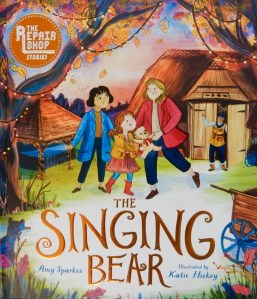
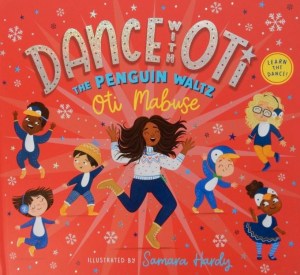
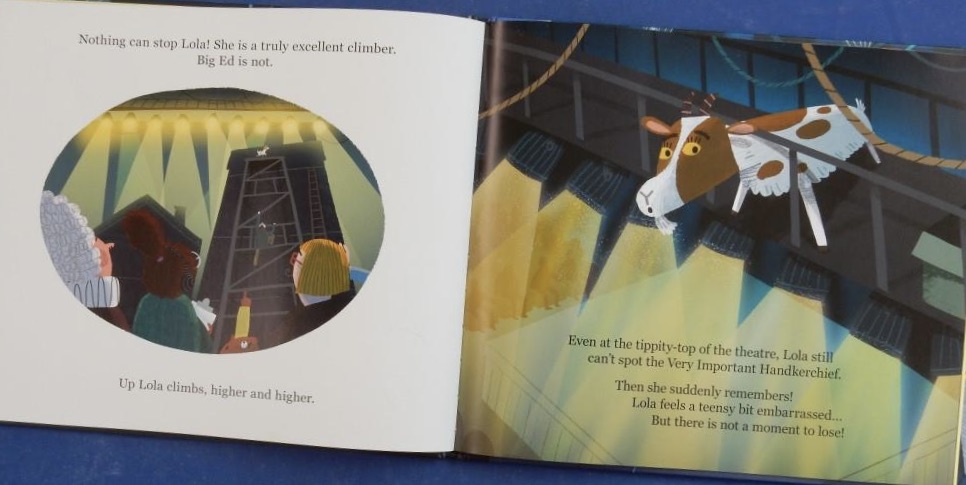
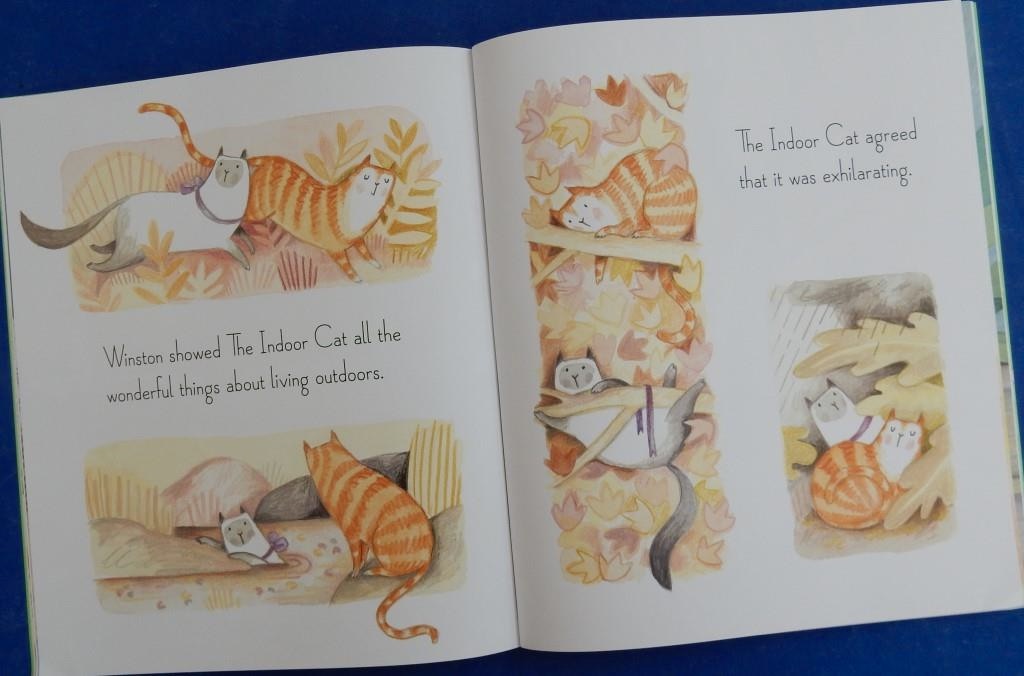
The Singing Bear / Dance With Oti: The Penguin Waltz

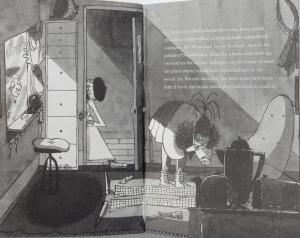
It’s always a huge pleasure to visit the Repair Shop and see Jay Blades and his team of expert repairers in these picture books that are based on the real life events of those who visit the workshop. This one featuring Kwai, Anne and young niece Lucy who bring along Singing Ted, for the team to work their magic on, being the third.

Kwai’s elder sister, Anne recounts part of her back story, explaining how as an eight-year old, she learned that her parents were going to adopt a baby girl, Kwai, from Hong Kong. When the little girl arrives, she’s quiet and sad and to try and cheer her up, the family visits the toy shop where they buy a teddy that plays a lullaby at the turn of a key.

On seeing the bear, little Kwai’s eyes light up for the first time

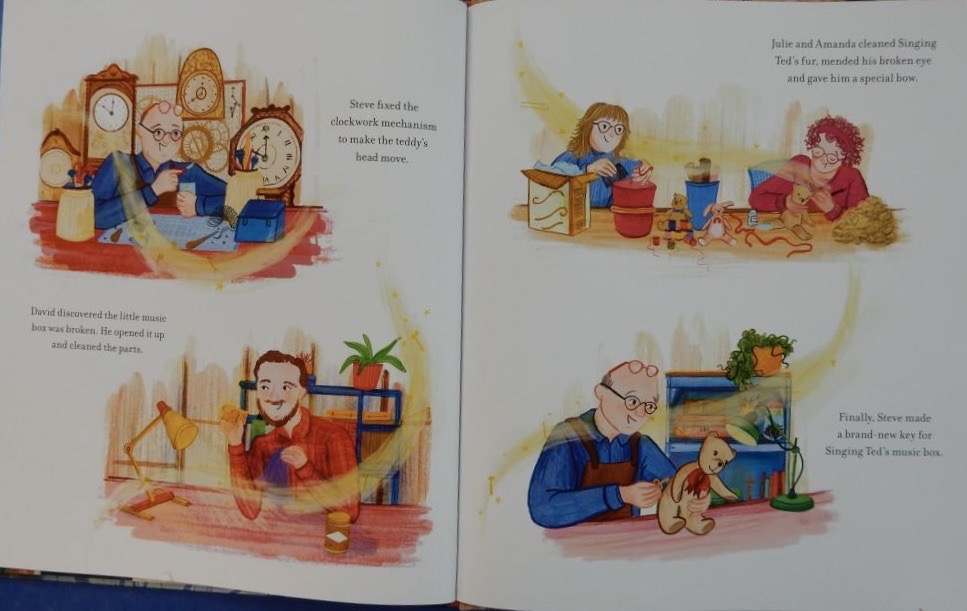
and from then on, Singing Bear as she names her teddy and Kwai go everywhere together. Inevitably over the years, the bear has been loved so much that it now needs Jay and his fellow workers to use their skills on Ted. Can they make the bear sing again as well as fixing the other things that need restoring?

Happily when, the three return, Jay greets them with a big smile and wonderful news.

Amy Sparkes’ telling is a delight but Katie Hickey’s superbly expressive illustrations, endpapers included, really bring the events to life making the book even more special. Back matter recounts the true story of the Singing Bear and introduces Jay and his expert team.

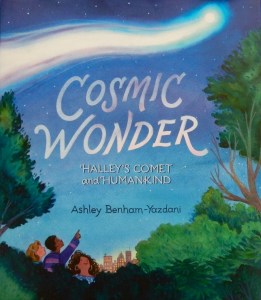
Mrs Oti and her dance class are preparing for a special wintry themed show when the snow falling outside prompts one of the children to ask if they can go out and play. Wrapped up warm, off they go and straightway as Mrs Oti teaches them how to balance on snowy ground, penguins are mentioned. This leads one of the pupils to initiate a penguin waddle and after a snowball fight, and further talk of penguins , Mrs Oti tells them she has an idea for the final dance in the show: the Penguin Waltz.
Back indoors, re-energised by hot chocolate, the practising begins in earnest.
Come the day of the show, what a performance the children give until it’s time for the finale. A mishap occurs but Gan’s quick thinking and sense of teamwork save the situation and the dance finishes perfectly, to the delight of watchers and performers.

A delightful addition to the Dance with Oti series: Samara Hardy’s bright, lively illustrations showcase Mrs Oti and her class beautifully: their camaraderie really shines through.
Read the book with your KS1 class, then get up and try the moves: you and your listeners can learn the penguin waltz by following the step by step instructions on the final spread.

AlphaBot / The Secret Mountain / Albert Puzzles and Colouring

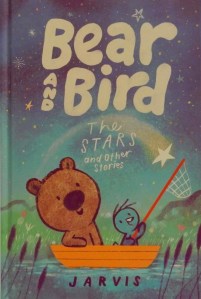
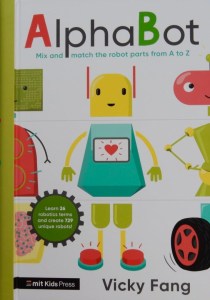
This interactive, non-fiction book published under Walker Books mitKidsPress imprint is sure to be a winner with children. On the first page comes the invitation: ‘Mix and match the AlphaBot parts! / What kind of robot will you build?’ Subsequent pages are split into three parts with scientific terms in alphabetical order defined on the verso sections and robot related illustrations are on each recto section.

The split pages make the book huge fun allowing the reader to design numerous different robots.. Its sturdy construction with a spiral binding will enable it to stand up to the heavy handling it is sure to get in a classroom or at home, as eager youngsters delightedly flip the sections back and forth, playfully learning a considerable amount while so doing. I met a couple of terms I’d not encountered before.

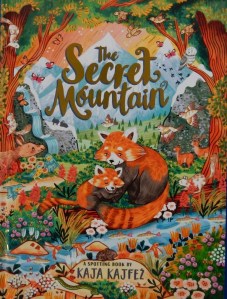
This book takes children on a long, long journey from Mount Everest all the way to Iceland. They will travel via Scotland’s Ben Nevis, then in turn the highest peak in the Andes, the Rocky Mountains, the Urals dividing Europe and Asia, Mount Broken in Germany, the Dolomites, the Heavenly Mountains of central Asia’s Tian Shan, California’s Mount Whitney, Mount Fuji and finally as night falls, Iceland’s Kirkjufell mountain.

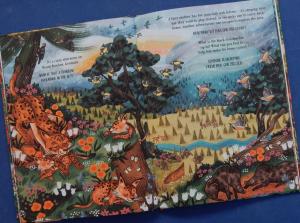
As the sun rises over the Himalayas youngsters will see in the foreground of the illustration, a young snow leopard and her cubs heading off to hunt for food. Also out hunting is a bear and readers are asked, ‘What might he be searching for?’

In each of the following illustrations, every one of which is bursting with wildlife, there’s a mother animal of some kind and her young. So across the day you’ll also spot golden eagles, llamas, moose, brown bears, lynx

and more; some are foraging, others in flight or perhaps playing.

Each spread has a search and find element, another of the interactive elements of this immersive, creature-filled compilation for adults and children to share. Additional facts about eleven animals – one per stopping place – are provided in the three final spreads.

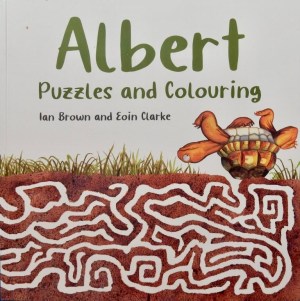
Albert the Tortoise loves to play games with his garden dwelling pals and now in this book he invites young readers to join him and participate in some playful activities at home. There are pages of silhouettes to identity, mazes to negotiate, a search and find, as well as several spreads to colour, others for playing spot the difference, and young children can hone their fine motor skills with dot to dots (those can be coloured in too).

Vlad the Fabulous Vampire

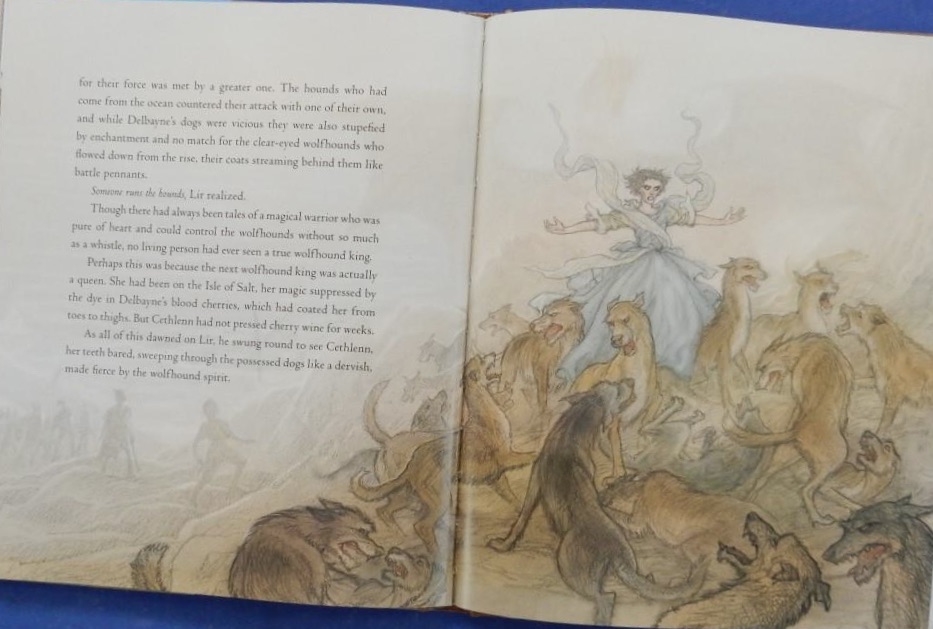
Meet Vladislav Varnaby Roland Dragul aka Vlad. Vlad has a passion for fashion and consequently he is a stylish vampire. However he has a secret of the colourful sort: behind his black cape he hides rosy pink cheeks that make him look all too alive. Vlad longs to feel and look like any other vampire; he feels insecure with his rosiness and uncomfortable about concealing his real self. However, he starts designing and making his own gear, always covering his cheeks; but having strutted his stuff for a while, he realises that he’ll never be able to hide who he truly is. 

Off goes Vlad to be by himself but after a short time he is alerted to the fact that his vampire pal Shelley is in trouble. What he sees is that she too has a shockingly bright physical trait. This makes Vlad reveal his own secret and with their friendship firmly established and Shelley leading the way, the two venture beyond the Dark Woods for Shelley to share another secret, a sight never before seen by another vampire. 

It’s in this new place that Vlad starts to overcome his insecurity about who he is 

and that’s when his fashion passion really comes into its own. From then on, whenever insecurity raises its troublesome head, Vlad knows he has somebody to help him cope with his self-doubt.

Drawing on her Mexican heritage, Flavia Drago mixes folk art with cartoon style in her illustrations, adding brighter hues to her colour palette as Shelley leads Vlad towards self-affirmation.
Yes you might share this one at Halloween time, but its vital message is for all times.

A First Book of Dinosaurs

It surely is a case of ‘eat or be eaten’ in Simon Mole’s poetic presentation of dinosaurs in all shapes and sizes. The large format book dramatically illustrated in collage style by Matt Hunt is divided into four sections: ‘Meet the Dinosaurs’, ‘Eat or Be Eaten’, ‘Dinosaur Families’ and ‘The End. Or Is It?’ Readers/listeners will encounter some already established favourites such as Triceratops, Tyrannosaurus Rex (the first two featured), Stegosaurus and Diplodocus called herein Planet On Legs on account of the numerous small creatures that live on its back. There are many less well known creatures too including the dog-sized Eoraptor (new to this reviewer as is Baryonyx). I love Simon’s description of that one: ‘Swift-sprinter / Tail-flicker / River-watcher / Quick- dasher / Fish-grabber / Flesh-ripper // Best hunter / Gets dinner!’ together with Matt Hunt’s dynamic visual interpretation. A wealth of kennings in that.

Readers are introduced to a variety of poetic forms: Ankylosaurus, Sauropelta and Euoplocephalis are all described in a single acrostic entitled Tough! Tough! Tough!.

There’s a wealth of onomatopoeia, some similes and metaphors, a recipe and even a dialogue with a present-day chicken. To find out what said chicken is doing in a book about dinosaurs, you’ll need to get your own copy; so doing will make you popular with youngsters for sure.

After a look at the downfall of dinos and some fossil evidence, the book ends with a somewhat truncated dinosaur timeline.

A large-format, romping, stomping treasure, beautifully produced and one hopes, likely to turn a fair number of dinosaur-fanatic children into poetry enthusiasts too.

Peace on Earth

‘Peace on earth … GOOD WILL TO ALL!’ Surely this is something almost all of us long for and with on-going conflict in several parts of the world, this stunning, heartfelt book couldn’t be more timely.

Lyrically written by Smriti Halls and dramatically illustrated by David Litchfield, it presents a story wherein we follow a group of friends who embark on a journey together over land and sea. A journey that starts out full of joyful anticipation and happy camaraderie

but then, lost and afraid, angry words are spoken – hurtful words – that cause distress and pain.

Thereafter it’s hard for the group to -re-establish that former harmony, peace and light. Fortunately though with the will being there, as it is with the friends herein, they find the courage and the inner strength to be peacemakers. I love this scene showing one of the characters bringing an affirming flame towards the others.

Thus, the story ends with a reconciliation that reunites the characters and they go on to share their joy with others as lights shine forth all along the shore line.

With its combination of striking art and deeply felt words (inspired by Luke 2:14), this book needs to be shared and talked about as widely as possible in many different settings from the family to adult meeting places.

Mermedusa / The Stars Did Wander Darkling

In this the fifth and final book in the Eerie-on-Sea mystery series, it’s midwinter once more and nigh on a year since Violet Parma appeared in Herbert Lemon’s Lost and Foundry at the Grand Nautilus Hotel. She had come searching for her parents but in so doing found Herbie, now a firm friend and herself, as Herbie tells her. The mystery of her parents’ disappearance remains unsolved however as the story begins.

I’ve not read any of the previous books in the series but that didn’t stop me quickly getting sucked into this wonderfully written, powerfully atmospheric, gripping tale with its truly memorable characters. Apart from Herbie and Violet, it would be impossible to forget the truly sinister Sebastian Eels, who keeps appearing in unexpected places as the two friends get ever closer to understanding the Deepest Secret of Eerie. New arrivals in town are three monster hunters cum hosts of the Anomalous Phenomena podcast, Professor Newts, Angela Song and sound-man, Fluffy Mike. Their aim is to discover the legend of the Malamander and share it with the whole world. There’s another monster too in the form of the titular Mermedusa.

What is the source of the “Eerie hum” that seems to be calling the Malamander from the deep and is making things to go wrong in town?

Action-packed, there are scary happenings aplenty, and some downright eerie ones in addition to that hum; a number of secrets are unravelled, some reunions take place and with Herbie being a ‘Lost and Founder’ there’s no doubt that whatever comes to light will be largely down to him – and Violet of course.

This decidedly eerie story is set in Oregon, in a small run-down coastal town called Seaham, where many streets and landmarks are named after the Langdons, a wealthy 19th-century fur-trading family. In this town live Archie, Oliver, Chris, and Athena. who are all looking forward to the summer break and going camping. Archie’s dad is in charge of a multimillion-dollar project to develop part of the headlands including the old Langdon house into a resort, upsetting many in the community, but it’s been paused since excavation revealed the promontory to be full of holes. Nobody will really tell the four friends anything so they take it upon themselves to do some investigating, especially after Archie sees: an elderly woman who mutters, “They shoulda left it hid,”.

But then strange happenings arise: Oliver gets some kind of ’episode’ that results in him being hospitalised. There he gets other more vivid visions as he calls them. As well as that there’s some strange behaviour from local adults with parents smelling decidedly odd and the arrival of three Shelley-quoting newcomers in old-fashioned clothes.

The friends decide to head to the local video shop, Movie Mayhem and there Randy, the proprietor, produces a box of photographs and old film from way back and also shares with them his local historic knowledge

Tension continues to build with the ever increasing weirdness and odd aroma of people, and events – why does Oliver keep seeing a zebra? Can some ancient evil be at the heart of all this? If so, can the four friends save their town?

Some of this gave me the feeling a horror movie was unfolding before my eyes, so creepy are the happenings. I’d say this is most appropriate for readers of eleven and over rather than 9+.

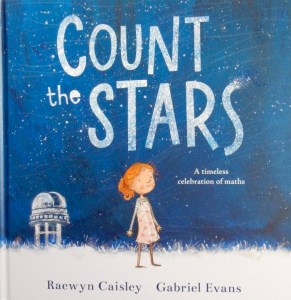
Count the Stars

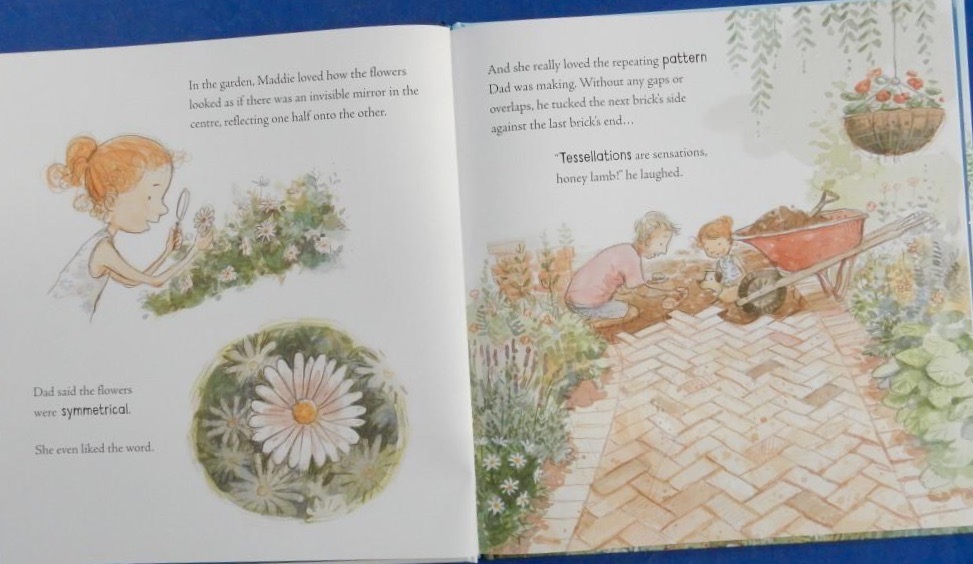
No matter what young Maddie sees or does, her everyday world is full of mathematical ideas; that’s just how she sees it, thinks about it and loves it. Perhaps it’s the early morning sunlight streaming through her bedroom blinds; then there are those fractions in her piano practice, the symmetry in flowers, the tessellating pattern in the pathway she and Dad make together,

the wealth of opportunities to count things in nature and much more besides.
Almost all the time Maddie is happy and comfortable in how she looks at the world, but very occasionally she notices that it makes her different from her friends – ‘an odd-shaped brick that didn’t fit into the pattern.’ This happens when some friends come to play: whereas Maddie focuses on the mathematical transformations involved in making hats for her dolls,, Grace and Olivia’s only interest is the dolls. Similar when they make cupcakes, her friends are interested in the decorations on the tops, Maddie in contrast, loves measuring out the ingredients.

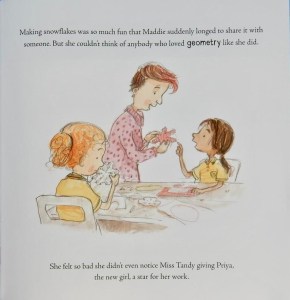
One day in school when Maddie and her classmates are busy making paper snowflakes, she wishes there was somebody with whom she could share her love of geometry. She doesn’t notice that perhaps there is, in the shape of a new girl, Priya; and for the next few days Maddie feels downcast.

Fortunately though, her perceptive Dad has a surprise in store. That night he organises a night-time playdate with Priya and they pay a visit to the observatory. An unforgettable experience for sure and one that leaves Maddie thinking an absolutely massive, mathematical what if …

From cover to cover and endpaper to endpaper, this is a wonderful, multi-layered book. Apart from being a terrific, superbly illustrated story, it’s overflowing with classroom potential, starting perhaps with a discussion on ways of seeing. I love that it shows how the imagination and creative thinking, and a fascination with facts, can sit side by side, as well as demonstrating the vital importance of notions of what if … as the basis for all new discoveries.

Betty and the Mysterious Visitor

Every summer Betty visits her grandma in the village of Wobbly Bottom. She loves spending time in the Acorn Hollows, the garden shared by all the residents of Grandma’s terrace. There she delights in the abundance of flora and fauna; there too her gran cultivates various fruits and Betty helps her pick them, make jam and sell it in the local market.

Full of eager anticipation Betty wakes on market day only to discover that overnight the garden has become a muddy mess. However there’s no time to investigate properly before they leave for the market. 

There it’s full of people buying and selling and come teatime all grandma’s jam has been sold so they head home with Betty determined to find out how the Hollows was spoiled.

She watches through the window that night and in the moonlight she spots a large creature thrusting its nose under the fence but in a trice it’s gone.

The following morning Betty’s Grandma says it was probably a badger and that it’s likely to return. Sure enough, over the next few nights the badger comes back, wreaking havoc in the garden. Supposing it gets into Gran’s fruit cage? Time to get working on a creative solution, thinks Betty and she puts together a frightening monster, then lays a trail towards it. 

Wide awake that night, Betty watches and in comes the badger. However, such is the effect of a sudden wind on the monster, that the intruder hastily departs but not before, so Betty thinks, looking directly at her, as if saying farewell.

Grandma is pleased to hear her granddaughter’s account next morning and together the two sit beneath the trees and celebrate with hot chocolate.

Author, Anne Twist’s inspiration for this, her debut picture book, was her own country garden and what a lovely celebration of the natural world it is. It’s also a beautiful celebration of intergenerational love. How brilliantly Emily Sutton’s jewel-like illustrations bring the world of Wobbly Bottom to life; each re-reading will likely reveal fresh details to savour.

Albert and his Friends / Spooky Little Halloween / That’s How Much I Love You

Albert the Tortoise has already established himself as a popular character among children from around three and their adult sharers. Now he wants to introduce himself and his minibeast friends to the very youngest children. In this little book, with its simple text and close-up images, they will meet in turn, Butterfly with its gorgeous wings, then a pair of woodlice, wiggly worm pops its head up through the soil, Buzzy Bee alights on a flower just in time to say hello, Snail slithers up with its shiny shell, Ladybird gives a wave with one of its front legs, Spider proudly shows a newly spun web 

and the ants demonstrate their teamwork. On the final spread, Albert’s multitude of friends return the compliment, telling the tortoise what a good friend he is to all of them.
Just right for the under threes.

Not really very spooky as the eight characters that almost leap from the pages of this vibrant ‘Finger Wiggle’ book are all smiling in a friendly manner. First comes a little witch riding her broom, arms outstretched; she’s followed by a little wolf singing to the moon, a spider wiggling its eight hairy feet, a little ghost, a rotund pumpkin, an upside down bat, a black cat and finally a little monster proudly showing his first tooth – albeit a very sharp one. On each spread that introduces Nick Sharratt’s endearing characters, Sally Symes’ simple rhyming text provides a ‘wiggle wiggle’ and a fun, sometimes onomatopoeic phrase to join in with.

One cannot help but bring to mind Sam McBratney’s Guess How Much I Love You when reading this first person rhyming tale wherein an adult racoon tells its cub just how much it is loved. The rhyme reads well aloud presenting in turn pairings such as a sock and a shoe, the sun and the moon, a bowl and a spoon; but it’s Tiphanie Beeke’s richly hued illustrations painted on textured paper showing the two racoons that steal the show, especially the final one wherein paw in paw, adult and cub walk in a woodland setting at sundown.
A gentle bedtime wind-down book to share with toddlers.

Sona Sharma: Wish Me Luck / The Feeling Good Club: Be Kind, Shazmin!

With its Tamil Nadu setting, the Sona Sharma series is one of my very favourites for younger readers. In this fourth story, Sona’s much-loved teacher is getting married and the entire class has been invited. This she learns on the last day before a mid-term break. So far so good, but then Sona sees on the invitation that Miss Rao’s husband to be comes from a place called Vijayawada that’s several hours away by train and by tradition the bride moves to live in her husband’s city. Definitely not good and Sona and her friends want to try and stop this happening so they start making a ‘lucky’ plan to keep Miss Rao as their teacher.

With this in mind, despite her list of things to do during the break, Sona is preoccupied with the possibility of having to bid farewell to her teacher. So. aided and abetted by Elephant, she begins to search for lucky charms . The night when her Amma hears about all of this, her response is, “Fortune favours the brave, Sona. … If you want something, go and make it happen.”

Sona’s way of doing so is to write a petition, get all her friends to sign it, as well as others at the wedding and then after the ceremony, hand it to their teacher. She puts a great deal of effort into this project; but what will be the outcome?

With its theme of embracing change, this enchanting story exudes warmth and family love throughout and as always, Chitra has woven several South Indian Hindu customs into her narrative including some details of the Kanyadaanam ceremony at the wedding

and Paatti’s story about Rudraksha beads, prompted by the seeds Sona’s friend Renu adds to their collection of lucky charms. Whether read aloud or alone, Jen Khatun’s illustrations add to the delights of the book.

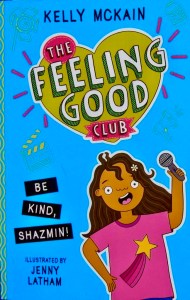
‘Sometimes I miss the old Charita so much it actually makes my stomach hurt.’ So writes her younger sister, Shazmin in her journal at the start of this third episode in the series wherein Bella, Archie and Shazmin help one another to face and cope with the things that worry them by means of supportive friendship and mindfulness activities.

Shazmin is upset that her elder sister, Charita, now a teenager, no longer wants to hang out with her. In a desperate attempt to impress Charita, she persuades Bella and Archie to participate in the making of a video with her, but she keeps the real reason for so doing to herself.

The three friends start working on the video but things keep going wrong, there are misunderstandings and squabbles and the project seems to be heading for the scrap heap.


Is there any way that what started out as a potential prize-winning video, can be rescued, even if that means it taking a rather different direction. And can harmonious relations be restored both in Shaman’s family and with her two Feeling Good Club buddies? Perhaps, but it will take some mindfulness by all concerned.

Children’s well-being has really come into focus since covid and Kelly McKain’s series of highly accessible stories with personable characters openly sharing their emotional ups and downs in situations that children can relate to, provides gently humorous, warm much-needed mentoring in book form.

Yippee! Rabbit / Uh-oh! Rabbit / Maisy’s Big Book of Kindness

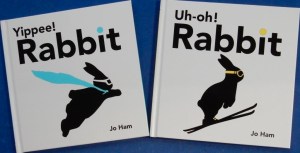
If you think this rabbit character looks familiar it’s probably because you’ve seen it on merchandise such as mugs and now the same Rabbit stars in two small books for the very young.
Yippee! Rabbit sees the little creature running uphill, kite behind and the words, ‘Rabbit go’. Reaching the hilltop with kite flying, is celebrated by a ‘Yippee!’ However turn over and there’s Rabbit and kite both entangled with a tree.

Further sequences follow a similar pattern and see Rabbit swinging close to another rabbit that is digging veggies from the ground and loading them in a wheelbarrow, going for a scooter ride in the rain and finally in a pattern breaking dash, launching high into the air … bound we know not where.
The endpapers show Rabbit engaging in a range of other activities, some more risky than others. I suspect this will become a winner with little humans as will the companion book.
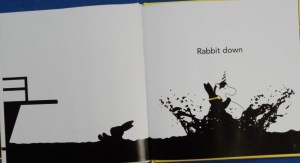
Uh-oh! Rabbit features two leporine and on the opening spread we first see them on a seesaw with the words ‘Rabbit down’. Turn over and there’s one ‘Rabbit up’, the other blissfully floating along on a blow up unicorn. The next page shows the rabbit from a diving board now in midair ‘Uh-oh!’ – where’s the landing place for ‘Rabbit down’? …

Other sequences show Rabbit ski jumping and then, using a slide, with the same prepositions used in each instance. However the final adventure has a twist and the sliding Rabbit, one assumes will land safely in the larger one’s outstretched paws.

Just right for sharing with the very youngest.

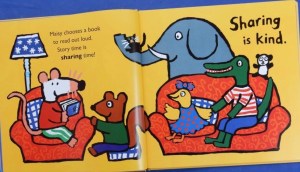
Kindness makes the world a better place but what does this mean for Maisy and her friends Tallulah, Eddie elephant, Cyril, Charley, Dotty, Little Black Cat and Panda?

First are examples of sharing: Maisy shares her toys, allowing Tallulah to play with Panda; she also shares favourite places – her paddling pool on a hot day, her umbrella when it rains and a favourite book during story time .

Giving is another example and Cyril’s birthday provides the backdrop for lots of giving – Maisy makes him a card, Charley bakes him a cake and both are duly thanked for their kindness.

Caring comes next and we see Maisy and Eddie caring for the plants in the former’s garden; then Daisy and Tallulah co-create a bug hotel. Indeed Daisy cares for lots of farm animals too, making sure they all have sufficient to eat. Extra care is needed when Dotty is hurt by a tumble from her skateboard and helping is needed when Little Black Cat gets stuck in a tree and all the friends help make the barbecue lunch Maisy hosts a success, including finding a way to help the planet.

The final scenario is ‘playing together’ which is rich in opportunities be they a quiet game with turn taking or a riotous musical extravaganza.

Altogether a joyful celebration of kindness to share, talk about and one hopes act upon at home and in early years settings.

Too Small Tola Makes It Count / Mermaid Academy: Cora and Sparkle

This is the fourth book in the enchanting series set in Nigeria featuring Tola who lives in a small flat in Lagos, Nigeria, with her older brother, Dapo, and sister, Moji and Grandmummy, the boss. Lockdown is now over and the four are back together and feeling very happy so to be. In the first story, Tola Finds a Solution, Tola’s friend, Mrs Shaky Shaky, who likes to come down and sit on the outside steps and chat to passers by, is having difficulty with the stairs. Tola too is having some difficulty at school because nobody believes that she knows and worked for the most famous Afrobeat musicians in Nigeria. Tola is great at solving maths problems but loneliness is much more tricky. Can she find a way to help Mrs Shaky-Shaky, and perhaps herself too? Tola certainly isn’t one to give up easily

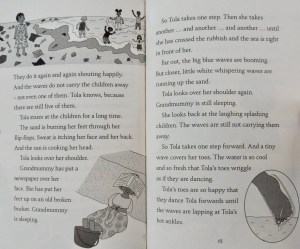
In Tola Counts the Uncountable Grandmummy announces that they are going to take a holiday, something Tola and her siblings have never done before: they’re off to the beach! In the end only Grandmummy and Tola go. Tola is shocked at the amount of rubbish all over the beach, covering a lot of the sand and she realises that she’s found something impossible to count – the grains of sand. Later on she finds two more uncountable things: one is the waves; what could the other be do you think.

In Too Small Tola is a Rock Star, Tola is looking after baby Jide for Mr and Mrs Abdul. Suddenly she realises that he’s crawled off. Where can he be? Can Tola find him?

Readers and listeners will be charmed by these tales, which as always, celebrate family, community and love, as well as trying to find answers to sometimes tricky concerns. Onyinye Iwu’s illustrations are full of warmth and gentle humour adding to the delights of Atinuke’s text.

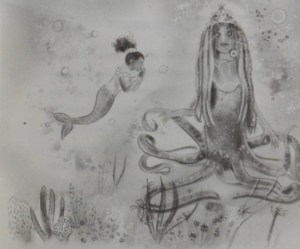
In this second tale set in and around Mermaid Academy the focus is the under-confident Cora and her dolphin partner, Sparkle. Cora has now been at the academy several weeks and still misses spending most of her time close to her twin, Issy. However, she is excited to hear the news that instead of normal lessons on Fridays, the students would participate in ‘enrichment activities’ or clubs. The club of Cora’s choice is music club, despite what her friends select but then she changes her mind and opts for what her sister has chosen. The day doesn’t go well until much later when she’s back with Sparkle and discovers her magic – it’s whirlwave magic, so Sparkle tells her and reluctantly agrees to Cora keeping this to herself until Issy has found out what her magic is. That means that any practice at creating whirlwaves must be covert.

Meanwhile her friends are excited about the repairs they’d been able to carry out on the damaged Glass Ocean reef but anxious to discover who or what is causing the destructive damage. To this end they all pay a visit to the Sea Sphinx,

the result being the possibility of a clandestine night-time adventure. Soon both Cora and Sparkle are heading towards the diminishing reef to find her friends and hopefully, the coral-crunching culprits. Great danger awaits but can the friends finally solve the mystery? And will Cora eventually decide to be true to herself in choices she makes?

Sparkling fun: younger readers will enjoy diving into the world of Cora and her fellow mermaids made even more magical with Lucy Truman’s drawings.

The Concrete Garden

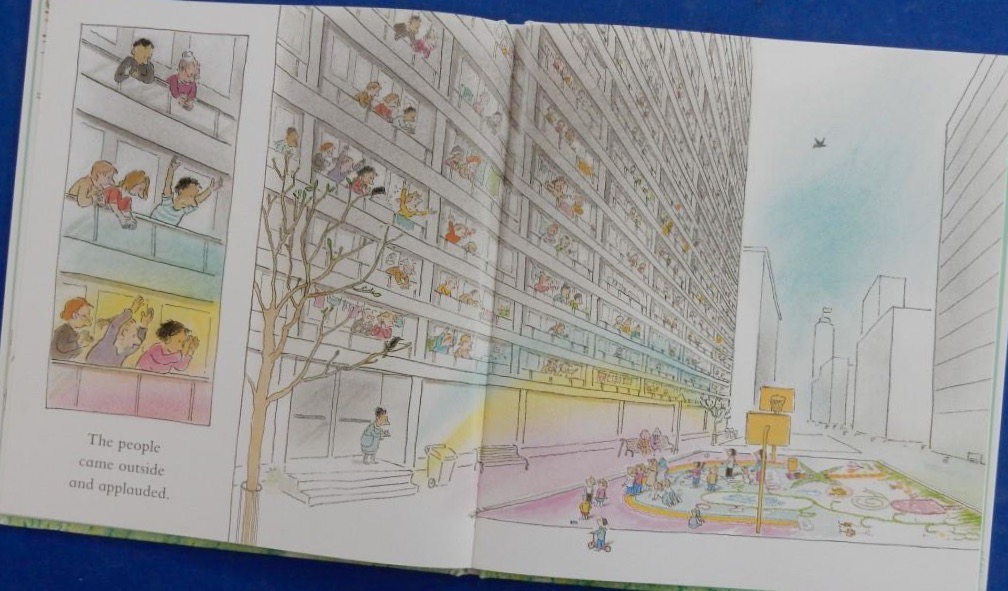
The product of covid times, this story starts with Amanda who lives on the fifteenth floor of an apartment block waiting for the lift down and clutching a large box given to her by her mum. As the doors open we see the lift is filled with other children and once they reach the ground they all spill out into the open air, ‘like sweets from a box.’ Last to emerge is Amanda with her huge box full of coloured chalks. It’s been a long, cold winter but it hasn’t diminished the children’s creative skills. 

First Amanda chooses a green chalk and makes a pattern on the concrete ground. Jackson adds a stalk and it becomes a dandelion. Others add more flowers, a mushroom, a snail slithering on it. Eventually there on the ground is an exotic garden alive with insects, birds and even an alien invader in its spacecraft. Over all of this reigns The Queen of Swirls – Rosie’s idea.

Three days later this wonderful creation becomes the victim of rain; but in the meantime Nasrin, who is missing her mum far off in Iran, captures the concrete creation on her camera and sends the image to her; she passes the image to everybody she knows bringing joy to them too.

Back in their home territory, having received appreciative responses from the apartment residents, 

the children are not bothered by the downpour and its effects and once the rain stops, out they come, Amanda pulling the now empty box. This she tears into pieces and so begins a new inventive activity for her and her pals.

Two good things that re-emerged during the pandemic were community spirit and the ability to find joy in the simple things in life: the latter Bob Graham allows the diverse children (not forgetting the dog) he drew in this story to show us all. His mixed media images of the children and their chalk creations bejewel the pages of the book making it a joy from beginning to end.

Ten-Word Tiny Tales

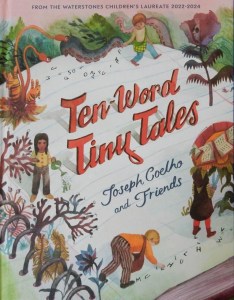
When explaining how the twenty stories in this book came about, poet and current Children’s Laureate, Joseph Coelho tells readers, ‘these are not cutesy tales – these are tales of teeth and claws!’ Despite their seeming simplicity, each of these fragmented story bits imply a more elaborate story and to this end, Joseph invited twenty artist friends to provide an illustrative interpretation, each one bringing a unique style to the enterprise. The resulting double-page spreads, through the interplay of words and pictures, are in turn mysterious, surreal, inexplicable or downright sinister.

For instance Nahid Kazemi portrays a moment of serenity as Grandma slumbers in her favourite chair while one of her plants – the Venus flytrap – edges ever closer to the blissfully unaware sleeper.
Equally disquieting is Thea Lu’s interpretation of ‘The X-rays reveal writing etched onto all of my bones.


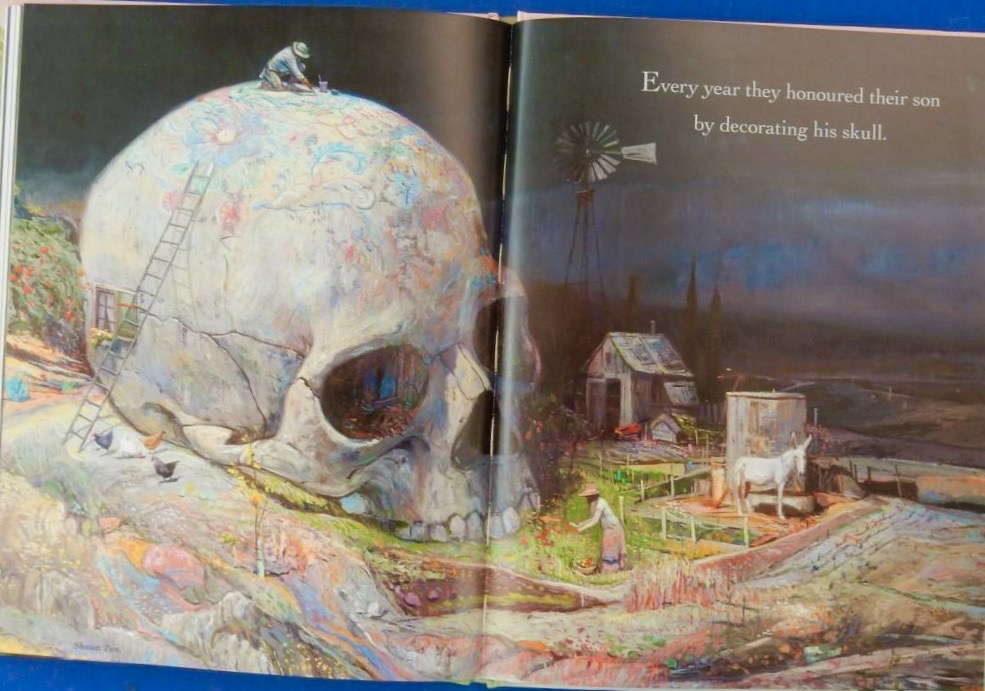
Meanwhile Flavia Z. Drago’s dining table scene combines touches of the dark humour of cartoonist Charles Addams with Magritte in her dining table scene; and look how Shaun Tan plays with scale in this enormously unsettling rural scene.

No matter where you open the book however, you are likely to find something to spark your imagination. To facilitate that Joseph offers several drawing and writing prompts to inspire and motivate children to extend the tales with ‘new beginnings, endings and middles’. What he says in ‘Take Your Pen on a Journey’ is what one hopes ,all teachers would be doing in the classroom.

A real treasure box this, with endless potential for creativity both at home and in school.

Space Pirate Bears

Wet weather, two bored children and a Dad busy working are the starting points for this wildly inventive tale. It’s Dad that does most of the inventing with tragedy in the form of a black hole, a Sniffle attack, a possible wave of alien broccoli, being averted. But there’s also the dreaded Doctor Drab whose aim in life is to turn the entire universe as dull as he is, by means of his terrifying Boron Beam. A hit from said weapon’s beam drained every scrap of fun out of the galaxy 

but there was somebody who just might with help, repel those forces of dullness and that was Princess Leonora and her heroic, multi-skilled, Space Pirate Bears.

At this point in Dad’s story, the two children, Jamie and Abby intervene and have a squabble about the direction it should take. 

Can they come to an agreement that puts paid to the Dok’s dastardly Boron Beam, leaving the Space Pirates to reign supreme and thus, the world able to revert to a place of fun?

A place of fun is an apt description for what is between the covers of this book. Both Alastair Chisholm’s words and Jez Tuya’s pictures epitomise the delights of story making, the former providing a humorous, twisting turning, action-packed adventure for the latter to play around with in his inventive scenes. A smashing book, especially for Dads to share with their offspring: inspired by the family in the story. Who knows what wild storytelling adventures of their own might result?

Ready for the Spotlight!

The younger sibling and narrator of this story, Tessie, envies her older sister for always being in the spotlight at their ballet classes, despite the fact that Tessie has been learning for just a month. Tessie however believes in herself: she’s better than everyone save Maya. Maya danced the Lilac Fairy in last year’s performance of Sleeping Beauty, wore a crown and received three bouquets of flowers.

Mum reassures her younger daughter that with as much experience as Maya, she’ll shine just as bright. Nevertheless, Tessie wants to be the best now, and her jealousy grows. Then come auditions for the autumn show in which she dearly wants to wear that crown. When it’s time for the freestyle, Tessie’s favourite: in this she excels, saying “No rules. No pointed toes. Who needs lessons when you have rhythm?”

Surely this will be sufficient for her to get that lead role. But no, it’s Maya who will be the princess, Tessie and two others are to be bumblebees.

That night back at home. Tessie is angry with her sister, refusing to teach her freestyle dancing because, “You stole my crown.”

Sisterly love saves the day as Maya tells her sister, “You don’t need a crown to be a good dancer.”, and goes on to say that she too had started out as a bumblebee. From then on the sisters practise together, Maya teaching Tessie jumping and balancing, and Tessie teaching her sibling freestyle and grooviness. Come performance day, it turns out two can share the spotlight and receive armfuls of bouquets.

Throughout this tale of personal growth, jealousy and tender sibling bonds, it’s Tessie and her emotions that take centre stage in Jaime Kim’s splendidly expressive illustrations for her story, which is based on her own childhood experiences with ballet and her little sister.

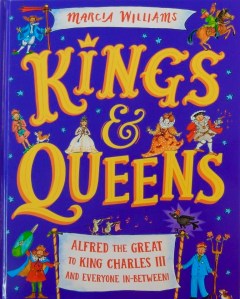
Kings & Queens

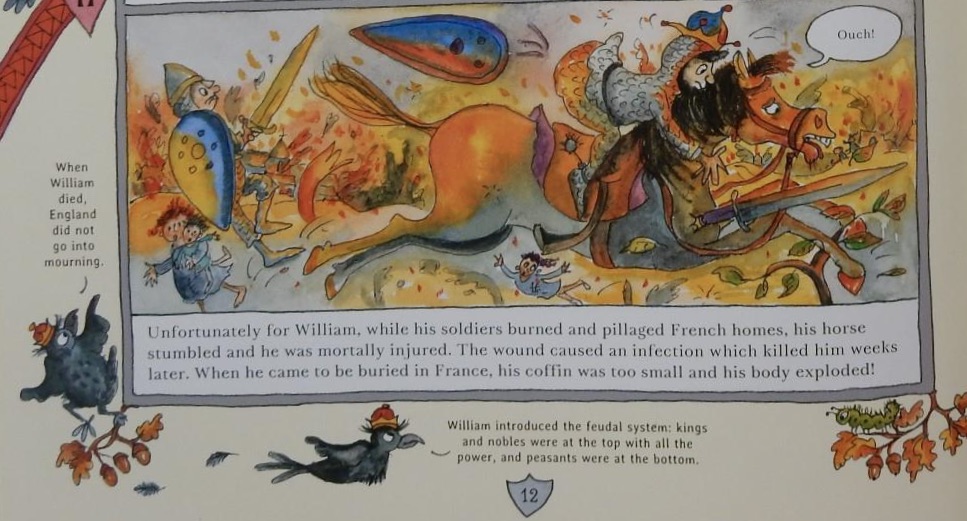
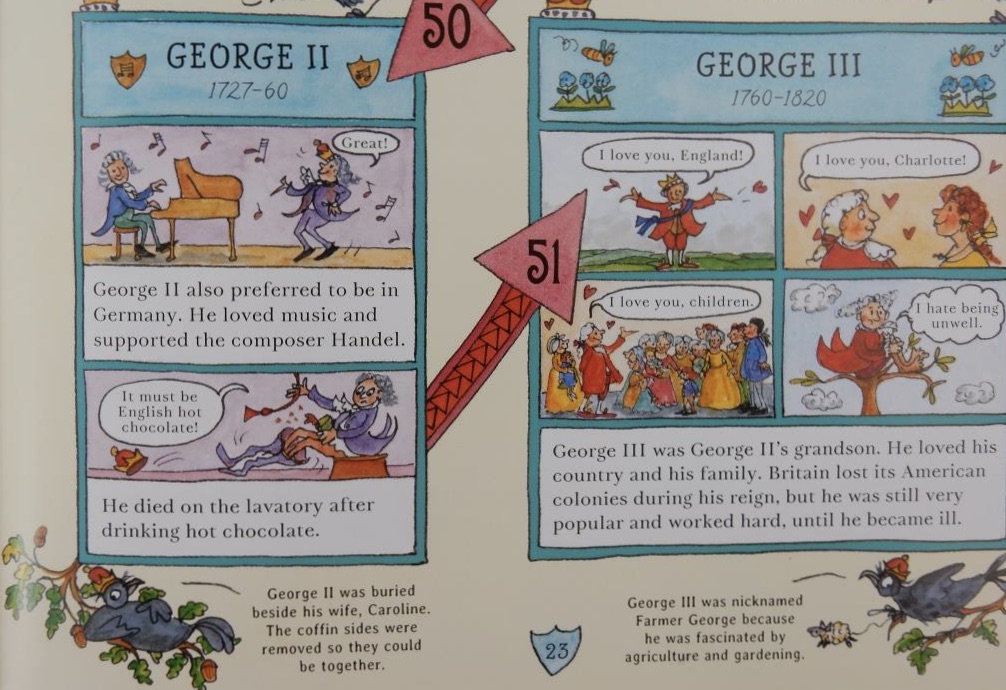
Essentially this is a whistle-stop tour of monarchs, sixty in all, starting with Alfred the Great and going all the way through to our present King Charles 111, presented in Marcia Williams’ trademark comic strip style, with speech bubbles and a wealth of humorous details in both the text (that includes a commentary by royal raven Caw) and illustrations that KS2 readers will really enjoy.

King Caw takes us on a journey along the timeline from 871 BCE to today. Along the way, we learn the dates of each monarch’s reign and any number of quirky facts about them, often relating to their untimely demises.

For instance we read this of William the Conqueror (1066-87) – a thoroughly unpleasant man so we are told: ‘ … he was mortally injured. The wound caused an infection which killed him weeks later. When he came to be buried in France, his coffin was too small and his body exploded.”

This about George 11 (1727-60) made me laugh so much I choked on my coffee: ‘He died on the lavatory after drinking hot chocolate.’

Seemingly the toilet was a dangerous place for royalty: King John (1199-1216) also died on the loo, perhaps due to over consumption of peaches.

A book likely to turn primary age children into history lovers.

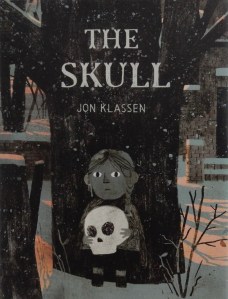
The Skull

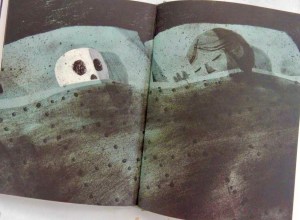
Weird and wonderful is Jon Klassen’s adaptation of a traditional Tyrolean folktale. Klassen brings his wry humour to this sometimes creepy, sometimes comforting and consoling telling of what happens when a runaway girl named Otilla dashes through the forest one night, trips in the snow, falls and having found her way out of the woods, discovers a large, old, seemingly abandoned house.

It’s not abandoned entirely though for inside resides a talking skull. Said skull agrees to let Otilla in; the two gradually form a friendship as the girl assists the bodiless being in doing things it would otherwise be unable to, such as drinking tea,

picking and eating a pear from the garden room; the two even dance together. As they take tea, the skull tells of a headless skeleton that frequents the house each night and Otilla determines to make sure it never catches her new friend.

Drawing on her resourcefulness and ingenuity, she annihilates the skeleton, returns to bed

and next day accepts the skull’s invitation to live with him in the rambling old house. An unexpected and unlikely happy-ever-after if ever there was one.

Klassen’s limited colour palette certainly highlights both the cosiness and spookiness of his telling, after which in an author’s note he tells readers how he came across a story called The Skull in a library. It lingered in his mind, morphed into something rather different and eventually became this book. I can’t envisage many other than he who could envisage a cranium companion for a young girl, unless they were creating an unadulterated horror story. This is anything but and even quite young readers and listeners will love it.

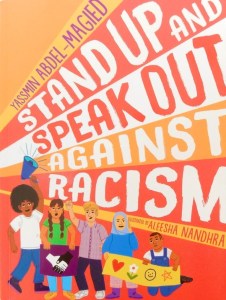
Stand Up and Speak Out Against Racism

A social activist, broadcaster and engineer, the author of this book visited schools and asked children what they wanted to know about racism and how to fight for social justice: herein she tries to answer their questions impartially. At the outset, she presents life as being like ‘climbing up a big, tall, scary mountain, and when we are born, we all get a different set of tools to climb it.’ For some the way is blocked, some get access to a cable car, while others must use the stairs and the most fortunate get a ‘jetpack’ is how she puts it, immediately drawing readers into the book.

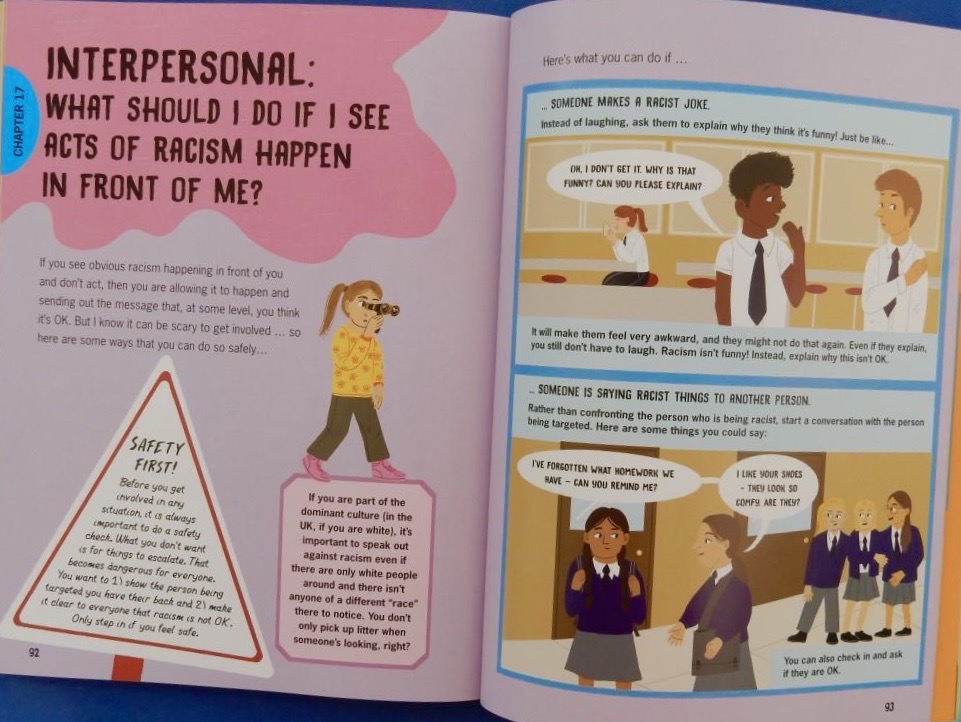
After that, the book is divided into three main sections: how racism started, what racism looks like today and finally, how do we stand up and speak out against racism? There’s a timely reminder to readers to take the book at their own pace and if something gets too much, stop and return to it when it feels okay. I know that I find myself getting really upset when I hear of people’s racist behaviour in the UK and feel ashamed to be British by some of what I see and hear on the news, for instance. The author states here that the English colonisers created slave codes or rules that formed the roots of the racism so entrenched in today’s world and in her conversational style leads readers through to the book’s final part: what to do – how to stand up and speak out. There are lots of practical suggestions such as asking someone who has made a racist joke why they think it’s funny, 

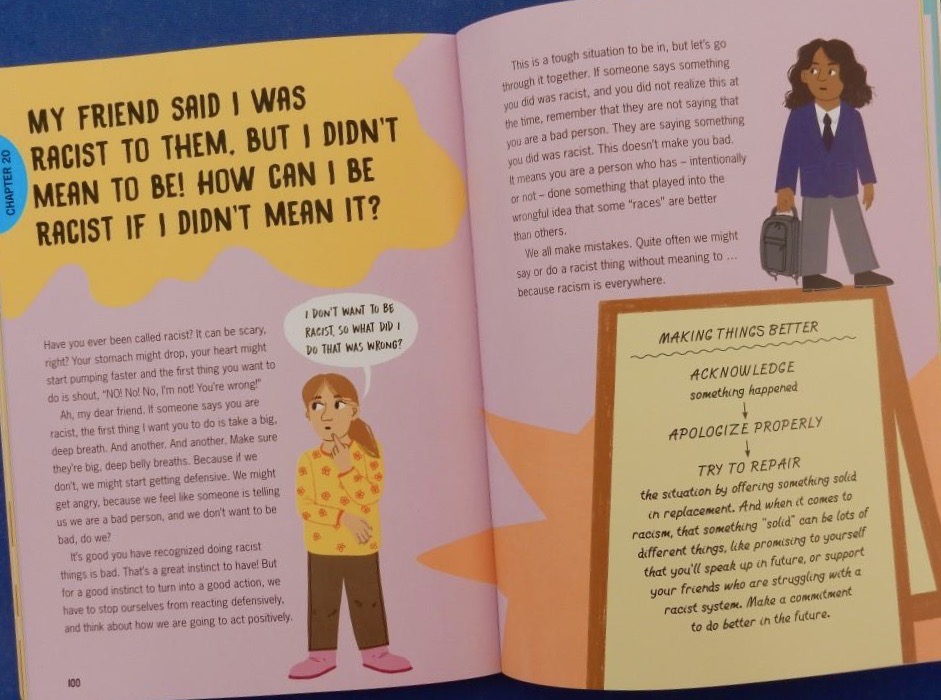
and questioning somebody who has made a judgement about others on account of their race. And of course, if you happen to be the person in the wrong, even by mistake, it’s important to apologise to the one wronged and to try and make reparations.

This is an important book that needs to be in all schools to instigate class discussions; many adults would do well to read it too.

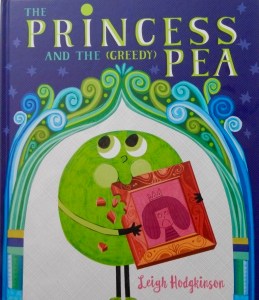
The Princess and the (Greedy) Pea

Take a popular children’s song and a favourite fairy tale, play around with those key ingredients then mix them together and the result is this clever and very funny new fairy story.

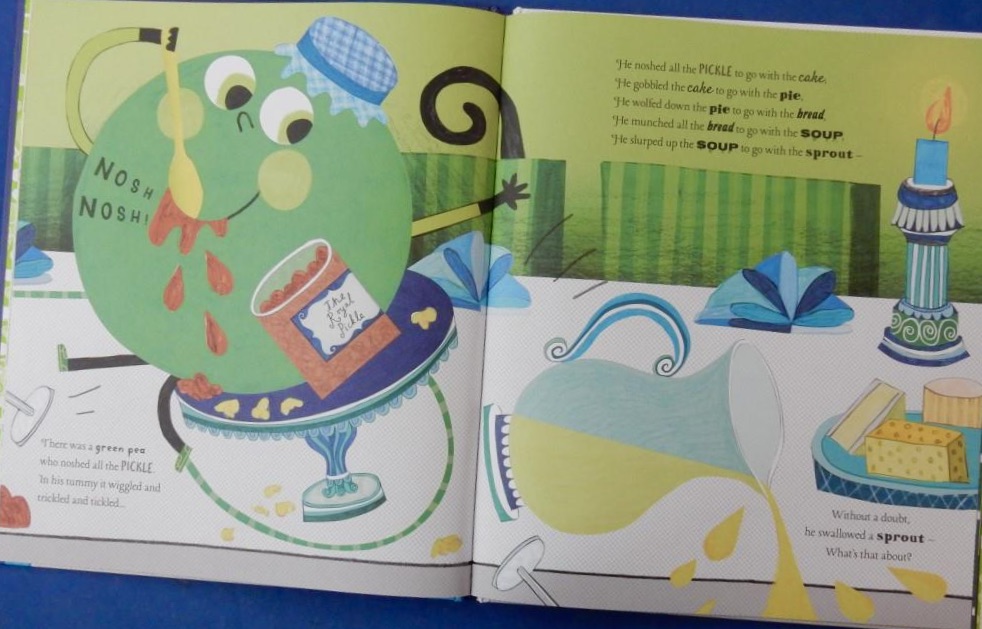
It begins with a ravenous pea that becomes the subject of a new take on ‘There was an old lady who swallowed a fly’, but now said pea does the swallowing and what he swallows is a Brussels sprout. Don’t ask me how a tiny spherical object managed to gulp down a considerably larger, similarly shaped one but that’s how this story goes.

Now this pea just happens to have found the delicacy among the feast laid out on the table of a royal residence and not content with the sprout, this pea goes on to stuff himself with soup, bread, pie, a fancy cake, pickle

and cheese. Having slurped, munched, wolfed, gobbled, noshed and guzzled all of this, our pea feels the need for a cuppa; you can guess what he needed after that. You’re probably thinking he had not a tincy wincy scrap of space left for more but if so, you’re wrong: despite an apparent lack of teeth, into pea’s mouth goes the chomped up table. Serve him right if he suffers from a terrible stomach ache, but instead , off come pea’s shoes and up the stairs he goes for a snooze beneath the stack of mattresses on a four-poster bed. ZZZZZZ

Now comes the fairy tale princess with a very grumpy expression on her face and a very rumbly tummy. Into the bed she climbs and having spent a considerable amount of time tossing around on account of both lack of food and a lumpy bumpy bed, out she tumbles. What do you think she says as she hits the floor? …

Leigh Hodgkinson’s playful, patterned illustrations that complement her text so well, have plenty to amuse. Pea’s expressions are splendid as he relishes every morsel of the meal; so too are those of the royal moggy and the princess. A delicious offering from beginning to end, but for those familiar with the inspirations for the tale, it will taste even better.

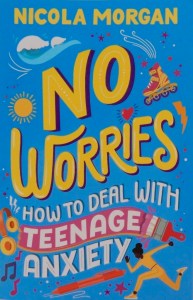
No Worries: How to deal with Teenage Anxiety

Expert on teenage well-being, Nicola Morgan has written a guide to help young people cope with anxiety, according to a survey, the most used word, so she discovered, used when talking about their health and well-being. Nicola’s advice is based upon the latest science and her formidable knowledge and understanding of what makes for a healthy and balanced teenager and she divides her latest book into three parts.

Part One is Anxiety and YOU, part two is called All About Anxiety and looks at what is happening in an anxious person’s body and brain, as well as the effects of anxiety. The third part offers Strategies and Solutions – obviously the most important section. Here you will find among other things, breathing strategies, mindfulness and meditation strategies and suggestions of practical ways to distract from worrying thoughts.

The book concludes with some anxiety experiences shared by people from their own lives and there’s a list of further resources.

Highly practical and written in a language that is both accessible and full of wisdom, this is a book I’d strongly recommend to all young people particularly if they are struggling with pressures and the resultant anxiety in their lives. Assuredly one to add to a teenager’s bookshelf; it’s packed with helpful information and advice.

Keisha Jones Takes On The World / Stink: Superhero Superfan

Having learned of her Great Aunt-Bee, a lawyer and activist, from her Grandpa Joe while he was hiding away to avoid the celebrations for his 70th birthday, Keisha decides that she too will become an activist, standing up for equal opportunities, striving to fight against injustice and making the world a better place; and she’ll do so in memory of her aunt.

To help her in her endeavours, she shares her plan with her best friends Paisley and KD and together they form the Bee Squad in honour of Aunt Bee. She also asks the advice of her teacher who suggests she look for an issue of concern in the town and go from there.

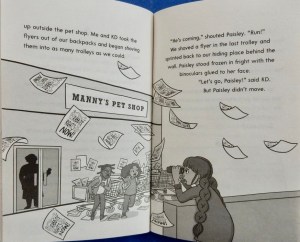
Now being a spirited girl with a big heart, Keisha can’t wait to get started. So, after school when she accompanies her Dad to Manny’s pet shop and sees that the cost to buying a male rabbit is double that of a female, she realises that she has found the Bee Squad’s first cause. She dismisses the owner’s reason for this disparity and spends the next week working on a Rabbits’ Rights plan.

With a promise not to cause any more trouble in the pet shop, she enlists the help of her Aunt Marie who, not knowing what’s about to happen, takes her fellow activists and her younger brother back to Manny’s Pet Shop and carries out her rather outlandish stratagem.

A fair bit of mayhem ensues. But that’s not quite the end of this story, though I will add that our young hero’s indomitable spirit results in her declaring, “ justice for female rabbits was served.”

It’s great to have empowering characters like Natalie Denny’s Keisha in stories for young readers and with Chanté Timothy’s zesty illustrations to bring the world of Keisha to life, this is a book to encourage primary children to stand up for what they believe in.

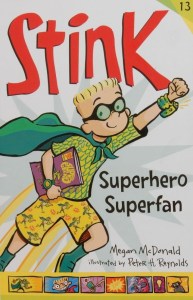
In this thirteenth story Stink is super-excited when he learns that the next topic for his Saturday Science Club is superhero science. Immediately he starts imagining himself in a cape with the titular words emblazoned across it.

Returning home full of enthusiasm, he finds his family sorting things to put in their yard sale and he adds some of his own items.

Next day at the sale, Stink discovers a box full of old comic books about Super Gecko, a superhero he’s never heard of: What could be more fantastic – GROOL in fact – than a part-man, part-lizard with superpowers? Moreover, said superhero has a sidekick, Gecko Girl.

Then Stink hears that there are real geckos in his vicinity and he and his pals decide to go and investigate the creatures that very evening. The hunt yields no geckos but they do find a note supposedly from Super Gecko – hmmm, mysterious.

Could it mean that Super Gecko is set to make a comeback? There is certainly a brand new Super Gecko comic book due to be published the very next Saturday. How will Stink manage his next Science Club meeting and getting to the bookstore to buy a copy before they run out, even if he can raise the money he needs for his purchase? Seemingly the boy faces much that will test his own deductive super powers; can he manage everything? Possibly, with the help of family and friends.

I love the gentle humour, the endearing characters and the mix of sleuthing and science; so too will young solo readers and listeners whether or not they have already met Stink et al.
Leif the Unlucky Viking: Saga of the Shooting Star

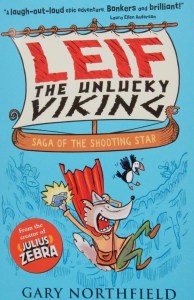
Leif is a little wolf pup of the Viking variety. Despite being small in stature, he has big dreams. he wants to be an explorer just like his dad, Eric the Red. However, it’s certainly not going to be plain sailing for there are certain things that might get in his way. First of all, he has a habit of tripping up, which means he splits his trousers on average once a week, and sometimes he even falls down holes. Far from an auspicious beginning for an aspiring explorer, albeit a determined one.

It’s his determination that leads him to attempt to unravel the riddles of a witch, find a rock shard fallen from a shooting star and then wield its magical powers. Now this journey won’t be smooth sailing but that’s not unusual for the best explorers; he will need to battle with snow and ice, enter polar bear country,

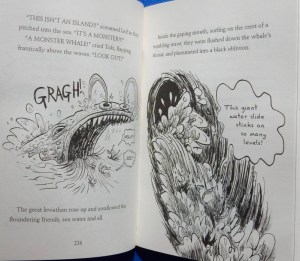
pit his wits against giants and trolls, as well as extricating the team from within an enormous whale-like creature with a top resembling an island,

not to mention sorting out his errant sister. All of which means he’ll need every morsel of luck he can get.
What he does have for company though, are Olaf the irritated duck, Toki, a foolish puffin and Flora the decidedly whiffy muskox Shame none of them is any good at map reading.

Prepare for one calamity after another as you laugh your way through this tempestuous tale, liberally illustrated with Gary Northfield’s comic book style drawings that serve to render his writing even more anarchic than ever. Utterly and absurdly brilliant.

This Is a School / Two Wheels

This Is a School
John Schu and Veronica Miller Jamison
Walker Books

Debut picture book author John Schu and illustrator Veronica Miller Jamison present a school that I would happily teach in or send a child to. In fact it’s much more than a place of learning, or rather perhaps it’s a place of learning in the very broadest sense. What we have here is a community with children at its heart; the very first sentence, ‘This is a child.’ speaks volumes to me, indicating this is somewhere where youngsters are helped to flourish in the broad sense. Children’s experiences lead to growth and transformation – their questions are welcomed

and their mistakes are seen as a vital part of the process of learning. Everybody herein, children, teachers, librarians, other staff, head teachers, helpers and visitors are valued and trusted too: and every single member of this community helps in the creation of its ethos.

This splendid celebration of a school is assuredly one to share with newcomers on their very first day. The illustrations, created in vibrant watercolour, acrylic and digital collage media match the upbeat tone of the writing, both combining to convey a vital message.
Would that all primary schools were more like the one herein.

A considerable amount of learning also takes place in

Two Wheels
David Gibb and Brizida Magro
Walker Books

The father of the little boy narrator of this story is obsessed with bikes and he has several different kinds – one for speed, one for muddy terrain, one for togetherness and one for a relaxing ride. The boy’s siblings and mum also have bikes but our narrator does not. Dad’s response to his refusal to sit on the baby seat any longer is to suggest he try his brother’s three wheeler, which he does. He also likes to help Dad fix other people’s bikes.

One day Dad presents his small son with a balance bike, then relatively soon after, a cycle with two big wheels and two stabilisers. This means that our narrator is allowed to ride out in the street. He practises and practises

until Dad decides it’s time to remove the stabilisers; this he does at the top of a hill. Then with words of encouragement rising in his ears, off goes the boy, gradually building up speed until he reaches the bottom – just in time for a big, congratulatory hug from Dad.

In her textured, patterned illustrations Brizida Magro shows the delight on the child’s face and the thrills as he progresses from tricycle rider to fully-fledged two-wheeler rider (We don’t see any spills though I’m sure there must have been some. One of my relations, after a tumble, kicked her bike and called it, “nincompoop bike!” though she was back in the saddle pretty soon after ) Author David Gibbs’ text portraying a very supportive Dad, is based on his experience of his own Dad teaching him to ride a bike. Becoming an independent cyclist is one most adults and proficient youngsters will recall, along with the trials and tribulations along the way.

This tale of patience and determination is one to share especially with those starting on the road to becoming confident bike riders.

A Boy, His Dog and The Sea

This image has an empty alt attribute; its file name is dscn9548-2.jpg


A Boy, His Dog and The Sea
Anthony Browne
Walker Books

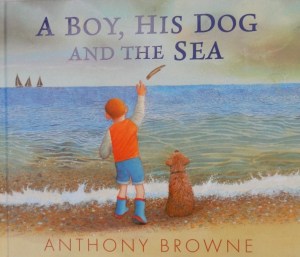
To relieve his boredom, Danny’s mother suggests he takes the family dog, Scruff, for a walk on the beach, to which Danny responds, “The beach is boring. Nothing ever happens there.” She replies, “Keep your eyes open; you never know what you might see.” 

Off go Danny and dog onto the beach, Scruff excited, Danny downcast: he’d much prefer to be playing with his older brother. However having found a stick and tossed it into the sea, the boy is impressed when Scruff retrieves it for the first time ever. After spending some time playing that game, Danny feels weary so he sits on the shingle and starts examining the pebbles, discovering on close inspection, lots of interesting things.

This image has an empty alt attribute; its file name is dscn9549-2.jpg

After a while the two continue wandering along the strand till they come upon a number of people waving excitedly as they look out to sea: Danny looks too, wanting to know what they’re waving at. In the distance he spies a tiny person waving too.

This image has an empty alt attribute; its file name is dscn9550-2.jpg

Having thought for a bit, Danny points seaward: “Fetch, Scruff!” he says and the dog does as he’s bid, swimming fast at first, then losing pace but never giving up.

Eventually two figures emerge from the waves, one canine, the other human. But who is it? Danny is very surprised to hear a familiar voice praising him and calling him a hero, something Danny says should rightly be applied to Scruff.

From front to back endpaper, every page is a visual treat; one would expect no less from Anthony Browne: I love the rather portly person with tattoos all over his arms, the faces and other designs on and with, the stones, the clever cloud formations and all the other somewhat surreal things that emerge the more you look at these awesome illustrations. If you share this poignant story with a class or group rather than an individual child, make sure you give them plenty of time to peruse the pictures and leave the book available for further exploration and excited discussion.

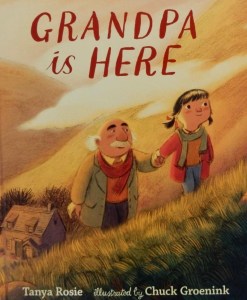
Grandpa is Here

Grandpa is Here
Tanya Rosie and Chuck Groenink
Walker Books

Meeting her Grandpa at the airport with her parents, the little child narrator quickly overcomes her initial shyness when he gives her an enormous hug, and on the drive back home she anticipates all the things she wants to share with Grandpa.

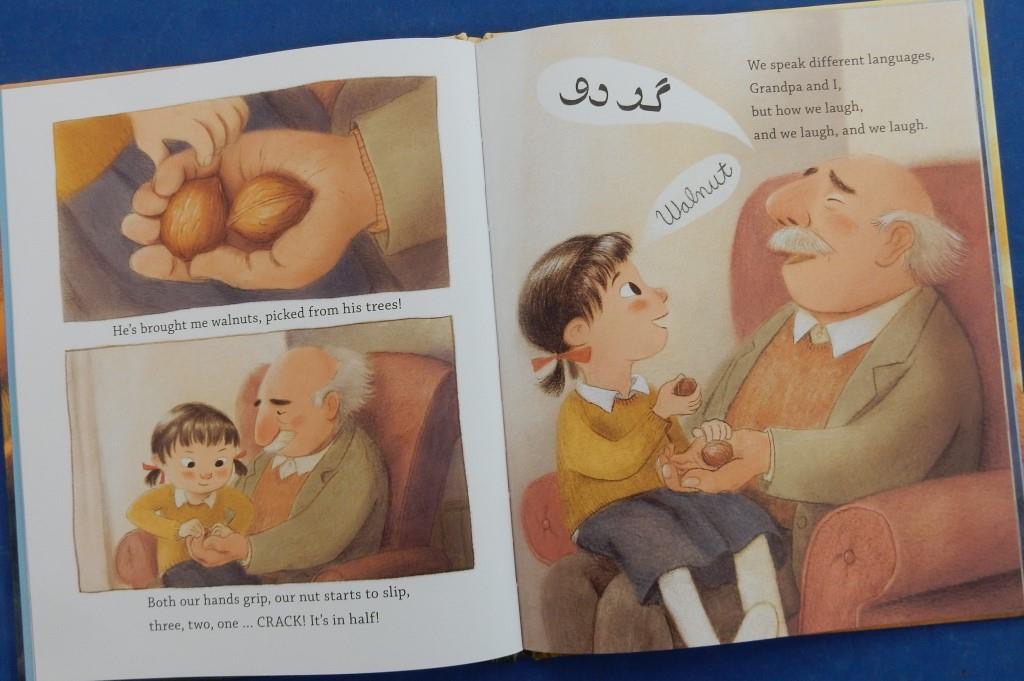
When he opens up his case, out comes the aroma of Persian spice and other culinary delights, including walnuts from his very own trees. The little girl doesn’t speak any Farsi and Grandpa seemingly doesn’t speak English but they laugh in the same language.

After he’s had a nap, our protagonist takes the opportunity to show Grandpa various places she loves as they take ‘the darkest path in the world’, wandering downhill and up tall hills. She introduces him to a horse named Santiago and Malou the frog and hills she calls Mount Sledge-Top and Rabbit View. As they sit looking at the view, the child wishes Grandpa could stay to share the coming of spring. “Grandpa is like snow, I never want him to go, never want his magic to leave,’ she thinks to herself.

As the sun goes down the two make their way back to the family home and there everyone sits and shares a celebratory meal

until they can’t stay awake any longer. Somebody does though and she creeps in to see her Grandpa fast asleep; gently she reaches out her hand and touches his and ‘hope that these days go slowly’ – just like the falling snow flakes she sees through the window.

Tenderly told through Tanya Rosie’s lyrical rhyming narrative in which the loving connection between grandpa and granddaughter is implicit; so it is too in Chuck Groenink’s illustrations which radiate the warmth and tenderness of the intergenerational bond. Like that tight hug at the start of the story, this will surely evoke strong emotions in adult readers who share this with children.

Memories are made like this.

The Happy Hut

The Happy Hut
Tim Hopgood
Walker Books

The child narrator of this story and two siblings loved to visit Grandpa Martin’s bright yellow beach hut, doing so in every season. In spring they enjoyed rock climbing and dodging the showers. In summer they would picnic on the wooden deck and paddle in the sea, though on occasion Grandpa Martin would get soaked, prompting his “flipping fiddlesticks!’ reaction. Summer afternoons were passed in card playing and the evenings in listening to Grandpa Martin read. Autumn days were for kite flying, some meteorological learning

and Grandpa would take the opportunity to do essential repairs and give the hut a coat of paint, aided of course by his three ‘Happy Hut Helpers’. Wintery days were spent walking along the seashore, then back in the warmth of the hut, hot tea, fruit cake and woolly socks awaited.
One spring Grandpa Martin falls ill and the hut is left without any visitors and nobody to do the essential upkeep. That winter a fierce storm badly damaged the yellow hut.
When the family returns the following spring, a big restoration task awaits but rather than repaint the hut in its original yellow, the narrator uses a sky blue hue as a special reminder of their beloved Grandpa Martin: now the hut is a place of cherished memories ‘our happy hut!’

Wonderfully warm, Tim’s tale of love, loss and memories is presented with tenderness and sensitivity in both words and pictures. This is a book to share with Grandpas, as well as to enjoy both with family members and in the KS1 classroom.

Batpig: Go Pig or Go Home

Batpig: Go Pig or Go Home
Rob Harrell
Walker Books

Porcine superhero, Gary, is back with two more stories of skylarking presented in graphic novel format.
The first, Careful What You Wish For, sees Gary getting his snout in a twist at the prospect of the history and biology tests the following day. Nevertheless, rather than staying at home and studying that night, he assumes his Batpig alter ego and heads out into the city to fight crime.

As a reward for preventing a robbery at the Weird Old Magic Shop, the owner gives Batpig a pouch containing a magical learning potion. Back at home Gary decides how to word his spell command and then goes off to sleep.

It will come as no surprise when I say that the spell does not go to plan. The following morning he wakes to find Sharkraham, come to assist with the tests, which it does. Whether or not this is cheating is a debatable question. Twenty four hours later Gary has something far, far worse than a couple of tests to worry about;

something in the form of a destructive squown or evil squid clown. It would appear from the beastie that our porcine pal has a vital lesson to learn. Will Gary ever work out what that is and if so, will he finally hold his trotter up and admit that doing well in tests by devious means is wrong?

In the second episode, Camp Danger, Gary (sans his suit), along with buddies Brook and Carl, is off to sleep-away Camp Moldy Snout.

Before long Carl has made some new friends, then too does Brook; this makes Gary feel rather excluded. But then after some alarming incidents in and around the lake including the emergence of a very frightening monster, Gary decides he must step in. even if it results in him revealing his secret identity to the other campers.

This is bad enough but it leads to his arch enemy and self-dubbed greatest ever supervillain, The Butcher, appearing on the scene and she means big trouble.

High energy humour at the heart of which is friendship. Fans of Gary et al will devour this eagerly.

Evie and Rhino

This image has an empty alt attribute; its file name is dscn9578-2.jpg


Evie and Rhino
Nerida McMullen, illustrated by Astred Hicks
Walker Books


This tale is based upon a true story of a shipwreck in 1891 off the south-west coast of Victoria in a coastal region well known for shipwrecks. One such was SS Bancora, which was travelling from Calcutta with a cargo of animals bound for Royal Melbourne Zoo. Among the animals was Rhino: the creature manages to make it to the shore, along with possibly some monkeys, parrots and cranes.


Enter Evie, a ten year old girl who lives with her once famous ornithologist grandfather, in an erstwhile grand mansion, Lunar House, having lost both her parents in a shipwreck two years back and since when she hasn’t spoken a word. She doesn’t any longer go to school and thus it is that the day after the Bancora shipwreck, she is wandering along the dunes to the beach and makes a discovery that will transform her life, and that of Rhino, for ever.


Told from alternating viewpoints, Evie’s and Rhino’s, we see the two forming an unlikely bond, a very deep one that provides a balm for the girl’s grieving spirit. All too soon though, the zoo sends a representative to recover the amazing animal. However Evie isn’t prepared to let Rhino go without doing her utmost to keep her beloved animal.


This image has an empty alt attribute; its file name is dscn9579-2.jpg

In Evie and Rhino, Nerida McMullen has created two hugely endearing characters, and we meet a number of other interesting characters too. The storytelling is superb – you’ll find yourself laughing at Rhino’s antics, and tearful on occasion, at the challenges both Evie and Rhino face; it’s a truly memorable tale of rediscovering your inner strength and your voice, and the healing power of friendship.

Scattered throughout the book are Astred Hicks’ deftly drawn illustrations along with occasional telegrams and cook’s apple pie recipe – apple pie having played a significant part in the story.

Johnny Ball Professional Football Genius / Rudy and the Skate Stars

This image has an empty alt attribute; its file name is dscn9519-2.jpg


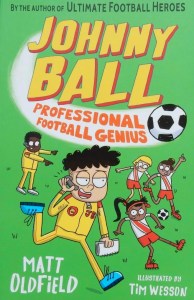
Johnny Ball Professional Football Genius
Matt Oldfield, illustrated by Tim Wesson
Walker Books


In his role as manager, nine year old Johnny Ball has recently led the Tissbury Tigers to glory at the world’s top youth tournament. He’s basking in the glory when he is approached by soccer agent, Darren Dealz telling him that the Tissbury Thundercats want an assistant manager for their Under-12s academy team and that somebody should be our young narrator.


Johnny lands the job with the proviso that he remembers that manager, Jaz ,is the one in charge – the decision maker – and he mustn’t overstep the mark. A challenge if ever there was one, particularly as his best friend Tabia is joining the squad.


This image has an empty alt attribute; its file name is dscn9520-2.jpg

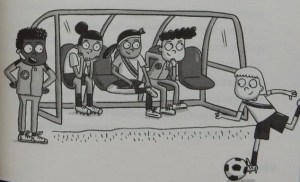
It’s a steep learning curve for Johnny, who as ever, is bursting with ideas; there’s a serious falling out with his bestie and unwelcome interference from Darren Deals but the assistant manager never loses sight of his main goal – that Tissbury Thundercats team take the Prime League title.


Champions or not? Johnny Ball fans will relish this amusing story with its liberal sprinkling of suitably dramatic drawings by Tim Wesson. Assuredly it’s a winner in this reviewer’s book.

This image has an empty alt attribute; its file name is dscn9564-2.jpg


Rudy and the Skate Stars
Paul Westmoreland, illustrated by George Ermos
Oxford Children’s Books


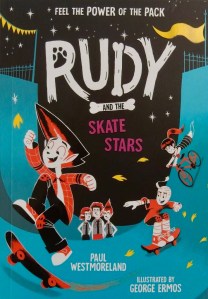
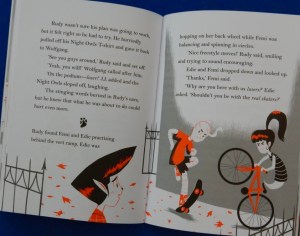
Excitement is high when werewolf Rudy and his friends, Femi (a mummy) and Edie (a ghost) discover that the Skate Stars competition is coming to their hometown, Cobble Cross and the legendary Jessie Howler is to be the judge. With the event just a week away the three pals know they must practise hard to stand any chance of a medal and Rudy is up super early next morning to start working on his moves. He’s only just got started when a group of wolf boys turn up looking smart and performing impressively. One of their number, Wolfgang. introduces the crew as the Night Owls and starts chatting to Rudi. He also asks Rudy to show some of his moves.


The following day Wolfgang suggests that Rudy enters the competition with them instead of Femi and Edie, saying that he’s much more likely to win if he does. The little werewolf can hardly believe his luck: it’s always been his dream to stand on top of the podium with a gold medal around his neck but switching teams means that he must agree to follow Wolfgang’s lead. However he decides to join the Night Owls team; but on the day of the competition, having had a chat with Jessie Fowler, Rudy feels conflicted: should he go for winning and risk losing his friends?

This image has an empty alt attribute; its file name is dscn9565-2.jpg

He tells Wolfgang he’s changed his mind and prefers to skate with The Power Pack.
What happens thereafter shows Rudy that winning the gold medal isn’t what really matters most.


This fourth story of Rudy and his pals is certain to please his followers among those just flying solo as readers and they’ll likely find additional fans among young skateboarders new to the series. As always George Ermos’s super-cool illustrations help break up the text and ramp up the action.


Moving the Millers’ Minnie Moore Mine Mansion

Moving the Millers’ Minnie Moore Mine Mansion
Dave Eggers and Júlia Sardà
Walker Books

This non-fiction story begins back in the 1870s when a dog belonging to a prospector was digging in the ground and found not the gopher it had been chasing, but silver. This discovery very soon became Minnie Moore Mine. Several years later the mine was sold to an Englishman, Henry Miller, making it Miller’s Minnie Moore Mine. It made him extremely rich. He found a wife, packed her off to Europe for a while, giving him time to build a riverside house they would share on her return – Millers’ Minnie Moore Mine Mansion. There a son was born to the couple.

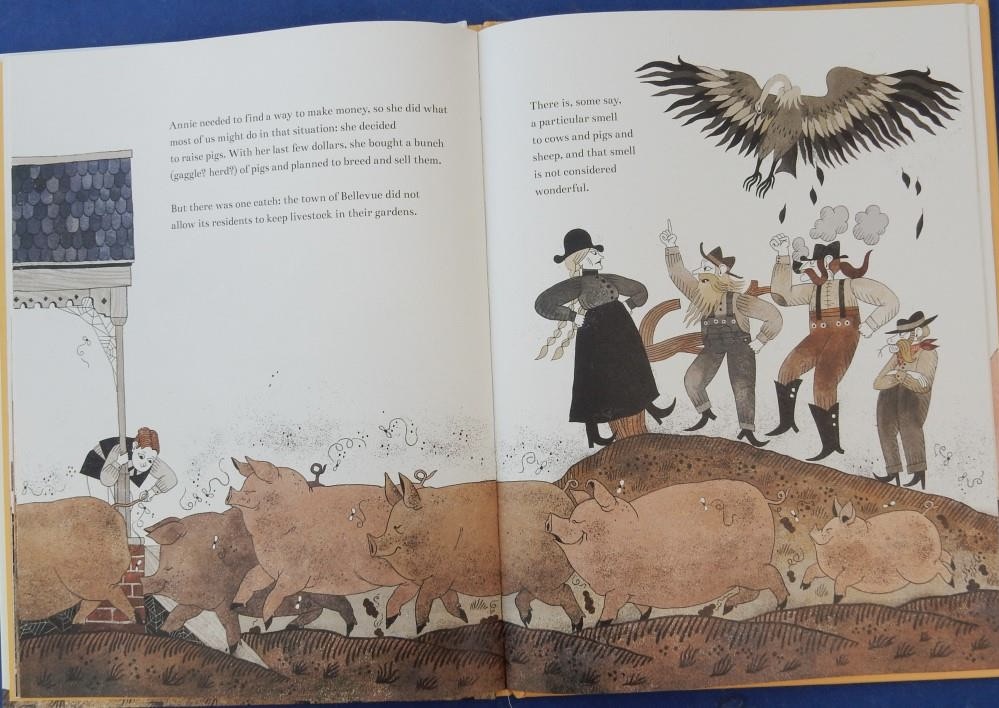
When Henry died his widow, Annie was tricked by a crooked banker to invest her money in his bank; it failed and she lost almost all of it. With the little left she bought some pigs intending to become a breeder. However the Bellevue townsfolk would have none of it 

so our enterprising Annie devised a plan – a pretty elaborate one – to move the house out of town. And so she did. Aided and abetted by her son and some hired workers, Millers’ Minnie Moore Mine Mansion was shifted just four miles down the road, 

where without pig restrictions, Annie, Douglas and the porcine team thrived for many years. 

Crazy but true, though if you want to know how they managed to move, you’ll need to get your trotters on a copy of Dave Eggers and Julia Sardà’s book. The former’s chatty, humorous writing style and droll, often dramatic art rendered in earthy tones by the latter show how human perseverance and resourcefulness win through on several occasions.

Slightly bizarre, this would make an entertaining read aloud.

How To Spacewalk / Wind: Discovering Air In Motion

How To Spacewalk
Kathryn D. Sullivan and Michael J. Rosen
Walker Books (in collaboration with MIT Kids Press)

In 1984, Kathryn Sullivan became the first woman to walk in space: in this book, illustrated with photographs and Rosen’s ink and pastel images, she shares her story.
As a child in the 1950s, Kathryn developed an interest in science early on but like other girls, she wasn’t encouraged to follow her interest. However, with determination and perseverance she studied geology and became an oceanographer, eventually applying to join NASA’s astronaut programme for which she was accepted, as well as receiving an offer to explore the ocean depths in a submarine. She chose the first option.

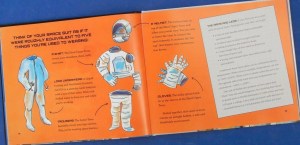
From then on the author addresses readers as though they are participants in her training as an astronaut. What is it like to do a spacewalk? How do you use cutting-edge equipment? What does it feel like to wear and carry out experiments in a hugely heavy space suit? – space armour as it’s called here.

What about experiencing weightlessness?. Will I suddenly feel scared?

A large amount of fascinating factual information is presented, but alongside this we share an empowering account of a woman fulfilling her dreams; it’s one that will surely encourage child readers to live the ‘life you invent’ – to reach for the stars, whatever that means for them.

Wind: Discovering Air In Motion
Olga Fadeeva
Eerdmans Books for Young Readers

Translated from the original Russian by Lena Traer, this book poses and explores eighteen wind- related questions, devoting a double page spread to each question, with illustrations by the author.
The responses to the first – Where does wind come from? are somewhat playful; for instance ‘Maybe there are giants… / who blow air with all their might?’ and ‘Or maybe the wind comes from the wings of a large bird?’.

However from there on the tone changes and What is wind? is answered with a scientific explanation ‘Wind is the horizontal movement of air over the surface of the Earth’ … The author then interweaves information on meteorology, biology, ecology, history, even venturing into outer space, so there’s plenty to keep readers interested.

Each double spread is distinctively designed and the richly textured illustrations are strikingly executed using acrylics, collage and digital media.

Included in several scenes are a little girl, sometimes accompanied by her grandfather and one assumes the questions are coming from the child.

Created with the help of a meteorologist, this exploration of my least favourite element is engaging and absorbing: I would recommend adding the book to primary school collections.

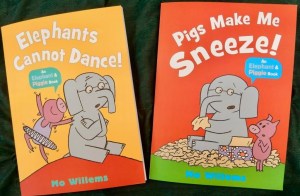
Elephants Cannot Dance! / Pigs Make Me Sneeze!

Elephants Cannot Dance!
Pigs Make Me Sneeze!

Mo Willems
Walker Books

Time after time, Mo Willems does it with these hugely funny episodes in the lives of best friends Gerald and Piggie, delivered entirely in hilarious dialogue and through the priceless drawings.

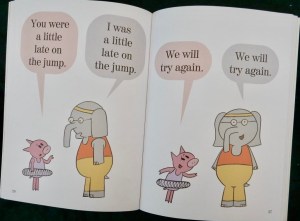
In Elephants Cannot Dance! Piggie announces that she’s teaching all her friends to dance and that includes Gerald. However despite, so he says, that he’d love to learn to dance, Gerald knows that it’s impossible; moreover he has proof. It says so in ‘What Elephants Can Do’ – on page eleven to be precise, which just happens to be the same page number as that particular bit of dialogue. Piggie isn’t having any of that, responding by telling Piggie that the book does NOT say he cannot try so to do. And try is what Gerald does, but his timing and coordination leave a lot to be desired 

as he appears to be doing the opposite of what Piggie instructs. 

Eventually a frustrated Gerald decides he’s had enough; point proved ‘elephants just cannot dance’. Maybe they can teach though …

Good on Piggie who never gives up trying to teach Gerald to dance.

What they both do effortlessly is put across the crucial ‘reading is fun’ message to children learning to read.

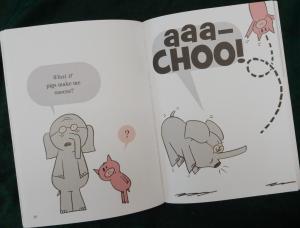
Pigs Make Me Sneeze! thinks pachyderm Gerald who just cannot stop sneezing and does so all over Piggie. That is a nuisance just when the two were about to play together, but much worse is the possibility that, so Gerald thinks, he is allergic to pigs and we all know what that means: he can’t go near his bestie.

Off goes Gerald to consult Dr Cat. However during the examination it becomes evident that the pachyderm isn’t suffering from an allergy. His diagnosis is one that demonstrates how best friends share everything and it makes Gerald feel a whole lot better; let’s hope Piggie soon feels better too. 

The expressions on the faces of Gerald and Piggie in this are just wonderful. With its subtle message about not jumping to hasty conclusions, this will delight learner readers and those who listen to the stories.

The Mermaid Moon

The Mermaid Moon
Briony May Smith
Walker Books

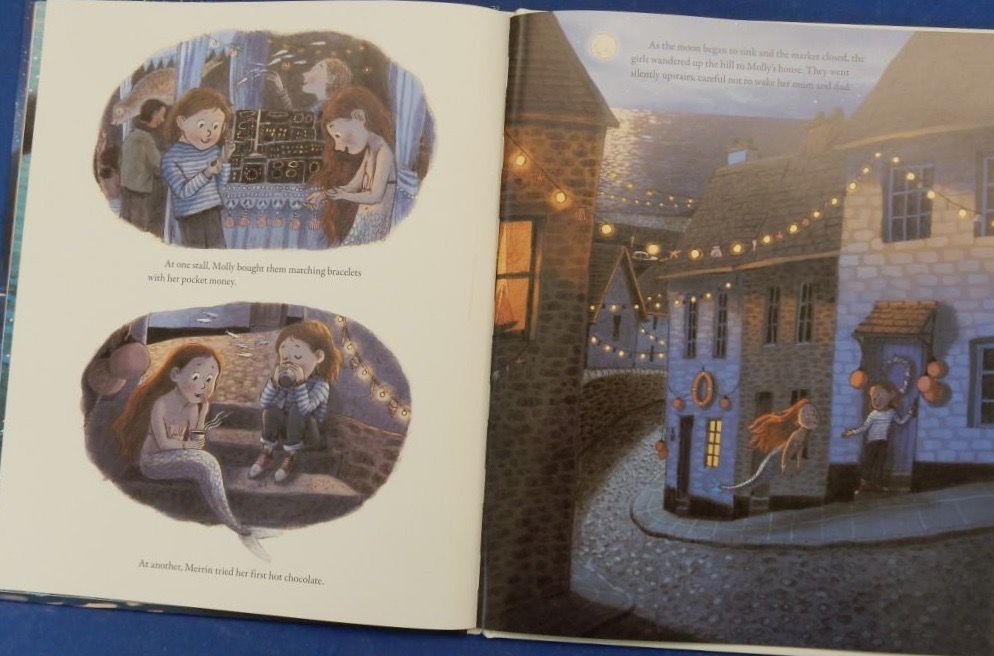
Mermaid Merrin and human girl, Molly are best friends. Molly’s home is in a cottage near the harbour side at Merporth a fishing village from where she can watch the sea from her bedroom. Merrin lives with her mum, Nerissa in a cave carved in the wall of the harbour. The girls played together every day after school, Molly above water, Merrin below.

One might each year Merporth celebrated the Mermaid Moon festival. On that night Perrin’s mum allows her daughter to go and join the celebrations with a Cinderella-like warning to “make sure to be home before the moon’s reflection disappears from the sea… ’. Using a special Mermaid Moon magic
Merrin is able to ascend, fly through the air and visit the streets full of stalls and celebrating villagers.

When the market closes Molly takes Merrin to see her bedroom

but all too soon, through the window Merrin notices the moon glinting and knows she should start for her own home. She does so but gets distracted on the way. Will she be able to make it home in time? Perhaps, but only with some extra special help from Molly and a very large sea creature.

Briony’s modern fairytale wherein friendship is key, will appeal specially to thoughtful readers and listeners who enjoy a touch of magic, which is something that her illustrations in particular are imbued with.

Special Delivery / Good Night Little Bookshop

Special Delivery
Polly Faber and Klas Fahlen
Nosy Crow

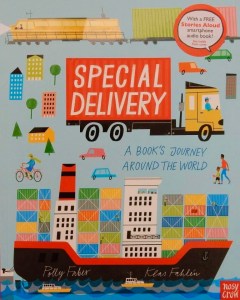
Children who love reading and books will be fascinated by the story of a book – a book just like this one – that goes on a journey.

It starts with Jay counting down the sleeps to his birthday and on the opposite page we see people on their way into a factory in a distant land, the factory being where copies of the book are being printed, cut, pressed and packed

ready to go in a container lorry to the docks and onto a massive freight ship to continue its journey.
Having sailed across the sea, the book travels by train to a warehouse before being loaded into a delivery van and taken to a book shop., Pip’s Bookshop.

Along cycles Jay’s Gran who goes in, buys a copy of Special Delivery and goes to the post office. Then follows further travelling for the book – to the sorting office where it’s placed in a sack, collected by a postie named Molly (many of the workers involved in this whole journey are named) and finally delivered to Jay.

He loves his present. Being a thoughtful boy, he makes a thank you card for his Gran – his ‘special delivery’ is by hand.

As well as a subtle look at international trade and those who make it happen, this book with illustrations of all kinds of machines and workers involved in the processes, will be a good introduction to interconnectedness of both objects and people. For those who want to know more, there are three pages of ‘Special Delivery Numbers’.

Polly Faber provides just sufficient information in her text and Klas Fahlen’s bright digital illustrations provide further details in visual form. An interesting, thought-provoking book that can be shared in KS1/ lower KS2 classrooms that covers several areas of the curriculum.

Good Night Little Bookshop
Amy Cherrix and E.B. Goodale
Walker Books

The special author event is over and it’s almost time for Little Bookshop on Little Street to close for the evening. First though there’s a goodnight ritual to perform. We see a little girl reaching for a picture book from those displayed on the shelves; a woman leaves to the accompaniment of of the door bell’s ‘Ding, ding, ding’, followed by a goodnight to the till with its ‘Ring, ring, ka-ching!’ And so it continues with goodnights to friends who’ve come from afar,

to familiar pooches and their owners, to forgotten glasses and hat, to the bookshop cat and the boxes of new books waiting to be shelved for the following day. Each of these and more are bid goodnight as well as discovering something of the work of bookshop owners and booksellers.

We see it all in E.B. Gooddale’s detailed illustrations that accompany Amy Cherrix’s gentle poetic words, which, in addition to being an ode to this particular independent bookshop, mentions little bookshops everywhere and concludes with a wish to “dream  big, dear readers, wherever you are.”

A lovely bedtime rhyme with a difference that had a special appeal for this adult reviewer who is a fan of indie bookshops and has worked in a couple too.

Wigglesbottom Primary: The Sports Day Chicken / The Princess in Black and the Prince in Pink

Wigglesbottom Primary: The Sports Day Chicken 
Becka Moor and Pamela Butchart
Nosy Crow

Herein are three more splendidly daft episodes in the life of a certain class at Wigglesbottom Primary whose mildly anarchic behaviour fueled by their wild imaginations, frequently has repercussions far outside the classroom as well as inside.

In the first story, the school chicken is absolutely determined to be a participant in the school sports events, first inside its pen and then, after the egg and spoon race – but don’t ask how – in the BIG RUNNING RACE actually on the grass. I wonder who wins the trophy in that one.

The second episode, The Ant Queen begins when the headteacher gives the class an ‘Educational Surprise’ in the form of an ant farm. 

What rapidly ensues is an escape, a frantic search for the escapees and a case of misidentification of the ant queen.

Finally we have another puzzler, The Green Slime Mystery, which begins in the school canteen, quickly becomes a toxic shock inducer for Joel Jack, and results in one or two rather green faces, not all on the pupils.

Giggles galore assured thanks to Pamela’s hilarious storytelling and Becka’s equally hilarious illustrating, this time using liberal amounts of day-glo green.

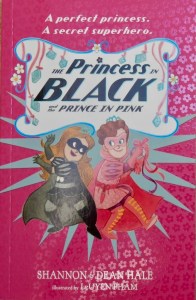
The Princess in Black and the Prince in Pink
Shannon & Dean Hale, illustrated by LeUyen Pham
Walker Books

In this tenth book in the popular series, Princess Magnolia (aka the Princess in Black) and her royal friends are celebrating the annual Flower Festival, the season’s biggest event. Princess Snapdragon has asked Princess Magnolia to take charge of the Festival Ball to be held in the evening and it’s a pretty big responsibility. As she starts unpacking the decorations there comes a scream and an angry emu stomps through the festival wrecking everything in sight, 

including Princess Magnolia’s boxes of decorations most notably the one containing her special secret surprise. 

Along comes a knight in shining armour and sees off the bird. Now Princess Magnolia, is not used to being rescued and the knight, Prince Valerian, is not keen to stay around and leaves. However he returns later eager to try out his special skills and for this he becomes the Prince in Pink. Then together he and Princess Magnolia create something beautiful from the shattered special secret decoration.

Meanwhile Emu, who loves to dance as much as to kick out, recruits her feathered friends, the Ostrich Twins and the Flightless Bird herd sally forth to crash the ball, arriving with the dancing in full swing. Is there any way that everyone can be accommodated happily without wrecking the dancing? One thing is certain, this will definitely be a party to remember.

Full of action, gentle humour, kindness and teamwork and with a new multi-talented superhero who sometimes likes to wear pink, as ever the Hale’s latest story gently subverts gender norms and with LeUyen Pham’s energetic and expressive illustrations, will please established fans of the series and surely win plenty more followers among new solo readers too.

The Last Mapmaker

The Last Mapmaker
Christina Soontornvat
Walker Books

Twelve year old Sai, daughter of a con man and the narrator of this fantasy, comes from a marshy Fenland area where its inhabitants are looked down on. Nonetheless, thanks to her quick thinking she has become assistant to Paiyoon, the Mangkon Royal Navy’s Master Mapmaker, until her 13th birthday, at which point, when she does not receive a lineal, (a golden bracelet with links representing the recipient’s noble ancestors), her lowly status will become evident to everyone, Paiyoon included. She loves her job but secretly wants to save sufficient money to escape her home kingdom before that fateful date.

As her birthday draws near, the Queen issues a new directive. Now the kingdom has achieved peace for the first time in twenty years, it’s time to rededicate itself to exploration. This presents a wonderful opportunity for Sai when Paiyoon, invites the girl to assist him on an expedition aboard the ship Prosperity to chart and discover the Sunderlands for the Queen. Due to advanced age, his handwriting has become shaky and Sai can copy his writing without anyone knowing their secret. An enormous money prize awaits any crew who can locate the Sunderlands where, legend has it, Mangkon’s long-departed dragons now dwell.

Once aboard ship, Sai quickly discovers that many others have secrets of their own, including Miss Rian and her friend, the war hero Captain Sangra, even Paiyoon. She’s also worried that there’s a boy aboard who might know her identity. In fact it’s difficult to know who she can really trust.

Utterly compelling adventuring on the high seas: full of surprise twists and a fair few betrayals, with a diverse cast of complex characters, Soontornvat has constructed a tight plot full of wonderful descriptions – you can almost smell the brine – with undertones of colonialism and environmental issues,

Strongly recommended for older readers especially those who love unusual fantasies and a protagonist determined to chart her own course through life.

A Bed of Stars

A Bed of Stars
Jessica Love
Walker Books

This beautiful demonstration of how powerful knowledge can be, begins with the child narrator telling readers that the immensity of the whole universe makes him feel so small as to be insignificant. This thought would keep him awake at night, but then one morning over breakfast his father announces, “We’re going camping you and me.”

The two pack up what they need and set out for the desert in the old family truck. The smell changes from ‘rubber and french fries’ as they leave the city and head into the mountains where it smells sweet and smoky. Dad talks of the flowers they pass and when they reach their destination, he points out the tiny beetle footprints in the sand. The two then jump in the dunes,

lie back and observe and name the birds and set up camp together. They build a fire, sing songs and watch the sunset.

Come bedtime, as they lie gazing skywards, the boy reiterates his fear of going to sleep because of the vastness of the universe. ( I love how beautifully this is mirrored in the blanket.) Dad knows just what to say and explains in his calm, thoughtful manner that stars are made of energy, “Same as you. Same as the beetles and crows and coyotes. We’re all friends and family in this universe. Maybe if you learned their names, they wouldn’t feel so much like strangers.” Then snuggled up together, the two give distinctive names to every star they can see and with fear transformed, the child drops off to sleep.

The next day, after hot chocolate and a greeting to the desert flora, the two are ready to return, The child repeats en route, the names of “all the new friends I’ve met… beetles, cacti, coyotes, stars,” At home Mum shares a surprise of her own making. Now at last, the child feels ‘at home in the universe.’

This tender, reassuring story with its scattering of small word pictures, shows just how a parent’s empathy and undivided attention allows his child to gain a different perspective on the universe. Jessica Love’s delicate watercolour, gouache and ink illustrations convey both intimacy and vastness making this contemplative story perfect for bedtime sharing (or any time), especially for anyone experiencing a lack of confidence similar to that of the child narrator.

My Bollywood Dream

My Bollywood Dream
Avani Dwivedi
Walker Books

Friday nights are special for the little girl narrator and her family, who set off through the hectic city streets of Mumbai, destination the cinema. En route in their car, the girl uses her camera to capture the sights and sounds of the city and in so doing imagines a movie evolving all around her, with action,

dance sequences and songs. Seemingly she has aspirations of becoming a movie director.

Once at the cinema, she immediately feels the excitement building in the audience until a hush descends and the film begins. It’s a typical Bollywood love story with lots of Hindi songs and dancing but it’s not just the actors that dance. Caught up in the music, up leap members of the audience and start moving in time to the beat, united briefly, by the hypnotic rhythms.

Our narrator concludes in upbeat mood, saying, “Bollywood movies are filled with many dreams and adventures that I haven’t yet had. … but one day I know I can create my own.”

Author/illustrator Avani Dwivedi has based her debut picture book on her own experiences of growing up in Mumbai and she really captures the vibrancy of Mumbai streets although I found it rather more chaotic on my most recent visit than her portrayal here. She captures too the magic of those movies, as they were, as they are and probably always will be, hopefully though with more women directors

Lola Saves the Show

Lola Saves the Show
Katherine Halligan and Guilherme Karsten
Walker Books

Created in association with The National Theatre, this fun adventure set on opening night, has most of the action taking place behind the scenes.

With the play soon to begin, best friends Lola and Oliver wait backstage and with necessary business done, Lola is about to enter stage left. But disaster strikes when she notices that a vital prop is not among those assembled on the table.
The only way to save the show is for Lola to find the Very Important Handkerchief. Off she dashes with Big Ed (her minder) and Oliver in hot pursuit, stopping to create mild chaos in various departments.

Lola is unstoppable even scaling the heights of the theatre when suddenly she remembers something and knows she must retrace her steps at top speed.

Back where she began, Lola finally finds that which she seeks and with not a single moment to spare, she makes her entrance before the waiting crowd. What a shining star she proves to be, but after her performance, something is lacking which makes the show’s saviour very sad. Happily however, Oliver knows just what is needed and all ends happily.

Guilherme Karsten’s funny, vibrant artwork is suitably dramatic and the fact that Lola is not a human is shown, but never mentioned in Katherine Halligan’s text makes the book all the more amusing. I love the names of the places Lola visits in her search for that missing article. (Further information about theatrical terms is given after the story)

Big Cat / Winston and The Indoor Cat

Big Cat
Jess Racklyeft
Allen & Unwin

Meet seven year old Catherine, an adventurer and investigator who likes everything to be ‘just so’ : her papers are organised by colour, her trainers always at the ready and her compass close at hand.

When she learns of Big Cats prowling near the city, she’s intrigued and next morning she wakes with a Big Cat hunt already in her mind. So, with essentials in her backpack, she sallies forth leaving ‘lures in the wildest place she knew.’ When her search yields no success, she sits alone to finish her snack and suddenly finds she’s face to face with a large, satisfied feline. This creature is totally unlike Catherine – lawless and chaotic

– but nonetheless the two bond, discovering they both love adventures. Catherine tells her new friend of her discoveries and Big Cat helps her make exciting new ones. The story ends on a wonderful note with Big Cat carrying ‘a little bit of Catherine in her pocket’ and Catherine keeping ‘a big piece of Big Cat in her heart.’ I love that.

Jess Racklyeft created this lovely story during lockdown in Melbourne where as she says in an introductory note, “ I discovered new places close to home … took new paths, looked for magic in the mundane” – and found it with the increased sharpness of cat-like eyes.

The book, with Jess’s detailed watercolour illustrations, pays tribute to small adventures, making new discoveries and appreciating what is around you. I think these are things a great many of us found close to home during those lockdown times. It also shows how spending time in the company of someone very different from yourself is often beneficial to both parties.

It is certainly true for the characters in this story


Winston and The Indoor Cat
Leila Rudge
Walker Books

Friendship and individuality are explored in this tale of Winston the outdoor one and the Indoor Cat, very different moggies indeed that form an unlikely friendship.

Winston’s outdoor existence suits him perfectly with its opportunities to explore freely and have exhilarating experiences. Then one morning he is surprised to encounter The Indoor Cat, albeit behind glass and decides to free the pristine, leisure loving creature. Winston goes on to show The Indoor Cat all the great things about outdoor life and his new friend has to agree, it is thrilling

but not really what he wants.

Back home he goes, inviting Winston back for lunch, after which he shows him all the wonderful things about life indoors. Yes, it’s a life of leisure and luxury, Winston agrees but not the life for him, most of the time anyhow.

This simple tale of respecting differences, staying true to yourself and being open to new experiences is told with a simple, straightforward text and gently humorous watercolour and pencil illustrations. Ideal for sharing with very young listeners.

Spellstone

Spellstone
Ross Montgomery
Walker Books

Used to going unnoticed, even by her parents, an ordinary twelve year old, Evie, wakes from a weird dream of being in a theatre where it pours with rain and the audience sleeps, other than the five in the front row, an odd assortment of people who happen to be the last members of a secret magical organisation, the Order of the Stone. Its leader, Wainwright tells the others, that he has discovered a sorcerer who may be their last hope in defeating an evil magician intent on finding the Spellstone and unleashing the dark magic contained within and destroying the world. He then proceeds to introduce Evie.

After school that day, feeling even more unseen than ever and despairing that she’ll ever find her own people, Evie takes the route home along the canal towpath. Suddenly a cyclist comes too close causing her to fall over, but she’s helped by a man whom she recognises from her dream. He introduces himself as Wainwright and tells her about Emrys, the Spellstone, which he’s been tasked to keep hidden and an evil magician determined to find it. He hands Evie a rusty old piece of metal on a chain, saying it’s precious and she must keep it hidden until she’s ‘with the others’. Before she has time to ask who is the mysterious Alinora he’d mentioned, he dashes off hotly pursued by a number of men.

That evening there comes a scratching sound at her bedroom window and Evie discovers the cat from her dream, a cat that can talk. A cat that tells of smoke men coming and insists they leave right away. Evie follows her, eager for answers, and she’s led to a narrow boat, the hideout of the members of the Order – the people from her dream. “She’s here! I’ve got her! We’re safe! announces the cat.

Thus begins a breathtaking adventure in which an unsuspecting girl is plunged right into an ancient battle against a dangerously power-hungry magician intent on unleashing on an unsuspecting world the evil bound within the Spellstone. You’ll surely find your heart racing as Evie struggles to discover her magic power before it’s too late. She needs to find the hidden Spellstone and do to it what’s needed before it once more unleashes darkness upon the world. All this with an army of evil Vale’s smoke men always on the watch.

Again storyteller extraordinaire, Ross Montgomery, has created an amazing world: this fantastic tale will grip readers as a determined Evie and the other Members of the Order face danger after danger. It’s imperative that they work as a team if the mission has a chance of succeeding. Can good overcome evil and will Evie finally be reunited with her parents?

The Great Fox Heist

The Great Fox Heist
Justyn Edwards
Walker Books

Justyn Edwards really ups the stakes and the tension in this sequel to The Great Fox Illusion. Desperate for answers as to her father’s whereabouts following his disappearance, Flick Lions has little choice but to go to the town of Linth in Switzerland and there with her best friend Charlie, take part in another TV competition, The Battle of the Magicians, for the Great Fox, whom she already distrusts but has promised to help. All the Fox (forever in his mask) is interested in is being elected the new chancellor of the Global Order of Magic and winning the competition would enable him to secure that position. That and having the right to know the workings of any trick in the world. But does he have another agenda?

We follow the friends as they find themselves tasked with something that seems an impossibility: stealing some twenty-five million euros worth of diamonds from one of the most secure bank vaults in the world. 

If you’ve read the first story though, you will already know that despite her prosthetic leg, Flick is a character with a steely resolve; she’s astute, highly observant and loyal.
It’s clear that as the plot thickens, the author expects readers to keep their wits about them just as much as Flick and Charlie. What is the significance of the Bell System that appears everybody wants to get their hands on?

Without divulging too much I’ll just say that with danger lurking everywhere, loyalties are tested and the final twist will make you gasp. A fascinating and enthralling read.

Fairytale Ninjas: The Glass Slipper Academy / Slugs Invade the Jam Factory

Fairytale Ninjas: The Glass Slipper Academy
Paula Harrison, illustrated by Mónica de Rivas
Harper Collins Children’s Books

You’ll meet some favourite fairytale characters in this, the first of a new series, starring friends Red, Snow and Goldie who are pupils at the Glass Slipper Academy; Red rather reluctantly as she considers there are plenty of more exciting things to do than learning how to pirouette – things such as fighting trolls and riding dragons.

It quickly becomes evident that Red is a headstrong character who doesn’t always think before she acts; so when she grabs Snow’s penny and throws it into a supposedly broken wishing well, it might just be a case of be very mindful of what you wish for.

Once inside the academy, Red continues with her thoughtless behaviour and one of her wild acts results in her discovering a secret door in the studio behind which is a small storeroom full of clothes, silver armour, swords and a rolled up carpet. Just the kind of things for an adventure, thinks Red.

Madame Hart catches them red-handed and as a result agrees to give them sword-fighting lessons, telling the girls that the moves are very similar to dance moves. She also tells them that the most important thing she can teach them is self-belief.

Some weeks later during a lesson, Madame Hart is arrested for supposedly kidnapping little Prince Inigo and a group of soldiers take her away. Before you can say Diamond Palace, the three girls have stashed what they think they’ll need in their backpacks, ninja suits included, and along with wolf pup, Tufty, are off to find the real villain responsible for the young prince’s abduction.

Highly enjoyable either as a read aloud or as a chapter book for emergent readers, especially fairy tale fans, who will delight in discovering some of their favourite characters in different situations. Black and white illustrations by Monica de Rivas add to the fun.

Slugs Invade the Jam Factory
Chrissie Sains, illustrated by Jenny Taylor
Walker Books

This is the third adventure for inventor, Scooter McLay, his little alien chum, Fizzbee and his human friend Cat Pincher. Between them they have transformed McLay’s jam factory into a tropical jam glasshouse wonderland.

Now they have a problem: an attempted take over of the sluggy kind. In fact the slimy creatures have found several ways to infiltrate and moreover appear to be well-organised. How on earth is this possible?

Equally seemingly impossible is that Scooter’s mind has gone blank: he doesn’t have one single idea that might help the situation. With slugs leaving their slimy trails everywhere, feasting on the fabulous fruits and most likely causing the factory to fail its imminent hygiene inspection, on account of slug infestation, the situation is pretty desperate.
Daffy diagnoses Scooter with having creative block but has no knowledge of how this might be fixed; but could some of Fizzbee’s Cocoa Bean Creativity Jam help?

Something needs to be done and fast to thwart chief slug, Mucus’s plan to turn their factory into the first ever slug cafe and wellness spa. He seems to be taking the place over completely so the jam clan must pull out all the stops to halt his dastardly scheme and save their beloved establishment..

Did anyone say Brussels Sprouts? And be prepared for a surprise announcement before the end.

Hugely funny and equally silly, with Jenny Taylor’s illustrations adding to the enjoyment, this tasty offering concludes with a spread giving information about cerebral palsy, the condition that Scooter has.

We Are in a Book! / Can I Play Too?

We Are in a Book!
Can I Play Too?

Mo Willems
Walker Books

If you’re looking for a book for new solo readers then these two are spot on. I have to admit to being a big Elephant and Piggie enthusiast already however.

We Are in a Book! plays the metafictive card from the moment Elephant suggests to his best pal, ‘I think someone is looking at us.’ Gerald’s concern that it might be a monster is quickly set aside by Piggie’s. “No. It is… / a reader! / A reader is reading us!” Going on to respond to Elephant’s immediate question, by dangling over a speech bubble to demonstrate. Their exuberant enthusiasm is soon followed by a practical joke as Piggie works out how to manipulate the reader

not just once but twice, which the two find utterly hilarious. However Piggie’s mention of the book’s ending sends Elephant into a tizzy and a little bit more reader manipulation occurs – over to you, reader …

Brilliant, cleverly paced and absolutely bananas.

Also hysterical is Can I Play Too? Herein, no sooner have Gerald and Piggie decided to play catch, when Snake slithers up asking to play too. The two are a tad doubtful wondering how an armless reptile can possibly play this game. Snake however is determined to give it a go and the game becomes let’s say, a bit bonkers. They keep trying, adding a lot more balls

but this idea doesn’t work. Surely there must be a way to make this game work for all three of them. Then comes a lightbulb moment for Piggie …

Perfect pacing as always, wonderfully wry humour – ditto, full of heart – tick! and a gentle lesson on inclusivity thrown in.

Clutch / Dragon Storm: Connor and Lightspirit

These are additions to two exciting series:thanks to Walker Books and Nosy Crow for sending them for review

Clutch
M.G. Leonard
Walker Books

This is the third story of the Twitchers and for me it’s even better than the previous two.

Twitch and Jack are alarmed to hear that somebody has been stealing eggs from the nest of a peregrine falcon in Aves Wood. As the Easter holidays start, all the Twitchers come together for the first time in a while and are determined to solve the mystery of the missing eggs before the thief strikes again.

In the knowledge that the thief’s actions are both against the law and immoral, the gang set off to find clues and learn what they can about any possible suspects. With the police involved Passerine Pike is now a crime scene, but is the criminal a local or somebody from outside come to participate in the Canal Masters fishing competition? With the competition only lasting a few days and a pair of Spoonbills nesting on the edge of the pond in the locality, time is of the essence in catching the thief.

However, suddenly Twitch receives a visit from the police and learns that he fits the suspect profile and evidence places him at the crime scene. Now it’s not only the nesting birds but Twitch in need of saving and the evidence against him seems to be mounting.
With several red herrings and wrong turns, the friends finally succeed in their mission: all ends well for Twitch, the real crooks are unmasked and there’s a new member of the Twitchers too.

With its superb mix of mystery, crime and environmental issues, this is another cracker for established fans of the series but others new to the Twitchers will quickly find themselves engrossed too. Whither next for these conservationists? I can’t wait to find out.

Dragon Storm: Connor and Lightspirit
Alastair Chisholm, illustrated by Eric Deschamps
Nosy Crow

This is the seventh of the author’s Dragon Storm series for younger readers and what a gripping tale it is. Relatively new to life in the Dragonseer’s Guild, Connor and the other children are told by vice-chancellor Creedy of a code that needs solving. But how trustworthy is Creedy? Connor thinks he’s OK but not all the others agree. The boy sets about cracking the code, which he does, helped by a clue about some of the symbols from Cara.

However the more involved he gets with Creedy, the more troubled Connor is by doubts that he’s doing the right thing by helping him, especially when under cover of darkness Creedy leads him to the Royal Palace. Moreover, Lightspirit is far from happy about what is happening: the truth is what matters to this dragon. Is King Godfic up to no good, or is it his son, or somebody else?
The Dragon Storm grows ever closer but can trust and truth save Draconis from a horrific war?

The story, with its atmospheric black and white illustrations by Eric Deschamps, ends on a real-cliffhanger leaving readers eager to discover what it is that Connor knows.

The Fastest Tortoise in Town

The Fastest Tortoise in Town
Howard Calvert and Karen Obuhanych
Walker Books

Barbara Hendricks, narrator of this story and describing herself as ‘just a regular leopard tortoise’, is troubled. The reason is that in just a week she is to participate in a running race. Now although the entrant has no self confidence at all, her owner and best friend, Lorraine, is optimistic about the outcome of the fun run and sets up a daily training schedule for her pet. However this only serves to make the shelled creature all the more downcast at her prospects. They’re overtaken by, in turn, an absentminded worm a newly toddling human, a great-granda’, a remote controlled toy and an out-of-control vacuum cleaner – enough to dampen any contestant’s spirits.

Not so Lorraine’s who encourages her pet saying, “Just run your own race.” Nevertheless come race day the tortoise is a bundle of nerves. Surely all that training isn’t going to be for nothing: Barbara will never find out if she stays in her shell so off they go to the stadium.

Children (and adults) will have a good giggle at the sight of the other contestants at the starting line – ‘the fastest animals I’ve ever seen’, the narrator tells us.

Off they all go with Barbara employing her ‘put one foot in front of the other’ strategy over and over again until … And the winner is? Who do you think?

Then, with a nod to a certain Aesop’s fable, Calvert delivers a wonderful surprise ending.

Full of pathos, Karen Obuhanych’s mixed media illustrations are a hoot and will surely have youngsters rooting for Barbara from the outset.

Certainly a winner in my book, this.

Love, The Earth

Love, The Earth
Frances Stickley and Tim Hopgood
Walker Books

Barely a day goes by when there isn’t something in the media about the climate crisis or the numerous ways in which people are still damaging our precious environment; but time is running out so it’s never too early to issue the rallying cry to young children.

This cleverly titled collaboration between author Frances Stickley and artist Tom Hopgood does just that in a truly captivating way.

It’s from Earth’s point of view that the rhyming narrative comes; the voice is gentle and friendly while also expressing a plea to be shown the kindness and fairness it needs for all its wonders to survive. With that plea comes a promise, given to the tiny newborn child we see at the start and follow through the book.

Earth’s riches are shown in Tim’s glorious mixed media illustrations as he transports us to wonderful woodlands,

gorgeous gardens, shows star-filled skies and sunny days, icy landscapes and the marvels of the deep.

Pitch perfect for little ones in every way and what a truly exquisite gift it would make to a recently born little one like the child shown at the start of the book.

The Crown

The Crown
Emily Kapff
Walker Books

Wearing a crown and speaking from the future, a girl addresses readers. She explains that she is no princess, her crown is made from rubbish that has been left behind by previous generations. So too is the hill upon which she stands; that is made of landfill. 

In this landfill however the child discovers a book; a book full of pictures showing what is the past for her, but is our world as it now is. She becomes filled with joy as, beside her equine companion, she peruses the pages showing the wonderful seas, infinite sky, the land all with a wealth of wonderful flora and fauna.

In contrast to her world, this one is beautiful to behold; this earth that belongs to all of us. It’s within our power to pass down those wonders so that the girl can wear a different crown, one not made of rubbish but alive with the flora and fauna we are fortunate still to see around us.

The message that comes through loud and clear is a positive one: it’s within the power of us all to pass down a different kind of crown.

Yes we still have the power – just – but do we have the will? Surely it’s incumbent upon us all to do our bit to help and the final page has some starting points for everyone.

Powerful too with her lyrical text and show-stopping illustrations is Emily Kapff’s debut picture book. The contrast between the ugliness of the grubby world of our throwaway society and the beauty of nature’s wonders really drives the message home to readers. Let’s hope it’s shared widely and acted upon before it’s too late.

Molly, Olive & Dexter / The Brambly Hedge Pop-Up Book

Molly, Olive & Dexter
Catherine Rayner
Walker Books

Meet Molly the hare, Olive the owl and Dexter the fox whose home is a garden oak tree. The three friends love to play together and Molly’s favourite game is hide and seek. “I’ll count and you two hide,” she tells her pals as she begins to count down, “5,4,3,2 … 1!’ but on opening her eyes after the ‘here I come’ Olive and Dexter have clearly misunderstood what effective hiding is and Molly finds them right away. Somewhat frustratedly she instructs them twice more to try again, properly.

Their third attempt proves too good, for now Molly cannot find Olive and Dexter anywhere. Where can they be? Suppose they’ve got lost and even worse, she never sees them again.

Happily for all this isn’t the case.

As always Catherine Rayner’s watercolour illustrations are superb: her three characters are winsome winners that capture the essence of the animals portrayed and the flora a delicately detailed delight.
I look forward to further stories in this new series by the wonderful watercolourist; so too, I have no doubt, will young listeners.

The Brambly Hedge Pop-Up Book
Jill Barklem
Harper Collins Books

There’s wonderful rich detail too, in Jill Barklem’s illustrations and it’s testimony to the world she created that it lives on and will continue to entice new audiences with this publication. However it’s not so much a pop-up as a multi-layered book. There are six 3D scenes to delve into: prepare to be enraptured as you visit the Toadflax family’s cottage on Wilfred’s birthday, call on their neighbours Mr and Mrs Apple from where you can almost smell those delicious baking aromas of Mrs Apple as she works in her kitchen; join the wedding celebrations of Poppy and Dusty. and find out what happened when Primrose went exploring. All this and more thanks to Mrs Apple’s diary wherein she chronicles hedgerow life through the seasons.

For adult reviewers like myself this is all a trip down memory lane; for younger readers, it’s an opportunity to get to know Jill Barklem’s characters and something about their lives.