This story, set I think in the late 20th century, unfolds around ten year old Ferris (Emma Phineas Wilkey), so called because she was born beneath a ferris wheel at the fairground. Ferris is sensitive, serious and a lover of words, the last thanks to her 4th grade teacher.
It’s an eventful summer for certain. It was then that a ghost appeared to her grandmother Charisse, that Ferris’s six year old sister, Pinky, decided to become an outlaw and that her Uncle Ted left Aunt Shirley, his wife to live in the basemen of Ferris’s home, hoping to paint a masterpiece. Oh yes and it was the summer that Dad declared there was a racoon in the attic; moreover Charisse said she was unwell and agreed to see a doctor.
Add to the mix Ferris’s best friend, Billy Jackson a pianist who hears music in his head all the time, Boomer the dog, teacher Mrs Mielk, Billy’s dad Big Billy Jackson and Charisse’s oft quoted assertion that “every good story is a love story” and you realise that those words definitely apply to Kate DiCamillo’s moving, memorable, quirky tale. Assuredly there’s love in abundance, but there’s also reunion, plenty of humour supplied mainly due to Pinky’s misdemeanours, as well as loss and birth.
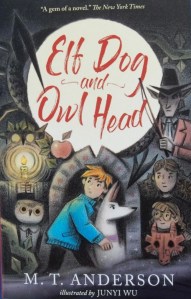
Elf Dog and Owl Head T.M. Anderson, illustrated by Junyi Wu Walker Books
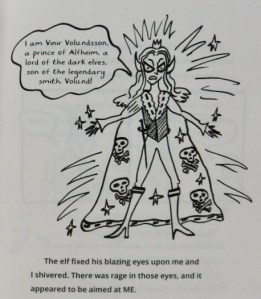
This weird magical novel is set during a covid lockdown. Clay O’Brian is tired of the virus that has forced him to stay home away from his friends. All he has to play with is a frisbee but nonetheless he enjoys the time he spends in the forest exploring, it’s far better than being cooped up indoors with his siblings. As he goes to retrieve his frisbee a dog suddenly bursts out of the bushes, a strange-looking dog with long ears, red inside – an elf-hound, Clay calls her. The creature – Clay thinks she’s saved him from a bear – follows him home and decides to stay.
Next day out walking with the dog, Clay overhears that her collar has a name, Elphinore, and that the two men speaking to one another think she’s a royal hunting dog belonging to the People Under the Mountain.
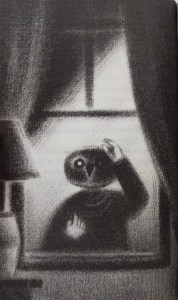
Time passes, the school term ends and Clay has even more time to spend with Elphinore, more time rambling in the forest. Allowed to lead the way, she takes Clay ‘on one of the paths that led through crooked elfin ways up the flank of the mountain.’ It’s thus that he meets the owl-head people, in particular an Owl Boy, Amos from a village full of such people.
One afternoon a while later after a strange incident with a shaker that Clay has acquired, his sisters decide to follow him and find out from where he got it. They creep after their brother and the dog, steered by the latter, so they stay on the right path. Along that same path, DiRossi (Clay’s angsty elder sister) also forms a strange friendship with a miserable giant Vud, that her brother accidentally woke from a deep sleep. Somehow her mood seems to improve as this happens. Clay meanwhile is having to spend time helping his Dad.
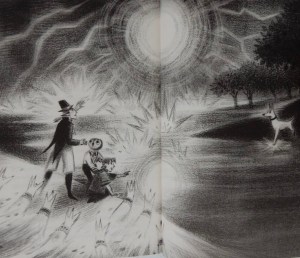
Come New Year’s Eve, the absorbing tale builds to a dramatic climax with an event – ‘a party between the worlds’ – on the slopes of Mount Norumbega, after which comes a final resolution with Clay having to decide where he, Amos and Elphinore really belong.
A brilliantly clever amalgam of fantasy and the everyday world, equally brilliantly illustrated with Junyi Wu’s black and white pencil art. A book that will leave readers with a feeling of wonderment.
Rarely I think, has so much artistry gone into a book of opposites as this one. From the cover, onto the title page and throughout the other spreads are show stopping portraits of primates. ‘What’s the opposite of old? asks the first sentence; turn over and there is the one word answer, ‘Young’ opposite which is a very small, pinkish coloured, thumb sucking infant gorilla. Sad, followed by happy are illustrated on the next two spreads, happy being portrayed by a blissful looking chimp holding a single flower. Then come heavy and its opposite, light, alone and together (observant readers will spot several intruders in the crowd.),
and BIG and small.
The next question is more tricky asking, ‘What’s the opposite of opposite?’ ’The same!’ comes the response with its illustration of a somewhat puzzled primate.
With a touch of the illustrator’s trademark surrealism, this is wonderful celebration of primates of all kinds, some of which followers of Anthony Browne might perhaps recognise from previous books of his. Exquisite illustrations of such wonders as orangutans and chimpanzees, not to mention the odd gorilla will delight readers of all ages.
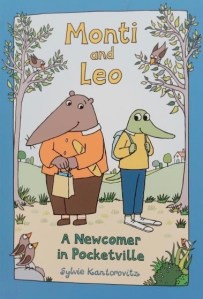
Monti and Leo: A Newcomer in Pocketville Sylvie Kantorovitz Walker Books
Pocketville as its sign says is, ‘a quiet little town’ and that’s just the way the animals living there want it. Like the others, Monti Mole dislikes change; he sticks to a daily routine but then one day, he discovers a stranger, Leo Lizard, sitting on his favourite rock. At a loss to know what to do, the mole goes home and has a sleepless night. Next morning there’s Leo again sitting on Monti’s rock, but this time the lizard’s genial greeting and ensuing kindness disarms the mole and a friendship starts to blossom.
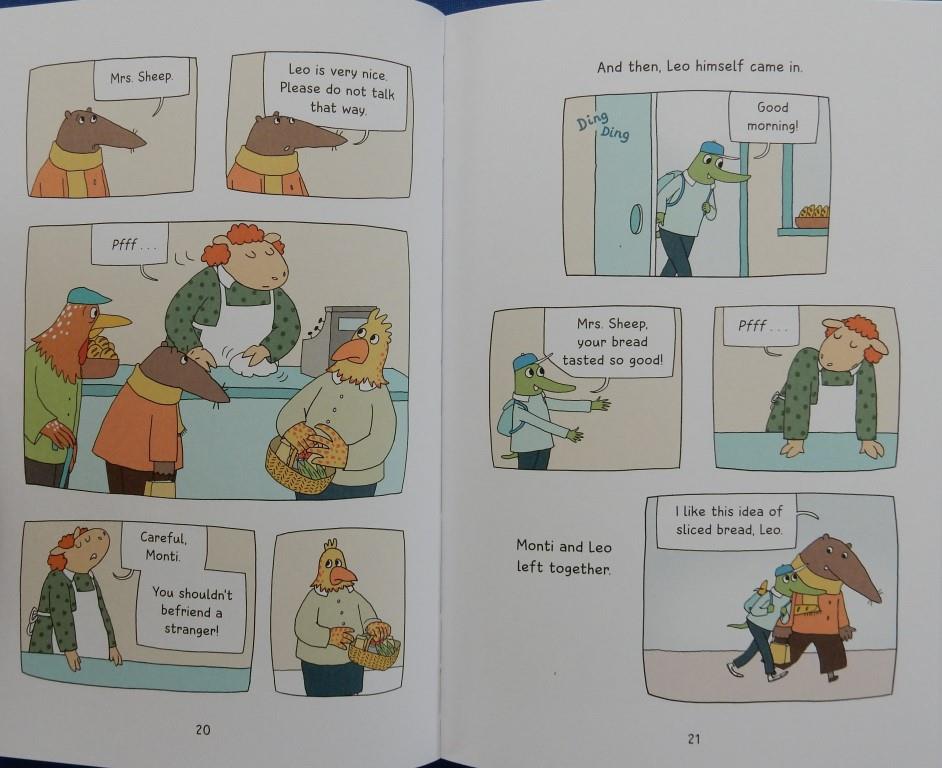
At the bakery the following day it’s apparent that baker, Mrs Sheep is suspicious of the newcomer commenting, “These strangers! They never respect our ways.” and warning Monti against becoming Leo’s friend. The mole though speaks up for Leo and the two walk off together.
Later, as Monti and Leo are sitting on a log, they hear the sounds of music. It’s Mole’s friend Harriet strumming and singing and Monti introduces her to Leo. This leads them into deciding to hold a talent show that anyone can audition for. Off they go to the library to enlist the help of Carl Crow. Poecketville residents are at first interested but quickly turn reluctant thanks to Mrs Sheep’s crusty ways.
However Mole eventually succeeds in sweet-talking the curmudgeon into sharing her ‘gorgeous singing’ at the show; and just in the nick of time before the organisers call the whole thing off. Come show night, the entire Pocketville population is in attendance, either performing or watching and the show is a big success.
The book’s creator aptly dedicates this story to ‘anyone who has ever felt like a stranger’. With its themes of friendship and community building, it was so good to see Monti finding his own talent in the latter. Sylvie Kantorovitz effectively uses a muted colour palette, simple lines and patterning throughout presenting her tale in graphic novel format for younger readers, .
Earnest Sandpiper’s Great Ascent Timothy Basil Ering Walker Books
In this deeply heartfelt story we meet three young members of the Sandpiper family on the day they are, so their parents expect, going to learn to fly for the first time. Spur and Rouse are full of confidence; not so Earnest. Under their parents’ tutelage: “BREATHE… TRY… JUMP… FLY!” Earnest’s siblings take to the air; Earnest however baulks at the edge of the dune. “I think my feathers are too heavy for me,” he tells his mother as he looks for a second time over the edge.
Using her wing tip, Mum draws a heart shape in the sand, adding the promise that “soon your heart will glow like the morning clouds. It will shine with desire and belief. ” This magical glow, she assures him, is a sign that magical things are going to happen. Other family members further encourage Earnest and then leave him wondering if he’ll ever feel the glow. He climbs carefully up a piece of wood, breathes in and tries a jump but … lands flat on his back. From his supine position, he spies a yellow balloon floating above him with that same heart decoration his mum drew. Earnest follows the balloon across the beach till it lands in the sea and he follows his curiosity into the water but as the tide comes in, he finds himself entangled in the balloon’s ribbon and thoroughly afraid.
Happily, his family returns just in time, and their loving concern triggers that magical glow his Mum had spoken of, as well as Earnest’s self-belief. With those basic instructions in his head and a powerful SNAP! Earnest takes flight.
The author’s naturalistic paintings are superb, brilliantly expressive, making that plastic-looking balloon stand out against the natural environment, a meaningful message indeed, helping to make this a cautionary tale about the dangers posed to wildlife by balloons floating free, as well as a powerful story of believing in oneself.
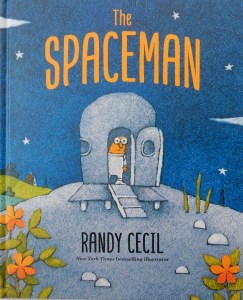
When the diminutive spaceman steps out of his spaceship on a mission to collect soil samples, his first impression is that the planet he’s landed on is pretty ordinary. That quickly proves otherwise however when he catches sight of a large red bloom. WOW! While he gazes at it, his spacecraft is stolen by a ‘thief that sprouted wings from its feathery sides’ (a bird). He gives chase but to no avail: he’s stranded alone and frightened on planet Earth, especially when he finds himself face to face with ‘a hideous beast’ as he stops to admire the next wonderful floral specimen. Off goes our explorer as fast as his feet will go until unable to flee further, he stops and sits atop a rock to ponder on his problematic situation.
In frustration at not being able to think of a solution, he stands up on the rock and is about to yell at the stars when he notices the night has ended, and with the coming of the daylight, the rich and diverse beauty of earth’s flora and fauna is revealed. Hitching a ride with a butterfly, the spaceman is totally enthralled by what he sees
but then he loses his hold and drops down into a pond where he floats gazing skywards. Along comes the ‘hideous beast’ causing the spaceman to realise that appearances in this instance were deceptive; he now describes his new canine friend as ‘a little unrefined perhaps, but charming nonetheless.’
Then as the two snuggle up together, the spaceman thinks of his responsibilities. A dilemma faces him: should he retrieve his spacecraft and return to his old life or make it impossible so to do?
A clever, rather formal, first person narration together with gently humorous, hatched illustrations that provide perspective, enriching the text, make this a book that when shared with children, will give and keep on giving. Initially they might merely enjoy it as a fun adventure for the little spaceman and then later come to appreciate the elation the traveller eventually feels at finding somewhere he feels he truly belongs.
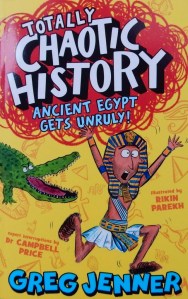
Totally Chaotic History: Ancient Egypt Gets Unruly! Greg Jenner, illustrated by Rikin Parekh Walker Books
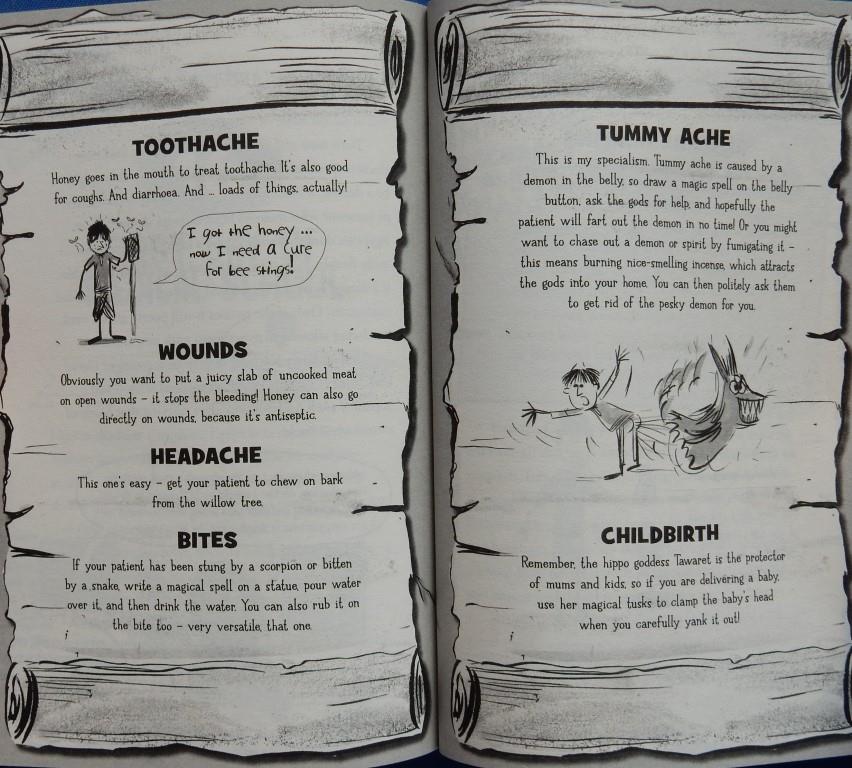
Speaking directly to his audience using a chatty present tense style, writer, Horrible Histories consultant and presenter of the hit BBC history podcast ‘You’re dead to me’, takes readers on an action-packed, chaotic romp through the whole of Ancient Egyptian history. In this enterprise as he navigates this messy world, he’s aided and abetted by Egyptologist, Dr Campbell Price, curator of Egypt and Sudan at Manchester Museum with interjections in the margin, myth busters and ‘accuracy alarms’ that sometimes challenge Greg’s ‘facts’. Adding to the humour of the text and the reader’s enjoyment and perhaps understanding, are Rikin Parekh’s comical illustrations on every spread.
There’s a brief introduction and timeline, after which we are taken on a whistle-stop chronological tour of the key events in Ancient Egyptian history. Then follow short chapters devoted to important figures such as pharaohs and Alexander the Great (he with a mega ego), as well as other topics you would expect such as mummification and hieroglyphics; we also pay a visit to “Doctor Peseshet’s medical school to see how they treated such problems as toothache, headaches and tummy troubles.
This cracker of a book will be of huge appeal to children who are interested in history in general and Ancient Egypt especially. For KS2 readers I recommend adding it to home, classroom and library bookshelves. With Roman Britain Gets Rowdy! coming in October, this promises to be a brilliant series.
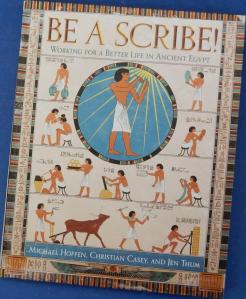
Be A Scribe! Michael Hoffen, Dr Christian Casey and Dr Jen Thum Callaway
With nothing much to do during the covid-19 pandemic, Michael Hoffen, a teenager in New York spent his time learning about Ancient Egypt and with valuable help from Dr Jen Thum, an Egyptologist and curator at the Harvard Art Museums, and teacher and mentor Dr Christian Casey, a postdoc at the Freie Universität Berlin. During regular meetings over the course of three and a half years, under the guidance of Dr Casey, Michael translated a work of ancient Egyptian literature, called ‘The Satire of the Trades’ and inspired by all he learned, he wrote the book, together with Dr Jen Thum.
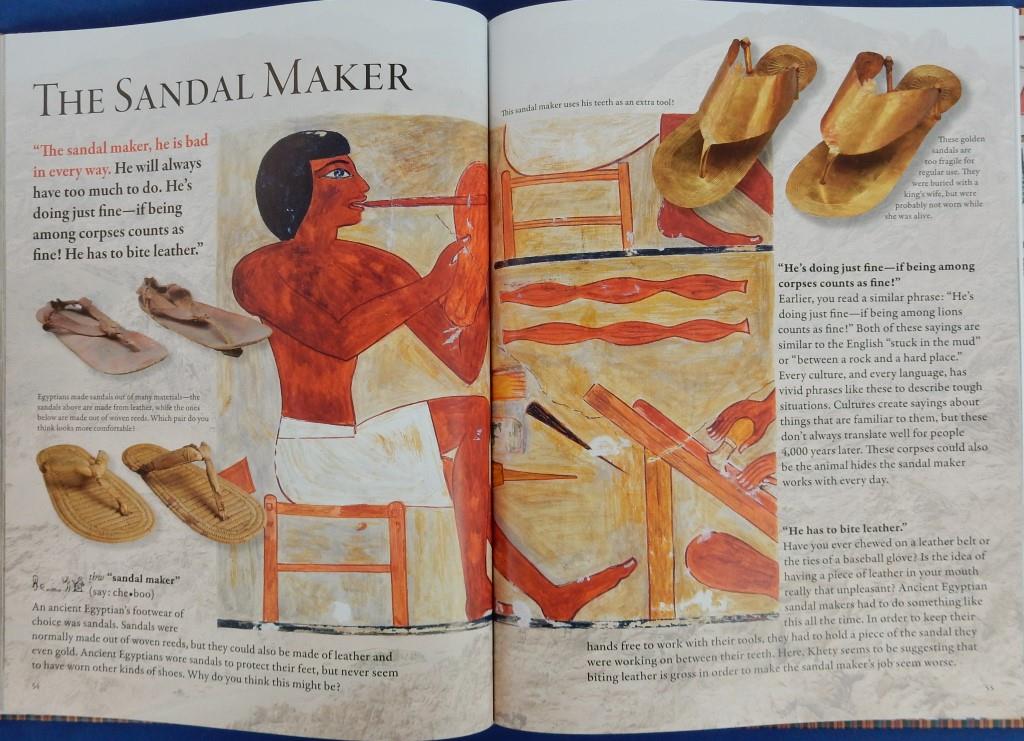
The narrative tells how a father, Khety, takes his son, Pepe, up the river Nile to a distant school so he can learn to read and write with the possibility of then being hired as a scribe in the royal court. The author uses photos of over a hundred real ancient Egyptian artefacts to help with the telling, giving readers fascinating information on such topics as the kinds of work people did and how this affects their lives – eighteen jobs are each given a detailed double spread.
In addition there’s a wealth of wisdom including such advice as ‘If you leave school at lunchtime and wander about in the street’s someone will punish you.’ The physical punishment of children was common in ancient Egyptian society.
Superbly produced, this is a book to add to primary collections and with the connection made to modern life throughout, it should appeal to history lovers as well as those studying ancient Egypt as a class history topic.
Guess Who’s Getting Dressed Guess Who’s Going to Sleep Smriti Halls and Marta Altés Walker Books
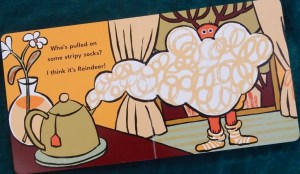
Hugely engaging, and tremendous fun are these two interactive lift-the-flap board books written in rhyme by Smriti Halls and zestily illustrated by Marta Altés. On the first four spreads in Guess Who’s Getting Dressed little humans are invited to respond to a question and given a possible answer (not the right one). Parts of an animal are visible from behind the flap on each recto, sporting the article of clothing the question mentions. For instance the suggestion is that Reindeer is wearing some stripy socks: not so, but the rhyme offers a clue …
The final spread presents the entire animal cast and a ‘Who else?’ to guess. Guess Who’s Going to Sleep follows the same pattern but with a different animal cast and a slumber time theme. Playful delight both.
Not a board book but also for the very young:
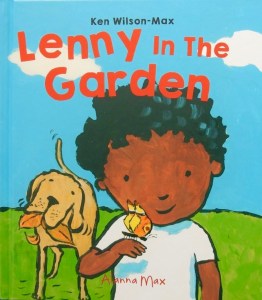
Lenny in the Garden Ken Wilson-Max Alanna Max
Lenny, his mum and Wilbur their dog are in the garden. On the lookout for new things, Lenny starts exploring, while mum gets busy digging. Before long Lenny draws attention to some ants walking in a line, so he says. Higher up a spider spins its web, round and round. Then as Lenny enjoys the tactile pleasures of toe wiggling in the grass, Wilbur makes friends with a wiggly worm that’s just popped up from underground. Mum finishes digging and begins watering, offering to water Lenny too but he’s too engaged with the nose tickling butterfly, the caterpillar and the dotty, spotty ladybird on a leaf.
Next he follows a snail slithering along leaving a trail behind; a grasshopper leaps hither and thither and Lenny attempts to emulate its bouncing until finally digging and watering done, mum calls to Lenny; he comes and the two sing a finger song ‘Tommy Thumb’ together before going indoors for lunch.
A simple, thoroughly captivating delight that is just right to share with the very youngest children. One hopes that having heard this story with its brightly coloured illustrations, listeners will become as observant as young Lenny in their own gardens or nearby outdoor spaces.
Wise Up! Wise Down! John Agard, JonArno Lawson, illustrated By Satoshi Kitamura Walker Books
Three awesome creative people from children’s literature have collaborated on what is sure to become a favourite poetry book for many readers. Two friends John Agard and JonArno Lawson provide the words and the distinctive art of Satoshi Kitamura provides the wonderful, whimsical illustrations. So, when you open this book be prepared to embark on a foray into a lively, thought-provoking conversation between prize-winning poets. It’s so cleverly put together with the two voices taking turns throughout; they’re made to seem as if one person’s thoughts have immediately initiated a response from the other, despite many of the poems having been published previously.
Sure to get your brain cells buzzing are Jon Agard’s Mind, What Exactly Are You? and JonArno Lawson’s rejoinder Never Mind. So too will Questions (JA) and Should I Be Me? (JL) Philosophical posers each one of which could be used to open a community of enquiry type discussion.
There’s humour too, of a wicked kind in for instance, JA’s Crocodile’s Tale: ‘The last man who mistook me for a log / Lost half a foot and can no longer jog.’ and Alligator’s Response (‘Is that right, old Croc? / But can he still walk? // The last man who stopped to look me in the eye? / That falling-down man was an upstanding guy.’ (JL)
What comes across loud and clear is both poets have never lost their sense of awe and wonder about life, the universe and all that: JL summarises this in the final lines of the verse in the final poem: ‘figuring out this strange world will never / be anything less or anything but / a forever and ever adventure.’ A perfect close to a terrific book.
Read it at home, read it in the classroom and then perhaps try out some of the suggestions given at the end.
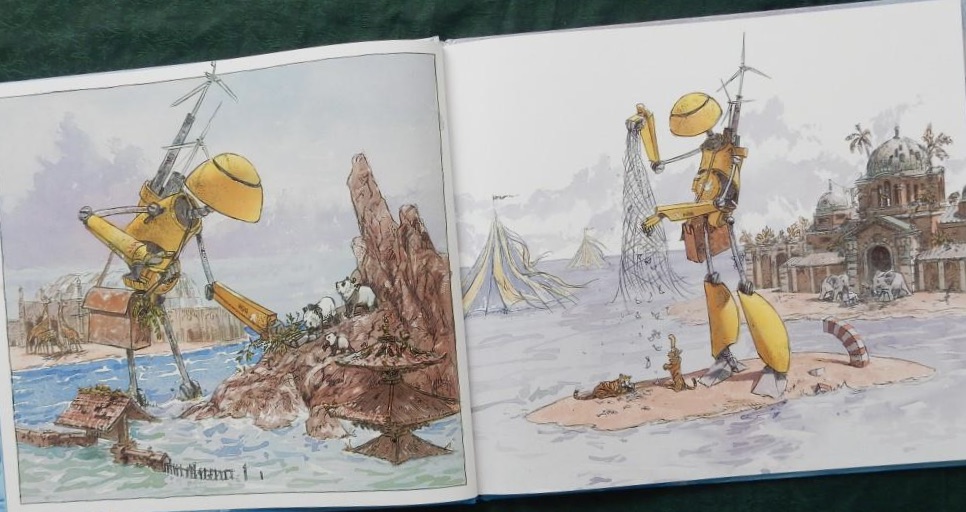
This is an ark story of an altogether different kind. Set in a post apocalyptic world, it has no text, only a series of amazingly detailed wordless spreads and there’s not a single human in sight. Instead, AI in the form of a ginormous, towering robot with the letters NOA on its arm and wind turbines to power it on its back, steps onto a flooded landscape with its incredible architecture.
It appears that he’s stumbled upon a ruined zoological garden where half a dozen or so iconic species are stranded. He feeds them but as the waters rise ever higher, he sets about designing and building a sail boat big enough to accommodate the remnants of survivors of the deluge – giraffes, pandas, tigers, rhinos, flamingoes, elephants, zebras.
They set sail but their craft is caught in a terrible storm and shipwrecked on a low lying archipelago.
All seems lost but then from the sky there descends help in the form of another robot piloting a hot air balloon . There’s hope after all …
A brilliantly imagined, bleak and thought-provoking parable showing what the future may hold for life on Earth if humans fail to turn back the tide of global warming. Becker’s minutely detailed watercolour and pen-and-ink illustrations provide many hours of immersive meditation.
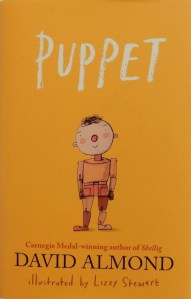
Puppet David Almond, illustrated by Lizzy Stewart Walker Books
David Almond’s sublimely written poignant fable, with Lizzy Stewart’s impressive illustrations will really pull at your heartstrings.
Silvester is a widowed puppet maker; together with his wife, Belinda, he gained a reputation for creating some of the most beautiful puppets and shows in the area. As a result, the local museum wants to exhibit the subjects of his work and a young woman, Louise from the university wants to write a short history of his creations to be offered for sale when the exhibition opens. All he has left are his memories, posters, and photographs of his beloved Belinda.
So what can a puppet master do when he’s old and alone? Pondering this question, Silvester feels strangely free. Days pass and one night, awaking from his dreams, the attic seems to call to him. Up he climbs, sits at his workbench and fashions a new puppet. Then comes, “E-O.” That’s the first sound the puppet makes: Silvester thinks he’s imagining it. Next morning he tries to get the puppet to stand; it’s a tough call but eventually he succeeds. “Hello, Puppet,” says Silvester. “E-O” comes the reply.
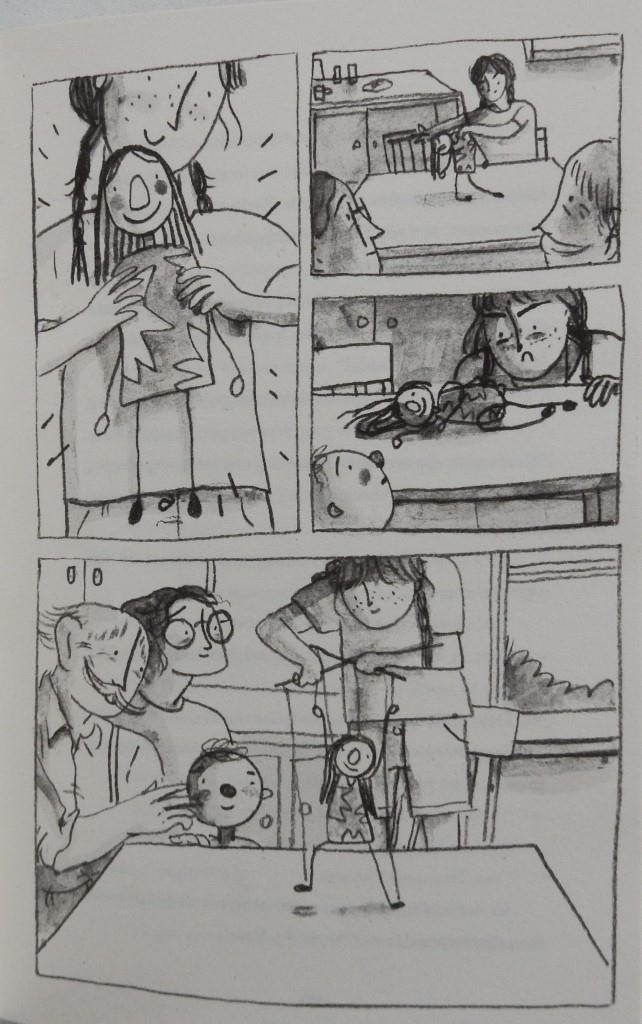
Puppet is a quick learner, he walks and it’s not long before the old man has found a firm place in his affections for his creation. They visit the park together and there they meet a rather unusual girl named Fleur and her mum, Antonia. The latter remembers some of Silvester’s magical shows from her childhood. The puppet becomes known in the local community as Kenneth and soon Fleur becomes Silvester’s ‘apprentice’, learning how to create and use puppets.
This eventually leads up to a public performance – but all the while, Silvester has been growing more and more tired. With the show over and everything cleared away, telling his friends, he’s seldom been happier, the old man heads home with Puppet and they lie down to sleep together. “Jam,” whispers Puppet the next morning … “Da- ad” but … . I had tears in my eyes at this point, such was the emotion I’d built up inside.
With his wondrous tale of creativity, playfulness and the circle of life, David Almond shows that with trust, love and the power of the imagination, anything is possible. Share it with a class: the children will be swept away by the magic of the telling, as will individual readers.
These are both the concluding books in series from Walker Books: thanks to the publisher for sending them for review.
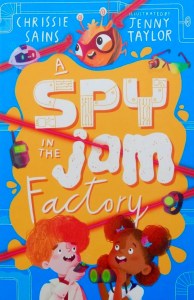
A Spy in the Jam Factory Chrissie Sains, illustrated by Jenny Taylor
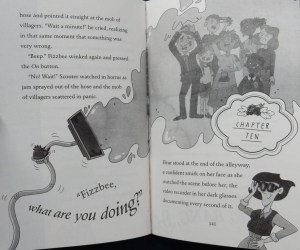
When, thanks to a spate of local newspaper articles, the jam factory (Willow Green villagers’ pride and joy) comes under surveillance by the Alien Intelligence Agency, its intention is to find a reason to evict Fizzbee from Earth. Yes, there have been several mishaps of late: giant green vegetables running wild, burglaries and worst of all, children floating in the air after consuming figgy jam thanks to one of Fizzbee’s alien ingredients getting a tad out of control but Fizzbee’s reputation is a rock bottom. Scooter and his pals decide it’s time for Operation Make Fizzbee Look Good to dispel the fears of the village residents. There’s a big problem however in the form of Agent Fleur De Vious, the only spy in the Alien Intelligence Agency. She believes Earth should be alien-free and is determined to get the agency’s director to sign an eviction notice for Fizzbee.
Off she sets aided and abetted by Bottie the inept little spaceship. She certainly appears to be making headway when she starts using subterfuge.
Will Scooter, the boy with a wealth of determination and creativity, be able to stop her in time?
There’s a surprise twist at the end as well as a vital message for every one – characters and readers – from Fizzbee: “Some humans find difference scary. But differences should be celebrated, not feared.” Many readers will be sad to learn that Chrissie Sains and Jenny Taylor’s fourth book in the Jam Factory series featuring expert inventors of wondrous jams, Scooter and his alien sidekick Fizzbee is the final one. So too was this reviewer, despite the satisfying ending.
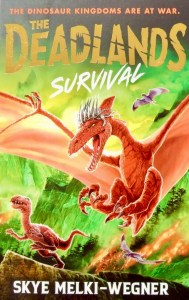
The Deadlands: Survival Skye Melki-Wegner
In this thrilling finale to the cracking trilogy, at the heart of which are five outcasts, former enemies, who are the only hope to save their warring dinosaur kingdoms from impending doom, author Melki-Wegner reassembles her all-dinosaur cast for a furious, climactic battle. With a massive army to face, frenzied fights, treachery from supposed allies, ambushes, as well as betrayals, narrow squeaks, and courageous exploits the action races towards a climax that is spent against an enormous inferno and a deluge. Through all the trials, the trust Eleri et al have in one another provides a powerful support and the battle’s momentous outcome depends on loyalties and holding fast to their honourable ideals and values. A showstopping conclusion to the adventures of the intrepid heroes that have kept many older readers, especially danger-loving ones, gripped.
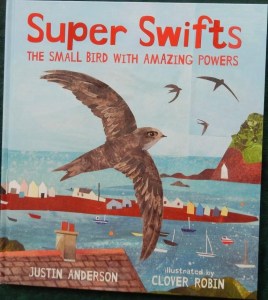
Super Swifts Justin Anderson and Clover Robin Walker Books
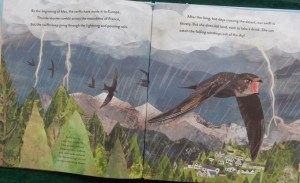
Astonishingly, swifts (champions of the bird world) are able to fly faster and higher than any other birds; even more astonishing is that they might stay airborne for as much as four years, flying up to seventy miles per hour.
Author, Justin Anderson begins this swift story in central Africa’s Congo region in early April and tells of the journey undertaken by one female in particular who with a group, flies from their place of overwintering, towards Europe and their destination in the UK.
A month long journey that takes them over the world’s largest desert, across vast oceans, through thunderstorms to the place where our female will look for her mate, a bird she’s not seen for a whole year.
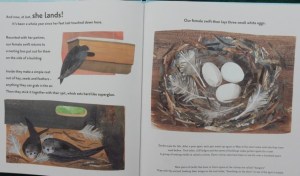
Clover Robin’s mixed media close ups of the pair show them making a nest in which the female lays three eggs each of which hatches into a hungry chick.
I love the author’s description of the pair sticking ‘their nest together with their spit, which sets hard like superglue.’ Come July, it’s time for the mother to make her return journey to Africa; she and the other super swifts will once more take to the skies.
On each spread, there’s a main narrative, alongside which is further information printed in smaller type. An inset box gives fascinating details of swift lice that nestle in young birds’ feathers and breed when the swifts nest again. A final author’s note contains information about some of the swift species and gives ways in which readers can help prevent swifts nesting in the UK from dying prematurely. I’m looking forward to hearing their screeching cries as they fly over our house this summer.
Also on the subject of birds is a book wherein fact and fiction come together.
Night Flight Katie Cottle Puffin Books
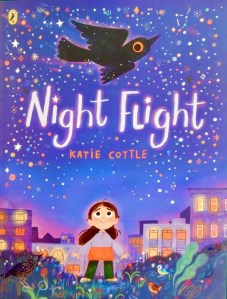
When young Ellie moves from her country home to a big bustling city on account of her Mum’s new job, the girl notices that many of the bird varieties she loved watching aren’t there. Mum gives her a bird feeder but no birds come a-visiting, so at her mum’s suggestion, Ellie takes a walk around but all she sees are pigeons, no blackbirds, sparrows or moorhens; and empty skies as she makes her way to school each morning. Then one night there’s a tapping at her window; it’s a glossy-feathered starling, a very large one that asks for her help and Ellie agrees.
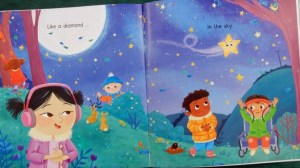
Off they soar with the child sitting on the starling’s back until they come to a hill whereon they land. When Ellie comments on the glow emanating from the city, the bird tells her that it’s light pollution. As she looks skyward, in this spot far from the city, there are hundreds and hundreds of glittering stars, stars being something else that Ellie has barely seen since the move to the city. On account of not being able to see the stars because they’re dimmed by the light pollution, the birds are unsure where they should fly: can Ellie find a way to help them find the way back home?
She sets to work with the help of her Mum, but she needs to find the confidence to speak out about the birds’ plight. Will she be successful in saving the birds? Happily yes and before long, the city has become much more like home to both Ellie and the avians. Author/illustrator Katie Cottle’s timely story has an important message about not allowing unnecessary artificial lighting to interfere with the natural world, especially birds. It’s one that needs to be shared and its message heeded by humans especially those who live and work in cities.
When Lena’s older brother Kay-Kay fails to return from summer camp in Goa, despite rather enjoying feeling a bit special at home for a change in his absence, Lena knows she must find him. His parents are grief-stricken but believe that the police, who think he’s run away, are doing everything they can. His friends say they don’t know why he disappeared from the train back to Lamora but, convinced that Kay-Kay would never run away, Lena suspects that one, Samir, who also went to Wildlife Adventures camp, knows more than he is letting on.
Devastated by the idea of living without her brother and finding her parents’ pain unbearable, she decides to embark on a mission to investigate, with the aim of locating Kay-Kay and bringing him home. ‘Without you, Kay-Kay, there’s no sun, no warmth, no light. I will find you – my brother, my friend. I will find you and bring you back,’ she says. Looking for clues in his room, she discovers that Kay-Kay has been keeping part of himself hidden from the family – his secret dreams and his fears of not living up to parental expectations; these he reveals in his powerful, heartfelt poetry.
Determinedly retracing his journey across India, she meticulously begins to reassemble clues leading to his disappearance. Can she find Kay-Kay and save him before it’s too late?
This mystery set in contemporary India grips the reader from the start. Written from Lena’s view point, it’s frequently gut-wrenchingly moving, especially when she addresses her thoughts to her brother. A terrific debut that pays tribute to the power of sibling bonds especially in desperate situations as well as showing that the creative arts are every bit as valuable as engineering and medicine, subjects that in common with so many Indian parents, are favoured by Kay-Kay’s parents.
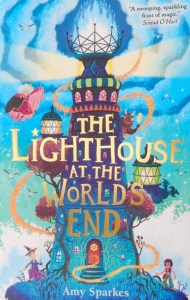
The Lighthouse at the World’s End Amy Sparkes Walker Books
Nine (a pickpocket girl) and her friends, Eric the troll, and wizard Flabberghast are back for their final adventure. They have to head back to the mortal realm to find a priceless lost stargold locket, a family heirloom that is hidden in the Nest of a Thousand Treasures. Not only that but if she’s successful, Nine must then find a way to release its power once and for all.
Desirous to get hold of the very same object and also residing in the House at the Edge of Magic is the most troublesome witch in all the realms, Flabberghast’s sister. Said witch has some connection to Nine, and may have the answers to some of her questions.
Despite the very idea of returning to the place guarded by her old foe Pockets, the formidable gang master of all the London thieflings, making Nine feel sick, off they go. The adventure is filled with threats, there are dangers aplenty including a close call for Flabberghast, and as the oft repeated words remind us ‘things are seldom what they seem’.
Amy Sparkes has a wonderful way of making her readers feel they are truly part of Nine’s journey, a chronicle about developing a sense of belonging, about the importance of friendship, about one’s family being what you make, rather than those you are related to, and about redemption and embracing differences. Like many others who first met Nine in The House at the Edge of Magic, despite the throughly satisfying finale to the quartet, this reviewer feels sad about bidding farewell to her and her friends.
The Magic Callaloo Trish Cooke and Sophie Bass Walker Books
Inspired by stories of enslaved Africans who made patterns in their cornrowed hair, using them as maps to help them escape to freedom, Trish Cooke’s neo-folktale has its origins in Rapunzel, made popular by the brothers Grimm
It begins in a small village, long ago and far off where there grows a magical callaloo plant that would grant the wish of any villager who ate one of its leaves. Thus all the villagers had everything they needed; but one of those living in the village was selfish and greedy. One night this greedy man creeps into he square, uproots the plant and makes a wish: to have the plant for himself. He then proceeds to eat more and more leaves, making wishes for more and more things until he had so much he could barely move. His laziness of course, has an adverse effect on the callaloo: it shrinks until just one leaf remains.
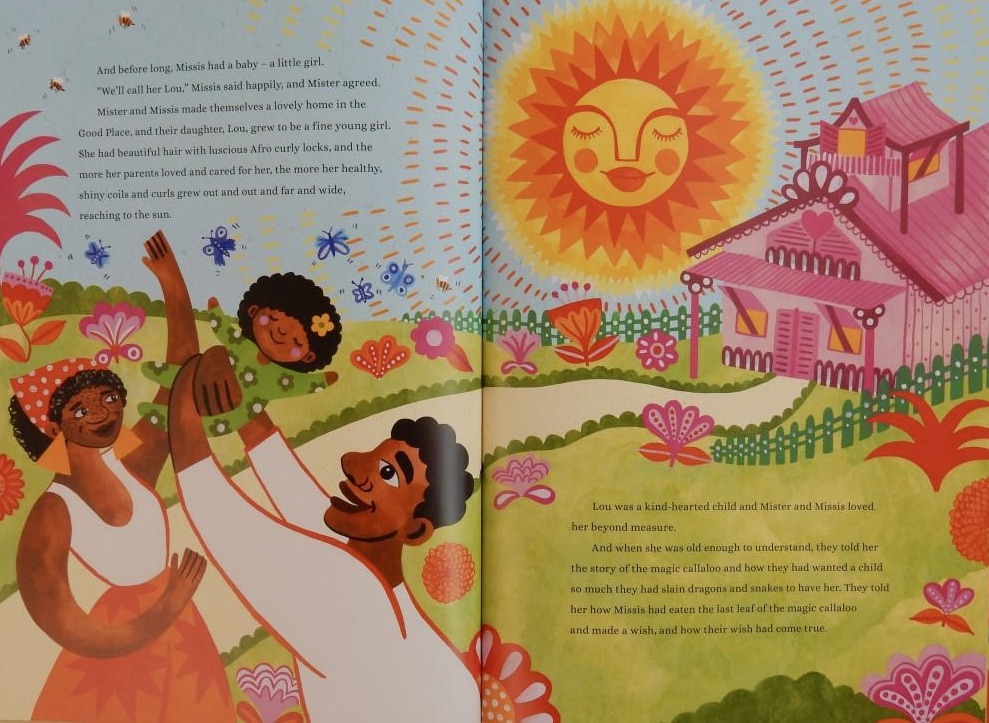
Back in the village, a couple hoping desperately for a child, are greatly distressed at the disappearance of the plant as their hope was that it could provide them with their dearest wish. Then one evening a wise woman tells them where the last leaf is and with renewed hope they begin to search, eventually locating the plant. The Missis eats the final leaf and both she and Mister wish for a child. Before long, to their joy, a baby is born and they call her Lou.
The girl grows into a kind, beautiful curly-haired girl and her parents tell her the story of the magic leaf. Lou makes up a magic callaloo song but her singing bothers her father in case someone overhears its words. Sure enough, the plant thief happens to pass through: he hears her song and snatches her away to his home where he keeps her prisoner, making her do all his work.
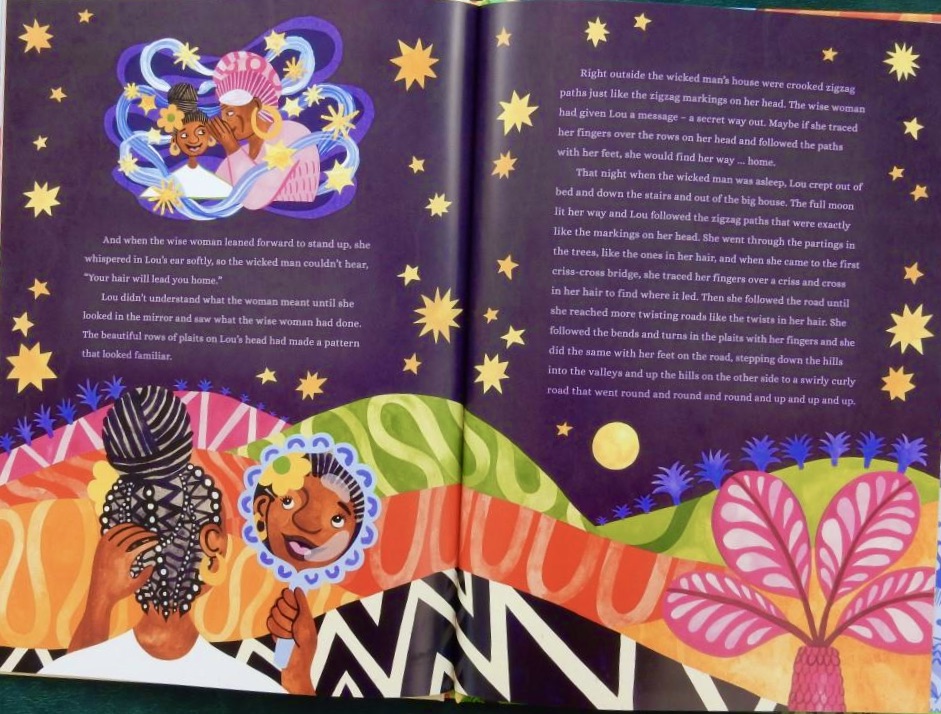
Both Lou and her parents grow ever more miserable, missing each other all the time, till years later who should come along again but the wise woman. Lou tells her of the cause of her sadness and the woman formulates a clever plan using the girl’s tresses which she twists into plaited patterns, quietly telling Lou, “Your hair will lead you home.”
However something else also returns with her.
With themes of longing, captivity and escape, Trish Cooke’s wonderfully woven tale is impressively embroidered with Sophie Bass’s art, which includes a wealth of flora and fauna in kaleidoscopic colours making every turn of the page a visual feast. This longish story will enchant readers across a wide age range.
Who could possibly blame the young knight narrator of this story for falling in love with the little green grotti he comes upon in a hollow while carrying out his knightly duties one day. For a start the little thing is clingy and puts on such a sad expression that despite explaining about his calling, the knight feels unable to leave Grotti behind, so the two start travelling together. Then comes the need for a ‘difficult decision’ by the knight: an exchange is made that means the two can travel much more quickly, surviving on berries and bugs
until the knight is faced with another decision in order to enhance what they dine on. A third difficult decision is caused by a sudden snowfall and the need to keep Grotti warm.
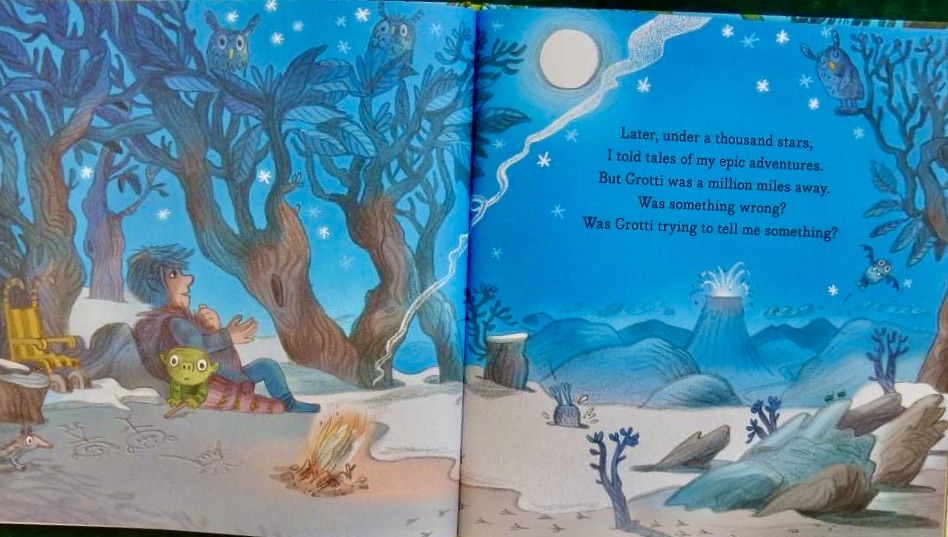
As the two snuggle down under the stars one night, the knight tells tales of his adventures but soon surmises that all is not well with Grotti who seems distracted.
Next morning the knight is faced with an exceedingly snotty Grotti and the realisation of what the little thing has been trying to communicate by means of a stick. Off they go with Grotti leading the way until they reach a house atop a volcanic rock pile. There, his task complete, the knight leaves Grotti with his family and departs to continue his beast battling and other work; but he knows in his heart that something is missing. Will he and the little green Grotti ever see one another again?
Despite his snottiness, Grotti is an adorable character that will endear himself to young listeners; he certainly had that effect on this reviewer. I suspect that this tale with its themes of friendship, family and love, will quickly become a story time favourite with children both in the classroom and at home.
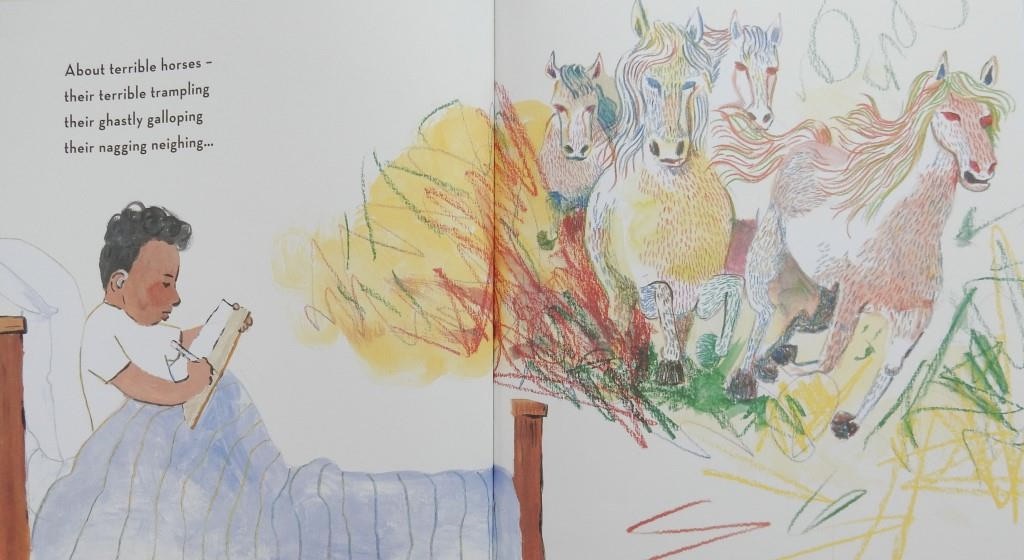
Terrible Horses Raymond Antrobus and Ken Wilson-Max Walker Books
Narrated by the younger of two siblings, a small boy talks of how he feels about his sister, the ways they react to one another and to sharing their things. From the boy’s viewpoint, big sister is a cool character but she causes the pair to fight one another physically, rather than verbally. To release the tension within himself, the boy goes to his room and writes stories featuring terrible horses, with himself as a lonely pony.
Then there’s another fight on account of the narrator taking things belonging to his sister without asking her permission, which triggers further actions that fuel the aggression. Once again the boy retreats into his bedroom, fashions a horse story that includes showing himself as the pony neither able to speak or sleep. Surprisingly though sleep he does and when he wakes the terrible horses book is missing. Who do you think has it now and what will be the outcome?
Raymond Antrobus has penned a seemingly simple tale of sibling rivalry, but it’s one that conveys feelings relating to discord and empathy, both of which Ken Wilson-Max captures so adeptly in his illustrations of humans and of horses.
Another feelings centred picture book is
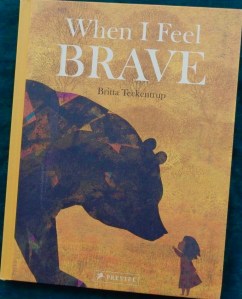
When I Feel Brave Britta Teckentrup Prestel
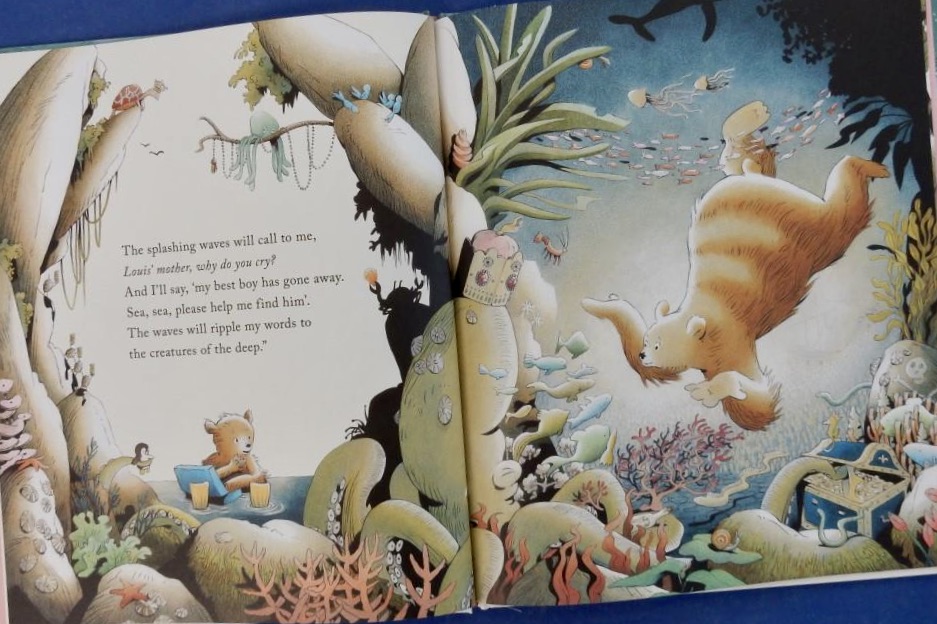
Having presented a girl’s feelings about being angry in When I See Red, Britta Teckentrup examines equally thoughtfully, a girl’s fear and what it means to be brave. By means of the author/artist’s rhyming narrative and evocative collage style illustrations, readers follow a child wandering through a forest who is startled by a huge bear that is initially terrifying, but as she continues her journey, becomes first companion
and by the time they emerge into the light, friend. ‘I can finally see … / that courage and fear / are both part of me’ the child concludes. An important insight indeed and a book that offers child readers and listeners a way of understanding one of their own basic emotions and how bravery allows them to take charge of this emotion. Try using this first person story as a starting point for a circle time discussion.
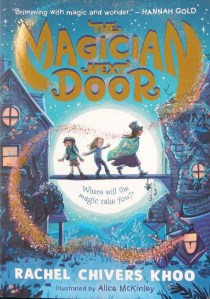
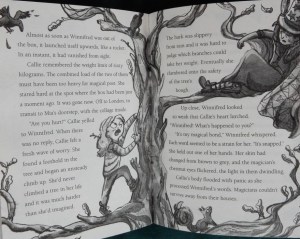
The Magician Next Door Rachel Chivers Khoo, illustrated by Alice McKinley Walker Books
Callie and her father have moved out of London to a mountainous area of Northern Ireland; she feels far away from her friends and her memories too. One night sleepless and struggling to settle into her new life, as she stares out of her window there comes a loud BOOM! An upside-down house has appeared in her back garden. Next morning no house is there, so despite the large crater on the lawn as well as a piece of tile, she decides it must have been a dream. Then the boy from across the fields appears and he knows her name as she does his; Sam believes what she says about the previous night’s strange occurrence but Carrie remains unconvinced until that is, some weeks later she finds a mysterious paper aeroplane on her duvet on which is a message from Winnifred Potts, a magician from the strange house who is urgently asking for her help.
Carrie meets her at midnight and learns that Winnifred’s Wanderlust, the adventure magic that protects her house from attack by magical beings is lost and she begs Carrie to go and bring it back. Can Callie and her new friend, Sam, who has hidden himself away and overheard the conversation, provide the help Winnifred and her house need?
Not only that but will she be able to transcend the overwhelming sense of loss she feels after her mother’s untimely death and her homesickness for her London community? With the help of new friends and different experiences, can she find hope for her life in the future?
With a sprinkling of Irish folklore, some great characters, and lots of sensitivity, Rachel Chivers Khoo has written a wonderful tale of magic and mayhem, with a vital message about the true meaning of home. To add to its spellbinding nature are liberal scatterings of Alice McKinley’s delightfully quirky black- and-white illustrations. A great read for children from Y2 and beyond.
These are both new titles featuring popular characters from previous stories: thanks to the publishers Walker Books for sending them for review.
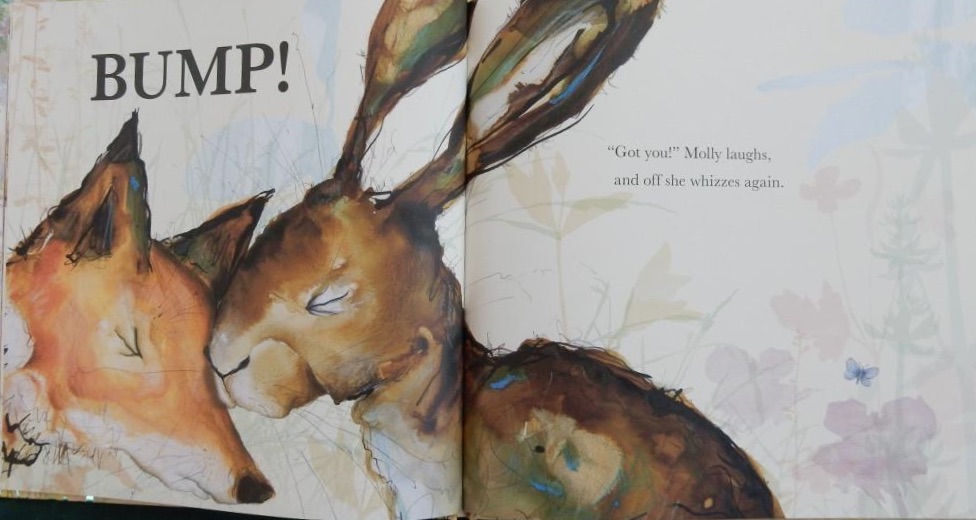
Molly, Olive and Dexter: You Can’t Catch Me! Catherine Rayner
In this third episode in the lives of a trio of residents of a garden oak tree, Molly the hare, Olive the owl and Dexter, the fox, Dexter asks his friends to participate in a game of chase. First to be ‘it’ is Olive but she’s super speedy and soon catches Molly. When she’s the chaser, Molly finds her fast feet and before long she’s got Dexter, well and truly.
The bump leaves the fox feeling all dizzy and after a bit of chasing in a tired tizzy too. Determined to do something to show his vulpine prowess, he does something that perplexes his pals and in so doing proves he too is a worthy participant in the game of catch.
And the winner? What do you think? …
As always, Catherine’s watercolour scenes are superb; every spread makes the reader want to slow right down and linger over it. Young listeners too will appreciate the artistry as well as enjoying the playfulness of the chase.
Dance with Oti: The Turtle Tango Oti Mabuse and Samara Hardy
Having learned to dance the Bird Jive, the Lion Samba and the Penguin Waltz, Mrs Oti’s pupils have a new challenge.
Prior to their performance at the grand opening of the aquarium, Mrs Oti takes the members of her dance class to see the marine creatures that are kept in its watery world. They enjoy watching the rainbow fish, wobbly jellyfish, scuttling crabs, the enormous shark and the turtle family. One of the class, Poppy, is concerned about the baby turtle and it’s the turtles that give their teacher an idea for the performance.
Back at the dance studio, the children enjoy emulating the fin flapping fish, the wobbly wobbly jellyfish and hear some sound advice from Mrs Oti. Advice that proves to be particularly important come the big day on stage when there’s a mishap just before the titular Turtle Tango grand finale.
After the show, along with congratulation from their teacher, each of the performers receives a special surprise thank you present.
After enjoying the vibrantly illustrated story, listeners too can learn the finale dance by following the step by step instructions on the last double spread..
Skylar and the K-Pop Headteacher Luan Goldie Walker Books
Skylar and her best friend, Dana, are obsessed with K-Pop, in particular AZ8, but when they’re about to launch a video comeback, her parents ban her from anything to do with the group for a whole week. During the lunch break at school as she’s telling Dana, a furious Skylar grabs her light-up dancing bunny ears from her rucksack and dashes off. But she forgets to remove the hat as she sets off to her next class and encounters the head teacher, Ms Callus who shouts at her and confiscates the precious hat.
Later she makes an excuse, leaves the classroom and confronts Ms Callus. Having grabbed her hat back, Skylar declares that she’s fed up with grown-ups telling her how to live her life. “I wish I was in charge,” she says twice. With that something weird starts happening: green lights flash and Skylar and Ms Callus swap bodies. Skylar is now the 71 year-old, mega-strict headteacher with a new role to try and get used to. When she turns to Dana for advice about what she needs to learn the response is.”something to do with empathy and walking in the other person’s shoes.” But how long will Skylar be like this, neither girl knows, certainly longer that the day and night they first thought.
Alongside this AZ8 announce they’re holding a competition and anyone who goes viral with their version of the ‘Hot Feet’ dance routine will win free tickets to their upcoming gig, and there’s an emergency inspection of the school to contend with. Chaos indeed.
Is it even possible that Skylar and Ms Callus can develop empathy towards one another and their lives, and if so can it be done in time for the weekend gig? It does’t help that Skylar has upset her bestie and the two have fallen out. And what about the inspectors; will they like what they see? Will Skylar repair the rift with Dana?
With lots of laugh-out-loud moments, this is a hilarious tale, at the heart of which is the importance of seeing things from another person’s viewpoint, friendship, self-belief and being true to yourself. Older KS2 readers will love it.
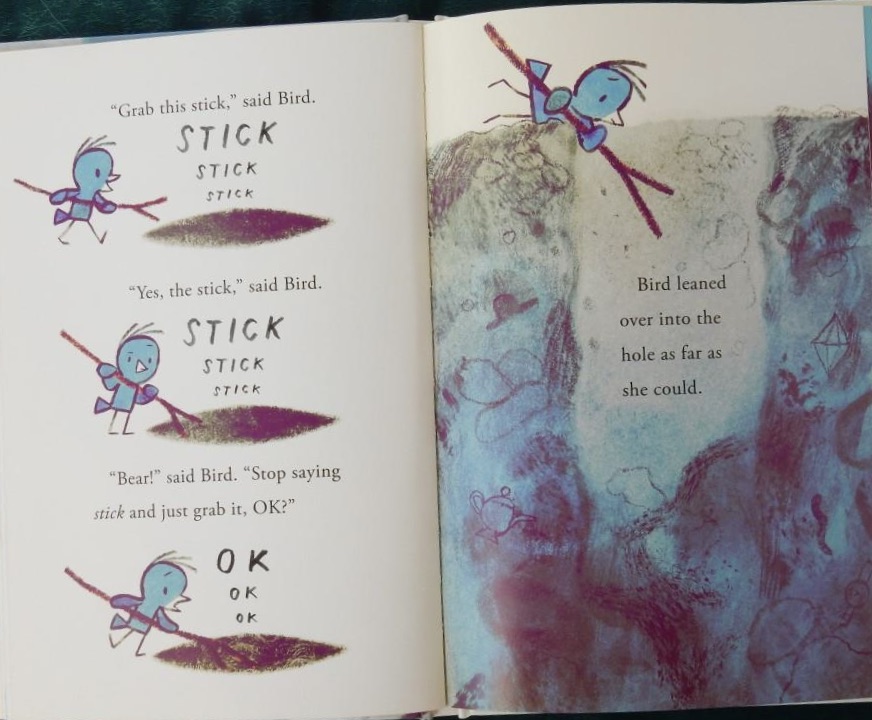
Bear and Bird : The Adventure and Other Stories Jarvis Walker Books
The first of the four short episodes about best friends Bird and Bear – The Nothing – takes place on a Tuesday, the pals’ usual day for spotting clouds but on this particular Tuesday Bird is poorly, so instead Bear endeavours to make his friend feel better. However she declines his offers of chewy things and other foodie favourites; it’s also a no to a story, a new wonky stick and dancing. ‘Nothing” is all Bird wants. Bear is on his way out when Bird calls him back with a request. Can you guess what it is?
With Bird feeling somewhat better, the two set off for some cloud searching when they come upon a sign, DO NOT GO IN THE HOLE, Bear reads. Off they go again, Bear with his mind on clouds, Bird preoccupied with wondering what his friend is thinking about. Suddenly Bear realises he’s lost Bird and vice-versa. Bird thinks of The Hole. Could Bear be stuck down there? Bird goes to look and finds a stick that’s just right for a rescue.
But who rescues whom?
Episode three sees Bear and Bird at Leaky Lake where they come upon The Mole, a creature whose jokes Bear finds funny. Soon Bird starts to feel left out and so she decides on a get rid of Mole plan. However, things don’t quite go as she hopes as it’s Bear who feels upset. Can they remain bestest friends or will Mole come between them?
In the final episode Mole is still waiting when the two return to the lake and he has a surprise in store: a little boat – just the thing for The Adventure under Mole’s captaincy. No matter if they encounter such things as pirates and sea monsters, they’ll surely keep each other safe.
As with previous titles in the series, this delightful duo will amuse both emergent readers and young listeners with their ups and downs and silliness that are beautifully captured in words and pictures by the inimitable Jarvis.
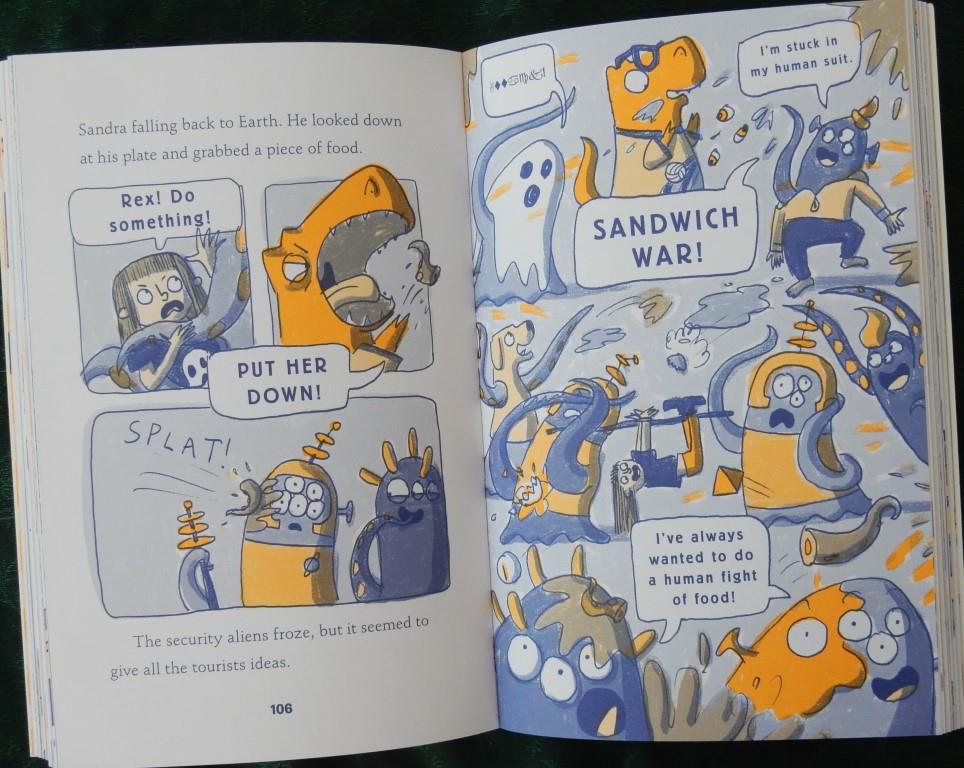
Rex Dinosaur in Disguise: Undercover Alien Elys Dolan Walker Books
Life is going well for dinosaur Rex, now a P.E. teacher, but then he upsets a human participant over a decision he makes at a competition. This is soon followed by the disappearance of every single one of the guinea pigs … ‘Ninny pig(s)’ … ‘Grumpy pig(s)’ … ‘Gwent squid(s)’ from the school pet show as a result of an accident when Rex was trying to be helpful; you can guess who gets the blame.
With the anti- monster humans determined to prove him guilty and Rex (undercover) and his friends Sandra, Anish and Bigfoot determined to prove his innocence by solving the case of the missing guinea pigs, this mission is not going to be a walk in the park, especially as it soon transpires that further guinea pig vanishings are happening all over the city. The crux of the matter is discovering who really is to blame, first stop a meeting with mayor, Jimmy Prigg: a surprise revelation awaits. The next stop is for coffee …
There follow further encounters with disguised creatures, a daring intergalactic undertaking and fyet more wild adventuring back on Earth.
Like this reviewer, I’m sure child readers will laugh out loud all through this crazy caper with its hilarious dialogue, fantastic illustrations and chapter headings such as BUM CRAC (you’ll need the book to work that one out). Let’s hope there’s a third story in the offing soon.
The delightful Hedgehog duo return in a new story. Eager to do everything Big Hedgehog does, Little Hedgehog enthusiastically helps gather all the fallen leaves. Having collected a huge pile there’s just one leaf remaining and that’s on a high branch of a tree. Unable to reach it by leaping, Big Hedgehog decides to climb up the trunk. “I can do that too!” cries Little Hedgehog. However Big Hedgehog is back on the ground with the leaf by the time Little Hedgehog reaches the top branch. Thereon is a ladybird and of course Little Hedgehog unable to resist copying the insect’s actions launches itself skywards.
This is only the first of the animal actions Little Hedgehog tries and before long a whole host of animal friends starting with a mole,
have been shown what the little prickly creature can do, including swimming in the lake. That’s where during an afternoon of fun, Little Hedgehog learns that not all animals have the same set of skills and abilities. Come nightfall, it’s fortunate that the turtles are willing to offer a lift all the way home to the Hedgehogs’ residence where an owl’s hoots send Little Hedgehog off to sleep but not before a final “I can do that too!”. Beautiful, textured scenes in Britta’s characteristic style and a gentle tale show little humans that it’s good to be eager to embrace new things but equally, it’s fine to discover that you’re not quite ready to accomplish all you try.
No, Nancy, No! a Dog Chase in New York Alice Tait Walker Books
Nancy and her canine best pal Roger are in New York ready to head off to the theatre to see Dogs! The Musical. On arrival Nancy spots Candy the star of the show on a lead outside and in her enthusiasm she accidentally unravels the lead and off goes Candy … through the city and into a cab destination Central Park. Nancy and Roger chase after her but Nancy can’t resist stopping several times as they pursue her into the zoo, past a parade and downtown to the Hudson River where Candy has been blown attached to a bunch of balloons. Eventually she ends up dangling from the Statue of Liberty.
As ever more of the dogs of the city join the chase young followers of the story will enjoy adding their voices to that of the long-suffering Roger with “No, Nancy, No!”
and amused to discover the total chaos Nancy has caused by her thoughtless action. Can she possibly succeed in scaling the heights, rescuing Candy and getting her back in time for the show? Happily with lots of assistance, she can and that night Candy (stage fright overcome) isn’t the only one in the spotlight. With a final fold out map, lots of famous landmarks, a surprise pop-up, a plethora of flaps and a wealth of detail in the busy scenes, there’s plenty for youngsters to explore in this interactive travellers’ tale.
Be My Sunflower Kathryn Simmonds and Rosalind Beardshaw Walker Books
Vernon is a sunflower seed, one of many in the packet Miss Okoro has for the children in her class to plant. All Vernon’s fellow seeds are excited about being released into the world, a world Vernon knows a considerable amount about – scary things like birds, slugs and stormy weather – and thus he feels apprehensive.
Come the next morning a little girl named Carla is given Vernon. Her enthusiastic response , “Be my sunflower” makes the seed feel somewhat more relaxed. Time passes; Carla waters Vernon, the sun shines, warming him and it’s so snug and safe in the soil. Meanwhile the other seeds have begun to germinate
and they encourage him to do likewise, extolling the delights of the stars. Their enthusiasm makes Vernon curious: perhaps he could just have a teeny peep. The stars glitter in the night sky but just as Vernon is reconsidering his opinion of the big wide world, something large swoops by, scooping him up and then dropping him way way down into a sandpit. There the frightened seed stays all night. In the morning a little boy picks him up and hands him to Carla. Carla immediately recognises Vernon and puts him back in his pot.
By the end of the week, Vernon is the only seed that hasn’t sprouted. Carla feels devastated and cries lots of tears right over his flowerpot. The ungerminated Vernon knows that he must act: he spends the night pushing through the soil. Is he brave enough when morning comes to remain exposed? For Carla, yes he is and she is overjoyed. So begins a new way of being in the garden: Vernon grows and flowers and yes, he still knows about the scary things, but now he also knows about some of the wonderful things the world offers, the most important of all being a very caring little girl.
What a lovely story about finding the courage to emerge from your comfort zone and take on the world. Its warmth and reassurance shine through like the sun that sends its rays down to Vernon. Young children will be amused at the seeds having names and the way they talk to one another; will certainly empathise with Vernon and be rooting for him to emerge and reach for the sky. Rosalind Beardshaw’s mixed media, digitally worked illustrations of the personified plants are such fun.
Counting Sheep Michelle Robinson and Nikki Dyson Walker Books
Sheepdog Sam has had a tiring day and he’s more than ready for sleep. Not so the sheep; they’re still way too lively. Sam suggests they should try counting sheep ie themselves to make them nod off. He starts “One, Two …”; the sheep try to continue but clearly need lots more practice, so Sam notices as he dashes off towards other wakeful animals. He gives the horses the same ‘count yourselves’ instruction, which results in Sam feeling more drowsy and the horses uttering letters of the alphabet.
It soon transpires that all the farm animals are still wide awake even the cows and Sam leads them into the barn urging them to demonstrate the sleep-inducing counting to the entire farmyard contingent.
The result is only a lot of mooing: it’s time to visit the hen house to seek an answer to the wakefulness epidemic. It’s there that Sam finally discovers the insomnia explanation; it’s also another counting opportunity for the other animals.
Michelle Robinson’s comical bedtime story and counting book with a difference, in combination with Nikki Dyson’s wonderfully expressive illustrations of the farm animals, will surely make wide awake young children giggle. It also offers lots of counting occasions – albeit sometimes slightly chaotic ones – on almost every spread.
My Mother’s Tongues Uma Menon and Rahele Jomepour Bell Walker Books
Sumi’s mother speaks two languages, Malayalam because she grew up in Kerala and English because she learned it at school and having emigrated to the USA ten years back, continues doing so now sometimes using both when she talks to her daughter. Sumi the narrator was born in the United States, uses Malayalam at home with her family and as a result of listening carefully to others at school and around the neighbourhood, describes herself as having two tongues like her mother. She goes on to say that when she visits Kerala with her family each summer she uses Malayalam with her relations and her ability to understand and speak it is improving.
She explains that as her family tell her, if she stops using a language she might forget it. I know that to be true with my speaking of Hindi. The more languages a person learns and speaks, the more people s/he is able to converse with: Sumi’s aunt for example is able to use Malayalam, English, Hindi and Spanish.
But imagine how many opportunities a person might have who is multilingual: that’s what Sumi aspires to. I love that she concludes by saying ‘Having a tapestry of tongues will be my superpower.’
This celebration of learning and using new languages is superb, showing how it helps overcome differences and borders of all kinds as we connect with people from all over the world.
Using canvas backgrounds and quilted textures, Jomepour Bell emphasizes the weaving theme of Uma Menon’s lyrical text in this illuminating book. Everybody should read this especially those who say such things as ‘English is spoken all over the world, so why bother to learn another language.’
Future Hopes: Hopeful stories in a time of climate change ed. Lauren James Walker Books
‘… dreams and stories are the real seeds of change.’ So says Nicola Davies in her foreword to this book, a collection of nine compelling short stories edited by Lauren James, the theme being the climate crisis.
First we have Eyeballs, Tentacles and Teeth by Oisin McGann’s exciting tale of plastic eating bacteria and geoengineering with its unintended consequences – there’s a giant squid in this one. Next comes Tolá Okogwu’s Saving Olumide, a tale of community food production using a farm created on the roof of an apartment building, family love and neighbourly kindness. All the stories are thought-provoking and each has its own appeal. I laughed at Louie Stowell’s playful comic strip They Came Back with its rewilding theme and fanciful elements; but I think my absolute favourite is M.G. Leonard’s Food of the Future which tells how two friends win their school competition which asks that pupils create a sustainable, preferably innovative dish; the Bug Burgers that Borneo and Francesca make are assuredly that, but they taste delicious too.
Lauren James follows each story with a summary and the facts behind the fiction, together with observations and ideas about how each of us, through our lifestyle choices, can make a difference. In so doing, having read this optimistic book, one hopes today’s children feel galvanised and sufficiently empowered to become part of the change that saves our precious planet Earth. With its terrific cover art by David Litchfield, it’s a must have collection that needs to be in every upper primary and secondary class collection.
Maisy Loves Bees Maisy Loves Trees Lucy Cousins Walker Books
Young children’s favourite rodent Maisy Mouse has turned green – not literally of course: rather, she’s become a champion of helping to protect our precious planet. In these Maisy’s Planet interactive board books, little humans are invited to join Maisy as she finds out about two of the most important organisms of the natural world. Maisy Loves Bees begins in her garden where she learns the basic characteristics of those stripy little insects and discovers why bees are so vital, what they need, what’s their role in nature. She also visits a beehive, finds a honey bees’ nest and finally invites her friends to join her in the garden where they all watch the bees busy at work.
In Maisy Loves Trees, she finds out what a tree is, how it grows, investigates different varieties of leaves, learns about seasonal changes through the year, discovers that not all kinds of trees undergo these changes and visits the park with Cyril the squirrel and Tallulah the chick to see examples of trees from all over the world.
With bold, bright illustrations, a final fold-out scene and simple explanatory texts, these are just right for encouraging tinies to become lovers of nature. Share and then go and do some investigating outdoors.
Puck , the smallest of Mamma Duck’s brood has trouble keeping up with the others as they make their way to the lily pond. By the time they reach the boating lake Puck is way, way behind so Mamma calls, “Keep up, Duck!” Puck looks around at the boats and being an astute little thing, comes up with a solution that sees him hopping and plopping to rejoin the rest of his family.
However he soon falls behind again and again he responds to the titular “Keep up, Duck1” from Mamma by hop, hopping onto a skateboard, then a child’s seat on an adult’s cycle and plopping back with his siblings. But then barking dogs cause another distraction
so Puck hop hitches a ride from one dog then another until with a final plop! he reaches the lily pond at last. And guess what: despite being smaller than all his siblings, diminutive duckling Puck has become the speediest.
Told using a repeat pattern text with a wealth of onomatopoeia and splendidly expressive watercolour and pen scenes of the adorable ducklings and their journey, this problem-solving tale is a delight to read aloud to young children. I suspect it will become a storytime favourite with foundation stage listeners. It would also be a great book for early readers to try for themselves.
Both picture books are Walker Books publications: thank you to the publishers for sending them for review.
It’s Time to Hush and say Goodnight Chitra Soundar and Sandhya Prabhat
Inspired by old Indian lullabies, Chitra’s rhyming narrative and Sandhya’s nocturnal scenes that begin in a small child’s bedroom and then transport both the toddler and readers through lush dreamscapes – whistling caves, watery worlds, past weird and wonderful monsters, across the starry sky and more,
– as the parent’s words conjure wondrous images into a fabulous quilt of dreams. All the while as the illustrations show, the father is coping with a gamut of infant emotions before peace descends and all is quiet, the child sound asleep in bed in his father’s arms.
With its oft repeated refrain, ‘ Count the stars that twinkle bright. / It’s time to hush and say good night.’ this is a smashing book to share with a little one just before bedtime; it’s infused with love and the magical images of possibilities inspired by the interplay of the verbal and visual.
Our Gorgeous Baby Smriti Halls and Eve Coy
The baby featured in Eve Coy’s illustrations certainly lives up to the title; she is truly adorable. Somewhat chunky, full of playful mischief, determined and very vocal in her own way, she beguiles those who don’t know her well. However, pay a visit to her loving family’s home and you will get a more realistic view of this ‘princess’. Meal times are an opportunity for mess making,
bathtime simply bubbles over and don’t even think she’ll allow family members to get a good night’s sleep on a regular basis. Nonetheless, it’s clear, mum, dad and big sister consider her an absolute treasure and I suspect, so too will readers of Smriti’s rhyming description of the infant, which was inspired by Shakespeare’s Sonnet 130.
L is for Love Atinuke and Angela Brooksbank Walker Books
‘L is for Love and L is for Lemons.’ So begins this wonderfully warm story wherein Mama, Baba and three young children set out from their village very early one morning with baskets of lemons bound for the market in Lagos city where they hope to sell all their fruit. It’s a very long way and with limited light, one of the children trips over a large log lying across the path, hurts a leg and starts limping.
As luck would have it, along comes a lorry and the kind driver stops and picks them all up. Having driven through stormy weather the lorry emerges into daylight where most of the wild animals still seem to be sleeping.
Eventually they reach their destination, the sprawling bustling city of Lagos that is full of sounds and bursting with life. There in the market place the family lay out out their stall and set to work selling their produce.
Then comes lunch and after that it’s time to start the very long journey home. Finally, late in the evening, they arrive to find Gran and Grandpa awaiting with outstretched loving arms to hug the travellers.
Joy abounds in Angela Brooksbank’s vibrant scenes that amplify Atinuke’s cleverly constructed alliterative sentences each of which (except one) starts ‘L is for …’ and take both the family and readers on a journey through the panoramic West African landscape. Rich in sensory experiences, this is a wonderful opportunity for young children, be they at home or in the classroom, to discover something about a culture which to the majority will be new.
L most definitely is for love where this reviewer is concerned.
This is the fourth and final book in what has been an absolutely brilliant series, a series that celebrates friendship, bird watching and the natural world. Herein the Twitchers find themselves on the trail of a gang of ruthless rare artefact thieves as well as protecting somebody who may have been involved in the crime.
The story begins when Ava is on an end of term class visit to the Swan natural history museum. An alarm sounds and hearing a rustling, she delays leaving and by chance is present when, what turns out to be a daring and well-executed robbery of rare, vintage bird ‘skins’ takes place. Who would want such things – a fashion designer perhaps?
Once outside the museum she encounters an unusual girl with a pet raven waiting at the bus stop opposite. Does she know anything, Ava wonders. With the school trip suddenly curtailed, and a possible clue in her bag, rather than going back home early, she messages her friends and she decides to head off to Briddvale and seek the help of the other Twitchers. Needless to say, the Twitchers are immediately onto this, especially as it involves rare avian specimens of historical importance.
Ava takes the lead in this adventure and some of her actions are exceedingly risky, especially as she is soon as anxious to help Rae (the bus stop girl), who is clearly in need, as she is to get to the bottom of the feather heist, though the two strands are intertwined.
M. G. Leonard includes an amazing amount of detail about bird species and the history of scientists such as Wallace and Darwin; and she clearly respects her audience showing rather than telling lots of the story. Inspired by a true crime, this tension-filled mystery is a superb conclusion to the seasonal quartet and perfect for deep thinking nature-loving readers.
Green: The Story of Plant Life on Our Planet Nicola Davies and Emily Sutton Walker Books
Starting with a single tree, team Nicola and Emily take readers on a journey through the natural world focusing on the vital importance of plant life. In so doing such topics as the process of photosyntheses
and the opposite process, respiration, are elucidated in the author’s carefully considered prose, She takes us right back to 4.5 billion years ago when earth’s air was toxic, moving forward a billion years when the very first plant microbes began to release oxygen into the air and more diverse life forms became possible. We learn how over millions of years the remains of forests were turned into the fossil fuels coal, gas and oil within which were enormous stores of carbon dioxide and energy from sunlight, this energy being used by humans for their various needs It’s terrible to realise that in so doing we have caused the formation of a thick blanket of CO₂ around the Earth thus stopping heat from escaping, the consequence being global warming.
All is not lost though for plants continue to do their work, giving shade, releasing water to create rain as well as using their ‘greenness to trap energy from sunlight and locking CO₂ in their leaves, branches and roots. Plants however need to work with other living things such as animals and fungi to do this, as well as working with each other in communities that Nicola calls ‘great green nations’
This is why it is vital everybody, the world over, stops destroying forests and polluting the oceans and focuses on protecting all things green.
Once again Nicola’s passion, knowledge and understanding shine through her carefully chosen words: the text in combination with Emily’s captivating, detailed scenes have created a book which gives us all hope that it’s not too late for our precious planet.
One Sweet Song Jyoti Rajan Gopal and Sonia Sánchez Walker Books
Across the city, its diverse residents stay within the confines of their homes. On a balcony a woman plays a note on her flute – ‘One note trills … / floating in the air.’ It’s heard by a child nearby looking through her window who picks up her triangle, steps onto the balcony and ‘rings a chime,/ soft and true./ One note trills, and/ now there are two.’ This prompts another neighbour to play his violin and then other people and their instruments including a saucepan and spoon,
a cello, a ghatam, a morsing, and bottles join as the music rises until the rhyming text reaches ten, voices young and not so young, sing out and the entire area feels connected and alive with a harmonious sound. “One sweet song that fills the space, / one sweet song, / a warm embrace.’ Then slowly, one at a time the instruments come to rest once more,
leaving everyone at peace with themselves and the world.
Powerful rhythms and lilting rhyme combined with spirited illustrations that have coloured swirls and musical notes weaving in and out of the homes, make a once separated community united by joy. Author Jyoti and illustrator Sonia have together created a wonderful celebration of the healing power of music and its capacity to bring people together even in difficult times such as the recent pandemic.
The Brilliant Brain Dr Roopa Farooki and Viola Wang Walker Books
I wonder how many young children realise just how crucial a role the brain plays in controlling what happens in the human body. When I asked nearly four year old Faith where her brain was, her reply “In my tummy” (as her mum is a GP, I think maybe she was joking) it made me realise we had better start sharing Dr Roopa’s guided tour around the brain and its amazing workings, aimed at young children.
Having confirmed that the brain’s location is in her head, how big it is and its role as a kind of ‘control room’, we explored the rest of the book. Herein it’s explained that our brains are responsible for our thoughts, feelings and memories,
as well as for telling our legs to walk and our lungs to breathe. It’s good to see the author doesn’t shy away from using such anatomical terms as cerebrum and cerebellum
as well as naming the various lobes, the spinal cord and nerves, each of which is defined.briefly. I like too, the way she explores in gently humorous, age appropriate language, the interconnectedness of the body’s systems. Her enthusiasm for her subject is evident and in a final author’s note, Dr Roopa shares some tips on how to look after the brain. Throughout, Viola Wang’s bright illustrations with just the right degree of detail, elucidate the author’s text, making this an ideal book to read with foundation stage children both at home and in an educational setting.
I look forward to further titles in Dr Roopa’s Body Books series.
Little Chick Little Bunny Petr Horacek Walker Books
Vibrant artwork with cutaway pages and cleverly placed die-cuts, together with simple question and answer texts, will captivate little humans as they follow the titular animals through their simple stories. The setting for Little Chick is the farm where she encounters in turn, a pig, a smily cat, a large cow and a tiny mouse, before suddenly emerging onto unfamiliar ground where a friendly horse assists the feathered infant in finding its mother, a mother that is also looking for her little one.
Little Bunny’s adventure takes place in the woods. There are lots of birds to spot as well as a friendly brown bear, but in the bushes lurks a red fox that scares the little leporine. Happily though a kindly owl leads the way to the safety of Mummy rabbit’s outstretched paws.
With his trademark glowing colours, Petr Horáček’s interactive ‘peep-through’ books will be enjoyed by adult sharers and the very youngest listeners. No child is too young for books such as these.
For an older audience is
One Little Tadpole Molly Littleboy and Jacob Sousa Little Tiger
With more than thirty flaps there is plenty of exploring to be done between the covers of this large board book. Besides the life cycle of the frog there is information about the birds, insects, fish, mammals and the flora likely to be encountered in or around a pond. However, not all the creatures – for instance the two frog species illustrated on ‘The Circle of Life’ spread’ – are ones that UK readers would come across. Nonetheless this is a book that encourages children to use all their senses when exploring in the real world and to this end includes a spread on pond dipping.
It’s also good to see, on the final spread, the suggestion that readers create a miniature pond of their own as a way of helping nature to thrive.
Some of the illustrations give only an impression of the animal rather than an accurate means of identification so, having sparked a child’s interest, one would need to refer to a field guide rather than rely on this book’s visuals.
Clever Crow Chris Butterworth and Olivia Lomenech Gill Walker Books
Who would have thought that crows would have the power to captivate but that is just what they do in this unusual non fiction nature book.
In a text that flows along, encompassing everything from feathers to flight techniques and feeding, and more besides, readers will discover that despite not having a melodic song or flashy plumage crows are very clever creatures.
For example these problem solving, tool users are able to extract delicious bugs from between cracks and crevices in the ground using their feet and tough beaks. Moreover, should they have spare food, they dig holes and are able to remember some while later, where it’s hidden.
These birds are playful too and in a manner similar to humans, use play to learn new things. You never know, perhaps you might look out one snowy day and see one or two sliding down a snowy roof.
Unassuming they might be, but these amazing avians can, just like humans, greet one another, tell each other where to find food and warn their fellow crows of danger.
Olivia Lomenech Gill’s mixed media illustrations are realistic yet have something of a magical quality about them and in combination with the words, offer young readers a wonderful and wondrous introduction to crows.
The author’s debut young adult novel about families and grief is set in Bristol and takes place over seven days ((apart from an epilogue one year on). The book is told from the viewpoints of Noori and Aamir, both of whom have recently lost those closest to them. Noori’s older cousin and best friend died while in Lahore and Aamir’s mother has died eight months ago and he has fallen out with his father. In a few days despite her own father’s disapproval, Noori plans to fly off to spend some time in Pakistan, staying with her aunt in the hope of getting some kind of closure .The seemingly more troubled Aamir has just been beaten up and robbed while on a train from Cardiff to see his older brother Bilal.
Their first encounter is on a park bench and Noori mistakes the boy for a university student as he’s holding a book of Rumi’s poems. The following day, she heads to the park and there lying on the bench is Aamir. Is he homeless after all, she wonders. They start talking and Noori offers him chai. He accepts her offer and rather than taking him to a cafe, Noori takes him to her home. She also calls her disapproving friend and neighbour, Mai, to join them and tells her mother that Aamir is a cousin of Mai’s.
Strangely, Noori feels drawn to him and their meetings continue. Aamir, meanwhile keeps going to his brother’s home but nobody ever answers the door so he is forced to sleep on the bench. Gradually the two reveal things to one another that they won’t share with anybody else.
But then the day before Noori is due to fly off to Lahore, an ailing Aamir has a fall and is rushed to hospital and into intensive care and may well not survive.
I won’t reveal how the book ends but I was swept up in the story of these two teenagers – a story of first love – as I’m sure many readers of around Noori’s age will be. I look forward to more from Rebeka Shaid; this is an intensely moving debut novel.
Dread Wood: Fright Bite Jennifer Killick Farshore
When Club Loser members learn of the plan Colette’s mum and Mr C have set in motion for the gang to celebrate Colette’s thirteenth birthday, which includes a kitty for ‘noms and spends’ it seems that they’re about to experience the best night ever. Neon Perch, here they come. Nothing can possibly go wrong, can it? After all the dastardly Latchitts are in prison so it’s safe to say the friends can enjoy Battle Karts, pizzas at Uccellino’s and, highlight of the excursion, the Project Z escape room experience.
Highlight it definitely isn’t however. With such things as scritchy scratchy, slime dripping creatures on the prowl, and the reappearance of their arch enemies, it would appear that the escape room knows the greatest fear of each player. Assuredly this is one birthday Colette won’t forget in a hurry.
At once scary and funny, older readers will find themselves gripped by Jennifer Killick’s fast-paced, twisting narrative, ticking clock, gigantic poisonous rats and all.
Bunny vs Monkey: Bunny Bonanza! Jamie Smart David Fickling Books
If you’ve yet to make the acquaintance of Bunny et al. these wacky short stories (‘strips’) of the woodland dwelling creatures including the megolomaniac Monkey first appeared in The Phoenix comic. David Fickling Books published several compilation books of these and then bind-ups of which this is the latest.
As the new year begins down in the woods, all is well except that Bunny is inexplicably missing. We join the gang on their search for their floppy-eared pal. As they hunt high and low they encounter several imposters: there’s Robot Bunny, Neanderbunny, Old Bunny aka Algernon Withersnap the Third, Bunny Law, Shadow Bunny and even weirder, Not Bunny: Maybe Bunny is merely suffering from acute amnesia or are these other leporine forms due to some other phenomenon. Most important, having gone right through the year, will the real Bunny return to take possession of his residence?
Anarchic, brim full of high jinks (and some decidedly low ones), frenetic and with a plethora of giggle-inducing surreal happenings, this bumper volume left this reviewer’s head spinning.
Groosham Grange: the graphic novel Anthony Horowitz, adapted by Max L’Hermenier, illustrated by Clément Lefèvre Walker Books
One of Horowitz’s classics is transformed into a hilarious graphic novel version. We follow David Eliot from the time his parents, despairing over the fact that their son has been expelled from his school Beton College, decide to send him to Groosham Grange, an establishment in a gothic castle on Skull Island with a reputation for sorting out rebellious pupils.
Not long after his arrival David overhears a conversation taking place in the headmaster’s study to the effect that something very nasty is going to happen to him and possibly the new friends Jill and Jeffery whom he met on the train..
They discover that every night the other pupils go to the library and then disappear. The three really must make an escape plan though it may not be possible for anyone to escape Groosham Grange.
Full of thrills and spooky chills, this is weird and strangely gripping.
Stitch, a boy made from bits and pieces stitched together, and his friend, Henry Oaf, live in a castle with the Professor who brought them into being from dead things, so they discover from the Professor’s notes – ‘a mishmash of parts of other people’ is what Henry later reads about himself.
Unexpectedly the Professor’s wicked nephew, Giles Hardacre, arrives and takes over his laboratory. Not long after, Alice, the nephew’s ‘adopted’ assistant tells Stitch that his uncle has gone for ever; he’s died. It soon becomes evident that the professor’s nephew wants to use Henry as the subject for his next experiment: clearly to him lives such as that of Stitch and Henry, who are ‘different’ are worth far less that those of ‘normal’ people. Alice however disapproves of her master’s ideas.
Henry sabotages the experiment and the three of them in turn make a break for it. Inevitably, troubles lie ahead, however Stitch’s innate goodness keeps him going, intent on doing the right thing no matter what or to whom.
Finally, having always wanted to be an explorer, Stitch now has the opportunity to be one. But will he go alone?
Exploring difference, prejudice, acceptance and what it means to be human, this is such a powerful, highly accessible fable with gothic chills running through it; especially moving is the friendship between Stitch and Henry. It would make a terrific, thought-provoking read aloud for older KS2 classes as well as a gripping book for individuals whether or not they pick up any echoes of Frankenstein.
Jane Eyre abridged by Patrice Lawrence Walker Books
Expertly abridged, yet staying true to Charlotte Bronte’s classic novel, this skilfully written first person narrative, is a splendid introduction to the original. Patrice Lawrence’s fresh prose maintains Bronte’s powerful atmosphere and key themes while considerably shortening the length of her book making it a highly accessible way of introducing older primary readers (or older students for whom English is an additional language) to ten year old Jane’s journey from that ‘haunted’ room in Gateshead Hall to finally becoming a wife.
These are both new titles from Walker Books: thank you to the publishers for sending them for review.
Taxi, Go! Patricia Toht and Maria Karipidou
Courtesy of Patricia Toot’s rhyming text and Maria Karipidou’s vibrant illustrations, we join a smiley red taxi for a busy working day in town, driving through all kinds of weather, as it stops to pick up fare-paying passengers – in turn a business woman, shoppers and children going to play football, a couple going to a dance,
theatre visitors and finally our busy cab heads for the airport to collect a family returning from their travels abroad. With them safely home, it’s back to the depot for a well-deserved night’s rest.
There is so much to see in the child-friendly scenes, you will likely need to share this several times to allow your young audience to enjoy the action and linger over all the details including the town’s diverse residents.
Parents/carers might choose to read this at bedtime to encourage their little one(s) to join Taxi as it dims the light and slips off into the land of slumbers.
Oops! Rabbit Jo Ham
This is another striking succession of playful misadventures in the life of Jo Ham’s silhouette leporine character. Herein, Rabbit wields a paintbrush creating a mural until ‘Oops!’ the chair Rabbit is standing on topples and it’s then ‘Rabbit off’ and paint splashing all around. A large wave destroys the sandcastle in the second misadventure. Then comes bath-time with further mishaps due to an excess of bubblebath and finally, tempted by the sight of a cake atop the table, Rabbit finds a creative use for an umbrella. Small humans will enjoy following the four sequences and joining in with the repeated, ‘Rabbit on … Oops! … Rabbit off’ text.
Ice Journey of the Polar Bear Martin Jenkins and Lou Baker-Smith Walker Books
This addition to the excellent Protecting the Planet series is written by conservation biologist, Martin Jenkins. In this book, the author has deftly woven into his narrative the crucial importance of conservation: like those written by Nicola Davies, as well as a story, this is a rallying cry to youngsters to act as stewards for our precious plant and its wildlife now and for future generations.
Here we follow an adult polar bear as she undertakes an arduous and challenging journey
through a stunningly illustrated Arctic landscape during which she gives birth to twin cubs, one male, one female.
During her travels it becomes alarmingly evident to us, the readers, how climate change has negatively impacted, not only upon the polar bears but upon the Arctic environment. This means that the future for these cubs, which we hope will survive to become awesome animals like their mother, is an uncertain one.
As the author says in a note at the end of the story, ‘as the climate warms the bears are now spending more time on land than before. So far they seem to be coping and polar bear numbers are keeping quite steady, but as things get worse the population will probably start to decrease.’ This underscores the vital importance of our role as individuals and communities.
An important book to add to KS1/2 classroom collections and family bookshelves.
Casander Darkbloom and the Threads of Power P.A. Staff, illustrated by Nathan Collins Walker Books
P.A. Staff certainly had me enmeshed in her authorial threads of power from the book’s opening chapters. When first we meet him, Casander wakes every morning outside Crane’s Curiosities shop in London. He has no memory and like the author, experiences random surges of uncontrollable energy in his limbs (a movement condition known as Paroxysmal Kinesigenic Choreoathetosis.) Nobody takes much notice of him until one rainy morning he’s invited into the shop where unaccountably, he brings a stuffed raven to life.
Almost the next thing he knows, Casander is running for his life along with the girl from the shop; her name is Warrior. She leads Casander into the Balance Lands – a world that mirrors the normal one – and to Wayward School, the place that Warrior calls home. Once safely inside away from the Heretics, she takes him to one, Dr Bane, and informs him that Cas is “The One we’ve been looking for.” In short he’s the Foretold, who it’s prophesised will defeat the malevolent Master of All.
Under the school’s protection, where for the first time, Cas feels a sense of belonging, he must learn to master his magical abilities. However it’s not long before he discovers that not all may be quite as it seems. Indeed the boy will need to take control of his destiny if he’s to find the strength to fight and overcome the powers of evil. In so doing he has an ally in Mrs Crane, the librarian and makes some wonderful friends in the Abnormies. As well as Warrior: there’s Paws who uses a wheelchair, Fenix, and a few others who accept him for who he is and are willing to help him learn about this new world
This is an enormously exciting, wonderfully imagined fantasy that celebrates difference, be that a physical disability, neurodivergence or whatever, showing how what makes each person unique is their greatest strength. With its brilliant final twist, readers will be left eagerly awaiting what comes next for Cas et al.
Unseen Jungle Eleanor Spicer Rice, illustrated by Rob Wilson mitKidsPress (Walker Books)
This book is all about microbes, microbes of all kinds. Microbes as defined herein are ‘any living creature that’s too small to see’, many of which live either in or on our bodies, in our homes, on pets and in the food we eat, in our toothbrushes even; pretty much anywhere you can think of. Some however, you would probably not want to think of at all; but rest assured, the majority are beneficial. No matter, the entomologist author introduces them in such a chatty, humorous manner that you are most likely to become fascinated before you finish House, the first of four parts into which the book is divided.
For example, most of us find houseflies annoying and so might be particularly interested in learning of a fungus (Entomorphthora muscae, if you want to impress your friends) that could land on an unsuspecting fly, makes a tube through the fly’s body, grows roots (hyphae) and starts digesting its organs, eventually reaching its brain and from there is able to control the fly’s behaviour, eventually causing its death. The cycle though begins all over again thanks to a multitude of spores that spill out of the zombified fly’s body.
Also included in this section is an interview with a public health vet that will allay the fears of anyone pregnant that has a dog: apparently one microbe found in dogs and other pets is linked to lower rates of allergies in children. Interviews with other scientists with different specialities are scattered throughout the book.
Also scattered through the book are Rob Wilson’s small, comical illustrations that further add to the joys found between its covers.
Did you know that without termites and their power farts we would not have rainforests? This is just one of the mind-blowing things I discovered as I read part one.
I will leave you to discover the delights of the book’s other parts – Yard, Food and You. With its extensive bibliography and even a drawing lesson (a comic style E. coli), it’s definitely worth adding to KS2 collections and family bookshelves.
The Puppets of Spelhorst Kate DiCamillo, illustrated by Julie Morstad Walker Books
This story has three acts. It begins with a lonely old sea captain, Spelhorst by name. One day when walking in the city, he comes upon a toy shop. Hanging on display in the window are five puppets: there’s a king, a wolf, a girl, a boy and an owl. Immediately the man is drawn to the girl puppet for it reminds him very much of someone he loved and lost long ago. The shopkeeper however, refuses to sell him just one puppet: they’re in a story and must be bought together he insists and so Spelhorst takes them all. That night, thinking sadly of his lost love, he writes for a long time, folds the letter and tosses it in the trunk with the puppets. He then dies in his sleep.
The trunk containing the puppets is sold to a musical rag and bone man, who sells it to a young man and it eventually ends up in the home of his two nieces, Emma and Martha. Emma, the elder of the sisters ranges them on the mantlepiece and later starts writing a play about them. Meanwhile significant misadventures happen to each of the puppets: two of the wolf’s teeth are wrenched out by Martha; later the maid flings the puppet out the window and she’s taken by a fox running to its den in the woods (running through the woods fulfils her greatest wish).The boy that longs to ‘do a great deed’ is seized by a hawk and dropped in the branches of a tree …
Tension mounts as we join the puppets in wondering if they will ever be together again. Eventually they are reunited and Emma’s play is performed. “We did something wondrous, important,” says the boy afterwards.
Wondrous and wonderful too, is this hauntingly illustrated novella of desires, belonging and identity that demonstrates the power of stories and their role in living one’s life and fulfilling one’s dreams. The author’s ending elegantly puts all the pieces together, and I found myself reaching for tissues.
We Could Fly Rhiannon Giddens and Briana Mukodiri Uchendu Walker Books
As a mother and daughter sit together outside on the edge of a wood, the child looks up and points out a sparrow that she sees. Why can’t I fly like the sparrow, she wants to know. Her mother then speaks of Granny Liza and how she used to fly every night, searching for the promised land.
The trembling that the child feels through her arms, her mother tells her is like a connection to her grandmother. The two continue talking until the child says that she feels it’s time for them both to join the journey and together they take flight, searching for the promised land far away across the ocean.
After the lyrical verses and stunningly beautiful skyscapes and landscapes, we read the author’s note wherein she reveals her inspiration came from the final story in the classic folktale collection, The People Could Fly, retold by Virginia Lee Hamilton, illustrated by Leo and Diane Dillon.
A mesmerising book, wonderfully warm that deserves to be shared widely.
Is This Love? Bob Marley adapted by Cedella Marley, illustrated by Alea Marley Chronicle Books
This new title in the series based on the lyrics of iconic reggae musician, Bob Marley, is again adapted by his eldest daughter, Cedilla. Here, she uses the repeat refrain of his song “Is This Love” to tell a story of sibling love.
We meet the siblings when the younger one is not long born and follow their loving relationship as they grow and engage in all kinds of shared activities. Big sister acts as a supportive teacher and playmate. Together they enjoy block building, bike riding, building a blanket den and visiting the playground to use the equipment.
Alea Marley’s bold, richly hued scenes have a tropical setting, with both daytime and evening activities being shown, some of which include the entire family, whereas in others we see just the two sisters.
The unique relationship shared by siblings is the key theme, but abiding warm, loving family bonds are also a vital element of this book. A book that can serve as an introduction to Marley’s music for young children, while also making adult sharers feel uplifted and nostalgic. It would make a smashing book to give a family as a welcome to a new arrival.
Always Never Always Meg McKinlay and Leila Rudge Walker Books
A little girl sets out on an adventure, accompanied by her wind-up duck. As she goes, she follows advice given by an outside voice (or perhaps her own inner one): always follow a secret track and worry not where it might lead; carry useful items including a torch, notebook, fairy wings, a key and be empathetic towards your travelling companion. This last is hugely Important. Each piece of advice in Meg McKinlay’s rhyming narrative begins ‘Always…’ and is followed by the caveat, ‘Never…’
All these are sage recommendations; I particularly like, ‘Never follow all the rules, / for some are surely made by fools.’
Through both words and pictures it comes through loud and clear that during life’s journey, like the protagonist, we should look for the positives and possibilities in things,
be mindful of the needs of others, be open to as yet undiscovered wonders, put aside negativity and remain open to joy.
An inspiring celebration of what the world has to offer, with Leila Rudge’s gorgeously coloured pencil and watercolour illustrations adding the potential for a wealth of stories large and small emerging along the way as you share the rhythmic text with young children, be that at home or in the classroom.
How Does Santa Go Down the Chimney? Mac Barnett and Jon Klassen Walker Books
If you’ve ever pondered upon the mystery of how Santa manages to go down the chimney, then this might well be the book for you. Countless young children have been spun that yarn over the years and now, frequent collaborators Mac Barnett using an unidentified narrator and artist Jon Klassen, put forward a series of hypotheses concerning his chimney descent, as well as looking at the possible means of entry should the house not have a chimney at all.
Klassen starts with Santa atop a roof, making adjustments: he pulls his belt tight in at the waist while a reindeer holds his jacket. Turn over and we see a mouse-size shrunken figure contemplating entering the chimney’s large opening. However, he might change shape in a different way. becoming super-stretchy so as to enable him to step in one leg after the other.
But supposing he should get stuck? Then what? A hefty kick from one of the reindeer maybe.. And what about all the soot that’s likely to get on his suit? A quick bit of laundry before moving on to his next house, perhaps.
For houses that lack chimneys there’s that well guarded (not) secret regarding the key under the flower pot; alternatively he can transform his shape so he can slide beneath the door or pass through the pipes and out of the tap into the sink. Having gained access things get even sillier. Does he possess the ability to get along with every household dog he meets: that would require a stash of doggy treats secreted about himself, as well as becoming the recipient of a succession of slobbery canine kisses. And what about night vision goggles if the lights are off?
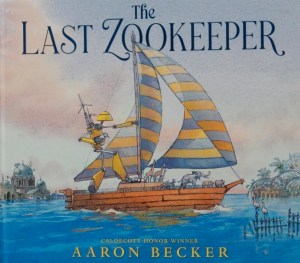
Nothing is certain except that, as we read, ‘Santa goes up the chimney the same way he comes down.’ No conjectures about that though, merely the final assertion, “But I’m so glad he can.’
A splendidly silly seasonal comedy from the partnership that are best known for their droll delights delivered through dead pan words and idiosyncratic illustrations.
Dasher Can’t Wait for Christmas Matt Tavares Walker Books
Dasher (the reindeer we met previously in the book named after her) is so impatient she just cannot wait for the big night when she’ll help pull Santa’s sleigh. With just one sleep remaining before Christmas Eve, she’s wide awake with excitement and taking a run, she leaps skyward to investigate the music she’s heard.
Enjoying herself thoroughly, as the music dies away she spies bright lights on the horizon. In her joy, she fails to pay heed to the falling snow and is unable to find the North Star to guide her, so again she takes to the sky, hoping to find something familiar. At last she sees something bright way ahead.
Flying towards the light, she discovers a wonderful Christmas tree in a garden and decides to land to take a rest. There she encounters a small girl. Having admitted to being lost and hungry, she receives, thanks to the child Charlie’s kindness, both food and a means of finding the way back home. This Dasher does, just in time to reach the North Pole where a worried Mama and Santa await.
Then off they go, the reindeer team pulling Santa along on his delivery round, during which Dasher ensures that they stop to leave a special thank you to Charlie.
A gentle story with some tense moments and a happy ending, dramatically illustrated by the author.
’Tis The Season illustrated by Richard Jones Nosy Crow
Constructed of thick card, this fold out book will work well with children from around four, right through KS1. Of the twenty four shortish poems included some have a distinct Christmas feel, others are wintry and the whole thing opens into a gorgeous advent calendar zigzag frieze that can be brought out yearly on the first of December.
There are flaps to open on each of Richard Jones’ beautifully illustrated snowy spreads, the first five of which have four poems each, the next has three and the final page has Philip Waddell’s clever What Christmas Is For, the last two lines of which are the hugely pertinent, ‘Christmas is a time for peace – / Forgiving and forgetting.’