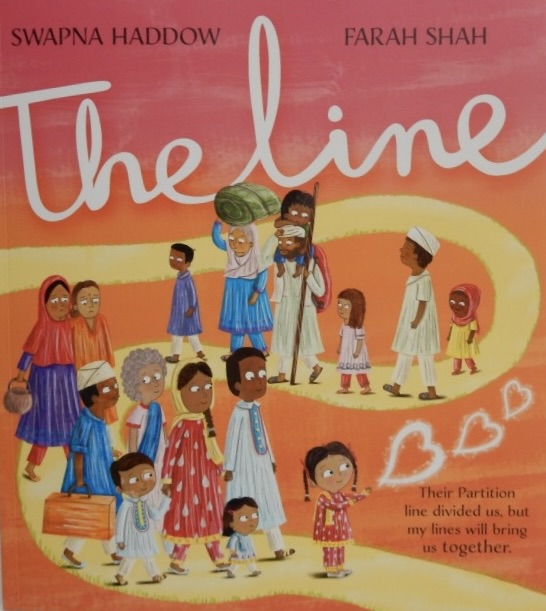
The Line
Swapna Haddow and Farah Shah
Scholastic
The Partition of India that was drawn up by the British almost eighty years ago remains a contentious issue. Yes the country became free from imperialism but political tension and rivalry continues between India and Pakistan to this day. The battle for the disputed Kashmir, the violent formation of Bangladesh and Islamic radicalism’s roots are indicative that the 1947 legacy is not truly over.
Sadly, as a frequent visitor to India I see first hand that the lines that divide still exist. I have Hindu, Sikh, Muslim and Jain friends but almost everywhere different communities live separately – a legacy of the British divide and rule policy. Would that a child such as the girl protagonist in Swapna’s story – The Line – been in charge rather than a politician. This girl was familiar with various kinds of lines from early in her life but then one day on her return from school she found that a new line had appeared, one that cut her father’s farm in half, tore her village in two and took her friends from her. Seemingly unnecessary fighting and having to join this new line meant that she and her family had to walk for many days, becoming progressively hungry, exhausted and afraid.
As she walked so the narrator tells us, she imagined what she would do, had she been in charge of a line with so much power. Any line of hers would be full of beauty and gentleness, drawing people together, feeling safe
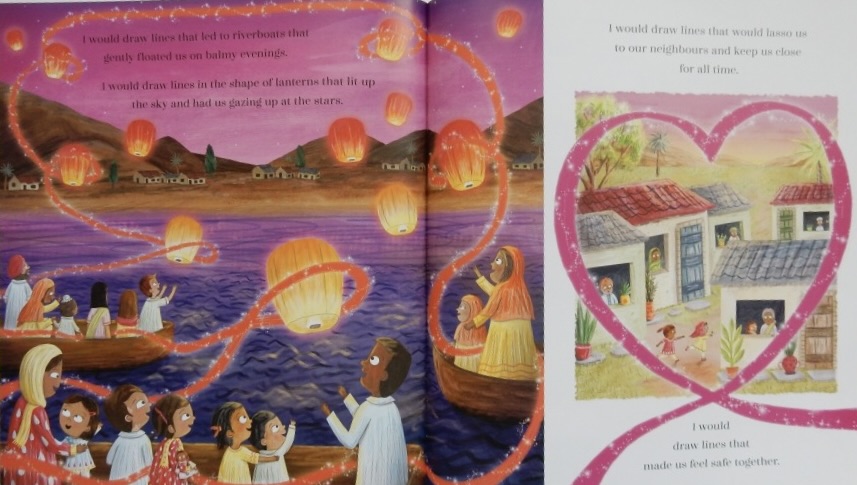
and wanting to learn more about one another. her line was all embracing and made everyone friends.
Farah Shah’s vibrant colours immediately catch the eye and draw you in to the wealth of details in her illustrations of this powerful and ultimately hopeful story about Partition that everybody – young and not so young – should read and discuss.