Paper Dragons: The Rise of the Sand Spirits / Treasure Hunt

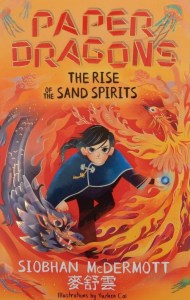
The second in this gripping series sees Zhi Ging continuing her journey in the magical underwater school Hok Woh. Now she undertakes a highly dangerous mission to rescue her friends and the villagers of all six provinces in the realm from attack. Accompanied by now-phoenix Malo she has to face dangerous sand spirits, enemies hungry for power and awesome lightning breathing dragons if she’s to save both her new home in the world of the immortals and her friends. However as secrets are uncovered, Zhi Ging must work out not only who she can trust but vitally, how she can survive.

With the author’s wonderfully imagined world-building and vivid, lyrical descriptions that include communicating jellyfish, readers will soon find themselves fully immersed in the twisting turning, fast moving plot. However, Zhi Ging’s journey is not only physical but it’s also one of self-discovery and personal development. She gains a considerable amount of wisdom concerning compassion and the power of words. With its blend of Chinese folklore, this is spellbinding indeed. Wither next, one wonders.
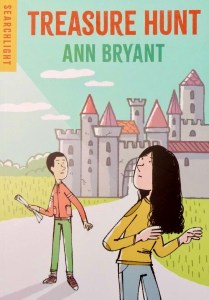
This book continues the tale begun in The Rock. The twins, Finola and Zane are at a traditional country fete in Cafner where they enter a treasure hunt that they hope might lead them towards their father. A local girl named Sylvie helps them understand the meaning of the clues but it’s not long before Zane catches sight of Nick Robinson whom he believes is somebody dangerous.. Should they abort the hunt and hurry to safety or continue following the clues to the end; clues in which their Dad has left messages for them. They really need to apply those lessons from Mum about Earth’s culture as well as the analytical thinking that Dad has advocated. And what about Nick Robinson – friend or foe?

The exciting story ends on a cliffhanger leaving readers eager to know if the family will ever be reunited.

Paper Dragons: The Fight for the Hidden Realm

Born in Hong Kong, the author grew up with a mixture of Chinese legends and Irish folklore and she draws on these for her debut novel.

Born under mysterious circumstances, twelve-year-old orphan Zhi Ging grows up feeling different from all the others living in her village Fei Chui, but can’t understand why. So, rather than working in the treacherous post pipe to make a living, she decides to go to Hok Woh, the underwater magic training school and learn the skills to become an immortal Cyo B’Ahon. However she doesn’t pass the entrance exam but through resolve, determination and stubbornness she eventually gets an acceptance lantern giving her entry to Hok Woh where she must succeed in twelve challenges to pass her Silhouette year.

It gradually emerges that Zhi Ging has special powers but they put her into much more danger with her life being at stake on occasion as she takes on deadly enemies while in so doing she works out her own identity. Some of the candidates are eliminated for failing various trials but with help both human and magical, she gets through all twelve.

Running through the story is a thread that it’s fine to be different and several at Hok Woh – students and teachers – have a feature that makes them different. It also seems that there may be a traitor in their midst but who will it turn out to be?

With a dramatic ending, this is an unusual adventure in a superbly built fantasy world. I eagerly await the next episode, The Rise of the Sand Spirits coming in April.

The Christmas Wish-Tastrophe

With echoes of Jane Austen, the story is set in 1812 and revolves around recently orphaned Lydia Marmalade who has been brought up in a cosy cottage, in a small village. Imagine arriving at a grand mansion house on 6th December to live with Lady Partridge at Peppomberley Manor, and being informed that you have until Christmas Day to prove that you can meet the standards expected of a proper young lady (good, modest and quiet), otherwise you will be sent away to a workhouse for poor children.

Lydia has nothing with her other than her much-loved sausage dog, Colin that she’s managed to smuggle in, and an optimistic outlook. Both of these she’ll need if she’s to cope with the challenges she faces, in particular that Lady Partridge appears anything but happy to have Lydia living in her home even if she is ‘a distant family member’. Unwelcoming too is Ronalds, the butler.

Pretty soon however, the newcomer finds allies amongst the servants, in particular Bertie the stableboy and his aunt Harriet., the cook. Then there’s Bel, an obstinate, accident-prone winter sprite that Lydia accidentally wished on, on St Nicholas’s Day, who is now bound to the girl and causes mayhem on the most inconvenient occasions.

Things don’t quite go to plan but can Lydia, with the help of her new friends, prove herself a worthy member of this Peppomberley household? Can she also discover why Lady Partridge has been keeping certain things hidden from her? There’s a jewellery theft, a Christmas tree fire and a mystery to solve in this wondrous tale of loyalty, searching for acceptance, love and belonging.

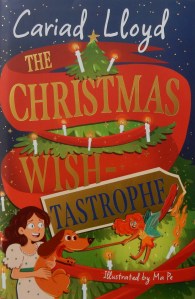
Cariad Lloyd’s characters are splendidly portrayed and her writing compelling: Whether shared with a KS2 class or read snuggled up with a hot chocolate, this is a seasonal gem spiritedly illustrated by Ma Pe.

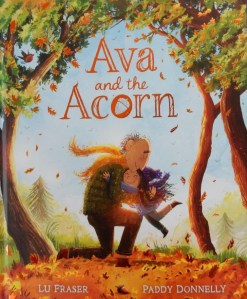
Ava and the Acorn

The cycle of the seasons and of life itself are sensitively related in rhyme between the leaves of this poetic picture book which focuses on the loving relationship between Ava and her grandfather and the ancient oak tree growing on a nearby hill.

The glorious illustrations show the two travelling through the seasons from ‘singing spring’,

through the long days of summer when they’d picnic ‘neath the oak’s spreading canopy, on into the golden glowing autumnal months when breezes bent the boughs of the oak sending its leaves dancing into the air now starting to chill in the shortening days and there are acorns to collect from among the fallen leaf litter. Then come the chills of winter time. Chills which cause Grandad to stay snuggled beneath his quilt and Ava to venture forth alone with only her teddy for company as she makes her way to the hill to the now drooping Oak standing still and silent as snow swirls around its bare branches. Leaving her bear to stand sentry guarding the tree she then whispers to it of the coming spring.

This she continues to do night after night till, joy of joys, Grandad is ready to sally forth again to visit their Oak now spring’s approaching.

What they find however brings tears to Ava’s eyes: the tree no longer stands tall. Thanks to Grandad though, first with his wise, uplifting words and then with his discovery of an acorn which they plant together, Ava’s heartbreak turns to a loving memory and hope of what is to. come. Little by little both acorn and Ava grow and grow through the years and we’re reminded that ‘All the things that you’ve lost – that you’ve loved – are not gone. When they’re held in your heart, a small part still lives on.’

A truly beautiful story to share and to cherish.

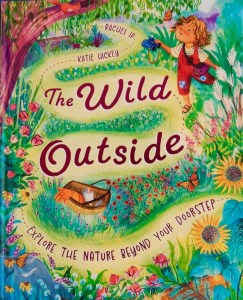
The Wild Outside

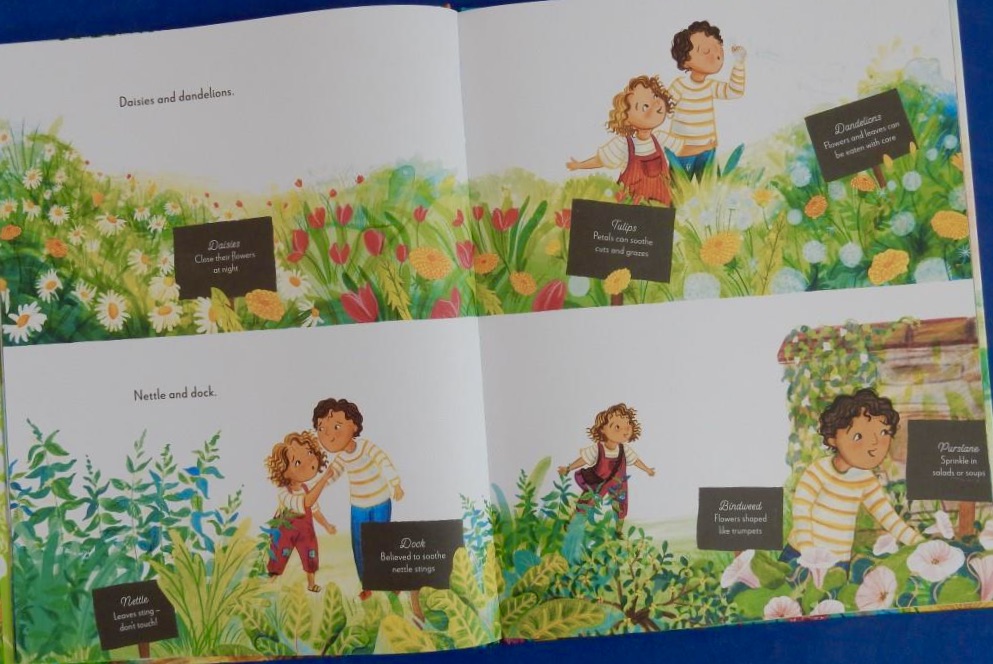
There’s nothing little Tulip likes better than to be outside exploring. She observes carefully the flora and fauna using all her senses and never stops asking questions to increase her knowledge. Then she comes upon a trail of muddy footprints on the path and a sign saying Nature Trail. Written in chalk in various places are labels naming lots of the plants, some she’s already familiar with, but lots that are new to her.

Who can possibly have made this trail, she wonders as she catches sight of somebody’s back retreating. Having filled her pockets with flowers and catkins, Tulip and her elder sibling return home and on the doorstep is a parcel with Tulip’s name on and inside is an illustrated botanical guide and a note encouraging her to keep on exploring.

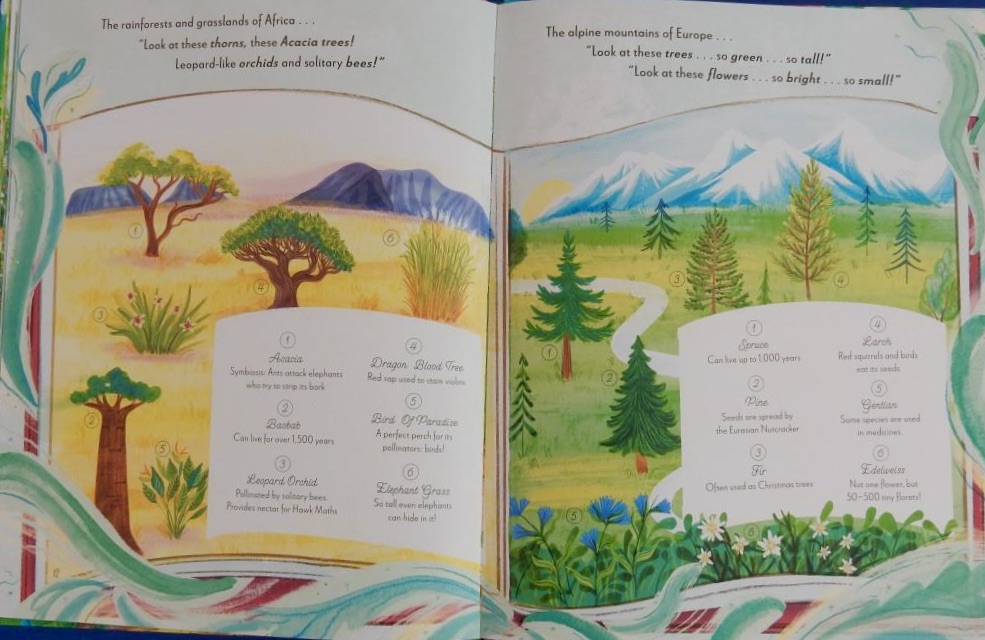
On opening the book, Tulip is excited to find lots of plants and trees she recognises and is inspired to do some labelled drawings. This keeps her engaged until bedtime when she falls asleep wondering where the following day’s explorations will take her. However, come the morning it’s raining hard and so she further explores her book instead, visiting Asian mangroves and forests, the deserts and plains of Australia, African rainforests and grasslands, mountainous regions of Europe,

the North American tundra region, various South American habitats and the cold Antarctic deserts. A clever device this for introducing to readers habitats the world over.

The following day the sun returns but rain has washed away the chalk markings of the trail. However someone has created a new one: who could that be? Tulip chalks a list of plants from the trail, leaving question marks for some she can’t name. On her return walk she discovers somebody else has written the names of those plants and left a trail of footprints. Who could it be? Tulip is delighted to discover the identity of her fellow nature lover and she makes a very special floral thank you using the contents of her pockets and bag.

A smashing way of encouraging young children to emulate Tulip and become natural history enthusiasts. The vibrant illustrations show the abundance of flora Tulip encounters as she explores and the labels are accompanied by brief captions with additional information about each plant. A wonderful combination of story and non-fiction.

One Day at a Time / Roots of Love

Robin and Poppy couldn’t be happier with their family life; their days are full of fun and adventuring together. And every springtime the children and their parents plant sunflower seeds together and watch them grow and bloom in the summertime. Then one summer Daddy tells the children that their parents are separating and will be living in different homes.. “We’ll always be a family, and we’ll always love you,” Dad reassures them. Poppy and Robin don’t want this to happen but despite the tears and talking, and the hugs, happen it does.

As you would expect both brother and sister are emotionally mixed up;

they also show this in different ways. Robin shares his worries with his friends at school whereas Poppy keeps everything to herself.

Both of them though ask their parents lots of questions and they all choose sunflower blooms to take to their parents’ new homes. Homes that are very different too.

Come the following spring Robin finds the dried out sunflower heads in the garden shed; they are absolutely full of seeds and give them an idea. Before long they have more than enough to sow in both mum’s and dad’s gardens. Little by little both Poppy and Robin have accepted their new way of life and realise that they will be okay; They are able to laugh more, hug more and of course, there is more than enough love for everyone; after all they are still a family no matter what.
A sensitively written and illustrated story that is full of hope and love, a story that offers an optimistic view of separation. However Poppy and Robin are fortunate in the way their parents separate; not all families are so amicable; indeed some children’s parents are downright hostile toward each other and this takes its toll on their offspring.

Also about changes in family circumstances is:

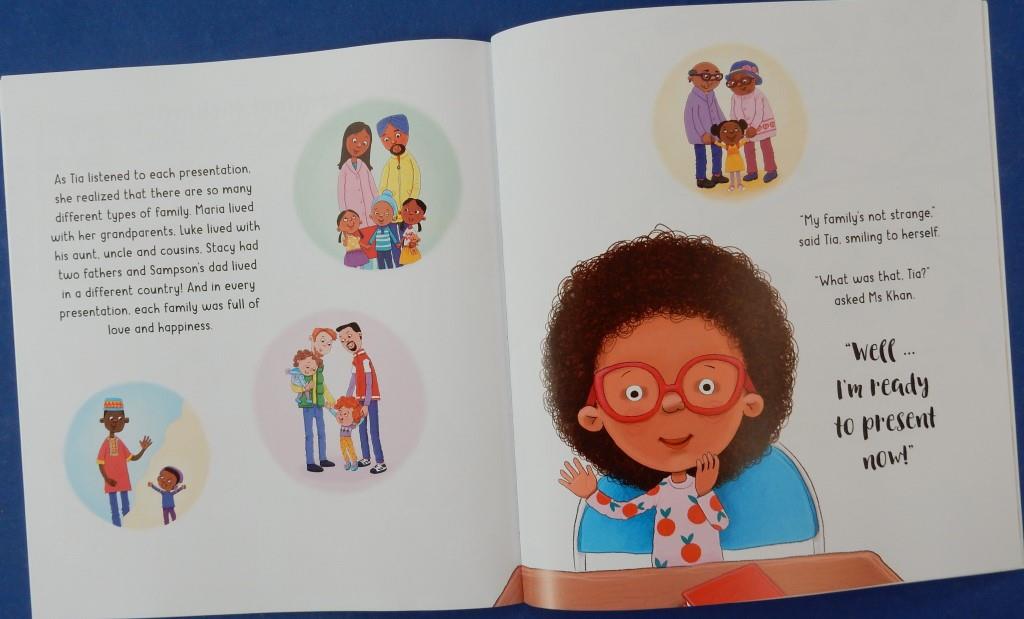
Subtitled Families Change, Love Remains, this story starts with a happy little girl, Tia who has just enjoyed the best day at school ever. But that evening after dinner her mother tells her to leave her project about her family and come and join a talk with her mum and dad. She knows they have been keeping something a secret recently and realises quickly that this isn’t going to be cheerful chat. Instead she learns that her parents are going to separate and that her dad will move out. “We’re still a family, we’re just changing to something new,” her mum tells her. Devastated little Tia rushes upstairs and cries herself to sleep.

Next day at school her class are to present their projects about families; inevitably Tia is worried about how her classmates will react to what she says. However what she hears from some of her friends about the variety of families they have, surprises, reassures and empowers her, enabling her to share her project too.

Using the apt metaphor of a tree Tia explains how her family has changed.

Ultimately reassuring, Sarah Asuquo’s story with its inclusive illustrations by Ruthie Burton is one for KS1 class collections as well as for sharing with individuals.

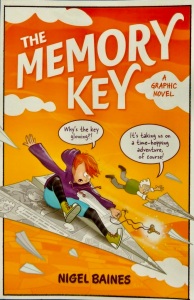
The Memory Key

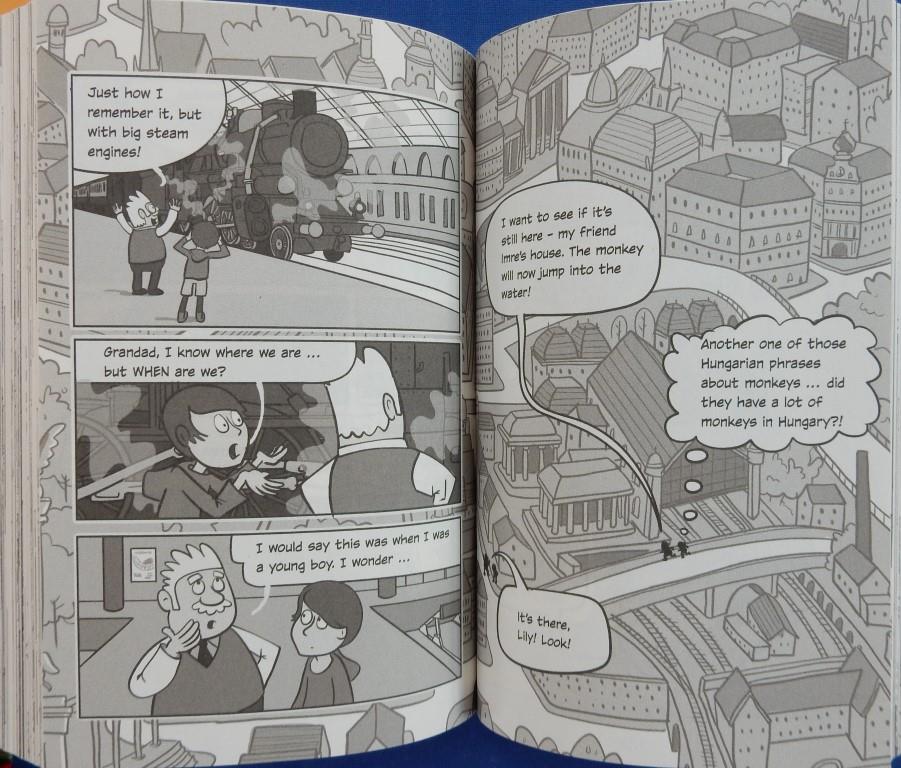
Lily Slade lives with her mum, Mum’s boyfriend Matt, his son Alex and her Grandad George. Train-loving Grandad has always been her hero but recently he’s been forgetful and confused: he has Alzheimer’s. Mum has started saying that with his deteriorating condition, Grandad will soon need specialist help in a residential home.
When it’s her turn to present her family origin story to her class at school, Lily tells how Grandad originally lived in Hungary and moved to the UK as a child when the political situation in Hungary became repressive. This prompts questions from her classmates but the most important question for Lily remains that concerning the fate of her Grandad.

Mum insists they all go and visit a care home but Lily remains determined to help Grandad get better, especially when his train and railway memories start coming to life magically.

However things start to spiral out of control especially when Lily loses the key to go back home. Will there always, as Grandad says from time to time, be light at the end of the tunnel? And will Lily be able to find it even when it seems impossible?

Enormously powerful and written with such sensitivity, readers cannot fail to be swept along to the end like one of Grandad’s trains. The straightforward explanations about Alzheimer’s are spot on for the target audience who will be hugely moved by the abundance of love between Lily and Grandad. They will also likely discover something about a part of recent European history that is new to them.

Until You Find The Sun

Debut author Maryam Hassan was inspired by her own experience and children she has taught to write this poignant, affecting story.

Aminah’s life is a happy one, made especially so by the evenings she spends with her grandfather, Da, who while snuggled together on his charpai, tells her tales of adventurers who visited new lands and made exciting discoveries. Then one day her parents tell her that they too are going to set off on an adventure. At first Aminah is excited but then Da tells her that he isn’t going with them.
Saying goodbye to her beloved grandfather, brings Aminah to the brink of tears as she urges him again to join then. “I am always with you. You will find sunshine wherever you go,” he tells his granddaughter.

When their plane lands at their destination though, there’s no brightness, only grey skies and rain. The next few days continue to be sunless, bitterly cold and despite wrapping in several layers, Aminah still feels numb both inside and out. She feels out of place in her new school too

and despite her parents’ best efforts to cheer her up, the only warmth she feels is when talking to Da on the phone. How she longs to go back. Understanding Da reminds his granddaughter that her adventure is just beginning and promises to light her way until she finds some sun once more.

That seems more unlikely than ever as the days grow even colder, but then as she trudges along clutching her Mama’s hand, she suddenly spots something bright mango yellow that reminds her of home. Mama and Aminah go and make a special purchase, one that brightens up the day considerably.


The following morning Aminah opens her curtains onto a sight that seems to herald that adventure Da had promised her. Outside in the snow she meets a new friend and at last the cold doesn’t have that same dismalness. When next she talks with Da on the phone, he knows that Aminah has at last found her sunshine once more.

Having spend most of my teaching life in schools close to Heathrow Airport, this beautiful story resonates powerfully with me. The author captures perfectly those feelings of overwhelming grey so many children are beset by when they first arrive from parts of the world so different from the UK. Anna Wilson’s scenes in the early part of the book radiate warmth – interpersonal and climatic – as well as portraying the contrasting grey dreariness of Aminah’s new environment where she’s never experienced such cold. An important story to share with KS1 classes especially.

The Lovely Dark

The Lovely Dark
Matthew Fox
Hodder Children’s Books

As the story opens Ellie is coping with the loss of her grandmother three years back, early on in the pandemic and being unable to say goodbye. During the pandemic too, a boy named Justin and his family moved into an empty house on Ellie’s street and the two become good friends. I love Ellie’s comments relating to forming of their friendship: “ … Books are the key. … When you meet someone new and they’ve read the same books as you … and they feel the same way as you do about them, it means they’re all right in your book. … You have a kind of shared language.”

Ellie and Justin visit an uncovered Roman mosaic where they are involved in a devastating accident. Both children find themselves in the Underworld but on two completely different journeys.
Ellie’s path leads her to a place called Eventide House, a school ‘of sorts’ so Mrs Cauke, the ‘headmistress’ tells her. Despite the days there being pleasant and almost without restrictions, Ellie soon senses something isn’t right about the place. However she discovers a girl, Ash, in the library and the two make a pact.

By this time though Ellie is more determined than ever to return to the world of the living especially so she can see her new baby brother. But will she manage to do so?

I found myself needing to put this amazing, very special book aside several times as I read, such were the sad feelings it engendered. It’s written with great sensitivity, and tenderness, cleverly mixing the 21st century world devastated by the pandemic with Ancient Greek mythology as the author explores loss and grief through a protagonist who never loses hope. Add to that the tribute Ross makes to the power of books and stories:: there’s nothing more this reviewer could ask.

I’m now going to seek out Matthew’s first book, The Sky Over Rebecca.

Mermaid Academy: Isla and Bubble / The Magic Faraway Tree: A New Adventure

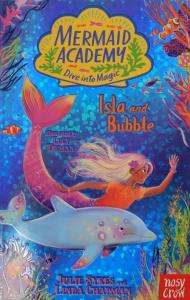
Mermaid Academy: Isla and Bubble
Julie Sykes and Linda Chapman, illustrated by Lucy Truman
Nosy Crow

Fans of the Unicorn Academy books will love this, the first of a magical new series set beneath the waves of Wild Sea. Just as the pupils of that establishment have captured the hearts of countless younger readers, I’m sure those of Mermaid Academy, led by headteacher, Dr Oceania, will do likewise, starting with Isla and the twins, Isobel and Cora who join the school on the same day.

Once the new pupils have been allocated their dorms, rather than lessons, they all participate in a treasure hunt intended to enable them to get to know one another, the dolphins and their new environment. Isla is a spirited character with a tendency to be headstrong, so when it comes to saving the woolly seahorses, even if that means breaking one of the Academy’s strict rules and venturing beyond its walls, she feels compelled to do so, however much danger that puts her team in.

Can she perhaps use her bubbliness to extricate them all from an emergency situation?

With adventure, friendship and discovering their magic and bonding with a special dolphin awaiting, (not to mention Lucy Truman’s black and white illustrations) who wouldn’t want to join Isla as she dives into this underwater world and helps protect its fauna and flora.

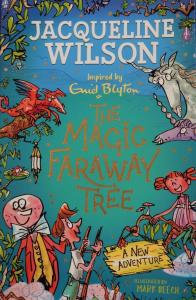
The Magic Faraway Tree: A New Adventure
Jacqueline Wilson, illustrated by Mark Beech
Hodder Children’s Books

The Faraway Tree is a series of popular children’s books by British author Enid Blyton. Blyton’s classic The Magic Faraway Tree, first published in 1939, was Jacqueline Wilson’s own favourite book as a very young child. Now the accomplished, popular contemporary children’s author, Wilson, has woven a new story that revisits this much-loved magical world in A New Adventure, that is just right for the next generation of young readers.

Those familiar with the original classic will remember some of their favourite characters, Moonface, Silky the fairy and The Saucepanman who loves to make up songs (and is now selling his wares on-line); but it’s the turn of a new family to experience what the magical tree has to offer.The family – dad, mum and three children are to spend their six week holiday staying at Rose Cottage and almost immediately, Birdy the youngest of the children meets a fairy outside her window. She invites the little girl to the Faraway Tree and so begins their adventure.

The next day Milo (10, the oldest), Mia about a year younger and Birdy (fourish), led by a talking rabbit, venture into the Enchanted Wood where among the whispering leaves stands the Faraway Tree: the tree that offers those who climb to the top, the opportunity to discover extraordinary places. Newly created by Jacqueline Wilson, the places the children experience are the Land of Unicorns – Mia absolutely loves this one,

the Land of Bouncy Castles, the Land of Princes and Princesses and finally, the Land of Dragons where a dangerous encounter awaits one of their number. This fourth story ends somewhat suddenly, I suspect to leave the way open for another Wilson sortie into the Enchanted Wood.

While keeping a strong sense of the original place, Jacqueline Wilson has challenged the stereotypical Blyton attitudes and language, one example being the way Mia is quick to admonish Mr Moonface: “Why on earth should it be Silky’s job to clean up after you … It’s terribly old-fashioned to expect a woman o keep a house tidy, … My mum and dad share all the chores and we have to help too.”

Also helping to give the book a modern feel that is just right for 21st century readers are Mark Burgess’ lively, often gently humorous illustrations.

Nightspark

Nightspark
Michael Mann
Hodder Children’s Books

In this Ghostcloud sequel, Luke, who escaped from Battersea Power Station, is back with his family and has started making a new life (in an alternative London). By day he’s an Apprentice Detective; by night he travels on his kite-cloud along with ghost friend Alma, helping lost souls make their final journeys.

However, Luke’s thoughts and dreams, or rather nightmares, are filled with his friend Ravi who was left behind. This makes Luke feel terribly guilty. He learns that Tabatha (the power station’s owner) has Ravi and many other child labourers, held prisoner.

On his first day working at the Detective Guild with his mentor, Inspector Oberdink, things don’t go well; he manages to cross the Inspector who tasks Luke with envelope-filling. While so doing he comes upon a witness statement referring to Tabatha; but when he questions Oberdink, the inspector dismisses it as an old tramp’s ramblings. Nevertheless, Luke slips it into his pocket.
That evening Luke and Alma take to the skies and when Alma hears about Luke’s nightmares, she suggests a visit to a ghost that can read dreams. Instead they first find themselves at a Ghost Council meeting where the council head shares the memories of a Battersea guard and they see the building being broken into and someone escaping with a case.

With an opportunity to discover what is really going on, Luke and Alma soon find themselves in terrible danger, not only from human enemies but ghostly ones too. Can the two, with some help from friend, Jess, discover who is behind that break-in and what the case contained. Most important: can Luke find where Ravi is and bring him home safely? With that strong sense of loyalty and love, as well as being very determined, Luke sometimes overlooks the threats to his family and friends. Apart from Alma, who can really be trusted?

Michael Mann draws readers in from the outset, taking them on a breathtaking adventure that includes superb descriptions, until we reach a satisfying and affecting conclusion. I couldn’t put it down.

Paper Boat, Paper Bird

Paper Boat, Paper Bird
David Almond, illustrated by Kirsti Beautyman
Hodder Children’s Books

Mina – a character from Skellig and its prequel My Name is Mina is now visiting Japan with her mother, experiencing the culture and learning a great deal. While travelling on a bus in Kyoto she watches a woman folding a piece of paper that becomes an origami boat; this she gives to Mina and soon after, a paper bird and when she leaves the bus, some origami paper. Watching the woman fashion these almost magical things from squares of paper captures Mina’s imagination.

As she travels to the temple at Kinkaku-ji, she holds onto her delight in the origami

and in the garden surrounding the temple Mina creates a boat and bird herself. She places the bird in the boat and gently puts it into one of the streams. Later it’s discovered by Mikaya who is with his dad; the boy notices the name on each one and when they stop, he writes his name on the bird and launches it into the air: communication and kindness are passed through origami,

and eventually Mina and Mikaya meet one another.

Powerfully beautiful – the power being in the simplicity of the telling and also in Kirsti Beautyman’s illustrations that have an airy, almost ethereal quality to them. David’s story is based on a real life happening when he was in Tokyo with his young daughter. He uses his awesome art of creating a story out of brief experiences and as always with his stories, this one with its quiet, contemplative gentleness resonates long after you’ve put the book down.

Ghostcloud / The Treasure Under the Jam Factory

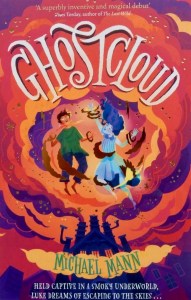
Ghostcloud
Michael Mann
Hodder Children’s Books

This is a ghost story with a difference, or rather several differences. It’s set in a grim dystopian future London beneath Battersea Power Station, twelve year old Luke and numerous other kidnapped children spend their miserable lives shovelling coal, working for the iniquitous Tabitha Margate.

After two years, Luke is eager to escape and return to his family, believing his only means of so doing is to gain one of the much coveted amber tickets to freedom. Luke is not without friends in this dark place: there’s Ravi and then Jess, an optimist and plumber in the making. There’s also ghost-girl Alma, who Luke saves, another terrific character; it’s she who shows him what it is to be a ghost cloud.

It’s one crisis after another in a prodigious adventure as Luke and Jess, aided by Alma ,attempt to free themselves from the clutches of the evil Tabitha and return to their homes – something that’s even more crucial once Luke has discovered the truth of what the heinous villain is up to. Is it possible? Perhaps with some assistance from the Ghost Council Alma talks of.

Superbly plotted, full of suspense and darkness but also powerful friendships, plenty of problem-solving, hope, determination and humour. Can one ask for more? Perhaps some moments of quiet, but Michael Mann provides those too in this brilliantly inventive debut novel. I can’t wait for the follow up.

Another adventure much of which takes place below ground is:

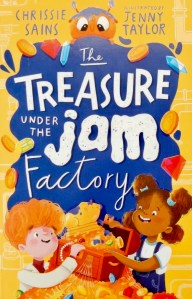
The Treasure Under the Jam Factory
Chrissie Sains, illustrated by Jenny Taylor
Walker Books

Having dealt with An Alien in the Jam Factory, McLay’s jam factory now faces a new challenge.

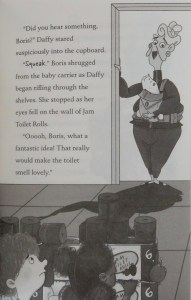
With his hyperactive brain a-fizz as always, differently abled Scooter McLay (he has cerebral palsy) can barely contain his excitement at the prospect of the Grand Re-opening with all that jam-themed food ready to be served. However, horror of horrors, all of a sudden something happens that nearly freezes young Scooter’s blood: the door unexpectedly opens and there before him and his parents, stands their hostile adversary, Daffy Dodgy clutching closely Boris, her guinea pig, come to claim what she insists still belongs to her. Surely all can’t be lost at this crucial moment. Time to call on the contents of tiny alien, Fizzbee’s, suitcase perhaps. Either that or find enough money to pay off Daffy once and for all.
Enter resourceful Cat Pincher and she has some more horrifying news for Scooter, news that increases the urgency to find treasure. Is she to be trusted? They’ll have to take a chance on that.

All manner of weird shenanigans take place deep underground when they find themselves face to face once more with Daffy. A deal is struck but it’s not long before Scooter, Cat and Fizzbee find themselves in the stickiest of situations imaginable on account of Cat’s jam-hating Uncle Perry who is intent on sabotaging the factory. Can Scooter’s knowledge of jam possibly extricate them from this? Cat certainly thinks so …

With fun illustrations by Jenny Taylor …

this really is a yummy sequel and one likely to leave Scooter fans licking their lips at the possibility of further encounters. Meanwhile they could always try baking some of the jammy biscuits using the recipe at the back of the book.

Chitty Chitty Bang Bang

Chitty Chitty Bang Bang
Ian Fleming, adapted by Peter Bently, illustrated by Steve Antony
Hodder Children’s Books

This is a retelling of Ian Fleming’s classic tale by the popular picture book author Peter Bently, illustrated by Steve Antony of Mr Panda fame..

The Potts family – mum, dad (a clever inventor) and their two children Jemima and Jeremy – are a poor but happy family. That is, until one of dad’s inventions makes a fortune and off they go to buy a car. 

Unimpressed by any of those on offer at the garage, they’re about to leave when Dad notices something under a cover. Beneath that cover is a large and very much the worse for wear, racing car, destined the next day for the scrapyard.

Young Jeremy has great faith in his father’s ability to restore it to its former glory and after spending weeks shut away in his workshop, Dad introduces them to a splendidly shiny vehicle.

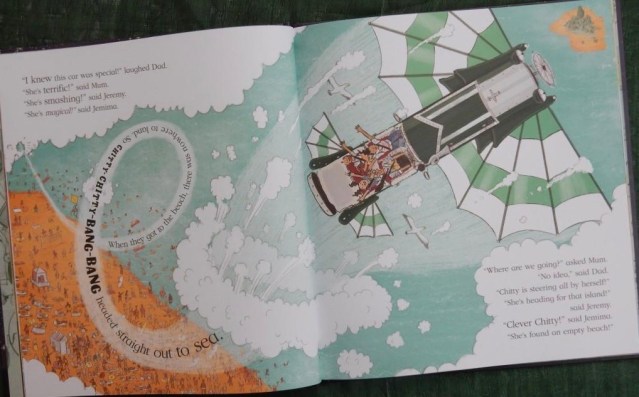
In climbs Dad and when he starts the engine, they hear this ‘CHITTY! CHITTY! BANG! BANG!’ before the vehicle rumbles into life. There’s only one thing they can call this car and you know what that is … Off they go for a drive to the beach and when they get stuck in a traffic jam, a mere push of a knob causes it to WHOOSH skywards as they take flight, 

destination a beach on a deserted island.

Fortunately, the car is better at spotting danger than the humans, and just before the tide engulfs them, Mum presses the flashing button and Chitty is transformed into a speedboat that takes them whizzing through the foggy waters to the coast of France.

What follows is an even more exciting part of their adventure involving a chase (of a famous robber and his gang) 

through the streets towards Paris where a hot-air balloon awaits the gold thieves. But they’d reckoned without a certain amazingly adaptable car …

Peter’s telling sweeps you along in the mounting excitement and Steve’s terrific, detailed illustrations provide readers with varying perspectives from which to witness the action. Together they’ve created a wonderful way to introduce youngsters to the original story.

The Wizard in My Shed

The Wizard in My Shed
Simon Farnaby, illustrated by Claire Powell
Hodder Children’s Books

Having narrowly avoided spluttering my coffee over the opening pages of Horrid Histories star Simon Farnaby’s new adventure tale, I envisaged that I’d continue spluttering throughout (not coffee – I hastily consumed that before resuming reading), and so it was. (Though I did have to stop after every chapter to take a few ‘mellow moments’ – like Evanhart, wizard Merdyn’s bestie until he decided to follow the ‘path of darkness’ and become a warlock aka a bad wizard x1000.)

The story follows both madcap Merdyn (from the Dark Ages) and would-be star singer,/dancer

twelve year old Rose, from now, residing in the normal town of Bashingford with her mum and brother. Each has a desire: Merdyn wants to avenge his banishment to the Rivers of Purgatory (actually it was The Rivers of Time) and at the same time get out of the 21st century in which he’s mysteriously arrived and return to the Dark Ages; Rose is anxious to sort out her broken family,

after her father’s death, which happened before this story begins.

There’s also Rose’s guinea pig, Bubbles, a frequent poo-er, that seemingly doesn’t do much else and certainly doesn’t enjoy sharing Rose’s fairy story books.

When Rose happens upon a ‘cloth creature’ wearing peculiar shoes, gesturing weirdly and thinking he’s in the land of Purgatory – you can work out his name – she decides he might actually be of some help to her.

A deal is struck. A family-sorting-out spell (and perhaps one to make her the world’s best singer) in exchange for Rose’s assistance in coping with so many strange 21st century ways and means.

That necessitates keeping the visitor in the garden shed away from Mum – to protect her smartphone – though that might be the least of her worries about the curious stranger. They will need to locate Merdyn’s treasured magic staff and find a way to return him whence he came. Surely nothing could possibly go a-miss – could it … ?

There’s masses of madness, magic, crazy characters,

not to mention high drama, and that enormously endearingly bonkers Merdyn, to enthrall readers throughout what proves to be a heart-warming tale.

And, with the addition of Claire Powell’s terrific illustrations, the enchantment just got even stronger, while ‘the world watched in silence.’

Read alone or, read aloud it’s an absolute winner.

Oi Aardvark!

Oi Aardvark!
Kes Gray and Jim Field
Hodder Children’s Books

Frog seems to be mining a seemingly bottomless – or maybe it should be bottomful – pit in Kes and Jim’s new Oi offering.

At the outset he throws out an invitation to the titular animal to participate in his new book that’s to be entitled ‘My ALL-NEW ALPHABETTY BOTTY BOOK. Dog is all agog; not so the cat who is, as usual, a sourpuss and ready to pour cold water over the enterprise even before it gets underway.

I have to hand it to Frog with his first chair substitute though, it’s pure genius: “Aardvarks will sit on cardsharks!” Nevertheless a certain feline is ready with a bit of negativity: “What’s a cardshark?” it demands. “It’s a shark who’s really good at playing snap!” comes Frog’s rapid response. That should shut Cat up, but let’s see.

We get through B and C without any interference, and only a minor bit of banter from Cat comes to herald in D. But then Dog’s tongue-twisting mix-up of a comment fuels another catty utterance. Eventually Frog announces his D and on we go safely (actually pretty precariously) through E and F.

For G, Frog has two clever inclusions – “giraffes can sit on baths and Gazelles can sit on bells!”

With horses comfortably seated and iguanas less so, clever claws Cat cheekily interjects again. (as if Frog doesn’t know his alphabetical order – well really!).

Anyway, or rather, Frog’s way, J. is duly dealt with and then as we’ve already been told, comes K. K is splendidly stinky …

Looks like the frog is the only one amused about this botty placement.

Off we go, with the dog heaping praise on our book compiler and guess who being its usual party pooping scorn pourer. Let’s skip to P and be pretty sure there’s a treat in store – ta da! Four animals happily installed on their bum bearers; but then comes another treat in the form of a double fold-out taking us through – with an inevitable purring pouring of cold water from the cat, to X.

Yet again Frog emerges triumphant, even giving himself a round of applause before zipping off through Y to the grand finale and completion of his book.

Or maybe not quite: we’ll leave it to the threesome to get to the bottom of their zany dispute.

So far beyond brilliant that it will never find the way back is this combination of Kes’ carefully and creatively concocted, rhyming, weaving of wordplay and Jim’s superbly silly seating solutions shown in his side-splitting visuals.

I’m hoping against hope that Frog doesn’t decide to rest on his laurels after this, his latest tour de force. I can’t wait to share it with anyone I can get to sit on their selected sit-upon.

Monsieur Roscoe On Holiday

Monsieur Roscoe On Holiday
Jim Field
Hodder Children’s Books

Jim Field has clearly been doing a fair bit of sitting on his own sit-upon, as he’s both author and illustrator of this picture book. The aim (as well as to entertain) is to set youngsters on a journey to becoming bi-lingual as they join the enormously endearing Monsieur Roscoe and his goldfish, Fry, for a holiday.

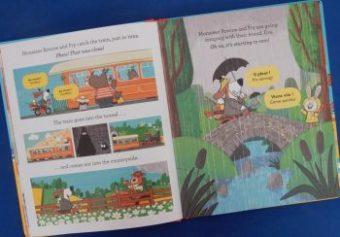
First comes the packing – always a bothersome task – and then with luggage loaded behind, it’s onto his bike and away through the big city to the railway station to catch the train.

It’s a close call, but fairly soon it’s time to meet up with Eva for a spot of camping. Learning to put up a tent courtesy of your rabbit friend, once you get to the campsite isn’t the best idea Monsieur R. even if you have come with all the gear.

Next morning Monsieur Roscoe and Fry bid ‘au revoir’ to Eva and board a bus bound for the ski slopes where there’s a rendezvous with another friend, Stan. Seemingly our canine holidaymaker has hidden talents …

The next destination appears a whole lot more peaceful. Caro is certainly happy to see her friends and even allows Monsieur Roscoe to take the wheel of her speedboat but it’s evident that a certain dog needs to hone his steering skills when it comes to watercraft.

The penultimate stop is the seaside where Jojo and Didi eagerly greet the new arrivals. After a splash dans la mer comes the last leg of the journey and a meet up with Dougal duck for a spot of indulgence at the busy village café.

However, even the most charming of travellers must go home eventually, and so it is with Monsieur Roscoe and Fry. Assuredly they’ll have lots to tell their friends back in their home city and who knows, perhaps after a good night’s sleep the two of them will start thinking about their next adventure …

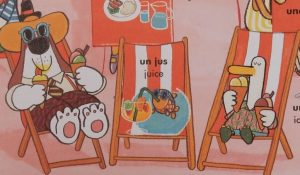
Jim introduces youngsters to plenty of common French words and phrases in the course of this story of the delightful duo. Every double spread has a wealth of humorous detail to explore and giggle over; Fry is an absolute hoot

and there’s even a seek-and-find element to the whole thing, for on the final page are lists of items to spot at the six locations featured.

Bravo Monsieur Field – un livre divertissant et éducatif.

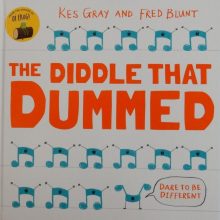
The Diddle That Dummed

The Diddle That Dummed
Kes Gray and Fred Blunt
Hodder Children’s Books

Oh my goodness, this book has given me the first really big laugh I’ve had since the lockdown, It’s utterly hilarious team Kes and Fred, and appealed most strongly to my sense of humour as well as to my divergent nature.

So let’s meet the cast: first is musician Flinty Bo Diddle who at the time our story starts is busy composing a tune to play upon his fiddle. Things go swimmingly at first with twenty nine diddles doing just as they ought but there has to be one doesn’t there, for the thirtieth note decides to make itself a dum.

How dare it – and half way through the tune at that.

A furious Flinty demands that the culprit confess. It does and the music starts up again with the dumming diddle consenting to another try. You can guess what happens with regard to Flinty,

and now all the other diddles turn on the dummer; the poor thing seems rather dumfounded but suggests being put first.

Diddles duly reshuffled, off they go again – err? Oops!

Maybe being placed as the final note might do the trick but …

What about changing the tune altogether suggests the dumming diddler. Flinty agrees though clearly a change of instrument is required.

The dums go well – for a while at least then …

Now those adults who happen to be teachers might recognise the sudden urge for a loo visit that is requested by our dear dumming diddle

especially as it precipitates a chain reaction.

The ending is beyond priceless and almost made my partner fall off his stool as I read it to him over coffee.

Brilliantly bonkers and a perfect antidote to lockdown blues.

Ready Rabbit?

Ready Rabbit?
Fiona Roberton
Hodder Children’s Books

Why is Rabbit hiding away inside a big box instead of getting ready to go to the party?

Seemingly the poor little creature is anything but keen on going; in fact he’s flatly refusing.

What’s needed is some gentle mind-changing persuasion and reassurance with regard to loud noise, the possibility of strange beasties lurking, as well as that no meanies will be present.

Best to focus on the exciting things that will be part and parcel of the party; things like friends,

yummy cake, games, dancing, balloons, presents and most important Rabbit’s favourite food.

Mind changed, now little Rabbit just needs to decide on what to wear and then outfit chosen,

off he goes.
The party proves to be all his encouraging adult (off scene) promised but now it appears that there’s another guest in need of a bit of encouragement …

Beautifully observed and portrayed, Fiona’s sweet story is delightful. It should go a long way towards showing anxious little ones how their big worries can disappear if like Rabbit, they practice positive thinking.

A winner for sure in every way.

Pests

Pests
Emer Stamp
Hodder Children’s Books

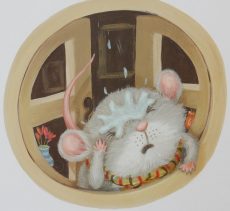
Having received a proof of this hilarious story from the publishers a little while ago, I was excited to see a finished copy of the book with its ‘glow in the dark’ cover drop through my letterbox.

Star of the show, Stix is a tiny mouse that lives with his ancient Grandma behind the washing machine of Flat 3, Peewit Mansions. The ’mans’ family – Schnookums, My Love and tiny Boo-Boo also live there along with their dog Trevor, the only one that knows anything about their flat-sharing mice.

The mice have survived thus far by sticking firmly to Grandma’s strict rules – number 3 being ‘never poop in places mans will see’. Breaking this rule would result in a visit from Nuke-a-Pest.

One night into this peaceable place of co-existence comes Maximus a nasty rat with his two hangers on Plague One and Plague Two. His arrival soon results in disaster of the discovery kind, which is followed speedily by Sheila, Emergency Response Exterminator who flushes Grandma down the loo.

At least her ‘dead’ pose was a success but it leaves Stix alone, well not quite alone for back on the scene comes the previously encountered Batz, student at the Peewit Educatorium for Seriously Terrible Scoundrels (aka PESTS).

Stix joins the basement school and finds himself learning a whole new set of rules as well as competing in the Pest of the Year competition, determined to knock the dastardly Maximus off the top spot.

Step forward rule saboteur Professor Armageddon with a terrible plot of his own; but is Stix prepared to follow the directions of a cockroach and do what he knows to be wrong in order to gain extra points in a competition?

All’s well that ends well and this tale surely does. With an infusion of toilet humour, a great deal of suspense and some brilliant characterisation, this is a terrific adventure; there’s warmth and wisdom too; and the illustrations, generously scattered, are wonderful.  Giggles aplenty guaranteed throughout.

Scribble Witch: Notes in Class

Scribble Witch: Notes in Class
Inky Willis
Hodder Children’s Books

This sparky story is the first of a new series featuring Molly Mills (our narrator), her best friend Chloe, and a ‘scribbly doodly’ character named Veronica Noates aka Notes, a somewhat mischievous little paper witch.

As the story opens Molly learns that her very best friend is leaving Dungfields School. They’ve been pals since nursery and they’re now 9 years old. Consequently Molly is very upset and starts taking it out on Chloe. Into this sorry situation drops, quite literally, a piece of paper on which is drawn a smiley, friendly looking, titchy little witch.

Having liberated her from the paper with her rainbow scissors, Molly begins to get to know this rather odd character
that communicates, not by speaking (although she can) but through little notes written not only on paper, but other things such as leaves too.

The trouble is, despite her best intentions, Notes causes Molly even more problems, and she’s already got herself very much in her teacher, Mr Stilton’s bad books.

Is there any way that Molly, with the help of Notes, might manage to convince her best pal to stay at Dungfields rather than move to Lady Juniper’s School; or if not can Notes make sure that the two girls can be in close touch whenever they want?

With its wealth of quirky illustrations (including pencil toppers) and written communications (readers will quickly get used to Notes’ idiosyncratic writing style), this book is terrific fun as well as being bang-on with the feelings relating to losing a best friend ever from class.

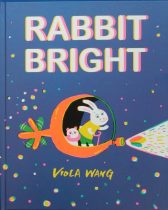
Rabbit Bright

Rabbit Bright
Viola Wang
Hodder Children’s Books

You might want to have your sunglasses ready when you read Rabbit Bright with its dazzling day-glow colour palette.

Rabbit Bright has finally summoned up the courage to turn off his night light. But thinking about so doing, sets the little fellow wondering, “ … where does the light go when it’s dark?”

Instead of sleeping, it’s helmet on, panda clinging on behind and off he goes on his bicycle out into the blue-black night with this thought in mind: “If there’s dark, there must be light.”
And light there surely is; for first he sees a sky lit up by fireworks.

Then, having left his cycle, he boards an underground train with its glowing headlamps.

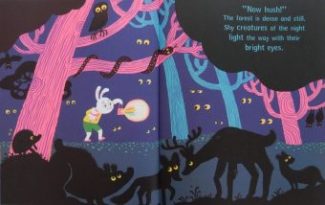
In the forest too he encounters light, in the form of bright-eyed nocturnal creatures.

Boarding a boat, he paddles off to a cave where the darkness is punctuated by the flashes of fireflies.

His journey of discovery continues in a sub-oceanic craft and our little explorer is almost dazzled by the sea creatures shining as they swim.

Having next, climbed a hill for a spot of star-gazing, Rabbit and panda float off into space.

Then mysteriously, that bicycle reappears, for the two to set off homewards where a cosy bed awaits. Sweet dreams Rabbit Bright; sweet dreams little panda.

If you have, or know a little one who has anxieties about the dark, then this is the perfect book to share with them. Not only is it an exciting story, beautifully and arrestingly illustrated, it should help to assuage those fearful feelings about turning off the light and being alone in the darkness.

Pug Hug

Pug Hug
Zehra Hicks
Hodder Children’s Books

We first see Pug standing at the window looking out as his young owner departs for school.

Seemingly the dog is desperate for a hug. The trouble is no matter which animal he approaches, not a single one wants to hug.

Cat doesn’t like hugs, Hamster is too difficult to catch, Rabbit is busy chomping,

hugging a goldfish doesn’t really work. Maybe a parrot will oblige; but no, all he receives to his request is amusement at his efforts to please.

Lots of the potential huggers are fast asleep and it appears as though our hug seeker is about to give up in despair. But then he gets an offer, he definitely CAN refuse – and fast …

Will Pug ever have that elusive huggy moment he so much desires, and if so from what source?

Zahra’s smudgy, superbly expressive illustrations showing in particular, Pug’s entreaties, are enough to make any human – even those like this reviewer who isn’t a dog fan – feel like embracing him as he keeps on getting rebuffed.

The text takes the form of Pug’s requests and the responses from the animals along with a sequence of encouraging suggestions and comments from an external narrator.

The result is picture book harmony of words and pictures creating a story that is both funny and satisfying.

Scruffle-Nut / Hugless Douglas Plays Hide-and-Seek

Here are two very different stories with a theme of friendship:

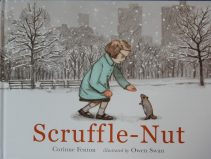
Scruffle-Nut
Corinne Fenton and Owen Swan
New Frontier Publishing

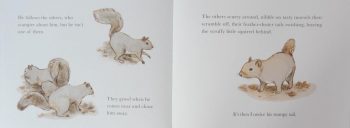
‘As winter leaves tumble and twirl / a wisp of memory / wraps itself about me / and whispers me back / to long ago … ‘

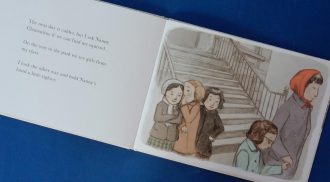
So begins a gentle tale told by Olivia whose childhood memories we share in this sensitively told, equally sensitively illustrated story with its soft-spoken bullying theme.

As a young child her Nanny Clementine would take her to the park and there one day she sees a shy stumpy-tailed little squirrel that is chased away by the squirrels with large bushy tails.

It’s the beginning of a friendship that develops between child and squirrel – a squirrel that is, like the girl, a little different from others.

Time passes, the days turn colder until the snow falls and visits to the park come to a halt and Olivia is left wondering whether Scruffle-Nut, as she calls her friend, will be able to ward off attacks from the Bully-Bunch, the name she gives to the bushy-tail squirrels.

Although she never sees her squirrel friend again, he stays in her heart along with the lesson she learned from him so long ago.

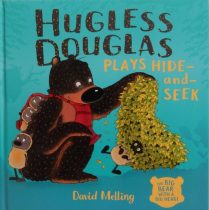
Hugless Douglas Plays Hide-and-Seek
David Melling
Hodder Children’s Books

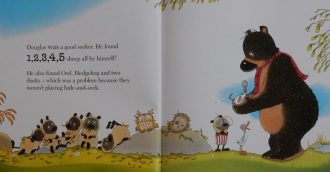
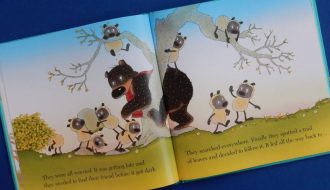
Playing hide-and-seek with his woolly friends is somewhat problematic for Douglas; he’s always the one to be found first.

But when Little Sheep invites him to team up and become a seeker, he certainly proves his worth; in fact he’s a little too good.

The game continues apace until there’s only Flossie left to find and then in his enthusiasm Douglas picks up the only possible hiding place remaining, in its entirety, which has the desired result. They locate Flossie but then find that Little Sheep is missing.

Can they discover where their friend is before it’s dark?

Another eventful episode from the adorable Douglas to please his fans and more than likely win him a whole lot more.

My Monster and Me

My Monster and Me
Nadiya Hussain and Ella Bailey
Hodder Children’s Books

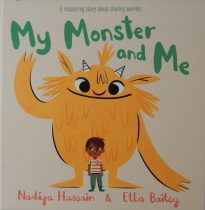
Nadiya Hussain has recently spoken out about her own anxiety issues and now has written a picture book intended to give little ones and their carers a starting point for talking about anxiety and worries.

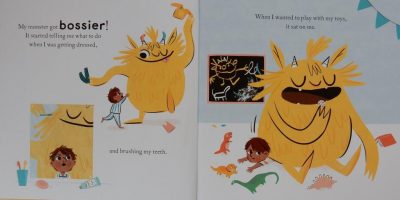
The narrator is a small boy who talks of his ever-present monster that nobody is able to banish; a bossy creature that gets in the way of everything the lad wants to do. It prevents him from playing with his own toys and even his friends.

After school one day the monster is waiting – huge and bad tempered – and it follows the boy all the way to his grandma’s house.

Seeing how upset he looks, Gran listens to her grandson’s tale of woe

and as he talks the monster starts to shrink and that’s when the boy gains control.

The monster never completely goes away but now it no longer wields the power.

Told in a straightforward manner that young children can easily relate to, Nadiya’s reassuring tale is made all the more so by rising star, Ella Bailey’s smashing illustrations. She portrays the monster as a mischievous rather rotund creature, rather than a scary one.

With ever more children of all ages having anxiety issues books such as this one can be an absolute boon for parents and teachers to share.

Pugicorn / Once Upon a Bedtime

Pugicorn
Matilda Rose and Tim Budgen
Hodder Children’s Books

The vogue for unicorn stories doesn’t appear to be waning but a Pugicorn – that’s something a bit different and certainly not what little Princess Ava has in mind when she visits Twinkleton-Under- Beanstalk’s Magic Pet Shop to pick her perfect unicorn pet.

Informing her that they’ve sold out, the kindly Mrs Paws offers Princess Ava instead, another horned creature with a ‘snuffly nose’ and a curly tail.

A challenge is then issued to her new pet by the determined Princess … ‘Think Unicorn!’ she tells him.

Such thinking proves useless on many occasions and despairing of her acquisition, Princess Ava heads off to the Unicorn Picnic sans Pugicorn.

Yes she does have a wonderful time; but on the way home she and her pals lose the way

and their unicorns prove useless path finders through a now, creepy-seeming forest.

Can loyalty in the form of a little pet Pugicorn save the day (and the night)?

Acceptance is the name of the lesson for young Lola and for the countless little unicorn fans out there who will fall for this new horned character adorably portrayed in Tim Budgen’s magical scenes for Matilda Rose’s enchanting tale.

Once Upon a Bedtime
David Melling
Hodder Children’s Books

It’s sundown in Sleepy Street as a long yawwwwnnn floats through engulfing a very tired Rabbit.

It’s time for bed but Rabbit, eager for a bedtime story, still has to have a bath as Ellie elephant points out.

Various other toy characters, Ollie ostrich,

Monkey, Bird , Crocodile each in turn adds something to the routine until at last all are ready assembled in bed with a cuddly apiece and rabbit begins to read the story.

Suddenly there comes a strange sound from beneath the bed.

The others take cover, leaving Rabbit to investigate.

What she discovers is another character who hasn’t got a cuddly. What is to be done? Can the friends help?

Full of endearing characters, this warm-hearted book showing the importance of having your cuddly close by at bedtime, from the Hugless Douglas creator David Melling, is sure to appeal to little ones as a wind-down to sleep story.

Why Are There So Many Books About Bears?

Why Are There So Many Books About Bears?
Kristina Stephenson
Hodder Children’s Books

The title to Kristina Stephenson’s new book poses a question that I suspect a fair few picture book reviewers will have asked themselves.

They however haven’t until now had recourse to ‘the most brilliant minds in the animal kingdom’ gathered together at Mollusc College, Oxford to discuss what is billed as the ‘Impossible Question’ concerning this preponderance of ursine book characters.

Let’s meet some of these brains forthwith.

First to offer a suggestion is William Snakespeare who proposes the answer lies in the number of words rhyming with bear and suggests a few examples.

His fellow debaters think he might have the answer. Not so Albert Swinestein. He quickly knocks that idea on the head stating that pig is equally easy to find rhymes for.

At this point there comes a knock on the door and a voice announces the arrival of the tea trolley. The debaters send the knocker packing drawing attention to the DO NOT DISTURB sign and Swinestein continues, proposing as the answer, the variety of sizes of bears; but this notion is immediately demolished by the PhDs (Porcupines, Hedgehogs and Dragons with Spines.)

The discussion continues, as do the interruptions by the tea trolley pusher causing increasing agitation to the debaters.

Just when tempers reach boiling point, Trevor the little mouse pipes up.

It might just be that this tiny, thus far silent creature, has solved the puzzle and that answering the door might yield the answer to the impossible question.

There’s something for everyone in this droll story. The very young will enjoy the frequent interruptions, the fold-out spread surprise and the superbly expressive illustrations of the characters, while older readers and adults will relish the tongue-in-cheek humour and the punning. Everyone I think, will love the throwaway finale tossed in by the tea-trolley pusher when he eventually gains admission.

Agent Weasel and the Fiendish Fox Gang / Freddie’s Amazing Bakery: The Great Raspberry Mix-Up

Agent Weasel and the Fiendish Fox Gang
Nick East
Hodder Children’s Books

This is the first of a proposed series of adventures starring super-spy Agent Weasel, resident of Flaky-Bark Cottage in United Woodlands.

Nick’s writing is wonderfully silly as he plunges his often inept Agent Weasel, WI6, super-spy of high renown, into all kinds of scarifying scenarios in his efforts to foil the nefarious Fiendish Fox Gang who, so rumour has it are creating absolute havoc with such dastardly deeds as nicking nuts from squirrels and shaving sleeping badgers’ bottoms.

It certainly seems as if Agent Weasel has his work cut out, though thankfully his team-mates – Doorkins, Steadfast, Mole and Muriel Moth are also at work in the woods.

But before you can say ‘catastrophe’ Weasel and his pal Doorkins find themselves taken captive and face to face with the notorious FFG leader Vixen von Fluff …

and what’s this she’s saying about sabotaging the eagerly anticipated Autumn Big Bash?

Can our super agent extraordinaire succeed in extricating himself from a potentially very sticky situation and if so could he possibly pull off what looks like the impossible feat of derailing Madame Vixen’s plan and saving the show?

Chortles galore guaranteed whether it’s read alone or read aloud; with a liberal scattering of Nick’s own hilarious illustrations, this is comedic craziness through and through. More please!

There’s competition chicanery too in:

Freddie’s Amazing Bakery: The Great Raspberry Mix-Up
Harriet Whitehorn, illustrated by Alex G. Griffiths
Oxford University Press

Young Freddie Bonbon is Belville town’s star baker. He works alongside his manager and best friend Amira who greets him one autumnal morning with the news that she’s been busy doing the maths to see if they can afford to replace their old and far too small cooker but unfortunately they just cannot afford to. Unless perhaps Freddie manages to win the advertised Belville Baking Competition with its £500 prize. He certainly has a fantastic design in mind for his cake.

In a swankier part of town is Macaroon’s Patisserie, run by the curmudgeonly Bernard Macaroon. He’s not at all like Freddie who is willing to offer advice to anyone, even those he knows will be rival contestants in the baking competition. Bernard shall we say, lacks imagination and flair when it comes to baking but his determination that he, not his young rival will win the prize means he’ll go to any lengths so to do.

As competition day draws nearer strange things start happening. First there’s the incident when Freddie out on his delivery round almost runs over Bernard’s beloved cat.

Then comes the disappearance of the remains of the raspberry pink food colouring he’ll need for his competition cake and when he goes out to buy some more, all the shops have mysteriously sold out and the only place he can find any is …

What luck, thinks Freddie but is it?

The day of the event arrives and Freddie is well prepared; but no sooner have the competitors been told to begin than things start going wrong for him.

Is it the end of his chances: or could it be that the kindnesses he’s shown to his fellow competitors might make a difference?

Like Freddie’s cake baking, there’s plenty to spice up Harriet Whitehorn’s story of cooking, community and camaraderie. Young readers will appreciate the way the story is broken up into short chapters that include lists and a generous sprinkling of Alex Griffiths’ quirky illustrations. There’s even a recipe for Freddie’s Raspberry Cupcakes at the end of the book. Mmm! Tasty.

Think Big!

Think Big!
Kes Gray and Nathan Reed
Hodder Children’s Books

Humpty Dumpty sits on a wall, but he’s not alone; his friends sit alongside and they are considering their futures.

Humpty however, sets the bar very low: “A boiled egg” is his only ambition. Shock horror among the others who go on to urge him to Think Big!

“Buy a pair of football boots and become a footballer,” suggests Wee Willie Winkie.

“Look for clues and become a detective, says Little Bo-Peep.

He could perhaps, like Little Miss Muffet, consider becoming a scientist.

Egg though he might be, he “really should try thinking outside of the box.” as Jack and Jill recommend. I second that!

An artist, a policeman, a doctor or a firefighter are also put forward as possibilities; but it is perhaps the Cow who jumped over the moon that really gets Humpty’s brain buzzing with potential personal achievements.

But will our eggy friend actually manage to live up to his elevated thoughts and reach for the stars …

Storytelling maestro Kes Gray smashes it again with this tale that will surely have you giggling from start to final, laugh-out-loud punchline (or more accurately crunchline).

Nathan Reed does a terrific job capturing Kes’s droll humour in his high-voltage illustrations, every one of which is a cracker.

With its powerfully positive ‘believe, work hard and you can achieve’ message this is an eggstra-special offering for young children.

Claude: Anyone for Strawberries? / Claude:Ever-So-Summery Sticker Book

Claude: Anyone for Strawberries?
Alex T.Smith
Hodder Children’s Books

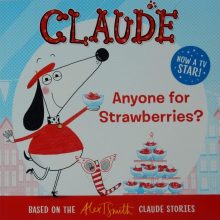
This is another is the delectably funny Claude stories spawned by the Claude TV Show and it’s perfect summer reading.

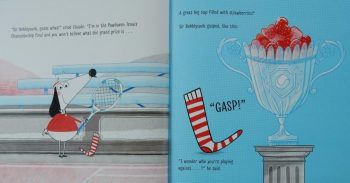
It’s a Tuesday in Pawhaven, but one that starts badly for our friends Claude and Sir Bobblysock who have been eagerly anticipating “Strawberries-for-Breakfast day”.

Off they dash to Denzel’s fruit-and-veg van, but disaster! When they arrive Denzel informs them that on account to the Pawhaven Tennis Championships, all the strawberries are already sold.

The friends head to the park, and as they arrive a tennis ball hurtles out of the sky directly towards Sir Bobblysock.

In a flash Claude leaps skyward, catching the ball in his beret, mightily impressing his pal.

Meanwhile the semi-final has ground to a halt. Movie star, Errol Heart-Throb, is refusing to continue without his lucky ball.
Needless to say he’s thrilled to have it handed back by Claude. Before you can say “strawberries’ Claude has landed himself a job as official match ball boy.

You can guess where Sir B. heads off to, hardly able to contain his excitement at the prospect. However, once again his anticipated strawberry feast is thwarted.

In the meantime, Errol has been declared the winner of the semi-final but it appears that vanity will stop the now ruffled-looking victor from playing in the final.

Claude is to take his place and is more than willing when he learns what the prize is …

There’s a slight snag though – the other finalist is Kimberley and she has a somewhat over-sized racket.

It’s a tense match, but who will be the winner? I wonder …

As with all the Claude stories, this is a smasher.

Game, set and match to Alex T.Smith and the TV series for another winning episode served up with bowls full of summery deliciousness. Hard luck if you happen like this reviewer, to be allergic to those small fruity berries Claude and Sir Bobblysock love so much. In which case, just get the book and pass on the strawberries.

If that’s not enough for your young Claude enthusiasts then also based on the Sixteen South TV show is:

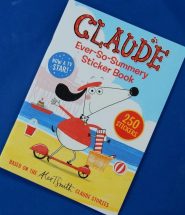
Claude: Ever-So-Summery Sticker Book
Hodder Children’s Books

Set on Pawhaven beach it’s full of seasonal silliness, Claude and Sir Bobblysock style.
There are lots of activities to test your little ones’ visual skills, pages to adorn with sandcastles (and some of the 250 stickers that make up the centre pages); a maze to navigate; a picnic to share with the two favourite characters and more.

Christopher Pumpkin

Christopher Pumpkin
Sue Hendra, Paul Linnet and Nick East
Hodder Children’s Books

Who or what would you ask for assistance if you were wanting to throw the scariest ever, totally unforgettable party? Perhaps not a pile of almost forgotten cooking ingredients that just happen to be lying on your kitchen floor; but then you are not a witch with a magic wand like the one in Sue and Paul’s crazy magical rhyming tale.

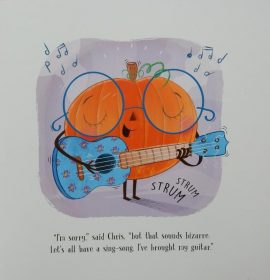
This witch decides to spell a heap of pumpkins into life, name them – Gnarly, Grizzly, Grunty, Roar, Snaggletooth, Stink Face and err – well she never gets to give a name to the last one for he cheerily informs her that he’s called Christopher Pumpkin and invites his fellow pumpkins to a group hug.

Can this thoroughly ill-fitting, non-scary animated member of the pumpkin fraternity possibly fit in with the witch’s scarifying plans? She decides to give him the benefit of the doubt, albeit while keeping her beady eyes upon him.

Task one is to create decorations that will bring dread and fear into all who so much as glance at them.
Easy peasy thinks Chris but the witch and other veggies are let’s say, underwhelmed. They’re equally unimpressed with Chris’s musical proposition …

So what about the party fare? Of course it’s cooked up in the cauldron and seems suitably disgusting until in walks our pal Chris proffering err, some pretty pink confections.

The witch gives the guy one more chance – be scary or be soup.

Can Chris come up with a scary solution before the following morning: he has just the hours of darkness to work something out or he’s in the pot.

Oddly enough, come morning, there’s an empty bed where Chris had been and the witch is ready to throw open the door to let her guests in …

Terrifically silly but terrific fun, this tale is perfect for showing little ones the importance of being themselves and not letting anyone push them around or make them into something they’re not.

It’s a smashing read aloud that slides and slithers over and off the tongue like yummy pumpkin soup. And as for Nick’s scenes of magic, mischief mayhem and the occasional menace, they’re a totally tasty treat to feast your eyes upon.

What’s not to love? Perhaps though, that rather depends on whether or not you have a penchant for things puffy, pretty and pink.

Will You Help Me Fall Asleep? / I’m Not Grumpy!

Will You Help Me Fall Asleep?
Anna Kang & Christpoher Weyant
Hodder Children’s Books

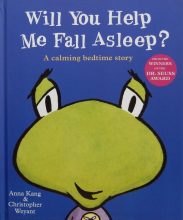
Little Frog is anxious to fall asleep and asks readers to help him for if he doesn’t get sufficient sleep his mother won’t allow him to participate in the Frogatta boat races the following day; in other words he’ll be in BIG, big trouble and there’s no fooling his observant mum.

He tries our (supposed) suggested counting sheep, a bedtime book – definitely not the best idea – and a chat with last year’s prize caterpillar toy all of which fail and then he recalls his teacher, Miss Chon’s advice to breathe long and deep then mind travel to his ‘happy place …

and joy of joys, zzzzzzzz.

Whether the final wordless spread is Monty’s blissful dream or the young frog’s elated presence (along with his parents) at the next day’s Frogatta is left open to readers to decide: no matter which, one cannot help but root for little amphibious Monty in this frog-a-licious bedtime tale.

With Christpher Weyant’s super, lively, cartoonish scenes of Anna Kang’s dramatic telling, the book is enormous fun for pre-sleep sharing, especially for little ones with a touch of insomnia.

I’m Not Grumpy!
Steve Smallman and Caroline Pedler
Little Tiger

Waking up to discover a huge furry bottom blocking your door might put most of us in a bad mood; it certainly does Mouse whose mood further deteriorates when he’s splatted on the nose by – so he thinks – a splashy raindrop.

In fact it’s a tear shed by a distraught little badger just outside his window wailing, “Where’s my Mummy?”

Together the two animals set off in search of the Mummy Badger only to find themselves lost.

Encounters with Squirrel and Owl both of which recognise Mouse as ‘that grumpy mouse”, (hotly denied by said Mouse), are willing to help in the search and off they all go deep into the forest.

There they come upon a large bear. On learning that Mouse is in fact helping Little Badger get home, the bear changes his grumpy accusation to “a kind friend”; a first for Mouse.

They travel deeper into the forest until Mouse becomes overwrought

which results in Owl giving him a cheer-up hug – another unusual event for the little creature. Suddenly out of the bushes emerges a very scary, very hungry predator.

Does that mean Squirrel, Badger, Owl and Mouse become a lupine’s evening meal?

Happily not. I won’t divulge the ending, but what ensues will certainly bring a happy smile to the faces of young listeners.

With opportunities for audience participation, Steve’s warm-hearted story with Caroline Pedler’s expressively portrayed woodland animals provides a good starting point for circle time discussion with early years children on themes of friendship, kindness, and on how their moods might affect other people.

The Colour of Happy / Some Days / A Thank You Walk

The Colour of Happy
Laura Baker and Angie Rozelaar
Hodder Children’s Books

This sweet, simple rhyming story of a boy finding a dandelion seed head and what happens thereafter is the means for an exploration of feelings for young children around the age of the child narrator, using a rainbow of emotions and the fluffy seed head.

The child, out walking with a pup, spies a dandelion clock: ’Yellow is for happy when I spot a special thing,’ he tells us and having picked it, hops and skips along. But when a gust of wind whisks his treasure away, the boy is engulfed in dark blue sadness.

His emotions then run through the colour spectrum: red for anger as he watches it sail away;

green for feelings of envy when he sees a girl with the seed head; grey when he cannot believe things will be okay; gold for the kindly response from a little girl, and the return of hope as they play together chasing the dandelion clock while it sails off again;

purple for the proud feeling when the boy again holds his treasure safe and bids his friend farewell; orange for the mounting excitement as he heads home and finally, pink as he reaches the front door with his somewhat depleted, love-filled offering …

Little ones will certainly relate to Laura Baker’s lovely story, which offers a great starting point for becoming mindful about their own responses to situations. With a foundation stage class, I envisage children talking about the book, their own feelings with regard to a particular happening; and then perhaps responding with paints or whatever medium they feel right, in music or a dance with coloured scarves perhaps.

Some Days
Karen Kaufman Orloff and Ziyue Chen
Sterling Children’s Books

We all experience different feelings at different times and so it is with young children and this book, with Karen Kaufman’s lively rhyming text and Ziyue Chen’s warmly hued illustrations, conveys that huge gamut of emotions through the course of a year.

Through two young children, we share in their everyday highlights such as ‘chocolate pudding pie day’s’, ‘Kites up in the sky days. Jumping super high days’; the joys of swimming and sunbathing;

as well as the downs – a nasty cut knee for instance.

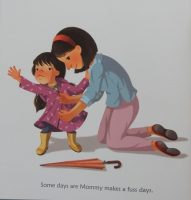
Some days are extra special like that for ‘picking out a pup’ or winning a cup. Then come fussy mum days

and days when raincoats just won’t do, and there are  too wet to play football days with glum stay indoors faces; better though are snow angel making days and watching a warm fire days.

The author acknowledges those bad days when everything feels wrong

and those when it’s best to be alone.

Finally comes ‘Learning to be me days’ which is really the essence of the whole, a book that celebrates the positive but doesn’t gloss over the negative feelings. It’s a good starting point for discussion in an early years setting, or after a one-to-one sharing at home, perhaps about how best to respond to and deal with negative emotions. After all, being mindful of, and being able to talk about, our emotions and feelings helps us best deal with them.

Helping to develop mindfulness in even younger children is:

A Thank You Walk
Nancy Loewen and Hazel Quintanilla
Words & Pictures

Nancy Loewen’s brief story of a mother and little girl walking their dog, Duke, is one of the Bright Start series aimed at developing emotional intelligence in the very young.

Simply expressed it tells how as they stroll hand in hand mother and child interact with the animals they encounter. The barking sounds of Duke, the chirping of birds eating seeds, a neighing pony fed carrots, an overturned beetle that they rescue, which flies off with a buzz-buzz,

are, the child is told, the creatures’ ways of saying thank you.

Cutely and expressively illustrated in black and white with orange pops, by Hazel Quintanilla the book demonstrates the importance of showing appreciation and thankfulness. It’s never too soon to start saying thank you and as an introduction to being mindful about expressing gratitude it offers a useful starter for a circle time session with a nursery group, or for individual sharing at home.

You Can’t Cuddle a Crocodile

You Can’t Cuddle a Crocodile
Diana Hendry and Ed Eaves
Hodder Children’s Books

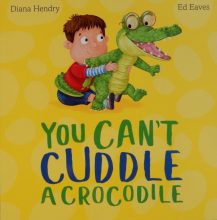
Why would anyone want to, was my immediate response to the title of this book but said crocodile doesn’t actually make an appearance until quite a way into the story – on Friday to be precise – so let’s go back to the start and meet the family on Monday morning.

There’s our narrator, a fresh-faced boy together with his smiling parents who counter the lad’s claim that on this particular day his sister is a monkey, with a question about the nature of monkeys’ choice of breakfast, and go on to fabricate further fanciful monkey-associated notions.

Come Tuesday, said sister has morphed into a bear whose ursine antics cause early morning chaos in the household.

And so it goes on through the week: Wednesday a camel accompanies mum and boy to the beach; Thursday sees a rainy shopping expedition with a flat-footed, flap, flap, flippered sibling slowing down the journey and causing consternation with the shopkeeper.

Friday it’s the turn of a visit from that crocodile – a decidedly uncuddle-able incarnation, particularly at bedtime story time and on Saturday the unsuspecting postie is scared silly when something roars at him and makes a grab for his sack. He isn’t impressed, preferring the human sibling.

On Sunday, Freya makes a welcome return as herself but suddenly Mum notices the absence of our narrator. What could have happened to him? … Seemingly he has the final chuckle in this tall tale.

Diana’s crazy story coupled with Ed’s zany digital scenes of young Freya’s incarnations and their outcomes, is likely to entertain youngsters in an early years setting or at home as well as providing a gentle introduction to, or reminder of, the days of the week sequence.

Super Snail

Super Snail
Elys Dolan
Hodder Children’s Books

Virtually without need to prove themselves, human superheroes are absolute winners with youngsters, but a super snail? That might take a little more demonstration of worth and that is exactly what Kevin (actually a normal slug) sets out to do in this super story.

Slug though he might be, come nightfall, Kevin dons a hard coiled mollusc coat and becomes transformed: fearless, invincible – an exceedingly slimy gastropod.

Now Kevin already has all that a superhero should have – a secret subterranean hideout complete with trusty butler, as well as a range of brilliant gadgets; but in spite of everything he’s yet to convince himself that he’s the real deal.

Time to consult the brave and comely League of Heroes.

Proof possibilities are posited and then all that Kevin needs is to receive the appropriate Snail Signal and he’s off on a mission, sadly at a snail’s pace, not super fast.

Once on the disaster scene, despite his best efforts Kevin is less than helpful; he resorts to last ditch efforts but even that merely renders him the butt of the villains’ jokes.

I should head home, thinks our would-be hero but then quite suddenly Kev. hears something alarming concerning one, Laser Pigeon, and he observes what looks like the ideal opportunity finally to exercise his slippery-slimy superpower and save his would-be dinner date, the ‘dynamic’ career worm Susan …

Super-author/illustrator Elys has out-supered herself with this one. With each new book, I think to myself, she won’t better this but then she does; and so it is with Kevin’s stupendously silly saga. It’s out of this world brilliant. Just get hold of a copy and see.

Going To The Volcano

Going To The Volcano
Andy Stanton and Miguel Ordóñez
Hodder Children’s Books

Meet Jane and Dwayne: whether they’re friends or siblings I know not but they’re both heading to the same place to look at the same thing.

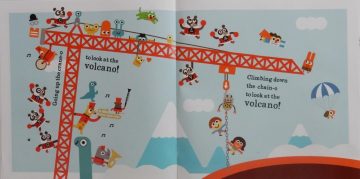
Its location is somewhere in Spain and to get there requires walking (down the lane-o); riding a Great Dane-o; sitting on a train-o; jumping on a plane-o, which flies them to their target country

where it happens to be raining. Splashing through it, – the rain-o, climbing up the crane-o and down the chain-o, (fortunately the rain has now stopped)

takes the two, plus the host of other interested parties who have tagged along during the journey, to the rim of the titular volcano.

That however, is not quite the end of this crazy saga for as perhaps the visitors were unaware, but little ones will be eagerly anticipating, said volcano is active and …

It’s easy to be wise after the event but those who value their lives and limbs will do well to heed the advice proffered by those who learned the hard way to STAY OFF THE VOLCANO!

For the full cast of volcano visitors, see the final spread, which in itself is sufficient to make you sputter with laughter – no not lava; despite those lava ‘girls’ lined up thereon, one of whom is called Trevor.

Stupendously silly, but then that is what makes Andy’s rhyming recklessness so riveting, all the more so when coupled with Miguel Ordóñez’ scenes of the comical cast cavorting towards their destination.

Everybunny Dream! / Hop Little Bunnies / This is Owl / Sleep, My Bunny

Everybunny Dream!
Ellie Sandall
Hodder Children’s Books

Ellie Sandall’s latest Everybunny tale is essentially a bedtime story.

Through a gentle rhyming narrative and a sequence of captivating scenes, some frolicsome, others more peaceful, we share in the bedtime ritual of the little bunnies as they respond to their mother’s instructions,

until they’re tucked up cosily under the covers.

Who should appear suddenly though but another creature with a long orange bushy tail, also clad in night attire.

Before long there’s a host of baby fox cubs sitting with the little bunnies – who have now all hopped out of bed – avidly listening to a good night tale

and then it really is time to snuggle down altogether for some shut-eye and perhaps some pleasant dreams.

A lovely way to send your little ones off into the land of nod at the end of a busy day.

Hop Little Bunnies
Martha Mumford and Laura Hughes
Bloomsbury Children’s Books

Based on nursery favourite Sleeping Bunnies, Martha Mumford has written a jaunty text that includes not only the bunnies of the original song but also fluffy lambs, tiny chicks, kittens and ducklings

all of which sleep until noon and wake up and make lots of noise.

They then go on to play for the rest of the day before a bedtime song sends them all off to sleep once more.

With plenty of flaps to investigate and sounds to make, Laura Hughes charming rural illustrations add to the springtime bounce of Martha’s words.

This cheery charmer is likely to become a much requested book for young listeners be that at home or in an early years setting.

After an initial sharing I’d suggest an action packed story session with sleeping, hopping, leaping and swimming, not forgetting baa-ing, cheeping, mewing and quacking.

Another book that invites interaction is:

This is Owl
Libby Walden and Jacqui Lee
Caterpillar Books
The sun is shining, Owl is fast asleep and doesn’t want to wake up but the book has to start so the reader’s help is needed to rouse our feathered friend.

Tummy tickling is only partially successful so the sun needs to be extinguished and replaced by a moon.

Hurrah Owl now has both eyes open but Beetle further along the branch is causing a distraction.

A considerable amount of page flapping is required to help Owl reach Beetle but then they both disappear. Oops! Where can Owl be?

With the help of several more birds Owl is eventually located and it seems one has become two for alongside is Other Owl.

Strangely the pair of them are doing a little uncharacteristic nest building so a bit of twig collecting from reader’s won’t come amiss.

Sometime later, once that threatening raincloud has gone, Owl has something in the nest to show off to readers.

By the time the sun starts to come up once again, two owls have become three and it’s time to bid them all farewell.

Feathery fun with a tad of scientific learning included, Libby Walden’s gently humorous, guiding words, in tandem with Jacqui Lee’s eye-catching, funny illustrations will certainly make for an active animal shared book experience.

Sleep, My Bunny
Rosemary Wells
Walker Books

Here’s a lovely way to wind down with your little one(s) at the end of the day.

Rosemary Wells’ gently flowing text reads like a lullaby as it talks of the sounds of evening: the simultaneous song of owls and crickets; the night wind that has ‘taken the moon for a ride’, the first soft summer rain.

Alongside we see, in Van Gogh-like impressionist style, a sunlit tree outside and then as the sun goes down, a series of gradually darkening skies shown through the window, foregrounded by scenes of a little bunny going through his night-time routine with his mother and father.

On each spread the textual border mirrors the sky seen outside.

There’s obvious love and tenderness in this bunny family so adorably depicted in this lovely bedtime book.

When I Was a Child

When I Was a Child
Andy Stanton & David Litchfield
Hodder Children’s Books

You’re swept away with this enormously heart-warming book right from Andy Stanton’s opening lines, ‘ “Back in the days before you were born, “ said Grandma, / “when the world was a rose’s dream … “ / There was butterfly-and-daffodil ice cream.‘

Back in the day, so she tells her grandchild, the world was ‘a crystal jewel’ full of beauty and magical events: ‘… in the summers of long ago, / when the world married the sun, / there was music in everyone.’

Now though that magic has gone, thinks the world-weary gran. But perhaps it hasn’t.

It’s down (or rather up) to young Emily to re-awaken the ability in her grandmother to see the world as that place of magic, with its beauty and hope once more: ‘ I can show you how to see.” Take my hand and come with me … she gently urges her gran as they embark on further flights of fancy, this time under the child’s guidance.

If you’re not brimming over with the joy it exudes having read this book once, then start over and soak up the transformative power of young Emily’s imagination as she finds magic, wonder and awe even in the most seemingly ordinary things such as  flowers and raindrops.

‘The world is a spinning star … no matter how old you are’ is what’s said on the book’s final spread.

A child’s wisdom is as fresh and young, and as old as the world itself; that is something we all need to remember especially in these troubled times of ours.

Totally immersive, tender and uplifting, this stunning creative collaboration between two  favourite book creators is also a celebration of a special intergenerational bond.

Verbal and visual poetry both: Awesome!

Claude: All About Kevin

Claude: All About Keith
Alex T. Smith
Hodder Children’s Books

One fine day Claude and Sir Bobblysock are perambulating in the warm sun, Claude taking the opportunity to practise his hooter playing, when they come upon a very distressed baby duck.

Benny Begonia, stops by. He suggests the creature has lost its mummy and offers to go and search for her. That’s how Claude and Sir B find themselves doing a spot of duckling sitting.

In order to pacify the little animal Claude suggests a visit to Mr Lovelybuns’ café.

Things are going swimmingly until Claude gets a tad over enthusiastic about his sandwich and SPLAT!

Keith is less than happy about his new pickle-spattered plumage and makes it known in no uncertain terms.

Off they go to the library and soon Keith is happily listening to Miss Hush’s story about an angry dragon. Until that is the librarian asks Claude to give a dragon impression.

You can imagine Keith’s reaction to the almighty roar.

Off they go again – to give Keith an opportunity to do what ducklings like to do. Thanks to Denzel the duckling appears to enjoy his swim but then Claude decides to join him in the water and … Here we go again.

Back comes Benny but without Keith’s mummy. “I should have just stuck with playing my hooter,” says Claude giving it a tiny toot.

Lo and behold that does the trick and before you can say ‘duck’ Keith is not the only one doing some enthusiastic moves to Claude’s tooting.

Back they all go to Pawhaven park: job done surely? Errr, maybe that’s not quite the end of the story. But we all love a happy ending and rest assured there is one though you’ll need to get hold of a copy of the book and discover how things are resolved – if indeed they are.

Alex’s Claude and Sir Bobblysock are totally irresistible and, based on the Disney Junior TV show, this latest adventure is as wittily ridiculous as ever.

Lots of Frogs

Lots of Frogs
Howard Calvert and Claudia Boldt
Hodder Children’s Books

Tommy Fox has a box – a box full of frogs. The expression ‘mad as a box of frogs’ sprang instantly to mind on reading this and there’s more than a little madness in Howard Calvert’s story.

Back in the day, dare I admit it in these days of environmental awareness, children (including myself) liked to collect frogspawn and take it into school where we’d watch the jelly blobs become tadpoles and then frogs. This clearly isn’t Tommy’s intention since he has the fully formed frogs (and toads) in his box but he does take them into school for show and tell. A risky enterprise you might be thinking and it’s certainly so.

Before you can say ‘atishoo’ those little amphibians have escaped and are leaping about causing utter chaos in the classroom,

silliness in the staffroom …

and havoc in the hall.

Tommy has to get all those frolicsome frogs back into his box but there’s one of their number – Frank by name – that has headed to the gym and is certainly eager to give young Tommy a run for his money.

Debut author Howard Calvert’s zany rhyming story bounces along with gusto. His main protagonist Tommy is a delight and Claudia Boldt has captured his enthusiasm and energy superbly. Equally the havoc-causing frogs – every one different – are utterly hilarious.

Spring has surely sprung in one particular classroom and I loved it.

Monster Match

Monster Match
Caroline Gray
Hodder Children’s Books

A host of zany-looking monsters each make a pitch to be chosen as a child’s special pet but is there one that stands out from the crowd?

First to strut its stuff is a tricky creature that advocates a daily run – now that’s a good idea.

Second comes a mock scary pink thing happy to do the frightening but wanting a little bit of snuggle room should it suffer from nocturnal fears.

Or what about a monster of the cuddly variety like this pamper-loving sweetie?

I’m not sure I’d advocate a monster that emerges from the rubbish bin covered in slime and stinking something dreadful; nor the snack guzzler who’s taste is for all kinds of gross looking ‘treats’,

especially not one that offers a dip in a drool pool. YUCK!

That’s almost all, but there are still one or two I won’t mention apart from to say that they join the others in claiming they’ll ‘be good, just like we should.’ Really?

Is there to be a winner? Which would your little monster choose I wonder …

Rhyming fun with a final twist: expect a few ‘EUGH!’s and “YUCK!’s when you share this one. Caroline Gray’s debut picture book most definitely offers plenty to talk about.

Amazing

Amazing
Steve Antony
Hodder Children’s Books

The boy narrator of this wonderful picture book has a pet dragon named Zibbo. Zibbo can fly thanks to the boy’s teaching; and our narrator, thanks to his pet, knows exactly how to …

The two are pretty much inseparable and a terrific hit with the boy’s friends. Zippo is ace at hide-and-seek though basketball is at times troublesome, depending on who is catching the ball.

A true party enthusiast, Zippo can on occasion get just a tad over-animated, or should that be over-heated …

No matter what though, as different as he may be, Zippo is the very bestest best friend a child could possibly have: it’s a case of ‘no holds barred’ when it comes to challenges in the company of the tiny dragon, who in the narrator’s closing words truly is AMAZING! Just the way he is. The boy though doesn’t actually have the final words – those are left to Zippo …

Amazing too is the book’s creator, Steve. His joyously inclusive portrayal of boy and pet is a cause for celebration: it’s rare to find a mainstream trade publication with a disabled child as its main character, let alone one so prominently portrayed on the front cover. Even more important though, is that the narrator’s disability is incidental with the celebration of friendship taking centre stage.

Having taught in both mainstream and special education, I know for sure that the likelihood of students who are different being picked on by ignorant or thoughtless individuals, increases the further through the system they go. Young children are in my experience far more open and accepting of differences of all kinds, just like those in this story. However it’s the place to start when it comes to developing those open-hearted attitudes.

A must for all nurseries, early years settings and primary schools as well as the family bookshelf.

Hugless Douglas and the Baby Birds

Hugless Douglas and the Baby Birds
David Melling
Hodder Children’s Books

As Douglas sits beneath a tree taking stock of his spring collection, it’s suddenly added to in an unexpected manner. A nest of eggs plummets into his lap, closely followed by a squirrel that informs Douglas it belongs to Swoopy Bird. The eggs are fine but the nest is rather the worse for its tumble.

Kind-hearted as ever, Douglas volunteers to mind the nest and its contents while its owner builds a new one but it seems a long wait.

One of the Funny Bunnies suggests egg hugging is a good way to keep the eggs warm – decidedly preferable to being sat upon by Douglas’ large rear – and it isn’t long before the eggs are ready to hatch.

The next challenge is to get the eight little hatchlings safely up to the new home Swoopy Bird has finished in the nick of time.

Once installed it’s hugs all round.

As always it’s perfectly pitched for young listeners but with sufficient humour – visual and verbal – to satisfy adult readers aloud too.

With its signature final double spread (here it’s things to spot on a spring day) and some crafty suggestions, this new story will please established fans, and make the huggable Douglas a lot of new followers.

Oi Duck-Billed Platypus!

Oi Duck-Billed Platypus!
Kes Gray & Jim Field
Hodder Children’s Books

Seemingly Frog’s work is never done, at least when it comes to finding suitable places upon which animals can rest their situpons.

Now he’s faced with not just the creature from the title but a whole host of other animals all wanting to know upon what they can sit and even worse, each one has a name that’s impossible to find a rhyme for – try hedgehog, say. Well perhaps the spiky creature could sit upon er, Frog. Ouch! I suspect that’s completely out of the question though. And kookaburra – hmm! Surely there must be another way of approaching this impasse. And happily there is!

Frog is a genius! “… what’s your first name?” he asks the duck-billed platypus. “Dolly,” comes the reply. Easily sorted.

Then, with moral support from his pals – the dog and the cat, our amphibious friend rapidly comes up with places upon which another twenty or so animals can park their bottoms.

That leaves just the matter of Geraldine the kangaroo …

I think this book has ousted any of the other Oi titles to become my very favourite of the seemingly effortless, utterly priceless. rhyming gems Kes Gray produces. Brilliant as they are though, they wouldn’t be quite so fantastic without Jim Field’s side-splitting illustrations.
Unmissable!

Oi teachers, think what terrific fun you could have with your classes …

The Queen’s Lift-Off

The Queen’s Lift-Off
Steve Antony
Hodder Children’s Books

Those of us who watched the opening ceremony of the 2012 London Olympics will probably recall that Her Majesty the Queen was, so we were led to believe, parachuted into the stadium.
Who would have thought that just a few years later she’d find herself blasting off into space aboard the rocket she’s just helped the little prince and princess to build?

WHOOOSH! goes the Queen, zooming faster than the speed of light, first to Mercury. After which, comet-like she soars to Venus,

before coming to land on the Moon’s surface

from whence it’s merely a matter of a single giant leap to the Red Planet.

Then she boldly takes flight towards Jupiter before she’s off again to spin rings around Saturn.

Zipping on past Uranus and Neptune, not forgetting little Pluto, she’s suddenly sucked into an enormous black hole.

Surely that cannot be the end of Her Royal Highness?

Not so: thank the universe then, for a passing spaceship that succeeds in safely beaming her up and depositing her safe and sound and none the worse for her awesome adventure, back in the palace garden, where it just happens to be afternoon tea-time. Hurrah!

And who, or what, should be there to serve it up …

Into his seemingly simple story Steve manages to weave some wonderful textual references to Star Trek and the American moon landings.

As always however, it’s the awesome illustrations that carry not just one, but many stories (as well as visual starting points for children’s own storying). However many times one looks at them there always seems to be something new to discover and enjoy. In this story there’s the ever -increasing number of loyal companions the Queen has on her journey, as well as a little alien and his flying saucer which appear from time to time.
Oh and of course, in each and every scene there’s a royal corgi complete with space-helmet, looking as though he’s thoroughly enjoying every minute of the adventure, Oddly enough, her highness just happens to have some dog biscuits (along with her lippy, perfume spray, specs and the various other necessities she carries in her handbag).
I’m guessing since its near loss, she’s never parted from this vital article of personal storage.

I think this series just keeps on reaching new heights; this one is my favourite thus far, although I was probably predisposed so to think because I was lucky enough to have my review copy signed and handed to me by Steve himself. You can’t get better than that – until the next one, perhaps.

Mr Penguin and the Lost Treasure

Mr Penguin and the Lost Treasure
Alex T. Smith
Hodder Children’s Books

The creator of the wonderful Claude books does it again with this the first of another adventure series. It stars Mr Penguin of Cityville (think Indiana Jones crossed with Sherlock Holmes or even Wallace and Gromit) who has just set himself up as a professional adventurer. He has all the gear: a dashing hat, large magnifying glass, a somewhat battered satchel and a smart-looking office complete with revolving chair. Like others of his ilk, he also has a sidekick, Colin the kung-fu-kicking spider.

Mr P. sits in his office, with a decidedly reduced bank balance and a distinct lack of clients, despairing that he’ll ever be asked to solve a mystery.

Happily he gets a call from a frantic-sounding Boudicca Boones, owner of the Museum of Extraordinary Objects. She wants to hire him to find some lost treasure buried long ago by a relative.

An adventure at last; but can this oddly matched pair manage to follow a map and solve clues let alone locate the whereabouts of that missing treasure?

Their search, which ends up involving more than just Mr P. and Colin, sends them down into the depths to a subterranean jungle under the museum itself.

What a cracking, fast moving adventure it turns out to be with a host of cliff-hangers,

surprises and delicious characters, not to mention brushes with the criminal fraternity, the odd alligator and more, that will keep readers on the edge of their seats as well as chortling at the wonderful dialogue.

As one would expect of Alex Smith, the entire tale is imbued with the absurd, both verbal and visual; and be sure not to miss those press excerpts before and after the beginning and end of the book.

Readers will be thrilled to learn, as I was, that this is the first of a new wacky adventure series. Bring on the next one …

Everybunny Count! / abc

Everybunny Count!
Ellie Sandall
Hodder Children’s Books

Since making friends in Everybunny Dance, ’Fox and bunnies like to play, / all together, every day.’ And their chosen game for this particular day is hide-and-seek.

The bunnies do their countdown and the hunt for fox commences. The first finding is a single badger soon followed by two bunnies spotting two birds: ‘Everybunny count to TWO!’

The search continues. Three bunnies spy three frisky squirrels; four find four ladybirds.

The pond is a fruitful place for fresh discoveries: five diving bunnies see five ducks while among the sticks, six bunnies find six frogs. ‘Everybunny count to SIX!’
Next stop is the carrot patch – just the place for a crunchy carrot nibble. It’s getting late and eight bunnies are anything but observant in their haste …

By now those bunnies are feeling sleepy as they form a line and count to NINE! (sheep) and then hurrah! There among the trees, close to his den is Fox.

There’s another surprise however for at the count of ten what should appear but ten little fox cubs and a proud mother.

It’s time to dance …

Ellie Sandall’s rhyming text with its infectious repetition ‘Everybunny count to …’ bounces along as beautifully as the bunnies. Add to that her deliciously playful pencil and watercolour illustrations (children will delight in occasional glimpses of Fox along the way) that lead to this …

and we have a counting book story that’s full of fun and sure to result in echoes of the animals’ “Let’s play hide-and-seek again.”

abc
Aino-Maija Metsola
Wide Eyed Editions

Learning the alphabet is just a part of this new addition to the Learning Garden series. Young children can have fun not only naming the objects for each letter of the alphabet but also enjoying the various patterns, shapes and bright colours that are part and parcel of every page.

There are numerous opportunities for language learning, depending on the child’s interest and the skill of the adult sharer. You might for example, chose two or three of the letters and illustrated objects, and use them to make up a story together. The sturdy pages mean that this little board book should stand up well to the enthusiastic use it’s likely to get in a nursery or family.

The Story of Tantrum O’Furrily

The Story of Tantrum O’Furrily
Cressida Cowell and Mark Nicholas
Hodder Children’s Books

I’m anything but a lover of cats – they make me sneezy, wheezy and itchy-eyed but the ginger creature staring out from the cover of this book is totally irresistible and goes by the unlikely name of Tantrum O’Furrily.

What we have here is a story within a story and it all begins one wild and windy night with stray cat, Tantrum O’Furrily dancing across the rooftops with her three hungry little kittens and offering to tell them a story.

Slightly disappointed to learn that stories aren’t edible, they start to listen to their mother’s song. She tells of a small kitten; Smallpaw by name, a very pampered pet living with Mrs Worrykin who, when asked for a story responds that only stray cats – the robbers and fighters – are story cats.

One night Mrs Worrykin forgets to close the catflap and seeking adventure, Smallpaw pokes her head outside into the dark sniffing for a story of her own.

The fox she encounters is more than willing to oblige and begins his tale thus: “Once upon a time there was a delicious little kitten with fur as soft as butter, who was bored of being indoors…

Recognising the similarities with her own story, Smallpaw is intrigued and allows herself be lured outside, bounding right up close to the foxy gentleman who, as foxes do, has his eye on the main chance.

Fortunately for her, there happens to be a stray cat on hand with tiger-like claws and tenacious teeth; she sees off the wily predator …

and gives Smallpaw some timely advice.

Smallpaw does return to her keeper but from then on, Mrs Worrykin always leaves the catflap open. The best of both worlds becomes the order of the day – and night – for, as that wise stray once said, ‘A cat with courage makes her own story.’

Beautifully told by wonderful weaver of words, Cressida Cowell whose modern fable is complemented by Carmelite Prize winning illustrator Mark Nicholas. His superbly smudgy scenes, executed with a minimal colour palette, detail the action with panache.

Swapsies / Say Sorry, Sidney!

Swapsies
Fiona Roberton
Hodder Children’s Books

There’s a delightful lesson in the importance of friendship and learning to share in this latest book from talented author/illustrator Fiona Roberton whose books have all been winners with me.
Fang has a favourite toy, an amazing yellow, stripey, squeezy, thing with an aroma of bananas; he loves Sock more than anything else.
Enter Philip with his magnificent shiny red train, which looks a whole lot more exciting than Sock. Being a good sharer, Philip agrees to a swap.

A similar thing happens with the bouncy toy belonging to Simon. But then disaster strikes …

and Fang is left toyless and missing his old favourite.
Is he to be without his beloved Sock forever more or is there perhaps a way they can be re-united.
Fiona’s characters are adorable; her dialogue superb: “What happened to Ball?” asked Simon. “Ball is no longer with us,” says Fang; and the finale (which I won’t divulge) leaves room for the children’s imaginations to take over and draw their own conclusions.

Say Sorry, Sidney!
Caryl Hart and Sarah Horne
Hodder Children’s Books

Resident of the zoo, rhino Sidney feels lonely so he decides to make a break for it and heads for the farm.
Once there, the creature starts helping himself to anything and everything that takes his fancy. First he scoffs Mr Potts lunch, then ruins all the washing on Aunt Ann’s clothes line. How wonderfully affronted she looks …

Not content with that he destroys young Emily’s den and smashes all her favourite toys. Even worse, despite their protests of innocence, everyone blames their loss on whichever farm animal happens to be on the scene at the time.
Rhino? What Rhino? / That cannot be true. / There’s only one rhino / and he’s in the zoo.” Is what the accusers all say to the accused.
Come the evening, those farm animals have had enough; time to confront that rhino and teach him a lesson they decide.

Will Sidney finally see the error of his ways, learn some manners and become a valued member of the farm community, or will it be back to the zoo for him?
With its join-in-able repeat refrain, the jaunty rhyme bounces along nicely and Sarah Horne’s wonderfully quirky characters, both animal and human, are quite splendid.
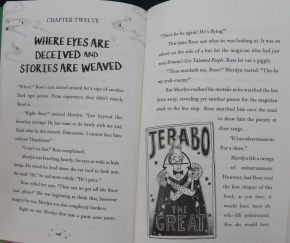
The Adventures of Egg Box Dragon

The Adventures of Egg Box Dragon
Richard Adams and Alex T. Smith
Hodder Children’s Books

Here’s the result of an inspired bit of decision making from someone at Hodder: the teaming of Richard Adams (now no longer with us) and wonderful illustrator of the Claude series, Alex T.Smith. It’s the first and only picture book from Watership Down author and the last ever book Adams wrote.
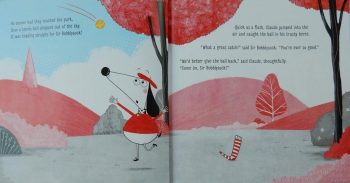
Like a good many other children, Emma loved to make things out of egg boxes, not the awful plastic things but the pukka cardboard ones. One day she fashions a fantastic dragon from those egg boxes with the addition of bits of card, scraps cut from bin liners, wire, shiny bike reflectors and paint.

This amazing construction is hugely admired when Emma brings it home and one person not usually given to speaking out declares the “critter’s got magic.”

Doing as she’s bid, Emma puts the dragon to sleep under the moon and waits.
Sure enough the old man is right, the dragon comes to life and yes, he’s a fiery thing but this mischievous beastie has an amazing talent: he’s able to locate the whereabouts of almost anything that’s been lost – Dad’s specs for instance and the neighbour’s tortoise.

Pretty soon the whole neighbourhood has heard of this extraordinary gift and the TV news gets hold of the story.

Then comes a surprise call:

her majesty enlists his help and the Egg Box Dragon finds himself going to the palace to assist her in finding a missing diamond from her crown.

A thoroughly enjoyable tale, full of splendid characters in its own right, but with amazing artistry from Alex that’s simply brimming over with wonderfully imagined details, the whole thing moves to a whole new level of deliciousness.