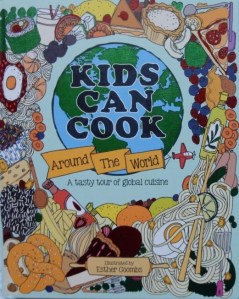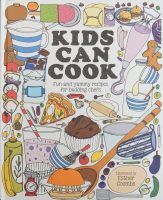
Kids Can Cook Around the World

With its enticing cover, this sturdy hardback introduces children to dishes both sweet and savoury from around the world.
Before the recipes there’s a short ‘Before You Begin’ section that talks about safety, equipment and basic techniques. Thereafter come the recipes themselves, the world in this book being divided into five areas: North and South America, Europe, Africa and the Middle East, Asia, and Australia and New Zealand, each of which has an introductory spread with interesting facts about the food. I was surprised to read that ‘Coca Cola was invented in North America, originally as a medicinal drink’, that there are over 350 different kinds of pasta and that there are more than 1,000 different types of cheese in France.

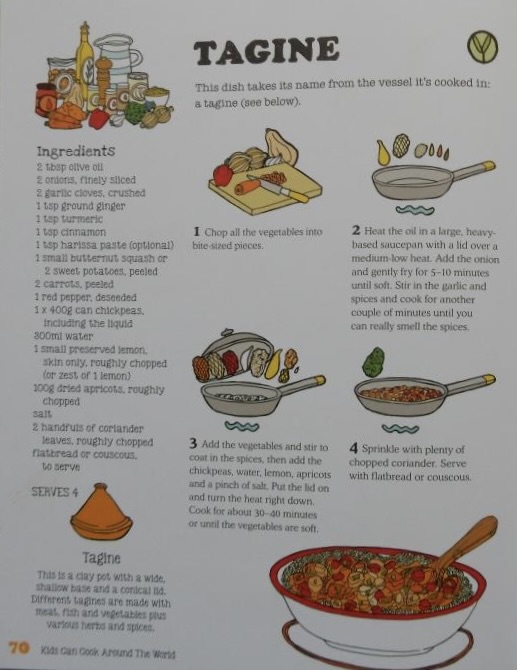
A fair few of the dishes will be familiar depending to some extent both on how open you are to trying cuisine from various parts of the globe and how well travelled you are. You will certainly find some mouth-watering selections including madeleines, a vegetable tagine

and I’m eager to try making koshari. All recipes have step-by-step instructions with visuals alongside each step and the number of servings each makes.

My only quibble about the book is that there aren’t many vegan recipes but that’s a personal thing and doesn’t stop me recommending it as a very useful one to help youngsters develop their cooking skills.

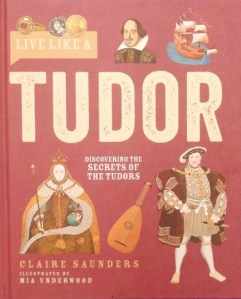
Live Like A Tudor

Primary age readers with an interest in history can step back in time, at the invitation of eleven year old Mary who lives with her family in an English manor house and has a sister who is a maid of honour to Queen Elizabeth 1st.

The latest in the ‘Live Like A … ‘ series covers a wealth of topics including the jobs people did, family life and childhood, education (the poorest children were not even taught at home but had to work instead), religion, trade and exploration when the seeds of the transatlantic slave trade were sewn.

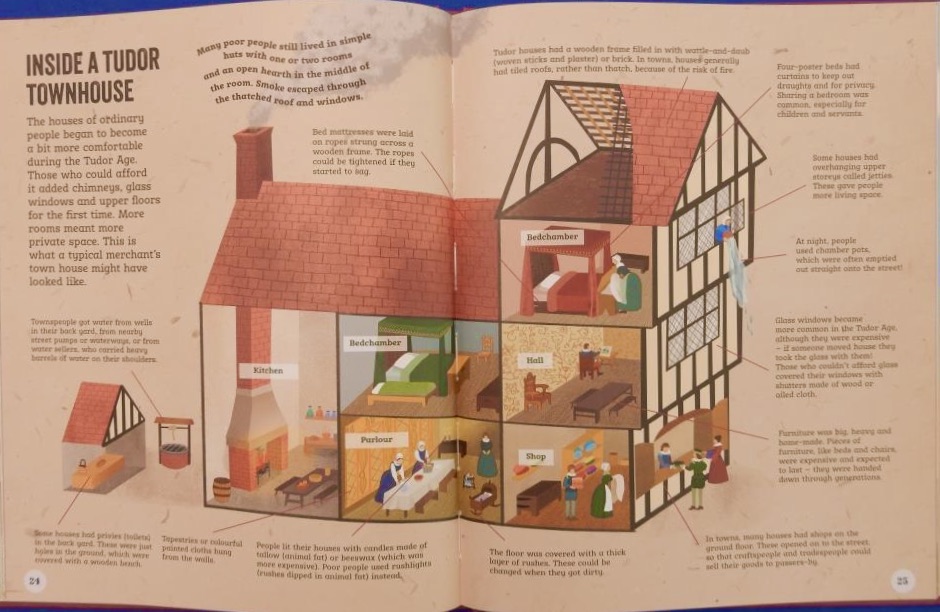
There are spreads on a typical Tudor village, a look at a townhouse both inside and out,

health and medicine, crime and punishment, games, sports and entertainment and fashion as worn by workers and nobles. In Elizabethan England, those who were able to a afford it wore a ruff and so doing was a sign that you were sewn sufficiently wealthy not to have to undertake any hard physical tasks and had servants to look after your ruffs, some of which were very elaborate. One of the craft activities in the book gives step by step instructions to make a ruff and matching cuffs.

Did you know that England’s first theatre was built in 1576 in London and was soon followed by others including the Globe Theatre where William Shakespeare’s play were performed?

Tudor Christmases were celebrated across twelve days and readers can join young Mary and her family and discover what they might have done.

The final spread asks “Could you have lived like a Tudor? and the author poses several questions to discuss. There’s also a glossary.

An engaging book that helps bring the era to life; it’s worth adding to to KS2 class collections, and to home bookshelves if you have a child interested in the past.

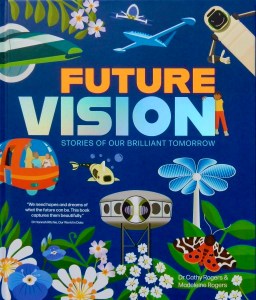
Future Vision

Herein with 12 year-old Kit and friends as guides, children are transported to the year 2070, to a world that has been transformed by sustainability, technology and global collaboration. A world wherein as the author says in her introduction, it’s hoped that ‘most countries have come together to solve some of the most pressing problems.’ A world with less poverty, better health, a greener and cleaner world with more kindness and happiness. Who wouldn’t wish that could be so?

Factors that contributed to the changes include no petrol and diesel cars, affordable public transport everywhere powered by the extremely cheap electricity and otherwise almost traffic-free cities. There’s been a great deal of re-wilding, meaning that people are able to enjoy the beauties of a thriving natural world.
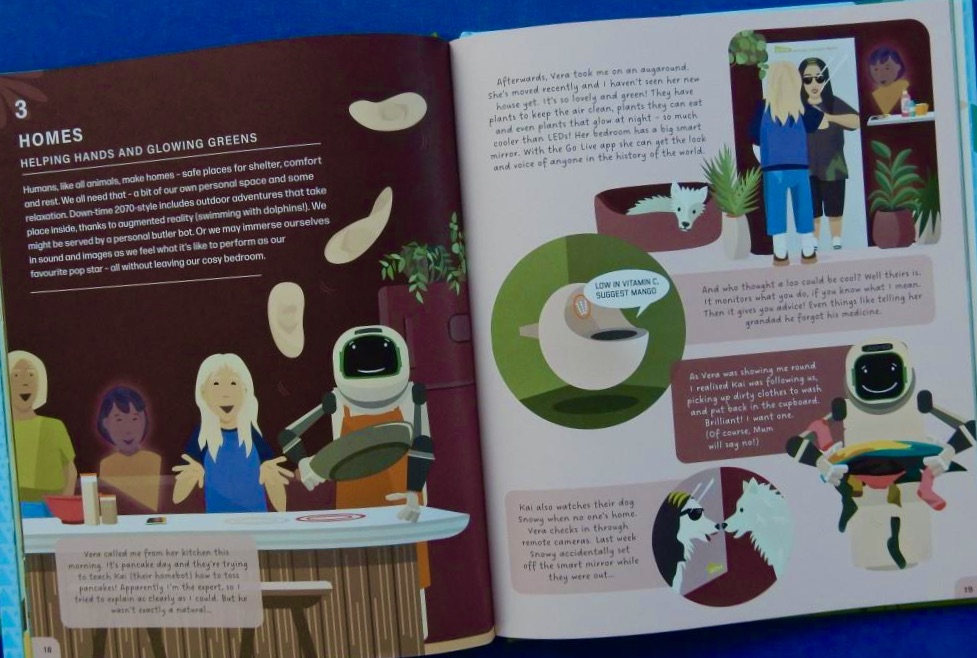
Homes too are eco-friendly with plenty of house plants, bots to assist with, or carry out, many household chores – imagine having a homebot to collect up all your dirty clothes for washing and then once clean, return them to the appropriate cupboard.

And of course all energy used at home or elsewhere is clean, green energy.

Health and Wellbeing, is an important topic. On the journey, it’s evident that life has improved for all and people usually live long, healthy lives until one hundred or thereabouts. How this has been achieved is discussed; so too is the interconnectedness of health and happiness.

Other topics presented are oceans, food and nutrition, space and democracy. The author feels strongly that optimism about the future, not only about people’s own lives, but about the world as a whole is important and she talks of ‘realistic optimism’. Finally she invites readers to think about their own vision of the future. This is where I see that the imagination is vital, for no scientific discoveries could have been made without the power of the imagination. Who would have expected forty years ago what could be done with a hand-held mobile phone for instance, but it all began with somebody’s creative thought.

100 Ways to Save the Planet

Engaging readers from the outset with his ‘superhero footprint’ suggestion, Tom Jordan provides a wealth of ways children can reduce their carbon footprint. starting with cutting out meat from their diet or if that’s too big a leap then reducing the amount eaten with fewer meat-consuming days per week and encouraging other family members to do likewise. To that end, related topics are suggested on later spreads; for instance growing your own vegetables.

I wonder how many people don’t ensure they’ve turned the taps off properly after showering or bathing, or brush their teeth with the water running: saving water isn’t hard, it just needs a bit of thought. Some of that bathwater you do use can then be used to give your ‘pet dragon’ a drink, (ie a Dracaena houseplant) – another cleverly linked suggestion.

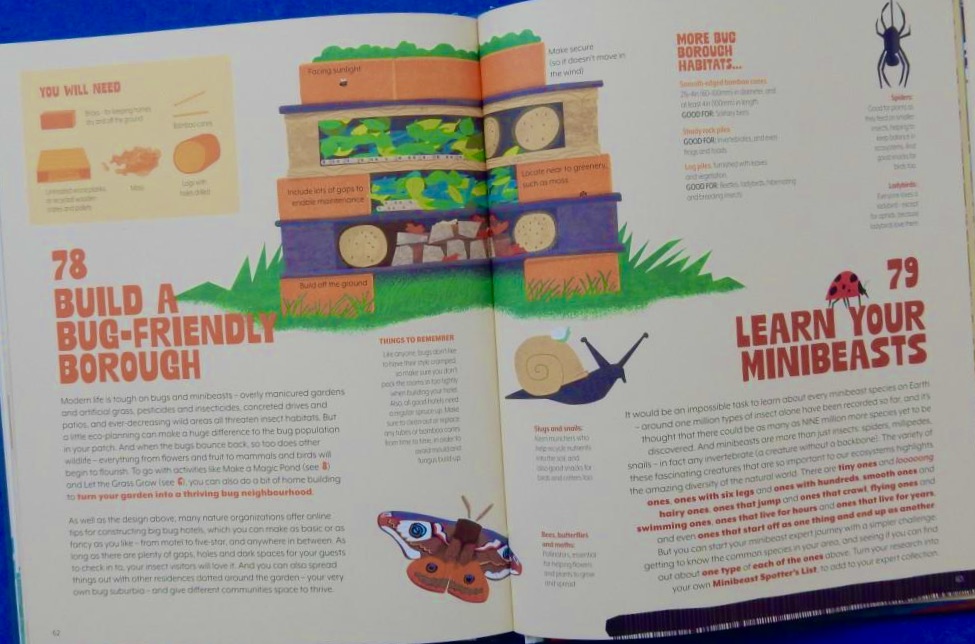
I’ve noticed many primary schools and children’s playgrounds have already constructed bug-friendly ‘hotels’ with the help of youngsters, but there’s still a way to go. Why not take the ‘Build a bug-friendly borough’ suggestion literally and with adult assistance, encourage all schools in your area to do likewise.

Reduce, repair, recycle, reuse: these are key practical words for anybody looking to tread more lightly on our planet. There are plenty of ideas to implement these actions and it matters not whether children can actually read the book for themselves. With its enticing, clear illustrations by Joshua Rice and interesting facts, this is an invaluable handbook for any family, primary or even secondary classroom: think of all the environmental superheroes it could inspire.

Politics

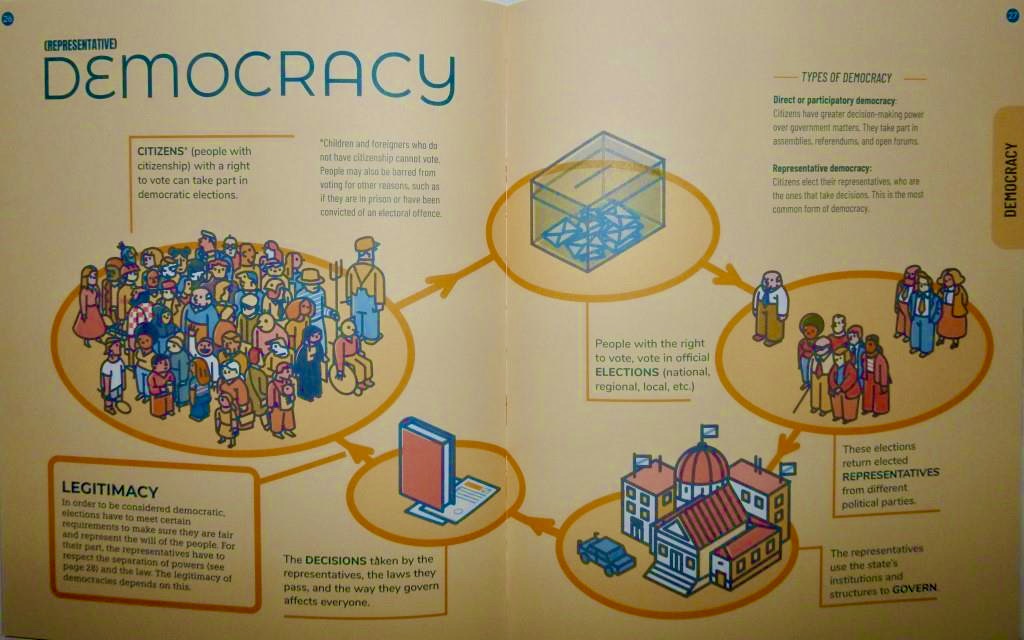
In the latest of this excellent series, Eduard Altarriba guides readers through what can often be a confusing topic and not only for younger readers. Questions including What is power? Who has it and how do communities govern themselves? are explained in a step-by-step manner. There’s also a look at the origins of political thought, democracy

and forms of government going right back to Ancient Greece. What is democracy, what is the best form of government and how does a government operate are also covered, as is what are the responsibilities of a government, left and right politics, majority governments and coalitions

Corruption and Populism too are discussed and the book poses a What would you do question on the final spread. Readers are asked to don the hat of mayor of a town where a multinational company wants to build a factory on land very near the river.

Clearly and concisely presented using infographics and diagrams this is an illuminating introduction to a vital topic relating to how the world works for Y6 readers and beyond, adults included. Teachers will find class discussion topics aplenty here too.

My First Book of Evolution

The stellar pair, author Sheddad Kaid-Salah Ferrón and illustrator Eduard Altarriba present another important STEM topic – how all life came to exist.

Starting close to home, there are pages that look at both the family tree and the tree of life, the latter being defined as ‘the family tree of all living things that have ever lived on Earth.’ Then comes a spread on species comprising a definition and examples, mentioning that the definition doesn’t actually apply to everything in the natural world, including many bacteria.

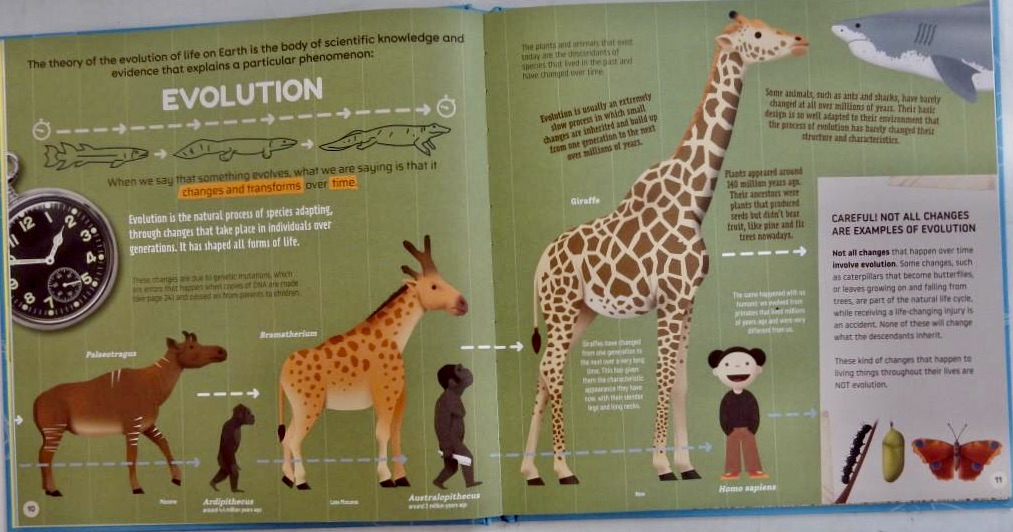
Evolution itself is presented next

followed by the process of natural selection wherein it’s explained its connection with evolution using giraffes as examples. Charles Darwin is mentioned here and the voyage of the Beagle, Dawin’s observations and his ‘The Origin of Species’ are the subjects of two double spreads.

Heredity, Gregor Mendel and genetics including mutations are also explored; there’s a look at LUCA (the ancestral organism all living things are descended from) and the book ends on future possibilities.

Exciting and accessible, this is a great starter book for budding scientists at home or school, as well as adults who may not have learned about the topic previously.

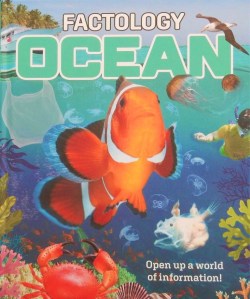
Wildlife in the Balance / Factology: Oceans

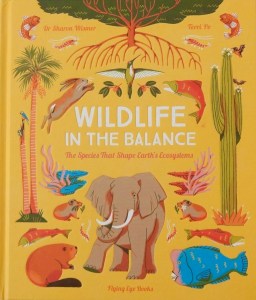
In this latest Flying Eye natural history offering author Dr Sharon Wismer introduces readers to the concept of keystone species and their impact upon various ecosystems.

There are introductory spreads explaining ecosystems, food chains and webs, and outlining the work of Professor Robert Paine whose experiments along the Washington State coastline in the 1960s demonstrated how the removal of a top predator from rock pools resulted in the collapse of the biodiversity of the ecosystem. He identified the ochre sea star as top predator and keystone species responsible for the biodiversity of the rock pools.

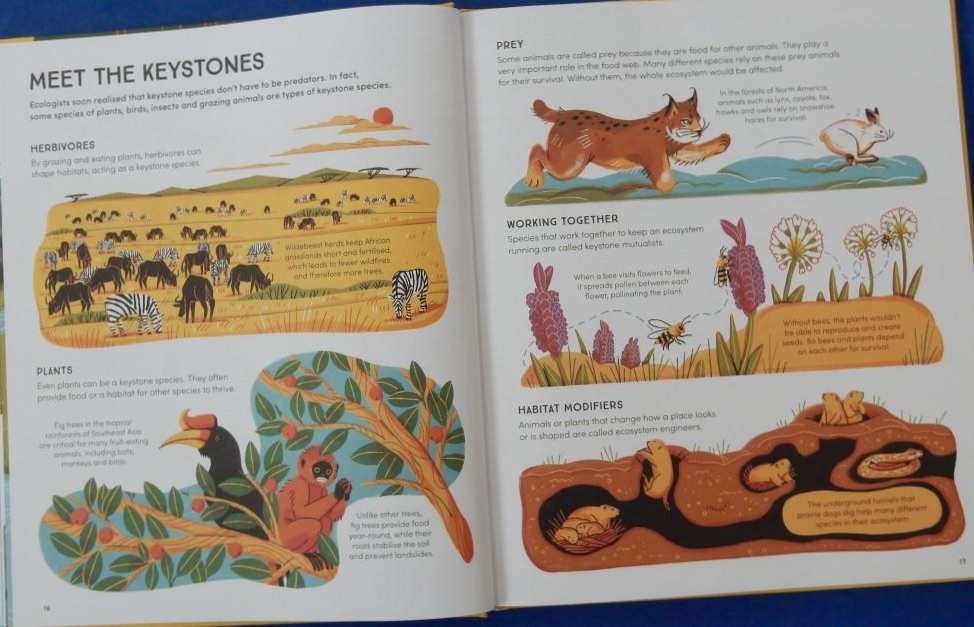
We learn that apex predators are not the only keystone species: herbivores, plants, prey, insects and habitat modifiers can also be keystone species maintaining the ecosystem in which they live.

Readers are then introduced to a dozen keystone species across the globe’s five major biomes: aquatic, desert,

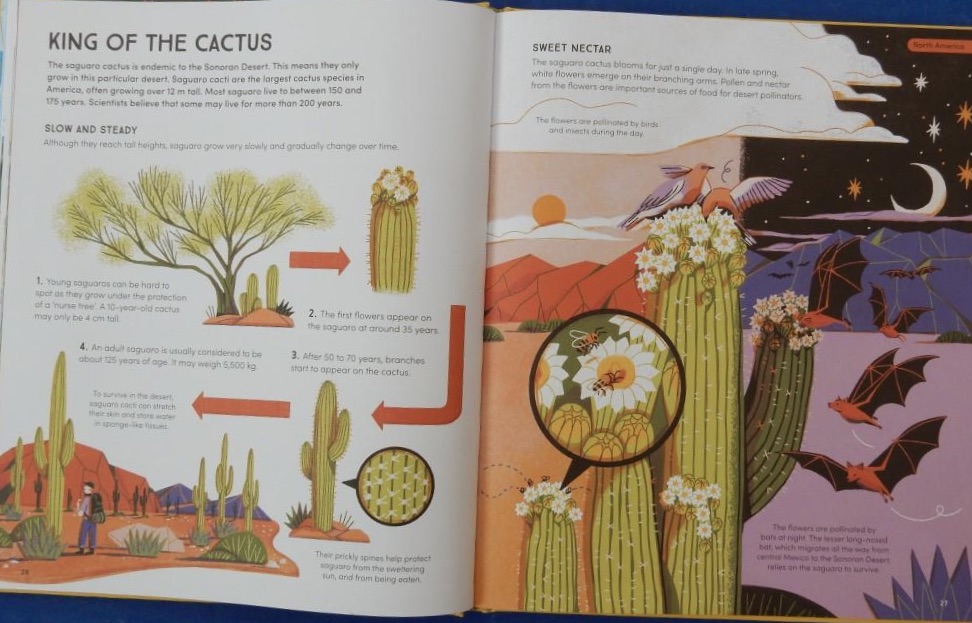
grassland, forest, and finally, tundra. These include salmon, the saguaro cactus, European rabbits of the Iberian peninsular, green-backed fire crown hummingbirds and krill.
Terri Po’s illustrations of the landscapes, flora and fauna are at once stylish, arresting and informative and expand and make accessible, the considerable scientific information conveyed by Sharon Wismer in her text, which concludes with a spread on how humans can help these vital keystone species. Backmatter comprises a glossary and index.
Altogether a fascinating book for KS2 readers and beyond..

For readers with a particular interest in the underwater worlds or for reference in a cross-curricular ocean topic is:

This highly visual book presents a wealth of facts about the ocean and its flora and fauna. In addition there is information on various topics such as the history of exploration and how people navigated their ships, subaquatic exploration of the ocean depths in the hope of finding treasure among the sunken wrecks.

Readers visit coral reefs and submarine volcanoes, see some of the wonderful deep-sea fishes and other creatures – giant squids, anglerfish, blowfish and the spooky-looking barrel eye fish and the fang tooth fish that has the largest teeth of any ocean species, find out how tides work, why the sea is salty and discover how tides and currents work. There’s a gallery of deep-sea deities and a spread introducing marine monsters such as the Kraken and a look at some of the horrendous outcomes of marine pollution

All this and much more, so imagine yourself into a submersible and take the plunge..

100 Forest School Activities / Bird, Bee & Bug Houses

Team Naomi and Dan, who run Outback2Basics, bring their ardour for the outdoors to the pages of another book.

Forest School should be part and parcel of the curriculum for every primary school child and the activities herein offer a wide range of ways to get youngsters connecting with the natural world.
It’s divided into five main sections, the first being Connecting With Nature. I particularly like something I’ve not tried before – making a camouflage cape. It will involve some cutting and sewing so make sure you check the ‘You Will Need’ list before setting out.
Chapter two Fire, Food and Shelter has more than ten food-related suggestions including making feta rolls, which sound tasty and something I plan to try.
Decorating leaves as per the instructions for one of the Nature Crafts is a creative idea that has lots of potential and once decorated said leaves can then be used to make for instance, greetings cards, a mobile or leafy butterflies. Another leafy possibility is to mould a leaf bowl using air dry clay and it can be done during any season of the year.
It’s great to see that most of the Games in the section of the same name are designed to get children working co-operatively and who wouldn’t want to try creating a ‘twiggy owl’.

There’s a template given at the back of the book but children might like to create a much larger owl so they could start by drawing their own template. Equally delightful is the leaf bat also made from sticks and leaves. All members of your forest school group could then leave one leaf bat dangling somewhere to create a collaborative display.
Before the five chapters are an introductory spread, followed by some general practical information including safety preparation, basic knots and vital pages about knives and fire.

Teachers and others working with children, this latest book by the Walmsleys is well worth adding to your resources.

Our local community-built forest play area for young children contains two bug hotels. Little humans and their carers who may be inspired to open heir own establishments would do well to get hold of a copy of this enticingly illustrated book. Therein are practical, clear instructions on how to do so, as well as a dozen or so other projects to help and encourage wild-life from birds to beetles, bats to butterflies.
Some projects such as making a bird box or a bat house

will need considerable adult involvement but others, a bird bath, a butterfly puddle area or a mini meadow for instance, require minimal adult intervention. Alongside the projects there are spreads with useful factual information relating to terminology and about some of the creatures likely to be encountered including owls, bats and frogs.
Esther Coombs supplies clear visual support and relevant illustrations of the animals. Backmatter includes a glossary and lists some conservation websites.

Outdoor Science

If you are looking for a resource of nature-related activities and crafts, to encourage children to develop their curiosity about the science of nature and natural phenomena, this could well fit the bill. The majority of materials they will need to do the thirty STEM projects herein are likely to be in your home already, or they can be found in close proximity to it.

Illustrated with photographs of a diverse group of child investigators, and with step-by-step instructions, the practical projects all begin with a needs list and conclude with a ‘science made simple’ explanation.
As a foundation stage/ primary teacher, most of the activities are not new to me but might be to parents of under elevens. I know from experience that youngsters are fascinated by shadow art and in this book Laura and Tia offer two ways of using shadows to create art.

Equally, most young children love watching tiny creatures so making an ant farm would appeal particularly for those who have more interest in fauna than flora. It’s a great way to encourage children to be observologists from an early age.

A wide variety of interesting, enjoyable activities to get youngsters interacting with the environment are presented from ‘Bubble Science’ to ‘Fractal Prints’ and ‘Scrap Vegetables’ (growing new veggies from leftovers) to a ‘Solar Still’.

This is a book for family collections, one to encourage children to set their screens aside and enjoy the outdoors especially now the longer days are here.

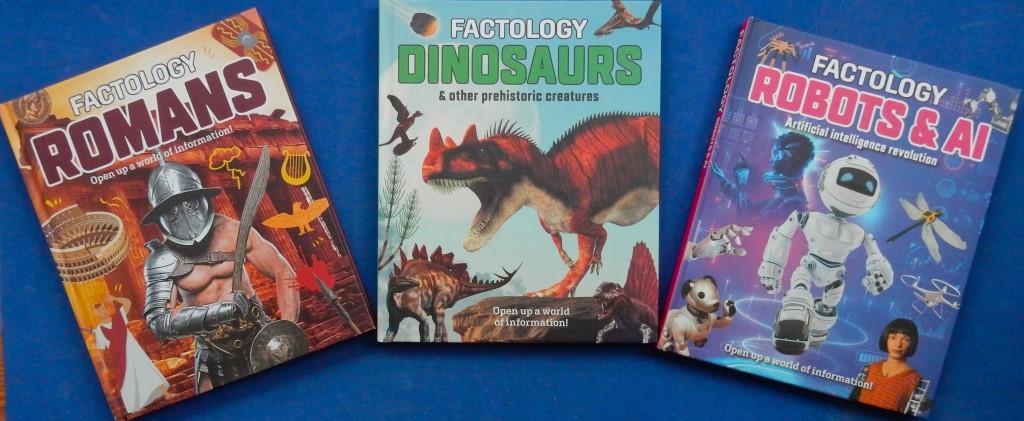
Factology: Romans / Factology: Dinosaurs and other prehistoric creatures / Factology: Robots & AI

Each of these new titles in the series offers a fact-packed, fast paced introduction to the topic. Individual readers will choose according to their interest or perhaps on account of a current subject focus in their school. For instance the key stage 2 national curriculum requires that children learn about the Roman Empire and its impact on Britain.

Like the other titles, Romans is divided into three chapters. Each has full-colour photographs and illustrations together with an accessible, easy-to-follow, bite-sized text that offers a good introduction to its subject, explaining key concepts and highlighting significant events in a manner that is both clear and entertaining. Did you know that those ancient Romans were extraordinarily fierce? For instance, a gladiator fight ended only when one of the combatants died or cried for mercy. Those who did survive sometimes became very rich. The Romans were also well-known for their inventive skills and you will also encounter all-powerful emperors, some worse than others, superb architecture, an impressive network of roads and much more.

Although Dinosaurs and other prehistoric creatures are not specifically included in the primary curriculum, huge numbers of children are fascinated by them and so teachers often find ways to incorporate them into thematic work.

As for Robots & AI, this is an area that all children will increasingly need to be informed about. Moreover a robotics topic brings together all the STEM areas and could be an exciting way of so doing with older children. It was absolutely fascinating to read of the number of ways robots are used in medicine.

I would advocate including all three books in both primary and secondary school collections.

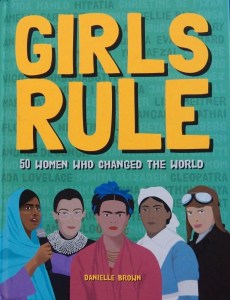
Girls Rule: 50 Women Who Changed the World

This is the second book written by double Paralympic champion Danielle Brown, the first para athlete to represent Team England in an able-bodied event at the Commonwealth Games,
Right from her introduction readers are empowered by such words as “There are no limits to how great your dreams can grow, or how much you can achieve when you keep your curiosity burning … You are bold, talented, unstoppable. And when you stay true to your beliefs, you too, can change the world.’

Travelling through history and to various parts of the world, we are introduced to female activists, artists, writers, teachers and educators, peacekeepers, pirates, politicians, spokeswomen, scientists, sportswomen and survivors who have, or are still changing the world. Often they’ve had to overcome almost impossible odds, getting over or through huge barriers, in pursuit of what they believe(d) to be right or important.

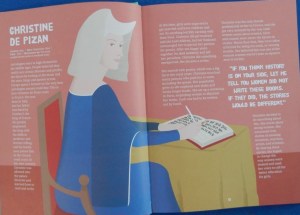
One of the women was a new name to me: Christine de Pizza an Italian who lived from 1364 to 1430. Her father became a member of the French royal court and when living in France she had access to the palace libraries and learned to read and write. After her supportive husband died, she had no money and unexpectedly, decided to become a writer who challenged the way women had always been presented in stories and accounts. She uncovered and shared true stories of women inventors, artists, scholars and more in the hope that sharing these would change the way women were treated. She was also determined to get a better education for girls.

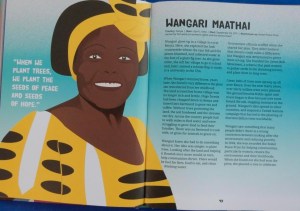
Those who care a lot about the environment will be interested to read about Wangari Maathai who grew up in rural Kenya. Having earned a degree from an American University, she returned to her home village and on realising that vast forest areas of Kenya had been destroyed, began planting trees. She founded the Green Belt Movement and over the next three decades, despite the negative attitudes of Government officials, more than thirty million trees were planted. Eventually this inspired a United Nations campaign. What Wangari realised, that many others didn’t, was the strong link between looking after the environment and the reduction of poverty and in 2004, she was awarded the Nobel Peace Price for her work helping communities, particularly women, to restore the environment and their livelihoods. What do you think she did to celebrate her prize?

Stylishly designed, a double spread is allocated to each woman featured and as well as the written biographical details, there’s a large illustration and for most, a significant quote. Here are a couple: “I refuse to believe that you cannot be both compassionate and strong.” (Jacinda Arden, the Prime Minster of New Zealand for over five years) and “The greatest gifts we can give our children are the roots of responsibility and the wings of independence.” (Maria Montessori, doctor and educator.)

Another inspiring book about following your dreams for KS2 readers.

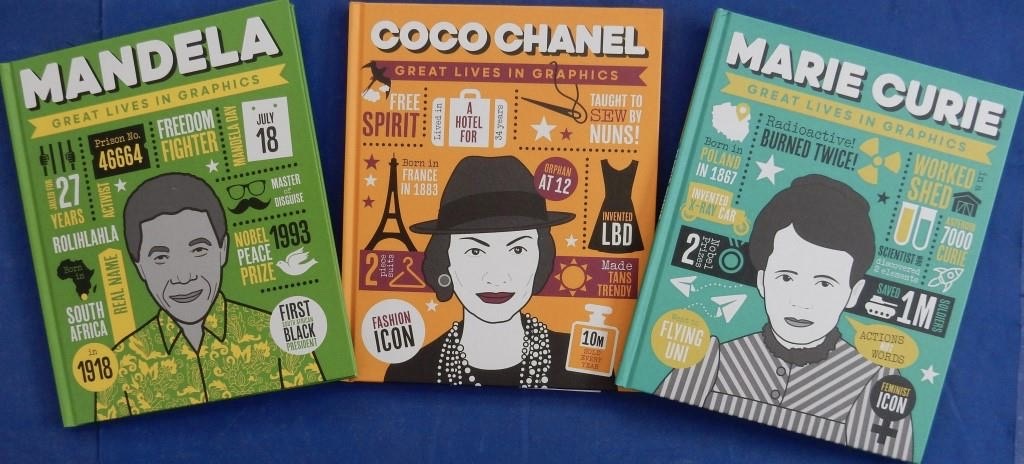
Great Lives in Graphics:Mandela / Great Lives in Graphics: Coco Chanel / Great Lives in Graphics: Marie Curie

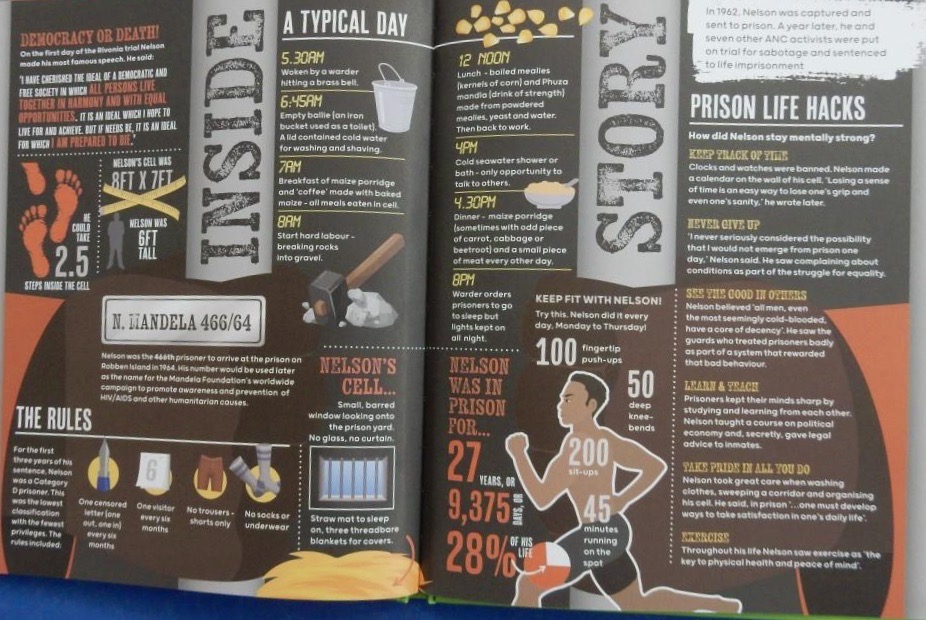
When in my early years of teaching, I passed on the news to my KS2 class that Nelson Mandela had finally been freed from prison, we all climbed up on the tables and cheered. (You’d never get away with that now but Mandela was then and has remained, my all time hero.) So of course, I was immediately interested to see the first of these titles being added to this very useful series. Readers will discover how Nelson’s life as the son of an African chief resulted, through his education, in his becoming an activist who protested against the apartheid system imposed by the white minority in South Africa in 1948; how his activism eventually led, when he was leader of the military wing of the ANC, to his arrest in 1962. He was sentenced to life imprisonment in 1964.

Fortunately though, he was released age 71, in 1990, a year before apartheid was abolished. After his release, Nelson was awarded the Nobel Peace Prize (1993) and the following year became South Africa’s first democratically elected president. he spent his last years in his home village.
An awesome man indeed.

If vou have an interest in fashion, then try a companion volume about Coco Chanel who overcame poverty as a child to become one of Paris’s key artistic talents. However, during WW2 it was rumoured that Coco acted as a Nazi spy. She made a comeback in fashion, in 1954, aged over seventy when she transcended ageism with her designs.

We all owe a great deal to Marie Curie, subject of the third book, the only woman to have been awarded two Nobel prizes, the first for physics, the second eight years later in 1911, for chemistry. Justifiably being dubbed a scientific genius, Marie faced prejudice and sickness, dying suddenly in 1934 from a bone marrow disease resulting from the effects of radiation.

All three, highly visual biographies, each of which has a final glossary, are definitely worth adding to KS2 libraries.

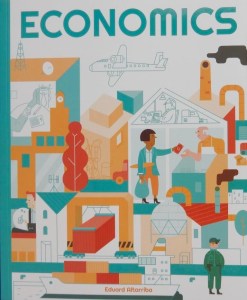
Economics

With ‘the economy’ being mentioned almost every time one turns on the TV or radio, this is indeed a timely publication. Herein the author provides an easy-to-understand explanation for older KS2 children about the economy, what fundamental economic ideas and theories are, as well as how its structures and rules impact on our daily lives and shape the way societies and the wider world function. I particularly like the way he uses as a starting point, the example of a village wherein sheep are reared and cheese made from their milk to explain such terms as surplus and exchange. This is just one of the devices used to make the complex world of economics accessible to children; children who will surely encounter words such as inflation and the escalating cost of living in the news.

In his usual fashion, Altarriba’s sequencing of topics explained is carefully considered so that each new subject (there are almost forty in all) segues logically into the next.

With its wealth of infographics and illustrations children can discover such things as how money works, the things you can do in a bank, what happens in the stock exchange and much more.

Altogether an excellent and illuminating introduction to a topic that is something of a mystery to all too many of us.

Factology: Bugs

Absolutely brimming over with minibeast-related information, photographs and diagrams: spend a few hours with this book and you’ll surely come away knowing a lot more about creepy crawlers, fliers, hoppers, wrigglers and jumpers than before. Did you know for instance that it’s thought that 90% of our planet’s life forms and the most diverse group are bugs? Or that bugs have existed on Earth for 470 million years and predate dinosaurs. Wow!

Insects with their chitinous exoskeletons and three-section bodies, form the largest group of arthropods. There are spreads presenting life cycles, habitats; you can dive into a bee hive as well as learn about how honey is made, meet all sorts of beetles and find out why some are so important to the health of the planet.

Not insects but included in this buggy extravaganza are spiders, comprising around half of the arachnid species. You might be surprised to learn that unlike we humans, spiders have blue blood; this is on account of the oxygen being transported around their bodies by haemocyanin, a copper-containing protein. 

Watch out for tarantulas, several varieties of which are presented on one of the spreads in this book. So too are ten highly dangerous bugs that can cause serious damage to unwary or unfortunate humans.

In the chapter ‘Bugs and Us’ is a spread detailing how to build a bug hotel and another offering ways to create an insect-friendly garden and there’s a final quiz, should you want to test your acquired knowledge. Back-matter includes a glossary and index. 

Also available in this new series are Factology: The Human BodyFactology: Space and Factology: Ancient Egypt, each of which provides a pacy, highly illustrated introduction to the subject, 

so if you know children with a budding interest in human biology, space science/astronomy or ancient history, these are a good place to start. They’re ideal for school libraries too.

Live Like A Roman

Live Like A Roman
Claire Saunders, illustrated by Ruth Hickson
Button Books

Do you know a primary child who is studying Ancient Rome or the Romans, has an interest in ancient history or just wants to find out more about life in Roman times, then this a book for them especially.

In addition to a wealth of information on a wide range of topics starting with Who were the Romans?, there are a number of practical activities for children to try. For instance alongside the facts about maths including Roman numerals, there are instructions for making an abacus. Having read the spread about childhood and family life, children can try making their own set of knucklebones and then play a game with them. Or what about making a wax tablet similar to those used by Roman children instead of the expensive papyrus paper. What really astonished me was to read that only about half of all Roman children made it to their tenth birthday.

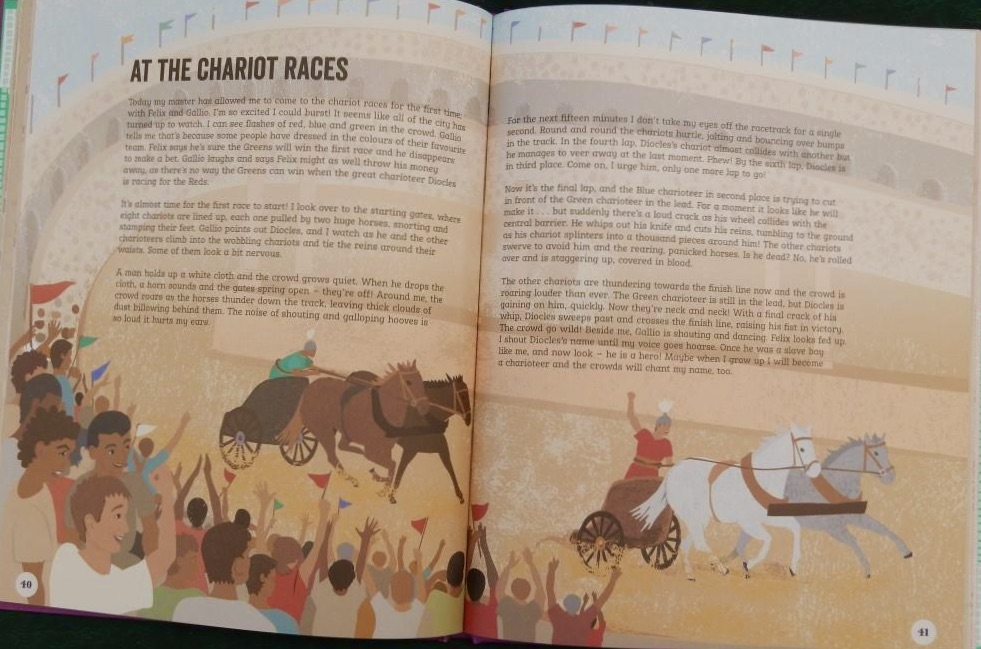
We meet a fictional child named Tito, a slave, who appears at various places in the book; we join him at the chariot races,

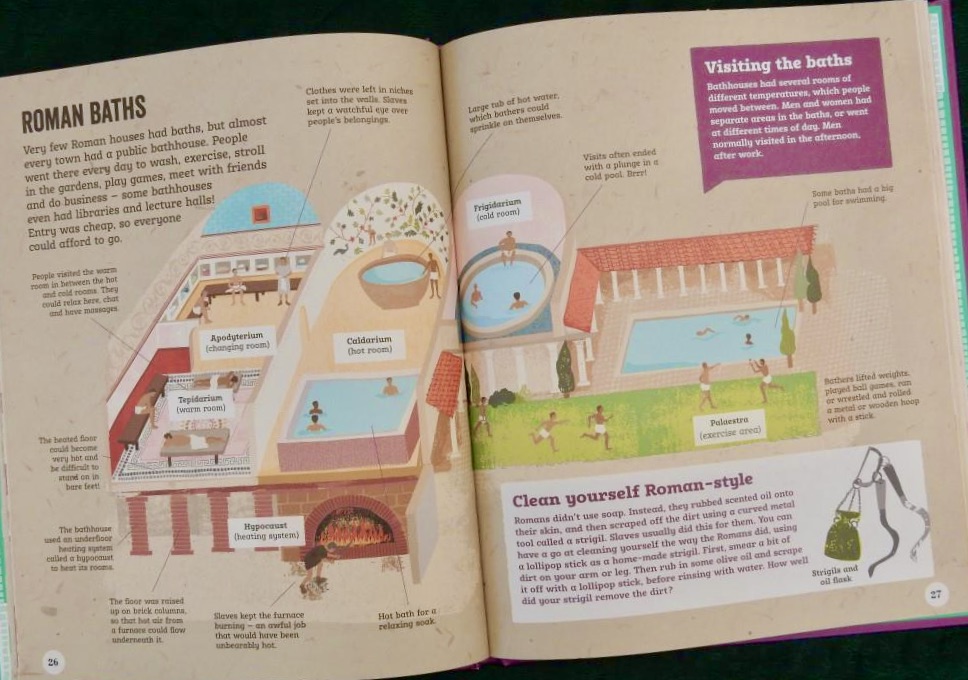
when he accompanies his master to the bathhouse and at the banquet his master hosts especially for an important guest.

The Romans are famous for their public baths, some of which are still in use today, but I’m not sure I’d want to try the Roman means of cleaning my skin by making a tool – a strigil – similar to those they used. The author suggests using oil and a lollipop stick.

Three double spreads are given to in turn food and drink, banquets and roman recipes; the honey cake sounds pretty tasty especially as instead of sugar, the Romans used runny honey; indeed honey was used in lots of recipes.

The final spread before the glossary poses the question: Could You Have Lived Like A Roman? This reviewer would not have survived long in a school: there were no opportunities for creativity and rote learning was the norm. However, the author appreciates the importance of creativity for today’s young readers and asks them to invent three new Roman gods or goddesses for things that are important to them and to give them names.

Ruth Hickson brings all this and much more to life in her detailed illustrations, large and small, helping to make this an altogether fascinating book for individual or primary classroom use.

Migrants / What Is War?

Migrants
What Is War?

Eduard Altarriba
Button Books

Both of these books are, sadly, hugely topical right now.

In Migrants, this sometimes emotive subject is explored in a matter of fact and dispassionate way. Eduard Altarriba explains that people have always been on the move since early humans migrated out of Africa to Europe and Asia more than a million years ago. He looks at borders between countries and why they exist, passports and visas that are required to cross them, how some countries colonised and created others, and discusses the reasons why migration might take place.

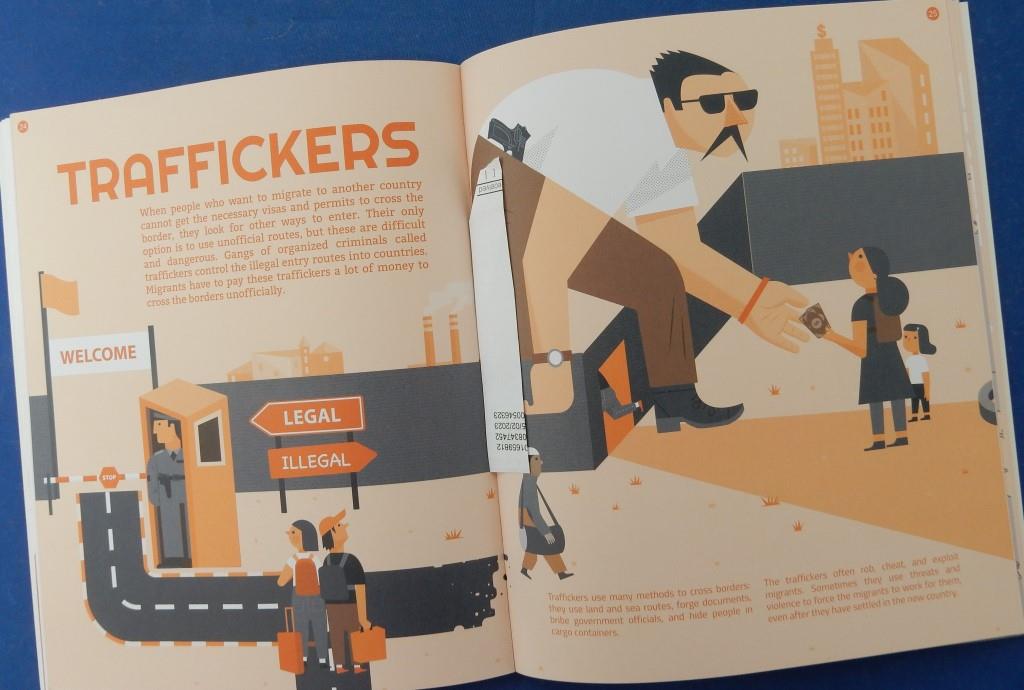
There is an excellent map showing the main migrant routes used in the last thirty five years. For some people it proves impossible to obtain the documents needed to cross borders so they have no option but to use often dangerous, unofficial routes and this leaves them open to exploitation by criminal gangs of traffickers.

The author covers the topic thoroughly yet succinctly, posing questions and answering them, progressing logically from one explanation to the next, with just the right amount of detail for older KS2 readers,

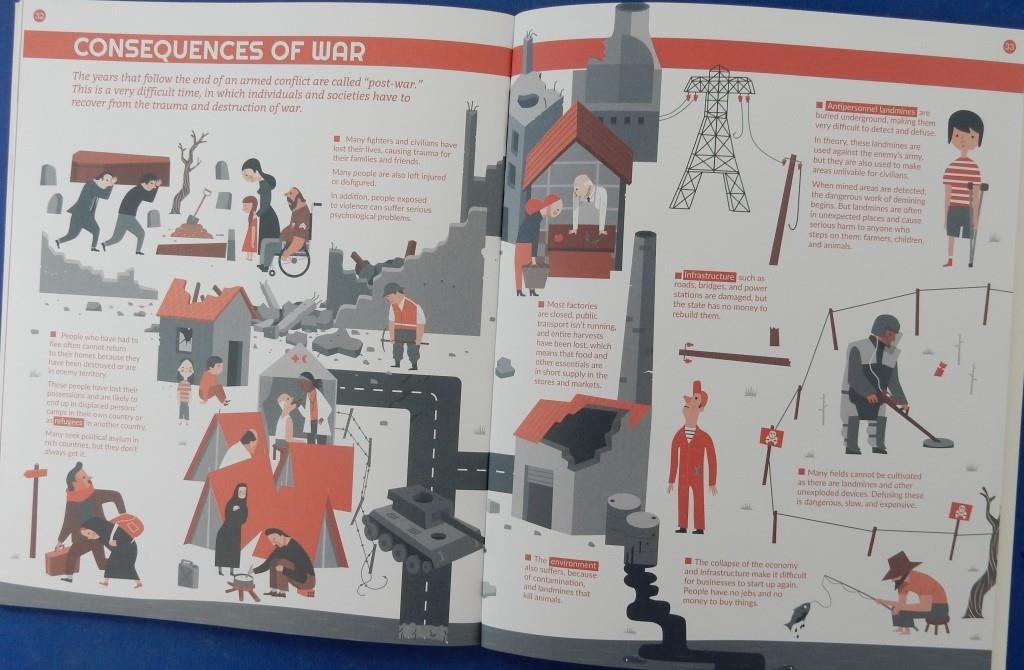
The same is true of What Is War? which is equally well-designed and illustrated. Altarriba’s approach is non-partisan and he explains that conflict between two clashing viewpoints, if unresolved through diplomacy or politics, may lead to violence and war. Disputes might be about borders or between different ethnicities, social or political groups within a country, in defence of national interests or historical grievances.

There are spreads about the principal actors involved, both national and international, the power brokers, the weapons and technology deployed. There’s a timeline stretching from ‘warring’ Neolithic hunters to the 20th century, a look at the types of war and the concept of a ‘just war’, a spread explores how a war might end and peace and mediation. This is followed by a brief look at the consequences of war both on individuals and societies.

The book concludes with three case studies: North Korea, the war in Syria and the war in Ukraine. War is a topic that, from questions they ask, worries many primary children, some of whom currently have Syrian and Ukrainian classmates.

I would strongly recommend adding both titles to upper primary class collections.

The Big Book of 100 STEM Activities

The Big Book of 100 STEM Activities
Laura Minter & Tia Williams
Button Books

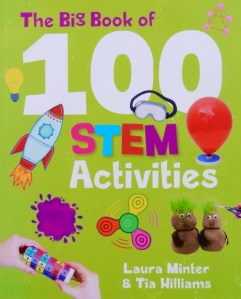
There’s fun learning aplenty in this latest offering from team Laura and Tia. Comprising one hundred STEM activities divided into nine sections, each one is clearly set out with step-by-step instructions and photos to act as a helpful guide. First though, essential reading is an introductory spread that includes a paragraph about safety, one listing craft essentials and another, food items.

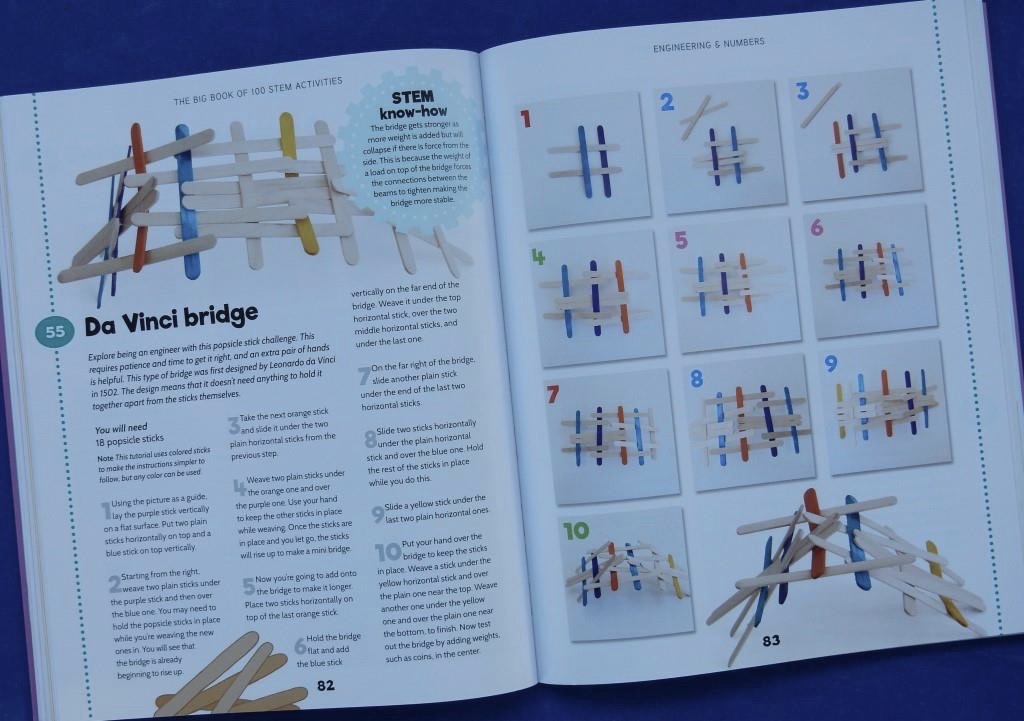
Most of the activities (or variations of them) are familiar to me as a primary teacher of many years experience and having worked with all ages from 4 to 11, but there are some I’ve not come across before. One such is the Da Vinci bridge construction from the ‘Engineering & Numbers’ section: this requires nothing more than 18 lolly sticks of the same size, some manual dexterity and patience.

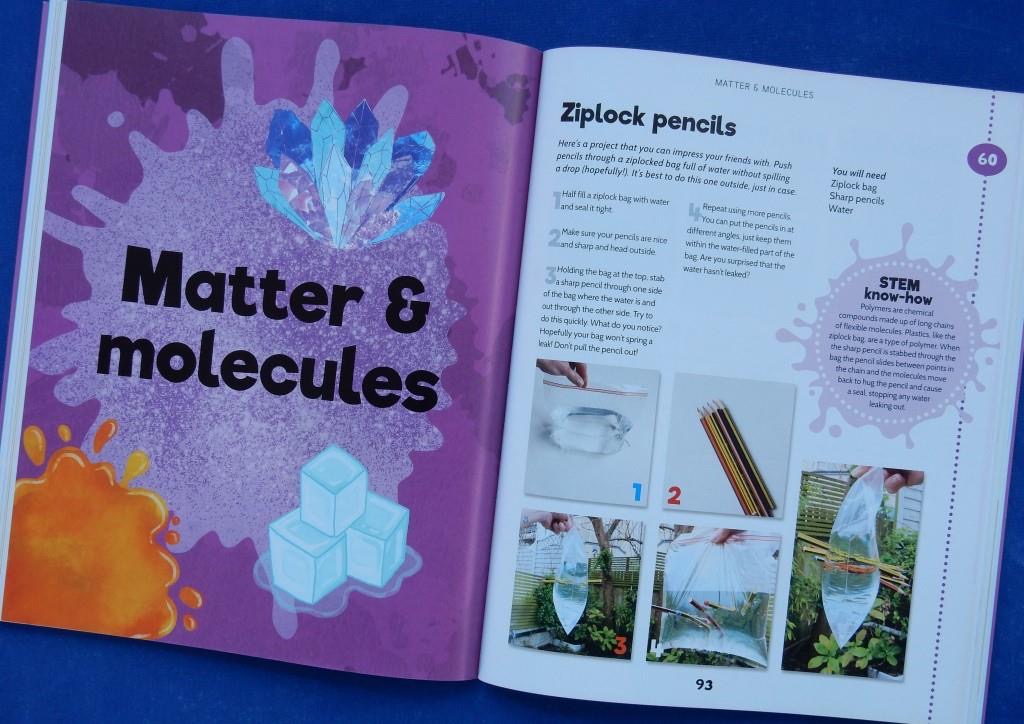
Another from the ‘Matter & Molecules’ section – Ziplock pencils – is best done outdoors for obvious reasons.


Did you know you can make a rocket from a paper straw and find out something about propulsion and air resistance while so doing? This is an activity that might be even more enjoyable if done with a friend or sibling as with two people they could add a competitive element and see who can send their rocket further each time. You’ll find it in the ‘Motion’ section.

With Christmas holidays on the horizon this could be a boon for restless children; it will keep them gainfully engaged away from their screens for a considerable time.

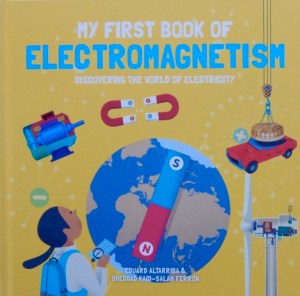
My First Book of Electromagnetism

My First Book of Electromagnetism
Eduard Altarriba and Sheddad Kaid-Salah Ferron
Button Books

In their usual stellar way author Sheddad Kaid-Salah Ferron and illustrator Eduard Altarriba present another STEM topic – that of electromagnetism, broken down into bite-sized portions suitable for primary readers.

In our modern world it’s almost impossible to think of many things that work without either electricity or magnetism but what actually are these physical phenomena and how do they work together? Furthermore, what do these things have to do with light? These and many other questions are explored in this fascinating book.

To relate the story of electromagnetism and our developing understanding of it, the author takes us way back to circa 600BCE to when Thales of Miletus’s first experiment with magnetic attraction when by rubbing a small piece of amber on some fur, he noticed a strange force that could attract small pieces of straw. Moving on we encounter Benjamin Franklin, an 18th century American scientist who worked on the idea of electrical charge in his experiments.

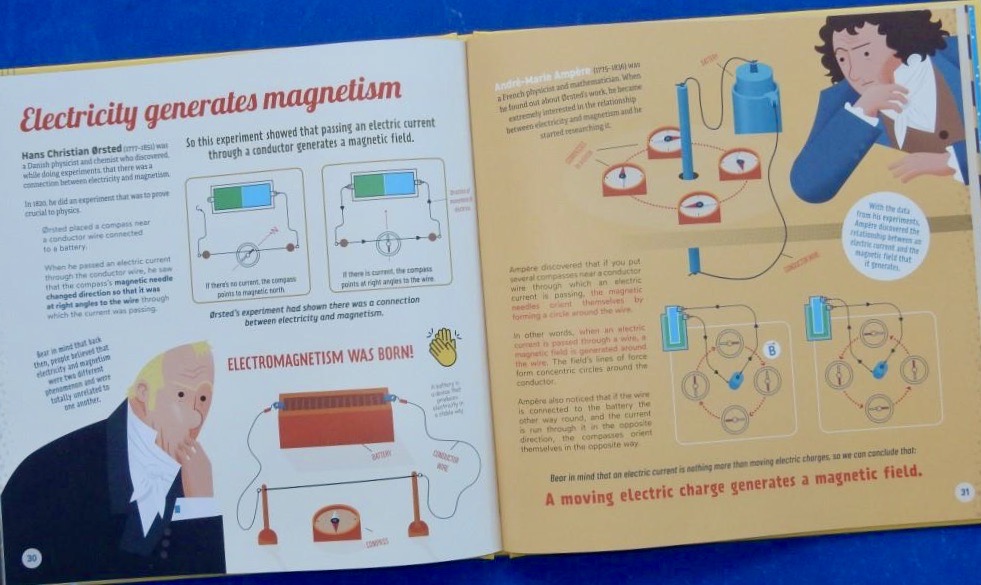
Until the work of Ørsted and of Ampère people thought electricity and magnetism were unrelated; those two experimented during the latter part of the 18th and first half of the 19th century.

That brings us right through to Michael Faraday and James Clerk Maxwell unifying the fields of magnetism and electricity to develop the theory of electromagnetism. Because of Faraday’s poor background, what was his original idea was left to Maxwell to write the four famous basic equations describing all electric and magnetic phenomena.

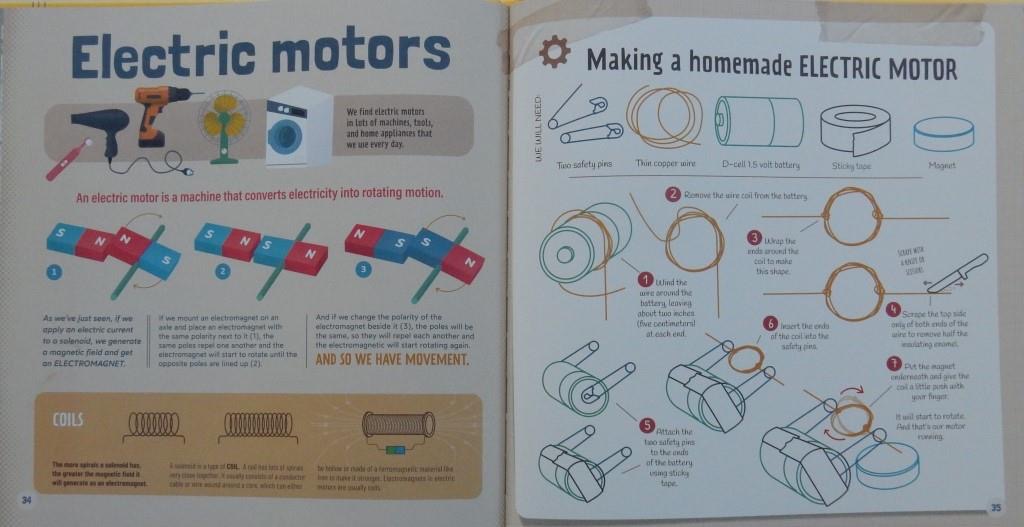
At intervals during this exciting account, readers can pause and do some experiments for themselves. These include making an electroscope to test for electric charge, creating a homemade battery and constructing a working motor.

It’s not simple science that’s described herein but it’s made accessible, engaging and exciting for children, and is presented in a way that will help them understand. Using his design background, Eduard has created enticing illustrations and helpful info-graphics to complement the text.

Recommended for budding scientists either at home or in school.

My First Baking Book / Kids Can Cook Vegetarian

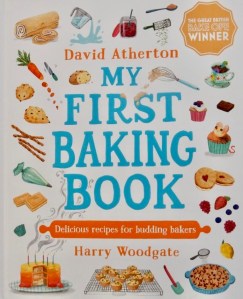
My First Baking Book
David Atherton, illustrated by Harry Woodgate
Walker Books

Great British Bake Off winner David Atherton has a new cookery book for young cooks and it’s bursting with exciting recipes, each with a healthy twist. It’s divided into five sections – breads, cakes, sweet biscuits and bites, pastries and finally, some extra special ‘showstoppers’ but first of all David offers users some helpful tips, ‘tricks’, a few facts and an equipment list.

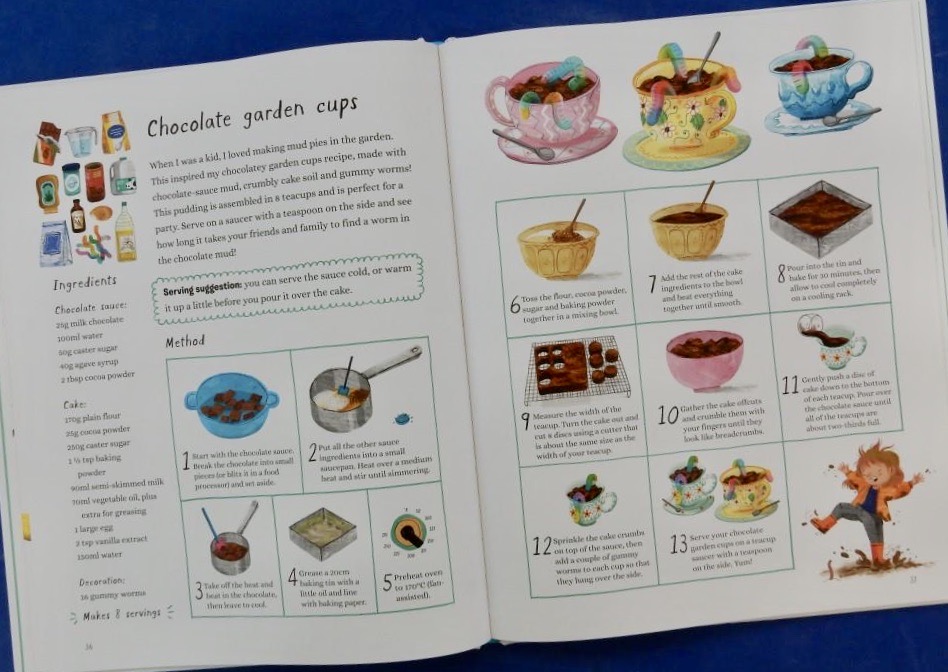
I’ve certainly never thought of baking a loaf in a flowerpot but this is one of the ideas in the bread section and it was interesting to find chocolate chip buns in the same section – a recipe to try when I have young relations staying; that’s if I can tempt them way from all the alluring cakes in this book. The chocolate garden cups remind me of when we visit Udaipur, Rajasthan where the owner of our favourite cafe would quickly rustle up chocolate cup cakes (sans gummy worms) for us when they’d run out of the pre-baked ones. I think those were cooked actually in the cups rather than a baking tin like they are in David’s recipe.

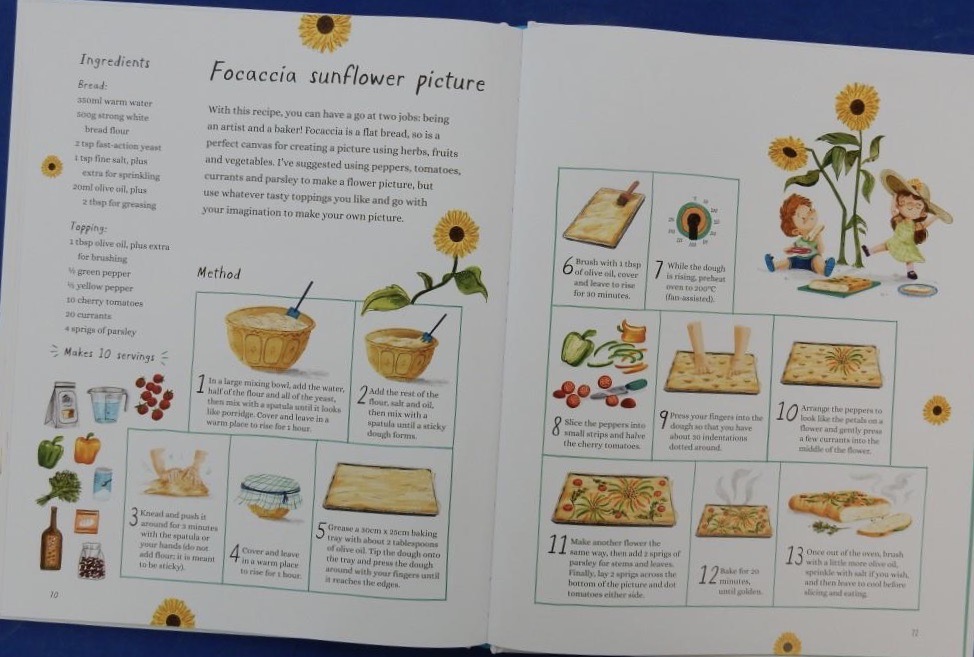
My very favourite idea is the show stopping focaccia sunflower picture. This is actually a flatbread that looks like a work of art in Harry Woodgate’s illustrations. It’s the perfect thing to offer any Ukranian guests you might be hosting, or to bake with a primary school class where there are Ukranian children.

As with his previous books David puts exciting, creative twists on baked goodies that might otherwise seem relatively ordinary and there are plenty of those in this book, each one clearly and alluringly illustrated by Harry Woodgate.

Kids Can Cook Vegetarian
illustrated by Esther Coombs
Button Books

Comprising an introduction giving information on safety, equipment and basic techniques and more than thirty recipes divided into three sections, this is for a vegan like myself, a very welcome addition to the Kids Can cooking series.

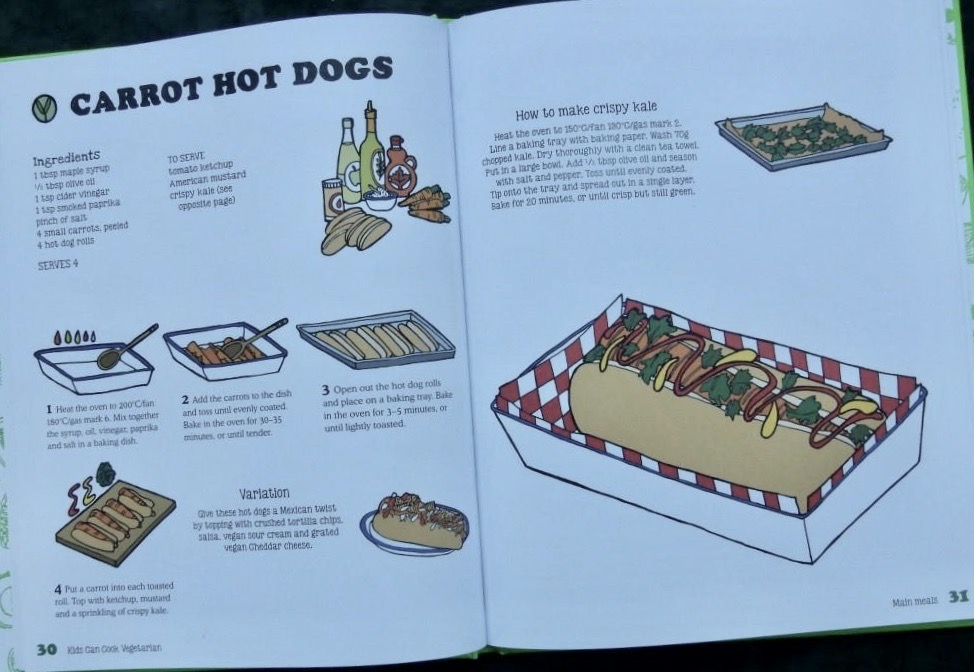
First come the ‘snacks and sides’ – savoury treats and three dips. Main meals is the largest part and includes breakfast burritos, falafels – my mouth is already watering at the prospect of making these, a yummy sounding roasted vegetable bowl, bean burgers and carrot hot dogs – now there’s another great idea. 

For those with a penchant for pasta, several of the recipes in this section include some kind of pasta, though I rather like the thought of courgetti, which looks like a noodle dish but uses long thin strips of courgette. This is definitely going on my list to try.

There are six ‘sweet treats’, two of which are for pancakes (blueberry and banana) but the recipe that is top of my must make treat list is the courgette brownies.

With easy to follow, step by step instructions for each recipe, illustrated by Esther Coombs, this book offers hours of fun in the kitchen (under the watchful eye of an adult) and an assortment of goodies to look forward to consuming. Wash those hands, put on your apron and off you go.

Kitchen Science

Kitchen Science
Laura Minter and Tia Williams
Button Books

This latest book by team Laura and Tia is a collection of science themed activities for children to do that will surely make them think of the kitchen in a different way: the place where a great deal of science happens every time some basic ingredients are mixed together, then baked or cooked in some other way.

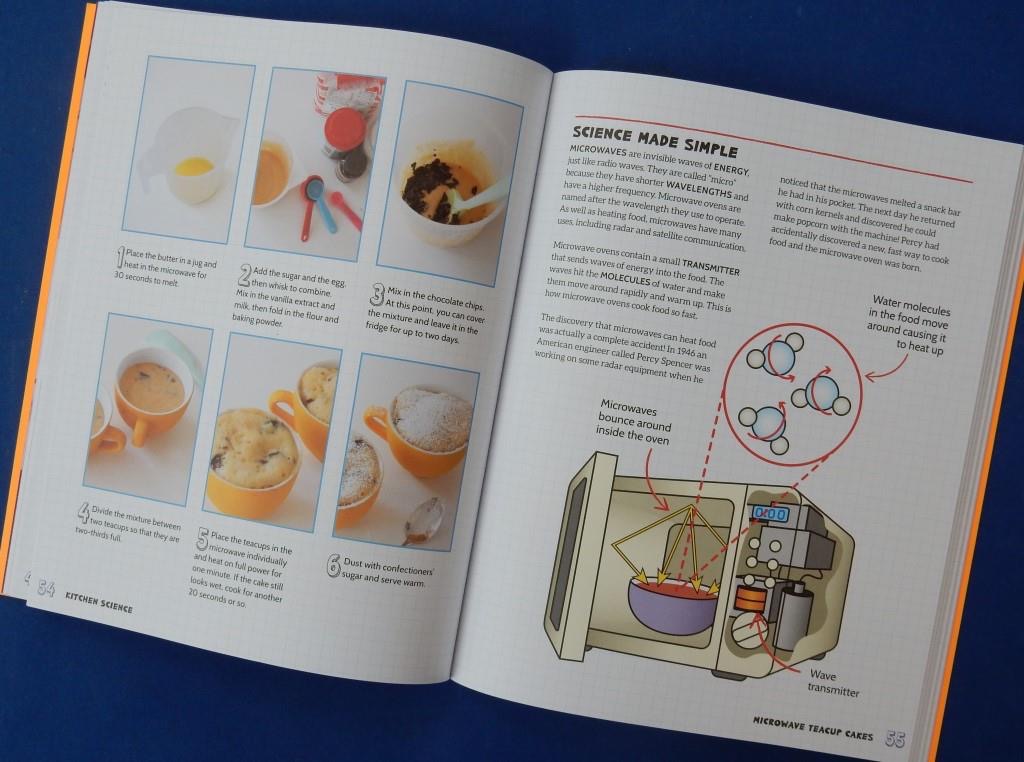
The authors present thirty kitchen based STEM activities for youngsters to do, (under adult supervision if they require use of an oven or hob). Safety, as well as the basics needed are covered in the ‘Getting Started pages before the activities, each of which is clearly and concisely set out in illustrated steps, together with a list of ingredients required (most kitchen cupboards will already have the majority) and followed by a paragraph explaining the science involved. There’s also a final glossary of the scientific terms the experiments encompass.

How many children will have thought about generating electricity to light a bulb by means of four lemons, some copper wire and a few crocodile clips? That’s a possibility if you discover you’ve run out of battery power.

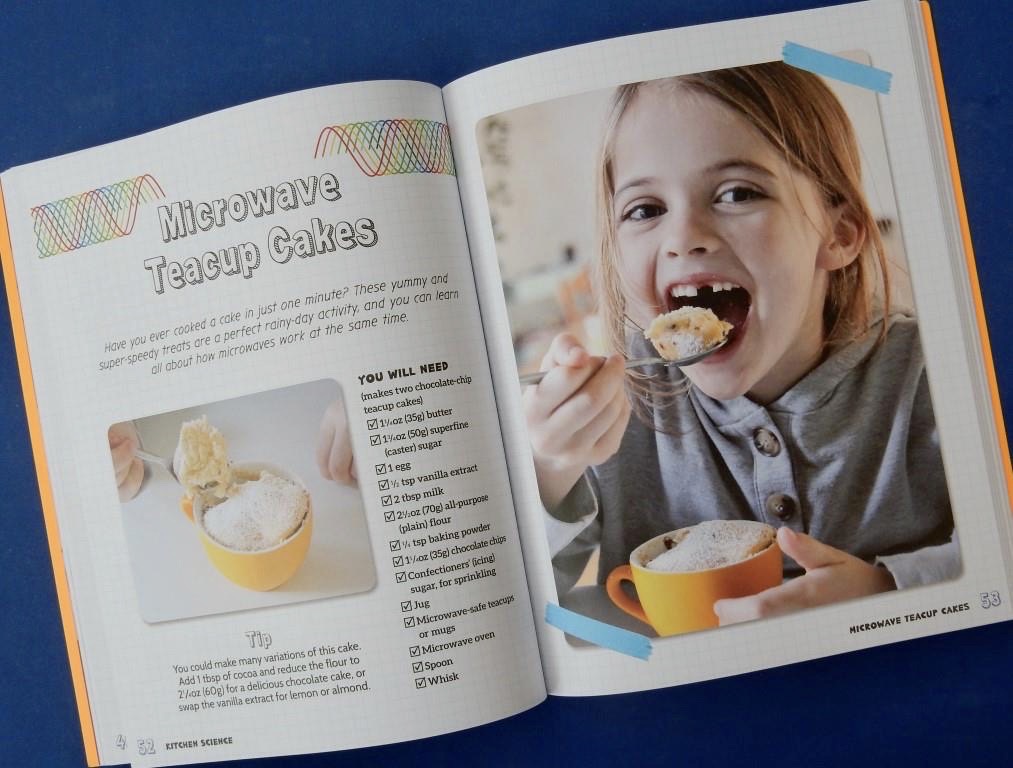
Have they tried making a cup cake in a single minute – using a microwave and a tea cup? One of my favourite cafes in Udaipur Rajasthan used to make chocolate ones for us when they’d run out of their other delicious cakes.

Like the previous titles from Laura and Tia, I strongly recommend this one: it’s huge fun as well as gently educational.

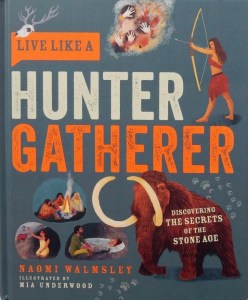
Live Like a Hunter Gatherer

Live Like a Hunter Gatherer
Naomi Walmsley, illustrated by Mia Underwood
Button Books

If you think that early humans were not very clever, or that they frequently said, ‘ugg’ and not much else, then this book will dispel those myths along with providing a considerable amount of fascinating information about how they lived, starting with a map of the Stone Age people’s movements and a timeline showing the three main periods of the Stone Age.

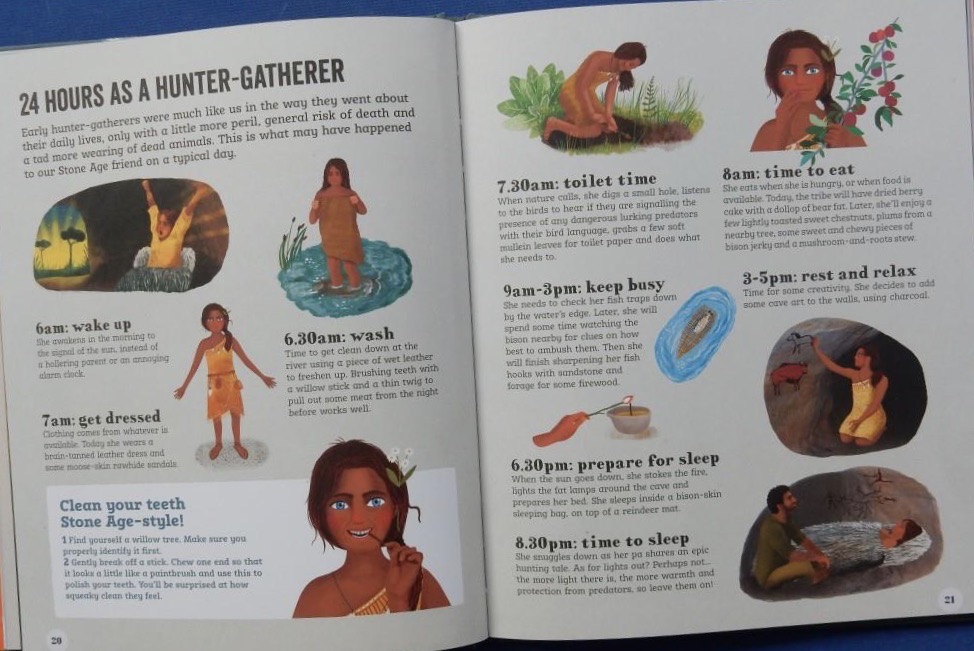
Readers are in the company of an eight-year old girl from a fictional tribe who at various times throughout the book, talks directly to us, sharing her feelings about such things as fishing trips and beginning to use her own bow and arrows. We also get a glimpse of how our stone age ‘friend’ might have passed her time during a typical day, sharing her feelings too,

and realise that the everyday needs of our Stone Age ancestors’ were quite similar to ours – how to keep warm, where to sleep safely and what to eat and drink.

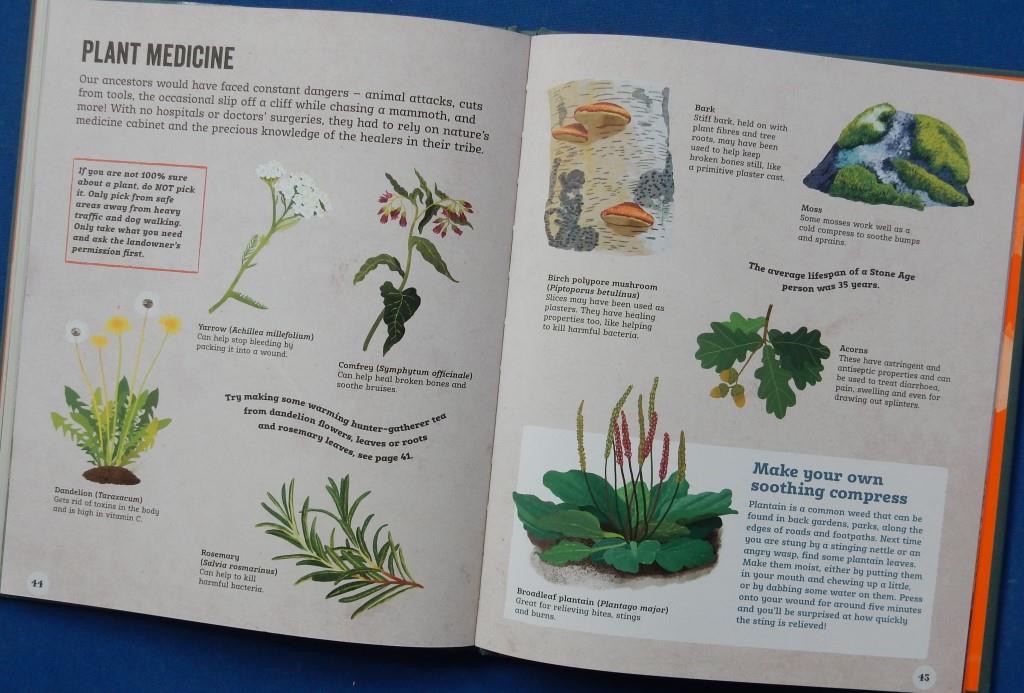
There are spreads on how those basic needs were met, and we learn how they made use of everything from an animal hunted; such a creature provided food yes, but also the means of making weapons, tools, jewellery, clothes and more. Constant danger surrounded these ancestors of ours and without doctors or hospitals, they had only the knowledge of healers in their particular tribe and the medicines nature provided; it’s hardly surprising that the average life of a typical Stone Age person was just thirty five years.

It wasn’t however a life without any fun: early humans made music, engaged in occasional celebrations and made art in the form of small sculptures and paintings especially on cave walls.

Mia Underwood brings all these activities and more to life in her detailed illustrations large and small; while in addition to providing a wealth of factual information, author Naomi Walmsley (who is a forest school and bushcraft instructor), also gives step-by-step craft activities and recipes offering readers first-hand experience of some vital Stone Age skills including making a Mesolithic shelter, some fat lamps, a digging stick and creating cave art.

An intriguing, gently educative resource for home and primary school users.

Earth-Saving Acts for Eco-Warriors / Great Lives in Graphics: Shakespeare / Great Lives in Graphics : Albert Einstein

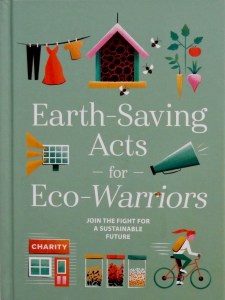
Earth-Saving Acts for Eco-Warriors
Ammonite Press

By now pretty well everyone must be aware that our world is getting hotter and that this is having a devastating environmental effect Yes ,we had COP26 in Glasgow towards the end of last year, but how many of the promises made will actually come to anything and how much will remain just rhetoric? If you want to help fight climate change – and surely hand on heart, everybody does – then here’s a helpful little book bursting with ideas and practical suggestions on how individuals can make a difference and thus be part of the drive to halt the catastrophe that is fast approaching.

None of its contents is really new: essentially the message is resist constantly buying the latest thing and when you do buy, go for quality rather than quantity; reuse and recycle, avoid single plastics whenever possible, spend more time outdoors rather than on screens, switch off lights and appliances when you don’t need them, walk, cycle or use public transport rather than travelling by car, read labels and eschew unsustainable palm oil products, eat a plant-based diet and don’t waste food.

The final quote made by Margaret Mead, ‘Never doubt that a small group of thoughtful, committed citizens can change the world; indeed, it’s the only thing that ever has.’ is apposite and one hopes a spur to activism in readers of this timely publication.

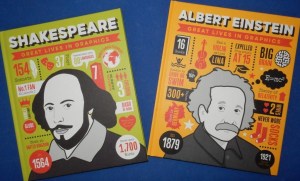
Great Lives in Graphics: Shakespeare
Great Lives in Graphics: Albert Einstein
Button Books

The first of these additions to the innovative infographics series features, I believe, the best-known playwright ever, William Shakespeare. Living in Tudor England much happened during his lifetime including outbreaks of the plague, the foiling of the Gunpowder Plot and execution of Guy Fawkes and his fellow conspirators.
As regards the bard himself, I was reminded that he left school at age fourteen, having learned only Latin and married Anne Hathaway when he was just eighteen and remained wedded to her till his death 34 years later. There is also information about other important people and places that feature in the life of the subject.

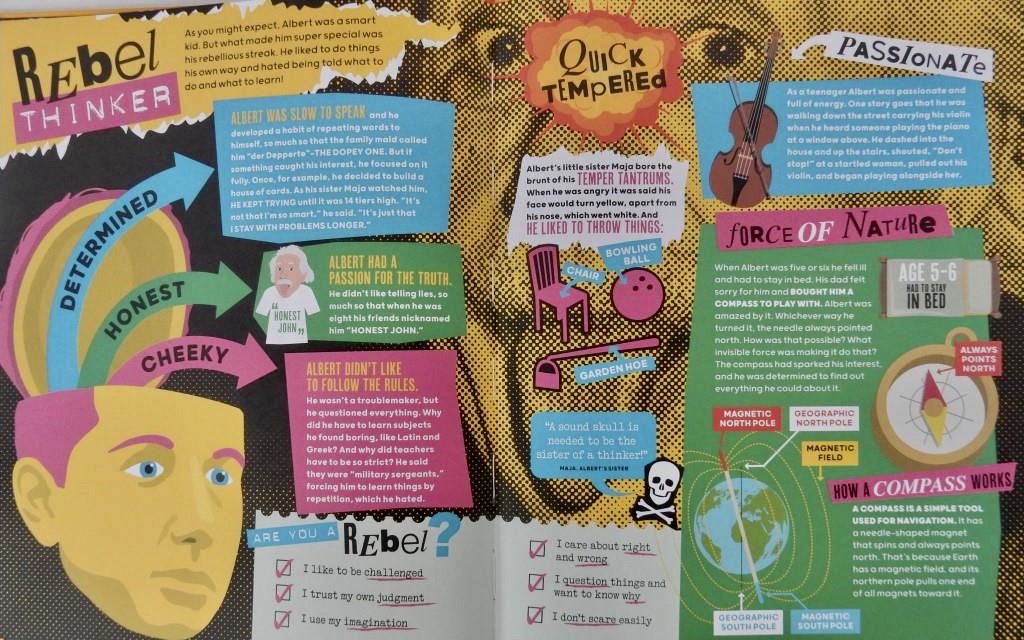
Being something of a rebel myself, I was excited to learn that Albert Einstein, subject of the second book was made special by his rebellious streak, liking to do things his own way and hating to be told what to learn or do. And I absolutely love this quote of his, “Imagination is more important than knowledge.’

These are just a few of the defining facts, thoughts, achievements and legacies of these two influential figures brought to life in these books. There are also timelines and glossaries and everything is in a form easily digested by most children in key stage two.

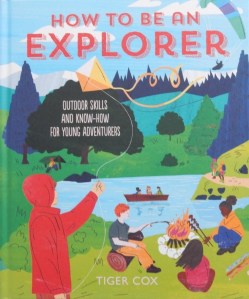
How To Be An Explorer

How To Be An Explorer
Tiger Cox
Button Books

Tiger Cox, is a paragliding instructor and lover of outdoor actives. To encourage youngsters to acquire the know-how and the confidence to become adventurers in the great outdoors, he has written this, his debut book.

His introductory spreads focus on thinking like an explorer, what a basic explorer kit comprises, how to read a map and how to create one.

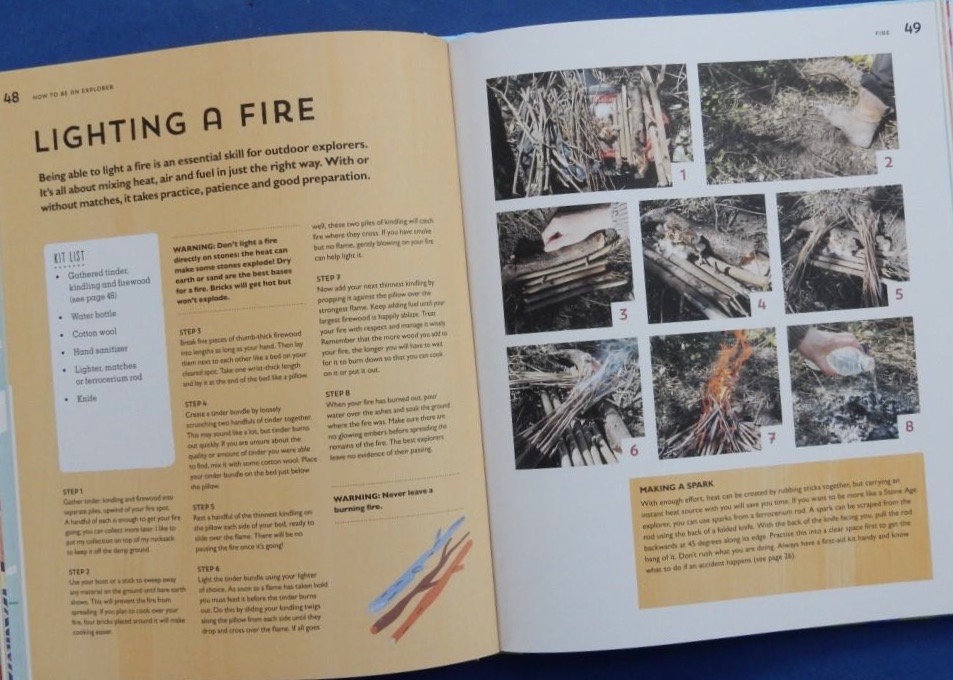
There are seven other parts: risk, skills (how to make cordage, knots to learn, using a knife and whittling a peg; how to light a fire,

cook on it, how to make a paper boiler and a couple of campfire recipes. The foraging section looks at edible insects, edible plants and those not to eat because they are poisonous; then comes a section on creating shelter followed by one on aspects of water and another on weather.

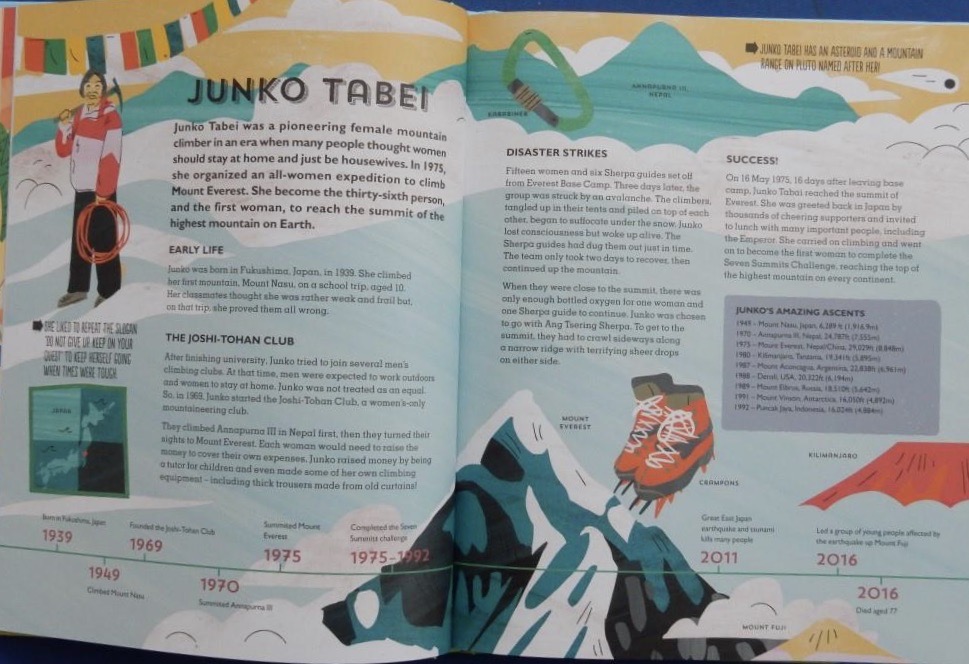
Also included in each chapter is information about a real-life explorer: map maker Muhammad al-Idrisi, female mountaineer Junko Tabei,

Matthew Henson (the first person to reach the North Pole), seafarer Bungaree, Jeanne Baret who disguised herself as a man which enabled her to become the first woman to circumnavigate the globe, and aviator Amelia Earhart each have a spread. In addition, the author includes some anecdotal snippets from his own expeditions.

Colour photographs help guide readers through the 25 activities step-by-step, whereas artistic impressions are used for the explorers’ biographies.

With the author’s enthusiasm for his subject shining through in his writing, this is a super book to encourage children away from their screens and outdoors for some adventuring.

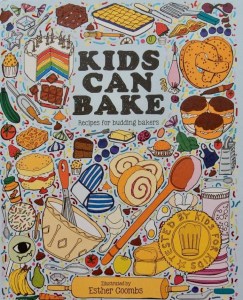
Kids Can Bake

Kids Can Bake
illustrated by Esther Coombs
Button Books

Following on from Kids Can Cook comes another colourful book of step-by-step recipes for youngsters (under adult supervision of course). During the past eighteen months and especially during lockdowns lots of people turned to cooking, becoming enthusiastic about it and although we’re not under such restrictions now people’s enthusiasm for home cooking remains high, especially with so many cooking programmes on TV at the moment, so this is a timely publication

After the safety precautions, visual list of equipment and of some basic techniques; the book is divided into sections – Bread, Pizza & savoury snacks, Pies & tarts,

Cookies & other sweet treats, Cakes, cupcakes & muffins, Bars & tray bakes, Desserts and finally, Cake toppings.

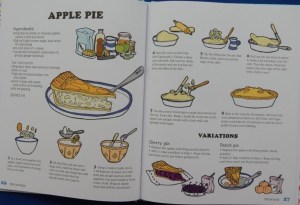
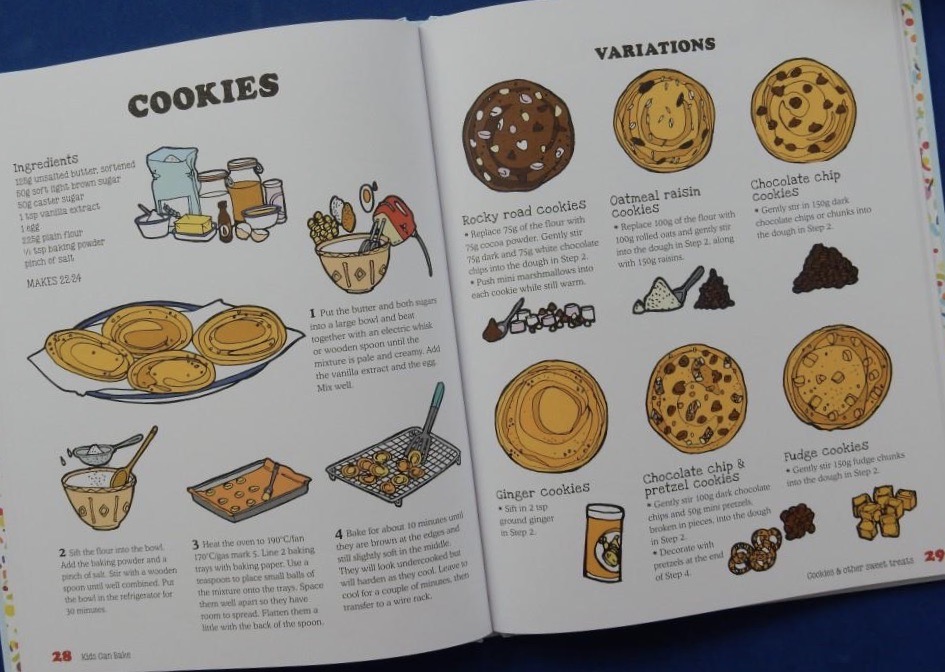
There are alluringly illustrated instructions for making such things as soft pretzels and cornbread; many people’s favourite – pizza (choose your own additional toppings) and mini vegetable quiches; apple pie (and variations), cookies (with options for half a dozen different varieties),

as well as Swiss roll and several other family favourites. If your preference is perhaps for brownies or flapjacks, you’ll find recipes for those too. I’m going to try some vegan substitutes for the butter and other dairy ingredients.

With Christmas approaching all too fast, why not buy this for a child now and suggest they dip in and practice that yummy-looking marble cake or even the rainbow cake, so it can be offered instead of the traditional Christmas cake; and some of the other sweet delights such as caramel shortbread would make a good gift for a friend or relation.

My First Book of Microbes

My First Book of Microbes
Sheddad Kaid-Salah Ferrón and Eduard Altarriba
Button Books

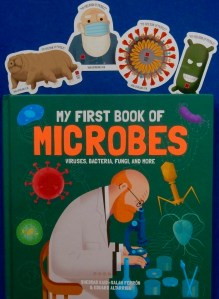
From the award-winning team whose previous titles include My First Book of Quantum Physics, this new STEM title explains the intriguing world of microorganisms – good and bad -to upper primary children and beyond.

They start by saying that these minute organisms come in all manner of different shapes and sizes, and using a rice grain for comparison show alongside it, a bacterium and a virus; then go on to explain the role of electron microscopy in observing such things as viruses.

Diving deeper into the hidden world of microbes, viruses, bacteria, fungi and more, they explain what these things are, where they are found, why many of them are vital to our very existence, as well as looking at the infections some microbes can cause, with a historical overview of the major epidemics and pandemics – including one we all know about, the devastating effects of COVID 19, which has its own double spread.
A number of topics are explored including algae, protozoa, phages,

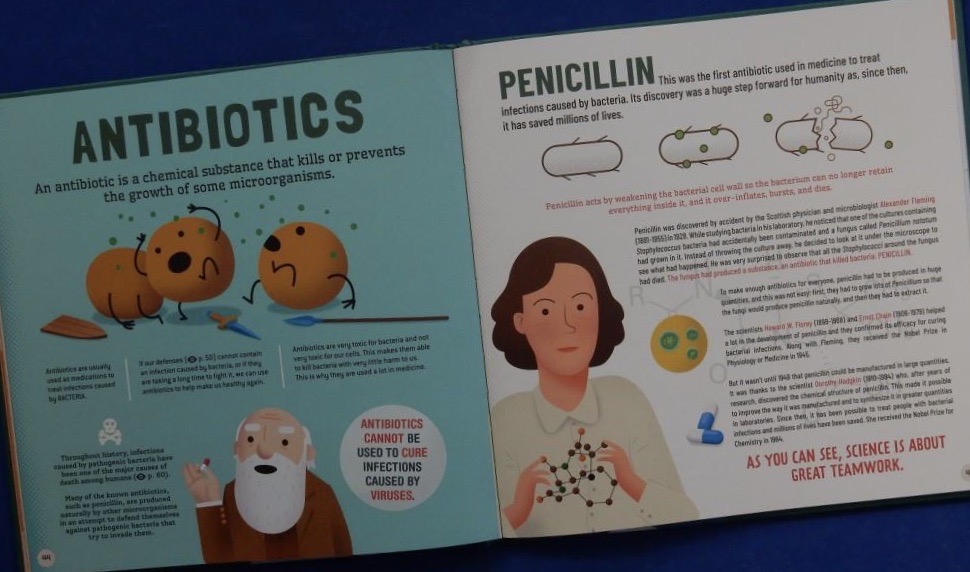
archaea (only discovered in 1977), how viruses cause infections, the importance of hand washing, the role of antibiotics

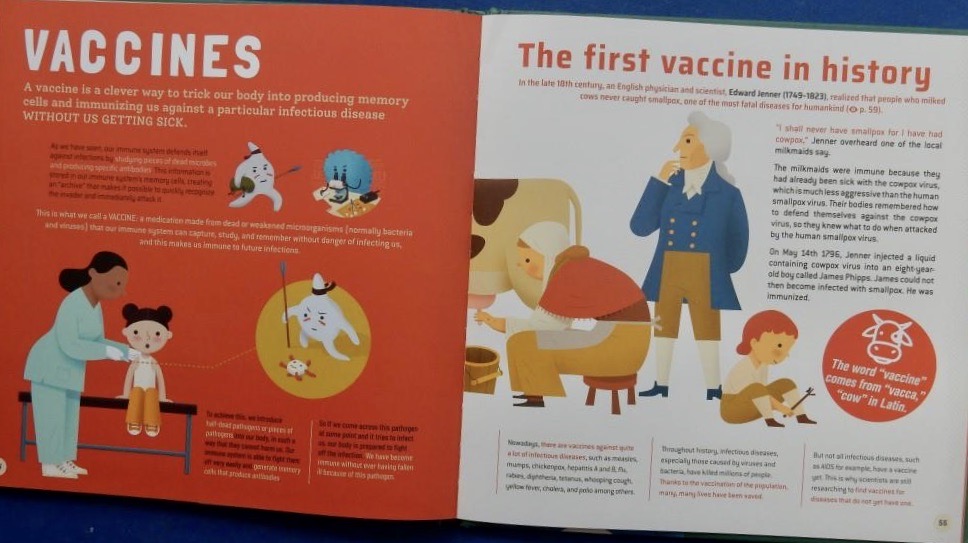
and how some bacteria can develop a resistance to them, the way our immune system protects us, vaccines and their role in immunisation and the eradication of some diseases such as Smallpox.

A number of key scientists – Louis Pasteur (who pioneered modern microbiology), Robert Koch who discovered the bacteria causing tuberculosis and Edward Jenner developer of the first vaccine are featured, and the important role of teamwork in this area of science is discussed.

As always with this series, every spread is well-designed with a clear layout, diagrams and fact boxes that augment Sheddad Kaid-Salah Ferrón’s thoroughly engaging text; and Eduard Altarriba’s colourful, sometimes playful illustrations help bring to life in an accessible manner, a topic that is sure to excite many youngsters, be they budding scientists or not.

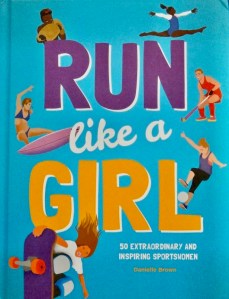
Run Like a Girl

Run Like a Girl
Danielle Brown, illustrated by Robin Shields
Button Books

With an illustration by Robin Shields on every spread, 2x Paralympic Gold Medallist, able-bodied Commonwealth Games medallist and champion of inclusion, Danielle Brown presents a look at the lives and achievements of 50 incredibly talented women from around the world of various ethnicities, ages and abilities.

No matter the sport, what these women all have in common is passion and perseverance and these qualities are what matter most of all. Resilience too is key, for success doesn’t come without something of a struggle.

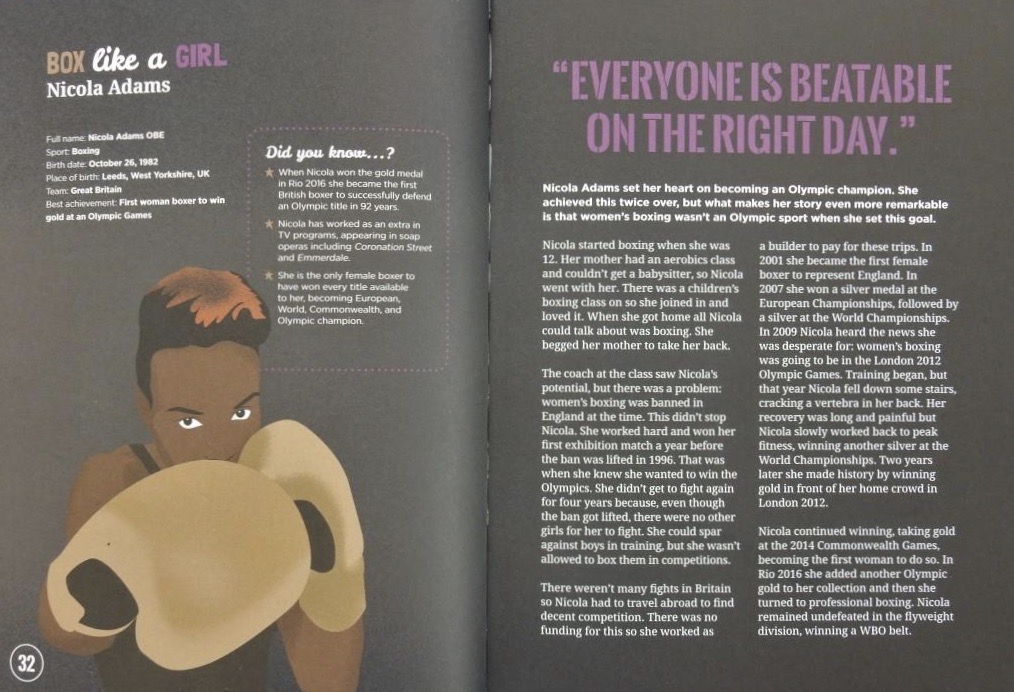
Some of those featured have been honoured by their countries. For instance Olympic gold medal winning boxer Nicola Adams has an OBE,

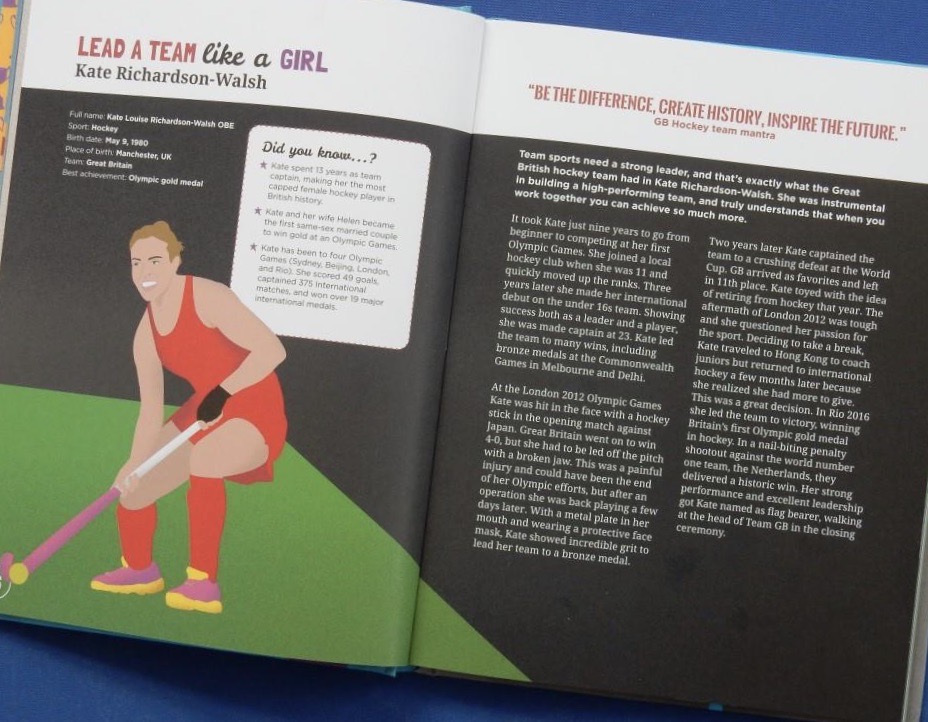
while hockey player, captain and Olympic gold medallist Kate Richardson-Walsh has received an OBE and carried the TeamGB flag at the closing ceremony of the 2016 Rio Olympics.

Triathlete, cyclist and rock climber Karen Darke not only has an MBE and a paralympic gold medal, but she also studied the gold content in rocks for a geology doctorate. She’s never let a fall down a cliff while climbing that left her paralysed and unable to walk again, hold her back. ‘Ability is a state of mind, not a state of body’ is her mantra.

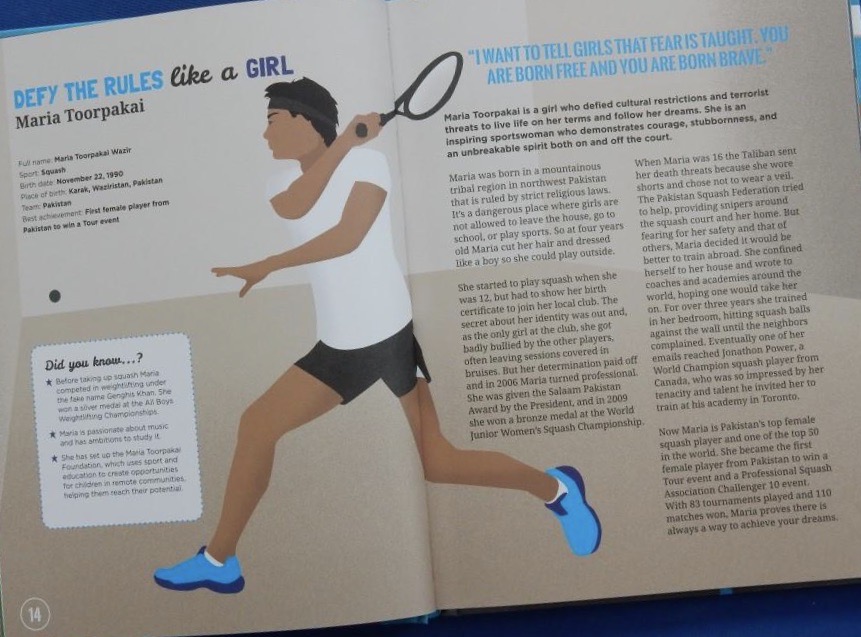
Defying both terrorist threats and cultural restrictions, squash player Maria Toorpakai from Pakistan dressed like a boy when she was four in order to play outside and when she began playing squash she was often bullied and bruised by other players, received death threats from the Taliban at sixteen but has now, thanks to support from Canadian squash player Jonathon Power, become Pakistan’s top female squash player. She’s also set up a foundation that aims to create opportunities for children in remote communities to reach their potential: “I want to tell girls that fear is taught. You are born free and you are born brave,” she says.

Tracey Neville has been a netball player and England coach; Stephanie Frappart a soccer referee of women’s and men’s matches, and the first woman to officiate at a major European men’s match are also featured.

No matter the sporting interest of the young reader, they’ll likely find it represented in this inspiring book that is essentially all about following your dreams and exceeding expectations and goals. With the Olympics just over and Paris 2024 to look forward to, youngsters can browse the narrative information and biographical details of the spotlighted women herein. Never say never … for as swimmer Yusra Mardini who became a member of the 2016 Refugee Olympic team says, “I want everyone not to give up on their dreams. Even if it’s impossible, you never know what will happen.”

Meet the Artist: Sophie Taeuber-Arp / Great Lives in Graphics: Frida Kahlo

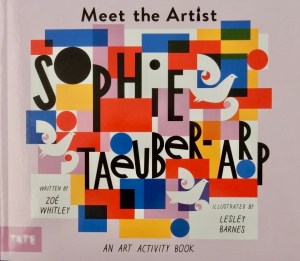
Meet the Artist: Sophie Taeuber-Arp
Zoé Whitley and Lesley Barnes
Tate Publishing

In this, the latest in the Tate Meet the Artist series readers visit the vivid world of Sophie Taeuber-Arp.

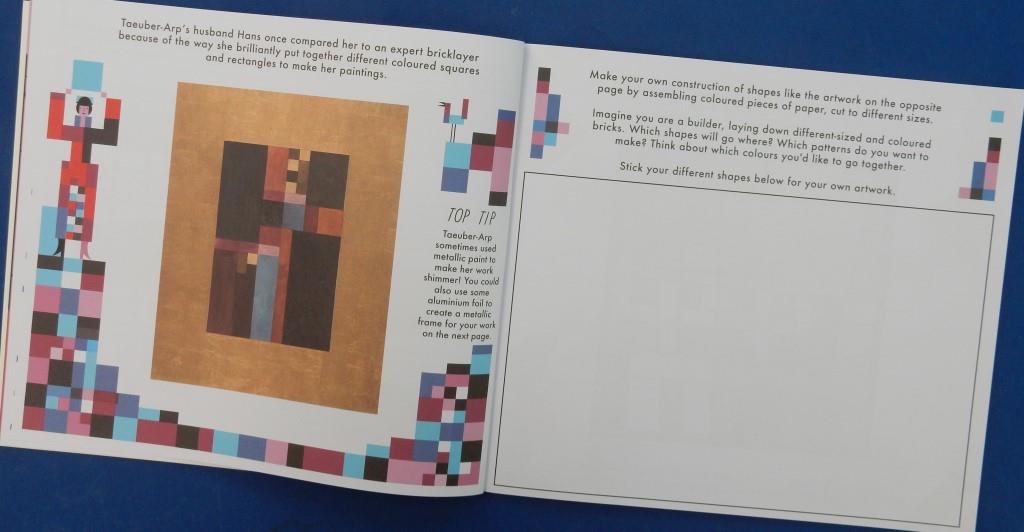
As well as being an abstract artist, she was a designer, puppet-maker, dancer, architect and magazine editor whose husband once compared her to an expert bricklayer on account of ‘the way she brilliantly put together different coloured squares and rectangles to make her paintings.’ Readers are invited to experiment in their own way with this idea, imagining being a creative bricklayer and making a design on the page opposite one of the artist’s works.

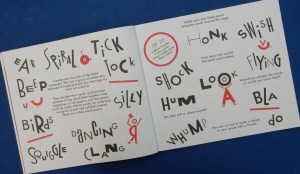
That is just one of the opportunities children are offered as they read about the artist’s life and are introduced to her key themes and works of art. Inspired by these, youngsters can also create a candle holder, design a magazine cover for a new publication, experiment with puppet making or funky costume design and more. Indeed an entire class might like to try creating and moving to sound poems in the fashion of the Dada movement of which Taeuber-Arp was a part.

Both engaging and lots of fun, try offering this book to a child from around six. (The activities don’t require any materials not likely to be found at home or youngsters could suggest their own alternatives if the odd thing is not readily available.)

Great Lives in Graphics: Frida Kahlo
Button Books

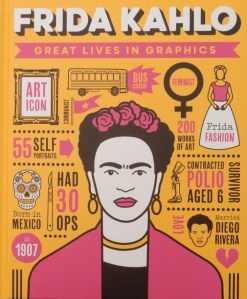
New in the publisher’s infographics series for KS2 readers, this features one of the world’s most famous artists.

Born in Mexico City, Frida spent her childhood in a bright blue house built by her father where she grew up with three sisters. While she was very young the Mexican Revolution broke out; her father couldn’t get much work so her family were forced both to sell their furniture and to rent out rooms in the blue house so they could afford to live.

Indeed many sad things happened in Frida’s life. At age six she caught polio, spending months in bed, after which time her right leg became very thin and her foot stopped growing.

This didn’t stop her gaining admission to Mexico’s prestigious school where she and eight friends formed a clique known as Los Cachuchas. Members got up to all kinds of mischief including stealing food from famous artist, Diego Rivera. Another tragedy happened when Frida was eighteen. A bus she was travelling on was hit by a tram, shattering the bus and severely injuring Frida who was again stuck in bed for months.

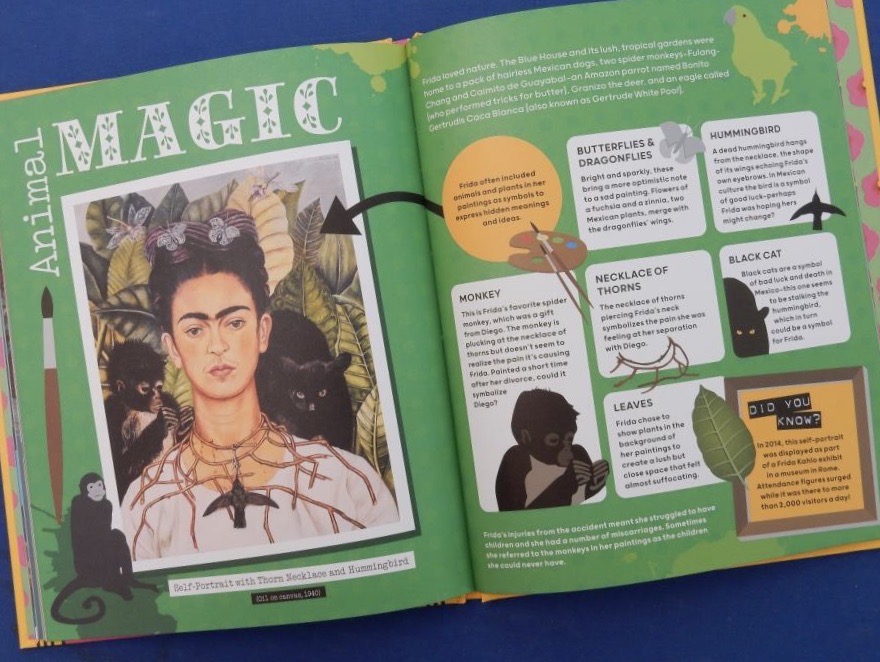
It was during that time she began to draw; her mother had a special easel made that Frida could use from a lying position; and she started painting self-portraits. It’s partly on account of this, we read, that most of her paintings are quite small.

From her schooldays Frida had a crush on Diego and they met again two years after her accident. Despite the twenty year age gap the two fell in love, married and had a stormy relationship, divorcing and remarrying a year or so later.

If little else, most people know of Frida’s flamboyant style of dressing and adorning herself, as well as her love of nature which often features symbolically in the paintings.

All this and more is included in this enticing book. Youngsters interested in art/artists and those studying Frida Kahlo in primary school especially, will want to get hold of a copy.

100 Endangered Species

100 Endangered Species
Rachel Hudson
Button Books

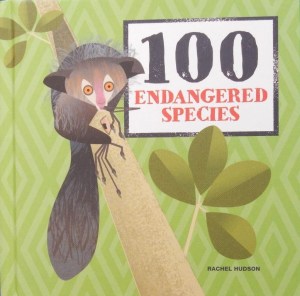
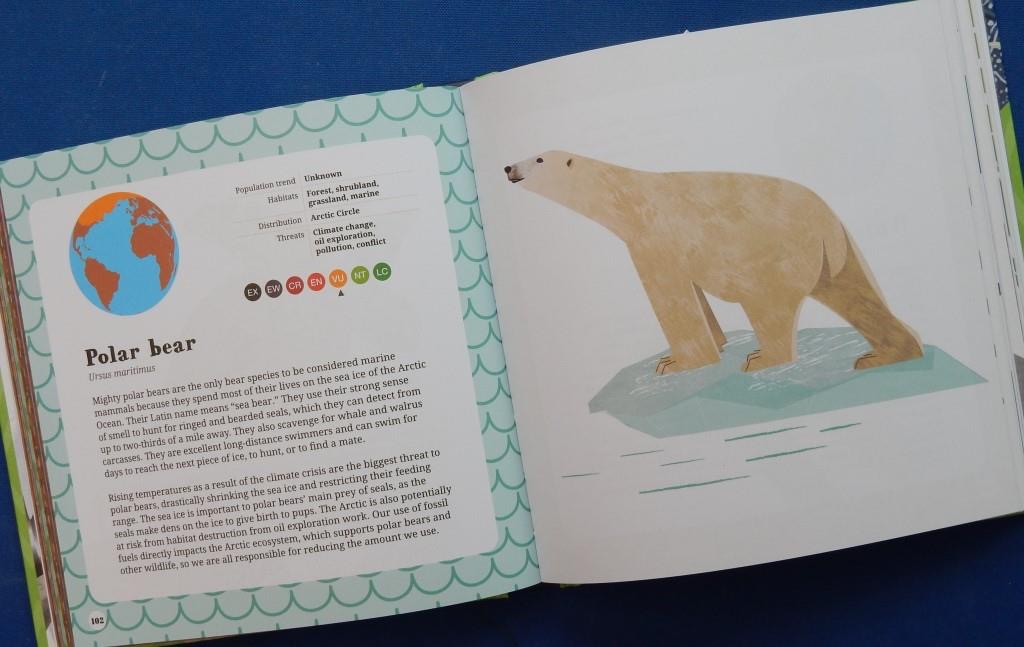
It’s alarming to think that there are so many creatures on the endangered or threatened list; the author/illustrator of this chunky book teamed up with the People’s Trust of Endangered Species to illustrate one such animal every day for 100 days.

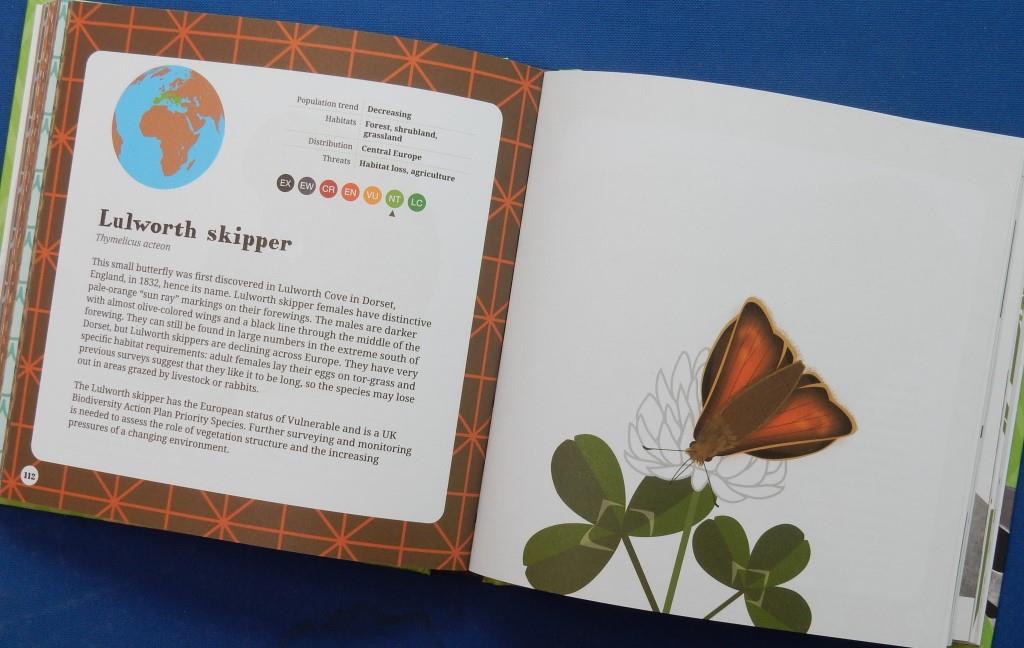
Those chosen come from all over the world and each has undergone evolutionary adaptations to suit its environment, be that the Red pandas found in China, Nepal and Bhutan; the Madagascan Aye-ayes, and the Indris that live in the northern and central rainforests of East Madagascar; the Sumatran tigers; the Little spotted kiwis of New Zealand; the Lulworth skipper butterfly first found in Dorset and now on the decline across Europe; 

or those magnificent polar bears whose Arctic Circle habitats are at risk both from destruction due to oil exploration work, and rising temperatures resulting from climate change.

Each of the animals depicted is on the International Union for the Conservation of Nature’s Red List (explained at the beginning of the book) and is thus a conservation priority. Opposite each gently amusing illustration is a descriptive paragraph (or two) giving interesting facts, as well as saying why the species is currently at risk and often, what is being done, or needs to be done, to protect it. There’s also a world map showing distribution, and listing habits, threats and population trend which is given, with very few exceptions, as ‘decreasing’. 

However, it’s heartening to see that numbers of the African elephant, the little spotted kiwi, the whooping crane, the greater one-horned rhino and the giant panda are on the increase as are those of the Eurasian beaver.

Readers who feel inspired to become involved in conservation issues/initiatives – hopefully that is all of them – can find a list of organisations and projects at the back of the book, as well as a glossary; and there’s a foreword by broadcaster and naturalist Brent Westwood. Give this book to a child and who knows, you might inspire a life-long passion for conservation.

Science School / Out and About Minibeast Explorer

Science School
Laura Minter & Tia Williams
Button Books

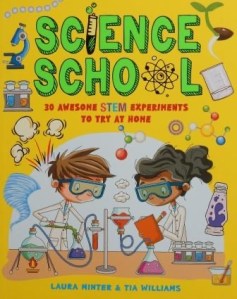
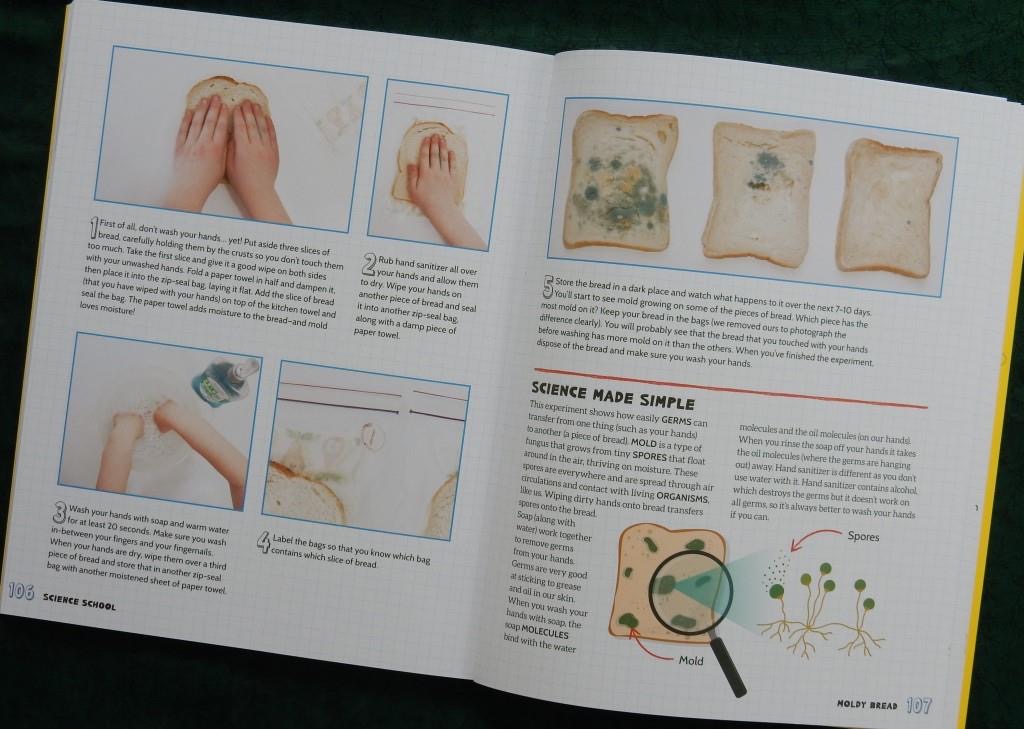
Covering such topics as magnetism, gravity, change of state, oxidation, the growth of fungus and much more – all relating to basic scientific principles, the latest collaboration from Laura Minter and Tia Williams offers thirty STEM experiments, some crafty, for youngsters to try at home.

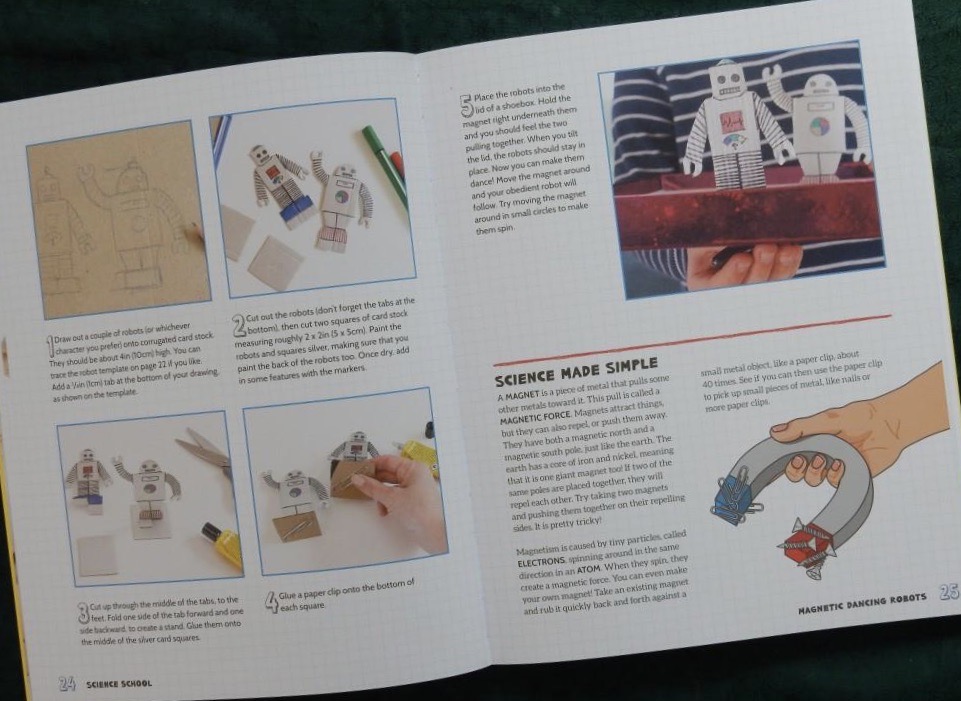
None of the activities require sophisticated equipment; rather they can be done at home with everyday materials you’re already likely to have knocking around somewhere. A list of what’s needed is given at the start of each project and there are photographs showing what to do, beneath each of which are step-by-step instructions, and, the science behind the experiment is concisely explained in the final ‘Science Made Simple’ paragraph(s) that often takes the science a bit further too.

My experimenters especially enjoyed making the “Magnetic Dancing Robots’ and other characters. 

Important at all times, but even more so as COVID is still with us, is the experiment showing the difference after around 10 days to three slices of bread: the first wiped all over with unwashed hands; the second wiped with sanitised hands and the third with hands that have been thoroughly washed with warm soapy water for 20+ seconds, completely dried and then wiped on slice number 3 (make sure the bag into which each is placed is labelled before putting it in a dark place.)

Providing hours of fun learning, this book is particularly useful for homeschooling.

Out and About Minibeast Explorer
Robyn Swift, illustrated by Hannah Alice
Nosy Crow

Published in collaboration with the National Trust, this handy guide for youngsters features more than sixty minibeasts about which Robyn Swift presents a wealth of information related to identification, lifecycles, habitats, anatomy and more. Did you know that a decapitated cockroach is able to live for up to nine days; that the blood of slugs is green, or that seagull sized dragonflies lived before dinosaurs roamed the earth?

The importance of minibeasts is explained and also included are some pages of activities, a classification chart and a quiz.

Hannah Alice’s illustrations of the creatures are clear and easily recognisable making this a super little book to tuck into a backpack when you go out and about no matter if it be in town, countryside or the garden.

Great Lives: Martin Luther King JR, Anne Frank, Stephen Hawking & Cleopatra

Martin Luther King JR
Anne Frank
Stephen Hawking
Cleopatra

Button Books

These are four titles in the publisher’s new infographic biography series Great Lives in Graphics aimed primarily at older KS2 school readers.

Whether their interest is in human and civil rights, the holocaust in the German -occupied Netherlands as a member of the Frank family desperately trying to avoid being detected by the Gestapo; an awesome scientist and cosmologist who refused to let his ALS diagnosis hold him back; or, the woman in ancient Egypt who first married her brother, became a wise political figure and writer of books on medicine and science, going on to make a famous match with Antony,

then one of these will definitely be worth seeking out and putting their way.

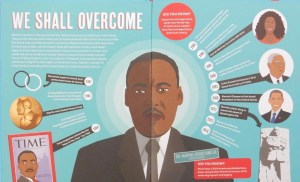
Martin Luther King’s story is one that, despite his awesome achievements, and his “I have a dream” speech “… that my four little children will one day live in a nation where they will not be judged by the colour of their skin but by the content of their character”, which inspired America to end segregation, the world changing, peaceful protests he used in overcoming enormous obstacles, is conveniently and sadly forgotten by a certain element of the population of the US today.

I had to laugh when I read that Anne Frank was dubbed a ‘chatterbox’ by some of her teachers in her Amsterdam school, something that I was also often called at school.

Each book has an introductory page of narrative, a timeline, details of family life and spreads detailing the subject’s key achievements; and each brings to life through its stylish, easily understood infographics, the person and the accomplishments of a memorable human being.

Well worth adding to primary school topic boxes and libraries.

A Trio of Activity Books

Viking Adventure Activity Book
illustrated by Jen Alliston
Button Books

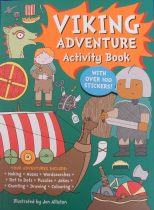
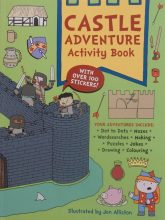
The latest in the series of Button Books unobtrusively educational, history activity books, illustrated by Jen Alliston, has a Viking theme.  If you have a child in the lower part of KS2 this may be part of their history curriculum. Whether or not this is so, books such as this are a particular boon in these days when many youngsters are not at school full time, if at all; and the activities and illustrations in this particular book are more appropriate for a younger (under 8) audience anyway.

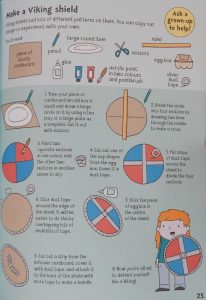
It’s packed with a wide range of over 70 Viking related, fun things to do such as making a Viking helmet, beard and shield,

baking some cupcakes to decorate with Viking runes, and using maths to work out your Viking name. There are plenty of puzzles, mazes, counting, matching, anagrams, codes, jokes and more.

Also included are four pages of stickers.

All in all this will engage and entertain youngsters who, along with some Viking learning, will also hone their observational and fine motor skills.

Keep Calm!
Studio Press
Dr. Sharie Coombes, illustrated by Katie Abey & Ellie O’Shea

Aimed at primary age children, this is an activity book written by Sharie Coombes an educationalist and psychotherapy expert, that aims to help youngsters stay calm and cope with uncertainty during, and following, the Covid-19 pandemic.

There are a variety of creative ideas to help with the emotional roller-coaster we’re all sharing, including drawing, writing, and crafty activities.

There’s also mindfulness, calming breathing techniques and yoga (I know from experience they work).

The final few pages comprise tips for parents and carers on self-care and managing children’s emotions.
This little book could well be a boon during these tricky times.

For the same age range, to help combat boredom, especially if your child is stuck indoors, is:

Beano Puzzle Book
Studio Press

Dennis, Gnasher and Minnie the Minx have dug into the 1990-1994 Beano archives and unearthed a host of fun things such as word searches and other word games, mazes, drawing, comics and maths challenges that will help turn young users into word WHIZZ-ARDS and number GNASH-ERS.

Nothing required other than a pencil (or 2) and a switched on brain.

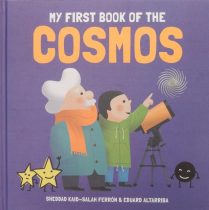
My First Book of the Cosmos

My First Book of the Cosmos
Sheddad Kaid-Salah Ferrón and Eduard Altarriba
Button Books

Team Ferrón (physicist and writer) and Altarriba (graphic designer and illustrator) have a special skill of presenting highly complex topics to children in a manner that is accessible, entertaining and educative.

Their latest book, My First Book of the Cosmos again does just that, managing to compress the vast Universe between 56 pages taking us on a trip through the life of the Cosmos from its birth to its possible end time. Incredible!

What then is this Cosmos or Universe? The author sums it up thus ‘the Universe is everything that exists: it is all space and time, and it is where all mass and energy is found’: awesome and mysterious for sure.

First off is a look at gravity and we’re presented with the gravitational models of Newton and Einstein, followed by a look through ‘Gravitational Lenses’, the first being thought of by an amateur scientist, Rudi W. Mandl. A gravitation lens, as defined here is one that ‘works like a powerful telescope that magnifies and distorts light’.

Having examined beginnings, topics include Galaxies, and the vexed question of The size of the universe.

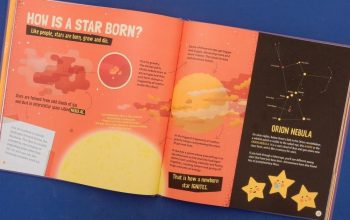
Then there’s an explanation of How a star is born; it’s formed from interstellar clouds of cold gas and dust called nebulae.

Next comes a look at the different types of stars – I didn’t know there were so many – as well as the life of a star from its birth to its death including how and why these happen.

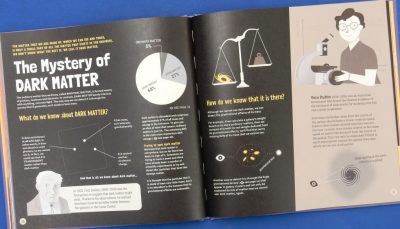
Plus if you’ve ever wanted to peer into a black hole or discover the mysteries of dark matter – a very tricky matter indeed,

and those of dark energy – that which ‘separates galaxies instead of bringing them together’ – in other words, it causes the Universe to expand ever faster, you can do so here.

Mind-blowing, imagination-stretching stuff!

Kids Can Cook

Kids Can Cook
illustrated by Esther Coombs
Button Books

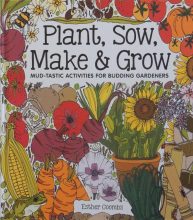
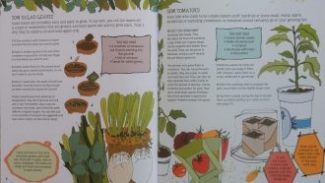
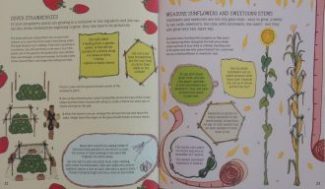
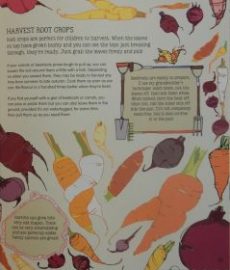
During the lockdown period many more people have taken to cooking, be they adults or adults and children together. If you’re looking for an introduction to cooking then this is a good starting point. Similar in style to Plant, Sow, Make & Grow, it’s very visual and really does get down to the basics with techniques such as how to crack an egg, how to beat it and how to test if a cake is cooked.

Before any of that however comes a contents page, a vital page of safety instructions and another showing and listing essential equipment for the recipes included.

The main part of the book has three sections – Breakfasts, snacks and breads; Main meals and sauces, and Sweet treats.

All the recipes are straightforward starting with a list of ingredients, are clearly illustrated and provide step-by-step instructions.

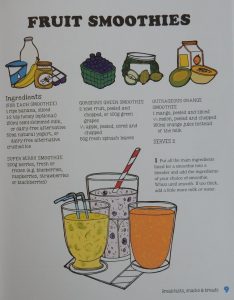
A word of caution however, if you’re a vegan family then some of the recipes won’t work for you unless you adapt them; but in other cases vegan alternatives are suggested. For example in ‘Breakfasts, snacks and breads’ the fruit smoothies,

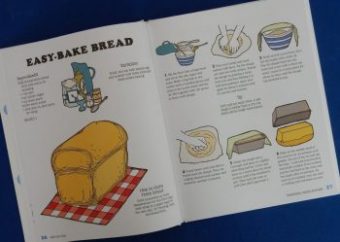
tofu skewers and the easy-bake bread are definitely suitable

and the veggie sliders in the second section are really tasty. However, no self-respecting Indian cook would tell you they are serving up ‘Curry’ as such – veggie or otherwise.

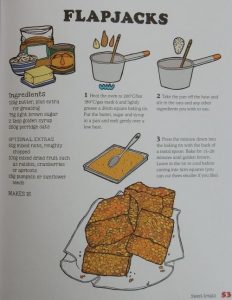
I have to admit that my favourite section is the ‘Sweet treats’, which includes fruit lollies and scrummy flapjacks (I’d want to use a non-dairy spread instead of the butter though).

If you’re currently home schooling Kids Can Cook ticks a lot of educational boxes: there’s maths in the weighing, measuring and counting; science, and of course, literacy, not forgetting fine motor skills such as pouring, kneading, chopping, whisking, rolling out and more.

Puzzles and More

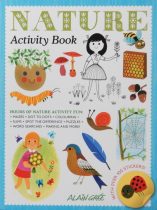
Nature Activity Book
Alain Grée
Button Books

The natural world is Alain Grée’s theme for his latest activity book suitable for those from about 5. There’s also a seasonal element: the things to do relate to spring, summer, autumn and winter.

With mazes, dot-to-dots, spot the difference, jokes, scrambled word puzzles, things to count and match, simple maths, things to colour, life cycles and more, there are hours of fun learning to be had from this compilation. Another thing – most little ones love using stickers and there are 4 pages of them included that are part and parcel of some of the activities.

There’s fun learning aplenty here. If you can’t get outdoors into the real natural world on these dark days then try this in the meantime.

For slightly older users are these two:

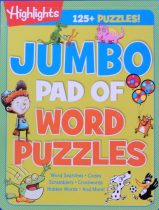
Jumbo Pad of Word Puzzles
Highlights

Youngsters from around 6/7 can have lots of fun and exercise their brains with the 120 plus puzzles in this bumper pad.

Contained therein are crosswords, codes, word searches, hidden words to discover, riddle Sudoku and mixed-up hidden pictures. Answers to all the puzzles are supplied on the back of the pages, which, with the pad’s tablet format, are easily removed.

Guaranteed hours of screen free fun from this and not just for the owner: family and friends can join in the puzzling too.

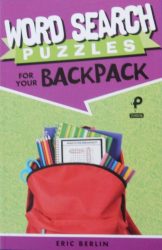
Word Search Puzzles for Your Backpack
Eric Berlin
Sterling

From camping to crafts, and summer time to sweet things, there’s a word search and more to suit the interest of any young reader among the 58 included in New York Times crossword compiler, Eric Berlin’s new puzzle book.
Some of the puzzles aren’t entirely straightforward however: the compiler has thrown in what he calls some ‘curve balls’ such as ‘Opposite Day’ where the words to find are the opposites of those given in the list below the puzzle.
That’s not all though: for every search there’s a hidden message related to its theme that is made from the letters not circled.
There’s some pretty funky stuff between the covers of this little book. It’s just right for tucking into your bag or snuggling under a blanket on the sofa with – with your favourite hot drink and of course, a pencil to hand.

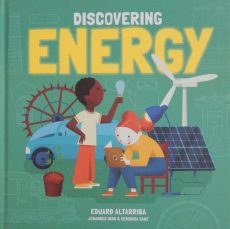
Discovering Energy

Discovering Energy
Eduard Altarriba, Johannes Hirn & Veronica Sanz
Button Books

In his characteristic bright, retro illustrative style, Eduard Altarriba in collaboration with writers Hirn and Sanz, both of whom are experts in physics, explores the vital topic of energy and its effects on all our lives.

After a spread on the sun’s energy, the book looks at what energy actually is including the difference between potential and kinetic energy.

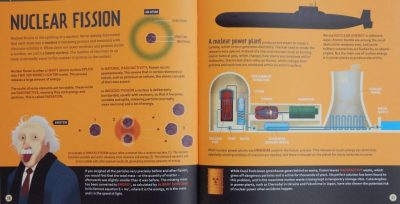
It goes on to investigate the interrelationship between energy and power, exploring wind power, water power, electricity, fossil fuels, nuclear power, solar power and much more.

Historical pioneers including Aristotle, Galileo, Newton, James Watt of steam engine fame, Alessandro Volta who created the first battery and Einstein

are all introduced in relation to their contributions to our understanding of the topic.

In the light of the drastic effects of climate change on the planet and life thereon, there is a spread on the all-important area of ‘clean and green energy’ and the crucial developments that will make safe, clean, sustainable energy now and in the future.

This vast subject is one we all need to come to grips with and it’s never too soon to start learning. This enlightening book, although aimed at young audiences, could also be useful to adults who have no background at all in physics.

The Magical Underwater Activity Book / Roman Adventure Activity Book

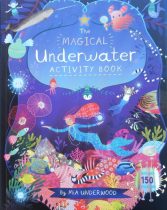
The Magical Underwater Activity Book
Mia Underwood
Button Books

Following on from her Secret Woodland Activity Book, Mia Underwood has created another exciting volume that combines fantasy and reality – merpeople and microplastics. It starts with an invitation from the sea creatures to become an ‘ocean hero’ and help save the planet.

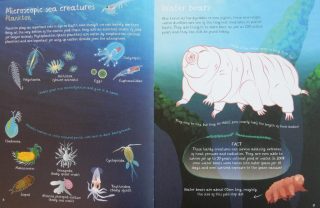
On the reality front, there are such diverse activities as meeting microscopic creatures like phytoplankton and zooplankton (their roles are explained),

and finding out some things to do that will help our planet.

There’s a challenge to design an ocean-cleaning gadget; maths and language challenges; ideas for lunch box snacks to prepare, crafty things to make, ideas for getting creative with pens or crayons and scissors, and much more.

There are also four pages of stickers to use in some of the scenes.

Guaranteed hours of engagement of the enjoyable and gently educational kind; just the thing for some screen free, dark evenings.

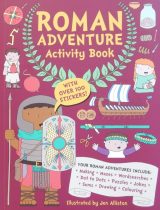
Roman Adventure Activity Book
illustrated by Jen Alliston
Button Books

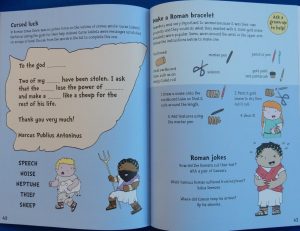
Youngsters can find out about the world of Ancient Rome as they engage in the wealth of fun activities between the covers of this book. There are such diverse ideas as making a Roman bracelet (not the solid gold kind popular in Roman times)

and discovering some of the remedies ancient Romans used for common ailments: I reckon consuming raw egg yolks would increase my digestive problems rather than curing an upset tummy; and imagine being told to kiss the nose of a mule to cure a cold. No way!

Puzzles – both word and maths, codes, mazes, spot the difference pages, colouring, search and find, and crafty things to make such as a gladiator shield. You can even, with adult help, bake some libum (a special bread made as an offering to the household gods).

Skills of several kinds are developed while engaging in these activities and there are pages of stickers to use along the way. Almost without exception, the Romans depicted in Jen Alliston’s illustrations look like children but I guess that’s part of the allure for young users.

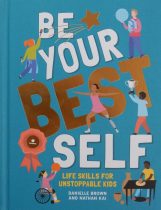
Be Your Best Self

Be Your Best Self
Danielle Brown and Nathan Kai
Button Books

At a time when more and more youngsters are suffering from low self-esteem, Danielle Brown double Paralympic Gold medallist and five times world champion in archery and Nathan Kai, (just seven at the time of writing), a member of MENSA and an elite athlete, have joined forces, creating a book to empower children to become their very best selves.

Profusely illustrated and including motivational quotes from the authors as well as the likes of Dr Seuss and J.K.Rowling, Michelle Obama and Amelia Earhart, this certainly is an inspiring book.

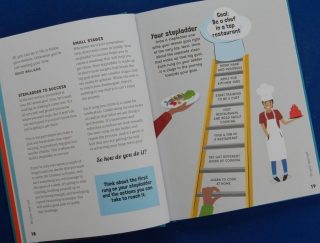
With a straightforward, thematically organised framework children are told to dream big and then determine what steps they need to take to fulfil their dreams.

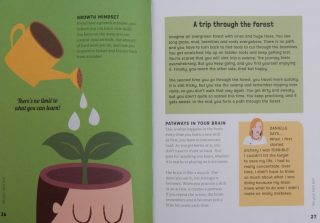
Aspects such as The Mind and Mindset, which looks at the importance of developing a growth mindset rather than a fixed mindset,

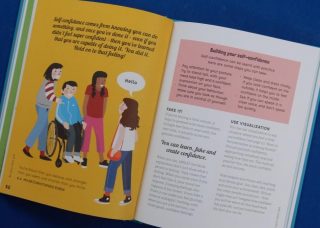
Staying Focused, Learning How to Fail Well ( it’s a chance to learn), Self-Confidence,

People Skills, and the importance of eating well and getting plenty of sleep are included.

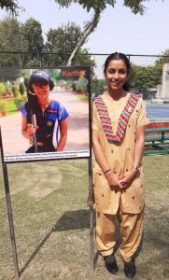
I have a teenage friend in Udaipur, Rajasthan who, one Christmas holiday four years ago announced she wanted to be sports captain of her school. She is a talented athlete but there is a tradition in Rajasthan for shooting and Karttiki decided she would try to become a shooter.

She started to practice in earnest and by luck one of the older girls fell sick at the last moment and Karttiki was given a chance to participate in an inter-school tournament. Thus began her shooting journey: one of determination and great focus.
Having researched several kinds of shooting, she decided that her best bet if she wanted to become a champion, was skeet. It’s a tough sport and very expensive but her father (my close friend) is very supportive. This year though still a junior, she has made the senior national team and in 2019, has represented India in the World Cup, World Championships and is about to go to the Asian Games (all this before A-levels). She’s had her downs as well as her ups along the way and feels tired a lot of the time, but as she says, “I’m doing it because I love it.”

Turning a dream into reality is just what this 17 year old is surely doing: she epitomises the spirit of this splendid book.

A Clutch of Activity and Craft Books

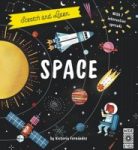
Scratch and Learn: Space
illustrated by Victoria Fernández
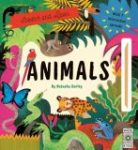
Scratch and Learn: Animals
illustrated by Natasha Durley
Wide Eyed Editions

These are new additions to the series, both of which have seven interactive spreads and an attached stylus for young readers to do the scratching.

Each spread explores a different theme and in the Space title, these start with the Big Bang and the scratching reveals 10 galaxies. Then come a look at the solar system, the Moon, ‘Spacecraft’, which has the Space Shuttle as a featured image, a peep at life on board the International Space Station, an account of the life cycle of a star, and finally, a constellation map.
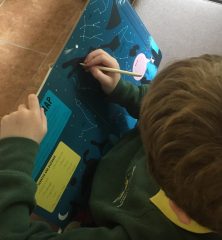
Spencer investigating the map

There are 10 ‘scratch and discover’ shapes to investigate with the stylus on every spread as well as a lead-in, easy to understand, factual paragraph (or two), clearly labelled objects and an additional ‘fact’ most in speech bubble form, for example ‘The light from the closest star still takes 4 years to reach us.’

The Animals featured in the second book come from different habitats around the world and as in the previous title, Lucy Brownridge supplies the succinct text.

Ten animals have ‘hidden’ themselves in each of Natasha Durley’s alluringly illustrated locations: the Amazon rainforest, the Great Barrier Reef, the Sundarbans Mangrove forest, (between India and Bangladesh), the grasslands of the African Savannah, a coniferous forest of northern Canada, the arid Gobi Desert and Antarctica.

Both titles are appealing early interactive books that can be brought out anywhere especially on a journey or a rainy day.
The Mermaid Craft Book
Laura Minter and Tia Williams
GMC Publications

Prolific craft book creators, Laura and Tia have added a new title to their series, this time with a mermaid theme.
It’s filled with ideas for making things to use, things to wear and tasty things to eat.

Having provided a list of what is needed, the authors give step-by-step instructions for such diverse projects as creating a seashore garden, making aquarium puppets and a theatre to use with them,
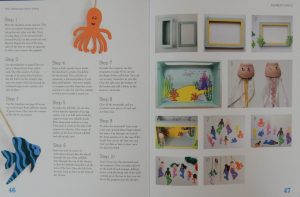
and you can even bake a mermaid cake or throw an ‘under-the-sea’ party serving only sea themed food and serve up that cake then. Young merpeople will love it.

Youngsters will also be enthusiastic about the book as a whole though they’ll require adult support with several of the activities.
Ancient Egypt Adventure Activity Book
illustrated by Jen Alliston
Button Books

Historical fun aplenty Ancient Egyptian style is found in this activity book.

Little ones can immerse themselves in the world of mummies, pyramids, pharaohs, hieroglyphics and ancient gods as they engage in mask making, maze manoeuvring, maths, message decoding, crafty creations, unscramble muddled up words and more. There are more than 100 activities in all as well as 4 pages of stickers to use to complete some of the scenes.

While engaging in these activities youngsters will likely learn some Ancient Egypt related language and facts too, as well as developing their fine motor and observational skills.

Jen Alliston has provided the illustrations and where relevant, answers are provided at the back of the book.

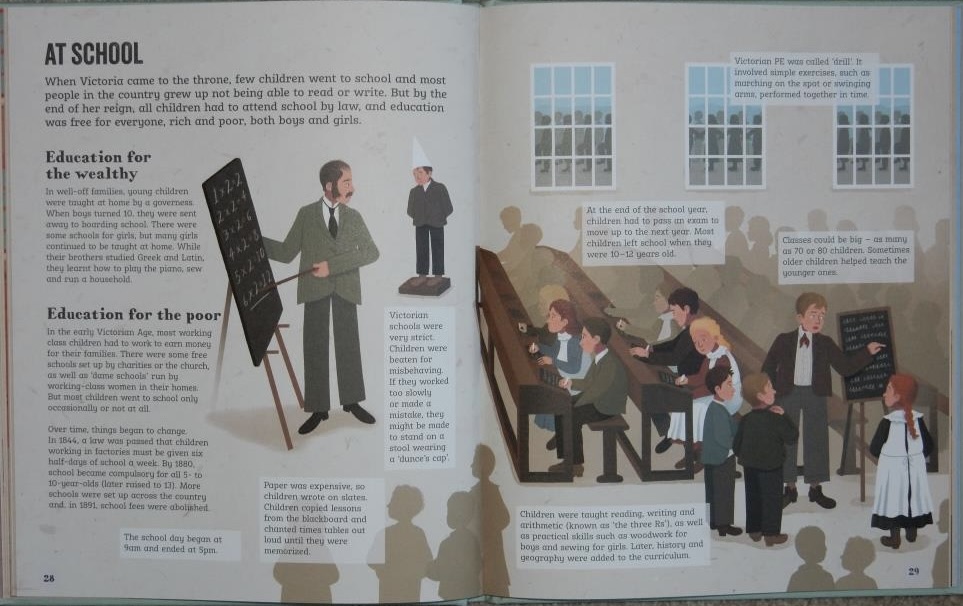
Discovering Architecture

Discovering Architecture
Eduard Altarriba and Berta Bardí I Milà
Button Books

The urge to build structures is seemingly, a universal human trait. I spent some of the Easter break constructing a den in a quiet woodland glade in Bushy Park, from a fallen tree trunk and branches, with 6-year old Emmanuelle and her soon to be 4, brother Samuel.

When they are ready to discover more about the build environment, this tremendous introduction should prove invaluable.

The graphic designer and illustrator Eduard Altarriba has already introduced young readers to Quantum Physics and now in a similarly engaging manner presents a look at iconic buildings through history, their creators and some of the items that might be found inside such buildings.

Starting with the earliest known building projects, the pyramids of Egypt, Iraq and Mexico, Classical Greek, Roman and Byzantine places of worship, domestic and vernacular architecture from many parts of the world, information on architects such as Antoni Gaudí, Le Corbusier, Ludwig Mies van der Rohe and Zaha Hadid …

readers are given a superb presentation of things and people architectural.

The final spreads focus on architecture’s basic elements – there’s a cut-away diagram of the principal parts of a building; what being an architect entails and lastly a look at what buildings might be like in the future (it’s good to see sustainability given a paragraph here).

University lecturer at the School of Architecture, UPC, Barcelona, Berta Bardí I Milá packs a wealth of absorbing information into the uncluttered spreads, so finely designed and illustrated by Altarriba.

Perfect for KS2 readers and perhaps adults wanting a starting point for the topic.

My First Book of Relativity

My First Book of Relativity
Sheddad Kaid-Salah Ferrón and Eduard Altarriba
Button Books

We had My First Book of Quantum Physics and now for a companion volume, its creators have turned their attention to another potentially complex science topic, that of relativity.

However, in the hands of this partnership, Einstein’s theory of relativity and other related aspects of connections between space and time are explained in such a way as to make them accessible to young readers. For, as it says on the back of this book, ‘it’s never too early to start exploring big ideas.’ So, how does one start?

The space-time theory, we read, can only be properly understood by first understanding what the two concepts mean in themselves; and then we’re in a position (like Einstein) to understand ‘the world through relativity’.

Time is succinctly explored – how it’s measured, by what means and the various units used.

Speed,

movement and the vital importance of frames of reference are explained, the latter using the example of a moving train and then a person in space.

There are spreads on adding up speeds and the speed of light, leading into Einstein’s two theories, special relativity and general relativity (his theory about gravity).

I love the ‘thought experiments’ relating to time dilation and clocks; and the wonderful spread whereon ten year old Alice travels to our nearest star Proxima Centauri, leaving her same aged friend  waiting for her on Earth and returning to find she’s still  ten whereas he is now almost 19, put me in mind of T.S. Eliot’s famous lines from Burnt Norton ‘Time present and time past / Are both perhaps present in time future / And time future contained in time past.’

If only physics had been made this fascinating back in the day when I was studying it at A-level (albeit only for a few weeks before deciding it wasn’t for me).

I’d not heard of muons before reading this book – a muon being an elementary particle of the electron family weighing around 200 times more than an electron, but again found the spread using a muon to check time dilation and length contraction totally engrossing.

The book concludes with how speed increases the mass of an object; the imaginings of the young Einstein (note the word imagined is used by the author, highlighting the crucial importance of the role of the imagination in scientific discovery) and a look at the mathematical equations Einstein used to describe his ideas of special relativity, the former taking mere weeks to find, whereas he took ten years to understand the ideas themselves.

The entire topic is mind-stretchingly incredible and brilliantly explained in this book, with the aid of Eduard Altarriba’s vibrant, graphics. Strongly recommended for budding scientists either for home reading or in school.

My City / In The City


My City
Joanne Liu
Prestel Children’s Books

A small boy, Max, is given the job of posting a letter and sets off to the post box.
His route through the city takes him past a launderette where he stops to watch the swirling whirling clothes in the machines;

then he stops at a crossing to look in a puddle (in stark contrast to the other people many of whom have their eyes on their phones)

and has an encounter with a rubbish collector and his truck. He chases after a leaf as it’s whooshed by the wind, catches it and eventually presents it to a man on a bench.

Each of these small happenings is followed by a shift in perspective that puts the reader as it were, behind the boy’s head as he meanders, ever watchful through the bustling city and through the day, all the while open-armed as though embracing each and every new experience until finally, he arrives back home to his watchful mother, and the mail box right by their house.

Almost wordless, Joanne Liu allows her vibrant, textured paintings to tell the story while allowing readers to create their own too, perhaps about the spotty dog that appears in several scenes.

A visual delight to explore and re-explore making new discoveries on each reading.

In The City
Dominika Lipniewska
Button Books

Dominika Lipniewska takes readers on an exploratory journey from the stirrings of early morning through twenty-four hours back to another sunrise.

Her graphical style urban landscapes have the playful appearance of a construction block city, comprising Lego-type figures, buildings and vehicles.

The streets and railway are full of hustle and bustle as commuters hurry on their way to work or perhaps take a more leisurely walk with a dog.

Noise is at times overwhelming, but not everywhere is so frenetic; there are green leafy spaces where wild life abounds, and quieter spots to pause and partake of some rest and repast.

Different as people may be, they share much in common including a love of ice-cream and engaging in fun activities as well as shopping – be that in a shopping centre

or smaller shops on the street, as well as the market, a great location for buying fresh produce.

Like most cities this one has other places of interest: a large variety of eating places, museums and art galleries, a zoo and more; and it’s both ever-changing and never still for some people work through the night to provide essential services.

Every spread offers enormous potential for observing and talking; in fact the whole book is visually appealing and immersive.

Plant, Sow, Make & Grow

Plant, Sow, Make & Grow
Esther Coombs
Button Books

Absolutely bursting with helpful gardening information whatever the season (the book is divided into four seasonal sections), the enthusiastic author, who started a gardening club at her daughter’s primary school and still runs it, has created a super book that introduces children to the wealth of opportunities being involved in a gardening project offers.

Before the seasonal sections, readers learn what the essentials are to get started, including the idea of creating a planting plan – all vital if you’re to make a success of your garden. Re-using and recycling are a part of the former and I like the idea of using loo rolls to make seed pots (I’ve frequently cut the tops from cardboard milk cartons but never tried this idea before).

Spring seed growing suggestions include salad leaves, tomatoes

potatoes, strawberries (the purchase of a few small plants initially is suggested here), root vegetables such as carrots and beetroot, peas and sweetcorn make up the edible kinds. Growing some flower seeds is also suggested because flowers will attract pollinators to your veg patch.
Then come a page on thinning out seedlings and another on wildlife – good and not good.

The summer section focuses on pumpkin growing, companion planting and lots of ideas for making useful items including a hanging-bottle container for tomatoes, a protective cover for strawberries, a watering can out of a screw top plastic bottle, as well as some creative activities, the suggestion of measuring some of the especially tall-growing plants

and some bee-related info. Then of course, there’s the important ‘summer harvest’.

Autumn is the season when much is ready for harvesting: sweetcorn, potatoes, root crops should all offer rich pickings and diggings at this time.

Compost, potting on strawberries, harvesting wild flower seeds, carving a pumpkin, creating a seasonal wreath and a bug home are also covered in this section.

Winter is the shortest section and again it’s packed with great tips such as saving seeds to plant the following year as well as stems for next year’s canes; creating a bird feeder from a sunflower head and more.

Motivating and thoroughly down to earth, this alluringly illustrated book is one I wholeheartedly recommend for school and home.

Non-Fiction Miscellany: Ambulance Ambulance / Weird Animals / Castle Adventure Activity Book

Ambulance Ambulance
Sally Sutton and Brian Lovelock
Walker Books

An ambulance crew responds to an emergency call out: a boy has come off his bike and ‘Nee nar nee nar nee nar nee nar …’ off goes the ambulance to the scene of the accident.

On arrival the paramedics make the necessary checks, put a splint on the child’s broken leg and carefully lift him onto a stretcher and into the ambulance.

Then with horn honking and lights flashing, off they go racing to the hospital, “Quick, quick quick. ‘Nee nar nee nar nee nar nee nar … ‘

Once the boy is safely inside and the hand-over complete, the crew are ready for a rest, but it’s not long before another emergency call comes and so off they go again …

Team Sally and Brian are already well known for their previous picture books such as Roadworks and Construction. Non-fiction loving little ones delight in these books and will doubtless relish this one with its bright illustrations, especially since its rhyming text comes with opportunities for joining in all those ‘Nee nar’ sounds. Share at home or in a nursery setting and watch the response …

Weird Animals
Mary Kay Carson
Sterling Children’s Books

The world of nature is full of strange and wonderful creatures, large and small, a dozen or so of which are featured in Mary May Carson’s Weird Animals. The author specialises in writing non-fiction for children and those with an insatiable appetite for the fantastically weird will enjoy her latest book.
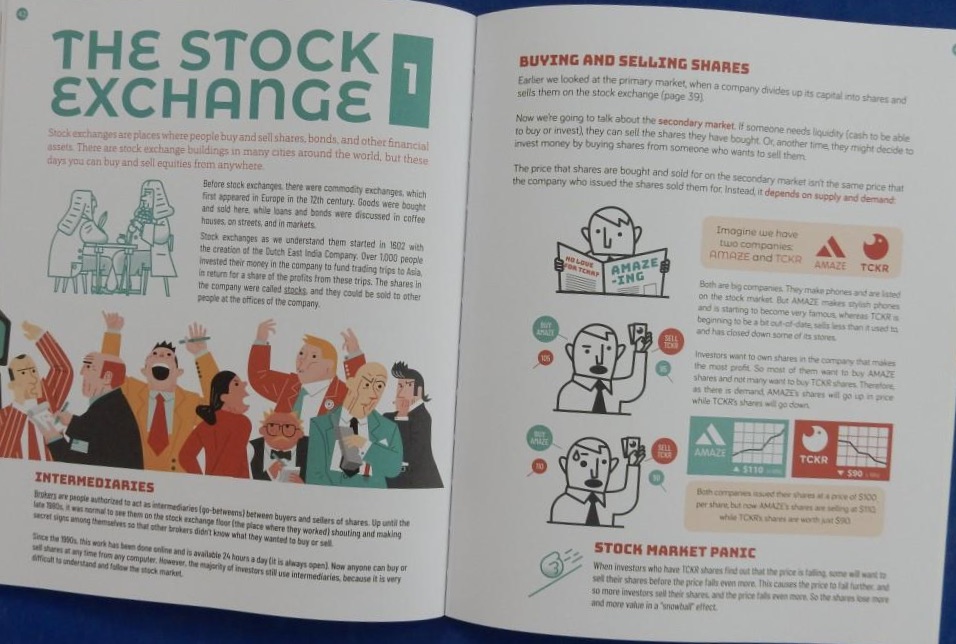
It explains the whys and wherefores of some amazing adaptations, those odd characteristics that help these creatures survive and thrive.

Take for example the Pink Fairy armadillo with its oversized feet and fluffy underside that helps keep the creature warm through cold desert nights.

The frightening-looking fauna from different parts of the world include insects, reptiles, birds, fish, mammals, with explanations for their appearance. Weird and wonderful they surely are.

Castle Adventure Activity Book
Jen Alliston
Button Books

Children should find lots to explore in this engaging historical activity book. There are mazes, matching games, word searches, colouring pages that include things to spot of a medieval kind. Observation skills are also required for matching games, determining the winner of a joust, searching for rats in the castle kitchen and more.
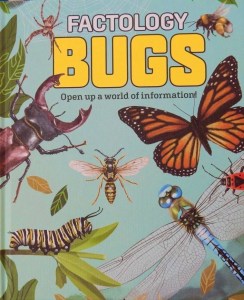
There are medieval scenes to complete by drawing and adding stickers as well as a number of crafty projects. Some, such as making a sword or a conical hat for a princess, require additional items – paper, card, scissors etc. and may also need adult assistance.

Some simple maths, words to unscramble and a scattering of jokes are also part and parcel of this themed compilation that’s a fun alternative to constant screen use.

The Secret Woodland Activity Book

The Secret Woodland Activity Book
Mia Underwood
Button Books

A wealth of activities await those who foray into the magical world created by Mia Underwood.

Creatures of all shapes and sizes inhabit this Scandinavian-style woodland: numbering among them are Stardust (snail), Hopper (a bird) and Nisse (a bearded sprite). There are also a forest spirit (an invisible magical being with a protective role), trolls, minibeasts, owls, bears, foxes, an occasional baby dragon; you might even come upon a unicorn or a yeti.

These feature in such activities as mazes, story writing, maths, word searches,

mobile making; there’s also a recipe to make bird feed balls and lots of opportunities for imaginative thinking.

Wonderfully quirky and engaging, this 64-page book includes a plethora of stickers to add to some of the woodland scenes.

With the darker nights upon us, and holidays fast approaching, it’s a super way to distract youngsters from their screens for a while.

Spot the Difference in the Park / Dinosaur Adventure Activity Book & Pirate Adventure Activity Book

Spot the Difference in the Park
Naomi Wilkinson
Lincoln Children’s Books

Five scenes show in turn, a host of playful dogs some accompanied by a walker; animals engaged in various sporting activities such as soccer, tennis, skate-boarding, badminton and cycling; a boating lake;

the flower beds; the playground and finally a downpour that sends all the animals homewards, with each offering five spot the differences per spread. The answers are found by looking beneath the flaps on each recto.
Set against subtle background colours, each busy scene, with its rhyming introduction, provides young spotters plenty of detail to peruse and enjoy, in addition to identifying the differences.
Also available is Spot the Difference on the Beach.

For slightly older children are:

Dinosaur Adventure Activity Book
Pirate Adventure Activity Book

illustrated by Jen Allison
Button Books

Following on from her Space Activity Book, Jen Alliston has two new eye-catching titles.
Each of the chosen themes have an enduring allure for young children and in both are to be found games, dot-to-dots, mazes, crafty things, word puzzles, riddles, spot the difference, colouring in, the odd joke or two, even a little bit of maths, as well as 4 pages of stickers (pictures and some labels).
Entertainment is the main focus, although users will likely acquire some new vocabulary and the occasional fact too, as well as developing their skills in observation, manipulation and concentration.
(The answers are supplied at the back of the books for those inclined to check.)

My First Book of Quantum Physics

My First Book of Quantum Physics
Sheddad Kaid-Salah Ferrón and Eduard Altarriba
Button Books

‘A children’s science book to educate and inspire’ says the press release of this book. Does it live up to the claim? Let’s take a closer look.
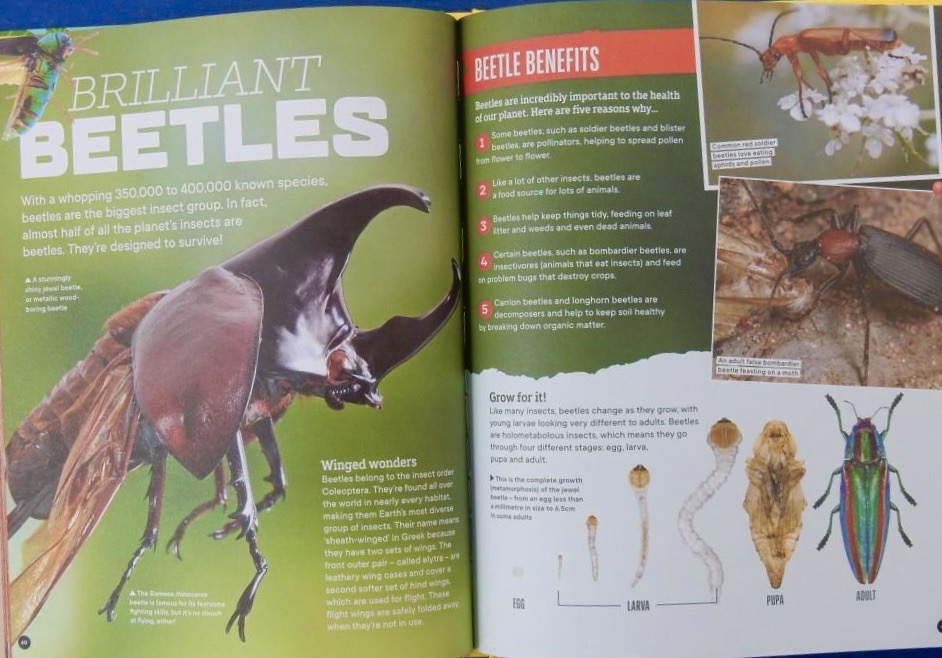
In the introduction the author explains that everything we see around us is composed of minute subatomic particles and as scientists began to discover more about them, they realised that a new set of theories was needed because the laws of physics as they stood, did not apply.

Thus new theories were generated and these are what we now know as quantum physics. Moreover without this science of subatomic particles none of our favourite electronic devices, so important in our everyday lives, would exist – now there’s a thought.

I remember very little about the content of the O-level physics I studied at school – it’s amazing I managed to pass – but one thing I can recall is being told about Plank’s quantum theory: this is one of the topics discussed in the book after the
introductory pages about ‘classical physics’ and its limitations; it makes much more sense to me now than it ever did back in the day.

Niels Bohr, another physicist whose name I came across in my limited physics education is also featured here with an explanation of the first ever vision of the ‘Quantized atom’.

What this highly illustrated book does is take key concepts and ideas

and explains them in a way that is comprehensible – no easy task – to both upper primary and lower secondary age children, but this is entertainingly written and invitingly presented with lots of diagrams and illustrations including a quantum timeline.

With my basic knowledge of the topic I would say this is an excellent introduction; author Ferron and illustrator Altarriba have done a great job to make it accessible and exciting.

With Giving in Mind

Little Hazelnut
Anne-Florence Lemasson and Dominique Ehrhard
Old Barn Books

What a simply gorgeous presentation is this tale of a hazelnut dropped by squirrel …

and buried by a heavy snowfall.
Other woodland animals, furred and feathered, come and go but the nut remains undiscovered.
In the spring, a little tree shoot emerges – literally – and a sapling begins to develop: a little nut tree, no less.

Readers are taken on a journey through the changing seasons in this wonderfully crafted pop-up story. The limited colour palette and occasional patterned backgrounds are most effective and the paper-engineering superb.
A book to share, to treasure and to give.

Greatest Magical Stories
Chosen by Michael Morpurgo
Oxford University Press

Michael Morpurgo has selected a dozen magical tales from different parts of the world for this collection, the final one of which, Jack and the Beanstalk is his own retelling. This first person telling from Jack Spriggins aka ‘Poor Boy Jack’ is especially engaging for young listeners. Morpurgo also provides an introduction as well as an introductory paragraph to each story.
Ten illustrators have been used with Victoria Assanelli and Bee Willey having two tales each. Most arresting as far as I’m concerned are Ian Beck’s wonderful silhouettes for Adèle Geras’ rendition of The Pied Piper.

From Japan comes Yoshi the Stonecutter, retold by Becca Heddle and beautifully illustrated by Meg Hunt, the only non-European offering.
Cinderella, Sleeping Beauty and Jack and the Beanstalk are ‘almost part of our DNA’ says Morpurgo in his introduction: they are universal.
Perhaps not a first collection but this read aloud volume is certainly one worth adding to a family bookshelf or primary classroom collection.
Not included in the above but certainly magical is:

Beauty and the Beast
illustrated by Dinara Mirtalipova
Templar Publishing

To satisfy his youngest daughter’s wish, a merchant steals a rose from the garden of a hideous-looking beast and Beauty, to save her father’s life, goes in his place to the Beast’s palace, falls in love with him and well, you know the rest.
The classic fairy tale is retold in a truly beautiful rendition – a feat of paper-engineering and lavish, cut out illustrations by self-taught illustrator Dinara Mirtalipova.

She has created six multi-layered scenes by using three layers of paper cut to look 3D, so that each spread simply springs into life when the page is turned.
Magical!
I really had to exercise my powers of persuasion to get one listener to part with my copy after we’d shared it.

A Child’s Garden of Verses
Robert Louis Stevenson, illustrated by Michael Foreman
Otter-Barry Books

I clearly remember my father reading Robert Louis Stevenson poems from A Child’s Garden of Verses on many occasions; most notably Rain. The Swing, From a Railway Carriage, Autumn Fires, Where Go the Boats? and my very favourite, Windy Nights (which I still know by heart).
Here’s a beautiful book of those same poems that were first published in 1885, and a century later illustrated by Michael Foreman, beautifully packaged with a foreword by Alexander McCall Smith for a new generation of listeners and readers.
For me Foreman is the perfect illustrator for the poems, his watercolours imbuing them with a sense of timelessness and innocence. One for the family bookshelf.

Space Adventure Activity Book
illustrated by Jen Alliston
Button Books

There’s plenty to engage young children during the long winter evenings in this space-themed activity book. There are things to count, to colour and to make; plenty of puzzles, wordsearches and more, plus 4 pages of stickers. All you need are pens, pencils, scissors, a paper plate or so, a couple of sponges and 2 rubber bands (to convert your shoes to moon boots) and some basic ingredients for the Stellar Cakes (plus the help of an adult).
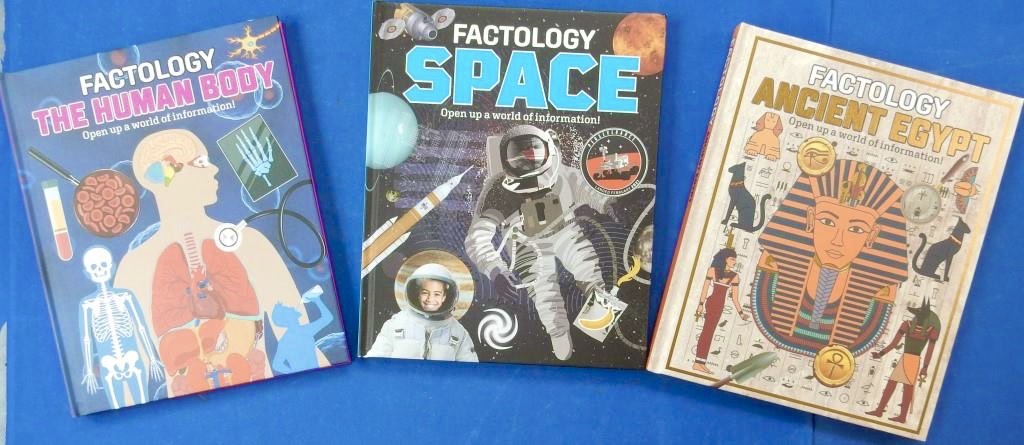
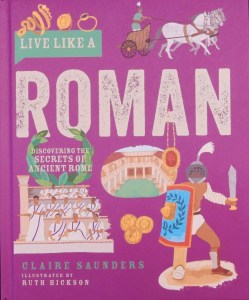
With 60 pages of spacey fun, this should help fill a fair few hours of darkness.

Welcome to London / Jane Foster’s London & Jane Foster’s New York

Welcome to London
Marcos Farina
Button Books
London seems to be a very popular picture book destination at present and Marcos Farina’s quirky, retro style illustrations certainly make it look an exciting one.
Surrealism abounds right from the arrival at a station whose platform will be familiar to fans of Harry Potter. From then on it’s a case of spot the literary references; chortle at the crazy cast of characters or giggle over the multitude of other visual anomalies scattered throughout as we visit the various famous London landmarks and encounter the multitude of characters that make it such a dynamic and vibrant city.

If like me, you know London, you’ll likely never look at it in quite the same way again: you’ll always be on the lookout for a storybook character lurking somewhere, or an animal emerging from the next taxi that stops close by one of its famous stores.

Marcos Farina’s London encompasses parks, sporting venues, bridges,

palaces, galleries, shopping venues, iconic buildings and much more. His clear, graphic, design led illustrations make almost every page a potential poster for the city.

Jane Foster’s London
Jane Foster’s New York

Jane Foster
Templar Publishing
In bold bright colours, designer Jane Foster introduces the very youngest children to two of the world’s most popular tourist cities.
Set against vibrant, sometimes patterned backgrounds, she places famous landmarks, objects and occasional less likely images such as the red squirrel (I wish there were more of those in London), although New York includes a grey squirrel.

Her intricately patterned imagery is sure to engage both toddlers and adults as they enjoy such iconic London sights as the red bus, Big Ben, the London Eye and Tower Bridge but also fish and chips and a pair of wellington boots. New York boasts the Statue of Liberty, the Empire State Building, Central Park as well as Broadway theatre and Staten Island ferry. Interestingly both cities have pigeons.
Foster’s characteristic eye-catching mix of strong colour, pattern and retro-styling do these famous cities proud.

I’ve signed the charter  

Mr Postmouse Goes on Holiday / Travel Activity Book

Mr Postmouse Goes on Holiday
Marianne Dubuc
Book Island
Mr Postmouse is back – or rather, he isn’t: he’s off on a holiday trip with his family and like many of us, is taking some work to finish. First stop is the forest where they set up camp, oh! and there just happens to be a parcel to drop off for forest resident, Aunt Maisy.

The mice then head to the seaside for some relaxation before boarding a cruise ship, which stops off at a volcanic island for another parcel delivery and for Pipsqueak, provides an opportunity to toast some marshmallows – yummy!

A camel ride in the desert, a jungle safari, a hasty, town stopover, a mountain sortie, a polar stop-off, an air-balloon flight all follow; and as you might expect, Mr P. has parcels to drop off at all the locations.

Eventually though, the globe trotting is over and the mouse family return home where unsurprisingly there’s a whole pile of letters needing to be delivered by Mr Postmouse.
This sequel is every bit as full of delicious details as Here Comes Mr Postmouse. It’s hard to show these on photos; but for instance, the forest scene has elements of a Hansel and Gretel type story being acted out by various characters. A mouse is picking up the pebbles that a small boy is using to leave a trail and hand-in-hand, two small children are heading towards a gingerbread house, there are boy scout bunnies and a whole host of minibeasts –

one toasting what looks like a sausage, over a bonfire.
If you share this with a group of youngsters – and I hope you will, as it offers so much to discuss, then ensure you build in lots of time to peruse each spread.

No matter where your holiday destination is, this might well be a worthwhile book to take along:

Travel Activity Book
illustrated by Charlie Brandon-King
Button Books
Starting with, on the inside front cover, a host of ideas for games to play on the journey, youngsters are offered a wealth of removable sheets of things to do from ‘Get Packed’ with its empty case, ticket and blank passport waiting to be filled; airport related activities, to a spot the clouds page, followed by a world map page. This just covers the first half dozen pages. There follow: all kinds of puzzles, problems to solve, drawing, writing and other creative activities and more.
No matter if you’re travelling to a jungly location or island far away, or somewhere much closer to home, there should be something to keep children from around 4 to 10 involved.

I’ve signed the charter 

A Handful of Animal Board Books

The Safari Set
The Jungle Crew
The Polar Pack

Madeleine Rogers
Button Books
Here we have the first three board books to be added to the Mibo series and they’re some of the best board books I’ve seen in a long while. Each one features a different natural location and all have rhyming texts and some brief, attractively presented snippets of information inside the back cover.
The Safari Set takes us to the dusty, sun-scorched African plains where lions laze, giraffes graze

on high-up leaves, elephants roam, zebras flash past and hippos wallow for hours in the cool water.
In the dappled, leafy jungle we encounter members of The Jungle Crew: a troop of lively monkeys, screeching macaws with their dazzling plumage,

a fearsome-looking tiger stalks, toucans chomp on tasty fruits and tree frogs hop, and drop (when it’s time to lay eggs).
Members of The Polar Pack live in either the far north or far south; many are under threat and need protection. The South Pole is home to Emperor penguins: mighty-tusked walruses, polar bears,

huge-hooved reindeer and snowy owls reside in the North Pole.
Superb, beautifully patterned illustrations and rhyming texts that are a pleasure to read aloud make these top quality little books for the very youngest.

Really Feely Baby Animals
Really Feely Farm

Polly Appleton and Dawn Sirett
DK
A host of animals (5 per book) introduce themselves and invite toddlers to participate in a variety of sensory experiences such as ‘Rub my tufty fur. Then choose a shiny red apple for me to eat.’ or …

Feel my fuzzy feathers. And touch my smooth, pointy beak.
A kitten, a playful puppy and a baby rabbit also want to be similarly explored in Baby Animals.
In Farm Animals we meet first a chicken, and go on to encounter a sheep, a piglet, a duckling …

Feel my soft, fluffy tummy. And touch my smooth, shiny beak.

and a calf.
In both books the photographic images on each recto really seem to leap out from the page, heightening the whole visual experience. On the baby rabbit page for instance, its whiskers glisten as the light catches them. However it isn’t only the animals that are tactile; every item on the page provides a lovely feely experience and a whole lot of language learning possibilities.