Girls Can Do Anything

Girls Can Do Anything
Caryl Hart and Ali Pye
Scholastic
Let’s hear it for girl power!
This is a celebration of what girls can do narrated in Caryl Hart’s enormously empowering jaunty rhyme:
“I’m a GIRL! I’m FANTASTIC! I’m strong, brave and proud!” so say a huge diversity of girls in no uncertain terms as they talk about their attire – anything goes; demonstrate their unique prowess as sports participants and students favouring a huge variety of subjects – maths, writing, science, music, art and more.
The older they get, the more amazing they become: there are environmentalists, vets, zookeepers, scientists of all kinds, machine operators

and life-savers.
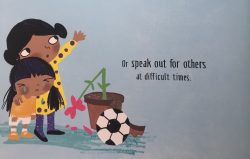
They can be rough and tough or soft and gentle, they can speak up for others …
and a great many help improve people’s lives.

Ali Pye’s cast of splendidly inclusive young females have enormous va-va-voom;
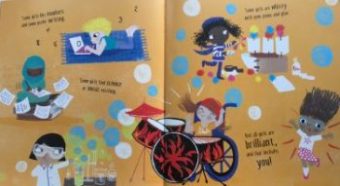
and the front endpapers are a gallery style presentation of possibilities for the future, while those at the back are fifteen named portraits (some more recognisable than others) of high achievers in many walks of life including Malala Yousafzai, Serena Williams, Olympic medallist LGBTQ boxer Nicola Adams, first woman-British firefighter Josephine Reynolds and author Chimamanda Ngozi Adichie.

Having read the book together with a five year old in the park after school , I spent 15 minutes exploring the endpapers with her; a woman came and sat on our bench with her phone. After a couple of minutes she put it away asking if she could listen as she thought the book ‘so brilliant’. I said ‘Be my guest’. She then called her friend over to share the experience. Five-year-old Emmanuelle instantly recognised Serena Williams but I had a fair bit of explaining to do with several of the others. Well worth the effort though.

In short, in this highly infectious adulation, it’s a case of no holds barred when it comes to girls; they’re undoubtedly a force to be reckoned with, cheered and applauded. Once again, let’s hear it for girl power!


Cyril and Pat

Cyril and Pat
Emily Gravett
Two Hoots

The super-talent that is Emily Gravett adds another book to her roster of read aloud crackers.

It stars a squirrel named Cyril, a lonely creature until that is, he meets Pat, another ‘squirrel’.
Thereafter the two spend happy times together in Lake Park inventing fun games, putting on puppet shows, skate-boarding and playing Hide-and-seek and Pigeon Sneak.

Cyril is completely oblivious to the outward differences between them despite being told time and again that his friend is not like him.

So what, I can hear you thinking; it was certainly my reaction.
Eventually though, Cyril heeds the negative comments of the other animals and he and Pat part company.

Inevitably Cyril is lonely once more: those games are no fun when played all by himself and he leaves the park putting himself in great danger.

Will he now realise his mistake and find his erstwhile friend once more?

Worry not: the author in her inimitable way provides a wonderful resolution that is altogether satisfying for both her main characters and her audience, although not for pooch, Slim, pursuer of the friends throughout most of the book.

Yes, this fine friendship story is wonderfully funny and stunningly illustrated in lush colours, but like all good stories it raises questions for readers to ponder as well as an important unspoken environmental message. (Love the Tidy rubbish bin.)

100 Dogs / Hey Duggee Sticky Stick Sticker Book

100 Dogs
Michael Whaite
Puffin Books

No this isn’t 101 Dalmations, it’s a mere one hundred pooches all packed between the pages of this romping, racing, rhymer of a book.

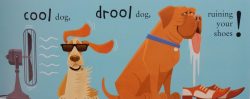
Herein you’ll meet dogs of every kind you can imagine and some you probably can’t: dogs big and small, bad and sad, dogs shaggy, baggy and wag-wag-waggy, fluffy ones and scruffy ones. Watch out for whiffy and sniffy ones, or those that might drool all over your best shoes.

There are dogs of the expected hues -with or without spots – but also a red one, a pink one and a yellow one.
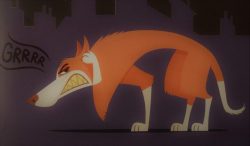
Some look friendly (even to dog-phobic me); others appear decidedly vicious

or just downright weird.

One has even had the audacity to leave its calling card right there on the page.

Each and every one of these canine beauties has been lovingly portrayed by Michael Whaite especially for the delight of readers, canine lovers of all ages in particular.

There’s just one dog in:

Hey Duggee Sticky Stick Sticker Book
Ladybird Books (Penguin Random House Children’s Books)

Young children who are familiar with the CBeebies series featuring Duggee and his pals, and in particular his Hey Duggee Stick Song will not be surprised that sticks feature large in this activity book. It is after all a sticker book but the first activity is to greet all the members of the Squirrel Club and shout ‘Woof’. Only then can you proceed.

What follows are ten stick-related activity pages and a centre spread of stickers to use in some of the activities. These include a stick-collecting route to follow in order to build a campfire; a find two the same game; a spot the difference spread, a word search, a maze and a game of ‘sticks and ladders’.

Just right to entertain little ones over the school holidays, especially on a journey or should the warm sunny days disappear.

20,000 Leagues Under the Sea

20,000 Leagues Under the Sea
Aleksandra Artymowska
Big Picture Press

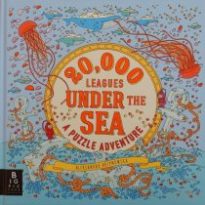
Graphic designer and illustrator Aleksandra Artymowska has taken Jules Verne’s novel and created an absorbing picture book puzzler.

At the invitation of Captain Nemo, readers are invited to set sail seeking adventure and a treasure beyond price. All they have to do is to enter the hatch of the Nautilus and descend, then search the seven seas for seven locks with which to open his secret sea chest.

Easy enough surely? Not quite, especially as there’s a giant squid lurking somewhere ‘neath those seas.
Those who embark on the treasure hunt will however be participants in a unique sub-aquatic experience taking them deep, deep down under the sea..

First of all there’s the correct button to find that will get the submarine started and of course, the steering wheel, to make sure you stay on your chosen course.

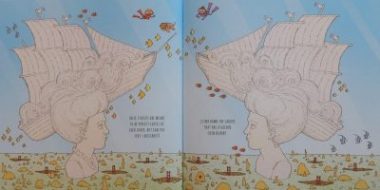
With a variety of challenges including hidden symbols and keys to detect, mazes to navigate, art works to locate, corals and shells to compare,

a reef to steer through, weird and wonderful creatures aplenty to surprise and perhaps alarm, all of which are part and parcel of the host of strange seascapes and labyrinthine mazes explorers encounter. Surreal sights abound.

Dive down in Nautilus and you’ll more than likely remain submerged for several hours, before you surface, with or without having spotted the compass hidden in plain sight in each and every scene. And just in case you haven’t solved all the posers, the author/artist has provided the answers at the back of the book. Happy exploring.

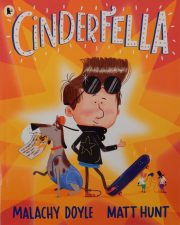
Cinderfella

Cinderfella
Malachy Doyle and Matt Hunt
Walker Books

I do love a fractured fairy tale and Malachy Doyle has smashed the Cinderella story well and truly with this funky, bang up-to-date rendition.

The star of the show is undoubtedly Cinderfella himself but he has two thoroughly undesirable, enormously lazy, extremely bossy older brothers named Gareth and Gus.

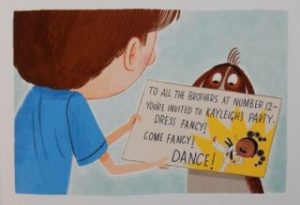
You can just imagine their reaction when an invitation arrives announcing junior karate champion Kayleigh’s birthday bash. Cinders is most definitely not on the guest list, they inform him.
However, once the two have scooted off to strut their stuff at the dance, Ruff comes upon the invitation and all is revealed …

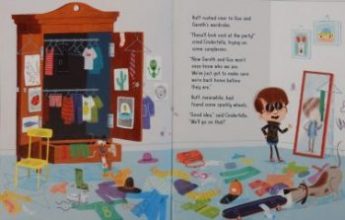
With his brothers out of the way, there’s nothing to prevent Cinderfella from raiding their wardrobe and sure enough, therein he finds the perfect gear to disguise and make himself look the height of cool. Ruff too discovers something that’s just the ticket. Now all they need to do is make sure they get home before Gus and Gareth. Gear and carriage sorted and it’s off they go.

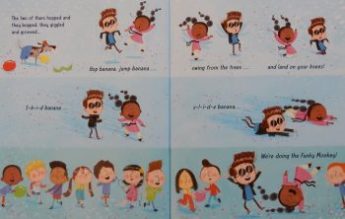
At the party, Kayleigh is singularly unimpressed at the preponderance of Groovy Chicken dancers but then she catches sight of somebody whose moves are altogether different: he and his canine pal are doing the Funky Monkey and she wants to join them …
They dance the night away – well almost

– but then Cinderfella’s watch reminds him that it’s time to scoot and off he and Ruff dash, Cinders dropping his sunglasses in his wake.

No prizes for guessing who picks up those shades and then the search is on.

Will the ace disco boppers be reunited and live as far-out friends ever after.

Matt Hunt is the perfect illustrative partner for Malachy Doyle here: his hip guys and gals are a wonderfully inclusive cast of characters and those party scenes are certain to make you want to get up and swing your hips to and fro, swing those hips and go, go, go as you too join in with that Funky Monkey. You might even be tempted to try a few karate kicks too.
Utterly irresistible.

Please Mr Magic Fish!

Please Mr Magic Fish!
Jessica Souhami
Otter-Barry Books

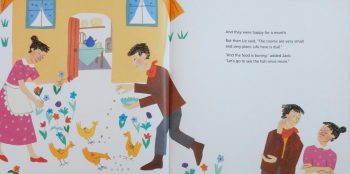
Jessica Souhami has taken the traditional story of the fisherman and his increasingly greedy wife and turned it into something even more magical, tossing in some silver sparkles along the way.

Here the fisherman goes by the name of Jack, and his insulting, constantly complaining wife is Liz.

Their wish to the magic fish Jack catches and agrees to release,

for a ‘small dry cottage, a blue teapot and some bread and cheese in the larder’, once granted, soon won’t do

and escalates first to a large sunny house, then after another week, to a palace full of luxurious items fit for a lord and lady.

Now that obliging fish grants all these wishes without receiving a single word of thanks from the acquisitive couple until finally he’s had enough, so when they return for yet another, instead of making them King and Queen of the land he gives Jack and Liz the biggest surprise of all.

I wonder if they were ever satisfied … Did they learn from the error of their ways? What do you think?

The direct manner of telling as befits the tale works so well as a read aloud and those stylish collage illustrations for which Souhami is renowned are just SO superbly expressive.

If looks could kill, those the fish bestows upon the greedy couple would knock them stone dead in an instant.

Toby and the Tricky Things

Toby and the Tricky Things
Lou Peacock and Christine Pym
Nosy Crow

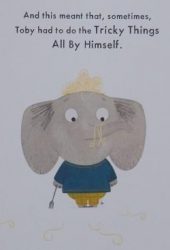
If the consequence of young Toby’s burgeoning independence – able to pour his own milk, read his own bedtime stories and reach the snacks intended “just for mummies” – means bothersome breakfast,

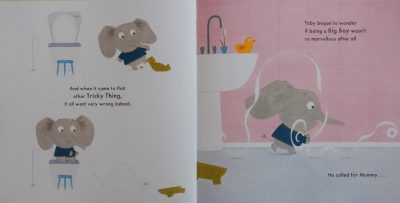
‘Bad Buttons’, for an entire day, ‘Wrong Wellies’ likewise and even worse, problematic pants and loopy loo paper, then Mummy Elephant’s Big Boy isn’t happy.

Even when he’s managed to get her attention for two minutes on account of the bathroom disaster, Baby Iris is demanding that attention YET AGAIN! Hmmm!

If that’s how it’s to be, then Toby is off on his own Big Boy’s adventure.

Suitcase packed with potentially useful toys, garden door successfully opened, stairs down duly descended, he’s off flying solo on the swing.

Soon though hunger pangs strike and a sudden downpour dampens his spirits (and those Toys That Might Be Useful aren’t at all so), then who should be there, just at the right moment with words of comfort and encouragement but his very own Mummy Elephant.

Yes, there will still be occasions when sharing a Mummy will be the trickiest of all things but now Toby knows that however big he gets, he will always be her baby.

Lou Peacock’s gently humorous tale looks at one of those bothersome situations that many older siblings have to contend with, doing so in a reassuring warm-hearted manner that will surely resonate with adults and children alike.

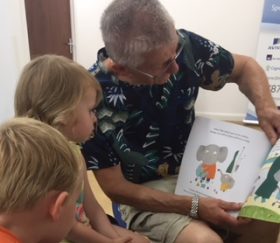
Samuel and Ruby absorbed in the story

The Elephant family as portrayed by Christine Pym is absolutely enchanting. She captures the changing feelings of Toby wonderfully and Mum’s love of her offspring shines out despite her obvious dilemma of being torn between two little ones. “Hey, I know that story,” one of my listeners said of the book being shared by the three characters on the back cover.

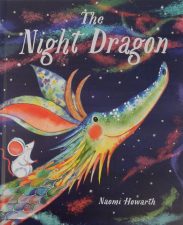
The Night Dragon

The Night Dragon
Naomi Howarth
Lincoln Children’s Books

Let me introduce a totally awesome dragon by the name of Maud. I should say that at the start of the always awesome, Naomi Howarth’s story, said dragon doesn’t feel at all awesome. She’s shunned by fellow dragons on account, so they say, of her lack of strong wings, A “weedy wimp” is what Gar calls her, while Brimlad is sure she’s insufficiently tough to take on the sun.

Poor Maud despairs she’ll ever be a night dragon.

Her only friend, Mouse, is encouraging, telling her that to be dragon of the night she need only be herself. Maud has her doubts.

One afternoon, Brimlad decides to celebrate his 557th birthday by throwing a party, but there’s one dragon that doesn’t get an invite. Instead she watches from behind a rock as the others drink, fight and one after another, fall into a deep sleep.

Time passes and still the dragons slumber as Maud notices a complete lack of clouds in the sky, and of nightfall there isn’t a sign.

Maud is at a loss. Mouse however isn’t. He knows what Maud must do and all he needs to do is encourage and persuade her that with him alongside, or rather behind her, she can spread those gorgeous wings of hers and fly.

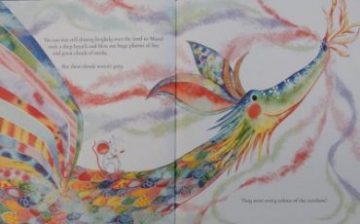
Slightly emboldened, Maud leaves the mountain edge, tumbling at first and then suddenly, soaring. Soaring and emitting the most amazing clouds of rainbow hued smoke from her nostrils.

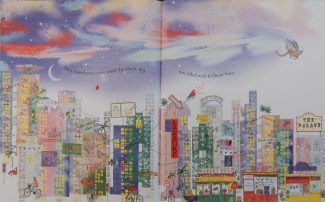
Over the mountains and fields, above winding rivers, winging over cities they go, filling the entire sky with the most fabulous shades of many colours,

until finally, as they pause for a rest, the sun starts to sink and night begins to fall.

Mouse’s words of thanks also let his friend know that just by being herself, Maud has made everything beautiful.

Now both Mouse and Maud have a new and very important role to perform – every single day …

Friendship, self-belief and daring to be different shine through in this dazzlingly beautiful picture book fable that reads like a neo folk tale. For me at least, Naomi Howarth has outshone her previous bobby-dazzlers and that’s no mean feat.

Get it, celebrate it and share it wherever you can. From cover to cover, it’s a stunner.

The Worry Box

The Worry Box
Suzanne Chiew and Sean Julian
Little Tiger Press

It must surely be a symptom of our troubled times that there’s been a spate of recent picture books on the theme of anxiety, and the mental health of young people is constantly under discussion, due in no small part to the prevalent pressurised education regime, a legacy of a certain politician currently championing the dreaded BREXIT.

The most recent of such books to come my way is The Worry Box wherein we meet the worrisome Murray Bear along with his big sister, Milly.

It’s waterfalls with their potential for ‘bigness’ and loudness that present the first of Murray’s worrying possibilities. Fortunately though, his fears in this respect are allayed by Milly as they make their way home.

Back inside Milly introduces her coping tool, a worry box, to her sibling, explaining how it works. They make one for Murray and they head off to meet their friends at that waterfall.

Once there Murray remembers to use his special box when he starts feeling worried about climbing a tall tree.

After a fun-filled afternoon, the mislaying of Milly’s backpack delays the friends and they’re not ready to leave until sunset. It’s then that Lara reveals her worries about the dark. Now it’s Murray’s turn to offer reassurance, a helping paw and co-use of his special box until they’re safely home,

after which the sibling bears stand in the moonlight contemplating their amazing day together.

Enormously reassuring for all little worriers is Suzanne Chiew’s story while Sean Julian’s gorgeous illustrations of the verdant natural landscape setting make you want to pause on the dragonfly littered riverbank, refreshing waterfall and scale the tree along with the animal characters so beautifully portrayed herein.

When I taught KS1 children we’d often have a worry tree (branches standing in a container) in the classroom. Children wrote their worries on leaf-shaped coloured paper, hung them from the twigs and then every day or so, those that wanted to shared what they’d written with the class. A discussion could arise or the mere act of hanging up the leaf often worked on its own. After sharing this book, children might create their own worry box for use at home or the class could make a communal one that is used in a similar way.

No matter what, a shared reading will help listeners let go of their concerns and enjoy embracing new challenges.

The Night Watch Ninjas

The Night Watch Ninjas
Lily Roscoe, Lisa & Damien Barlow
Simon & Schuster Children’s Books

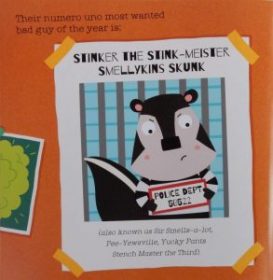
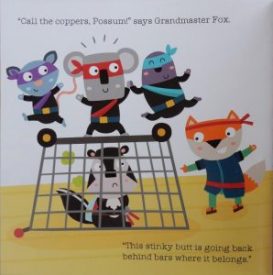
HIYAAAAAAAA! The Night Watch Ninjas are here, charged with keeping the town free from nocturnal mischief makers and there’s one in particular they’re eager to apprehend; the year’s most wanted bad guy.

Do not be fooled by his cute-looking demeanour: what lies beneath that bushy tail of his is, so we hear, ‘THE BOTTOM OF TOXIC DESTRUCTION’.

That badass has escaped from gaol and there’s a red alert. No time for midnight feasts when he’s on the loose and now he’s dropped one of his gross, malodorous bombs.
He has to be stopped before the entire world is engulfed in egregious odours. Off go the ninjas in their warrior wagon and before long Koala spies a huge green cloud issuing forth from the cinema.

False alarm! Stinker has tricked them.

But who is that little old lady offering her assistance? Don’t be fooled guys; that talk of the object of their search entering the Bat Cave Café might well be another dupe. And it is!
The Ninjas are trapped, well and truly; or are they? One of their number, Koala, is the other side of the door. Perhaps she can release her pals.

Luckily she can and once free, Fox reminds the gang of a vital ninja rule: get inside your opponent’s mind. That’s what they put into practice as they follow their prey into the all-night supermarket. Can they track Stinker down, and if so where?
I’m sure young listeners will be eager to supply suggestions as to what might be the favoured fare of a fiery-bottomed skunk.

It seems that the Ninjas have made a catch. Game over, or is it? …

A bedtime tale quite unlike others: this one will definitely not lull your little ones into a soporific state. Rather they’ll be cheering for those Night Watch Ninjas so colourfully portrayed in Lisa and Damien Barlow’s zany scenes of nocturnal shenanigans, that or issuing a series of ‘EEEEUUUGGHHHs’ and ‘YUCKs’ as you share Lily Roscoe’s wonderfully windy tale.

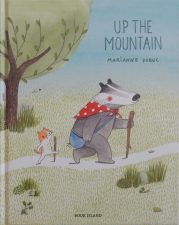
Up the Mountain

Up the Mountain
Marianne Dubuc
Book Island

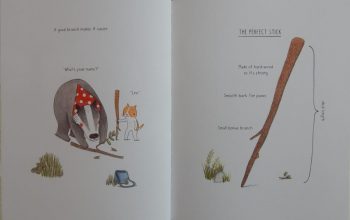
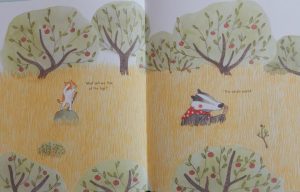
Old Mrs Badger is a kindly soul residing at the foot of a small mountain. She loves to walk and does so every Sunday, climbing up to the top of the mountain and sometimes stopping en route collect things such as mushrooms for a friend

or to help one in need.
One Sunday she comes upon a little cat eager to accompany her on her journey though he lacks the confidence. Fortunately Mrs Badger knows just the thing to make the challenge easier for Leo

and so the two continue climbing together.

Her companion is inquisitive and quick to learn; Mrs Badger encouraging, wise. and generous with her wisdom.

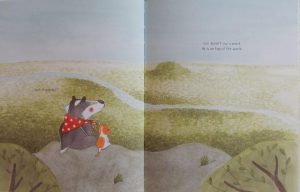
Finally they reach their destination.

There follow many Sundays when the two friends climb together and gradually week by week, month by month Mrs Badger starts to grow weary on their walks and now it’s erstwhile mentee Leo’s turn to take on the mentoring role.
Then comes a day when Mrs Badger doesn’t feel strong enough for an uphill hike so Leo heads off alone. And so it continues with the cat bringing back treasures to share with Mrs Badger.
Eventually the mountain has become Leo’s but then one day that too changes: now Leo has a new friend with whom to share all that natural beauty.

Marianne Dubuc’s moving cyclical tale has a quiet beauty that holds readers in its thrall throughout, and demonstrates so touchingly the power of intergenerational friendships. Her scenes, both intimate and expansive, are superbly detailed and beautifully textured, and her colour palette spot on for the rural setting.

Give Peas a Chance (Dinosaur Juniors)

Give Peas a Chance (Dinosaur Juniors)
Rob Biddulph
Harper Collins Children’s Books

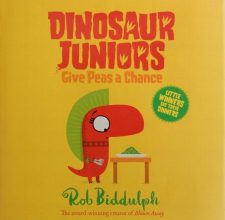
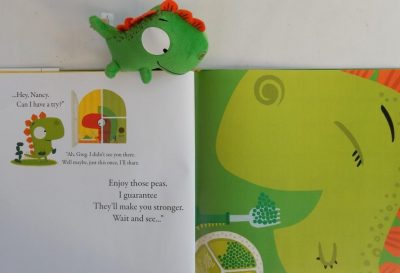
Hurrah! There’s a whole story starring Nancy, one of the Dinosaur Juniors brigade we first met playing a bit part, strumming her guitar in Greg’s Happy Hatchday tale.

Yes that little dino-guy does put in an appearance too in the form of a co-consumer of Nancy’s unwanted peas. The problem being Nancy detests all things green so when she’s called in for her dinner

and told in no uncertain terms that she can’t go out and join her pals until her plate is empty, peas and all, she just has to cook up a quick plan.

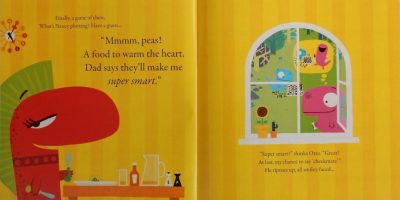
As Greg passes beneath her window, Nancy utters these words loud and clear, “Mmmm, peas! / I’d eat them all day long. / Dad says they’ll make me / super strong.

This utterance immediately has Greg salivating and asking for a share, which of course Nancy is only too willing to provide.

A similar thing happens when Sue comes along and her desire, as Nancy knows, is to be super speedy so all she needs to do is alter her pea praising poem to include the words “super fast” and Sue too is at the ready to receive a forkful of the little green veggies.

Chess-playing Otto is likewise attracted to the window and Nancy’s promise of the bestowal of super smartness upon those that consume those little green balls, so he cannot wait for a brain-boosting mouthful.

Now Nancy’s plate is completely clean. Mission accomplished and off she can go to play …

Err, maybe not quite yet, for Dad is about to become the bearer of some good news.

Again a super-stylish Rob Biddulph feast for ears and eyes, not to mention taste buds: those vibrant colours, especially the green hues are just SO appetisingly alluring.

Absolutely brilliant, the prehistoric pals do it once more: I wonder which of the dino-littles will star in the next of the series. Will it be Sue, or Otto; or perhaps Winnie, Wilf, Hector, Martin or Boo? There will be a huge number of fans waiting in eager anticipation after consuming this rhyming treat.

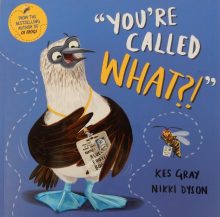
“You’re Called What?!”

“You’re Called What?!”
Kes Gray and Nikki Dyson
Macmillan Children’s Books

Spluttersome delight is guaranteed in the latest of Kes Gray’s comic outpourings.

He takes us to the Ministry of Silly Names where there’s a queue of weird and wonderful creatures all intent on changing their monikers.

As each one reaches the counter and reveals what it’s called: Cockapoo, Monkeyface Pricklebat, Pink Fairy Armadillo, Blue-Footed Booby,(thanks to Jonny Lambert I’d heard of that one) Ice Cream Cone Worm,

Shovelnose Guitarfish, Blobfish

and yes, Bone-Eating Snot Flower Worm … the hoots of laughter from those behind get ever louder (and longer), in tandem, if my experience is anything to go by, with those of listeners.

Nikki Dyson’s hilarious portrayal of each animal with its peeved, or perhaps acquiescent countenance, is rib-ticklingly funny; but perhaps the best bit of all – no make that the second best bit – is the discovery that each and every one of these animals actually exists.

The funniest bit, at least for me, is when the final creature, the Aha Ha Wasp announces what its new name is to be.

Revealing this would most definitely spoil the fun so you’ll just have to lay your paws, feelers, fins or other appropriate appendages on a copy of the book pronto.

With its impeccable comic timing, this one’s beyond priceless, probably as much so as the author’s Oi Frog! and if your audience’s love of language isn’t boosted 100% after hearing the story, then I’m off to stick my head under the frill of that Tasselled Wobbegong.

I might have to do that anyway: one read aloud, with all those ‘HA HA’s, has left me utterly exhausted.

Shifty McGifty and Slippery Sam The Missing Masterpiece

Shifty McGifty and Slippery Sam The Missing Masterpiece
Tracey Corderoy and Steven Lenton
Nosy Crow

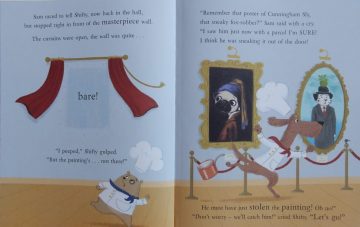
A fox with a penchant for paintings – really? Yes really; one going by the name of Cunningham Sly and he steals them – in Paris no less.

However, that’s where the famous canine bakers Shifty McGifty and Slippery Sam have just arrived with a special commission, to create a culinary edifice – a gingerbread Eiffel Tower- in time for the opening of the art exhibition at Galerie Bonbon. With only an hour to complete their work before the doors open, there’s not a second to lose despite the fact that Sam has spotted a ‘wanted’ poster displayed outside and is already on the alert.

En route to the kitchen Sam points out the location of a masterpiece, so he thinks, to Shifty, but his pal is on his way back to their van to collect something they’d left therein.

Once in the kitchen Sam is surprised to encounter a dapper-looking vulpine character and has a strange feeling he looks familiar. The dapper gent however assures him this can’t be so on account of his being an artist who spends all his time indoors on his work. Sam is impressed. But then as he dashes to inform his pal, they see something alarming and immediately, the chase is on.

Can they apprehend the wily thief and if so, will that dip in the River Seine have ruined the priceless Bone-a-Lisa portrait;

or is there perhaps a possibility that two masterpieces, one culinary and one artistic will be on view for the celebratory opening party of the exhibition?

Time after time in this series Tracey delivers a faultless rhyming narrative that is sheer delight to read aloud and full of tasty titbits. Steven Lenton’s scenes with their Parisian backdrop, portray with panache, the bakers’ plight as they strive to complete their double task and avert disaster. (There’s that spider to spot on every spread too.)

Another successful culinary caper with the crime busting canine duo: this would make a cracking TV cartoon or even perhaps, a stage show.

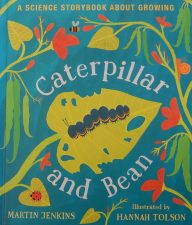
Caterpillar and Bean

Caterpillar and Bean
Martin Jenkins and Hannah Tolson
Walker Books

Here’s a beautifully illustrated, narrative information book that cleverly combines two life cycles, that of a runner bean and an unnamed butterfly. (I’m not aware of a butterfly whose food plant is the runner bean.)

Written by conservation biologist and author, Martin Jenkins it’s the latest in the Science Storybook series for young children with growth and change as its themes.

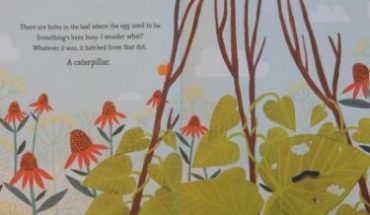
Starting with a wrinkly bean seed ‘neath the ground, readers can follow its development as first a tiny root emerges, followed by (above ground) green leaves, then more green leaves onto one of which a white dot of an egg appears.

From this hatches a caterpillar that nibbles and grows, nibbles and grows,

shedding three skins, almost stripping the plant of its foliage.

Fortunately though, the plant too continues growing apace, but of the caterpillar there is no sign. Instead, dangling on a thread is a chrysalis.

Meanwhile bean pods have replaced the flowers and are swelling ready to shed new bean seeds after which, come winter the plant dies.

Not so the chrysalis however, that is awaiting spring when …

Simply and effectively told in a reader-friendly chatty style, alongside growing your own beans and caterpillars this is an excellent introductory book.

Ten Minutes to Bed Little Unicorn

Ten Minutes to Bed Little Unicorn
Rhiannon Fielding and Chris Chatterton
Ladybird Books (Penguin Random House)

I must admit having seen it’s sparkly cover with that pink hued unicorn I didn’t want to like this book but having had children’s responses to it, and shared it one to one with several individuals, I’ve changed my mind.

Essentially it’s a tale about a spirited little unicorn named Twinkle who, like many young humans, does all she can to resist her dad’s “Ten minutes to bed!” warning.

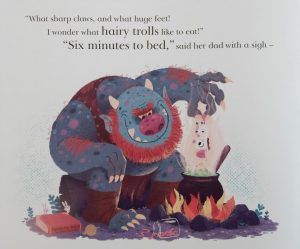
Thus begins a countdown as the lively, far from tired unicorn, begins frisking through the forest, dancing and prancing, chasing the little creatures in the first three minutes and then she discovers a trail of footprints. Footprints that lead first to the sighting of a huge hairy troll,

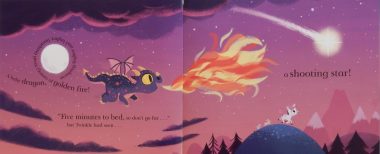
then this being flashing across the sky, as well as the star.

Be honest, what would you do in that situation?

The problem is with four minutes left, Twinkle is, she realises, lost. There’s just one thing to do to get herself back in time, but will it work? Will she get home and if so, will she do so before the ten minutes expire? Remember, this is a magical story so …

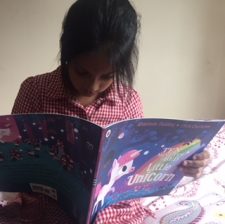
With its rhyming text that reads aloud well, Rhiannon Fielding’s story works nicely as a bedtime tale, but equally as a shared read with a nursery group, or as an individual supported read for someone just gaining confidence as a reader of texts other than the boring schemes schools offer. Its predictable, patterned counting down nature and Chris Chatterton’s child-appealing, other worldly illustrations that also help when it comes to predicting the words coming next, contribute to its relative ease of reading. How magical is it for a six year old to be able to say, “I read that myself” like the little girl in the photo.

Alesha was over the moon to be  able to read this story herself.

.
Don’t forget to explore the Land of Nod maps back and front, one is a daytime landscape,

the other shows the same panorama at night. There’s a great deal of potential in those alone for further exploration and perhaps 3D map making, especially if you happen to have a little toy unicorn.

A Stone for Sascha

A Stone for Sascha
Aaron Becker
Walker Books

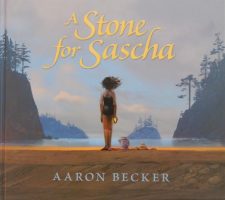
I could just write a single word in response to this story– awesome – but that wouldn’t help those who have yet to encounter Aaron Becker’s new wordless picture book. Nor would it do justice to his remarkable lyrical endeavour.
My initial reading called to mind two poems of T.S. Eliot, the first being the opening line of East Coker: ‘In my beginning is my end.

In Becker’s beginning we see a girl collecting flowers and discover they’re an offering for her beloved dog, Sascha’s grave.

The family – mother father, daughter and son – then leave home for a seaside camping holiday.
As night begins to fall the girl heads to the water’s edge and we see her standing beneath a starry sky about to throw a smooth stone.

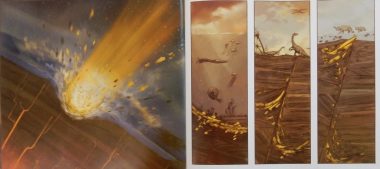
Thereafter, time shifts and what follows are spreads of a meteor hurtling earthwards to become embedded in the ocean floor and we witness the evolution of our planet as the stone works its way upwards and out, as life transitions from water to land, dinosaurs roam and then give way to early mammalian forms.

Having broken the surface as an enormous protrusion, the stone is quarried and transported to a huge ancient royal edifice where it’s carved into an obelisk.

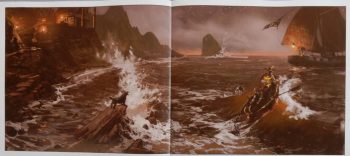
Wars, looting, fragmentation and remodelling occur as the stone moves through history becoming part of first a religious monument, then a bridge; is fashioned into a fantastical dragon and placed in an ornate carved chest; taken to an island and installed in a chieftain’s dwelling, stolen,

lost at sea and eventually, having moved through eons of time, is polished smooth and carried by the waves to the shore where stands the girl who finds it.

Now, as she presses the stone to her cheek she appears to have made peace with the situation and perhaps, her loss and grief.

The stone’s final resting place – as far as this story goes – is atop Sascha’s gravestone.
(You can also trace the whole journey through the timeline maps that form the endpapers.)

Becker’s layered pastel spreads – digitally worked I think – have in the present time, a near photographic, quality. The scenes of bygone eras where the degree of sfumato intensifies are, in contrast imbued with a dreamlike quality, being as Leonardo da Vinci said of the technique he too employed, ‘ without lines or borders’.

This intensely moving, unforgettable, multi-layered, circular tale is open to countless interpretations and reinterpretations depending on what we bring to the book, at any particular time. Assuredly, it makes this reviewer think about our own place in the cosmos and our connection to past and future, for to return once more to T.S. Eliot:
Time present and time past / Are both perhaps present in time future, / And time future contained in time past.’
Burnt Norton

10 Reasons to Love a Lion / 10 Reasons to Love a Penguin

10 Reasons to Love a Lion
10 Reasons to Love a Penguin

Catherine Barr and Hanako Clulow
Lincoln Children’s Books

The latest additions to this environmentally concerned series that introduces children to, and encourages their positivity towards, animals in the wild, takes readers to some highly contrasting locations.
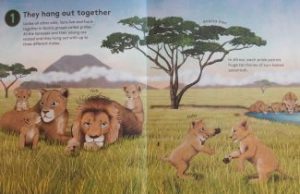
In 10 Reasons to Love a Lion we discover that sadly, there is only one species of lion remaining in the wild, living in central and southern Africa

and the Gir Forest National Park in Gujarat, India.
Unlike other big cats, lions are social animals, living in prides and in Africa, so we learn, huge territories of arid savannah are patrolled by each pride which might comprise as many as three magnificently-maned males, plus lionesses and their offspring.

I was unaware that despite their having quills that are potentially lethal to lions should their skin be pierced and become infected, the large cat predators – the females do the hunting – like eating these prickly creatures. Ouch!

In addition to this information we’re told about lions’ ability to see in poor light when hunting, thanks to their ‘glow-in-the-dark eyes; hear of the playfulness of cubs; their manner of greeting and becoming friendly towards, other lions using their individual oily scent; and their propensity to sleep, particularly after fully sating their appetites.

Other birds and animals are also featured in Hannah Clulow’s realistic-looking scenes; so for instance we can tell which location – African or Indian – it is by say, the presence of an Indian peacock, or ostriches.

Scattered throughout the book are 5 ways in which we all can show our appreciation towards lions and thus perhaps help in their preservation.

In contrast there are 18 penguin species, which, with the exception of the Galapagos penguin all live in or near Antarctica. Each one is pictured on the opening spread of 10 Reasons to Love a Penguin.

Ecologist and environmentalist, Catherine Barr adopts a similarly engaging style as she writes of these flightless birds as ‘super speedy swimmers’ using their ‘underwater wings’ to ‘twist and turn’ as they hunt for fish. She talks of their specially shaped eyes that help underwater vision while searching for ocean food, some of which unfortunately is being depleted by large floating nets that might also entangle the penguins.

We see and read of penguins tobogganing on their tummies,

sneezing salty water, some species huddling close together to fend off the chill – their feet still suffer though; discover the mating habits of adelies; the chick rearing of emperors penguins; the loss of waterproofing during their ‘catastrophic moult’ and more.

Again, interspersed throughout are 5 ways we humans can help the cause of penguin preservation.

Written in collaboration with the Natural History Museum, these are two to add to primary classroom collections, and for ecologically aware individual readers.

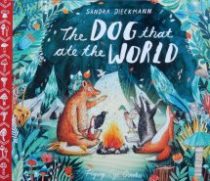
The Dog that Ate the World

The Dog that Ate the World
Sandra Dieckmann
Flying Eye Books

Down in the valley the various animals live alongside each other peaceably, birds with birds, bears fishing with bears and fox playing his fiddle to other foxes.

Then, one fateful day across the pastures comes an unwanted canine intruder, large and greedy. He helps himself to whatever he wants in the way of food and drink, growing ever larger.
In an attempt to assuage the hunger of the beastly dog, the fox with his fiddle approaches him and plays a song.

He’s rewarded for his efforts by being consumed by the dog, but despite this the fox continues playing his song from within.

It’s heard without by a trio of brave bunnies that resolve to rescue the fox,

but they too end up inside the dog.

Peace-makers attempt to talk, trick and tire the beast, all to no avail; the dog swallows the lot.
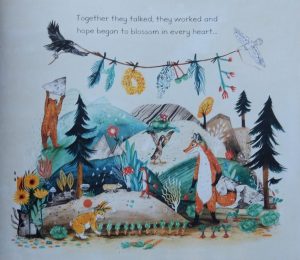
Trapped within, the animals light a fire, talk and work, until eventually as life continues to flourish, so too does hope.

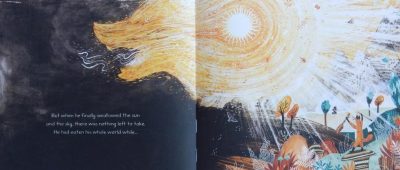
Nonetheless the gluttonous and now prodigious, dog continues stuffing himself until finally, down too, goes the sun and the entire sky. The beast has eaten his entire world.

And what of the other animals? Let’s just say that brightness surrounds them. In their world, there’s no place for such an animal as that voracious dog and all is peace, harmony and togetherness.

The forest animals in Sandra Dieckmann’s second picture book demonstrate so well to us humans, the importance of friendship and community when disaster strikes. Her striking colour palette, mixed-media, richly detailed scenes of flora and fauna, and slightly mystical landscapes draw one in and hold you while you ponder both composition and meaning.

Surely an allegory of our times and one that is open to many interpretations. However one sees that all consuming metaphorical dog, be it as consumerism, capitalism, or evil itself, this book is sure to engender discussion no matter the age of the audience.

A First Book of the Sea

A First Book of the Sea
Nicola Davies and Emily Sutton
Walker Books

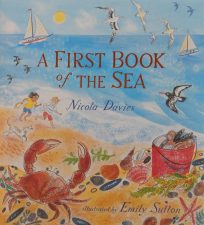
Award winning team Davies and Sutton present a fine, diverse collection of sea related poems that subtly blend information within.
Starting down by the shore readers can experience a paddle, sandcastle building, watch a flock of seagulls, have a spending spree on the pier, ride a wave, become creative with shells and pebbles, or stop still and watch a Shore Crab:

‘Delicate! / As a dancer, / The crab sidesteps / To a dead-fish dinner. / Wary! / Periscope eyes up, watching. / Its big claws pinch tiny scraps / And pass them to its busy mouth. / Dainty! / Like a giant eating fairy cakes.’

I love that observation.

Equally beautiful, from the Journeys section, is Star School wherein, ‘The old man draws the night sky out in pebbles / to teach his grandson the pattern of stars. / They will steer his path across the ocean / like stepping stones laid out in the sky, / They’ll steer him safe to tiny islands, / green stars lost in seas of blue.’

I’ve never been a particular lover of beaches and the sea other than in tropical climes, but Nicola Davies’ superb word pictures in tandem with Emily Sutton’s remarkable watercolours have made me want to head to the nearest coast and look anew at those seagulls, limpets, shells and ‘bits of beauty that are pebbles.’
I know I’ll have to travel a bit further in search of puffins though, and I can wait a few more months to watch fishermen on palm-clad shores, perhaps in Kerala or Goa, tossing their nets ‘spider web’ like, endeavouring to ‘catch just enough fish for dinner’.
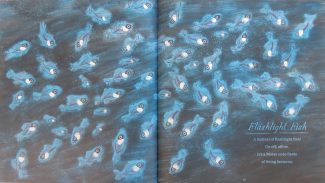
This is an outstanding and wondrous evocation of the sea – beside, upon, above and beneath –

‘A festival of flashlight fish! Off-on, off-on. It’s a morse code fiesta of living lanterns.

for every book collection, be that at home or in school. A ‘First Book of the Sea‘ it might be, but this is one that will go on being appreciated over and over and …

Baby on Board

Baby on Board
Allan Ahlberg and Emma Chichester Clark
Puffin Books

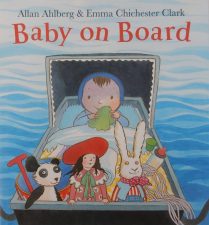
Storyteller extraordinaire, Allan Ahlberg, has teamed up with some wonderful illustrators over the years and here he is partnered by another; Emma Chichester Clark, who provided the pictures for his Mrs Vole the Vet, one of the Happy Families series.

This is a story – an epic adventure – that has its origins in the author’s infancy when two girls used to call at his home in the Black Country, asking to take baby Allan out for a walk in his pram.
It begins thus:
‘Once, many years ago,
there was a baby,
in his pram,
with his sisters
and their sandwiches and lemonade
and toys,
and their friends
and a kite,
and a dog or two … ‘

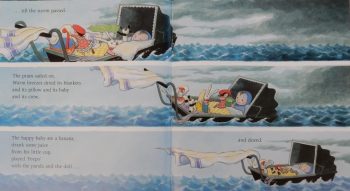
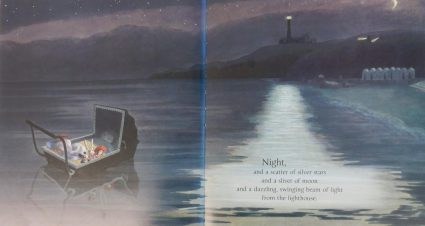
From there it takes off into a lilting tale wherein baby and minders are separated on account of a kite, and the infant in its pram sails off, along with a trio of toys, into the open seas.
Fortunately the toys are able to make the babe warm and comfy; but coping with the sudden storm that blows up is much more of a challenge, though it’s one the three are up to.

Unexpectedly however, three becomes two thanks to an inquisitive puffin, the arrival of which precipitates a fall overboard by panda. Happily the other two are able to perform a timely rescue and the pram sails on into the setting sun, with its complete crew and a somewhat whiffy baby.

Eventually the baby carriage drifts to shore once more with its four passengers safe and sound, albeit pretty exhausted; and all ends happily thanks to terrific toy teamwork.

Stunning artwork by Emma Chichester Clark – love the 1930s pram and children’s attire –  transforms Allan Ahlberg’s super story into a super, super story. It’s perfect as a bedtime book, or equally as a shared read at any time of the day.

Lunch on a Pirate Ship

Lunch on a Pirate Ship
Caryl Hart and Kristina Stephenson
Simon & Schuster Children’s Books

Pirates rule yet again, or is it young Jack, in this lipsmacking adventure that rollicks and rolls along apace in Caryl Hart’s seemingly effortless, rhyming narrative.

Let’s meet Jack then: he’s something of a fussy eater – I’m sure we all know a few of those – and one day, a fine one perhaps like today, he decides that cold chips and crunchy baked beans do nothing to tempt his taste buds.

Instead he fantasises about the possibilities of lunch aboard a pirate ship. Now what might those salty souls sink their gnashers into by way of a lunchtime treat, he wonders – pongy pickled crabs and rancid rotten fish maybe?

Rejecting this unappetising dish, both pirates and Jack set off in search of other more promising fare.

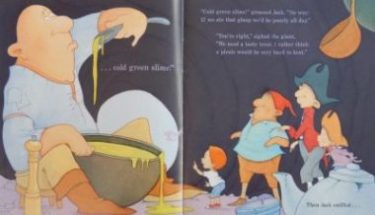
What the giant offers is little better …

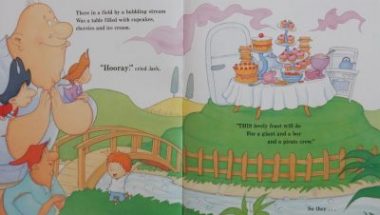
so he too joins the hunt – as passenger carrier – and off they all go following a sweet-smelling scent, eventually coming upon a fantastic feast laid out in a field.
Uh-oh! First they must cross a bridge and we all, children in particular, know what might be lurking somewhere in the vicinity of one of those.

What takes place thereafter, I won’t reveal for fear of spoiling your appetite for the remainder of the tale, but let’s just say, they do all, or almost all, get home in time to appreciate their tea that includes some pretty delectable offerings, so long as they eat their greens, that is.

Kristina Stephenson eschews her ‘stinky socks’ for a sojourn on the high seas doing it with absolute appetising aplomb as befits this truly tasty story that so brilliantly mixes food and fairy tale.

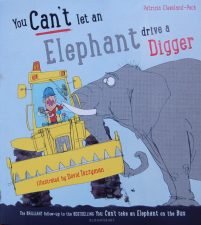
You Can’t Let an Elephant Drive a Digger

You Can’t Let an Elephant Drive a Digger
Patricia Cleveland Peck and David Tazzyman
Bloomsbury Children’s Books

After their successful collaboration with You Can’t Take an Elephant on the Bus, team Cleveland-Peck and Tazzyman return to entertain readers with another selection of silly scenarios involving an array of unlikely creatures all endeavouring to lend a hand, a tusk, paws or perhaps fins, flippers or some other part of their anatomy, all with gigglesome outcomes.

Patricia’s rhyming possibilities or should I say, impossibilities, will surely deter even the bravest of readers from say, letting a polar bear anywhere near their hair with a pair of scissors, engaging an octopus as a dressing assistant,

attempting tooth cleaning in the vicinity of a crocodile, particularly of the hungry kind, or allowing a wolf to read the bedtime story,

while David Tazzyman’s portrayals of the creatures carrying out their self-set tasks are a scribblesome treat of the disastrous – sometimes life-threatening – consequences of ignoring the author’s advice.

Maybe the rejected animals are right – if you can’t join ’em then beat ’em and party instead!

Spencer age 5, who thoroughly enjoyed the book, has come up with two playful ideas of his own.

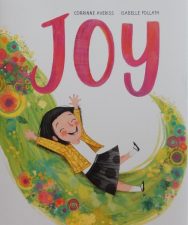
Joy

Joy
Corrinne Averiss and Isabelle Follath
Words & Pictures

Where can you find joy, and once found, how can you capture it? That’s the conundrum young Fern sets herself in this gorgeous story.
Fern’s Nanna has not been her usual self recently; her sparkle’s gone and with it her love of cake baking and even worse, her smile. That’s what upsets Fern most.
It’s like the joy has gone out of her life.” is what her Mum says when Fern asks what’s wrong with Nanna.
Once she’s understood that joy involves experiences that generate a ‘whooosh!’ factor, Fern packs her catching kit into her bag

and sets out for the park to catch some and bring them back for her Nanna.

Sure enough, the park is brimming with joyful moments, but try as she might, those whooshes refuse to be caught in her various receptacles …

and she trudges sadly home.

Now it’s Nanna’s turn to notice how sad her granddaughter is. As Fern recounts her abortive attempts to bring home some joy for her, lo and behold, Nanna’s face breaks into the ‘BIGGEST, WIDEST WHOOOSH! of a smile’ and next day they’re off to the park together.

Corrine Averiss’s empathetic tale showing that unique bond between grandparent and child, is in itself elevating and a gentle demonstration that love is the true generator of joy however manifested: coupled with debut picture book illustrator Isabelle Follath’s tender, mixed media scenes of both sadness and jubilation, this very special book makes one want to break into WHOOOSH-induced handsprings of delight.

The Princess and the Pitstop / Cleopatra Bones and the Golden Chimpanzee

The Princess and the Pit Stop
Tom Angleberger and Dan Santat
Abrams

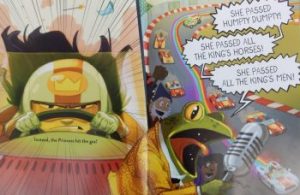
A princess racing car driver – Yeah! We first meet her as she makes a pit stop with one lap of the race left and is told by her Fairy Godmother that she’s in last place. ‘She might as well give up!’ is the suggestion from our narrator.
This particular princess is not however, a quitter: she’s one determined young woman and so it’s time to hit that accelerator – HARD!

Off she zooms, outstripping various opponents so the cleverly punning commentator tells us, leaving a trail of rainbow coloured exhaust in her wake.

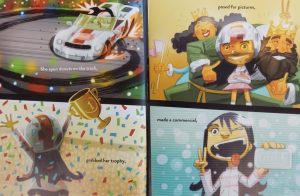
Before long she’s whizzed past scores of nursery rhyme characters, and pretty much every fairy tale character you can think of, (‘She spun out Rumpelstiltskin and butted in front of the The Three Billy Goats Gruff!’ we hear) as well as Beatrix Potter’s Flopsy, Mopsy and Peter Rabbit (what happened to Cottontail one wonders), until the only cars still in front are those belonging to the two ugly stepsisters ( I guess Cinderella’s elsewhere engaged) and after a lot of bumping and blocking on the sisters’ part, whoppee! – our princess, who isn’t at all alarmed by a bit of biffing and bashing, is declared the winner.

That however isn’t quite the end of the tale: there’s another competition still to be won and that involves taking a partner.
I’m not sure I wouldn’t rather have had her perform solo again, but still, this telling, coupled with Dan Santat’s computer game animation style art work will surely give you an adrenalin rush.
Reading the break-neck speed narration of royalty and racing aloud left this adult reviewer more than a little breathless.
Long live girl power!
There’s another race in:

Cleopatra Bones and the Golden Chimpanzee
Jonathan Emmett and Ed Eaves
Oxford University Press

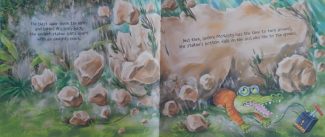
When news of the location of a priceless statue, The Golden Chimpanzee breaks, the race is on to get to the spot in the Jungle of Junoo on the shore of Lake Lazoo and secure the treasure.
Can canine explorer Cleopatra Bones, finder of the treasure map showing exactly where the statue is to be found, beat the opposition, in particular the dastardly driver of an armoured aqua-car, Al McNasty, and discover the hidden gold?

Cleo. spies something interesting, a monkey statue assuredly but it’s not a golden one and then suddenly Al McNasty skids to a halt at the base of the statue. He’s convinced the place to look is underground.
Al however isn’t prepared to pick up a spade and dig down deep in the hope of booty: instead he has another plan up his sleeve, one that entails creating a blast.

But when his ruse backfires in no uncertain terms, he inadvertently precipitates a rather exciting waterfall …

A fun, fast moving, rollicking rhyme from Jonathan Emmett accompanied by Ed Eaves’ detailed scenes of zany vehicles that travel over land, through water and air, driven by an array of funky animals is just the thing to keep youngsters on the edge of their seats as they root for Cleopatra and her pals, all of whom, along with the evil-intentioned reptile are catalogued inside the front and back covers.

My Town

My Town
Ingela P Arrhenius
Walker Studio

This large format picture book urban exploration is absolutely bursting with potential for discussion and language development with a group of preschool children.

The artist, Ingela Arrhenius has selected an exciting assortment of town-related places from a bookshop (I love that she’s included her Animals book in the window display)

to a building site, a police station to a port, a skyscraper

to a school and a museum to the metro.

Each of these and others are illustrated in a striking graphic style that has a retro feel.
Readers will enjoy following various characters who move from one page to another; but where will say, the woman serving in the bookshop and the guy buying a book next pop up?

Observant children will notice that the cyclist at the beginning of the book passes the hotel before ending up as a patient in the hospital on one of the final pages.

An almost wordless book (apart from the labels of the scenes, each with an aptly chosen typeface), there will be no shortage of words generated by, as I envisage it, groups of youngsters sharing the book while lying flat out on the floor, poring over each of its pages and making connections and storying excitedly, (perhaps with the occasional gentle nudge from a teacher or other adult), as well as making use of the picture dictionary front and back endpapers.

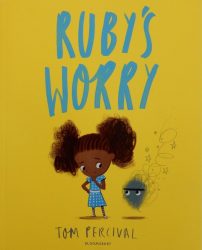
Ruby’s Worry

Ruby’s Worry
Tom Percival
Bloomsbury Children’s Books

All children have worries from time to time and so it is with young Ruby.
She’s always felt upbeat doing the things she loves until the fateful day she discovers, uh oh! a Worry.

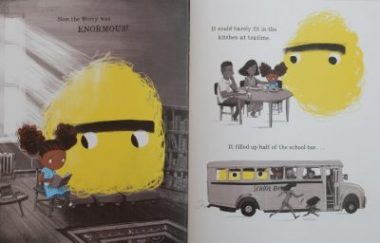
At first the worry is tiny, barely noticeable in fact, but the trouble is it begins to grow … and grow, day by day until it seems to be there all the time no matter what she does or where she goes.

Nobody else can see the thing and Ruby tries to stay positive but the Worry gets in the way of her doing her favourite things. Suppose it never goes away, she worries. Oops! Big mistake – the thing expands,

until it’s completely filling her every waking moment.

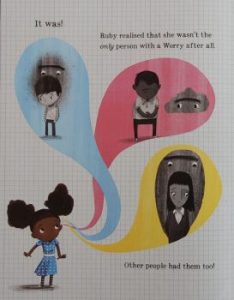
Then one day as Ruby is walking in the park she comes across a sad-looking boy and, something else is lurking beside him. A worry perhaps?

What happens thereafter is of enormous benefit to both the boy and Ruby herself.

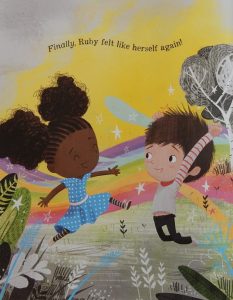
Yes of course, she still does have the occasional worry but now Ruby has a coping strategy so that she’ll never feel so overwhelmed again.

Tom Percival is such an empathetic story maker. Once again he explores a subject that affects so many young children through an empowering, book that all can relate to.

I love the way he adjusts the colour balance of his illustrations so that as Ruby’s worry grows, the pictures take on an increasingly grayscale appearance, with full colour returning when the two children’s worries are banished in an exuberant rainbow of joy.

A perfect book for stimulating discussion about worry sharing.

The Station Mouse

The Station Mouse
Meg McLaren
Andersen Press

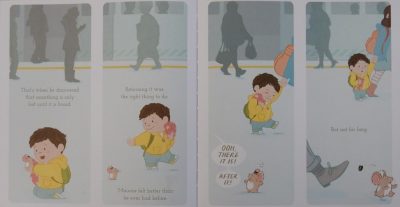
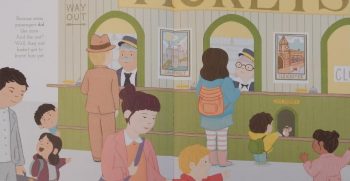
Maurice is a Station Mouse bound by the rules in the Station Mouse Handbook. The first rule states ‘A Station Mouse must remain unseen.’ The second is, ‘A Station Mouse must never go out in the daytime.’ Rule number three says, ‘A Station Mouse must never approach passengers.’
Clearly these rules are there for the benefit of humans, particularly that large majority who DO NOT like mice.

Now Maurice being a rule-abiding, recent employee of the railway spends his days (after sleeping late) hiding away and, it’s a pretty solitary life that gives him opportunities to contemplate such things as why nobody ever comes back to enquire about their lost things.

His nights in contrast, when nobody is about, are busy times when the mouse is occupied collecting all the items that have been left behind during the day.

One day Maurice spots a small child dropping a comforter; but what about that third and most important rule? Perhaps, if he values his life it would be safer to remain out of sight like the handbook says.

What about though, if you are absolutely sure that the lost thing IS a wanted thing? Maybe after all, it’s right to break the rule just occasionally whatever the consequences …

Seems there’s a price to pay for so doing which makes Maurice decide to keep to himself henceforward.

But then we are met with rule number four:’ If the bell rings, pull the alarm and return to your duties.’ That’s because a station mouse must not under any circumstances answer the bell – or should this rule too be ignored for it appears that the business about passengers not liking mice might just have some exceptions.

Time for a new rule and perhaps a different modus operandi …

Make sure you peruse both endpapers; they’re an important part of this cracking book. Its story really resonated with me as someone, who as an educator, is frequently accused of being a rule breaker or subverter. Good on Maurice for following his heart rather than sticking to the rule book.
Knowing when so to do is a vital lesson for children and one I believe they need to start thinking about right from their early days in nursery or even before.

Meg McLaren just keeps on getting better and better; this is my favourite of her stories so far. There are quirky little jokes, both visual and verbal wherever you look – even on the back cover. As well as creating superb characters, there’s an impressive sensitivity about everything she draws and she has an amazing eye for detail.

Dinosaurs Don’t Draw / Tyrannosaurus Wrecks!

Dinosaurs Don’t Draw
Elli Woodward and Steven Lenton
Macmillan Children’s Books

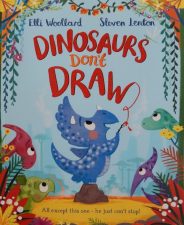
‘Of course they don’t’, children will be thinking in response to hearing the title of this book, but they’re in for a surprise thanks to Picassaur and his strange find. Said find is a white object and it’s not long before the young dinosaur has transformed his surroundings.

His mother is less than impressed: “We’re fighters and biters, as fierce as can be!” is what she tells her dino. infant.

Far from being put off, Picassaur continues with his creative endeavours, in glorious technicolour this time, but his father’s reaction is the same as his mother’s.

Despite his amazing third artistic effort, Picassaur’s cousins too respond negatively, telling him to forget his drawing and do battle instead.

Then all of a sudden they get the surprise of their lives …

Is that the end for all the little dinosaurs?

It certainly seems likely they’ll be the next meal for that T-rex; but something even scarier than himself meets his eye when he turns around …

Whoever thought pictures could be that powerful … Three cheers for peaceful solutions rather than conflict and another three for Picassaur who dared to be different.

Elli Woodward’s zippy rhyming text flows nicely inviting audience participation and in tandem with Steven Lenton’s spirited scenes of dinosaurs and the artistic outpourings of one of their number, makes for a fun story-time read aloud.

A rather different dino. character stars in:

Tyrannosaurus Wrecks!
Sudipta Bardhan-Quallen and Zachariah OHora
Abrams Appleseed

We all know that tyrannosaurs are renowned for their destructive ways and so it is for young Tyrannosaurus rex here. This young terror is not intentionally bad but his lack of awareness and over-exuberance results in a pre-school setting of angry-faced characters whose creative activities are ruined,

and whose quiet endeavours are disturbed.

Eventually thoroughly infuriated by all this wrecking, his classmates have had enough. “Tyrannosaurus – go!” comes the cry.

This causes contrition on the part of the antihero but even then his attempts to make amends flounder due to his ungainliness, at which point his fellow dinos. muck in, overseeing and facilitating the reparation.

However, just when harmony seems about to be restored we see that the little Tyro.dino. isn’t the only one capable of precipitating a disaster …

Zachariah OHora’s stand-out bright scenes of the classroom will attract pre-school humans but also include the occasional visual joke such as the Styracosaurus writing ‘climate change’ over and over on the chalk board to amuse adult readers aloud.
With its fun rhythm and rhyme, this stomping romp invites noisy audience participation.

Belinda Brown

Belinda Brown
David McKee
Andersen Press

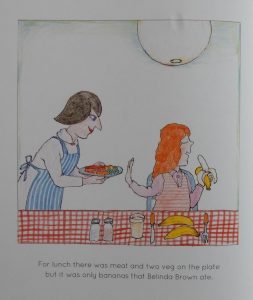
Belinda Brown is fanatical about bananas, insisting on dining upon them at every meal and in-between times too, even going to the lengths of keeping a spare in her sock should she feel peckish. None of her family or friends shares her ultra-enthusiasm for the fruit; in fact her friendship with best pal, Felicity Jones is terminated thanks to the curvy fruit.

So convinced are her parents that the child is merely going through a faddy phase that they aren’t troubled by this over-indulgence:

it’s left to her Grandma to worry about Belinda’s obsession.
She becomes increasingly troubled until eventually on a walk together, she begs her granddaughter to cut down on the bananas for fear her body should start to mimic the form of same.

Belinda has no wish for her back-bone to take on a banana-shape and so, rather than give up what she loves so much, the girl tries her own method of offsetting any possible curvature that might occur.

The results however, are not quite what she’s hoping for …

Rhyming nonsense from McKee to tickle the taste buds and bring on the giggles. Belinda’s a totally zany character but you’ll also love her small brother Bryan, the balletic, skinny Aunt Sally and the banana-sharing toddler twins, all portrayed in McKee’s signature style.

World of Birds / My RSPB Sticker Activity Book: Woodland Animals

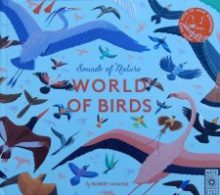
World of Birds
Robert Hunter
Wide Eyed Editions
This is the first of a new Sounds of Nature series, which has ten 10-second natural soundscapes available at the touch of a button.
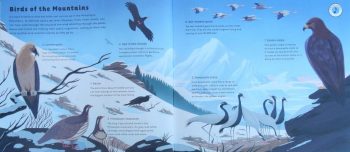
Herein readers can visit and explore ten diverse habitats—from the Himalayan Mountains

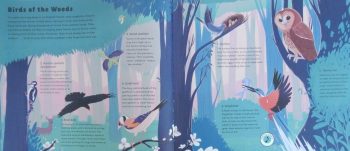
to the wetlands of Kenya’s Lake Nakuru, and the tropical rainforest of New Guinea to an English forest

and listen to birds in the wild with this exciting book, strikingly illustrated by Robert Frank Hunter.
There’s a brief paragraph of facts about each bird species included and their respective numbers relate to the order in which the sounds they make can be heard.
An interactive book for young, and not so young nature lovers that called to mind an alarm, sounded by ecologist and musician, Bernie Krause in his recent book: ‘A great silence is spreading over the natural world even as the sound of man is becoming deafening.’
Let’s hope that it doesn’t spread over the wonderful habitats featured by Hunter.

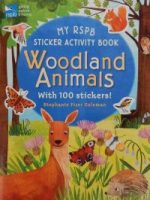
My RSPB Sticker Activity Book: Woodland Animals
Illustrated by Stephanie Fizer Coleman
Walker Books

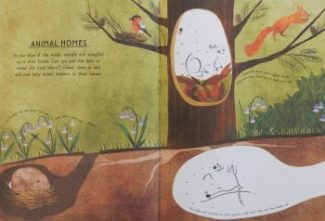
There’s a range of activities to engage young children in this woodland setting book. Readers can enjoy dot to dots,

colour in some of the creatures including completing and ensuring the symmetry of the peacock and red admiral butterflies (they’d have to check elsewhere for the colours of the latter), add stickers to scenes (in some cases completing a puzzle), hunt for partially hidden nocturnal animals, complete a maze and spot differences.

The semi-matt finish and reproductive quality of the stickers, along with the illustrator’s attractive collage style art work and the factual information integrated into the various scenes make this a book to keep and return to after the tasks have been completed.

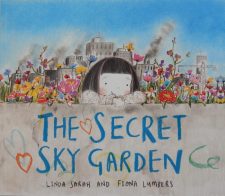
The Secret Sky Garden

The Secret Sky Garden
Linda Sarah and Fiona Lumbers
Simon & Schuster

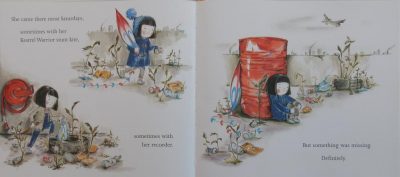
Funni loves to visit the disused rooftop airport cark park, coming almost every Saturday to fly her kite or play her recorder but always she feels a lack of something.

She can imitate the notes from the airport tannoy, the whine from the engines of landing planes and the music of the bells in City Square, but something else is needed. Something visual perhaps?

Funni decides on operation transformation and each week for the next three months she brings a sack of soil and collects up all the litter until eventually, the entire surface is covered with soil.

Then it’s time to plant seeds and wait …

Now in addition to flying her kite and making her music, Funni has the flowers to tend but even so, still she feels something is missing.

Then the very first visitor arrives …

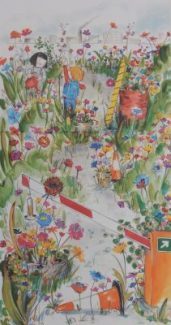
What happens thereafter will make your heart sing: I won’t reveal what that is, but suffice it to say it involves a flourishing of flowers aplenty, and friendship, a city soundscape with beautiful music, kite flying and thanks to Fiona Lumbers’ glorious floral scenes, the most gorgeous colours you can imagine.

Linda Sarah’s Funni is an enchanting child and her story, although sparely told is pitch perfect for her themes and has touches of poetry.

With its inherent creativity motif this is altogether an uplifting book that will delight both children and adults alike.

Picking Pickle

Picking Pickle
Polly Faber and Clara Vulliamy
Pavilion Children’s Books

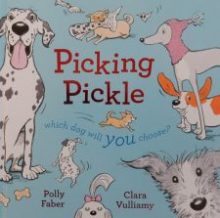
Here’s a story from the dream team, Faber and Vulliamy, creators of the Mango & Bambang series who now take us to a dogs’ home and, courtesy of longest term resident canine narrator, help us find just the right dog. But which one will it be? There are just so many potential companions to choose from it’s a veritable canine conundrum.

Who better though to introduce fellow residents; our narrator knows the ins and outs of them all so let’s meet some.

There’s incredible handsome, silky-haired, prize winning Geraldo; what about him? Or he of the voracious appetite, Harvey?
Perhaps we might prefer Dumpling, a clever pooch, chewer of news, views and crosswords at super fast speed as well as being multi-lingual.

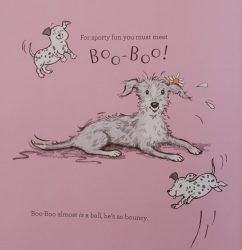
Maybe Matilda – she of the perfect teeth – and an excellent guard dog; or super-cute Boo-Boo, bouncy as a ball.

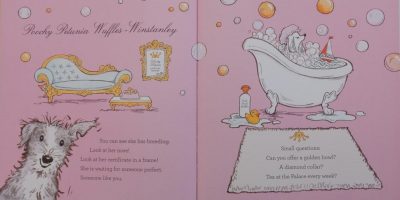
Then again, there’s Poochy Petunia Wuffles-Winstanley, undoubtedly the poshest pet of the lot, although on occasion her manners leave something to be desired.

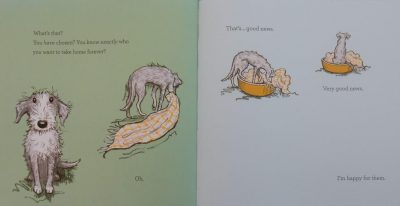
Oh what a dilemma, a real pickle indeed. Perhaps it’s easily sorted; I know which I’d choose. The one that bears a close resemblance to the canine, Chester, my best friend is currently caring for, the one  that I sometimes accompany on walks in Bushy Park:

I wonder; might it be our faithful narrator himself …
Full of fun and heart, Polly’s laugh-out loud text combined with Clara’s cracking, brilliantly observed, canine portraits make for a deliciously silly pooch-filled romp that ends just perfectly.
Make sure you check out the end papers, they’re a delight too.

Steve, Terror of the Seas

Steve, Terror of the Seas
Megan Brewis
Oxford University Press

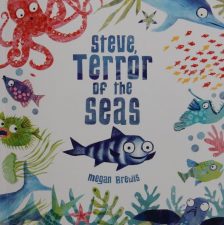
Steve is not a very big fish, his teeth aren’t really razor sharp,

he’s no angelfish certainly, but why, he wonders, is it that the very sight of him sends not only all the fishes large and small, but other sea creatures too, and even humans, into a terrified tizzy.

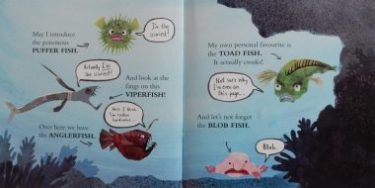
Let me introduce some of the most alarming varieties of the fish Steve shares the ocean with: here they are, each one appearing decidedly more likely to have you for breakfast than Steve;

but I’ll leave him to do the honours when it comes to an introduction to his best pal, George. “We go EVERYWHERE together” Steve tells us “And George doesn’t think I’m scary at all!’ Now why would that be?

This is just a made up tale, you’re probably thinking but actually it is and it isn’t. Steve is a Pilot fish for George; and they share a symbiotic relationship. He keeps George free from harmful parasites and is even allowed to clean his teeth. Ooooh!

Essentially this is an extended joke of a story with a factual sting in its tail. It’s amusingly illustrated with interestingly textured, sub-aquatic scenes by relative newcomer to the picture book scene, Megan Brewis.

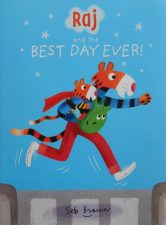
Raj and the Best Day Ever!

Raj and the Best Day Ever!
Sebastien Braun
Templar Publishing

Meet young and entirely lovable tiger, Raj and his cool Dad.

They’ve drawn up a plan of the adventure they’re about to embark upon and are super-excited about the whole enterprise. Then it’s a case of back-pack packed and they sally forth.

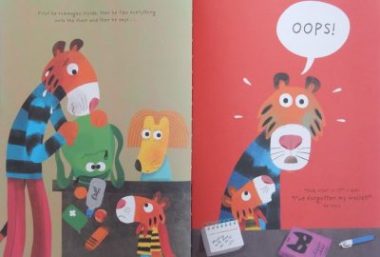
First stop the library and book chosen, it’s time to show your library card. Oh NO! Disaster! Dad hasn’t brought his wallet. Without that all the things on that list have just flown out of the window so to speak.
Raj is convinced that their perfect day is ruined before it even begins., especially as down comes the rain.
Time to get those imaginations powered up …

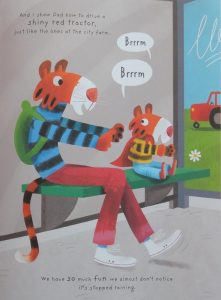
Off they go and before long, it looks as though the day might just be rescued,

but then the wind whisks their list up and away and in Arnold Lobel’s Frog and Toad style, Raj fears that without their list, they won’t know what to do.

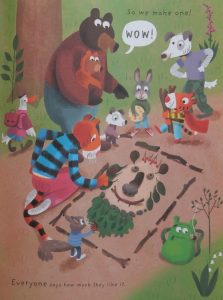
Good old Dad! Imagination rules again and off they go once more.

With a wonderful twist in its tale, Sebastien Braun’s story is an absolute winner. Sadly my copy arrived too late for Father’s Day but this is a perfect share on any day: a Dad who’s willing to pitch in and enjoy life no matter what; a book enthusiast offspring equally willing to look on the bright side – two colourful characters superbly portrayed by Seb Braun whose books just keep on getting better.

This one could be the perfect distraction from that seemingly wall to wall soccer and it’s a cracking demonstration that companionship and imagination are all that’s needed for the very best day ever: no money, no technology, just free-flowing fun.

Ta-Da!

Ta-Da!
Kathy Ellen Davis and Kaylani Juanita
Chronicle Books

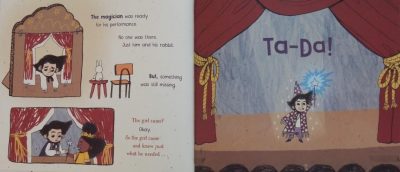
Once upon a time a little girl was playing happily with her animal friends in a homemade castle until DUN DUN DUH! there appears at her door, a wizard accompanied by his ‘dragon’.

So begins an action and reaction concatenation with boy wizard attempting to subvert the girl’s peaceable play with his roistering, wrecking actions. She counters these with her wand ‘Ta-Dah!’ and magic spells.

This to and fro of ‘Dun Dun Duhs and Ta-Dahs continues apace until the dragon, having imbibed rather too much water, needs an urgent visit to the bathroom, and the boy exits stage right …

leaving girl and dragon to live happily ever after.

Well, perhaps not quite ever after, for after an uneventful interval, the two decide to pay the boy a visit to see how things are going. And going they certainly are: the boy has become a magician and is about to perform before a decidedly small audience.

Small that is, until girl and dragon pitch in providing more watchers and a co-performer.
Show over, it’s time for a snack providing more happily ever afters … whoops! Not EVER, after all: there’s still time for one final, sub-aquatic adventure together.

DUN DUN DUH! … Ta-Da!’

Conflict and resolution done with panache in this debut for both author, Davis and illustrator, Juanita. It’s a wonderful portrayal of children’s imaginative play with its give and take and boundless possibilities.

A House That Once Was

A House That Once Was
Julie Fogliano and Lane Smith
Two Hoots

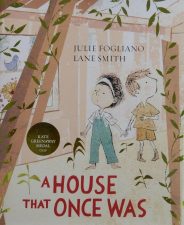
Quiet in its impact, this is one of those slow burn books that carry on working inside you long after you’ve closed it.
Immediately I started reading it, I was taken back to one of my childhood walks along a road close to where I lived, not in a wood atop a hill like the one Julie Fogliano describes, but a suburban one. There was surprisingly, a ramshackle-looking house overgrown with thick foliage, empty, but some said a witch woman lived within.

Unlike the two children in this contemplative lyrical story, neither I, nor any of my friends dared venture inside although, as the children here, we did speculate and make up stories about possible previous occupants, albeit from the safety of the rackety gate. That house has long gone, replaced by a new development, but its memory remains to this day.

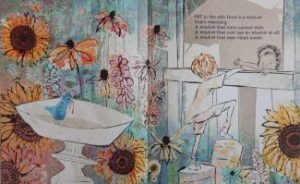
‘Deep in the woods/ is a house/ just a house/ that once was / but now isn’t/ a home.’ In fact it’s derelict and totally uninhabited save for the intruding textured foliage Lane Smith has woven between its cracks and in and out of its broken doors, roof and windows.

It’s one of these windows through which the boy and girl climb to explore.

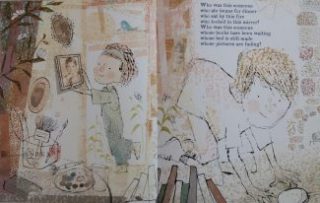
Within, they discover the ephemera of a life that once was: a shelf of books, old toys, art materials, old photographs.

‘Who was this someone who ate beans for dinner/ who sat by this fire/ who looked in this mirror?’ ask the narrators, ‘Who was this someone / whose books have been waiting / whose bed is still made / whose pictures are fading? … Who was this someone / who left without packing / someone who’s gone but is still everywhere?’

Ghostly echoes there, until the children begin to ponder upon who the residents might have been, becoming increasingly playful in their imaginings, Lane Smith’s scenes growing brighter as they do so.
(At the back of the book is a note explaining the two different techniques employed to create the ‘present day’ and ‘imagined scenes”’)

Still wondering, the two eventually return to their own home where warmth and dinner await.

Full of mystery, intensely beautiful, is this entrancing story of what is, what was, and what might have been, all seamlessly melded together through Folgiano’s telling and Smith’s showing.

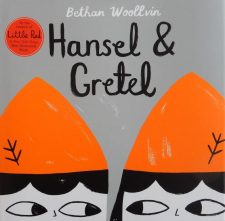
Hansel and Gretel

Hansel & Gretel
Bethan Woollvin
Two Hoots

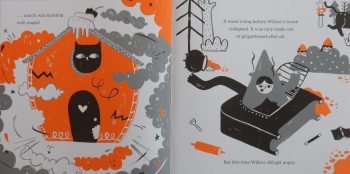
Most children are familiar with the story of Hansel and Gretel wherein the siblings are cast out from their home into the forest where they encounter a wicked witch; but in her latest fairytale reworking, Bethan Woollvin mischievously turns the tale completely on its head.
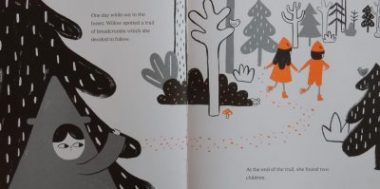
Here it’s Willow, a very good witch, who follows a trail of breadcrumbs dropped by the brother and sister.

She sees those breadcrumbs as messy and likely to lead vermin to her gingerbread home. Her request that they tidy up is ignored and she’s left to do the job herself, but- ‘Willow did not get angry, because Willow was a good witch.’

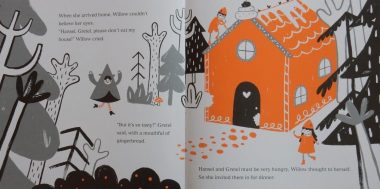
On returning home she finds Hansel and Gretel tucking into her house, literally, but despite their appalling behaviour, instead of being angry she invites them into her home for dinner; they must be very hungry she tells herself .

Rather than being grateful for her hospitality, the gluttonous children continue pushing Willow to the limits of her patience until finally, she does get angry.

The totally unexpected and wonderfully dark and humorous finale is spl-utterly delicious.

In her striking signature graphic style and limited colour palette, Bethan Woollvin has again produced a wonderfully witty visual narrative from simple shapes and textures. I love the scattering of birds and tiny animals watching the events from the vegetation that somehow make you pay attention to those stark shapes both large and small. Love the clever endpapers too.

Perhaps not for the most faint-hearted, but I can’t imagine many listeners not devouring this one and asking for more.

Stonkingly brilliant!

Albie Newton

Albie Newton
Josh Funk and Ester Garay
Sterling

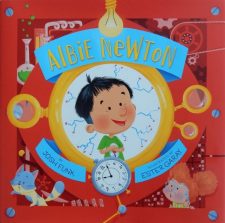
Albie Newton is a thinker, a ‘child genius’ so we’re told, learning a new language almost every week and he also loves to tinker.
The lad starts school mid term and in the hope of making some friends, decides to build a special surprise gift for his new classmates.

It doesn’t take long for the newcomer to start rubbing the others up the wrong way. In addition to shining in all areas of the curriculum,

his behaviour is more than a little disruptive, particularly when he appropriates items from the classroom; and the noises he makes are nothing short of ear shattering.

Albie however, is completely oblivious to the effect of his actions; his social skills are clearly nothing like as developed as his intellectual and inventive ones.

Fortunately for Albie though, one of his classmates, Shirley by name, has been keeping an eye on his secret activities and seems willing to give him a chance. She thinks that perhaps Albie is well intentioned. Can she convince the others to give him the benefit of the doubt?

Perhaps, when they see that special gift he’s constructed …

It will be pretty obvious to adults, especially teacher readers of Funk’s seemingly light-hearted rhyming story, that Albie is wired differently from the other children.

With in-built messages about accepting difference and building empathy emerging, it offers plenty to discuss; and illustrator, Ester Garay ‘s bold bright illustrations have plenty of details to amuse, as well as effectively conveying Albie’s abundance of mental and physical energy.

Something Fishy

Something Fishy
Polly Dunbar
Two Hoots

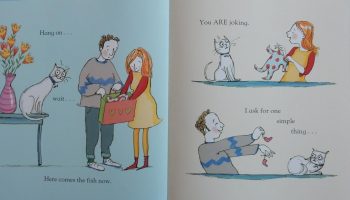
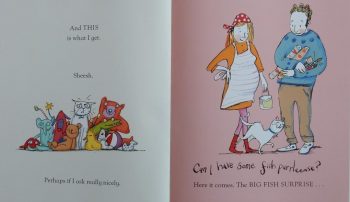
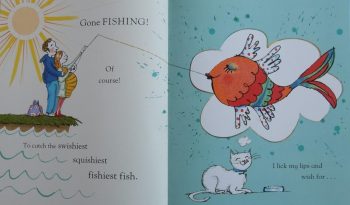
There are undoubtedly fishy goings on in the moggy narrator’s house, however, not the kind of fishiness appreciated by the normally, extremely well fed cat.

Despite polite requests for fishy offerings the other family members merely look blissed out and produce such items as tiny suits and soft toys. Hmm!

By this time listeners will have figured out what’s imminent even if the ever- grouchier narrator hasn’t. Now this really isn’t funny; well, not if your desire for all things fishy isn’t being satisfied, however nicely you ask.

Then suddenly the cat is left alone in the house: of course they must have gone fishing: oh, the eager anticipation!

What comes back home though is certainly not fish but something that changes Cat’s expectant smile into first a look of bewilderment, and then extreme disappointment.
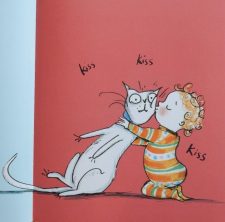
Altogether a charmer, Polly Dunbar’s new book is purrfect for families where the arrival of a new brother or sister sibling is fast approaching, especially as there seems to be enough love to go round for everyone …

Polly’s illustrations are so brilliantly expressive, funny, and occasional jealous cat countenance notwithstanding, full of her characteristic joie de vivre.
An absolute winner.

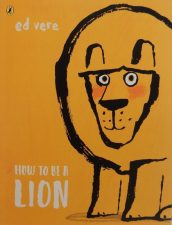
How to be a Lion

How to be a Lion
Ed Vere
Puffin Books

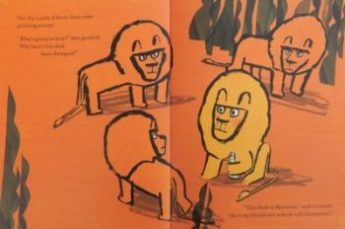
‘This book is for those who daydream, and those who think for themselves’.
I love that. It’s written in Ed Vere’s inspiring ‘letter’ that accompanied my review copy; it’s also printed on the final page of his eloquent story: I hope it applies to myself, make that, to everyone. I wish everybody could read the entire letter, but instead I urge you to get yourself a copy of the book and share it widely.

It starts philosophically: ‘The world is full of ideas. /Big ones,/ small ones. / Good ones,/ bad ones. / Some think this … / others think that.’ before bringing us back to earth and in particular, lion territory on the African plains where the norm is to be FIERCE! But is that the only way to be?
Enter Leonard: thoughtful, prone to daydreams, something of a poet and above all, gentle.

Enter shortly after, a duck, Marianne by name. Being Leonard, it isn’t a case of ‘Crunch, crunch, CHOMP!’ Instead our lion, polite introductions over, requests her assistance and as luck would have it, Marianne is able to assist in freeing Leonard’s stuck muse and before long a firm friendship has been forged; one that involves stargazing, philosophical musings and above all, contentment and happiness.

Into their peaceable existence comes a pack of ferocious lions demanding to know why the duck has not met its demise.
True to himself, Leonard explains about their friendship and resists their loud growly admonishments.

Their instructions about becoming fierce make him pause and question however, but Marianne suggests a trip to their thinking hill to mull things over. Lo and behold, serious hums and serious quacks together are turned into an idea, and then, poetry that is finally ready to be presented to those fierce lions.

What Leonard says to them is heartfelt, provocative – “Why don’t you be you … And I will be I.” – and one hopes, a game changer.

Ed Vere’s timely fable is profound and intensely moving in the gentle way it offers words as tools of bridge building and change, as well as showing a different male role model. Don’t be pressurised into conforming, be yourself is what shines through both his words and oh, so eloquent, humorous illustrations.

A perfect read aloud with oodles of food for thought, and talk.

Ready to Ride

Ready to Ride
Sébastien Pelon
Words & Pictures

What can you do on a dull, stay- indoors kind of a day that’s already become boring? You might perhaps, like the small child narrator of this story, venture outside and see what unfolds.

Into view comes a large furry shape riding a tiny bike and sporting a luminous pink hat. They make eye contact and the boy hops on his own bike and off they go.

It isn’t long before the human is wanting rid of his stabilisers, which his new friend helpfully consumes leaving the lad struggling to cope with trying to ride his ‘big boy’s’ bike.

The learning curve is steep with the usual frights, falls and rallying,

along with the odd spot of relaxation,

until finally come success, speed and some over-confidence.

All the while though, the silent, white lumpy creature is there ready to offer succour and the occasional bit of provocation: then suddenly he’s gone.

Perhaps he was never there at all except in the boy’s mind.

Back home goes one small child, proud of himself and eager to tell his mum and dad about his adventure but when a “What did you do?’ comes from Mum his answer is let’s say, understated.

You can succeed so long as you show resilience, is what comes through in Pelon’s picture book.

Its graphic format is such that it works best as a one-to-one share and with that blank ‘Super Cyclist’ certificate on the back endpapers, is certainly one to offer a child at that same stage of readiness to fly solo on two wheels. I love the colour palette and the plethora of humorous details.

The Day War Came

The Day War Came
Nicola Davies and Rebecca Cobb
Walker Books

I came back home after a few days away to find this book waiting; it was the day we heard about the egregious separation of children from their parents at the US border, so it was especially moving. It is also Refugee Week as I read/write this – even more timely and heartbreakingly pertinent, especially as I think of my Syrian friends who fled their home country from war a couple of years ago and are now happy and their two children loving their primary school in Stroud. No lack of chairs there.

Nicola Davies wrote the text, a poem, as a response to her anger at our government’s refusal to allow 3000 refugee children to enter the UK in 2016. A poem that began the 3000 chairs campaign for which artists contributed pictures of chairs, symbolic of a seat in a classroom, education, kindness and the hope of a future.

For those who didn’t read the poem when it was published in the Guardian, it’s a spare text narrated by a little girl from a country, perhaps Syria, blighted by war whose day starts normally – breakfast with her family and then school where in the morning, she learns about volcanoes, draws a picture of a bird and sings a song of tadpoles.

After lunch though comes war, destroying her school, her home, her town,

leaving her alone, bloody and tattered.

Somehow she makes it to a boat and thence to a beach and then to a camp. “But war had followed me. / it was underneath my skin, / behind my eyes, / and in my dreams. / It had taken possession of my heart,” she says.

Nicola Davies is a fine weaver of words; her text is heart-wrenchingly powerful and ultimately, redemptive – having initially been turned away from a school classroom because there was no chair for her, one is supplied by a little boy,

whose friends do likewise … as the children walk together, “Pushing / back the war / with every step.”

Rebecca Cobb has done an outstanding job with the illustrations. Her watercolour, crayon and pastel pictures – scenes of destruction, flight and desolation, all too familiar to us from TV news bulletins, have a heightened poignancy so rendered, and are all the more powerful viewed together with her images of normal life in home, street and classroom.
All her characters are incredibly expressive both facially and in their body language, and the little girl is the very embodiment of the poem’s narrator.

A must read book for anyone who values humanity.

£1 from every copy of the book sold will go to the HelpRefugees charity.

Grandad Mandela

Grandad Mandela
Zazi, Ziwelene & Zindzi Mandela and Sean Qualls
Lincoln Children’s Books

Nelson Mandela is my all time hero and I was thrilled to see this picture book published in honour of the 100th anniversary of his birth (July 18th 1918).

It takes the form of a dialogue between Mandela’s great grandchildren Zazi and Ziwelene and their Grandma Zindzi – his daughter, after the children discover a photograph of Grandad Mandela.
Can you tell us about him again?” they ask and a discussion ensues with Zindzi Mandela answering the children’s questions.

It’s an earnest discussion during which we, and the children, learn of South Africa’s recent history, about what it was like to be a child of apartheid (“But why did the white people start making everybody’s lives sad?” … “Did they make your lives sad too?”)

and about the role the family and in particular Mandela played in ending the apartheid regime. “Grandad was fighting for us all to be equal.” she says in response to Zazi’s “Why did Grandad go to jail?

The fight was one that continued throughout the 27 long years Mandela was a prisoner, both by himself and others who carried on the fight for the equality he believed in, and for freedom.

The penultimate question “Do you know what ubuntu means?” comes from Grandma Zindzi who goes on to explain “It means ‘I am because we all are’.
A powerful unifying thought that encapsulates Mandela’s legacy to us all wherever we are, a legacy that embodies service to his people and forgiveness.

Qualls’ illustrations rendered in acrylics, collage and pencil are absolutely superb embodying in turn, love,

hope, brutality (by the police), protest, joy,

family pride, diplomacy and more.

Powerful, inspiring, intensely moving and a wonderful tribute to an amazing man; (it brought tears to the eyes of this reviewer), this is a book for everyone who wants to pay tribute to the icon of equality and peace that is Nelson Mandela and surely that is all of us, young and not so young.

Magna Cow / A Campfire Tale

Magna Cow
Barry Hutchison and Cate James
Little Door Books

Brisket is a cow, an unusual one with especially curly horns, a particularly frizzy tail and, when it’s dark a faint glow emanates from her. Odd though these features might be, there is one that makes her even more extraordinary, she’s magnetic.

It’s this magnetism that causes Magna to create havoc at the cows’ camping trips,

bring about the dismantling of their treehouse and appropriate the cutlery at a party.

Consequently when the big day of the Moove to the Music dance competition comes around, Brisket is banished to the top of the hill while the other bovine beauties strut their stuff.

Suddenly disaster, in the form of a trundling tractor moving downhill, is about to strike. The dancing cows are too busy prancing and pirouetting to notice what’s happening. Only Brisket from her hilltop vantage point sees the danger: can she save the day?

Cate James daftly depicts this bonkers, but fun tale, about mooving metal, bovine bother and friendship from Barry Hutchison, with appropriately crazy-looking cattle and their shenanigans.

Specially written songs can be downloaded from the publisher’s website.

A Campfire Tale
Sarah Glenn Marsh and Ana Gómez
Sterling

The first night away from home, be it a sleep over or as in this story, a camping trip, can be a scary thought for some children and it appears so with Dragon too.

The child narrator though offers to act as his buddy. Assuming he’ll be a great companion, she takes him swimming, sailing and involves him in the whole gamut of camp-related activities,

even a puppet show; but all go pretty badly to say the least.

Perhaps it was a big mistake to take on the Dragon as her buddy especially as the other campers now seem to be avoiding them.

Come the evening, Dragon is a disaster when he attempts to help with the tent pitching and insists on listening to ghost stories, despite being scared stiff of same, but the last straw is his effort to get rid of a spider, which only serves to inflame the situation.

The narrator sends him packing and in the morning, there’s no sign of the scaly character.
The campers search for him in the woods but quickly get lost; what’s more they hear something growly in the distance.

Could this be an opportunity for Dragon to redeem himself perhaps?

The bold, bright illustrations by Ana Gómez are comical and engaging, showing the feelings of both Dragon and narrator.

Tropical Terry

Tropical Terry
Jarvis
Walker Books

Come with me to Coral Reef City, home to the most flashy, dashy array of fish you could imagine. It’s also home to Terry. Terry has no dazzling scales or funky fins to flaunt. He does however have two good friends, Cilla the crab and Steve the sea snail with whom he lives and plays.

The three and their games of Dodge-a-Dolphin, Shark Speed and Hide-a-Fish are shunned by the tropical fish on account of their drabness. Terry’s pals try to cheer him up but he still hankers after that dashing, flashing life.

A plan is needed and next day, with the help of his friends, operation transformation Terry is put into action.

Now he verily outshines everything else in Tropical City.
At last he’s one of the fishy dazzlers and much too busy with his new acquaintances to bother with Steve and Cilla.

One day however, Eddie the Eel arrives on the scene and Terry’s life in is great danger. What can he do to escape becoming an eel’s next meal?

There’s only one way to find out: get your fins on a copy of Jarvis’ tale of friendship and sea changes and read the rest of this piscine picture book.

Jarvis never fails to delight: his deep-sea adventure is certainly one to dive into.

Mixed

Mixed
Arree Chung
Macmillan Children’s Books

In the beginning there were three colours: Reds – the loud ones; Yellows – the bright ones and Blues – the laid-back ones, and they lived in harmony.
One afternoon though, the Reds took it upon themselves to declare that they were the best colour and that was the start of disharmony

resulting in the erection of fences, tall brick walls and separatism. Does that sound familiar?
However, one day a Yellow and a Blue notice one another and realise that their distinctive characteristics are of mutual benefit:

in short they become best buddies and more, to the alarm of the others of the three hues.
Love prevails, the two MIX and it’s not long before they’ve created a new colour they name Green. She has elements of both parents but is unique and, all the others love her.
So much so that they too begin to mix … and mix …

gradually transforming the entire neighbourhood into a harmonious, multi-coloured environment.
My immediate response to this straightforward story was ‘If only it were that simple.‘ That said the book contains powerful messages about the importance of diversity, acceptance and respect for others, as well as celebrating how  people’s differences can be tools for transformation.

Skyward: The Story of female Pilots in WW11

Skyward: The Story of Female Pilots in WW11
Sally Deng
Flying Eye Books

Here’s a beautifully produced, exciting book, based on real events, telling of three young women, Hazel, Marlene and Lilya, who pursue their dreams to become pilots and, countering gender stereotypes, go on to fly for their countries – the USA, England and Russia, in the Second World War.

First though they had to overcome, not only family ridicule but that of their governments and the armed forces.

“You’re taking all the jobs from our men!” Hazel was told by prejudiced people in powerful positions.

Even once they’d graduated it wasn’t all thrills; there were spills too …

and enormous risks.

But the three and the other female pilots did their utmost with little recognition and paltry pay, and in so doing paved the way for generations of young women.

Sally Deng, whose debut book this is, has, like her subjects herein, set the bar high for herself. Her carefully considered, inspiring telling coupled with her charismatic art style make for a powerful read.

A ‘must include’ for any World War Two topic in schools and a book I’d hope will be shared and celebrated, along with its subjects, by all who want to fly the flag for women’s achievements and for following your dreams.

Audrey the Amazing Inventor

Audrey the Amazing Inventor
Rachel Valentine and Katie Weymouth
Words & Pictures

Hot on the heels of Ada Twist, Scientist and Rosie Revere, Engineer comes another young girl character with a passion.
Meet Audrey, inquisitive and an inveterate fiddler with things, who, having declared to her teacher, her intention to be an inventor, sets about achieving her ambition.

She starts with items to make life better for her dad and Happy Cat but after a very rocky start

and even more disastrous next efforts, Audrey miserably declares herself “the world’s worst inventor!

Luckily for her, her dad, far from making disparaging remarks, encourages his daughter to learn from her mistakes and carry on trying. Wise advice.

It works too, for it isn’t long before Audrey is inventing again, but this time she’s extra careful at the planning stage, the constructing stage and the testing stage. Dad cannot wait to see the new invention.

Will it work to the satisfaction of all though? It’s certainly wildly inventive, and sophisticated; but will it deliver?
Crazy, but enormously enjoyable and an inspiration to young female would-be scientists, technologists and engineers: Audrey demonstrates just how much enjoyment the STEM curriculum offers and Rachel Valentine’s narrative reminds children of the importance of persevering, and of following your dreams.

There’s a slight touch of the Heath Robinsons about some of Katie Weymouth’s zany scenes of Audrey at work on her inventions, and she also adroitly captures the close and supportive relationship between father and daughter.

Don’t Feed the Bear

Don’t Feed the Bear
Kathleen Doherty and Chip Wass
Sterling Children’s Books

Teachers of young children know what appeals when it comes to story time; they certainly ought to or they shouldn’t be in the job. Not all of us though can use that knowledge to produce super book texts that make great read alouds like Kathleen Doherty has in this, her debut picture book.

There’s been a plethora of picture books featuring beary characters this year, in fact I’ve featured quite a few on this blog, but none with such wonderful endpapers as this one.

Now what about the story? First there’s that Bear, resident of a forest frequented by campers, a large creature that particularly relishes the tasty offerings left by same. There’s also a ranger, short of stature, seemingly a jobsworth kind of character, equally keen on the food left behind and partial to erecting signs such as the one that gives the book its title.

When she does just that, she triggers a veritable sign-writing skirmish …

lasting much of the day …

until a détente is reached and the signs are amended one last time.

Will those signs have the desired affect now? Here’s a clue …

However, if you want to know who has the final word, then get your paws on a copy of the book and find out for yourself. It’s brimming over with wonderfully join-in-able onomatopoeia – here’s a taster : ‘SMACKITY! SMACK! WHOMP! CLOMP … CLOMP … CLOMP’, there’s the occasional rhyme and a thoroughly satisfying finale, not to mention the understated message that two heads, or rather pens, are better than one.
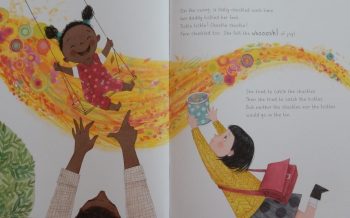
Then of course there are Chip Wass’s funky, bold scenes of the arboreal antics that are guaranteed to delight.

This is a sure fire story time winner: Kathleen’s short sentences allow the reader aloud to create maximum impact with each one and the illustrations are delectably droll.
Having said all that, the nature of the text is such that after a couple of sharings, children may well feel they’d like to try the book themselves.