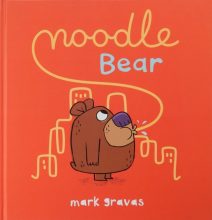
Noodle Bear

Noodle Bear
Mark Gravas
Walker Books

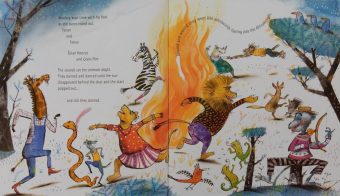
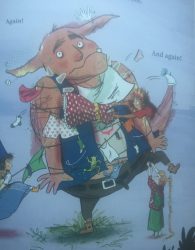
When spring arrives the animals celebrate with a party but there’s a notable absentee, Bear. Fox, the party organiser goes off in search of her friend, taking with her an offering of snacks only to find Bear asleep having spent all winter bingeing on his favourite noodles and watching Noodle Knockout on TV.

So obsessed with noodles is he that instead of consuming the treat he’s been left, all he can think of is yet more noodles.
None of his friends can supply the necessary
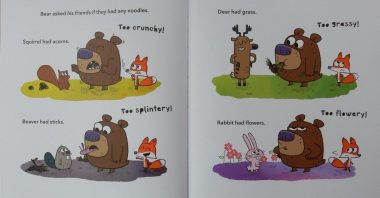
and eventually Bear decides to travel to the big city and take part in his favourite game show.

Unsurprisingly, he has no trouble securing the Grand Noodle Champion’s crown
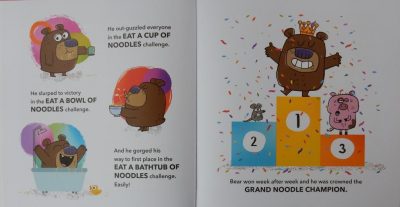
and quickly becomes a celebrity with his own show.

Satisfying though all this fame and unlimited noodles might be, before long, Bear realises that there are other more important things in life – his friends and all the fun things they did together. Only these can really fill the emptiness he feels deep inside. So it’s a long journey back to the forest where awaits a celebratory party thrown by his best pal, Fox; guess who supplies the noodles.

There’s a comic, cartoony feel to this cautionary tale of having too much of a good thing that will surely lure screen-obsessed little humans away from their digital devices for a while.
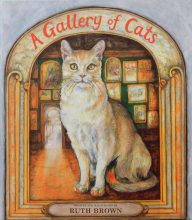
A Gallery of Cats

A Gallery of Cats
Ruth Brown
Scallywag Press

Tom who is visiting an art gallery with his granny wanders off into a side room where something quite amazing happens.

As he stands reading a label beside the Jackson exhibit, out of the painting leaps a cat. Tom follows it.

Seemingly there’s been a feline invasion for from almost a dozen works of art that closely resemble famous masterpieces, there appear in turn as Tom pauses to read the labels to his guide Jackson, cats named Gustav, Piet, Frida, René, Vincent, Maukie & Cornelis, Kats,

Henri, Edvard,

William and Samuel.

Eventually with a bevy of assorted cats at his feet Tom turns a corner and there before him is the famous Rousseau-like tiger.

At the sight of this the other felines turn tail and dash back to their own paintings; not Jackson though; he at least waits to bid farewell to the boy while his gran looks at the notice announcing a new exhibition; no prizes for guessing what the topic is.

Cleverly conceived and superbly executed in her own painterly style, Ruth Brown presents a playful introduction to the work of thirteen world famous artists. Cat lovers and primary teachers in particular will love this novel way of bringing their work to life for children who have yet to see the real pictures.

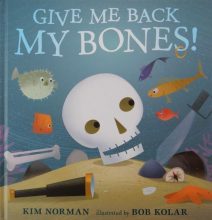
Give Me Back My Bones!

Give Me Back My Bones!
Kim Norman and Bob Kolar
Walker Books

‘A stormy night has passed here /and toppled every mast here./The ocean flowing fast here,/has scattered all my bones!’ But from who or what is this making this claim on the opening spread, readers will wonder.

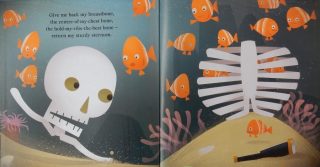
A page turn reveals a skull and thereafter Kim Norman’s spirited rhyming narrative cleverly introduces each vertebra from the skeleton using both the scientific name and an everyday one: ‘Give me back my breastbone,/ the centre of my chest bone, / the hold-my-ribs-the-best bone – / return my sturdy sternum.’

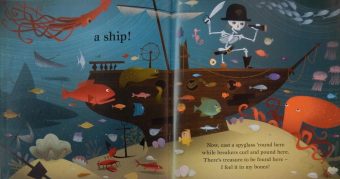
As the story progresses we realise  it’s a pirate skeleton that, with our help, is putting himself back together piece by piece from among the marine flora and fauna Bob Kolar has scattered collage-style on the ocean bed.

Love the generous sprinkling of alliteration – ‘I claim my clavicle

… that armpit-of-alarm bone – I hanker for my humerus’ , … I miss my metatarsals’, as well as the other playful language that’s part and parcel of this bone-rattling reclamation, which finally sees the reconstructed skeleton proudly standing before all that have helped complete him …

Don’t miss the endpapers – the front shows all the disparate skeleton components, the end ones display the cutlass waving salt.

Anatomy with a mock scary twist:  Avast me hearties, go grab yourselves a copy of this rattling good book. ARRRR!

Fiddle Dee Dee!

Fiddle Dee Dee!
Dianne Hofmeyr and Piet Grobler
Otter-Barry Books

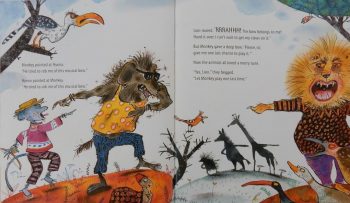
This trickster tale featuring a clever monkey had its origins in a collection of South African folktales but for her retelling, Dianne Hofmeyr has changed the villainous wolf for a hyena.

Monkey comes upon a strange-looking object while digging around beneath a tree. As he plucks it out comes a sound, “Fiddle dee dee! Look what I see! / A musical bow. / Lucky monkey! Lucky me! / Luckiest monkey in the whole country,” he sings.

Along comes Hyena claiming the bow to be his and threateningly accusing Monkey of stealing it.

To solve their dispute,Tortoise advises them to consult Lion and off they go to find him.

Lion however, is not the fair and just creature he’s reputed to be and demands the bow for himself.

Monkey begs to be given a final chance to play the instrument and Lion accedes.

The music he plays enchants the other animals, including Lion and they start to dance. Monkey plays faster, the creatures dance faster and faster

and eventually as night falls, they’re all completely exhausted.

Taking advantage of the situation Monkey makes another request and finally secures the bow once and for all.

In her usual animated fashion with plenty of dialogue, Dianne Hofmeyr has refashioned this folk tale from the African continent that is a lively read aloud. Grobler’s scratchy characters are a mix of endearing humour and downright scariness. They certainly snare the attention and whether one is alarmed or amused, each scene offers a wealth of quirky detail to pore over.

Love You Always / Mama’s Work Shoes

Love You Always
Frances Stickley and Migy Blanco
Nosy Crow

There’s a definite autumnal feel to this book portraying the loving bond between a mother hedgehog and her son Hoglet but despite the little hedgehog’s occasional shivers as the two creatures wander home through the woods, this is a warm-hearted tale.
Hoglet notices the season changing and his mother explains that … change makes nature lovlier with every passing day.’ Hoglet then asks, “Mummy … / would you love me more…if I changed?”

As they encounter other mother-child animals – dashing squirrels, fluttering dragonflies, bouncing frogs, fluffy rabbits,

Hoglet asks his question again and on each occasion gets the same response ’I couldn’t love you more’.

Just before they reach home, Hoglet raises the all important “But, Mummy… will love always last forever, / even if I change just like the seasons or the weather?” And as little humans will be eagerly anticipating, her “Always” promise of unchanging love acts as sufficient reassurance to allow her offspring to curl up and having repeated her final ‘Always’ to fall fast asleep.

With its combination of Frances Stickley’s soft-spoken, pleasingly constructed rhyming narrative that mostly works, and Migy Blanco’s richly hued scenes of the autumnal countryside, this is a lovely bedtime story for parent humans and their little ones to snuggle up together with and share just before bedtime.

Mama’s Work Shoes
Caron Lewis and Vanessa Brantley-Newton
Abrams Books for Young Readers

Little Perry’s mum has a plethora of shoes, a pair for every occasion and Perry knows them well: the ‘swish-swush’ ones for indoors, the ‘zip-zup’ ones for running and skipping, ‘flip-flop’ ones for sunny days and those that go ‘pat put’ in puddles.
One morning Mum puts on a new pair of shoes that go ‘click-clack, click-clack’. They sound interesting but what could they be for, wonders Perry.
When she discovers they signal the start of a new routine that means she and her Mum are to spend time away from one another, Perry is not happy.

Left with her Nan, the child lets her feelings out with a tantrum.

Eventually of course, Mum comes to collect her and back home they go where eventually Mum’s explanation finally reassures her little one that yes those clickity-clack shoe sounds will take her to work but they’ll always bring her back as fast as ever she can.

With Vanessa Brantley-Newton’s bright mixed media illustrations capturing Perry’s changing emotions, Caron Levis’ story will reassure the very young who like little Perry are faced with a parent returning to work.

Campsite Revelations: Fergal in a Fix! / Koala is Not a Bear

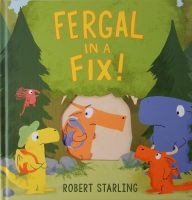
Fergal in a Fix!
Robert Starling
Andersen Press

Fergal (with fiery temper pretty well under control now) returns in a new story.

He’s off to Dragon Day-Camp for the first time and despite assurances from his parents, he’s feeling anxious about it.

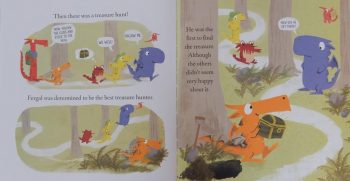
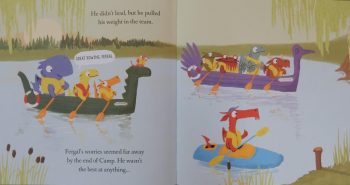
Eager to be popular he decides to try and outshine the other dragons at all the activities on offer. But his ‘being the best’ involves behaviour that doesn’t please his fellow campers; he even resorts to cheating.

By lunchtime Fergal is shunned by the other young dragons.
Fortunately the camp leader notices he’s alone and has some wise words to offer, words about being his best self rather than the best at things.

Come the evening Fergal is a much happier little dragon with a lot of new dragon friends.

With a gentle lesson about being yourself and the best version of yourself you can, this second Fergal tale should win the little dragon plenty of new little human friends too.

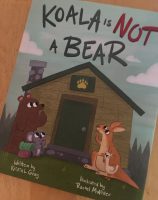
Koala is Not a Bear
Kristin L. Gray and Rachel McAlister
Sterling

Koala has been eagerly anticipating camp but as it’s her first time away from family and home, she pops a few reminders into her backpack – just in case she feels homesick.

On arrival she searches for her cabin but there seems to be a problem. Just as Grizzly is welcoming her to Bear Cabin, there comes a protest from Kangaroo. “A bit of a know-it-all” is how Grizzly describes the naysayer.

Eager to find a place to rest, Koala tries to prove her ‘bearness’ but Kangaroo is having none of it. Yes she does have sharp teeth and claws but so do crocodiles; lemurs share her ability to climb trees; tigers too can growl. She might be able to perform a reasonable bear crawl but she lacks a tail.

Despite Grizzly’s continued support, Kangaroo continues his assertions when the animals sit down to eat until at last Koala thinks Bear Cabin and even perhaps the entire camp is not for her.

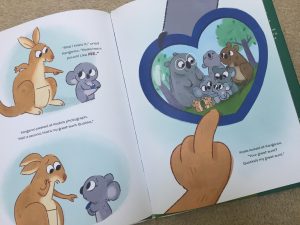
Seeking comfort, out of her pouch comes a photo of a relation – a creature that Kangaroo recognises as his great aunt too.

A few questions from Kangaroo are all that’s needed: it turns out that Koala and Kangaroo are cousins. Hurrah!

The author raises important points about inclusion, similarities and differences during the course of her amusing narrative while at the same time providing a fair sprinkling of marsupial-related facts along the way. Rachel McAlister’s expressive, digitally rendered wide-eyed animal characters will appeal to little ones as they follow Koala’s search for a place to belong.

Oh No, Bear!

Oh No, Bear!
Joanna Partis
Little Tiger

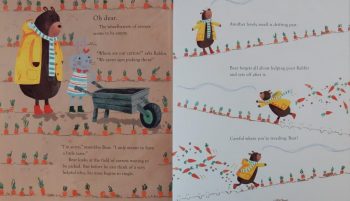
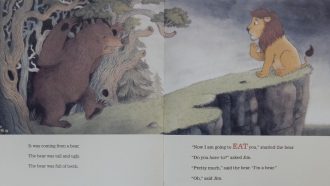
One autumnal morning a hungry bear wakes knowing he has an important task ahead. But as he walks through the forest his hunger distracts him causing him to follow the delicious smell that assails his nostrils. It leads him to a vegetable bed where Rabbit and friends have dug up a huge pile of carrots. Bear accepts Rabbit’s offer to try one and before you can say ‘chomp’ Bear has consumed the entire barrowful.

But then he smells another delicious aroma and instead of making amends to the rabbits, nose in the air, he’s off on the trail,

which leads him to a group of squirrels engaged in picking acorns. A similar thing happens: it’s Bear’s tummy not the baskets that he fills with acorns.  After a brief apology Bear’s off again hot on the trail of another tempting smell. And oops!

Soon, Beaver’s freshly caught fish ends up in the same place as the previous items he was supposed to taste and unsurprisingly by now, Bear’s tummy is rather larger that it was at the start of the day. As he sits ruminating upon his greed he starts to feel concerned that his friends might have to go hungry all winter.

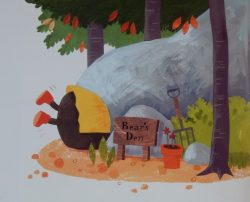
Back to his cave he heads intent on thinking of a way to put things right. But when he reaches his door another problem awaits.

Is he to remain in that sorry state all winter? Happily not, thanks to his friends, not to mention his inadvertent clumsiness during his pre-hibernation perambulations.

Funny, thought-provoking and engagingly illustrated, with its ‘OH NO BEAR!’ refrain this is an enjoyable autumn term read for foundation stage audiences especially.

Binky’s Time to Fly!

Binky’s Time to Fly!
Sharmila Collins and Carolina Rabei
Otter-Barry Books

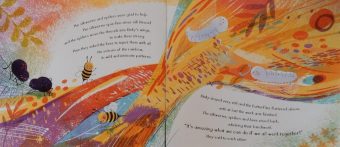
Binky has always wanted to be a beautiful butterfly but when his big day finally comes, he discovers to his dismay that instead of powerful wings, despite their shape, his are fragile, holey things, so wispy they won’t lift him up. Dreams in tatters, he creeps away to hide.

Some time later, two other butterflies that had emerged at the same time discover him and offer to help.

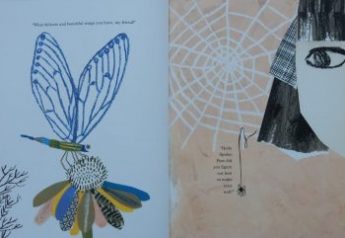
Seeking the assistance of the silkworms, the spiders and the bees, the team work away until at last Binky’s wings are transformed.

They look amazing but will they allow him to take off ?

Acknowledging his inherent difference but thankful and full of hope, Binky watches as his friends flutter above and then responding to their call, “It’s time to fly!’ he carefully unfurls his wings and at last …

Incorporating themes of inclusion and empathy, this movingly told and illustrated story demonstrates the power of co-operation and determination.

As Sharmila, the author says in a final note, this is a book about hope and freedom. Her eldest daughter, the inspiration for the story, has the fragile skin condition epidermis bullosa and to aid the finding of a cure, Sharmila founded the charity Cure EB to which her royalties will be donated.

Rich in pattern and texture Carolina Rabei’s expressive mixed media illustrations are reflective of the softly spoken, uplifting narrative.

Small in the City

Small in the City
Sydney Smith
Walker Books

I’ve loved Sydney Smith’s work ever since I saw his illustrations for Footpath Flowers so was super-excited to learn of his first picture book as both author and illustrator. It’s a stunner.

The story begins with two wordless spreads showing a child on a tram, the first four blurred views through the tram’s misted window from the boy’s seat,

the second looking into and within the vehicle.
Then, warmly wrapped against the cold, the lad (our narrator) rings the bell, gets off the tram and starts walking. ‘I know what it’s like to be small in the city,” he comments as he crosses the road, continuing to talk of the hustle and bustle around.

As he negotiates crowds and traffic we sense that it’s not the reader he’s addressing, rather it’s a special someone known to him; and instead of being scared, he begins to give advice, …’don’t go down this alley. It’s too dark.’ … ‘There are lots of good places to hide, like under this mulberry bush. Or up the black walnut tree.’

Gradually, even before the boy begins to put up posters, readers understand that he isn’t talking to a human at all. As he enters the park, snow swirling all around, he stops to put up another of his posters; then we see …

and in the dwindling daylight we fully appreciate his, ‘Your bowl is full and your blanket is warm. If you want you could just come back.’

There’s a final twist in the narrative that leaves readers with fast beating hearts, awed by Smith’s brilliance in capturing emotions, and by his use of light, shadows and reflections; and with new knowledge, a desire to turn back to the beginning and start the story over again.

Nibbles: The Monster Hunt

Nibbles: The Monster Hunt
Emma Yarlett
Little Tiger Press

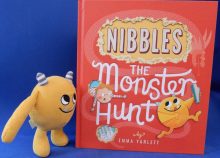
Uh-oh! Emma Yarlett’s Nibbles, the monster is on the loose again and he’s managed to find his way into a little boy’s bedroom where quite clearly, he’s been indulging himself with the furnishings and his favourite fodder, books. Not just any books however but the boy’s very favourite information book.

Time to get on his trail before he destroys the whole thing completely and creates mayhem in so doing.

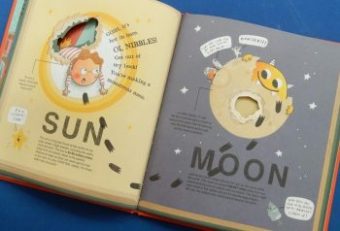
What follows is a breathless chase that has boy and monster hurtling through space,

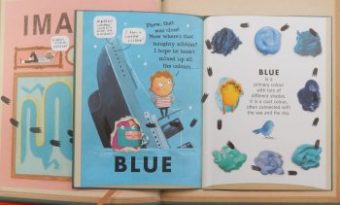
dashing past dogs and cats, gallivanting into the realms of artistry, cascading into colour mixing,

diving into a counting book, where thanks to some quick thinking on Nibbles’ part, the boy and the monster narrowly escape the flaming jaws of the dragon that has been in hot pursuit since Nibbles inadvertently set him free in the art section.

So much for preventing hayhem!

Full of fascinating snippets of information, jokes, speech bubbles, flaps and holes – of course, holes – readers will relish this latest adventure of the monster with a wicked grin and voracious appetite. There’s surely something to satisfy all tastes and a wide age range in this one.

The Wonder Machine

The Wonder Machine
Barry Timms and Laura Brenlla
Little Tiger

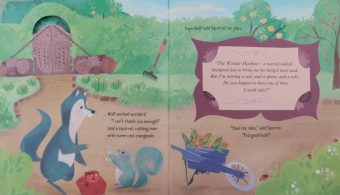
Something of a reclusive character, Wolf is an inventor, the world’s greatest so we’re told.

One day she decides to make a machine that will be a world changer and with that in mind she consults a large nameless book wherein she finds these words, ‘The wonder machine! / The wonder machine! / A gadget like nothing that / you’ve ever seen! From mittens to music, / from cushions to cakes, / The thing you most need / is the thing that it makes!’
Her search for the components required to construct such a marvel take her for the first time ever, away from her home and across onto the mainland.

Once there, she encounters, and helps in turn Squirrel,

Owl and a family of foxes. For each kind deed she receives a gift of thanks. First a garden rake, then a fishing reel and finally, a silver spoon: the very items she needs to complete her Wonder Machine.

Back at home she sets to work next morning, toiling all day until her creation is ready. Although from it there comes wonderful music, Wolf doesn’t feel the satisfaction she’d eagerly anticipated. But then as she sits downheartedly

there comes a realisation and a wonderful surprise …

All of which shows that stepping outside your comfort zone, paying it forward and sharing your talent are enormously rewarding.

Barry Timms’ tipping, tapping text flows along nicely sweeping readers along with it, eager to find out everything about Wolf’s invention, while on the way they’ll enjoy her exchanges with the other characters and empathise with her highs and lows as the story builds to its satisfying musical finale. All this is appealingly shown in Laura Brenlla’s rural scenes with their peepholes, flaps and foldouts.

Rabbit and the Motorbike

Rabbit and the Motorbike
Kate Hoefler and Sarah Jacoby
Chronicle Books

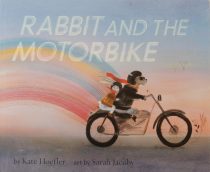
Rabbit lives in a field and dreams of leaving his safe haven one day, but this home-lover gets his adventures vicariously thanks to his friend Dog, an erstwhile motorcycle enthusiast who has spent much of his life riding his cycle all over the countryside.

One day though, Dog is gone and with it Rabbit’s daily adventure.

Dog has bequeathed his vehicle to his friend and it lies for many days abandoned in the field.

Then one night Rabbit decides to bring the bike inside and in the absence of a story, they listen to the sounds of the highway.

Summer comes bringing with it not only new blooms but also for rabbit, a newfound courage that allows him to admit to his fears and to suggest to the bike, “Just down the road.” But as we know, and Rabbit discovers, roads have a way of going on and on and …

It’s an independent, greatly enriched Rabbit that eventually returns to his field, with his head full of memories and stories, ready for new friends and with a feel for the pull of the open road.

Lyrically told by Kate Hoefler and gorgeously illustrated in pastels and watercolour by Sarah Jacoby, whose delicate scenes bring out Rabbit’s changing emotions while also capturing the power of the profound silences surrounding his loss, and the contrasting roar of the bike when he finally takes to the road.

An exhilarating tale of friendship, loss and finding the courage to step outside your comfort zone.

Strange Happenings with Winnie and Wilbur: The Bug Safari / Ghoulia and the Mysterious Visitor

Winnie and Wilbur: The Bug Safari
Valerie Thomas and Korky Paul
Oxford Children’s Books

As Winnie and Wilbur picnic in the garden their dropped crumbs are collected by ants.

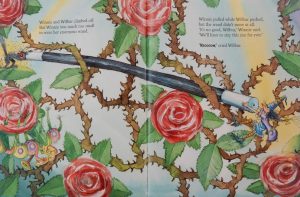
Winnie is fascinated and wants a closer look. Out comes her wand and with a wave and a shout, witch and cat are transformed into tiny, tiny beings. Wilbur is not impressed, especially when a bird lands in the grass in search of some lunch and even less so when the postman’s boots nearly squash both him and Winnie flat.

The obvious thing would be to make an enlarging spell but Winnie’s wand is stuck in a bush out of reach and anyway it’s now far too big for her to wave.

Are the two of them destined to stay forever tiny?

The countless fans of this series will be fascinated by the scaled down world in which its star characters find themselves and especially enjoy the garish-looking minibeasts that appear to dwarf Winnie and Wilbur.

Ghoulia and the Mysterious Visitor
Barbara Cantini
Amulet

If you’ve not yet encountered Ghoulia, let me introduce her: she’s a zombie girl who lives in Crumbling Manor along with Auntie Departed, Tragedy (dog) and other rather weird residents.

One rainy evening when the young zombie is feeling particularly bored, partly because her aunt has been totally absorbed with gardening and in particular tending her Chatterbox Ivy, an unexpected visitor arrives. He announces himself as Cousin Dilbert, (a cousin Ghoulia didn’t know existed) invited by her aunt to come on a visit.

But why invite such a fault-finding, demanding character? Off goes Ghoulia to find her aunt and ask the reason, but she is nowhere to be found.

Meanwhile another visitor arrives – one of Ghoulia’s friends thanking her for his invitation, also penned by her aunt.
More and more of her friends arrive, each holding similar invitations.

Things get ever more strange though and at one point the piano seems to be playing without a pianist and then Theresa (another of Ghoulia’s friends) disappears too.

After a search, the mystery is finally solved, thanks in no small part to her cousin and for once, everyone – even Dilbert – seems happy.

Out of this world zany, but just the right length for new solo readers who will especially enjoy Cantini’s detailed, mock-scary colour illustrations and the idea of a seemingly harmless plant turning carnivorous.

Jazz Dog

Jazz Dog
Marie Voigt
Oxford Children’s Books

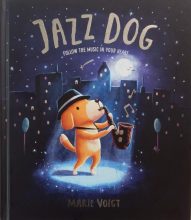
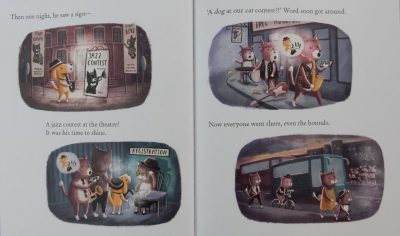
Segregation rules in a world populated by dogs and cats. Dogs play only dog music; cats only play cat music.

However there’s one dog that isn’t happy with this separatist regime; his music is different.

One night he hears a beautiful sound coming through an open window and he’s mesmerised. He’s determined to learn to play like the Jazz Cats, but the cats won’t help so he decides that he must teach himself cat music.

Borrowing instruments and books he sets about learning cat jazz and it feels right.

As he passes the theatre a sign announcing a jazz contest catches his attention. What an opportunity to show his talent; but a dog performing in a cat contest?

Shock horror.

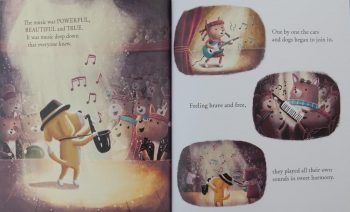
The theatre is packed to capacity with growling dogs and hissing cats. The jazz dog has a crisis of confidence but thanks to some feline encouragement, he decides to stay and play.

Who would have believed that the actions of one determined little dog could have such amazing consequences …

Marie Voigt’s uplifting rendition gets right to the heart of individuality and is a reminder that every one of us is entitled to follow our own path, and to find the inner courage and confidence to stand up for what we know is right, for ourselves and also for others.

A must for families, and for classroom sharing and discussion.

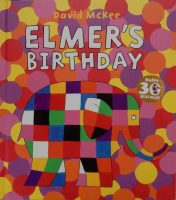
Elmer’s Birthday

Elmer’s Birthday
David McKee
Andersen Press

After three decades it’s safe to say that Elmer the elephant has become an institution in nurseries, primary schools and families.

This story celebrates his birthday or does it?

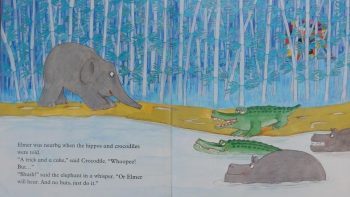
The group of elephants he passes on his regular morning walk certainly think he has a birthday the following day and decide to play a joke on him. ‘… let’s act as if we’ve forgotten it …’ they decide intending to produce a celebratory cake at the end of the afternoon.

Off they go to inform his friends and family of their intentions.
The trouble is those elephants don’t pay heed to the responses they receive, dismissing all their ‘buts’ as insignificant.

Indeed not a single animal they speak to is impressed with their trick, but the mention of cake keeps them quiet.

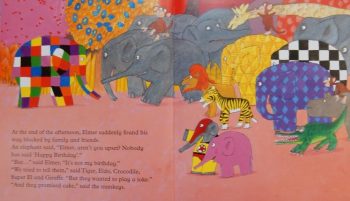
Next morning when he takes his walk, Elmer’s slightly puzzled at the way his friends greet him. Throughout the day the other animals seem to be avoiding him until the end of the afternoon when he’s suddenly confronted by all his friends and family.

Yes, the trick backfires but who can resist the enormous patchwork confection that his fellow pachyderms have baked for all to share, birthday or no birthday.

“ … the cake is a winner,” concludes Elmer before they all tuck in; and a winner is what little ones will think about this shared joke of a tale. I’m pretty sure they’ll ask for second helpings too.

Be More Bernard

Be More Bernard
Simon Philip and Kate Hindley
Simon & Schuster

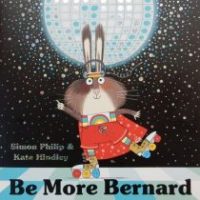
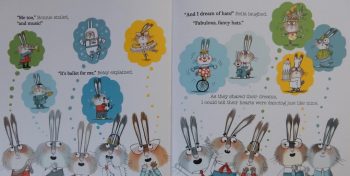
Bernard is a bunny; he does bunny things like nose twitching and ear pricking and he digs lots of deep holes. In fact whatever his fellow bunnies do, Bernard does likewise.

In his dreams though things are rather different; he dreams of decidedly un-rabbity things. But how long can he keep up his pretence of being just like the other bunnies?

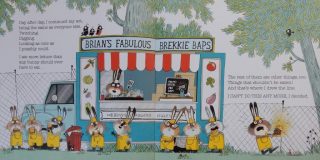
One day he decides to eschew the bunny poo baps his fellow rabbits are eating. ‘I can’t do this any more’ he decides.

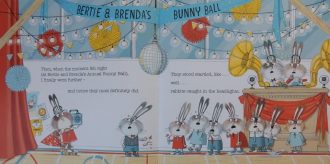
Little by little Bernard starts to do his own thing, largely ignored by the others until that is, the day of the annual bunny ball when, shock horror, a divergent bunny rolls up!

Ignoring cries of “You can’t wear that!” and “We’re all the same!’ Bernard struts his stuff with joyful abandon, disco dancing like there’s no tomorrow.

Amid the cries of consternation, there’s one little bunny, Betsy, who loves his daring to be different and it isn’t long before Bernard isn’t the only risk taker on the dance floor.

Then comes the big reveal …

which all goes to show that the best possible choice is to be true to yourself whatever that may be.

Long live individuality and difference: that is what is so splendidly conveyed in Simon Philip’s cracking story narrated with such delicious humour by Bernard himself.

Kate Hindley brings out that humour with her splendiferous scenes of the protagonist’s transition from rule adherent to rule breaker, from follower to leader, from ordinary bunny to bunny extraordinaire. Make sure you peruse every spread carefully or you’ll miss the wealth of captivating detail in every one.

Blooming brilliant!

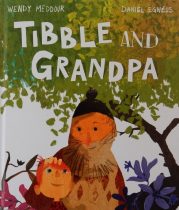
Tibble and Grandpa

Tibble and Grandpa
Wendy Meddour and Daniel Egnéus
Oxford Children’s Book

The relationship between a child and a grandparent is often very special and uncomplicated, and so it is here.

Tibble’s Grandpa is grieving. He seems to be always in the garden: Mum explains that what he needs is time.

Full of loving concern, Tibble wants the old Grandpa back: he barely recognises this silent, withdrawn person. Little by little he gets Grandpa to open up as they spend time together talking of favourite things.

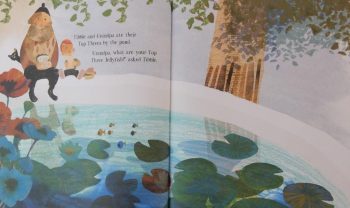
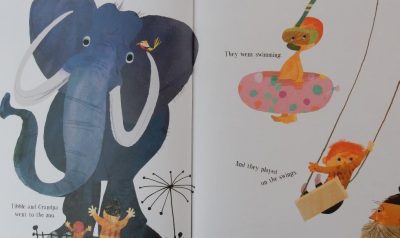
Next morning Grandpa actually seeks out Tibble’s company and they spend the day doing the boy’s favourite things – his ‘Top Three Days Out’ all in one.

That evening they get out the telescope Granny had given to Tibble and they watch the stars together. Tibble opens up a discussion about favourite (Top Three) Grannies, ‘Mine are granny who is dead. Granny Agnes who lives on top of the shoe shop. And the Granny in Little Red Riding Hood,’ he says and this acts as a release for Grandpa.

Wendy Meddour has created an enormously affecting tale of loss, grief and love. Her repeated use of ‘Top Threes’ throughout the narrative is genius, injecting just the right degree of gentle humour into her telling.

Daniel Egnéus reflects so well both the humour and poignancy of the story in his outstanding mixed media illustrations making you feel as though you want to hug both Tibble and Grandpa.

Yes it’s a book about coping with the death of a loved one but it’s also an outstandingly beautiful story about intergenerational love and its power to heal.

Hungry Jim

Hungry Jim
Laurel Snyder and Chuck Groenink
Chronicle Books

This is a tribute to Maurice Sendak with a delectably dry deadpan delivery by both author and artist.

When Jim wakes up one Tuesday morning he feels at odds with himself – beastly in fact –and definitely doesn’t feel like breakfasting on the pancakes his mother is busy downstairs cooking.

Instead he devours her, but still feeling hungry he leaves home and consumes everyone who crosses his path. There’s no getting away from it – the more he rampages, the more he wants to eat. He wants to cry too though.

Finally he can run no further. As he stands contemplating his conflicting emotions he hears a growl that isn’t emanating from his stomach. There before him stands a larger, even more ferocious looking creature …

but Jim’s ferocity grows too …

Hunger sated at last, he heads home, burping and ‘braap’-ing along the way,

and there ‘It was a huge relief to find things mostly as he’d left them.’

Back in his own room another transformation takes place and finally the only hunger he’s left with is ‘For pancakes’.

After all that beastliness, it’s breakfast in this case, not supper that is waiting, but of course, it IS still hot.

This deliciously wicked tale demonstrating the power of the imagination will make you uneasy, it will make you gasp, and it will make you aware of the hidden wildness that lies within. What young listeners will make of it, I’m yet to discover. They will however definitely appreciate Groenink’s masterful pencil and Photoshop illustrations that are the perfect complement for Laurel Snyder’s pithy prose.

Once Upon a Wild Wood

Once Upon a Wild Wood
Chris Riddell
Macmillan Children’s Books

Former Children’s Laureate, Chris Riddell has woven a wonderful fairy tale extravaganza if ever there was one.

Its main protagonist is Little Green Rain Cape whom we meet as she sets off through the woods heading for Tall Tower wherein Rapunzel is throwing a birthday party.

En route, Green meets and rejects the assistance of several well known fairytale characters including a wolf, a ‘kindly’ old lady, a ‘friendly’ troll, the Beast sans Beauty who has gone missing; a talking harp whose aid she comes to and in so doing happens upon the Three Bears.

All this walking however is hard on the feet so it’s fortunate that another encounter is with Thumbelina who gives her some ointment to salve their soreness; and eventually along with a host of others including a prince,

pigs and dwarves, she reaches the venue where they all gain admittance.

A great night is had by everyone

particularly Beauty and the Beast who are reunited at last; and the following morning Green continues on her way through the Wild Wood.

Most assuredly this is a book for everyone, although with his dramatic irony and witty lines – ‘ ”Princesses!” he exclaimed. “Did someone say princesses? Exhausting! Either falling asleep for a hundred years, losing their shoes or going out every night dancing. …” ‘, – Riddell does assume some prior knowledge on the readers part. Perhaps it’s a case of the more you know the more you’ll get from it.

A Life Made by Hand: The story of Ruth Asawa

A Life Made by Hand: The story of Ruth Asawa
Andrea D’Aquino
Princeton Architectural Press

I have to admit that despite my interest in art the name of this book’s subject is new to me.

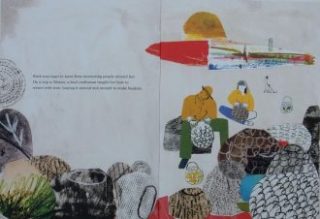
Brought up on her family farm in California, Japanese-American artist Ruth Asawa was from an early age, mesmerised by the flora and fauna she saw around her.

Her close observation of such things as insects she saw led her to make representations of them from wire or folded paper, and she also loved to draw in the dirt with her feet.

At weekends, instead of working on the farm, Ruth studied Japanese calligraphy and later she went to art school where she gained further inspiration from dance choreography, and her teachers, in particular Buckminster Fuller and Josef Albers.

Travelling to Mexico she learned wire weaving from local craftsmen who twisted the metal to make baskets.

Back home Ruth experimented with this medium and finally knew what was THE medium for her.

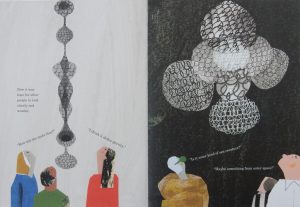
Her sculptures are enormously complex, beautiful graceful pieces that are now to be found in art museums mostly in the US

where they inspire others to look closely, imagine and create for themselves.

This short interesting introductory biography for youngsters with an interest in both art and the natural world omits the darker events in the life of Asawa and her family, but the author provides factual notes on these, as well as an explanation for her own inspiration in creating the book, and instructions for making a paper dragonfly.

D’Aquino’s collage style illustrations – a combination of charcoal and colour pencil drawings with hand-printed and monoprinted paper are quirky and arresting, and may well inspire readers to experiment with collage too.

Handa’s Noisy Night

Handa’s Noisy Night
Eileen Browne
Walker Books

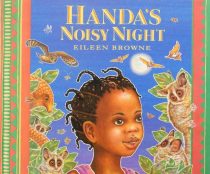
Yippee! A new Handa story. Handa’s Surprise was one of THE most loved, most read picture books when I taught under sevens, so I was super excited to get my hands on a copy of this.

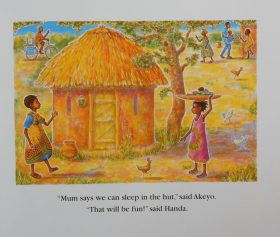
Handa goes to spend the night with her friend Akeyo and the girls are to sleep alone in the hut.

Having bid goodnight to the rest of Akeyo’s family, off they go but almost before the door is closed Handa hears a snorting sound outside. Akeyo insists it’s just her dad laughing.

During the night there are more sounds – chattering, rattling,

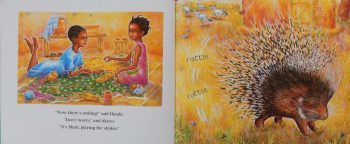
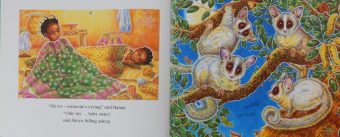
squeaking, slurping, crying and finally a thud. Rather than the grown-ups talking, Mum making music, Grandpa’s rusty bike, Nan having her bedtime drink and Akeyo’s baby that her friend claims are the cause,

readers see what is actually happening outside.

In the morning a tapping wakes Handa and when her friend opens the door, nobody’s there.

Mum’s “Did you sleep well?’ receives an accusation that the noises from other family members meant a wakeful night, which is quickly countered with, “We were as quiet as mice”.

The glowing Kenyan landscape and stunningly patterned clothes of the characters are signature Handa story elements, but here we’re treated to the delights of some of the resident fauna of the area- a bushpig, bat-eared foxes, an African porcupine, yellow-winged bats, a tree pangolin, lesser bush-babies, the magnificent spotted eagle-owl and a Nubian woodpecker, each one in its full glory (all are named in the author’s notes at the front).

It’s hard to believe the original Handa story is now 25 years old; I still have a treasured copy of the first edition and she’s lost none of her magic. Happily now though there are more BAME books available: this one is a ‘must have’ addition to any family bookshelf or nursery/KS1 class library.

Fair Shares

Fair Shares
Pippa Goodhart and Anna Doherty
Tiny Owl

Both Hare and Bear have designs on the juicy-looking pears they see high up in the tree but neither can reach them.

Hare suggests climbing on chairs but there are only three …

“That’s not fair!’ exclaims Bear so one is discarded. Now Bear can reach the yummy pears – SCRUNCH MUNCH – but Hare isn’t happy.

Suddenly a tiny voice pipes up. Beetle puts forward the notion that giving everybody the same thing isn’t always fair and with a visual aid, goes on to explain.

Everyone appears happy but only briefly;

wait for the surprise ending …

Pippa Goodhart’s funny, seemingly simple story will set youngsters’ brains a- buzzing as they contemplate the vexed question of fair shares and fairness.

Before that though, they’ll relish the entire telling wonderfully visualised in Anna Doherty’s lively, splendidly expressive illustrations of the animal participants in this thought-provoking book. Look out for all the minibeasts watching the action and sometimes enjoying the spoils thereof.

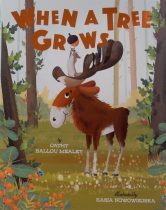
When A Tree Grows

When A Tree Grows
Cathy Ballou Mealey and Kasia Nowowiejska
Sterling Children’s Books

Cause and effect meet choose your own adventure in this amusing book set in a forest.

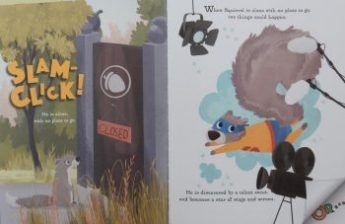
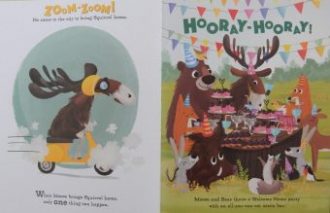
‘When a tree grows … two things could happen. It becomes a scratching post for Moose’s itchy antlers and the tree sways gently side to side.’ Or … he pushes too hard and crash!-boom! Down comes the tree onto a cave waking up a bear. Bear too can do one of two things … and so it goes on with the possibility of an ordinary or an extraordinary happening.

The possibilities get more and more outlandish, even the ordinary ones, until the adventure brings all three characters (and a host more) together for a Welcome Home party for their small bushy-tailed friend …

after which there is a satisfying completion of the circular tale that readers may, or may not, have seen coming.

There’s plenty to amuse as each scenario is presented in this cleverly constructed story wherein text and digital illustrations work well in tandem providing a fun storytime read aloud with a good sprinkling of omomatopoeia that gives young listeners an opportunity to let rip.

The book also offers a model for older audiences to use as a starting point for writing their own similarly constructed adventures.

Baz & Benz / Mannie and the Long Brave Day

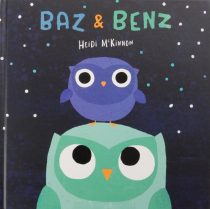
Baz & Benz
Heidi McKinnon
Allen & Unwin

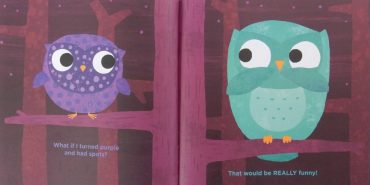
Owls Baz and Benz are best friends: Baz is small and blue; Benz is big and green.

One day while sitting together Baz decides to check if their friendship really is for ever and ever.

He puts forward a series of possibilities – a colour change; a colour change with a spotty pattern? So far so good.

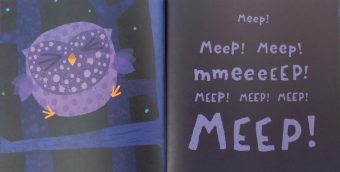
Constant ‘Meeping’? – not at all a good idea.

A scary bat with sharp claws? Err! Rather frightening, but the friendship bond would remain intact … no matter what.

Little humans will delight in Baz’s ability to annoy, and to push the boundaries but remain loved, and they’ll especially relish the way he gets the last “Meep!’

Comforting and reassuring; Heidi McKinnon gets right to the heart of true friendship in this simple, enormously enjoyable story for the very young. The bold, bright illustrations are captivating and the characters with their matching coloured lines immediately endearing.

A book I envisage being demanded over and over.

An altogether different celebration of friendship is:

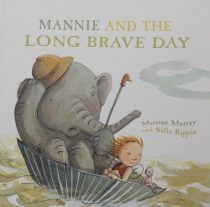
Mannie and the Long Brave Day
Martine Murray and Sally Rippin
Allen & Unwin

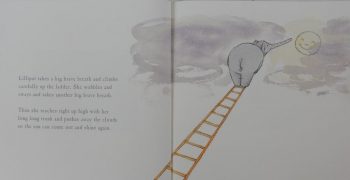
This is a sweet story about a little girl Mannie, her toy elephant, Lilliput and her doll, Strawberry Luca.

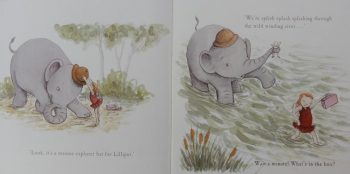
Together with a special box of useful things, Mannie takes her friends on an exciting adventure … down the rocky road, through the tall, tall trees, across the winding river

and up the high hill for a picnic.

Suddenly the sun disappears, the sky darkens, thunder starts to rumble and Mannie feels scared.

Now it’s Lilliput’s turn to say the words, “What’s in the box?’

and before long all is well once more.

A truly magical book  that celebrates the boundless imagination of young children. Both author and artist capture the way in which the very young can transform almost anything and everything into the ingredients for their fantasy play.
Sally Rippin’s gorgeous illustrations took me right into the nursery classroom where I taught for a number of years, as did the ‘special box’ in the narrative. We too had a similar item not pink but battered and brown with a hole cut in the top, into which I’d put various items and we’d all sit around it and sing, “What’s in the box, what’s in the box, let’s think, let’s see … what’s in the box” before somebody would put in their hand and extract an item as the starting point for storying.

This is a Dog

This is a Dog
Ross Collins
Nosy Crow

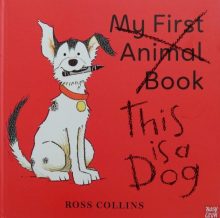
There’s no getting away from it, Ross Collins’ intended My First Animal Book’ has been infiltrated, indeed taken over, by a mischievous canine that has no intention of doing anything but ensuring he’s the only animal that matters herein. He’s even had the audacity to substitute his name for Ross’s on the title page.

Make no bones about it, his actions are anything but well received by the other animals – note their expressions. And having annoyed the monkey, astonished the rabbit and alarmed the squirrel, he’s somehow managed to get his paws on a black crayon to edit (actually mess around with) the text.

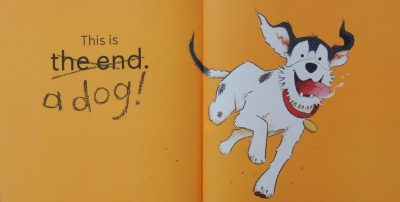
Children will absolutely love what he does beside the giraffe and giggle at his attempts at emulating a pachyderm in front of the elephant.

He almost gets his cum uppance with bear but then comes gorilla where he definitely over steps the mark by way too much and they all give chase.

It’s fortunate that his trusty crayon is still close at paw as it enables him to have the last laugh, not to mention the final word (or two).

I love everything about this cracker of a book. It’s so clever, such a ingenious mix of seeming simplicity and sophistication, and likely to appeal to a wide readership from beginner readers to those who will notice and delight in Ross’s dedication to his own dog Hugo ‘Who taught me the meaning of irony by destroying some of the artwork from this book.’

Brilliant!

Polly and the New Baby

Polly and the New Baby
Rachel Quarry
Oxford University Press

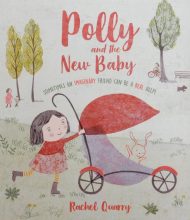
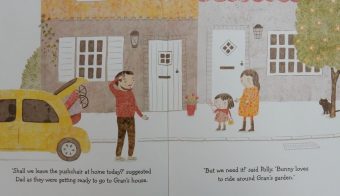
Little Polly’s imaginary friend Bunny goes everywhere with her. She takes him in the pushchair she had as a tiny baby.

Every time her Mum or Dad try to persuade her to do without said pushchair, she insists it’s an absolute necessity. Bunny and chair go to the supermarket, the park and even to her Gran’s house.

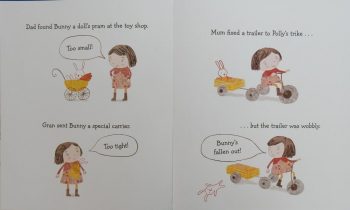
There’s a problem though: Mum is soon to have a new baby and needs the chair for her own purposes. Several replacement modes of transport for Bunny are offered but none satisfy Polly

and all the while Mum’s due date draws ever closer.

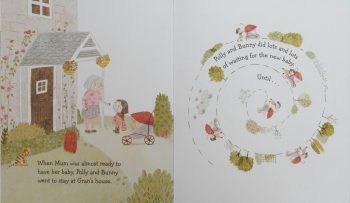
Even when it’s imminent, and Polly and Bunny go to stay at Gran’s, you’ve guessed, the pushchair goes too.

However, when Mum introduces Polly to her new little sister Lily, the now big sis. makes a special announcement concerning her friend: “Bunny can walk!”

Definitely now’s the time to pass on that old pushchair surely; or is it? … It would appear that Polly isn’t the only one with a new sibling.

Happily Polly’s imagination stretches to making a compromise that might just work for everyone.

The understated humour in both words and illustrations makes this story of a family with a super-cute creative thinking protagonist, a delight to share with little ones around Polly’s age whether or not a new arrival is in the offing.

Old Man of the Sea

Old Man of the Sea
Stella Elia and Weberson Santiago
Lantana Publishing

Grandpa and the boy narrator of the story share a special relationship: sometimes they just sit in silence and on other days Grandpa wants to talk.

On one such day he starts the conversation thus: “Every line on my skin tells the story of my life.”

He then begins to recount his life story to the lad beginning each tale with “All aboard!”

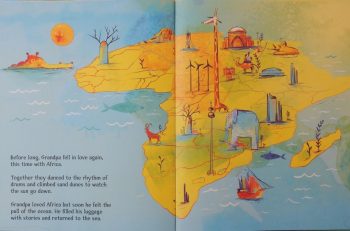
Driven by Elia’s wondrous telling, Santiago’s impressive illustrations executed in a vibrant palette, show Grandpa’s travels from his days as a young sailor when he visited first Europe where he ‘wandered through fairy tale castles and ate picnics in groves of olives’, and then to Africa where he ‘danced to the rhythm of drums’.

Later his wanderlust took him to Asia where he ate tongue burning spices and visited ancient temples before travelling to Oceana

and finally, after a stormy voyage, to America.

It was there that he fell in love, married, settled and raised a family. No longer was the call of the sea pulling him to the oceans where earlier it was the only place he felt truly happy and at peace, at one with the world, able to watch the stars as he slept under a moonlit sky.

Grandpa’s love for the places he visited is palpable, radiating from the spreads of the continents mentioned in the narrative.

Are all the stories true, wonders his grandson at the end; so too probably, will readers; but no matter what, they’ll be absorbed in the telling and that’s what really counts in this beautiful book.

Mum’s Jumper

Mum’s Jumper
Jayde Perkin
Book Island

This is a book that explores the nature of grief.

A mother dies but for the child narrator and her dad, life must go on.
Her mother’s absence feels like a dark cloud that is always hovering close by, and makes concentration at school difficult. No matter how kind other people are, the overwhelming feeling is of being alone, angry even, at times.

Her father explains that the constant ache she feels is the way grief engulfs a person who has lost someone very dear to them; he too feels it.

While sorting out her mother’s belongings the girl comes upon a much-loved jumper. Along with her father’s words of solace, it’s adopting that snuggly warm garment that helps her begin to find a way through those dark days.

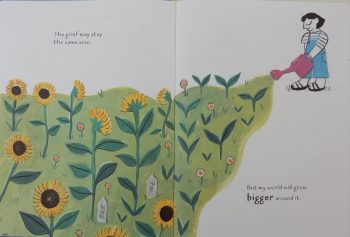
Grief, Dad says, ‘is like Mum’s jumper. The jumper stays the same size, but I will eventually grow into it.’

After some time, her world does enlarge around her grief and she feels able to put her treasured possession out of sight, safe in the knowledge that it, like her mother, will always be there; for she’s a part of everything and everywhere, and most important she’s there inside forever.

Grief is a very personal thing and Jayde Perkins’ illustrations for this book are heartfelt. (Her own mother died of cancer) and here she puts into her art (and words) some of the feelings that a young grieving child might have.

I’d like to see this ultimately uplifting book in every primary classroom; and I’d definitely offer it to anybody who has, or knows, a young child coping with the loss of a parent or close family member.

A Stone Sat Still

A Stone Sat Still
Brendan Wenzel
Chronicle Kids

As with They All Saw a Cat, Brendan Wenzel explores perspective, this time playfully using a stone as the focal point.

A stone sat still/ with the water, grass, and dirt,/ and it was as it was/ where it was in the world.

A series of spreads, shows the stone as it is experienced by all manner of wild creatures: a snail crawls over it, a chipmunk stops on it to nibble a nut; for an owl it’s a bright place upon which to perch, while a gull cracking a clam shell finds it ‘loud’,

in contrast to the snake for which it was a quiet spot upon which to bask in the sun.

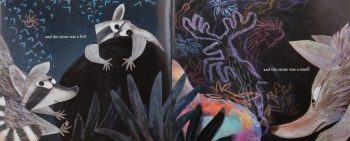
The stone’s texture to a slug is ‘rough’ whereas to a racoon’s paws it’s smooth.

The meditation on the inanimate object continues through the seasons when it takes on a variety of hues – green, red, purple and blue as witnessed by four different animals.

Its size can seem as a mere pebble to a large moose but to a bug, it’s an enormous hill; while in the dark, its sensory qualities are picked up as a feel to investigative racoons, whereas it’s a smell to a sniffing coyote on the hunt.

Readers too experience the stone’s sensory qualities, thanks to Wenzel’s text and his superb mixed-media illustrations, large and small.

As they move through the book, readers will, so long as they are observant, see that around the stone, the water is on the rise

as little by little it is engulfed, becoming a tiny island and then a wave, a memory, ‘and the stone was always.’ Submerged beneath the waves ‘with water, grass, and dirt a stone sits still in the world.’

Assuredly this is a book that invites us to celebrate the changing and the unchanging, and encourages us to look closely and ever closer, not only at the illustrations, but also at the natural world around.

It’s one to have on hand if you are thinking about wildlife, about perception and perspective, even perhaps about existence itself; it’s deep and gently powerful, and has much to offer across a wide age range.

Lulu’s First Day / Butterflies on the First Day of School

Lulu’s First Day
Anna McQuinn and Rosalind Beardshaw
Alanna Max

Lulu is starting pre-school and she’s already been well prepared. There have been lots of story time sessions at the library, a visit to the school, and special gifts from Nana and Tayo that she’ll use regularly for school.

She’s even chosen her clothes for the next day and packed extras in her new bag – just in case.

The big day dawns, everybody is up early and with a pause for a quick photo, off she goes with her mum.

There’s a warm welcome from her teacher and Lulu is soon enjoying all that nursery has to offer.

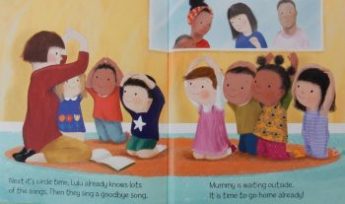
Almost before you can say, ‘circle time’, there she is on the carpet with all her friends and the grown-ups are waiting outside eager to hear of those new experiences.

Yes, its’ been a tiring day, but Lulu can’t wait for tomorrow …

With all the reassurance that little ones need, Anna McQuinn and Ros. Beardshaw present the pitch perfect book for those who, like Lulu, are about to take those next steps into pre-school.

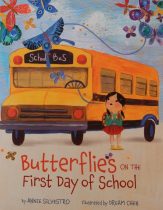
Butterflies on the First Day of School
Annie Silvestro and Dream Chen
Sterling Children’s Books

An enchanting fanciful take on a well-known figure of speech is presented in this story of first day nerves.

Rosie has been eagerly anticipating starting school for a whole month but on the night before her big day, doubts creep in and next morning she announces that she doesn’t feel well.

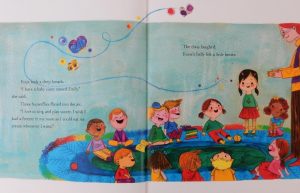
Her mum tells her it’s just butterflies in her tummy and when she sits chatting rather nervously on the school bus to another new girl, butterflies (seen only by Rosie) flutter from her mouth. Now she understands her mum’s puzzling comment.

More butterflies are released, also seen only by Rosie, every time she opens her mouth in the classroom during that first session,

until by playtime her tummy is less rumbly and she can barely feel any more butterflies.

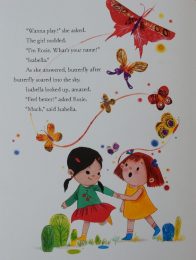
Out go the children to play, Rosie feeling pretty confident now. Then she notices another little girl standing alone under a tree, hands on her tummy. Rosie introduces herself and when the forlorn-looking girl speaks, a cloud of butterflies come fluttering from her mouth.

With its bold bright butterfly images this is a lovely warm story that will reassure little ones who like Rosie are starting school imminently, along with adults who may well share that first day feeling.

The Little Mermaid

The Little Mermaid
Geraldine McCaughrean and Laura Barrett
Orchard Books

Storyteller extraordinaire Geraldine McCaughrean retells the Hans Christian Andersen classic tale as only she can, making it a real joy to read aloud.

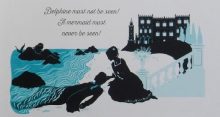
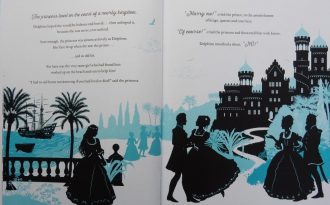
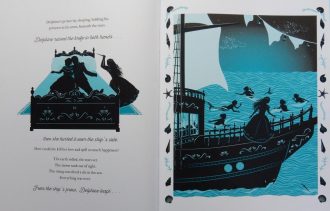
Delphine the youngest of six mermaid sisters hears from her siblings of the wonders of the world above the sea’s surface and can hardly wait for her special coming of age birthday when she too will be allowed to venture up.

When the great day arrives it’s a joyful Delphine who swims to the surface and begins to sing in her wonderful voice.
As she does so another celebration is taking place aboard a great ship anchored close by. The sight of the prince’s face sends her heart spinning but suddenly, seemingly from nowhere, there comes a huge storm engulfing the ship entirely beneath the waves.

Delphine manages to rescue the prince taking him to a safe place on land not far from what she thinks must be his palace home, and there she leaves him knowing she must never be seen by human eyes.

As her songs grow ever sadder fuelled by her nightly swims to the cove near the palace, it becomes clear to her sisters that she has fallen in love with the prince.

Determined to become his wife, Delphine visits the sea witch and a deal is struck – a potion to render her human in exchange for her beautiful voice.

But that is just part of the enormous price Delphine has to pay. It’s not she who marries the prince but another beauty.

The tragedy doesn’t end there, as those familiar with the original will know

and others must learn from this utterly enchanting rendition that is made all the more magical by Laura Barrett’s silhouette style illustrations.

Assuredly a book for lovers of fairy tales, young and not so young; buy it to keep and buy it to give; buy it for home and buy it for school.

Don’t Mess with a Princess!

Don’t Mess with a Princess!
Rachel Valentine and Rebecca Bagley
Puffin Books

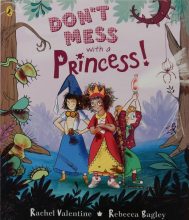
Far away in a beautiful and usually very happy kingdom atop a hill lives King Juno. Also residing in the palace are his three granddaughters Princess Thea, Princess Leaf and Princess Juno.

Now these three aren’t the type of princess who sits around waiting for a handsome prince to show up and sweep them off their feet, far from it.

So when having heard news of a mayhem creating Ogre, the King warns them to remain in their tower and absolutely not, on any account to mess with the Ogre, they quickly conceive a plan.

The sisters are thoroughly resourceful females and it isn’t long before they’re off towards the forest – an enchanted forest. But, unlike the knights sent to capture the Ogre, the three princesses know just how to get themselves safely through the angry trees and come out with, as Juno says, ‘fabulous hair’.

But can they cope with the webbed pit alive with large squirming spiders?

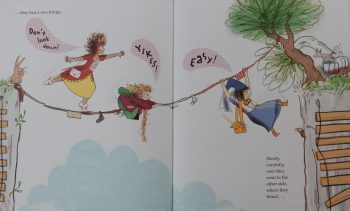
Fortunately Theo knows how to deal with the creatures and then all they need to do is cross the ravine with the broken bridge.

This time it’s Leaf who comes up trumps with some deft knots.

The important thing about all three princesses is that while not totally fearless, they’re always up for a challenge.

Once across and in Neatville they’re greeted with the sight of the Ogre charging off to trash yet another village. Off go the princesses in hot pursuit and finally they have the Ogre trussed up.

It’s then that they discover the reason their captive has been causing so much devastation; and being kind-hearted as well as clever, Thea, Leaf and Juno are ready and able to assist the Ogre in his search for his lost item.

If, like me you enjoy neo fairy tales then you’re certain to relish Rachel Valentine’s action-packed story of using your talents and not allowing others to make decisions for you.

Debut picture book illustrator Rebecca Valentine’s droll scenes of the three creative adventurers highlight the contrast between them and the supposedly brave knights of the kingdom. Make sure you spend time enjoying all the wonderful details on every spread.

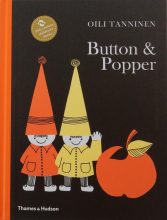
Button & Popper

Button & Popper
Oili Tanninen
Thames & Hudson

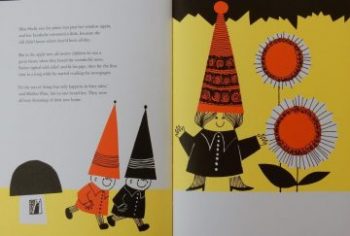
This is a retro charmer from the 1960s created by award wining Finish author and illustrator Oili Tanninen.

It tells of a family of pixies, a mother and father and their twelve children, who with winter fast approaching, decide that their apple tree home isn’t suitable accommodation for the cold and rain. It’s a worrying, sad time as they consume the pie made from the last apples that evening. Two of the children, twins Button and Popper resolve that the following morning they will go and find a new home.

Out they sneak, very early towards town making inquiries, but all those they ask say the same thing ”Twelve children” and kindly explain there’s nowhere large enough for so many people.

The twins feel more than a little dispirited, but then by mistake the only person in the market they haven’t asked, an absent minded fellow named Professor Prilli, accidentally picks up the basket they’d climbed into, mistaking it for his own and takes it back, leaving it in his cellar.

Realising they’ve left their father’s umbrella at the market the two pixies manage to escape. They retrieve the umbrella and the professor’s own basket and take it back to him.

The thankful professor asks the pixies what they were doing in the market and when he learns their reason, he offers them temporary use of his home till he returns from his South Pole research trip the following spring.

There’s great jubilation all round when the twins give the exciting news to the rest of their family back at the apple tree.

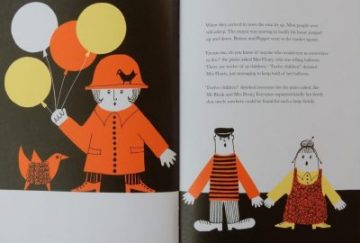
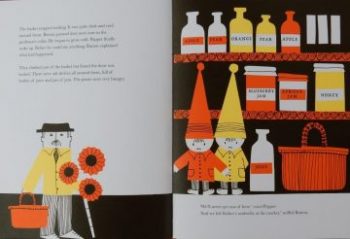
With its orange, yellow and black illustrations adorned with lines and geometric shapes, this delightful tale of serendipity will appeal especially to those who enjoy a touch of whimsy in their stories.

Hope

Hope
Corrinne Averiss and Sébastien Pelon
Words & Pictures

Finn is a small boy with a very large dog called Comet. The two are best friends and do pretty much everything together.

One morning Comet isn’t his usual lively self: “He’s poorly,” Mum says, “he needs to go to the vet’s.”

Off go Dad, Finn and the dog in the car. The vet is uncertain about Comet’s recovery but promises to do his best.

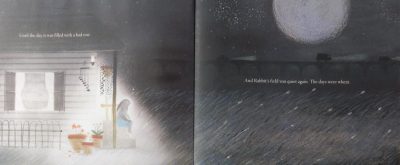
Alone in his den on their return, Ben lets his tears flow.

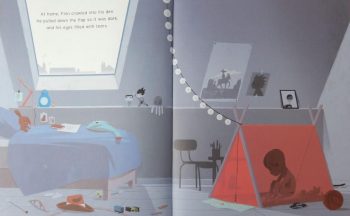
Dad comes into the boy’s room with a torch offering advice. “All we can do is hope, … Hope is keeping a little light on however dark things seem,’ he tells the boy.

That night Finn lies in bed, torch on for Comet and unable to sleep.

Suddenly he notices another light: it’s the bright moon shining right into his room as if it too is hoping.

Eventually Finn does fall asleep and outside the sky is alight with hopes – big and small, old and new, some shining right down on the vet’s.

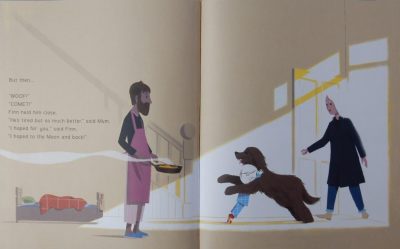
Next morning it’s an anxious boy who rushes downstairs just in time for a wonderful surprise …

A powerful, positive message shines forth both from Corrinne’s appropriately direct telling and Sébastien Pelon’s illustrations. His effective use of dark, light and shadow serves to intensify the emotional power of the story showing little ones that even in dark times, you should never give up hope.

Kites

Kites
Simon Mole and Oamul Lu
Frances Lincoln First Editions

Young David has just moved to Fivehills and the very first thing that he notices is the abundance of kites in the sky: seemingly he’s the only person without one.

Using bits and pieces from things he already has, the boy fashions a kite and cannot wait to launch it from the hill whereon the others are flying theirs.

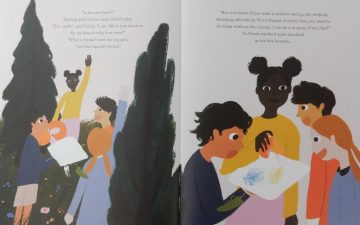
Then one by one, well-intentioned girls and a boy alter David’s own design.

By the time they’ve finished the kite is totally different and certainly doesn’t feel right. Moreover when it comes to ‘breeze-busting’ and ‘gale-sailing’ the thing is a total flop.

Back in his bedroom David takes hold of Grandpa’s lucky feather and remembers his words, “Let’s see what we’ve already got. More often than not, we’ll find the answer inside.” And then he knows.

Back to the kite he goes and once again makes it his own.  Will it fly this time?

David though, has learned about more than just kite-making that day: he’s made an important discovery concerning himself.

Simon Mole’s reflective narrative is poetic which isn’t surprising as he’s a performance poet. In this, his first picture book he captures so well those feelings of displacement and desperately wanting to belong that children especially experience when moving to a new community: feelings that Oamul Lu mirrors in his distinctive eloquent digital paintings.

Through the Eyes of Us / In Every House, on Every Street

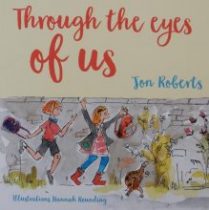
Through the Eyes of Us
Jon Roberts and Hannah Rounding
Graffeg

This is the second book written by the father of a child on the autism spectrum.

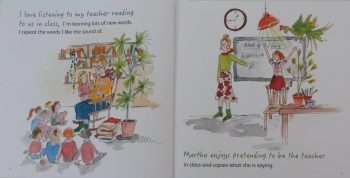
Herein as well as Kya from Through the Eyes of Me, we meet her best friend Martha.

Kya, now at school, talks about her experiences there, sometimes contrasting her thoughts, behaviour and preferences with Martha’s.

I know from experience of children I’ve taught that school can be a very confusing place for neurodiverse children, but both girls have their own ways of navigating through lessons, playtimes and lunchtimes, all of which are illustrated in colourful, detailed, sometimes funny scenes.

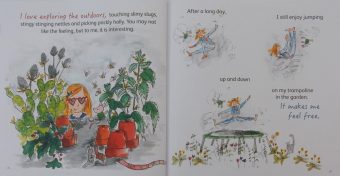
Kya also describes how she and Martha enjoy different tactile experiences,

and activities in their free time; and their routines are also different.

Martha knows when she feels tired, unlike our narrator whose energy seems boundless; although once asleep after a soothing bath and massage, she sleeps soundly.

Enlivened by Hannah Rounding’s expressive illustrations, this is a smashing celebration of every child’s uniqueness as well as providing an insightful picture of the world of an autistic child.

The book concludes with a list of relevant websites.

Put Through the Eyes of Us in your class collection and whether or not you have children on the autism spectrum therein, read it together, talk about it and lend it to individuals for home sharing too.

In Every House, on Every Street
Jess Hitchman and Lili La Baleine
Little Tiger

The girl narrator of this book invites readers into her house to see what goes on in its various rooms.

What we discover is a happy family engaging in seemingly ordinary everyday activities, but nothing they do is dull or mundane.

The cake baking in the kitchen becomes an opportunity for the family to dance and sing together.

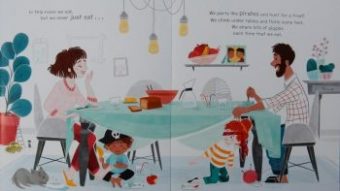
The dining room might be the place for eating a meal, but that meal can turn into a fun piratical party,

while the living room is a great spot for rest and relaxation but also for dancing and singing, mulling things over and talking about feelings.

Yes the bathroom is for getting clean but there are opportunities for some artistic endeavours too.

And the bedroom? Yes sleep happens therein, but so too does play.

Full of warmth, this is a lovely demonstration of what makes a house a home delivered through Jess Hitchman’s upbeat rhyming narrative and Lili La Baleine’s views of the everyday incidents of family life that make it special but different for everyone in the street, as the final fold out spread reveals.

Two Oldies But Goodies

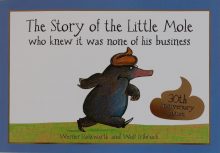
The Story of the Little Mole who knew it was none of his business
Werner Holzwarth and Wolf Erlbruch
Pavilion Books

It’s hard to believe, it’s 3 decades ago since this ground-breaking book was first published.

I clearly recall the day in 1989 when as a member of the local authority advisory steering group for English, our senior adviser called a meeting to talk about the national curriculum that was being foisted upon us. We gathered in a small room and without comment he walked in and read aloud this book. – well not exactly for this one, that I have now is a 30th anniversary celebratory edition.

We sat there in silence avidly listening, knowing full well why we were being treated to this: clearly it summed up what he thought about a curriculum being dumped on us from on high.

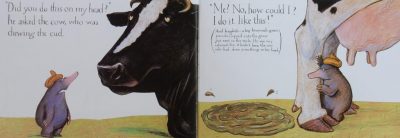
If you don’t know the story, it’s the tale of a little mole upon whose head there falls one morning as he pops up from his hole, a sausage-shaped turd. He then goes on to try and find the culprit, asking each of the animals he encounters in turn, “Did you do this on my head?”

Their excretory responses assist him in eliminating them one by one from his search

until finally, thanks to a pair of large flies, the poo perpetrator is discovered and receives his due deserts, after which mole returns to his underground residence.

With its wonderfully droll illustrations providing a ground level view, I’ve yet to share this book with a class that hasn’t dissolved into helpless giggles and now, with this new edition, long may it continue so to do.

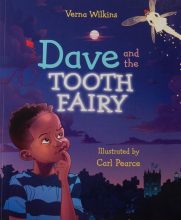
Dave and the Tooth Fairy
Verna Wilkins and Carl Pearce
Studio Press

I remember using the 1993 Tamarind Books edition with primary classes and now some 25 years on it’s back in a newly illustrated incarnation for another generation of readers whose parents, like myself, will likely remember the first version.

Having tried unsuccessfully to dislodge his wobbly tooth, one morning at breakfast ‘Dave does ‘his biggest sneeze ever’ causing the thing to shoot out of his mouth, fly across the room and vanish.

His initial excitement quickly gives way to disappointment: no tooth means no Tooth Fairy visit and thus no money for a new kite. No matter where he looks Dave just cannot find the missing object.

When Grandpa comes to stay, Dave comes up with an idea that he hopes will solve the problem …

My original version was read to pieces so I’m unable to compare the illustrations but Carl Pearce’s have a filmic quality that will appeal to today’s avid screen watchers.

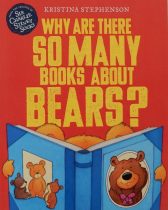
Why Are There So Many Books About Bears?

Why Are There So Many Books About Bears?
Kristina Stephenson
Hodder Children’s Books

The title to Kristina Stephenson’s new book poses a question that I suspect a fair few picture book reviewers will have asked themselves.

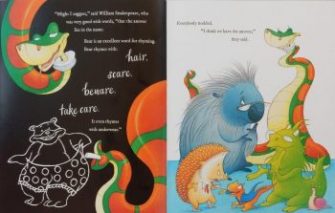
They however haven’t until now had recourse to ‘the most brilliant minds in the animal kingdom’ gathered together at Mollusc College, Oxford to discuss what is billed as the ‘Impossible Question’ concerning this preponderance of ursine book characters.

Let’s meet some of these brains forthwith.

First to offer a suggestion is William Snakespeare who proposes the answer lies in the number of words rhyming with bear and suggests a few examples.

His fellow debaters think he might have the answer. Not so Albert Swinestein. He quickly knocks that idea on the head stating that pig is equally easy to find rhymes for.

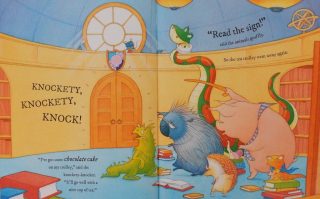
At this point there comes a knock on the door and a voice announces the arrival of the tea trolley. The debaters send the knocker packing drawing attention to the DO NOT DISTURB sign and Swinestein continues, proposing as the answer, the variety of sizes of bears; but this notion is immediately demolished by the PhDs (Porcupines, Hedgehogs and Dragons with Spines.)

The discussion continues, as do the interruptions by the tea trolley pusher causing increasing agitation to the debaters.

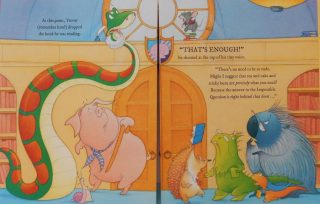
Just when tempers reach boiling point, Trevor the little mouse pipes up.

It might just be that this tiny, thus far silent creature, has solved the puzzle and that answering the door might yield the answer to the impossible question.

There’s something for everyone in this droll story. The very young will enjoy the frequent interruptions, the fold-out spread surprise and the superbly expressive illustrations of the characters, while older readers and adults will relish the tongue-in-cheek humour and the punning. Everyone I think, will love the throwaway finale tossed in by the tea-trolley pusher when he eventually gains admission.

Don’t Worry, Little Crab

Don’t Worry, Little Crab
Chris Haughton
Walker Books

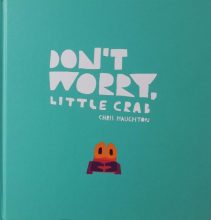
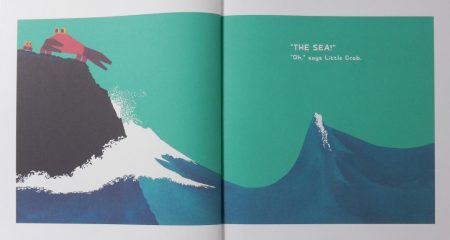
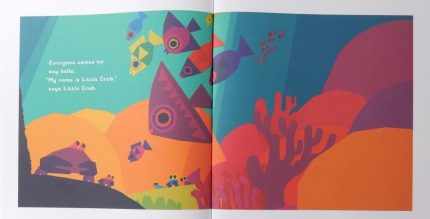
Chris Haughton takes the familiar topic of first time fears and finding the courage to overcome them and in his signature style arresting, minimalist graphics and a present tense narrative, conjures an original decapod spin.

Little Crab and Big Crab live together in a small rockpool and today’s the day Little Crab takes his very first swim in the big ocean. They set off together making their way over the rocks, tip-clawing across shallow pools and squelching through slimy seaweed, Little Crab full of eager anticipation until …

Perhaps this isn’t quite such a good idea after all, he thinks as despite Big Crab’s reassurance and encouragement, a rather large wave approaches. Then comes an even bigger one followed by a much, much bigger one.

Big Crab continues to cajole his companion and all the while ever more fierce-looking waves wash up.

Inching closer and closer the tiny creature eventually dips his claws beneath the sea

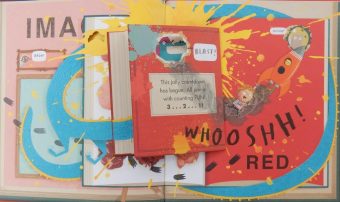
but still those waves come, one so gigantic it WHOOSHES the two of them right away from any land.

Down into the depths they go discovering together a truly wonderful new place and what’s more, it’s full of friendly creatures ready to introduce them to some exciting new experiences.

Chris’s vibrant, seemingly simple illustrations convey SO much about Little Crab’s feelings showing how in his case, less is most definitely more.

This is an ideal book for little ones taking their first steps towards independence be that starting nursery or school, learning to swim, joining a new club or whatever.

There’s a Rang-Tan in My Bedroom

There’s a Rang-Tan in My Bedroom
James Sellick and Frann Preston-Gannon
Wren & Rook

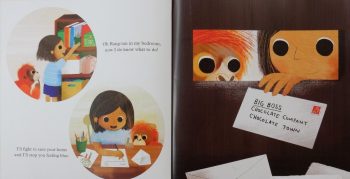
What begins as a rant at a mischievous ‘Rang-Tan’ in the bedroom of a small girl as she orders it to depart, is dramatically changed by the creature’s revelation of how human devastation of its rainforest home in south-east Asia has caused it to flee for its life; and all on account of palm oil – a constituent of the items in her room that the animal has been howling at.

Having learned of the irresponsible actions of her fellow human beings,

the girl is fuelled by a determination to do something about this reckless deforestation and so she does.

She writes to chocolate manufacturers

and talks to others about rainforest destruction, enlisting their support in her campaign and ending with a promise to make sure there is a future for animals like her visitor.

After the story there are several pages giving details of the orangutans and their plight; the problem caused by irresponsible destroying of rainforests and over-planting of the palm trees that yield the much-wanted oil, and what we can all do to help save the remaining rainforest habitat in Indonesia. Emma Thompson has written a foreword to the book in support.

Based on the original Greenpeace film that became a recent sensation, James Sellick’s rhyming story speaks powerfully for the cause and has been beautifully re-illustrated by Frann Preston-Gannon whose scenes of destruction take readers to the heart of the problem.

A book that should bring to the attention of younger readers the price paid by irresponsible palm-oil production, enlisting more recruits to the green movement.

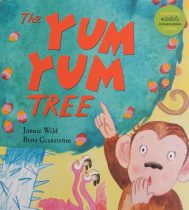
The Yum Yum Tree

The Yum Yum Tree
Jonnie Wild and Brita Granström
Otter-Barry Books

This, the third story to feature the Five Flamingos begins with a cry for help from Monkey. Her baby is stuck up in a Yum Yum Tree.

While the other animals are debating the unlikelihood of such an event on account of its difficulty to climb, evidence of the baby’s position comes in the form of a cascade of fruits from above.

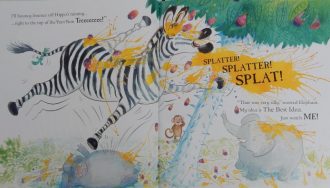
That precipitates a series of rescue operation proposals first from Hippopotamus (his bouncy belly is offered as a soft landing); followed by an attempt to use said belly as a springboard by Zebra, which fails even more dramatically.

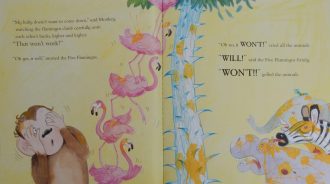
Crocodile gets his just desserts (not the baby monkey) for his wily attempt leaving just the Five Flamingos to show the way and they’re pretty convinced their idea is going to work.

Seemingly the quintet know something about baby monkey psychology

and not long after all the animals are participating in a celebratory party thrown by a grateful mum Monkey; or maybe not quite all the animals …

Absolutely bound to induce instant delight is the surprise finale of Jonnie’s smashing tale of problem solving and community.

Brita’s comical illustrations are a treat making every spread a giggle worthy delight for both listeners and adult readers aloud. If you’ve yet to encounter this particular group of African animals then start here, but be sure to catch up with their previous adventures.

Once Upon a Rhythm

Once Upon a Rhythm
James Carter and Valerio Vidali
Caterpillar Books

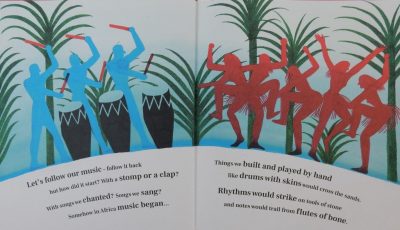
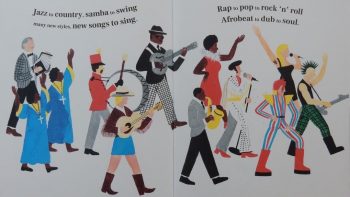
In this booming, stomping, chanting, magical look at music and its origins, poet James Carter engages not just our ears and eyes but our voices, our limbs, our hearts, and indeed our whole bodies, as we follow his lead that takes us back to the rhythmic sounds of tools on stone, to the chants of Africa,

to the songs of communities, to the voices of different instruments be they blown, plucked, shaken, banged, bowed or stroked.

First came the making of music and then came the notation – the lines and signs – indicating the pitch and the rhythm, enabling us to preserve it and pass it on through time and space.

We celebrate the emergence of new forms and styles,

new places to ramp up the sound and most of all, the notion that music is for everyone and each of us has the capacity to make music of one kind or another.

He concludes with an acrostic RHYTHM invitation to ‘Listen to life’s music’.

This latest of James Carter’s non-fiction poetic writing has Italian illustrator Valerio Vidali’s arresting artwork to complement it. His music makers appear to have picked up the rhythm of Carter’s poetry making it all the more vivid and powerful.

A smashing celebration of the art of music.

The Boring Book

The Boring Book
Shinsuke Yoshitake
Chronicle Books

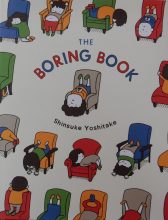
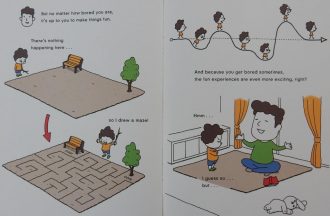
“I’m bored.” How many times do we hear children utter those words? They’re the first words said by the child protagonist in Yoshitake’s philosophical picture book.

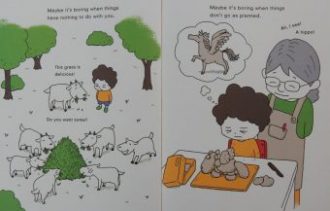
His mum can do nothing to alleviate his state so the boy decides to explore the whole notion of boredom. What does it mean? What causes it? Inertia perhaps?

The lad continues his consideration of ennui by looking at different situations such as detachment and disappointment

as well as whether inanimate objects can be bored.
He visits possible locations that induce boredom in the extreme – an amusement park that fails to amuse for example.

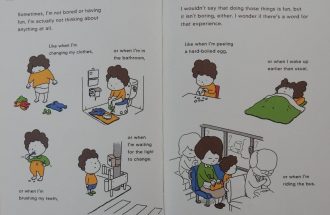
But then comes a revelation – ‘it’s actually fun to think about “boring” things. This is followed by a deliberation on the strange state between boredom and having fun when things are done seemingly without any thought at all – things like teeth brushing or riding in the bus.

And who invented the word anyway?

It’s probably not a good idea to question grandparents about being bored; they’re likely to ramble on for ages about their experiences and anyhow, looks can be deceptive when it comes to boredom.

What about Dads though? This particular one seems more insightful about the topic and even sparks off some creative thinking …

but then he goes and spoils things again …

One thing is certain though, exploring and discussing boredom is anything but boring. Boredom is an option but one that can often lead to creativity where children are concerned – if they’re left to their own devices.

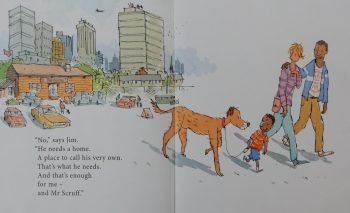
Mr Scruff

Mr Scruff
Simon James
Walker Books

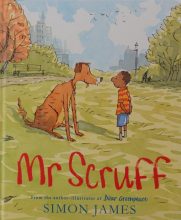
Crazy but totally adorable is this canine tale from Simon James.

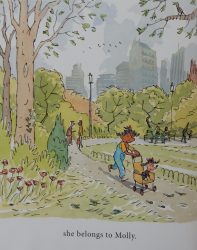
Most of the dogs herein bear a striking resemblance to their owners: there’s Polly and her owner Molly;

Erik belonging to Derek; Martha owned by Arthur and then there’s Mr Scruff, a large rather mangy-looking dog that nobody coming to the rescue centre seems at all interested in.

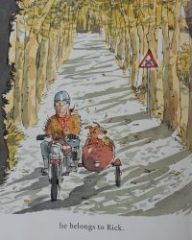
Also very much wanted are Mick – by Rick

as well as Lawrence with indulgent Florence.

Meanwhile back at the centre, things are looking more hopeful for Mr Scruff. In comes Jim and right away boy and dog seem to take a shine to one another.

Jim’s parents take a bit of convincing: there’s the size difference and surely a pup might be more fun. Jim though has made up his mind: Mr Scruff is going home with them and that’s that.
And so he does.

Now into the centre comes someone else seeking a dog: he makes an unlikely choice too, but no matter because like Mr Scruff this one also needs a loving home. And that’s that.

Animals lovers especially will fall for this tale. The gentle humour of Simon James’ wonderful watercolours ensures that the inherent warmth of the story never becomes sentimental, while the rhyming nature of the narrative makes reading it aloud all the more enjoyable.

A definite winner for me despite my cynophobia.

Out and About: Night Explorer / Animal Homes

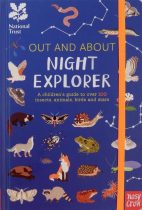
Out and About: Night Explorer
Robyn Swift, illustrated by Sara Lynn Cramb
Nosy Crow

Created in collaboration with the National Trust, this is an excellent little book if you’re planning on doing some exploring after dark with youngsters or are off camping somewhere.

It’s packed with information about such things as suitable clothing, creating a night-time den, star gazing, nocturnal creatures – from minibeasts to moths and mammals including bats, plus owls and amphibians; and, it’s good to see several spreads on night-time flowers.

There are lots of helpful hints on such things as tracking animals by means of footprints and poo deposits.

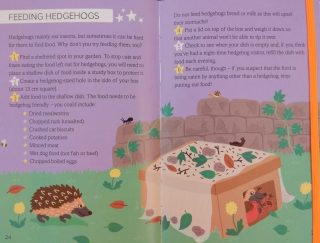
No matter the season there’ll be ideas herein: how about creating a house for creepy-crawlies in your garden during winter; or setting up a hedgehog feeding station?

I especially like the idea of making a sensory map at night, particularly focusing on sounds and smells as you walk and then repeating the same route in the light and comparing what you notice.

There are even suggestions for games, a quiz and a glossary.
All in all, with its plethora of very attractive labelled, coloured illustrations by Sara Lynn Cramb, this is ideal for encouraging young explorers (with an adult or older sibling) to get closer to nature at night.

Animal Homes
Clover Robin and Libby Walden
Caterpillar Books

Wherever we walk there are likely to be animals living either in the earth beneath our feet, at eye level, or high up above our heads. We currently have a bees’ nest in our chimney.

Illustrator Clover Robin and author Libby Walden offer us an insight into six different animal homes, in various parts of the world.

After a general introductory page, we visit a beehive;

a beaver lodge; the nest (eyrie) of a North American Bald Eagle; a rabbit warren; a termite mound and the earth of a Red Fox.

As well as the habitats themselves, each spread (one per home) provides factual snippets about each of the inhabitants and their habits, some of which is hidden beneath flaps.

It’s unlikely that young children will encounter these particular habitats but nevertheless this little book, with its attractive collage style illustrations will encourage them to keep their eyes open for animal homes in the environment. Should they find any it’s important to remember Libby’s final rules: ‘Find, Look, Leave’.

Can You Find 12 Busy Bees? / Ten Little Aliens

Can You Find 12 Busy Bees?
Jordon Winch and Patrick Shirvington
New Frontier Publishing

Who wouldn’t want to accept Jordon Winch’s invitation to enter the garden Patrick Shirvington so beautifully depicts on the opening spread, and join in the search for the abundance of wildlife residing therein. I for one couldn’t wait to go through the gate and seek out the lizard basking in the sun.

As we wander, lots of different birds introduce themselves starting with ‘2 patient powerful owl chicks’ nestling in a tall old tree …

as well as ‘3 crafty kookaburras, ‘6 merry magpies’ – these are poking around on the lawn, ‘7 flighty fairy-wrens, (in the bushes), ‘8 carefree cockatoos’ and ’10 rowdy rainbow lorikeets’ sipping nectar. Yes, some of these birds may be unfamiliar to young readers outside Australia but discovering new things is part of the pleasure.

Lolling around in the pond are ‘4 fat frogs’ to find; and there are two different kinds of butterflies making up the 5 fluttering through the flowers. We’re not told what kind they are, nor the identity of the 9 green grubs chomping through the foliage, though I hope few youngsters will fail to name the 11 lovely ladybirds’

or the most vital for us all, the ’12 buzzy bees’ of the title, as they forage for food in the flowers.

All these creatures, and readers too will endorse the final ‘We love our garden. We hope it will be there forever.’ And it definitely acts as reminder to make our own gardens wildlife friendly.

Patrick Shirvington’s love of the natural world shines through in his beautiful watercolour scenes that accompany the simple descriptive narrative.

Ten Little Aliens
Mike Brownlow and Simon Rickerty
Orchard Books

Aliens of all shapes and hues star in this counting down space adventure wherein the strange beings far from home search for a friendly place to stay.

Seemingly though, their numbers diminish as one receives a FIZZ! from a comet’s tail, another is SPLOOFed by Nova-berries, a Mega-Robot’s honking blasts the next, and a fiery crater fires out bubbling lava at a pink one.
Now we’re down to six and they’re caught in a sudden snowy blizzard. So it goes on with a SNIFF!, a BOING!,

a PARP!, a cry for HELP! as the sat-nav gives up the ghost.

Then, hurrah! Up steps the one remaining – a female alien – with a rescue operation to perform.

Will they ever find a hospitable planet on which to land their space ship? What do you think?

Rhyming fun Brownlow and Rickerty style always hits the spot with little ones and this story on an ever popular topic, with its sprinkling of alliteration is sure to please too.

Let’s All Creep Through Crocodile Creek

Let’s All Creep Through Crocodile Creek
Jonny Lambert
Little Tiger

As the sun sets an intrepid little Mouse leads his fearful friends homewards.

In order to get there before dark, he decides to take the short cut through the creek. He’s ‘NEVER seen a crocodile in the creepy, crooked creek’, so he tells Shelly and Rabbit.

What follows is a delicious comedy of errors as the three friends set off, traversing a ‘lumpy, bumpy bridge,’ clambering through ‘long, thick “scritchy, scratchy” thorns’

and swinging through green vines. All the while Mouse is providing a description of the animals they’re hoping never to see.

Then Shelly’s comment concerning the similarity between slippy, slidey logs and the bodies of the green reptiles causes them to plunge into a dark tunnel from where they view a host of watchful pairs of eyes upon them.
Hundreds of crocodiles, is Shelly’s conviction.

Mouse continues with his banter until Shelly’s burning question provokes a considerable degree of panic; but the three friends do manage to find dry land safely, albeit still some distance from home.

A forest shortcut is Mouse’s suggestion; but don’t forests contain tigers, wonders Rabbit … and off we go again.

Jonny’s surefooted way of manipulating words and images, orchestrating them into a seamless drama that unfolds across the pages, is what makes this book SO brilliant; that and his attention to detail throughout. From the crocodilian front endpapers to the tiger-striped back ones it offers a superb lesson in how a picture book should be read.

Gerald the Lion

Gerald the Lion
Jessica Souhami
Otter-Barry Books

In a departure from her more usual folk tale renditions Jessica Souhami sets her tale of Gerald in an urban jungle.
Full of boldness Gerald the lion – a character youngsters will instantly see is a domesticated grey cat – decides to explore his neighbourhood jungle.

It’s an environment full of strange sounds and sights – there’s the roar of creatures in the tree branches,

weird beings from outer space (a trio of snails); hungry crocodiles swimming in the lake, and some giants stop to speak to him when he pauses his perambulation.

Suddenly there appears a fiery dragon that causes Gerald to leap in alarm

and then he finds himself lost and completely alone.

Poor Gerald: will he find his way back home?

We all, but especially young children, hear strange noises from time to time imagining all kinds of scary things might be lurking, and so it is here in Jessica’s simple but clever tale: a tale wherein the incongruity between her telling of the extended joke and her hallmark bold, bright collage style illustrations work perfectly together.

With its large clear print this book is ideal for early reading as well as for sharing with little ones during story sessions where I envisage it becoming a firm favourite.

The Pigeon HAS to Go to School!

The Pigeon HAS to Go to School!
Mo Willems
Walker Books

At last the time has come; our favourite picture book Pigeon is to start school, despite the fact that he’s adamant that he’s not going. “I already know EVERYTHING!” he insists immediately shooting himself in the foot by inviting readers to ‘… ask me a question. Any question!’

From there however he starts revealing his real anxieties: he’s not good first thing in the morning; supposing he doesn’t like it and worse – supposing the teacher doesn’t like pigeons. One by one these worries emerge from beneath that feathery bluster. There’s sooooooooooo much stuff to learn – too much and his head and body might part company.

We’re treated to an eight-part tirade of terrifying possibilities – ‘Will FINGER PAINT stick to my feathers? … What’s up with those heavy BACKPACKS? I’m a fragile bird.’ By now our little Pigeon is a jittering wreck.

But then, after a further rant …

comes a light bulb moment … followed by the very best of all Pigeon possibilities that answers his question, ‘Well, HOW am I supposed to get there, anyway!?!”

It’s a truly wonderful finale, perfectly delivered Mo Willems style; and I’m sure all the Pigeon fans out there will be on the edges of their seats as they anticipate what is about to show up next – whey hey! …

Presented almost entirely through speech bubbles, Pigeon’s monologue is simply brilliant and the way in which Willems zooms in and out on his protagonist both orchestrates the action and highlights the emotional turmoil.

I’ve totally loved all of the Pigeon books but perhaps this is my favourite so far.

Share with those about to start school as well as those already experienced in the mysteries of the classroom.

How Do You Dance?

How Do You Dance?
Thyra Heder
Abrams Books for Young Readers

How Do You Dance? That question is posed on the title page followed by some responsive ‘like this’ moves, while there’s a little boy shown opposite sitting reading.

Turn over and some adults have joined the fun ‘like this’ they say, while the same boy, now standing digs his heels in: “I don’t”.

Out from behind him leaps a girl “I do” she counters indicating a cleaner …

Others take up the beat, the joy of each one being beautifully captured in Heder’s watercolour and pencil illustrations, as they beckon, bop, flit, scrunch, pull faces, swirl and twirl.

The same small girl then shows a series of moves

before leading readers to assorted locations wherein to continue the dance – the kitchen for shimmying on account of your delicious cooking;

or outdoors

and sometimes you just need to cheer yourself up with some floppy steps; there are just so many possibilities.
(A chart is provided should readers feel like experimenting).

This dance thing is just SO infectious that Dads and even animals kick up their heels and eventually they all (bar one) come together in a wonderful climactic celebration of dancing …

But what of our naysayer – does he ever dance? He insists he wants to be left alone …

If this utterly joyful book doesn’t get you on your feet and trying out some new moves, I’ll hang up my dancing shoes.