Exploding Beetles & Inflatable Fish

Exploding Beetles & Inflatable Fish
Tracey Turner and Andrew Wightman
Macmillan Children’s Books

Sam, narrator of this funky STEM information book is totally obsessed with all that’s weird and wonderful about members of the animal kingdom. (There is mention of the occasional plant too.) He keeps four pets – stick insects of the Indian variety named Twiggy and Wiggy, a goldfish named Bob (deemed boring by Sam’s elder brother) and a hamster, Letty. Readers learn a fair bit about these creatures along the way including the fact that stick insects often eat the old skin they’ve shed and as a defence mechanism, they might exude from their joints a foul-smelling liquid or spray attackers with a nasty chemical substance. Best not to attack a stick insect then.
I should say at this point that throughout the book Sam has drawn or rather claims to have done (actually Andrew Wightman is the illustrator) all kinds of funky creatures eating, pooing and just generally going about their lives.
On the poo topic, did you know that a fair number of animals including woodlice eat their own? (they never ever wee though) Or that wombats have cube-shaped poo – how on earth do they manage excreting that without discomfort?

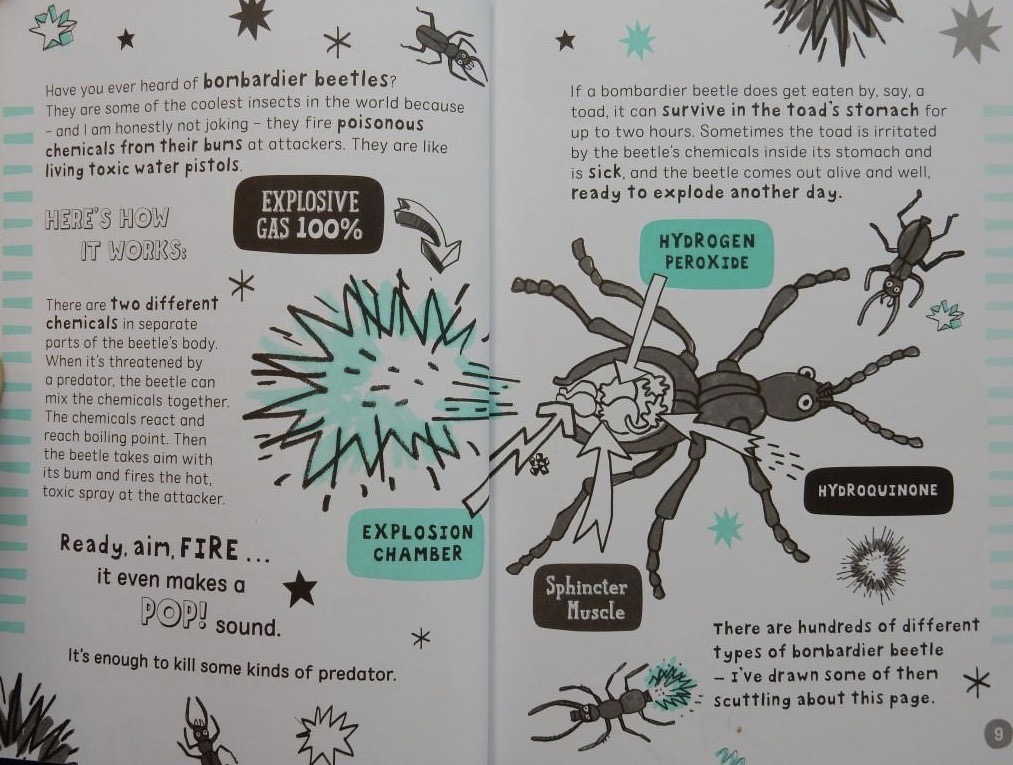
I’m pretty sure your reaction to the revelation that bombardier beetles can explode like toxic water pistols will be similar to mine – best to steer clear of their bums.
Much of this fascinating information is related during a hunt for Twiggy. Sam discovers that the little creature has gone awol from his vivarium when he goes to spray water inside.

Happily she is eventually found (hiding in plain sight) but not before Sam has shared a considerable number of amazing factual snippets with readers.

Terrific fun and gently educational too.

Protest!

Protest!
Alice & Emily Haworth-Booth
Pavilion Books

Did you know that people have been protesting since the time of Pharaoh Ramses 111, ruler of Egypt when the first workers’ strike took place in 1170 BCE? That’s something I learned from the first section of this book by sisters Alice and Emily that looks at the global history of protest from then (the hard-working pyramid workers were demanding more food) until now with Greta Thunberg and school children’s strikes for the climate.

It’s good to know that from early on (195 BCE) women were protesters. The women of Rome marched for the right to dress the way they wanted – and they won!

Thereafter come the peasants’ revolt, and in the 1640s the Levellers and the Diggers about whom I knew nothing before reading about them herein. Included too are the Native American Ghost Dance (1890s); the Protest Ploughs of the Maoris towards the end of the 19th century, the Salt March and of course, the Abolitionist movement, the Suffragettes (UK) and many other women’s movements in various parts of the world.

Two movements I was personally interested in and strongly supported, the Anti-Apartheid Movement and the anti-nuclear movement are covered,

as are the Stonewall Riots, the fall of the Berlin Wall, the Arab Spring and bang up to date, Black Lives Matter and Extinction Rebellion.

The authors also talk about some of the creative means of protesting: singing, tree-hugging, theatre and other performing art and even using toys as protesters.

An uplifting, inspiring and timely look at how protesting has changed our society and the world we share. Emily provides the illustrations, and she and Alice co-authored the text. It’s a call to action for sure.

Do Animals Fall in Love?

Do Animals Fall in Love?
Katharina von der Gathen and Anke Kuhl
Gecko Press

Katharina von der Gathen is a German sex-educator; her writing style is direct, packed with intriguing detail and infused with humour. This humour is reflected throughout in Anke Kuhl’s amusing cartoonish illustrations.
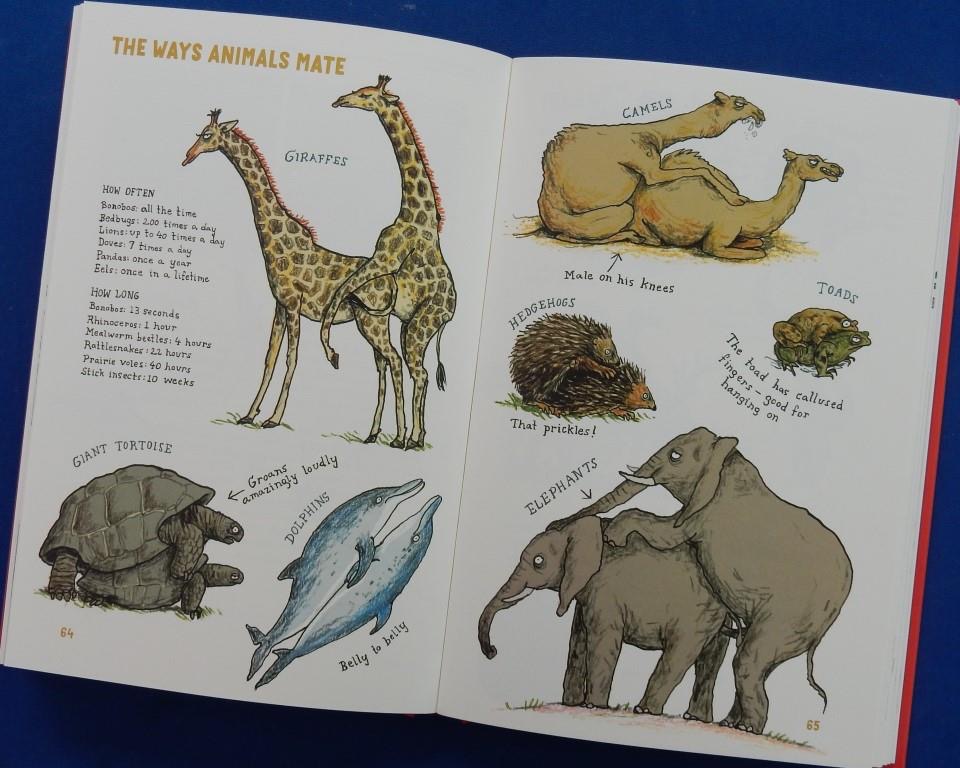
The author divides this book on animal reproduction into three main parts – courting (The Art of Seduction), Mating

and The Babies Arrive; but within each are lots of sub-divisions. For instance within seduction we find flashy appearance, dances, smells to attract, songs and physical fighting (sometimes head to head).

Choosing examples from a wide variety of creatures – vertebrate and invertebrate – Katharina von der Gathen uses biological terminology throughout her descriptions (normally one or two paragraphs) of the various activities while also maintaining a chatty tone.

For example, a male cabbage white butterfly ‘seems intent on being, and remaining, the only partner for his mate. The others can push off! So during mating, he sprays the female with a very special perfume. From then on, she is no longer attractive to other males. To them, for some reason, she stinks!’

At one time or many, children will ask ‘how do animals do it?’ questions. This book provides fascinating answers while taking readers on a journey through the incredible animal kingdom in so doing. It’s definitely one to add to book collections be that at home, public library or school. (Children at the younger end of the intended readership may need some further explanations)

Interview with a Shark

Interview with a Shark
Andy Seed and Nick East
Welbeck Publishing

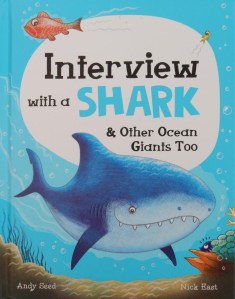
For those who like their information delivered with a degree of quirkiness then the results of Andy Seed’s latest expedition with his ‘tranimalator’ machine will definitely appeal.

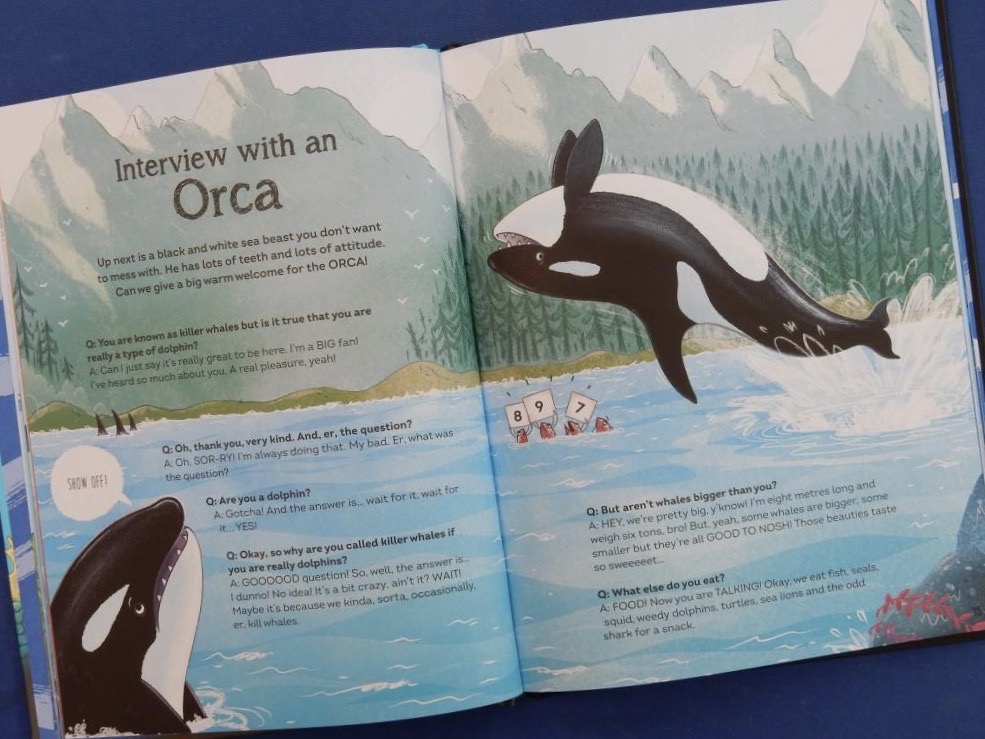
In this book he dons his wet suit and dives into the ocean where, feeling more than a tiny bit nervous he faces his first interviewee, a massive bull shark. Like the author, this subject (and the others) seem to have a great sense of humour as they respond to his questions (just the sort of things a child might ask), with more than the occasional leg pull. The answers though are informative too, revealing such things as what they eat, what might eat them, where they live, (I wasn’t aware that bull sharks sometimes live in rivers as well as salty sea water.)

Andy has close encounters with nine marine giants – an awesome blue whale (the kind of whale with no teeth and the world’s biggest poos); a very toothy orca – actually a type of dolphin, 

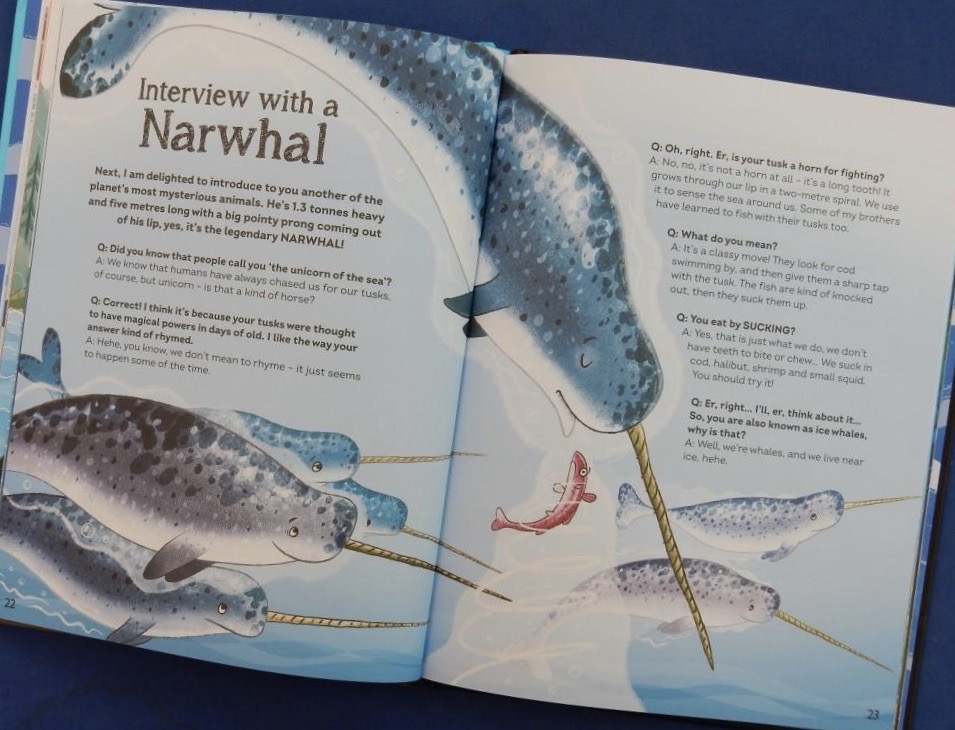
a giant squid, a narwhal (of the stamp collecting, yoga practising variety – told you they have a sense of humour); 

a manta ray – most unhappy about the rubbish we humans dump in the oceans, as are several of the other creatures; an ocean sunfish; an octopus, a conger eel (bites like a bulldog) and finally a creepy anglerfish. 

One of this creature’s claims to fame is its soft bendy bones and stretchy belly that enable it to gobble up BIG things. 

Along with the moans about plastic pollution, we also hear grumbles reminding us of the effects of global warming and fishing (nets and noise). Andy provides a “How you can help’ spread suggesting ways readers can help take better care of our planet and its wildlife; and, there’s a final fun quiz (no cheating).

Nick East provides the visuals – they’re hugely appealing and some almost leap off the page. Young readers (and some adults) can assuredly learn a considerable amount if they dive in with Andy and Nick.

Dance With Oti: The Bird Jive

Dance With Oti: The Bird Jive
Oti Mabuse and Samara Hardy
Walker Books

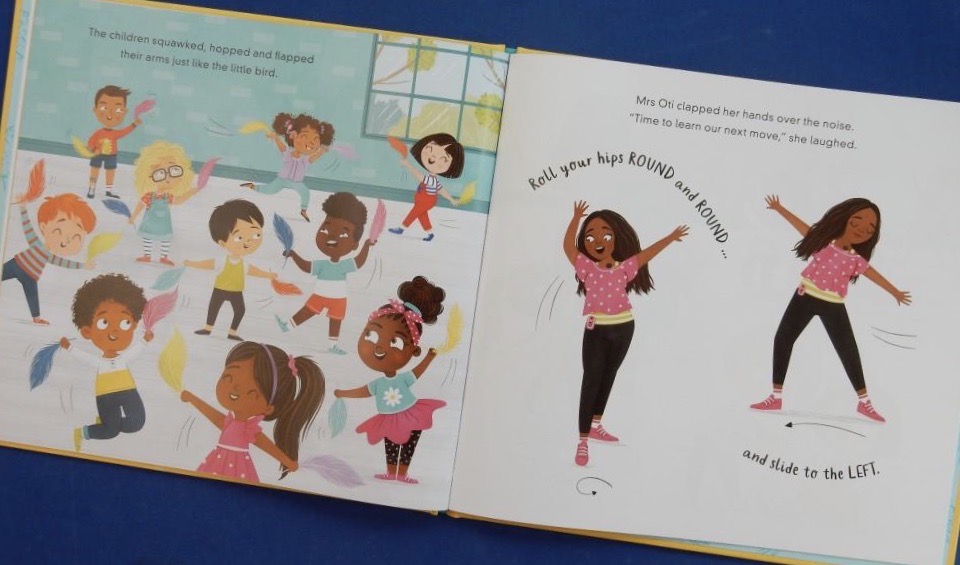
This is the debut picture book of Strictly Come Dancing star, Oti Mabuse, and as the book opens, Mrs Oti is welcoming a host of would-be dancers into her studio for their very first lesson.

Warm ups and stretches completed, everyone is ready to start learning the jive. There are the inevitable thrills and spills but under their teacher’s enthusiastic, watchful, caring eye, the children are quick learners

and in no time the lesson is halfway through. Then suddenly, an unexpected winged visitor makes an appearance.

Mrs Oti deals with the disruption in her characteristic creative way and soon everyone is back on task

and the lesson proceeds towards the final steps and a wonderful controlled POSE! Just in time to give the waiting families a first performance of The Bird Jive. And humans aren’t the only ones that show their enthusiasm as the dance draws to a close.

With some delightful characters including Poppy, Gan and Olivia, all illustrated with panache by Samara Hardy, and a step-by-step demonstration of the Bird Jive routine by Oti, this is a thoroughly enjoyable celebration of movement, dance and giving it your all. Share the book then, get on your feet and JIVE!

My Big Book of Outdoors

My Big Book of Outdoors
Tim Hopgood
Walker Books

When it comes to nature, ’The more you look, the more you see’. So says Tim Hopgood in the blurb to this stunningly beautiful bumper book.

To amplify this, starting with Spring, Tim takes us through the four seasons of the year celebrating the delights to be discovered in each one.

My favourite time, Spring, brings blossom, baby animals, bulbs busting into bloom, the birds greeting the day with their dawn chorus, nest building, egg laying and more.

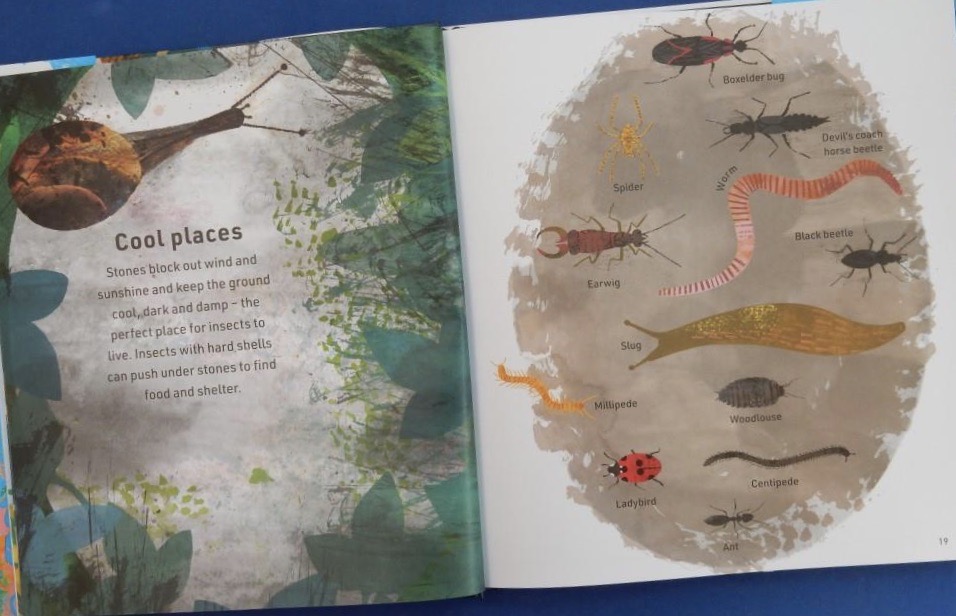
There are close-ups of eggs, feathers, minibeasts, 

frogs, soil and a rain shower and more; as well as the occasional poem and activities for indoors and out.

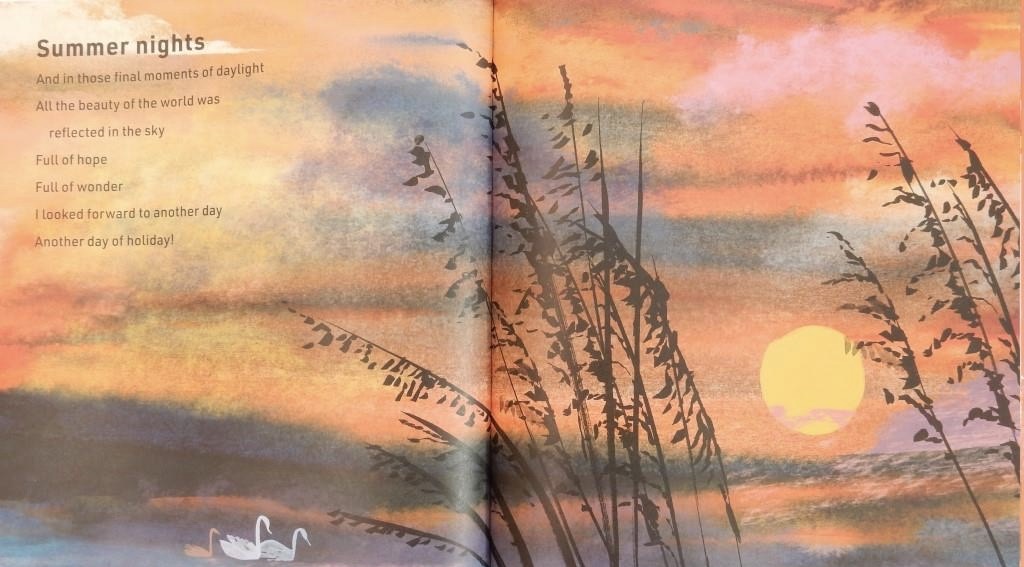
With its longer, warmer days, Summer offers insects aplenty, baby birds taking flight, a richness of colour and scents from flowers and for some plants, it’s time for seeds to be dispersed. More colour comes from amazing skies, 

ripening fruits and vegetables and there’s the promise of a holiday, perhaps by the sea.

Misty mornings, leaves changing colour and falling in blustery winds herald Autumn as birds take flight to warmer climes, seeds are dispersed far and wide, and creatures forage for supplies in readiness for winter as do humans who harvest the spoils from trees and hedgerows.

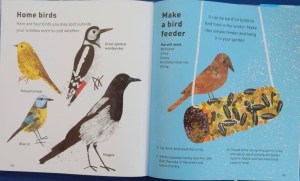
Quiet seems to descend along with Winter’s arrival with its chilly, sometimes frosty days and cold snuggle up nights when some creatures hibernate to survive. It’s a season to remember the resident birds and perhaps using Tim’s instructions, make a feeder for the garden or balcony. Assuredly they’ll need it should snow fall.


With every page turn bringing more of nature’s delights, this is for sure, a veritable treasure trove: Tim has done nature proud.

100 Endangered Species

100 Endangered Species
Rachel Hudson
Button Books

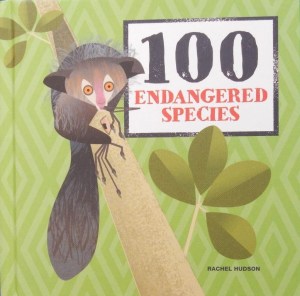
It’s alarming to think that there are so many creatures on the endangered or threatened list; the author/illustrator of this chunky book teamed up with the People’s Trust of Endangered Species to illustrate one such animal every day for 100 days.

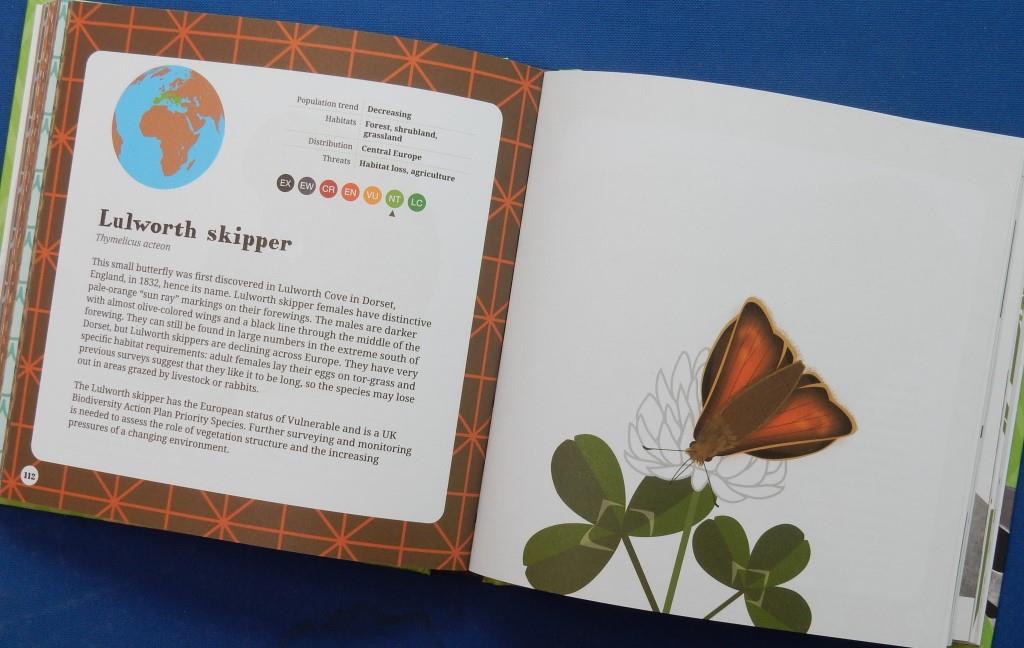
Those chosen come from all over the world and each has undergone evolutionary adaptations to suit its environment, be that the Red pandas found in China, Nepal and Bhutan; the Madagascan Aye-ayes, and the Indris that live in the northern and central rainforests of East Madagascar; the Sumatran tigers; the Little spotted kiwis of New Zealand; the Lulworth skipper butterfly first found in Dorset and now on the decline across Europe; 

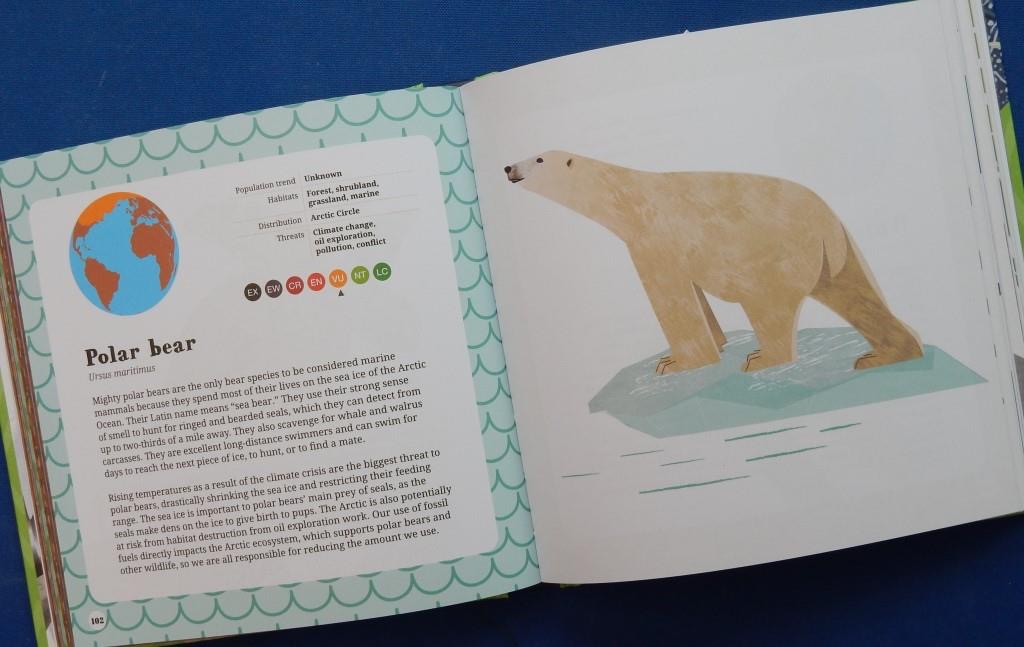
or those magnificent polar bears whose Arctic Circle habitats are at risk both from destruction due to oil exploration work, and rising temperatures resulting from climate change.

Each of the animals depicted is on the International Union for the Conservation of Nature’s Red List (explained at the beginning of the book) and is thus a conservation priority. Opposite each gently amusing illustration is a descriptive paragraph (or two) giving interesting facts, as well as saying why the species is currently at risk and often, what is being done, or needs to be done, to protect it. There’s also a world map showing distribution, and listing habits, threats and population trend which is given, with very few exceptions, as ‘decreasing’. 

However, it’s heartening to see that numbers of the African elephant, the little spotted kiwi, the whooping crane, the greater one-horned rhino and the giant panda are on the increase as are those of the Eurasian beaver.

Readers who feel inspired to become involved in conservation issues/initiatives – hopefully that is all of them – can find a list of organisations and projects at the back of the book, as well as a glossary; and there’s a foreword by broadcaster and naturalist Brent Westwood. Give this book to a child and who knows, you might inspire a life-long passion for conservation.

The Encyclopaedia of Unbelievable Facts

The Encyclopaedia of Unbelievable Facts
Jane Wilsher and Louise Lockhart
Frances Lincoln Children’s Books

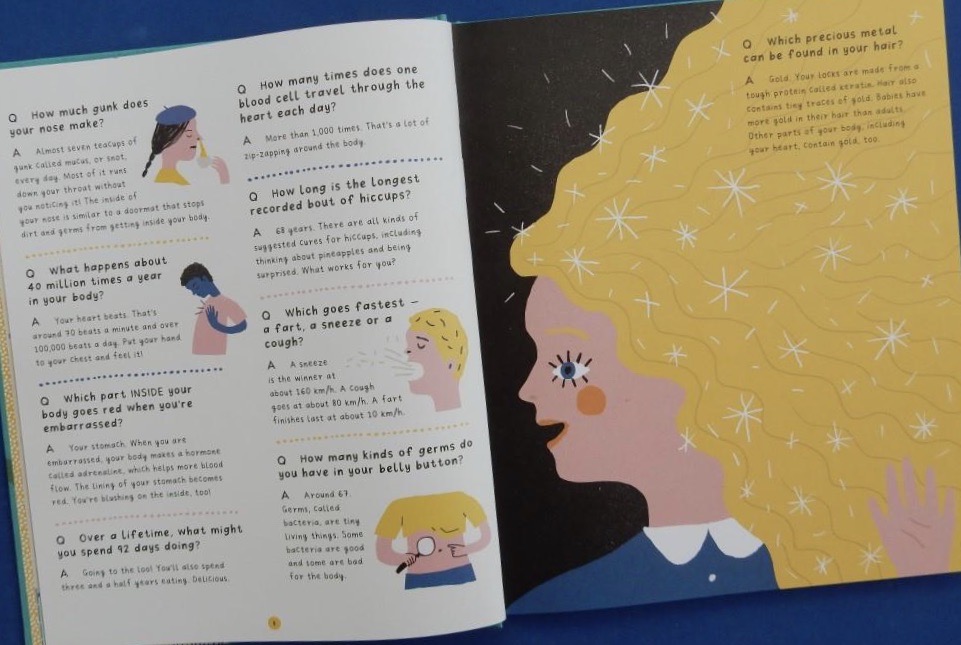
Many of us turn red in the face when feeling embarrassed but have you ever wondered about your insides? Embarrassment causes adrenaline to be produced and this helps increase blood flow, one consequence of which is that the stomach lining becomes red, so we blush both internally and externally.

Equally amazing is that our hair contains minute traces of gold, with babies having more than adults. Both are covered in the Human Body the opening part of this unusual encyclopaedia of trivia.

In case you’ve ever wondered what astronauts do with their dirty laundry, what happens to their wee, or what happens when an astronaut wants to scratch an itchy nose while wearing a space helmet, you’ll discover the answers along with those to over 45 more questions in the Space section of this book.

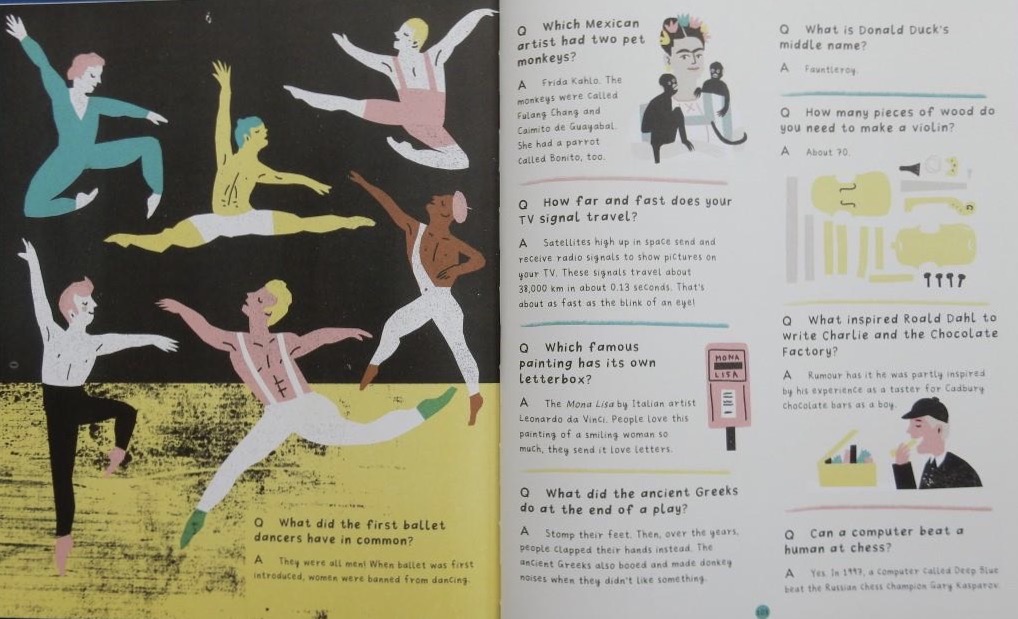
It’s not only STEM topics that are included herein though. There are sections entitled Customs & Culture, Our World and finally Arts & Entertainment. If you want to know Donald Duck’s middle name, you’ll find the answer there.

For each theme Louise Lockhart provides a wealth of offbeat, stylish illustrations, mostly small but some whole page ones too.

No matter whether you want to ask questions in a quiz with your friends or family, or just fancy dipping in to discover some new factual bits and pieces, then here’s a book for you; this reviewer certainly learned a fair bit.

Ancient World Magnified

Ancient World Magnified
David Long and Andy Rowland
Wide Eyed Editions

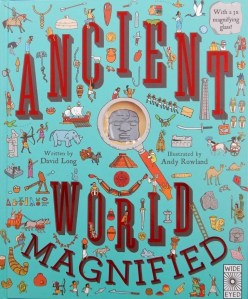
New in the interactive ‘Magnified’ series, this is one of those books where you think, ‘I’ll just spend a few minutes reading this’ and hours later you’re still totally immersed, using the magnifying glass provided inside the front cover.

Starting with Mesopotamia in what is today parts of Iraq, Iran, Syria and Turkey, author, David Long and illustrator Andy Rowland take readers time travelling to visit sixteen ancient civilisations, providing a taster of what life was probably like in each one. I was pleasantly surprised to learn that here where civilisation is thought to have begun, men and woman were mostly treated as equals.

From there we move to (c. 4000-1500 BC), a large area now in India and Pakistan, the Indus Valley Civilisation, in which I have a particular interest having once visited not Harappa or Mohenjo-daro featured here, but another more southern site, Lothal.

I have to admit though I’d never heard of Olmec, central America’s first civilisation in what is Mexico today, nor the Kingdom of Aksum (120BC – 850 AD), one of Africa’s greatest empires much of which is in modern Ethiopia and we learn, among the first of the great civilisations to convert to Christianity. 

Also new to me is the Xiongnu Empire in what took up large parts of today’s northern China, Siberia and Mongolia, formed when several tribes of nomadic peoples came together under a ruler named Modu, controlling an area almost as big as Europe. 

Each of these fascinating civilisations is allocated a double spread most of which is taken up with a riveting, highly detailed illustration by Andy Rowland. There are also two or three paragraphs giving information about location, daily life, buildings, what made it prosper etc. and there are ’10 things to spot’ on every spread. Not easy in several cases but should you wish to look, the answers are supplied at the back of the book, along with a famous figures gallery, almost 60 more things to find in the busy scenes, a timeline and glossary.

Recommended especially for young history enthusiasts, as well as those who love search-and-find books.

The Dinosaur Awards

The Dinosaur Awards
Barbara Taylor, illustrated by Stephen Collins
Frances Lincoln Children’s Books

Here’s a novel way of presenting dinosaurs to youngsters, not that a good many of them wouldn’t devour almost any dino. related book they can get their hands on, such is the seemingly never ending enthusiasm for these prehistoric creatures.

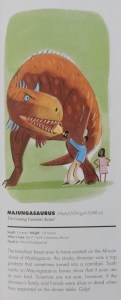
This one uses a combination of quirky, almost cartoonish digitally created illustrations and a wealth of intriguing facts about lots of different dino. species, some well known, others less so. I met a few for the first time herein, one being Majungasaurus that receives the ‘Cunning Cannibal Award and lived on Madagascar during the Cretaceous Period between 84 and 71 million years ago – assuredly a VERY scary predator.

Almost all the winners, be they famous or lesser known, are allocated three or four paragraphs, a captioned framed portrait of the award receiver along with its trophy or medal and one or more larger illustrations. There’s also a databank with name pronunciation and meaning, where it came from, diet, and size, plus in some instances a short humorous cartoon strip, in others some additional trivia.

So, if you’ve ever wondered what might make Ouranosaurus so special, not only did it have a ‘Super Sail’ along its back and tail, but also a duck-like beak and two bony bumps in front of its eyes.

Whereas Troodon’s claim to fame was its enormous eyes (about 5cm across), so it received the “What Big Eyes You Have’ award.

There’s even a ‘King of Rock ’N’ Roll medal and that goes to Cryolophosaurus (aka Elvisaurus’ on account of its funky head crest thought to resemble that 1950s quiff of the rock legend).

With plenty here to amuse and inform, this works either as a dip in and out book, or a longish read straight through, in which case you’ll encounter around fifty incredible prehistoric creatures from our planet’s past – worthy winners all.

The Plesiosaur’s Neck

The Plesiosaur’s Neck
Dr Adam S.Smith & Jonathan Emmett, illustrated by Adam Larkum
uclan publishing

I certainly wasn’t expecting a rhyming text when I received this book but wow! It really works and is a terrific read aloud.

Plesiosaur expert Dr Adam S.Smith teamed up with children’s author Jonathan Emmett to create a cracking narrative to investigate the evolutionary conundrum of the long neck of Albertonectes using Poppy the plesiosaur as their main character. Poppy, so we learn, was an ocean dwelling Albertonectes plesiosaur – a prehistoric reptile from the Cretaceous Period living around the same time as the land living dinosaurs. Said creature was around 12 metres long and had many features similar to those of other sea creatures, but that stupendous neck (apparently around two-thirds of its whole body length) – what ever could have been the purpose of that?

Various possibilities are posited: maybe it was a pterosaur grabber …

or, could it have been a parasite picker-offer.? Perhaps it was a tunnelling tool to procure crunchy-shelled nibbles,

or contained an electric zapping mechanism to stun unsuspecting prey swimming too close. Poppy would most definitely have required a huge amount to food to keep her going.

This prehistoric poser is still being puzzled over and I love that the authors end by asking young budding palaeontologist readers, ‘So, what do YOU think that immense neck was for?’

Along with the playful, punning rhyming narrative is a series of fact boxes containing a wealth of additional information and in a rather wacky role are a pair of molluscs, Alfie Ammonite and Bella Belemnite, that chip in with jokes, and cheeky comments and puns relating mainly to Poppy.

The final spread is devoted to a glossary and a spotter’s guide to the Cretaceous Period with fifteen creatures to send readers back to the beginning of the book on a search-and-find quest. Adam Larkum’s illustrations are full of fun, adding to the entertainment of what is a smashing exploration.

Is There Life on Your Nose?

Is There Life on Your Nose?
Christian Borstlap
Prestel

Dutch illustrator/designer Christian Borstlap presents a playful look at some of the vast number of microbes that occur everywhere you can imagine and places you probably can’t.

Despite his light-hearted style, there’s a lot of information contained between the covers of this book as readers are introduced to a host of these invisible organisms, starting with those living on our noses. Amazingly like all of us humans, these microorganisms are sensitive, able to move, eat and release things from within.

Contrast a single microbe with the largest living thing on our planet: I was surprised to discover that it’s a ginormous fungus that has grown to a size of 3.8 square miles and lives under the Blue Mountains in the USA. The author provides additional details about this and each of the other largely illustrative spreads presented in a ‘Find out more’ section at the end of the book.

The rate at which microbes reproduce is phenomenal as is the tolerance to extremes shown by some – those living in boiling water for instance, or barren deserts. And, did you know that some of these organisms even feed on metal,

and others on oil – both of which can be a good thing.

None of us would be able to digest our food without the action of the microbes living in various parts of our digestive system. So these are definitely vital to our well-being.

During the past year we’ve all become hyper-aware of the harmful kind of microbes, viruses, in particular COVID 19 (mentioned in the final notes) but only alluded to on the relevant spread.

With the ever growing problem of plastic waste, it’s great to read of the possibility of microbes offering an organic solution to this huge issue. Others are even able to generate clean energy through gas production.

Now you might think you’re pretty good when it comes to recycling but we learn here that microbes are actually the very best of all recyclers …

All in all, none of us would be here at all without microbes: those known as cyanobacteria produce almost 50 per cent of the oxygen we breathe.

This fascinating account has truly whetted my appetite and I can’t wait to visit Amsterdam (one of my very favourite places) again: this time I will definitely head for Microbia – the world’s only microbe museum – mentioned at the back of the book.

Escape: One Day We Had To Run

Thank you so much to Lantana Publishing for inviting me to take part in the Escape: One day We Had To Run blog tour. 

Escape: One Day We Had To Run
Ming & Wah and Carmen Vela
Lantana Publishing

For centuries, people have left their homes for such reasons as famine, slavery, war, intolerance, political turmoil and more recently, climate change. They had two things in common, their determination to search for a better life elsewhere, and their bravery.

This hugely inspiring, timely book tells a dozen stories of some of these seemingly ordinary human beings, starting with sisters Yusra and Sara Martini who fled the war-torn Syrian city of Damascus to Turkey where they boarded an overloaded dinghy bound for Greece. When the boat’s engine failed and to prevent it from capsizing, the girls plunged into the sea. Desperately holding on, and freezing cold, they helped direct the dinghy until it’s engine restarted and it eventually reached the shore. The girls later made it to Germany and Yusra swam in the Refugee Olympic team at the 2016 Rio Olympics.

Also escaping by sea were Chan Hak-chi and his girlfriend Ly Kit-hing who roped themselves together and swam for six hours across a shark-infested bay to reach Hong Kong, thus escaping famine and persecution in mainland China.
Another twosome was Hans and Margret Rey who, carrying the manuscript for the very first Curious George picture book, fled Paris on bikes just hours before the Nazi invasion of the city, cycling for days to reach the Spanish border from where with the money from selling their bikes they bought train tickets to Lisbon from whence they made their way by boat eventually reaching New York where twelve months later their book was published.
Escaping underground were Joachim Neumann and his girlfriend, members of a group of 57 East german students who tunnelled under the Berlin Wall from East to West Germany and freedom, through what is now known as Tunnel 57.

Those featured on other spreads – each escapee has one – include fleer from Kiribati, Ioane Teitiota, who became the first legal climate change refugee when granted special status by New Zealand’s Prime Minister, Jacinda Ardern.

However the person I’ve chosen to highlight is Russom Keflezighi. He had supported Eritrean rebels in their protracted attempt to win independence from Ethiopia. Walking overland from war torn Eritrea at his wife’s insistence, Russom Keflezighi left his family, encountering many dangers before reaching Sudan, and then Italy. After five years he was reunited with his family and they settled in the USA where his son later became one of America’s greatest marathon runners.

Russom Keflezighi

I just can’t imagine the heartache and pain caused by the decision fleeing father Russom Keflezighi had to make in leaving all his loved ones behind, then walking vast distances every day under constant threat from enemy soldiers until he crossed the border into Sudan. The very thought of leaving behind my own family to do such a thing is just unbearable.
Dramatic, graphic style illustrations by Carmen Vela show escapers swimming, biking, walking, flying even, as they flee danger and this moving book fittingly concludes with two Articles from The Universal Declaration of Human Rights relating to movement and asylum.
ESCAPE: ONE DAY WE HAD TO RUN will be available in all good bookshops in the UK from May 6th and in the USA & CAN from May 4th! OR, buy your copy from Lantana’s online shop and donate a book to children who need books the most with your purchase: www.lantanapublishing.com

FACTopia!

FACTopia!
Kate Hale, illustrated by Andy Smith
Britannica Books

Surprising and sometimes humorous are the connections between the four hundred statements found within this cornucopia of facts collected by Kate Hale.

With my love of chocolate, and that large tower spanning the gutter of the book, how could I resist savouring first the information on that spread. I was surprised to read that ‘The world’s largest chocolate bar weighed 2,696 kg’ – about the same weight as four male polar bears.” Wow! Now that would take some eating. However with my vegan sensibilities I was horrified to learn that ‘the average chocolate bar contains some tiny insect fragments’. Where do they come from?

I hastily left the chocolate page and turned instead to the linked spread where I was met with a gaping mouth in the process of consuming birthday cakes and discovered that a world record was set by a man who consumed 6.6kg of birthday cake in eight minutes; I assume he didn’t eat the candles as well. That surely must have stopped him having ‘borborygmi’. I have to admit I had to check up the meaning of this word just to make sure it wasn’t a joke but sure enough it is ‘the rumbling sounds made by a body when hungry’.

As somebody who loves to travel I was fascinated to read about the Potato Hotel in Idaho where the rooms are contained within a gigantic replica of a potato, while in India, the country’s fisheries HQ building is fish-shaped.

There is actually some kind of linking thread running right through this entire book but there is more than one trail through the wealth of facts included so divergent thinkers can choose to follow their own path, or even just dip in and out enjoying the range of topics covered from babies to breakfast and popcorn to pets and pirates.
Andy Smith’s 300+ illustrations are huge fun and add to the enjoyment of this collection of facts for curious children (and the occasional adult I suspect).

ABC of Opera: The Academy of Barmy Composers Classical

ABC of Opera: The Academy of Barmy Composers: Classical
Mark Llewelyn Evans and Karl Davies
Graffeg

This is the second in the exciting series that presents opera and its composers to youngsters. It’s written by Mark Llewelyn Davies, professional opera singer and founder/creative director of ABC of Opera Productions, a touring company that travels the UK introducing children to the wonders of the opera through music and storytelling.

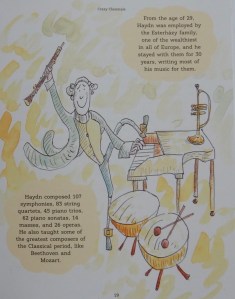
Now Megan and Jack are on a school trip to London’s Natural History Museum when all of a sudden they find themselves separated from their classmates and heading to the museum vaults. It’s there that Jack accidentally disturbs their old friend, the time-travelling, multilingual Trunk. Trunk tells them he’s on a mission concerning some Haydn manuscripts and before you can say ‘classical’ they’re whisked up and away, and back in time, first stop the Academy to return those manuscripts to the man who introduces himself as “Herr Hectic Haydn”.

From there an adventure unfolds in Salzburg, Vienna and Paris, in the classical period of opera (1750-1820).
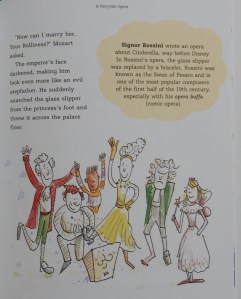
There are encounters with Mozart (aka Windy Wolfie), Beethoven and Tortellini Rossini and they all find themselves playing a part in Rossini’s La Cenerentola (an operatic Cinderella story)

as well as confronting the evil Queen of the Night. But will Jack and Megan end up losing their heads? YIKES! There’s only one person who might be able to save them and get them back to their own time …

With its “Any Body Can’ message and Karl Davies’ zany illustrations, this book is madcap fun and highly informative: what better way to learn some music history, a host of musical terms, details of the lives of several famous composers and even why sign language is important.

Science School / Out and About Minibeast Explorer

Science School
Laura Minter & Tia Williams
Button Books

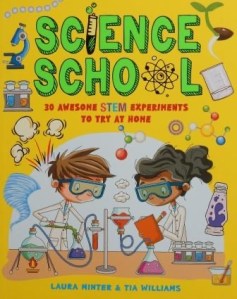
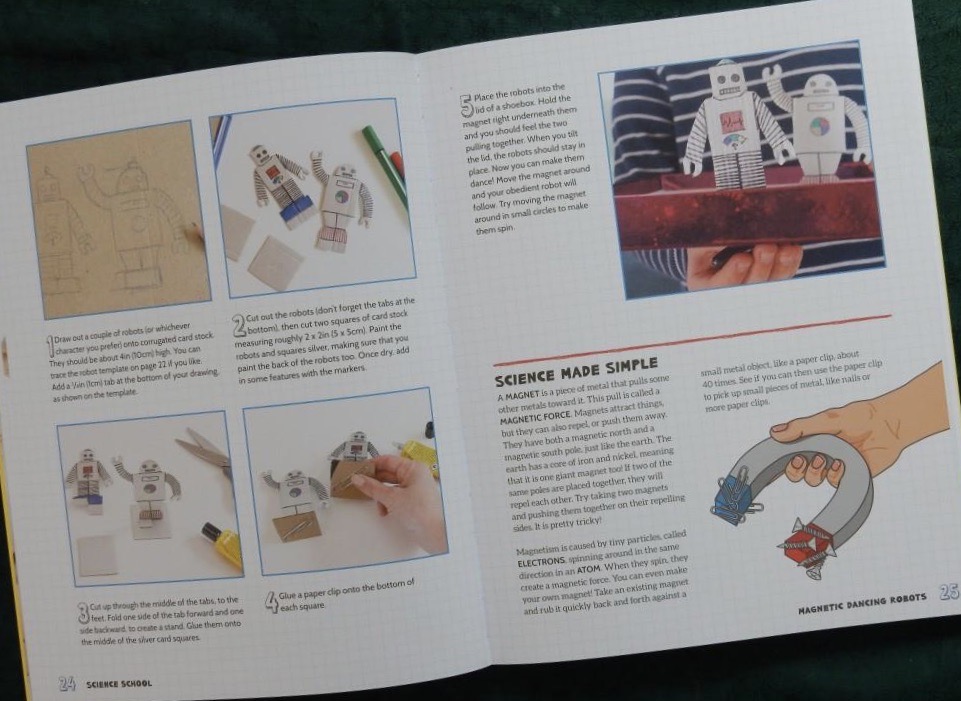
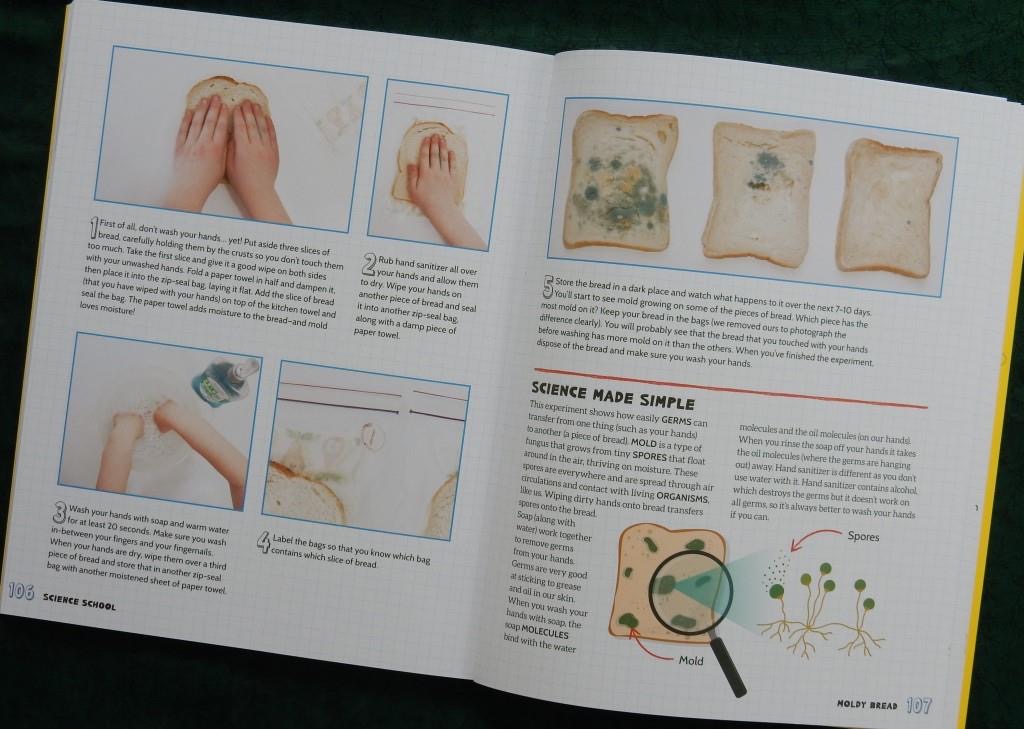
Covering such topics as magnetism, gravity, change of state, oxidation, the growth of fungus and much more – all relating to basic scientific principles, the latest collaboration from Laura Minter and Tia Williams offers thirty STEM experiments, some crafty, for youngsters to try at home.

None of the activities require sophisticated equipment; rather they can be done at home with everyday materials you’re already likely to have knocking around somewhere. A list of what’s needed is given at the start of each project and there are photographs showing what to do, beneath each of which are step-by-step instructions, and, the science behind the experiment is concisely explained in the final ‘Science Made Simple’ paragraph(s) that often takes the science a bit further too.

My experimenters especially enjoyed making the “Magnetic Dancing Robots’ and other characters. 

Important at all times, but even more so as COVID is still with us, is the experiment showing the difference after around 10 days to three slices of bread: the first wiped all over with unwashed hands; the second wiped with sanitised hands and the third with hands that have been thoroughly washed with warm soapy water for 20+ seconds, completely dried and then wiped on slice number 3 (make sure the bag into which each is placed is labelled before putting it in a dark place.)

Providing hours of fun learning, this book is particularly useful for homeschooling.

Out and About Minibeast Explorer
Robyn Swift, illustrated by Hannah Alice
Nosy Crow

Published in collaboration with the National Trust, this handy guide for youngsters features more than sixty minibeasts about which Robyn Swift presents a wealth of information related to identification, lifecycles, habitats, anatomy and more. Did you know that a decapitated cockroach is able to live for up to nine days; that the blood of slugs is green, or that seagull sized dragonflies lived before dinosaurs roamed the earth?

The importance of minibeasts is explained and also included are some pages of activities, a classification chart and a quiz.

Hannah Alice’s illustrations of the creatures are clear and easily recognisable making this a super little book to tuck into a backpack when you go out and about no matter if it be in town, countryside or the garden.

Invented By Animals

Invented by Animals
Christiane Dorion and Gosia Herba
Wide Eyed Editions

Animals have pretty much taken over in this book – there’s even an introductory ‘Dear Reader’ letter typed by a frog pointing out that many techniques, designs and ‘superpowers’ used by animals have been the inspiration for human inventions or lie at the heart of future technological advances that are works in progress. Thereafter, it’s left to the various creatures to do the talking.

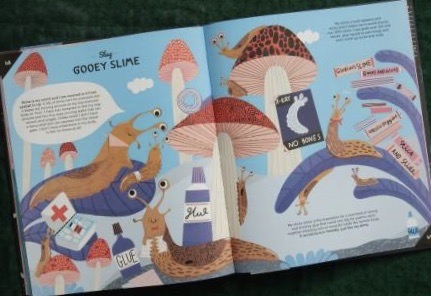
For instance there’s the shark whose skin was mimicked in super-fast swimwear that was ultimately banned after too many records were broken in the 2000 Olympics; the slug with sticky slime that is behind a super-strong glue that may well be used to mend wounds both inside and outside the human body.

Another creature helping humans in their exploration of post surgical wound closing is the prickly porcupine with its antiseptic-coated quills.

Readers also meet the super fast flying, amazingly clever hovering dragonfly whose abilities in the air are behind the invention of a little four-winged drone, as well as the woodpecker with its thick skull and shock-absorbing bones, the design of which is being copied by technologists endeavouring to make safer helmets for cyclists and others who need protective headwear.

The engaging manner through which Christiane Dorion conveys a wealth of STEM information will likely appeal to primary readers, as will Gosia Herba’s bright playful illustrations. There are lots of potential cross-curricular links: I particularly like the way many of the animals encourage child readers to think both creatively and critically in this fun exploration of biomimicry.

The Secret Life of Bees

The Secret Life of Bees
Moira Butterfield and Vivian Mineker
Words & Pictures

In this large format book you can learn all about the life of the domesticated honey bee and much more. The bee’s life cycle, anatomy,

life in a hive including the tasks undertaken by workers – cleaning, care of the bee nursery, making honey and wax, guard duty and finally, foraging for nectar and pollen outside; plus facts and figures about other species at home and abroad, honey thieves,

pollination, what bee keepers do and how to create a bee-friendly environment are all explained by our narrator worker guide, Buzzwing the honeybee.

There are also five bee tales from various parts of the world including Greece, India and Australia.

Vivian Mincer’s enticingly colourful, gently humorous child-friendly illustrations with Buzzwing’s invitation to spot various creatures hiding within many of the scenes, are likely to be pored over at length by young readers. Author, Moira Butterfield even invites budding poets to write their own bee poetry as did the character in the Indian tale she retells. Indeed, there are activities relating to each of the tales included.

The health of our natural ecosystems is intrinsically linked to the health of our bees (and other pollinators) but their numbers are in decline. Let’s hope this fascinating book will enthuse youngsters to do whatever they can to halt this potential catastrophe.

Altogether a super introduction to the world of bees.

How to Change the World / Climate Rebels

How to Change the World
Rashmi Sirdeshpande, illustrated by Annabel Tempest
Puffin Books

In her follow up to How to be Extraordinary, Rashmi Sirdeshpande presents a companion book in which she shows what a large impact can be made by people working together. There are fifteen stories of teamwork that start way back in sixth century BCE Athens with the origins of the very first democracy and is followed by a look at the incredible human engineering collaboration involved in the building of the Great Pyramid in the desert of ancient Egypt.

Then come the campaigns for change – well known and less so – in various parts of the world. Thus among environmental campaigners we have not only the universally known Greenpeace and the Montreal Protocol banning CFCs, but also the Treeplanters of Piplantri that I know of only because a friend took me to visit the village in Rajasthan a few years back. (Every time a girl is born 111 trees are planted in honour of the chief’s daughter who died during a drought around fifteen years ago).

Then, as well as the Montgomery Bus Boycott triggered by Rosa Parks’ action, there is the Singing Revolution in Estonia where people used song to tell the world that this small country had always been a free nation.

Following the spread about the abolition of slavery campaign in the British Empire is one about the 1965 Freedom Ride campaigning for justice for the indigenous people of Australia.

Alluringly illustrated by Annabel Tempest and attractively laid out, each spread with its well-written text offers an example of high quality narrative non-fiction for primary readers.

The same is true of

Climate Rebels
Ben Lerwill
Puffin Books

‘The greatest threat to our planet is the belief that someone else will save it’. Robert Swan’s quote at the beginning of this book is a powerful reminder that the terrible effects of climate change can only be arrested through our individual and collective actions.

Award winning writer Ben Lerwill presents twenty five inspiring and fascinating stories of individuals (and some groups) who have worked tirelessly and continue to do so for the causes in which they believe so passionately.

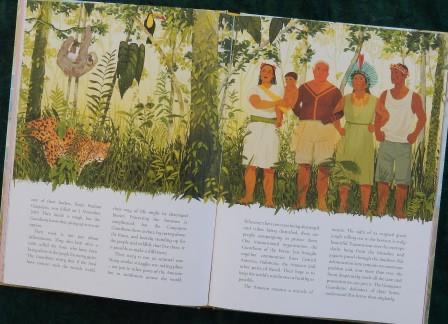
Among those featured are Dr Jane Goodall (who wrote the book’s introduction), Sir David Attenborough, the Greenpeace founders, Rachel Carson and Greta Thunberg. Alongside those are accounts of less famous names – The Guajajara Guardians –

who often risk their lives while working to protect the Amazon Rainforest; and William Kamkwamba who built a windmill in a small village in Malawi and went on to build more that pump water to the crops in the fields, thus improving the life of his entire community through renewable energy.

Not only is this book a powerful call to action; it’s also a reminder that we need to stand together – there might just be time to make those crucial changes to the climate change story.

Compellingly written in a lively style and illustrated by Masha Ukhova, Stephanie Son, Chellie Carroll, Hannah Peck and Iratxe Lopez de Munain, this book is strongly recommended for home and school reading.

Nano: The Spectacular Science of the Very (Very) Small

Nano: The Spectacular Science of the Very (Very) Small
Dr Jess Wade and Melissa Castrillón
Walker Books

Talking to nine year olds about nano particles? Surely not, you might at first think. However the author of this book knows just how to do it.

This is a totally captivating look at materials and the uses scientists make of them by physicist Dr Jess Wade from Imperial College, London and illustrator, Melissa Castrillón.

Right from the opening spread containing the words, “Look around your home. Everything is made of something … “ readers are drawn in, all the more so as the text then goes on to use the book itself as an exemplar to remind us of some basic descriptions of materials as well as introducing the importance of microscopy. 

That leads neatly in to a spread on atoms – those building blocks from which ‘every single thing on this planet is made …’ and molecules.

A great thing about this book is that every new term that’s introduced – elements for instance- is immediately then related to something familiar to its target audience:. So we’re told, the human body comprises eleven different elements including carbon. This element is part of the make up of every living thing, but sometimes existing solely as layers of carbon atoms; graphite (the lead in pencils) is given as an example.

By moving on to graphene (created by removing a single layer of carbon atoms from graphite) the author takes us into unfamiliar territory with a new material: or rather, a ‘nanomaterial’ that has taken countless experiments and many years to make.

Graphene, we’re told, already has many uses in technology but because nanotechnology is a dynamic field of study, there are further possibilities, some not perhaps even dreamt of yet. Neatly bringing the narrative full circle to the reader, the author concludes ‘There are so many secrets left for scientists to unlock, And who knows the key person might just be … YOU.’

A hugely inspiring combination of superb science and awesome art.

Do You Love Dinosaurs?

Do You Love Dinosaurs?
Matt Robertson
Bloomsbury Children’s Books

Ask a group of children the title question and almost certainly the vast majority will answer in the affirmative, so this book, brimming over with awesome, roarsome dinos is set to be a winner.

Accompanied by some young palaeontologists, Matt Robertson takes readers way way back in time to meet these incredible creatures large and small. First though come ten ‘must obey’ dinosaur rules to help ensure that youngsters get the maximum from their experience.

It’s then time to introduce in turn, the theropods – meat eating, terrifying two-legged beasts; then the sauropods (gigantic vegetarian, gentle creatures) among which were the diplodocuses.

Prepare to hide, for Tyrannosaurus rex comes next – AAARRRHH! those gaping jaws. Much less alarming are the herbivores including several new to me, as are some of the omnivores with which they share a double spread.

Horns and spikes were great protectors and the armoured dinosaurs also show their skills and how they used their incredible armour; and last we meet the deadly bird-like raptors.

The final spreads look at dinosaur fossils, development from egg to adult, there’s a dino sports event, a look at some other prehistoric creatures and last of all, annotated portraits of extra special dinos in a hall of fame.

The author takes a light-hearted approach and his illustrations are huge fun, while there’s a considerable amount of information packed into each spread.

Chickenology / Milly Cow Gives Milk

Chickenology
Barbara Sandri and Francesco Giubbilini, illustrated by Camilla Pintonato
Princeton Architectural Press

This introductory book contains everything you ever wanted to know about chickens and probably a lot more too. There are five sections (listed on contents page but not mentioned thereafter) into which is packed an incredible amount of information presented in a highly readable manner with well-designed, stylishly illustrated spreads, every one of which has just the right amount of text so that at no time does the reader feel overwhelmed.

It starts with pages on identification; how to tell the difference between a hen and a rooster, courtship and mating, a spread on shape and size – astonishingly a Jersey Giant is almost the height of a three year old child. Communication is given a double spread; feathers have two and the Leghorn spread presents a dozen different varieties of the same breed, something I didn’t know.

Last in the first section is an exploration of the question ‘Can chickens fly?’

The next part begins with a look at the anatomy – internal and external and then comes a section comprising an egg-sploration of eggs.

My favourite section is ‘Chickens and Humans’ that encompasses some history, symbolism, folktales and more.

And last of all is a presentation of just some of the estimated 300 different breeds.

There’s likely something of interest to readers of all kinds here.

For a younger audience is:

Milly Cow Gives Milk
Deborah Chancellor and Julia Groves
Scallywag Press

Ask a group of young children where milk comes from and if my experience is anything to go by, some of them will name a supermarket. Now here’s a simple picture book (endorsed by the Royal Association of British Dairy Farmers), the first of a series, that goes right back to grass roots, to Farmer McBean’s farm to be precise.

There, in the company of a child, we meet Milly, one of a well cared for, ’happy herd’ and learn the basic facts about her daily life as she grazes on tasty grass in summer and is fed lots of hay to see her through the winter. Molly has to chew and chew what she eats to help its passage through her system, as well as drinking large amounts of fresh water, inevitably making lots of cow pats in the process.

Readers get right up close to her swollen udder as it bulges with milk and watch her being led to the milking parlour (which happens at sunrise and sundown). I was astonished to learn that Molly’s daily yield is around sixty pints and that along with the milk from the rest of the herd, is made ready for drinking and eventually once packed, it does reach the shelves of supermarkets and other outlets.

The final pages gives some further, basic facts about cows, milk and dairy farming. Julia Groves’ clean, bold illustrations and Deborah Chancellor’s straightforward account show that milk production involves a lot of hard work and for many people, it’s a vital item in their daily diet, unless like me they happen to be vegan.

For foundation stage and KS1 topic boxes.

Fossils From Lost Worlds

Fossils From Lost Worlds

Fossils From Lost Worlds
Hélène Rajcak and Damien Laverdunt
Gecko Press

Immerse yourself in the world of palaentology with this large format book that provides youngsters with an accessible way to learn about fossils and geological periods.

The first spread is devoted to the diagrammatic representation of the geological periods after which readers travel through time from the very beginnings of animal life looking at the likely first organisms with each spread featuring a different prehistoric creature selected for its special contribution to scientists’ learning of palaeontology.

Yes, there are some of the expected familiar favourites including Archaeopteryx the oldest bird, Diplodocus, Stegosaurus and the iconic Tyrannosaurus; but many of the less well-known species are new to me and probably many other readers. There’s the invertebrate Anomalocaris: since 1978 palaeontologists agree on what it looked like, but its behaviour is still the subject of discussion.
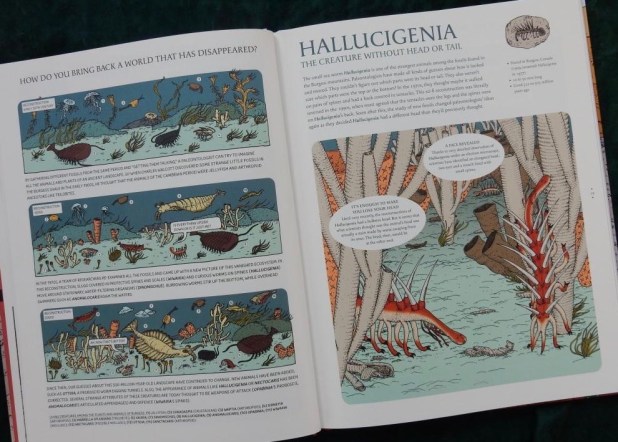
Another creature – Hallucigenia – has been the topic of much dispute in particular which end was the tail and which the head 

and there was also confusion as to what were tentacles and what were legs. Happily now thanks to electron microscopy these mysteries have been resolved.

The fossilised footprints found in Thuringia (Germany) were a mystery to scientists for over 130 years and it’s since the 1960s that it was decided that these were made by the reptilian Ticinosuchus. 

The last animal we encounter is possibly the largest ever land mammal Paraceratherium, the hornless cousin of the rhino thought to have a flexible upper lip which it used to pluck leaves and grass in similar fashion to rhinos of today.

Every one of the animals represented is allocated either one full page depiction or a full page illustration opposite which is a sequence of smaller panels adding to the overall visual appeal of the book. Each is also accompanied by a written description as well as helpful bullet points setting out where the fossil remains were found, crucially, its size and when it lived.

Alongside the animals, we also meet some of the associated palaeontologists including Georges Cuvier, Othniel Charles Marsh, Clive Forster-Cooper and the person whose name is familiar to most readers, Mary Anning, each of whom is introduced in amusing graphic style comic strip format.

The final two double spreads comprise a time line of palaeontology from the 5th century to 2017.

Most young children are dinosaur and prehistoric animal mad; this book will take those with an abiding interest in the topic, deeper in and further back in time.

The Great Barrier Reef

The Great Barrier Reef
Helen Scales and Lisk Feng
Flying Eye Books

Located off the coast of Australia, the Great Barrier Reef, the subject of this large format book, truly is one the world’s natural wonders. We read first about how the reef was formed and are introduced to the different types of coral, their structures, and how corals can multiply and spread. In order to discover the reef close up though, it’s necessary to be a qualified diver and scientists now have sophisticated equipment allowing them to spend longer and to go down deeper than ever, as is explained in one of the early spreads.

The second of its five sections is entitled Reef Dwellers and therein readers are introduced to the inhabitants both fauna and flora – of the reef and its environs. 

It’s truly amazing just how many fascinating species live on and around the reef from small molluscs to mammals such as whales, some of them in symbiotic partnerships; one tiny reef island, Michaelmas Cay is home to thousands of birds. I was surprised to discover that night is often the most active time on the reef when a wonderful array of nocturnal creatures are hunting.

It’s not only the reef ’s natural history we learn of though. There’s also information about the culture and traditions of the Aborigines and Torres Straight islands.

Unfortunately however the reef is under threat, due largely to climate change as a result of the burning of fossil fuels : an increase in ocean temperatures and acidification endanger its very survival and that of the marine life that depends on it. The book ends with a look at what has already happened and what can be done to save the reef.

Throughout, the author, marine biologist Dr Helen Scales shares her knowledge and enthusiasm writing in an accessible style that will enthral primary age readers. Arresting illustrations by Lisk Feng showcase the awesome array of life of this remarkable World Heritage Site, while the entire design of the book is of the exemplary quality one associates with Flying Eye publications.

Turtle Rescue

Turtle Rescue
Jonny Marx and Xuan Le
Little Tiger

I suspect the burgeoning of picture books telling of the plastic pollution of the oceans is indicative that the problem is on many people’s minds. Sadly though, not those who continue to throw rubbish onto the beaches or in the sea. One can but hope that Jonny Marx and Xuan Le’s Turtle Rescue will help in this hugely important environmental cause.

Flora, marine biologist and ace underwater swimmer, Fauna, inventor and turtle lover, and their child, Baby Bud, are holidaying at the seaside intending to take it easy for a while. That isn’t what happens however.

Soon they find themselves helping with a rubbish collection during which they’re told it’s hoped it will help bring back the turtles to lay their eggs on the sandy beach once more. Before long the three of them have packed supplies, chartered a boat and are sailing off to investigate the lack of turtles.

As they sail towards the reef, Bud is excited to see all the different sea animals and plants and keeps pointing out what he calls ‘jellyfish’ – the floating plastic bags he insists on counting. Eventually Flora sights a turtle

and carefully follows it until she runs out of air. Back on board the boat again, it’s obvious a storm is looming but eventually it blows itself out and there ahead is an island. Just the place to stop and let Fauna’s queasiness subside. Imagine their delight when Bud notices tracks in the sand leading right across the dunes at the end of which are …

After an eventful and hugely exciting trip, with sail duly repaired, it’s time to head home.

There’s an amazing amount of information about turtles and other marine wildlife packed between the pages of this fascinating part fact, part fiction book.

Science and Me

Science and Me
Ali Winter and Mickaël El Fathi
Lantana Publishing

Following their Creators of Peace, author Ali Winter and illustrator Mickaël El Fathi present profiles of thirteen more Nobel Prize winners, this time for their work in medicine, physics and chemistry.

Coming from all over the world and starting with Marie Curie (1903) and concluding with Donna Strickland (2018 winner for laser technology), each of the laureates is given just one double spread so there’s only space for a brief biography that focuses as much on the dedication and challenges overcome as the individual’s discoveries / achievements and the social impacts thereof. For example, it took decades for the discovery of Subrahmanyan Chandrasekhar relating to ‘black holes’ to be recognised.

Michaël El Fathi takes a key moment or element from each featured life as the basis for each collage illustration: for Youyou Tu it was the ancient book mentioning ‘Qinghao’, the Chinese name for herbs in the Artemisia family. From these could be extracted Artemesinin, the drug that has subsequently prevented over two hundred million people worldwide dying from malaria.

I particularly like the way in which the author involves readers in considering what science contributes to making the world a better place for us all; she does so both through the title lead in to each of the scientists as well as through the summation on the final spread, the last line of which asks “What does science mean to you?

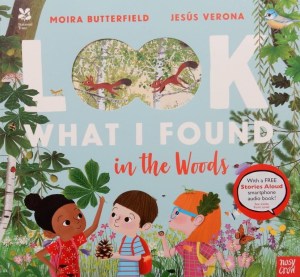
Look What I Found in the Woods

Look What I Found in the Woods
Moira Butterfield and Jesús Verona
Nosy Crow

‘Follow me. I know the way. / We’re walking in the woods today.’ So says the child narrator of this book.
The woods are my favourite place to walk and during the pandemic I’ve spent a lot of time so doing in woodlands close to my home, always returning home feeling considerably uplifted. Consequently I was more than happy to take up the invitation to participate in this woodland foray with the three child adventurers shown on the first spread.

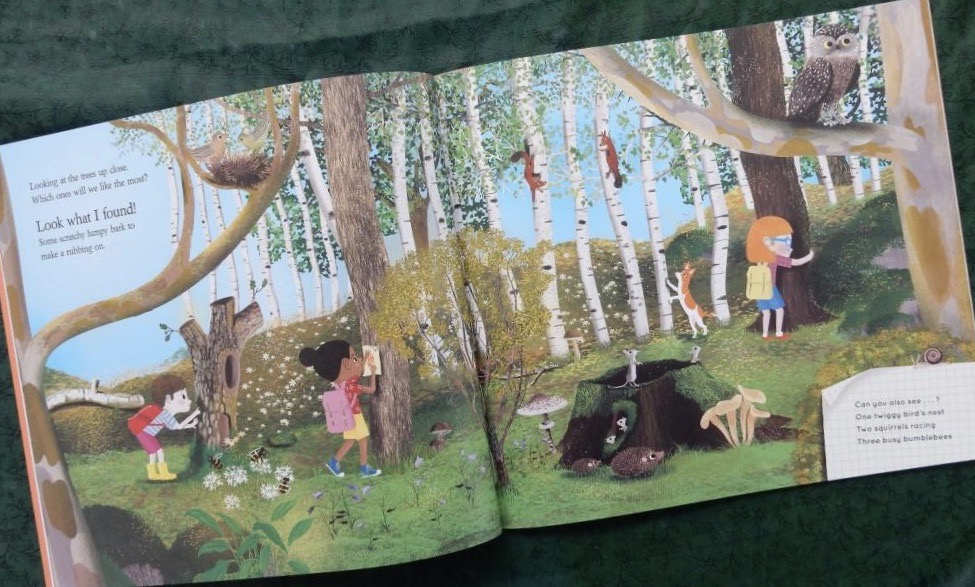
Readers are immediately engaged by means of an insert in the bottom right-hand corner that asks us to find one signpost, two butterflies and three bright yellow flowers.
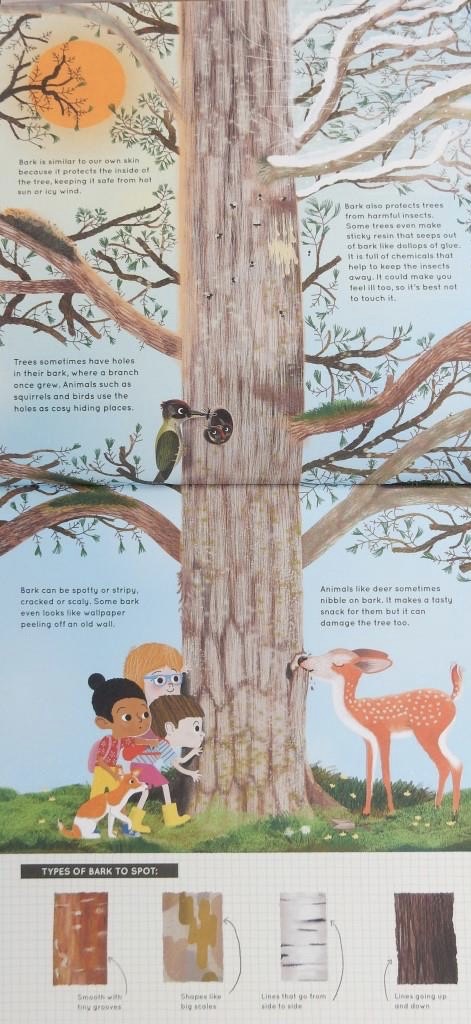
The second spread shows the children making observations while the text provides facts about the trees and a sidebar showing labelled tree shapes.

The subsequent spreads alternate between these two styles of layout

as readers learn about leaves, bark,

fruits and seeds, fir cones and shells while the children continue their exploration discovering exciting ‘treasure’ throughout their walk; treasure that they present on the final spread once back indoors.

This highly engaging nature book published in collaboration with the National Trust, successfully mixes story, non-fiction and search-and-find. Jesús Verona’s illustrations are an absolute delight. Each one offers an immersive scene to linger over and wonder at the fine detail included; and the final endpaper shows the children’s creative efforts with some of their findings.

Busy Spring: Nature Wakes Up

Busy Spring: Nature Wakes Up
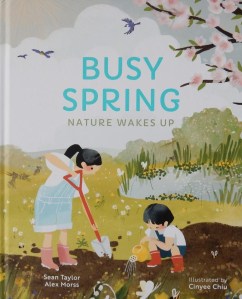
Sean Taylor , Alex Morss and Cinyee Chiu
Words & Pictures

If you live in the northern hemisphere, like me you have probably been noticing beautiful wild flowers – snowdrops, daisies, celandines and primroses springing up, an abundance of catkins, blossom starting to open on trees, pussy willow buds bursting; as well as the occasional bee and butterfly. We even saw frogspawn a couple of times last week (the end of February). Definitely spring, with its promise of so much, is my favourite season and this year it seems even more important than ever to celebrate its arrival.

That is exactly what the two children in this beautiful book (written by children’s author Sean Taylor and ecologist Alex Morss) are doing. The older girl acting as narrator, tells us how what starts out as a hunt for Dad’s fork so he can plant some carrots turns into an exploration of the family’s garden. ’Everything smelled like wet earth and sunshine.”

“The spring sunlight is nature’s alarm clock,” Dad says, taking the opportunity to mention pollination.
Both girls are observant, asking lots of questions and noticing signs of new life all around – tadpoles,

a bird building its nest and a wealth of minibeasts – ants, woodlice, worms and beetles and several species of butterfly, as well as playfully emulating some of the creatures they discover.
Throughout, Dad subtly provides snippets of relevant information concerning life cycles, habitats

and what causes the seasons; and throughout the children’s sense of excitement is palpable.

Cinyee Chiu’s illustrations are absolutely gorgeous, beautifully composed and carefully observed.

At the back of the book are several pages of more detailed information about spring and how it affects the flora and fauna, as well as some suggestions for ways children can get involved in helping nature in its struggle against climate change.

A must have book for families with young children, as well as foundation stage settings and KS1 classrooms.

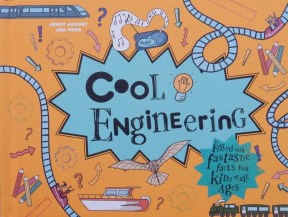
Cool Engineering

Cool Engineering
Jenny Jacoby and Jim Venn
Pavilion Books

This latest in the Cool series looks at the various branches of engineering, provides short pertinent biographies of key engineers through the centuries including Isambard Kingdom Brunel, Frank Whittle, Hedy Lamar and Tim Berners-Lee, as well as the history of engineering from the invention of the wheel right up to today’s technology as used in such things as clean energy. 

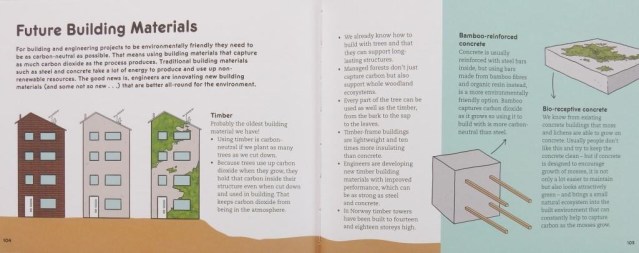
There’s even a look at some future projects including innovative new building materials – whoever would have thought that encouraging mosses to grow on concrete (bio-receptive concrete) would become a good thing to do.

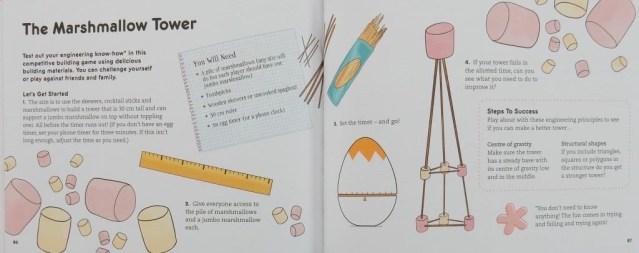
There are plenty of interesting experiments to try at home or school – the marshmallow tower is a fun example and can include an element of competition.

There’s so much to like about this engaging little book including the clear layout, ‘Cool facts’ boxes, quotes from the engineers featured, a timeline and alluring contents page, glossary and Jem Venn’s slightly quirky illustrations. It’s especially good in a STEM book such as this to see importance given to the sketching of ideas.

If you want children to think like engineers, then include this book in your classroom or family collection – it’s a good place to start.

When We Went Wild

When We Went Wild
Isabella Tree and Allira Tee
Ivy Kids

This is prize-winning author, conservationist and rewilder, Isabella Tree’s first book for children. Herein she describes what happens when farmers Nancy and Jake decide to convert their failing farm (the animals and even the trees look sad), and whereon they use chemicals for crop growing and machines for milking and harvesting, for something totally different – a haven for wildlife.

Nancy’s idea so to do means they can sell off all the machinery and pay off their debts. Then it’s a waiting game: soon the bare earth is covered in wild flowers, brambles and bushes,

and their animals now roaming free seem much happier.

Their neighbours though, are far from pleased and write to the local paper complaining about the messy vegetation spoiling their view.

Will Nancy and Jake have to abandon their plans and return to conventional technology-led, intensive farming? Happily not. When a storm and torrential rain hits the village everyone prepares for the worst as flash-flooding strikes across the country but that messy vegetation helps to slow and absorb the rainfall and the village is spared. A lesson learned thanks to a near disaster,

and soon everyone is going wild.

Allira Tee’s digital illustrations for this thought-provoking, important book are beautiful and from the alluring cover, every page full of engaging detail.

On the final spread, the author explains what rewilding actually is and talks a little about its importance and her own experience. (The book itself is sustainably produced).

The Good Germ Hotel

The Good Germ Hotel
Kim Sung-hwa and Kwon Soo-jin, illustrated by Kim Ryung-eon
What on Earth Books

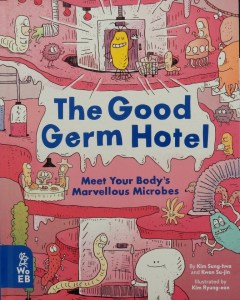
What an unusual and entertaining way of presenting information is this dialogue between the main narrator – Colon Bacteroides – and the nine year old girl – the hotel within which it lives. This bacterium describes its role and those of its fellow bacteria explaining the various tasks they perform in the body. I wonder how many children realise that there are microbes all over the body, many good – the superheroes – and some bad too.
The narrator takes readers on a journey through the digestive system talking about what happens when food is eaten and how gut bacteria help provide energy by removing nutrients from the food consumed, and thus helping the body work and grow.
Protection from bad germs is another job for the ‘good’ bacteria but if those baddies do invade then the hotel’s army of immune cells are called into action.

At this point in the narrator’s explanation there comes, (along with the likes of stomach bugs, strep throat and cold, a brief, timely mention of the virus Covid-19.

Next is an explanation of the role of antibiotics and a discussion of how important it is that they are only prescribed when absolutely vital in case all those good bacteria are destroyed too, or the nasties learn how to become antibiotic resistant.

Alongside such examples of serious scientific topics, young readers will definitely enjoy the references to farts and poo, especially that farewell final spread from the narrator so graphically illustrated.

Indeed all the illustrations are comical and huge fun to peruse, helping to make the entire topic accessible to primary school age readers. Who ever would have thought that talking with a bacterium could be so enlightening. There’s a final glossary in case readers need to check the meaning of any of the terms used during the conversation.

Veggie Power

Veggie Power
Olaf Hajek and Annette Roeder
Prestel

Award-winning illustrator, Olaf Hajek serves up a veritable feast of deliciously inventive visual stories to relish alongside author, Annette Roeder’s taste-bud tingling verbal platters of mind-boggling textual information. Just the thing to satisfy this vegan reviewer despite her aversion to several of the root vegetables that grace the pages of this large playful book. One of them being the parsnips that along with carrots, are the subject of the first spread. I was amazed to discover that members of the Vienna Vegetable Orchestra make use of these (as well as quite a few others featured herein) as musical instruments: imagine playing a carrot recorder or flute, for instance.

Over twenty vegetables are included in this culinary offering, but the author produces more than mere cooking related information: there are garnishings of historical and botanical tidbits, as well as sprinklings of health and healing- related facts.

One of my very favourite veggies is broccoli and I was vastly amused to read that it’s celebrated on not just one but two days: there’s St. Broccoli Day on March 18th and National We Love Broccoli Day just four days later on 22nd. 

I’m also extremely partial to both spinach and chard which share a spread, as well as a place in our garden. My mouth is watering at the prospect of those yummy leaves that take centre stage in Hajek’s energetic illustration of same. 

If being strictly accurate, there are a few interlopers at this veggie fest. for the tomato, as well as the peppers and chilli are botanically classified as fruit. However why exclude them when they’re usually served as vegetables?

A bountiful harvest is assuredly the result of this collaboration, albeit a lusciously quirky one. Food fun for everyone.

Planes

Planes
Jan Van Der Veken
Prestel

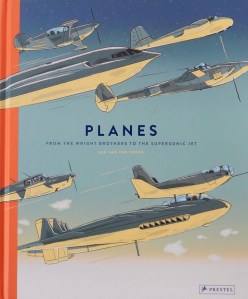
Whether or not you are an aviation enthusiast you can’t help being wowed by Jan Van Der Veken’s retro, futuristic style illustrations in this absorbing book that takes a look at the design (and much more) of planes from the tiny Wright Flyer of 1903 to the giant Airbus A-360-800 of 2005.

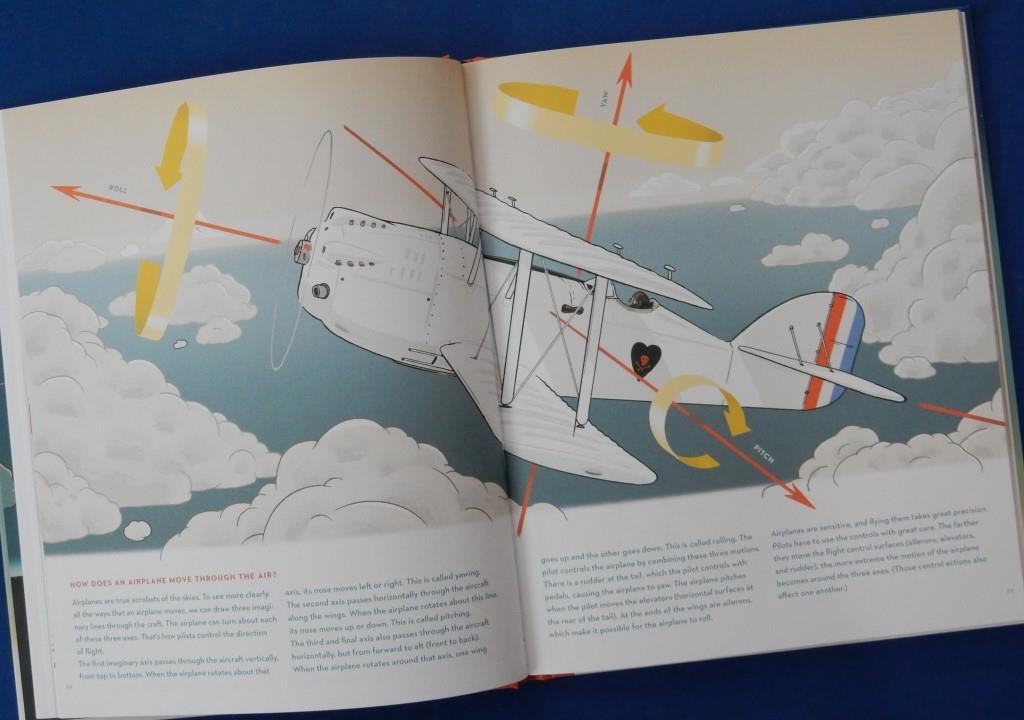
The first section – Aircraft Design, explores the principles of flight, the forces at work and the aircraft’s power and controls,

making reference to a number of specific planes as exemplars such as the Northrop YB35 Flying Wing.

Then follow, sections on Atmosphere and Weather, Communications and Navigation and The Future of Flight, which includes the prospect of the flying car.

If, like me you’ve ever sat in a plane and wondered about the flaps and ailerons on the wings that suddenly go down or up, there’s a whole spread on how each of these function complete with diagram.

I’ve been a lifelong flier, short and long haul, and have been a passenger in some small planes in weather such as dense fog, that caused me to be concerned we’d ever land safely anywhere when all we seemed to be doing was going round in circles using up precious fuel. I learned from this book that thanks to GPS, pilots can use global positioning equipment and/or radio beacons to find their way in difficult conditions.

With so much information packed between its covers, it’s pity there is no index. A great many pilots and designers are mentioned and it would have been good to have a roll call of them all; and perhaps the fact that the book’s creator is Belgian might explain the omission of such iconic planes as the Spitfire and the Harrier Jump Jet. Nonetheless this is a smashing book for older readers both at home and in school.

Antarctica: A Continent of Wonder

Antarctica: A Continent of Wonder
Mario Cuesta Hernando and Raquel Martin
Prestel

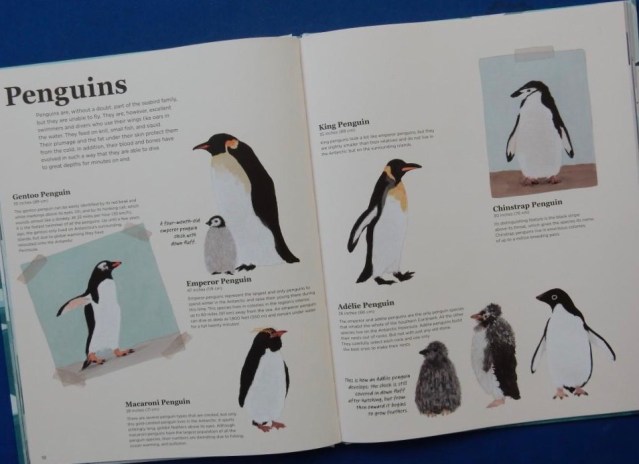
If you’ve ever wondered about taking a trip to Antarctica, then now is your chance if you accept a once-in-a-lifetime invitation from the United States Antarctic Program to accompany a research team on an expedition to the continent of penguins and the world’s lowest temperatures. You’ll sail on an oceanographic research vessel – the Polar Star – bound for the McMurdo Research Station. The subject of this large format book truly is a continent of wonders and it’s exciting to spend time with the researchers and discover what happens during their six month stay.

Many children will have heard about work being done studying the penguins, 

seals and whales that are able to thrive in the harsh climatic conditions, but are less likely to be aware that scientists are also investigating the fossil record of the continent and the secrets of life locked in the ice of its glaciers. There’s also an observatory for astronomers and research continues into the impact of global warming.

Did you know that one of the few open lava lakes is to be found at the heart of this continent, in the crater of Mount Erebus, an active volcano some 12448 feet high? I certainly didn’t. 

There is mention of the first known individuals to make landfall on Antarctica as well as details of the explorers including Amundsen and Scott who tried to reach the South Pole. 

Who owns this incredible area, you might be wondering; the answer is that it belongs to nobody, or rather no country can claim it as theirs; it belongs to everyone, including readers of this book. Thanks to the Antarctic Treaty (1959), this should ensure that international teams of scientists can continue their research for the good of all.

The book’s author, Mario Cuesta Hernando, a journalist with a special interest in adventure and nature, has himself, visited Antarctica and his enthusiasm for his subject is evident in this narrative. Raquel Martin’s dramatic land- and seascapes as well as the animal portraits capture the awesome nature of the continent.

Ideal for budding scientists and school collections in particular.

Meet the Oceans

Meet the Oceans
Caryl Hart and Bethan Woollvin
Bloomsbury Children’s Books

Like Caryl and Bethan’s previous collaboration Meet the Planets, this one is both full of fun and informative. Speaking in rhyme, Caryl’s young narrator invites youngsters to participate in an underwater adventure to visit the seas and oceans of the world.

The first destination is the decidedly chilly Arctic Ocean that like the other marine locations tells us directly about itself, mentioning such things as giant jellyfish, narwhals, beluga whales and walruses, as well as polar bears that pad on the ice floes.

Next to introduce itself is the Atlantic – a huge ocean so we hear, full of undersea caves, subaquatic mountains and teeming with salmon and silver swordfish, while less easy to spot, swimming among the sea grass are occasional wild manatees.

If warm waters are more to your taste, then you might decide to have a longer float around the tropical islands of the Caribbean Sea. Beneath its surface you’ll encounter all kinds of wonderfully patterned fish, as well as myriads of starfish. We can’t spend too long counting them though, for six watery worlds remain to be seen.

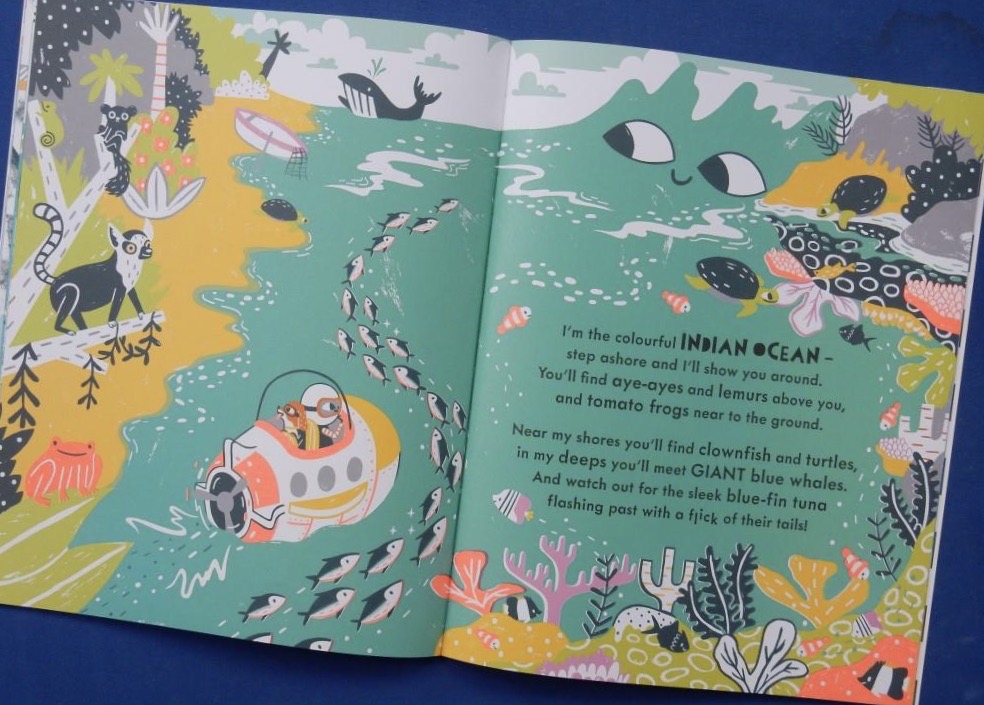
There’s the Pacific with its plastic pollution problem, the South China Sea with its plethora of ships and seabirds, the wonderful coral sea around the Great Barrier Reef, the Indian Ocean alive with gloriously coloured creatures waiting should you have time to step ashore …

before heading down to the Southern Ocean of the Antarctic. BRRR! Watch out for biting gales if you plan stopping at one of the research stations.

Much more frequently visited is the final watery wonder, the Mediterranean Sea: a great place for a spot of snorkelling as I recall.

With pops of day-glo colour Bethan’s distinctive visual style successfully personifies each of the watery worlds that Caryl has given voice to on this splooooshing, whooshing foray aboard a submarine.

Great for pre-bathtime sharing with youngsters as well as for foundation stage storytime sessions.

Funny Bums, Freaky Beaks

Funny Bums, Freaky Beaks
Alex Morss & Sean Taylor, illustrated by Sarah Edmonds
Welbeck Publishing

Here’s a clever idea for presenting animals to youngsters: the authors of this alluringly titled book have grouped them by their distinguishing features. In addition to bums and beaks however, there are plenty of other creatures with something special that makes them stand out from the crowd. Moreover those strange features all have a purpose and a story behind them. Those are recounted herein.

Facial features – noses – of the odd kind, extraordinary eyes, ears – weird ones, terrific teeth, so chosen for their size, shape or function, as well as tongues (the stranger the better) are explored. Sun bears, ( they’re the smallest of all bears), have dangly tongues the length of which is a quarter of the creatures’ height. Why? you might wonder. As well as it being essential for obtaining food, a sun bear uses its tongue for grooming purposes.

So what do a blue bird of paradise, a luna moth, a scorpion rattlesnake, a Willani sea slug and a young hoverfly have in common? They all have ‘stunning tails’ – I certainly would never have guessed that. Strictly speaking though, the baby hoverflies’ ‘tails’ are actually breathing tubes used during their early underwater lives.

Necks (perplexing) and toes (puzzling) are also presented. We probably all know about the very long neck a giraffe has but I was amazed to know that it has the same number of neck bones as a mouse; and imagine having toes that you can stretch wider and longer than your entire body like a jacana – very useful if you want to appear to be walking over water.

The authors have found at least ten creatures to include in each of their ten groups and every one has an explanatory paragraph and a gently humorous illustration – some of them are downright alarming-looking.

Compelling reading for wild animal enthusiasts, as well as for budding zoologists and celebrators of difference.

I am a Fish / Birch Trees, Bluebells and other British Plants

I am a Fish
Isabel Otter and Fernando Martin
Little Tiger

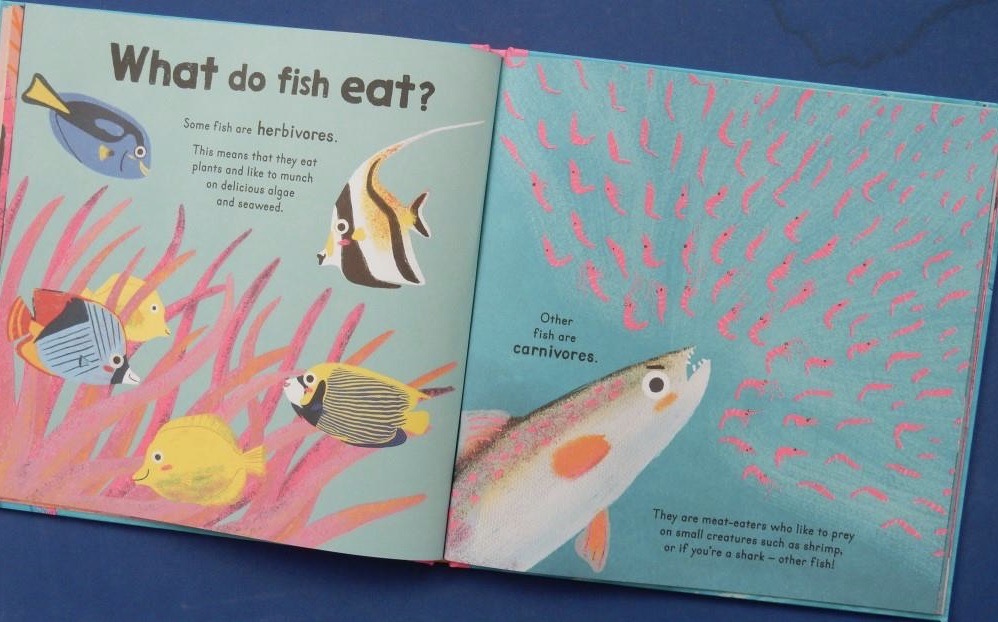
This is a companion volume to I am a Bird from the same team. Using an un-named fish, youngsters are introduced to the general characteristics of a fish and then dive underwater to discover a variety of aquatic habitats and learn something of fishes’ habits (we meet both herbivores and carnivores),

shapes, size and distinguishing features. Mention is made that ‘rays don’t have bones’ but that they and the sharks illustrated alongside, are cartilaginous fish is not stated.
If you’ve ever wondered whether or not fish sleep, this subject is discussed on another of the vibrant spreads while another spread introduces seahorses, which some little ones might be surprised to discover are actually classed as fish.
The chatty narrative and arresting subaquatic scenes make this a book for early years audiences and foundation stage topic boxes.

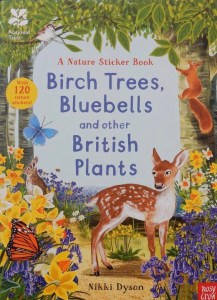
Birch Trees, Bluebells and other British Plants
Nikki Dyson
Nosy Crow

Here’s a gorgeous ‘Nature Sticker Books’ to lift the spirits. Published in collaboration with the National Trust, it contains eleven beautiful scenes by Nikki Dyson that are brimming over with the bounties of nature whatever the season.

It starts with spring and its gorgeous insect-attracting blossom and wild flowers aplenty. Summer scenes show gardens are full of bright flowers and butterflies, as well as meadows of poppies, daisies and other composites. Summer’s a good time to visit a pond or perhaps the coast: those locations too, have a wealth of beautiful wild plants and birds. Come autumn ripening berries are waiting to be gathered and the deciduous trees take on their yellow, orange and red hues while in gardens and allotments there are vegetables aplenty as well as herbs to pick and you’re likely to come across lots of minibeasts that also like to have a nibble.
Finally winter comes around when there is much less colour but there are still wonderful flora and fauna to discover when you brave those chills.

Each spread has a couple of introductory factual paragraphs as well as suggestions for adding some of the relevant stickers provided in the centre of the book. There’s also a checklist of the plants in the book so young naturalists can enjoy an additional I-spy element.

So You Think You’ve Got it Bad: A Kid’s Life in the Aztec Age

So You Think You’ve Got it Bad: A Kid’s Life in the Aztec Age
Chae Strathie and Marisa Morea
Nosy Crow

This the latest in an excellent fun history series written by the award winning Chae Strathie and developed in consultations with British Museum experts, reveals what it was really like to be a child in the Aztec age..
Covering the topics one’s come to expect of the series – clothing and hairstyles, education, diet, the home, family life, health and medicine as well as some you might not, such as human sacrifice (it could happen just for being a member of a losing team), this truly is horrible history made highly visual.

Imagine – or preferably don’t unless you want to puke – being fed maggots, tadpoles, lizards and the like, or a cake made with blue green algae containing masses of water fly eggs – gross! It wasn’t all revolting though; there were occasional tomatoes and beans. This vegan reviewer would surely have gone hungry much of the time.

Can you contemplate being stretched by the neck in a special ceremony every four years – a very strange way to demonstrate parental love but it happened; and then being likened to jade, a precious gem stone: talk about mixed messages.

As for schooling, modern youngsters might love the idea of not starting school until you’re in your teens, but it happened to Aztec children, who were home schooled up until then – sounds familiar! As does the dual system of one kind of school for the rich, another for the poorer families.

When I taught KS2 classes, children were always especially fascinated by the Aztecs and I have no doubt if I’d had this book there would have been a queue of eager readers waiting to get their hands on it. Marisa Morea brings all the gory details to life in her wealth of illustrations that illuminate the text.

Eco Craft Book / The Extraordinary Book That Eats Itself

Eco Craft Book
Laura Minter and Tia Williams
GMC Publications

In their latest book, Laura and Tia offer some cool ideas for using bits and pieces that might otherwise end up being thrown away.

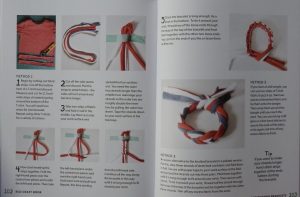
Instead of consigning that old T-shirt or other no longer worn garments to the rubbish or recycling bin, why not suggest your children try a project like the T-shirt friendship bracelets here.

Alternatively, if the T-shirt is white, it can be dyed using a natural plant dye and refashioned into a ‘no-sew tie-dye bag’. Those are just two of the fabric projects.

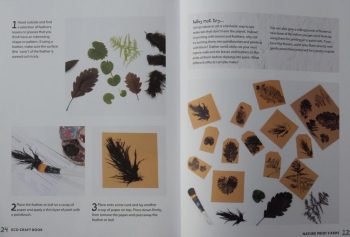
Getting even closer to nature, youngsters can make a collection of interesting shaped leaves, grasses or perhaps feathers and use them to make some printed cards (or perhaps wrapping paper)

and if you want to attract more wildlife into your garden, there are instructions for creating a bug hotel using for example, old tin cans.

Each mini project is succinctly explained with step-by-step guidance and clearly illustrated with colour photos. In addition there are spreads that talk about climate change, what youngsters can do to help protect the environment and why it is important to immerse children in nature.

This book would be a boon to parents who are coping with home schooling, but all of us who work with children have a duty to nurture their creativity and to encourage them to think about the impact on the environment of all they do.

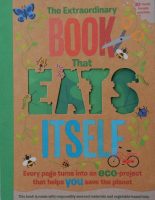
The Extraordinary Book That Eats Itself
Susan Hayes & Penny Arlon, illustrated by Pintachan
Red Shed ((Egmont)

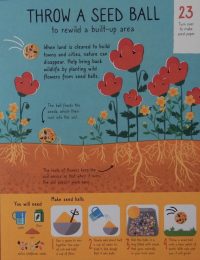
If you’re looking to engage a child or children in some environmental projects here’s a book to try. It’s packed with eco-projects – thirty in all – and each page (as well as the cover) is cleverly designed to be used in an activity – hence the title.

It’s amazing just how much difference simple everyday actions such as turning off the lights when you leave a room, and at night can make, not only for the safety of animals but to reduce electricity consumption. Ditto, saving water by turning off the tap while brushing your teeth or using your bath water to ‘feed’ your plants (of course that takes a bit of effort but every drip and drop counts). There’s a Make a Difference in your home’ page with additional suggestions .

One of my favourite projects is Throw a seed ball to rewild a built-up area, something I’ve never tried, although I have scattered plenty of packets of wild flower seeds. This is really clever though and all that’s needed in addition to wild flower seeds are water, flour and soil to make your mixture. Can’t wait to have a go at this.

(The reverse side suggests making seed paper for writing a message on – another clever idea.)

Whether or not home schooling continues, this is certainly worth getting hold of.

What Did the Tree See?

What Did the Tree See?
Charlotte Guillain and Sam Usher
Welbeck Publishing

Oak trees are wondrous things. With its spreading branches to climb and a resident owl, I was endlessly fascinated as a child by the large one growing in our garden. They’re also well known for their exceptionally long life spans.
Not primarily a natural history book but rather, using the oak as a chronicler of the landscape wherein it grows, Charlotte Guillain has written a sequence of verses telling how an unnamed place somewhere in the UK has grown from a small village in the days of yore

to a vast industrial coastal city.

From its beginning ‘I was first an acorn, so tiny and round, / I fell from a branch and sank into the ground. / Then as I grew up, I turned into a tree … / over hundreds of years! So what did I see?’ Sam Usher’s fine illustrations make evident what it did see, showing just how much a landscape is altered by the action of humans,

in stark contrast to the oak, the life cycle of which we witness both in words and pictures.

The final few pages chronicle significant events in world history and their dates occurring during the life span of our narrating oak, the life cycle of an oak tree and suggestions for children to investigate the history of their own locality, as well as finding out more about trees and the life they might support.

With its unusual approach, this is an engrossing book to share and talk about with primary age children. I particularly like the way the oak’s own story comes full circle.

Moreover it could be an absolute boon for home-schooling parents (COVID even gets a mention in the timeline.)

Kaleidoscope of Creatures

Kaleidoscope of Creatures
Cath Ard and Greer Stothers
Wide Eyed Editions

This is a fascinating look at the reasons underlying the amazing hues, patterns and textures (feather, fur and scales) of members of the animal kingdom.

After a general introduction, the opening spreads are devoted in turn, to an animal family tree that gives information about the characteristics each group has in common, followed by a close-up look at different examples of body coverings – fur, scales – reptilian and fish – and feathers.

Thereafter come a series of spreads where animals – both well known and unusual species – are grouped by the colour of their outer covering (brief explanations are given) be that red,

orange or pink, yellow, green, blue, indigo or violet, black, white, black and white.
Red for instance may act as a warning as in the red velvet mite whose silky hairs indicate to predators ‘I taste horrible’, as does the body of a scarlet lily beetle. Whereas being green often helps a creature remain unseen be it a forest dweller or one that lives in the sea.

Also helping some animals to stay unseen are designs such as spots and stripes and these are the titles of two further spreads.
Most of us know male peacocks have those amazing tail feathers that open into a stunning fan shape in order to attract a mate, but did you know that to attract a mate, male green iguanas turn carrot-coloured?

Every spread is visually arresting thanks to Greer Stothers’ pleasingly arranged arrays of fabulous fauna each one of which is labelled, with most having accompanying salient facts.

For budding zoologists and school topic boxes, I suggest.

Amazing Treasures

Amazing Treasures
David Long and Muti
What on Earth Books

In this the second in the Our Amazing World series David Long presents a veritable wealth of amazing things in his mind boggling assortment of 100+ objects and places.

Some are naturally occurring, others are not and the author’s definition of treasure is sufficiently broad to encompass personal items such as a photograph and a favourite book; the tulip fields of Holland, the Lascaux cave paintings, the Amazon Rainforest, moon rocks (some of which have gone missing) and Bugatti cars from the Schlumpf collection.

Items such as the cars, and the abandoned city of Machu Picchu in the Andes are given just a paragraph, whereas Tikal the ancient Mayan site,

and China’s Forbidden City each have an entire double spread devoted to them. There’s also a world map gatefold as the centre spread that when open shows a list of all the 105 items included.

No matter whether your interest is in architecture, fossils, rocks and gems or the natural world, readers will likely find something new to wonder over here.

The Muti team has used a relatively subdued colour palette for their illustrations most of which are relatively close up depictions; others including Windsor Castle,

Machu Picchu and Masada are shown in aerial views of different sizes.

With topics both ancient and modern (ownership for instance), this fascinating book is one to include in KS2 class collections particularly.

Marvellous Machines

Marvellous Machines
Jane Wilsher and Andrés Lozano
What on Earth Books

This book comes with a detachable ‘magic lens’ embedded inside its front cover that enables readers to look into buildings and the inner workings of all manner of mechanical things large and small, relatively simple as well as highly complex.

This is achieved by focussing the lens on the areas of red patterning (stippling, cross hatching or brickwork) which then disappears to show such things as the energy connections powering all kinds of machines in the kitchen, robots at work,

the insides of a container ship, a submarine, a space station …

and even a human body.

The book concludes with some thought-provoking questions.

Mechanically-minded youngsters especially will love the opportunity to peek into various components of a space station and to use the lens to hunt for the dozen items listed in the ‘find it’ panel on the relevant spread, or to do likewise in and around the cyclists on the jet aeroplane and “Bicycle’ spreads.

As well as anything else, this book reminds younger users of the enormous wealth of machines we rely on in our daily lives and to discover something about how they function.

Made for Each Other

Made for Each Other
Joanna McInerney, illustrated by Georgina Taylor
Big Picture Press

Joanna McInerney explores the symbiotic relationships – evolved interactions – that exist between different organisms living close together often for their mutual benefit. Using examples between animal and plant, and between two kinds of animal, she takes readers to various forest locations, beneath the waves, onto the plains and to tropical jungles and rainforests presenting different kinds of symbiotic relationships.

One instance of mutualistic symbiosis is that between the tiny Ruby-throated Hummingbirds and cardinal flowers. These red flowers are one of the birds’ favourite sources of nectar, while their tubular shape is well-suited to accommodate the birds’ beaks. A hummingbird hovers in the air, wings beating and as well as feeding on their nectar, the birds collect pollen from the cardinal flowers, transferring it to another on the next feeding stop. Over time these two species have become almost entirely dependent on one another for survival.


Another example of non-insect pollination is that of the balsa tree flowers carried out by the white-headed capuchin monkeys living in the Ecuadorian rainforest treetops. The process of evolution has ensured that as much pollen dust as possible is transferred when the monkeys feed from flower to flower.

Moving under water, we learn that remora fish have a specially adapted dorsal fin that functions as a sucker by which the fish attach themselves to sharks and thus conserve energy while at the same time feeding on the leftovers of their carrier sharks. In return the hosts receive what the author terms ‘a type of exclusive spa treatment’ with the remoras nibbling at dead skin and shark parasites.

On the Serengeti plains of Eastern Africa can be found one of the most well-known symbiotic relationships: that between the little oxpecker birds and giraffes. The former tend to spend much of their time close to their hosts and use their curved beaks to remove giraffe parasites. Using their two backward-facing toes to cling even to moving giraffes they also keep a watch for predatory animals. The oxpeckers make use of giraffe hair that which they pluck from their hosts to line their nests.

Each of these examples, as well as the other seventeen, are strikingly illustrated by Georgina Taylor. Every one of her artful watercolour compositions of her subjects are reminiscent of Audobon, the 19th century ornithologist and painter.

Little People, Big Dreams: Pelé / If You’re Going to a March!

Little People, Big Dreams: Pelé
Maria Isabel Sánchez Vegara, illustrated by Camila Rosa
Frances Lincoln Children’s Books

This new addition to the best-selling series stars one of the world’s greatest ever soccer players, telling of both his awesome skills on the field and his sterling work off the pitch in helping children in need, not only in his home country Brazil, but the world over.

From modest beginnings in a poor neighbourhood in Brazil, young Edson aka, Pelé fashioned a ball from a sock stuffed with paper and tied with string and used it to work on his footie skills.

Fuelled with a determination to lead his country to a World Cup victory, he was selected at age sixteen to play for the national team in Sweden where he became known as the player of ‘Jogo Bonito’ (‘beautiful game’)

Pele went on to take his country to another two World Cup victories. He’s now recognised as the top footballer who ever lived as well as a voice for unity and for the most needy.

With additional facts at the back of the book, set out along a timeline, and Camila Rosa’s striking illustrations, this is a book to inform and inspire young sports enthusiasts especially.

If You’re Going to a March
Martha Freeman and Violet Kim
Sterling Children’s Books

Although this book originated in the USA, there are plenty of young activists and would-be activists in the UK and in many other countries too; this book with its reader-friendly advice and instructions, will speak to them all, whether their cause is civil rights, the environment, women’s rights, gay rights, peace or whatever. And, children start very young: during my participation in pro EU marches I encountered babes in slings accompanied by parents and young siblings.

There’s advice on such practicalities as making your own sign,

appropriate clothing (check the weather forecast), transport to starting point; plus warnings about such possibilities as getting a bit bored if lots of people want to make speeches; feeling free to let go and dance should the opportunity arise; how to interact with the media; even visiting the loo is covered; (perhaps the spread with the smiling police officers ‘their job is to keep people safe’ is probably more apt for the UK than that of the book’s origins).

The author and illustrator also present the ‘why’ behind marches, rallies and protesting – ‘they are showing they care about their country and want to make things better’, as well as pointing out the possibility of seeing people who disagree with your cause – ‘sometimes democracy looks like disagreement’ and advising politeness. With its focus on the practical and positive elements of activism, this book is a good starting point for adults wanting to introduce the possibilities of political involvement, peaceful protest and community action to youngsters.

I love the way Violet Kim conveys a community feel to her scenes throughout.

Music: A Fold-Out Graphic History

Music: A Fold-Out Graphic History
Nicholas O’Neill & Susan Hayes, illustrated by Ruby Taylor
What on Earth Books

This large format, concertina book is published in celebration of the 150th anniversary of the opening of the Royal Albert Hall in London.

Essentially it opens up the entire world of music to all whether or not they have a specific interest in music and is written by Nicholas O’Neill, himself an acclaimed musician and composer and author Susan Hayes. Together with illustrator Ruby Taylor, they present a superb illustrated timeline that unfolds to double-sided 2.5 metres beginning in prehistoric times with the use of bones, gourds, and hooves, and culminating in contemporary music of Björk, Adele, Beyonce and Grime artist Stormsy.

Pretty much everything one can imagine relating to music as well as more that you can’t, is included in the densely packed pages. Truly international in perspective, the presentation begins with a world map showing prehistoric sounds emanating not only from instruments from the aforementioned materials but also perhaps, from wood.

We meet music makers of all kinds – maestros and more – mainly in national or period dress. There are pithy paragraphs about such things as written music from 1000 CE, the first printed music (1501), styles of music, the use of technology in playing and recording

and various innovations including the Chinabot platform that showcases Asian music both modern and traditional, as well as MuseNet – an online tool that uses AI so create songs of different styles.

The book covers orchestral music, opera, rock -‘n’-roll, protest music and there are some lesser known mentions such as opera founder Wei Liangfu; and American composer Amy Beach and English composer Ethel Smyth whose March of the Women became the anthem of the women’s suffrage movement.

Some musicians have a paragraph,

while the Beatles have a whole page devoted to them, and there’s a double spread entitled the Royal Albert Hall of Fame.

There’s no way you can read, let alone digest, the entire contents of this inclusive and highly visual offering in a single sitting. It’s engrossing; and in addition to the index and glossary, the authors provide personal notes and even, a final playlist. All in all, a truly amazing collaboration and a book to add to primary and secondary collections, as well as family bookshelves.

Wild is the Wind

Wild is the Wind
Grahame Baker-Smith
Templar Books

This is a story of a journey or perhaps, several journeys – that of young Cassi in her hot air balloon, that of the little swift she has nursed until its wings are strong enough to take to the sky and join its fellows on their path across land and sea, a journey of eight thousand miles, that takes three months to complete; and of course, there’s the path of the wind.

As the morning sun rises in Southern Africa, the world is temporarily on hold until a breeze stirs the leaves and the seeds in the butterfly trees. Then with the strengthening of the wind, it’s time to let go of the tiny winged creature and allow it to join its fellow travellers on a prodigious migratory journey

as a cyclone swirls, spirals and howls, whipping the waves into wild white horses.

Then on over deserts and rocky terrain sculpted by windstorms until at last, the swifts are nearing their destination on the other side of the ocean. And there, without pausing once, Cassie’s little swift and the others are greeted in China by Kûn who has long awaited their appearance.

There too, will they build their nests and rear their young until, once again the wild wind calls them to make their return journey to that little girl so far, far away on distant shores.

With Grahame Baker-Smith’s spare lyrical prose in combination with his equally lyrical, breath taking, powerfully atmospheric, detailed illustrations, Wild is the Wind is narrative non-fiction at its memorable best.

Queens

Queens
Victoria Crossman
Scholastic

From pirate queens to elephant hunters, and spanning thirty centuries, this book is a celebration of strong, fearless women from all around the world who ruled in one way or another. There are some, such as the Indian Queen Nur Jahan, said to have saved a whole village from a man-eating tiger by shooting it, and the third century ruler in Japan, Empress Himoko believed to have been a magic practising shaman, who are the subject of folklore. Then there’s the mysterious Queen of Sheba (Queen Makeda) who is mentioned in the Qu’ran and the Bible with both Ethopia and Yemen claiming to be her birth country.

There are alternating focuses on an individual – the Queen of Sheba, Lady K’Abe; Mayan warrior queen whose rule was from 672 to 692

and Yaa Asantewaa who led a rebellion against British colonists trying to expand into Ashanti country (1840-1921) – for instance.

In between are topical spreads that include information about queens depicted on money, their clothing and footwear,

make-up, pets, hobbies and more. I was fascinated to discover Rani Lakshmibai reportedly had a pre-breakfast regime of weightlifting and wrestling, while Queen Rania of Jordan has written a children’s book.

The author’s style of writing is chatty and full of interesting facts, while the illustrations are inviting, vibrant and detailed.

The last few spreads are devoted to a visual timeline of the rulers, a world map showing their homelands, a glossary, and a list of places to visit should readers be interested to discover more about the featured women.

The True Story of Zippy Chippy: The Little Horse That Couldn’t

The True Story of Zippy Chippy: The Little Horse That Couldn’t
Artie Bennett and Dave Szalay
NorthSouth Books

You’ll find it hard not to fall for the racehorse that stars in this true picture book story; I say stars because despite expectations Zippy Chippy never won a single race. Thoroughbred from champion genes, Zippy loved to run but his behaviour on the track was totally unpredictable: sometimes he merely stood and never ran at all, on another occasion he stopped dead in the middle of the track to enjoy the wonderful smells in the air.

After nineteen losses his owner trades him for a truck and then – new trainer not withstanding – fuelled by sweet goodies – Zippy is relegated to the second-rate races breaking the record for the most consecutive losses. However, Felix (the new owner/ trainer) doesn’t give up easily and a year later, Zippy (apparently a lover of being a racehorse despite his ineptitude) is given yet another chance and another and …

Winner he might not be, but Zippy certainly caught people’s attention including his trainer’s young daughter and later on, press sportswriters and the crowds that came to cheer him on. Determined to make the horse a winner, Felix sets up a race against a baseball player and guess who wins …

Down but not entirely out, Zippy comes in second in race number ninety-eight but come race one hundred, he brings up the rear – again! But does Zippy go out quietly and unobtrusively? Absolutely not, for after the starting bell, before taking a single step in the race, he entertains the crowd with a final farewell, bowing out gracefully to tearful onlookers.

A legend indeed, but what he showed not only those involved in horse racing, but readers and listeners too, as author Artie Bennett writes, ‘you can lose and lose and lose and still be a winner.’ Zippy’s attitude is ultimately what counts: you don’t need to be a winner to be loved, being best isn’t THE most important thing, taking part is. In other words, be true to yourself and don’t be afraid to walk your own path: such a great message to give children.

With their changing perspectives, Dave Szalay’s zany illustrations will surely make readers chuckle, capturing both the spirit of the horse, and the heartfelt humour, love and perseverance inherent in Artie’s writing about Zippy.

Molly and the Mathematical Mystery

Molly and the Mathematical Mystery
Eugenia Cheng and Aleksandra Artymowska
Big Picture Press

There are challenges aplenty in mathematician and maths advocate and demystifier Eugenia Chen’s picture book for older primary children. In collaboration with illustrator Aleksandra Artymowska she presents a plethora of mind-boggling mathematical ideas in a creative and enormously alluring mystery story that involves readers who join Molly in a series of challenges as she ventures forth into a weird world where everything is other than it appears.

If you are one of those people who when somebody says the word ‘maths’, thinks of times tables and numerical problems, then this interactive journey will surely show you that it’s about SO much more, most importantly about imagination.

With letters to read, clues to find, flaps to explore, wheels to manoeuvre, and an absolute wealth of mathematical information at the end of the story, this incredible book will have you confounded, bemused, astonished and absorbed.

Aleksandra Artymowska has packed so much into every double spread scene, be it the impossible staircase,

the garden of hidden shapes with its tessellations, that hall of endless doors with their intricate patterns, the steam room with its plethora of pipes, wheels and vents, the room adorned with carpets of awesome designs. Then come the mixed-up library where you’ll love to linger among the books of all sizes, the beautiful symmetry garden,

the high-walled fractal garden or the scene that shows Molly all the places she’s visited or even her very own bedroom at home wherein the adventure starts and concludes.

Highly recommended for school and home.