How It All Works

How It All Works
Adam Dant and Brian Clegg
Ivy Press

There’s a mind-blowing amount of information broken into bite size portions packed between the covers of this chunky book, revealing to readers the ways in which complex science laws and phenomena affect our daily lives. Science in action it surely is.

Divided into thirteen chapters (plus an introduction and reference section of key figures and an index of the laws) it starts in the kitchen, gradually spreading out into the house, the garden, the Science Museum, and other places that may be found on a walk along the street from the town square.

It then moves into the countryside and to the coastline, the continent, the earth, the solar system and finally, the entire universe with every chapter starting with one of Adam Dant’s incredibly detailed illustrations.

Embedded within each of these are forty six different laws and phenomena behind the featured objects and activities. In his introduction Brian Clegg puts it thus: ‘What these illustrations and their short descriptions will show is the way that everything we do, in everything we experience, we are witnessing and taking part in scientific phenomena, guided and linked by scientific laws. Science is not just something we do at school or that professionals undertake in laboratories, it is at the heart of how everything works.’

Following each large illustration are close-up labelled sections taken from it, every one accompanied by a paragraph in which Clegg succinctly describes the relevant phenomenon (P) or law (L)


I really wish I’d had this book when I was studying science at school for it makes complicated principles/ laws easy to understand, something that spending hours every week in a physics or chemistry lab, failed to do: nobody even tried bringing in a bicycle pump and relating it to Boyle’s Law for instance.

Of course you don’t have to work your way straight through this book section by section. There are lots of ways to enjoy it: you might take one law illustrated in a section and then search for other examples throughout the book. You could use something that sparks your interest as a jumping off point for further research using other sources. Alternatively some might enjoy spending ages poring over just one of the large scenes, each of which has a different colour or hue.

The potential audience for this unusual book is wide – from KS2 through to adult and it’s most definitely one to add to a family collection as well as those of primary and secondary schools.

Journey to the Last River

Journey to the Last River
Frances Lincoln Children’s Books

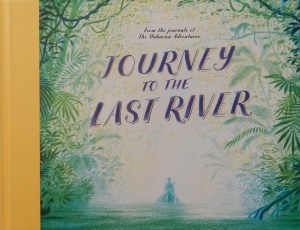
Teddy Keen edits a spin-off from The Lost Book of Adventures, an Amazon adventure presented in the form of a scrap book journal belonging to ‘The Unknown Adventurer.’ Smudgy, apparently finger-marked pages and ‘handwritten’ text add authenticity.

Again the written account grips the reader from the start as you learn that the adventurers (the writer, and Bibi who grew up somewhere in the region) are staying in a wooden outhouse belonging to a local villager, preparing for their six week canoe trip into the rainforests. They’ve got the original map ‘borrowed’ from The Geographical Society to help them search for that Last River and discover its secret. The writer hasn’t mentioned this to his companion; instead he’s led her to believe that he’s an artist adventurer.

There’s certainly drama aplenty including an unexpected encounter with a man who draws the supposedly non-existent river in the sand with a stick and Bibi recognises a few of his words including ‘wait’, ’rains’ and ‘guide’ before disappearing again. The two travellers are heartened and eager to continue however.

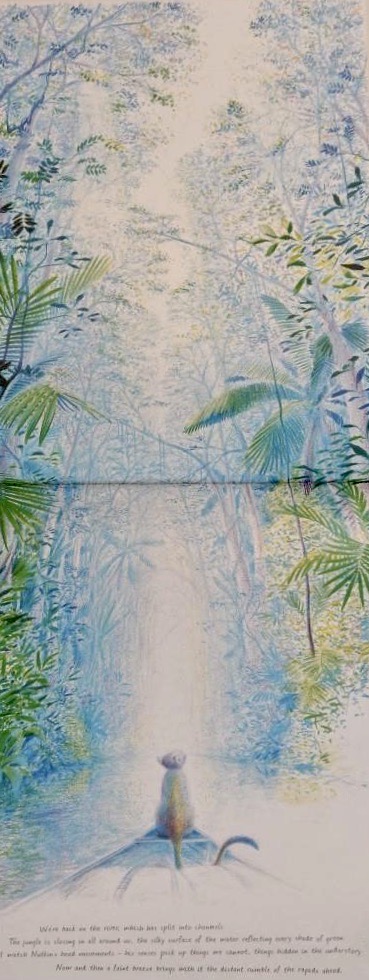
Continue they do and just over two weeks into their journey they acquire a new crew member, a squirrel monkey that they name Nutkin.

The days pass and the two begin to despair of ever finding what they’re searching for; but then comes the lightning followed by torrential rain.

Suddenly a realisation dawns: perhaps their journey isn’t in vain after all …

Brilliantly illustrated with powerfully atmospheric scenes of the Amazon flora and fauna,

as well as the elemental spreads, there’s a lot to learn from this book with its important final conservation message. Readers will be enthralled by the detail included in both the words and visuals, as well as by seeing the transformative effect the trip has on the ‘writer’.

A superb book that offers huge potential to upper KS2 classes in particular.

Where is Everyone? / The Day Time Stopped

These are two quirky books from Prestel – thanks to the publisher for sending them for review

Where is Everyone?
Tom Schamp
Prestel

Herein Tom Schamp invites little ones to discover the unexpected in the expected as they lift the flaps to find what is hiding beneath in turn the bushes, a toadstool, a small car,

a washing machine, a fridge, a toaster, a cup and saucer, a sofa, a toilet, a sink, a bath, a bed, a gift-wrapped box and a tiered decorated cake. The text on each page comprises a ‘who question’ and the answer hidden under the flap – a peacock, Puss in Boots or a tortoise raring to go, for instance.

Now who would expect to find a racoon inside the washing machine or a hamster getting rather heated in the toaster? And I suspect nobody would anticipate there being a monkey on a surfboard lurking behind that cup containing that cuppa, nor a napping camel tucked away behind that comfy couch.

Full of whimsical ideas, this playful board book with its duck commentator surely will encourage youngsters to go beyond the information given and look at things with a fresh, creative mind and eye.

The Day Time Stopped
Flavia Ruotolo

If you’ve ever stopped to wonder what your friend in another part of the world is doing right now, perhaps because you want to call them on your mobile, then here’s a fun book for you.

The young narrator who happens to be in Genoa, Italy is just taking her first bite from an ice-lolly (she calls it a popsicle) at 5:33pm her time when inexplicably, time stops.

At that exact time in another part of Europe – Berlin – Selma and Nora bring their scooter to a sudden halt – just in time to prevent a small creature getting run over.

In La Paz (Bolivia) however it’s 12.33pm and Rosa’s grandmother has just finished knitting a sweater while in New York City two children discover their tube of toothpaste is empty – it’s 11.33 am their time.

At that moment too Kimo’s underwear pings off the washing line in Port Moresby (Papua New Guinea) where the time is 2:33am and in Sapporo, Japan Yuki’s cat is woken by a noise. (The clock there would say 1:33am).

Concurrently, Makena, way off in Nairobi proudly shows her first ever self portrait to her dad, the time there being 7:33pm; whereas in Maurituis’s Port Louis it’s 8:33pm and Carl the canary wants his dinner.

And so on …

Then, suddenly time restarts and things seem normal once more: now for our narrator back in Genoa, it’s 5:34pm.

Flavia Ruotolo’s seemingly simple playful presentation of people, animals and their activities is essentially a philosophical reflection on the notion of time and place that takes readers across two dozen time zones and on a lightning visit to twenty six countries. These are shown on a world map on the penultimate spread and the book concludes with an explanation of why it isn’t the same time the world over.

When Plants Took Over the Planet

When Plants Took Over the Planet
Chris Thorogood, illustrated by Amy Grimes
QED

Reputed botanist and field guide writer, Chris Thorogood presents a clear, concise evolutionary history of plants from the very earliest green alga called a charophyte that first appeared around 500 million years ago.

From those minute algae, plants moved onto land some 30 million years later, the first being mosses, liverworts and hornworts.Readers can then follow that land journey through various historic periods (a time line is given).

It’s amazing to think that some of the plants found millions of years ago in prehistoric forests are still found today some equisetum species for instance, one of which I frequently see on walks in the part of Gloucestershire where I currently live. Who’d have thought they’re now what’s termed ‘living fossils’.

Every spread is full of fascinating information on various plant groups and species; we discover when seed plants emerged – those that forever transformed the planet – and again some of these gymnosperms are still around today, the ginkgo (or maidenhair tree) being one. I was astonished to read that such forms existed well before dinosaurs roamed the earth.

There’s an explanation of the difference between moncots

and dicots (as I was taught to call them) but now referred to as eudicots; a look at powerful medicinal plants that can heal ailments, boost health and flavour food and drinks, and some examples of carnivorous plants.

Most people know that plants are crucial to our existence but nonetheless many species are in danger of extinction and the author gives a timely warning about the effects of human damage. It’s still not too late and the final spread offers some ways everybody can play a part in preserving the rich diversity of plant life.

With Amy Grimes’ bold, bright illustrations thoughtfully arranged around the detailed factual information, this is a superbly presented book as well as a fascinating and exciting one for individuals or class collections.

Beetles for Breakfast

Beetles For Breakfast
Madeleine Finlay and Jisu Choi
Flying Eye Books

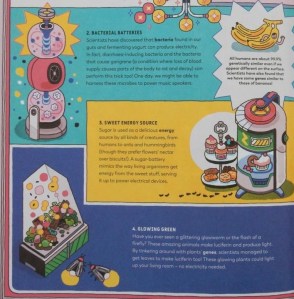
Fundamental to all scientific discoveries is the imagination and so it is in this book wherein Madeleine Finlay explores the imaginative new technologies scientists are developing to help make our planet greener.

There’s absolutely no getting away from the drastic effects that climate change and global warming are having on planet earth and Finlay’s book is bursting with ideas – including those of the weird and wonderful kind – suggesting ways that humans might reduce the adverse impact of we humans.

The backdrop is a day in a child’s life and as we follow it through from the breakfast table, the bathroom, into the city, to school, the park, then onto a farm and pay a visit to the beach before returning home, we learn how some of the cutting edge inventions could become part and parcel of everyday life.

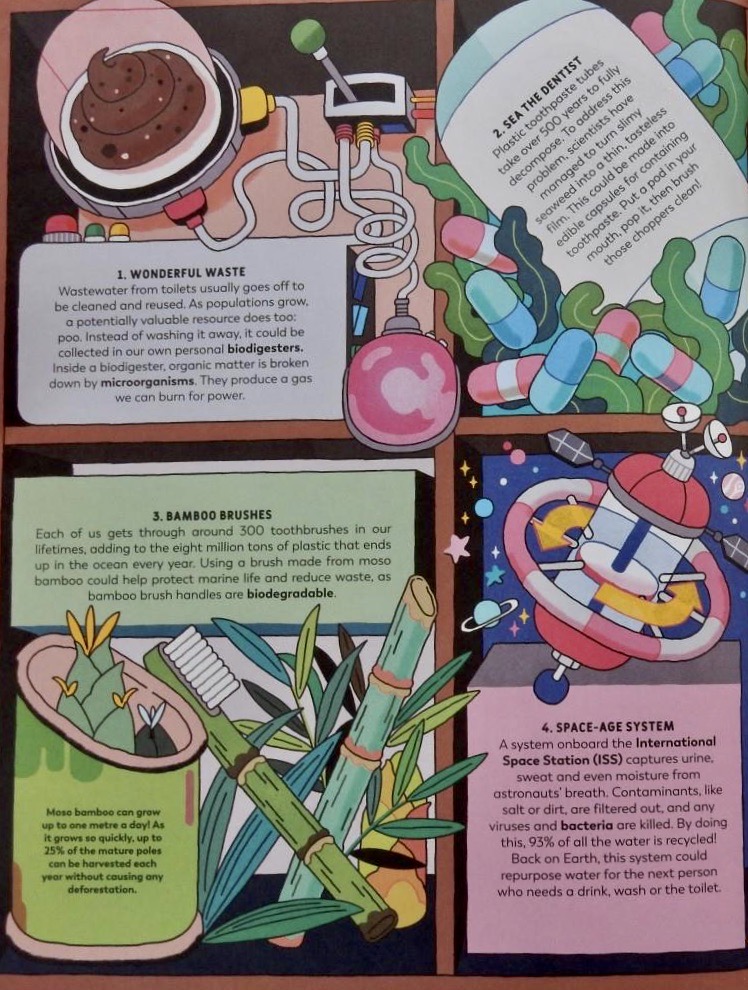
Imagine cleaning your teeth by means of edible capsules of toothpaste made from slimy seaweed that you’d pop into your mouth and brush your teeth squeaky clean; perhaps brushing with a biodegradable bamboo-handle toothbrush. Think of the plastic saved!

Being almost entirely vegan, I certainly wouldn’t entertain the idea of eating beetle burgers however.

What about wearing a PE kit that contains bacteria and when you start to sweat, these microorganisms swell, opening flaps for a refreshing breeze and shrink again once the sweat has dried. Clever stuff.

Indeed, other scientists have discovered bacteria in fermenting yogurt and in our guts that can produce electricity: maybe in the future, it’s suggested, musical speakers could be powered by harnessing such microbes.

We all know of the damage caused by the exhaust fumes from cars and other vehicles; however with some clever chemistry it might be possible to turn toxic black carbon soot into ink you could use for art projects or writing.
With bright, often intricate, infographic art and a wealth of facts, some still a tad far-fetched but you never know, and exciting ideas aplenty, this is a book that could inspire youngsters to become the cutting edge scientists and technologists of the future.

Play Like Your Football Heroes

Play Like Your Football Heroes
Seth Burkett and Matt Oldfield, illustrated by Tom Jennings
Walker Books

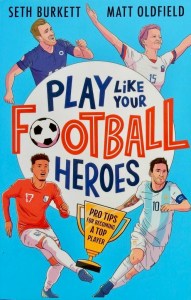
Former pro football player Seth Burkett co-authors this book with friend and writer Matt Oldfield. It’s broken down first into four parts with tips on how to: Train Smart, Think Smart, Live Smart and Play Smart, and then into chapters each featuring five or six star players. It’s great to see both men and women included, one of the latter being American icon and political activist Megan Rapinoe, winner of two World Cup winner’s medals as well as both the Golden Ball and Golden Boot trophies. But what makes her even more inspirational to this reviewer is her peace message: “We have to love more, hate less, listen more, talk less.’

Self belief is key if you’re to become a successful soccer player, or indeed succeed at pretty much anything: Kevin De Bruyne is a shining example of a player who believes in his ability, in his case to ‘pull off another amazing assist’. He started having to find the courage to step outside his comfort zone (a requisite if you’re to develop self confidence) age fourteen when he left his Drongen home and family to join the Genk academy 100 miles away. Just one of the incidences of his awesome self-belief.

Incredibly skilful ball dribbler, Messi, didn’t gain that outstanding ability in a vacuum; rather he needed to work on a whole lot of inter-linked skills to become the amazing ball master that he is. Training, training and more training in different conditions: constant, variable and random. Don’t worry if this sounds a bit technical; explanations are given in the very first chapter, featuring of course, Lionel Messi.

Another star who believed in himself, no matter what is Harry Kane who scored that crucial goal in the final minutes of the first group game against Tunisia in the 2018 World Cup. A real smart hero assuredly..

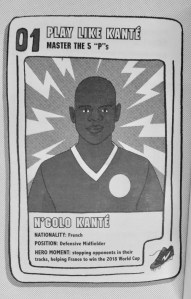
When it comes to playing smart, somebody who personifies the five ‘P’s – ‘proper preparation prevents poor performance’ is French midfielder N’Golo Kanté, he of outstanding stamina.

However, no matter where you open the book you’ll likely find something that will speak to you: and sometimes challenge you.

With both authors’ passion for the game shining through all that they’ve written in this inspiring, interactive book, as well as some 80 black and white illustrations by Tom Jennings, there’s lots in here for readers from around seven, be they enthusiastic watchers/team supporters of the game, or a young player and would be football star, .

What the Elephant Heard

What the Elephant Heard
Charlotte Guillain and Sam Usher
Welbeck Publishing

Charlotte Guillain tells this rhyming non-fiction story from the viewpoint of a young elephant that lives on the African savannah with her herd.

We learn of the wisdom and knowledge of the narrator’s grandmother always able to find water just like the grandmothers before her. Those that could tell of roaring lions, zebra herds and the activities of humans with their smoke belching machines,

their aeroplanes and their cars bringing tourists.

Worse than all those though, are the sounds of buzzing, whining tree destroying monsters that carried the felled trees off to people in towns,

and then that tragic shot from a poacher’s gun which killed the young elephant’s own father.

Now, as Sam Usher’s watercolour illustration shows, with the land dusty and parched, the herd awaits the welcome sounds of thunder and rain. With Grandma as leader, they lumber across the denuded savannah in the hope that once more, their leader wiii be successful in locating a waterhole …

After the elephant has finished speaking, come three prose spreads, the first giving basic information about elephants, their features and habits, the second discusses the work of elephant rescue teams and wildlife rangers and the third presents worrying facts about the declining numbers of elephants and some ways in which humans can help support these amazing creatures.

Equally lyrical in their own way as Charlotte’s words, are Sam Usher’s scenes of both the beauty and the harshness of the elephants’ environment over time and place. Altogether a heartfelt and timely presentation of pachyderm plight and majesty.

The Book of Labyrinths and Mazes

The Book of Labyrinths and Mazes
Silke Vry and Finn Dean
Prestel

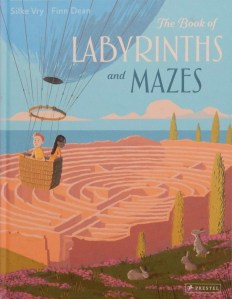
Cleverly framing the topic as a metaphor for life, author Vry (who has a background in archaeology and art history) and illustrator Dean, present a survey including both historic and modern world mazes and labyrinths from various viewpoints. In so doing they encourage youngsters to ponder upon what fascinated those in bygone times and still does make these puzzles so appealing.

One thing that’s important to know at the outset of this journey is that a labyrinth is not a maze and a maze is not a labyrinth: the difference being that you cannot get lost in a labyrinth whereas you can in a maze. I vividly recall getting lost in Hampton Court maze on more than one occasion.

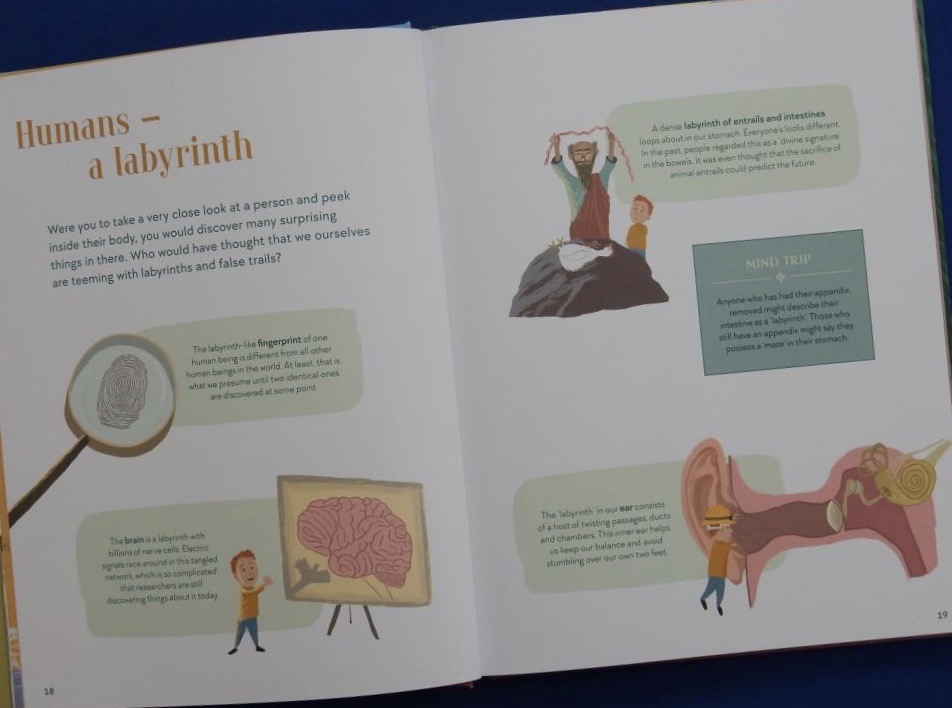
Have you ever thought about labyrinths in relation to the human body? that’s one of Vry’s considerations, offering the human brain, the ear and our entrails and intestines as exemplars.

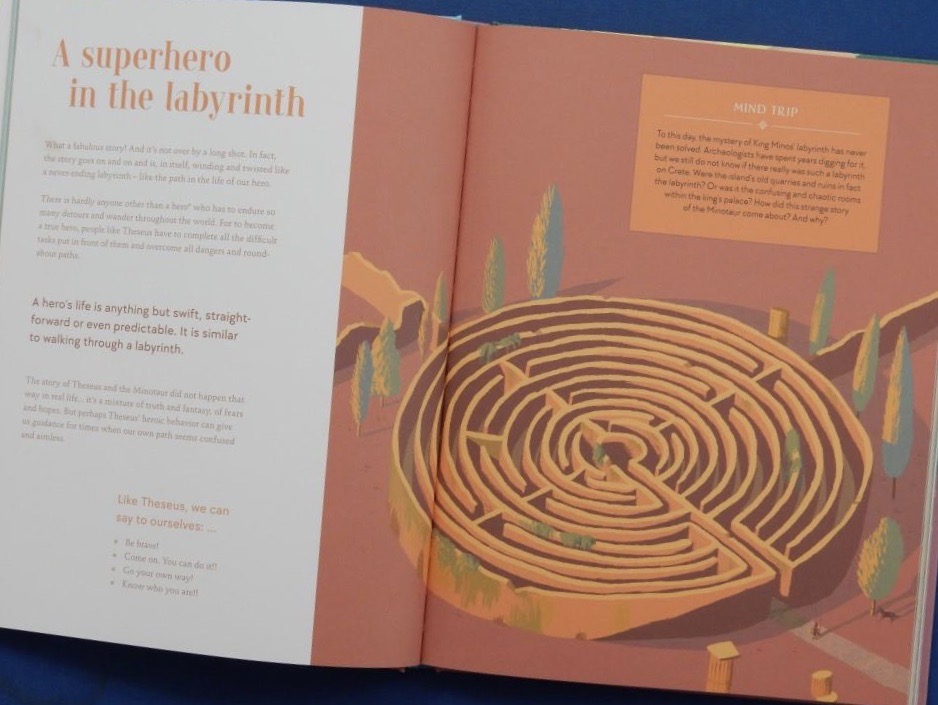
Another theme looks at the the historical and mythological labyrinths and mazes; there’s the labyrinth Daedalus designed for King Minos in the ancient city of Crete, so the story goes.

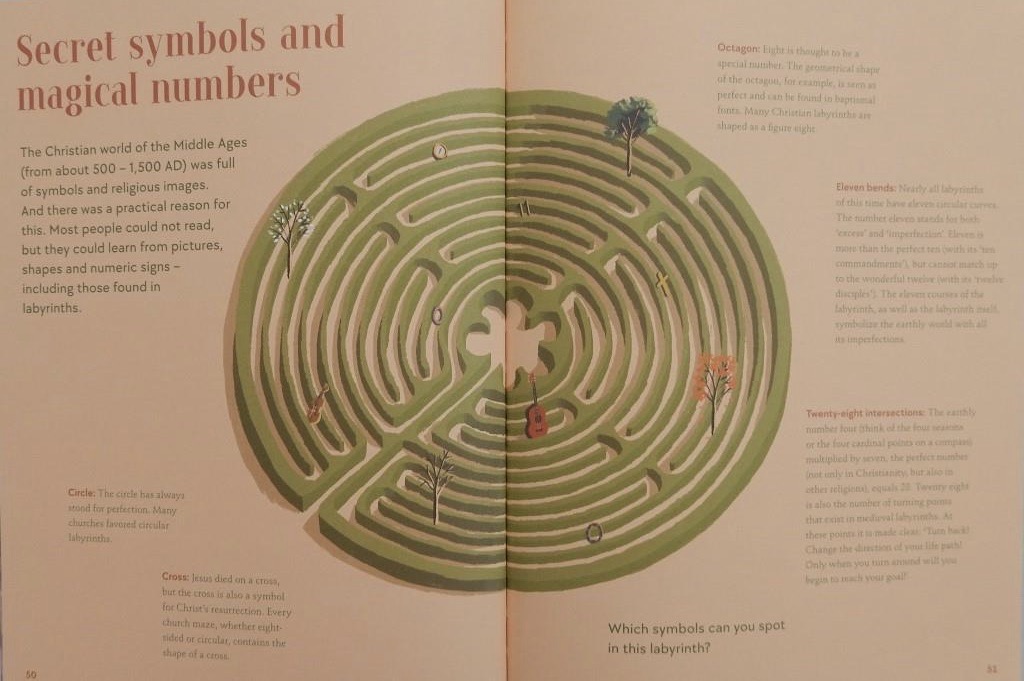
Children will likely be amazed by the grand labyrinth with its rounded sides and eleven concentric circles, rich in symbolism, that is set into the floor stones in Chartres Cathedral.

Then there are labyrinths in nature too: the other day young relations of mine were thrilled to discover ammonite fossils in a Cotswold stream near where we live. There’s a spread devoted to natural world examples herein too.

There is SO much more than at first meets the eye – this is a philosophical book that can act as a kind of sacred space wherein time slows right down offering readers the opportunity of ‘being in the moment’, a meditative mode wherein there is potential for change and growth: in life, like a labyrinth, the path shifts in unexpected ways, sometimes diverting you from your goal, but ultimately leading you to the centre or your own centre. Try running a finger slowly along the lines of a labyrinth and feel its calming effect.

I could go on at length about this engrossing, alluringly illustrated book with its facts, exciting ideas and participatory invitations for maze/labyrinth drawing, but I’ll now just encourage you to get a copy for your family bookshelves, and classroom. collections – you’ll find lots of opportunities across the curriculum to share it with youngsters.

Hooves or Hands?

Hooves or Hands?
Rosie Haine
Tate Publishing

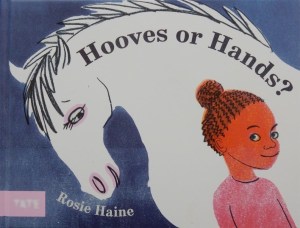
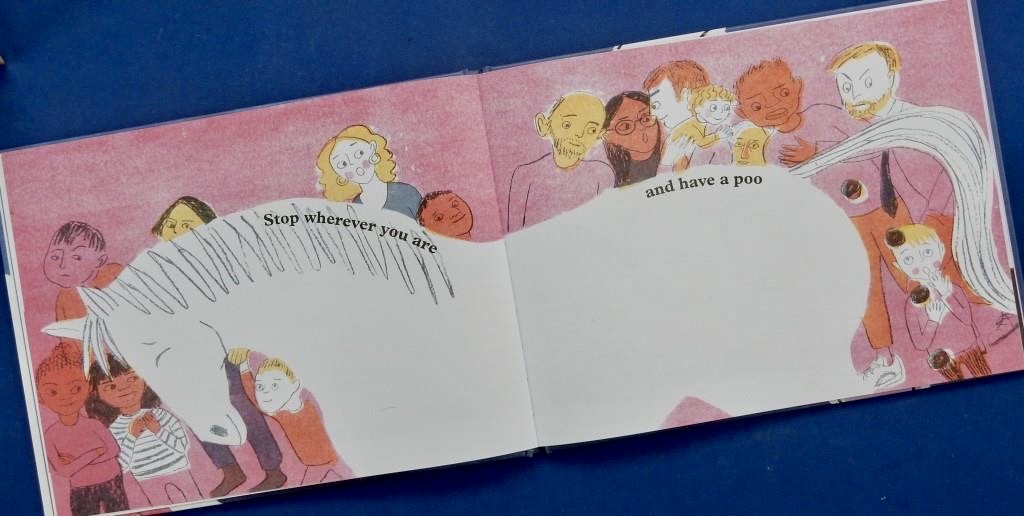
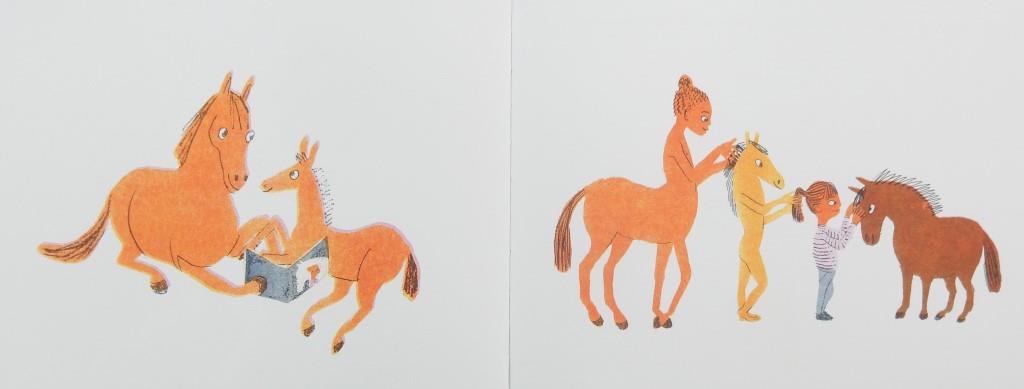
Following her debut picture book, It Isn’t Rude to be Nude, author/illustrator Rosie Haine invites readers to ponder on the possibilities that being a pony instead of a human might offer.

Taking by turn a series of parts of a pony’s anatomy – hooves, legs, face, hairy parts and then moving onto topics such as pooing, movement, diet and mode of communication, she presents the alternative equine /human scenarios starting with the title hands or hooves, followed by being four or two legged, having a long or short face, possessing a mane, tail, forelock and fetlocks or not, pausing for a dump wherever you are or having to hold on,

galloping or running, whether or not your bum is furry,

whether you dine on a variety of foods or have to stick to hay and whether you utter words or a neigh (yes the text does rhyme).

The key question is ‘… would you rather be a pony or a person?’ Which would bring more fun? There’s even the prospect of being both. The key thing however, is individual choice and making the most of what you choose.

Playful, clever, quirky and thought-provoking.

Share this in a classroom and you might find children trying their own versions using a different animal of their choosing.

What a Wonderful World

What a Wonderful World
Leisa Stewart-Sharpe and Lydia Hill
Templar Books

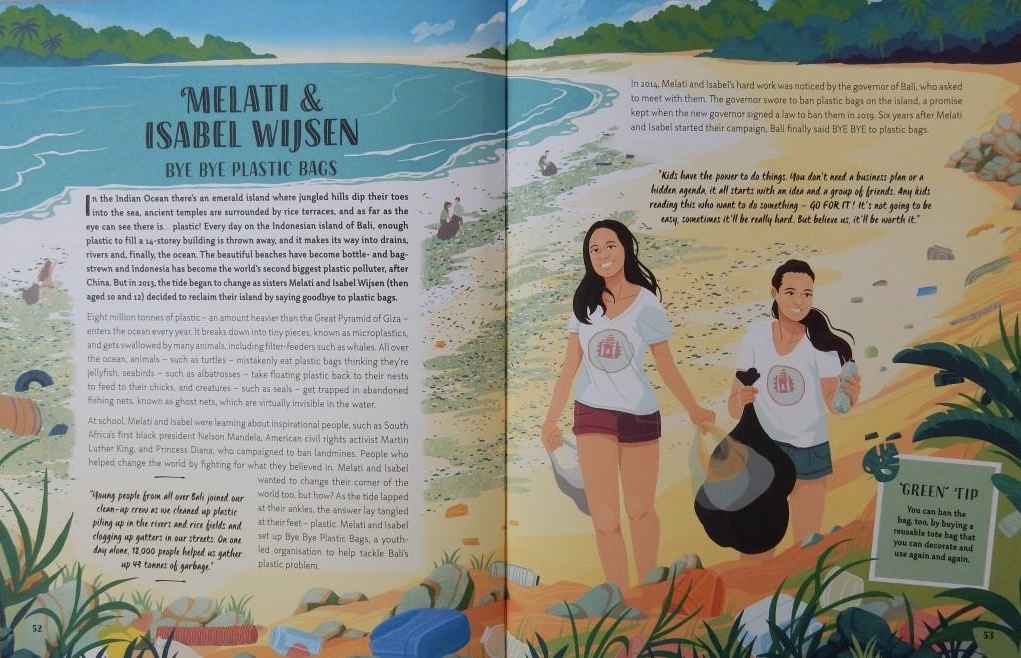
In this compilation, author Leisa Stewart-Sharpe takes readers to various parts of the world – the top of mountains, through rainforests, across deserts, over grasslands, along rivers, to both icy poles and deep down into the ocean – presenting the amazing flora and fauna of a large variety of habitats. In so doing, she shares stories of over thirty “‘Earth Shakers’ – activists young and not so young who have worked tirelessly for the cause of nature. The youngest mentioned is Romario Valentine (aka Romario Moodley) fundraiser and talented artist who on his 9th birthday asked for donations to an endangered bird sanctuary nearby rather than presents or a party.

Let’s go now to the foot of Mount Everest to meet Priti Sakha and learn about her fight for clean air in and around her home city of Bhaktapur. As a volunteer for the group Nepalese Youth for Climate Action, this nineteen year old participated in street clean-ups, protests and visited schools to help students understand the terrible dangers of air pollution and talking about ways in which everybody can work towards cleaner air in the Himalayan region. “The mountains are our pride. I’m taking a stand” she said. The spread devoted to this young woman and each of the other people featured includes a relevant ‘green tip’.

Trees are crucial to our world and several people included in this collection have espoused their cause. There’s German schoolboy Felix Finkbeiner who’s started a tree planting project in his school. It quickly spread to other schools and within a year, some 50,000 tree seedlings had been planted across the country. He set up the ‘Plant-for-the-Planet’ organisation to involve children the world over and to date there are over 91,000 child participants representing 75 countries.

Trees were also Julia Butterfly Hill’s cause. This young woman visited the redwood forests of California intending to stay for just a week, However on discovering that the forest was to be cleared by a lumber company, she lived peacefully in the branches of a tree named Luna for two years until finally the company agreed to leave a 60 metre protective zone around that tree and others in the vicinity.

Another tree planter was Kenyan ecologist Wangari Maathai who planted 50 million trees across Africa and started the Green Belt Movement to that end, a movement that continues to transform both people’s lives and the landscape.

Doing his utmost for the cause of Antarctic seals, is polar scientist/conservationist Prem Gill. Studying these creatures in the field is a massive challenge and Prem uses space satellite technology to do so.

There’s no room in this review to mention the awesome work of everyone spotlighted in this hugely inspiring book but I must introduce sisters Melati and Isabel Wijsen who took on the huge task of both cleaning up the beaches of Bali and setting up the organisation Bye Bye Plastic Bags to help tackle the island’s massive plastic problem. I was amazed to learn that Indonesia has become the second worst plastic polluter in the world.

With Lydia Hill’s striking illustrations of activists and wildlife and a foreword by Lee Durrell MBE, this surely is a book to motivate youngsters to get involved, both by making small changes and joining in with a project or two that particularly interests them. (Suggestions are given at the end of the book, and there’s a glossary and letter from the author too.)

Let’s Save Antarctica

Let’s Save Antarctica: Why We Must Protect Our Planet
Catherine Barr and Jean Claude
Walker Books

This book is an urgent plea from author Catherine Barr and illustrator Jean Claude for readers and listeners to help in the vital task of protecting our precious planet, in particular Antarctica from climate change and plastic pollution, and all that means.

That vast white continent covering the South Pole – the most extreme environment on earth – is home to millions of Emperor penguins as well as safe waters for the enormous whales that live in the depths of the surrounding Southern Ocean. Losing these, thus far tough survivors just doesn’t bear thinking about, but think about it we must.

Penguins though are just some of the awesome inhabitants of the vast icy wilderness, for eons ago it was home to dinosaurs, and fossils, footprints, teeth and ginormous bones have been discovered by scientists investigating the ancient volcanic ash of the Antarctic sea floor.

Other scientists have and still are investigating what Antarctica can reveal about how earth’s climate – the temperatures and wind patterns – have changed over hundreds and thousands of years.

But what are the secrets to the survival of the flora and fauna of this extreme environment? Yes they are all protected in this our last great wilderness.

However, it’s something biologists are studying while others are looking at what allows deep sea life to survive.

So too is the crucial work that scientists are doing to monitor the effects and speed of climate change, Antarctica’s greatest risk of all, and something that will also have a huge impact on all of our lives.

You don’t have to be a scientist to contribute to the saving of Antarctica and the final spread comprises things that we can all do to stop plastic pollution in the ocean and help slow down climate change. What Catherine has written will surely spark action to protect this incredible place; it’s up to us …

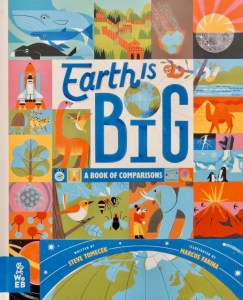
Earth is Big

Earth is Big
Steve Tomecek and Marcos Farina
What on Earth Books

Every one of the eighteen topics in this large format book explores the notion of absolutes in relation to planet Earth.

The author has an impressive science background and in his introduction he uses measurement and comparison to talk about this planet calling it in the final paragraph a ‘big, small, heavy, light, cold, hot, wet, dry, fast, slow, round, jagged planet, Earth.

Then follow double spreads, the titles of which are for the most part seemingly contradictory – Earth is Big followed by Earth is Small, Earth is Cold then Earth is Hot and so on.

So is Earth big, or is Earth small? What we learn is that in comparison to the inner and dwarf planets, its diameter is big whereas when compared with the outer ones, Earth is small.
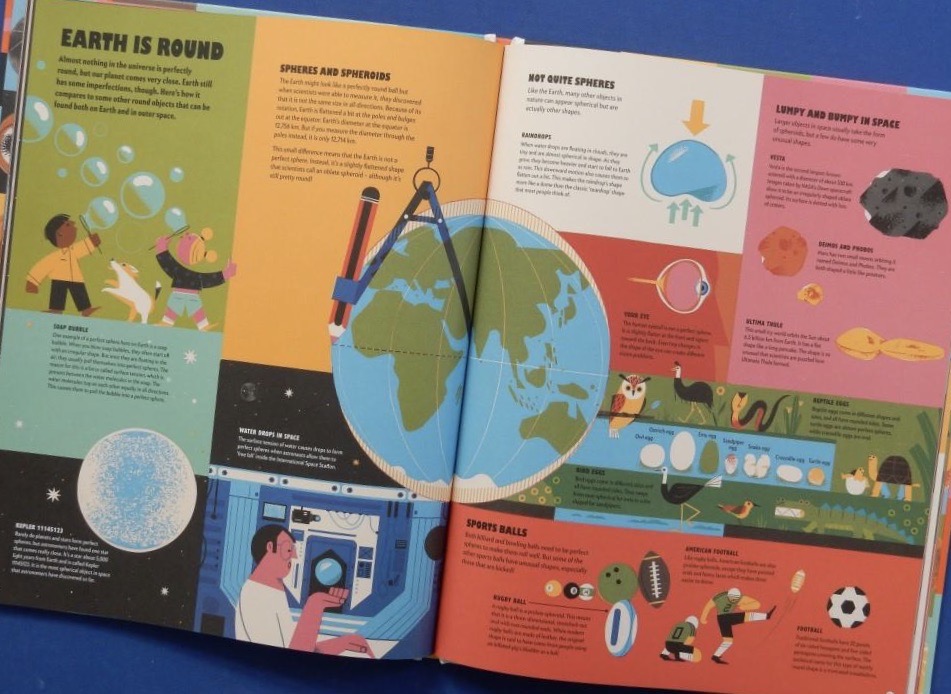
When it comes to a consideration of roundness, Earth is an almost perfect sphere though it’s not without imperfections; 

however despite appearing spherical, the surface is rough and jagged on account of such things as mountains and canyons.

Sometimes changes take place on Earth quickly or suddenly on account of such phenomena as earthquakes, moon phases or wind; at others it changes slowly. The relevant spread briefly explains tectonic plates and like all the other explanations is accessible, no matter the scientific field. 

An amazing amount of always readable information encompassing such topics as mass extinctions, 

the Sutter’s Hill meteor strike in 2021 and climate change, which is mentioned several times, is packed between the covers of this book.

There’s a slightly retro look about Marcos Farina’s stylised illustrations and each page layout is different, helping to maintain the general reader’s interest in this unusually conceived scientific book. It also has a a glossary, contents, index, conversion tables and source notes.

One to add to KS2 collections and family bookshelves.

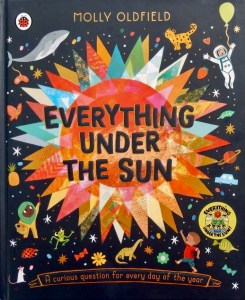
Everything Under the Sun

Everything Under the Sun
Molly Oldfield
Ladybird Books

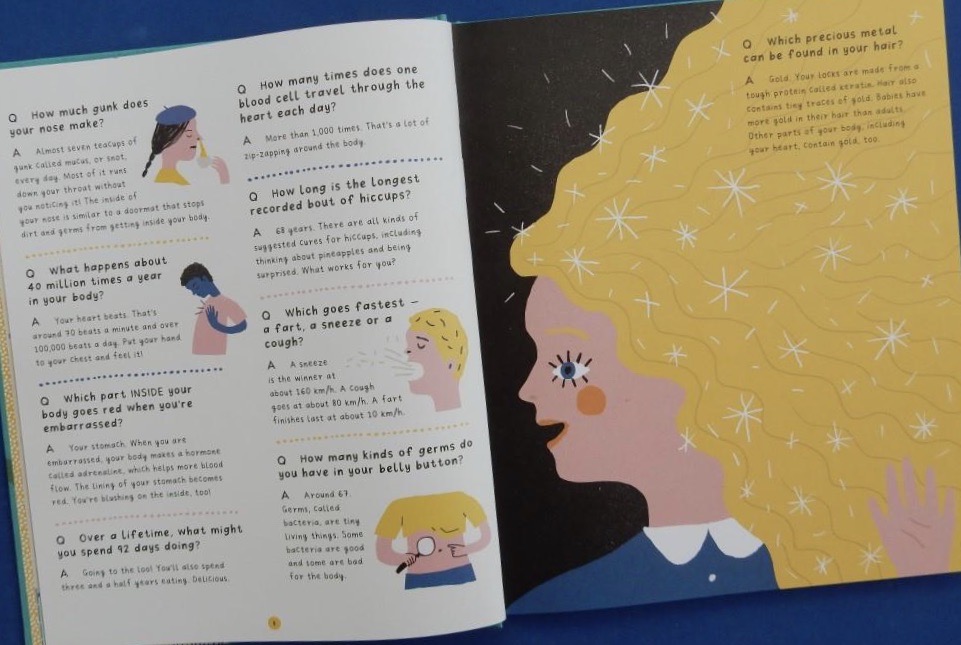
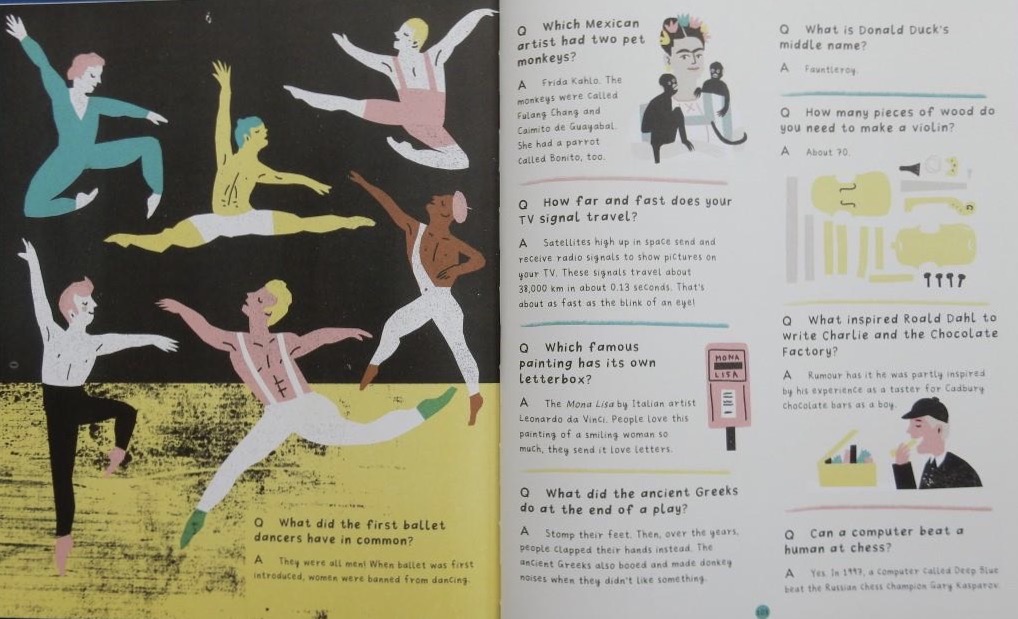
This is an exciting compendium of 366 questions (one for every day of the year plus 1 for a leap year) posed by inquisitive children from all over the world, that has its origins in the podcast from Molly Oldfield aka QI Elf.

Written contributions, some factual responses others opinion-based, come from a wealth of experts such as scientists, authors, poets, politicians, conservationists and the twelve illustrators who provided the visuals. Interestingly Rob Biddulph gives an answer (as does author Abi Eplhinstone) to “Where do ideas come from?” but he isn’t among those illustrators (Laurie Stansfield did the art for that one); neither is Oliver Jeffers who responds to “Why do people make art?” I particularly love this part of Rob’s reply, probably because he endorses my feelings: “… My children are a really good source for my ideas. They are big readers, and they have really vivid imaginations! And no idea is too silly!”

Some of the spreads have a theme, for instance there’s one with four wild animal questions, three relating to big cats, the other being “What noise does a zebra make?” Another has three penguin questions.

Others devote a double spread to a single question “Why do butterflies have patterns on their wings” being one for August.

There’s a splendid illustration of an owl around which a question of head rotation is discussed.

On a completely different topic, Nick Ross explains why the Tower of Pisa is leaning.

Not something this reviewer has ever considered but I was interested to learn why nonetheless. That’s another way this book works. You can just dip in randomly and discover something that perhaps you didn’t know before and no matter your particular interests, you’re pretty sure to come upon something illuminating.

Or you might have a question binge and spend hours browsing and you could formulate a few questions of your own. I wondered why there are relatively few ‘where?’ questions compared with those asking ‘why’ and ‘what’ and it’s great to see such a wide age range of inquiring children (2-18) included as the source of the questions.

I’d strongly recommend both families and primary schools adding this engrossing book to their shelves.

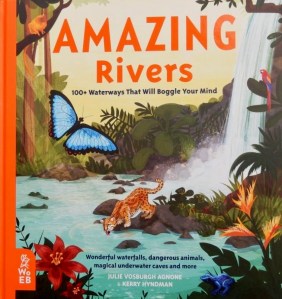
Amazing Rivers

Amazing Rivers
Julie Vosburgh Agnone and Kerry Hyndman
What on Earth Books

Author Julie Vosburgh Agnone starts by giving a general description of a river and then takes readers on an exploration of freshwater waterways all around the world. She and illustrator Kerry Hyndman then present more than a hundred rivers explaining as they go subjects including measurement, source and flow,

as well as what is to be found in and also around rivers, and the humans living and working in their vicinity.

Crop growing has long been an important activity with dates and other fruits, grains and vegetables having been watered by water from the Tigris and Euphrates Rivers since ancient times when Sumerian farmers designed irrigation methods to divert the river water.

Many rivers, we’re told, contain fish species in abundance including perch, catfish and trout while others yield freshwater crabs and shrimps that can make a tasty meal.
I was fascinated to read about pancakes – not the edible variety but ones made of ice that are occasionally formed in the River Dee in Scotland.

In contrast the Boiling River in Peru has water hot enough to cook an egg.

Some rivers – the Amazon, the Yangtze and another Chinese river, the Li – are allocated a spread each while other spreads are topical including treasures found in rivers, industry, feats of engineering and threats to divers with short titled paragraphs presenting the facts set into or around stylised illustrations.

Kerry Hyndman uses a variety of visual layouts that include vignettes,

close-ups, arial views and broad river scenes as well as making good use of texture and shadow to help maintain readers’ interest throughout. There’s also a central foldout map showing the location of each river mentioned as well as giving some fun river-related lists. A glossary, index and resource list comprise the four final pages.

Altogether a fascinating and informative resource book for individual browsing and KS2/3 school collections.

Inside Animals

Inside Animals
Barbara Taylor and Margaux Carpentier
Wide Eyed Editions

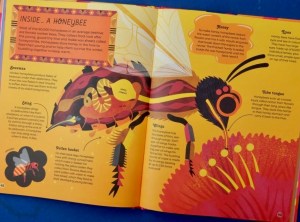
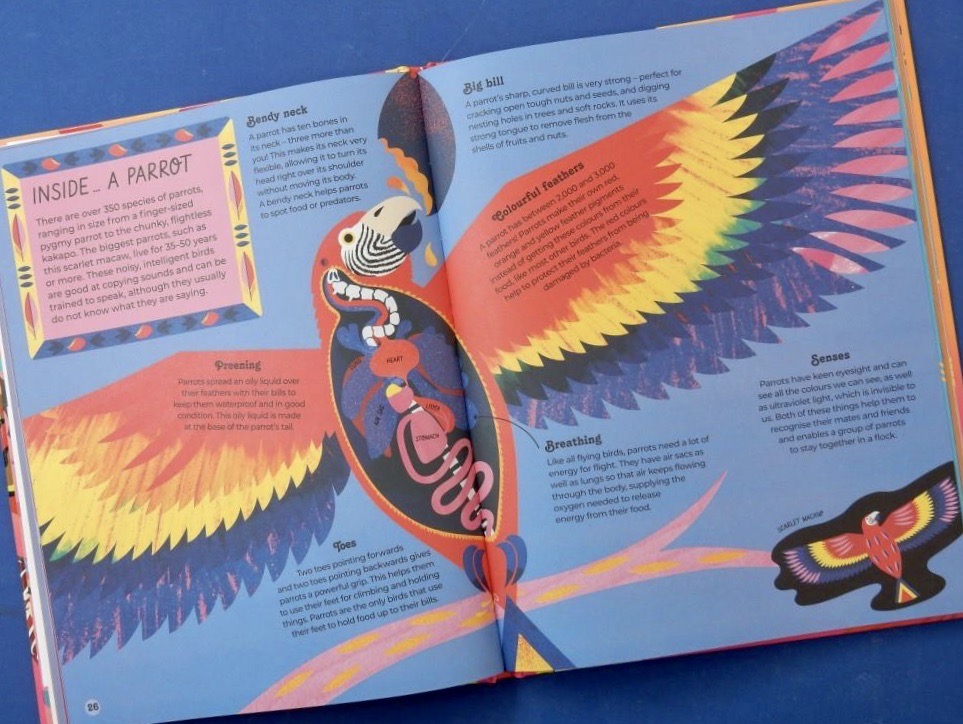
Back in the day when I was studying zoology at A-level and beyond I always felt extremely uncomfortable having to do animal dissections to get a close look at an animal’s innards. Now here’s a book containing twenty one cross-sections of a variety of animals large and small, all illustrated in vibrant colours by Margaux Carpentier. 

In the introductory section, detailed pictures show how skeleton, muscles, organs and nerves fit together inside the featured creature – a snake, a camel and a shark.

Then come several focus topics – Muscles and Moving, Skeletons, Lungs and Breathing, Brain and Senses, Heart and Blood, and Amazing Organs.

Written by one time Science Editor at London’s Natural History Museum, Barbara Taylor and set out around each internal view, are factual paragraphs and an introduction, for all the mammals, birds, reptiles, amphibians, fish, insects, spiders and other invertebrates spotlighted herein.

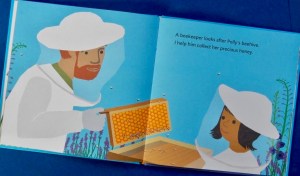
I was fascinated to see the honey stomach of the honeybee – a storage organ for nectar – shown and mentioned in one of the paragraphs and part of what helps this creature survive and thrive.

No animal would be able to survive without oxygen to breathe but not all have lungs, or gills like fish and oysters. Within a parrot we see both lungs and additional air sacs that keep oxygen-supplying air flowing throughout its body so the energy for flight is available. 

Other creatures including we read, land-living earthworms, breathe through their skin.

What about brains? It’s not every animal that has one of those although all rely on sensory information sent via electrical signals along nerves. Such information might be gathered through an animal’s sight, hearing, smell, taste and touch. Without a brain, jellyfish for instance use a simple nerve network to detect touch, light, smells and to respond to their surroundings; amazingly these graceful creatures can still sting after they’re dead.

Turning to animals having more in common with humans, a giraffe for instance possesses lungs (around eight times the size of ours), and a heart – also enormous and roughly the weight of your average two year old. I was surprised to learn that despite its very long neck, a giraffe has only seven neck bones, linked we read by ball-and-socket joints enabling that neck to be super-bendy.

I suspect that any youngster, especially those with a scientific bent, will discover some surprises in this engrossing book. It’s one I’d recommend adding to family bookshelves and KS2 classroom collections.

Run Like a Girl

Run Like a Girl
Danielle Brown, illustrated by Robin Shields
Button Books

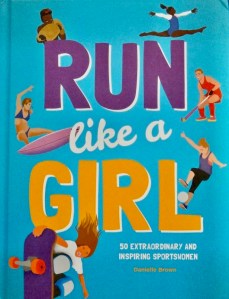
With an illustration by Robin Shields on every spread, 2x Paralympic Gold Medallist, able-bodied Commonwealth Games medallist and champion of inclusion, Danielle Brown presents a look at the lives and achievements of 50 incredibly talented women from around the world of various ethnicities, ages and abilities.

No matter the sport, what these women all have in common is passion and perseverance and these qualities are what matter most of all. Resilience too is key, for success doesn’t come without something of a struggle.

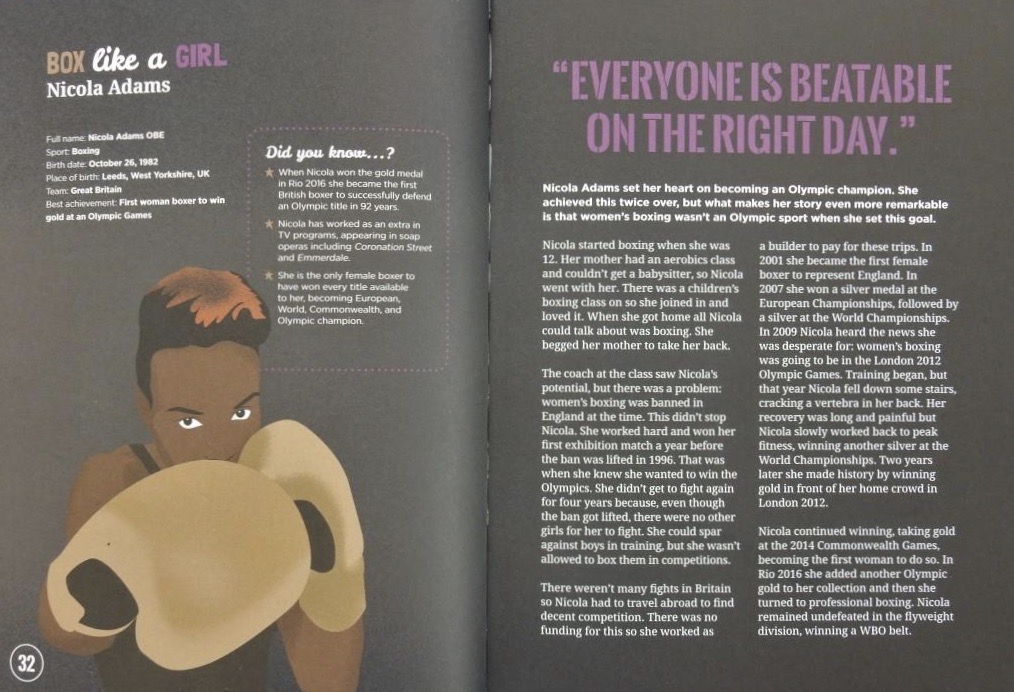
Some of those featured have been honoured by their countries. For instance Olympic gold medal winning boxer Nicola Adams has an OBE,

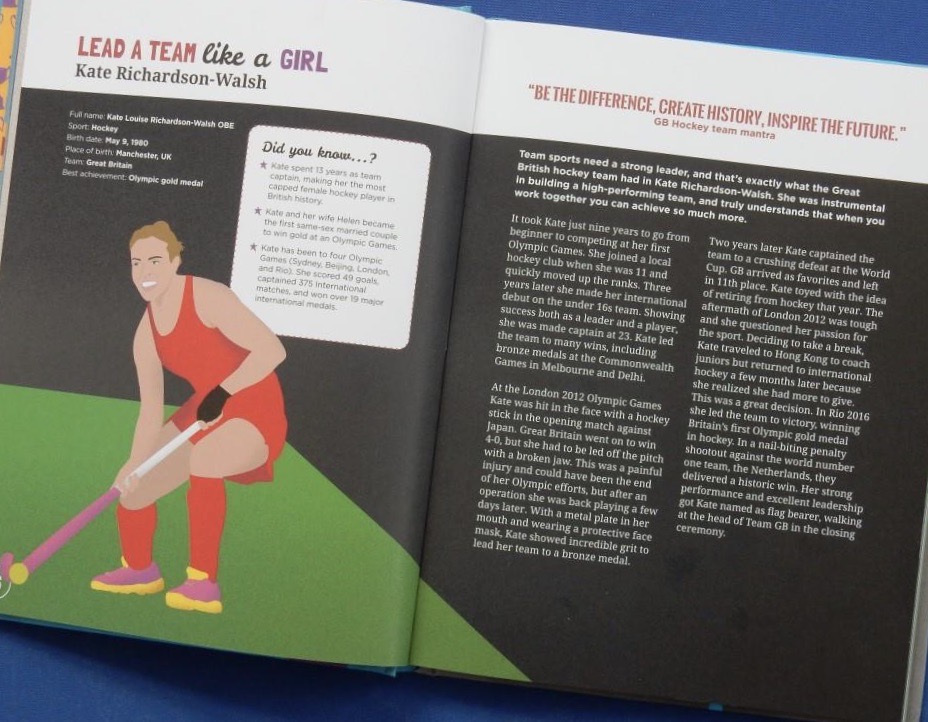
while hockey player, captain and Olympic gold medallist Kate Richardson-Walsh has received an OBE and carried the TeamGB flag at the closing ceremony of the 2016 Rio Olympics.

Triathlete, cyclist and rock climber Karen Darke not only has an MBE and a paralympic gold medal, but she also studied the gold content in rocks for a geology doctorate. She’s never let a fall down a cliff while climbing that left her paralysed and unable to walk again, hold her back. ‘Ability is a state of mind, not a state of body’ is her mantra.

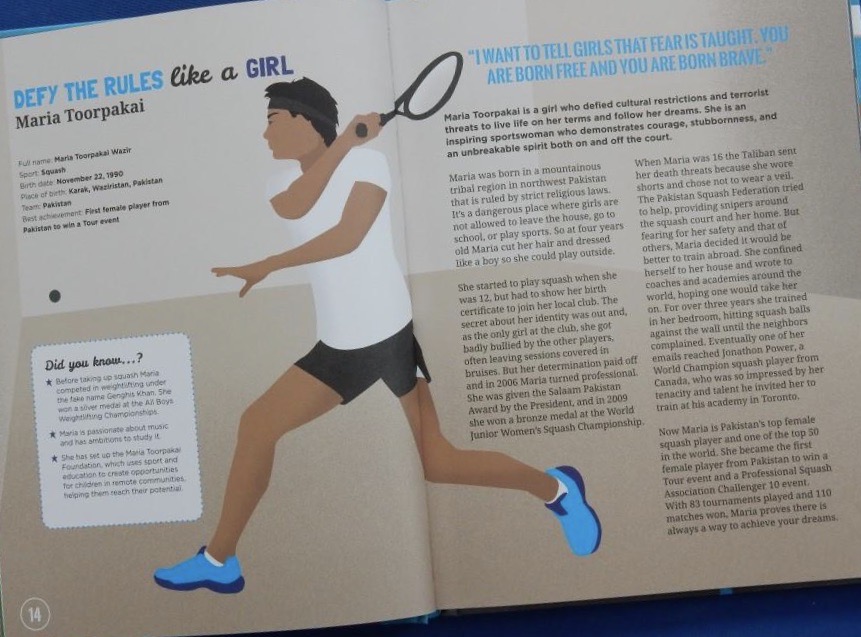
Defying both terrorist threats and cultural restrictions, squash player Maria Toorpakai from Pakistan dressed like a boy when she was four in order to play outside and when she began playing squash she was often bullied and bruised by other players, received death threats from the Taliban at sixteen but has now, thanks to support from Canadian squash player Jonathon Power, become Pakistan’s top female squash player. She’s also set up a foundation that aims to create opportunities for children in remote communities to reach their potential: “I want to tell girls that fear is taught. You are born free and you are born brave,” she says.

Tracey Neville has been a netball player and England coach; Stephanie Frappart a soccer referee of women’s and men’s matches, and the first woman to officiate at a major European men’s match are also featured.

No matter the sporting interest of the young reader, they’ll likely find it represented in this inspiring book that is essentially all about following your dreams and exceeding expectations and goals. With the Olympics just over and Paris 2024 to look forward to, youngsters can browse the narrative information and biographical details of the spotlighted women herein. Never say never … for as swimmer Yusra Mardini who became a member of the 2016 Refugee Olympic team says, “I want everyone not to give up on their dreams. Even if it’s impossible, you never know what will happen.”

Sing Like a Whale

Sing Like a Whale
Moira Butterfield and Gwen Millward
Welbeck Publishing

Previously Moira Butterfield invited youngsters to lessons that would help them Dance Like a Flamingo. Now in this spirited book their voices are the focus as they take delight in joining in with this exploration of the variety of sounds made by creatures large and small.

First to perform its song is the male humpback whale as he swims through the ocean with a long low Hoooooooo Hoooooooo.

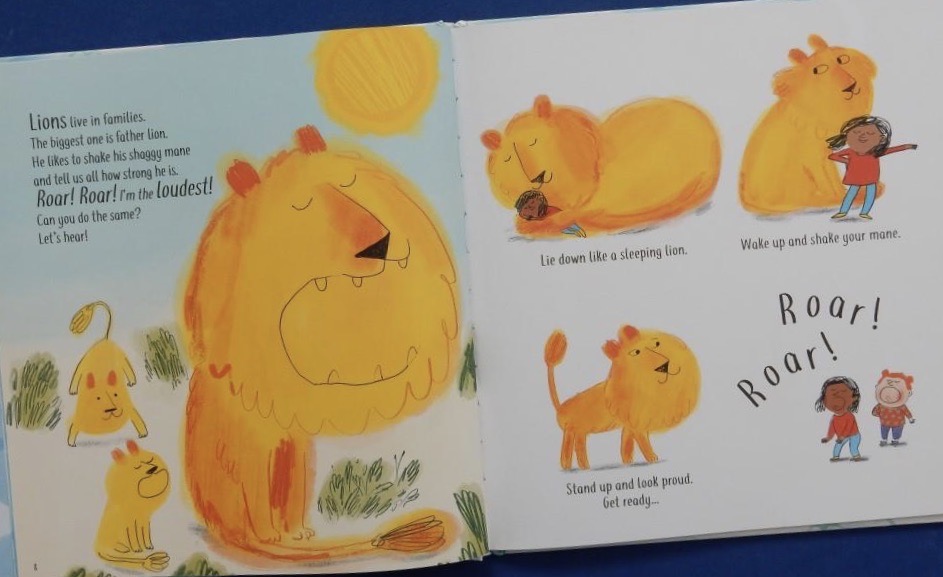
Back on land we meet shaggy maned father lion ready and waiting to make his loudest Roar! Roar! – the ideal sound for little ones to stand proud and tall ready to give vent to their feelings.

Next to use its vocal organ is an owl Hoot, hoot! it goes as it perches on a branch. Make sure youngsters are ready to emulate its turning head movements as well as its hooting before spreading their wings and gliding off.

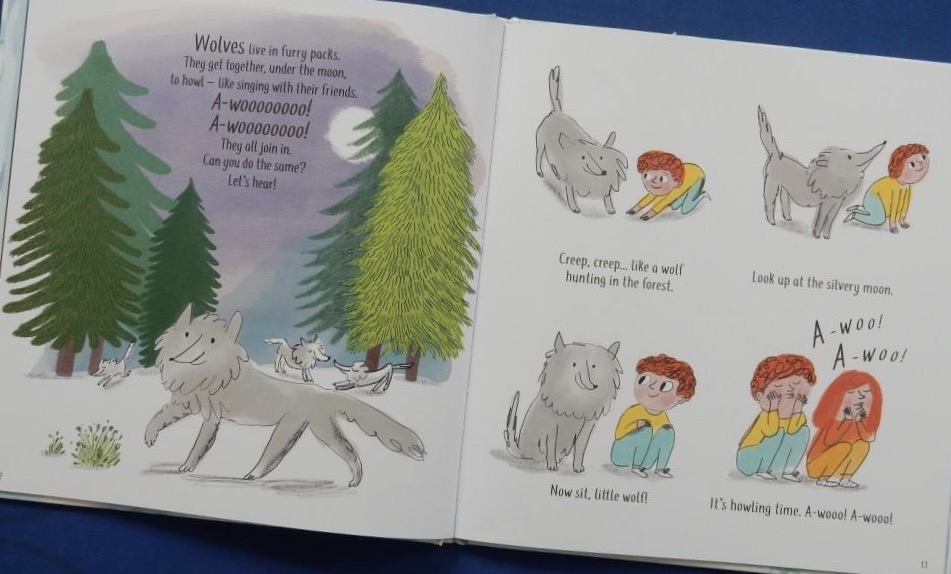
Also enjoying a moonlit singing session are a pack of wolves, each one A-woooooooo-ing and waiting for little humans to creep, sit and create an echoing A-woo! A-woo!

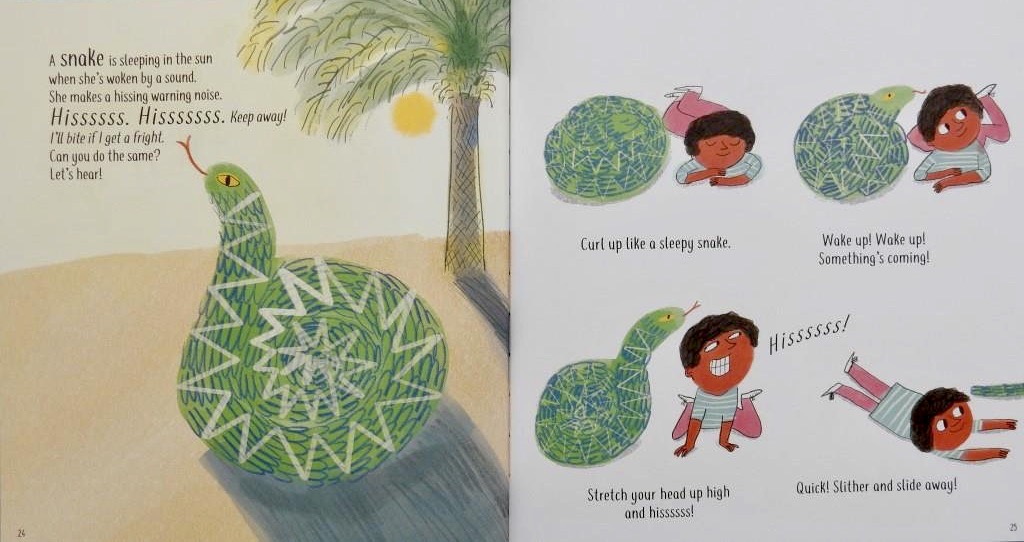
A further eight creatures, some feathered, others furry and one scaly are all eager to give renditions and encourage children to copy them

and then it’s the turn to the children to issue an invitation to “Sing with me!”

Whether you share this book with one, several or an entire foundation stage class prepare yourself for a very noisy and thoroughly enjoyable story/movement session. Make sure you allow time to let your audience see Gwen Millward’s humorous illustrations of the various animals, and the animated child mimickers clearly enjoying themselves.

Mummies Unwrapped

Mummies Unwrapped
Tom Froese
Nosy Crow (in collaboration with The British Museum)

Ancient Egypt is a popular topic for the KS2 History curriculum but the subject of mummies is given relatively little attention.

Now illustrator Tom Froese reveals their mysteries in this book unravelling both those of humans and animals. To allow them to remain together in the afterlife, sometimes pets were mummified at the same time as their humans.
First of all is an explanation of what a mummy actually is, and the origin of the word. We then learn how a mummy was made. It was crucial to start the embalming process as soon as possible to prevent the body rotting in the hot sun.

An embalmer’s toolkit is depicted and the entire process is described.

If you’ve ever wondered what the wrappings were made of, they were generally linen torn into long strips that look a bit like bandages.

We learn the grisly details of what was done with internal organs (only the heart was left in place as this was thought to be needed in the afterlife), as well as reading of the outcomes of embalmers’ errors.

There’s information about the funeral procession (after 70 days) to the tomb and what took place thereafter. There’s also a spread introducing some of the most famous mummies including Tutankhamun and one called the ‘unlucky mummy’ said to have been cursed.

Unearthed too are stories of tomb robbers, and what took place when archaeologists discovered mummies thousands of years after their burial; there’s mention of fake mummies and other shenanigans. Apparently the French King Francis 1 always carried a packet of powdered mummy with him in case he was ever in need of urgent healing. Bizarre!

Froese’s stylish illustrations have touches of gentle humour, plenty of detail and pattern making this a book I would definitely recommend adding to primary school collections and the bookshelves of youngsters with an interest in ancient history.

What a Wonderful Phrase

What a Wonderful Phrase
Nicola Edwards and Manu Montoya
Little Tiger

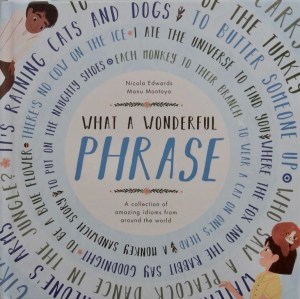
Nicola Edwards and illustrator Manu Montoya take readers on a world tour looking at idioms from far and wide, including such places as Sweden, South Africa, Korea, Nigeria and Greece. There’s even this: ‘Nuces relinquere’, Latin for ‘To Give Up Nuts’ which to the Ancient Romans meant to give up childish ways. Fascinating, as are all the other idiomatic phrases in this book, each of which is explained in a gently humorous manner in this compilation of curious utterances.

We learn the cultural and historical facts behind for instance, ‘Putting Watermelons Under Someone’s Arms’. Originating in Iran (then Persia) and also found in Azerbaijan and Turkey, it translates as ‘conning someone into doing a tiresome or stupid task for you’.

I was surprised at how many of the idioms mention food.

Can you guess the meaning of ‘To split open the crocodile’s intestine’ a phrase sometimes said by Izon speakers living around the Niger Delta. If your home language is English you’ll surely be familiar with ‘to butter someone up’ and ‘it’s raining cats and dogs’ but unless you speak Dutch you aren’t likely to have come across ‘a monkey sandwich story’.

I couldn’t help but laugh at this Icelandic one that translates as ‘peeing in your shoes will only keep you warm for a short while’. Really? However the accompanying bit about an unusual delicacy said still to be consumed by some did not appeal to my vegan sensibilities. Gross!

As well as being amusing, this delightfully illustrated book is an exploration of the diversity of language and a presentation of snippets from many different cultures that readers of all ages can enjoy sharing and discussing.

Eureka! A Big Book of Discoveries

Eureka! A Big Book of Discoveries
Jonathan Litton and Wenjia Tang
Little Tiger

If you lack an open inquiring mind, open eyes and imagination, it’s unlikely that you’ll discover anything new or shed fresh light on something that’s already known.

In this book Jonathan Litton takes a look at all kinds of amazing discoveries from both long ago and recent times, history being the first theme with dinosaur remains the first topic along with what some key palaeontologists have discovered. I was astonished to read that on account of several factors including improved technology and more trained palaeontologists, dinosaurs are ‘being discovered at a faster rate than ever … a new species per week on average.’

Ancient civilisations and some of their artefacts are presented next including a visit to some entire cities that were lost.

The second section ‘Introduction to Earth’ takes readers to both the Arctic and Antarctic regions as well as deep down into oceans

and right into the earth’s core. We read of extinct species and new ones that are recent discoveries: I’d not heard before of the psychedelic frogfish that usually walks on the ocean floor but can make itself into a ball and jet propel itself from one place and another.

Section three presents discoveries of a scientific and mathematical kind, some like penicillin, accidental, others the outcome of experimentation either simple or incredibly complicated and costly.

Perhaps your interest is space. That is Litton’s next theme, about which humans have discovered relatively little despite it being a source of fascination for well over 1000 years. It’s good to see Vera Rubin and her work on galaxy rotation getting a mention herein

and I’m pleased that the author devotes a double spread to women whose remarkable discoveries gained them scant credit at the time. This forms part of the final ‘nature of discoveries’ section that considers some philosophical questions – what makes a discovery a discovery?

The world is a dynamic place and it’s likely in the time that I’ve taken to read this book and write these words, fresh knowledge is being uncovered. That truly is an incredible idea …

A thoroughly engrossing and inspiring book, alluringly illustrated by Wenjia Tang to add to individual and school collections.

Myths, Monsters and Mayhem in Ancient Greece

Myths, Monsters and Mayhem in Ancient Greece
James Davies
Big Picture Press

However famous the Greek myths might be, retellings of these ancient tales for youngsters can sometimes be pretty dull, turgid even; now here’s a book that makes them anything but.

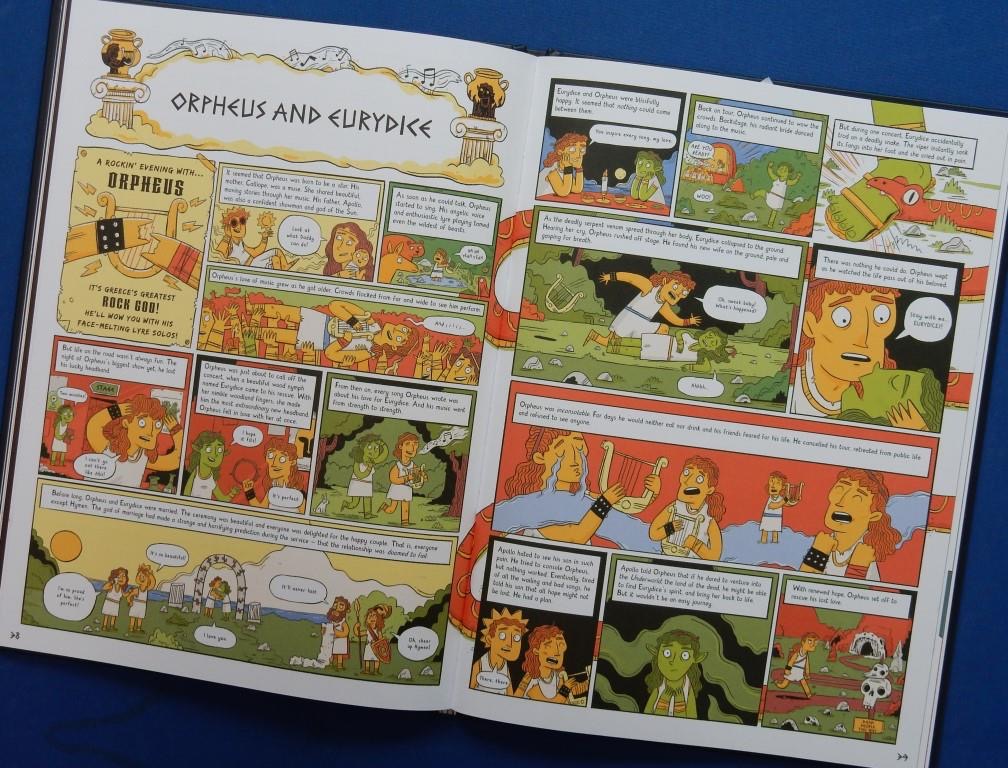
In a dramatic comic book style James Davies presents half a dozen tales making them highly accessible to primary age readers wherein they will find bravery, loss, love,

greed and envy. Interspersed between the stories are thematic spreads on various topics that offer a broader look at such aspects of Greek mythology as the Greek gods and how the Greek myths explained the world; there’s a presentation of heroes and heroines including Atlanta, Achilles, Penthesilea and Odysseus. We also take a journey through the Greek underworld, a place that could be downright scary or delightful depending on your actions during your life.

James Davies’s bold graphic artistic style means that he manages to make even the most terrifying monsters such as the many-headed Scylla and the gigantic Hydra look amusing.

Right now I think we definitely need that tiny little shining insect that popped out of Pandora’s Box spreading light wherever there was darkness and hope wherever there was despair. Definitely now would not be a good time even to contemplate hiding away inside that ginormous wooden horse like those Greek soldiers did when Helen was rescued in The Trojan Horse story. However there’s much to learn from all six stories: that of Theseus and his quest to defeat the horrendous Minotaur,

the Twelve Labours of Heracles, Orpheus and Eurydice and Perseus and Medusa.

With Ancient Greece being one of the oft used topics in KS2 history, a couple of copies of this enthralling book would make a worthwhile, up to the minute addition to primary school topic resources as well as the school library.

Curious Creatures: Glowing in the Dark

Curious Creatures Glowing in the Dark
Zoë Armstrong and Anja Sušanj
Flying Eye Books

Author Zoë Armstrong and illustrator Anja Sušanj take us close up to some of the world’s most incredible animals – some of those that are bioluminescent and others that are biofluorescent.

The former use chemical reactions to create sparkles, flashes and flickers of light within their bodies by mixing together two chemicals luciferin and luciferase plus oxygen. This is then shown in a variety of ways. Some creatures including two earthworm species one from New Zealand, the other from the American South ooze a gooey gunk. The New Zealand species dribbles orange goo, the American, blue.

In contrast there are sea creatures such as Flashlight fish that use the bioluminescence of glow-in-the-dark bacteria they carry around and can switch on and off in the blink of an eye. Amazing! Amazing too is the fact that beneath the sea around the Florida coast over three-quarters of the marine creatures glow in the dark, using light to communicate.

It’s not only marine animals that use light to signal to one another. I once spent hours over many evenings in the hills near Dharamshala, fascinated by the myriads of fireflies flickering in the evening dark after a rainy day. In this book, the author focuses on those found at the forest edge in Japan; apparently there are over 2000 species of firefly around the world.

Biofluoresent creatures such as scorpions that are nocturnal, need to absorb invisible ultraviolet light from the Sun (or Moon) in order to glow.

However, so we read, this whole phenomenon is ‘something of a mystery’ and increasing numbers of familiar creatures, so scientists are discovering, are able to glow in the dark.

Having presented all these amazing animals, it’s exciting to read that scientists are making use of both bioluminescence and biofluorescence to research new ways to track diseases moving around the body, as well as looking at ways to save energy and to test for pollution. WOW!

Beautiful illustrations and a highly readable text make this a book for KS2 readers either in the classroom or at home.

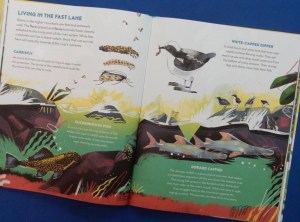
Amazon River

Amazon River
Sangma Francis and Rômolo D’Hipólito
Flying Eye Books

The author of Everest now invites readers to join her on an exploration of a river that starts as a tiny trickle high up in the Andean Mountains of South America, flows across seven countries and 6,400 km. and has more than 1,100 tributaries.
I was previously unaware that the Amazon comprises three different kinds of water: the fast flowing clearwater, the slowly churning blackwater that moves almost imperceptibly across forested land (the dark colour is the result of leaves that fall and rot at the bottom), and the milky whitewater that looks rather like flowing caramel, the colour coming from a mix of sand, silt, minerals, floating sediment and broken down bits of rock.

Having described the geological features, Sangma Frances moves on to talk about the fact that in the Amazon basin there are three different kinds of river, one aerial, the surface river that is visible, and four km. down and recently discovered by scientists, the Hamza.

There’s a wealth of information about the flora (including 16,000 tree species)

and fauna – great and small – 3000 fish species, 1,300 species of birds, 2.5 million species of insects, assuredly the world’s most incredible ecosystem.

After this comes a legend about a tribal warrior said to have been turned into a huge fish called the pirarucu.

Did you know that the Amazon has been home to human life for 12,000 years, since the last ice age? Or that there are more than 400 indigenous societies in the Amazon, each of which has its own culture, language and traditions and folklore. The story of Naia, queen of the lilies is retold here.

Having described next human life along the river, the author ends by discussing some of the terrible threats faced by the Amazon,

how activists are doing their utmost to protect the precious space and a final plea to all readers to do their bit to help.

The amazing illustrations of Rômolo D’Hipólito really help readers to feel immersed in the wonders of this mighty waterway.

Altogether a smashing cross-curricular resource for schools as well as for individuals interested in learning more about an incredible ecosystem.

Wild Child

Wild Child
Dara McAnulty and Barry Falls
Macmillan Children’s Books

This is such a beautiful book written by award-winning author of Diary Of A Young Naturalist and gorgeously illustrated by rising star, Barry Falls.

With his distinctive voice, Dara McAnulty invites readers to take a close look at the world around, journeying into and exploring with all your senses, the five different locations that he describes both poetically and scientifically.

First off is a look through the window, after which we go outside into the garden, wander in the woods, saunter up onto heathlands and meander along the riverbank. At each location we pause while Dara provides a lyrical introduction to the habitat followed by a wealth of factual information about the wildlife – both flora and fauna – to be found there.

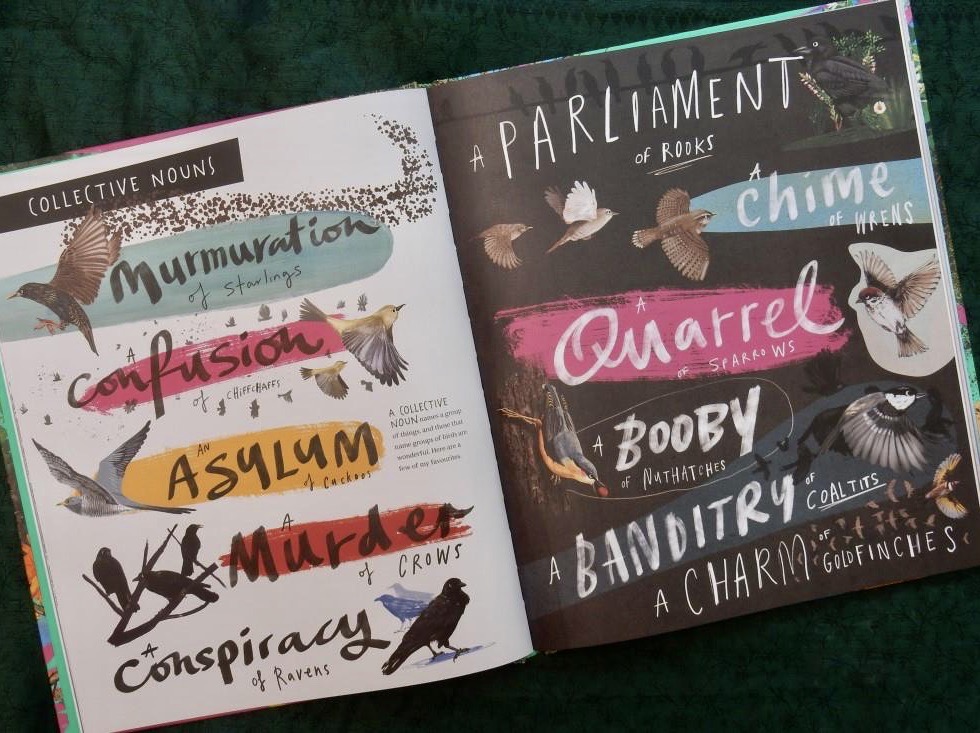
This includes a discovery spread where in turn, you can learn the collective nouns for eleven different birds,

take a look at classification, find out how various trees propagate

and about migration and metamorphosis.

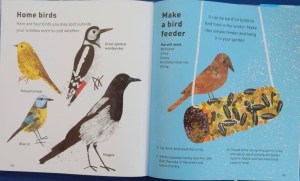
An activity to do once you get home concludes most sections: make a bird feeder, make a terrarium, create a journey stick (I love that).

Assuredly this will help any reader, young or not so young, connect more deeply with the joys and wonders of the natural world, and find their inner wild child.

The author finishes with some sage words about the fragility of nature and caring for the countryside, plus a glossary.

Altogether a smashing book for families and schools.

Everybody Has Feelings / Respect / I’m the Fire Engine Driver

These are recent titles from Oxford Children’s Books – thanks to the publishers for sending them for review

Everybody Has Feelings
Jon Burgerman

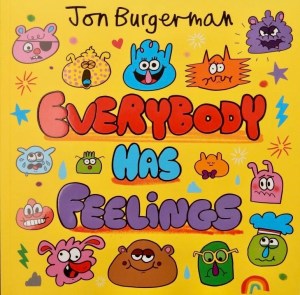
Through his exuberant style illustrations depicting colourful characters of all shapes and sizes in a play park setting, together with a narrative of rhyming couplets, Jon Burgerman presents over twenty feelings that youngsters (as well as zany blobby beings) are likely to experience.

In so doing he acknowledges that it’s perfectly normal to feel say anxious, disappointed,

embarrassed, frustrated, sad or scared as well as confident, calm, proud, and joyful and offers the vocabulary for young children to open up and discuss their emotions as well as listen to others talking about how they feel.

With lots of starting points for circle time sessions, this is just right to share in foundation stage settings especially.

Respect
Helen Mortimer and Cristina Trapanese

This new title in the Big Words for Little People series shows the importance of acknowledging and accepting individual differences and respecting them. It gives examples demonstrating that all lives matter no matter what people look like or believe: that means showing kindness, politeness and abiding by rules. Everybody should feel safe to speak out about their feelings and their lives in general.

Cristina Trapanese illustrates each of the key ideas enacted by a lively cast of characters and Helen Mortimer concludes by suggesting ten things adult sharers can do to get the most from this little book, be that at home or in an education setting.

Add to early years collections.

I’m the Fire Engine Driver
illustrated by David Semple

Here’s a book that allows little ones to switch to imagination mode and step into the shoes of a firefighter, donning the rest of the protective gear, meeting your crew and with siren sounding and flashing lights turned on, driving the fire engine to the scene of the fire in the bakery kitchen.

Part and parcel of the narrative are opportunities for number recognition and counting, joining in with sounds, vocabulary building, following instructions, describing a scene and more.

Through David Semple’s bright, stylistic illustrations and a narrative that makes youngsters feel as though they’re in control, this is a fun book to share either one to one or in a group.

Listified!

Listified!
Andrew Pettie, illustrated by Andrés Lozano
Britannica Books

This is a cornucopia of a book that is so easy to get totally immersed in that before you know where you are, a couple of hours have gone by.

Divided into eight chapters on various aspects of our world – space, nature, dinosaur times, animals, the body, being human, inventions and game changers – it’s written in a humorous style, and absolutely bursting with amazing, bite size portions of information and I’m sure the majority of adults as well as children will learn a considerable amount.

Did you know for instance that a corned beef sandwich was smuggled onto NASA’s Gemini 3 space mission by astronaut, John Young? I don’t think much of his taste.

On the topic of taste, I was astonished to read in the Being Human chapter that the average person in Switzerland eats 176 chocolate bars in a year while in China, the average person eats a mere two. I wonder where they have better teeth?

There certainly have been some amazing inventions but this book contains 8 of the weirdest ever made. These include a motorised ice-cream cone that automatically rotates your ice-cream to save you having to turn the cone around to lick the ice-cream on the other side – totally bonkers. I know many people rely on their mobiles for lots of things but did you know there’s a mobile that doubles as an electric beard trimmer? Yes really. On the other hand, I might just have to seek out some of the smart underpants I read about as being in development and give a pair to my partner: these measure how much your buttock and leg muscles are moving and then tell you if you need to up your exercise regime.

You really can’t beat nature as designer though: look at these incredible examples of the Fibonacci sequence found in plants.

In all Andrew Pettie has stashed over 300 lists between the covers of this weighty tome, many with quirky illustrations by Andrés Lorenzo; there are also a fair number of photographs too, plus a glossary and index. Love the playful list headings.

Add to family bookshelves (so long as they’re strong enough it carry its weight) to KS2 collections and beyond, and libraries.

Kids Fight Climate Change / So you want to be an Owl / My RSPB Sticker Activity Book: Rainforest

There are 3 recent Walker Books publications about various aspects of the environment – thanks to the publishers for sending them for review:

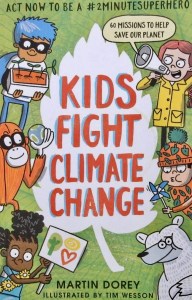
Kids Fight Climate Change
Martin Dorey, illustrated by Tim Wesson

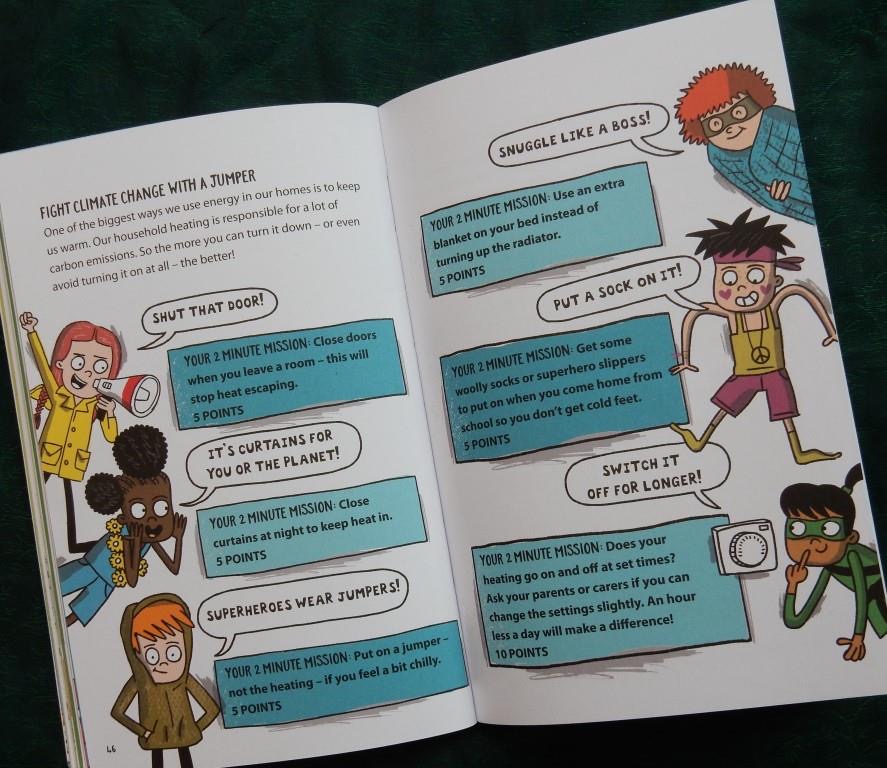
Following on from Kids Fight Plastic, from the same team comes a second book containing sixty six ways in which children can become two minute superheroes.

There are sixteen major missions focussed on helping to save the planet and in particular on climate change, starting with powerful facts about global warming and the hugely harmful effects it’s having on ecosystems both large and small. 

Many people will have heard about the terrible effects of the Canadian heatwave that has killed hundreds of people in the west of the country. There have also been huge numbers of wildfires putting both humans and wild life in danger in Australia especially. The latter as well as the other effects of climate change are presented around a world map early in this little book.

Then comes the first of the main missions, how to count your carbon footprint, that includes a bitesize ‘2 minute mission’ to compare inside and outside temperatures on a sunny day, as well as finding one small action you could do tomorrow to reduce your carbon footprint.

With the added interest of collecting points along the way youngsters must complete such challenges as using ‘an extra blanket on your bed instead of turning up the radiator’,

making a bee hotel in your garden or a reusable face mask from an old cotton T-shirt or persuading parents to let you use an airer or washing line for drying the wash rather than an electric drier.

This is a smashing, highly readable little book with lots of funky illustrations from Tim Wesson. It gives young eco-warriors plenty of information, incentive and inspiration to be active in their homes/gardens, schools and local community. Very much a book of our time and young followers of Greta Thunberg (I know a fair few of those) will love it. An empowering read likely to produce lots of young activists.

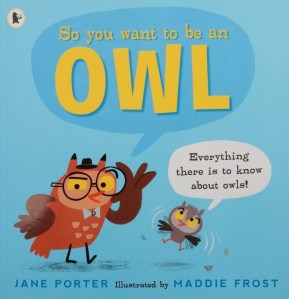
So you want to be an Owl
Jane Porter and Maddie Frost

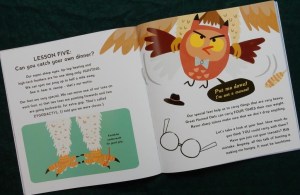
Author Jane Porter places Professor Olaf Owl in the classroom to deliver a sequence of nine lessons and an initial assessment should readers (despite being a fair bit larger than the featured creatures.) want to consider the possibility of becoming an owl alongside the trainees.

There’s a strict code to live by: ‘Be alert! Be watchful! Be silent!’ Then come the questions that start each lesson: Can you fly? Can you merge into the background environment? What about seeing in the dark. What’s your hearing like? and so on before giving her assessment to each class member and whoo hoo! they’ve all gained a certificate.

Skillfully engaging readers by the aforementioned questions and others about hunting and feeding, 

hooting, tree dwelling and chick rearing, Jane Porter imparts key facts to young readers with gentle, playful humour while Maddie Frost’s inviting and endearing illustrations further enhance that humour and the scientific information.

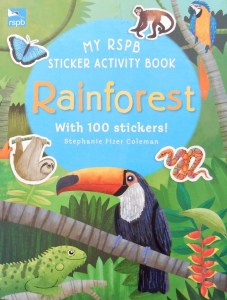
My RSPB Sticker Activity Book: Rainforest
Stephanie Fizer Coleman

With scenes of several rainforest locations in different parts of the world, youngsters can encounter some of the fauna and flora of these steamy habitats as they search for hidden animals, help a chimpanzee find her way to her friend, match up pairs of gorgeously patterned South American butterflies, add colours to some birds of paradise and to Amazon rainforest snakes. They can also use the 100 or more stickers to further adorn the various spreads and learn some amazing facts along the way.

Find Tom in Time: Ancient Greece

Find Tom in Time: Ancient Greece
Fatti Burke
Nosy Crow

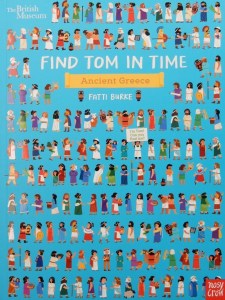
Published in collaboration with The British Museum, this latest time travelling adventure of Tom’s sees him back in Ancient Greece after handling his archaeologist Granny Bea’s ancient amphora, decorated with battle scenes.

As usual, Tom’s not only lost in time but he’s also lost his mischievous cat, Digby and readers need to help him find the creature as well as all the other items mentioned in the ‘Can You Spot’ boxes, that are hiding in plain sight as Tom dashes across the pages in pursuit of the elusive Digby.

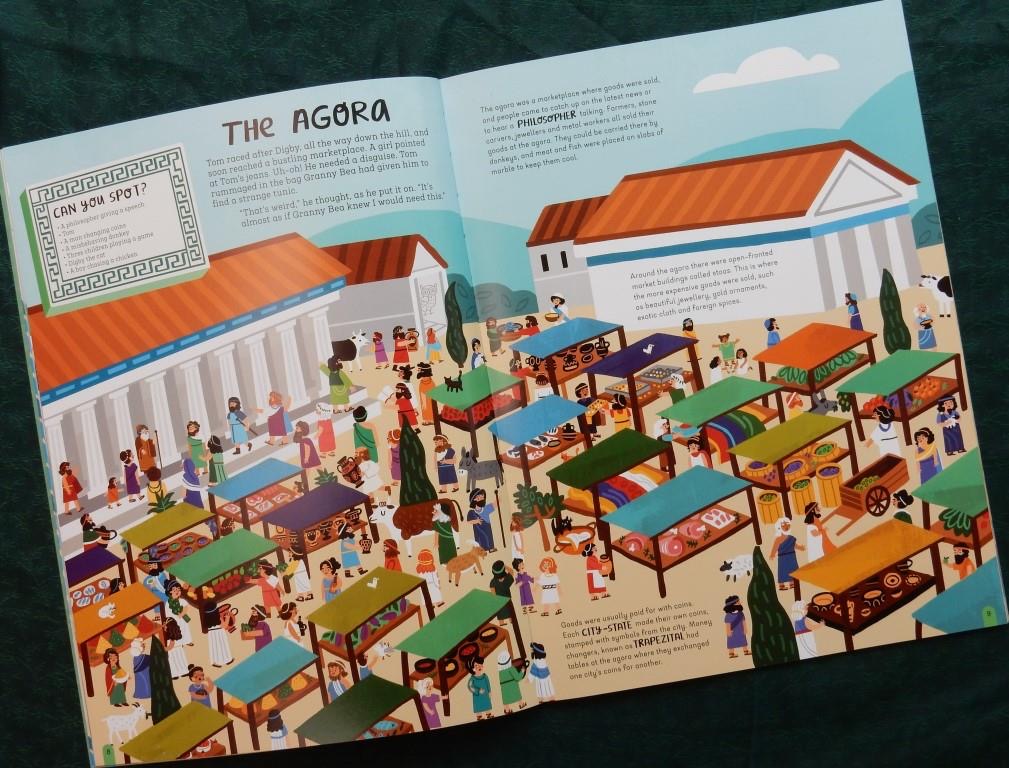
During his search he visits the Acropolis, a bustling market place – the agora where a philosopher can often be heard giving a speech

and nearby, the cylindrical tholos wherein the council (all male) would meet to debate important issues.

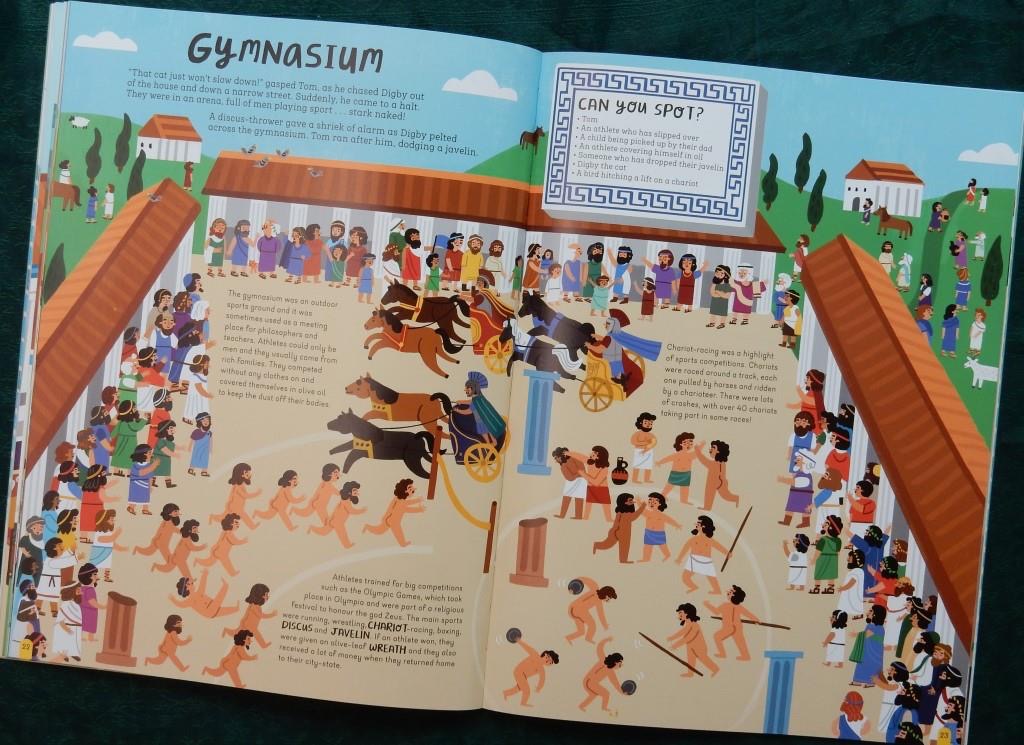
Other locations he visits include a pottery workshop, the school (wealthy boys only attended that), a doctor’s surgery, a street of houses, a gymnasium

and a theatre before heading out of town to the fields as farmers finish their day’s work. Then it’s on towards the port before finally discovering the whereabouts of both Granny Bea and Digby and then being transported back to the present.

As with previous books in the series, this one is superbly interactive and packed with fascinating facts. Each of Fatti Burke’s alluring, highly detailed scenes offers much to pore over including an athlete who has dropped a javelin, another who’s fallen over and a sleeping member of the theatre audience.

My First Book of Dinosaur Comparisons

My First Book of Dinosaur Comparisons
Sara Hurst and Ana Seixas
Happy Yak

Authors are always looking for new ways to present dinosaurs to young enthusiasts who seem to have an insatiable appetite for these prehistoric creatures.

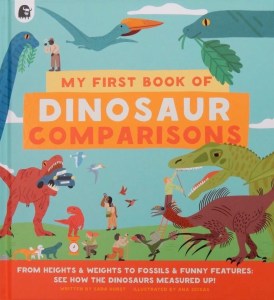
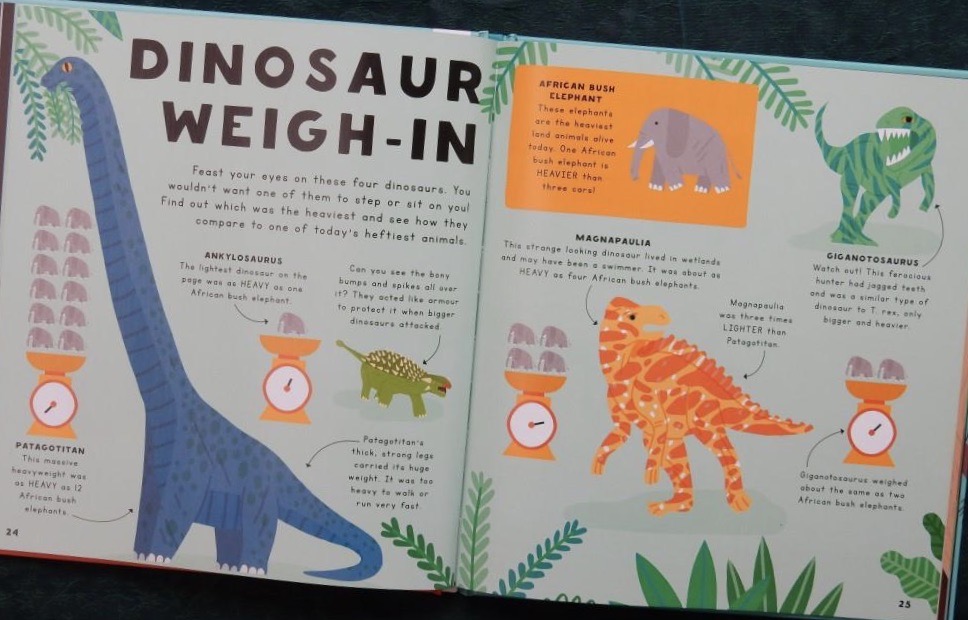
Herein Sara Hurst compares dinos. with vehicles, predators, humans and modern day foods among other things. With a body longer than a tennis court, Diplodocus needed to munch through around 33kg of ferns daily – that’s the equivalent of a human gobbling 66 boxes of cereal every single day – imagine that!

First though come an explanatory spread explaining comparisons, a pronunciation guide to dinosaur names and a time line.
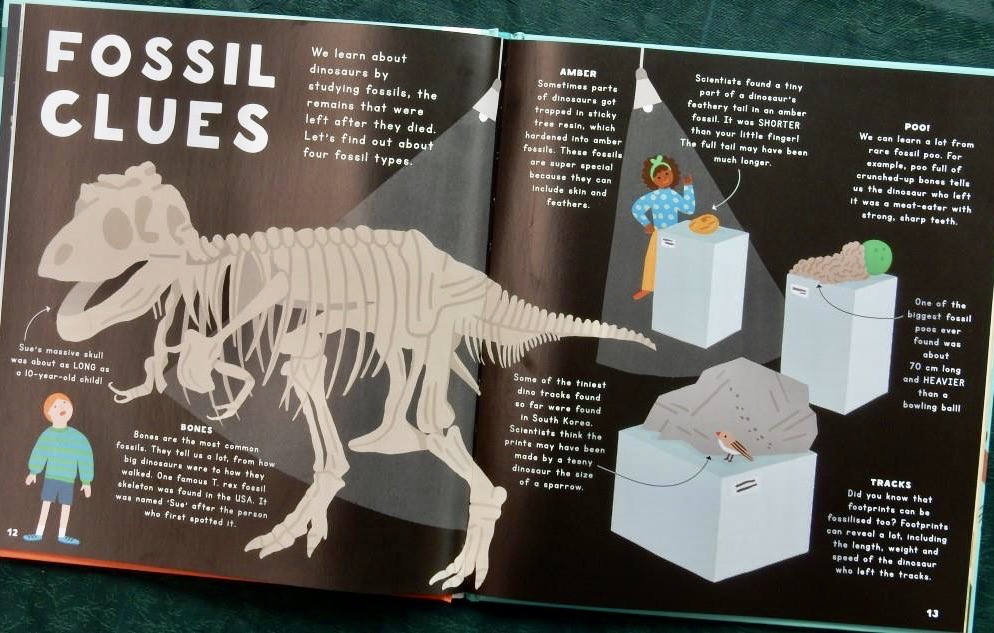
The comparisons start on the Fossil Clues pages where readers learn for example, that one of the largest fossil poos ever found was around 70cm long and weighed more than a bowling ball.

I was fascinated to discover that a dinosaur’s age is calculated by counting the growth rings inside its bones (in a similar fashion to trees I imagine).
Other spreads look at the super skills of a variety of dinosaurs – Dromiceiomimus was about as speedy as an ostrich and twice as fast as the fastest man sprinter. Other spreads explore defence, food, weight

hunting ability, self defence and more, concluding with what was the likely cause of dinosaurs dying out.

In addition there’s a scattering of quizzes (answers at the back) and the entire book is brightly and dramatically illustrated by Ana Seixas.

Babies, Babies Everywhere!

Babies, Babies Everywhere!
Mary Hoffman and Ros Asquith
Otter-Barry Books

An absolutely gorgeous and inclusive celebration of babies during their first year of life. Now I’m no lover of babies, (though I have particular fondness for one particular little girl, now a toddler, a few months beyond her first year), but this book is a delight from cover to cover.

We follow the ups and downs of that first year with five families all of which welcome a new little one (or two) into their lives. To start with there’s a lot of sleeping, crying, milk drinking, burping and naturally, pooing and weeing. Then comes limb waving and laughing,

followed after a few weeks with facial recognition of those they see daily. Next is the grabbing, grasping stage often accompanied by much gurgling and cooing,

after which sitting and rolling ensue. By around six months the infants are usually ready for some solid foods – often a very messy time as can be the mobile stage when bottom shuffling and crawling, and beginning to get onto two feet, frequently leads to the little ones opening cupboards, etc and enjoying scattering the contents everywhere.

That’s nothing compared to what they can get up to once they start toddling …

One thing’s for sure though, there’s never a dull moment as Ros’s wonderfully detailed, amusing illustrations show (I love the soft toy’s thought bubbles). Mary’s straightforward narrative has a gentle playfulness with lots of baby sounds and comments from family members. (There’s a reminder on the dedication page, that babies develop at different rates and not all of them do things at the same age.)

Great fun for sharing with babies. toddlers who will enjoy spotting things at every page turn, not least the purple elephant, as well as for including in a ‘Families’ topic box in the foundation stage.

The World’s Most Pointless Animals: Or Are They?

The World’s Most Pointless Animals: Or Are They?
Philip Bunting
Happy Yak

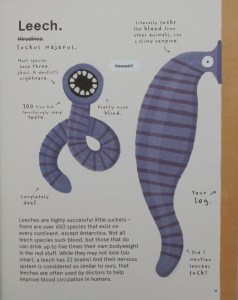
Author/illustrator Philip Bunting presents an irreverent look at some of the world’s most weird and wonderful creatures that we’re fortunate (or sometimes less so) to share our planet with. Take leeches for instance: I don’t consider myself particularly fortunate to have to live with those (despite their use by doctors) but like all the other animals from axolotls to zooplankton included herein, these hugely successful sucking parasites have undergone adaptations that have enabled them to survive, indeed to thrive. And as the author says in his introduction ‘Each creature is an illustration of Darwinian evolution, and, every animal has a unique yet important role to play on our precious planet. I was amazed to read that a leech has 32 brains. But what does it use them for?


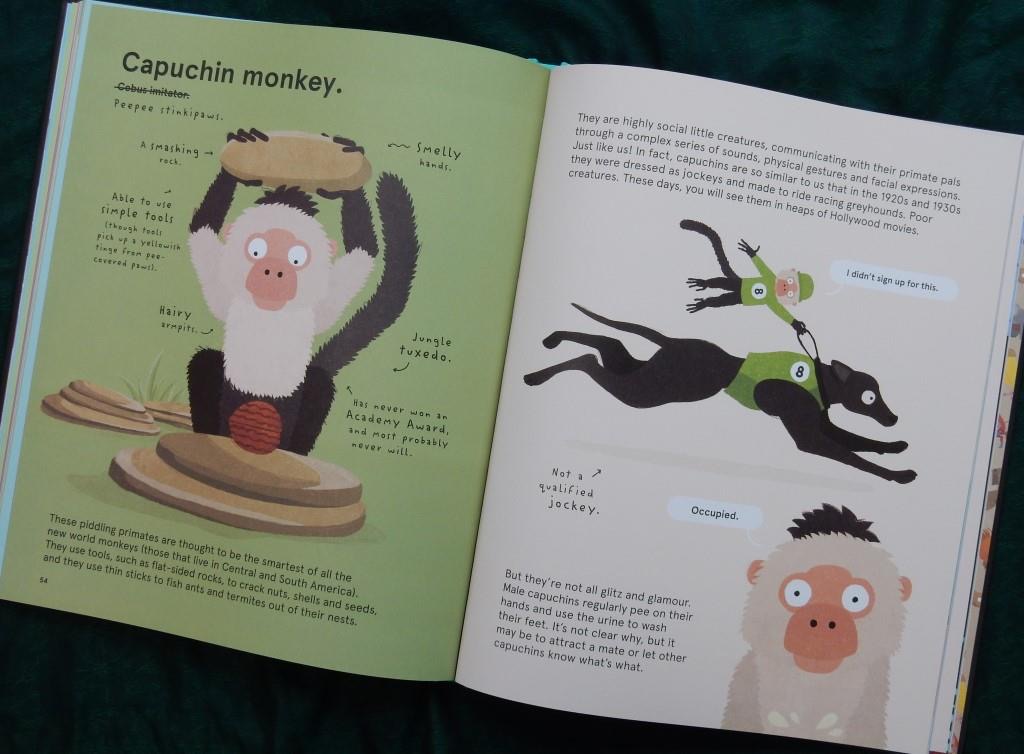
Let’s get right up close to some of the others then starting with the capuchin monkey (Cebus imitator renamed here ‘Peepee stinkipawas). These particular primates – the most intelligent of all known New World simian species –
use simple tools to procure foods they want to sink their teeth into. You certainly wouldn’t want to share their seeds or insects though, for the males make a habit of peeing on their hands and washing their feet in their urine. Yuck!

Seemingly the only raison d’être for Daddy longlegs (other than to scare some people silly) is to act as a ‘valuable source of food for birds on every continent, except Antarctica. WIth more than 15,000 species of these spindly-legged insects, that amounts to a vast number of satisfied birds.

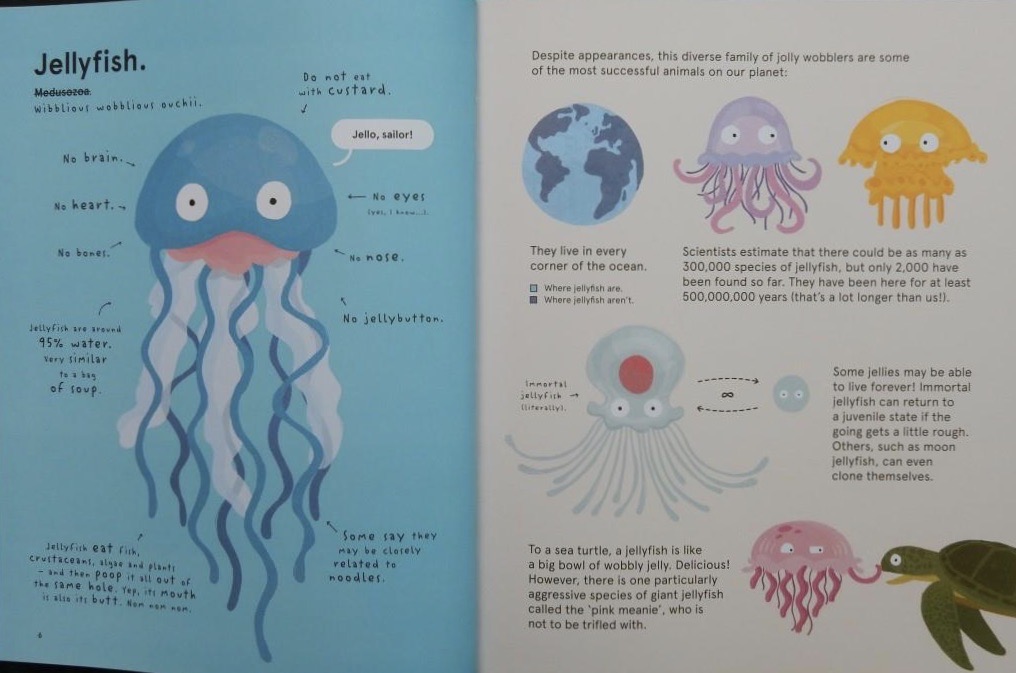
Turning to ocean dwellers, jellyfish are hugely successful medusozoa, sorry ‘wibblious wobblious ouchii’ that are about 95% water. Apparently of the possible 300,000 species estimated by scientists, so far only 2,000 have been found including moon jellyfish that can clone themselves, and immortal jelly fish. The latter can reverse its life cycle reabsorbing its tentacles becoming a blob-like cyst again which then begins over … Awesome!

Bursting with facts presented in a manner that’s huge fun and highly accessible including quirky labelled illustrations – Bunting clearly enjoyed creating these, not least inventing daft new names for every creature included – this book has a more serious mission too; To celebrate the diversity of the animal kingdom and to remind us of the fragility of the ecosystems that together make up Planet Earth.

Give a child this book to get immersed in and you could put them on the path to becoming a zoologist. I’m off to see how many Lumbricus terrestris (aka Squiggleous wriggleous) I can spot brought up after the recent rain shower – I might even be able to make a clew – that, I learned from the spread featuring same, is the collective name for a group of earthworms.

Let’s Go For a Walk / Look What I Found at the Seaside

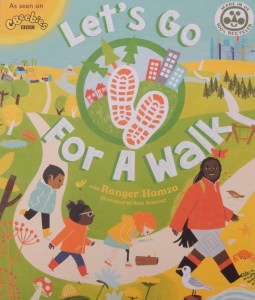
Let’s Go For a Walk
Ranger Hamza and Kate Kronreif
Ivy Kids

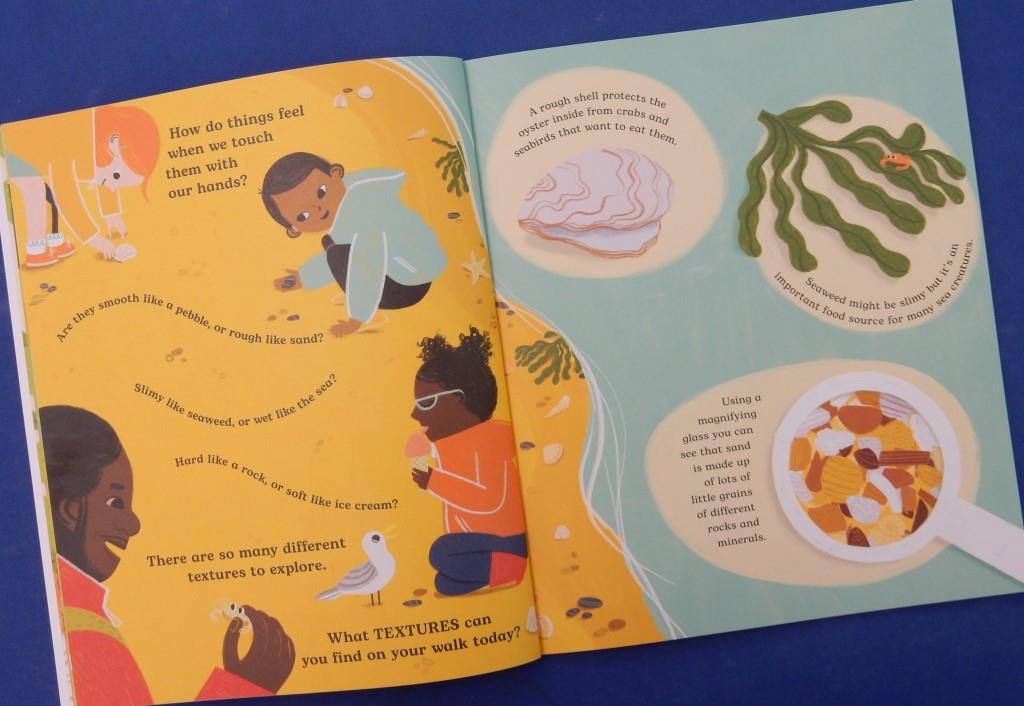
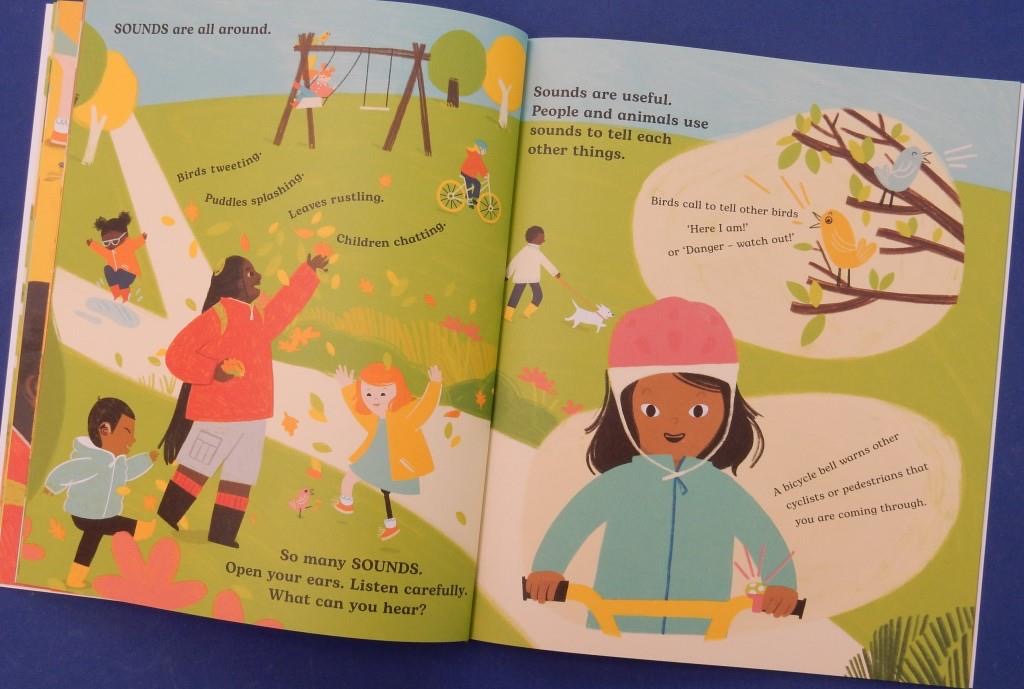
In the company of Ranger Hamza, any walk will be an experience that engages all the senses. No matter where or when you go there’s sure to be a wealth of interesting sights, sounds, smells and exciting tactile things to feel with our hands. Best to do as Ranger Hamza advises though and take a copy of this book along, then suitably attired and with eyes and ears open, everyone is ready to sally forth.

The first focus is colour and youngsters are encouraged to spot red things and of course, what is found will depend on the season and to some extent the surroundings.
Then what about trying to spy things tall, wide or small; or feeling various things like these walkers are doing on the sea shore.

Not all smells are to be savoured; we all enjoy different ones. I for instance would not want to be in close proximity of fresh fish or chimney smoke but would love to inhale the aroma of lavender or baking bread. The important thing is to do as the ranger suggests and ‘use our noses’.

Each double spread has a new focus: there are shapes, minibeasts, sounds,

letters and numbers, pairs of objects, different materials that things are made of. The dark makes everything look different, shadowy perhaps, or you might spot some nocturnal creatures or star patterns if you walk at night.
To see other things up high though, it’s better to walk in the daytime when the clouds sometimes look amazing; while focussing on the ground can be equally rewarding with plants popping up in unexpected places and all kinds of patterns created either by humans or by nature.

With wildlife photographer and CBeebies Ranger Manza as guide and Kate Kronreif as illustrator, this guided book walk is sure to make youngsters want to undertake the real thing. Nature and being able to get outdoors are what have kept so many of us – young and not so young – sane over the past year and now I’m pretty sure that henceforward, none of us will take these things for granted. Are you ready, ‘Let’s Go For a Walk’ …

Look What I Found at the Seaside
Moira Butterfield and Jesús Verona
Nosy Crow

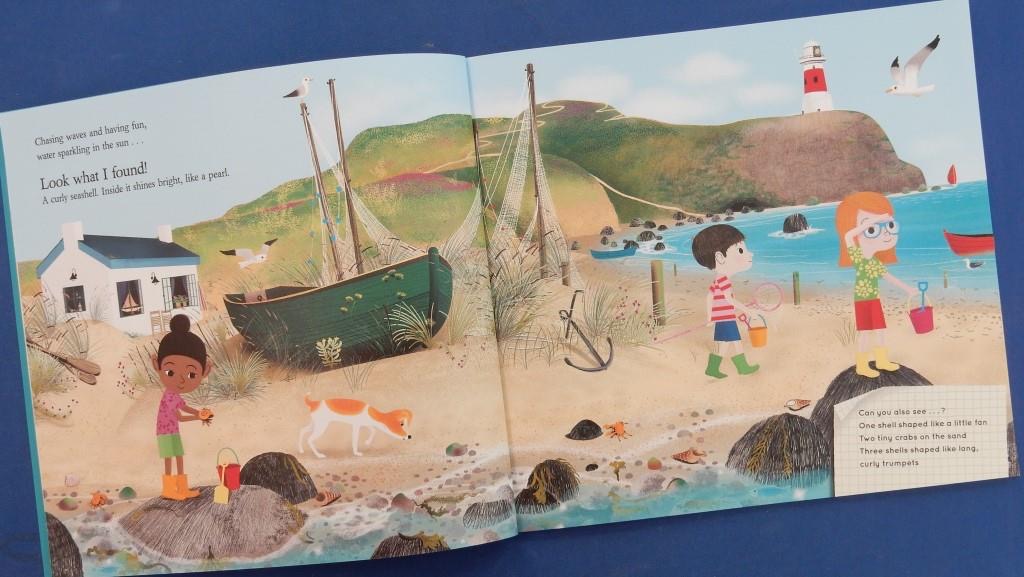
There are wonders aplenty waiting to be found if you take a stroll on the seashore with the characters in this smashing book (a companion to Look What I Found in the Woods), also published in collaboration with the National Trust).

Every spread is packed with exciting things to discover, the first being the wealth of different shaped seashells, be they curly and shining bright ‘like a pearl’,

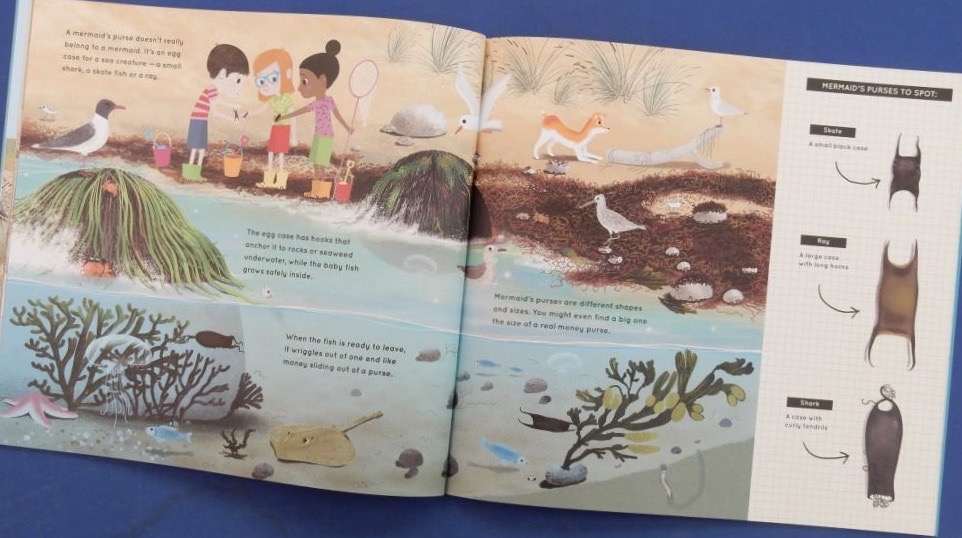
long and curly, opening like a pair of wings or perhaps a purse.

The rock pools too are full of exciting patterned pebbles, fish and other small sea creatures; among the seaweed too are more treasures and sometimes foraging seagulls. Watch out for crabs scuttling among the fronds or peeping out of shells.

It’s interesting to imagine what a mermaid might keep in one of those mermaid’s purses close to the cave mouth …

There’s much more too if you follow the cliff path; maybe some fossils, butterflies, bees and seaside flowers; and if you are quiet you just might come upon some wonderful sea birds tucked away among the rocks.

Yes, the seaside is a veritable treasure trove but it’s important to collect thoughtfully, doing no harm and leaving nothing but your footprints behind.

Told through a gentle rhyming narrative and also bursting with fascinating facts, and illustrated with alluring scenes of the children investigating the natural world, this will surely get youngsters enthused to get out and explore nature.

Curious About Crocodiles

Curious About Crocodiles
Owen Davey
Flying Eye Books

Book seven of Owen Davey’s splendid series explores members of the weird and wonderful Crocodilia order. The order includes crocodiles as well as alligators, gharials and caimans, all of which are strong, armoured reptiles with four short legs, powerful jaws – beware! long, flattened snouts and long tails. Each kind spends some time on land and some in the water.

After his general introduction, Owen looks first at design using the Orinoco crocodile to which he takes us right close up and decidedly uncomfortable. I was more than a tad jealous to read that when one of these creatures loses a tooth, another one replaces it and a single croc. can go through as many as 4000 teeth in its lifetime. 

Dinosaur enthusiasts in particular will be interested to learn that millions of years ago crocodiles and dinosaurs shared the earth.

The other dozen topics, each given a double-spread, take a look at movement – sometimes crocodilians walk low to the ground but more frequently adopt a ‘high walk’ and some of the smaller species can break into a run, while others might climb trees. Most although excellent underwater swimmers, tend to stick mainly at surface level.

Did you know that a crocodile’s gender is determined by the temperature of the nest at a crucial point in the development of the egg with high and low temperatures tending to result in female babies, though due to varying layers of a nest having different temperatures, it’s likely that a clutch will have hatchlings of both sexes? First of course, a male has to attract a mate and to do so, some blow bubbles and produce a water dance with vibrating bodies and water droplets ‘that dance around them’. 

As with his previous guides, Owen has packed this with a wealth of engrossing biological information as well as some mythology; and last but definitely not least, a look at conservation including some things readers can do to help preserve both the creatures and themselves.

Truly something to chomp on and bound to scale up the interest of budding young zoologists.

Exploding Beetles & Inflatable Fish

Exploding Beetles & Inflatable Fish
Tracey Turner and Andrew Wightman
Macmillan Children’s Books

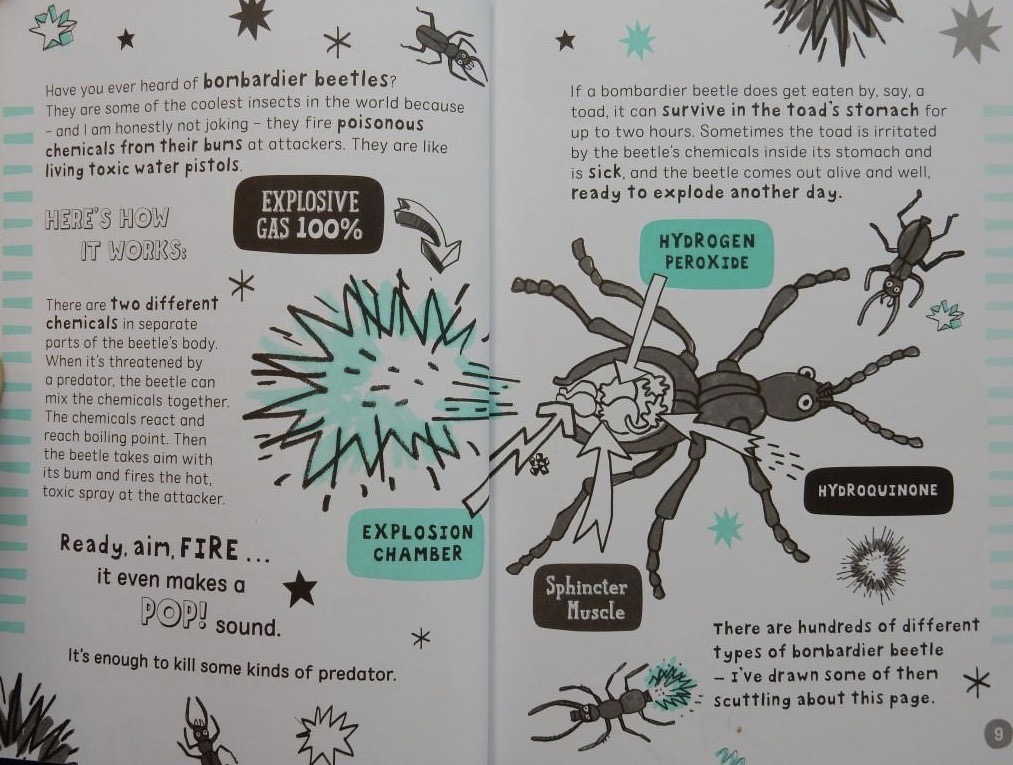
Sam, narrator of this funky STEM information book is totally obsessed with all that’s weird and wonderful about members of the animal kingdom. (There is mention of the occasional plant too.) He keeps four pets – stick insects of the Indian variety named Twiggy and Wiggy, a goldfish named Bob (deemed boring by Sam’s elder brother) and a hamster, Letty. Readers learn a fair bit about these creatures along the way including the fact that stick insects often eat the old skin they’ve shed and as a defence mechanism, they might exude from their joints a foul-smelling liquid or spray attackers with a nasty chemical substance. Best not to attack a stick insect then.
I should say at this point that throughout the book Sam has drawn or rather claims to have done (actually Andrew Wightman is the illustrator) all kinds of funky creatures eating, pooing and just generally going about their lives.
On the poo topic, did you know that a fair number of animals including woodlice eat their own? (they never ever wee though) Or that wombats have cube-shaped poo – how on earth do they manage excreting that without discomfort?

I’m pretty sure your reaction to the revelation that bombardier beetles can explode like toxic water pistols will be similar to mine – best to steer clear of their bums.

Much of this fascinating information is related during a hunt for Twiggy. Sam discovers that the little creature has gone awol from his vivarium when he goes to spray water inside.

Happily she is eventually found (hiding in plain sight) but not before Sam has shared a considerable number of amazing factual snippets with readers.

Terrific fun and gently educational too.

Protest!

Protest!
Alice & Emily Haworth-Booth
Pavilion Books

Did you know that people have been protesting since the time of Pharaoh Ramses 111, ruler of Egypt when the first workers’ strike took place in 1170 BCE? That’s something I learned from the first section of this book by sisters Alice and Emily that looks at the global history of protest from then (the hard-working pyramid workers were demanding more food) until now with Greta Thunberg and school children’s strikes for the climate.

It’s good to know that from early on (195 BCE) women were protesters. The women of Rome marched for the right to dress the way they wanted – and they won!

Thereafter come the peasants’ revolt, and in the 1640s the Levellers and the Diggers about whom I knew nothing before reading about them herein. Included too are the Native American Ghost Dance (1890s); the Protest Ploughs of the Maoris towards the end of the 19th century, the Salt March and of course, the Abolitionist movement, the Suffragettes (UK) and many other women’s movements in various parts of the world.

Two movements I was personally interested in and strongly supported, the Anti-Apartheid Movement and the anti-nuclear movement are covered,

as are the Stonewall Riots, the fall of the Berlin Wall, the Arab Spring and bang up to date, Black Lives Matter and Extinction Rebellion.

The authors also talk about some of the creative means of protesting: singing, tree-hugging, theatre and other performing art and even using toys as protesters.

An uplifting, inspiring and timely look at how protesting has changed our society and the world we share. Emily provides the illustrations, and she and Alice co-authored the text. It’s a call to action for sure.

Do Animals Fall in Love?

Do Animals Fall in Love?
Katharina von der Gathen and Anke Kuhl
Gecko Press

Katharina von der Gathen is a German sex-educator; her writing style is direct, packed with intriguing detail and infused with humour. This humour is reflected throughout in Anke Kuhl’s amusing cartoonish illustrations.
The author divides this book on animal reproduction into three main parts – courting (The Art of Seduction), Mating

and The Babies Arrive; but within each are lots of sub-divisions. For instance within seduction we find flashy appearance, dances, smells to attract, songs and physical fighting (sometimes head to head).

Choosing examples from a wide variety of creatures – vertebrate and invertebrate – Katharina von der Gathen uses biological terminology throughout her descriptions (normally one or two paragraphs) of the various activities while also maintaining a chatty tone.

For example, a male cabbage white butterfly ‘seems intent on being, and remaining, the only partner for his mate. The others can push off! So during mating, he sprays the female with a very special perfume. From then on, she is no longer attractive to other males. To them, for some reason, she stinks!’

At one time or many, children will ask ‘how do animals do it?’ questions. This book provides fascinating answers while taking readers on a journey through the incredible animal kingdom in so doing. It’s definitely one to add to book collections be that at home, public library or school. (Children at the younger end of the intended readership may need some further explanations)

Interview with a Shark

Interview with a Shark
Andy Seed and Nick East
Welbeck Publishing

For those who like their information delivered with a degree of quirkiness then the results of Andy Seed’s latest expedition with his ‘tranimalator’ machine will definitely appeal.

In this book he dons his wet suit and dives into the ocean where, feeling more than a tiny bit nervous he faces his first interviewee, a massive bull shark. Like the author, this subject (and the others) seem to have a great sense of humour as they respond to his questions (just the sort of things a child might ask), with more than the occasional leg pull. The answers though are informative too, revealing such things as what they eat, what might eat them, where they live, (I wasn’t aware that bull sharks sometimes live in rivers as well as salty sea water.)

Andy has close encounters with nine marine giants – an awesome blue whale (the kind of whale with no teeth and the world’s biggest poos); a very toothy orca – actually a type of dolphin, 

a giant squid, a narwhal (of the stamp collecting, yoga practising variety – told you they have a sense of humour); 

a manta ray – most unhappy about the rubbish we humans dump in the oceans, as are several of the other creatures; an ocean sunfish; an octopus, a conger eel (bites like a bulldog) and finally a creepy anglerfish. 

One of this creature’s claims to fame is its soft bendy bones and stretchy belly that enable it to gobble up BIG things. 

Along with the moans about plastic pollution, we also hear grumbles reminding us of the effects of global warming and fishing (nets and noise). Andy provides a “How you can help’ spread suggesting ways readers can help take better care of our planet and its wildlife; and, there’s a final fun quiz (no cheating).

Nick East provides the visuals – they’re hugely appealing and some almost leap off the page. Young readers (and some adults) can assuredly learn a considerable amount if they dive in with Andy and Nick.

Dance With Oti: The Bird Jive

Dance With Oti: The Bird Jive
Oti Mabuse and Samara Hardy
Walker Books

This is the debut picture book of Strictly Come Dancing star, Oti Mabuse, and as the book opens, Mrs Oti is welcoming a host of would-be dancers into her studio for their very first lesson.

Warm ups and stretches completed, everyone is ready to start learning the jive. There are the inevitable thrills and spills but under their teacher’s enthusiastic, watchful, caring eye, the children are quick learners

and in no time the lesson is halfway through. Then suddenly, an unexpected winged visitor makes an appearance.

Mrs Oti deals with the disruption in her characteristic creative way and soon everyone is back on task

and the lesson proceeds towards the final steps and a wonderful controlled POSE! Just in time to give the waiting families a first performance of The Bird Jive. And humans aren’t the only ones that show their enthusiasm as the dance draws to a close.

With some delightful characters including Poppy, Gan and Olivia, all illustrated with panache by Samara Hardy, and a step-by-step demonstration of the Bird Jive routine by Oti, this is a thoroughly enjoyable celebration of movement, dance and giving it your all. Share the book then, get on your feet and JIVE!

My Big Book of Outdoors

My Big Book of Outdoors
Tim Hopgood
Walker Books

When it comes to nature, ’The more you look, the more you see’. So says Tim Hopgood in the blurb to this stunningly beautiful bumper book.

To amplify this, starting with Spring, Tim takes us through the four seasons of the year celebrating the delights to be discovered in each one.

My favourite time, Spring, brings blossom, baby animals, bulbs busting into bloom, the birds greeting the day with their dawn chorus, nest building, egg laying and more.

There are close-ups of eggs, feathers, minibeasts, 

frogs, soil and a rain shower and more; as well as the occasional poem and activities for indoors and out.

With its longer, warmer days, Summer offers insects aplenty, baby birds taking flight, a richness of colour and scents from flowers and for some plants, it’s time for seeds to be dispersed. More colour comes from amazing skies, 

ripening fruits and vegetables and there’s the promise of a holiday, perhaps by the sea.

Misty mornings, leaves changing colour and falling in blustery winds herald Autumn as birds take flight to warmer climes, seeds are dispersed far and wide, and creatures forage for supplies in readiness for winter as do humans who harvest the spoils from trees and hedgerows.

Quiet seems to descend along with Winter’s arrival with its chilly, sometimes frosty days and cold snuggle up nights when some creatures hibernate to survive. It’s a season to remember the resident birds and perhaps using Tim’s instructions, make a feeder for the garden or balcony. Assuredly they’ll need it should snow fall.
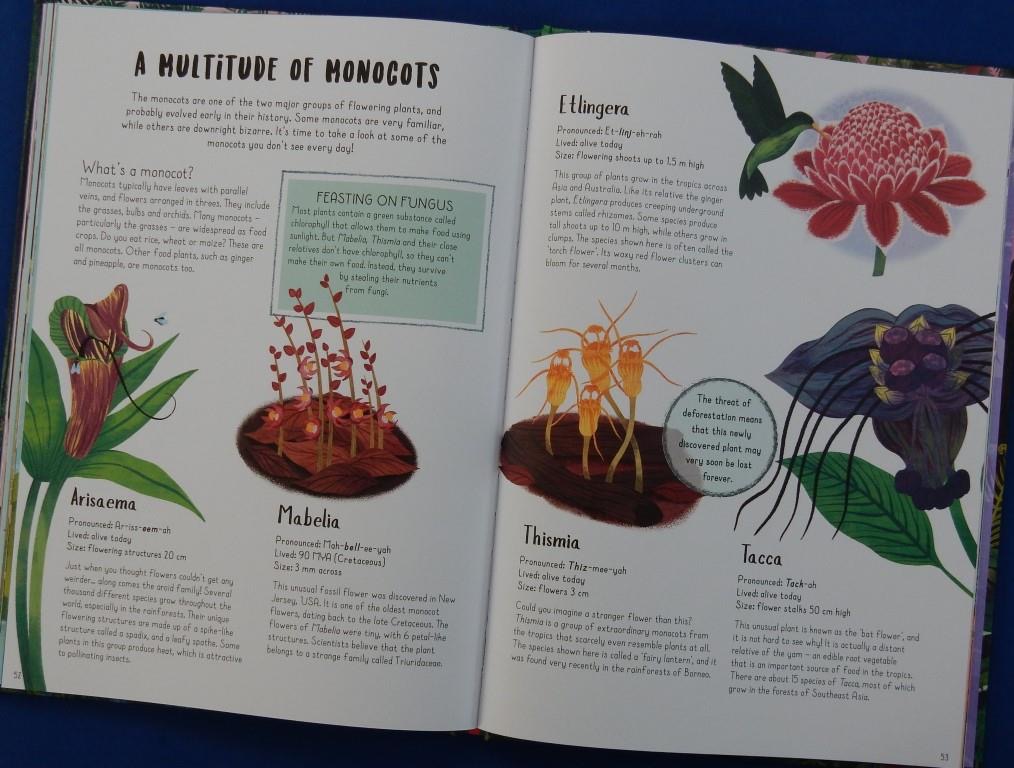

With every page turn bringing more of nature’s delights, this is for sure, a veritable treasure trove: Tim has done nature proud.

100 Endangered Species

100 Endangered Species
Rachel Hudson
Button Books

It’s alarming to think that there are so many creatures on the endangered or threatened list; the author/illustrator of this chunky book teamed up with the People’s Trust of Endangered Species to illustrate one such animal every day for 100 days.

Those chosen come from all over the world and each has undergone evolutionary adaptations to suit its environment, be that the Red pandas found in China, Nepal and Bhutan; the Madagascan Aye-ayes, and the Indris that live in the northern and central rainforests of East Madagascar; the Sumatran tigers; the Little spotted kiwis of New Zealand; the Lulworth skipper butterfly first found in Dorset and now on the decline across Europe; 

or those magnificent polar bears whose Arctic Circle habitats are at risk both from destruction due to oil exploration work, and rising temperatures resulting from climate change.

Each of the animals depicted is on the International Union for the Conservation of Nature’s Red List (explained at the beginning of the book) and is thus a conservation priority. Opposite each gently amusing illustration is a descriptive paragraph (or two) giving interesting facts, as well as saying why the species is currently at risk and often, what is being done, or needs to be done, to protect it. There’s also a world map showing distribution, and listing habits, threats and population trend which is given, with very few exceptions, as ‘decreasing’. 

However, it’s heartening to see that numbers of the African elephant, the little spotted kiwi, the whooping crane, the greater one-horned rhino and the giant panda are on the increase as are those of the Eurasian beaver.

Readers who feel inspired to become involved in conservation issues/initiatives – hopefully that is all of them – can find a list of organisations and projects at the back of the book, as well as a glossary; and there’s a foreword by broadcaster and naturalist Brent Westwood. Give this book to a child and who knows, you might inspire a life-long passion for conservation.

The Encyclopaedia of Unbelievable Facts

The Encyclopaedia of Unbelievable Facts
Jane Wilsher and Louise Lockhart
Frances Lincoln Children’s Books

Many of us turn red in the face when feeling embarrassed but have you ever wondered about your insides? Embarrassment causes adrenaline to be produced and this helps increase blood flow, one consequence of which is that the stomach lining becomes red, so we blush both internally and externally.

Equally amazing is that our hair contains minute traces of gold, with babies having more than adults. Both are covered in the Human Body the opening part of this unusual encyclopaedia of trivia.

In case you’ve ever wondered what astronauts do with their dirty laundry, what happens to their wee, or what happens when an astronaut wants to scratch an itchy nose while wearing a space helmet, you’ll discover the answers along with those to over 45 more questions in the Space section of this book.

It’s not only STEM topics that are included herein though. There are sections entitled Customs & Culture, Our World and finally Arts & Entertainment. If you want to know Donald Duck’s middle name, you’ll find the answer there.

For each theme Louise Lockhart provides a wealth of offbeat, stylish illustrations, mostly small but some whole page ones too.

No matter whether you want to ask questions in a quiz with your friends or family, or just fancy dipping in to discover some new factual bits and pieces, then here’s a book for you; this reviewer certainly learned a fair bit.

Ancient World Magnified

Ancient World Magnified
David Long and Andy Rowland
Wide Eyed Editions

New in the interactive ‘Magnified’ series, this is one of those books where you think, ‘I’ll just spend a few minutes reading this’ and hours later you’re still totally immersed, using the magnifying glass provided inside the front cover.

Starting with Mesopotamia in what is today parts of Iraq, Iran, Syria and Turkey, author, David Long and illustrator Andy Rowland take readers time travelling to visit sixteen ancient civilisations, providing a taster of what life was probably like in each one. I was pleasantly surprised to learn that here where civilisation is thought to have begun, men and woman were mostly treated as equals.
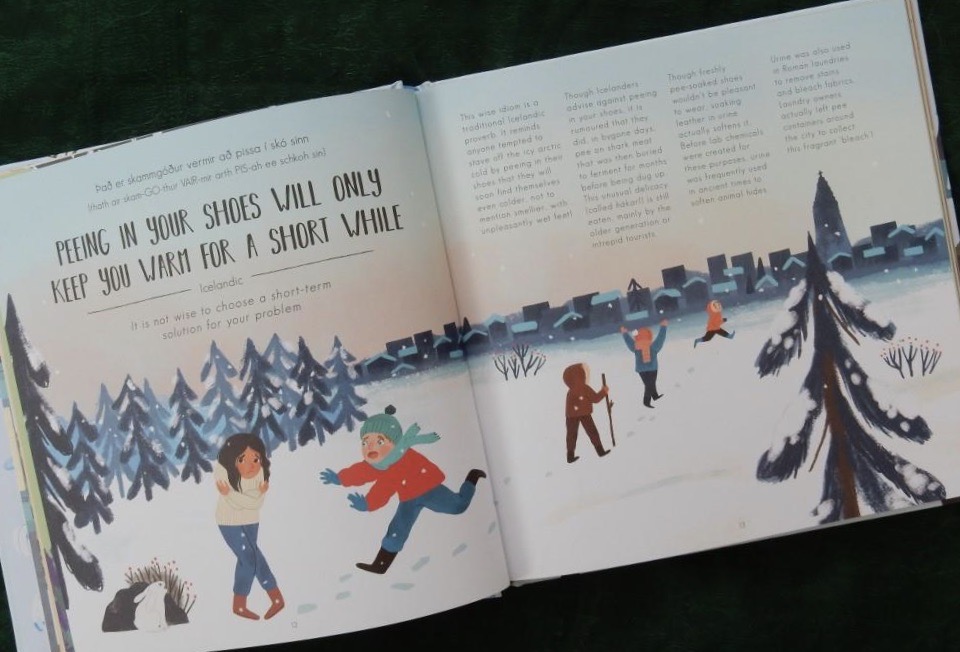
From there we move to (c. 4000-1500 BC), a large area now in India and Pakistan, the Indus Valley Civilisation, in which I have a particular interest having once visited not Harappa or Mohenjo-daro featured here, but another more southern site, Lothal.

I have to admit though I’d never heard of Olmec, central America’s first civilisation in what is Mexico today, nor the Kingdom of Aksum (120BC – 850 AD), one of Africa’s greatest empires much of which is in modern Ethiopia and we learn, among the first of the great civilisations to convert to Christianity. 

Also new to me is the Xiongnu Empire in what took up large parts of today’s northern China, Siberia and Mongolia, formed when several tribes of nomadic peoples came together under a ruler named Modu, controlling an area almost as big as Europe. 

Each of these fascinating civilisations is allocated a double spread most of which is taken up with a riveting, highly detailed illustration by Andy Rowland. There are also two or three paragraphs giving information about location, daily life, buildings, what made it prosper etc. and there are ’10 things to spot’ on every spread. Not easy in several cases but should you wish to look, the answers are supplied at the back of the book, along with a famous figures gallery, almost 60 more things to find in the busy scenes, a timeline and glossary.

Recommended especially for young history enthusiasts, as well as those who love search-and-find books.

The Dinosaur Awards

The Dinosaur Awards
Barbara Taylor, illustrated by Stephen Collins
Frances Lincoln Children’s Books

Here’s a novel way of presenting dinosaurs to youngsters, not that a good many of them wouldn’t devour almost any dino. related book they can get their hands on, such is the seemingly never ending enthusiasm for these prehistoric creatures.

This one uses a combination of quirky, almost cartoonish digitally created illustrations and a wealth of intriguing facts about lots of different dino. species, some well known, others less so. I met a few for the first time herein, one being Majungasaurus that receives the ‘Cunning Cannibal Award and lived on Madagascar during the Cretaceous Period between 84 and 71 million years ago – assuredly a VERY scary predator.

Almost all the winners, be they famous or lesser known, are allocated three or four paragraphs, a captioned framed portrait of the award receiver along with its trophy or medal and one or more larger illustrations. There’s also a databank with name pronunciation and meaning, where it came from, diet, and size, plus in some instances a short humorous cartoon strip, in others some additional trivia.

So, if you’ve ever wondered what might make Ouranosaurus so special, not only did it have a ‘Super Sail’ along its back and tail, but also a duck-like beak and two bony bumps in front of its eyes.

Whereas Troodon’s claim to fame was its enormous eyes (about 5cm across), so it received the “What Big Eyes You Have’ award.

There’s even a ‘King of Rock ’N’ Roll medal and that goes to Cryolophosaurus (aka Elvisaurus’ on account of its funky head crest thought to resemble that 1950s quiff of the rock legend).

With plenty here to amuse and inform, this works either as a dip in and out book, or a longish read straight through, in which case you’ll encounter around fifty incredible prehistoric creatures from our planet’s past – worthy winners all.

The Plesiosaur’s Neck

The Plesiosaur’s Neck
Dr Adam S.Smith & Jonathan Emmett, illustrated by Adam Larkum
uclan publishing

I certainly wasn’t expecting a rhyming text when I received this book but wow! It really works and is a terrific read aloud.

Plesiosaur expert Dr Adam S.Smith teamed up with children’s author Jonathan Emmett to create a cracking narrative to investigate the evolutionary conundrum of the long neck of Albertonectes using Poppy the plesiosaur as their main character. Poppy, so we learn, was an ocean dwelling Albertonectes plesiosaur – a prehistoric reptile from the Cretaceous Period living around the same time as the land living dinosaurs. Said creature was around 12 metres long and had many features similar to those of other sea creatures, but that stupendous neck (apparently around two-thirds of its whole body length) – what ever could have been the purpose of that?

Various possibilities are posited: maybe it was a pterosaur grabber …

or, could it have been a parasite picker-offer.? Perhaps it was a tunnelling tool to procure crunchy-shelled nibbles,

or contained an electric zapping mechanism to stun unsuspecting prey swimming too close. Poppy would most definitely have required a huge amount to food to keep her going.

This prehistoric poser is still being puzzled over and I love that the authors end by asking young budding palaeontologist readers, ‘So, what do YOU think that immense neck was for?’

Along with the playful, punning rhyming narrative is a series of fact boxes containing a wealth of additional information and in a rather wacky role are a pair of molluscs, Alfie Ammonite and Bella Belemnite, that chip in with jokes, and cheeky comments and puns relating mainly to Poppy.

The final spread is devoted to a glossary and a spotter’s guide to the Cretaceous Period with fifteen creatures to send readers back to the beginning of the book on a search-and-find quest. Adam Larkum’s illustrations are full of fun, adding to the entertainment of what is a smashing exploration.

Is There Life on Your Nose?

Is There Life on Your Nose?
Christian Borstlap
Prestel

Dutch illustrator/designer Christian Borstlap presents a playful look at some of the vast number of microbes that occur everywhere you can imagine and places you probably can’t.

Despite his light-hearted style, there’s a lot of information contained between the covers of this book as readers are introduced to a host of these invisible organisms, starting with those living on our noses. Amazingly like all of us humans, these microorganisms are sensitive, able to move, eat and release things from within.

Contrast a single microbe with the largest living thing on our planet: I was surprised to discover that it’s a ginormous fungus that has grown to a size of 3.8 square miles and lives under the Blue Mountains in the USA. The author provides additional details about this and each of the other largely illustrative spreads presented in a ‘Find out more’ section at the end of the book.

The rate at which microbes reproduce is phenomenal as is the tolerance to extremes shown by some – those living in boiling water for instance, or barren deserts. And, did you know that some of these organisms even feed on metal,

and others on oil – both of which can be a good thing.

None of us would be able to digest our food without the action of the microbes living in various parts of our digestive system. So these are definitely vital to our well-being.

During the past year we’ve all become hyper-aware of the harmful kind of microbes, viruses, in particular COVID 19 (mentioned in the final notes) but only alluded to on the relevant spread.

With the ever growing problem of plastic waste, it’s great to read of the possibility of microbes offering an organic solution to this huge issue. Others are even able to generate clean energy through gas production.

Now you might think you’re pretty good when it comes to recycling but we learn here that microbes are actually the very best of all recyclers …

All in all, none of us would be here at all without microbes: those known as cyanobacteria produce almost 50 per cent of the oxygen we breathe.

This fascinating account has truly whetted my appetite and I can’t wait to visit Amsterdam (one of my very favourite places) again: this time I will definitely head for Microbia – the world’s only microbe museum – mentioned at the back of the book.

Escape: One Day We Had To Run

Thank you so much to Lantana Publishing for inviting me to take part in the Escape: One day We Had To Run blog tour. 

Escape: One Day We Had To Run
Ming & Wah and Carmen Vela
Lantana Publishing

For centuries, people have left their homes for such reasons as famine, slavery, war, intolerance, political turmoil and more recently, climate change. They had two things in common, their determination to search for a better life elsewhere, and their bravery.

This hugely inspiring, timely book tells a dozen stories of some of these seemingly ordinary human beings, starting with sisters Yusra and Sara Martini who fled the war-torn Syrian city of Damascus to Turkey where they boarded an overloaded dinghy bound for Greece. When the boat’s engine failed and to prevent it from capsizing, the girls plunged into the sea. Desperately holding on, and freezing cold, they helped direct the dinghy until it’s engine restarted and it eventually reached the shore. The girls later made it to Germany and Yusra swam in the Refugee Olympic team at the 2016 Rio Olympics.

Also escaping by sea were Chan Hak-chi and his girlfriend Ly Kit-hing who roped themselves together and swam for six hours across a shark-infested bay to reach Hong Kong, thus escaping famine and persecution in mainland China.
Another twosome was Hans and Margret Rey who, carrying the manuscript for the very first Curious George picture book, fled Paris on bikes just hours before the Nazi invasion of the city, cycling for days to reach the Spanish border from where with the money from selling their bikes they bought train tickets to Lisbon from whence they made their way by boat eventually reaching New York where twelve months later their book was published.
Escaping underground were Joachim Neumann and his girlfriend, members of a group of 57 East german students who tunnelled under the Berlin Wall from East to West Germany and freedom, through what is now known as Tunnel 57.

Those featured on other spreads – each escapee has one – include fleer from Kiribati, Ioane Teitiota, who became the first legal climate change refugee when granted special status by New Zealand’s Prime Minister, Jacinda Ardern.

However the person I’ve chosen to highlight is Russom Keflezighi. He had supported Eritrean rebels in their protracted attempt to win independence from Ethiopia. Walking overland from war torn Eritrea at his wife’s insistence, Russom Keflezighi left his family, encountering many dangers before reaching Sudan, and then Italy. After five years he was reunited with his family and they settled in the USA where his son later became one of America’s greatest marathon runners.

Russom Keflezighi

I just can’t imagine the heartache and pain caused by the decision fleeing father Russom Keflezighi had to make in leaving all his loved ones behind, then walking vast distances every day under constant threat from enemy soldiers until he crossed the border into Sudan. The very thought of leaving behind my own family to do such a thing is just unbearable.
Dramatic, graphic style illustrations by Carmen Vela show escapers swimming, biking, walking, flying even, as they flee danger and this moving book fittingly concludes with two Articles from The Universal Declaration of Human Rights relating to movement and asylum.
ESCAPE: ONE DAY WE HAD TO RUN will be available in all good bookshops in the UK from May 6th and in the USA & CAN from May 4th! OR, buy your copy from Lantana’s online shop and donate a book to children who need books the most with your purchase: www.lantanapublishing.com

FACTopia!

FACTopia!
Kate Hale, illustrated by Andy Smith
Britannica Books

Surprising and sometimes humorous are the connections between the four hundred statements found within this cornucopia of facts collected by Kate Hale.

With my love of chocolate, and that large tower spanning the gutter of the book, how could I resist savouring first the information on that spread. I was surprised to read that ‘The world’s largest chocolate bar weighed 2,696 kg’ – about the same weight as four male polar bears.” Wow! Now that would take some eating. However with my vegan sensibilities I was horrified to learn that ‘the average chocolate bar contains some tiny insect fragments’. Where do they come from?

I hastily left the chocolate page and turned instead to the linked spread where I was met with a gaping mouth in the process of consuming birthday cakes and discovered that a world record was set by a man who consumed 6.6kg of birthday cake in eight minutes; I assume he didn’t eat the candles as well. That surely must have stopped him having ‘borborygmi’. I have to admit I had to check up the meaning of this word just to make sure it wasn’t a joke but sure enough it is ‘the rumbling sounds made by a body when hungry’.

As somebody who loves to travel I was fascinated to read about the Potato Hotel in Idaho where the rooms are contained within a gigantic replica of a potato, while in India, the country’s fisheries HQ building is fish-shaped.

There is actually some kind of linking thread running right through this entire book but there is more than one trail through the wealth of facts included so divergent thinkers can choose to follow their own path, or even just dip in and out enjoying the range of topics covered from babies to breakfast and popcorn to pets and pirates.
Andy Smith’s 300+ illustrations are huge fun and add to the enjoyment of this collection of facts for curious children (and the occasional adult I suspect).

ABC of Opera: The Academy of Barmy Composers Classical

ABC of Opera: The Academy of Barmy Composers: Classical
Mark Llewelyn Evans and Karl Davies
Graffeg

This is the second in the exciting series that presents opera and its composers to youngsters. It’s written by Mark Llewelyn Davies, professional opera singer and founder/creative director of ABC of Opera Productions, a touring company that travels the UK introducing children to the wonders of the opera through music and storytelling.

Now Megan and Jack are on a school trip to London’s Natural History Museum when all of a sudden they find themselves separated from their classmates and heading to the museum vaults. It’s there that Jack accidentally disturbs their old friend, the time-travelling, multilingual Trunk. Trunk tells them he’s on a mission concerning some Haydn manuscripts and before you can say ‘classical’ they’re whisked up and away, and back in time, first stop the Academy to return those manuscripts to the man who introduces himself as “Herr Hectic Haydn”.

From there an adventure unfolds in Salzburg, Vienna and Paris, in the classical period of opera (1750-1820).
There are encounters with Mozart (aka Windy Wolfie), Beethoven and Tortellini Rossini and they all find themselves playing a part in Rossini’s La Cenerentola (an operatic Cinderella story)

as well as confronting the evil Queen of the Night. But will Jack and Megan end up losing their heads? YIKES! There’s only one person who might be able to save them and get them back to their own time …

With its “Any Body Can’ message and Karl Davies’ zany illustrations, this book is madcap fun and highly informative: what better way to learn some music history, a host of musical terms, details of the lives of several famous composers and even why sign language is important.

Science School / Out and About Minibeast Explorer

Science School
Laura Minter & Tia Williams
Button Books

Covering such topics as magnetism, gravity, change of state, oxidation, the growth of fungus and much more – all relating to basic scientific principles, the latest collaboration from Laura Minter and Tia Williams offers thirty STEM experiments, some crafty, for youngsters to try at home.

None of the activities require sophisticated equipment; rather they can be done at home with everyday materials you’re already likely to have knocking around somewhere. A list of what’s needed is given at the start of each project and there are photographs showing what to do, beneath each of which are step-by-step instructions, and, the science behind the experiment is concisely explained in the final ‘Science Made Simple’ paragraph(s) that often takes the science a bit further too.

My experimenters especially enjoyed making the “Magnetic Dancing Robots’ and other characters. 

Important at all times, but even more so as COVID is still with us, is the experiment showing the difference after around 10 days to three slices of bread: the first wiped all over with unwashed hands; the second wiped with sanitised hands and the third with hands that have been thoroughly washed with warm soapy water for 20+ seconds, completely dried and then wiped on slice number 3 (make sure the bag into which each is placed is labelled before putting it in a dark place.)

Providing hours of fun learning, this book is particularly useful for homeschooling.

Out and About Minibeast Explorer
Robyn Swift, illustrated by Hannah Alice
Nosy Crow

Published in collaboration with the National Trust, this handy guide for youngsters features more than sixty minibeasts about which Robyn Swift presents a wealth of information related to identification, lifecycles, habitats, anatomy and more. Did you know that a decapitated cockroach is able to live for up to nine days; that the blood of slugs is green, or that seagull sized dragonflies lived before dinosaurs roamed the earth?

The importance of minibeasts is explained and also included are some pages of activities, a classification chart and a quiz.

Hannah Alice’s illustrations of the creatures are clear and easily recognisable making this a super little book to tuck into a backpack when you go out and about no matter if it be in town, countryside or the garden.

Invented By Animals

Invented by Animals
Christiane Dorion and Gosia Herba
Wide Eyed Editions

Animals have pretty much taken over in this book – there’s even an introductory ‘Dear Reader’ letter typed by a frog pointing out that many techniques, designs and ‘superpowers’ used by animals have been the inspiration for human inventions or lie at the heart of future technological advances that are works in progress. Thereafter, it’s left to the various creatures to do the talking.

For instance there’s the shark whose skin was mimicked in super-fast swimwear that was ultimately banned after too many records were broken in the 2000 Olympics; the slug with sticky slime that is behind a super-strong glue that may well be used to mend wounds both inside and outside the human body.

Another creature helping humans in their exploration of post surgical wound closing is the prickly porcupine with its antiseptic-coated quills.

Readers also meet the super fast flying, amazingly clever hovering dragonfly whose abilities in the air are behind the invention of a little four-winged drone, as well as the woodpecker with its thick skull and shock-absorbing bones, the design of which is being copied by technologists endeavouring to make safer helmets for cyclists and others who need protective headwear.

The engaging manner through which Christiane Dorion conveys a wealth of STEM information will likely appeal to primary readers, as will Gosia Herba’s bright playful illustrations. There are lots of potential cross-curricular links: I particularly like the way many of the animals encourage child readers to think both creatively and critically in this fun exploration of biomimicry.