Welcome to London / Jane Foster’s London & Jane Foster’s New York

Welcome to London
Marcos Farina
Button Books
London seems to be a very popular picture book destination at present and Marcos Farina’s quirky, retro style illustrations certainly make it look an exciting one.
Surrealism abounds right from the arrival at a station whose platform will be familiar to fans of Harry Potter. From then on it’s a case of spot the literary references; chortle at the crazy cast of characters or giggle over the multitude of other visual anomalies scattered throughout as we visit the various famous London landmarks and encounter the multitude of characters that make it such a dynamic and vibrant city.

If like me, you know London, you’ll likely never look at it in quite the same way again: you’ll always be on the lookout for a storybook character lurking somewhere, or an animal emerging from the next taxi that stops close by one of its famous stores.

Marcos Farina’s London encompasses parks, sporting venues, bridges,

palaces, galleries, shopping venues, iconic buildings and much more. His clear, graphic, design led illustrations make almost every page a potential poster for the city.

Jane Foster’s London
Jane Foster’s New York

Jane Foster
Templar Publishing
In bold bright colours, designer Jane Foster introduces the very youngest children to two of the world’s most popular tourist cities.
Set against vibrant, sometimes patterned backgrounds, she places famous landmarks, objects and occasional less likely images such as the red squirrel (I wish there were more of those in London), although New York includes a grey squirrel.

Her intricately patterned imagery is sure to engage both toddlers and adults as they enjoy such iconic London sights as the red bus, Big Ben, the London Eye and Tower Bridge but also fish and chips and a pair of wellington boots. New York boasts the Statue of Liberty, the Empire State Building, Central Park as well as Broadway theatre and Staten Island ferry. Interestingly both cities have pigeons.
Foster’s characteristic eye-catching mix of strong colour, pattern and retro-styling do these famous cities proud.

I’ve signed the charter  

Cinnamon

Cinnamon
Neil Gaiman and Divya Srinivasan
Bloomsbury Children’s Books
Prepare to be transported to another time and a faraway place in this beautiful picture book fable.
Cinnamon is a princess with pearls for eyes, which make her very beautiful, but also, blind. ‘Her world was the colour of pearls: pale white and pink, and softly glowing.’ For some reason, Cinnamon does not speak. Her parents, the Rajah and Rani offer magnificent rewards for anyone who is able to get their daughter to talk. Many come and many go but none succeeds until a talking tiger appears – ‘huge and fierce, a nightmare in black and orange, and he moved like a god through the world, which is how tigers move.
Despite their initial reluctance, Cinnamon’s parents give him leave to remain with their daughter, alone. One by one, the magnificent beast awakens in the princess, the emotions of pain (with his claw),

fear (with his roar), and love (with his tongue).
He also talks to the girl about the riches of the world he inhabits with its chattering monkeys, ‘the smell of the dawn and the taste of the moonlight and the noise a lakeful of flamingos makes when it takes to the air’.
All of this can be hers too, but only if she uses words to describe it; and describe it she does.

And thus she sets herself free.
With touches of surrealism, humour and occasional frissons of fear, Gaiman’s tale wields its power in a ‘just-so’ manner leaving Divya Srinivasan plenty of space to fill her matt spreads with rich details of the tropical flora and fauna, and the Mogul palace and its inhabitants.
First written over ten years ago but only available in audio form or from the author’s website, it’s wonderful to see this magical tale now available in book form. Yes, it is a tale of ‘a long time ago’ but some of Srinivasan’s scenes took me to the ancient palaces of a Rajasthan that still exists in parts to this day.

I’ve signed the charter  

Crazy About Cats

Crazy About Cats
Owen Davey
Flying Eye Books
Owen Davey can make any subject a delight; even cats to this ailurophobic reviewer – actually though my phobia only applies to the domestic or the feral kind.
Following on from his magnificent Mad About Monkeys and superb Smart About Sharks, Davey delivers a third ace.
His fifteen spreads are again, cleverly named and playfully subtitled; so after the introductory, ‘What Are Cats?’ with its ‘Nom Nom’ consideration of diet, and ‘Hard Cat to Follow’ lines concerning locations, readers are asked to “Paws for Thought’ and focus for a while on felid evolution.

We then move on to food and the catching thereof, which looks at adaptations or what the author terms ‘super powers’ using as an example, the Asiatic golden cat.
Wildcat coat patterns and camouflage is the next topic; (the latter crops up again in ‘Making a Meal of Things’) and here Davey’s central band of patterned beasts is particularly striking in its effect.

Trees and other plants play an important role for some cat creatures such as the nocturnal Margays that lurk among their foliage, using their ‘super-powered eyes’ when hunting …

and leaping through the treetops and sprinting head first down tree trunks.
Territory, shape and size, mythology and weird features or characteristics are some of the other topics explored and the final index pages look at the lineage of eight cat families.
Another class act from Owen Davey and Flying Eye Books; awesome art, amazing design, and wonderful word wizardry; but then one has come to expect nothing less.

I’ve signed the charter  

Brown Bear, Brown Bear, What Do You See? / My Dad is a Bear

Brown Bear, Brown Bear What Do You See?
Bill Martin Jr and Eric Carle
Puffin Books
With a CD read by Eric Carle, this is a 50th anniversary edition of a truly golden picture book. Yes, as it says on the blurb, it can ‘teach children about colours’ but it does so much more. It’s an iconic ‘learning to read’ book and one I included in a Signal publication I wrote early in my teaching career when I talked about the importance of using visual context cues. This is now something that most teachers who use phonics as the basis of the way they teach beginning readers insist children should not do. How ridiculous! Any book worth offering to learner readers and I stress ‘worth’ has pictures and words working hand in hand, as does this simple, singsong question and answer book wherein you have to read ahead ie turn the page,

in order to get the visual context cue offered by the bright tissue-paper collage picture of each animal being questioned.
A classic; and one all children should encounter in the early stages of becoming a reader.

Also good for beginning readers is:

My Dad is a Bear
Nicola Connelly and Annie White
New Frontier Publishing
What is ‘tall and round like a bear; soft and furry like a bear’; can climb trees and gather in a bear-like manner?

And what has big paws and enjoys a spot of back scratching, not to mention possessing an enormous growl, having a penchant for fishing and a very bear-like way of sleeping?

Why a bear of course. And what is it about young Charlie’s dad that brings the most pleasure of all? What do you think? …
Using ursine characteristics to point up the numerous ways in which a dad is special, debut picture book author, Nicola Connelly paints a pen portrait of a much-loved character.
What an engaging book this is with its lovable characters, two bears plus bit part players, blue bird and rabbit. All are so adorably portrayed in Annie White’s uncluttered paintings that beautifully orchestrate the simple storyline making every page turn a fresh delight. Beautifully simple and full of warmth, it’s just right for sharing with a pre-schooler or with an early years group.
I’ve signed the charter  

The Thing

The Thing
Simon Puttock and Daniel Egnéus
Egmont
Among the picture books I like most are those that leave me with unanswered questions: this is such a one.
A Thing falls from the sky causing passers by to stop and puzzle over it: one asks, “What is it?” Another, “What does it do?” while a third merely suggests, “Maybe it just is.” A fourth thinks it beautiful.
Investigations as to whether or not it’s alive ensue. Tummler is unsure; Hummly – the third of the creatures wonders if it might be lonely and Roop, the fourth of their number, suggests they stay and keep it company. All four lie beside the Thing and fall asleep.

Next morning nothing has changed; various greetings are proffered, and the appropriateness of each commented upon; and all the while, the Thing remains, silent and unmoving. A shelter is planned and duly built for the four, but also for the visitor.

People come to view; and to question; some want one like it.
Before long, the Thing has become a visitor attraction and a theme park springs up; its fame goes worldwide and viral.

But then, almost inevitably, its presence proves controversial and divisive; some deem it ‘too strange’, others ‘worrisome’; some suspect it could be dangerous: it doesn’t belong so, they want it gone …
Then one day, gone it is – ‘un-fallen’ – completely vanished. Again opinions are split – some are sad, others pleased to see the back of it. Without the Thing, everything goes back to how it was; or rather, not quite everything.
Hummly never did identify it; Cobbler remains puzzled: Tummler and Roop are more upbeat and focus on the friendship that has formed between the four of them. The sun sets, the friends go their separate ways – albeit with promises to get together again soon; and that’s it.
Themes of caring for strangers and friendship emerge; but this multi-layered, enigmatic, thought-provoking picture book poses rather than answers questions. It is perfect for a community of enquiry style discussion with any age group from nursery up. Daniel Egnéus’ slightly Miróesque illustrations of a fantasy world, populated by whimsical, almost recognisable creatures leave further space for free thinking and speculation.
One to add to any book collection, I suggest.

I’ve signed the charter  

Muffins for Mummies

Muffins for Mummies
Adam & Charlotte Guillain and Lee Wildish
Egmont
All the cakes have mysteriously disappeared from the museum café but never fear: George is on the case with Trixie, his dog; and the lad has stuffed his bag full of yummy-looking chocolate muffins.
Once at the museum, there’s a trail of cake-crumbs for the would-be thief catchers to follow through the shadowy interior and before long they find themselves face to face with a possible suspect, a very angry-looking one at that.
Fortunately for the detectives, said suspect gets stuck and can only watch as they make a hasty escape on a fortuitously placed exhibit …

Suspect number one – ruled out on account of his girth.
Could it instead be the fearsome, net-wielding Roman? He’s definitely not happy about being accused of cake thieving. The cake crumb trail however, leads past him on into the gloom from which lurches suspect number three.

He too is furious at the young detective’s accusation and the latter is forced to make a hasty exit right into the Ancient Egyptian room wherein there stands wide open, a large sarcophagus. A sarcophagus containing …

Oh dear me! It looks as though George is going to be the next one accused of being a cake thief …
Who could that stash have been collected by? THAT is the question …
The answer lies in the title of the Guillains’ fast-moving, action-packed rhyming tale of detective derring-do; the reason for so doing is one you can only discover by getting hold of a copy of same for yourself. George’s amazing museum adventures are deliciously and dramatically depicted in Lee Wildish’s gigglesome visuals.

I’ve signed the charter  

Once Upon a Jungle

Once Upon a Jungle
Laura Knowles and James Boast
words & pictures
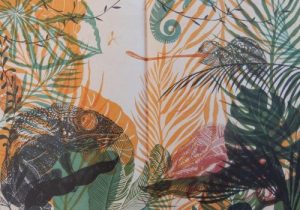
James Boast’s vibrant floral images of the jungle setting that provides a home for myriads of creatures, almost leap out at you  off the pages of this book that focuses on a small number of those creatures, a few of which are just visible on the opening spread …

The straightforward, patterned text then introduces ants, a preying mantis, a lizard, a monkey, a panther that ages and is eventually broken down by roaming beetles.

Thus the soil is enriched, new seedlings thrive and eventually, become part of the jungle habitat: home to …

Simply, and highly effectively, Laura Knowles has demonstrated a food chain within this jungle ecosystem; a food chain that is further elucidated on the final fold-out spread wherein information is given about the various roles played by the sun, producers, consumers and decomposers, along with a final challenge to re-read this alluring book and identify which flora and fauna are performing each role.
As well as being an eye-wateringly beautiful book in its own right, this is an excellent way to introduce the concept of food chains to young children; in addition, it’s a book that children would (once it’s been shared with them) be able to read for themselves. They can along the way, also see how many of the jungle fauna they can spot.

I’ve signed the charter  

The Nut Stayed Shut

The Nut Stayed Shut
Mike Henson
Templar Publishing
Squirrel Rodney, the world’s best cracker of nuts, has a problem: a confounding nut-shaped one. He’s succeeded in cracking nut number 1 and nut number 2; but nut number 3 stays firmly and unequivocally shut. Brute force doesn’t do the trick, so maybe a spot of tickling, or perhaps whopping it with a fish, scaring it maybe? None of these have the slightest effect – on the nut at least: nor do chainsawing, door dropping or even this …

Clearly something larger is needed …

No? Then a big bang maybe?

No matter what Rodney does all through the day and all through the night, not a chink of an opening appears in that nut shell. Is it perhaps time to admit defeat and walk away: it certainly appears as though poor Rodney is cracking under all the strain. Or is there something else he can do? …
With its rhyming narrative and over-the-top notions, this superb piece of slapstick is satisfyingly silly. The staccato rhythm of Henson’s delivery is comic timing of the first order, and leaves just the right amount of space for his visuals to have maximum impact. Rodney’s side-kick, complete with camera to film the champ in action, further adds to the delights of this whole smashing experience.

I’ve signed the charter  

My Sister is Bigger than Me

My Sister is Bigger than Me
Kate Maryon and Lisa Stubbs
Jonathan Cape
In Kate Maryon’s bouncy, rhyming narrative, three-year old Ava tells what it’s like being little sister to Gracie who is almost three years older. Being the elder sibling, gives, Gracie, so she thinks, the upper hand when it comes to deciding what to play, choosing roles and directing the action.

Poor Ava always ends up as the underdog being bossed around; she’s only in charge in her imaginary games, until suddenly, she decides enough is enough. Off she storms, up to her room where as a witch, she begins mixing up some magic; but before long who should burst in and take over once again.
Poor Ava, it’s back to in-her-mind games to get the upper hand.

In an instant though, events take a turn as the two spy a pack of hungry wolves lurking, and it’s time for them to make a dash for safety together …

Lisa Stubbs beautifully captures the changing dynamics of the children’s play as sibling rivalry is acted out through their games of make-believe; but most important, and over-riding all their actions, is that bond of sisterly love.
Her wonderfully patterned scenes of young children at play speak volumes.
Just the thing to share within families where there are two young sisters; or for early years story sessions after which I suspect there will some earnest sisterly discussions.

I’ve signed the charter  

9 Months

9 months
Courtney Adamo, Esther van de Paal & Lizzy Stewart
Frances Lincoln Children’s Books
Designed for sharing between adult and child/children, this is a month-by-month explanatory account of the development of a human embryo from fertilisation until the delivery of the baby and just after. It draws on the experiences of the two authors who have between them, nine children.
Each month is given a double spread: the verso provides general information in the form of a factual ‘Did you know’ about animal baby development; two questions and answers about human foetal development and a comparison with a fruit or vegetable of similar size. For instance, ‘The baby is the size of a blueberry’ – that’s month 2 when, we’re told, the human baby still has a tail.
Or as here …

Small vignettes illustrate the facts beautifully.
Opposite, the recto relates how the mother is feeling, with a full page illustration by Lizzy Stewart …

So, sensitively written, packed with fascinating facts, diagrams and illustrations, (the final spreads provide additional information) this is an excellent book for any family preparing for a new baby; and for anyone wanting an accurate, euphemism-free starting point for discussions relating to pregnancy.

I’ve signed the charter  

Mango & Bambang Superstar Tapir

Mango & Bambang Superstar Tapir
Polly Faber and Clara Vulliamy
Walker Books
I have to admit that I’m a great fan of the Mango & Bambang series, this being the fourth book; and they seem to go on getting better and better.
What is the snowiest meal you can think of: whatever it is I’ll bet it’s not half as delicious as that consumed by the little girl and her best friend and tapir, Bambang in the first of these four linked, although separate, stories. It happens because, Mango is trying to provide the best possible experience of snow for her pal without there actually being any likelihood of the chilly precipitation in their neck of the woods, especially as it’s summer. Instead she decides to ‘bring snow to the tapir’; and they end up breakfasting on lemon sorbet, cream soda, crushed ice topped with whipped cream plus meringue chunks and marshmallows – white ones naturally. That of course is only part of their snowy Saturday outing, which does get more than a little hairy at times …

The whole episode is sheer delight though, especially the finale that you’ll have to discover for yourself by getting your hands on a copy of this enchanting book.
In the other three stories, they spend a night at the fair and poor Bambang ends up with Bambang sustaining a rather nasty injury, inflicted by one of the duo’s arch enemies when Bambang puts his own safety second in order to protect Mango.
Being quick to recover though, its only a few days before the two are ready for their next two adventures, the final one of which sees them reunited with Bambang’s somewhat sassy, diminutive young cousin Gunter at the international premiere of his new film.

I absolutely love Bambang’s assessment of the canapés offered as ‘just normal food, made too small.
Charm simply oozes from these wonderfully uplifting, fun-filled tales; but what over-arches everything is the bond of affection between the two main protagonists, one of which has an unfailing capacity for innocent havoc wreaking.
As always, Clara’s delectable, retro-style illustrations – this time with touches of orange – add visual charm to Polly’s stories; the combination once again creating the perfect book for newly independent readers, or for sharing with those not yet ready to fly solo.
If you’ve yet to be delighted by this team, get a copy of this book right away; I suspect you’ll then want to read their previous stories too.

I’ve signed the charter  

The Dressing-Up Dad / Little Monster’s Day Out with Dad

The Dressing-Up Dad
Maudie Smith and Paul Howard
Oxford University Press
I’m sure most children are embarrassed by their parents from time to time: I suspect the boy in this funny story with its being yourself no matter what theme, feels increasingly that way as he gets older.
Danny’s Dad, like his son just loves to dress-up: I don’t mean in his favourite gear say, his best jeans and T-shirt. Oh no! Danny’s Dad really gets into the swing of the young lad’s fantasy play, donning whatever costume he deems appropriate for the situation in hand. He might become a space rocket, a fearsome dragon;

a wizard at the library, or a snow bear; and at Danny’s themed birthday parties, you can guess who was the most dreadful dinosaur or the dastardliest of pirates …

As Danny’s next birthday approaches, Dad contemplates his attire: should he perhaps be a ladybird, a dragonfly; there are plenty of bugs to choose from. Danny however, has other ideas for his Dad this year. And yes, he does look pretty cool as an ‘ordinary everyday’ dad but can he resist the invitation of Danny’s pals who have decided they want to be chased by a giant caterpillar. I wonder …

There’s a dilemma at the heart of this story and it’s evident in the body language and facial expressions of Danny’s Dad at the party. He’s doing his level best to enjoy being the perfect ordinary father when inside he’s torn: what he really wants is to don a costume and be a bug too; but how can he please himself and at the same time please his son? Paul Howard portrays all this and much more so adeptly in his enchanting illustrations. The presence of Danny’s lively dog wanting in on all the action and managing to creep in to almost every scene adds to the visual enjoyment of Maudie Smith’s captivating story.

Little Monster’s Day Out with Dad
Pippa Goodhart and Nick Sharratt
Egmont
Little Monster is excited at the prospect of a day trip to the fair with his dad, despite the fact that they’re going by car rather than train: that at least is the intention. No sooner on the road though than they’re held up in a traffic jam; when the car breaks down en route, after which the rescue truck gets a flat tyre, one begins to wonder whether they’ll ever reach their destination at all. Thank goodness then, for the bus: and there’s room for all aboard.

Finally they arrive at the fair ground and it seems as though Little Monster might be going to get his longed-for train ride after all …

With its funny, suitably garish Sharratt scenes with their plethora of flaps to lift, large print and sturdy pages, this will please most little monsters about the age of the chief protagonist herein.

I’ve signed the charter  

My Daddy is a Silly Monkey / The Dictionary of Dads

My Daddy is a Silly Monkey
Dianne Hofmeyr and Carol Thompson
Otter-Barry Books
A little girl shares with readers, the characteristics of her dad, likening him first thing in the morning, to a huge, yawning, grizzly, grouchy bear. Then as he performs his ablutions, a toothily grinning crocodile …

He becomes octopus-like as he texts, brushes her hair, overturns a chair, burns the toast, spills the milk, ties shoelaces and prepares her lunch. PHEW!
His chitter-chatter monkeying around makes our narrator late for school too.
Afterwards though at the pool, he’s a …

And then after a spot of kangaroo bouncing, he turns into a ravenous, tooth-gnashing tiger; after which he still manages to summon the energy to morph into a monster ready to boss, chase, catch and …

Unsurprisingly after all those energetic activities, there is only one thing to do: snuggle up for some well-earned rest having earned the final “just my lovely daddy”.
This adorable, sometimes rhyming, portrait of a single dad is a delight and perfect for sharing with young children, no matter what their family situation.
Carol Thompson’s exuberant, mixed media scenes are at once funny, full of love and at the same time, show a father struggling to cope with the frenetic life of being a single parent of an energetic youngster and managing to stay upbeat and entirely lovable.

The Dictionary of Dads
Justin Coe illustrated by Steve Wells
Otter-Barry Books
Dads come in all shapes and sizes: in this, his debut collection, performance poet, Justin Coe introduces a veritable alphabetic assortment. From Abracadabra Dad to Zen Dad we meet over fifty of the paternal species, the least energetic of whom, surprisingly, is Sportsman Dad: ‘Dad’s favourite sport / On the couch with the baby / Synchronised snoring.

For the most part the mood is upbeat but there are also plenty of reflective, sometimes sad poems too, such as Prison Dad which takes the form of an apologetic letter from a dad to his children. Having acknowledged that he let them down, he says this … ‘Despite my bravado I’m no macho man. // How can I act hard when these guards have got me sewing? / And sitting in my cell, I’ve even started writing poems! / Days go by slowly. I’m lonely and the only times / That I can find to be close to you are in these rhymes.
Totally different, but equally poignant, is Old Dad wherein a snow-haired man and his brown-eyed boy take a walk in the park in late autumn and the man is mistaken for the child’s grandpa. The two collect seasonal souvenirs and as they leave; ‘the boy picks up one last leaf/ a gift for his father. // “Is it mine to keep forever?” / the old man asks. / And this time it is his boy’s turn to nod and smile. // The old man beams with pride, / holds the leaf gently to his lips / and kisses it, / as if this gift were some kind of / golden ticket.
There’s a poem about having Two Daddies and we also meet Mum-Dad – a mum who plays both the maternal and paternal role and as the child tells readers, ‘However wild the weather / She’s got a way to get it done / And I could not have asked for / A better dad than Mum.
My favourite I think though is Storytelling Dad (there are seven S dads) wherein we hear that this particular father actually seems to undergo a metamorphosis to become various characters from The Wind in the Willows, ‘ … But best of all / was when Dad turned into a Toad, / a horn hooting, / toot- tooting, poop-pooping Toad, / Motor-Car Maniac, / menace of the Road.

It’s impossible to mention all the dads that feature in this collection but it’s certainly one I’d want to add to any primary class collection, or to a family bookshelf. Steve Wells’ visual pen-and-ink embellishments are numerous – at least one per spread – and add to the individual reader’s enjoyment.

I’ve signed the charter  

The Birthday Invitation / Wishker

The Birthday Invitation
Lucy Rowland and Laura Hughes.
Bloomsbury Children’s Books
That the author of this book is a speech therapist is evident in the abundance of verbs in her enormously engaging story.
We meet Ellen on the eve of her birthday excitedly writing and posting off invitations to her party. On her way though, she drops one: it’s picked up by a wizard while out collecting herbs, and into a bottle he pops it.

Some while later though, it finds its way into the hands of a pirate captain out at sea where it is then seized by his parrot which flies off and drops it into the hands of a princess and thereafter, it passes to several other unsuspecting characters before ending up in the pocket of its originator.
The day of the party dawns and there’s considerable hustle and bustle as Emma makes the final preparations for her birthday party and then comes a loud knock on her door …
Has there been a mistake or could it be that the wizard had worked some rather extraordinary magic? Certainly not the former, and maybe a sprinkling of sorcery went into the making of that wonderful celebratory cake …

There certainly is a kind of magic fizzle to Laura Hughes’ captivating illustrations: every scene sparkles with vivacity and her attention to detail further adds to the enjoyment of her spreads.
Just right for pre-birthday sharing with those around the age of the birthday girl herein, or for a foundation stage story session at any time.

Wishker
Heather Pindar and Sarah Jennings
Maverick Arts Publishing
Be careful what you wish for is the moral of Heather Pindar’s deliciously crazy cautionary tale.
Meet Mirabel who it seems never gets what she asks for be it a sleepover with her friends or a pet monkey; “It’s not fair! Everyone always says NO” she complains as she sits outside in her garden. Her comments are heard by a cat that introduces itself as Wishker, claims to posses magical powers and offers her three wishing whiskers.
Mirabel uses her first wish on ice-cream for every meal and her second for having her friends to stay – forever. The third wish involves a phone call to the circus and results in the arrival of clowns, fire-eaters, acrobats and a whole host of animals. The result? Total pandemonium in one small house: things are well nigh impossible.

Another wish is uttered and ‘Whoosh’. Normality reigns once more. But that’s not quite the end of the tale – or the whiskery wishing: Mirabel has a brother and there just happens to be a whisker going begging …
Sarah Jennings bright, action-packed scenes are full of amusing details and endearing characters human and animal.

I’ve signed the charter  

Under the Same Sky / This Is How We Do It!

Under the Same Sky
Britta Teckentrup
Caterpillar Books
I’m a big fan of Britta Teckentrup’s work especially her books with cut out pages so I eagerly anticipated this one. With its theme of connectedness, it’s absolutely beautiful.
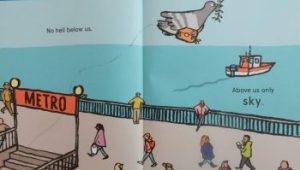
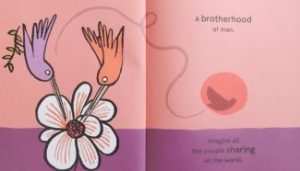
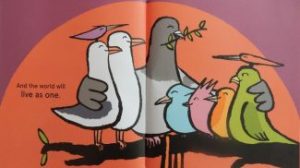
We live under / the same sky … / … in lands / near and far.’ So begins the lyrical text, which accompanies superb, soft-focus animal images set against natural backgrounds.
Hugely impactful with its spare narrative and its strategically placed die-cuts on alternate recto pages, through which we see  elements of scenes of universally shared games, feelings,

hopes and dreams, this is uplifting and full of hope. Timely, and exactly what is needed when our world seems to be growing increasingly intolerant, fractured, and with too many people focusing on differences rather than what binds us all together – our common humanity.

Fuelled by this powerful and lovely book, let’s seize every opportunity, transcend those differences and come together for the ultimate good of everyone.
Share, ponder upon, delight in and discuss: it’s a must for every family, early years setting and KS1 classroom collection.

This is How We Do It
Matt Lamothe
Chronicle Books
Children are the focus of this fascinating book, children whose ages range between seven and eleven; children from seven different families, backgrounds and diverse situations tell their own stories. Let’s meet, Romeo (Meo) from Italy; Kei from Japan; Daphine from Uganda; Oleg from Russia; Ananya (Anu) from India, Kian from Iran and the eldest, Peruvian, Pirineo.
These narrators share information about their particular homes, their families, their clothes – in particular what they wear to school; breakfasts, lunches and evening meals (each meal has a separate spread); mode of travel to school.

We meet their various teachers and see how they learn (almost all classrooms looks very formal). Each child shows how his/her name is written …

We also see the children at play, helping at home and finally, sleeping.
Yes, there are differences, each country, each family is unique; but the most important message is that no matter where we are from, we all have similarities: we eat meals, we play and we go to school (at least those children we meet do) and all under the same sky.
At the end of the book we meet all seven families in photographs; and there is a final glossary, an author’s note on how he came to create the book and the endpapers have a world map showing where the children (and author) live.
This predominantly pictorial presentation celebrates our commonalities and our uniqueness. With world travel a commonplace nowadays, the book offers a great way to expand children’s horizons giving them insights into particular ways of life in addition to those in countries they might themselves visit.

I’ve signed the charter  

The Legend of Rock Paper Scissors

The Legend of Rock Paper Scissors
Drew Daywalt and Adam Rex
Harper Collins Children’s Books
Have you ever wondered about the origins of the playground game? Now thanks to a rib-tickling collaboration between author Daywalt (of The Day the Crayons Quit fame) and illustrator, Adam Rex you can find out.
Daywalt’s telling demands much of the reader aloud in the way of performance power, as he tells in true legend style, of fearsome heroes; first of Rock, invincible champion warrior of the ancient realm of the Kingdom of Backgarden. Dissatisfied by the lack of worthy challengers, Rock travels far and wide in search of an equal in battle: His first adversary is Peg atop a washing line; his second comes in fruit form: he insults a juicy apricot and is immediately challenged to a duel…

but flattening the fruit, brings him no joy.
Meanwhile, in the Empire of Mum’s Study, and in Kitchen Realm, two other warriors, Paper and Scissors are equally at odds with themselves over lack of sufficiently challenging opponents. “Taste my fury, giant box-monster!” Paper yells at Computer Printer before completely jamming up its works …

Scissors at the same time, puts paid to a ‘strange and sticky circle-man, aka tape dispenser, as well as ‘dinosaur-shaped chicken nuggets’.

Finally the three warriors make their way to a garage and after three eye-popping rounds, they come to the conclusion that there is an endless circularity to their battles and become fast friends. But we all know the perils of triangular friendships …
Fiercely fast, furious and funny, this will have your audiences crying out for instant re-reads, not least on account of such giggle-inducing cries as, “You Sir look like a fuzzy little fruit bum” – that’s to the apricot; and “drop that underwear” (to clothes peg); as well as Rock’s talk of “no pants” in response to Scissors’ mention of “battle pants”.
The high drama of Daywalt’s text is made even more verbally viciously confrontational by the use of all manner of graphic exuberances and is further heightened by Rex’s superb, action-packed scenes of the battlers set against backdrops of raging thunderstorms, volcanic eruptions and missile firings.
What really makes the whole confrontational epic so engaging for me though, is that in the end, co-operation RULES …

I’ve signed the charter  

Big Tree is Sick

Big Tree is Sick
Nathalie Slosse and Rocio Del Moral
Jessica Kingsley Publishers
Meet close friends, Snibbles and Big Tree; they’re accustomed to spending a lot of time together and Snibbles loves Big Tree very much.
One day though, Big Tree is sick: the doctor diagnoses woodworm; and Snibbles is devastated. Feelings of frustration and anger start to overwhelm him …

and he feels very scared.

Other creatures offer support: Bessie the Sheep brings a lovely, warm woollen scarf to wrap around the sick tree which gives him some comfort; not so Snibbles though. But then, having made himself a crown from Big Tree’s fallen leaves, he starts to feel a bit more upbeat. Thereafter, the focus is on helping Big Tree get through his treatment and happily for all, he does eventually make a good recovery.
With delightful illustrations and some extremely useful suggestions for activities and strategies at the end of the story, this book portrays the powerful feelings and emotions that children are likely to exhibit when a family member or a close friend is diagnosed with a serious, debilitating illness, cancer for instance.
There is also a link to the website of a Belgian non-profit organisation that adult users of the book might find useful.

I’ve signed the charter

All the Wild Wonders

All the Wild Wonders
edited by Wendy Cooling, illustrated by Piet Grobler
Frances Lincoln Children’s Books
In her introduction to this diverse compilation, now in paperback, Wendy Cooling expresses the hope that ‘just one of the poems lingers in your mind long after the book has been put down’: I suspect more than just one of the thirty-five therein will do so.
Loosely grouped into subjects concerned with the natural world, there are different viewpoints that relate to the beauty of our world, and threats to the environment; and Elizabeth Honey’s opening poem which gives the book its name pretty much sums it up in these final lines:
All the wild wonders, / For you my sweet babe. // For this wish to come true /We have much work to do / All the wild wonders / For you my sweet babe.

Riad Nourallah’s An Alphabet for the Planet (beautifully bordered with letters from a variety of scripts) puts the case for much we hold dear; and is one that might well inspire children to try writing their own either individually, in small groups or perhaps, as a class.
The same is true of Brian Moses’ Dreamer, which has become a lovely picture book in its own right, albeit in a slightly different incarnation.
It’s possible to hit home using very few words as Andrew Fusek Peters does with his Man,the Mad Magician:
Said the money-man “We must have oil! / And that’s my final word!’ / How magical and tragical his final act / As the seagull became a blackbird.
The whole book is beautifully illustrated with Piet Grobler’s delicate watercolours: here’s one of my favourites …

Encompassing gentle and not so gentle lessons on taking care of our precious environment, this thought-provoking book is for families, for schools and for anyone who cares about the natural world; and that should be everyone.

I’ve signed the charter  

Hoot & Honk Just Can’t Sleep / Pete With No Pants

Hoot & Honk Just Can’t Sleep
Leslie Helakoski
Sterling
A storm tosses two eggs from their nests precipitating a parental mix-up.
Hoot hatches in one nest: sometime later, Honk hatches in another. Straightaway there are problems with diet and the sleep-cycles of the hatchlings.

Their surroundings seem rather alien too and that is despite the accepting manner in which the parent birds deal with their offspring.
All ends happily however with both fledglings eventually being reunited with their own families, and adults of each are shown similarly enfolding their respective young in a tender embrace, just like a warm cosy duvet.

Helakoski’s delightfully whimsical tale told through a fusion of gentle staccato, rhyming text that has a pleasing pattern to it, and superbly expressive pastel illustrations is perfect for sharing with the very young at bedtime (or anytime). Ahhh!
In addition, the book offers a lovely gentle introduction to the fact that some birds are diurnal, others nocturnal.

Pete With No Pants
Rowboat Watkins
Chronicle Books
Seemingly pants and imaginative play don’t go together, or do they?
This book cracked me up from the opening line: ‘Shortly after breakfast, Pete decided he was a boulder.’ It’s the conclusion the young elephant, knock-knock joke lover, reaches having given it due consideration: after all he’s big, he’s grey; he’s not wearing pants. QED. But then as he basks in a kind of self-glory, his thoughts are interrupted by a knock-knock joke: result – a plummeting of his enthusiasm for boulderness.
So what about a squirrel? He definitely fits the essential critera for colour, an acorn predilection, non wearing of pants but …

And one far-from happy Mum.
Next day it’s a case of cloud contemplation, squirrel mockery and further knock-knock jokery failures with owls for Pete.

Then Mum, who appears to have undergone something of a change of heart, shows up to play. Whoppee!

Deliciously quirky, crazily anarchic and you need to read the muted pictures very carefully to keep abreast of the happenings. Share with one child, or for individuals to enjoy in ones or twos.

I’ve signed the charter  

Mine! / Thousand Star Hotel

Mine!
Jeff Mack
Chronicle Books
It’s amazing how by using the same word 27 times, Mack can concoct a hilarious tale on ownership with a terrific final twist to boot.
Two mice in turn stake a claim for a substantial-looking rock and then a battle of brain and brawn involving a chunk of cheese, a gift-wrapped parcel,

a pile of rocks and a couple of vehicles ensues over which of them it belongs to. Seemingly this isn’t a conflict easily settled: things escalate …

until with both mice on the point of self-combustion the rock makes a startling revelation and the pals realise what a massive mistake they’ve made.
Wrapped up in this hilarious encounter are important messages about acquisitiveness and possibilities of sharing. Seemingly though as the story concludes, these lessons are yet to be learned by the protagonists herein.
Mack uses lettering the colour of which matches that of the mouse making the utterance to help orchestrate his parable and in addition to being a perfect book for beginner readers (preferably after a demonstration) this is a gift for anyone wanting to demonstrate how to tell a story to a group: inflection and intonation rule!

Thousand Star Hotel
The Okee Dokee Brothers and Brandon Reese
Sterling Children’s Books
The award winning musical duo give a new slant to the Fisherman and His Wife folktale using two riverside dwellers, Mr and Mrs Muskrat. Their life is simple: their dwelling a far from perfect cabin; their diet largely fish in one form or another. One day while out in their boat, Mr Muskrat feels an enormous pull on his line and after a considerable amount of STRUGGLIN’, TUGGLIN’, YANKIN’, and CRANKIN’, they successfully haul out a massive golden catfish. This is no ordinary fish: it’s a magical wish-giving one, and offers the couple a wish in exchange for its life.
Therein lies the rub: Mrs Muskrat is all for simple creature comforts – a hammer and nails to fix the roof, a new soup kettle, or perhaps, a cosy warm quilt. Mr Muskrat in contrast sets his sights rather higher; he wants a life of luxury.

And, he certainly expresses himself in no uncertain terms, getting a whole double spread to call each of his wishes to a halt midstream …

In fact all the dialogue and the rest of the telling is wonderful; and the final fun twist offers an important message. Brandon Reese’s exuberant illustrations of the characters in their wild woods setting have a cinematic quality.
Starlit filled dreams are assured if you share this one at bedtime. There’s a delightful CD with an audio telling and eleven funky songs tucked inside the front cover too.

I’ve signed the charter  

King of the Sky

King of the Sky
Nicola Davies and Laura Carlin
Walker Books
Peter is starting a new life in a new country and what he feels overwhelmingly is a sense of disorientation and disconnection. Only old Mr Evans’ pigeons bring him any reminders of his former, Italian home.

Those pigeons are Mr Evans’ pride and joy, his raison d’être almost, after a life spent underground in the mines, a life that has left him with a manner of speaking sufficiently soft and slow for the boy narrator to comprehend.
There is one pigeon in particular, so Mr Evans says, that he’s training to be a champ. This pigeon he gives to Peter who names him “Re del cielo! King of the Sky!” Together the two share in the training, not only of Peter’s bird, but the entire flock; but after each flight, Peter’s bird with its milk-white head, is always the last to return. Nevertheless the old man continues to assure the lad of its winning potential. “Just you wait and see!” he’d say.
As the old man weakens, Peter takes over the whole training regime and eventually Mr Evans gives him an entry form for a race – a race of over a thousand miles back home from Rome where his pigeon is sent by train.
With the bird duly dispatched and with it Peter thinks, a part of his own heart, the wait is on.

For two days and nights Peter worries and waits, but of his special bird there is no sign. Could the aroma of vanilla ice-cream, and those sunlit squares with fountains playing have made him stay? From his bed, Mr Evans is reassuring, sending Peter straight back outside; and eventually through clouds …

Not only is the pigeon home at last, but Peter too, finally knows something very important …
Drawing on the history of South Wales, when large numbers of immigrants came from Italy early in the last century, Nicola Davies tells a poignant tale of friendship and love, of displacement and loss, of hope and home. Powerfully affecting, eloquent and ultimately elevating, her compelling text has, as with The Promise, its perfect illustrator in Laura Carlin. She is as softly spoken as Mr Evans, her pictures beautifully evoking the smoky, mining community setting. The skyscapes of pit-head chimneys, smoke and surrounding hills, and the pigeons in flight have a mesmeric haunting quality.
A truly wonderful book that will appeal to all ages.

I’ve signed the charter  

Hello, Mr World

Hello, Mr World
Michael Foreman
Walker Books
Two small children dress up and play doctors. Their patient is Mr World and he’s not feeling good. In true GP fashion the children ask, “Now what seems to be the matter?
As the doctors go about making their diagnosis, taking his temperature, listening to his chest and running him through the X-ray machine, Mr World talks of raised temperature and breathing problems and we are shown in Foreman’s telling watercolours the consequences of his malaise. Habitats are under threat;

towns and cities choking with filthy, toxic fumes …

drastic consequences of climate change are evident everywhere and, as the doctors decree, “You must look to the future or things will just get worse …
The solution is in the hands of Mr World’s human inhabitants; and, to the joy of the doctors, and the threatened animals,
the young children acknowledge that they have a huge responsibility; but it’s a challenge well worth taking up.

If only it were that simple. Fortunately, the final three pages offer a brief real world diagnosis and some small but important actions that children themselves can take to help with the crisis.
Foreman’s treatment of a red-hot topic is powerfully affecting. Almost every day one hears on the news or reads of the adverse effects of climate change: only recently we heard that many children playing outside in their school breaks are breathing toxic fumes for instance, so his book is all the more timely. Likening the world to a patient subject to the diagnosis of two small children at play is a stroke of genius, and makes what is a global issue comprehensible to early years listeners

who are likely to inherit the problems we’ve all helped to create. Seize the day!

I’ve signed the charter 

My New Room / Time for a Nap

My New Room
Lisa Stickley
Pavilion Books
Edith, the young girl narrator shares with readers the process of moving into a new room and making it her own. We share too, the comments of other inhabitants of the room starting with Edith’s toy soldier guard, Gary.

As head of moving and room safety, I have been keeping everyone in check to ensure a smooth and safe move, “ he announces.
Next to speak is dog, Albert, who deems the place “usually OK smelly wise”on account of Edith’s almost daily baths. Other toys include the softly spoken, Osbert T. Octopus, Timothy Sloth and Reginald Rabbit, occupants of the spare bed (unless Grandma comes for a sleep-over) and a host of others. Those perching atop the wardrobe have a wonderful view of the garden – perfect for “plane spotting” says Susan hippo, whereas Breton Mouse has found the perfect trampolining spot …

while poor Sebastian Snake has the chilliest spot of all and is thinking of applying “for a promotion.” It looks as though they might all settle happily in their new abode; it looks too as though they’ve been pretty busy creating something special for Edith.

I absolutely loved Lisa Stickley’s Handstand debut; this is even better I think. The text, presented as in a child’s writing book, is deliciously witty and the patterned illustrations adorable. I’d certainly recommend putting this in pride of place on Edith’s bookshelf along side Gary Guardsman, as well as adding it to a family, nursery or early years classroom collection.

Time for a Nap
Phillis Gershator and David Walker
Sterling
Through a gentle rhyming text and delightful, soft-focus pencil and acrylic scenes of a little rabbit and parent, human toddlers can share in their week. Starting with Monday, shopping day,

Gershator and Walker take us through their weekday activities, shopping, playing, a visit to the library for storytime (hooray!), clothes washing and gardening and on Saturday and Sunday, relaxing together.
A crucial part of every one of those days is nap time – not always readily embarked on by little rabbit.

Short and sweet, and ideal for participatory reading with littles: try reading it with a nursery group and then leaving the book with appropriate props or small world toys for children to interact with.

I’ve signed the charter  

Poor Louie / Raymond

Poor Louie
Tony Fucile
Walker Books
Louie the Chihuahua narrator of this story leads a life of contented predictability with Mum and Dad until things start to change. Mum still meets up with friends, which was fine but now there are other small creatures at those get-togethers, meaning Louie is no longer the centre of attention.

Then Mum’s tummy gets visibly larger … and larger …

Lots of new things are delivered; but why two beds, two carriers, two sets of clothes and a double buggy. The prospect of two ‘of those creatures’ is just too much for Louie: he waits for an opportunity, grabs his belongings and attempts a runaway. It’s thwarted by a well-intentioned neighbour however and Louie feels his life is over.

You can close the book now” he tells readers.
We don’t of course, for that is not the end of the story …
Dry humour, a restricted colour palette which gives the whole thing a subtle air of retro sophistication, constantly changing and sometimes, unusual perspectives, and some laugh-out-loud spreads make the whole thing a delight from cover to cover. Fucile’s delicious comedy will appeal to dog lovers and families adjusting to a new sibling in particular; but neither of those are applicable to this reviewer who loved it nonetheless.
Here’s another tale of a canine accustomed to leading a pampered pooch life:

Raymond
Yann and Gwendal Le Bec
Walker Books
Meet Raymond, used to having his own special spot by the sofa, scratchings behind the ears in ‘just the right place’ and a surprise birthday party every year. What more could a canine want? If you’re Raymond, a considerable amount it appears and thus commences his being more like a human behaviour. Sitting at the table for meals; ‘cappuccino-and-cupcake Saturdays at the café and cinema trips’ become part and parcel of his life. but Raymond is not alone; seemingly the whole doggy world wants to act human.
Raymond’s four-footed gait becomes two and naturally the world now looks very different. Big thoughts invade his head and before you can say DOGUE, Raymond has landed himself a job as rover-ing reporter on the up-market magazine and spends all hours working to meet deadlines.

Soon though, Raymond embarks on a new role: he becomes newscaster on the TV channel, Dog News. Eventually however, an excess of pampered fame means that he’s in dire need of a break away from it all. Could it be that the canine celebrity is about to undergo a light-bulb moment …

This funny, ‘be careful what you wish for’,‘ don’t bite off more than you can chew’ tale, with its New York setting, will resonate with adults as much as children, or perhaps more. The trouble is though, it’s not necessarily all that easy to step off that workaholic, achievement treadmill, which seems always to be driving us onwards towards greater heights …
There’s plenty to make readers – be they or be they not dog lovers – smile in the comic style scenes of a life as a top dog.

I’ve signed the charter  

Never Take a Bear to School

Never Take a Bear to School
Mark Sperring and Britta Teckentrup
Orchard Books
The creators of the gorgeous Your Hand in My Hand have teamed up again for this starting school or nursery story; and according to the two of them, there is only one rule: ‘you just cannot take your bear into school.’ As if!
After all he’d scare everyone silly with that huge bulk and gigantic paws;

he’d sabotage the child-sized furniture and fill the room with ill-timed growls and grizzles. Then, come lunchtime, nobody else would get a look in …

Imagine his crushing capacity in a PE session; and he’d completely trash your role-play area: his havoc wreaking potential just makes the whole idea a complete no-no. And anyhow you’ll be far too busy getting to know the ropes, making friends, even making a picture of your favourite thing …

Much better then, to have that ursine pal waiting by the school gates at the end of the day, when he’ll welcome you with open arms; and you can walk home together talking about that important first day. Then once at home well, you can do whatever you want – just you and YOUR BEAR!
The possibilities entertained in Mark Sperring’s funny rhyming narrative lend themselves so beautifully to Britta’s picture making. Her scenes of chaos and consternation among the children are a treat for those around the age of the little boy and his classmates; equally so, the fun times boy and bear have together at the end of that first school day. Yes it’s a lovely starting school story but too much fun to keep just for those run up to it days, or those in the little boy’s situation: it’s a wonderful ‘what if ’ story for foundation stage audiences no matter when or who.

I’ve signed the charter  

Little Wolf’s First Howling

Little Wolf’s First Howling
Laura McGee Kvasnosky and Kate Harvey McGee
Walker Books
Little Wolf accompanies Big Wolf to the top of the hill, both father and son eagerly anticipating the wolf pup’s first howling. The full moon appears above the hill top and Little Wolf can hardly hold on to that first howl of his but first he must let his father demonstrate “proper howling form.” Then comes the turn of the beginner: he starts conventionally but then adds a little bit extra of his own.
Not wanting to dent the cub’s confidence, Big Wolf performs another howl, then off goes the cub again with a superbly creative version of his own – love you little fella!

‘aaaaaaaaaaaoooooooooooooooooooooooooooooooooo dignity dobbity skibbity skobbity skooo-wooooo-wooooooooooo’

Unsurprisingly, he’s told gently but emphatically, it doesn’t pass muster. No matter how many times Big Wolf demonstrates what he’s waiting to hear from his little one, what comes from the cub is increasingly elaborate verbal creativity.
Then suddenly, Little Wolf’s joyful wild abandon starts to have a different effect on his parent: instead of admonishing his offspring’s outpouring, he joins him, becoming co-creator of an extremely unauthentic duet performed at uninhibited full volume right across the countryside.

After which the two head home “to “tell the others” – just in case they hadn’t heard it.
Kvasnosky and McGee together have produced a superb picture book celebration of the creativity of young children.
Little Wolf’s spirited renderings are a perfect example of the kind of uninhibited imaginative responses of those in the early years, so long as well-intentioned adults don’t step in, take over and try to show them the one ‘right’ way to do something. Long live all the little wolves everywhere (especially those of the divergent kind), and those adults who, like Big Wolf have the good sense to step back and look at things from behind the heads of the very young.
The digitally coloured, gouache resist scenes wonderfully evoke the inky night setting in which wolves might wander, the telling is a delight and the dialogue spot-on. A word of warning to readers aloud though: you may well find yourself completely hoarse after being called upon for immediate re-readings of this wonderful book – happy howling.

I’ve signed the charter  


Towering Tree Puzzle / Lift-the-Flap and Colour:Jungle & Ocean

The Towering Tree Puzzle
illustrated by Teagan White
Chronicle Books
Essentially this is a sturdy box containing 17 large, easily manipulated, double-sided pieces depicting Spring/Summer scenes on one side and Autumn/Winter ones on the reverse. Each piece shows various woodland animals playing and working together; a whole tree community indeed and the puzzle when complete is over 130 centimetres long. Nothing special about that, you might be thinking but, the language potential is enormous, especially as there is no one right way of fitting the pieces together: this open-endedness also means that if more than one child plays with the pieces, there is a co-operative element too.

The artwork is splendid: each detailed piece, a delight.
Every branch of the tree generates a different story, or rather, many possibilities; ditto the completed tree. Some children like to story about the pieces as they put them into place, others prefer to complete the puzzle and then tell one or several stories which may or may not be connected. You could try a completely open-ended ‘take it in turns tell me about’ game with children sitting in a circle for starters, or perhaps choose a focus, say animals, plants or perhaps, events: the possibilities are many.
I’ve used this marvellous resource in several different settings and each time it’s been received with enormous enthusiasm and the users have shown great reluctance to part with it afterwards.

Lift-the-Flap and Colour Jungle
Lift-the-Flap and Colour Ocean

Alice Bowsher
Frances Lincoln Children’s Books/ Natural History Museum
In this collaborative publishing enterprise, children can choose from one of two locations to start their colouring in experience. The first is the South American Amazon jungle wherein jaguars hunt, slow sloths dangle, alligators lie in wait for a tasty meal, stick insects and parrots share the lush foliage, and swinging monkeys abound.
In the Ocean they can encounter diving dolphins, and shoals of fish, visit a coral reef with its abundance of sea creatures, notice the seaweed fronds that provide a safe hiding place for fish; and dive right down to the deepest dark depths.
A brief, rhyming text accompanies each adventure gently informing and guiding the young user as s/he explores the location, lifts the flaps and adds colour to the black and white pages – five spreads per book. And the final page of each book has an information paragraph that focuses on the importance of protecting the specific environment.
These will I’m sure be seized on by young enthusiasts, particularly those with an interest in wild life and will one hopes, leave them wanting to discover more about the inhabitants of each location.

If I Were a Whale
Shelley Gill and Erik Brooks
Little Bigfoot
This contemplative, charmer of a board book successfully mixes rhyme and science facts. It imagines the possibilities of being a minke, a beluga playing with icebergs, a pilot whale and then these beauties …

If those don’t suit there’s a tusked narwhal, a blue whale, or a humpback perhaps? There are eleven possibilities in all, each one beautifully illustrated by Erik Brooks who manages to capture the essence of each one in those watery worlds of his.
Yes, it’s a small introduction to a huge topic but this is a pleasure to read aloud, is likely to be demanded over and over, and to inspire tinies to want to know more about these amazing mammals.

I’ve signed the charter  

Kiki and Bobo’s Sunny Day / Papasaurus

Kiki and Bobo’s Sunny Day
Yasmeen Ismail
Walker Books
Meet Kiki and Bobo. They’re super excited on account of a trip to the seaside; the perfect place to spend a sunny day they think. Off they go in the bus where Kiki eagerly anticipates a swim in the sea: Bobo, in contrast does not.
He doesn’t want the ice-cream Kiki buys either, despite his friend’s best efforts.
Undaunted, she suggests that dip in the sea. This is greeted by a series of stalling activities: rubbing on sun cream,

collecting seashells and sandcastle constructing, until finally the indulgent Kiki is rewarded, not by an enthusiastic change of heart on Bobo’s part: rather he tearfully admits that he’s scared of sea swimming.
Three cheers for Kiki: she has just the thing for reluctant swimmers and she’s ready to let Bobo have that, and equally important, to take hold of his hand as they enter the water.

So, overcoming the fear of water – tick; being a super-duper friend and helping a pal in his hour of need – tick. Those are the important outcomes of a seaside sortie so delightfully orchestrated through Yasmeen Ishmail’s characteristically adorable illustrations – littered in this instance with flaps to open – and a straightforward text that in the main, comprises the dialogue between Bobo and Kiki.
Another winner for Yasmeen Ismail.

Papasaurus
Stephan Lomp
Chronicle Books
Using a similar question and answer style employed in Mamasaurus, Lomp has Babysaurus participating in a game of hide-and-seek with his Papasaurus. When it’s Babysaurus’s turn to be the seeker, he can’t find his Papa. His “Have you seen my papa?” is directed to first Stego, and subsequently Anky, Mosa, Velo and Edmont,

all of whom respond by referring to attributes of their own papas. None though can match up to Papasaurus in the eyes of his little one and eventually he pauses his search on top of a large hump in the landscape to consider where his father might be;

and lo and behold …
The dinosaur characters are rendered in bright colours making them stand out starkly against the sombre shades of the prehistoric landscapes they inhabit and it’s thus that Lomp creates the possibility of hidden danger as the infant dinosaur forays into the unknown perhaps for the first time.
Lots of fun to share with young dino. fans, in particular those youngsters who with a parent fairly near at hand are beginning to make those first forays into the wider world.

I’ve signed the charter  

The Snugglewump / Pearla and her Unpredictably Perfect Day

The Snugglewump
Lou Treleaven and Kate Chappell
Maverick Arts Publishing
Molly has a host of toys and sitting side-by side awaiting her arrival one day, each claims to have pride of place in her affections. There’s Ted, an antique doll, Alien, Robot and Action Andy …

all strutting their stuff so to speak. It’s no wonder that Snugglewump lies forgotten on the floor feeling less than confident about his lot. But then, having seen and heard the others showing off, it ups and snugglewumps away through the catflap and off down the road.
Thanks to a free ride on a postman’s shoe, it ends up spending the night, damp and virtually shapeless contemplating the possibilities offered by having limbs and a countenance, or batteries, and generally rueing its lot.
Is it Snugglewump’s fate to be cast so it thinks, into the dump or could there perhaps be an alternative ending for this brightly coloured, albeit amorphous thing which, thanks to a couple of pigeons is, as the sun rises, hanging across the branch of a tree in the park?

Told through Lou Treleaven’s jaunty rhyming text with its fun descriptive phrases, and Kate Chappell’s beautifully expressive, quirky illustrations (she even manages to imbue that Snugglewump with a personality) this is great fun to share with young listeners either at home or in an early years setting.

Pearla and her Unpredictably Perfect Day
Rochel Lieberman and Lloyd Jones
Jessica Kingsley Publishers
Ten year old Pearla likes nothing better on Sundays than to help her father in his bakery. She’s something of an expert herself, cooking up perfect cupcakes and cookies that people come from far and wide to buy.
One Sunday however, having so she thinks whisked up the usual perfect mix for her cookies and cupcakes, and put them into the oven to bake, she realises that she’s left out a vital ingredient. Disaster for one used to a perfect baking outcome.

But then as she paces up and down, Pearla starts out on what is to be a huge learning curve: “I’m a person, People are not perfect. I did my best. I know I will be helped with the rest,” she tells herself.
Out come the far from perfect confections some time later and rather than throwing the whole lot in the bin, Pearla decides to sell them at half-price.
What happens thereafter is a big surprise for the girl and after the odd sales setback, every single item is sold. Thank goodness Pearla managed to stay calm and turn her mistake into something positive. Even more important she learned the crucial life-lesson: that mistakes are a vital part of the learning process; something all teachers worth their salt would agree with, and that all youngsters need to take on board early on in their education. That way lies success.
Full of important and empowering lessons. Written by a speech and language specialist, this is a book to share with all young learners, especially those who, for whatever reason, are averse to risk-taking. Lloyd Jones’ illustrations add gentle humour to Pearla’s plight.

I’ve signed the charter  

The Cave

The Cave
Rob Hodgson
Frances Lincoln Children’s Books
Inside a cave there is a ‘little creature’: the cave is his home. Outside the cave is another creature: the cave is not his home, but his heart is set on getting the troglodyte to come out and join him. “I’m sure we’d be VERY good friends.” he says encouragingly. The little creature refuses to budge.
This goes on day after day, after day. Boredom isn’t an issue for the little creature despite what the lupine outsider says. “Only boring creatures get bored” is the response of the cave-dweller. Time passes and with neither animal giving way…

come wind or rain … it’s situation impasse.

Then one day in desperation, the creature without lets slip the words, “I’m getting hungry now!” then quickly amends the ‘I’m’ to ‘YOU’. This results in an admission of slight hunger from the little creature within, whereupon a deliciously tempting doughnut, complete with sprinkles, is proffered. This confection proves irresistible and the ‘Little Creature’ emerges. To say what happens next would make me a story spoiler but I can reveal that the doughnut disappears and there’s a new resident in the cave.
An absolutely splendid debut for Rob Hodgson. There is just SO much to love about this book.
The illustrations are scrumptious with delectable details chronicling, in addition to the main action or rather lack of it for the most part, Wolf’s total disregard for little creatures such as worm, snail and slug, that play silent bit parts throughout.

Hodgson’s text in contrast, is spare, and plays in perfect harmony with his visuals. A super read aloud: you’ll have children squirming in eager anticipation throughout and they’re sure to demand at least one encore performance.

I’ve signed the charter  

All Aboard the London Bus / No, Nancy, No!

All Aboard the London Bus
Patricia Toht and Sam Usher
Frances Lincoln Children’s Books
It’s hard to resist the opening invitation of this book:
Come! / Board the double-decker bus / and see the London sights with us. / Any time, hop off. /Explore! / Then climb back on and ride some more.’ With its welcome aboard greeting in five languages, we’re off and heading for Buckingham Palace to see the Changing of the Guard.
From there, it’s on to Westminster Abbey with its amazing ceilings and tombstones and statues galore.

Big Ben is the next stop and then comes the London Eye so beautifully described as ‘A bracelet that hangs off the Arm of the Thames, / its pods filled with people, all dangle like gems.’ Then after pausing to look at the river itself snaking through a host of landmarks, the family heads for Trafalgar Square. Here readers are offered a busy ‘Seek and Find’ spread while they too pause for breath,

before heading via Speaker’s Corner down onto the tube and thence to Piccadilly Circus where they emerge into a sudden downpour. Seemingly there’s only one thing to do: stop for tea and a browse in a famous toyshop for a while.
The British Museum, Tate Modern and the Globe are some of the other destinations once family members have dried off; and no London visit would be complete without seeing Tower Bridge and the Tower itself so that is their final stop. Phew! It’s certainly been an exhausting day especially for the little ones. The adults are very brave to undertake such a huge itinerary in a single outing and still leave the bus with smiles on their faces.
Essentially a sequence of poems in celebration of London: you can either take the whole tour in one sitting or, take things more slowly just dipping into or revisiting favourite landmarks. No matter which way, Sam Usher’s gently humorous illustrations, whether the focus be a famous London site or its visitors,

are sheer delight.
It’s clear from this celebratory book that London means a lot to both author and artist.

No, Nancy, No!
Alice Tait
Walker Books
Join Nancy and best friend Roger for an exciting, action-packed visit to London. First stop is Buckingham Palace where Nancy is hoping for a glimpse of the Queen. Her dog however has his eyes on two children, one of whom drops a teddybear. Rather than remain at the palace, Nancy and Roger set off hot on the trail of the bear’s owners. A bus ride takes them to St Paul’s Cathedral

and thereafter various other famous London landmarks. Every time it seems they’re about to catch the teddy losers, Nancy’s proclivity for mischief diverts her attention.
Will they ever catch up with the children they’re chasing; and will Nancy ever get to see the Queen?
There are flaps on every detailed spread helping to move the action forwards as well as a surprise Nelson’s Column pop-up; and guess who cannot resist climbing right up to the top. Fun, fast and with its repeat “No, Nancy, No!” from Roger, fun to share, especially before a visit to London.

I’ve signed the charter 

That Bear Can’t Babysit / Brobot Bedtime

That Bear Can’t Babysit
Ruth Quayle and Alison Friend
Nosy Crow
Little did Mr and Mrs Burrow know when they had to resort to hiring Bear as babysitter for their night out, leaving their seven bunny offspring in his charge while they went off to a party, what those young rabbits or indeed Bear, might get up to.
The junior Burrows certainly seem to have Bear wrapped around their little paws from the start – or some of them do at least. They choose inappropriate reading material; cause chaos, and worse when it comes to supper;

create mayhem with the hosepipe and then embark on a moonlit adventure with Bear at the helm.

Finally our ursine child-minder seems to have the upper paw, all the more so when out comes the perfect bedtime storybook.

Which is just as well because before you can say ‘goodnight little bunnies’ back come Mr and Mrs B to find a scene of serenity and shut-eye; accompanied by some rather surprising words from their babysitter. Shame that counting isn’t one of his better skills.
Author, Ruth Quayle’s debut picture book is a charmer through and through. It’s full of lively, tongue-in-cheek dialogue, scattered throughout with join-in-able repeat phrases, not the least of which is the title of this book, and there’s a lovely final twist in its tail.
Alison Friend’s scenes fizzle with fun. Her portrayal of frolicsome mischief, furry friend style, is full of amusing detail and her characters are adorably impish.

Brobot Bedtime
Sudipta Bardhan-Quallen and Scott Campbell
Abrams
The only words of this pre bedtime story are speech bubbles – one colour per character – and encased within outlines that approximately correspond with different shapes of the speakers’ heads. The dialogue, which is liberally sprinkled with wordplay, opens with the mother robot sending her three offspring to bed. A seemingly straightforward “time to enter sleep mode” instruction however, is anything but that. Beep can’t possibly sleep; he has “the flick-ups” and needs help. His brothers Crash and Buzz offer assistance in the form of a “nice cup of oil”,

to no avail. Then Buzz leaps into action with a spot of diverting impersonation …

And so it goes on with all manner of supposedly helpful shenanigans until, with Beep on the point of insomniac self-destruction, mum robot calls out, expressing extreme displeasure demanding to know “Why are there still gears turning up there?” and threatening “a hard reboot”.
A plan is hatched but will those little bots ever settle down and drop off to sleep? Well, um yes – and no!
The crazy, occasionally slightly confusing, visuals of the romp, in tandem with those colour-coded speech bubbles, offer a wonderful opportunity for readers aloud (and young listeners), to engage in robot-speak. A word of warning though: if you share this as a bedtime book, it might well lead to rather too much child-robot talk and as a result, insufficient infant wind-down.

I’ve signed the charter  

Grumpy Frog

Grumpy Frog
Ed Vere
Puffin Books
Grumpy Frog wasn’t the only character to be leaping around when I opened his book parcel: I started leaping round the kitchen waving the book in delight especially as its arrival coincided with Earth Day and there on the first double spread is a more upbeat version of the amphibian proclaiming thus:

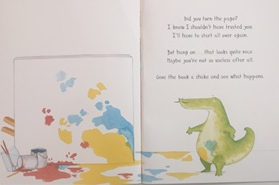
He then proceeds to blow it though by damming every other colour, he can think of: “Uh oh!” to pinch his words, “Grumpy Frog alert!“.
Better organise a hopping contest with some pals ASAP, but make sure he crosses the line first or else …

Don’t think of suggesting a swim – that involves blue; or a bounce, which, so Grumpy Frog decrees, is yellow.
It looks as though isolation is the best thing; after all, aloneness he absolutely adores. It gives him time to contemplate colour, diet, annual events and err … loneliness.

Not such a good idea after all then, this setting oneself apart.
Enter stage left another kind of jumper but as you might expect, a pink rabbit gets a huge thumbs down from our frog who manages to make the poor unsuspecting creature cry for its trouble. What about this large snuggle toothed croc. then? He’s definitely making friendly overtures towards GF and SNAP! Oh no! surely Grumpy Frog hasn’t met his demise; has he?
Actually no: a spot of self-reflection appears to have saved his skin so …

Furthermore it looks as though some apologies are on the cards too; though that is not quite the end of this corker of a book: this is …

and, to discover what happens in the interim, I urge you to hot foot it, or rather hop foot it immediately to your nearest bookshop and bag yourself a copy.
It’s an utter triumph for Ed Vere and maybe even for Grumpy Frog, just so long as he gets there first. This reviewer found herself snortling at every turn of the page: it’s the perfect antidote to grumpiness (and election blues).

I’ve signed the charter  

Ice Boy / Stack the Cats

Ice Boy
David Ezra Stein
Walker Books
Meet Ice Boy, the hero of Stein’s latest book. Rather than being restrained by his freezer existence and frequent “Never go outside” parental warnings, the young ice-cube leaves the safe enclosed environment and ventures down to the ocean’s edge and thence discovers a whole new world of exciting adventures is to be had.
His first incarnation is ‘Water Boy …

and thereafter Vapour Boy; after which, having tap-danced upon a thunderstorm and freezing …

a tiny pellet of summer hail.
In solid form once again, he hurtles off a roof-top and ‘BLOOP’ –is reunited with his parents who just happen to be chilling someone’s drink.

Suddenly it looks as though extermination is to be the outcome for all three cubes but fortunately, the thirsty human’s first taste is of the little lad who, after all his adventures has become a taste-bud disaster; and Ice Boy and parents are summarily tossed from the tumbler onto the grass.
Then, with an infusion of worldly knowledge, Ice Boy leads the trio off on a new water-cycle adventure …
This clever tale of risk-taking, transformation and re-incarnation is such a fun way to introduce a sclence lesson on the water-cycle. Stein’s mixed media, largely blue and grey illustrations are littered throughout with witty speech bubbles (‘Oh, Ice Boy! You’re a sight for sore ice.‘ Or, ‘Am I dense or did I just become a liquid again?‘and peppered with POPs, PUFFs, BLOOPs and other appropriate noises off.

Stack the Cats
Susie Ghahremani
Abrams Appleseed
Much more than a mere counting activity, this playful picture book offers opportunities for youngsters to expand their mathematical thinking to embrace simple division and multiplication; and a spot of height comparison. We start with ‘One cat sleeps.’ // Two cats play. // Three cats?/ STACK!’ Followed by …

After which the pattern alters thus:

Clearly the six have found this process a little wearying so ‘Seven cats nap.’
Then, the revived felines plus another try their paws at a spot to towering , which rapidly turns to a tumble. It’s as well cat nine is there to even things out and for the first and only time, numerals make their appearance …

What happens thereafter is that Ghahremi decides that ten cats are ‘just too many’, dispersing the gathering to hide, sleep, climb and generally have a playful time (a subtraction discussion opportunity) and finishing with an open-ended, ‘How will you stack the cats?’
The eye-catching cats are given the opportunity to show their playful personalities while youngsters are offered a plethora of mathematical possibilities. A purrfect prelude to some mathematical activities: fun and educative and also, great for beginning readers.

I’ve signed the charter  

A Home for Gully / Through the Gate

A Home for Gully
Jo Clegg and Lalalimola
Oxford University Press
Gully is a long-suffering resident of the park; long-suffering because every morning his makeshift home is swept away by the keeper. This should no longer be tolerated, decides the scruffy dog that happens along one morning, introduces himself as Fetch and claims to be returning Gully’s stick. Fetch calls a meeting of his 412 resident fleas and thereupon they decide to assist the seagull in a search for a more satisfactory place of residence: one “that doesn’t get swept away, where my feet are warm and dry, and my tummy is full” is the bird’s desire.
They leave the relative peace and quiet of the park …

and head into the city where, after being shown the door of a smart hotel, they come upon the seemingly stuck-up Madison who offers her assistance as city guide. The three circumambulate the whole city before ending up at the library for some R and R. Make that R, R and R for therein they meet rat, Zachary.

On learning it’s a home rather than a book they’re seeking, Zachary leads them out and eventually, to a likely spot. Then with Gully safely installed, the other three head off into the darkness leaving their pal to his new warm, dry abode.
Next morning however, all is not quite hunky-dory with Gully. What good is a home if he doesn’t have others to share it with thinks our feathered friend …

There is a wonderful vintage look to Jo Clegg’s warm-hearted, funny story, thanks to Lalalimola’s delectably droll illustrations. These she packs with diverting visual (and verbal) asides that cause the reader to pause for a while and spend time exploring every spread. This is an artist I shall watch with interest, as I will the author.

Through the Gate
Sally Fawcett
EK
A little girl narrator, unhappy about a move to a new house, shares her step-by- step transformation from feelings of sadness and loss, to those of joy and satisfaction. The process is recounted as she travels with initially, downcast eyes, in a plodding manner to and from her new school; then after a week, the plod gives way to a mooch and the sighting of wild flowers growing through cracks in the pavement. Another week passes and she changes to an eyes-forward wander and hence, more awareness of the positives the environment offers …

The following week our narrator is ready to look all around her as she walks and thus, one becomes two walkers to school; and thereafter, things are altogether different.
Concurrent with the little girl’s changing feelings as new opportunities manifest, we see the new house gradually becoming a wonderful new home; but those aren’t the only changes: a lone bird on a bare tree builds a nest, finds a mate, eggs are laid, and life begins anew as three fledglings appear, just in time for blossom to burst forth on the tree.

Look closely at the spreads and you’ll notice a cat that plays a bit part in the whole transformation; delicate details of plants which, like the rest of the girl’s surroundings, change from shades of grey to full colour.
Sally Fawcett orchestrates this lovely story of change, hope and resilience superbly using a patterned text in tandem with subtly changing scenes of the girl’s actual and metaphorical journey.

I’ve signed the charter  

Three Pirate Tales

There appears to be a plethora of pirate picture books at present: these three arrived in a single postal delivery:

The Treasure of Pirate Frank
Mal Peet, Elspeth Graham and Jez Tuya
Nosy Crow
Taking the rhythmic pattern of the nursery rhyme The House that Jack Built, the authors have woven a lovely lilting tale of a young boy set on discovering the hiding place of Pirate Frank’s treasure.
He has a map so show him the way, a trusty ship in which to sail,
To the island with spices and gold and tall mountains all snowy and cold,
On which is a forest with monkeys bold, and a swamp with lilypads topped with frogs.

He must beware of the volcano, spitting out fire,
As he ascends the steps going higher and higher;
then crosses the bridge to the tall palm tree; there to behold – my goodness me!
Who’s this standing atop that chest?

It seems there’s only one thing to do. What would that be if the boy was you?
Jez Tuya’s imaginative perspectives and creature crammed spreads are worth revisiting once the treasure has been found and the tale completed.

Pirates in the Supermarket
Timothy Knapman and Sarah Warburton
Scholastic Children’s Books
First there were Dinosaurs in the Supermarket; now the place is beset with pirates hell-bent on creating mischief and mayhem among the groceries as unsuspecting shoppers go about the task of filling their trolleys with goodies. They leave plenty of clues but nobody save one small boy is aware of the piles of rubble appearing in the aisles,

the cannon-wielding gang on the rampage, or the piratical accoutrements appearing around the store. Fortunately for all concerned just when it seems things might be getting somewhat out of hand, the aforementioned boy springs into action and before you can say, ‘shiver me timbers’ he has things under control – well and truly so methinks …

Which all goes to show that you need to keep your eyes wide open whenever you embark on a supermarket shop; you never know who might be lurking …
Fun, fast and full of crazy characters, oh and the odd observant one too.; and they’re all colourfully portrayed in Sarah Warburton’s comedic supermarket scenes. What more can a swashbuckling child ask?

Pete’s Magic Pants: Pirate Peril
Paddy Kempshall and Chris Chatterton
Egmont
Another pair of Pete’s snazzy magic pants come out of the suitcase for a wearing – pirate’s stripy ones in this instance – and before you can say ‘Avast’, with a wiggle and a wobble, the lad is off on the high seas aboard the Flying Fowl with Cap’n Ted and his trusty, clucking crew. They’re on the trail of Long John Silverside the most feared buccaneer on the high seas; he who has seized the treasure rightfully belonging, so we’re told to Cap’n Ted and his pals.
Can they escape the jaws of the sharks and the clutches of the soggy-suckered octopus, find their way to where the treasure is stashed and then get past the loutish-looking Long John himself?

Perhaps – with the help of Pete’s brain and the odd touch of brawn thereafter.
Fans of Pete’s previous adventure will welcome this second tale, which is pacey, pant-revealing and full of high drama and I suspect it will capture some new pants followers too.

I’ve signed the charter  

Alfie and Dad

Alfie and Dad
Shirley Hughes
The Bodley Head
This book comprises three short stories wherein Alfie’s dad, Simon, so we’re told on the introductory page, plays a significant part.
In the first, a disturbed night, on account of relatively new friend Neal’s mention of a possible visit from the “Flying Loobies”, when he visits for a sleepover, calls for reassurance from Dad …

before Alfie can finally settle down for some shut-eye.
This is followed by the temporary loss of Alfie’s beloved soft toy, Flumbo when he, Mum and Annie Rose take a shopping trip by bus. Here again, Alfie’s Dad sorts out the problem. He takes Alfie, the following morning, to the main Lost Property Office

where they retrieve Flumbo

and end up taking home some other ‘unclaimed’ toys to add to Alfie’s collection.
Loss is the theme of the third story too: it’s a in the form of a little marmalade cat that despite misgivings from Dad, not to mention their own cat, Chessie, takes up temporary residence in Alfie’s home.

Dilys, as they call her, doesn’t overstay her welcome though; and after a few days, she disappears again. Not long after, while out walking with Dad, Alfie spies Dilys outside another house and discovers that she, or more accurately Tibbles, has, like many cats, a habit of going missing temporarily from her true place of residence.
As always, Shirley Hughes’ portrayal of Alfie and his family and friends is wonderfully affecting. The temporary setbacks and problems that beset young children, lead to outcomes that are, thanks here to Dad’s timely words of wisdom, satisfyingly resolved.
Alfie will always have a very special place in the affections of those who grew up with his early stories; but thanks to Shirley’s artistic genius with both words and pictures, he will continue to captivate new generations of readers and listeners, who will also take him into their homes and their hearts.

I’ve signed the charter  

Old Masters Rock: How to Look at Art with Children

Old Masters Rock: How to Look at Art with Children
Maria-Christina Sayn-Wittgenstein Nottebohm
Pimpernel Press
There are no rights or wrongs when it comes to looking at art. We all respond differently to paintings: our response depends on what we bring to a work of art; it’s not fixed and likely to change as we change.
Curiosity, the author tells us is the starting point; and everyone –child or adult has that. Whether or not one is able to visit galleries and museums in person, doesn’t stop anyone from experiencing and enjoying works of art through books or via the internet. An important point to remember, says the author, is not to try and see too much in a single visit. She suggests that choosing several focuses of attention will prove much more satisfying than dashing round endeavouring to see every single exhibit. That way lies frustration and, or, boredom. In fact the whole introduction is full of wise and helpful suggestions for any adult contemplating an art gallery visit with one or more children.
‘Puppa’ then goes on to introduce a variety of Old Masters, grouped together thematically. So we have Animals, the Natural World, Families, At Home, Fabulous Faces, Action and Heroes,

Science and Technology to name just some of the thirteen sections.

The Railway, 1873 (Édouard Manet) Oil on canvas, National Gallery of Art, Washington D.C.

In total there are some fifty paintings of a variety of styles from Early Renaissance to Impressionist; some of the works are from famous artists such as Constable, Degas and Leonardo da Vinci; others will be less familiar ( a few were new to me) but equally worthy of attention.
Each painting is given a whole page illustration opposite which is a page containing factual information about the artist, the background to the work, and pointers, including questions, to focus on when viewing the particular picture. The whole emphasis is on opening up, rather than closing down on, an individual’s response and there is plenty to satisfy those who enjoy stories.
In short, it’s an excellent resource for families or for primary school teachers.

I’ve signed the charter  

Spot the Mistake : Lands of Long Ago

Spot the Mistake: Lands of Long Ago
Amanda Wood, Mike Jolley and Frances Castle
Wide Eyed Editions
Many children love to point out the mistakes made by adults. This large book capitalises on this, giving them the opportunity to search Frances Castle’s ten historic scenes to identify the 20 impossible elements that have found their way into each one, as they accompany two young detectives who are on the hunt for those visual errors.
Their first visit is right back to the Stone Age or more precisely around 12,000 years back to the Late Stone Age when humans started living in communities, building permanent homes, growing crops and keeping animals.
From there the questers move forward to 5,000 years back and the Land of the Pharaohs.

The double page scene is followed by another about the same location and provides reasons for the 20 visual anomalies as well as facts about what the ancient Egyptians would have had instead. This pattern, spot the mistakes followed by information spread, is used for each stop throughout the entire time travelling adventure.
Other scenarios are ‘An Outing to the Acropolis’, ‘The Emperor’s Palace’ in ancient China; ‘Life in Ancient Rome’; ‘At the Temple of the Sun’ – the Mayan Empire;

Sailing with the Vikings’; ‘Jousting with the Knights’; ‘The (Mughal) Emperor’s Parade’; and finally, there’s a beach location for ‘Pirates Ahoy!’.
Frances Castle’s aptly bordered, alluring scenes have an ironical, lightheartedness about them that is just right for this time-travelling investigation. I envisage groups of children captivated as they play visual detective together.

I’ve signed the charter  

A Story Like the Wind

A Story Like the Wind
Gill Lewis and Jo Weaver
Oxford University Press
Gill Lewis has woven a wonderful novella with an up-to-the-minute feel to it. Stories of the refugee crisis continue to feature in the news with desperate people continuing to attempt seemingly impossible journeys in inflatable boats: this fable is such a one and this particular boat is filled with hopeful passengers young and old, ‘clutching the remains of their lives in small bags of belongings.’ The boat’s engine has failed and the boat is adrift on the Mediterranean; but the passengers, their resources dwindling minute by minute, are alive. Even so, they are willing to share what they have. Among them is fourteen year old Rami: he has no food to share so he refuses what the others offer him. What he does have though, is his precious violin: fragile; intricate; beautiful.

I took the only thing I could not leave behind,” he tells the others when asked why he refuses their offers.
Tell us a story to see us through the night,” requests mother of two young children, Nor.
What Rami performs for those beleaguered passengers is, so he tells them a story of Freedom, a story like the wind, a story that begins on the highest plains of the Mongolian desert, known as the ‘land of a million horses’. His story – essentially a Mongolian folktale about a young shepherd and a white stallion that he rescues as a foal, – is powerful, drawing in each and every listener (and readers) and as it progresses part by part, the passengers make connections with their own lives. Carpet seller, Mohammad tells of trying to sell a flying carpet to the woman who is now his wife. Others too have stories to tell but eventually, Rafi’s magical telling is done. It’s brought his audience together in a shared bond of happy memories, of sadness for those they’ve loved and lost, but most of all, of freedom and hope.

With what I fear is an increase in overt racism, in hate crimes and fascism, not only here in the UK, but also in many other parts of the world, this affecting book deserves, (I’d like to say needs), to be shared widely and discussed anywhere people come together in groups.
Music has the power to transform – that is clear from the story;

and it’s something many of us know from experience: so too do words. Let’s hope Gill Lewis’s poignant words here can work the same magic as those of Rami. They certainly moved me to tears several times as I read. But let’s not forget the power of pictures: they too can bring us together, sometimes in shared understanding, sometimes, shared appreciation or awe. Seamlessly integrated into the story, and adding to the sense of connectedness, Jo Weaver’s illustrations rendered in blue-grey shades are at once atmospheric, evocative and intensely moving, as befits the telling.

I’ve signed the charter  

The Tickle Test / Sky Private Eye and the Case of the Runaway Biscuit

The Tickle Test
Kathryn White and Adrian Reynolds
Andersen Press
Tickling has been the topic of picture books on previous occasions but there’s never been one wherein a tiny mouse is being tested for a job in the ‘Tickle Squad’. The little animal is charged with test tickling all kinds of creatures, great and small, while established members of the squad look on and comment on each and every ticklish encounter.

Did I say ‘creatures great and small?’ Maybe I should add here that each one is a pretty formidable proposition be it the jiggling, wriggling bear; the stinky gorilla, the parping pachyderm,

or even the sniggering snake.
I’d rather he than me when it comes to tackling the jaggy-toothed croc. and I’d beat a hasty retreat when it comes to the final challenge – that’s if you aren’t partial to a spot of tickling particularly from an enthusiastic mouse anyhow.
Kathryn White’s rhyming narrative in combination with Adrian Reynolds’ rib-tickling visuals make for a fun read aloud. Love the endpapers too!

Beware though of finger-fidgets on behalf of your listeners as they try hard to resist testing their own tickling skill on those around them during the story.

Sky Private Eye and the Case of the Runaway Biscuit
Jane Clarke and Loretta Schauer
Five Quills
Sky Private Eye has another case to solve when she answers the call of the Little Old Man who reports anxiously, “Our Gingerbread Boy is missing!” Before you can say ‘biscuit’, Sky and her trusty companion, Snuffle are off on the scooter to the source of the call. There they learn that gingerbread lover, Foxy Loxy is in the vicinity and are given permission to search the Boy’s bedroom. It’s there Snuffle discovers a crucial clue concerning new running shoes, which Sky immediately links to the forthcoming Fairytale Olympics.
The race is on: can they track down Gingerbread Boy before Foxy Loxy gets to him?

Furthermore will the sudden shower of rain reduce the runner in training to a soggy heap?
The recipe is akin to the previous case: cupcake baking, a deft move on Sky’s part …

and a thoroughly satisfying finale. Whether or not you met Sky in Sky Private Eye and the Case of the Missing Grandma, then do so now. The chief ingredients: Jane Clarke’s toothsome telling and Loretta Schauer’s appetising artwork, wield their magic again.

I’ve signed the charter  

Quality From The Start

Park
Lisa Jones and Edward Underwood
Nosy Crow
It’s never too soon to introduce babies to books: this ‘Tiny Little Story’ is a delight. We accompany Mum and Baby Boo on a walk in the park where they see a dog, a squirrel – squeeze the page and the leaves rustle – and a snail.
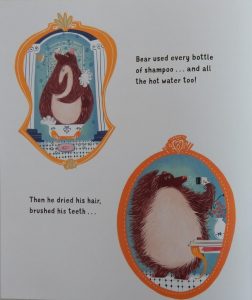
It rains, they feed the ducks and then the infant bids farewell to a bird and the park. That’s it; but with its squidgy fabric pages, simple, bright, attractive illustrations and brief text, it’s perfect for a first book. The whole thing comes in a presentation box and there’s a velcro strap to attach the book to a buggy.
With its soft pages, this would make a super present for a mum and new baby.

So Many Feet
Nichole Mara and Alexander Vidal
Abrams Appleseed
HIGH FEET, SLOW FEET; FAST FEET: SNOW FEET; DANCING FEET, HANGING FEET – these are just some of the many different kinds to be found in this largish board book that introduces toddlers to the diverse forms and functions of animal feet be they toed, clawed, webbed, sticky, hoofed, padded or other. Each animal’s feet are adapted for its life style whether it’s  mountain climbing, slow plodding, jumping, swimming, digging,

or perhaps, wall scaling.
Interesting, informative and alluringly illustrated, and with its final spread, which concludes with a parting question, ‘What can YOUR FEET do?’ an open invitation for youngsters to try some experimental movements with their own feet. In fact, nursery practitioners might make it the starting point for some playful group movement activities.

123
ABC

Nosy Crow
Nosy Crow has embarked on a new collaboration with The British Museum and these two board books are some of the first of a new joint non-fiction list.
Each one contains photographic images of objects found in the museum and thus give very young learners an opportunity to see and celebrate some of the wonderfully rich cultural collections while at the same time re-enforcing alphabetic and numerical concepts.
I randomly opened 123 at the first spread and was surprised to see a pair of what look like almost identical Indian shoes to a pair I have that I bought in Rajasthan, India a few years back, and where there are a fair number of makers/sellers of these jooties or mojaris as they are called. Those illustrated here are given in the index as ‘shoes: date unknown’ so I have no idea how old they might be, but it just shows how certain things remain almost unchanged over time.
In fact the whole book starting with 1 llama (a gold figure from Peru); and ending with 20 coins, is full of fascinating objects to look at and talk about.

There is a mix of photos of illustrations (paintings, etching, drawing) and 3D objects including drums, bowls, kites, beads, bags and spoons from the collection.
A similar mix of illustration and 3D items graces the pages of ABC. This spread shows a Japanese woodblock print of a snail, a porcelain teapot from the UK and an ivory figure from Sri Lanka.

Think of the rich vocabulary you might help your child develop by focussing on any of the objects shown: there’s certainly no talking down to toddlers here.
In addition to the index each book has, there is a QR code that if scanned on a smart phone supplies further information about the objects depicted. So, share these exciting little books and then if possible pay a visit to the British Museum and try to find the objects on display there.

I’ve signed the charter  

Our Kid

Our Kid
Tony Ross
Andersen Press
What an intolerant teacher ‘Our Kid’ has, responding to his lateness by sending him to the ‘Naughty Corner.’ (I have strong feelings about naughty corners/steps but won’t pursue the topic here). The Kid has an enormously fertile imagination and so, following his dad’s “Go straightly to school, Our Kid. Don’t be late again.” he tells how he took the shortcut along the beach, which led to hoof dunkling,

an encounter with a dinosaur pirate-chasing submarine driven by fish …

which resulted in the loss of his homework-containing schoolbag and trousers; followed by a rendezvous with an enormously helpful elephant who eventually dropped him at the school before he ‘kerlumped’ off: hence the kid’s tardy arrival.
However, just as the errant pupil has finished his tale and been admonished for his making up of “total and utter nonsense” the classroom tenor takes a sudden unexpected turn. The school, after a considerable degree of turbulence, is invaded by three creatures asking for “Our Kid” and proffering some objects …

To relate what ensues thereafter would spoil this fantastic story so let’s just say, the teacher has something of a change of heart, which leaves our protagonist bounding home joyfully after a thoroughly uneventful day at school. Did I say at the start Our Kid has an enormously fertile imagination? Actually, I may have been just a teensy bit wrong on that score.
This cracking tale put me in mind somewhat, of Cali and Chaud’s A Funny Thing Happened on the Way to School but its manner of telling is completely different. Ross’s off-beat use of language is both inspired and playful: I absolutely loved ‘shoffled’ ‘bumpeeded’ ‘felumpingly’, ‘boomdered’ and ‘glumbtious’ to mention just some of the wonderful words he sprinkles throughout the kid’s saga. Equally brilliant are each and every one of his watercolours. The expression of utter joie-de-vivre the narrator shows as he dunkles his hooves in the seawater; the way he clambers up the elephant’s trunk to reach the howdah on its back;

and the nonchalance of the teacher as he hands back Our Kid’s unread homework are beyond brilliant; which in fact, applies to the whole book.

I’ve signed the charter  

When We Go Camping/ Skyfishing


Who is the narrator of this lively celebration of family camping? Could it be one of the children? A parent? Or perhaps, the eponymous dog that gets into each and every scene? I doubt it’s one of the grandparents; all they seem to do is sit around or participate in some form of spectator sport, with the odd pause for a spot of insect swatting on occasion.
Meanwhile, other family members make friends, play, cook, fish, swim, shiver thereafter: beg your pardon Gramps: there you are boiling up the billy can for a warm-up drink for the chilly swimmers.

Naturally taking a pee involves a bit of inconvenience and perhaps it might be advisable to take a clothes peg along.

Perhaps the highlight of the day is a spot of ‘Hummetty strummetty squeak-io’ singing around the fire before finally repairing to the tent for some dream-filled slumbers.
Sally Sutton’s rhythmic, rhyming narrative is irresistible, especially so those playful refrains that accompany every scenario so beautifully portrayed in Cat Chapman’s watercolours: there’s a ‘Smacketty tappetty bopp-io‘; a ‘Zippetty zappetty flopp-io’ and a ‘Snuffletty wuffletty roar-io’ to name a few: I’ll leave readers to guess what actions they orchestrate.
My memories of camping are of endeavouring to bash pegs into sloping, rock-hard ground, lumpy porridge and noisy sleep-intruding voices in the night. This book in contrast makes the whole experience – well maybe not the loo visits or the odd trip-up – a pleasure, full of simple, fun-filled delight.
Skyfishing
Gideon Sterer and Poly Bernatene
Abrams Books for Young Readers
The young girl narrator’s grandfather loves to fish; so when he moves from his rural idyll to live in the big city with his family, he greatly misses his passion. The child is determined to find a way to engage him, but through autumn and winter, nothing catches his interest.
Come spring, the girl has an inspiration: she initiates a game of ‘let’s pretend’ fishing over the balcony edge and …

The possibilities escalate until they cast their lines deep into the rumbling tumbling ‘ocean’ below: an ocean full of wonderful adventures to last for months and months …

As the narrative unfolds, Bernatene’s vibrant, whimsical paintings show the chaotic city transformed into an ocean teeming with amazing sea creatures.
A warm-hearted story of the special relationship between the young and old, and the power of the imagination.

I’ve signed the charter  

Mouse’s Big Day / All Birds Have Anxiety / Mouse and the Storm

Mouse’s Big Day
Lydia Monks
Macmillan Children’s Books
Mouse is going to school for the very first time and even before leaving home, she’s decided it’s not for her. Her dawdling tactics don’t work, nor does her “I don’t want to” response to all Mummy mouse’s encouraging remarks; finally she’s left at Twit Twoo School in the safe hands of teacher, Miss Hoot.

She has an exciting project for her class: “… go out and find something. Something special. Maybe something only you can find.
Mouse reluctantly joins her classmates all of whom thoroughly enjoy rummaging, upturning rocks, digging and pond peering, although she’s too shy to be anything but an onlooker. While the others are busy contemplating their findings …

Mouse vanishes. Miss Hoot knows just where to look for her though, and eventually a kindly paw proffered by Mole encourages Mouse to emerge from her hiding place and follow the others back indoors.
There she makes a series of discoveries that ultimately lead her to a very important realisation. School is an exciting place after all and she cannot wait for tomorrow.
Populated by adorable animal characters, Mouse’s school is an inviting place and Lydia Monks’ heart-warming story of her first day gets right to the heart of how the less outgoing among 4 year olds are likely to feel on their ‘Big Day’. This is just right to share with a nursery and preschool groups, or individuals, in the lead up to starting school.
Further reassurance about coping with tricky situations comes in:

All Birds Have Anxiety
Kathy Hoopman
Jessica Kingsley Publishers
Statistics show that more and more children have anxiety problems, often starting at a young age. I’ve talked about educational issues that I feel are to a large degree responsible in other reviews so will just say that here is a photographic picture book that will help children of all ages better understand the condition.
By populating it with birds of all kinds with appealing faces,

and in amusing poses,

the author gives a serious topic just the right degree of lightness and gentle humour.
Anxiety in all its forms is discussed including how stress can effect everyday activities – ‘Everyday jobs, like combing hair, changing clothes or making decisions are too much to think about ’; its possible causes – ‘it often runs in families’; how to deal with it: ‘Being with those who listen to us and accept us makes a world of difference.’ and ‘Exercise, plenty of sunshine and a healthy diet are all a huge help.’ for instance.
Unthreatening, fun and enormously helpful for children of all ages, whether they suffer from anxiety or just want to understand it better in others.
For educators and those they have dealings with, be that in school, at home or in another setting.
Anxiety prone youngsters will benefit from some therapeutic reflexology as in:

Mouse and the Storm
Susan Quayle, illustrated by Melissa Muldoon
Singing Dragon
Reflexologist, complementary therapist and developer of The Children’s Reflexology Programme follows The Mouse’s House with a third story intended, this time for reflexology on a child’s hands.
Using Mouse and the five other animal characters to represent reflex areas of the hand, Quayle weaves a charming rhyming story to accompany the sessions of hand reflexology. It’s especially designed for use with young children, in particular those who have anxieties be they associated with ASD, new experiences, or another condition where calming treatments are required.
With hand instructions at the top of each left hand page and a charmingly quirky illustration on the right, adults can read the story of what happens when the animals awake to discover a storm scattered them far from the comfort of their own homes

while applying the gentle movements to the young recipient’s hands.
Since no prior reflexology experience is needed, this is a book for any parent of an anxious young child to add to the family bookshelf.

I’ve signed the charter  

A Walk in the Forest

A Walk in the Forest
Maria Dek
Princeton Architectural Press
In the forest, wonders await’. Thus begins what feels like a truly heartfelt advocacy of the joys to be discovered by taking up the author’s invitation to leave behind the civilised world and join the child narrator in an exploration of a magical place. What actually happens is that readers, immediately engaged, find themselves standing behind the boy’s head, or even in his shoes, as he becomes ensphered by the greens and browns of a jungly canopy; drags a stick behind him, chases dragonflies and goes down on his knees to observe some things he’s found (vignettes show these); runs wild amid brightly coloured birds and tree-coiling snakes.

Then gives full throttle to his vocal chords: and who can ignore the pull to ‘Follow footprints. See where they lead you.’ and even more important, ‘Look! Find treasure.’ Here Dek focuses our attention on the textures and shapes of those treasures – flowers, feathers, fir cones, stones and the tail of a lizard.

The contrasts are stark: ‘All is small in the forest. All is big. And deep.’ Who can resist the unspoken invitation to shed footwear and ‘Wade in’ feeling the cool of the pond and the tickle of those water plants and fishes?
Secrets surround: birds have them; trees have them – if you listen; and patience might result in an encounter with a fox
and perhaps one of the many forest burrowing animals that tend to keep themselves out of sight.
A treasure of a book; and with its constantly shifting perspectives …

an eloquent, visual and verbal evocation of nature: especially, it’s one to visit whenever you’re feeling a bit down. It will surely help lift your spirits and after re-reading, send you out in search of a wooded place where further joys await.
Dek’s watercolours do the flora and fauna of the natural world proud with her lush scenes and surprise, sometimes stunningly stark, discoveries.
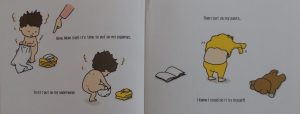
Like those of Frost, her ‘woods are lovely, dark and deep’. But I too have promises to keep and so reluctantly, must leave the meditational peace and tranquillity of this debut children’s book creator’s verdant world and just say, you need this picture book gem; everybody does.

I’e signed the charter 

Six Blind Mice and An Elephant

Six Blind Mice and an Elephant
Jude Daly
Otter-Barry Books
So often in my teaching career have I used Six Blind Men and an Elephant that despite having the book beside me, I instinctively mistyped the title of Jude Daly’s rendition of the Indian fable at the start of this review.
Daly sets her story somewhere in rural South Africa and begins with a somewhat sleepy elephant wandering from its forest habitat into a farmer’s barn and there falling fast asleep in the straw. On discovering it and excited by his find, the farmer rounds up his family and neighbours to view the creature and its wonders.

Meanwhile six blind mice nesting in a tree nearby are aroused from their slumbers by a strange aroma. Eager to discover the source of this new sensation, they follow their noses, encounter a cat and take refuge in a hole where they hear the humans chatting about the visitor asleep in the farmer’s barn. Search over they decide, and once the crowd has dispersed off they go to the barn.
Suddenly “Ouch!” that’s the oldest mouse coming up rather hard against the elephant’s side and declaring the beast to be “like a – wall”.

The second mouse disagrees likening the animal to a spear as she almost nose dives from the end of a tusk. And so it goes on with the other four mice giving their opinions based on partial evidence until as the youngest completes its simile, the somnolent pachyderm gives a flap of its enormous ears and expostulates so loudly that the rodents run for cover. The elephant then delivers a piece-by-piece description of himself (love those palm fan-like ears)

before finally, likening himself to … (readers aloud might want to pause at that point and give listeners an opportunity to complete the sentence) and crashing out once more exhausted by laughter.
Exit six fully satisfied mice …
Daly’s playful take on the fable still leaves plenty of food for thought and is perfect for a community of enquiry style discussion with early years or primary children.
Glowing African light radiates from every one of her illustrations; the golden straw-strewn barn floor is for me, reminiscent of some of the fractured swirls of Hockney’s pool painting.

I’ve signed the charter  

Rockabye Pirate / The Tooth Fairy’s Royal Visit

Rockabye Pirate
Timothy Knapman and Ada Grey
Bloomsbury Children’s Books
Don’t expect loud shouts of ‘Avast me ‘arties’ and similar in this pirate tale; far from it, for Knapman’s text is a lilting, under the covers-luring, lullaby for mummy pirates or daddies for that matter, to share with their pirate offspring at bedtime.
Yes, it’s full of freebooters, the likes of Black Bearded Brewster, Sea Dog McPhail and Freddy the Fright, but they’re not doing the wicked deeds upon the seas, rather they’re performing their ablutions

albeit with some maternal assistance in preparation for the most important part of their daily ritual …

After all, their day has been packed with mischief and mayhem, so now it’s time for some tucked-up-cosily-under-the-duvet dreams. I wonder what those might feature …

Ada Grey’s piratical characters, far from alarming, are portrayed as an endearing bunch of marauders as befits the inhabitants of a gentle bedtime story. Having said ‘bedtime’, this fun picture book could equally be shared with an early years group especially if they’re engaged in a pirate theme.

The Tooth Fairy’s Royal Visit
Peter Bently and Gerry Parsons
Hodder Children’s Books
The Tooth Fairy returns for another adventure, this time responding to a missive from Her Majesty the Queen informing of the loss of her great grandson’s first tooth. Come nightfall, the little fairy is palace bound but has a few obstacles in her path

before she finds a way in.
Once inside there are still further hazards – corgis, a cloth-wielding maid and some undies …

Finding the little prince’s bedroom is none too easy and the Tooth Fairy finds herself assisting in another ‘toothy’ search before receiving assistance for her troubles.

Will she ever make that all-important coin/tooth exchange and get home for some shut-eye?
Bently’s rhyming text is full of read-aloud fun with some unexpected encounters and, some expected ones: the corgis seem to find their way into every Royals’ picture book as do members of the Queen’s Guard. Garry Parsons’ exuberant illustrations provide gigglesome details at every turn of the page. All in all, a right royal chuckle.

I’ve signed the charter  

Ella Queen of Jazz / The School of Music

Ella Queen of Jazz
Helen Hancocks
Frances Lincoln Children’s Books
A super-stylish biographical story of the friendship between two iconic women: Ella Fitzgerald and Marilyn Monroe. It tells how rising star, Ella and her ‘Fellas’ experienced racial prejudice on the part of some club owners.

This treatment dented her confidence, but only temporarily, thanks to the magic of her music and the intervention of one very special woman who secretly used her powers of persuasion to get Ella an invitation to perform at the ‘biggest joint in town’, (The Mocambo,) the very same nightclub that had turned her away before.
And so it was that, just as her secret friend had predicted, Ella Fitzgerald became a huge hit with the audience

and subsequent shows drew in enormous, enthusiastic crowds for every performance, in part thanks to Marilyn Monroe’s presence. Like all good things though, this show had to come to an end; but Ella’s sadness was more than compensated for by the lasting friendship between herself and Marilyn .

Thanks to Marilyn too, Ella became a great film singer and even sang for the US president, eventually earning the name of ‘First Lady of Song – the Queen of Jazz’ and winning thirteen Grammys and many other awards.
Enormously empowering and pitch perfect for KS1 readers is this slice of 1950’s Hollywood razzle-dazzle.

Jazz is just one of the many music genres featured in another stylish presentation:

The School of Music
Meurig & Rachel Bowen and Daniel Frost
Wide Eyed Editions
Readers are invited to enrol in the School of Music for a course of 40 lessons, presented over three terms. First we meet ‘The Boss’ aka Sergio Trunk aka, The Maestro, convincingly putting the case for having music in your life and explaining his role as Head of School. Next we meet other faculty members, six talented professors including the percussionist, Roxy Moto …

Now let lessons commence:
During the first term, there’s an introduction to a variety of musical instruments and a wide range of music.
Term two comprises a look at the essentials of melody, harmony, pitch and rhythm; and musical notation is explained in terms understandable to anyone, even those without any musical knowledge.

Students who make it through to Term 3 – and one hopes that’s everyone (no exams here), the final nine lessons encompass ways to enjoy the practical aspects of music. There’s a lesson on making music at home, another on singing and its benefits, and a brief consideration of which instrument to learn. Then comes the nitty gritty ‘Why do we have to practise?, followed by helpful ideas for combatting nerves and more. Many of the lessons have a practical activity for additional enrichment and enjoyment. There is even a QR code at the back of the book with which to stream  samples  of music to your phone or tablet.
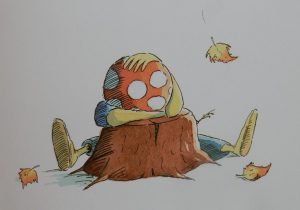
I learned more from reading this, than I did during all my music lessons at grammar school (albeit only taken for the first four years and during which I spent a lot of time mucking around as the teacher was so boring). Meuirig and Rachel Bowen are infinitely better teachers and their lessons are made more accessible and further enlivened through Daniel Frost’s witty, contemporary illustrations.
Thoroughly recommended for KS2 readers at home or school.

I’ve signed the charter 

My Hand to Hold / How Do I Love You?

My Hand to Hold
Smriti Prasadam-Halls and Alison Friend
Hodder Children’s Books
Love shines through no matter what, is the message in this sweet rhyming book.
Through the seasons and through the highs and lows of everyday life, we follow an adult and infant as they interact with each other;

with the natural world they inhabit and occasionally, with others …

Smriti’s heartfelt verbal evocation of unconditional love is made all the more enchanting by Alison Friend’s pastel and watercolour illustrations.

I think this is their first picture book collaboration; it’s certainly a harmonious one.

How Do I Love You?
Marion Dane Bauer and Caroline Jayne Church
Hodder Children’s Books
Using the well-known line from Elizabeth Barrett Browning as a starting point, Bauer uses comparisons with aspects of the natural world to show that parental love is ever present. ‘I love you as the thirsty duck loves a sudden shower.

Or, ‘I love you as the waking bear loves the smell of spring.
The small girl, the only human shown throughout, is clearly the centre of a parent’s world; this also suggests an ‘at oneness’ of child and nature no matter the landscape she happens to be in.

Caroline Church’s mixed media style collages have a pleasing texture: the duck’s wings bear a floral pattern, the bear’s fur has a hatched appearance not unlike parquet flooring; the cat’s fur is gently brushed with a darker shade contrasting beautifully with the child’s madly wavy tangled tresses.
The final spread fuses present and future with ‘And as our friendly Earth/ loves to spin around. / I love you as the moon / loves each shining star. // I love all that you will be / and everything you are.’ So be it.
An enchanting interplay of words and pictures for adult and child to savour together.

I’ve signed the charter