Look Out, It’s a Dragon!

Look Out, It’s a Dragon!
Jonny Lambert
Little Tiger Press

It’s always a pleasure to open a package and discover a new Jonny Lambert picture book. This, his latest, is something of a departure in that it stars a mythical, rather than a ‘real’ animal although there are plenty of the latter herein too.

Without further ado let me introduce Saffi. She’s an atypical dragon who isn’t interested in capturing princesses, nor in crushing castles, and she’s had quite enough of bottom-bruising rocky mountains. So off she flies in search of a more hospitable environment in which to live.

That is just what she thinks she’s found when she lands rather ungracefully in a sunny woodland. The forest animals however, think otherwise and start fleeing for their lives.

Suddenly Saffi hears a squeaky “Oi! Knobbly knickers! You can’t stay here!” from behind her. It’s Mouse expressing an opinion held by all the forest inhabitants on account of her fiery dragon nature. The dragon does her best to persuade the little creature otherwise and has almost won him over when disaster strikes in the form of a twitchy nose that ends in a very forceful sneeze that scares Mouse …
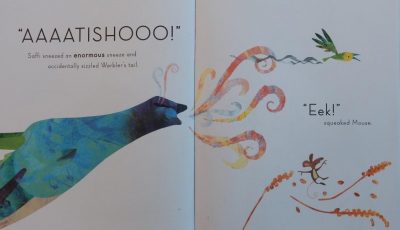
and damages Warbler’s plumage.

Saffi sets off in pursuit only wreaking more havoc …

until the animals have had enough and the poor well-intentioned dragon is sent packing in no uncertain terms.

Later though, something happens that puts the forest animals and their habitat in real peril.

Who can save them now?

A drama that embodies themes of prejudice, friendship, the dangers of stereotyping and bravery.

Gentle humour pervades the dragon-dominated, mixed media illustrations although even the very tiny participants make their presence felt strongly in the unfolding drama. As always in Lambert’s books, body language is superbly done throughout.

Your heart really does go out to Saffi in her attempts to find a new home so you will be happy to learn that there’s a dragon template that can be used for children to create their very own Saffi character. I’d suggest making a whole diorama and suspending the dragon somewhere therein.

I’ve signed the charter  

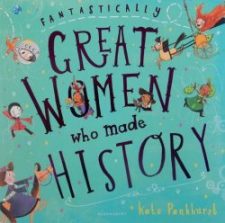
Fantastically Great Women Who Made History

Fantastically Great Women Who Made History
Kate Pankhurst
Bloomsbury Children’s Books

Perhaps 2018 is going to be the year of women. So often children are presented with books about what men have achieved in the past; now it’s time to redress the balance and hear it for the women.

Kate Pankhurst celebrates fourteen, managing to provide a great deal of information about them in this slim volume.

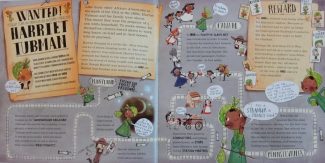
We start with Harriet Tubman whose double spread features a plethora of ‘Wanted’ posters displayed around the ‘Underground Railroad’ tracks. This, like all the other spreads, is illustrated with a wealth of delightfully humorous details.

Next come warrior queen, Boudicca, followed by Flora Drummond the Manchester suffragette who joined and became a leading light in the Women’s Social and Political Union (SPU). Not only did she breach Downing Street security, but also led Scotland’s first march in the name of women’s rights.

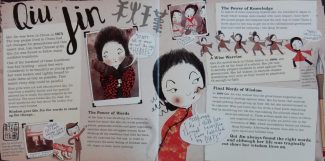
There’s Qiu Jin, who during her short life, campaigned against the tradition of foot binding in China and wrote powerful poems and articles that continue to inspire today.

Also fighting injustice was Sayyida al-Hurra who came from a Muslim family living in 15th century Granada. They were forced by Spanish rulers to flee to Morocco where she married a sultan and after his death became allies with the fearsome pirate Barbarossa of Algiers. In her determination to get her own back on Spain, Sayyida’s rule as pirate queen lasted more than three decades.

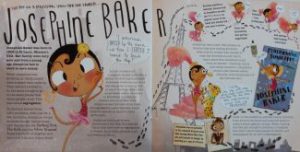
Others included are Noor Inayat Khan, the first WW2 female radio operator in Nazi-occupied France whose codename. Madeleine, was taken from a character in the book of traditional Indian children’s stories she wrote; Dr Elizabeth Blackwell, the first woman ever to gain a degree in medicine; Pocahontas; Valentina Tereshkova, the first woman in space; Ada Lovelace who made a great contribution to computer science; Josephine Baker, the amazing dancer who fought against segregation,

and writers Mary Wollstonecraft and her daughter, Mary Shelley of Frankenstein fame.

Kate Pankhurst does all these women proud.

The book concludes with a “Bookshelf of Brilliance’ and a ‘Great Words’ glossary.
In a word, it’s inspirational; in another, uplifting; in a few more – every primary classroom should have a copy and every child should read this.

I’ve signed the charter 
Read the Book, Lemmings!

Read the Book, Lemmings!
Ame Dyckman and Zachariah OHora
Andersen Press

Having seen it in the catalogue, I eagerly awaited the arrival of a copy of this latest comedic offering from Dyckman and OHora, creators of the wonderful Wolfie the Bunny and Horrible Bear! It more than lives up to its promise.

The book features three lemmings of the particularly impressionable kind, a whale that doubles up as a container ship, S.S.Cliff , its polar bear captain, PB by name, and first mate Foxy.
The story actually starts on the front endpaper where a sign floating on an iceberg informs, ‘ lemmings: small fuzzy, illiterate rodents who share the icy North with arctic foxes and polar bears. People used to think lemmings jumped off cliffs. Now we know they don’t.’

Close to the iceberg is a cliff and guess what: a lemming jumps proclaiming at the same time “Wonder what that says.” “Me too,” replies a second lemming. “Ditto!” says a third.
The trio lands up aboard S.S. Cliff whereon Foxy has just settled down with his book entitled ‘Everything About Lemmings’. “Huh!” he announces, “Says here, lemmings don’t jump off cliffs.” The lemmings hear just a single word: a four-lettered one beginning with j and …

Foxy requests the use of PB’s bucket and fishes the creatures out, bestowing upon them hats and names – Jumper, Me Too and Ditto, and urging them to “Read the book,” before settling down once more with said text.

A few further foolhardy leaps follow, each one increasingly reckless … “Sinking! Sinking fast!” / “Me too!” / “Glub!

until Foxy’s “WHY didn’t you read the book, lemmings?!” finally gets to the crux of the matter: the lemmings can’t read.

Time for some reading lessons …

After which, er that’s for you to discover when you ‘Read the book!’ (And, be sure to check out the final endpapers.)

Ame Dykman’s brilliantly mischievous text is an absolute treat for readers aloud and listeners alike; and the deadpan humour of OHora’s illustrations with their fun details and supremely expressive faces and body language, is the perfect counterpart for this madcap romp. I love the colour palette.

If this isn’t a superb demonstration of the importance and delights of reading, then one reviewer at least will jump off the nearest cliff.

Spyder

Spyder
Matt Carr
Scholastic Children’s Books

Meet Spyder, reputedly the world’s smallest secret agent and penthouse flat resident at No. 7 Fleming Road wherein a special birthday is about to be celebrated.

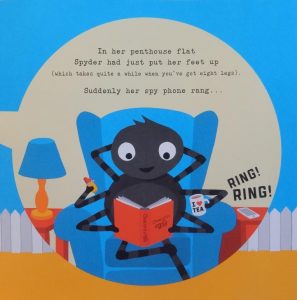
Suddenly, as the agent has just settled down for a spot of reading she receives an urgent call from HQ.

Instantly, or almost so – it takes a little time to get those feet readjusted to work mode, and then to pack her spy-kit – she’s off on a mission to save Tom’s birthday cake from a disastrous attack by a dastardly buzzing insect going under the code name of Bluebottle.

It’s a hazardous chase with some pretty perilous moments. Not least this one …

There follow, clever moves on the part of Bluebottle, some wily thinking from Spyder and the occasional moment of fun for the agent;

but will it be enough to save the day and the cake?

And who actually gets the last laugh?

All this and more in a totally daft tale that’s a wonderful follow up to Matt’s debut Superbat.

There are some groan worthy puns, plenty of action of the comical kind, some splendidly silly speech bubbles, a show-stopping colour palette and endpapers packed with spy stuff. Another cracking read aloud from Carr who even adds a strategically placed word (or several) on the back cover warning about the folly of trying any of Spyder’s stunts – they’re for trained professionals only.

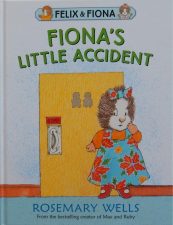
Fiona’s Little Accident

Fiona’s Little Accident
Rosemary Wells
Walker Books

Years ago I was enchanted by Rosemary Wells’ Max and Ruby: more recently she has introduced another equally enchanting pair of characters, Fiona and her much quieter friend, Felix.

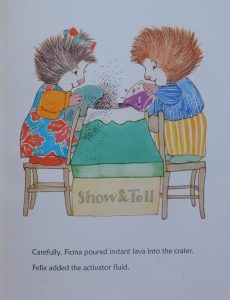
The guinea pig friends are eagerly anticipating demonstrating their volcano in show and tell. Fiona is so excited that she doesn’t go to the loo before leaving for school; nor does she visit the bathroom before going into class.

Show and tell begins and Fiona starts feeling rather desperate but now the bathroom is occupied. Fiona hears their turn being announced. She dashes back and she and Felix start the demonstration.

Suddenly disaster strikes. Fiona cannot hold on any longer: in full view of the class she wets herself. ‘Fiona knew everyone saw. She wanted never, ever to be seen again.’

Her teacher quickly deals with Fiona’s discomposure …

and Felix reassures her that everyone has accidents, even royalty and that within fifty seconds the whole thing will be forgotten.

Wells presents this embarrassing scenario with an empathetic understanding that must surely help children see that accidents such as Fiona’s are quickly forgotten, as well as being something pretty much universal.

One to include in KS1 classroom collections methinks.

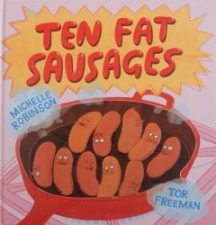
Ten Fat Sausages

Ten Fat Sausages
Michelle Robinson and Tor Freeman
Andersen Press

Come into the kitchen. There a delicious drama is about to unfold.

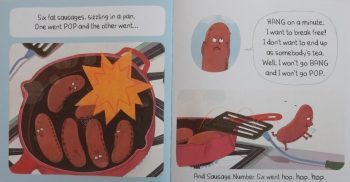
Atop the cooker, sizzling in a frying pan sit the ten fat sausages of the title.

All of a sudden one explodes with a ‘POP’ and another, alarmed at the event vows not to meet the same fate, and hops out and across the worktop. At first all is ticketty boo but then disaster strikes …

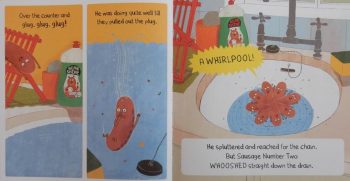
On goes the rhyming tale with the total of sausages rapidly diminishing two by two thanks to some reckless testing of a liquidiser switch, a flying leap onto a ceiling fan, an encounter with the resident moggy who proves to be in hungry mood,

and some foolhardy cavorting that leads the final succulent pair, (with high hopes of their escape plan,)

into a hiding place within “a squishy thing.”

Michelle Robinson’s yummy story based on the much-loved counting down rhyme is sure to become a firm favourite with early years listeners. The irresistible join-in-ability of the text with its oft repeated “HANG on a minute! … Well, I won’t go BANG and I won’t go POP.” and ‘And Sausage Number Two, (Four,Six or Eight) went hop. hop, hop.’ will ensure a supremely noisy story session wherever this is shared with young audiences.

Tor Freeman’s visuals of the whole sorry saga are a visual treat: how she managed to impart such deliciously gigglesome expressions on those bangers is a wonder in itself: every spread is a flavourful slice of comedy.

It certainly had me in fits of giggles; but then, I’m a vegetarian.

Young, Gifted and Black

Young, Gifted and Black
Jamia Wilson and Andrea Pippins
Wide Eyed Editions

All children deserve to see themselves represented positively in stories. That’s why we’re highlighting the talent and contributions of black change-makers from around the world – for readers of all backgrounds to discover.’ So say the creators of this splendid book in their introduction.
It’s a sterling objective and one that is achieved with panache.

The title itself comes from Nina Simone’s song, ‘To Be Young, Gifted and Black’ and the book features 52 iconic activists, politicians, film directors, actors, entrepreneurs, athletes and other sporting legends,

writers, artists, scientists, singers, musicians and more from around the world.

Jamia Wilson introduces each one with a short biography that encompasses details about their birth (and death if relevant), their accomplishments and achievements, and includes a powerful quotation. Here are a few:
Reading is an exercise in empathy, an exercise in walking in someone else’s shoes for a while.’ (Malorie Blackman);
Children will live in a nation where they will not be judged by the colour of their skin, but the content of their character.’ Martin Luther King, Jr.
If they don’t give you a seat at the table, bring a folding chair.’ Shirley Chisholm;
It’s the little things citizens do. That’s what will make the difference. My little thing is planting trees.’ Wangari Maathai.
It always seems impossible until it’s done.’ Nelson Mandela.

The order of presentation is seemingly random and the majority of those featured are from the 20th century although there are also some earlier icons such as Mary Seacole and Alexandre Dumas.

Andrea Pippin’s illustrations are rendered predominantly in shades of pink, green, yellow, red and each double spread has a pleasing unifying design and colour palette.

This is a fine tribute to the black changemakers included, an inspiring read for youngsters and a must have book for Black History Month.

I’ve signed the charter  
Chalk Eagle

Chalk Eagle
Nazli Tahvili
Tiny Owl

The power of the imagination is crucial for so many reasons. I’ve spoken and written about its importance in education in many places and on numerous occasions, including from time to time, on this blog. Sadly however, the education policy writers in our government seem not to place much value upon it.

However, one never gives up on something so vital and it is wonderful to have Tiny Owl’s on-going championing of wordless books as one means of promoting the education of the imagination. Equally it was exciting to hear on a recent The Life Scientific programme, a woman mathematician, Eugenia Cheng, speaking about the importance of the imagination in maths.

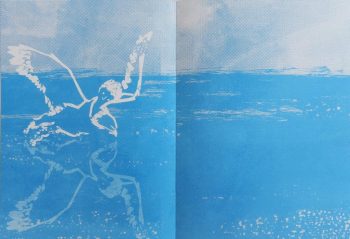
This wordless picture book by Iranian artist Nazli Tahvili is the perfect vehicle to get the imagination soaring and for me the eagle in flight is a wonderful symbol of creativity unleashed.
A rooftop vantage point is just the place to broaden one’s horizons and make free with chalk on tiles, which is what the young protagonist does herein having watched an eagle flying overhead.

Boy and eagle join forces

and soar over town and country, sea and mountain in his imagination and in Nazli Tahvili’s screen-print illustrations.

The colours she has used are, so we’re told, influenced by the blue skies, and green rice fields that surround her northern Iranian home.

A book to open up and let your mind go free with child and eagle: in particular, I’d like to give it to a group of teachers or teachers in training and see where their discussions/imaginations fly.

Animals with Tiny Cat / 15 things NOT to do with a Puppy

Animals with Tiny Cat
Viviane Schwarz
Walker Books

Viviane Schwarz’a Tiny Cat of There Are Cats in This Book and There Are No Cats in This Book fame is back and as always, is in a playful mood.

With the aid of a few simple props, our feline friend transforms first into a mouse, then an elephant, followed by a …

a horse, a porcupine …

a snake and a spider.

Suddenly though, the pile of discarded items takes on a life of its own …

Is there anything Tiny Cat can become that will send that fearsome beastie packing? …

Viviane Schawarz’s wonderfully playful imagination has, once again, produced a seemingly effortless performance for her moggy star.

Be ready for enthusiastic squeaking, tooting, neighing, hissing and more when you share this one.
Then, I’d suggest leaving the book in a suitable spot in your early years setting together with a few well-chosen items and see what your listeners turn themselves into.

15 things NOT to do with a Puppy
Margaret McAllister and Holly Sterling
Frances Lincoln Children’s Books

This is the latest in Margaret McAllister and Holly Sterling’s instruction manual series. Herein the topic is canine care and the two toddler presenters pretty much have the whole thing worked out. Presumably they speak from experience and if you’ve recently added a puppy to your household, then this book has some sound advice.

Hang-gliding, tuba lessons (as if), and getting its paws on the remote control are definite no-nos. So too are taking the pup to some of the children’s favourite places; and gardening is completely out of the question.

Football matches and the library are also definite no-go areas and for safety’s sake keep the animal from the driving seat of the car …

and well away from the sink too. Cafes are off limits as are shopping expeditions.

On the other hand, the dos are relatively straightforward: in a nutshell, love, play, food, drink and sleep work wonders.

The main characters, both human and canine are full of youthful exuberance as are the humorous possibilities of the scenarios presented in Holly Sterling’s illustrations of same.

I’ve singed the charter  

Beyond the Fence

Beyond the Fence
Maria Gulemetova
Child’s Play

Thomas and Piggy live together in a large country house. Thomas always takes the lead when it comes to decision making, no matter what ‘He just knew.’

When Thomas’s cousin visits, the boy is preoccupied with her and that’s when Piggy decides to venture outside the confines of the house.

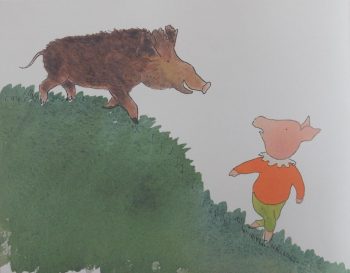
On his walk he encounters Wild Pig.

Wild Pig asks Piggy some thought-provoking questions about his way of life and Piggy returns home.

Thereafter he makes frequent visits to the great outdoors in the hope of seeing his new friend but he never appears.

One evening however, there he is full of apologies and an explanation. He invites Piggy to accompany him into the forest. Piggy declines on account of it being out of bounds although he promises to meet with Wild Pig the following evening.

Thomas’s cousin goes home the next day and the boy is surprised and scornful when he discovers that Piggy has chosen his own way of playing …

Not for long though, for Thomas soon has the upper hand (or trotter) once again.

Will Piggy ever make that decisive break for true freedom? I wonder …

Watch young children playing. There are lots of Thomases but happily there are also plenty of Piggys and that’s what makes life so fascinating.

Maria Gulemetova’s picture book is softly spoken but embodies strong messages about being your own person, standing up for yourself, and what true friendship really means. Her watercolour illustrations (which put me in mind somewhat of the work of Ron Brooks) echo the sparseness of her text and that is what makes the impact of the whole so strong.
It’s a lovely one to share and discuss with people of all ages.

My Green Day

My Green Day
Melanie Walsh
Walker Books

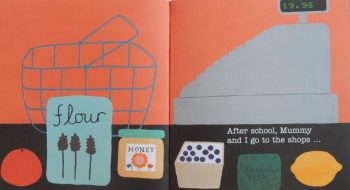
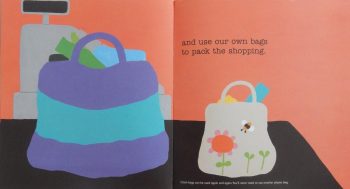
The messages contained in this book are as relevant today as when it was first published in 2010. Yes, almost all of us use our own bags when we go shopping …

but the amount of plastic that often goes into our shopping bags still needs to be dealt with. The home baking advocated by the little girl narrator is one way of dealing with that; however, much more needs to be done by the major supermarkets.

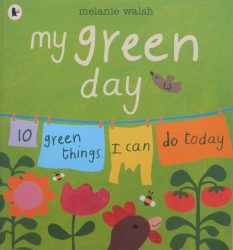
Essentially we share the girl’s day and she talks us through the green things that are her way of helping the environment. Each of her ten green actions is printed in large type and then two or sometimes more double spreads are allocated to illustrating and adding to her narration so for instance we have ‘At lunch … ‘I eat up all my pasta.’ and in small print ‘We throw away one third of all the food we buy. If we bought only the food we actually needed to eat, we wouldn’t have to grow or transport so much food, which saves lots of energy.’ This additional information can be left out if the audience is very young but children are never too young to start thinking about the all important messages herein.

Other suggestions include: adding an extra layer rather than using the central heating, avoiding the use of tumble dryers, composting and re-using materials to make gifts.

Melanie Walsh’s bright collage illustrations, albeit without the die-cuts and cutaway pages, are as fresh and contemporary looking as they were in the original edition.

What Do Animals Do All Day? / Rainforest

What Do Animals Do All Day?
Wendy Hunt and Muti
Wide Eyed Editions

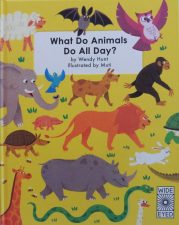
This is a follow-up and in some ways, a companion volume to What Do Grown-ups Do All Day? The author and illustrator take us to fourteen different habitats – every spread has lots to look at – and for each, on the following spread, introduces us to eight residents, every one of which briefs us on its role in that particular ecosystem.

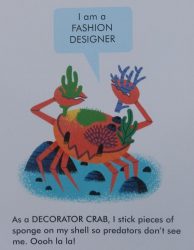
Some of the job descriptions will make young children laugh. The Decorator Crab that resides on coral reefs and sticks pieces of sponge onto its shell as camouflage describes itself as a ‘fashion designer’ …

while the Large-eared Horseshoe Bat calls itself a ‘sound engineer’ since it makes use of sound waves and echoes to locate moths in the dark.

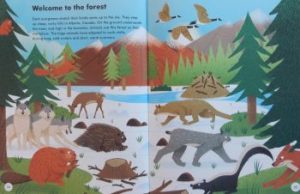
I certainly have no desire to encounter the Striped Skunk, a forest resident that sprays stinky ‘perfume’ lasting several days. and describes its role as ‘perfumier’.
Another forest dweller the North American Porcupine tells readers its an ‘acupuncturist’.

I particularly liked the Death Stalker Scorpion’s description of itself s ‘brain surgeon’s assistant’. (Researchers are using its venom in a cure for brain tumours.)

If you were to visit the wetland reed beds in Somerset you might come across animals who describe themselves as ‘sleigh-rider, ‘aerobatic flyer’, ‘camper’, ‘trapeze artist’, ‘sun-seeker’, ‘submariner’, ‘opera singer’ and ‘synchronised swimmer’. Can you think what their common names might be?

An attractive, somewhat quirky book that provides plenty for children to talk about.

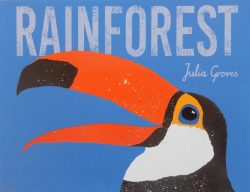
Rainforest
Julia Groves
Child’s Play

The focus here is on the visual, with fifteen animals being featured in Julia Groves’ first picture book. (Sixteen if you count the butterfly on the title page) None is named until the final spread where detailed information about each of them is given in tiny print.

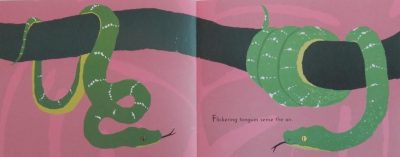
A single line of text accompanies each illustration that evokes the nature of the particular creature, so for instance, ‘Fleeting ripples trace the runner’ accompanies the picture of the Plumed Basilisk Lizard; ‘Slowly stalking, majestic and silent.’ is the Jaguar and …

‘ Flickering tongues sense the air’

The rainforest is, as the book’s blurb tells us, a ‘precious and endangered habitat’; Julia Groves imaginative presentation of some of its inhabitants offers young readers an opportunity to enjoy what most of us will never see in the wild.

The Big Red Rock

The Big Red Rock
Jess Stockham
Child’s Play

The importance of play and collaboration are celebrated in a comical story about the large red rock of the title,
Bif, whose path is blocked by same, and assorted other monsters of various hues and talents.

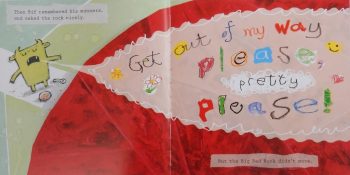
‘Chomp, slurp’ goes Biff as he strolls merrily along consuming the contents of his breakfast bowl. So absorbed in his meal is he that he fails to see the large obstacle in his path until suddenly he can go no further. Shouting at the rock gets him nowhere so Bif tries a polite approach …

but to no avail.

Physical attempts at budging the object such as kicking and bashing it have no effect whatsoever and as Bif ponders his next move along comes Bop. He offers to enlist the help of the Big Red Rock Eater and off he goes to fetch her, wobbly tooth and all.

The lack of a firm bite means that mere nibbles are shifted. Bop though has other pals and each one has a go. Try as they might though, that Big Red Rock stays firm.

Time to play, announces Bif, giving up on rock-shifting attempts; and off they go to have fun until lo and behold, they find themselves on the other side of the rock. Bif has by now worked up an appetite once more.
I wonder where he left that breakfast bowl?

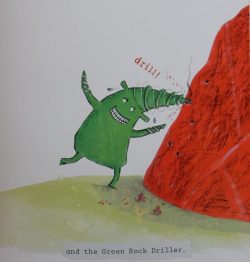
Jess Stockham’s assorted monsters are a willing, if inept crew and the sight of their ineffectual efforts is hilarious; I particularly chortled over that Green Rock Driller;

and the ‘Clanger-like’ Pink Rock Sucker. If you share this book with a class, they could have some fun inventing their own colourful Rock attacking monsters.

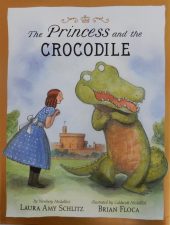
The Princess and the Crocodile

The Princess and the Crocodile
Laura Amy Schlitz and Brian Floca
Walker Books

Cossetted from the start, the ‘perfect’ being that is Princess Cora is then – once the realisation dawns on her doting parents that she’ll one day be the ruler of the land – scheduled for every single minute of her time for fear she won’t measure up to the task.

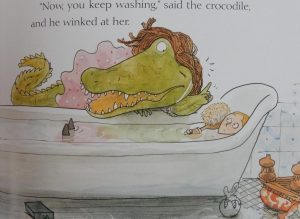
A nanny is hired to ensure she’s always neat and clean – a three baths a day regime is introduced; and when she’s not in the tub, her mother is making her life a misery with deadly dull tomes or her father subjecting her to a gruelling fitness regime.

One night though the girl decides a dog might just make her life bearable but neither her parents nor the nanny are willing to entertain such an idea. In desperation the Princess writes to her fairy godmother and then rips the letter to pieces and tosses them out of the window. Here Schlitz injects a lovely magical touch “because it was a letter to her fairy godmother, every scrap turned into a white butterfly and flew away’.

Perhaps though she isn’t sufficiently specific in her request for the following morning what should be at the foot of her bed but a gift-wrapped crocodile.

The two strike a deal. For a day, in exchange for cream puffs the crocodile will take Cora’s place giving her a day of sheer unadulterated freedom.
First though there’s the issue of a suitable disguise: that comes in the form of a frilly frock and mop wig together with a promise not to eat anyone.

The creature keeps his promise while managing to create utter havoc around the palace with an appropriate degree of ferociousness: dunking in the tub and nips for the nanny,

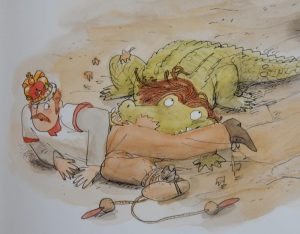
insults and nips for the Queen and lashings, clawings, bitings …

and incarceration for the King, allowing Cora a wonderful day outdoors being thoroughly wild,

getting messy, wet, and even managing to step in a cowpat.

Witty writing and delicate yet energetic, and often very funny illustrations, make for a wonderful read aloud or read alone chapter book. Either way, I imagine a good many listeners or readers wanting to devour this whole riotous neo fairytale in a single sitting.

Enchanting from begin to end. A book that will appeal to those who love princesses, justice, a good giggle and even perhaps, crocodiles. The latter will certainly love the one herein.

While You Are Sleeping

While You Are Sleeping
Mariana Ruiz Johnson
Chronicle Books

Words there are none, but this picture book is absolutely brimming over with stories.

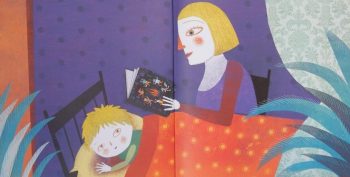
We start with a view through a window of a mother reading a goodnight story to her child …

then on the next spread, tiptoeing out of the bedroom as the youngster falls asleep.

The view widens as we see both inside the house, and outside in the urban setting where fantasy and realism mix. Under a starry sky what appear to be animal characters from the storybook cavort, while in their homes people eat, chat, cook and embrace. We see a nurse and patients in a hospital, an artist working at an easel, someone with a telescope and more.

The lens widens still further revealing two animals on a jetty carrying a large object.
Keep turning and you see all six characters from the book cover have left the city and are paddling out across the ocean in a kind of long canoe (note the pattern and compare with the child’s bedspread).

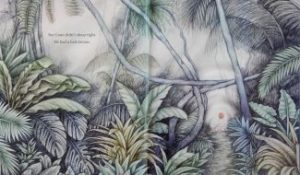
They reach the shore of a wild jungle and there in the darkness, light torches and build a bonfire around which they play instruments and dance.

Then, something even more amazing takes place: the bonfire rises up into the sky becoming the morning sun.

Back in the city dawn breaks, the child awakes and a new day begins …

The magical realism of Isabel Allende and Gabriel García Márquez come to mind as the story slips effortlessly between its real and dreamlike, surreal elements.

This is a book that demands close attention and several readings during which, new details will be discovered and fresh possibilities emerge from the dazzling folk-art hues of Johnson’s scenes.

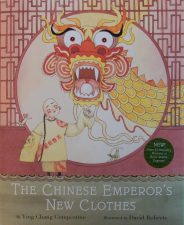
The Chinese Emperor’s New Clothes

The Chinese Emperor’s New Clothes
Ying Chang Compestine and David Roberts
Abrams & Chronicle

Many people are familiar with the Hans Andersen classic fairy tale, The Emperor’s New Clothes, and here it’s given a clever Chinese twist that sheds a different light on the whole matter of that vain emperor and his tricky tailors.
Set in Imperial China it tells how in fact this particular emperor, one Ming Da, is not vain at all; indeed he is a boy trickster who comes to the throne at the tender age of nine and there are no tricky tailors at all. Instead, as the young emperor discovers, it is his ministers who are the dishonest ones, stealing the country’s food, gold and other resources and leaving Ming Da with scant resources to feed his people and run his kingdom.

What can the boy emperor do to outsmart his perfidious ministers and thus avoid rebellion against him on their part? He ponders hard.
Then as Chinese New Year draws close, Ming Da decides to engage the help of his loyal tailors to dress him in rice sacks rather than the splendid finery expected for a new year celebration.
Honest people will see their true splendour, while the dishonest will see only burlap sacks,” a young tailor asserts as the emperor shows the ministers his new ‘magical’ outfit, setting in action his plan to recover some of the kingdom’s riches.

In an author’s note at the end of her story, Compestine explains how she has drawn on her personal experience as a child growing up during China’s Cultural Revolution and her efforts to outsmart the officials in order to obtain ‘forbidden literature’.
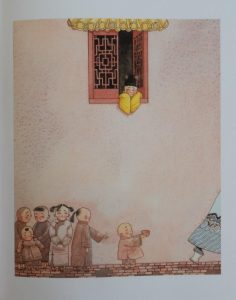
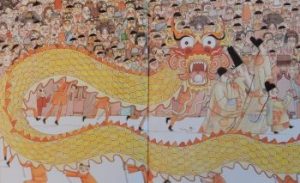
David Roberts (who has illustrated several other fairy tales as well as Ada Twist Scientist, Rosie Revere Engineer and Iggy Peck Architect) uses watercolour, pen, and ink for his wonderfully detailed, witty artwork.
An enchanting story to share over Chinese New Year or at any time, this will have a wide age appeal.

There is even a final page giving step by step instructions for making a Chinese New Year parade robe; a great starting point for a class celebratory parade.

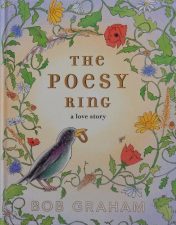
The Poesy Ring

The Poesy Ring
Bob Graham
Walker Books

Subtitled ‘a love story’ this truly is, visual poetry.
It tells of a poesy ring engraved with the message ‘Love never dies’. (Such objects have been given since the Middle Ages as symbols of love and friendship.)

We follow the ring from 1830 when it’s tossed away into a meadow by a tearful young horsewoman in County Kerry, on the west coast of Ireland.

Seasons come and go, and the years pass as the ring is once again tossed, by a deer this time.
It gets reburied and eventually picked up by a starling, becomes airborne and then dropped into the ocean depths where a fish swallows it.

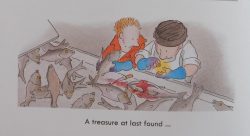
Trawlermen retrieve it from the fish’s belly and it’s sold for cash.

We’re now in New York City 1967 where, after a day’s work, two subway buskers with love in their hearts and a pocket full of money, make a very special purchase …

There’s symbolism aplenty in this exquisitely crafted story – a story of history, of life and most importantly, of love.
Graham shows the passing of time masterfully: an acorn becomes a vast oak tree shedding its own acorns, for example;

and through all the changing decades – almost two centuries – one thing remains constant: the ring never loses its shine, for true to its message, ‘Love never dies’; it’s always there if you know how to look for it.
Each of his illustrations is simply exquisite and is worth careful attention to appreciate the fine detail; indeed there’s a whole story in each spread.

A book to return to over and over, to share, to discuss and most of all, to treasure.

The Very Long Sleep

The Very Long Sleep
Polly Noakes
Child’s Play

Polly Noakes’ latest picture book is essentially a delightful extended joke.

Meet four animal friends Fox, Chipmunk, Marmot and Bear who decide to set up home together. They enthusiastically set about so doing but there is a snag: three of said animals hibernate come the arrival of winter’s frost, something they fail to tell Fox.

Inevitably he is disappointed that none of the others stays awake to share his specially prepared food; he himself is unable to sleep and feels extremely lonely.

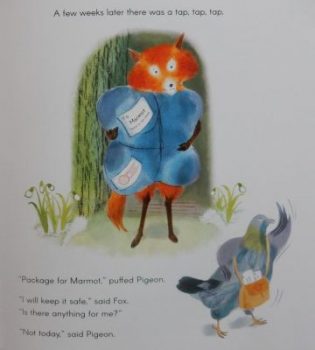
Then one day the deliveries start. First it’s a parcel for Chipmunk; next comes a package for Marmot;

and that is followed some weeks later, by a large item for Bear.

Fox is the only one not to receive something through the pigeon post. He waits; his boredom increases: surely a little peep wouldn’t hurt, he thinks.
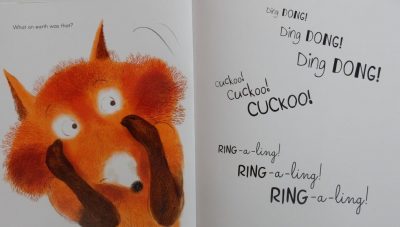
All of a sudden …

Now what could all that noise mean? …

Illustrated with warmth and humour, this is lovely and potentially rather noisy read aloud to share snuggled up together, especially after a woodland walk. I’d suggest mugs of hot chocolate to sip along with it.

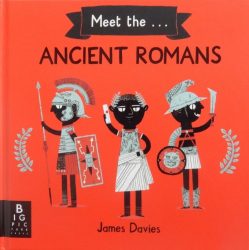
Meet the Ancient Romans

Meet the … Ancient Romans
James Davies
Big Picture Press

This is one of a new history series. It’s an engaging look at the Ancient Romans, presented with an exuberance that young readers will find both highly entertaining and illuminating.

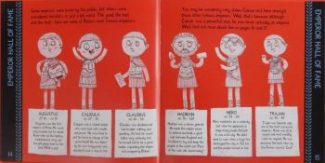
Small chunks of information are delivered with a gentle wit, on almost thirty topics. These range from The Birth of the Roman Empire (a comic strip rendering of the Romulus and Remus myth), through emperors …

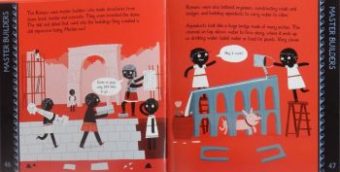
writing and number systems, home life, clothing, inventions, food and farming, bathing, theatre, building (the Romans were superb builders and engineers) …

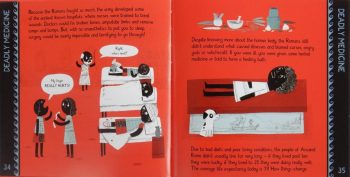
medicine (herbs and healing baths were prescribed for most illnesses);

entertainment, (the Romans pitted animals against animals as well as humans; and entry to the Colosseum was free, sometimes even the food came gratis), and ending with the fall of the empire, and a spread on Rome Today.

Throughout, the emphasis is on the visuals: Davies has an off-beat style, uses limited colour to great effect and peppers his illustrations with amusing speech bubbles.

All in all a great introduction for a younger audience, to a fascinating ancient civilisation, the legacy of which is still evident today.

Check out the companion volume ‘Meet the Ancient Egyptians’ too.

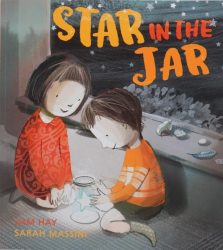
Star in the Jar

Star in the Jar
Sam Hay and Sarah Massini
Egmont

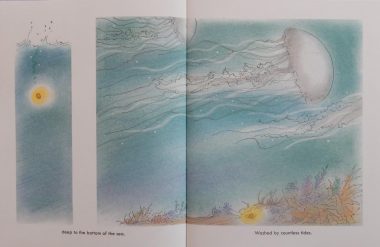
Abortive attempts to discover the owner of the extra special treasure found by the narrator’s younger brother result in ‘finders keepers’. The little boy takes his new -found star with him everywhere.

But although the boy is happy, the star, despite its shininess, definitely is not.

That night there appears a message in the sky.

Try as they might though, brother and sister are unable to relocate the star in its rightful place far above them: but then big sis. has a bright idea – a very bright idea and a message is sent to the little star’s astral friends way, way up in the dark.

The lost star is rescued; the boy is sad but then comes a realisation that although he’s lost one treasure, it has been replaced by something even more special …

Full of warmth, this is a lovely story of siblings, friendship and doing what’s right that is perfect for sharing just before sleep but too enjoyable to be restricted to bedtime reading only.

With a plethora of enchanting detail, (including what looks rather like a small velveteen rabbit) Sarah Massini highlights the tenderness of the sister/brother relationship and the problem solving, of Sam Hay’s tale.

I’ve signed the charter  

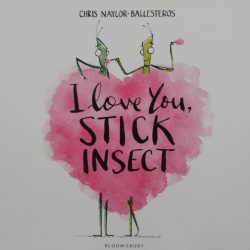
I Love You, Stick Insect

I Love You, Stick Insect
Chris Naylor-Ballesteros
Bloomsbury Children’s Books

Following his tasty debut, I’m Going to Eat This Ant, Chris Naylor-Ballesteros has now turned his attention to another insect – a stick insect. A particular stick insect that is besotted with another erm, stick insect: or is it?
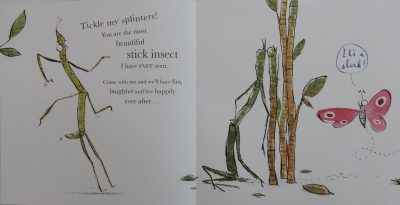
Certainly butterfly thinks otherwise …

Our love-lorn minibeast however continues attempting to woo the insect of its dreams positing all manner of wonderful propositions as to how the two might spend their time together – at the seaside, ice-skating or in flight …

and all the while Butterfly is attempting to point out that it’s a case of mistaken identity.

But with possibilities of biking

not to mention funfair rides, a trip to the movies and more, the ardent woer lets his imagination run riot until, as he reaches for the object of his affections …

I’d hate to be a story spoiler so let’s just say this is a crackingly droll tale with a rather tasty final twist that is sure to tickle the fancy of those whose sense of humour is somewhat dry.
It’s all deliciously daft and therein lies the appeal.

Chris Naylor-Ballesteros’ portrayal of this love story, as well as having child appeal, could well serve as a February 14th gift for that special valentine.

I’ve signed the charter 
Dog in Boots

Dog in Boots
Paula Metcalf
Oxford University Press

Here’s a doggy delight if ever there was one – or should that be two?

Philip is madly in love with new neighbour Penelope. Her kind eyes, waggy tail and beautiful smile have swept him off his feet.
However, there’s a problem: Penelope appears to be very tall whereas Philip’s legs are so short, his ears sweep the floor as he walks. Hmm.
Philip shares his problem with best pal, Ralph.

Ralph comes up with a variety of ingenious methods to make his friend appear taller …

After the resounding failure of the tablecloth comes the message on the wall …

But this leads only to unexpected tears from Penelope and feelings of desperation on Philip’s part.
Plan C involves a trip to the shoe-shop, the purchase of some funky footwear and the addition of some strategically placed stuffing.

Now Philip is ready to go and offer comfort to his true love. But as we know, ‘The course of true love never did run smooth.’ And so it is here. More tears flow, this time from Phillip: surely though, our besotted pooch isn’t doomed to eternal embarrassment and unrequited love …
Judiciously placed flaps add to the laugh out loud happenings and total silliness so wonderfully illustrated, and underlying which is a plethora of heartfelt feelings, all of which add up to a read aloud delight.

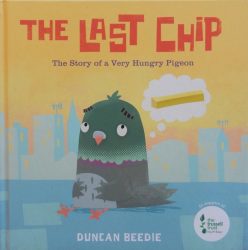
The Last Chip

The Last Chip
Duncan Beedie
Templar Publishing

In the light of the recent controversy over rough sleepers in a certain royal wedding town and my concern and distress at the increased number of rough sleepers I observed in Bristol the other day, Duncan Beedie’s latest picture book particularly resonated with me. Actually, the book is set in Bristol and it’s subtitled ‘The Story of a Very Hungry Pigeon’.

Percy is the pigeon’s name and his life on the streets is a tough one. Percy’s patch is the railway station and it’s here that the hungry creature heads at the start of each day in the hope of picking up a few tidbits dropped by commuters.
On one particular morning though, a gang of voracious pigeons has beaten Percy to it. He’s shoved out of the way and ends up with not so much as a single crumb.

With a rumbling tummy, Percy decides to try his luck at the park and off he flies …

only to discover that he’s no match for the greedy ducks that consume everything that’s tossed their way. They certainly have no intention of sharing, so Percy heads to the seaside.
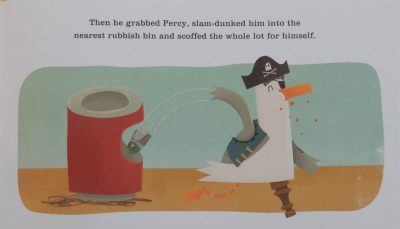
Here too though, he’s insulted and also physically abused by a resident avian, one giant seagull.

In despair, a very weak Percy heads back from whence he came; but dizziness overtakes him and he crash lands onto the city pavement amidst the melee of homeward bound commuters. Dazed and hungry, suddenly, he hears a voice offering him something very special: “Would you like my last chip?

There’s one spot on a street in Bristol that is a whole lot less tough on that particular night.

From his debut, The Bear Who Stared, Duncan Beedie has gone from strength to strength and it’s great to know that 10% of UK profits from sales of this new book will go to The Trussell Trust, which runs some 425 food banks across the UK.
Beadie’s message is a powerful one but he delivers it with a gentle humour and without a hint of preachiness. From his cover illustration, my heart went out to Percy; and the greedy birds, be they pigeons, ducks or that giant seagull, are deliciously nasty characters.
A thought-provoking story that deserves to be shared and discussed widely.

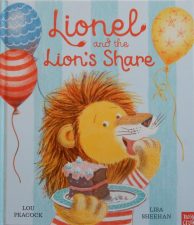
Lionel and the Lion’s Share

Lionel and the Lion’s Share
Lou Peacock and Lisa Sheenan
Nosy Crow

Lionel is a lion with sharing a problem – a big one; in fact he does NOT like to share at all. More than that, he’ll go out of his way to prevent one of the other animals from having something they really want.

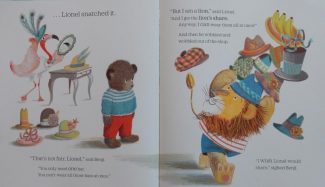
On Monday he’s in the music shop choosing himself an instrument and is certainly spoilt for choice. Elsa elephant is also shopping there and has set her heart on the shiny tambourine when who should snatch it from her grasp to add to the drum and tuba he’s already clutching but greedy Lionel.

A similar thing happens on Tuesday in the hat shop. Lionel needs but a single hat but has already purchased ten when he notices Benji eyeing up the banana titfa. No prizes for guessing who grabs that one for himself too …

And so it goes on: Wednesday sees him disappointing Rosie rabbit and on Thursday at Chloe’s party …

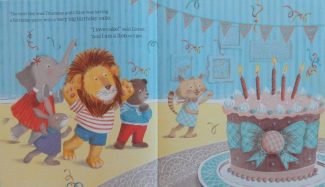
he scoffs the entire cake., again claiming it only right he gets’ “the lion’s share.” Cries of ‘I wish you would share’ are now replaced with a chorus of “we wish you would share.
This time however, with Chloe in tears, the other animals have had enough of Lionel’s greed and tell him what they think of him in no uncertain terms.

It’s a furious lion that stomps off home but by the time he reaches there, he has come to a very important realisation: it’s time to make amends …
Can Lionel save the day after all?

With opportunities for joining in with the “That’s not fair, Lionel” protestation of the other animals and his “But I’m a lion … and I get the lion’s share” responses, this is a great book to share and discuss with young children.
Lisa Sheenan’s scenes of greed and disappointment capture the animals’ feelings beautifully and each spread offers plenty to interest and explore.

Ellena enjoying the story.

Look, there’s a Tractor; Look, there’s a Helicopter / I Love You Little One

Look, there’s a Tractor!
Look, there’s a Helicopter!

Esther Aarts
Nosy Crow
Here’s a pair of board book adventures for the very youngest.
In the Tractor a rhyming narrative guides young listeners as they climb aboard and accompany the farmer and his dog on a search around the farm for a missing hen.

Strategically placed die-cut holes help move the story forward towards the final surprise finale.
In the Helicopter book we join the pilot as she takes her machine out on a rescue mission to save a family and their dog from a sinking boat.

This one also has the same ‘Follow-the-holes’ feature. I think the rhyme works better in the tractor tale though.

I Love You, Little One
Holly Surplice
Nosy Crow
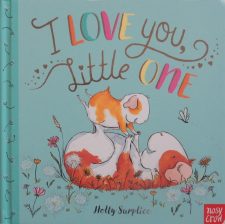
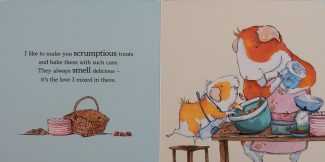
If you want a super-cute board book to share with your little one then look no further than this outpouring of love from a mother guinea pig to her infant.
Actually though, she says words cannot express the strength of her feelings, so instead actions do the speaking – through her pride in little guinea pig’s artistic creations; the songs she sings for him and the music they create together, the baking they share in.

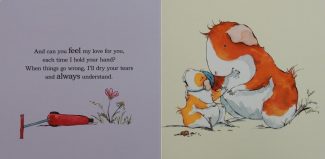
Then there are those moments when some TLC is required …

Most of all though, is the idea – a magical one – that wherever Mummy guinea pig is, be it near or far, her love for her little one is always there and so it will always be.
Told through a rhyming text and adorable illustrations, this could have been sickly sweet but it isn’t; the showing makes sure of that – both Holly’s and the mother guinea pig’s.

Hidden World: Ocean / 50 Wacky Things Humans Do

Hidden World: Ocean
Libby Walden and Stephanie Fizer Coleman
360 degrees

Essentially this is a visual exploration of living things that live beneath the ocean waves.
Six spreads present in turn Giants – some of the world’s largest creatures; Colourful Creatures; Hide and Seek – animals that camouflage themselves;

creatures that dwell on The Ocean Floor; Deep Sea creatures – those that live in the chilly, dark ocean depths and finally, The Coral Reef where sponges, corals, puffer fish, butterfly fish, clown fish and crabs can be found.
Each spread has six labelled flaps that open to reveal the creatures in their natural surroundings, and some brief factual information. I was amazed to discover that there are over 3000 different species of sea slug, for example.
With ecosystems such as coral reefs under threat from global warming, as well as being a fascinating book for young children, it’s also one that when shared with an adult, can open up discussions about the importance of protecting the crucial marine environments.
The book’s sturdy pages should help ensure that this resource can withstand fairly heavy handling from interested and enthusiastic youngsters.

50 Wacky Things Humans Do
Joe Rhatigan and Lisa Perrett
Walter Foster Jr.

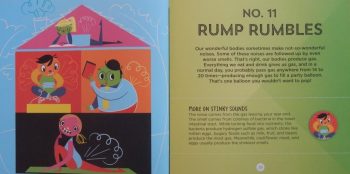
Here we have a book that is full of fascinating facts relating to the weird and wonderful things our bodies do.
Each topic is introduced with an alluring title such as ‘Raisin Fingers’ (why our digits go wrinkly after a long time in the bath); ‘Rump Rumbles’ (there’s a lot of alliteration and wordplay in the headings);

Snot’s Amazing’ ;‘Black-and-Blue’ about bruising;

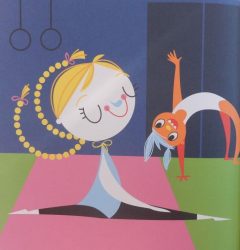
and ‘Be Flexible’. (It’s good to see yoga getting a mention here.)

Joe Rhatigan’s narrative style is chatty and designed to draw readers in, which it certainly does; and Lisa Perrett’s zany and colourful cartoons  add to the allure.
Most children are fascinated by their own bodies and what happens in and around them; and this unusually presented and arranged book on that topic will certainly both entertain and inform. It should also encourage young readers to value and respect their bodies, keeping them as healthy as possible.

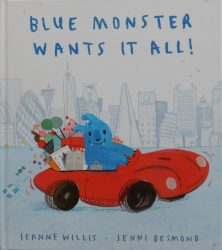
Blue Monster Wants It All!

Blue Monster Wants It All!
Jeanne Willis and Jenni Desmond
Little Tiger Press

We live in a throwaway, consumer society where the desire for the new, and the notion that the next thing is always better, tend to prevail.
Jeanne Willis and Jenni Desmond have created a timely and eloquent picture book fable that demonstrates the folly of this thinking.
Meet Blue Monster, thoroughly indulged by his parents the never satisfied creature discards them and his new sibling, and takes off with all his money to begin life anew. However although he’s left behind his old life, he’s taken his acquisitive habits with him.

But new hats, cars, luxury palaces, an aeroplane, and a tropical island with amazing animals no less, fail to satisfy.

Even the sunshine itself cannot bring him happiness.
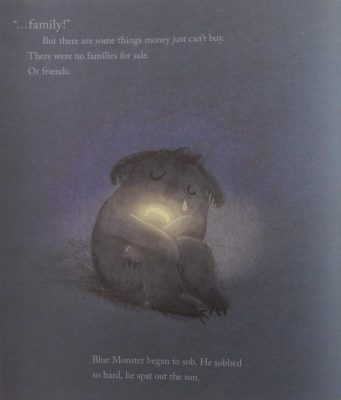
It’s not until he finds himself surrounded by darkness that somehow, in his abject misery, Blue Monster finally realises what he needs for true contentment and well-being. But is it too late?

Jenni Desmond adeptly portrays the monster and his constantly changing moods and emotions – his tantrums, his decadence, his dissatisfaction and his supreme sadness, all of which are part and parcel of Jeanne Willis’ thought-provoking text.
Although we know that the creature has brought in all on himself, you cannot help but be moved by the sight of him in his desolation.
What is most important to you, the latest smartphone or tablet, a brand new car or the love of your family and friends?
Perhaps it takes a powerful picture book such as this, which has as much to say to adults as to children, to make us all stop and think?

Firefly Home

Firefly Home
Jane Clarke & Britta Teckentrup
Nosy Crow

The second interactive picture book from the Clarke and Teckentrup duo features another creature from the natural world, a little firefly called Florence, and she’s got lost.

It’s up to readers to help her find the way back home. There’s a problem though: there are so many flashing lights in the night sky that Florence follows lots of false leads.

Young listeners, more worldly wise than the little firefly will revel in anticipating the bright moon, the lighthouse beam,

the moving train and the brightly illuminated buildings in the city before the respective pages are turned, as well as responding to the verbal instructions given to help Florence on her long flight in search of her firefly friends.

The yellow used in Britta Teckentrup’s illustrations glows so intensely that I found myself wanting to check to see it there was a hidden battery somewhere.

A potential story-time favourite for early years listeners for sure. And shared one to one, it’s totally absorbing: each of my listeners has followed Jane Clarke’s instructions with gusto and been thrilled to be instrumental in Florence finally finding her way back to her friends.

Now in paperback is their Neon Leon, which I absolutely loved and used frequently last year always with enthusiastic responses.

The Weaver

The Weaver
Qian Shi
Andersen Press

The creator of this lovely debut picture book got her inspiration from a spider’s web she discovered with a piece of leaf caught in the middle.

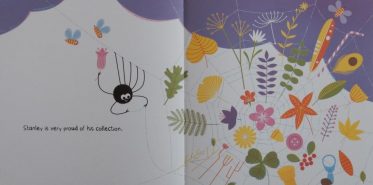
Stanley spider is a weaver of webs; he’s a collector too. The things he collects – seeds, leaves, twigs and other ephemera are carefully woven into his webs.

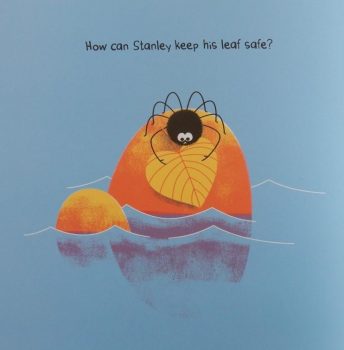
Then disaster strikes in the form of a downpour that washes away both Stanley’s home and his precious collection, save for a single leaf.

Stanley attempts to secure this leaf but the wind whisks it away leaving Stanley with nothing.
Throughout the night he labours and come morning he’s fashioned something beautiful …

Yes, the web traces the memories, but with those treasures etched in his heart, it’s time for Stanley to move on …

Simply and beautifully told, but it’s the illustrations which embroider and add nuance to the text, furnishing the rich details of Stanley’s journey and his creativity.

A book that’s rich in potential in a nursery or classroom setting too where children might look first at real spider’s webs (a fine water spray will make the details of a web more visible) and then become web weavers like Stanley, adding their own special objects to their creations.

The Squirrels’ Busy Year

The Squirrels’ Busy Year
Martin Jenkins and Richard Jones
Walker Books

From the creators of Fox in the Night is a new addition to the Science Storybook series, this time about the seasons and changes in the weather.

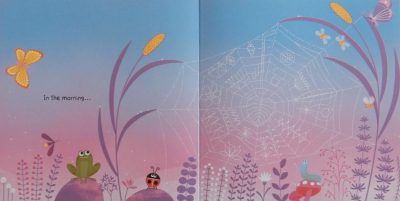
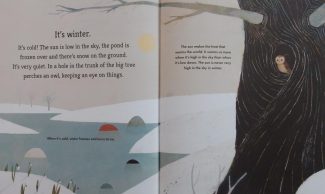
We start in winter and just like today when I’m writing this, it’s very cold, the pond is frozen and snow covers the ground. The animals are tucked away in warm places until they have to go out and search for food.

Spring brings warmer weather with bird song, croaking frogs, scampering squirrels hoping to find juicy maple buds on the trees or bulbs they can unearth; but they’ll have to be quick for there’s an owl on the prowl.
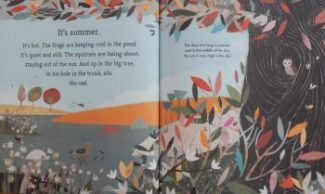
With the summer come hotter days, the need for shade, and longer hours of daylight with a chance of thundery weather.

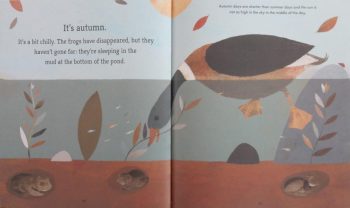
Come autumn and the frogs have gone to the bottom of the pond to sleep in the mud;

many birds have flown to warmer climes and the squirrels start collecting for their winter store in preparation for hibernating.
All this is presented through an engaging, at times poetic, text, together with some basic scientific facts, and in Richard Jones’ textured illustrations.
His beautifully crafted scenes work in perfect harmony with Jenkins’ descriptions, his colour palette mirroring the seasonal hues superbly.
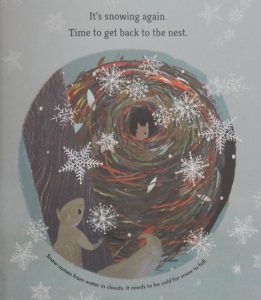
Look how perfectly this embodies the hushed arrival of winter’s snow …

A fine example of non-fiction for the very young.

All At Sea

All At Sea
Gerry Byrne and Faye Hanson
Walker Books

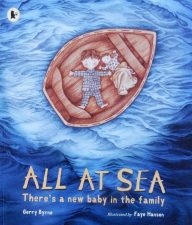
This wonderfully warm story is subtitled ‘There’s a new baby in the family’ and chief protagonist, young Liam certainly has his very own way of dealing with the arrival of a new brother.
He plays out his feelings using the small world hippo family – a daddy, a mammy, two little hippos and a tiny, baby hippo – his parents give him when they come back from the hospital bringing with them a new baby brother for him and his slightly older sister.

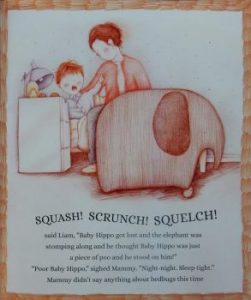
First he puts the baby hippo in the mouth of a hungry crocodile to be gobbled up. The following evening the tiny hippo is squashed under an elephant’s foot …

and on the third night it ends up down the loo, supposedly swept over a waterfall when out swimming with the rest of the hippo family.

All these actions however result in Liam having bad dreams …

and ending up sleeping in his parents’ bed with them.

On the third night though, something else happens too: Liam has a change of heart not only about the baby hippo, but more importantly concerning a certain Baby Brother.
The following night all is well both with the hippo family and Liam’s.

This is a fine addition to the new sibling genre and an ideal picture book for a young child with, or about to have, a new baby in the family.
It’s beautifully told, the dialogue both child and adult, is spot on and Faye Hanson captures the inherent warmth of Gerry Byrne’s tale, and the emotions of Liam and his mum in particular, in her superb, textured illustrations. Her colour palette – predominantly sepia, violet, inky blue – give the whole story a slightly dreamlike quality.

Few picture books I’ve seen – and that’s a lot – capture the mixed emotions of a young child with a new sibling so perfectly as this one.

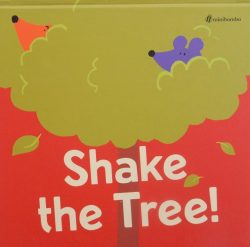
Shake the Tree!

Shake the Tree!
Chiara Vignocchi, Paolo Chiarinotti and Silvia Borando
Walker Books

I’ve championed Minibombo books on this blog before and I make no apologies for doing so again. This one is my favourite so far.

It all begins when a hungry Mouse spots a nut high up in a tree and determines to eat it. She gives the tree a shake in both directions but it has no effect on the nut. She dislodges Fox though …

who declares his intentions concerning Mouse in no uncertain terms.

Up the tree scampers Mouse and Fox takes over as tree shaker; but he’s equally unsuccessful in dislodging mouse or the nut: something else drops down though and he too is ravenous. It’s Warthog and the shaking process begins again.

Oh my goodness! Fox, Mouse and the nut hold firm but down comes a very growly creature.
His frantic left and right shaking has the desired effect: down tumbles the entire contents of the tree, leaves and all.

Who or what will Bear going to claim as his prize? …

To emphasise the height of the tree, the book opens vertically, but readers have to keep turning to book to keep up with the narrative shifts from vertical to horizontal as the drama progresses, thus mirroring the tree shaking of the creatures.

A delicious piece of theatre superbly orchestrated by the book’s creators and equally superbly acted out by the animal characters whose narrow escapes will delight young listeners.
Equally, thanks to its repetition and brief patterned text, the book is spot on for those in the early stages of becoming readers to dramatize for themselves. Read it to them first though.

The Great Race: The Story of the Chinese Zodiac

The Great Race: The Story of the Chinese Zodiac
Christopher Corr
Frances Lincoln Children’s Books

I was wowed by Christopher Corr’s Deep in the Woods and now he’s turned his amazing artistry to another folktale, the Chinese story of how the years were named.
It’s a fuller version than any I’ve seen and used in schools over the years and is in my view set to become the ‘go to’ book for celebrating Chinese New Year from now on. (16th February this year).
For those who don’t know the folktale it’s set in an ancient China when there was no way of knowing how much time had passed and consequently the Jade Emperor having no idea how old he was, decided it was about time he knew.
He called together all the animals of his kingdom and announced that on the next day a Great Race was to be held and the first twelve creatures to cross the river would each have a year named after them. Needless to say, all the animals were eager to win.
Two in particular were good friends and planned to become joint winners so long as the rat could wake his cat friend from sleep, that is.
Next day however, the rat did his utmost to rouse his slumbering pal but was forced to leave him to dream and head towards the river.
En route he met an ox and they team up – the rat as passenger and thankful singer on the ox’s back. The double-dealing rat though, jumped forwards at the last stroke to land first at the emperor’s feet and thus claim the first year, which henceforth became The Year of the Rat, with Ox giving his name to the second year.
Tiger …

and Rabbit claim the next two years and then in fifth place, comes a dazzling dragon with a tale to tell of how he assisted the rabbit on his journey.
Horse arrives to claim the next place and he too has a passenger – wily snake who sneakily claims sixth position instead.
In contrast, goat, monkey and rooster employ teamwork …

and the Emperor rewards them by assigning the next three years to Goat, Monkey and Rooster respectively.
Both dog and pig …

have  wasted time during the swim and thus are allocated the eleventh and twelfth years. Then it’s time to celebrate.
Suddenly though, a small cat makes his presence felt in no uncertain terms as he emerges from the water and proceeds to shout in fury at Rat for failing to wake him, causing the little creature to flee for his life, then and for ever on …
This finale adds a pourquoi element to the whole tale.
Everything, from the tactile cover is splendid. Steeped in folk art tradition, Corr’s beautifully patterned illustrations are truly captivating and offer a powerful stimulus for children’s own artistic creations.
His telling too is terrific, focusing on the animal characters themselves – some sneaky, some helpful and others co-operative.
Fab-ul-ous!

Nursery Bookshelf

You’re Three!
You’re Four!
You’re Five!

Shelly Unwin and Katherine Battersby
Allen & Unwin
Here are three little books dedicated to being a particular age, each one using different animal characters – a small one and an adult.
Celebrating being three is a little alligator; a small meerkat and a parent look at the specialness of becoming four; and a young goat plus parent explore what being five brings.
Weaving in such concepts as basic one to one counting, addition, numbers, shapes, change, seasons, and the senses into her rhyming text, the author gently builds in opportunities to extend the listener’s language while at the same time celebrating each specific age.
Thus being Three encompasses some favourite fairy tale titles, being halfway up and the idea of triplets.

Four introduces compass points, quarters and the seasons;

and Five mentions the vowels, days of the week, questioning words and the senses.

Each book will need a fair bit of adult/child discussion and exploration with the aid of Katherine Battersby’s engaging art; but the most important element every time is the specialness of the child at which ever age they are.
As a teacher I’ve always been concerned about parents trying to make their children look and act older than they are; these small books are a helpful counter to that.

Archie’s First Day at School
Archie Goes to the Doctor

Emma Brown
Cico Kids
The creator of the Shady Bay Buddies books and soft toys, Emma Brown, a crochet expert, started making up the stories when her daughters were young, and these two titles are part of a series that aims to provide reassurance and information to help very young children overcome their ‘first time’ anxieties.
In the first story Archie sets off for his first day at school with Bunny his toy, his big sister, Amber and his mum. He’s greeted at the door by his teacher, bids his mum farewell, chooses a coat peg and then is allocated somewhere to sit
Soon he’s busy making a model and accidentally spills paint on Bunny.

He spills milk on him at snack time: seemingly Archie is rather excited.
Outside play is followed by lunch with his friend Breeze.
After a story, it’s time to go home and Amber is waiting for him, although surprisingly, not his mum. Archie says he’s enjoyed himself but isn’t too sure about Bunny.
In the second story Archie is outside with his sister and being very adventurous on the swing when suddenly he finds himself on the ground with a hurt arm.
He’s somewhat alarmed to hear he has to go to the doctors with Mum.
In the waiting room he meets his friend Breeze who has earache. Soon it’s time to go into Doctor Hodge’s surgery where after an examination of his arm, Archie learns nothing is broken but he needs to wear a sling.

Then after a quick reassuring chat to Breeze, he goes off home.
With interesting mixed-media backdrops (listeners can search for Archie’s bunny at every turn of the page), appealing cuddly toy characters, and stories told simply and directly, these books should help allay first time nerves.

The Princess and the Suffragette / The Song From Somewhere Else

The Princess and the Suffragette
Holly Webb
Scholastic Children’s Books

This is a sequel of sorts to one of my childhood favourite reads, Frances Hodgson Burnett’s A Little Princess.
It centres on one of the characters from the original story, Lottie, now ten, who has lived at Miss Minchin’s school since she was four.

Now, a few years on, it’s 1911, when the suffragette movement is on the rise, Lottie finds herself becoming friends with one of the maids at the school, a girl named Sally who is interested in the rights of women.
During the next couple of years she also finds herself getting more rebellious and more involved in suffragette activities.

In tandem with her burgeoning rebellion, Lottie discovers that there’s a mystery surrounding her mother, and that what she’d been led to believe about her isn’t the truth.

There’s frankness about Holly Webb’s writing that makes the whole story feel genuine and well researched. She doesn’t avoid mentioning the suffering and brutality that some members of the suffragette movement underwent; and one hopes, her deft manner of talking about it will inspire young readers to understand the importance of standing up for what they believe to be right.


The Song From Somewhere Else
A.F.Harrold, illustrated by Levi Pinfold
Bloomsbury Children’s Books

Here’s a book that is both beautiful and alarming, terrifying even at times.

Frank (Francesca Patel) is stalked and bullied by the local nasty, Neil Noble, and a couple of his pals; but then a rather odd boy, Nick Underbridge comes to her rescue. You might expect that the girl would be greatful, indeed she knows she ought to be, but at school Nick is said to be smelly and so not exactly the kind of person she’d want any involvement with.
However, for safety she goes back to his house with him intending merely to thank him and leave. It’s a rather strange house – not what she’d expected – filled with abstract painting done by Nick’s dad; there’s a rather strange earthy aroma pervading the place and suddenly she hears music. It’s the most haunting and beautiful music she’s ever heard; and she wants more of it and more, and more. And so, she returns.

What happens thereafter is the development of an unlikely but challenging friendship, and the discovery that within Nick’s home are secrets.

There’s a talking cat involved too.

Part reality, part fantasy, this story is absolutely wonderfully and lyrically told, and entirely convincing – the stuff of dreams, the stuff of nightmares both.
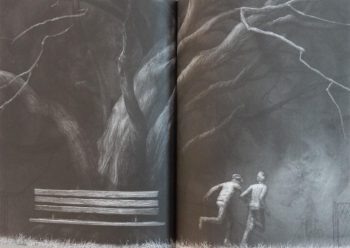
And Levi Pinfold whose images – dark, mysterious and haunting – are a fine complement to Harrold’s telling, equally beautifully illustrates it.

Totally captivating: a magical book to return to over and over.

Boogie Bear

Boogie Bear
David Walliams and Tony Ross
Harper Collins Children’s Books

The tour-de-force that is Walliams and Ross has created yet another winning picture book, this time starring a resident of the North Pole, a female polar bear.

The creature over-indulges, drops off to sleep and drifts far from home. So far in fact that the sun is sufficiently warm to melt away the ice-berg upon which she’s been precariously balanced and she’s forced to swim for shore, employing ‘her best bear paddle’.

Once on dry land it seems worse is to come in the form of an advancing stampede of decidedly hostile-looking furry creatures of a brown hue yelling about a ‘boogie monster”.

Further undesirable episodes follow including the hurtling through the air of various objects – missiles …

and bears – until suddenly, the ursine residents make a startling discovery.

From then on things turn distinctly peachy for a certain polar bear;

but if you want to find out exactly how the tale ends then you’ll have to get your paws on a copy of this hilarious book. If you’re an adult who loves giving a full dramatic performance when sharing a book you’ll absolutely love this one; if you’re a child who enjoys a rippingly good yarn that will make you wriggle with laughter and that’s brilliantly illustrated, then this is for you.

Uproariously funny as it may be, the story has much to say about embracing difference, acceptance, welcoming, friendship, displacement and more. It’s as much needed now as ever.

I’ve signed the charter  
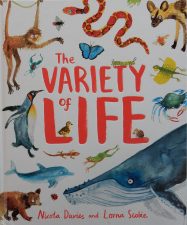
The Variety of Life

The Variety of Life
Nicola Davies and Lorna Scobie
Hodder Children’s Books

Here’s a large format book for young readers to dip in and out of, time and again, especially those who like animals of one kind or another and the wider biodiversity of our planet.

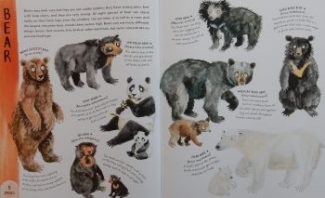
The author and zoologist, Nicola Davies explores the huge diversity of the natural world, providing information about the chosen subjects, one per double spread – a short introductory paragraph to each group and a sentence or two about those depicted (their food, their habits and their habitats) together with the common name, the scientific (Latin) name, and if they happen to number among the endangered species, a black star. It’s alarming to see for instance, that of the eight species of bear, six are threatened with extinction.

Accessibly presented are a large variety of animals big and small, and some plants – grasses and trees and finally, representing the fungi are mushrooms.

Some of the numbers of animal species are questionable though: for instance the number given on the sheep page is 6 species but 9 are illustrated on the relevant spread.

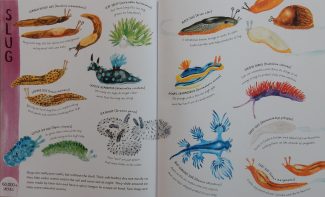
Lorna Scobie’s illustrations of the animal kingdom in particular, are impressionistic rather than strictly scientific. Nonetheless, with their googly eyes, the creatures – from butterflies to bats and sheep to slugs –

have an irresistible child appeal embodying their essential characteristics, and are recognisable if not exactly in the field guide class.

Certainly this thoroughly enjoyable book offers opportunities to take pleasure in, to compare and contrast; and should encourage young readers to respect and treasure the world’s biodiversity and do all they can to preserve and conserve it.

Bears Don’t Eat Egg Sandwiches

Bears Don’t Eat Egg Sandwiches
Julie Fulton and Rachel Suzanne
Maverick Arts Publishing

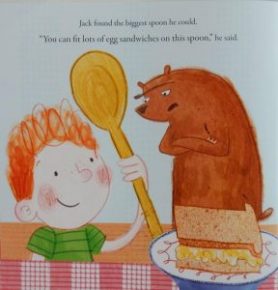
Jack is busy preparing his lunch – egg sandwiches – when there’s a knock on his door. He’s more than a little surprised to discover his visitor is a large bear.
Being a friendly lad, Jack offers him an egg sandwich only to be told firmly, “Bears don’t eat egg sandwiches.

As soon as the bear demands a big plate, listeners, unlike Jack, start getting suspicious. More so when he asks for a big spoon.

The boy however continues trying to persuade his ursine guest to join him in partaking of an eggy treat.

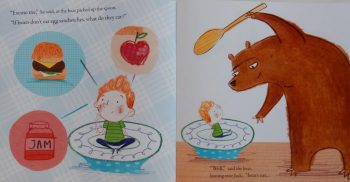
When Jack does finally discover the answer to the all-important, ‘what do bears eat?’ question, it looks as though it might be the end of the line for the lad. Could there perhaps be a way out of his perilous position?

Anticipation is key in this tale.

Rachel Suzanne’s portrayal of diminutive boy and enormous bear are quite splendid; and Julie Fulton’s conversational narrative style works a treat.

My audiences delighted in Jack’s naivety, spluttered with pleasure over the final utterance of the title line and its illustration,

and chortled at the finale.

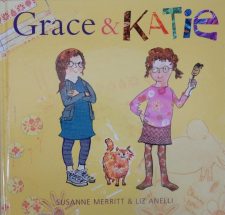
Grace & Katie

Grace & Katie
Susanne Merritt and Liz Anelli
EK Books

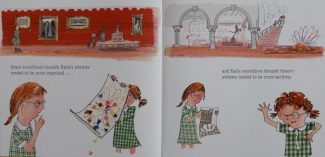
Twins Katie and Grace love to draw. They approach things in entirely different ways however – one with the eye of a prospective architect or cartographer, the other, an artist; and the results are altogether different.
Grace favours straight lines and angles, which Katie considers a tad dull; Katie in contrast is more creative producing colourful patterns and swirls: Gracie thinks her sister’s work could do with organising. Are they both right perhaps?

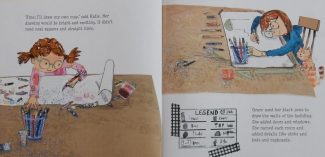
One day Gracie decides to draw a map of their home and rejects Katie’s offer of help, so Katie draws a map of her own.

Grace’s black and white map is ordered and detailed. Katie’s rendition of the park opposite their home is also detailed but it’s colourful and full of action. Neither girl is completely satisfied with what they’ve produced.

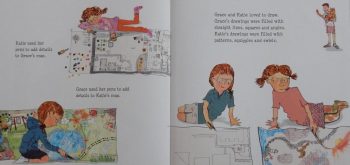
They look at each others and then, after some discussion, Katie adds some colourful touches to Grace’s map, while Grace’s added details provide more structure for Katie’s.

With a combination of creativity and accuracy, collaboration wins the day.

Susanne Merritt puts the points for respecting differences, the importance of being oneself, and co-operation across subtly and effectively. Liz Anelli reflects the themes in her detailed illustrations effectively showing the sisters’ contrasting styles in a suitable child-like manner.

The book’s potential for discussion is enormous, be it in the foundation stage, or, with much older listeners.

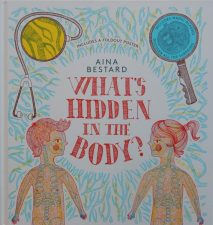
What’s Hidden in the Body?

What’s Hidden in the Body?
Aina Bestard
Thames and Hudson

Here’s a fascinating book that invites readers to look, look and look again:it’s perfect for stimulating curiosity about the human body.

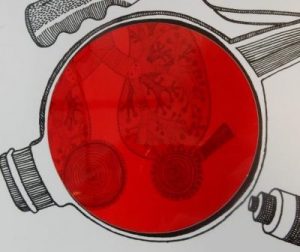
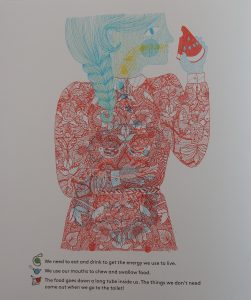
The author likens the body to a house, no two are the same and each a home to a different person, then goes on to gently guide exploration without and within and by using a set of three different colour lenses that are provided inside the front cover, the structure of the various systems and organs that make up our bodies are revealed to readers.

The way the whole thing works is that the lenses filter out different colours on the printed page allowing only some to appear clearly.

Through the red lens …

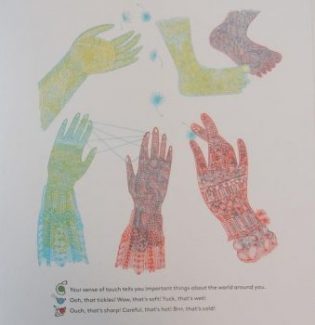
Aina Bestard uses exquisitely patterned images throughout that are worth paying close attention to without any of the lenses: the hands and feet for instance, look as though they’re covered in mehndi designs …

So, we start with the skeletal system – our bones and muscles, then move on to the outer covering, skin and the sense of touch which is followed by the other sensory organs.
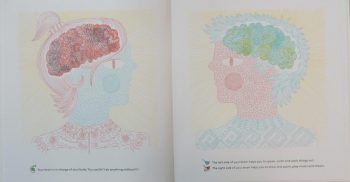
Next comes a spread on the brain where we can take a look at both left and right hemispheres …

before moving on to the digestive system …

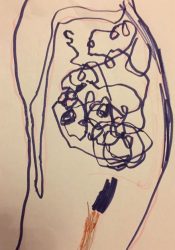
Emmanuelle (just 5) drew before seeing the book, what she thinks happens inside her body when she eats.

followed by the respiratory system …

heart, lungs, blood vessels, blood cells.
Other topics for exploration are cellular structure, reproduction and finally, there’s a mention of feelings wherein Bestard says, ‘… sometimes they make us … excited.’
That is certainly what readers of this book should feel after delving into this visual wonderland that is our bodies.
In addition to the lenses, tucked inside the front cover, there’s a large, double sided poster – male and female – of the human body to explore.

Frankenbunny / Ten Little Superheroes

Frankenbunny
Jill Esbaum and Alice Brereton
Sterling

Youngest of three brothers, Spencer, knows monsters don’t exist until his siblings Leonard and Bertram start talking about the terrible Frankenbunny just to scare their little brother.
It’s relatively easy being brave during the daytime when mum or dad are on hand to reassure him that monsters aren’t real,

but come bedtime it’s much harder to ignore the graphic descriptions of “crusty fangs, ginormous jaws and flashing red eyes”.

Having made it through the night however, Spencer discovers something in his cupboard next morning that enables him to start planning his revenge on his brothers.

And indeed, it’s truly satisfying.
Light and dark are used to effect in this first person narrative that provides just the right frisson of fear without overdoing it; and shows youngsters it is possible to overcome your own fears in the end.

Ten Little Superheroes
Mike Brownlow and Simon Rickerty
Orchard Books

Riotous play superhero style begins when in mid flight, the Ten Little Super-Kids spy the League of Bad Guys plotting in their lair.

And then it’s a case of action stations, as they set about saving the city from the dastardly plotters.

Full of pows, vrooms, bishing, bashing, boshing, splats, zaps and more: can those Super-Kids overcome the very tricky Monstro’s Gang and thwart their villainous attack on Metro Hall? If so they’ll have to contend with cyclonic firing, sticky resin and Kraken’s flailing tentacles, not to mention a sonic boom and a hypnotic yogini.

I suggest a few practice run-throughs before reading this aloud to a group of small super-hero enthusiasts; it’s pretty fast paced and needs lots of ‘wellie’ to deliver the onomatopoeia-packed action.

However thereafter time will be needed to explore the kaleidoscopically coloured scenes of mischief and mayhem.

I’ve signed the charter  
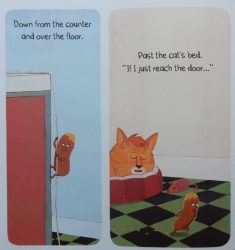
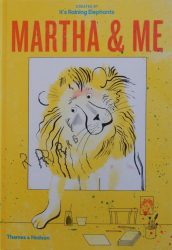
Martha & Me

Martha & Me
created by It’s Raining Elephants aka Nina Wehrie and Evelyne Laube
Thames & Hudson

There’s a touch of Harold and the Purple Crayon and Antony Browne’s pencil wielding Bear about this splendidly playful tale.

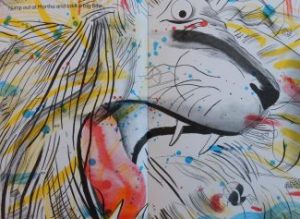
It all begins when creative young miss, Martha, paints a large lion picture. And no sooner is it completed than out from the frame steps the story’s narrator, none other than the lion himself.

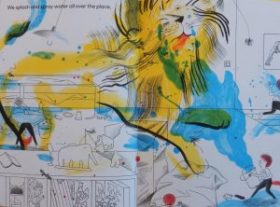
Then, in rhyming fashion, he relates how the two of them embark on an imaginary amazing adventure over sea, onto an island, through a jungle and then straight into an extremely splashy water fight.

Their playfulness escalates just a tad too far when the narrator oversteps the mark with a jump and a snap of his jaws.

Martha however gives as good as she gets, retaliating with a massive ROAR.

This calms things down temporarily and the two mop up (or rather Martha does while her playmate stays still and quiet), make up and embark upon another adventure in the park.
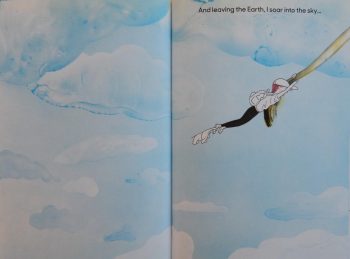
This culminates in the two friends becoming airborne …

and Martha tumbling down, back into her room sans lion.

Play has come to a halt, but perhaps it isn’t quite the end …

Scratchy line drawing and striking painting with touches of Jackson Pollock’s abstract expressionism create an imaginary and dynamic play-scape that will delight and absorb both listeners and readers aloud.

Beware the Mighty Bitey

Beware the Mighty Bitey
Heather Pindar and Susan Batori
Maverick Arts Publishing

Nippy Pool lies deep in the jungle; it’s the home of The Mighty Bitey Piranhas. These creatures with their razor-sharp teeth lurk beneath the waters over which hangs a rope bridge, frayed and apt to sway, waiting for something tasty to come their way and singing their favourite song.

Along come in turn Mouse, Goat and Bear, each with his musical instrument; and all on their way to Cougar’s party. Each accepts the “Please play for us!” invitation of the Mighty Biteys causing the fragile bridge to sway and dip ever closer to the water until suddenly amid all the ding-dings, dong dungs …

and roompah, oom-papahs, leaving the rope dangling precariously by a single twine …

Are the party-going animals about to become the piranhas’ next meal or will party-throwing Cougar and his pals be the ones feasting?

A suspenseful tale from Heather Pindar to keep listeners on the edges of their seats, deliciously illustrated by Susan Batori with toothsome scenes of ferocious fish and musical mammals.
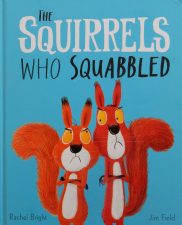
The Squirrels Who Squabbled

The Squirrels Who Squabbled
Rachel Bright and Jim Field
Orchard Books

From the duo who gave us The Lion Inside and The Koala Who Could comes another winning story, this time featuring two greedy squirrels one of which has done the unthinkable –failed to collect food for his store – and consequently, with winter fast approaching, his cupboard is completely empty: that’s Spontaneous Cyril who lives his life firmly in the here and now.

Squirrel number two is ‘Plan-Ahead Bruce’. He’s a wily one and has already amassed a huge stockpile of goodies.
By the time Cyril realises his partying habits have put him in a bit of a plight, all that appears to be left is a single pine-cone. This potentially fruitful object might just save him from starvation but he’s not the only one with his eye on the main chance. Bruce too has set his sights on one final addition to his stash.

With this potential treat delicately lodged in the twist of a branch and two would-be gatherers scurrying madly up the tree trunk, things are not set to go well and before you can say ‘slow down’ the cone is dislodged from its niche in the spruce and has gone tumbling down the hill with the two adversaries in hot pursuit through the forest.

What follows is an out and out scrimmage between Cyril and Bruce over a single treasure, that must surely end badly, as the object of their desires cascades into the water and well, I won’t say where it ends up for fear of being a story-spoiler.

This is truly a cracking book, delivered through Rachel’s perfectly paced rhyming narrative that like the cone, bounces over the pages with increasing speed, accompanied by Jim Field’s deliciously detailed illustrations executed in a softly glowing autumnal palette, and absolutely wonderful characters – not only the main ones but the bit part players too.
A truly delicious read aloud no matter what the time of year, especially with its themes of the importance of friendship and the folly of petty fights.

Secret of the Ron Mor Skerry / The Night of Wishes

It’s great to see The New York Review of Books bringing forgotten children’s books back for a new audience; they have some wonderful titles on their list. Here are two recent ones:

Secret of the Ron Mor Skerry
Rosalie K. Fry
New York Review Children’s Collection

As a child I was an avid collector of Puffin Books and had one with a Welsh setting called Snowed Up by Rosalie Fry, so her name rang a bell when I received this review copy.
It’s a tale of erstwhile city dweller, ten year old Fiona McConville who goes back to live with her grandparents in a village on the Scottish coast.
With her she takes memories of her lost little brother Jamie whose cradle had been swept from the shore of Ron Mor several years before, and disappeared at sea.
From her Grandfather she learns that fishermen tell tales of a child of the seals; could this possibly be her lost brother? Fiona determines to find out.
Poetically told and imbued with folklore of the Western Isles, and illustrated with line drawings by the author, this magical tale was the basis for the classic film, The Secret of Roan Inish.
It’s a small treasure.

The Night of Wishes
Michael Ende illustrated by Regina Kehn
New York Review Children’s Collection

It’s New Year’s Eve; Shadow Sorcery Minister Beelzebub Preposteror is in his laboratory when he discovers he has a visitor. It’s one Maledictus Maggot, come to remind him that he has only until midnight to fulfil his contractual obligations re pollution, extinction of species, tree destruction, plague and devastation, or have his powers rescinded – a ‘personal foreclosure ex-officio’ is how Maggot puts it.
There is seemingly, only one way to avert this terrible fate; Beelzebub must collaborate with his aunt Tyrannia Vampirella (who has also received a similar ultimatum) in the brewing of the ‘Satanarchaeolodealcohellish Notion Potion’. This dastardly and powerful spell will, on New Year’s Eve alone, grant its imbiber a wish for every glass downed in a single gulp.
Can the two possibly accomplish the task in the face of an attempt to counter the plan from animal spies, Beelbezbub’s cat Mauricio and Tyrannia’s raven Jacob, and hence save the world from destruction?
Written by the author of The Neverending Story and translated by Heike Schwarzbauer and Rick Takvorian, this twisting, turning comic fantasy of good versus evil should enthral older readers, who will appreciate the word play and injections of verse. Regina Kehn’s wonderful illustrations, and the ticking clocks throughout, add to the atmosphere.

Bears and More Bears

Willa and the Bear
Philomena O’Neill
Sterling

Made by her Grandma Bibbie, Willa’s rag doll Rosie is her constant companion until one winter’s day as Willa and her parents are on their way to Grandma’s birthday celebration, the doll falls from the sleigh and is lost in the dark snowy woods.

They stop and search but have no luck; little do they know that the doll has been found.

When they reach their destination, her gran gives Willa a little bear that she’s made. Later, Willa spies a real and very large bear through the cabin window …

but when they open the door all they find on the doorstep is Rosie. “That bear must be a friend of yours,” her gran tells Willa.

On the way back home Willa leaves her new toy bear in the snow with the words, “My friend will love you,” …

Despite its chilly setting this is a warm-hearted, albeit rather unlikely story of reciprocal giving and receiving; and the old-fashioned, cosy paintings have a Nordic feel.

Where Bear?
Sophy Henn
Puffin Books

The fabulous Sophy Henn’s first picture book is now out in board book format and is just right for small hands.

It’s a heart-warming tale that stars a bear and a boy who have shared the boy’s abode since the bear was a cub and the boy considerably smaller.

Bear has now grown too large for the house and the boy, eager to find his friend a suitable new residence, sets out with him.
But where bear?” he asks over and over, until finally they find a suitable location and the boy heads back to his home.

Both bear and boy are happy, particularly as their friendship can be continued, verbally at least.

With such superb characterisation it’s a delight through and through.

The Turkey That Voted For Christmas / Evil Pea Rules

The Turkey that Voted for Christmas
Madeliene Cook and Samara Hardy
Oxford University Press

Christmas is an overwhelming no-no when it comes to a certain sector of the residents of Pear Tree Farm, all except Timmy Turkey that is. To the horror of his family, he really wants a dose of the festive fun but in the face of so many determined NO voters what’s a young turkey to do?
Seemingly there’s only one thing – hold a ‘Christmas’ election. First though he needs to canvas support among the other animals to see which will join his Christmas party.

Christmas Eve dawns and it’s time for votes to be cast but what will the result be?
Are the turkeys to be stuffed at last or can it perhaps be a win/win scenario despite the outcome of the poll?
A crazy Christmas offering stuffed with nutty puns and served up by the team who created The Mouse That Cancelled Christmas.

Evil Pea Rules!
Sue Hendra and Paul Linnet
Simon & Schuster

Evil Pea is back and raring to go with his dastardly doings once again. Not content with being ruler of the freezer, he’s determined to take over the whole supermarket with a particularly chilling plan.
With his arch-enemy Supertato duly dealt with, the pesky pea thinks he’s well on the way to supermarket supremacy

but he’s reckoned without the cold-busting power of the chillies.
From its sparkly cover, there’s a decidedly seasonal feeling where this latest Supertato adventure is concerned; so pervasive is it that even Pea finds himself bound to join in with the festivities.
Fans of the series will relish this icy offering, which may well garner additional followers tempted by the arresting cover.

Baking Bonanza: Dough Knights and Dragons / Jake Bakes a Monster Cake

Dough Knights and Dragons
Dee Leone and George Ermos
Sterling

Here’s a ‘Great British Bake Off’ tale set in the days of yore when dragons roamed and knights fought them.
A young knight comes upon a cave filled with novel ingredients and cannot resist cooking up a huge pot of savoury stew.
So delicious is its aroma that it arouses the resident dragon and before long the two have formed a forbidden friendship because it’s deemed in this land that every knight must slay a dragon and every dragon must eat a knight.
As their friendship flourishes so do their culinary skills but as the day of impending contest draws ever nearer, the two realise that they must cook up a clever solution by means of the thing that has bound them together in friendship.

And what a tasty solution that turns out to be with its mix of semantic niceties and unusual shaped doughnuts;

and the outcome changes the nature of competitions between knights and dragons for ever more,
This is a recipe for a lip-smacking storytime: there’s adventure, friendship, edibles, suspense, chivalry and a sweet ending, all delivered through a rhyming narrative readers aloud will enjoy sharing, and vibrant, playful digital illustrations.
Take a look at the end papers too.

More cooking in:

Jake Bakes a Monster Cake
Lucy Rowland and Mark Chambers
Macmillan Children’s Books

Jake is busy in the kitchen; he’s called in his pals to help him bake an extra delicious cake for sweet-loving Sam’s birthday tea.
His fellow monsters scoff at Jake’s cook book deeming instructions a waste of time …

and instead invent their own recipe, a concoction of altogether unsavoury items. Surprisingly, the mixture tastes pretty good to Jake though.

When it’s baked to perfection, off go Jake and his fellow cooks to deliver the enormous confection; but suddenly disaster strikes …
Is that the end of a wonderful birthday treat for Sam?
Lucy Rowland and Mark Chambers have together rustled up a deliciously disgusting tale. Lucy’s the rhymer and Mark the picture maker and their latest offering is sure to illicit plenty of EEUUGHs from young audiences.
There’s an added treat in the form of a pack of scratch ‘n’ sniff stickers: clothes pegs at the ready!

The Wildest Cowboy

The Wildest Cowboy
Garth Jennings and Sara Ogilvie
Macmillan Children’s Books

If you’re looking for adventure, saddle up and head west to a town called Fear, home to the roughest and toughest, wildest folk imaginable; those who sport rattlesnake socks and dine upon rocks.

Into town rolls Bingo B. Brown with his enormous grin, his dog and his wagon full of goodies …

but his cries of “Roll up! Roll up!” are met with a stony silence. Seemingly this is the wrong place for his playful pitch: this town is completely joyless, but also downright dangerous.

Alarmed to learn of the wildest scariest cowboy who rides in at nightfall: (so scary is he that even the townsfolk fear him) Bingo decides to leave forthwith and boards the next train.
Suddenly though, who should come hurtling through the carriage window but the dreaded terroriser himself

and the next thing he knows, Bingo himself is hurtling out of the train and through the air, leaving his dog alone with the cowboy.

Time for the entertainer to muster all his courage. Could his collection of fancy bits and pieces, those bow ties and braces, and waterproof suits, finally come into their own?

Jennings’ riotous rollicking rhyme is action-packed and designed to thrill – a treat of a tale in itself, but its combination with Sara Ogilvie’s rumbustious renderings of the action takes the enjoyment to a whole new level.

Oliver Elephant / It’s Christmas!

Oliver Elephant
Lou Peacock and Helen Stephens
Nosy Crow
Armed with a list of people to buy for, Noah, his mum and little sister, Evie-May sally forth to the large Christmas shop; Noah with his beloved Oliver Elephant tucked under his arm.
Once inside, Mummy shops while Noah and Oliver play happily until disaster strikes when Oliver dances into a large jug full of baubles …

That disaster pales into insignificance though when it’s followed soon after by another one.
Having finished their shopping mum takes them all to a café and as they are leaving Noah notices that Oliver is no longer with them.
Back to the big shop they dash but a search reveals no sign of his precious toy.
Does Evie-May perhaps know anything about his disappearance?
Fear not: all ends happily although they do have to dash back inside yet again to make one final purchase …
Beautifully told in Lou Peacock’s faultless rhyme and accompanied by Helen Stephens’ gently nostalgic, superbly expressive illustrations – her characterisation is great– this is just right for sharing after a hectic bout of Christmas shopping with your little ones.


It’s Christmas!
Tracey Corderoy and Tim Warnes
Little Tiger Press
The big day is almost here and super-exuberant little rhino Archie is full of the Christmas spirit.
He improves Dad’s Christmas biscuits, and, not content with Mum’s new decorations, redecorates the Christmas tree; but that’s not all; his ideas keep on coming. Having seen Granny and Grandpa’s Christmas jumpers, he decides his own festive jumper needs some sprucing up.
This results in a resounding …

after which mum gives him a very important role as ‘snow watcher’. Bored by the distinct lack of snowflakes though, Archie comes up with his own way of making it snow which precipitates further disasters.
Will the family ever get themselves sorted out in time for Christmas morning?
As always, young Archie knows just how to steal the show and amuse his audience be they young listeners or adult readers aloud.