Ten Cars and a Million Stars: A Counting Storybook

Ten Cars and a Million Stars: A Counting Storybook
Teresa Heapy and Sue Heap
Walker Books

Team Heapy/Heap (of ‘Very Little’ fame) have co-created a star-filled, car-filled counting story for young children.
It features big sister Alice who is helping her toddler brother begin to learn some number names and counting skills.
She begins with the familiar items that surround them – their pets

and toys.

Then as the numbers get larger, Alice’s imagination enlarges to encompass silly animals sporting funky hats and shoes,

building blocks and more until the count reaches 100 toys. Wow!
There’s more to learn though, and Alice is eager to take Baby beyond, to mind-expanding bigger numbers …

When their mum arrives on the scene, she too decides to add to the numerical opportunities, but what she provides is way beyond their ability to count.
With its wealth of counting opportunities (there are even 100 square endpapers), Teresa’s warm-hearted story is sure to count among the favourites of very young listeners, especially those taking their early steps in numeracy.
Sue’s enchanting illustrations are super-cute and a joy to look at.

Arty! The Greatest Artist in the World

Arty! The Greatest Artist in the World
William Bee
Pavilion Children’s Books

I fell for Arty frog on the very first page of William Bee’s totally funky book.
Arty is a really cool dude, reputedly the world’s greatest artist. How did he come to earn this prestigious title, you might be wondering, I certainly did: the question is answered in this biographical work.

Here’s what happened: first off he purchases some vital pieces of equipment: snow shoes, a warm winter jacket and an extra tall step ladder.

Secondly he scales Mount Everest where atop the highest peak, he sets to work with brush and paints to create the world’s coldest, highest painting.

Clearly this leaves his energy and creativity depleted so his plan is to pass a week or so recuperating in bed, but it’s not to be. There’s more work to be done: it entails climbing aboard the wing of a supersonic jet plane and performing a sequence of aerobatic stunts.

The fastest painting does earn him the R & R he so badly desires.

His next task is to render his pal Tallulah the spottiest painting in the world.

Surely, like me you must be thinking, that’s got to be ‘job done’.

Not so; there’s still the wettest ever painting, the most paintings created simultaneously, the loudest painting

and the prettiest to do; not to mention the hairiest (and incidentally, the scariest).

Poor Arty. His agent Mr Grimaldi is an incredibly hard task master and refuses his protégé further rest; instead the two of them perform a kind of cooperative act on a gigantic trampoline.

My goodness that little amphibian really does need some down time after all that.
But has he managed to earn that sought after title after his monumental outpouring of activity?

William Bee’s stories get more and more zany with each new book.  For me this one certainly has the most buzz: it’s off-the-wall, or should that be on-the-wall, brilliant.

The Crocodile and the Dentist / Molly Mischief: When I Grow Up

The Crocodile and the Dentist
Taro Gomi
Chronicle Books

Crocodile has a cavity and is suffering from toothache, and must, albeit reluctantly, pay a visit to the dentist.
Equally, the dentist is more than a tad apprehensive about treating the croc.
Both try to be brave and each prepares for the worst.
Two “Ouch” moments occur – one apiece; tears are shed (crocodile tears perhaps) but both persist with the task in hand reigning in their anger

until finally, the tooth is fixed.

Unsurprisingly neither crocodile nor dentist is looking forward to the next visit.

In the meantime Crocodile knows he must follow the dentist’s instructions and brush his teeth regularly.
As portrayed in Gomi’s bold expressive style, both characters display their emotions facially and in their body language with the croc. being particularly appealing despite those jaggy teeth and enormous jaws.

A fun book for re-enforcing good oral hygiene and the desirability of regular visits to the dentist, as well as an enjoyable demonstration of bravery and empathy.

Molly Mischief: When I Grow Up
Adam Hargreaves
Pavilion Children’s Books

Fed up with being bossed around by her parents, Molly Mischief contemplates what being a grown up with a job has to offer.
There are all sorts of possibilities such as an astronaut – although this has its distinct disadvantages too.
She tries her hand as a fire-fighter and loves it, although her mum and dad definitely do not.
Mum is equally aghast when her daughter attempts to become a baker of the world’s best cakes –err?

Exploring could bring excitement and plenty of action –perhaps too much though!
So what else is there? Maybe a scientist or even, a pop star? But on second thoughts …

Other roles she imagines seem in turn, too dangerous, challenging, yucky, downright scary, noisy, or stinky. Molly does excel at making others laugh though, so what about a clown. Oops! Dad is not amused.

Libraries are definitely out of the question: Molly’s far too noisy.

Light bulb moment: none of these grown-up roles leave any room for the activities she loves as a child – playing with her pals, constructing, painting, teasing even. Maybe Molly should put off becoming an adult for a little while and just get on enjoying being mischievous herself.

Adam Hargreaves’ Molly is a delight: I love the way it’s no holds barred when she comes to considering what she might do as an adult. Her imagination knows no bounds, so misadventures are larger than life and full on as she throws herself wholeheartedly into everything she does.

Caring and Sharing: A Prayer for the Animals / My Little Gifts: A Book of Sharing

A Prayer for the Animals
Daniel Kirk
Abrams

Writing in a meditative manner, Daniel Kirk wishes peace to all the animal inhabitants of our planet: to those of the earth, the sea and the sky.

He asks readers to understand that like we humans, those creatures too have needs. They need to be safe, to rest,

to have sufficient food and companionship.
‘May our hearts be open to caring for the animals of this world,’ he says.
Would that it were that simple.

It’s a start though and the book does have a powerful feel both through the lush looking, pencil drawn, digitally coloured illustrations that will attract young children, (his skies are stunning) and the carefully honed words.

If it encourages readers to do their bit against the destruction of precious habitats, to stand against the predatory actions of humans for their own selfish purposes then this book, with its final author’s note about World Animal Day on 4th October, will have succeeded beyond being merely a bedtime blessing.

My Little Gifts: A Book of Sharing
Jo Witek and Christine Roussey
Abrams Appleseed

The small girl narrator shares a special holiday celebration with readers, telling of the importance, not only of receiving shiny gift-wrapped packages, but more important, of saying thank you; of sharing our things, our friendship, our time, our talents (including making items such as friendship bracelets or cakes for others);

our knowledge (Lili has learned about bees and pollination in school), our kind words our love, our imagination.

With all manner of differently shaped flaps (some with several folds) to explore (one at every turn of the page), Christine Roussey’s crayon illustrations are enticing and full of child appeal.

The sturdy pages should ensure that this gift of a book – the latest in the ‘Growing Hearts’ series – will last from one holiday to the next. No matter the holiday, this is a story that demonstrates the value of both giving and receiving.

Mice in the City: Around the World

Mice in the City: Around the World
Ami Shin
Thames & Hudson

Busker, Stanley Mouse is off on his travels. Pigeon has booked him a place aboard Mrs Crombie’s Skyship; he’s got his passport, a snack, his banjo and is ready for the off: first stop Paris. What Mrs C. doesn’t know is that beneath the deck is an extra passenger.

Unsurprisingly with his penchant for cheese of the whiffy Camembert and Roquefort varieties, this city is one that assaults Stanley’s sensory organs, but he overindulges and then pays the price.

Brazil, with its streets teeming with Samba dancing mice is the next stop. It’s Carnival time and so everyone has to keep moving to the beat: Stanley is soon quite worn out and in need of sustenance and a quiet place to partake of same.
From there it’s on to New York where Stanley plays for some mice to spin to on the dance floor but this almost makes him miss the ship’s departure to Australia’s Great Barrier Reef – a great place for a swim with the tropical fish.
China, Etosha National Park in Namibia,

Moscow, Tokyo, India – in particular Agra’s Taj Mahal, Germany’s Black Forest, Mexico City. Amsterdam, Seoul and one of my favourite cities – Barcelona, are also on his itinerary before the Skyship touches down once more in Trafalgar Square.

I’m surprised he isn’t too Skyship-lagged so to do, but Stanley is eager to share his new songs and regale his experiences to those that greet him after all the excitement.

My goodness! What an exhausting adventure. It’s one that’s jam-packed with visual treats to amuse young readers and keep them engrossed for hours. Those who are already familiar with previous titles in the series will be happy to add this tale of two intrepid travellers to their collection; newcomers will also want to explore Mice in the City: London and Mice in the City: New York.

Daddy Hairdo

Daddy Hairdo
Francis Martin and Claire Powell
Simon & Schuster

Like many newborn babes, Amy had started life with very little hair: in contrast her Dad was the proud owner of a prolific mop.

As time passes she catches her dad up in the hair stakes and then, as his starts to disappear, she overtakes him.
She decides to join her Dad in a search for his hair but unsurprisingly it has vanished for good.
Eager to discover what happens to hair that’s been shed they search through books and ponder over its disappearance.: both to no avail.
Meanwhile Amy’s hair has grown apace and just keeps on so doing. It definitely needs a great deal of TLC and eventually becomes so long she requires a carry from a kind adult. Even so she’s reluctant to visit the hairdressers.

Dad studies and works on honing his tonsorial skills until he is ready to unleash them on his daughter.
The results are sensational …

There’s a snag however: such funky hair-dos make life pretty problematic: indeed all kinds of Amy’s favourite activities become impossible.

There’s only one solution …

Readers will delight in the splendid creations Claire Powell has depicted and laugh long and loud over Francis Martin’s zany father/daughter tale of tonsure-related trials and tribulations. She and he have created a winner there.

The Bear, the Piano, the Dog and the Fiddle

The Bear, the Piano, the Dog and the Fiddle
David Litchfield
Lincoln Children’s Books

In a glorious sequel to the  The Bear and the Piano, David Litchfield introduces two new characters, busker Hector and his best pal Hugo.

When we first meet the two, life is no longer what it used to be; Hector’s act is, so he says, “yesterday’s news” partly on account of that world-renowned piano-playing bear. The violinist decides it’s time to call it a day and pack away his fiddle not just for the night, but forever.

Now he spends much of his time watching TV, listening to music and sleeping – lots of sleeping.

Hector’s neighbours were prone to be noisy so the old man would keep his windows closed at night; but one night he forgets and his sleep is disturbed by an unusual sound. Out of bed he gets and following the sound, steps out onto his roof to discover …

Hector decides to pass on his wealth of musical know-how to Hugo and soon crowds gather to hear the fiddle-playing dog.
Then one day an extremely famous ursine pianist joins the watchers. He is eager to sign Hugo up for his new band and go on tour.

He gets Hector’s reluctant backing until it’s time for the dog to depart. Then however, jealous feelings strike and the old man says some unkind words. Words he quickly regrets but by then; it’s too late …

Time passes, Hugo’s tour is a sell-out success wherever they play and he’s the star of the show, being accompanied by some amazing animals – Bear on piano, Big G on drums and groovy Clint ‘The Wolfman’ Jones on double bass.

Hector watches them play on his TV and greatly misses not only playing the fiddle himself, but particularly his now famous pal.

Months later, the show comes to perform in his city; but what will Hugo think if his erstwhile best friend is in the audience?

As Hector sits spellbound by the awesome music, he’s suddenly seized by security guards. Is he to be thrown out?

What happens next will make your heart leap with joy: suffice it to say, it’s a maestro performance all round, for as the author so rightly says, there are two things that last a lifetime – good music and good friendship.

Like its predecessor, this story is brilliantly orchestrated throughout. Pitch-perfect, it reads aloud like a dream, is filled with poignant moments; it’s gloriously illustrated with spreads and vignettes that really make for pulse racing and pulse slowing moments of delight and poignancy.

Another show-stopping performance, not only from the musicians, but also from their creator, David Litchfield.

Super Frozen Forest / Maze Quest

Super Frozen Magic Forest
Matty Long
Oxford Children’s Books

Brrrrrr! The inhabitants of Super Happy Magic Forest are back in a third adventure that begins when the evil Ice Queen who is intent on spreading bitter winter chills across the entire world starts with Super Happy Magic Forest, over which now hangs a huge snow cloud.

As a blizzard rips through the forest, five brave heroes, Blossom, Twinkle, Herbert, Trevor and Hoofus sally forth with the hope of defeating the enemy and breaking the spell.

Readers accompany the quintet on their quest as they journey northwards (pausing for rest and refreshment at the Elf and Dwarf Tavern). Their endeavours to blend in with the local residents are not entirely convincing and a chase begins.

Sadly the adventurers are captured and taken before the Ice Queen in whose palace they receive a chilly welcome.

And worse, for the egregious ruler lets loose her magic, encasing four of their number inside blocks of ice.

That leaves Herbert to take on the Queen by himself: is he a match for the evil woman?

Can he break the spell that grips his homeland in wintry weather, restore the sunshine and free his companions?

This is absolutely brilliant fun, brimming over with splendidly wacky characters both good (don’t miss Gnomedalf) and bad. Every spread – like that icy cloud – will hold readers in its clutches as they explore Matty’s superbly imagined scenes that are guaranteed to make readers splutter with delight over the splendid silliness of it all.

Maze Quest
Travis Nichols
Chronicle Books

A story with puzzles to solve, not just any story, but an exciting one that’s lots of fun, places the reader in the role of main character and asks him/her to put their photo in the frame on the front endpapers.

From then on it’s a quest to find the Sword of Lacidar, stolen hundreds of years ago from the Chamber of Priceless and Ridiculously Fantastic Treasures. The first task is to navigate the maze of messy bedroom into the secret Quest Office wherein sits Anirak, warrior/manager of the whole operation.

The missing sword is now in five pieces scattered through the realm, the first being just outside the Quest Office; the others lie in Drymouth Desert, within Shinsplint Mountain, across the Sea of Sickness and atop the Mazing Temple.

There are all kinds of mazes to negotiate, some fairly easy, others more challenging as you travel through a boneyard, a field of flowers, a beehive, a tropical rainforest, a junkyard and on other exciting paths. You even have to pass through the innards of a large dead beast. YUCK!

On the way there are some weird and wonderful encounters with such characters as monks, a wizened old man and the Ghoul King.

Hours of immersive enjoyment and challenges a plenty.

A Kid in My Class

A Kid in My Class
Rachel Rooney illustrated by Chris Riddell
Otter-Barry Books

This is an absolutely smashing collaboration between prize-winning poet Rachel Rooney and former Children’s Laureate, illustrator Chris Riddell.

As the author says at the outset, readers will likely see elements of themselves in not just one, but several of the characters portrayed in her superb poems and Chris’s awesome artwork.
It’s pretty certain too that school-age youngsters will be able to say, ‘that person’ in any of these works ‘is just like so and so’. I recognise all of the members of Rachel’s learning community; I suspect I’ve taught each and every one of them, many times over. There are those who’ll drive you crazy, make you laugh, cry, leap for joy; but no matter what you’ll love them all.

There’s First; this pupil is always first to arrive in the playground; first on the register; first to put her hand up to answer a question; first to have that new item that becomes a craze. This young miss can be more than a tad annoying.

As a teacher I’ve always had a soft spot for a Daydreamer; one who’s head and mind are somewhere far away from classroom reality perhaps during circle times or when the register is called.

I could have been the model for A Girl; the bookish child with ‘a farway look. // Head in the clouds. Nose in a book.’
… ‘Views the world in black and white. … Thinks. //… has pale, thin skin. // Bones of a bird. Heart on a string.’ Still am pretty much, even now; that’s me.

Then there’s The Artist, the inveterate doodler who cannot resist adding the personal touch to the photos in newspapers, who fashions a tattoo ‘ a black and blue rose’ around a bruise, or adds creatures to crawl up the brickwork.

I could go on raving about each and every person that is part and parcel of this class; imbued with one of childhood’s most crucial features, a boundless imagination, they can all engage in flights of fancy, imagining him or herself as fighter of a grizzly bear and astronaut in training (Don’t Walk, Run!);

or ‘speedier than googling Wikipedia’ potential Thesaurus, Wordsmith; even the class pet hamster has the ability to see itself as  muscle exerciser, French learner, Kandinsky recogniser.

Recently it’s been reported in the news, that poetry doesn’t really have a place in classrooms nowadays. What utter rubbish. It’s a book such as this that will most definitely demonstrate the absurdity of such a statement. Share a couple of these poems with a class or group and I’ll guarantee they’ll be clamouring to get their hands on a copy.
Totally brilliant!

Hungry Bunny

Hungry Bunny
Claudia Rueda
Chronicle Books

We first met Bunny on the ski slopes and now the cute little rabbit returns with a very rumbly tummy. However, there’s a snag: the yummy-looking rosy apples hanging ready to sate that hunger are out of reach.
This is where readers can help, first by shaking the book to try and dislodge said fruit; then blowing on the page to unwrap Bunny’s leafy wraparound.

Oops! Yes that works but the sudden breeze causes our friend’s scarf to blow up into the tree just above grabbing height.

Ah-ha! Bunny has a plan. If we carefully position the ribbon inserted in the page, it becomes a climbing rope: clever thinking Bunny.

Now you can sit on the branch and throw juicy apples into the strategically placed cart. Then yes, we’ll surely grab the scarf once more and hold it tight while you slide down.

If readers were thinking that’s all the assistance Bunny requires, well it’s not.
There’s some book-tilting required to get the cart rolling down the hill; a bit of playful rocking it back and forth.

Yippee! That launches cart and Bunny skywards for a spot of aerobatics –

great fun, but out come all the apples.

No matter; life’s full of thrills and spills and that ribbon comes in useful again – this time as a means of crossing a gorge.

Is Mum bunny ever going to get those apples to make a deliciously tasty pie? What do you think?

There’s a delicious autumnal feel to this slice of life Bunny-style: outlined in charcoal, there are the rosy apples of course, the cart has a pinkish hue and certain imperatives are printed in matching red, and both the background, Bunny’s jacket and other items are rendered in yellowish tones.

To add to the appetising nature of the telling, our rabbit friend has dropped some choice idiomatic phrases into the narration, ‘I upset the apple cart’ being one.

Very effective as an interactive tale, and enormous fun to share.

Red and the City

Red and the City
Marie Voigt
Oxford Children’s Books

If you thought you knew the story Little Red Riding Hood, then think again. I certainly thought I was pretty familiar with a considerable number of versions both traditional and the ‘fractured’ variety, (especially as this blog is a variation on the name), but Marie Voight’s is something altogether different.

Red has now become sufficiently trustworthy and grown up to visit her Grandma on her own.Taking a cake as a present for her gran and Woody the dog as company, she begins by following her mum’s instructions to “Follow the heart flowers”, cross the road carefully, stay on the path, and not speak to anyone.

Hunger pangs however strike and Red decides to have just a small piece of the cake; but it’s an especially tasty one and pretty soon, the child has devoured the whole thing.

She decides to buy her Grandma some flowers as a gift instead. This means just a small, brief diversion from the path or so she tells Woody.
Soon though, Red has completely forgotten about her mission and instead wanders here and there making a purchase but not of flowers;

and before long she is utterly lost and in the grip of the consumerist urban wolf.

Indeed, she’s swallowed up.

Suddenly a bark wakens her and remembering what really matters, Red finds her own way back onto the path and eventually reaches her Grandma’s home, albeit rather late in the day.

All ends happily with talk and cake – one Grandma has specially baked for the occasion earlier – and a bedtime story … I wonder what that might have been.

This contemporary telling of the traditional tale is, can you believe, Marie Voigt’s picture book debut and what a delicious one it is.

From start to finish, children will simply adore discovering the wolvish elements in her scenes as they relish Marie’s telling, whether or not they fully appreciate the issues of consumerism and self-determination that older readers might.
The limited colour palette is perfect for the story and the special loving bond between Grandma and Red shines through in the final spreads.

Ten Horse Farm

Ten Horse Farm
Robert Sabuda
Walker Books

WOW! This truly is a work of art and superb craftsmanship. a pop-up extraordinaire from ace  paper-engineer, Robert Sabuda.

As each spread is opened readers are treated to an incredibly intricate equine scene that literally leaps in one direction or another from the page, and is captioned by a single word be that racing, resting, jumping, grazing,

playing, drinking

bucking, sharing, or pulling. And all that happens down on Ten Horse Farm, a place inhabited by other animals too. Look very carefully and you’ll discover all the animal residents in the final scene.

There’s a dog that loves to race, a trio of playful kittens that leap on and over the resting horse; a rooster that’s somewhat startled by a jumping horse; a mischievous billy goat enjoying a tug of war with a dappled horse; ducks, a little grey mouse seemingly awed by a bucking bronco; and they all want to enjoy a ride courtesy of the good natured horse that pulls a cart.

For children and adults, it’s a magical experience from start to finish made all the more enjoyable by Sabuda’s rustic colour palette that complements the mood be it playful, quiet, energetic as well as the camaraderie permeating the whole.
Whether you’re a lover of horses, art or design, or awesome books, this will surely amaze and excite.

Ootch Cootch

Ootch Cootch
Malachy Doyle and Hannah Doyle
Graffeg

Author Malachy Doyle has collaborated with his daughter, illustrator Hannah Doyle to create this timely thought-provoking book.

How would you feel if you landed up alone in a place where nobody else speaks the same language as you? Terrified probably, and so it is for Little Skunk who is left behind on a railway platform when the train taking his family has departed.

The other animals are reluctant to respond to the tannoy message for help from the stationmaster for anyone speaking Skunk to come to his aid. Little Bel Badger doesn’t want to assist because, so she tells her Mum, “He smells”. Mum explains it’s on account of him being frightened and then Bel offers to try.

The little skunk is clutching a photo as Bel listens to what he has to say and does her very best to make sense of his words.

With Hare and Rabbit’s help, she works out that it’s a family photo and that they’ve gone off in a train accidentally leaving him behind in the loo.

Words of reassurance follow and a promise from the stationmaster that he’ll ring through to the next station and get the train halted there.

When the next train arrives all the animals climb aboard with Little Skunk and en route change their minds about him.
After a journey of anxiety on Bel and Little Skunk’s part they reach their destination and ‘Hurrah!’ The skunk family is re-united.

But there’s a pleasant surprise awaiting Bel too. “Ootch Cootch!’ Good on Bel for standing against prejudice.

This tale has much to say to us all, child and adult, in these troubled times when all too many people are quick to form judgements about anyone at all ‘different’. After all we’re all different and we all need to embrace that difference, accommodate others, learn about and from them. That way lies the route to making not just our own country but others, a better place; a hopeful place with better times to come.

Told and illustrated as it is, with gentle, warm-hearted humour, a topical picture book like Malachy and Hannah’s is a good place to start. (By the way ‘Ootch cootch’ is Skunk for ‘hug’).

Once Upon a Raindrop

Once Upon a Raindrop
James Carter and Nomoco
Caterpillar Books

With his opening lines, ‘Do you know why the Moon’s so dry / and yet our world is wet?’ poet, James Carter invites readers to dive into a watery world of oceans, rivers, streams, snow and ice, clouds and steam.

How did it all begin, this wet stuff: was it a single raindrop, or flake of snow; or perhaps an enormous wave braking on the shore? Nobody can be certain, we’re told.

It might perhaps have come as huge blocks of ice from distant outer space, born by meteorites that crashed down to Earth …

and became liquid, then gas, then clouds that sent forth rain to form the oceans that preceded the land that contained rivers and lakes.
As in Earth’s eternal dance around the Sun, so it is with the endless water cycles:

it’s those that produce that amazing life-supporting, life giving element we all rely upon for keeping ourselves and our clothes clean, for cooking, to swim in, sail on and refesh ourselves; so it is too for plants and other creatures.

Our very survival depends on it as it drips, drops, gushes and pours, endless shape-shifting, sometimes flooding, sometimes a trickle, but always on the move.

Our planet Earth, so James reminds us, is the wettest of all and we all are a part of that “WORLD WIDE WET!’

Wellies on everyone. I’m just off to India to catch the tail end of the monsoon.

This verbal celebration of water and its story is made all the more wonderful by Japanese artist, Nomoco’s watercolour washes, swirls, meanders, blobs, drips, drops and splashes.
A beautiful seamless amalgam of words and watery inks, it’s a must have if you’re going to explore any water-related topic with a class, as well as for individual readers who will find the book immersive and informative.

The Girl, The Bear and The Magic Shoes

The Girl, The Bear and The Magic Shoes
Julia Donaldson and Lydia Monks
Macmillan Children’s Books

Perhaps like me you have a particular penchant for shoes, especially trainers (and boots).
How would it be then to purchase a brand new sparkly pair of red ones like the little girl in Julia Donaldson’s super new story. Not only that, but to discover that they are magic and have the power to morph into every possible kind of footwear you need at exactly the right moment, as you attempt to flee ‘Click-click!’ from a backpack-wearing polar bear, ‘Pit-a-pat’.

The first transformation comes at the bottom of an imposing-looking, seemingly unclimbable mountain. Perfect for ‘Crunch, crunch’-ing upwards, albeit pursued still by that bear.

Once at the summit, descent is necessary, so another change produces ‘Whee’, whizzy skis,

then squelch-withstanding yellow wellies,

followed by super splishy,splashy flippers.
All the while though, that bear is hot on the trail; but why would a polar bear be pursuing the child so eagerly? That would be telling – certainly he has no egregious intent.
To find out, hot foot it down to your nearest bookshop (no not shoe shop), bag a copy and discover for yourself.
Oh! I forgot to mention, there’s one final transformation before the shoes reassume their initial jazzy red trainers incarnation.

Lydia Monks’ wonderfully expressive, alluringly bright, funny illustrations sparkle as much as Donaldson’s text. The latter is sprinkled liberally with delicious-sounding onomatopoeia (perfect for helping to develop sound/symbol associations) and irresistibly join-in-able.

To add to the delights, those cracking, textured scenes provide a super tactile experience for young hands to explore. Look out too for the visiting ladybird that keeps popping into and out of view.

A sure fire winner!

Valdemar’s Peas / Sports are Fantastic Fun!

Valdemar’s Peas
Maria Jōnsson
Gecko Press

This deliciously funny tale of fussy eating lupine style stars young Valdemar, devourer of fish-fingers; hater of peas.

When Papa strikes a bargain: “The peas go in the tummy. Then ice cream. Chocolate ice cream!” the wily little wolf comes up with a clever ruse that gets the peas into a tummy without a single one of the wretched spherical objects passing his lips.
When he eventually fesses up to which particular tum the peas actually found their way into, Papa’s response is more than a little unexpected, which is fortunate for the young trickster.

Perhaps next time however, his pa might be a little more specific with respect to whose tummy he has in mind.

I love the interactions between father and son that will surely resonate with both young pea-protesters and other anti-veggie littles and their parents.

Maria Jönsson’s black and white illustrations with touches of yellow, red, green and of course, brown, are as playful and humorous as her words.
One to devour avidly and I’m sure second servings will be on order right away. Like those peas, this book is small but perfectly formed.

Sports are Fantastic Fun!
Ole Kōnnecke
Gecko Press

I received this book for review having spent the weekend with a very lively 5-year-old girl who proudly informed me at every opportunity, “I’m a sporty girl!”
I suspect she would feel a little under-represented in this sporting celebration.

It features a host of cartoon style animals of all kinds demonstrating a wide variety of sporting activities both of the individual and team kind; from sprinting to soccer, cricket

to climbing, fishing to cycle racing,

pole vaulting to rowing,

billiards to boxing and rhythmic gymnastics to ice-hockey.

Not only well-known sports are showcased; unlikely ones like  arm wrestling, skipping and unicycling and caber tossing also get a mention.

Each activity is described, sometimes with tongue-in-cheek irony, and illustrated in a style slightly reminiscent of Richard Scarry, with watercolour and pen drawings that are replete with visual humour.

Lack of gender equality and recognition of the differently abled notwithstanding, it’s all very entertaining and there’s a wealth of factual information relating to the featured sports.

A big thank you to Gecko Press for sending these and renewing their acquaintance with Red Reading Hub.

The Yark / The Island of Horses

The Yark
Bertrand Santini and Laurent Gapaillard
Gecko Press

Meet the Yark, a voracious child-guzzling monster that restricts his consumption to the flesh of ‘very good’ children on account of his delicate digestive system. Consequently it doesn’t do, if you’re a child, to be good or even compliant
The creature has a problem though, for in our modern times, the supply of such well-behaved, and thus gobblable youngsters, has become increasingly hard to come by. The present crop yields virtually no nutritional value so far as this particular monster is concerned and Yarks as a species are on the verge of extinction.

Yark is now wandering the forest in the dead of night, hungry, weary and seeking shelter when an idea pops into his head. Santa Claus has a list of all the well-behaved children in the entire world.

Donning a polar bear disguise, the creature pays Santa a visit:

Santa however sees through the disguise but still the dastardly Yark escapes the North Pole with the list in his clutches.

His first port of call thereafter is France where in Provence resides the altogether desirable little Charlotte. Surprisingly instead of being petrified of the marauding intruder, the child is positively thrilled to find this thing she’s read of staring down at her. Seemingly at this particular moment she no longer wants to be on that list of good children; rather she intends to be the complete opposite. And so she is; thus putting paid to the Yark’s anticipated meal.

Lewis is next on his list, a London dweller; will he too thwart the creature’s plan to make a meal of him? If so who, or what next? …

Suffice it to say that our Yark does finally redeem himself thanks to a doting little girl, Madeleine.

Laurent Gapaillard’s fine gothic style drawings of the shaggy, toothy Yark complete with his ridiculously diminutive wings set in richly detailed landscapes, against murky cityscapes or intricately rendered interiors are sometimes scary or shocking, at other times comical or endearing. Rich language, dark humour and equally rich art combine to make an enormously enjoyable read.

The Island of Horses
Eilís Dillon
NYRB Kids

This is a re-issue of a novel by respected Irish author Eilis Dillon that focuses on two teenage boys, Danny MacDonagh, 15, and Pat Conroy, a year older, residents of Inishrone, an island three miles off the coast of Connemara, near the mouth of Galway Bay and offers a view of village life in the first half of the 20th century.

The two boys take off in a boat on an adventure to the forbidden Island of Horses. Thereon they need to hone their survival skills and are thrilled to discover in a valley, a herd of beautiful wild horses.

What happens thereafter is an exciting tale, eloquently told, of colt-capture, kidnapping and more that may well still grip some readers as much as it did me when I first read a Puffin Books edition as a child many years back.

Hungry Babies

Hungry Babies
Fearne Cotton and Sheena Dempsey
Andersen Press

The adorable babes and their associated adults who entertained readers with their yoga activities now share mealtimes with us and they’re a very hungry group of little ones.

Going through the day, we start with Honey enthusiastically devouring her breakfast while big brother Rex gets dog Bingo to help him finish his toast.

The next visit is to Emily who unfortunately isn’t up to eating anything at all on account of her ‘poorly tum’.

Then comes Prakash, out with his granny at the market where most of their purchases go in the basket, but one creates a mango juice design on the little boy’s T-shirt.

We take a look at lunch time both indoors (with Kit) and outside with Sophie and her mum;
then move on to Maya’s birthday celebrations at the café where things get just a tad out of hand before order is eventually restored.

Teatime too looks full of fun if what we see at George’s and Winnie’s homes are anything to go by;

so also does Maya’s birthday tea in the garden when all the friends gather together.

Evening brings a bedtime snuggle up together, milk and story: what better way to end the day for Hungry Babies.

An altogether irresistible rhyming treat from Fearne Cotton with equally engaging Sheena Dempsey scenes to share with your young ones.

Ceri & Deri:No Time For Clocks / Ceri & Deri:Good To Be Sweet

Ceri & Deri:No Time For Clocks
Ceri & Deri:Good To Be Sweet

Max Low
Graffeg

I’ve not come across this series before but I was very happy to become acquainted with the inseparable cat Ceri and her best friend Deri the dog. The two are always on the lookout for new learning opportunities.

In No Time For Clocks, the two friends have arranged an afternoon meet up but although Ceri is on time, Deri is nowhere to be seen.
When the dog finally shows up there ensues a discussion about their differing lunch times and the problem of knowing when the other one is ready.
Then along comes Gwen Green and she offers the solution: a clock each for Deri and Ceri. Neither has a clue about clocks so a fair bit of puzzling and explaining follow.

Eventually Gwen disappears, returns with the objects in question and shows them how to work their new tools. When they still seem rather at sea with the whole notion of clock numbers, she produces her pen and proceeds to add little pictographs to the faces of each.

Hurrah! Job done. Now all that’s needed is a visit to Tomos’ Tea Room for a spot of tea, cake and chat, but there’s just one slight snag …

Good To Be Sweet finds the owner of Bryn’s Sweet Shop in generous mood when he notices the two friends with their noses pressed hopefully against his window.

He gives them a bag containing 11 sweets with instructions to share them. The problem starts when they realise that having taken five each, there’s a sweet remaining. Who should have that one since neither Ceri nor Deri likes that particular flavour?

This dilemma precipitates several more rounds of sweet giving generosity as Dai Duck expresses a love of certain kinds

until all that remains for the two friends is an empty bag. Oops!

Thank goodness then for Dai the Duck’s altruistic act …

A great way to introduce young children to the idea of telling the time and division respectively, these two books are great fun and educative without being overly so. They also portray the ups and downs of friendship with humour; all this through the amusing dialogue and bright, uncluttered illustrations.

The Wizard of Oz

The Wizard of Oz
L.Frank Baum adapted by Meg McLaren and Sam Hay
Egmont Publishing

This is a version of the Baum classic like you’ve never seen or heard before.

In Meg Mclaren’s 21st century retelling, Dorothy has become Little Dot, a pre-schooler and it’s she who is indoors when the tornado whisks her home with her and Toto inside, up and away, far, far away to a strange land.
It’s there where she meets all manner of unusual characters, one of the first being the Good Witch from the North, identifiable by her starry cloak (as opposed to sparkly silver boots – those are worn by The Bad Witch that Dot’s house has just squashed).

The Good Witch tells Little Dot to go home forthwith but when Dot tells her that she has no idea of the way, instructs her to “Follow the yellow brick road to the Emerald City and get help from the Wonderful Wizard of Oz.”

Donning the Bad Witch’s silver boots, the little girl sets off accompanied by Toto. Thus begins their big adventure.
Before long they meet first, Lion, looking very worried, and shortly after, the talking Scarecrow without a brain.

They both join Dot on her journey, the former hoping the Wizard will make him braver, the latter hoping to be given a brain.

Their next encounter is with Tin Can, a diminutive being in need of a heart; he joins the journeyers and they cross a bridge.

Suddenly “Boo!” Out jumps the Even Worse Witch who’s been lying low, waiting to ambush them. Fearless Dot soon deals with her, courtesy of a host of ginormous jelly snakes that emerge from beneath the surface of the road

and a yogurt that she whips from her backpack and squirts at their assailant just in the nick of time.

Having seen the evil witch off, the friends proceed to the Emerald City wherein waits The Wonderful Wizard of Oz.
Dot tells him their story and is surprised to hear the wizard’s response: they’ve done the job themselves, they don’t need his help after all. He even awards each of them a ‘good work’ sticker.

Now there’s just one remaining matter; that of getting Dot and Toto home. Apparently Dot herself is wearing the answer to that …

Highlighting the importance of friendship, kindness, bravery and home, this is ideal for early years audiences who will be enchanted from the sparkly front cover right through to the satisfying ending. Along the way they’ll thoroughly enjoy meeting the unusual, mainly endearing, cast of characters as portrayed in Sam Hay’s engaging scenes.

Good Knight, Bad Knight and the Big Game

Good Knight, Bad Knight and the Big Game
Tom Knight
Templar Publishing

The two young rival knights are back, not in picture book format but in what looks to be the first of a series and if this one is anything to go by the aptly named Tom Knight is on to a winner.
In case you didn’t meet the cousins in their previous incarnation, Berkeley Paggle is the bad one, Godwin the goody. A rhyming introduction sets the scene reminding us of how Berkeley saved the day by using a terrific stink bomb to send an evil-intentioned dragon skywards.
Now school is about to start again and Berk with his new hero status is eagerly anticipating the day for the first time ever.
Thus begins a delicious tale of derring-do, a dark magic dabble – the dabbler being Warrick Pitchkettle (Berk’s best pal), who has come across an ancient spell book.
The plot is frenetic and throughout, the dialogue is peppered with mock-medieval exclamations, some just plain crazy, others with a tinge of toilet; and there are diary entries, a weird game called bladderball – Berk’s current obsession,

dastardly deeds – of course, great danger in the form of a brush with the evil hordes

and a surprising admission (Berk again, but Godwin too).

The tale is spicily summed up in a few final verses sung by the cast and there’s a glossary should you struggle with some of the wonderful medieval words.

I’ll say no more other than it all adds up to a cracking read liberally littered with super illustrations by Tom himself.

The Best Sound in the World

The Best Sound in the World
Cindy Wume
Lincoln Children’s Books

Most of us have a favourite sound, or perhaps several we really like. I love the sweet notes of a song thrush in the early morning; a cascading waterfall and the voice of Roberta Flack, to name just three.

For Roy, the little city dwelling lion in this enchanting picture book, music is his very favourite thing.

Being an urban dweller, Roy is surrounded by sound, particularly that of neighbour Jemmy lemur, another lover of music although Roy who has aspirations to become a great violinist merely regards his musical efforts as agitating.
So he sets out in search of beautiful sounds and those that please him, he puts into small bottles to take home. However, none of them seems to be beautiful enough when he plays them on his violin and those Jemmy offers are totally rejected.

Roy boards a train to go further afield seeking the most beautiful sound the world has to offer. (Observant readers/listeners will notice that someone else is also making the journey.) The rain in the forest yields ‘plip-plops’;

birds flying in the high mountain provide ‘twitter-tweets’ and the desert whistling wind gives him ‘woooos’. To these he adds tidal waves sounds and the chit-chat of the souk.

His confusion deepens with each new sound: which is THE most beautiful of all?

To add to this muddle in his head, Roy is struck by loneliness: it’s time to return.

Sadness surrounds him as he enters his home sans that elusive sound.

Perhaps however, that which he really sought is somewhere he’s never thought to look …

Friendship rules in this totally enchanting debut picture book: Cindy’s scenes be they urban or in the wilds, are wonderful, especially those where music flourishes thanks to the notes furnished by Roy’s violin and the various other harmonious sounds.

Sheer joie-de-vivre abounds in the final pages, though listeners could have fun looking for pleasant sound possibilities in every spread.

In Cindy Wume, an exciting new talent has emerged.

The Artists (Tales from the Hidden Valley book 1)

The Artists
Carles Porta
Flying Eye Books

This is the first of the Tales from the Hidden Valley series.

Summer is on its way out in the secret hidden valley and changes are afoot as the leaves take on their autumnal hues. As the birds start flying south to warmer climes, Sara with her drum stands atop the mountain watching and wondering. “What if all the leaves are flying to the same place?” she asks herself as they twirl and whirl from the trees.

Meanwhile, deep in the very deepest part of the forest Ticky prepares to leave his nest. He’s anticipating the arrival of his tardy best friend Yula who should be coming to bid him farewell.

She however is yet to leave home; she’s still engrossed in painting a farewell message for Ticky and has lost track of time. Suddenly though, her reverie is interrupted by a large gust of wind. “Careful of the giant wave!’ her two strange-looking grandmothers warn as the wind whisks her painting from her.

Yula chases after it to where is lands in a dark, damp, deserted part of the forest. The painting is now a soggy mess.

Eventually Ticky sadly decides he must leave without a farewell.

Back in the cave, a strange ballerina-like being rescues Yula’s painting adorning it with brightly coloured spatters.

But is it too late; or will she eventually be able to give Ticky his present?

The answer is: Ticky has left in the company of a little bird, called Yellow; Sara, still chasing those leaves sees them in flight; Ticky, concerned about Yula, has second thoughts and returns to check her home where he exchanges words with those grandmothers of hers. He then comes upon Sara who wants to help in the Yula hunt, which is eventually successful: the entire cast of characters minus those grans end up in a jumbled heap buried in an enormous pile of leaves, and happiness and friendship reign.

Wonderfully whimsical both visually and verbally; Carlos Porta’s telling twists and turns rather, so a second read is probably necessary to ensure all the fragments of her upbeat storyline fall into place. It’s sheer delight nonetheless.

The Old Man

The Old Man
Sarah V. and Claude K. Dubois
Gecko Press

Softly spoken and compassionate, this little book has amazing power to move.

In the city, morning has come; it’s time for everyone to begin the day. The children set off for school and beneath a blanket, an oldish man, a rough sleeper stirs, slowly and reluctantly. Anonymous, he’s freezing cold, in need of coffee and very hungry. He walks and as he does so his hunger increases.

As he grows wearier, he slows and stops for a rest and watches the passers by; memories of his past drift into his mind until he’s suddenly awoken and told to move on.

Belly rumbling, he heads for the shelter in the hope of sustenance but when his turn comes he cannot even recall his name so leaves – empty.

A bus affords a brief shelter from the wet and cold but his sleep is interrupted by unkind words from which he flees as soon as possible.

His loneliness is pervasive as he wanders on and through a park until towards the end of the day, when he’s wrapped himself in his blanket once more, a little girl approaches him smiling; she offers him her sandwich

and likening him to a teddy bear, walks on. No sandwich has ever tasted so good.

Fuelled by her kindness the man heads back to the shelter once again. When asked his name this time, “Teddy” comes his response.

A wonderful demonstration of how it often takes a young child to take notice, to see beyond the surface, to show empathy, reach out and make that vital connection.

Claude Dubois’ soft watercolour pencil sketches with their loose imagery underline the mood and the chill of this drifting tale of our times. Entirely unsentimental yet enormously heart-warming, this is a book that needs to be shared and discussed everywhere, not least by policy makers in government who have, dare I say, been instrumental in creating the circumstances like those of this homeless man.

Buttercup Sunshine and the Zombies of Dooooom / Uncle Gobb and the Plot Plot

Buttercup Sunshine and the Zombies of Dooooom
Colin Mulhern
Maverick Arts Publishing

Buttercup Sunshine is the ‘friendliest, most angelic little girl you could ever imagine.’ So thinks Granny Fondant. Why, then, when the woman looks out of her window one fine morning, does she see the child running down Honeysuckle Lane towards her little house wielding a chainsaw? And even more strange, why is she asking Granny for petrol ,of all things?

Buttercup has alarming information to impart: zombies are on the loose and they’re heading towards Buttercup and Granny intent on eating their brains.
Even more alarming is the news that the chainsaw belongs to lumberjack, Mr Blackberry, one of the undead advancing upon them at that very moment.

Time to close the curtain, put the kettle on, make a cuppa, flourish a tray of shortbreads and sit down to hear what Buttercup has to say. Apparently the whole affair had begun with a star.

Seemingly the young lady, aka Agent Sunshine, was investigating a crime one night. The crime being the theft – so she thinks – of a thimble and thus, aided and abetted by the torch, a micro walkie-talkie and fellow detective Barry, who just happens to be a computer-hacking toad , the hunt is on for the mystery thief.

Back to that star. It, we learn was a meteorite that had landed slap bang, in a cemetery right in the centre of the Wicked Woods of Woe. Being Agent Sunshine, she just had to sally forth into those woods and that’s where everything kicked off.

Buttercup encounters Mr Blackberry who suggests that the meteorite might be made of diamonds.
It turns out though, that said meteorite appears to have magical properties capable of rendering dead bodies into a state of undeadness – an undeadness that means being ‘Huuugrry …’.

The question is, will the shortbreads run out before Buttercup has finished telling Granny her tale and if not, how, if at all, does this crazy situation resolve itself?
I’ll merely say that with Buttercup adopting warrior pose, standing firmly beside Granny armed with a pair of her longest knitting needles,

a plan gets underway. A plan entailing a great deal of hammering and banging not to mention needle-clicking, oh, and a vacuum cleaner.

The story is bursting with zany humour to which the author has added a liberal sprinkling of laugh-inducing line drawings; it’s likely to satisfy those who enjoy their giggles mixed with occasional gruesome chills and that I suspect is a lot of young readers.

The same can be said of:

Uncle Gobb and the Plot Plot
Michael Rosen, illustrated by Neal Layton
Bloomsbury Children’s Books

This, the third in the series starring Malcolm and his awful uncle, has each of them with a plot; hence the crazy title and needless to say Uncle Gobb’s plot isn’t a good one, in fact it’s downright dastardly.

Uncle Gobb is intent on setting up a school right behind the one Malcolm attends; the difference being, this educational establishment, or should I say non-educational, alternative is Dread Shed School of Facts. Now what that has to do with being educational, the author and I both agree upon and I’ll leave you to work it out.

However there’s no need to work out that this is a crackingly bonkers read, equally zanily illustrated by Rosen’s plot partner, Neal Layton whose daft artwork adds further gigglesome moments to this wonderful tale of plot and counter plot.

As to who is the victor of the battle for young brains, I’ll let you work that one out too.
Better still head off down to your nearest bookshop, obtain your own copy and laugh your way through it.

Me and My Fear

Me and My Fear
Francesca Sanna
Flying Eye Books

Following on from her Amnesty Honour book The Journey, Francesca Sanna has created another beautiful, very topical companion picture book, Me and My Fear, with an integration theme. Herein she explores fear from the viewpoint of a little girl, a recent arrival from another part of the world.

Fear takes on a persona that accompanies the girl narrator all the time, everywhere she goes, whatever she does. It has stayed beside her, keeping her safe from harm.

Since she’s arrived in this new country though, Fear has just kept on getting bigger and bigger. So big that it prevents her from going out to explore her new neighbourhood.

Hating her new school, Fear also makes the narrator dread going at all and then find fault with things once she’s there. It isolates her; it, as much as the language difference, is a barrier to understanding.

Observant readers will notice that all the time the girl wrestles with her fear at school, there’s a little boy watching.

Once back home it’s all consuming; its dreams so loud they prevent the narrator sleeping.

Her loneliness increases: in short, Fear overwhelms and engulfs her completely.

Then one day in class, something happens to initiate a change.

In addition the narrator discovers that she isn’t the only person with a secret fear: her new companion is also afflicted.

Thereafter, both children’s fears start to shrink and in tandem, the girl and boy’s reassuring awareness that pretty well everyone is fearful about something …
Friendship grows and with it a sense of belonging.

Digitally painted illustrations in blue, pink and ochre hues soften the feelings of the characters without dampening its powerful impact; the curvaceousness of Fear makes it all the more enveloping in this memorable tale that shows how friendship, connectedness and empathy can overcome even the most overwhelming negative emotions.

Having spent almost all my teaching career working in and with schools in the London Borough of Hounslow where many asylum seekers and refugees arrive in the schools, often traumatised and overwhelmed with all things other, and watching how well they seemed to become a part of the community, this book is a stark reminder of what they must have been going through (and many still are) when they arrived from such war-torn places as Somalia, The Sudan, Afghanisthan, Sierra Leone, Iran, Bosnia, and now, Syria.
It needs to be in every primary school in the country and every other setting that has dealings with children of families who have experienced displacement trauma.

Friendship Rules: Lucia & Lawrence / The Sasquatch and the Lumberjack

Lucia & Lawrence
Joanna Francis
New Frontier Publishing

Lucia and Lawrence live next door to one another; their interests are very different: Lucia is dreamy, wildly imaginative and creative; Lawrence has an analytical mind, filling his head with numbers.
One rainy day when Lawrence first moved in, Lucia introduced herself with an invitation to play.

She also asked him to imagine a rainbow, something her neighbour couldn’t do; nor did he have the courage to go out and play with Lucia, so she takes matters into her own hands.

Before long the two have become friends. Lucia decides to invite Lawrence to her birthday party but still he cannot bring himself to accept.

Instead, busy in his room, he finds his own way to celebrate the occasion. That night he contacts Lucia again, informing her that he has made something for her.
The wait next day is long but eventually in her inimitable effervescent way, there she is …

It turns out she’s also brought her crayons along and with those puts the finishing touches to her gift. But the very best present of all, both for Lucia and Lawrence, is their togetherness.

There’s a wonderful whimsiness about Joanna Francis’ illustrations for her warm-hearted story of reaching out, find a way, understanding and finally, friendship.

The Sasquatch and the Lumberjack
Crix Sheridan
Little Bigfoot (Sasquatch)

If you don’t know what a sasquatch is, let’s say it’s a kind of yeti type creature, huge and hairy – think Bigfoot.

In this wonderful tale with minimal words, Sheridan creates a tale of a highly unlikely friendship that grows between a woodcutter and a sasquatch after they encounter one another in the forest and experience the seasons in each other’s company.

Together they have a lot of exciting adventures: the richly hued Autumn provides a foragers’ feast.

Winter offers icy surfaces for skating and and snowy ones for ski-ing and sledging.

Spring brings renewal to the forest with fragrant flowers,

hiking and biking while Summer brings surfing, and swimming under golden skies.

Then Autumn is back and the cycle begins all over with the friends ready for a fresh round of delights.

It’s terrific fun and full of heart with Sheridan’s cracking illustrations doing most of the talking.

Cooks’s Cook: The Cook Who Cooked for Captain Cook

Cooks’s Cook: The Cook Who Cooked for Captain Cook
Gavin Bishop
Gecko Press

In 1768 Captain Cook and his crew set forth on a journey aboard H.M.S. Endeavour. In this wonderful book, published to coincide with the 250th anniversary of Endeavour’s voyage to Australia and New Zealand, the New Zealand author/illustrator Gavin Bishop takes readers along with the crew of 94 aboard, on an amazingly tough voyage full of hardships telling the story from the viewpoint of one-handed cook, John Thomson, a rather parsimonious chap.

He uses a chronological diary form along with recipes including some pretty unpleasant ones (especially if like me you’re a vegetarian,) such as stewed albatross with prune sauce.

Unsurprisingly, bad-health and such afflictions as scurvy in addition to the perils on the high seas are regaled with lots of grim details from one below deck, make for a truly fascinating and at times witty read.

We also learn something of the way the gentlemen explorers spent their time and of their encounters with the people whose lands they travelled to.

Clearly Bishop has researched his topic thoroughly, and no matter how one views historic colonisation, the delectable, sometimes troubling, tale of adventure he tells, is totally absorbing.

So too are his splendid painterly watercolour illustrations. Don’t miss the longitudinal section of the Endeavour on the front endpapers along with all who sailed; and a map (plus ‘Tidbits’) of its voyage, at the back.

I’m the Biggest / I Can’t Sleep!

I’m the Biggest
I Can’t Sleep!
Stephanie Blake
Gecko Press

Young rabbit, Simon has now grown considerably – he even stars in his own show on Milkshake 5 ,and here is engaged in a spot of sibling rivalry over the relative increase in height of the two brothers: Casper has grown a full 2 centimetres more than big brother Simon. Needless to say the latter is far from happy, exclaiming “No way,” in response to his Mum’s pronouncement. He even accuses her of giving Casper more food.

Having been chastised by both parents, he’s positively a-boil with fury and swearing revenge.

However, while engaged in a game of footie with his pals in the park later in the day, he spies Casper being bullied by a boy from his class.

‘Serves him right!’ is his initial reaction but then comes a change of heart. Perhaps he is still the BIG brother after all.

Good fun as all Simon titles are, especially for those grappling with being a big brother.

However, I prefer I Can’t Sleep! which I missed first time around. This story focuses on the positive – the comradeship between the two brothers.
Having both spent the day in the garden erecting a ‘MEGA GIGA-NORMOUS’ hut, when it’s bedtime Casper realises that he’s left his special blanket outside in the hut. Needless to say, he can’t possibly sleep without his blanky. It’s time for big brother to don his superhero gear and brave the dark.

It’s cold and damp as his little feet ‘pitter-pat’ run through the night, and pretty scary when he encounters a huge and hungry monster but he makes it back home clutching what he went for

and only too willing to regale his adventure to Casper till morning.

Stephanie Blake’s bold, bright illustrations are deliciously expressive showing just how the characters feel, her language too is enormously engaging and fun. Here she cleverly reveals the way in which big bro. is clearly in charge and little bro. eager to be his pupil.

Mike the Spike / Barkus Dog Dreams


Mike the Spike

Stella Tarakson and Benjamin Johnston
New Frontier Publishing

Small for his age, Mike has red hair; it’s his pride and joy, particularly because it makes him look taller when he’s gelled it into spikes. The trouble starts when his class is busy engaged in hat making for the great hat parade to be held in a couple of days. Everyone’s hat is well under way except Mike’s; he’s having trouble deciding what to make on account of his itchy head, which has been bothering him all day. Dandruff maybe, he wonders. But then as the lad gives his head yet another scratch, something becomes wedged under his fingernail. Oh no! Mike has head lice.

Determined to keep the matter a secret both from people at school and his mum, the boy takes matters in his own hands; but his lice-ridding attempts fail miserably.

Seizing the opportunity to go to the chemist when Mum needs some more contact lens cleaner, Mike asks the chemist for what he thinks he needs.

Eventually though he has the right shampoo for the task, a task he decides must be done in the school toilets. No easy task since the stuff needs to be left on for twenty minutes.

Will he ever rid himself of this pesky problem and can he manage to make himself a stylish hat in time for the parade?

The gigglesome moments as the lad tries to sort out one scratchful incident after another are likely to induce splutters of mirth from newly independent readers whether or not they’ve suffered from having those uninvited guests in their own hair. Watch out when you read this review (or better still, the book,) that you don’t suddenly get that urge to scratch.

A sprinkling of coloured louse-some, laugh-some illustrations from Benjamin Johnson have wriggled their way into the tale.

Barkus Dog Dreams
Patricia MacLachlan and Marc Boutavant
Chronicle Books

Five further episodes, one per chapter, in the life of the mischievous Barkus, his little girl owner Nicky, feline Baby, and their family.

Once again Nicky acts as narrator relating a visit to see Robin the vet on account of a problem with Barkus’ ear (it’s infected);

a birthday party for the town in which they all live when Barkus finds temporary fame as a singer as he comes to the aid of a soprano struggling to reach the high notes;

and a search and rescue for some missing farm animals. Barkus makes friends with the next door neighbour’s dog, Millie and an exchange of toys takes place. The final chapter has Millie and owner Miss Daley staying with Nicky’s family while a storm rages and there’s a power cut.

It’s all highly entertaining, generously illustrated with Marc Boutavant’s bright, funny pictures and there’s just the right amount of action and detail to keep those just starting to fly solo as readers interested and involved.

How to Help a Hedgehog and Protect a Polar Bear / Terrific Tongues!

How to Help a Hedgehog and Protect a Polar Bear
Jess French and Angela Keoghan
Nosy Crow

It’s never too early to get your children interested in, and involved with, conservation and helping to care for our planet and the amazing creatures that share it with us.

Jess French, a zoologist, naturalist and vet, demonstrates that small-seeming actions can be significant and each one contributes to the whole huge conservation task. For each of the dozen habitats – gardens, hedgerows,

heathlands, woodlands, highlands, wetlands, bodies of freshwater, coastlines, oceans, savannahs, jungles and mountains, she suggests straightforward everyday things we can all do to help protect these precious ecosystems and contribute towards making them places where the fauna and flora can thrive.

We might for instance create a bee-friendly wild part of our garden or build a log pile so lizards or insects have a warm, safe place to survive the winter chills.

Or perhaps when out and about we might participate in a butterfly or dragonfly count in a local wetland area. All these things can make a difference to the bigger picture as well as being thoroughly enjoyable.

Angela Keoghan’s splendid illustrations add to the pleasures of this absorbing and inspiring book that’s just perfect for young aspiring conservationists either at home or in school.

Terrific Tongues!
Maria Gianferrari and Jia Liu
Boyd Mills Press

Here’s a smashing little book that demonstrates the enormous versatility of animal tongues presenting the information in a really fun interactive way for young children who will delight at being asked, as they are on the opening page to ‘Stick out your tongue!’ as well as trying to imagine it as a straw, a mop and a sword.

Courtesy of a monkey presenter, we follow the creature as it tries out the various possibilities: for instance a sword-like tongue, as used by a woodpecker, becomes a sharp tool with which to stab insects especially beetle larvae that burrow beneath the tree bark.

The pages work in pairs with the recto asking the question and using a common object

and the verso providing an illustration of the kind of animal with that particular sort of tongue as well as some interesting relevant facts.

The final pages look at human tongues with some amusing things to try, as well as further information on the animal tongues featured (I love the rhyming spread) and where the creatures live.

The entire book is great fun to use with a group who will eagerly anticipate what’s coming; and its patterned text also makes it a great one for learner readers to try themselves. All will enjoy Jia Liu’s playful digital illustrations.

Tom’s Magnificent Machines

Tom’s Magnificent Machines
Linda Sarah and Ben Mantle
Simon & Schuster Children’s Books

This is a totally awesome picture book that celebrates the very special relationship between young Tom and his father. It also celebrates their inventiveness and resilience in the face of difficulties.

We first meet the two as they zip around their lakeside home with dad pulling his son in a small, simple vehicle they’ve fashioned from bits and pieces.

Gradually however their inventiveness escalates and their home becomes chock full of weird and wonderful whizzy, whirry, hovering machines: life is peachy.

Then unexpectedly, Dad loses his job and with it, so Tom thinks, his smile and his propensity for inventiveness.
Gloom descends and the old machines lie forgotten. Then comes even worse news: they can’t afford to keep their home. Tom is devastated. Taking his trolley-bike he sets off to do some thinking.

Suddenly he has an enormous, hope-filled idea. Back home Dad appears relatively uninterested but finally Tom gets his message across and Dad smiles for the first time in many days.

A great deal of creating, testing, fixing and more ensue until beyond anything anyone could have imagined, they’re ready to open ‘The Museum of Vehicles Made From Things Not Usually Used For Making Vehicles.’
Visitors pour in, and wonder and laughter fill their establishment. Life is once again peachy as Dad says they can stay in their home.

Life does sometimes have a way of throwing disasters in the way of some unlucky people, and so it is for Tom and his Dad.
One night a whirlwind destroys their dream house, scattering its contents and leaving just rubble.

Despite his ‘badly-hidden sad’ Dad however mentions rebuilding;

Tom has other ideas. Off he goes once again on his bike; and returns with a brilliant new suggestion. It’s pure genius and one that will work no matter what the elements throw their way.

Linda Sarah has such an amazing way with words; her story is sheer delight to read aloud: coupled with Ben Mantle’s stupendous scenes of the highs and lows of life as shared by Tom and his dad, the result is a terrific book to share, and share and …

The Spectacular City

The Spectacular City
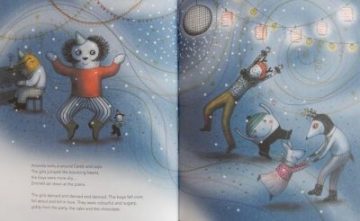
Teresa Heapy and David Litchfield
Puffin Books (Red Fox)

Safely back from their moon trip in The Marvellous Moon Map, friends Mouse and Bear are off on a new adventure.

Dazzled by the bright lights, sparkle, shine and glitter, Mouse is eager to leave the dark woods and head for Spectacular City. Ever loyal, Bear agrees to accompany him. “I’ve got you and you’ve got me,” he reminds Mouse as they sally forth.

It’s not long before there appears from an alleyway, a character introducing herself as Cat and offering to show them around the city.

With Cat in the lead, they roam all over the city, through its neon-lit alleys and kaleidoscope streets

but Mouse’s appetite for the bright lights seems insatiable; “More light!” he requests, whereupon Cat invites him to the Glitz – a restaurant atop a skyscraper.

It’s a place that doesn’t admit bears and so having checked with his best pal, Mouse leaves him at the door. Bear reminds him once again “… just call and I’ll come.”

As they sit admiring the glowing river of light down below, Mouse is ready to order his meal almost immediately: Cheese Special is his choice. But what perfectly seasoned meal, on or perhaps off the menu, does Cat have in mind?

Perhaps it’s time for Mouse to bring to mind those “ … just call, and I’ll come.” words of Bear’s before it’s too late …

One cannot help admiring both Mouse’s insatiable curiosity and sense of adventure as well as Bear’s unfailing friendship and warm-heartedness, both of which radiate from the pages of Teresa’s wonderful story and shine forth out of David’s dazzlingly gorgeous, expansive scenes and vignettes.

Having just spend the weekend with visitors including two enthusiastic paper-plane making boys, (I’m still finding their creations around the house), I’m somewhat glad they left before this smashing book arrived. I’m sure its final spread – courtesy of bear – would have prompted a whole lot more paper folding and planes whizzing about the place.

Once Upon A Magic Book

Once Upon A Magic Book
Lily Murray and Katie Hickey
Lincoln Children’s Books

Entering out of the rain a toyshop that seems to have appeared from nowhere, best friends Sophie and Jack embark on an adventure that takes them, once they’ve located and turned the golden key, through the pages of a purple book.
Their journey takes them to all kinds of locations: a fairytale forest wherein a wicked witch might be lurking; a pirate island;

a city they reach on a flying carpet and a frozen mountainous region where the witch is at work on an avalanche-creating spell.
From there it’s on to a medieval castle where Sophie falls under that witch’s spell; then they dive beneath the sea to an underwater world.

The next magic door leads them to a jungle city from where they enter the land of sweets before stepping back in time to a cobbled city wherein the witch has let loose animals from a zoo.

At the fairground an old woman tempts Sophie with an apple and they spot a familiar-looking cottage.

Surely they haven’t been tricked by that wicked witch after all that? They’d better hurry up and find, with readers’ help, all the vital ingredients that will enable them to escape her clutches.

Intricately detailed illustrations of the various locations from debut picture book artist Katie Hickey, together with a story that draws readers in from the very start and holds them spellbound through to the final spread with so many items to search for and clues to solve, it will be a considerable time before not only Jack and Sophie, but those accompanying them on their journey, finally emerge from its pages.

Fearless Mirabelle

Fearless Mirabelle
Katie Haworth and Nila Aye
Templar Publishing

Daughters of famous circus acrobats, Meg and Mirabelle are identical twins; but though they look alike, they are completely different. Much to her parents’ delight, Mirabelle shows signs of following in their footsteps right from the start as she balances, climbs and jumps.

Meg in contrast merely makes an enormous amount of noise. And so it continues as the girls grew older, although their propensities for dare devil moves and incessant talking are now in full flower.

One day the parent Moffats decide to take their twins to work. Once in the circus tent three family members perform amazing acrobatic feats.
Then comes Meg’s turn and with it, as she slowly ascends the ladder and stands on the platform all a-tremble, comes the Moffats’ realisation that this daughter suffers from acrophobia. (Me too).

Once she’s safely back on the ground, her parents offer sympathy and alternative possibilities but nothing really fits the bill so far as Meg is concerned.

Off she goes to sit alone in the caravan; refusing even to come out and see Mirabelle’s debut performance.

The act commences and is an enormous success but then Mirabelle is faced with the inevitable cameras and mikes being thrust at her. That’s the price of success; but the poor child is no longer fearless, she’s positively petrified.
Sisterly love prevails though as Meg steps forward to offer a helping hand and an enormous voice.
Could she finally have discovered her calling?

What a terrific celebration of difference, finding your own purpose in life, and sisterly love Katie Haworth’s story is. You certainly don’t have to be a twin to appreciate its messages, nor to revel in Nila Ali’s spirited scenes of the circus sisters and their parents.
A book that will surely have encore performances demanded after every reading.

Raise the Flag

Raise the Flag
Clive Gifford and Tim Bradford
QED

Traveller Clive Gifford and nature enthusiast Tim Bradford have created a fascinating books absolutely jam-packed with information, stories and other tidbits.

Herein you can find out about the history of flags including their use in heraldry.

Then comes a look at the national flag of every country in the world.
These are grouped under regions, first the Americas and Canada, then a glance at local and regional ones. Thereafter it’s on to Asia, the continent with the largest human population, where we find out about frags from Afghanistan, Bangladesh and Bhutan to Uzbekistan, Vietnam and Yemen. Some countries such as India, have a whole spread devoted to its flag.

There’s a look at flag usage – in sport,

to commemorate amazing feats such as the conquest of Everest,

the Apollo moon landing, pirate flags, flags in semaphore and much more.

In total 268 flags are explored including that of New Guinea, designed by a 15 year old schoolgirl; at one time, and until it was discovered at the Olympic Games of 1936, two countries Liechtenstein and Haiti, had exactly the same flag design. Now Monaco and Indonesia share a design; these fascinating facts I learned from the book.

Comprehensive and totally absorbing; I certainly never imagined that vexillology could be so interesting. My only issue is that I’d have liked to see the ‘Union Jack’ called the Union Flag.

This book is very well written and the visual presentation excellent; no spread looks like another and none will overwhelm primary age readers. There’s even a quiz and a final glossary and index.

Well worth adding to a school or family bookshelves.

The Great Zoo Hullabaloo! / Scaredy Cat

The Great Zoo Hullabaloo!
Mark Carthew and Anil Tortop
New Frontier Publishing

An unusual and unexpected silence greets zoo-keepers Jess and Jack when they open the zoo gates one morning. But where, oh where are all the animals?

The observant young keepers spot all sorts of evidence of their recent presence and realise that the animals have left a trail of feathers, footprints and ‘scats’ (poo).

They decide to split up and Jess’s parting words to Jack as he starts scooping up the poops are to ‘keep an eye out for that rascally rat.’ That’s a wonderful ‘Look – he’s behind you’ opportunity for listeners.

As the sun starts to sink, Jess is still searching when she hears drifting on the breeze, all kinds of musical sounds.

Then comes a FLASH in the sky as a flare goes off, (She’s also instructed Jack to send up a flare should he find himself in trouble – so is he?)

Jess follows the floating feathers towards the light, which as she draws near, she sees is coming from a forest up ahead.

Suddenly from the bushes, Jack emerges and he leads her to where sitting around a fire making music are all the missing animals. They’re having a whale of a time hopping, bopping, tooting, hooting, whistling, and kangaroo plays a didgeridoo – what a hullabaloo. (Wonderful language play in the form of onomatopoeia and alliteration is dropped into the rhyming text here)
What’s it all in aid of though?

Drawing in closer, they see, curled up cosily in a zookeeper’s shoe is a baby roo: – ‘Softly she slept in the warm furry bed, / flamingo feathers tucked under her head.’

Right up beside her however is a coiled snake holding aloft a celebratory offering. Time to waken the sleeper from her slumbers …

Then all that’s left to do is sing a special song before wending their way home by the light of the moon.

With a wonderful assortment of creatures and musical instruments portrayed by Anil Tortop in his effervescent scenes of the animals’ antics absolutely bursting with sound, (that rat manages to get itself into many of them) and Mark Carthew’s splendid read aloud text, the book is a superb amalgam of the visual and verbal. A gift for listeners and readers aloud too: get out those instruments, bring on the HULLABALOO!

More inspired Anil Tortop illustrations can be found in:

Scaredy Cat
Heather Gallagher and Anil Tortop
New Frontier Publishing

A little girl has lost her pet: ‘Have you seen my Scaredy Cat? /He’s afraid of this and afraid of that!’ she tells us as she searches high and low.
Bees, towering trees, Granny’s sneeze – a super duper kind – noises, certain toys, climbing, sprawling, brawling boys, hoses, noses, muck, ducks and garbage trucks,

all these things and more have him running scared: but where has he chosen to hide?

Could it be among the books or hooks? His owner can deal with those (love her attitude)

as well as the crooks, so where has he gone, this hissing, erm … moggie, that object of her affections?
The combination of Heather Gallagher’s frolicsome, bouncy rhyme and Tortop’s funny scenes (love all the varying viewpoints) is a delightfully entertaining romp of friendship and tease.

Voyage Through Space

Voyage Through Space
Katy Flint and Cornelia Li
Wide Eyed Editions

In the company of a little astronaut and her dog, readers are taken on a journey of adventure in space starting at the Sun, the centre of our solar system.

So it’s space suits and helmets on and off we go exploring the planets, our first stop being Mercury, closest to the Sun and the smallest planet in our solar system. We learn that its surface is covered in craters on account of the meteors that have crashed into it over millions of years; we discover that its temperature varies dramatically; it’s ‘blisteringly hot’ by day and very cold at night. Did you know that on Mercury a year is a mere 88 days long?

Venus is next closest where temperatures can go as high as 460 ℃ – OUCH! This is the hottest planet, has no moon and is impossible to explore.

Next stopping place is the moon, whereon American astronauts Armstrong and Aldrin were the first to land, a good place from which to observe Earth.

The red planet, Mars is the next stop; a place prone to fierce dust storms . A sol (Martian day) is approximately 39 minutes longer than an Earth day.

Passing through the asteroid belt takes the explorers to the largest planet in our solar system and fifth from the sun. NASA’s Juno spacecraft is currently studying Jupiter with its liquid surface and clouds of toxic gases.

The ringed planet, Saturn is the next destination. There strong hurricanes rage and the surface is mostly liquids and swirling gases. I was amazed to learn that a year on Saturn is more than 29 Earth years.

Uranus glows blue when seen in the distance from Saturn. That’s the next place viewed. Its surface is the coldest in the universe and the explorers are unable to stand thereon as its surface is gaseous, although beneath the blue-green gas clouds, scientists believe enormous gems are to be found. If only …

The final planet on the journey is Neptune, even windier than Jupiter and the furthest from the Sun. Voyager 2 took a whole two years to reach Neptune from Earth. Thereafter the adventurers reach the ‘frisbee-shaped Kuiper belt … Time to head home.

All this information is provided in easily digestible bite size chunks scattered on the relevant spread, most of which is taken up with Cornelia Li’s powerful and intriguing illustration. You can almost feel the intense heat coming from some of the pages and taste with swirling gases from others.
In addition there’s a glow-in-the-dark, fold-out poster at the back of the book to further excite young readers.

Spike The Hedgehog Who Lost His Prickles

Spike The Hedgehog Who Lost His Prickles
Jeanne Willis & Jarvis
Nosy Crow

Suddenly finding yourself without your defences isn’t something anybody would want to happen, but it’s the fate of hedgehog Spike who awakes one morning to discover that all his prickles have fallen out overnight. The unfortunate fellow is spineless, completely bare no less. “I’m in the nude. How rude!’ he says. “What will the neighbours think?’ And off he goes in search of something to wear that will cover his embarrassment.

He dons a paper lampshade and sallies forth only to have rain render it useless

and expose his nether regions to the amusement of all around.
Having fled to the woods he comes upon, of all unlikely things, a china cup and plate – the latter being a perfect bottom cover. But then the cup/hat tips and the poor creature trips; you can imagine the fate of his new outfit.

Badger has things to say about his lack of spikes next, but before long Spike finds a sock, albeit a rather whiffy one, but it serves as a smock. Little does he know however, that as he wanders merrily on his way, the thing is slowly unravelling and yet again he’s the butt of some unwelcome comments.

Blushing, our spikeless pal dashes on until he spies a bunch of balloons of all hues. Now he’s the object of the other animals’ admiration as he floats off skywards.

The sun sinks, the moon rises and Spike drifts until he’s made two circles of the world.

Suddenly he sees his home once more below, he waves and …

Now why might that be? It certainly looks as though it’s time to celebrate …

This book is an absolute treat to read aloud; not only does Jeanne Willis’ rhyme flow without a single spike, but Jarvis portrays the entire journey in his own inimitable brilliant way and there are SO many wonderful details to linger over. The colour palette is splendidly summery but this is a tale to share at any time; and its finale is an absolute hoot.

A winner through and through.

Three Cheers For Women!

Three Cheers for Women!
Marcia Williams
Walker Books

Richly detailed, funny illustrations and accompanying information on seventy remarkable women from all over the world is presented in comic strip format in Marcia Williams’ (Dot) signature style.

The amazing achievements of these women are diverse and presented, with their stories, chronologically. We start in ancient times with Cleopatra V11 Queen of Egypt and warrior queen Boudicca, ending with the 2014 Nobel Peace Prize winner, Malala Yousafzai, children’s and women’s rights activist.

Along the way we are introduced to among others, Mary Wollstonecraft (radical feminist and writer),

Marie Curie, human rights activist Eleanor Roosevelt, Amelia Earhart,

artist Frida Kahlo,

environmentalist and peace activist Wangari Maathai, Mae C. Jemison the first African-American woman in space, and Olympic athlete Cathy Freeman.

Look out for the wonderful tiny animal and bird characters that drift around the margins of the spreads along with narrator Dot and her friend Abe, adding to the fun and biographical information given in the main frames – love that narrative device.

There are also three final spreads – ‘Leaders and World-Changers’, ‘Sportswomen & Creatives’, and ‘Scientists, Pioneers & Adventurers’, containing paragraphs on around sixty other amazing women.

Memorable, inspirational, accessible and enormously enjoyable.
Children reading this, in addition to celebrating these awesome women, will surely come to know that where world changing achievements are concerned, there are, if you have a passion and self-belief, and think beyond the limits, no holds barred.

Scaredy Bear

Scaredy Bear
Steve Smallman and Caroline Pedler
Little Tiger Press

What’s BIG and HAIRY and cause for alarm in the deep, dark forest? According to Little Bob’s mother (rabbit) one bedtime, it’s a terrible creature with a roar like thunder, huge scary teeth and long, equally scary, claws.

Little Bob however, wants to find out about this creature for himself and so waiting until his mum is fast asleep, he arms himself with an extra pointy carrot and creeps out into the forest: a forest that in the moonlight looks considerably more scary than it does by day.

Having narrowly dodged a hunting owl, he dives into a huge bush only to discover it isn’t a bush at all but an enormous ursine creature. He tells the creature about the BIG HAIRY; they introduce themselves to one another and having decided to become friends, the two Bobs Big and Little, continue the search together.

When Bear, now hungry, asks about Little Bob’s carrot, he’s told it isn’t for sharing but instead the little rabbit intends sticking it up the Big Hairy’s nose. Ouch!

This prompts Big Bob to comment on Little Bob’s unexpected bravery. “How can you be so brave when you are so small?” he wants to know. ‘Because,” comes the whispered response, “I’m big on the inside.” He also tells Big Bob that he too must have a big bear hiding within if only he could let it out.
By this time Little Bob too is feeling hunger pangs so his pal goes off in search of food. Suddenly from behind leaps a very hungry fox.

Now Big Bob needs to find that inner big bear in time to save his friend from becoming fox’s supper. He lets out an enormous …

and that gives the game away well and truly.

When Little Bob finally realises who his saviour is, can the two of them sort things out between them without the little rabbit having recourse to that carrot of his? Or could there perhaps be a better use for it …

Steve Smallman’s lovely story about finding your inner strength and making a special friend is a great reminder that we can all be brave no matter our shape or size so long as we have the confidence to draw on our inner resources.
Caroline Pedler’s moonlit woodland scenes are aglow with tension and she captures the animals’ changing feelings wonderfully.

Nature & Around the World / Look, a Butterfly! / Little Boat

Nature
Around the World

Nosy Crow

These are the two latest additions to the wonderful board book series produced in collaboration with The British Museum, each presenting and celebrating cultures the world over, and inspired by the enormous British Museum collection.
Nature celebrates both the flora and fauna of the world and the elements, from a shell to the sun; the squirrel to the sunflower and the butterfly to blossom.

It’s absolutely gorgeous and certain to engender curiosity about the natural world.
In Around the World fourteen cultures are represented through items from near and far: Egypt, France, Britain, America, Germany, Japan, New Zealand, Korea, Mexico, Greece, China, Kenya and India each have a spread or page devoted to items including clothing,

musical instruments, buildings, jewellery, and much more.

Both are, like the rest of the series absolutely superb for developing language as well as being a brilliant way to introduce history and culture to your little ones, especially if you can combine it with a museum visit too.
If you can’t, worry not: each has an index as well as QR codes linking to additional information about each object featured.

Enormously worthwhile to add to bookshelves at home, or in an early years setting.

Look, a Butterfly!
Yasunari Murakami
Gecko Press

This lovely little board book is by award-winning Japanese artist/designer/author, Yasunari Murakami who is also an environmentalist and lover of wild-life. It begins with an irresistible invitation to notice, and then follow the journey of a butterfly as it explores what a flower garden has to offer.

We see the flower buds pop open and burst into a host of colours;

watch the little creature pause for a drink of nectar and revived, flit and flutter again before coming to rest upon a playful kitten.

This of course precipitates a game of flap and tease before the butterfly finally flies away.

Beautifully simple and attractively illustrated, it gives you an injection of joie-de-vivre and is perfectly honed  to be just right for sharing with tinies. Catch hold of this one before the butterflies disappear for the season.

Little Boat
Taro Gomi
Chronicle Books

Life lessons Little Boat style will delight fans of Taro Gomi’s previous Little Truck especially.

Here we follow Little Boat as he determinedly manoeuvres his way through bigger boats including a snarling one, braves the rough seas and stormy weather

until after his testing adventures, he finally meets his parent boat once more in calm waters.

Short and sweet: splendid entertainment for little ones and a great demonstration of remaining positive no matter what.

Want To Play Trucks?

Want To Play Trucks?
Ann Stott and Bob Graham
Walker Books

It’s autumn: Alex and Jack meet at the playground sandpit nearly every morning.
Alex enjoys playing with dolls of the pink sparkly clothed variety; Jack enjoys playing with trucks, especially the wrecking kind.

So what happens when Jack invites Alex to play trucks? A compromise ensues as Alex suggests, “Let’s play dolls that drive trucks.”

While their carers – parents one presumes- sit chatting, the boys play amicably together until Jack’s “You can’t wear a tutu and drive a crane,” announcement, halts things.Tempers flare briefly

but fizzle out when Alex realises that all that’s required is a quick outfit change for the truck driver.

The wonderful details in Bob Graham’s watercolour scenes that pan in and out of the play action, add much to Ann Stott’s light, spare telling. The latter relies on the story’s premise resting on what, one hopes, is a completely out-dated sexist viewpoint about who should play with what.

Be sure to take time over the interaction between the two seated adults; there’s much to wonder about there too,

in addition to thinking about what’s going on between the two main characters, the denouement of which is based on their shared passion for large, dribblesome ice-cream cones.

With messages concerning the importance of allowing children free rein in their imaginative play, compromise and inclusivity, this is a book to share and discuss either at home or in an early years classroom.

Need more suggestions for your children’s reading? Try Toppsta’s Summer Reading Guide

Biographic: Kahlo

Biographic: Kahlo
Sophie Collins
Ammonite Press

I’ve long been a fan of Frida Kahlo – her art and her spirit – so was thrilled to receive this new addition to the Biographic series for review.
It takes us first, through her life. Born in 1907 and growing up in Mexico, Frida caught polio when she was six, leaving her with a limp in her right leg; then at eighteen she was in a terrible bus accident that left her with many broken bones and in constant pain for the rest of her sadly short life.

During her recovery period, so the first part of her timeline informs us, Frida started to paint.

Three years after the accident she met Mexican artist Diego Rivera and in 1929, (a year after Frida joined the Communist party), they married for the first time.

Several operations, three failed pregnancies and a couple of affairs later, in 1935, Frida and Rivera separated: “A marriage between an elephant and a dove” is a what Frida’s mother is reputed to have said about the couple and she was certainly dwarfed by him bodily though certainly not in spirit or artistic talent.

Her first exhibition was held in 1938 and much of her work was intensely personal reflecting what was happening to her and how she felt at the time. She painted in oils, often using pastels and coloured inks for sketching. One of her most famous works, is the heavily symbolic ‘Self-portrait with Thorn Necklace and Hummingbird’.

Another is  ‘The Wounded Deer’:

Frida’s clothes were always distinctive as this self-portrait shows:

This, and others in the series that includes Biographic: Hendrix, and Biographic: Sherlock, all of which include maps,flowcharts and bubble-diagrams, are examples of infographics at their best.

See the V&A exhibition (a collection of personal possessions – clothing and artefacts) and buy this book. They can work in tandem.

Treasure Hunt House

Treasure Hunt House
Kate Davies and Becca Stadtlander
Lincoln Children’s Books

When a brother and sister receive a letter from their Great Aunt Martha inviting them to go and stay at her incredible house their mother urges them to accept.
They pack a weekend bag and off they go only to discover on arrival that their aunt isn’t there. She’s been unexpectedly called away but in her stead is her kindly looking housekeeper who introduces herself as Jo. She informs the children that their aunt has planned a treasure hunt to occupy their time until her return.

We join them in the hallway as they attempt to solve the first clue, ‘I have a heart of stone. And a head of stone, too’ and lifting the various flaps on the spread will reveal the solution along with further instructions, as well as cultural and historical information about some of the objects therein.

Thereafter we follow them around as, accompanied by Jo, they visit the rest of the rooms: the kitchen; the bedroom, where we read of the making of the first denim jeans;

the bathroom (this has a trickier riddle and a famous painting reproduction on the wall);

the living room – the cat introduces itself there); the library with its floor to ceiling bookshelves (Aunt Martha is evidently a Shakespeare enthusiast); the olde-worlde dining room; the sub-tropical  conservatory wherein butterflies flittered around the flowers;

the enormously fascinating Cabinet of curiosities packed with biological specimens including a velociraptor skeleton and a shelf of corals; a wonderful art gallery; a hall of inventions (Aunt Martha is an avid collector of incredible inventions, we learn); a music room packed with instruments of all kinds; and finally, a child’s paradise of a toy room. Therein too the final clue is solved and the secret of Jo’s real identity revealed.

Each room is exciting, packed with history and in all there are over 50 flaps to explore.

This is a fascinating and magical book that is likely to engender an interest in both history and art; it’s perfect for all who enjoy playing with or collecting doll’s houses, or have an interest in old houses, and would make a super present.

Caged

Caged
Duncan Annand
Tiny Owl

Wordless books say so much without uttering a single syllable. They challenge us, move us – sometimes to tears, make us laugh or make us feel joyful; they offer us a different way of looking at the world; sometimes they make us feel hurt or anger.

Duncan Annand’s picture book does all these, certainly for me.

Herein we see, simultaneously two threads of interwoven visual narrative, one constructive, the other, in its way destructive, although a construction project is under way. The latter is the work of two eccentric-looking architects.

As the story opens we see the two men busy in the process of destroying what looks like virtually the last remaining tree; a bonfire is ablaze close by and on a branch, a bluebird perches with a twig.

While the men work at bringing cages of brightly coloured parrots and using them to build a circular-based edifice, the bird flies hither and thither building a nest of twigs.

As the construction takes shape its architects perform some perilous climbing and precarious dangling feats to secure the cages in place.

All the while the bird keeps a watchful eye on the process.

By the time the dome is atop the enormous aviary – for that is what is being built – the bird has laid her eggs.
Job done all round. The men certainly appear to think so as they enter their edifice.

Not so the bird however; she has one final act to perform and it’s one of both liberation and entrapment …

Like the architects in his story, Duncan Annand has set the bar incredibly high for his debut picture book that tells a cleverly constructed, enormously satisfying story of environmental vandalism, just desserts and freedom.

This is most definitely a book for all ages and all people in all places. Like those parrots on the final spread, it’s one to make both hearts and imaginations take flight, particularly, the final denouement.

Priceless!

Mr Penguin and the Lost Treasure

Mr Penguin and the Lost Treasure
Alex T. Smith
Hodder Children’s Books

The creator of the wonderful Claude books does it again with this the first of another adventure series. It stars Mr Penguin of Cityville (think Indiana Jones crossed with Sherlock Holmes or even Wallace and Gromit) who has just set himself up as a professional adventurer. He has all the gear: a dashing hat, large magnifying glass, a somewhat battered satchel and a smart-looking office complete with revolving chair. Like others of his ilk, he also has a sidekick, Colin the kung-fu-kicking spider.

Mr P. sits in his office, with a decidedly reduced bank balance and a distinct lack of clients, despairing that he’ll ever be asked to solve a mystery.

Happily he gets a call from a frantic-sounding Boudicca Boones, owner of the Museum of Extraordinary Objects. She wants to hire him to find some lost treasure buried long ago by a relative.

An adventure at last; but can this oddly matched pair manage to follow a map and solve clues let alone locate the whereabouts of that missing treasure?

Their search, which ends up involving more than just Mr P. and Colin, sends them down into the depths to a subterranean jungle under the museum itself.

What a cracking, fast moving adventure it turns out to be with a host of cliff-hangers,

surprises and delicious characters, not to mention brushes with the criminal fraternity, the odd alligator and more, that will keep readers on the edge of their seats as well as chortling at the wonderful dialogue.

As one would expect of Alex Smith, the entire tale is imbued with the absurd, both verbal and visual; and be sure not to miss those press excerpts before and after the beginning and end of the book.

Readers will be thrilled to learn, as I was, that this is the first of a new wacky adventure series. Bring on the next one …

What Does the Crocodile Say?

What Does the Crocodile Say?
Eva Montanari
Book Island

A really smashing ‘starting nursery’ book is this one from author/illustrator, Eva Montanari starring a little crocodile on his very first day at nursery.

Mama wakes him, baths him, dresses him; they eat breakfast together and off they go.

At the door, teacher elephant greets parent and son

and they enter the noisy room where other animals are playing. Little croc. is very reluctant to bid his mum farewell.

Then comes story time

followed by a music session and then it’s time for lunch and thereafter a nap.

When the little ones are awake their teacher entertains them with bubble blowing and after the final POP comes a KNOCK KNOCK on the door.
Mama has arrived to collect little croc who couldn’t be happier to see her. MWAH MWAH …

And will he return tomorrow? It certainly looks that way.

Short and sweet assuredly: I can almost hear adult ‘AWW’s of empathy as they share this one and as for soon-to-start nursery little ones, they’ll most certainly enjoy joining in with the cacophonous sequence of sounds -accompanying the gorgeous illustrations as we follow the little reptile through his day.

An absolute winner this.

What Do You Do if Your House is a Zoo?

What Do You Do if Your House is a Zoo?
John Kelly and Steph Laberis
Little Tiger Press
My immediate answer to the title question would be, ‘move out straighaway’. That is precisely what the human characters in this funny story do eventually, but that is getting way ahead of the action.

The whole sorry saga begins one Sunday when the boy narrator’s parents finally agree to their son becoming a pet owner. He’s overjoyed but undecided as to what kind to choose.

Monday morning sees him dashing off an ad. to go in the local paper.

Come Tuesday the responses start arriving, and by Wednesday the lad is inundated.

Dizzying confusion reigns.

On Thursday an animal invasion begins … which very quickly becomes a total take over and that’s despite Dad’s heartfelt “No more animals!” order.

Eventually in desperation the family decamps to the garden: surely that must be a haven of peace and tranquillity? ….

Now it’s Mum’s turn to insist: They’ve all got to go!” That does the trick: women rule OK!

Feeling a little sad at the animals’ hasty departure, the would-be pet owner admits that perhaps none of the applicants was quite the right pet for him. But then he comes across one letter that he’d previously over-looked, albeit a rather whiffy affair. Could this finally be THE one? Its writer certainly does appear to have a winning way with words.

A hilarious tale that will delight those with a penchant for pets especially; but those less keen on sharing their home with a feathered or furry friend will equally be tickled by the pet problems encountered by this particular family, as so amusingly related by John Kelly and visually documented in Steph Laberis’s zany scenes of mischief and mayhem animal style. The animals’ letters in particular, are a real hoot.

DIY Circus Lab for kids

DIY Circus Lab for kids
Jackie Leigh Davis
Quarry Books

Did you know that this year is the 250th anniversary of circus in the UK; I certainly didn’t although I live in an area of Gloucestershire that regularly hosts the wonderful Giffords Circus.

This book is written by mime artist, educator, teacher and founding member of the American Youth Circus Organisation, Jackie Leigh Davis, who provides an absolute wealth of circus skills for children; and she makes it clear in her preface that circus sees all colours, all kinds of bodies: it’s inclusive, it’s for everyone. I like that.

Readers are given an overview of the various circus skills: Acrobatics, acrobalance and pyramids, Aerial arts, (for safety reasons, this are not covered in the book), Balance arts, Clowning, Gyroscopic juggling and Toss juggling.

This is followed by a ‘What’s in this book?’ spread that begins with the words, ‘This book empowers you to take your first steps in circus.’ I like that too. Herein are included some wise words on safety, a crucial element, and it also includes a ‘Proceed at your own risk’ disclaimer.

Next come the individual units wherein as well as instructions for learning the skills, Poi for instance,

readers are invited to make their own circus props such as hoops, juggling sticks and balls, poi, stilts and clown hats and nose; T-shirts even.

The instructions are always easy to follow and there are photos to help.

While the particular skill under discussion might at a beginners level, the author also includes fascinating historical references,

the positive impact of each skill learned and, where appropriate links to on-line tutorials.

The section entitled Partner Acrobatics and Human pyramids took me to Udaipur, Rajasthan where on Janmasthami, I regularly see some terrifying-looking human pyramids at a cross roads near a famous temple. I was recently interested to read that this year, a high court in Mumbai has banned those under 18 years old participating in this ‘Dahi Handi’ festival as well as banning pyramids above 20 feet high.

Back to the book, the pyramids taught herein are of an altogether safer type and include vital words on warming up and, crucially, safety, as well as the concise instructions for several pyramid styles. (There’s a whole language of pyramids: I didn’t know that!)

Putting on a show is addressed too and in the final pages are information on additional resources, recommendations for further study and more.

Intended to engender and foster a child’s enthusiasm for circus arts, but in addition think how important skills of balance and co-ordination are for adults as we grow older.

I can even envisage some of the activities being tried with an old folks group.

All in all, this is an excellent book, comprehensive and done superbly: it’s well worth investing in for families, schools and other groups that have an interest in exploring and fostering the circus arts and their potential.