I Am So Clever

I Am So Clever
Mario Ramos
Gecko Press

Oohh! If there’s one thing I do love it’s a new take on the Red Riding Hood story, after all this blog takes it’s name from a play on the story’s name.

The wolf in question herein has an enormous thirst for power, not to mention an insatiable hunger for meals of the human kind.

On this particular morning the lupine creature is in jovial mood as he converses with Little Red Riding Hood complimenting her on her appearance and warning her of the dangers of walking alone in the woods.

Now the little girl may be small of stature but she most definitely isn’t short of brains. She takes no time in demolishing the wolf’s “You could meet some ferocious creature … like a shark!” with an immediate riposte, “Oh, come on Mr Wolf, everyone knows there are no sharks in the woods,”.

Despite the put down, the wolf is already anticipating his feast as he rushes off ahead of Red Reading Hood to Grandma’s house.

Discovering in the bedroom only her nightie,

he hastily dons it as a disguise but then, rather than leaping into bed and hiding to await Red Riding Hood, he manages to shut himself the wrong side of the cottage door.

Now instead, it’s the woods he attempts to hide in. The disguise though works pretty well and he manages to dupe the hunter:“Gadzooks and dogs’ droppings!” said a voice. “Oh good morning Grandmother. Excuse the bad language but I’ve dropped my glasses. Would you please help me find them?”
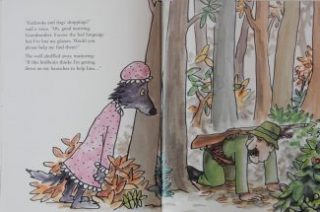
And not just him: Baby Bear, the three little pigs, the seven dwarves, and one of the gentry searching for Sleeping Beauty are also hoodwinked.

There follows a desperate struggle on the wolf’s part to extricate himself from the nightie but he fails and finds himself face to face with his planned first course.

The girl’s reaction however throws the creature completely – quite literally.
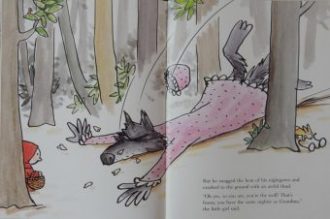
“No iff not funny!” he whimpers. “I’ve broken all my teeff! And I’m twapped in diff terrible dweff!” Pride definitely came before a fall here.

The ending comes as something of a surprise: I won’t reveal what happens but Ramos’ final scene is one that might provoke some pathos on your audience’s part.

Thanks to deliciously droll illustrations throughout, an enormously satisfying story full of comic tension and wonderful dialogue, Ramos’ wolf goes ever on: I for one hope to see him again.
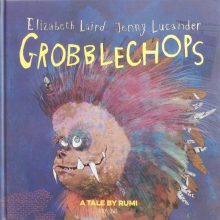
Grobblechops

Grobblechops
Elizabeth Laird and Jenny Lancaster
Tiny Owl

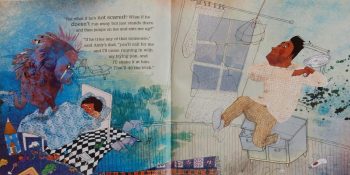
Many young children imagine monsters under the bed and sometimes use their fear of same as a tactic to delay bedtime.

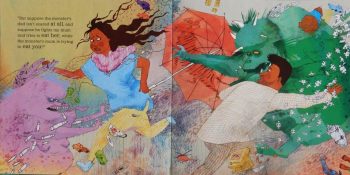
In this story based on a Rumi tale it appears that young Amir is genuinely scared in case there’s something lurking in the darkness of his bedroom – a terrible huge-toothed, hungry something that growls like a lion.

Dad’s advice is to reciprocate but be even more alarming This precipitates even more fears: suppose the monster’s dad has an even bigger frying pan for whacking than his own dad;

suppose his mum’s umbrella isn’t sufficiently scary and the end result is that the entire family become targets for monster consumption …

Perhaps it’s time for a different approach: Dad suggests he leaves the hostilities to the parents (human and monster) while Amir and the little monster play with toy cars together. It might even lead to a peaceable discussion between the grown ups.

Now that sounds like a very good idea; but there’s one thing Amir is determined not to share with any little monster and that is his precious Teddy.

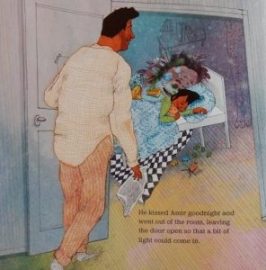
Finally, having safely tucked the boy into bed with ted, there’s something Dad wants to know and that’s the name of Amir’s monster: the clue is in the title of this smashing book.

Elizabeth Laird puts just the right amount of scariness into her gently humorous telling. Her perceptive observations of the parent/child relationship underscore the entire tale and her dialogue is spot on, ensuring that adult sharers as well as their little ones will relish the story.

Jenny Lucander employs a fine line in her richly coloured, textured illustrations. Their wonderful quirkiness, especially in the portrayal of the monsters makes them endearing rather than frightening while her human figures give the book a contemporary look.

A Story about Cancer (with a Happy Ending)

A Story about Cancer (with a Happy Ending)
India Desjardins and Marianne Ferrer (trans. Solange Ouellet)
Frances Lincoln Children’s Books

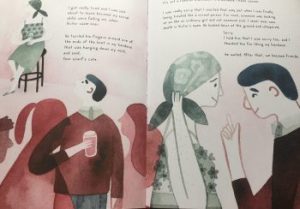
The story opens with the 15-year-old narrator telling us, as she and her parents walk down the hospital corridor, “In just a few minutes, they’re going to tell me how much time I have left to live.”

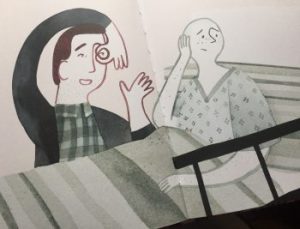
It’s five years since she was diagnosed with leukaemia and as she awaits her prognosis she shares with readers her years of treatment with the threat of death hanging over her. We hear of the sadness she feels over the death of her best friend Maxine which was “definitely not because she wasn’t strong enough or didn’t fight hard enough”; and are shown how her grief renders her temporarily limp limbed.

She talks of the hospital sounds, smells and colour scheme, how her parents react to her illness – her father’s jokes;

her mother’s insistence “that she had so much confidence in me, and she knew I’d get well …’ in contrast to her own it isn’t ‘ a battle…because there was nothing I could do to fight it. All I could do was let everything happen to me and try not to complain too much.”

There are high points too: she goes to a party, meets Victor and experiences her first love.

And finally, as we know from the title, the news the doctor gives is good; the narrator is going to live.

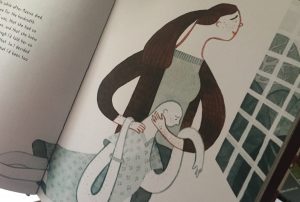
This no-holds-barred story is a real emotional roller coaster but the first person telling serves to bring a sense of calm to the whole sequence of events, be they dark or bright. Ferrer’s almost dreamlike, at times, surreal visuals, highlight the intensity of feeling, moving from predominantly grey to plum and claret when ardour prevails.

The author was asked by a ten year old cancer patient she met on a hospital visit to write a cancer story that ends happily. This is the result and serves to remind readers that 8 out of 10 children diagnosed with cancer are cured, and to give hope to any child who has cancer.

Pirate Pug

Pirate Pug
Laura James and Eglantine Ceulemans
Bloomsbury Children’s Books

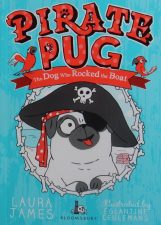
Their latest adventure sees Pug and Lady Miranda holidaying in Pebbly Bay.

They’re just preparing to indulge themselves in a hotel breakfast of some rather yummy jam tarts when in through the window flies a parrot. Showing a distinct lack of interest in the tasty fare on the tray, the bird takes off with a teaspoon.

Thus begins a seaside sojourn, which might be a bit of a challenge, for Pug is scared of water.

Things don’t go too well and before long, the dog is flat out in the vet’s operating theatre on account of an unlucky accident.
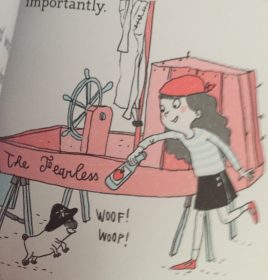
Lady Miranda’s comment on his being given an eye-patch to wear sparks one of her good ideas and soon Pug is also sporting a pirate’s hat.

Meanwhile in the town square crowds are gathering for a rehearsal of the Pebbly Bay Parade.
It’s in celebration so the mayor tells Lady Miranda and Pug, of the day the town was freed from pirate rule.

As she’s showing them her special gold chain of office, down swoops that pesky parrot Rio who seizes the chain and flies off with it.

Is Pug brave enough to sail the high seas and join the others on a boat trip across to Finders Keepers Island to rescue the treasured item?

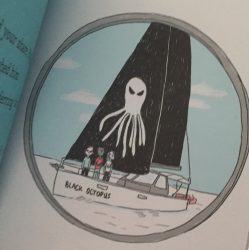
Arch-enemy Finnian and his gang are already on the ocean in their own craft so it looks like trouble is in store.

With the usual brand of charm, humour, fun and frolics, Pug’s fourth book is ideal for new solo readers and a fun read aloud. Make sure you give your audience time to see Eglantine Ceulemans’ engaging illustrations if you share it.

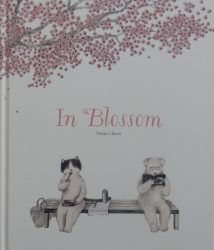
In Blossom

In Blossom
Yooju Cheon
Frances Lincoln Children’s Books

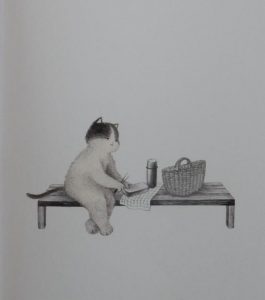
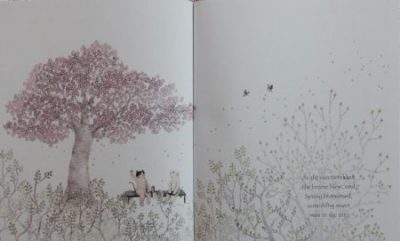
Spring is in the air. A gentle breeze is blowing and blossoms are blooming as Cat sits down on a bench beneath a tree with a picnic basket.

Singing a little song, she begins to eat her lunch.

Soon after, along comes Dog with his book.

Cat makes room for him; he sits down and starts reading.

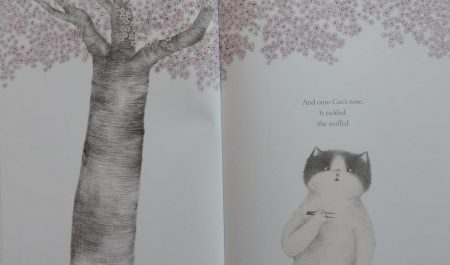
Suddenly the breeze blows a singe petal onto Cat’s nose causing a tickle, a sniff,

and a ‘Poof!’

The petal drifts across onto Dog’s nose. Another tickle, a sniff and Poof! …

A little later, Cat’s offer to share her lunch is accepted and thus, one assumes a friendship begins to blossom.

Yooju Cheon’s telling is spare and it’s definitely her exquisite, delicate inky illustrations that steal the show here. Look out for another developing friendship between two little birds as well.

Short and sweet and beautifully expressive sums up this gentle offering from an author/illustrator who is new to me.

Pip and the Bamboo Path

Pip and the Bamboo Path
Jesse Hodgson
Flying Eye Books

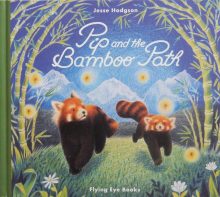
Thanks to deforestation, poaching, an illegal pet trade and accidental trapping the red panda population is critically endangered.

It’s on account of deforestation that little red panda Pip and her mother have to leave their Himalayan forest home and go in search of a new nesting place.

“Find the bamboo path on the other side of the mountain. It connects all the forests together and will lead you to safety.” So says an eagle, and the two pandas set off on a trek through the mountains in search of the path.

Their long, perilous journey takes them high into the cold shadowy mountain regions

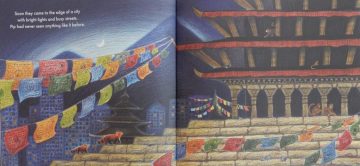
and across a rocky ravine until eventually they reach the edge of a brightly lit city.

It’s a chaotic place but is it somewhere they can make a nest? And what of that bamboo path: do the fireflies know something about that? …

The spare telling of Jesse Hodgson’s story of endangered animals serves to highlight their plight and her illustrations are superb.

From the early scene of sinister silhouettes of the tools of destruction,

shadows and inky darkness powerfully amplify Jesse’s portrayal of Pip and her mother’s journey in search of safety.

The Everyday Journeys of Ordinary Things

The Everyday Journeys of Ordinary Things
Libby Deutsch and Valpuri Kerttula
Ivy Kids

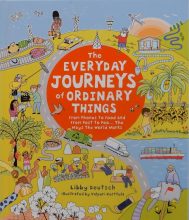
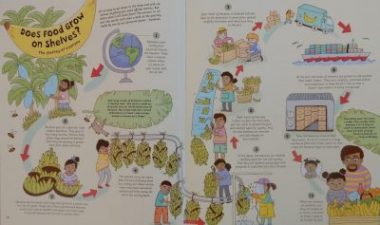
Children, especially young ones, are tremendously inquisitive, asking endless questions about how the world works. What happens to my luggage when I catch a plane to go on holiday? Where do those bananas mum’s bought at the supermarket for my lunch box come from?

Or What happens to my poo when I flush the loo?

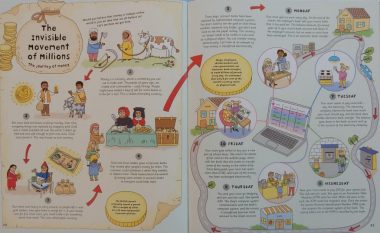
The entire processes that answer these questions and seventeen others are presented, one per double spread by means of Valpuri Kerttula ‘s flowing style graphics and Libby Deutsch’s succinct paragraphs of text.

Not all though are physical processes: ‘Lights, Camera, Action!’ follows the journey of a film idea right through to shooting.

Where does the water in the tap come from?’ presents the water cycle while ‘The invisible Movement of Millions’ takes readers through the change from commodity trading, through coin currency to bring it right up to date with the electronic transfer of money via computer.

With its engaging visual and verbal narrative, this is just the book to have on the shelf to answer some of those How? … posers your children bombard you with be they at home or school.

Pop-up Moon

Pop-up Moon
Anne Jankeliowitch, Olivier Charbonnel and Annabelle Buxton
Thames & Hudson

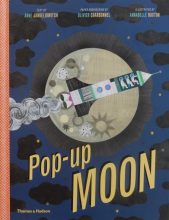
Earth’s moon has long been a source of fascination and inspiration to both children and adults, and with the 50th anniversary of the first moon landing later this year, as well as the Chinese landing on the dark side of the moon at the beginning of January, this is a timely publication.

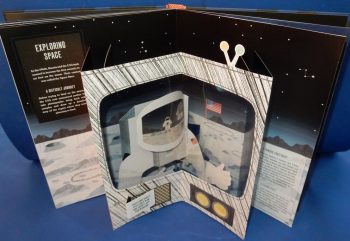
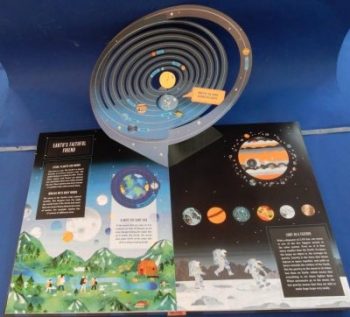
In just eight spreads, engineer and scientist Anne Jankeliowitch has packed a considerable amount of information, but it’s Olivier Charbonnel’s four spectacular pop-up visuals that steal the show.

Readers can find out about how the moon came into being; what its surface and atmosphere are like; why it apparently changes shape and how it can have an effect on the tides.

There’s a look at eclipses and their cause; as well as space exploration including the Apollo landings.

Non-scientific ideas considered by many to be mere superstition, receive a mention too.

Space enthusiasts or not, children will be excited when they open the book and images such as this leap out at them from Annabelle Buxton’s illustrations.

The spectacular nature of some of the paper engineering is likely, I think, to result in such enthusiastic handling that this is perhaps more suitable for home than classroom use.

The Song of the Dinosaurs

The Song of the Dinosaurs
Patricia Hegarty and Thomas Hegbrook
Caterpillar Books

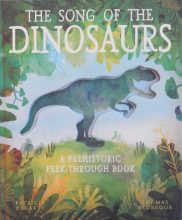
Dinosaurs are endlessly fascinating to young children and for every book on the topic published there’s a new audience ready to lap it up.

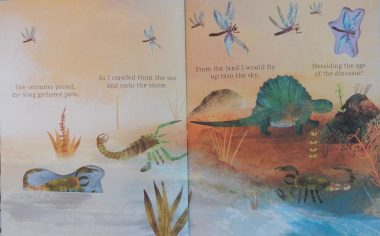
This one with its rhyming narrative and alluring die-cut illustrations immediately transports readers back to the prehistoric world with Patricia Hegarty’s opening lines, ‘I am the song of the dinosaurs, / For millions of years my tune filled the air … / In the whisper of leaves, caught up on the breeze, / Travelling unseen, but I was still there.’

They are introduced to a line-up of dinosaurs set against richly coloured landscapes and the cleverly placed die-cuts on each spread invite the reader to turn the page forwards.

Thomas Hegbrook’s vibrant scenes are a visual treat for your little dino. enthusiasts as they follow the evolutionary story from the depths of the sea, up into the skies and over land, ‘through rocks and sand.’

The back endpapers show an illustrated time line.

Patricia’s lyrical text is both atmospheric and factual; and in combination with Thomas’ illustrations, creates an exciting educational adventure to share at home, nursery or school.

Hugs and Kisses / Love from Pooh

Hugs and Kisses
Sam Hay and Emma Dodd
Egmont

The opening line of the Joni Mitchell’s classic song Both Sides Now popped into my head as I saw the cover of this book bearing the words ‘There are two sides to every story …’

Start from the front and there’s Big Blue Whale feeling, well blue on account of the fact that he’s the only creature in the ocean without someone to hug.
Several kind-hearted sea animals do their best to give him that longed-for hug but the whale’s size is an issue, as is his ticklishness

until he encounters an old shipwreck wherein lies a woeful Wiggly Octopus. Could she perhaps be the one …

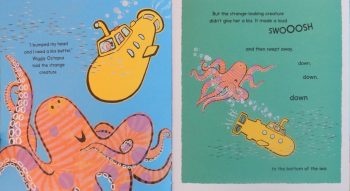
Flip the book and we meet Wiggly Octopus in desperate need of a kiss better on account of a bumped head sustained while playing bubble ball. Her long, sucker-covered tentacles are a distinct disincentive to her fishy friends and the starfish she passes and one odd-looking creature merely swooshes right down into the depths away from her.

It looks as though it’s time to hide away in the old shipwreck and feel miserable, all alone and unkissed …

We all love a happy ending but this cleverly constructed book provides, depending on how you look at it, not that, but a happy middle; or alternatively, two happy endings that just happen to take place in the middle.

However, no matter which way you go, there’s a smashing pop-up encounter in the middle of Sam and Emma’s enchanting twist in its tail book.

Just right for Valentine’s Day or any time when someone needs a hug and a kiss.

Love from Pooh
A.A.Milne and E.H. Shepard
Egmont

Read one per day and you have an entire month’s worth of original quotations on the theme of love, from the one and only Pooh Bear. Unsurprisingly being as it’s his greatest love, honey features in a good few. Here’s one entitled ‘Frustrated Love’ to set those taste buds a-tingle: ‘He could see the honey / he could smell the honey, / but he couldn’t quite / reach the honey.

If you want to put a smile of delight on a special someone’s face this Valentine’s Day then this assemblage of delicious A.A. Milne snippets together with some illustrative gems from Ernest Shepard is just the thing (perhaps along with a pot of Pooh’s favourite sticky stuff).

Non-Fiction Miscellany: Ambulance Ambulance / Weird Animals / Castle Adventure Activity Book

Ambulance Ambulance
Sally Sutton and Brian Lovelock
Walker Books

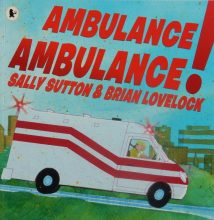
An ambulance crew responds to an emergency call out: a boy has come off his bike and ‘Nee nar nee nar nee nar nee nar …’ off goes the ambulance to the scene of the accident.

On arrival the paramedics make the necessary checks, put a splint on the child’s broken leg and carefully lift him onto a stretcher and into the ambulance.

Then with horn honking and lights flashing, off they go racing to the hospital, “Quick, quick quick. ‘Nee nar nee nar nee nar nee nar … ‘

Once the boy is safely inside and the hand-over complete, the crew are ready for a rest, but it’s not long before another emergency call comes and so off they go again …

Team Sally and Brian are already well known for their previous picture books such as Roadworks and Construction. Non-fiction loving little ones delight in these books and will doubtless relish this one with its bright illustrations, especially since its rhyming text comes with opportunities for joining in all those ‘Nee nar’ sounds. Share at home or in a nursery setting and watch the response …

Weird Animals
Mary Kay Carson
Sterling Children’s Books

The world of nature is full of strange and wonderful creatures, large and small, a dozen or so of which are featured in Mary May Carson’s Weird Animals. The author specialises in writing non-fiction for children and those with an insatiable appetite for the fantastically weird will enjoy her latest book.

It explains the whys and wherefores of some amazing adaptations, those odd characteristics that help these creatures survive and thrive.

Take for example the Pink Fairy armadillo with its oversized feet and fluffy underside that helps keep the creature warm through cold desert nights.

The frightening-looking fauna from different parts of the world include insects, reptiles, birds, fish, mammals, with explanations for their appearance. Weird and wonderful they surely are.

Castle Adventure Activity Book
Jen Alliston
Button Books

Children should find lots to explore in this engaging historical activity book. There are mazes, matching games, word searches, colouring pages that include things to spot of a medieval kind. Observation skills are also required for matching games, determining the winner of a joust, searching for rats in the castle kitchen and more.

There are medieval scenes to complete by drawing and adding stickers as well as a number of crafty projects. Some, such as making a sword or a conical hat for a princess, require additional items – paper, card, scissors etc. and may also need adult assistance.

Some simple maths, words to unscramble and a scattering of jokes are also part and parcel of this themed compilation that’s a fun alternative to constant screen use.

Monster Match

Monster Match
Caroline Gray
Hodder Children’s Books

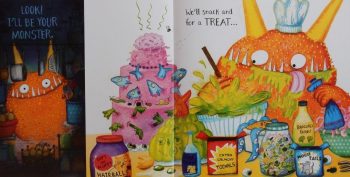
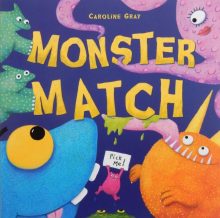
A host of zany-looking monsters each make a pitch to be chosen as a child’s special pet but is there one that stands out from the crowd?

First to strut its stuff is a tricky creature that advocates a daily run – now that’s a good idea.

Second comes a mock scary pink thing happy to do the frightening but wanting a little bit of snuggle room should it suffer from nocturnal fears.

Or what about a monster of the cuddly variety like this pamper-loving sweetie?

I’m not sure I’d advocate a monster that emerges from the rubbish bin covered in slime and stinking something dreadful; nor the snack guzzler who’s taste is for all kinds of gross looking ‘treats’,

especially not one that offers a dip in a drool pool. YUCK!

That’s almost all, but there are still one or two I won’t mention apart from to say that they join the others in claiming they’ll ‘be good, just like we should.’ Really?

Is there to be a winner? Which would your little monster choose I wonder …

Rhyming fun with a final twist: expect a few ‘EUGH!’s and “YUCK!’s when you share this one. Caroline Gray’s debut picture book most definitely offers plenty to talk about.

I’ll Love You …

I’ll Love You …
Kathryn Cristaldi and Kristyna Litten
Andersen Press

I doubt little ones these days are familiar with the phrase used on the opening page of this rhyming book, ‘I’ll love you till the cows come home’ but they’ll love the silliness of the whole thing. There are already countless books whose theme is the love a parent has for a child but this one is altogether zanier, without the saccharine sweetness that many of the sub’ Guess How Much I Love You’ kind have.

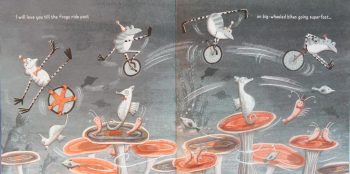
The nine verses each tell the reader they’ll be loved until … with each of the scenarios becoming increasingly outlandish. ‘I will love you till the frogs ride past / on big-wheeled bikes going superfast … // in a circus for seahorses, shrimp and bass. / I will love you till the frogs ride past.’

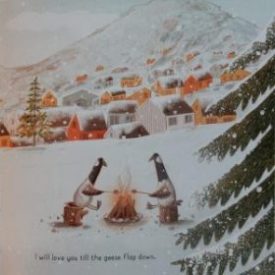
Or ‘till ‘ the deer dance by’ (sporting dapper top hats); till ‘ the geese flap down’ (with gourmet marshmallows);

till ‘the ants march in’ and then some, for there’s no end to this love.

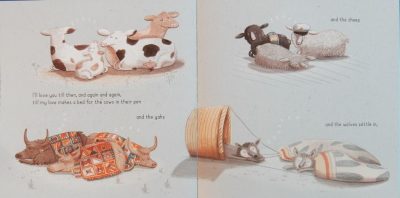
The litany concludes as all good just before bed tales do, in a sequence of perfect bedtime scenes.

The catchy rhythm of Kathryn Cristaldi’s telling combined with Krystyna Litten’s portrayal of the animals’ exuberant activities make this a wonderfully silly way to assure your child they’re forever loved.

Alternatively, with Valentine’s Day coming up you might also consider it as an altogether different way of telling that special someone, ‘I’ll love you forever.’

Amazing

Amazing
Steve Antony
Hodder Children’s Books

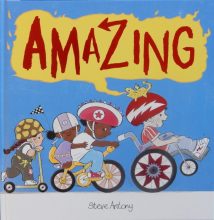
The boy narrator of this wonderful picture book has a pet dragon named Zibbo. Zibbo can fly thanks to the boy’s teaching; and our narrator, thanks to his pet, knows exactly how to …

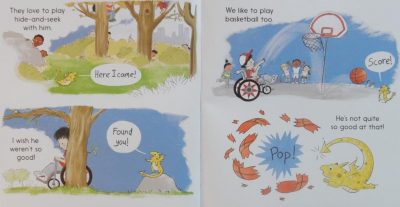
The two are pretty much inseparable and a terrific hit with the boy’s friends. Zippo is ace at hide-and-seek though basketball is at times troublesome, depending on who is catching the ball.

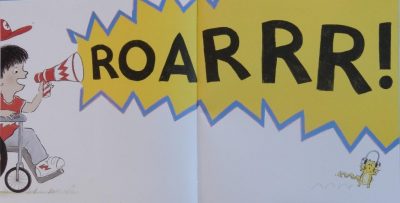
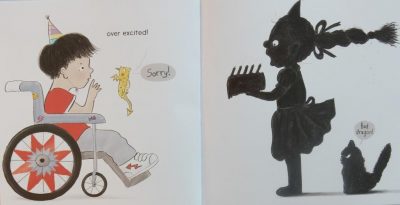
A true party enthusiast, Zippo can on occasion get just a tad over-animated, or should that be over-heated …

No matter what though, as different as he may be, Zippo is the very bestest best friend a child could possibly have: it’s a case of ‘no holds barred’ when it comes to challenges in the company of the tiny dragon, who in the narrator’s closing words truly is AMAZING! Just the way he is. The boy though doesn’t actually have the final words – those are left to Zippo …

Amazing too is the book’s creator, Steve. His joyously inclusive portrayal of boy and pet is a cause for celebration: it’s rare to find a mainstream trade publication with a disabled child as its main character, let alone one so prominently portrayed on the front cover. Even more important though, is that the narrator’s disability is incidental with the celebration of friendship taking centre stage.

Having taught in both mainstream and special education, I know for sure that the likelihood of students who are different being picked on by ignorant or thoughtless individuals, increases the further through the system they go. Young children are in my experience far more open and accepting of differences of all kinds, just like those in this story. However it’s the place to start when it comes to developing those open-hearted attitudes.

A must for all nurseries, early years settings and primary schools as well as the family bookshelf.

Rosie Is My Best Friend

Rosie is My Best Friend
Ali Pye
Simon & Schuster
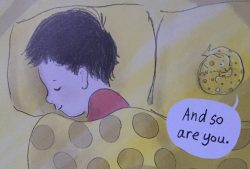
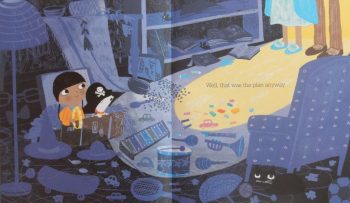
‘Rosie is my Very Best Friend. And I think I’m hers.’ So says the narrator of Ali Pye’s new picture book.

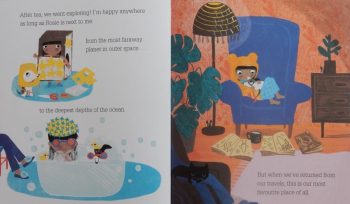
We then hear how a little girl and a small dog spend a brilliant day together. Rising early they play quietly before breakfast so as not to disturb the grown ups …

Then after a spot of training the two set about helping with some jobs – gardening, shopping and tidying, none of which receive due adult appreciation. Instead they’re packed off for a long, albeit rather muddy, walk in the park

that concludes with an encounter with a large, extremely scary looking dog.

Safely home, having had tea, the friends spend some time in imaginative play before nestling up together in their very favourite place.

‘… tomorrow could be even better’ says the narrator anticipating another wonderful day and re-stating as the two snuggle into bed, ‘Yes, Rosie is the Very Best Friend …’

But there’s a twist in this tale that listeners may, or may not have been anticipating, as we learn who in fact the storyteller has been.

Who can resist the two faces looking out and drawing readers in from the cover of this wonderfully soft-hearted story of a special friendship? Ali Pye’s characteristically patterned illustrations of child and canine friend are adorably cute without being at all sentimental; even this very dog wary reviewer immediately warmed to the small black and white pooch.

When Sadness Comes To Call

When Sadness Comes To Call
Eva Eland
Andersen Press

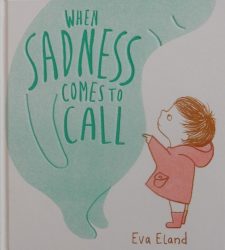
Sadness can come at any time, right out of the blue and no matter how hard you try to avoid it or want to hide it away; it can become so overwhelming that you feel as though it has completely taken you over, mind and body.

In this, Eva Eland’s debut picture book she portrays Sadness as an amorphous physical entity, somewhat resembling a Babapapa, that comes a-knocking at the front door of a child.

Better than shutting it away and letting it frighten you, is to acknowledge it by giving it a name, then just let it be for a while. Perhaps there are things you can enjoy doing together – drawing, listening to music or drinking hot chocolate, or venturing outside for a walk.

Changing your response to this feeling is what’s required, rather than trying to change the feeling itself: be mindful of the sadness for things will get better.

Children’s mental well-being has become head-line news of late with more and more children, even young ones having problems with mental health. There are plenty of picture books about anger and how to cope with it, but far fewer on the topic of sadness or melancholy so this book is especially welcome. It’s sensitively written, empathetic and ultimately uplifting.

Eva’s hand-drawn illustrations for which she uses a three colour palette effectively portray the child’s changing emotions.

Her endpapers too show two different responses: in the front ones people are ignoring their sadness and look depressed, while the back endpapers show the same characters interacting with sadness and feeling better.

A book to share and discuss at home or in school. Armed with the knowledge offered therein young children have a tool to use with their own sadness next time it comes visiting.

Mole’s Star

Mole’s Star
Britta Teckentrup
Orchard Books

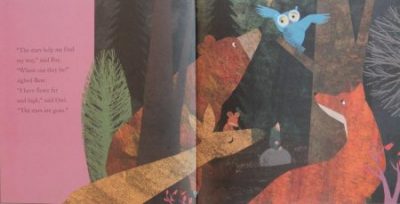
Mole loves to watch the stars; they help to alleviate his feelings of loneliness that are sometimes brought on by the dark. Every night he sits on his favourite rock star gazing and enjoying their lights that twinkle in the sky.

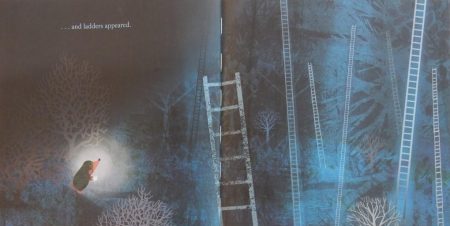
One night he sees a shooting star and makes a wish. Finding himself immediately surrounded by tall ladders stretching all the way up to the sky, it seems his wish to own all the stars in the world can really come true.

Up and down the ladders Mole hurries, as he fills his burrow with starlight, giving not a thought to the consequences of his actions.

So much does Mole love the new brightness of his home

that it’s a while before he pops his head out of the molehill again. Total blackness meets his eyes; then he learns how his actions have affected the other woodland animals.
Ashamed of his thoughtlessness Mole wanders deep into the forest where he suddenly comes upon a dim light glinting in a puddle.
Voicing his regret at his ill-considered action has a surprising effect; the faded star twinkles and …

Mole knows exactly what he must do and happily his friends are ready to lend a paw, hoof or wing to help him.

Picturebook star Britta Teckentrup’s magical story highlights the importance of sharing, demonstrating how the wonders of the world belong to all its creatures. Her characteristic digitally worked collage style illustrations show the beauty of the natural world, while in this instance her sombre colour palette allows the night’s twinkling lights to shine through with dramatic effect.

Happy To Be Me

Happy To Be Me
Emma Dodd
Orchard Books

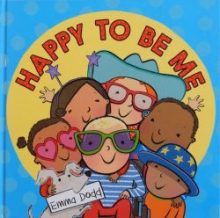
Emma Dodd’s simple rhyming celebration of all kinds of human bodies as presented by the six small children in her new book, is both wonderfully upbeat and inclusive.

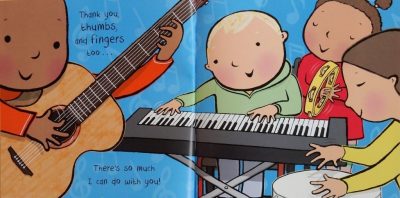
The toddlers are happy in their own skins with mouths for smiling and laughing, wiggly toes, fingers and thumbs that can do so many different things

as well as hands that touch and hold; ears for listening; eyes for seeing; a head bursting with good ideas, arms for hugging, a nose for smelling; a tongue that tastes; legs that can fold up to make a lap – just right for a cosy napping place for a pet.

Thanks too, go to lips and teeth for facilitating eating and drinking; but most important of all to our hearts that let us love. And love is what shines forth from every spread.

With its adorable little individuals and two supporting adults, this book provides a great way for adults, either at home or in a nursery setting, to talk with very young children about their bodies and being thankful for the amazing things they can do.

Peter in Peril

Peter in Peril
Helen Bate
Otter-Barry Books

Let me introduce Peter, although as narrator of Helen Bate’s debut graphic novel, he introduces himself in this true story of a six year old Jewish boy living in Budapest during World War 2.

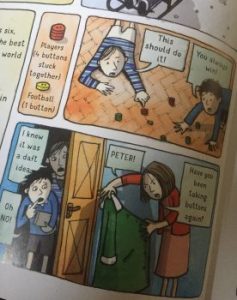
Peter always makes the best of things; he trims the sides off newly baked cakes and frees buttons from his mother’s coat to use in his play

but when his beloved Roza (who lives with the family and helps his mother) has to leave as she’s no longer allowed to work in a Jewish household, the lad is bereft.

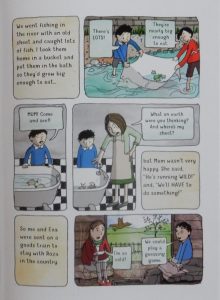
That though is only the start of the upsetting things that happen but Peter’s story is not all dark and bleak. Despite the fact that under Nazi rule, Peter’s family were forced to leave their home, split up and had then to live in hiding in constant fear for their lives, there’s humour too; it’s rightly subtitled ‘Courage and Hope in World War Two’. Indeed with its fine balance between horror and humour, it’s pitched just right for 9+ children.

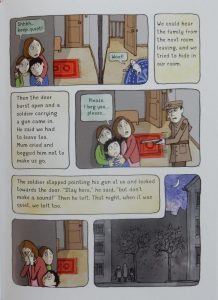
Thanks to enormous good fortune and the amazing kindness of individuals including a soldier,

Peter and his parents escaped a number of nightmarish situations and survived, although (as we learn in the afterword) his grandmother, aunts and uncles were killed in concentration camps.

Moving, accessible and offering a less well-known perspective on WW11 and the Holocaust, with its skilful balance of illustration and text, this is definitely a book to include in a primary school KS2 collection.

With Holocaust Memorial Day coming shortly, if you missed this poignant book when it was first published, it’s worth getting now. It could also open up discussion about other children, victims of more recent horrific events, who on account of their ethnicity or religious faith for instance, find themselves victims of persecution and perhaps forced to become refugees.

Particularly in the light of recent and on-going conflicts in various parts of the world and the current upsurge of nationalism, we would all do well to be reminded of Amnesty International’s endorsement statement on the back cover, ‘ it shows us why we all have the right to life and to live in freedom and safety.’

So You Think You’ve Got It Bad? A Kid’s Life in Ancient Greece

So You Think You’ve Got It Bad? A Kid’s Life in Ancient Greece
Chae Strathie and Marisa Morea
Nosy Crow

Chae Strathie knows just how to make history interesting and fun for children as he demonstrates in his latest So You Think You’ve Got It Bad title published in collaboration with The British Museum.

The first topic (of ten) Clothes and Hairstyles contains some tasty or perhaps rather yucky, snippets of information such as the fact that one source of purple clothes dye was insect larva (maggots to most of us); though actually, yellow was a favourite with girls.

Suppose you were a boy in Ancient Greece; you’d wear merely a short tunic; yes it was probably pretty warm much of the time but even so a sudden gust of wind, especially in winter, would probably expose your nether regions. Brrrr!
Moreover, young men training in the gymnasium or participating in a sporting event did so in the altogether and it was considered absolutely normal so to do.

Young girls fared slightly better; they too wore only a single garment – an ankle length dress called a peplos but at least it was belted.

Zips or buttons hadn’t been invented although people used brooches, pins, cord or belts as fasteners.

Girls had a pretty grim time of it back then and female babies were often left to die on account of the dowry system, which meant that it could cost parents a fortune when a girl married, something that could happen as young as thirteen and to a complete stranger.

Girls fared badly too when it came to education: boys went to school when they were seven but girls –rich ones only – were home educated, the focus being how to run a home.

Inequality was everywhere with slaves making up around a third of the population of Athens.

Talking of education, tablets were used for note taking in lessons – no not the electronic kind; these were made of wax-covered wood on which you wrote with a stick-like stylus.  Sticks were employed for another reason too – for beating those boys who didn’t learn quickly enough in class. Yeouch!

Pets were popular with families with snakes, goats, swans, ducks and geese numbering among the favourites along with dogs (the very favourite). Try taking geese out for a walk!

Oh my goodness! Even the homes of the very richest were without a loo. Imagine having to poo in a pot every single day. No thanks. There’s even a depiction on a painted vase of a small boy sitting having a dump on a tall potty-like object that apparently doubled as a high chair. Hygienic it surely wasn’t.

The largest room in a typical Greek house was devoted to partying – men only again. Female readers are probably fuming by this time.
Health and medicine introduces physician Hippocrates, often called the founder of modern medicine but before he came along much of ancient Greek medicine relied on magical prayers and charms.

Diet, myths and legends, ancient gods and fun and games complete the thematic sections.

The layout of almost every spread differs with information presented in paragraphs of text, in speech bubbles, via diagrams, and through Marisa Morea’s amusing illustrations, which make the book even more engaging.

Readers will surely finish reading this with a big smile and almost without noticing will have gained insights into an important ancient civilisation as well as a greater appreciation of their own lives today.

You’re Not a Proper Pirate, Sidney Green!

You’re Not a Proper Pirate, Sidney Green!
Ruth Quayle and Deborah Allwright
Nosy Crow

Here’s a book that takes a different slant on piratical tales with the all-absorbing nature of imaginative play at its heart.

When Sidney Green receives a letter urging him to stop playing and become a proper pirate he likes the idea but as he tells his playmate, dog Jemima, they have an important race to take part in first. “I’ll come in a minute,” is his response to Captain Shipshape and off he races, whoosh!

Race successfully completed, he forgets all about being a pirate until, in through the window flies a scarlet macaw that repeats Captain Shipshape’s summons.

Sidney’s response is the same as before. and he and Jemima plus the macaw set off on an expedition to Africa.

Once again a ‘rip-roaring time’ is had by all and the pirate business is forgotten.

He’s reminded however by three pirates, who come banging on his door disturbing the project Sidney is engaged in. Building a castle seems more interesting than returning whence they came so the three join in with the project.

It’s thirsty work and as the builders stop for some liquid refreshment who should appear on the scene but Captain Shipshape himself.

His dismissal of the friends’ activities as ‘just playing’ and his instruction to join him, have an unexpected outcome.
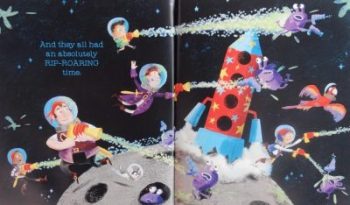
Before you can say ‘Proper pirate’ something heavy hits him on the head and he finds himself a member of Sidney’s crew blasting off into space to track down some dangerous aliens.

The outcome is another rip-roaring time …

How will this adventure end? You’ll have to unearth a copy of this treasure of a book for yourself to discover that. (That sentence holds a clue). Suffice it to say that there’s more than one way of being a ‘proper pirate’.

I love the way Ruth’s story highlights the importance of children’s imaginative play in this enormously engaging tale that is packed with action, has plenty of dialogue for readers aloud to let rip on, and some satisfying repetition for young listeners to join in with.

Deborah Allwright packs plenty of action into her digitally worked scenes of cars and corners, boats and a birthday celebration, castles and crocodiles, diggers and dinosaurs, and much more, making this a super story to share with your little ones.

A Year of Nature Poems

A Year of Nature Poems
Joseph Coelho, illustrated by Kelly Louise Judd
Wide Eyed Editions

Here’s the perfect book to start off 2019 and give us all something to look forward to other than the doom and gloom that issues forth whenever one turns on the TV or radio news and current affairs.

Award-winning performance poet Joseph Coelho has penned twelve poems about the natural world, one for every month of the year. Each is introduced with a brief prose paragraph to set the scene, and beautifully illustrated by Kelly Louise Judd in folk art style.

Joe is one for creating powerful images in his writing and it’s certainly so here.

There are reflective poems, several of which seemingly stem from the author’s own childhood, one such is April. ‘ When there was electricity in the sunset / I’d lay in the sky-hug of our balcony hammock / and swing. The rain was always welcome / each drop a cold thrill/ that relaxed and washed away.’

Reflective too and exquisitely expressed is his account of creating a pond and its visitation by mayflies in May.
‘They’re quick to shed their awkwardness. / The dead pond, I couldn’t bring myself to fill-in, / explodes into an exultation / of fairy dust / and angel light / of dancing tears / and sparkling goodbyes / as wild life fills / the hole we dug.’

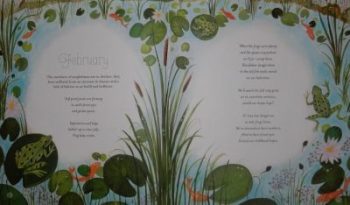
In its final verse February laments the decline in amphibian numbers but before that we’re treated to a lyrical description of frogspawn: ‘Soft pond jewels are forming / in sunlit forest pools. // Expectation and hope / balled-up in clear jelly. Frog-baby crèche.’

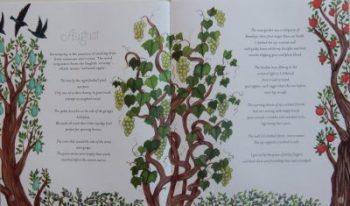
Many of us as youngsters indulged in a spot of scrumping but my partner has never grown out of this activity and still enjoys liberating apparently unwanted fruit as summer gives way to autumn. So, I was amused to read Joe’s fruitful account of childhood exploits of so doing in his August poem.

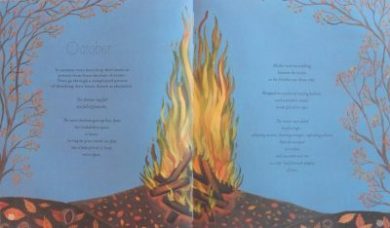
You can almost smell smoke so vivid is the description of leaf fall and the autumnal hues enjoyed by a young Joseph with his mother one October: ‘The leaves were piled / bonfire high / whizzing russets, shooting oranges, exploding yellows /that she scooped in armfuls / and cascaded over me / in a dry-leaf firework display / of love.’

A year as seen through Joe Coelho’s poems offers a terrific sensory awakening to put us all in mindful mode, and perhaps inspire children to pen their own responses to the beauty of the natural world.

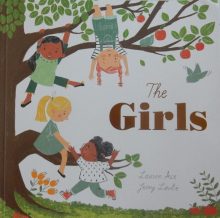
The Girls

The Girls
Lauren Ace and Jenny Lovlie
Little Tiger

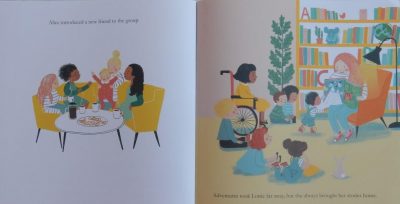
When four little girls meet under an apple tree, little do they know that the friendship they form will over the years, grow and deepen into one that lasts into adulthood.

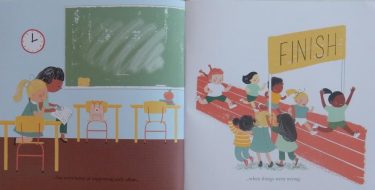
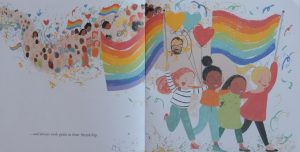
We follow the four through the good times and the down times,

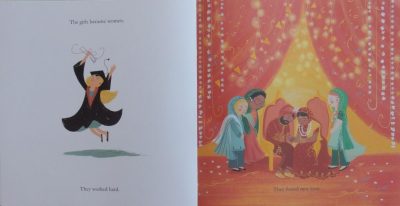
with the girls sharing secrets, dreams and worries as they grow into women

and by the end readers feel they too share in this friendship so well do they know the foursome.

There’s Lottie the adventurous one; full of ideas, Leela; practical Sasha and Alice, the one who is always able to make them laugh.

We’re really drawn in to this wonderfully elevating account of long-lasting female friendship that Lauren describes and Jenny Lovlie so beautifully illustrates.

Like friends everywhere, these four are totally different in so many ways but no matter what, transcending their differences, is that enduring bond between them symbolised by – what an apt metaphor it is – the growing, changing tree that embodies strength, support and above all, permanence.

Here’s hoping that all the young readers who encounter Lottie, Leela, Sasha and Alice within the pages of this inspiring book will, like those characters, find not only reassurance and emotional strength but the joys of true friendship in their own lives.

Jungle Jamboree

Jungle Jamboree
Jo Empson
Puffin Books

The jungle is alive with anticipation. The coming of dusk is the opportunity for all the animals, great and small, to show off their beauty; but which one will be judged the most beautiful of all?

One after another the creatures dismiss their natural beauty: Lion says his mane is too dull; bird’s legs are too short; zebra’s stripes are too boring; leopard’s spots too spotty and hippo’s bottom is well, just too big.

None of them expects to win the crown.

A passing fly is interested only in his lunch and while the other creatures all set about getting themselves ready for the jamboree, he happily sates his appetite.

At last all are ready but they’re hardly recognisable with their fancy adornments and new-found confidence.

The fly, in contrast talks only of the beauty of the day’s ending.

Finally the long-awaited hour of dusk arrives. Judges and creatures assemble ready to strut their stuff; but all of a sudden the clouds gather and a storm bursts upon them.

The animals are stripped of their flamboyant accoutrements and left standing in darkness as the storm finally blows itself out. Now it’s impossible for the judges to see who should receive that crown of glory.

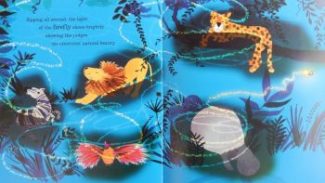
Then the little fly speaks out, offering light, for this is no ordinary fly.

How wonderfully one little firefly illuminates all the creatures, now clad only in their natural beauty; but which will be declared the most beautiful of them all?

Jo’s story is funny, thought provoking and a superb celebration of kindness, self-acceptance and every individual’s unique beauty: her electrifying illustrations are a riot of colour and pattern and likely to inspire children’s own creative efforts.

Tooth / Big Kid Bed, Bizzy Bear Knights’ Castle, Mix & Match Farm Animals

Tooth
Big Kid Bed

Leslie Patricelli
Walker Books

Baby, the star of several previous board books including Toot returns in two further amusing and appealing episodes.

Tooth begins with the star of the show exhibiting some distress about a strange feeling in the mouth. Before long we discover that Baby is getting a tooth, shiny, white, hard and sharp. Not just a single tooth though, there’s another and then two more follow.
Having shown those shiny gnashers, Baby demonstrates some things good and not so good that can be done with the teeth.

Very important too is taking care of teeth and we see how even one so small is conscientious about dental hygiene.

Brushing twice a day and flossing (with Daddy and Mummy’s help) are part of the little one’s daily routine.

Patricelli’s straightforward first person text combined with scenes of the adorable Baby is irresistible.

The same is true in Big Kid Bed. Here the toddler tells of bedtime preparations for a sleep on ‘my new big kid bed!’ How exciting; but the bed is so big and the toddler so small it’s as well that Mummy and Daddy are on hand to make things easier, piling up pillows around the bed in case of a fall and bringing in Baby’s stuffed animals to snuggle up with.

Comfortable as Baby might be, there’s the possibility of getting out of bed again to investigate what other members of the household are doing during the night, until finally, YAWN; sleepiness takes over and it’s time to return to the warmth and cosiness of that new bed for a good night’s sleep.

Who could ask for more from a bedtime book for the very youngest?

Bizzy Bear Knights’ Castle
Benji Davies
Nosy Crow

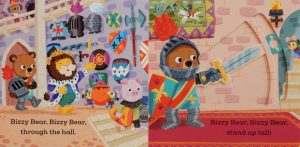
In this adventure Bizzy Bear finds out what life as a knight is like when (with a bit of help from small fingers that slide the helmet visor up and down) he dons a perfectly fitting suit of armour and visits a castle.
Once kitted out and inside, Bizzy tries his paw at brandishing a sword

and then on the next spread, at jousting before finally sitting down to participate in a delicious-looking banquet.

As with other titles in the series, the engaging simple rhyming text, brightly coloured illustrations with just the right amount of detail (look out for the dragon) and those interactive features – sliders and tabs that are easy to use, make this well-constructed book ideal for toddlers.,

Mix & Match Farm Animals
Rachael Saunders
Walker Books

With the same innovative design as previous titles in this mix & match series (a tiny board book within a small one) young children are invited to match the larger surrounding page with its ‘Who says …?’ question to the appropriate smaller inset animal spread showing the animal that makes the sound.

The animals featured in the smaller book are all adult while on the surrounding pages young animals are depicted, as well as other appropriate clues, for instance there’s a calf, a bull, a barn and a bucket of milk on the ‘cow’ spread.
On the final ‘sheep’ spread we meet a farmer and sheepdog in Rachel Saunders’ illustration.

A clever format, and a playful and enjoyable way to introduce or re-enforce farm animal sounds to the very youngest

A Home on the River

A Home on the River
Peter Bently and Charles Fuge
Hodder Children’s Books

When Bramble Badger discovers that he has no water and neither have his friends he looks beyond his own front door.

Heading down to the river, he finds the riverbed is completely dry – there’s not even enough for Tipper Toad to take a dip.

Determined to help his friends, Bramble follows the dry river bed deep into the woods manoeuvring over and around obstacles and startling some of the woodland animals; he even takes an unplanned dip in a freezing lake, until eventually he comes upon a blockade.

Thinking the young squirrels have been up to mischief he goes to investigate.

What he finds though isn’t squirrels but a wooden house on an island.

The house is inhabited by one Sam beaver who doesn’t realise that his actions have caused problems further downriver.

Fortunately he’s ready to make amends and so Bramble shows him the perfect spot he’s discovered close by and all ends happily with water flowing once again.

Peter Bently’s rhyming story of friendship, sharing and caring for the world around us is the second to feature Bramble and his community of animal friends. Again in his lovely illustrations, Charles Fuge brings out both the warmth of Peter’s tale and the beauty of the natural world.

The Kiss

The Kiss
Linda Sunderland and Jessica Courtney-Tickle
Little Tiger

Right from Jessica Courtney-Tickle’s inviting cover, this is a superbly uplifting book about one small expression of love and the life-changing consequences such acts of loving kindness can have.

It starts with a kiss blown by young Edwyn to his departing Grandma.

On her journey home, she shows this kiss to a sad-looking old man – with dramatic effects …

and blows him a kiss of her own as her bus leaves.

Walking through the park, she comes upon a woman shouting unkindly at her daughter. Again the sight of Grandma’s kiss has transformative effects –shared laughter between lady and child and an increase in the size of Gran’s kiss.

A surprise in the form of a rich and greedy man desirous of procuring her kiss awaits Grandma as she reaches home. Her refusal to part with it does nothing to deter the man who tries several ploys to get it but Grandma stands firm.

Finally the man resorts to theft and having stolen the kiss he stashes it away, for his eyes only, in a silver cage inside his tower.
Its incarceration has drastic effects on the kiss, on the elements and on the rich man’s mood, so much so that he returns what he’s taken to its rightful owner.

Instead of chastising him, Grandma shows him nothing but kindness, even bestowing upon him a mood-lifting farewell kiss.

I wonder what effects Edwyn’s big hug will have …

Linda Sunderland’s story is such a wonderful demonstration of how much more power for good a small act of kindness such as sharing has, than the grabbing greed of acquisition, as well as that It’s impossible to put a price on simple, heartfelt expressions of love.

Rising star Jessica’s illustrations are totally gorgeous; her delight in the natural world is evident in her vibrant, richly patterned scenes.

Perfectly Polite Penguins

Perfectly Polite Penguins
Georgiana Deutsch and Ekaterina Trukhan
Little Tiger

As this story states at the outset, penguins are ALWAYS perfectly polite. Always? Surely that’s just too good to be true isn’t it?

Certainly most of them have excellent manners but there’s always an exception to the rule; in this case it’s Polly.
Polly penguin finds politeness boring and shows it by her actions.

She butts in when others are speaking, doesn’t think about the feelings of her fellow penguins; is untidy and bad-mannered especially at meal times.

When this lack of politeness infects others in the household, the resulting mayhem upsets Baby Peter so much that he shuts himself away.

Fortunately though Polly knows exactly how to put things right.

Is she now a reformed character? Errr! You know how it is with little humans: so it is with little penguins and perfection would be extremely boring wouldn’t it?

Georgiana Deutsch and Ekaterina Trukhan’s fun demonstration of the importance of appropriate behaviour and consideration of others is great to share with young humans, especially the Pollys among them. I love the bold colour palette Ekaterina uses. Her portrayal of the antics of the penguin waddle as their behaviour deteriorates into penguin pandemonium is splendidly subversive; expect giggles galore.

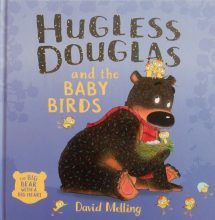
Hugless Douglas and the Baby Birds

Hugless Douglas and the Baby Birds
David Melling
Hodder Children’s Books

As Douglas sits beneath a tree taking stock of his spring collection, it’s suddenly added to in an unexpected manner. A nest of eggs plummets into his lap, closely followed by a squirrel that informs Douglas it belongs to Swoopy Bird. The eggs are fine but the nest is rather the worse for its tumble.

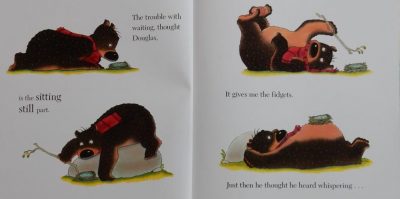
Kind-hearted as ever, Douglas volunteers to mind the nest and its contents while its owner builds a new one but it seems a long wait.

One of the Funny Bunnies suggests egg hugging is a good way to keep the eggs warm – decidedly preferable to being sat upon by Douglas’ large rear – and it isn’t long before the eggs are ready to hatch.

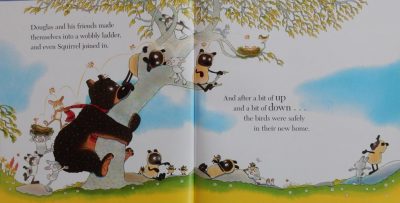
The next challenge is to get the eight little hatchlings safely up to the new home Swoopy Bird has finished in the nick of time.

Once installed it’s hugs all round.

As always it’s perfectly pitched for young listeners but with sufficient humour – visual and verbal – to satisfy adult readers aloud too.

With its signature final double spread (here it’s things to spot on a spring day) and some crafty suggestions, this new story will please established fans, and make the huggable Douglas a lot of new followers.

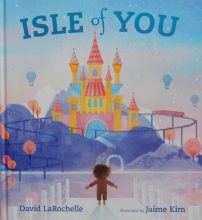
Isle of You

Isle of You
David LaRochelle and Jaime Kim
Walker Books

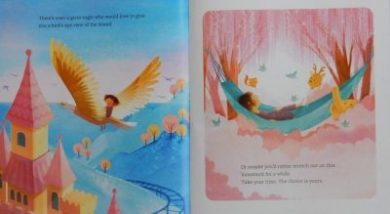
The unseen narrator invites a sad-looking child to leave all worries behind and take a journey (a sailing boat awaits) to a very special place – the Isle of You. This fantastical land is one bathed in soft llght and on shore are a host of welcoming animals and small humans ready to indulge their visitor.

Choices abound: there’s a waterfall in which to swim, a stallion to ride, mountains to climb or perhaps a ride on the back of an eagle, or a restful stretch in a hammock is preferable.

‘Take your time. The choice is yours.’ That’s the assurance.

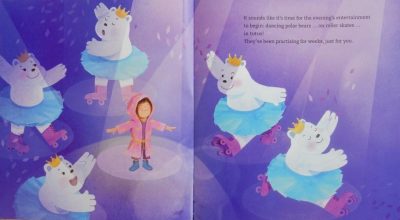
There’s entertainment laid on courtesy of dancing polar bears

and a delicious-looking feast to partake of before perhaps, a moonlit stroll on the beach before it’s time to depart, safe in the knowledge that ‘Someone loves you very, very, very much.’

This reads like a guided visualisation in picture book form – mindfulness for little ones after a bad day.

David LaRochelle’s gentle whimsical story is a sweet one (perhaps some will find it overly so) and Jaime Kim’s glowing pastel shades of yellow, pinks, blues and purples help bring feelings of comfort and an otherworldy atmosphere to a fantasy that will help youngster listeners, (safe in the knowledge that it’s sometimes okay to feel sad), to set aside the day’s trials and worries and undertake a mindful journey to a magical place, that’s closer than they think, the ISLE OF YOU.

Flat Cat

Flat Cat
Hiawyn Oram and Gwen Millward
Walker Books

Pampered puss Jimi-My-Jim, living a seemingly idyllic life with Sophie in a flat at the top of a tall block, does his very best to show his appreciation. As a result Sophie has no idea that her pet longs to be a part of the outside world.

When Sophie and her parents leave home each day why, you might wonder, does he merely sit at the window watching life go by? I certainly did.

Little by little his pampered, prison-like existence takes its toll: the creature begins to flatten out until he looks utterly two dimensional – he’s become, in the style of Jeff Brown’s human boy hero Stanley, a FLAT CAT.

Then one day, Sophie and her Mum leave him alone. Now here I anticipated Jimi sliding under the door, but no. In their haste, the two forget the keys giving him the perfect opportunity to take action. He dons his coat, grabs the keys, does a spot of climbing and exits onto the street, destination another feline he’s had his eye on.

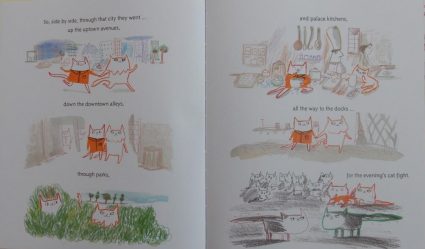
Streetwise Blanche introduces herself and offers to show Jimi around. Together they explore the city;

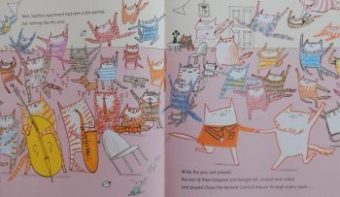
Blanche takes Jimi to meet all her feline friends and a few canine ones as well; but  evening comes all too soon and Jimi doesn’t want to say farewell.

Instead he invites his new friends home and even thows a party for them.

What on earth will Sophie and her parents do when they return? Could it be the end for Jimi’s forays into the big wide world?
Let’s just say it’s a happy ending and not just for the main protagonist …

I’ve always been a rule-breaker so thoroughly enjoyed Hiawyn’s tale of freedom, adventure and friendship, feline style. Gwen Millward’s distinctive naive, flat cartoon illustrations are a purr-fect portrayal of Jimi’s jaunts and underscore the message that freedom, love and friendship not material things are what make people happy.

Zoology for Babies / Architecture for Babies & Look & See: Fun with Shapes

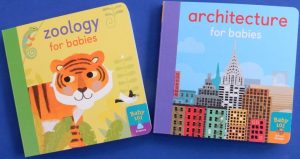
Zoology for Babies
Architecture for Babies

Jonathan Litton and Thomas Elliott
Caterpillar Books

Here are two new additions to the Baby 101 series, the zoology one being billed as ‘science’ and the architecture book as ‘Art and Design’.
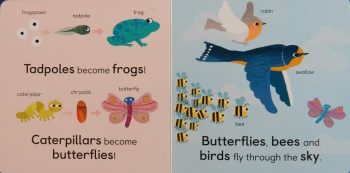
Zoology acknowledges the ubiquity of animals, and their varying sizes; introduces the idea of herbivores and carnivores (although not in those terms).
Birth and life cycles are also touched upon

as is movement.
We’re shown several different habitats and the animals living therein; and the fact that animals can be nocturnal is also given a spread.
The final spread asks somewhat tongue-in-cheek: ‘Are you a little zoologist? And has a drop down flap to investigate.

I’m not sure how many babies would be interested in buildings – it depends on the skill of the adult mediator – although I can certainly see the Architecture book being a useful addition to a nursery topic box.
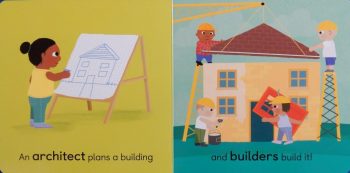
It embraces history, geography, the role of an architect and builders

as well as introducing various building materials. Architectural designs for different functions including homes, schools and shops are also introduced. It’s good to see a bookshop included.
Like Zoology, the final spread herein asks ‘Are you …’ and has a final flap to investigate, beneath which is to be found what I suspect will be of most interest to the very young …

Bold, eye-catching illustrations and design, minimal wording and simple facts characterise both books.

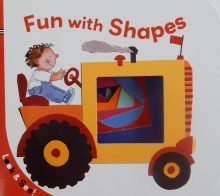
Look & See: Fun with Shapes
Emanuela Bussolati and Antonella Abbatiello
Sterling

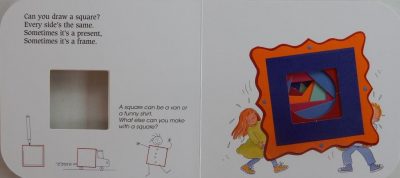
Youngsters are presented with ten basic 2D shapes to touch and explore in this playful board book.

A sequence of bright die-cut collage style illustrations featuring a girl and boy show in turn a square picture frame,

the circular body of a peacock, a triangular boat sail, a hexagon-shaped space craft and a host of other colourful objects on the recto pages and on the verso is an engaging text and three possible items that might be created using the particular featured shape as a starting point.

Inspiration for further creativity perhaps.

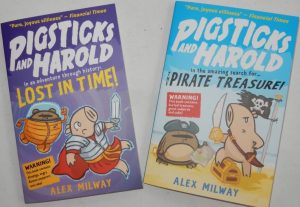
Pigsticks and Harold: Lost in Time / Pigsticks and Harold: Pirate Treasure

Pigsticks and Harold: Lost in Time
Pigsticks and Harold: Pirate Treasure

Alex Milway
Walker Books

With aspirations to become more like his brilliant inventor Great-aunt Ada Lovepig, Pigsticks is busy preparing for the Tuptown Science Fair – the ideal place to demonstrate his own inventive prowess. There’s a problem though; it’s the day of the competition and his entry for Best Invention is not going at all well, indeed it’s a mess.

But then Pigsticks comes upon a time machine left by said Great-aunt and he enlists a rather reluctant Harold, (fuelled by thoughts of yet to be invented cakes) to accompany him to the future where he’s certain they’ll discover how to build a real spaceship.

However, thanks to some hamfisted handling of the time lever at the start of their travels, the two find themselves not going forwards in time but hurtled way back for a scary encounter with dinopigs.

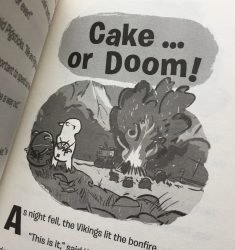
That though is only the start of their adventure: thereafter they slide straight into Cleopigtra, fall into a flaming London – ‘what’s so great about his fire?’ Harold asks; do a spot of dangling in New York City and bump into Julius Squealer before being captured by one Hamfrida, the Viking chief and her vicious minions.

It looks as though the end is nigh for our time travelling twosome; or, could cake perhaps be their salvation …

Fast paced and full of superbly silly moments, not to mention some very sticky ones, with its delicious wordplay this twisting, turning romp, the fourth of the hilarious Harold and Pigsticks series, is another winner for early chapter book readers especially.

Said readers will relish Alex Milway’s comical illustrations that are liberally scattered throughout the tale.

Another laugh out loud adventure of the two friends is:

Pigsticks and Harold: Pirate Treasure
In their third adventure, Tuptown is under threat from one Sir Percival Snout who claims their much-loved town belongs to him and what’s more, he has the paperwork to prove it. Or so he claims and he plans to destroy the entire town unless the pair can find a vast sum of money by the very next day.

Finding the three million pounds Pigsticks has so recklessly agreed to come up with is totally crazy since the pig is absolutely penniless.

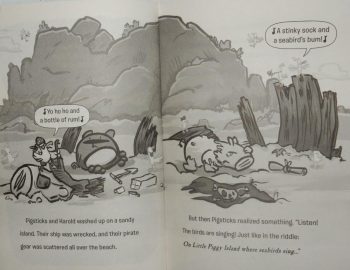
Fortunately though Pigsticks then remembers that his great-great-grandpig was a pirate who’d left a legacy of treasure buried somewhere as yet to be discovered.

All the two friends need to do is to solve the riddle on the map his ancestor had left behind. With clues to follow, there’s little time to discover the whereabouts of that treasure and thus save Tuptown.

As always with these comic capers, there’s a wonderful final twist in the tale.

If your newly independent readers have yet to encounter Milway’s Pigsticks and Harold, I suggest starting at the beginning and binge reading the whole series from the start; those who already know the duo will delight in this cracking adventure.

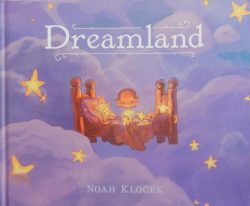
Dreamland

Dreamland
Noah Klocek
Walker Books

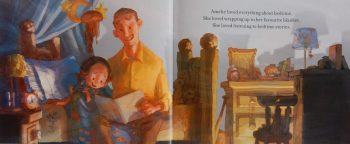
Unlike most young children, Amelie puts up no resistance at bedtime; indeed she loves everything about it – snuggling into her favourite blanket and listening to bedtime stories,

but most of all, she loves to dream.

Her dreams however often prove elusive and she has to search for them.

At this point in the story, (with a nod to Sendak’s Where the Wild Things Are) we see a forest growing in her bedroom.
She finds herself in strange landscapes as various items from her room become part of the dreamscape:

is this journey all part of her dreams, is what listeners will wonder.

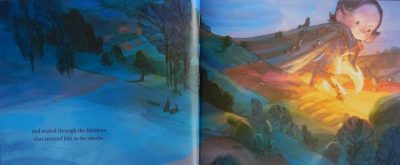
On Amelie marches taming whatever hides among the shadows,

dancing ‘past the tick and tock of the clock’ as she travels far and wide, through high clouds and deep dark waters until finally sleep embraces her; and a happy sleep it is for she’s ‘found herself in her favourite dreams’.

Dreamily enigmatic is Noah Klocek’s story while his ink and watercolour illustrations chronicle the mysteries of her night-time slumber.

A book for individuals to ponder over as part of their own bedtime routines.

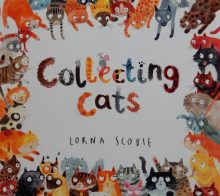
Collecting Cats

Collecting Cats
Lorna Scobie
Scholastic

If you love cats and wish to become a collector of same, then you’d be wise not to emulate the narrator of Lorna Scobie’s debut picture book.

To attract the objects of her desire said narrator conceives a plan: use bait of the cheesy variety.

Now cats aren’t generally attracted to this delicacy, but certain small rodents much loved by the wanted felines most certainly are,

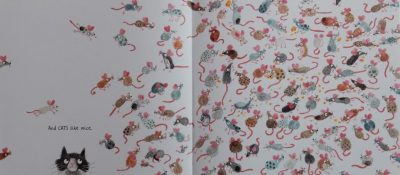
and it doesn’t take long for the ruse to bear fruit, or should that be cats, a dozen of them to be precise – some fluffy, some spotty, some fat and the remainder, thin.

Not content with twelve, and still having some unconsumed cheese at the ready, our narrator leaves the remaining bait to do its job.

However things start to get just a little out of hand as hoards of domestic cats descend, followed by bigger, wilder kinds.

Maybe this cat collecting idea wasn’t such a great one after all.
Another plan might be more manageable, perhaps …

I first came across Lorna Scobie as the illustrator of Smriti Prasadam-Halls’ Pairs board books and Nicola Davies’ The Variety of Life, so it’s great to see her first solo picture book.
Her cat and mouse portrayal is splendid; it looks as though she really enjoyed creating so many different-looking furry creatures, every one of which including the mice, has a different personality – no mean feat. I’m anything but a lover of cats but I thoroughly enjoyed the feline frolics herein.

Marvin and Marigold: A Stormy Night / Grizzly Boy

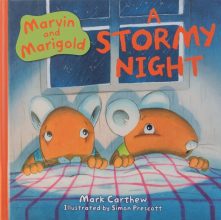
Marvin and Marigold: A Stormy Night
Mark Carthew and Simon Prescott
New Frontier Publishing

On a wild windy night, as Marigold snuggles under her blanket, the lights go out and frightened by all the shadowy shapes in her room, she gathers up her blanket, pillow and teddy and hides under the bed.
As she cowers in the darkness there’s a rat-a-tat at her window and she sees her neighbour Marvin Mouse. Marvin is frightened by the wind and also wants to hide.

Marigold invites him in to share her safe place and the two take comfort in each other’s company but not for long.

Soon there comes another knock: it’s Marvin’s grandparents out hunting for their missing poodle. They’ve brought some tasty treats to share

but then comes a howling, a scratch-scratching and a growling outside. Now who or what might that be?
Young listeners will likely anticipate what Marigold finds when she opens to door yet again …

Mark Carthew’s rhyming text bounces along nicely as he creates a mock-scary, ultimately feel good tale of a stormy night.
Simon Prescott adds tension and additional frissons of fear to the mix helping to conjure up the feelings of both the alarm and relief felt by the two small mice.

Grizzly Boy
Barbara Davis-Pyles and Tracy Subisak
Little Bigfoot

Theo wakes up one morning and decides to be a grizzly bear, a very wild and growly one that needs to use the bedpost as a bottom scratcher and doesn’t wear underwear (wait for the giggles) or shoes.

Undaunted, his mum replaces his usual favourite breakfast cereal with fruit and veggies and eventually, with clever use of a poster taped to his bedroom door, manages to pack him off to school.

There, an ursine Theo creates havoc in the classroom and it’s a rather careworn boy who greets his mum back home.

Suddenly however, there’s a turnaround: mum has an attack of the grizzlies and thereafter a compromise is struck as she shows it’s fine to have some wild and free experiences, but in the right place at the right time.

Illustrator Tracy Subisak successfully alternates the two sides of Theo as boy and bear bringing out his changing emotions throughout. With speech bubbles adding to the impact of the author’s storyline, this is a book to spark off discussion about feelings.

Emily Green’s Garden / Hodge Podge Lodge

Emily Green’s Garden
Penny Harrison and Megan Forward
New Frontier Publishing

Emily Green’s house is perfectly lovely, so too is her busy bustling street. It’s the epitome of tidiness; likewise her house.
Emily however is tired of all this; she longs for opportunities to be playful, creative and messy.
One day she discovers a small green shoot poking up between the paving stones and this sparks an enthusiasm for gardening.

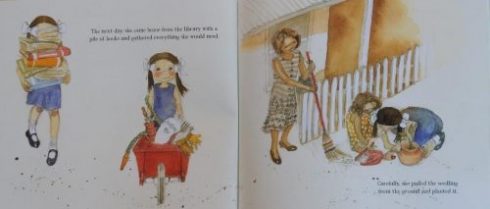
At first her parents are happy to allow her fill the house with plants; but little by little her wildness increases and eventually they decide enough is enough.

The garden must move outdoors and so it does …

The transformation is one that pleases not only her mum and dad but everyone in the neighbourhood too.

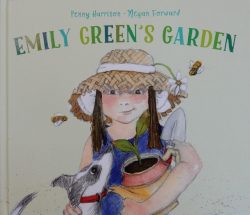
Emily’s growing passion shines forth from Penny Harrison’s telling, and from Megan Forward’s cover picture and her increasingly horticultural, watercolour spreads

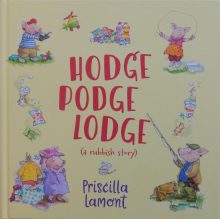
Hodge Podge Lodge
Priscilla Lamont
New Frontier Publishing

In Hodge Podge Lodge live the Pigwigs, a family of very messy pigs. Their consumer life style is such that they accumulate an excess of unnecessary things and inevitably, the packaging that comes with it.

One very windy morning, a strong gust distributes all their rubbish far and wide. The consequences are a disaster for all their neighbours who suffer adversely in one way or another.

So disgusted are they that a meeting is called after which the animals collect up all the scattered rubbish and take it back to the Pigwigs residence.

Fortunately, Little Miss Pigwig decides to put project re-use into action and the result is something that pleases everyone. Moreover, the Pigwigs become reformed characters who think carefully about how they dispose of everything they no longer require.

Priscilla Lamont’s story, an unashamed swipe at our excessive consumerism and the throw away society, is a stark reminder of the importance of re-using, recycling and caring for the environment.

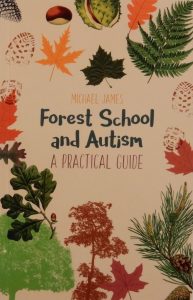
Forest School and Autism

Forest School and Autism
Michael James
Jessica Kingsley Publishers

Let me say from the outset, wearing my early years teacher’s hat, I’m a firm believer in the benefits of Forest School for all children be they neuro-typical or with an autistic spectrum condition, so I was excited to receive this book, the first of its kind on Forest School and Autism.

The author, Michael James has a wealth of experience of Forest School and now runs his own Forest School in Somerset; his enthusiasm shines through in everything he says.

Having provided background chapters on both Forest School, its principles and practice, and autism (wherein he asserts crucially, ‘In order to offer autism-inclusive practice, you must view each autistic person as an individual.’), Michael goes on to discuss with the help of case studies, the positive impact of Forest School on health; its sensory benefits and the opportunities it can offer for the learning of new skills. Fun however, so the author asserts, is a primary objective.

Sensitivity and positive relationships lie at the heart of the whole of Forest School practice and the importance of empathy is paramount.

So too is observation, which is the biggest responsibility of all practitioners; how otherwise can effective communication between learners and practitioners (who need to be clear, sensitive and frequently literal) take place (each can learn from the other) and true developmental learning take place?

Crucial to the success of an inclusive practice is preparation – preparation at the outset of a course of sessions – coupled with on-going reflection and further preparation. A chapter is allocated to this and a summary of its key points, such as the importance of individual learning programmes, is given at the end. Indeed a useful summary of key points concludes the other chapters too.

This most definitely is a book to be recommended for all Forest School practitioners rather than only those who work with learners who have ASC. After all, our connection with nature enhances our humanity and focussing on a child’s strengths, abilities, sensory preferences and likes is beneficial to every learner.

Mindful Little Yogis

Mindful Little Yogis
Nicola Harvey, illustrated by John Smisson
Singing Dragon

The author of Mindful Little Yogis is an education writer and children’s mindfulness practitioner and the book is based on her experiences as a teacher working with children in both primary and secondary schools with a range of learning abilities and needs. Several years ago around 20% of children were identified as having special educational needs and the number is rising, making additional demands on classroom teachers in both mainstream and special schools. Nicola stresses the importance of these children receiving consistent positive messages from all adults be they parents, carers, teachers, teaching assistants, therapists.

She advocates using mindfulness techniques to help build self-assurance and describes the STAR model: ‘STOP. Take a breath. And. Relax.’ that provides a framework, a four part developmental tool.

Then follows a section on mindful breathing, giving guidance on a range of sensory breathing techniques that I know from experience work very well with young children and those with additional needs.
The same is true of Animal Breathing (children I know especially love lion’s breath, bee breath and snake breath); Shape Breathing techniques and the use of sound, and body flow are explored next.

Part two ‘AND …’ comprises a range of self-regulation activities, grounding and sensory yoga games. There are also sections on emotional intelligence, using music as therapy and much more. I especially like the emphasis Nicola puts on positivity throughout.

With illustrations by John Smisson, this is a smashing book for all children of all abilities in all places for all times. With our increasingly pressurised education system all schools would do well to include some of these techniques and activities in their daily schedule.

What Should a Horse Say? / Business Pig

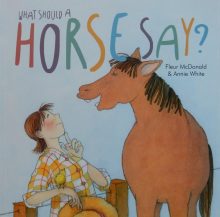
What Should a Horse Say?
Fleur McDonald and Annie White
New Frontier Publishing

Farmer Rochelle has a cow that says ‘moo moo’, a sheep that says ‘baa baa’, a chicken that says ‘chick chick’ and a horse that says, err… ‘chick chick’!
It’s not until she receives a visit from Farmer Hayden who brings a box of six baby ‘chick, chick chick’ -ing baby chicks however, that she questions the sound her horse makes.

Surprisingly Farmer Hayden isn’t sure and none of her other friends can help either, although one does have a cockatoo that says, ‘Can I have more chocolate? Squark!’ Eventually they send for Dr Swan the vet.

Can his investigations offer a solution?

Young children will delight in being in the know throughout the story and relish the silliness of the entire tale. Equally they’ll love the opportunity to make a lot of farmyard sounds as they join in with Fleur McDonald’s telling and enjoy Annie White’s amusing rural watercolours.

Business Pig
Andrea Zuill
Sterling

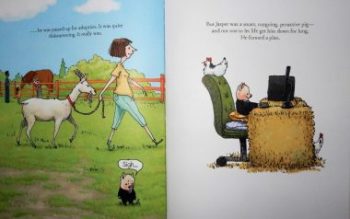
When Jelly Bean the sow gives birth to five piglets, one stands out from all the others. Given the name Jasper by the animal sanctuary workers, this piglet eschews playing in the mud and rooting for grubs and acorns and quickly becomes a firm favourite at the sanctuary. So much so he’s given his own special space.
There he sets about becoming a business pig, helping with the bookkeeping, holding meetings, producing endless charts and more, to the annoyance of some of his fellow residents. Even worse, he can’t seem to interest anybody in giving him a loving home.

Nevertheless, Jasper is determined and proactive and forms a business marketing plan to get himself adopted; after all he is a
‘gen-u-ine Business Pig’ as one of the workers said at the outset.

It’s not long before his efforts begin to pay off; could it be that the perfect home is in sight …

This playful tale with its themes of determination and being true to yourself, successfully mixes humour and moments of sheer heart-warming charm, both of which are brought out beautifully in Andrea Zuill’s splendidly expressive illustrations.

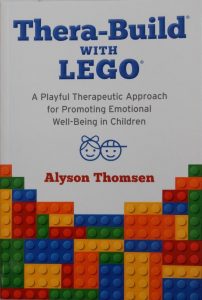
Thera-Build with LEGO® / Art Therapy Cards for Children

Thera-Build with LEGO®
Alyson Thomsen
Jessica Kingsley Publishers

Alyson Thomsen was a senior teacher and since creating and developing the Thera-Build methodology, runs a business consultancy for schools, families and others interested in using LEGO® bricks with children therapeutically.

Purposeful play with these bricks aims to develop social competence, reduce stress, boost self-esteem and confidence.

As a teacher I have used LEGO® bricks across the curriculum, but never as a therapeutic tool. However I was pleased to discover that I share with Alyson some basic underlying educational principles, most notably vital the importance of play in children’s development be that social, emotional or academic; and the crucial role of adult as facilitator – flexible and enthusiastic – in the learning process.

Drawing on her wealth of experience, Alyson provides in this book a veritable treasure trove of ideas for using LEGO®, a resource loved by so many children, in a therapeutic way, as well as giving readers an introduction to the brain science behind her methods, a wealth of advice that includes both the strategies for, and practicalities of, using the materials. and much more.

Not only will this inspiring book be a great resource for those working in schools and for parents, even more importantly, it has the potential to result in extremely positive outcomes for children.

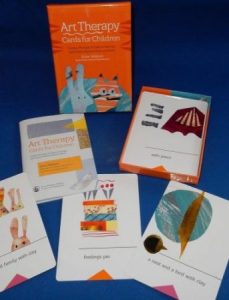
Art Therapy Cards for Children
Elitsa Velikova
Jessica Kingsley Publishers

This resource comprises a box containing 22 stimulus cards (105x 150cm) and an accompanying explanatory book, and could be used for anyone (art therapists, social workers, psychologists, teachers and counsellors) who works with children and perhaps parents. The author, Elitsa Velikova, is an art therapist and psychologist with extensive experience, and is also Director of the Arts and Therapy Institute in Sofia (Bulgaria)

The cards offer creative art therapy opportunities for primary school age children and encompass four themes: feelings and emotions, relationships with family and friends, the body and imagination.
There are opportunities for exploring in both two and three dimensions and all the materials required are listed in the booklet.

Each card provides a different prompt, for instance, ‘Draw a person in the rain using pastels or pencils’ (feelings); ‘Create a nest and a bird with clay’ (relationships); or ‘draw or create a happiness machine (imagination). All are illustrated in bright collage style.
The booklet explains each prompt and its aim(s), the materials needed and how a child might benefit from experiencing the activity.

A useful resource but it could I think, have been even more so, especially for teachers and other non-specialists in art therapy, to have at least the materials needed listed on the reverse of each card.

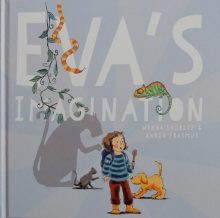
Eva’s Imagination

Eva’s Imagination
Wenda Shurety and Karen Erasmus
New Frontier Publishing

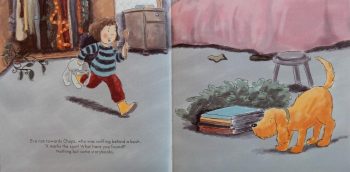
When a little girl announces that she’s bored her mum’s, “What’s happened to your imagination, Eva?” response triggers a wonderful adventure in which she and her canine companion Chops go on a search, although Eva doesn’t know what an imagination actually is.

It’s a search that takes them all over the house as they journey into a forest,

climb mountains, explore a cave, visit a rainforest full of colourful creatures – some a bit scary. They discover a long-lost toy rabbit and some books …

but don’t find Eva’s imagination, or do they?

Eva certainly declares it “the best adventure”.

A wry look at the importance of allowing children to be bored, for that is when the all-important imagination often kicks in. After all, It’s that ability to stand back and say, “suppose that …’ or what if …’ in other words, the power of the imagination that has led to so many discoveries be they scientific, mathematical, technological.
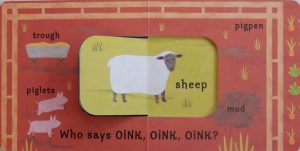
Karen Erasmus clearly understands that as she transforms the interior landscape of Eva’s home into some wonderfully exciting places for the two searchers to explore.

Hurrah for an author and illustrator who understand just how crucial imagination is.

All About Ben / The Giant from Nowhere

All About Ben
Dorothy Markham & Aileen O’Donnell
Jessica Kingsley Publishers

Here’s a little book for children from around five to the age of Ben, the narrator who is eight, particularly those who have attachment issues, but equally for children who have a Ben character in their lives either as a friend, member of their peer group or relation. It aims to help children like Ben understand their feelings and emotions and how these cause them to behave in certain ways; and to develop the confidence to open up to an adult who can help them manage all their different parts.
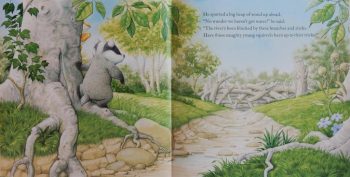
Ben introduces himself, part by part: his action parts and nine feeling parts.

He goes on to talk about and give examples of, how different situations cause him to feel different parts – when playing with friends he feels his happy part whereas falling out with a friend brings his hurt part into play;

when he helps others he feels his caring part; and it’s the combination of all these different parts that makes him who he is.

Readers are then asked about their own feeling parts to add to Ben’s lists and we learn how feeling parts affect action parts (cause and effect) – which is important for children’s self understanding.

The final pages are devoted to the crucial roles of talking and listening (including the role of a trusted adult) in the development of a secure, integrated, happy and confident person able to understand and manage his/her emotions.

Reassuring and helpful, this is a useful book to have in primary school classrooms.

The Giant from Nowhere
Frances Dickens and Peter Hughes
Jessica Kingsley Publishers

When the Giant from Nowhere sets out to find a place with some company, little does he know that his sheer size is going to cause him problems. So it is in the little village of Somewhere. Its residents are terrified when he appears in their midst, and tell him in no uncertain terms to go away. His angry response causes damage to their homes and the Giant departs.

The villagers then decide to hunt him down and put him on trial. After a newspaper report and a police search, the Giant is found and eventually a little boy succeeds in getting him to answer some questions.

A trial follows and the defendant pleads guilty. The boy speaks up for him and the judge decides on a community sentence.

To reveal what happens thereafter would spoil the ending but suffice it to say all ends happily for everybody.

This is an insiders and outsiders story that should encourage plenty of discussion on such themes as empathy, mutual understanding and inclusivity.

A class of primary children could have fun acting it out in addition to participating in some of the activities included at the back of the book.

Can I Tell You About … Auditory Processing Disorder / Forgiveness?

Can I Tell You About … Auditory Processing Disorder?
Alyson Mountjoy, illustrated by Kelly Davies
Can I Tell You About … Forgiveness?
Liz Gulliford, illustrated by Rosy Salaman
Jessica Kingsley Publishers

These are two recent additions to the excellent Can I Tell You About series aimed at primary school audiences, their families, teachers and others who work with them.

Each illustrated book has a child narrator, and in the Auditory Processing Disorder (APD) book it’s Amy who herself has the disorder. After an explanatory introduction for adults, she talks about how the condition affects her; how she got her diagnosis and how she is supported both in school and at home.

We also learn that APD isn’t the same for all those affected: one of her friends, Tom has the condition too but has different challenges to cope with. Amy’s dad also has APD but received his diagnosis after his daughter.

One of the most important things for teachers to know is the emotional strain that children like Amy are under and in addition to this being a helpful book for young readers, it’s one teachers should read too.

Amy herself ends on an upbeat note: having described both her own and Tom’s particular strengths she says, “Work hard, believe in yourself, and you can make your dreams come true too.” How adults can help a child make this so are listed in the final pages.

Forgiveness, as author Liz Gulliford states in her introduction, is a complex, frequently misunderstood concept. It’s one that she has researched for many years. Liz feels it’s important for children not to be made to apologise automatically after a dispute between classmates for instance, something that can happen in schools or between siblings at home

Here she uses Joseph as her narrator and together with his family offers a story designed to stimulate discussion on forgiveness at home and school.
Joseph talks about different scenarios – his best friend telling others something Joseph confided in him, thus breaking his trust in Billy.

He then goes on to talk of an instance when he took his sister’s ball without asking and lost it, which required not only Joelle’s forgiveness, but also self-forgiveness on his own part.

There’s also the important consideration of another of Joseph’s school friends, George who is being bullied. Perhaps forgiveness in this instance is not appropriate in case the perpetrator then goes on to bully another child. Could a degree of compassionate concern, at least from Joseph be better?

These are some of the ideas explored in this book that will certainly be a valuable resource in starting explorations of forgiveness in PSHE lessons at KS2. To this end the final pages are devoted to notes and key learning points.

Geronimo

Geronimo
David Walliams and Tony Ross
Harper Collins Children’s Books

When a new hatchling penguin going by the unlikely name of Geronimo bursts into the snowy world of the Antarctic he’s fuelled by a determination to become airborne, despite his father’s assertions that penguins can’t fly.

His first attempt sees him plunging headlong into the freezing-cold ocean. Unabashed he relaunches himself, this time using a seal’s enormous belly as a springboard, only to nose dive into deep snow.

But Geronimo isn’t ready to give in that easily: he has the ingenious notion of placing his bottom over the blowhole of a whale. This rather reckless rear end rest results in his needing beak-to-beak resuscitation from his pa.

Thoughts of flight now fill not only his every waking moment but also his dreams – every single night it’s the same …

Eventually, the Emperor emperor penguin instructs his Dad to tell Geronimo once and for all he’s to stop trying. But surely that can’t be the end of his aeronautic antics?

Perhaps not, with the collective brains of the colony working overtime …
After all there is more that one way of looking at things now isn’t there? It’s certainly so if you happen to be a yogi, or at least, like the adult penguins in the story, able to stand on your head.

Totally crazy but then this is David Walliams with his off the wall humour. Tony Ross adds his own brilliant touches of zaniness with a sequence of hilarious spreads of Geronimo’s efforts and the optical delusion that finally makes his dream come true.

Hold fast to your dreams – what a great message for young children.

Jingle Spells / Meg’s Christmas

Jingle Spells
James Brown
Simon & Schuster

Unlike other witches, young Trixie is not excited at Halloween, it’s Christmas that she loves and she’s determined to show her fellow witches why.

Who better to help her in her mission to demonstrate that the magic of Christmas is the best of all than Santa himself?
Seemingly though witches have a bad reputation within the walls of Santa’s workshop so her letter receives a firm refusal from his head elf.

Determined to prove that she isn’t ‘naughty’, Trixie sets off to see Santa nonetheless.

What she discovers on arrival at the workshop isn’t the hustle and bustle she’d expected. Instead there’s a decided lack of toys on the elves’ shelves and worse still, it’s not only the elves who are suffering from bad colds, Santa too has succumbed to a very bad attack of the wheezes and sneezes.

Time to mix a special curative potion but will it work; in fact will the smitten even take so much as a sip of Trixie’s warming brew?

It appears to be the only way that Christmas can be saved …

A fun, elf-filled festive frolic featuring an endearing little miss who brings her own special brand of seasonal magic to the Christmas season: James Brown’s Trixie has an irresistible charm.

Meg’s Christmas
Jan Pieńkowski and David Walser
Puffin Books

After all these years Jan Pieńkowski’s Meg, Mog and Owl star in their very first Christmas adventure and the magic still holds good.

When a pipe bursts on Christmas Eve flooding Meg’s residence, there’s only one thing to do and Meg does it: ‘Find us somewhere dry to stay but bring us home for Christmas Day!’ she chants.

Before you can say “magic spell” the broomstick whisks them up and away to …

Instead of hanging up their stockings in the comfort of their own home Meg, Mog and Owl do so in the very spooky room where they spend the night.

Come Christmas morning the three are anxious to be off to meet the friends they’ve invited to their Christmas party. Can they be ready in time for their guests? …

The magic of the threesome never wanes: this seasonal offering will be enjoyed by parents who loved the early Meg and Mog adventures, as well as by their young offspring coming new to the stories penned by David Walser.

Sammy Claws The Christmas Cat / Santa’s High-Tech Christmas / Christmas Gremlins / A Very Corgi Christmas

Sammy Claws The Christmas Cat
Lucy Rowland and Paula Bowles
Nosy Crow

Such is his fondness for taking a snooze that Santa’s fluffy feline Sammy will drop off pretty much anywhere and dream of accompanying his owner on the Christmas Eve delivery run.

What he doesn’t imagine though when he dashes off to Santa’s workshop, is the manner in which that dream finally comes true. The somnolent cat gets parcelled up and dropped in among the other packages on the back of the sleigh and then it’s a case of “Ho! Ho! Ho! “ and off they go.

However, Sammy isn’t the only extra rider on Santa’s sleigh that night. Two wicked robbers, Mischievous May and Bad Billy are ready and waiting to seize their big chance and help themselves to some of the parcels.

Can Sammy save the day? And what is the special present Santa leaves for his pet moggy under the Christmas tree?

Festive fun aided and abetted by a snoozy feline delivered in Lucy Rowland’s bouncing rhyme with the addition of a good sprinkling of elves and excitement in Paula Bowles’ pattern-rich illustrations.

Santa’s High-Tech Christmas
Mike Dumbleton and Angela Perrini
New Frontier Publishing

Santa has eschewed the old fashioned methods when it comes to transport and keeping account of Christmas parcels; instead he uses a motorised sleigh and stores all his lists on his smart new techno-pad. But disaster strikes as he’s whizzing over the rooftops by means of his rocket-pack; Santa’s techno-device plummets to the ground and he’s faced with a blank screen.

Enter Jasmin, a techno-savvy little girl who is more that happy to give sad old Santa a helping hand by showing him how to access all the information he needs.

Not only that but she comes to his aid in another way too: after all Christmas really is all about giving.

Mike Dumbleton’s jaunty rhyming narrative is given added zaniness by Angela Perrini’s illustrations.

Christmas Gremlins
Adam & Charlotte Guillain and Chris Chatterton
Egmont

Oh my goodness, those gremlins are at large again in another of the Guillains’ rhyming romps and now they’re on the rampage creating havoc in the run up to Christmas. It seems they’re determined to get in on the act no matter whether it’s decorating the tree, baking mince pies and Christmas cake (or should that be gobbling same?), wrapping up all the presents (and everything else in sight), singing – more like screeching – carols at the door or popping out of Christmas cards. But that’s only indoors. Further prankish doings are likely outside too: nothing is safe from their mischief so let’s hope they’re well out of the way before Santa arrives.

With more than 50 flaps to lift, this madness and mayhem will keep little ones entertained as they play hunt the mischief makers on every one of Chris Chatterton’s jolly spreads.

A Very Corgi Christmas
Sam Hay and Loretta Schauer
Simon & Schuster

The royal corgis are among those not feeling the Christmas spirit, far from it, all except for young Bella that is. Dazzled by the lights and excited by the hustle and bustle outside she decides to go and join in the fun. Hitching a ride in the back of a mail van, she gets out at Piccadilly Circus where everything suddenly feels overwhelming – too bright, too hectic and FAR TOO LOUD!

As luck would have it along comes London savvy pup Pip offering to show her the sights. A great time is had by both but suddenly as they approach the palace, Pip goes missing. Will Posy ever see her newfound friend again? Perhaps with the assistance of a very special royal couple …

Delivered with an abundance of Christmas spirit, Sam and Loretta’s London tale is a charmer.

I Was Made For You

I Was Made For You
David Lucas
Andersen Press

As soon as a woman finishes knitting a soft toy cat, “Why was I made” asks the creature. “It’s a surprise,” comes the response.
The woman gift-wraps the cat with a “no peeping” instruction. The woolly animal remains curious as he’s placed under the Christmas tree.

All is darkness and quiet. Cat peeps out of his wrapping and discovers a gift tag bearing the name DAISY. He’s puzzled for that is not his name and once more asks as he looks out at the darkness, “Why was I made?’

Surprisingly DARKNESS responds telling him to wait until morning. Cat isn’t willing to and having freed himself entirely, wanders through the door and out into the night in search of a satisfactory answer. Unbeknown to the answer seeker though, he catches a thread on a nail protruding from the floor.

He continues asking the same question to steps (down which he skids); the whirling snow, rock, stars, wind, and trees.

Thoughtful responses come from each one, until day dawns and then in the morning light, Cat realises that he’s growing shorter; he’s barely half of what he was.

Sun is the recipient of his final existential “Why was I born?” From the ensuing dialogue, Cat deduces that he’s intended as a gift for Daisy.

By now though, all that remains of our answer seeker is a long, loose woollen thread.

Meanwhile back in the house, presents are being opened, but there’s no present for Daisy. There are clues though which mother and child follow through the snowy landscape with Mummy winding the strand into a large ball.

This she uses to make Cat ‘good as new’.

David Lucas combines a folklore style narrative with folk art style illustrations, many beautifully bordered as in A Letter for Bear to fashion an unusual, seemingly simple tale that is likely to generate philosophical musings on behalf of young listeners and readers.

This would make a gorgeous offering for a thoughtful child this Christmas season.

Silent Night

Silent Night
Lara Hawthorne
Lincoln Children’s Books

One of the world’s favourite Christmas carols, composed 200 hundred years ago in Austria and now with UNESCO cultural heritage status, is given a beautiful pictorial rendition by author/illustrator Lara Hawthorne.

Her beautiful, richly patterned illustrations stand out against an inky, star speckled night sky telling the nativity story using just the English translation of Joseph Mohr’s words.

We see Mary and Joseph travelling to Bethlehem, settle themselves in the stable and the baby – the holy infant – is born.

Thereafter come spreads of the announcement of the birth to the shepherds by a heavenly host

and their visitation to see the Christ child.

The Three Kings’ journey following the star and their presentation of the gifts take up the next three spreads

and in the final three we see animals of all kinds, drawn to the stable over which the star shines and joining the humans in a joyful celebration.

Any one of Lara’s spreads would make a superb Christmas card.

The book concludes with notes about the origins of the carol and the words (though not the music) of the carol.

A gorgeous Christmas offering.

Pip and Posy The Christmas Tree / All Aboard for Christmas

Pip and Posy The Christmas Tree
Axel Scheffler
Nosy Crow Books

Pip and Posy are a duo much loved by countless under fives and now they star in a lovely new tale that’s a great seasonal treat.
It’s Christmas Eve and the best friends bring home a Christmas tree. Once installed in a large pot, they set to work decorating it.

First off they bake some festive biscuits to hang on it. Then Posy goes to get the candy canes but when she comes back, one of the biscuits has mysteriously vanished.

The same thing keeps happening: each time she turns her back to find more goodies to add to the tree, there’s one less decoration when she returns. Hmm!

Young children will of course relish seeing what Posy doesn’t. Nor does she realise what’s been going on until she finds Pip flat out on the sofa with a rather bulging tum and saying he’s feeling sick.

Posy keeps quiet and allows Pip time to confess and then the two work together towards a satisfying solution to their lack of tree ornaments

and for listeners especially, there’s a lovely, even more satisfying finale come Christmas morning.
An enormously appealing festive addition to this ever-popular series of Axel’s.

All Aboard for Christmas
Andrew Kolb and Nichole Mara
Abrams Appleseed

There’s a train full of seasonal fun just waiting at the station – it’s Santa’s Christmas train with a gingerbread driver. Inside (lift the flaps to see within) it’s packed full of brightly coloured things to look for and to discuss, questions to answer and most important, lots to enjoy. There are elves and reindeer, penguins, pies and plenty of other good things to eat, toys and other treats.

Once extended, the train is over a metre long and you can reverse the extended carriages to see the frozen, snowy landscape through which Santa journeys, all the while searching the carriages for his missing boot..

With its die-cut windows, there’s plenty to engage little ones who take the ride on Christmas Eve.