The Bird Within Me

The Bird Within Me
Sara Lundberg
Book Island

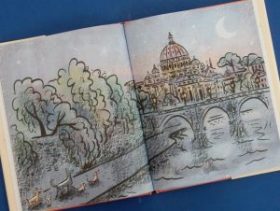
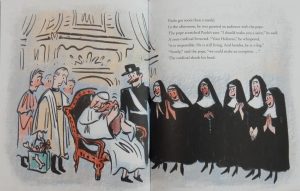
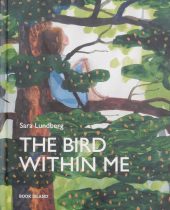
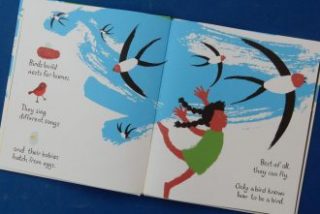
In this movingly told, inspirational book, based on the paintings, letters and diaries of Swedish artist Berta Hansson, we learn what it would have been like to grow up with her mother always sick in bed with TB and slowly dying, and an enormously hard-working father who calls your desire to express yourself imaginatively through art and beauty ‘ridiculous’.

That was life for Berta whose uncle (with whom she sometimes stayed when her mum was especially sick) managed to combine being a farmer with creating wonderful pictures, and occasionally allowed his niece to paint too.

Berta’s father wanted his daughter to follow his ideas – fit in, be a housewife – but she yearned to break free to live her own life, follow her desired creative path.’To fit in, you have to keep your desires secret. Be silent. And not really show who you are.’

‘When I grow up I’m going to be an artist. Like Michelangelo. But I don’t say that aloud. Because it isn’t a real job. Not something you can be. Especially not of you are a girl.’

Just when it seems her mother is slightly better, she is taken very sick again and dies.

Then not long after, the doctor, an art lover who regularly examines the rest of the family, asks Berta what she plans to do after leaving school. She longs to tell him of her dream but doesn’t, keeping it bottled up inside.

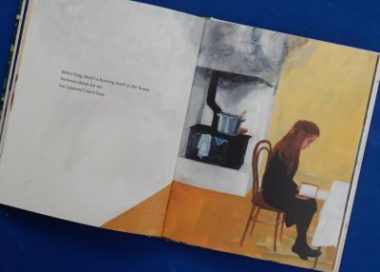
Things get too much and after just a short while, something snaps inside Berta as she stands at the stove cooking pea soup on a wooden stove. She lets it burn

and that precipitates a change in her father and for Berta whose journey might well have gone in a completely dead-end direction.

So beautifully illustrated and affectingly told, this is a wonderful testament to the power of the imagination, Berta’s and that of all who have creative instincts.

Follow Me, Flo!

Follow Me, Flo!
Jarvis
Walker Books

Anything but a follower of the rules, young ducky Flo prefers to do things in her own divergent way and so it is when she and Daddy Duck set out to pay a visit to Auntie Jenna’s new nest.

Daddy lays down some ground rules from the start – ‘FOLLOW ME all the way. No chasing or hiding’ and then off they go with Daddy inventing a song to help keep his little one on the straight and narrow: “We’re off to somewhere new./ So stick to me like glue.// FOLLOW ME, FLO!/ Come on, let’s go!/ We’re sure to be there soon.// Follow me UP… . // Follow me DOWN… . / Look straight ahead and NOT AROUND!”

Inevitably it isn’t long before Flo begins to feel this song isn’t right for her.

Instead she invents her own much more exciting version and so pleased with same does she become that she fails to realise that she’s strayed right into the path of a certain Roxy Fox with other things on her mind than singing.

Fortunately however, Jarvis’ ducky ditty takes an unexpected turn for Flo remembers in the nick of time, the words of her Daddy’s song and is back on the right track, even managing to earn some praise from her pa and all ends happily.

It’s all in the eyes with Jarvis’ delectable images of young Flo’s recalcitrant romp that young humans will relish, especially those with a streak of rebellion, and that’s pretty much all of them; they might even learn an important lesson along the way too.

Adult sharers will love to give voice to this rollicking read aloud with its liberal sprinkling of accompanying minibeasts adding to the delights.

Fun, Facts and More in Boardbook Format

Here’s a handful of board books to entertain your little ones courtesy of the Little Tiger Group:

ABC of Kindness
Patricia Hegarty and Summer Macon
Caterpillar Books

Rhyming couplets by Patricia Hegarty together with Summer Macon’s small scenes of super cute animal characters showing the way make for a lovely reminder of the important things in life.

For instance, there’s ‘Cc is being caring in everything you do. / Dd is for dear ones – who mean the world to you!’

The pastel backgrounds to the kindnesses illustrated complement the softly spoken text in a lovely introduction to the behaviours we’d all like to see in little humans. Perfect for sharing and talking about.

Cook with Me: Bunny Makes Breakfast
Kathryn Smith and Seb Braun
Little Tiger

Big Mummy invites her Little Bunny to share in the creation of a ‘yummy breakfast’ but what are they going to cook? They already have butter, flour and maple syrup, but that’s not all they need.

Out they go and pick juicy berries, collect eggs from the hens, and creamy milk from the cow.

Back in the kitchen comes the fun, messy part of mixing all the ingredients and by the time the delicious aroma comes wafting from the cooker, Little Bunny has worked out what their surprise meal will be. Hmmm!

Kathryn Smith’s is a story with a bonus – the final spread includes a recipe book – Bunny Oliver’s Breakfast for Bunnies.

With flaps to explore on every one of Seb Braun’s engaging spreads, this is a tasty little book for sharing with small humans – preferably not at breakfast time though in case of sticky fingers.

Curious Kids: Sea and Shore
Jonny Marx and Christine Engel
Caterpillar Books

From early morning to sunset, there’s a wealth of wildlife to enjoy at the seaside.

This board book format non-fiction title presents in eight spreads, snippets of factual information about some of the marine creatures to be found in and around our seas from seagulls

to seahorses, octopuses to turtles.

There’s a pop-up feature on each bold, bright spread and observant eyes can also look for marine flora both in the sea and on the shore.

With the seaside likely to be off-limits for some time, maybe one way to remind little ones of its delights is with Christiane Engle’s sturdy book.

Also out in boardbook format now is:

Bee: Nature’s Tiny Miracle
Patricia Hegarty and Britta Teckentrup
Little Tiger

I reviewed the original hard cover edition of this smashing book that absolutely buzzes with bee-uty almost 4 years ago and it’s great to see it in a sturdy format for tinies: Britta’s illustrations are stunning.

An Artist’s Alphabet

An Artist’s Alphabet
Norman Messenger
Walker Studio

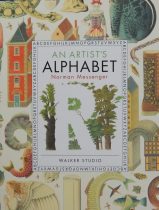
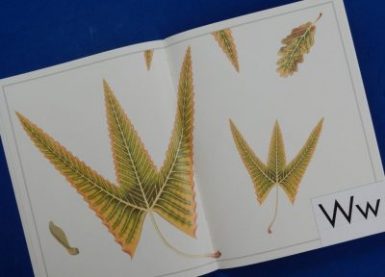
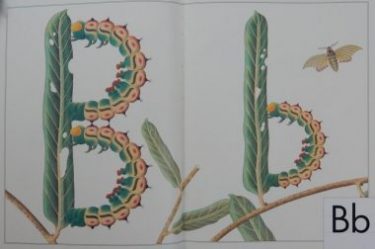
This is really way beyond a mere alphabet book: it’s a stunningly beautiful art book, extraordinarily clever, playful, sophisticated and nigh on irreverent where the ABC is concerned, being based more on the shape and form of letters than their sound quality.

There are some surreal offerings, letters inspired by works of art such as Hokusai’s The Great Wave off Kanagawa. (C for curves maybe); mythology,

botany,

zoology,

landscape features including clouds and mountains, tools; but every single one of Messenger’s pages is itself a work of art. Some of them might challenge you: it took me some while to appreciate his use of negative space in R; but once you see it you think, how come I didn’t see it immediately, especially as it’s obvious on the cover.

I’d love to share every single letter with you but rather, I urge you to get your own copy of this book if you have an interest in art, design, and / or language and its components,

An absolute treasure to behold, to pore over and to spark the imagination: I see it being enjoyed by individuals of all ages, used in art and design courses in schools and colleges, and much more.

Wigglesbottom Primary: Break Time Bunnies / Lottie Luna and the Bloom Garden

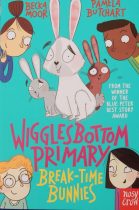
Wigglesbottom Primary: Break Time Bunnies
Becka Moor and Pamela Butchart
Nosy Crow

It’s always a delight to read of the exploits of Class 2R in their school where pretty much anything can happen.

Here we have three new fun, beautifully observed episodes wherein the children allow their imaginations to take flight. In the first story it’s a case of bunnies running riot in the playground: could they be ATTACK BUNNIES and why are they there?

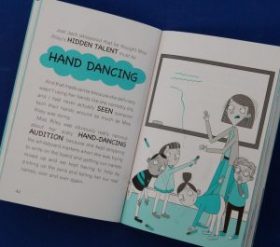
The second tale, has class teacher Miss Riley announcing the imminent arrival of a ‘special guest’. Is the man who sits at the back of the class a TV talent spotter or has he another purpose for watching the goings on of teacher and pupils?

In story number three the children all sign up for violin lessons but their music teacher, Miss Stein looks really spooky. Could she perhaps be a witch – a bewitching witch?

It’s so easy to get sucked into 2B’s zany premises in these enormously enjoyable stories and the final revelations are always delicious.

As ever Pamela Buchart has done a brilliant job illustrating these small sparkling stories. She catches the zaniness of Becka’s tellings SO well making every page turn not only a verbal but a visual treat.

Bring on the next one.

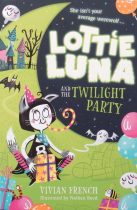
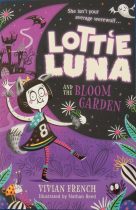
Lottie Luna and the Bloom Garden
Vivian French, illustrated by Nathan Reed
Harper Collins Children’s Books

Meet Lottie Luna, star of a super new series by Vivian French.
Lottie is a werewolf, but a very special one with extra powers on account of her being born during a full lunar eclipse. Hence she’s super speedy, super strong, has x-ray vision and has super hearing. Oh yes and she’s also a princess on account of her father inheriting a kingdom.

This however means that she’s had to move home to the crumbling Dracon Castle and consequently has to start at a new school mid year. Like many youngsters, Lottie is nervous about this and certainly doesn’t want it known at Shadow Academy that she’s special even if that means not revealing her real self.

Lottie’s class teacher announces a pupil project – to create a design to transform the wasteland behind the school into a beautiful garden and the winning design will be used for the purpose.

Before long Lottie finds she has two friends, and decides that the head of her new school is amazing – a kindred spirit too; perhaps things won’t be so bad after all.

As for the garden design, Lottie is the winner but once the garden creation begins,

more challenges arise – there’s a Bloom Garden saboteur at work.

Now Lottie must do all she can to save the enterprise from road developers; but can she do it? Perhaps it’s time to draw on those superpowers of hers …

Friendship, determination, being true to yourself, courage, resilience and forgiveness are at the heart of this smashing story Vivian has woven.

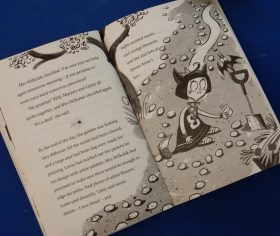
Nathan Reed has done a terrific job with his black and white illustrations; they’re offbeat and splendidly playful.

More please!

Mr Brown’s Bad Day / Bunnies on the Bus

Mr Brown’s Bad Day
Lou Peacock and Alison Friend
Nosy Crow

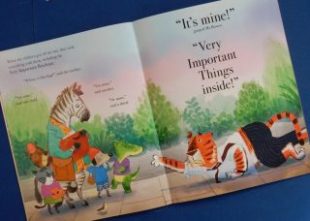
Mr Brown is a Very Important Businessman with a Very  Important Briefcase that he takes to his Very Important Office where he spends his time signing Very Important Letters and attending Very Important Meetings.

Every lunchtime clutching his Very Important Briefcase he leaves his office to eat his lunch in the park.

One Tuesday however, a baby elephant snatches the briefcase while Mr B is busy thinking important thoughts.

There follows a frantic chase on foot and by tricycle as said briefcase is passed relay style onto the back of an ice-cream trolley and then in the possession of a group of children, onto the fairground’s big wheel, and the bus back through the town to school.

Mr Brown finally catches up with it when the bus stops to disgorge the passengers.

Eventually with darkness falling it’s a very weary tiger that heads home clutching his briefcase. Once there he checks to make sure the contents are safe before heading up to bed for a well-earned rest and some more ‘Very Important Business’ …

But what was inside that briefcase? Now that would be telling and I’m no story spoiler.

Great fun with a wonderful final surprise revelation. Alison Friend’s illustrations are a treat too with plenty of detail and action to engage your little ones as they listen to Lou Peacock’s tongue-in-cheek tale.

Bunnies on the Bus
Philip Ardagh and Ben Mantle
Walker Books

TOOT! TOOT HONK! HONK! Madness and mayhem abound as the bunnies take to the bus one summer’s day in Sunny Town, so the rest of us drivers and pedestrians had better steer well clear as the bunny driver has clearly gone rogue, careering past the bus stops narrowly avoiding the other animals going about their daily business.

The bunnies meanwhile are having a ball aboard FLUFF 1, cavorting down the aisle; there’s even one up on the roof.
Where is this vehicle bound for you may well be wondering as it suddenly leaves the road completely.

No matter, for at the next stop, those bunny passengers instantly set their sights on another mode of transport as they make their exit and err … where one journey ends another begins so to speak …

Anarchic fun for your bouncy little ones created by the terrific Ardagh/ Mantle team whose combination of energetic rhyme (Philip) and cracking illustrations jam-packed with gigglesome details (Ben) is perfect cheering up material.

Once Upon An Atom

Once Upon an Atom
James Carter, illustrated by William Santiago
Little Tiger

James Carter successfully wears several hats: he’s a much loved, award-winning poet, a musician and a non-fiction writer; how he manages to fit in all his performances at schools and festivals too, is pretty amazing.

In this latest book, James fuses his poetry and non-fiction writing, this time to explore some of the really BIG questions that fascinate both children and adults alike; and they’re all of a scientific nature.

Starting with a mention of the Big Bang and tiny atoms, the poet wonders, ‘WHY do leaves turn red and gold? / WHY do fireworks explode. // WHAT are whizzes, bangs expansions? / They’re all CHEMICAL REACTIONS!’
That assertion certainly makes chemistry begin to sound exciting.

Next on the scientific agenda are electricity, followed by gravity,

both aspects of physics – for as we hear, ‘We live on one great universe / and PHYSICS tells us how that works.’

Evolution, medicine come next, followed by my favourite of the sciences – botany, all of which are aspects of BIOLOGY.

The final stanzas talk of the work of scientists, their experimenting and inventing, ending with the exciting thoughts: ‘Now WHO knows what / the FUTURE is? // Find out … / become a SCIENTIST!’ Now there’s a possibility.

On the last spread is one of James’ acrostics entitled It’s all a question of SCIENCE.

A fizzingly, zinging addition to James’ non-fiction poetry series, this one is a clever fusion of playful entertainment and STEM information. With each spread being embellished with William Santiago’s arresting, zippy art, the book becomes a STEAM title that is great to share in the classroom or at home.

There’s a Lion in the Library!

There’s a Lion in the Library!
Dave Skinner and Aurélie Guillerey
Orchard Books

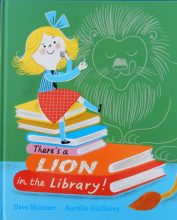
Here’s a simply delicious reworking of The Boy Who Cried Wolf fable starring a little girl named Lucy Lupin. Lucy might appear a little sweetie but in fact she’s a holy terror whose favourite thing is to tell lies – absolute whoppers!

It all begins one Monday morning when this young miss makes the titular announcement to the librarian, claiming the creature is chomping through the history books.

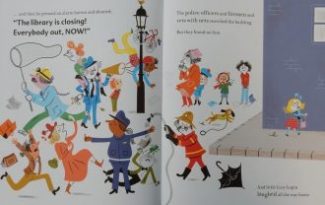
An emergency is declared and the library evacuated while a search takes place.

A similar thing happens on the Tuesday when our mischief-maker informs the caretaker that the lion is devouring books in the romance section. Then come Wednesday the announcement is made to the coffee shop manager who insists all library visitors run for their lives.

For the third time the search for said creature proves fruitless.

The three library workers have a meeting to consider this mysterious visiting creature. Could it perhaps be that when it comes to sweet-looking little girls, appearances can be deceptive?

A day or two later, young Lucy Lupin returns to the library. On this particular day however, things go a little differently …

I’m a terrific enthusiast when it comes to fractured fairy tales and fables, and this one is a cracker to read aloud. Aurélie Guillerey’s illustrations have a slightly retro look reminiscent of Roger Duvoisin and her characters both human and leonine are splendid.

Bug Belly Babysitting Trouble / Kitty and the Sky Garden Adventure

Bug Belly Babysitting Trouble
Paul Morton
Five Quills

Meet Bug Belly, he of ingenious plans, a clever kit bag and super cool gadgets; sounds a together kind of frog doesn’t he. There’s a snag though: Bug Belly has an almost insatiable appetite. Not a particular problem you might be thinking but how will he deal with that as well as the task of babysitting hundreds of taddies and froglets for a whole day while their parents attend a conference?

Seemingly not very well, for before long he’s faced with rescuing his charges from a rapidly draining pond and the reason for this is known only to the care-giver and his belly (readers of course are in on the secret).

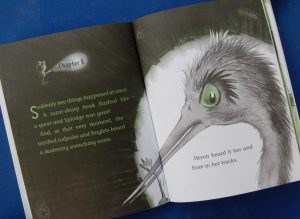
Can he come up with a super-ingenious plan – probably his most clever ever – to evade the jaws of the ferocious pike Old Snapper and Heron of the razor-sharp beak

not to mention one Sneaky Snake that might just be snooping around?

Let’s just say DUCK POO and leave you to discover its significance.

Hilarious antics, splendidly portrayed and related in Paul Morton’s spluttersome storytelling prose: URGLE-GURGLE GLUMP! Froggy fun it surely is and perfect cheering-up fodder for new solo readers. It’s a great read aloud too – you can really give it some belly.

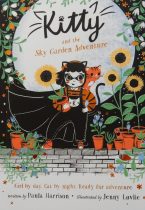
Kitty and the Sky Garden Adventure
Paula Harrison, illustrated by Jenny Lovlie
Oxford University Press

I can almost hear the cheers from young solo readers for girl during the day, cat at night, Kitty, as she returns in a third adventure with her feline side kick Pumpkin.

As the story opens Kitty is excited to discover that the sunflower seed she planted as part of the school garden design competition is sprouting leaves and is showing it to Pumpkin when Pixie appears talking of an established garden across the city that might provide some inspiration for Kitty’s own design.Kitty cannot resist the opportunity to see this garden and quickly dons her superhero suit.

Following the scent of flowers, the three adventurers venture forth and discover a wonderful rooftop garden alive with wonderful aromas, beautiful trees and gorgeous flowers including seven huge sunflowers.

Her companions are mightily impressed by the catnip bush and it’s this that results in their presence being discovered by an irate tortoiseshell cat whose peaceful evening they have disturbed. The friends’ enthusiasm for things botanical persuades the grumpy Diggory to allow them to explore and he shows them around Mrs Lovett’s amazing creation, even inviting them to return.

So excited is Pixie that she cannot keep the news of the wondrous place to herself and next evening they return to find the place overrun with cats behaving in a thoroughly undesirable fashion.
Before long, Kitty and her pals have a huge task on their hands – to repair the damage the unruly frolickers have done before sunrise.

Can they rise to the challenge when they have a whole gang of recalcitrant cats to deal with, Kitty’s going to need all her powers of persuasion to get that gang on side to help.

I love the way Paula Harrison almost unobtrusively weaves nature’s wonders into this urban adventure; there are subtle lessons for young readers about re-using and recycling planted in her tale too. From its gorgeous cover by illustrator Jenny Lovlie, this is a delight through and through. The illustrations within are fab too, especially those of the garden.

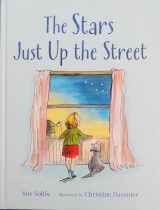
The Stars Just Up the Street

The Stars Just Up the Street
Sue Soltis and Christine Davenier
Walker Books

Mabel’s grandpa loves to tell stories of the thousands of stars in the night sky where he grew up and this draws in his granddaughter Mabel who loves to look at the five stars she can see through her bedroom window and the nineteen visible from her back garden’s ‘narrow patch of sky’.

When Grandpa and Mabel go walking in the town looking for the myriad of stars he saw in his youth, the plethora of street lights and houselights make it impossible.

What can she do about the lack of the real darkness that would allow the stars to become visible?

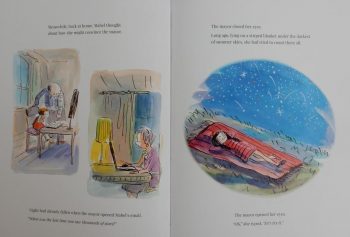
Now Mabel has a mission: to convince other people to turn off the lights. First she goes to her neighbours who having done as requested are amazed at the number of stars now visible – around two hundred. “Look, the Big Dipper!” cries one in surprise.

More people agree to switch off but to get the street lights turned out, Mabel must appeal to the town’s mayor. This, with dogged persistence and a reminder that everyone was a starry-eyed, star watching child once upon a time, she eventually does.

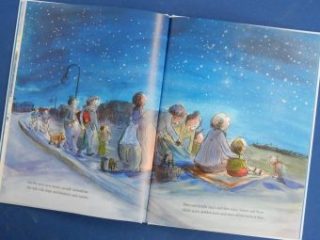
The story concludes with a community celebration with everybody gathering up on the hill to view the wonders of the night-time sky, now filled with stars,

an event that seems destined to become an annual new moon tradition with  picnics and telescopes.

Sue Soltis’ beautifully told, inspiring story of the love between Grandpa and grandchild, of determination, community and controlling light pollution, will appeal to urban star-gazers especially, as well as one hopes encouraging youngsters to take up the challenge and campaign for what they believe is right and to stand against those things which are detrimental to our world. Christine Davenier’s ink-wash illustrations capture both the beauty of the night sky liberally sprinkled with stars, and the young girl protagonist’s heartfelt determination.

Would that it were so relatively easy: our towns and cities at night are ablaze with unnecessary artificial lights, almost wherever one looks: every town, every city needs a Mabel.

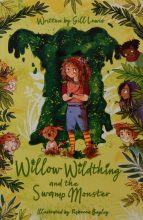
Willow Wildthing and the Swamp Monster

Willow Wildthing and the Swamp Monster
Gill Lewis, illustrated by Rebecca Bayley
Oxford University Press

This story introduces a super new character, Willow Wildthing in the first of a series to be.

Willow has just moved into a new home in a different town; everything feels strange, alien even. Left to her own devices, she decides to go exploring with just her dog Sniff for company. No sooner have they sallied forth than something startles Sniff and he vanishes.

Giving chase, Willow comes upon four grubby-looking children calling themselves the Wild Things who have seized Sniff saying they need him for a mission.

When Willow stands her ground the Wild Things (Fox, Raven, Mouse, Hare) agree (mostly) to let her accompany them.
But is she brave enough to enter the Wilderness? It’s a kind of wood but not just any wood, a secret place where anything can happen, a place wherein a wild monster dwells.

It means crossing some very murky water and going barefoot. Oh yes, it’s also a place where magic seeps into you regardless of whether or not you want it to; and you can only enter through the Holloway.

It’s said that a witch lives in the Wilderness too, though Mouse insists she’s the writer who came to talk at school; witch or writer, or both? The woman tells them in answer to Fox’s ’what do you do?’ – ‘I suppose you could say I conjure openings into other worlds.’

Eventually Willow decides that accompany them she must, Sniff’s help is needed in locating and rescuing another member of their group – Bear; but his is not the only rescue they undertake. They locate the source of the howling Willow heard on her first night in the new house.

All ends satisfactorily with Willow being accepted as a member of the Wild Things and there’s the promise of another mystery waiting to be solved.
And as for magic, let’s say yes to that, the best magic of all being, friendship.

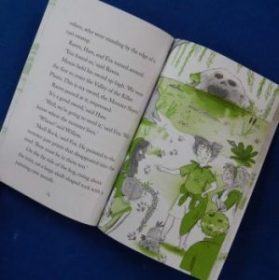
Gill Lewis lyrical manner of telling this tale immediately engages the reader holding your interest throughout with its mixing of the enchantment of the natural world and that conjured up by the imagination. Rebecca Bagley’s two-colour illustrations are a delight too. The book is one likely to engender in children the urge to be curious, thirsty for adventure and resilient, as well as open-hearted and kind.

The Extraordinary Gardener / The Five of Us / Incredible You

Celebrating the paperback editions of 3 Tate Publishing titles:somehow they all speak a similar message to us in this current crisis:

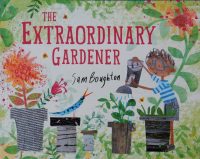
The Extraordinary Gardener
Sam Boughton

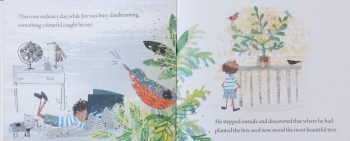
Wildly imaginative, Joe lives in an ordinary apartment in an ordinary city but in his inner world, plants flourish growing taller than skyscrapers and wondrous animals abound.
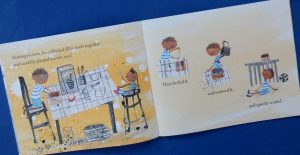
Then thanks to reading one night in bed, a seed of an idea is planted in his mind; it’s colourful, aromatic and joyful sounding. The following morning he sets about transforming that idea into reality, starting with an apple seed and some basic tools.

His idea seems to take ages and ages, almost forever; so much so that Joe forgets his seed and returns to imagining colour into his grey existence. But then one daydreaming day Joe spies something outside, colourful and REAL!

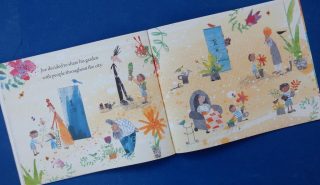
Tender care and new seedlings turn that single tree into a stunningly beautiful garden; a garden admired by his neighbours and that ignites his imagination once again.

More seed gathering ensues and gradually the entire neighbourhood is totally transformed into a riot of colour. Just the kind of awesome moment we all need in our lives just now, and the message too about reaching out to neighbours and strangers.

The more you look at this book, the more you see – the detail is awesome; and Sam Broughton’s way of using greyness and gradually bringing more and more colour into her scenes is wonderful, culminating in a glorious fold-out.

Time to get yourself some seeds, go into your garden (or failing that grab some containers), and begin growing something amazing …

The Five of Us
Quentin Blake

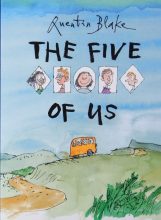
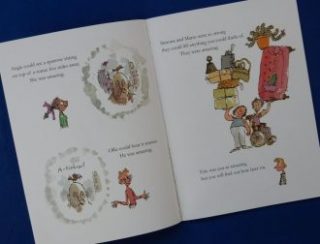
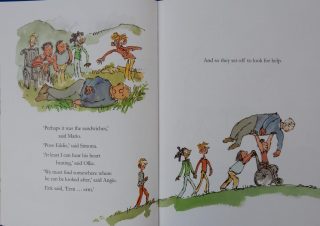
This is an enormously powerful story about how five friends, set out for a picnic into the countryside, in a big yellow bus driven by Big Eddie. Now what we’re told about the five is that each of them has a special, amazing ability: Angie can see things miles away; Ollie’s hearing is supersensitive; Simona and Mario are extraordinarily strong and as for Eric – he’s not yet aware of his superpower, but of that  … more later.

During the picnic Eddie starts feeling “ a bit peculiar’ and suddenly the children have an emergency on their hands. Now more than ever they need to work together

but which of them is going to end up saving the day – or will it be a wonderful collective problem-solving effort.

Quentin Blake’s genius shines forth in every way in this book; his characters are wonderfully portrayed and he leaves plenty of space for readers to bring their own interpretations to the story, though one thing is absolutely clear: do whatever you can – a crisis situation can bring out the most awesome talents in every single one of us.
Written 6 years ago, this is just as timely now – or perhaps even more so.

Incredible You
Rhys Brisenden and Nathan Reed

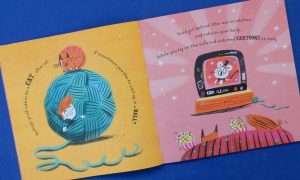
We all have a bad day from time to time and perhaps like the boy protagonist in this book, on especially bad ones, we might wish to be someone or something else.

This boy however, having run through the gamut of ordinary

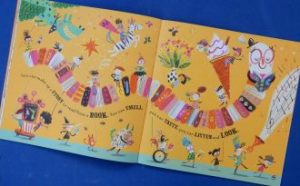
and less ordinary animals and the possibilities offered by so being, comes back round to the senses that he himself possesses and the wonderful wealth of possibilities these can generate.

In short everyone is uniquely AMAZING!

Amazing too is the combination of Rhys Brisenden’s rhyming text and Nathan Reed’s colourful scenes of upbeat characters, animal and human, demonstrating the multitude of ways of being yourself.

Hours of visual stimulus and an abundance of potential talk herein.

Only a Tree Knows How To Be a Tree/ We’re Going on a Bear Hunt: Let’s Discover Changing Seasons

Only a Tree Knows How to Be a Tree
Mary Murphy
Otter-Barry Books

There are SO many things about a tree to appreciate and take delight in. First and foremost is its inherent and unique beauty, but it also provides shelter for all manner of insects, birds,

and other small animals, for as the author says ‘Only a Tree knows / how to be a tree.’

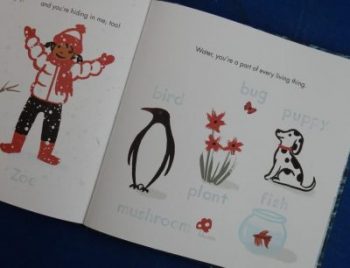
In similar enthusiastic fashion, Mary talks of and celebrates other things in the natural world – birds, dogs, water with its plethora of fish,

Earth whereon all the things mentioned have their homes, but also for its turning that brings both night and day, and the seasons; and there’s the universe with its multitude of planets … “But Earth is our home / and only Earth knows how to be Earth.’

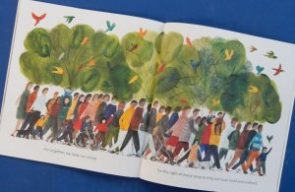
There are people too of all kinds to celebrate every one special and different: these are represented by a host of joyful children

playing, talking, pretending, one even meditates. Indeed children feature in all but one spread. I love Mary’s inclusive, brightly hued, detailed pictures of them all. These alone offer plenty to look at, enjoy and talk about.

Nothing is too insignificant to celebrate here from the tiniest creature to the entire universe. Share, pause, reflect and feel awe.

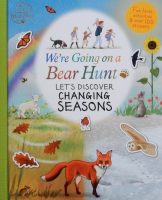
We’re Going on a Bear Hunt: Let’s Discover Changing Seasons
illustrations by Max Williams/ Bear Hunt Films Ltd. Susanna Chapman
Walker Entertainment

No matter the weather or the season, youngsters will find something of interest in this interactive seasonal guide. There are a number of weather related investigations some of which can be done at home, others will involve going out doors. You might make your own rain gauge; or perhaps find a good spot for some cloud spotting.

On a clear wintry night, what about some moon spotting or looking at the stars? Or on a fine spring day, why not take the opportunity to get outside and look for signs of new life – there might be baby animals around.

Then once back indoors you can adorn a field with spring flowers using some of the stickers provided at the back of the book.

There are also seasonal recipes, crafts and I particularly like the idea of ‘Go green lucky dip’ where you can use the discs provided but also add you own counters.

With plenty of fun, learning opportunities, certainly this is a sticker activity book and much more.

Patricia’s Vision / Hosea Plays On

Here are a couple of books about enormously inspiring people from Sterling Books

Patricia’s Vision
Michelle Lord and Alleanna Harris
Sterling Children’s Books

Here’s a super STEM picture book biography by Michelle Lord, of an inspiring African American woman, Dr. Patricia Bath, who followed both her passion and her vision to become a doctor and change other people’s lives by restoring their eyesight by means of tools that she herself had invented, tools that included lasers to remove cataracts.

From her childhood, (as a young child having seen a blind man begging on the street in Harlem in the 1940s, and pondered on how and why it could have happened), Patricia was a girl with a great and growing curiosity. After qualifying as a doctor, she “decided to get the training, education, skills set so I could achieve miracles” and that is precisely what she did, believing that “eye sight is a basic human right”.

She always looked for possibilities where others saw only insurmountable walls, and through her tenacity and determination managed to do what had never been done before often against her naysaying fellow doctors who hadn’t the imagination she possessed to look beyond the information given.

Through her entire life, even in retirement, this awesome woman kept her goal firmly in her sights and when climbing Mount Kilimanjaro, she visited a school classroom wherein blind children received their education in a classroom without braille books. On her return home she sent computers to that Tanzanian school so that the pupils could use their fingertips to read braille computer keyboards; this she called “Computer Vision”.

What an incredible woman and what an awe-inspiring book, made all the more so by the inclusion of direct quotations from Dr Bath and animated illustrations that show both emotion and scientific details. A terrific tribute, and a splendid way to introduce young readers from all over the globe, to this medical hero who died last year.
(There’s also a timeline, a note from the author, a further page about Dr Bath and a bibliography.)

Hosea Plays On
Kathleen M. Blasi and Shane W. Evans
Sterling Children’s Books

Both author Kathleen Blasi and illustrator Shane Evans celebrate the street musician Hosea Missouri Taylor Jr. in their fictional homage of a story of a day in his life, when he boards the bus and goes to his favourite spot, Rochester Public Market.
There he would take out his saxophone and play amid the hustle and bustle. On this particular day we see him passing a boy raking leaves who pauses in his work to pretend play using his rake.

Once in the market passers by are entranced by his music and some drop money into his saxophone case; one girl is moved to dance,

their harmonious double act continuing until the rain comes down when she and the watchers, head for cover leaving Hosea to play alone.

At the end of the day, Hosea is thrilled to discover he has earned ‘enough money’ which we understand is the means to buy another instrument – a trumpet –

and in so doing, spread the love by donating it to the lad Nate, he’d spoken to in the morning. Then they play a lovely surprise finale duet.

The vibrant artwork is wonderfully uplifting: Hosea’s passion for music and its power shines out and the story is enormously, joyously heart-warming.

An author’s note explains how the musician’s goal was to keep the neighbourhood children in positive ways. To this end he bought instruments for youngsters and offered them free music lessons: a true advocate for learning through music.

Recommended for all who want to share, or inspire others with the joys of music and of giving.

Build A Castle

Build a Castle
Paul Farrell
Pavilion Books

Young children are continuously sensing, relating, observing, investigating, thinking and communicating. In so doing they research and create theories about how and why the world and things in it, work. We adults – teachers, parents, playworkers and others – have a unique opportunity to support this through our work and our play, through the arts and our relationships with children.

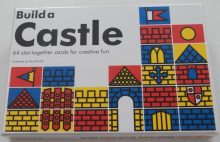
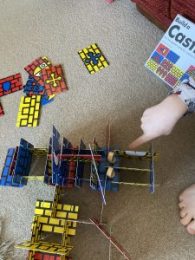
One such opportunity is presented in this Build a Castle kit that Samuel (age 4) was enormously excited to investigate.
The kit comprises 64 cleverly designed, slot-together building cards (105 x 69mm) – turrets, arrow-slit windows, portcullises, roofs, walls, flags and other things which can be assembled both upwards and outwards, to create a medieval wonder, or many.
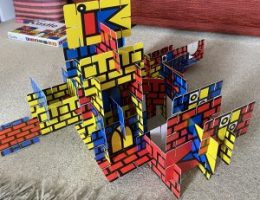
Samuel spent a couple of hours completely absorbed, finding out how to slot the pieces together and working on ways to construct.

Having unpacked the pieces he unfolded the ‘Basic Building guide’ booklet and perused it, trying to match the various different cards with the design illustrated. He then began building, trying things out, and altering his design until he’d both used all the pieces and was satisfied with his creation.

His concentration never wavered

and having partly completed his castle he went and got two wooden figures from his toy box and added those, playing and storying with them inside the various rooms as he built.

What a cool way in which to play and learn. I thoroughly recommend Build a Castle for individuals, families, foundation stage settings and schools.

Hattie

Hattie
Frida Nilsson, illustrated by Stina Wirsén
Gecko Press

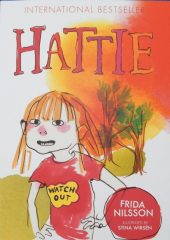
Six year old Hattie is shall we say, something of a mischief. She lives in a small country town in Sweden with her hard working parents and there’s little to keep her amused so she’s been eagerly anticipating starting school. That, she thinks, will surely bring plenty of adventures, and so it does.

Right on the very first day she makes a new friend, Linda who despite initial appearances is full of fun. She makes other friends too and manages to get herself into all kinds of trouble, sometimes solo, at other times along with her bestie, each escapade being related in a chapter. Every one however, results in new learning on Hattie’s part.

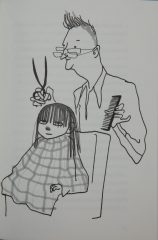
There’s the incident when on the eve of the school photographs, she gets her haircut

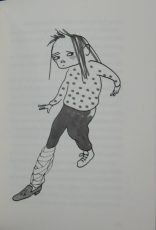
and ends up with a style that’s way too tufty, but guess who looks the most funky when the photo comes out.

Not everything goes wrong though: Hattie turns seven, becomes besotted with a hermit crab which results in Dad having to do some quick thinking; she gets her very first swimming badge – eventually – after some warty trouble;

and before you can possibly say, ‘where’s all that time gone,’ a whole school year has passed and it’s the summer holiday.

Youngsters around Hattie’s age will surely love reading about, or hearing of, her escapades; this is a girl with a thirst for fun, a total charmer who just doesn’t stop and think about the consequences of her actions before plunging straight in. She does though pause for thought, reflect and take on board the lessons learned.

The occasional line drawings by Stina Wirsén are a sheer delight too.

It’s Rhyme Time with Big Green Crocodile and Seagull Seagull

Two exciting books that celebrate rhyme and encourage a love of same:

Big Green Crocodile
Jane Newberry, illustrated by Carolina Rabei
Otter-Barry Books

This collection of original play-rhymes for the very young comes complete with how to ‘act out’ instructions for adult readers aloud. Wearing my foundation stage teacher and advisory teacher for language hats, I know that it’s never too early to start sharing rhymes with little ones, first and foremost for the sheer pleasure they afford, but also for enjoyment of the inherent 3Rs (rhythm, rhyme and repetition) and here’s a book with sixteen new ones to enjoy.

Several of the rhymes feature aspects of the natural world – Five Buzzy Bees, a tree to tap, a Tickle Beetle, fishes, a Big Green Crocodile, while others are about things little ones adore hearing about (or will once you’ve read them a rhyme on the topic) such as monsters, a Wibble-Wobble Clown,

a Moon Rocket a dinosaur (Brontosaurus Ride), and sharing baking and sharing yummy ‘ICE-CREAM, COOKIES / AND CHOCOLATE CAKE!’ when The Queen Comes to Tea.

Whether your children are babies, soon to start reading at school, or somewhere in between, this is for you.

Caroline Rabei’s wonderful illustrations showing enthusiastic young child participants in all the action make this an even more delightful sharing experience for both children and adults.

So, jump up, shout for joy and move that body.

Seagull Seagull
James K. Baxter, illustrated by Kieran Rynhart
Gecko Press

Opening this book on the page opposite the contents, I read ‘Grasshopper green, / Grasshopper grey, / Why do you sit and fiddle all day? // Grasshopper grey, / Grasshopper Green. / Tell me of the wonderful things that you’ve seen.’
I know that poem I thought to myself and then realised why.
This is a new edition of New Zealand poet, James K. Baxter’s classic poetry – a selection of 20 poems from his book The Tree House, written for his class when he was a primary school teacher. The Tree House first published I think in the 1970s, is a book I had in my collection of poetry books at one time and his poems have been frequently anthologised by people such as myself.

Equally, I can recall reading Jack Frost to some of my classes way back in the 1980/90s. That’s the one that begins, ‘Look out, look out, / Jack Frost’s about! / He’ll nip your ears / And bite your snout!’ How well I remember those lines and my infants shouting it when the frost set in.

The more I read, the more excited I became: it was a real trip down memory lane to come upon Andy Dandy again, as well as meeting again The Old Owl as it sits on the branch of a gum tree telling listeners and readers, ‘There’s nobody here / But the moon and me:’ …
‘I’m as old as old, / And wise as wise, / And I see in the dark / With my great round eyes. // “So hurry and scurry,’ / The old owl said – / Pack up your toys / And get ready for bed.’
What wonderful images these words conjure up: and they surely have for Kieran Rynhart whose lovely illustrations grace the pages of this book.

I have no idea what happened to my copy of The Tree House but I shall most definitely enjoy sharing Seagull Seagull with children at every opportunity.

In the Sky: Designs Inspired by Nature

In the Sky: Designs Inspired by Nature
Harriet Evans, illustrated by Gonçalo Viana
Caterpillar Books

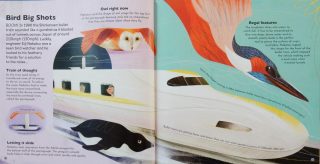
Yet again, prepare to be awed by nature. This time at the way scientists and technologists have been inspired by things in the natural world, both animal and plant, as described in this book.

Did you know for example that the Wright brothers were inspired in part by pigeons when they designed and flew their first successful plane; or that the wingtips of the Airbus A350 XWB are curved like a bird to help it fly faster?
As well as such information, readers can learn how forces affect the speed of flying objects, be they birds or aeroplanes.

I was fascinated to read that the Japanese engineer Eiji Nakatsu was an avid bird watcher and when faced with the challenge of lessening the noise of the Shinkansen bullet train, he took inspiration from the Adélie penguin for the bottom half of the pantograph (device connecting the train to the overhead wires), and was able to make it more streamlined.

Architects too, have used nature as designer to influence creations such as the apartment building, Arbre Blanc in France, while Vietnamese architects have covered the roofs of some houses with trees to help lower the temperature of the locality and improve air quality. Other architects have drawn upon the hexagon shapes created by bees’ honeycombs in designs including the British HiveHaus homes, while the Slovenian social housing in Izola comprises hexagonal modules and the Sinasteel skyscraper in Tianjin, China will have hexagonal windows.

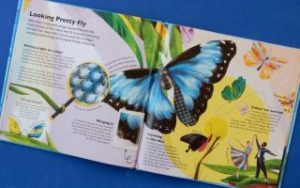
I was interested to learn scientists have copied the rough coating of moths’ eyes, using microscopic bumps on the surfaces of phone screens and other electronic devices to reduce glare;

while in the USA designers have created special screens for such devices, which bend light like butterfly wings. Amazing.

All this and other intriguing topics are covered in Harriet Evan’s text. Gonçalo Viana’s dramatic illustrations make it all the more alluring, exciting and imagination stirring. There’s a glossary too and I love the endpapers.

All in all, a super STEM book.

Meet Pippi Longstocking / Pippi Longstocking and the Snirkle Hunt

Meet Pippi Longstocking
Pippi Longstocking and the Snirkle Hunt
Astrid Lindgren, illustrated by Ingrid Vang Nyman
Oxford University Press

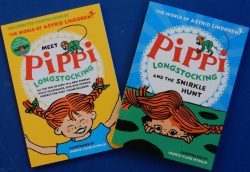
2020 sees the 75th anniversary of the publication of the first Pippi Longstocking book and as part of the celebrations OUP is releasing six new early reader, illustrated editions with Ingrid Vang Nymans’s illustrations rendered in two colours in each book, using adaptations of the original text by Astrid Lindgren.
The first two are Meet Pippi Longstocking, which introduces youngsters to the inimitable Pippi and her world and that in which Pippi invents the wonderful-sounding word “snirkle’ the meaning of which she tells her friends Tommy and Annika, she has no idea except that it’s not dustbin lid. Thus we have the second title, Pippi Longstocking and the Snirkle Hunt.

Clearly Pippi needs to discover what this brand new word of hers means and that’s exactly what, after a few moments of contemplation she sets out to do.

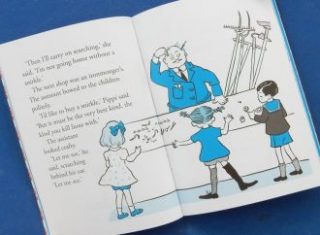
It proves not to be the sound made when you trample in mud making it come up between your toes: that she decides is SHBLURP and heads off, gold coin in hand, riding her horse Mr Nillson, to the shops with her friends, to see if it’s something that can be bought.
Several unsuccessful shop visits later,

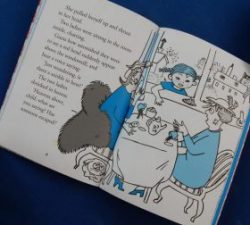
she heads to the doctor’s but that yields nothing helpful.

Nor does the intrusion she makes upon two ladies sitting chatting over a cuppa up in a flat.

Will the determined young miss ever solve her snirkle conundrum? Perhaps it’s closer to home than she thinks …

For the adult me, nine year old Pippi, with her mismatched stockings, carroty-coloured hair and freckles, has lost none of the allure she had in my childhood – an unstoppable self-belief, determination, resilience and kindness and lots of terrific adventures.

I can’t wait to introduce her, through these smashing little books to a new generation of young readers.  Long live Pippi!

Every Child a Song / Like the Moon Loves the Sky

Every Child a Song
Nicola Davies and Marc Martin
Wren & Rook

This book was written in celebration of the 30th anniversary of the United Nations Convention on the Rights of the Child.
Sensitive and thought-provokingly Nicola Davies uses the idea of every child having a song to explore some of the things contained in the 54 rights that all children should have.

Easily understood, her beautiful words highlight the right to freedom of thought and expression, the right to an education; the right to relax, play and participate in a wide range of cultural and artistic activities indoors and out, to be both an individual and part of a loving community.

Nicola’s is a song of love indeed and a vitally important one that reminds us all that there are still children whose access to these rights is limited by the chaos of hatred and war

yet still they are able to sing and to have their songs heard by people the entire world over.

Marc Martin’s illustrations don’t shy away from the darkness but the bright light of hope prevails as the final spreads show how by raising our collective voices we can make sure that ALL children, wherever they are, can sing their own song; a song that starts from the day they are born – a song of love, of joy and of freedom ‘–unique and tiny. Fragile. But never quite alone.’

Truly an inspiration to children everywhere.

Just now in the present difficult situation that are all share, think about what you can do at home with this book as your starting point.

Like the Moon Loves the Sky
Hena Khan and Saffa Khan
Chronicle Books

‘Inshallah you are all/ that is gentle and good // Inshallah you feel safe, / like all children should.’
These are the opening lines of Hena Khan’s lyrical text (each verse being based on a verse of the Quran) expressing new parents’ hopes for their tiny child to show gentleness, be safe, kind, reflective, to seek knowledge,

to stand strong, to embrace change and much more, prefacing each one with the “Inshallah” (in Arabic – if God wills it).
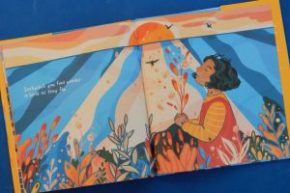
Debut illustrator Saffa Khan has created exquisite ink textured, digitally rendered scenes in rich, vibrant hues for every spread. I particularly like her carefully considered, inclusive one for ‘Inshallah you travel / to thrilling new places.’

Throughout, not only does she imbue the book with a sense of security, contentment and happiness, but also with hope and kindness, and feelings of awe and wonder,

perfectly complementing and extending the author’s over-arching tender, peaceful message of unconditional love.

This is a book that will resonate with people of all faiths and none, for as the author reminds us ‘Inshallah is used … to reflect the idea of a greater force or power beyond ourselves’.
Gorgeous!

Midge & Mo / Judy Moody Super Book Whiz

Midge & Mo
Lara Williamson & Becky Cameron
Little Tiger

Starting at a new school is almost always a bit scary and many children go through those ‘I want things to be how they were before we moved’ feelings. It’s certainly the case for Midge in this latest story in the Stripes series of full colour fiction for new solo readers.

Midge’s parents have separated and Midge is faced with having to start at a new school with all the challenges that presents. He really doesn’t want to embrace the change, instead he wants his old school and friends, and his parents together.

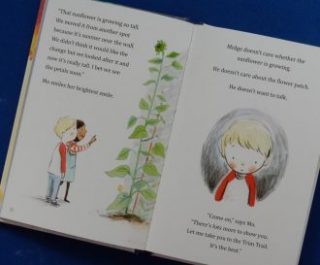
On his first day he receives a warm welcome from teacher, Mr Lupin who asks Mo to be Midge’s buddy. This proves to be a challenging role, for no matter how hard she tries, Midge remains sad and silent.

At the end of the day, Mr Lupin encourages her to keep on trying.

Back at home that night, Mo has an idea. She reaches for the snow globe her mum and dad gave her when she was a newbie at school and sits down with her parents whose words of wisdom inspire her to create a special something for Midge.

At school the following morning, she tries again with Midge and her actions precipitate a change in him: little by little, the clouds begin to shift …

Told and illustrated with obvious empathy, Lara’s words and Becky’s illustrations express so well, the emotional turmoil of Midge. It’s a lovely warm-hearted story for young just-independent readers as well as providing an ideal opportunity to explore the feelings associated with changing schools and/or a parental separation.

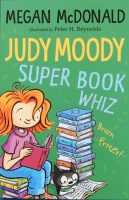
Judy Moody Super Book Whiz
Megan McDonald, illustrated by Peter H. Reynolds
Walker Books

My goodness, I hadn’t realised just how many Judy Moody books there now are.

Although there is a competition in this story regarding factual recall of things in stories and I’m somewhat uncomfortable with that, books and reading rule and that must be a good thing.

Judy Moody and her brother Stink are both on their school bookworm team (along with Frank and Judy’s erstwhile arch nemesis Jessica, Frank and Sophie). They have to read all the books on the list in order to beat the team from a school in the nearby town. There’s money for the school library as a prize and their much-loved teacher, Mr Todd is asking the questions, but can team Virginia Dare Bookworms out-perform The Fake-Moustache Defenders with their star, ‘Mighty Fantasky, Fourth grader’.

In order to be in with a chance the Bookworms will need to read at every possible opportunity – on the bus, in karate class, at the dining table, sick in bed, even.

Judy tries speed-reading while Stink fashions a cape using sticky post-it notes both of which are not quite the answer.

However, enthusiasm for reading never wanes in this exciting bookish battle, (all titles read are listed after the story), and let’s just say that it’s a win for books, for hard work and for determination.

I’ll leave you to decide to whom that applies and suggest you get a copy of the book for your classroom or a bookish young reader. Either way the final list of books, as well as the story, with its liberal scattering of funky Peter H. Reynolds illustrations, provide literary inspiration and enjoyment.

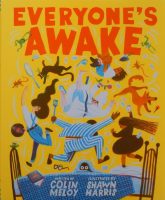
Everyone’s Awake

Everyone’s Awake
Colin Meloy and Shawn Harris
Chronicle Children’s Books

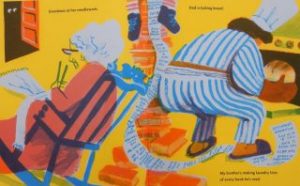
Wide awake, a child narrator lying in bed regales readers with the night-time activities of various members of the household, not one of whom is actually in bed despite it being almost midnight. Speaking in rhyme he tells of the relatively normal activities ‘Grandma’s at her needlework. / Dad is baking bread. / My brother’s making laundry lists / of every book he’s read’;

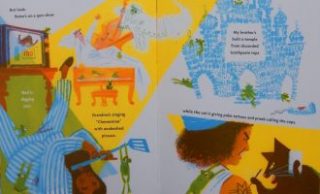
and the much more unlikely “My brother’s now reciting every line from Condorman while my sister is trapezing from the kitchen ceiling fan. / Dad just rolled the motorbike into the living room and is practicing Sinatra with the handle of the broom.’

Why oh why, when they have a busy day planned for tomorrow would Mum decide to go up on the roof and start fixing broken slates, or brother spend time using toothpaste tops to build a temple – totally bizarre behaviour. Even the family pets have got involved in the action: the cat’s been taking lessons in bad language from ‘my brother’ and then goes on to engage in a spot of tattooing.

Will these frenzied activities ever cease?

Eventually our narrator just has to go down.

The retro feel illustrations rendered in ink, charcoal and pencil with added colour absolutely capture all the frenzied nocturnal activity as the clock ticks on towards the morning. With a satisfying finale, the entire thing is absolutely and defiantly crazy – insomnia guaranteed – so best not shared as a bedtime tale.

Isadora Moon Goes on Holiday / Freddie’s Amazing Bakery: The Cookie Mystery

Welcome back to two terrific characters in new stories kindly sent, super speedily by Oxford University Press:

Isadora Moon Goes on Holiday
Harriet Muncaster

Isadora Moon enters a competition and is mega excited to learn that her picture has won a prize – a family holiday abroad.

Despite their initial reservations – the sticky heat, a plane flight the suitability of the hotel and more, her parents are finally packed and ready to embrace a new adventure.

Soon after their arrival Isadora, her mum and little Honeyblossom head for the beach, but during their first dip, Mum is concerned about the amount of rubbish people have thrown into the sea.

Next morning the whole family go on a boat trip and while demonstrating her underwater swimming skills Isadora encounters Marina, a friend she’d made when on a camping holiday. Now Marina too is holidaying with her family and she tells Isadora of the large amounts of rubbish they’ve discovered underwater.

The mermaid gives Isadora a conch shell to use as a communication device and later on she receives a call from Marina begging her to help in freeing a baby turtle that’s got stuck in a tangle of rubbish beneath the ocean.

Despite her parents’ warnings not to venture out again without telling them, Isadora, wand in hand creeps out into the moonlight and is soon diving beneath the waves on a rescue mission.

Even after successfully releasing the little creature, there’s a  huge task ahead of Isadora and for that she needs to enlist the help of her parents. Will they overlook this latest bit of disobedience in a far greater cause – saving our precious planet?

Telling and illustrating it with her usual sparkly magic and pizzazz Harriet Muncaster weaves into this latest story, important environmental messages about the horrors that we thoughtless humans cause the natural world.

Fans of the fangtastic fairy-vampire books will enthusiastically lap up this one, and will very likely espouse the cause of saving our planet too.

Freddie’s Amazing Bakery: The Cookie Mystery
Harriet Whitehorn, illustrated by Alex G. Griffiths

We’re back in Belville town where kind-hearted Freddie Bonbon has his bakery.

As the story opens it’s a lovely spring morning and Freddie is just about to leave on his delivery round leaving the bakery in the capable hands of Amira, his best friend and manager who is putting up a sign advertising for another baker. He’s heading for Van de Lune’s Hotel with a special delivery.

At the same time, the unscrupulous owner of Macaroon’s Patisserie, Bernard, is thinking super-bad thoughts about Freddie, intending to sample one of the  yummy confections he’s just stolen from Freddie and work out what it is therein that so delights everyone.

The following morning Freddie learns that Cookie, the superstar cat staying at Van de Lune’s has disappeared, presumed kidnapped. Can he, with the skills of his small dog, Flapjack succeed in solving the case of the vanishing feline?

The recipe of Harriet Whitehorn’s fun story with its highly satisfying ending, generous sprinkling of Alex’s superbly characterful black and white illustrations, posters, signs, and appropriate capitalisation of the text, plus a culinary glossary and instructions for baking delicious cookies, this is another yummy treat for junior fans of The Great British Bake Off.

Freddie is destined to win even more young book enthusiasts with this, his second mystery.
Two Terrific Board Books

Here are two very different but both smashing board books to explore with little ones.

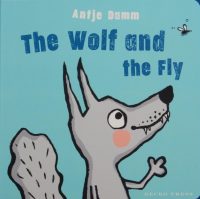
The Wolf and the Fly
Antje Damm
Gecko Press

What a totally delicious book this is, and it’s one where readers, young and not so young, can polish up their observation and memory skills as they follow the tale of a hungry wolf.

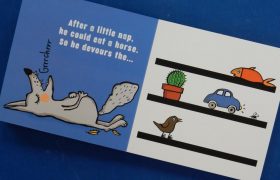
On the first spread we see the lupine contemplating his shelves of objects – a duck, an apple, a fish, a cactus, a car, a fly, a bird and a cat and the words, “The wolf is feeling a bit peckish today. So he eats the …’

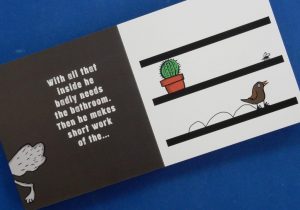
Each subsequent spread shows a gap on one of the shelves indicating where the missing item was and readers have to remember what that item is.

He keeps on chomping until he’s fit to burst and has to head to the bathroom.

On his return he’s ready for afters and consumes another item. Once inside said item tickles his tum; you can guess what happens next.

Antje’s illustrations are superbly expressive and the entire experience of sharing this story with a little one is absolutely yummy.

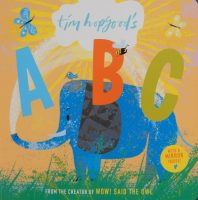
Tim Hopgood’s ABC
Oxford University Press

Author/illustrator Tim Hopgood has created a gorgeous alphabetical introduction to the natural world for the very youngest.

No matter where the book is opened, little ones will be treated to a beautiful image that celebrates an aspect of wildlife and/or the elements, that can be found somewhere on the planet.

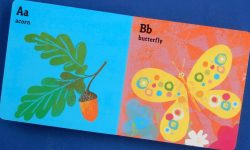
We have Aa for acorn, a butterfly represents Bb;

a scene of a child relaxing atop a hill gazing skywards while a bird perches on her foot, butterflies flit and a bee drifts by, that’s Cc for cloud, and opposite is a scorching desert – Dd.

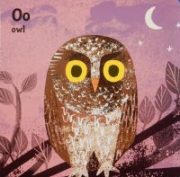
So it goes on – it’s hard to pick favourites though I especially like the owl –

through to Yy . Hereon it’s not nature but the toddler’s own image that will be reflected back by the mirror forming the centre of, I think, a sun.

Alphabetical it may be, but in the first instance, I’d just enjoy talking with a tiny about the illustrations for their own sake, and perhaps focus more on the alphabetical element later on.

The Book of Time

The Book of Time
Kathrin Köller and Irmela Schautz
Prestel

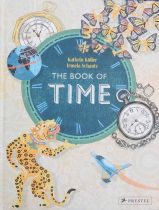
To say that this fiction/picture book obsessed reviewer spent hours engrossed in this captivating factual book, rather than reading a story, would say that it’s definitely worth getting hold of a copy.

After its introductory page entitled ‘Time! What Is It?’ there are four main sections in this look at the hows and whys of thinking about time.

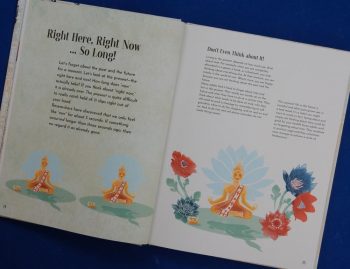
The first deals with the philosophical aspects: here we meet Chronos, the god of time as well as a number of other mythological deities and creatures. The cyclical nature of time in some cultures is considered as is the notion of living in the here and now – that immediately brought to my mind the opening lines of TS Eliot’s Burnt Norton, “Time present and time past / Are both perhaps present in time future, / And time future contained in time past. / If all time is eternally present / All time is unredeemable.”
How many of us have actually stopped to consider what he really meant in the 1930s when he wrote those profound lines?

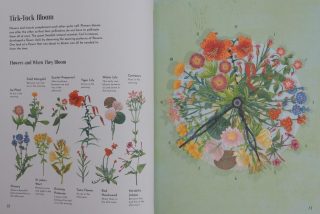
Another section that immediately caught my interest was ‘Birds, Bees and Bloom’ that looks at how certain animals appear to have a precise internal clock that tells them when it’s time to hunt for their food, to seek a mate, to migrate, pollinate and hibernate. Did you know that Hummingbirds are able to remember the precise time a flower produces fresh nectar? How incredible is that?
Flowers too have specific times for blooming (although global warming seems to be playing havoc here) so that their pollinators don’t have to pollinate them all at once. In this respect, through careful observations, Carl Linnaeus developed a flower clock.

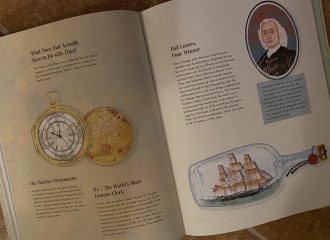
The other three sections – Around the Year, Around the Day and Travels Through Time are equally interesting. Readers can find out how studying latitude and longitude are related to clocks;

take a look at some of the weird and wonderful clock designs, and ponder upon time travel and consider other fascinating chronos concepts.

Every spread is stylishly illustrated – it’s well worth spending time studying Irmela Schautz’s often sophisticated art, as well as Kathrin Köller’s text: how long I wonder will you spend on the vexed question of time, caught between the pages of their book?

Agents of the Wild Operation Honeyhunt

Agents of the Wild: Operation Honeyhunt
Jennifer Bell, illustrated by Alice Lickens
Walker Books

Returning home one day, 8 year old Agnes Gamble, daughter of the sadly no longer alive, renowned botanists Ranulph and Azalea, discovers a creature clad in a safari uniform awaiting her in her bedroom. He informs Agnes that he’s an elephant shrew (species Rhynchocyon petersi) , a field agent for SPEARS (the Society for the Protection of Endangered and Awesomely Rare Species). He gives her a pair of knee pads covered in a sticky green goo (slug mucus) and says she’s to accompany him on a mission. He’s even brought a replacement chimp trained to mimic her so that her Uncle Douglas won’t notice her absence.

The recruiter who’s also known as Attenborough or Attie for short, says that not only did her erstwhile parents know of SPEARS but that they too were field agents for the society. This persuades Agnes to go along with Attie who leads the girl up inside a hidden passage to where eventually they board the SPEARS dragoncopter that takes them to HQ to meet the organisation’s Commander, a turkey.

He tells Agnes that she’s been scouted and if after training, she’s deemed ready, she’ll be sent on a mission with a view to becoming a permanent agent.

Needless to say the training is pretty rigorous

but Agnes scores well and along with Attie, is assigned to Operation Honeyhunt tasked with rescuing a young bee left behind during a hive relocation to a protected sanctuary the previous week. Said bee is at even greater risk due to the fact that the dastardly Axel Jabheart has been sighted in the Atlantic Forest, the place where the bee was left.

Eventually they locate the apis in the rainforest.

He then informs the agents that he’s called Elton and that he’s choreographer in chief of the hive colony. Agnes amasses a wealth of additional information about Elton but is she up to the difficult rescue task, after which she’ll become a full SPEARS agent?

With its exciting mix of adventure and wildlife conservation, Jennifer Bell has created a terrific story for those around Agnes’ own age. Alice Lickens’ wonderfully offbeat illustrations sprinkled throughout the book, break up the text; and at the end of the story are several pages providing facts about the endangered wildlife of the Atlantic Forest in which the mission is set, as well as information on how readers can get involved.

I look forward to reading more of young Agnes and her adventures.

Scribble Witch: Notes in Class

Scribble Witch: Notes in Class
Inky Willis
Hodder Children’s Books

This sparky story is the first of a new series featuring Molly Mills (our narrator), her best friend Chloe, and a ‘scribbly doodly’ character named Veronica Noates aka Notes, a somewhat mischievous little paper witch.

As the story opens Molly learns that her very best friend is leaving Dungfields School. They’ve been pals since nursery and they’re now 9 years old. Consequently Molly is very upset and starts taking it out on Chloe. Into this sorry situation drops, quite literally, a piece of paper on which is drawn a smiley, friendly looking, titchy little witch.

Having liberated her from the paper with her rainbow scissors, Molly begins to get to know this rather odd character
that communicates, not by speaking (although she can) but through little notes written not only on paper, but other things such as leaves too.

The trouble is, despite her best intentions, Notes causes Molly even more problems, and she’s already got herself very much in her teacher, Mr Stilton’s bad books.

Is there any way that Molly, with the help of Notes, might manage to convince her best pal to stay at Dungfields rather than move to Lady Juniper’s School; or if not can Notes make sure that the two girls can be in close touch whenever they want?

With its wealth of quirky illustrations (including pencil toppers) and written communications (readers will quickly get used to Notes’ idiosyncratic writing style), this book is terrific fun as well as being bang-on with the feelings relating to losing a best friend ever from class.

Little People, Big Dreams: Astrid Lindgren

Little People, Big Dreams: Astrid Lindgren
Ma. Isabel Sánchez Vegara, illustrated by Linzie Hunter
Frances Lincoln Children’s Books

In the latest of this splendid biography series for youngsters Ma. Isabel Sánchez Vegara celebrates one of the world’s most favourite children’s authors, Astrid Lindgren, the creator of much loved character Pippi Longstocking.

Pippi Longstocking was the name given by Astrid’s daughter Karin who, when sick in bed asked her mother for a get-better story about a character whose name she had just thought up and those adventures are now children’s book classics that all readers should immerse themselves in.

Back now to Astrid: she had a happy childhood living on her parents’ farm in Vimmerby, Sweden and at a young age developed an insatiable appetite for books and reading, quickly working her way through the library’s entire collection.

She had a rather rebellious nature that became more evident as she began to grow up, getting her first job on a newspaper, and at age nineteen she became a single mother to her son, Lars.

Later she married and had another child, Karin. Always playful, Astrid frequently invented stories. As a 10th birthday present for Karin she put all the Pippi stories down on paper and before long the wise, wild character was famous the world over with Pippi being translated into over 100 languages and becoming a TV star too.

Astrid went on to create other popular characters including Lotta and Emil and was awarded two Hans Christian Andersen medals in recognition for her contribution to the book world.

There was even a planet – Planet 3204 – named in her honour by a Russian astronomer. Awesome! A legend indeed and now her stories live on inspiring new generations of young readers.

A time line and further information conclude this cracking book.

Linzie Hunter really captures the spirit of both Astrid and Pippi in her delightful, slightly wacky illustrations.

Where’s Baby?

Where’s Baby?
Anne Hunter
Walker Books

In this delightfully playful book whose story really begins on the front endpapers, Papa Fox searches for his little one. “Have you seen Baby, Mama Fox?” he asks on the first page and the response, “Why, Baby must be somewhere, Papa Fox” leads the male parent off, walking stick in paw, searching high and low in the countryside – up in the tree, inside a log, over the hill, down a hole, under the water and around the bend.

In each location he comes upon a decidedly un-foxy animal. Some respond politely to his question “ Ba-by! Are you … up in the tree?” for instance …

Whereas others such as a grumpy skunk with its “I am inside the log, but I am not your baby. Go away!” are rather rude and on occasion Papa Fox gets the shock of his life.

Totally at a loss, back goes Papa Fox empty pawed; and by this time if your audience hasn’t already yelled out, “Behind you” at the top of their voices they certainly will when he reaches Mama Fox again. Once reunited, it’s down to Baby to utter a final throwaway line …

Inevitably this will lead to cries of ‘Read it again” and you – like that Papa Fox, will happily oblige.

There’s so much to love about this hide-and-seek book: the dramatic irony of the whole tale; the entirely speech bubble text with its question and answer format; Anne Hunter’s superb, finely drawn pen and pencil, cross-hatched illustrations with that limited colour palette that grace every spread, the fact that youngsters will perceive that Mama Fox is playing along with her offspring and the unobtrusive lesson in prepositions.

Simple literary entertainment of the first order, methinks.

Just In Case You Want To Fly / Read to Your Toddler Every Day

Just In Case You Want To Fly
Julie Fogliano and Christian Robinson
Walker Books

All parents and carers want to do their best to ensure that their little ones have what they need in any eventuality and so it is here in author Julie Fogliano and illustrator Christian Robinson’s second collaboration.

It begins ‘just in case you want to fly, here’s some wind / and here’s the sky’ going on in rhythmic rhyme to provide such uplifting words about potential needs as ‘here’s a cherry if you need a snack/ and if you get itchy / here’s a scratch on the back’

as readers and participants move through the day perhaps pausing and ‘just in case you want to sing / here’s a la la la’ and to pick up a book or two …

getting ever closer to bedtime,

while in the bedroom there awaits ‘a pillow, a song and a tissue’. Before that though come a warm bath and  a honey-sweetened drink.

Christian Robinson’s final collage and paint, bedtime tuck-in spread shows the young child safely snuggled beneath a cover patterned with most of the items mentioned in the text.

With its reassuring messages that no matter where you journey, or what you try to do, something or somebody will be there for you, this is a tale to share with youngsters at bedtime or any other time of the day,

Also just right for sharing with that same young audience is:

Read to Your Toddler Every Day
Lucy Brownridge and Chloe Giordano
Frances Lincoln Children’s Books

Following on from their nursery rhyme book Read to Your Baby Every Day, the same team have collaborated on a collection of twenty folk and fairy tales and fable retellings from around the world – from Scandinavia to Syria

and Cambodia to China to read to slightly older children.

Once again Chloe Giordano has created gorgeous hand-embroidered illustrations and there’s at least one for every story. You’ll find animals of all kinds, shapes and sizes including mice and elephants from India,

Anansi the spider and a turtle from the Caribbean, as well as humans such as the couple whose snow girl came to life in the Russian “Snowflake, the Snow Child’, and the Stonecutter named Haru from Japan.

Each of Lucy Brownridge’s retellings is just the right length for bedtime reading providing an enriching way to end the day with your little one (s).

Welcome to Your World

Welcome to Your World
Smriti Halls and Jaime Kim
Walker Books

Strangely enough this gorgeous book arrived in the same week as my nephew’s wife had a new baby girl so it was particularly timely. I can already imagine her seven-year-old sister reading Smriti’s, lyrical, almost prayerful text to her and showing her the beautiful scenes of the natural world. That though will have to wait until the next time I see them.
‘Welcome, little baby, / round your mother curled. / Welcome, little baby. / Welcome to your world.’ begins the exhortation to the infant to use every sense to experience the delights of nature from morning to nightfall: the warm rays of the sun; the flora and fauna of the forests, the splashing ocean with its fish and turtles; the sound of the eagles as they soar and swoop; the wondrous sight of the Arctic light;

to feel the water from the rain and the waterfall as the elephants do. There are juicy berries waiting to be tasted (though not just yet and not without adult say so) as well as sweet-smelling blossoms and many other wonderful experiences.

When the sky darkens there are twinkly stars far out and closer, the moon to shine upon your lovely face.

The mother concludes by repeating ‘Welcome to your world’ continuing – ‘it loves you through and through. / Welcome to your world … // will you love it too?’

Just beautiful!

The Story of Inventions / The Great Big Brain Book

Two new titles from Frances Lincoln each one part of an  excellent, established series:

The Story of Inventions
Catherine Barr & Steve Williams, illustrated by Amy Husband
Frances Lincoln Children’s Books

Have you ever wondered how some of the things we take for granted such as paper and books,

clocks and watches, computers, electricity, vaccinations, cars, planes, the current pollution-creating scourge – plastic, as well as the internet came about? If so then this book will supply the answers.

Written in a reader friendly, informative style that immediately engages but never overwhelms, the authors will fascinate and inspire youngsters. Add to that Amy Husband’s offbeat detailed illustrations that manage to be both accurate and amusing,

and the result is an introduction to inventions that may well motivate young readers to become the inventors of tomorrow.

Add to classroom collections and family bookshelves.

For all those incredible developments to happen, people needed to use their brains; now here’s a smashing look at how this wonderful organ of ours works:

The Great Big Brain Book
Mary Hoffman and Ros Asquith
Frances Lincoln Children’s Books

There’s so much to like about this book, that is a great introduction to an amazing and incredibly complicated part of the body. How many youngsters will have thought about the notion that their brains are responsible for every single thing that they do, be it breathing, walking, chatting, eating, thinking, feeling, learning for instance. Moreover the brain enables us to feel happy, sad, powerful, and much more.

So how does this ‘control room’, this ‘miracle of organisation’ as Mary Hoffman describes the brain, actually function? She supplies the answer so clearly and so engagingly that young readers will be hooked in from the very first spread.

Each double spread looks at a different but related aspect such as the brain’s location and development;

another explains how the brain functions as a transmitter sending messages around the body by means of neurons. Readers can find out about how we’re able to move our muscles, do all sorts of tricky, fiddly things such as picking up tiny objects, a jigsaw piece for instance.

Lots of other topics are discussed including the two sides of the brain and what each is responsible for, as well that of neurodiversity. Some people’s brains develop differently, while others might have problems if something goes wrong with their brain.

Every spread has Ros Asquith’s smashing cartoon-style illustrations that unobtrusively celebrate diversity and make each one something to pore over.

A must have in my opinion.

Rabbit Bright

Rabbit Bright
Viola Wang
Hodder Children’s Books

You might want to have your sunglasses ready when you read Rabbit Bright with its dazzling day-glow colour palette.

Rabbit Bright has finally summoned up the courage to turn off his night light. But thinking about so doing, sets the little fellow wondering, “ … where does the light go when it’s dark?”

Instead of sleeping, it’s helmet on, panda clinging on behind and off he goes on his bicycle out into the blue-black night with this thought in mind: “If there’s dark, there must be light.”
And light there surely is; for first he sees a sky lit up by fireworks.

Then, having left his cycle, he boards an underground train with its glowing headlamps.

In the forest too he encounters light, in the form of bright-eyed nocturnal creatures.

Boarding a boat, he paddles off to a cave where the darkness is punctuated by the flashes of fireflies.

His journey of discovery continues in a sub-oceanic craft and our little explorer is almost dazzled by the sea creatures shining as they swim.

Having next, climbed a hill for a spot of star-gazing, Rabbit and panda float off into space.

Then mysteriously, that bicycle reappears, for the two to set off homewards where a cosy bed awaits. Sweet dreams Rabbit Bright; sweet dreams little panda.

If you have, or know a little one who has anxieties about the dark, then this is the perfect book to share with them. Not only is it an exciting story, beautifully and arrestingly illustrated, it should help to assuage those fearful feelings about turning off the light and being alone in the darkness.

Make Time for a Board Book

Where’s My Llama?
Kate McLelland and Becky Davies
Little Tiger

Capitalising on the current vogue for all things llama, Becky Davies has written a board book. Herein a llama has gone missing and it’s up to little ones to follow the trail of brightly coloured footprints to track her down.

Along the way tiny detectives will encounter a long-necked Giraffe, a cute tailed fox

and a long-eared rabbit, all of which have similar characteristics to the llama.
But where is the errant ungulate? Rest assured her fluffy tail will finally give the game away.

With its final flap reveal, Kate McLelland’s alluring scenes – each with a touch and feel animal body part – on softly patterned pastel backgrounds, simple descriptive text with the repeat refrain, ‘Where’s my llama?’ to chant, there’s plenty to keep the attention of tinies throughout this touch and feel, search and find book.

Maisy’s Science
Lucy Cousins
Walker Books

Toddlers’ favourite mouse Maisy is in investigative mode in this STEAM First Words tabbed book.

Out and about, she encounters some very windy weather that is perfect for kite flying; seasonal snow as she feeds the birds; enjoys a relaxing break from vegetable gathering to enjoy watching the minibeasts close by. Then it’s time for a bit of seed watering – perhaps she’s planted sunflower seeds – followed by observing some seasonal changes.

The arrival of her friends gives an opportunity to look at various parts of their bodies and hers and once she’s alone again, she and cuddly Panda can investigate a variety of textures; make some rather noisy musical sound with her percussion; don her painting apron and experiment with her paints, perhaps trying colour mixing and after all that activity it’s time to sit and read a book (or choose from one of the other learning tools shown on the opposite page).

Ninja, Ninja, Never Stop!
Todd Tuell and Tad Carpenter
Abrams Appleseed

This is a fun, rhyming tale of an energetic would-be little ninja whom we first meet looking terrified of the rather large family dog.

Creeping away, he comes upon his younger brother happily playing with a balloon. Not for long though. With a deft ‘chop’ Ninja  removes the balloon from little bro., then proceeds to snatch his chocolate-chip cookie and with a further chop – delivered with his foot this time – destroys his block-built castle leaving the long-suffering toddler howling.

A change of heart caused by an unseen force calling ‘Ninja, Ninja, would you stop?’ sees our Ninja then pause and help to reconstruct the building before whizzing off once more into the great outdoors.

It’s there that he receives his comeuppance, discovering – much to his surprise – that little brother is actually a highly observant pupil. Time to join forces it seems, for two Ninjas may well be better than one, certainly when it comes to scheming.

There’s a slight retro feel to Tad Carpenter’s bold, bright scenes from which the black-clad Ninja leaps out – literally! I can see little ones joining in, enthusiastically chanting along with adult readers aloud of debut author, Todd Tuell’s staccato text, as they turn the pages.

Welcome to Moomin Valley: The Handbook

Welcome to Moomin Valley: The Handbook
Macmillan Children’s Books

I’ve been an ardent Moomin fan since first reading Tove Jansson’s Finn Family Moomintroll and Comet in Moominland as a child of primary school age. So, I was thrilled to receive this handbook for review. Written by Amanda Li, it’s based on the animated TV series that sprung from the wonderful world of Moominvalley that Tove created. I was fascinated to learn from the introductory ‘How it All began’ that there’s even been a Moomins opera made.

Essentially though this colourful book is a guide to the world of the Moominvalley animation, the illustrations being based on Tove Jansson’s classic art.  First we meet the family (that includes special friends who when staying in the Moominhouse, become temporary family members), after which Moomintroll, Moominmamma and Moominpapa each have a page devoted to them describing their main characteristics and in the same section we’re provided with a brief Moomin history.
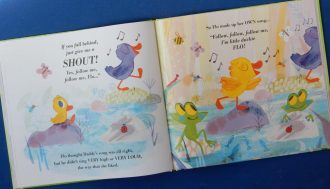
Next come the diverse group of the family’s visitors including the romantic Snorkmaiden who is besotted with Moomintroll.

The Moomin family residence is in the peaceful Moominvalley where they live in harmony with their environment. Due to their plethora of visitors they’ve had to extend their cylindrical home and it’s now the tallest building in the valley.
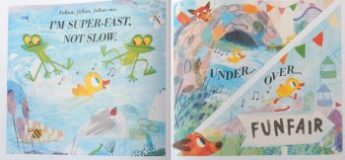
We read of their adventures, both at sea and on land, and

learn how they love to celebrate. We humans could do well to learn from them for they frequently ‘find meaning in the little things in life’. There’s magic too in the valley, especially at midsummer.
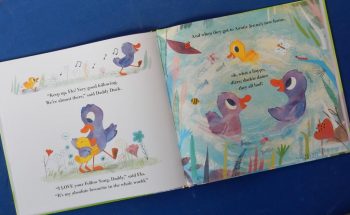
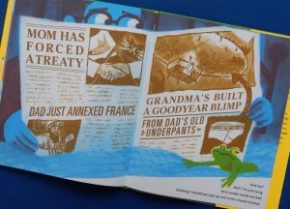
One chapter that immediately caught my attention was that called Rule Makers and Rule Breakers, the latter being of particular interest. There was of course Little My, rule breaker par excellence and a character after my own heart,

as is Snufkin, disliker of petty rules and regulations.

Further chapters are given over to ideas of the bright kind; kindness, the natural world of the valley and in Misunderstood Creatures we’re introduced to the likes of Groke and the hattifatteners. As anywhere there are seasonal changes in Moominvalley and these too are discussed. Then, beautifully rounding off the book, on the final 3 spreads, there’s ‘An A-Z of Moominvalley.

Tove Jansson died almost 20 years ago and since then there has been an enormous renewal of interest in her work. The Moomin books with their original artwork have been reissued as well as her fiction for adults. There have also been exhibitions and a biography in 2014 marking the centenary of her birth.

Moomins will never go out of favour so far as I’m concerned and I thoroughly enjoyed immersing myself in this book.

One Banana, Two Bananas

One Banana, Two Bananas
Adam & Charlotte Guillain and Sam Lloyd
Egmont

A yummy banana feast is in store for readers of this high octane rhyming, read aloud romp.
Without further ado let’s meet the banana crew with ‘One banana, two bananas, three bananas, four, snoozing in the garden’ (in hammocks) when their slumbers are disturbed by a ringing at the door.

There appear bananas five, six, seven and eight in party mood announcing that bedtime is postponed for a pyjama-clad shin-dig. And the eight are just in the act of inverting themselves when through the window they spy …

The llamas hailing from the Bahamas invite the fruity friends to join in their ‘llama race’. Now that’s an offer, eight PJ clad bananas just cannot resist and off they go. Oh no! They’ve been spotted by a monkey and you can guess what he has in mind as he gives chase.

Happily though something causes him to stumble-trip,

just as a couple of new bananas come speeding up – in the nick of time.

This hungry Monkey isn’t one to be deterred by a mere tumble though, certainly not when his tummy’s a-rumble.

Next thing we see is ‘Ten bananas in pyjamas’ dog-paddling – make that banana-paddling – to save their skins, pursued by the same number of pointy-toothed piranhas. Even if they manage to escape those, that Monkey is still close on their tails. But, can they manage to stay afloat long enough? That is the crucial question as we leave them bobbing up and down on the water …

Splendid silliness, both verbal (Adam & Charlotte) and visual (Sam), to tickle your taste buds and tempt you into performing this to your audience of book-hungry little ones. I wouldn’t mind betting, you’ll relish it as much as they will even if, like me, this reviewer, you don’t even like bananas.

How Colour Works

How Colour Works
Catherine Barr and Yuliya Gwilym
Red Shed (Egmont)

Right from its arresting endpapers, this book that investigates the science of colour and how we see it, simply explodes into a rainbow of bright hues.

Perhaps you’ve wondered how our eyes work, or why some things glow in the dark.

Or maybe you’re curious about how animals see colour – do they see what we see?

and how do they use colour?

Why is grass green, blood red, the sky sometimes blue, and why does the snow look white? The answers are herein.

This surely is a visual treat – Yuliya Gwillym’s dramatic illustrations arrest the eye at every page turn; but author Catherine Barr provides plenty of facts too, facts that will likely have readers wanting to go beyond the information given to learn even more.

Successfully combining science and art to present a veritable STEAM kaleidoscope, this is a book that offers something to youngsters from nursery age upward. What about awe and wonder? Yes, it definitely fits that bill too.

Egg

Egg
Sue Hendra and Paul Linnett
Macmillan Children’s Books

Team Hendra and Linnet (of Supertato fame) have created something delightfully different with their terrific tale of an upside down egg. And, they tell this tale with but a single 3-letter word and a sequence of delEGGtable illustrations.

Here’s what takes place. Into a group of pointy topped, bulging bottomed ‘normal’ eggs, comes our upside downer. The group members are at pains to point out how an egg ‘ought’ to look …

but undaunted, the newcomer proceeds to demonstrate its skills with some clever moves.

These seem to impress the others, so they decide to adorn it …

But this new look turns out to be merely temporary: our upside-downer has something else on its mind here and it looks like a lot of fun. Hopefully not of the shell-shattering sort, however.

Hang on though – might that mean that it’s fine to be an ‘invert’? Acceptance at last? Maybe; but that’s not quite the end of the story …

Accepting and celebrating difference are at the yolk of this Eggstraordinary book that will have you cracking up with laughter.

If you want an Easter offering that will last and last, way beyond the bank holiday, then Egg is the perfect treat. I’m certainly going to be giving a few.

Go Get ‘Em, Tiger! / As Big as the Sky

Go Get ‘Em, Tiger!
Sabrina Moyle and Eunice Moyle
Abrams Appleseed

Believe in yourself, is the message that grins, growls, giggles and positively shines out from the Moyle sisters’ latest offering.

Throughout Sabrina’s rhythmic, rhyming text that switches between the distinctly upbeat – No matter who you choose/ to be, you’ll be/ TERRR-IFIC./ Wait and see!’ – softer spoken exhortations – ‘ be humble’ and gentle warning – ‘You’ll make mistakes./ Things will go wrong./ And when they do,/ you’ll carry on.’

The emphasis is on resilience, finding your inner strength, and focussing on the possible; on kindness, ( You will see creatures who are stuck, / feeling lost, down on their luck. / To these new friends, you’ll lend a hand … ), consideration (‘use your strength to shine a light / on what is wrong and what is RIGHT ) and thoughtfulness.

Optimism rules.
The same is true in Eunice’s bright (with fluorescent touches), exuberant scenes of little Tiger and its community: they’re expressive and an effective complement to the words.

Perhaps the characters in the next book were inspired by the advice to that Tiger

As Big as the Sky
Carolyn Rose and Elizabeth Zunon
Sterling Children’s Books

Inspired by a real life meeting of the author and Caleb’s parents and sister, this story is of two at one time inseparable siblings, Prisca and her big brother Caleb.

He carries a bucket of water when the load is too heavy for her; and when Caleb gets malaria she brings sweet tea and nsima (a Malawian cornmeal dish) to his sick bed, and makes him laugh by chastising the mosquitos. But Caleb has set his sights on a better education than the village school can provide, so he goes to live with Grandma in Chimwe, a considerable distance away.

Eager to see him but lacking the wherewithal to pay the transport fares, she begins some entrepreneurial endeavours,

creating various items that the kindly peddler, Tewa Tewa, tries to sell on her behalf but without any luck. Still though, the man always receives a warm welcome from the child. The rains come putting paid to her creations,; again there’s no chance to get to Chimwe. But then one bright, dry day Tewa Tewa returns with nothing to sell on his bike.

Prisca asks him if he could possibly carry both her mother and herself all the way to Chimwe. After a little consideration on his part, all three set off on the long bumpy road

and finally, after many hours and absolutely exhausted, the wonderful man manages to reach their destination. There a joyful sibling reunion takes place.

Carolyn Rose’s uplifting story pays homage to the resourcefulness of children who have little in the way of money, but are full of love, kindness and ingenuity. It’s also a window into some of the hardships village-living families face in parts of Africa including Malawi.

Nine Lives Newton

Nine Lives Newton
Alice McKinley
Simon & Schuster

A dog with nine lives – now that is something different. It’s the case, so we hear, with long-eared Newton the narrator of this story. He’s just discovered the fact … so he thinks, and having shared same with his feline friend, off he goes to do all his favourite things as he lives life in the fast lane.

The moggy meanwhile (along with we readers and listeners), knows what Newton doesn’t, and sets off to pass on the information. Newton has another problem too: close attention to detail is definitely not one of his fortes and therein might lie his possible demise.

High drama aplenty is found in Alice McKinley’s debut picture book. With its wealth of lessons in visual literacy, she’s created a real winner here. Youngsters will love being in the know with the author and the moggy character when they watch Newton coming within inches of his life as he attempts to get the biggest bones; poo wherever he pleases;

select playmates freely; perfect his barking technique and more; as well as taking the occasional break for some R and R.

Now what could happen, if and when that cat succeeds in getting the crazy canine to listen? He may accept that he doesn’t after all, quite have nine lives, but Newton doesn’t look like the kind of dog to let something like that stand in his way of excitement …

Assuredly, excitement and hilarity are what you’ll get with Nine Lives Newton.

Smell My Foot!

Smell My Foot!
Cece Bell
Walker Books

If you happen to be looking for a book for readers who might have struggled a little or want something funny and a tad pungent in graphic novel style then Cece Bell’s bonkers book will tick those boxes.

Without further ado let me introduce its comedic duo: Chick is the pedantic, manners obsessed one; The socially inept Brain, despite appearances, can’t quite get the hang of such niceities as ‘please’ and ‘thank you’ and simple greetings, despite Chick’s modelling them for him. Instead of copying, his response is direct action. For instance Chick says, “ But I will not smell your foot until you say PLEASE.’ … ‘Like this ; please smell my foot.’ ‘Oh! OK!’ comes Brain’s response followed immediately by …

and so it goes on until finally the pair have smelled each other’s feet.

Chapter two sees the arrival of Spot the dog and a lot more social behaviour modelling and foot sniffing ensues until Spot invites his tutor home for lunch – UH! OH!

Chapter 3 demonstrates beautifully how clueless Chick really is: will he become a dog’s dinner or might his supposedly daft counterpart come up trumps by stepping in at the crucial moment? Polite, Chick-pleasing foot sniffing might not be his forte but sniffing danger could be an altogether different matter.

I’ll leave you to surmise and move rapidly on to the final chapter: oops that’s a bit of a giveaway but this hilarious saga does have a happy ending just about!

I absolutely love the way the author sends up the awful reading scheme language of yesteryear books such as Janet and John, Peter and Jane or the US equivalents Dick and Jane, the latter just happen to rhyme with this book’s delectable duo.

Super, slightly stinky spluttersome silliness of the first order, a friendship you won’t forget in a hurry, priceless comic-strip sequences with a dialogue only text, and short, bite-sized chapters: what more can a perhaps less than eager reader ask? Once anyone samples this, I suspect the demand will be “More of Chick and Brain please!”


Flower Power : The Magic of Nature’s Healers

Flower Power: The Magic of Nature’s Healers
Olaf Hajek and Christine Paxmann
Prestel

In this glorious spring bouquet, illustrator Olaf Hajek and author Christine Paxman offer art and information about seventeen flowers.

Because of some of my personal interests and experiences I was immediately drawn to this large format book: the couple of pre-uni. years I spent working in the herbarium at Kew Gardens, as well as my interest in the healing properties of plants in relation to Ayurveda, and the courses I took in aromatherapy and massage. That’s as well as an abiding fascination with the botanical world in general.

Every one of Hajek’s full-page illustrations is simply stunning in its beauty and witty detail so it’s virtually impossible to choose favourites – there’s magic in them all. Indeed, as Christine Paxman writes ‘In many old children’s books, the bellflower is described as a magic flower.’

However as a frequent visitor to India, I was instantly attracted to the “ginger’ illustration with its stylised dancer reminiscent of Indian miniatures. We read of ginger’s origins in India, China and other parts of Asia and of its many uses in cooking, in drinks and as a medicinal plant. Perhaps you didn’t know (I certainly not even considered it)) that in addition to its many healing benefits for humans, ginger root can be used to treat horses and other animals.

Many of us think of the Dandelion merely as a nuisance weed that’s nigh on impossible to get rid of. We might have sampled the leaves of Taxacarum in salads but I was surprised to read that the flowers can be used to make a jelly and the roots eaten, if roasted first. Moreover, the latex if extracted, can be used in rubber making.

‘Can a flower cure almost anything?’ This is one of Paxman’s introductory questions to Common Mallow. She goes on to answer that, as well as discussing its culinary uses, its uses as a dye and as a potential source of green energy.

You can dip in and savour every one of the entries: the conversational style of the text and outstanding art will fascinate, and perhaps prompt readers to dig deeper into some of the mysteries of the plant world.

Don’t Mess With Duck! / The Monkey with a Bright Blue Bottom

Here are two treats from Little Tiger


Don’t Mess With Duck!
Becky Davies and Emma Levey
Little Tiger

Duck is an exceedingly grumpy creature, the grumpiest in his particular pond. Rather than leaving him to enjoy some peace and quiet the other residents create a terrible row and splash infuriatingly. Consequently, case in wing, Duck ups and leaves seeking somewhere quiet.

His search yields several promising ponds but each proves unsatisfactory in one way or anther so he goes to the city where he’s equally unsuccessful,

so too is the cave.

Finally though, he comes upon just what he’s looking for, except that all of a sudden he hears another voice and finds himself face to face with a grumpy frog that’s as cross about seeing Duck as Duck is to discover another occupant. “Clear off!’ they both order.

A brief argument ensues followed by a truce when each agrees to keep out of the other’s way. Peace at last.

But then after a few days a loud cry disturbs this peace.
Are Duck and Frog now ready to accept that perhaps friendship is more important that seclusion? …

Themes of acceptance, inclusion and friendship are at the heart of Becky Davies’ funny tale of self-exploration and compromise. Plenty to think about there, for sure and with Emma Levey’s superbly expressive animal illustrations (I certainly wouldn’t dream of messing with that duck), this is a smashing book to share and discuss with youngsters either in school or at home.

The Monkey with a Bright Blue Bottom
Steve Smallman and Nick Schon
Little Tiger

Just when we, certainly I, am feeling in need of a bit of brightness in what feels like especially grey times, this book with its brand new dazzling, celebratory ‘becoming a teenager’ cover arrives in my post.

It’s a neo pourquoi tale delivered in jaunty rhyme that certainly packs a punch. It tells how long ago a monkey, inspired by the rainbow colours of the birds, takes up the paintbox he happens upon beside the stream, along with a couple of brushes, and feeling an upsurge in his creative juices, sets to work to make his world a brighter place.

Waiting until the animals are having their early afternoon snooze, he gets busy daubing some reptiles and then decides to give the leopard a bright yellow coat. In so doing however, he causes it to stir. Monkey dashes up a tree and splodges of black paint rain down upon the creature.

Impressed with what he sees, Monkey lets his artistry loose upon a giraffe, a zebra, a lemur and a skunk. Bear receives a pair of white specs. but he’s roused from his slumbers and demands to know what Monkey is up to.

Then instead of venting his wrath upon the fearful primate, Bear takes up the paintbrush and it’s payback time … and the rest as you know is natural history …

I’m certain author Steve and artist Nick Schon had as much fun creating this book as Monkey did creating all those animal designs. It’s terrific fun, reads aloud superbly and will have young audiences laughing their heads off as well as wriggling on their ‘not blue’ bottoms in glee.

The Paper Bag Princess

The Paper Bag Princess
Robert Munsch and Michael Martchenko
Annick Press

I remember my excitement on discovering this feminist fairy tale in my early days of teaching and became even more excited whenever I shared and discussed it with classes. This will become a classic I thought and so it has.

Now Annick Press celebrates its 40th anniversary with a new edition for which Chelsea Clinton has written an introductory note. There’s also a piece entitled Stand Up to Dragons from writer Francesca Segal in which she says, “it was the most important book I ever read.” Wow! It definitely was one I read to and talked about with every single class of 4s to 11s.

Just in case you don’t know the story, it tells of an about to be married, princess Elizabeth, whose dream wedding is sabotaged when a dragon attacks the kingdom, smashes down her castle, burns all her fine clothes and carries off Prince Ronald.

Elizabeth dons a large paper bag and goes off in pursuit of the dragon.

Now the dragon might claim to be the smartest of his kind in the world, but the princess is even smarter. She tracks him down, persists in getting him to pay attention to what she has to say and well and truly outwits the creature. Talk about flattering to deceive.

She then proceeds to save the prince but his reaction quickly demonstrates that, despite his princely appearance he’s no prince;

as she says, “you are a real bum.” No nuptials after all!

The times of my enthusiastic sharing of the story predate the #MeToo aware world. Now, this new anniversary ‘refreshed’ edition is all the more pertinent for both girls and boys.

Emmanuelle (7) seized on my copy eagerly saying, “Oh this is such a great book,” and proceeded to read it laughing at the prince getting his come-uppance, and commenting, “Just what he deserved, to be called a bum!’ She then went on to create her own Paperbag Princess.

The Grizzly Itch

The Grizzly Itch
Victoria Cassanell
Macmillan Children’s Books

What do you do if you wake from your winter slumbers with an itch? If you’re a bear of the grizzly kind then you’d most likely go in search of a tree for some scratching relief. That’s exactly what Victoria Cassanell’s Bear does in her debut picture book.
There’s a major snag though, in the form of a rather large queue at Bear’s favourite scratching tree.

Even worse, when it comes to his turn, this happens …

The beaver in question is apologetic and being a beaver, is also fond of trees and familiar with a good many in the vicinity. He takes Bear and together they hunt in the forest.

After seeing several that just don’t cut it as a suitable back scratcher, they come upon one beside the river that looks promising. Up Bear climbs, wobbles along a branch and …

Wet through, Bear despairs of ever finding a tree to do what he so badly desires. Beaver sitting beside him, is sympathetic and as it happens rather more …

By nightfall a firm friendship has been forged: I’ll say no more on the matter, other than this is a delight to read aloud and Victoria’s illustrations are smashing. Her portrayal of both the animal characters and their natural habitat, painted in ‘layered watercolour’ are captivating. I love the different view points especially that of Beaver and Bear looking upwards to the top of the tree Bear then climbs; and that back view of the two animals sitting side-by-side.

Funny, full of heart and a pleasure to read aloud, this story has vital messages about the relative importance of friends and ‘things’, and the surprising things that can happen if you offer help to others.

All Around Bustletown: Summer / All Around Bustletown: Autumn

All Around Bustletown: Summer
All Around Bustletown: Autumn

Rotraut Susanne Berner
Prestel Publishing

Completing the seasonal visits to Bustletown are these two seek-and-find books from Hans Christian Andersen award winner, Rotraut Susanne Berner.

The only words in the books apart from the plethora of signs, shop names etc. in the seven scenes of each, are found on the back cover. Nevertheless children will enjoy look, look, looking, over and over, inventing their own tales about the characters they meet on the pages; or instead, taking one particular scene and making up a story about what’s happening thereon.

For instance, there is a woman who is celebrating her birthday and has invited all her friends to a party in the park. Or why not follow Martha the penguin-loving nun who delightedly adds a penguin balloon to the fan she’s carrying only to have it blown away in a sudden squally downpour? Does she manage to retrieve it? You can find out on the final party spread.

Then there’s bookseller Wyatt, another party invitee: I’m sure Cara will be happy with his surprise gifts, not to mention the love element between the red-helmeted guy and the woman in checked-cut-off trousers. Do they make it to the party or head off elsewhere?

Oh! There’s also a mouse hiding in plain sight on every spread too: he needs to watch out for Tom the cat.

Autumn is the time when Bustletown holds a special festival and everyone is busy preparing. There’s an abundance of pumpkins large and small ready to be carved in the competition and the kindergarten we saw being built in the Summer book is now celebrating its opening with a lantern parade: so look out for children carrying all kinds of wonderful lanterns on every spread.

Martha the nun is there with her penguin too as well as, when she reaches the café on the final page, a funky ladybird lantern.

Oh my goodness: George and Anne’s huge pumpkin looks so heavy they can hardly manage to lift it up the steps and into the cultural centre where the carving is to take place.

Once again, there’s an absolute wealth of stories told and more waiting for readers to invent: just so many ways youngsters to let their imaginations soar here. The sturdy board book build of these two means that they should stand up to the enthusiastic use I envisage they’ll get if you add them to your collection.

What’s in the Egg? & Funny Birds / In the Butterfly Garden

What’s in the Egg?
Maike Biederstädt
Prestel Publishing

Taking readers to a variety of locations – the branches of a tree, the South Pole, a sandy beach, a coral reef, a tropical riverbank and finally, a milkweed plant, a paragraph of text explores the titular question.

Thus, we see life emerging into view as in turn, a hungry blackbird chick breaks out of its shell; baby penguins emerge from their eggs; tiny newly hatched turtles start their journey from eggshell to sea as dusk falls; a male clownfish keeps watch over babies in their transparent eggs; using her gaping mouth, a mother crocodile carries her newborn baby crocodiles to the river

and on the last spread the entire life-cycle of a monarch butterfly is shown.

The elaborate paper-engineering that Maike Biederstädt uses to make her boldy hued, detailed scenes explode into life is amazing.

Youngsters will learn some interesting facts about each of the animals and their habitats as they enjoy the superb visuals. For instance they’ll be fascinated to discover that a father penguin carries an egg on his feet and uses his feathers to keep it warm.

More superb paper-engineering is the essence of these two books also from Prestel that I missed when they were first published:

Funny Birds / In the Butterfly Garden
Philippe Ug

Philippe’s incredible cut-out illustrations carry most of the story as we follow, in the first title, a group of exotic ‘funny birds’ and the hatching of their new babies. High up in a tree, a nest holds eggs safely hidden from view until the fledglings are ready to emerge and explore their external environment on that first day.
Using rich colours Ug has created eight awesomely intricate 3D scenes of birds of various shapes and sizes

for us to feast our eyes upon.

In the Butterfly Garden little ones can follow the story of a caterpillar’s metamorphosis into chrysalis from whence emerges a beautiful butterfly.

There are other tiny insects hiding in the garden’s foliage too, including ladybirds, ants, a dragonfly; there’s even a praying mantis just poised ready to snatch a snack. Then as day gives way to night, it’s time for the moth to take to the wing.

Again in Ug’s eight scenes there’s considerable attention to detail and a rich colour palette.

Tiny T. Rex and the Very Dark Dark

Tiny T. Rex and the Very Very Dark
Jonathan Stutzman and Jay Fleck
Chronicle Books

Tiny T. Rex and his buddy Pointy are spending their very first night under the stars, and the adorable dinosaur narrator, all the while clutching tight his squishy bear Bob, regales us with their nocturnal experiences. When outside, we hear, ‘the dark is VERY dark’ and with no ‘nighty-lights to turn on’ there may very well be Grumbles and Nom-bies at large.

Mum assures her little one that even in the dark, there will always be a light shining somewhere. He though is far from convinced. He and Pointy however, have a secret being brave plan. This means building a hiding fort

to contain snacks and themselves but even then, feeling hidden isn’t what happens. So, brain-protecting helmets are necessary although a proper fit is a requisite

as are the lamps from indoors and the strings of coloured lights with which they deck the trees and their tent. At last everything is ready; now let those Crawly creeps and Nom-bies come …

That brightness however, lasts only briefly for a fuse blows and they’re plunged into total ‘very dark dark’ blackness.

Now what can they do: everyone is scared but can they summon up all their courage, open their eyes and look hard – very, very hard …

There’s plenty to see and delight in here in this reassuring tale, not least what those Grumbles and Nom-bies actually are.

What’s needed for dark-fearful little ones is a super story bedtime tale such as this one, then a big hug, followed by lights out and imaginations temporarily switched off. Most definitely, it’s another winner from the Stutzman and Fleck team.

Dear Earth

Dear Earth
Isabel Otter and Clara Anganuzzi
Caterpillar Books

A little girl and her Grandpa pay homage to the Earth in this beautiful book that highlights the fragility of our planet’s precious natural places and their wild life.

As the two walk together on the beach Grandpa regales the child with his adventures and the wondrous sights he’s seen as an explorer. So vivid are his descriptions that Tessa can see pictures in her mind.

Inspired, with the sound of the sea roaring in the distance, she decides to write a special letter to the Earth, letting her imagination flow as Grandpa suggests.

She writes of becoming an explorer, addressing first the water, then the lands. Those parts whereon animals stampede with their thundering hooves;

the places where dwell creatures both great and small; the meadowlands where butterflies flit. She mentions floating in lagoons and splashing beneath waterfalls – what joy that is.
Cold, icy regions, some with mountains and other parts too such as the rainforest canopy are addressed.

Finally Tessa’s mind travels bring her back to reality with thoughts of Earth’s desperate need for love and care from humans, not least those who have already caused damage.

Having signed off ‘Love from Tessa’, she takes her Grandpa’s hand and together they head back to the beach discussing how realisation might bring people to keep safe all that we treasure on our planet. “Perhaps if enough of us share the message, we can still save our dear Earth.” Grandpa’s concluding remark is an incentive to us all, young and not so young to do all within our power to do just that.

Successfully combining exploration and the wonders of nature with a crucial message about environmental issues, this beautifully illustrated book with Clara Anganuzzi’s fine, detailed and sometimes dramatic, scenes of the natural world shown from a variety of viewpoints as well as the different landscapes, is a must for families and primary classrooms.

The Seedling that didn’t want to grow

The Seedling that didn’t want to grow
Britta Teckentrup
Prestel

The riches of spring are all around us now so there’s no better time to enjoy Britta Teckentrup’s story of a seedling that grows in its own time eventually flourishing into a wonderful plant.

Through her softly spoken text and gorgeous collage-style illustrations we follow along with her characters Ant and Ladybird, the reluctant to germinate seed, as it eventually shows signs of life, growing from a delicate, fragile little seedling in the meadow, and creeping through the undergrowth towards the sun.

Under the watchful supervision of the two insects, together with other friends – Cricket to guard her roots, Mouse to search for the most suitable paths, Butterfly accompanying Ladybird flying above to locate the perfect spot – it gradually changes as it weaves and twines through dense foliage to emerge at last to feel the warmth of the summer sun’s rays on her leaves.

The perfect location to continue her life story.

Now in the hot sunshine she is ‘the happiest plant there could be’ as all manner of creatures live in her foliage so she is ‘full of love and life.’

With the coming of autumn and shorter days comes further changes as the plant ‘s leaves turn a golden colour, eventually wilting as she sets seed ready for the wind to liberate a host of white fluffy parachutes scattering them far and wide before the winter comes and the plant is ready to die away.

That though isn’t the end, for with the melting of the snow, those seeds will start to flourish as the cycle of life begins anew.

This is one of my favourites to date of Britta’s books: her richly textured, detailed art reflects in her choice of colour palette, the changing seasons; while thanks to her changing depth of focus, we are made truly to appreciate the beauty of the incredibly diverse natural world. We appreciate too that just as diversity is key in the natural world, so it is with humans: each of us is unique and with careful nurturing, can find and fulfil our own path in life.