Julian at the Wedding

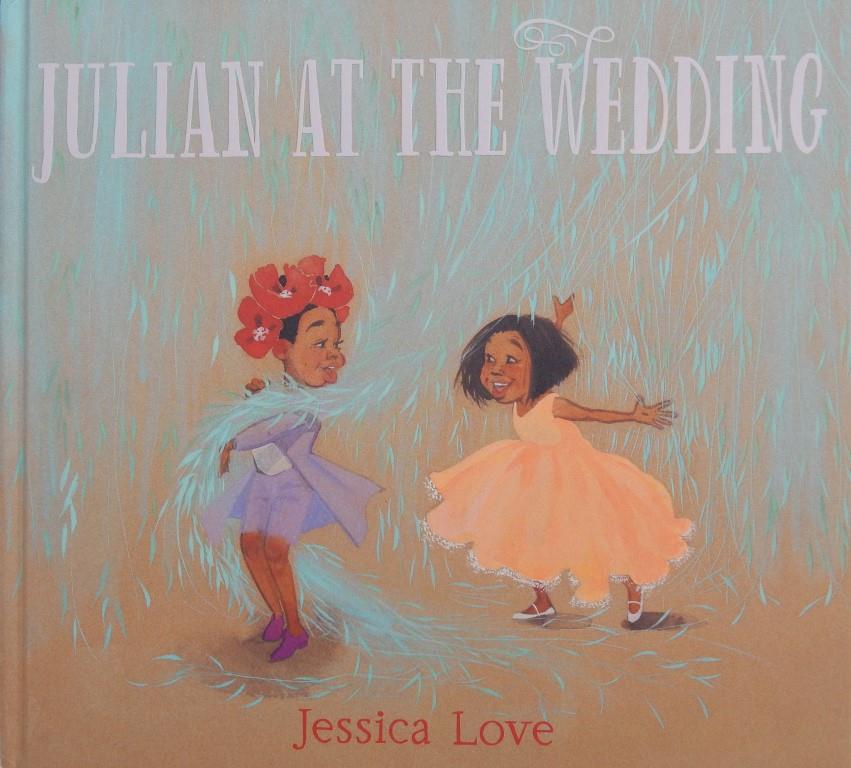
Julian at the Wedding
Jessica Love
Walker Book
Love, love love this stunner of a book wherein we see the return of mermaid- loving Julian – at a wedding. Not his of course but he does pretty much steal the show.

As the story starts, we see dapper looking Julian arriving at the celebration accompanied by Abuela, being greeted by a friend of hers who is accompanied by a little flower girl, Marisol. Both children are to be in the wedding – a ‘party of love’. And so it is – in more ways than one.

During the meal, Julian, Marisol and the brides’ dog, Gloria decide to make a break for it

and off they head to a “fairy house” as Julian calls the weeping willow. All three have terrific and rather mucky fun with the result that Marisol’s dress is dappled with paw prints and mud splodges.

Julian comes to the rescue with a creative idea and thanks to the magic of that fairy house … a transformation takes place. Now both parties are dressed divinely and just how they like to be.

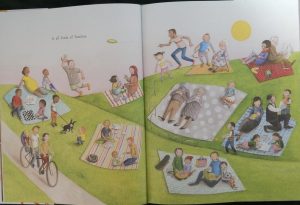
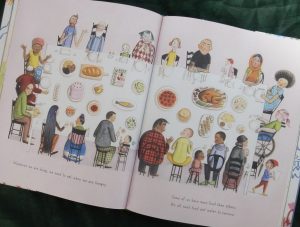
Then they’re discovered by their grandmothers– time for Marisol to fess up and face the music but does anybody mind? Of course not: the brides welcome their return to the party and the loving festivities continue … under the stars.

There’s an abundance of love and tenderness, just the right amount of rebellion and wildness, and of course, individuality, acceptance and understanding.

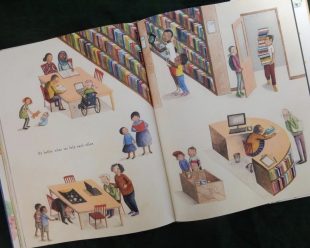
Jessica Love’s illustrations (gouache and watercolour) are simply divine – vibrant and brimming over with glorious details making every spread one to pore over.

Sheer joy from cover to cover.

Coming to England

Coming to England
Floella Benjamin and Diane Ewen
Macmillan Children’s Books

In a colourful autobiographical picture book story of her own life and that of her family, Floella Benjamin celebrates the Windrush Generation, many of whom have been so badly treated as a consequence of our government’s ‘hostile environment’ policy.

It’s a beautifully written and illustrated account of the move from her childhood home in Trinidad

to England, undertaken first by her Dardie and then a year later by her Marmie and two siblings; then finally Floella and her remaining two brothers.

This new version will surely open the eyes of young children to long voyages undertaken during the middle of the twentieth century, by many, many families from Caribbean Islands who came to England. Certainly it was a shock in so many ways, not least being the cold and greyness in stark contrast to the vibrancy and warmth of Trinidad.

It still hurts to read of the treatment she and her brothers and sisters initially received from other children when they started at school in London;

but the book ends on a happy upbeat note with Floella receiving recognition for all the incredible work she has done for children.

Apart from one or two scenes of England, Diane Ewen’s mixed media illustrations are aglow with rich colours that really make the images come to life on the page.

The way to overcome adversity is through courage and determination: Baroness Floella’s life is an inspiring example of this, and it’s fantastic to see a version of her life story for a younger audience than her earlier 2016 memoir.

All KS1 classrooms need this special book.

The Beast and the Bethany

The Beast and the Bethany
Jack Meggitt-Phillips, illustrated by Isabelle Follath
Egmont

What a feast of a book is this deliciously droll take on The Picture of Dorian Gray for a younger audience.
The key characters are a diverse lot: there’s soon to be 512-year-old, and still dapper-looking, Ebenezer Tweezer; underneath that patina of youth and respectability lies a fearful, ruthless human. He resides (and has done for more than five centuries), in a huge house full of luxuries, courtesy of an attic-dwelling beast with a voracious and horrifying appetite. These two have a special deal going: the old man feeds the beast whatever it asks for and said beast spews out whatever Ebenezer wants.

Now, as the ancient man prepares to celebrate his birthday, he notices he’s starting to look his age and requests his annual anti-aging potion from the beast – to be withheld until Ebenezer procures the beast’s next meal – a human child. “You can’t go around eating children, there’s something so very impolite about it,” comes the response. But which is more important to the man – his own life or that of a child? You can guess what Ebenezer decides.

This story has several comic episodes, the first being operation child acquisition. Things don’t come easily when it comes to getting hold of a child however, and after several dead (almost) ends, there’s mention of the local orphanage run by Miss Fizzlewick wherein resides Bethany. Far from likeable, this young miss is the ideal candidate, sullen, uncivil, and extremely naughty, but scrawny with it. And therein lies the rub; for once procured by Ebenezer, the child (who has already decided to torment her adoptive parent) needs to add more flesh before the beast will dine upon her. That means trouble for Mr E.T. – three days of it.

Nonetheless he grows unintentionally fond of the child:

could it be that the two might find themselves on the same side endeavouring to get the better of a thoroughly inhuman would-be child consuming creature?

With lashings of deliciously dark humour and a handful of unforgettable characters, this book with its suitably tasty illustrations by Isabelle Follath,

will hold you in its bone-crunching jaws right through to the last page.

Bring on the second uncaging of the Beast and The Bethany.

Crocodile Tears

Crocodile Tears
Roger McGough and Greg McLeod
Otter-Barry Books

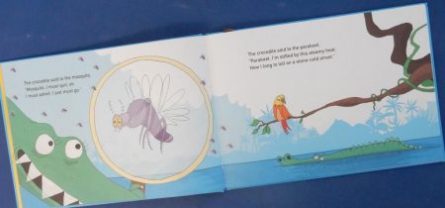
‘The crocodile said to the chimpanzee, “Chimpanzee, I want to be free. The jungle jangle’s not for me.” Said crocodile goes on to utter a similar sentiment to other jungle residents – mosquito,

parakeet, alligator, hippo, a piranha fish, as well as mum, faithfully promising to write to her.

Then with rucksack on back, the crocodile glides off downstream heading seawards. Once there a clever disguise is donned and breathing deeply, the creature dives beneath the waves, jetting towards a banana boat. This little croc seems to have everything worked out.

Safely aboard, our traveller spends much of the voyage sleeping and the rest consuming healthy fare. Then, having docked, it’s more stowing away, now on wheeled transport, destination the big city.

First job in this strange new environment is to honour that promise to mum. The start of a series of Dear Mother letters is penned, telling of London’s dreary strangeness.

These epistles continue over time as croc. sees the sights of the city by day …

and by night. Then comes the snow and enough is enough for our roving reptile: the jungle calls once more and so …

This is an absolutely brilliant read aloud tale (make sure you read it carefully to yourself first though). Roger McGough’s narrative verse is bursting with wit as are those affecting letters crocodile writes home. The inherent humour is wonderfully reflected in animator Greg McLeod’s delectably quirky scenes of the intrepid traveller undertaking the journey of a lifetime. The crocodile’s eye views of our capital city are absolutely priceless.

Assuredly it’s a case of ‘east, west, home’s best’. I can’t wait to share this with young humans.

Pirates vs. Monsters / The Knight Who Might

Thanks to Maverick Publishing for sending these two picture books for review

Pirates vs. Monsters
David Crosby and Lee Cosgrove

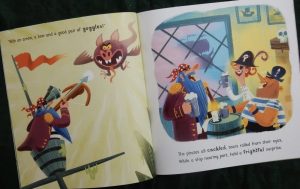
Three pirates, Hector (tall, strong and bold), Sue (curly haired and fearsome) and George (rather rotund) meet in their local hostelry one foggy night.

They boast about their monstrous conquests; Hector’s of the poison-spitting Hockler;

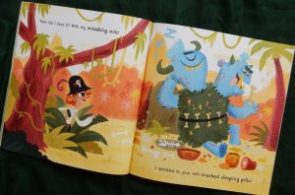
Sue’s of the double-headed Crunk …

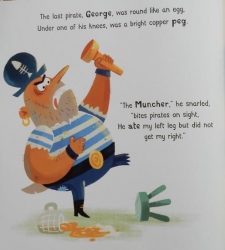
and George’s of the limb- gobbling Muncher that had feasted on one of his lower limbs,

regaling one another with their modes of over-coming the gruesome beasties.

Truth or fantasy? That is the question.

Meanwhile through the fog a ship approaches … Fiction or phantom? Err … now that WOULD be telling.

This rip, roaring rhyming yarn from debut picture book author David Crosby exudes daftness and delicious mock-scariness, brought into being so the characters almost leap off the pages in Lee Cosgrove’s zany scenes of groggy picaroons and maniacal monstrosities.

I envisage this one becoming a much requested storytime tale in foundation stage classes and families with young landlubbers.

As will this one, coming soon:

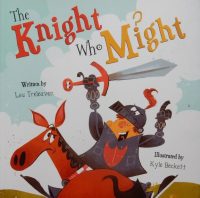
The Knight Who Might
Lou Treleaven and Kyle Beckett

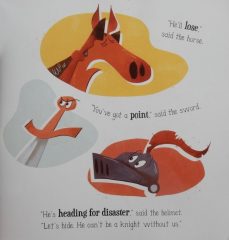
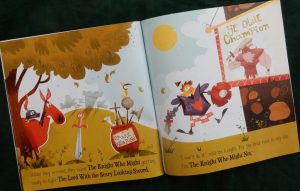
With her repeat refrain ‘ “You might not” said the … / (It was a magic …. ) / “But I might,” said the knight.’ (insert ‘sword’, or ‘helmet’ where it fits), Lou Treleaven entertains with her tale of yore wherein the inept titular knight aspires to attain knightdom but discovers that it’s a long road so to do.

Yes, he has the accoutrements,  (or rather he did have); but with their scathing comments– “He’ll be exhausted,” (that’s the horse.) “He’ll be cut to pieces,” (spoken by the sword) and “He’ll lose his head,” (helmet’s put down)

our hopeful champ of derring-do sets out on foot to meet his first combatant ‘The Lord with the Scary Looking Sword’ in a tournament.

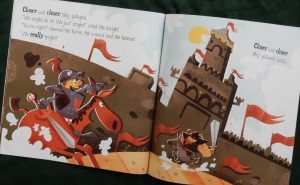
After a change of heart, those bit part players (now out of hiding) are somewhat more upbeat than their owner, as the two contestants gallop towards each other.

If you want to know the outcome of their combat, then you’ll need your own copy of Lou’s olde story of trying, replete with its puns and onomatopoeia. It’s illustrated with appropriate verve and humour in Kyle Beckett’s slapstick style scenes of clanking-clonking, stomping, donking and plonking.

Mischief and Mayhem: Good Dog / Vampire Peter

Good Dog!
Sean Taylor and David Barrow
Frances Lincoln Children’s Books
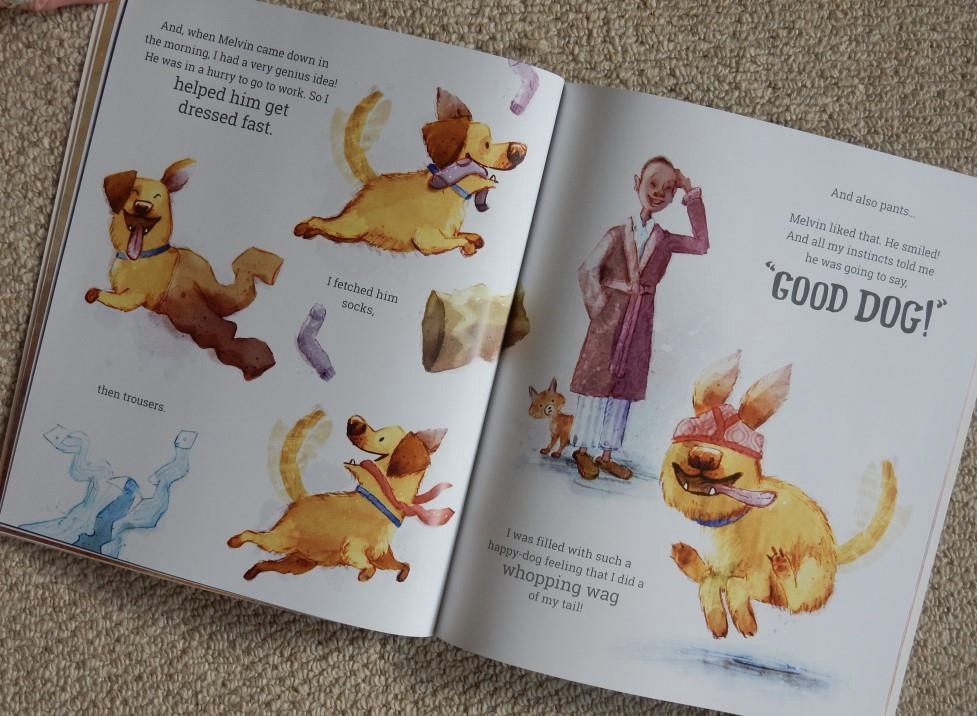
Our canine narrator lives with his human owner, Melvin, and they rub along pretty well together, with Melvin giving out a fair few affectionate, “Good Dog!” smiling affirmations that make the receiver go all over waggy and excited.
Then yesterday what should be left standing irresistibly, deliciously aromatic on the table but …

Needless to say, upon discovering the culprit consumer of a sizeable slice, here’s what was said …

Time to put an amazing smile-inducing plan into action, the only trouble being our narrator doesn’t choose the most suitable time to enact said plan; the consequence being a less than enthusiastic reception, and the ensuing of a ‘boo-hoo’ kind of a night.
So, what about plan B – that ‘genius idea’ as uttered straight from the pooch’s mouth? Could that perhaps result in the much-desired words from Melvin?

Or might yet another reparative plan be required? …
Even a cynophobic reviewer such as this one couldn’t help falling for the well-intentioned (mostly) narrator of Sean’s hilarious tale of the ups and downs of a canine’s life. David Barrow truly brings to life the waggish creature making it leap into life, almost right off the pages. Those expressions are utterly beguiling and likely to have readers eating right out if its paws, pizza or not. And make sure you follow the cat’s continued consternation throughout too.

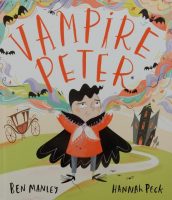
Vampire Peter
Ben Manley and Hannah Peck
Andersen Press
With his black cape and frilly collar, wild hair and fangs, new to the class, Peter soon earns a reputation as ‘baddest boy’ in the school. Indeed, his behaviour is somewhat strange and his deeds land him in considerable trouble with the teachers,

as well as resulting in a distinct lack of friends among his classmates.
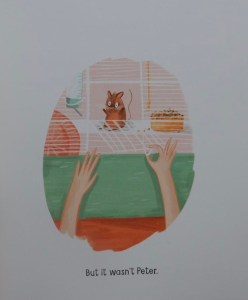
Inevitably when the class gerbil goes missing, the obvious assumption is that Peter is answerable.

However, there’s a mysterious somebody narrating who knows otherwise, not only about that particular incident but also about the reality of Peter’s ‘bad’ behaviour.
Can both parties exonerate themselves?

With a classroom setting, this is a really fun demonstration that being different doesn’t equate with being bad: we shouldn’t categorise anyone on account of looks or mere assumptions. Make your own judgements rather than following popular opinion.
I love the comical telling and memorable characters, especially Peter. A terrific read at Halloween or any time.

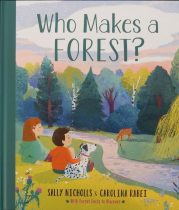
Who Makes a Forest?

Who Makes a Forest?
Sally Nicholls and Carolina Rabei
Andersen Press

I received this lovely book the day after I’d spent a gorgeous (slightly damp) morning walking in a forest not far from my Gloucestershire home. I commented to my partner what an uplifting experience it was, (and always is) in stark contrast to all the pandemic doom and gloom in the media. Had I been out with youngsters I might well have asked them if they’d ever wondered how such a forest came into being: now I have an ideal starting point.

On the first page is posed the title question, followed by a number of possibilities, as two children, a male adult and a dog walk in a forest landscape.

How can something so vast and full of closely-growing trees and often, dense undergrowth have come into being? Could it have been created magically – by a giant perhaps? Or, as a large company enterprise? Or perhaps by other groups of humans?

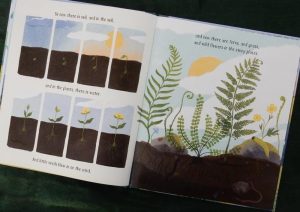
It’s almost impossible to believe that something so huge was once very small but it’s true, as Sally’s effective story tells and Carolina Rabei’s beautiful illustrations show, demonstrating to children the entire process starting from bare, stony ground that becomes soil through the action and interaction of lichens, algae, moss,

and tiny insects causing a gradual fertilisation of the ground and eventual formation of soil.

Then come the first flowers, ferns and grasses,

the seeds and spores of which spread, becoming more flowers that attract bees and insects that feed on them.

Growth and change continue through the years, the centuries until there’s a huge ecosystem that we call a forest.

As the story concludes we come full circle to the ‘who made’ question and then read, “No. / It was the seeds / and the bees and the / roots of the trees. / It was a thousand / thousand tiny things. // And together they changed the face of the earth.’ A fitting finale to an inspiring story.

Not quite the end of the book though for the final five pages provide interesting facts about forests in various parts of the world and a last word about making a difference that relates to deforestation.

Whether for home bookshelves or school classroom collections, I strongly recommend this book.

Ballet Bunnies

Ballet Bunnies: The New Class
Ballet Bunnies: Let’s Dance
Ballet Bunnies: Millie’s Birthday

Swapna Reddy, illustrated by Binny Talib
Oxford University Press

This series for newly independent readers will definitely appeal to a certain sector of readers; these are the first three of what will eventually be six books starring young Millie and the four tiny magical bunnies residing at Miss Luisa’s School of Dance that she attends. Each one has a wealth of cute full-colour illustrations by Binny Talib.

In the first story we meet six-year old Millie who excitedly attends her first lesson, only to receive an almost instant put-down from the star of the class, Amber. As the class continues Millie’s despondency grows as she finds herself unable to accomplish the perfect-looking, graceful steps of her fellow classmates and at the end of the class she’s left alone to wait for her mum to collect her.

Suddenly she notices a moving shadow behind the stage curtain and discovers to her surprise, Dolly, Trixie, Fifi and Pod the miniature dancing bunnies. Perhaps these friendly little creatures can make all the difference to her time at the ballet school.

Swapna offers an encouraging voice to youngsters feeling somewhat disheartened by a new challenge especially when some classmates are less than kind. Support and warmth are powerful forces in the face of anxiety.

In Let’s Dance, Millie and her entire ballet school are to dance at a gala performance. Moreover, they’re to perform with props and the theme is ‘The Garden’: Millie’s class will be flower fairies. Teamwork is essential but not every class member is a hundred per cent co-operative. What will happen on performance night?

The third book begins on the last day before the holidays at ballet school with Millie’s birthday fast approaching. As she helps clear up, she shares with the bunnies her anxieties about the large number of people invited to her party to celebrate her, as her furry friends point out.

The bunnies agree to accompany Millie home to help her cope with the ballet-themed party; but can she keep them hidden from her mum and will it be a Happy Birthday when Millie turns seven?

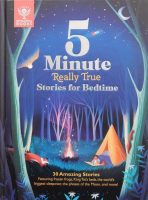
5 Minute Really True Stories for Bedtime

5 Minute Really True Stories for Bedtime
Sally Symes, Jackie McCann, Jen Arena, Rachel Valentine & various illustrators
Britannica Books

This is an unusual take on bedtime reading: an assortment of thirty narrative non-fiction stories each one with a bedtime connection.
From a hospital visit to see what happens in an accident and emergency department, the maternity ward and other parts where people are busy at work, to hibernation (the winter sleep of ladybirds, a queen bee and North American painted turtles are described).

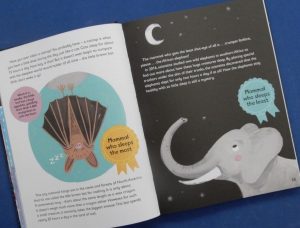
We’re introduced to Sleeping Champions – including a group of Brownies who got into the Guinness World Records book, a little brown bat that sleeps for almost 20 hours a day and elephants that only grab two hours of shut-eye;

and Gherman Titov, the first person to sleep (and puke) in space – fascinating!

Or you might choose to do a spot of Stargazing like the Italian scientist Galileo who made his own telescope to look at the night sky and who by discovering that Earth revolves around the Sun, also changed our understanding of Earth’s place in the universe.

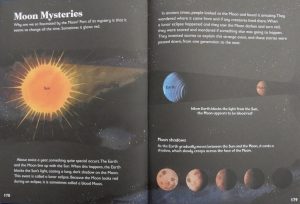
Then there are star stories and Moon Mysteries to enjoy

and lots more.

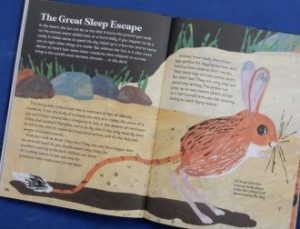
The writing style of the various authors is chatty and engaging, and reads aloud well, while the illustrations are alluring – well maybe not that of the goliath bird-eating tarantula, which is downright alarming and in stark contrast to that of the jerboa – with its huge ears that looks like a creature I’d be happy to meet.

It’s said that just before sleep is a good time to internalise new learning so why not try sharing a non-fiction story from this intriguing book.

Mother and Daughter Dress-Up Dolls: Fashion from Long Ago / How to Speak Astromech with BB-8

These two books present opportunities to learn something new and have great fun in so doing.

Mother and Daughter Dress-Up Dolls: Fashion from Long Ago
Gracie Swan and Felicity French
Nosy Crow (in collaboration with the National Trust)

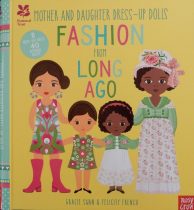
With this hardback book, children can press out eight dolls – four large and four small – mothers and daughters – dress them and learn lots about fashion from Medieval, Tudor, Georgian and Victorian times, as well as the Twenties, the Thirties and every other decade through to the 1970s.

Isabella and her mother Beatrice don their finest attire to attend a medieval banquet anticipating tasty food, loud music and acrobats to entertain them.

Margery and daughter Alice will head to the market once they’ve put on their warm woollen dresses, shawls and bonnets hoping to sell all their homemade bread.

Turn each of the press-out garments around and there’s an alternative story with two different characters, each time – a clever idea that provides a whole set of new opportunities.

Children will love discovering what their older relations wore and those before them, when they reach the twentieth century characters and their geometric mini-dresses, those jump suits, bell bottoms-trousers, maxi dresses and more. It’s amazing how everything comes around again!

In addition to the main items of clothing there’s a page of accessories and shoes to complete every one of the forty outfits. What more can aspiring fashionistas ask? Perhaps for a timeline – but there’s even one of those on the back inside cover.

Hours of fun learning to be had from this fascinating activity book.

How to Speak Astromech with BB-8
I.M. Rollin, illustrated by JAKe
Chronicle Children’s Books

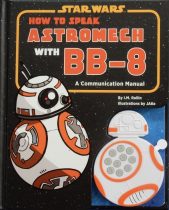
Star Wars enthusiasts will love this sound book- a communication manual – that celebrates the enormously popular, adorably quirky droid character BB-8 that appeared in several of the films.

Included are ten built-in droidspeak audio clips, with translations and conversation tips, and funny illustrated scenarios that will help readers understand and get the best out of their own droid companion in a galaxy far, far away.

Astromech qualities such as playfulness, resourcefulness, determination, trustworthiness and bravery, demonstrated by means of BB-8’s adventures, are recognised herein. Fans will lap up the insider jokes too.

A fun and handy guide indeed, that fans young, and not so young, will delight in.

The Journey / Sounds of the Wild

Here are two books from Little Tiger featuring amazing wildlife from different parts of the world

The Journey
Jonny Marx and Hanako Clulow

Nature’s greatest journey begins on the parched Serengeti plains and follows the herd of zebras as they make the arduous, annual migration across the dusty, sandy terrain. It’s a long trek, battered sometimes by wind, before they reach the waterhole where they stop to quench their thirst.

The zebras are not the only animals to undertake the journey; there are elephants, boars, birds and giraffes too, all bound for the watering place eager to drink their fill.

Ahead though, lie green pastures and that is where these animals are heading. but first there’s a swim ahead across crocodile infested waters.

Once safely on dry land again the verdant grasslands stretch as far as the eye can see and then down comes the rain – in huge torrents. Ahhhh!

There (so the author’s note on the title spread tells us) they remain for two months feasting on the abundant grass before it’s time to make that long, long journey back once again.

After his rhyming narrative that really conjures up the landscape of the journey, Jonny provides more information about plains zebras. I was amazed to learn that each zebra’s striped pattern is unique and that a zebra’s kick is so strong it can kill a lion. Hanaka Clulow’s illustrations too capture the sandy plains and the animal inhabitants, and have an almost photographic quality.

Sounds of the Wild
Moira Butterfield and Stephanie Fizer Coleman

Immerse yourself in the pages of this book and you can visit nine island locations where you can see and listen to a variety of their animal inhabitants.

Each double spread introduces a different habitat and its wildlife be that a jungle in Madagascar with ring-tailed lemurs, its predator if it catches one, the fossa, tomato frogs and stunningly coloured birds. By pushing the ‘Press Here’ button readers can hear the lemur’s call.

You can also hear an elephant seal (South Georgia Island),

a bellbird (Isla Escudoo de Veraguas), sooty terns (Ascension Island), a Komodo dragon (Flores), polar bears on Svalbard, a humpback whale (around the Azores), marine iguanas,(Galapagos)

and a tiger (Sumatra).

After the eco-system island tour, there’s a world map showing each habitat’s location., an index and finally, an ‘animals under threat’ page mentioning the endandered status and threats to six of the animals whose sounds were heard. Warning cries indeed.

Each spread is beautifully and brightly illustrated by Stephanie Fizer Coleman and Moira Butterflied provides short factual paragraphs on each of the animals shown. Those who love wild animals will enjoy this and doubtless wear out the battery, leaving the animals voiceless until it’s replaced.

Kitty and the Great Lantern Race / Kevin and the Biscuit Bandit

The welcome return of favourite characters in two series from Oxford University Press

Kitty and the Great Lantern Race
Paula Harrison and Jenny Lovlie

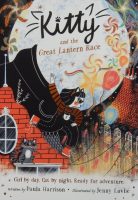
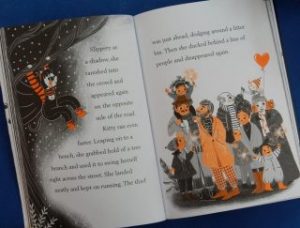
At the annual lantern festival young Kitty, superhero in training, returns in a fifth adventure, ready to enchant young solo readers with her nocturnal catlike superpower.

Kitty is pleased with the lantern she’s created for Hallam City’s Festival of Light but as the parade is just beginning, a mysterious burglar is at work among the crowds. Having spied a shadowy figure, Kitty knows that she’s going to have to call on her feline superpower as she turns investigator.

Now her mission is to prevent the festival being spoiled and without the assistance of her firework fearing cat crew, she must summon all her superhero skills and bravery to chase the fast-moving thief.

As always Paula’s words and cast of cracking characters, combined with the plethora of Jenny’s arresting two-coloured illustrations are a delight. This tale of friendship, family, building self-confidence and being brave is an ideal read for Kitty’s countless established followers, as well as others just starting out on chapter books.

Kevin and the Biscuit Bandit
Philip Reeve illustrated by Sarah McIntyre

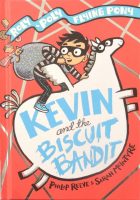
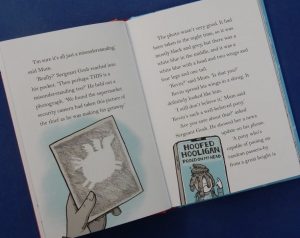
There’s a crisis in Bumbleford. For a whole week, somebody has been slowly but surely stealing the town’s entire stock of biscuits. Make that two crises for now Roly-Poly Flying pony Kevin, stands accused of the crime of stealing said biscuits – all the evidence seems to point in his direction – despite his not remembering eating the biscuits, which he surely would have, fig rolls and all.

The only ones left anywhere (and that’s in the next town), are some speciality Sprout Squashies, good for you but tasting disgusting and fart-inducing, especially when sampled by a certain RPF pony.

To avoid arrest, and hence removal from Max and family, poor Kevin is forced to go on the run – or rather the wing – from the local police constabulary. With Kevin already being dubbed as the Biscuit Bandit, it’s the Horse Prison for him unless Max and Kevin’s friends can help find clues to clear his name.

The search is on: can they unearth the real culprit (not forgetting the biscuit stash) before the police track them down?

Once again team Philip and Sarah have created a hilarious and enthralling adventure – a whodunnit – with its wealth of wordplays and asides, ensuring that readers giggle their way right through to the final reveal.

Never let it be said that Sprout Squashies don’t have their uses.

Once Upon A Dragon’s Fire


Once Upon A Dragon’s Fire
Beatrice Blue
Frances Lincoln Children’s Books (First Editions)

In essence this fabulous follow-up to Beatrice’s Once Upon A Unicorn Horn is a neo-pourquoi tale telling how those mythical dragons came to breathe fire, or rather, one very particular dragon.

Now we all know that dragons with their snaggly teeth and huge wings, are truly terrifying creatures. Well maybe not actually; but that’s what comes of listening to hearsay and making up one’s mind before even setting eyes on such things.


And so it was in the village where reside young book-loving Freya and Sylas. All the other villagers lived in fear of their lives on account of the kitten-eating, storm-blowing creature responsible for the constant chill around; but these two are far from scared. In fact, they simply love to read dragon tales to one another; it’s their most favourite thing to do.


Now while the other villagers cower in their homes in the icy cold, the brave pair set out to find said ‘bad dragon’ and terminate its reign of terror once and for all.

What they discover having clambered up the wind-swept mountain though, is something entirely unexpected. No deafening roar, nor sharp teeth, just a sad, lonely-looking creature.

These two children however, know exactly the right remedy for the dragon’s blues …

This wonderfully heart-warming tale celebrates the power of love and kindness as well as the power of story; it’s about misconceptions, facing your fears, searching for truth and much more; I suspect new meanings will reveal themselves on subsequent readings. Beatrice’s illustrations wield their own breath-takingly powerful magic; little by little, they reveal the truth about the dragon, as she dramatically changes the hues of her colour palette with that special gatefold reveal and what follows.


Children and adults alike will relish this book.

Action and Reaction: Fish / Yawn

Fish
Brendan Kearney
Dorling Kindersley Penguin Random House

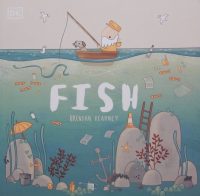
Softly spoken yes, but, inspired by personal experience, Brendan Kearney’s picture book about the perils of polluting the ocean with plastic, and how we can all help to improve the situation for the endangered fish and other marine flora and fauna is clear and to the point.

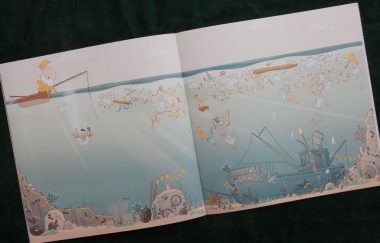
Finn and his dog Skip set out one morning in their little boat, hoping to catch a tasty fish or two for their supper.

After a while when not a single fish has given so much as a tug at Finn’s line, Skip spies something in the waves. Down to the depths he swims and the sight that meets his eyes is horrifying.

Rubbish, rubbish and more rubbish. Back to show Finn with some evidence he goes.

Equally concerned, the man goes on fishing for a while but before long all he has on board is a collection of weird objects.

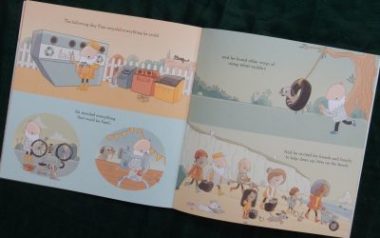
Fortunately, once back on dry land the two encounter a group of young beach cleaners who are equally alarmed at the load of rubbish brought out of the sea.

Finn explains how he came by it and about the complete lack of fish. What follows are a number of pertinent comments from the young eco-warriors and the following day Finn heeds their words – re-use and recycle – and goes on to join the beach cleaners.

With his engaging narrative, visual and verbal – Brendan Kearney focuses on the crucial environmental issues in the hope – his, mine and countless others – that young children will become part of the movement to clean up our polluted oceans and beaches and of course, it’s never to soon to teach them about the importance of recycling.

Yawn
Patricia Hegarty and Teresa Bellón
Little Tiger

A yawn can be highly infectious as this fun story shows.
Starting with a single feeling from deep inside the little boy narrator, a single yawn quickly becomes unstoppable, passing from the boy to all – every neighbourhood inhabitant, human and animal, until the entire street have gaping mouths.

From here it moves to the countryside and eventually all over the world, not content until every single person and every single creature has the yawns. It even heads off out into space

– it’s ‘gone viral ‘we read. Does that remind you of anything?

Fortunately though, on this occasion the outcome is that when bedtime comes, so does a great big YAAAAAAWN! to send us off into the land of slumbers.
Happy dreams.

It’s is definitely a book to share at bedtime unless that is you want to induce sleepiness at some other time in your home or classroom. Patricia’s rhyming narrative has that soporific feel to it, and if you happen to pause just a little too long on any of Teresa Bellon’s spreads (love those cutaway pages) to enjoy all the funky details, you might just find yourself the next recipient of that repeat refrain ‘YAAAAAAWN! Pass it on!’ Snore …

The Book of Not Entirely Useful Advice

The Book of Not Entirely Useful Advice
A.F. Harrold, illustrated by Mini Grey
Bloomsbury Children’s Books

I was already chortling before I’d even finished reading the poet’s note to readers, let alone any of his advice in poetic form.

This book of awesome delight is the combined effort of two terrific talents, illustrator Mini Grey and A.F. Harrold, the writer and it’s patently obvious that they both relished working on its creation. Indeed, I’ve never seen the poet in better form than here.

The result is a collection of unmissable artistry – verbal and visual – advising on all manner of topics both ordinary and extraordinary from breakfast – both its perils and its lack of boredom inducing properties, to Blackbirds and Bananas, Bins even! As well as ‘… Wobble, wobble, wobble, / gobble, gobble, gulp. … ‘ For, Jelly Is Never Wrong’ (not even the cabbage flavoured variety or the marmite kind) I should hasten to say there’s an entire section of ‘Advice mainly relating to food …”.

When next I see her I’m going to share Useful with 7 year old Emmanuelle after her rather pathetic sausage-eating efforts when last she stayed with us. Having persuaded her dad she “really, really wanted” the sausage dish on offer at the restaurant, she refused to eat any of its main constituent. (they were organic and maybe that was the issue). Had I done so prior to the event I’m sure she would have tried this suggestion: ‘You can balance them on your lip / and pretend to have a moustache / in order to amuse your companions. ‘ I don’t’ think she’s ever been lost at sea, thus needing to ‘attract aeroplanes’ or sharks. But you never know …

Even this zany poet doesn’t advise eating that Bin he writes of; that’s to be found among the 4th and final section containing miscellaneous bits and bobs such as Crosses and Knot Knots – see how cleverly Mini has placed her knotty collection around those. Just one example of her wonderful integrating manipulation (often complete with her own witty asides).

I’ve just read Inside the Anthill to my partner as he’s given to lying flat out in fields to investigate these bumps and lumps, though even his ‘scientific zeal’ hasn’t led him to quite such lengths as trying a cake crumb imitation – at six foot I doubt he’d fool even a single ant.

Not all the poems are totally absurd though: there is a fair sprinkling of the quiet poignant and thoughtful too.

Take the unforgettable, Earthsong: that ends with ‘Some of it is poisoned/ and some of it is dying. / Some of it is silent / and some of it is crying. // Some of it is going / and some of it is gone. / Some of it… ‘

No matter where you open this corker of a book, there’ll be something to love and I can’t resist concluding with the revelatory and entirely apt final verse from Inside: ‘Where am I? / I’m inside, / I’m between the covers. / I’m in so deep. / I’m through the paper door. / I’m breathing the air of other worlds. / I’m exploring. / I’m reading // and I can’t hear you any more.’
Now that is what it’s all about …
Get this – it’s a must for home collections, classrooms, libraries – and I’m sure you’ll never look at anything in quite the same way again.

The Wizard in My Shed

The Wizard in My Shed
Simon Farnaby, illustrated by Claire Powell
Hodder Children’s Books

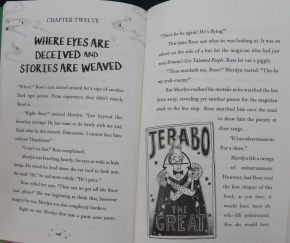
Having narrowly avoided spluttering my coffee over the opening pages of Horrid Histories star Simon Farnaby’s new adventure tale, I envisaged that I’d continue spluttering throughout (not coffee – I hastily consumed that before resuming reading), and so it was. (Though I did have to stop after every chapter to take a few ‘mellow moments’ – like Evanhart, wizard Merdyn’s bestie until he decided to follow the ‘path of darkness’ and become a warlock aka a bad wizard x1000.)

The story follows both madcap Merdyn (from the Dark Ages) and would-be star singer,/dancer

twelve year old Rose, from now, residing in the normal town of Bashingford with her mum and brother. Each has a desire: Merdyn wants to avenge his banishment to the Rivers of Purgatory (actually it was The Rivers of Time) and at the same time get out of the 21st century in which he’s mysteriously arrived and return to the Dark Ages; Rose is anxious to sort out her broken family,

after her father’s death, which happened before this story begins.

There’s also Rose’s guinea pig, Bubbles, a frequent poo-er, that seemingly doesn’t do much else and certainly doesn’t enjoy sharing Rose’s fairy story books.

When Rose happens upon a ‘cloth creature’ wearing peculiar shoes, gesturing weirdly and thinking he’s in the land of Purgatory – you can work out his name – she decides he might actually be of some help to her.

A deal is struck. A family-sorting-out spell (and perhaps one to make her the world’s best singer) in exchange for Rose’s assistance in coping with so many strange 21st century ways and means.

That necessitates keeping the visitor in the garden shed away from Mum – to protect her smartphone – though that might be the least of her worries about the curious stranger. They will need to locate Merdyn’s treasured magic staff and find a way to return him whence he came. Surely nothing could possibly go a-miss – could it … ?

There’s masses of madness, magic, crazy characters,

not to mention high drama, and that enormously endearingly bonkers Merdyn, to enthrall readers throughout what proves to be a heart-warming tale.

And, with the addition of Claire Powell’s terrific illustrations, the enchantment just got even stronger, while ‘the world watched in silence.’

Read alone or, read aloud it’s an absolute winner.

The Day I Fell into a Fairytale

The Day I Fell into a Fairytale
Ben Miller, illustrated by Daniela Jaglenka Terrazzini
Simon & Schuster Children’s Books

Lana is a lover of stories and books, often using them as a starting point for fantastical games played with her brother, Harrison.
Now though, Harrison has started secondary school and considers himself both too grown-up and too busy with studies to play with his sister. Consequently, Lana feels lonely.

Then something strange and magical happens when with her mum, she visits the mega offers supermarket that’s recently appeared in town and there she discovers something totally unexpected – a portal leading to a fairytale world.

There is SO much to discover in this other world and her own.
Just who is the strange little old man she encounters in the supermarket?

Lana manages to get her brother to take her back to the supermarket
but “tubs of sweets that lead to fairytales … it’s just too far-fetched” is his reaction. But is it so?

Even when both siblings have cascaded through a portal, large white deer fail to convince him of its otherworldly nature; so what about flying arrows?

Lana though, is used to happy-ever-after fairytales and what she experiences are anything but; they’re dark and perilous. Even that odd little man when next they meet him, insists that the Sleeping Beauty fairytale the siblings have just left, is of the scary kind.

Enter Hansel and Gretel, a wicked witch (now where did she come from?) and what in fairytale land do oxbow lakes, Archimedes and the lever principle have to do with anything?

So, can Lana – dubbed Lana of Azupermarket – with the aid of her brother, defeat that evil witch? Perhaps, but only if she can convince him to resurrect his belief in fairytales.

With a big push for the power of the imagination and the importance of having fun, Ben Miller has created stories within a story and it’s so cleverly done. No reverse psychology required to get this reviewer and lover of fractured fairytales to read it right through, relishing every word. I love the border embellishments and occasional illustrations by Daniela Jaglenka Terrazzini too.

As a teacher I’ve never been one to stick to timetables but having read this cracking story, I might just have to think again on that one – in certain circumstances that is.

Pirate Stew

Pirate Stew
Neil Gaiman and Chris Riddell
Bloomsbury Children’s Books

Dream team Gaiman and Riddell have again joined forces, this time creating a stonkingly brilliant piratical rhyming tale.

Stupendously silly and enormously entertaining, this story is narrated by the boy who with his sister, is left in the care of Long John McRon, ship’s cook, possibly THE most unlikely babysitter you can imagine.

He’s not the only one who comes a-knocking though; for hardly have the parents left than the entire wildly crazy crew comes charging in.

Having investigated the contents of the family fridge, the pirates decide supper is to be the “Pirate Stew! Pirate Stew! / Pirate Stew for me and you! … Eat it and you won’t be blue. / You can be a pirate too!” Furthermore, it’s to be served “ underneath a pirate’s moon!”

Unnoticed by the pirates too busy feasting on their own concoction, the children decide to eschew said stew with its weird and wonderful ingredients. Nevertheless, it’s not long before they find themselves sailing off into the night

and sating their appetites on doughnuts instead.

That’s not quite the end of this yummy yarn however …

Totally delicious, spectacular storytelling and incredibly detailed illustrations that make the entire cast leap right off the pages, this is perfect fare for those who relish the unexpected, the magical or the piratical – it provides all three in bowlfuls.

Pirate stew anyone?

Nature in Focus – Home / Seasons

Here are two books from Little Tiger that focus on nature and the changing seasons
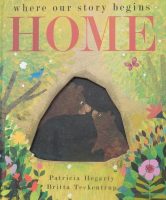
Home
Patricia Hegarty and Britta Teckentrup

‘All of us need a place to rest – / A cave, a warren, a pond, a nest … // Wherever we may choose to roam, / We need a place to call our home.” So says Patricia Hegarty’s introduction to this look at the forest that is home to all kinds of creatures large and small.
In the company of little bear, we visit a variety of animal homes starting with the cub and her family’s cave, dark and deep.

With the advent of spring, the cub ventures out watched by an owl in her tree. He visits the place where squirrels are gathering leaves for their drey; beavers are also building a shelter; a bird is busy nest building.
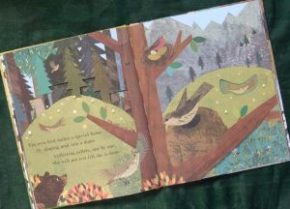
Further afield salmon spawn in the glistening river, multitudes of minibeasts are hard at work, and underground rabbits are safe in their warren.

As night begins to fall, a pack of wolves begin to prowl, hunting for food; while a flock of arctic terns make ready to begin their long journey before another winter sets in.
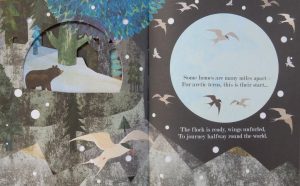
Finally as the cold arrives, it’s time for little bear and his family to hibernate ‘til spring comes round once more.

In her lyrical text Patricia takes us through the changing seasons and to the various animal homes. Britta Teckentrup’s signature style collage scenes, with their die-cut pages, follow the action and the bear cub, highlighting the importance of each home mentioned in the narrative as well as showing the seasonal changes in the forest.
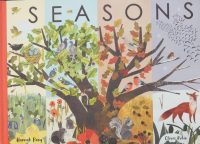
Seasons
Hannah Pang and Clover Robin

Author Hannah and illustrator Clover take us to half a dozen different locations in the world to experience the natural world in all its glory through the seasons.

We observe the changes that each season brings, starting with a focus on a mighty European oak tree that stands majestically in a meadow, its spreading branches and roots providing shelter and food for countless creatures – birds, insects and other minibeasts, small mammals and some larger ones too.

Spring, summer and autumn with their flowers, fruits and fungi are times of abundance for the various animals. Come winter, the branches are bare and it’s a hard time for animals, many of which hide themselves away in order to survive. Indeed, change through every season is vital for survival of the tree and the associated wildlife.

The other natural habitats are the chilly Arctic where the change in length of day and night is dramatic,
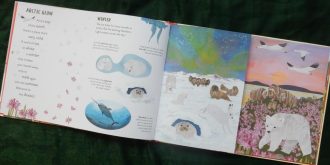
the wilds of Alaska where rivers freeze in the coldest months; a boggy mangrove in northern Australia – one season teeming with land animals, another with fish; then comes the Yellow Dragon Valley, home to some of China’s rarest animals including the giant panda.
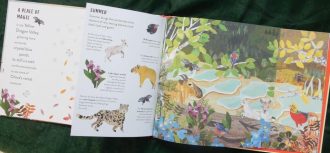
The last stop is on the grasslands of the Kenyan Maasai Mara with its wonderful richness of awesome animals and plant life.

As in the oak tree’s location so it is with all the others: change is vital for survival and the Great Migration of the animals of the final location is, so we read, ‘one of the most dramatic events on Earth. For the animals, … a journey of life and death.’

Since the pandemic struck, I think huge numbers of us have become much more aware of the importance of nature in our lives: this book, with Clover Robin’s richly detailed illustrations and Hannah Pang’s factual text, sings that song loud and clear.

Afraid of the Dark / Noah and the Starbird

Here are two picture books  about dealing with difficult situations – thanks Little Tiger for sending these warm-hearted stories

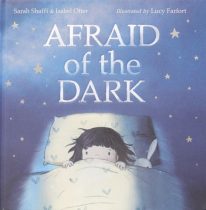
Afraid of the Dark
Sarah Shaffi, Isabel Otter and Lucy Farfort

Moving to a new home is often scary and so it is for the little girl, Amy, who does so with her Dad and dog, Pickle in this story.
Dad is very positive about the move, but not so Amy and Pickle; it just doesn’t feel like home. Her bedroom seems full of strange sounds and shadowy creatures waiting to leap. A night’s sleep might have sent the monsters packing but still that queasy feeling remains.

A visit to the library helps a little,

especially when the kind librarian finds just the right book to transport Amy to a faraway land of adventure when her  dad reads it to her that night. But once he’s gone from her bedroom, back come those monsters.

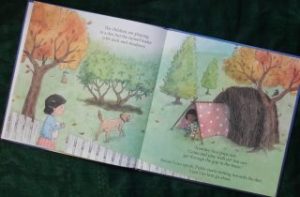
Next morning seems a little brighter. Children outside wave and invite Amy to play with them in their den. It looks a bit dark inside, but Pickle is willing to go inside so she follows and lo and behold inside a wonderful warm welcome awaits thanks to Sofia and Bilal.

Could this be the beginning of the banishment of those scary monsters. Can Amy send the lurking shadows packing once and for all? …

Sensitively told, this story, demonstrates beautifully how it always takes time to adjust to new situations; and how love and friendship can make all the difference when it comes to coping with first experience fear. Lucy Farfort captures Amy’s fearful feelings perfectly in her illustrations, as well as her dad’s concern and warmth, and the wonderful kindness of the children who welcome her.

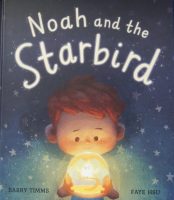
Noah and the Starbird
Barry Timms and Faye Hsu

Noah’s dad is ill and has gone to hospital, so Noah is staying with his kind, reassuring, Granny. As they unpack Noah’s things together, the boy notices a lamp inside which is a bird.
Granny tells him it belonged to her grandma and at bedtime Granny suggests to Noah that the bird might have magical powers.

As the boy lies wide awake in bed worrying about his dad, he’s startled by a sound. It’s the bird from the lamp. She introduces herself as Starbird, promising that his father is safe. She sings a lullaby, pulls out one of her tail feathers and gives it to Noah who eventually falls asleep.

The following morning, on hearing what happened Granny tells Noah he has a special magical friend but even she cannot hasten the process of his Daddy getting well. Instead Starbird provides a listening ear again that night before Noak goes to sleep.
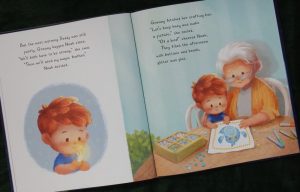
Next day the news from the hospital isn’t what Noah hopes, but with some special strength from the magic feather, he and Granny create a collage bird to keep up their spirits.

Can Starbird use her magical powers to help Noah’s Daddy get well again?

Kindness, courage and friendship shine forth from this gentle story: I think right now, the entire world could do with a feather like the one therein.

Fearless Fairy Tales

Fearless Fairy Tales
Konnie Huq & James Kay, illustrated by Rikin Parekh
Piccadilly Press

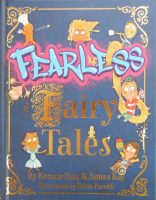
If like me you’re fond of fractured fairy tales, then this subversive collection of seventeen is a must have. Even the titles made this reviewer splutter with giggles and as for the important note before the contents page, I’ll say no more.

On closer reading it’s probably true to say the stories have been not so much fractured as entirely pulverised, pounded and then reconstituted adding new magic to the mangled mores of old, replacing them with modern reinventions for a more demanding, “I can change the world” generation.

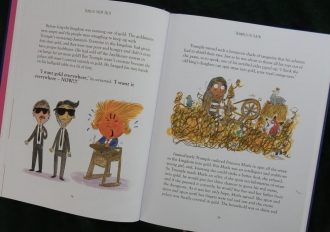
I couldn’t resist turning first to Trumplestiltskin and sure enough there is the easily identifiable ‘Trumple’ hailing from the United States of Kraziness. Said little man is obsessed with gold and power mad. No need for me to regale the whole sorry story – it had me in stitches throughout – but having thrown the king and his daughter, Princess Marla into a dark dungeon, an aide lets slip that Marla can spin straw into gold.

Needless to say, Trumple cannot resist making the girl an offer and the princess being a pretty savvy person, eventually manages to out-trumple the Trumple. (Love the postscript.)
Rumplestiltskin has been my favourite fairy tale since as a youngster, I heard the late Sara Corrin tell it at a book event. She’s in my head narrating this new one even now.

There’s also Sleeping Brainy (‘a flipping genius!’) who aspires to become Chancellor of the Exchequer and does so – against all the odds.

Absolutely cracking is Mouldysocks and the Three Bears in which he of the stinky foot attire is computer crazy. This almost causes his complete undoing when Mummy Bear, Other Mummy Bear and the little baby bear return from their forest foray –

that and the disgusting pong emanating from a certain pair of socks bad enough to put Baby Bear off his porridge. All ends happily however with everyone, including Mouldysocks (newly named) living spotlessly ever after.

It’s impossible to talk about every story in this review but I must  mention that The Princess and the Snog is written entirely in verse. Herein we meet pink-haired Pandora and the frog that catches her punchball when it lands in his boggy residence. Does she want to grant him a kiss – err … not quite and the outcome is, ‘A very wise rule for a mister or miss: / You choose who you / hug and you choose / who you kiss.” No coercive control for this wily young miss.

Finally, another princess – Zareen by name – is only a princess because that’s what her stepmother Tania (a goodie rather than the usual kind) calls her. Actually she’s a normal girl residing in the ‘magical suburb of Crystal Palace and dead keen to follow the latest school playground craze and get a Zoom Peashooter (basically just an overpriced paper straw). Hence the title The Princess and the Peashooter.

She ends up having got her mitts on one, with a rather funky eyepatch due to an errant flying shot – not hers – and being the leader of the anti-peashooter side for the next school debate. Bring on the Zoom Bands, say I. Much less dangerous, or maybe not …

Make sure you read this corker of a book right past THE END, including the small print. I’m wondering who would score higher on the enjoyment scale, team Konnie and James and illustrator Rikin, or readers who guffaw their way through its pages, relishing every satirical story,

If You Come to Earth

If You Come to Earth
Sophie Blackall
Chronicle Books

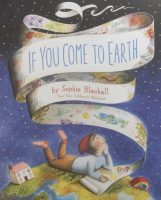
Award-winning author-illustrator Sophie Blackall’s inspiration for this book was her encounters with thousands of children she met while travelling the world in support of Save the Children and UNICEF – ‘a book that would bring us together’, she says in an author’s note at the end.

Her illustrations are truly breathtaking, as, by means of a child who is addressing a visitor from Outer Space, readers are taken on a journey through the solar system, down towards the surface of Earth viewing the various kinds of homes people live in, their families,

their bodies – each one different, their expressions as they think and feel, their clothing, weather both good and less so, transport, places of education and the work people do, how they spend their free time; we see some of the foods people eat. (Some of us have more food than others.’)

There’s an explanation of the importance of water, its sources and a stream of marine creatures swims majestically past. Then come Earth’s fauna: Those with feet and those with wings, leading us back to humans, their love of music making, their different ways of communicating (Some of us who are deaf talk with our hands and faces. Some of us who are blind read with our fingers’ caption a spread showing people signing and sign language, and braille with people reading it.)

With its incredible detail, each and every spread is truly a beautiful story in itself (or many) – there are natural things and those made by people, even invisible things. Sophie puts occasional humour into her narrative with such comments as ‘Some germs can make you sick. So … breathing in smoke or getting spat on by a slow loris’ (it’s venom really can cause great harm to humans).

Then come two spreads – one with fighting, the other facilitating, and the comment,’It’s better when we help each other.’( If only everybody stuck to that one)

The only sentence I took slight exception to is ‘Babies are not very good at anything.’ Babies are VERY good at learning – they do it pretty much all the time they’re awake as I observed when spending time with Faith, a six-month old relation the other day.

It’s good to see attention being given to storytelling, be it older people storying about the past, or children imagining.

The author concludes that there’s much we don’t know but ‘right this minute, we are here together on this beautiful planet.’ A fitting end to a gloriously illustrated, wonderful message. The visual detail is awesome and the importance of seeing each person as a unique, valued human being worthy of our respect and care, and of the vital necessity too caring for the Earth, shine through the entire book.

A must have for school and home.

Tales from the Forest

Tales from the Forest
Emily Hibbs, illustrated by Erin Brown
Stripes Publishing

This collection of twenty stories – five for each season – takes readers close up to creatures great and small from various habitats in the forest.

There’s a wishful caterpillar discovering its own metamorphosis, an adder that sheds its beautiful patterned scaly skin and the woodpeckers searching for a new tree in which to nest and rear chicks in spring.

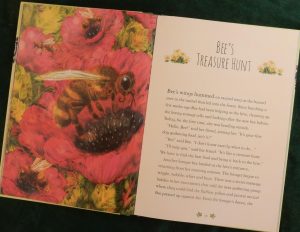
Bees busy performing their various roles in and around their hive;

fireflies lighting up the forest at twilight “The stars of the forest, burning bright”; competitive boars that end up wallowing side by side in the mud; bats, and tadpoles turning into frogs,

we meet them all in summertime.

Autumn presents beavers building a dam; the subterranean mole; a little mouse that has a narrow escape from a marauding hawk to tiny ladybird ready to join its fellows huddling close inside a log and a fawn whose spots vanish and his antlers grow.

In chilly winter Spider’s new web holds her pouch of tiny eggs while she finds a warmer place to spend her days till spring;

Black Wolf finds a white female companion to share his days; Squirrel remembers where she’s stashed her nuts; a little fox and his siblings lose their way and finally, an owlet listens to the sounds of the other forest animals before she and her father add their own voice to the nocturnal song.

Amazing animals all, as the author acknowledges in her final factual paragraphs – one each for the twenty featured. Her stories are packed with detailed, description and information in a highly accessible form so that readers/listeners will come away from each one having learned a lot without realising it. And, each story ends with a 4-line verse.

Erin Brown’s finely detailed, painterly illustrations at every turn of the page are an absolute delight adding further atmosphere and detail to each telling.

The Spots and the Dots

The Spots and the Dots
Helen Baugh and Marion Deuchars
Andersen Press

Here’s a tale that happened long ago – or was it so long?

Told with an appropriately bouncy rhyming text by Helen Baugh (it does feature spherical objects after all) we discover what happens when the little Spots, paying insufficient heed to their parents oft repeated warning, “If you go over the hill you will be taken away by the dots”,

start getting more daring with their favourite game until Baby Spot, scared and still, finds itself one evening at the apex of the hill.

However, close by is a second small someone, equally on its own.

A conversation ensues, and a revelation, followed by something very exciting …

Flip the book and read the story from the perspective of the Dots. This small tribe are also pod dwellers and their little ones love bouncing too, receiving a similar warning about the ill-intentioned Spots.

Naturally the infant Dots play a similar game to the little Spots and you can work out the rest …

Such a clever tale of colliding communities that celebrates difference and lays bare the idea that fear and prejudice are often fuelled by ignorance, showing that we’re all much more alike than we might at first think.

Helen tells it with a deliciously wry liveliness that is mirrored in Marion Deuchars’ superbly expressive scenes of small spheres and their adult carers.

Do make sure you study closely the grand meet up of the two infant groups wherein Marion has managed to give each of the playful infants a different look.

I can’t recommend this one enough: it’s brilliant.

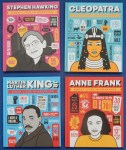
Great Lives: Martin Luther King JR, Anne Frank, Stephen Hawking & Cleopatra

Martin Luther King JR
Anne Frank
Stephen Hawking
Cleopatra

Button Books

These are four titles in the publisher’s new infographic biography series Great Lives in Graphics aimed primarily at older KS2 school readers.

Whether their interest is in human and civil rights, the holocaust in the German -occupied Netherlands as a member of the Frank family desperately trying to avoid being detected by the Gestapo; an awesome scientist and cosmologist who refused to let his ALS diagnosis hold him back; or, the woman in ancient Egypt who first married her brother, became a wise political figure and writer of books on medicine and science, going on to make a famous match with Antony,

then one of these will definitely be worth seeking out and putting their way.

Martin Luther King’s story is one that, despite his awesome achievements, and his “I have a dream” speech “… that my four little children will one day live in a nation where they will not be judged by the colour of their skin but by the content of their character”, which inspired America to end segregation, the world changing, peaceful protests he used in overcoming enormous obstacles, is conveniently and sadly forgotten by a certain element of the population of the US today.

I had to laugh when I read that Anne Frank was dubbed a ‘chatterbox’ by some of her teachers in her Amsterdam school, something that I was also often called at school.

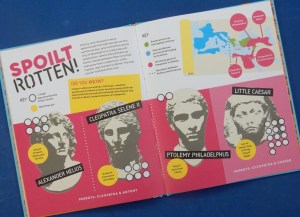
Each book has an introductory page of narrative, a timeline, details of family life and spreads detailing the subject’s key achievements; and each brings to life through its stylish, easily understood infographics, the person and the accomplishments of a memorable human being.

Well worth adding to primary school topic boxes and libraries.

Love, Hide-and-Seek and Night-time Board Book Style

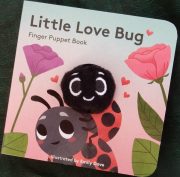
Little Love Bug
Illustrated by Emily Dove
Chronicle Books

Author/illustrator and nature enthusiast, Emily Dove, uses a popular minbeast as the featured creature in her latest in the finger puppet series to share with babies. We see a parent and little bug spending a busy day together snuggling, meeting friends, taking a slow wander, enjoying a dance and having a goodnight hug. No matter the time of day you can find an opportunity to show your love.

Bright, cute and sturdily built for lots of reading together times.

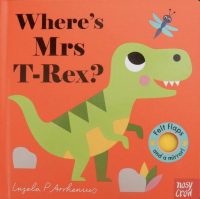
Where’s Mrs T-Rex?
illustrated by Ingela P Arrhenius
Nosy Crow

There’s a decidedly dinosaurish theme to the latest in Nosy Crow’s ever-popular felt flaps series with that final mirror that tinies love.. In this one you can introduce babies and toddlers to the four dinosaurs that are playing hide-and-seek from various minibeasts, a pterodactyl and a turtle.

It’s never too early to expose them to such names as Stegosaurus (Mr) Diplodocus (Mrs), Triceratops (Mr) and T-Tex, herein set against vibrant, patterned backgrounds. What fun!

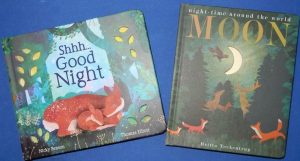
Shhh … Good Night
Nicky Benson and Thomas Elliott
Caterpillar Books

With Nicky Benson’s gentle, rhyming text and Thomas Elliott’s gorgeously hued illustrations, this lovely book with its die-cut pages, showing a mother bird and her baby, a baby squirrel with its parent, a big and small firefly and deer, little and large, settling down for a night’s sleep, this book is a lovely way to bid little humans goodnight; they’ll surely sleep well after this dreamy meditative experience.

And if you missed the paperback version of Britta Teckentrup’s beautifully illustrated Moon, reviewed already on this blog, Little Tiger have now published a die-cut paged board book edition showing animals around the world at night-time.

Skeleton Keys: The Legend of Gap-Tooth Jack / The Thing at Black Hole Lake

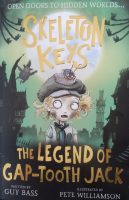
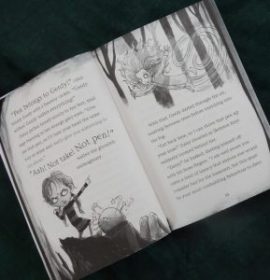
Skeleton Keys: The Legend of Gap-Tooth Jack
Guy Bass, illustrated by Pete Williamson
Little Tiger

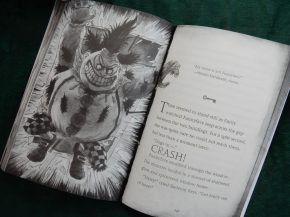
If you’re looking for a darkly comic adventure story that’s full of mystery, monster chases, and outlandish ghoulish decapitations, (that’s also about friendship, fitting in and finding self-confidence), then accept the invitation of Keys – Skeleton Keys – and allow this character to tell his tale (actually it’s that of Gap-Tooth Jack) that he claims is a “truly unbelievable, unbelievably true’ one.

However, in order for this tale to be unfolded back in the past, it’s necessary to begin in the here and now with a second story and in particular with wildly imaginative, seven-year-old, Kasper. This lad conjures himself up an imaginary friend whom he names Wordy Gerdy. By all accounts (or rather our storyteller’s), this ghost of a girl possessed an amazing ability: once she has in her fragile fingers a pen, she can rewrite any story she cares to, or even as here, she doesn’t.

Oh! We must mention Daisy; she’s Skeleton Keys’ unimaginary partner-in-problem-solving without whom, our bony being storyteller might have been a has been.

Find out what takes place when a highly dangerous, ghasty, goulish unimaginary escapes into yesteryear. Can Jack thwart her malevolent game plan by joining forces with Mr Keys? Plunge into Guy’s spooky saga, full of terrific characters,
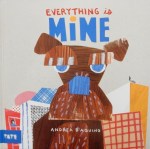
extremely quirky humour with Pete Williamson’s fangtastically spooky illustrations and find out. It will definitely make some superbly silly story sessions as a lower KS2 class read aloud.

For a slightly older audience is:

The Thing at Black Hole Lake
Dashe Roberts
Nosy Crow

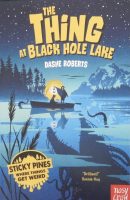
We’re back at Sticky Pines, the small US town of weird events and secrets lurking in woods, for this spooky sequel to the Bigwood Conspiracy; and once again there are weird things afoot.

We get two perspectives on events, those of Milo and Lucy (currently not on speaking terms). Milo Fisher, loyal son of business tycoon NuCo president – a double-crossing guy; and Lucy Sladen, who’s determined to discover the truth about the mysterious, alien life, Pretenders of Sticky Pines, and protect them from the greedy NuCo company, set on exploiting every one of the town’s resources.

In the previous adventure it was Lucy who made the astonishing discovery but now it’s Milo’s turn, for there’s something very strange in Black Hole Lake; something that will put both he and Lucy in terrible danger. Danger that begins as Milo leaves a party early in order to avoid Lucy, takes a short cut and soon finds himself sinking into the lake and there are eyes watching him from below the surface.
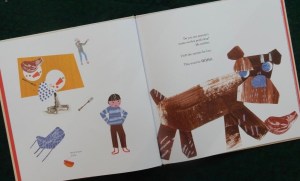
Mesmerisingly brilliant fun., fast-paced with lots of twists and an abundance of ever-deepening mysteries, creepiness and with the philosophical good guy/bad guy dilemma underpinning the tale, this is a stonkingly good, enormously satisfying read.

Feathered Serpent and the Five Suns

Feathered Serpent and the Five Suns
Duncan Tonatiuh
Abrams Books for Young Readers

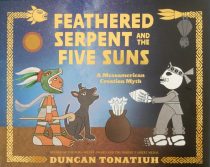
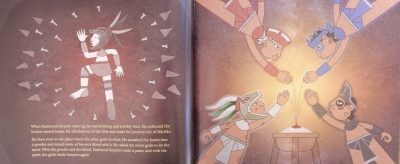
Legend has it that the Mesoamerican gods had considerable bother creating humanity.

During the first tonatiuh their effort resulted in mountains, the second, fish and having modified the process, the third attempt was close, but the humans were disrespectful of their creators and so were turned into tree-dwelling monkeys.

Attempt number four produced kind-hearted, respectful beings but due to their laziness, the gods turned them into birds.

Enough! The gods were weary and ready to give up entirely, all except Quetzacóatl – the Feathered Serpent and god of knowledge. Gathering his staff, shield, cloak and good luck shell he set off to Mietlán – the underworld – to recover the bones his fellow gods had given to the lord of the underworld for safe keeping.

To reach his destination, Feathered Serpent travels through nine daunting regions,

but aided and abetted by Xolotl the dog spirit guide, he finally reaches his destination and is able to speak to the god of the underworld.

After he’s explained his mission, Mictlantecuhtli gives him one final test and Feathered Serpent finds himself on the end of a trick. However, he manages to out-trick the keeper of the bones and is given the sacred objects. Mictlantecuhtli hasn’t finished with him yet though; but Feathered Serpent finally escapes, wounded and bleeding, recollects the bones and returns.

Once there, he smashes them to a powder, mixes in his own blood and that which the other gods provide, to make a paste

and from that finally creates humanity.

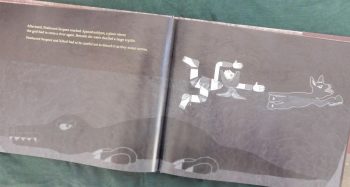
Despite being a complex story, Tonatiuh’s telling is captivating and readers aloud can certainly give it a highly dramatic presentation. His superb, flat, hand drawn, digitally collaged scenes successfully conjure up pre-Columbian art, and after his enthralling rendition, to help with the historical context  there’s an author’s note on the symbolism behind the myth, a glossary with Nahuatl pronunciation guide and a select bibliography.

We’re Going on a Pumpkin Hunt / Winnie and Wilbur Around the World

We’re Going on a Pumpkin Hunt
Goldie Hawk and Angie Rozelaar
Nosy Crow

Based on the nursery favourite ‘We’re going on a bear hunt’, I’m surprised nobody thought of a pumpkin-themed variation before. It’s definitely a goodie.

Herein we join three fearless pumpkin hunters – a little skeleton, a witch and a slightly unravelling little mummy – as they sally forth one beautiful night. Needless to say their path is obstructed by various things that they can’t go over, under or around.

First it’s watchful green-eyed moggies meow-meow(ing); then cobwebs – the sticky spiders’ variety – just right to ‘tickle-swish’ through.

Yikes! What about those ‘Flap-flap’ flapping bats – fortunately they look quite friendly, and then the trio come to a house, old, dark and spooky of course. Could a pumpkin be hidden therein?

There’s only one way to find out and that’s in …

and over those creaky-squeaky floorboards and of course, our adventurers aren’t scared, are they? …

Happy trick or treating …

At every page turn, day-glo colours leap out from Angie Rozelaar’s anything but scary spreads showing the mock-spooky sortie, and Goldie Hawk’s clever adaptation of a popular join-in narrative, this will assuredly enchant, rather than scare, young listeners and solo readers around Halloween time. (or any time come to that.)

Winnie and Wilbur Around the World
Valerie Thomas and Korky Paul
Oxford Children’s Books

Inspired by a visit to the library and animal books in particular, Winne and Wilbur embark on a world trip with the aim of visiting all the animals featured in the book they’d seen (and decided to borrow).

All it takes is a hastily packed suitcase, duly attached to the broomstick, a glance at the book and a wave of Winnie’s wand;  up and away they go to land in a tree house surrounded by giraffes – very hungry ones.

Prompted by picture two (and sans lunch) they whizz on to an oasis where dates, camels’ milk and an exceedingly hot, bumpy ride await.

A spot of kangaroo bouncing (Wilbur) comes next, followed by some panda spotting (Winnie finds the creatures dull); then a too close for comfort encounter with an enormous whale …

and a polar bear.

An elephant, an aardvark and meerkats (not cat eaters happily) rendezvous leads them on to the final page and a jungle full of monkeys. Their mischief-making might well have caused the demise of both our plucky travellers but fortunately, all ends happily. With thoughts of their favourite animal in mind, and with the book duly returned to its place in the library, its time for the intrepid adventurers to relax.

What more can the countless fans of the duo want than this high-octane world trip by their favourite witch and her trusty moggy. Probably another reading of same, followed by further adventures. Perfect for Halloween and other story times.

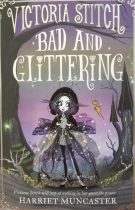
Victoria Stitch Bad and Glittering

Victoria Stitch Bad and Glittering
Harriet Muncaster
Oxford University Press

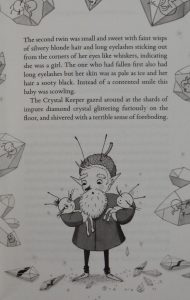
As the story starts, living alone in a small tree trunk, twin fairy-like beings ‘wisklings’, Celestine and Victoria should be princesses.

But the single royal diamond from which they were born is impure so their birthright is denied them.

The mild Celestine is accepting, but with her frenzied energy, Victoria Stitch as she likes to be called, is obsessed with becoming the next queen and very angry about the decision Lord Astrophel has made.

Between the twins there exists a fondness, but it’s maintained by a fragile thread that’s all too easily snapped. ”She took all the kindness and I got all the rage,” is how Victoria Stitch puts it.

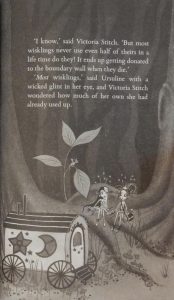
Then Victoria encounters secret-loving Ursuline who needs a friend and offers to help in her unthwartable mission to become queen after Cassiopeia.

But will this new alliance prove to be a force for good or not? And what will happen after the twin’s graduation …

Any reader who fell for Isadora Moon and is ready for something a bit longer and rather darker, will surely love Harriet’s new gothic fantasy. The illustrations are simply divine especially as Victoria Stitch with her funky, pointy toed, heeled boots is a fashionista who loves to strut her stuff in melodramatic wiskling style as befits the superbly woven, absorbing narrative.

To enter Wiskling Wood is utter enchantment every step of the way; it’s hard to leave for whatever reason …

Saving the Planet – The International Yeti Collective: Shadowspring / Astronuts Mission Two: The Water Planet

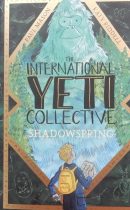
The International Yeti Collective: Shadowspring
Paul Mason, illustrated by Katy Riddell
Little Tiger

The Yeti Collective is a worldwide organisation with each of its strands having responsibility for an element of conservation while simultaneously aiming to avoid human detection.

Shadowspring (underground water upon which all wildlife and the humans depend) is under the protection of the Greybeards (the British group) but now somebody or something is interfering with the water levels and things are looking bad for the inhabitants of Tadpole’s community.

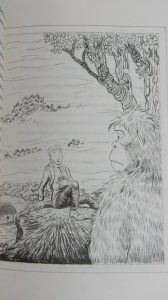
Tadpole (she of unripe character), daughter of the sett’s leader, Shipshape (she in perfect order), is next in line to become the Greybeards’ leader, a role for which she feels anything but fit.

Despite the precedent for avoiding humans contact, like her grandfather before her, Tadpole meets a human; his name is Henry, a boy just adapting to boarding school life.

Now, on account of the danger the Greybeards are facing, Tadpole and Henry (aka Hen-ree) must work together: an extremely dangerous undertaking ensues.

It’s a delight to enter and share in this world with its highly pertinent environmental messages, that’s populated by wonderful characters such as the two main ones in this story.

I missed the first book in the series, but I intend getting hold of it forthwith; I’m sure it too will be a superb read.

Astronuts Mission Two: The Water Planet
Jon Scieszka and Steven Weinberg
Chronicle Books

AstroWolf, LaserShark, SmartHawk, and StinkBug, the four NNASA agents, return having previously failed to find the perfect Goldilocks Planet, with a new mission, to find a planet fit for human habitation.

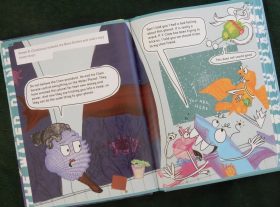
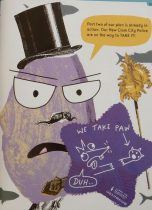
Having splash-landed on Water Planet, they discover it is awash with clams, a power-hungry, sub-aquatic force led by their president, P.T.Clam . Said creature is absolutely gushing with praise about his home planet and more than a little keen to swap his planet of residence for Earth. the polluted waters of which he claims to filter. Now why might he be so eager for that exchange?

It appears that he’s willing to do a special deal on the quiet with AlphaWolf (the mission’s leader) but another clam, Susan B. Clamthony tells a rather different story

and it’s one that the Astronuts really need to hear. It sounds as though not all the residents of Water Planet are as dastardly as their leader.

Packing the adventure with punny humour, hilarious interchanges and with a bounteous brio, Jon Scieszka, via his Earth narrator, cleverly knits together environmental information and facts about climate change. Combined with Steven Weinberg’s equally zany collage illustrations, every one of which is as immersive as the watery environment of the story’s setting, (love the spread on how they were created) this is a terrific second instalment.

More please! I hear youngsters, (especially fans of graphic novels) cry. (And this reviewer.)

Jeremy Worried about the Wind

Jeremy Worried About the Wind
Pamela Buchart and Kate Hindley
Nosy Crow

Young Jeremy is a worrier par excellence – we all know one I’m sure. Risk averse he surely is, and a highly sensitive little chap to the extent that he avoids pretty much anything and everything from overly crunchy crackers to dinosaurs …

and squirrels to shoelaces. His biggest worry though, is the wind.

One day he meets and befriends Maggie – she of the untied shoelaces and “What’s the worst that could happen?” attitude. Immediately Jeremy decides that she’s in need of care and protection. Taking her under his wing, he teaches her all manner of ways to stay safe.

Then comes that hugely wildly blustery day when Maggie inevitably decides to throw all caution to the wind. Out she dashes with Jeremy in hot pursuit (or maybe a cold sweat). And that’s when he finds out about the delights of living dangerously.

Bursting with zany humour, Pamela’s text will lift your spirits – it’s a great read aloud likely to help even the worst worriers among your audience to unwind a tad, (and perhaps offer a warning word or two to any Maggies sitting alongside); while Kate’s splendidly expressive scenes of the perils – possible and real, excitement and effervescence, will enchant and entertain. Make sure you slow down when you get to the wordless spreads so your listeners can savour every single tiny detail.

Ridiculously brilliant in every way.

The Accidental Prime Minister Returns / Roald Dahl Rotsome & Repulsant Words

Books that make us laugh are much needed at the moment: here are two such, sent for review by Oxford University Press

The Accidental Prime Minister Returns
Tom McLaughlin

Do I detect a touch of irony in this title? Perhaps the return of Joe who found fame by accidentally becoming Prime Minister while trying to save his local park, knew just when he’d be needed again. Now, I defy you to get through even one chapter of this new story without splitting your sides with sniggering snuffling laughs and ginormous guffaws, let alone wait till chapter four.

Who better than Joe (aka your Primeministerness) to bring back a bit of cheer? So here he is – the perfect counter to all the current doom and gloom – at the ready to remind the populace of life’s good things, and how they can all do their bit to make our great country (or rather, tiny island) and the world, a better place in which to live.

With his entourage, that’s best pal, Ajay dubbed ‘an all round absolute dude, and Alice, democracy’s most mega enthusiast (also a total dude), not to mention Mr Rottweiler (a useful ally?) who else could possibly get our vote. (He’s even got the right colour hair – almost!)

With its healthy herbal juice, spare false eyelashes and an absolute wealth of shenanigans, book seven, laying bare the ups and downs of political life, could not have come at a more apt time. Bring on the ‘coal addition’ – right now!

Delicious daftness of a different kind in:

Roald Dahl Rotsome & Repulsant Words
illustrated by Quentin Blake

Roald Dahl was a prolific inventor of rude words. He used some incredibly adroit putdowns and curses, insults and expletive forms.

Now, thanks to editor and lexicographer Dr Susan Rennie, they’ve all been brought together into this collection of naughty-sounding words that will absolutely delight any child (and probably adult) who gets their hands on a copy of Rotsome & Repulsant Words. (my spell check is NOT happy!)

So, if you want to try creating your very own ‘gigantuous’ curse word, there’s a spread to show you how. Or perhaps you’d rather become ‘as Grumpy as a Grandma’ then you can find out how so to do.

I have to say I rather enjoyed the ‘How to be rude in other languages (so grown-ups won’t notice).’ It doesn’t always hold true however: I can recall several occasions when teaching reception and nursery age children, hearing extremely insulting words (meaning much worse things than the examples in this book) coming from the role play area, spoken by children not knowing that their teacher could understand their Hindi, Urdu, Panjabi etc.

Naturally children will relish the collecting of ‘bottom’ words and even more so, those relating to sounds that emanate from same.

There are some smashing onomatopoeic examples here including the Spanish ‘popotraques’ and the Scots ‘rummlypumps’.

Think of the fun you might have in a group discussing ‘swatchwallop’ (the most disgusting thing you can eat. An opportunity for some more creative word inventions methinks. Think too of the wealth of language lessons you could enliven using this with your class.

Whether or not you’re a Dahl fan, I’m pretty sure you’ll relish this little linguistic goldmine, especially with those Quentin Blake illustrations.

Ruby and Graham / This Old Dog

Ruby and Graham
Lucy Barnard
New Frontier Publishing

Playful party loving Ruby and organising expert, Graham, both live in Acorn Wood ensuring that it’s both a happy lively place and a beautiful one.

However, it’s Ruby who gets all the attention from the other woodland animals, so one afternoon Graham decides to change his ways and become more funky.

Such is the improvement in his popularity that he resolves to make the change permanent.

Now while it might be a good thing for Graham, the woodland rapidly becomes a messy, confused environment. Ruby approaches her fellow squirrel and an interesting discussion ensues wherein they each talk about their feelings of self-worth.

Can the two share their abilities to their mutual benefit, as well as for the betterment of the entire community? Working together is the way to go …

Lucy Barnard’s digital illustrations add humorous details to her textual narrative, making every spread a stopping point that offers much to enjoy and talk about with young listeners, particularly with the approach of autumn and winter.

This Old Dog
Martha Brockenbrough and Gabriel Alborozo
Levine Querido

This Old Dog is a heart-warming story about a dog that’s well past its prime (‘His bones are sore but his heart is strong’) and a small girl who loves him dearly.

From the moment the child is born, the pace of life in old dog’s family speeds up, but the creature ‘likes to take things slow.’ He’d yearned to have a friend for long, slow strolls, rolls in the grass and romps in the leaves.

Both little girl and the dog truly know how to live in the moment, make the most of their experiences and cherish their time together; and once the child takes to her feet she walks straight towards old dog. At last his wish is fulfilled: there’s grass smelling, hill rolling down and much more …

some of which make the pooch enormously excited.

Together they can discover (or rediscover) what a wonderful world it is, day after day …

Just as the girl and old dog were seemingly made for one another so too was the author/illustrator partnership between Martha Brockenbrough and Gabriel Alborozo. The slow, steady text skilfully mirrors old dog’s plodding, yawning demeanour so perfectly captured in the delicately lined ink and water colour illustrations; he’s a real personality this pooch, as is the adoring little girl, his total devotee and playmate.

Whether or not you’re a lover of dogs, you’ll definitely fall for this gorgeous book.

Kids Knit

Kids Knit
Kerry Kimber
GMC Publications

I’ve never really got to grips with knitting – just the odd (very) scarf, a jumper that I abandoned and numerous blanket squares for charitable causes over the years. And, rather than making me feel relaxed, something my mum used to say about knitting, I always ended up having tense shoulders from trying to go fast, so I was interested to see these listed in the “Ten Great Things About Knitting’ at the front of the book:
#2 Feel Good, #3 Relax,  #7 Cheer You Up  – failure on my part with those.

What about the others? #1You Can Make Stuff – sort of; #4 Improve Your Maths – yes possibly; #5 No Screens – absolutely! #6 Banish Boredom – perhaps for a short time #8Make Friends – I definitely never joined a class; #9 Start a Movement – I was never sufficiently proficient to be enthusiastic to teach anybody else #10 Gifts From the Heart – yes hurrah!
However a book such as this with its upbeat, encouraging tenor and emphasis on creativity might well have made all the difference.

After talking about the basics: what you need, needle sizes and yarn selection, comes the part I really love that starts with ‘Get Creative’ …

and there’s a lovely traditional rhyme, (new to this reviewer, certainly in a knitting context) “In through the door / Once round the back / Peep through the window / Off jumps Jack.” And an invitation to young users to invent their own version with the key words ‘in, round, through off’.

There are tutorials on the basic stitches, casting on and off. Then comes “Sewing On’ bits and pieces so that you can make cute creatures such as Frog,

monster hand puppets, a sweet tufty owlet (its instructions come with an owl joke).

Things step up a level then as readers learn about colour changing; that results in patterned items including a rose, bunting, a cup cuddler and beanbags.

After this section of tutorials you might be sufficiently proficient to start on the “Star Knitter Tutorials’. Herein you can find out how to make your very own stylish beanie,

a funky field mouse and several, a ladybird, a crown or even a cactus.

The book concludes with information about the origin of different yarns and being a responsible kids knitter, a bit of history and some useful templates.

There’s a wealth of photographs to provide further inspiration should you need it and the children shown with their creations look really proud of what they’ve made.

With the shorter days and less time to be outside, this is the ideal Kids Knit time.

Fergal Meets Fern / Elmer and the Lost Treasure

It’s lovely to see favourite characters returning in these two recent books from Andersen Press

Fergal Meets Fern
Robert Starling

New sibling unsettlement quickly arises when Fergal’s Mum and Dad bring home ‘the egg’. From this emerges a new baby sister for the little dragon and with its arrival, funny feelings start within Fergal. Even nan’s gift of flying show tickets lift his mood only briefly because Fern’s actions really stoke up Fergal’s inner fire.
Then to make matters worse, comes the news that the flying show excursion is off: Dad has to get medicine for Fern who’s become sick.

Inevitably Fergal’s fiery feeling grows even stronger, so much so that he does something to make him the centre of attention, which it does, once Dad discovers his whereabouts.

After a frank Father and Fergal discussion on feelings, Dad shows his son something by way of explanation.

Later on as the two do some yoga side by side, the feelings discussion continues

and eventually Fergal understands that something in him needs to change. Being a big brother is an important role and perhaps it’s one he can undertake successfully and lovingly.

As with previous Fergal stories, Robert Starling conveys this one with sensitivity, humour and considerable charm.

Share with little ones at any time but it’s especially apt if you’re a family with young child and a new arrival.

Elmer and the Lost Treasure
David McKee

The adorable elephant, Elmer stars in what is almost unbelievably, his twenty eighth picture book adventure.

He, along with cousin Wilbur and three other elephants set out on ‘a long, exploring walk’ through the jungle and after a while find themselves in unfamiliar territory.

After a roll down a steep slope with Elmer in the lead – naturally – they discover an entrance to an old forgotten palace and start exploring within, or rather Elmer and Wilbur do. The others meanwhile have their own agenda. What can they be doing?

The palace is incredible with huge domed halls in shades of blue, amazing mosaics, tiles and carvings. But who will find that Lost Treasure? And what is it?

Another absolutely smashing story of everyone’s favourite patchwork pachyderm and his pals, told and illustrated with David McKee’s usual sense of humour and fun, warmth and heart, that is also reflected in his main character.

Fire Burn, Cauldron Bubble

Fire Burn, Cauldron Bubble
chosen by Paul Cookson, illustrated by Eilidh Muldoon
Bloomsbury Education

Poet, Paul Cookson has brewed up an anthological crucible that’s brimming over with magical poems, over seventy in all. He’s spread his web wide gathering a rich and varied mix of ingredients that includes classics such as Shakespeare’s Over Hill, Over Dale; from a Midsummer Night’s Dream, Tennyson’s The Kraken and Lewis Carroll’s Dreamland, as well as a host of contemporary poets, established and rising.

I really enjoyed every single one and it’s impossible to select favourites, as it depends on mood as much as anything; but on the day I received my review copy I’d spent at least two hours screaming at my new Macbook which had supposedly had everything migrated from the previous one, but there were lots of things unexpectedly going wrong.

I was greatly amused to find the book opened itself at Stan Cullimore’s Song of the Witches (when their Internet Wasn’t Working) with its opening lines ‘Double, double, click that bubble / We have got computer trouble’. Shame I couldn’t fix it with the poet’s final line ‘Just had to switch it off and on again’ that works so often with computer woes. I suspect Paul himself was using a bit of his ‘Telepathically Magical’ power to cause me to start on that particular page, and no, my answer was not … 3 and I’m still struggling – three days later. A-hah! That’s it!

I know many youngsters who will take great delight in James Carter’s How To Turn Your Teacher Purple! – ‘Heebie Geebie, Hurple Burple / Time To Turn My Teacher … PURPLE!’
I just hope none of them test it out on me though. I definitely wouldn’t countenance being fed with ‘beetroot every hour’ – can’t stand the stuff.

I will certainly avoid doing what the filling of Graham Denton’s four liner did too …

And I’m going to share Matt Goodfellow’s An Example of my Amazing Ability to Make People (Namely my Older Sister) Spontaneously Combust Without Even Touching Them with 5 year old Samuel. It goes like this:
‘I pour away her perfume / scribble in her books / dribble on her mobile phone / and give her dirty looks // pull down all her posters / trample on her clothes / then leg it to my bedroom / and hey presto // she explodes.’
I suspect however that he’s too good natured to try it, but you never know.

Rather than waxing lyrical about the rest of the elements of this marvellous mix, let me just say that Paul serves up a terrific repast here and it’s one to relish whatever the season. Spellbinding it certainly is and I totally love the addition of Eilidh Muldoon’s visual garnishing.

There Must Be More Than That!

There Must Be More Than That!
Shinsuke Yoshitake
Chronicle Books

In our increasingly pessimistic times, it’s really good to have children offered an alternative perspective on the future, especially when it’s presented with the wonderfully droll humour of Shinsuke Yoshitake.

It opens on a rainy day with big brother saying to his younger sister, “Hey, Sis. … Our future is doomed … Terrible things are going to happen … That’s what a grown-up told my friend.”

Feeling somewhat deflated the little girl goes and passes on his message to her Grandma. She however is much more level-headed suggesting focussing on the good things and the many possible choices one can make: “Grown-ups act like they can predict the future … but they’re not always right,” she says, immediately triggering more positivity in her grand-daughter.

She in turn then goes on to envisage possibilities of all kinds – ‘A future where it’s okay to spend the day in pyjamas’ – little did she know! – and one where ‘robots take us everywhere’ … and ‘someone always catches the strawberry you drop’ … and ‘someone does your homework for you.’ (“Bring it on,” I hear youngsters cry).

Now the girl is really on a roll, imagining outgrown shoes put to use as planters; being able to ban carrots, and having ‘that bully’ abducted by aliens or even finding her own true love and consequently not being bothered about the bully boy.

If you’re thoughtful, you can always think of extending your horizons and not thinking in terms of polar opposites. Thus good/bad could become ‘not bad / hard to say/ questionable / interesting /could be okay / strange’ or ‘I don’t know’.

There are lots of alternatives for an aging Grandma too – who knows, she could wake up as a teddy bear or live for 300 years. And as for that boring boiled or fried egg that Mum offers as the other options to left-overs for dinner … there are plenty of better ways to make an egg …

You just have to make up your mind which …

Midnight Magic / Cally & Jimmy Twins in Trouble

Midnight Magic
Michelle Harrison, illustrated by Elissa Elwick
Stripes Publishing, Little Tiger

This is the first of a new rhyming series by author of the A Pinch of Magic books, Michelle Harrison; it’s superbly illustrated by Elissa Elwick and it’s absolutely perfect for young solo readers or for reading aloud.

It all begins when with tummy swollen and heavy, ‘One frosty evening, / A tabby cat prowled / Through white winter fields / While a bitter wind howled.’

Said tabby cat makes her way into a barn and there, watched by the animal residents, produces three kittens that she duly and aptly names Snowdrop, Foxy and Midnight. The third one, born at midnight is different – both mischievous and magical. And this magic seems to be doubling each day and potentially troublesome. Indeed, she soon starts calling herself a ‘cat-astrophe’ and before long forges a friendship with the broom from the barn, naming the thing `Twiggy’.

The two travel together and they’re spotted by a girl named Trixie as she plays in her village.

Trixie takes the kitten home where she’s eventually welcomed whereas the broom is treated less favourably. But with her mischievous nature, will the rest of Trixie’s family allow Midnight to stay?

Trixie is certainly happy with her new friend but it’s not long before sparks start to fly. And then Nan makes a discovery about that broom she’d unceremoniously tossed into the cupboard.

W-hay – it’s up and away …

A magical tale, this surely is; it reads aloud like a dream and is perfect for sharing or independent reading. especially around Halloween time.

Cally & Jimmy Twins in Trouble
Zoe Antoniades, illustrated by Katie Kear
Andersen Press

Meet twins Cally and Jimmy: twins they might be, but you’d be hard pushed to find two more different people. Cally – short for Calista meaning ‘most beautiful’ – the quiet one, is our narrator and is well behaved, most of the time. Jimmy in contrast (his real name is Dimitri on account of having a Greek mother) is far from quiet and his behaviour, not helped by ADHD, leaves a fair bit to be desired. In class, he has a special table right beside the teacher’s desk and far away from his sister’s ‘top table’.

In four short stories we get a pretty clear picture of what it’s like to live with the most-annoying-brother-in-the-whole-wide-world. His actions frequently land them both in trouble, though there are plenty of fun times too. And even after getting into trouble together they often end up laughing together afterwards.

Like the time when they made brownies using dad’s ‘fool-proof recipe’ only they added some rather interesting extra ingredients to the mixture. Not sure I’d want to sample those.

Then there’s the time they contribute to a class assembly, the practising of which doesn’t quite go smoothly.

The final episode sees the celebration of the twins achieving double digits and celebrating it in style.

Other colourful characters include Yiayia (grandma)

and lunchtime supervisor, Mrs Gutteridge.

It’s Only Stanley

It’s Only Stanley
Jon Agee
Scallywag Press

Jon Agee imbues this picture book with his usual dry humour, leaning herein towards the utterly absurd.

It tells of a family, the Wimbledons, whose slumbers are disturbed by a series of weird sounds that Mr W. (Walter) goes to investigate each time.

First he reports on their pet dog Stanley’’s howling at the moon; but on subsequent disturbing occasions we discover that Stanley has a particular penchant for engaging in noisy tasks during the hours of darkness.

Next he’s reported to have fixed the oil tank,

after which he’s provided the moggy with some delectable-looking catfish stew, the smell of which awoke young Willie Wimbledon (don’t you love the alliterative names, the entire family has them).

Thereafter Wanda’s ‘buzzing sound’ at 3.30am turns out to be our Mr Fixer repairing the old TV; Wylie’s ‘splashy sound’ proves to be a rather wet bathroom caused by Stanley’s drain fixing activities and finally the entire family is up in arms, mum Wilma included.

What repairs can our diligent, multi-talented Stanley be working on next? Let’s merely say, it’s assuredly his most ambitious project yet … and leave you, the cast and readers in suspended animation,

awaiting Agee (and Stanley’s) laugh-out-loud finale.

I’m sure if you share this with youngsters, arguments will ensue about whether the canine character is conscientious, crazed, or certifiable. Whichever they opt for listeners/readers will assuredly delight in his DIY antics so hilariously presented in Agee’s unpredictable rhyming narrative with its repeat refrains, and his droll, alternating scenes of the disturbed family and their disturber’s deeds.Make sure you closely follow Max, the cat throughout.

What a satisfying read aloud for both listeners and adult presenters. Suitable bedtime reading? – that’s entirely up to you …

Build a Skyscraper

Build a Skyscraper
Paul Farrell
Pavilion Books

Following on from his Build a Castle, graphic artist and illustrator Paul Farrell has, with a different colour scheme, created another terrific set of 64 slot-together building cards, this time with the intention that users build something very tall.

I put my set in front of Samuel (5) who delightedly seized it saying, “That’s a bit like the castle one”, clearly recognising the distinctive graphic style of Paul Farrell.

He then spent the next hour engrossed in building, wanting to know if he could build a skyscraper as tall as himself. “I bet it’s nearly up to my head” he commented. (estimating). He then proceeded to find out, carefully slotting the pieces together concentrating hard the entire time

and getting progressively more excited as it grew higher than his shoulder level.

When he put the final piece in place he was thrilled to find his skyscraper was taller than he is.

During the building, Samuel’s big sister came in and she was told to see where it reached on her body which she duly did, with Samuel suggesting he’d need 4 more pieces to get to her height. (estimating again).

Samuel had been watched throughout the building process by his baby sister Faith (6 months) who was clearly fascinated by what was going on. Samuel then went outside for a little while for a kickabout with a ball and before so doing he built a barricade around his construction with cushions and other items.

As soon as he left, Faith started rolling towards his model with a mischievous look about her, seemingly intent on destruction. However, she couldn’t get close enough to do the deed. PHEW! The tower was saved.

There are SO many learning possibilities presented by this set. Samuel clearly was using his fine motor and manipulative skills, his imagination, and several maths skills. The potential for creative play by adding toy characters and working with one or more children is enormous. I suspect it could embrace all the areas of the early years curriculum if used in a foundation stage setting; and if put into a KS1 class, there are further possibilities.

An excellent resource for home or school use.

Trail Blazers: Stephen Hawking / Little People Big Dreams: Ernest Shackleton

Trail Blazers: Stephen Hawking
Alex Woolf, illustrated by David Shephard
Little Tiger (Stripes Publishing)

‘Be inspired’ says the first line of the blurb of this book. Who could fail to be inspired by reading about Stephen Hawking, an incredible individual who refused to be defined by his illness and which he never allowed to hold him back from pursuing his awesome scientific dreams, and whose life story is told therein by historian Alex Woolf.

It’s both a biography and a science book – ‘A life beyond limits’ as the subtitle says. Alex Woolf explains by means of an informative narrative together with David Shephard’s illustrations and clear diagrams, Stephen Hawking’s scientific discoveries (panels giving theoretical summaries are provided)

and the challenges he faced through much of his life.

There’s just enough detail of the genius’s revolutionary theories and of the key questions cosmologists have sought answers for, to inspire but not overwhelm readers from the top of KS2 onwards.

The narrative begins with a summary of the history of black holes theory, a brief explanation of the space-time continuum and a mention of other mathematicians and physicists involved in the theory.

There’s also information about Stephen’s formative years: I was particularly interested and amused to read of his family’s trip to India when the car got caught in monsoon floods and had to be towed to safety. (Sounds to me like an almost familiar incident!).

Children will be interested to learn that during his under-grad. days Stephen was far from hard-working and later calculated that he’d spent on average just one hour a day studying, spending much of his time rowing or at the boat club; getting by on his utter brilliance and managing to talk his way into getting a first in his Oxford degree.

It was when he became a student at Cambridge that both Stephen’s clumsiness and his resulting focus on his intellect began to take hold. A diagnosis of the incurable amyotrophic lateral sclerosis (ALS) might have overwhelmed even the most determined of people. Not so Stephen whose propensity to ask difficult questions and to put forward new theories without fear of being wrong is exemplary.

“Look up at the stars and not down at your feet. Try to make sense of what you see and wonder about what makes the universe exist. Be curious. “ So says the final quote – truly inspiring and one hopes, motivating …

Strongly recommended reading for older children.

Little People, Big Dreams: Ernest Shackleton
Maria Isabel Sánchez Vegara, illustrated by Olivia Holden
Frances Lincoln Children’s Books

This addition to the popular series of biographical stories presents the famous Antarctic explorer Ernest Shackleton from the time he was a child growing up in rural Ireland dreaming of wider horizons, when even at a young age, he showed the qualities of a good explorer – optimism, idealism, patience and courage.

We learn of his participation as a young man, in expeditions endeavouring to reach the South Pole. Then how, inspired by Roald Amundsen, he planned to cross Antarctica from sea to sea, via the pole.

This expedition aboard Endurance, began in August 1914 with a crew of 28 enthusiastic, optimistic men and assorted animals. After months crossing the ocean, the ship became trapped in ice;

and so it remained for nine months with their calm leader doing his utmost to keep the spirits of his crew high, until the ice began to break up their ship.

Though there was scant hope of a rescue, Ernest never lost hope of saving his crew, and finally he and five of his men reached a whaling station. Then, having found help, he returned and brought his crew back home, Incredible though it may seem, every one of them survived.

With his unfailing optimism, Shackleton, a true inspiration to countless others, died at the young age of 48, as the final timeline shows. A true inspiration to young readers too, especially at this time when remaining optimistic is to say the least, challenging for us all.

Winter Wishes / Frost

Winter Wishes
illustrated by Alison Edgson
Little Tiger

This collection of tales comprises ten illustrated wintry tales each by a different author.

From Caroline Juskus, there’s a lively little penguin Pip, eager to improve his marching in time for The Penguin Parade. There’s a rather confused, large hairy ape-like creature wandering around the snowy forest in Guy Bass’s Finding Bigfoot, an adorable seal pup eager to get in on the act in Michael Broad’s Seeley’s Song.

Caroline Pitchers’s story Is of a husky pup, anxious about her first sledge pull as a member of the team;

Elizabeth Baguley tells of a rather homesick little girl, wishing and an elephant, set in India; while Karen Wallace’s story has a fox cub puzzled about the white ‘feathers’ in the garden in the days coming up to Christmas – he certainly has a lot of learning to do about the season.

Malachy Doyle’s Morning Bear is full of wishing, surprises and lots of guessing; The Kitten in the Snow takes a while to acquire a name in Penny Dolan’s chilly tale; Narinder Dhami’s Tiger in the Night has three fox cubs discovering what it means to be a Siberian tiger and Holly Webb provides the final Just in Time for Christmas, telling how little dog Max leaves the rescue shelter and finds a family home.

Just right to snuggle up and dip into, along with a hot chocolate. Young independent readers might want to read one or two stories a day, or spend a whole afternoon/evening relishing the entire book.
More from the final author in:

Frost
Holly Webb
Stripes Publishing, Little Tiger
This story is part of the author’s wintry animal tales that cleverly mixes fantasy and historical fiction to create magical books for younger solo readers, and for reading aloud.

This one features Cassie, often known as William’s ‘baby sister’ and hence frequently left behind when it comes to the activities of the other older flat-living children. But on one occasion being left behind gives rise to her spotting a little fox on the waste ground close to her London home.

Cassie forms a special bond with the fox cub naming it Frost and feeds it regularly till one winter’s night the creature leads her off on a very special adventure, as they time-slip back to the 1683  Frost Fair on the frozen River Thames.

It’s exciting spending time in this other world but Carrie finds herself lost; can she make it safely back to her own time …

In addition to the consideration of urban foxes and the differing viewpoints about these creatures, another element woven into the story is that of the importance of understanding and helping others, herein through Cassie’s developing relationship with her somewhat irascible neighbour, Mrs Morris.

Plenty of food for thought and discussion, as well as a wondrous wintry adventure. (Line drawings from the Artful Doodlers add further atmosphere to Holly’s telling.)

Songs for our Sons

Songs for our Sons
Ruth Doyle and Ashling Lindsay
Andersen Press

Here’s a rhyming celebration of a newborn child wherein the narrator shares her future hopes for the infant, encouraging the little one, oh so full of potential, to be the very best person possible. “So dance-up your dreams; / sing out your spirit-song / And let the light that’s inside you, / guide you along.’

Whether the baby grows up to be ‘a sequinned sparkler, a kaleidoscopic colour- catcher’ or ‘a … puddle-pouncing, soil-squelching mud sculptor’ …

the hopes are that they will be proud, free and happy, an appreciator of and wonderer at, the natural world, a ‘champion of change … and non-violent fighter.’

One who rejoices in differences and their own uniqueness. All this and more in the hope of building a gentler, brighter world. Something we all wish for, especially right now.

Whether we read Ruth’s entire text as being spoken directly to the new-born, or to us as readers, the message is potent – it’s fine to show your feelings, to cry, follow your heart – and cleverly organised so that it sits within, or alongside, Ashling’s gorgeous scenes of children exploring and making the most of whatever surrounds them, culminating in an enormously uplifting, whimsically portrayed , finale …

Gentle, hopeful and a perfect book to give a newborn, at a naming ceremony, or as a present at any time throughout childhood.

A companion book Dreams for our Daughters follows in 2021, though it’s only in the title of this one that there’s any mention of gender.

A Story About Afiya

A Story About Afiya
James Berry and Anna Cunha
Lantana Publishing

Oh my goodness, Lantana publish such beautiful books and here’s another one written by Jamaican poet James Berry and illustrated by Anna Cunha.

The text is almost 30 years old and now Anna Cunha has created some stunningly gorgeous illustrations to accompany James’ lyrical prose.

The story is of Afiya, whose Swahili name means health. She’s described as having ‘fine black skin that shows off her white clothes and big brown eyes that laugh and long limbs that play.’

Young Afiya has a very special white summer dress that she wears every day, washing it every night. It’s a very special garment that picks up and collects images of things Afiya experiences – sunflowers, red roses,

grasses, butterflies, wild animals from the zoo, or fishes from the seaside.

Strangely, by night the imprint remains when she washes her dress but the following morning it’s always hanging ‘white as new paper’ once more, ready for a new design to imprint itself upon it. – boulders or autumn leaves for instance.

Each one is a source of amazement to Afiya; equally readers will be amazed at Anna Cunha’s crafting of same. Her magical matt illustrations are as lyrical as James’ text and provide the ideal complement – a perfectly seamless, unique fusion of two kinds of artistry to set the imagination soaring sky high.

The Hat Full of Secrets

The Hat Full of Secrets
Karl Newson, illustrated by Wazza Pink
Stripes Publishing, Little Tiger

Picture book author, Karl Newson turns his hand to writing a longer story, and with Wazza Pink’s full colour illustrations it has become one of Stripes Publishing ‘Colour Fiction’ series for emergent readers.

It’s a cracking story that starts with young Henry Pepper discovering a ‘secret’- a really big one. He rushes back excitedly to tell his Grandad but finds himself getting tongue-tied as he attempts to do so.

Grandad however understands and suggests that a good place for keeping secrets is under your hat. Henry has no hat, but Grandad comes to his rescue giving him one of his specials, a very large one called a Jones, ‘made for adventures’.

And so it is, for no sooner has Henry set off again down the garden path than strange things start happening in the form of flying luggage labels – five of them – all of which except one, float off in different directions.

Henry picks up the remaining one which reads, ‘Shh! The Egg Box Crown’ and returns to his grandpa to tell him. Grandad too has a label and he tells Henry that they’re his secrets.

As memories come back, Grandad regales the boy with wonderful stories of things that have happened in his life relating to each label that once read aloud, morphs into an item pertinent to the message, before disappearing into dust.

Besides the one already mentioned, there’s a label about a missing Tyrannosaurus Rex Bone, another about The Ice and the Polar Bear, one that says ‘Shh! The Fastest Arrow’ about an awesome drive and the final label, ‘Shh! A Moon with a View’ that results in an incredible lunar happening.

Having shared Grandad’s secrets, it’s time for the wonderful final surprise in the form of Henry’s own secret. What could it possibly be? Is that Jones hat large enough to contain it – I wonder.

I absolutely loved every minute spent reading this gorgeous tale that has at its heart the special relationship between a young boy and his aging Grandad. It truly celebrates the power of the imagination and the magic that memories can bring. Illustrator Wazza Pink succeeds in bringing out these qualities in her scenes of the two characters together.

Inch and Grub

Inch and Grub
Alastair Chisholm and David Roberts
Walker Books

What’s the most important thing in your life – is it the acquisition of ever more ‘must have’ stuff, or is it something as simple as friendship? I’m pretty sure that during this on-going pandemic, this is something most of us have been considering and discovering the answer to.

Let me introduce two cavemen, Inch and Grub. The latter’s cave is bigger so that makes him the best, so he says. Inch responds by adding a water feature to his abode but then Grub makes fire.

This ignites their competitive natures well and truly, resulting in a contest wherein each one tries to outdo the other, creating bigger and better things, until their colossal, precariously perched towers of furniture, homes, modes of transport,

technological devices and more,

reach their tipping point – uh-oh!

The outcome is, both rivals learn a valuable lesson – actually more than one – about themselves …

With its timely and vital message, this terrific story will make you and youngsters giggle all the way through as you eagerly anticipate the seemingly inevitable denoument.

David Roberts’ wonderfully quirky illustrations adroitly amplify the impact of the telling, showing how such games of brinkmanship are almost bound to end in disaster.

Superb!

Fox: A Circle of Life Story

Fox: A Circle of Life Story
Isabel Thomas and Daniel Egnéus
Bloomsbury Children’s Books

This beautiful book sent me straight back to my copy of T.S. Eliot’s Four Quartets, to the opening line of East Coker, ‘In my beginning is my end.’

As the story opens in early spring in a still frozen forest life is astir: we follow fox as she sets out to find food for her three cubs.

We meet them a few weeks later – bigger, bolder and playful close to the safety of their den. They too decide it’s time to try being hunters as they follow their parent on the hunt.

Suddenly danger appears in the form of a car; the three cubs dash safely across the road but not so their mother. She is hit, tossed into the grass and dies.

The cubs return home leaving a decomposing body that little by little, over almost a year, returns to the earth, to the plants and to the air.

Her remains provide food and shelter for other creatures and a place for new life to be nourished and flourish. For death is not merely an end, it’s a beginning too.

The powerful, beautifully written non-fiction narrative of Isabel Thomas and the stunningly gorgeous illustrations of Daniel Egnéus combine to make a book that answers one of the ‘big’ scientific questions children ask, ‘ What happens when we die?’ and provides a perfect starting point for talking about the cycle of life and death or, as the subtitle says ‘A circle of life story.’
(There’s also a final spread that has separate paragraphs explaining ‘The building blocks of life’, “What is death?’, What is decomposition’, ‘The cycle of life’ and ‘Death is not just an end’.

There’s no need to wait for the death of a beloved pet or human before sharing this book with youngsters though: I’d suggest reading it with a class or in a family at any time, particularly at a time when the seasons change.

This Book is NOT a Bedtime Story!

This Book is NOT a Bedtime Story!
Eoin McLaughlin and Robert Starling
Pavilion Children’s Books

Whether or not you choose to believe the title of this book clutched by the red monster on its cover, or the sign held by the little frog is up to you. Best to read it to yourself before making up your mind, rather than plunging in and sharing it with little ones before you tuck them in.

Speaking in rhyme the chief monster narrator insists from the outset ‘It’s scary, strange / and rather gory. ‘ … as he attempts to convince frog, rabbit and deer of his and his fellow monsters’ intention to consume them in a dark forest,

before heading off to look for other scary possibilities – a haunted house; a ghostly galleon afloat on shark-infested waters;

a cave full of bats – oops the bats have gone AWOL!

Still however, the only ones that seem convinced of the monsters’ mega-ghastliness are the monsters themselves; but they might just have one more scare up their sleeves, or rather, furry arms. Will this one work and allow them to prove themselves to frog et al? I wonder …

Robert Starling’s mock scary scenes of the would-be terrifying beasties and those they’re attempting to put the frighteners on, are hilarious; and there are some deliciously funny words spoken by bit part players such as the mouse ‘trying to get on with my knitting’, the spider in the cave, and the exchange between rabbit and one monster beside the cooking pot.

The whole enterprise might or might not be a story for bedtime, but it’s most certainly one to share with youngsters. They’ll relish it, as will adult readers aloud, and the former will more than likely demand immediate re-reads.

Thank You

Thank You
Joseph Coelho and Sam Usher
Frances Lincoln Children’s Books

Inspired by the NHS Thursday 8pm Clap for Carers earlier in the pandemic, award-winning performance poet Joseph Coelho wrote this gorgeous story, to demonstrate to children how they, like the child in this book can show appreciation for, and celebrate the key workers, in their own lives.

The story tells of Tatenda, a thankful child who says thank you whenever he gets an opportunity: thank you to mum and dad for making breakfast, thank you to the post lady for delivering his favourite comic, to the teacher for marking his work and to the shop staff who stack the shelves.

Of late though, nobody seems to hear his words of thanks, they’re too bogged down in their fears and worries.
Consequently, the boy decides that a much bigger thank you is needed: here’s what he does …

Suddenly this thank you turns into something colourful, full of energy and movement. Out the front door it whizzes and off down the road, followed by his parents, the post lady whose smile makes the thank you ‘grow and glow’, all the way to school where’s it’s given further sparkle from the teacher’s eyes. Then off into the market it goes, with everyone touched by it in pursuit, spreading joy and colour till it reaches a massive oak tree. And there among the branches it sticks.

Eventually after a massive team effort, Tatenda is able to reach  and liberate the thank you, whereupon it continues on its way spreading colour and joy throughout the community and helping everyone feel better!

This wonderful, lyrical celebration of Joseph’s, superbly illustrated by Sam Usher, is a brilliant manifestation of the power of gratitude and of community strength.

For every book sold 3% of the retail price goes to Groundwork, a charity that helps some of the UK’s most disadvantaged communities deal with the effects of the coronavirus pandemic: another great way of showing appreciation is to get your own copy.