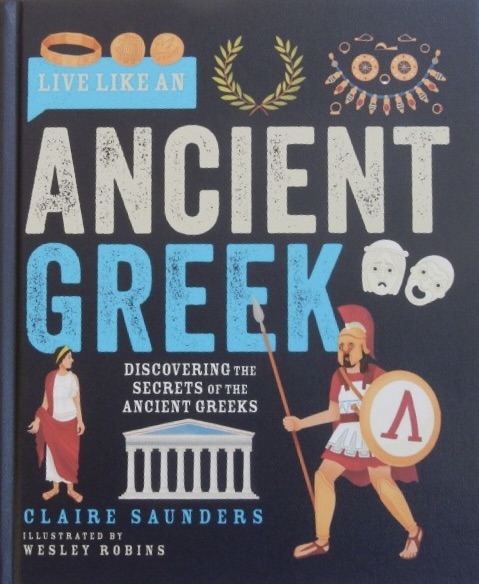
Live Like An Ancient Greek

A wealth of fascinating facts are to be found between the covers of this book wherein the author provides an overview of life in ancient Athens, occasionally expanding her scope and moving further afield.

Living in ancient Greece was by no means idyllic: society was deeply segregaated by class, gender and about one third of the population were enslaved. Women, foreigners and the enslaved were excluded from participating in Athenian democracy. Women did however wear jewellery, which differed according to their status. (There’s a spread giving instructions for making a brooch and a tunic. Great fun especially if ancient Greek life is a topic for a KS2 class.)

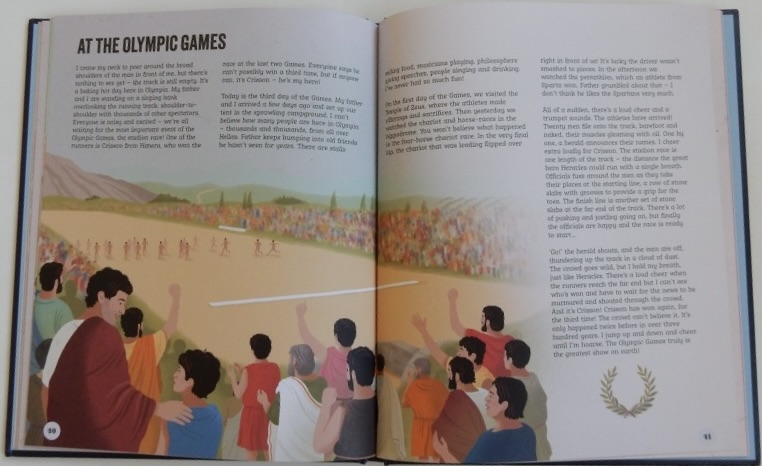
We meet a nine year old Athenian boy, Pentathlos, son of an architect working on building a new temple on the Acropolis. Said boy takes us right through his day including sharing with us his time at school. In his company we also visit Olympia where the Olympic Games are being held; it’s absolutely crammed with noisy spectators and we see that the athletes competed totally naked – in the heat PHEW!
There are brief paragraphs about great philosophers such as Socrates, Plato and Archimedes and huge leaps were also made in maths, science and astronomy and we read of Hippocrates who changed the thinking about where illnesses came from, even going as far as tasting people’s pus.

Most ancient Greeks ate a surprisingly healthy diet that included fruit, vegetables, grains, cheese and eggs as well as lots of bread. (Recipes for pancakes, Greek bread and lentil soup are provided in case readers want to try eating like an ancient Greek. There are also instructions for making a 2-handled drinking cup called a kylix.)

The penultimate spread asks readers: Could you live like an ancient Greek? My answer would be a very firm NO! Imagine using pieces of pottery instead of loo paper. Ouch! Fortunately this isn’t part of the civilisation’s lasting legacy.

A book to add to primary school libraries as well as home bookshelves of children in KS2.

Live Like a Victorian

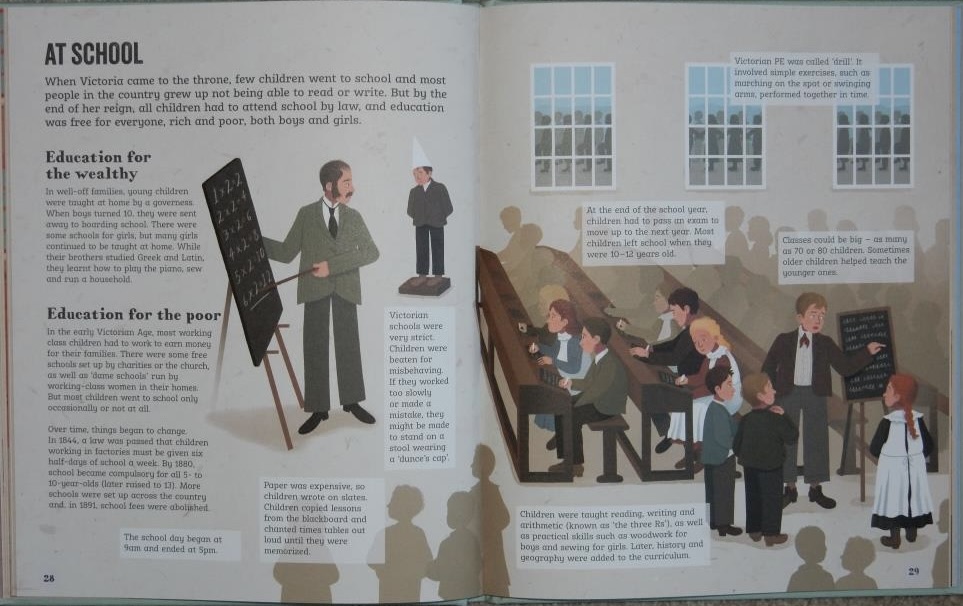
The Victorian age was a time when, as a result of the Industrial Revolution, inventions, new technology and ideas, great changes took place that transformed people’s lives and work. A timeline early in the book shows some of the main events and changes: try imagining life without bikes, electric street lights, cars, railways, movies and aeroplanes – all of which were invented during Victorian times.

We meet two Victorian children, eleven year old Will from a poor family, and nine year old Dora from a much wealthier family. These two help show how very unequal society and hence life was for those with money and those without. Readers get an insight into the difference between the rights and opportunities men and women had, the contrasting grand homes of the rich and those of the poor, life in the workhouse, the work poor children had to do, education,

fashion, food, entertainment, law and order and more.

The book also has some hands-on activities – recipes and crafts – particularly useful if a class is studying this period of history and there’s a detailed map showing the British Empire and trade routes. It’s a shocking thought nowadays to see how in 1910 a quarter of the world’s population lived under British rule.

Claire Saunders’ engaging text and Wesley Robins’ fascinating illustrations combine to bring the Victorian era to life. The book ends by asking children, ‘Could you live like a Victorian?’and there’s a final glossary. One to add to KS2 class collections.

A Nest is Noisy / Secrets of Our Earth / Secrets of Animal Camouflage

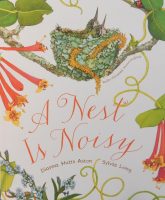
A Nest is Noisy
Dianna Hutts Aston and Sylvia Long
Chronicle Books
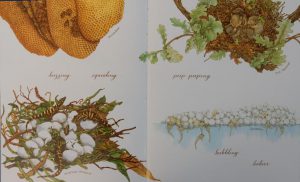
Full of fascinating information, poetically presented, (like its companion titles from this super-talented duo) is this rivetingly illustrated look at the irresistible world of nests. Who could resist Dianna Hutts Aston’s opening ‘ … it’s a nursery of chirp-chirping … (Ruby-throated Hummingbird) buzzing … (honeybees) squeaking … (American Alligator) peep-peeping … (Fox Squirrel) bubbling babies (Gourami)’ …

Did you know for instance that the world’s smallest nest – that of the bee hummingbird – is golf-ball sized and normally wrapped in spider’s silk, the stretchiness of which allows the nest to expand as the babies increase in size?
Or, that orang-utans braid beds of strong branches high up in the rainforest canopy and on rainy nights a woven umbrella of leaves keeps them dry? I certainly didn’t, nor was I aware that lampreys make underwater nests from pebbles varying in size from a pea to a base-ball; and that the temperature of an alligator’s nest determines the sex of the baby alligators.
A splendid introduction to a captivating topic, this is sure to inspire awe and wonder at nature’s creativity while at the same time prompting children to revisit its contents over and over.

Secrets of Our Earth
Carron Brown and Wesley Robins
Ivy Kids
A recent addition to the cleverly conceived Shine-a-Light series of non-fiction titles that makes reading all the more exciting as you need a torch or flashlight, in this instance, to reveal the secrets of our earth from the outside in.
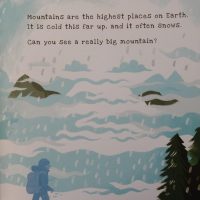
Readers are shown topographical features such as mountains …

and volcanoes, rivers and oceans, deserts and grasslands, rainforests and even cities: Holding the light behind the page gives a behind-the-scenes look at each destination.
Just the thing for Early Years and KS1 topic boxes and ideal for those youngsters who prefer to read information books. Build your topical role play area, then place the book strategically inside with a large torch and see what happens.
Other titles in the series include:
Secrets of Animal Camouflage
Carron Brown and Wesley Robins
Ivy Kids
This is another one of the series. Here you need your torch or flashlight to reveal the hidden world of arachnids, stick insects, Bengal tigers, tree-trunk hiding owls, amazingly camouflaged butterflies and more. Each of these creatures and others are hiding in plain sight in its natural habitat and by holding a light behind the page the camouflaged animal is revealed.

A clever and fascinating, interactive introduction to the vital topic of adaptation made all the more so by Robins’ alluring art work.

On the Plane
Carron Brown and Bee Johnson
This one features everything airport-related from the airline staff at the check-in desk to the pilots who, with the help of a computer, fly the planes.
This is one to read just before that first flight, or next trip.
The Human Body
Carron Brown and Rachael Saunders
This takes readers below the skin to see the skeleton and muscles, and then resurfaces to look at skin patterns, before going internal again to find out about the respiratory system, the nervous system, digestion, excretion, teeth, reproduction and more.
It’s almost a case of whatever topic happens to be your focus, there’s one of these books to illuminate it. Perfect for inquiring minds and show me a young child that doesn’t have one of those.

I’ve signed the charter