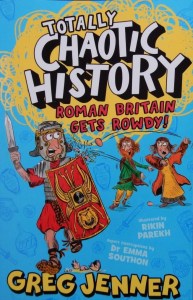
Totally Chaotic History: Roman Britain Gets Rowdy

Greg Jennings is a sure winner when it comes to bringing historical information to primary age children. Here, as with the previous book in this series, he is joined by an expert in the period, in this instance Dr Emma Southon whose discussions with the author, their banter and especially the Accuracy Alarm interjections add to the entertainment value for readers. These alarms introduce the important idea that information relating to history cannot be assumed to be fully accurate, certainty and historical accounts are often open for debate.

Now most people know that Gaius Julius Caesar was the first ever Roman to land on the shores of Britain (Britannia as the Romans called it). However, less know that he came and went, then returned a year later in 54 BCE and even that wasn’t a great success as invasions go. Indeed it wasn’t until the arrival on the scene of Emperor Claudius (who took just sixteen days to out perform Caesar), that despite the valiant efforts of Caractacus, Britain was largely conquered, though that took a few years.

The whistle stop ride through Roman Britain continues with the murder of Emperor Claudius by his wife, the rebellion of Queen Boudica who is eventually defeated in the Battle of Watling Street, the construction of Hadrian’s Hall (122CE),

the crowning of Constantine the Great, who then in 313CE makes Christianity legal in the Roman Empire, all the way through to 409CE when the Romans left Britain for ever.

Your brain will probably be in a spin by the time you reach the end of this book but you’ll have had a great deal of fun along the way and learned (or in my case re-learned) a fair bit of ancient history too. Rikin Parekh makes the book even more enjoyable with his zany cartoon-style illustrations.

One that KS2 readers will battle over I suspect.

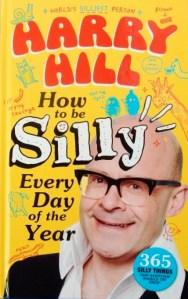
How to be Silly Every Day of the Year

Once upon a time Harry Hill was a doctor but he gave up practising medicine and became a comedian instead. If you are looking for reasons for being silly then you can blame this guy for compiling a book that encourages readers to be silly for a whole 365 days. Alternatively if you fancy a short spell of silliness you can dip in and see what takes your fancy just for a few days at a time. Assuredly you will find some hilarious suggestions among the activities.

Want to impress your parents? How about turning yourself into a human hoover. to do so you will need several rolls of double-sided sticky tape to wrap around yourself. Then all you have to do is lie down on the carpet or a rug and roll around picking up whatever fluff and rubbishy bits are there.

Maybe you’d like to adopt a conker. If so, ask an adult to make a hole through it so you can thread it onto a string and then off you go for walks together. (One of my young relations adopted a pine cone of the longer kind. She named it Violet and wrote stories about it. I don’t think her intention was to be silly however.) And in case you find you’re forgetting to be silly then try creating a SILLY acrostic that you can stick in a strategic spot as a reminder.

With facts of the silly sort and lots of doodle drawings to jazz up its appearance, this is a book to brighten up those days of doom and gloom especially. “Being silly is a serious art,” I heard someone say on the radio recently: what do you think?

Oak: The Littlest Leaf Girl

Oak, the tiniest leaf girl of all lives with her parents in a large oak tree in the middle of the woods. She’s full of fun, has soft wings and bunches in her hair and spends her time playing with her family and her friend, Squirrel. One day though, there’s a chill feeling in the air: “Times are changing” Mama Oak says. “Soon, it will be time to leave the tree behind,” Papa Oak announces.

Oak is worried when she goes to bed that night, fearful of what might be waiting in the unknown wild.

Further changes in the weather take place and eventually with the branches of the oak tree almost stripped of leaves, despite Oak’s reluctance, it’s time for the family to leave. “All leaves must nestle into their winter acorn homes,” says her mother reassuring her daughter that they can return in the spring: even Squirrel says that it’s time for a long winter sleep, so what will Oak do. “ I trust you to go at your own pace and find the right moment to leap,” Papa Oak tells her.

Her parents both leave and go to an acorn home on the forest floor nearby; not Oak though. But then she starts to feel lonely and realises what it is that brings her real happiness, not the tree but her family.

So she closes her eyes, takes a slow deep breath and …

I’m sure the way Oak resists change and the unknown will resonate with young children – maybe they’re just starting school – and Lucy’s story with its fairytale woodland setting provides a warm, non-threatening way to demonstrate the importance of courage, accepting the need for change and taking it in your stride. The illustrations with the difference in colour palette for autumn and winter scenes enhance the telling.

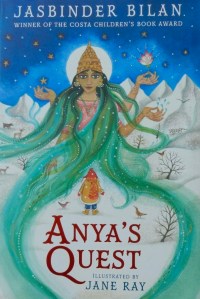
Anya’s Quest

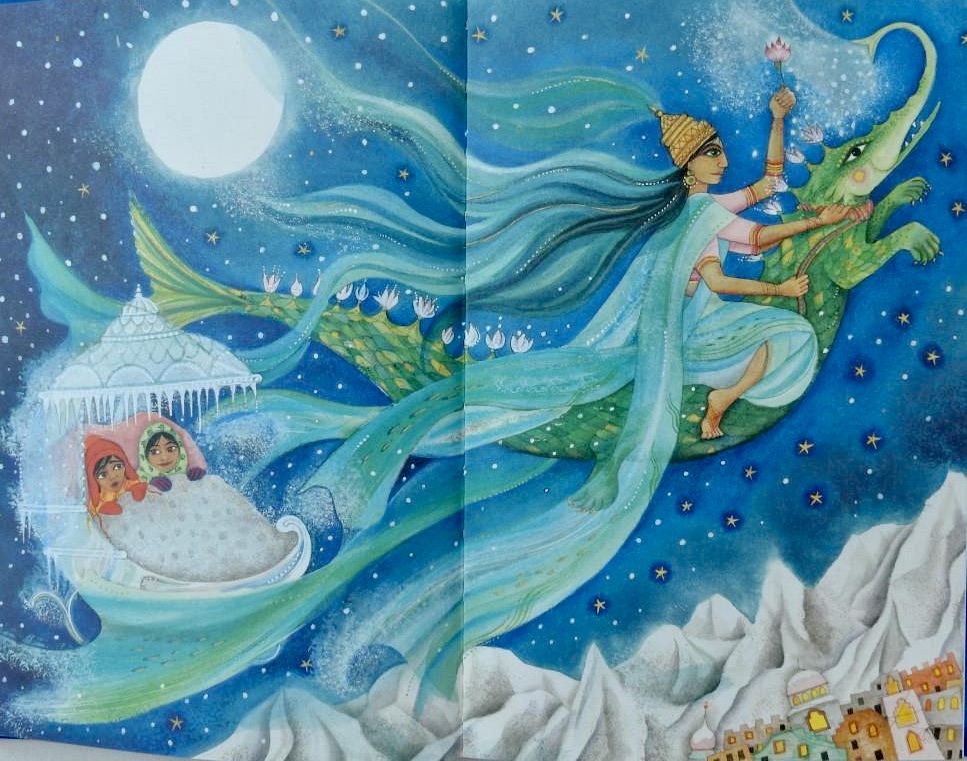
Little does Anya know when she complains to her papa of boredom that she is soon to embark on a vital quest. With her goes Mahi, the cook’s daughter with whom Anya reluctantly accepts as someone to play with in the snow. Anya is called by the goddess, Ganga and the two girls step into a chariot drawn by Ganga’s river dragon spirit companion and they undertake an epic journey through time and right across India.

As they fly Ganga explains that she urgently needs their help to heal the terrible damage that greedy, thoughtless humans have done to the fragile planet over time. They search for elusive spirit animals, lullabies long forgotten and while so doing Anya realises that she’s treated Mahi badly and apologises asking that the two become friends. Friends who can communicate effectively with the children of the world about the horrendous, pollution and its effects and save everything before it’s too late. The girls have to be brave, confront their fears and Anya has to dig deep within herself and connect with her ancestors as her friend has always done. She also needs to find a sacred star-shaped flower from her dreams, said to have healing powers, and use it to help a wounded bear cub.: could the bear be Anya’s spirit animal?

Once Ganga knows both girls are ready, she tells them that they ‘need to join the songs of all the children and sing the earth lullaby’, and thereby gradually heal the planet just like Anya helped the bear cub to heal. She also enlists the help of the other gods to support the earth healing cause and so more and more appear to join in ‘the celebration of sharing the lullabies and the message of hope.’ Finally with a promise to Ganga to do their utmost, the girls return home to the palace where anxious parents await and Anya and Mahi regale them with an account of their adventure and how they intend to make changes in their own lives.

Jasbinder Bilan’s thoroughly enchanting tale inspired by Hindu mythology, and equally enchantingly illustrated by Jane Ray, combine to make a truly gorgeous book. It’s one that will make a superb gift for a special occasion be that Diwali, a birthday, Raksha Bandhan or even Christmas.

Lockett & Wilde’s Dreadfully Haunting Mysteries: The Ghosts of the Manor

Matilda Lockett acts as assistant to spirit medium Signora Valentina (in reality her Aunt Evelyn) and Uncle Barnabus (close friend of her aunt).Really no ghosts appear at her aunt’s seances but she manages to convince those who attend that ghosts are actually reaching out from beyond the grave.
When Matilda isn’t pretending to be Edna at the seances she enjoys trying to solve mysteries.
Then one night Matilda thinks perhaps she did actually see something (or someone) during the act: a ghost perhaps? After the show, a woman bursts into their dressing room, introduces herself as Baroness Rosa Beachamp, announces that her home Beauchamp Manor is haunted and that she needs ‘Signora Valentina’s help urgently. Can her aunt pull off a real exorcism, Matilda wonders: apparently the baroness has offered a tidy sum in payment.

When the three arrive, the baroness introduces them to Mr Symmonds who is there to catalogue a collection of paintings in the folly (supposedly the National Gallery are interested in them) asking that they don’t disturb his work. He plays a violin (terribly) to keep ghosts at bay.
There follows a lot of snooping on Matilda’s part, assisted by a ghost boy, Edgar with whom she forms a bond. But what is Mr Symmonds really up to? A mystery needs solving.

There’s a treasure supposedly hidden somewhere. During their stay Matilda sees and hears things that make her worry about her future. How will this all end?

This suspenseful, often humorous tale, with Pam Smy’s atmospheric illustrations, has eeriness aplenty but it’s also about working together, trust, love and the importance of friendship. Just right to curl up with as the nights draw in.

A bear, a bee, and a honey tree / Dinosaurs: A Pop-Up Book

The book begins with the three natural objects named in the title each shown in an illustration of their own. The bee – a busy one of the honey obsessed kind – then flies out from the tree to visit a flower. The bear – a hungry one – sallies forth intent on obtaining some honey from that tree. On the bee’s return we see two busy creatures in the tree looking far from happy. The drama escalates as the honey hunting ursine faces a swarm of ‘fuzzy buzzing bees’, then cascades down to the ground coming to land in a weedy patch above which one angry bee searches and the bear hides before both the million buzzing bees, still busy, return to their tree and a very disgruntled, exceedingly hungry bear returns to it’s cave.

With its cleverly constructed text using minimal words by Daniel Bernstrom and dramatic story telling scenes by Brandon James Scott, this playful board book will entertain both little humans and grown-up sharers.

There are five double spreads allocated to dinosaurs in this large format novelty board book, each one introduced by popular illustrator, Ingela Arrhenius. First we meet the Long Necks, all nine featured are herbivores, each with a long tail, very long neck and small head.
Next come the Spiky Dinos – ten in all, and every one had bony plates along its back and spikes on its tail. (A Sauropelta (new to me) had spikes all over its body however.) Lifting the flap beside the Kentrosaurus (also new to me) is a sentence about its brain – despite the creature’s huge size, its brain was only the size of a walnut.
The third spread has nine dinos, all with bird-like beaks. Most also sported frills on their necks and some had horns. The least frilly of the Frilly Heads, Psittacosaurus got its name on account of having a parrot-like beak: Psittacosaurus means ‘parrot lizard’.

Fourth come the Feathered Friends, dinosaurs that walked on two legs and were often feathered and winged. The smallest known dinosaur is featured here: it’s the Microraptor.
The final spread features dinosaurs Fast and Fierce and includes Tyrannosaurus Rex, Spinosaurus and Allosaurus. Some of these beasties moved extremely fast, others had sharp claws and teeth with which they would attack and consume their prey.
Most small children are dinosaur mad so this book with its flaps, central pop-ups and brief factual snippets will be a winner for Ingela.

Loki: A Bad God’s Guide to Making Enemies

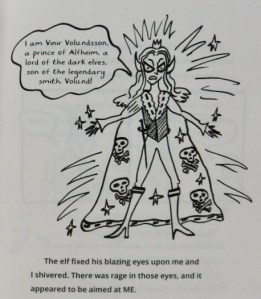
As readers of this hilarious series presented in diary form have come to expect, Loki has once again upset somebody or in fact more than one somebody. This time there’s his school friend, Georgina whom he’s got into trouble and then there’s Vinir Volundsson, an elf prince from Alfheim. Said elf for some reason unknown to Loki, beams him aboard his chariot and challenges him to a duel of the magical kind.

Initially Loki manages to extricate himself from this by sweet talking but the elf doesn’t give up that easily. Vinir even allows Loki to practise his skills but rather than returning to elf land, he turns himself into a a human child who shows up at school. calling himself Alfie. An opportunity for his opponent to study the elf for any weaknesses he might have thanks Loki.

Meanwhile Valerie continues to be obsessed with aliens, Thor remains obsessed with Frost Giants, and Heimdall and Hyrrokkin are pressurised into helping out with the school’s winter fair. There’s so much for our narrator to contend with not least the way a certain elf endlessly witters on about his dad and a seemingly endless string of detentions, not to mention that irritating brother Thor. So many lessons to learn about being good and surprisingly our young hero comes a considerable way in just one month.

Like this reviewer, many primary readers will eagerly anticipate Loki’s fifth adventure.

The Fairy Tale Fan Club

This is essentially a satirical collection of letters supposedly written to or from well-known fairy tale characters, each with an introduction by the supposed narrator—C.C. Cecily, the Senior Secretary of the Fairy Tale Fan Club. Said secretary also wrote a rather long introduction to the whole book where he explains how he came to compile and edit the work. Some readers may well want to miss out this and head straight to letter number one, hand-written by eight year old Ira to Little Red Riding Hood. Preceding this is a brief introduction from C.C using the first of a plethora of puns in the book, this one concerning the child being ‘literally wolfed down’ . This child is bemused by a couple of things in the story: how could Little Red have mistaken a wolf for her grandmother and how could she possibly be swallowed by a wolf and survive the experience. She goes on to enquire about the health of the recipient and ends with a PS asking ‘How “little” are you?’ Back comes an explanatory response covering the salient points.

Later there’s another correspondence – a fan letter of sorts – relating to this story but written by Sebastian (almost seven) to the wolf. The wolf then answers at considerable length.

For those who enjoy toilet humour, there’s a hilarious exchange involving a certain Prince Farty Pants (calling himself a duke in the first instance) and Prince Charming; and the latter proves less than helpful in his concluding sentence.

Another laugh-out-loud letter is penned by Humpty Dumpty in reply to that he received from Tyler (just eight). The egg talks about being anthropomorphised unfairly.

For the thoroughly modern reader there’s Zora’s message to Cinderella sans a single apostrophe and complaining about being unable to borrow her siblings’ iPads. This confuses the recipient who assumes an iPad is a cloth or similar used for cleaning.

In addition to the text there are a number of textured, sometimes finely detailed sketches as well as vignettes preceding each epistolary exchange; a perfect complement provided by David Roberts.
Altogether a very clever, tongue-in-cheek compilation that will appeal to book lovers especially those like me with a penchant for traditional tales.

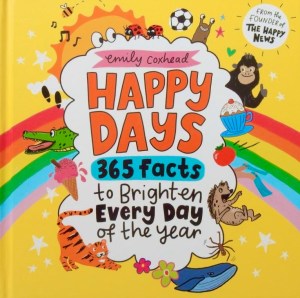
Happy Days: 365 Facts to Brighten Every Day of the Year

A few years ago, Emily Coxhead had a mission: to sprinkle a tiny bit of happiness all over the planet. To that end she launched a quarterly newspaper, The Happy News. Now comes this book aimed primarily at young children. Starting on 1st January, there are 366 fun facts, each one vibrantly illustrated by Rachel Suzanne. Some feature animals, others plants, and there are also facts relating to humans in various parts of the world.

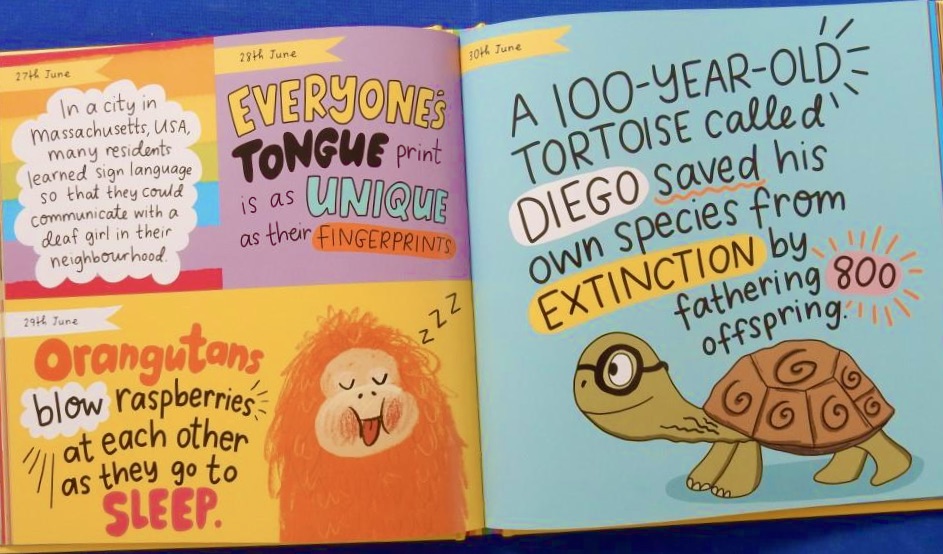
You can either follow the pattern of the book, discovering a new fact each day, or perhaps start by looking at birthday dates of friends and relations. No matter how you read it, you’re certain to discover new facts. Did you know for instance that a group of pugs is called a grumble or that a 100-year old tortoise, Diego by name, saved his species from extinction by fathering 800 offspring. Wow!

I wonder how big a newly hatched tortoise is: a newborn koala, so we read, is the size of a 2 pence coin.

Prepare to be astonished, puzzled and amused as you turn the pages of this chunky book. I was puzzled to discover that elephants can hear better with one foot off the ground and surprised to read playing music to plants helps them grow faster and that lemons float but limes sink. I guess that’s to do with density. A fun, gently educative read that goes on giving.

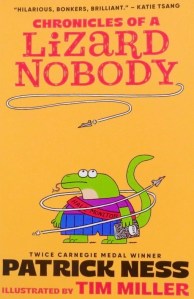
Chronicles Of A Lizard Nobody

“ I’m making you both Hall Monitors,” Principal Wombat said, though she quickly added, “This isn’t because you’re monitor lizards.” So begins this laugh-out-loud school story with a difference , seemingly the first of a series, aimed at primary readers, from Carnegie medal winning Patrick Ness.
It’s not long before Zeke, one of the chosen two and rather large, demonstrates how incompetent he is at the role. He has an unpleasant encounter with the school bully Pelicarnassus (son of an international supervillain), punches him in the beak and loses his position as hall monitor.

Another problem for Zeke soon raises its head at school; it’s that due to an ancient family curse the entire country of France appeared on Zeke’s knee after the death of his father. Now his class is to study France and teacher Mr MacPherson has the lizard sitting on the edge of the teacher’s desk and is using the shape on Zeke’s knee as a visual aid. Add to that the fact that since his father’s death, Zeke’s mother has been suffering from depression and the young lizard has an awful lot to cope with. On the positive side, however, Zeke has some loyal, brave friends who are often on hand to offer wise words and to assist in his efforts to save their school.

Ness uses an anthropomorphic cast to present the sort of issues human children might face at school every day – bullying, intimidation, violence, fat-shaming and insensitivity to disabilities. His combination of splendid silliness, tenderness and poignancy works effectively, so much so that readers will find themselves laughing frequently. Making the whole thing even funnier are Tim Miller’s zany ink drawings. Underestimating a monitor lizard is not to be advised.

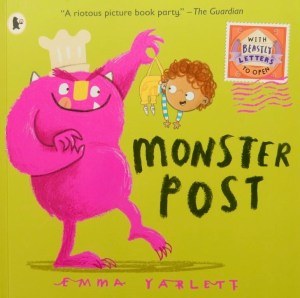
Monster Post

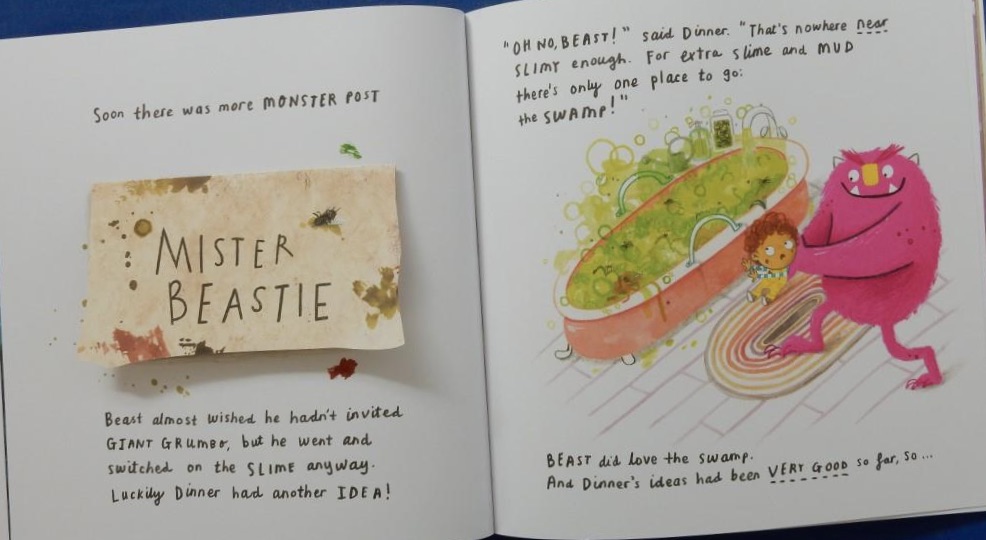
Beast has found himself what he deems will be a vary tasty dinner, so much so that he decides to invite all his friends to partake of a feast. Into a cooking pot goes a very alarmed looking Dinner and off go invitations to Beast’s pals. It’s not long before he receives his first reply; it’s from Sir Gutguzzler who is happy to accept although recommends that Dinner gets a bit more flesh on her body. Out of the pot comes Dinner and is about to be fed something utterly gross when our quick-thinking child aka Dinner makes a suggestion that is sure to make her way more plump.

After some initial reluctance, Beast follows her suggestion and the result is exceedingly yummy. Three further acceptances arrive, each one with a request intended to add additional deliciousness to the feast

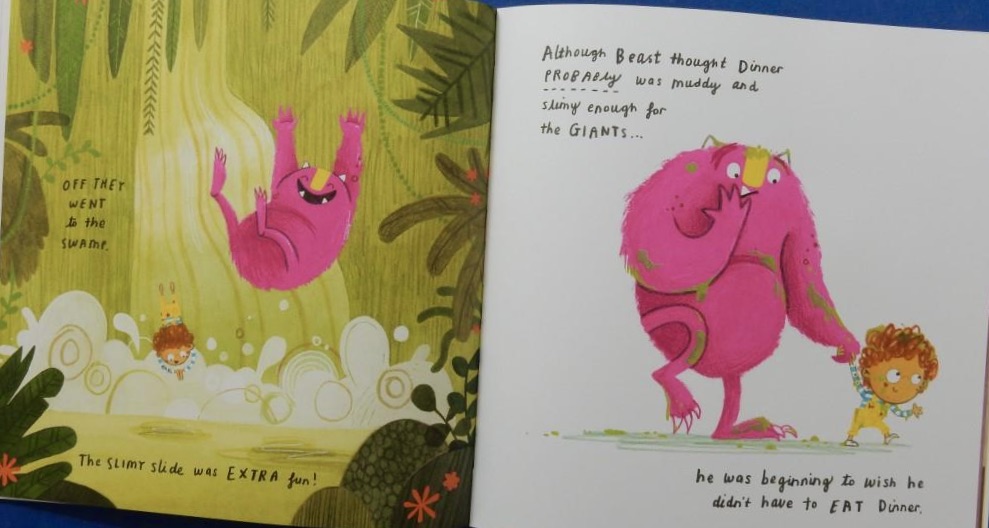
and for each, Dinner comes up with a clever idea. Each suggestion results in Beast and Dinner having a thoroughly enjoyable day together, so much so that Beast starts having second thoughts about eating Dinner.

Then one more acceptance arrives. Beast and Dinner have what is for Beast assuredly the best ever day. Come the evening before the feast, with Dinner having been made super tasty, Beast is feeling far from happy about the prospect of consuming her. She in turn has a change of heart about Beast.

Now Beast has a dilemma. He starts thinking really hard. Is there a way he can make his guests satisfied when they arrive for that much anticipated Dinner?

With communications from Beast’s guests containing disgusting recipes, yucky offerings and preposterous stipulations to open, young children will relish this hilarious, interactive book and demand further helpings after an initial sampling.

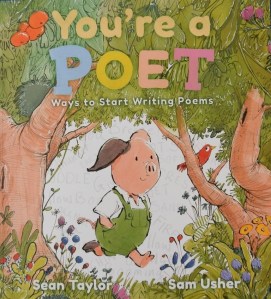
You’re a Poet

In a clever amalgam of story and non-fiction, author Sean Taylor has created a guide full of poetry-writing tips. There are five short stories starring Piglet, his family and friends, each of which shows children a different way to write a poem.

The first, Piglet … You’re a Poet starts with mum and Piglet in happy mood out walking along a puddly track towards a hill. Piglet, stops, picks up a large stone and drops it into a puddle causing a word-splash. ‘Sunshiny, earthy, wet, fresh, splashing puddle, ‘ says Piglet. Piglet has just created a poem, his mum tells him. This special happening reoccurs as they continue their walk, which culminates in the dizzy delights expressed as the two of them roly-poly down the hill and Mum’s confirmation that her son is a poet. Integral to Sean’s narrative is a demonstration of how to make a Puddle Poem and there are two spreads after the tale with a helpful lesson and ‘writing secrets’ aimed at children.

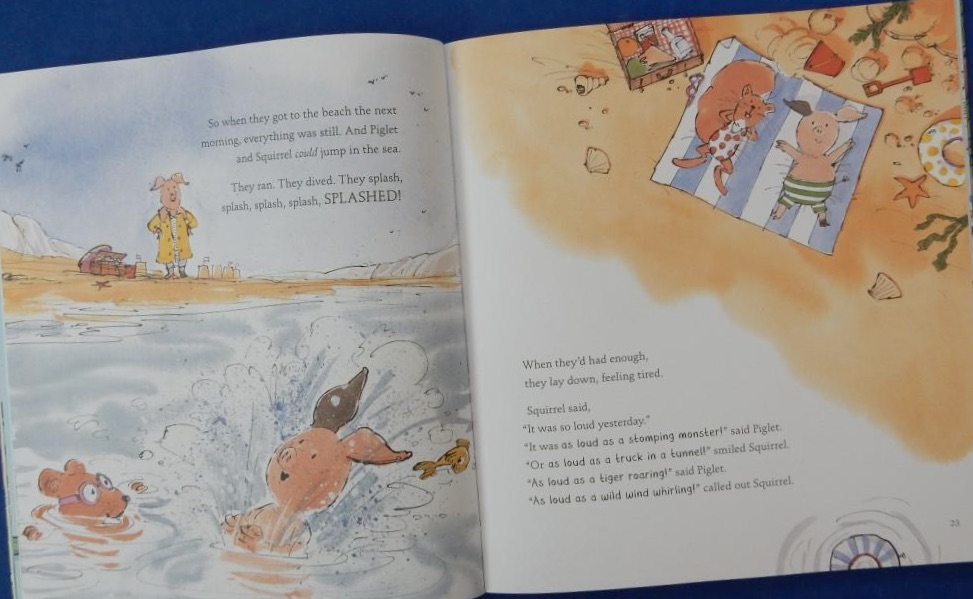
Of the remaining four stories, the second As Loud As Thunder Booming, introduces figurative language in the form of similes during a seaside family holiday on which Piglet’s pal Squirrel accompanies them.

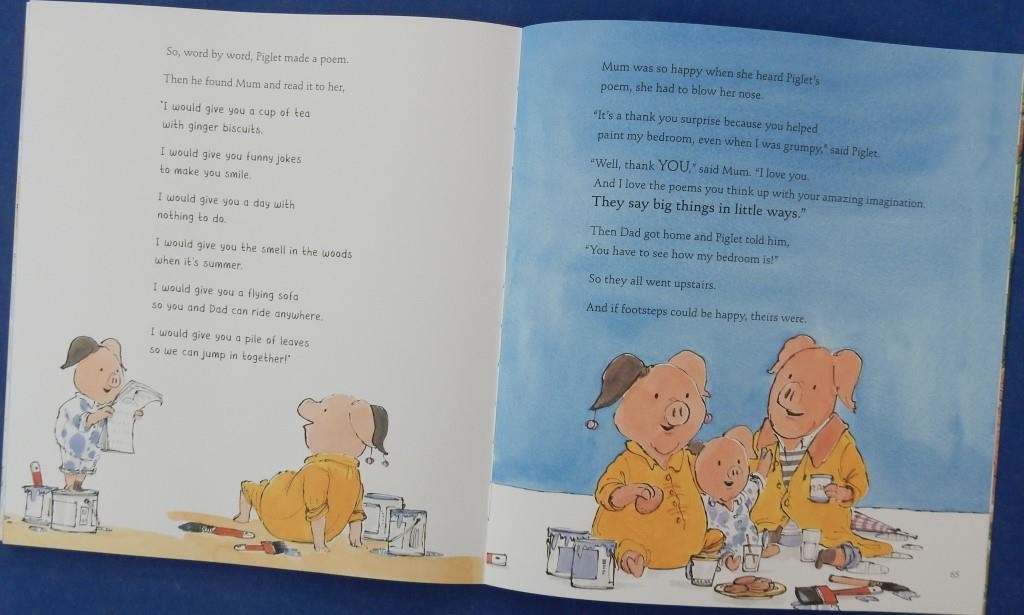
The Breeze Is My Friend sees Piglet and Squirrel getting a soaking but not before the former has invented a descriptive poem about the seemingly playful breeze. The next tale has Piglet and Squirrel sharing a swing, the to-ing and fro-ing of which gives rise to Piglet’s ‘If I Was a Tree’ poem. Finally, on a day of rain showers Piglet invents an ‘I Would Give You’ poem especially for his Mum while the two paint his bedroom walls together; it’s his special way of saying thank-you to her and she in turn compliments Piglet on his ‘amazing imagination’.

With its compelling narrative, writing possibilities and Sam Usher’s playful and dramatic watercolour illustrations that instantly endear the story characters to readers/llisteners, the message ‘poetry writing is fun’ comes across loud and clear. An inspiring, must have book for foundation stage and KS1 classes.

Love in the Library


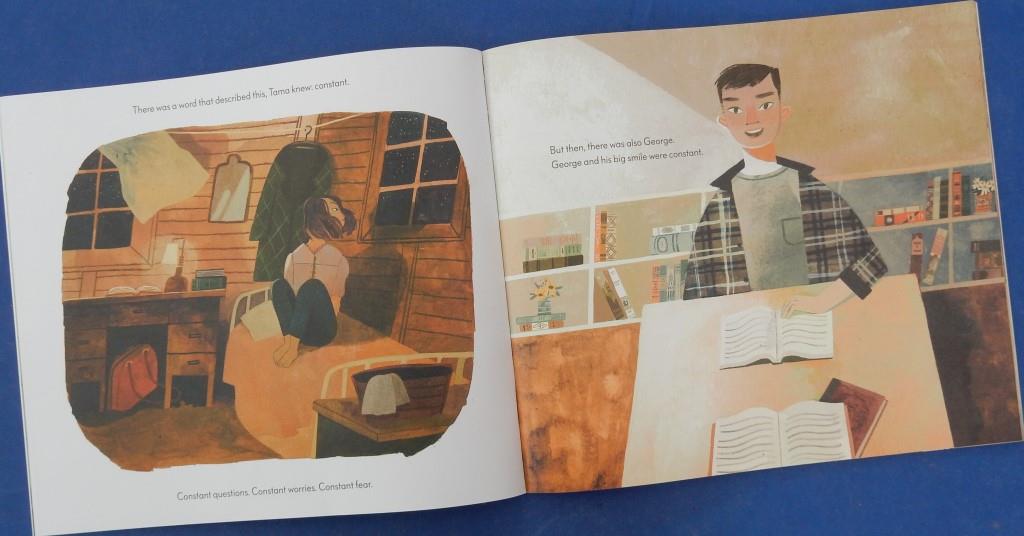
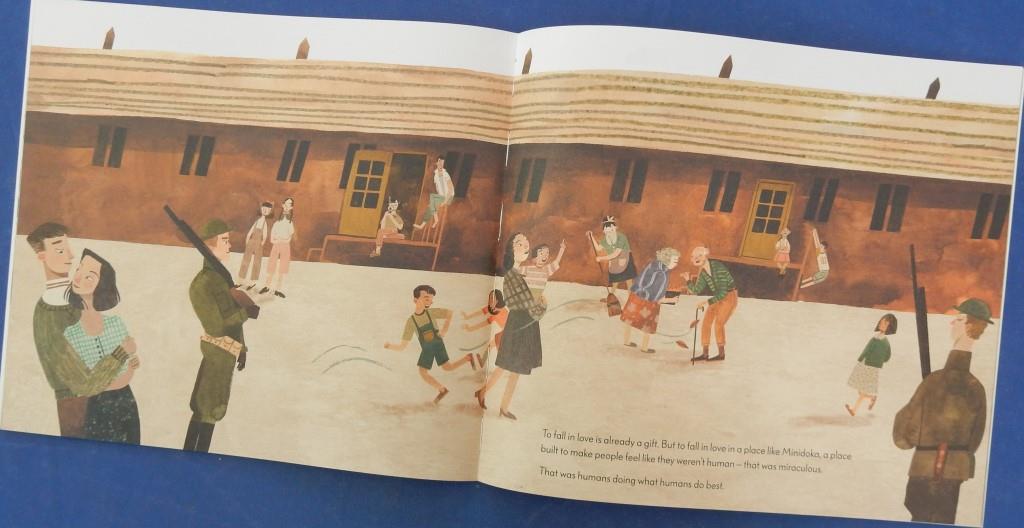
It’s possible to find love, even under the worst situations and so it was for Tama and George in this story based on the experiences of the author’s grandparents who were put in Minidoka incarceration camp during the second world war just for being Japanese Americans. (An author’s note explains the reasons for this terrible unjust treatment at the end of the book.)

This particular love blooms in a desert library in Minidoka incarceration camp where young Tama works. Every day George visits the library; he too is a lover of books, or so it seems as he always takes away a pile of them and always has a smile on his face. ‘Constant’ Tama calls George and his smile

as helped by books, she tries not to spend all her time thinking of the life before incarceration. Instead she thinks of the gift of the books she is surrounded by.

Gradually, struggling to describe her overwhelming feelings, she opens up to George. He offers her a word – human – and it helps her feel less alone; he also uses the same word to explain why he vistis the library daily and takes so many books. Hope and love blossom – a miracle for sure. Tama and George marry and their first child is born in Minidoka – another light in their lives.

Maggie Tokuda-Hall’s telling is beautifully crafted and together with exquisitely illustrated scenes by Yas Imamura in muted tones showing the harsh realities of the camp, highlight the injustice while at the same time celebrate the treasure of hope and love humans can find against all the odds.

A book that deserves to be widely read.

Fart Zoo / Not Another Unicorn Book

Have an air freshener close at hand when you share this malodorous book with youngsters for you’ll be paying a visit to an exceedingly pongy place.

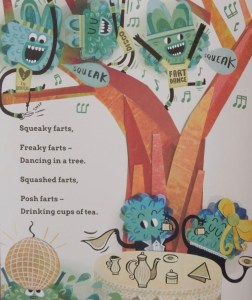
At this unique zoo (make sure you read all the signs at the entrance) you will encounter more than twenty fart varieties so wearing a nose peg or a face mask might be a good idea. Read too the signs relating to the beastie(s) in each enclosure. Thanks to Leigh Hodgkinson’s narrative and madcap visual portrayals you will quickly discover they come in all shapes and sizes including those sneaky, cheeky …

shlumpy and grumpy, squeaky and freaky, even posh farts (though how that’s possible I truly wonder) and several others.

Finally, however comes an empty enclosure: seemingly a fart has done a runner but where could it possibly be? Chaos rapidly ensues. With the zoo gate wide open the escapee might be anywhere, but it’s not actually left the venue. A couple of eagle-eyed security staff eventually apprehend the whiffer (Evade Fartum), put it back on its recliner and lock the gate but how long will it remain there is anyone’s guess – check out the final scene.

Replete with silly speech bubbles, this is fetid fun for little ones and any adult with a sufficiently strong constitution to read aloud Leigh’s rhyming rendition. (Wearing my science studies hat, the final User’s Guide to Farts is not strictly correct as a classification. For instance ‘Escaping farts should be Fartum evado and ghostly farts should be Fartum umbrabilis and so on … ie only the genus name is capitalised, not the species.)

Another subject with great appeal for young children is:

The unicorn narrator of this book is anything but pleased at the possibility of being in a unicorn book, vowing she would ‘never, ever ‘ do so but fate takes its course …


There’s nothing for it but to escape its covers as soon as possible. Try as she might with her chomping, poo-dodging and running, her search for adventure doesn’t match up to her expectations. Maybe being in a unicorn book is not actually so bad after all. Assuredly it has its compensations.

Undoubtedly countless little human unicorn lovers will fall for the protagonist in this rainbow coloured setting with its sparkly starry sprinkles that even hover over the poo piles and delicious-looking confections shown in Chris Jevon’s dramatic scenes

The Dictionary Story

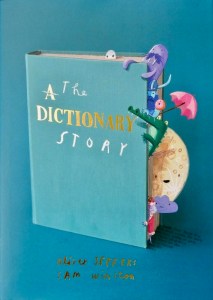
A little dictionary’s realisation that she’s merely a list of definitions whereas the other books lined up beside her on the shelf contain stories, makes her decide that things must change: she resolves to ‘bring her words to life’. Thereupon an alligator of the hungry kind makes an appearance by opening the definitions enclosing him and proceeds to the D pages from where a delicious smell emanates in the form of a doughnut (donut is used here). The tasty confection sees him coming and rather than being consumed rolls off, accidentally right into Ghost – make that through him – and wakes the apparition. Donut continues on its way hotly pursued by Alligator, to the moon. As said moon starts interrogating the two, Ghost appears scaring the moonlight out of them all and prompting Alligator and Donut to rush off until midway through the dictionary the former catches up, only to collide with the Queen who ends up flat on her derriere.

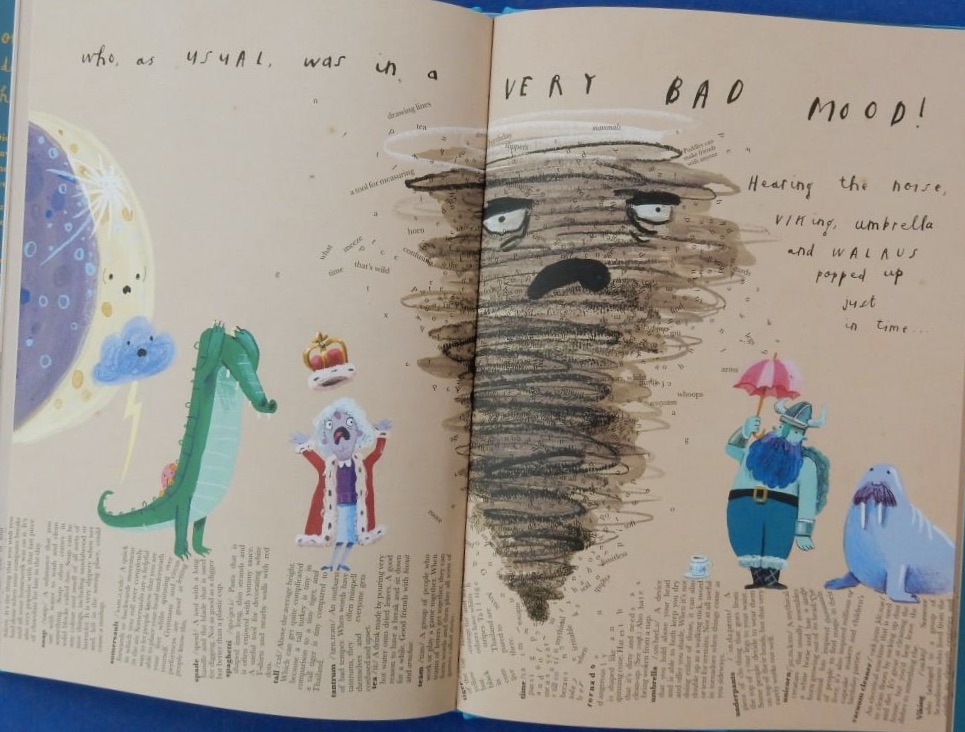
Where will this all end, you might be wondering. Let’s just say total chaos ensues mainly due to the appearance of a tornado, spilled ink, a Viking, an umbrella and more.

In order to restore some semblance of order to the situation and the dismayed dictionary, she calls upon the help of her friend Alphabet whose song solves everything leaving all the words back in their proper places at last. PHEW!

Make sure you read all the tiny print on the dictionary pages ; those definitions are frequently hilarious and very clever, seemingly serving as a stage upon which the alphabetic characters perform. The definition of marmalade for instance is ‘A sort of jam made from citrus fruit, usually oranges. Marmalade is perhaps the main reason that the universe came into existence.’ Vacuum cleaner is defined thus, “An electrical machine that is used to clean floors by sucking up dust and dirt. It’s great at cleaning the house, but you’d best leave the dishes to something else.’

Sam Winston’s comic pacing of the tale – a meta celebration of words – is superb. Superb too are Oliver Jeffers’s naive style illustrations showing the shenanigans of the characters. Totally immersive and brilliantly created right from the real dictionary shown at the front of the book. The more you read it the more delights you will discover, it’s a veritable wordy wonder.

The Seal on the Beach

This treasure of a picture book celebrates the delights of a British seaside holiday: sand dunes, cliff walks, bracing salt water bathing, beach huts, a pier, a boat trip, ice-cream and the littoral wild life to be seen. It’s also a story of a young girl, Maggie’s anxiety; about missing her Mum, her new-born baby brother sick n hospital and the seal pup abandoned on the beach, which she finds stranded among the pebbles while out walking with her Uncle Jack and Aunt Jean.

It’s the most amazing thing she’s ever seen and she feels very protective towards it, so much so that it haunts her dreams.

Her aunt and uncle, as well as the lifeguards to whom they report their find, reassure Maggie that the seal mother will return. That doesn’t happen however and a very sickly little seal has to be rescued and cared for by the RSPCA.

There’s a happy ending though both for Maggie’s own family and the seal pup, named after her, which she sees returned to the sea.

Mara Bergman’s episodic, poetic prose is every bit as elegant as Brita Granstrom’s beautiful watercolours, which are a joy to behold. Feast your eyes on the seaweed, snail and shell strewn endpapers before reading the story with children. For adult sharers it will likely bring back memories of their own childhood summer seaside adventures.

Aisha’s Colours

Aisha and her parents live in Jakarta. It’s the summer holidays so they are going to spend the time at Grandma’s in a countryside village as they always do. However, Aisha’s not happy: she longs to go somewhere different like her friends.

Once in the car, Aisha talks of her friend Jennie; she’s off to a snowy place: what does snow taste like? Recounting Jennie’s description to her parents gives Mum an idea and they stop for a while and savour a special sweet crispy, crunchy treat – es campur.

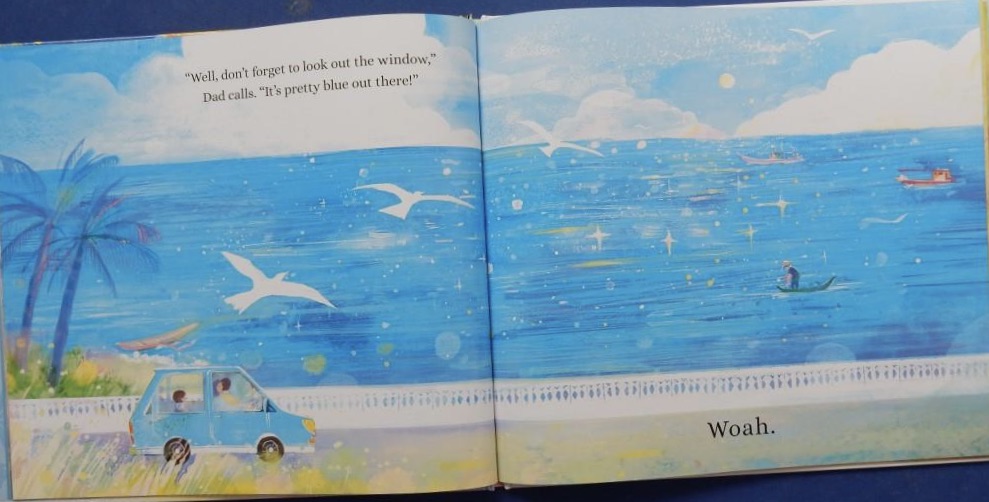
As they continue Aisha talks of the blue sky another friend sees when in his holiday home swimming pool, prompting Dad to point out the stunning blues visible through the car window.

The car engine overheats and they have to pause their journey. At her mum’s behest Aisha and Dad go and lie down in a grassy field where the little girl describes the wonderful hues of tropical fish in an aquarium, another of her friends saw on his holiday. Suddenly the sky is filled with multi-coloured kites soaring above.

When they resume their drive, Aisha contemplates the beauty of the colours she’s seen on the way until they finally reach their destination. There Grandma stands;

Aisha is so excited to see her, but she’s even more excited when Grandma serves up her favourite meal. Could its predominantly yellowy colour be Aisha’s favourite? She’s not sure but of one thing she is certain: henceforward she is going to savour the amazing colours in her own life rather than compare her experiences with those of others.

Appreciating what you have is an important theme of this book wherein Nabila Adani’s illustrations engulf readers in a kaleidoscope of colours as they join Aisha on her journey of discovery.

Olu’s Teacher

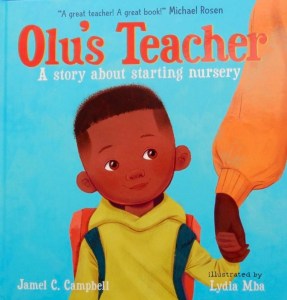
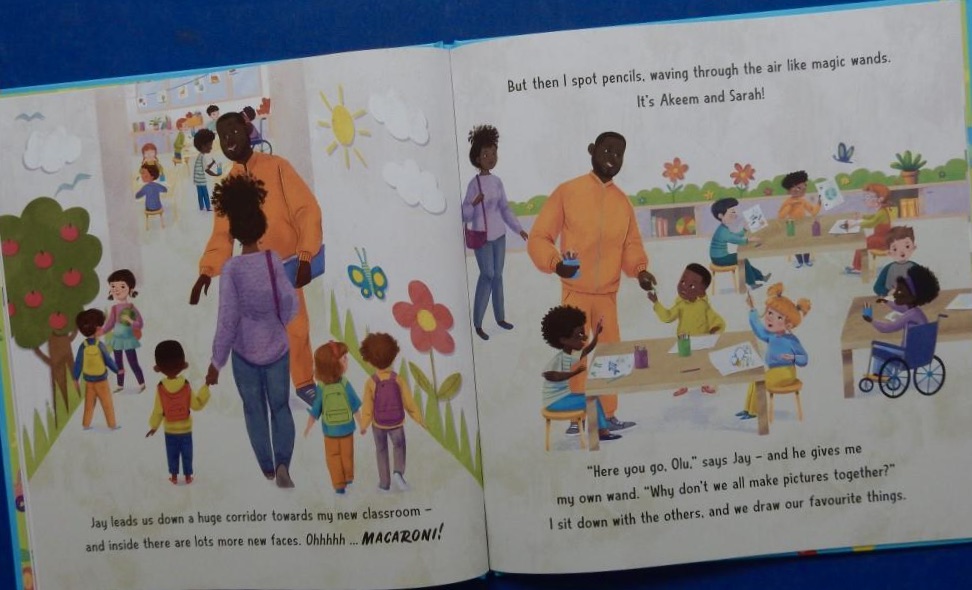
Understandably Olu is very nervous about starting nursery school. His Dad reminds him that his friends Akeem and Sarah will be there, but what about the teacher? As he contemplates this new person, imagining all kinds of scary possibilities, he suddenly says, “MACARONI!” This is the word Olu uses when he’s really nervous. His worries get the better of him several times despite the reassurances from his Dad and Mum; and they reach the nursery building all too soon for our little narrator. However, it’s a really warm, friendly face that greets him and introduces himself as ‘Jay”. When Jay smiles he shows his shiny gold tooth, which he does all the way to the classroom. Once there he invites Olu to sit with his friends and make some pictures.

Mum gives her son a goodbye hug and departs leaving him in Jay’s care.
Olu could not have had a better teacher that Jay: he plays the boy’s favourite reggae music on his guitar

and at story time, dons a special cape before sharing a book with the children. Olu is surprised at how quickly the session has gone and it’s time to leave. Before so doing, however, a realisation dawns: Jay actually looks like Olu – another reason he’s eagerly anticipating returning to nursery the next day.

A smashing, hugely reassuring book by a smashing teacher (the author is himself an Early Years educator) and as he writes after the story, he knows that starting nursery is one of the big, and most important, transitions in a child’s life and it’s vital everything possible is done to ensure that for every child, it’s a positive one. Lydia Mba’s illustrations of the diverse community Olu joins when he starts nursery certainly make it look an exciting, enabling place to be.

Rabbit On the Rampage

Like many young humans, Rabbit has a favourite object that accompanies her to lots of different places and like adults, young children get very annoyed when they can’t find that special thing.
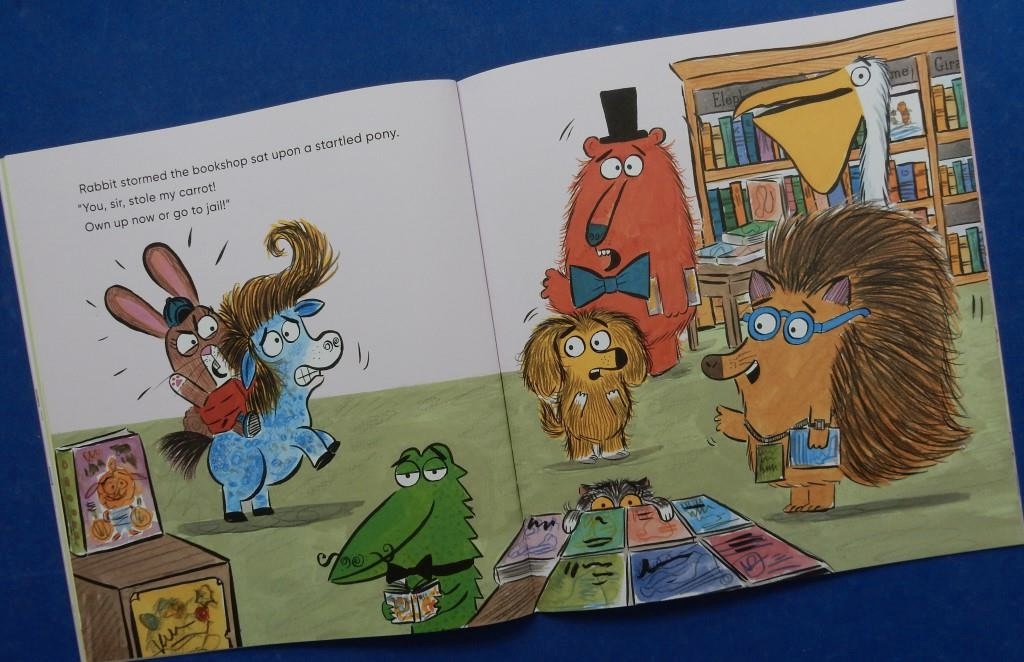
Rabbit’s favourite thing is a carrot; this she takes to swimming with her every Sunday but rather than plunge said carrot into the pool, Rabbit deposits it in her coat before entering the water. One Sunday though, shock horror! When she goes to retrieve Carrot it’s not there. A search of the pool and changing room prove carrotless and Rabbit is convinced it’s been stolen.

Following the suggestion of the swim coach, she retraces her steps; first stop Badger’s home where she’d had lunch. In storms Rabbit accusing her friend of Curly Carrot theft. Badger’s response is to remind her he doesn’t like carrots and instead offers one of his garden peas. This infuriates Rabbit and wow does she let Badger know.

Next Rabbit returns to the dance school where she’d had a lesson with Madame Mouse. Once again she makes a dramatic entry and accusation. This is met by the offer of a cauliflower from the dance teacher, which again infuriates Rabbit causing her to hurl the crunchy crucifer out the window.

A further revisit results in an awful outcome,

though now Rabbit is starting to feel just a tad bothered about the way she’s treated her pals. Off home to bed she goes and there garment by garment she removes her outdoor attire …

Time for Rabbit to make amends to her innocent friends …

Hilarious! Lorna Watson’s debut as picture book author is definitely destined to be a big hit with young children. Her rhyming text is brilliantly complemented by Rikin Parekh’s wonderfully dramatic scenes of Rabbit and her outrageous behaviour as she storms around on her search.

Where the Water Takes Us

When eleven year old Ava learns she’s to spend the summer at her grandparents’ remote island cabin with her Nonno and Nonna, because her mother’s twin pregnancy has become complicated, she can’t let go of the fact that she’s been labelled a ‘burden’. In addition she feels terrified that something awful could happen to her mother.

Soon after her arrival when out paddling the canoe, Ava notices a boy standing with a fishing rod on the dock. He endeavours to make conversation but she turns down his offer of showing her pike and continues paddling before ending up in the water. Ava is so tired that once she’s pulled herself out she falls asleep. She’s awoken by a powerful storm and a woodpecker falling at her feet, which she is unable to revive. This leads to second encounter with the boy, Cody MacDonald, who is with his father and he insists on seeing that she gets safely back to her grandparents’ island.

That evening when Ava and Nonna are talking about birds, Nonna says that a dead bird falling at your feet or on your doorstep can be a sign that a death will come to the family. Ava then hears her mother is back in hospital and decides that nothing else matters except that her mother must be saved. She returns to Deer Island to make a deal with the dead woodpecker. Back at the cabin, Ava is told that rather than trying to call her Mum she should write her a letter and as a further distraction, she should walk to the spring with Nonno to collect some jugs of water.

At the spring there’s another chance meeting with Cody and despite Ava denying she’s friends with him Nonno leaves her with the boy to fill their jugs. While there Ava discovers two eggs – robin’s eggs so Cody says. During the ensuing conversation despite herself, Ava finds she’s getting closer to the boy, and she then takes the two eggs back to her grandparents home for protection. Caring for two baby robins with her Nonna’s help might just be what she needs.

Then a situation unfolds which puts Cody’s life in danger and Ava must summon both her swimming skills and courage to save the day.

With themes of protection, friendship and identity, this is a truly compelling, sensitively written story full of lyrical descriptions about the natural world. The author’s occasional delicate watercolour illustrations have a quiet power of their own: be sure to follow the development of the two eggs along the bottom and up the edge of the recto pages.

Unicornia: Learning to Fly

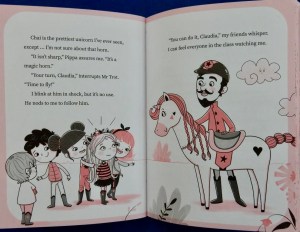
Young Claudia, the narrator of this story, has recently moved to the city of Unicornia. Her first day at the Unicornia Academy of Magic proves much more challenging than she’d anticipated: her potion mixing goes wrong to the amusement of her classmates and then she’s too upset to participate in the Unicorn Flying class which displeases teacher, Mr Trot, especially with an assessment imminent.

Meanwhile, her parents have opened a shop selling magical food and it’s here that she encounters two familiar-looking girls who introduce themselves as her classmates, Pippa and Sara, Before long the three girls are laughing together and Claudia has two new friends. The next day’s spell mixing lesson goes much better thanks to Pippa and Sara and in Magical History Claudia makes another friend, a crow named Nibbles. However the Unicorn Flying class does not go well.

Pippa and Sara take Claudia around the city to get to know it better and one place they visit is a shelter for unicorns, another is the school stables after the staff have left, their intention being for Claudia and Chai (the unicorn Mr Trot had introduced to her) to get to know one another better. Can Pippa and Sara help Claudia form a bond with the unicorn and make sufficient progress to succeed in tomorrow’s flying exam?

Bursting with excitement, and with whimsical illustrations by Diana Vicedo at every turn of the page, this enchanting chapter book is perfect for new solo readers especially lovers of fantasy and magic stories.

Bartie Bristle and other stories

The six charming read aloud tales in this collection are an exciting venture for Julie and Amanda aka the Teddybear Ladies.

In common with the other bears, Bartie Bristle – we learn how he got this name in the first story – has a special magical thread of kindness stitched into him by Mrs T and Rose.
The second story features a lost bear who remains in the shop window and is fed sticky treats until she’s claimed by her owner

The biggest bear in the shop is Sanderson; he’s gentle, wise and extremely helpful. He becomes the school’s ‘Reading Bear’ a role he loves on account of all the books in the school library.

Sanderson plays a vital part in the fourth story too: he explains the importance of bees to the other bears after one buzzes into the shop on a very hot day.

Story five sees Bartie accompanied by Tom Boot (so called as he was fashioned out of a child’s boot) setting out on an adventure wherein they meet the womins. These creatures send the adventurers flying onto the floor – it’s a good thing bears never hold grudges. A very sticky adventure it turns out to be, especially for the womin called Sparkle; he gets stuck in some honey that had leaked from Bartie’s bag. All ends well however, with a friendship being formed between the womins and the bears.

Dear Old Albert is the title of the sixth story. Albert being the name of a bear that arrives in the post in a very sorry state. He requires a lot of work and so stays a long time at the shop. During that time he regales the others with stories about his long life, they become very fond of him and tell Mrs T they’d like him to stay forever. What will her decision be?

With its gorgeous mixed media illustrations by Elke Boschinger this would make a wonderful gift for teddy bear lovers especially.

The Night Whale

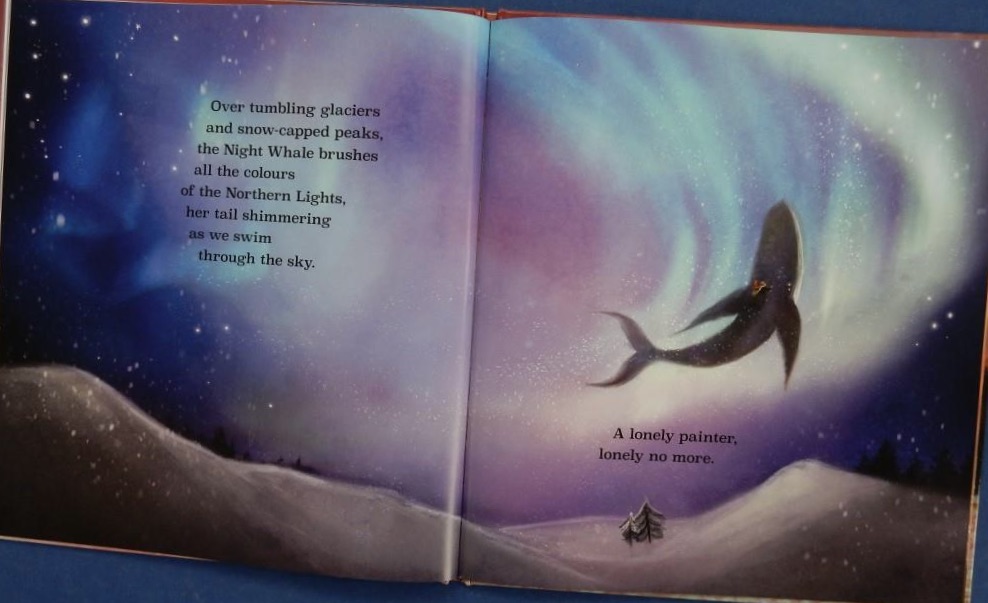
A grandmother and granddaughter sit beneath the stars looking skywards at the patterns and hoping to see the Night Whale, a truly magical creature of the night that Nana hasn’t seen since she was a child.
Then lo and behold, swimming majestically amongst the stars she comes, greeting Nana like a long lost friend. Woman on the cliff and majestic whale in the sky dance, connected, despite it being winter, by a warming breeze.

With the Night Whale’s consent, the two mount on her back and with a whistle, whoosh! They ascend, travelling over seas and forest trees, towns and cities all a-twinkle, as far as the Northern Lights

keeping one another company all the while, until Nana whispers that it’s time to go home. Knowing that their stargazing and night sky painting adventure together is coming to an end, Nana and the child embrace as they look towards the beautiful hues above.

With Nana and the Night Whale’s reassurance that “Anything is possible” this tender, lyrically told tale with Gillian Elide O’Mara’s awesome illustrations offers readers much to ponder upon concerning the enormity of the universe, intergenerational relationships and farewells.

Luigi the Spider Who Wanted to Be a Kitten

If you think spiders can’t be cute you might find yourself changing your mind having read this story.
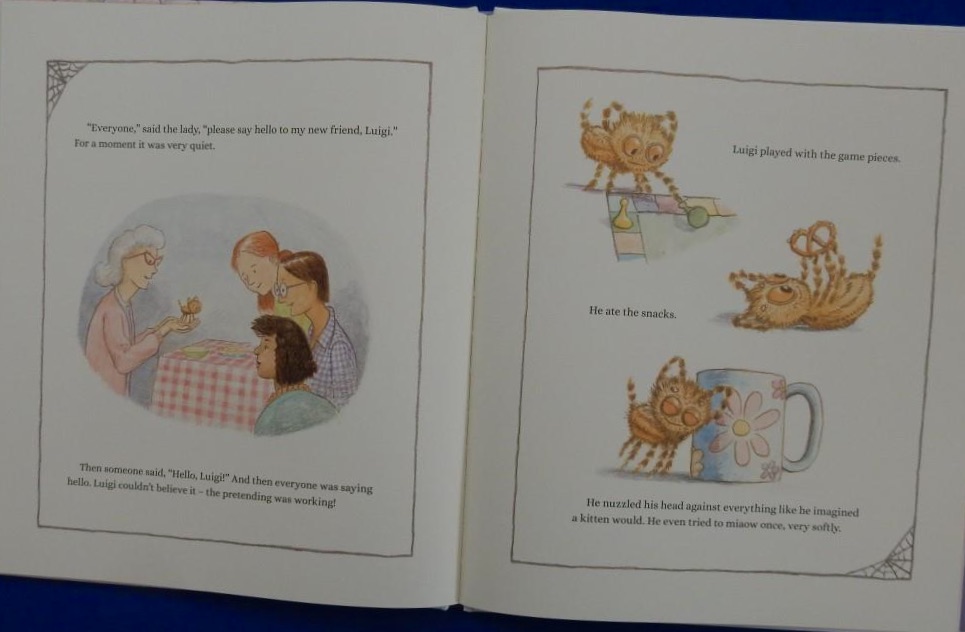
A big hairy spider on the lookout for a new home comes upon an old house that he’s sure will provide plenty of dark nooks and crannies. He weaves himself a splendid web in the dark space beneath an old sofa and falls fast asleep. The following morning Betty, the owner of the house discovers the arachnid, calls him a very unusual-looking kitten and names him Luigi.

Now this spider is sure he’s not called Luigi and even more sure he’s not a kitten. Nevertheless he accepts the woman’s offer of breakfast and finds the contents of the bowl placed before him perfectly acceptable. So too is the game they play together with a toy bug on a string for the remainder of the morning. Then replete with excitement Luigi retreats to his dark spot and goes to sleep.

Next day he’s up before the woman and so begins web spinning, all the while wondering where she is till he decides to take a walk and finds her in the kitchen offering to play again.

Not only does Luigi fancy playing, but he also wants some more of the same breakfast as the previous day. Why not go along with the kitten pretence, he decides and so he does. The woman even goes so far as to provide a cosy bed for him: who knew that kittens led ‘such magical lives’? Certainly not Luigi.

Come Friday, the woman announces that her friends will be coming later on for a games night. Suppose one of the friends reveals his true identity: time to disappear under the sofa, thinks Luigi but the inevitable happens. Out comes the woman’s hand, out comes Luigi and introduction is made

Eventually the pretence is over: he couldn’t fool those visitors but what about Betty?
Luigi beats a hasty retreat but next morning he receives a surprise declaration from her and an invitation that lifts his spirits.

Kevin Hawkes’ acrylic and pencil illustrations, be they large or small, portray Luigi’s kitten-ness with panache making him a delightful and endearing character and Michelle Knudsen’s longish text offers a sympathetic story of being yourself, trying out a new persona and companionship that works well as a read aloud or for confident solo readers to enjoy for themselves.

Pavlo Gets the Grumps / Two Birthdays

There are days when we wake up and everything seems out of kilter: Pavlo is having one of those. Nothing his Mama suggests be it a visit to the park, a swim or a cinema outing, appeals to Pavlo. Why is that?

Mama suggests it’s an attack of the grumps and that he best treatment is to go out anyway, so they do, Pavlo somewhat reluctantly. However before long there’s a shout of ‘Pavlo! … Are you OK?” It’s his best friend, Mila who understands just how to respond to his “I’ve got the grumps”. Happily she also knows how to get get rid of grumps and off they all go for a good mood restoring whizzy slide followed by a tasty treat. I wonder what they’ll do next?

A comforting hug of a picture book that shows little ones (and reminds bigger ones) that sad feelings don’t last forever and friends are often the best remedy.
Both sad and funny at once, Natalia Shaloshvili’s soft focus smudgy illustrations are a wonderful reassurance that no matter what kind of day we’re having, even a grumpy one, there are family and friends who love and nurture us, and happier times are coming.

Cedric the crocodile and Boo the elephant are the very best of friends. When Boo’s birthday comes, so do lots of cards, a very special extra long scarf specially knitted by Cedric and the two celebrate with enormous ice creams for tea. Boo declares it’s his best ever birthday.

Cedric’s birthday is a few weeks later; he too receives lots of cards and presents. However there’s nothing from Boo. He waits and waits and eventually calls his best pal but it’s clear to him that Boo has completely forgotten his birthday.

The following day the two meet in the park, Cedric riding his new birthday scooter.

Boo notices and asks about it and quickly realises he’s missed Cedric’s birthday. Is it too late or can he put things right and make his best pal feel happy again.

A simple story showing that true friendships can transcend accidental errors. As always Tim Hopgood’s bright, collage style illustrations are a visual delight, even the sad ones.
Share with preschoolers and I suspect they will have lots to say about this.

Smelly Peggy

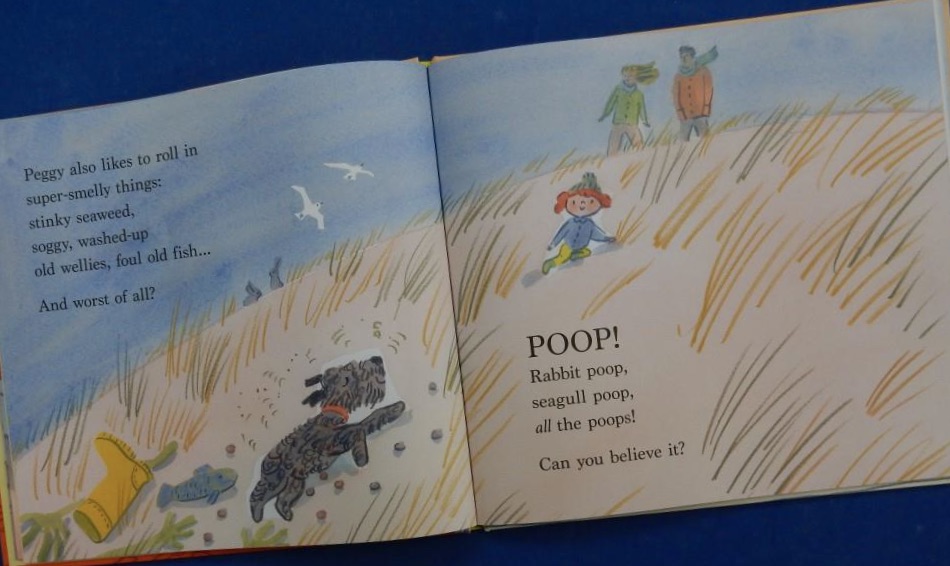
Young Pie has a rescue dog, Peggy, and she’s full of mischief, getting up to such naughtiness as disturbing the tranquility of Pie’s parents every morning. As they lie abed the pooch even makes off with Mum’s knickers. Then on walks, having got used to sticks, she thinks nothing of sending the entire family head over heels in the sand as she cavorts around with huge lumps of wood.

Super-smelly things are one of Peggy’s predilections, the worst of all being poop.

She’s not fussy what kind; so long as it pongs she’ll roll over and over in it. PHOAH! Imagine the mess and the stench when they get back home and she has another roll about; this time on the rug and Pie’s pjs.

As you might expect, Peggy detests having to have a shower and gets her own back by giving herself a very vigorous shake to get rid of the water once her paws are back on the floor.

Despite all her flaws and mischief, Pie and her parents cannot help but love their pet but there are times when the powerfully malodorous emanations from her rear end are well nigh unbearable.

Now I’m no pooch lover, in fact I’m a cynophobe but I can quite see how beguiling Pie’s Peggy is. Helen Stephens’ portrayal of this family pet is at once funny and tender and her tale is one that will endear Peggy to readers, rescue dog owners especially.

Natterjack Toad Can’t Believe It!

Most of us have a favourite snack and so it is with Natterjack Toad. As the story opens he’s languishing among the reeds in his hammock anticipating tucking into his packet of Chocolate Chunk Crunchy-Munch cookies. Mmm! they do sound delicious.

They’re mine! thinks Natterjack Toad, ‘And this hidey-hole is just the place for munching one up.’ Out comes a cookie, out comes NT’s tongue in preparation for a yummy taste but along comes a huge heron, beak at the ready. Now our Natterjack friend has no intention of becoming the heron’s next snack so back goes the cookie and off he goes at top speed.

His next stop is the meadow with its long grass and summery flowers: the perfect spot for a nibble. Out comes a cookie, open-mouthed, NT anticipates that choccy flavour but once again Natterjack Toad ‘CAN’T BELIEVE IT’. Right beside him is a whiskery weasel with mouth wide open.. Uh-oh! Back in the basket goes the cookie and away ‘quickety-whip’ goes Natterjack Toad destination the forest. Surely here in a cool hidey-hole he’ll be undisturbed. Or maybe not.

As he’s about to consume his treat, right beside him appear a mole and a vole. Will Natterjack Toad heed their words of warning regarding a huge hungry marauding animal? There comes that open mouth, that ready tongue and a mighty CRUNCH! Yikes! There before the three stands …

How will this tale end? Tasty treats for the large beastie or …

Deliciously playful, this dramatic tale is an absolute treat to read aloud. I’m not sure who will find it more tasty, the adult sharer or the young listeners who will be on the edge of their seats, joining in at every opportunity as the story unfolds. Sean’s patterned text combined with Kathryn Durst’s hilarious scenes are a confection too good to miss.

To the End of the World, Far, Far Away

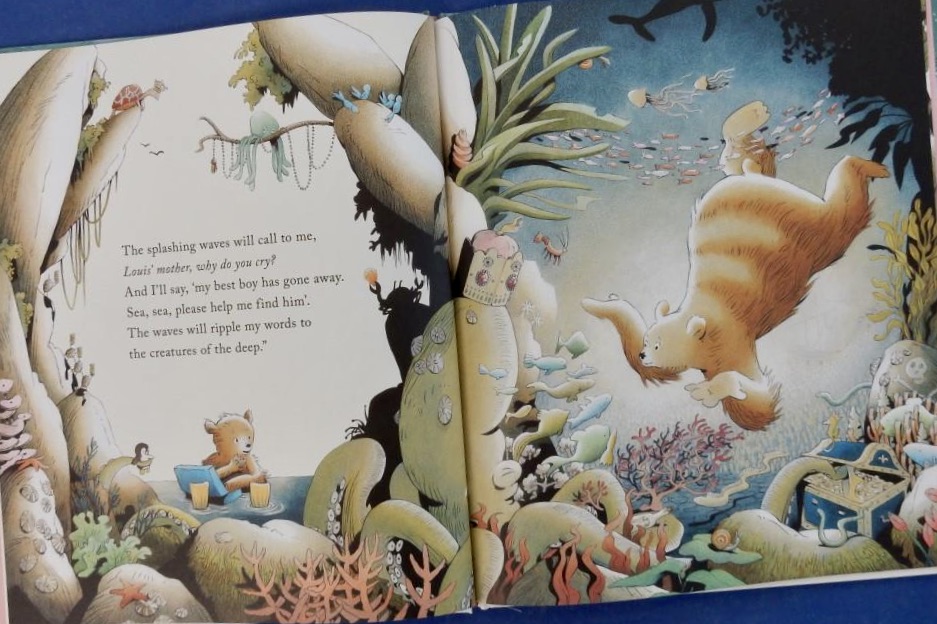
An accidental spillage by little bear, Louis, makes Mum a bit cross. Louis cries and decides it’s time he headed off, far, far away right to the end of the world. With bag in hand, he pauses, turns to Mum and asks, “Will you be sad when I’ve gone away?” Mum then goes into dramatic mode, describing how her tears will create a great sea, wherein the waves will ask about her sadness and then transmit her words to the marine creatures.

She’ll then climb a tall mountain atop which she will beseech the wind to help her in her search. The forest trees she visits will carry her distressed message to the creatures there.

Will that exhaust all her sadness, Louis wants to know. But no, even his own toys will start to cry for nobody will be there to tuck them up and hold them tight at bedtime.

By now readers and listeners will have realised that Ronda Armitage’s dramatic “going away” tale is showing the depth and breadth of motherly love enacted in a kind of game that both parties thoroughly enjoy playing. Who better to illustrated this than Victoria Turnbull whose scenes are filled with wonderfully whimsical details at every turn of the page, while the changing expressions on the faces of the two characters are a delight.

Like this game that’s likely played over and over by its protagonists, the story too will be oft requested by young children and read aloud over and over by parents and other adults.

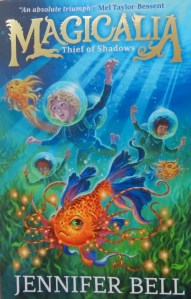
Magicalia: Race of Wonders

Bitsy’s life is pretty normal as she endeavours to find interesting events to cover in her attempt to follow in her journalist mother’s footsteps. She enjoys creating podcasts with her best friend, Kosh, but things are pretty dull in Oddington, until that is a raven-haired woman appears in her home accompanied by a magical beast. An argument about a book ensues and this is followed by the disappearance of her Dad (an astrophysicist), along with the woman and the purple hamstoceros beast. Not however before Dad has summoned a creature of his own, Quasar, and instructed it to protect Bitsy and Kosh.

Bitsy then decides to search for clues as to where her Dad might have been taken. She comes upon an old book entitled Magicalia wherein are lists of majicores and the emotions that conjure them. The two children must use this book both to locate Eric (Bitsy’s Dad) and to work out why he was taken. First stop the address atop a letter Bitsy has found, and.there she learns things about her parents, secrets that they’d been keeping from her..

With the help of the powerful Magicalia book what follows is an incredible adventure- a race against time – taking them across the globe to places as far apart as India’s Taj Mahal and Paris as they too become conjurors of majicores and follow the clues in the hope of rescuing Bitsy’s Dad from a mysterious enemy.

Building a world of majicore beasts created by emotions is an awesome achievement on Jennifer Bell’s part: her spellbinding tale wherein the importance of creativity and courage and the power of friendship are key, will grab you from the outset and hold you captive until the end. Part of the magic also lies in David Wyatt’s illustrations of the majicores that introduce each of the twenty six chapters. Happily though it isn’t quite the end; Race of Wonders is the first of a series.

Ranger Hamza’s Eco Quest / Brown Bears

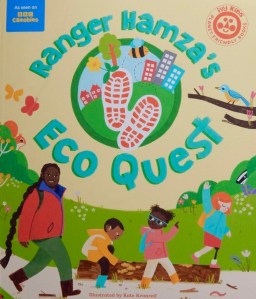
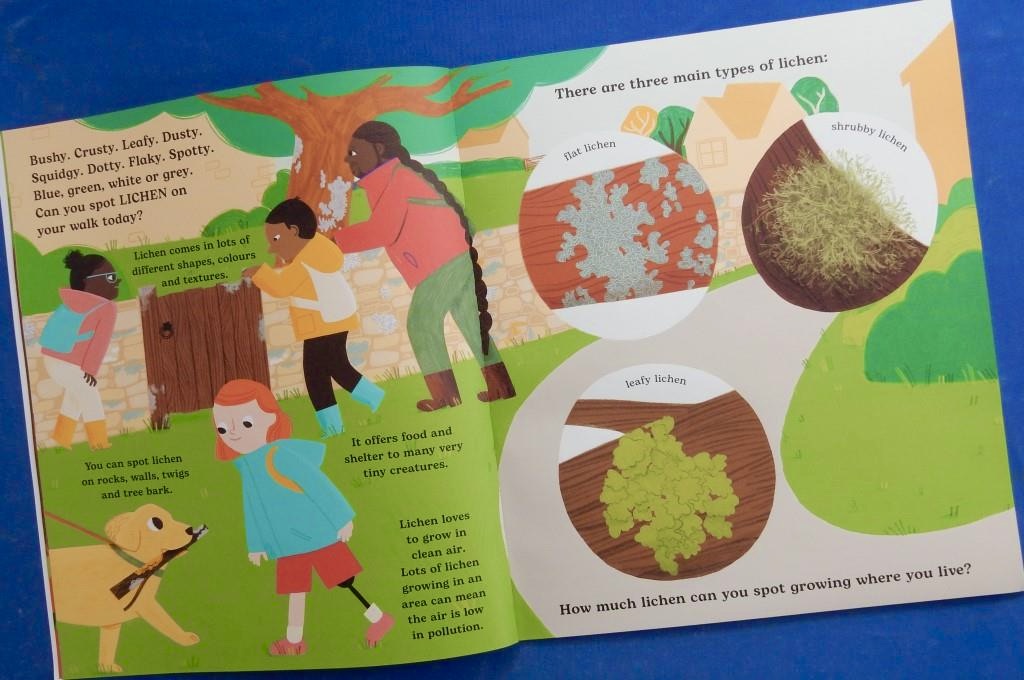
It’s great to be back in the company of Ranger Hamza and here he takes three children and readers on an important learning journey to discover how nature’s everyday heroes from the smallest seed to the tallest tree play a crucial role in our ecosystem, and how we also have a vital role to play. It’s not difficult and Ranger Hamza explains in straightforward steps some ways to help the planet, starting with the making of a mini water butt.
I loved the adjectives used to describe lichen, of which there are three types. In addition to providing food and shelter to tiny creatures, lichen acts as an indicator of the air quality in an area: lots of lichen indicates the likelihood of low pollution, so next time you walk with children keep a watch too see how much is growing.

One thing virtually everybody will notice is dandelions; rather that pulling them up (even from your garden), leave a place where some can grow. In so doing you will be helping several kinds of insects. I know from experience that children love to plant sunflower seeds and watch them grow: this is a great way to provide food for birds, so long as you keep the heads, let them dry out and then put them somewhere birds can access.
These are just some of the suggestions in this thoroughly engaging, inclusive book. It’s never too soon to start teaching children about ways they can help nature thrive so I suggest adding a copy to your family bookshelves, and foundation stage/ KS1 teachers, you need one in your classroom: it offers an abundance of forest school activities.
Another highly effective narrative non-fiction book is

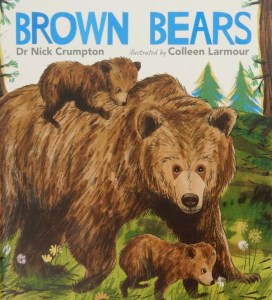
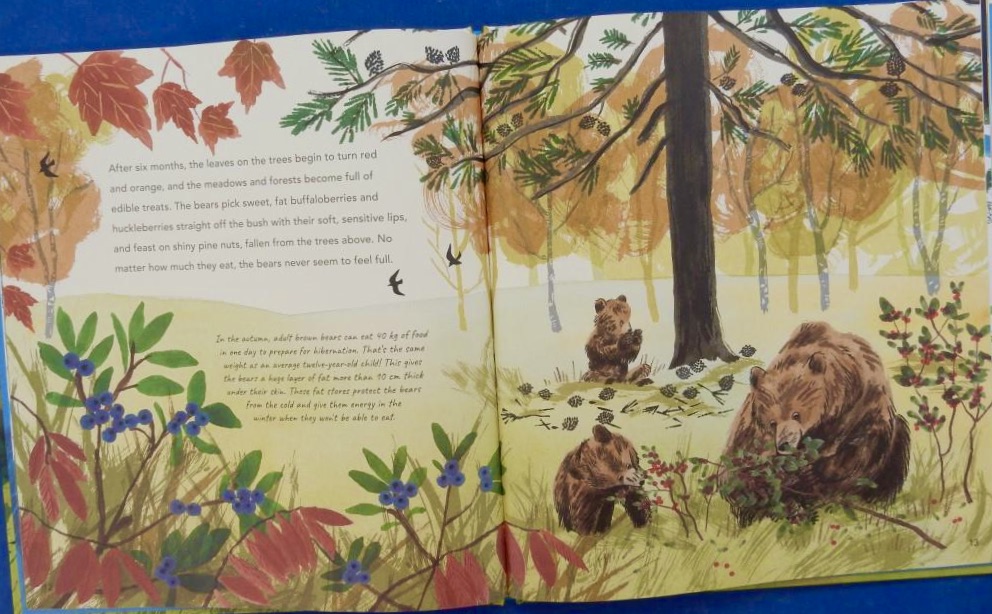
Set in Alaska, USA, this tells the story of a mother brown bear and her two cubs, one male, one female that we follow through a year in the forest. Therein lie dangers aplenty so, almost as soon as they are born, the mother bear starts teaching her offspring survival skills in order that they will be able to live and thrive alone in the wilderness.
The cubs learn to climb, to leave scents to inform other bears where they’ve been and to remove bugs from their skin. It’s dangerous for bears to stay too long in locations where people have left discarded food, as this can endanger both humans and the bears that have followed their noses. Much better is picking berries and foraging for nuts in the meadows and forest areas, which is what the cubs do come the autumn to build up a layer of fat to help protect them through the winter when hibernation prevents them from eating.

Come the snowfall, mother bear builds a new den wherein they will all spend the winter, in the warmth trapped by the tree branches covering the tunnel’s entrance.
After a whole seven months the mother wakens as do the cubs, the light hurting their eyes after so long. Then it’s out into the melting snow to start feeding again and come the summer part of their food will be salmon that have come to lay eggs in the gravelly rivers. Danger isn’t over however; indeed it comes in the form of a massive, very hungry male brown bear; but thanks to the cubs’ climbing skills and their mother’s warning sounds, the three remain safe and as autumn approaches again, the male cub will leave his family and go in search of a new home
Beautifully illustrated and captivatingly written, (with paragraphs of additional information to enjoy either during or after reading the main narrative), this is perfectly pitched for KS1 children.

Beti and the Little Round House

Beti and baby Jac live in a cosy little round house built by their Mam and Tad in the woods beneath the mountains in Wales. Living close by are Mr Crouch; his house is a tumbledown round one, and in a ferny house live Beti’s friend, Billie, and her mother Fern.
The book follows Beti and the adventures she has presented in four stories, one for each season, starting in the spring when Beti celebrates her birthday with a party and receives a surprise present in the form of a goat to provide her with milk every day; make that a double surprise for along with the mother goat comes a tiny little baby one. Beti names them Goat and Naughty.

When summer comes, Beti enjoys collecting food from the garden – peas and strawberries but she’s not the only one eager to gobble them up: Naughty has her eyes on them too. Back indoors, the little girl has problems amusing her little brother so Tad sends her out and she goes to visit Billie and together the two friends, aided by another friend, Blue, spend the rest of the day endeavouring to fill up an enormous jar with water from the nearby waterfall.

Unsurprisingly there are spills aplenty but also magical seeming dragonflies to assist – fairies, so Beti tells Mam and Tad.

Autumn brings dark evenings and lots of berries to pick and make into pies before the birds gobble them all. There’s also fierce stormy weather that reminds Beti of a dragon with its roaring sounds and she falls asleep somewhere that isn’t her snuggly bed in the little round house. The day ends well though, with huge helpings of Mam’s delicious pie.

With winter comes the ice and snow, a poorly Mam, escaped horses and Beti overcomes her fear of the dark.

Sheer delight from cover to cover. With its gentle humour, Atinuke’s gorgeous descriptions of the natural world and Emily Hughes’ wonderful colour or black and white illustrations on every spread, and themes of family love, friendship and the power of believing in oneself, this is a lovely book to read aloud to foundation stage children. For most of them the portrayal of a simple way of life will be something entirely new.

The Bravest Word / The Feeling Good Club: Believe in Yourself, Bella!

A powerful story of trust and love between a boy and a dog that addresses depression in youngsters, it will surely help readers who are struggling to recognise the symptoms in themselves. It will also reassure those readers that they aren’t alone and however confused and scared they might feel, there are ways to cope, so long as they seek help from somebody.

Eleven year old Matt, a soccer star is suddenly beset with thoughts of “I can’t do this” especially when it comes to playing his favourite game and he feels tired all the time. He’s way too scared to talk to his mum who clearly cares but puts his troubles down to hormones, and he won’t say anything to his dad for fear of upsetting him

Then, as he’s out walking with his dad, they come across an abandoned dog that has clearly been very badly treated. Matt is determined to save the creature and decides to call him Cliff after his grandad. He also finds a scrap of paper with the words UGLY, SAD DOG. HE’S YOURS close by. Off they go to the emergency vet and having followed the required procedures, and persuaded Mum, Cliff finally goes to live with the Brown family.

As Matt cares for the newcomer, we see that boy and dog exhibit similar emotions: Cliff recovers physically but remains withdrawn and anxious while Matt remains determined to restore the pooch’s faith in human beings as well as restoring his own zest for life. It’s an arduous slow process, the highs and lows of which Matt shares with his new canine buddy.

In doing so, Matt perceives his own situation with increasing clarity. Bit by bit, the boy begins to open up, sharing, his despair, his sickness, his hopes, through Cliff’s social media presence, which soon becomes viral. There’s enormous on-line support for the dog and by association Matt, from virtual strangers, which finally forces the boy to find the courage to ask for help. “I think I might be depressed,” he tells his Dad. Dad’s response is enormously understanding; he’s clearly proud of his son and feels great empathy towards him. Matt then discovers that he’s not the only person who has problems with their mental health. Then surrounded by love and support, he is allowed to rest and begin to heal.

A hugely important, beautifully written, honest book that shows children they are not alone in their struggles, and that as Matt’s Dad tells his son, asking for help is the bravest thing.

Bella, Archie and Shazmin are three friends who set up a mindfulness club to help them understand and handle their feelings. This has really boosted Bella’s self-confidence, until the three decide to enter the Muddy Assault Course Challenge in the hope of winning £50, which they intend donating to WaterWorks (a charity). They call themselves Ace Team but they’re one person short. Billy, a rather loud, over-confident boy offers not only to join their team but also to coach them. Training begins in earnest that weekend and after one session Bella wants to pull out of the event.

Things go from bad to terrible when the team hold a training session in Bella’s garden and end up wrecking Mum’s favourite plant pots and making a whacking great hole in Dad’s new fence panel and the only one who doesn’t straightway apologise to Bella’s parents is Billy.
Somehow Bella needs to find the courage to talk with Archie and Shazmin, Billy too, about how she really feels. Can she do so and set Ace Team back on the road to enjoying preparing for and participating in, that challenge?
She’s fortunate to have Jess, her older sister, to discuss everything with; among other things that really helps her get her feelings about Billy out in the open, though as events unfold she ends up with a much greater understanding of why he behaves in ways she doesn’t like and ends up calling him a friend.

This is Bella’s second turn of sharing her diary with readers: I wonder who will be next in this very enjoyable series. Make sure you check out the mindfulness activities at the end of the book.

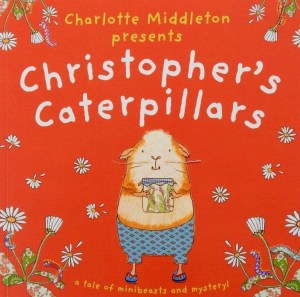
Christopher’s Caterpillars / Maisy Goes for an Eye Test

While working in the garden with Posie, his best friend and fellow football lover, Christopher Nibble hears a strange munching crunching sound coming from his dandelions. It’s six hairy caterpillars feasting on his prize plants. What should he do? Certainly not let them continue eating his plants. Posie suggests they keep them as pets.They compile a list of possible needs and off they go to visit Mr Rosetti at his café. He amends the list and gives them some caterpillar keeping advice. The caterpillars munch and grow bigger and bigger until they’re no longer in their container.

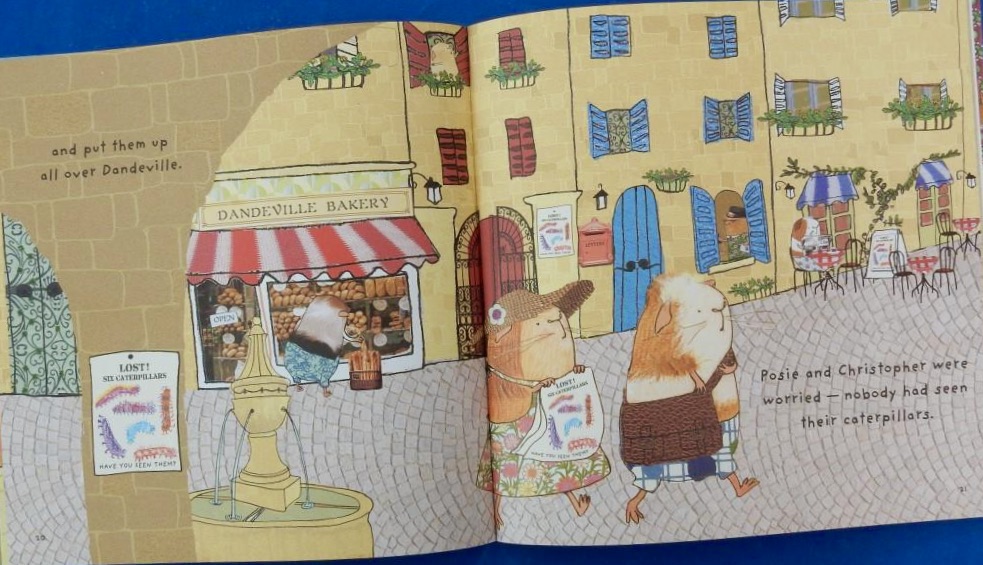
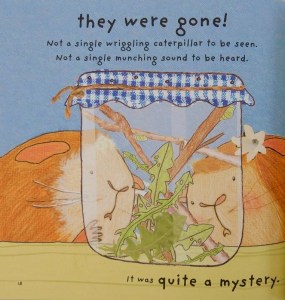
The friends make some “LOST! ‘ posters and paste them all over Dandeville but nobody has seen the caterpillars. Then comes an email from Mr Rosetti, telling them to bring the jars that had housed the caterpillars to his cafe for inspection.

What do you think they discovered in those jars? Is it time to make some new celebratory posters.

With some lovely descriptions, this delightful story captures the wonder of nature and a life cycle especially well. Children who have already experienced the joys of keeping caterpillars may wonder why Christopher and Posie failed to notice the chrysalises in their jars.

The book concludes with two spreads of relevant information – Caterpillar Facts and How to Care for Caterpillars. If you missed it the first time around, (or if your original copy has been read to pieces) this book with its funky mixed media illustrations is one for sharing with young children either at home or in a foundation stage setting.

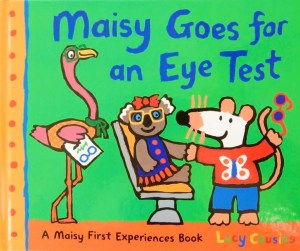
In this 23rd Maisy First Experiences story, young children join Maisy and her friend Ella when they attend the opticians to have their eyes tested for the first time. The reason for the visit is that Ella has trouble reading the number symbols written on the nursery blackboard. On arrival they sit in the waiting room until Flamingo, the optometrist is ready: Maisy goes first and is able to see everything whichever eye she uses. Not so Ella though; the optometrist uses her special machine to look right inside Ella’s eyes and promises to make some specs that will be just right for her eyes. Then with Maisy’s help Ella chooses some frames, the lenses are inserted, and she’s given a case to keep them in. Maisy selects a pair of sunglasses to wear in bright sunshine and with a promise to return for a check-up in a year, off they go , both sporting their new glasses.
This upbeat, reassuring story will help prepare little ones for their first visit to the optician.

Ferris

This story, set I think in the late 20th century, unfolds around ten year old Ferris (Emma Phineas Wilkey), so called because she was born beneath a ferris wheel at the fairground. Ferris is sensitive, serious and a lover of words, the last thanks to her 4th grade teacher.

It’s an eventful summer for certain. It was then that a ghost appeared to her grandmother Charisse, that Ferris’s six year old sister, Pinky, decided to become an outlaw and that her Uncle Ted left Aunt Shirley, his wife to live in the basemen of Ferris’s home, hoping to paint a masterpiece. Oh yes and it was the summer that Dad declared there was a racoon in the attic; moreover Charisse said she was unwell and agreed to see a doctor.

Add to the mix Ferris’s best friend, Billy Jackson a pianist who hears music in his head all the time, Boomer the dog, teacher Mrs Mielk, Billy’s dad Big Billy Jackson and Charisse’s oft quoted assertion that “every good story is a love story” and you realise that those words definitely apply to Kate DiCamillo’s moving, memorable, quirky tale. Assuredly there’s love in abundance, but there’s also reunion, plenty of humour supplied mainly due to Pinky’s misdemeanours, as well as loss and birth.

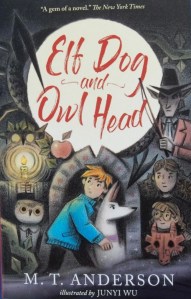
Elf Dog and Owl Head

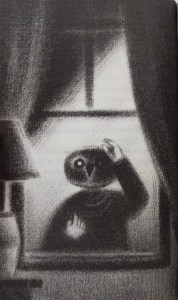
This weird magical novel is set during a covid lockdown. Clay O’Brian is tired of the virus that has forced him to stay home away from his friends. All he has to play with is a frisbee but nonetheless he enjoys the time he spends in the forest exploring, it’s far better than being cooped up indoors with his siblings. As he goes to retrieve his frisbee a dog suddenly bursts out of the bushes, a strange-looking dog with long ears, red inside – an elf-hound, Clay calls her. The creature – Clay thinks she’s saved him from a bear – follows him home and decides to stay.

Next day out walking with the dog, Clay overhears that her collar has a name, Elphinore, and that the two men speaking to one another think she’s a royal hunting dog belonging to the People Under the Mountain.

Time passes, the school term ends and Clay has even more time to spend with Elphinore, more time rambling in the forest. Allowed to lead the way, she takes Clay ‘on one of the paths that led through crooked elfin ways up the flank of the mountain.’ It’s thus that he meets the owl-head people, in particular an Owl Boy, Amos from a village full of such people.

One afternoon a while later after a strange incident with a shaker that Clay has acquired, his sisters decide to follow him and find out from where he got it. They creep after their brother and the dog, steered by the latter, so they stay on the right path. Along that same path, DiRossi (Clay’s angsty elder sister) also forms a strange friendship with a miserable giant Vud, that her brother accidentally woke from a deep sleep. Somehow her mood seems to improve as this happens. Clay meanwhile is having to spend time helping his Dad.

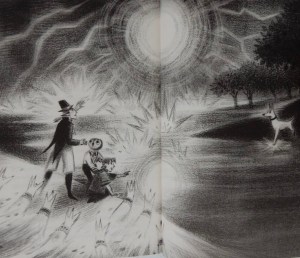
Come New Year’s Eve, the absorbing tale builds to a dramatic climax with an event – ‘a party between the worlds’ – on the slopes of Mount Norumbega, after which comes a final resolution with Clay having to decide where he, Amos and Elphinore really belong.

A brilliantly clever amalgam of fantasy and the everyday world, equally brilliantly illustrated with Junyi Wu’s black and white pencil art. A book that will leave readers with a feeling of wonderment.

Big Gorilla

Rarely I think, has so much artistry gone into a book of opposites as this one. From the cover, onto the title page and throughout the other spreads are show stopping portraits of primates. ‘What’s the opposite of old? asks the first sentence; turn over and there is the one word answer, ‘Young’ opposite which is a very small, pinkish coloured, thumb sucking infant gorilla. Sad, followed by happy are illustrated on the next two spreads, happy being portrayed by a blissful looking chimp holding a single flower. Then come heavy and its opposite, light, alone and together (observant readers will spot several intruders in the crowd.),

and BIG and small.

The next question is more tricky asking, ‘What’s the opposite of opposite?’ ’The same!’ comes the response with its illustration of a somewhat puzzled primate.

With a touch of the illustrator’s trademark surrealism, this is wonderful celebration of primates of all kinds, some of which followers of Anthony Browne might perhaps recognise from previous books of his. Exquisite illustrations of such wonders as orangutans and chimpanzees, not to mention the odd gorilla will delight readers of all ages.

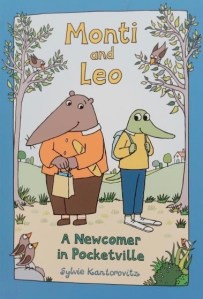
Monti and Leo: A Newcomer in Pocketville

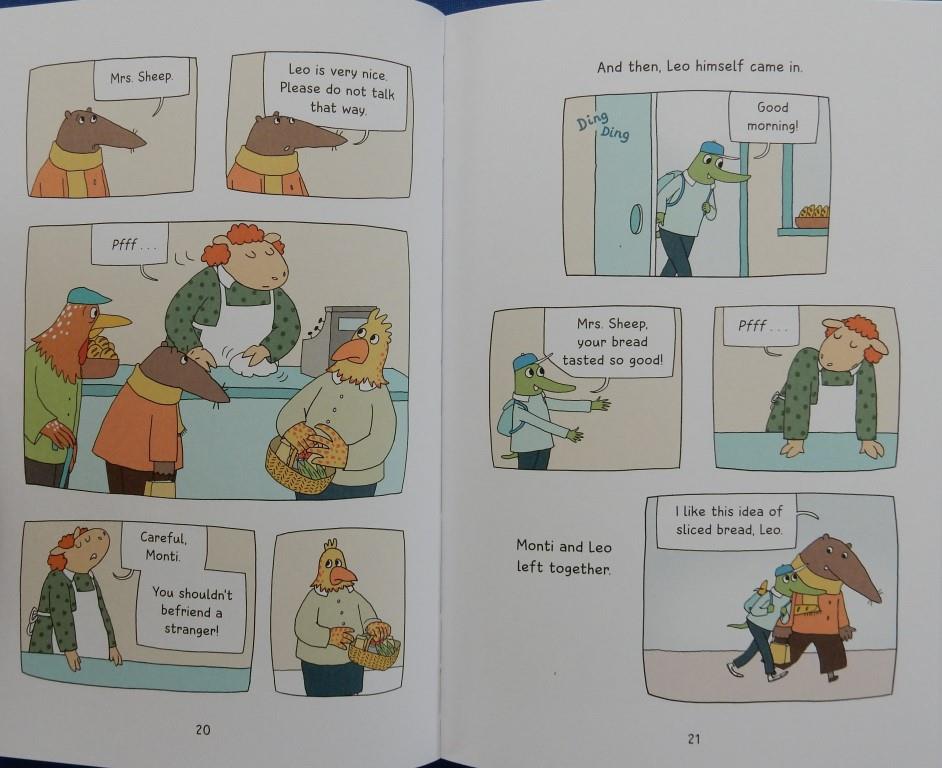
Pocketville as its sign says is, ‘a quiet little town’ and that’s just the way the animals living there want it. Like the others, Monti Mole dislikes change; he sticks to a daily routine but then one day, he discovers a stranger, Leo Lizard, sitting on his favourite rock. At a loss to know what to do, the mole goes home and has a sleepless night. Next morning there’s Leo again sitting on Monti’s rock, but this time the lizard’s genial greeting and ensuing kindness disarms the mole and a friendship starts to blossom.

At the bakery the following day it’s apparent that baker, Mrs Sheep is suspicious of the newcomer commenting, “These strangers! They never respect our ways.” and warning Monti against becoming Leo’s friend. The mole though speaks up for Leo and the two walk off together.

Later, as Monti and Leo are sitting on a log, they hear the sounds of music. It’s Mole’s friend Harriet strumming and singing and Monti introduces her to Leo. This leads them into deciding to hold a talent show that anyone can audition for. Off they go to the library to enlist the help of Carl Crow. Poecketville residents are at first interested but quickly turn reluctant thanks to Mrs Sheep’s crusty ways.

However Mole eventually succeeds in sweet-talking the curmudgeon into sharing her ‘gorgeous singing’ at the show; and just in the nick of time before the organisers call the whole thing off. Come show night, the entire Pocketville population is in attendance, either performing or watching and the show is a big success.

The book’s creator aptly dedicates this story to ‘anyone who has ever felt like a stranger’. With its themes of friendship and community building, it was so good to see Monti finding his own talent in the latter. Sylvie Kantorovitz effectively uses a muted colour palette, simple lines and patterning throughout presenting her tale in graphic novel format for younger readers, .

Earnest Sandpiper’s Great Ascent

In this deeply heartfelt story we meet three young members of the Sandpiper family on the day they are, so their parents expect, going to learn to fly for the first time. Spur and Rouse are full of confidence; not so Earnest. Under their parents’ tutelage: “BREATHE… TRY… JUMP… FLY!” Earnest’s siblings take to the air; Earnest however baulks at the edge of the dune. “I think my feathers are too heavy for me,” he tells his mother as he looks for a second time over the edge.

Using her wing tip, Mum draws a heart shape in the sand, adding the promise that “soon your heart will glow like the morning clouds. It will shine with desire and belief. ” This magical glow, she assures him, is a sign that magical things are going to happen. Other family members further encourage Earnest and then leave him wondering if he’ll ever feel the glow. He climbs carefully up a piece of wood, breathes in and tries a jump but … lands flat on his back. From his supine position, he spies a yellow balloon floating above him with that same heart decoration his mum drew. Earnest follows the balloon across the beach till it lands in the sea and he follows his curiosity into the water but as the tide comes in, he finds himself entangled in the balloon’s ribbon and thoroughly afraid.

Happily, his family returns just in time, and their loving concern triggers that magical glow his Mum had spoken of, as well as Earnest’s self-belief. With those basic instructions in his head and a powerful SNAP! Earnest takes flight.

The author’s naturalistic paintings are superb, brilliantly expressive, making that plastic-looking balloon stand out against the natural environment, a meaningful message indeed, helping to make this a cautionary tale about the dangers posed to wildlife by balloons floating free, as well as a powerful story of believing in oneself.

The Spaceman

When the diminutive spaceman steps out of his spaceship on a mission to collect soil samples, his first impression is that the planet he’s landed on is pretty ordinary. That quickly proves otherwise however when he catches sight of a large red bloom. WOW! While he gazes at it, his spacecraft is stolen by a ‘thief that sprouted wings from its feathery sides’ (a bird). He gives chase but to no avail: he’s stranded alone and frightened on planet Earth, especially when he finds himself face to face with ‘a hideous beast’ as he stops to admire the next wonderful floral specimen. Off goes our explorer as fast as his feet will go until unable to flee further, he stops and sits atop a rock to ponder on his problematic situation.

In frustration at not being able to think of a solution, he stands up on the rock and is about to yell at the stars when he notices the night has ended, and with the coming of the daylight, the rich and diverse beauty of earth’s flora and fauna is revealed. Hitching a ride with a butterfly, the spaceman is totally enthralled by what he sees

but then he loses his hold and drops down into a pond where he floats gazing skywards. Along comes the ‘hideous beast’ causing the spaceman to realise that appearances in this instance were deceptive; he now describes his new canine friend as ‘a little unrefined perhaps, but charming nonetheless.’

Then as the two snuggle up together, the spaceman thinks of his responsibilities. A dilemma faces him: should he retrieve his spacecraft and return to his old life or make it impossible so to do?

A clever, rather formal, first person narration together with gently humorous, hatched illustrations that provide perspective, enriching the text, make this a book that when shared with children, will give and keep on giving. Initially they might merely enjoy it as a fun adventure for the little spaceman and then later come to appreciate the elation the traveller eventually feels at finding somewhere he feels he truly belongs.

Totally Chaotic History: Ancient Egypt Gets Unruly! / Be A Scribe!

Speaking directly to his audience using a chatty present tense style, writer, Horrible Histories consultant and presenter of the hit BBC history podcast ‘You’re dead to me’, takes readers on an action-packed, chaotic romp through the whole of Ancient Egyptian history. In this enterprise as he navigates this messy world, he’s aided and abetted by Egyptologist, Dr Campbell Price, curator of Egypt and Sudan at Manchester Museum with interjections in the margin, myth busters and ‘accuracy alarms’ that sometimes challenge Greg’s ‘facts’. Adding to the humour of the text and the reader’s enjoyment and perhaps understanding, are Rikin Parekh’s comical illustrations on every spread.

There’s a brief introduction and timeline, after which we are taken on a whistle-stop chronological tour of the key events in Ancient Egyptian history. Then follow short chapters devoted to important figures such as pharaohs and Alexander the Great (he with a mega ego), as well as other topics you would expect such as mummification and hieroglyphics; we also pay a visit to “Doctor Peseshet’s medical school to see how they treated such problems as toothache, headaches and tummy troubles.

This cracker of a book will be of huge appeal to children who are interested in history in general and Ancient Egypt especially. For KS2 readers I recommend adding it to home, classroom and library bookshelves. With Roman Britain Gets Rowdy! coming in October, this promises to be a brilliant series.

With nothing much to do during the covid-19 pandemic, Michael Hoffen, a teenager in New York spent his time learning about Ancient Egypt and with valuable help from Dr Jen Thum, an Egyptologist and curator at the Harvard Art Museums, and teacher and mentor Dr Christian Casey, a postdoc at the Freie Universität Berlin. During regular meetings over the course of three and a half years, under the guidance of Dr Casey, Michael translated a work of ancient Egyptian literature, called ‘The Satire of the Trades’ and inspired by all he learned, he wrote the book, together with Dr Jen Thum.

The narrative tells how a father, Khety, takes his son, Pepe, up the river Nile to a distant school so he can learn to read and write with the possibility of then being hired as a scribe in the royal court. The author uses photos of over a hundred real ancient Egyptian artefacts to help with the telling, giving readers fascinating information on such topics as the kinds of work people did and how this affects their lives – eighteen jobs are each given a detailed double spread.

In addition there’s a wealth of wisdom including such advice as ‘If you leave school at lunchtime and wander about in the street’s someone will punish you.’ The physical punishment of children was common in ancient Egyptian society.

Superbly produced, this is a book to add to primary collections and with the connection made to modern life throughout, it should appeal to history lovers as well as those studying ancient Egypt as a class history topic.

Guess Who’s Getting Dressed & Guess Who’s Going to Sleep / Lenny in the Garden

Hugely engaging, and tremendous fun are these two interactive lift-the-flap board books written in rhyme by Smriti Halls and zestily illustrated by Marta Altés.
On the first four spreads in Guess Who’s Getting Dressed little humans are invited to respond to a question and given a possible answer (not the right one). Parts of an animal are visible from behind the flap on each recto, sporting the article of clothing the question mentions. For instance the suggestion is that Reindeer is wearing some stripy socks: not so, but the rhyme offers a clue …

The final spread presents the entire animal cast and a ‘Who else?’ to guess.
Guess Who’s Going to Sleep follows the same pattern but with a different animal cast and a slumber time theme.
Playful delight both.

Not a board book but also for the very young:

Lenny, his mum and Wilbur their dog are in the garden. On the lookout for new things, Lenny starts exploring, while mum gets busy digging. Before long Lenny draws attention to some ants walking in a line, so he says. Higher up a spider spins its web, round and round. Then as Lenny enjoys the tactile pleasures of toe wiggling in the grass, Wilbur makes friends with a wiggly worm that’s just popped up from underground. Mum finishes digging and begins watering, offering to water Lenny too but he’s too engaged with the nose tickling butterfly, the caterpillar and the dotty, spotty ladybird on a leaf.

Next he follows a snail slithering along leaving a trail behind; a grasshopper leaps hither and thither and Lenny attempts to emulate its bouncing until finally digging and watering done, mum calls to Lenny; he comes and the two sing a finger song ‘Tommy Thumb’ together before going indoors for lunch.

A simple, thoroughly captivating delight that is just right to share with the very youngest children. One hopes that having heard this story with its brightly coloured illustrations, listeners will become as observant as young Lenny in their own gardens or nearby outdoor spaces.

Wise Up! Wise Down!

Three awesome creative people from children’s literature have collaborated on what is sure to become a favourite poetry book for many readers. Two friends John Agard and JonArno Lawson provide the words and the distinctive art of Satoshi Kitamura provides the wonderful, whimsical illustrations. So, when you open this book be prepared to embark on a foray into a lively, thought-provoking conversation between prize-winning poets. It’s so cleverly put together with the two voices taking turns throughout; they’re made to seem as if one person’s thoughts have immediately initiated a response from the other, despite many of the poems having been published previously.

Sure to get your brain cells buzzing are Jon Agard’s Mind, What Exactly Are You? and JonArno Lawson’s rejoinder Never Mind. So too will Questions (JA) and Should I Be Me? (JL) Philosophical posers each one of which could be used to open a community of enquiry type discussion.

There’s humour too, of a wicked kind in for instance, JA’s Crocodile’s Tale: ‘The last man who mistook me for a log / Lost half a foot and can no longer jog.’ and Alligator’s Response (‘Is that right, old Croc? / But can he still walk? // The last man who stopped to look me in the eye? / That falling-down man was an upstanding guy.’ (JL)

What comes across loud and clear is both poets have never lost their sense of awe and wonder about life, the universe and all that: JL summarises this in the final lines of the verse in the final poem: ‘figuring out this strange world will never / be anything less or anything but / a forever and ever adventure.’ A perfect close to a terrific book.

Read it at home, read it in the classroom and then perhaps try out some of the suggestions given at the end.

The Last Zookeeper

This is an ark story of an altogether different kind. Set in a post apocalyptic world, it has no text, only a series of amazingly detailed wordless spreads and there’s not a single human in sight. Instead, AI in the form of a ginormous, towering robot with the letters NOA on its arm and wind turbines to power it on its back, steps onto a flooded landscape with its incredible architecture.

It appears that he’s stumbled upon a ruined zoological garden where half a dozen or so iconic
species are stranded. He feeds them but as the waters rise ever higher, he sets about designing and building a sail boat big enough to accommodate the remnants of survivors of the deluge – giraffes, pandas, tigers, rhinos, flamingoes, elephants, zebras.

They set sail but their craft is caught in a terrible storm and shipwrecked on a low lying archipelago.

All seems lost but then from the sky there descends help in the form of another robot piloting a hot air balloon . There’s hope after all …

A brilliantly imagined, bleak and thought-provoking parable showing what the future may hold for life on Earth if humans fail to turn back the tide of global warming. Becker’s minutely detailed watercolour and pen-and-ink illustrations provide many hours of immersive meditation.

Puppet

David Almond’s sublimely written poignant fable, with Lizzy Stewart’s impressive illustrations will really pull at your heartstrings.

Silvester is a widowed puppet maker; together with his wife, Belinda, he gained a reputation for creating some of the most beautiful puppets and shows in the area. As a result, the local museum wants to exhibit the subjects of his work and a young woman, Louise from the university wants to write a short history of his creations to be offered for sale when the exhibition opens. All he has left are his memories, posters, and photographs of his beloved Belinda.

So what can a puppet master do when he’s old and alone? Pondering this question, Silvester feels strangely free. Days pass and one night, awaking from his dreams, the attic seems to call to him. Up he climbs, sits at his workbench and fashions a new puppet. Then comes, “E-O.” That’s the first sound the puppet makes: Silvester thinks he’s imagining it. Next morning he tries to get the puppet to stand; it’s a tough call but eventually he succeeds. “Hello, Puppet,” says Silvester. “E-O” comes the reply.

Puppet is a quick learner, he walks and it’s not long before the old man has found a firm place in his affections for his creation. They visit the park together and there they meet a rather unusual girl named Fleur and her mum, Antonia. The latter remembers some of Silvester’s magical shows from her childhood. The puppet becomes known in the local community as Kenneth and soon Fleur becomes Silvester’s ‘apprentice’, learning how to create and use puppets.

This eventually leads up to a public performance – but all the while, Silvester has been growing more and more tired. With the show over and everything cleared away, telling his friends, he’s seldom been happier, the old man heads home with Puppet and they lie down to sleep together. “Jam,” whispers Puppet the next morning … “Da- ad” but … . I had tears in my eyes at this point, such was the emotion I’d built up inside.

With his wondrous tale of creativity, playfulness and the circle of life, David Almond shows that with trust, love and the power of the imagination, anything is possible. Share it with a class: the children will be swept away by the magic of the telling, as will individual readers.

A Spy in the Jam Factory / The Deadlands: Survival

These are both the concluding books in series from Walker Books: thanks to the publisher for sending them for review.

When, thanks to a spate of local newspaper articles, the jam factory (Willow Green villagers’ pride and joy) comes under surveillance by the Alien Intelligence Agency, its intention is to find a reason to evict Fizzbee from Earth. Yes, there have been several mishaps of late: giant green vegetables running wild, burglaries and worst of all, children floating in the air after consuming figgy jam thanks to one of Fizzbee’s alien ingredients getting a tad out of control but Fizzbee’s reputation is a rock bottom. Scooter and his pals decide it’s time for Operation Make Fizzbee Look Good to dispel the fears of the village residents. There’s a big problem however in the form of Agent Fleur De Vious, the only spy in the Alien Intelligence Agency. She believes Earth should be alien-free and is determined to get the agency’s director to sign an eviction notice for Fizzbee.

Off she sets aided and abetted by Bottie the inept little spaceship. She certainly appears to be making headway when she starts using subterfuge.

Will Scooter, the boy with a wealth of determination and creativity, be able to stop her in time?

There’s a surprise twist at the end as well as a vital message for every one – characters and readers – from Fizzbee: “Some humans find difference scary. But differences should be celebrated, not feared.”
Many readers will be sad to learn that Chrissie Sains and Jenny Taylor’s fourth book in the Jam Factory series featuring expert inventors of wondrous jams, Scooter and his alien sidekick Fizzbee is the final one. So too was this reviewer, despite the satisfying ending.

In this thrilling finale to the cracking trilogy, at the heart of which are five outcasts, former enemies, who are the only hope to save their warring dinosaur kingdoms from impending doom, author Melki-Wegner reassembles her all-dinosaur cast for a furious, climactic battle.
With a massive army to face, frenzied fights, treachery from supposed allies, ambushes, as well as betrayals, narrow squeaks, and courageous exploits the action races towards a climax that is spent against an enormous inferno and a deluge. Through all the trials, the trust Eleri et al have in one another provides a powerful support and the battle’s momentous outcome depends on loyalties and holding fast to their honourable ideals and values.
A showstopping conclusion to the adventures of the intrepid heroes that have kept many older readers, especially danger-loving ones, gripped.

Super Swifts / Night Flight

Astonishingly, swifts (champions of the bird world) are able to fly faster and higher than any other birds; even more astonishing is that they might stay airborne for as much as four years, flying up to seventy miles per hour.

Author, Justin Anderson begins this swift story in central Africa’s Congo region in early April and tells of the journey undertaken by one female in particular who with a group, flies from their place of overwintering, towards Europe and their destination in the UK.

A month long journey that takes them over the world’s largest desert, across vast oceans, through thunderstorms to the place where our female will look for her mate, a bird she’s not seen for a whole year.

Clover Robin’s mixed media close ups of the pair show them making a nest in which the female lays three eggs each of which hatches into a hungry chick.

I love the author’s description of the pair sticking ‘their nest together with their spit, which sets hard like superglue.’ Come July, it’s time for the mother to make her return journey to Africa; she and the other super swifts will once more take to the skies.
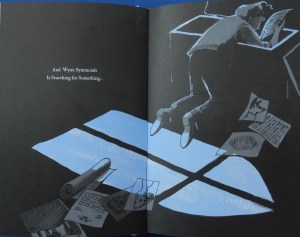
On each spread, there’s a main narrative, alongside which is further information printed in smaller type. An inset box gives fascinating details of swift lice that nestle in young birds’ feathers and breed when the swifts nest again. A final author’s note contains information about some of the swift species and gives ways in which readers can help prevent swifts nesting in the UK from dying prematurely.
I’m looking forward to hearing their screeching cries as they fly over our house this summer.

Also on the subject of birds is a book wherein fact and fiction come together.

Bringing Back Kay-Kay

When Lena’s older brother Kay-Kay fails to return from summer camp in Goa, despite rather enjoying feeling a bit special at home for a change in his absence, Lena knows she must find him. His parents are grief-stricken but believe that the police, who think he’s run away, are doing everything they can. His friends say they don’t know why he disappeared from the train back to Lamora but, convinced that Kay-Kay would never run away, Lena suspects that one, Samir, who also went to Wildlife Adventures camp, knows more than he is letting on.

Devastated by the idea of living without her brother and finding her parents’ pain unbearable, she decides to embark on a mission to investigate, with the aim of locating Kay-Kay and bringing him home. ‘Without you, Kay-Kay, there’s no sun, no warmth, no light. I will find you – my brother, my friend. I will find you and bring you back,’ she says. Looking for clues in his room, she discovers that Kay-Kay has been keeping part of himself hidden from the family – his secret dreams and his fears of not living up to parental expectations; these he reveals in his powerful, heartfelt poetry.

Determinedly retracing his journey across India, she meticulously begins to reassemble clues leading to his disappearance. Can she find Kay-Kay and save him before it’s too late?

This mystery set in contemporary India grips the reader from the start. Written from Lena’s view point, it’s frequently gut-wrenchingly moving, especially when she addresses her thoughts to her brother. A terrific debut that pays tribute to the power of sibling bonds especially in desperate situations as well as showing that the creative arts are every bit as valuable as engineering and medicine, subjects that in common with so many Indian parents, are favoured by Kay-Kay’s parents.

The Lighthouse at the World’s End

Nine (a pickpocket girl) and her friends, Eric the troll, and wizard Flabberghast are back for their final adventure. They have to head back to the mortal realm to find a priceless lost stargold locket, a family heirloom that is hidden in the Nest of a Thousand Treasures. Not only that but if she’s successful, Nine must then find a way to release its power once and for all.

Desirous to get hold of the very same object and also residing in the House at the Edge of Magic is the most troublesome witch in all the realms, Flabberghast’s sister. Said witch has some connection to Nine, and may have the answers to some of her questions.

Despite the very idea of returning to the place guarded by her old foe Pockets, the formidable gang master of all the London thieflings, making Nine feel sick, off they go. The adventure is filled with threats, there are dangers aplenty including a close call for Flabberghast, and as the oft repeated words remind us ‘things are seldom what they seem’.

Amy Sparkes has a wonderful way of making her readers feel they are truly part of Nine’s journey, a chronicle about developing a sense of belonging, about the importance of friendship, about one’s family being what you make, rather than those you are related to, and about redemption and embracing differences. Like many others who first met Nine in The House at the Edge of Magic, despite the throughly satisfying finale to the quartet, this reviewer feels sad about bidding farewell to her and her friends.

The Magic Callaloo

Inspired by stories of enslaved Africans who made patterns in their cornrowed hair, using them as maps to help them escape to freedom, Trish Cooke’s neo-folktale has its origins in Rapunzel, made popular by the brothers Grimm

It begins in a small village, long ago and far off where there grows a magical callaloo plant that would grant the wish of any villager who ate one of its leaves. Thus all the villagers had everything they needed; but one of those living in the village was selfish and greedy. One night this greedy man creeps into he square, uproots the plant and makes a wish: to have the plant for himself. He then proceeds to eat more and more leaves, making wishes for more and more things until he had so much he could barely move. His laziness of course, has an adverse effect on the callaloo: it shrinks until just one leaf remains.

Back in the village, a couple hoping desperately for a child, are greatly distressed at the disappearance of the plant as their hope was that it could provide them with their dearest wish. Then one evening a wise woman tells them where the last leaf is and with renewed hope they begin to search, eventually locating the plant. The Missis eats the final leaf and both she and Mister wish for a child. Before long, to their joy, a baby is born and they call her Lou.

The girl grows into a kind, beautiful curly-haired girl and her parents tell her the story of the magic leaf. Lou makes up a magic callaloo song but her singing bothers her father in case someone overhears its words. Sure enough, the plant thief happens to pass through: he hears her song and snatches her away to his home where he keeps her prisoner, making her do all his work.

Both Lou and her parents grow ever more miserable, missing each other all the time, till years later who should come along again but the wise woman. Lou tells her of the cause of her sadness and the woman formulates a clever plan using the girl’s tresses which she twists into plaited patterns, quietly telling Lou, “Your hair will lead you home.”

However something else also returns with her.

With themes of longing, captivity and escape, Trish Cooke’s wonderfully woven tale is impressively embroidered with Sophie Bass’s art, which includes a wealth of flora and fauna in kaleidoscopic colours making every turn of the page a visual feast. This longish story will enchant readers across a wide age range.

Grotti

Who could possibly blame the young knight narrator of this story for falling in love with the little green grotti he comes upon in a hollow while carrying out his knightly duties one day. For a start the little thing is clingy and puts on such a sad expression that despite explaining about his calling, the knight feels unable to leave Grotti behind, so the two start travelling together. Then comes the need for a ‘difficult decision’ by the knight: an exchange is made that means the two can travel much more quickly, surviving on berries and bugs

until the knight is faced with another decision in order to enhance what they dine on. A third difficult decision is caused by a sudden snowfall and the need to keep Grotti warm.

As the two snuggle down under the stars one night, the knight tells tales of his adventures but soon surmises that all is not well with Grotti who seems distracted.

Next morning the knight is faced with an exceedingly snotty Grotti and the realisation of what the little thing has been trying to communicate by means of a stick. Off they go with Grotti leading the way until they reach a house atop a volcanic rock pile. There, his task complete, the knight leaves Grotti with his family and departs to continue his beast battling and other work; but he knows in his heart that something is missing. Will he and the little green Grotti ever see one another again?

Despite his snottiness, Grotti is an adorable character that will endear himself to young listeners; he certainly had that effect on this reviewer. I suspect that this tale with its themes of friendship, family and love, will quickly become a story time favourite with children both in the classroom and at home.