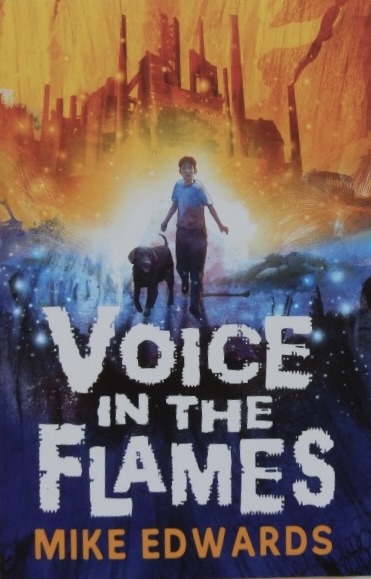
Voice in the Flames
Mike Edwards
Walker Books
Mike Edwards is an author and poet from Teeside and he sets this story in north east England and unusually it includes use of the regional dialect that gives it a powerful sense of place. The main protagonist is Jack and he longs to be able to turn the clock back to when his dad was still alive and working as a Furnace Keeper at the old steelworks. Now though Dad is gone (he died around a year ago) and the works are closed down and stand silently, tower-like over the estate where Jack lives with his Mum who works at a care home and seems to do endless shifts, and Shadow the dog.
One day Jack and his friend Beans are kicking a ball outside the perimeter fence of the steelworks when it goes over into the site and determined to retrieve it, Jack squeezes through a gap and has a strange experience. He thinks he hears a voice, there’s lots of smoke and his clothes are covered in ash when he emerges. Later on he asks his mum whether his dad had ever spoken of anything strange at the works and she says that he talked of what she assumed at first was a workmate, Old Sal, but then learned that it was actually the furnace itself.
During half term Jack goes to sketch near the works and decides to investigate where the ball was lost. He comes upon the ball in the hands of a man with white candles in his hair who asks Jack to set him alight.
Beans tells Jack he is crazy but that doesn’t deter him; help the old man he will. So when his mum is once more delayed by work, off he goes with some of the takeaway that his Mum had ordered. He learns that the strange grey man knew his Dad and that makes him all the more determined so he gathers some things to create a fire and starts it in an oil drum. Sal claims to be a spirit that can bring the old works back to its former glory. He mentions his heart-stone and Jack realises what this is and promises to bring it to Sal; but later he realises where it belongs. Several surprises follow. How will this powerful, intriguing atmospheric fantasy-tinged adventure end?
The book’s conclusion reminds me of T.S.Eliot’s opening lines of Burnt Norton:
‘Time present and time past
/ Are both perhaps present in time future,
/ And time future contained in time past.’

