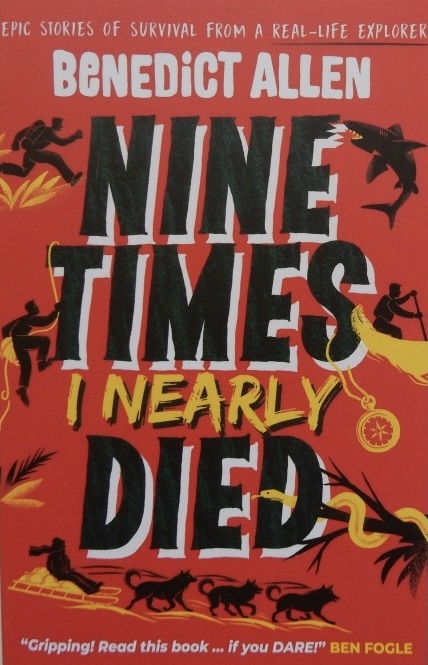
Nine Times I Nearly Died
Benedict Allen
Walker Books
Benedict Allen had already decided to be an explorer when he was just ten year old. Since then he’s visited various parts of the world that hardly anybody has been to and at the start, so he confesses in his introduction, he knew very little about how to survive and had to rely on help from members of local communities.
Facing danger at every turn, he’s learned about distant and remote environments but as he says in his introduction, ‘one of the most important lessons I’ve learned isn’t only about the end goal; it’s also about what you discover along the way – and that includes what you learn from making mistakes or suffering setbacks.’
The first expedition sees Allen aiming to make the first known full crossing of the northern Amazon in Brazil and record what he could of the ‘pristine rainforest’. He hadn’t anticipated his canoe capsizing though. After consideration he decides to continue his journey on foot, about 105km through dense undergrowth and so he does, finally reaching a small hut and there he falls at the feet of a little man with extended arms and a reassuring smile. From there he’s taken by jeep to a hospital where he recovers from two kinds of malaria, one of which could have killed him. Readers may be astonished to learn that rather than being totally put off, Allen resolves to return to the Amazon rainforest.
Undaunted Benedict Allen undertakes eight further expeditions, none of which go entirely to plan. He visits the frozen Arctic (where he gets separated from his huskies and becomes lost in a blizzard), the Gobi Desert, endeavours to make the first crossing of Papua New Guinea’s Central Range, is shipwrecked on an island while attempting to cross the treacherous shark-infested Torres Strait between Papua New Guinea and Australia and is left without food or water.
Not put off by the events of his first Amazon expedition, Allen returns ten years later with considerably more experience and a lot more confidence. Word about him spreads and he becomes known as “El Mister” – another life or death situation occurs as it does in each of the remaining accounts. One being on a return to the Arctic and the final one being another return – to Papua New Guinea, first visited thirty years earlier, this time with malaria tablets.
Each adventure will have readers on the edge of their seats as they are gripped by the terrifying details. Whether they will be inspired to embark on their own expeditions depends to some extent on whether they are open to challenges be they close to home or in far far distant places. A book that will enthral older KS2 audiences and beyond. (There are photos, line drawings and diagrams throughout the book.)

