Love You Always / Mama’s Work Shoes

Love You Always
Frances Stickley and Migy Blanco
Nosy Crow

There’s a definite autumnal feel to this book portraying the loving bond between a mother hedgehog and her son Hoglet but despite the little hedgehog’s occasional shivers as the two creatures wander home through the woods, this is a warm-hearted tale.

Hoglet notices the season changing and his mother explains that … change makes nature lovlier with every passing day.’ Hoglet then asks, “Mummy … / would you love me more…if I changed?”

As they encounter other mother-child animals – dashing squirrels, fluttering dragonflies, bouncing frogs, fluffy rabbits,

Hoglet asks his question again and on each occasion gets the same response ’I couldn’t love you more’.

Just before they reach home, Hoglet raises the all important “But, Mummy… will love always last forever, / even if I change just like the seasons or the weather?” And as little humans will be eagerly anticipating, her “Always” promise of unchanging love acts as sufficient reassurance to allow her offspring to curl up and having repeated her final ‘Always’ to fall fast asleep.

With its combination of Frances Stickley’s soft-spoken, pleasingly constructed rhyming narrative that mostly works, and Migy Blanco’s richly hued scenes of the autumnal countryside, this is a lovely bedtime story for parent humans and their little ones to snuggle up together with and share just before bedtime.

Mama’s Work Shoes
Caron Lewis and Vanessa Brantley-Newton
Abrams Books for Young Readers

Little Perry’s mum has a plethora of shoes, a pair for every occasion and Perry knows them well: the ‘swish-swush’ ones for indoors, the ‘zip-zup’ ones for running and skipping, ‘flip-flop’ ones for sunny days and those that go ‘pat put’ in puddles.

One morning Mum puts on a new pair of shoes that go ‘click-clack, click-clack’. They sound interesting but what could they be for, wonders Perry.
When she discovers they signal the start of a new routine that means she and her Mum are to spend time away from one another, Perry is not happy.

Left with her Nan, the child lets her feelings out with a tantrum.

Eventually of course, Mum comes to collect her and back home they go where eventually Mum’s explanation finally reassures her little one that yes those clickity-clack shoe sounds will take her to work but they’ll always bring her back as fast as ever she can.

With Vanessa Brantley-Newton’s bright mixed media illustrations capturing Perry’s changing emotions, Caron Levis’ story will reassure the very young who like little Perry are faced with a parent returning to work.

A Forest’s Seasons / Apple / Who’s Hiding on Safari? & Who’s Hiding in the Jungle?

A Forest’s Seasons
Ingela P. Arrhenius
Chronicle Books

This tiny, chunky board book comprises just six pages, each differently shaped, showing the seasonal changes in a forest. ‘Spring brings babies and blooms’ we read, whereas summer is alive with different greens; in autumn we see fungi and a predominance of orange and browns while in winter the landscape is blanketed in white.

A delight for small hands and a lovely introduction to the idea that nature is cyclic.

Apple
Nikki McClure
Abrams Appleseed

Essentially what is the life cycle of an apple but interspersed with human interaction is presented in just fourteen words, – a single one per spread – opposite one of McClure’s signature style black and white cut outs. The apple being the only red, in each composition makes it stand out.

In autumn an apple falls from the tree; it’s collected and put into a sack with others.

Back at home, a little girl watches her mother cutting the apples and seizing her chance takes one (SNEAK) and pops it into the school bag and off she goes to school. Intending to consume it later she begins playing and the apple lies forgotten.

Eventually it rots, is composted and finally in spring we see it’s sprouting into a new tree.

There’s a final explanatory page reminding readers that ‘apple seeds rarely grow into trees that make tasty apples.’ Nonetheless this book is an effective and simple lesson and one whose outstanding art offers much to enjoy and discuss with little ones.

Who’s Hiding on Safari?
Who’s Hiding in the Jungle?

Katharine McEwen
Nosy Crow

By means of her alluring colourful collage spreads, Katherine McEwen takes little ones to two locations to spend a day playing animal hide and seek either in Africa or the South American rainforest.

On Safari, from early morning the grasslands are an exciting place to watch wild animals be they nesting, napping, digging, playing, having a cooling afternoon swim in the river or basking in the warm sun. Come evening you can spot hungry giraffes grazing on the trees and perhaps spy a monkey or two nibbling; and when it’s dark it’s the turn of the bats and foxes to appear while their fellow creatures sleep.

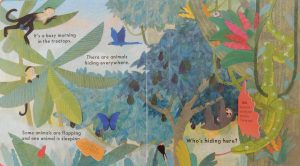
There are also lots of lively animals around Hiding in the Jungle amidst the lush flora and in the overhead canopy.

Little ones can also search for others hiding along the steamy riverbank, beneath the surface of the river and, in the cool of the evening, look among the foliage for creeping, crawling creatures.

Night brings sleep for most, but lifting the flaps will reveal some surprises.

Both books contain simple factual snippets and every spread has several flaps to investigate, where there is information about the hidden animals.

So You Think You’ve Got it Bad? A kid’s life in Ancient Rome

So You Think You’ve Got It Bad? A kid’s life in Ancient Rome
Chae Strathie and Marisa Morea
Nosy Crow

Imagine having your pet parrot or fish ending up in the cooking pot, or being sold as a slave to cook for richer neighbours.

How would you feel if you had a headache and the remedy was finding an elephant to touch your head with its trunk and hoping it sneezed a trunkful of snot right at you?

Or worse perhaps, if you were a boy you’d have to go to school every single day of the week (except holidays) and anyone who made more than the occasional mistake in class, would be held down by a couple of slaves while the teacher beat you with a leather whip: scary or what?

Alarm bells ringing I suspect, but this is just a small glimpse of what life was like for children in Ancient Rome that is provided in this fascinating book. There’s a section on clothing, hairstyles and make-up – supposing your mum used bear fat to make her hair grow, or pigeon poop to lighten it?

Other sections include food, family life, the home, gods, fun and games – yes there were some,

gladiators and emperors. And there’s a final glossary and index.

High on entertainment for sure, but also high on information of the accessible sort, this book published in association with the British Museum and with an abundance of amusing illustrations by Marisa Morea, is definitely one for primary school classes and individuals interested in ancient times.

This is a Dog

This is a Dog
Ross Collins
Nosy Crow

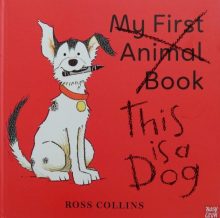
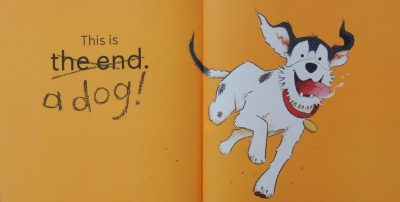
There’s no getting away from it, Ross Collins’ intended My First Animal Book’ has been infiltrated, indeed taken over, by a mischievous canine that has no intention of doing anything but ensuring he’s the only animal that matters herein. He’s even had the audacity to substitute his name for Ross’s on the title page.

Make no bones about it, his actions are anything but well received by the other animals – note their expressions. And having annoyed the monkey, astonished the rabbit and alarmed the squirrel, he’s somehow managed to get his paws on a black crayon to edit (actually mess around with) the text.

Children will absolutely love what he does beside the giraffe and giggle at his attempts at emulating a pachyderm in front of the elephant.

He almost gets his cum uppance with bear but then comes gorilla where he definitely over steps the mark by way too much and they all give chase.

It’s fortunate that his trusty crayon is still close at paw as it enables him to have the last laugh, not to mention the final word (or two).

I love everything about this cracker of a book. It’s so clever, such a ingenious mix of seeming simplicity and sophistication, and likely to appeal to a wide readership from beginner readers to those who will notice and delight in Ross’s dedication to his own dog Hugo ‘Who taught me the meaning of irony by destroying some of the artwork from this book.’

Brilliant!

100 First Words / Betsy Rabbit in the Park & Ralphie Dog at the Station

100 First Words
Edward Underwood
Nosy Crow

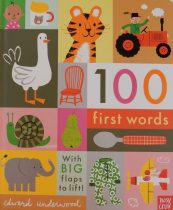
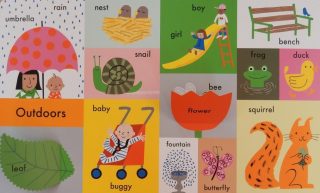
This large format board book has seven spreads each devoted to a different theme – farm, outdoors, wild animals, the home, vehicles, about us and finally, bedtime.

Around fifteen named items are illustrated for every topic with additional objects hidden under flaps (two per spread) to further engage the very youngest.

The brightly coloured images are seductively arranged in a mosaic of contrastingly coloured frames of varying sizes. Each image is clearly captioned in an easily read font so that the book could also aid those beginning to learn English as an additional language.

Betsy Rabbit in the Park
Ralphie Dog at the Station

Melissa Crowton
Nosy Crow

This pair of interactive first story, board books have flaps – felt and cardboard – and mirrors (one a-piece) to help engage little ones in the narrative.

The first features Betsy who cycles to the park to meet her pals and enjoy sharing time together.

Ralphie has his suitcase with him as he heads to the station to buy a ticket. It’s a busy noisy place to wait before he boards a train bound for the seaside.

Both books have plenty for toddlers to enjoy as they listen to the simple narrative, hunt for items named, begin to count, look for differences and compare.

Unobtrusively educational and more important, fun to share.


Out and About: Night Explorer / Animal Homes

Out and About: Night Explorer
Robyn Swift, illustrated by Sara Lynn Cramb
Nosy Crow

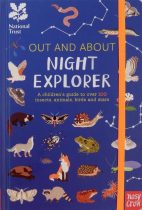
Created in collaboration with the National Trust, this is an excellent little book if you’re planning on doing some exploring after dark with youngsters or are off camping somewhere.

It’s packed with information about such things as suitable clothing, creating a night-time den, star gazing, nocturnal creatures – from minibeasts to moths and mammals including bats, plus owls and amphibians; and, it’s good to see several spreads on night-time flowers.

There are lots of helpful hints on such things as tracking animals by means of footprints and poo deposits.

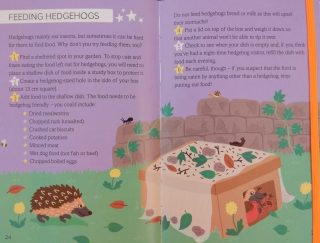
No matter the season there’ll be ideas herein: how about creating a house for creepy-crawlies in your garden during winter; or setting up a hedgehog feeding station?

I especially like the idea of making a sensory map at night, particularly focusing on sounds and smells as you walk and then repeating the same route in the light and comparing what you notice.

There are even suggestions for games, a quiz and a glossary.
All in all, with its plethora of very attractive labelled, coloured illustrations by Sara Lynn Cramb, this is ideal for encouraging young explorers (with an adult or older sibling) to get closer to nature at night.

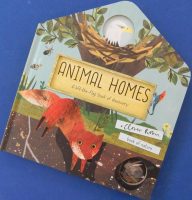
Animal Homes
Clover Robin and Libby Walden
Caterpillar Books

Wherever we walk there are likely to be animals living either in the earth beneath our feet, at eye level, or high up above our heads. We currently have a bees’ nest in our chimney.

Illustrator Clover Robin and author Libby Walden offer us an insight into six different animal homes, in various parts of the world.

After a general introductory page, we visit a beehive;

a beaver lodge; the nest (eyrie) of a North American Bald Eagle; a rabbit warren; a termite mound and the earth of a Red Fox.

As well as the habitats themselves, each spread (one per home) provides factual snippets about each of the inhabitants and their habits, some of which is hidden beneath flaps.

It’s unlikely that young children will encounter these particular habitats but nevertheless this little book, with its attractive collage style illustrations will encourage them to keep their eyes open for animal homes in the environment. Should they find any it’s important to remember Libby’s final rules: ‘Find, Look, Leave’.

Some Recent Young Fiction

Sophie’s Further Adventures
Dick King-Smith, illustrated by Hannah Shaw
Walker Books

This is a new edition containing three books in one, so it’s a bumper bundle of stories about the adorable, animal-mad little Sophie. I remember children in my early days of teaching avidly lapping up the stories when she first appeared on the scene back as an uncompromising four-year old who discovered a snail that led to her passion for all things animal.

In these three adventures she visits the farm, learns to ride, and pays a visit to great Aunt Al in the Scottish Highlands.

I asked the opinion of precocious reader, 6 year old Emmanuelle, who quickly became absorbed in the book. She commented that she particularly loved reading about Sophie riding Bumblebee the pony and later drew a picture of her doing so. She also said it made her want to try horse riding herself.

Seemingly the determined Sophie, still has the capacity to delight especially with Hannah Shaw’s illustrations that give the stories a fresh, present day feel.

Here Comes Lolo
Hooray for Lolo

Niki Daly
Otter-Barry Books

These books are part of a mini series for new solo readers starring young Lolo, a sparky young character who lives with her Mama and Gogo (gran) in South Africa.

Both titles have four stories each being just the right length to consume in a single sitting.

In the first book Lolo wins a longed-for gold star for reading, loses it, then gives it away; acquires a much-wanted, rather large hat; finds a lost engagement ring in the street;

and reports a lost dog and in so-doing assists in the arrest of a thief.

Along the way, helped by Niki’s delightful line drawings, we discover much about Lolo’s family life, her school life, her friendships and interests.

In Hooray for Lolo, the friendship with best pal Lulu is threatened when Lolo thinks she hasn’t been invited to her birthday party; she becomes a member of the library and chooses her first picture book which subsequently goes missing; wakes up one day with tummy ache and ends up having an operation, and finally, discovers that baby-sitting Bongi is exhausting work.

Sparkly stories all, with lots of gentle humour that will win Lolo lots of friends among young readers who are sure to enjoy making the acquaintance of this enormously engaging girl.

Princess of Pets: The Lost Puppy
Paula Harrison, illustrated by Olivia Chin Mueller
Nosy Crow

When Princess Bea discovers a puppy in the fountain of the palace grounds, she knows that she’ll have to find it somewhere else to live for it’s against her father’s rules to have pets in their home. But with frantic preparations for the evening’s banquet under way, not to mention the deportment lessons she’s supposed to be having, keeping a lively puppy hidden at Ruby Palace in the meantime is a huge challenge.

Then there’s the matter of the threat to the café belonging to her best friend Keira’s parents, that, so she discovers over dinner, her father’s guests, are planning to demolish to make way for the mansion they intend to build. Bea is determined to thwart that plan.

Can she achieve both goals? Possibly, with her kind heart and strong resolve, together with help from her best pal and perhaps some special spring rolls from the café.

Fans of the Princess series will likely devour this addition to the series at a single sitting.

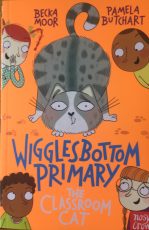
Wigglesbottom Primary: The Classroom Cat

Wigglesbottom Primary: The Classroom Cat
Pamela Butchart, illustrated by Becka Moor
Nosy Crow

This contains three more stories set at Wigglesbottom Primary.

In the first the appearance one Monday morning in 2R’s classroom of a very large stripy cat causes their teacher Miss Riley to jump almost right out of her skin in surprise at the sight of the creature sitting on her keyboard.

But is the cat actually trying to communicate something to the children and if so what on earth does the message WURGLERSSSHHHH that emerges from the printer mean?

Then the creature starts perambulating along the bookshelves and paying particular attention to a cookbook. It isn’t long before Evie MckIntosh is telling the others that the intruder is warning them about the fish soon to be served up for school lunch and Irfan is 99% certain the message is that the fish is dangerous.

Maybe the children don’t want to consume it but what about a certain feline? And was the fish dangerous or not? You’ll need to read the end of the story and make up your own mind.

The second story centres upon the vexed question of whether or not eating a crisp that you’d dropped in a puddle could give you a serious disease – Puddle-pox – for instance, said by Y6 children to be like the plague but even worse.

Imaginary Margaret as the third story is called, is supposedly Joel Jack’s imaginary friend who accompanies the class on a school trip to the museum. He says she’s 100% real and the one responsible for crisps being scattered all over the museum floor, not to mention the loo roll that comes hurtling over the cubicle wall at Jayden King; and even worse, the handprints on the newly painted Viking boat.

Becka Moor’s engaging, wonderfully expressive illustrations are the ideal complement for Pamela Butchart’s super-silly stories that are just right for newly independent readers to giggle their way through.

The Dragon in the Library / The Day I Found a Wormhole at the Bottom of the Garden

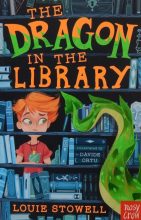
The Dragon in the Library
Louie Stowell, illustrated by Davide Ortu
Nosy Crow

Kit is anything but enthusiastic about reading; she much prefers to be playing outdoors and the library is definitely not her choice of destination on the first day of the summer holidays. But when her friends manage to persuade her to accompany them she discovers that she’s a wizard. Not just any wizard though, possibly the youngest ever wizard. The librarian doubles up as a wizard too.

Before long Kit learns that she has to play a crucial role in protecting the dragon sleeping in the library. The existence of the library itself is at stake though (the villainous Salt is determined to destroy it and it seems as though he knows too much about that dragon).

There’s another snag however, over-enthusiastic Kit is, shall we say rather impetuous in the use of her new-found power and it might be that her action has put not only the library but the entire world in danger.

The plot moves at a rapid pace and with its plethora of wonderful one-liners, allusions to other children’s books, and excellent characterisation, Louise Stowell’s debut story is a cracking one. Throw Davide Ortu’s illustrations into the mix and the magic becomes even more potent. ‘True magic’ indeed as the final words of the story say.

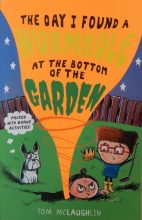
The Day I Found a Wormhole at the Bottom of the Garden
Tom McLaughlin
Walker Books

This book is totally crazy; it’ll likely have you giggling your way through in one gulp as you encounter its diverse cast of characters. There’s metal detecting enthusiast Billy and his trusty dog Shakespeare, Billy’s nan (who loves to snooze and in between bakes cakes (rocky ones) and watches television. Then come – thanks to the wormhole of the title – Queen Victoria, Roman warrior and wonky road builder Atticus, Einstein (self explanatory), Shakespeare – the real one this time and Professor Jones, scientist specialising in time travel and consumer of quantities of his favourite dunkable chocolate biscuity confection.

How on earth can all those co-exist you may be wondering; it’s on account of that time portal aka wormhole. When you toss into the mix a whoopee cushion, (it reminds Queen Vic. ‘of my Albert after a pork-pie session’),

a toaster – which according to HRH “has utterly blown one’s mind.”, a dinosaur and the frantic race to close that wormhole before the whole of history is forever altered, you’ll be sure Tom’s day cannot get any more complicated.

Splutter-inducing dialogue, a plot that moves so fast you almost have to run to keep up, and a liberal scattering of suitably silly drawings by none other than Tom himself, not to mention a quiz, a maze and instructions for making an olde quill pen, make for a terrific adventure to tickle the taste buds of independent readers.

It would make a super class read aloud too – as long as you don’t laugh so much you lose the plot.

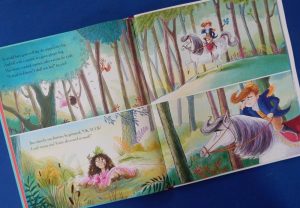
The Princess and the Shoe

The Princess and the Shoe
Caryl Hart and Sarah Warburton
Nosy Crow

Young Princess Jasmine, hater of fancy frills and beribboned gowns has much better things to do than think about dancing with a prince, let alone getting one to kiss her. She’d far rather run about playing on the green with the other children, so when she spies a poster announcing a cross country race scheduled for the following Sunday, she’s determined to enter.

First though, she has to practise, which proves something of a challenge, especially as she ends up waist deep in muck.

And then she discovers that the date of the race clashes with her Big Birthday Ball.

It’s a rather downcast young Jasmine who sits in her window that night contemplating her lot. Suddenly out of the darkness there appears …

The tiny being offers to grant young Jasmine her wish and with a swish of her wand she produces some super go-fast shoes, saying that the magic runs out at midday.

On race day, Jasmine is ready at the starting line and sets off confidently, looking as though she’ll easily finish in time to get to the ball. But then as she’s crossing a sticky, muddy patch disaster strikes and one of her shoes is washed away down the stream.

Does the princess give up in despair: oh no she doesn’t. On she strides wearing just one red trainer gaining speed all the time …

Guess who makes it first through the finishing tape where a welcome party awaits.

Was her win due to those magic trainers or could it have been Jasmine’s self-belief and determination?

As always Caryl’s faultless rhyming narrative slides off the tongue making it a joy to read aloud, while Sarah’s scenes are sheer delight, brilliantly expressive and full of sparkle without the need for any added glitter or foil adornment.

A deliciously different Cinderella tale.

Suzy Orbit, Astronaut / Make & Play: Space / Balloon to the Moon

Here are three very different books all with a space theme:

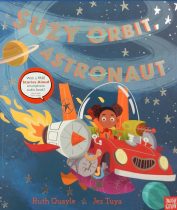
Suzy Orbit, Astronaut
Ruth Quayle and Jez Tuya
Nosy Crow

Space engineer, Suzy Orbit lives with her boss, Captain Gizmo in a lunar space station.

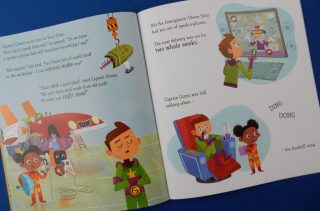
One morning they learn that aliens have been spotted within range of their location and they need to act quickly to launch their space pod. The Captain orders one forthwith but it arrives without batteries and those the Captain has don’t fit.
Furthermore his shiny new space suit is way too small and as the aliens have by now arrived, it’s pointless trying to get a new speak-o-phone.

Happily though, the aliens are peaceable beings but they have bad news to share. Earth is about to be blasted by a meteor storm unless Suzy and her boss can stop it. No pressure there then.

Fortunately Suzy, with her tools always to hand, is an engineer extraordinaire and just happens to have a wonderful new invention ready and waiting. It’s as well that one of the team realises that it’s better to rely on ingenuity than ordering things on the net. Before you can say ‘blaster’ the two are heading out into the meteor storm with Suzy at the controls to do battle with those errant meteoroids. Can they save the day and see off the storm?

It’s great to see Suzy as a positive STEM character in the role of engineer/inventor in Ruth Quayle’s quirky tale. Jez Tuya’s bold illustrations show her as having determination and resourcefulness – exactly what’s needed in the face of the Captain’s lack of drive and inability to show any innovative aptitude.

Make & Play: Space
Joey Chou
Nosy Crow

The latest of Joey Chou’s Make & Play interactive activity book series is sure to please young space enthusiasts.
It contains eight pages of bold, brightly coloured, double-sided press-out play pieces that can be used to create a space scene (some have a hole to suspend with thread while others slide together to stand). The entire set would make a great diorama with space dogs, aliens, astronauts and spacecraft, though if desired, the pieces can be fitted back into the spirally bound book for safe keeping.

There are also other space-related activities – a fruit rocket made from fresh fruit pieces; a song to learn; a ‘blast-off rocket’ science experiment, alien models to create (they could be made into puppets perhaps) and more.
There are hours of fun to be had with this, whether used by an individual, or a small group of young children.

For older space enthusiasts is:

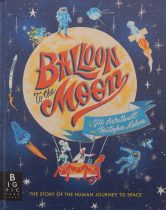
Balloon to the Moon
Gill Arbuthnott and Christopher Nielson
Big Picture Press

Rather than concentrating on the Space Race, this takes a historic look at the steps that began in the late 18th century with the Montgolfier brothers flight of a large unmanned balloon and led on to their sending a variety of animals skywards on a 3km flight three months later.

In the same year came the first manned untethered flight by inventor Pilâtre de Rozier and the Marquis d’Arlandes who flew 8km in a Montgolfier balloon. Hot on their heels came the first woman to do similar, the following year (1784). There’s a whole spread given over to this balloon bonanza.

The narrative then shifts to the first half of the 20th century with a look at some aviation pioneers, followed by a focus on some iconic planes.

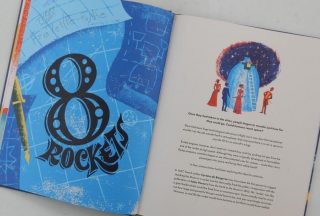
I was especially pleased to find some literary references on the opening page of the ‘rockets section’ where there’s a mention of both Cyrano de Bergerac and Jules Verne. The author uses numbers in her selection of what she includes so we have, for instance ‘8 Rockets’

and ‘Into the Unknown 7’. The seven referring to the seven animals that became the first astronauts; and this chapter cleverly links these with an explanation of g-forces and their relation to fighter pilots and astronauts.

Much of the remaining part of the book provides information on the endeavours of the US and the Soviet Union to win the space race; and what happened thereafter. In conclusion there’s a quick look at some of the new information the Apollo Moon flights gave us; what ‘space travel has done for life on earth’ and a final look to the future.

Christopher Nielson’s retro style illustrations are full of humorous touches adding to the allure of the book and the enjoyment of the whole narrative.

Find Tom in Time: Ancient Egypt


Find Tom In Time: Ancient Egypt
Fatti Burke
Nosy Crow

When Tom’s adventure-loving, archaeologist grandmother, Bea holds out an amulet for him to touch,

he finds himself transported back to a desert in Ancient Egypt surrounded by huge pyramids. In front of one stands a large statue called the sphinx. That though is only the first of the fascinating sights and activities that he encounters on his time travelling trip.

A funeral procession passes by and Tom follows behind to witness the burying of a mummy. He suddenly realises that there’s a cat on the scene that looks uncannily like his gran’s Digby. Surely not, but it is, and thereafter the creature is one of the numerous items readers are asked to spot in the locations Tom visits.

There’s the River Nile

and farmland close by, flooded annually by the river that puts additional nutrients into the soil; the busy town marketplace; the huge temple close to which is a scribe school where fortunate students sit writing on stone blocks.

From there Tom follows a boy to the embalming workshop that is full of dead bodies , priests and workers.

Outside again he takes a look at some of the houses, one of which belongs to a nobleman and is full of expensive wooden furniture, ivory and gold.

Somehow the lad finds himself at a banquet where guests feast on such things as duck, goose, fresh fruit, sweet cakes and pastries.

By now dusk has fallen, Digby still eludes him but Tom makes a stop at a riverside festival having heard a familiar meow. Surely that can’t be Granny Bea holding the errant moggy?

It is; and as Tom reaches out to hug her, there’s a ‘whoosh!’ and they’re back home in the present. It’s then that readers learn that Granny Bea has accompanied Tom at every stage of his journey: time to go back and start searching for her in every scene.

The Ancient Egyptians is a very popular unit of study in the KS2 curriculum and with detailed art by Fatti Burke, this book, published in collaboration with The British Museum, will make a fun, immersive and educative addition to a primary school collection as well as one to enjoy at home, especially by those who are eager search and finders. It’s fortunate perhaps that there are solutions showing the location of all the seven items hidden in each spread.

Astro Girl / Where’s Mr Astronaut?

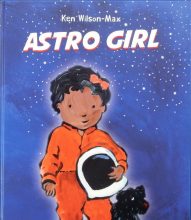
Astro Girl
Ken Wilson-Max
Otter-Barry Books

Space and stars enthusiast Astrid wants to become an astronaut, so she tells Jake her best pal as they lie stargazing.

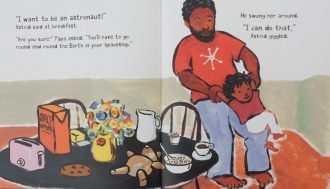
She goes on to tell the same to her papa over breakfast.

He challenges her assertion with comments about orbiting the Earth in a spaceship, dining on food from tubes and packets, becoming used to zero gravity, conducting scientific experiments …

and sleeping alone among the stars: he seems pretty knowledgeable about life in space. Astrid assures her Papa that she can manage all those things even the solo sleeping.

The day comes for the two of them to go and collect Mama in the car.

It’s then that we discover the possible reason for Astrid’s enthusiasm about space and her Papa’s knowledge.

A joyful reunion takes place and thereafter the little girl starts reading avidly to learn as much as she can about how to achieve her ambition, and about some of those trailblazing astronauts who went before, several of whom were women.

Simply and beautifully told, Ken keeps readers interested in the theme by showing us space related items such as Astrid’s t-shirt, her breakfast cereal, Papa’s T-shirts, the cookie shapes they bake together, pictures, a toy – all of which help in the build-up to the grand finale.

A smashing book for young space enthusiasts and perhaps to share on Father’s Day.

For a younger audience is:


Where’s Mr Astronaut?
Ingela P.Arrhenius
Nosy Crow

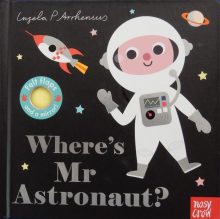
Vibrant, immediately appealing illustrations characterise Ingela P.Arrhenius’ latest title for the ‘flaps and mirror’ series in an amusing introduction to space exploration for the very youngest.

The space travellers hidden herein are a delightful mix of human, canine and alien. There’s Mrs Engineer, Mr Space Dog, Mrs Alien,

Mr Astronaut and finally, whoever happens to be looking in the mirror tucked beneath the felt moon flap.

This one’s sure to add to the deserved popularity of the hide-and-seek series.

The Same But Different Too / Goodnight World

The Same But Different Too
Karl Newson and Kate Hindley
Nosy Crow

Similarities and differences are highlighted and celebrated in this joyful and engaging rhyming book that uses both human and animal characters to demonstrate examples throughout a busy, fun-filled day from breakfast time to bedtime.

In between come a look at differing heights, climbing skills,

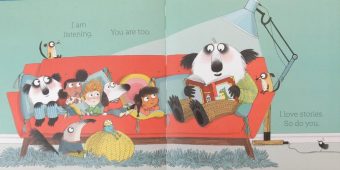
play activity preferences, age, dentition, position, speed and much more; and it’s particularly heartening to find that everyone shares the love of a story session.

Karl’s upbeat words in combination with Kate’s vibrant, zany artwork create a great picture book that’s perfect for family sharing and for foundation stage settings.

With the emphasis on embracing differences it’s a super book to open up discussions about such issues as inclusivity and acceptance. Every spread offers much to talk about and enjoy, helping to highlight how our differences make each and every one of us special and unique.

Goodnight World
Nicola Edwards and Hannah Tolson
Caterpillar Books

Ideal for bedtime sharing is this presentation of the ways of saying “Goodnight” in a dozen languages as well as in English.
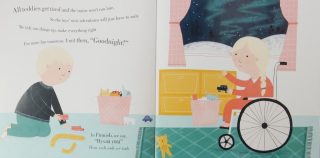
Nicola Edwards rhyming narrative takes us through the bedtime rituals of different families as the little ones are hugged, have a bath, brush their teeth, tidy up toys,

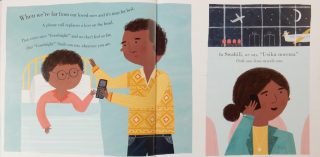
perhaps listen to a phone message from a loved one far away,

and share a bedtime story …

Some tinies are just so tired they need carrying up to bed already fast asleep, while others bid each other “Goodnight’ or in German “Gute nacht”.

Others will have trouble falling asleep and need to count sheep before dreams come.

No matter what though, come nightfall, little ones everywhere go to bed having said “Goodnight” or perhaps used the Mandarin “Wān an”, the Russian “Spokoynoy nochi”; the Italian “Buona note”; the Finnish “Hyvää yötä”; or maybe they said “Usiku mwema” (Shahili); “Buenas noches” (Spanish), the Arabic “Tisbah ala khair”; the Hindi “Shubh raatri” or the French “Bonne nuit”.

Safe in their beds under shared moon and stars, everyone finally falls asleep.

In her bold naïve style, inclusive illustrations Hannah Tolson shows all these different bedtime scenarios as they unfold in various places.

Animal Families: Forest, Animal Families: Safari / If I Were a Bear

Animal Families: Forest
Animal Families: Safari

Jane Ormes
Nosy Crow

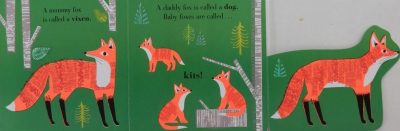
Little ones can discover the parental names of a variety of animals in two different habitats.

Forest presents for example a ‘mummy fox’ or vixen, a dog (daddy) fox and then if you lift the flap on the recto, you discover some baby foxes or kits.

Interestingly both a female deer and a female rabbit are called does whereas a male deer is a stag and a male rabbit is a buck; their offspring are fawns (baby deer) and like foxes, baby rabbits are called kits.

A boar (male bear) and a sow (female) produce bear cubs.

The pattern is the same throughout with the little ones being discovered by lifting the flaps on each recto.

The final spread has gatefolds opening to showcase the collective nouns for each of the animal families included.

Safari is slightly different in that each of the parent animals (leopards, zebras, lions and rhinos) are referred to as ‘daddy’ or ‘mummy’ and beneath the flaps are hidden ‘baby’ leopards, ‘baby’ zebras and so on while the final spread asks tinies to point out various items such as a pink sun’ or ‘little yellow huts’.

The real strength of both books is Jane Ormes’ striking, screen-printed patterned animal images that all have a textured look about them providing further opportunities for language development.

If I Were a Bear
Shelley Gill and Erik Brooks
Little Bigfoot

Through Shelley Gill’s informative rhyming text and Erik Brooks’ splendid, realistic painterly illustrations, the very young are introduced to several kinds of bears, their habits and habitats.

They may be surprised to learn that not only are there black, brown and polar bears, but also rare blue bears and black bears born white, also known as Kermode bears.

Read to Your Baby Every Day / Hickory Dickory Dock

Read to Your Baby Every Day
edited by Rachel Williams, illustrated by Chloe Giordano
Frances Lincoln Children’s Books

Editor Rachel Williams has chosen thirty classic Mother Goose nursery rhymes, favourite nursery songs along with the occasional action rhyme for this collection for adult carers to share with babies.

Chloe Giordana has crafted beautiful, intricately detailed sewn accompaniments to the words using a mix of stitching and fabrics that are hand-dyed.

It’s never and I mean never, too soon to introduce babies to rhymes and songs; there’s absolutely no better way not only to bond with a little one, but it’s proven that exposure to the world around through spoken words, rhymes and songs gives young children a head start in education, and not only with respect to language learning and communication skills.

This lovely collection will introduce tinies to the likes of Hey, Diddle Diddle, Hickory Dickory Dock, Twinkle Twinkle, Little Star, Humpty Dumpty

and Little Miss Muffet along with Row, Row Row Your Boat, Hush Little Baby and I’m a Little Teapot,

and even both in English and French Are you sleeping?

A lovely gift to give a new parent.

Hickory Dickory Dock
illustrated by Yu-hsuan Huang
Nosy Crow

A favourite rhyme with all the nursery classes I ever taught is this one that’s now given the ‘Sing along with me!’ format characterised by sturdy sliders and peep-holes. However in addition to singing the song, little ones will love watching the escapades of the mice as the clock strikes one, then two, then three

and finally four, and discovering that by four o’clock there’s not just one but four mice tucked up in cosy beds ready for some shut-eye, having escaped the clutches of the moggy character that has been eyeing them during the past three hours.

Yu-hsuan Huang’s illustrations are a delight with plenty to interest child and adult as they share the book or perhaps listen to the recording from the scanned QR code.

The Suitcase


The Suitcase

Chris Naylor-Ballesteros
Nosy Crow

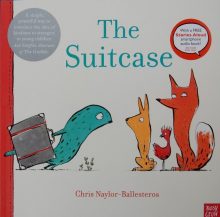
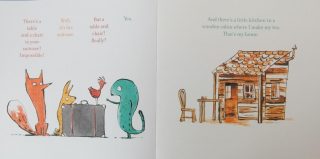
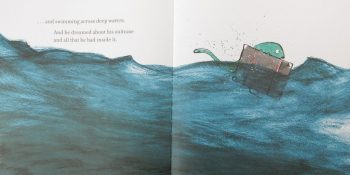
One day there comes a weary, wan and dusty looking stranger dragging behind him a large suitcase. Challenged by a watching bird as to the contents of his suitcase, the creature answers, ’Well, there’s a teacup.’

Another animal arrives on the scene expressing surprise at the size of the case in relation to a teacup and is told that it also contains a table for the cup and a wooden chair for the stranger to sit on. Up rocks a fox and on hearing what’s being said, implies the stranger is lying.

This prompts him to fill in further details about a wooden cabin with a kitchen or making tea and to describe its surrounding landscape too.

By now the creature is so exhausted he begs to be left alone to rest and falls asleep right away.

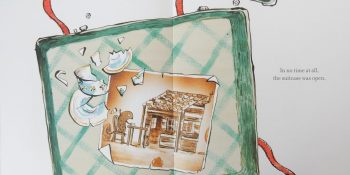
The other three creatures discuss things and fox is determined to discover the veracity or not of the information the stranger has given. His friends are less sure that breaking into the case is acceptable but fox goes ahead and the contents of the suitcase is revealed …

The damage is done: still fox insists the stranger lied to them whereas the other two are showing concern.

Meanwhile the slumberer dreams …

And when he wakes up he’s totally surprised at what the others have done …

Audiences will go through the whole gamut of emotions when this heart-rending story is shared, as did this reviewer.

It’s a totally brilliant, brilliantly simple and compelling way of opening up and discussing with little ones the idea of kindness and how we should treat those in need. I love the way the animals and what they say are colour matched and Chris’s portrayal of the characters is superb.

What better book could there be to share with a nursery or foundation stage class during refugee week than this one, offering as it does, hope and the possibility of new friendship.

Beetles, Butterflies and other British Minibeasts / Look and Say: What You See at the Seaside / Queen Victoria

Beetles, Butterflies and other British Minibeasts
Nikki Dyson
Nosy Crow & the National Trust

In all my time teaching under 7s, I’ve probably never come across a child, however lively or challenging who, when outside (or sometimes in) failed to become engrossed in watching such minibeasts as woodlice, ants, ladybird larva or caterpillars.

This beautifully illustrated Nature Sticker book takes users to several locations where minibeasts are likely to abound: the vegetable patch – several, but not all of the minibeasts therein are likely to be pests.

Anything but pests are bees, hugely important garden visitors that have a vital role in pollination, as do some butterflies like the beauties shown herein.

The shed is a likely place to find spiders and their webs in abundance as well as daddy-long-legs and perhaps other less desirable kinds of flies.
You’ll probably hear grasshoppers and crickets before you see them as they’re often camouflaged in the long grass they like to frequent.
Tree trunks like this one are good spots for discovering and observing beetles.

What better time that now to get outside, look for small creatures and then come back and enjoy hours of learning and fun with this beautifully illustrated book?

Look and Say: What You See at the Seaside
Sebastien Braun
Nosy Crow & the National Trust

Whether you’re building sandcastles at the water’s edge, swimming in the sea, looking at the boats in the harbour, walking on the cliffs, rock-pooling, fishing, exploring the estuary, strolling on the sand-dunes, or perhaps diving down beneath the waves, there’s always plenty of interesting things to see. when you visit the seaside.

This is what Sebastien Braun shows in his engaging scenes of the various locations, each of which has an introductory sentence and another pointing out a particular feature of note. At the bottom of each spread is a row of named objects to find in the large illustration and say together, if sharing the book as intended with an adult (or older child).

A fun way to develop vocabulary and observational skills with little ones.

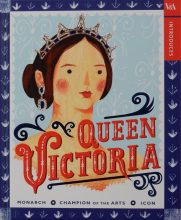
Queen Victoria
Illustrated by Nina Cosford
Puffin / V&A

Readers with an interest in the past will enjoy this mini-hardback book that looks at the life of Victoria and her legacy.
It tells how, when the young Victoria became queen she was determined to break free from the controlling influences of her mother and her courtiers and rule Britain on her own, even if she didn’t always get things right. It was against royal protocol for her cousin Albert, with whom she fell in love, to propose marriage to her; instead she did the honours and was accepted.

As well as information about the Queen, there are spreads about the industrial revolution; the Great Exhibition at the Crystal Palace, the royal couple’s work in support of the arts and science,

their interest in the latest technological developments as well as Albert’s popularising of the Christmas tree and Victoria’s golden and diamond jubilees.

Illustrated with a mix of photographs and finely detailed illustrations by Nina Cosford this is one to add to primary school classroom shelves, or for young readers wanting an introduction to a fascinating period of great change.

Fabio: Mystery of the Ostrich Express / Ariana and Whisper / Princess of Pets: The Naughty Kitten

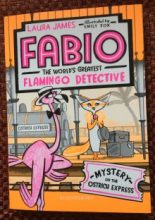
Fabio: Mystery of the Ostrich Express
Laura James, illustrated by Emily Fox
Bloomsbury Children’s Books

Fabio, flamingo detective and resident of a small town on the banks of Lake Laloozee, returns to solve his second case and it involves a stolen necklace.

Fabio and his trusty associate Gilbert giraffe are about to depart on the Ostrich Express for a much-needed holiday at Coconut Palm Resort when something, or rather someone, catches Fabio’s eye.

Once on the train, a desert fox who introduces herself as Zazie – appears in the dining car sporting a fur stole and enormous ruby pendant – the legendary, -very valuable so she tells Fabio and Gilbert – Lalooze Ruby.

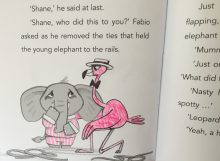
As the train speeds across the desert, unexpected happenings take place, the first being that Gilbert is knocked unconscious when he hits his head against the window as the train is suddenly brought to a full-stop. Leaving his friend in the care of Zazie, Fabio leaves the train and discovers a baby elephant lying beneath the stars tied to the tracks. Fabio unties him and learns that a gang of bandits – hyenas and a leopard – had tied him down.

That though is only the beginning. Soon a scream pierces the dark followed by hyena’s laugh and as Fabio climbs back aboard the train he spots a leopard silhouette and learns that the ruby has vanished from around Zazie’s neck – pulled off by a thief so she says.

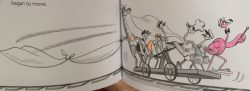
Never fear, Fabio is hot on the case; he merely needs to enlist the aid of the train crew to help power his refurbished handcar,

let loose the tied-together table cloths , … cavort across a few train carriages, execute a deft flick of Gilbert’s cane and … and … that would be telling way too much of this exciting, fast-paced, perfect for just flying solo readers tale.

And with Emily Fox’s dayglo bright, pink and orange powered illustrations and occasional text backgrounds, plus Fabio-patterned chapter breaks, what more can any young reader want?

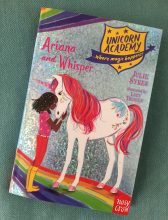
Ariana and Whisper
Julie Sykes, illustrated by Lucy Truman
Nosy Crow

Unicorn Academy is ‘where magic happens’ and now in story number 8, arachnid-fearing  Ariana is finding it hard to make friends. She does however love her special unicorn Whisper and enjoys spending time in the stables bonding with him and helping him discover his magic power.

Things improve somewhat when she starts to bond with untidy Matilda and then Ms Nettles announces that the day’s lessons are to be replaced by a field trip to the edges of the woods to find out which animals are leaving and why. An adventure is set to begin: something is very wrong in the woods and Ariana can feel it.

Not long after, Whisper discovers his special power: perhaps with its help, together with the courage of Ariana, her unicorn and the other students, the mystery of what has been happening with the animals can be solved.

Fans of the sparkling series will lap this up with its short, bite-size chapters and Lucy Truman’s enchanting black and white drawings.

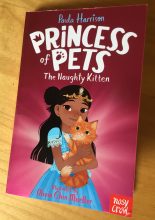
Princess of Pets: The Naughty Kitten
Paula Harrison, illustrated by Olivia Chin Mueller
Nosy Crow

Princess Bea is an animal lover but her father King George tells her time and again that Ruby Palace is ‘no place for a pet’. However, the nine-year-old princess isn’t one to be deterred by royal rules when it comes to taking care of animals needing help.

While she’s at the kite festival with her teacher Mr Wells, Bea climbs up a tree to free her kite and there comes upon a ginger kitten; and of course, she just has to rescue it.

Determined to keep it safe until they can find its owner she manages to sneak it in to the palace but discovers that Tiger as she calls it, is rather excitable. Moreover when her father discovers the creature, he’s far from pleased and gives Bea just 24 hours to get rid of it.

At night the kitten decides to go exploring and Bea needs to summon up all her courage to hunt around the palace in the pitch dark, especially when she hears a noise that doesn’t sound like Tiger …

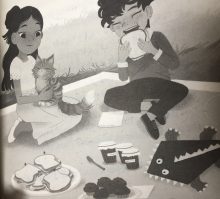
Young animal lovers just flying solo as readers will enjoy this addition to the series illustrated by Olivia Chin Mueller.

Have You Seen My Blankie?

Have You Seen My Blankie?
Lucy Rowland and Paula Metcalf
Nosy Crow

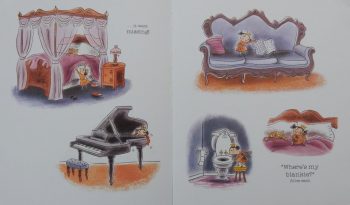
Lucy Rowland is a highly skilled rhyme writer and here she uses her verbal artistry to tell the tale of young Princess Alice and her soft, warm, snuggly blankie.

One day this exceedingly cuddlesome item goes missing. Alice hunts high and low unsuccessfully

and then heads outside to consult her brother Jack playing in his den. Jack informs her that he’d used it a while back but then a giant took it away.

Off goes Alice to find the giant. He invites her in to partake of tasty pies but tells her that yes, he’d had the item, used it to wipe his nose, whereafter a witch flew off with it. Again, the witch had made use of the object (as a cloak) until it was snatched by a dragon.
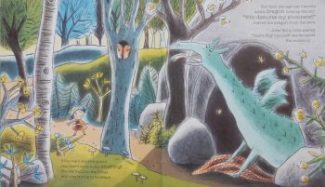
Following a snoring sound coming from the forest, Alice puts on a brave face and walks towards a cave wherein, seated at the entrance she finds …

Surprisingly however, the dragon isn’t at all ferocious and instead tells the child how much he benefits from such a soft item to protect him from the cold, rough cave floor when he sleeps.

Alice’s first thought is to establish owner’s rights, then on further consideration she comes up with an alternative plan: to help the dragon find a warm, soft, snuggly substitute.

Easy, you might be thinking but their search is far from so and both Alice and dragon become increasingly troubled

until finally they arrive back at the royal palace sans anything suitable.

Eventually up in the attic the little princess extricates the perfect item … Sleep well Alice, sleep well dragon friend.

Equally as enchanting as Lucy’s telling are Paula Metcalf’s illustrations. Her colour palette – mainly greeny, orangey, browny, bluey hues is a great choice and her characters human and animal are adorable and splendidly expressive.

A felicitous collaboration, an enormously successful mix of words and pictures: in short, a super read-aloud picture book to enjoy especially just before snuggle up time.

Board Book Gathering: Jump! / Hello House / Hello Garage / Meeko and the Big Red Potty

Jump!
Tatsuhide Matsuoka
Gecko Press

This is such a cool board book; it made me want to go out, find the nearest toddler, share the book and do some joyful, very noisy celebratory jumping about together.

The idea is so simple yet SO effective: a patterned text accompanies a statement going over two vertically opening spreads, starting with ‘A frog jumps. // Boing!’
It then proceeds to introduce other agile jumping creatures – a kitten, a dog, a grasshopper …

a rabbit, a snail – although that one just cannot get airborn,

a mother hen and chick, a fish and finally the small girl narrator of Tatsuhide Matsuoka’s cracking little book.

Ready to jump? Everybody ready? 1, 2, 3 … BOING!

Hello House
Hello Garage

Nicola Slater
Nosy Crow

In Hello House little Ludo is out and about in search of some friends to play with. He calls first at the home of Milly and Dylan who are busy cooking in their kitchen. Next stop is at the rabbits’ residence where he invites the bunnies to join him. Ludo and entourage then proceed to Ruby and Ned’s house and ask the pups to leave the TV and play outside.

Their final port of call is Bruno Bear’s and there they discover a sleeping friend who needs a spot of nose tickling to wake him from his slumbers. Then with all the friends assembled it’s time for some fun …

Little fingers will enjoy lifting the house-shaped flaps to assist Ludo as he rounds up his pals.

Equally enjoyable is Hello Garage and again Ludo is on the hunt for playmates only now his search takes him to the garage where he looks in various vehicles in the hope that he’ll find some not too busy animals with time to play.

With Leo, Mabel, Olaf, Daisy, George, and finally (after a tummy tickling rousing) Lucy duly invited, let playtime begin on the ‘soft, green grass’

Toddler fun through a pleasing repeat pattern text, and bright illustrations with plenty of detail to peruse and discuss.

Meeko and the Big Red Potty
Camilla Reid and Nicola Slater
Nosy Crow

Little ones just at the potty training stage will love that you can orchestrate Camilla Reid’s story by means of the strategically placed sound buttons as they hear how now a big bear, Meeko recently has graduated from nappies to big bear pants. However there are still times like this one when he just can’t manage to hold it and so does a wee, soaking his pants and the floor.
Happily next time though he remembers he needs to run to his red potty before it’s too late

and the simple story ends with a proud Meeko and equally proud parents and animal friends. Splendidly expressive illustrations from Nicola Slater make this down-to-earth board book a winner.

Who is Afraid of Little Wolf? / Marley Bear at the farm / Ottie Elephant in the town

Who is Afraid of Little Wolf?
Yayo Kawamura
Prestel Publishing

A bored little wolf is eager to find a playmate but he’s rebuffed in turn by little squirrel, little rabbit and little fox each saying that their mother doesn’t allow them to play with wolves.

Feeling rejected and sad, the little wolf hears a voice inviting him to play. It’s little bee, who is definitely not afraid of him and wants to play hide and seek.

So much fun do they have that the forest resounds with their playfulness.

All of a sudden, first squirrel and then a host of other animals want to join the game …

It’s never too early to demonstrate to the very youngest the importance of friendship and of not prejudging others; Yayo Kawamura’s delightful little book with its endearing characters does both of those without a hint of preachiness.

Marley Bear at the farm
Ottie Elephant in the town

Melissa Crowton
Nosy Crow

Part novelty lift-the-flap, part seek-and-find, these tactile board books, the first two of a new series, involve little ones from the outset.

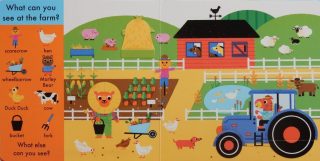
Marley Bear stars in the first book and we join him on a farm visit. There’s plenty to discover as he’s greeted by Gus Lion,

encounters some noisy farm animals including a pig family, a soft, fluffy sheep (very strokable) and then looks at more farm animals, the farmhouse and a truck before jumping into his car to drive home. Highly interactive, with some subtle positional vocabulary learning (in front/behind).

It’s a busy day when Ottie Elephant makes a trip to town; the place is bustling with shoppers and full of noise;

there are many colourful sights to enjoy, and as well as counting Ottie’s flowers, little ones can explore her shopping basket before she sets off home for some welcome refreshments.

Little Duck Duck hides in plain sight in every spread adding to the enjoyment of both books.

Lots of inherent learning, but most important, lots of fun to share with tinies.


The Rescue Princesses: The Amber Necklace / Arlo, Miss Pythia and the Forbidden Box

The Rescue Princesses: The Amber Necklace
Paula Harrison
Nosy Crow

In the 15th and final adventure in the series, it’s up to Zina and her friends to save the tamarind trees of their rainforest home. These trees are the only ones that provide year round food for the lemurs but they’re scheduled to be cut down to make way for the carnival that has been re-routed on account of the usual road being flooded.

Princess Zina is horrified at the prospect; but the princesses must use their intelligence, co-operative skills, kindness and courage to protect the animals and their precious tamarinds.

With their camouflage ninja gear and Zina’s special amber necklace, said by her grandma to hold the heart of the forest it might just be possible to persuade Ando and his workmates to find another path. If not, could the amber jewel works it magic? …

Another exciting tale with short chapters, plenty of line drawings and an exciting and intriguing plot to keep readers turning the pages, this is ideal for new solo readers.

For readers who like longer stories there are two new fiction titles from Maverick Publishing coming soon: one is

Arlo, Miss Pythia and the Forbidden Box
Alice Hemming, illustrated by Mike Garton
Maverick Publishing

4X have become 5P and they’re back with another highly unusual teacher, not from the stone age this time but nevertheless there’s something not quite normal about Miss Pythia.
For a start, she always seems to know exactly what is about to happen; she has a weird-looking symbol tattooed on the back of her neck; she never seems to change her clothes, and there’s that box she keeps on her desk. Mmmm! And could it be sheer co-incidence that she shares her name with a priestess of the Ancient Greek world?

When I taught nursery children we often did an activity called, ‘What’s in the box?’ Singing a little ditty based on those words served to arouse the children’s interest and enthusiasm before the lid was lifted and we investigated its contents. And that is just what Miss Arlo does when she instructs her class that opening the particular box she has in her safe-keeping, is strictly forbidden.

But then 5P are selected to participate in A Play a Day, electing to perform a version of Pandora’s Box and Arlo is chosen to act as director. Can his classmates resist the temptation to open Miss Pythia’s actual box as they rehearse?

What Arlo doesn’t immediately spot as he gets engrossed in his directing role is that the replica box made for the drama has been switched.

Then with the play in full swing a terrible realisation comes upon him …

Another winner from Alice Hemming; it’s full of suspense, gently humorous and splendidly complemented by Mike Garton’s lively, expressive drawings, which provide additional details and humour.

Now set fair to become a super series, this story is great for solo reading as well as highly appropriate as a class read aloud especially if the Ancient Greeks are on the agenda.

When a Dragon Comes to Stay

When a Dragon Comes to Stay
Caryl Hart and Rosalind Beardshaw
Nosy Crow

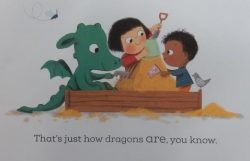
When a scaly creature turns up at number 124 with a shoulder bag it looks as though she’s there for the long haul. Perhaps though, she does need some guidance when it comes to good behaviour.

Snatching toys rather than sharing; breaking the rules in a supposed-to-be co-operative set-up; cheating and messy eating; all these need attending to; so its fortunate for this particular little dragon that she’s found some small, kind, friendly residents ready and willing to lead the way as positive role models:
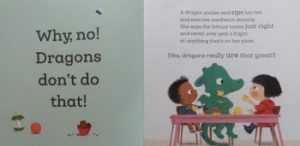
‘And does she snatch and keep the toys / away from other girls and boys? //Why, no! / Dragons don’t do that! // A dragon knows she must play fair / And wait her turn and always share. / She knows the rules of all the games / and never argues or complains …’

Caryl cleverly alternates the undesirable with the desirable behaviours in a rhyming narrative that gently guides without preaching (in the same way, one hopes teachers/parents model what they hope to see rather than drawing attention to the misdemeanours of little ones).

And of course, allowances need to be made for nobody’s perfect, and certainly not little dragons.
I particularly like the sequence where the dragon’s messy eating is helped when she’s given a stable seat.

In her wonderfully expressive scenes of the adorable humans and their visitor, Ros. brings out the gentle humour in Caryl’s telling, showing how hard the little dragon is trying to behave appropriately.

Altogether a smashing book to share with little humans at home, or in an early years setting.

Toppsta have created some very useful reading records for schools: for further details follow the link.

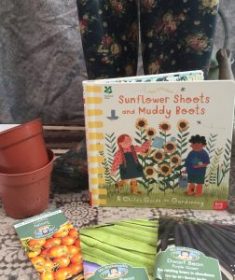
Sunflower Shoots and Muddy Boots

Sunflower Shoots and Muddy Boots
Katherine Hallligan and Grace Easton
Nosy Crow

Published in collaboration with the National Trust this is a super introduction to gardening for youngsters no matter whether they have available a large outdoor space or a tiny one.

In a dozen spreads author Katherine Halligan includes pretty much everything you need to know when starting out as a gardener, from the kinds of plants that are easy to grow; making an indoor garden (you might use welly boots or old suspended hats);

constructing a garden den; composting, tasty things such as radishes that can be grown in a variety of containers, and raspberries, that need more space.

Also included are ways to deter pests by gardening organically; encouraging desirable wildlife such as birds and butterflies by planting some trees

and/or sowing wild flower seeds. There’s a page on the kind of gear you’ll need, another on safety, one on pressing flowers and a final page of tips for adults.

Each spread is highly visual and there are instructional paragraphs, tips, ‘did you know?’ questions; appropriately placed lists of what’s needed for individual projects, as well as a list of useful gardening definitions.

Bursting with ideas, activities and facts to get children interested, with its wipe-clean pages, and Grace Easton’s eye-catching illustrations, this is a book to use at home, in a nursery/early years setting or a school gardening club.

Where Dani Goes, Happy Follows / Snow Sisters: The Enchanted Waterfall / Unicorn Academy: Rosa and Crystal

Where Dani Goes, Happy Follows
Rose Lagerercrantz and Eva Eriksson
Gecko Press

This is my first encounter with the delightful Dani whose adventures began with My Happy Life.In this, her sixth instalment the girl is spending the winter break staying with her grandparents because her father has again become sad and is now spending time with his mother and brother in his home city, Rome to ‘think about his life’.

While out ski-ing, the normally cheerful Dani gets that gloomy feeling but then she suddenly thinks of her best friend Ella and remembers that it’s almost her birthday. What better birthday present than an experience – a surprise visit from Dani?

There’s a slight snag though: Ella lives miles away in Northbrook. Of course, being the positive child she is Dani’s sure one of her grandparents will drive her: maybe she doesn’t have a problem after all.

After consideration Grandma asks her if she dares go from Stockholm to Northbrook on the train by herself so long as Ella’s mum collects her at the station. Granpa needs a fair bit of convincing but eventually Dani is on the train bound for her destination.

When she arrives at Northbrook however things start to go wrong; the station is covered in snow and there’s nobody there to meet her. That however is only the first bad thing that happens …

With her near indomitable spirit, Dani is an adorable character. In this book, in a very short space of time she emerges with a lot more understanding of the adult world with its ramifications and frailties.

With its bitter-sweetness, Rose Lagererantz’s writing really rings true and her characterisation is superb.

Eva Eriksson’s splendidly empathetic black and white illustrations are a delight and add an extra touch of piquancy to the book.I will definitely seek out the earlier titles in this series.

Wholeheartedly recommended for solo reading and as a class read aloud for KS1 and early KS2.

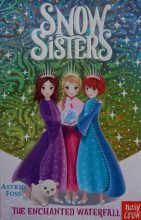
Snow Sisters: The Enchanted Waterfall
Astrid Foss, illustrated by Monique Dong
Nosy Crow

This is the 4th and final magical adventure of the three sisters, with special powers to enchant, who reside in a castle on the mystical island of Nordovia.

Now Magda, Hanna and Ida must draw on all their strength and bravery to undertake their final quest in this battle of good versus evil, for it’s the Day of the Midnight Sun and the nefarious Shadow Witch is absolutely determined to do whatever she must to obtain the power of the Everchanging Lights and make the skies forever dark.

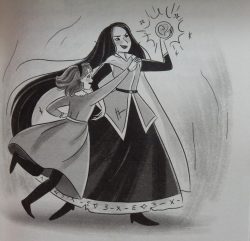
As always the combination of magical fantasy, highly engaging characters (some animal), a powerful plot with just the right amount of darkness, and plenty of Monique Dong’s lovely black and white illustrations will ensure that early chapter book readers will lose themselves in the adventure.

And do the sisters succeed in ensuring that the Everchanging Lights are in their rightful place by the time the clock strikes the midnight hour? Let’s just say that where’s there’s light and love, there is hope.

For roughly the same age group, there’s more magic in:

Unicorn Academy: Rosa and Crystal
Julie Sykes, illustrated by Lucy Truman
Nosy Crow

This series for the countless young unicorn lovers out there takes us yet again to Lakeside Unicorn Academy for another instalment of magical unicorn delight.

The pupil in question herein is Rose and her unicorn partner is Crystal and after just a month at the school the two are off on a rule-breaking adventure in search of the magical map. It’s not all down to the twosome however, teamwork is involved and they both have to learn what being a member of a team entails.

Engaging, undemanding fun.

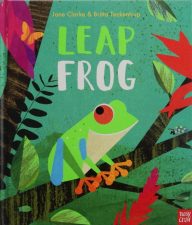
Leap Frog

Leap Frog
Jane Clarke and Britta Teckentrup
Nosy Crow

The latest in Jane and Britta’s series of stories that offer maximum audience participation features a little tree frog named Felix. Felix has got lost near the pond, far from his home in the jungle trees.

The tiny creature appears easily frightened by the strange noises, the first being the ‘Plip! Plop! Plip! Splosh!’ of the turtle. She though is nothing to be alarmed about; the friendly creature merely wants to watch the sunset and we’re ready to reassure him with our, “Don’t worry, little frog, / there’s nothing to be scared of.”

These words of encouragement are to be repeated each time Felix hears a scary sound and there are encounters with a beetle that’s just walking across the foliage;

a troupe of cheeky monkeys a-nibbling their ‘nutty night-time snacks’ and dropping the shells with a ‘Crack! Crunch! Clatter!’; and a slithery snake to be seen off with some clapping and shouting.

The branching tree beside that on which a woodpecker taps provides young listeners with some counting practice as the little frog, aided by his sticky toes, climbs up and up.

Having reached the top, Felix hears yet another sound, and it’s getting nearer. What could be making that ‘Hop! Hop!’ hopping noise … ?

The textured, jewel-like colours of Britta’s scenes with the leap-off-the-page fluorescent green of Felix’s back and lower limb parts are perfect for holding the attention of little ones as they enthusiastically respond to Jane’s irresistible instructions and questions on every spread of this noisy, fun-filled story.

Tiny T. Rex and the Impossible Hug / Dinosaur Farm!

Tiny T. Rex and the Impossible Hug
Jonathan Stutzman and Jay Fleck
Chronicle Books

Daft and sweet sums up this story of one very small T. Rex and his enormous challenge.

Tiny, as he tells us at the outset has tiny arms and a strong desire to cheer up his stegosaurus friend Pointy by giving him a hug.

Determined to overcome his design fault and bestow a comforting embrace upon his best pal, Tiny consults various members of his family. His father suggests the solution might be a mathematical one: ‘Rexes are thinkers, not huggers.’ he proffers.
Auntie Junip – a yoga buff – suggests balance (along with a healthy drink of cucumber juice), offers the best means of problem solving.

Thank goodness then for his mum, for now Tiny is both battered and lost until she discovers him and gives some words of reassurance about his being creative, kind, brave and big-hearted.

It’s siblings, Trixie and Rawie that have the most useful suggestion: ‘To do the impossible you must plan and practice.’

However well intentioned this advice – and Tiny is ready to embrace it – the practice doesn’t go so well for the little guy.

And his final hug is a huge error although he does make an important discovery while airborne.

All ends well, though to reveal what happens will spoil the compassionate finale.

Young listeners will doubtless be rooting for Tiny throughout Stutzman’s wryly humorous tale and enjoy Fleck’s minimally detailed stylised digital art; mine certainly did, requesting an immediate re-reading.

Who can fail to admire Tiny with his determination not to let his physical limitations get in the way of his big-hearted instincts?

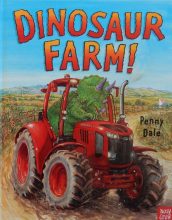
Dinosaur Farm!
Penny Dale
Nosy Crow

You might be surprised to learn of a gang of dinosaurs running a farm unless you happen to be familiar with Penny Dale’s dinosaur brigade. In which case you’ll already know that these prehistoric beasts can take on all manner of unlikely roles so farming is no challenge too far despite Dinosaur Farm being an extremely busy place.

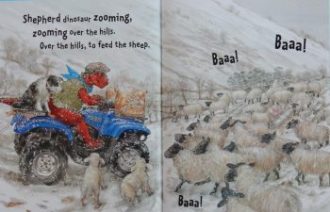
There are fields to plough – up and down, up and down as well as sheep that need feeding.

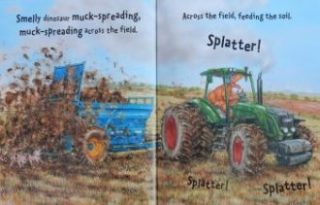
A group of noisy dinosaurs are building a fence, bang, bang banging in the wooden posts while a rather pongy Allosaurus is muck-spreading.

We see two of the team making the hay into bales and others digging up the muddy carrots.

When the sun comes out, it’s time to get out the combine harvester and cut the corn. Then there’s the apple harvest to pick – red, juicy fruits aplenty – yum, yum.

Finally all the produce needs cleaning and packing: it keeps the entire group of ten working late into the night but what is all this hard work for?

Where could they be going next morning with their trailer loaded? There’s certainly excitement in the air …

Told as usual in rhythmic language, the story is punctuated by contextually apt exclamations your little ones will love to join in with, while Penny Dale’s elaborately detailed pencil and watercolour scenes will absorb them visually. They’ll likely be amused at such humorous touches as the ‘Haymaking dinosaurs …’ scene that shows one of the two propped up against a bale, seemingly snoozing.

Nibbles Numbers / Little Fish and Mummy / Where’s Mr Duck?

Nibbles Numbers
Emma Yarlett
Little Tiger Press

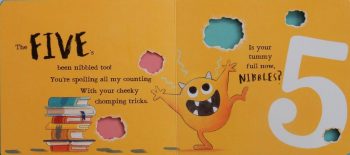
Emma Yarlett’s little yellow book-eating monster Nibbles is back and now he’s got his teeth into a board book. One might think that chomping through card would be a challenge too far but no. Once released the little fellow immediately starts sinking his gnashers into the pages and even has the audacity to nibble into the numerals leaving fairly sizeable holes.

Moreover he’s sabotaging our counting practice and just when we think we’ve cornered the little munching rascal, he makes a dive for it and disappears through the final spread, only to emerge on the back cover with a satisfied grin on his face.

Smashing fun and what a delight to be able to introduce my favourite little monster Nibbles to a younger audience.

Little Fish and Mummy
Lucy Cousins
Walker Books

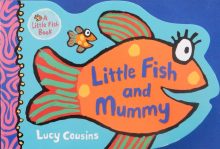
The latest Little Fish book is narrated by none other than Little Fish who is particularly excited about sharing with listeners a ‘Mummy Fish and me’ day.

This special day is spent on lessons in swimming and bubble blowing, splishing and splashing with all the other fish, a game of hide-and-seek just with Mum and a look inside a deep down cave.

What better way to end such a great day than with a round of kissing – ‘Kiss, kiss, kiss!’

Irresistible if you know a little one who’s a fan of Lucy Cousins’ endearing spotty Little Fish, and I certainly know a lot of those.

Where’s Mr Duck?
Ingela P Arrhenius
Nosy Crow

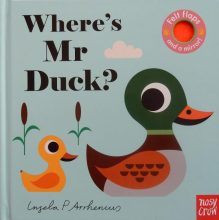
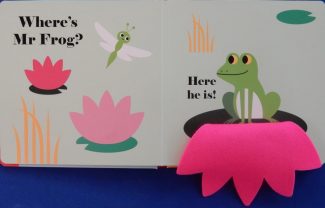
The latest felt flap hide-and-seek board book in this deservedly popular series is set around the pond. In its environs little ones can discover Mrs Butterfly, Mr Frog,

Mrs Worm, Mr Duck and finally as the creatures look on, him or herself.

With its characteristic question and answer format, a wealth of opportunities for developing language, bold bright art and satisfying conclusion it’s no wonder the series is such a success; this one will be as popular as its predecessors.

So You Think You’ve Got It Bad? A Kid’s Life in Ancient Greece

So You Think You’ve Got It Bad? A Kid’s Life in Ancient Greece
Chae Strathie and Marisa Morea
Nosy Crow

Chae Strathie knows just how to make history interesting and fun for children as he demonstrates in his latest So You Think You’ve Got It Bad title published in collaboration with The British Museum.

The first topic (of ten) Clothes and Hairstyles contains some tasty or perhaps rather yucky, snippets of information such as the fact that one source of purple clothes dye was insect larva (maggots to most of us); though actually, yellow was a favourite with girls.

Suppose you were a boy in Ancient Greece; you’d wear merely a short tunic; yes it was probably pretty warm much of the time but even so a sudden gust of wind, especially in winter, would probably expose your nether regions. Brrrr!
Moreover, young men training in the gymnasium or participating in a sporting event did so in the altogether and it was considered absolutely normal so to do.

Young girls fared slightly better; they too wore only a single garment – an ankle length dress called a peplos but at least it was belted.

Zips or buttons hadn’t been invented although people used brooches, pins, cord or belts as fasteners.

Girls had a pretty grim time of it back then and female babies were often left to die on account of the dowry system, which meant that it could cost parents a fortune when a girl married, something that could happen as young as thirteen and to a complete stranger.

Girls fared badly too when it came to education: boys went to school when they were seven but girls –rich ones only – were home educated, the focus being how to run a home.

Inequality was everywhere with slaves making up around a third of the population of Athens.

Talking of education, tablets were used for note taking in lessons – no not the electronic kind; these were made of wax-covered wood on which you wrote with a stick-like stylus.  Sticks were employed for another reason too – for beating those boys who didn’t learn quickly enough in class. Yeouch!

Pets were popular with families with snakes, goats, swans, ducks and geese numbering among the favourites along with dogs (the very favourite). Try taking geese out for a walk!

Oh my goodness! Even the homes of the very richest were without a loo. Imagine having to poo in a pot every single day. No thanks. There’s even a depiction on a painted vase of a small boy sitting having a dump on a tall potty-like object that apparently doubled as a high chair. Hygienic it surely wasn’t.

The largest room in a typical Greek house was devoted to partying – men only again. Female readers are probably fuming by this time.

Health and medicine introduces physician Hippocrates, often called the founder of modern medicine but before he came along much of ancient Greek medicine relied on magical prayers and charms.

Diet, myths and legends, ancient gods and fun and games complete the thematic sections.

The layout of almost every spread differs with information presented in paragraphs of text, in speech bubbles, via diagrams, and through Marisa Morea’s amusing illustrations, which make the book even more engaging.

Readers will surely finish reading this with a big smile and almost without noticing will have gained insights into an important ancient civilisation as well as a greater appreciation of their own lives today.

You’re Not a Proper Pirate, Sidney Green!

You’re Not a Proper Pirate, Sidney Green!
Ruth Quayle and Deborah Allwright
Nosy Crow

Here’s a book that takes a different slant on piratical tales with the all-absorbing nature of imaginative play at its heart.

When Sidney Green receives a letter urging him to stop playing and become a proper pirate he likes the idea but as he tells his playmate, dog Jemima, they have an important race to take part in first. “I’ll come in a minute,” is his response to Captain Shipshape and off he races, whoosh!

Race successfully completed, he forgets all about being a pirate until, in through the window flies a scarlet macaw that repeats Captain Shipshape’s summons.

Sidney’s response is the same as before. and he and Jemima plus the macaw set off on an expedition to Africa.

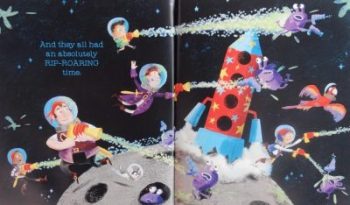
Once again a ‘rip-roaring time’ is had by all and the pirate business is forgotten.

He’s reminded however by three pirates, who come banging on his door disturbing the project Sidney is engaged in. Building a castle seems more interesting than returning whence they came so the three join in with the project.

It’s thirsty work and as the builders stop for some liquid refreshment who should appear on the scene but Captain Shipshape himself.

His dismissal of the friends’ activities as ‘just playing’ and his instruction to join him, have an unexpected outcome.
Before you can say ‘Proper pirate’ something heavy hits him on the head and he finds himself a member of Sidney’s crew blasting off into space to track down some dangerous aliens.

The outcome is another rip-roaring time …

How will this adventure end? You’ll have to unearth a copy of this treasure of a book for yourself to discover that. (That sentence holds a clue). Suffice it to say that there’s more than one way of being a ‘proper pirate’.

I love the way Ruth’s story highlights the importance of children’s imaginative play in this enormously engaging tale that is packed with action, has plenty of dialogue for readers aloud to let rip on, and some satisfying repetition for young listeners to join in with.

Deborah Allwright packs plenty of action into her digitally worked scenes of cars and corners, boats and a birthday celebration, castles and crocodiles, diggers and dinosaurs, and much more, making this a super story to share with your little ones.

Tooth / Big Kid Bed, Bizzy Bear Knights’ Castle, Mix & Match Farm Animals

Tooth
Big Kid Bed

Leslie Patricelli
Walker Books

Baby, the star of several previous board books including Toot returns in two further amusing and appealing episodes.

Tooth begins with the star of the show exhibiting some distress about a strange feeling in the mouth. Before long we discover that Baby is getting a tooth, shiny, white, hard and sharp. Not just a single tooth though, there’s another and then two more follow.
Having shown those shiny gnashers, Baby demonstrates some things good and not so good that can be done with the teeth.

Very important too is taking care of teeth and we see how even one so small is conscientious about dental hygiene.

Brushing twice a day and flossing (with Daddy and Mummy’s help) are part of the little one’s daily routine.

Patricelli’s straightforward first person text combined with scenes of the adorable Baby is irresistible.

The same is true in Big Kid Bed. Here the toddler tells of bedtime preparations for a sleep on ‘my new big kid bed!’ How exciting; but the bed is so big and the toddler so small it’s as well that Mummy and Daddy are on hand to make things easier, piling up pillows around the bed in case of a fall and bringing in Baby’s stuffed animals to snuggle up with.

Comfortable as Baby might be, there’s the possibility of getting out of bed again to investigate what other members of the household are doing during the night, until finally, YAWN; sleepiness takes over and it’s time to return to the warmth and cosiness of that new bed for a good night’s sleep.

Who could ask for more from a bedtime book for the very youngest?

Bizzy Bear Knights’ Castle
Benji Davies
Nosy Crow

In this adventure Bizzy Bear finds out what life as a knight is like when (with a bit of help from small fingers that slide the helmet visor up and down) he dons a perfectly fitting suit of armour and visits a castle.
Once kitted out and inside, Bizzy tries his paw at brandishing a sword

and then on the next spread, at jousting before finally sitting down to participate in a delicious-looking banquet.

As with other titles in the series, the engaging simple rhyming text, brightly coloured illustrations with just the right amount of detail (look out for the dragon) and those interactive features – sliders and tabs that are easy to use, make this well-constructed book ideal for toddlers.,

Mix & Match Farm Animals
Rachael Saunders
Walker Books

With the same innovative design as previous titles in this mix & match series (a tiny board book within a small one) young children are invited to match the larger surrounding page with its ‘Who says …?’ question to the appropriate smaller inset animal spread showing the animal that makes the sound.

The animals featured in the smaller book are all adult while on the surrounding pages young animals are depicted, as well as other appropriate clues, for instance there’s a calf, a bull, a barn and a bucket of milk on the ‘cow’ spread.
On the final ‘sheep’ spread we meet a farmer and sheepdog in Rachel Saunders’ illustration.

A clever format, and a playful and enjoyable way to introduce or re-enforce farm animal sounds to the very youngest

Sammy Claws The Christmas Cat / Santa’s High-Tech Christmas / Christmas Gremlins / A Very Corgi Christmas

Sammy Claws The Christmas Cat
Lucy Rowland and Paula Bowles
Nosy Crow

Such is his fondness for taking a snooze that Santa’s fluffy feline Sammy will drop off pretty much anywhere and dream of accompanying his owner on the Christmas Eve delivery run.

What he doesn’t imagine though when he dashes off to Santa’s workshop, is the manner in which that dream finally comes true. The somnolent cat gets parcelled up and dropped in among the other packages on the back of the sleigh and then it’s a case of “Ho! Ho! Ho! “ and off they go.

However, Sammy isn’t the only extra rider on Santa’s sleigh that night. Two wicked robbers, Mischievous May and Bad Billy are ready and waiting to seize their big chance and help themselves to some of the parcels.

Can Sammy save the day? And what is the special present Santa leaves for his pet moggy under the Christmas tree?

Festive fun aided and abetted by a snoozy feline delivered in Lucy Rowland’s bouncing rhyme with the addition of a good sprinkling of elves and excitement in Paula Bowles’ pattern-rich illustrations.

Santa’s High-Tech Christmas
Mike Dumbleton and Angela Perrini
New Frontier Publishing

Santa has eschewed the old fashioned methods when it comes to transport and keeping account of Christmas parcels; instead he uses a motorised sleigh and stores all his lists on his smart new techno-pad. But disaster strikes as he’s whizzing over the rooftops by means of his rocket-pack; Santa’s techno-device plummets to the ground and he’s faced with a blank screen.

Enter Jasmin, a techno-savvy little girl who is more that happy to give sad old Santa a helping hand by showing him how to access all the information he needs.

Not only that but she comes to his aid in another way too: after all Christmas really is all about giving.

Mike Dumbleton’s jaunty rhyming narrative is given added zaniness by Angela Perrini’s illustrations.

Christmas Gremlins
Adam & Charlotte Guillain and Chris Chatterton
Egmont

Oh my goodness, those gremlins are at large again in another of the Guillains’ rhyming romps and now they’re on the rampage creating havoc in the run up to Christmas. It seems they’re determined to get in on the act no matter whether it’s decorating the tree, baking mince pies and Christmas cake (or should that be gobbling same?), wrapping up all the presents (and everything else in sight), singing – more like screeching – carols at the door or popping out of Christmas cards. But that’s only indoors. Further prankish doings are likely outside too: nothing is safe from their mischief so let’s hope they’re well out of the way before Santa arrives.

With more than 50 flaps to lift, this madness and mayhem will keep little ones entertained as they play hunt the mischief makers on every one of Chris Chatterton’s jolly spreads.

A Very Corgi Christmas
Sam Hay and Loretta Schauer
Simon & Schuster

The royal corgis are among those not feeling the Christmas spirit, far from it, all except for young Bella that is. Dazzled by the lights and excited by the hustle and bustle outside she decides to go and join in the fun. Hitching a ride in the back of a mail van, she gets out at Piccadilly Circus where everything suddenly feels overwhelming – too bright, too hectic and FAR TOO LOUD!

As luck would have it along comes London savvy pup Pip offering to show her the sights. A great time is had by both but suddenly as they approach the palace, Pip goes missing. Will Posy ever see her newfound friend again? Perhaps with the assistance of a very special royal couple …

Delivered with an abundance of Christmas spirit, Sam and Loretta’s London tale is a charmer.

Early Years Christmas Miscellany

Christmas
Lisa Jones and Edward Underwood
Nosy Crow

What a gorgeous introduction to the festive season for a little babe is the latest in Lisa and Edward’s Baby’s First Cloth Book series.

Baby Boo, suitably clad is taken outdoors into the snow where, to the song of a bird, Daddy and infant build a snowman. Back inside the fire gives a warm glow, the Christmas tree lights sparkle and soon Santa will come with a special gift for Baby Boo.

With its crinkly pages and buggy handle, this book in a box would make a lovely gift for a new parent this Christmas.

Decked Out for Christmas
Ethan Long
Abrams Appleseed

The mouse elves are all prepared; it’s time to start decorating. Out come the lights, the garland, the baubles, and the star.
But why sunglasses and hot chocolate and surely a map and air freshener aren’t needed to adorn a tree?

Eventually in a fun twist, Ethan Long reveals all. It’s a turbo-charged sleigh those elves have been busily decorating: now who might that belong to? …

Just right to share as you and your toddler set about decorating your tree.

Make & Play Christmas
Joey Chou
Nosy Crow

Unlike other titles in this series where you can make an entire scene, the press-out pieces from this festive book slot together or are used separately to make twenty seasonal decorations – Santa, a reindeer, an angel, snowflakes and a star, bells and baubles, candy canes and a Christmas tree to hang on your tree.
There are also pages with instructions for making paper chains and wrapping paper, recipes for gingerbread biscuits and snowball truffles, the words of the ever popular Jingle Bells and We Wish You a Merry Christmas and those little ones who like messier things can use their hands and feet to print a reindeer’s head: (if done on thick paper or card these might be turned into Christmas cards).

Helpfully the decorations can be dismantled and popped back into the book to keep them safe until next year.

Construction Site on Christmas Night
Sherri Duskey Rinker and Ag Ford
Chronicle Books

Christmas is almost here but the construction vehicle team has one final job to complete: they’re building a very special house and they really must get it done.

Into action roars Bulldozer first and for his trouble he receives a special thank you gift.

So it is with Excavator, Cement Mixer, Dump Truck and Crane: each one gets a special ‘thank you’ surprise at the end of the day.

Then across the snow comes the fleet of fire-trucks, bells a-ringing. What awaits this merry ‘fire crew’ as they come to a halt for the night? …

Full of the seasonal spirit of friendship and kindness, the rhyming narrative with its repeat refrain “Merry Christmas! … Goodnight.” together with richly coloured spreads of the construction vehicles against a snowy townscape make for a truck-lovers delight.

Time for Play with Nosy Crow: Alphabet Street / Pip and Posy Book and Blocks Set

Alphabet Street
Jonathan Emmett and Ingela P Arrhenius
Nosy Crow

It’s the alluring design that immediately attracts young children to this concertina alphabet book though I don’t imagine any wanting to let go once they start exploring inside. It’s terrific fun, folding out to make an entire street of shops – thirteen in all – each with an apartment above; and all are populated with animal characters either shopping or doing something of a homely nature.

For instance we might choose to stop at Coffee and Doughnuts café outside which two elephants are enjoying a drink and a snack.
Lift the flap and inside we have ‘Dd D is for Dog, who is drying a dish’, an illustration of same, and two more customers drinking.
Above them in the apartment … ‘Cc C is for Cat, who is cooking some fish.’

The shop names make up the entire alphabet ending with

In between are all sorts of wonderful places to visit, not least of which is this one:

Jonathan Emmett’s cleverly constructed, fun alliterative rhyming text, together with Ingela P Arrhenius’ bold, bright, retro style illustrations make for a splendidly interactive book and even more clever, on the back is a complete fold-out park scene which can be used as a backdrop for small world play. So too can Alphabet Street itself which could perhaps be used in conjunction with a play mat. The learning possibilities, in addition to the obvious alphabet element, are enormous.

Pip and Posy Book and Blocks Set
Axel Scheffler
Nosy Crow

This set includes a board book copy of Pip and Posy: The Big Balloon and a set of nine jigsaw puzzle building blocks.

In case you’re not familiar with the story, essentially it tells what happens when Pip lets go the string of his prized shiny red balloon and it floats away. The best friends give chase but the balloon bursts. Fortunately Posy is ready and willing to provide cheer in the form of bubbles – lots of them. And if they pop, well it doesn’t matter for that’s what bubbles are supposed to do.

The blocks can be used to make 6 different scenes from Pip and Posy stories: toddlers may need some help with this activity but a pictorial guide is provided.

If you’re looking for a fun present for a little one, this gift set might well fit the bill: Pip and Posy are a delightful duo.

Early Years Assortment: Where’s Mr Penguin? / Monsters Go Night-Night / Balance the Birds

Where’s Mr Penguin?
Ingela P Arrhenius
Nosy Crow

Just right for sharing with the very youngest is this new addition to the Nosy Crow felt flaps series splendidly illustrated by Ingela P Arrhenius.

Infants will be immediately attracted by her colourful art and be enchanted to join in the game of hide-and-seek to find the missing animals – Mrs Seal, Mr Seagull, Mrs Whale and Mr Penguin that have tucked themselves neatly behind the bright, shaped felt flaps before seeing themselves in the final spread.

Monsters Go Night-Night
Aaron Zenz
Abrams

As you might expect, the bedtime routine for little monsters isn’t quite the same as that of little humans. Yes they do have an evening snack, bath, don their night attire, find something to snuggle up with, clean their teeth, use the potty (yes they’re like little humans in this respect) and they do love their ‘night-night kisses; but bedtime feasting after they’ve cleaned those teeth, now that is not such a good idea.

The seven little monsters certainly do have a lot of fun in this participatory guessing game story. Let’s hope it doesn’t put ridiculous ideas into the heads of little humans though. Sleep inducing, it definitely is not.

Balance the Birds
Susie Ghahremani
Abrams Appleseed

Following her Stack the Cats, Susie Ghahremani presents youngsters with another mathematical observing/thinking game.
To get the most from it I’d suggest having read the title and the opening page, that the adult pauses to give children time to do their own thinking before turning the page to reveal how the birds settle.

Their equilibrium however is soon upset by a pesky squirrel that sends half of the feathered creatures flying, leaving the branches unbalanced unless they rearrange themselves.

Another squirrel sighting then causes the hasty departure of three of the four remaining birds. Along comes an owl: now what? Certainly it’s much too heavy to balance the single remaining little blue bird.

With the advent of each new intruder, the balance becomes far more of a challenge to young humans who will likely enjoy observing the chain of events in all its colourful glory without becoming too bogged down in the mathematical concepts.

A simple balance, some small toys of equal weights and a larger one, will clarify things.

Peter Pan

Peter Pan
J.M.Barrie, Caryl Hart and Sarah Warburton
Nosy Crow

Caryl Hart retells in rhyme, the ever-popular J.M. Barrie classic Peter Pan, the boy who wanted never to grow up, making it a truly magical experience for children long before they’re able to read the original for themselves.

And to keep up the rhyme so superbly well making it easy on the ear and a pleasure to read aloud – all seventy odd pages of it – is something of a mammoth achievement.

Right from the gorgeous silver embossed cover you know this book is going to be something special and Caryl’s wonderful telling in combination with Sarah’s gorgeous, brilliantly expressive illustrations make it truly that. The characterisation is terrific and every scene worth lingering over.

“Second to the right!” they cried. “Then straight on until morning!” If you start reading this with a child at bedtime, you may well find that enchantment prevails and straight on till morning is exactly what happens.

I love everything about this book and what a smashing present it would make this Christmas season.

Halloween is Coming: The Right One / Monster School / Bizzy Bear Spooky House

The Right One
Violeta Noy
Templar Books

New Spanish author/illustrator Violeta Roy presents in bold graphics, a cute story about daring to be different ghost-style: it’s perfect for Halloween, especially for those who don’t like to be scared.

Roderic is the smallest ghost in a very large, ancient family. They all look pretty much alike on account of wearing sheets although Roderic’s is the tiniest.

This diminutive ghost is the last of a long line and he feels more than a little insignificant. None of his family seems to notice his presence. Roderic decides to do something about this. His name is fixed, ditto his family but he can change his appearance. Both a hat, and a scarf prove problematic.

Next morning, deciding a more radical approach is required, our little ghost experiments until finally he’s ready to sport his new gear.

However the reception he receives isn’t quite what he’d hoped, so off he goes to strut his stuff among the city folks. Once again though, nobody notices him at all: poor little thing is now feeling even more invisible than ever.

Back home again he’s given a fresh white sheet but it makes him anything but happy. His frustration causes things to start flying around, one of which just happens to land upon the little ghost and yippee! It feels absolutely right.

What’s more, it looks absolutely right and now nobody is going to stop him from wearing it.
And maybe, just maybe, his new appearance might have some influence on other members of Roderic’s family.

For older readers:

Monster School
Kate Coombs and Lee Gatlin
Chronicle Books

A school it may be, but despite its fairly typical activities – homework for example, there’s a class pet and a regular weekly menu on offer at the cafeteria – Monster School’s pupils are anything but your usual boys and girls; the staff are pretty weird too.

Let’s meet some of them. There’s Stevie the Loser, who manages to lose pretty much anything and everything from backpack, book and homework, to his eyeball, kneecap and arm; what a zombie! He may not be able to find said homework but keen-eyed readers will surely spot it still attached to that missing arm of his.
There’s also ‘a ‘multicultural’ miss – whose family tree comprises giants, witches, trolls and other ghoulies.

Computer Wizard has tech skills aplenty: app creator, program writer extraordinaire, with a mouse that dines on virtual crackers and cheese and a ram that consumes virtual grass; seemingly this guy can do anything so long as it’s not a word problem.
I should also mention she of the amazing hair; it’s entirely reptilian with an abundance of adders, vipers and other venomous twisters and twiners.

Katie Coombs imaginative verses employ a variety of forms that will send tingles down the spines of primary age readers while Lee Gatlin’s creepy illustrations home in on the grim and gruesome with plenty of details of the shivery kind.

For the youngest:

Bizzy Bear Spooky House
Benji Davies
Nosy Crow

In his latest adventure, Bizzy Bear dons his starry costume and accompanied by his pal, ventures into a spooky house. Therein are plenty of things to make him shiver as he enters the spiders’ web festooned hall, climbs the creaky stairs and discovers a surprise party at the very top of the house.
Benji Davies’ scenes have plenty to amuse and explore and with a slider or tab to manipulate on every spread, this is mock scary Halloween fun for toddlers.

The Rabbit, The Dark and the Biscuit Tin

The Rabbit, The Dark and the Biscuit Tin
Nicola O’Byrne
Nosy Crow

It’s almost bedtime but rabbit is not  ready for sleep. Suddenly, while out in his garden he has a bright idea: If it doesn’t get dark then he need not go to bed at all. Grabbing his best biscuit tin with a single remaining biscuit inside, he heads back outside to find The Dark.
An easy job and Rabbit offers it the biscuit but as Dark reaches out, SNAP goes the lid of the tin: Rabbit has caught The Dark inside.
From inside the box comes a voice chastising Rabbit for his thoughtless action. What about all the animals that get up as night falls: The Dark is vital for them.

Selfishly Rabbit goes inside clutching his tin of Dark. Their conversation continues with The Dark pointing out what his captor will miss unless he frees his prisoner. Rabbit’s mood deteriorates and he stomps back outside clutching his tin tightly.

What he sees and feels – a very hot, sad looking place full of very hot sad-looking animals and even worse, his favourite carrots have all wilted.

The Dark makes one more plea for release: “I want to show you how wonderful I can be …” he says.
This makes Rabbit really think and slowly, slowly he opens the lid to find …

Dark points out some further good things he has to offer, not least of which is bedtime stories. Now though it appears that he’s too tired even for one of those.

Nicola’s lovely story is perfect for bedtime reading. It gently and unobtrusively introduces the idea of nocturnal animals as well as only thinking of oneself.
With gorgeous illustrations and a pop-out surprise to open, this book may well cause little ones to delay bedtime to hear the story ‘just one more time’.

The Boy and the Bear / This Book Just Stole My Cat!

The Boy and the Bear
Tracey Corderoy and Sarah Massini
Nosy Crow

It’s not much fun playing alone as the little boy in this story knows so well; he longs to have a friend to share in such games as hide-and-seek and catch.

One day as he sits alone, he spies a paper boat floating towards him; on it is the brief message, BOO! Could perhaps it be from the best friend he so longs for? Messages are exchanged and a meeting arranged.

Bear however isn’t exactly the kind of best friend he so desires. Nevertheless he does invite the bear to play hide-and-seek. The game is not a success, neither are the other activities they try.

Bear however does have other positive qualities that are revealed one morning in autumn. The two then embark upon a collaborative project –

one that once complete results in a special time together.Time doesn’t stand still though and as autumn gives way to winter, Bear has to depart leaving the boy with a realisation of all that he’s lost. But not lost forever: come the spring boy spies not one but three message carrying paper boats …

Tracey’s enchanting tale of the joys of establishing and maintaining a special friendship is illustrated in Sarah’s equally enchanting spreads that show how the friendship develops across the seasons.

A lovely book to be shared over and over.

This Book Just Stole My Cat!
Richard Byrne
Oxford University Press

A certain book seems to have an insatiable desire for furry creatures (and other items on occasion): first it consumed a dog and here it’s become a cat thief. Poor Ben, for it’s his cat that’s gone missing, followed shortly after by Bella who has kindly offered to help in the search.
Along comes a rescue vehicle and guess what …

That leaves only Ben (and a tiny fluffy rodent) to proceed with the rescue mission: Ben however doesn’t last much longer.

Not long after, a message appears requesting the reader’s assistance: tickling seems to be a possible rescue facilitator for said book is bound to respond to a dose of tickly fingers by emitting a rather forceful sneeze.

Yeah! Success! There’s only a slight issue that needs to be sorted now …

Another fun, interactive tale of Ben and Bella for little ones; it’s great for beginning readers too.

I Am the Seed that Grew the Tree

I Am the Seed that Grew the Tree
selected by Fiona Waters, illustrated by Frann Preston-Gannon
Nosy Crow

Wow! this huge, weighty volume is most definitely something to celebrate. Containing 366 nature poems, one for every day of the year, the collaboration between publishers Nosy Crow and the National Trust is a veritable treasure trove.

Fiona Waters wonderfully thoughtful compilation includes something for all tastes and all moods: there are poems, chants, songs and rhymes including a fair sprinkling from the great anon.

Each month contains a mix of the familiar including timeless classics, and a wealth of new offerings to delight and enchant.

185 poets are presented, both contemporary and from past times, mainly from UK based and American poets including Alfred, Lord Tennyson, Robert Louis Stevenson, Edward Lear, Thomas Hardy, Edward Thomas, William Blake from the UK; and Emily Dickinson, Amy Lowell, my very favourite poet Robert Frost, E. E. Cummings from the US. Alongside are more modern offerings from Charles Causley, Carol Ann Duffy, Richard Edwards, John Agard, Tony Mitton,

Philip Gross, Benjamin Zephaniah to name but a few and from the USA: Aileen Fisher, Jack Prelutsky, David McCord and Myra Cohn Livingstone.

Almost all the poems are familiar to me (no surprise as I have compiled over 30 books of poetry) but I’ve also discovered some new gems such as Adelaide Crapsey’s November Night:
Listen … / With faint dry sound, / Like steps of passing ghosts, / The leaves, frost-crisp’d, break from the trees / And fall.
And Snow Toward Evening by Melville Cane:
Suddenly the sky turned gray, / The day, / Which had been bitter and chill, / Grew soft and still. / Quietly. / From some invisible blossoming tree / Millions of petals cool and white / Drifted and blew, / Lifted and flew, / Fell with the falling night.

Frann Preston-Gannon has done an amazing job with her art work: helping to reflect the beauty of the natural world and the changing seasons she provides a fine complement to the poems.

I found this beautifully bound, utterly enthralling book waiting for me on my recent return from India; I’ve been dipping in and out of it ever since, rediscovering old favourites and unearthing some fresh treasures. I suspect I shall continue to do so for a long time yet. It’s an ideal family book, a must for every school and a perfect way to start or end the day (or both).

Come on teachers – what about a poem a day with your class: Fiona has done all the hard work for you.

How to Help a Hedgehog and Protect a Polar Bear / Terrific Tongues!

How to Help a Hedgehog and Protect a Polar Bear
Jess French and Angela Keoghan
Nosy Crow

It’s never too early to get your children interested in, and involved with, conservation and helping to care for our planet and the amazing creatures that share it with us.

Jess French, a zoologist, naturalist and vet, demonstrates that small-seeming actions can be significant and each one contributes to the whole huge conservation task. For each of the dozen habitats – gardens, hedgerows,

heathlands, woodlands, highlands, wetlands, bodies of freshwater, coastlines, oceans, savannahs, jungles and mountains, she suggests straightforward everyday things we can all do to help protect these precious ecosystems and contribute towards making them places where the fauna and flora can thrive.

We might for instance create a bee-friendly wild part of our garden or build a log pile so lizards or insects have a warm, safe place to survive the winter chills.

Or perhaps when out and about we might participate in a butterfly or dragonfly count in a local wetland area. All these things can make a difference to the bigger picture as well as being thoroughly enjoyable.

Angela Keoghan’s splendid illustrations add to the pleasures of this absorbing and inspiring book that’s just perfect for young aspiring conservationists either at home or in school.

Terrific Tongues!
Maria Gianferrari and Jia Liu
Boyd Mills Press

Here’s a smashing little book that demonstrates the enormous versatility of animal tongues presenting the information in a really fun interactive way for young children who will delight at being asked, as they are on the opening page to ‘Stick out your tongue!’ as well as trying to imagine it as a straw, a mop and a sword.

Courtesy of a monkey presenter, we follow the creature as it tries out the various possibilities: for instance a sword-like tongue, as used by a woodpecker, becomes a sharp tool with which to stab insects especially beetle larvae that burrow beneath the tree bark.

The pages work in pairs with the recto asking the question and using a common object

and the verso providing an illustration of the kind of animal with that particular sort of tongue as well as some interesting relevant facts.

The final pages look at human tongues with some amusing things to try, as well as further information on the animal tongues featured (I love the rhyming spread) and where the creatures live.

The entire book is great fun to use with a group who will eagerly anticipate what’s coming; and its patterned text also makes it a great one for learner readers to try themselves. All will enjoy Jia Liu’s playful digital illustrations.

Spike The Hedgehog Who Lost His Prickles

Spike The Hedgehog Who Lost His Prickles
Jeanne Willis & Jarvis
Nosy Crow

Suddenly finding yourself without your defences isn’t something anybody would want to happen, but it’s the fate of hedgehog Spike who awakes one morning to discover that all his prickles have fallen out overnight. The unfortunate fellow is spineless, completely bare no less. “I’m in the nude. How rude!’ he says. “What will the neighbours think?’ And off he goes in search of something to wear that will cover his embarrassment.

He dons a paper lampshade and sallies forth only to have rain render it useless

and expose his nether regions to the amusement of all around.
Having fled to the woods he comes upon, of all unlikely things, a china cup and plate – the latter being a perfect bottom cover. But then the cup/hat tips and the poor creature trips; you can imagine the fate of his new outfit.

Badger has things to say about his lack of spikes next, but before long Spike finds a sock, albeit a rather whiffy one, but it serves as a smock. Little does he know however, that as he wanders merrily on his way, the thing is slowly unravelling and yet again he’s the butt of some unwelcome comments.

Blushing, our spikeless pal dashes on until he spies a bunch of balloons of all hues. Now he’s the object of the other animals’ admiration as he floats off skywards.

The sun sinks, the moon rises and Spike drifts until he’s made two circles of the world.

Suddenly he sees his home once more below, he waves and …

Now why might that be? It certainly looks as though it’s time to celebrate …

This book is an absolute treat to read aloud; not only does Jeanne Willis’ rhyme flow without a single spike, but Jarvis portrays the entire journey in his own inimitable brilliant way and there are SO many wonderful details to linger over. The colour palette is splendidly summery but this is a tale to share at any time; and its finale is an absolute hoot.

A winner through and through.

Nature & Around the World / Look, a Butterfly! / Little Boat

Nature
Around the World

Nosy Crow

These are the two latest additions to the wonderful board book series produced in collaboration with The British Museum, each presenting and celebrating cultures the world over, and inspired by the enormous British Museum collection.
Nature celebrates both the flora and fauna of the world and the elements, from a shell to the sun; the squirrel to the sunflower and the butterfly to blossom.

It’s absolutely gorgeous and certain to engender curiosity about the natural world.
In Around the World fourteen cultures are represented through items from near and far: Egypt, France, Britain, America, Germany, Japan, New Zealand, Korea, Mexico, Greece, China, Kenya and India each have a spread or page devoted to items including clothing,

musical instruments, buildings, jewellery, and much more.

Both are, like the rest of the series absolutely superb for developing language as well as being a brilliant way to introduce history and culture to your little ones, especially if you can combine it with a museum visit too.
If you can’t, worry not: each has an index as well as QR codes linking to additional information about each object featured.

Enormously worthwhile to add to bookshelves at home, or in an early years setting.

Look, a Butterfly!
Yasunari Murakami
Gecko Press

This lovely little board book is by award-winning Japanese artist/designer/author, Yasunari Murakami who is also an environmentalist and lover of wild-life. It begins with an irresistible invitation to notice, and then follow the journey of a butterfly as it explores what a flower garden has to offer.

We see the flower buds pop open and burst into a host of colours;

watch the little creature pause for a drink of nectar and revived, flit and flutter again before coming to rest upon a playful kitten.

This of course precipitates a game of flap and tease before the butterfly finally flies away.

Beautifully simple and attractively illustrated, it gives you an injection of joie-de-vivre and is perfectly honed  to be just right for sharing with tinies. Catch hold of this one before the butterflies disappear for the season.

Little Boat
Taro Gomi
Chronicle Books

Life lessons Little Boat style will delight fans of Taro Gomi’s previous Little Truck especially.

Here we follow Little Boat as he determinedly manoeuvres his way through bigger boats including a snarling one, braves the rough seas and stormy weather

until after his testing adventures, he finally meets his parent boat once more in calm waters.

Short and sweet: splendid entertainment for little ones and a great demonstration of remaining positive no matter what.

Little Owl’s First Day / This is the Way We Go to School

Little Owl’s First Day
Debi Gliori and Alison Brown
Bloomsbury Children’s Books

Leaving a parent to begin school or nursery for the very first time, particularly when a younger sibling is still at home, can be a bit bothersome for little ones and so it is for Little Owl.

We first met the delightful character when a new sibling arrived and now he’s facing his first day at school.

When he wakes up on the big day, he isn’t feeling full of excitement as his Mummy Owl anticipates; instead the little fellow doesn’t even want to get out of bed. “I want a small day. I want to stay at home with you and Baby Owl,” he tells her.

After a lot of cajoling, they’re all ready to sally forth but then Little Owl is reluctant to pick up his new owlbag. Eventually, with Little Owl calling the tune, he sets off pushing his baby in the pram while Mummy carries his bag.

At the school door Miss Oopik is ready with a welcoming greeting; and reassuring farewell’s over, Little Owl is gently encouraged to try his wing at painting.

His picture is Mummy and Baby Owl moonbound in a rocket, and they seem to occupy his every thought for a considerable part of the morning until snack time is announced. And then it looks as though Little Owl might just have found a friend as he and Tiny Owl share the contents of their owlbags with one another.

The rest of the session seems to pass in a flash before Miss Oopik calls them all together for a story.

Soon, who should be waiting outside but Mummy and Baby Owl; but Little Owl is much too sleepy to tell them all about how he spent his time.

Debi Gliori’s gently humorous tale is a real situation soother that will embrace a first timer like a warm comfort blanket, especially since it’s woven together with Alison Brown’s scenes of adorable strigine characters small and not so small.

This is the Way We Go to School
illustrated by Yu-hsuan Huang
Nosy Crow

Ideal for little ones about to start, or already at nursery or playschool, is this board book version of a favourite song, complete with sliders. With these your child can help the little tigers in the early morning to get out of bed; eat their breakfast, brush their teeth

and walk to school, where they smilingly wave a farewell to their parents before rushing inside to join their friends.
In addition to the sliders that facilitate getting up, teeth brushing and waving, there’s a wheel to turn that brings into view a host of other animals all hurrying schoolwards.

Both the tigers’ home, and the journey to school spreads have plenty of interesting details for little humans to spot and discuss.

Inside the front cover, is a QR code to scan onto a phone or tablet and download that provides a sing along version of the song.

Toby and the Tricky Things

Toby and the Tricky Things
Lou Peacock and Christine Pym
Nosy Crow

If the consequence of young Toby’s burgeoning independence – able to pour his own milk, read his own bedtime stories and reach the snacks intended “just for mummies” – means bothersome breakfast,

‘Bad Buttons’, for an entire day, ‘Wrong Wellies’ likewise and even worse, problematic pants and loopy loo paper, then Mummy Elephant’s Big Boy isn’t happy.

Even when he’s managed to get her attention for two minutes on account of the bathroom disaster, Baby Iris is demanding that attention YET AGAIN! Hmmm!

If that’s how it’s to be, then Toby is off on his own Big Boy’s adventure.

Suitcase packed with potentially useful toys, garden door successfully opened, stairs down duly descended, he’s off flying solo on the swing.

Soon though hunger pangs strike and a sudden downpour dampens his spirits (and those Toys That Might Be Useful aren’t at all so), then who should be there, just at the right moment with words of comfort and encouragement but his very own Mummy Elephant.

Yes, there will still be occasions when sharing a Mummy will be the trickiest of all things but now Toby knows that however big he gets, he will always be her baby.

Lou Peacock’s gently humorous tale looks at one of those bothersome situations that many older siblings have to contend with, doing so in a reassuring warm-hearted manner that will surely resonate with adults and children alike.

Samuel and Ruby absorbed in the story

The Elephant family as portrayed by Christine Pym is absolutely enchanting. She captures the changing feelings of Toby wonderfully and Mum’s love of her offspring shines out despite her obvious dilemma of being torn between two little ones. “Hey, I know that story,” one of my listeners said of the book being shared by the three characters on the back cover.

When the Moon Smiled / Vehicles ABC

When the Moon Smiled
Petr Horáček
Walker Books
Full of twinkling charm is this board book version of a favourite Petr Horáček counting story.

One evening the moon rises to discover that everything down below has gone topsy-turvy. The animals that should have been awake are nowhere in sight while those that ought to have been asleep are still awake.

Time to light the stars and set things right, thinks the moon. And so he does, one by one.

The first star lit sends the dog into the land of nod; the second is for the two cats; they stretch and go out on the prowl.

Then in turn he goes on to light a star, for, the three cows, four bats,

five pigs, six foxes, seven geese, eight mice, nine sheep and finally, the tenth star is for the moths.

Now the entire sky is full of stars shining down over the farm and all’s right with the world.

It’s a perfect bedtime story for little ones, so written in a lyrical manner and illustrated in mixed media by Horáček, as to induce a feeling of somnolence.

Children will love to join in counting the stars and animals along with the moon as he alternates between setting to rights the diurnal and nocturnal creatures, before falling fast asleep themselves.

Vehicles ABC
Jannie Ho
Nosy Crow

Just right for introducing an assortment of 26 means of transport, from ambulance to zeppelin, is this alphabetic array of vehicles that run on land, move across water or fly through the air.

If your child’s at that stage, it’s great for learning letters of the alphabet by name and also the initial sounds; although electric car and ice-cream van, unicycle, Queen Mary and express train will need a bit of extra talking about (one of the snags of phonics).

With bold bright images against equally bright backgrounds to enjoy, the sounds of the various vehicles to make – both you and your toddler can have fun being inventive over this – plus possibilities such as wheels, lack of, who might drive and countless other possible things to talk about, this little board book is simply bursting with a wealth of language learning potential.

Shifty McGifty and Slippery Sam The Missing Masterpiece

Shifty McGifty and Slippery Sam The Missing Masterpiece
Tracey Corderoy and Steven Lenton
Nosy Crow

A fox with a penchant for paintings – really? Yes really; one going by the name of Cunningham Sly and he steals them – in Paris no less.

However, that’s where the famous canine bakers Shifty McGifty and Slippery Sam have just arrived with a special commission, to create a culinary edifice – a gingerbread Eiffel Tower- in time for the opening of the art exhibition at Galerie Bonbon. With only an hour to complete their work before the doors open, there’s not a second to lose despite the fact that Sam has spotted a ‘wanted’ poster displayed outside and is already on the alert.

En route to the kitchen Sam points out the location of a masterpiece, so he thinks, to Shifty, but his pal is on his way back to their van to collect something they’d left therein.

Once in the kitchen Sam is surprised to encounter a dapper-looking vulpine character and has a strange feeling he looks familiar. The dapper gent however assures him this can’t be so on account of his being an artist who spends all his time indoors on his work. Sam is impressed. But then as he dashes to inform his pal, they see something alarming and immediately, the chase is on.

Can they apprehend the wily thief and if so, will that dip in the River Seine have ruined the priceless Bone-a-Lisa portrait;

or is there perhaps a possibility that two masterpieces, one culinary and one artistic will be on view for the celebratory opening party of the exhibition?

Time after time in this series Tracey delivers a faultless rhyming narrative that is sheer delight to read aloud and full of tasty titbits. Steven Lenton’s scenes with their Parisian backdrop, portray with panache, the bakers’ plight as they strive to complete their double task and avert disaster. (There’s that spider to spot on every spread too.)

Another successful culinary caper with the crime busting canine duo: this would make a cracking TV cartoon or even perhaps, a stage show.

Make & Play Safari

Make & Play Safari
Joey Chou
Nosy Crow

This latest Make and Play theme will last all year round and enthuse young makers with a variety of activities, the most important being the construction of a safari scene, once the various pieces from the first eight pages have been pressed out and slotted together.

You get a jeep transporting a family of enthusiastic-looking safari goers with cameras and map,

zebras and a hippo, a lion family, two giraffes, a pair of crocodiles, meerkats, another hippo, an adult and infant elephant, a couple of monkeys to swing in a tree, a rhino and another tree with a leopard resting in its branches.

With these sturdy items – both sides of each piece is coloured – children can create and re-create different small world scenes and then carefully replace the various parts back in the equally robust card pages. (Very small children will need a little assistance in the construction and replacing of parts.)

Joey Chou’s art will appeal to youngsters, as will the activities on the other spreads. The crafty ideas are making a ‘bendy monkey’ and a pair of binoculars; the foodie ones are, a yummy snake sandwich and equally tasty-looking animal cupcakes; instructions are provided for creating a safari map to use in a game outdoors.

The words of a ‘Five Little Monkeys’ song take up another spread. I would have chosen another Five Little Monkeys song that has the monkeys swinging from a tree teasing Mr Crocodile, as it seems to fit the overall theme better, but that’s a small criticism.
All in all this is excellent value and should engage young users for a considerable time, not just the once, but over and over.

Are You Hungry? / Lois Looks for Bob at the Seaside & Lois Looks for Bob at the Museum

Are You Hungry?
Janik Coat and Bernard Duisit
Thames & Hudson

There’s a veritable feast contained within the few pages of this new addition to the ‘Flip-Flap-Pop-Up series from author/illustrator Janik Coat and paper engineer extraordinaire, Bernard Duisit.

Starting on Monday, we move through the week with an animal per day sharing a culinary delight or two with us. Or should I say that perhaps not all have such mouth-watering allure.

and, while some will meet with parental approval, others probably will not.

Sunday brings a wonderful pop-up spread of treats to keep one little bear going for several days; let’s hope he remembers to brush his teeth like the rabbit on the final spread.

Playfully interactive, each spread has either a wheel to turn, tab to pull, or pop-up to unfold.
Hours of fun for small hands guaranteed from this sturdily built little book.

Lois Looks for Bob at the Seaside
Lois Looks for Bob at the Museum

Gerry Turley
Nosy Crow

Those who have met Bob in previous books will know that he likes nothing better than a game of hide-and-seek with faithful feathered friend, Lois, a game in which toddlers can take part by lifting the variously shaped flaps he might be hidden under.

The beach is the setting for the first story where we also meet, seagull Geoffrey, turtle Maureen, Victor the crab and wait for it – fish Dolores, Mike and Fay.

Where can he possibly be?

Raf (15 months) is eager to find Bob …

In the second book we visit a museum and once again Lois looks for her elusive pal even starting her hunt before entering the place. He’s not behind the curtain, or the painting; he’s not among the vases, nor in the broom cupboard.
We do discover a variety of other creatures in those places but not Bob. Then, what about the café? Could he be there perhaps?

There’s plenty to amuse and involve young listeners in these two additions to the series, although adult sharers will likely have a good giggle over the wry humour, not least in this spread.