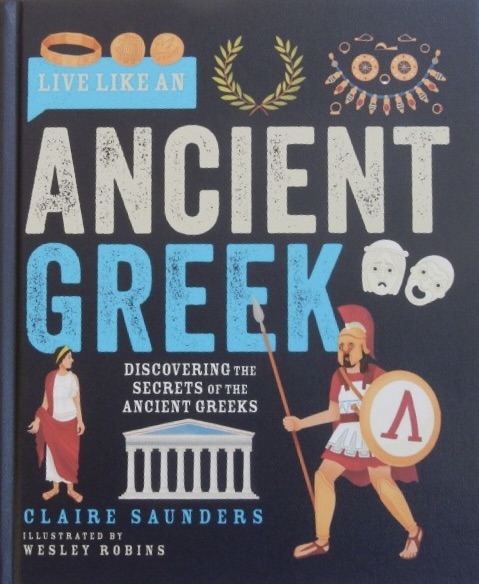
Live Like An Ancient Greek
Claire Saunders, illustrated by Wesley Robins
Button Books
A wealth of fascinating facts are to be found between the covers of this book wherein the author provides an overview of life in ancient Athens, occasionally expanding her scope and moving further afield.
Living in ancient Greece was by no means idyllic: society was deeply segregaated by class, gender and about one third of the population were enslaved. Women, foreigners and the enslaved were excluded from participating in Athenian democracy. Women did however wear jewellery, which differed according to their status. (There’s a spread giving instructions for making a brooch and a tunic. Great fun especially if ancient Greek life is a topic for a KS2 class.)
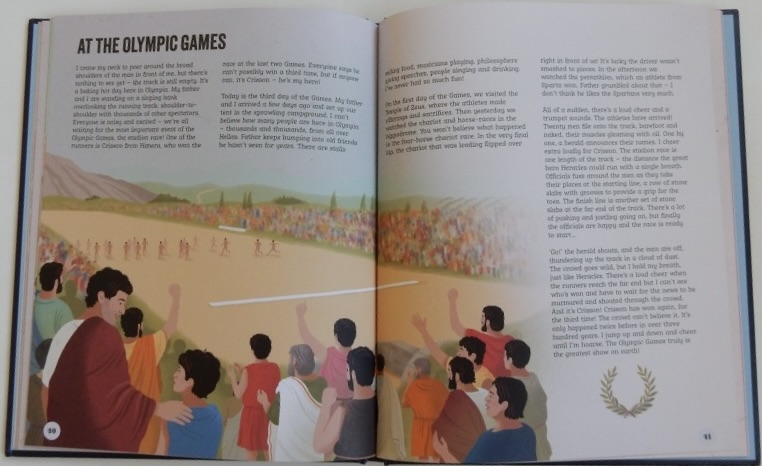
We meet a nine year old Athenian boy, Pentathlos, son of an architect working on building a new temple on the Acropolis. Said boy takes us right through his day including sharing with us his time at school. In his company we also visit Olympia where the Olympic Games are being held; it’s absolutely crammed with noisy spectators and we see that the athletes competed totally naked – in the heat PHEW!
There are brief paragraphs about great philosophers such as Socrates, Plato and Archimedes and huge leaps were also made in maths, science and astronomy and we read of Hippocrates who changed the thinking about where illnesses came from, even going as far as tasting people’s pus.
Most ancient Greeks ate a surprisingly healthy diet that included fruit, vegetables, grains, cheese and eggs as well as lots of bread. (Recipes for pancakes, Greek bread and lentil soup are provided in case readers want to try eating like an ancient Greek. There are also instructions for making a 2-handled drinking cup called a kylix.)
The penultimate spread asks readers: Could you live like an ancient Greek? My answer would be a very firm NO! Imagine using pieces of pottery instead of loo paper. Ouch! Fortunately this isn’t part of the civilisation’s lasting legacy.
A book to add to primary school libraries as well as home bookshelves of children in KS2.

