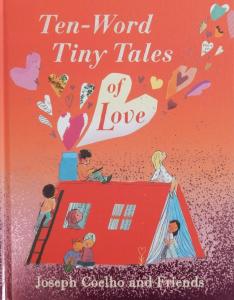
Ten-Word Tiny Tales of Love

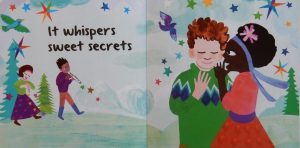
This is former children’s laureate Joseph Coelho’s second Ten-Word Tiny Tales offering, this one having a unifying theme – love – and in an introduction, Joseph tells readers how the tiny tales came about.
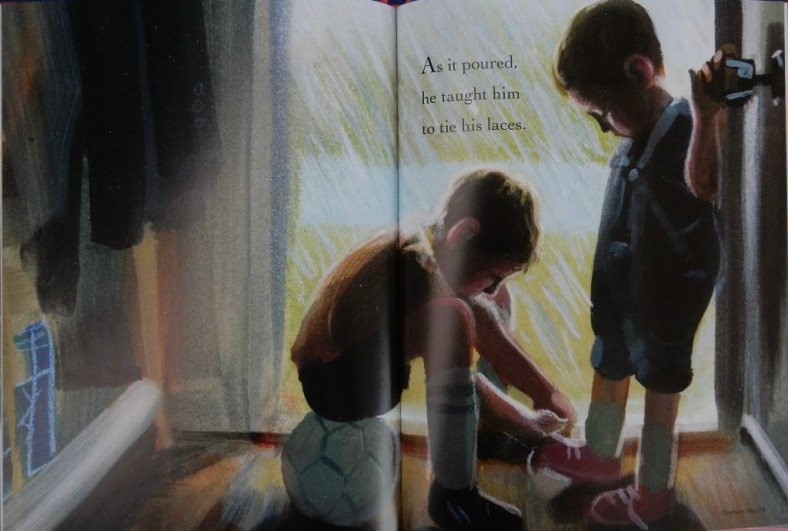
Each of the tales is moving in its own special way; you will find great sadness, tender parental and sibling love, spookiness, the fantastical, the humorous and more.

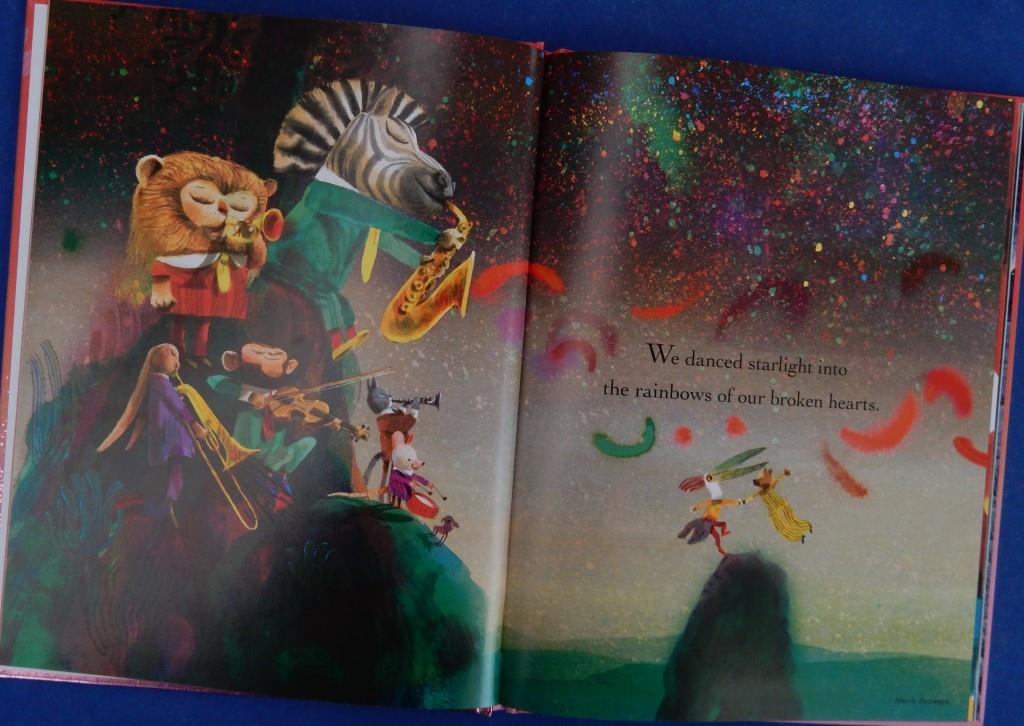
Coming from all over the world, each one of the talented artists has created an equally special, very different scene, thus making every turn of the page a verbal and a visual delight.

We see enigmatic and literal interpretations as well as ambiguity: there is love for such diverse things as a bike, baby birds and a brother,

but in every case the intention is to create a world – a space of awareness – that will spark the reader’s imagination.

To facilitate this, Joseph offers some story writing prompts in the final two spreads.
Altogether a treasure trove that holds within, a wealth of possibilities for creativity both in the classroom and at home.

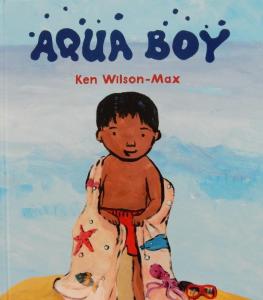
Aqua Boy

Islander Aaron lives by the sea with his parents and elder sister, Angel. Mum and Dad are ocean guardians, volunteers performing a vital role in trying to keep the beach clean. His sister is at home in the water as well as on land and loving to plunge into the waves, she calls herself Coral Girl. Aaron would dearly love to do the same but he’s frightened of going under water. When he shares his fear with his Mum, she tells him that it will happen one day, “when you least expect it.” Dad is equally reassuring when Aaron joins him in the boat as they head out to check on the sea creatures.

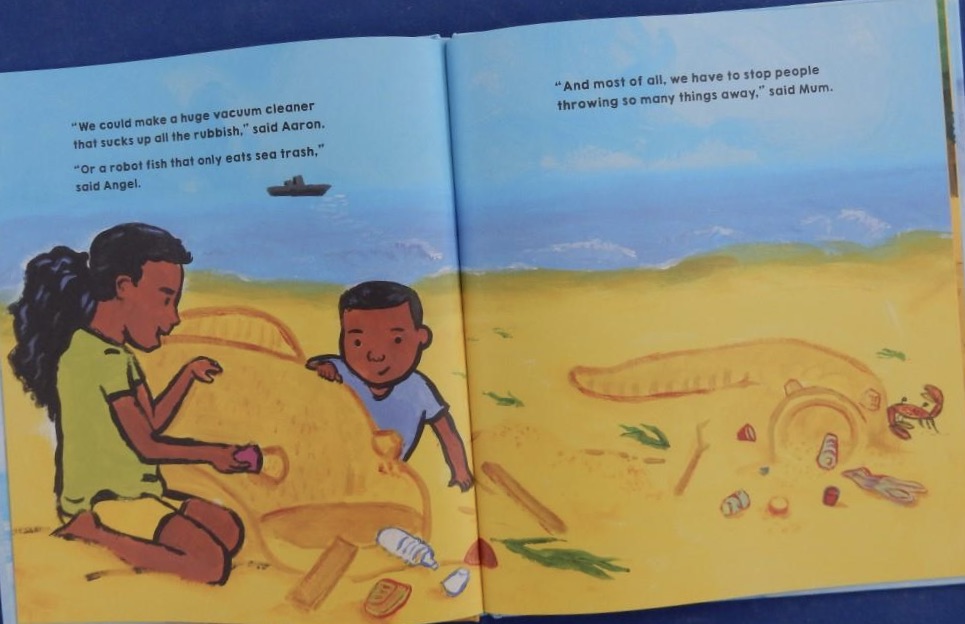
That night a huge storm blows up and the following morning the beach is littered with rubbish. The ocean guardians set to work clearing it up, Aaron and Angel imagining ways they might ‘clean up the ocean for good.’

All of a sudden, Aaron spots an octopus, stranded, so Dad says, on the sandy shore. Dad entices it with a length of wood. The children watch as gradually the creature wraps itself around the stick and Dad wades out into the sea. Grabbing his goggles, Aaron follows looking right at the octopus, the creature looking directly at him as it slowly releases its hold on the wood

and swims free below the surface.

The boy then puts on his goggles, breathes deeply and immerses himself, watching the movements of the octopus. Once his friend has swum away Aaron stands up and there, fear finally gone, he is really happy and ready to embrace a new way of being an ocean guardian. He learns about the creatures he sees underwater, helps care for them and never stops hoping his octopus friend will return.

This timely, gentle tale of environmental guardianship with Ken Wilson-Max’s vibrant scenes that portray both family love and the vital role ocean guardians play, will one hopes, highlight to young children the importance of caring for marine life and ensuring that they play their part by taking their rubbish home as well as helping to keep beaches clean. A final spread gives some octopus facts and underscores the outcomes of ocean pollution.

Guess Who’s Getting Dressed & Guess Who’s Going to Sleep / Lenny in the Garden

Hugely engaging, and tremendous fun are these two interactive lift-the-flap board books written in rhyme by Smriti Halls and zestily illustrated by Marta Altés.
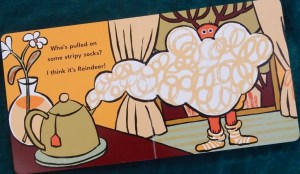
On the first four spreads in Guess Who’s Getting Dressed little humans are invited to respond to a question and given a possible answer (not the right one). Parts of an animal are visible from behind the flap on each recto, sporting the article of clothing the question mentions. For instance the suggestion is that Reindeer is wearing some stripy socks: not so, but the rhyme offers a clue …

The final spread presents the entire animal cast and a ‘Who else?’ to guess.
Guess Who’s Going to Sleep follows the same pattern but with a different animal cast and a slumber time theme.
Playful delight both.

Not a board book but also for the very young:

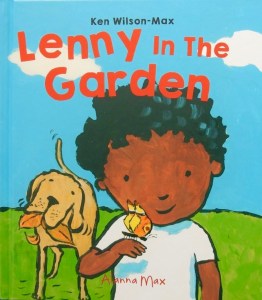
Lenny, his mum and Wilbur their dog are in the garden. On the lookout for new things, Lenny starts exploring, while mum gets busy digging. Before long Lenny draws attention to some ants walking in a line, so he says. Higher up a spider spins its web, round and round. Then as Lenny enjoys the tactile pleasures of toe wiggling in the grass, Wilbur makes friends with a wiggly worm that’s just popped up from underground. Mum finishes digging and begins watering, offering to water Lenny too but he’s too engaged with the nose tickling butterfly, the caterpillar and the dotty, spotty ladybird on a leaf.

Next he follows a snail slithering along leaving a trail behind; a grasshopper leaps hither and thither and Lenny attempts to emulate its bouncing until finally digging and watering done, mum calls to Lenny; he comes and the two sing a finger song ‘Tommy Thumb’ together before going indoors for lunch.

A simple, thoroughly captivating delight that is just right to share with the very youngest children. One hopes that having heard this story with its brightly coloured illustrations, listeners will become as observant as young Lenny in their own gardens or nearby outdoor spaces.

Terrible Horses / When I Feel Brave

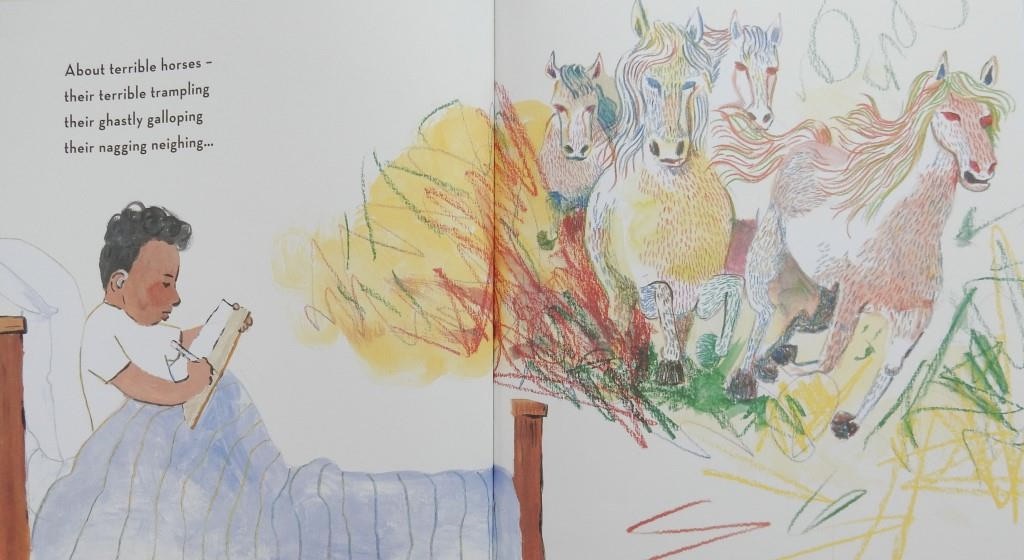
Narrated by the younger of two siblings, a small boy talks of how he feels about his sister, the ways they react to one another and to sharing their things. From the boy’s viewpoint, big sister is a cool character but she causes the pair to fight one another physically, rather than verbally. To release the tension within himself, the boy goes to his room and writes stories featuring terrible horses, with himself as a lonely pony.

Then there’s another fight on account of the narrator taking things belonging to his sister without asking her permission, which triggers further actions that fuel the aggression. Once again the boy retreats into his bedroom, fashions a horse story that includes showing himself as the pony neither able to speak or sleep. Surprisingly though sleep he does and when he wakes the terrible horses book is missing. Who do you think has it now and what will be the outcome?

Raymond Antrobus has penned a seemingly simple tale of sibling rivalry, but it’s one that conveys feelings relating to discord and empathy, both of which Ken Wilson-Max captures so adeptly in his illustrations of humans and of horses.

Another feelings centred picture book is

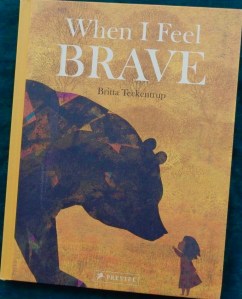
Having presented a girl’s feelings about being angry in When I See Red, Britta Teckentrup examines equally thoughtfully, a girl’s fear and what it means to be brave. By means of the author/artist’s rhyming narrative and evocative collage style illustrations, readers follow a child wandering through a forest who is startled by a huge bear that is initially terrifying, but as she continues her journey, becomes first companion

and by the time they emerge into the light, friend. ‘I can finally see … / that courage and fear / are both part of me’ the child concludes. An important insight indeed and a book that offers child readers and listeners a way of understanding one of their own basic emotions and how bravery allows them to take charge of this emotion.
Try using this first person story as a starting point for a circle time discussion.

Catch! / Hello Winter

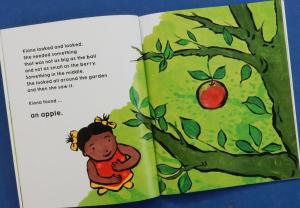
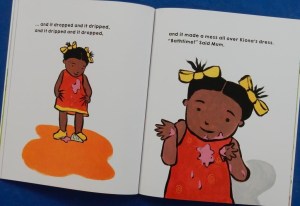
This is a delightful story wherein we join Kiona and her Mum playing catch one sunny afternoon. When the little girl finds her ball too big, they try all kinds of other objects such as a berry and an apple

but nothing works for Kiona. Back indoors, Mum offers Kiona an ice cream, but you can guess where it ends up;

even the bubbles at bath time elude the child. Happily though, Mum knows the perfect thing that assuredly her daughter can catch; it’s something that stays with Kiona for ever: what could it be?

A lovely read aloud for preschoolers; it has everything you could ask for: repetition, opportunities to encourage mathematical thinking that can be taken up again when playing outdoors, as well as Ken Wilson-Max’s vibrant illustrations that show Kiona’s changing feelings so clearly.

Yet another example of Alanna Max’s pitch perfect picture books for under fives.

The fourth in the Best Friends With Big Feelings series wherein each title is set in the natural world of Season Isle and features four magical friends, the focus being on a different seasonal character.each time. Now it’s time for Autumn to pass the weather crown to Winter but instead he gives it to Spring, saying that the others don’t like playing her frosty, freezing games. Upset, Winter walks off to play snowy games by herself. Solo play isn’t fun though, and the bunnies she tries to involve are not interested.

However, her three pals soon start feeling troubled about what they’ve done and decide to search for their friend. It’s a really chilly journey they make but can they find Winter and put things right between them once more? Maybe, but Spring, Summer and Autumn will need to feel warm if that crown is to be bestowed upon its rightful wearer.

In this, the series concluder, the life lessons the friends share with young children are about the importance of turn taking and empathy

Lenny Has Lunch

Lenny Has Lunch
Ken Wilson-Max
Alanna Max

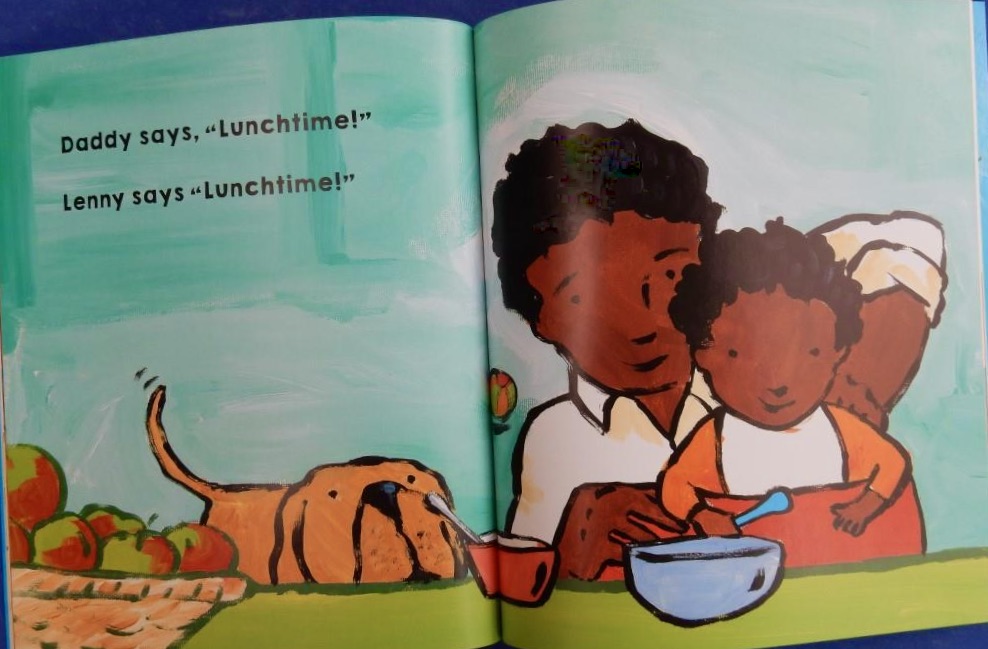
The strong bond between a father and his infant son, Lenny, is beautifully captured in this simple story that unfolds in the family kitchen. We watch as Daddy prepares a healthy lunch for his little one – chopping the various veggies, putting them and the pasta in pots to cook on the hob – and enjoying a sing-song until the meal is ready to eat. We then see Lenny relishing his lunch, he’s at the messy eating stage and his dad remans close at hand, as does the family dog, Wilbur,

until Lenny has finished eating and then it’s face wash time, after which Lenny and Wilbur play together.

Throughout the entire sequence, a sense of calm prevails and Ken Wilson-Max portrays this to perfection in his bold, bright scenes that complement the telling; a telling that has lots of fun onomatopoeia – ‘Splash! Slurrp! Slurrp! Splash!’ and ‘Suck, suck. Plop!’ – for small children, who like Lenny are at that imitative stage, to copy. Young children will also enjoy joining in with Daddy, and Lenny as they sit together singing and acting “Row, row, row your boat / gently down the stream. … “

Altogether a lovely presentation of family life, this is ideal for families with a toddler.

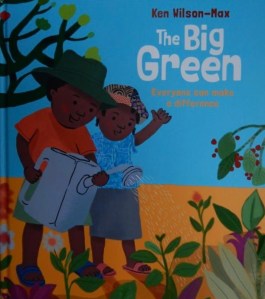
Eco Girl

Eco Girl
Ken Max-Wilson
Otter-Barry Books

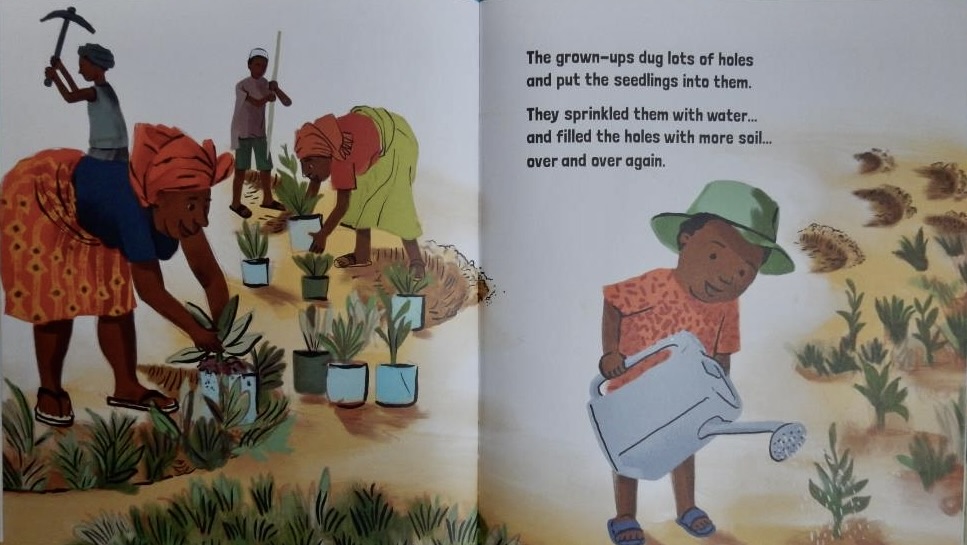
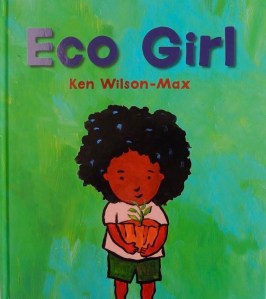
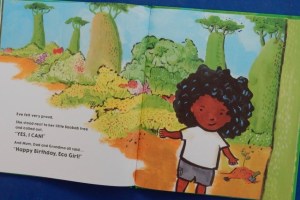
Eve loves the forest beside her home; she loves the animals and birds, but most of all she loves the trees, her favourite being the Baobab tree. Do those trees talk to one another, she wonders wishing that she could be a Baobab and hence talk to the other trees. To be a tree is to be patient her mother tells her and later her father says that each tree plays its own special role in caring for the living things in the world.
Soon after, on a pre birthday visit to her Grandma deep in the forest, after remembering to be patient on their long walk, Eve asks her grandmother, “Would you talk to me if I was a Baobab tree?” Delighted by the response and Grandma’s mention of the next day being a special day, Eve can hardly wait.

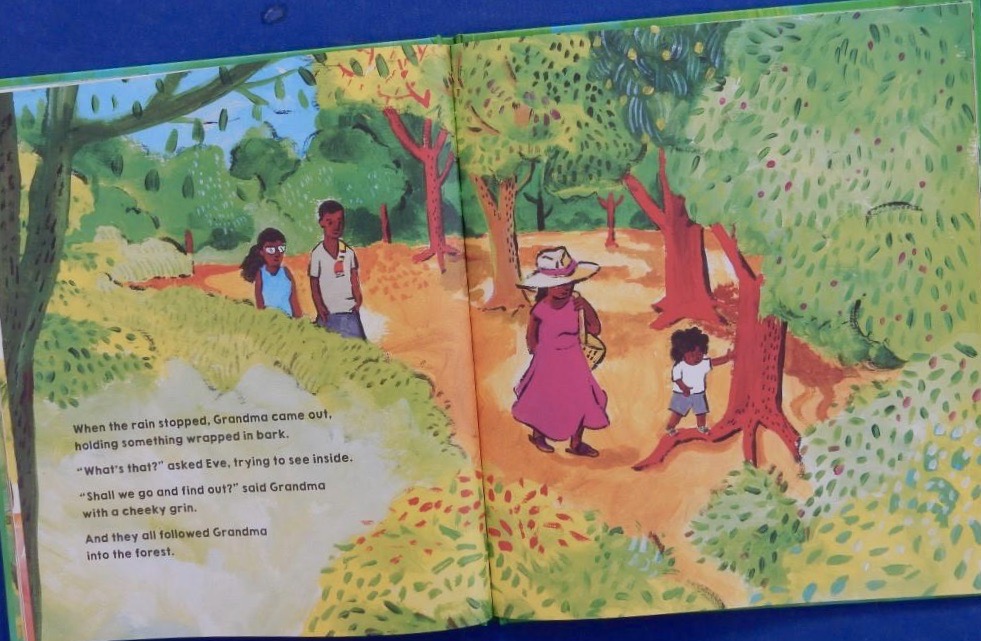
Next morning, she gets a magical surprise. Carrying something, Grandma leads her into the forest.

What could it be? It’s something very special that Eve must plant, love and take care of, something that will connect her for ever with the forest she so delights in. That, she proudly assures her Grandma, is something she definitely can do. Many happy returns of the day, Eco Girl.

Heart-warming and inspiring, this is a lovely demonstration of the importance of planting and nurturing trees wherever you live in the world. I love the vibrant colours of the illustrations, especially the variety of greens in the forest landscape.

(After the story are some tree facts including a mention of Wangari Maathai who started the Green Belt Movement in Kenya.)

Stars with Flaming Tails

Stars with Flaming Tails
Valerie Bloom, illustrated by Ken Wilson-Max
Otter-Barry Books

How exciting to have a book of new poems from Valerie Bloom after quite a long while; but Stars With Flaming Tails with more than sixty offerings was definitely worth the wait.

Arranged under five headings – Family and Friends, Fun with Forms, Our World, Animals and Unbelievable?, this is a veritable treasure trove of delight encompassing such diverse topics as pancakes and piranhas, the elements, grandparents, siblings, parents,

the ordinary and the extraordinary (though nothing is the former when Valerie works her magic on it).

You’ll laugh, feel saddened, ponder upon, puzzle over, empathise, wonder, and with all your senses aroused, discover many things anew. It’s amazing how totally different moods can be evoked by just four lines; take for instance EclipseA huge space giant saw the sun, / he thought it was a currant bun, / so he took an enormous bite / and turned the daytime into night.

and Dawn – ‘Sunlight pries open / the hands of the mimosa / which all night had been clasped / in prayer.’

On the shortest day of the year, that has also been extremely wet and cheerless, one of the poems that really made me smile ends thus: ‘But all’s well, we’re rich and happy (so I had to beg his pardon), / and he’s charging folk a pound to see the dead giant in the garden.’ Can you guess who the ‘he’ is in this one – hint it’s a character from a traditional tale.

No matter how you’re feeling though, you’ll discover something to suit your mood, or to lift you out of it perhaps. Ken Wilson-Max’s black and white illustrations serve the poems well providing an additional reason to smile wherever you open the book.

Astro Girl / Where’s Mr Astronaut?

Astro Girl
Ken Wilson-Max
Otter-Barry Books

Space and stars enthusiast Astrid wants to become an astronaut, so she tells Jake her best pal as they lie stargazing.

She goes on to tell the same to her papa over breakfast.

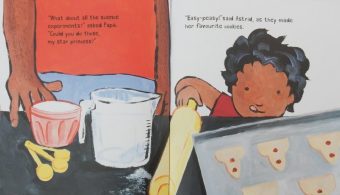
He challenges her assertion with comments about orbiting the Earth in a spaceship, dining on food from tubes and packets, becoming used to zero gravity, conducting scientific experiments …

and sleeping alone among the stars: he seems pretty knowledgeable about life in space. Astrid assures her Papa that she can manage all those things even the solo sleeping.

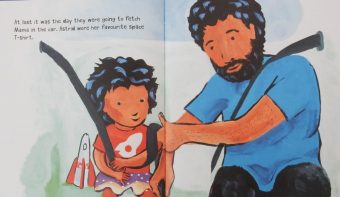
The day comes for the two of them to go and collect Mama in the car.

It’s then that we discover the possible reason for Astrid’s enthusiasm about space and her Papa’s knowledge.

A joyful reunion takes place and thereafter the little girl starts reading avidly to learn as much as she can about how to achieve her ambition, and about some of those trailblazing astronauts who went before, several of whom were women.

Simply and beautifully told, Ken keeps readers interested in the theme by showing us space related items such as Astrid’s t-shirt, her breakfast cereal, Papa’s T-shirts, the cookie shapes they bake together, pictures, a toy – all of which help in the build-up to the grand finale.

A smashing book for young space enthusiasts and perhaps to share on Father’s Day.

For a younger audience is:


Where’s Mr Astronaut?
Ingela P.Arrhenius
Nosy Crow

Vibrant, immediately appealing illustrations characterise Ingela P.Arrhenius’ latest title for the ‘flaps and mirror’ series in an amusing introduction to space exploration for the very youngest.

The space travellers hidden herein are a delightful mix of human, canine and alien. There’s Mrs Engineer, Mr Space Dog, Mrs Alien,

Mr Astronaut and finally, whoever happens to be looking in the mirror tucked beneath the felt moon flap.

This one’s sure to add to the deserved popularity of the hide-and-seek series.

Listen! – The Flute / World of Forests

The Flute
Ken Wilson-Max and Catell Ronca
Tiny Owl

The second in the Children Music Life series showcases a reedless woodwind instrument, the flute. Here flautists from different parts of the world come together to celebrate its magic. It’s a colourful magic that conjures up mellow sounds …

and bright ones; that sometimes speaks very softly …

or blows icily.
It might be a scream of pink, a sigh of lilac that is …

The voice through which the flutes speak is pure poetry; now why not try to discover its sounds for yourself … Where will it take you? What will you hear and see: how will you feel?

With rainbow bright illustrations from Catell Ronca and Ken Wilson-Max’s poetic words, prepare to be transported and perhaps to dance with your little one like some of the characters herein. Through music is a wonderful way to introduce very young children to stories: this little treasure of a book will help you do just that.

World of Forests
Robert Hunter
Wide Eyed Editions

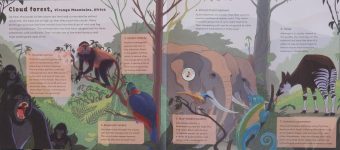
Robert Hunter follows his World of Birds with a new Sounds of Nature title in which he explores ten different forest habitats from various parts of the world – Europe (including the UK), the USA, South America, Africa, India, Socotra Island (Yemen) and China.
Each habitat is given a double spread wherein are showcased the animal inhabitants (with a factual paragraph on each one) as well as a general introduction to the particular forest be it of the coniferous or deciduous kind.
Six or seven creatures are included in each location be that the German evergreen forest; the Redwood forest of California; England’s New Forest; the Amazon rainforest; a cloud forest in the Virunga Mountains of East Africa;

a desert forest of Socotra Island; a beech forest of Brussels;

the Sundarbans mangrove forest in the Bay of Bengal (I don’t think this is at ‘the southern tip of India’ as stated in the book though); the coniferous taiga (snow) forest of Alaska; or the bamboo forest in the mountains dividing North and South China.

Pressing the sound button on each spread produces a ten second burst of the natural sounds of 60 or more animals. You’ll need to listen very carefully to identify such creatures as the squawking macaws of the rainforest or the call of the Northern wren in the beech forest.

The whole thing is splendidly atmospheric: with its beautiful panoramic illustrations and fascinating soundscapes it’s a book that is likely to appeal across a wide age range.

The Drum

The Drum
Ken Wilson-Max and Catell Ronca
Tiny Owl

One of the highlights of the school year in three of the primary schools I taught in before moving out of London was the annual visit of multicultural music workshop providers, Earthsong.
Storm and fellow musicians would come with their van filled with exciting musical instruments from different parts of the world – in particular, an amazing collection of drums – and give first a whole school presentation and then individual class workshops of music and dance for the children, often based on a theme that we had flagged up beforehand.
Once those drums came out and the children got their hands on them, even the most challenging of individuals became totally engaged and remained so throughout the session.

It was evident that drum circles (such as those Earthsong provided) were an opportunity for the children to feel totally connected with themselves and with one another and equally, that playing a drum was a terrific mood booster for every individual, many of whom came from less than ideal home situations.

Author Ken Wilson-Max and illustrator Catell Ronca capture those feel good experiences in their splendid little book for young children that features African drummers captivating both the players themselves and their audience

who cannot resist the invitation to follow Ken’s instructions to ‘Clap your hands … Stomp your feet … Move your shoulders from side to side

… Feel the beat in your belly … Feel the drum in your heart’

and who can ignore the appeal to ‘Shake your body and dance’. I can almost feel the beat and rhythm of the drums in Catell Ronca’s vibrant illustrations and want to start moving in concert with the children portrayed therein.

Spencer feels the beat

I can’t wait to see further titles in this new Tiny Owl series ‘Children, Music, Life’.