Fish Are Friends

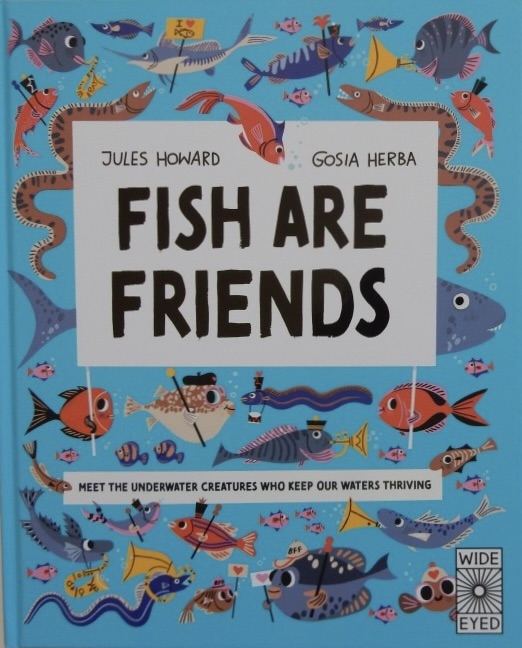
Ready to take the plunge? It will be well worth it as you’ll meet all manner of underwater creatures including the ‘really smart’ fish that got together to write and narrate this book. Chief among the latter is a White-Spotted Pufferfish. Between them they will provide a wealth of information that is divided into an introduction, an explanation about what fish are – did you know they have been around for 500 millions years? – followed by five main chapters, the first of which is called Big-Brained Buddies wherein four fish including that Pufferfish describe the various ways in which they are clever creatures.

That Pufferfish then has a spread where it shows some of the beautiful patterns he and fellow puffers create in the sand – ‘works of art’ so some scientists call these designs on the sea floor.
I love the alliterative titles of some of the spreads, one such is ‘Nifty Navigators’ where we learn how sharks find their way using Earth’s magnetic field. Clever stuff, particularly the journey made by a whale shark named Anne that scientists tagged and found she swam 19,300 kilometres. Wow!

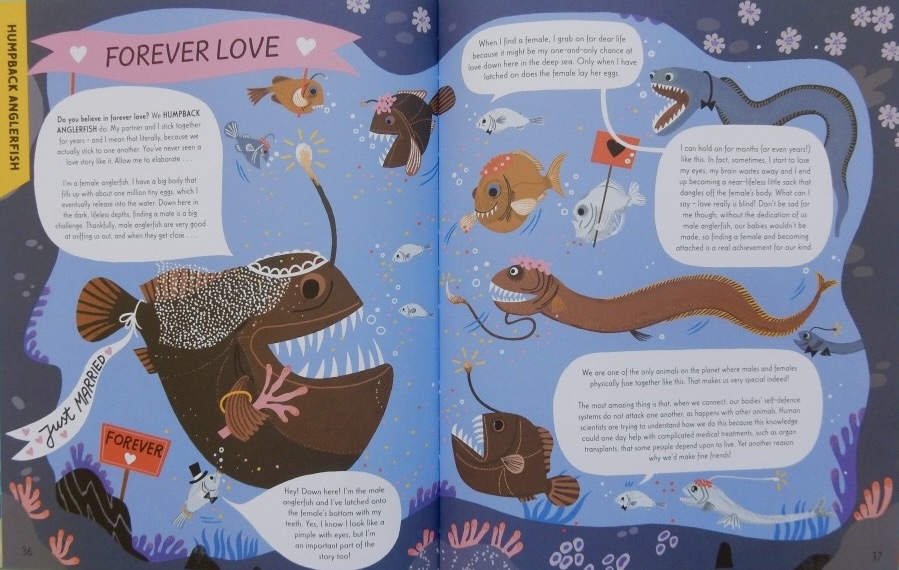
Chapter 2 explains why Pufferfish and others call themselves Loving and Loyal and looks at parenting and friendship by fish. Clownfish exhibit something called ‘sequential hermaphroditism’ (youngsters can impress their own friends by using that term) where the babies all start life as male but later in life change and begin to produce eggs instead, sometimes thousands. Female Humpback Anglerfish are also prolific egg producers and may fill their large bodies with around 1,000,000 tiny eggs before releasing them.

The third chapter, We’ve Got You Covered, introduces and explores the fact that fish perform all kinds of jobs that help ecosystems thrive and is full of hopeful medical possibilities that fish chemicals offer.

The two final chapters are Join The Party about fish social habits and Friends Through Time! The latter explores the evolutionary journey fish have been on over millions of years, even preceding dinosaurs.

A vital spread at the end presents how human readers could ‘Become A Friend To Fish’ and as you’d expect plastic pollution and overfishing are key problems for our fishy friends.

Zoologist, Jules Howard’s writing style is gently humorous as are Gosia Herba’s illustrations making the book very approachable for young readers to absorb a wealth of fascinating information almost without noticing.

Thoroughly recommended for primary class collections, secondary school libraries and home bookshelves.

The Who, What, Why of Zoology

The Who, What, Why of Zoology
Jules Howard and Lucy Letherland
Wide Eyed Editions

For youngsters with a budding interest in the study of animals ie zoology – this is for you, whether or not you have aspirations to become a zoologist.

The author starts by defining zoology and explaining what zoologists do and then takes a quick look back over the past hundred or so years at how the work of zoologists has changed with the help of ever-developing technology.

Readers then join the scientists working in the field and visit different biomes around the world and this is where the book differs from the many others about environmental regions in that it provides an insight into the role played by zoologists in the world today.

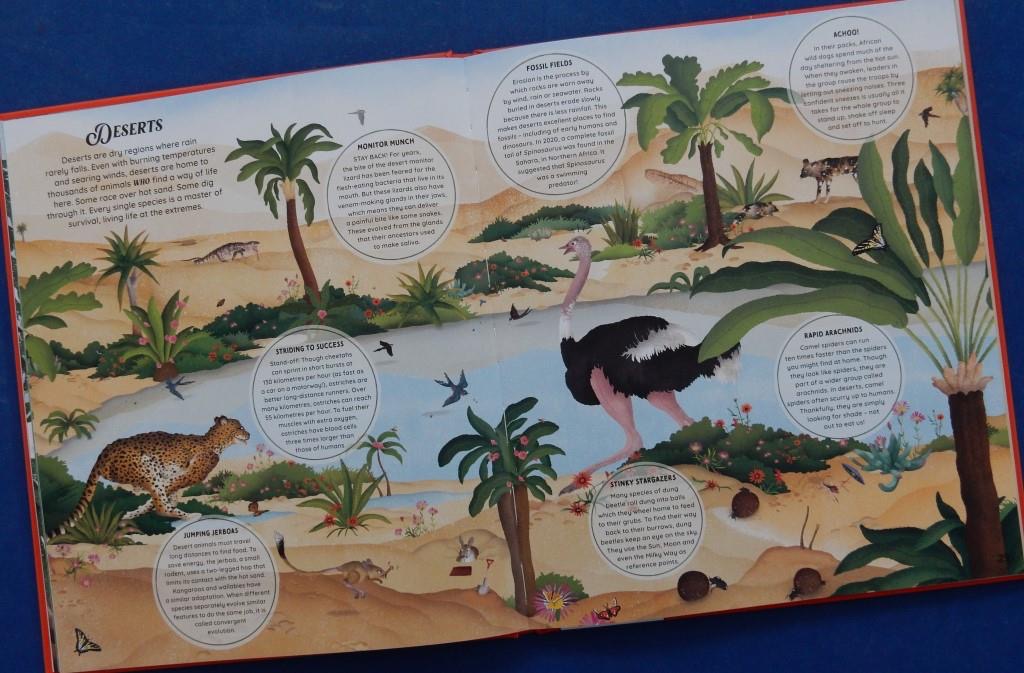
We start with temperate forests, then take a we look at tropical rainforests, deserts,

grasslands including savannahs, the tundra, and then dive down to underwater reefs and beyond, to the ocean floor.

For each region, the book explores the kind of terrain, introduces some of the animals who live there, provides some interesting facts related to those animals, and looks at the work zoologists do in that region, and how they go about it.

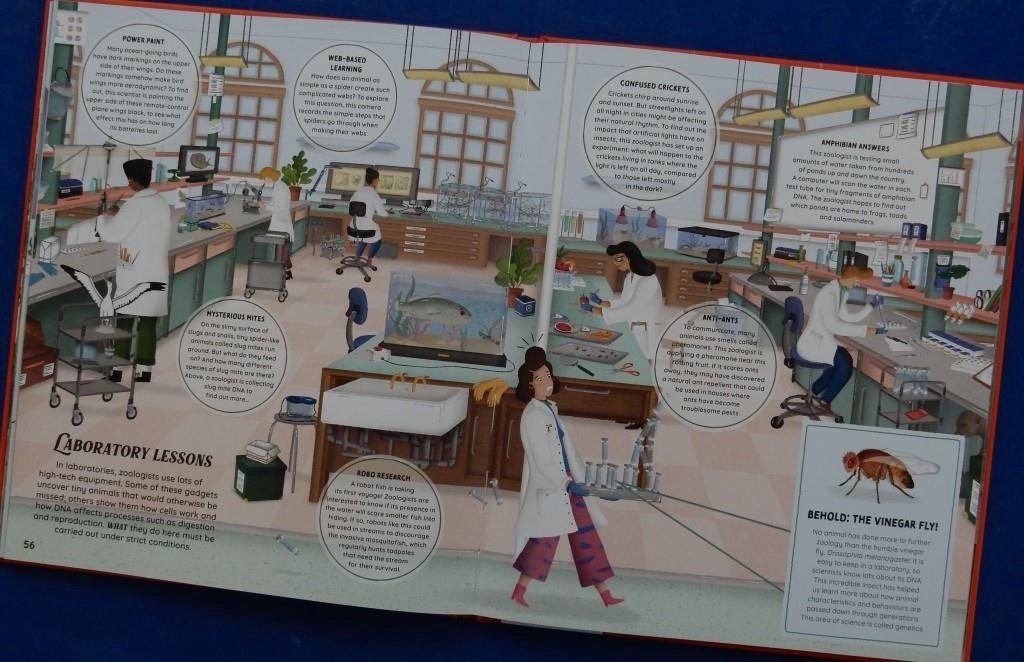
After all the exploring we return to the laboratories to see zoologists working not in the field but using high-tech equipment to further their research.

We also find out about the role museums, zoos and aquariums play in the area of zoology. Throughout Lucy Netherland’s illustrations illuminate the text and also offer gentle humorous touches in each spread.

The book ends with a reminder that zoology is for everyone and, with quotes from some of today’s great zoologists, offers pointers in how young readers can start out on their own zoological adventures.

Fascinating, informative and pitched just right for older primary readers and above.

Creatures of the Order

Creatures of the Order
Jules Howard, Fay Evans and Kelsey Oseid
Weldon Owen (Twenty Watt)

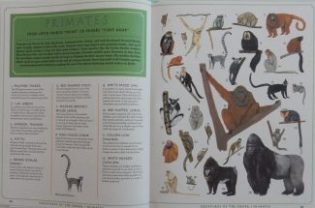
Have you ever wondered what a lion and a meercat have in common, a quali and a peacock, or a lemur and a gorilla?

If so, or if you have a mind that likes things ordered, or merely have an interest in animals, then this book is for you.
It groups together creatures belonging to the same taxonomic order, Kelsey Oseid illustrates them beautifully, and Jules Howard and Fay Evans provide essential information about each one.

Before all that come an introduction to taxonomy, a spread on animal classification with some examples, and another spread on the evolution of the orders.
The sixteen orders embrace the enormously diverse animal kingdom and it’s fascinating to look closely at the members of each order to discover their common feature/s.

Beginning with the Carnivora, each order is allocated two double spreads, the first of which includes an introductory paragraph, a small illustration of every animal and facts about same, the others being covered on the following spread that also provides further information about particular features.

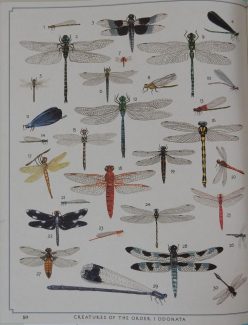
I was most fascinated by the Odonata and had no idea that there were so many different kinds of these beautiful insects (dragonflies and damselflies) one of which has a wingspan of nearly 20cm.

A book to include in a family collection, as well as to add to the primary or secondary school library.