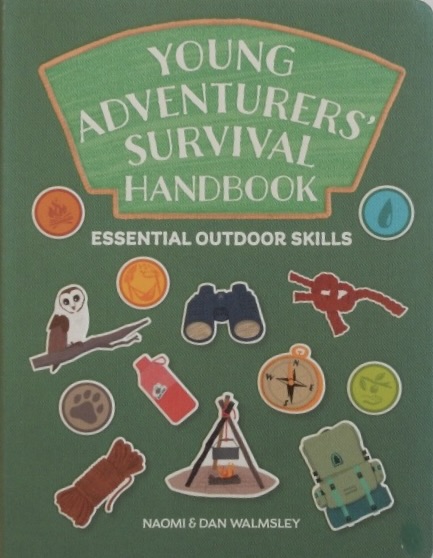
Young Adventurers’ Survival Handbook
Naomi & Dan Walmsley, illustrated by Joshua Rice
Button Books
This is another excellent book from team Naomi and Dan Walmsley, who run Outback2Basics and are the authors of several books about forest school. The focus of their latest is adapting and survival in unexpected conditions. It’s a book I would definitely have been grateful to have read before embarking on a camping trip with my best friend back in the day. The tent we were sharing I was assured, was waterproof, but during a sudden huge deluge I soon found it was anything but. My way of adapting to the unexpected circumstances was to find the nearest youth hostel to stay in.
There are five main chapters herein: Fire, wood & warmth, Food & water, Camp Crafts, Tricks & tips and finally First aid & emergencies. The first presents fire basics, which includes ways to make fires with different arrangements of logs; lighting a fire in windy, damp and rainy weather. I was fascinated to discover that under extreme conditions it’s possible to use a toothpaste tube as a fire starter. Obviously you’d need to clean it out, cut off the bottom part and add petroleum jelly to sawdust or wood shavings, then fill the tube with the mixture by means of a stick and seal the open end. When the starter is lit it ought to burn sufficiently long to ignite more sticks. This is just one of the ways you could make a fire lighter using the instructions provided.
Clearly food and drink are important considerations and without extra food, foraging is likely to yield a fair few edible plants and perhaps, unless like me, you are vegan, minibeasts of various kinds.
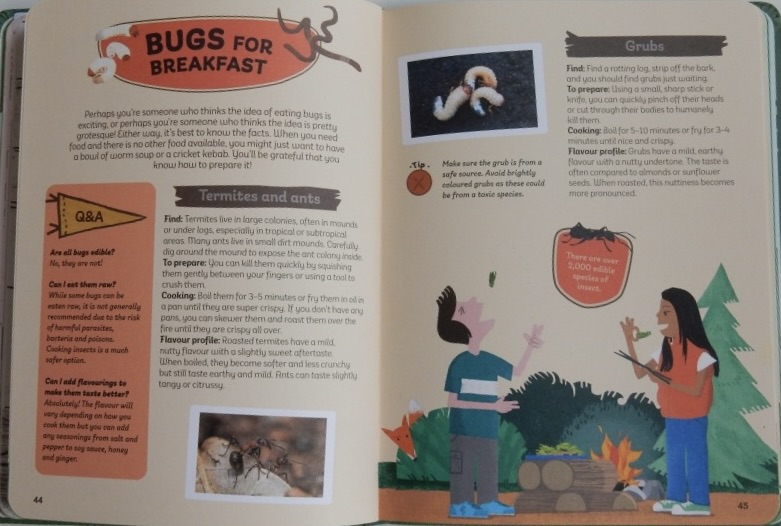
Lots of these can be stewed or baked – instructions for cooking are provided.
One topic in Camp Crafts that’s worth practising before embarking on an expedition is to learn how to tie basic knots and visuals for tying at least half a dozen are included.
I could go on mentioning ideas from the remaining parts but let me just say that anybody thinking of spending some time in the wild should get themselves a copy of this book.