Froggy: A Pond Full of Pals!

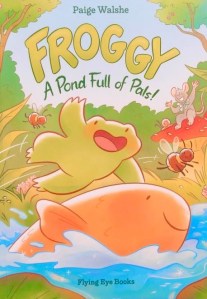
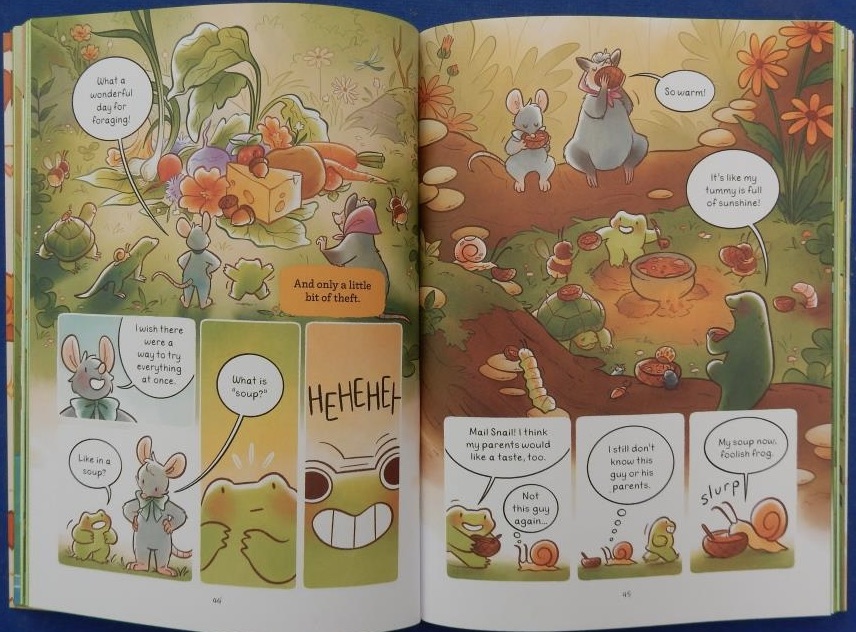
Froggy lives with his parents and lots of other frogs in a village until one day he decides it’s the right day for him to set off on an adventure. He collects his belongings together and sets off to the stream where, having promised his parents that he’ll write home, he’s seen off by all the frogs of the village, Froggy’s adventuring has begun.

Almost immediately though, a hungry bird seizes him in its beak, lily pad boat and all. But Froggy has no intention of being another creature’s next meal and he manages to escape, plunges downwards landing on the earth with a thump and enters an ancient pond. There he meets and is befriended by a fish that introduces itself as Fishtopher. However the next thing Froggy knows – he has a big heart after all – is that he’s coming to the aid of a love struck bee. When hunger strikes Froggy finds himself sharing delicious treats with all manner of other creatures in the wondrous forested place he’s adventuring in.

Further encounters see him engaging with humans – not a happy experience, a nine hundred year old fluffy being, a wizard and in between finding time to send his parents occasional letters by snail mail.
You’ll find Froggy experiencing wonder, frustration, loneliness, and delight especially at a joyful reunion, during the course of his adventuring.

Divided into ten chapters and illustrated in vibrant shades, this is just the book to tuck into your own backpack, find a shady spot to sit down by the waterside and enjoy adventuring along with the endearing protagonist.

Hupo and the Wonder Thief

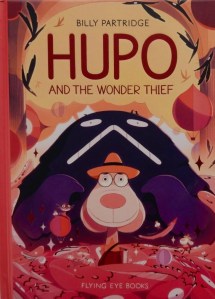
This is Billy Partridge’s debut graphic novel; it’s set in a mysterious land called Yip within which is a bustling town named Yorger, the noisiest place in all of Yip. Therein resides Hupo, a dog-like creature with a longing for adventure who also makes very frequent visits to the library from which he borrows the same book every time, this being his 763rd borrowing of The Adventures of the Great Humdingo. Hupo can’t resist reading it aloud to his best friend the Aletha (a cross between bird and a serpent) as they walk along the streets but no-one else has the slightest interest in Hupo or the wild exploits he talks of in the shops he visits. Suddenly, having missed the bus home, he’s surrounded by a thick fog that descends and everything becomes weird.

“The Dark One is waiting,” one of the crows remarks. Now it appears that Hupo is finally going to get that much desired big adventure as the crows surround him and the Aletha is no longer by his side.

Hupo soon realises that real life heroism is way harder than any book has led him to think, but he’ll do anything for his friend no matter the danger involved. And danger there certainly is in the massive form of the Wallower. He, so a little creature named Choomo tells Hupo, was once none other than the great Humdingo but has become the beastly Wallower, determined to remove all traces of wonder and joy.
Use of scale makes Hupo’s encounter with the Wallower even more alarmingly dramatic,

but can his unwavering determination save the day and the town of Yorger?

A pacy tale with a vital message – ‘never be anything but yourself’ that will have young fans of graphic novels rooting for Hupo from the start.

Wrong Time Rooster

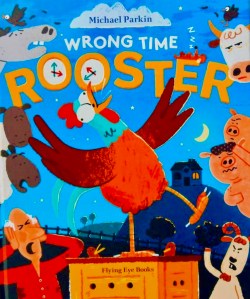
There’s excitement down on the farm when a large crate is delivered. With the animals gathered around, Farmer Tony opens the lid to reveal a rooster. Said bird wastes no time in introducing himself as Ronnie. “No more sleeping in late,” the farmer tells them but at dinnertime that evening there comes a resounding ‘COCK-A-DOOODLE-DOOO’; but Ronnie fails to crow the following morning. As a result, the animals remain fast asleep.

After a whole week of wrongly timed crowing, much to the delight of the farmyard entourage, Farmer Tony decides that he needs to have a talk with Ronnie about his efforts.

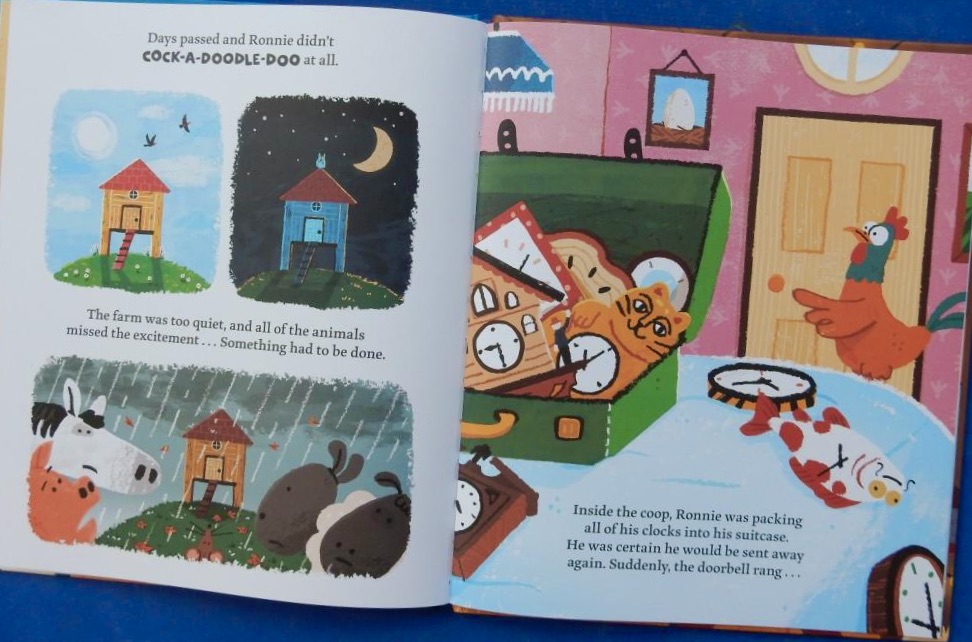
Apologetically, the rooster explains that he’s been sacked from every job he’s ever had on account of his badly timed crowing. “But nobody ever taught me how to tell the time!” he reveals. Farmer Tony’s parting comment leaves Ronnie convinced that he’ll be re-crated and moved on yet again.

However, the silent farmyard no longer feels right to the animals, nor indeed to the farmer. Rather than sending Ronnie packing, they collaborate on something much better for them all: teamwork rules and that team includes rooster, Ronnie. No more crowing at the wrong time on the farm – or make that almost never …

With rumbustious illustrations, a main character that will endear himself to listeners, its playful narrative that reads aloud well and lots of opportunities for audience participation in the COCK-A-DOODLE-DOOs and WRONG TIME ROOSTER refrains, this is a story that young children will enjoying giggling over, time and again.

The Comet

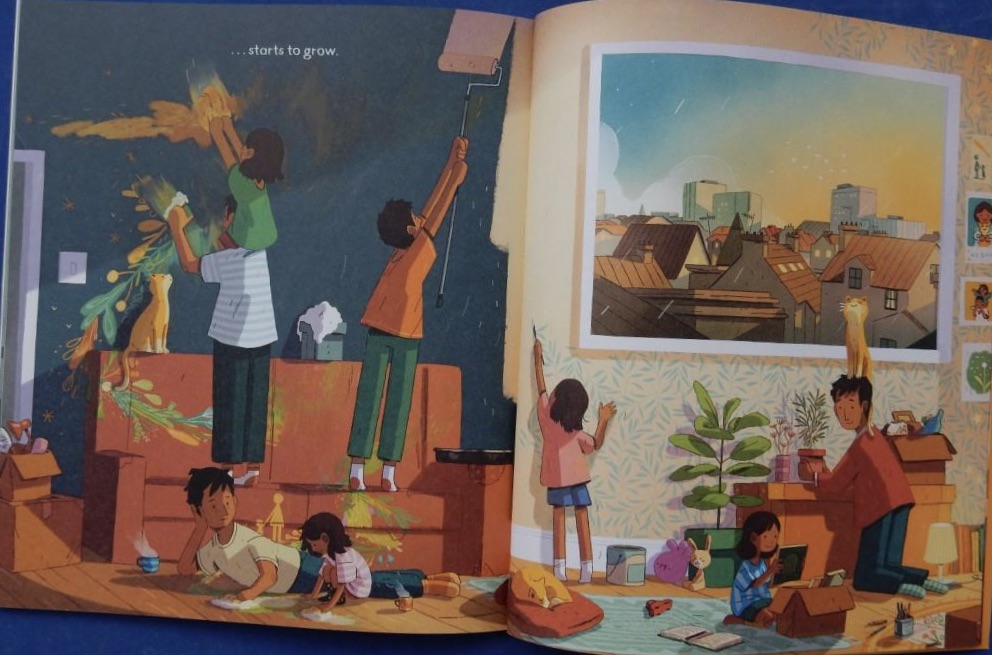
Nyla loves her home by the sea from where she can count a hundred stars and has even seen a comet; but then Dad loses his job and they have to move to a city. Nothing there feels like home to the girl: it’s a grey, frenetic place and her father has to work all the time, so they no longer have feasts together, no waves lull Nyla to sleep and just seven stars appear in the sky.

Then one night, she sees a comet falling towards earth and where it lands there sprouts a glowing, growing tree.

From this wonder, she creates something that forms a connection between the old and the new, something that is able to change their new abode into something magical, something that will make her begin to feel at home in the new place.

Told from Nyla’s viewpoint, the text is spare allowing for the exquisite, richly coloured illustrations, be they double spreads, single pages

or vignettes, to convey most of the story, and the dramatic final vertical spread brilliantly emphasises the transformation that has started and one infers, will continue.

A superb, heartfelt book to share with primary children, whether or not they are concerned about having to move themselves.

Flying Eye’s production is top class with it’s immediately engaging cover, framed pictorial endpapers relating to change and matt finish to the pages and help reflect Joe Todd-Stanton at his best as he shows how creativity and the power of the imagination can fill someone with hope and can help transform an unhappy situation into something positive.

Hilda and Twig Hide From The Rain / Sidekicks

This is in essence a prequel to previously published books starring Hilda.
‘Be back in time for dinner’ comes the call from mum as Hilda and Twig, a deer fox, set out for a walk, destination to be decided until, down comes the rain and they make a dash for the woods. Therein they come upon a cave offering shelter. Also sheltering there are a host of other creatures that are puzzled by Twig. They go on to discuss what the place actually is and buried treasure, and a giant snake are mentioned; the latter surely isn’t real decides Twig.

Nonetheless he pops back outside to check and as a result of what he sees, Twig and Hilda become separated. Now it’s up to Twig to find his brave side and protect his friend from becoming a creature’s dish of the day. Can he do so and what of the treasure that was spoken of?

It matters not whether readers have already met the main characters before as this adventure can stand alone. It’s smashing fun and definitely one to offer reluctant older readers as well as younger primary children.

Captain Amazing, defender of Metro City is feeling old and has decided that he needs a trusty sidekick. When his moggy, Manny, ran away, he was left with Roscoe the dog, Fluffy the hamster and Shifty the Chameleon as pets. Unknown to the Captain, each one is eager for the sidekick role; he’s also unaware that his pets have already begun to develop superpowers, all bar Fluffy as yet. Then back on the scene comes Manny offering to assist Fluffy with some superpower training (and at one point, a peanut as a reminder of something lesson learned).

Meanwhile the Captain’s arch nemesis Dr Havoc is planning something sinister for him. It’s time for serious teamwork from the would-be sidekicks and quickly too, for Captain Amazing’s life could be at stake. Metro City cannot be allowed to fall. Can the pets be the victors?

So cleverly constructed, hugely engaging, well paced with plenty of action and crazy capers, this book will certainly win a large number of fans.

Cactus Kid : Rumble At The Rodeo

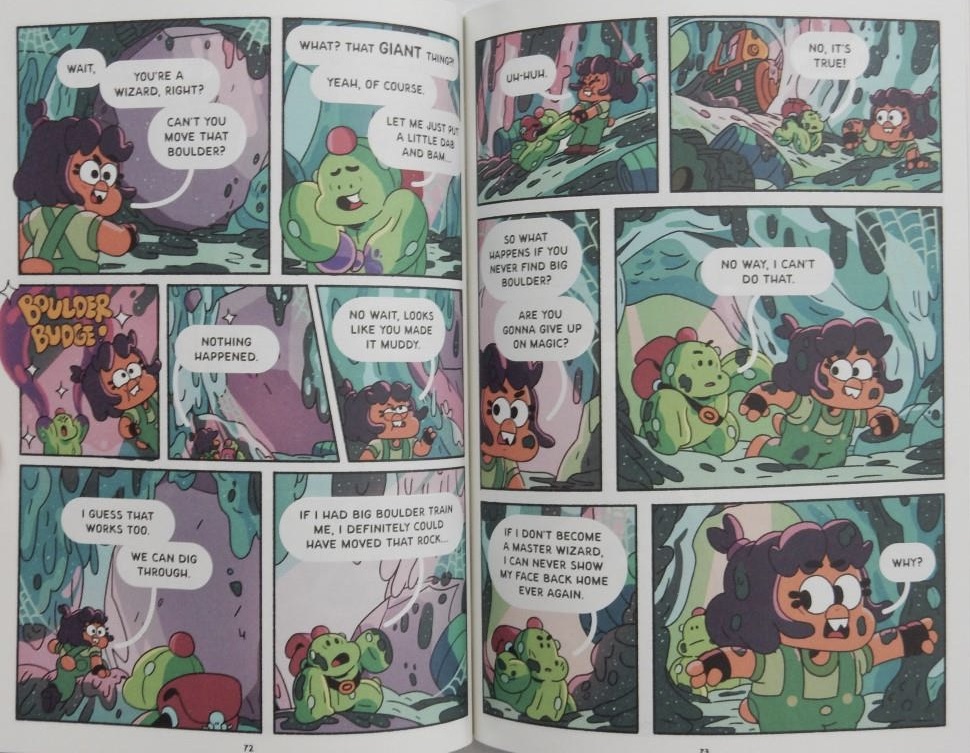
Cactus Kid continues his search for someone to teach him the real wizarding skills he requires to be a proper wizard and as the story opens he’s heading off in search of Big Boulder, a mysterious dirt magic master he wants as his teacher. Having learned what he needs, the Kid hopes he can finally make his dad proud. He makes the mistake of stopping for snacks on the way and while so doing his trusty bike is damaged by what appears to be an earthquake but is actually a very large rock monster. He now requires a mechanic to fix it urgently, but there’s a problem. Rhyan the mechanic is participating in the three day New Moon rodeo event. While speaking to Rhyan, Cactus Kid sees a wanted poster for Big Boulder and is convinced that the wizard he needs is the one that beat him up. Is he right though?

Without waiting for his bike to be mended Cactus Kid sets out on foot but then discovers his compass is missing. Before long things have gone completely out of control. He’s in the muck mines with Ryan.

Not only is an army of wicked little baby spiders after the Kid but the very existence of the wizard Big Boulder that he’s searching for is called into question. Moreover the Spidermama is intent on destroying not just the mines but the whole town. Is there even a tiny chance that Cactus Kid can prove his father wrong, and save the day and the town?

A second madcap adventure: its ’to be continued’ ending means that Cactus Kid’s adventures are far from finished. Followers of the protagonist will zoom through this one and look forward to the next wacky tale.

The Goodnight Garage

Night is falling on Motor Isle, the time when most of its residents are thinking about bedtime. Not so those working for the Good Night Garage, for them it’s wake up and all aboard your various vehicles: there’s lots that needs to be done to make sure the community keeps running smoothly.
There’s a lorry painting new lines on the otherwise empty road, Bin Lorry goes around clearing up all the rubbish from bins and other places where waste is stored – that one has a special packer blade.

Fire Engine and Ambulance have their sirens blaring as their crews respond to emergency calls.
Street Sweeper with its large broom and brushes collects unwanted litter and other debris from the streets then washes them clean with a water spray.

Lots of deliveries are made during the night too and for this task Sturdy Lorry is required to drop off goods at different shops. Last but definitely not least, comes Night Bus stopping to pick up passengers along its route and taking them home or to work.

Young vehicle enthusiasts will love seeing the seven featured in Meg Hunt’s illustrations, each with its animal crew and come to appreciate the vital roles played by their human counterparts who often receive little recognition for their labours. They will enjoy too the opportunity to join in with the onomatopoeic honks, beeps, nee-news etc.as an adult shares the book at bedtime or in an education setting.

Wildlife in the Balance / Factology: Oceans

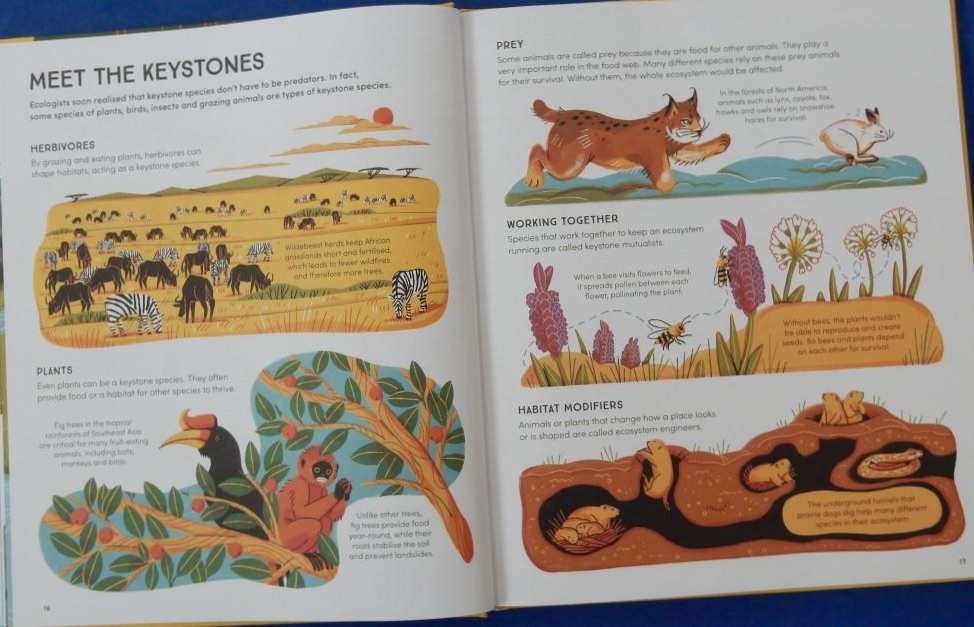
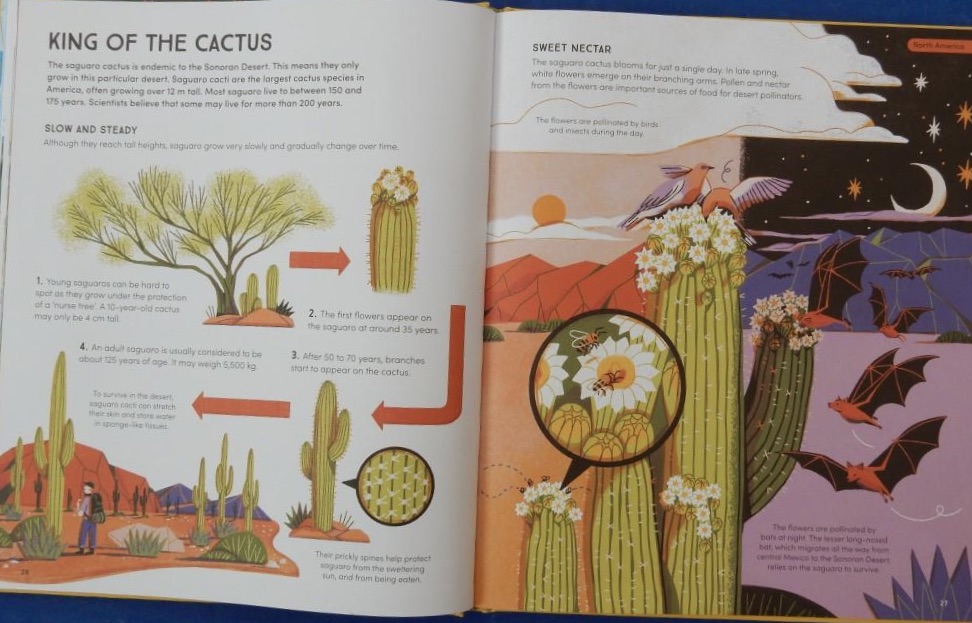
In this latest Flying Eye natural history offering author Dr Sharon Wismer introduces readers to the concept of keystone species and their impact upon various ecosystems.

There are introductory spreads explaining ecosystems, food chains and webs, and outlining the work of Professor Robert Paine whose experiments along the Washington State coastline in the 1960s demonstrated how the removal of a top predator from rock pools resulted in the collapse of the biodiversity of the ecosystem. He identified the ochre sea star as top predator and keystone species responsible for the biodiversity of the rock pools.

We learn that apex predators are not the only keystone species: herbivores, plants, prey, insects and habitat modifiers can also be keystone species maintaining the ecosystem in which they live.

Readers are then introduced to a dozen keystone species across the globe’s five major biomes: aquatic, desert,

grassland, forest, and finally, tundra. These include salmon, the saguaro cactus, European rabbits of the Iberian peninsular, green-backed fire crown hummingbirds and krill.
Terri Po’s illustrations of the landscapes, flora and fauna are at once stylish, arresting and informative and expand and make accessible, the considerable scientific information conveyed by Sharon Wismer in her text, which concludes with a spread on how humans can help these vital keystone species. Backmatter comprises a glossary and index.
Altogether a fascinating book for KS2 readers and beyond..

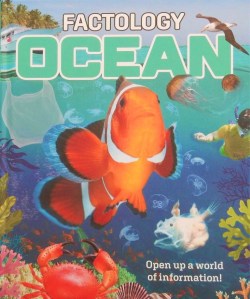
For readers with a particular interest in the underwater worlds or for reference in a cross-curricular ocean topic is:

This highly visual book presents a wealth of facts about the ocean and its flora and fauna. In addition there is information on various topics such as the history of exploration and how people navigated their ships, subaquatic exploration of the ocean depths in the hope of finding treasure among the sunken wrecks.

Readers visit coral reefs and submarine volcanoes, see some of the wonderful deep-sea fishes and other creatures – giant squids, anglerfish, blowfish and the spooky-looking barrel eye fish and the fang tooth fish that has the largest teeth of any ocean species, find out how tides work, why the sea is salty and discover how tides and currents work. There’s a gallery of deep-sea deities and a spread introducing marine monsters such as the Kraken and a look at some of the horrendous outcomes of marine pollution

All this and much more, so imagine yourself into a submersible and take the plunge..

Brainy About Bears

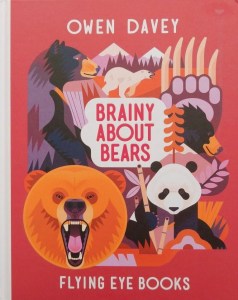
This is the ninth in Owen Davey’s deservedly popular non-fiction animal series. At the start is an overview that mentions there are eight distinct bear species and possibly around fifty subspecies from various parts of the world from Arctic regions and tundra to tropical jungles.

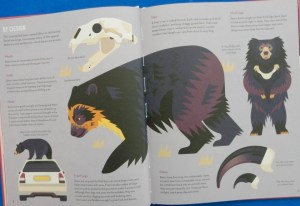
Featured in By Design, the spectacled bear, native of South America, is so-named for its facial markings, has an immensely powerful bite, sharp, fang-like canine teeth, good eyesight and sense of hearing but mostly explore the world through their excellent sense of smell, which so we read, is over 2,000 times better than a human’s. Did you know that bears are able to smell a bar of chocolate stashed away in a locked car? Hopefully they can’t use their long claws to pick car locks but stick to using them for purposes such as digging, climbing, fighting and catching prey.

Amazingly, the earliest modern bears -the dawn bears – lived about 23 to 5.3 million years ago whereas modern day humans have been around less that 1,000,000 years.

With regard to movement, bears normally walk on all four legs, all have the capacity to outrun Olympic sprinters, use their claws to climb trees for such purposes as finding food, escaping enemies or perhaps hibernating. They are also able to swim and like being in water, polar bears being the best swimmers; this last fact you will discover on the And the Award Goes To spread.

When it comes to nutrition, almost all bears tend to eat anything depending on what is available, not so giant pandas, which stick almost exclusively to bamboo, the result being they are now classed as a vulnerable species as few areas have sufficient bamboo to satisfy their needs.
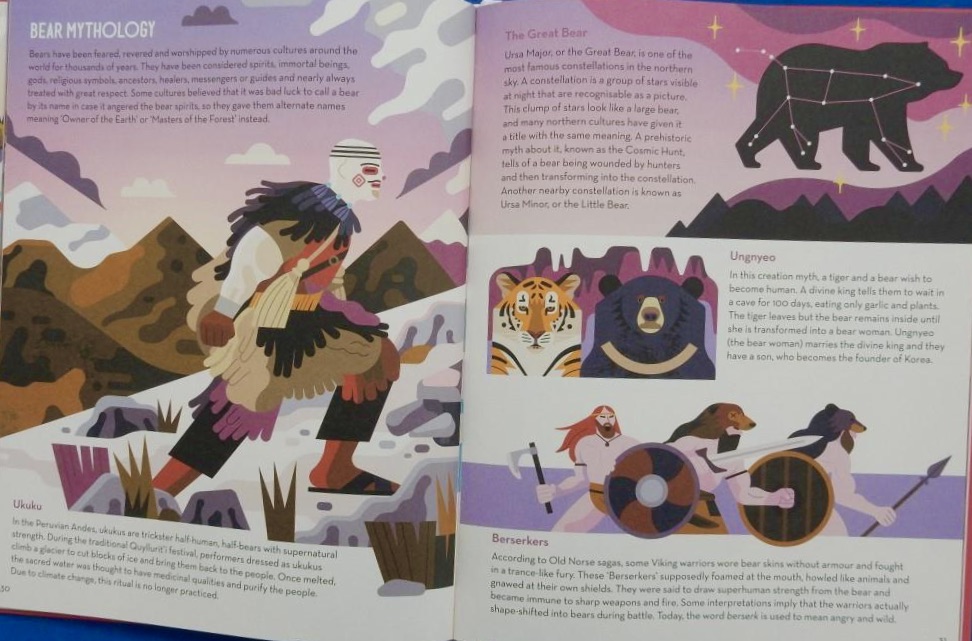
Bears feature in the mythology of many cultures around the world and have been thought of as such diverse things as healers, spirits, religious symbols and guides.

The final spread mentions giant pandas and polar bears as reminders to readers. of the damage we humans do to the planet and the hope of giving greater priority to the protection of bears and their habitats in the future.

Characteristic of this series is the vast amount of facts presented in a well organised, lively and entertaining manner. The information level is spot on for primary school readers and the illustrations are as always, superb.

Is It A Seed?

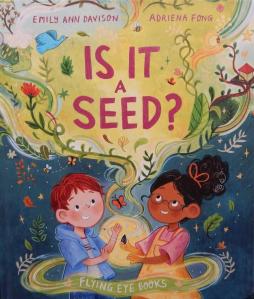
When a young girl discovers an unusual-looking seed, she and her brother start pondering upon what it might become. The only way to find out though is to plant it and that’s what they do, but it takes time for a plant to grow so the maybes continue. Could it be a single flower or something incredible?

The seed takes root and further possibilities are put forward: what about a large tree in which to build a treehouse, or even more fun, an entire treehouse town. Maybe it will become a gigantic beanstalk atop which is a fantastical kingdom and suppose a giant descends or an entire giant army intent on world domination. On the other hand, said giants might be of the friendly variety.

Eventually to the excitement of the entire family, a tiny shoot appears in the planter but this doesn’t stop the children’s inventive ideas from running wild as they joyfully measure the seedling’s growth.

I love stories that celebrate the power of young children’s imagination, which this playful book with Adriena Fong’s lush scenes, does beautifully, alongside documenting the growth of a seed and presenting ways in which the child characters’ connection with the natural world is forged and further fuelled.

Cactus Kid: The Battle for Star Rock Mountain

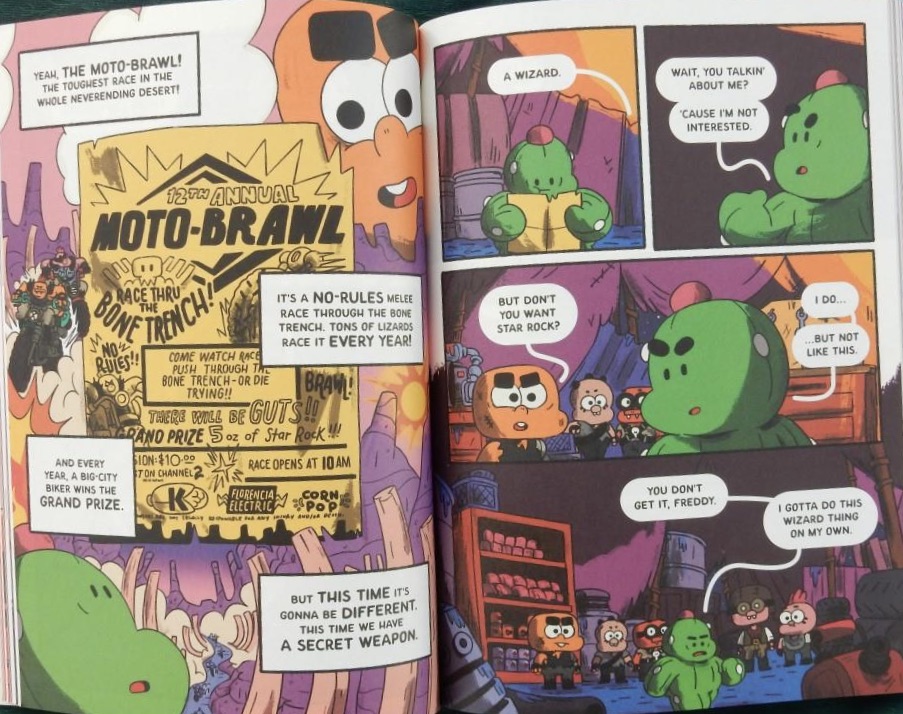
In this first of a new graphic novel series Cactus Kid is in self-imposed exile in the Neverending Desert. His aim is to master magic and show his all-powerful father back in Florencia that he’s the best wizard of all time. For starters he needs a small piece of star rock, the stardust of which will upgrade his starter potion to master-grade. However others are also searching for the same thing and they’re not at all friendly. Though Cactus is a tough character, will he be put off by the mention of the Moto Brawl, a no holds barred race one of the competing teams wants him to participate in?

So begins a wacky adventure bursting with motor bikes and mayhem. There’s also a dark bounty-hunting lizard, armed with an other-worldly compass scouring the land for magic and the encounter between that lizard and Cactus Kid is pretty prickly.

During the course of the race Cactus Kid learns something very important: going it alone isn’t always the best way to go: An ally that has your back is sometimes what you need, especially one willing to part with one of their special possessions as a farewell offering.

As Cactus Kid heads off into the sunset in search of more magic, it’s good to discover that it’s not the last we readers will see of him. If your taste is for wacky magic, a lovable protagonist and terrific world building, then this dramatic offering delivered in powerful colours, comic book style, will surely fit the bill.

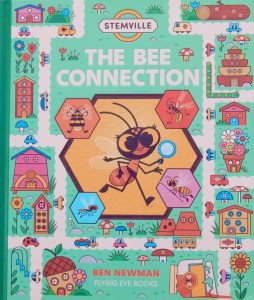
STEMville: The Bee Connection

STEMville town is populated by creatures of all kinds, though there are no humans, and this story unfolds in Bug Borough where a solitary bee, Mason B. Chandler (love the name) has recently set up her new private detective agency. She is eagerly awaiting a case when she hears a loud CRASH! outside. There she discovers that the Bug Borough traffic – vehicular and pedestrian – has come to a halt; everything is stuck in a golden sticky goo. Mason tastes the stuff – it’s sweet and immediately she feels an energy boost. Honey, she thinks, but how has it got all over town?

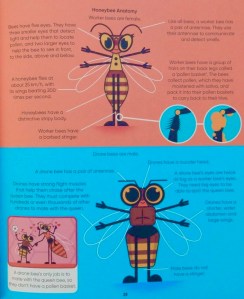
Using the device of a private eye investigation, Ben Newman imparts a great deal of information about insects and the apian world in particular. We learn that there are three kinds of bees – solitary bees like Mason, bumblebees and the social honey bees (the ones that make honey). Bee anatomy is illustrated,

and how bees differ from wasps and hoverflies. The secrets of the hive are revealed, its architecture, layout, the various different roles of its occupants

and the intricacies of the waggle dance whereby bees communicate where to find the best nectar sources, as well as just how important they and other insects are in the pollination of the plants that provide us with the food we eat.

Mason solves the mystery of the honey spill: it was all down to that careless bee-keeper bear who eventually confesses to dropping the jar.

In Flying Eye tradition, Ben Newman’s book is all a-buzz with information presented through explanatory panels, lively cartoon style illustrations and diagrams. A smashing way to introduce children to a vital topic; it concludes with some brief bee friendly suggestions for readers.

The Code of Life

This image has an empty alt attribute; its file name is dscn9957-1.jpg

The author of this fascinating book opens with a look at the history of genetics beginning as you might expect with the work of the Austrian monk Gregor Mendel in the 19th century. One of the first to experiment with cross-pollination, he used pea plant varieties with different colour flowers, meticulously writing down all his findings. It wasn’t until after his death that the importance of his work was recognised and he became known as the ‘father of genetics’.


From Mendel to Crick and Watson and beyond, via Darwin and evolution, this remarkable book charts the journey of scientists to unlock to secrets of life and where that journey may take us into the future.

This image has an empty alt attribute; its file name is dscn9955.jpg

The work of these and numerous other pioneers in the field and their discoveries in the fields of chromosomes, genes, cell division, the DNA double helix and much more, are recounted and explained. Everything is elucidated clearly in an engaging manner and supported with a wealth of visuals, both diagrams and illustrations; and there’s a page at the end encouraging readers to do some research of their own (answers supplied).


A high quality publication and one I would strongly recommend for older readers.

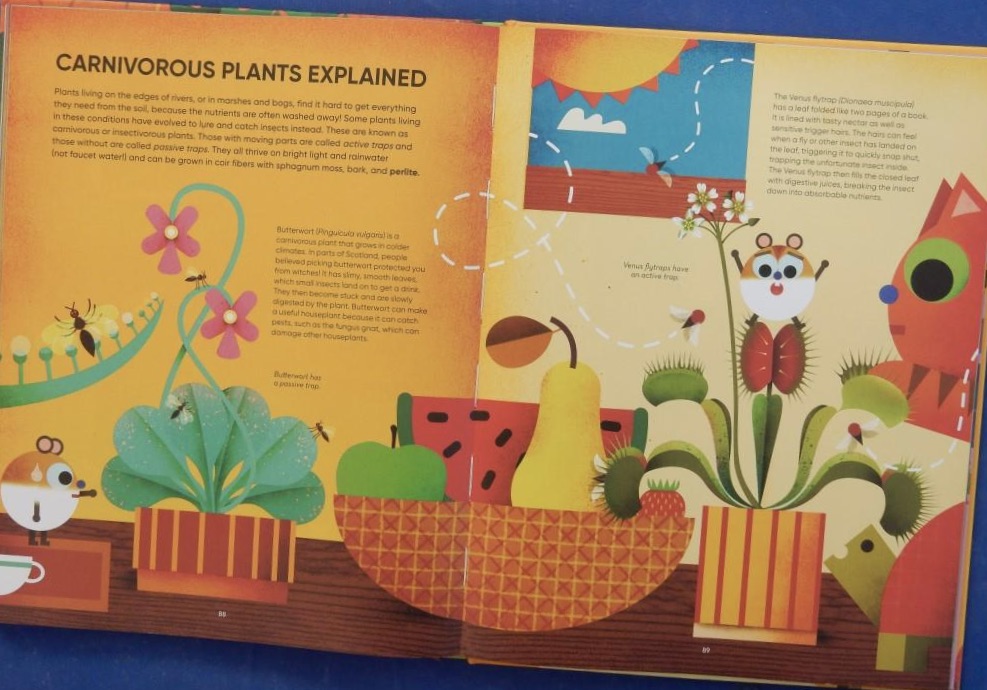
A Jungle in Your Living Room

Despite being given many houseplants of various kinds over the years by pupils, friends and relations, I have never been any good at nurturing them for long, so I was interested to see the sub- title of this book – ‘A Guide to Creating Your Own Houseplant Collection’.

There are three main sections: All About House Plants, The World of Houseplants and Houseplant Care.
The first presents basic classification, discusses some reasons for growing plants in our homes, plants used in celebrations in the home, talks about how some plants have adapted in order to survive in specific habitats, the conditions under which they survive best in a home environment. There’s a look back to houseplants in ancient history, including the origins of growing miniature trees that most of us know as bonsai. I was fascinated to read of the invention of the Wardian Case and some if its outcomes;

sadly including the triggering of journeys to remote locations of plant hunters to collect exotic plants. Better to paint them in the wild as did Marianne North and later, Margaret Lee, both of whom are mentioned in this book.

The second section is the longest and introduces houseplants of different kinds – succulents, cacti, various crassulaceae, members of the asparagus family, philodendrons, ferns, palms, a number of carnivorous plants

and several others. Interspersed with these are some DIY projects such as creating a desert garden and bonsai for beginners.

Section three looks at houseplant care and there’s a final glossary and index.

Drawing on his wealth of experience in the field, expertise and knowledge, Michael Holland’s straightforward text provides all young readers and beginning indoor plant growers with all they need to know and much more. Each spread is eye-catchingly, sometimes playfully, illustrated in vibrant colours by Philip Giordana.

Mason Mooney Supernatural Sleuth

Mason Mooney Supernatural Sleuth
Seaerra Miller
Flying Eye Books

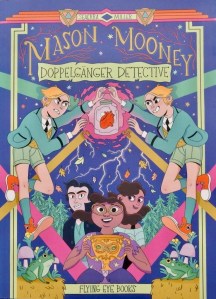
This is the third and final story of the world’s greatest paranormal investigator, Mason Mooney.

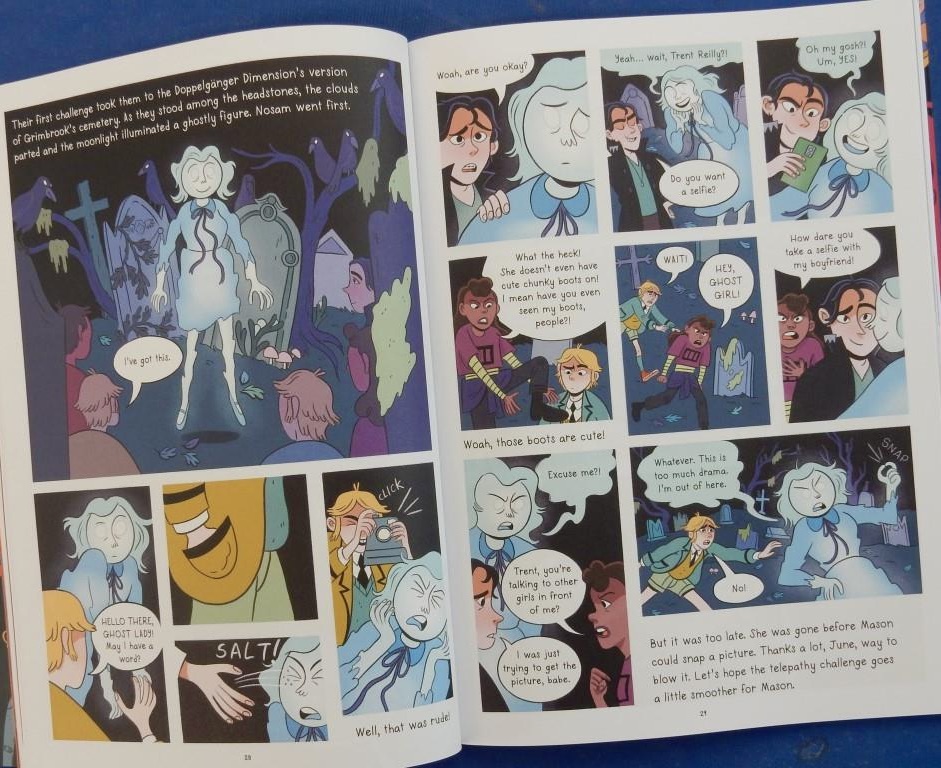
With his heart currently in another dimension thanks to Nosam, Mason’s evil Doppelgänger, Mason and his best friend, Iris, are bemused by the sudden appearance of pits around Grimbrook. Despite the foul stench, they realise they must follow the person who disappears through a manhole and enters a warren of underground passages.

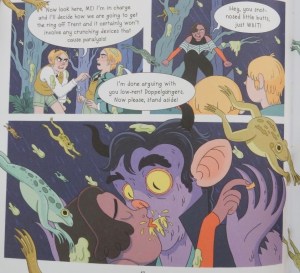
Before you can say, ‘Emerald Palm’, the two friends are on a mission to get hold of the Hand of Glory before Talitha finds it and creates total havoc. However, Iris has just been handed a necklace – the only one available – welcoming her as a member of the Order of the Emerald Palm; this causes Mason to get a fit of jealousy, the two get separated and end up in different dimensions. Mason then faces a number of challenges against Nosam in order to obtain he thinks, the Hand of Glory.

However things go badly wrong for Mason. Then he meets Constance, chats and realises that only by overcoming his jealousy can he stand a chance of getting his heart back, finding Iris and saving Grimbrook. With nothing more to lose, your favourite investigator will give it his all.

Thoroughly engaging, fast-paced and presented with panache, this series finale will surely satisfy Mason’s followers.

Curious Creatures Talking Together

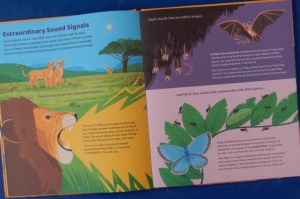
It’s common knowledge that humans spend a considerable amount of time communicating with one another in various ways, mostly though not always using words, but less well known is that all manner of animals communicate wordlessly by means of movements, sounds and smells.

In this latest Curious Creatures book, Zoe Armstrong presents in her relatable style, some of the ways this happens in the animal kingdom. Many times I’ve stood in Bushy Park and watched what the two hikers in the highlands of Scotland are witnessing: two stags roaring, stamping and bellowing. This happens during the mating season when males compete for females and one wants to prove himself stronger. Having described their mode of communication, the author briefly compares their actions with ways we humans might sort out a disagreement. I especially like this feature, which is part of each section.

The next couple of spreads present examples of other creatures that communicate by means of visual signals, the peacock spider being one. I love the description of the male’s dance vibrations as ‘rumble rumps’ ‘crunch rolls’ and ‘grind-revs’. 

The book continues with spreads each focussing on in turn, sound signals, 

chemical ‘smelly’ signals, tactile or ‘touching messages’. There’s also a spread on ways some domesticated animals communicate with humans and finally comes a reminder that if we pay close attention to signals from animals, we can discover what they want, need and perhaps, feel, and thus develop empathy with them, which should emphasise the importance of protecting the world’s fauna and treating them with respect.

Anja Sušanj’s vibrant illustrations augment the text and will help to entice children into exploring the information. A worthwhile addition to primary class collections and libraries.

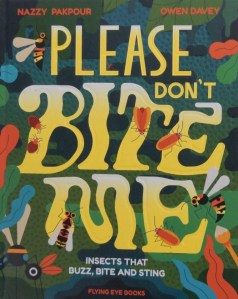
Please Don’t Bite Me!

Please Don’t Bite Me!
Nazzy Pakpour and Owen Davey
Flying Eye Books

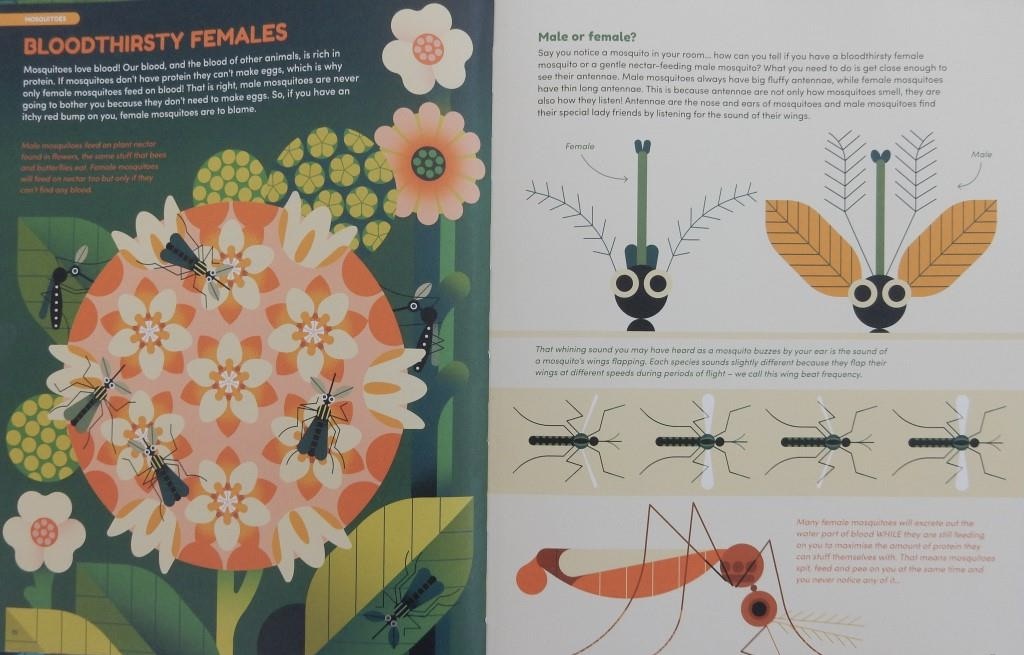
With a partner who can’t walk more than twenty metres without stopping to examine the vegetation for insects in various stages of metamorphosis – complete or incomplete – Nazzy Parker explains the difference – I was I suppose, predisposed to be interested in the contents of this book. It introduces readers to six varieties of insect pests, mosquitoes, lice, wasps, cockroaches, fleas and bedbugs; the very names, excluding wasps, make me want to squirm.

Pakpour starts by defining insects and the scientists who study them after which three or more spreads are devoted to each of the aforementioned pests. She describes their appearance including the difference between males and females, their impact on humans and how they find us, their habitat – I was intrigued to discover that mosquitoes are found everywhere except Antarctica and Iceland where it’s too cold for them to survive, and that it’s only the females that bite.

We also read about their habits and their development from egg to adult. Mosquitoes, wasps, and fleas undergo ‘complete’ ie four stage metamorphosis, whereas lice, cockroaches and bedbugs have a three stage, or incomplete metamorphosis.

Can you believe that there are more than 5,000 different kinds of lice, each kind being specific to the kind of animal it feeds on. Those that feed on humans spit saliva that can take as much as thirty days for us to develop an allergic response to. Weirdly though the very mention of a child in one of my classes having headlice has always made me start itching round my hairline straight away.

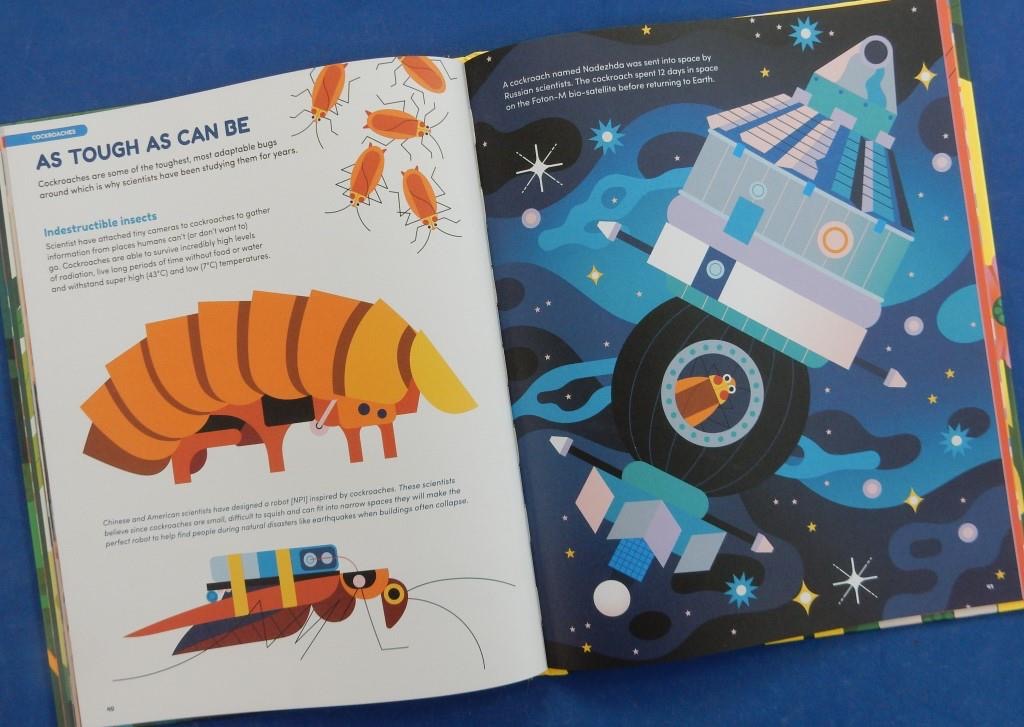
As for cockroaches, I will never forget the sight of an enormous one crawling across the pillow of our room in one of Jaipur’s five-star luxury palace hotels; it certainly didn’t get a five star review from me despite the fact that so we are reminded herein, the creatures don’t actually feed on human blood.

The author provides lots of fascinating snippets of information including that Chinese and American scientists have designed a robot inspired by cockroaches and that Russian scientists sent a cockroach into space for twelve days on a bio-satellite.

Probably though what is most important is the role of various insects in the world’s ecosystem; this is assigned the book’s final paragraph.

Owen Davey’s stylised, stylish illustrations work really well with biologist, Nazzy Pakpour’s text. Not the first book one would go to for general information about insects but a thoroughly engrossing one nonetheless.

The Planet in a Pickle Jar

The Planet in a Pickle Jar
Martin Stanev
Flying Eye Books

The brother and sister in this story aren’t keen on visiting their Grandma’s house. They consider it boring and would much prefer to spend all their time using their screens. Immediately we see some of what they are missing by so doing. They don’t enjoy her meals, or listen to the stories she tells: but a boring Grandma she is most assuredly not. Just take a look at her shopping, knitting and pickle making.

Then one evening she starts telling them something she considers important and on this occasion the children do listen and even spend time that night thinking about what has been said. As they do so a star falls from the sky and vanishes; so too has Grandma when they go to tell her about it. 

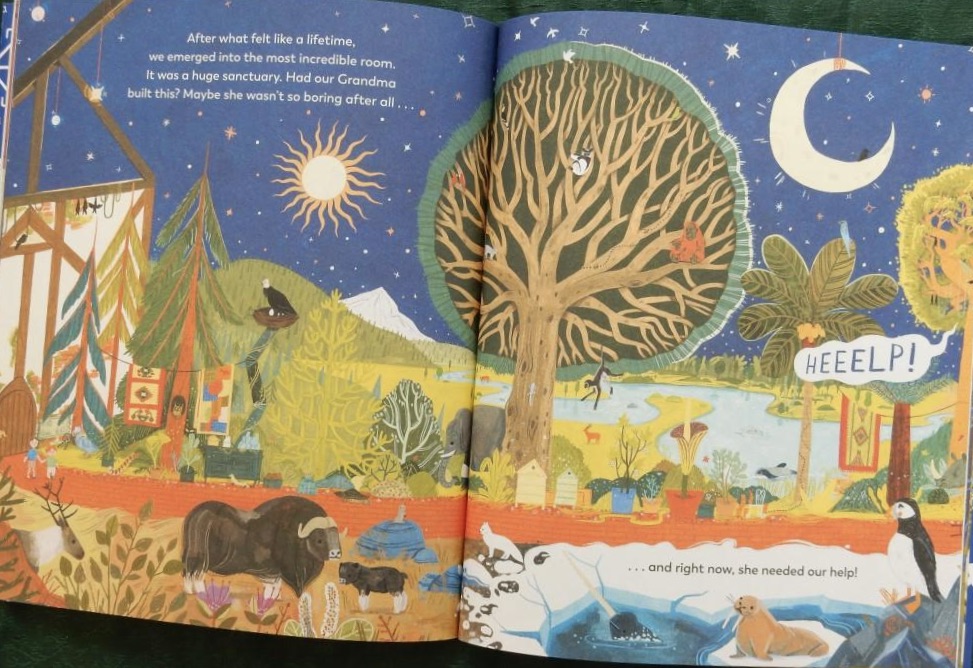
Their search yields only a wild cat that gives chase, and the children flee to the basement via a door they’d not noticed before. There they discover shelf upon shelf of pickle jars in which are preserved everything Grandma considers precious – ‘history, languages, nature, memories, smells, feelings’ and more. In addition, she has created an amazing underground sanctuary for endangered wildlife.

When eventually the children find Grandma, she explains that in order to prevent the complete destruction of the natural world, she now needs help to continue her life’s work. And so it is that , along with Grandma, the two children become custodians of the planet. 

Let’s hope that other children too are inspired by the story. It’s magnificently illustrated by the author and tells much of the tale without the need for lots of words; indeed what is shown is often at odds with what is said.

A book to share and discuss at home and in the classroom, and most importantly, for children and adults to act upon.

Luna and the Treasure of Tlaloc

Luna and the Treasure of Tlaloc
Joe Todd-Stanton
Flying Eye Books

At the start of this, the fifth of the Brownstone Mythical Collection series, Professor Brownstone introduces readers to Luna Brownstone, the most cunning of all the Brownstones. Daughter of renowned and respected adventurers known for their selfless acts, Luna decides after her parents were robbed and left abandoned while on a mission, that she would look after nobody but herself. This is just what she did: running away from home as soon as she was old enough, Luna began stealing priceless treasures from all over the world.

On the hunt for her next treasure, she goes to Aztec America and there learns of a young girl, Atzi, who has volunteered to undertake a journey, taking an offering, to the Aztec rain god Tlaloc and imploring him to save her village from drought. Luna decides on a cunning plan: she’ll befriend the girl, take her map and find the rain god on her own.

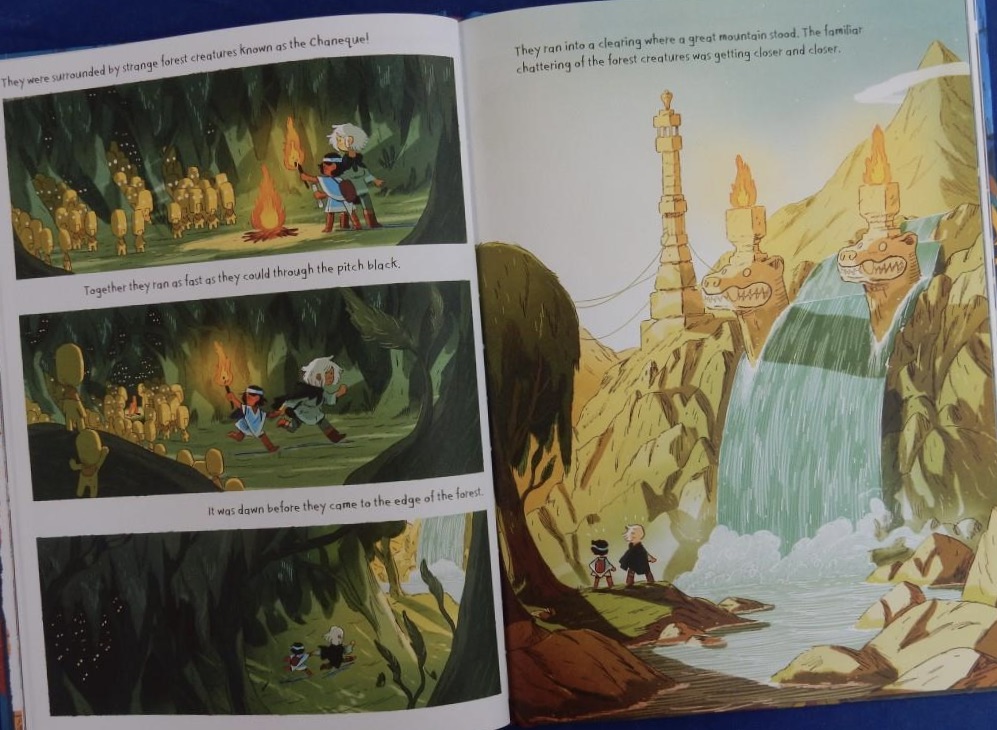
Their journey to his home beneath a sacred mountain is full of hazards including strange creatures

and they have to solve a riddle to discover the entrance to the palace. Luna realises that she must work with Atzi to navigate powerful waterfalls and evade hungry creatures, avoid dangerous ice shards and much more. Suddenly as they near their destination, Atzi is in peril of her life. Luna finds herself unable to let her die, though she doesn’t abandon her plan to steal the gold offering.

But is there something else that matters more than treasure and self- interest: Luna is soon faced with a crucial decision: does she have within her the power to change?

Luna is a rather different protagonist from others in the picture book cum graphic novel series – an anti-hero – and as always, Joe Todd-Stanton’s richly coloured illustrations for this thought-provoking story are full of wonderful details to pore over.

Ingenious Edie Master Inventor of Tiny Town

Ingenious Edie Master Inventor of Tiny Town
Patrick Corrigan
Flying Eye Books

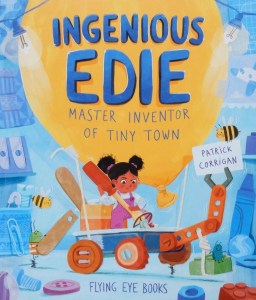
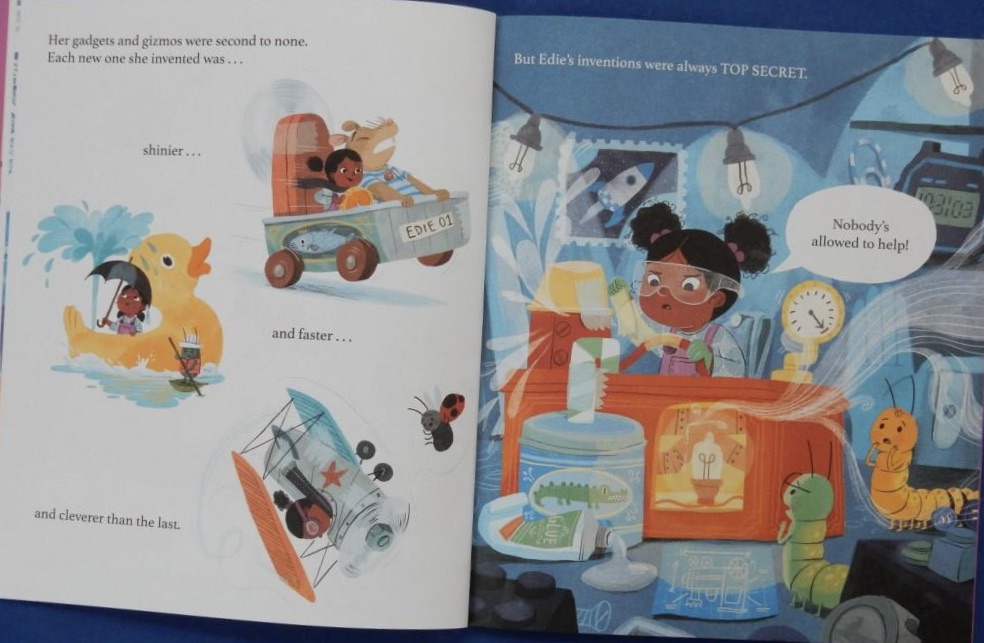
Meet young inventor Edie, one of the tiny inhabitants of Tiny Town. She loves nothing better than to create new contraptions and her aim is that each new one is even better than any of her previous inventions. She always keeps what she’s working on top secret – no help from anybody else, ever.

However that is until the arrival of Magpie; he with a particular penchant for all things shiny and a plethora of disguises. Edie decides this marauding meanie has to be stopped so she sets to work inventing clever Magpie traps but none is successful in doing the job. 

The girl is distraught especially after needing to call for assistance from her friends to extricate herself from entanglement engineered by Magpie. 

As she sits sobbing at her failures, first Ladybird and then others of her pals suggests that this is an occasion when they should all work together if they want to trap the thief.

The following day there appears on Tiny Town’s street something ‘new and mysterious’. Surely an irresistible attraction for any creature on the lookout for shiny objects. Could this be a case of community action winning the day?

That the power of the imagination and creativity play a vital role in scientific, technological and engineering discoveries and advances is demonstrated so well in Patrick Corrigan’s illustrations of Edie’s inventions. I love the miniature world created in this story, the demonstration of the importance of community action and wholeheartedly recommend sharing it with young children at home and in the classroom.

Monster Support Group: The Werewolf’s Tale

Monster Support Group: The Werewolf’s Tale
Laura Suarez
Flying Eye Books

Being true to yourself and celebrating difference are key themes in this the first of the new Monster Support Group series.

The book begins with Lowell entering an underground room where a meeting is being held. He sits down and begins his story.
We hear that he has recently moved to the village with his family and is struggling to fit in at his new school. He is rather different and has become the target for the bullies, Cassius Steel and his cronies. Then the changes started. Initially Lowell thought these were just ordinary, growing-up kind of changes: becoming hairier, moodier and smellier but then came the stranger changes that despite his best efforts, cannot be hidden.

After a particularly bad day at school he shut himself in his bedroom but his twin sister, Lys appeared on the scene, just as Lowell was morphing into a werewolf. This it transpires is on account of an ancient family curse. The following morning the twins visit the library to do some research about werewolves 

and come upon several books containing legends about them including the one his father had mentioned the previous night; each one mentions possible cures for the curse. 

These he tries but despite apparently having beaten the curse, the very next month on full moon night, it’s evident that the cures haven’t worked.

Back to the library go Lowell and Lys where they discover the Monster Support Group. Lowell joins the group and shares that story. Can anybody there help him with his ‘furry’ problem? Or is he happier being his unique self?

Drawing on mythology, this is a vibrantly illustrated, enjoyable story with a vital message about being yourself and that works for anyone; but those who see the werewolf trope as a metaphor for a boy’s transition from puberty through adolescence, into maturity, will find it somewhat strange that although the blurb says Lowell is twelve, he is portrayed as several years younger.

Ning and the Night Spirits

Ning and the Night Spirits
Adriena Fong
Flying Eye Books

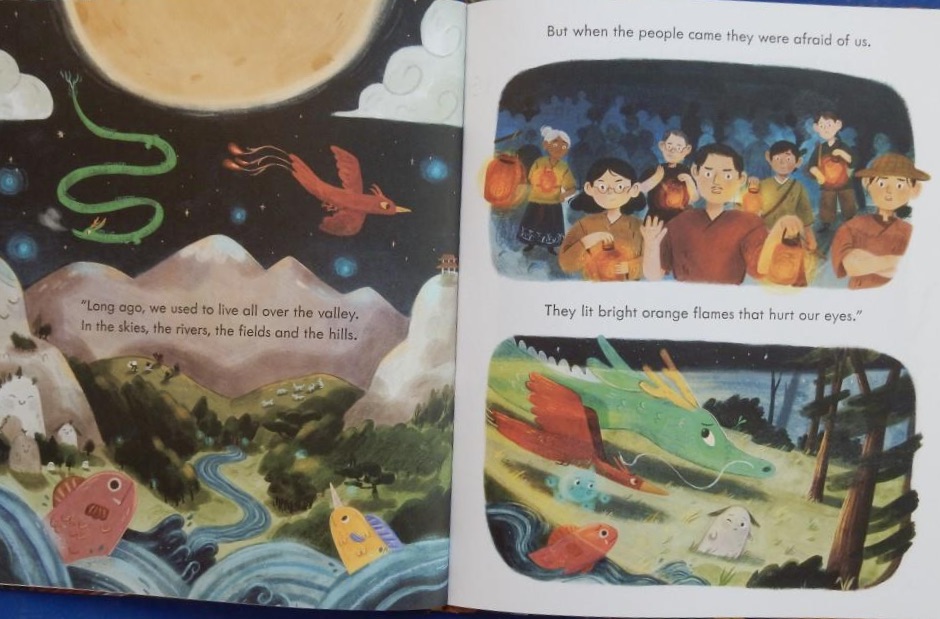
Ning, a quiet boy, lives in a little town in a lush valley at the edge of a forest. Each evening he helps his parents light lanterns to ward off the night spirits. Ning wants to know if the spirits really are scary but he’s unable to ask the other children as he finds making friends as scary, or more so, than any spirit he could imagine.

Bothered by his parents’ reaction to his lack of friends, Ning creeps out of the back door one night and into the forest 

where he finds himself face to face with a night spirit, a creature that looks anything but scary. Indeed Ning realises it’s the creature that is scared of him. The two quickly become friends and the cute little creature shows him the wonderful forest animals and the secret world of the night spirits. Ning discovers that rather than being scary, the spirits are scared, scared of the bright flames of the townsfolks’ lanterns that hurt their eyes, causing them to take refuge in the forest.

The boy knows that he must try and help his new spirit friends, but to do so he needs to find the courage to speak to the other children and enlist their help. Can he do that? Back home he works on a plan …

Adrian Fong has created a magical world in a far eastern setting for her debut picture book that tells a story about friendship, gaining the confidence to confront your fears and not making prejudgements about others. When you share the book with young children at home or in school, take time to look closely at the illustrations of the inside of Ning’s home and the parade through the town, they’re rich in cultural detail.

Farah Loves Mangos

Farah Loves Mangos
Sarthak Sinha
Flying Eye Books

Having just returned from a visit to India during which my mango loving partner announced that he wants to establish a mango orchard in the grounds of our friend’s Rajasthan country hotel, I was immediately attracted to this book that features a mango-loving little girl.

Farah’s Grandpa has a mango tree in his large backyard and every year she enjoys collecting the fruits, aided by Mali the dog. Then comes a summer when the tree doesn’t produce a single mango and unsurprisingly Farah wants to know why. Dismayed, she asks Grandpa but he’s too busy with a piece of wood to respond so Farah’s questions so she takes matters into her own hands, trying out all manner of remedies to make the tree produce fruit. She sings to it, gives it milk,

adds manure, ties a red scarf around its trunk and waters it with her profuse tears, all to no avail. The tree is useless, decides an angry Farah.

Along comes Grandpa hand outstretched, puts his granddaughter on the swing he’s been making all the while and gives the swing a push.

As Farah swings up into the tree’s canopy she discovers a world of wonder far beyond anything she might have imagined. This new way of seeing brings a vital realisation: a tree is SO much more than its fruit bearing function.

Sinha’s richly hued illustrations are bursting with humour, emotion and movement extending his story far beyond the words. A fun book to share with an important lesson about ways of seeing and appreciating natural things in their entirety.

The Laugh

The Laugh
Fay Evans and Ayse Klinge
Flying Eye Books

‘There was once a lady who had the loveliest laugh in the world.’ This lady laughed both loudly and quietly, sometimes with others, sometimes to herself; her laugh was contagious

and always full of love, no matter how it sounded. But then one day, that lovely lady becomes ill and dies, and with her dies the laughter.

The lady has left a great big hole in the world.
Her little girl can’t find the laughter, no matter where she searches. Then unexpectedly, something funny happens and the girl laughs again.

This moving look at a child navigating loss is such a beautiful tribute to a mother whose presence in her child’s life is enormous. The author of the third person narrative acknowledges that after a loved one’s death the family affected are unable to ‘move on’ – and indeed don’t want to but ends on a positive suggestion that the possibility of laughter returning is in fact, welcome. Ayse Klinge’s warm, comforting mixed-media illustrations convey strong emotions throughout as the book moves from joyful laughter, to sadness and then to laughter once more.

This book would be an invaluable resource for any young child who is grieving for a loved one.

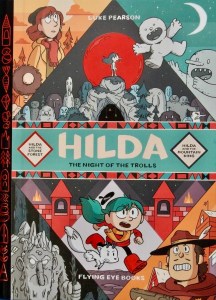
Hilda: The Night of the Trolls

Hilda: The Night of the Trolls
Luke Pearson
Flying Eye Books

This large format book contains Hilda and the Stone Forest and Hilda and the Mountain King, the fifth and sixth of the amazing graphic novel series.

In case you’ve not met Hilda before, she’s a blue-haired girl who lives with her mum and Twig, her fox-with-antlers pet, in a remote mountain cottage and then, later, in the city of Trolberg. Hilda finds adventure irresistible and in Hilda and the Stone Forest we first find her involved in the usual Hilda style adventure as she and Twig are chasing a small patch of ground that has weirdly grown legs and run off carrying atop itself a very small house full of very small people whom Hilda is desperately trying to rescue. Suddenly however, she realises that she’s late for Sunday dinner with her Mum and home she dashes taking the tiny house with her. During dinner, she succeeds in keeping what she’s been doing from Mum and meanwhile the residents of the tiny house sample the fare.

Dinner over, the girl tells her mum she’s going out again and off she goes, supposedly to the park; but this is Hilda and that isn’t exactly what happens. Eventually, after insisting the two of them go out together, which proves pretty eventful, Hilda’s mum grounds her. The girl then employs teleportation skills to escape the confines of her room but Mum grabs hold of her, things go haywire and mother and daughter end up lost in a stone forest wherein live the trolls.

Happily the two of them manage to survive what proves to be a weird and sometimes perilous adventure, one that isn’t over, but is continued in Hilda and the Mountain King.

Hilda, still in the Stone Forest has now morphed into a troll child whereas her Mum is back home caring for a troll baby. While in the wilds with the trolls, it becomes evident to Hilda that increasing numbers of trolls are being called to Trolberg’s outskirts and that could well mean trouble is on its way.

The troll mother that is looking after Hilda offers to re-humanise her but Hilda must find and bring in return, ‘something very special from the horde of the Mountain King’.

Can Hilda pull this off?

Without spoiling the ending, I’ll just say, the finale is a terrific culmination and revelation that ties everything together; but it’s a real shame that this is the end of Luke Pearson’s wonderful and wondrous graphic novel series. Long live Hilda and her indomitable spirit of adventure.

Juniper Mae: Knight of Tykotech City

Juniper Mae: Knight of Tykotech City
Sarah Soh
Flying Eye Books

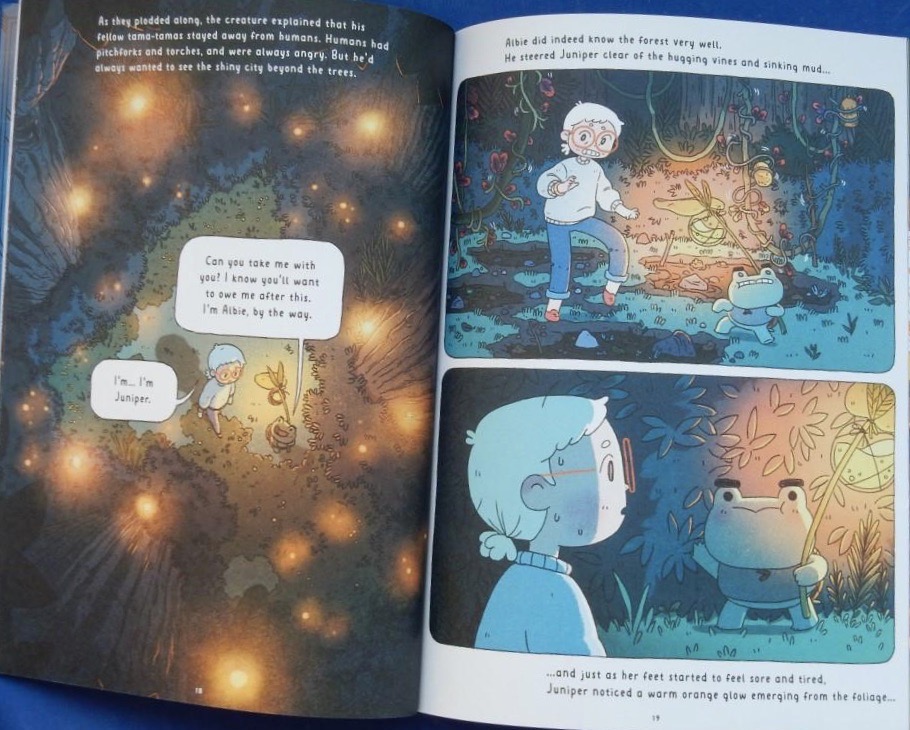
Juniper Mae, a young inventor, lives in Tykotech City, a wonderful place on account of its residents having their energy sourced from within by The Core, so that they have no need to venture into the deep dangerous forest surrounding the city to obtain resources. Now though unexplained problems with The Core have started causing power cuts.

One night when out testing her latest invention, the Juni Jet, (a high velocity jetpack with miniaturised hyperdrive), The Core’s power cuts out causing Juniper to crash land in the forest. Hearing a sound, she fears it heralds the approach of one of the terrible beasts the city folk talk of, but instead what appears is a tiny creature – a tama-tama – that looks rather endearing.
The creature introduces himself as Albie, offers his help to guide her home and accompanies Juniper in the hope that she’ll show him the city.

First though, Albie shows her his own village where she notices some unusual plant lights she’s told are sourced from kabbage seeds, and then in his hut, the artefact he’d mentioned that could help her. He also tells Juniper that this object had once belonged to the Guardian Knights, the ancient protectors of both humans and tama-tamas, thus giving both groups a shared antiquity. Albie gives his new friend both the ancient sword and an ancient map and they both go back to Juniper’s home.

Juniper investigates how the kabbage seeds work but just as she’s done so the city is invaded by metal monsters. Are they responsible for the power losses? Juniper is a determined character and with Albie’s assistance, together with the artefact and the newly discovered power source, she sets about saving the city and the forest. Can the spirit of those Guardian Knights supercharge her confidence.

Sarah Soh’s graphic style presentation of Juniper’s world is immediately immersive with its wealth of glowing images and lots of mechanical detail; there’s a gripping fast-paced plot that includes lots of dialogue and leaves readers satisfied with the resolution of one mystery but eager to meet Juniper and Albie again in the two further tales. I love the mix of technology and nature and that the main protagonist is passionate about STEM subjects.

Scientists in the Wild: Galápagos

Scientists in the Wild: Galápagos
Helen Scales and Rômolo D’Hipólito
Flying Eye Books

Along with a team of seven scientists from around the world who have a variety of special interests and expertise, readers are invited aboard the research ship, Sula, the aim being to study the flora and fauna of the Galápagos Islands, especially those unique to the archipelago.

Their tasks will include counting penguins: high numbers indicate that the population is healthy, What they find on this first stop is that nearly half the penguins they see are juveniles; this is good for it means the adults are breeding well.

The next job, after measuring a tiger shark is to attach a satellite tag to the creature and then track its movements. On the same island is a cove: a good stopping point for some underwater filming of the sea lions with a focus on what fish they’re eating.
The islands are home to a large variety of iguana species, one of which is very rare and the team stop off on one to count the endangered Pink land iguanas. Much, much tinier are the microscopic phyto- and zooplankton that play a crucial part in feeding the marine life around the islands.

The richness of the subaquatic flora and fauna attracts huge animals to the Galápagos to feed including sperm whales and one of the team wants to try and discover what it is these whales are communicating to one another.

It’s impossible to mention all the team investigates in a short review but readers find out about such topics as climatic conditions, a successful breeding programme of almost extinct Espania tortoises; there are spreads about Darwin and how the islands inspired his On the Origin of Species; the underwater volcanoes and their ‘mysterious’ ecosystems; and the final spread presents on going work in the Galápagos islands.

Helen Scales, herself a marine biologist, writes in an engaging manner, holding the reader’s interest throughout. I was excited to find the spread on Blue-footed boobies having loved Rob Biddulph’s picture book that starred the bird.

Stylish, detailed illustrations by Rômolo D’Hipólito play an equal part in conveying the science and keeping readers absorbed.


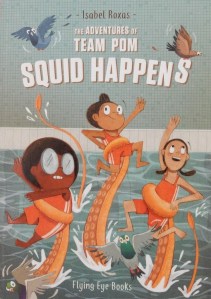
The Adventures of Team Pom: The Last Dodo / War of the Wind

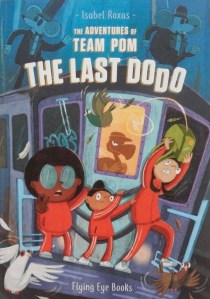
The Adventures of Team Pom: The Last Dodo
Isabel Roxas
Flying Eye Books

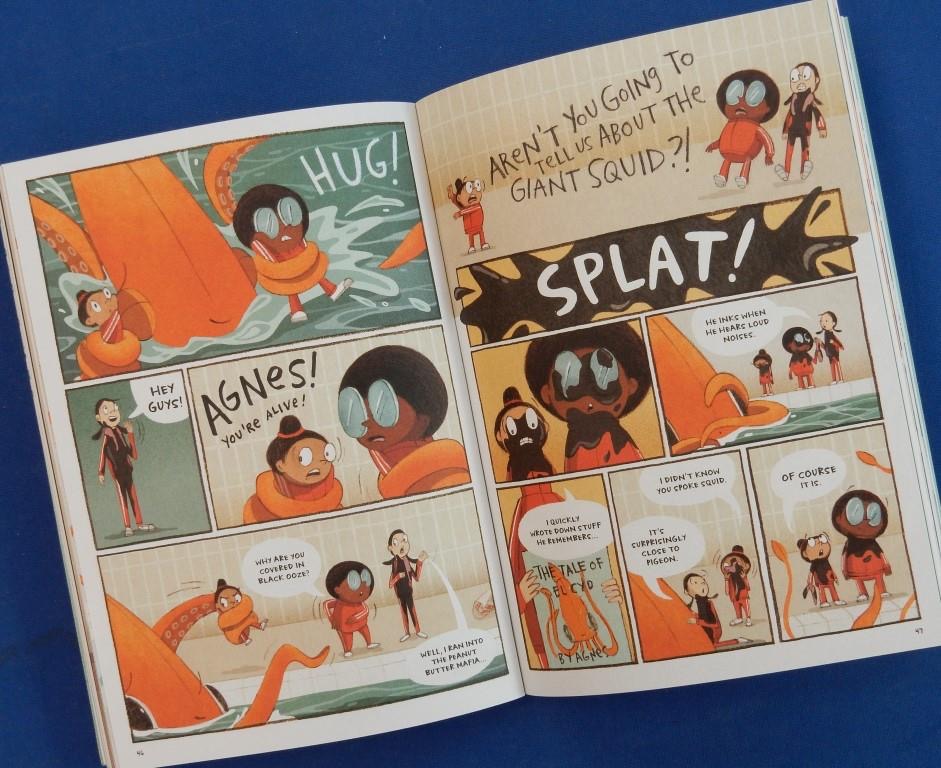
It’s the summer break in Shadyside and Team Pom comprising Roberta, Ruby and Agnes have decided to spend it at the Natural History Museum where Ruby’s aunt Dr Octavia – a de-extinction biologist in training is currently working. There she is mighty proud to show the junior naturalist group a very precious specimen, a fossilised dodo foot. Who should be lurking in the background masquerading as cleaners though, but that ratty pair of the dastardly Steve’s minions, Mister Gilbert and Monsieur Georges. The next thing Dr Octavia et al know is that the dodo specimen has gone missing. Quickly Team Pom is on the trail but they are going to have to foil Steve’s wicked plan to turn all the humans to dodos if they’re to save the city.

If only they can find an ‘antidote’ and get the dodo-humans to consume it; otherwise it will be a case of “The dodos shall inherit the earth.”

With both inventiveness and action galore, this second off-the wall adventure, presented in Isabel Roxas’s whimsical graphic novel style, will delight those who met Team Pom in their previous adventure as well as winning them plenty of new fans.

War of the Wind
Victoria Williamson
Neem Tree Press

On a remote Scottish island lives fourteen year old Max with his parents and baby sister. As the story opens Max is struggling to come to terms with his hearing loss that happened after an accident on board his dad’s fishing boat. Up until then Max had been a popular boy – one of the crowd – but now he’s become one of the zoomers, those with additional needs whom he and his friends had previously laughed at. In addition Max feels that his parents have replaced him with perfect baby sister Sally. He doesn’t understand why his Dad can’t be bothered to communicate with him in writing and is irritated that his mum always seems too tired to sign accurately.
Max’s village is not on the internet, nor indeed is a mobile phone network available. But then, setting aside the noise pollution in exchange for the promise of wi-fi for everyone and a power source, the islanders vote to allow huge wind turbines to be installed in the bay just off the coast.

We follow Max’s developing relationships with three children who have been ‘different’ all their lives: David, uses a wheelchair, Beanie, who has Down’s Syndrome and lives with her granny, and Erin, who was born deaf; his gradual acceptance into this community being somewhat bumpy. Almost as soon as the wind farm appears it’s evident that the animals and islanders are acting oddly. In a few short weeks they become irritable, bad tempered and unpredictable. The strange behaviour spreads to the children and acts of violence threaten to tear the community apart.

On account of his hearing loss, Max, unaffected by the changes, discovers that a sinister scientist, Doctor Ashwood, and the government are using the wind turbines to test a new sound wave weapon on the island population. Using their strengths, can Max and his three new friends find a way to shut down the wind farm’s signals and halt Doctor Ashwood’s plan before the experiment has tragic consequences?

Not only is this a gripping thriller but it’s also an empathetic portrayal of children with additional needs, showing how all too often, they can be underestimated.

The Season of the Giraffes / Wild Animals of the World

The Season of Giraffes
Nicola Davies and Emily Sutton
Walker Books

This the first of the publishers new Protecting the Planet series looks at the effects of climate change on the much loved giraffes of Niger; its inspiration was the work of climate activist and film maker, Kisilu Musya.

Once some time back giraffes were very much a part of everyday life in Niger: and considered a blessing in the same way as the birds, the trees and the rain. The children saw them browsing the trees on their morning walk to school or when they brought home the cattle at night; the giraffes had a strange fighting regime and communicated in a language of grunts and snorts.

However the number of these graceful animals sadly started to decline as more and more buildings, roads and farms filled the land and then on account of climate change the rains began to fail too. The result was terrible droughts that parched the land causing much suffering to both animals and humans.

Soon very few giraffes were left in Africa but in the country of Niger, there was still time to save the few that remained. The humans stopped hunting, protected the trees giraffes fed on as well as the creatures’ favoured places and gradually, then more rapidly, the giraffe population increased. So much so that some have been transported by truck to other parts where they live under the watchful eye and care of wildlife rangers and scientists. The hope is that one day these beautiful animals might be able to return to the places they once roamed.

Nicola’s story of optimism shows how with resolve, we humans can change things for the better; it’s gorgeously illustrated by Emily Sutton who captures both the grace of the animals and their homeland, and the lifestyle of some of the people of Niger.
(There’s additional information about giraffes, climate change and what we can all do to help both causes.)

Wild Animals of the World
Dieter Braun
Flying Eye Books

This sumptuous volume brings together Braun’s Wild Animals of the North and Wild Animals of the South taking us on a world tour that begins in North America, moving in turn to South America, Europe, Africa, Asia, Australia and finally, Antarctica.

Magnificent art takes the forefront in an awe-inspiring introduction to an array of creatures great

and small of the land, sea and air. Sadly some – the Asian elephant, the Emperor penguin for instance – are on the endangered list, others are threatened, though this isn’t stated in the book.

Dieter Braun manages to encapsulate the very essence and spirit of every one of the hundred and thirty plus animals portrayed. Some have an accompanying factual paragraph, others leave the labelled illustration to speak for itself. (Both scientific and common names are given.) A great gift for young wildlife lovers.

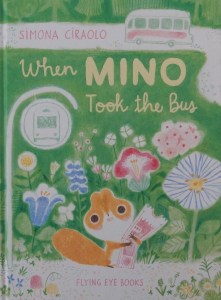
When Mino Took the Bus

When Mino Took the Bus
Simon Ciraolo
Flying Eye Books

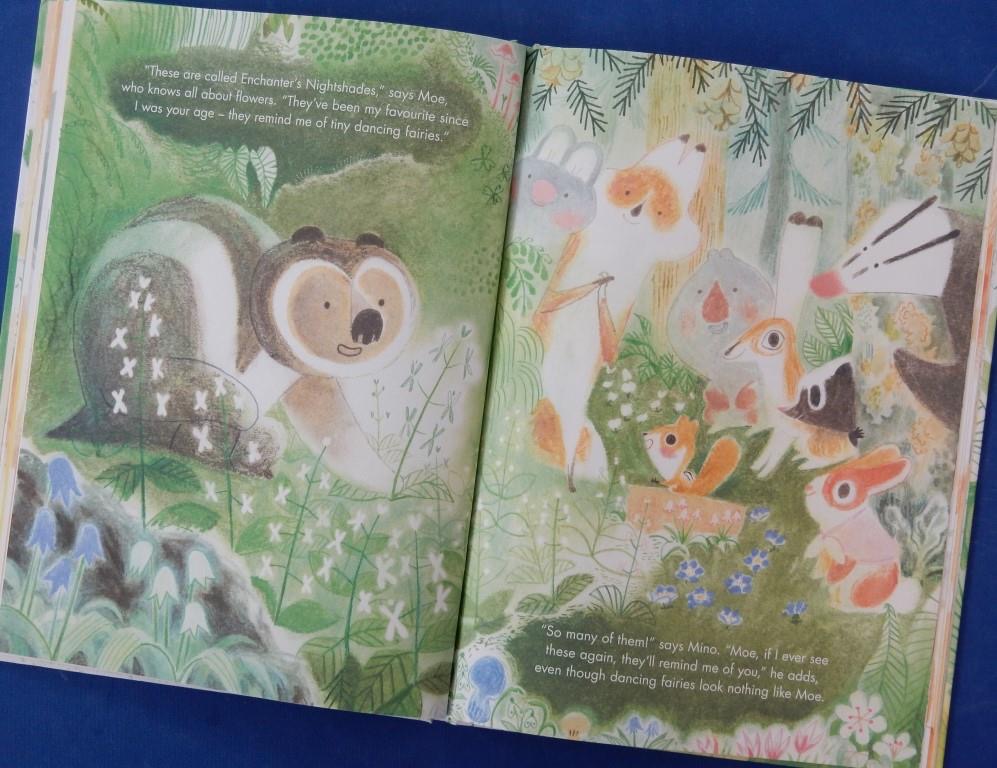
When he turns eight weeks old, young chipmunk, Mino must bid his mother farewell and set out into the world alone. With the instructions he’s been given running through his mind and his ticket at the ready, Mino excitedly boards the bus to the very last stop. He can hardly wait to reach his destination where he will find his future home, plant his seeds and watch them grow. To help pass the time Mino chats to the driver, shows him his leaf collection and asks, “How can you spend all day waiting to arrive?’ Guido responds thus, “ I often think the journey is just as important as the destination.”

As the journey continues other passengers come on board. First there’s Béatrice who shares her snacks with Milo and receives one of his seeds in return; then others who treat Milo with varying degrees of friendliness. Sometimes the bus stops to allow the passengers to have a little walk and perhaps find something of interest to show each other and especially Milo.

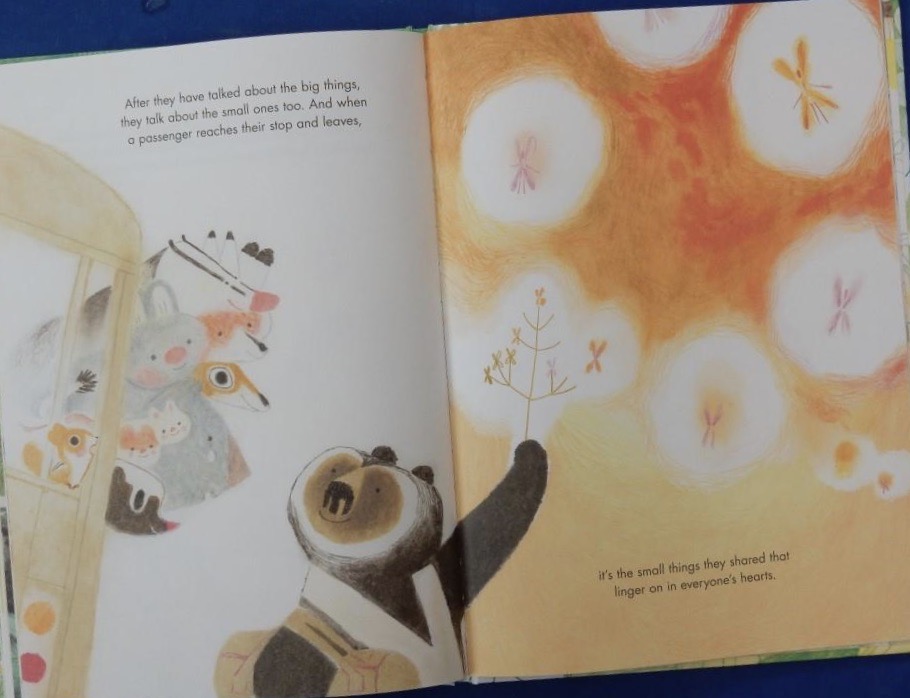
The hours aboard the bus pass almost without notice as Milo is surrounded by his new friends and he decides to collect the memories they share with him. Some passengers depart

and eventually the bus comes to its last stop. None of the remaining passengers hurry to get out and embrace the future but eventually each one leaves and having had to retrace his steps and give the driver something, Mino sets off to find that new home.

What matters most in Simona’s uplifting story so enchantingly illustrated, are the small moments the friends have shared, those are the ones they will remember and cherish.

Alcatoe and the Turnip Child

Alcatoe and the Turnip Child
Isaac Lenkiewicz
Flying Eye Books

I am a huge fan of vegetables but those grown underground are just not my thing. Nonetheless, I immediately found myself rooting for the Turnip Child in Isaac Lenkiewicz’s magical story told in comic format.

The setting is Plum Woods where spells come alive and witches gather for the Annual Harvest Festival to celebrate the season. Therein among others, resides reclusive Alcatoe the witch who acts as narrator for the tale. There’s also the grumpy Mr Pokeweed, reputedly half goblin who has his eyes firmly set on the main prize at the harvest festival pageant and the local children, three in particular – Emma, Chris and Holly – who are determined to beat him.

Fortunately for them, they come upon a hat belonging to Alcatoe on their way to school and that gives them a perfect reason to visit the witch and enlist her help in growing a prize-winning turnip.

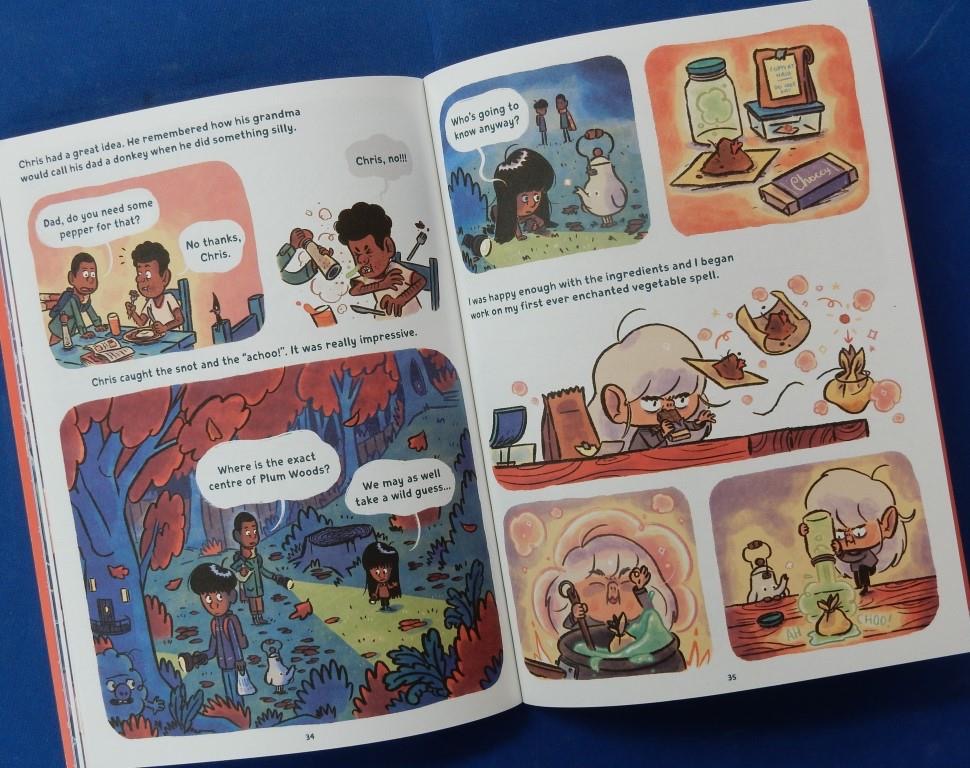
Happily Alcatoe knows just the right ingredients to make magic happen and she wants to get her own back on the one in charge of the pageant; but the three children must gather the items for themselves. Off they go in search of the tail hair of a copycat, the sneeze of a donkey and a chocolate bar.

However, operation champion turnip works just a little too well, astonishingly so for the children.
Can disaster be averted? Perhaps, but only if Alcatoe comes to the rescue – again!

Start with a large amount of creative talent, add several spoonfuls of magic, umpteen vegetables, sprinklings from the condiment containers, drams of determination and the result is one cute character, a fair bit of mayhem and a wonderfully funny, tremendously tasty tale.

Curse of the Chosen Volume 1 & Curse of the Chosen Volume 11

Curse of the Chosen Volume 1
Curse of the Chosen Volume 11

Alexis Deacon
Flying Eye Books

These are two bumper volumes, the first comprising (Geis) A Matter of Life and Death and A Game Without Rules, the second being the eagerly awaited The Will that Shapes the World, which concludes the trilogy.

Alexis Deacon’s first two graphic novels have held readers in their thrall since their publication. The first begins in fairly traditional fairytale style becoming progressively darker: a young woman, Io, finds herself in a room with 50 nobles; all are waiting for the death of the matriarch and thence the declaration of a new chief. They discover that the former matriarch has died but her body has been possessed by a sorceress who sends them from the Castle telling them to be back before dawn. “One alone I will spare,” she tells them. From this point on the reader watches the ordeals of some of these nobles as they try desperately to fight the “death magic” that has brought them thither.

Equally enthralling and even darker than the first book, A Game Without Rules begins by saying that the first test is now completed and only Io and a young man, Nemas know the truth of the sorceress’s plan. What follows is essentially a game of manipulations and wit within the city walls and the castle itself. Readers learn more about these characters who during the race for the crown, that at times becomes a race in a matter of life and death, we see the contestants change and develop. With the stakes raised the tension grows and it’s impossible to predict what will happen and who will succeed in the second test.

Powerful storytelling and awesomely detailed artwork once again sweep the reader away in the series finale The Will that Shapes the World. “The sorceress plans to kill us all! She has already murdered and enslaved the others!” comes a girl’s voice from behind bars, one of those remaining who are now scattered throughout the castle.

Shortly after comes an announcement from the sorceress, “Only one of you will survive … kill the others and one of you will live. I promise you that.”
Nightmarish scenes follow and awful realisations too as we head towards an unanticipated, impactful and clever conclusion.

I was astonished to realise that the creator is the same Alexis Deacon whose picture books are some of my most frequent classroom shares. What his awesome graphic novels do, among other things, is expose a different audience of older readers to challenging vocabulary, presenting it in a visually supportive context.

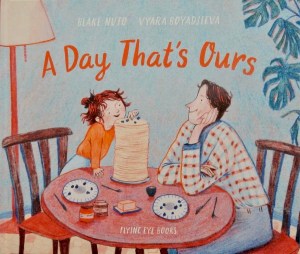
A Day That’s Ours

A Day That’s Ours
Blake Nuto and Vyara Boyadjieva
Flying Eye Books

With normal life more or less resumed, post pandemic, for many of us that means back to dashing around trying to pack way too much into our days and forgetting those leisurely lockdown days when there was plenty of time and opportunity to slow down and appreciate just being together, savouring the simple things. The kind of little things the father and small child do in this gorgeous book, such as tucking into an enormous pile of pancakes at breakfast time, walking hand in hand discovering tiny treasures waiting to be seen on the way to the park.

The sounds too – they, just like Vyara Boyadjieva’s exhilarating illustrations – are captivating and need to be savoured.

There seems to be all the time in the world to notice the seasonal changes – those small signs like the leaves turning golden or orange, then not long after drifting down;

as well as to rest beneath the spreading branches of a tree before the day begins to fade.

Lyrically written in gentle rhyme, Blake Nuto has captured that magical window of time before even the quite young have their lives packed with worries about school grades, tests and exams, as the parent here knows all too well loom on the horizon for his child, a time all to soon over and one to celebrate.

A perfect fusion of words and pictures that adults will definitely want to share with young children over and over and over …

Passionate About Penguins

Passionate About Penguins
Owen Davey
Flying Eye Books

Spending their time between land and sea, penguins are amazing creatures: I knew this, but I didn’t know that there are so many different kinds. Owen Davey talks of this on the opening spread of the eighth of his superb series. There are way more penguin species than that though, possibly as many as twenty it’s suggested here, and they are divided into six groups. Examples from each group show off their heads on the first page.

Ask a child where penguins live and they’ll likely tell you Antarctica; however that only accounts for some. Galapagos penguins might be found living north of the equator and there are lots of other kinds of terrain inhabited by penguins – beaches, rocky areas and coastal forests being some. Being carnivorous, they’re always fairly near the sea where they hunt, preying on such marine creatures as jellyfish, eels, crabs and tiny krill. 

On account of their ‘aquatic’ lifestyle, penguins have become specially adapted. Owen uses the example of a Humboldt penguin to zoom in on the special features – webbed feet positioned towards the rear of its body, countershading, making them tricky to spot, streamlined body shape to facilitate effortless swimming, wings – used not for flight but balance, thick blubber for warmth, a special gland to filter excess salt from their blood, dense skeletons for ease of swimming and diving, hooked beaks to catch and hold prey. This they swallow with the aid of fleshy spines on their tongues and inside of their mouths. There’s a spread further entitled Making a Meal of Things giving lots more information on food and feeding.

Other spreads are devoted to plumage, locomotion, self-defence, surviving in extreme conditions, the rearing of chicks – fancy having to eat partially-digested food regurgitated by a parent. Put it another way the adult throws up into the chick’s mouth and surprisingly the little ones love it.
There’s also information about love life, 

social life, size comparison – Emperor penguins can be as tall as 1.2 metres vs ‘Little’ penguins, two antipodean species being only just over 30 centimetres.

As with previous books in the series, there’s an ‘And the Award Goes To’ feature with six award winners, one each for swimming speed, the deepest divers, those that hold their breath longest (that’s two medals for Emperor penguins), the most aggressive, the most private and wait for it – the most fashionable – the feathery crowned Macaroni.

This fascinating book ends with a look at conservation, a vital topic since most penguin species are becoming endangered on account of human action and here you’ll find too what can be done to protect these creatures and their habitats. Finally there’s an index.

Imbued with Owen Davy’s gentle humour, and with a wealth of his signature style illustrations that make each page opening a treat, this fact-packed book is another must have for wild animal lovers, budding zoologists and classroom collections.

The Perfect Rock

The Perfect Rock
Sarah Noble
Flying Eye Books

I’d just finished reading another Flying Eye book, Curious Creatures: Working With Tools, when I picked up this one, little realising it too involves tool-using otters.
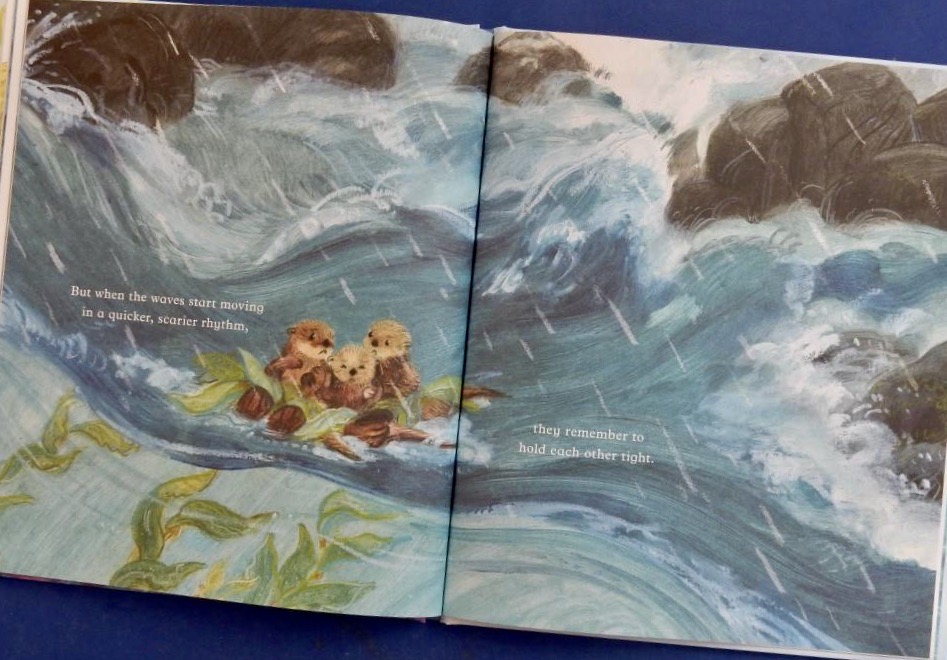
However, Sarah Noble’s narrative is a story about three busy young otters, Ollie, Bea and Ula that on account of their busy schedule, don’t generally have time to consider rocks. Nonetheless their shellfish feasting cannot happen in the future unless they can open the shells for themselves; so say their Papa and Mama. They go on to explain the qualities the opening tool – the Perfect Rock of the title – needs to have concluding with, “Most importantly, … something you hold dear, something you’ll hold tight and never lose.”

Off swim the little otters through the seaweed forest searching both high and low tides until at last … 

However a squabble ensues as each states the case for taking possession of this perfect finding and their squabbles lead to a scrap and chase resulting in the loss of the vital object and angry feelings bubble up. Then a scary storm blows in, delivering an important life lesson that changes everything. 

With gorgeous illustrations of both the otters and their environment, and words that are a delight to read aloud, this is such a lovely book offering as it does life lessons on sibling rivalry and finding your independence for the young otters, that are equally applicable to little humans. The otters’ changing feelings are so well expressed in Sarah’s scenes of their search, squabbles and final serenity.

Curious Creatures: Working With Tools

Curious Creatures: Working With Tools
Zoë Armstrong and Anja Sušanj
Flying Eye Books

I wonder how many children know that using tools for tasks we do often, daily even, is not confined to humans. There are, so we read in this enormously engaging book, animals in various parts of the world that display amazing problem-solving skills and adaptability, recognised by zoologists as tool using.

One such is the sea otter: these animals sometimes make use of kelp for several mooring purposes and also use rocks as hammer and anvil, for example to break open a clam shell or mussel to extract what’s inside for food.

Did you know, several creatures use sticks as tools: elephants in Bangladesh have been observed waving twigs or branches to ward off troublesome insects while others sometimes use a spiky stick as a back-scratcher. Indeed so Zoë Armstrong states, ‘the elephants choose the right tool for the job.’ So too we learn, do several primates: mandrills clean the dirt from beneath their nails with a small twig; gorillas sometimes take a long stick as a measuring device to gauge the depth of water they wish to cross before wading right in; and chimpanzees in Tanzania smooth a stick and use it to extract insects from a termite mound, eating them as we might a lollipop. I’d have been so excited had I been Dr Jane Goodall who first noticed and recorded this phenomenon.

I was especially interested to read though that tool use techniques among primates such as Orangutans sometimes differ according to the particular habitat in which they live.

Indeed some living near a research camp in Borneo’s Tanjung Putting National Park have been observed in a boat paddling it around with their arms – just one of several clever habits they’ve worked out.
Birds too are skilled tool users and author Zoë and illustrator Anja Sušanj provide several examples of them. Crows in particular are known to forage and perform other tasks with sharpened sticks they shape in a variety of ways: indeed New Caledonian crows are among the most skilled toolmakers in the entire animal kingdom.

Altogether a fascinating tribute to creature ingenuity: children (and adults) will be surprised and awed by these clever animals in a book that conveys a wealth of STEM information. There are lots of potential cross-curricular links: I particularly like the way these animals encourage child readers to think creatively to solve problems, just like the exemplars herein have done.

I Ate Sunshine for Breakfast

I Ate Sunshine for Breakfast
Michael Holland FLS and Philip Giordano
Flying Eye Books

‘Plants are essential to your world. Without them, no other living thing would be able to survive.’ So begins this absolutely beautiful book aptly subtitled ‘A Celebration of Plants Around the World’ that presents much about the truly amazing plants of our planet in glorious colour. With spring well and truly bursting forth around us now, what better time to pay tribute to botanical beauties (and some animals along the way) – were you aware that some plants – the carnivorous kinds – actually feed on insects?

Written in a child-friendly style by Michael Holland, the book is divided into four main sections that together comprise pretty much everything a youngster would need to know and more, starting with what plants are, their parts, their essential processes – photosynthesis, respiration and growth, reproduction (I’m sure readers will be amused to learn of the world’s largest seed – coco de mer, that looks remarkably like a gorilla’s rear) and why they matter. 

Then comes a look at the plant kingdom in general – evolution – did you know all plant species originated from just one type of plant, millions of years back? There’s a family tree, a look at adaptation, 

food chains and food webs.

The latter part of the book explores how plants sustain our everyday lives: there are plant extracts in medicines, in toothpaste, in clothes, cooking oil, soap, plastics and then of course there are all those delicious fruits and vegetables we consume as part of our daily diet.

Despite the huge amount of information in the book, it’s all split up neatly into small sections and paragraphs, making it super-easy to digest and there’s a glossary at the back should you come across unfamiliar botanical terms. Plus, there are a dozen suggestions for some simple plant-based science experiments such as creating cornflour slime and cultivating a wild weed bottle garden. Of course environmental pollution affects plants too so the last part covers that as well as a spread entitled The Future is Green.

Visually stunning with retro-style graphics that provide a perfect complement to the text, this is a must-have book for budding botanists, family bookshelves and class collections. Readers will surely want to dig into it time and time again.

Coming Up For Air / Sisters of the Mist

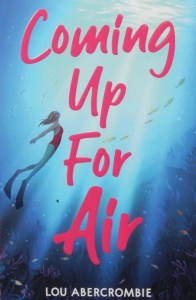
Coming Up For Air
Lou Abercrombie
Little Tiger

When Coco has to move to the seaside town of Piscary where her mum grew up, she’s eager to make friends and learn more about the family her mum has kept from her. What she doesn’t expect is the resentment shown by the community and her mum’s secrets are certainly deep-rooted.

Staying with her reputedly brilliant biologist Uncle Henry who is struggling with ME, Coco is an aspiring film-maker and an excellent swimmer with as she discovers, a talent for freediving.

Within Piscary are factions: the residents born and bred in the town (Fishes), those who have bought property to live in (Cuckoos), and the ‘Zombies’ who come to spend the summer enjoying what the town offers. As Coco explores the rift between her mum, her family and her hometown, making an occasional friend along the way, she becomes more and more determined to bring the town together.

But then disaster strikes when she and ace swimmer/diver Leo and new friend Shiv investigate a cave that involves diving deep and swimming along a tunnel. Will it be a case of tragic history repeating itself or can Coco finally see herself as part of a proper family?

Lou Abercrombie’s powerful, gripping coming of age story is told from the viewpoint of Coco who intersperses her narrative with filmic directions, adding an unusual element to the book.

Sisters of the Mist
Marlyn Spaaij
Flying Eye Books

Frygea Forest is ancient and mysterious; trolls lurk and mischievous changelings scuttle around. It’s also the place on the edge of which three sisters go every summer to stay with their grandmother on her farm.

Kyra and Janna have been eagerly anticipating another chance to climb trees, toast marshmallows and play some silly games in the woods with their big sister Margot who will be starting senior school after the holidays. Things are different this year however. Margot is less enthusiastic about spending all her time with her siblings. But when she’s lured into the midst of the swampy woods by the phantom-like beings in the mist – the Fog Furies – a worried Kyra is determined to help her

and that means facing the frightful Hellhound. What’s actually happening is that on account of the mysterious forces, Margot is being transformed into a young adolescent.

Marlyn Spaaij’s cleverly conceived, dramatically illustrated graphic novel combines swirlingly strange fantasy elements with Margot’s coming of age and starting her periods, both these being aided by the Furies and her understanding grandmother. It’s a good one to give girls especially those around ten before those changes of growing up start to happen, especially as it shows that facing up to scary changes doesn’t have to mean leaving behind the power of the imagination.

Professor Astro Cat’s Frontiers of Space

Professor Astro Cat’s Frontiers of Space
Dr Dominic Walliman and Ben Newman
Flying Eye Books

Space suits on? Professor Astro Cat, along with his sidekick Astro Mouse is ready to take us on a journey through space: it’s a skyrocket tour of the solar system and plenty else too.
First he informs us about the Big Bang and the birth of the universe, and then with a spread each, goes on to explain the formation of stars and how they collected together to form galaxies.

Next we whizz past the sun, after which our feline prof. presents in turn, all eight planets of our solar system, Earth and the Moon.

The practical aspects of space travel are covered in spreads on the early astronauts – animal and human. We meet the first moon-walkers, Buzz Aldrin and Neil Armstrong, as well their colleague Michael Collins who remained in the command module, while the others explored the moon’s surface. There’s a pause to discover some lunar information – did you know that due to lack of a wind and hence no erosion, the footprints those astronauts left will remain there for millions of years – wow!

There’s a chance to take a look at their Apollo spacesuits and some more modern ones, see some modern rockets, pay a visit to the International Space Station (ISS).

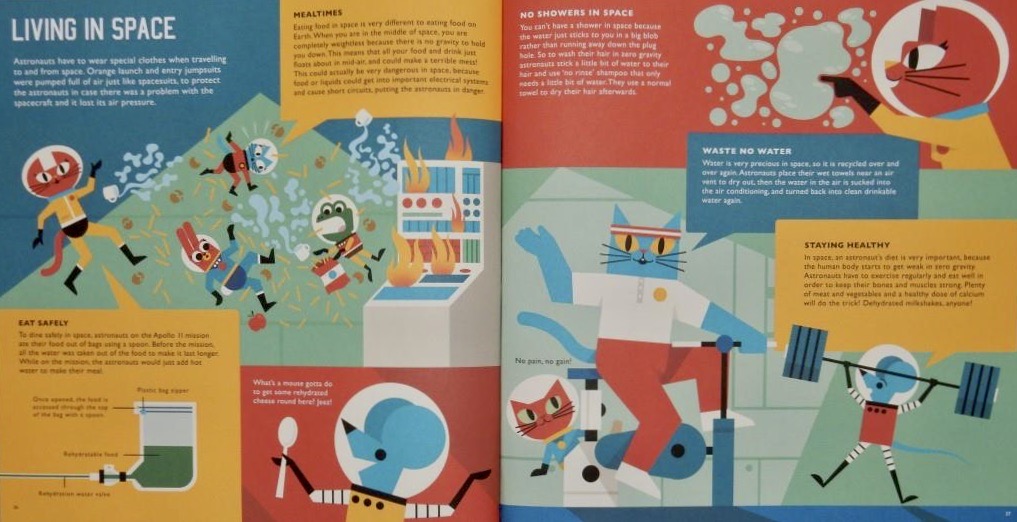
Then comes a consideration of what life in space might be like

and a whirlwind visit to each planet in turn starting nearest to the sun with Mercury and working outwards

and much, much more.

There’s also some speculation about possible ways the end of the universe might come about, the future of space and on the possibilities of alien life. Finally we have a fascinating factoids spread, followed by a glossary and index.

A whirlwind exploration indeed but it’s hugely informative and thanks to the Professor’s gently humorous, yet authoritative voice, accessible to young readers. Made all the more so by Ben Newman’s retro-style illustrations and the scattering of jokes throughout.

Beetles for Breakfast

Beetles For Breakfast
Madeleine Finlay and Jisu Choi
Flying Eye Books

Fundamental to all scientific discoveries is the imagination and so it is in this book wherein Madeleine Finlay explores the imaginative new technologies scientists are developing to help make our planet greener.

There’s absolutely no getting away from the drastic effects that climate change and global warming are having on planet earth and Finlay’s book is bursting with ideas – including those of the weird and wonderful kind – suggesting ways that humans might reduce the adverse impact of we humans.

The backdrop is a day in a child’s life and as we follow it through from the breakfast table, the bathroom, into the city, to school, the park, then onto a farm and pay a visit to the beach before returning home, we learn how some of the cutting edge inventions could become part and parcel of everyday life.

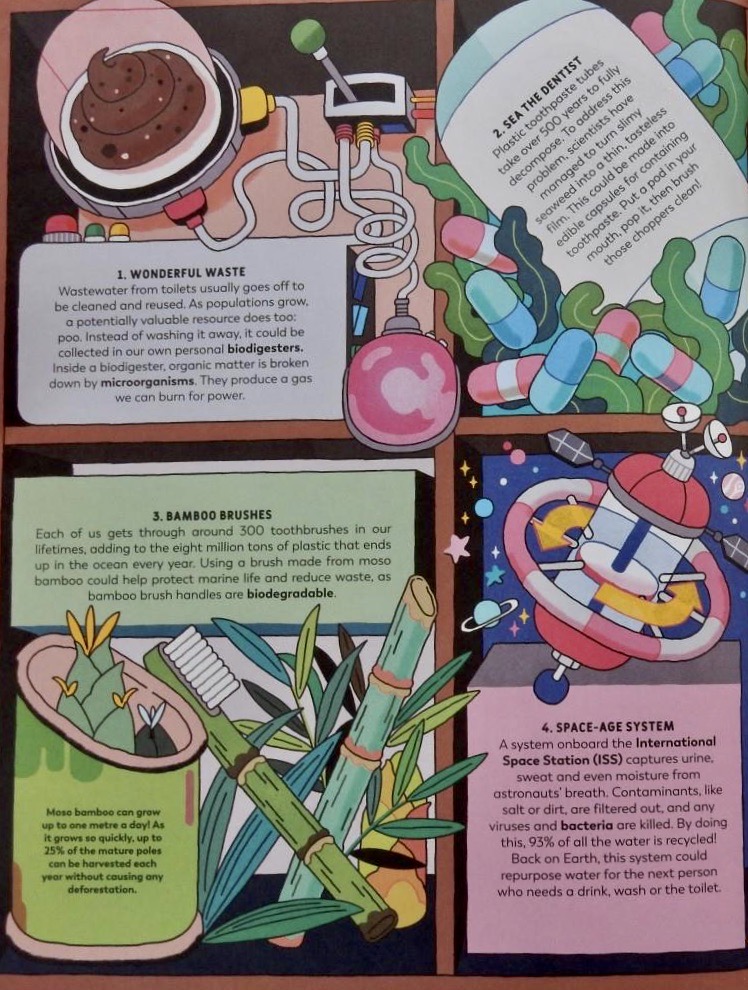
Imagine cleaning your teeth by means of edible capsules of toothpaste made from slimy seaweed that you’d pop into your mouth and brush your teeth squeaky clean; perhaps brushing with a biodegradable bamboo-handle toothbrush. Think of the plastic saved!

Being almost entirely vegan, I certainly wouldn’t entertain the idea of eating beetle burgers however.

What about wearing a PE kit that contains bacteria and when you start to sweat, these microorganisms swell, opening flaps for a refreshing breeze and shrink again once the sweat has dried. Clever stuff.

Indeed, other scientists have discovered bacteria in fermenting yogurt and in our guts that can produce electricity: maybe in the future, it’s suggested, musical speakers could be powered by harnessing such microbes.

We all know of the damage caused by the exhaust fumes from cars and other vehicles; however with some clever chemistry it might be possible to turn toxic black carbon soot into ink you could use for art projects or writing.
With bright, often intricate, infographic art and a wealth of facts, some still a tad far-fetched but you never know, and exciting ideas aplenty, this is a book that could inspire youngsters to become the cutting edge scientists and technologists of the future.

Mason Mooney: Doppelgänger Detective

Mason Mooney: Doppelgänger Detective
Seaerra Miller
Flying Eye Books

Mason Mooney is back in a sequel to Mason Mooney: Paranormal Investigator! It’s now Halloween time and in Grimbrook that is especially significant for it’s when the paranormal world and the ‘normal’ one are at their very closest. Halloween is also Mason’s busiest day in the entire year; however with Mason now friends with Iris, the two have different priorities, Iris being interested in the ‘silly’ aspects of the occasion while Mason needs to concentrate on investigating.

However because Iris and her fellow middle school council members have pulled out all the stops for the Grimbrook Middle School’s celebratory dance and costume competition Mason feels he has to join in. Soon comes the discovery of a weird magic mirror located in the school’s bathroom and immediately team Mason and Iris are on the case.

Furthermore, out of the blue Iris has received a mysterious invitation from a substitute teacher and then things start getting ever stranger.

During the costume judging there are even more bizarre happenings, largely on account of a magic ring.
Prepare yourself for a lot more mystery and magical happenings, as Mason and Iris stand between Grimbrook and the dastardly doppelgängers from the mirror dimension. There’s even, in the middle of a shower of frogs, a lip-smacking kiss; 

and why is Mason suddenly standing in the midst of everything without his trousers?

Can he possibly reopen that portal and lure the doppelgängers back into their world, and save Grimbrook? And what about his heart?

This nail-biting adventure ends on a cliff-hanger, so to discover the answers, readers are going to have to wait for the next book.

When I’m Big

When I’m Big
Ella Bailey
Flying Eye Books

In an ancient forest a small, single egg hatches, from it emerging a weeny dinosaur, Fern by name. Having surveyed her surroundings she deduces that she’s no bigger than the smallest fern frond.

Pondering upon the question of what she’d be like when she’s big, she spies a massive dinosaur gobbling the leaves of the trees towering above her. A bite of one of the leaves doesn’t tingle her taste buds so off she goes to investigate further. Next stop is a clearing but the loud honking of a dinosaur herd there sends her searching for a more peaceful place.

So what about the river? Could she be a subaquatic dinosaur perhaps? Not with a body like hers seemingly …

Fern keeps wandering and searching for a dinosaur that might perhaps be her like her grown up self, but none of the pointy horned ones, those with bumpy armour on their backs, nor the feathered kind feel right for her. Will she ever know: maybe she’ll not be big at all.

Feeling thoroughly downcast she bumbles on till all of a sudden there in front of her is something she recognises:

Fern has come full circle but something has changed …

A realisation dawns: whatever the future holds, it’s a matter of wait and see …

A sweet, warm story of finding a place in the world and being content in the here and now, prehistoric style.

Youngsters will delight in the telling, the gorgeous illustrations and exploring the back endpapers, which will send them back to the beginning of the book for a re-read to search for fourteen dinosaurs Ella has depicted thereon.

When I Was a Fairy

When I Was a Fairy
Tom Silson and Ewa Poklewska-Koziello
Flying Eye Books

A grandmother shares reminiscences with her grandchild about the days back when she was a youngster. “When I was a fairy, I lived in an ancient willow, / Inside a homely hollow with a round red door. / When I was a fairy I slept on dandelion pillows. / Back when I was a fairy, do you want to hear more?” 

She goes on to talk of summers spent leaping over lily pads,

meandering through meadows, gathering blackberries, meeting up with all the other fairies to share letters from children. Then in winter, skating on snowflakes and painting holly berries. 

Those were times when everything was possible and days were for exploration.

And so it can be once more, only now it will be in the company of her grandchild for whom as yet, untold adventures await. 

So, invites gran, “Let me show you … clap your hands, flap your wings and come fly with me.”

With magical creatures aplenty adorning the pages so richly illustrated by Ewa Poklewska-Koziello, this rhyming tale of intergenerational love, memories and delighting in the natural world is a lovely one to share especially between grandmothers and their young grandchildren, particularly those who like stories with a touch of whimsy and enchantment.

Curious Creatures: Glowing in the Dark

Curious Creatures Glowing in the Dark
Zoë Armstrong and Anja Sušanj
Flying Eye Books

Author Zoë Armstrong and illustrator Anja Sušanj take us close up to some of the world’s most incredible animals – some of those that are bioluminescent and others that are biofluorescent.

The former use chemical reactions to create sparkles, flashes and flickers of light within their bodies by mixing together two chemicals luciferin and luciferase plus oxygen. This is then shown in a variety of ways. Some creatures including two earthworm species one from New Zealand, the other from the American South ooze a gooey gunk. The New Zealand species dribbles orange goo, the American, blue.

In contrast there are sea creatures such as Flashlight fish that use the bioluminescence of glow-in-the-dark bacteria they carry around and can switch on and off in the blink of an eye. Amazing! Amazing too is the fact that beneath the sea around the Florida coast over three-quarters of the marine creatures glow in the dark, using light to communicate.

It’s not only marine animals that use light to signal to one another. I once spent hours over many evenings in the hills near Dharamshala, fascinated by the myriads of fireflies flickering in the evening dark after a rainy day. In this book, the author focuses on those found at the forest edge in Japan; apparently there are over 2000 species of firefly around the world.

Biofluoresent creatures such as scorpions that are nocturnal, need to absorb invisible ultraviolet light from the Sun (or Moon) in order to glow.

However, so we read, this whole phenomenon is ‘something of a mystery’ and increasing numbers of familiar creatures, so scientists are discovering, are able to glow in the dark.

Having presented all these amazing animals, it’s exciting to read that scientists are making use of both bioluminescence and biofluorescence to research new ways to track diseases moving around the body, as well as looking at ways to save energy and to test for pollution. WOW!

Beautiful illustrations and a highly readable text make this a book for KS2 readers either in the classroom or at home.

Amazon River

Amazon River
Sangma Francis and Rômolo D’Hipólito
Flying Eye Books

The author of Everest now invites readers to join her on an exploration of a river that starts as a tiny trickle high up in the Andean Mountains of South America, flows across seven countries and 6,400 km. and has more than 1,100 tributaries.
I was previously unaware that the Amazon comprises three different kinds of water: the fast flowing clearwater, the slowly churning blackwater that moves almost imperceptibly across forested land (the dark colour is the result of leaves that fall and rot at the bottom), and the milky whitewater that looks rather like flowing caramel, the colour coming from a mix of sand, silt, minerals, floating sediment and broken down bits of rock.

Having described the geological features, Sangma Frances moves on to talk about the fact that in the Amazon basin there are three different kinds of river, one aerial, the surface river that is visible, and four km. down and recently discovered by scientists, the Hamza.

There’s a wealth of information about the flora (including 16,000 tree species)

and fauna – great and small – 3000 fish species, 1,300 species of birds, 2.5 million species of insects, assuredly the world’s most incredible ecosystem.

After this comes a legend about a tribal warrior said to have been turned into a huge fish called the pirarucu.

Did you know that the Amazon has been home to human life for 12,000 years, since the last ice age? Or that there are more than 400 indigenous societies in the Amazon, each of which has its own culture, language and traditions and folklore. The story of Naia, queen of the lilies is retold here.

Having described next human life along the river, the author ends by discussing some of the terrible threats faced by the Amazon,

how activists are doing their utmost to protect the precious space and a final plea to all readers to do their bit to help.

The amazing illustrations of Rômolo D’Hipólito really help readers to feel immersed in the wonders of this mighty waterway.

Altogether a smashing cross-curricular resource for schools as well as for individuals interested in learning more about an incredible ecosystem.

The Adventures of Team Pom: Squid Happens / Dino Knights: Panterra in Peril

The Adventures of Team Pom: Squid Happens
Isabel Roxas
Flying Eye Books

Meet Team Pom: there’s Agnes a keen pigeon keeper, Roberta, generator of ideas and Ruby, oceanography enthusiast, the team’s boss. Very different in most ways and far from athletic in any way, the three have a shared love of snacks and a desire to win this year’s Synchronised Swimming Championships.

During the course of their training they discover a friendly, rather lonely and definitely hungry squid named Cyd.

The creature makes a great addition to their team but there’s a problem. Hot on the trail are a pair of dapper rats sporting bowler hats that are trying to hunt down the tentacled creature for their nefarious boss who wants its ink.

Sink or swim it surely is in Isabel Roxas’s slapstick, action-packed graphic novel. With some fun puns, and wordplay aplenty, along with other jokey inclusions, this madcap romp with its New York setting and terrific trio of friends will surely go down especially well with those readers who like lots of surprises.

Dino Knights: Panterra in Peril
Jeff Norton, illustrated by Jeff Crosby
Scallywag Press

In this story readers are transported to Medieval times but there’s a difference: dinosaurs still roam the earth.

As the adventure opens young Henry Fairchild is a stable boy but he doesn’t tend horses; rather it’s his job to look after the dinos of Brecklan with which he has a special bond.

When he learns of a vicious T-Rex on the rampage in the forest, he rides to the rescue of his guardian Lord Harding (ruler of Brecklan) and his Lady Anwyn. The result of his selfless act of bravery, Henry is invited to join the brave Knights of Panterra, aka the Dino Knights.

To prevent an invasion of Brecklan by the Swamp states eager to get their hands on the berries grown only there, a tournament is set to take place in just two days.

Dino Knight training begins and one of the first things Henry learns is ‘to expect the unexpected’. Lord Harding urges the knights to work as a team as they work through their training classes.

As the tournament gets underway, Henry finds his attention suddenly focussed skywards and he sees two Pterosaurs swooping down. One grabs Lord Harding by his tunic; the other snatches up Lady Anwyn and thus begins Henry and his fellow Dino Knights’ mission to rescue his guardians. Nothing though is quite what it seems in this fast-paced adventure that assuredly tests Henry’s bravery to the limit.

With plenty of action and high drama, gentle humour and lots of dialogue, this fast-paced tale of derring do will please newly independent readers, many of whom will eagerly anticipate Henry’s next adventure. Helping to break up the text are Jeff Crosby’s detailed illustrations that add to the impact of the tale.

Secret Lives of Dragons

Secret Lives of Dragons
Prof Zoya Agnis and Alexander Utkin
Flying Eye Books

Long, long ago deep in the mountains there was a flourishing dragon kingdom. So says Prof Zoya Agnis, international expert and life-long studier of Drackenosophy, aka Sangma Francis, the author of this book.

Dragons have apparently existed on this earth for ‘as long as human memory’ and probably a lot longer but what has happened to the creatures that once guarded priceless treasures and sent their voices forth on the wind? Are there any still around and if so how would anybody know if they were to encounter one? Let alone know what to do under such circumstances.

This manual offers the answers along with a host of fascinating information about such topics as how dragons evolved; what are the key anatomical features common to all six of the dragon families; how they breathe fire and what makes it change colour; how do the creatures fly and what are the stages in a dragon’s life-cycle? All this is discussed in the first of four parts, each being dramatically illustrated by Alexander Utkin.

The second part explores the six main dragon families (or species) from the most secretive sort to the rarest; there’s even an aquatic family, pretty terrifying and some have a multitude of heads.

The prof. claims to have had recent sightings of four different kinds.

Part three charts dragon history and introduces some of the most famous dragons of myths and legends from various parts of the world; we also meet some celebrated dragon slayers of yore, pay a visit to a lair and see a hoard of treasure. Maybe you’re interested in languages, if so, there are a few riddles and half a dozen easy dragon phrases.

Finally, and particularly if the first three sections have whetted your appetite, the final part takes us to the World School of Dragons to learn what is entailed in becoming a drackenosophist. (You can guess who heads up that establishment.)

Of course the entire thing is a work of fiction but enormous fun, so cleverly written and show-stoppingly illustrated throughout.

Curious About Crocodiles

Curious About Crocodiles
Owen Davey
Flying Eye Books

Book seven of Owen Davey’s splendid series explores members of the weird and wonderful Crocodilia order. The order includes crocodiles as well as alligators, gharials and caimans, all of which are strong, armoured reptiles with four short legs, powerful jaws – beware! long, flattened snouts and long tails. Each kind spends some time on land and some in the water.

After his general introduction, Owen looks first at design using the Orinoco crocodile to which he takes us right close up and decidedly uncomfortable. I was more than a tad jealous to read that when one of these creatures loses a tooth, another one replaces it and a single croc. can go through as many as 4000 teeth in its lifetime. 

Dinosaur enthusiasts in particular will be interested to learn that millions of years ago crocodiles and dinosaurs shared the earth.

The other dozen topics, each given a double-spread, take a look at movement – sometimes crocodilians walk low to the ground but more frequently adopt a ‘high walk’ and some of the smaller species can break into a run, while others might climb trees. Most although excellent underwater swimmers, tend to stick mainly at surface level.

Did you know that a crocodile’s gender is determined by the temperature of the nest at a crucial point in the development of the egg with high and low temperatures tending to result in female babies, though due to varying layers of a nest having different temperatures, it’s likely that a clutch will have hatchlings of both sexes? First of course, a male has to attract a mate and to do so, some blow bubbles and produce a water dance with vibrating bodies and water droplets ‘that dance around them’. 

As with his previous guides, Owen has packed this with a wealth of engrossing biological information as well as some mythology; and last but definitely not least, a look at conservation including some things readers can do to help preserve both the creatures and themselves.

Truly something to chomp on and bound to scale up the interest of budding young zoologists.

The Great Barrier Reef

The Great Barrier Reef
Helen Scales and Lisk Feng
Flying Eye Books

Located off the coast of Australia, the Great Barrier Reef, the subject of this large format book, truly is one the world’s natural wonders. We read first about how the reef was formed and are introduced to the different types of coral, their structures, and how corals can multiply and spread. In order to discover the reef close up though, it’s necessary to be a qualified diver and scientists now have sophisticated equipment allowing them to spend longer and to go down deeper than ever, as is explained in one of the early spreads.

The second of its five sections is entitled Reef Dwellers and therein readers are introduced to the inhabitants both fauna and flora – of the reef and its environs. 

It’s truly amazing just how many fascinating species live on and around the reef from small molluscs to mammals such as whales, some of them in symbiotic partnerships; one tiny reef island, Michaelmas Cay is home to thousands of birds. I was surprised to discover that night is often the most active time on the reef when a wonderful array of nocturnal creatures are hunting.

It’s not only the reef ’s natural history we learn of though. There’s also information about the culture and traditions of the Aborigines and Torres Straight islands.

Unfortunately however the reef is under threat, due largely to climate change as a result of the burning of fossil fuels : an increase in ocean temperatures and acidification endanger its very survival and that of the marine life that depends on it. The book ends with a look at what has already happened and what can be done to save the reef.

Throughout, the author, marine biologist Dr Helen Scales shares her knowledge and enthusiasm writing in an accessible style that will enthral primary age readers. Arresting illustrations by Lisk Feng showcase the awesome array of life of this remarkable World Heritage Site, while the entire design of the book is of the exemplary quality one associates with Flying Eye publications.

A Journey Through Greek Myths

A Journey Through Greek Myths
Marchella Ward, illustrated by Sander Berg
Flying Eye Books

Classics expert Marchella Ward, courtesy of Little Owl and her grandpa owl, takes readers on an exciting journey through Ancient Greece and the Greek myths from the beginnings of the Universe in Greek mythology, right through to the tale of Daedulus and Icarus, via the Labours of Heracles in her spellbinding sequence of stories awesomely illustrated by Sander Berg.

Perched atop the Parthenon in Athens, Little Owl listens to her Grandfather Night owl as he begins to regale her with stories of the ancient Greek world, stories that had so he says ‘taught the owls all of their wisdom’, the first being of events before Athens even existed and of whence came gods that first the Greeks and then, all humankind came to know.

The stories are divided into several parts: Athens, (where we hear of The Birth of Zeus and the incredible Birth of Athena), Mount Pellon, Mount Parnassus, where the owls encounter Pegasus, and we’re told the tale of his friendship with Bellerophon;

the city of Thebes, Across the sea, The city of Argos,

the Underworld (approaching which the two owls meet a third, White Owl that tells his favourite story Demeter and Persephone;

and finally, the ‘Land of the Living’, each of which acts as a stopping point on the journey we take with the two owls during a cool, dark night.

Be regaled by tales well known and less so, of gods and goddesses, and heroes as you tour the Mediterranean, learning too about the places where each story takes place and why it is important.

As well as the manner in which the myths unfold, I love the family tree at the start, the map of the stopping points and the end papers.

This book would make a smashing present for an older child (there’s a note before the title page that ‘some content may not be suitable for younger readers).