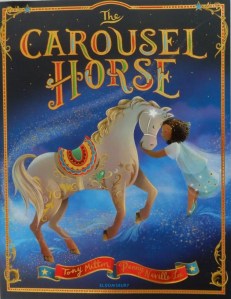
The Carousel Horse Tony Mitton and Penny Neville-Lee Bloomsbury Children’s Books
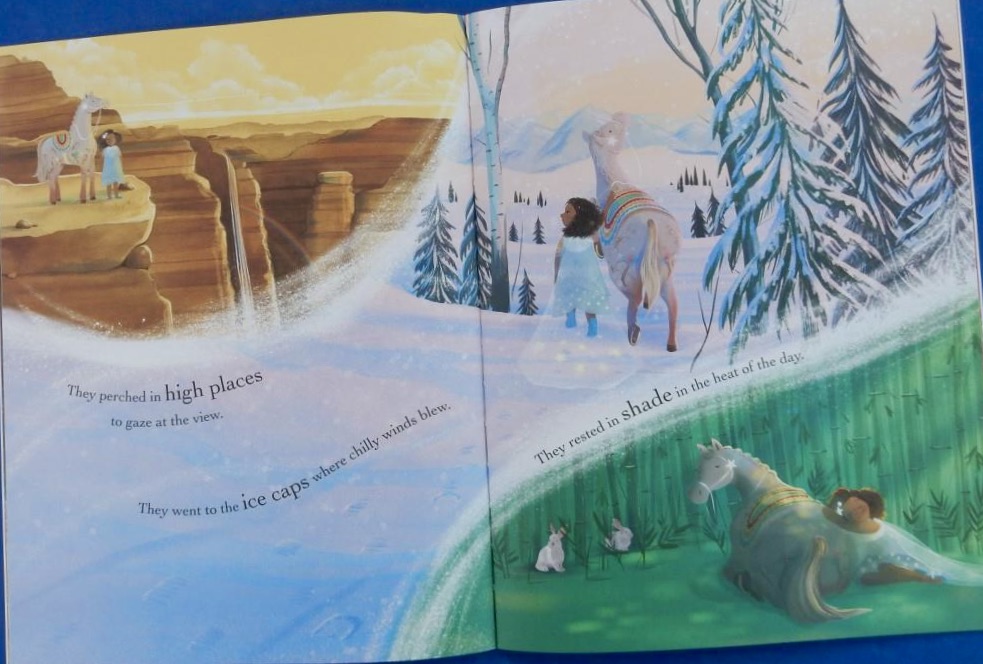
This is an enchanting story of a fairground merry-go-round horse that longs for adventure. One night when the people have all left and the horse expresses a desire to fly to the moon, there appears before him a shimmery princess who tells him to let go of his fear and make his wish. Having done so, with the princess on his back the horse rises up, up far above the fairground eventually coming to land on the moon. From there they stand and look around admiring the beautiful colours of the distant earth. They then return to the world below and set forth to explore: they visit places high and low, hot and cold;
they watch dolphins leaping and swans swimming. No matter where they go, though the horse feels the need for a sense of purpose, a place where he belongs. So, at the princess’s suggestion, he returns from whence he came,
thereafter providing the fairground visitors fun aplenty, but safe in the knowledge that at full moon time should that urge arise, a wish will see him and the princess reunited, ready to take another magical journey together..
Told in perfect rhyme, this tale of wish fulfilment and finding where you truly belong is a joy to share: observant readers/listeners will notice that the painted scenes atop the carousel and the animals below that provide the rides – rabbit, dolphin, squirrel, swan, frog are all encountered in the dreamtime journeys so magically depicted in Penny Neville-Lee’s scenes.
Red Reading Hub is delighted to be a part of the blog tour for Dragons Love Underpants
Dragons Love Underpants Claire Freedman and Ben Cort Simon & Schuster
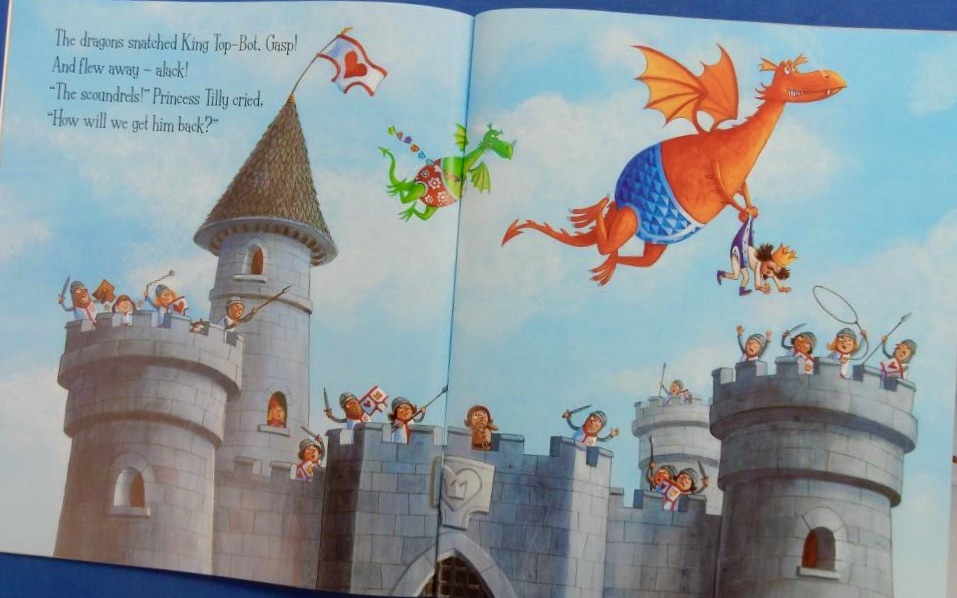
The latest in the pant-loving series features a group of monstrous marauders that flew around the countryside in bygone days sporting pants pinched from anyone and everyone. However being such fiery beasties, the dragons had a problem of the blazing kind, for no sooner had they donned their new undies, they accidentally set them on fire. OUCH! More pants very soon, was the order of the day and where better to find replacements than the Kingdom of Pantasia ruled over by pants aficionado King Top-Bot. Off they set at top speed. At this point Faith (4½) with whom I was sharing the story commented, “I have an assortment of pants. They’d better not come and take any from my bedroom.” Once aware of the winged invaders, the king sent out his most loyal knight to do battle with the dragons, but the knight merely made a rapid dash for it. Meanwhile the poor king was airborne, gripped firmly by the seat of his pants by one of the dragons.
Soon after, a ransom note arrived at the palace demanding piles of pants in exchange for the monarch who otherwise would get his bum badly burnt. Young Princess Tilly cooked up a clever plan. She headed over to the forge, grabbed her hammer and fashioned some very special undergarments of the fireproof kind. (Faith wondered how the dragons managed to stay up in the air with such heavy pants. “They’d need to flap their wings really really hard,” she said. Having received their new garments, the dragons stuck to their side of the deal, they set free the King and in true fairy tale fashion, everyone lived happily ever after. Claire Freedman has woven a new and splendidly silly rhyming narrative for her seventh underwear yarn for which Ben Cort has conjured hilarious scenes of fearsome fliers, fearful fugitives and one smart young princess.
Now here are Claire Freedman’s Top 5 Tips for Writing in Rhyme
1) Get Used to Rhyme If you are a total beginner at writing in rhyme, keep things simple to start with. Nursery rhymes can be a quick and useful resource. Maybe try a couplet rhyme – two lines that rhyme together – such as ‘Humpty Dumpty sat on the wall, Humpty Dumpty had a great fall’. ‘Mary had a Little Lamb’ is a good example of a four-line verse where the second and last lines rhyme. Nursery rhymes generally have simple metres and memorable rhythms for a child to read. Plus, nursery rhymes are also easy to run through in your own head.
2)Let Your Mind Drift Once you have your chosen rhyme metre in your head, try and take it with you as you go through your day. I often find the best rhymes come to me whilst having a shower or walking to the shops. I find it helps to continually count the syllables of each word, so they fit. If one word doesn’t fit the rhythm of your rhyme, play around with other words in your head, perhaps with fewer or more syllables. Sometimes you can get it right by just changing the order of the words. Keep repeating the lines until you feel satisfied that they flow well.
3) Use a Rhyming Dictionary This might feel a bit like cheating, but a lot of writers use them – including me! Sometimes just flicking through the pages can give me an idea for a different rhyme that might work better. My personal rhyming dictionary is also full of other rhymes of my own that I’ve scribbled down, so it has become a brilliant reference book for when I’m stuck! A thesaurus is useful too. If I’m trying to convey a particular feeling or atmosphere to my story, and I can’t get my chosen descriptive words to rhyme or fit the metre, sometimes I’ll find an alternative (or better) word in my thesaurus.
4) Map Out Your Story I love writing in rhyme, but it is a challenge. I have to think – not only about the rhyme, rhythm and metre, but also the pace of the story. Picture books usually have twelve spreads and, ideally, each spread will be illustrated differently, to help the book move forward as much as the words do. Sometimes it can help to map out your story in your head first, or write it down. Then you know what you have to fit into each spread. Of course, write with manoeuvrability – your map is a helpful guide, but you dictate the story!
5) Read Out Loud Picture books are perfect for reading out loud, and for enjoying as a shared experience between parent and child, family and friends, and also teachers and pupils. So, they MUST read well. It’s important to read your own work out loud to yourself. Listen out for any clunky rhymes and words that don’t flow as they should. When working on a rhyme, I can read it countless times, and it seems fine to me. But when I pick it up a few days later and read it out loud, I’m disappointed to find areas where the rhyme or rhythm clearly doesn’t work. Read out loud to friends and family too. It really helps to identify areas that need more attention.
Enjoy a sublime time with rhyme!
Please visit the posts of the other blog tour participants too.
The Colour of the Sky Layn Marlow Oxford Children’s Books
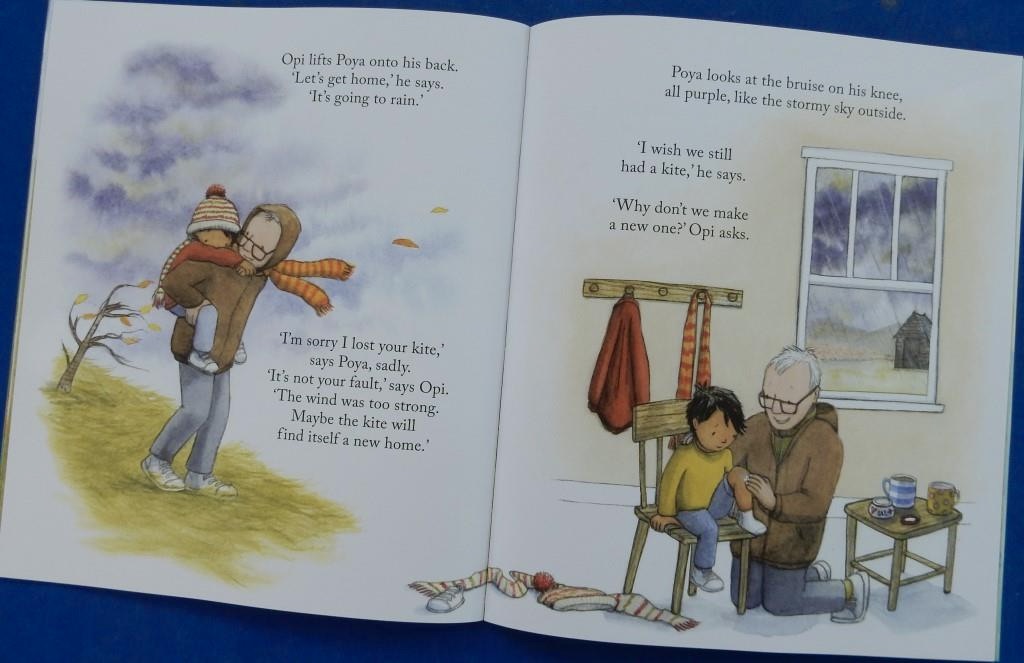
This story of a boy and his grandfather begins with the boy, Poya and his fascination with the many colours of the sky When the lad expresses a wish to reach the very top of the sky, his grandfather, Opi responds by showing Poya an old kite that he’d made with his own grandpa. They’d painted it blue to match the sky on a sunny day and it gave Opi the feeling he could react the sky whenever he flew it. Having heard that, Poya begs to try the kite and Opi agrees.
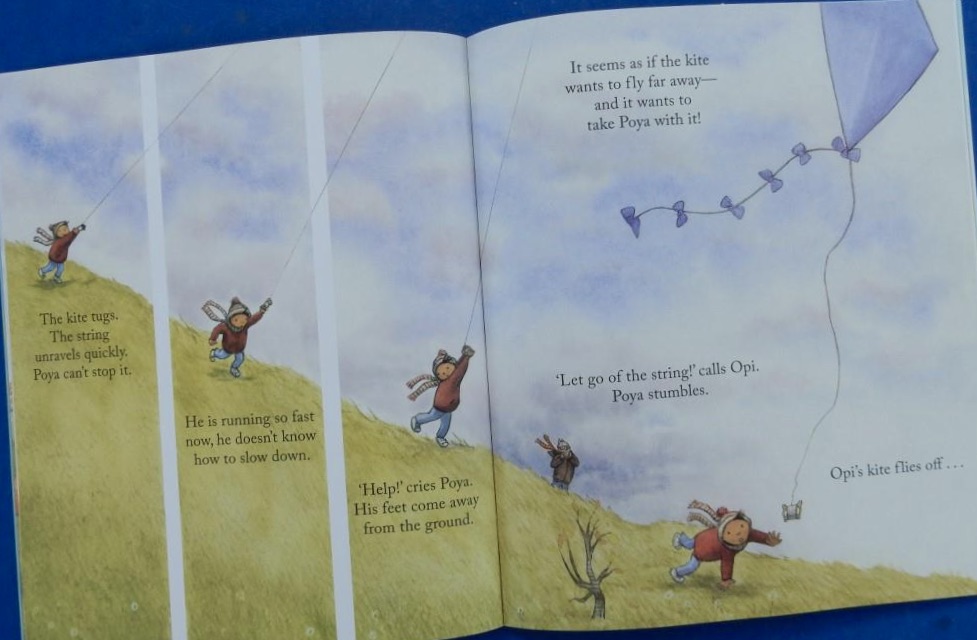
They climb to the top of a nearby hill where there’s plenty of wind. Following his grandpa’s instructions, the boy is thrilled when the kite takes flight and he starts running faster and faster, the kite soaring higher and higher. Suddenly Poya loses his footing
and Opi tells him to let go the kite string and the kite disappears into the blue leaving the boy feeling miserable. A sympathetic Opi takes his grandson home and to cheer him up, suggests they make a new kite together. Poya decides it should be painted the colour of the sky: I wonder what it will look like.
A lovely story that celebrates the special bond between a grandfather and grandchild and the beauty of nature. On the final page, the author gives instructions for making a mini kite from easily found materials. With autumnal, gusty days on their way, this is a book to share with foundation stage children. You can almost feel the wind blowing through the pages of this atmospheric exploration of autumn days and intergenerational love.
Ava and the Acorn Lu Fraser and Paddy Donnelly Hodder Children’s Books
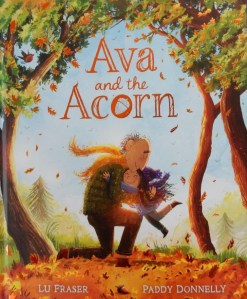
The cycle of the seasons and of life itself are sensitively related in rhyme between the leaves of this poetic picture book which focuses on the loving relationship between Ava and her grandfather and the ancient oak tree growing on a nearby hill.
The glorious illustrations show the two travelling through the seasons from ‘singing spring’,
through the long days of summer when they’d picnic ‘neath the oak’s spreading canopy, on into the golden glowing autumnal months when breezes bent the boughs of the oak sending its leaves dancing into the air now starting to chill in the shortening days and there are acorns to collect from among the fallen leaf litter. Then come the chills of winter time. Chills which cause Grandad to stay snuggled beneath his quilt and Ava to venture forth alone with only her teddy for company as she makes her way to the hill to the now drooping Oak standing still and silent as snow swirls around its bare branches. Leaving her bear to stand sentry guarding the tree she then whispers to it of the coming spring.
This she continues to do night after night till, joy of joys, Grandad is ready to sally forth again to visit their Oak now spring’s approaching.
What they find however brings tears to Ava’s eyes: the tree no longer stands tall. Thanks to Grandad though, first with his wise, uplifting words and then with his discovery of an acorn which they plant together, Ava’s heartbreak turns to a loving memory and hope of what is to. come. Little by little both acorn and Ava grow and grow through the years and we’re reminded that ‘All the things that you’ve lost – that you’ve loved – are not gone. When they’re held in your heart, a small part still lives on.’
The Language of Flowers Shyala Smith and Aaron Asis Lantana
Juhi’s Appa, a florist, has taught her the language of flowers. She knows that stargazer lilies, irises and jasmine represent different kinds of love. On account of her flower knowledge she is aware of the various celebrations and special events that happen in her neighbourhood: frangipani is for those who pray on full moon days, dried henna petals are used to paint hands on a variety of occasions, daffodils announce the birth of a new baby and peonies often decorate a birthday cake. However of all the customers who visit the family’s florist shop, Mr Potter is her favourite. He is always cheerful, enjoys telling jokes and stories from long ago and every Wednesday chooses flowers of the brightest hues for his wife. Mr Potter lives life to the full, Appa tells his daughter.
Then one Wednesday it’s Mrs Potter who comes to buy flowers; she wants them for her husband who is in hospital and Juhi knows just the ones that will cheer him up. Several weeks pass and there’s no sign of either Mr or Mrs Potter and then on a Friday Juhi enters the shop and finds Appa making an enormous bouquet of white flowers. Sadly he tells her that Mr Potter has died and the bouquet is for his wife. Juhi though does not know the language of grief and remains silent.
Appa asks Judi if she’d like to accompany him to deliver the bouquet. However she doesn’t think that the white bouquet her Appa has made truly represents the way she wants to remember Mr Potter’s life of joy. Instead she makes a garland of all his favourite, brightly coloured blooms from his world travels.
This moving story of love, community, grief and self-expression is told in Shyala Smith’s elegant direct words and through Aaron Asis’s often vibrant, textured gouache and digital illustrations.
Step into my shoes Alkisti Halikia and Fotini Tikkou (translated by Constantine Matsoukas) Lantana
Matou, the narrator of the story, lives with her parents in a small town just outside Paris. One Friday afternoon, her school finishes early and walking home alone, Matou passes the mosque. Outside she sees what she calls ‘a sea of shoes.’ Her eye is drawn to a pair of trainers and as nobody is around, she tries them on. Then suddenly the door opens and she hurriedly removes the trainers and puts her own shoes back on. Shortly after a boy wearing the trainers passes her.
Henceforward Matou would make a habit of stopping and trying on various pairs of shoes left outside the mosque.
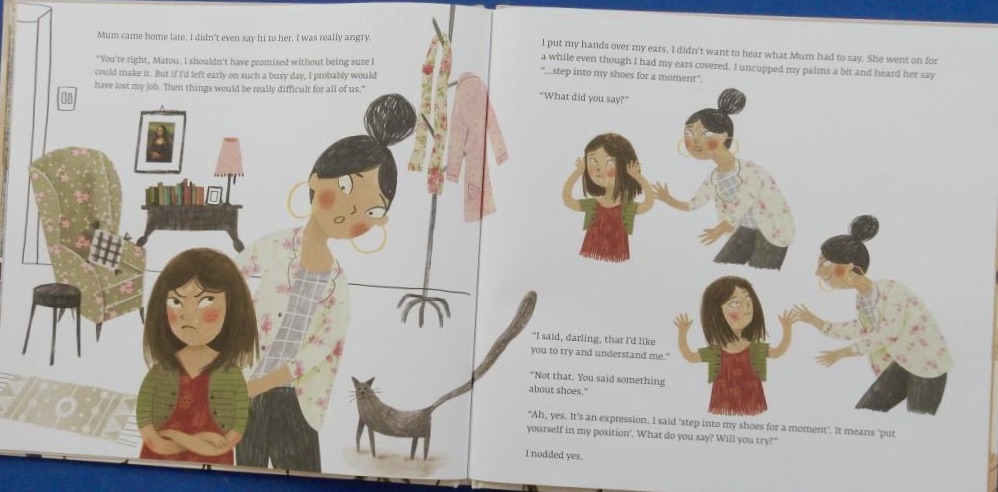
A few weeks later an eagerly anticipated day arrives; Mum has promised to leave work early so the two of them can visit the shops together. The perfect opportunity to show her mum those sports shoes, thinks Matou. But when she gets home, it’s Dad who greets her with the news that her mum is unable to take the time off from work. Matou is very angry, Mum apologises and asks her daughter to … “step into my shoes for a moment.” Having had this saying explained to her, Matou agrees to try.
The result is that by recalling her mosque shoe trying, the girl is able to understand her Mum’s difficult position and all is well between them.
Come the spring, Matou is much happier; not only does she have a new friend, she also has a special new pair of shoes. With themes of acceptance, positivity and optimism, this book with its French setting, and mixed media illustrations, will enable readers to step into the shoes of the girl narrator.
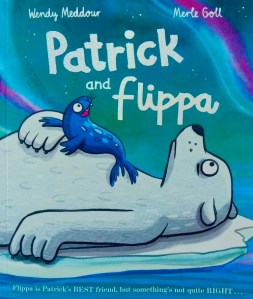
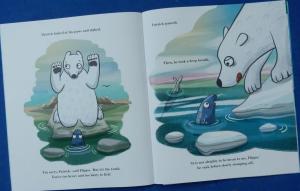
Patrick and Flippa Wendy Meddour and Merle Goll Oxford Children’s Books
Best friends Patrick, a polar bear, and Flippa, a seal, love to watch the clouds together. Each day Flippa dives into the ice cold sea to catch juicy fish for Patrick to fill his tummy. However, despite having a full tummy, Patrick is suffering from an empty-bear feeling, so he tells Flippa. The trouble is that he thinks Flippa is overly dominating: why should she always be the one in charge never allowing Patrick to make his own decisions?
Following some disagreeable words between the two, Patrick stomps off, but to his surprise he feels no better. A snow fox comes along, stops and offers some wise words to the polar bear. Patrick decides to follow the fox’s advice; he plunges into the sea and for the very first time, catches his own fishy meal.
Unbeknown to the polar bear, Flippa has been watching and admits that she was already aware that Patrick could fish, going on to explain her reason for being so over-bearing. Of course being besties, the two talk things over, make up and all ends happily.
With themes of friendship and boundary setting, Wendy Meddour’s gently humorous story in combination with Merle Goll’s equally humorous scenes that convey the changing feelings of the two characters, make a read aloud tale that offers a good starting point for discussion with young children.
Frog in a Fog Marielle Bayliss and Mariela Malova Graffeg
Frog is in high spirits at the start of this rhyming tale as he boogies on a log along with three bhangra-loving bumblebees; seemingly he hasn’t a care in the world. However that quickly changes as a large lorry starts up emitting foul fumes. Frog then has to make his way through piles of litter of the plastic kind. Then in the fen he continues dancing with Wren and Snipe until foul fluids gush from a rusty pipe flooding the pool and further fumes make the air murky.
Come the evening Frog and a friend rhumba under the stars but what they’re dancing on is a massive pile of trash and suddenly Frog’s leg becomes stuck on a wrapper and the froggy twosome tumble into the mire.
Things deteriorate further still when Grayling flaps her fishy tail and the shimmying pair hit the ground finding themselves too close for comfort to a blazing fire left burning beside the lake. As the froggy friends sit huddled together they ponder upon the horrific pollution they’ve encountered during the day. Happily though Grayling then surfaces once more and tells them the good news concerning a special location; it’s a nature reserve and it’s free from all detritus.
Led by Grayling, they make their way to the reserve. Frog starts to spread the word and to this unpolluted paradise come all manner of creatures where nightly they perform their celebratory dances while in the bog frogspawn floats and glistens in the moonlight.
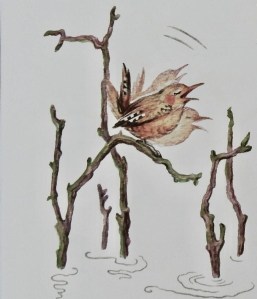
The message about pollution comes across loud and clear in Marielle Bayliss’s dramatic story. Mariela Malova’s quirky illustrations are full of movement starkly contrasting the delights of dancing with the desolation of the polluted landscapes. I particularly like the portrayal of the wren vibrating with song.
One word of warning for adult readers aloud: you may need a bit of practice to do justice to the rhythm of the rhyming narrative.
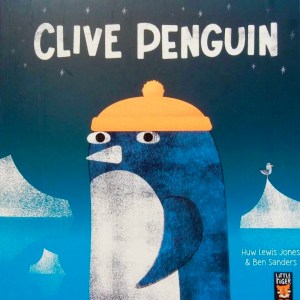
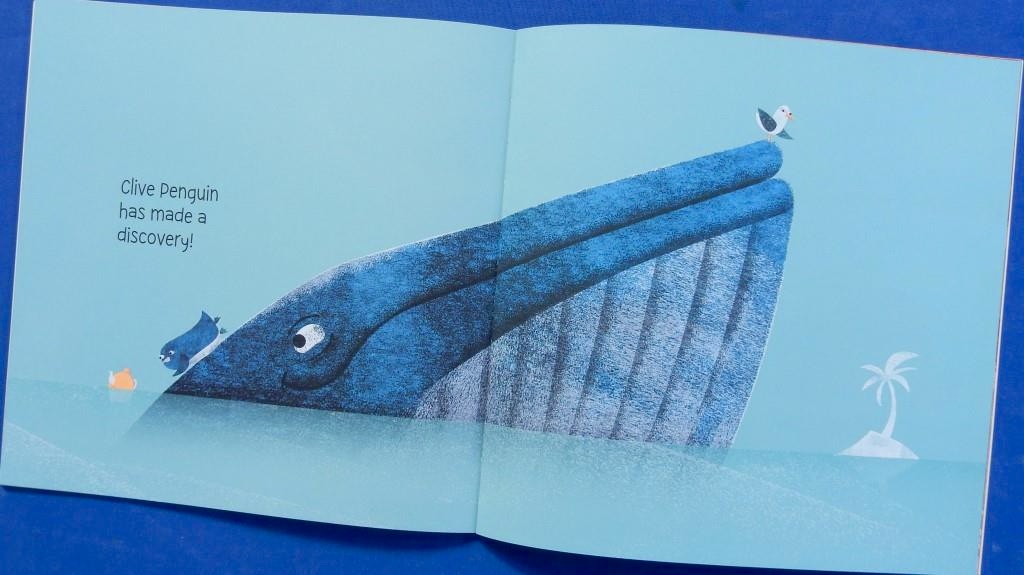
Clive Penguin Huw Lewis Jones and Ben Sanders Little Tiger
Far, far away lives a penguin named Clive; but is he happy? No poor Clive is having an identity crisis. ‘Same old snow. Same old bloomin’ penguins, ‘ he tells us. He’s clearly fed up with his mundane existence and after due consideration, he decides to leave his boring abode and seek a new life. There’s sure to be something incredible waiting around the corner, so he thinks. His travels don’t last long for very soon he comes upon an enormous whale floating in the sea. Wow! Nevertheless, this isn’t what excites Clive Penguin. Rather, he is attracted to something much smaller close to the whale.
It’s unique, fashionable and what’s more, it has many possible uses.
Sporting his new find – it’s a perfect fit – back goes Clive to his huddle. At this point the narrative states, ‘… they lived happily ever after …’ However, in case you’re thinking this applies to Clive, you are in for a fun surprise. Our adventurous Clive is not feeling comfortable AT ALL …
This witty tale will certainly bring some laughs but it will also make readers ponder upon its message: finding what you think you want is not necessarily compatible with discovering where you truly belong and Clive has to go a long way to appreciate his true identity. A cool and hot tale amusingly illustrated by Ben Sanders.
Superwolf Helen Docherty and Thomas Docherty Alison Green Books
Little Luna has a yearning: to be a superhero is her life’s goal. Her big brother tells her this can’t happen because everyone beats a hasty retreat when they see a wolf. Undaunted, Luna works hard honing her super hero skills until she feels ready to show others just how super she can be. Off she flies and soon encounters a kitten stranded atop a tree. Luna swoops towards the treetop and in so doing causes the kitty to take a leap – right into the paws of his waiting parents and the three dash away.
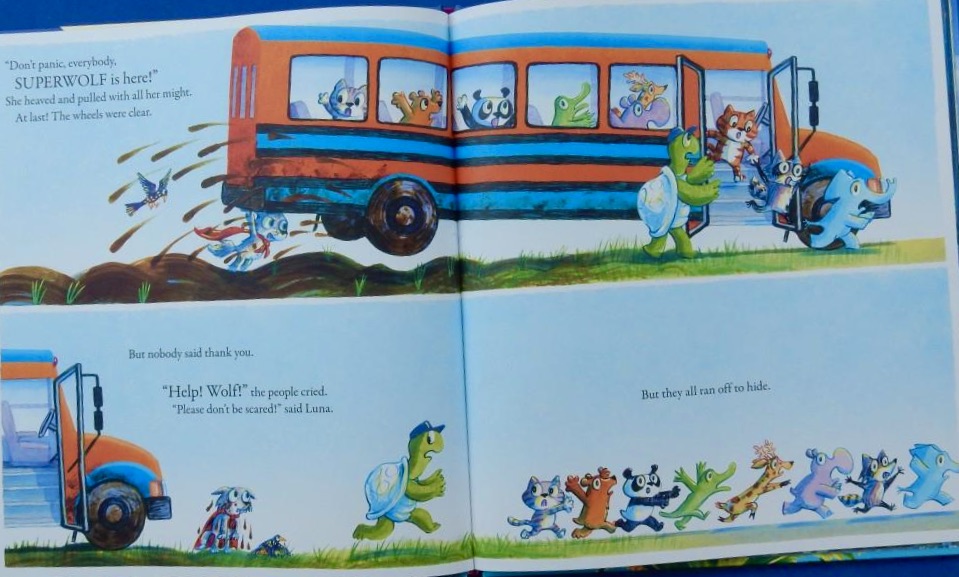
Soon Luna spies a bus stuck in a muddy patch. Having shot downwards, she uses her strength until the wheels are free. No recognition of her might is forthcoming though: the passengers merely run to hide.
And so it goes on. No matter where she goes and what she does, her help is unappreciated. Thoroughly dejected, Luna creeps away, tossing her cape aside, she is ready to give up following her dream; but then she hears a cry for help coming from the river. A family of rabbits in a boat are being swept towards a waterfall. Could this be the opportunity Luna has been looking for? She grabs her cape, flies after the terror-stricken rabbits and …
All this goes to show that you should never give up on your dreams.
Told in a jaunty rhyming text by Helen and illustrated by Thomas, whose scenes of Luna’s endeavours to prove herself are bursting with life, full of drama and fun details including a bird that appears in every picture.
These are both additions to popular Graffeg series: thanks to the publisher for sending them for review
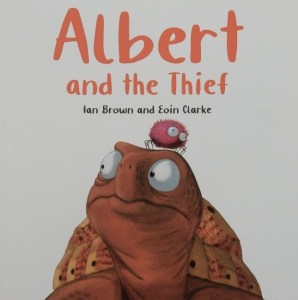
Albert and the Thief Ian Brown and Eoin Clarke
Things are going missing in Albert’s garden, so the ants report at a special meeting. Accusations are made and dismissed and squabbles break out. Albert suggests the animals search for the missing items and as he’s doing so a voice calls softly to him. It’s a squirrel asking for his help. It’s said squirrel that has apparently been doing the stealing and now regrets so doing. Albert tells him to return each of the items, and apologise to everyone he’s stolen from.
Albert’s friends are somewhat surprised when they see how much stuff Squirrel has amassed
and some of them offer ideas as to how the reformed character can get them all back where he’d found them without anybody knowing. A view of the garden shows that its animal residents are going to have their work cut out to do so.
I especially love the catapult contraption worked by the ant brigade and the horrified expressions on the faces of Albert and his garden friends as they discover the enormity of the task they are about to undertake as the story concludes.
Molly and the Pirate Cave Malachy Doyle and Andrew Whitson
In this seventh story starring Molly and her island community, She goes against everything her parents have told her when her much loved dog, Gus goes missing. After a sleepless night when the dog still hasn’t been found, she goes into the dangerous Pirate Cave, from where she’s heard a noise. In the pitch dark, she discovers little Bo who was also searching but now is too frightened to move. As she’s giving her friend a reassuring hug, there comes the sound of muffled barking and there in a very narrow part is Gus. Why does the dog refuse to move though? His sense of hearing is more acute than Molly’s and he’s heard the sound of the sea. It’s coming right into the cave. Following Gus’s lead the children scramble up onto a ledge
and then Molly realises that there’s another way out. It’s a place her father once talked about. If they make sufficient noice, there’s a possibility somebody will hear and so as loudly as they can, the three howl at the moon shining away, way above them …
Andrew Whitson’s expressive illustrations capture so well the children’s fear as they attempt to clamber up so the water can’t reach them. There’s an important lesson in the story, one that young listeners will learn along with Molly as they root for her to get safely out of the cave.
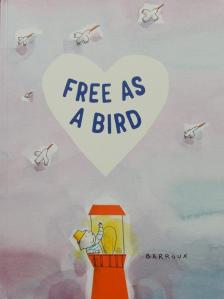
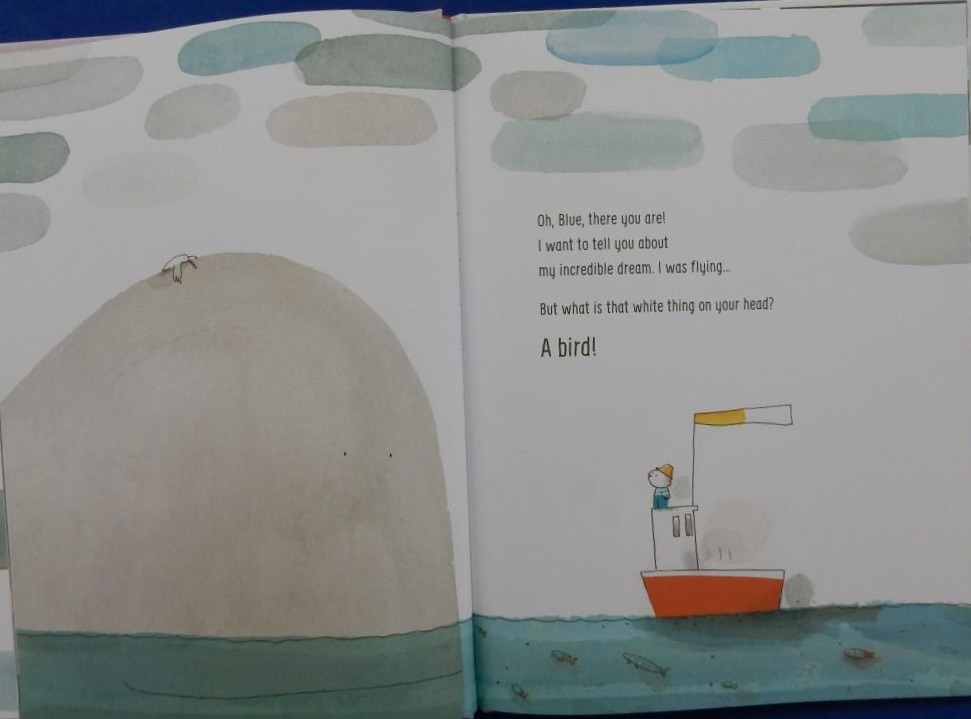
One morning Jonas the lighthouse keeper wakes having spent the night dreaming of flying over the ocean like a bird and rushes off excitedly to tell his friend Blue, the whale all about it. When he finds his friend, there on her head is a bird.
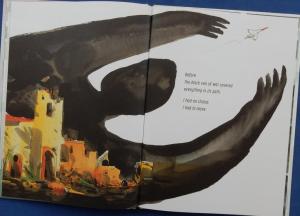
It’s completely exhausted and scarcely alive. Back at the lighthouse the friends know they need to take special care of the little creature. Fortunately Blue is able to understand the meaning of his tweets. The bird has flown from a distant country that was once a beautiful place; that however was before the war came and the bird had no choice but to flee and undertake a perilous journey in the hope of finding a safe haven.
Little by little the bird grows stronger and his song fills the air around. Many other birds come too, all singing a similar song of hope and freedom as they recover sufficiently to venture forth to find homes elsewhere. Not so their friend the first little bird; he’s found a place of happiness, a home at the lighthouse, just the place to raise a family .…
Illustrated in pen and watercolour, Barroux’s simple, compassionate and hugely powerful story told with great empathy, uses the bird metaphor effectively to convey the on-going plight of refugees from so many different parts of the world. If only they could all find a safe haven like the little bird did.
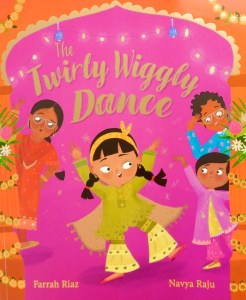
The Twirly Wiggly Dance Farrah Riaz and Navya Raju Oxford Children’s Books
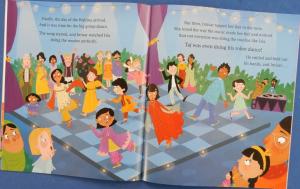
Little Intisar is super excited to be invited to her Auntie Mahira’s wedding and thrilled to be asked to perform in the big group dance, the Walima, at the end of the festivities..As she practises the moves, Intisar discovers one that’s particularly tricky and she just cannot get it right. Instead she invents her own move instead – her twirly wiggly one is much more fun. On the eve of the first party – the Mehndi, Intisar is allowed to have henna put on her hands and while it dries she watches her older cousin, Isla, practise the dance and then later, they practise together. However, when it comes to the tricky part, Intisar finds herself getting in a tangle once more so she does her own twirly wiggly dance instead. Isla is far from impressed at her efforts telling her young cousin that she’ll disappoint Auntie Mahira.
This leaves Intisar doubting her ability to participate despite her big brother Taj’s encouragement. What will happen on the big day? Will Intisar do the group dance the same way as other guests
or will she use her own moves and if so, what will the reaction be?
This charming story celebrates individuality and the importance of being able to embrace your uniqueness. Little Intisar is a delightful character that any child should be able to relate to, whether or not they are familiar with South Asian weddings, particularly as celebrated by Muslim families. For those who aren’t, both Navya Raju’s vibrant, energetic illustrations and the two pages after the story explaining the various elements will enhance their enjoyment of this lovely tale.
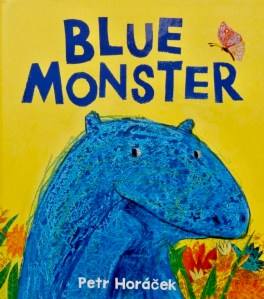
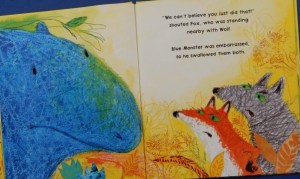
Bored with no-one to play with Blue Monster decides to ask Rabbit; but Rabbit is sleeping and doesn’t hear the request. Blue Monster repeats it much louder, waking Rabbit this time. Rabbit though refuses so the monster proceeds to swallow Rabbit. The trouble is he does’t merely swallow Rabbit: oh no! This crazy creature also swallows in turn Rabbit’s leporine friend, Raccoon, Fox and Wolf.
Having done so he realises his actions were not appropriate, let alone kind. Moreover with all his friends inside his tummy, who can Blue Monster play with? Overcome with guilt and sadness he sits beside a tree and yawns. You can guess what happens next but what will the outcome be? Will Blue Monster truly see and error of his ways? Illustrated with his usual panache, Petr Horáček’s tale is a surprising mix of friendship and silliness; it’s also a tad anarchic and a terrific read aloud that will both shock and amuse young listeners as well as being a great starting point for discussion be that in the classroom or at home.
There’s further undesirable behaviour and friendship tested in
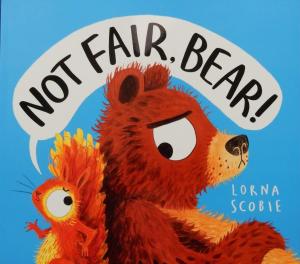
Not Fair, Bear! Lorna Scobie Scholastic
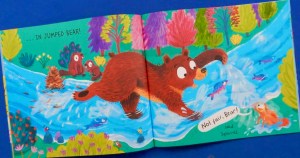
Squirrel and Bear are best friends, doing everything together. Being besties though doesn’t mean they enjoy the same things.and the huge difference in their size can sometimes cause issues regarding playing. One day Bear chooses only activities that Squirrel deems unfair. The tree climbing ends with Squirrel cascading into a bush, Squirrel isn’t a swimmer so the river fishing leaves Squirrel feeling left out and so it goes on.
Come the evening Squirrel is feeling pretty dismal and off he goes to sleep. Not so Bear who disturbs Squirrel’s slumbers announcing that it’s playtime. An angry Squirrel tells Bear that the next day will be “DIFFERENT”. Before long it’s evident that games played Squirrel’s way don’t work for Bear and the two have a tiff resulting in Squirrel telling Bear that he no longer wants to play with him. Can the two find a way to enjoy each other’s games without falling out? Maybe, but will what they do please all the other creatures too? Lorna Scobie’s lively, funny story about learning to compromise is dramatically presented both in words and pictures. It’s followed by a ‘Big Feelings’ spread for children and adults to talk about together either at home or in a foundation stage setting.
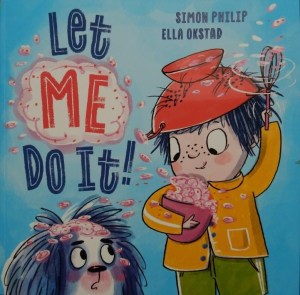
Let ME Do It! Simon Philip and Ella Okstad Oxford Children’s Books
Teddy, so he tells us is NOT a baby any longer; he’s ‘actually very grown up’. The trouble is that everyone still insists on fussing over him,; they want to wipe his nose, make his breakfast, fasten his jacket and tie his shoe laces. Frustrated, our narrator decides to take matters in his own hands letting his family know in no uncertain terms that HE will be the one to do all those tasks. And so he does. Indeed he becomes super confident, so much so that when as he makes his own breakfast and Mum announces a trip to get his hair cut, Teddy decides to give himself some tonsorial treatment with interesting results …
If only he’d left the cutting craft there, as well as quite a few other ideas that he has, washing the family’s whites for instance. OOPS!
Simon Philip’s hilarious first person narrative in combination with Ella Okstad’s equally hilarious, dramatic scenes of Teddy’s ambitious actions will appeal to both young children and the adults who share the story
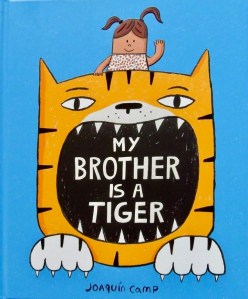
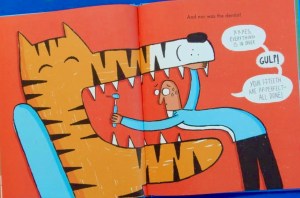
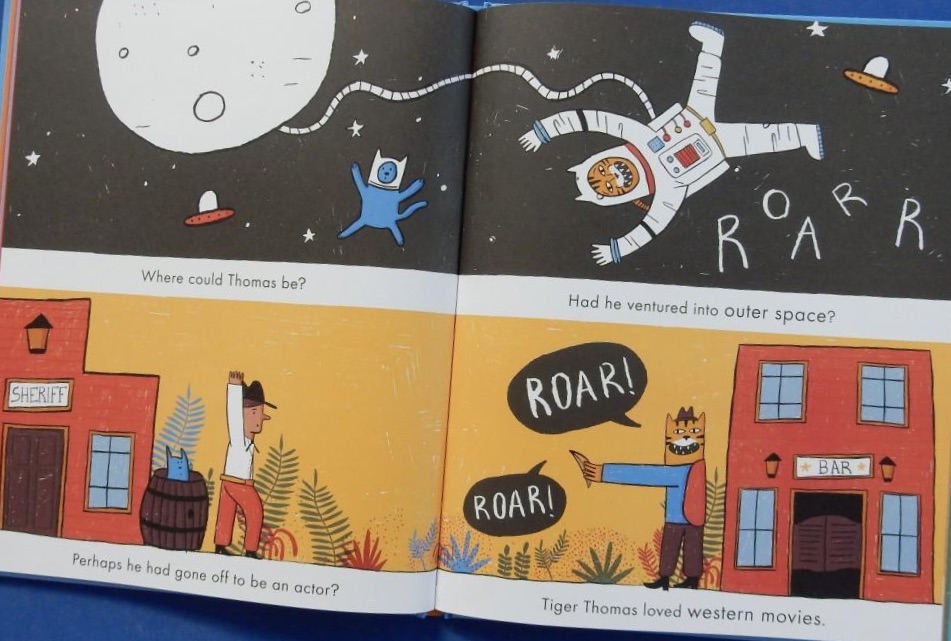
One afternoon young Teresa is playing downstairs while her parents enjoy a relaxing drink and snack together. Suddenly she hears a weird noise coming from upstairs so she decides to go up and try to discover the cause. Shock horror! Her little brother Thomas has turned into a fierce-looking tiger.
When it comes to school activities, this new persona has its pros and cons and it takes Teresa a while to get used to having a fierce feline for a brother but all in all she copes pretty well. Not so though the neighbours and others that find themselves way too close to Thomas for comfort.
Then one day Tiger Thomas is nowhere to be found: Teresa hunts high and low but without success. Where can he be? She entertains all manner of possibilities …
Clearly distressed, big sister waits and …
When he does appear there’s a surprise in store, but more than one person can play at that game. The surprise twist in this tale will have young listeners chuckling with delight as will some of the scenes of Teresa’s imaginings.
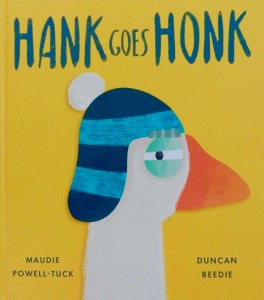
Hank Goes Honk Maudie Powell-Tuck and Duncan Beedie Little Tiger
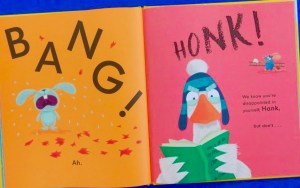
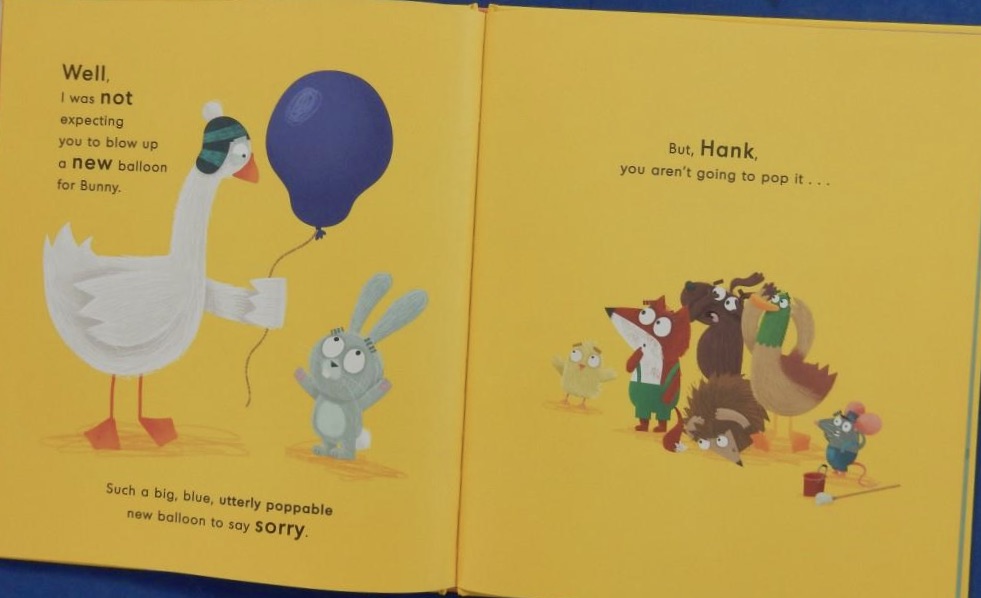
Hank is a goose, an obnoxious one so we’re told. He honks continuously, interrupting everybody at every opportunity. Not only that but he annoys others by pinching the cherries from their cupcakes; he pecks the books visitors are reading in the library, he creates a rumpus in the cinema and bursts balloons of unsuspecting passers by. However such mean behaviour is not without its consequences and Hank finds himself being avoided by all the other animals.
This loneliness causes him to reconsider his thoughtlessness and he spends some time reading a book entitled How To Be An Impeccable Goose. Thereafter he sallies forth a reformed character, determined to be considerate to his fellow creatures. All goes well for a while but then along comes Bunny with a large new balloon and Hank just can’t resist the temptation …
His new friends though are a forgiving lot and, appreciative of the way Hank tried to be good, give him another chance. They wait with bated breath as the goose gives Bunny a new balloon: will he finally be able to restrain himself? I wonder.
A honkingly fun story with an important message and lots of possibilities for audience participation. Young children will revel in following Duncan Beedie’s droll portrayal of Hank and his efforts to change his reprehensible ways.
Nibbles: The Very Hungry Book Monster Emma Yarlett Little Tiger Press
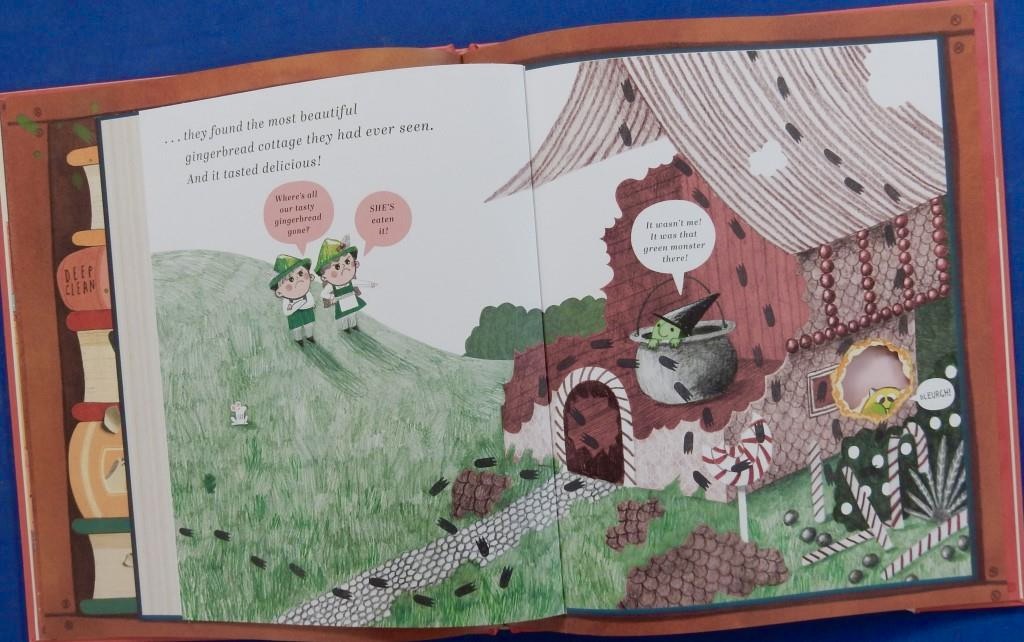
Beware! The creature that gives the ‘I Love Books’ expression a whole new meaning is back. Nibbles the book monster is on the loose again and he’s on the look out for some tasty books to sate his appetite. His first port of call in town is the library. Surely he’ll find something delicious there in that recipe book Maybe not if that birthday cake recipe is anything to go by. With that one far too slimy, perhaps something sweet might suit his palate; but no. The witch’s gingerbread house is far too sweet, so much so that the gingerbread sampling has made him throw up.
Next stop is the farm for some fresh produce but the aroma emanating from Old Macdonald’s farm is truly foul and has him getting away as quickly as his teeth will allow. What a truly awful day. Will Nibbles ever find a book that is just right for snacking on? Maybe it’s a case of east, west, home is definitely best; in which case what will he finally snack on?
Little children, be they established Nibbles enthusiasts or are meeting him for the first time, will delight in following him by peeping through the strategically placed die-cut chomping holes and lifting flaps. They’ll also enjoy encountering some of their favourite characters from traditional tales and rhymes as they follow the book- devourer through this latest all consuming escapade. I love the way Emma has scrambled her name to provide authors for the various books in the story.
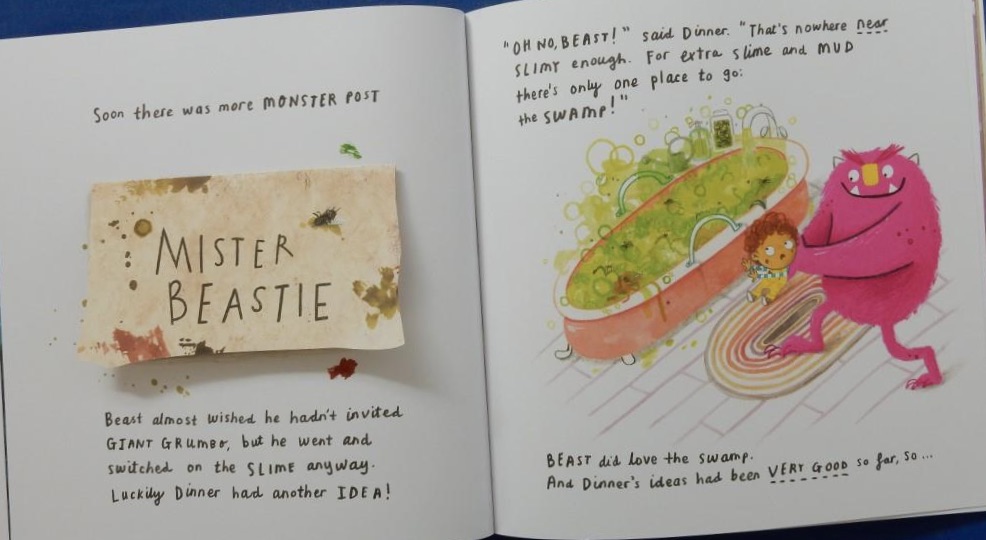
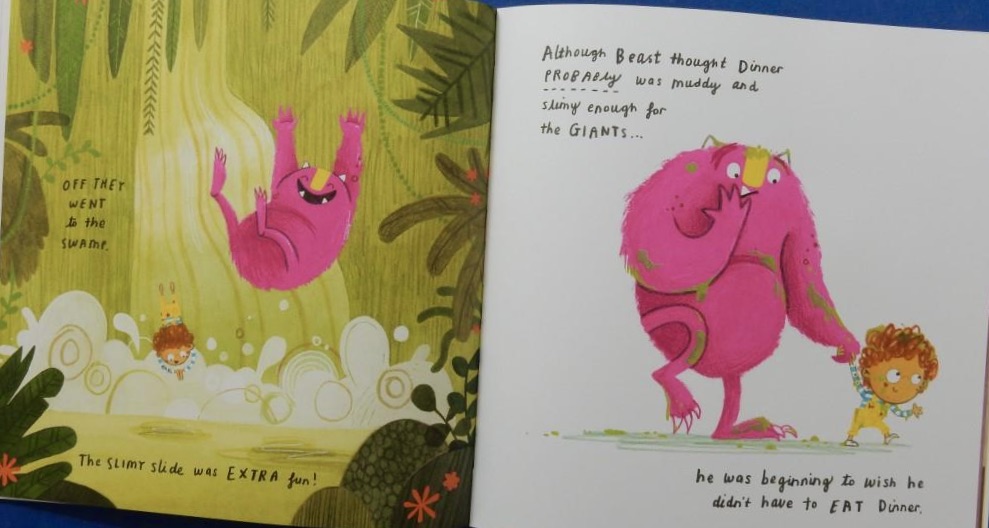
Beast has found himself what he deems will be a vary tasty dinner, so much so that he decides to invite all his friends to partake of a feast. Into a cooking pot goes a very alarmed looking Dinner and off go invitations to Beast’s pals. It’s not long before he receives his first reply; it’s from Sir Gutguzzler who is happy to accept although recommends that Dinner gets a bit more flesh on her body. Out of the pot comes Dinner and is about to be fed something utterly gross when our quick-thinking child aka Dinner makes a suggestion that is sure to make her way more plump.
After some initial reluctance, Beast follows her suggestion and the result is exceedingly yummy. Three further acceptances arrive, each one with a request intended to add additional deliciousness to the feast
and for each, Dinner comes up with a clever idea. Each suggestion results in Beast and Dinner having a thoroughly enjoyable day together, so much so that Beast starts having second thoughts about eating Dinner.
Then one more acceptance arrives. Beast and Dinner have what is for Beast assuredly the best ever day. Come the evening before the feast, with Dinner having been made super tasty, Beast is feeling far from happy about the prospect of consuming her. She in turn has a change of heart about Beast.
Now Beast has a dilemma. He starts thinking really hard. Is there a way he can make his guests satisfied when they arrive for that much anticipated Dinner?
With communications from Beast’s guests containing disgusting recipes, yucky offerings and preposterous stipulations to open, young children will relish this hilarious, interactive book and demand further helpings after an initial sampling.
What The Crow Saw Below Robert Tregoning and Greg Stobbs Oxford Children’s Books
As the story starts we meet a curious young crow who is doing as she’s told, looking down and squawking a warning at anything and everything she sees beneath her on the forest floor. while the others are asleep though, our young crow looks around to see what’s going on. Seemingly there’s nothing sinister at all: could her elders be mistaken?
Then, tired of looking for supposed dangers below she finds the courage to look up and see what she can discover. The older crows are horrified but this doesn’t stop the youngest corvid not only looking but moving upwards. Bravely she takes to the air and then accepts the invitation from a different kind of bird to join them.
Deciding that she can then return to the other crows and encourage them to ‘throw caw, caution to the wind’, she finally leads them all upwards and life begins anew, with a positive, hopeful attitude (and of course, a modicum of caution.)
A terrific rhyming telling with descriptive language that excites and includes alliteration and other clever word play by Robert Tregoning and Greg Stobbs’ illustrations that wonderfully complement the words, this is a joy to share with young listeners. I love a book like this one that encourages children to think for themselves and to focus on the positive things in life. Definitely one to enjoy and talk about both at home and in the primary classroom.
The Goodnight Garage Tori Kosara and Meg Hunt Flying Eye Books
Night is falling on Motor Isle, the time when most of its residents are thinking about bedtime. Not so those working for the Good Night Garage, for them it’s wake up and all aboard your various vehicles: there’s lots that needs to be done to make sure the community keeps running smoothly. There’s a lorry painting new lines on the otherwise empty road, Bin Lorry goes around clearing up all the rubbish from bins and other places where waste is stored – that one has a special packer blade.
Fire Engine and Ambulance have their sirens blaring as their crews respond to emergency calls. Street Sweeper with its large broom and brushes collects unwanted litter and other debris from the streets then washes them clean with a water spray.
Lots of deliveries are made during the night too and for this task Sturdy Lorry is required to drop off goods at different shops. Last but definitely not least, comes Night Bus stopping to pick up passengers along its route and taking them home or to work.
Young vehicle enthusiasts will love seeing the seven featured in Meg Hunt’s illustrations, each with its animal crew and come to appreciate the vital roles played by their human counterparts who often receive little recognition for their labours. They will enjoy too the opportunity to join in with the onomatopoeic honks, beeps, nee-news etc.as an adult shares the book at bedtime or in an education setting.
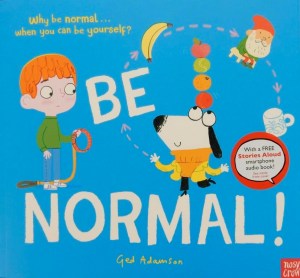
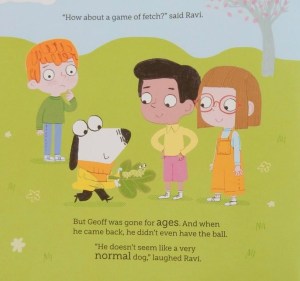
Theo, the story’s narrator, is hugely excited at the prospect of the arrival of a dog of his own and has prepared well. However one thing he hasn’t prepared for is a dog like Geoff Thorndike; he’s a dog like no other. Geoff arrives clad in trousers and jacket and pulling a wheelie case, turns down the offer of water and makes smoothies – delicious ones at that. Come bedtime he turns his nose up at the special doggy bed and usurps Theo’s bed instead. Time passes and it’s evident to Theo that Geoff is anything but keen on the normal doggy things though he does accept a walk in the park
His response to ‘sit’ is well let’s say, something of a surprise. Then Theo’s pal Ravi suggests a game of fetch; this Geoff participates in – kind of –
and after the squirrel incident Theo has had enough. Embarrassed, he tells his friends that his pooch just doesn’t do many normal doggy things but he’s kind and funny and that’s perfectly fine with him. ‘I’m lucky to have you,” he tells Geoff. Having now come to appreciate his dog,Theo accompanied by his friends go home and have smoothies – you can guess who makes those and then Geoff offers to perform his one silly trick …
It’s great to have a story for young children wherein being different is valued. It’s a vital life lesson and Ged Adamson’s fun book conveys this message brilliantly.
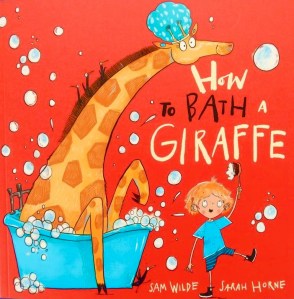
How To Bath A Giraffe Sam Wilde and Sarah Horne Oxford Children’s Books
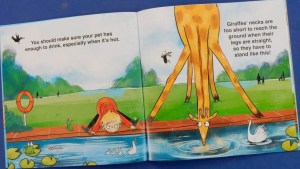
The latest in team Wilde and Horne’s How To series features another pet of the peculiar kind – a giraffe. This one appears in response to the poster displayed in the neighbourhood and astounds the boy narrator’s family with its stature. Clearly there are likely to be issues when caring for such a creature – drinking might be one;
but the most challenging of all is giving the giraffe a bath. The whole story is pretty ridiculous but it’s lots of fun, gently informative and it’s also inclusive (the child narrator has a hearing aid).
Sarah Horne’s illustrations are a hoot and Sam Wilde’s narrative includes lots of interesting facts about giraffes as well as a ‘Top giraffe facts’ final spread. Astonishingly, giraffes and humans have the same number of neck bones (seven).
These are both additions to popular series for very young children:
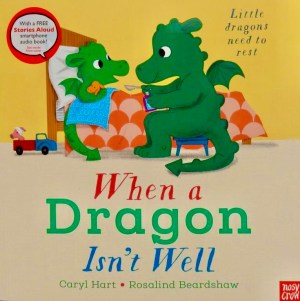
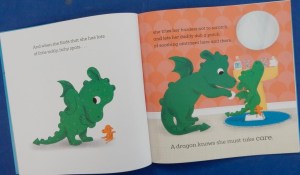
When a Dragon Isn’t Well Carol Hart and Rosalind Beardshaw Nosy Crow
When Little Dragon is poorly and aching all over, she doesn’t stamp and stomp or cry so loudly she wakes the baby. No of course not. Rather she gently calls Daddy dragon who manages to get her off to sleep. Come the morning though, she’s covered all over with itchy spots and instead of scratching frantically, she allows Daddy dragon to apply some soothing ointment.
She accepts being told she cannot go and join her friends who call inviting her to play. She also accepts that she needs to stay indoors and do some more restful activities like drawing and sharing a book with Mummy dragon. Indeed Little Dragon complies with whatever her parents want her to do, – eating lunch, snoozing and enjoying some imaginative play of the gentle kind. Of course, once she’s recovered from her spotty sickness it’s a different matter and Little Dragon resumes her lively activities with gusto: what about her tiny sibling though? … A delightful addition to team Hart and Beardshaw’s When a Dragon series that young humans will relate to and enjoy whether or not they have had lots of itchy spots that make them feel poorly like Little Dragon.
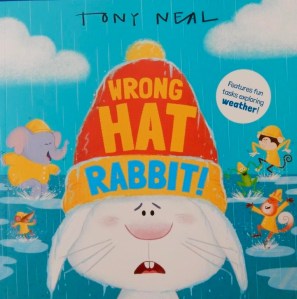
Wrong Hat Rabbit! Tony Neal Oxford Children’s Books
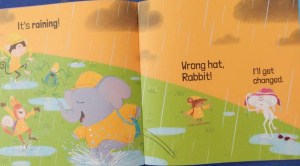
Rabbit wants to spend a day playing at the park with his friends so he dresses in what he hopes is the right gear. However, the weather proves to be very changeable and so no matter how many changes he makes to his attire, he seems to be wearing the wrong outfit. After in turn, being too hot, getting a soaking
and feeling too chilly, his pals decide to step in and help until all appears to be well; but then they start having a snowball fight … An entertaining, simple introduction to some of the vocabulary associated with weather for very young children. The final spread offers activities for a child and adult to do together. Altogether an enjoyable way to support learning at home or perhaps in an early years setting.
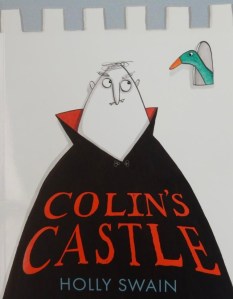
Colin is a vampire, an extremely happy one as it’s the day he moves into his new abode – his very own castle with space aplenty and fabulous views. There’s a snag though, a duck shaped one. Said duck is determined to maintain her squatter’s rights. No matter what Colin does, be it indoors or out in the grounds, the duck pops up, even doing so when Colin is in the bathroom having a dump.
So furious is the vampire that he chases the duck out of the castle and then locks and bolts the castle doors. Hurrah! Peace and quiet at last he thinks, but no; the dastardly bird has somehow managed to find a way in again.
Colin devises a clever ruse
and eventually, pretty exhausted from the day’s events and desperately in need of peace and quiet, retires to bed. But his dreams are disturbed by a loud, “Quack”. It can’t possibly be, can it? … Well, yes and no, for there’s a hilarious final twist that will have young children and adult sharers in fits of giggles
Fearsome fun and full of witty visual details: I especially love the Newton’s cradle and the ultra high factor sunblock.
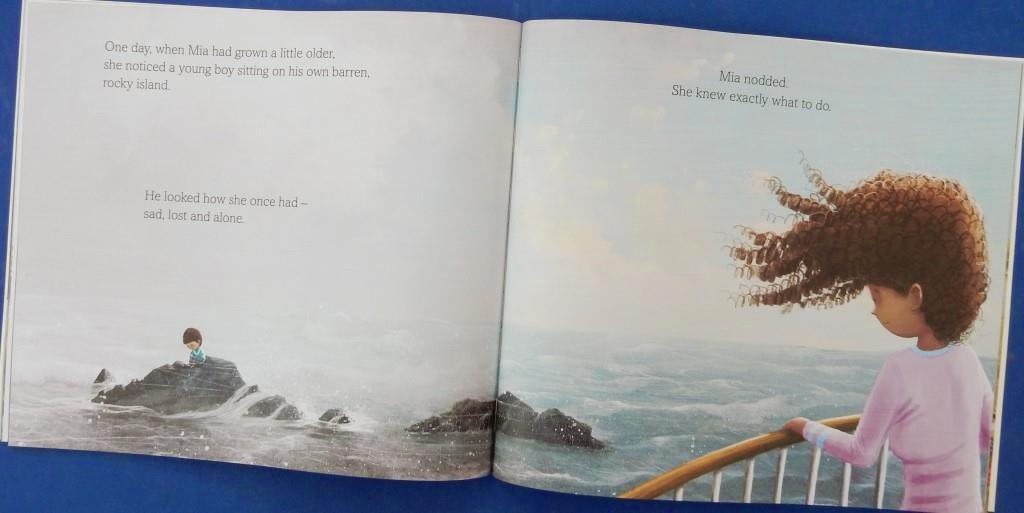
With parents so busy they seldom have time to play with her, Mia feels alone, so much so that it feels as though she lives far out to sea on a small island empty save for her.
One day an unexpected parcel arrives; it contains a book and it’s for Mia. Because she’s never had a book of her own before, this one feels extremely important and that’s before she’s even looked inside the covers. As she begins to read, Mia notices that something amazing is happening: with every word, Mia’s island becomes less empty. Gradually it fills with plants and creatures, and the air is perfumed with what to Mia feels like hope. As she continues reading a bridge starts to appear, growing gradually stronger all the while.
She leaves the island behind and a world of connections opens up with friendships and amazing possibilities in abundance.
Tom’s use of the bridges metaphor is SO well done for the target age of readers: for instance ‘Soon it was solid arches of dependable stone, easily spanning the distance between her and the small island she had now left behind.’ It’s wonderful to see how a slightly older Mia sees a lonely boy and immediately knows what to do.
Leaving her very first book on his doorstep, she passes on the love of reading to him, knowing that before long, his world too is going to be ‘full of bridges, connections, life and laughter’.
Promulgating the power of story and reading, this is a truly beautiful book both verbally and visually. A must have for primary classroom shelves and home collections to share, to give, to inspire and to cherish.
Ebb and Flo and the New Boat Ebb and Flo: A Blowy Day Kate Canning and Thomas Voigt Graffeg
In the first story, despite it being early in the morning Bird cannot wait to tell Ebb about what she’s found so she sets off beeping enthusiastically to tell Ebb about the discovery even though Ebb dislikes being disturbed at such an hour. Bird’s excitement is on account of the new boat bedecked with greenery that has arrived at the jetty.. So, Bird sallies forth alone and when she hasn’t returned some while later Ebb starts feeling concerned.
The reason for her absence is that she’s made a new friend on board the new boat. Ebb discovers this with help from Flo who approaches the owner of the new boat asking for Bird. The conversation is confusing as the lady speaks German; however Flo, Ebb and Mum go aboard and in the cabin sure enough there is Bird and also a little canary named Zoot, so the boat owner tells the visitors.
Almost inevitably Ebb feels a tad jealous of Zoot, especially as Bird plays with this new friend all day. Ebb considers Zoot to be akin to Mum’s yellow feather duster. Even Flo’s reassurance at bedtime that it’s possible to have more than one friend doesn’t reassure the pooch. However, the following morning the visiting boat has gone and with it Bird’s new friend. Now it’s her turn to feel upset. Can Ebb and Flo find a way to help Bird return to her usual happy self?
In A Blowy Day, the strong wind causes Mum to feel concern for Granny so she, accompanied by Ebb, Flo and Bird, row across to pay her a visit. Granny is taking advantage of the strong wind and is busy hanging out her washing when they arrive. Her mention of a kite prompts Flo to ask about making a new one there and then so she and Granny set to work. Before long they’re ready to go out and test the kite but it gets caught up with the line of washing and Bird flies to the rescue. Then a sudden extra strong gust sees Granny’s clothes flying way up and out to sea. Time for operation rescue …
Both books, based on Jane Simmons’ original characters are part of an animated TV series: with their simple stories, they work well too as read alouds to share with young children (Both titles have notes for adults that include activities and discussion possibilities at the back.)
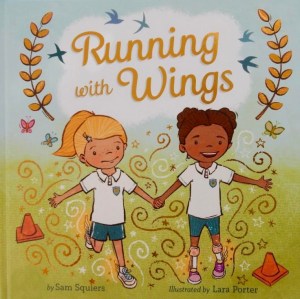
Running with Wings Sam Squiers and Lara Porter New Frontier Publishing
Frankie absolutely loves running; so too does Mimmi. They both seem to live, eat and dream racing and both dream of running in the most spectacular race there is – The BIG One. First though they have to compete in the school carnival on which day every class races the super sprint, 100 metres. However whenever Mimi goes to participate in a race she gets an attack of nerves.
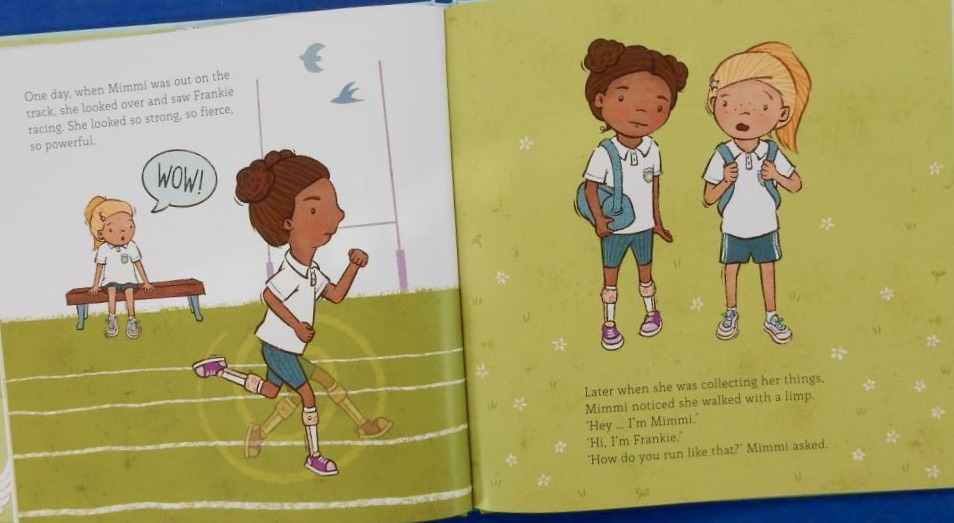
One day while training on the track she sees Frankie running and later notices that she walks with a limp. Introducing herself, Mimmi asks how she manages to run so well.
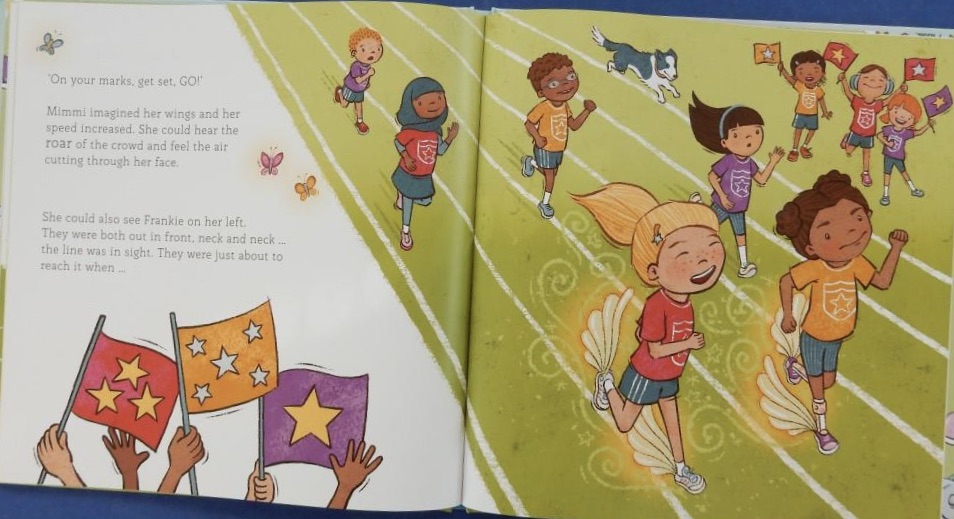
Frankie quietly shares her secret with Mimmi, “I imagine I have wings on my trainers.” Mimmi expresses a wish for wings too and so Frankie explains what she does just before she runs. As you might expect Mimmi tries imagining wings on her own heels and it certainly speeds her up. Henceforward the two girls become almost inseparable friends training and running together at every opportunity.
Come the day of the school carnival Mimmi’s butterflies return and she needs Frankie’s reassurance to get herself to the starting line. Who crosses that finishing line first though?
After the race Mimmi learns from her buddy that there’s more than one way of winning and she cannot help but agree with Frankie.
This is an empowering tale of dreaming big and holding fast to your dreams, self-belief, resilience and over-coming challenges. With the 2024 Paralympics about to start, this is a good book to share with young children. In the author’s words, ‘With their wings they can run, / With their wings they can soar, / It’s not about the race, / But so much more.’ This is brought out beautifully in Lara Porter’s illustrations.
In January 1971 an astronaut took a pouch of seeds with him on the Apollo 14 moon mission. On returning to planet Earth he planted the seeds to see whether any would germinate and thrive. Sally Anne Garland’s story tells of one of those seeds – a winged one.
Below the earth’s surface the little seed determined that it would grow so tall it would be able to reach the moon once more. Gradually a small shoot broke the soil’s surface and in the far distance was able to see the moon shining. The seedling decided to sleep during the daytime and waken only at night when the moon was visible. Weeks and months passed and the months became years until that tiny seed was a mature tree with its roots keeping it firm in the ground. After the tree flowered, winged seeds blew on the wind, a wind that caused a dozing bear to ask, “Why are you still awake, Tree?” Bear doesn’t hear the response though, it’s already slumbering once more.
Each night other animals use the tree for shelter and still the tree yearns for the moon. Then one night Squirrel asks the tree if it’s sad and tree responds thus, “I’m sad that I can’t reach the moon, where I once saw the most bright and beautiful thing I’ve ever seen.” Squirrel then invites the tree to stay awake during the day and together they would see something beautiful.
The following morning bees and birds greet the new day, the tree’s leaves look green against a blue sky
and henceforward the tree slept at night and stayed awake during the day to appreciate and love its earthly home.
The author/ illustrator engenders a sense of awe and wonder in her mixed media scenes of both night and day, be they of the maple tree stretching moonwards, the images of mammals and birds it sheltered, the splendour of a rosy dawn landscape, or our unforgettable blue planet viewed from space.
Don’t Disturb the Pirate! Rhiannon Findlay and Sîan Roberts Puffin Books
Young children will have fun joining the young protagonist in a search for his lively puppy, Patch, that has run away. There’s a need to tread carefully however and keep a watch out so as not to disturb the pirate captain and his crew. Scallywag Island offers plenty of hiding places for both pirates and the missing pup and who knows, you could stumble upon a treasure chest, a magical tree, a mermaid or even a helpful map. After looking high and low
what should our young pup hunter spy through his binoculars? Assuredly it’s something unexpected.
With its touches of magic, clues to follow, unexpected ending and fun, throwaway lines on the final page, young children will enjoy the adventure delivered through a jaunty rhyming text and Sîan Roberts’ exciting, brightly coloured scenes of the search. Make sure to peruse the map at the front of the book before you share the story. and allow time for young children to enjoy the playful details in the illustrations as you read.
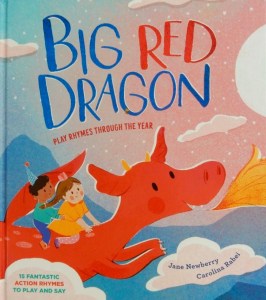
Big Red Dragon: Play Rhymes Through the Year Jane Newberry and Carolina Rabei Otter-Barry Books
From dinosaurs to diggers and rattle snakes to robins, this lively collection of fifteen playful action rhymes will soon have young children, be they at home or in an early years setting, eagerly participating in both actions and words.
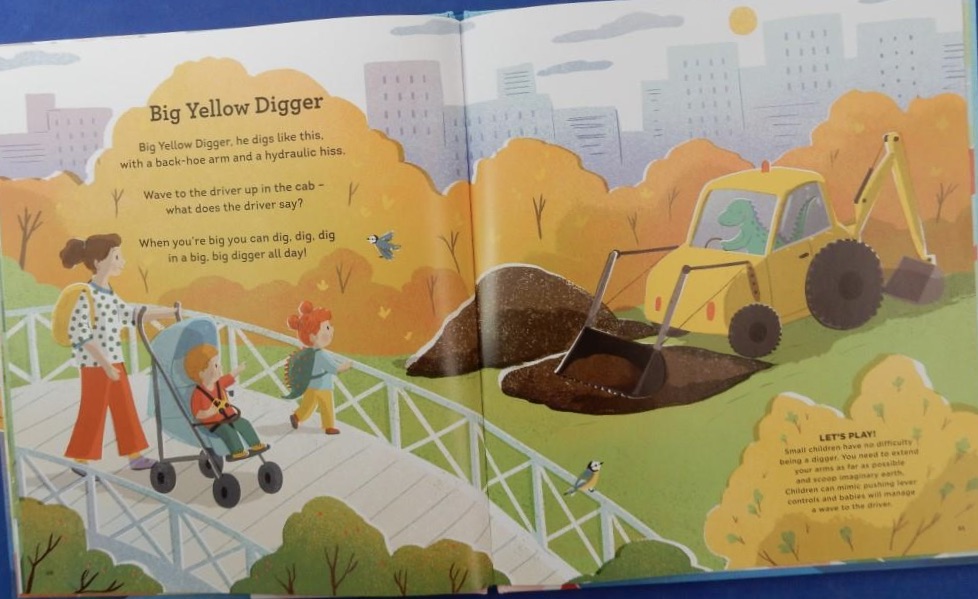
The festival related rhymes are arranged through the year starting with the titular Big Red Dragon for Chinese New Year, then the Easter Bunny, Halloween Fun and Happy Diwali and Naughty Reindeer. Each rhyme has a ‘Let’s Play’ suggestion set into the illustration giving ideas for ways little ones can join in, although some rhymes themselves will suggest movements and sounds, for instance toddlers might like to emulate the dragon’s paws and wings ‘clap clapping’, and ‘flap flapping’ with possible shouts of “Boing!’ as accompaniment.
Carolina Rabei’s playful illustrations are an ideal match for Jane Newberry’s rhymes;
her visual images are vibrantly coloured, textured, perfectly in tune with the words and sure to appeal to young children.
Definitely worth adding to foundation stage collections: I envisage it being used in lots of story time sessions when it will unobtrusively help develop children’s verbal and visual learning.
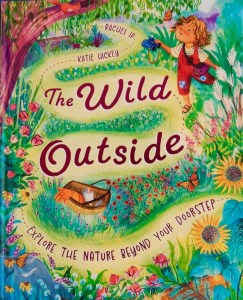
The Wild Outside Rachel Ip and Katie Hickey Hodder Children’s Books
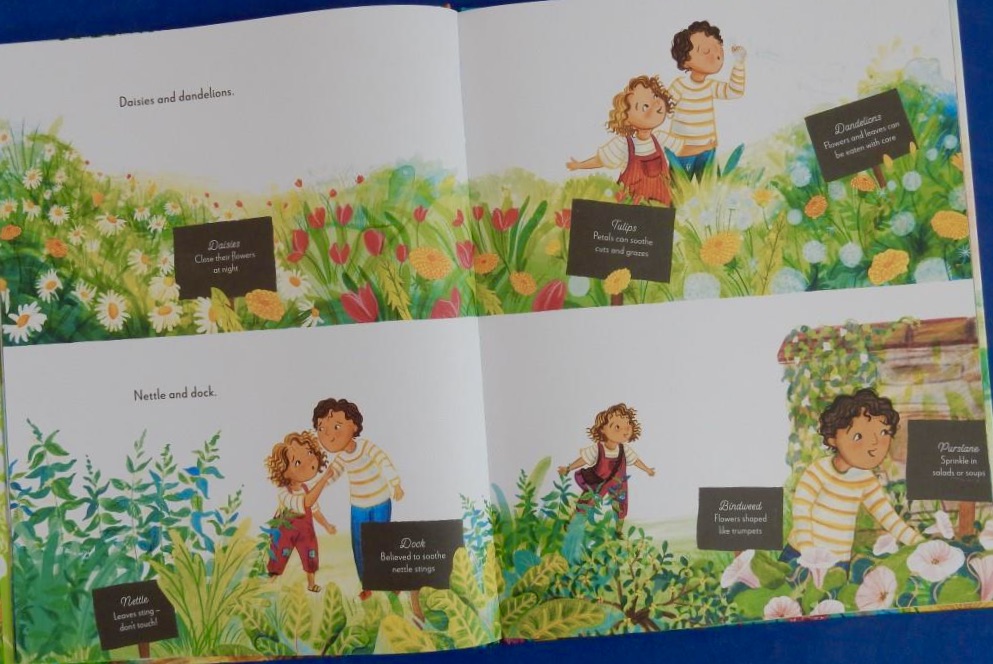
There’s nothing little Tulip likes better than to be outside exploring. She observes carefully the flora and fauna using all her senses and never stops asking questions to increase her knowledge. Then she comes upon a trail of muddy footprints on the path and a sign saying Nature Trail. Written in chalk in various places are labels naming lots of the plants, some she’s already familiar with, but lots that are new to her.
Who can possibly have made this trail, she wonders as she catches sight of somebody’s back retreating. Having filled her pockets with flowers and catkins, Tulip and her elder sibling return home and on the doorstep is a parcel with Tulip’s name on and inside is an illustrated botanical guide and a note encouraging her to keep on exploring.
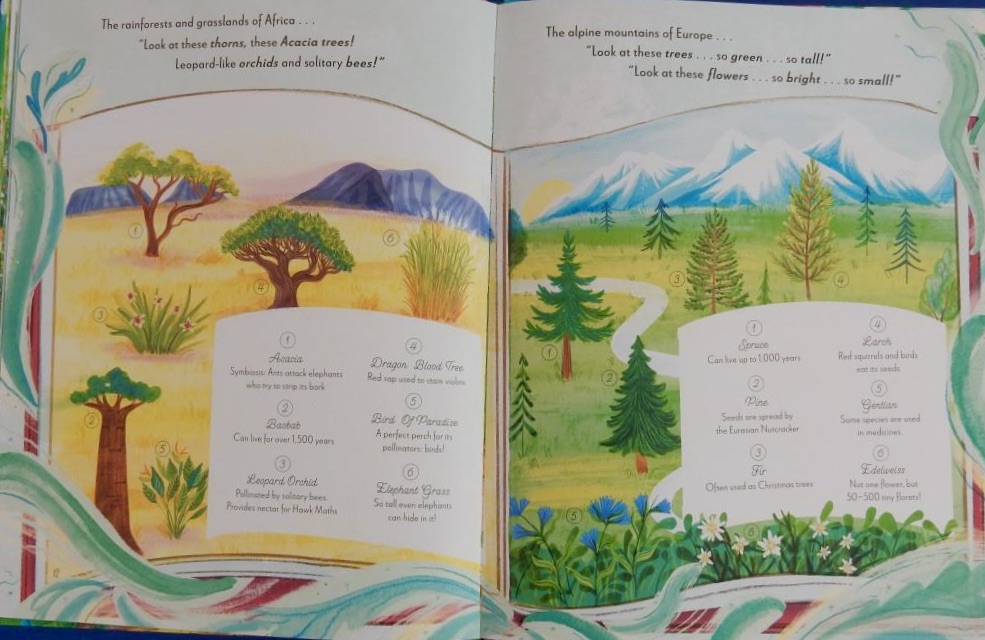
On opening the book, Tulip is excited to find lots of plants and trees she recognises and is inspired to do some labelled drawings. This keeps her engaged until bedtime when she falls asleep wondering where the following day’s explorations will take her. However, come the morning it’s raining hard and so she further explores her book instead, visiting Asian mangroves and forests, the deserts and plains of Australia, African rainforests and grasslands, mountainous regions of Europe,
the North American tundra region, various South American habitats and the cold Antarctic deserts. A clever device this for introducing to readers habitats the world over.
The following day the sun returns but rain has washed away the chalk markings of the trail. However someone has created a new one: who could that be? Tulip chalks a list of plants from the trail, leaving question marks for some she can’t name. On her return walk she discovers somebody else has written the names of those plants and left a trail of footprints. Who could it be? Tulip is delighted to discover the identity of her fellow nature lover and she makes a very special floral thank you using the contents of her pockets and bag.
A smashing way of encouraging young children to emulate Tulip and become natural history enthusiasts. The vibrant illustrations show the abundance of flora Tulip encounters as she explores and the labels are accompanied by brief captions with additional information about each plant. A wonderful combination of story and non-fiction.
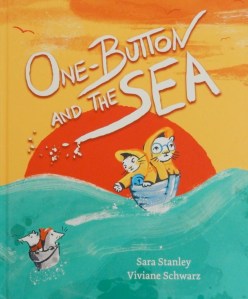
One-Button and the Sea Sara Stanley and Viviane Schwarz Scallywag Press
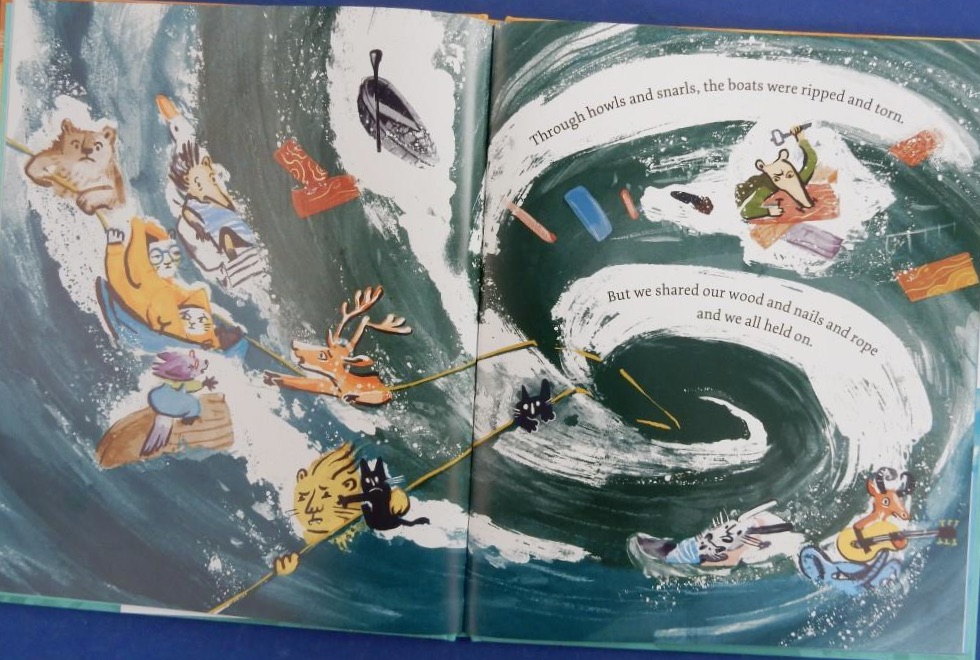
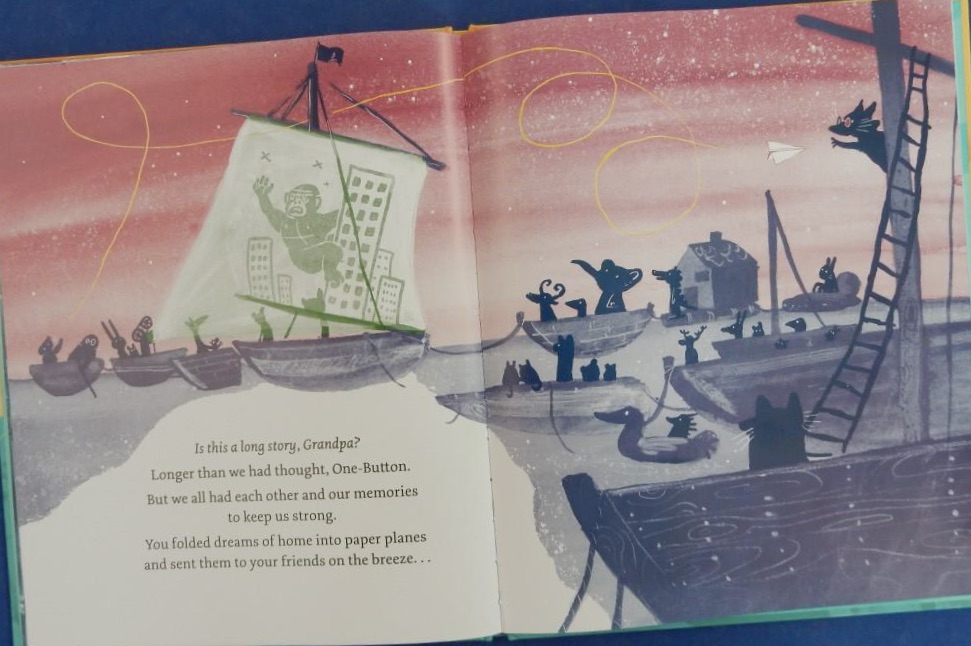
‘Grandpa, tell me the story again of when we went to sea. That’s a BIG story, One-Button. How does it begin? It begins with the uprooting . . .’ And thus, as One-Button sits with Grandpa we share in the story of what happens to a community that suddenly had to uproot and head out to sea in all manner of boats, some of which had several aboard, but Grandpa’s little boat had just the two of them. Leaving their everyday lives far behind, they sang to keep their spirits up as they encounter both calm and stormy waters. The fierce weather badly damaged some boats but this was a community and so everyone did what they could to help those affected, ensuring the safety of all.
There were happy times and sad times for everyone.
After ages on the sea, waiting, waiting, during which they found various creative ways to pass the time,
one day everything changed again. It was safe to return to their homeland, back where they truly belonged. It was time to carry on with their previous way of living, ready to start generating new stories but never forgetting their challenging experience at sea.
Yes, in her quirkily powerful scenes Viviane Schwarz has illustrated Sara’s telling with an animal community but the book would be ideal to share and then discuss, perhaps using a community of enquiry approach when children will likely link it to displaced people in various parts of the world. It’s hopeful and ultimately uplifting and definitely one to add to Foundations Stage and KS2 class collections.
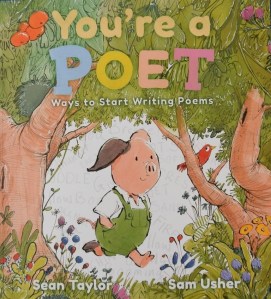
You’re a Poet Sean Taylor, illustrated by Sam Usher Walker Books
In a clever amalgam of story and non-fiction, author Sean Taylor has created a guide full of poetry-writing tips. There are five short stories starring Piglet, his family and friends, each of which shows children a different way to write a poem.
The first, Piglet … You’re a Poet starts with mum and Piglet in happy mood out walking along a puddly track towards a hill. Piglet, stops, picks up a large stone and drops it into a puddle causing a word-splash. ‘Sunshiny, earthy, wet, fresh, splashing puddle, ‘ says Piglet. Piglet has just created a poem, his mum tells him. This special happening reoccurs as they continue their walk, which culminates in the dizzy delights expressed as the two of them roly-poly down the hill and Mum’s confirmation that her son is a poet. Integral to Sean’s narrative is a demonstration of how to make a Puddle Poem and there are two spreads after the tale with a helpful lesson and ‘writing secrets’ aimed at children.
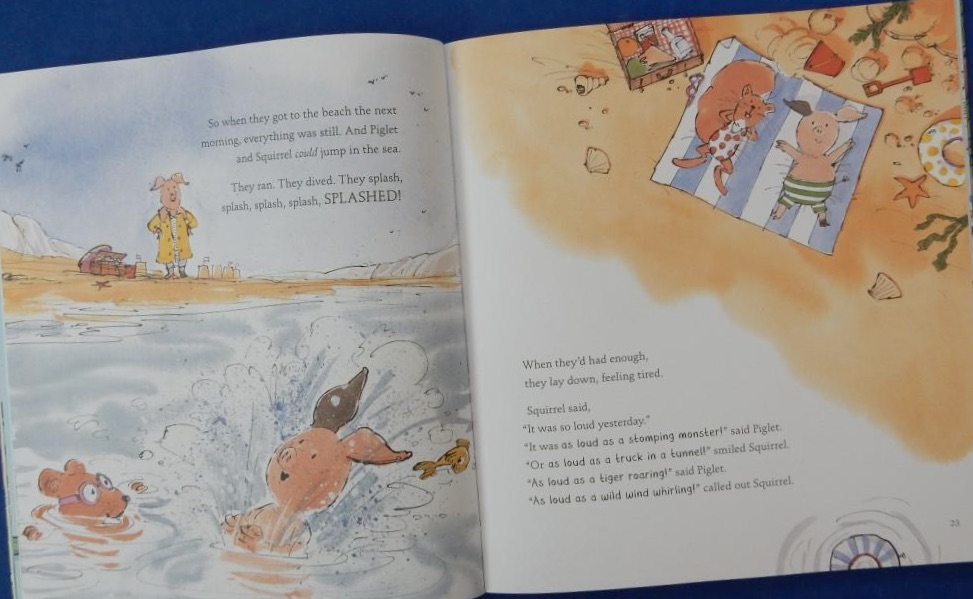
Of the remaining four stories, the second As Loud As Thunder Booming, introduces figurative language in the form of similes during a seaside family holiday on which Piglet’s pal Squirrel accompanies them.
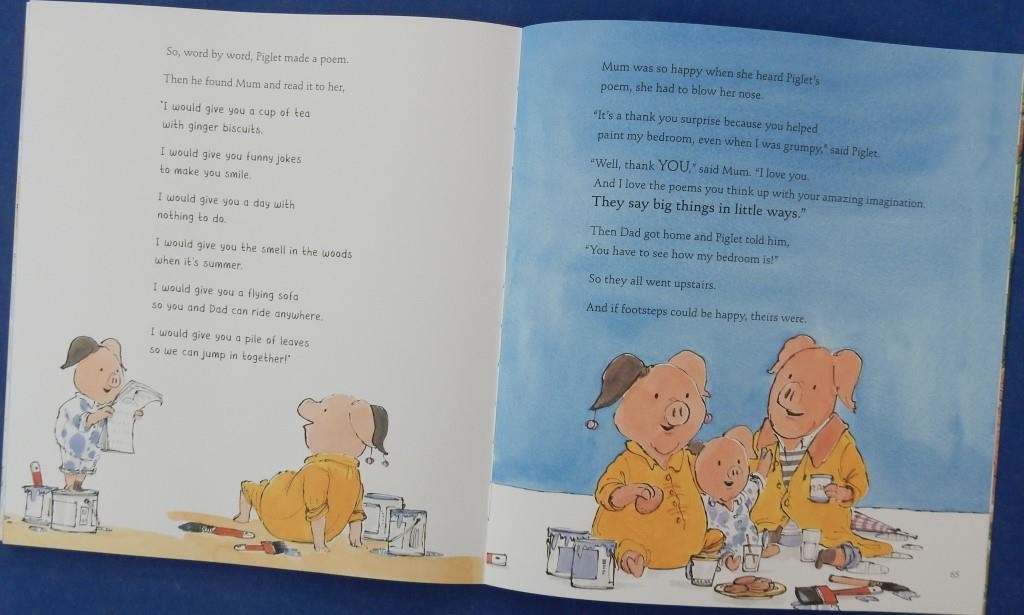
The Breeze Is My Friend sees Piglet and Squirrel getting a soaking but not before the former has invented a descriptive poem about the seemingly playful breeze. The next tale has Piglet and Squirrel sharing a swing, the to-ing and fro-ing of which gives rise to Piglet’s ‘If I Was a Tree’ poem. Finally, on a day of rain showers Piglet invents an ‘I Would Give You’ poem especially for his Mum while the two paint his bedroom walls together; it’s his special way of saying thank-you to her and she in turn compliments Piglet on his ‘amazing imagination’.
With its compelling narrative, writing possibilities and Sam Usher’s playful and dramatic watercolour illustrations that instantly endear the story characters to readers/llisteners, the message ‘poetry writing is fun’ comes across loud and clear. An inspiring, must have book for foundation stage and KS1 classes.
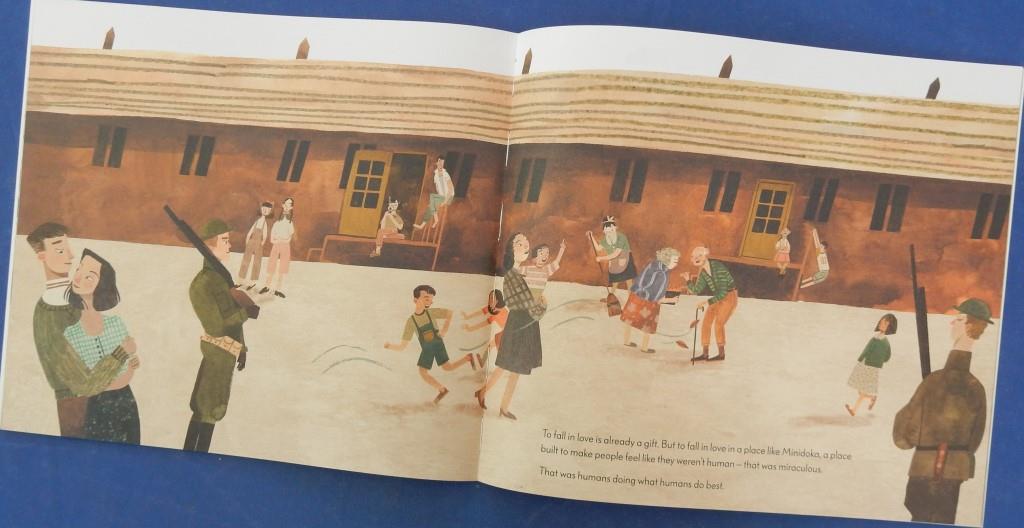
Love in the Library Maggie Tokuda-Hall and Yas Imamura Walker Books
It’s possible to find love, even under the worst situations and so it was for Tama and George in this story based on the experiences of the author’s grandparents who were put in Minidoka incarceration camp during the second world war just for being Japanese Americans. (An author’s note explains the reasons for this terrible unjust treatment at the end of the book.)
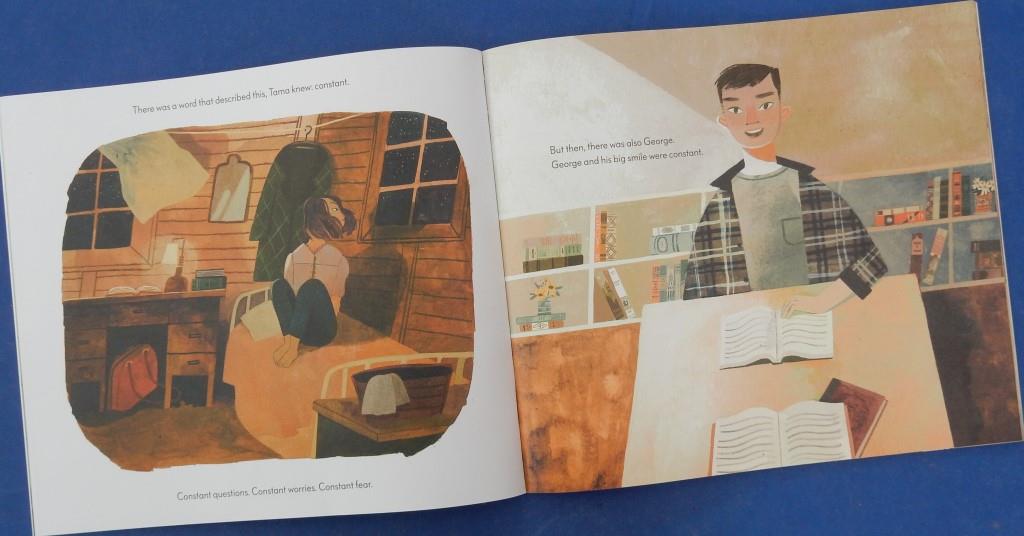
This particular love blooms in a desert library in Minidoka incarceration camp where young Tama works. Every day George visits the library; he too is a lover of books, or so it seems as he always takes away a pile of them and always has a smile on his face. ‘Constant’ Tama calls George and his smile
as helped by books, she tries not to spend all her time thinking of the life before incarceration. Instead she thinks of the gift of the books she is surrounded by.
Gradually, struggling to describe her overwhelming feelings, she opens up to George. He offers her a word – human – and it helps her feel less alone; he also uses the same word to explain why he vistis the library daily and takes so many books. Hope and love blossom – a miracle for sure. Tama and George marry and their first child is born in Minidoka – another light in their lives.
Maggie Tokuda-Hall’s telling is beautifully crafted and together with exquisitely illustrated scenes by Yas Imamura in muted tones showing the harsh realities of the camp, highlight the injustice while at the same time celebrate the treasure of hope and love humans can find against all the odds.
The Shy Book Howard Pearlstein and James Munro Graffeg
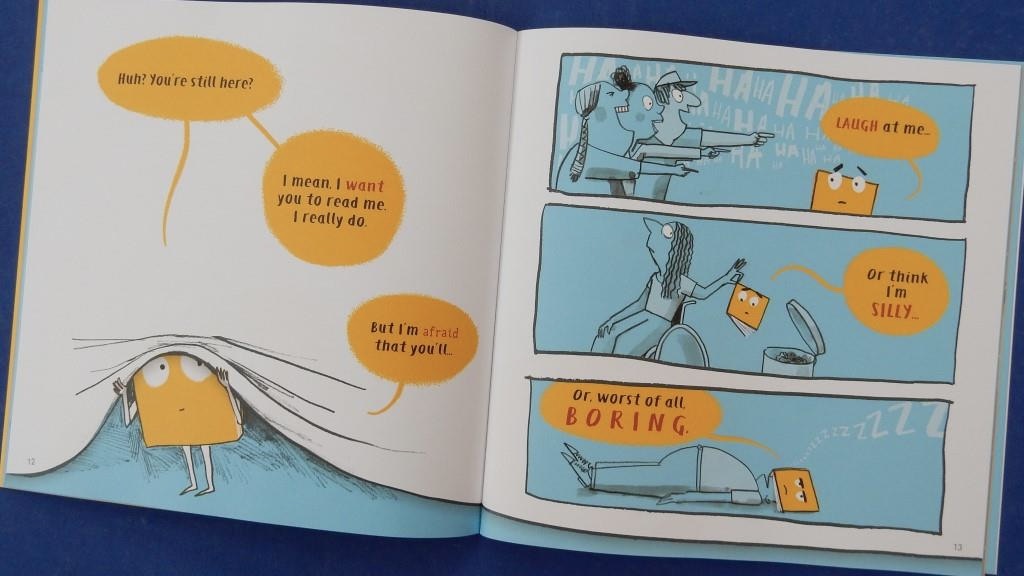
This interactive picture book is a novel way of introducing young children, particularly those about to start nursery or school, to a way of coping with their fears about meeting new people and coping with new situations. Its narrator is the titular book and it really does want to be read despite its extreme nervousness. It’s worried, sometimes to the point of dizziness, in case a reader finds it laughable, silly or much worse, boring …
‘go ahead … pick a different book’ it suggests. But what if instead a reader keeps turning the pages? Could they come upon the narrator’s suggestion and gently discover a non-threatening way to feel brave, despite feeling shy as the book does, especially at the outset?
Howard Pearlstein’s clever idea is simply presented, and brought to life by James Munro’s droll illustrations. Empowering and amusing.
One Up Ben Sanders Little Tiger
Blue and Green are tortoises and they’re best friends. But which is the bestest? That is a cause for competitiveness as each tortoise adds to his shell, making it bigger and bigger, until things get more than a bit out of hand, not to mention out of shell. Both Blue and green are way, way up in the sky
whereas their places of residence remain on the ground and the who is best issue is still unresolved. For a reason unknown to both characters, Blue and Green start craving gelato. But they might have to wait a long while before that desire is satisfied. What in sky’s name can they do? And will they remain best friends?
With inventive, increasingly detailed illustrations of the competitive craziness resorted to by Green and Blue, plus the fun final twist, this is an amusing read aloud that shows the inventiveness of the characters (and the book’s author/artist). With an abundance of visual humour, both children and adult sharers will find themselves laughing as things get progressively precarious.
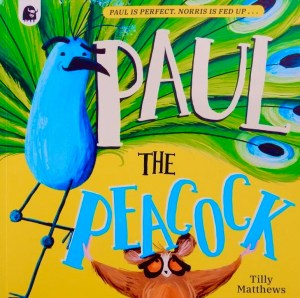
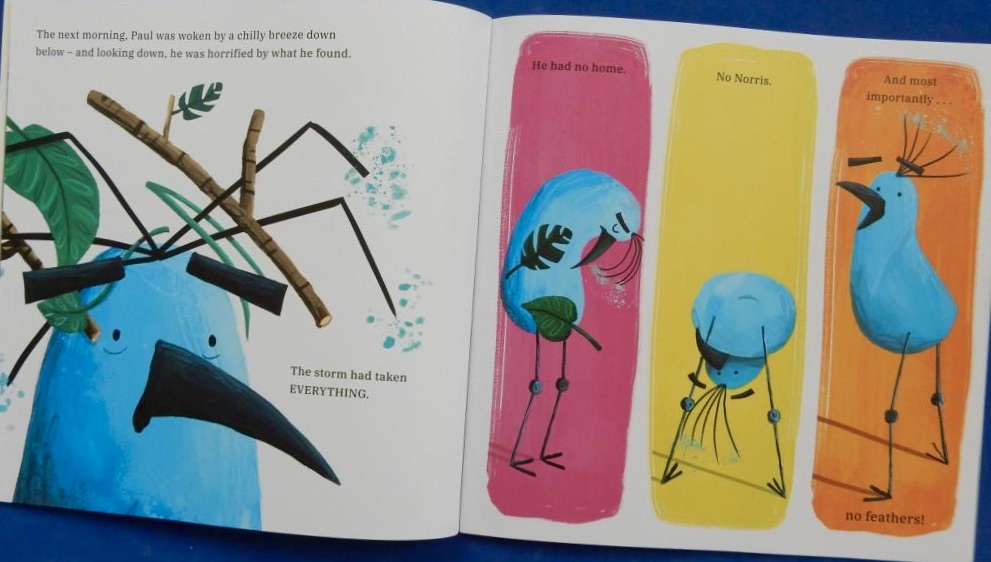
It’s clear from the outset that Paul considers himself an entitled peacock. He has the biggest nest, the most loyal friend and his pride and joy – the most beautiful feathers in the forest. His trusty pal Noris the loris ensures that Paul receives plenty of pampering every single day until one evening a fierce storm blows up. Norris is sent out for more branches to strengthen Paul’s nest but the loris has had enough of his feathery friend’s arrogance and bossiness.
The following morning Paul wakes to discover disaster has struck: he no longer has a home, Norris and worst of all, his feathers have gone – every single one.
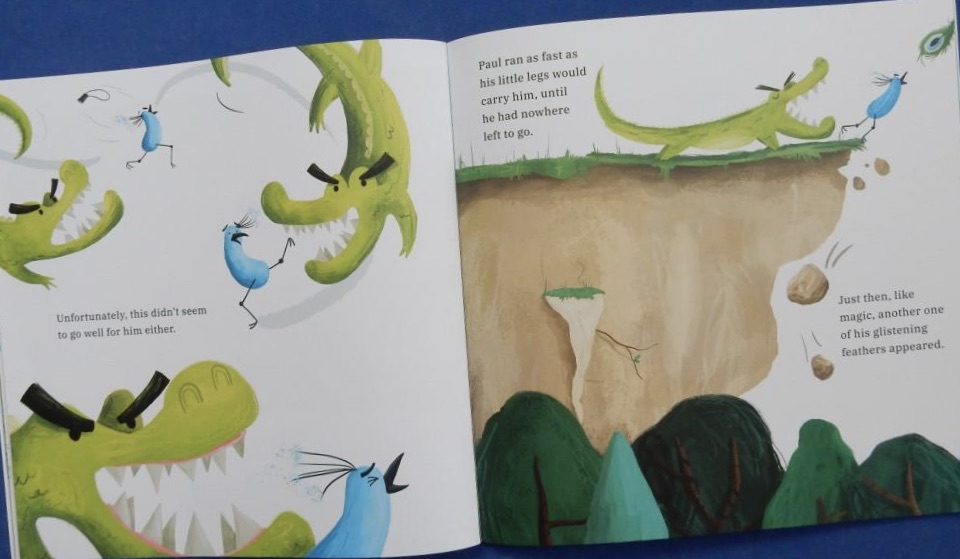
For the first time ever, the peacock heads out on his own to search for those missing feathers; Paul is nothing without his plumage so he’s determined to retrieve every single one. Now politeness is not a quality Paul possesses so he goes about demanding the animals he comes upon with one of those feathers to return it immediately; either that or he attempts to snatch it back.
Hmm, you’ve a lot to learn Paul and you’re going to have to do it the hard way, and eventually he does. Could those same creatures that he’s treated so badly enable Paul to discover that there’s something even more important in life than himself and his appearance?
Tilly Matthews’ fun fable demonstrates the importance of considering the feelings of others as well as being able to show humility and value one’s friends. The illustrations are full of drama and details that will amuse both young listeners and adult sharers of the book. Lots to think about and discuss here.
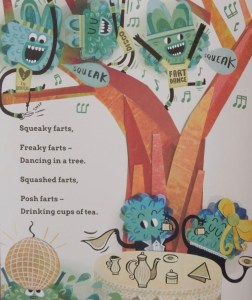
Have an air freshener close at hand when you share this malodorous book with youngsters for you’ll be paying a visit to an exceedingly pongy place.
At this unique zoo (make sure you read all the signs at the entrance) you will encounter more than twenty fart varieties so wearing a nose peg or a face mask might be a good idea. Read too the signs relating to the beastie(s) in each enclosure. Thanks to Leigh Hodgkinson’s narrative and madcap visual portrayals you will quickly discover they come in all shapes and sizes including those sneaky, cheeky …
shlumpy and grumpy, squeaky and freaky, even posh farts (though how that’s possible I truly wonder) and several others.
Finally, however comes an empty enclosure: seemingly a fart has done a runner but where could it possibly be? Chaos rapidly ensues. With the zoo gate wide open the escapee might be anywhere, but it’s not actually left the venue. A couple of eagle-eyed security staff eventually apprehend the whiffer (Evade Fartum), put it back on its recliner and lock the gate but how long will it remain there is anyone’s guess – check out the final scene.
Replete with silly speech bubbles, this is fetid fun for little ones and any adult with a sufficiently strong constitution to read aloud Leigh’s rhyming rendition. (Wearing my science studies hat, the final User’s Guide to Farts is not strictly correct as a classification. For instance ‘Escaping farts should be Fartum evado and ghostly farts should be Fartum umbrabilis and so on … ie only the genus name is capitalised, not the species.)
Another subject with great appeal for young children is:
Not Another Unicorn Book Laura Baker and Chris Jevons Scholastic
The unicorn narrator of this book is anything but pleased at the possibility of being in a unicorn book, vowing she would ‘never, ever ‘ do so but fate takes its course …
There’s nothing for it but to escape its covers as soon as possible. Try as she might with her chomping, poo-dodging and running, her search for adventure doesn’t match up to her expectations. Maybe being in a unicorn book is not actually so bad after all. Assuredly it has its compensations.
Undoubtedly countless little human unicorn lovers will fall for the protagonist in this rainbow coloured setting with its sparkly starry sprinkles that even hover over the poo piles and delicious-looking confections shown in Chris Jevon’s dramatic scenes
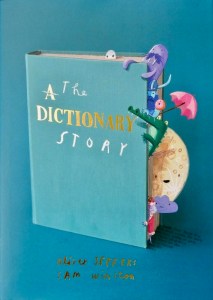
The Dictionary Story Sam Winston and Oliver Jeffers Walker Books
A little dictionary’s realisation that she’s merely a list of definitions whereas the other books lined up beside her on the shelf contain stories, makes her decide that things must change: she resolves to ‘bring her words to life’. Thereupon an alligator of the hungry kind makes an appearance by opening the definitions enclosing him and proceeds to the D pages from where a delicious smell emanates in the form of a doughnut (donut is used here). The tasty confection sees him coming and rather than being consumed rolls off, accidentally right into Ghost – make that through him – and wakes the apparition. Donut continues on its way hotly pursued by Alligator, to the moon. As said moon starts interrogating the two, Ghost appears scaring the moonlight out of them all and prompting Alligator and Donut to rush off until midway through the dictionary the former catches up, only to collide with the Queen who ends up flat on her derriere.
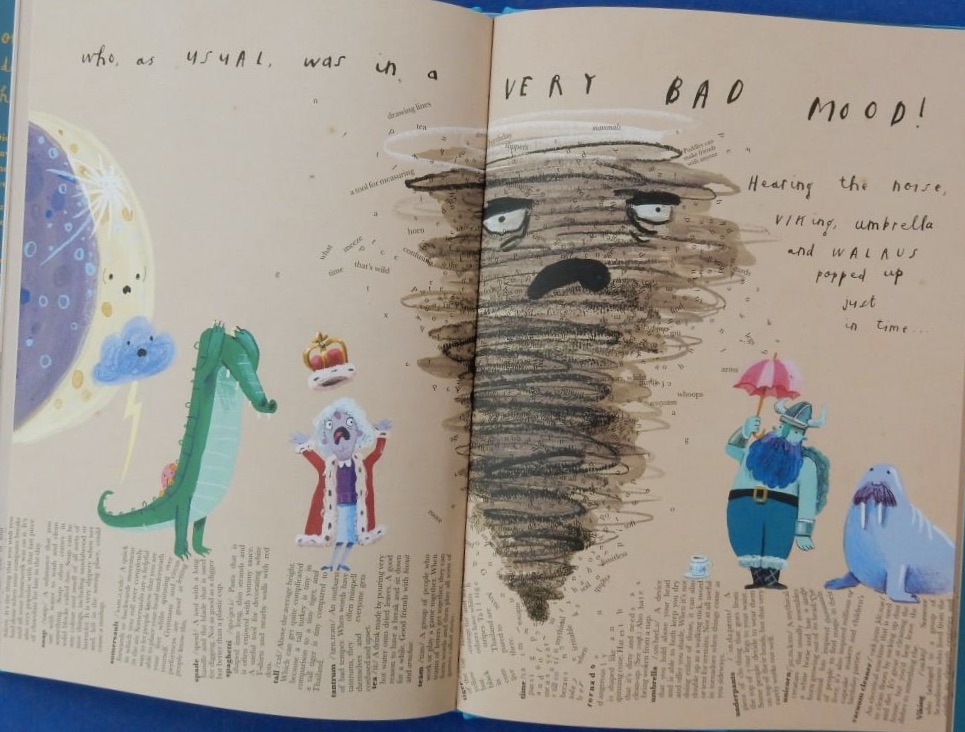
Where will this all end, you might be wondering. Let’s just say total chaos ensues mainly due to the appearance of a tornado, spilled ink, a Viking, an umbrella and more.
In order to restore some semblance of order to the situation and the dismayed dictionary, she calls upon the help of her friend Alphabet whose song solves everything leaving all the words back in their proper places at last. PHEW!
Make sure you read all the tiny print on the dictionary pages ; those definitions are frequently hilarious and very clever, seemingly serving as a stage upon which the alphabetic characters perform. The definition of marmalade for instance is ‘A sort of jam made from citrus fruit, usually oranges. Marmalade is perhaps the main reason that the universe came into existence.’ Vacuum cleaner is defined thus, “An electrical machine that is used to clean floors by sucking up dust and dirt. It’s great at cleaning the house, but you’d best leave the dishes to something else.’
Sam Winston’s comic pacing of the tale – a meta celebration of words – is superb. Superb too are Oliver Jeffers’s naive style illustrations showing the shenanigans of the characters. Totally immersive and brilliantly created right from the real dictionary shown at the front of the book. The more you read it the more delights you will discover, it’s a veritable wordy wonder.
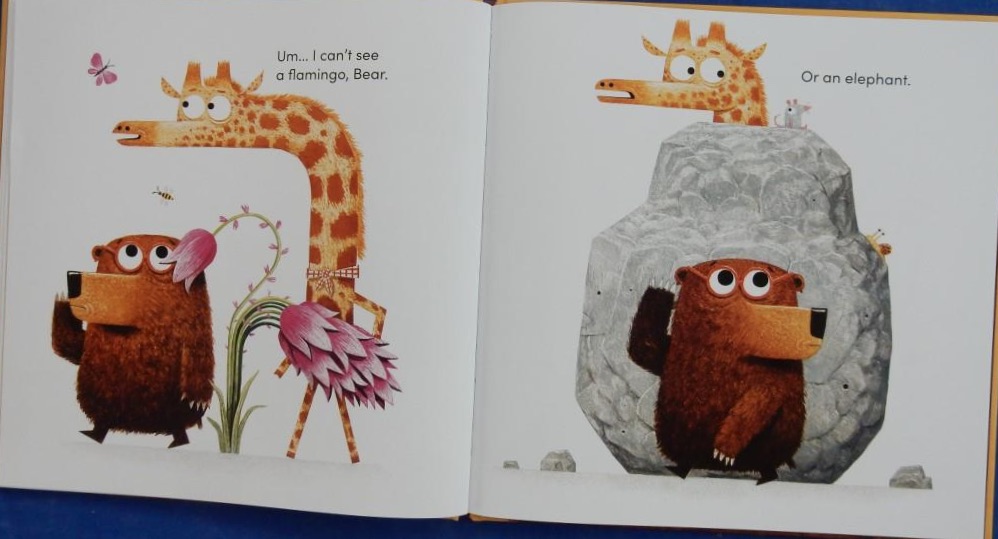
Right from the cover illustration, young children will love being in the know as to the whereabouts of Bear’s glasses but the ursine character decides that he’s left them at Giraffe’s house so off he trots. Now sans specs, as he tells us, he ‘can’t see a thing’ but nevertheless he comments on various objects he passes en route to his friend’s, misidentifying them in turn as a deer, a crocodile, an elephant, a flamingo, each of which astonishes him.
He even fails to recognise Giraffe who is taking it easy on his lounger, calling him instead a snake. Bear apologies and explains his plight; Giraffe then ‘returns’ the glasses to their owner, which allows Bear to uphold his original notion.
Bear goes on to tell his pal of the unusual sights he’s seen en route and eager to see them for himself, Giraffe accompanies the now bespectacled Bear as he makes his way back the same way he came. Of course, neither spots the flamingo nor the elephant,
the crocodile or the deer though a confused Bear blames his glasses. These he then removes and goes on to point out to Giraffe, three lions nearby.
A terrific, tongue-in-cheek comical delight that puts forward the possibility that seeing with one’s imagination is preferable to viewing reality. Little ones will relish Timmers’ tale of discovering – albeit accidentally – new ways of seeing the world and loudly correcting him with regard to the misidentifies flora and fauna.
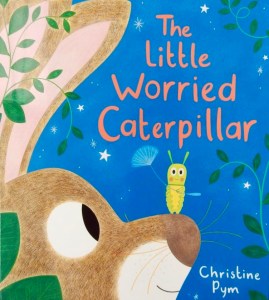
The Little Worried Caterpillar Christine Pym Scholastic
Little Green is on the brink of change. However she’s not aware of this when she wakes early one morning ready to play with her caterpillar pals, but she can’t find them anywhere on the ground. Then a call tells her that they have morphed into butterflies and are way up above her. “You’ll be next, there’s no doubt!” they tell her. However rather than sprouting wings, she sprouts fear, a fear of change that brings with it worries about the unknown. Her friends reassure Little Green that change is what they were born to do and it’s exciting but this makes her feel even worse.
Along comes bee with what is meant to be some helpful advice; she gets momentary relief but that’s all.
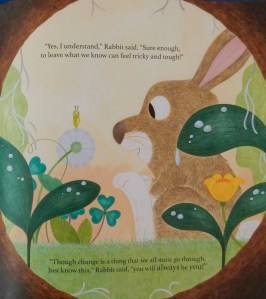
Other creatures also offer suggestions but nothing works until Rabbit appears on the scene. Rabbit listens and what her new friend tells Little Green enables her to feel ready to embrace and prepare for that transformational change
and become … Butterfly Green.
Some young children take change in their stride, others needs considerable support from empathetic friends and understanding adults. A book such as this one is particularly valuable for sharing with the second kind. Christine Pym’s illustrations capture so well Little Green’s fearfulness and eventual delight.
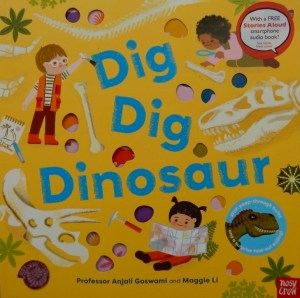
Dig Dig Dinosaur Professor Anjali Goswami and Maggie Li Nosy Crow
Three intrepid little explorers with their kit at the ready are on an expedition in the hope of finding something, something ‘REALLY big’. Dig! Dig! Dig! they go till one person discovers some remains of a sharp clawed dinosaur. These claws make the finder conclude that they belonged to a Velociraptor.
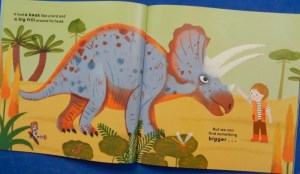
A second child’s Dig! Dig! Dig! digging unearths three large horns: young readers can perhaps guess from which dinosaur these came..
Still intent on finding something even bigger, they continue hunting till the third explorer tells of a dinosaur with a very long tail. and a tiny head supported by an extra long neck.
Little ones can have fun guessing what this might be before the big reveal fold out … They will also enjoy the peep hole pages showing the skeletal remains the young explorers find during the dig.
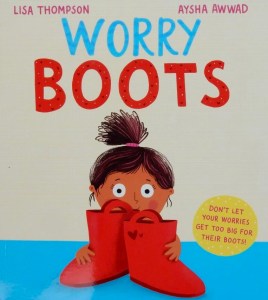
Worry Boots Lisa Thompson and Aysha Awwad Scholastic
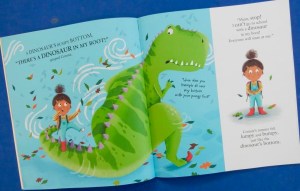
It’s Connie’s first day at school and after putting on her shiny new boots she, her mother and younger sibling set off for the bus stop. Before long Connie stops and calls out to her mum, “There’s something in my boot!” Having wriggled her foot around, her tummy feeling like a dinosaur’s bumpy bottom, she then, declares that it’s a dinosaur and consequently she can’t go to school because everyone will stare at her.
Mum reassures her that this won’t happen and they continue on their way, Connie now not feeling the lumpy bump.
Having boarded the bus, Connie feels the thing in her boot again only now it seems hard and spiky. It must be a unicorn’s horn she decides, informing her mum of the situation and again saying she cannot go to school. Now her tummy feels hard and spiky. Mum tells her all will be well but as they approach the school gate Connie feels another visitation – sharp and pointy this time. There’s no way she’s going into school with a shark in her boot. She’ll frighten everyone out of their wits.
With a sharp pointy feeling in her tummy Connie then sees her teacher welcoming the children as they arrive in the classroom and she has a big smile on her face. Maybe it’s not a shark then, but still that boot and Connie’s tum don’t feel quite right. Before she says goodbye, quick thinking Mum suggests they remove whatever is in her daughter’s boot; she upends it and out falls … What do you think?
Feeling so much better Connie then goes to join the other children in the classroom. With so many new friends perhaps her day won’t be nearly as bad as she had been anticipating.
Acknowledging young children’s first day anxieties, this reassuring story is perfect for sharing with little ones. With her powerful imagination, Connie is a delight and Aysha Awwad’s portrayal captures her feelings beautifully.
A Mystery At The Incredible Hotel Kate Davies and Isabelle Follath Frances Lincoln Children’s Books
We’re back at the Incredible Hotel for a second story which begins one autumn afternoon when manager Mr Starch announces that the World Baking Contest is to be held in the hotel and the head judge will be Chef Tartine, owner of the Stupendous Restaurant. Moreover Chef Stefan has been chosen to represent the city of Delaunay in the event. Stefan works and works until he’s invented a new secret recipe but come the morning of the contest, shock horror! His recipe has disappeared.
Fortunately ace detective, aka Matilda, the hotel’s bellhop, Stephan’s best friend is at the ready to solve the case. But who can the thief possibly be? It turns out that a chef’s hat has also gone missing as well as a cushion.
As Matilda continues trying to find a thief, the police are busy interrogating various suspects. She follows footprints but suddenly is apprehended and accused by Mr Starch of being the thief herself. Just in time however, the determined Matilda discovers the whereabouts of the recipe and the other missing articles. All is forgiven by a very shame-faced manager
and she’s given a new role; but by now there are only ten minutes of the competition left. Surely Stefan can’t bake his cake in time for the judging – or can he …
Another truly tasty treat from team Davis and Follath. Children will delight in joining Matilda as she follows clues to the surprise revelation of the culprit, as well as savouring the delicious details in Isabelle Follath’s mixed media scenes of the unfolding events. Watch out for the antics of the cat and mouse as you peruse the pages.
One Day at a Time Rachel Ip and Natalle Quek Hodder Children’s Books
Robin and Poppy couldn’t be happier with their family life; their days are full of fun and adventuring together. And every springtime the children and their parents plant sunflower seeds together and watch them grow and bloom in the summertime. Then one summer Daddy tells the children that their parents are separating and will be living in different homes.. “We’ll always be a family, and we’ll always love you,” Dad reassures them. Poppy and Robin don’t want this to happen but despite the tears and talking, and the hugs, happen it does.
As you would expect both brother and sister are emotionally mixed up;
they also show this in different ways. Robin shares his worries with his friends at school whereas Poppy keeps everything to herself.
Both of them though ask their parents lots of questions and they all choose sunflower blooms to take to their parents’ new homes. Homes that are very different too.
Come the following spring Robin finds the dried out sunflower heads in the garden shed; they are absolutely full of seeds and give them an idea. Before long they have more than enough to sow in both mum’s and dad’s gardens. Little by little both Poppy and Robin have accepted their new way of life and realise that they will be okay; They are able to laugh more, hug more and of course, there is more than enough love for everyone; after all they are still a family no matter what. A sensitively written and illustrated story that is full of hope and love, a story that offers an optimistic view of separation. However Poppy and Robin are fortunate in the way their parents separate; not all families are so amicable; indeed some children’s parents are downright hostile toward each other and this takes its toll on their offspring.
Also about changes in family circumstances is:
Roots of Love Sarah Asuquo and Ruthine Burton Scholastic
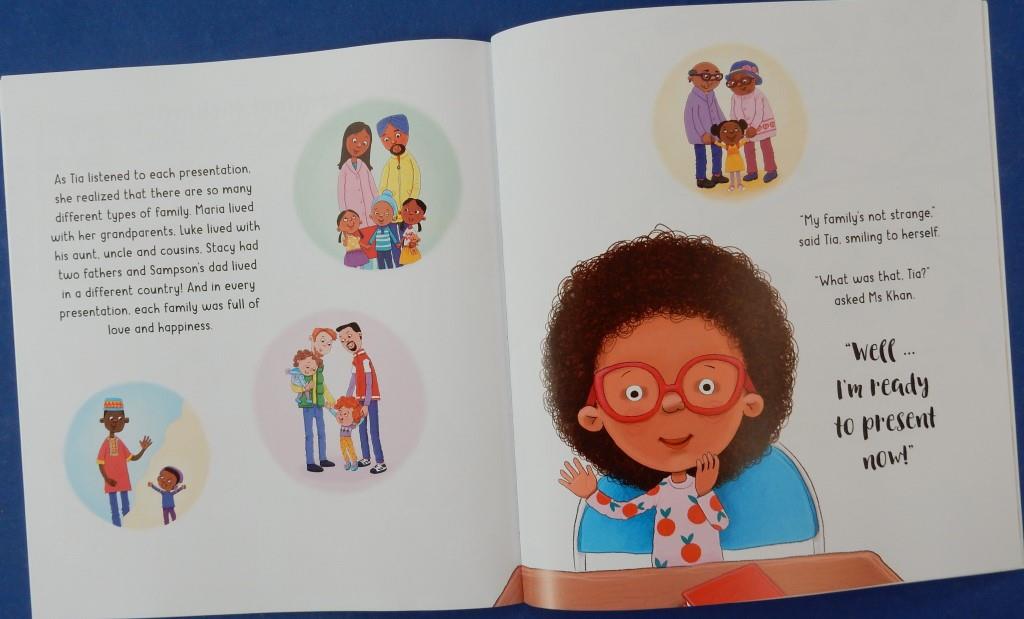
Subtitled Families Change, Love Remains, this story starts with a happy little girl, Tia who has just enjoyed the best day at school ever. But that evening after dinner her mother tells her to leave her project about her family and come and join a talk with her mum and dad. She knows they have been keeping something a secret recently and realises quickly that this isn’t going to be cheerful chat. Instead she learns that her parents are going to separate and that her dad will move out. “We’re still a family, we’re just changing to something new,” her mum tells her. Devastated little Tia rushes upstairs and cries herself to sleep.
Next day at school her class are to present their projects about families; inevitably Tia is worried about how her classmates will react to what she says. However what she hears from some of her friends about the variety of families they have, surprises, reassures and empowers her, enabling her to share her project too.
Using the apt metaphor of a tree Tia explains how her family has changed.
Ultimately reassuring, Sarah Asuquo’s story with its inclusive illustrations by Ruthie Burton is one for KS1 class collections as well as for sharing with individuals.
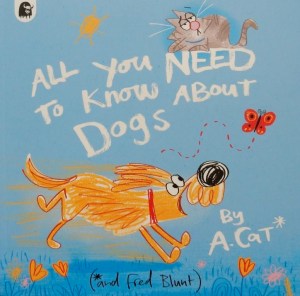
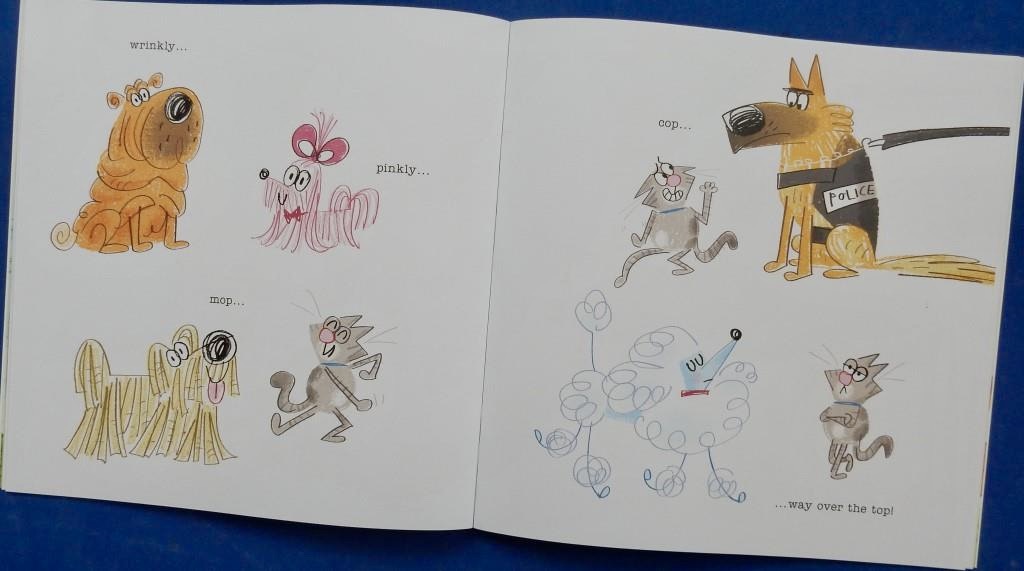
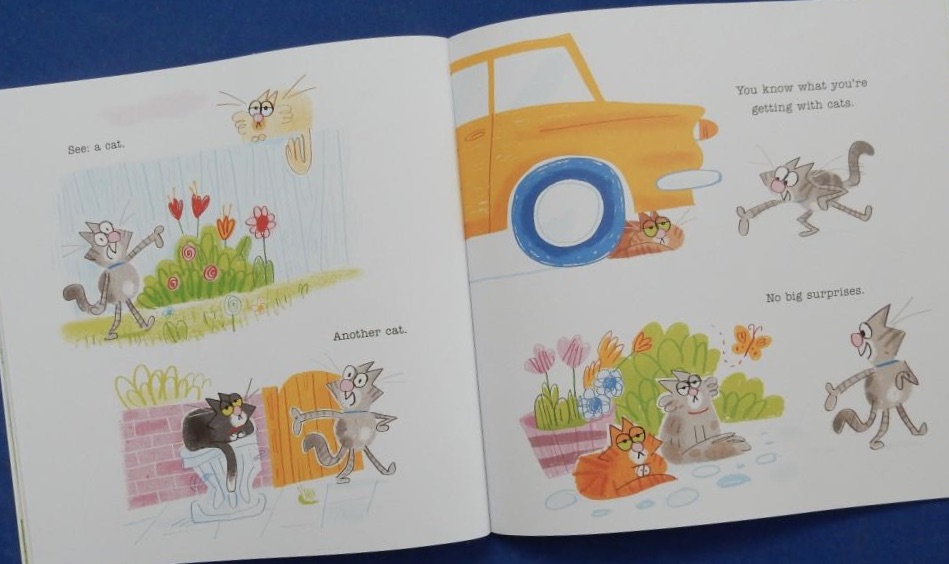
All You Need To Know About Dogs Fred Blunt Happy Yak
Now I’m no lover of cats, far from it – they bring me out in an itchy rash, neither am I a dog lover (having been mauled by an Alsatian as a child). However I am a fan of Fred Blunt’s picture books. which is why I read this. It’s told by a matter of fact cat and indeed there are actually two versions. The first is extremely brief, blunt you might say and is over in one spread; the second is the extended one for which our narrator employs rhyme to talk about the various breeds of dog
and to inform us of the many reasons dogs are stupid. For instance despite their having an excellent sense of smell, they use it for ridiculous activities. Then there’s what they do with their poo and as for the fur … It’s hard not to agree with all that moggy has said thus far.
In contrast when you come to cats, they are just cats,
only with some felines you get rather more than you bargained for and when a scary moment arises dogs come into their own. It’s assuredly the case here for loyalty reigns and a dog might just turn out to be the best friend of all.
Both cat and dog lovers of all ages will lap this up; so too will those who enjoy wit and a good laugh.
A Boy Called Book Vincent Ralph and Aaron Cushley Scholastic
When a mother and father decide to call their newborn baby Book, it bothers a variety of people and puzzles the little boy he becomes. One day he asks his mum, “Why am I Book?” “Because your life is a story … You can write it however you want,” comes the reply.
First Book decides to become an adventure story, full of exciting chapters. When he turns four, Book starts school but for him, this feels like being part of a scary story. Until that is, his mum’s mention of heroes and being brave leads to Book making his very first friend.
A friend who loves to have fun and laugh a lot – a joke book.
Gradually Book learns such a lot that he aspires to become an encyclopaedia but not all his book types bring him happiness; he also faces sadness, loss (an emptiness inside) but then he receives a special something in the post that makes him forget his sad feelings for a while. So too do pictures of different kinds and gradually back come Book’s smiles. Eventually Book sees that his life is much more than a book; it’s an entire library and one that will keep on growing and growing …
Vincent Ralph’s picture book author debut is an unusual and powerful one that shows the power of story to shape us, inspire us and also to heal us. Powerful too are Aaron Cushley’s scenes of the boy’s developing competences and supportive family life. On a similar theme is
Reading Together Robert Broder and Melissa Larson Blue Star Press
Having an adult or two in your life who are passionate about reading and share books with their baby from the outset, will likely set that infant on the road to becoming a reader and lover of books and stories too. So it is for the mother and father narrators of this book who read to their little one from birth. We are party to various developmental stages such as sitting up and eating solid food, alongside various kinds of books – an abc, flap books the child can manipulate independently, books of nursery rhymes. We see how stories come to life on the page with their elements seemingly becoming a part of the home environment too.
We see too the joys of visiting a bookshop and coming out with arms full of new picture books to enjoy together at every opportunity, so much so that after reading and loving them so much they needed to be mended; books such as wordless ones, rhyming ones and fairy tales. Sometimes no book at all was needed, instead a story would be co-created using family members’ imaginations.
Such was the power of all this book/story experience that eventually two readers in the family become three as the child grows up to be an independent reader herself. Job done, you might say; hopefully not, for confident solo readers too should have stories read to them and I suspect it was so in this family.
Melissa Larson’s portrayal of family life in this household certainly shows how memories are created and emphasises the importance of sharing books together right from the start. What a wealth of connections are created by so doing.
Fly Free! Roseanne Greenfield Thong and Eujin Kim Neilan Astra Books for Young Readers
Using a chain of simple interactions between a variety of people and the repeat refrain, “Fly free, fly free, in the sky so blue. When you do a good deed, it will come back to you!” the narrative of this story comes full circle.
Set in Vietnam, the story opens with young Mai who visits the temple early one morning. Before going inside she feeds the birds kept in a cage near the entrance. As a Buddhist, it is her hope that someone will be able to do what she cannot afford: to pay for the release of the birds. On this particular morning Mai notices another girl Thu, who removes her red slippers before going in; Mai waits and when she comes out, offers her some bird seed so she too can feed the birds. She also whispers the “Fly free …” refrain. This sets off a concatenation of good deeds and having performed a kind action each person sings the same refrain as a kind of suggestion to pay it forward when an opportunity arises.
Eventually the chain comes full circle and as Mai watches, a man pays for the birds’ release, nodding to her to open the cage.
In a final note the author explains that her story of the characters’ actions is based on the Buddhist doctrine of karma as well as the principle of the wheel of life.
Using earthy tones and subtle texturing Eujin Kim Neilan’s striking scenes show the gentle joy each character experiences as they perform a kind act. It’s vital that all children come to understand the importance of empathy and generosity and sharing this heartwarming tale of selfless actions and having a circle time discussion is one way of demonstrating these qualities.
The Seal on the Beach Mara Bergman and Brita Granström Walker Books
This treasure of a picture book celebrates the delights of a British seaside holiday: sand dunes, cliff walks, bracing salt water bathing, beach huts, a pier, a boat trip, ice-cream and the littoral wild life to be seen. It’s also a story of a young girl, Maggie’s anxiety; about missing her Mum, her new-born baby brother sick n hospital and the seal pup abandoned on the beach, which she finds stranded among the pebbles while out walking with her Uncle Jack and Aunt Jean.
It’s the most amazing thing she’s ever seen and she feels very protective towards it, so much so that it haunts her dreams.
Her aunt and uncle, as well as the lifeguards to whom they report their find, reassure Maggie that the seal mother will return. That doesn’t happen however and a very sickly little seal has to be rescued and cared for by the RSPCA.
There’s a happy ending though both for Maggie’s own family and the seal pup, named after her, which she sees returned to the sea.
Mara Bergman’s episodic, poetic prose is every bit as elegant as Brita Granstrom’s beautiful watercolours, which are a joy to behold. Feast your eyes on the seaweed, snail and shell strewn endpapers before reading the story with children. For adult sharers it will likely bring back memories of their own childhood summer seaside adventures.
The Boy and the Octopus Caryl Lewis and Carmen Saldana Puffin Books
The arresting cover image of a small child snuggled up with an octopus immediately drew me into the pages of the book. Meet Stanley whose favourite toy is that octopus and who in his dreams sees its skin change colour according to various feelings. Particularly important is Octopus’s ability to camouflage himself and hide when something scary comes along; indeed when beset by anxiety and fear Stanley would really like to be able to disappear.too.
There’s the occasion when other children mock him as he walks in the park leaving him unable even to talk with his dad about what happened. That night though Stanley and Octopus have a dream encounter with a sea monster and when he wakes from the experience something feels different. The following morning Stanley sets about using his creativity to convey his feelings
under the watchful eye of his supportive dad. Thereafter having made a promise to his dad, Stanley is ready to step out and face up to difficult situations with a new-found confidence, empowered by his artistry.
Being bullied is a topic that many children find hard to talk about, often thinking when it happens that it’s somehow their fault. In her text Caryl Lewis makes it clear this isn’t so.
Carmen Saldaña’s arresting underwater sleep scenes are awash with pinks and blues in contrast to the family and park pictures that have been executed with a much more varied colour palette.
As an Early Years teacher I have encountered many traumatised children from different parts of the world: they would frequently reveal their feelings through their art so this story particularly resonated with me. It’s one to share and talk about in Foundation stage settings and at home.
Aisha and her parents live in Jakarta. It’s the summer holidays so they are going to spend the time at Grandma’s in a countryside village as they always do. However, Aisha’s not happy: she longs to go somewhere different like her friends.
Once in the car, Aisha talks of her friend Jennie; she’s off to a snowy place: what does snow taste like? Recounting Jennie’s description to her parents gives Mum an idea and they stop for a while and savour a special sweet crispy, crunchy treat – es campur.
As they continue Aisha talks of the blue sky another friend sees when in his holiday home swimming pool, prompting Dad to point out the stunning blues visible through the car window.
The car engine overheats and they have to pause their journey. At her mum’s behest Aisha and Dad go and lie down in a grassy field where the little girl describes the wonderful hues of tropical fish in an aquarium, another of her friends saw on his holiday. Suddenly the sky is filled with multi-coloured kites soaring above.
When they resume their drive, Aisha contemplates the beauty of the colours she’s seen on the way until they finally reach their destination. There Grandma stands;
Aisha is so excited to see her, but she’s even more excited when Grandma serves up her favourite meal. Could its predominantly yellowy colour be Aisha’s favourite? She’s not sure but of one thing she is certain: henceforward she is going to savour the amazing colours in her own life rather than compare her experiences with those of others.
Appreciating what you have is an important theme of this book wherein Nabila Adani’s illustrations engulf readers in a kaleidoscope of colours as they join Aisha on her journey of discovery.
Olu’s Teacher Jamel C. Campbell and Lydia Mba Walker Books
Understandably Olu is very nervous about starting nursery school. His Dad reminds him that his friends Akeem and Sarah will be there, but what about the teacher? As he contemplates this new person, imagining all kinds of scary possibilities, he suddenly says, “MACARONI!” This is the word Olu uses when he’s really nervous. His worries get the better of him several times despite the reassurances from his Dad and Mum; and they reach the nursery building all too soon for our little narrator. However, it’s a really warm, friendly face that greets him and introduces himself as ‘Jay”. When Jay smiles he shows his shiny gold tooth, which he does all the way to the classroom. Once there he invites Olu to sit with his friends and make some pictures.
Mum gives her son a goodbye hug and departs leaving him in Jay’s care. Olu could not have had a better teacher that Jay: he plays the boy’s favourite reggae music on his guitar
and at story time, dons a special cape before sharing a book with the children. Olu is surprised at how quickly the session has gone and it’s time to leave. Before so doing, however, a realisation dawns: Jay actually looks like Olu – another reason he’s eagerly anticipating returning to nursery the next day.
A smashing, hugely reassuring book by a smashing teacher (the author is himself an Early Years educator) and as he writes after the story, he knows that starting nursery is one of the big, and most important, transitions in a child’s life and it’s vital everything possible is done to ensure that for every child, it’s a positive one. Lydia Mba’s illustrations of the diverse community Olu joins when he starts nursery certainly make it look an exciting, enabling place to be.