Smelly Peggy

Young Pie has a rescue dog, Peggy, and she’s full of mischief, getting up to such naughtiness as disturbing the tranquility of Pie’s parents every morning. As they lie abed the pooch even makes off with Mum’s knickers. Then on walks, having got used to sticks, she thinks nothing of sending the entire family head over heels in the sand as she cavorts around with huge lumps of wood.

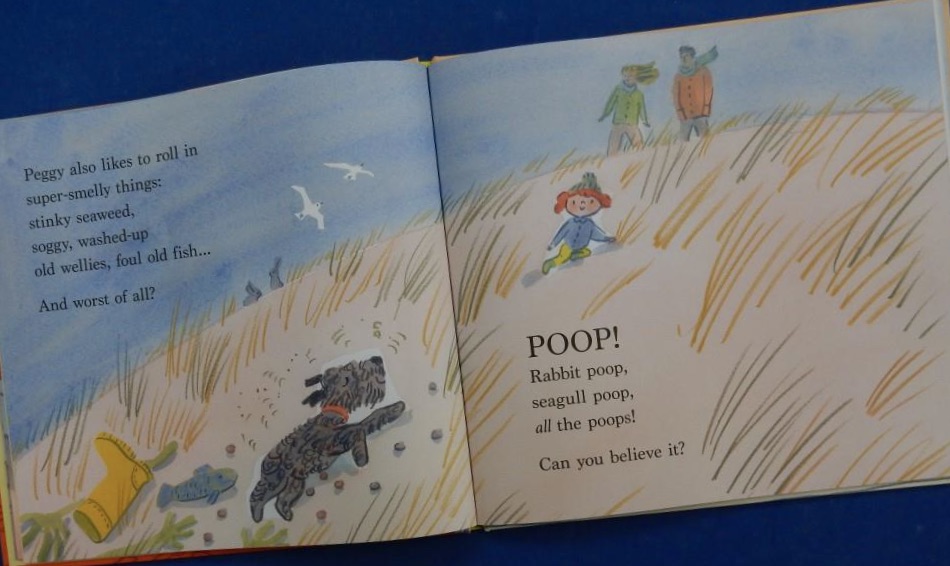
Super-smelly things are one of Peggy’s predilections, the worst of all being poop.

She’s not fussy what kind; so long as it pongs she’ll roll over and over in it. PHOAH! Imagine the mess and the stench when they get back home and she has another roll about; this time on the rug and Pie’s pjs.

As you might expect, Peggy detests having to have a shower and gets her own back by giving herself a very vigorous shake to get rid of the water once her paws are back on the floor.

Despite all her flaws and mischief, Pie and her parents cannot help but love their pet but there are times when the powerfully malodorous emanations from her rear end are well nigh unbearable.

Now I’m no pooch lover, in fact I’m a cynophobe but I can quite see how beguiling Pie’s Peggy is. Helen Stephens’ portrayal of this family pet is at once funny and tender and her tale is one that will endear Peggy to readers, rescue dog owners especially.

Natterjack Toad Can’t Believe It!

Most of us have a favourite snack and so it is with Natterjack Toad. As the story opens he’s languishing among the reeds in his hammock anticipating tucking into his packet of Chocolate Chunk Crunchy-Munch cookies. Mmm! they do sound delicious.

They’re mine! thinks Natterjack Toad, ‘And this hidey-hole is just the place for munching one up.’ Out comes a cookie, out comes NT’s tongue in preparation for a yummy taste but along comes a huge heron, beak at the ready. Now our Natterjack friend has no intention of becoming the heron’s next snack so back goes the cookie and off he goes at top speed.

His next stop is the meadow with its long grass and summery flowers: the perfect spot for a nibble. Out comes a cookie, open-mouthed, NT anticipates that choccy flavour but once again Natterjack Toad ‘CAN’T BELIEVE IT’. Right beside him is a whiskery weasel with mouth wide open.. Uh-oh! Back in the basket goes the cookie and away ‘quickety-whip’ goes Natterjack Toad destination the forest. Surely here in a cool hidey-hole he’ll be undisturbed. Or maybe not.

As he’s about to consume his treat, right beside him appear a mole and a vole. Will Natterjack Toad heed their words of warning regarding a huge hungry marauding animal? There comes that open mouth, that ready tongue and a mighty CRUNCH! Yikes! There before the three stands …

How will this tale end? Tasty treats for the large beastie or …

Deliciously playful, this dramatic tale is an absolute treat to read aloud. I’m not sure who will find it more tasty, the adult sharer or the young listeners who will be on the edge of their seats, joining in at every opportunity as the story unfolds. Sean’s patterned text combined with Kathryn Durst’s hilarious scenes are a confection too good to miss.

A Fairy Called Fred

Fred is a fairy who works in the Department of Dresses in the Wish Granting Plant where the fairies respond to countless requests for ball gowns from princesses. He loves the job but he too has a wish – he longs to find a wish-mail in his tray. Joshua Reed is a little boy who longs to got to his friend Claire’s party but it has a princess theme and Joshua doesn’t have a dress. Off goes his letter to the Wish Granting Plant where top designer Bella hands Joshua’s request to Fred. Can Fred help? He’ll need to get busy right away, which of course he does.

Meanwhile Josh waits in hope and then to his joy there comes a knock on his window. The transformation begins and ‘fashionably late’ he arrives at Claire’s house. Wow! There stands a smiling boy in his awesome attire and shortly after there stands Claire with something for Josh.

For Fred though, it’s late; time for him to leave the party and return from whence he came. There waiting for him is a very special award for his very special design.

Celebrating diversity and being yourself, this magical reworking of Cinderella is a joy to read aloud and Josh in his dress with its sparkles and spangles is a joy to behold.

Betsy Buglove and the Brave Butterfly / Watch Them Grow!

Nature lover Betsy Buglove, she who saved the bees, returns for a new adventure. It begins as she and her best friend Stan are in the garden and a bee buzzes along with an urgent message about a butterfly that needs their help. They follow the bee next door and there discover the juice cups they left on the grass earlier and inside one a butterfly is trapped in the sticky dregs.

Having successfully extricated the butterfly, its wings soon dry and off it flies.

Shortly after a cry comes from Betsy’s dad. The leaves of his vegetables and flowers have been badly nibbled. Off goes Dad to get his bug spray leaving Betsy examining a thistle plant in the grass. Thereon, with the aid of her magnifying glass, she sees lots of caterpillars munching away its leaves. Caterpillars she and Stan soon find out, belong to the butterfly they’d rescued earlier on.

Can they persuade Betsy’s dad to leave a patch of thistle and other weeds for the caterpillars? Fortunately they can; but what happens thereafter?

Will it be another case of mission accomplished for team Betsy and Stan?

With Catherine’s jaunty rhythmic text where the rhyme doesn’t falter and Lucy’s scenes containing an abundance of flora and minibeasts, this is a book that’s just right for sharing with young nature enthusiasts, as well as to encourage those less keen (happily I’ve only ever encountered a few,) to find out what they’re missing. Everyone can do their bit to help insects.
At both ends of the book are fact pages about butterflies.

Author James Carter and artist James Munro have joined forces to present the life cycles of nine different animals starting with the Emperor Dragonfly and concluding with a human. Before these is an introductory poem inviting readers to ‘Watch them grow!’. Following the featured animals are a spread about baby animals names – young children will be amused to learn that it’s not only cows whose babies are called calves: so too are those of six other animals. And, the term hatchling can be applied to baby crocodiles, turtles, tadpoles and newts in addition to baby birds.
Then comes some straightforward information about axolotls; (these, unlike other amphibians never become adult; instead they retain their gills and remain in the water); and a paragraph explaining that male seahorses give birth to babies (fries, hundreds of them)

as well as some facts about parenting in emperor penguins, Australian marsupials and others.
All this James Munro has captured in his playful illustrations, each of which is a combination of reality and fun.

Gloria Goes For Gold / Albert and the Flood

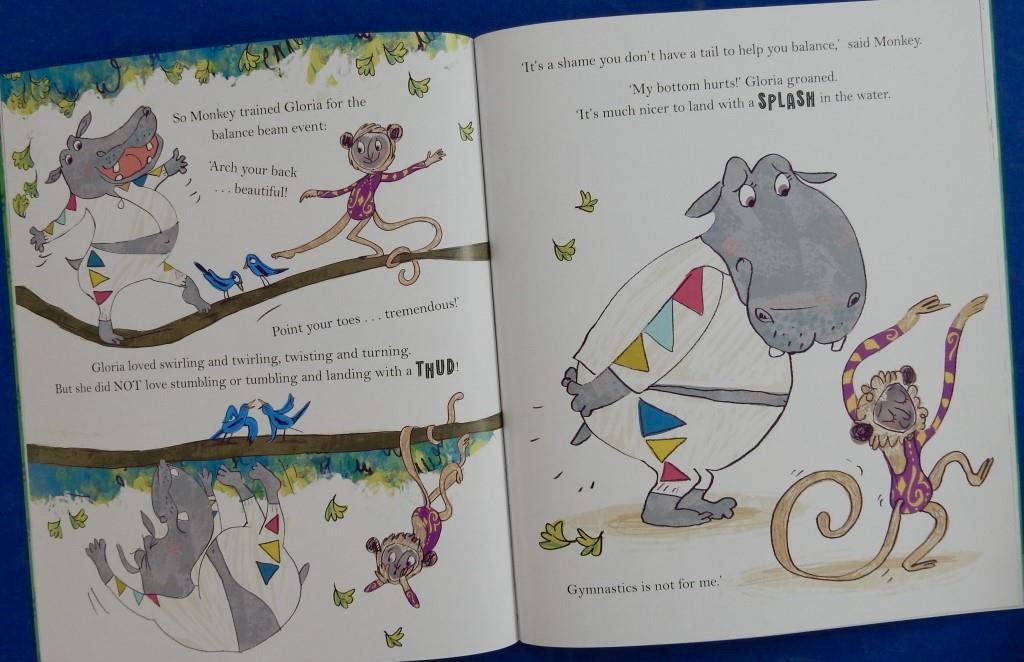
Of all the unlikely animals to be called graceful it’s Gloria the hippo and her family members, a champion- winning team of synchronised swimmers that always comes away with gold at the Artistic Swimming Championships. However Gloria is not as happy as the others about this: she longs for a prize she doesn’t have to share. Then comes a letter about the upcoming Savannah Games and Gloria decides to find a sport she can win solo. Off she goes leaving the other hippos to practise their routine and before long bumps right into sprinter Cheetah going so speedily she fails to see Gloria. The hippo decides she’d like to try sprinting and Cheetah offers to coach her. Pretty soon Gloria realises that this sport isn’t for her and as she sits beneath a tree contemplating what next, down swings Monkey. He makes gymnastics appear great fun but Gloria quickly discovers that she’s not cut out for being a gymnast.

Nor does she take to distance swimming. In fact she decides that after all, she’d rather be part of the family team; but feels too ashamed to ask.

The next day sees the start of the Savanna Games and Gloria tucks herself away among those watching the artistic swimming.

While so doing she overhears something her brother says to their cousin. Is there a situation that needs saving? If so, what should she do?

Priceless pictures by Annabel Tempest are for me the real winners in this book. No matters whether one aspires to be a solo winner or part of a winning team, it’s important for children to see that it’s participation and doing one’s best that really count the most and Marina Firth’s telling shows this in a fun, non-didactic way.

It’s a truly eventful day for Albert and his friends despite the sporting event Games Day being rained off. Actually that’s an understatement for it’s a thunder storm that is responsible for rescheduling of the Games, despite what the ant commander says as the rain starts. However the steady rain rapidly turns to a torrential downpour that causes severe flooding of many of the creatures’ homes. Fortunately Albert quickly starts leading a rescue mission, aided and abetted by Frog, a group of ants and some spiders.
Before long, Albert’s shell was packed with minibeasts, while others of the rescued found safety elsewhere.

Then suddenly the rain eases off and the storm clouds pass to reveal a glorious sight in the sky.
The ant commander makes an announcement that pleases most of the creatures; and then Albert too makes an announcement. Can you guess what he said: it concerned something of vital importance.

This is Albert’s seventh adventure created by team Ian and Eoin and it’s one that contains an important life lesson for young children. Eoin’s illustrations are very amusing and both adult readers aloud and their audiences will laugh at many of the scenes.

A Hat Full of Sea

Cora visits her Grandpa Jim during his stay in hospital; she wears the hat he’d given her every time she goes. His room there has only a small window, which Cora doesn’t feel is enough for him. She wants him to experience a variety of places and so using the hat, she sets out to help him.

First it’s the sea and with the help of her imagination, the girl catches ‘the cold-water ripples and the white foaming waves. … the softness of the sand and the seagull cries all wrapped up in the wind.’ Carefully she carries them to him and we see the water seemingly covering him like a blanket.

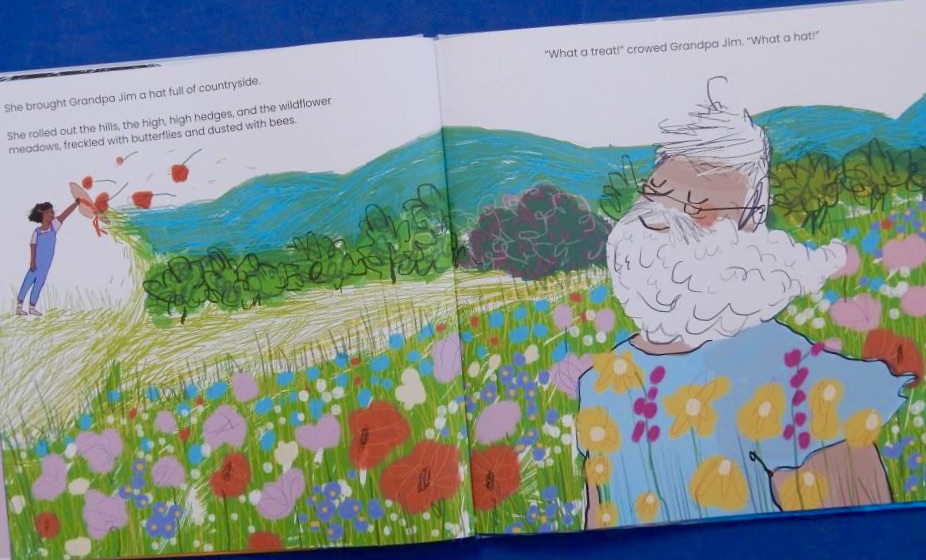
Next she takes him the countryside alive with flora and fauna,

then the thrills of a fairground and more including the beauties of a black velvet night sky.

Her best idea, Cora thinks, will be a journey but as she nears a train, she drops her hat. She’s heartbroken at not being able to find it , but when she visits the hospital again she can’t find her grandpa either; he’s not in the bed.

Happily though, he has recovered and is soon beside her telling Cora that it’s her, not the hat, that is special and cheered him up. Moreover he feels ready for a walk down to the sea.

I love the playfulness of Jen Khatun’s digitally created illustrations that are perfectly in keeping with Maudie Smith’s warm, equally playful text. A beautiful portrayal of inter-generational love that reminds us all how important it is to spend time with loved ones.

Can You Share Little Whale? / Zeki Eats Out

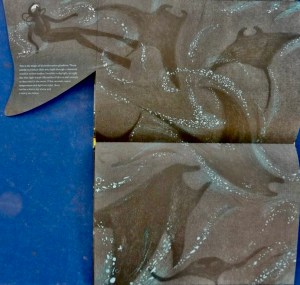
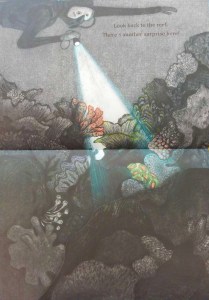
Little Whale doesn’t want to share: her place at the front of the pod has been taken despite Mum saying she can be the leader; then it seems that noisy gannets are taking all the silvery fish and leaving none for her to feed on. “It’s not fair!” complains Little Whale but then up swims her friend Blue offering to share a snack with her. This pleases her and she decides to search for something delicious to share with Blue. Down she swims towards to coral reef but is concerned in case she isn’t able to find a special something: suppose there isn’t sufficient, she worries. Happily though, Turtle helps her discover a reef burgeoning with treats aplenty,

more than enough for everyone and thanks to the reef’s inhabitants Little Whale is able to return to her pod with a juicy treat to share with Blue.

Again, however, Little Whale is upset for she finds Blue swimming alongside HER mum! “That’s my mum!” says Little Whale pushing her friend away. Mum scolds her, and reminds her offspring that “it’s always good to share.” Little Whale turns to Blue, confirming that there’s enough room for them both and together, they swim forward as friends.

It’s great to see Mum whale using gentle guidance rather than chastisement to help her little one learn the vital lesson about sharing. Jonny’s beautiful, detailed scenes of the coral reef are a particular delight and he captures so well the movement and textures of the whales and other marine fauna.
The life lesson Little Whale learns is an essential one for little humans to learn too: this story is an enjoyable way to make sure they realise that sharing is both important and brings mutual pleasure to those involved.

For slightly younger children:

The adorable Zeki, is going out to have lunch at a restaurant with Daddy and Nana-G. Accompanying them is Zeki’s Mr Seahorse so the little boy gives him some tips on appropriate restaurant behaviour before they set out.
Having greeted Nana-G outside the venue, in they all go and Bruno their waiter is there to serve them. The three consult the menu and make their choices of what to eat and then Dad and Zeki head to the washroom to wash their hands before the food arrives. Clearly an enjoyable time is had by all.

Equally an enjoyable time will be had by adults and the little ones with whom they share this latest episode in the life of my favourite story book toddler. It’s simply told in Anna’s straightforward prose which leaves Ruth’s spreads to portray the warmth of the love between Zeki and his family members.

Waiting for the Stars

Mouse is super excited: she’s staying up late to see the stars for the very first time. Fortunately, for the wait feels very long, her friends Owl, Firefly, and Squirrel are there too. To help pass the time Owl offers to tell them a story but she nods off leaving her exceedingly lengthy tale unfinished. No matter, Mouse has spotted a star, or rather, she hasn’t but the excitement has made her need a wee

and soon after, very sleepy, until hurrah! At last! There are the stars filling the sky with sparkles; but only briefly.

Along come thick clouds causing tears to start falling from Mouse’s eyes.
Happily however Firefly knows a way to fill the sky with magical sparkles once more …

Young listeners will surely recognise that eager anticipation felt by Mouse during the story, a story from which friendship shines forth throughout.

As always Jonny Lambert’s scenes provide visual delight at every turn of the page. The rich colours of the creatures and the surrounding vegetation really stand out against the night sky. A charming tale to share with young children at bedtime but also one to read aloud and talk about in a foundation stage setting.
The Great Henna Party

It’s the eve of Noor’s cousin’s wedding and the women of the family have gathered to sing traditional songs and have henna (also called Mehndi in Urdu and Hindi) designs applied to their hands for the big day. Meanwhile Noor’s Baba (Dad) has been busy decorating the garden with lights and string of flowers. They shimmer like treasure, Noor thinks.

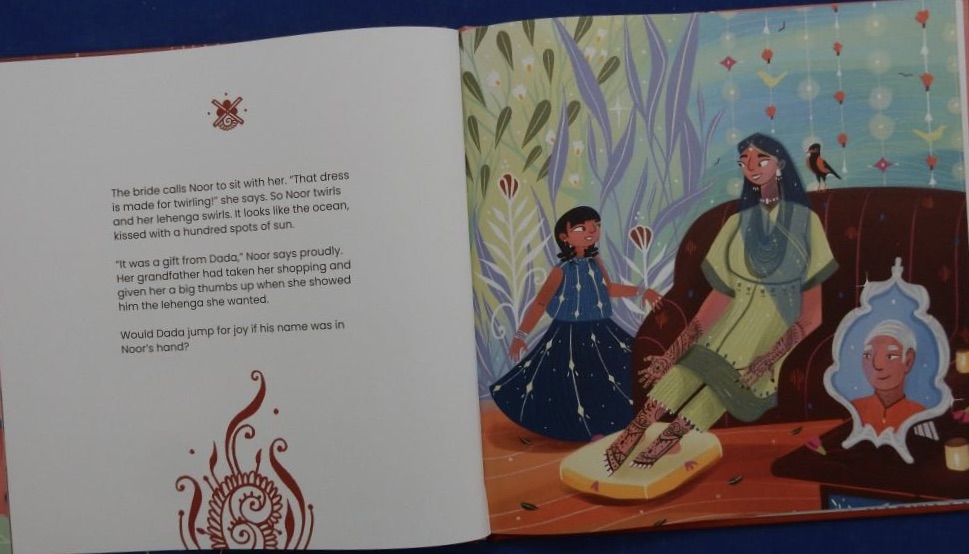
At the henna party Mama tells Noor about the ‘henna name game’ in which the henna artist hides the groom’s name in the intricate patterns she applies to the bride’s hand and the groom has to try and find it. Noor likes the idea of this henna game and asks her mother if she can hide someone’s name on her hands too.  Mama agrees but her daughter can’t decide which of her treasured family members to pick.  As the party proceeds Noor wonders if it should be one of her parents, her Nana or Dada (grandfather)

or perhaps her big sister. As the party draws towards its close, Noor suddenly has an innovative idea and when she sees the result of her choice, the girl declares. “It’s perfect!”

This is a truly delightful celebration of family and of culture that thanks to the details – verbal and visual – both author Humera Malik and illustrator Sonali Zohra have included, will be accessible to all children, not just those who are familiar with South Asian cultural traditions. I love the warm colour palette and richly patterned illustrations Sonali has used. (A final author’s note giving more information about henna is included.)

A lovely book to share with KS1 children. It’s sure to result in much discussion both about this story and perhaps weddings more generally.

The Invisible Story

On a shelf, hidden away in a corner of a large library is a book that’s unlike all the rest. They would sometimes spend time arguing about which is most read, or best loved; but the ‘Invisible Story’ listening from the shadows has never been read. It longs to be colourful and popular like the others. “I’m just a ghost, nobody can see me.” it chants over and over.

Then, one day a young girl visits the library; she runs her fingertips over the spine of the ‘ghost’ book, discovers tiny raised dots. and announces … “I’m going to read.” The alarmed book begs her not to, saying that its pages are blank. However the girl’s gentle voice calms the book and it goes on to discover that it is in fact a very wonderful story indeed, a story written in braille, “the language you read with your fingertips’.

The invisible story now realises that no one story is better than any other, they are just different.
Translated from the original Spanish by Daniel Hahn, Jaime Gamboa’s inclusive tale is a reminder that not every book is intended to be read with the eyes. It also contains an important message about the power of a great story – the best books can be read over and over; they never really end.

Wen Hsu Chen’s watercolour and cut paper illustrations work in harmony with the text and are really effective, be they wholly white, predominately white with small splashes of colour or where the colour predominates.

For those readers who are blind, partially sighted (or dyslexic) the publishers have collaborated with the Royal National Institute for the Blind and accessible formats are available from RNIB Bookshare.

My Momo-la is a Museum

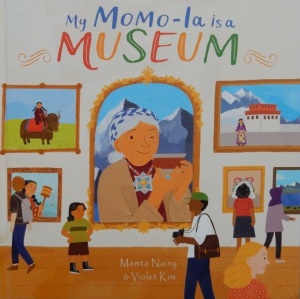
When Momo-la comes to visit every summer, she shares her precious mementoes and her life stories, one every night, with her granddaughter, the narrator of the book. When she asks Momo-la where all her stories come from, she responds, “Stories are everywhere,” and offers to show her granddaughter.


The following morning they head out into the city noticing such things as wildflowers and wormholes, things the child mostly misses. They visit first the Museum of Ancient History, which is full of artefacts, followed by the Museum of Art. There the girl points out that a painting depicts a woman wearing a jacket with a design like the one on Momo-la’s chuba (a traditional Tibetan apron).

In fact wherever they visit, the girl sees something that reminds her of Momo-la, who has a special story from her own experiences to tell about each one.

After a tiring but wonderful day the two return to the child’s home, where she stands her grandmother before a mirror and makes an announcement: the most important museum of all is there right before her eyes. …”A museum that will always feel like home.” And what a wonderful storyteller she is.

A memorable, heartwarming story of intergenerational love, family, culture, memories, treasures and most importantly, stories. It’s a powerful reminder that grandparents, parents and other family members are treasure chests of stories, stories that they love to share if we give them time to do so.
Indeed each of our lives is a story, or perhaps stories within a story. At the back of the book, the author, Mamta Nainy, has written a letter telling how her grandmother had a wooden box full of special objects that went everywhere with her; objects that told stories about her family and their migration to India after partition. She also talks of ways Tibetan refugees in a settlement in New Delhi try to keep stories of their home alive.

The book is beautifully illustrated by Violet Kim who brings the story of the girl and her Momo-la to life in densely coloured, detailed scenes. If you share this with a primary class, perhaps some of the children might ask their own grandparents in to share objects and associated stories from their lives.

The Rainbow Flamingo

Adele the flamingo is desperate to be like her pink contemporaries, indeed she appears pink from the outside but within are colours she has great difficulty hiding – rainbow colours. With the annual Flamboyance fast approaching, having without success upped her diet of shrimps, Adele is sick with worry. This year her class is to give a dance display and poor Adele is sure she won’t be able to hide all her colours inside. Making excuses to leave the practice, she goes home feeling totally alone. There she summons her courage and goes to find her mum; but mum flamingo is too busy with her culinary activities to pay heed to her daughter’s approach.

Off goes Adele in search of something to consume that might make those feathers turn pink. The outcome of her hunt is a colour change but now to Adele’s extreme concern, she is green all over.

Then she spies her mum and tries explaining but her tears speak louder than any words. However, once home again, she’s finally able to confide in her mum. No more hiding for Adele, especially the following day at the Flamboyance. With her eyes on mum’s proud face, the little flamingo joins the other dancers, breathes deeply and opens wide her wings, dancing and prancing in her full glory.

Who do you think is the winner of the crown? It turns out that some of Adele’s friends have hues of their own too.

With its empowering, motivating message, ‘don’t be afraid, wear your colours with pride.’ Catherine’s rhyming text and Claire’s suitably elegant illustrations convey Adele’s mounting anxiety splendidly. It takes lots of courage to be yourself, as the young flamingo finally did, but trying to be somebody you aren’t will never make you happy.

Definitely a book to share and discuss in KS1 classrooms as well as at home.

To the End of the World, Far, Far Away

An accidental spillage by little bear, Louis, makes Mum a bit cross. Louis cries and decides it’s time he headed off, far, far away right to the end of the world. With bag in hand, he pauses, turns to Mum and asks, “Will you be sad when I’ve gone away?” Mum then goes into dramatic mode, describing how her tears will create a great sea, wherein the waves will ask about her sadness and then transmit her words to the marine creatures.

She’ll then climb a tall mountain atop which she will beseech the wind to help her in her search. The forest trees she visits will carry her distressed message to the creatures there.

Will that exhaust all her sadness, Louis wants to know. But no, even his own toys will start to cry for nobody will be there to tuck them up and hold them tight at bedtime.

By now readers and listeners will have realised that Ronda Armitage’s dramatic “going away” tale is showing the depth and breadth of motherly love enacted in a kind of game that both parties thoroughly enjoy playing. Who better to illustrated this than Victoria Turnbull whose scenes are filled with wonderfully whimsical details at every turn of the page, while the changing expressions on the faces of the two characters are a delight.
Like this game that’s likely played over and over by its protagonists, the story too will be oft requested by young children and read aloud over and over by parents and other adults.

Does A Bear Wash Its Hair?

In this sequel to Does a Monkey get Grumpy? author Moira Butterfield turns her attention to animals’ daily routines. You may well be surprised to read that many animals – certainly the fifteen featured in this book – devote a considerable amount of their time doing the same things we humans do, although they don’t go about them in the same way. They are nonetheless, creatures of habit.

Whereas we humans normally use soap and water to keep ourselves clean, brown bears lick their fur, slurping up whatever is attached to it, sometimes tasty bugs, so they get a reward as well as a wash. Certain fish including green moray eels visit coral reef cleaning stations where cleaner wrasse nibble off unwanted bugs and flaking scales: a win/win process.

Did you know that decorator crabs dress themselves up with bits and pieces from the ocean, these they stick onto tiny bristles on their shells, the intention being that so disguised they won’t be easily preyed upon by hungry enemies.

Young readers will be amused to discover that young meerkats have lessons – hunting lessons where they learn how to bite off a scorpion’s sting. Before swallowing a scorpion though, they roll it in the sand to rub off any poison.

Poo is a topic that seems to fascinate most young children and I suspect they will laugh at the thought of a sloth descending from its tree once a week to take a ‘big poo’ excreting a third of its body weight. Having made a poo pile, sloths then need to bury it to prevent enemies discovering where they live.

Tidying,

co-operating, making friends, teeth cleaning, eating meals and sleeping are habitually done by animals of various kinds.

All these are described in Moira’s bouncy rhythmic text (with additional factual snippets) and illustrated in Adam Ming’s amusing scenes making this a really fun way of teaching children the many similarities between humans and other animals..

The Legend of the Wild West Twins

Imagine a Wild West where every one of the inhabitants is a child. That’s the setting for this cleverly written adventure starring twin sisters Buffalo Lil and Buffalo Jill. The former is said to be the hardest ridin’ … fastest knickerbocker glory-guzzlin’ gal in town; her sister, she of the sweetest smile is the sewer of the frilliest frocks and baker of the tastiest iced buns in the vicinity of Lone Ridge.

Lone Ridge’s claim to fame was its hosting of the wildest cowboy contest in the West: the Rip- Roarin’ Rumble and for the first time, Lil has decided to enter. What will happen when she comes up against Lone Town’s hero Yee-Haw Jack, he with a reputation for long distance lasso-ing feats, acrobatics in the saddle and bucking bronco saddle sitting that’s almost unbelievably long lasting?

Into town rides the young guy certain he’s about to win the Rumble once again but Lil isn’t going to let him do so without giving it her all. Moreover, Jill has her back and keeps her beady eyes on Jack from the off. Pretty soon her suspicions start to arise.

Come nightfall she goes out to investigate and it’s evident that Jack is no hero, he’s a ‘low-down cheatin’ rattlsnake.’

Is it possible that by co-operating, the twins can expose Jack and his dastardly ways.

High octane humour with a plot that twists hither and thither, celebrates difference and demonstrates that honesty and being true to yourself are what matters most, whomsoever you are. Katie Cottle’s pictures have a potency all of their own and provide the perfect complement to the text.

Bear vs Dragon

This is a rib-tickling tale of a stand off on a bridge, a very rickety bridge over a rapidly moving river. The two animals involved are both large and both are determined to be the first to cross to the other side. From the moment both Bear and Dragon are standing on the bridge, children (and adult sharers of the book) will notice the creaking and cracking sounds coming from the wooden construction indicating disaster for the foolhardy pair.

As their self-aggrandising dialogue proceeds, Mark Chambers’ splendidly droll illustrations capture to perfection the body language of the speakers until eventually, following a barrage of verbal insults,

the inevitable happens sending the protagonists hurtling downwards into the ravine and they SPLASH into the rushing water.

Happily they are not swept away; rather what follows is a highly precarious ascent to safety

and the forging of a powerful bond of friendship.

Young listeners will painlessly absorb the important messages about seeing something from another’s perspective and the power of co-operating.

A cracker of a book to read aloud and discuss in Foundation stage and KS1 classrooms and at home.

The Ballad of Cactus Joe

Cactus Joe is ‘lean ’n’ mean’, and every night he happily sings all alone in the desert. Until that is, along flies a woodpecker. Using its persuasive powers the woodpecker exhorts the cactus to let him live on one of his branches and a deal is struck. However, despite what Joe says to his lodger it does not remain ‘Just Woodie and me / till the day I die.’ All manner of birds start making overtures to the erstwhile loner: first it’s an owl,

then a hawk that nests, followed by more and more that flock to stay on Joe. By now our spiky plant has earned a great reputation as ‘the place to stay’ but Cactus Joe has had enough. “Go away!” comes his order and they all take flight leaving Joe on his lonesome once again.

Surprisingly to our protagonist, it’s lonely sans the companionable sounds of his chattering congregation. However that isn’t the only surprise; another is forthcoming thanks to Woodie et al.

This rhyming tale of adapting to different circumstances and being open hearted is, with its surprise ending, huge fun. Clive McFarland’s characterisation of the cactus is wonderful: I love his bright orange colour pops especially that hat and bandana.

The final spread gives information relating to Cactus Joe being a saguaro cactus, a kind only found in the Sonoran Desert of Southern Arizona and northern Mexico and the animals likely to be found near to such a cactus. Share with individuals or a class: there’s plenty to talk about.

Wowzers!

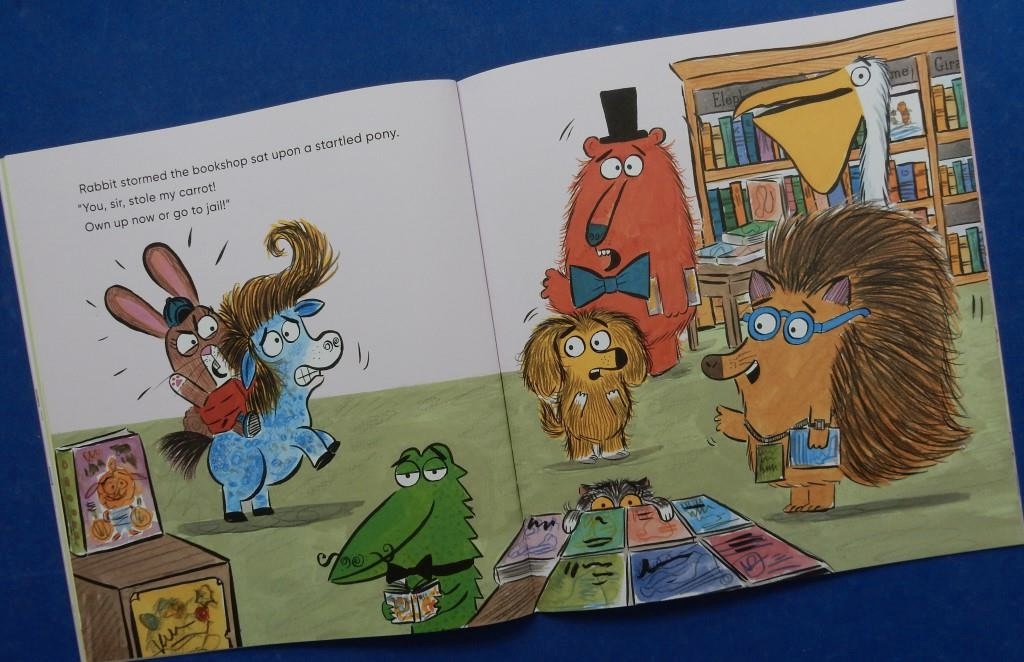
Rabbit has been saving up to buy a new car. When he finally has the money, off he goes to the garage and there purchases a snazzy blue sports car. Away he zooms to show it to his pals, the first being Bear. But within minutes our lapine character is suffering from digger jealousy, fire-engine envy,

sailing boat begrudgement and more. Each time he sets eyes on a means of transport he considers superior to his own, back home he goes and adds something extra before setting out again to show off his ‘perfect’ car . Seemingly though he’s thwarted at every turn of the steering wheel.

Eventually considering himself the proud owner of the BEST vehicle around, Rabbit zips through the countryside

eventually reaching a bridge where his friends call to him to stop and assist with a rescue. What will Rabbit do, whizz past completely ignoring the pleas of his pals or will friendship prevail?

Young children will love joining in with the ‘WOWZERS’ and ‘VROOMs of Lou Carter’s rhyming narrative as they follow the zany modifications Rabbit makes in his endeavours to impress, which Magda Brol depicts in her zany scenes. With important messages about learning to be content with what you have and friendship being way more important and satisfying than belongings, this is a story to share and talk about with foundation stage/KS1 children.

HELP! Ralfy Rabbit and the Great Library Rescue

This is Ralfy’s third adventure and he has a mission. When he and his little brother Rodney visit the library, their favourite place, they are devastated to discover that everything has been cleared away. Miss Page the librarian tells them that because there aren’t enough people using the library nowadays, it is to close the following day. “It would take a magic dragon to save it now,” she says sadly.

Taking her words literally the rabbit brothers round up all their book-loving friends and before long they’ve got all they need for their dragon search.

Off they go, first stop the zoo where they speak to zoo-keeper Mr Dung, who on hearing the news , realises how much he needs the library. So too do all the other people Ralfy and Rodney talk to: the doctor,

the sweet shop owner, and many others are horrified at the imminent loss of the invaluable resource.

Back home go Ralfy et al feeling utterly dejected and next morning they walk, equally sadly, to say goodbye to the librarian. What do you think they find?

Emily’s illustrations are full of details that will make both young children and adults smile and the characters’ expressions speak volumes. Together with its vital messages about the importance of a library in the community and the role everyone can play to bring about change, this is a story to share at home, in the classroom and of course in libraries – long may they survive and flourish.

Ranger Hamza’s Eco Quest / Brown Bears

It’s great to be back in the company of Ranger Hamza and here he takes three children and readers on an important learning journey to discover how nature’s everyday heroes from the smallest seed to the tallest tree play a crucial role in our ecosystem, and how we also have a vital role to play. It’s not difficult and Ranger Hamza explains in straightforward steps some ways to help the planet, starting with the making of a mini water butt.
I loved the adjectives used to describe lichen, of which there are three types. In addition to providing food and shelter to tiny creatures, lichen acts as an indicator of the air quality in an area: lots of lichen indicates the likelihood of low pollution, so next time you walk with children keep a watch too see how much is growing.

One thing virtually everybody will notice is dandelions; rather that pulling them up (even from your garden), leave a place where some can grow. In so doing you will be helping several kinds of insects. I know from experience that children love to plant sunflower seeds and watch them grow: this is a great way to provide food for birds, so long as you keep the heads, let them dry out and then put them somewhere birds can access.
These are just some of the suggestions in this thoroughly engaging, inclusive book. It’s never too soon to start teaching children about ways they can help nature thrive so I suggest adding a copy to your family bookshelves, and foundation stage/ KS1 teachers, you need one in your classroom: it offers an abundance of forest school activities.
Another highly effective narrative non-fiction book is

Set in Alaska, USA, this tells the story of a mother brown bear and her two cubs, one male, one female that we follow through a year in the forest. Therein lie dangers aplenty so, almost as soon as they are born, the mother bear starts teaching her offspring survival skills in order that they will be able to live and thrive alone in the wilderness.
The cubs learn to climb, to leave scents to inform other bears where they’ve been and to remove bugs from their skin. It’s dangerous for bears to stay too long in locations where people have left discarded food, as this can endanger both humans and the bears that have followed their noses. Much better is picking berries and foraging for nuts in the meadows and forest areas, which is what the cubs do come the autumn to build up a layer of fat to help protect them through the winter when hibernation prevents them from eating.

Come the snowfall, mother bear builds a new den wherein they will all spend the winter, in the warmth trapped by the tree branches covering the tunnel’s entrance.
After a whole seven months the mother wakens as do the cubs, the light hurting their eyes after so long. Then it’s out into the melting snow to start feeding again and come the summer part of their food will be salmon that have come to lay eggs in the gravelly rivers. Danger isn’t over however; indeed it comes in the form of a massive, very hungry male brown bear; but thanks to the cubs’ climbing skills and their mother’s warning sounds, the three remain safe and as autumn approaches again, the male cub will leave his family and go in search of a new home
Beautifully illustrated and captivatingly written, (with paragraphs of additional information to enjoy either during or after reading the main narrative), this is perfectly pitched for KS1 children.

No. 5 Bubblegum Street

Translated from the original Polish by Scotia Gilroy, this picture book takes readers inside the apartment building at No. 5 Bubblegum Street. It’s five pm we’re told by our tiny, friendly insect narrator, who lives in the top floor apartment, number 11.

One by one, we are introduced to the residents of each floor, the first being Mouse, a famous rapper preparing to go out. Mouse is frantically searching for his hat to complete his outfit. Apartment two is home to some monkeys and we join them in their kitchen as they bake a delicious “speckled orange orangutan cake” Apartment three, owl’s residence is currently empty; all we see is evidence that Owl enjoys games of different kinds.

There’s also Cat, lover of birdsong; Panther who is mad about house plants, a family of spiders, musicians all, a slumbering Hippo,

frogs, a sculptor dog and Bat ready and willing to share a twenty one move dance routine.

Come 6pm all these neighbours meet on the rooftop terrace where they each contribute their particular talent to a party and a great time is had by all.

This will appeal to children who enjoy poring over detailed illustrations, especially of the quirky kind. Full of movement and joyfulness, Gosia Herba’s, executed in bright pencil colours, are certainly that.

Adnan

Ten year old Adnan and his mother had to flee their home country of Syria and are now safe in a new home in the UK. However, following the trauma, with both his Dad and sister having lost their lives in the war, Adnan’s mother is struggling with depression . Now though the boy embarks on a different kind of journey: to help his mother remember their lost loved ones and in so doing, gradually heal and start to build a happy new life together. He’s hopeful his plan will work as he begins collecting discarded materials from around the city and using them to recreate some of both the happiest and heartbreaking memories from their previous life – essentially story telling in three dimensions.

It’s not an easy undertaking but Adnan perseveres.

As he builds we learn of the traumatic boat crossing the two made and how his brave mother saved Adnan’s life when he tumbled overboard. We also perceive how much she means to him through the everyday things he dreams will soon become realities: all these things he puts in his notebook. A notebook that becomes a turning point for Adnan’s mother: a place from which to begin their life’s new adventure in a new home with a new purpose.

This is wonderfully portrayed in Diala Brisly’s illustrations.

I found this book particularly poignant as my partner and I befriended a family of refugees from Syria a few years back and then others from different parts of the world; but it’s equally pertinent now in the current climate with ever more people seeking refuge in our country and the less than positive reception many are sadly receiving. Happily however there are amazing people like the authors of this book who have given so much time, energy and love to helping refugees and other children lacking resources.

This story will one hopes, spark discussion and help to change negative attitudes towards asylum seekers. For every copy sold a donation of the book’s cover price will go to the charity Choose Love and the authors are both donating half of their royalties to the same charity.

Pearl and her Bunch

Pearl is a member of a very large family of grapes so she thinks, but one day a passing child stops and what he says, precipitates a revelation from Mama and Papa Grape. No, Pearl is not a grape, she’s a pea, albeit a much loved one, but what she’s been told makes her feel as if the grapes aren’t her real family; she’s the odd one out. Shock horror!

Off she dashes, tumbling to the floor where she finds Carlos carrot, her best friend who asks her what is wrong. As the two talk, there comes a loud sobbing and it’s coming from a large yellow fruit. Thinking Big Yellow Fruit must be lost, the friends take her to look for her family.

They hunt high and low till there comes a call, “Grace! Grace!” It’s her mama but to Pearl’s surprise Grace does not look like the others in her family.

Carlos then takes Pearl to meet his family and there, thanks to his responses when she’s astonished by their appearance, she reconsiders her ideas about what it means to be part of a family. “You don’t have to look the same … you can just feel it when you’re with family.”

Those were Carlos’s words but now they are ones that she too would endorse, especially when she receives a very special group hug from the Grapes on her return to ‘her bunch.”

Light-hearted in approach yes, but identity and celebrating family, the topics Momoko Abe explores are topics most of us feel deeply about.

Excuse Me, Are You a T-Rex?

Rather than a case of ‘Look out, he’s behind you, this is an instance of ‘Look out, it is you.’

Soon after a little dinosaur emerges from its egg, it meets a host of other tiny dinosaurs all huddled together. “Have you heard? There’s a T-Rex in town!” shouts one. Unlike most of the other little dinos. this one is not scared at all. Rather, it embarks on endeavouring to find this bus sized creature with its vicious jaws and claws.

How to go about this is not difficult; it merely requires asking anyone and everyone you meet: “Excuse me, are you a T-Rex?” This question is directed first at what we discover is a Chindesaurus.

Having asked almost a dozen others politely,

including one standing atop an enormous pile of poop,

and journeyed through millions of years, our determined little dinosaur still hasn’t met that which it seeks.
Why could that possibly be, I wonder.

In my experience, small humans can never have too many dinosaur books. Using a narrative non-fiction mode this one is cleverly and amusingly done, with delicious dino. expressions and timelines, and will surely appeal to young children. A fun read aloud that gently informs.

Christopher’s Caterpillars / Maisy Goes for an Eye Test

While working in the garden with Posie, his best friend and fellow football lover, Christopher Nibble hears a strange munching crunching sound coming from his dandelions. It’s six hairy caterpillars feasting on his prize plants. What should he do? Certainly not let them continue eating his plants. Posie suggests they keep them as pets.They compile a list of possible needs and off they go to visit Mr Rosetti at his café. He amends the list and gives them some caterpillar keeping advice. The caterpillars munch and grow bigger and bigger until they’re no longer in their container.

The friends make some “LOST! ‘ posters and paste them all over Dandeville but nobody has seen the caterpillars. Then comes an email from Mr Rosetti, telling them to bring the jars that had housed the caterpillars to his cafe for inspection.

What do you think they discovered in those jars? Is it time to make some new celebratory posters.

With some lovely descriptions, this delightful story captures the wonder of nature and a life cycle especially well. Children who have already experienced the joys of keeping caterpillars may wonder why Christopher and Posie failed to notice the chrysalises in their jars.

The book concludes with two spreads of relevant information – Caterpillar Facts and How to Care for Caterpillars. If you missed it the first time around, (or if your original copy has been read to pieces) this book with its funky mixed media illustrations is one for sharing with young children either at home or in a foundation stage setting.

In this 23rd Maisy First Experiences story, young children join Maisy and her friend Ella when they attend the opticians to have their eyes tested for the first time. The reason for the visit is that Ella has trouble reading the number symbols written on the nursery blackboard. On arrival they sit in the waiting room until Flamingo, the optometrist is ready: Maisy goes first and is able to see everything whichever eye she uses. Not so Ella though; the optometrist uses her special machine to look right inside Ella’s eyes and promises to make some specs that will be just right for her eyes. Then with Maisy’s help Ella chooses some frames, the lenses are inserted, and she’s given a case to keep them in. Maisy selects a pair of sunglasses to wear in bright sunshine and with a promise to return for a check-up in a year, off they go , both sporting their new glasses.
This upbeat, reassuring story will help prepare little ones for their first visit to the optician.

Supersaurus: Total Tricera-Flop!

Supersaurus is something of a disaster when it comes to saving the day. Smalltown’s ice cream seller, Dan’s residence catches fire during the jamboree and with the assistance of his sidekick, Hatch, Supersaurus hurls the fossil-flinger at the roof extinguishing the flames but wrecking the roof. The duo then notice moggy, Mr Tiddles stuck in a tree. Chaos ensues as they rescue the cat but flatten Dan’s ice-cream van, leaving its contents wide open to thievery in the form of Burglar Gran.

Supersauarus attacks the burglar with his T.rex trap causing cake to fly every which way and ice cream from Dan’s van to squirt forth all over the place super speedily. Just as Supersaurus is about to clear up the mess with his Bronto-Broom, the town’s mayor calls a halt and sends the duo packing. Only Hatch is aware of the impending fate of Dan’s van but he’s caught in a torrent of ice cream.

Can Supersaurus finally save this whole sorry situation once and for all?

Totally daft, Angela Woolfe’s funny rhyming saga of a muddlesome dinosaur and his disasters, is illustrated in suitably silly scenes of the inept superhero at large in the community. With its combination of two of young children’s favourite topics – superheroes and dinosaurs – team Woolfe and Chambers are surely onto a winner with this one.
Until You Find The Sun

Debut author Maryam Hassan was inspired by her own experience and children she has taught to write this poignant, affecting story.

Aminah’s life is a happy one, made especially so by the evenings she spends with her grandfather, Da, who while snuggled together on his charpai, tells her tales of adventurers who visited new lands and made exciting discoveries. Then one day her parents tell her that they too are going to set off on an adventure. At first Aminah is excited but then Da tells her that he isn’t going with them.
Saying goodbye to her beloved grandfather, brings Aminah to the brink of tears as she urges him again to join then. “I am always with you. You will find sunshine wherever you go,” he tells his granddaughter.

When their plane lands at their destination though, there’s no brightness, only grey skies and rain. The next few days continue to be sunless, bitterly cold and despite wrapping in several layers, Aminah still feels numb both inside and out. She feels out of place in her new school too

and despite her parents’ best efforts to cheer her up, the only warmth she feels is when talking to Da on the phone. How she longs to go back. Understanding Da reminds his granddaughter that her adventure is just beginning and promises to light her way until she finds some sun once more.

That seems more unlikely than ever as the days grow even colder, but then as she trudges along clutching her Mama’s hand, she suddenly spots something bright mango yellow that reminds her of home. Mama and Aminah go and make a special purchase, one that brightens up the day considerably.


The following morning Aminah opens her curtains onto a sight that seems to herald that adventure Da had promised her. Outside in the snow she meets a new friend and at last the cold doesn’t have that same dismalness. When next she talks with Da on the phone, he knows that Aminah has at last found her sunshine once more.

Having spend most of my teaching life in schools close to Heathrow Airport, this beautiful story resonates powerfully with me. The author captures perfectly those feelings of overwhelming grey so many children are beset by when they first arrive from parts of the world so different from the UK. Anna Wilson’s scenes in the early part of the book radiate warmth – interpersonal and climatic – as well as portraying the contrasting grey dreariness of Aminah’s new environment where she’s never experienced such cold. An important story to share with KS1 classes especially.
The Magic Garden Frog

Mamgu has a Magic Garden that she tends carefully. It’s a place her three grandchildren, Isabella, Elis and Macsen love to visit, especially enjoying all the different things that are round shaped.

One day while exploring, they find something new in the fountain; it’s a frog they name Suki. As the children watch her, the frog suddenly sticks out her long tongue and flicks it three times making something unexpected happen. The three children shrink and fall into the pond with a splash. The next thing they know is that they’ve become wiggly tadpoles, able to breathe under the water.

So begins a magical adventure during which as a seeming metamorphosis takes place, they learn lots of interesting facts about frogs, their lifecycle and their habitat, and sadly that frog numbers are declining.
After the story is a spread encouraging children to go outside and look carefully at the nature that is all around and perhaps create their own ‘Magic Garden’. It’s never too soon to start introducing young children to the wonders of the great outdoors and this story offers a good starting point.

Both the author and illustrator feel the book is a very personal project. The Magic Garden author Shann Jones writes about, is based on her own garden in Wales and the grandchildren characters are based on her own grandchildren, whose names she used for the story. Illustrator Hannah Rounding visited Shann’s garden and met the real Isabella, Elis and Macsen several times while creating her beautiful mixed media, layered artwork for the book.

Let’s hope their timely tale, seen in part from a frog’s perspective, encourages youngsters to become environmental activists in whatever way feels right for them.
(A proportion of the royalties from sales of the book will be given to the charity Froglife.)

A Better Best Friend

A red squirrel is thrilled to find a best friend while out for a walk in the woods one morning; it’s a mushroom named Pock and has a ‘real best friend face’. Despite not saying much, said mushroom seems willing to comply with the squirrel narrator’s desire to show him “things you wouldn’t show anyone except a best friend” : things such as puddles reflecting the sunlight and clearings with tall grass. Autumn and winter pass and the two stay close to one another doing seasonal things, but with the spring comes Moo.

Moo is a fly, a fly that knows some even better parts of the forest and now the three spend their time together, with Squirrel wondering whether perhaps Moo is a better best friend than Pock.
Now Squirrel has a dilemma. ‘I want ONE best friend. Not two!’ he declares. Then one morning along with the sun, Gunther (a mouse) appears. Again it’s a while before much is said.

I’m pretty sure a lot of thinking is going on though, especially by Squirrel before the declaration of ‘The (Better) End’ – I wonder: what do you think? It certainly works for playing cards as the final page shows but for a bestie? Hmm.

Translated from the French by Anthony Shugaar, Tallec’s playful, slightly surreal quirkiness, is evident in his scenes of the characters in this tale which is likely to leave many readers, including this reviewer pondering upon its open-ended nature – or perhaps that’s the creator’s intention.
Frida the Rock-and-Roll Moth

Frida is a moth: with her prowess at playing loud music on her purple guitar and her pointy boots she exudes funkiness. Despite constant encouragement from Auntie Edna, her number one fan, there comes a day when Frida feels anything but shiny. She even begins to think of giving up playing her purple guitar,

then suddenly there appears a big bright light and she sees a host of rock-and-roll moths that are dancing, singing and rocking. Eager to join them, Frida begins to approach them but as she gets closer, she starts to feel smaller. They all seem so much sparklier than her. Why can’t I be more like them, she thinks to herself.

Back in her room, Frida decides change is needed: boots, songs and purple guitar are all replaced. The following night at the Big Bright Light, Frida moves forwards again, but the same feelings start to worry her until she hears Auntie Edna’s words, “Go, Frida! You can do it! Your best self is always inside you!” So, she begins to play but to no avail: still nothing feels right. Alone again in the dark, she feels inadequate once more.

Returning to her bedroom, she is determined to change again and gives several possibilities careful consideration. Along comes Auntie Edna with a hug and some vital words of wisdom. Are those what is needed to empower Frida next time she visits the Big Bright Light?

With it’s delightfully quirky illustrations that show so well Frida’s feelings, and vital message about believing in yourself, Kim Hillyard’s tale will surely encourage young children to find their inner light and let it shine forth no matter what challenges they face: self belief is key.

Big Gorilla

Rarely I think, has so much artistry gone into a book of opposites as this one. From the cover, onto the title page and throughout the other spreads are show stopping portraits of primates. ‘What’s the opposite of old? asks the first sentence; turn over and there is the one word answer, ‘Young’ opposite which is a very small, pinkish coloured, thumb sucking infant gorilla. Sad, followed by happy are illustrated on the next two spreads, happy being portrayed by a blissful looking chimp holding a single flower. Then come heavy and its opposite, light, alone and together (observant readers will spot several intruders in the crowd.),

and BIG and small.

The next question is more tricky asking, ‘What’s the opposite of opposite?’ ’The same!’ comes the response with its illustration of a somewhat puzzled primate.

With a touch of the illustrator’s trademark surrealism, this is wonderful celebration of primates of all kinds, some of which followers of Anthony Browne might perhaps recognise from previous books of his. Exquisite illustrations of such wonders as orangutans and chimpanzees, not to mention the odd gorilla will delight readers of all ages.

Earnest Sandpiper’s Great Ascent

In this deeply heartfelt story we meet three young members of the Sandpiper family on the day they are, so their parents expect, going to learn to fly for the first time. Spur and Rouse are full of confidence; not so Earnest. Under their parents’ tutelage: “BREATHE… TRY… JUMP… FLY!” Earnest’s siblings take to the air; Earnest however baulks at the edge of the dune. “I think my feathers are too heavy for me,” he tells his mother as he looks for a second time over the edge.

Using her wing tip, Mum draws a heart shape in the sand, adding the promise that “soon your heart will glow like the morning clouds. It will shine with desire and belief. ” This magical glow, she assures him, is a sign that magical things are going to happen. Other family members further encourage Earnest and then leave him wondering if he’ll ever feel the glow. He climbs carefully up a piece of wood, breathes in and tries a jump but … lands flat on his back. From his supine position, he spies a yellow balloon floating above him with that same heart decoration his mum drew. Earnest follows the balloon across the beach till it lands in the sea and he follows his curiosity into the water but as the tide comes in, he finds himself entangled in the balloon’s ribbon and thoroughly afraid.

Happily, his family returns just in time, and their loving concern triggers that magical glow his Mum had spoken of, as well as Earnest’s self-belief. With those basic instructions in his head and a powerful SNAP! Earnest takes flight.

The author’s naturalistic paintings are superb, brilliantly expressive, making that plastic-looking balloon stand out against the natural environment, a meaningful message indeed, helping to make this a cautionary tale about the dangers posed to wildlife by balloons floating free, as well as a powerful story of believing in oneself.

The Spaceman

When the diminutive spaceman steps out of his spaceship on a mission to collect soil samples, his first impression is that the planet he’s landed on is pretty ordinary. That quickly proves otherwise however when he catches sight of a large red bloom. WOW! While he gazes at it, his spacecraft is stolen by a ‘thief that sprouted wings from its feathery sides’ (a bird). He gives chase but to no avail: he’s stranded alone and frightened on planet Earth, especially when he finds himself face to face with ‘a hideous beast’ as he stops to admire the next wonderful floral specimen. Off goes our explorer as fast as his feet will go until unable to flee further, he stops and sits atop a rock to ponder on his problematic situation.

In frustration at not being able to think of a solution, he stands up on the rock and is about to yell at the stars when he notices the night has ended, and with the coming of the daylight, the rich and diverse beauty of earth’s flora and fauna is revealed. Hitching a ride with a butterfly, the spaceman is totally enthralled by what he sees

but then he loses his hold and drops down into a pond where he floats gazing skywards. Along comes the ‘hideous beast’ causing the spaceman to realise that appearances in this instance were deceptive; he now describes his new canine friend as ‘a little unrefined perhaps, but charming nonetheless.’

Then as the two snuggle up together, the spaceman thinks of his responsibilities. A dilemma faces him: should he retrieve his spacecraft and return to his old life or make it impossible so to do?

A clever, rather formal, first person narration together with gently humorous, hatched illustrations that provide perspective, enriching the text, make this a book that when shared with children, will give and keep on giving. Initially they might merely enjoy it as a fun adventure for the little spaceman and then later come to appreciate the elation the traveller eventually feels at finding somewhere he feels he truly belongs.

I Really, Really Don’t Like Parties

When Dora discovers an envelope containing an invitation to Rashid’s birthday party at the bottom of her book bag, her heart sinks: she does not like parties at all. Mum insists it will be fun but Dora is creative thinking up all kinds of reasons why she can’t possibly go, even if her friends will all be there.

Mum is having no nonsense though and packs her off to the party.

Dora is right about it being a very noisy affair but does her best to participate in some of the games. Then comes the teatime announcement. Dora dives under the table and there to her surprise finds she’s not alone. Tom is already there and he’s tucking in to a plate of food which he shares with Dora: that’s two party haters and two new friends having a great time together.

Some time later Dora receives another party invitation. I wonder what her reaction will be to this one.
As a young child I would have been a Dora, though I probably wouldn’t have invented such wonderful excuses nor gone under the table and I know a number of children who feel the same about hectic noisy parties now.

Angie Morgan’s illustrations of Dora’s excuse sequence are both hilarious and heartfelt. She cleverly uses humour – visual and verbal – to convey a very important message: we are all different in our response to loud, busy situations and Dora’s feelings about them are perfectly valid.

Aqua Boy

Islander Aaron lives by the sea with his parents and elder sister, Angel. Mum and Dad are ocean guardians, volunteers performing a vital role in trying to keep the beach clean. His sister is at home in the water as well as on land and loving to plunge into the waves, she calls herself Coral Girl. Aaron would dearly love to do the same but he’s frightened of going under water. When he shares his fear with his Mum, she tells him that it will happen one day, “when you least expect it.” Dad is equally reassuring when Aaron joins him in the boat as they head out to check on the sea creatures.

That night a huge storm blows up and the following morning the beach is littered with rubbish. The ocean guardians set to work clearing it up, Aaron and Angel imagining ways they might ‘clean up the ocean for good.’

All of a sudden, Aaron spots an octopus, stranded, so Dad says, on the sandy shore. Dad entices it with a length of wood. The children watch as gradually the creature wraps itself around the stick and Dad wades out into the sea. Grabbing his goggles, Aaron follows looking right at the octopus, the creature looking directly at him as it slowly releases its hold on the wood

and swims free below the surface.

The boy then puts on his goggles, breathes deeply and immerses himself, watching the movements of the octopus. Once his friend has swum away Aaron stands up and there, fear finally gone, he is really happy and ready to embrace a new way of being an ocean guardian. He learns about the creatures he sees underwater, helps care for them and never stops hoping his octopus friend will return.

This timely, gentle tale of environmental guardianship with Ken Wilson-Max’s vibrant scenes that portray both family love and the vital role ocean guardians play, will one hopes, highlight to young children the importance of caring for marine life and ensuring that they play their part by taking their rubbish home as well as helping to keep beaches clean. A final spread gives some octopus facts and underscores the outcomes of ocean pollution.
Marley’s Pride / You Are Brave

It’s June and for Marley and for Marley’s grandparent Zaza, that means Pride month with its parades and other celebratory activities. Marley really wants to join Zaza at the festivities when they’re to receive an award for transgender advocacy, but with sensory sensitivities noise and crowds making the child tense up at the very thought, it’s a no go for the young narrator.
Come the morning of the parade, the child decides to give it a go after all. Into a bag go noise-cancelling headphones a fidget spinner and favourite lavender bunny and off go Zaza and Marley, the latter feeling very uncertain.
At the venue, just as things threaten to overwhelm Marley, Zaza’s reminder, “Pride isn’t just a big ole party. It’s about celebrating who we are, about community, and love” gives the child a boost of courage to go among the crowds. By the end of the day, Marley feels a part of that community with new friends

and a personal delight at belonging.

Author, Joëlle Retener’s telling is a celebration of Pride’s communal spirit brought wonderfully to life with DeAnn Wiley’s inclusive, splendidly textured, bold digital illustrations.
Backmatter comprises double spreads entitled the History of Pride, that includes paragraphs about sensory sensitivities, the other, with lots of definitions and explanations is called More About Marley’s Pride. An invaluable resource for primary schools especially.

‘Being brave does not mean you are not afraid. It means you are afraid, but you do the scary thing anyway.’ Inspired by Sofia Sanchez, a young actress and model who happens to have Down syndrome, that is the vital life lesson contained in this book.

‘Every day, says author Margaret O’Hair, we meet people who inspire us – people who are amazing at the things they do.’ Sofia Cardoso illustrates a guitarist, a vet, a pilot, a baker, a gardener and several others. Before they became amazing though, they had to make the ‘tough decision’ to try something new, which likely meant they had to be brave. This is something that needs to be learned like everything else and no matter what ‘being brave means doing something you want to try.’ Of course, success seldom comes at the first try, but that’s no reason to give up;

Inclusive and optimistic in tone, this is surely an encouraging invitation to challenge yourself, have a go and try something new. With its important messages, this is a book to share and discuss in primary classrooms.

Lola Loves Walks / Serena and the Little Blue Dog

Meet Lola, a furry creature with many loves, so author Jake Hope tells us: she loves kisses and cuddles, having fun with friends, snoozing in sunny places and her favourite of all, walkies, especially when her human takes her to the park.

She has a particular predilection for hide and seek. Paddling along beside the pond is another of her favoured activities and on reaching the bench, she hides to watch the ducks waddling past. Like pretty well, all pooches, Lula enjoys chasing and retrieving objects but thus far, we readers have yet to see Lola in her entirety.

This is revealed in a fun final twist that will amuse adult sharers (who may have guessed what’s afoot) as well as the children they read the story with.
Illustrator James Brown has done a splendid job creating thirteen richly hued scenes of the lively main character enjoying herself without giving the game away about her identity until the final spread.

‘Once upon a time a little girl called Serena lived in a cottage in the woods. She was friends with all the birds and animals of the forest. … But what she really wanted was a special friend of her own.’ : so begins a magic modern fairy tale. One day as she’s wandering in the woods surrounding her home, there suddenly appears a little blue dog. Not knowing at the time, that he’s magic, Serena names him Haiku. She takes him home with her and they become the best of friends. Haiku grows and grows until one day he’s grown too big for her house. Seeing her sadness, he asks what’s wrong. Surprised he’s able to talk, Serena tells the blue dog what is wrong and together they embark on an adventure that takes them over a mountain eastwards, over plains, into valleys and between fields to a distant castle to consult the wise woman. On the way Serena is given three stones – a green one from the mountain bird, a red one from a snake and a yellow one from a golden fish.
These, as per the sweet-voiced woman’s instructions, she places into her crown. What the woman tells her comes as a surprise,

but does it help Serena with Haiku and the size problem?

With its friendship theme Rosemary Clunie has created with striking illustrations and a longish text, a kind of modern fairy tale that can be enjoyed by solo readers as well as shared with young listeners, perhaps as a bedtime story read over several nights.

Big Bad Wolf Investigates Fairy Tales

Behind every fairy tale is a ‘what if ?‘. Behind all scientific discoveries also lies a ‘what if ?’. Bring the two together as author Catherine Cawthorne does here and the result is a really fun debunking of six of the most popular fairy tales by none other that the lupine villain of several of them.

First to come under his scrutiny is The Three Little Pigs and here, as with the others, he presents the story first and then on the next spread, proceeds to ask some somewhat crazy science questions. All this is illustrated in hilarious cartoon strip style by Sara Ogilvie. Readers learn that in fact, let alone not having hair on their chin chin chins, pigs don’t even have chins; it’s only we humans that actually have chins. As for a wolf huffing and puffing to blow down a house, even one made of straw: no chance there on account of having the wrong kind of lips. A whale would certainly do way better but then what would one of those be doing on land in the first place? Should little humans wish to test their own huffing and puffing, there’s a suggestion using a paper straw and a Malteser.

What about a gingerbread house: have you ever pondered upon what would happen to a gingerbread house in the rain? Probably not but courtesy of our scientifically minded wolf, you can try the gingerbread collapsibility test and find out.

As for that cunning pea test in The Princess and the Pea, the Queen devises to determine who is a real princess – it’s totally nonsensical: nobody could feel a single pea through all those mattresses. All you need to confirm this is a small Lego head (or a dried pea), all the pairs of pants you can find (don’t raid the dirty washing basket though) and a wooden chair. What fun – a Princess Bottom Pants Sensitivity Test.

Brilliantly quirky is the way Catherine and Sara have created this STEAM book that children will absolutely delight in. There are hours of investigative fun as well as hilarious retellings energetically illustrated by Sara.. Some of my family members tried out the huffing and puffing test and had great fun but came nowhere near the world record mentioned in the text.

A Sprinkle of Happiness

Told in rhyme by Lucy Rowland and pictures by David Litchfield, this story starts with a seed (nothing special at all) and a boy, kind, brave and smart. What should he do about such a seed, the lad wonders. A sprinkle of happiness, a pot together with ‘Some soil and some water. A bit. not a lot.’ That’s what he tells the seed and his Grandma, who is in agreement, so they do the necessary. Then each day they sit happily outside and before long, the seed grows a short stalk: ‘ … the best stalk I’ve seen.” Grandma says. As if encouraged by these words, the stalk continues to grow taller … and taller until it’s taller than the wall over which the boy and Gran see people walking miserably by. It’s clear, “A sprinkle of happiness. / That’s what they need!”

That happiness comes first to a lady who notices the stalk and sits down enjoying the boy’s smile and the view. Then, atop the stalk grows a bud. Kind words from Grandma and the boy make an old man and a little girl cheer up and so the two continue in this way. As a result the people and the seed grow happier, day by day until wow! That tiny seed has become a stunning sunflower.

A storm comes one night, snapping the sunflower stalk and scattering the petals far away. But seeds too have been scattered, all over town. Wise Grandma knows just what to say to cheer up the boy; but can happiness also grow anew? It surely can

and slowly, slowly sunflowers start to flourish everywhere in the town. Sunflowers that have grown ‘ … as a little reminder/ of how life can be when we’re all a little kinder. ’

A truly beautiful book to share at home and in classrooms, as well as any place where a little bit of happiness is needed.

The Hoys

ARRR! Me hearties! How many of you have ever wondered what a hoy is? No? Well, you are about to find out in this zany piratical tale.

When his friends call out ‘Ahoy There’ Pirate Jake is confused – what are these hoys and where can he find them?

His hoy hunt around the harbour proves unsuccessful so Pirate Jake goes on a very long and very miserable walk along the beach during which he argues with his parrot and having run out of beach, ends up at the bottom of a tall cliff. There, in the sand, he discovers a trail of strange- shaped footprints …

Now where might they lead, the two wonder and who do they belong to? They decide to follow them and see.

‘Ahoy there!” he calls on entering a well-concealed cave. Could this place contain the answer to Pirate Jake’s puzzlement; will he perhaps end up feeling like a true pirate at last?
Ho! Ho! Ho! To reveal the ending would make me a story-spoiler.

Mark Chambers’ bold bright art, some scenes bursting with fun piratical details, is perfect for Kes Gray’s crazy telling, which contains some smashing descriptive phrases. A thoroughly enjoyable read aloud and one to re-read come ‘talk like a pirate day’ this year’s being on 19th September.

A Midsummer Night’s Drama

The whole story is presented in three acts and includes a performance of Shakespeare’s A Midsummer Night’s Dream unlike anything you’ve experienced before. It’s penned, so we’re led to believe by a clever bear, Bill, residing in a treehouse with his friends Sir Bun Bun, Foxy and Lady Bushytail. The friends love to act plays at their theatre, The Glade and these attract large audiences from all over the kingdom.

There’s great excitement as Bill and his pals are performing a brand new play. Its entire cast comprises a fairy queen, a fairy king, Puck the cheeky sprite and Bottom. Various insects perform the duties of stage manager, set designer, understudy, and one looks after lighting and another is responsible for props. Its opening night constitutes Act 1. It’s a wild success,

which leaves Bill thrilled but over-excited.

Act 11 shows he is just that, unable to sleep in his cosy bed, his brain all a-fizz with ideas. Up he leaps and against his friends’ advice, begins working on another play until that is, in buzzes Queen Bee who speaks thus, “I COMMAND you to zzzzzzzsleep!” and buzzes out again leaving the acting troupe to offer sleeping advice.

Act 111 opens with Bill trying out some of the ideas proffered, the first being to dance, but to no avail.

Perhaps Sir Bun Bun’s suggestion will induce that much-needed slumber …

With appropriately dramatic illustrations by Isobel Lundie and Louie Stowell’s clever word usage both hinting at the story’s Shakespearean origins and background, this is a pre bedtime treat. Equally it’s enormous fun to share with a class and you can enjoy investigating the book’s final spread that presents some information about the bard himself, William Shakespeare, and his work. Make sure you look closely at the front endpapers too. I wonder what Bill Bear et al would do with Twelfth Night, my favourite Shakespeare play.

Bun on the Run

Starring Bernard the Bun, this is a delectably funny take on the traditional tale The Gingerbread Man. As the tale opens Bernard sits atop a display in the baker’s shop, a perfect confection of its kind. The thing is that Bernard has a yen to see life beyond the bakery and so down he jumps and off he sets only to be confronted with a drooling dog. Our quick thinking Bernard turns down the dog’s offer to tarry awhile with “You can chase, chase, chase, / you can run, run, run. / But you can’t catch me. / I’m Bernard the bun!” and dashes away. Almost immediately a moggy appears pondering on the possibility of a bun for tea.

As it pounces, Bernard dashes over the gate and into a sunny meadow repeating that same refrain.
His next potential consumers – two feathered creatures – receive similar treatment. Even when our adventurer is in terrible danger, he uses his wits to outsmart the black one,

lands safely and keeps running and running … and the story ends with a tasty final twist.

Child listeners to Smriti’s rhyming text will soon be rooting for Bernard and joining in with his repeat refrain as he hastens across the pages on his marathon dash. Chris Jevon’s use of a bright colour palette for the illustrations, together with the various background hues indicate the time of day as the tale progresses and readers will come to realise that our bun has been on the run for a whole day from early morning till sundown.

A nursery classic in the making this, methinks.

Guess Who’s Getting Dressed & Guess Who’s Going to Sleep / Lenny in the Garden

Hugely engaging, and tremendous fun are these two interactive lift-the-flap board books written in rhyme by Smriti Halls and zestily illustrated by Marta Altés.
On the first four spreads in Guess Who’s Getting Dressed little humans are invited to respond to a question and given a possible answer (not the right one). Parts of an animal are visible from behind the flap on each recto, sporting the article of clothing the question mentions. For instance the suggestion is that Reindeer is wearing some stripy socks: not so, but the rhyme offers a clue …

The final spread presents the entire animal cast and a ‘Who else?’ to guess.
Guess Who’s Going to Sleep follows the same pattern but with a different animal cast and a slumber time theme.
Playful delight both.

Not a board book but also for the very young:

Lenny, his mum and Wilbur their dog are in the garden. On the lookout for new things, Lenny starts exploring, while mum gets busy digging. Before long Lenny draws attention to some ants walking in a line, so he says. Higher up a spider spins its web, round and round. Then as Lenny enjoys the tactile pleasures of toe wiggling in the grass, Wilbur makes friends with a wiggly worm that’s just popped up from underground. Mum finishes digging and begins watering, offering to water Lenny too but he’s too engaged with the nose tickling butterfly, the caterpillar and the dotty, spotty ladybird on a leaf.

Next he follows a snail slithering along leaving a trail behind; a grasshopper leaps hither and thither and Lenny attempts to emulate its bouncing until finally digging and watering done, mum calls to Lenny; he comes and the two sing a finger song ‘Tommy Thumb’ together before going indoors for lunch.

A simple, thoroughly captivating delight that is just right to share with the very youngest children. One hopes that having heard this story with its brightly coloured illustrations, listeners will become as observant as young Lenny in their own gardens or nearby outdoor spaces.

Champ / High Top Sole Mates

Abtin Moleski was born into a family of champion athletes but no good at sports and without the slightest urge to win, he doesn’t feel he really belongs. Despite everything his family has done to help him become a champion,

he has no interest in being a sporting hero. Abtin’s passion is for art and upset at being a huge disappointment to others in the family, he resolves to do whatever it takes to make his father, indeed the entire family, proud. To this end he works and works until at last he has what he thinks is a solution.

What he does is revealed in an amusing and clever visual twist. How will his family respond?

With its themes of individuality, self-acceptance and understanding, family pressure, resistance and resilience, this is a book to share and discuss with children across a wide age range. It’s written and illustrated by two Iranians, whose creative wisdom is evident throughout the story. Caroline Croskery has translated the story into English.

High Top is everyone’s friend and loves to show it in all possible ways: from smoochies to surprises, cuddles to cosy knitted gifts, the sneaker does everything to transmit his loving feelings to his fellow footwear. Then one day he decides to ramp up the level of his love-in; to this end he collects all manner of bits and pieces which he takes to the top of a big hill and there, fashions a brand new mega love sign. However things don’t go entirely as he hopes, leaving a devastated High Top tottering back to his box.

It appears that he’s had some visitors in his absence though. Have they left a message telling him to get knotted or is there something there that will brighten up his life of loving.

Laced with gentle humour, polished with puns and brushed with bright colours, this second episode in the life of a lovable item of footwear will perhaps fit many sizes.

How Many Dinosaurs Is Too Many?


One day a child, (our narrator) gets a dinosaur and what fun the two have. However another dinosaur would surely mean more fun and so right on cue, a second one appears. And so it goes on until the blissfully happy child has amassed ten different dinosaurs, a veritable soccer team.

Of course, there is a price to pay for all these new, very energetic and hungry companions that do pretty much whatever they want, causing chaos at mealtimes,

bath times and bedtimes too. Enough is enough, indeed way too many and out goes the entire dino. crew. But is our young narrator happy now? No, despondency rules (we have a scene of sadness on the see-saw) but only briefly for a singular surprise awaits offering the ideal solution.

Nicola Slater’s vibrant illustrations tracking the growing dinosaur contingent and the child’s reactions to same, capture the energy and humour of the events as the narrator begins to see that it’s actually a case of ‘be careful what you wish for’.
Highly engaging, Lou Peacock’s interactive rhyming story offers so much more than just counting fun. Little ones can play ‘spot the latest addition to the dinosaur entourage’ as each page is turned until all ten have assembled. They’ll also love Nicola’s funny details, especially in the meal scene. Share at home or in an educational setting: youngsters can never so it seems, have too many dinosaur tales.

Here Be Giants

This sequel to Here Be Dragons is every bit as comically entertaining as its predecessor.

We join the same hapless knight as he sallies forth with his trusty steed, on a new and perilous quest, determined to prove to the other knights that he’s no fool. Having paused to consult his Giant Spotting Book, he starts looking out for LARGE things as per its instructions, measuring various normal sized objects, significantly an armour clad damsel. However, he fails to notice something that alert readers will have spotted.

Despite various clues fairly liberally scattered over the ground, our knight manages to miss every one and instead decides to find a spot higher up that offers a better view.

Having secured himself further from the ground it’s time to follow step two: beware of the ‘cursed sound of giant tummy rumbling’. That thunder the knight hears signifies a storm on its way, he thinks; but what is that ‘damsel’ on about; it certainly can’t be heard above the thundering sound. Better take shelter till the storm has passed and while so doing check out step three in the manual.
Even with the dastardly giant’s drool dripping on him from above, our hapless knight fails to recognise the clue and starts faffing about with his brolly.

Turns out, it’s just as well he’s brought that along on his quest: verily a poke from its tip provides a timely twist and demonstrates several things, not least of which is that females are frequently more savvy than males.

Paddy Donnelly provides one hilarious scene after another as the saga unfolds. That they are completely at odds with the knight’s (ie Susannah Lloyd’s) verbal narrative makes this book, with its knightly language, a story adventure-loving listeners will want read aloud multiple times as they relish being in on the joke from the outset.

The Last Zookeeper

This is an ark story of an altogether different kind. Set in a post apocalyptic world, it has no text, only a series of amazingly detailed wordless spreads and there’s not a single human in sight. Instead, AI in the form of a ginormous, towering robot with the letters NOA on its arm and wind turbines to power it on its back, steps onto a flooded landscape with its incredible architecture.

It appears that he’s stumbled upon a ruined zoological garden where half a dozen or so iconic
species are stranded. He feeds them but as the waters rise ever higher, he sets about designing and building a sail boat big enough to accommodate the remnants of survivors of the deluge – giraffes, pandas, tigers, rhinos, flamingoes, elephants, zebras.

They set sail but their craft is caught in a terrible storm and shipwrecked on a low lying archipelago.

All seems lost but then from the sky there descends help in the form of another robot piloting a hot air balloon . There’s hope after all …

A brilliantly imagined, bleak and thought-provoking parable showing what the future may hold for life on Earth if humans fail to turn back the tide of global warming. Becker’s minutely detailed watercolour and pen-and-ink illustrations provide many hours of immersive meditation.

Is It A Seed?

When a young girl discovers an unusual-looking seed, she and her brother start pondering upon what it might become. The only way to find out though is to plant it and that’s what they do, but it takes time for a plant to grow so the maybes continue. Could it be a single flower or something incredible?

The seed takes root and further possibilities are put forward: what about a large tree in which to build a treehouse, or even more fun, an entire treehouse town. Maybe it will become a gigantic beanstalk atop which is a fantastical kingdom and suppose a giant descends or an entire giant army intent on world domination. On the other hand, said giants might be of the friendly variety.

Eventually to the excitement of the entire family, a tiny shoot appears in the planter but this doesn’t stop the children’s inventive ideas from running wild as they joyfully measure the seedling’s growth.

I love stories that celebrate the power of young children’s imagination, which this playful book with Adriena Fong’s lush scenes, does beautifully, alongside documenting the growth of a seed and presenting ways in which the child characters’ connection with the natural world is forged and further fuelled.

Bud

Tucked up tight in a snug red plant pot in a cosy greenhouse is Bud. Each morning Bud is warmed by the sun and come the evenings, the Moon arrives to tell fascinating tales of the Big Outside. Then one day it’s time for Bud to be replanted in the great wide world beyond the greenhouse. Placed between the nettles and tree roots, Bud’s roots reach down into the cold soil and the stem grows upwards. However, the Big Outside is not at all like Bud has imagined: it’s chillsome and scary and full of unfamiliar things, some of which make weird noises.

No matter where Bud looks there’s more danger – howling winds, flying footballs, pecking birds and nibbling insects. Missing the safety of the greenhouse, Bud cries out asking to go home but there’s no answer.

Then along flies Buzz: Buzz snuggles beneath Bud’s leaves, the two fall asleep and thus a friendship is forged. Henceforward, no matter the weather be it heavy rain, crashing storms, wild winds or freezing frost Bud continues to grow, the two have each other as comfort

and before long Bud makes other insect friends too. Perhaps life in the Big Outside isn’t really so bad after all, Bud decides.

One day Bud wakes to discover yet another new friend: now side by side stand two fully blooming roses – Bud and Rose.

Gently educational, this story of plant growth, illustrated with a gentle humour, is a charmer to share with young children especially prior to planting seeds. With themes of anxiety and fear of new situations, it’s also a reassuring book to discuss as children move from a nursery setting into a reception class, for instance.

Small Steps, Big Change

Containing fourteen suggestions, this book talks children through the United Nations Sustainable Development Goals in a straightforward manner. These everyday goals are presented in an upbeat style by iconic emoji-like heroes and are the kind of things even young children can do to make a difference to our world such as switching to meat free veggie meals, reducing the amount of plastic (think of all those rubbishy plastic toys that are attached to comics as come-ons to make little ones spend their pocket money on them), remembering to turn off taps and collecting rain to water the garden.

Each one is illustrated by James Jones whose scenes are alluring and playful.

Bursting with great ideas, a copy of this needs to be in every primary classroom and adults could do well to read it too. It’s all too easy for busy people to forget some of the simplest things – turning out lights, unplugging mobiles when charged – that can contribute to making better tomorrows for everybody.