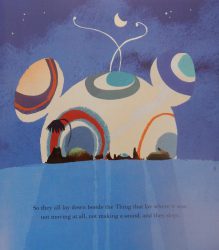
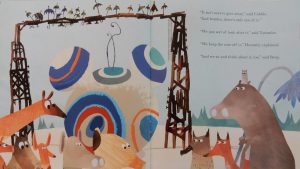
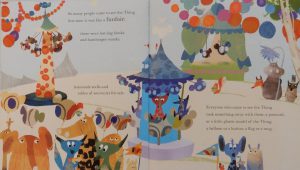
Hug Me, Please!

Hug me, Please!
Przemystaw Wechterowicz and Emilia Dziubak
Words & Pictures
Przemystaw Wechterowicz weaves a seemingly simple, enchanting, tale of two bears.
With the taste of sweet honey on their tongues, Daddy Bear and Little Bear, spend the day hugging each and every character whose path they cross on the woodland walk they take together.
First off is Mr Beaver, a somewhat reluctant recipient who nonetheless agrees, only to discover ‘It felt strange but nice.’ Heartened by the experience, Little Bear suggests finding others to hug and so they do. he bestows a calming hug upon the alarmed Miss Weasel, two hares, an elderly elk, a Red-Riding Hood-hungry wolf …

even an anaconda.

Full of the feel-good factor, with occasional touches of surrealism …

this story imparts a vital message concerning the importance of being able to show and receive affection openly, about empathy and not overlooking anyone. (Listeners will be quick to point out at the end of the story, who it is that’s yet to be a hug receiver.
Emilia Dziubak’s bears are real large creatures with very sharp claws to their paws but this is the only scary thing about them;

and she beautifully rings the emotional changes with the animals’ expressions. I also love the focus on small things – a rainbow hued caterpillar, the delights of dancing, for instance, that are sources of pleasure; and the way in which scenes are framed with things of the natural world – leaves, berries, carrots, and wild flowers.
Both author and illustrator are award winners in Poland; it’s easy to see why. this is sheer delight from cover to cover.

I’ve signed the charter 

Trucks and Rock Pools

William Bee’s Wonderful World of Trucks
William Bee
Pavilion Books
This is truly a vehicular delight and who better to introduce it than Bee himself. First he shows off the fuel tanker which, we’re told, holds sufficient fuel to fill 2500 motorbikes, or if you prefer, 650 cars or 40 of the fanatic’s largest trucks. It’s fuel is pretty indispensable unless you happen to have one of these beauties: watch out for soot.

Mr Bee however, has a truck to take care of that eventuality too – his amphibious one.
As construction is a frequent activity at the William Bee’s Garage, there are all kinds of trucks to help with the various building-related tasks; there’s the one that carries supplies, a cement mixer, a café truck – building makes one hungry after all. William also has a rescue truck, which here, has been called out to aid a snow-scooper.

Racing cars, and a truck to carry them complete with spare wheels, tool boxes and more, are also kept at the garage, as is William’s amazing jet-powered truck; fire engines and more. Mr Bee though is off to the seaside in yet another of his amazing vehicles and there he goes … leaving readers with a few final spreads of truck facts and some adverts for all his trucks’ needs.
What more could a truck-crazy pre-schooler want that these wonderfully bright, detailed illustrations (eye candy for truck fanatics) and William Bee’s running commentary on same.

Rock Pool Secrets
Narelle Oliver
Walker Books
As a child on summer holidays in Devon, Cornwall or further afield in the Mediterranean, apart from swimming, my favourite activity was poking around in rock pools accompanied often by my sister and Dad. I’d catch various things in my net, pop them into a bucket, observe and attempt to identify them; and then put them back into the water. This ‘lift-the-flap’ book takes me right back to those days with a close look at many of the creatures and plants I most certainly found: sea anemones with their sticky tentacles – endlessly fascinating; hermit crabs residing in empty mollusc shells, other crustacea – crab species, shrimps shooting rocket-like into the tangled seaweed; and various fish including gobies.

Most starfish I found were dried up on the seashore; herein though we see one cleverly camouflaged on the surface of a rock.
Each creature is given a double spread and almost all have a large, appropriately shaped flap that open to reveal further details about the particular animal. The final spread with an invitation to discover its secrets, opens up on both sides revealing an entire rock pool.
With awe-inspiring lino print illustrations, a fairly short narrative text and a pictorial glossary at the back giving extra information, this is perfect for preschool children and KS1 audiences.

I’ve signed the pledge  

The Giant Jumperee

The Giant Jumperee
Julia Donaldson and Helen Oxenbury
Puffin Books
Donaldson and Oxenbury – a formidable team if ever there was one: together they’ve created a picture book that has all the hallmarks of a classic.
Who or what is occupying Rabbit’s burrow: some monster perhaps; it certainly has a loud voice as it claims “I’m the GIANT JUMPEREE and I’m scary as can be!” stopping Rabbit short as he’s about to enter his home.
Rabbit’s friends, starting with Cat, come to his aid:

she offers to “slink inside and pounce” only to be threatened with “I’ll squash you like a flea!” Cat then cries for help and Bear responds.
The Giant Jumperee however seems to have the measure of each of the would-be assailants: this time issuing the threat of a bee-like sting sending Bear into a tizz and calling for help. Help that comes in the form of Elephant but he too ends up in retreat, remaining, like the others though, in close proximity to Rabbit’s burrow.
Enter Mummy Frog, and paying scant heed to the frets of the other animals, she calmly approaches the burrow and employs what will surely be a technique familiar to early years audiences: she calls the Jumperee’s bluff as she slowly counts to three.
Out pops her gleeful offspring, totally unrepentant …

and more than happy to be led off home – for tea, with the other animals in tow, of course. This is sure to result in equally gleeful responses from young listeners who will have been totally captivated by the whole saga – I say saga, although this is a short story. It’s impact though, is far from small: it’s truly a case of less being much, much more. Take a look at this final wordless spread:

Everything about this is pitch perfect, from the wonderfully effective plot with its repetitions, occasional forays into rhyme, and tone of telling, to Helen’s glorious renderings of the animals whose demeanours are totally priceless, especially that of Mum Frog – an indomitable force if ever there was one- on discovering the culprit of all the hullabaloo.

I’ve signed the charter 

It’s My Pond / Looking for Lord Ganesh


It’s My Pond
Claire Garralon, translated by Sarah Ardizzone
Book Island
There is a pond and a duck – a yellow one that comes upon same. “Wow, nice pond – it’s my pond!” it declares and plunges in. Bliss. Enter stage right another duck, white this time. It too wants the pond. Its “Why don’t we split it in two?” suggestion seems ideal. Another duck appears, a red one …

but that’s no problem: divide the pond three ways. And so it goes on: more and more ducks of all colours of the rainbow appear one by one, and the pond is split into ‘tiny bits and pieces.’ Then … consternation on the part of the in-the-pond ducks … none of them, it transpires, is actually having any fun at all.
“We don’t swim” says green duck. “We just stay put.” “We’re bored, “ says pink duck “and we can’t move!
Leave it to black duck though: it has the perfect solution.

But then what should happen along but a huge hippo: uh-oh!
Wonderful wit on the part of the book’s creator is evident in both words and pictures. Young listeners will have a good laugh over the lovely lessons on negotiating and sharing; and they’ll delight in the notion of what look like the kind of ducks they’ve seen at the fair or school fete being characters in a picture book.

Looking for Lord Ganesh
Mahtab Narsimhan and Sonja Wimmer
Lantana Publishing
I have a fairly large collection of Ganesha images both 3D and 2D so was more than a little amused by the title of this book. A friend asked me the other day, ’Why do you collect them?’ My response that Ganesha is the remover of obstacles, was all that was needed. Herein it’s Anika’s grandmother who had always told her to ask ‘Lord Ganesh’ for help when the girl is anxious over something. Anika has recently emigrated with her family and now is missing her home city Mumbai greatly. However she has made a friend, Hadiya and now has a dilemma.

Anika has the opportunity to join a soccer team but without her new friend, so, she borrows her mum’s tablet and e-mails the god of wisdom asking for advice.
What happens thereafter involves a whole lot of soul searching on Anika’s part, a wise choice (without the help of a response to her mail) and ultimately, an outcome that works for all would-be players, every one of them.

Sonja Wimmer’s vibrant, richly patterned illustrations convey beautifully, both Anika’s and her friend’s thoughts and emotions in this touchingly different story about friendship, inclusiveness, finding your feet in a new environment and discovering your own inner strength to hold fast to what you believe to be right. It offers an excellent starting point for discussion and explorations of a cultural and/or, religious nature.

I’ve signed the charter  

There’s a Walrus in My Bed!

There’s a Walrus in My Bed!
Ciara Flood
Andersen Press
Flynn is thrilled at the prospect of sleeping in his new bed, but come bedtime, it appears that his much-anticipated sleeping space has been invaded. Neither Mum, nor Dad believe his “there’s a walrus in my bed,” assertions so he’s forced to try and fit himself alongside an enormous intruder. Things aren’t straightforward even then: could the creature be hungry perhaps? Or suffering some malaise …

Blankets and a drink of soothing milk seem to exacerbate the problem, the latter sending the walrus to the bathroom for a wee.
Perhaps a lullaby might be sufficiently soothing to induce slumbers on the walrus’s part. It certainly doesn’t seem to please Flynn’s parents. What IS the lad to do?

There aren’t any monsters lurking and finally Flynn resorts to an embrace …

which appears to do the trick but there’s still the issue of fitting Flynn and the slumbering sea creature into the same space: it just isn’t big enough.
Flynn has one more trick up his pyjama sleeve: “Mum, Dad, can Walrus sleep in your bed tonight?” he requests. Their affirmative reply leaves their son able to snuggle into his soft warm bed at last; but he’s the only human likely to get a good night’s sleep thereafter …
Rich, warm hues make the invader and the place he invades, full of geniality; and Ciara Flood’s characterisation is superb. Mum’s and Dad’s expressions at Flynn’s increasingly demanding and disturbing activities speak volumes.
Another winner from rising star, Ciara Flood: I’d avoid sharing it just before bed though: you just never know – new bed or not …

I’ve signed the charter 

Parps and Splats

Old MacDonald Heard a Parp
Olaf Falafel
Harper Collins Children’s Books
I foresee a whole lot of tittering and mouth yoga from your audience when you share this noisy book.
Up bright and early, Old Macdonald is out and about on his farm: his aim, to identify the perpetrator of a loud parp. First he thinks it emanated from a cow – ‘With a Plrrb Plrrb here and a Plrrb Plrrb there … ‘ (instructions supplied to make the cow parp). But seemingly it wasn’t she. Perhaps instead it came from a duck …

Or could it have been a goat, a unicorn – surely not! – in your dreams Old MacDonald. No? Maybe then, a pig; or possibly a horse.
Apparently none of these lively creatures is the parper. Who could it possibly be?
That would be telling …

Suitably droll illustrations accompany the vocal gymnastics supplied by surreal comedian/illustrator Olaf Falafel. I see this becoming a resounding hit with early years listeners.
More crazy shenanigans – this time with the emphasis on the visual – in:

SPLAT!
Jon Burgerman
Oxford University Press
Many years ago, as an advisory teacher for language I used on occasion, to go on school visits with the advisory teacher for primary science; and we’d do a double act. One of the things we explored was “The Splat Factor” I recall.
This crazy book took me right back to those days when we had the children investigating all manner of splats.
Here, Burgerman confines his splatting to a slightly less messy amorphous green blobby thing, which undergoes various splat experiences when the reader turns the page. First it receives a pair of googly eyes and a mouth, followed by a pie, a pair of specs, a nose and lips; and a slice of bread spread with what looks like liberal coatings of sauces.
Thereafter comes a SQUISH SQUASH, an attack by some peckish birds, and worse … This though is followed by a truce.

Surely nothing can threaten those scrummy-looking ice-creams, can it?
Best shared with an individual; my testers to date have all deemed it a tasty, albeit rather squishy, treat, and thoroughly enjoyed being the splat perpetrators.

I’ve signed the charter  

The Ladybird / Make and Move Minibeasts / Build a Butterfly

The Ladybird
Bernadette Gervais
Laurence King Publishing
I knew that the ladybird season was about to burst upon us when I noticed several that had emerged, and died on a window-sill of one of the spare bedrooms of my house a few days back. Before disposing of them I took a close look: I think they were a variant of the invasive Harlequin species from Asia. My first go-to was this little book waiting for me to write a review. It’s a wonderful introduction to the little insects, beautifully produced and illustrated, biologically accurate with parts properly labelled; and with judiciously used flaps that add to the effectiveness of the information given.

Topics covered include the insect’s anatomy, defence, nutrition, hibernation and reproduction. The latter takes readers through the entire life-cycle from mating, via the larval stage to the emergence of the new spotless ladybird; the spots and red colour develop fully after about an hour.

There are also spreads devoted to the variety of ladybirds; and a ‘spot the difference’ observation game. The whole thing is printed on thick matt paper, which further adds to the quality of the whole. Altogether a class act; add it to your early years topic box or KS1 collection.

Make and Move Minibeasts
Sato Hisao
Laurence King Publishing
I’m not generally a great fan of ‘pop-out, create a whatever’ kind of books; they generally require way more manual dexterity and know how than the target age group indicated, but this one is definitely worth a look.
It’s the most recent of a Make and Move series by this artist and contains nine pre-coloured creatures; and a butterfly, a stag beetle and a dragonfly to which users of the book can add their own designs and colours. The coloured images are textured, and although texturing the uncoloured ones, while not impossible, might be something of a challenge that’s no bad thing and certainly something a six or seven year old could do.

Bee

They might need a little help with putting the animals together though and the projects increase in difficulty from first to last.
When completed the minibeasts do move easily, partly due to their being printed on thin card. Now while I don’t suggest buying a whole lot of these books, I know that many schools have a focus on minibeasts at some time during the summer term and a copy of this in the classroom could well prove inspiring for children to perhaps use as a source book, with an adult creating an example or two from the book itself. There’s a whole lot of mathematical learning potential as well as biological (and technological) learning herein.
Alternatively, it’s an interesting way to spend a few hours at the weekend or during say, a half term holiday.

Build a Butterfly
illustrated by Kiki Ljung
Frances Lincoln Children’s Books
Published in collaboration with the Natural History Museum, this is a board book and activity book combined.
Young readers are invited to find out about the Painted Lady butterfly (Vanessa cardui) and to use the press-out pieces, following the step-by-step instructions to build a card model of the butterfly. Starting with its life-cycle, information is given about finding food including the role of the eyes in locating same, as well as finding a mate; the butterfly’s diet;

emergence from its chrysalis; habits; and how it migrates.
The names of the insect’s various body parts are supplied – these are crucial when constructing the butterfly model – as well as a simple explanation of the function of each part. Young fingers may require the assistance of an adult in fitting the eleven pieces together.
My knowledge of this butterfly species is that there’s a slight inaccuracy in the portrayal of the adult, which here has been given white markings to the upper surface of the hind-wings making it look like a Monarch butterfly. A curious slip considering the endorsement given by the Natural History Museum; ditto the use of a capital C in the specific name; the paragraph about the butterfly’s emergence from its chrysalis has inaccuracies too. These factors will not however detract from the enjoyment of creating the insect. This book, I suggest, is best seen as helping readers to understand the basic anatomy of the butterfly.

I’ve signed the charter  
Lots: the Diversity of Life on Earth

Lots
Nicola Davies and Emily Sutton
Walker Books
Subtitled ‘The Diversity of Life on Earth’ the enchanting large-sized book looks at biodiversity and interdependence on our planet.
The ‘LOTS’ herein encompasses over a hundred different animals as well as numerous plants and one enthusiastic little girl narrator.

By giving voice to the child, Nicola Davies cleverly explains what would otherwise be an abstruse topic in words that pre-school and KS1 age children can engage with and enjoy.
We visit a variety of locations from deserts to tropical islands; and zoom right in to such microbial habitats as beneath the feathers of birds, on the backs of lichen beetles

and even boiling volcanic pools. Counting all the different kinds of flora and fauna is far from easy on account of sheer numbers; but sometimes it’s a very difficult task due in part to the comparative inaccessibility of particular habitats – the tops of tall jungle trees or the bottom of the coldest seas for instance. But also there’s the fact that some young creatures – the Queen Angelfish – for one, look quite different from the adult; or alternatively things that look virtually identical are entirely different species such as here:

The Viceroy Butterfly and the Monarch look almost identical

All this is explained in a straightforward narrative that as well as providing youngsters with a wealth of information, is likely to engender awe and wonder in the ‘almost two million different kinds of living things’ already identified; and the millions that probably are yet to be found.
In the three final spreads, crucial ideas about extinction and the importance of preservation of living things are introduced, leaving readers much food for thought about the vital stewardship role humans have in the whole scheme of things.
This follow up to Tiny also has wonderful detailed, painterly illustrations by Emily Sutton. A must for primary school classroom collections and family bookshelves.

I’ve signed the charter 
Can’t Catch Me!

Can’t Catch Me!
Timothy Knapman and Simona Ciraolo
Walker Books
Meet Jake, the fastest mouse in the world so we’re told, and Old Tom Cat – he looks pretty formidable, at least in Simona Ciraolo’s opening portrait of him. Tom has designs on Jake as his next tasty tidbit; but however many knots the old moggy ties himself into to that end, Jake manages to elude him. All poor Tom succeeds in geting is a rumbly tum and a thinner body, and a whole lot of taunting from a certain mouse as he runs off out of the garden and into the fields beyond.
Pretty soon Jake encounters a fox. That too has hunger pangs and a space in his tummy for a little mouse.

Can’t catch me!” brags Jake as he dashes through the cornfield and on into a wood leaving the pursuing fox far behind.
In the wood, lives a wolf and guess what? It too fancies a “juicy young mouse” to eat. Despite the fact it ‘sprinted and sprang’, that wolf just could not catch the boastful Jake.

Nor could the roaring bear he next comes across, even though it lunges and leaps at the rodent who manages to spring right across a chasm and end up (after going all around the world) right back where he started …

Now there’s an old saying, ‘everything comes to he who waits’ and so it is here; I’ll say no more.
There are echoes of the Gingerbread Man in this stonker of a story; but Timothy Knapman has taken the bones of the traditional tale and created a snappy spin-off that is certain to go down well with young listeners (if mine are anything to go by) who will relish its denouement. Simona Ciraolo’s scenes of showing off, sprinting and strutting speak even louder than all Knapman’s wonderful dialogue. This is another genius author/illustrator pairing.

I’ve signed the charter
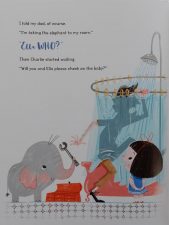
The Ammuchi Puchi

The Ammuchi Puchi
Sharanya Manivanna and Nerina Canzi
Lantana Publishing
To visit India, no matter which part, is an assault on the senses, especially that first time: the sights, sounds, smells, the sheer seeming chaos that surrounds you is almost, though not quite, overwhelming. But somehow, for me at least, there is something about it that gets right into your spirit and doesn’t want to let go; so, you keep on going back again and again and … then, you realise that you’ve fallen in love with the place. This picture book evokes some of the wonderful sights, sounds and smells of the country.
Now one of the most striking things about India, particularly the southern part is the dazzling, dancing array of butterflies and it’s something my partner and I both appreciate every time we go. I happen to have picked up a few words of Malayalam and thought I recognised Ammuchi as mother but then realised that word is ‘ummachi’ ; I know grandmother, or rather maternal grandmother as ‘ammacci’ in Tamil (having taught some Tamil speaking 5 year olds in my reception classes) and my Hindi, which is much better, tells me that ‘puchi’ means kiss. So, before even opening this gorgeous book, I was making lots of connections and deciding the title means ‘grandmother’s kiss’.
Let’s get to the story then: the setting, I think, is rural south India; and its narrator is Aditya who lives with his younger sister, Anjali, their parents (Amma and Appa) and grandmother, Ammuchi.

The two children adore their paan-chewing grandmother, despite being somewhat scared by her ghost stories – “Don’t you see it sitting there, with eyes big-big like two moons?” until that is, they grow out of being spooked and join in with her tales of ghost sightings, furnishing their own details to add to her descriptions of the mango-tree dwelling manifestation.

Just as Aditya’s tenth birthday approaches, Ammuchi gets ill, has to go into hospital and dies. The two youngsters, like their parents, grieve and the children in particular struggle to come to terms with their loss: that constant ray of sunshine no more illuminates their lives …

But then one evening a beautiful butterfly flies down and settles on Anjali’s head. It’s “Ammuchi Puchi,” she tells her brother. Next day at school, he tells his classmates of the event, saying, “Ammuchi Puchi is an insect who is our grandmother.” Despite their ambivalence, back home that evening, Aditya ponders further and becomes convinced that the butterfly is in fact his grandmother. His parents’ response and seeming lack of understanding, result in the Ammuchi Puchi becoming the children’s secret. It turns out though, that it’s not only the children who have a secret: the Ammuchi Puchi has one too: one that she reveals to the brother and sister one rainy night;

and so begins the healing and the understanding that Ammuchi’s love will always permeate their lives, no matter what.
Grandmothers have a very special place in Indian families in particular, but grief is a universal phenomenon. What Sharanya Manivannan’s moving, thought-provoking narrative offers for all readers is, ‘a place from which to become aware’. Yes, it’s deeply sad in part; but ultimately it’s about much more than heart-breaking loss and grief: this is a joyous celebration of love, of a very special person who relished life; of family; of the beauty of the natural world; and of the power of the imagination. No matter your feelings about, or understanding of, reincarnation, the author’s symbolising of the grandmother as a butterfly both comforts the child characters and allows for open-ended responses from readers everywhere.
Nerina Canzi’s illustrations complement the telling beautifully. The predominance of vibrant hues in the lush flora and fauna, the fabrics of the clothing, the kolam design on the school floor, the carpets and rugs, underscores the Indian setting while at the same time, reinforcing the message that the story is essentially, about abiding love and the way children have a propensity to transcend deeply upsetting events. In contrast, almost all colour is leeched from the spread dealing with Ammuchi’s dying, reflecting the palpable desolation her death brings to the whole family, and rendering it all the more affecting for readers, not least this reviewer.
A must have book for all family bookshelves and primary classroom collections.

I’ve signed the charter  
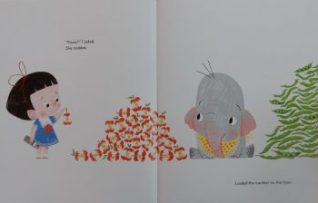
The Story of Space / 100 Steps for Science

The Story of Space
Catherine Barr, Steve Williams and Amy Husband
Frances Lincoln Children’s Books
Subtitled ‘A first book about our universe’ this follow-up to The Story of Life is an equally fascinating exploration of another ‘big’ topic: what is thought to have happened 13.8 billion yeas ago when the Big Bang created our universe; and what followed in space thereafter going right up to the present time …

even projecting future possibilities. We’re told how the sun came into being; how, over billions of years, stars ‘are born, grow old and die’; how the planets – and hence our solar system – were formed. As well as that, there is a spread on comets and asteroids; another on how/why the seasons vary in different parts of the Earth; and one looking at oxygen and how it supports life.

This awesome journey is taken in the company of two young space investigators who comment and ask questions alongside the authors’ main narrative. Both Barr and Williams have a science background and manage perfectly, to avoid talking down to primary school aged readers. Amy Husband’s vibrant illustrations have an exuberance about them, making the whole book all the more inviting for the target audience.
I’d most certainly add this to a home collection or primary class library.
The same is true of:

100 Steps for Science
Lisa Jane Gillespie and Yukai Du
Wide Eyed Editions
Ten STEM topics are explored in this fascinating book (written by a doctor of chemistry), that offers thoroughly digestible, bite-sized introductions to Space, Wheels, Numbers, Light, Sound, Particles, Medicine, Materials, Energy, and Life.
Each one is allocated several spreads wherein its evolutionary story is explored and the key scientists are introduced. In this way, what might for some, seem formidable topics, are given a human element making them more easily engaged with and intriguing. Add to that Yukai Du’s detailed visuals, which include some amazing perspectives …

and science becomes exciting for everyone.

I’ve signed the charter 

Mrs Mole, I’m Home!

Mrs Mole, I’m Home!
Jarvis
Walker Books
Walking along the canal path this morning near my home I noticed unusual mole activity and immediately thought to myself, that Mr Mole of Jarvis’s must have recently popped up along here. How does the guy do it? Jarvis I mean, not Mr Mole – coming up with one superbly funny picture book after another in rapid succession. Back to Mr Mole: the creature is exhausted after a hard day’s work at Gordon Ratzy’s and eager to get home to his wife and children; the problem however is that he’s unable to find his specs. – ANYWHERE!

No matter, he thinks to himself, “I ought to know my way back home by now!
Off he burrows and … Up he pops calling out to announce his presence to his family. It’s a wrong call however, with rabbits not moles greeting him. So off he burrows again and the same thing happens when first he lands up at the residence of the Owl family demanding a “kissy kissy” from his little ones;

then bumping into the penguins in the Antarctica; and next the crocs in their swampy commorancy. Oops! Better move out of there fast before you become crunching matter for Croc’s dinner, Mr Mole. Good job you can’t see those jagged teeth they’re brandishing at you.
After all that burrowing and popping up in the wrong places, Mr Mole is near despair but then ‘Sniff – sniff … Something familiar!’ causes his nostrils to tingle – worm noodles!
There’s only one place that aroma could be coming from; and so it’s ‘Up he popped!

Explanations as to the delay inevitably amuse his offspring and a promise is made never by lose those glasses again. But …
With its glorious throw-away final scene, this story is utterly hilarious from cover to cover – literally: there’s even a wonderful visual pun on the back cover and that eye-chart title page is priceless. In-built repetition of ‘Up he popped!‘ and ‘And off he burrowed …‘ cry out for audience participation; and this is an absolute gift for readers aloud: just make sure you give your audience plenty of time to enjoy the wit in every one of Jarvis’s scenes.

I’ve signed the charter 

The Dreaming Giant / 13 Art Materials Children Should Know

The Dreaming Giant
Véronique Massenot and Peggy Nille
Prestel
Imagine a giant dropping in on your neighbourhood: what on earth might he want? This is exactly what happens to the tiny world of Krobz, the inhabitants of which are less than one inch tall. Unsurprisingly everyone is alarmed at the new arrival with his harlequin trousers and shoes sized 612. Is he peaceful or hostile? A plan is formulated while the being naps.
There follows an internal investigation of the sleeper …

undertaken by a brave trio: Zig, Zag and Swirl. They visit various organs such as his heart, and his brain (the command room) wherein they discover how the visitor is feeling …

The Giant apparently liked the taste of his sandwich but his buttocks seemed to find the ground a little too hard.” Their search however, reveals nothing about the possible reason for the Giant’s visit; and having reported back to base from where they are informed that the subject of their observations is in a dream state, an amazing sight meets their eyes, and an extraordinary experience unfolds …

An experience which leads them to conclude ‘There is nothing to fear from someone who lives and thinks so beautifully and whose dreams are so GIGANTIC!
Kandinsky’s dreamlike abstract paintings were the inspiration for this unusual picture book and in an afterword, both author, Massenot and illustrator Nille talk about how his Sky Blue in particular gave them space within which to let their own imaginations get to work. We also learn something of Kandinsky’s interest in physics, in particular Einstein’s theory of relativity and its possible influence on the artist’s painting.
A splendid introduction to the work of a hugely important 20th century artist, and a delightfully fanciful story to boot.

13 Art Materials Children Should Know
Narcisa Marchioro
Prestel Publishing
With the disastrous scaling back and cutting of arts subjects in education, in both schools and colleges, books that educate children in respect of the arts are increasingly important.
This absorbing volume takes young readers on a tour around the world and back in time to find out about the evolution of materials artists and craftspeople have used, some of them such as bone, wood and ivory, right back as far as the Palaeolithic Era …

Part of a spear-throwing tool made from reindeer horn.

From objects discovered, we can learn a lot about how those ancient peoples lived and what occupied their thoughts. Now contemporary artists such as Vik Muniz use discarded materials in their work; and before him, Joseph Cornell made use of found objects as inspiration for complex assemblage creations …

Joseph Cornell’s ‘The Hotel Eden’ 1945

These too in their own way have much to teach us.
Each material considered has a time line across the top of the spread(s) which helps readers see how certain materials, gold for instance, were used at different points in time, often centuries apart.
A particularly fascinating section looks at the use of parchment right back to the time when monks painstakingly created illuminated manuscripts, and up to its 21stC use as a medium for collage and sculpture.
In addition to finding out about the materials, readers are introduced to particular artists some of whom, Henri Matisse for example, are well known, others less so. I was fascinated to learn that Chinese artist, Li Hongbo created these sculptures using only paper, scissors and glue.

‘Roman Youth’ Li Hongbo, 2013

Both educational and fun, this book is likely to inspire individual readers to turn to other sources to find out more about some of the topics that are of particular interest to them. A worthwhile addition to the family bookshelf or primary/ lower secondary school library.

I’ve signed the charter  
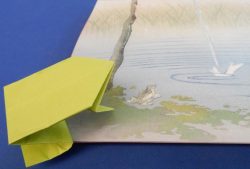
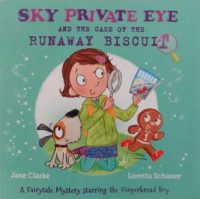
Sky Private Eye and the Case of the Missing Grandma / The Fairytale Hairdresser and Aladdin

Sky Private Eye and the Case of the Missing Grandma
Jane Clarke and Loretta Schauer
Five Quills
There’s a new independent publisher – Five Quills – on the block, with a new series introducing Sky, a young detective and resident of Fairytale Town. She has a cupcake making business that doubles up as a detective agency and a canine assistant called Snuffle.
In this tale we meet her as she’s busy with an order for her ‘Just-in-case Cupcakes’ when she receives an emergency call from Little Red Riding Hood reporting the absence of her gran. Before you can say cupcakes are us, Sky has gathered her necessary accoutrements, and is off on her scooter, on a rescue- grandma mission.
Aided and abetted by her Map Nav, she quickly locates Granny’s house and is greeted by a fraught-looking Red Riding Hood. Once inside though, it quickly becomes apparent that far from becoming the Big Bad Wolf’s breakfast, Granny has decided to take a vacation. Seemingly though, once the two set off in pursuit, it appears that she might have been followed: that’s certainly what the evidence attached to a bush suggests.
Lo and behold, when they arrive at Fairytale beach whom should they spy through Sky’s trioculars but …

And it looks as though that lupine character might have designs on Granny after all. Time to don some disguises, Sky decides. Can she get them all out of a very sticky situation with a spot of ‘Carrycake Kit, Bake it Better!’; not to mention a few deft moves with a wooden spoon …

and the odd Just-in-Time Cupcake?
The tale’s telling is terrific fun and with illustrations by rising star, Loretta Schauer, that are full of hilarious details, this series looks set to be a winner. There’s even a cupcake recipe at the back of the book.

The Fairytale Hairdresser and Aladdin
Abie Longstaff and Lauren Beard
Picture Corgi
When Kittie Lacey closes her shop and heads off for a vacation courtesy of Aladdin’s Magic Carpet Tours,

she’s hoping for a bit of rest and relaxation but almost immediately on arrival, she realises that is not to be.
First, she has to help Aladdin, with a very low budget, find a very special present for Princess Jamelia. The following day however, Aladdin is nowhere to be found. A search takes Kittie out into the desert where she discovers he’s been duped by the wicked Ibeneeza and is trapped underground. Worse still, the plan is to force Jamelia into marrying the trickster. It’s up to Kittie and Aladdin – once she’s rescued him – to use their wits and all their resources to put a stop to the evil intentions of Ibneeza. Can they do it? Perhaps with the help of the dusty old lamp that Aladdin has discovered in the cave where he was imprisoned.

Kittie is a determined character and likely to have one or two ideas up her sleeve – or in her bag …
Kittie Lacey has a band of enthusiastic young followers already; I’m sure this latest adventure will win her more, as well as delighting her established readership.

I’ve signed the charter  

Message in a Bottle

Message in a Bottle
Matt Hunt
Scholastic Children’s Books
Town life doesn’t suit Lion: he dreams of clear sunny skies, wind in his mane, sand in his paws and, his guitar. Nothing more. So when he spies a ‘beach house for sale’ advert he cannot believe his luck. That very evening he packs the necessities – mostly strawberry smoothies – and heads off over land, air and sea until he reaches the island of his dreams. There, he takes up residence and thus, his perfect existence commences …

What joy to wake to the sounds of parrots and splashing waves, to breakfast on succulent coconuts and strum a guitar to your heart’s content. Soon though, unsurprisingly, Lion begins to feel lonely; but how can he communicate his need for a pal without a phone or mail service?

Sunlight moment! Lion decides to write a message, pop it in one of the many bottles he has (sans smoothie of course) and drop it into the sea. No response. Lion writes more messages, puts them into more empty bottles – many bottles, tosses them into the sea, watches them disappear, and sleeps …
What happens thereafter, is not exactly what Lion had hoped;

but suffice it to say without giving the whole thing away, all ends happily and … rather noisily. Which all goes to show that you don’t always know what will make you happy; and that stepping out of your comfort zone, embracing difference and welcoming new arrivals can work wonders.
A timely, important message for readers and, a tumultuous one for Lion. Matt Hunt delivers both with verve and humour.

I’ve signed the charter  

Gecko’s Echo / Monster Baby

Gecko’s Echo
Lucy Rowland and Natasha Rimmington
Bloomsbury Children’s Books
The lengths a soon-to-be mother goes to in order to protect her eggs is hilariously demonstrated in this delicious rhyming tale by debut author, Lucy Rowland. Meet brave Mummy Gecko who stands up to the threats of Snakey,

and Eagle (later in the day) with warnings about “a hundred angry geckos”.
Come the evening, a very nasty-looking, ravenous rat appears, also with designs on the eggs; he though is less easily convinced. His response to Gecko’s, “If you’re staying I can show you … I hope you’re feeling brave.

is met with a spot of lip licking and “Why, yes I’m staying Gecko, / and I’m having eggs for tea./ A hundred geckos living here?!/ I don’t believe it’s true. … /I’m quite sure it’s only you.
Whereupon the wily Mrs G. lets forth an enormous “RAAAAH!” and back come those hundred voices …
Guess who beats a rather hasty retreat, leaving one echoing gecko to have the last laugh. The last laugh maybe, but not the peaceful evening she’d anticipated for, with a wibble and a wobble, what should appear but …

A real winner of a book with plenty of opportunities for audience participation, laughs galore and superbly expressive illustrations by Natasha Rimmington. Her wily animal characters are absolutely wonderful.

Monster Baby
Sarah Dyer
Otter-Barry Books
A topic that has been the theme of numerous picture books already is given a cute narrator herein.
Little Monster is none too thrilled at the prospect of an even littler monster; neither is Scamp, the family pet. Even before the newcomer arrives though, it’s presence is being felt: rest and healthy food are on the agenda and not only for Mum. The expectant monster needs a great deal of rest, which may account in part for her increase in girth, and certainly gets in the way of carrying the young narrator. He’s far from impressed with the scan either:

a wiggly worm is how it appears to Little Monster, but probably because Mum has several months to go yet: even so it’s capable of hearing apparently.
When the big day finally comes around, Granny comes to stay and Dad takes Mum Monster to hospital; the baby is duly delivered and Little Monster becomes a ‘BIG’ one according to his dad.
Having Mum and baby back home gives rise to mixed feelings on the narrator’s part: it’s great to have Mum around; but that noise-making babe is going to take a fair bit of getting used to. The inevitable feelings of being left out soon give way to accommodation and thereafter, the beginnings of a bond of brotherly love starts to form …

Sarah Dyer’s Little Monster is adorable: his account of the weeks leading up to, and just after, the arrival of his new sibling will be enjoyed not only by those in a similar situation, but also general early years audiences, whether this is shared at home or pre-school.

I’ve signed the charter  

Follow Your Dreams: The Wooden Camel & Jimmy Finnigan’s Wild Wood Band

The Wooden Camel
Wanuri Kahiu and Manuela Adreani
Lantana Publishing
Despite his youth and lack of stature, Etabo dreams of becoming a camel racer, much to the amusement of his older siblings. But the lad’s dreams are not destroyed, even when his father announces that they have to sell the family’s camels to buy water. He asks the Sky God, Akuj for help but receives the response: “Your dreams are enough.” Surely this cannot be so, but it looks increasingly likely as Etabo and his brother and sister are sent out to mind the goats …

and eventually his siblings too have to find paid work so the task is left entirely to Etabo.
He continues to dream of racing camels; but his dreams are not enough. He begs to ride one of the horses in big sister, Akiru’s care but receives a firm refusal; even the cats, chickens and his favourite goat won’t let him ride on their backs.
Once again, the boy prays to Akuj but receives the same “Your dreams are enough” response.
Akiru, saddened by her brother’s increasing unhappiness, sets to work on a project that keeps those dreams of Etabo’s alive,

and for the time being, they have to be enough. Hold fast to those dreams Etabo.

Adreani’s scenes of the Turkana people of Kenya set against the harsh landscapes are truly beautiful and perfectly complement the soft, sympathetic humour of Kahiu’s text. A book to cherish, to share, ponder upon and discuss widely.

Jimmy Finnigan’s Wild Wood Band
Tom Knight
Templar Publishing
Jimmy Finnigan has a dream: he wants to start a band. He has something of a problem though – his place of residence has an award for ‘the prettiest village ever’ and seemingly each and every other resident is protective or at least wants to keep their particular place ‘nice’. Every place except the woods that is: they’re a pretty wild spot and the subject of adult warnings to keep away. Jimmy’s parents are no exception and send him to the attic in search of a quiet, indoor pursuit. What he finds though, results, with a bit of help from Dad, in this …

Pretty soon, this musical interest has become an obsession, Posters appear, but there are no takers …

until Jimmy remembers a place that might just prove fruitful; but when he forays into the forest, even that one is nowhere to be seen.
The lad is on the point of giving up the whole enterprise when he hears a distant crashing, bleeping, booshing, boinging, doofing, plonking and crashing. Hardly able to contain his excitement, he follows the sounds to their source and discovers a wild trio busy practising.
A conversation, some shenanigans and a search ensue; a search resulting in something altogether unexpected and beyond Jimmy’s wildest dreams. And after that nothing is ever quite the same again …
Suitably zany, action-packed, wilder than wild, illustrations accompany Tom Knight’s boogying extravaganza. Get your ear plugs ready, your bodies bopping and join the fun. Some of those spirited scenes certainly got me going.

I’ve signed the charter  

Go Yogi! / Animal Asanas

Go Yogi!
Emma Hughes and John Smisson
Singing Dragon
Namaste: Meet Monkey, Mac and cat, Flo: they are enthusiastic about yoga and its benefits and want young children to join them and learn a special yogic way of breathing and some of their favourite yoga poses. First though, a space away from distractions is needed and then, mat down it’s time to start. The first focus is on the breath, and this is followed by a round of sun salutation. Here are the opening moves:

The two animals then move on to some standing poses, the first being the triangle – here called ‘Tea Pot’.

Clearly this book is for very young children who will most likely be familiar with the favourite nursery action song.
After this come four further standing poses; ‘balancing barn door introduces the slightly tricky (for 3 and 4 year  olds) standing on one leg. They’ll love to try though and increase the time before wobbles set in. Equally great fun, is the ‘warrior’.
All good yoga sessions need a variety of standing and sitting poses, so Flo demonstrates the ‘balancing boat’ next.

Following it with what they call here ‘pebble on the shore’ and many yogis will know as the pose of the child or balasana. Three additional poses are shown by Flo and then it’s time to relax. Mack gives her instructions and Flo begins to let go completely, making a ‘Ha’ sound to help her.
The entire yoga lesson is nicely illustrated by John Smisson who also teamed up with the author in Striker, Slow Down!
The final spread is aimed at adults and offers words of wisdom from a very experienced teacher of yoga, the author, Emma.
For me, as an early years teacher and yoga teacher, this is perfectly pitched for the very youngest beginning yogis. I’d strongly recommend it for all early years settings and families with young children. It could, one hopes, be the start of a life-long practice that offers many benefits, physical and emotional.

Animal Asanas: Yoga for Children
Leila Kadri Oostendorp and Elsa Mroziewicz Bahia
Prestel
A gloriously ornate menagerie of creatures great and small demonstrate over a dozen yoga asanas, and relaxation exercises.
‘Namaste, Children’ the author says on the introductory page and then goes on to give some wise words about yoga and taking it up. Anyone coming to yoga for the first time should read and inwardly digest what’s said before going near a yoga mat
The first asana shown is Vrikshasana – the tree pose and before embarking on the pose itself, there’s a ‘tree meditation’ that begins ‘Imagine you are a tree … You stand firmly on the ground and nobody can move you.’ A great introduction and believe me, as a yoga teacher and one who specialises in teaching children, this really works. Benefits of the pose (and indeed, all the others), is given as is a helpful tip. Here it’s the crucial anti-wobble: ‘Focus your eye on to a single point straight ahead of you. This will help keep your balance.
After this, all the asanas are animal-based: there’s the Frog, Cat and Cow, The Dog ,

the Cobra, the Dove (I know it as the Pigeon), the Butterfly, the Camel, the Tortoise, the Roaring Lion – a great one for letting off steam and relieving tension/stress – children love this …

the Rabbit, the Locust the Fish and finally, the Crocodile.
Relaxation is extremely important after a yoga session and there is a lovely Rainbow journey to undertake while lying in sarvasana.

The final spread gives some words of yoga wisdom – and wise they are ‘time spent … is for children’s enjoyment and exploration; it is not a time to be achievement-oriented or critical.’ and some practical tips for parents on a child’s yoga practice.
The whole book is beautifully presented both verbally and visually. Ornate Indian style borders enhance each spread and really help to underline the notion that the yoga mat or demarcated space is ‘a place from which to become aware’ and that time spent on yoga is a very special time when nothing else matters; and nothing should be impinging on that time.

My Very Own Space

My Very Own Space
Pippa Goodhart and Rebecca Crane
Flying Eye Books
From the opening “SHUSH! I want to look at my book!” pronouncement from its adorable bunny narrator, Jack, I knew this was going to resonate with me. The little character has my sympathies surrounded as he is by sounds of sneezing, noisy play, instrumental practice and all manner of other noisy activities; who wouldn’t do exactly as he does …

Even then with space demarcated, there are intruders and a whole host of breathing-down-his-neckers. Totally infuriating and deserving of the desperate sounding “OI! ALL OF YOU! Go AWAY and play somewhere else! This is MY SPACE!” plea.

Later on though, objective achieved, young Jack starts to have thoughts about what he might be missing out on – cuddles and tasty treats for instance. Is it perhaps time to allow younger sister to cross that red line …

and even open the space to everybun once more. After all at the end of the day, there IS one place wherein he can be alone; in his very own snuggly bed – some of the time at least.

Most of the story is conveyed through Rebecca Crane’s delectable visuals: she, with minimal manipulation of line and facial features, eloquently captures little Jack’s emotions and thoughts; and her use of red  for the demarcation line, the space-rocket of his story and Jack’s polo-neck jumper, sends out clear warning signals to both his family and readers.
Little Jack is a character you just want to enfold in your arms and give him an enormous, snuggly cuddle; and this eloquent book is certainly one of my new favourites.

A Farm Visit, An Egg Hunt Activity Book & Masha and her Sisters

%0a

Look and Say What You See in the Farm
Sebastien Braun
Nosy Crow
Published in partnership with the National Trust, this book with its thick pages presents us with thirteen farm scenes going right through the year from early spring when there’s an abundance of lambs in the fields, little chicks have been born and there are calves needing their share of milk …

%0a

Back outside at the pond, ducklings and goslings are learning to swim and tadpoles wiggle and waggle their tails. In summer, there is an abundance of insects, wild animals and wild flowers; their presence enriches the farm and some weeks later, it is time for the collecting of yummy vegetables .

%0a

Autumn brings the wheat harvest, pumpkins aplenty and in the orchard, the apples are ripe and ready for picking, so too the pears.. Mmm!
Winter sees the animals snuggling in the warm barn with the door firmly shut against the cold.
Every spread has a strip along the bottom asking readers, ‘What can you see … ? with nine items to search for in the large scene above. Perfect for developing visual literacy, for encouraging storying; and, it’s lots of fun.
fullsizerender-63

We’re going on an Egg Hunt Activity Book
illustrated by Laura Hughes
Bloomsbury Children’s Books
The bunnies from last year’s We’re Going on an Egg Hunt picture book return inviting youngsters to participate in a variety of activities including matching shadows to images, egg decorating, spot the difference, a word search and much more. The centre spread has beautiful stickers with which to adorn the pages as instructed – or otherwise if you’re divergent. I suspect some children won’t want to cut out the triangular shapes to make the bunting, especially as there’s a game of hide and seek with the bunnies and a follow the path game on the reverse sides; if so, I’d suggest copying the spread or drawing your own triangles to decorate. These are just some of the games in this attractive book, made all the more delightful by Laura Hughes’ cute bunnies. Just right for Easter.

%0a

Masha and Her Sisters
Suzy Ultman
Chronicle Books
This is a retro delight: a maryoshka doll-shaped board book that, once the cover is lifted, opens downwards to reveal, one by one, five dolls, the first being the smallest. Flip that page down and a slightly larger sister is revealed and so on. First we meet Natasha, the storyteller, then nature lover, Galya; Olya is the chef, Larisa, the performer and finally, Masha who is the collector. The body of each is decorated – front and back – with objects related to their special interest. Thus for instance, Galya has fauna, trees and a tent;

dscn0284

Olya the chef has herbs, mixing bowls and kitchen tools. Innovative, charming and near enough egg-shaped to make an Easter treat for a small child.

Charter logo FINAL.indd

Fum / Beauty and the Very Bad Beast

Fum
Karl Newson and Lucy Fleming
Maverick Arts Publishing
Despite their name, the Crumbs are a very large family: there’s Pa, Ma, Grandpa Plum, Fee, Fi, Fo and Fum. Or rather there should be; Fum, the smallest Crumb was gone missing. The search is on: first stop, the houses of the three little pigs …

No sign of him there. “He could be hiding … / In the woods with Little Red Riding.” That’s the suggestion from one of the pigs. Off they go again with everyone joining the hunt, but Grandma and her crew cannot help. Or rather, the Big Bad Wolf gets a whiff of his socks and thinks it’s worth locating Golidlocks. Guess whose bridge they cross to get to the house of the bears. The three are eager to assist and take to the air . Further locations are visited, all to no avail, until suddenly a small voice is heard. Now who might that be up the tree – or rather beanstalk? (I just wanted to be in line with the story’s rhyme.)

Lo and behold, the little chap wasn’t lost after all – just small! And in true fairy tale style, ‘The woods filled up with songs and laughter, / and all lived happily ever after.
Satisfying stuff, delivered through Newson’s exuberant rhyming text, full of repeat refrains, KNOCK! KNOCK!’s and “No” s to join in with; and Lucy Flemming’s funny pictorial rendition of the search with its unusual perspectives and spilt page scenes.

Beauty and the Very Bad Beast
Mark Sperring and Barbara Bongini
Scholastic
I love a story that mucks around with fairy tales, or as here, a fairy tale.
Let’s meet Beauty’s sisters, Grace,a golf-loving lass, and May, who likes to tong her hair. Both ask their doting father to bring them appropriate gifts on his return from a shopping trip in town. Beauty – well we know what her request is; her Popsey however decides to steal it from someone’s garden …

and that’s when the trouble begins. The Beastly Beast appears, makes an accusation and demands his price. Inevitably, it’s Beauty who greets him on his return and thus she duly departs to reside with the Beast.
Beauty asks him to let her go, the creature agrees to consider it and he does – over a long period that stretches into seasons during which time he falls head over heels with his captive; he even proposes.

What happens thereafter includes further considerations, a return, a whole lot of forgetting, the death of a rose, a frantic dash and a kiss …

l’ll leave you to imagine the final event: assuredly it’s rather splendid and made all the more so by Barbara Bongini’s hilarious, action packed scene of same.

I’ve signed the charter  

The Egg

%0a

The Egg
Britta Teckentrup
Prestel
Many aspects of oviparity are explored in this fascinating book along with spreads on the egg in art, religion and mythology;

%0a

a look at traditions involving eggs, the famous Fabergé egg and the symbolic golden egg of wealth and fairy tales; and there’s a look at decorating eggs.
Caliology is an engaging aspect and obviously interested Britta Teckenetrup who devotes a dozen double spreads to various kinds of bird’s nests from the colonial nest building weaver birds, whose amazing nests are often built suspended (as a safety precaution) from trees over water,

%0a

to the ground nesting Snowy Owls that make shallow nest bowls where the snow has gone, during the Arctic summer.
Other egg layers include insects, there being a multitude of marvellous shapes, colours and textures;

%0a

spawning amphibians, reptiles – these mostly lay soft-shelled eggs incubated by natural heat rather than by the adult; turtles, fish and the mammalian sub-group which includes the platypus and echidna, the latter two being termed monotremes; and are indigenous to Australia and New Guinea.
The book’s blurb says of the egg, ‘Its beauty has inspired artists since ancient times’:

%0a

it has clearly inspired Britta Teckentrup, the creator of this handsomely produced, (it has a wonderful feel as well as look) enormously engaging and informative ‘eggthology’. As with many good information books it leaves you wanting to know more.
One for the primary school bookshelf, as well as for interested individuals.

Charter logo FINAL.indd

Ivy and the Lonely Raincloud

Ivy and the Lonely Raincloud
Katie Harnett
Flying Eye Books
There was once a raincloud.’ Nothing unusual about that: we frequently have plenty. This particular raincloud though has feelings, sad ones on account of being the only one remaining after the ‘horrible’ hot sun had chased off the others, leaving him all alone and without a pal to play with. Search as he might, the cloud’s friend-finding endeavours were fruitless. On the point of giving up however, the cloud notices a small person in the street beneath him – an extremely grumpy-looking lass, despite the sunshine.

Could she be the one he’s been looking for?
The cloud pursues the girl to the market, the underground and finally home; and all the while she remains grumpy VERY grumpy indeed. What could be the cause of all this ill-temper? The cloud ponders: is she lonely or just plain peevish?

After all, she has plenty to lift her mood.
Being a kind-hearted soul, the raincloud decides to ‘pay it forward’ in the very best way a raincloud can …
and guess what? A beautiful new friendship begins to form …

This entrancing follow-up to Archie Snufflekins Oliver Valentine Cupcake Tiberius Cat caught me on a day when I, like Ivy, was feeling more than a little down. That raincloud had the same uplifting effect on me as it did on the girl character herein. Now that’s pretty amazing as rainclouds normally have the effect of dampening my spirits considerably … which all goes to show what a revivifying reaction a lovely picture book can bring about.

I’ve signed the charter 

How do you do, Mr Gnu? / What’s More Scary?

dscn0275

How do you do, Mr Gnu?
Billy Coughlan and Maddie Frost
Maverick Arts Publishing
Gnu has received a royal invitation, to take tea with Her Majesty the Queen no less. First though he needs to polish up his etiquette and for this he has plenty of role models: the dogs with their polite begging “Woof” Woofs for starters and then there’s that “Caw” of raven’s: that’s definitely worth imitating especially with those spindly legs of his flapping like wings. The fish have such eloquent “Glug”s that Gnu just cannot help but try emulating those …

dscn0276

Add to that the dinosaur’s “ROAR”; the refined “Neigh” of the guardsman’s horse, not to mention the raspberry blowing from a little girl (think twice Mr Gnu, before you try that one on Her Majesty. Err …

dscn0278

With its wonderful, final piece de resistance, “Pfffffft” this lesson in manners is sure to have your audiences in fits. They’ll love joining Gnu in trying out the other exquisitely mannered expositions and actions of the other animals so amusingly portrayed in Maddie Frost’s hilarious scenes too. Prepare yourself for a noisy story session when you share this beauty.

%0a

What’s More Scary?
Min Flyte and Matt Hunt
Nosy Crow
This ‘choose-the-flap’ adventure takes readers along with the little boy narrator for a jungle adventure. First though he has to pack his rucksack with the appropriate gear, (especially according to his mum, a toothbrush) and don his rosy red wellies – just the thing for a camouflaged safari walk.

%0a

Off goes the lad along the jungle path and before long he hears some alarming sounds; seemingly he’s being followed but then comes a fork in the path: which way should he go? Crisis averted, it’s time to proceed but again the path divides and another choice needs making – or not! Well yes in a way but a spot of tree climbing is required.

%0a

And so it goes on with a bit of dangling, followed by rowing and another fork – in the river this time, with a croc one way and piranhas the other. Next there’s a choice between a tree with a snake, or one with a grumpy gorilla, to climb; then inside a cave, our narrator, aka “Jimmy” is confronted with something with the scariest ever eyes: what could that be? The little guy has had enough of safari-ing and beats a hasty path back home: has he escaped though?
With a final choice left to the reader, Flyte and Hunt’s flap-filled foray into the wild, has plenty to engage and involve youngsters.

Charter logo FINAL.indd

Sunk!

Sunk!
Rob Biddulph
Harper Collins Children’s Books
Yet another Biddulph bobby-dazzler and it comes in the form of a second Penguin Blue (from Blown Away) adventure.
Donning pirate gear, Penguin Blue, along with his penguin pals, Jeff and Flo, and polar bear, Clive, set out, armed with a map, on a nautical treasure-seeking trip.

Pretty soon though, they find themselves in trouble and have to abandon ship.

The result being, they land up on a tiny island and come face-to-face with an old sea dog who seems eager to make their acquaintance: “My name is Captain Walker Plank. / Been stuck here since my galleon sank.” The very galleon that Blue and his piratical pals had recently discovered on the ocean bed. Are they all to be stuck on the same tiny island now? Of course not: Blue knows just what’s needed …

Then, lo and behold (cue audience join in) “THAR SHE BLOWS!” … Off they go, and it’s homeward bound, with something much more precious than that gold they’ve bagged.

I’ll unreservedly second that final ‘Fun times with/ buddies, new and old. // That’s treasure worth/ much more than gold.‘ comment as the pals feast their eyes upon their wonderful new play equipment.
A deliciously swashbuckling, rhyming saga, dazzlingly illustrated and with Biddulph’s signature style design brilliance. Treasure indeed. What more can a story reader ask for?
A must for the family bookshelf; ditto, anyone who works with young children.

I’ve signed the charter 

Floss the Playground Boss

Floss the Playground Boss
Corrinne Averiss and Sam Usher
Egmont
Meet Floss, the playground boss; she claims this supremacy on account of residing right next to the playground, but also she remains unchallenged because nobody has the nerve to challenge her.

Thus, she rules the roost issuing orders to all and sundry until a new kid arrives on the block – on the other side of the playground actually. His name’s Peter and he knows nothing of Floss and her bossiness and so he does this …

Guess where it lands: right at Floss’s feet and she’s far from happy about it.

Pete is unmoved by her tirade: all he does after she’s finished her rant, is to laugh. Good on you Peter. Seems he knows just how to deal with tyrannical behaviour “PP2 has been cleared for take-off,” he responds, thus leaving the plane on her runway, so to speak.
What ensues is a simply wonderful little drama with an avid audience chipping in, as, after due consideration, a paper plane is whizzed skywards by a certain female; it loops and swoops, and Floss laughs and whoops; and in the time you can say ‘paper planes’, the sky is full of same …

and the whole tenor of the playground has changed for the better – once and for all. And Floss has dropped her ‘Boss’ handle with a resounding silence …
What a wonderful way of handling tyrannical behaviour and so brilliantly presented through Corrine’s cracking story and Sam’s superb visuals. The child dialogue is so well observed and I love the occasional forays into rhyme Floss employs. Sam’s illustrations too are beautifully observed and full of energy. A real winner of a book that should be read and discussed widely in early years settings and primary classes, as well as shared with individuals at home.

I’ve signed the charter 

Chicken Nugget in Scrambled Egg


%0a

Chicken Nugget in Scrambled Egg
Michelle Robinson and Tom McLaughlin
Puffin Books
Little Chicken Nugget seems to have a slight complex about being the smallest member of the family but is soon to lose this position in the family pecking order: a new baby, Benedict, is being hatched as Mum keeps on reminding her offspring Moreover, the soon-to-be infant ‘can hear every word’ its brothers and sisters unenthusiastically utter.
Our narrator however, vows to be the ideal older sibling,

%0a

so obviously when Mama suggests taking the ‘eggling’ outside to play, warning that special care needs to be taken of the creature, Nugget duly obliges. A game of footie – solo style – ensues but then who should pop her head over the fence but neighbour, Mrs Kiev. I don’t know; Nugget complains about Benedict not listening but somebody should be admonishing Nugget for not looking …

%0a

There follows a crazy ‘Red Riding Hood episode’: “Why, Mrs Kiev, what furry arms you have today.
All the better to warm you with, … Why don’t you let me look after the baby while you play?
We all know where this is going, or rather WE do; seemingly not Nugget though who scoots off to take a break from being kind. Uh-oh!
But then a wild kick from an older sibling send their ball right over fence into Mrs Kiev’s back yard and Nugget goes off to retrieve it. What is lying trussed up on the barbecue brings the ball rescuer up short. And as for Benedict, it looks as though he is about to become the chief ingredient for a lip-smacking meal.

%0a

And, as we know already, he can hear every word; but maybe that is the key to an escape. …
This cheepy chirpy twist on the fox and chickens tales we all know and love, really tickled the imagination of my audiences. Nugget’s naivety and Michelle Robinson’s frequent cracking of eggy jokes really appealed, as did the final twist in the tale – just the thing to ruffle their feathers and keep them engrossed in Tom McLaughlin’s pun-filled, fun-filled illustrations.

Charter logo FINAL.indd

Over and Under the Pond

%0a

Over and Under the Pond
Kate Messner and Christopher Silas Neal
Chronicle Books
In this follow-up to Up in the Garden and Down in the Dirt we join a mother and child as they take an evening row across the pond :‘Over the pond we slide, splashing through lily pads, sweeping through reeds.’ The boy narrates using a beautifully attentive, almost meditative voice that immediately connects us to the watery setting: ‘The water’s a mirror, reflecting the sky, /Sunshine and clouds – then a shadow below.
Unhurriedly, the pond reveals its riches, both hidden and more clearly visible, as the two people in their craft skim, ‘lift and dart and pull past a row of painted turtles on a waterlogged tree‘ …

dscn0237

On they go, with occasional help from the wind, passing a great blue heron about to dive for minnows, a woodpecker clinging to a ‘teetering pine, digging for ants.’;

%0a

dragonflies skim the water’s surface below which dragonfly larvae seize passing minnows in their jaws. How skilfully, occasionally using onomatopoeic phrases such as ‘splash – gurgle – splosh!’ ‘to heighten the dramatic effect, author, Kate Messner, reflects that way young children can be ‘in the moment’ excluding all else as they immerse themselves in the here and now.

%0a

Gradually the shadows engulf the scene as dusky darkness falls over the pond and it’s time to return ‘swish – bump!’ to the shore and home, leaving nature still watching and waiting …
Neal’s richly hued, mixed media illustrations show us the pond from every possible perspective both above and below causing readers, like the rowers, to pause and linger over every scene, taking in its stark beauty.
In the final spreads, the author provides notes about some of the fauna inhabiting the pond, especially useful for readers in the UK who may not be familiar with all of them. A book to inspire, enthuse and send readers (accompanied by an adult) out into the wonderful natural world to find out for themselves what lies Over and Under the Pond.

Charter logo FINAL.indd

I Lost My Sock! / Fruits in Suits

dscn0104

I Lost My Sock!
P.J.Roberts and Elio
Abrams Appleseed
Subtitled ‘A Matching Mystery’ this begins with Fox’s declaration, “I lost my sock!” Ox, despite the fact his pal is sporting its pair, asks what it’s like. The dopey-seeming Ox then goes on to produce several unmatching sockish articles of a variety of patterns and sizes for the increasingly frustrated Fox.

dscn0096

A parcel and a rock are then proffered and rejected before a totally undaunted Ox comes up with a lorry load of socks, tips the entire contents out and proceeds to hunt for the match, without success.
Eventually Ox gives up and is about to depart when BINGO! Fox spots the sock …

dscn0099

There then ensues a dispute over the ownership of the blue-dotted article. Ox maintains it’s his brand new, perfectly fitting hat with a special handy place to keep his supply of oranges; oranges he cannot keep in his pocket because he doesn’t have one on account of not wearing any pants (trousers). PARDON!

%0a

Ox’s crazy response educes a crazily considerate response from Fox who generously hands over his one remaining sock/hat: but that is not quite the end of this wonderfully foolish tale.
Crazy as it may be, this tale of misunderstanding and mismatching offers much to learn about friendship, and also about pattern, shape, size and colour, comparison and contrast. Elio’s exuberant, cartoon-like illustrations, with their geometric shapes, are terrific fun and Roberts’ equally amusing text, all in dialogue, is hugely enjoyable to read aloud. (The exchanges reminded me somewhat of Mo Willems’ heroes, Elephant and Piggie). It’s also ideal for those in the early stages of reading to try for themselves; share it first though.

fullsizerender-46

Fruits in Suits
Jared Chapman
Abrams Appleseed
It’s time for a swim, fruit style. First changed into appropriate gear is Strawberry, the narrator, in snazzy polka dot trunks, who then endeavours to persuade the business suited Grapefruit that what he’s wearing – suit though it may be – is totally inappropriate for taking a dip in the pool. Other fruits duly dress suitably – pardon the pun – in one- or two-piece bathing attire (although the word swimsuit’ is never mentioned). After a ridiculous exchange culminating in “BUT I’M WEARING A SUIT!” the near-exasperated Strawberry eventually produces a pair of large trunks and finally …

fullsizerender-47

whereupon the infant Pomegranate throws caution to the wind and takes a leap in the buff …
This final action caused a giggle on behalf of my young reader who also enjoyed the whole nonsensical scenario.

Charter logo FINAL.indd

We’re All Wonders

We’re All Wonders
R.J.Palacio
Puffin Books
This awe-inspiring picture book is narrated by the hero character of Palacio’s incredibly moving novel, Wonder. I was totally knocked out by this new Auggie book. Here, in relatively few, perfectly chosen words, the boy narrator tells us what it’s like to be him – an extraordinary boy who, like other children, does ordinary, everyday things. Things that are discounted by others because of how he looks. His mum calls him ‘a wonder’; his dog is in agreement but, so he says, “ … some people don’t see that I’m a wonder. All they see is how different I look. Sometimes they stare at me. They point or laugh. They even say mean things behind my back. But I can hear them.”

Most children have ways of transcending difficulties: Auggie’s manner of so doing is supremely brilliant. He dons his helmet and together with his dog, Daisy, blasts off through the clouds, traversing the galaxy to land on Pluto. It’s there after an encounter with old friends, that he is able to see things from a different perspective. “Earth is big enough for all kinds of people” he says, Such wise words, which he follows with a hope that people can change the way they see him and themselves.

His concluding “Look with kindness and you will always find wonder” are words that each and every one of us would do well to keep at the forefront of everything we do and every encounter we have.

Then, who knows, with passion and courage, perhaps we can change the world … It’s definitely worth trying.

I’ve signed the charter

Virginia Wolf

Virginia Wolf
Kyo Maclear and Isabelle Arsenault
Book Island
Author, Kyo Maclear (The Listzs) and Isabelle Arsenhault, illustrator (Cloth Lullaby) have together invented an episode from the youth of Virginia Wolf, narrated by her sister Vanessa when the former was overcome by depression: ‘She made wolf sounds and did strange things … ‘ Unsurprisingly, her actions affected the entire household –

‘She was a very bossy wolf. The whole house sank. Up became down. Bright became dim. Glad became gloom.’
Vanessa is a very understanding and supportive sister and does her upmost to cheer up her sibling. Eventually she responds to Virginia’s wish to fly to a perfect place … with “ABSOLUTELY NO DOLDRUMS”, a place called Bloomsberry, by creating, as Virginia sleeps …

a glorious ‘Bloomsberry’ garden.
This has the effect of lifting the gloom that has engulfed her sister– for the time being at least.

Strong emotions are part and parcel of childhood but comparatively few children go on to develop the dark melancholic, depressive feelings that would frequently engulf Virginia in her adult life. Not everyone, however hard they try will be able to help a depressed family member, but this is no detraction from what is undoubtedly a beautiful picture book.
Arsenault’s eloquent illustrations capture superbly the whole gamut of emotions of Maclear’s text: the graceful beauty of the pictures Vanessa creates would surely bring solace to almost anyone. The use of a hand-lettered text that sometimes almost explodes off the page, further adds to the impact of what is an immensely powerful and intensely personal tale of love and hope.
This is a book to share and discuss with older children (from around ten, and into early secondary school). I hope teachers have the insightfulness and perhaps courage to do so: its potential is rich.

I’ve signed the charter 
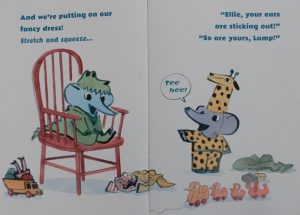
The Street Beneath My Feet

dscn0214

The Street Beneath My Feet
Charlotte Guillain and Yuval Zommer
Words & Pictures
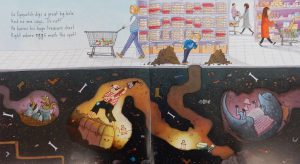
This large format volume takes the form of a concertina book that invites readers to stop and look down, posing the question, ‘What’s going on deep in the ground under your feet?’ and then takes them, layer by layer down, down through the earth’s structure to its core, and back again.
Through Charlotte Guillain’s accessible narrative style text and Yuval Zommer’s super-stylish illustrations the whole experience encompasses aspects of biology, archaeology, geology and civil engineering …

%0a

There are questions such as ‘Who do you think wore this helmet on their head?’ to ponder and perhaps research,

%0a

as well as less satisfying ones like ‘What’s that loud rumbling noise making the ground shake?’ that are immediately answered by the next sentence. In fact, any small paragraph or picture might generate some research if it catches the interest of a young reader and that, must surely be part of the intention of the joint enterprise.
Those same readers may well find themselves getting a little dizzy at the point the pace accelerates with ‘Let’s pick up speed as we delve down deeper. Hold on tight because things are about to get shaky. We’re deep in the Earth’s crust now and things are moving!’ and there follows talk of an earthquake and how it happens.

%0a

If you can’t experience the real things, this book is a stimulating substitute; alternatively and better, read the book and then, enthused by what is between its covers, get out into the world and discover first hand, what lies under the ground beneath your feet in your particular part of the world.

Lots

dscn0142

Lots
Marc Martin
Big Picture Press
Prepare for a visual tour that takes in places as different as Delhi and Antarctica, Alice Springs and the Amazon rainforest,

dscn0145

Tokyo and the Galapagos Islands and the wonderful and exciting things to be found at each destination. There’s a plethora of people to meet, amazing and common or garden animals to encounter – the inevitable abundance of dogs in Paris, and the elephant shrews of Cape Town. Tokyo seems almost over-run with vending machines and Kawaii (cute things), whereas cats are curiously common in Cairo;

%0a

and Delhi is replete with rickshaws of various kinds; and chai wallahs are always on hand to provide you with a cuppa.

chai wallhas at work

All this and much more, is contained within Marc Martin’s vibrant, jam-packed illustrations printed on beautifully matt spreads – one per location.
There seems to be no rhyme nor reason to his choice or arrangement of destinations: Ulaanbaatar with its ubiquity of yaks and Reykjavik, home to lots of Annas and Jóns clearly interested him so there we are.
Amusing snippets of information are scattered over the large pages, some such as Lenin almost ‘accidentally’ being an honorary member of the Beatles are funny, or that New York is sometimes called ‘The City that Never Sleeps’ (probably on account of the coffee!) Martin suggests.
So, if you want to be an ‘armchair traveller’, this is for you; better still, get hold of the book, be inspired by one of the destinations herein and then pay it a visit, to learn more about its people, wildlife, buildings, food, transport and landmarks for real.

Adelaide’s Secret World

%0a

Adelaide’s Secret World
Elise Hurst
Murdoch Books
Adelaide’s life has become a solitary one: her once busy world of wonders now shrunk to a behind the red-curtain, glass-jar-filled existence. From the window she observes the sunrise, the ships entering the port and the loners in the city below. In the evenings, she uses her art to re-create what she’s seen by day; but there always seems to be something lacking.

%0a

Then one day, feeling restless Adelaide heads out, despite the gathering clouds into the hustling, bustling city. As the storm gathers apace, she notices by chance a fox dropping his book as he dashes through the crowds. Without a moment’s thought, Adelaide retrieves the book – a sketch book – and follows its owner back to his home; and through the window the sight that meets her eyes is one of recognition. ‘And she knew them all – the dancers, the lost ones, the midnight cat and herself, Adelaide.

dscn0221

Then the door is opened and ‘though her heart called out she could make no sound.’ – Such a beautiful portrayal of coming face to face with your true soul mate.
Having handed over the book and dashed home, Adelaide’s world spins in turmoil

%0a

and a change happens: the seemingly impossible becomes the possible. It’s not only her world that changes though: things in the city will never again be the same: there’s laughter and music … ‘And those who had once been lonely and silent … found their voices.’
To read this is to step onto a roller-coaster of emotions. It’s just SO breathtakingly moving and ultimately, uplifting. I particularly love the way that red curtain behind which Adelaide has retreated, and its unravelling, by and by becomes the means through which she and other lonely residents of the locality reach out and become linked to one another.

dscn0209

Books such as this are so important at the present when there’s so much talk of building walls, with countries breaking away from one another, looking inwards rather than outwards: it’s a timely and potent reminder that open-heartedness and the courage to reach out, to speak out against xenophobia, racism and the like can, little by little, bring change for the better.
There’s a near sublime quality about Elise Hurst’s oil-paintings and the way in which these, interwoven with her equally poetic words, create a synergy that moved this particular reviewer to tears and at the same time, fuelled a determination to continue working as a bridge builder in the spirit of Adelaide. What a gamut of emotions her colour palette arouses too: the contrasting greys and deep greeny-blues and browns of the storm both external and within the main character; and the contrasting orange and especially, red that is ever present representing a spark of spirit, warmth and the power of the imagination.

That’s Not a Daffodil!

dscn0056

That’s Not a Daffodil
Elizabeth Honey
Allen & Unwin
When Tom’s next-door neighbour, Mr Yilmaz,  calls with a crumpled bag containing what looks somewhat like an onion, but Mr Yilmaz assures him is a daffodil, the boy is more than a little sceptical. “Let’s plant it and see,” Mr Yilmaz suggests, so they do, in a large pot. Tom waits and waits but nothing much happens; He calls it a desert so Mr Y. suggests making it rain and he does …

dscn0057

Still, nothing seems to be happening, but they keep watching until Tom declares “a green beak” is peeping through. Inevitably, – as beaks do – it opens up; and becomes a green- fingered hand.

dscn0058

Mr Yilmaz continues visiting, bearing gifts of various fruits and vegetables, Tom’s curiosity growing along with the plant all the while as it becomes “Grandpa’s hairs in the wind”, “a wet rocket”, needs the assistance of “the plant ambulance” when Mr Yilmaz’s grandchildren accidentally knock over the pot in play; and then after some TLC, shines forth as a “street light”, heralding spring.

dscn0059

What though, does young Tom see when the bud finally bursts forth in bloom …
Wonderfully playful, uplifting and full of hope, this beautiful story introduces so much – notions of good neighbourliness, diversity, respectfulness and a whole lot of learning about gardening, and growth – not only of the flower but also of a special friendship. At the same time it interweaves imaginative notions in the form of metaphor and all this through the eyes of a young child.
The author’s gorgeously warm, soft-focus illustrations in, I think, watercolour and oil pastel, exude warmth and a joie-de-vivre.
A perfect springtime share for early years teachers and parents of pre-schoolers.

Poetry Parade

Silver
Walter de la Mare and Carolina Rabei
Faber & Faber
Slowly, silently, now the moon
Walks the night in her silver shoon;
This way, and that, she peers, and sees
Silver fruit upon silver trees;
‘ …
It’s lovely to see Carolina Rabei’s enchanting visual interpretation of a de la Mare poem that was a childhood favourite of mine. I still have all the words in my head and often used to visualise a moon wandering silently in those ‘silver shoon’.

The illustrator imbues the whole thing with dreamy magic as she portrays the moon as feline, tiptoeing among the silver fruited tree branches, and then across the ground pursued by two small children and a host of faery folk, past the log-like sleeping dog …

and watched by all manner of nocturnal creatures that all gather in a clearing …

before some of them take a small boat and glide across the water while ‘moveless fish in the water gleam’ and the two children fall fast asleep. AAAHHH! Gorgeous.

Little Lemur Laughing
Joshua Seigal
Bloomsbury Children’s Books
I’m always excited to discover new poets and was delighted to receive a collection from rising star, Joshua Seigal. Playful is the name of the game where these poems are concerned: they cover all manner of topics from food (for instance Johnny and The MANGO wherein a boy retires to a warm tub to consume his favourite tea) to Fireworks; Seagulls to Stickers and Conkers to Colours and Chat. Alliteration abounds – indeed there is a page at the back of the book in which Seigal talks about his use of this in the title poem; there’s a generous sprinkling of concrete poems –

and some, such as Turvy & Topsy are completely bonkers, but went down well with my listeners.
In fact there isn’t a single one that isn’t lots of fun to read aloud to younger primary children. I’d certainly recommend adding this to a KS1 or early years teacher’s collection and buy it for any youngster whom you want to turn on to poetry.

The Fire Horse
Vladimir Mayakovsky, Osip Mandelstam & Daniil Kharms
The New York Review Children’s Collection
This contains three longish poems, one from each of the authors, all being translated by Eugene Ostashevsky and each having a different illustrator. The title poem has wonderful art by Lydia Popova; Mandelastam’s Two Trams artist, Boris Ender, used a limited (almost exclusively, black, grey and red) colour palette for his superbly stylish portrayal of the two tramcars. The final work, Play portrays verbally and visually three boys absorbed in their imaginary play worlds, the illustrations being done by Vladimir Konashevich.
For me, the book’s illustrations make it worthwhile, showing as they do, Soviet book illustrations from almost a century ago.
For book collectors/art connoisseurs rather than general readers, I’d suggest.

I’ve signed the charter 

Pigeon P.I.

dscn0175

Pigeon P.I.
Meg McLaren
Andersen Press
Murray is a private investigator of the pigeon kind. Of late, since the departure of his fellow operative, Stanley, Murray has been taking life rather easy. Then out of the blue – or rather, the rain – who should show up but the Kid, aka Vee, with a mission: to locate her missing friends.

dscn0176

Intrigued, but not yet ready to take on another case, our narrator Murray asks her to come back the following day. She doesn’t show up and, with the police busy on a ‘big case’, he realises this will have to be a ‘do it yourself’ crime investigation.

dscn0178

Seemingly there’s a feather thief at large in the town. Who or what is responsible for the dastardly scene that meets his eyes once inside the Red Herring Bar and Grill;

dscn0179

and why does the voice emanating from the depths of the place sound oddly familiar? Even more importantly, is Investigator Murray ‘s goose well and truly cooked; or will the town’s streets again become safe for his fellow avians of every hue, once and for all?
Meg McLaren’s (Life is Magic) winning piece of detective fiction is bound to make you cackle. Take a look at those end papers for starters, especially if you want to do a spot of detecting yourself. Full of visual and verbal puns, witty details, speech bubbles and delivered in the manner of the best crime writers, this will appeal particularly, to anyone with a passion for setting things to rights. For sure, it’s a case of the more you look, the more you discover …

The Butterfly Dance

%0a

The Butterfly Dance
Suzanne Barton
Bloomsbury Children’s Books
The butterflies weren’t the only ones dancing: I joined them as I opened the parcel containing this alluring book. My dance though, fell far short of the dazzling show of the exquisitely patterned, winged creatures herein. It’s good to see Susanne Barton adding a book starring ‘flyers’ different from those in The Dawn Chorus and Robin’s Winter Song to her repertoire.
Two caterpillars, Dotty and Stripe share everything. Then Stripe pupates leaving Dotty feeling lonely, but soon she too makes a cosy bed and falls asleep. Dotty is first to emerge and cannot wait to show her wonderful wings to Stripe. He however, is already flying towards her, resplendent with his outstretched wings.
Then begins a dazzling gliding, looping, soaring, whirling, fluttering and chasing dance, which is interrupted by an untimely rain shower. Taking cover, the butterflies encounter a bee that tells them of a meadow full of flowers, and sends them on their way. Their route takes them through the woods where dragonflies dip and dart around a puddle

dscn0182

and there they learn of other butterflies the colour of Stripe. Further on though, Dotty discovers that there are also butterflies of her own blue colour and the two wonder if they should be playing with those that look like they do.
The best friends have a dilemma: should they seek their fellow look-alikes or stay together? They decide to part: Stripe plays with red butterflies, Dotty with blue. They miss each other. Can they remain friends but stay true to themselves at the same time? And, equally important, can they find one another again?

dscn0185

Inherent in this enchanting rendition are themes of self-knowledge, self-acceptance, friendship, reaching out to others, similarities and differences, and change. Every spread, be it a single scene stretching across the whole double page, one page, or a sequence of small vignettes,

%0a

is made visually captivating by Suzanne Barton’s kaleidoscopically coloured, signature mixed media, collage style art.

Let’s Go to Nursery! / Will You Be My Friend?

Let’s Go to Nursery!
Caryl Hart and Lauren Tobia
Walker Books
We join Bee and Billy (and their mums) at the door of a nursery. The session is already in full swing with all kinds of exciting activities taking place. The children give their mums a farewell hug and Bee eagerly begins to join in. Billy however, is more reluctant and a tad clingy. He soon gets drawn in though, thanks to a ‘message’ full of kindness …

Happy noisy play ensues until there’s a dispute over ownership of a large toy; but Billy, surely a fast learner, comes to the rescue and all is well once more.
There’s so much fun to be had, so many things to share and so much playful learning – just how it should be.

All too soon though, it’s time to help tidy up; the mums are back and it’s farewell until tomorrow: a happy, exhausting day spent and the prospect of many more to come.
Caryl Hart and Lauren Tobia paint a lively portrait of nursery life without the intrusion of the nursery staff: they, one hopes, are observing and sometimes, gently encouraging and perhaps guiding, unobtrusively from the side-lines.
The first of the First Experiences series for ‘a new generation of little readers’ the publishers say. Perhaps ‘little listeners’ would be more accurate, but no matter which, its intended young audience will find plenty to enjoy; it’s as well that the book is sturdily made with wipe-clean pages as I foresee a lot of enthusiastic handling.

Will You Be My Friend?
Molly Potter and Sarah Jennings
Bloomsbury Children’s Books
This is a title from Bloomsbury’s Featherstone imprint and has something of an educational slant: There’s plenty to think about and discuss; and the whole thing is invitingly illustrated with a sequence of vignettes. These are captioned and each spread opens with a question on an aspect of friendship: ‘What do you do when a friend upsets you?’ and ‘What do your friends think of you?’ for instance. Notes from a friendly puggish pup offer further food for thought at the bottom of each right hand page.

A final spread is aimed at parents, although I see this book being used in preschool and KS1 sessions on ‘What makes a good friend?’ too. It’s all very nicely and inclusively done though personally, I prefer emotional and social learning to be part and parcel of picture books’ stories rather than books specially created for the purpose.

I’ve signed the charter  

When Grandad was a Penguin / Snip Snap Croc

dscn0195

When Grandad Was a Penguin
Morag Hood
Two Hoots
When is a Grandad not a Grandad? That’s the dilemma facing a little girl when she goes to visit her Grandad. His behaviour seems somewhat out of character, he looks a trifle different, he keeps talking about fishing, his clothes are ill fitting and he keeps turning up in unlikely places such as …

%0a

Could it perhaps be his age? Fishy indeed.
Can a timely phone call, followed by a trip to the zoo, sort things out? Grandad certainly looks at home in his icy surroundings, so will he agree to another change of environment?

%0a

Unlike the child protagonist in this latest Morag Hood delight, young readers and listeners will happily go along with the whole crazy situation, aware that they’re being taken for a ride, so to speak; and they’ll certainly have a good giggle over the silly scenarios. Best shared with a Grandad, but shared it needs to be. The restricted colour palette, controlled ink and lino print scenes and a simple direct text delivered by the child narrator combine to make a delectably droll drama …

%0a

and that final twist is inspired.

%0a

Snip Snap Croc
Caroline Castle and Claire Shorrock
QED
This tale takes us to the River Nile, where, should you happen to be wandering along its banks, you might encounter Snip Snap Croc. If so beware: this creature boasts of sixty snip snipping teeth just waiting to ‘nip, nip, nip’. Mama Baboon, Mama Meerkat,

%0a

and Mama Lion, whose homes are along the river all urge their little ones to stay close to their sides.
On the bank meanwhile Snip Snap Croc is busily engaged digging and very soon TAP! TAP TAP! and out come …

%0a

Soon she has twenty three new born baby crocs to take care of; but it looks as though she’s gobbling them up – at least, that’s what the other baby animals think …

%0a

Mama Croc – the newest mama on the riverbank has a secret though – a protective one; and once she has moved her offspring to a suitable spot, she opens her enormous jaws and plop, plop, plop: out come the twenty three babes, with a word of warning from their mama, “Stay close by me and / no harm you’ll meet./ For I love you more/ than the river is deep.” As it is with the other mothers, so it is with Snip Snap Croc. Now, as day gives way to evening, all the animals know they can rest content that night.
The text moves in and out of rhyme as the story flows merrily along and Claire Shorrock’s illustrations have a droll humour about them, which adds to the enjoyment of the shared joke between author and readers.

Charter logo FINAL.indd

Can I Join Your Club?

Red Reading Hub is thrilled to be taking part in the blog tour for this cleverly inclusive book

Can I Join Your Club?
John Kelly and Steph Laberis
Little Tiger Press
Children are inveterate club creators (often calling them gangs); and club joiners. There’s the book club, the gym club, dance club, drama club, art club and so on: after- school clubs are numerous and in my experience, extremely popular. Adults too are big club joiners. The trouble is, the issue of insiders and outsiders often rears its ugly head causing upsets, resentment and sometimes, worse: discrimination and prejudice for example.
John Kelly’s wonderful story of Duck’s efforts to become a member of a club – any club – be it Lion Club, Snake Club or Club Elephant find him wanting: he receives a resounding ‘Application DENIED!’ in each case.
Down, but definitely not out, Duck knows just what he must do. He sets up his very own club: one where every single applicant is welcome – Good on you Duck. And best of all, he calls it, eventually, OUR CLUB.

Drum roll for Duck. Acceptance and friendship rule.
How beautifully Kelly takes the issues of inclusivity and the vital importance of embracing diversity and weaves them into this funny book. As someone who is in despair about current issues such as BREXIT, the treatment of migrants, refugees and asylum seekers, not to mention Trump’s wall, this is truly a timely parable. This could be seen as a wake-up call for one and all.
Steph Laberis’ animal characters are a treat to behold: the specs they sport in this scene are so ridiculously spectacular.

Almost every scene simply crackles with energy; there is deliberately, the odd exception though – not a lot of dynamism here …

I now hand over to the book’s author to talk about the way he works:

Where do I work? And how do I work? With John Kelly author of Can I Join Your Club?

I work from home.
But the truth is that I work in lots of different places.

I work sat bolt upright in front of my desktop computer, but also slouched on the sofa with my laptop. I draw with big pencils on a drawing board perched on my dining room table, yet I scribble tiny doodles with my favourite fountain pen in a Moleskine sketchbook. I write leaning against the kitchen worktop, hunched over a cup of coffee in a cafe, wrapped up warmly on a park bench. I construct plots, characters and rhymes best in a hot bath, in the shower, laid flat out on the floor with my eyes closed, or walking a friend’s tiny Jack Russell (called Luna) round the park.

My writing work falls roughly into two modes of working.
Rhyming books and Non-rhyming books.

Rhyming books tend to start with a general idea: i.e. ‘What if a dragon was raised as a knight in armour?’
I then just begin jotting down random rhyming couplets that make me laugh or, by a bizarre combination of words, spark some other silly idea.
When I’ve got enough of those (about 40-50) I’ll see if it’s possible to roughly cut them into some kind of order. That order will then (fingers crossed) suggest some kind of story. I then start filling in the gaps with more new couplets. This will then suggest even more silly ideas which, in turn, suggests more stupid plot ideas. I then need new couplets, and the process goes on, and on, and on…

After an indeterminate time (anything from three weeks to two years) I end up with a working story outline. So then I go through it doing everything to make the rhymes as amusing as possible. Then I polish it over and over until I’m not clever enough to make it any better and send it to my agent.
She emails me back saying, “That’s great!” or “That’s awful!” In which case I start again.

Non-rhyming books are a bit different.
They still start with a general idea: i.e.‘What would happen if a Bear checked into a 5 star hotel to hibernate?’
But then I’ll just jump straight into writing in my sketchbook, trying to work out what the story is actually about. I often do drawings as I go along – not because I’m intending to illustrate it myself – but because it helps me find the meaning of certain scenes. It’s like having my own pet actors who can act out scenes to see if they work or not. Sometimes the actors are much cleverer than me and they’ll come up with something I would never have thought on my own.
Eventually I have enough to attempt a rough draft. Then it becomes very similar to the previous method of working. The big difference with non-rhyming books is that I act them out in my kitchen, which I’m sure is enormously amusing/irritating to my neighbours.

I do school visits and have learnt that what works on paper doesn’t always translate out loud. So I’m now a big believer in performing each draft of my texts. I don’t think it’s until I’ve read something out loud, in a silly voice, that I get a sense of whether it works – or not. It’s got to the point now where when I’m writing I’m always thinking, ‘How this will sound?’ in front of a hall full of 150 kids.

(I’d love to be a fly-on-the-wall when John is acting out some of those drafts of his.)

I’ve signed the charter
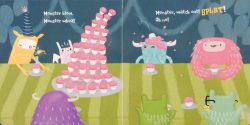
The Naughty Naughty Baddies

dscn0199

The Naughty Naughty Baddies
Mark Sperring and David Tazzyman
Bloomsbury Children’s Books
One baddie’s bad enough but four ‘Naughty Naughty’ ones is something else, especially if it’s this particular quartet – a motley bunch if ever there was one.

%0a

These NNBs especially enjoy creeping and they excel in same: sometimes, or rather, this time, their creeping leads to a big fat nothing: they simply can’t find a single naughty thing to do no matter how hard they try, or where they look.
So, ideas are discussed and Four’s plan is the favourite. It entails bouncing from their trampoline to their Badmobile and thence into a helicopter, then parachuting over a certain palace and there doing a spot of ‘spotnicking’ which will leave her royal highness’s pooch, er, spotless.
They have plans for putting to use their swag bag of spotty spoils too …

dscn0202

Can those dastardly deed doers execute their mischief though; or might there be a chance that they’ll be spotted and apprehended in the act of thievery?

%0a

If so, can they talk their way out of trouble and who will get the last chuckle? Um, that one’s easily answered: it’s anyone who is lucky enough to read or hear this wickedly funny book read aloud.
The combination of Sperring’s super-silly story that is brimming over with word-play, and Tazzyman’s terrific, rib-tickling visuals is a fabulous treat for all who encounter the outrageous shenanigans of the awesomely awful foursome. Bring it on baddies!

Counting with Tiny Cat / The Fox Wish

Counting with Tiny Cat
Viviane Schwarz
Walker Books
Tiny Cat is an energetic bundle of mischief with a particular penchant for red wool. At the outset there isn’t any but then yippee! A ball of the red stuff rolls right along. That quickly becomes TWO! THREE! FOUR! Which is all the creature can really juggle; but still they keep coming.

Clearly Tiny Cat’s counting skills have yet to develop further, though oddly the feline’s vocabulary encompasses ‘ABOUT A DOZEN– emphasis on the about here I should add.

Still though, the creature’s appetite for the red stuff isn’t satisfied: ‘LOTS’ leads to a very greedy ‘AS MANY AS YOU CAN GET’ but even that isn’t sufficient. SOME EXTRA gives way to …

Will the frisky thing ever realise that enough is enough?
A wonderful visual comedy with a delightfully playful star: Tiny Cat most definitely commands the performance, and viewers will definitely demand instant encores.

The Fox Wish
Kimiko Aman and Komako Sakai
Chronicle Books
A small girl – the narrator – and her younger brother return to the playground in search of the skipping rope left behind earlier. There’s no sign of their rope but they follow some sounds of laughter and in the clearing, come upon, not the friends they’d anticipated. but a group of foxes enjoying a skipping game.

Doxy, foxy, / touch the ground. / Doxy, foxy, / turn around. / Turn to the east, / and turn to the west, / and choose the one that / you like best.
The children decide the foxes are less adept skippers than they on account of their tails and Luke lets out a giggle. Fortunately the foxes aren’t offended: instead they approach the children and ask for some coaching. Soon animals and humans are playing together happily, taking turns to hold the rope ends. When the little girl’s turn comes to do so, she notices the name, painted on the handle.

It’s her name, but also happens to be that of one of the foxes; and, the little creature has assumed it now belongs to her because of a wish she’d made.
Does the little fox’s wish come true: what does the little girl decide to do?
A wonderful, slightly whimsical tale of empathy, altruism and kindness, and a delightful portrayal of the way young children so easily slip between fantasy and reality, told with sensitivity that is captured equally in Sakai’s glowing illustrations and Aman’s words, which in their direct simplicity, echo the voice of a child. Such exquisite observation.

I’ve signed the charter 

Triangle

Triangle
Mac Barnett and Jon Klassen
Walker Books
Knowledge of a friend’s ophidiophobia is in part, the driving force behind Triangle’s foray from his home in his triangular neighbourhood, across a barren place of rocky humps ‘They were shapes with no names’ Barnett informs us; and on through the place of squares –

big, medium and small ones – to Square’s abode. All the while he’s been plotting the sneaky trick he’s about to play.
He walks right up Square’s door, whereupon he delivers a round of snake-like “HISS” sounds.
Square is momentarily petrified: Snake dissolves into paroxysms of laughter. A pregnant pause follows,

rapidly replaced on Square’s part by incandescent rage.
Thereupon the four-sided being chases the three-sider all the way back to his home. His shape however, prevents him from entering and there he stands stuck in the doorway and thus accidentally discovers Triangle’s nyctophobia.

I know you’re afraid of the dark. Now I have played a sneaky trick on you! You see, Triangle, this was my plan all along.” Hmm! I’m not so sure about that.
Klassen’s restrained earthy palette and minimalist scenes (those eloquent eyes again), are in perfect harmony with Barnett’s even sparer, deadpan text allowing readers to step into the narrative landscape and fill for themselves, the host of gaps left by the book’s genius creators.
Prankish play or something more sinister? I come down on the side of the former.
This book is the first of a planned trilogy from this formidable team: I eagerly anticipate the next one … and the next.

I’ve signed the charter 
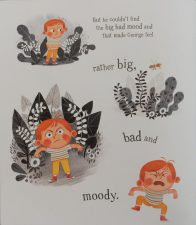
Town Mouse, Country Mouse

Town Mouse, Country Mouse
Richard Jones and Libby Walden
Caterpillar Books
There are numerous versions of the Aesop classic tale to be had; I have a fair few myself, but this has now become my favourite. Libby Walden renders the story in a measured, beautifully readaloudable rhyming text telling of the house swap between the mouse cousins: the ideal solution to Town Mouse’s hectic bustling life fatigue and Country Mouse’s yen to become ‘a mouse about the town!
Invitations are sent, received – love the postie frog –

and responded to, bags packed (don’t you love Town Mouse’s roller-wheels and little black bag); with high expectations the two sally forth …

and the swap begins.
Less than twenty-four hours later though, all is not well: Town Mouse is disturbed by the dawn chorus, and the never-ending ‘beeps and creaks and clinks’ result in a sleepless night for Country Mouse. Food is problematic too: Town Mouse almost breakfasts on poisonous berries;

and the tasty chunk of cheese Country Mouse has set his sights on for his morning meal, is in a trap.

Their walks are equally stressful: Town Mouse is totally unenthusiastic about country rambles in the rain: Country Mouse finds the whizzing wheels and lurking cats downright alarming. It’s time to return: farewells are said and with heads whirling with unforgettable memories, the cousins head for home. Assuredly it’s a case of ‘thank you’ but ‘no thank-you’ to one another’s ways of life.
This particularly resonated with me and my present struggles with having moved out of London to the country a few years ago, and now feeling the call of London life pulling strongly at my heartstrings. Richard Jones’ truly beautiful artwork makes both town and country look wonderful places to live. I love the cleverly conceived, strategically placed die cuts and the cutaway page, making the reading experience all the more pleasurable. A totally gorgeous fable reimagining to share and discuss, over and over.

Caterpillar Dreams

Caterpillar Dreams
Clive McFarland
Harper Collins Children’s Books
What a wonderfully positive message concludes Clive McFarland’s superbly uplifting tale of having the courage to believe in yourself and follow your dreams. That is just what Henri the Caterpillar does as he first dreams some big dreams, and then determines to follow his dream to see the world beyond his garden home. His minibeast friends do their best to discourage him: “Seriously, Henri, an adventure? Sounds exhausting.” is Slug’s comment but happily, Toad is on hand to offer encouragement: “Here’s the thing with dreams, Henri. If you don’t chase them, they always get away.” Wise words indeed. Thus it is that our stripy creature, aided and abetted by Bird, Mole and Fish starts out on his ‘amazing, incredible, impossible-seeming adventures.‘ Having crossed a wall, a road and a lake,

Henri discovers a giant hot-air balloon; but before he can climb to the top, he starts to become encased in a cocoon. Surely his dreams aren’t about to be thwarted before lift off? Young audiences familiar with Carle’s The Very Hungry Caterpillar, will know the seeming setback is only temporary. Far from being robbed of his dream, his metamorphosis allows Henri to take flight and travel anywhere he wants; and what he wants is to go to “The most amazing, incredible, impossibly possible place of all.” …

Inspiring, – don’t you love Henri’s politely determined help-seeking persistence as he appeals to Bird, Mole and Fish? What dauntlessness: what a journey; this scene reveals the scale of same, and allows audiences to enjoy the sight of those facilitators again.

Clive’s crisp, mixed media, digitally assembled collage pictures, with those wonderful characters and delectable details, make the whole thing a complete charmer of a book that quietly packs a powerful punch.

I’ve signed the charter 

Superbat / A Good Day for a Hat

%0a

Superbat
Matt Carr
Scholastic Children’s Books
There’s a new superhero on the block – or should that be a would-be one? Meet Pat the bat. Sleepless and bored with inverted hanging, one day, he longs to be special like those superheroes in his comics. Suddenly ‘POW!’ Light bulb moment; straightway it’s out with Mum’s sewing machine and he sets to work …

%0a

Hours later, Pat is ready to hit the high spots, but persuading his fellow bats of his super powers is going to take some doing. After all, super-hearing, flying and echolocation don’t count: all bats have those capacities; and he certainly can’t lift cars or shoot laserbeams from his eyes.
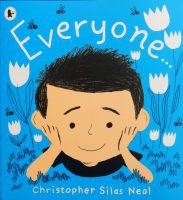
%0a

Pat is disheartened. “I’m just a normal bat in a silly outfit,” he says holding back his tears. Is he though? Suddenly, his super ears pick up a distant cry …

dscn0130

Could this be his big chance?
Matt Carr’s debut picture book is slightly crazy –or rather, batty – and none the worse for that. I suspect Pat the Bat, with his stitched-on-star suit, will win the hearts of young human would-be superheroes. The yesteryear colour palette is perfect for portraying his antics be they by day or by night.
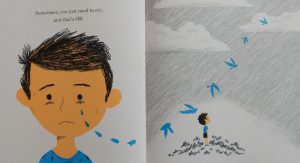
%0a

A Good Day for a Hat
T. Nat Fuller and Rob Hodgson
Abrams Appleseed
Donning a smart titfa, Mr Brown is ready to sally forth and he has a destination in mind. Try as he might though, he just can’t get beyond his own front path. First it’s the weather, then all kinds of unexpected, unlikely events unfold: a band marches by, magical bunnies are leaping all over his lawn,

dscn0108

a rodeo gallops along; there’s even a huge fire-breathing dragon …

dscn0107

and that is followed by a pirate ship. But, with no time for further dallying Mr Brown steps out again and this time, he’s well prepared.

%0a

Will he ever make it to Miss Plum’s house though? And what is the purpose of his visit?
Oodles of fun, with clever use of repetition, making its patterned text easy to read, and a super surprise ending, this jolly picture book is a treat for sharing and individual reading.
Early years teachers, think of all the hatty fun you could have with this playful book.

Piranhas Don’t Eat Bananas / Be Brave Little Penguin – Stepping out of your Comfort Zone

%0a

Piranhas Don’t Eat Bananas
Aaron Blabey
Scholastic Children’s Books
Brian is anything but your normal piranha; Brian feeds on fruit and veg. – bananas, silverbeet, (the Australian word for chard) peas,

%0a

and plums; and he’s on a mission to convert his fellow piranhas to a similar diet. They instead gorge themselves on feet, knees and bums! They’ll need to nibble through those boxers first though …

%0a

Despite their fervent declaration “We don’t eat apples! We don’t eat beans! We don’t eat veggies! We don’t eat greens! We don’t eat melons! We don’t eat bananas! … “ can he persuade them to sample something from his tempting-looking fruit platter?

%0a

Perhaps; but the allure of bum consumption will surely reign supreme.
Brian’s dietary requests will undoubtedly resound with many adults trying to persuade their offspring, or others to eat more healthily; young children will definitely laugh uproariously over the use of ‘bum’ and both will appreciate the subtle visual differences between Brian (no warts, no red tinges to the sclera of the eyes, even perhaps a slightly healthier-looking green hue about his skin) and his fellow piranhas. They’ll also love Brian’s wonderful facial expressions.
Flesh-eating, fruit eating, rhyming hilarity but with an important message too. Sample and see!

%0a

Be Brave Little Penguin
Giles Andreae and Guy Parker-Rees
Orchard Books
Pip-Pip is a tiny penguin, smaller than all the other penguins and he has a problem: he’s too scared to go in the water. He gets taunted by his fellow penguins which makes him sad and sometimes, lonely. His dad insists he should be brave; but mummy penguin takes over with a more gentle approach leading him by the wing towards the icy-looking water.

%0a

Brrr! It looks freezing and there might be monsters waiting to eat him. He clearly has a fertile imagination so his mum capitalizes on this, suggesting an alternative for him to imagine;

dscn0158

and step-by-step they go till Pip-Pip’s right at the water’s edge. He just needs to take that final plunge …
A gentle rhyming story with important messages about risk-taking for both children and adults. Parker-Rees’ icy-fresh illustrations convey the Antarctic chill but there’s also a warm glow to the sky making it less threatening for Pip-Pip and his young audiences alike.

Henry and the Yeti

%0a

Henry and the Yeti
Russell Ayto
Bloomsbury Children’s Books
Imagine loving a yeti. A yeti? We don’t actually think they exist, do we? That’s not the case for the young Henry however: he’s an adoring fan of the creatures and is determined to undertake an expedition to find one. First though he needs permission from his headteacher, who, surprisingly, authorises his absence, asking only for some evidence on his return –should he find one, that is.
Thus, with bags duly packed with vital equipment, Henry sets off with his father’s “no staying up late” instruction ringing in his ears.
It’s a long way to his Himalayan destination, although finding the way over seas and rivers, through forests and up mountains is, let’s say exciting.
Finding yeti traces though, is challenging, and Henry begins to lose heart when what should appear but …

%0a

It turns out that when it comes to size and friendliness, the yeti more than meets Henry’s expectations. Soon though, with evidence photos duly taken, and a quick game of hide and seek over,

%0a

it’s time for Henry, trusty compass at the ready, to head home.
Now to produce that evidence; but where on earth is Henry’s camera?

dscn0189

No camera, no evidence,” his father tells him: ditto his headteacher. Will the lad have to write the ten million lines for making things up that the latter orders; after all he really did see a yeti didn’t he? We know, his father knows but …
And, who gets the last laugh?
Henry’s self-belief is utterly awesome and entirely commendable; so too is this laugh out-loud creation from Russell Ayto. I’ve loved all his books, but this one surely tops the lot.

Under the Love Umbrella

Under the Love Umbrella
Davina Bell and Allison Colpoys
Scribble
One of my closest friends lives in India and when his two daughters were much younger, we took some holidays in Goa together. The elder girl, Triambika had recently started at boarding school and was not at all happy during her first term. One evening after dinner near the beach we stood together in the dark, looking up at the sky, where the moon had formed a smile shape. I recall saying to her, “Whenever you are feeling sad or alone, look up at that smile in the sky and know I’m there for you, thinking of you and sending my love.” This beautiful picture book brought this right back to me, using as it does an umbrella as the symbol of love and protection. ‘Over your head and just above / There’s an umbrella of my love. / To show it’s you I’m thinking of / Wherever you might be.
It then goes on to explore various situations when a child might feel frightened, upset, shy or sad

reminding him/her that a loving parent with the love umbrella is always there to comfort, reassure and embrace.
Moving home is particularly challenging for many children; another situation that calls for the umbrella and its loving care …

As do wet pants accidents, breakfast disasters, camping trips in maybe scary woods and more; whatever the weather, out comes that umbrella.

Indeed there isn’t a single instance when that all embracing cover cannot offer succour.
Delivered through Davina Bell’s gentle soothing rhyming words and Allison Colpoys’ striking, stand-out scenes rendered in neon shades: this creative partnership goes from strength to strength. A MUST buy book for families especially.
I’ve signed the charter …