Famously Phoebe / Goodnight, Little Bot

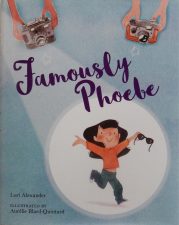
Famously Phoebe
Lori Alexander and Aurélie Blard-Quintard
Sterling

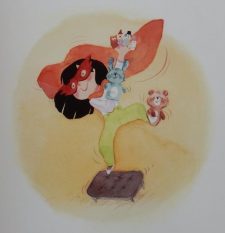
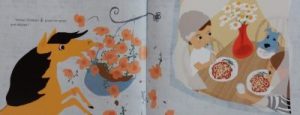
Young Phoebe is used to being in the limelight; no matter where she goes she gets special attention and so sees herself as a star.
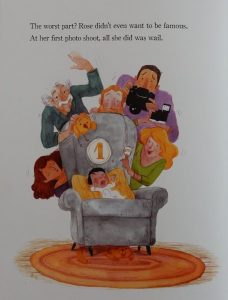
Then into her heretofore spectacular life comes a new and much tinier star, named Rose.
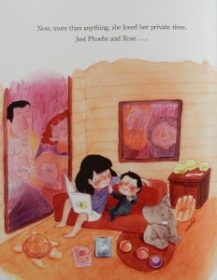
Suddenly nobody is interested in Phoebe; it’s Rose, Rose, Rose all the time and it’s not as though the new babe even wants to be famous. In fact she makes it pretty clear, it’s far from so.

Re-enter Phoebe stage right. Can she not only gain the spotlight, but manage to bring a smile to Rose’s face?

Maybe there are more important roles to play than star of the show, roles such as Big Sister for instance.

Lori Alexander’s playfully constructed narrative and Aurélie Blard-Quintard’s expressive watercolour and pencil illustrations artfully spotlight Phoebe’s changing emotions in this amusing addition to the new sibling shelf.

Goodnight,Little Bot
Karen Kaufman Orloff and Kim Smith
Sterling

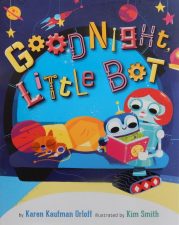
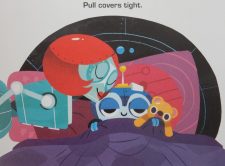
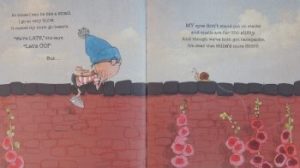
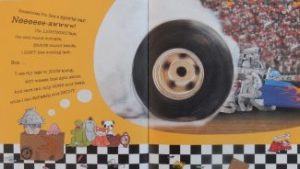
Like the majority of little humans, Little Bot is still full of energy when his mother robot tells him it’s time for bed.
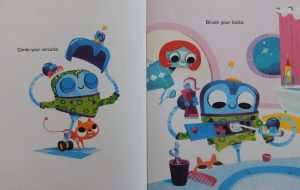
She then puts him through his usual bedtime routine: TV off, a scrub bath, pyjamas on, a snack and drink, comb, brush and storytime will all be familiar, especially the demand for ‘ten more books’. There are differences though and herein lies the fun: Little Bot snacks on batteries, drinks oil, combs his circuits and brushes his bolts …

before plugging in to a recharger (he barely needs that from the way he’s been whizzing around).
Orloff’s jaunty rhyming text and Smith’s bold, cartoonish, digital illustrations work well together in this pre-bedtime tale and yes, after hugs, kisses and a lullaby, Little Bot does finally wind down and drift off to dreamland.

Fox in the Night / Snow Penguin

Fox in the Night
Martin Jenkins and Richard Smythe
Walker Books

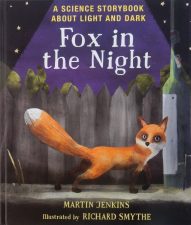
Billed as ‘A science storybook about light and dark’, this is a narrative non-fiction picture book with a sprinkling of additional facts.
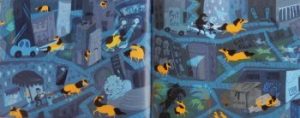
We join Fox as she wakes, sees it’s still daylight outside and so goes back to sleep for a while. Later, at sundown, she leaves the safety of her den and, guided by the moon and street lights, sallies forth across the park towards the town in search of food.

A mouse eludes her so she keeps looking; perhaps something static will be easier prey.
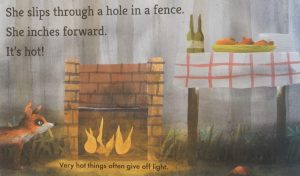
A bumped nose and a near miss from a car later, she’s still searching. Then, turning down an alley, her nose leads her towards something more promising – a barbecue in progress – and it’s here that she’s finally rewarded with a tasty treat to take back to her den.

Beautifully illustrated, this is a good starting point for a topic on light and dark with early years children. I’d suggest reading the story first and then returning to discuss the additional, smaller print, possibly using it as pointers to get youngsters thinking for themselves about why for instance, Fox bumps her nose on the shop window.

Snow Penguin
Tony Mitton and Alison Brown
Bloomsbury Children’s Books

Far away in the icy Antarctic, a curious little penguin is restless: he wants to find out more about the chilly sea and the snow. Off he goes alone to explore, unaware that the ice on which he’s standing as he gazes seawards has become detached from the mainland.
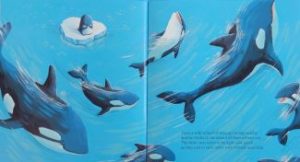
On his trip afloat on his little ice floe he sees blue whales, orcas,

an elephant seal and a sea lion with her cub. Suddenly he feels alone and scared adrift on the darkening waters. How will he find his way back to where he most wants to be, back with his family and friends?

Mitton’s assured rhyming couplets in combination with Alison Brown’s engaging depictions of the frozen Arctic seascapes and landscapes make for a gentle cuddle-up adventure for the very young.

On the Night of the Shooting Star

On the Night of the Shooting Star
Amy Hest and Jenni Desmond
Walker Books

Bunny and Dog are neighbours living on opposite sides of the fence in homes that match their owners. Bunny’s house is blue and is furnished in suitable bunny style (look for the bed’s rabbit-eared headboard and the chair’s fluffy white tail):

Dog has a red house with red furnishings. (I love the rug border and fireplace tiles.) Both have lake views and signs indicating they want to be left alone as they go about their solo activities.
However first thing every morning Bunny looks through the fence at Dog and Dog looks through the fence at Bunny: neither says so much as hello. They also take the odd peek at one another during the course of the day and at bedtime each checks the light in the window of the house opposite.
Time passes and one moonlit night, unable to sleep, both animals are drawn outside to watch the stars and each decides the other is in need of a friend.
The sudden appearance of a shooting star provides a shared experience:

could this be the catalyst for their friendship to develop at last?

Everyone needs a friend: sometimes we need the courage to reach out and be that friend. This timely message is at the heart of Amy Hest and Jenni Desmond’s softly spoken, captivatingly illustrated book.

How Monty Found His Magic / Starring Carmen!

How Monty Found His Magic
Lerryn Korda
Walker Books

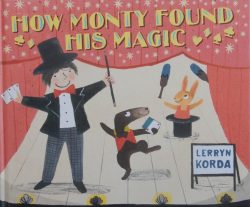
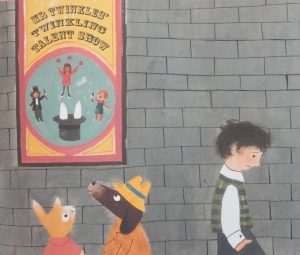
Meet the Magnificent Trio: Monty, his dog named Zephyr and his rabbit named Snuffles. They have ambitions to show their magic in front of a real audience and with Mr Twinkle’s Twinkling Talent Show coming up they’ve a chance to realise their dream.

First though, Monty must overcome his fear of public performance.
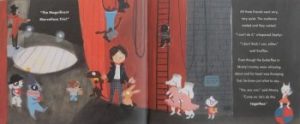
The day of the talent show dawns and Monty has a bad attack of butterflies in his tummy. His pals reassure him, “ … we’ll be fine … we’ll be together.
But will Monty be able to remember their words when they’re under the spotlight up on that stage in front of all those people.

This is a tale of finding your inner courage and working together as a team that will resonate with those children in particular who find doing anything in public a trial. Equally it demonstrates that behind every public performance lies a great deal of a gentle kind of magic that comes when friends support each other just because …
With its vibrant scenes of friendship and prestidigitation this should be a winner with young audiences.

Another performance tale is:

Starring Carmen!
Anika Denise and Lorena Alvarez Gómez
Abrams Books for Young Readers

Carmen is a drama queen of the first order: she acts, sings, dances and even makes costumes.
Her little brother, Eduardo is desperate for a part in her shows, so she gives him a silent role in her latest extravaganza.

Then when her parents ask for an intermission, the showgirl stages an enormous sulk. What good is a stage show when the audience are merely toys?
There’s one member of the family though who never seems to tire of performances and it turns out, he has much to offer when it comes to high drama too.

With its sprinkling of Spanish dialogue – I like the way the Spanish phrases are naturally dropped into the narrative – and brighter than bright illustrations, this story will appeal most to those who enjoy being in the limelight – one way or another.

I’ve signed the charter  

Curiosity The Story of a Mars Rover

Curiosity The Story of a Mars Rover
Markus Motum
Walker Studio

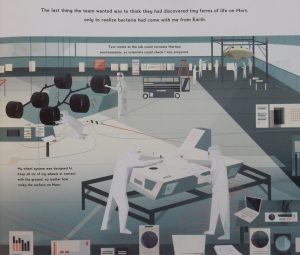
Wherever you are in the world right now, I’m a very long way away. I’m not even on the same planet as you. I’m a Mars rover.
So begins this story narrated by Curiosity, the robot vehicle landed on the surface of Mars in August 2012.
Readers are given a behind the scenes look at the lead up to, the planning behind and the building of, NASA’s 2011 mission

to land on, and explore, the surface of Mars. We learn how of the 39 previous missions to the red planet over half had ended in failure. Not so with Curiosity however. Launched from the Kennedy Space Centre in Florida on 26th November 2011,

the journey was successfully completed in 253 days.

So successful was Curiosity’s early work that what was originally to be a two- year mission was extended, and in August 2017 NASA celebrated the 5th anniversary of the landing and the work continues. More questions are asked; some answers are found; further questions are generated.
The information contained herein is detailed but never too wordy and the narrative style ensures that younger readers are not overwhelmed.
Motum’s graphics make it all the more accessible: geometric in form and richly coloured in blues, reds, grey, black and white, they have a clean sophistication that will appeal to adults as well as child readers.
There’s also a timeline and glossary at the back of the book.
All in all, this is superbly put together: it would make a great addition to a school library or family bookshelf, particularly for those who from time to time stand in the dark looking up into the night sky, wondering and questioning …

Snowboy and the Last Tree Standing

Snowboy and the Last Tree Standing
Hiawyn Oram and Birgitta Sif
Walker Books

Snowboy likes to spend his time playing imaginative games with his animal companions. Greenbackboy is riddled with greed. He persuades Snowboy to join him in a ‘better game’ he calls KA-CHING. The game entails cutting down all the forest trees in return for KA-CHING, which seemingly, can be used to get anything they want. With one tree left standing however, the enormity of what they’ve done strikes Snowboy and with the aid of his Cloak of Many Uses, he manages to hide the last tree.
Not satisfied with his ill-gotten gains, Greenbackboy drags his reluctant fellow player off to the oceans, their next target for exploitation.
With all the fish netted Snowboy again has second thoughts and manages to release two of their catch overboard, unnoticed by his companion.

But strongboxes filled with KA-CHING and mountains of tinned fish give no protection from the ravages of a storm that brews up, sweeping the tinned fish into the empty ocean to go to waste.
Snowboy has had enough.

Leaving Greenbackboy with his treasure, he, his Ice Troupers and Polar Bear King trek back across the wasted land, finally reaching that last tree.
Could it just be that with tender loving care, the tree can become their saviour?

Hiawyn Oram’s unusual story has a powerful ecological message: a fable about greed and exploitation of natural resources, it’s a timely reminder of what is happening to our planet.
Birgitta Sif’s beautiful illustrations have a muted luminescence and bring a touch of quirkiness to what is essentially a dark tale.

Gary

Gary
Leila Rudge
Walker Books

Gary is a racing pigeon. He eats, sleeps and dreams of adventure just like the others that share his loft; but, on race days, because he cannot fly, he’s left behind organising his scrapbook of travel mementos collected by his fellow pigeons. He listens avidly to the adventures of his friends as they talk of flight paths and wind directions on their return, noting down what they say in that precious scrapbook.
One night Gary and scrapbook accidentally fall from the loft into a travel basket and are taken, along with the others, to the city the next day.
He watches as the other pigeons take flight and race off into the sky, homeward bound,

leaving him all alone wondering if he’ll be forever lost in the city.
Unable to fly, he might be, but Gary does have a fully functioning brain and his scrapbook. It’s to these that he turns in his hour of need; and little by little with the aid of the book’s contents, he plots his way home, arriving with lots of exciting new mementos for the scrapbook

and a wonderful adventure story with which to regale his flighted friends.
Like Gary, Leila Rudge brings her text full circle, albeit with a slight twist, subtly showing how his differences are also sometimes, a gift. Good on you Gary for doing something amazing and doing it your way.

Beautifully illustrated, this is a wonderful story to share and talk about, and an inspiration for anyone who needs a little boost when it comes to self-belief.

Bonkers About Beetroot / Pony in the City

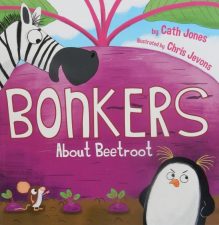
Bonkers About Beetroot
Cath Jones and Chris Jevons
Maverick Arts Publishing

Sunset Safari Park is in danger of being closed down due to a distinct lack of visitors. Zebra calls a meeting of its inmates in the hope they might have suggestions as to how to save their home. Despite Penguin’s discouraging “Nobody comes because we’re boring” comment, Zebra remains determined to do something to attract the crowds. Beetroot is his plan: the biggest in the world and the animals are to grow it. “BONKERS!” is pessimistic Penguin’s response to this idea and to pretty much every stage in the growth of the vegetable from manure heap planting ground …

to the large beet that soon attracts the crowds.
So successful is the vegetable that it just goes on growing and growing until there’s no longer room for visitors.

Penguin’s solution is a pretty drastic one but will it have the effect he hopes? Can the safari park be saved after all?

Really, there’s no other way to describe this story that to borrow Penguin’s much used word, ‘BONKERS’.
The contrasting characters: optimistic Zebra and pessimist, Penguin complement one another well, making for a lively and quirky story time read aloud that invites audience participation.
Chris Jevons’ vivid illustrations of zoo residents, the zoo’s human visitors and of course, the beetroot itself, provide plenty to giggle over.

Pony in the City
Wendy Wahman
Sterling

Otis, a pony at the Pony Paddock gets on well with the children who visit his home; in fact he’s ‘saddled with questions’ about them. Do they gallop and kick? Do they ever walk on all fours? Do they graze on grass and daisies? The older ponies ignore his constant questioning so Otis sets out to find some answers for himself.
He visits the city park where hiding himself away, he observes and discovers their movements and sounds are not very different from his. Next stop is their homes; ‘such big barns’, he decides.
Otis discovers many more similarities …

but then suddenly comes the scary realisation that he’s far from home, alone in the big city and it’s way past time to sleep.

Next morning he hears a familiar clippity cloppity sound; could it be one of his fellow ponies coming to look for him?
No it isn’t; but his finders are equally surprised to see the little pony so far from his home and more than willing to take him back home where, inevitably, he has lots of questions to answer …
This gentle adventure with witty collage style illustrations of a children’s world interpreted through the limited experiences of a pony, offers food for thought about judgements and diversity.

Art, Artists and Some Science Too

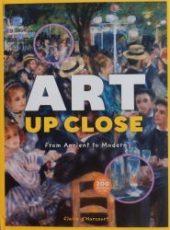
Art Up Close
Claire d’Harcount
Princeton Architectural Press

Art enthusiasts of all ages wlll enjoy this search and find game based on twenty three famous works of art from around the world.
Each large spread is a high quality reproduction of one named artwork that is credited and dated, in the same border as ten to twelve floating bubbles each containing a small detail from the whole piece. It’s these tiny visual elements that readers are asked to search for, some being a whole lot easier to locate than others.
The arrangement of the selected works is chronological beginning with Egyptian papyrus paintings from the Book of the Dead (around 1300BC). This is followed by a 6th century Byzantine mosaic, an Arabic manuscript (1400s), the Limbourg brothers illumination (1416) and other 15th century European painters.
Then comes an early 16th century Aztec manuscript, a Flemish tapestry, a Bruegel (the elder) and a Veronese painting.
From the 17th century are the younger Teniers, and Jan Steen’s Village School. This chaotic classroom scene, which includes a child drawing on the wall and back end of a rat that is tucking into the contents of someone’s lunch basket certainly made the teacher part of me smile; and oh my goodness, the place is so dark, it’s hardly surprising that half the people therein look as though they’ve fallen sleep or are about to do so. All this and more while the two ‘teachers’ appear totally unaware of what’s happening around them.
There’s a Japanese woodblock print from the early 19th century; Impressionism is represented by a Renoir and an Ensor; and we then move into the 20th century with surrealist, Miró,
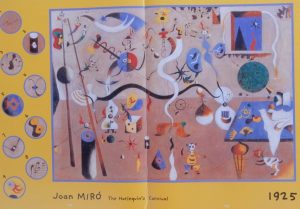
Picasso represents cubism and the final work is a 1952 Jackson Pollock, Convergence.
Then follow ten pages wherein D’Harcourt discusses each of her chosen examples individually; and the two final spreads have lift-the-flap mini paintings of each work that reveal the whereabouts of the details in the bubbles, and also provide short notes on the artists.
Of the 23 works, only five are non-western, but what disappointed me more was the lack of a single woman artist. Nonetheless, the whole enterprise is absorbing, educational, fun, attractively presented and well worth spending time over.
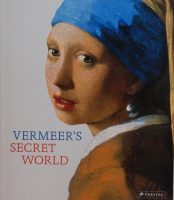
Vermeer’s Secret World
Vincent Etienne
Prestel

In what is an essentially introductory book, art historian and author, Etienne, traces the life and work of Dutch painter Johannes Vermeer, one of history’s most distinctive artists who lived in 17th century Delft for his entire life.
There are fifteen full-page reproductions of his works …
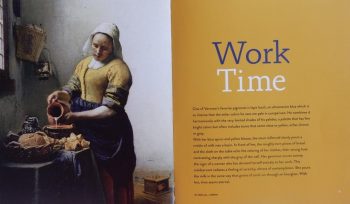
as well as eight smaller ones.
If you can’t manage to visit London’s National Gallery or one of the other galleries exhibiting Vermeer’s paintings, then this short book is a good starting point to begin to appreciate the Delft master, an artist whose focus was very much on people rather than places.

Trick of the Eye
Silke Vry
Prestel

Subtitled ‘How Artists Fool Your Brain’, this book offers a host of examples that demonstrate that deceptive imagery in art, far from being a new phenomenon, has been in use by famous and popular artists for centuries.
Vry uses paintings by, to name just some, Giuseppe Arcimboldo, van Gogh, Leonardo da Vinci, Hogarth, Turner, Vermeer, Paolo Veronese and Georges Seurat, as examples of optical illusions, as well as more modern artists including Salvador Dali, René Magritte,
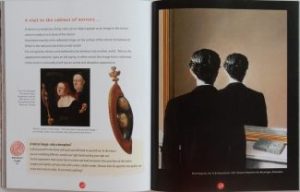
M.C. Escher, Bridget Riley, and Banksy.
In addition to paintings, some objects such as the Athens Acropolis and the Scala Regia in Rome are used.
The end pages offer solutions to the questions posed during the discussions of the various works of art, as well as instructions for some creative projects for readers to try themselves that were previously flagged up in the those discussions.
Absorbing, illuminating and a novel way of looking at some works of art.

For those readers of a more scientific bent:
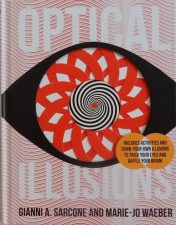
Optical Illusions
Gianni A. Sarcone and Marie-Jo Waeber
QED

Both the creators of this fascinating book are experts in brain training and cognitive sciences, and herein they offer readers the opportunity to find out about the science behind the illusions that trick our brains.
After a brief ‘Is Seeing Believing’ introduction; the book is divided into five sections: Light, Lines and Space,
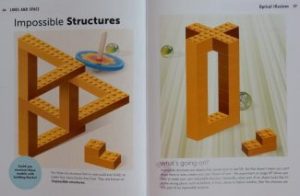
Motion, The Brain and finally, Experiments.
Each topic explores a variety of effects: for example Light demonstrates colour assimilation, complementary colours and after image, and colour contrast.
Since buying a book on MC Escher many years ago, I have been fascinated by the idea of optical illusions. This book has refreshed that fascination, but a word of warning: I spent ages poring over its hypnotic pages; don’t sit down with it unless you have plenty of time to spare – you’ll most likely be hooked, eyes and brain in sensory overdrive mode.
Dinosaurium

Dinosaurium
Chris Wormell and Lily Murray
Big Picture Press

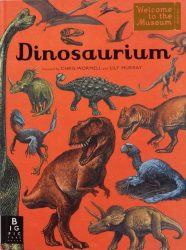
Dinosaur books seem to be coming thick and fast at the moment. This one is the latest in the ‘Welcome to the Museum’ series that includes Botanicum and Animalium, and, illustrated by Chris Wormell, it’s truly awesome: serious stuff in fact.
Like others in the series, the whole thing is presented as a museum, the author and illustrator being billed as its curators and the chapters, after the ‘Entrance’ that houses an extremely useful dinosaur evolutionary tree, as a series of galleries, six in all with a final index, some information about the book’s curators and a list of further sources should readers want to learn more.
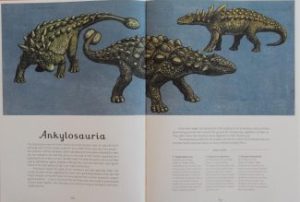
Gallery 1 is Sauropodomorpha. Don’t worry, the meaning of this is explained at the outset. Every spread has a large full-colour plate, which even has a numbered key in addition to the informative paragraphs relating to what is shown in the plate. I should mention here that these are splendid digital engravings, each illustration being in predominantly earthy tones.

The galleries proceed through Theropoda, Ornithopoda, Thyreophora, (these include the well-known to children, Stegosauria and Ankylosauria);

then on to Marginocephalia and to the final ‘Non-Dinosaurs’, which includes petrosaurs, marine repliles, Mesozoic mammals and lastly, survivors; (those that escaped the catastrophe that wiped out the ‘non-bird dinosaurs’).
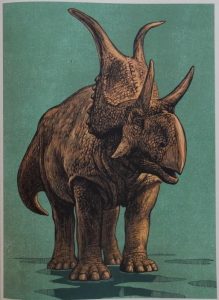
Going back to Maginocephalia, take a look at this stunning plate of Diabloceratops eatoni (yes the full scientific name is given).

This creature from the late cretaceous era is thought to have been a primitive ancestor of Triceratops and would, so we’re told, have used its beaked mouth to feed on low-growing plants in areas covered by lakes, floodplains and rivers.
In addition to the amazing exhibits of the galleries, each gallery is prefaced with a beautiful botanical plate featuring an original wood-cut of typical plants from the age of the dinosaurs featured.
A short review doesn’t really do justice to this outstanding book: it’s perhaps not, despite the ‘Admit All’ on the front cover ticket, for the very youngest dinosaur discoverers; although once any child has been inside, it’s likely to be a place that they’ll want to return to over and over, gradually taking in more of Lily Murray’s detailed text,  from each visit, perhaps early on, sharing their ticket with an adult who, I’m sure, will be more than willing to act as a guide.
The Boy From Mars

The Boy From Mars
Simon James
Walker Books

When Stanley’s mum has to go away overnight for work, Stanley too decides to leave the family home. From the back garden he blasts off in his spaceship – destination Mars.
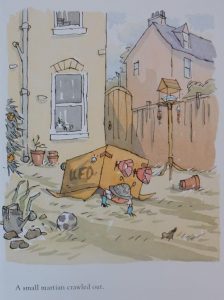
Not long after, the spaceship returns and out crawls a smallish martian …

come to explore “your sibilization” he tells Stanley’s brother, Will.
Their “leader” plays along with the martian thing and there follows a wonderful boundaries testing evening. Martians seemingly don’t wash their hands before meals, are unimpressed with earth food (other than ice cream) and definitely don’t have bedtimes. They don’t brush their teeth or wash before sleeping either and they always sleep in their helmets.

If there’s one thing that gets a martian’s temper flaring it’s being challenged about its identity and Stanley’s best pal, Josh is on the receiving end of a martian’s shove. This results in a morning spent sitting outside the head’s office contemplating his behaviour, something Dad learns of when he collects his offspring from school that afternoon.

When Mum returns in the evening, eager to hear how things have gone, a certain little martian decides there’s only one way to deal with the “Have you been a good little martian?” question … a return to base – of sorts.

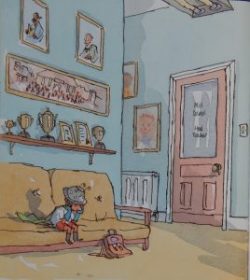
Simon James never fails to delight and this book is a cracker. The matter of fact, down-to-earth telling is pitch perfect when read aloud – the dialogue is simply superb. The illustrations reveal a space-obsessed little human with an inventive imagination and much else to contemplate and revel in.

I’ve signed the charter  

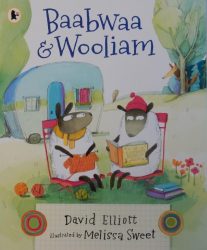
Baabwaa & Wooliam

Baabwaa & Wooliam
David Elliott and Melissa Sweet
Walker Books

Wooliam is a sheep – a sheep with a penchant for reading: how cool is that!
Baabwaa is also a sheep: she enjoys knitting – a more likely activity for a farm resident. These two are best friends. ‘Sounds kind of boring. But they like it.’ so we’re told.
One day the friends decide they should inject some adventure into their lives; so, it being perfect sunny weather with birds singing, off they set. However their field is surrounded by a wall; and circumambulating the field seems a rather dull kind of adventure. Nevertheless it’s what they do – three times. “Is this what adventures are like?” Baabwaaa asked. “All this walking, I mean.
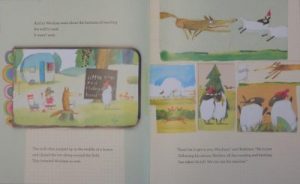
It certainly leads to an appetite for grass and while they’re munching their lunch another sheep appears. Or is it? This particular one has a long tail, a whiskery snout, dirty wool coat and ‘horrid teeth’. A pathetic attempt at a sheep disguise methinks.
Suddenly the whole adventure gains pace.
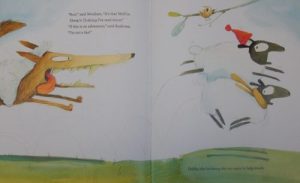
It’s that Wolf in Sheep’s Clothing I’ve read about,” says Wooliam knowingly,

producing a book he just happened to have in his rucksack, to prove it to the sheep/ wolf.
Woe is me! The lupine creature can’t read as he tearfully admits. “It’s not my fault, I’m just not the reading kind.” No matter: Wooliam can teach him and thus begins a highly unlikely friendship. Baabwaa meanwhile knits their new pal a replacement for his awfully dirty coat.
Learning to read is rather a protracted business, broken up as it is by bouts of wolf chasing sheep around the field.

He ‘s merely following his nature: “We can use the exercise,” is Baabwaa’s philosophical take on the interruptions. Eventually though, the wolf is sufficiently proficient to be horrified at the way he’s billed in books: ”It says here I’m cruel and sneaky!” he complains. “And your point?” said Wooliam. Deliciously droll humour such as that pervades Elliott’s entire comical narration, which is an absolute gift to readers aloud and an equal delight for those on the receiving end.
Equally brilliant are Melissa Sweet’s mixed media illustrations, which extend the telling and breathe additional vitality into the three players,

all of whom are a mix of opposing characteristics.
You can dine on this one over and over …

Alfie / Wakey, Wakey Elephant

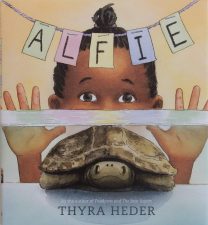
Alfie
Thyra Heder
Abrams
‘There are two sides to every story’ is an oft-used statement and so it is in this picture book. First we hear from six year old narrator Nia who receives a new pet, turtle Alfie on her birthday. She’s thrilled with the creature, introducing him to friends, making him presents, telling him stories and dancing and writing songs for him, all without anything by way of a response from Alfie. As time passes, Nia’s enthusiasm has waned considerably.
Come her seventh birthday; Alfie is conspicuous by his absence. Where has he gone?

Here the story turns and we hear from Alfie. He has after all appreciated her love and attention and wants to show Mia, by finding a present that will make her equally happy on their joint birthday.
Alfie’s quest for the perfect gift takes him outside for the first time in his life where he receives help first from dog, Toby, then from a snail and finally, after a long nap, from a fish.

It’s in the pond that Alfie eventually finds just the right thing and by the end of the book, there are two very happy celebrators of a birthday, albeit not the one Alfie thinks they’re celebrating.
Expressive watercolour scenes, punctuated by a single impactful, minimal black and white spread, combined with a spare, straightforward text, document this lovely story of appreciation and friendship.

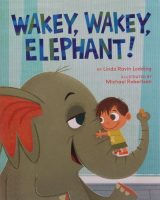
Wakey, Wakey, Elephant!
Linda Ravin Lodding and Michael Robertson
Sterling

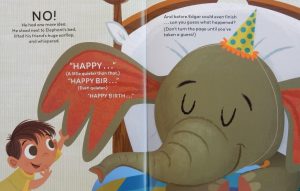
What do you do when your elephant friend simply refuses to wake from his slumbers no matter what you do? That’s the problem facing young Edgar.
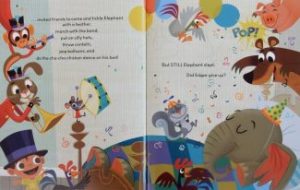
He’s tried the usual shouting and tickling neither of which caused so much as an eyelid twitch. A flock of roosters fails to rouse him, ditto a band marching right through his bedroom and a cha-cha chicken dance on the bed is similarly ineffective as are popping balloons and a particularly itchy party hat. (Young listeners will by now have guessed the reason Edgar is so eager to wake his pachyderm pal.) Even all these things done simultaneously  does not cause so much as a stirring from the slumberer.

Could a few softly spoken words in Elephant’s ear perhaps do the trick?

With its themes of friendship and perseverance, and its satisfying finale, this lively romp coupled with Robertson’s illustrations of exuberant activities taking place around the blissfully slumbering elephant, will illicit giggles from young listeners.

I Won’t Eat That

I Won’t Eat That
Christopher Silas Neal
Walker Books

There’s a delicious sting in the tail of this rather dark story of a cat’s search for an alternative to yucky, dry, dull cat food.
Tortoise, Fox, Chimp, Lion, Elephant

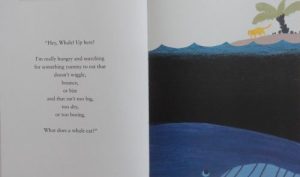
and Whale …

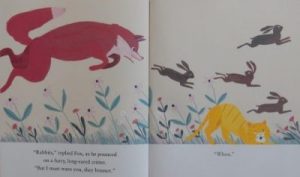
are all consulted on their diets but wiggly worms, bouncy rabbits,

bitey ants, stripy zebras and dry boring grass are decidedly uninviting for a fussy moggie, and Whale’s “bioluminescent phytoplankton” is simply weird, let alone unpronounceable.

Seemingly Mouse is similarly on the hunt for something tasty to eat and the innocent creature stops and consults Cat. Uh-oh! Finicky Cat suddenly turns eager predator.

Neal’s animals have a simple folktale look about them, which is perfectly in keeping with his cumulative textual style in this story that will be a winner with early years listeners; (mine demanded an immediate re-reading).
Equally the patterned nature of the text with its question and answer, built-in repetition format, is ideal for learner readers, once they’ve had the story read to them, of course. Here’s a taster: “Lion, please help. / I’m hungry and searching / for something yummy to eat that / doesn’t wiggle, / bounce, / or bite. // What does a lion eat?” “Zebras!” roared Lion, as he sprang after his striped prey. / “But I must warn you – “ …

A tasty tale indeed.

What Makes me a ME? / Words and Your Heart

What Makes me a ME?
Ben Faulks and David Tazzyman
Bloomsbury Children’s Books

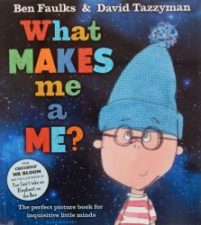
Here’s a diverting book about identity: “What makes me a ME?” Who am I and where do I fit into this world? – these are questions that everyone ponders.
For the boy narrator it’s a mind-stretching poser as he acknowledges that at different times he’s like a whole range of things: sometimes he’s slow like a snail but he’s not slimy and his eyes don’t stand out on stalks.

He doesn’t have a tail so he can’t be exactly like his puppy Monty, despite being full of energy.
Is he perhaps like a sports car; he’s certainly lightning fast, but that’s thanks to his legs rather than wheels.

No matter what he likens himself to, essentially he’s just himself – special and unique.
Faulks’ funny rhyming stanzas documenting the five year old narrator’s search for an answer to his philosophical question provide Tazzyman plenty of space to conjure up some wonderfully comical scenes, and the boy himself with snub nose, specs and bobble hat is cheekily enchanting.

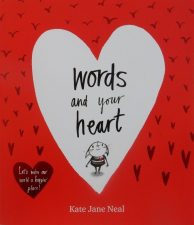
Words and Your Heart
Kate Jane Neal
Simon & Schuster Children’s Books

Words are powerful things: they can make your heart soar; they can make your heart sink; they can make your heart sing; they can make your heart hurt.
Words can be a force for good; or they can be a force for causing pain.
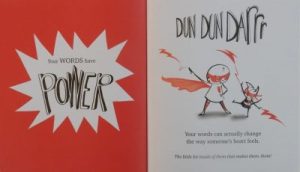
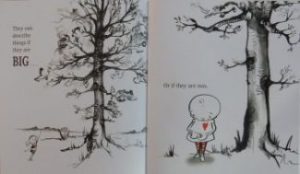
All this and more is demonstrated through characters Pip and Cat in author/illustrator Kate Jane Neal’s debut picture book.
‘This book is about your heart.
The little bit inside of you that makes you, you!’

So begins this unassuming book that goes on to say ‘the words that enter your ears can affect your heart.’
Her simple, but compelling message is a wonderful demonstration of how we can all contribute to making the world a better place by being mindful of the words we use to, and about, other people.

Executed with minimal colour, the illustrations, together with the empathetic and compassionate text that is orchestrated by means of changes of font, put forward a message too important to ignore.

A book to share and talk about at home, in playgroups and nursery settings, and in schools.

I’ve signed the charter  

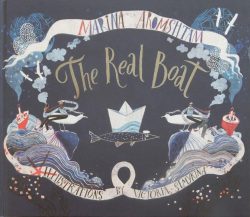
The Real Boat

The Real Boat
Marina Aromshtam and Victoria Antolini
Templar Publishing

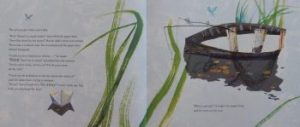
The little paper boat has ambitions – big ones. As he floats on the pond, he hears a duck talking of ‘real boats sailing on the ocean’ and decides that just like the other ‘real boats’, the ocean is the place to be. Prove himself he must by leaving the safety of his home surroundings and heading off into waters unknown.
Getting to his destination though, that is going to be tough. Many of the river boats whose help he seeks – the rowboat,

the motorboat, the riverboat and the barge – are singularly unhelpful.
The tugboat however is encouraging and assists him down to the harbour.
There the paper boat is mesmerised by the tall cranes,

the cars coming off the ferry and the lights of a huge passenger liner.
Further help and encouragement though, come from a fishing trawler in whose wake the tiny paper traveller follows as they venture further and further out on the ocean waves.
Then a fierce storm breaks battering the little paper boat and separating him from the friendly trawler. Is all lost for the intrepid journeyer?

Not quite: in fact all ends in a totally unexpected and highly satisfactory manner for the tenacious little adventurer.
From its brilliant cover you know you’re in for a real visual treat with this one: it’s wonderfully tactile and intricately detailed. Then there’s the number of pages: it’s twice as long as the usual picture book length, one of several I’ve seen of late; just the thing to snuggle up with and relish along with a hot chocolate on these long wintry evenings.
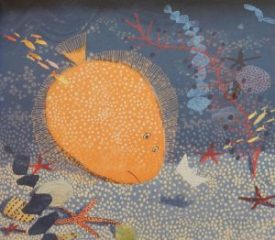
Lyrically told and with illustrations that are arresting and demand exploration for their artistry and technique, this modern fable is a thoroughly rewarding read.

The Bad Mood and The Stick

The Bad Mood and the Stick
Lemony Snicket and Matt Forsythe
Andersen Press

We all succumb to a bad mood from time to time and most of us know how contagious that can be.
So it is here with young Curly who chooses to take her storminess out on her younger brother, Napoleon, by poking him with a stick. That cheers her up but the bad mood is transferred to her mother and thence to carpenter Lou, who ends up in a dry cleaner’s shop.; but, Mrs Durham, the shop’s boss, confronted by the sight of Lou sans dungarees finds herself singularly unaffected by the bad mood

which in fact, sails right out the window and off around the world.
And the stick? It too has a contagious effect; but it is cheer that is slowly spread by the spiky object and, once colourfully clad, it takes pride of place for a while in the twisting narrative,

gaining ultimately, a life of its own and also, bringing into the tale, Bert, proprietor of the ice-cream parlour.
Snicket’s off-beat tale twists and turns in wonderful ways as it reveals a chain of surprises: there’s even a wedding attended by the entire cast of characters, human, animals and even – look carefully – a certain coloured blob …

Despite the prominent Bad Mood character, there’s a great sense of community about the whole thing, visually documented in Forsythe’s deliciously hued, retro-style illustrations of events large and not so large.
If you want a cure for a case of bad moodiness, this is absolutely perfect and even if you don’t, it’s a terrific read aloud for a wide range of audiences.

Stomp! Stomp! / Count on Goz / Night and Day

Stomp! Stomp!
Sebastien Braun
Nosy Crow
In this new addition to the ‘Can you say it too?’ board book series, a handful of dinosaurs have hidden, or rather attempted to hide themselves, in Sebastien Braun’s brightly illustrated spreads.
Very young children will get lots of pleasure manipulating the flaps (plants, a cloud and a rock) to discover what’s hiding beneath them, as well as getting their tongues around the names and noises.

Children beginning to read often find words such as ‘triceratops’, ‘diplodocus’, ‘stegosaurus’, ‘pterodactyl’ and ‘tyrannosaurus’ easy to recognise especially in a meaningful context, so why shouldn’t infants just starting to talk encounter them early on too, perhaps even with that older sibling reading the book with its short, predictable text, with them.

Count on Goz
Steve Weatherill
Steve Weatherill Books
Goz the baby goose has just taken his early morning swim but now he’s managed to lose the other geese. In his search he encounters in turn a cow and her calf, a sheep and 2 lambs, a mother cat and her 3 kittens and a dog with 4 lively puppies. To each he says, “Hello. Are the geese here?” but is greeted with “No, only me and my …” followed by a “Moo!”, “Baa, baa!” and so on …

until finally beside the big pond we spy …
Guess what is tucked in the nest beneath that large wing.
In addition to the baby animals revealed by opening the flap on each spread, the final page has 6 swallows, 7 sheep, 8 eggs, 9 newts and 10 tadpoles for those who want to continue their counting.
First published over 25 years ago, Goz has certainly stood the test of time. In addition to being a first counting book, this re-issue is, with its brief, predictable text, just right for beginning readers and far better than the rubbishy reading schemes offered to children starting to read in schools nowadays.
Equally it’s perfect to share with a small group of listeners in a nursery setting or an adult or older child to read to a younger sibling.

Night and Day
Julie Safirstein
Princeton Architectural Press
In ‘A Big Book of Opposites’, as the subtitle says, Safirstein uses simple shapes, clever design and bold colours together with flaps of various sizes, pop-ups, fold-outs and other interactive devices to help demonstrate opposing relationships such as tiny/ huge (and sizes in between); left/right – which has a secondary numerical element …

high/low; night/day – in this instance a large tree unfolds to illustrate both.
Circular sliders can be manipulated to demonstrate alone/together and next to/far (with ‘in the middle’ also included for good measure).
The whole thing is a handsome and inventive production …

and even the finale is ingenious; a gatefold is lifted to ‘open’ a bright red flower after which the book is ‘closed’ as printed on the back cover.
Once in their clutches, young users will I suspect spend a considerable amount of time with the book ‘open’, being reluctant to ‘close’ it, thoroughly enjoy playing with the various moveable parts so it’s as well the whole thing is sturdily constructed. It might even help them develop a few concepts while so doing.

The Elephant in the Room

The Elephant in the Room
James Thorp and Angus Mackinnon
Templar Publishing

‘It started with an “OOPS!” … and a “LOOK OUT!” and a CRASH!’

So begins this wonderfully eccentric mystery concerning the identity of the guilty party responsible for breaking Father Giant’s treasured china elephant.

The suspects are numerous: it could have been Olive or her brother, Grub – after all they are hiding in a cupboard when the elephant’s owner strides into the room issuing threats of the dire punishment he will dish out to the culprit.
Seemingly though they’re in the clear; but what about the naughty newt, the laughing lady with the golden boot,

the clipping clopping yucky yack? No? Surely it can’t have been Sophie Sofa, the sun or the storm; so who? It must have been someone; after all, the thing is lying in pieces on the floor, but will the case be solved?

The whole thing romps along in absolutely faultless rhyme – for me a cross between Spike Milligan and Edward Lear – to its splendidly satisfying, twisting finale that will cause listeners to wriggle in delight.

Those wacky illustrations of Mackinnon’s – wow! There’s a touch of Seuss about some of them …

and that innovative colour palette with its neon orange highlighting gives the whole thing a slightly hypnagogic feel.

I can’t wait to see what these two come up with next.

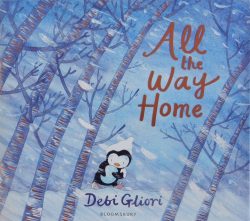
All the Way Home

All the Way Home
Debi Gliori
Bloomsbury Children’s Books

Little One, if you promise you’ll go to sleep, I’ll tell you a story. It’s so secret even your mama hasn’t heard it …
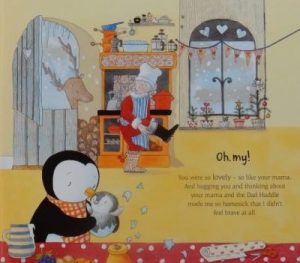
The tale this daddy penguin tells this is one: a kind of autobiographical snippet in a way. The Daddy Penguin is supposed to be looking after the egg while Mama Penguin is far away looking for fish but he wanders away from the Dad Huddle and together with the egg, is whisked up and away to the Arctic.
The creatures there are pretty scary-looking …

and decidedly unhelpful when it comes to giving directions back to the penguins’ home. Thank goodness then for one ‘hairy, sheltering thing’ that’s kind enough to carry penguin and egg to the northernmost place in the world,
Now as young children know, a very special person (here called the Special Air Navigation Transport Authority)  lives there, one who is more than willing to share the delicious feast he’s been rustling up with his visitors, the number of which suddenly increases during their stopover.

This same person is also willing to add a Daddy Penguin and his newly hatched chick to the load of parcels he has to deliver; and drop them off just in time for Mama Penguin’s return.

Gently told, full of tenderness and with enchanting illustrations: the perfect recipe for wintry seasonal sharing.

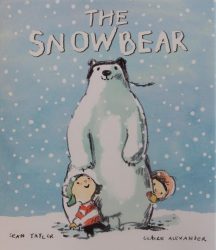
The Snowbear

The Snowbear
Sean Taylor and Claire Alexander
Words & Pictures

Two small children, a brother and sister wake to find that overnight their world has turned completely white. “Make a snowman if you want. But be careful because the hill is too steep and slippery,” is their mother’s warning as they sally forth into the great outdoors.
Slips and slides are inevitable and a snowman, of sorts is duly built, although they decide their creation looks more like a snowbear.
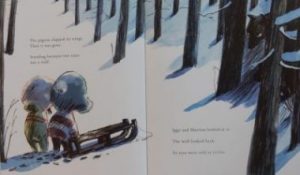
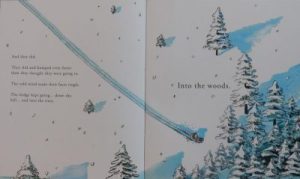
Having completed their chilly enterprise, the children take to their sledge and go hurtling downhill, faces a-tingle, towards the woods.

Eventually they come to a halt and decide home is where they now most want to be. But the climb is steep and there’s something watching them from between the trees.

Suddenly they hear a sound. Could it be that something or someone is coming to their rescue in that chilly white wood?
It is and it does.

Next morning though, the sun has melted their snowbear right away; at least that’s Martina’s suggestion. Iggy puts forward an alternative. “… he could have gone back in the woods and he’s alive down there.” I wonder …
A lovely wintry tale with just a frisson of fear, and an acknowledgement of the boundless imaginations of young children. This is, I think a new author/artist collaboration: in her eloquent, soft focus illustrations, Claire Alexander brings out the drama of Sean Taylor’s deliberately understated narrative, as well as showing young children’s ability to immerse themselves completely in the here and now.

Imagination Rules: The Magical Ice Palace & Daddy and I

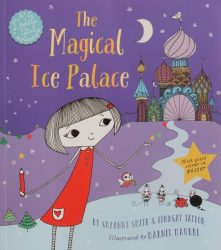
The Magical Ice Palace
Suzanne Smith, Lindsay Taylor and Marnie Maurri
Simon & Schuster Children’s Books

A flight on a gigantic magical snowflake,

a hairy mammoth prince stranded atop a mountain, a dramatic rescue involving an enormous bunch of balloons,

a beautiful palace …

a birthday party and a snow globe: yes Doodle Girl, is back with her magic pencil, of course, and her friends, for another amazing adventure. And it all begins with Doodle Girl’s discovery of a ‘curly CURVY SHAPE’ as she’s skipping through the sketchbook.
Even when the rescue has finally been effected there’s still the problem of a distinct lack of one absolutely vital ingredient for a topping birthday party –the cake. Can Doodle Girl wield her magic pencil one more time and make the Mammoth Prince’s celebration a truly royal occasion complete with cake and candles?
If you’ve not yet made the acquaintance of the wonderfully imaginative heroine, Doodle Girl, I urge you to do so now: she resides in a big red sketchbook and as soon as she so much as whispers the words, “Draw, draw, draw …” amazing adventures start to happen.
Deliciously quirky illustrations, whimsical characters and a sparkling wintry tale add up to another winning flight of fancy for Doodle Girl’s three creators; and there’s a bonus giant doodling poster inside the back cover.

Daddy and I
Lou Treleaven and Sophie Burrows
Maverick Arts Publishing

Saturday is ‘Daddy day’ for the little girl narrator and here she tells of a walk they take together; and what a wonderfully memorable Saturday that particular one turns out to be.
As they set out down the lane, not only is our narrator full of excitement, but her imagination is in full flow too as the pair become first, jungle explorers;

then grass snakes slithering through a field, followed by mountain climbers and cloud watchers.
Next comes a game of ‘Pooh sticks’, (they manage to pack so much into their day),

followed by a foray into the woods; but then there’s a storm and it’s time to make a run for it … all the way back to the dry.

This rhyming celebration of a special bond between father and daughter is beautifully told.
Sophie Burrows has picked up Lou Treleaven’s tuneful text embellishing the everyday sights of their country walk with scenes drawn from the child narrator’s imagination depicting a world where fact and fantasy meet.

Daydreams and Night Dreams

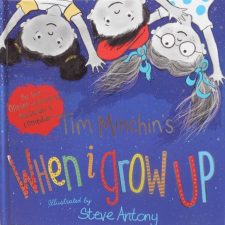
When I Grow Up
Tim Minchin and Steve Antony
Scholastic

Inspired by Tim Minchin’s song of the same name from Matilda the Musical, this book takes a (mostly) light-hearted look from a child’s viewpoint, at what it’s like to be an adult.
Of course, you’ll need to know the answers to a great many questions and that means being smart.
But think of being able to ‘eat sweets every day’,

‘go to bed late every night’, get up with the sun and watch endless cartoons without a care.
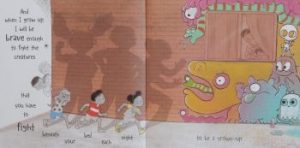
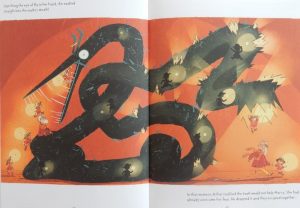
Life isn’t all roses though; there are heavy things to ‘haul around’ and creatures that lurk beneath the bed to fight with.

But all that’s offset by daily treats, playful opportunities in abundance …

and days spent lying in the sun without damaging the skin – we wish!
Is that what we grown-ups really do? Hmm …
Steve Antony surely has made adulthood look like a ball, even the less desirable activities; and those young narrators of his are boundless energy personified.

One Moonlit Night
Zanna Davidson and Seo Kim
Templar Publishing

Through a prose poem and amazing pop-ups we share in a little girl’s magical dream of an amazing adventure wherein she flies through the star-filled sky aback a dragon, encountering three-headed giants, trolls and ogres …

before, swathed in clouds, invoking her very own dragon spell.
Magical pop-out scenes of a journey through swirling waters and inky skies make for a wondrous, just before bedtime book to share.

Horses: Wild & Tame / Home Sweet Home

Horses: Wild & Tame
Iris Volant and Jarom Vogel
Flying Eye Books

My experience of and with horses is decidedly limited, or so I’ve always thought. Certainly my only riding experience was when  aged about twelve, I had gone to find my best friend who lived round the corner in a suburban road like mine. She wasn’t in but suddenly appeared round the corner on horseback. She dismounted and insisted I took her place. Now, never having ridden before I was reluctant but let her persuade me with ‘It’ll be fine, he only goes slowly.’ Next thing I knew the creature had taken off and was, so it felt, bolting up the road while I slid ungracefully down its back and off into the road, landing on my rear.
Having read the Horse Character page in this book however, I can look back and consider the character of that creature: was it a cold blood, a hot blood or a warmblood?

From Volant’s description it certainly wasn’t the first, and was most likely the last ‘strong and agile … perfect for riding’, despite thinking the best fit was ‘hotbloods … bold, spirited character’.
Flicking randomly through, I came across other spreads that particularly resonated. There’s one featuring Black Beauty, Anna Sewell’s classic novel; a book I loved as a voracious child reader. That story, as we’re reminded here, ‘encouraged people to be kinder towards horses, leading to many new laws in England and America’ concerned with the protection of horses.
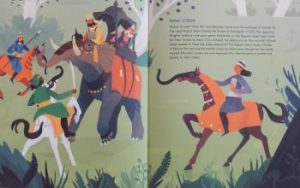
However, it was the Royal Steed spread that came as an exciting surprise. It tells how in 1576 during the Battle of Haldighati, Rajput warriors made false trunks for their horses to wear, thus confusing the elephants ridden by their Mughal enemies so that they wouldn’t attack what looked to them like baby elephants. We also hear how Chetak, the badly injured horse belonging to the Rajput ruler carried his master to safety.

I’ve visited Haldighati on more than one occasion on trips to India and during my annual holidays in Udaipur am frequently reminded of the creature by an imposing statue of that particular horse in the centre of a roundabout in Udaipur city, aptly named Chetak Circle.
Author, Iris Volant, goes way back further than that though, right to horse evolution. Indeed there’s probably something for everyone in this fascinating book that has artistic references, literary ones, horses in legend, war horses, work horses, horses in sport and more. How fortunate that its illustrator, Jarom Vogel, decided to become an artist rather than pursuing his studies as a dentist; he’s certainly done these beasts proud.

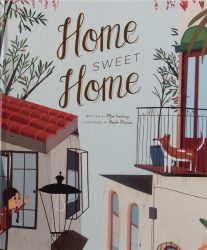
Home Sweet Home
Mia Cassany and Paula Blumen
Frances Lincoln Children’s Books

Both author and illustrator of this book come from one of my favourite cities, Barcelona. We’re given a look at different homes from around the world from the viewpoint of the pets, mostly dogs and cats, with the occasional bird and even a tortoise, that live in them.
Readers can discover what it’s like to live in say, a waterside house in a Netherlands village;

a tiny apartment in Hong Kong, China; a cabin with a roof of grass in Iceland or a townhouse by the Thames in London.

Cleverly conceived with the animal narrators, in addition to what we’re told in the text, there’s a great deal of visual information about each of the homes and lifestyles packed into every one of the locations we visit. Every one is made to look exciting:

where would you choose to live?
A stylish and fascinating addition to a primary classroom library or topic box.

Rooster Wore Skinny jeans

Rooster Wore Skinny Jeans
Jessie Miller and Barbara Bakos
Maverick Arts Publishing

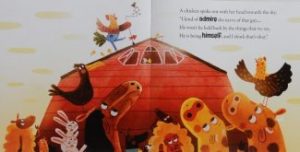
Be yourself and if that means wearing skinny jeans that make you the butt of jokes from your farmyard friends then so be it.

That’s the conclusion the resident rooster of Rosemary Mill farm comes to after strutting his stuff in his newly delivered denims with their gold stitching, and being on the receiving end of the other animals’ cutting comments.

Having run for cover and taken stock of himself in his skinnies,

the rooster decides to cock a snook at those micky takers – with surprising results.

Jessie Miller’s unfaltering rhyme rollicks along with a sparkle to match the stitching on Rooster’s jeans and if my audiences’ reactions are anything to go by, she has a winner here.

Exuberantly executed scenes of the rooster hero sporting his new purchase brought on fits of giggles from my listeners, young

and not so young; and I suspect adult readers aloud will be rushing to the nearest mirror in their skinnies to see how their rear view compares with fashionista, Rooster’s.

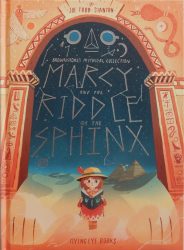
Marcy and the Riddle of the Sphinx

Marcy and the Riddle of the Sphinx
Joe Todd-Stanton
Flying Eye Books

Yay! A new addition to the Brownstone’s Mythical Collection series is certainly something to cheer about.
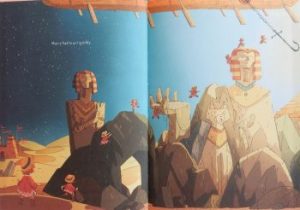
Herein the Prof. recounts the gripping tale of how young Marcy decides to try and prove herself a real adventurer by following her father, Arthur, to Egypt on his quest to find an ancient book trapped in the belly of the Sphinx.
It’s a journey that will surely test not only her fear of the dark, but much else besides.
Marcy’s first Egyptian encounter is Thoth who demands she bring him Ra’s magical moon eye in return for her father’s release.
Acting quickly …

she manages to haul herself aboard Ra’s sun boat and soon finds herself face to face with the great god himself and pouring out her story to him.
To reward her honesty Ra, offers his help in her rescue efforts and before they part, gives her his left eye to guide her through the darkness.
Still though, she has to solve the Sphinx’s riddle, gain entry to the tomb and attempt to complete her quest.

It’s going to test more than just her fear of the dark; and it’s as well she doesn’t suffer from ophidiophobia .

Even with her father safely outside once more, there’s still Thoth waiting for what he’s asked Marcy to bring him. …
The young girl really does prove herself a worthy daughter to Arthur, star of the Golden Rope adventure, demonstrating that by drawing on our inner reserves, we can achieve the seemingly impossible.
Gripping, fast-paced and illustrated with pizzazz, this is likely to win more fans for the series as well as pleasing existing ones.
Love the gentle humour and detail in this …

Malala’s Magic Pencil

Malala’s Magic Pencil
Malala Yousafzai and Kerascoët
Puffin Books

Malala Yousafzai, the youngest ever recipient of the Nobel Peace Prize and campaigner for the rights of every child to attend school, has written an autobiographical account of her life designed for young audiences.
She tells of her childhood in Pakistan and uses a favourite television show she liked to watch about a boy with a magic pencil that he used to help other people and sometimes himself.
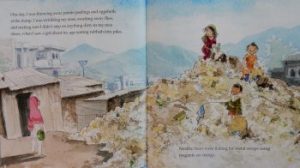
Gradually her desire for a magic pencil of her own translates as she grows into a discovery of the need to take real action. She learns that the troubles in her home village – children working to support their families and thus unable to go to school;

the gender inequalities and with the arrival of the (unnamed) Taliban, the ban on girls being educated, are things that need to be spoken about.
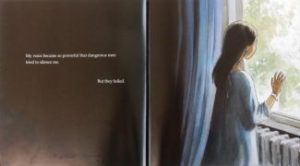
Malala starts writing and speaking out: “My voice became so powerful that dangerous men tried to silence me. / But they failed,” she states simply; the hospital band around her wrist being the only indication of all that she’s gone through.

Her quest for justice and for making the world a more peaceful place continues, a quest that has been joined by many others.
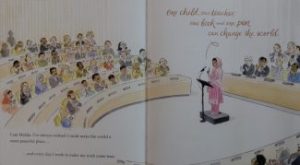
The final spread shows Malala giving her famous speech before the United Nations: “One child, one teacher, one book and one pen can change the world.

Here the force of her words and the message therein, that by finding your own voice, everyone can become a powerful force for positive change, resounds loud and clear.
The watercolour and ink illustrations of Malala’s daily life by Kerascoët (the joint pen name of the French illustrators, comics and animation artists Marie Pommepuy and Sébastien Cosset) give a wonderful sense of place; and the overlay of gold highlights her optimism and hope for making the world a fairer, better place.

Truly inspirational.
As the biographical notes at the end remind us, Malala has now become the youngest-ever UN Messenger of Peace: long may she continue her crucial work promoting the importance of education for all.
A picture book to share, reflect upon and talk about, again and again.

Halloween Briefing: Monsters Galore and a Witch or two

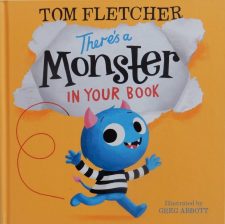
There’s a Monster in Your Book
Tom Fletcher and Greg Abbott
Puffin Books
Here we have one of those interactive picture books that are in vogue at the moment and it comes from the co-writer of The Dinosaur That Pooped series.
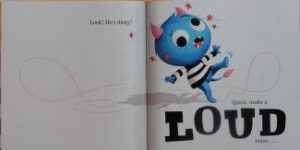
The book is invaded by a rather cute-looking little monster that seems intent on wrecking the whole thing. ‘Let’s try to get him out,’ suggests the narrator which is clearly a good idea.
Readers are then asked to shake, tickle, blow, tilt left, then right, wiggle and spin the book, turning the page after each instruction. All the while the monster lurches this way and that around a plain background looking far from delighted at the treatment being meted out to him.
None of this succeeds in dislodging the creature but he’s definitely feeling dizzy so loud noises come next; then even louder ones.

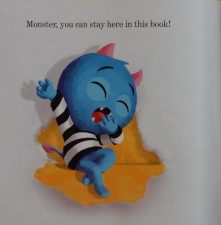
This works but ‘Now he’s in your room!’ That’s even worse than being contained within the pages, at least from the reader’s viewpoint, so now the idea is to gently coax him back into the book. There he can stay while receiving some tender head stroking and a soft ‘goodnight’ until he falls fast asleep. Ahh!
With Greg Abbott’s cute, rather than scary monster, this is a fun book to share with pre-schoolers particularly just before their own shut-eye time; all that shaking and shouting will likely tire them out making them feel just like this.

SHHHH!

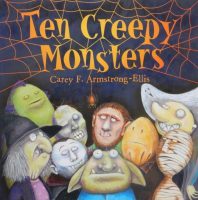
Ten Creepy Monsters
Carey F. Armstrong-Ellis
Abrams Books for Young Readers
Here’s a gigglesome twist on the nursery countdown featuring a mummy, a witch, a ghost, a werewolf, a vampire and others who, having gathered ‘neath a gnarled pine’ begin to disappear until only one remains. But what sort of creepy monster is that? Be prepared for a surprise.
Trick or treaters, if mock scary ghastly ghouls are your Halloween thing then look no further than this gently humorous, little paperback offering.

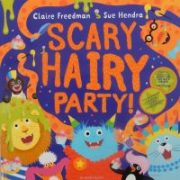
Scary Hairy Party!
Claire Freedman and Sue Hendra
Bloomsbury Children’s Books
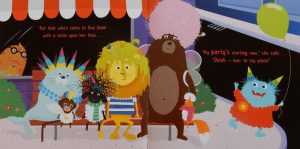
Monster’s having a party; it’s at 3 o’clock and all her friends are invited. Fortunately they’ve just got time to nip into Raymond’s salon for a hairdo first.
Seemingly Raymond’s not on top form however, as one after another receives a style disaster.

What on earth is Monster going to say when she sets eyes on her pals with their new make-overs?
Light-hearted rhyming fun illustrated with crazy, brighter than bright scenes of barnet mayhem: just right for those youngsters who like their Halloween stories to be on the silly, rather than the spooky side.

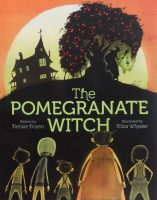
The Pomegranate Witch
Denise Doyen and Eliza Wheeler
Chronicle Books
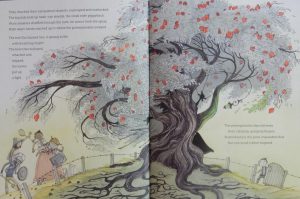
A deft rhyming text, imbued with spookiness and replete with rich language, tells a tale of how five children desperate for a pomegranate from the witch’s tree, and armed with all manner of unlikely implements, do battle with its owner to get their hands on a tasty treat from its branches. A veritable Pomegranate War is waged …

until finally, one of children succeeds in bagging the object of their desires and they each have a share of the spoils.
The following day, Halloween, a Kindly Lady (the witch’s sister) appears to offer cider and a celebratory surprise fruit to all the town’s children: ‘And not one child wondered who was who, or which was which. / The shy old Kindly Lady or the Pomegranate Witch.’
Surely they couldn’t be one and the same – or could they?
Not for the very youngest listeners but a fun read aloud for KS1 audiences. As your listeners savour Denise Doyen’s story, make sure you allow plenty of time to enjoy Eiiza Wheeler’s delightfully quirky ink and watercolour illustrations.

For older solo readers:

Witch Snitch
Sibéal Pounder, illustrated by Laura Ellen Andersen
Bloomsbury Children’s Books
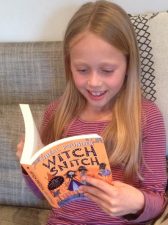
The (Witch Wars) Sinkville witches are preparing for Witchoween and it’s the first Tiga will experience. This is especially exciting as Peggy has asked her and Fran to make a documentary about the town’s most famous witches. With Fluffanora acting as fashion adviser, what more could she ask?
This book with its numerous activities, facts and character information as part and parcel of the narrative, is sure to make you giggle. So too will Laura Ellen Andersen’s line drawings.

The Glassmaker’s Daughter

The Glassmaker’s Daughter
Dianne Hofmeyr and Jane Ray
Frances Lincoln Children’s Books

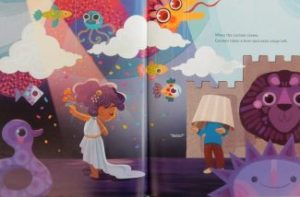
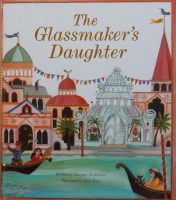
Daniela is the daughter of a glassmaker living in Venice in the 16th century. So full of melancholy is she that her despairing father offers a glass palace as reward to the first person who can make his daughter smile. The palace is duly fashioned and people come from near and far to try and bring on that smile.
A flame swallower, a mask maker, a lion-tamer followed by ‘Glove makers, tart bakers, trumpet players, dragon slayers, monkey trickers, pocket pickers, bell ringers, opera singers, even sausage stringers‘ all fail miserably.

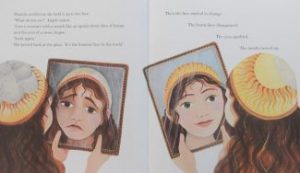
Then along comes young glassmaker, Angelo with the looking glass he’s carefully fashioned as a gift for Daniela. Now the girl has never seen such a thing before, nor has she seen the sight that meets her eyes when she looks into it as Angelo instructs. At first it’s her cross face that stares back, then as she begins to smile, so too does the mirror;

and when her smile gives way to laughter, the effect is truly dramatic in more ways than one …

And before long, the entire city of Venice is one laughing, dancing, ringing celebration of joyfulness.
Diane Hofmeyer takes a familiar fairytale theme and like Angelo in her story, fashions it into something new and special. We all know that true happiness lies within but it’s good to be reminded sometimes, especially in such a captivating way as this. (An introductory note gives some information about historic Venetian glassmaking.)
Jane Ray’s intricate images and vibrant scenes conjure up the fairy story-like Venice of the setting making every turn of the page both magical and memorable.

Ally-saurus & the Very Bossy Monster

Ally-saurus & the Very Bossy Monster
Richard Torrey
Sterling

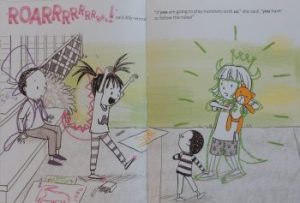
Having put up with her mother’s fixing of her unruly hair and consumed her breakfast, Ally, or Ally-saurus as she insists on being called, sallies forth outside to find her friends. Their morning of imaginary play is summarily interrupted by newcomer, Maddie, a control freak if ever there was one. Everything just has to be done by the rules – her rules.

Ally, Kal and Petey try accommodating her commands into their monster play and while still keeping to their customary roles; but after a while, Maddie seizes Petey’s bear. Then, enough is enough.
“ROARRRRRRRRRR” goes Ally-saurus, angered into finding the courage to uphold her own favoured persona, and firmly standing up to Maddie.

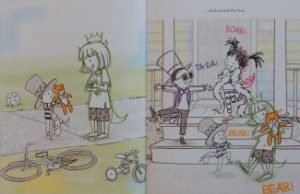
Now it’s Ally-saurus’ turn to lay down some rules before setting off on an afternoon’s super, amazing monster dance of stomping, roaring and laughing, first without and latterly with, a certain monster queen.

Torrey cleverly uses crayon outlines to show the imaginary characters the children assume in their role play, the kind of play that will be familiar to most young children who will likely have already encountered a “Maddie’ of their own.
With its believable characters and themes of friendship and standing up for yourself and others, and clever ending, this is a fun book to share and talk about in an early years story session.

I Am Peace / The Two Doves

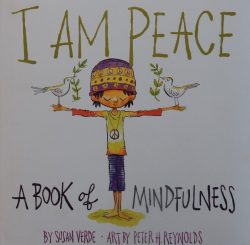
I Am Peace
Susan Verde and Peter H. Reynolds
Abrams Books for Young Readers

This is a companion book to yoga teacher, Verde, and illustrator, Reynolds’ I Am Yoga.
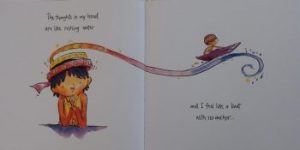
Here, a worried child narrator, feeling “like a boat with no anchor” …

shares with readers how focussing on the here and now helps to calm all those worries and troubling emotions, allowing them to dissipate and disappear. Inwardly watching the breath enables the child to feel centred and then, through acts of kindness, by connecting with nature and fully using the senses, feelings of at oneness with the world, inner peace pervades and can be shared with all those who need it.

With today’s increasingly fast-paced, pressurised and stressful world, this is a lovely gently joyful reminder to children, and also adults of the importance of cultivating the habit of mindfulness. That (along with yoga), can help them change their own world and perhaps that of others. Just 3 to 5 minutes a day with no distractions, no doing, merely being.
Peter Reynolds’ ink, watercolour and gouache illustrations reinforce the mindfulness message and add a delightful touch of whimsy as he portrays the child, peace symbols and all, balancing, cloud watching, feeding the birds and meditating.
(A guided meditation is included at the end of the book.)


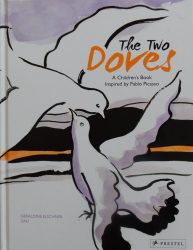
The Two Doves
Géraldine Elschner and Zaū
Prestel

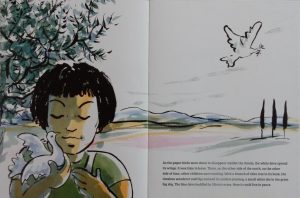
In search of a safe place to rest, a white dove lands on a deserted island; deserted save for another dove, a blue one that has been badly injured.

The white dove tends to the blue one until after a few days, it’s sufficiently recovered to take flight,
Together the two birds take wing eventually landing in – or rather in the case of the blue dove, falling – into a large garden where, under an olive tree, a man was painting, while around him some children played.
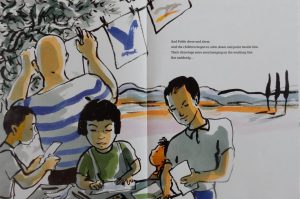
The man is the artist Picasso. The children see the wounded dove and want to care for it. Soon though both man and children are busy creating pictures of the bird,

pictures that Picasso tells them as their images are borne aloft by a gust of wind, will “go to countries all around the world.
Soon after, the white dove takes flight once more leaving the blue one safe in the children’s care.

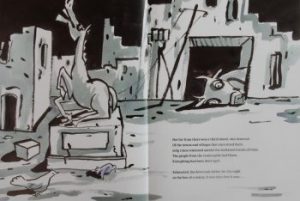
This lovely story of Géraldine Elschner’s, inspired by Picasso’s iconic work, The Dove of Peace, is beautifully illustrated by Zaü whose ink drawings filled mostly with greys, greens and blue give a strong sense of both the desolation of the war struck third island and the stark beauty of its countryside.
Adults using the book with primary age children may well need to fill in with a little information about the Spanish Civil War and on the visual references from Picasso paintings that the book’s illustrator mentions in a note at the end of the book.

Halloween is Coming: Hugo Makes a Change / Pretty

Hugo Makes a Change
Scott Emmons and Mauro Gatti
Flying Eye Books

Hugo the vampire is a total carnivore: tucking into juicy meat, be it burgers, hot dogs, steak or lamb, is his idea of satisfaction and he doesn’t stop until he’s stuffed himself to bursting.
Then one night he starts to feel bloated, sluggish and downright grumpy. Time for a change of diet he decides and wings it away in search of something new to tempt his taste buds.
Landing in a vegetable garden, Hugo examines the crops and is totally unimpressed with wrinkly leaves, lumpy blobs and bumpy skins. But then he comes upon something red dangling from a tree and feeling those hunger pangs starting up, he sinks his fangs right into the object. Ahhh! the delight; the tang.

Before you can say ‘vegetables’, he’s munching away on crunchy carrots, peppers, tomatoes and cucumbers; wisely though he passes on the garlic.
Back home he makes a decision: meat is fine in moderation but a healthy mix of veggies, fruit and nuts is much more satisfying.

Before long he starts to notice the changes in himself: it’s a stronger, happier Hugo who takes his regular evening flight and just cannot resist leaving his mark whenever he stops for a quick bite.

Emmons’ rhyming narrative and Gattis’ bold, engaging illustrations (look out for Hugo’s feline companion therein) make for an entertaining story. If like me you’re a confirmed veggie, you might find yourself heaving somewhat at the opening scenes of Hugo gorging himself on mounds of meaty morsels.
A fun read, and a clever way to demonstrate, without a hint of preachiness, the benefits of a balanced diet: the ideal fare for adults wanting to get across the notion of healthy eating to young children.

Pretty
Canizales
Templar Publishing

Is it better to have ‘a crooked back, a lumpy nose, a big pointy chin and wiry hair’ or have ‘a nice straight back, a neat little nose, a very dainty chin and sleek wavy hair’? That is the dilemma facing the witch when she’s invited for a picnic by the troll.
She starts out duly attired in her best black outfit as her normal self warts and all, but after encounters with Squirrel,

Rabbit, Fox and Mouse, she is persuaded to alter her appearance, with a few deft flicks of her wand, to their perceptions of prettiness.
So effective is her transformation that her date fails to recognise her …

and stomps off in disgust.
The following day the witch invites the troll to a picnic of her own making.
Troll deems the food delicious and it certainly is, in more ways than one, especially if you like your revenge served cold.

A tasty mix of humour, magic, whimsicality and revenge, sprinklings of cumulative narrative and a darkly toothsome final twist, all served up with flat, stylised illustrations in a subdued earthy colour palette: the perfect Halloween offering.

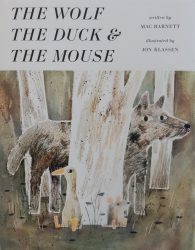
The Wolf The Duck & The Mouse

The Wolf The Duck & The Mouse
Mac Barnett and Jon Klassen
Walker Books

There’s a fable-like, porquoi feel to Mac Barnett and Jon Klassen’s latest collaboration: think wolves, think howling at the moon.
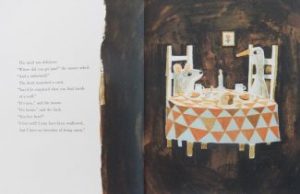
One morning a mouse is gobbled by a wolf; its woeful cry disturbs a duck attempting to get some shut-eye in the belly of the wolf. The two breakfast together and strike up a friendship.

Their dialogue had me spluttering as the mouse asks, “Where did you get the jam? … And a tablecloth?” “I may have been swallowed but I have no intention of being eaten.” the duck assures the mouse. And over lunch preparations he reassuringly comments on the lack of fear of being swallowed by a wolf, leaving them to enjoy their creature comforts from the inside.
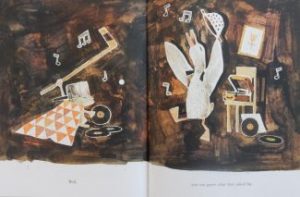
Comforts that include a record player and record for a celebratory dance, which has drastic effects on their host’s stomach; but for that the duck has a cure: “Eat a hunk of good cheese. And a flagon of wine! And some beeswax candles, ” he states.
Complying only worsens the wolf’s stomach ache: his moans are heard by a hunter whose target he becomes.
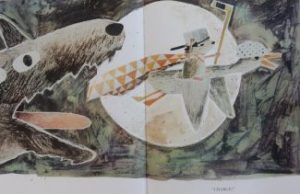
Now, quite suddenly all three animals must combine forces to save their lives and they do so in no uncertain terms …

convincing the hunter that “the woods are full of evil and wraiths.
The grateful wolf offers his saviours a favour, which they are delighted to accept …

Thereafter comes a kind of symbiotic existence between the main protagonists.
Barnett’s snappy narrative style with its repeated “Oh woe!” provides plenty of laugh out loud moments. In combination with Klassen’s mixed media collage-style illustrations the whole thing unfolds rather like a puppet theatre performance.
An off the wall, howlingly funny, brilliantly clever Barnett/Klassen offering, not to be missed at any cost.

La La La

La La La
Kate DiCamillo and Jaime Kim
Walker Books

A small girl stands alone and opens her mouth; “La” she sings followed by a few more “La, La La … La”. No response. She stomps across the page and outside.
There she begins chasing and singing to the falling maple leaves, but even her shouts are answered merely with silence.

She continues addressing her ‘Las’ to the pond and the reeds; still nothing comes back.
Dejectedly she returns home, sits and ponders. Later on she sallies forth into the purple, starry night. Once again she begins her singing, directing her vocals towards the moon.

Nothing.
Back she goes and returns with a ladder. So desperate is she for a mere response that she climbs right up to the top … Will the moon finally hear her song?
It does, but not for a longish time and then begins a wonderful moonlit duet.

Virtually wordless, this eloquent symphony of sound, light and colour offers an inspiring message of determination and hope. The whole thing unfolds like a silent movie with the little girl’s body language saying so much about her emotions.

This book is twice the length of a normal 32 page picture book, so in addition to recognising the virtuoso performance of Kate DiCamillo and Jaime Kim, it was a brave publisher who allowed them room for their duet to be heard in full.

Hide and Seek

Hide and Seek
Anthony Browne
Doubleday

There are search and find picture books aplenty and then there is Anthony Browne’s game of Hide and Seek, which is in an altogether different class: a class of its own. And it’s actually Anthony Browne’s 50th picture book of his career.
Herein the search is for a missing dog, Goldie, belonging to sister and brother, Poppy and Cy, or rather it isn’t. The search is actually that of Poppy for her brother in the game of hide-and-seek they decide to play in the woods as a distraction from their sadness over Goldie’s disappearance.
Cy duly hides himself; Poppy counts and then confidently commences her search.

(By now observant readers will have noticed some surreal additions to the children’s woodland surroundings.)
Seemingly Cy has hidden himself rather too well, for Poppy has trouble locating him thanks to several false leads. Her little brother meanwhile, is getting increasingly desperate for a wee, not to mention chilly and downright scared.

Is his mind beginning to conjure up some of the more disturbing images hidden in the woods as he hears the sound of something approaching?
There’s more than one surprise in the final spreads of this rich and absorbing story; and for readers perhaps, the most unexpected surprise is the open-ended finale …

But then Browne always poses questions and invites speculation way beyond the simple narrative of the written story.
(The last page lists eighteen objects the author has ‘hidden’ throughout the book.)
For me, having access to woodland is an essential part of being human. To enter a wood is to journey back in time: it sharpens the senses; we hear, see and smell differently and our imagination too is expanded. It puts us back in touch with our primeval selves. Anthony Browne invokes that same experience between the leaves of this spell-binding book.

A Mighty Bitey Creature

A Mighty Bitey Creature
Ronda Armitage and Nikki Dyson
Walker Books

The peace and quiet of the jungle is suddenly shattered by Frog’s loud “OUCH! Who bit my lovely green bottom? Something MIGHTY and super-sharp BITEY!” He immediately resolves to tell Lion, the King of the Jungle.

Off he dashes, lickety-split, meeting en route Monkey and Zebra, each of whom also receives a sharp nip on the nether region ‘YA-A-A-HOO!

and in consequence, both accompany Frog to consult King Lion in the hope he’ll know what to do.

The dramatic effect mounts as the trio gate crash Lion’s nap and tell him of their bitten bums.

But then something sinks its teeth into Lion’s royal sit-upon.

Will the animals discover the identity of the bottom-biting beastie; and will Lion carry out his threat to gobble up the offending creature?

The answer is yes to the first part and no to the second; but without spoiling the thoroughly satisfying finale, I can say no more on the matter.

With its combination of suspense, silliness, playful language and noisy orchestration, Ronda Armitage’s longish text, together with Nikki Dyson’s ebullient illustrations will undoubtedly please young listeners, not to mention readers aloud who will enjoy putting on a dramatic performance of the tale.

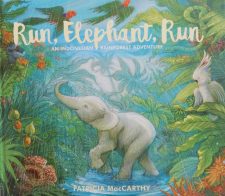
Run, Elephant, Run

Run, Elephant Run
Patricia MacCarthy
Otter-Barry Books

As a storm gathers, lashing the vegetation of his Indonesian rainforest home and pelting down upon Little Elephant, he becomes separated from his mother.
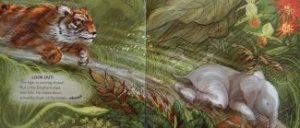
The storm gets increasingly wild but there’s something even more fierce close by. It’s a tiger.
Little Elephant battles against the whirling, swirling elements, the creature hot on his trail. With no time to hide, Little Elephant has to run for his life through the slippery mud.

He slips and falls, whooshing pell-mell down a muddy slope right into his anxiously searching mother.
There’s only one thing to do: make as much noise as possible; so they trumpet and stamp till suddenly

the tiger turns tail and dashes away.
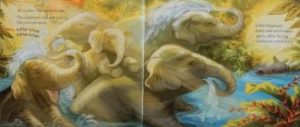
Eventually the storm blows itself out and with the change in the weather, the herd moves on. The weather isn’t all that’s different though: thanks to his adventure, one small pachyderm has changed on the inside. He now feels bigger and braver as he sploshes and splashes with the other elephants in the rain pool.

With its wealth of onomatopoeia this is a great book for adding sound effects during a story session. Children could use their voices, found objects or musical instruments – possibly ones they’ve made themselves – to orchestrate the reading.
First though, read the story, look closely at the superb visuals and then, using the final puzzle spread, go back through the book and search for the thirty odd rainforest creatures in the richly coloured illustrations.

Balthazar the Great

Balthazar the Great
Kirsten Sims
Frances Lincoln Children’s Books

Balthazar, the polar bear is a violin player, the only remaining one left in all the circuses of the world. Until that is, he’s set free by a group of animal rights activists who leave him in the middle of he knows not where, to find his way home – so long as he can discover where to go.

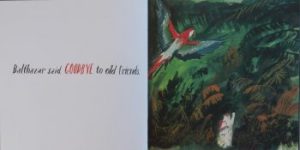
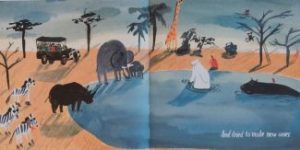
On his journey he bids farewell to old friends …

and endeavours to make new ones.

He meets some kind-hearted souls but for much of his travels Balthazar is entirely alone – lonely, lost and overwhelmed by the enormity of what he’s attempting.
He even starts thinking about returning from whence he came;

but then all of a sudden he sees something. Could it possibly be who he thinks it is? The giver of Balthazar’s very first violin? …

In this, Kirsten Sims’ debut picture book, her spare text allows her eloquent gouache and ink  illustrations to carry much of the story, a story of the strength of family bonds and of journeying. Her colour palette is somewhat dark which seems to reflect the loneliness of the traveller.

The book’s creator resides in South Africa and that is where Balthazar starts his journey as is evident from the design on one of the mugs featured on the endpapers.

Do take a look at them all though.

The Quiet Crocodile / Hey Willy, See the Pyramids

The Quiet Crocodile
Natacha Andriamirado and Delphine Renon
Princeton Architectural Press
Fossil the crocodile is a lover of peace and quiet, preferring to be alone and away from hustle and bustle. He has however, a ‘few friends’ so we’re told although the endpapers in particular, belie this: some two dozen named pals large and small, (each with a colour-coded dot so we can keep track of them) line up thereon, seemingly ready to move.
And move is just what they do, one by one, across the pages of the book and find a place upon Fossil’s back until he resembles first an outsized sofa and then a climbing frame or a circus balancing act as the animals pile precariously up on his length.

All the while Fossil has a large grin on his face and despite our being assured that ‘He’s afraid of scaring his friends’ sceptical readers may be beginning to doubt that.
Things take something of a turn textually however when our narrator informs, ‘… as everybody knows, they’re fierce. Even in books!’ Hmm!
Are all his friends right in issuing that “Come and play with us!” invitation? And did anything accompany that hat of Piggy’s into his grinning mouth?

Surely he’d never even consider eating any of his friends, or would he?
Irony and wry humour abound in Andriamirado’s text which, accompanied by Renon’s stylised illustrations of intricately detailed animal characters, is likely to please those with a penchant for the quirky and open-ended.

Hey Willy, See the Pyramids
Maira Kalman
New York Review of Books
This is a re-issue of an early Kalman book and quirky it surely is.
Young Alexander has trouble falling asleep and asks his elder sister Lulu to tell him stories: a million are requested but she agrees to five and ends up by telling eleven. They’re all very short – flash fiction really – and therein she mixes the familiar with the downright bizarre and surreal.
One tells of a dog that wants to live in Paris and be a poet; another features a green-faced scientist.

There are crazy parties and fish flying into the sky.
Punctuating the stories, in white lettering printed on black, are brief conversations between sister and brother further adding to the overall strangeness of the book.
Maira Kalman has, seemingly, plumbed the depths of her imagination for both narrative and illustrations of this far out offering. It’s not for the very young, certainly not everyone’s cup of tea, but worth a look if you’re into the highly unusual in picture books.

You Choose in Space / Ludwig the Sea Dog

You Choose In Space
Nick Sharratt and Pippa Goodhart
Puffin Books

The You Choose series just gets better and better: now young children can whizz off on countless journeys of discovery in the pitch black of outer space. They can choose their jobs aboard the space-craft; select some snazzy gear to wear; there’s a weird and wonderful assortment of potential friends to get to know;

a whole different diet to sample and much more.
The great thing- or one of them –is, there’s a seemingly limitless choice of possibilities, so that with each blast off, a whole new out-of-this-world story can unfold in glorious technicolour.
The Sharratt/Goodhart team truly have conjured up an inclusive and wonderfully interactive, treat for young space enthusiasts, as well as those who like to be in the driving seat when it comes to a story.

Ludwig the Sea Dog
Henning Lōhlein
Templar Publishing

In this, the second adventure of Ludwig and his friends, the dog receives from his pal, Peter the penguin, whose submarine has broken down, a postcard requesting his assistance.
How on earth or under sea, for that’s where Peter is stuck – is a book-dwelling dog supposed to go to the aid of a friend beneath the ocean?
There are of course, plenty of books to tell him about marine life but these don’t prove as helpful as Ludwig anticipates.

He has to be rescued, and then discovers that water is not his favourite medium.
Perhaps he’ll have better luck with a spot of fairy tale magic, courtesy of the book he’s left in to dry out;

that and of course, some further assistance from his friends.
I’ll say no more other than to recommend that you open the envelope at the front of the book, put on those 3D sea goggles and prepare yourself for an amazing underwater experience. There’s even a fold out spread to explore.

The Marvellous Moon Map

The Marvellous Moon Map
Teresa Heapy and David Litchfield
Red Fox

Mouse and Bear share a house in the big, dark woods, so when Mouse announces that he’s off to find the moon, accompanied only by a the Moon Map he’s in the process of making, Bear offers to accompany him.
Mouse turns him down: “I don’t need your help – I’m the Moon map inventor!” he tells his friend; and once the map is complete, off he goes.

He tunnels, climbs and clambers up into the blackness of the woods. Suddenly, as he’s urging himself forwards who should emerge from the shadows but his ursine pal. Once again his help is refused, although Mouse cannot, so he admits, see his map in the darkness: but Bear responds with “I know, Mouse, … But I’ve got you, and you’ve got me – so we’ll be all right.
The two proceed with Mouse leading the way, until they reach a stretch of water; a stretch far too wide for them to swim across.

Once again Bear is reassuring. He then takes the map and to Mouse’s consternation, starts folding it.

Eventually, after some manipulation, and the odd bit of grumbling from Mouse, there before them is …

But in such a tiny craft, against such high waves, will they ever manage to find the moon?
Teresa’s lovely story with its two endearing characters, the reassuring repetition of Bear’s words of encouragement and the delightful surprise finale find, combined with David Litchfield’s entrancing illustrations make for what I’m sure will become a storytime favourite.

The Creature

The Creature
Helen Bate
Otter-Barry Books

Cats have a habit of dragging things in from the outside; usually it’s a bird or small rodent.
Not so with marmalade cat, Alfie however. What he deposits on the mat is a strange little creature, bedraggled yes, but growly and frightening.

Once inside though, the creature seems to want to stay and when spring comes, smell not withstanding, it’s well and truly settled in and part of the family …

It certainly enjoys a rather strange diet; cardboard, banana skins, plastic and toast being its breakfast favourites.

Night is for roaming; that appears to be part of the creature’s nature, but come morning, it never fails to reappear.
Autumn turns to winter once more and there are clues that the Creature is up to something on the top bunk.

By Christmas however, everyone has forgotten all about it. Has that Creature perhaps got a very special seasonal gift tucked away up there?

With its quirky illustrations, surprise ending and rhyming text that echoes the rhythm pattern of “The Night Before Christmas’, this is a fun read aloud that leaves plenty of gaps for readers to fill.

Hortense and the Shadow

Hortense and the Shadow
Natalia and Lauren O’Hara
Puffin Books

Combining elements of dark and light, the O’Hara sisters’ debut picture book has a haunting, fairytale quality that will have a wide appeal.
A little girl Hortense, who lives in an ornate mansion deep in the woods, is a kind, brave, caring child. However there’s one thing she hates: her own shadow. It follows her no matter where she goes or what she does; and when night falls, it grows ‘tall and dark and crooked.’
She tries hiding her shadow … to no avail:

she and her shadow remain locked in mutual hatred.
Then one evening Hortense manages to escape from its clutches: she feels liberated, happy and safe; although just occasionally it feels like she’s being watched.

One black night some bandits arrive and it seems all is lost; but then Hortense’s shadow appears and saves her.

That’s when the girl realises that, rather than being something to hate, her shadow is a part of what she is, ‘sometimes dark, cross, strange, silly, jagged or blue,‘ – the perfect ending for this highly original, allegorical fairytale.
Natalia O’Hara’s lyrical prose and Lauren’s delicate, muted illustrations, sometimes ornate, sometimes stark and looming, together make for a multi-layered story to have you tingling with delight. Absolutely beautiful.

Oi Cat!

Oi Cat!
Kes Gray and Jim Field
Hodder Children’s Books

Frog is a stickler for the rules – his rules in particular – which is unfortunate for Cat whose turn it is to have his own book. Sadly though, for the feline at least, it’s been decreed that he, and all cats now ‘sit on gnats’.
Imagine the bites, imagine the itching, imagine the scratching of a very sensitive part of his anatomy. Ouch!
Inevitably Cat’s distress results in all kinds of possibilities being proffered by the other animals: were he a pony he could sit on macaroni, suggests Dog. This does not go down well with Cat who objects to his bottom being anyone’s business but his own.
Dog though is full of good ideas, all of which are rapidly negated by the frog on account of their not rhyming with cat.

And even when he does deliver the goods, that dastardly amphibian is quick to point out that bats – be they of the cricket, baseball or softball variety – are already allocated to, erm …

Still though, the dog keeps on trying and even changes tack, suggesting ‘mog’ as an alternative handle for the put upon cat. Now there’s a thought … Doesn’t that word rhyme with a certain extremely assertive creature beginning with f?
But that’s a no go area isn’t it? Surely there must be plenty of alternatives …

Someone’s going to regret that utterance.
I keep on thinking with every new addition to the Oi…! series that they can’t get any better, but then along comes another and I have to say, this one, with its splendid elevating finale, is as close to ‘purr-fect’ as you’re likely to get.
Top that, Kes and Jim …

Singing in the Rain / I Want Snow!

Singing in the Rain
illustrated by Tim Hopgood
Oxford University Press

A few years back I was in Udaipur, Rajasthan when the first monsoon rains of the season started to fall. Almost instantly, everyone around, the children certainly, all dashed outside and began celebrating – jumping for joy and playing in the rapidly forming, large puddles that soon became rushing torrents in the streets.
Tim Hopgood’s exuberant illustrations that accompany the words based on Arthur Freed and Nacio Herb Brown’s song too, make rain a joyful experience.

Most adults in the UK certainly, especially teachers, find rainy days a nuisance at best, as they usually mean wet playtimes. Early years teachers though, like the children herein, embrace it as an opportunity to experience puddle jumping and splashing, and have a thoroughly good time – so long as everyone is suitably clad in waterproofs and wellies, that is.
Included with this uplifting book is a CD with the song performed by Doris Day followed by the story with page-turn signals.
So, as the book’s illustrator urges, no matter where you are, be it city or tropical rainforest,

Next time it rains, step outside, feel the rain on your face and give the clouds up above your biggest smile!

Just like the children here in Tim Hopgood’s bright alluring scenes.

I Want Snow!
Tony Ross
Andersen Press

The Little Princess is well known for making demands.
In this, her latest story, prompted by a postcard from her mum in the South Pole, and in spite of it being summer, it’s snow she wants.
But what the Little Princess wants, she usually gets and so it is here – eventually.
First though she has everyone in the palace doing their best, building snowmen out of stones and sand and indulging her with mudball fights.

Is the little madam satisfied? Of course not; even the cook’s proffered glass snow globe fails to please and off she stomps to bed. Endless bed – or almost …

until finally she has something to lift her spirits.
I wonder what she thinks about the long-awaited, chilly precipitation.
The Little Princess does look slightly less little here but her charm shows no signs of wearing thin, and I’m sure she’s especially pleased to have a sparkly cover to her latest book.

A Home Full of Friends

A Home Full of Friends
Peter Bently and Charles Fuge
Hodder Children’s Books

Peter Bently does rhyming narrative with aplomb and it’s once again the case here.
Kind soul, badger Bramble doesn’t quite know what he’s letting himself in for when he offers Scuffle the dormouse, toad Tipper

and Boo the hedgehog a bed for the night when they’re made homeless by a storm. Rather that’s all he thinks he has to contend with as he hurries home concerned about his messy sett, stretching his supper to feed four and there only being one bed.
Bramble busies himself making preparations: makeshift they may be but entirely adequate for a badger and three pals.
His thoughts are interrupted by a loud knock at his door and the sight that meets his eyes is more than a little shocking. Three entire families are standing on his doorstep …

Fortunately though, they’ve brought with them everything they’ve managed to salvage from their wrecked homes and it’s not long before, with full bellies, they’re having a wonderful time playing games and sharing a bedtime story

before snuggling up for the night.

Warm-heartedness shines out of Charles Fuge’s beautifully detailed scenes which, together with Bently’s text, make a read aloud book with a compassionate message which is particularly pertinent given recent weather disasters and the ever increasing numbers of displaced people in various parts of the world.

Maurice the Unbeastly

Maurice the Unbeastly
Amy Dixon and Karl James Mountford
Sterling Children’s Books

Oh, I do love a divergent character and vegetarian beast Maurice, sweet of voice, gentle of nature and a delight to look upon, certainly fits the bill. In fact his parents are so despairing of his peaceable ways that they send him off to the Abominable Academy for Brutish Beasts to learn to be more beastly.
Now although alfalfa fritters may be his favoured food, Maurice does not want to be a failure so off he goes, determined to do his best.

After just a few days though, the new pupil is close to being ejected from this educational establishment for singing instead of roaring, unsuitable eating habits in a disorderly dining hall;

dancing dashingly when he’s supposed to be havoc wreaking; and his school photo is positively glamorous despite his best efforts to be hideous.
When a strange creature invades the classroom causing teacher and Beastly students considerable consternation, Maurice steps in with his winsome ways and a timely offering, taming the animal …

and earning himself accolades and a new title from the Head.
That however is not the only new thing Maurice is responsible for at the Academy, but for the rest, you’ll have to get your hands on a copy of this enormously enticing offering.
Remain true to yourself Maurice; long may you prevail.
What a delicious cast of characters Mountford has conjured up using a colour palette of black, sage, olive, rust, mustard and coral tones. I’m sorely tempted to make a puppet or soft toy Maurice.
Meanwhile I’m going to be enthusiastically sharing his story with a whole lot more little beasties.

Amazing Information Books

Bees
Toni Yuly
Walker Books
For the very youngest is this beautifully simple book of gratitude that demonstrates our connectedness to the natural world: it’s narrated by a small boy, who we see interacting with the things he mentions.
‘Sun gives us light. // Thank you, sun. // Bees give us honey. // Thank you, bees.’ Thus begins the concatenation of connections: from sheep we have wool. From clouds comes the rain, trees provide wood

and thanks to dirt, there are plants.
Appropriately, bold, bright collage illustrations combine fabric, paper, wood, ink and tissue, re-enforcing the biological bounties of the natural world.
Perfect for an end of the day sharing, be it with a single child, or nursery group; and equally with its minimal patterned text, it’s ideal for those just starting to read.

The Story of Snow
Mark Cassino and Jon Nelson
Chronicle Books
In this narrative non-fiction book we begin high up in the clouds with an explanation of how a tiny speck of earthly matter becomes a snow crystal (each crystal requires a single particle to start growing); and then we zoom right into a crystal.

Did you know that its shape depends on the wetness of the cloud and how cold it is? Or, that a single crystal is rarely perfect.
We learn that there are in fact, three main types of snow crystal – star-shaped, plate and column-shaped; and are told something about each kind including the different conditions under which the three kinds form.

With its succinct text, diagrams and amazing photographs of each kind of crystal, this is an excellent starting point for those who want to discover more about snow and can be used across a wide age range. There’s even an instruction spread on how to catch and observe snow crystals; and I love the final quote from Japanese scientist, Ukichiro Nakaya, ‘A snow crystal is a letter from the sky.’ – a perfect ending to a fascinating book.

Bugs
Simon Tyler
Pavilion Books
This large format book is packed with bright, bold illustrations and is designed to draw readers into the fascinating world of insects, the title word being used as an alternative generic term for this entire class of animal.
The first third is devoted to their general characteristics including anatomy, life cycle, eyes …

and other senses, and how and what they eat. Also included is an explanation of taxonomy.
The remaining 60 or so pages cover the nine main insect orders including beetles,

true bugs,

dragonflies, flies, cockroaches and termites. There’s also a double spread each, covering the most dangerous bugs, and some beneficial ones at the end.
The larger than life illustrations of representatives of each order are drawn from all parts of the world and each is captioned with its own common and scientific names, its size, its geographic range and a short factoid of additional information. The detailed scientific information together with the superb illustrations make it appropriate for a wide readership.

13 ½ Incredible Things You Need to Know about Everything
DK
Dorling Kindersley do non-fiction books really well and this one is amazing.
The title of this large volume makes you stop in your tracks and wonder what on earth could be inside.
Prepare to be impressed at the superb exploded illustrations you’ll encounter at every turn of the page, be they of Fantastic Fungi, Super Seeds or any other of the biological topics explored.

Biology isn’t the only subject herein though. The book also covers medicine, space, geology, history, technology, music and more, such is its diversity.
With over a thousand facts (not to mention those myth-busting halves, one per topic) you’re guaranteed a fascinating read. And if you don’t come away from the book knowing a whole lot more than before you started reading it, then your knowledge must have been truly encyclopaedic.

Luna Loves Library Day

Luna Loves Library Day
Joseph Coelho and Fiona Lumbers
Andersen Press

As a young child, Saturdays were always my favourite days; they were the days my Dad would take me to the local library to choose a bagful of books that we’d share together during the week. Much has changed since then; there certainly weren’t comfy chairs to relax in, nor were books checked in and out electronically; but libraries were still exciting places to visit and it’s thanks in no small way to those visits, that I have become a life-long reader.

Poet Joseph Coehlo has penned a wonderful picture book text – his first – extolling the virtues of libraries; magical places that he has described as ‘gateways into reading, into writing, into discovering a world beyond that in which we find ourselves.’
For Luna, library day is special; it’s the day she spends with her dad sharing in the delights their library offers. There are books of all kinds – mysteries,

magic, minibeasts and history …

several of which find their way into Luna’s book bag.
There’s one very special book though, one that seems as though it’s been written just for Luna and her Dad.

This is a fairytale for children whose parents, like Luna’s, have divorced or separated. It’s inherent message is that although family situations change, the parents’ love for their child remains the same.
Fiona Lumbers too has done a terrific job. Right from the cover picture, you’re drawn into Luna’s world and Luna herself is a delight. So too are the other characters who frequent the library, not least the little girl who pops into several spreads – peering round bookshelves or sprawling slantwise across an armchair.

Fiona’s illustrations really do complement the text and every spread is a joy with much to make you smile: you know just how the characters are feeling as you turn the pages.

Emmanuelle immersed in the story

From cover to cover, a winsome enterprise. Don’t miss the end-papers!

Looking for Yesterday / Oh No! Where did Walter Go?

Looking for Yesterday
Alison Jay
Old Barn Books

It’s most often children who live their lives forward, eagerly anticipating what might come next, whereas adults tend to reminisce about what has already past.
In this story though, it’s the little boy narrator who is eager to turn the clock back: thinking nothing can ever be as good, he wants yesterday all over again.
Employing all his knowledge of science, he searches for a way to travel backwards in time …

and eventually turns to his grandad for help.
Instead, Grandad shares his own treasured memories of things he’s done;

but also shows the lad that there is much to look forward to, for every new day brings the possibility of exciting new adventures.
Although comparatively brief, Alison Jay’s text embraces notions of time and space, of hopes and memories, and of happiness.
Her illustrations add a surreal fantasy element to the story encouraging readers and listeners to embark upon their own flights of fancy. The whole book offers plenty to think about and discuss, especially to those teachers who have community of enquiry sessions with their children.

Oh No! Where Did Walter Go?
Joanna Boyle
Templar Publishing

Meet best friends and partners in crime, Olive aka Master of Mystery,  and the Duke of Daring, Walter her parakeet.
One day Walter goes missing and immediately Olive goes into detective mode following footprints, amassing evidence, interviewing the local residents and sticking up ‘Missing’ posters all over town.
Just when the whole search is becoming a tad overwhelming she receives a helpful pointer and off she speeds to the park: a very green place indeed.

How on earth is she to find her friend there among all those trees and bushes?
Undaunted Olive looks high and low but her search is fruitless: Walter is nowhere to be found and now she too is lost.

Will the two friends ever find one another again and if so, how will they manage to find the way back home?
Unless you look at the final page before embarking on the story, it’s not apparent that Walter is also searching for Olive and puts in an appearance on every spread; (although observant readers will probably spot him lurking somewhere as the narrative progresses). This adds a fun search and find element to the whole book and ensures that once the two characters are reunited, children will immediately want to go back and enjoy hunting for Walter all over again in Joanna Boyle’s stylish illustrations be they multi-framed strip sequences or expansive single scene spreads.