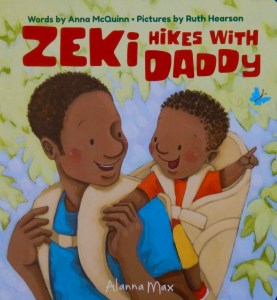
Zeki Hikes With Daddy / Fiona on the Swings & Herbert Climbs to the Top

This latest Zeki story is so full of joy from the front cover illustration right through to Ruth Hearson’s final scene showing a blissfully slumbering infant being carried home on the back of his smiling father after their wonderful day together.

As they explore the great outdoors Zeki notices small details such as a tiny falling leaf, crisp footprints left by a bird in the squelchy mud beside the water, a delicate feather and a bumpy pine cone: what lovely rich descriptive language Anna uses in her verbal pictures of these natural objects and the others mentioned.

It’s great to see both father and son being excited by the natural world,

as well as spending quality time in each other’s company. Spending time in the company of Zeki and his family is always a delight for small children and their adult sharers; both audiences will surely cherish this shared time too.

Like all the others in the series, this book deserves to be part of the early experiences of every toddler. It’s pitch perfect for encouraging talk and new learning.
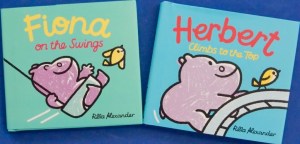
Just like little humans, Herbert and Fiona Hippo love using the equipment in the park: Hippo Park is where they meet their friends including a frog, a mouse, and a turtle.

Fiona is eager to learn to swing though needs help to get herself up onto a swing seat but Herbert is on hand to assist and provide an initial push to give her some momentum. Following his instructions, she’s soon kicking and tucking her legs as she swings back and forth till Herbert too starts his swing and then it’s time to let their imaginations take flight …

The top referred to in the second title is that of the arched climbing ladder. Urged on by his pals, Herbert takes tentative steps gradually gaining confidence as he goes step, pull, step, pull right to the very highest part. Overcoming sudden wobbliness and the dropping of Teddy, back down he climbs and off into a flight of fancy with frog et al.

Endearing, cartoonish drawings of the activities at the park combined with simple, chatty storylines of friends at play will please the very youngest.
Good Night My Sweet Island / Fantastic Families

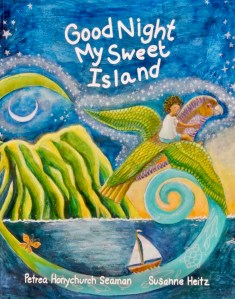
Essentially this is a seductively illustrated lullaby that bids, ‘goodnight to all things we love’ on the Caribbean island of Waitukubuli (Dominica). In so doing it celebrates the lush natural world – the forest covered mountains and valleys, the rivers, the wind, the rain and thunderstorms, the rainforest trees, the birds, bees and water-living creatures,

the fruit trees with their luscious mangoes and guavas, breadfruit and the cinnamon trees. It’s also goodnight to the tasty food the child and family are eating, to the festive music and dance, the beaches, cliffs and ‘coral-filled bays.’

Words and pictures work in perfect harmony throughout making every turn of the page both a verbal and visual feast.

I love the patterns, textures and rich colours of the flora and fauna, the waters and sky, and the characters too: the more you look, the more you see in every one of Susanne Heitz’s illustrations. Adding further authenticity to the lyrical telling is the inclusion of some Kwéyòl (Creole) words, definitions of which are given on the final page of the book.

I’ve never visited any of the tropical Caribbean islands but this gorgeous portrayal of the one where the author was born and grew up has made me want to do so.

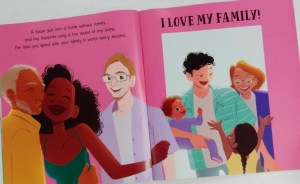
Young vegan chef, Omari McQueen, celebrates the diversity of families in this picture book, which is inspired by his own large family. Herein he introduces his relatives telling readers, “Family love is like no other and having each other is all that matters.’ Size is unimportant, but the love you have for them all is what counts. He goes on to liken families to food, some are spicy, some savoury, some sweet, but ‘always the most delicious dish.’

Families provide togetherness, safety, comfort, empowerment, support …

and unforgettable shared experiences that make for treasured experiences, they make a house a home.

On the final double spread is one of Omari’s own recipes, cookie dough chocolate cups, which I intend to try soon; and the last page asks readers to think about their own family.

A real warmth emanates from the pages, in no small part on account of Sophia Green’s vibrant illustrations. A book for family bookshelves but also one to share in primary schools especially to open up a classroom theme about families.

Paws, Claws, Tails & Roars

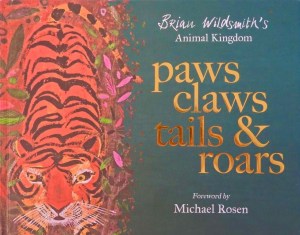
Like Michael Rosen in his foreword to this sumptuous book, I recall that my first encounter with the work of Brian Wildsmith was in the Oxford Book of Children’s Poetry, which I still treasure to this day. His image for Blake’s The Tyger immediately springs to my mind when I close my eyes and visualise.
Wildsmith’s awe inspiring art was very much part of my early years as a teacher. Picture books were at the heart of my classroom practice as a foundation stage teacher and Wild Animals, Birds and Fish were among the first titles included in my book collection to share with the children as part of their visual education and to foster a love of books. One wishes that exposure to such beauty was possible for all young children.

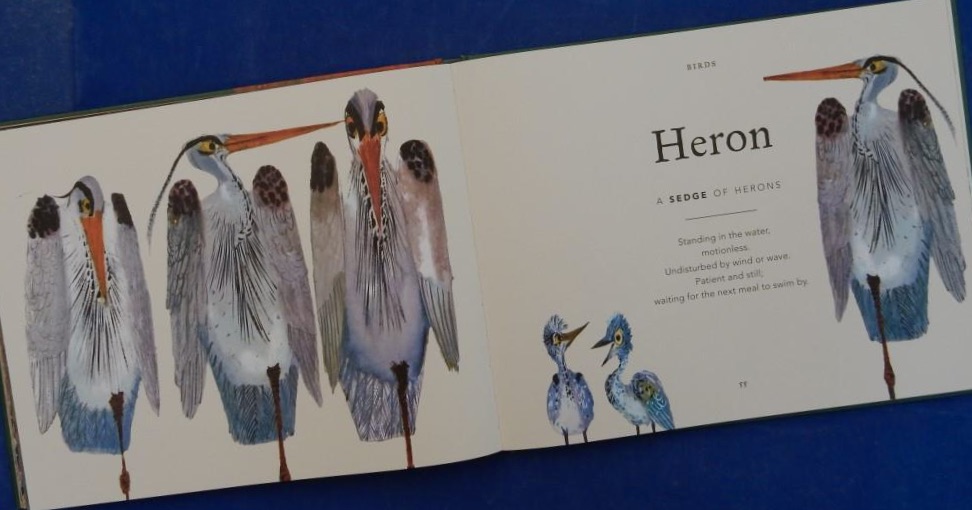
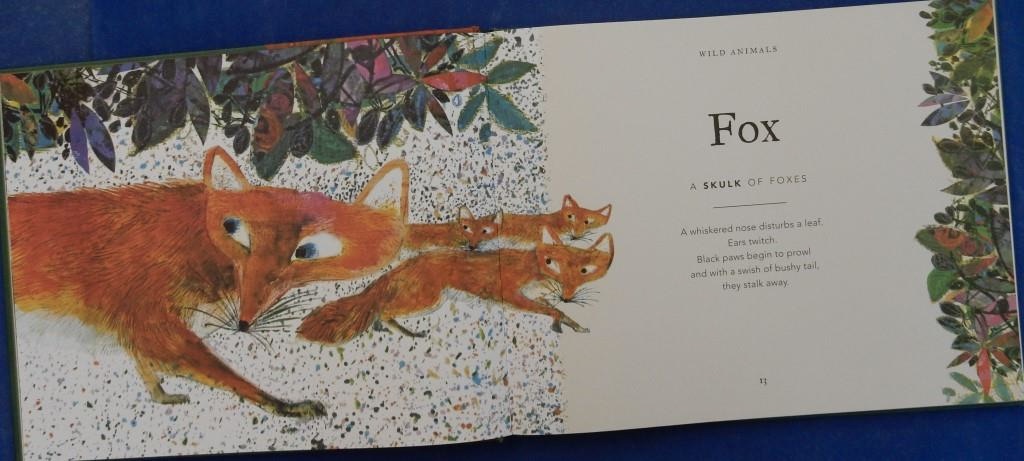
Seemingly those early titles are no longer in print, so it’s wonderful to see this compilation that brings together the art from the three titles aforementioned. A double page spread is devoted to each animal and includes the collective noun for each .

The images are accompanied by Deborah Sims’ poetic descriptions of each of the forty plus creatures illustrated.

This is a book I’d like to see in every classroom from the foundation stage upwards as well as on family bookshelves. And, what a wonderful present it would make.

A Bad Day For Bear

Duncan Beedie’s staring Bear returns for a third adventure. As he leaves his cave intent on the important job he has to do in preparation for the forest party to be held that very evening, Bear is in a good mood. However it’s not to last for the first piece of wood he picks up for the bonfire leaves a splinter in his paw. Into the forest he heads in search of some better wood only to be in the way of a falling log chopped by Beaver. The dam builder apologies and offers Bear some wood for the bonfire. No sooner has Bear begun dragging the logs along than down comes the rain. With three disasters he declares, “Today really is the worst day ever.”
Perhaps Frog can help make him feel better, thinks our ursine friend but as he heads towards Frog’s pond, Bear fails to notice a massive muddy puddle and …

Frog though, is a problem solver: can he solve not one but three problems for his miserable pal? Perhaps with some careful inspection and further consideration.

Come party time, thanks to an extra pair of feet, that important job of Bear’s is completed just in time

and as night falls the woodland animals enjoy a feast around the fire … until it starts to die down. It’s Badger who isn’t pleased at the sudden descent of darkness. However having learnt something from his froggy friend, it’s Bear’s turn to to offer a different perspective. Will it change the others’ viewpoints too?

We all have bad days from time to time and this book is the perfect one to share with young humans on such days to remind them that things aren’t necessarily as bad as they might think. As always Duncan’s text and pictures work in perfect harmony, the former is rich in descriptive language and the latter striking; Bear’s expressions are wonderful and sure to make young audiences both laugh and empathise with the sudden setbacks that befall him.

Bompa’s Insect Expedition

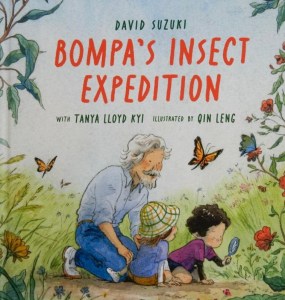
This book was inspired by author David Suzuki’s adventures with his own grandchildren and features twins Nakina and Kaoru who love having adventures with their grandpa. This adventure is a nature expedition and by the time Bompa arrives, the two have amassed everything they might need including Kaoru’s field journal.

As time is short on this particular day, their expedition is an insect search in the area right close to their home. Initially Kaoru is somewhat sceptical about discovering anything new, but there are plenty of surprises and new learning in store.

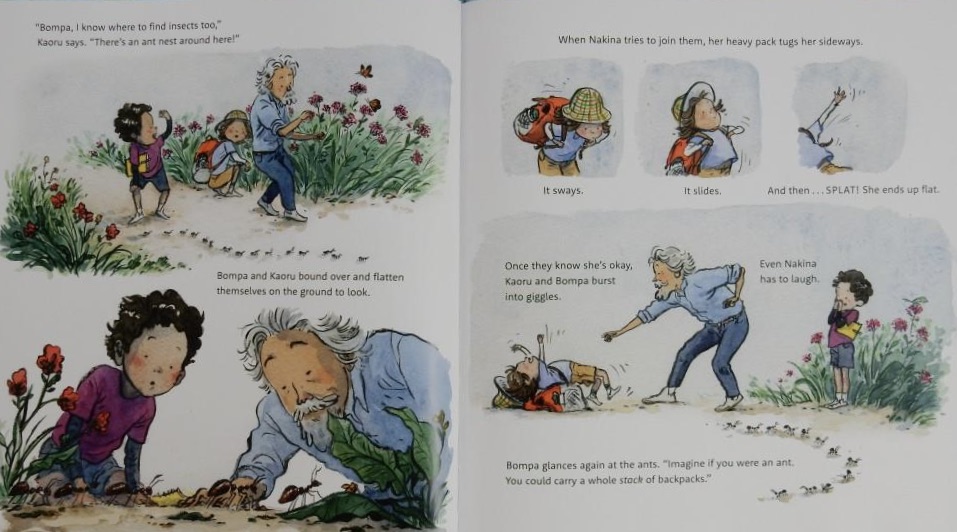
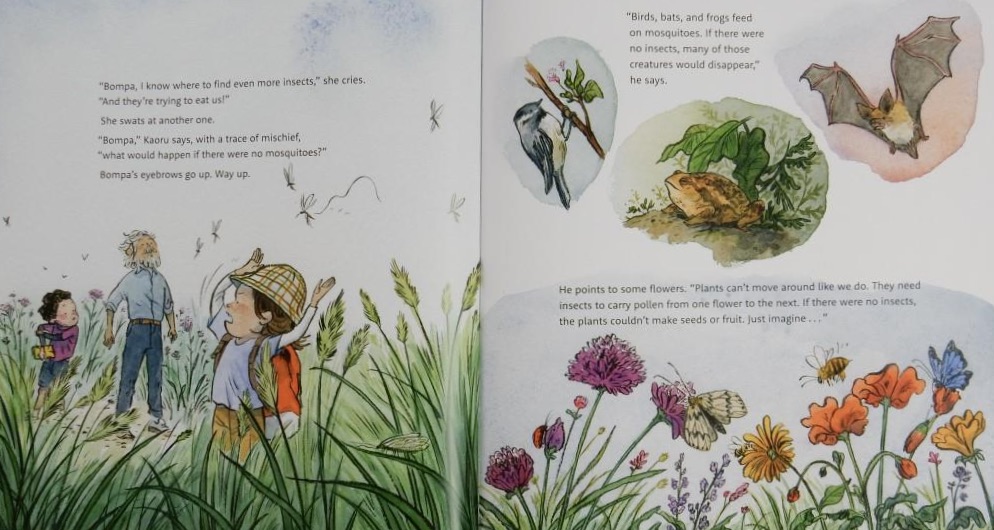
The two children are both inquisitive and imaginative in their approach as they encounter in turn, a bumblebee, dragonflies, caterpillars of the monarch butterfly, an ants’ nest,

mosquitoes and a lacewing. During their exploration, Bompa imparts a wealth of scientific information, much of it in response to what the twins say, taking every opportunity to encourage and deepen their thinking.

The story ends with the three enjoying a picnic and is followed by a page from Kaoru’s field journal, a peek at the contents of Sakina’s backpack and a final spread with some additional insect facts.

David Suzuki is a renowned scientist/environmentalist and this engaging book is published in partnership with the David Suzuki Institute; his co-author, Tanya Lloyd Kyi, has written numerous books for children. Qin Leng’s watercolour illustrations are a delight, bringing out the intergenerational love between the characters as well as showing details of the fauna and flora of the environment the three explore.

Two Ants Puzzled

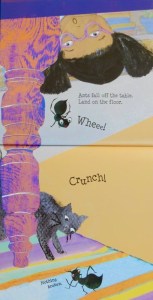
In this charming interpretation of Rumi’s classic tale with its theme of looking at the bigger picture, Elizabeth Laird sets her tale, told from the ants’ perspective, in the house of a little girl. The title page shows the two ants out exploring, walking in through an open front door and turning the page we see them starting to explore by climbing up the table leg onto a large white sheet of paper whereon the child is drawing. They walk right along her pencil and what they focus on is the tip and the movement of that pencil in her fingers. 

So intently are they looking at the shapes and colours that they slither and slip hither and thither.
When the girl pauses and looks up, the ants start to retreat, ending up on the floor safe and sound – just! 

Unhurt they begin ascending the table leg once again. This time what they see before them is the entire finished picture and included in it are … two ants. Guess who is inspired to be creative now.

Jenny Duke chooses a variety of perspectives for her scenes making them especially effective and intensifying the small drama as it unfolds, and she cleverly imbues the ants with real personalities. Young listeners will also notice that there is a playful black cat watching the action throughout the story.

Peace on Earth

‘Peace on earth … GOOD WILL TO ALL!’ Surely this is something almost all of us long for and with on-going conflict in several parts of the world, this stunning, heartfelt book couldn’t be more timely.

Lyrically written by Smriti Halls and dramatically illustrated by David Litchfield, it presents a story wherein we follow a group of friends who embark on a journey together over land and sea. A journey that starts out full of joyful anticipation and happy camaraderie

but then, lost and afraid, angry words are spoken – hurtful words – that cause distress and pain.

Thereafter it’s hard for the group to -re-establish that former harmony, peace and light. Fortunately though with the will being there, as it is with the friends herein, they find the courage and the inner strength to be peacemakers. I love this scene showing one of the characters bringing an affirming flame towards the others.

Thus, the story ends with a reconciliation that reunites the characters and they go on to share their joy with others as lights shine forth all along the shore line.

With its combination of striking art and deeply felt words (inspired by Luke 2:14), this book needs to be shared and talked about as widely as possible in many different settings from the family to adult meeting places.

Imperfectly Perfect

Maria’s day starts badly; she accidentally damages her brother’s favourite book as she’s turning the pages a tad too fast. Robbie is far from pleased, accusing his little sister of ruining the book and stomping off. Needless to say, Maria is upset and in comes a family friend, Bea, with a timely hug. This she follows with a story about the day a bowl she’d given to Maria’s mum broke and was repaired with love and golden glue, making it imperfectly perfect.
Maria remains upset so Bea suggests a cheering up walk. During their saunter Maria looks for other imperfectly perfect things around and about,

and by the time a thunder storm breaks, she’s starting to feel better. As well as seeing beauty in the stormy sky, she has an idea about her brother’s book.

Back at home, Maria and Bea then work together carefully making repairs to Robbie’s precious book.

How do you think he will react when Maria goes to his room with an apology and the book?

A sweet and important story about accepting and embracing imperfections, and making amends, engagingly told and illustrated. Hoang Giang’s illustrations underscore the author’s empowering message about discovering beauty in all manner of unexpected places.

The Most Famous Rhinoceros

The inspiration for this moving story reimagined by Dianne Hofmeyr, was Albrecht Durer’s celebrated woodcut print of the rhinoceros sent from India to Portugal in 1515, the woodcut now being housed in the National Gallery of Art, Washington.

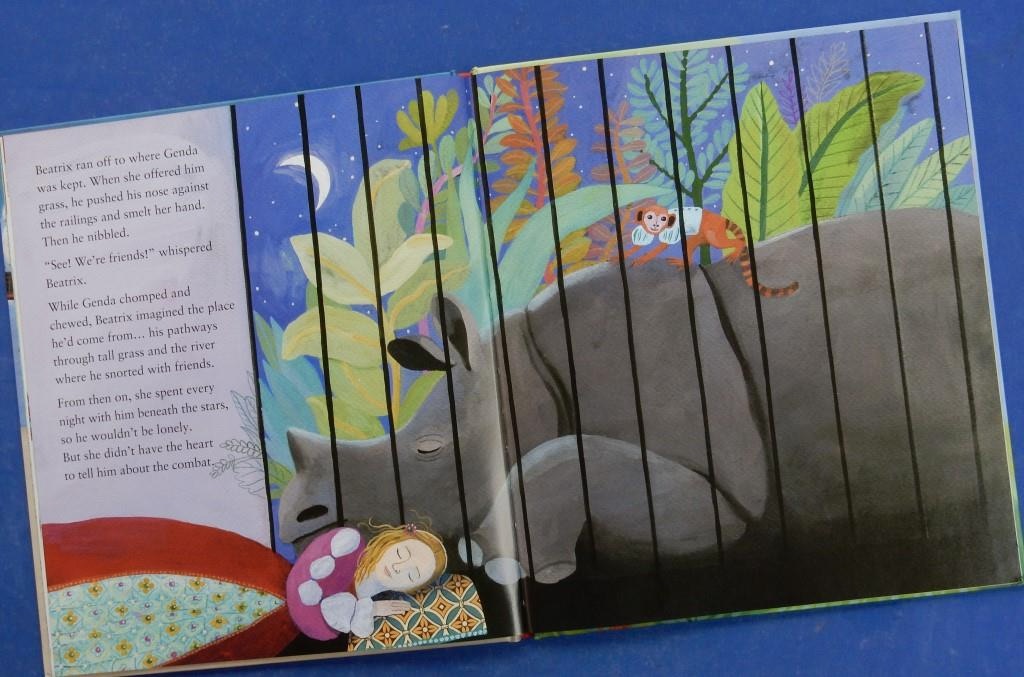
We read how Princess Beatrix and her sister receive a one-horned animal as a gift from the Sultan of Gujarat, a creature Beatrix hopes will be a unicorn. However she’s disappointed to see standing on the sea shore straight off the ship, a very large bulky beast with a small stubby horn on the tip of its nose. Genda, is what she names the gift. Her father informs her it is a rhinoceros and mounting his stallion, he leads the animal, along with a host of other creatures, the queen and her entourage through the crowds to the palace.

Beatrix has already formed a bond with the rhino and is horrified to hear the following day, the king announcing a fight between the rhino and an elephant to settle a squabble between her two brothers.
From then on she sleeps alongside Genda’s enclosure every night leading up to the combat, a matter she doesn’t tell her new friend about.

However, come the day of the contest, the two animals face one another but no fight ensues, no matter how much enticement the creatures receive.

What will be the fate of Genda? Her brother João demands he be sent away but Beatrix begs that the rhino is returned to India and given his freedom. Not long after a ship sets sail with Genda on board and Beatrix bids her friend a fond farewell but …

Animal lovers horrified at the treatment of creatures such as Genda in this story, sent over vast distances in return for favours from their recipients, will applaud Beatrix’s caring attitude and desire to get this gift sent back from whence he came. Simona Mulazzani’s richly ornate illustrations capture beautifully the period in which the events are set, making the telling even more poignant. They show the contrasting natural beauty of the rhino with the elaborate finery of the human characters and the adornments placed upon Genda for the parade and the fight.

Count the Stars

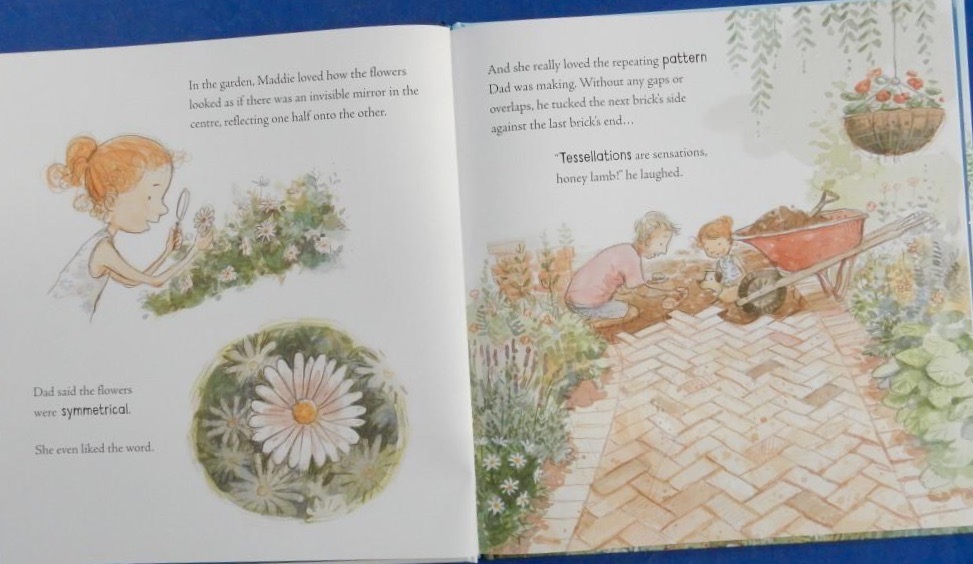
No matter what young Maddie sees or does, her everyday world is full of mathematical ideas; that’s just how she sees it, thinks about it and loves it. Perhaps it’s the early morning sunlight streaming through her bedroom blinds; then there are those fractions in her piano practice, the symmetry in flowers, the tessellating pattern in the pathway she and Dad make together,

the wealth of opportunities to count things in nature and much more besides.
Almost all the time Maddie is happy and comfortable in how she looks at the world, but very occasionally she notices that it makes her different from her friends – ‘an odd-shaped brick that didn’t fit into the pattern.’ This happens when some friends come to play: whereas Maddie focuses on the mathematical transformations involved in making hats for her dolls,, Grace and Olivia’s only interest is the dolls. Similar when they make cupcakes, her friends are interested in the decorations on the tops, Maddie in contrast, loves measuring out the ingredients.

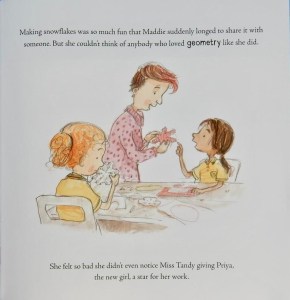
One day in school when Maddie and her classmates are busy making paper snowflakes, she wishes there was somebody with whom she could share her love of geometry. She doesn’t notice that perhaps there is, in the shape of a new girl, Priya; and for the next few days Maddie feels downcast.

Fortunately though, her perceptive Dad has a surprise in store. That night he organises a night-time playdate with Priya and they pay a visit to the observatory. An unforgettable experience for sure and one that leaves Maddie thinking an absolutely massive, mathematical what if …

From cover to cover and endpaper to endpaper, this is a wonderful, multi-layered book. Apart from being a terrific, superbly illustrated story, it’s overflowing with classroom potential, starting perhaps with a discussion on ways of seeing. I love that it shows how the imagination and creative thinking, and a fascination with facts, can sit side by side, as well as demonstrating the vital importance of notions of what if … as the basis for all new discoveries.

Betty and the Mysterious Visitor

Every summer Betty visits her grandma in the village of Wobbly Bottom. She loves spending time in the Acorn Hollows, the garden shared by all the residents of Grandma’s terrace. There she delights in the abundance of flora and fauna; there too her gran cultivates various fruits and Betty helps her pick them, make jam and sell it in the local market.

Full of eager anticipation Betty wakes on market day only to discover that overnight the garden has become a muddy mess. However there’s no time to investigate properly before they leave for the market. 

There it’s full of people buying and selling and come teatime all grandma’s jam has been sold so they head home with Betty determined to find out how the Hollows was spoiled.

She watches through the window that night and in the moonlight she spots a large creature thrusting its nose under the fence but in a trice it’s gone.

The following morning Betty’s Grandma says it was probably a badger and that it’s likely to return. Sure enough, over the next few nights the badger comes back, wreaking havoc in the garden. Supposing it gets into Gran’s fruit cage? Time to get working on a creative solution, thinks Betty and she puts together a frightening monster, then lays a trail towards it. 

Wide awake that night, Betty watches and in comes the badger. However, such is the effect of a sudden wind on the monster, that the intruder hastily departs but not before, so Betty thinks, looking directly at her, as if saying farewell.

Grandma is pleased to hear her granddaughter’s account next morning and together the two sit beneath the trees and celebrate with hot chocolate.

Author, Anne Twist’s inspiration for this, her debut picture book, was her own country garden and what a lovely celebration of the natural world it is. It’s also a beautiful celebration of intergenerational love. How brilliantly Emily Sutton’s jewel-like illustrations bring the world of Wobbly Bottom to life; each re-reading will likely reveal fresh details to savour.

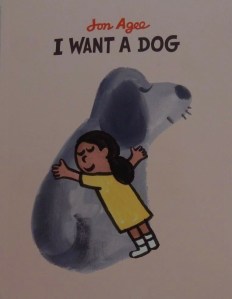
I Want A Dog

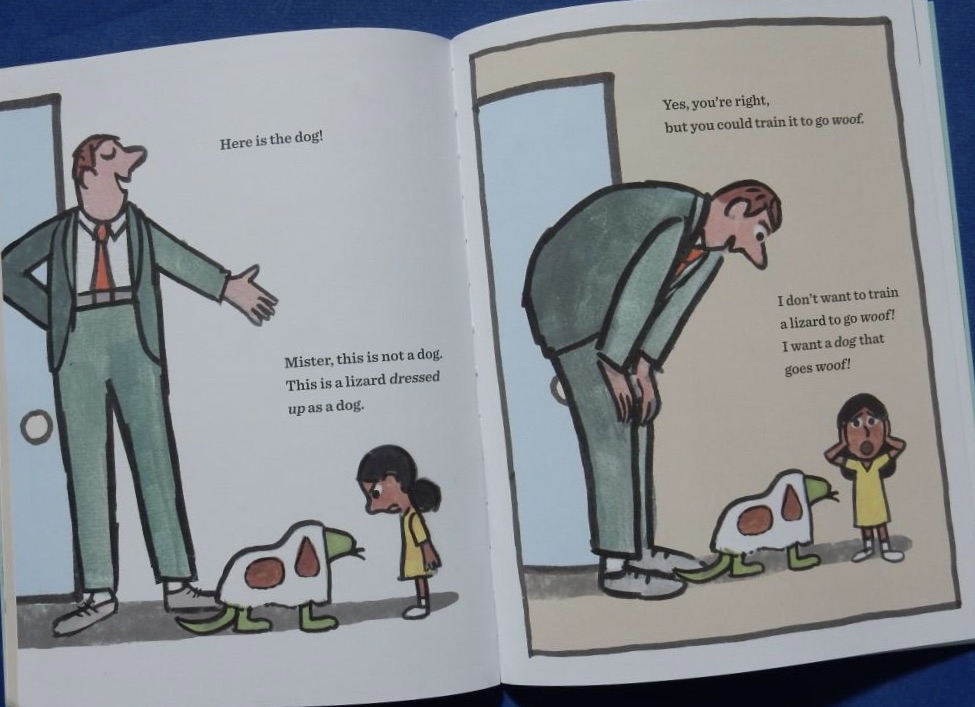
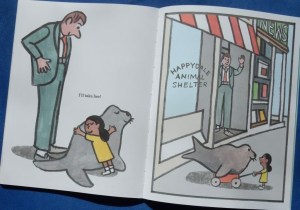
When a little girl visits Happydale Animal Shelter, she’s determined to come away with a dog. However, while agreeing that a dog is an excellent choice for a pet, the helpful man there has other ideas. He produces in turn, an anteater, a baby baboon, a python, a frog, a goldfish (dead, rather than playing dead). The little girl remains steadfast, and then he brings in what he says is a dog …

Of course, it won’t do and nor will the wombat, the kangaroo or the albatross. With her body language speaking volumes, the child asks ’Do you even have a dog?” Time to admit the truth, so out goes the girl – almost. The persistent man has one more try, asking what makes a dog so special. Having heard her response, he offers something that fulfils all her criteria, although he admits it’s not of the canine kind. Instead he produces Lucinda and it seems to be love at first sight.

Back home go girl and, balanced rather precariously on her pull-along cart, her new pet.

Evidently, as the final spread shows, her parents are happy to accommodate this new addition to the household.

The interaction between the girl and the man at the animal shelter is superb – signature Agee wry humour, coupled with watercolour illustrations rendered in subdued colours (apart from the thick black outlines) and a perfectly paced text that includes a hilarious final twist.

A winner with this reviewer and so will it be with young listeners and beginner readers who will soon be joining in with the girl’s part of the dialogue.

The Shade Tree / Rapunzel

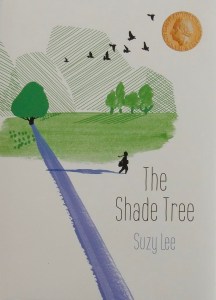
This is a re-telling of an old Korean folk tale wherein we see how a young traveller tricks a rich but heartless man into selling him the shade from the tree that grows on the latter’s land. The rich man considers he’s made some very easy cash but hasn’t considered the effects of the lengthening shadow of his house as the day progresses.Whatever the shade touches is thus owned by the traveller, and he can share it with whomever he wishes. Furthermore when the shade covers the rich man’s house, the traveller can enter that house, which he does,

eventually causing the wealthy one to move out. Once the house is vacant the traveller settles down and enjoys life as the new resident.

Much of the power of this thought-provoking telling lies in its simplicity, simple too is Suzy Lee’s art; it’s almost abstract in style and uses a limited colour palette to effect. With its dramatic gatefold, this is altogether an unusual book that feels at once both old-fashioned and contemporary. It would probably appeal most to older readers especially those with an interest in folk stories.

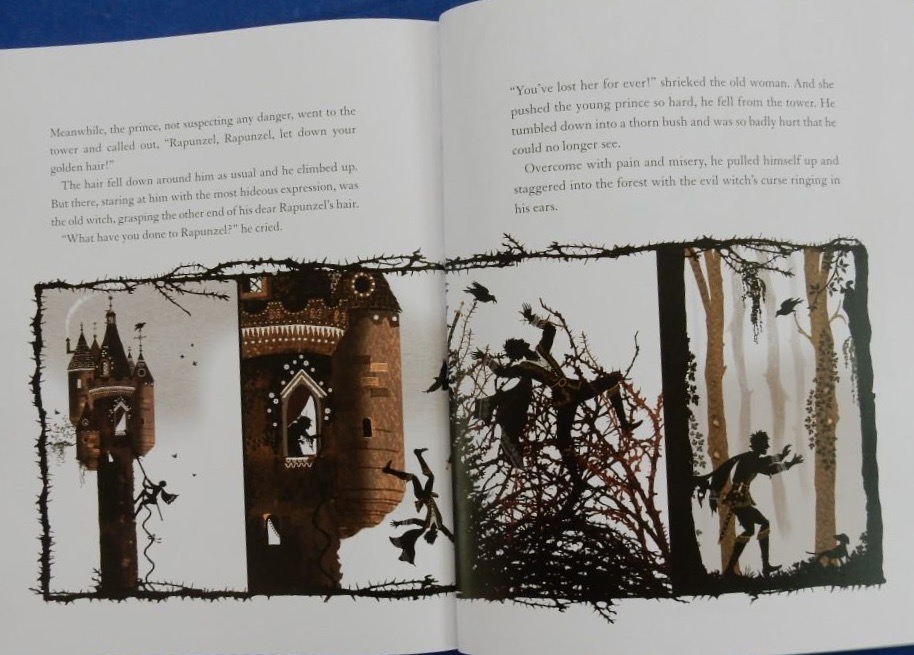
Sarah Gibb has taken the original classic fairytale and turned it into a visual feast.with a mix of gorgeous silhouettes and delicate, detailed colour illustrations, without losing any of the essential elements of the plot in her simplified telling. We still have the drama: the witch discovering the young husband helping himself to the salad leaves from her garden to cure his ailing wife and his promising to give her the baby when born in return. And romance: the baby Rapunzel becoming a beautiful girl incarcerated in a tower, who is visited by a prince and the two eventually marrying.

Rapunzel’s tower is illustrated in true fairytale style, with turrets and weathervanes, vines and roses
and the contrasting silhouette style prince staggering through the forest having been seriously hurt as a result of his fall from the tower.

Recently reissued with a new cover, I suggest that if you are looking for a highly pictorial version of the fairytale, look no further than Sarah Gibb’s offering.

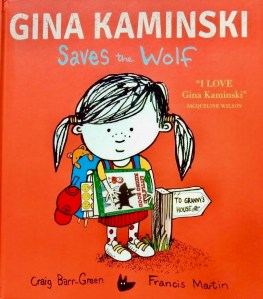
Gina Kaminski Saves the Wolf

If you are a teacher, you are likely to realise from the start that Craig Barr-Green’s delightful protagonist and narrator, Gina Kaminstki is neurodivergent.

One morning in school, Gina is finding things a bit ‘rubbish’ and so her TA, Anya, takes her to the peace and quiet of the reading room, says she will read to Gina offering the choice of two books, Little Red Riding Hood or The Big Book of Wolves. Gina picks the former, Anya reads the story. Afterwards our narrator disagrees completely with the tale, declaring, “That girl and the wolf make three big mistakes,” These she decides to fix by paying a visit to fairy tale land.

Duly prepared with a backpack containing breadsticks, her cap and her teddybear, off she goes.into the fairytale. First stop is the home of the mum who duly produces a yummy-looking cake, which she tells Gina to deliver to Granny, giving an excess of information to the child. Then comes ‘Mistake One’ but that is easily rectified: what would you do with a cake? Avoiding making mistake two, she proceeds through the woods, followed by a scary-looking wolf. That’s when the breadsticks come in handy, allowing our protagonist to reach granny’s house, confirm her identity and give her three pieces of information before the lupine arrives on the scene.

When the creature does arrive, Gina tells him of her plan; the wolf acts as per instructions and before you can say, ‘here’s the woodcutter’, off goes Gina, back to the reading room

and thence her classroom. Then it’s a happy ending both for Gina and a certain wolf.

I absolutely loved this; both words and pictures are wonderful. The matter-of-fact telling works SO well – it’s really great for reading aloud – and Francis Martin’s illustrations perfectly capture Gina’s feelings throughout the book, showing so well her spirit of inquiry and propensity for gentle rebelliousness.

Apart from being a splendid story, the classroom potential is massive.

Millie’s Big Decision

Young Millie has long wanted a dog and as this story begins she’s visiting a dog shelter with her dads. However, each time she’s introduced to a dog she comes up with an excuse as to why it’s not suitable. Even when she sees one that appears to be a strong contender, she says no.

Then we learn that her grandmother has recently died and Millie fears the possibility of becoming attached to another person, or dog, and experiencing loss again. However her patient parents tell her of the wonderful adventures they and a dog could have together and Millie eventually admits what is holding her back. Once more the little girl thinks of the joy a dog could bring and finally, she takes her favourite into her arms

and decides he should be named Oscar; seemingly she’s already opened her heart. to him.
The following week, Oscar joins the family, ‘ready for a new adventure’.

Loss is never an easy subject to discuss with young children, but with Ian’s empathetic, sensitively written story together with Max Rambaldi’s expressive illustrations, this book offers an ideal starting point showing the importance of remembering those we have lost, but also of enjoying the present and looking forward to what the future might hold.

Strongly recommended for family collections and classroom bookshelves.

Wheels: The Big Fun Book of Vehicles

This book takes readers on both a historical and worldwide journey that explores everything you can think of with wheels and a whole lot more wheel-related ideas from the cycle of life to cheese; now that’s a pretty broad spectrum you might be thinking, but Tom Schamp’s spreads that begin in ‘Antiquity’ and go right through to the future, are absolutely crammed with captioned images and snippets of information. (A few ships have also managed to sneak their way in despite the “No Boats, Wheels Only!’ signs.) 

Schamp begins by stating that nobody knows when, where or by whom the wheel was invented but says that pottery and sculptures have taught us a great deal about wheels in ancient times.
Some forms of wheeled transport have a whole double spread devoted to them: there’s one on stagecoaches, then come carriages, steam-powered trains/trams, bicycles, 

one entitled Otto’s Autos (essentially early cars), motorcycles, ‘woodies’ so called, which were cars made partly from wood, family vehicles (the four-wheeled kind), wheeled machines used to build roads, emergency vehicles, race cars, race bikes, delivery trucks, buses, taxis, (watch out for the cheeky free-riding hay wagon passenger) and limousines. You will find jokes both verbal and visual, word play, as well as eight characters to search for on every spread.

A book to return to over and over – you’ll find new things to enjoy at every reading, – it’s immersive, great fun and with a wealth of learning potential. Did you know that the commercial 3 wheeler, the Piaggio Ape was named after the worker bee? I learned that from this zany large format book.

Include in primary class collections, and family bookshelves if you have children interested in vehicles.

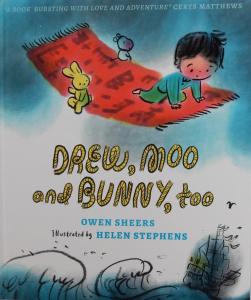
Drew, Moo and Bunny, too

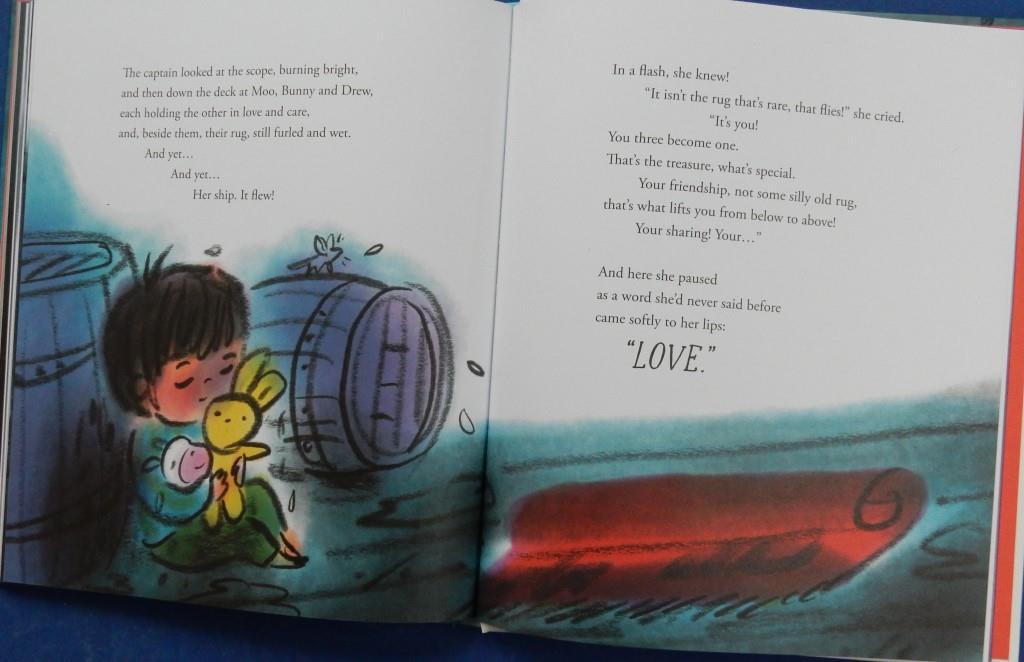
In this magical tale three endearing characters, a boy Drew and his companions Moo and Bunny take off on a red rug for an adventure that sees them travelling around the world. They find themselves aboard a pirate ship whereon they encounter Captain Jacqueline (Jack for short) and her piratical crew – a scary meeting if ever there was one.

When they’re confined to the space below deck they are astonished to discover all kinds of caged creatures; these so the captain informs them, have been captured thanks to her ‘rare-o-scope’, an instrument she produces and proceeds to demonstrate how it works. However instead of being impressed, Drew is horrified the animals have been removed from their natural habitats as trophies, ‘rarer than any of the jewels on Earth.’ and increasingly precious. When Drew goes on to mention that he and his friends too have something uniquely special, in the form of their flying rug, the Captain is eager to add it to her treasure collection and tries to take possession of the rug. In so doing she makes a startling discovery causing her to utter a word that’s never before passed her lips. ‘L_ _ E’.

This is a story that ends happily: Drew proffers some wonderfully wise words that have the desired effect on the pirate captain and her crew; and the three adventurers return to the warmth and safety of their bedroom.

With Owen Sheers’ longish poetic text and Helen Stephens’ richly imagined illustrations, this is a wonderful book to share over several bedtimes. The story was inspired by the true story of Drew Barker-Wright, who aged just four, lost his life to paediatric chordoma – a rare form of childhood cancer. Sales from this book go to raise funds for The Drew Barker-Wright Charity

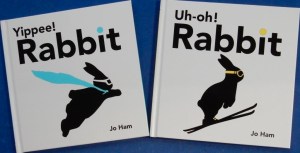
Yippee! Rabbit / Uh-oh! Rabbit / Maisy’s Big Book of Kindness

If you think this rabbit character looks familiar it’s probably because you’ve seen it on merchandise such as mugs and now the same Rabbit stars in two small books for the very young.
Yippee! Rabbit sees the little creature running uphill, kite behind and the words, ‘Rabbit go’. Reaching the hilltop with kite flying, is celebrated by a ‘Yippee!’ However turn over and there’s Rabbit and kite both entangled with a tree.

Further sequences follow a similar pattern and see Rabbit swinging close to another rabbit that is digging veggies from the ground and loading them in a wheelbarrow, going for a scooter ride in the rain and finally in a pattern breaking dash, launching high into the air … bound we know not where.
The endpapers show Rabbit engaging in a range of other activities, some more risky than others. I suspect this will become a winner with little humans as will the companion book.
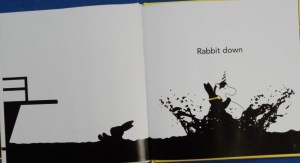
Uh-oh! Rabbit features two leporine and on the opening spread we first see them on a seesaw with the words ‘Rabbit down’. Turn over and there’s one ‘Rabbit up’, the other blissfully floating along on a blow up unicorn. The next page shows the rabbit from a diving board now in midair ‘Uh-oh!’ – where’s the landing place for ‘Rabbit down’? …

Other sequences show Rabbit ski jumping and then, using a slide, with the same prepositions used in each instance. However the final adventure has a twist and the sliding Rabbit, one assumes will land safely in the larger one’s outstretched paws.

Just right for sharing with the very youngest.

Kindness makes the world a better place but what does this mean for Maisy and her friends Tallulah, Eddie elephant, Cyril, Charley, Dotty, Little Black Cat and Panda?

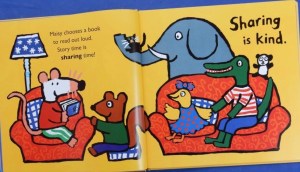
First are examples of sharing: Maisy shares her toys, allowing Tallulah to play with Panda; she also shares favourite places – her paddling pool on a hot day, her umbrella when it rains and a favourite book during story time .

Giving is another example and Cyril’s birthday provides the backdrop for lots of giving – Maisy makes him a card, Charley bakes him a cake and both are duly thanked for their kindness.

Caring comes next and we see Maisy and Eddie caring for the plants in the former’s garden; then Daisy and Tallulah co-create a bug hotel. Indeed Daisy cares for lots of farm animals too, making sure they all have sufficient to eat. Extra care is needed when Dotty is hurt by a tumble from her skateboard and helping is needed when Little Black Cat gets stuck in a tree and all the friends help make the barbecue lunch Maisy hosts a success, including finding a way to help the planet.

The final scenario is ‘playing together’ which is rich in opportunities be they a quiet game with turn taking or a riotous musical extravaganza.

Altogether a joyful celebration of kindness to share, talk about and one hopes act upon at home and in early years settings.

Lulu’s Nana Visits

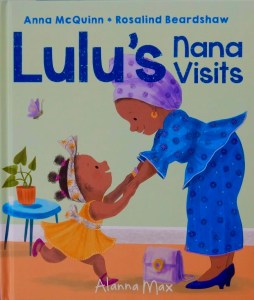
The stories in the Lulu series presenting young children’s experiences are always beautifully done and so it is in this new one, with words and pictures working so well together as one has come to expect from Anna and Rosalind, who always pays careful attention to detail.
Lulu is very excited at the prospect of a visit from her Nana-Bibi and together the little girl and her parents make the necessary adaptions to their sleeping arrangements. When Nana-Bibi arrives, following a rest to revive herself after the long flight, family members share a special welcome dinner.

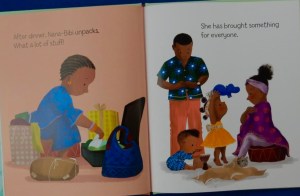
After this Nana-Bibi unpacks her bags: there’s a surprise present for everybody.


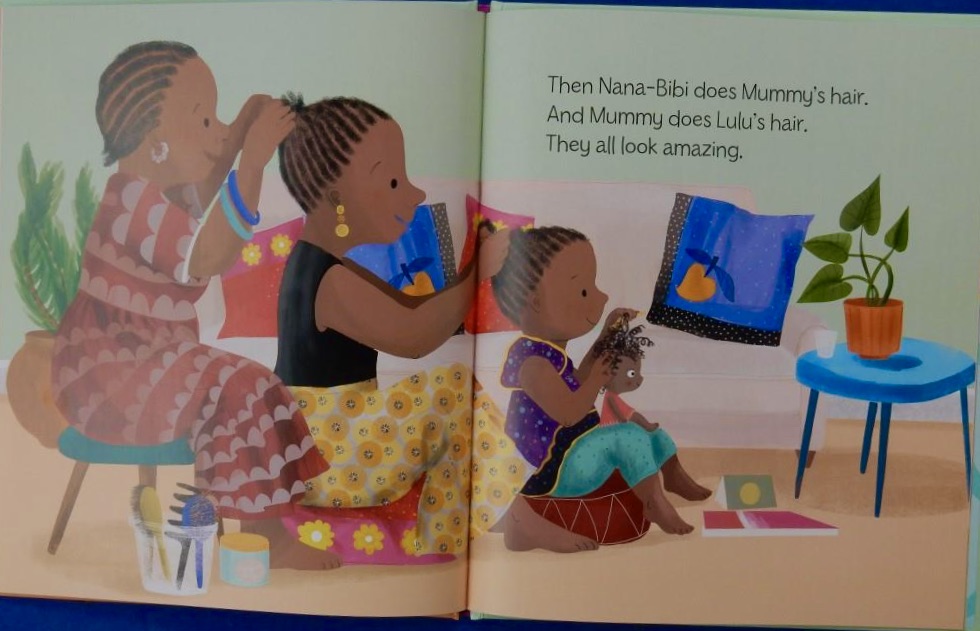
Plans have been made for the visit and the following morning it’s a shopping trip so Nana-Bibi can get some gifts for everyone back home. However, every day is exciting when Nana-Bibi’s around. There’s her cooking, a hair doing session

and more. I love the way cultural traditions are presented and you can almost feel the family’s joy as they share in them.

Perfect for sharing and discussing with preschool children.

Whirly Twirly Me

Sometimes children get so overwhelmed by their feelings that they find them impossible to control: so it is for the little girl protagonist in the story Manjeet Mann tells.

From the moment she wakes up, the girl talks of feeling a ‘bit whirly, my insides a bit twirly. my stomach in a knot’ which results in a strop, then a flop and at breakfast time, her elder sister takes the last of her favourite cereal. Hmm! This tangled turmoil continues all the way to school despite Mum promising to replace the cereal but things get even worse. A boy takes her favourite pencil to use, friends play a new game, which she doesn’t understand,

Lola tells her, “You’re no fun” and refuses to play.

Back home, on hearing about their daughter’s anger at school, her parents tell her that it isn’t acceptable to get angry for no reason; but still that whirling twirling persists. Up in her bedroom our narrator is overwhelmed and unable to stop stomping until up comes Mum.

As the two sit together and talk, those knotty feelings begin to dissipate until, reassured by hearing that ‘It’s normal to feel all those feelings,’ … It’s all part of who she is, the child finds a smile, a hug and a way to move forward.

Amanda Quartrey’s illustrations immediately take hold of you, as you follow the progtagonist through her day of small upsetting dramas that mount up and up into something really big.
A good book to start a classroom discussion about emotions.

Albert and the Shed

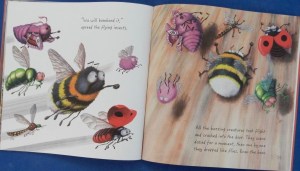
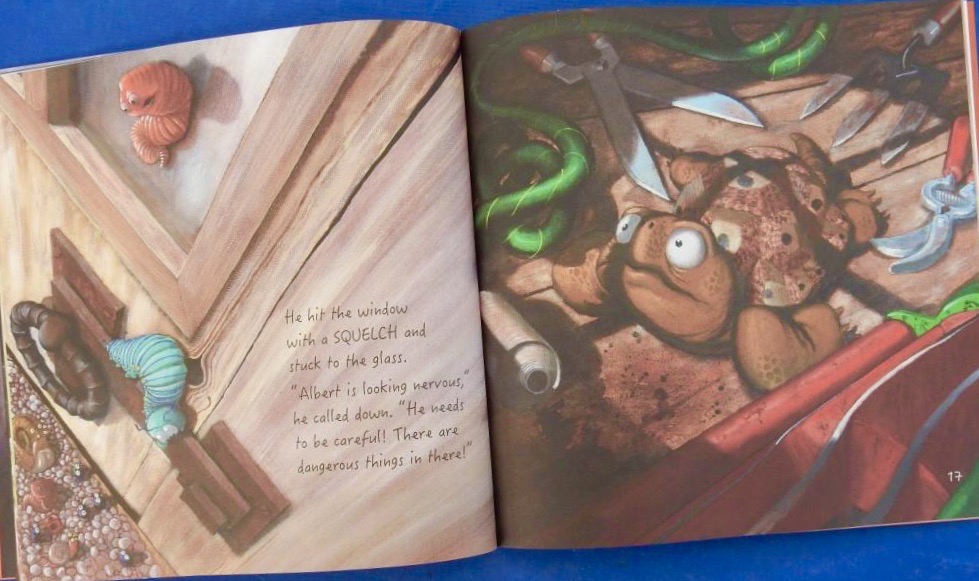
While a thunderstorm rages, Albert decides to take refuge in a garden shed, but as he looks for a cosy place to settle the wind blows the door shut so the tortoise resorts to taking a snooze. When he’s woken by sun however, the door is still shut and he’s not happy. Suddenly he hears the voice of the ant commander telling him how untidy the place is and promising to get help with the door.

It’s not long before a rescue party arrives and with no real plan, a little worm finds itself flying up towards the window, which is also firmly closed. However, he does see Albert looking decidedly nervous on account of all the dangerous objects littering the floor. Meanwhile the ant commander decides he and his fellow ants should come under the door and attempt to open it from the inside: that is not a good idea.

Outside, other door-opening attempts including bombardment are being made,

albeit unsuccessfully; however, what none of the would-be rescuers know is that all the while a little caterpillar has been creeping up the door towards the latch.

Will Albert be free at last? And what about the ant brigade, still stuck fast, and they’re not the only things that remain stuck.

With some hilarious moments – from the reader’s viewpoint, though not the characters herein, this latest Albert story will delight, with its dramatic telling and arresting illustrations.

I Can See Nature’s Rainbow

This image has an empty alt attribute; its file name is dscn9793-2.jpg


There’s a kaleidoscope of vibrant colours to be found in the natural world and that’s what author/artist Vicky Woodgate celebrates in this book.


Starting with blue, a spread is allocated to each of eleven different colours. Yes we all know that sometimes the sky is blue but did you know that there is a blue daisy and a blue starfish?
Thanks to chlorophyll, there is an abundance of green in nature’s flora; there are also lots of green insects, quite a few birds and animals. Among the snippets of fascinating information is the fact that ‘the world’s heaviest parrot (the kakapo) weighs as much as a brick. You probably won’t be surprised to discover that kakapos don’t fly.
Keep going through the book and you will come upon lots of other things of interest.

Have you ever thought about why there are so few purple animals? You will find the answer on the relevant spread as well as being introduced to several purple bugs, birds, flowers and a peculiar Indian frog that spends just two weeks above ground each year and clucks like a chicken: it’s not surprising I’ve never seen one on my frequent visits to India.


These are just a few of the delights you will encounter as you turn the pages towards the final spreads, one showing rocks and minerals, which explains how they get their unique colouring and the last pages explain what colour is and present some arty activities.

A visual feast for younger primary readers.

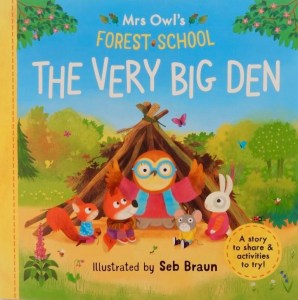
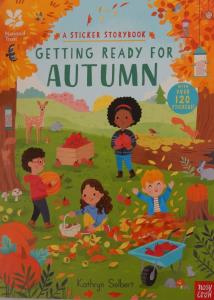
Mrs Owl’s Forest School: The Very Big Den / Getting Ready for Autumn

You never know what you will find, if you go down to the woods today, perhaps a forest school in progress.
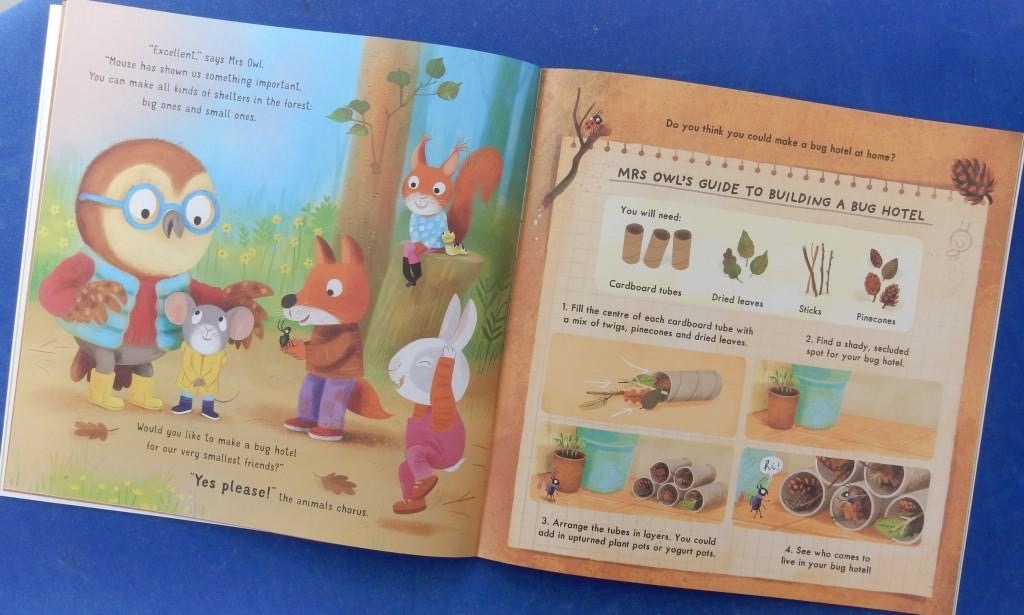
Herein we join Mouse, Squirrel, Fox and Rabbit in a woodland setting beneath the trees where Mrs Owl holds her forest school. During the process of den building the animals use all their senses to learn about wildlife, both flora and fauna of the surrounding environment, as well as learning an important lesson about friendship and inclusivity. In addition they gain some useful skills such as how to tie knots and how to build a bug hotel. 

Written in consultation with Lizzie Noble, a forest childcare provider with a wealth of experience in running creative, play-based forest school sessions for families, this is a book that may well inspire youngsters to get out into the wild, wonderful world of nature. Seb Braun’s inviting, detailed, richly hued scenes help underscore some of the instructions woven into the narrative and should encourage young children to find and explore their local woodland places and perhaps try their hand at den-building. In my experience, children need little encouragement when it comes to the building of dens.

This seasonal sticker storybook is published in collaboration with the National Trust. Herein readers join a family and friends as they enjoy a range of early autumnal activities. Mum, Dad and two children walk in the woods where the trees now have their rich golden, orange foliage, and they keep their eyes open for woodland creatures such as deer, squirrels and birds. They also spend a fun afternoon apple picking in preparation for some baking and take advantage of windy days to fly kites. 
With the new term about to begin there are the inevitable getting ready activities as the siblings are starting school. On their first day, Grandma comes to meet them and they visit the park to hunt for conkers. As the chillier days arrive, it’s time to put up some bird feeders and with the approach of Halloween, some ripe pumpkins are ready and waiting to be picked. The book concludes with some Halloween activities.

After the narrative come two ‘can you spot’ pages that will send children back to each spread to find the items shown; there are also several pages containing 120+ stickers to add to the relevant spreads.
A useful, book to have to hand as summer ends, especially on a rainy day.

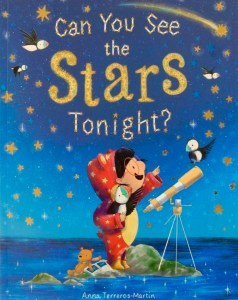
Can You See the Stars Tonight?

Most of us are very aware of the need to rein in our use of energy in order to protect the planet, but I suspect that light pollution is not the first thing that springs to mind when the word pollution is mentioned. I live part of my life in a small village near Stroud in Gloucestershire and the other part in suburban outer London: the difference in the number of shining stars visible in the night sky is astounding. Apart from the houses, there are far more street lights, commercial premises lit at night, illuminated advertising etc. in TW12 than in rural Gloucestershire.

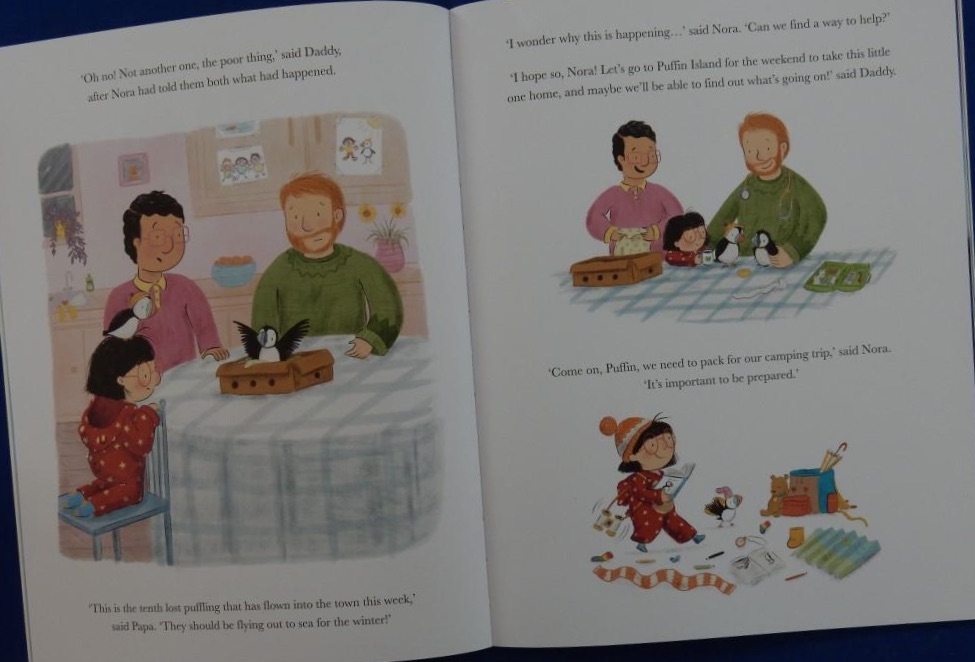
Nora the small girl protagonist in Anna Terreros-Martin’s story, enjoys using her telescope and looking at the stars from her bedroom window and she becomes aware that the stars are much less bright than those in her book. She’s remarking about it to Puffin when suddenly a baby puffin – a puffling – comes flying into her room, clearly in a panic. When she goes down to tell her dads, they tell her that it’s the tenth lost puffling that instead of flying out to sea for winter, has flown into the town that week. Why? Nora wants to know.
Dad and Papa suggest they spend the weekend camping on Puffin Island, return the puffing they have and see what is happening on the island.

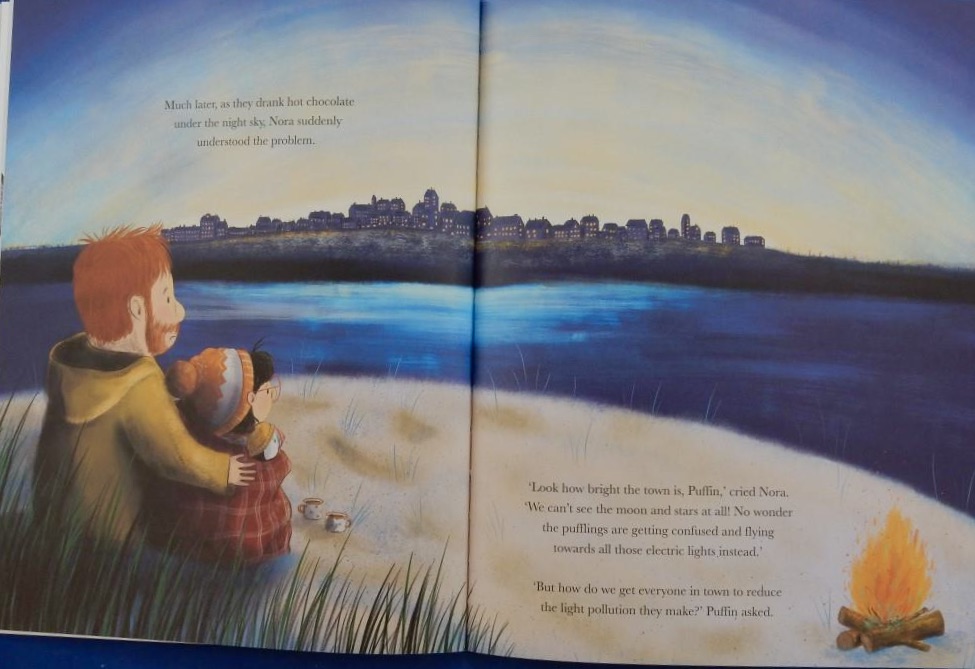
Once there, with the help of her Papa and Dad, as well as Puffin, Nora learns that pufflings normally use the light of the moon and stars to help them find their way. Then as darkness falls and they sit together under the night sky, Nora realises that light pollution from the town is confusing the little birds.

Back home, determined to find a solution to the issue, she enlists her school friends to join her in making a difference to the amount of artificial light. They make sure all the electric lights are turned off, close the curtains and put up the light shields they’ve made. Now as they look out, it’s clear that the pufflings are flying out to sea, guided by the moon and stars, just as they should be.

An important book that highlights an issue that will be new to many young children. Nora is such an engaging character, let’s hope she is as successful in enlightening and galvanising readers as she is her friends at school.

The Concrete Garden

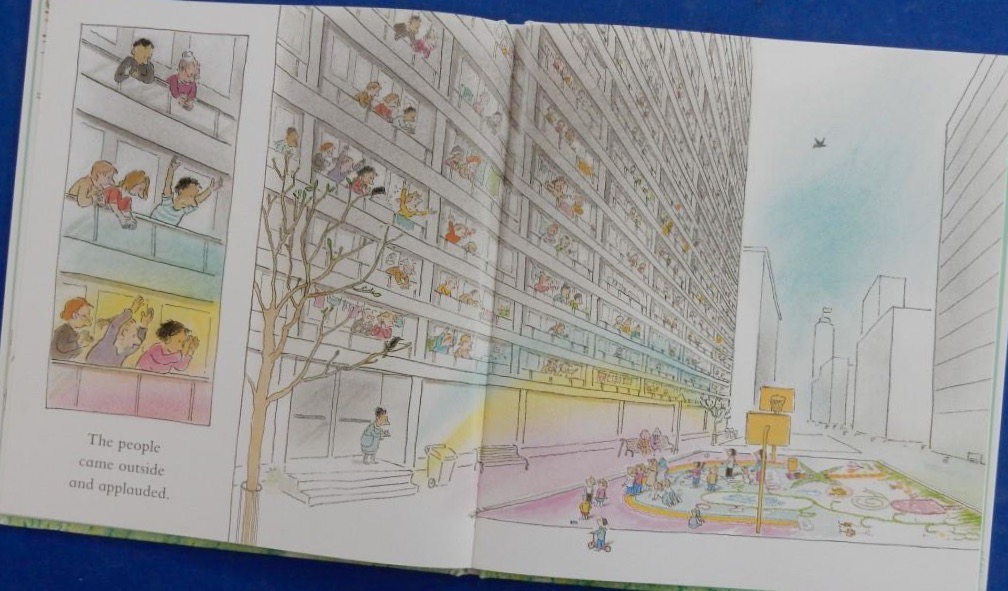
The product of covid times, this story starts with Amanda who lives on the fifteenth floor of an apartment block waiting for the lift down and clutching a large box given to her by her mum. As the doors open we see the lift is filled with other children and once they reach the ground they all spill out into the open air, ‘like sweets from a box.’ Last to emerge is Amanda with her huge box full of coloured chalks. It’s been a long, cold winter but it hasn’t diminished the children’s creative skills. 

First Amanda chooses a green chalk and makes a pattern on the concrete ground. Jackson adds a stalk and it becomes a dandelion. Others add more flowers, a mushroom, a snail slithering on it. Eventually there on the ground is an exotic garden alive with insects, birds and even an alien invader in its spacecraft. Over all of this reigns The Queen of Swirls – Rosie’s idea.

Three days later this wonderful creation becomes the victim of rain; but in the meantime Nasrin, who is missing her mum far off in Iran, captures the concrete creation on her camera and sends the image to her; she passes the image to everybody she knows bringing joy to them too.

Back in their home territory, having received appreciative responses from the apartment residents, 

the children are not bothered by the downpour and its effects and once the rain stops, out they come, Amanda pulling the now empty box. This she tears into pieces and so begins a new inventive activity for her and her pals.

Two good things that re-emerged during the pandemic were community spirit and the ability to find joy in the simple things in life: the latter Bob Graham allows the diverse children (not forgetting the dog) he drew in this story to show us all. His mixed media images of the children and their chalk creations bejewel the pages of the book making it a joy from beginning to end.

Ten-Word Tiny Tales

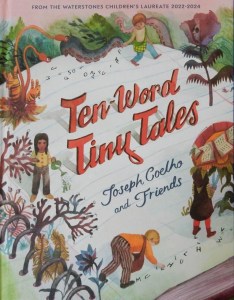
When explaining how the twenty stories in this book came about, poet and current Children’s Laureate, Joseph Coelho tells readers, ‘these are not cutesy tales – these are tales of teeth and claws!’ Despite their seeming simplicity, each of these fragmented story bits imply a more elaborate story and to this end, Joseph invited twenty artist friends to provide an illustrative interpretation, each one bringing a unique style to the enterprise. The resulting double-page spreads, through the interplay of words and pictures, are in turn mysterious, surreal, inexplicable or downright sinister.

For instance Nahid Kazemi portrays a moment of serenity as Grandma slumbers in her favourite chair while one of her plants – the Venus flytrap – edges ever closer to the blissfully unaware sleeper.
Equally disquieting is Thea Lu’s interpretation of ‘The X-rays reveal writing etched onto all of my bones.


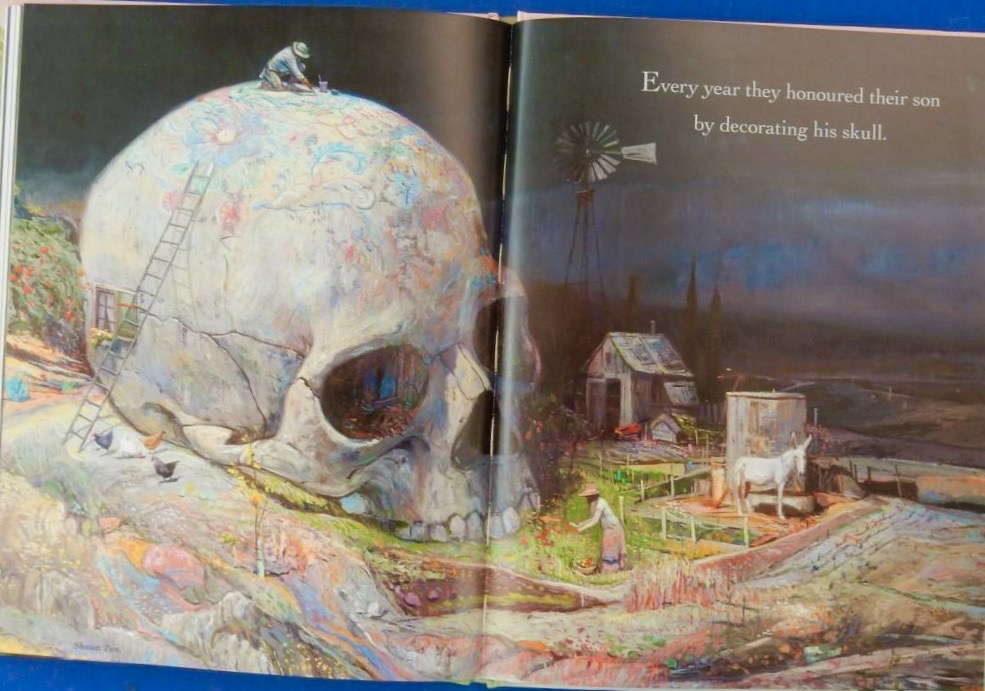
Meanwhile Flavia Z. Drago’s dining table scene combines touches of the dark humour of cartoonist Charles Addams with Magritte in her dining table scene; and look how Shaun Tan plays with scale in this enormously unsettling rural scene.

No matter where you open the book however, you are likely to find something to spark your imagination. To facilitate that Joseph offers several drawing and writing prompts to inspire and motivate children to extend the tales with ‘new beginnings, endings and middles’. What he says in ‘Take Your Pen on a Journey’ is what one hopes ,all teachers would be doing in the classroom.

A real treasure box this, with endless potential for creativity both at home and in school.

Space Pirate Bears

Wet weather, two bored children and a Dad busy working are the starting points for this wildly inventive tale. It’s Dad that does most of the inventing with tragedy in the form of a black hole, a Sniffle attack, a possible wave of alien broccoli, being averted. But there’s also the dreaded Doctor Drab whose aim in life is to turn the entire universe as dull as he is, by means of his terrifying Boron Beam. A hit from said weapon’s beam drained every scrap of fun out of the galaxy 

but there was somebody who just might with help, repel those forces of dullness and that was Princess Leonora and her heroic, multi-skilled, Space Pirate Bears.

At this point in Dad’s story, the two children, Jamie and Abby intervene and have a squabble about the direction it should take. 

Can they come to an agreement that puts paid to the Dok’s dastardly Boron Beam, leaving the Space Pirates to reign supreme and thus, the world able to revert to a place of fun?

A place of fun is an apt description for what is between the covers of this book. Both Alastair Chisholm’s words and Jez Tuya’s pictures epitomise the delights of story making, the former providing a humorous, twisting turning, action-packed adventure for the latter to play around with in his inventive scenes. A smashing book, especially for Dads to share with their offspring: inspired by the family in the story. Who knows what wild storytelling adventures of their own might result?

Ready for the Spotlight!

The younger sibling and narrator of this story, Tessie, envies her older sister for always being in the spotlight at their ballet classes, despite the fact that Tessie has been learning for just a month. Tessie however believes in herself: she’s better than everyone save Maya. Maya danced the Lilac Fairy in last year’s performance of Sleeping Beauty, wore a crown and received three bouquets of flowers.

Mum reassures her younger daughter that with as much experience as Maya, she’ll shine just as bright. Nevertheless, Tessie wants to be the best now, and her jealousy grows. Then come auditions for the autumn show in which she dearly wants to wear that crown. When it’s time for the freestyle, Tessie’s favourite: in this she excels, saying “No rules. No pointed toes. Who needs lessons when you have rhythm?”

Surely this will be sufficient for her to get that lead role. But no, it’s Maya who will be the princess, Tessie and two others are to be bumblebees.

That night back at home. Tessie is angry with her sister, refusing to teach her freestyle dancing because, “You stole my crown.”

Sisterly love saves the day as Maya tells her sister, “You don’t need a crown to be a good dancer.”, and goes on to say that she too had started out as a bumblebee. From then on the sisters practise together, Maya teaching Tessie jumping and balancing, and Tessie teaching her sibling freestyle and grooviness. Come performance day, it turns out two can share the spotlight and receive armfuls of bouquets.

Throughout this tale of personal growth, jealousy and tender sibling bonds, it’s Tessie and her emotions that take centre stage in Jaime Kim’s splendidly expressive illustrations for her story, which is based on her own childhood experiences with ballet and her little sister.

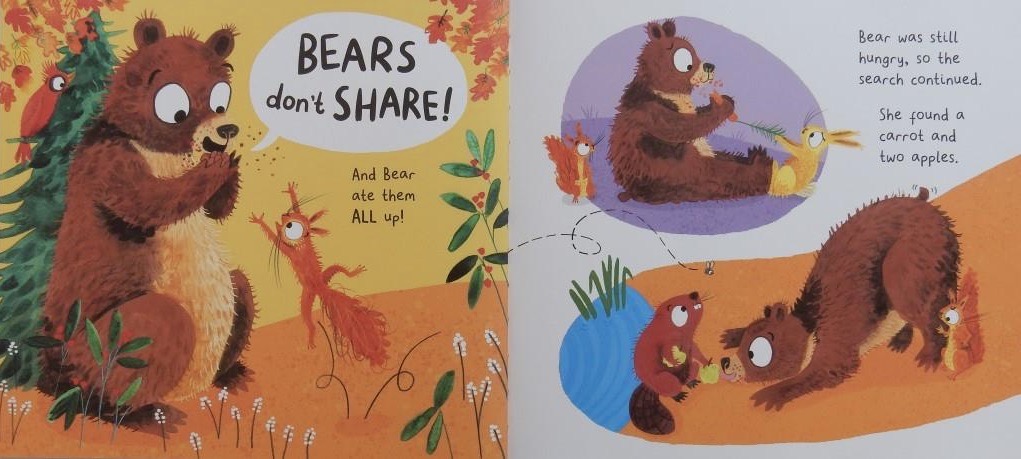
Bears Don’t Share!

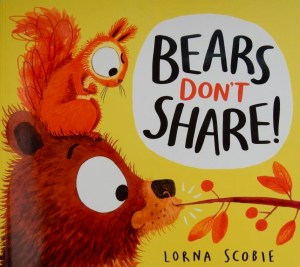
With winter fast approaching Bear and Squirrel are having a discussion about the long sleep Bear is soon to have and Squirrel suggests his friend should go with him to find some food. Off they go and soon both animals have found berries. Guess who eats them all. “Save some for me please!” begs Squirrel, “Sharing is caring, you know!” to which Bear responds, “Bears Don’t share!”. The same thing happens when they find nuts – Squirrel’s favourite food. Bear scoffs the lot. He also consumes the carrot, apples, pizza and ice cream without sharing a single morsel.

Eventually the two come upon a picnic laid out on a cloth. This, Squirrel says, is ideal for sharing. Bear however proceeds to stuff sandwiches, smoothies, jelly, cookies and veggie sausage rolls before noticing an enormous cake.

Now Squirrel is at the begging stage and Bear is just about to swallow the entire thing when she notices Squirrel. A funny feeling comes upon the ursine character: what do you think she does next?
Come the spring what will Squirrel do with his stash of berries, seeds and cake?

With a fun final twist, this is a delicious story to share especially during autumn days: I love the expressions on the faces of the two main characters. I suspect some young children will be horrified at what they consider to be Bear’s greed, but in the final spread – Winter in the Wild – the author explains that Bear isn’t really being selfish, just consuming sufficient to get him through the period of hibernation.

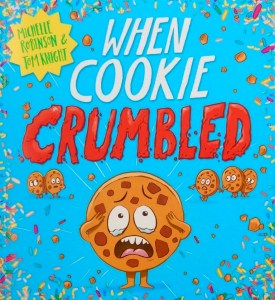
When Cookie Crumbled

Author Michelle Robinson and illustrator Tom Knight seem to have a special propensity to create books with food characters. Their latest stars a cookie named Michael; all the other characters herein are also cookies but Michael is a cookie with a difference. he doesn’t want to match all the rest with their circular, beige spottiness. Instead he likes to sport sprinkles, sweets, have a spicy aroma or even cut a dash with a splash of strawberry jam or chocolate sauce. “Fall in line,” the others tell him.

Eventually he becomes thoroughly dejected, almost at breaking point. “Why can’t I be myself?’ he wants to know. Having one last go at individuality and receiving negative reactions all round, poor Michael crumbles, scattering crumbs every which way.

But then, he listens to what his heart is telling him and he reaches for the tube of icing.

What will the reaction of all the other cookies be?

With Michelle’s highly engaging rhyming text and Tom’s dramatic, laugh-inducing illustrations, this mouth-watering tale celebrates difference, being oneself, acceptance and understanding. Take pride in who you are is it’s vital message.

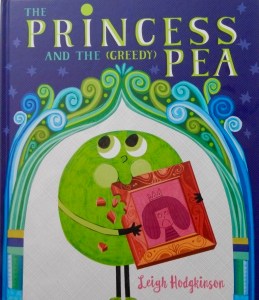
The Princess and the (Greedy) Pea

Take a popular children’s song and a favourite fairy tale, play around with those key ingredients then mix them together and the result is this clever and very funny new fairy story.

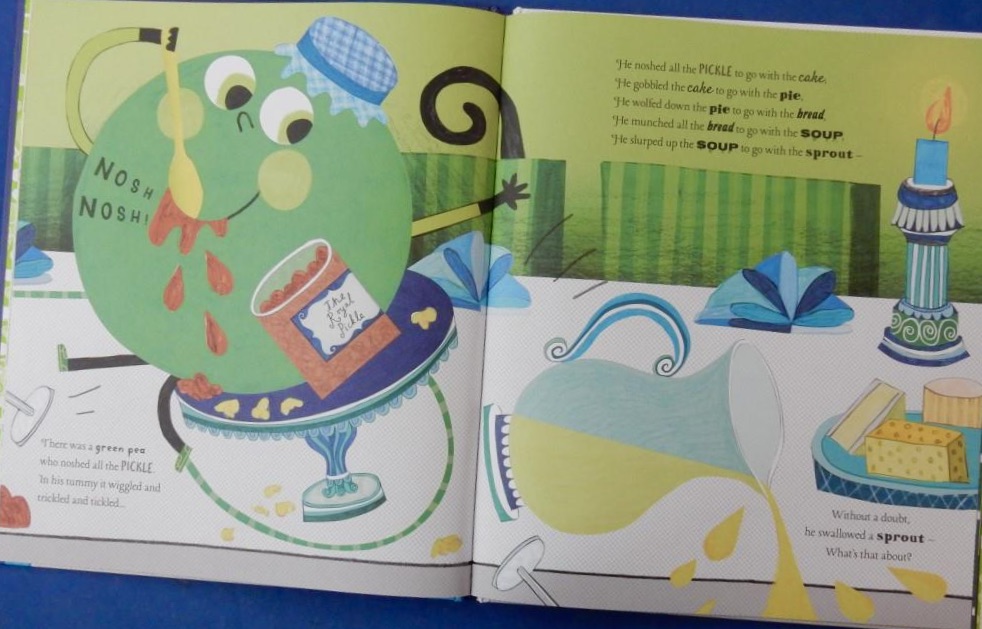
It begins with a ravenous pea that becomes the subject of a new take on ‘There was an old lady who swallowed a fly’, but now said pea does the swallowing and what he swallows is a Brussels sprout. Don’t ask me how a tiny spherical object managed to gulp down a considerably larger, similarly shaped one but that’s how this story goes.

Now this pea just happens to have found the delicacy among the feast laid out on the table of a royal residence and not content with the sprout, this pea goes on to stuff himself with soup, bread, pie, a fancy cake, pickle

and cheese. Having slurped, munched, wolfed, gobbled, noshed and guzzled all of this, our pea feels the need for a cuppa; you can guess what he needed after that. You’re probably thinking he had not a tincy wincy scrap of space left for more but if so, you’re wrong: despite an apparent lack of teeth, into pea’s mouth goes the chomped up table. Serve him right if he suffers from a terrible stomach ache, but instead , off come pea’s shoes and up the stairs he goes for a snooze beneath the stack of mattresses on a four-poster bed. ZZZZZZ

Now comes the fairy tale princess with a very grumpy expression on her face and a very rumbly tummy. Into the bed she climbs and having spent a considerable amount of time tossing around on account of both lack of food and a lumpy bumpy bed, out she tumbles. What do you think she says as she hits the floor? …

Leigh Hodgkinson’s playful, patterned illustrations that complement her text so well, have plenty to amuse. Pea’s expressions are splendid as he relishes every morsel of the meal; so too are those of the royal moggy and the princess. A delicious offering from beginning to end, but for those familiar with the inspirations for the tale, it will taste even better.

Shifty McGifty and Slippery Sam: Train Trouble

It’s almost impossible to believe that this is the tenth anniversary of the robbers turned bakers/cum mystery solvers, Shifty and Sam. Now the delightful dogs are off to bake on the deluxe train, The Pawrient Express, destination Venice for Carnival Night.

Little do the duo know but their old adversary, Kitty Claw, is also aboard the train ,masquerading as a porter. However just as the pooches have served supper – of their very highest quality of course –

out go the lights and there comes a cry, “I think we’ve been robbed!”. That’s when they realise the identity of the thief.

The chase is on; but manipulating a gondola through the carnival crowded canals is difficult as they pursue Kitty on water, and then on paws through the city square

and even through the air. But can the dogs retrieve the stolen gems and will they be able to apprehend the criminal?

Tracey’s rhyming text bounces along in the jaunty fashion one has come to expect of this smashing series and Steven’s illustrations are as delicious and zesty as ever, whether or not they include any actual confectionery items.

An action-packed read aloud that fans will relish, and if you’ve yet to savour their canine capers, you are sure to be wanting more.

April’s Garden

April’s Garden
Isla McGuckin and Catalina Echeverri
Graffeg

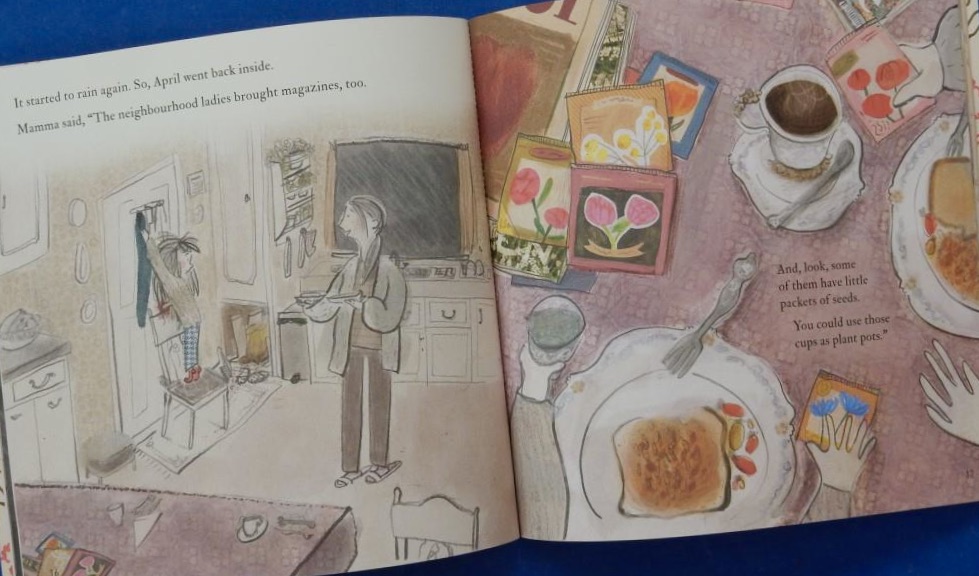
It is evident from the lack of bright colour in Catalina Echeverri’s first three spreads, that April is feeling downcast, living with her mum in a room in temporary accommodation. There is a garden – something Mum refers to as contributing to the ‘silver lining’ she keeps talking about, but it always seems to be raining, making her daughter feel even more confined.

When Mamma suggests drawing the garden of her dreams, April creates a colourful scene.
Eventually the rain stops and April heads outside for some fresh air, but it’s not long before down comes more rain so in she goes, to learn that attached to the magazines the neighbour ladies have given them. are some packets of seeds.

Despite the rain, April heads back outside with the seed packets and some cups. She plants the seeds and goes back inside. Then comes a long, long wait during which April, despite Mum’s words of wisdom – “Lovely things are just around the corner,” – feels more and more dejected. She rushes out into the garden to give vent to her emotions, after which she feels slightly less angry.

Some months later, it’s time for the two of them to move to their new home, With them they take all the cups with the seeds April had planted and joy of joys, she notices in them something is starting to sprout.

Finally, after several weeks, beautiful flowers are blooming in every cup: at last April is filled with happiness.

Hope is key in this moving, superbly and sensitively told and illustrated story of the healing power of nature, finding solace in the seeds and renewal.

Pick A Story: A Superhero + Mermaid + Dragon Adventure

Pick A Story: A Superhero + Mermaid + Dragon Adventure
Sarah Coyle and Adam Walker-Parker
Farshore

This is the third in the interactive picture book series that encourages children to read in a different way, inviting them to use their imagination and direct the route the story takes. Herein Sarah Coyle and Adam Walker-Parker have integrated a superhero, mermaids and dragons into a tale to recover an important drawing of a bicycle.

It begins as Davy is on his way to school proudly clutching his best ever picture for Show and Tell when suddenly the picture vanishes. Was the taker a superhero stuck for creative inspiration, a fiery dragon, marauding mermaids perhaps; and can any of these be of assistance in Davy’s search for the missing article?

Along with enjoying Sarah’s lively text with its word play aplenty and choosing the narrative direction, readers are invited to give thought to a number of questions that relate to the text and Adam Walker-Parker’s zany, eye-catching scenes: ‘What would you buy if you had five sea gems to spend?, ’What’s your super-cool handshake?’

and ‘What’s your favourite thing to do with a friend?’

Decision making is an important skill for children to learn and this story and the previous ones are a super way to foster this; with a diverse cast of characters, the book will appeal to a lot of readers. Add to family bookshelves and KS1 class collections – I wonder what might happen if two children read the book together?

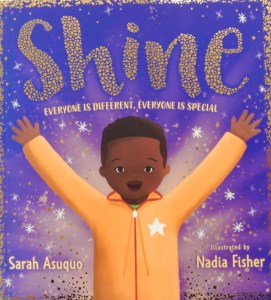
Shine

After the end of the summer holiday, Kai’s enthusiasm for returning to school and meeting his friends again, is quickly dampened on the very first day. The reason for this, he tells his mother, is because having participated in building a den, which he understood was for everyone, the other children told him he was too tall to fit inside. “I wish I wasn’t tall.” he says.
His mother responds, “Be proud my son, that you are tall; stand as high as you can be.” His height, she continues, enables him to see beyond what other children can. Yes, Kai is different in this respect but he should be true to himself, letting the special light that is within us all, shine through.

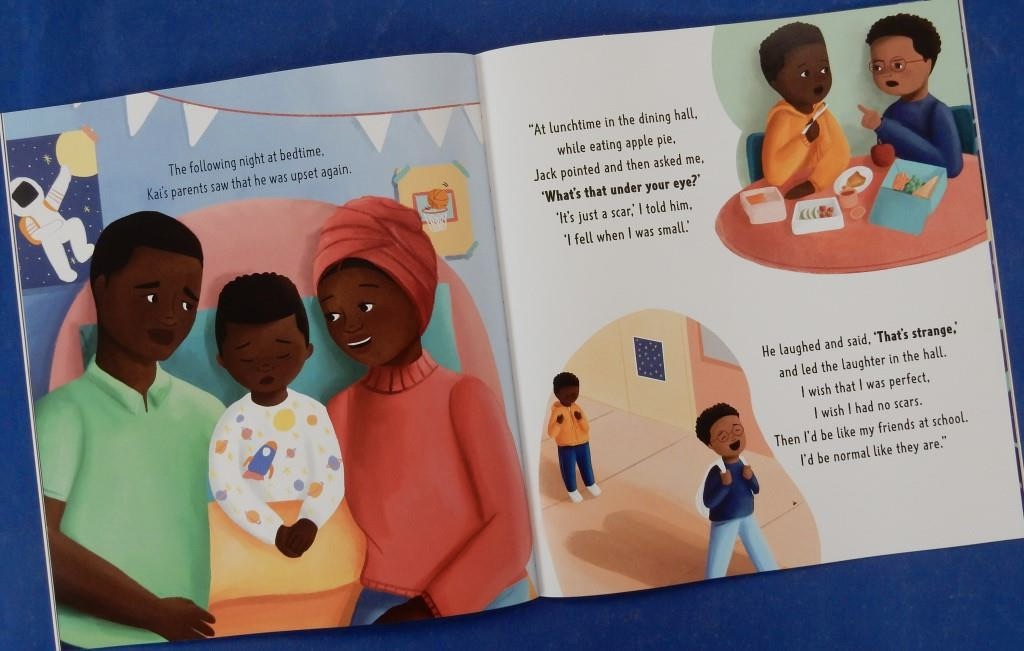
Next evening at bedtime, Kai is upset again, this time on account of being laughed at for the small scar beneath his eye. He feels this imperfection stops him from being normal.

Now dad speaks, gently telling his son to be proud of his scar for it adds to his shine. Then he opens the curtains and asks whether it’s possible to say that either the stars or the moon is best. ‘Everyone is different, son. You must be true to you. // Within us all is a special light. / Will you let yours shine through?” Kai nods in assent and then it’s time to say goodnight. The boy now realises that the very things that make him different also make him special.
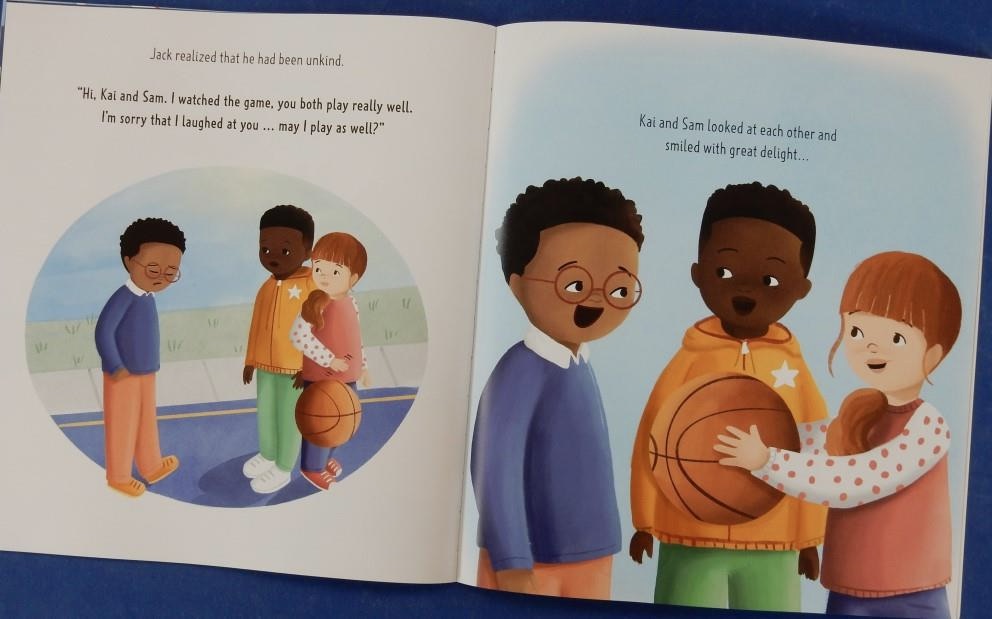
At school the following playtime, Kai’s friend, Sam, is upset: she had been told she was too small to join the game of basketball. Kai shares his parents’ wisdom , likening her speed when she plays to a shooting star. An ideal complement for his height – the perfect team. Moreover the two impress their classmates and the boy who had laughed at Kai’s scar realises that he needs to apologise for his unkindness.

Then when he asks to join their game, Kai’s affirmative response is “we all can shine if we just unite.”

Kai underwent a big change as, with his parents help, his low self-esteem was transformed into inner confidence, and an ability to understand the importance of both individuality and inclusivity.

Sarah Asuquo’s narrative is presented in prose and the text breaks into rhyme whenever a character speaks. Nadia Fisher’s mixed media, digitally worked illustrations shine a light on Kai’s feelings as he navigates the first week back at school and a steep learning journey.

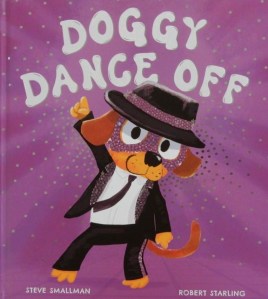
Doggy Dance Off

Doggy Dance Off
Steve Smallman and Robert Starling
Little Tiger

There’s plenty going on should you care to join the cool canines and pay a visit to the Doggy Dance Off. However, despite the flea-ridden Superstar DJ Patch who’ll immediately get you a’scratching, all disco dancers are having the time of their lives.

There’s golden retriever, Eva, the dance floor diva, Dynamite Doug, the body popping pug

and Duke Doggy Doo a punk rocker cockapoo bounding up and down kangaroo style. The newbie Lenny Labrador is so super-excited he leaves a puddle on the floor so beware should you feel like kicking your shoes off and joining the masked dancer that just can’t wait to perform the boogie woogie and several other show-stopping dances,

unaware of where she was putting her paws. However, despite her prowess, this masked marvel isn’t all she seems as a sudden slip sends her mask flying skywards, likewise her hat, and a splendid surprise awaits both readers and the movers and shakers at the Doggy Dance Off. Moreover should you subsequently pay this venue another visit, you’ll find it’s been renamed.

Steve’s rhyming text goes with a real swing when you read it aloud and coupled with Robert Starling’s funky disco dance scenes of the pooches strutting their stuff, you’re guaranteed a fun-packed time if you venture between the covers of this full-on canine caper.

One Little Word

This image has an empty alt attribute; its file name is dscn9676-3.jpg


Two friends are playing in the park when suddenly an unspecified incident happens between them. There’s face pulling, shouting and a monster appears – The Argument – that keeps on growing as the quarrel escalates and the two children separate. Still the beast grows involving all the other children and making the most of the situation to keep on getting bigger and bigger

This image has an empty alt attribute; its file name is dscn9677-3.jpg

until the two that triggered things stand face to face and the girl who is narrating gives the other one a nasty push, immediately resulting in her feeling ‘sad and angry, mixed-up and confused’. He retaliates with a push too and both children end up in floods of tears. Those tears prove cathartic and the two are able to exchange just one tiny but crucial word. The effect on The Argument is dramatic: it gradually shrinks

This image has an empty alt attribute; its file name is dscn9678-3.jpg

until it disappears completely and very soon the park is full of happy, laughing children once more.


This is absolutely brilliant, both verbally and visually. Allison Colpoy’s attention to detail is superb, capturing the changing expressions of the two protagonists and their concerned, supportive pals. Her colour palette is hugely effective in highlighting the emotional journey and accompanying physical changes of the engaging adversaries especially : what a superb complement for Joseph’s lyrical telling.

This terrific book needs to be in every primary classroom to be shared over and over, carefully considered and discussed. The potential of its impact is tremendous – like that of The Argument at its most monstrous.

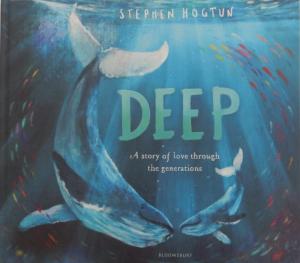
Deep

Deep
Stephen Hogtun
Bloomsbury Children’s Books

In this wonderful story we follow a mother whale and her little one from the time the infant takes his first breath. Guided by his mother, the calf learns to swim alongside her and is keen to travel without her, but first, mother and calf must take a long journey together. We accompany the pair as they head into the unknown on a swim that is sometimes stormy and challenging,

but with his mother close at hand to offer reassurance and protection, the calf learns to face his fears as well as see beauty in the peaceful nights they spend together.

Eventually of course, as it is for all mothers, she realises that it’s time for her offspring to set out and make his way alone in the world,

safe in the knowledge that should he need her, his mother is always waiting.

Wise, gentle, lyrical and exquisitely illustrated, this is a book that truly expresses the devotion and love of the mother whale and her young one. Capturing to perfection the beauty of the ocean world, it not only conveys the feelings of the two whale characters, but also the universal bond of a human mother and her infant – what greater gift than knowing you are loved?

An immersive tale to open up discussions about growing up and life’s journey; this is one to share at home or in a KS1 classroom.

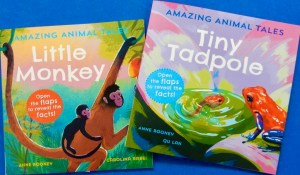
Little Chimpanzee / Little Whale / Little Monkey / Tiny Tadpole

Little Chimpanzee
Anna Brett, illustrated by Rebeca Pintos
Little Whale
Anna Brett, illustrated by Carmen Saldaña
Words & Pictures

These are the latest additions to the Really Wild Families series of fun, informative interactive books for children and adults to share.
Having introduced itself, Little Chimpanzee invites readers to spend a day exploring its African rainforest home and meeting the sociable family community comprising father, mother, older brother, aunts, uncles and cousins. The creature narrator explains how chimpanzees care for and groom each other and talks about the social structures and relationships in the group , including how they communicate with one another.There’s a spread about chimp conservation and another about the vital work of Jane Goodall and the chimps in Gombe Stream National Park.
The narrative is followed by a quiz and a craft activity. A charming, effective way for young children to find out about our nearest relative, while gently reminding them of the importance of caring for creatures in the wild; vibrantly illustrated with gentle humour.

The Little Whale of the title introduces itself and the rest of its pod of humpback whales and readers join their annual journey from warm waters to search for the cold waters of the Antarctic Ocean where there’s plenty of food. On the way we learn about how the creatures move, their external features, breathing, breeding, diet and feeding,

possible predators and whale song.
Following the story are the usual factual spread, a look at conservation, a craft activity, a quiz and we meet Migaloo, a albino humpback that lives off the Queensland coast of Australia. Carmen Saldana’s underwater illustrations are beautiful and really add to the book’s appeal.

Narrative works really well as a means of transmitting information to young children and these are additions to the Amazing Animal Tales series that also successfully use this approach along with straightforward facts found beneath the flaps.

Little Monkey
illustrated by Caroline Rabei
Tiny Tadpole
illustrated by Qu Lan
both written by Anne Rooney
Oxford Children’s Books

Little Monkey is a spider monkey and we first encounter him high in the rainforest treetops clinging round his mother’s tummy as she moves from branch to branch. Lifting the full-page flap reveals two pages of information and a simple question to further engage listeners.
As the story continues there is information about feeding, what this entails.and how it changes as he becomes more independent, an independence that makes him want to go off exploring by himself.

Anne Rooney’s way of presenting the information is appealing and perfectly pitched for an Early Years audience, the special skill being the combination of the two styles, with Caroline Rabei’s delightful illustrations containing just the right amount of detail.

The Tiny Tadpole also lives in the rainforest but further south than the monkey family. Herein we follow the transformation from tadpoles hatching out of the protective jelly eggs and the growth and changes that ensue in their habits and in the care provided by the mother frog,

until the tiny black dot has become a froglet. This one is illustrated using a rich colour palette by Qu Lan and every picture is bursting with life.

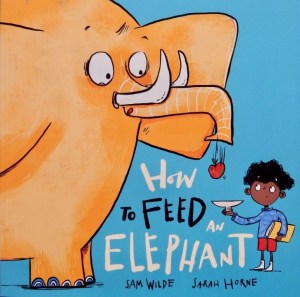
How To Feed An Elephant

How To Feed An Elephant
Sam Wilde and Sarah Horne
Oxford Children’s Books

In the unlikely event that an elephant should be able to read and thus, respond to a wanted poster in the same way as the one in this story did, then you will definitely need to be able to provide the creature with an appropriate diet and know how to take care of it too. With regard to food, both quality and quantity are important

and since elephants are thirsty creatures, you will need access to at least 200 litres of water daily and that doesn’t include that required for washing your pet unless it insists on having mud baths.

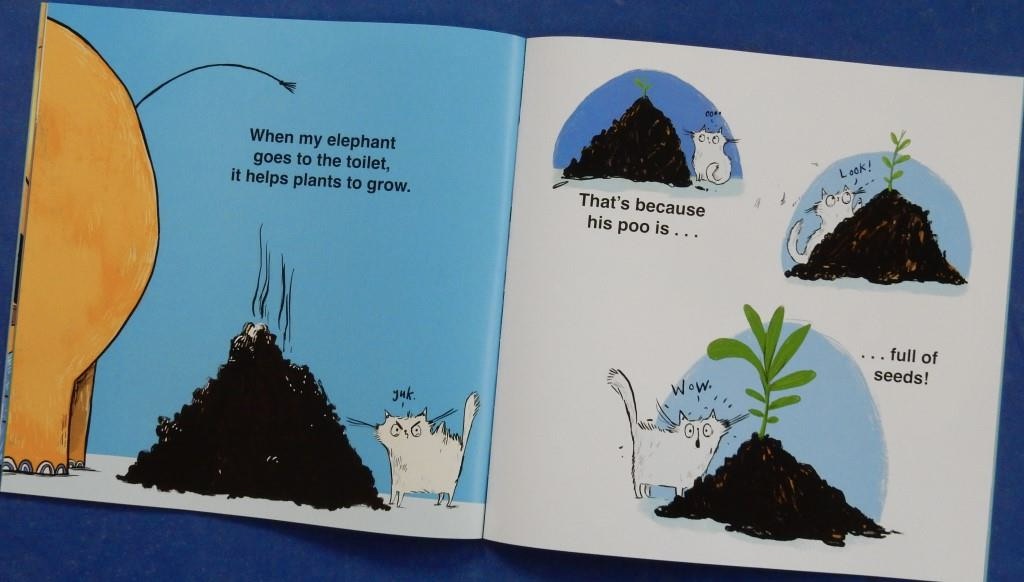
Poo, as you might expect, will be plentiful but it won’t go to waste as it helps to add vegetation to your garden.

Comfortable sleeping quarters are another important consideration, and despite elephants only sleeping for a couple of hours per night, you really don’t want your neighbours complaining about a lack of sleep on their part on account of its noise.

It’s more than likely however, that having given it a go, you and your family will decide that despite the affectionate bond you’ve formed with your colossal pet pachyderm, it would be better off living back home with its own family; and who knows, a more suitable pet could turn up at any time …

Totally silly but enormous fun, especially with that final farewell spread, Sam Wilde’s straightforward text and Sarah Horne’s hilarious illustrations, many of the latter including the silent bit part playing resident moggie, work really well together.

After the story is a ‘top elephant facts!’ spread. This might result in some children having even more fun envisaging a few of these facts using the characters from the story. Furthermore, did you know that elephants can be either right- or left-tusked, I certainly didn’t.

Nabil Steals a Penguin

Nabil Steals a Penguin
Nishani Reed and Junissa Bianda
Nosy Crow

On the last day of a holiday in France with his parents, Nabil is at the zoo watching the penguins when one of them addresses the boy introducing itself as Pierre. The penguin goes on to complain about his dull diet – fish, fish and more fish, saying he’d love to sample something more exciting. Obligingly, Nabil offers to share his lunch with Pierre and before you can say ‘spicy’ the penguin has scoffed the lot.

As the family are departing, Pierre bids farewell to his fellow penguins and dives into Nabil’s backpack and eventually, after a somewhat worrying journey for Nabil, the family plus penguin reach home. Very soon Nabil’s sister suspects something strange is going on: how on earth is the boy going to conceal his increasingly lively guest from his parents?

The answer is, he can’t. Into the bathroom comes Mum;

what will her reaction be? Young readers and listeners may well be surprised at what happens thereafter. I’m sure they’ll approve however.

Deliciously daft, this tasty offering is author Nishani Reed’s debut picture book. Junissa Bianda’s wonderfully expressive illustrations capture Nabil’s consternation at the antics of the lively stowaway and the delight of the entire family in the final few spreads.

Vegetable biryani anybody?

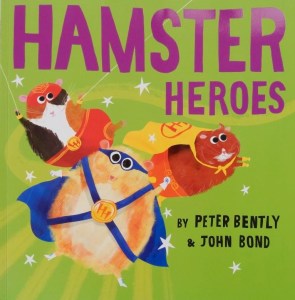
Hamster Heroes

Hamster Heroes
Peter Bently and John Bond
Harper Collins Children’s Books

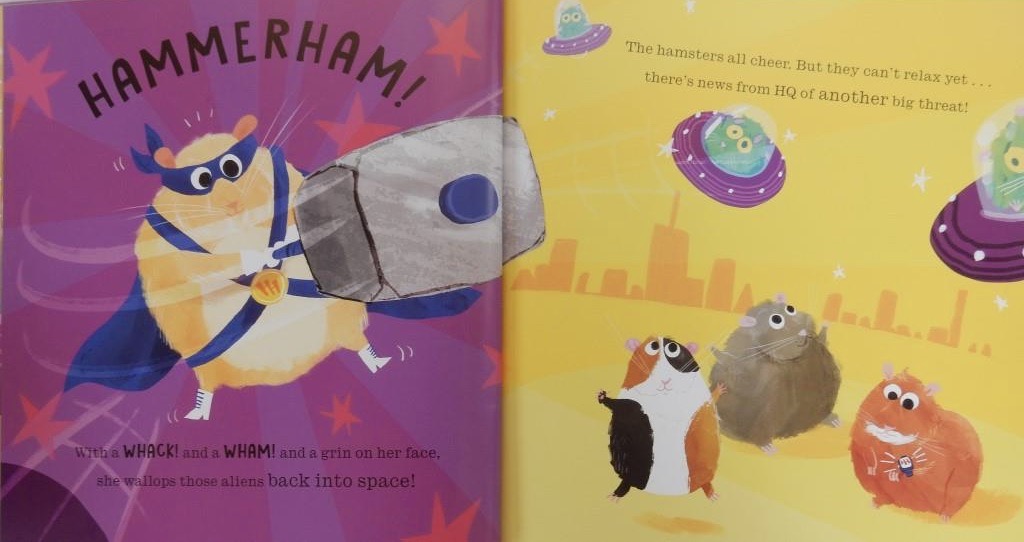
Following on from their terrific Dogs in Disguise and Cats in Chaos, team Bently and Bond present another pet-themed picture book. Here a team of courageous hamsters respond to calls from Hero HQ and proceed to take on alien gerbils invading from outer space. Those are immediately seen off by PomPom aka Hammerham and her trusty massive mallet.

But a second threat soon follows in the form of giant chinchilla, Chinzilla. This time Jiffy, transforms into Superham and sends the monster packing.

Snack time is underway when their broccoli feast is rudely interrupted by another call: their worst enemy Goldenpaw Guinea-Pig is on the screen with his dastardly weapon threatening to vamoosh with the entire world supply, right under the noses of the snackers.

However he’d reckoned without Pushkin morphing into The Bulk and along with the other super hamsters, giving chase. Hurrah for those hamster heroes and hurrah for pulling off an awesome rescue of this reviewer’s favourite vegetable – bonus accolades for that and have a good snooze, you super-pets.

Peter’s deliciously silly rhyming narrative combined with John’s wacky scenes of the super-hamsters in action, deliver what will surely become a story time favourite with young listeners at home, or in the classroom or nursery.

Hello Me!

Hello Me!
Dr Naira Wilson and Elisa Paganelli
Little Tiger

Positivity is key in this gentle book wherein the author, a child psychologist, presents a young boy narrator explaining and showing how he gradually learns self-care and self-acceptance.
He begins thus: ‘Sometimes I think my mind is like a house. Just like a house, I need to treat my mind with love and care.’

Like all of us, this child has flaws and makes mistakes, but just like us all too, he acknowledges those mistakes using them as a powerful learning tool.

When jealousy rears its head, our narrator accepts that nobody is perfect and everyone is different. The important thing is to be flexible in your attitude to routines, make the best of what you have and not to be afraid to ask for help when it’s needed. Friends and their love are key but so too is learning to love yourself for who and what you are.

The final spread breaks down the key points in the narrative, augmenting them with vignettes taken from Elisa Paganelli’s beautiful larger illustrations.

Accessible and easy for young children to relate to, this would be a good book to open up a classroom circle time discussion on looking after and loving oneself.

The Quickest Bedtime Story Ever!

The Quickest Bedtime Story Ever!
Louise Fitzgerald and Kate Hindley
Nosy Crow

Most young children will go to extreme lengths to delay getting into bed and this behaviour is what debut author, Louise Fitzgerald, plays on in her story.
According to our narrator, the story contains just ten words: well that’s as maybe, but there’s a whole rigmarole to go through beforehand. First, we – the listeners and the four little animal characters herein – need to promise to go to sleep at the end of the book. Then, in fairness, the grown-up reader aloud must promise to use their best reading voice and of course that will only be possible if said voice has done a whole-hearted warm-up. Comfort is crucial for all parties involved, so pillows must be plumped up,

a check kept so no pages are skipped (as if!). It’s vital too, for all the toys to be tucked in (they love a bedtime story and you can devise a way of doing this) – check they’re all present as the odd one could still be lurking unnoticed. Oops! almost neglected a bit of a razzmatazz,

but that over – hurrah! We can begin – we’re on the way … zzzzzzz.

This hugely funny take on the bedtime formalities will surely strike a chord with vast numbers of humans, young and adult but it’s difficult to know which category will like it more. I really, really, really wish I’d had this book yesterday when I was putting a very reluctant three year old relation to bed; a procrastinator of the first order, she could give Louise Fitzgerald more than a few additional ideas. I know young Faith and countless other preschoolers will love exploring the plethora of funny details in some of Kate Hindley’s spreads and joining in with the actions depicted on many others (more opportunities for delaying tactics).
I suspect sharing this story will become part of the bedtime routine in many a household.

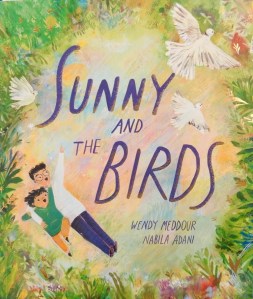
Sunny and the Birds

This image has an empty alt attribute; its file name is dscn9572-2.jpg


Sunny and his family have only recently moved to a new country. Almost inevitably there are things his dad misses. Every evening when they watch the birds through the window and Danny’s father asks him if he can name them, Dad’s response refers to similar ones “back home”. His son’s reply is “But this is our home!”

This image has an empty alt attribute; its file name is dscn9573-2.jpg

It’s evident that Dad doesn’t yet feel at home where he now is. In the middle of the night both Sunny and his Dad are wide awake and the boy acknowledges his father’s sad feelings.


This image has an empty alt attribute; its file name is dscn9574-2.jpg

After school the following day, Sunny’s Nanna meets him and the boy asks if they can go and buy Dad a present – a surprise. Can his bird-related plan help his father begin to feel at home in this new country?


As always Wendy Meddour’s story is written with great sensitivity. Presenting what for many immigrant families is a challenging time, she shows how with love, support, kindness and nature’s healing power, the process of adjustment to a different life can begin.


The richness and beauty of the natural world – real and remembered – is elegantly captured in Nabila Adani’s misty illustrations and you can read the changing emotions in her portrayal of the two main characters.


With more and more schools having immigrants as part of their community, this book would help children understand how newcomers might be feeling. Share at home, share in the classroom and invite listeners to participate in discussion, whatever the setting.

Going to Big School / Come To School Too, Blue Kangaroo!

Told alternately from the perspectives of Ava and Jack, this is an account of their first day at ‘big’ school.
Ava, is excited, enthusiastic and has butterflies fluttering in her tummy, Jack, in contrast is shy and nervous; he has moths flapping around in his tummy. On arrival in the noisy playground, Ava is eager to get involved whereas Jack hangs back, upset by the busyness. Happily however, the kind reception teacher, Miss Moloney notices Jack’s shyness and whispers to him that everybody – she included – has first day nerves.

As we follow the two children through their first day we see how they react differently – at story time, 

fruit time, during a colouring session, at lunchtime and during the afternoon of free play: there’s no sense that one set of reactions is right or wrong (better or worse). By hometime, Ava’s actions have helped Jack feel more relaxed 

and they both depart as happy friends, eagerly looking forward to tomorrow.

The author includes things that by their very newness, might be a challenge for young children – a big, round hat and a lunchbox with clips so stiff they require the help of a buddy to open, both of which are shown in Danielle McDonald’s bright, inclusive illustrations. Whether or not children are moving from a preschool setting or going straight into a reception class, this book will reassure them that the going to big school milestone will be unique for them all, and that everything will be fine.

This is the ideal book for children about to start a new school and with its brilliant, wonderfully warm art and enchanting telling, it remains my very favourite starting school story.

Blue Kangaroo’s owner, Lily is off to a new school and decides to take Blue Kangaroo too. Ready with new bags, both child and toy anticipate the big day: Blue is excited about school – the fun things to do, the friends waiting to be made and new experiences. Lily on the other hand is worried that Blue might be frightened about getting lost, or feel too shy to talk to anybody.

Having been greeted warmly by her teacher, Lily is soon happily engaged in the busy school day, 

and Blue watches thoughtfully from the windowsill as Lily enjoys painting, playing and joy of joys – story time. 

Come hometime, Lily is so excited about her day that the almost inconceivable happens: Blue Kangaroo is left at school all by himself . However, his sadness quickly gives way to happiness because now he can do all the things Lily did during her fantastic school day including reading Quentin Blake’s dancing frog story. 

He also leaves a surprise for everyone to discover the following morning.

It’s so clever the way the author makes Lily express her anxieties and fears about starting school by putting them onto the unworried Blue Kangaroo.

The Ocean Gardener

The Ocean Gardener
Clara Anganuzzi
Little Tiger

The author/illustrator of this book was raised in the Seychelles where this tale is set.
Ayla and her mum’s beautiful island home is surrounded by a coral reef and one morning while out swimming with her mum, Ayla notices that as she goes further out, something is wrong: the colours of the coral are faded and the fish are disappearing.

The girl is upset and asks her mum why these things are happening. Surely it can’t be too late to save this wonderful part of the ocean’s eco-system.

Fortunately, Mum, a marine biologist, has a plan and the very next day she and Ayla start working bringing tiny pieces of coral from the sea into their home and so begins operation coral reef rescue. It’s a lengthy process and eventually after some time Mum decides the coral growths are ready to return to the ocean and they create their ocean garden.

That place is Ayla’s destination each day for what feels like forever; she tends to the coral and awaits the return of the fish until at last …

Clara Anganuzzi’s gorgeous illustrations capture so well the beauty of the coral reef and at the same time present the highly complex issue of global warming in a positive manner that will appeal to young readers, while also offering hope that the work of marine biologists such as Chloé Pozas, whom we meet after the story in a spread giving more information about coral nurseries, can restore these precious parts of our oceans’ ecosystems.

Victor, the Wolf with Worries

Victor, the Wolf with Worries
Catherine Rayner
Macmillan Children’s Books

Victor is a young wolf beset with worries: he worries about almost everything. He considers himself to be not ‘wolfish’ enough, not brave enough, not big enough, nor fierce enough, so he resorts to pretence.
However this leads to worries about how his shortcomings will impact upon other wolves; for example if he attempts to act fiercely, he could end up accidentally frightening his fellow wolves. And so his worries just keep on growing.

Fortunately, Victor has a best friend, Pablo. Empathetic Pablo notices Victor looks worried and with his help and understanding, and some coping strategies, Victor’s worries gradually recede. He begins to feel braver, bigger, fiercer and increasingly wolfish.

Not only does Victor’s anxiety wane but he also learns something else important: he is not the only one who worries about these things, so too does Pablo and all their fellow wolves.

As it is with wolves, so it is with humans. The practical ways Victor was shown to handle his anxieties, are equally effective with young humans, and not so young ones, so this story offers an ideal starting point to help children deal with issues affecting their mental well-being.

In Victor and indeed Pablo, Catherine has created hugely engaging characters with wonderfully expressive eyes. Those winsome wolves stunningly portrayed in her ink and watercolour illustrations will surely win the hearts of any reader or listener.

Sala, Mountain Warrior

This image has an empty alt attribute; its file name is dscn9570-2.jpg


Sala, Mountain Warrior
Wakanyi Hoffman and Onyinye Iwu
Otter-Barry Books


When Sala sees a poster announcing a school camping trip that involves climbing a mountain near her Grandmother’s village, she’s excited at the prospect but also rather worried. Nevertheless, with her Grandmother’s stories, encouragement and a week’s preparation, she registers for the climb – the only girl to do so. She wants to be brave like her Great-Grandfather.

This image has an empty alt attribute; its file name is dscn9571-2.jpg

Before the climbers leave, her Grandmother gives her a water gourd as a good luck present and after a long journey in the school bus, they reach the bottom of the mountain. There they make their base camp.


Early the following morning their mountain guide. Laibon, leads them on the first stage of the climb, which they do by afternoon. Next day , the climb is harder work and not everyone reaches the third campsite. Sala perseveres despite feeling a bit shaky and eventually gets to the field of ‘Forever Flowers’ as Laibon calls them, showing the girl his beads and giving her words of encouragement. That night Sala’s dream is of those pink flowers, but all too soon it’s time for the last leg of the climb. Setting off before sunrise, Sala starts to doubt herself.

This image has an empty alt attribute; its file name is dscn9561-2.jpg

Can she make that final push? Yes, with a special something given to her by Laibon.
Back at base camp after their descent, the climbers are greeted by the entire party and somebody unexpected is there too, with something extra special for Sala.


Author, Wakanyi Hoffman’s uplifting present-day story was inspired by her childhood memories of spending school holidays in the foothills of Mt. Kenya where her grandmothers passed down their indigenous knowledge and wisdom through the telling of stories. Onyinye Iwu (you will likely recognise her name if you’re familiar with the Too Small Tola tales) illustrates the text with a colour palette that captures the natural hues of the setting, the intricacy of the Samburu peoples’ beaded accessories and the feelings of the climbers, especially Sala.


An empowering book that deserves to be in every primary school collection.


Ray

Ray
Alex Latimer
Oxford Children’s Books

Such were the delights of Mouse’s walk that the little rodent failed to notice the lateness of the day.
After the sun has disappeared he sits alone frightened at the prospect of going home in the dark. Then from within a flower, there comes a glow and from it emerges a firefly; she introduces herself as Ray and offers to light Mouse’s way home. A grateful Mouse accepts but denies being afraid of the dark and off they go.

Mouse follows his guiding light but suddenly stops at the sight of a shadowy shape – ‘a snake’ coiled ready to strike, he thinks. Fortunately he’s mistaken and Meerkat, also not afraid of the dark, joins the travellers. After a while there’s a cry of “A bear! We’re done for!’ Ray investigates and informs her followers, it’s a pair of hens roosting . As you might expect said hens are not afraid of the dark either and off they go again, Mouse, Meerkat and two hens led by Ray until …


The journey continues with the addition of five green frogs and three squirrels, all of which have ‘reasons’ for joining the entourage, and each being welcomed by the words “Of course, … I’m Ray and I’ll light your way.’

Eventually in front of them a lion shadow looms large. Now Mouse, well used to being bamboozled by shadow shapes says, “ … that’s not a lion at all! That’s my home.’ He tells Ray to illuminate the shape, which she does.

Here our story takes a sudden dramatic turn … confessions re the dark are forthcoming and then a certain firefly proffers her oft repeated promise once more.

Deliciously tongue-in-cheek, Alex Latimer’s travellers’ tale will de-light young listeners, as well as adult readers aloud who will be amused at the excuses given by various animals for wanting to be led by Ray’s light. I have no doubt Alex Latimer had great fun creating his shadow shapes and he might well inspire children to experiment with a black crayon, paint, oil pastel or even play around cutting black paper.