Scaredy Bat

Thanks to Little Door Books for inviting me to join the blog tour for:

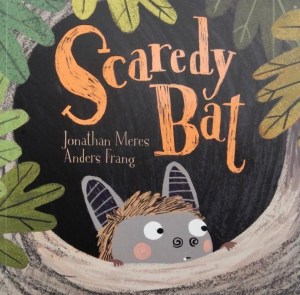
Scaredy Bat
Jonathan Meres and Anders Frang
Little Door Books

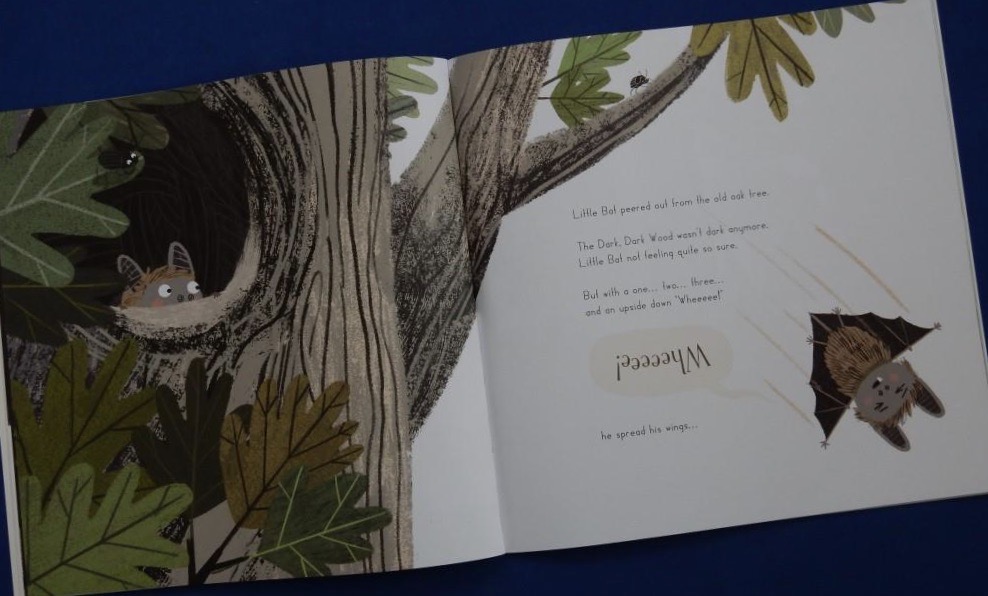
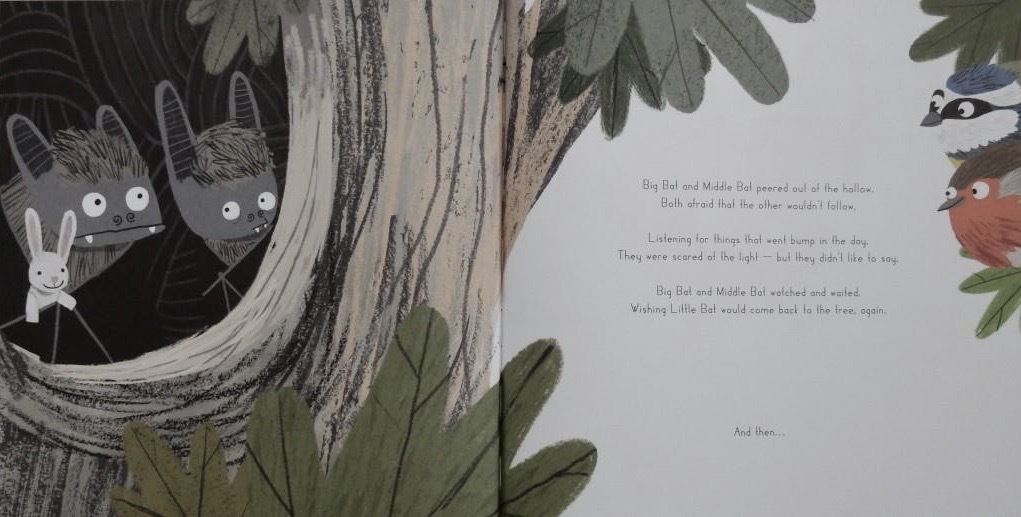
Absolutely bat-tastic sums up my response to this book. It had me hooked from the opening lines, so poetically describing the coming of morning to the Dark, Dark Wood. A wood where, in an old oak, dangle Big Bat, Middle Bat and Little Bat, snuggled up and ready for rest and perhaps some inverted dreams.

However, bothered by the buzzing, humming and drumming that fills the air, Little Bat just can’t get to sleep. The others tease him and so he decides to prove to them that he’s not in the slightest bit scared of the light. Off he goes with a ‘Wheeeee!’,

their warnings about the BOGEY BAT and bothersome bumps echoing in his ears. ‘Scaredy Bat! Scaredy Bat! Ner, ner, ner, ner, ner!” was their mocking cry.

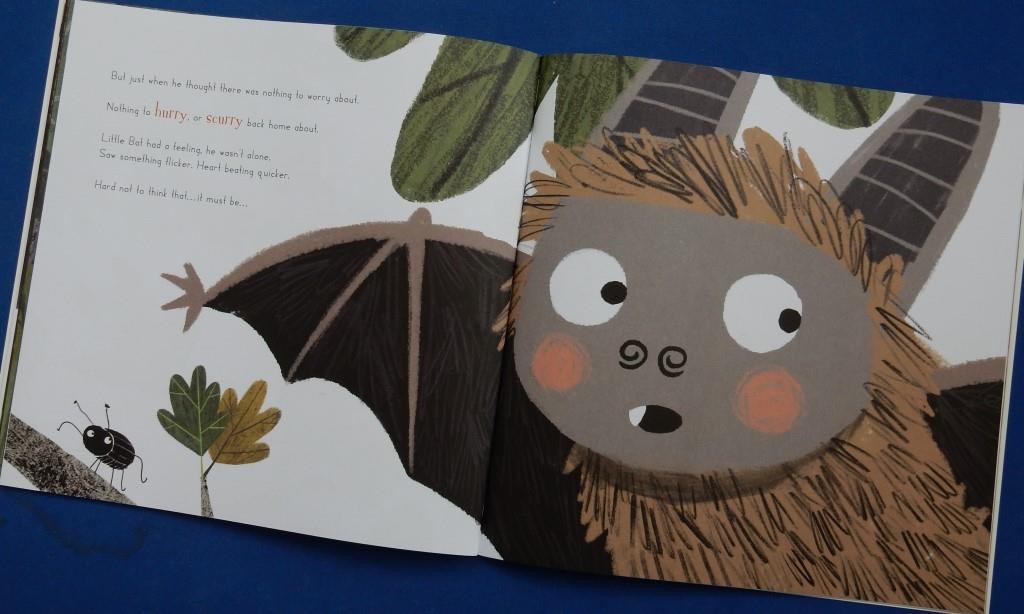
As Little Bat fizzes and whizzes around in and out of the branches his confidence grows and he feels like he’s king of the wood. But then a strange feeling comes upon him – a feeling he’s no longer alone.

Surely it couldn’t be that bogey bat after all, could it?

Quickening his pace has no effect: wherever he goes that dark creature goes too until a sudden realisation dawns … But then he really knew all the time didn’t he?
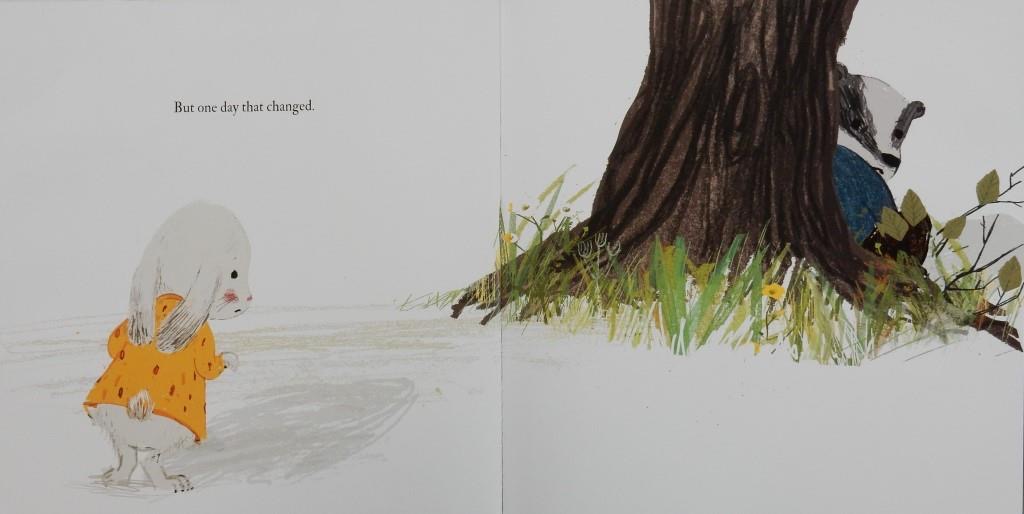
Time to head back home to the others, both now a bit bothered by his prolonged absence.

Could there be another fright in store? …
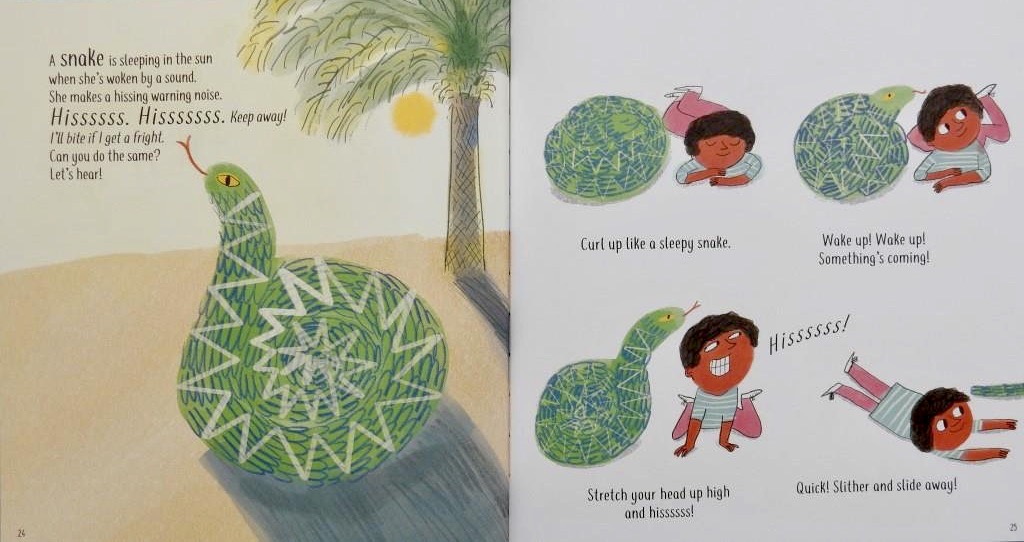
Jonathan Meres’ dramatic rhyming narrative reads aloud like a dream (not of the upside down kind) and adult sharers will enjoy performing the tale probably as much as little humans will enjoy being entertained, both by the words and Anders Frang’s equally theatrical scenes. I love the way he uses the bats’ eyes to show their various feelings, and the cuddly toy rabbit.

Sing Like a Whale

Sing Like a Whale
Moira Butterfield and Gwen Millward
Welbeck Publishing

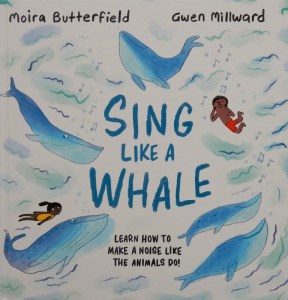
Previously Moira Butterfield invited youngsters to lessons that would help them Dance Like a Flamingo. Now in this spirited book their voices are the focus as they take delight in joining in with this exploration of the variety of sounds made by creatures large and small.

First to perform its song is the male humpback whale as he swims through the ocean with a long low Hoooooooo Hoooooooo.

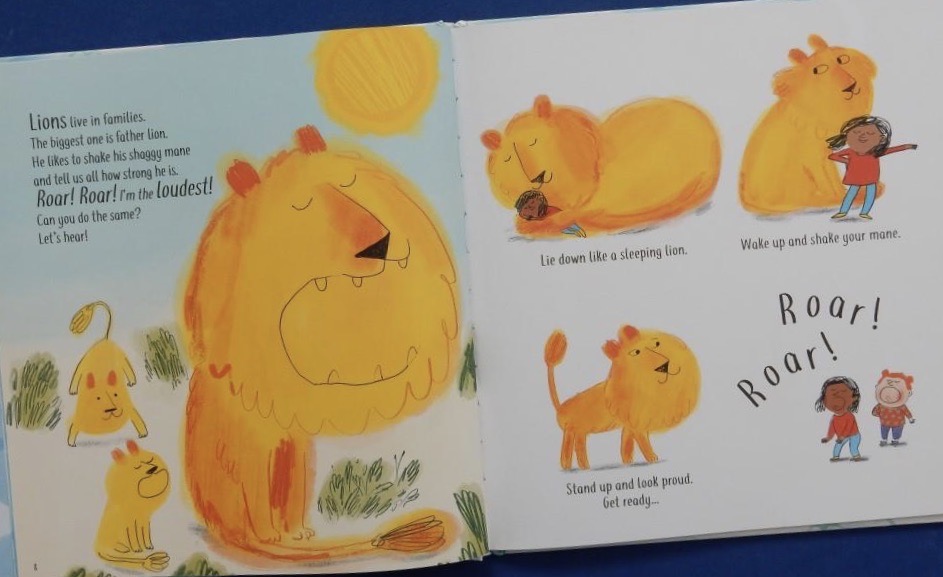
Back on land we meet shaggy maned father lion ready and waiting to make his loudest Roar! Roar! – the ideal sound for little ones to stand proud and tall ready to give vent to their feelings.

Next to use its vocal organ is an owl Hoot, hoot! it goes as it perches on a branch. Make sure youngsters are ready to emulate its turning head movements as well as its hooting before spreading their wings and gliding off.

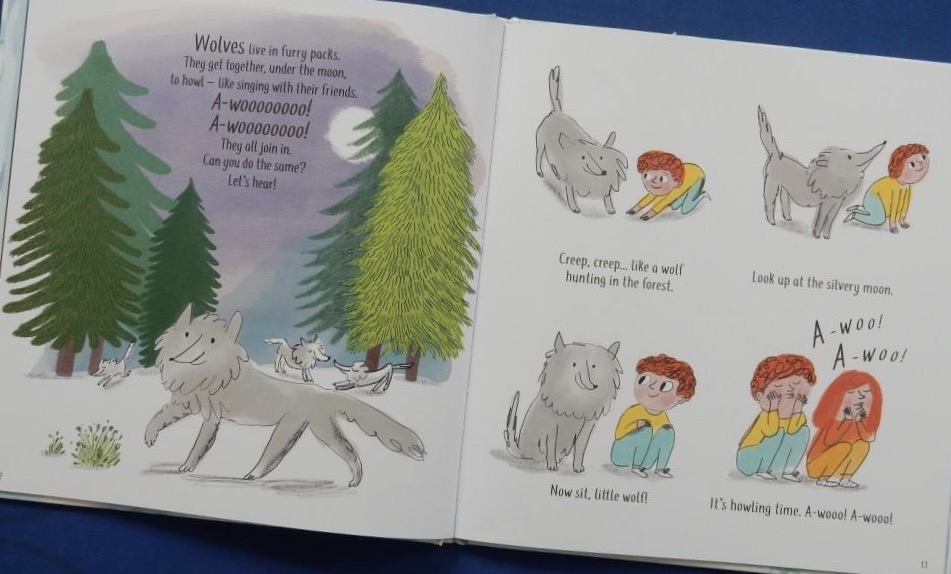
Also enjoying a moonlit singing session are a pack of wolves, each one A-woooooooo-ing and waiting for little humans to creep, sit and create an echoing A-woo! A-woo!

A further eight creatures, some feathered, others furry and one scaly are all eager to give renditions and encourage children to copy them

and then it’s the turn to the children to issue an invitation to “Sing with me!”

Whether you share this book with one, several or an entire foundation stage class prepare yourself for a very noisy and thoroughly enjoyable story/movement session. Make sure you allow time to let your audience see Gwen Millward’s humorous illustrations of the various animals, and the animated child mimickers clearly enjoying themselves.

Bird’s Eye View

Bird’s Eye View
Frann Preston-Gannon
Templar Books

Little Bird is curious about what lies beyond the treetops wherein she nests with her mother. Mama tells her that beyond the forest live people though she knows not what people actually are other than that her own mother has told her to avoid them. However, once her wings are sufficiently strong, Little Bird tells her Mama that she’s ready to leave the nest and see the world. Off she flies enjoying the freedom as she observes the world from above and it’s not long before she spies what she thinks must be people.

As she flies further, Little Bird becomes increasingly confused: some people are quiet and slow, others frantically hurrying around. There are happy, colourful people sharing what they have and singing lovely songs.

But then she sees something that leads her to believe that not everybody values freedom, they put birds in cages, spoil the environment with rubbish and burning fossil fuels. Other people in contrast are cleaning up the mess.
Her journey takes her over land and sea until eventually Little Bird needs to pause for rest; that’s when she has a narrow escape.

Now hurt and doubting whether she’ll ever see her mama again, Little Bird feels gentle hands. Hands that rescue and nurture her until she’s strong enough to take flight once again.

Finally back home, Little Bird has much to tell her Mama, the most important relating to acts of kindness.

Cleverly using a bird’s eye view, Frann weaves powerful themes relating to the impact humans have on the world into both her verbal and her visual storytelling. There are ‘people on the move. “Migrating like birds”,

black smoke billowing into the sky and those who share whatever they can, all acting as powerful reminders of the importance of having a sense of responsibility and showing kindness. Therein ultimately lies freedom.

Share this beautiful story at home with little humans especially those just starting to spread their wings; share it in the classroom as an inspiration to help make the world a better place.

The Hundred Decker Bus / The Hundred Decker Rocket

The Hundred Decker Bus
The Hundred Decker Rocket

Mike Smith
Macmillan Children’s Books

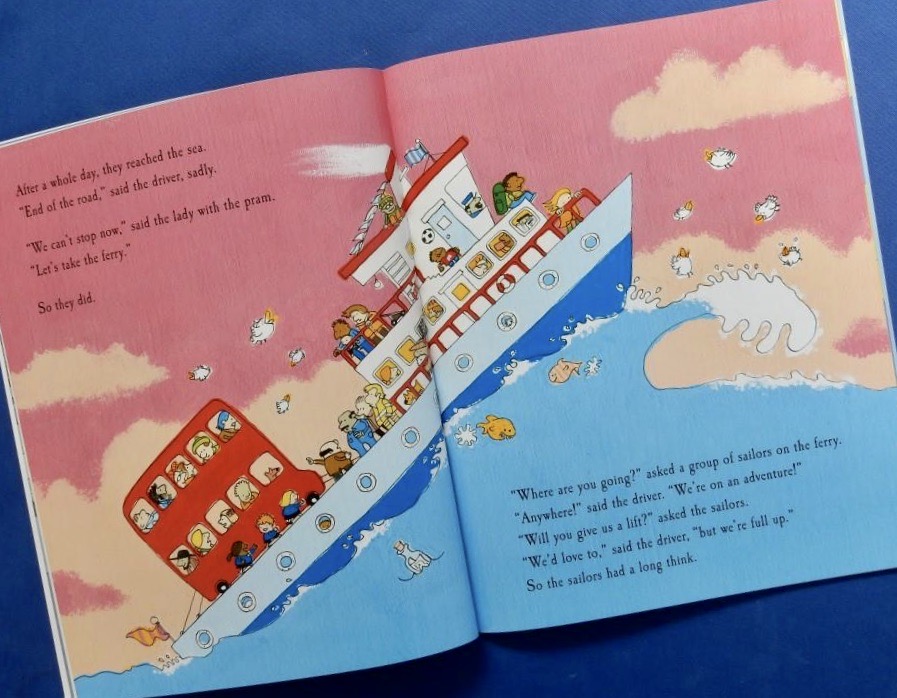
New to me but a reissue of his debut picture book is Mike Smith’s The Hundred Decker Bus. Tired of his usual routine, the bus driver takes inspiration from a passing hot air balloon and decides to take a new route that he’s never before noticed. Imagine being on that bus: what would your reaction be to a diversion to nobody knows where? That of the passengers (whose numbers increase en route), is one of happy abandon, as after a day’s driving the bus reaches …

But that is only a small part of their adventure about which I’ll say no more other than the sky’s the limit … or maybe it’s not.

This fantastical story with its awesome fold-out page will grip youngsters as they explore not only that spread but every one of Mike Smith’s humorous, highly detailed scenes be they large or small.

Share this uplifting picture book reissue either with one child, a group or a whole class. It has huge potential in the classroom.

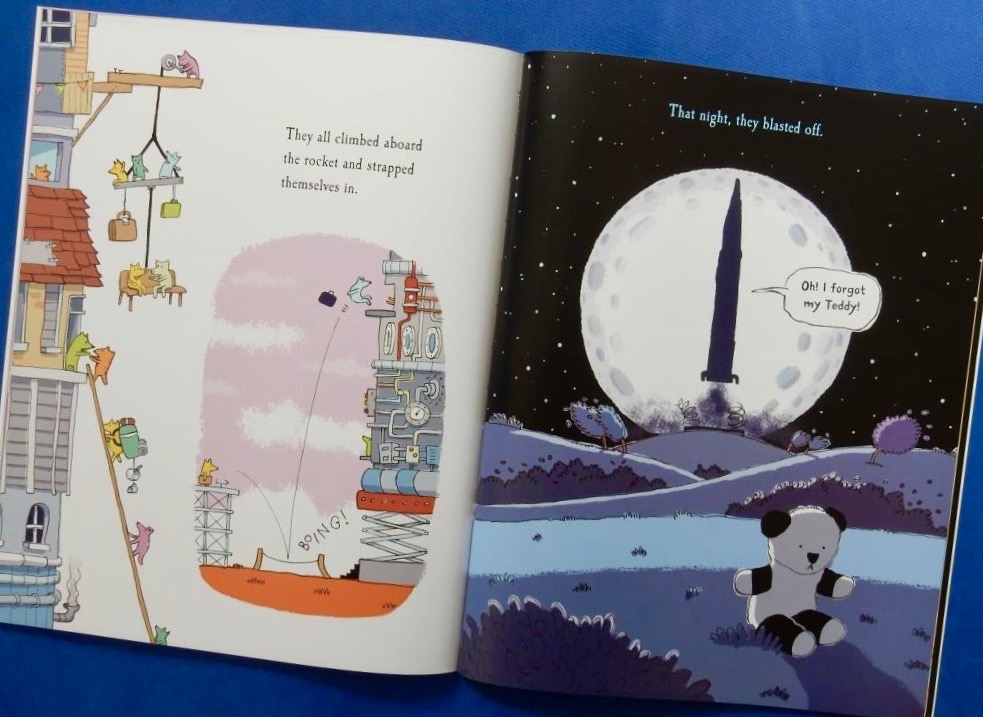
So too does The Hundred Decker Rocket. This begins in Ivy’s bedroom where she’s just finished creating a massive telescope through which she sees a strange and beautiful ‘something’ glimmering in the sky far off. An adventure beckons Ivy and her trusty dog Eddie, but that will require another round of constructing.

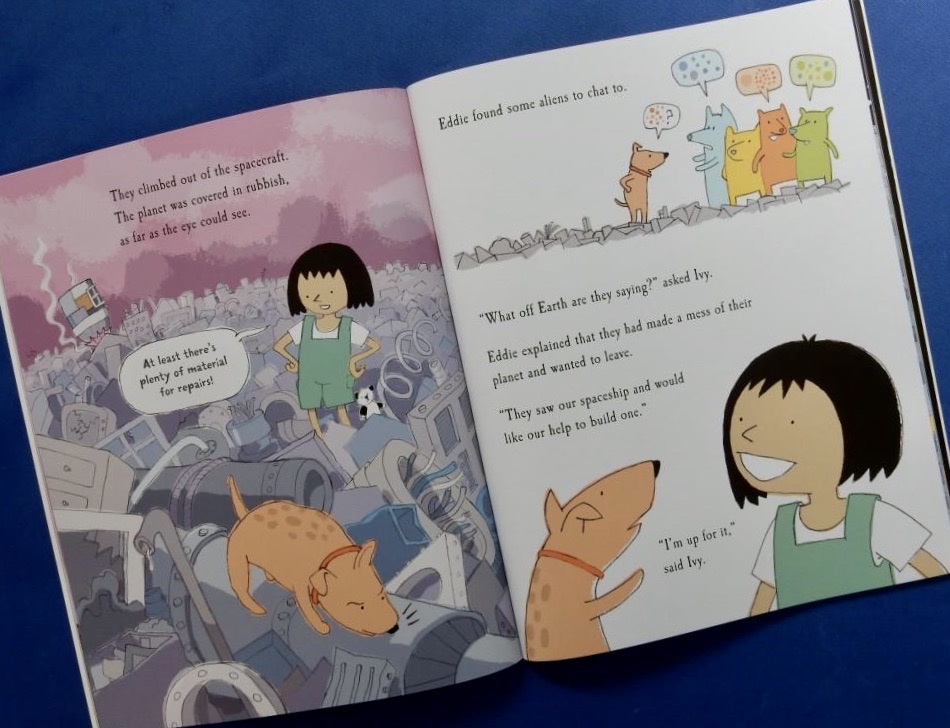
Several days later the two are blasting off skywards in their rocket, landing unceremoniously, after what seems an incredibly long journey. on a planet entirely covered in rubbish.

Eddie learns from the resident environmentally un-savvy aliens that they’ve messed up their home and now want to leave and find a new place to live – if Ivy and Eddie help them build a spaceship that is. The construction continues apace as more and more aliens appear and yet more rubbish accumulates and is used, leaving the planet much cleaner.

With a hundred decks duly built, they deem the rocket ready for boarding and blast off takes place that night.

Eventually the aliens agree on what they feel is a suitable new planet and down they go … but there’s a strange familiarity about it …

With a great final twist, incredibly detailed, zany scenes that youngsters will pore over for hours revelling in the wealth of humorous touches, including speech bubbles and onomatopoeic noises off, and its fold-out page, this is a cracking book. Highly relevant is the vital environmental message about the importance of caring for our planet.

If you’re after a fun story or a super starting point for an ecological discussion that will galvanise children to take care what they throw out and where/how they dispose of it, this is it.

Willow Wildthing and the Magic Spell

Willow Wildthing and the Magic Spell
Gill Lewis, illustrated by Rebecca Bagley
Oxford Children’s Books

It’s great to see another adventure of Willow and her friends. Now they’re on a mission to save the Wilderness from the clutches of a dastardly property developer, one Lord Smog aka the money wizard, who it seems will stop at nothing to get his way. That means he intends to fell all the trees to make way for his housing development.

What Willow needs is to ‘out-spell’ him and there’s somebody the Wild Things know who can surely help them. Off they go to see their witch friend though even she isn’t very hopeful, initially at least. But after some discussion on the possibilities of what a spell might do they set about creating one – a spell written from the heart. That’s part one of the plan.

The second is to make their adults remember what it was like to be wild.

Can they do it? Anything is worth a try to save the wild green space wherein nature and magic meet, that they love so much.

At first I thought perhaps ash dieback might be the reason for the trees being marked and it was a relief to find it wasn’t so: even a powerful enchantment of the Willow kind wouldn’t work against that.

I really loved that Willow, her little brother Freddie, Bear, Fox, Mouse, Hare and Raven co-create the spell.

I’m sure Willow’s multitude of established fans will relish this smashing story spell-bindingly created by Gill Lewis and Rebecca Bagley; and the determined girl will doubtless add significantly to her fanbase too.

How to be a Human / Museum Kittens: The Treasure Map

Two recent fiction titles from Little Tiger – thanks to the publisher for sending them for review

How to be a Human
Karen McCombie

When their home town is hit by unprecedented wild weather storms causing schools to close it seems something is badly wrong. Little Ty thinks he’s seen aliens in the sky and much to sister Kiki’s horror has even appeared on the news saying the freak weather was caused by strange beings in their spaceships. How will she face the embarrassment of such nonsensical talk when Riverside Academy reopens? Especially the taunts of Lola and the Popular Crew of which she wants to be part.

Someone else not thrilled with the school reopening is previously homeschooled newbie Wes, also in Y7 and an outsider (though the bullies have their eyes on him).

Then there is Star Boy, presently marooned on Earth about which he’s been taught some things relating to its inhabitants, as well as having taught himself some of its languages.

Both finding every day painful, Kiki and Wes start spending time together and soon realise they have things in common: they’re really struggling to settle in to the new school, they both have parents who have separated and then comes music.

Having observed their behaviour together, Star Boy decides he can learn much about human behaviour by watching and filming the duo so that once he returns to his own planet, the Master will consider him a ‘scientific hero’.

Then Wes and Kiki discover Star Boy. They start to learn things about one another but also about themselves and who they are; they learn what being human really means, about the importance of trust and of friendship. They also discover that sometimes what you really want is right there before you and that it’s possible to heal sadness.
With terrific characters Karen McCombie infuses her insightful story with warmth and gentle humour. She really seems to stand behind the heads of eleven/twelve year olds and their salient concerns.

Thoroughly recommended for those around the age of Kiki and Wes in particular.

for younger readers is

Museum Kittens: The Treasure Map
Holly Webb, illustrated by Sarah Lodge

The fourth tale of the kittens that get playful once all the visitors have left the museum begins up on the roof when Tasha declares that the cloud she’s seen in the sky is a dragon. Boris then decides it’s actually a ship which puts him in adventurous mood as he leads his fellow kittens off to see an actual ship, The Silver Lion, a four-hundred-year-old galleon in dry dock at the back of the museum.

No sooner have they gone aboard than they hear rats voices singing about treasure and they appear to have a map.

When Boris informs them that The Silver Lion was a pirate ship that once belonged to a pirate queen, his excitement rubs off on the other kittens. Grandpa Ivan gives them his blessings to follow the rats; they have to get hold of that map one way or another. But those rats are pretty tricky creatures … and is there really a treasure map, let alone any treasure?

Those familiar with the kittens and their escapades, illustrated by Sarah Lodge, will eagerly grab this; other new solo readers could start here and then likely will want to read what went before.

Mummies Unwrapped

Mummies Unwrapped
Tom Froese
Nosy Crow (in collaboration with The British Museum)

Ancient Egypt is a popular topic for the KS2 History curriculum but the subject of mummies is given relatively little attention.

Now illustrator Tom Froese reveals their mysteries in this book unravelling both those of humans and animals. To allow them to remain together in the afterlife, sometimes pets were mummified at the same time as their humans.
First of all is an explanation of what a mummy actually is, and the origin of the word. We then learn how a mummy was made. It was crucial to start the embalming process as soon as possible to prevent the body rotting in the hot sun.

An embalmer’s toolkit is depicted and the entire process is described.

If you’ve ever wondered what the wrappings were made of, they were generally linen torn into long strips that look a bit like bandages.

We learn the grisly details of what was done with internal organs (only the heart was left in place as this was thought to be needed in the afterlife), as well as reading of the outcomes of embalmers’ errors.

There’s information about the funeral procession (after 70 days) to the tomb and what took place thereafter. There’s also a spread introducing some of the most famous mummies including Tutankhamun and one called the ‘unlucky mummy’ said to have been cursed.

Unearthed too are stories of tomb robbers, and what took place when archaeologists discovered mummies thousands of years after their burial; there’s mention of fake mummies and other shenanigans. Apparently the French King Francis 1 always carried a packet of powdered mummy with him in case he was ever in need of urgent healing. Bizarre!

Froese’s stylish illustrations have touches of gentle humour, plenty of detail and pattern making this a book I would definitely recommend adding to primary school collections and the bookshelves of youngsters with an interest in ancient history.

Look, Puppy!

Look Puppy!
Mary Murphy and Victoria Ball
Walker Books

A little girl has long awaited the arrival of her new puppy and now, hurrah! At last the nameless creature has arrived and she is eager to introduce the newcomer, first to the immediate surroundings and then the world at large. The latter entails a walk around the neighbourhood to see the various houses and their inhabitants both human and canine,

most of whom are very welcoming and offer to help choose Puppy a name. But then disaster! The creature disappears.

Where is Puppy?

A frantic search begins, followed by a pause for some reflection,

a joyful reunion and a return home.

Will the little girl ever settle on a name for her puppy though. Yes of course, but what will it be?

With endearing, finely detailed illustrations by Victoria Ball, Mary Murphy’s is a warm, gentle tale that will especially appeal to youngsters with a dog in the family. The little human protagonist herein shows such understanding and love in her dealings with her puppy offering a great example to young readers.

What a Wonderful Phrase

What a Wonderful Phrase
Nicola Edwards and Manu Montoya
Little Tiger

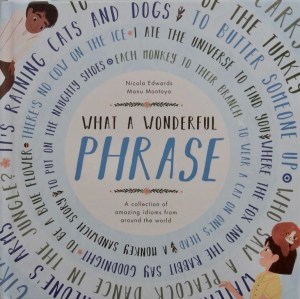
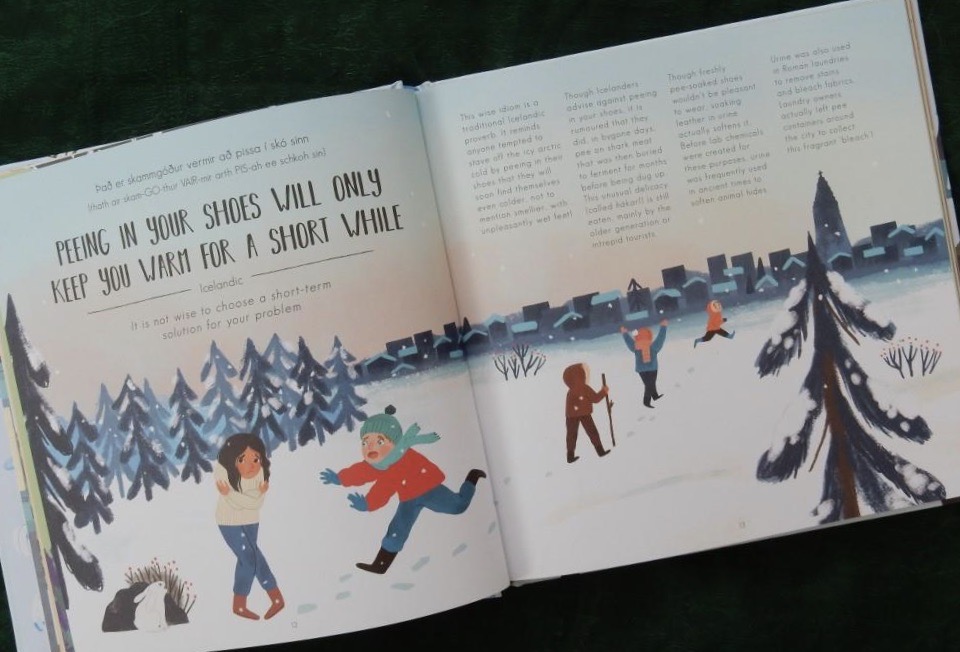
Nicola Edwards and illustrator Manu Montoya take readers on a world tour looking at idioms from far and wide, including such places as Sweden, South Africa, Korea, Nigeria and Greece. There’s even this: ‘Nuces relinquere’, Latin for ‘To Give Up Nuts’ which to the Ancient Romans meant to give up childish ways. Fascinating, as are all the other idiomatic phrases in this book, each of which is explained in a gently humorous manner in this compilation of curious utterances.

We learn the cultural and historical facts behind for instance, ‘Putting Watermelons Under Someone’s Arms’. Originating in Iran (then Persia) and also found in Azerbaijan and Turkey, it translates as ‘conning someone into doing a tiresome or stupid task for you’.

I was surprised at how many of the idioms mention food.

Can you guess the meaning of ‘To split open the crocodile’s intestine’ a phrase sometimes said by Izon speakers living around the Niger Delta. If your home language is English you’ll surely be familiar with ‘to butter someone up’ and ‘it’s raining cats and dogs’ but unless you speak Dutch you aren’t likely to have come across ‘a monkey sandwich story’.

I couldn’t help but laugh at this Icelandic one that translates as ‘peeing in your shoes will only keep you warm for a short while’. Really? However the accompanying bit about an unusual delicacy said still to be consumed by some did not appeal to my vegan sensibilities. Gross!

As well as being amusing, this delightfully illustrated book is an exploration of the diversity of language and a presentation of snippets from many different cultures that readers of all ages can enjoy sharing and discussing.

Ruffles and the Teeny, Tiny Kittens / I am Dog!

Ruffles and the Teeny, Tiny Kittens
David Melling
Nosy Crow

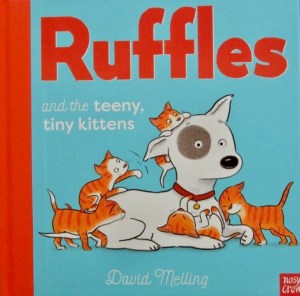
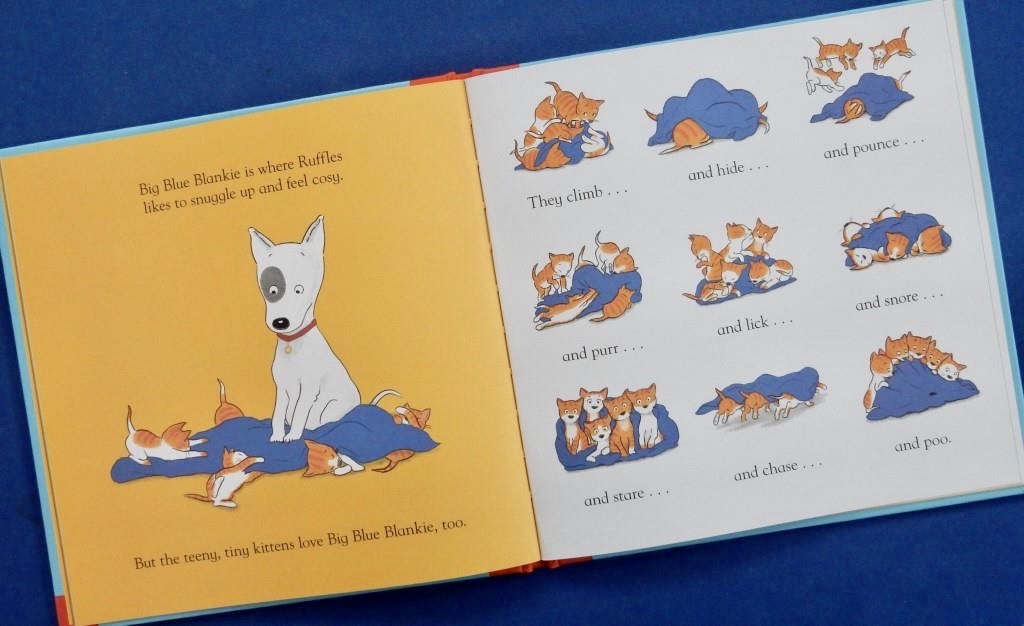
Puppy Ruffles is in many ways similar to a little human as he learns about the world – its ups and downs. There’s much he enjoys but if there’s one thing he particularly dislikes it’s teeny tiny kittens. So you can imagine his feelings when five lively kittens of the teeny tiny kind come to stay. He is far from happy about their high-spirited actions, their noises and their poo. They follow him wherever he goes and try to do whatever anti-sharer Ruffles does. Worst of all is that they want to enjoy the delights of his Big Blue Blankie.

When a tug of war over this special object occurs the kittens’ game results in catastrophe.

Can these frolicking felines perhaps help Ruffles learn one of life’s important lessons – that sharing is the best way to make friends and have fun.
Once again David’s observations are spot on and this funny follow up to Ruffles and the Red, Red Coat is sure to be another winner with youngsters of the human kind. With its text closely matching the terrific illustrations this is also an ideal book for young learner readers.

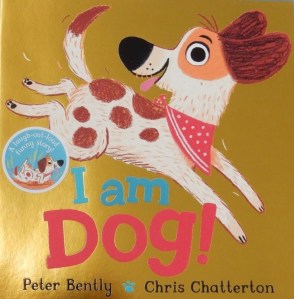
I am Dog!
Peter Bently and Chris Chatterton
Macmillan Children’s Books

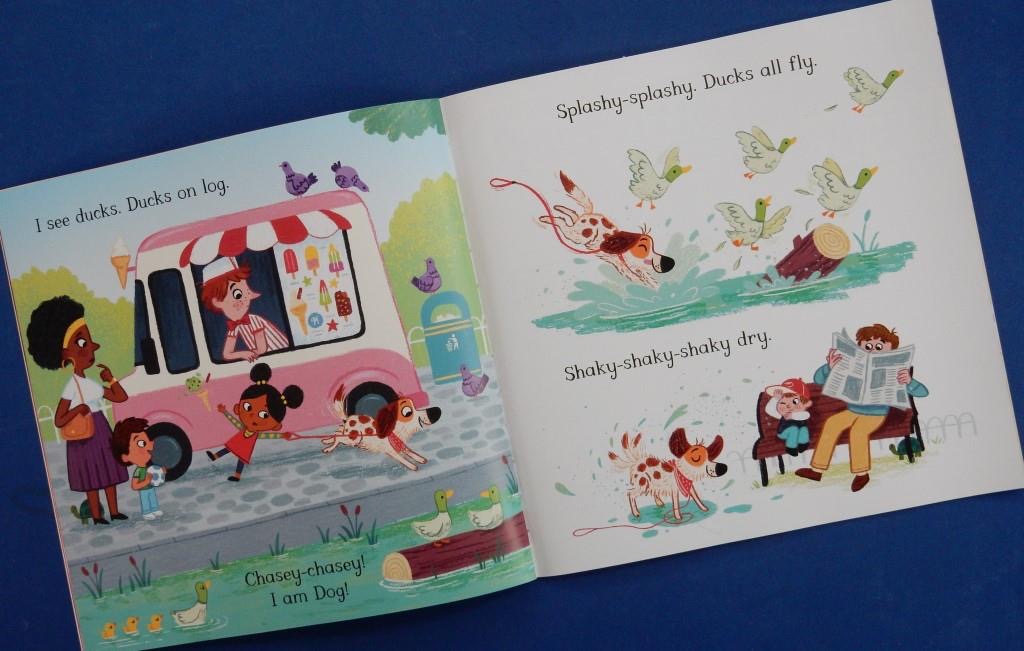
We meet another playful pooch herein, this time acting as the book’s narrator and telling of a day in its life from its very own doggy viewpoint. And what a clever creature to speak in clipped canine rhyme about liking such things as ‘beggy-beggy trick’ and ‘fetchy-fetchy stick’.
This canine can’t resist a watery chase,

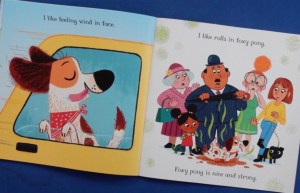
a race or ‘feeling wind in face’, not to mention rolling in strongly ponging foxy droppings.

However, like the majority of canines, our narrator has a great aversion to the moggy residing next door.

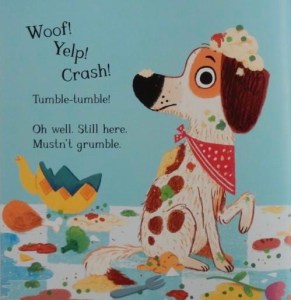
Much more enjoyable are cosy cuddles, ‘lap-lap-lappy puddles’, sniffing the rear ends of fellow dogs and the ‘sniff-sniff’ aromas emanating from the tasty meal laid out on the table. But therein lies both disaster and satisfaction:

now what does the little human residing in the same home think of all this? …

Chris’s action-packed scenes portraying the predilections and pranks of Dog are hilarious and provide the perfect complement to Peter’s bouncy, splendidly onomatopoeic text.

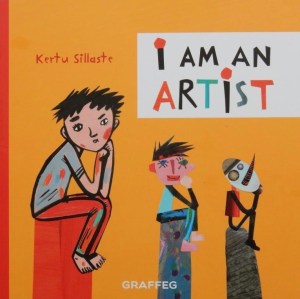
I Am Am Artist

I Am Am Artist
Kertu Sillaste (translated by Adam Cullen)
Graffeg

Who or what is an artist? That lies at the heart of this picture book by illustrator/art teacher Kertu Sillaste. My experience of teaching young children indicates that it’s not until they reach about seven that they start saying such things as “I can’t draw” when what they mean is more like “I can’t create what I consider an accurate representation of this or that” – a tiger is the exemplar this book’s creator uses – but art is so much more.
This is what the young artist main character and narrator discusses and demonstrates herein.

First, with reference to a self-portrait, he presents the variety of processes that an artist might use, ‘An artist thinks and draws and paints and glues and sketches and moulds and photographs and films and considers and constructs and assembles.’ Most important at the outset is ‘a good idea’ and this can be generated in different ways including using one’s imagination, looking at art, taking out your paints and paper or perhaps you don’t even know what sparked it but you feel so inspired that you just have to get to work right away.

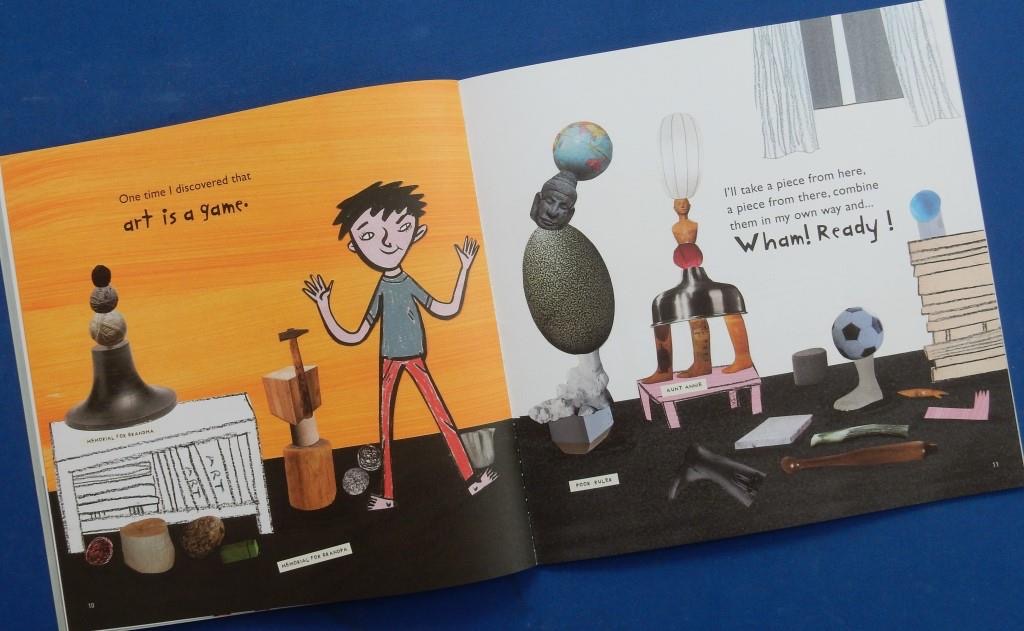
I love the playful ways the boy creates memorials for his grandparents 

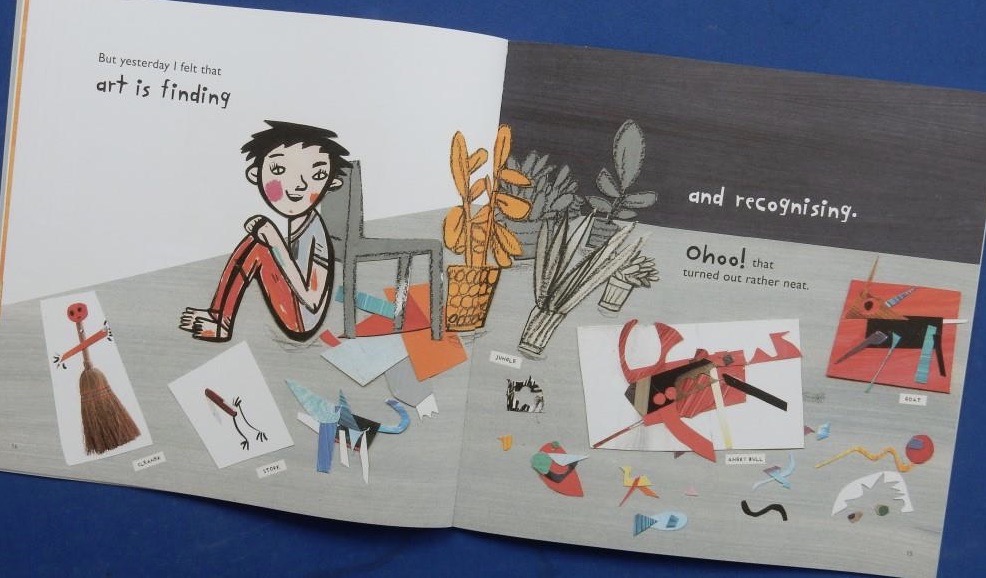
and others, as well as his creative putting together of found objects. 

At other times art might be story-telling through pictures, and these pictures can perhaps be about worrying events or people, or in contrast reveal what makes that particular artist happy.

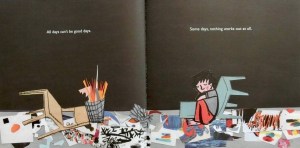
Not all creative ideas reach fruition though – some remain as ideas while others might be possibilities for another day. Indeed some days can go particularly unsatisfactorily with nothing at all working out; 

but still the creative spark is re-ignited the following morning.

There’s also the consideration of revealing what you’ve done to others – what will the reaction be? … ‘An artist really needs praise’ says John. Over-ridingly though the narrator loves to make art; that is what the author hopes he’ll put across to young readers of this book and in so doing, expand their boundaries of art and being an artist. Thinking outside the box is what we want to encourage.

Undoubtedly Kertu Sillaste succeeds in her mission and I suggest this is a book to share and discuss with KS1 children especially, ‘before that “I can’t draw’ notion takes root.

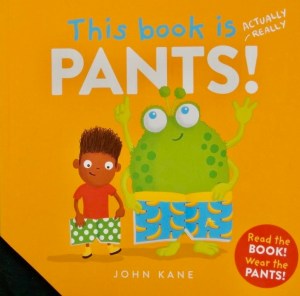
This Book is Pants

This Book is Pants
John Kane
Templar Books

John Kane seems to have something of a penchant for a certain type of undergarment: I well remember groups of children enthusiastically chorusing, ‘underpants, underpants’ whenever I’ve shared his I Say OOH You Say AAH.

There’s certainly a plethora of pants in this interactive, intergalactic adventure starring a boy narrator and his alien pal, Buzzly, that he meets on the moon.

By donning the appropriate pants – courtesy of the reader aloud who has to wear them – the boy launches his rocket moonwards and having landed, encounters Buzzly who wants to visit planet Earth. Pants alert!

But what pants do you need to beat a hasty retreat,

climb a tree, escape from a dark scary place, warm an increasingly chilly rear,

or sate your hunger? And what are the very BEST PANTS EVER?
That, you’ll need to discover for yourself …

All you need to do is bag yourself a copy of the book, wear the appropriate snazzy pants as required and prepare for action: pantalicious fun assured. I forgot to mention that for the best results you’ll also need an audience of one or preferably quite a few, young listeners. Think of the fun you could have with a class creating their own pants stories using appropriately chuddies shaped books.

Eureka! A Big Book of Discoveries

Eureka! A Big Book of Discoveries
Jonathan Litton and Wenjia Tang
Little Tiger

If you lack an open inquiring mind, open eyes and imagination, it’s unlikely that you’ll discover anything new or shed fresh light on something that’s already known.

In this book Jonathan Litton takes a look at all kinds of amazing discoveries from both long ago and recent times, history being the first theme with dinosaur remains the first topic along with what some key palaeontologists have discovered. I was astonished to read that on account of several factors including improved technology and more trained palaeontologists, dinosaurs are ‘being discovered at a faster rate than ever … a new species per week on average.’

Ancient civilisations and some of their artefacts are presented next including a visit to some entire cities that were lost.

The second section ‘Introduction to Earth’ takes readers to both the Arctic and Antarctic regions as well as deep down into oceans

and right into the earth’s core. We read of extinct species and new ones that are recent discoveries: I’d not heard before of the psychedelic frogfish that usually walks on the ocean floor but can make itself into a ball and jet propel itself from one place and another.

Section three presents discoveries of a scientific and mathematical kind, some like penicillin, accidental, others the outcome of experimentation either simple or incredibly complicated and costly.

Perhaps your interest is space. That is Litton’s next theme, about which humans have discovered relatively little despite it being a source of fascination for well over 1000 years. It’s good to see Vera Rubin and her work on galaxy rotation getting a mention herein

and I’m pleased that the author devotes a double spread to women whose remarkable discoveries gained them scant credit at the time. This forms part of the final ‘nature of discoveries’ section that considers some philosophical questions – what makes a discovery a discovery?

The world is a dynamic place and it’s likely in the time that I’ve taken to read this book and write these words, fresh knowledge is being uncovered. That truly is an incredible idea …

A thoroughly engrossing and inspiring book, alluringly illustrated by Wenjia Tang to add to individual and school collections.

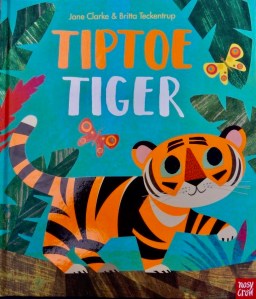
Tiptoe Tiger

Tiptoe Tiger
Jane Clarke and Britta Teckentrup
Nosy Crow

Tara is a little tiger cub – a lively one – and so, despite it being sundown in the jungle, she’s not ready for bed just yet.

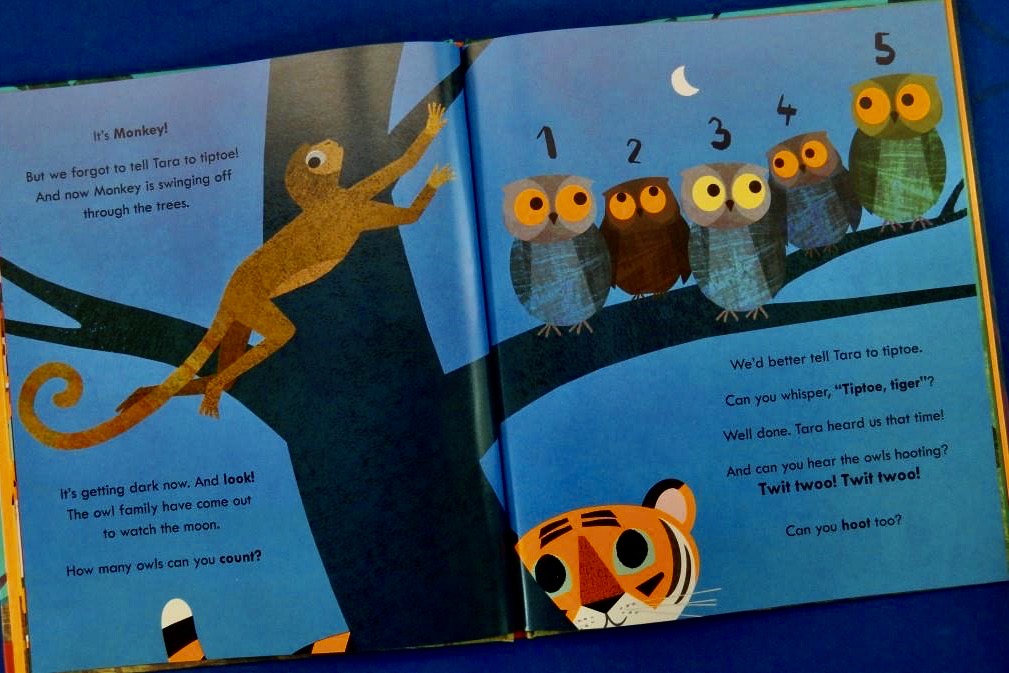
But who can she find to play with? Could it be the fluttering Butterfly and her spotty-winged friends, the strutting peacock with his beautiful tail, or maybe those hooting owls sitting on the branch?

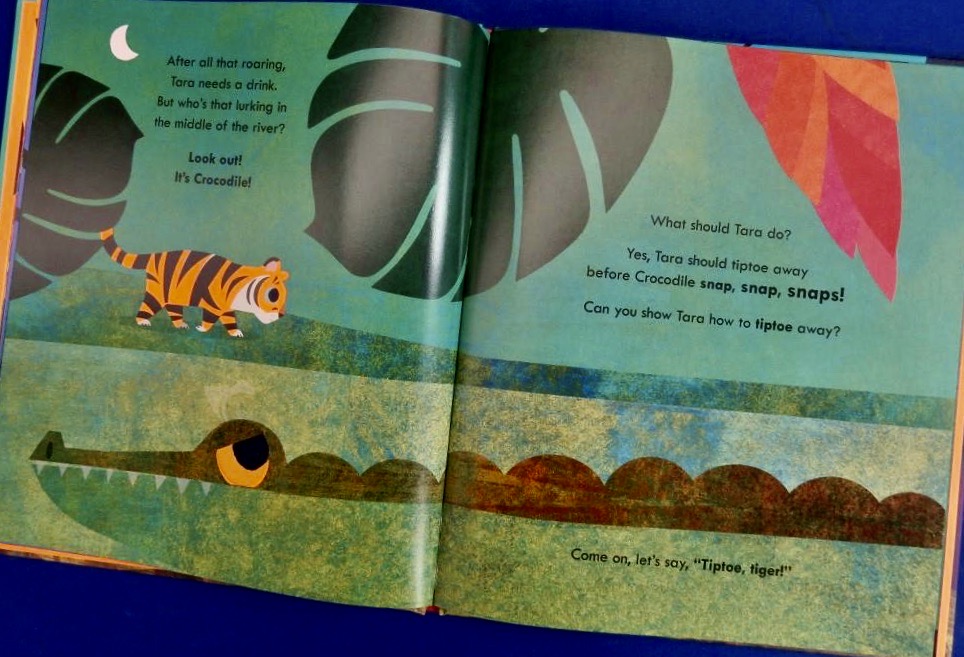
She’ll surely need to tread warily along the river bank on account of the scary-looking crocodile lurking in the water. I doubt if even Tara’s bouncing and pouncing will scare that away even if it frightens off all the other potential playmates.

This is another of Jane and Britta’s smashing interactive neon bright picture books that will delight little humans at bedtime (or any time). They’ll love delaying their own shut eye as they follow Tara on her nocturnal search helping her on her way with whispers of “Tiptoe, tiger,” spotting the animals lurking part-hidden in Britta’s neon bright, vibrant illustrations, fluttering their arms, stretching them wide, ‘Raaaaar-ing’ and finally, when the cub does settle down for the night, joining in with her yawn and bidding her, ‘Night, night, little tiger. Sleep tight!’

1,2,3, Do the Shark / The Horse that Jumped

These are two picture books ideal for bedtime sharing kindly sent for review from Farshore

1,2,3, Do the Shark
Michelle Robinson and Rosalind Beardshaw

Get ready for a bit of funky action deep beneath the ocean where Bess’s fishy pals are somewhat disturbed by a storm. Not so Bess though; clad in her shark attire, she urges them all to join her in a bit of boogieing. “Copy me and do the shark!” she says performing the appropriate moves

until all the sea creatures are joining in with the stretching, fin waving, tail swishing and generally strutting their stuff.

That achieved, it’s time to take a dive down deeper, right to the ocean bed where something rather scary is peering out from the mouth of a cave.

Crab gives a Shark alert. Time to take evasive action suggests Bess and so they do.

But perhaps that shark isn’t as scary as they first thought? Has he another reason for watching them so closely perhaps …

With a lovely switch from imagined to real, the story has a perfect ending 1,2,3 zzzzz.
An ideal pre bedtime book for those around little Bess’s age told in Michelle’s splendidly readable rhyming text and through Rosalind’s delightful mainly subaquatic, scenes.

The Horse that Jumped
Thomas Docherty

This is a thoroughly enchanting tale of a little girl and a horse that jumps and keeps on jumping. It jumps over a flower, over a rock, over a fence, out of its field, across a steam, over a bench and through an open window right into the girl’s bedroom.

On jumps said girl and off they go right out into the world, galloping and then jumping through a series of richly illustrated scenes of mountains, sea

and skyscapes

until the girl falls fast asleep, is transported back to her own bed and thence into dreamland.

With mounting excitement, so evident in the eyes of girl and horse, as the journey moves from location to location, Thomas Docherty, tells this exhilarating story of freedom and friendship using relatively few well chosen words, leaving his gorgeous illustrations of a fabulous flight of fancy to do most of the talking. It’s impossible not to feel that joyful freeing sense of movement be you listener or reader aloud: what a splendid celebration of the power of the imagination.

Petunia Perry and the Curse of the Ugly Pigeon

Petunia Perry and the Curse of the Ugly Pigeon
Pamela Butchart, illustrated by Gemma Correll
Nosy Crow

I missed this the first time round so I’m please to meet twelve year old Petunia Perry aka Peri in this reissue. Now in her first term at secondary school, Petunia has decided to write her memoirs and is starting to do so from inside her wardrobe.

As the cool chapter headings indicate, she’s beset by problems and presently believes her best friend Cammy hates her and will never speak to her again. There’s also a pigeon of the unpleasant kind, the question of whether she’s the perpetrator of spoon crime, an unwelcome unicorn-obsessed suitor,

a mother who is totally embarrassing at parents’ evening, not to mention that she begins to have doubts about the boy she really likes. Then when The Spoons, the band she’s formed with the inclusion of Cammy’s cat Margaret as lead singer, looks set to hit the rocks, things really can’t get much worse and certainly not any more crazy.
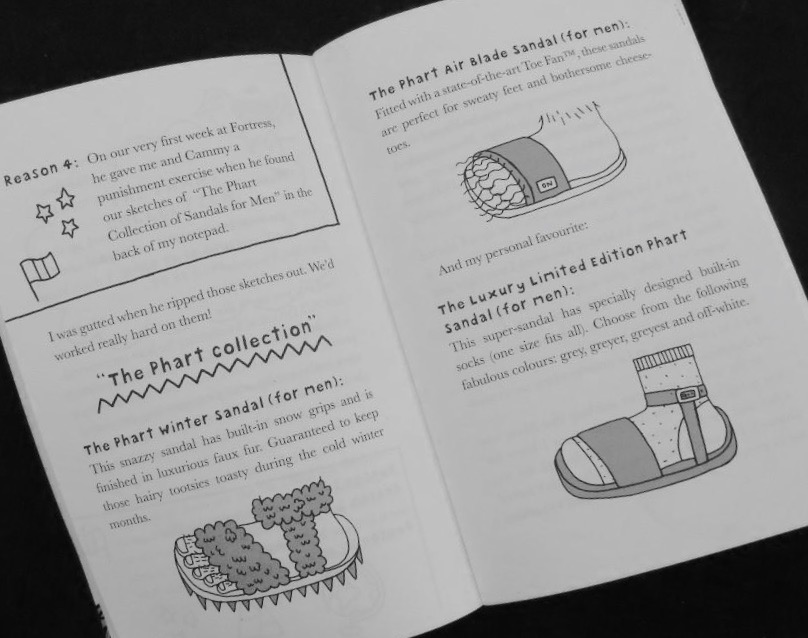
Totally hilarious throughout, but also surprisingly credible. Peri and the other characters – be they classmates such as Smile Boy and Cara, parents, relations, teachers (I must mention Mr Phart of socks and sandals fame) are all wonderfully observed. I love Gemma Correll’s accompanying visuals.

Pamela Butchart has given Peri a strong voice that readers will quickly come to love; she’ll have you chortling thoughout: I certainly was; but there are some serious themes too: forbearance, empathy and kindness being key.
Anybody want a spoon or two, or a kitten perhaps?

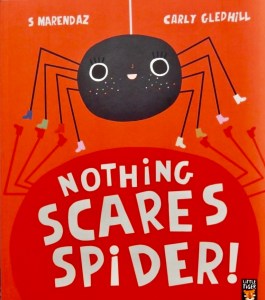
Nothing Scares Spider!

Nothing Scares Spider!
S Marendaz and Carly Gledhill
Little Tiger

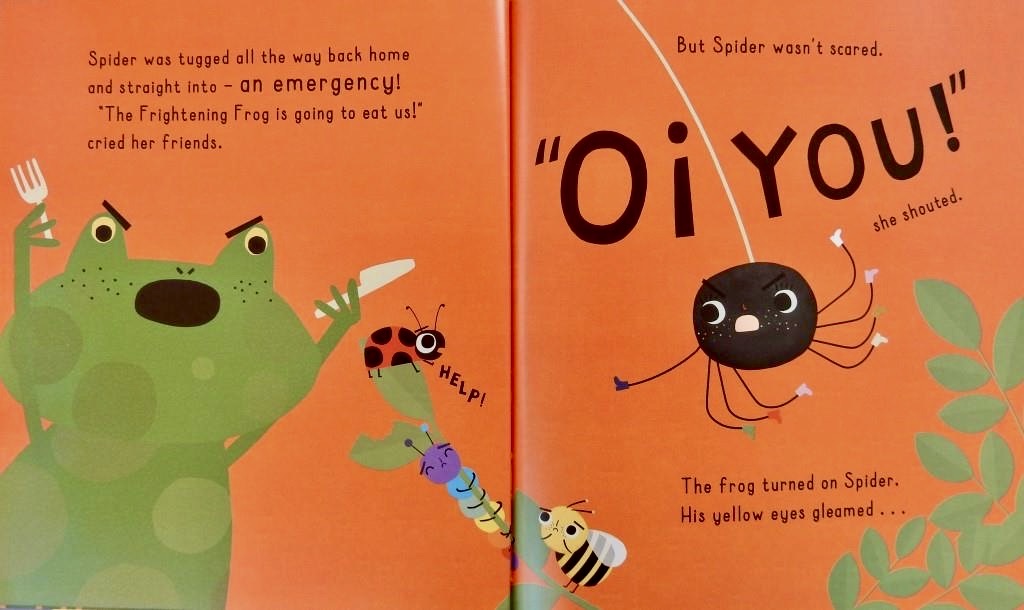
Spider is a fearless creature and is ready to set off and explore the ‘Whole Wide Garden’. First though she bids farewell to her minibeast friends and in so doing hears of their worries at being left without their protector.

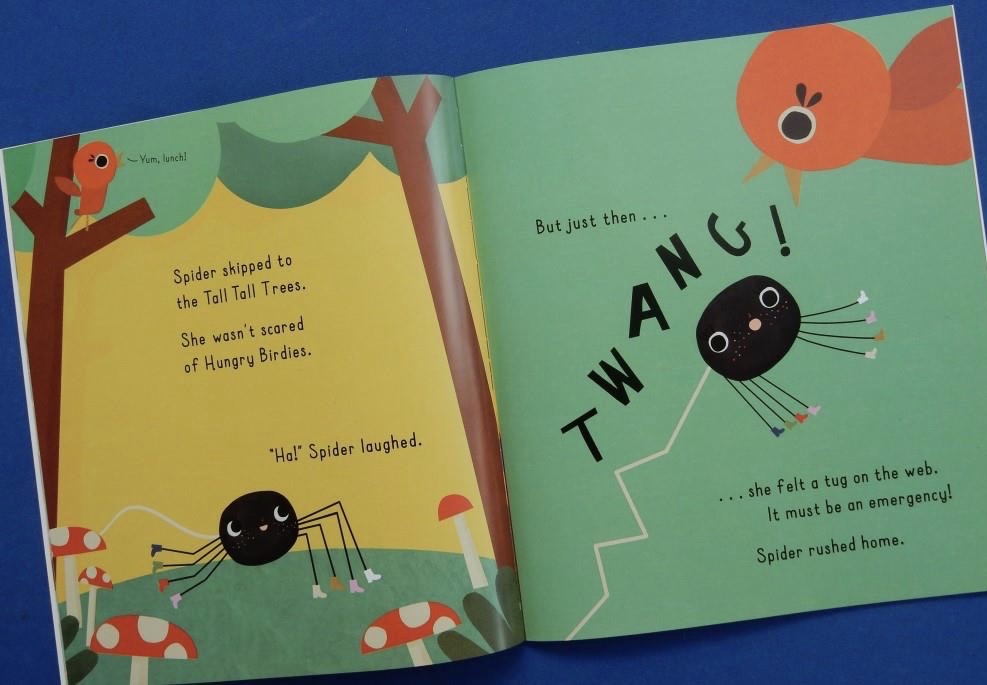
Spider leaves a web thread that can be pulled to call her back but only in emergencies and then off she goes. Almost immediately however comes a tug TWANG!

and back home she dashes only to discover that her return is seemingly, unnecessary.

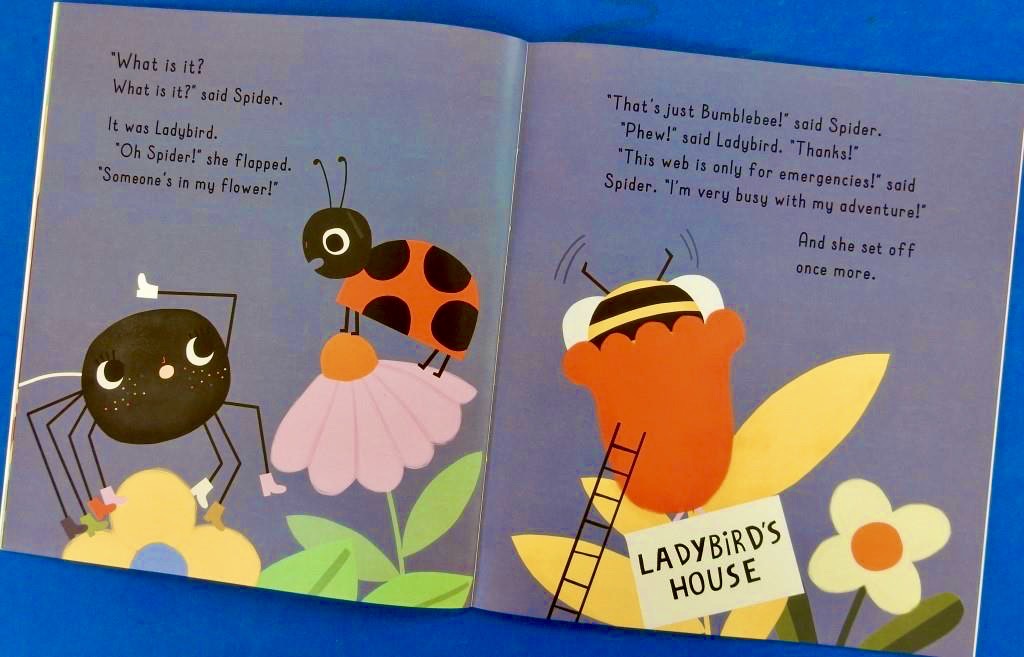
Away she goes again, but whenever Spider herself is unknowingly in danger there comes a tug on the thread – just in the nick of time. Back she goes on several occasions merely stopping to admonish the thread puller before she sets out once more. Now Spider is really getting irate but YANK! On her return this time she comes face to face with Frightening Frog.

Now it just might be Spider’s turn to feel scared …

Fortunately for them all, Caterpillar offers some sage advice which is followed by some nifty work, first by Spider and then her friends. Thereafter comes a deal with their captive and an invitation from Spider.

Carly Gledhill’s vibrant illustrations show what the text doesn’t, enabling young listeners to relish being in the know along with the book’s creators in this tale of friendship and teamwork that will go down well at storytime. Youngsters will also enjoy the humorous touches such as spider’s assorted footwear and the characters’ changing expressions in Carly’s deceptively simple scenes.

It Could Be Worse

It Could Be Worse
Einat Tsarfati
Walker Books

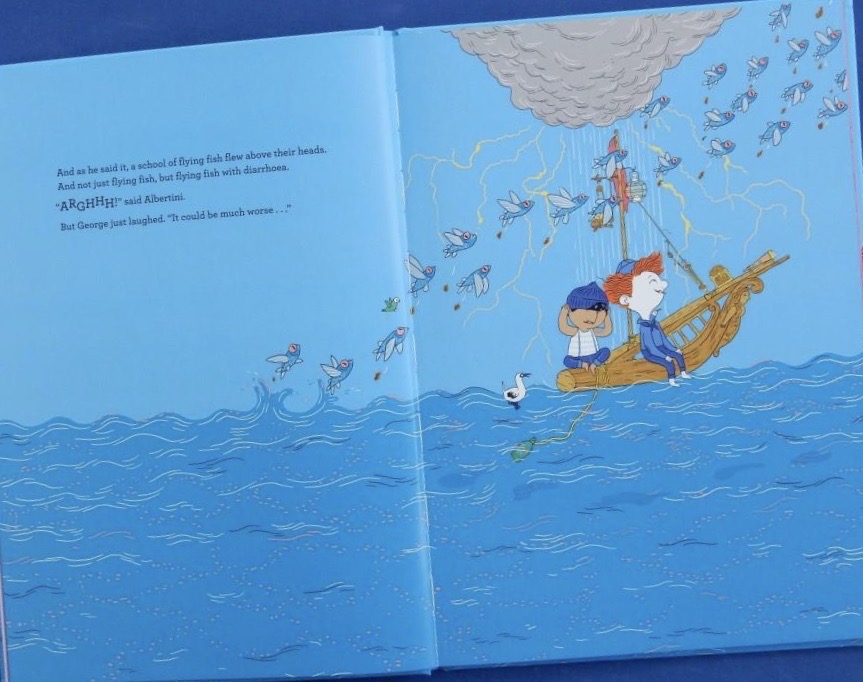
Are you an optimist or a pessimist? In this story we meet one of each – Albertini is the latter, always placing a negative slant on a situation; his fellow sailor, George is an optimist, remaining cheerful no matter what.

Stranded out on the open sea on what’s left of their ship after a disaster that took place prior to the start of the story, we see them facing a series of incidents that get progressively unlikely. First comes a cloudburst with the rain falling only on the two sailors, followed almost immediately by a torrent of excreta from a school of flying fish suffering from diarrhoea, that strangely amuses George (perhaps none fell on him).

Their disparate viewpoints continue as they encounter half a dozen crooning mermaids whose song lodges itself in lamenting Albertini’s brain; then while George renders the mermaids’ tune on his harmonica, a ghost ship of pirates suddenly appears, closely followed by an ark brimming over with animals – very hungry ones on account of being food deprived for forty days.

Their adventure then takes a subaquatic turn as the tentacles of a massive sea anemone pull them to the ocean floor

where George’s oft repeated “It could be worse” starts to wobble somewhat as they’re surrounded by jellyfish, engulfed (albeit briefly) by a whale

before landing unceremoniously on a rather smelly island where they bed down for the night. Or attempt to before they get the surprise of their lives …

Now how on earth (or in water)? did that happen?

Comical illustrations of the unlikely scenarios and George’s oft-repeated refrain will likely keep young listeners anticipating the possibilities of the next unlikely happening, while causing lots of giggles along the way.

Fox & Rabbit Celebrate

Fox & Rabbit Celebrate
Beth Ferry and Gergely Dudás
Amulet Books

This graphic novel style series is terrific fun and it’s reached the third book. The focus for the five interconnected stories is celebration and there’s so much to love about them, not least being the alliterative story titles.

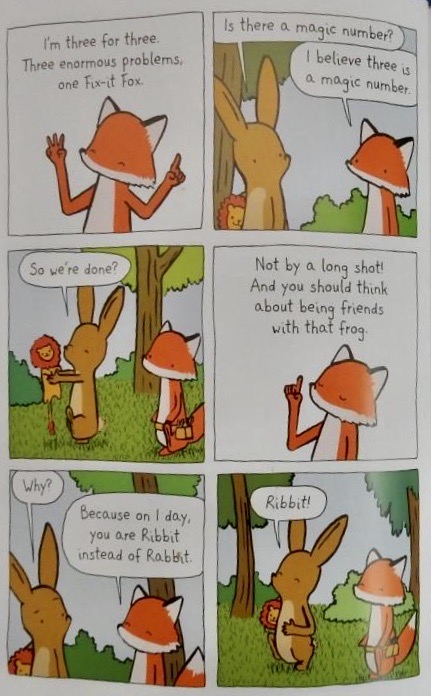
First Fix, Fuss & Flies takes place just before Sparrow’s birthday and begins with Fox announcing confusingly for his pal Rabbit that he’s decided to change the middle letter of his name to i and henceforward he’s to be called Fix not Fox or even better Fix-it Fox. Well maybe for that day only; but before it ends there are a number of jobs that need fixing and other animals wanting to be part of i day. So, Fred becomes Frid, and Rabbit gets dubbed Ribbit.

All ends happily with the work done but I do wonder what Tortoise might have been called had he not rocked up right at the day’s end in time for dinner, asking his usual ‘What’d I miss?’

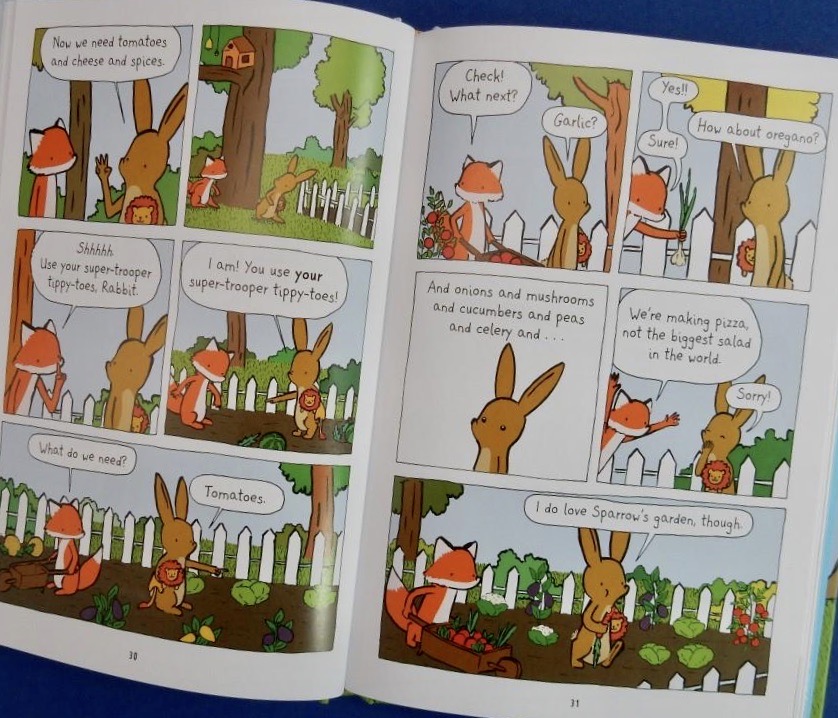
In Party, Pizza & Plans Rabbit and Fox resolve to make Sparrow’s birthday (the next day) ‘super-trooper special’, the best ever and that entails making him the biggest, yummiest pizza in the world. As they have no idea how to make such a thing, they’ll need help, but from whom? Where will all the ingredients come from and how will they go about cooking so huge a thing?

Make way for a new and fiery character in the third story, the addressing of whom requires speaking another language – or perhaps not.

Said new character also appears in Birthdays, Best Days & Best Friends, where he’s introduced, performs a key task, becomes part of the team and a great time is had by all; but guess who almost misses the entire thing.

Wonder, Wish & Wow involves memories of the celebration, a lot of guessing and a considerable amount of hard work; but is it all worth the effort? Does Sparrow’s birthday wish come true?
Love the ending, love the new character and of course, I totally love Tortoise.

Dudás’ brightly coloured, splendidly expressive illustrations together with Beth Ferry’s terrific text, almost entirely in speech bubbles, make this perfect for those just moving to chapter books.

ROAR! / Build

Thanks to publishers Little Tiger for sending these new board books for review

ROAR!
Amelia Hepworth and Jorge Martín

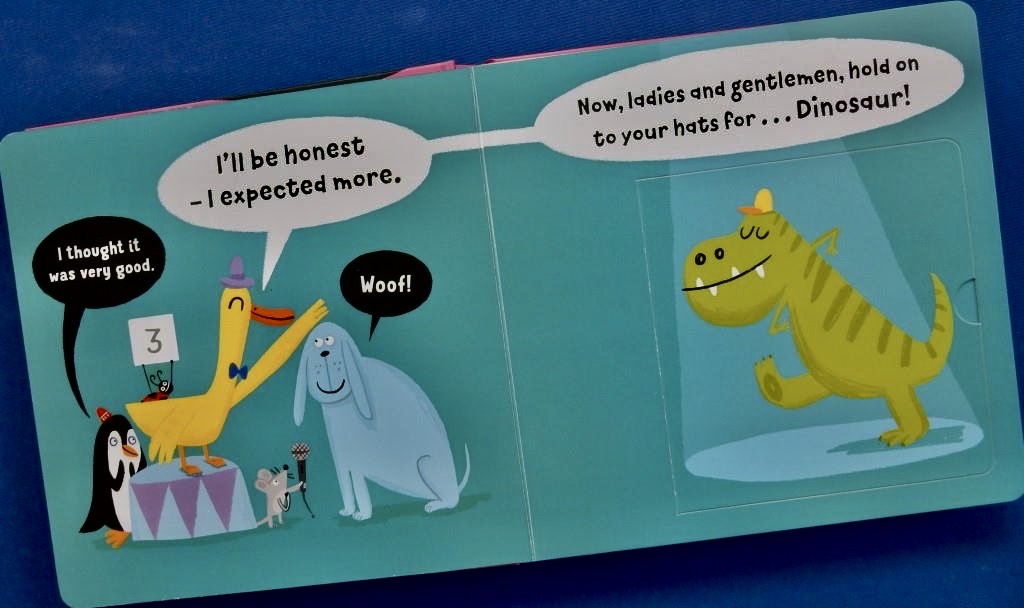
Who will be the winner of the Best Roar in Town contest? With a dapper duck as compere, the animals take turns to let loose their most fearsome roars. There’s Mouse who receives faint praise; Penguin – not overly impressive; Dog – definitely an underwhelming performance and then comes Dinosaur.

Now here’s a likely winner especially with a score of eight.

Hang on though, step forward another competitor …

With flaps to manipulate, number scores to recognise, contestants’ comments from the sidelines and the entire verbal presentation via speech bubbles, little ones will delight in the silliness of the whole thing as well as the opportunities for some roaring.

Build
Pau Morgan

The latest in this Little Nature series presents animals as constructors of their own homes. There are honey bees busily building a beeswax safe place to store food and keep their eggs. Then comes stick-collecting eagle looking for materials to build a nest, followed by web-spinning spider and finally a pair of beavers. These strong-toothed mammals collect stones and bits of trees to build a dam wherein they make a cosy lodge.

Peek-through holes provide additional interest to this one and it’s printed on 100% recycled board which gives a lovely feel to the sturdy pages.

Seven Sisters

Seven Sisters
Ayisha Malik and Erika Meza
Little Tiger

Lola, Esher, Ayla, Zoha, Zayna, Amelia and Saffah all live in the Forest of Tremendous Trees. Each of them lives in a tree and despite being sisters, they’re very different characters with very different interests. Zayna is a writer, Lola is an artist, Saffah is the musical one, shy Ayla has a technological mind, Amelia loves gymnastics, Zoha particularly enjoys the natural world and Esher is an inventor. Despite being so different, they get along well largely because they have their own spaces wherein to hone their talents.

Suddenly one day they sense change is afoot and lo and behold a large tree appears before them and continues growing becoming the most beautiful in the entire forest.

That night the girls retire to their beds each thinking of the house they could build in the new tree.

Inevitably next morning they all make their way to the tree where each of them puts forward a case for ownership.

Arguments ensue and things get chaotic until they decide the only way to solve the issue is to hold a competition with their beloved aunt as judge.

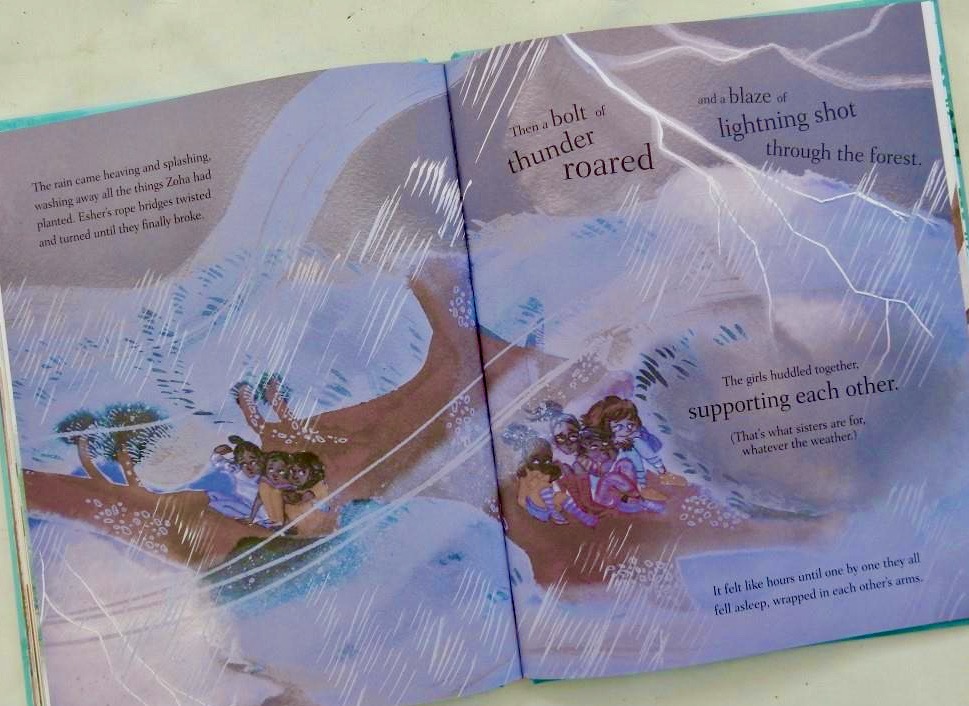
Despite her reservations the competition is scheduled for the following day but none of them had expected the storm that blows up just as they arrive. Time to take refuge … together.

Could this perhaps be the best learning opportunity that nature could offer the seven sisters?

Read solo or read aloud: there are lessons aplenty in this engaging story that celebrates individual differences, creativity and the joys of community. Having recently enjoyed Ayisha’s adult novel This Green and Pleasant Land I was pleasantly surprised to learn that she also writes for children. Erika Mesa’s mixed media illustrations are wonderfully expressive, full of life and really bring out the girls differing personalities.

Ten Delicious Teachers

Ten Delicious Teachers
Ross Montgomery and Sarah Warburton
Walker Books

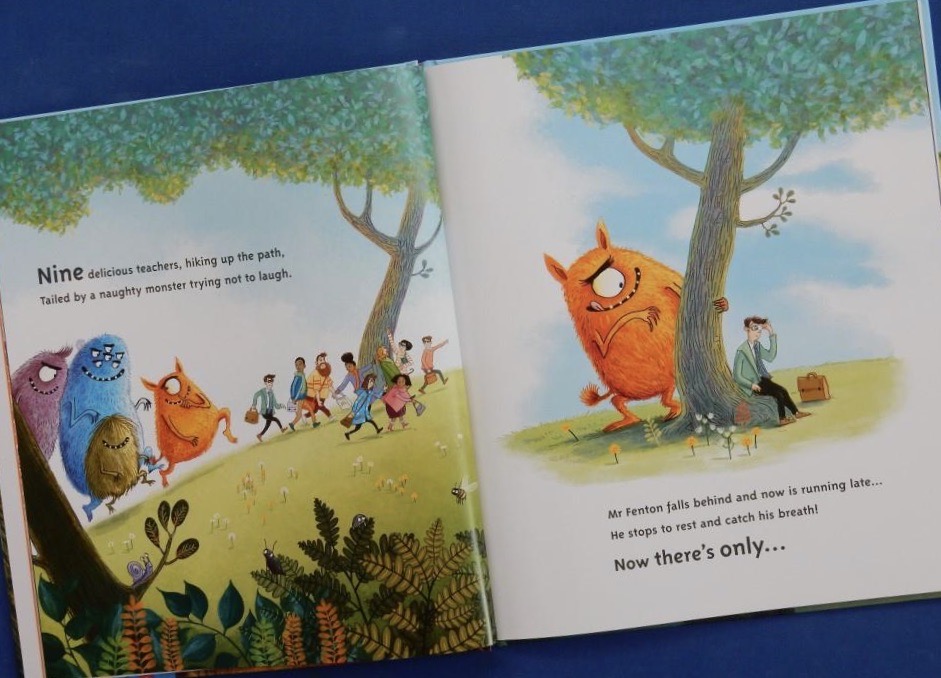
In all my time as a teacher I’ve heard teachers called many thing but never ‘delicious’. Get hold of this yummy counting down rhyme though and you’ll immediately see the reason for the adjective.

Many youngsters have recently bid farewell to their teachers but here you’ll not see a single child for as the book begins what we have is those ten teachers, tired and weary coming out en masse only to discover that they’ve missed the last bus home: no cars parked in a car park- what a ‘green’ lot they are.

Maybe though, I should use green in another way, for following Mr Smith’s suggestion to take the shortcut, they head off into the Dark Forest wherein lurks a hungry horde of hirsute beasties of all shapes, sizes and hues, ready and waiting for that next tidbit.

One by one, the easily distracted teachers are gulped down by the waiting monsters

until just one, Miss Hunter the nursery teacher remains.

Then comes a brilliant twist to Ross’s jaunty rhyming tale: who will have the last laugh though? Surely that will be the youngsters who savour this number narrative so dramatically illustrated by Sarah Warburton whose mock-scary monsters are hilarious. I love all her witty details too.

Myths, Monsters and Mayhem in Ancient Greece

Myths, Monsters and Mayhem in Ancient Greece
James Davies
Big Picture Press

However famous the Greek myths might be, retellings of these ancient tales for youngsters can sometimes be pretty dull, turgid even; now here’s a book that makes them anything but.

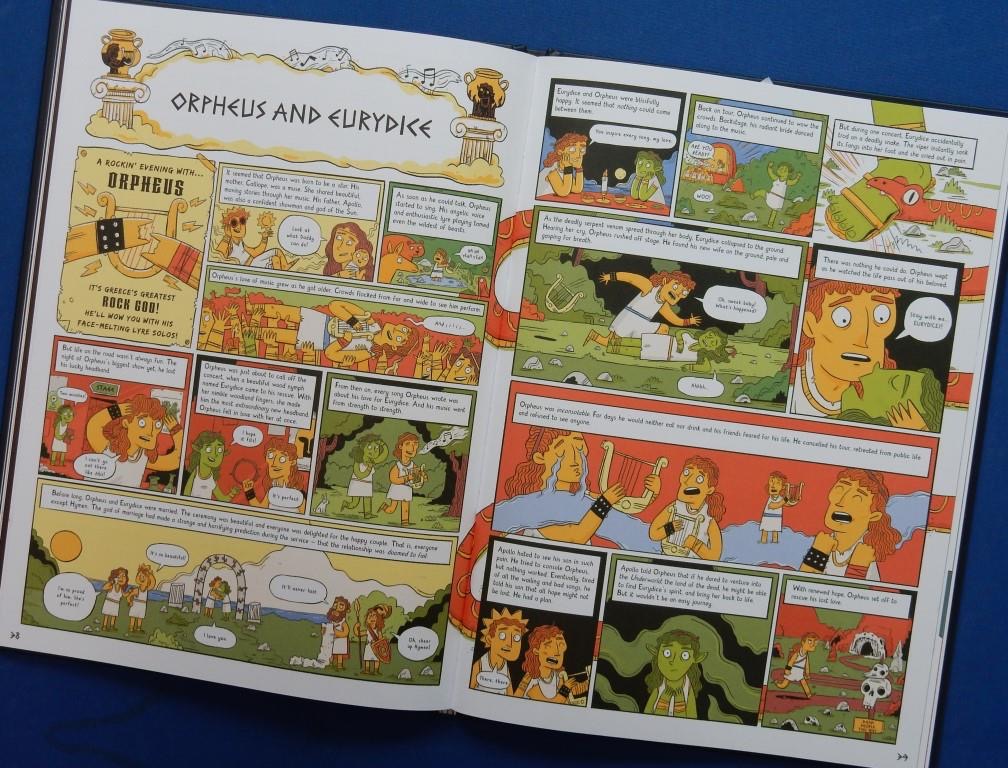
In a dramatic comic book style James Davies presents half a dozen tales making them highly accessible to primary age readers wherein they will find bravery, loss, love,

greed and envy. Interspersed between the stories are thematic spreads on various topics that offer a broader look at such aspects of Greek mythology as the Greek gods and how the Greek myths explained the world; there’s a presentation of heroes and heroines including Atlanta, Achilles, Penthesilea and Odysseus. We also take a journey through the Greek underworld, a place that could be downright scary or delightful depending on your actions during your life.

James Davies’s bold graphic artistic style means that he manages to make even the most terrifying monsters such as the many-headed Scylla and the gigantic Hydra look amusing.

Right now I think we definitely need that tiny little shining insect that popped out of Pandora’s Box spreading light wherever there was darkness and hope wherever there was despair. Definitely now would not be a good time even to contemplate hiding away inside that ginormous wooden horse like those Greek soldiers did when Helen was rescued in The Trojan Horse story. However there’s much to learn from all six stories: that of Theseus and his quest to defeat the horrendous Minotaur,

the Twelve Labours of Heracles, Orpheus and Eurydice and Perseus and Medusa.

With Ancient Greece being one of the oft used topics in KS2 history, a couple of copies of this enthralling book would make a worthwhile, up to the minute addition to primary school topic resources as well as the school library.

10 Silly Children

10 Silly Children
Jon Lander
Pavilion Books

Here’s an altogether new and huge fun take on the customary counting book by debuting picture book author/illustrator Jon Lander.

It begins with ‘1 sensible child / sitting quietly’ but not for long though for behind her back she has something hidden – something with which to make a great deal of noise. You discover what by lifting the flap.

And so it goes on with every sentence on the verso being a great whopping lie: there are for instance ‘3 sensible children drawing quietly’, or not …

‘4 sensible children / helping with the washing’ as they do …

(or rather, don’t).

Actually I told a lie earlier (as did the author) – it’s related to the 5 sensible children – good on them, but I won’t reveal why I say so.

Keep going and you’ll discover 8 children brushing their teeth

and more …

This hugely entertaining, tongue in cheek book will delight young listeners (and one hopes their adult sharers) with its inherent silliness and repeat phrases. I love his ‘Dear reader’ introduction and finale too. Jon Lander’s seemingly laid back illustrative style is just right for the children portrayed in both their sensible and exuberant modes.

I shall watch Lander with interest.

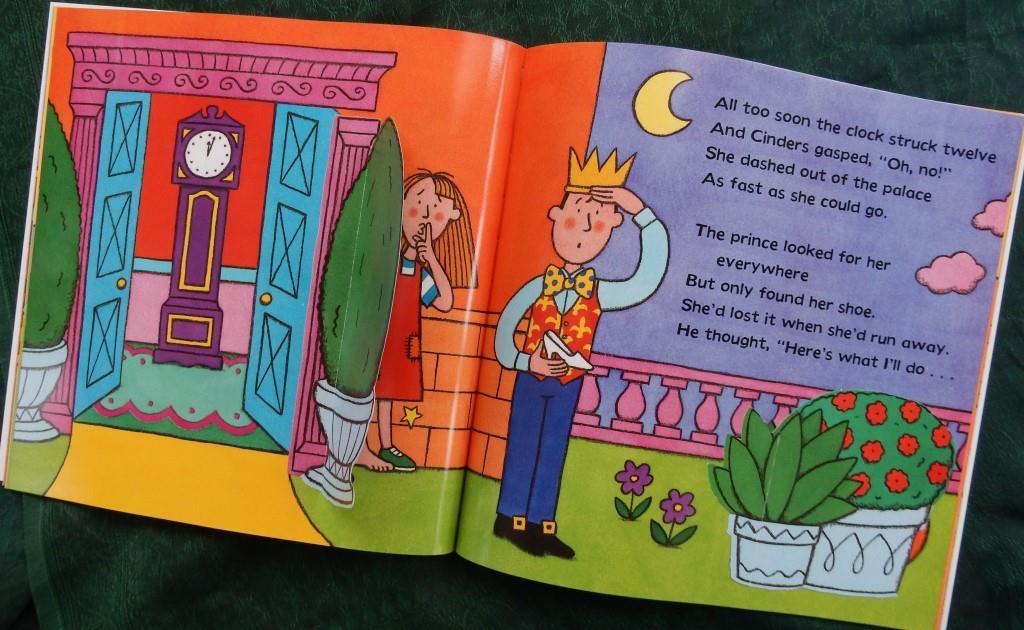
Jack and the Beanstalk & Cinderella / Vocabulary Ninja Workbooks

Jack and the Beanstalk
Cinderella

Stephen Tucker and Nick Sharratt
Macmillan Children’s Books

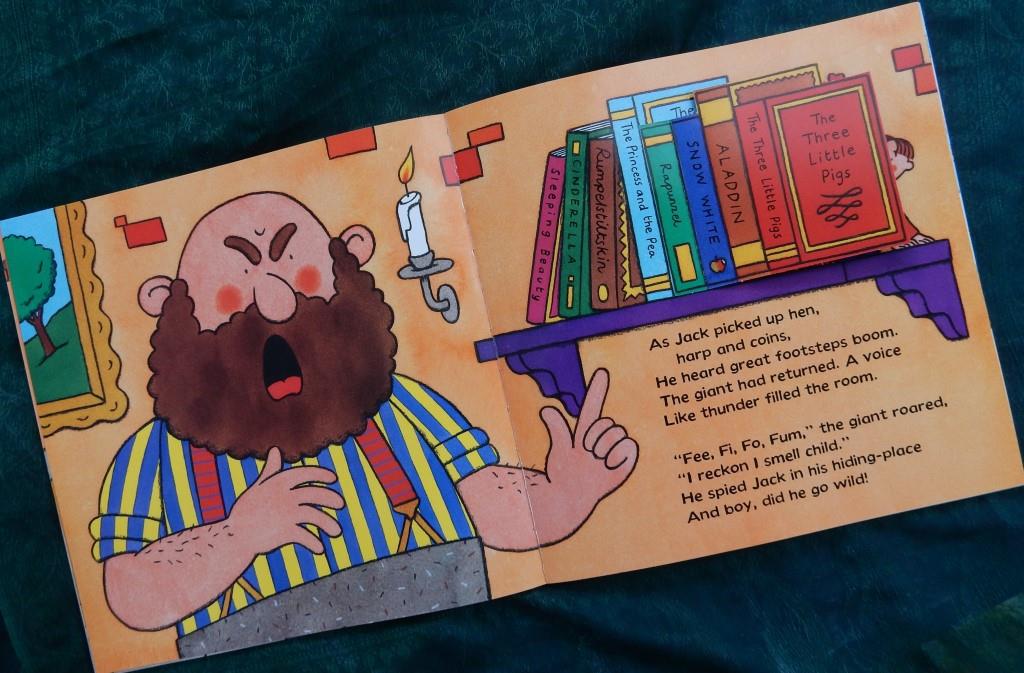
When I was a KS1 class teacher these lift-the-flap fairy tales were very popular with children just taking off as readers. The fact that youngsters were in the main already familiar with the stories, their rhyming texts, and Nick’s trademark cartoon bright, bold humorous illustrations made them ideal choices for confidence building as well as entertainment and getting across the vital reading is fun message.

Now with new editions that include a QR code to scan to access audio versions read by actor Anna Chancellor, the playful, witty tellings will be sure fire winners with a new generation of learner readers and listeners in school or at home.

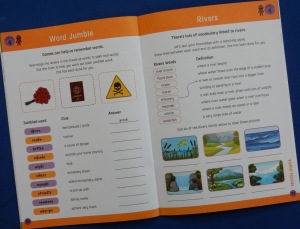
Vocabulary Ninja Workbooks
Andrew Jennings
Bloomsbury Education

This series of six vocabulary books is intended to support home learning. There is one for each year group from Y1 through to Y6 ie covering both KS1 and KS2 and providing the vocabulary likely to be needed in the National Curriculum topics such as geography, history and science.

With most children missing a lot of school over the past eighteen months these books are likely to be a boon for parents struggling to help their youngsters and not knowing where to turn.

Aiming to extend vocabulary and literacy skills in general in a fun, imaginative way, the activities on the pages of each book are grouped into levels: grasshopper, shin obi, warrior, samurai, assassin and grand master. In his introduction, the author (a teacher) suggests that a child should attempt to do the first two levels as independently as possible while from level three and beyond, he recommends some adult support to ensure full understanding. However those of us who are teachers or work in education will know that a great deal of differentiation may be required within a class, so parents will have to be guided by their own judgement and assuredly children will enjoy some adult interaction.

With their colourful graphics, straightforward instructions and activities that never overwhelm,

these books offer engaging and much-needed support and empowerment for learning at home, especially at present.

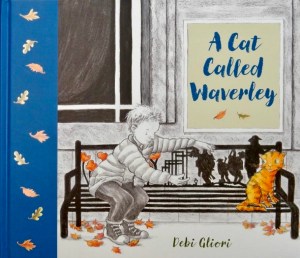
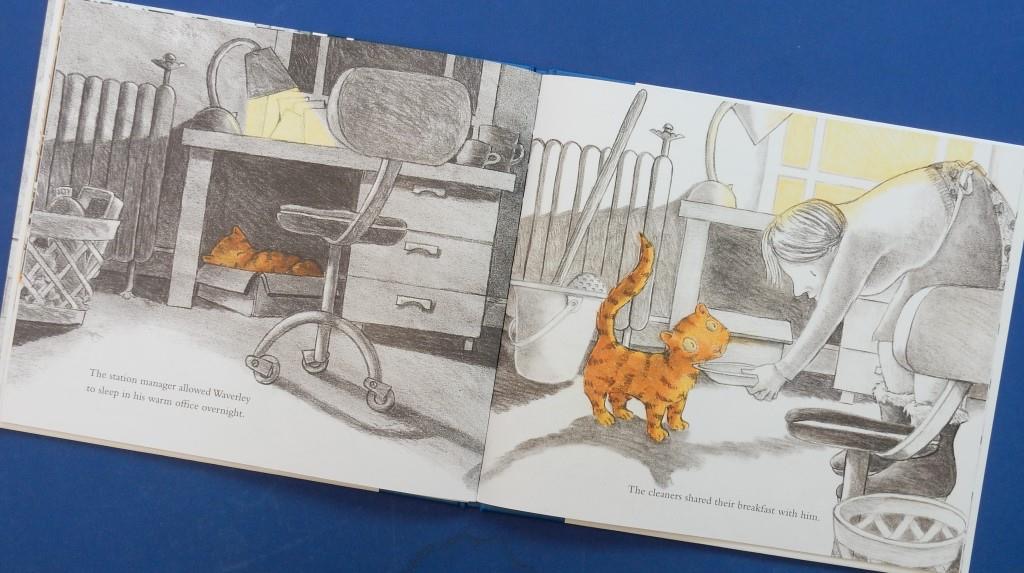
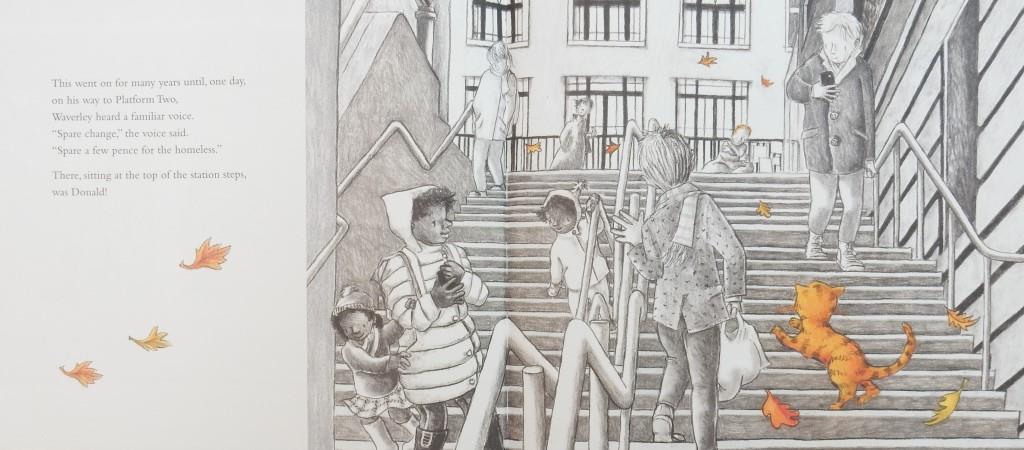
A Cat Called Waverley

A Cat Called Waverley
Debi Gliori
Otter-Barry Books

Born in a park in Edinburgh, moggy Waverley has learned much about life, not least being how to make friends, his very best friend being Donald with whom he has supper every night for years.

Then one day Donald packs his bag and leaves his place of residence instructing Waverley to stay behind. One after another, all the cat’s other friends vanish from his life and unbeknownst to Donald who is at war,

his house is demolished.

What next for Waverley?

Off he goes to the railways station to wait for Donald. He waits and waits and it’s not long before people notice him, take photos and even bring him food, though he allows nobody to pick him up.

But despite the kindnesses shown by the station staff, nothing assuages his loneliness. Indeed Waverley misses his best pal more and more over the years.

Then one day as he makes his way down onto the platform, the cat hears, “Spare change. Spare a few pence for the homeless.” Surely that familiar voice belongs to his beloved Donald?

Debi’s story is written and illustrated with such empathy and sensitivity, it will surely bring a tear to your eye as you turn the pages of this book. Perhaps even more so when you read at the end that it’s about a real homeless war veteran for whom she wrote the book (as well as for all the countless other homeless people who share our world.)

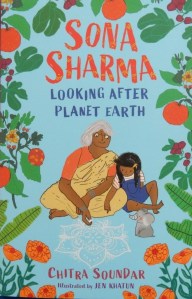
Sona Sharma: Looking After Planet Earth / Leo’s Map of Monsters: The Frightmare

Sona Sharma: Looking After Planet Earth
Chitra Soundar, illustrated by Jen Khatun
Walker Books

It’s great to have young Sona Sharma and her extended family back in another story. Now Sona is alarmed when she hears how much humans are doing to damage Planet Earth as her class talk about global warming, plastic pollution, deforestation and more and after the lessons she and her classmates all sign a pledge to do their bit to look after Planet Earth. Sona resolves to enlist the help of all her family members too, although once home she finds Paati (grandmother) is very preoccupied with perfecting her kolam designs in preparation for an upcoming competition.

Nonetheless, on Saturday Soma sets to work on her caring for the planet plan but her over-zealous electricity saving soon has other family members just a tad irritated, not to mention the disappearance of baby sister Minmini’s nappies.

Time for a family Panchayat as Sona’s grandfather calls it, to look at Sona’s list of changes to be made. There are some compromises but everyone seems satisfied with the outcome of the discussion and Sona goes to school clutching a plan she’s happy about on Monday morning.

That evening however, things happen that make her anything but happy and as a result some high drama ensues. The day ends well though but a new day brings another challenge for Sona when she resolves to get the use of chemicals, plastic and glitter banned in the kolam competition. 

Will she succeed? It might just require a miracle …

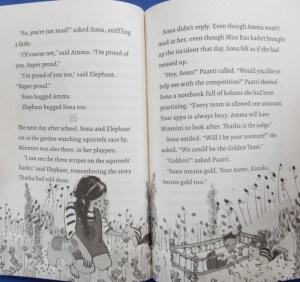
I’m an even bigger fan of Sona after this story: she’s certainly a force to be reckoned with. Her enthusiasm and determination are admirable even if they do get her into some tricky situations. I love too the way Chitra has woven into her narrative an explanation from the Ramayana of why the Indian palm squirrel has three stripes.

Jen Khatun’s line drawings are a delight; it’s great to have one, (often containing fine detail) on every spread.

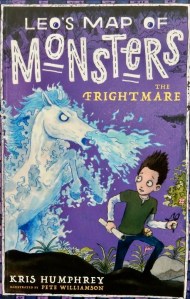
Leo’s Map of Monsters: The Frightmare
Kris Humphrey, illustrated by Pete Williamson
Oxford Children’s Books

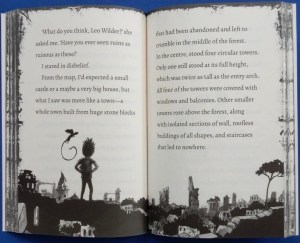
Leo’s role as apprentice to the Guardian, Henrik, is to protect the village from any monsters that lurk in the encircling forest while keeping his job secret. Even if receiving a summons from Henrik means curtailing his enjoyment of the Spring Festival being celebrated as this story opens.

It’s as well he’s just demonstrated his target hitting prowess at the festival; he’s certainly going to need it in this assignment; but is the truth about his job in danger of being revealed when his close friend Jacob decides to help?

There’s only one thing to do according to The Guardian: Leo must urgently obtain a hair from one of the ghostly Frightmare’s tails before the end of the night. Not a problem then, except that these monsters haunt the higher mountain passes protecting their territory by breathing deadly blue fire from their nostrils.

Can Leo succeed? Perhaps with map in hand and the assistance of his Leatherwing friend, Starla. 

However as he soon discovers, these Frightmares have an unexpected power that will make his task even more difficult: that and the fog. But as Leo tells himself, ‘failure just wasn’t an option’ …

Established fans of the series will eagerly join Leo in this new, splendidly written and illustrated adventure that’s packed with thrills, action and atmosphere. Newcomers will quickly find themselves sucked into the intriguing story too and also enjoy the map and concluding illustrated fact files.

When I Was a Fairy

When I Was a Fairy
Tom Silson and Ewa Poklewska-Koziello
Flying Eye Books

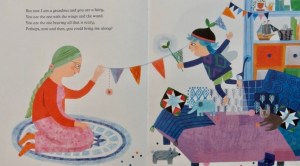
A grandmother shares reminiscences with her grandchild about the days back when she was a youngster. “When I was a fairy, I lived in an ancient willow, / Inside a homely hollow with a round red door. / When I was a fairy I slept on dandelion pillows. / Back when I was a fairy, do you want to hear more?” 

She goes on to talk of summers spent leaping over lily pads,

meandering through meadows, gathering blackberries, meeting up with all the other fairies to share letters from children. Then in winter, skating on snowflakes and painting holly berries. 

Those were times when everything was possible and days were for exploration.

And so it can be once more, only now it will be in the company of her grandchild for whom as yet, untold adventures await. 

So, invites gran, “Let me show you … clap your hands, flap your wings and come fly with me.”

With magical creatures aplenty adorning the pages so richly illustrated by Ewa Poklewska-Koziello, this rhyming tale of intergenerational love, memories and delighting in the natural world is a lovely one to share especially between grandmothers and their young grandchildren, particularly those who like stories with a touch of whimsy and enchantment.

Let’s Get Ready for School

Let’s Get Ready for School
Jane Porter and Carolina Rabei
Walker Books

Meet Marley, Maya, Theo, Akiko, Ella and Zakir. These young children are about to experience one of the most important days of their lives: they’re starting school. Yes it may well feel exciting but that feeling is perhaps tinged with nervousness too.

The little ones share with readers, not only their feelings but their actions as they make themselves as ready as possible, trying to do such things as putting on their own coats and shoes and opening their lunch containers.
Then come two questions: ‘why do I have to go to school? and how will I get there?, both of which are answered with a spread for each.

Safely at school, there are lots of new faces.

We see them meeting their teacher and getting to know what happens in the classroom; how best to become a member of a largish group – working in a team, taking turns, how carpet times operate and more.

One of the most important lessons is a social one: accepting and understanding difference among your classmates and always being kind no matter what.

Then there are routines that help the day go smoothly: snack time, lunch time and playtime.

Not every single day will be the same however – sometimes there are special occasions to look forward to, but before you know it, the entire first day will have whizzed by and it’s home-time. Your grown ups will be waiting, having wondered about how you’ve got on and you may well be bubbling over to tell them all about it, or perhaps you aren’t ready to share your experiences just yet: it’s up to you.

With Jane Porter’s reassuring narrative (including a ‘worry page’), the plethora of speech bubbles and Carolina Rabei’s realistic illustrations of classroom life (why no story time, I wonder), this book will certainly be one to share in those days leading up to that big step, especially as due to the pandemic, youngsters may not have had those taster sessions normally offered before a child starts school.

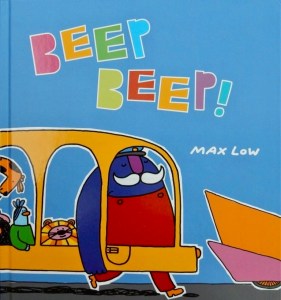
Beep Beep!

Beep Beep!
Max Low
Otter-Barry Books

Prepare yourself for a very noisy book session when you share this with little ones.

Not only will they relish beeping along with driver Big Bobby’s yellow bus – punctual as always, but there’s also Friendly Fern’s fire engine NEE NAWing its way to the rescue, Tremendous Tracy’s tractor

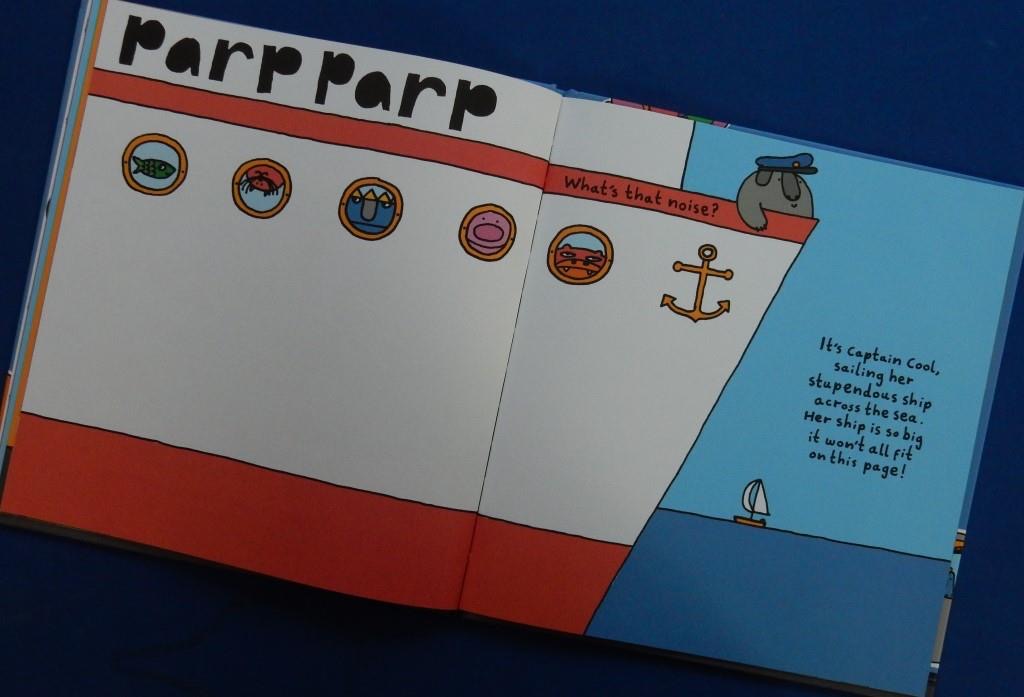
and Little Lemmy’s extremely lengthy limousine driven in a novel way by the owner. Then who could resist the offer of a spin in that sports car belonging to Super Speedy Susan – once she gets through those traffic lights, of course; or perhaps a ride on board Trudy’s spotty train. If you reach the sea, there’s always the enormous parp parp-ing ship with Captain Cool at the helm.

However if your preference is for flight, then why not accompany Harold in his helium balloon, RWAAAR! off with Jennifer in her jumbo jet (along with a host of feathered friends), or maybe if you hear that WUM WUM of Zappy Zurgle’s spacecraft you’d like to join the alien in a spin around the galaxy.

Hey! They’re all offering a lift so if you could only pick one, what it might be. Think I’d stick with that moggy character on the final page: now what would that entail?

With Max Low’s characteristic playfully quirky illustrations and all those sound making opportunities there’s plenty to entertain young audiences here.

Nikhil and Jay Save the Day / Nikhil and Jay The Birthday Star

Nikhil and Jay Save the Day
Nikhil and Jay The Birthday Star

Chitra Soundar, illustrated by Soofiya
Otter-Barry Books

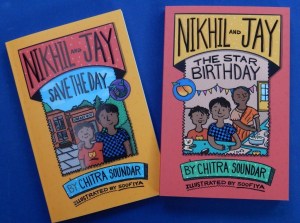
The main focus of these two delightful books of short stories is preschooler, Jay and his elder bother Nikhil. Jay finds it frustrating when he cannot do all that his brother can – climbing the apple tree in their garden and lifting up Nana’s heavy bag, for instance. However, when it comes to blowing out his birthday candles and cutting the cake, he’s ready to accept a bit of brotherly assistance, both of which enable him to adopt a ‘we do’ attitude. That story is in the first book. 

There are also episodes telling of a visit to Grandpa and Nana’s home without the green story dragon that Grandpa bought for Jay; then comes the weekly pancake making day when Amma makes the dosa that the boys love so much. Again patience is needed on behalf of Jay whose eyes might prove to be bigger than his tummy. (At the back, Chitra has included a recipe for those, and chutney especially for those who fancy trying to make their own, ‘ the Chennai Granny way’).

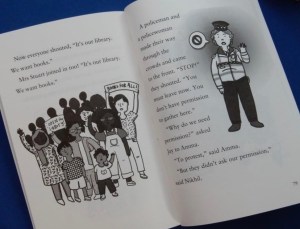
The final story tells what happens when the boys make their regular Saturday visit to the library and discover it’s closed ‘forever’ 

– or is it? Perhaps not when the local community gets involved in a protest.

In The Star Birthday, there’s huge excitement in the household as Granny and Grandad from Chennai come to stay. 

One of the first things they do is take the boys to the nearby Indian market to buy fruit and vegetables. Seemingly they ate the mangoes in similar fashion to the way my partner does (although he doesn’t sit in the bath) but he does suck the contents through the peel having made a hole in the top.

After Granny and Grandpa have stayed a week, it’s only one more before it’s time to celebrate Nikhil’s birthday. So why does Granny insist they celebrate on that particular Saturday, calling it a ‘Chennai birthday’ and not on the following week?

Then all four grandparents and the boys plan a visit to the park but first they have to make sure they have the right things to carry the food in – definitely no plastic; and the boys conclude that it’s the best picnic ever.

In the final story the boys prepare to bid farewell to their Chennai grandparents but there’s talk of them paying a visit to Chennai at Christmas. Perhaps this might be the topic of the next book – I hope so. 

It’s lovely to see these books for newly independent readers (or for reading aloud) starring a British Asian family. Chitra draws on her own South Indian background and the stories are illustrated with gently humorous line drawings by Soofia on every page.

Ergo

Ergo
Alexis Deacon and Viviane Schwarz
Walker Books

For me there’s nothing worse than feeling trapped between the walls of my home however safe and secure it might be. And I suspect most of us have experienced some claustrophobic feelings during the last sixteen or so months, though I’m lucky to be living at present in the countryside surrounded by green spaces that I’ve taken advantage of no matter the weather. Hurrah for the big wide world waiting outside your immediate cosy environs, both physical and mental.

So let’s now meet the aptly named Ergo, a cute baby chick that’s just woken up to her own physicality. She decides to explore the world: first she finds her toes, ‘wiggle, wiggle ‘ now that’s a GREAT START and it’s followed by wings, beak and legs. Now that’s a small world: AM I THE WORLD though?

Ergo concludes that she is. Until she notices the wall surrounding her – a roly poly world then.

Suddenly into this hitherto perfect world intrudes a sound – BUMP and it’s closely followed by a realisation. Time to embark on a journey of discovery perhaps …but it’s going to take some pluck to reach out. Can Ergo make that vital truth searching move? …

What Alexis Deacon and Viviane Schwarz have so cleverly created here is a philosophical demonstration of freeing oneself, of going beyond the information given and of reaching out to others. Seemingly simple perhaps, but this is a highly thought-provoking and a smashing starting point for a philosophy for children discussion in the primary classroom.

Caterpillar Cake

Caterpillar Cake
Matt Goodfellow, illustrated by Krina Patel-Sage
Otter-Barry Books

This is performance poet Matt Goodfellow’s second poetry book and it’s aimed at younger children. Embracing a wide range of topics in his sixteen poems – playing on the beach, space, wild animals, play, movement,

school related things – a visit from the school photographer, a classroom carpet session for instance, as well as things related to the natural world. Here are the opening verse and the final one of My Shell: ‘there is a shell / alone on a beach / over the sand-dunes / out of my reach // we’ll sing of the sun / and the salt and the sea / together forever / just my shell and me’.

Perfect for reading aloud to young children and once they’re familiar, perhaps those in KS1 could read some to one another. Which ever you do, take time not just to enjoy Matt’s writing but also debuting illustrator Krina Patel-Sage’s inclusive, vibrant digitally created illustrations. So, if your taste is for pebble skimming, a slice of chocolate caterpillar cake, the smashing word play of Kitty Cat, or a gentle River Lullaby at the end of the day, you’ll find it herein.

If you want to engender a love of language, this is definitely one to add to early years settings, KS1 classrooms, and family bookshelves (if you have little ones).

The Viking Who Liked Icing

The Viking Who Liked Icing
Lu Fraser and Mark McKinley
Bloomsbury Children’s Books

Here’s a story set long, long ago and far, far away.

When it comes to the traditional Viking skills or indeed anything else that requires some kind of sporting finesse, Nut, in contrast to his big sister Leaf, falls well short of the mark. Indeed whenever he picks up his bow and arrow, everyone else takes cover. He’s not entirely without talents however: he’s passionate about baking cakes and does so with lashings of creativity, dreaming about so doing at night too.

There’s one day in the Viking calendar that young Nut dreads more than any other: Viking Sports Day has him shaking in his boots. Nonetheless off he goes, cake in hand to the venue, a reluctant participant if ever there was one.

Things go pretty disastrously

and then comes the Great Horn-Throwing Race …

Is there any way Nut might redeem himself?

With its combination of Lu Fraser’s dramatic rhyming narrative and Mark McKinley’s hilarious scenes of Nut’s sporting ineptitude as well as his mouth-watering confections, and the other characters’ reactions to both, this is a fun demonstration of the fact that everybody has a talent that will win through if nurtured. That way lies happiness.

This will surely be a hit with young listeners at school or at home.

Tilda Tries Again

Tilda Tries Again
Tom Percival
Bloomsbury Children’s Books

Tom Percival’s latest addition to the Big Bright Feelings series is yet again spot on: herein he uses his empathetic understanding of young children’s emotions to present Tilda.

We first meet this little girl as a bright happy child but then suddenly something happens to turn her world upside down, leaving her feeling utterly downcast. Now things that had once seemed easy, feel the absolute opposite: she doesn’t want to meet her friends; indeed everything feels a struggle.

What does she decide to do? Absolutely nothing at all.

One day she notices a tiny ladybird stuck on its back. Immediate recognition but there’s a difference: the ladybird is doing its upmost to put itself right whereas thus far Tilda has suffered complete inertia. Then suddenly the little creature flips itself over and flies away leaving Tilda alone with her thoughts.

Time for a change of perspective she decides, and calling forth that ‘can-do’ attitude, little by little she starts to persevere with things and the more she tries, the more she can do. But can she summon up the courage to join her friends in their play?

You bet!

An enormously uplifting story of patience, perseverance, resilience and self-belief that youngsters (and their adults – be they parents, teachers or carers) will relate to.

Tom’s change of palette from bright colours to predominantly grey shows the stark changes in Tilda’s emotional journey; and with everything that youngsters have been through during these last 18 months, this book could not be more apposite.

A must have for family bookshelves and classroom collections.

Curious Creatures: Glowing in the Dark

Curious Creatures Glowing in the Dark
Zoë Armstrong and Anja Sušanj
Flying Eye Books

Author Zoë Armstrong and illustrator Anja Sušanj take us close up to some of the world’s most incredible animals – some of those that are bioluminescent and others that are biofluorescent.

The former use chemical reactions to create sparkles, flashes and flickers of light within their bodies by mixing together two chemicals luciferin and luciferase plus oxygen. This is then shown in a variety of ways. Some creatures including two earthworm species one from New Zealand, the other from the American South ooze a gooey gunk. The New Zealand species dribbles orange goo, the American, blue.

In contrast there are sea creatures such as Flashlight fish that use the bioluminescence of glow-in-the-dark bacteria they carry around and can switch on and off in the blink of an eye. Amazing! Amazing too is the fact that beneath the sea around the Florida coast over three-quarters of the marine creatures glow in the dark, using light to communicate.

It’s not only marine animals that use light to signal to one another. I once spent hours over many evenings in the hills near Dharamshala, fascinated by the myriads of fireflies flickering in the evening dark after a rainy day. In this book, the author focuses on those found at the forest edge in Japan; apparently there are over 2000 species of firefly around the world.

Biofluoresent creatures such as scorpions that are nocturnal, need to absorb invisible ultraviolet light from the Sun (or Moon) in order to glow.

However, so we read, this whole phenomenon is ‘something of a mystery’ and increasing numbers of familiar creatures, so scientists are discovering, are able to glow in the dark.

Having presented all these amazing animals, it’s exciting to read that scientists are making use of both bioluminescence and biofluorescence to research new ways to track diseases moving around the body, as well as looking at ways to save energy and to test for pollution. WOW!

Beautiful illustrations and a highly readable text make this a book for KS2 readers either in the classroom or at home.

The Gingerbread Man/ Let’s Play, Daddy Bear!/ Manju’s Magic Muddle / Fizzy and the Party / A Hundred and One Daffodils

These are new additions to the Bloomsbury Education Young Readers series (one per band Turquoise, Purple, Gold, White, Lime) which aims to help children towards becoming independent readers. Thanks to the publishers for sending them for review:

The Gingerbread Man
Kandace Chimbiri, illustrated by Richy Sánchez Ayala
Let’s Play, Daddy Bear!
Dawn McNiff, illustrated by Andy Rowland
Manju’s Magic Muddle
Chitra Soundar, illustrated by Verónica Montoya
Fizzy and the Party
Sarah Crossan, illustrated by Nicola Colton
A Hundred and One Daffodils
Malachy Doyle, illustrated by Denise Hughes

In The Gingerbread Man, Kandace Chimbiri gives her lively telling a Caribbean flavour with this wonderfully aromatic character being chased by its old lady baker, an old man, a clutch of chickens, a horse, and a scary looking dog to the river’s edge. There however, it’s a monkey that beguiles the little fellow into accepting a lift across the water and ever closer to his mouth, but will the runaway end up being consumed?
Look closely at Richy Sánchez Ayala’s illustration showing what the baker of the runaway is holding.

Let’s Play, Daddy Bear! is a warm-hearted story with equally warm illustrations of a young bear that spends weekends at her father’s home where they play fun games like Monster Chase and Daddy-is-a-Big-Climbing Frame. But on this particular weekend Daddy Bear is so busy using his computer that his daughter becomes thoroughly bored with waiting for him to finish his work; and her ‘take notice of me’ tactics only serve to slow him down even more. Will he ever get to the end of his keyboard tap tapping and go outside to play with Little Bear?

There’s more boredom in Chitra’s second story featuring this little girl, Manju’s Magic Muddle. Again her protagonist again makes use of that lamp in her Grandmother’s wardrobe. Now when she summons the genie she learns that he is suffering from a terrible cold that’s having an adverse effect on his ability to grant people’s wishes correctly. Moggy, Cumin is against calling on said genie at the outset and although less than impressed at what he hears in this story feels sorry for the genie and his plight. Especially when it’s revealed that any more errors and the genie will be forever struck off the Genie Register. Can the two of them help sort things out when another call comes in on the Genie-O-Summoner? The genie is in no fit state to go it alone … With its theme of kindness, this is such a fun story with amusing genie mishearing outcomes to entertain youngsters along the way.

Slightly longer is Fizzy and the Party: Fizzy is certainly an apt name for the protagonist herein for she simply fizzes with energy even or perhaps especially at bedtime, which is when Mrs Crumbleboom is having her party.Despite Mum’s words to the contrary, young Fizzy dons her glitzy fairy gear and against Mum’s better judgement heads next door to her neighbour’s garden. Will she be allowed to stay and participate in the fun though? A good many young readers will recognise the bedtime delaying of persuasive Fizzy who provides not only a great rationale for being allowed to attend but continues to sway the situation her way throughout the story.

There are no humans in Malachi Doyle’s A Hundred and One Daffodils; rather it’s an enchanting story of Dusty the fox cub and her search for the appropriate number of daffodil flowers that will enable her and her friends that help her hunt, to enjoy a celebratory party for the first day of spring, just like Dad fox did year after year until he was a grown-up fox. Friendship and determination are key in this one.

All in all these short lively chapter books, with their carefully chosen words by popular authors, and attractive illustrations at every page turn, are certainly going to help a great many children on their way to solo reading. For adults guiding children on their reading journey, there’s a ‘Tips for Grown Ups’ inside the front cover and a ‘Fun Time’ for children at the end.

Amazon River

Amazon River
Sangma Francis and Rômolo D’Hipólito
Flying Eye Books

The author of Everest now invites readers to join her on an exploration of a river that starts as a tiny trickle high up in the Andean Mountains of South America, flows across seven countries and 6,400 km. and has more than 1,100 tributaries.
I was previously unaware that the Amazon comprises three different kinds of water: the fast flowing clearwater, the slowly churning blackwater that moves almost imperceptibly across forested land (the dark colour is the result of leaves that fall and rot at the bottom), and the milky whitewater that looks rather like flowing caramel, the colour coming from a mix of sand, silt, minerals, floating sediment and broken down bits of rock.

Having described the geological features, Sangma Frances moves on to talk about the fact that in the Amazon basin there are three different kinds of river, one aerial, the surface river that is visible, and four km. down and recently discovered by scientists, the Hamza.

There’s a wealth of information about the flora (including 16,000 tree species)

and fauna – great and small – 3000 fish species, 1,300 species of birds, 2.5 million species of insects, assuredly the world’s most incredible ecosystem.

After this comes a legend about a tribal warrior said to have been turned into a huge fish called the pirarucu.

Did you know that the Amazon has been home to human life for 12,000 years, since the last ice age? Or that there are more than 400 indigenous societies in the Amazon, each of which has its own culture, language and traditions and folklore. The story of Naia, queen of the lilies is retold here.

Having described next human life along the river, the author ends by discussing some of the terrible threats faced by the Amazon,

how activists are doing their utmost to protect the precious space and a final plea to all readers to do their bit to help.

The amazing illustrations of Rômolo D’Hipólito really help readers to feel immersed in the wonders of this mighty waterway.

Altogether a smashing cross-curricular resource for schools as well as for individuals interested in learning more about an incredible ecosystem.

The Rainbow Connection / The Happy Mask

Here are two stories very much of our COVID times both kindly sent for review by Little Steps Publishing.

The Rainbow Connection
Vanessa Parsons and Angela Perrini

During the first lockdown in particular, rainbows were an uplifting symbol of hope and a means of saying thank you to the countless key workers who have bravely continued doing their jobs throughout the pandemic. Vanessa Parsons’ story, though set in Australia, is one that youngsters everywhere will relate to. It’s narrator is a little girl who shares with readers her year’s experiences, mostly rainbow related.

Her elder sister creates a lovely chalk rainbow across the family driveway; she spots rainbow drawings in the windows of houses when she walks James, the family dog; her Grandma wears a rainbow badge during a video call. 

Then their new neighbours leave a rainbow hued thank you card. This prompts the narrator to respond with a box of chalks to the newcomers. And so it goes on with more and more people finding innovative, creative ways to use rainbows as a means of communicating positivity. 

The narrator’s family celebrate her little brother’s fourth birthday with a rainbow cake; there’s even rainbow bread in the bakery. And an old lady who lives nearby really surprises everyone with her funky new hair colours.

As the lockdown weeks turn to months, everyone takes advantage of the small things we’d normally take for granted, like being able to go for walks, but most of all they look forward to the return of normal life.

With a recipe for rainbow cake and a promise of 10 per cent of author royalties going to NHS Charities Together, this is a lovely story to share both now, as well as later as a post pandemic memory, be that at home or in nursery/ KS1 classrooms.


The Happy Mask
Aimee Chan and Angela Perrini

Maggie is bored and grumpy about staying indoors during a lockdown but the answer is in her own hands: she can do as her dad says, put on her mask and they can go for a walk to the shops. Eventually after a bad tempered explosion aimed at her dad she changes her mind, puts on what she terms her itchy mask and out she goes into the front garden to wait for Dad to join her. 

She peers over the fence into the next door garden and waves to Holly and baby Tommy but rather than smiling, he starts crying. Who is this strange-looking person peering at him?

But then a game of peek-a-boo reassures the little boy and by this time Dad is ready to leave. Maggie tells her dad about what just happened, complaining about her mask again and commenting, “And masks make people look mean.”

Dad has an idea and goes indoors again returning with a mirror and some marker pens and before long Maggie’s mask is transformed, her mood too. 

Comments from others on their walk lead to more masks being personalised by their owners. One such belonged to a friendly old lady sitting waiting for a bus who tells Maggie she’s trying to remain upbeat despite having not seen her grandchildren for ages. The girl’s suggestion excites the old lady and she gets to work using Maggie’s markers and mirror. 

What do you think her Dad might draw on his mask when they arrive back home after their walk?

Certainly this should bring a smile not only to young listeners but also their adult sharers: both are likely to have felt very much like Maggie and her Dad during lockdowns. This makes the story a great conversation starter as it gives both the child’s perspective and that of a parent.

Illustrator Angela Perrini uses a lot of different perspectives in her urban environment, showing effectively how social distancing is maintained between Maggie and her neighbours. Then in interactions with others outside her immediate family, there’s mention of hand sanitiser being used.

Delightfully Different Dilly

Delightfully Different Dilly
Elizabeth Dale and Liam Darcy
Happy Yak.

Meet Dilly the adorable baby penguin that’s born with a difference: she has only one leg and so doesn’t do things quite the same way as the other little penguins. Instead of waddling she hops and revels in so doing, impressing the other little ones who try to emulate her with only a modicum of success. However they all have fun together

and Dilly’s difference is totally accepted by the young penguin generation as well as her parents.

Not so the other parents however: set in their ways and with a narrow view of life, they upset Dilly by thoughtlessly telling her to stop being different.

Then Dilly gets an opportunity to demonstrate to all the adult penguins just how awesome her difference makes her: indeed she becomes a superhero and in so doing shows the entire colony how much diversity should be valued.

Despite its chilly setting, with its theme of acceptance, Elizabeth Dale’s is a warm-hearted story to share and discuss with little humans. Liam Darcy’s illustrations are splendidly expressive and gently humorous perfectly complementing the text.

Harriet’s Expanding Heart

Harriet’s Expanding Heart
Rachel Brace and Angela Perrini
Little Steps Publishing

Harriet’s mum and dad are separated and for the little girl that means that in addition to two parents, she has two homes, two different bedrooms, one school and a cat Ginger. Moving between the two homes also means she has to cope with two different sets of rules and routines. No matter what though, she always feels both much loved and safe.

Then one day on a visit to her dad’s, he shares some news: he and his new partner Emily are going to move in together. ‘We’re going to be a step family,’ he tells his daughter. For Harriet this also means a new little stepbrother, Cooper. This announcement leaves her feeling apprehensive and anxious. There follow explanations about what this all means that only leave Harriet with a whole lot of worries whizzing around in her head: what if Dad chooses Emily and Cooper over me? being just one.

After the move some things change, others remain the same for Harriet who experiences feelings being an outsider and sometimes even anger.

It’s going to take time to get used to living with a grown up who isn’t either your mum or dad.

However, little by little with sympathetic understanding and reassurances from her Dad, Harriet begins to feel much less anxious and as her mum explains, ‘there is no right or wrong way to feel’ but no matter what, both her parents will continue to love her very much. She in turn gradually sees that being a member of a stepfamily doesn’t change how much she loves her mum or her dad; it’s more that her heart, along with her family has grown a little bit bigger.

Written by a family psychologist, Rachel’s story, with its straightforward easy to understand language, is especially apposite for new stepfamilies where there are young children. (The author also gives some helpful tips for parents and stepparents.) Angela Perrini really captures the gamut of emotions Harriet experiences during the upheaval in her life.

Wild Child

Wild Child
Dara McAnulty and Barry Falls
Macmillan Children’s Books

This is such a beautiful book written by award-winning author of Diary Of A Young Naturalist and gorgeously illustrated by rising star, Barry Falls.

With his distinctive voice, Dara McAnulty invites readers to take a close look at the world around, journeying into and exploring with all your senses, the five different locations that he describes both poetically and scientifically.

First off is a look through the window, after which we go outside into the garden, wander in the woods, saunter up onto heathlands and meander along the riverbank. At each location we pause while Dara provides a lyrical introduction to the habitat followed by a wealth of factual information about the wildlife – both flora and fauna – to be found there.

This includes a discovery spread where in turn, you can learn the collective nouns for eleven different birds,

take a look at classification, find out how various trees propagate

and about migration and metamorphosis.

An activity to do once you get home concludes most sections: make a bird feeder, make a terrarium, create a journey stick (I love that).

Assuredly this will help any reader, young or not so young, connect more deeply with the joys and wonders of the natural world, and find their inner wild child.

The author finishes with some sage words about the fragility of nature and caring for the countryside, plus a glossary.

Altogether a smashing book for families and schools.

The Moose Fairy

The Moose Fairy
Steve Smallman
Happy Yak

Moose has always yearned to be a fairy so he’s over the moon when he spots a sign advertising for new members of the Secret Fairy Club.

Having put together what he thinks is the most suitable gear and donned same, he feels totally fabulous. Until that is, he arrives at the venue and realises that he dwarfs all the other potential members, some of which are anything but welcoming. Not so however the head fairy who invites him to do the tests along with the other would-be joiners.

With admission to the club gained Moose needs to use the secret knock to open the door of the clubhouse but although he succeeds in so doing, the door is so tiny, he can’t fit through and the others merely shun him.

Poor Moose walks sadly away and takes a dip in the river, hoping to shrink himself. There he encounters Fox with whom he shares his problem and rather too much other information.

Back inside the clubhouse, some of the other creatures are now seeing the error of their ways when suddenly an unwanted intruder arrives and just manages to squeeze himself through the door.

Perhaps now Moose has an opportunity to show he’s a true fairy no matter his size. A fairy that lives up to the oath: ‘Fairies are kind to all creatures, / Fairies are not mean or bitter, / Fairies help others in trouble or need …’

With its mix of humour, hope and determination, Steve’s heartwarming story about being yourself and accepting others unconditionally no matter their appearance is a delight to share. Moose is a smashing character splendidly portrayed by the author whose quirky, vibrant illustrations are a mix of suitable silliness and sparkling enchantment. And I absolutely love Steve’s wise words in the dedication to his grandchildren.

The Battle for Roar / A Super Weird! Mystery: My pencil case is a time machine

Two recent fiction books from Farshore kindly sent for review

The Battle for Roar
Jenny McLachlan, illustrated by Ben Mantle

The superb Land of Roar fantasy series comes to a gripping conclusion in this utterly enchanting adventure that sees twins Rose and Arthur travelling to a group of islands far beyond everything they know: beyond The End.

There’s a storm, a shipwreck, you’ll meet fanged fairies, a possible dragon egg, there are secrets aplenty and prepare to be surprised, shocked even.

To say it’s action-packed is something of an understatement; it’s humorous in parts, pretty scary in others, a wonderful demonstration of the redemptive power of teamwork and a veritable ode to the power of the imagination.

Altogether an absolutely perfect ending to a brilliant trilogy. I gobbled it up in a single sitting, along with a few marshmallows (not magical ones) and a mug of hot chocolate.

A Super Weird! Mystery: My pencil case is a time machine
Jim Smith

Having coped with the Danger at Donut Diner and the Attack of the Haunted Lunch Box, Yoshi and his friends Melvin Pebble and Rhubarb Plonsky have another mystery to solve. If he can manage to tear himself away from his phone that is, for like most youngsters, Yoshi has of late, let his phone take up much of his time, particularly uploading his videos onto Donut Tube.

Enter Yoshi’s dad bringing a shoebox containing the ‘smelly eraser collection’ from his own childhood (we’ve all had them) and thus begin some seriously surreal happenings necessitating some serious sleuthing from the three young detectives.

But that’s getting a bit ahead of things so let’s go back to where the three are in HQ aka Brenda the Hut and Yoshi finds an ordinary non-smelly eraser on one of the shelves therein, names it Brenda too and adds it to other smelly erasers now in his pencil case. Then at Rhubarb’s behest he pulls out a dinosaur-shaped one for her to sniff. Uh-oh! Time slip alert!

Seems the pals have just whiffed themselves back to the age of the dinosaurs and that T-Rex doesn’t look too friendly.

All is not lost though for they’ve still got the rest of the smelly erasers. Perhaps one of those can get them back to their own time but then what? …

Well that would be telling, and I’ll leave Jim Smith’s young narrator to do that in his own inimitable way and merely say that what follows is seriously silly and huge fun especially with daft cartoon style drawings adorning every spread adding to the overall wackiness.

The Bookshop Cat

The Bookshop Cat
Cindy Wume
Macmillan Children’s Books

In rising star Cindy Wume’s new book we meet a bibliophile black cat.

One day, while out exploring the city, said young moggy lands his dream job at the children’s bookshop thus acquiring his titular name too. He’s certainly an ideal assistant and before long proves himself both to his family who had despaired at his insistence on putting reading before achieving, and to the shop’s young customers for each of whom he manages to find just the right book.

Then one morning, disaster strikes: torrential rain causes the pipes to burst and a flood in the bookshop; outside is also under water. The result is that for several days nobody at all comes to the shop: both young Violet the owner’s grandaughter and the Bookshop Cat are thoroughly downcast.

Back at home, the Bookshop Cat’s family decide to pitch in and help. Happily Violet comes up with a wonderful idea:

if the children don’t come to the bookshop, the bookshop must go out to them. Indeed the entire city is transformed into a library and not only that, the workers find a way to get the customers back into the shop. Hurrah!

It’s an absolute delight with superb detailed illustrations; and what a wonderful demonstration of the power of reading, of books and bookshops, as well as an affirmation of the Bookshop Cat’s words early on in the story, “With a book, I can go anywhere and be anything.”

Aziza’s Secret Fairy Door / Mirabelle’s Bad Day

Aziza’s Secret Fairy Door
Lola Morayo, illustrated by Cory Reid
Macmillan Children’s Books

This is the first of a sparkly new series starring Aziza who is fanatical about all things fairy; she’s even named after a type of fairy creature from West African folklore.

On the day this tale unfolds, Aziza is celebrating her birthday and is especially excited by the mysterious parcel containing a fairy door with DIY instructions, that arrives from she knows not where.

The intrigue increases when having found a place to stand it (she’s a flat dweller so it’s not easy), Aziza lying in bed that evening hears a knocking sound seemingly coming from the other side of the decorated door. When she touches its knob, the door opens and she finds herself transported to Shimmerton where she soon makes friends with Princess Peri and nose-twitching shapeshifter Tiko. 

Just the characters she needs to help her take on the Gigglers aka Kendra, Noon and Felly who take possession of the doorknob thus leaving Aziza trapped in Shimmerton without her only means of returning home. This threesome need to learn a few lessons, not least about taking things that don’t belong to them without asking and about kindness and fairness.

With the help of her new friends, will Aziza manage to make it back to her family?

By creative duo Tólá Okogwu and Jasmine Richards writing under the pen name Lola Morayo this is a thoroughly engaging magical story about perseverance and earning respect among other things, that’s just right for new solo readers. In their fantasy setting, they introduce readers to a diverse host of fascinating characters not least a curmudgeonly anthropomorphic clock and a talking unicorn shopkeeper. 

Cory Reid’s black and white illustrations have an appropriate quirkiness about them and are a perfect complement for the text.

I’m sure the delightful Aziza will have youngsters eagerly awaiting her next adventure beyond that Secret Fairy Door.

More magic in

Mirabelle Has a Bad Day
Harriet Muncaster
Oxford Children’s Books

We all have days when everything seems to go wrong and so it is with half fairy, half witch Mirabelle. She’s actually set herself up for one the previous evening by not putting away her spell ingredients before going to bed, as well as forgetting to bring her broomstick in from outside. 

The day in the title begins when she sees the state of her hair on waking and then at breakfast time learns that her brother has finished the rose petal fairy flakes leaving her no option but to have some of the batwing porridge her mum’s made instead. And as for her broomstick …

From then on things get even worse: she arrives at school late and sopping wet, her best friend is absent and she can’t join in the playground games on account of her over large borrowed attire.

Later, at home even bigger disasters are waiting to happen, in part due to the transformation potion Mirabelle made in class, a portion of which she was allowed to bottle up and take home; 

that and the fact that her infuriating brother has gobbled every single one of the remaining chocolate biscuits and is playing with her pet dragon.

Will Mirabelle end up going to bed in a foul mood or will things get better before she closes her eyes?

This enchanting book with its dramatic illustrations ends with some magical Mirabelle extras including a recipe for witchy cakes.

Established fans will likely gobble this (not the cakes) in a single sitting and Mirabelle is sure to gain some new followers too.

The World Awaits

The World Awaits
Tomos Roberts and Nomoco
Farshore

I received my review copy of this book on what is supposed to be ‘freedom day’ here in England at least. Assuredly this follow-up to The Great Realisation, is a book of our time. Herein poet Tomos Roberts offers a welcome rallying call to action to readers young and not so young asking us to embrace the challenges we still face and to do whatever we can individually and collectively to face the future with positivity and hope.

We see, and hear the voice of an adult rousing a child from slumbers and going on to try and persuade that reluctant young friend to accept the enormous potential within,

to do good spending time doing the things that make life better for others and ultimately perhaps, oneself. It might be planting a tree, calling grandparents for a chat, helping a creature in distress or smiling at a stranger – acts such as these will prevent apathy and negativity taking hold – something that’s all to easy to do, especially if one listens to the news every day or reads a daily paper.

This book with Nomoco’s gentle watercolour illustrations will surely resonate with us all: seize the day: help the world get better step by step, action by action …


Everybody Has Feelings / Respect / I’m the Fire Engine Driver

These are recent titles from Oxford Children’s Books – thanks to the publishers for sending them for review

Everybody Has Feelings
Jon Burgerman

Through his exuberant style illustrations depicting colourful characters of all shapes and sizes in a play park setting, together with a narrative of rhyming couplets, Jon Burgerman presents over twenty feelings that youngsters (as well as zany blobby beings) are likely to experience.

In so doing he acknowledges that it’s perfectly normal to feel say anxious, disappointed,

embarrassed, frustrated, sad or scared as well as confident, calm, proud, and joyful and offers the vocabulary for young children to open up and discuss their emotions as well as listen to others talking about how they feel.

With lots of starting points for circle time sessions, this is just right to share in foundation stage settings especially.

Respect
Helen Mortimer and Cristina Trapanese

This new title in the Big Words for Little People series shows the importance of acknowledging and accepting individual differences and respecting them. It gives examples demonstrating that all lives matter no matter what people look like or believe: that means showing kindness, politeness and abiding by rules. Everybody should feel safe to speak out about their feelings and their lives in general.

Cristina Trapanese illustrates each of the key ideas enacted by a lively cast of characters and Helen Mortimer concludes by suggesting ten things adult sharers can do to get the most from this little book, be that at home or in an education setting.

Add to early years collections.

I’m the Fire Engine Driver
illustrated by David Semple

Here’s a book that allows little ones to switch to imagination mode and step into the shoes of a firefighter, donning the rest of the protective gear, meeting your crew and with siren sounding and flashing lights turned on, driving the fire engine to the scene of the fire in the bakery kitchen.

Part and parcel of the narrative are opportunities for number recognition and counting, joining in with sounds, vocabulary building, following instructions, describing a scene and more.

Through David Semple’s bright, stylistic illustrations and a narrative that makes youngsters feel as though they’re in control, this is a fun book to share either one to one or in a group.

The Mighty Lions & the Big Match

The Mighty Lions & the Big Match
Tom Chapman and Chris Dickason
Welbeck Publishing

I’ve seen first hand both as a teacher and when taking young relations to compete in tennis tournaments, the enormous pressure that some parents put on their youngsters; it’s almost as though the entire thing is about them and winning/success, rather than supporting and giving encouragement to their children. So I think a book such as this debut picture book, written by Tom Chapman (founder of The Lions Barber Collective, a charity for suicide prevention and awareness focussing on the mental health of boys and men) is as important for adults as for young readers/listeners.

The story focuses on young Abel and Drake, soccer players and members of the Mighty Lions team and their cup final match against the Tigers, Abel being the player suffering from acute anxiety even before stepping onto the pitch.

It’s a tense, close match

but the pressure Abel feels from his team members, coach and parents militates against him performing at his best, let alone enjoying the game; and in the end Tigers are victorious.

However, once the brothers explain, their parents are understanding and apologetic, “ … you played your best and that’s all that matters,” Mum says. Dad in turn offers some wise words, “ … Either way, we love you – not the result of the game.”

Chris Dickason’s bright illustrations convey the feelings of all the characters, especially the two brothers, as well showing the on field drama of the match.

Dark Peak / Lightning Strike

These are two additions to Oxford University Press Rollercoasters series published in association with Barrington Stoke designed to build confidence and foster a love of reading in the over 11s less inclined to pick up a book.

Dark Peak
Marcus Sedgwick

Award winning author Marcus Sedgwick has created a gripping amalgam of mystery and mythology (Sir Gawain and the Green Knight particularly) in this first person narrative.

A geography field trip one hot summer includes a visit to Lud’s Church. The pupils are instructed to meet back at a certain time and when that time arrives, everyone is there except Stephen and Stephanie.

Nobody gives credence to Miss Weston’s eight year old daughter who says she saw them being taken away by ‘the little white girl’.

Two of the class members including the narrator Porter are sent off to make a phone call and by the time they return to the group, Stephanie has mysteriously reappeared.

But why the delay in searching for Stephen, a quiet slightly strange individual? And next day back in school, why is nobody mentioning the boy? What has happened to him and will he ever be found?

An utterly enthralling, chilling unputdownable tale that examines notions of consciousness and time, as well as what friendship means.

Lightning Strike
Tanya Landman

With the constant danger of being struck by the dreaded phossy jaw disease like many other people working in the match factory, Eliza the fourteen year old narrator of the story is justifiably angry. Especially since every one of her family works all hours and still they struggle to pay their rent and never have enough to eat. Moreover, with the boss of the factory seldom putting in an appearance, denying the existence of the disease ever affecting his workers, and an unsympathetic foreman, it’s small wonder she’s inclined to rant and rage.

Then one Sunday something happens that changes young Eliza’s life for ever. In the park she hears a ‘posh’ woman making a speech about fairness, social justice and the rights of workers. Thus, much to her parents’ horror, begins her journey as an activist. Now though Eliza has somewhere to channel her anger and her energy.

Although Tanya Landman’s Eliza is a fictional character, her story set in London’s East End in the summer of 1888 is based on fact; and a gripping one it is. Readers will empathise with Eliza, her sister and the other young match factory workers and perhaps be inspired to find out more about the Match Girls’ Strike. That, or become activists for a 21st century cause they believe in: such is the power of this strikingly good story.