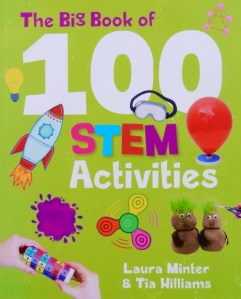
The Big Book of 100 STEM Activities Laura Minter & Tia Williams Button Books
There’s fun learning aplenty in this latest offering from team Laura and Tia. Comprising one hundred STEM activities divided into nine sections, each one is clearly set out with step-by-step instructions and photos to act as a helpful guide. First though, essential reading is an introductory spread that includes a paragraph about safety, one listing craft essentials and another, food items.
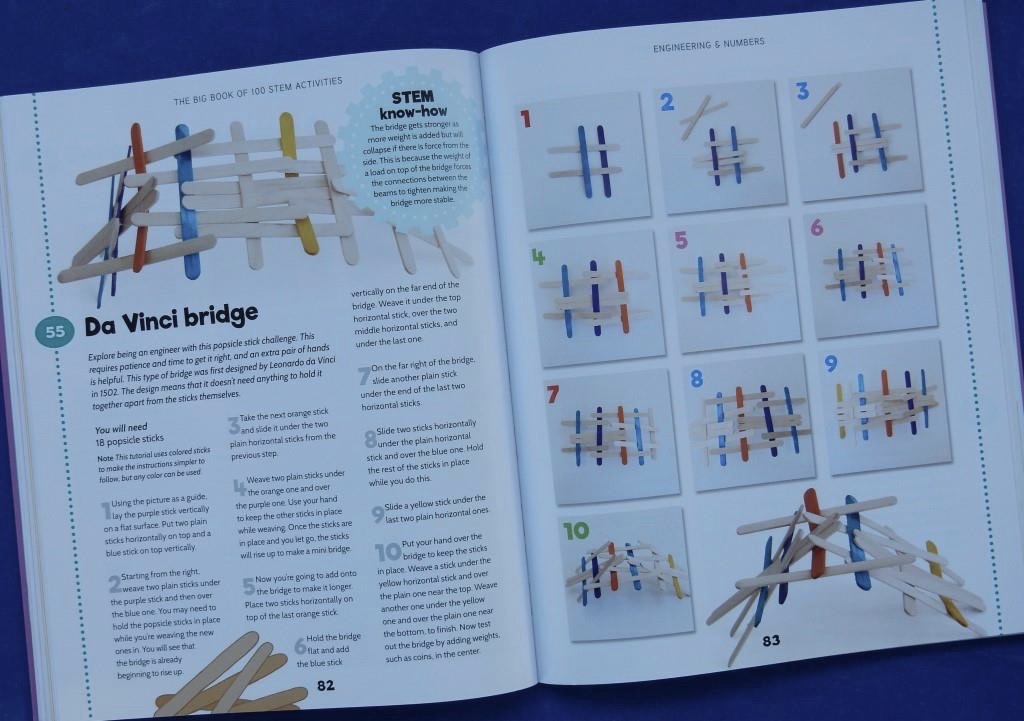
Most of the activities (or variations of them) are familiar to me as a primary teacher of many years experience and having worked with all ages from 4 to 11, but there are some I’ve not come across before. One such is the Da Vinci bridge construction from the ‘Engineering & Numbers’ section: this requires nothing more than 18 lolly sticks of the same size, some manual dexterity and patience.
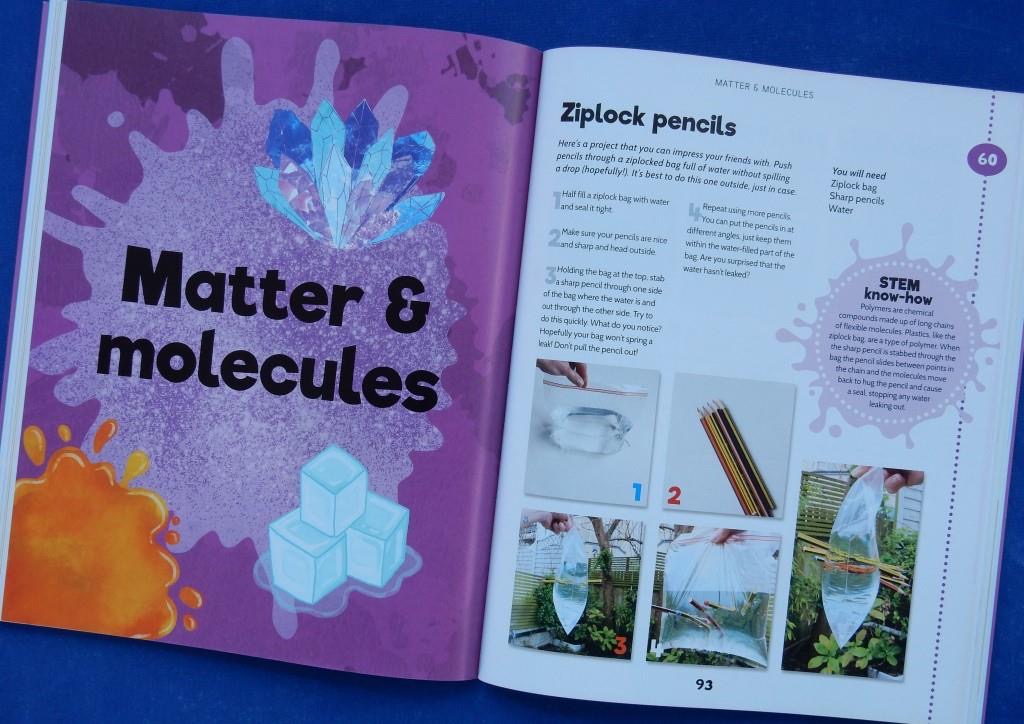
Another from the ‘Matter & Molecules’ section – Ziplock pencils – is best done outdoors for obvious reasons.
Did you know you can make a rocket from a paper straw and find out something about propulsion and air resistance while so doing? This is an activity that might be even more enjoyable if done with a friend or sibling as with two people they could add a competitive element and see who can send their rocket further each time. You’ll find it in the ‘Motion’ section.
With Christmas holidays on the horizon this could be a boon for restless children; it will keep them gainfully engaged away from their screens for a considerable time.
Johnny Ball International Football Genius Matt Oldfield, illustrated by Tim Wesson Walker Books
In this third title in the hugely funny Johnny Ball series, the nine year old football manager has perhaps his biggest challenge yet: to take the Tissbury Tigers all the way to becoming winners of the WORLDIES (aka the World Youth Championships). Just imagine the headlines in the local paper. There’s a big problem though, Johhny’s elder brother, the mega-talented striker Daniel has been injured – a broken tibia – and has been instructed to rest for two months.
However, with their victory in the play-off match, the Tigers are on their way to Capdevila in Spain. Next comes organising their coaching team and after that, the players. With four needed to make the squad complete, it’s time for a team trial. Job done, and with packing also complete, the journey begins.
Arrival means that Johnny’s brain must go into overdrive as the matches get under way. With three results in the group table, the Tigers reach the semi-finals and after a day of rest, must play the Lions.
What happens thereafter, I will leave readers to find out and just assure them that so doing is definitely worth it.
Full of hilarious moments and some nail-biting ones, this story, with Tim Wesson’s rib-tickling black and white illustrations, will most certainly be a winner with young soccer enthusiasts.
The Naughtiest Unicorn and the Firework Festival Pip Bird, illustrated by David O’Connell Farshore
Having missed the Diwali extravaganza, Mira is really excited about the forthcoming firework festival at Unicorn School, especially as she’ll be watching with her unicorn Dave. Once there though, Mira finds out something upsetting: there are to be no fireworks. Surely that can’t be right?
Step forward DI Mira Desai to try and solve this mystery. It doesn’t help matters that Dave has already managed to get himself covered in sticky caramel after immersing himself in the toffee apple mixture in the cauldron; but the investigation must go ahead no matter what. That means Mira and Dave must track down the ‘Lightning Bugs’ that live in the Fearsome Forest. Said creatures love to put on magical light shows with their glowing bums and the key to getting the bugs to perform is to make them laugh. Off go Red Class plus unicorns into the forest …
But what will make those bugs laugh? It’s certainly not going to be straightforward.
With a considerable number of rear end emanations from Dave, this latest episode starring Mira and Dave will provide plenty of fizzing fun and frolics for fans of the series whenever they read it.
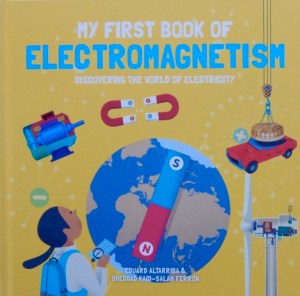
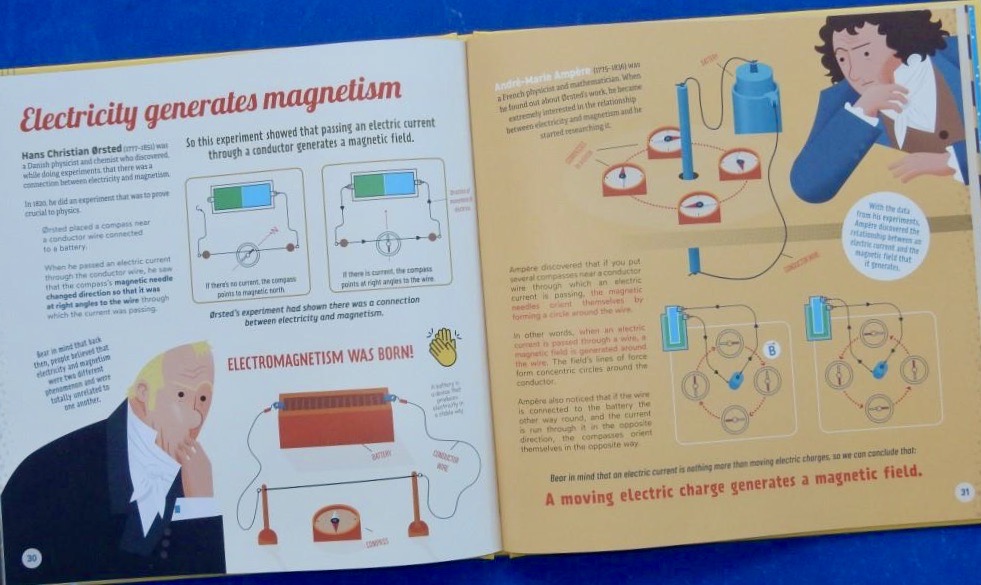
My First Book of Electromagnetism Eduard Altarriba and Sheddad Kaid-Salah Ferron Button Books
In their usual stellar way author Sheddad Kaid-Salah Ferron and illustrator Eduard Altarriba present another STEM topic – that of electromagnetism, broken down into bite-sized portions suitable for primary readers.
In our modern world it’s almost impossible to think of many things that work without either electricity or magnetism but what actually are these physical phenomena and how do they work together? Furthermore, what do these things have to do with light? These and many other questions are explored in this fascinating book.
To relate the story of electromagnetism and our developing understanding of it, the author takes us way back to circa 600BCE to when Thales of Miletus’s first experiment with magnetic attraction when by rubbing a small piece of amber on some fur, he noticed a strange force that could attract small pieces of straw. Moving on we encounter Benjamin Franklin, an 18th century American scientist who worked on the idea of electrical charge in his experiments.
Until the work of Ørsted and of Ampère people thought electricity and magnetism were unrelated; those two experimented during the latter part of the 18th and first half of the 19th century.
That brings us right through to Michael Faraday and James Clerk Maxwell unifying the fields of magnetism and electricity to develop the theory of electromagnetism. Because of Faraday’s poor background, what was his original idea was left to Maxwell to write the four famous basic equations describing all electric and magnetic phenomena.
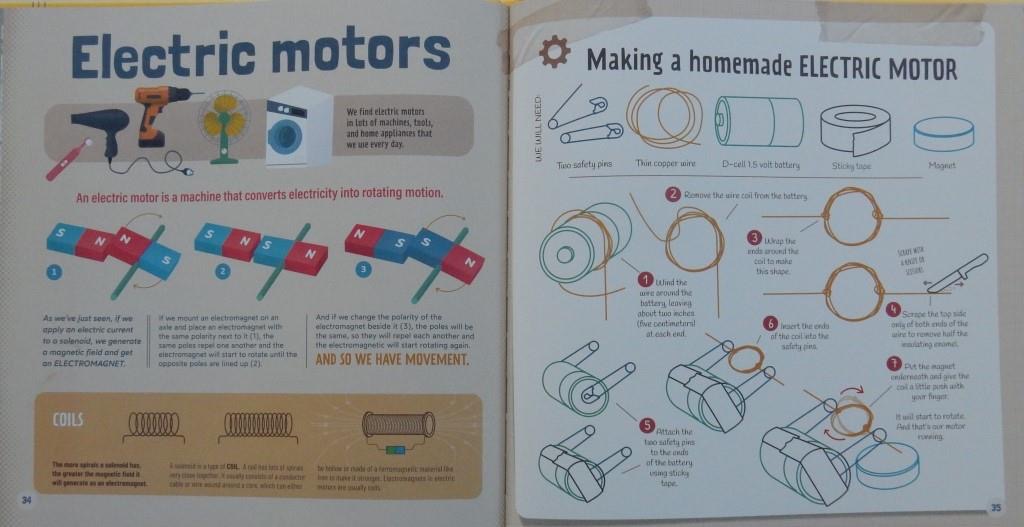
At intervals during this exciting account, readers can pause and do some experiments for themselves. These include making an electroscope to test for electric charge, creating a homemade battery and constructing a working motor.
It’s not simple science that’s described herein but it’s made accessible, engaging and exciting for children, and is presented in a way that will help them understand. Using his design background, Eduard has created enticing illustrations and helpful info-graphics to complement the text.
Recommended for budding scientists either at home or in school.
These are two small books from Gecko Press – thanks to the publisher for sending them for review
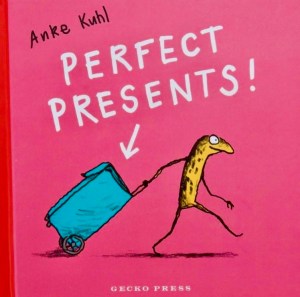
Perfect Presents Anke Kuhl
In this mini hardback wherein Kuhl uses crayon to great effect, a monstrous-looking creature sits in an armchair, waiting. He keeps looking at his watch until BRRING! goes the doorbell. Enter a skinny lizard pulling a trolley, who greets him with, “Best wishes for today!” Clearly the large creature is celebrating his birthday and the visitor holds out first a cake, then a bunch of flowers and finally, a gift-wrapped surprise, all of which the monstrous one devours with obvious relish.
He then grabs hold of his guest: surely the lizard isn’t going to be consumed too? The tension mounts … Anyone for tea? …
Hugely satisfying: I hope it’s to your taste; it certainly is to mine.
For younger children is
Let’s Play, Little Rabbit Jörg Mühle
Herein we see Little Rabbit behaving in the same exuberant fashion as would his human toddler counterparts – playing peekaboo, enjoying a swing and wanting to go ever higher, splashing in a tub of water and having fun with a soft toy rabbit. “Can my little rabbit play too? One, two, three….” “Wheeee!” comes the request in Jöge Mühle’s simple first person text, which speaks directly to his intended audience.
A sweetly playful, vibrantly illustrated, interactive board book to share with the very youngest.
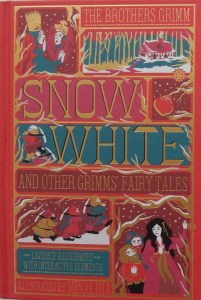
Snow White and other Grimms’ Fairytales Jacob and Wilhelm Grimm, illustrated by MinaLima Harper 360
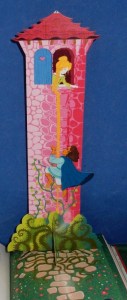
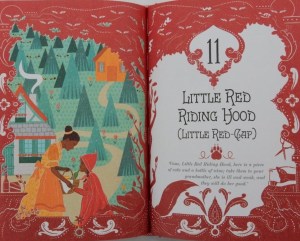
Twenty fairy tales are given the design team, MinaLima (Miraphora Mina and Eduardo Lima) treatment in this glorious collection. What this means in short is wonderfully imaginative artwork exquisitely detailed and engaging design with interactive elements (nine herein), bring to life timeless stories including, Sleeping Beauty, Rapunzel, Rumpelstiltskin, Hansel and Gretel, Little Red Riding Hood (Little Red-Cap),The Frog Prince and The Elves and the Shoemaker.
You will delight in such surprises as the awesomely intricate thicket surrounding the castle the prince must deal with to release Sleeping Beauty from her slumbers, a pop up tower that climbs right out of the book in Rapunzel, with a prince you can make climb up her golden hair – possibly my favourite.
A close contender though, is the pop-out house in Hansel and Gretel that opens into a diorama of the interior with a kitchen and a wicked witch waiting to lure the two children inside. It’s good to see that ethnicity has also been a consideration in the portrayal of the characters, some of whom have brown or black skin: Red Riding Hood is shown as black, for example.
With vividly coloured illustrations, both large and small throughout, this book is one for keeping and for giving. With the festive season fast approaching, it would make a magical Christmas present.
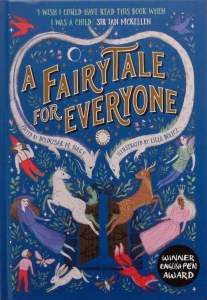
A Fairytale for Everyone edited by Boldizsár M. Nagy, illustrated by Lilla Bölecz Farshore
This groundbreaking collection of seventeen re-imagined traditional stories was highly controversial when originally published in Hungary on account of its inclusive nature. However because LGBTQ+ characters are featured it rapidly became a symbol in the fight for equality and against discrimination in Hungary and received a great deal of support both in the country and outside.
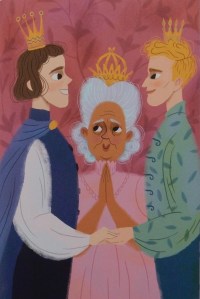
You’ll find stories that push back the boundaries of traditional gender roles showing how heroes can be any shape or size, princesses enormously powerful such as Margaret the Giant Slayer. In the final story written in rhyme, a prince finds true love, not with the blonde princess presented to him, but with her equally fair brother.
I loved the reworking of the Thumbelina tale of Little Lina who discovers what being big really means when she meets a fairy prince, small in stature like herself.
A true celebration of diversity that will likely appeal most to those with an interest in traditional tales.
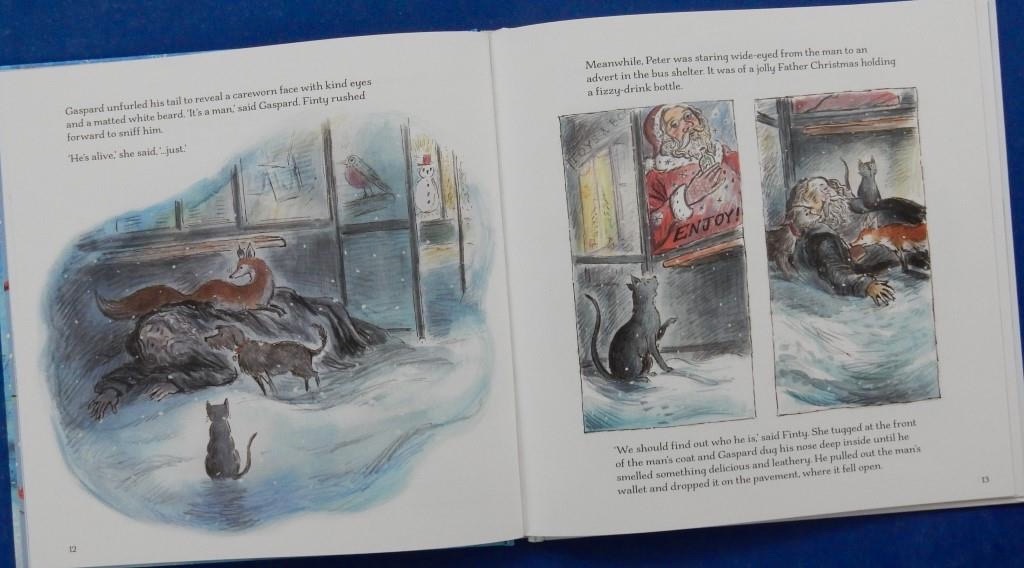
Gaspard’s Christmas Zeb Soanes and James Mayhew Graffeg
The enormously popular fox Gaspard returns in his fourth adventure, the proceeds from which will go to St. Martin-in-the-Fields Charity that helps the homeless.
When out hunting for food one bitterly cold night near to Christmas, Gaspard comes upon what he thinks is a bulky black bag in a bus shelter. On investigation he discovers an old man with a white beard wearing a black overcoat who is obviously freezing. He quickly realises that the man needs help and goes off in search of assistance, calling on his friends Flinty the dog and Peter the cat before returning and attempting to warm the man whose condition has clearly deteriorated.
The savvy creatures investigate and find that the old man’s name is Nikolas and off rushes Flinty to find her person. Then together Honey and Flinty struggle through the streets back to Nikolas and the other animals.
Eventually back in the church, the old man is given a meal, clean clothes and a warm shower, and later a special temporary role at the shelter party.
Despite being given a small reward each, Peter, Flinty and Gaspard understand that their true reward is the knowledge that their kind and speedy actions have saved someone’s life.
Such a vital message about selflessness and a thought-provoking story about the importance of showing kindness to those less well off than ourselves. I love James Mayhew’s painterly, detailed illustrations that, as always in this series, are infused with loving concern.
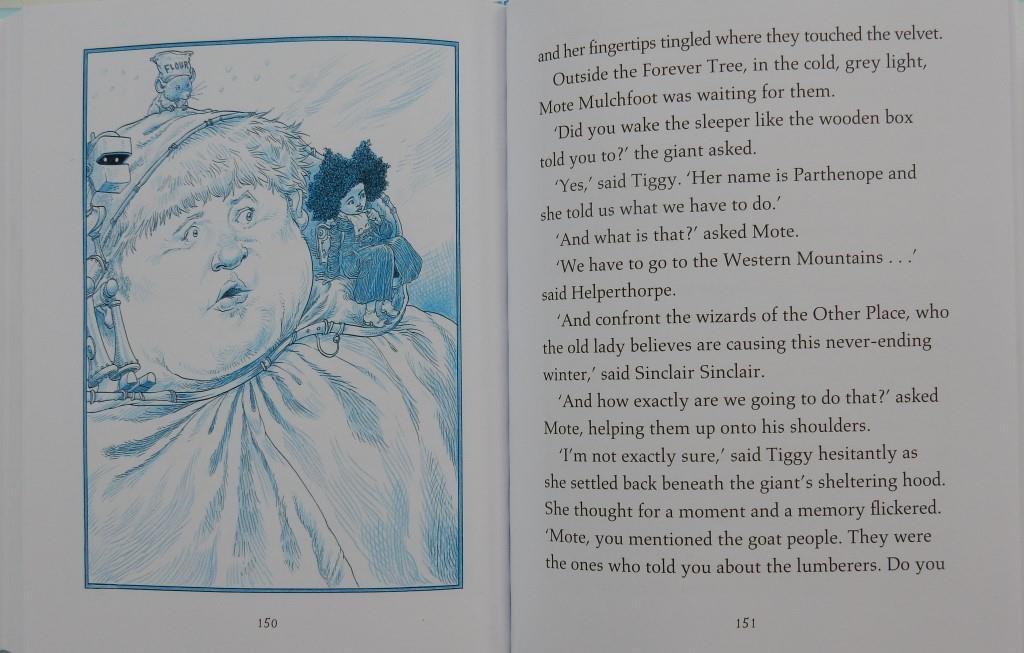
Tiggy Thistle and the Lost Guardians Chris Riddell Macmillan Children’s Books
This is the second and sadly, final story in the brilliant Cloud Horse Chronicles sequence. Before even starting to read it, I knew I was in for another treat for the book begins with a blue and white illustration in Chris Riddell’s iconic style depicting The Mighty Wizard Thrynne: that was me hooked.
Zam, Phoebe and Bathsheba, the three guardians of magic, disappeared suddenly almost ten years ago, leaving the Kingdom of Thrynne in the icy grip of powerful sorceress, Thalia Sleet.
One day while out looking for firewood, young Tiggy Thistle saves one of the Stiltskin brothers from some ferocious cats and is given in return three magical objects – boots, a scarf and a rucksack.
Soon after, with time running out to save Thrynne from the curse of endless winter, young Tiggy leaves the safety of the home she shares with kindly badger, Ernestine, and sets off on a quest to find the lost Guardians and their cloud horses; the only ones, she believes can save Thrynne.
Along the way, the determined child encounters some wonderful characters including tin man Helperthorpe, rat Sinclair Sinclair and giant Mote, each one as caring as Tiggy herself. Along the way too, Tiggy comes to know that she is able to feel and control magic, a big asset as she journeys high and low over vast, varied landscapes. These, as well as the superb cast of characters are depicted in detail in the awesome illustrations.
However, as well as being an amazing artist, Chris Riddell is a wonderful storyteller and creator of worlds. What better way to pass the chilly wintry evenings than to curl up warm and let yourself be transported by the magic of Tilly’s adventure with its echoes of some classic literature, and find out whether she can bring the lost guardians home as well as discovering what she learns of her own identity.
The Red Sledge Mick Jackson and Victoria Ball Walker Books
Mabel Taylor is thrilled with her shiny new red sledge. She dresses herself warmly and opens her front door only to find – no snow. Back indoors she sits in her sledge and starts to imagine … She visualises herself as a bobsleigh champion and next morning, quite excited, she races to open the curtains. But what does she see; no snow at all. Back in her sledge she gets and this time she imagines herself as a polar explorer dragging her laden sledge and trudging through the deep snow. ‘Tomorrow it might just snow, she thinks.
The following morning, a little bit excited she opens the door and peeps out only to find – you’ve guessed it – not a single snowflake has fallen. Again she sits in that sledge and takes on the Father Christmas persona, with her sledge being drawn by four reindeer. Next morning convinced there won’t be any snow she almost fails to notice what is happening through her window: heavy snow is falling – whoopee! Warmly wrapped up, she crosses the field, climbs the steep hill and pausing to take in the view, gets into that sledge, breathes deeply and Wheeeeeeeeee! She’s off at last.
Although it’s not mentioned, in the words, young children will likely deduce from the excited look on the child’s face in the first illustration, that Mabel’s sledge is a Christmas present. I love the way she copes with the disappointments of no snow, turning them into opportunities for imagined indoor adventures.
We’re Going on a Sleigh Ride Martha Mumford and Cherie Zamazing Bloomsbury Children’s Books
Having chased elves, hunted for eggs and treasure in previous books, it’s now Christmas Eve, time for Martha Mumford’s bunnies to wrap up warm, load the presents and take off on a round the world sleigh ride with Santa and his reindeer. Much of the rhyming text comprises the refrain “We’re going on a sleigh ride./ HO! HO! HO!” along with some onomatopoeia (‘Honk! Honk!’ ‘Ding-a-ling-aling!’) and more. Readers and listeners meanwhile can have fun hunting alternate spreads for the hidden gifts and watching their tally mount and they reveal them.
The narrative zips along merrily and Cherie Zamazing’s jolly watercolour illustrations show the varied locations visited with all kinds of animals enjoying the spectacle of the sleigh whooshing by. I suspect little ones will relish the sight of Santa with his feet waving from a chimney top, down which, aided by one of the four reindeer, he’s attempting to enter a house.
With lots of flaps to explore, this is a perfect Christmas Eve read together and equally, the simple text makes it ideal for those in the early stages of reading for themselves.
We Disagree About This Tree Ross Collins Nosy Crow
The duo from There’s a Bear on My Chair are back and as usual they are disagreeing: why break an established habit just because it’s the festive season?
Mouse is excited when Bear bursts through their front door clutching a large Christmas tree and urges him to relax and leave the adorning to him. Inevitably Bear soon begins making disparaging comments about Mouse’s efforts and this precipitates back and forth critical animosity, culminating in tree overload
and disaster. However, not everything is a cause for contention thanks to two neatly wrapped packages waiting to be opened. Have the two bickerers finally found a way to share a Merry Christmas?
The interplay between Ross Collins’ sparkling verse telling together and his superbly expressive illustrations that are simply bursting with humour, is wonderfully done and will appeal to both young listeners and adult readers aloud.
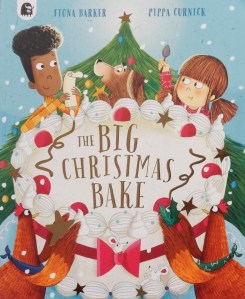
The Big Christmas Bake Fiona Barker and Pippa Curnick Happy Yak
Author Fiona and illustrator Pippa cook up a wonderful festive tale based on the structural rhythm of the traditional Twelve Days of Christmas.
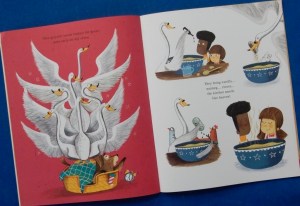
On the first day of Christmas two children head to the kitchen and begin to make a Twelfth Night cake. The list of ingredients is long and they wonder where everything will come from. Happily however, day after day for the next eleven days animal friends of all shapes and sizes show up bringing in turn, dried fruit, flour, sugar, candied peel, eggs, spices
and all the other things needed, until on day ten, ten lords come leaping in ready to carry the cake to the stove for baking. All that’s left then is the piping pipers to show up on the eleventh day to add the finishing touches so that come Twelfth Night, the most incredible confection is set on the table ready for every single one of the contributors to enjoy. I wonder who finds the bean that was hidden in the mix …
A tasty treat indeed and don’t forget to check out the recipe after the story.
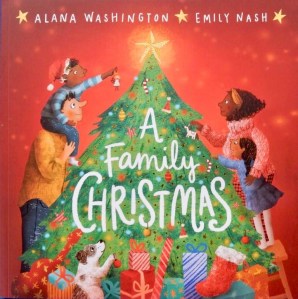
A Family Christmas Alana Washington and Emily Nash uclan publishing
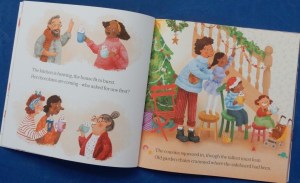
With echoes of Clement Clarke Moore’s ‘Twas the Night Before Christmas Alana Washington relates the events of a family’s Christmas day. There’s excitement about the arrival of guests and a kitchen of hot chocolate drinkers with cousins squeezing close together clutching their mugs.
Then at dinner time, dish after dish of delicious food is served up, an unexpected visitor turns up and when everyone is bursting with extra helpings of pudding, it’s time for a toast to the host. In order to work off some of that food, family members go for a walk, followed by further indoor festivities: dancing and games, singing and the playful adornment of those who take a snooze. With the washing up duly done, it’s present time at last. Darkness comes all too soon and some of the family must head for home, but there’s one final treat still to come: something big and extra bright high up in the sky. What better way to end the day than by sharing a special story and watching a sprinkling of snow fall before snuggling down in bed after a perfect family celebration.
With joyful scenes of togetherness, Emily Nash’s gently humorous art captures so well that magical feeling of the festive season described in the author’s text.
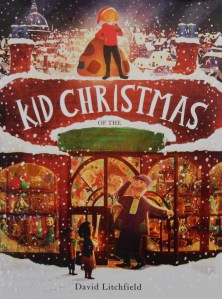
Kid Christmas of the Claus Brothers Toy Shop David Litchfield Frances Lincoln Children’s Books
Everything David Litchfield does is a winner as far as I’m concerned and this one is no exception. It features young Nicky and his three uncles: Louis, Hans and Levi, aka the Claus Brothers, the finest toy makers in all the land.
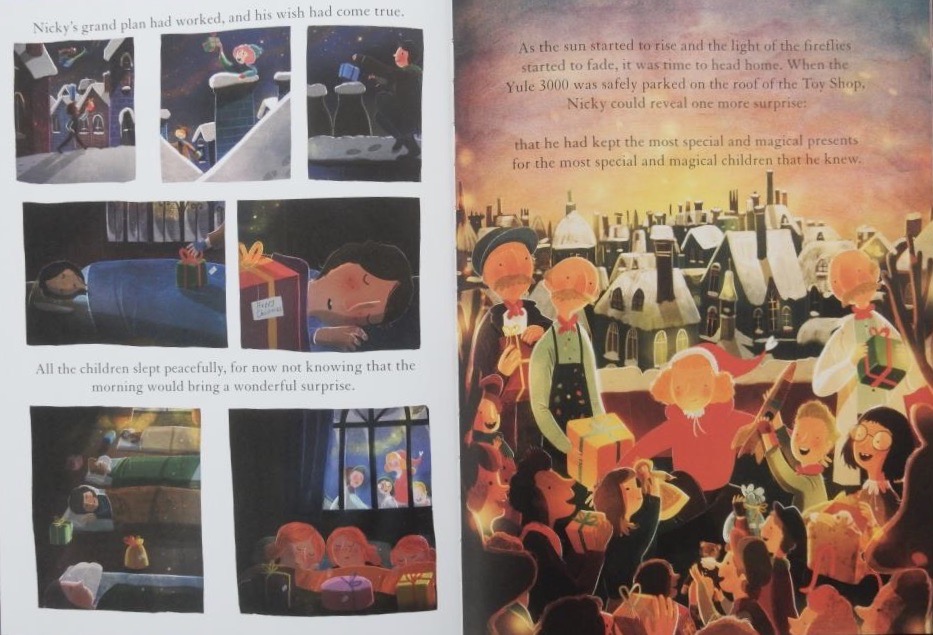
Nicky is now old enough to work for his uncles in their emporium behind which is their workshop. There, Uncle Hanz was to be found making the toys, Uncle Louis would check them and Uncle Levi had a special role: he added the magic sparkle to every single toy making it perfect for the recipient. From time to time Nicky would notice less fortunate children outside the shop peering in and on Christmas Eve, with the shop closed early, Nicky decides to follow the children. What he discovers saddens the boy greatly and he vows to give every child in the city a present to make them happy, even if only for one day.
Back in the Toy Shop, his uncles are agreeable to the plan and with huge sacks full of gifts, Nicky suddenly realises that delivering them is going to be beyond his capabilities. Or maybe not, thanks to another of his uncles’ creations.
Off he sets but then faces other difficulties on his journey pulled by reindeer that require frequent supplies of carrots. Will Nicky ever bring his plan to fruition? Happily yes: how else would the story of Father Christmas have come to be?
David’s illustrations are out of this world brilliant. Full of Victorian details to pore over, and combined with a story brimming over with kindness that will fill anybody lucky enough to read the book, with a wonderful seasonal glow.
Cat Family Christmas Lucy Brownridge and Eunyoung Seo Frances Lincoln Children’s Books
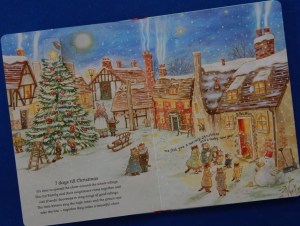
There’s an olde world feel to this Christmas count down. We follow the Cat Family through the busy days in the run-up to the festival, right through to Christmas Eve in this lift-the-flap book.
With twelve days to go to the big day, after many hours working in town, Mummy Cat joins her kittens just back from school and Daddy Cat already there to welcome them, and then it’s all systems go. There’s so much to do: the first being putting up the decorations – a task for the kittens; then comes the baking of Christmas cake and mince pies – hmmm you can almost smell that lovely spicy aroma. While their parents write cards, the kittens write to Santa and the following day, the family go to meet Granny and Grandpa at the station. Next the Cat Family go out into the village to do some cat-a-carolling, “We fish you a meow Christmas and a tabby new year”.
With six days to go, there’s a bit of garden harvesting needed of veggies for the Christmas feast and finally with all the last minute jobs done, it’s time for a snuggly Christmas Eve with the family and a regaling of Grandpa’s special story.
There’s seasonal cheer aplenty here with not a hint of a cross word or a tear and the family seemingly cruise through all the preparations. Eunyoung Seo’s scenes are bursting with detail and each spread has a plethora of small flaps to peep behind (careful handling required), where further details are revealed. This large format board book will last more than one season in contrast to the traditional advent calendar; moreover it’s something to share with your little ones.
Santa’s Christmas Countdown Kath Jewitt and Sebastien Braun Townhouse Publishing
Poor Santa! Having lost his list of jobs to do, he’s worked himself into such a state, till, lightbulb moment: he’s been doing them for so many years that surely he can now recall every single task. It’s surely worth a try so off he goes. First he checks the sleigh is clean and shiny; then there are all the presents to wrap and his own snacks to put in his food box. Singing jolly songs helps him get into the spirit of the season and of course, the reindeer must be well fed and their coats brushed. Good old elves, they’re at the ready for this job and more.
Then Santa works on himself: that entails donning his lucky socks and pants, some tonsorial treatment and then it’s time to get into his red outfit (heated of course). That done, he feeds his moggy, makes a hot chocolate, hitches the reindeer, loads the sleigh and Ho! Ho! Ho! off he jolly well goes on his round.
A touchy-feely, fun book for tinies with a rhyming text and Sebastien Braun’s bright, busy illustrations. It’s great to see a black, bespectacled Santa and a diverse team of elves too.
The Christmas Carrolls: The Christmas Competition Mel Taylor Bessent, illustrated by Selom Sunu Farshore
This story sees the Carrolls competing for The Most Festive Family. Also in contention for winning the prize – a trip to New York City – are the Klauses.
With just two weeks to prepare for a visit from the editor of the Christmas Chronicle who will be judging the competition, the Carrolls go into frenzied preparation mode. Surely those Klauses, with a house on Candy Cane Lane couldn’t be more festive, could they? Holly is worried. Also on her mind though, are the upcoming Halloween activities her friends are all excited about. Must she miss out completely on the spooky fun to try and do her utmost to help her family win that competition? She feels somewhat conflicted, but can she make her mum and dad understand. Top of their agenda is to pay a clandestine visit to Candy Cane Lane and take a look at their opposition. Things don’t quite go to plan though. Just as they’re on the point of leaving, the front door opens and out come the Klauses – Mr, Mrs and their children Poinsettia and Toboggan.
Rather than sending them packing, Mrs K offers to show them round Klausland with its dancing penguins and private ski mountain. That’s when Holly sees a baby penguin with a broken wing and unequal size feet that the Klaus children call Nuisance. Next morning what does Holly discover in her room but the very same baby penguin, which she names Sue. Mum insists that Holly return the penguin that same day: Holly however, has other penguin plans.
Meanwhile the clock is ticking and that visit from the newspaper editor draw ever closer …
Zany seasonal reading that is full of heart, some shenanigans, a sackful of good intentions and plenty of lively illustrations from Selom Sunu.
We Wish You a Merry Christmas and other festive poems chosen and illustrated by Chris Riddell Macmillan Children’s Books
Chris Riddell has selected almost fifty festive poems, mixing lots of old favourites including Clement Clarke Moore’s A Visit from St Nicholas with some exciting new seasonal poetry. You’ll find the secular and the religious, and both serious and fun offerings herein, some of the latter being those Talking Turkeys of Benjamin Zephaniah – I definitely support ‘Turkeys United’; and Clare Bevan’s spirited Just Doing My Job about a Christmas drama performance: teachers and pupils together will enjoy this one. You’ll likely be amused by the sequel to The Twelve Days of Christmas (for which Riddell provides several superb illustrations) – it’s Dave Calder’s offering on a phone call that takes place on the thirteenth day of Christmas.
I really enjoyed another poem new to me, Dom Conlon’s Father Christmas sent me the Moon. With the world as it is at the moment though, I was especially drawn to John Agard’s Green Magi and Lem Sissay’s Let There Be Peace.
Awesomely illustrated throughout, this has something for all ages.
The Christmas Doll Amy Sparkes and Katie Hickey Walker Entertainment
I have a lot of admiration for Jay Blades having heard him share some of his back story on the radio recently so was especially excited too see him as one of the characters in this seasonal Repair Shop story.
Evie and her great granny Sue, have come to the Repair Shop with a very special doll named Lizzy, who’s in need of some TLC from Jay’s Teddy Bear Ladies. “That is a very beautiful doll. Can you tell me something about her?” he asks Granny Sue. His inquiry transports Sue back to her childhood. She then recounts the story of how she was evacuated as a young girl from London at the beginning of the war in 1939. Sent to stay with the Russells, a husband and wife who treated her with such loving kindness, that by Christmas Eve, the little girl is feeling much more at home. On Christmas Day she can hardly believe her eyes when she discovers a beautifully wrapped present at the end of her bed. Inside is the doll and she names her Lizzy, taking the doll everywhere but thinking that at the end of the day she will have to return her. Imagine her joy when she’s told Lizzy is hers to keep for ever. What a truly magical Christmas.
Eventually however, it’s time for Sue to bid farewell to Mr and Mrs Russell and return to London. Even now, Granny Sue recalls the couple with fondness, going on to explain that Lizzy’s damaged state is on account of all the love and cuddles she’s been given over the years. Enter Amanda and Julie. Lizzy is left in their safe hands while for the next week they work on the precious doll
and Granny Sue is overjoyed with the result of their creative work. But that’s not quite the end of the story: a new chapter in Lizzy’s life is about to begin …
Amy Sparkes has worked her own magic by fashioning the ‘true story of the Christmas doll’ related at the end of the book, into an utterly charming, heartwarming new tale wherein past and present come together seamlessly. The Repair Shop team are immediately recognisable in Katie Hickey’s portrayal and she infuses the scenes of Granny Sue’s childhood memories with a warm glow. Don’t miss the gorgeous endpapers – the front one captures that wonderful community spirit of Jay’s team.
This is a book I see being shared in countless families and classrooms over and over, as part and parcel of the Christmas season.
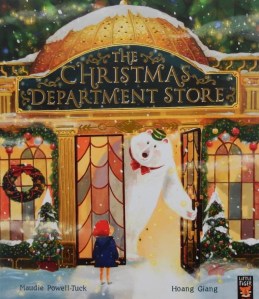
The Christmas Department Store Maudie Powell-Tuck and Hoang Giang Little Tiger
It’s Christmas Eve but Benji feels anything but festive: it seems as though Christmas has lost its magic this year. His family can’t afford either a tree or a turkey and so they’re sad. As Benji walks through the snow-filled street wishing he could buy them spectacular presents he recalls his Granny’s words about magic happening on Christmas Eve. Suddenly a huge polar bear knocks him flying and as he gets up, there before him is a large department store. But this is no ordinary store; it’s full of wonder and magic, with penguin doormen and a shiny steam train that puffs along on a glittering spiral track.
One by one, Benji discovers the most perfect gifts for his family – a funky trumpet for his sister Hana, which he pays for by singing a silly song,
an unusual imaginary hat for his gran (he tells a story to a leopard in payment for that) and a very special warm-smelling potion for his dad. Full of excitement and high hopes for a wonderful Christmas Day, he returns home.
Next morning those hopes become doubts; but when he sees the smiles on Hana, Dad and Granny’s faces when they open their presents, he realises that the real gifts he’s given them are not material things but love and happiness.
Absolutely full of heart, this enchanting tale shows that the very best presents aren’t those bought with money, but those given with love and care. With their warm festive tones of red, gold and green Hoang Giang’s illustrations on every spread are filled with the magic of the department store.
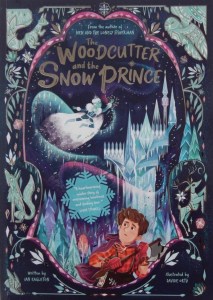
The Woodcutter and the Snow Prince Ian Eagleton and Davide Ortu Owlet Press
With links to the classic fairytale The Snow Queen, Ian, a wonderful spinner of inclusive stories brings us what is, despite its wintry setting, a magical heart-warming tale of a lonely woodcutter who searches for love.
Kai is a woodcutter who enjoys carving statues for people to enjoy on Christmas Eve but nobody ever passes by. This year he is feeling particularly lonely without his grandmother, whose wondrous tale he recalls: ‘But this year he was alone,’ we read. Then as Kai ponders upon the possibility that his grandmother’s stories might be true, he is visited, but only briefly, by the Snow Prince. What he sees in the Prince’s eyes is hope.
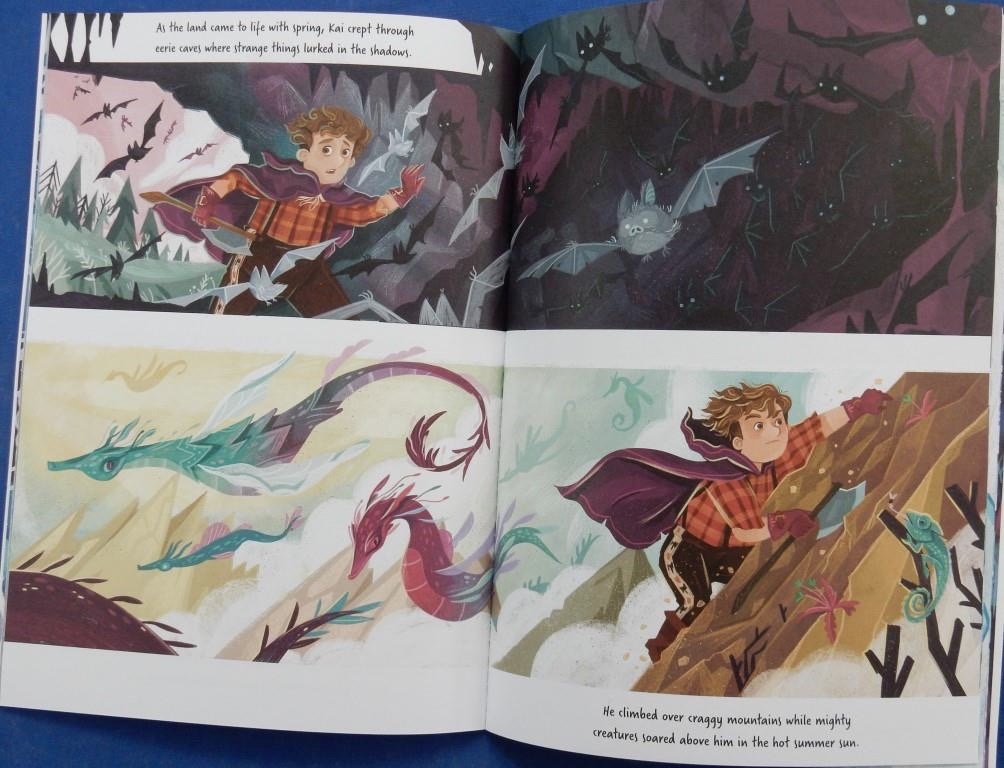
So begins his journey to find love. To do so though, Kai undertakes a long, long journey, travelling though days, weeks and months
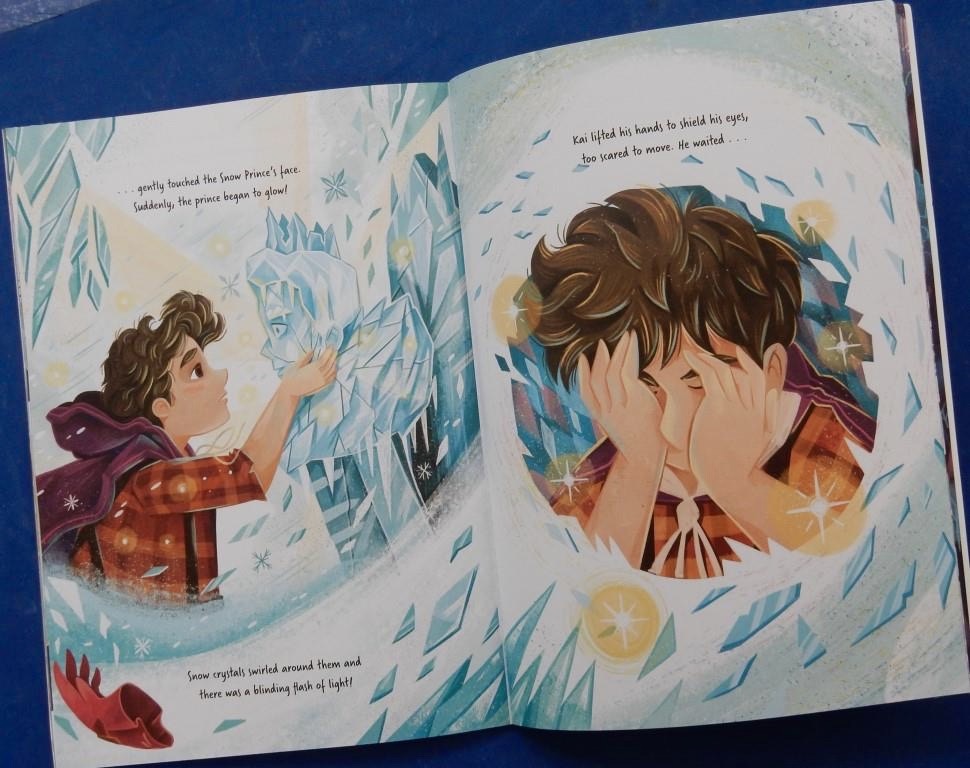
and all kinds of weather until it’s Christmas Eve once more. Now he needs to break the curse on the Prince imprisoned once again in his palace of ice. Can he do so with his loving touch?
The power of love is palpable in both Ian’s lyrical words and Davide Ortu’s beautiful, richly detailed filmic illustrations;
and make sure you take time to look at the pictorial maps that precede and follow the story.
Teachers and others, if you want your seasonal bookshelves to be for everyone, then you must add this LGBTQ+ picture book to your collection and share it this winter and beyond.
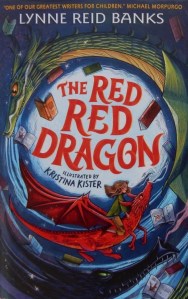
The Red Red Dragon Lynne Reid Banks, illustrated by Kristina Kister Walker Books
The author transports readers to a world of dragons and uprights (humans as we know them). The latter have been forced from the mainland (the Great Ridding) following years of war between them and the dragons. Now the dominant beings, the dragons have become a caring, peaceable community and they solve any problems that arise through discussion and debate.
Into the dragon community is born a dragon named Ferocity but on account of being the only red dragon he becomes known as Red once he starts dragon school. Not only is Red a different colour, he appears to possess the capacity to use his ‘think-space’ to think thoughts that other dragons can’t. Add to that, the notion that he is central to some ancient legends that are important for a shared future for them all. The current problem for dragons however, is their essential need: supplies of coal have almost gone and need to be replenished in order that their chest fires can remain hot. The only way to do so is make contact with the uprights, they who have hands and can mine. This is the mission that Red and his parents undertake.
It’s wonderful watching how Red develops during this mission, which is full of adventures, especially as the bond between him and the young upright Lou, grows. Particularly exciting is the development of his ‘thinks’ as he gains an understanding of ideas such as the imagination described thus, ‘It had the sound of beautiful newness. Like the start of warm-time when everything is bursting, and anything is possible.’ Indeed it is the young beings – Red and Lou, who are the real channel for meaningful interactions between the two sides and with them lies the possibility of future reconciliation.
This is a wonderful, moving story that radiates warmth and hope for a better world. Wonderful too are Kristina Kister’s black and white illustrations, especially those between blocks of the narrative.
Having worked for most of my teaching career in the London Borough of Hounslow, close to Hounslow Heath, for 100 years between the 17th and 18th centuries, the most dangerous place in England on account of highwaymen, I was drawn to this story and quickly found myself gripped.
A victim of these times and of circumstance is young Ned. Awkward, shy and trying his best to find where he fits in the world, the lad has become unpaid assistant to The Shadow, the nation’s most feared highwayman aka Tom Gregory. Living in Epping Forest, The Shadow identifies himself with Robin Hood, robbing only the rich that cross his path as he proudly informs Ned, although conveniently, he ignores the part about giving to the poor and relies on his apprentice for assistance to avoid being sent to the gallows for his crimes.
Ned longs to be an apprentice carpenter but is too scared to run away from Tom Gregory in case he should end up in the workhouse. Instead he is pulled into a life of risky adventure and when Tom is injured, the lad finds himself taking over his master’s role and even briefly, his identity. Then he happens upon the infamous Bloodstone of Jaipur, a jewel said to be cursed and resulting in the death of every man who ever laid hands upon it. This jewel forces Ned to make a vital choice.
The tension builds as Ned makes new friends and some enemies too. The former include Eliza, bold determined daughter of thief-taker, William Parbold. While Parbold believes Eliza should be spending her time preparing to become a fine lady and thence wife to a good husband, she is determined to work alongside her father in a role that society at that time deemed totally unsuitable for a young woman.
As the tale twists and turns there’s plenty of excitement, daring deeds and some very scary episodes too, before this wonderful romp comes to a satisfying close.
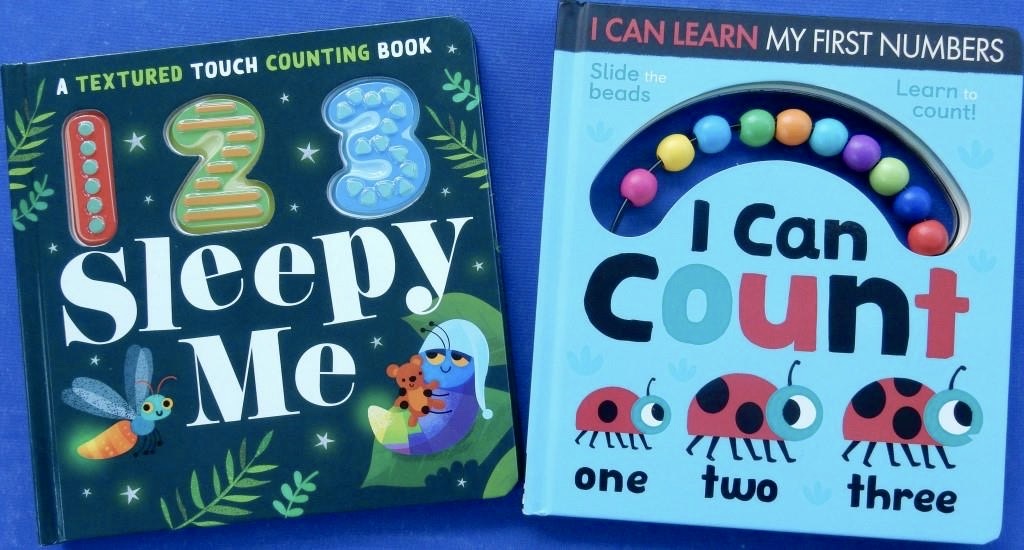
Here are two playful counting books from Little Tiger – thanks to the publisher for sending them for review.
1 2 3 Sleepy Me Sophie Aggett and Gareth Lucas
This die-cut counting book has a nocturnal theme and moulded textured numerals 1-5 offer a variety of tactile experiences. Strangely Gareth Lucas sets his illustrations of stars to count and talking minibeasts – a ladybird, a firefly, a butterfly, a baby bee and a glow-worm against brightly coloured rather than dark backgrounds, although the final one is rather more subdued as the glow-worm decides it’s time for sleep. The rhyming text begins thus, ‘One little night star shining over you. “Goodnight!” says a ladybird as she spots …’ and continues adding a star
until in addition to the five twinkly stars there’s a full moon in the sky and all five minibeasts assemble to bid, ‘Goodnight, everyone!’ Simple, interactive pre bedtime counting fun for tinies.
I Can Count Lauren Crisp and Thomas Elliott
This cleverly designed board book is intended to help little ones with both counting and number recognition. A die-cut shape through both the covers and the pages contains an arched shape plastic rod through which are threaded ten beads. The rhyming text alternates giving an instruction like ‘Horses gallop in the sun. Can you count them as they run? or asking a question such as ‘How many arms do starfish grow?’ Additionally on each page is the relevant numeral and on each spread the sentence, “Slide the beads to help you count!’
On the 10 page stands a rocket and rather than counting up from 1, the instruction is ‘Join the countdown to see it fly.’ encouraging children to count backwards 10 9 8 etc … LIFT OFF!
Thomas Elliott provides the brightly coloured illustrations on every page with cute googly-eyed characters and in addition to maths skills little ones will develop their fine motor skills.
Little Elephant Anna Brett and Carmen Saldaña Little Platypus Anna Brett and Rebeca Pintos QED
In the first of these additions to the Really Wild Families series, Anna Brett takes readers to the African Savannah, home to Little Elephant (our narrator) and family to spend a day with the elephant herd comprising fifteen elephants, almost all of which are female, the oldest and most knowledgeable being Grandma. The youngest member of the herd is a two day old cousin of the narrator.
We see how the elephants search for and eat their food, meet some of the other animal inhabitants of the savannah and then head for the watering hole to drink and have some fun too, all under the watchful eye of Grandma.
It’s she that sounds the trumpet alarm call warning of a lion in the vicinity: time for the adult elephants to form a protective circle around the calves until the danger is over. There’s information about the role of tusks, ways of communicating and more, until at sundown, members of the herd stop to rest for the night.
Following the simple narrative are some additional elephant facts, information about elephant conservation, a case study and some activities. Carmen Saldaña illustrates this one, supporting the information well.
Belonging to a much smaller family (a mother and her two young ones) and living tucked away in a burrow on a riverbank in eastern Australia is Little Platypus, a nocturnal animal. It’s Little Platypus’s voice that tells readers about platypuses’ physical features, habits and habitat, reproduction and how they are born,
what they eat and how they survive. Males such as Little Platypus have a spur on each back leg that is able to release venom in dangerous situations. Again Anna Brett’s manner of presenting the information is well pitched for young children and Rebeca Pintos’s illustrations are beautifully executed, playful and alluring. The backmatter is similar to the previous book though platypus related. Like the elephant title, the few photos are especially useful as both illustrators have made their animals look rather more endearing than realistic.
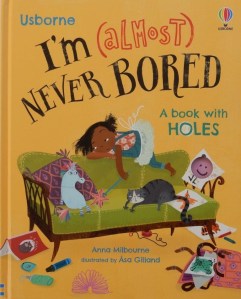
I’m (almost) Never Bored Anna Milbourne and Åsa Gilland Usborne
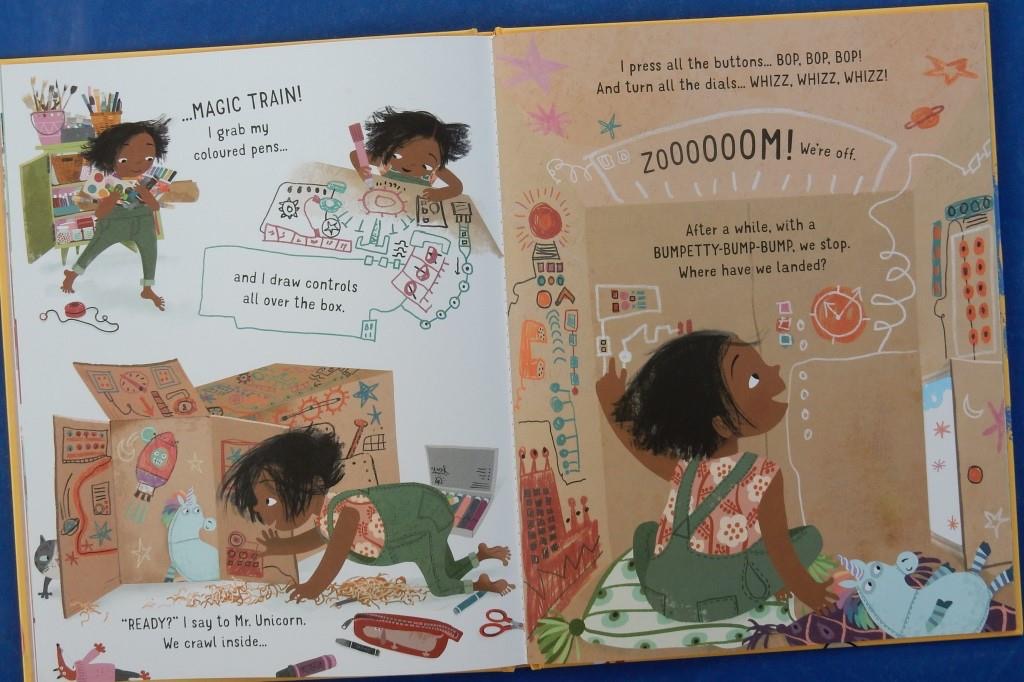
This is a wonderful celebration of the power of childhood imagination, in this case called into play when one wise father decides to curtail a little girl’s screen time. Furthermore his response to his daughter’s “I’m BOOORED!’ is “Oh, that’s great … being bored comes right before having a Really Good Idea.” And so the young narrator discovers, first when she spies a large cardboard box among those her dad is unpacking. This she turns into a magic train by using coloured pens
and then most importantly, in the company of Mr.Unicorn, imagining a wonderful adventure that involves visiting all manner of strange places – a land of wibbly-wobbly jellies, for instance.
Fortunately the girl’s mother is of the same mind and she responds in similar fashion to her daughter’s complaints about being bored. This time pens and mind conjure up a massive monster with a seemingly insatiable appetite. And so it goes on until our young narrator is sufficiently convinced by what she’s been told by her parents that she is ready to give a confident reply to the boy next door’s “I’m bored!” and you won’t need to use much imagination to guess what she says …
Åsa Gillard has clearly used her imagination to bring Anna Milborne’s text to life in exuberant scenes (with strategically placed die-cuts) of the little girl’s wonderfully playful flights of fancy. If any parents/ carers have doubts about the necessity to limit young children’s screen time, then this story will surely convince them to do so. Most certainly a smashing book to share both at home and in foundation stage settings.
These are additions to three popular series from Farshore: thanks to the publisher for sending them for review
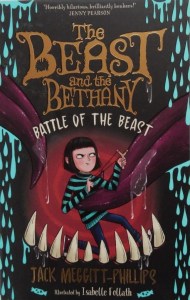
The Beast and the Bethany: Battle of the Beast Jack Meggitt-Phillips, illustrated by Isabelle Follath
With the beast safely imprisoned after controlling Ebenezer Tweezer for 511 years and twice attempting to eat Bethany, Ebenezer is trying to attract new clients for the problem-solving business, The Wise Tweezer. He also keeps receiving phone calls; these he determinedly ignores until eventually Mr Nickle gets through and announces some strange, disturbing news concerning the beast. Almost before you can say the dreaded word, Bethany and Ebenezer are on the beach of D.o. r. r.i.S Island facing Mr Nickle. He informs them that the beast is to be released on account of its having lost its mind and become a reformed character. Moreover, in the next stage of his rehabilitation, he’s being put in the care of Ebenezer and Bethany; either that or the former will be arrested. Bethany though is having none of it and off she storms. Nonetheless the beast sets about proving how adept he is at do-gooding as he gets involved in Ebenezer’s business. carrying out kindnesses around the neighbourhood by vomiting out things people need. But Ebenezer surely can’t carry on ignoring those rumbling sounds that come from the beast’s belly every so often? Bethany meanwhile is determined to prove that the beast is still its evil self. Enter Mortimer the parrot. Let battle commence … Fiendishly funny and darkly discomforting, this will definitely leave readers wanting still more
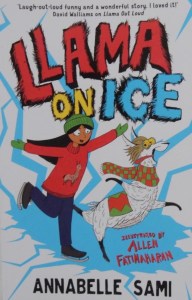
Llama on Ice Annabelle Sami, illustrated by Allen Fatimaharan
It’s the Christmas holidays and with her llama pal Levi away on a training mission and her best human friend Ezra enjoying himself in Jamaica with his grandad for a fortnight, Yasmin is feeling pretty miserable stuck in London. Then comes the snowstorm: apparently the thickest for twenty years, so the TV news announcer says and soon after she hears from Ezra that the adverse conditions mean his return flight is cancelled. What will she find to do? Certainly not have a family Christmas; her family don’t celebrate that festival. The snowstorm also means that Tia, her erstwhile best friend and now arch enemy, can’t go on her luxury holiday to France to see her dad and stepfamily and visit that Fantasy Icestravaganza. Suddenly as Yasmin is sitting in her bedroom trying to cheer herself up, the llama landline lights up and she receives a message from Mama Llama, head of Seen Not Herd, informing her of a mission: to give Tia her best ever Christmas. Eventually she accepts. But then what? With just three days to go, Yasmin must switch to guardian llama mode. Let the carol singing begin … Things don’t always go to plan and this looks like being one of those times, especially when Yasmin lets her temper get the better of her. Surely her very first mission isn’t going to be a failure? Perhaps with the help of the unexpectedly returned Levi and Ezra, she can achieve what she sets out to do and even give Tia a version of that special ice show … Despite the chilly wintry setting, this story has at its heart, warmth, kindness, forgiveness and family love.
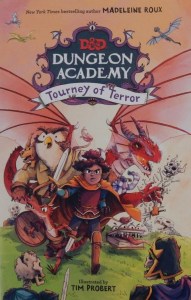
Dungeon Academy: Tourney of Terror Madeleine Roux, illustrated by Tim Probert
This is a sequel to No Humans Allowed. Secretly human, Zelli is having enigmatic nightmares sent by Lord Carrion the necromancer currently a captive in Dungeon Academy’s detention room. The adults (Zelli’s adoptive minotaur mothers included) instruct her to leave things to them but she’s not convinced they’re doing sufficient, especially when she learns that she’s not the only one having nightmares and so she turns to the Danger Club to help her research the clues left by Lord Carrion. Meanwhile chaos ensues at the school, which is host to rivals, the Waterdeep Dragons for the Tourney of Terror, a monstrous sporting event. Nonetheless Zelli decides she must investigate and close to a portal she discovers a dragon, or really, a human boy, Tavian. Soon the two, both of whom are masquerading as something they’re not, are swapping back stories, they form a bond and Tavian decides to join Danger Club’s investigation. With some fierce battles, the tale twists and turns all the way to its cliff-hanger ending that will leave Dungeons and Dragons fans in suspense awaiting the next instalment.
Zeki Rise and Shine Zeki Sleep Tight Anna McQuinn and Ruth Hearson Alanna Max
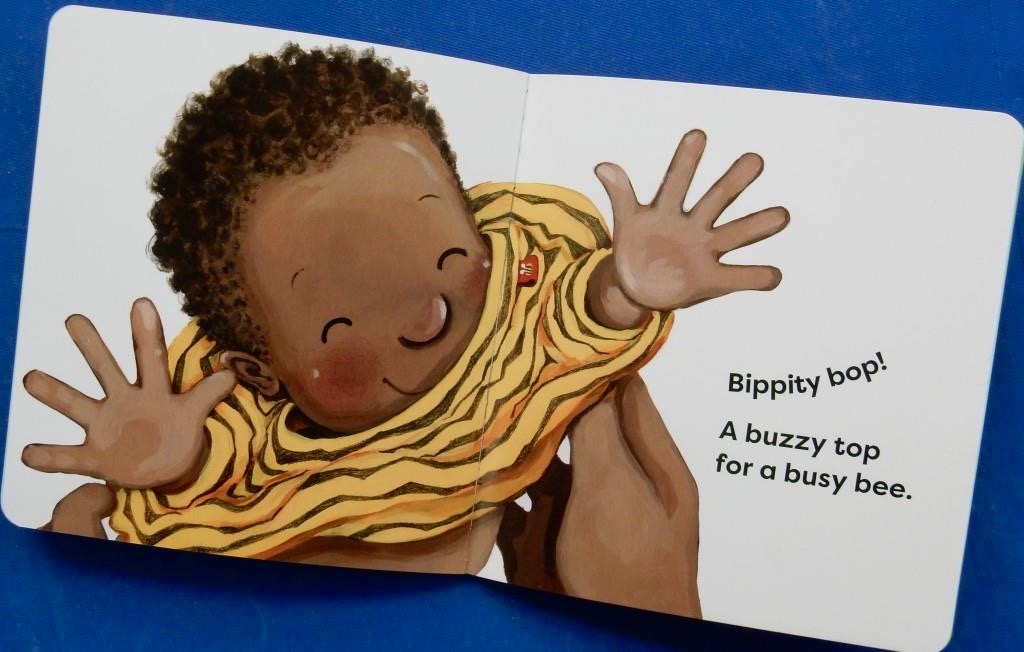
So much thought has gone into these two books starring the totally adorable Zeki wherein we share his family rituals. In the first Zeki has just woken up and from his cot, he greets readers with THE most engaging smile you could ever imagine as his Mummy opens the curtains to reveal the sparkling lemon-yellow sun. Then released from the confines of his cot he proceeds to dance his way into the kitchen where Daddy, preparing breakfast, joins his little one in a bit of box shaking.
With cereal consumed, it’s off to the bathroom for a wash and teeth brushing. Then on go a snazzy top and shorts, and to complete the outfit ,wonderful sunglasses and jelly shoes. Now Zeki is ready for whatever the day brings; and it’s patently clear just how much this little one is loved by his parents as they enjoy these simple routines together.
An equal amount of love and care has been taken in the creation of this simple presentation of family rituals. With each and every word having been carefully considered, the text is an absolute pleasure to read aloud: ‘He munches crunches. he sips zingy juice.’ and there’s a wealth of other onomatopoeia and alliteration too.
Equally, Ruth Hearson’s illustrations radiate joy, while cleverly using repeat images such as the sun (hanging from Zeki’s cot and in his book); the chickens (on the window sill and in the kitchen); the crocodile (on Zeki’s bib and the rolled up mat in Mummy’s bag); the ducks (on the soles of Zeki’s shoes matching the string puppet). Sheer delight for adults and little ones at every turn of the page.
The same is true of Zeki Sleep Tight wherein the atmosphere is much gentler as Zeki slows down and prepares for bed. He sips warm milk, soaks in a bubbly bath, wriggles his creamy caressed body into a fleecy sleep suit
and settles down for a pre-bedtime song and favourite story. Bliss.
Beautiful calming, soothing, sometimes sibilant language (‘they sing a slow song about a slumbering sloth’) and illustrations full of delightful details including plenty of sheep and other sleepy creatures. No need for parents to sing their little ones a lullaby, a quiet read aloud of this at bedtime will surely send them off to slumberland.
Both books are made from thick card and have rounded corners – ideal for little hands as well as a change from board books. I wholeheartedly recommend these for parents of very young children and for early years settings.
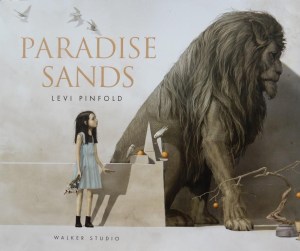
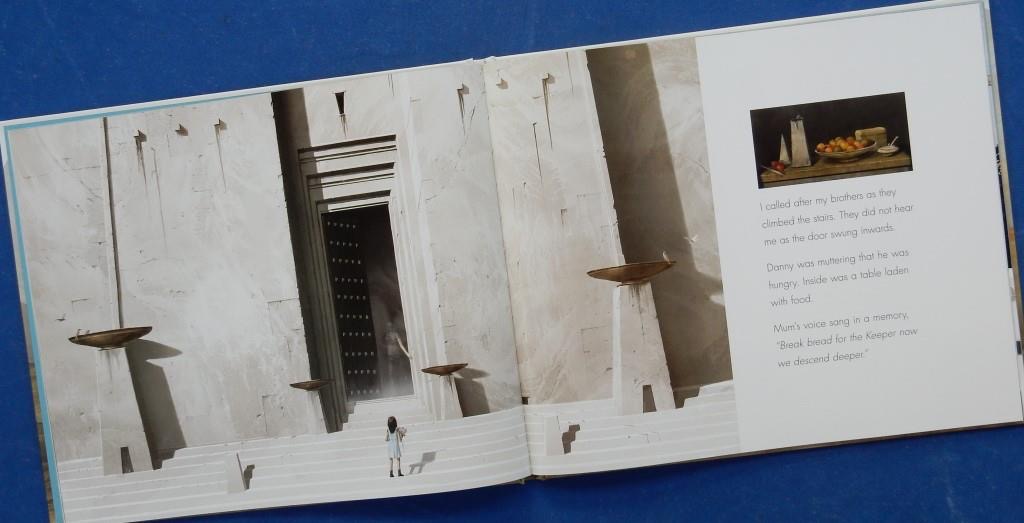
Three boys, Bill (the driver), Danny and Bob and their sister (the narrator) are in a car on their way through an arid landscape to see their mother in hospital when the girl suggests stopping to pick some flowers for her.“White roses we follow, towards Teller’s Hollow” sings Bill, as they leave the car and start to pick. “Dead earth to a spring, the house of a King,” he continues the ominous rhyme as they gather a bouquet. Feeling hot and thirsty the boys move towards a spring beside which stands a large palace, silent, imposing and seemingly empty; they take a long, deep drink, then instead of returning to the car, climb the stairs and enter the edifice.
Once inside, hungry and thirsty the boys consume what they find, then plunge into a pool and are transformed into dolphins.
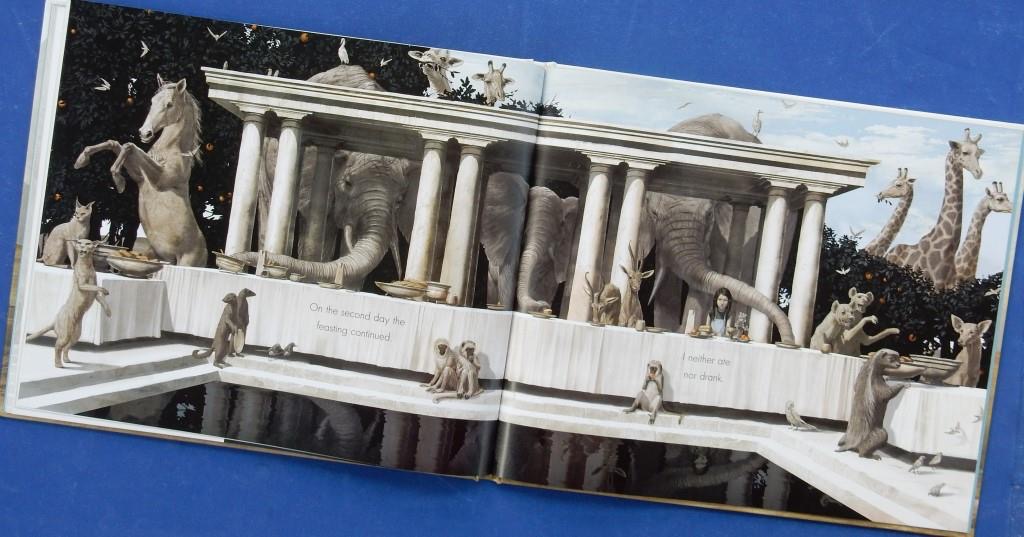
The girl meanwhile has an encounter with the creature calling itself the Teller and offering drink and food to her. ‘I only want to leave with my brothers” comes her response. She’s offered a deal: three days without drinking or eating and things will return to what they were before the family entered his domain. His terms are accepted by the girl and despite being tempted she neither eats nor drinks;
she does however use some water for another purpose. For this she must pay in the future.
When she returns to the car, her brothers are already there and they drive to the hospital to see their mother and give her the flowers …
This is a truly eerie tale with much left for the reader to ponder upon. Pinfold’s illustrations are mesmerising, unsettling and haunting, drawing us to them again and again in search of further meanings.
Penguin Huddle Ross Montgomery and Sarah Warburton Walker Books
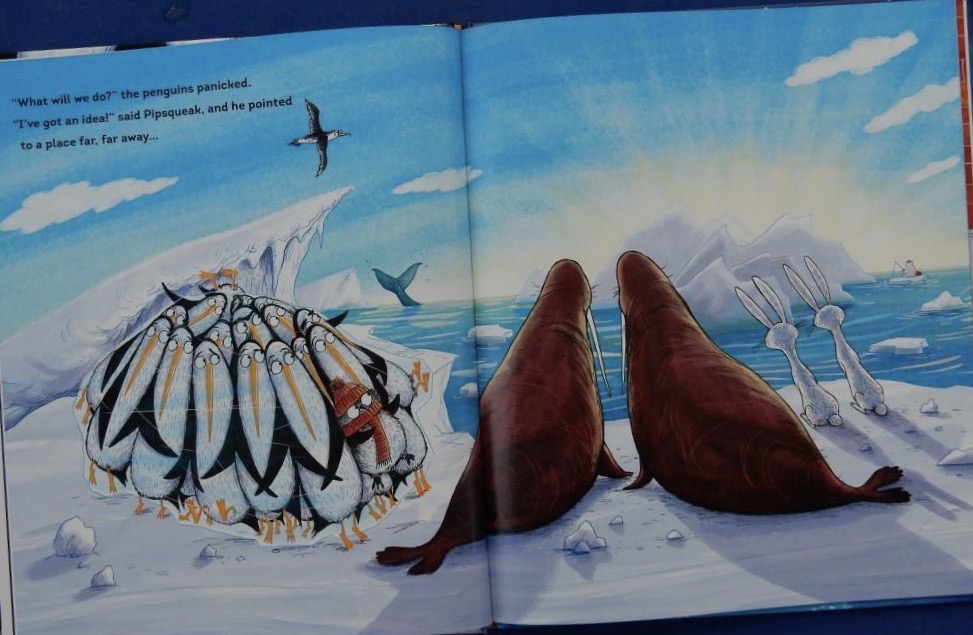
Meet the penguin pack, a playful lot that spend their days having fun, then at sundown they come together under the starry skies and form a huddle. Thus they keep snug and warm throughout the nights; till one night a particularly fierce gale blows up and the following morning the penguins awake to discover they’re stuck fast together. No amount of pulling and puffing, shuffling and scuffling can unfreeze the ginormous ‘penguin ice pop’.
Acting on tiny Pipsqueak’s suggestion they call on their friends to help; but neither the heaving and hugging of the snow hares, nor the prising and puffing of the walruses made the slightest difference. Can Pipsqueak’s clever idea diffuse the panic that now besets those huddling, muddling penguins?
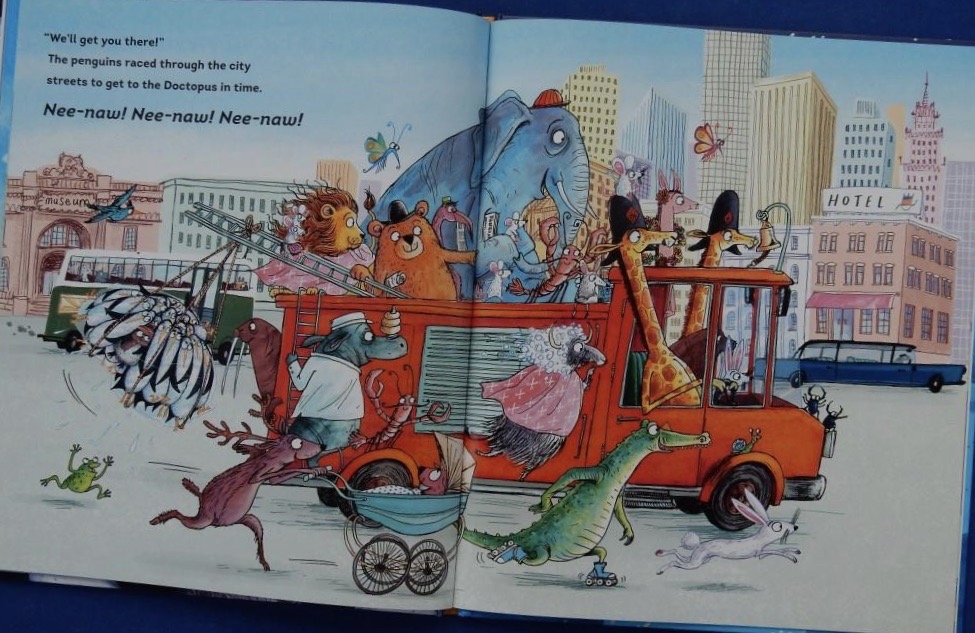
By means of various modes of transport the penguins journey over land and sea until they eventually reach a shining city, the streets of which are full of animals from all parts of the world. Several of the creatures are ready to try defrosting the huddle but they meet with no success. Just when the other penguins are on the point of abandoning their search, Pipsqueak has another idea. Can they reach the establishment of Doctopus before the surgery closes? Happily their new friends are there to assist.
What happens when they reach their destination though …
This is a cracking tale of friendship, community and helping those in trouble that will surely melt the hearts of young audiences and the readers aloud who share it with them, be they huddled, cuddled or snuggled. Sarah’s portrayal of all those penguins is absolutely wonderful, especially Pipsqueak.
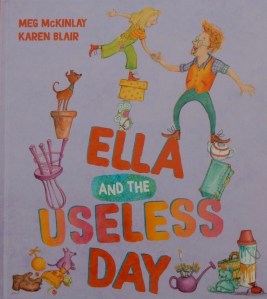
Ella and the Useless Day Meg McKinlay and Karen Blair Walker Books
Having had a good look around their house, Dad and Ella decide it’s time for a serious clear out and so they get to work right away. Together, they search, scramble, sort, poke, pick and pile all the useless stuff they find into the trailer to take to the rubbish tip, where useless things go. However, before they’ve even set off, their neighbour delightedly relieves them of the tricycle, calling it “Absolutely perfect!” and so it goes on until by the time they reach the dump, their trailer is almost empty,
even the holey blanket has been given a new lease of life. Then Ella realises that the final item is one they can make use of back in her own bedroom.
Meg McKinlay tells a subtle, gently humorous tale of recycling and reusing, creativity and community, that is highly pertinent in our throwaway society, where we all ought to be giving serious thought to living more sustainably. One wonders what on earth can be done with the “fashion disaster” of a suit,
the leaky goldfish bowl, the broken crockery and other things but young listeners/readers could have fun thinking of possibilities before turning to the final wordless spread where in a series of vignettes, Karen Blair shows just what their new owners did with them. Throughout the story, her watercolour and pencil illustrations provide lots of delightful details and underscore the wry humour of the words.
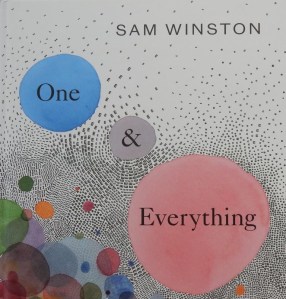
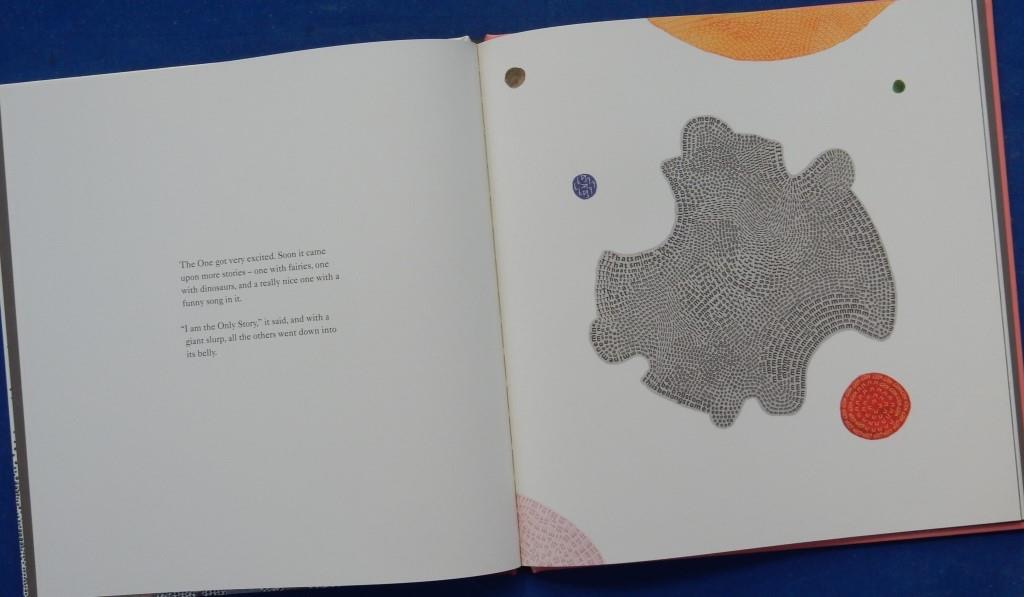
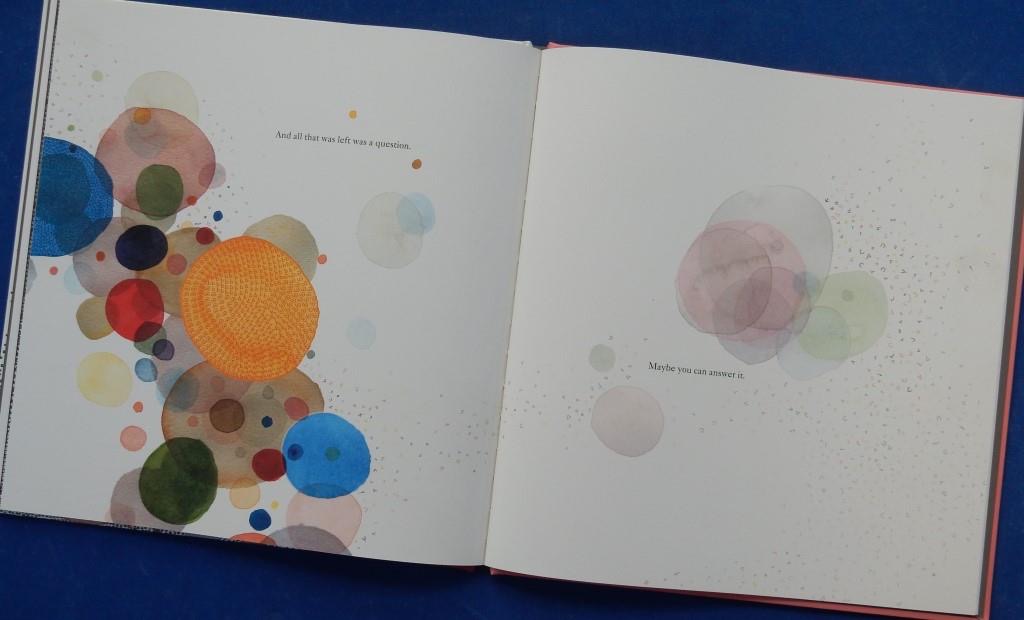
Here’s something strange, a story about endangered languages. Its main characters are circles of various colours and sizes, every one contains symbols, characters and script from a living or extinct language, each representing a story. These include stories about ‘beautiful sunsets’, the bottom of the sea whereas some are ‘simply full of dogs.’
All seem to co-exist peaceably until one story decides to become the most important story in the world. It calls itself One, the Only story and goes around the world’s story-verse consuming each and every other story, and thus filling its belly.
Therein however, something is happening: some letters get together to make words and eventually a voice speaks thus, “… you’re not the One story then. You’re Every Story.” This causes the One to come to an understanding and it then explodes into a myriad of stories. What’s left is a question. “Maybe you can answer it, ‘ asks the author …
The telling thus far has been minimal but what follows is the author’s note. This describes in some detail first the importance of preserving endangered languages and then introduces us to the linguistic characters that are shown in the illustrations. I’m not sure who the intended audience for this picture book is, but this reviewer certainly found it interesting.
A Dinosaur A Day Miranda Smith, illustrated by Jenny Wren, Juan Calle, Xuan Le, Max Rambaldi and Olga Baumert Red Shed
Imagine being able to encounter a different dinosaur, or other prehistoric animal, every day for a whole year. That’s what you can do if you plunge into this prehistoric extravaganza. Herein, after a general introductory spread, you will meet all your favourites such as the fearsome Tyrannosaurus, the club-tailed Ankylosaurus and the plant-eating Triceratops and Diplodocus. You’ll also encounter a great many unfamiliar creatures, some of which have only recently been discovered: I have to admit the majority were new names to me.
One such is Aquilops, one of the beaked dinosaurs. It was a herbivore about the size of a cat with a skull smaller than the hand of a human. Another small herbivore was the Nqwebasaurus (found in what is now Southern Africa) Amazingly so we read, ‘fossils have been found with gastroliths in the stomach – stones it swallowed to help grind up tough plant food,’
As well as dividing the contents by months, the author also uses dinosaur groups – examples are: ‘some of the smallest’, ‘duck-billed dinosaurs’, ‘horn-faced dinosaurs’ and ‘largest of them all’. Surprising to me was that all those included here were herbivorous. One such Antarctosaurus never chewed its food, rather it swallowed plants whole.
Key facts for each dinosaur featured include the period it lived, the family it belonged to, diet, length, weight anywhere remains have been found; and there is also a brief paragraph giving key information ; and helpfully, the backmatter includes a pronunciation guide.
If you have a dinosaur fanatic or a budding palaeontologist in your family then you should definitely get a copy of this book. It’s also one to add to school collections: I envisage it being in much demand especially with KS2 readers.
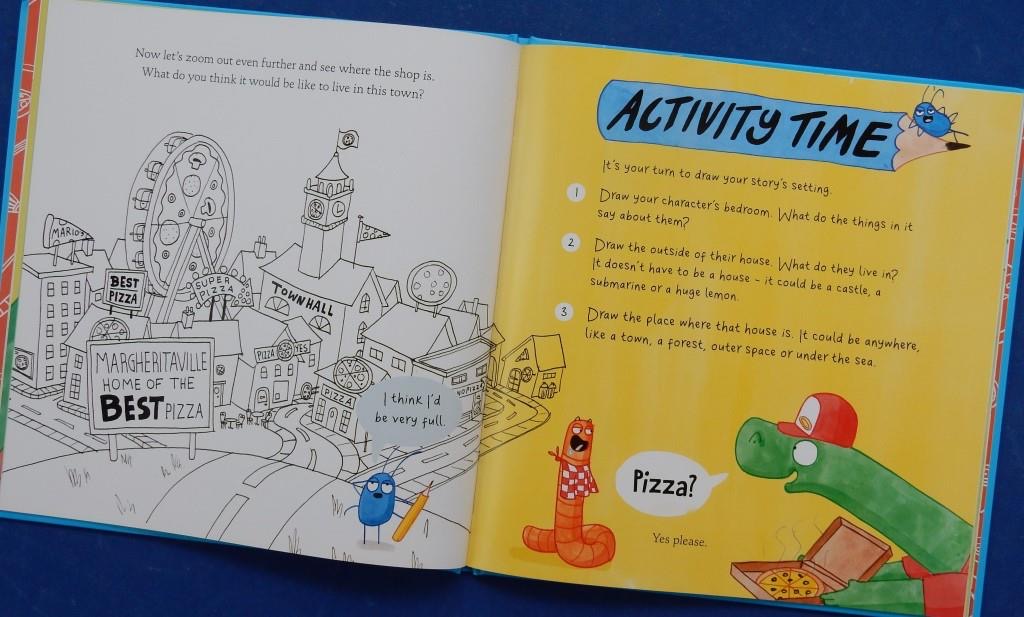
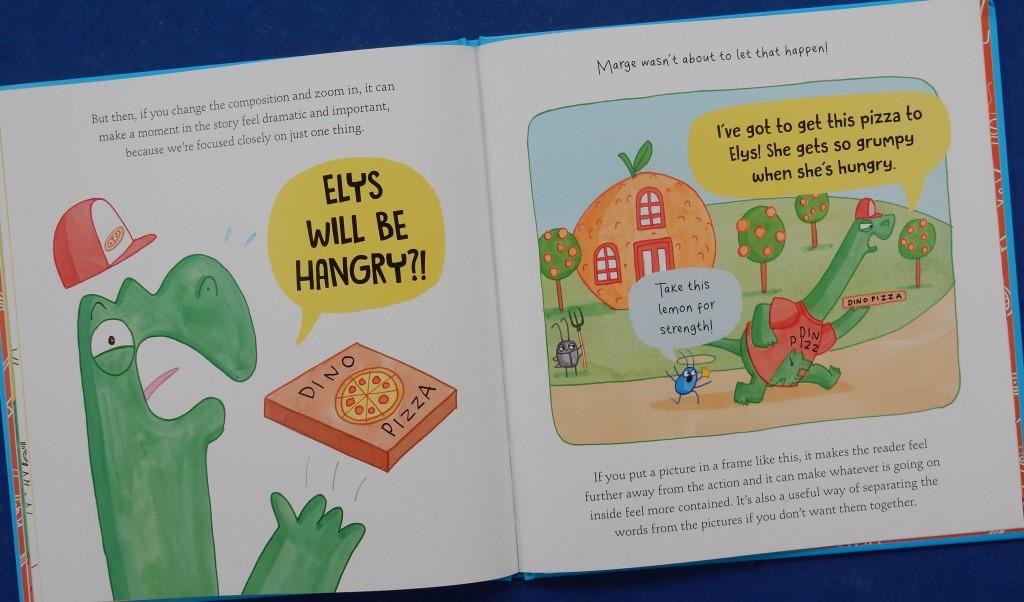
How To Make A Picture Book Elys Dolan Walker Books
If you’ve ever considered the possibility of making your own picture book, then look no further. Elys Dolan, aided and abetted by her annelid assistant, Bert, shows you how in this humorous, step by step guide. First make sure you have all your favourite pens, pencils, crayons, brushes etc to hand.
Of course, inspiration is key and according to our trusty tutor it’s time to visit your gallery of muses – in other words, your very special things; these can be used to generate a ‘story idea’. Then there’s the creation of credible characters, the first being the main protagonist and you need to get to know them very well.There’s lots of advice from Doc Dolan on how to do so.
Setting is another consideration – where is your story going to unfold and hugely important is what is going to happen throughout the story and how the events will be structured.
The use of building blocks is suggested – not the things young children love to play with – but sequences of words.
Two other vital elements in the creation of a picture book are also discussed. The placement of words and pictures on each spread means the creator needs to decide what the pictures should look like and how they and the words will use the space on each page. This allows the pace of the telling to be changed at different times: for example zooming in on a particular moment in the story heightens the dramatic impact,
whereas framing a picture creates distance between the action and the reader of the book. Moreover in the best picture books, the illustrations show things not said in the text and the text should say things not shown in the illustrations: not always easy this.
Our pro has one last tip to make the book a winner and it concerns colour: that means the author/illustrator putting themselves into the shoes or maybe that should be head, of the reader and then choosing appropriate colour(s) to generate the feeling wanted.
With a sequence of activities, tips aplenty and jokes too, Elys’ guide is highly entertaining and very informative. (Bert has even sneaked in step-by-step instructions on how to make your own blank book.) It’s a brilliant tool to use in the primary classroom or at home.
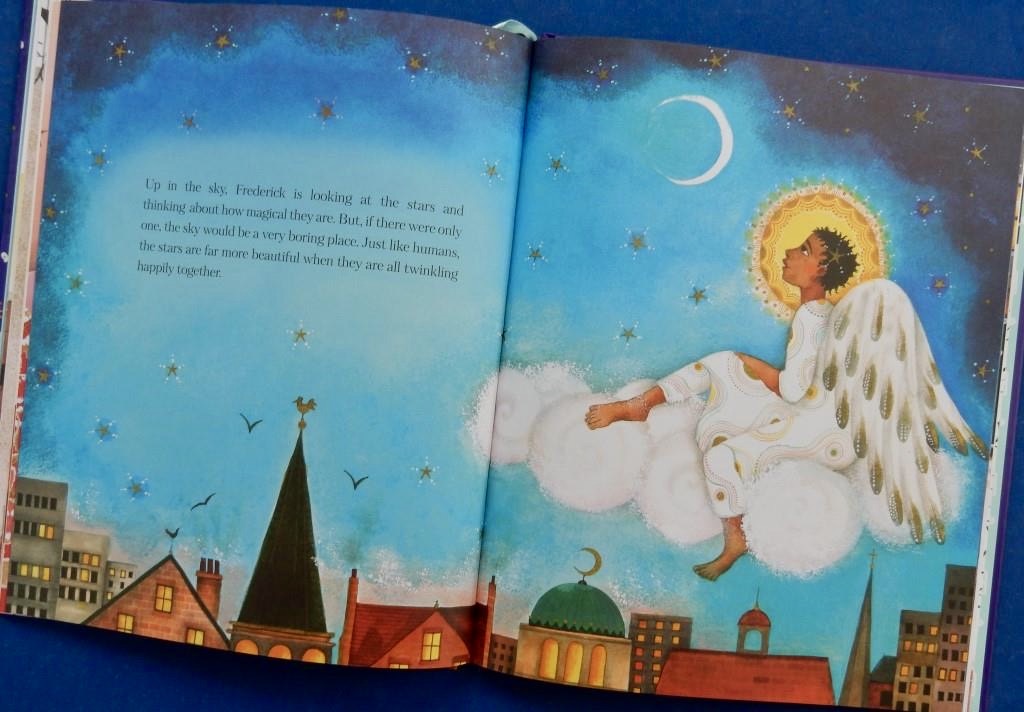
Rosie and the Friendship Angel Lucinda Riley & Harry Whittaker, illustrated by Jane Ray Macmillan Children’s Books
This is the third of the Guardian Angel series written by Lucinda Riley with her son Harry Whittaker before her death in 2021. Like the previous ones it’s based on stories she would tell her childen when they were facing challenging situations that made them fearful.
Here we meet young Rosie and her Guardian Angel Frederick. It’s Rosie’s first day at a new school and she is feeling very nervous as she ‘s greeted by her teacher Miss Marshall and reluctantly lets go of her father’s hand. Rosie is introduced to her classmates, one of whom, Jessica, has been asked to look after the newcomer. However Jessica doesn’t seem particularly friendly and come playtime Rosie is made to feel an intruder.
By the end of the day she’s feeling invisible and lonely, especially after what happens in the final task. That night having kept her feelings to herself, Rosie lies awake in bed and she makes a wish, a wish that is heard by Angel Frederick, whose job it is to help anybody in need of a new friend.
Frederick moves down towards Rosie’s home town and sets in motion events that result in Rosie finding a wonderful new friend.
Starting at a new school is an event that many children find stressful and scary and this gentle story is one that could help them overcome those fearful feelings. Jane Ray’s illustrations are strikingly beautiful and capture Rosie’s anxiety perfectly. There’s a special angel bookmarked ribbon attached to this lovely book.
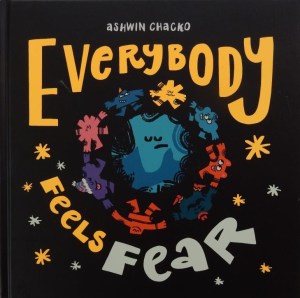
Everybody Feels Fear Ashwin Chacko Dorling Kindersley
As this book’s creator asserts we all have fears, some long-lasting, others much less so, some are small and some can be huge and overwhelmingly. This picture book is an exploration of the wide variety of fears we might have, from spiders to mice and bears to monsters. The text starts in rhyme and part way through changes to prose that offers encouraging words about fears: no matter how seemingly overwhelming a fear feels, with a modicum of courage, ‘as small as a mustard seed’ we can begin to face up to whatever is making us fearful. Assuredly fear does not define a person and most importantly love fuels courage and ‘where love lives fear cannot be.’ In other words, working together is the way to go.
Chacko uses a wacky, bold illustrative style combining it with arresting typography to put across his important message. This zany book offers a helpful starting point to encourage children to talk about their fears and in a classroom could act as the prelude to a circle time discussion.
The Dream Train Sean Taylor and Anuska Allepuz Walker Books
Rather than sharing a story with your little one(s) before bed why not try some poems for a change. From popular picture book author Sean Taylor comes this collection of thirty poems that are perfect bedtime reading. The book has three sections: Night Arrives, Shut-Your-Eyes Time and Dream Wheels Turning. No matter if you want something magical or musical, something to give you a good giggle or to snuggle up warm with, then you will surely find it herein. Offering something snuggly and warm is The Blanket: ‘Dad says there’s a little bit / of love in every stitch. // … I’m sure it sometimes whispers “Good night, love. Sleep tight.”
From the first section, Story Time provides something musical, which is confirmed in the final verse: ‘Right round the world, / you will always hear it. / Wherever there are children, / you will always hear it … / the soft music of story time.’ If only that were so for all children everywhere.
Magical for me are the words of Once There Was: ‘The day is done. / Darkness comes. // Once there was a lake. / Now there’s a mirror of stars.’ Making this one even more magical is Anuska Allepuz’s watery twilight scene.
To induce a giggle or two you could turn to The Middle of the Night, tell your child to close eyes and imagine as you read of knives and forks asleep in the kitchen, towels asleep in the bathroom, flowers asleep in the gardens. Can they suggest what those things might be dreaming of when ‘the stars are awake in the sky.’ ?
Anuska Allepuz’s illustrations are a visual treat: their subtle, muted shades and soft focus pastels give a dreamlike quality as befits the overall theme of the book.
Add to family bookshelves if you have a young child.
On the Move: Poems About Migration Michael Rosen, illustrated by Quentin Blake Walker Books
This is a subject very close to the poet’s heart as is evident right from the start when he explores his roots. We read of the experiences of Michael Rosen’s Family and Friends in the first of the book’s four thematic sections. We read too of when he was just a boy and he writes about growing up in London after the end of WW11, and his Polish-Jewish heritage.
The poems in the second and shortest section, The War, are equally poignant comprising parental reminiscences of World War II and incidents during family travels in various parts of postwar Europe
Enormously potent is The Migrants in Me. In this third part, Michael considers missing family members. So says his father: “I had two French uncles. / They were in France / at the beginning of the war. / They weren’t there at the end.” In the next poem ‘Finding Out,’ Rosen purposefully searches out information about these uncles—Oscar and Martin, learning of old photos of them in a long-hidden box labelled Family Photos. Then come heart-wrenching poems directly addressing Oscar and Rachel, his wife; these imagine their feelings during escape, discovery by Nazis, and being sent to Auschwitz.
In On the Move Again we read of the poet’s thoughts about migration today, in particular the plight of refugees who flee their homelands in the face of war, famine or other adversity, to start life afresh. It ends with the compelling ‘Today’ – ‘What you did yesterday / can help you choose what to do now. / What you did yesterday and what you do now / can help you plan what to do tomorrow. / But you can only do something now.’
At once commemorative, historical, political and celebratory, Michael’s poems herein have a straightforward power that is echoed in Quentin Blake’s black and white illustrations that have a haunting quality of their own.
The book opens with an explanation of the difference between refugees and migrants and concludes with suggestions of organisations that support refugees.
Before the title page we meet a small boy holding up a doll dressed in ballet attire, who introduces himself thus, ‘I’m Thomas, and I want to be a ballet kid.’
He then goes on to share with readers in a straightforward manner, the events of a ballet class day. Having dressed up warm as befits the snowy day and packed his ballet shoes, off he goes to the dance studio clutching mum’s hand. He introduces us to each of the friends he meets on the way, all of whom are heading to the class too.
Once there, with their ballet shoes on, the children start their lesson. Thomas takes readers through the warm up, and the various moves, describing the exercises,
defining ballet terms, while speech bubbles provide comments from the young participants. Mr Elliot, their teacher is enormously encouraging as are the children one to another and then with Christmas approaching, the pupils choose outfits and thus, roles for the winter show, a performance of The Nutcracker. Thomas picks out what he thinks is the most wonderful costume he’s ever seen. “You’re the Sugar Plum Fairy”, Mr Elliot tells him and puts on the music for him to dance. When it’s time to leave Thomas has started feeling butterflies in his tummy but they’re soon allayed by his teacher’s words, “Just listen and move with the music, the magic will come from within.” And it most certainly does …
In her inclusive illustrations, Holly Sterling captures that magic and the sheer joy of the young dancers both in their class and as they perform the winter show. Young audiences will surely be swept up in that enchantment, especially the aspiring dancers among them.
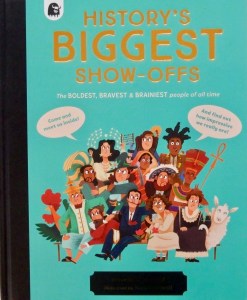
History’s Biggest Show-Offs Andy Seed, illustrated by Sam Caldwell Happy Yak
What is it about some people that makes them want to show off about their achievements? Have you ever wondered who the biggest braggers of all time might be? If so then Andy Seed has done the work for you, presenting in his lighthearted style, the flashiest boasters in the history of humankind.
The book is divided into three main parts entitled People in Charge, People Who Think Up Stuff and People Who Create Things; however if readers prefer they can look instead at different time periods: ancient (c.6000 BCE to 500 CE), post-classical (c.500-1500 CE), early modern (c1500 – 1800 CE) and modern (c. 1800 to the present).
We’re introduced to eleven rulers, five of whom were women. These include Hatshepsut, an ancient Egyptian pharaoh, Tarabai who at just twenty five, took over the leadership of the Marathas after the death of her husband and proceeded to show off her military skills to overcome the Mughals; and Christina of Sweden, she who was super-brainy and loved to read. Among the men was Mansu Musa who when on Haj, took 12, 000 servants each with a bag of gold to give away en route to Mecca.
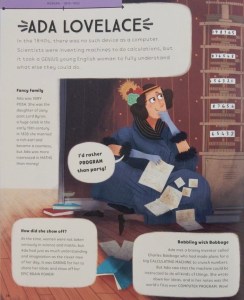
Those with a scientific or technological bent include the first ever computer programmer, Ada Lovelace
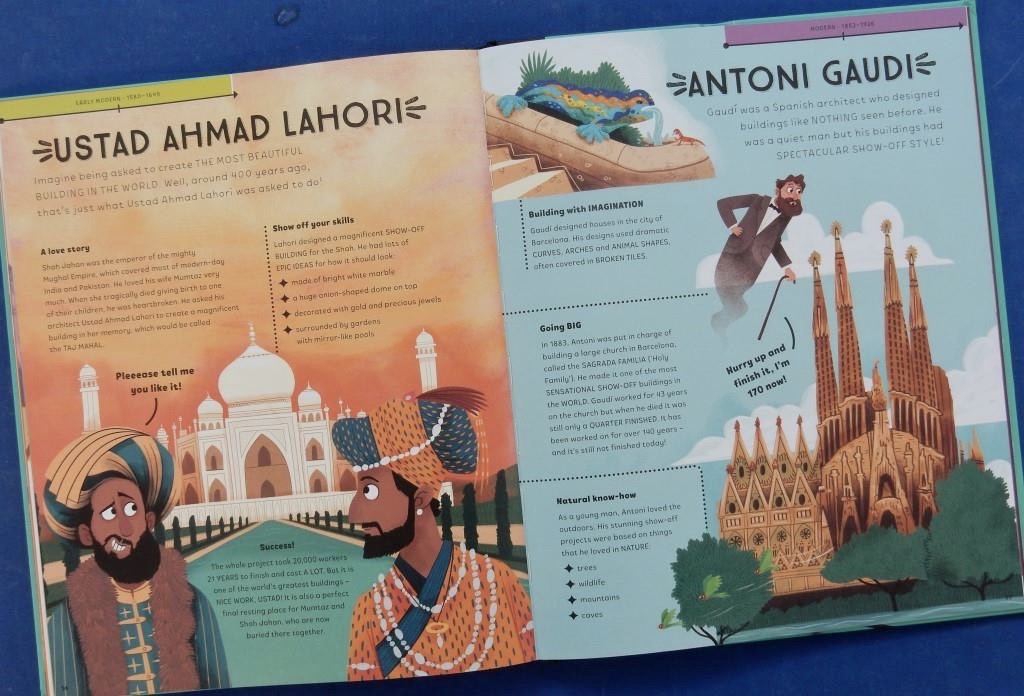
and Ynes Mexia, an intrepid plant collector from the early 20th C who discovered 500 new species and had fifty plants named after her. Having studied at Brunel University, I have to mention the ace engineer, Isambard Kingdom Brunel who, with help from his father, built the first ever tunnel beneath a river (The Thames) and who sadly died before his exceedingly costly Clifton Suspension Bridge was finished. Finally come the creative types: Ustad Ahmad Lahori was asked by Shah Jahan to create a building in memory of his beloved wife Mumtaz and that’s how the magnificent Taj Mahal came to be. Another show-off architect Antoni Gaudi is famous for Barcelona’s still unfinished Sagrada Familia.
There’s a wealth of bling too, as Andy Seed’s humorous writing brings all these and more back to life and he’s even included some quizzes to ramp up the fun. Talking of fun, Sam Caldwell’s zany illustrations certainly add more of that in abundance: even the timeline will make readers giggle.
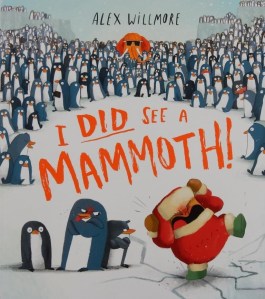
A research team – three adults and a child – are in the Antarctic exploring. The adults are looking for penguins; not so the child narrator who insists: ‘But I’m going to see a MAMMOTH.’
Setting out alone the little protagonist comes upon a skateboarding mammoth. ‘Mammoths are extinct. And I’m pretty sure they’re not even from around here.’ is the response of one of the researchers. ‘Are you sure it wasn’t a wonderful … penguin?’ More determined than ever to prove it was a mammoth, the child sallies forth again and sees in turn the mammoth skateboarding wearing a frilly pink tutu doing ballet and the mammoth sporting a scuba mask submerged underwater.
Still no one believes the child and a shouting match ensues. Followed soon after by a full on tantrum by the youngster. This results in the ice cracking, an avalanche and a surprise revelation for some of the party. The final twist is huge fun and the book concludes with a brief note about both mammoths and penguins. Adult readers aloud will love sharing this humorous tale and listeners will relish shouting ‘Mammoth’ at every opportunity, as the child’s indignation turns to anger. Alex’s illustrations are superbly expressive, especially the penguins every one of which is a visual treat.
A super wintry book.
The Grizzled Grist Does Not Exist! Juliette Maclver and Sarah Davis Gecko Press
Ms Whiskersniff, Ms Whisk for short, having assessed her pupils’ forest skills, takes her class trekking up the Dismal Hills. When shy Liam announces that he’s good at hiding, he’s told, “You can’t call that a skill”. Really? Soon the group pass a sign announcing the Grizzled Grist; Liam attempts to draw Ms Whisk’s attention to it and is immediately given the titular response, “The Grizzled Grist does not exist.”
So what has made the very large footprints that Hider, Liam (now camouflaged) urges his teacher to take notice of? You can guess what he’s told, in no uncertain terms. Lunchtime comes and goes with the occasional near disaster and eventually after trudging for much of the day it’s time to think about wending their way back. Liam meanwhile has gone into hiding up a tree and from this vantage point he spots something alarming. Yet again, the teacher will have none of it and back they continue to trek until …
Catastrophe! Thank goodness Liam is so good at hiding; but can one small boy possibly save all of 2B and Ms Whisk from the clutches of the gruesome Grizzled Grist?
Juliette MacIver’s rhythmic rhyming text tells a witty, playful tale that is humorously illustrated in scenes that show much more than the words say, especially regarding the characters. I love the endpapers.
The Book That No One Wanted To Read Richard Ayoade, illustrated by Tor Treeman Walker Books
This is one of the most crazy books I’ve ever read: it’s the first actor, writer and director, Richard Ayoade has written for younger readers. It’s also fiendishly funny, clever and thought-provoking.
Let’s consider how it feels to be a book – the best way is to allow a book to be both main character and the narrator telling things from its own viewpoint – sounds as though we’re getting a bit autobiographical here. Still that way allows us readers to imagine such things as the importance of making one’s cover alluring – failure to do so could all too easily result in being hurled across the room, abandoned under a whiffy pant pile or, horror of horrors, left on a shelf to be nothing more than a mere dust collector. And unless the tome under consideration happens to be a yogi there’s the possibility of having to perform some pretty sophisticated folds,
have your spine broken or, should you be totally unwanted then – gasp! – be sent off to a warehouse and there ‘pulped’ to near oblivion.
Hang on though, this book that we’re reading is in the process of charting its own destiny and that means finding its way into the hands of readers like us who will take great delight in discovering it in a bookshop – preferably on a display table with that irresistible unicorn cover or similar.
Tor Freeman captures with panache, Richard Ayoade’s wry humour in her wonderfully quirky illustrations that accompany the narration. Contrary to its title, this is a book you most definitely WILL want to read.
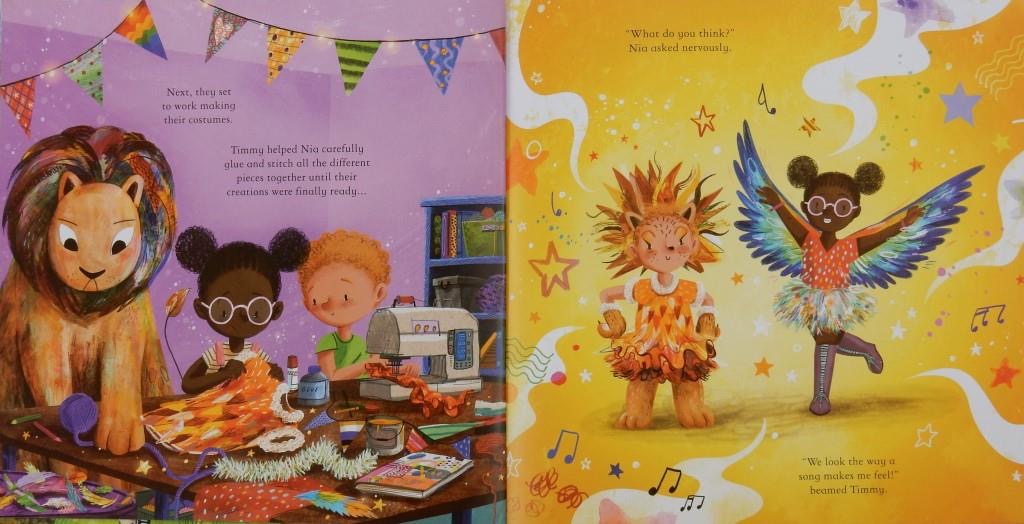
Timmy is a non-binary child who loves performing and dreams of one day becoming a stage star and being able to share stories with others. However unless singing and dancing in the bedroom there’s problem in the form of a very large, grumpy lion and it’s always lurking stopping Timmy from focussing. One day Mr Stevens, Timmy’s teacher announces to the class that there’s to be a school play, Timmy feels no excitement on account of that lion.
At lunch break Timmy sits watching the other children playing together when a classmate approaches
and a friendship begins to blossom between the two. It turns out that both children are actually shy and with mutual encouragement they create costumes,
rehearse, meditate and use positive affirmations. Little by little the relationship between Timmy and the lion becomes calmer and Timmy becomes more self-assured.
Come the night of the show however, Timmy has a crisis of confidence. Can it be overcome with Nia’s help? It surely can and as for the show: it’s a dazzler.
This uplifting story of getting the better of shyness will surely resonate with almost any young child. Youngsters will understand that the lion is a metaphor for Timmy’s anxiety and love the vibrant illustrations. There’s lots to explore in the opening scene set in Timmy’s bedroom and take a look at the various flags shown during the story.
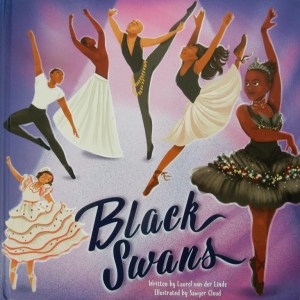
Black Swans Laurel van der Linde and Sawyer Cloud Sunbird Books
The six brilliant Black ballet dancers almost leap right off the pages of this show-stoppingly illustrated, narrative non-fiction book.
First we are introduced to Essie Marie Dorsey who although she never made it as a ballet dancer herself on account of her colour, made sure that others could by opening her own dance school in Philadelphia – The Essie Marie Dorsey School of Dancing; and to get Black parents to enrol their children, she went knocking on their doors asking them to send their offspring as pupils and so they did.
Next is Arthur Mitchell; such was his skill at ballet, that he attracted the attention of George Balanchine, artistic director of New York City Ballet and was invited to join the company, eventually becoming the first Black principal dancer. Even then it wasn’t plain sailing for in 1957 an audience deemed it unacceptable for a Black man to dance with a white woman. Some twelve years later using his own money, Arthur co-founded the Dance Theatre of Harlem ballet company.
Christian Holder moved to England aged seven with his family, then later attended the New York High School of Performing Arts. His talent was noted by the choreographer Robert Joffrey and as principal dancer, he had to face racial prejudice but it was his partner, not Christian who was replaced.
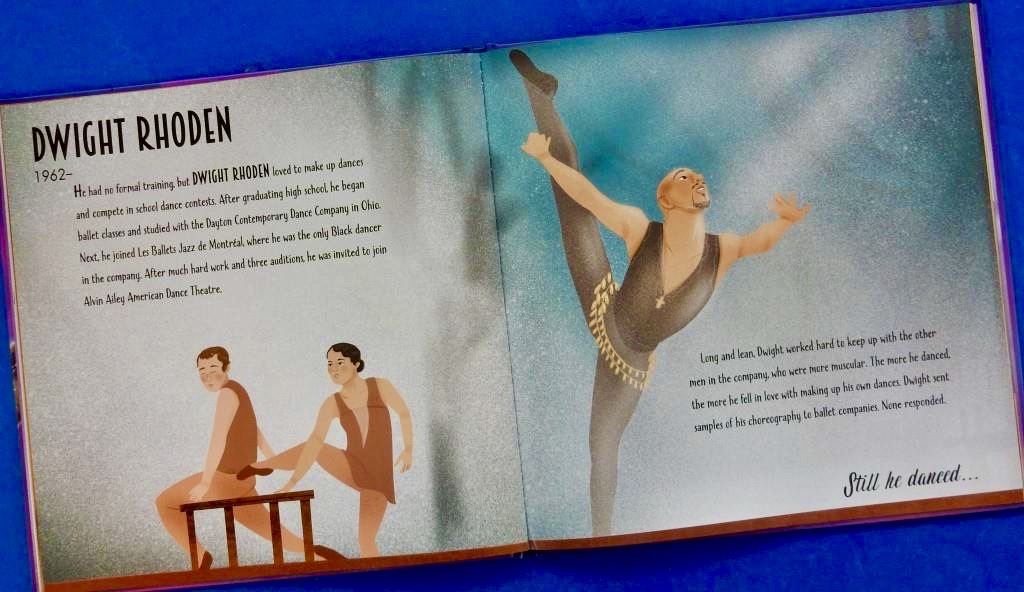
Dwight Rhoden too was held back on account of his skin colour, but as a choreographer went on to cofound Complexions Contemporary Ballet.
Last come two women, Misty Copeland who in 2015 became the first Black ballerina to be Principal Dancer of American Ballet Theatre and finally Michaela DePrince who when a very young orphan in Sierra Leone saw a magazine picture of a ballerina.
When she was adopted by a family from New Jersey she went on to become a star dancer of Boston Ballet.
Ground breakers all and each of these dance lovers achieved greatness by overcoming obstacles through self belief, determination and of course, amazing talent.
A lovely book to inspire youngsters to follow their dreams, whether or not that involves dance.
Baby Polar Bear Anne Rooney and Qu Lan Oxford Children’s Books
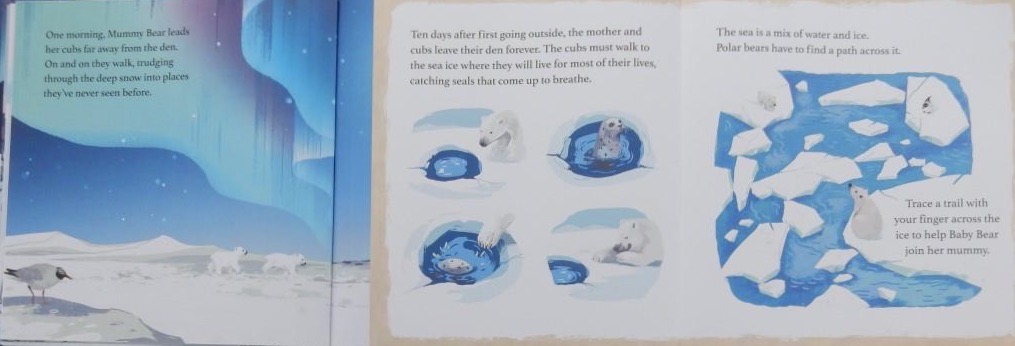
In this latest of the Amazing Animal series, we follow a recently born Baby Polar Bear cub and her twin as they take their first forays away from the Arctic den their mother has built. They’re a playful pair and both stay close to Mummy Bear as they frolic in the thick snow.
One morning their mother leads them away from the den on a long journey across the icy terrain. The little ones take care not to stray too far away in case of wolves.
Eventually they reach the sea and the cubs delight in chasing the birds and Baby Bear takes a tumble into the chilly water. Brrrrr! After some splashing for a while, it’s time for the cubs to snuggle up together under the star-filled sky. All this is told in the narrative part of the text while facts about the bears are found beneath the gate-fold flaps of this cleverly designed book.
The illustrations are gorgeous and Anne Rooney’s engaging text with its interactive element, is pitched perfectly for the intended young audience; to add to fun, there’s also a Bonaparte’s gull to find on every spread.
A book I’d strongly recommend for both home and class use.
‘In this book you’ll find / Many kinds of things / Some have slippery scales / Some have feathered wings. // But kind is more than type / Kind is how to care / For creatures that you meet / And places that we share.’ Thus begins the beautifully illustrated, rhyming narrative that urges readers to show kindness to all living creatures and to our precious planet.
Making each spread a joy to explore, the author takes us first on a tour of the animal kingdom and presents flutterers, weavers, animals with shells, fish, the horned, the waddlers, owls and more, including some of the most spectacular. Every creature illustrated is clearly labelled with its Western common name; and each kind has a four lined verse that reads aloud well: ‘ Be kind to those who glitter / In gold and blue and green / There’s treasure in the world / That sometimes goes unseen’.
Having presented us with that wealth of wonderful creatures, Jess McGeachin moves the kindness focus, first to the planets, particularly Earth, and finally having gone large, he comes back small to remind readers that we humans are part of nature and we need to treat other people kindly too.
It’s good to see the author’s carefully considered afterword includes recognition that many of the animals depicted have names in the languages of the First Peoples who shared the land with them. This is a book to add to family shelves and primary school collections.
Hugg ’n’ Bugg Finding Home Ian Brown and Eoin Clarke Graffeg
High in the Himalayas lives Bugg, a mountain flea. Unlike most of the other creatures living in this chilly location, Bugg does not like the freezing climatic conditions and so decides to search for somewhere warm to shelter. The sight of him bobble-hatted and carrying a load on his back is hilarious. First a lost sock and then a stinky boot, offer temporary accommodation and then he quickly rejects the bat-filled cave. Eventually, after a series of other unsuitable stops, Bugg takes a huge leap, landing somewhere promising at last – in the fur of the Abominable Snowman, aka Hugg. This huge creature introduces itself as “Bummy Nubble Snowman” going on to explain that on account of his looks he keeps himself hidden on the highest ground. Bugg offers to look after the Yeti in return for a home in his warm hair and a deal is done.
A deal that leads to the most unlikely of friendships and some tonsorial treats for Hugg.
Totally crazy and hugely entertaining is this latest Brown/ Clarke collaboration, the first of a new series with a theme of mutual friendship, it offers some vital lessons to young audiences. Ian Brown’s terrific talent for story-telling in combination with Eoin Clarke’s comical illustrations make this a read aloud, which despite its chilly setting, leaves a warm feeling within.
Cloud Babies Eoin Colfer and Chris Judge Walker Books
This story is inspired by events in the family life of Chris Judge, the book’s illustrator. Young Erin’s favourite game is spotting animals in the clouds with her mum and dad and friends. She sees all kinds from cats to crocodiles and snowball polar bears to puff-less dragons. She calls them her cloud babies.
One day, Erin is very ill and has to spend a considerable length of time in the children’s hospital. She’s made to feel very welcome, is looked after with loving care by doctors and nurses and makes lots of friends. Even in hospital Erin takes delight in playing cloud babies with her new friends and either personally or remotely, with her dad.
Eventually Erin is thrilled to be discharged from hospital but learns from the doctor that she will still need to have further “Hospital days”
Rather apprehensively she returns to school but things have changed considerably and Erin, now six, is sad to find that people there don’t share her imaginative interpretations of clouds. Indeed that comforting world she’d built and become used to in hospital feels distant and unfamiliar; moreover she decides that cloud babies aren’t for her any longer. It’s SO difficult to feel a part of either her hospital friends’ or her school friends’ group.
However her loving, empathetic parents don’t give up on those cloud babies and with their guidance and support from her class teacher and classmates, Erin comes to understand that through sharing her world and her cloud babies, she will find joy in being her true self again.
This story is written with great warmth and sensitivity by Eoin Colfer who has also included a special letter to readers at the front of the book. Chris Judge’s art is a skilful fusion of photographic images and vibrant illustration that blend children’s unlimited imaginative powers with the day to day world of a children’s hospital. No mean feat and the end result is an upllifting book that offers great help and comfort both to children faced with illness and to the adults who share their lives.
I would love to see Cloud Babies in all children’s hospital wards and doctors’ surgeries.
The Bear and her Book: There’s More to See Frances Tosdevin and Sophia O’Connor uclanpublishing
The big brown ursine bibliophile with an enormous heart returns and despite being snuggled up cosily one warm winter’s night, she feels that urge to explore. It’s prompted by a white, book-less bear looking lonely and downhearted in a picture in her Book of Being Wise. She packs her book and sallies forth, first aboard a fishing boat and then an ice floe. Soon she encounters a kindly whale who points her in the right direction but mentions a blocked up spout. Fortunately Bear’s book has the remedy and having helped the whale, receiving a “Yay” … “my blowhole’s mended. Thank you so much, my spouting’s splendid!” off she goes again.
On land as she walks across the snowy Arctic terrain, Bear meets first a moose and then a muskox, both of whom she helps, as is her way;
and then again repeating the words, “I’m a curious bear who must explore / The world is big and there’s more to see, / And I’ll find this bear who is not like me.” she proceeds on her way, eventually stumbling into an icy sleep.
On waking she repeats her refrain once more and there before her stands the object of her search, sobbing gently and speaking of wanting “A great big book – with lots of pages”.
I suspect readers can guess what happens next, but perhaps not how this tale of friendship concludes … Despite the chilly setting of most of this rhyming story, Sophia O’Connor’s illustrations give you a warm glow inside as you read Frances Tosdevin’s lyrical narrative of the tender-hearted Bear with a desire to do good. I hope to see lots more of this character and her passion for exploration.
Gotcha!: A Funny Fairy Tale Hide-and-Seek Clotilde Perrin (translated by Daniel Hahn) Gecko Press
Between the covers of this large format book are three mock-scary monsters just waiting to give you the creeps and to catch the small character from the title page. First there’s a big yellow and decidedly nasty ‘hairball’. Fear not though, there is safety if you seek refuge within the brick house cleverly constructed by the third little pig and so our porcine pal says, this residence is built to withstand monsters.
He’s waiting within, cooking up something delicious and is willing to share it with little human visitors who want to hide from hairballs and the like.
Also on the prowl is the ‘fizzling stinkwort’; this monster uses its gaseous emanations to render you senseless and then consume you, unless you flee forthwith. Where better to hide than what looks like a deliciously welcoming abode with walls of gingerbread covered with confections of all kinds? Therein you will find the self-sufficient children, Hansel and Gretel – kind hosts who can help keep you safe once you’re within those walls.
Having recently consumed its breakfast, the tired-eyed creeper has its mind on the next meal and to ensure staying safe, it’s necessary to fight a way through the creepers covering the walls of Sleeping Beauty’s castle wherein lie sleeping fairytale characters.
However the three nasties don’t give up that easily so don’t think it’s safe just yet …
With the three residences full of amusing references to the stories they come from (and others), as well as flaps to explore and the satisfying disposal of the nasty monsters, this will keep youngsters entertained for ages, and returning for further forays into those favourite fairytale abodes.
Dragon Storm: Kai and Boneshadow Alastair Chisholm, illustrated by Eric Deschamps Nosy Crow
This is the fifth book in Alastair Chisholm’s fantasy series for younger readers, set in the city of Rivven.
After dinner one night Kai and his fellow dragonseers are called to the office of Berin, Chancellor of the Dragonseer Guild. She informs them that at the king’s beset they have been summoned to the Royal Palace where trade negotiations are taking place. There they are to act as ‘apprentice clerks’ to assist Prince Harald by copying out various relevant documents because members of the clerical division at the palace have been struck down by a mysterious sickness.
Following their first day’s work, the children are talking in their dormitory and Tom mentions seeing a dragon entering the palace. They decide to search in secret for this dragon and while so doing Kai picks up a leather pouch, containing a bottle holding a mysterious potion. This Kai has in his hand when he is rushing to get back to the dorm; it breaks and a shard of glass penetrates his palm and the liquid goes all over his hand. The result is that Kai starts feeling completely different – more confident and powerful.
Back home at the weekend Kai’s dragon Boneshadow notices a change in the boy. The dragonseers are also warned by Berin not to go exploring the castle on their return there the following week. During the weekend Kai’s actions cause consternation among his friends especially when he causes Erin to get injured. Back at the palace, when he starts following the call of that other dragon, Firedreamer,
not only does he risk losing his human friends, it appears that he might lose Boneshadow too. Will Kai realise what is happening to him before it’s too late? Will Boneshadow discover what her power is? And what is the significance of that crest on the leather pouch …
Gripping reading and a cracking addition to the series.
Duck’s Backyard Ulrich Hub, illustrated by Jörg Mühle Gecko Press
A duck with a ‘wonky’ leg lives a lonely life in a backyard from which she’s never ventured. Then one day in wanders a chicken wearing dark glasses. The chicken is rather egocentric, determined and also blind, almost immediately deciding that the duck will be her guide on a journey to a place “where all our secret wishes come true” She knows not where this place is but is certain she’ll know when they reach there. Duck eventually accedes to Chicken’s wishes and off they go, taking it in turns to lead the way.
They talk and they squabble and dance a fair bit as they conquer ‘the darkest forest in the world’, cross a huge ravine, on a plank placed there by duck,
and climb the world’s highest mountain. Or do they? No matter, for they find themselves and each other; and they certainly find what matters most of all.
There’s a great deal to ponder upon in this superficially simple, philosophical tale, the drama of which is underscored by Jörg Mühle’s humorous depictions of the travellers. A small piece of thought-provoking brilliance this.
These are two recent titles from Allen & Unwin Children’s Books: thanks to the publisher for sending them for review
Dear Grandpa Kate Simpson and Ronojoy Ghosh
Separated by a huge distance, a little boy Henry and his grandpa sustain a very special relationship through their letter writing that begins when the child moves to a new apartment in the big city 2003 km from his grandpa’s house. The first letters are factual and Henry talks of things in the city that he hopes just might encourage Grandpa to come and visit (ice-cream shops, cinemas and me). As their exchange proceeds, the two become imaginative, inventing and deflating one another’s way out visiting plans – riding on a whale,
catching a shooting star – and readers are presented with a series of facts that the letter writers share while coming to terms with the physical distance between them. I love the way the author brings us full circle with Grandpa’s closing letter mirroring Henry’s opening one with talk of that needle and magnet to point the way to one another’s abodes.
A gorgeous demonstration of how it’s possible for a loving human connection to transcend distance, with Ronojoy Ghosh’s imaginative illustrations being quirky visual representations of each of the letters. A smashing book for a grandparent and grandchild to share.
Where? Jordan Collins and Phil Lesnie
Where? is an enormously powerful, heartfelt slam poem by Jordan Collins written when the author was in his teens, in response to the ‘where are you from’ question. Thoughtless racist comments such as that can be incredibly hurtful yet still some people continue to ask such things. Here the author makes a plea to be seen in the same way as everybody else (everybody with white skin that is) as opposed to somebody entirely ‘other’. Readers cannot help but feel for the young narrator, and by implication, every other person who is being judged not by who s/he is, but on account of their skin colour, type of hair, way of speaking, from where they’ve come.
lllustrator Phil Lesnie has taken Jordan’s words and brought them to life in a stunning way that expands on those words which quite rightly, (and optimistically), end thus ‘I’m from the same place that you are. // So no need to ask again.’ Every spread is one to ponder over and think deeply about and one can but hope that the book finds its way into all primary school classrooms wherever they are. For sure, we all need to celebrate our common origins and shared humanity.
Well Done, Mummy Penguin Chris Haughton Walker Books
I’m a big fan of Chris Haughton’s animal picture books and immediately fell for the penguin family, especially Little Penguin.
As the story opens Daddy Penguin is explaining that Mummy is off searching for yummy fishy dinner for them all in the chilly waters of the Southern Ocean. She needs to swim very fast and dart at great speed – swoosh swish swoosh
and while she is so doing Little Penguin seeks reassurance that she will return safely. And so she does but to do so she has to jump, climb a slippery slope – cu-crunch cu-crunch cu-crunch and then tip-toe carefully past some slumbering seals – shh! – in case she wakes them.
Little Penguin is concerned to see that Mummy Penguin finds herself face to face with one now wide awake seal
and as a result has to perform an amazing leap. Fear not though for Mummy is unstoppable and Woo-hoo! she lands safe and sound with a tasty offering for her little one. Can you guess what he says having consumed his dinner with relish?
With beautiful Antarctic landscapes, this is a gorgeous celebration of mothers, be they penguins or other; I’m sure little humans will love following Mummy’s progress and joining in with the onomatopoeic words sprinkled throughout the telling.
The Very Hard Book Ian Ben-Barak and Philip Bunting Allen & Unwin
In this zany book readers are asked to try some very challenging things and it’s all in the name of helping us to become aware of our thought processes (metacognition). Are you up for the challenge of some open-ended thinking? Right … ‘Sit in an empty room.’ ‘Drop something by accident.’ ‘Dig half a hole.’
Each page (almost) gives a different instruction or asks a different question and by the time you’re half way through you’ll be giggling (partly thanks to Philip Bunting’s quirky creatures) and your brain will be going into overdrive with the creators’ comical ideas. Certainly however you will be more conscious of the limitations of your own mind.
You might even be prepared to have a look at The Very Hard Gallery at the back of the book. Here you will find a more detailed exploration of the paradoxes presented: you’ll see some interesting sounding names such as the Stroop Effect (your mind having to process two conflicting messages; in the example given, they are meaning and colour); then there’s Panta rhei. You will need to find out what this means for yourself, which means getting hold of a copy of the book (no cheating by using google).
Try putting this in a KS1 classroom; as well as introducing them to some surrealism, it will surely get everyone’s little grey cells working hard as they embark on a fun-filled thinking journey.
A World Full of Spooky Stories Angela McAllister, illustrated by Madalina Andronic Frances Lincoln Children’s Books
This collection of fifty traditional tales from all over the world is organised thematically into eleven parts – by geographical feature or location – and celebrates things spooky (but not terribly so). Some are very familiar: Hansel and Gretel and Little Red Riding Hood being two from the ‘Into the Woods’ section, which comes first.
One witch I wasn’t familiar with is the Water Witch. In this tale originally from France, William the hero goes to the bottom of an enchanted lake to find riches so he can afford to marry his beloved, a dairymaid, but is tricked by the witch, transformed into a frog and thrown into a fish tank. All ends happily I hasten to add, though maybe not for the witch.
Readers are more likely to know Baba Yaga who resides in the house that stands on a pair of chicken legs: she’s the one Vasilissa the Beautiful gets the better of when she goes into the forest, in a Russian tale of the same name.
If you follow a mountain path it might lead to a man-eating ogre. This fearsome being is found in the mountains of Tibet and he tricks a girl into believing he is her mother and thus is able to carry her off to his cave. Do you think he eats the girl? Possibly, but it’s also possible that a fox helps the girl’s mother and in so doing causes the demise of the old ogre. Also feared for consuming humans is the Chenoo that features in a North American Passamaquoddy story. This giant creature had once been a man but on account of his wickedness, his heart had turned to ice. Can that ice perhaps be melted again and with it the wickedness? …
Certainly there are spooky elements in all the stories, but very few are really spooky and one or two are even humorous. Helping to bring the tales to life are boldly coloured folk art style illustrations by Madalina Andronic. Yes, this could be a book for reading while snuggled up on chilly autumn and winter evenings, but equally, folk tales are entertaining whenever you encounter them.
The Woman Who Turned Children Into Birds David Almond and Laura Carlin, Walker Studio
When a woman, Nancy Solo by name, arrives in town claiming to be able to turn children into birds, the adults warn the youngsters to stay away, scoffing, calling it piffle and balderdash. The children however think differently. First to approach Nancy on the bench is Dorothy Carr. Nancy whispers into her ear and off flies the girl, a swallow ‘swooping up into the blue’, but only briefly.
Before long another child, Colin Fox steps forward
and takes to the air – as a sparrow. Very soon the sky is full with a goldfinch, a rook and a host of other children transformed into birds. With more and more children enjoying their flight, Nancy asks the adults, “But what on earth are you afraid of?” Twice she asks the question and on the second occasion one of the grown ups starts to soar, thoroughly enjoying so doing; and it’s not long before the sky is filled with joyful song and soaring birds.
Nancy’s work here is done; everyone has become a risk taker, overcoming that fear of flying, and it’s time for her to move on to another town and work her magic.
Full of playful language, there’s a fable like feel to David Almond’s tale and Laura Carlin’s wonderful mixed media illustrations show an aura of light surrounding each transformation as it occurs. A story to revisit over and over with the possibility of new meaning emerging with each reading.
Planet Football Michelle Robinson and Chris Mould Walker Books
Jackson is football mad; everywhere he goes and everything he does involves football: he lives and breathes it.
One dull wet day he decides to play outdoors no matter the thunder, and making a run up to his ball he wonders just how high he can kick it. WHAM! Off it soars skywards, narrowly missing a plane and a space vehicle. This stupendous kick catches the attention of a passing reporter and the following day a huge crowd awaits Jackson all demanding he attempts even more. What follows is a tour of cities and towns the world over and each time his massive kick sends a ball sailing up but it never returns to earth.
Where can all those balls have gone? The answer is, they’re all up on the moon where the moon-folk are becoming football crazy. However the lack of a single ball on Planet Earth means disaster: the world Cup is cancelled. Now what?
Jackson knows he must fix things forthwith but can he do it? Perhaps with the help of all his pals: let operation moon mission commence.
This totally bonkers tale is told in Michelle’s rollicking rhyming narrative and Chris Mould’s highly comical, inclusive scenes of soccer mania. With the countless young soccer fans out there I have no doubt this will be a resounding success