Bun on the Run Smriti Halls and Chris Jevons Scholastic
Starring Bernard the Bun, this is a delectably funny take on the traditional tale The Gingerbread Man. As the tale opens Bernard sits atop a display in the baker’s shop, a perfect confection of its kind. The thing is that Bernard has a yen to see life beyond the bakery and so down he jumps and off he sets only to be confronted with a drooling dog. Our quick thinking Bernard turns down the dog’s offer to tarry awhile with “You can chase, chase, chase, / you can run, run, run. / But you can’t catch me. / I’m Bernard the bun!” and dashes away. Almost immediately a moggy appears pondering on the possibility of a bun for tea.
As it pounces, Bernard dashes over the gate and into a sunny meadow repeating that same refrain. His next potential consumers – two feathered creatures – receive similar treatment. Even when our adventurer is in terrible danger, he uses his wits to outsmart the black one,
lands safely and keeps running and running … and the story ends with a tasty final twist.
Child listeners to Smriti’s rhyming text will soon be rooting for Bernard and joining in with his repeat refrain as he hastens across the pages on his marathon dash. Chris Jevon’s use of a bright colour palette for the illustrations, together with the various background hues indicate the time of day as the tale progresses and readers will come to realise that our bun has been on the run for a whole day from early morning till sundown.
Guess Who’s Getting Dressed Guess Who’s Going to Sleep Smriti Halls and Marta Altés Walker Books
Hugely engaging, and tremendous fun are these two interactive lift-the-flap board books written in rhyme by Smriti Halls and zestily illustrated by Marta Altés. On the first four spreads in Guess Who’s Getting Dressed little humans are invited to respond to a question and given a possible answer (not the right one). Parts of an animal are visible from behind the flap on each recto, sporting the article of clothing the question mentions. For instance the suggestion is that Reindeer is wearing some stripy socks: not so, but the rhyme offers a clue …
The final spread presents the entire animal cast and a ‘Who else?’ to guess. Guess Who’s Going to Sleep follows the same pattern but with a different animal cast and a slumber time theme. Playful delight both.
Not a board book but also for the very young:
Lenny in the Garden Ken Wilson-Max Alanna Max
Lenny, his mum and Wilbur their dog are in the garden. On the lookout for new things, Lenny starts exploring, while mum gets busy digging. Before long Lenny draws attention to some ants walking in a line, so he says. Higher up a spider spins its web, round and round. Then as Lenny enjoys the tactile pleasures of toe wiggling in the grass, Wilbur makes friends with a wiggly worm that’s just popped up from underground. Mum finishes digging and begins watering, offering to water Lenny too but he’s too engaged with the nose tickling butterfly, the caterpillar and the dotty, spotty ladybird on a leaf.
Next he follows a snail slithering along leaving a trail behind; a grasshopper leaps hither and thither and Lenny attempts to emulate its bouncing until finally digging and watering done, mum calls to Lenny; he comes and the two sing a finger song ‘Tommy Thumb’ together before going indoors for lunch.
A simple, thoroughly captivating delight that is just right to share with the very youngest children. One hopes that having heard this story with its brightly coloured illustrations, listeners will become as observant as young Lenny in their own gardens or nearby outdoor spaces.
Champ Payam Ebrahimi and Reza Dalvand Greystone Kids
Abtin Moleski was born into a family of champion athletes but no good at sports and without the slightest urge to win, he doesn’t feel he really belongs. Despite everything his family has done to help him become a champion,
he has no interest in being a sporting hero. Abtin’s passion is for art and upset at being a huge disappointment to others in the family, he resolves to do whatever it takes to make his father, indeed the entire family, proud. To this end he works and works until at last he has what he thinks is a solution.
What he does is revealed in an amusing and clever visual twist. How will his family respond?
With its themes of individuality, self-acceptance and understanding, family pressure, resistance and resilience, this is a book to share and discuss with children across a wide age range. It’s written and illustrated by two Iranians, whose creative wisdom is evident throughout the story. Caroline Croskery has translated the story into English.
High Top Sole Mates Tom Lacey Little Tiger
High Top is everyone’s friend and loves to show it in all possible ways: from smoochies to surprises, cuddles to cosy knitted gifts, the sneaker does everything to transmit his loving feelings to his fellow footwear. Then one day he decides to ramp up the level of his love-in; to this end he collects all manner of bits and pieces which he takes to the top of a big hill and there, fashions a brand new mega love sign. However things don’t go entirely as he hopes, leaving a devastated High Top tottering back to his box.
It appears that he’s had some visitors in his absence though. Have they left a message telling him to get knotted or is there something there that will brighten up his life of loving.
Laced with gentle humour, polished with puns and brushed with bright colours, this second episode in the life of a lovable item of footwear will perhaps fit many sizes.
In this powerful sequel to Nicola Penfold’s Where the World Turns Wild we join Juniper and her brother Bear in a raw and incredibly thought-provoking dystopian adventure that sees them (against their father’s wishes), returning from their new home in Ennerdale where they live with their Dad, his new partner, Willow, and their baby, Fern, to the city. They feel driven by the thought that their beloved grandmother, Annie-Rose, and friend, Etienne, are still in the city where disease is fast spreading.
Juniper is determined to rescue them and bring them to safety, and at the same time, bring hope to the ever more barren city, a place where there are signs that the iron-fisted control of ruthless leader, President Steel, is starting to weaken. However, the possibility of insurgence by a group called the Polecats has made the authorities more aggressive. Determined to fight for freedom, Etienne who has participated in the disease trial, finds himself in extreme peril and in need of rescue from more than the city itself.
The story unfolds through the increasingly anxious voices of Juniper and Etienne who speak in alternating chapters enabling readers to see what is happening both in the Wild and in the city alongside each other. Both show enormous courage and strength of character as they give their all to what they believe in, and fight for those they love.
The threat of disease, vaccine trials, restrictions on normal life and fear of strangers will remind many readers of our own recent pandemic though Nicola tells us that her story was written prior to COVID. It’s a story from which the author’s love of the natural world shines out as she describes vast landscapes and the minutiae thereof; a story that holds powerful messages about the vital importance of caring for nature. A wonderful read and a call on us all to play our part in helping our precious natural world.
How Many Dinosaurs Is Too Many? Lou Peacock and Nicola Slater Nosy Crow
One day a child, (our narrator) gets a dinosaur and what fun the two have. However another dinosaur would surely mean more fun and so right on cue, a second one appears. And so it goes on until the blissfully happy child has amassed ten different dinosaurs, a veritable soccer team.
Of course, there is a price to pay for all these new, very energetic and hungry companions that do pretty much whatever they want, causing chaos at mealtimes,
bath times and bedtimes too. Enough is enough, indeed way too many and out goes the entire dino. crew. But is our young narrator happy now? No, despondency rules (we have a scene of sadness on the see-saw) but only briefly for a singular surprise awaits offering the ideal solution.
Nicola Slater’s vibrant illustrations tracking the growing dinosaur contingent and the child’s reactions to same, capture the energy and humour of the events as the narrator begins to see that it’s actually a case of ‘be careful what you wish for’. Highly engaging, Lou Peacock’s interactive rhyming story offers so much more than just counting fun. Little ones can play ‘spot the latest addition to the dinosaur entourage’ as each page is turned until all ten have assembled. They’ll also love Nicola’s funny details, especially in the meal scene. Share at home or in an educational setting: youngsters can never so it seems, have too many dinosaur tales.
Here Be Giants Susannah Lloyd and Paddy Donnelly Frances Lincoln Children’s Books
This sequel to Here Be Dragons is every bit as comically entertaining as its predecessor.
We join the same hapless knight as he sallies forth with his trusty steed, on a new and perilous quest, determined to prove to the other knights that he’s no fool. Having paused to consult his Giant Spotting Book, he starts looking out for LARGE things as per its instructions, measuring various normal sized objects, significantly an armour clad damsel. However, he fails to notice something that alert readers will have spotted.
Despite various clues fairly liberally scattered over the ground, our knight manages to miss every one and instead decides to find a spot higher up that offers a better view.
Having secured himself further from the ground it’s time to follow step two: beware of the ‘cursed sound of giant tummy rumbling’. That thunder the knight hears signifies a storm on its way, he thinks; but what is that ‘damsel’ on about; it certainly can’t be heard above the thundering sound. Better take shelter till the storm has passed and while so doing check out step three in the manual. Even with the dastardly giant’s drool dripping on him from above, our hapless knight fails to recognise the clue and starts faffing about with his brolly.
Turns out, it’s just as well he’s brought that along on his quest: verily a poke from its tip provides a timely twist and demonstrates several things, not least of which is that females are frequently more savvy than males.
Paddy Donnelly provides one hilarious scene after another as the saga unfolds. That they are completely at odds with the knight’s (ie Susannah Lloyd’s) verbal narrative makes this book, with its knightly language, a story adventure-loving listeners will want read aloud multiple times as they relish being in on the joke from the outset.
Wise Up! Wise Down! John Agard, JonArno Lawson, illustrated By Satoshi Kitamura Walker Books
Three awesome creative people from children’s literature have collaborated on what is sure to become a favourite poetry book for many readers. Two friends John Agard and JonArno Lawson provide the words and the distinctive art of Satoshi Kitamura provides the wonderful, whimsical illustrations. So, when you open this book be prepared to embark on a foray into a lively, thought-provoking conversation between prize-winning poets. It’s so cleverly put together with the two voices taking turns throughout; they’re made to seem as if one person’s thoughts have immediately initiated a response from the other, despite many of the poems having been published previously.
Sure to get your brain cells buzzing are Jon Agard’s Mind, What Exactly Are You? and JonArno Lawson’s rejoinder Never Mind. So too will Questions (JA) and Should I Be Me? (JL) Philosophical posers each one of which could be used to open a community of enquiry type discussion.
There’s humour too, of a wicked kind in for instance, JA’s Crocodile’s Tale: ‘The last man who mistook me for a log / Lost half a foot and can no longer jog.’ and Alligator’s Response (‘Is that right, old Croc? / But can he still walk? // The last man who stopped to look me in the eye? / That falling-down man was an upstanding guy.’ (JL)
What comes across loud and clear is both poets have never lost their sense of awe and wonder about life, the universe and all that: JL summarises this in the final lines of the verse in the final poem: ‘figuring out this strange world will never / be anything less or anything but / a forever and ever adventure.’ A perfect close to a terrific book.
Read it at home, read it in the classroom and then perhaps try out some of the suggestions given at the end.
This is an ark story of an altogether different kind. Set in a post apocalyptic world, it has no text, only a series of amazingly detailed wordless spreads and there’s not a single human in sight. Instead, AI in the form of a ginormous, towering robot with the letters NOA on its arm and wind turbines to power it on its back, steps onto a flooded landscape with its incredible architecture.
It appears that he’s stumbled upon a ruined zoological garden where half a dozen or so iconic species are stranded. He feeds them but as the waters rise ever higher, he sets about designing and building a sail boat big enough to accommodate the remnants of survivors of the deluge – giraffes, pandas, tigers, rhinos, flamingoes, elephants, zebras.
They set sail but their craft is caught in a terrible storm and shipwrecked on a low lying archipelago.
All seems lost but then from the sky there descends help in the form of another robot piloting a hot air balloon . There’s hope after all …
A brilliantly imagined, bleak and thought-provoking parable showing what the future may hold for life on Earth if humans fail to turn back the tide of global warming. Becker’s minutely detailed watercolour and pen-and-ink illustrations provide many hours of immersive meditation.
Puppet David Almond, illustrated by Lizzy Stewart Walker Books
David Almond’s sublimely written poignant fable, with Lizzy Stewart’s impressive illustrations will really pull at your heartstrings.
Silvester is a widowed puppet maker; together with his wife, Belinda, he gained a reputation for creating some of the most beautiful puppets and shows in the area. As a result, the local museum wants to exhibit the subjects of his work and a young woman, Louise from the university wants to write a short history of his creations to be offered for sale when the exhibition opens. All he has left are his memories, posters, and photographs of his beloved Belinda.
So what can a puppet master do when he’s old and alone? Pondering this question, Silvester feels strangely free. Days pass and one night, awaking from his dreams, the attic seems to call to him. Up he climbs, sits at his workbench and fashions a new puppet. Then comes, “E-O.” That’s the first sound the puppet makes: Silvester thinks he’s imagining it. Next morning he tries to get the puppet to stand; it’s a tough call but eventually he succeeds. “Hello, Puppet,” says Silvester. “E-O” comes the reply.
Puppet is a quick learner, he walks and it’s not long before the old man has found a firm place in his affections for his creation. They visit the park together and there they meet a rather unusual girl named Fleur and her mum, Antonia. The latter remembers some of Silvester’s magical shows from her childhood. The puppet becomes known in the local community as Kenneth and soon Fleur becomes Silvester’s ‘apprentice’, learning how to create and use puppets.
This eventually leads up to a public performance – but all the while, Silvester has been growing more and more tired. With the show over and everything cleared away, telling his friends, he’s seldom been happier, the old man heads home with Puppet and they lie down to sleep together. “Jam,” whispers Puppet the next morning … “Da- ad” but … . I had tears in my eyes at this point, such was the emotion I’d built up inside.
With his wondrous tale of creativity, playfulness and the circle of life, David Almond shows that with trust, love and the power of the imagination, anything is possible. Share it with a class: the children will be swept away by the magic of the telling, as will individual readers.
Is It A Seed? Emily Ann Davison and Adriena Fong Flying Eye Books
When a young girl discovers an unusual-looking seed, she and her brother start pondering upon what it might become. The only way to find out though is to plant it and that’s what they do, but it takes time for a plant to grow so the maybes continue. Could it be a single flower or something incredible?
The seed takes root and further possibilities are put forward: what about a large tree in which to build a treehouse, or even more fun, an entire treehouse town. Maybe it will become a gigantic beanstalk atop which is a fantastical kingdom and suppose a giant descends or an entire giant army intent on world domination. On the other hand, said giants might be of the friendly variety.
Eventually to the excitement of the entire family, a tiny shoot appears in the planter but this doesn’t stop the children’s inventive ideas from running wild as they joyfully measure the seedling’s growth.
I love stories that celebrate the power of young children’s imagination, which this playful book with Adriena Fong’s lush scenes, does beautifully, alongside documenting the growth of a seed and presenting ways in which the child characters’ connection with the natural world is forged and further fuelled.
These are both the concluding books in series from Walker Books: thanks to the publisher for sending them for review.
A Spy in the Jam Factory Chrissie Sains, illustrated by Jenny Taylor
When, thanks to a spate of local newspaper articles, the jam factory (Willow Green villagers’ pride and joy) comes under surveillance by the Alien Intelligence Agency, its intention is to find a reason to evict Fizzbee from Earth. Yes, there have been several mishaps of late: giant green vegetables running wild, burglaries and worst of all, children floating in the air after consuming figgy jam thanks to one of Fizzbee’s alien ingredients getting a tad out of control but Fizzbee’s reputation is a rock bottom. Scooter and his pals decide it’s time for Operation Make Fizzbee Look Good to dispel the fears of the village residents. There’s a big problem however in the form of Agent Fleur De Vious, the only spy in the Alien Intelligence Agency. She believes Earth should be alien-free and is determined to get the agency’s director to sign an eviction notice for Fizzbee.
Off she sets aided and abetted by Bottie the inept little spaceship. She certainly appears to be making headway when she starts using subterfuge.
Will Scooter, the boy with a wealth of determination and creativity, be able to stop her in time?
There’s a surprise twist at the end as well as a vital message for every one – characters and readers – from Fizzbee: “Some humans find difference scary. But differences should be celebrated, not feared.” Many readers will be sad to learn that Chrissie Sains and Jenny Taylor’s fourth book in the Jam Factory series featuring expert inventors of wondrous jams, Scooter and his alien sidekick Fizzbee is the final one. So too was this reviewer, despite the satisfying ending.
The Deadlands: Survival Skye Melki-Wegner
In this thrilling finale to the cracking trilogy, at the heart of which are five outcasts, former enemies, who are the only hope to save their warring dinosaur kingdoms from impending doom, author Melki-Wegner reassembles her all-dinosaur cast for a furious, climactic battle. With a massive army to face, frenzied fights, treachery from supposed allies, ambushes, as well as betrayals, narrow squeaks, and courageous exploits the action races towards a climax that is spent against an enormous inferno and a deluge. Through all the trials, the trust Eleri et al have in one another provides a powerful support and the battle’s momentous outcome depends on loyalties and holding fast to their honourable ideals and values. A showstopping conclusion to the adventures of the intrepid heroes that have kept many older readers, especially danger-loving ones, gripped.
Tucked up tight in a snug red plant pot in a cosy greenhouse is Bud. Each morning Bud is warmed by the sun and come the evenings, the Moon arrives to tell fascinating tales of the Big Outside. Then one day it’s time for Bud to be replanted in the great wide world beyond the greenhouse. Placed between the nettles and tree roots, Bud’s roots reach down into the cold soil and the stem grows upwards. However, the Big Outside is not at all like Bud has imagined: it’s chillsome and scary and full of unfamiliar things, some of which make weird noises.
No matter where Bud looks there’s more danger – howling winds, flying footballs, pecking birds and nibbling insects. Missing the safety of the greenhouse, Bud cries out asking to go home but there’s no answer.
Then along flies Buzz: Buzz snuggles beneath Bud’s leaves, the two fall asleep and thus a friendship is forged. Henceforward, no matter the weather be it heavy rain, crashing storms, wild winds or freezing frost Bud continues to grow, the two have each other as comfort
and before long Bud makes other insect friends too. Perhaps life in the Big Outside isn’t really so bad after all, Bud decides.
One day Bud wakes to discover yet another new friend: now side by side stand two fully blooming roses – Bud and Rose.
Gently educational, this story of plant growth, illustrated with a gentle humour, is a charmer to share with young children especially prior to planting seeds. With themes of anxiety and fear of new situations, it’s also a reassuring book to discuss as children move from a nursery setting into a reception class, for instance.
Small Steps, Big Change Annemarie Cool and James Jones Little Tiger
Containing fourteen suggestions, this book talks children through the United Nations Sustainable Development Goals in a straightforward manner. These everyday goals are presented in an upbeat style by iconic emoji-like heroes and are the kind of things even young children can do to make a difference to our world such as switching to meat free veggie meals, reducing the amount of plastic (think of all those rubbishy plastic toys that are attached to comics as come-ons to make little ones spend their pocket money on them), remembering to turn off taps and collecting rain to water the garden.
Each one is illustrated by James Jones whose scenes are alluring and playful.
Bursting with great ideas, a copy of this needs to be in every primary classroom and adults could do well to read it too. It’s all too easy for busy people to forget some of the simplest things – turning out lights, unplugging mobiles when charged – that can contribute to making better tomorrows for everybody.
Looshkin: Honk If You See It! Jamie Smart David Fickling Books
Billed at the outset as ‘Looshkin – A Comprehensive Catalogue of His Rise to Fame, this is the third volume of delectably daft doings of the craziest cat in the world, created by maestro of madness Jamie Smart in his characteristic frenetic fashion.
Readers will delight in such doings as the blue moggy character tormenting the grey suited, bowler-hatted Mr Johnson, as well as a clown who thinks a good gimmick is to bring a large box of crabs to a children’s party and let the little nippers loose among the guests. Then there’s the episode of the lost fish finger that answers to the name of Sharon, the accidental morphing of Looshkin into a duck – well maybe and the proper ducks were certainly less than impressed. And just in case anybody you know is undergoing a vampire attack, they might well take a leaf out of our feline friend’s book and bombard it with chicken nuggets.
Stupidly brilliant or brilliantly stupid, whichever way you want to put it, youngsters will relish it. Adults? Well, they may want to take heed of this aroma alert: beware, there are a considerable number of farts between the covers of this book,
some even delivered straight to a certain person’s doorstep in a large cardboard box.
Agent Harrier: This Book Will Self Destruct Ben Sanders Little Tiger
Danger alert: with the book set to self-destruct in just five minutes, thanks to a bomb planted within its pages, Agent Harrier must follow the red wire to defuse it before it’s too late and everyone is blasted to smithereens. The clock is ticking and it seems he’s started chasing a red herring.
Though maybe that could turn out not to be such a terrible idea after all. Want to know who was responsible for planting the bomb? Then you’ll need to get your paws on a copy of the book super fast. With zany daftness visual and verbal, from cover to cover, this punny spy caper with a twist or two, presented graphic novel style, is just right for newly independent readers.
Set above and below the Parisian streets towards the end of the nineteenth century, this utterly compelling story forced me to set aside my recently purchased adult novel in order to finish reading Snakestone in bed.
A cursed gemstone, a dark secret society – the Brotherhood of Blood, a circus full of vibrant characters, and a baby sloth, all this in a city where Zélie Dutta, a young girl from Calcutta, hopes to find her missing father and solve the mystery of why she was so suddenly taken out of school and sent to Paris. (The story of owing the Malaises money somehow doesn’t ring true, she knows there is more to it than that). Providing the lens through which we see the city – a place of innovation, decadence, and also great poverty – Zélie, our intrepid narrator, works as a lady’s maid with the formidable Madame Malaise. Because the girl’s eyes don’t match, the other servants in the house see her as a witch and are ready to blame whatever goes wrong in the household on her.
The second key character is Jules, a young boy working in the sewers, who has found a golden locket belonging to Zélie’s father. Suddenly emerging from a sewer, unaware of the way his life is about to turn, Jules – unwillingly to begin with – is drawn into Zélie’s adventures and plays an invaluable part henceforward. They make a brilliant team with the girl’s resourcefulness, determination and willingness to go to any lengths to help those she loves, not to mention her affirming pep talks that she sometimes gives herself, combined with the boy’s careful and considered attitude to things.
Full of mystery and adventure with themes of family, friendship and trust, along with the important lesson of not making hasty judgements about people, and the weaving into her story, real historical elements and allusions to colonisation, this is a great and unforgettable read for older primary children and beyond.
These are both paperback picture books from Ivy Kids: thank you to the publishers for sending them for review.
Always Carry Me With You Hervé Eparvier and Fred Bengalia
Despite the hard, often cold exterior of the book’s inanimate character, this story is full of love and heart. The love is that shown by a father towards his young daughter, conveyed through something one can hold in the hand – a pebble. He talks to her of its durable nature and longevity, mentioning some of its myriad uses and possibilities.
Without actually saying the words, this father is letting his child know that he will always be there for her no matter what, offering comfort, safe keeping and reassurance that she’ll never be alone. Dads/ caregivers suggest you keep a pebble in your pocket and show it to your child before you share this treasure of a book that reads like a love letter to a little one. Both author Hervé Eparvier with his warm words and illustrator Fred Bengalia with his mixed media art, have done a sterling job capturing the marvel of an unassuming stone.
My Friend Tree Dawn Casey and Geneviève Godbout
Two children grow up with a constant companion, an old oak tree. They play on it, beneath it and around it and sometimes watch it act as a food source for visiting birds and small animals. The oak provides shade and shelter, warmth and appears to understand the feelings of the girl and boy. When the oak drops seeds, these fuel dreams of a forest and the children gather them, plant them in pots and place them in sunny places.
They tend the growing seedlings and once sufficiently grown, they plant the saplings around their Tree friend and continue to care for them.
Over time along with the trees, the friends grow, eventually forming a romantic relationship and having children of their own and now the oak is a family tree in more than one sense of the words. It flourishes in the forest and so does the loving family.
Whether the tree’s growth is taken as a metaphor for human growth and change or an example of plant growth and changes, this book with its minimal rhyming text and softly hued, glowing pastel and pencil illustrations, offers a view of the natural world embedded in a story that will likely ignite young children’s interest in growing things and offers plenty of potential in the way of discussion be that at home or school.
The Pinchers and the Diamond Heist Anders Sparring and Per Gustavsson Gecko Press
The opening chapter in this story for new solo readers reveals that only one of the Pincher family is honest; that’s Theo. His mum, dad and sister are thieves and lie all the time: the first names of the entire family are puns based on thieving: Theo’s parents are Nic and Rob, his sister is Criminellen (Ellen for short), Gran is Stola (she’s in prison) Before the story proper begins we learn a bit about each person – what they like to steal, tools they use and their personal motto. Next door to the Pinchers lives Paul Essman, a police officer, something Theo aspires to be.
When a diamond exhibition at the Royal Palace is announced in the newspaper Theo’s parents start planning their next crime. Then with bag duly packed, they leave the children and head off. Come bedtime Theo’s story reading prowess isn’t up to scratch so accompanied by his sister, he goes next door to ask Paul to read Ellen her bedtime story. He also divulges where their parents have gone and that’s where officer Paul immediately heads, leaving the children sans adult once again.
To satisfy Ellen’s need for adult company they head next to prison to visit Grandma. Once inside, all manner of crazy shenanigans ensue: there’s a break out, an encounter with policeman Paul, and the escapees plus Theo and Ellen head to the exhibition where more high drama takes place. Theo then devises a plan to get everyone home, there’s a surprise reveal, romance in the offing and through all this, apart from one time on purpose, Theo has remained a truth teller.
Zany illustrations of the crazy antics of members of the cast appear on almost every spread and are sure to illicit lots of giggles from young readers. If you want to discover your inner Pincher, the tongue-in-cheek back matter that follows the light-hearted story might prove useful.
Magic Keepers: Mysterious Mishaps Linda Chapman, illustrated by Hoang Giang Little Tiger
Strange things start to happen following a visit from Jo, one of Ava’s mum’s book club friends who has come to take photos for a poster she’s designing. It transpires that she’s photographed one of the magical curios – a golden chalice left by Ava’s great aunt. Since then their home town has been struck by a stream of accidents including a tree crashing into Jo’s front garden wall blocking the road and Jo jumping to avoid a lorry and ending up with a sprained wrist.
This object is a the Cup of Savnoch, a ’curse cup’ and best friends Ava, Sarah and Lily set about translating the writing they find on the front to find out what kind of curse it contains. This they do over the weekend and having cracked the code and read the writing, work out that there are only a couple of days of the five mentioned remaining in which to break the curse. Can they do what’s needed?
With plenty of black and white illustrations by Hoang Giang, this is another exciting story in the magical series, and one wherein Ava learns that her difficulty with spelling, written grammar and punctuation indicate she’s most likely to have dyslexia, which makes her feel so much better about herself.
Super Swifts Justin Anderson and Clover Robin Walker Books
Astonishingly, swifts (champions of the bird world) are able to fly faster and higher than any other birds; even more astonishing is that they might stay airborne for as much as four years, flying up to seventy miles per hour.
Author, Justin Anderson begins this swift story in central Africa’s Congo region in early April and tells of the journey undertaken by one female in particular who with a group, flies from their place of overwintering, towards Europe and their destination in the UK.
A month long journey that takes them over the world’s largest desert, across vast oceans, through thunderstorms to the place where our female will look for her mate, a bird she’s not seen for a whole year.
Clover Robin’s mixed media close ups of the pair show them making a nest in which the female lays three eggs each of which hatches into a hungry chick.
I love the author’s description of the pair sticking ‘their nest together with their spit, which sets hard like superglue.’ Come July, it’s time for the mother to make her return journey to Africa; she and the other super swifts will once more take to the skies.
On each spread, there’s a main narrative, alongside which is further information printed in smaller type. An inset box gives fascinating details of swift lice that nestle in young birds’ feathers and breed when the swifts nest again. A final author’s note contains information about some of the swift species and gives ways in which readers can help prevent swifts nesting in the UK from dying prematurely. I’m looking forward to hearing their screeching cries as they fly over our house this summer.
Also on the subject of birds is a book wherein fact and fiction come together.
Night Flight Katie Cottle Puffin Books
When young Ellie moves from her country home to a big bustling city on account of her Mum’s new job, the girl notices that many of the bird varieties she loved watching aren’t there. Mum gives her a bird feeder but no birds come a-visiting, so at her mum’s suggestion, Ellie takes a walk around but all she sees are pigeons, no blackbirds, sparrows or moorhens; and empty skies as she makes her way to school each morning. Then one night there’s a tapping at her window; it’s a glossy-feathered starling, a very large one that asks for her help and Ellie agrees.
Off they soar with the child sitting on the starling’s back until they come to a hill whereon they land. When Ellie comments on the glow emanating from the city, the bird tells her that it’s light pollution. As she looks skyward, in this spot far from the city, there are hundreds and hundreds of glittering stars, stars being something else that Ellie has barely seen since the move to the city. On account of not being able to see the stars because they’re dimmed by the light pollution, the birds are unsure where they should fly: can Ellie find a way to help them find the way back home?
She sets to work with the help of her Mum, but she needs to find the confidence to speak out about the birds’ plight. Will she be successful in saving the birds? Happily yes and before long, the city has become much more like home to both Ellie and the avians. Author/illustrator Katie Cottle’s timely story has an important message about not allowing unnecessary artificial lighting to interfere with the natural world, especially birds. It’s one that needs to be shared and its message heeded by humans especially those who live and work in cities.
When Lena’s older brother Kay-Kay fails to return from summer camp in Goa, despite rather enjoying feeling a bit special at home for a change in his absence, Lena knows she must find him. His parents are grief-stricken but believe that the police, who think he’s run away, are doing everything they can. His friends say they don’t know why he disappeared from the train back to Lamora but, convinced that Kay-Kay would never run away, Lena suspects that one, Samir, who also went to Wildlife Adventures camp, knows more than he is letting on.
Devastated by the idea of living without her brother and finding her parents’ pain unbearable, she decides to embark on a mission to investigate, with the aim of locating Kay-Kay and bringing him home. ‘Without you, Kay-Kay, there’s no sun, no warmth, no light. I will find you – my brother, my friend. I will find you and bring you back,’ she says. Looking for clues in his room, she discovers that Kay-Kay has been keeping part of himself hidden from the family – his secret dreams and his fears of not living up to parental expectations; these he reveals in his powerful, heartfelt poetry.
Determinedly retracing his journey across India, she meticulously begins to reassemble clues leading to his disappearance. Can she find Kay-Kay and save him before it’s too late?
This mystery set in contemporary India grips the reader from the start. Written from Lena’s view point, it’s frequently gut-wrenchingly moving, especially when she addresses her thoughts to her brother. A terrific debut that pays tribute to the power of sibling bonds especially in desperate situations as well as showing that the creative arts are every bit as valuable as engineering and medicine, subjects that in common with so many Indian parents, are favoured by Kay-Kay’s parents.
The Girl and the Mermaid Hollie Hughes and Sarah Cassini Bloomsbury Children’s Books
Readers follow the touching and uplifting story of Alina and her granny, residents of a lighthouse. Every evening the two share tales of mermaids woven by Granny as she sips her tea but now these wondrous stories have become faded and forgotten, gone from her memory. Broken hearted at the pain this causes her granny, Alina’s greatest desire is to bring back those stories.
Then one day as she gazes out to sea, she’s surprised to see a mermaid dive from the nearby rocks. The mermaid calls to her urging, “Swim with me … through swirling, whirling ideas to where your granny’s stories are, and many more besides.” Knowing for certain now that Granny’s tales were true, the girl plunges into the waves and follows the mermaid. She discovers wondrous sights such as coral reefs, sunken treasure, shoals of shining fish and other wonders of the deep.
She also encounters other merfolk and receives something special to take back home.
Back at the lighthouse once again, Alina knows it’s now her task to ensure that the tales are kept alive and help them fly far and wide. She’s now Alina the Lightkeeper who will keep Granny’s stories brightly burning.
What a wondrous book to share with children at home or school. The portrayal of the relationship between the two generations is superbly portrayed in both Hollie’s lyrical rhyming text and Sarah’s watercolour scenes that will surely tug gently at the heartstrings of adult readers aloud.
The Lighthouse at the World’s End Amy Sparkes Walker Books
Nine (a pickpocket girl) and her friends, Eric the troll, and wizard Flabberghast are back for their final adventure. They have to head back to the mortal realm to find a priceless lost stargold locket, a family heirloom that is hidden in the Nest of a Thousand Treasures. Not only that but if she’s successful, Nine must then find a way to release its power once and for all.
Desirous to get hold of the very same object and also residing in the House at the Edge of Magic is the most troublesome witch in all the realms, Flabberghast’s sister. Said witch has some connection to Nine, and may have the answers to some of her questions.
Despite the very idea of returning to the place guarded by her old foe Pockets, the formidable gang master of all the London thieflings, making Nine feel sick, off they go. The adventure is filled with threats, there are dangers aplenty including a close call for Flabberghast, and as the oft repeated words remind us ‘things are seldom what they seem’.
Amy Sparkes has a wonderful way of making her readers feel they are truly part of Nine’s journey, a chronicle about developing a sense of belonging, about the importance of friendship, about one’s family being what you make, rather than those you are related to, and about redemption and embracing differences. Like many others who first met Nine in The House at the Edge of Magic, despite the throughly satisfying finale to the quartet, this reviewer feels sad about bidding farewell to her and her friends.
The Magic Callaloo Trish Cooke and Sophie Bass Walker Books
Inspired by stories of enslaved Africans who made patterns in their cornrowed hair, using them as maps to help them escape to freedom, Trish Cooke’s neo-folktale has its origins in Rapunzel, made popular by the brothers Grimm
It begins in a small village, long ago and far off where there grows a magical callaloo plant that would grant the wish of any villager who ate one of its leaves. Thus all the villagers had everything they needed; but one of those living in the village was selfish and greedy. One night this greedy man creeps into he square, uproots the plant and makes a wish: to have the plant for himself. He then proceeds to eat more and more leaves, making wishes for more and more things until he had so much he could barely move. His laziness of course, has an adverse effect on the callaloo: it shrinks until just one leaf remains.
Back in the village, a couple hoping desperately for a child, are greatly distressed at the disappearance of the plant as their hope was that it could provide them with their dearest wish. Then one evening a wise woman tells them where the last leaf is and with renewed hope they begin to search, eventually locating the plant. The Missis eats the final leaf and both she and Mister wish for a child. Before long, to their joy, a baby is born and they call her Lou.
The girl grows into a kind, beautiful curly-haired girl and her parents tell her the story of the magic leaf. Lou makes up a magic callaloo song but her singing bothers her father in case someone overhears its words. Sure enough, the plant thief happens to pass through: he hears her song and snatches her away to his home where he keeps her prisoner, making her do all his work.
Both Lou and her parents grow ever more miserable, missing each other all the time, till years later who should come along again but the wise woman. Lou tells her of the cause of her sadness and the woman formulates a clever plan using the girl’s tresses which she twists into plaited patterns, quietly telling Lou, “Your hair will lead you home.”
However something else also returns with her.
With themes of longing, captivity and escape, Trish Cooke’s wonderfully woven tale is impressively embroidered with Sophie Bass’s art, which includes a wealth of flora and fauna in kaleidoscopic colours making every turn of the page a visual feast. This longish story will enchant readers across a wide age range.
Who could possibly blame the young knight narrator of this story for falling in love with the little green grotti he comes upon in a hollow while carrying out his knightly duties one day. For a start the little thing is clingy and puts on such a sad expression that despite explaining about his calling, the knight feels unable to leave Grotti behind, so the two start travelling together. Then comes the need for a ‘difficult decision’ by the knight: an exchange is made that means the two can travel much more quickly, surviving on berries and bugs
until the knight is faced with another decision in order to enhance what they dine on. A third difficult decision is caused by a sudden snowfall and the need to keep Grotti warm.
As the two snuggle down under the stars one night, the knight tells tales of his adventures but soon surmises that all is not well with Grotti who seems distracted.
Next morning the knight is faced with an exceedingly snotty Grotti and the realisation of what the little thing has been trying to communicate by means of a stick. Off they go with Grotti leading the way until they reach a house atop a volcanic rock pile. There, his task complete, the knight leaves Grotti with his family and departs to continue his beast battling and other work; but he knows in his heart that something is missing. Will he and the little green Grotti ever see one another again?
Despite his snottiness, Grotti is an adorable character that will endear himself to young listeners; he certainly had that effect on this reviewer. I suspect that this tale with its themes of friendship, family and love, will quickly become a story time favourite with children both in the classroom and at home.
Kevin the Vampire: A Wild and Wicked Witch Matt Brown, illustrated by Flavia Sorrentino Nosy Crow
In this sequel to A Most Mysterious Monster Kevin (almost eleven) and his family, plus human best friend Susie Cabbage who now lives with them, and the Carnival Monstromo carriages are heading to Monstro City to take part in the Dragon Parade. Reluctantly, Susie is clad in an exceedingly itchy, scratchy dress.
As they are running late, Kevin’s family take a shortcut through the perilous Wild Woods, a place nobody ever goes on account of the dastardly witch who lives there. Everything should be fine as long as no one gets out and no one eats anything … err? Kevin will be at the Festival before you can say incredible (which Susie does) After all, nothing goes wrong for the Carnival Monstromo, never ever … With the performing of awesome tricks including the Danger Dive of Death, revelations relating to Uncle Drax’s falling out with Lazarus Vandross, the disappearance of Dog, some serious sadness for Susie,
and aided and abetted by The Sphinx, the fizzling out of Grayvon Fury, the most evil witch in Grackelser Odd, this is a real humdinger of an adventure. Those familiar with the first book will recognise some of the magical monstrous creatures from that, but Matt Brown has invented some additional characters, mostly of the humorous, even slightly bonkers variety. All this plus Flavia Sorrentino’s weird and wonderful illustrations: primary age readers could ask for nothing more.
Goosebumps House of Shivers: Goblin Monday R.L. Shine Scholastic
This story is narrated by Mario who has recently moved with his family from Florida to Philadelphia. He’s been invited to join his new friends Todd and Jewel on their winter holiday at their grandparents’ home in Vermont and is thrilled at the prospect of seeing snow for the first time.
Pretty soon after they arrive, Mario starts to suspect that something really weird is going on inside this house. Todd and Jewel’s grandparents are more than a little odd: Grandpa Tweety really loves his birds and in the evenings tells tales about goblins, gremlins and imps; he’s also written books about them. MomMom loves to make stews and she knits strange green outfits. However, the real terrors begin when Mario finds that the fairy tales may not be made up stories after all. He’s attacked by a creature in the garden and his friends’ parents disappear.
Full of twists and turns, it’s all a bit creepy and anyone prone to nightmares is advised not to read this just before bedtime.
Terrible Horses Raymond Antrobus and Ken Wilson-Max Walker Books
Narrated by the younger of two siblings, a small boy talks of how he feels about his sister, the ways they react to one another and to sharing their things. From the boy’s viewpoint, big sister is a cool character but she causes the pair to fight one another physically, rather than verbally. To release the tension within himself, the boy goes to his room and writes stories featuring terrible horses, with himself as a lonely pony.
Then there’s another fight on account of the narrator taking things belonging to his sister without asking her permission, which triggers further actions that fuel the aggression. Once again the boy retreats into his bedroom, fashions a horse story that includes showing himself as the pony neither able to speak or sleep. Surprisingly though sleep he does and when he wakes the terrible horses book is missing. Who do you think has it now and what will be the outcome?
Raymond Antrobus has penned a seemingly simple tale of sibling rivalry, but it’s one that conveys feelings relating to discord and empathy, both of which Ken Wilson-Max captures so adeptly in his illustrations of humans and of horses.
Another feelings centred picture book is
When I Feel Brave Britta Teckentrup Prestel
Having presented a girl’s feelings about being angry in When I See Red, Britta Teckentrup examines equally thoughtfully, a girl’s fear and what it means to be brave. By means of the author/artist’s rhyming narrative and evocative collage style illustrations, readers follow a child wandering through a forest who is startled by a huge bear that is initially terrifying, but as she continues her journey, becomes first companion
and by the time they emerge into the light, friend. ‘I can finally see … / that courage and fear / are both part of me’ the child concludes. An important insight indeed and a book that offers child readers and listeners a way of understanding one of their own basic emotions and how bravery allows them to take charge of this emotion. Try using this first person story as a starting point for a circle time discussion.
Hen in the Bed Katrina Chapman and Guilherme Karsten Nosy Crow
In this version of the popular nursery counting song it’s Hen who orchestrates the rolling over as in turn various animals roll, tumble and fall from bed to floor. Each one makes its characteristic sound : lion roars, cow moos, cat meows, sheep baas, dog woofs, bear growls and so on,
until the speckled hen realises that she misses cosying up with the other creatures and begs them to return, which they do. Once they’re all snuggled up together, it’s a “Cluck! Cluck” from Hen and some shut-eye time for everyone.
Its opening sequence of progressively cut down pages cleverly shows the entire animal entourage in bed. Each turn of the page tumbles one animal after another onto the mat or thereabouts.
Playful counting down practice made into an entertaining pre slumber time tale for young children, or alternatively a fun picture book to share with little ones in a nursery setting.
Twinkle Twinkle Little Star Lucy Rogers Scholastic
It’s good to see this favourite nursery rhyme in an inclusive sign-along songbook version by Lucy Rogers, herself deaf, who grew up not seeing any deaf characters in the books she read. The song is introduced with two double spreads whereon characters using British sign language (BSL) demonstrate how to do the sign for each phrase, thus enabling everyone to join in with signing the entire song.
Many children come to school or nursery knowing no other nursery rhymes so this vibrantly illustrated picture book is one I’d strongly recommend putting in all early years settings as it should enable any child to participate in a visual, gestural rendition. Twinkle, twinkle was always the first song my nursery classes sang accompanied by the appropriate Makaton signs and they loved so doing.
The Magician Next Door Rachel Chivers Khoo, illustrated by Alice McKinley Walker Books
Callie and her father have moved out of London to a mountainous area of Northern Ireland; she feels far away from her friends and her memories too. One night sleepless and struggling to settle into her new life, as she stares out of her window there comes a loud BOOM! An upside-down house has appeared in her back garden. Next morning no house is there, so despite the large crater on the lawn as well as a piece of tile, she decides it must have been a dream. Then the boy from across the fields appears and he knows her name as she does his; Sam believes what she says about the previous night’s strange occurrence but Carrie remains unconvinced until that is, some weeks later she finds a mysterious paper aeroplane on her duvet on which is a message from Winnifred Potts, a magician from the strange house who is urgently asking for her help.
Carrie meets her at midnight and learns that Winnifred’s Wanderlust, the adventure magic that protects her house from attack by magical beings is lost and she begs Carrie to go and bring it back. Can Callie and her new friend, Sam, who has hidden himself away and overheard the conversation, provide the help Winnifred and her house need?
Not only that but will she be able to transcend the overwhelming sense of loss she feels after her mother’s untimely death and her homesickness for her London community? With the help of new friends and different experiences, can she find hope for her life in the future?
With a sprinkling of Irish folklore, some great characters, and lots of sensitivity, Rachel Chivers Khoo has written a wonderful tale of magic and mayhem, with a vital message about the true meaning of home. To add to its spellbinding nature are liberal scatterings of Alice McKinley’s delightfully quirky black- and-white illustrations. A great read for children from Y2 and beyond.
These are both new titles featuring popular characters from previous stories: thanks to the publishers Walker Books for sending them for review.
Molly, Olive and Dexter: You Can’t Catch Me! Catherine Rayner
In this third episode in the lives of a trio of residents of a garden oak tree, Molly the hare, Olive the owl and Dexter, the fox, Dexter asks his friends to participate in a game of chase. First to be ‘it’ is Olive but she’s super speedy and soon catches Molly. When she’s the chaser, Molly finds her fast feet and before long she’s got Dexter, well and truly.
The bump leaves the fox feeling all dizzy and after a bit of chasing in a tired tizzy too. Determined to do something to show his vulpine prowess, he does something that perplexes his pals and in so doing proves he too is a worthy participant in the game of catch.
And the winner? What do you think? …
As always, Catherine’s watercolour scenes are superb; every spread makes the reader want to slow right down and linger over it. Young listeners too will appreciate the artistry as well as enjoying the playfulness of the chase.
Dance with Oti: The Turtle Tango Oti Mabuse and Samara Hardy
Having learned to dance the Bird Jive, the Lion Samba and the Penguin Waltz, Mrs Oti’s pupils have a new challenge.
Prior to their performance at the grand opening of the aquarium, Mrs Oti takes the members of her dance class to see the marine creatures that are kept in its watery world. They enjoy watching the rainbow fish, wobbly jellyfish, scuttling crabs, the enormous shark and the turtle family. One of the class, Poppy, is concerned about the baby turtle and it’s the turtles that give their teacher an idea for the performance.
Back at the dance studio, the children enjoy emulating the fin flapping fish, the wobbly wobbly jellyfish and hear some sound advice from Mrs Oti. Advice that proves to be particularly important come the big day on stage when there’s a mishap just before the titular Turtle Tango grand finale.
After the show, along with congratulation from their teacher, each of the performers receives a special surprise thank you present.
After enjoying the vibrantly illustrated story, listeners too can learn the finale dance by following the step by step instructions on the last double spread..
We Are The Wibbly! Sarah Tagholm and Jane McGuinness Bloomsbury Children’s Books
I found myself smiling all the way through this. It’s narrated by a member of the Wibbly community and as the book begins they’re all floating gently along in a relaxed manner encased in their protective jelly coating. But then, ‘OH MY CRIKEYS!’ the narrator’s eggy pals start breaking out of the wibbly and undergoing rapid changes, something our storyteller isn’t keen on doing but feels obliged so to do in order to keep up with the others.
Before long, they’ve all grown tails and become tadpoles, water-flying everywhere. No more relaxing henceforward. Instead there’s this water-flying to become skilled at
and a sudden sprouting forth of new limbs, first back ones and then front ones with which to grab tasty tidbits, after which comes tail shrinkage. Yikes! There are some dangerous furry hungry monsters lurking at the ready on land; this requires some swift water-flying to safety.
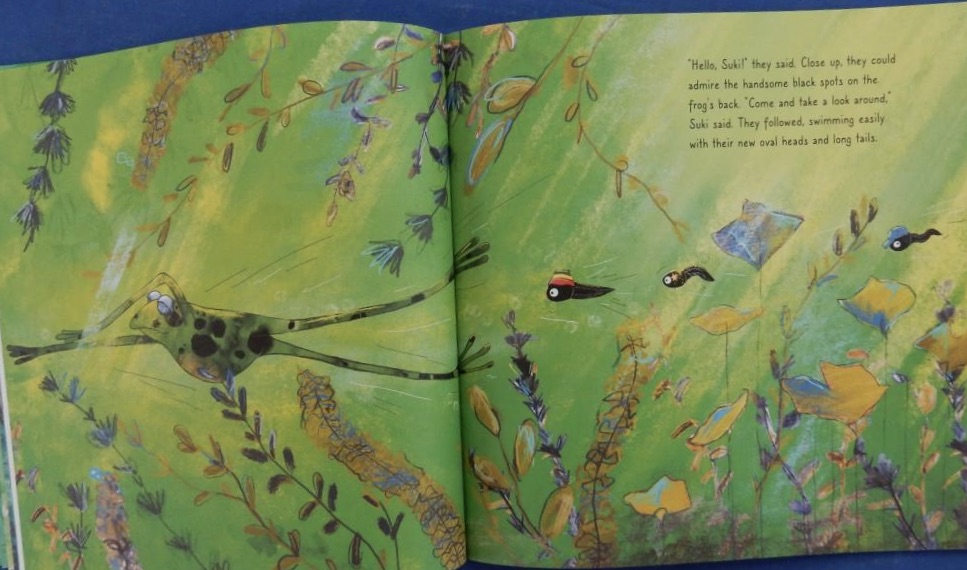
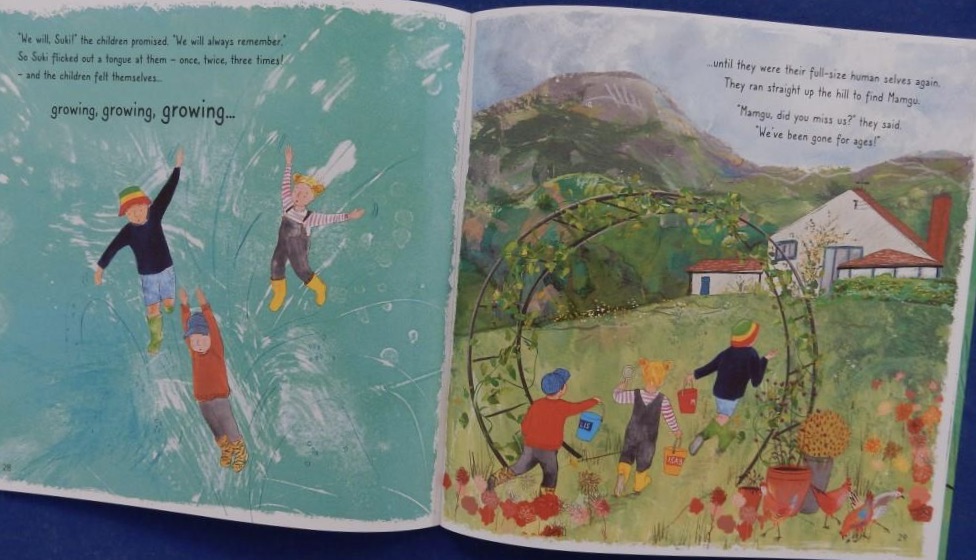
Finally – whoopee! Every wibbly is now a frog. Such a hilarious, heartfelt tale of the narrator’s epic journey from frogspawn to frog, at the heart of which is being ready for change and a fear of feeling left behind
With a bubblesome underwater setting Jane McGuinness’s humorous illustrations are just right: a perfect complement for Sarah Tagholm’s wacky words. Together they offer a wonderfully engaging and memorable rendition of an aspect of springtime zoological ontogeny for the very young.
Girl on the Fly Nansubuga Nagadya Isdahl David Fickling Books
The story begins in April 1992 Philadelphia when Kamaria (Kam) and her relay team mates, Luce, Alexis and Neeka have just finished their practising for the day. Determined to win the upcoming championships, the regional and then the big state one, Kam has decided that the team needs something special: a chant maybe that will ensure the team all pull together – and who should write it, she should of course.
Now Kam is a girl who finds change difficult to cope with so when she’s told that her Aunt Rose from Tanzania, who is going through a hard time, has been invited to stay, she isn’t happy. With all the intense running practice, plus school work as well as the fact that she and her best friend, Odie, have stopped talking though she’s not sure why, it seems to Kam that this is just too much to handle all at once. How will she be able to concentrate on anything with her mind in a turmoil and an aunt she’s never met before, sharing her room?
However, largely thanks to Aunt Rose, who tells lots of stories, shares her beautiful kangas and their meanings, cooks delicious meals and offers carefully considered advice, – ‘To hear what is around us is very, very important. To hear what is inside us, maybe more so’ – Kam changes, becoming more placid. It’s not just Kam however, who is affected by Aunt Rose’s four week visit; she has a positive impact on Kam’s Momma and Baba too. She certainly made this reviewer’s heart soar and go ‘boom, boom, boom, boom’ and like myself, readers will find themselves rooting for Kam from the outset of this wonderfully heart-warming story.
The Girl Who Wasn’t There Jacqueline Wilson Puffin Books
When Dad drives Luna (nearly eleven), her younger sister Aurora (almost six) and their Mum to the foot of a hill and stops the car, everyone is amazed at the tower perched atop the hill. “It’s like Rapunzel’s tower!” comments Luna. But then Dad announces that it’s to be their new home, their shocked Mum thinks he’s joking. Not so. Having lost his restaurant, Dad has somewhat recklessly bought this crumbling/tumbledown building at a bargain price and to say it needs some work done on it before they can move in is putting it mildly.
With the room at the very top strictly out of bounds, it’s anything but the ‘happily ever after’ fairytale abode Aurora imagined. However Dad promises Luna that they can have a puppy. despite the fact that temporarily they are going to have to live in a caravan. The following weekend he takes the family out to lunch to meet an elderly couple, the Stanleys, who have a pup – Molly – but are finding it too lively. They agree that a new home with Luna and her family is the ideal solution.
As someone who frequently gets her own way, Aurora has never been to school before, though thanks to her big sister, she can read and write well. However at the end of the summer there’s no choice, go to school Aurora must. Unlike her sister who is quick to make friends, Aurora decides that she hates her classmates and prefers the company of Tansy, an imaginary friend. Luna meanwhile worries that Mum and Dad might split up with so little real progress being made on their new home even though Dad now has the help of two new friends. She’s also concerned about her status in the family – is she truly a part of it when Dad isn’t her birth father?
As time passes, Aurora’s make-believe life becomes problematic for all the family, particularly as she insists Tansy is real. Could she perhaps be a ghost? And is there a curse on the tower? If so, can Luna be the one to break it?
I was fortunate that on the day this arrived it was the only book delivered so I was able to indulge myself and read right through to the end. It’s a wonderful mix of magic, the power of the imagination, family life, human resilience and love.
One of my relations, Emmanuelle an avid reader in Y6 was keen to read the book and review it: here’s what she wrote: Jaqueline Wilson’s new book is a beautifully-written story complimented by delightful illustrations from Rachel Dean. This book is perfect for anyone struggling with change or anyone finding it hard to be an elder sibling. They will be able to relate to Luna, the main character, who has to adapt to moving to live in an unfamiliar place and, on top of that, has a sister who she occasionally finds hard to deal with.
For fans of fairytales, there is an allusion to the story of Rapunzel because the main character is a girl with blonde hair who moves to live in a tower. In my opinion, surprisingly, the title does not link to the main theme of the story. I think the theme of the story is Luna’s journey in adapting to a new house, a new school, a new life, whereas the title links to the fact that Luna’s little sister, Aurora, has an imaginary friend who actually used to live in the same tower that they own now. Because of its cliffhanger ending, I think this book begs for a sequel. The final enigma leaves the reader hungry for more.
The Most Amazing Thing Ian Hayward Robinson and Matt Shanks Allen & Unwin
Henry is stuck indoors on account of the rain, the other members of his family are at home too: mum is busy working on her novel, his sister Greta is doing an experiment, his father is cleaning his telescope lens and brother Simon is meditating. But Henry with nothing to do, is bored, so he consults his mum who suggests he might draw the most amazing thing. What could that be though? Henry has no idea so he decides to ask his family. Each has a different answer: telling her brother to look down her microscope, Greta says life is the most amazing thing; to Henry, the mind is the most amazing thing, whereas Dad’s response is the universe.
Mum, finally free for a short while, surprises her son with her answer. Both words and pictures take us through the various parts of the house where Henry goes for inspiration; it’s evident that he learns a considerable amount in his quest for an answer, some of it about himself. Matt Shanks’ watercolour, pencil and gouache illustrations of the images that might be forming in Henry’s brain as he talks to each of his family are full of fascinating details.
A thought-provoking story showing that with an abundance of wonderful things in the universe and a great many different ways to find that wonder, it’s unlikely that two people will have exactly the same view: we all see the world through different lenses. Try asking the children in your class or members of your own family: who or what will they decide is THE most amazing?.
Footprint Phil Cummings and Sally Soweol Han Allen & Unwin
There’s a line in a Native American poem wherein the author prays to the Great Spirit of Life to give him the wisdom ‘to walk softly on the earth’ acknowledging that it is the responsibility of each of us to care for our planet and its natural environment.
In this book, author Phil Cummings and illustrator Sally Soweol Han remind us of the wonders all around us and that we should walk carefully leaving only good behind us. The author’s lyrical rhyming text invites readers to join the children in various parts of the world as they wander out into the morning, looking and listening, but also taking time to pause, ponder upon what they see and hear and to breathe in the beauty,
be that of the deserts, mountains, valleys or wherever they find themselves. Each of the environments – a tropical forest with a river flowing through, the (melting) polar ice, the sandy desert, the smoky city and more – is depicted in Sally Soweol Han’s soft pastel and coloured pencil scenes, each of which shows how we can all, like the children depicted, look after our precious planet. Only that way can the young have the rich futures they hope for and deserve.
Wildlife Crossings Catherine Barr and Christiane Engel Otter-BarryBooks
Human activity has an ever increasing impact upon the natural environment. Deforestation, agricultural expansion and urban development all have adverse consequences for the animals with whom we share our planet. This book looks at some examples of how this disruption is being ameliorated by taking positive action. Catherine Barr allows readers to track the journeys of seven animals in different parts of the world and discover how ‘wildlife corridors’, together with education programs, are enabling precious wild creatures to survive. The first destination is India, in particular an area where the ancient paths elephants follow to find food and water are blocked by roads and railway tracks, so in order to facilitate their migration, elephant wildlife corridors have been created. Solar powered electric fences help keep the elephants out of crops that are important for the local village people who inform one another when the elephants are on the move.
UK readers may be aware of the disastrous decline in the hedgehog population but thanks to the work of the the UK Hedgehog Street campaign especially, Hedgehog Highways, people have been encouraged to leave holes in their fences to allow hedgehogs safe free passage as well as to create hedgehog friendly spaces in their gardens.
Bird migration flyways around the world with wetland stopovers, aerial bridges to help gibbons across forest gaps in China, fish ladders for migrating salmon to pass dams and weirs,
bear bridges across busy highways in Canada and cougar crossings in the USA are the other examples featured. Each one is allocated two double spreads where Catherine’s words are integrated into Christiane Engel’s detailed scenes of each location, one presenting the problems the second, how they are being solved. A final spread gives brief illustrated paragraphs about seven other animals whose ancient paths have been disrupted.
A book to raise awareness among children who one hopes, will find ways to support the vital work being done. Highly recommended for primary school collections.
When Flora, the littlest dormouse stirs from the long winter sleep, she’s raring to go with a head full of questions, unlike her friends; they just want to sleep. She though is ready to explore the big wide world to try and find answers to ‘Why are bees so busy?’, ‘What do caterpillars eat?’ and ‘How do birds build nests?’ for instance. Ignoring the call to nap with her companions, Flora storms out and immediately encounters a duck. She tells him of her urge to see the world; he offers her a lift to the pond and off they soar together. At the pond Flora is intrigued by the wiggly things, which she learns are tadpoles and the duck talks of recently hatched ducklings.
Flora spends the spring learning new things and writing postcards home about what she observes. She follows the development of new baby birds and caterpillars
and watches the bees through the seasons as well as seeing the autumnal pursuits of spiders, squirrels and migrating geese, and despite missing her friends, she doesn’t go home.
Snow falls and Flora starts feeling drowsy. Time for a little nap,she decides, snuggling down among the tree roots where she’s happy to find something fluffy to curl up on. ZZZZZ! Little does she know that her comfy bed is a fox’s tail. Along comes a beetle that immediately realises he needs to get help for Flora before the fox wakes.
Will Flora be rescued or will she become a tasty meal for the fox?
The story has a lovely final twist to it that is sure to make young children and adult readers aloud smile and Flora shares some of the entries from her nature diary, after the tale ends.
Raahat Kaduji neatly weaves facts about the natural world into her story and her illustrations are a delightful mix of the real and the whimsical.
Hugg ’n’ Bugg: The Surprise Ian Brown and Eoin Clarke Graffeg
In this third Himalayan tale starring yeti, Hugg, and his fur dwelling flea, Bugg, the former is preparing for his birthday, determined to look his best. However it’s not long before he starts feeling furious at what he sees. All the other creatures are sporting new, ornate hairstyles and Hugg is certain that rather than him being in the limelight, they’ll put him in the shade.
Little does the shaggy creature know, but the reason for all the funky tonsorial touches is a surprise party in his honour. A party with all manner of fancy food, some of it looking far from delectable having been whipped up by the guests
and then modified somewhat in transit.
With Hugg and Bugg’s friendship repaired, everyone gathers round the table to tuck in and start filling their tummies, but there’s another surprise awaiting Hugg. What will be the host’s reaction?
Diverting daftness delivered in Ian’s rhyming text and Eoin’s splendid scenes of the animals’ antics. Fans of the duo will gobble this up but if you’ve yet to meet them, I suggest you start with Hugg ’n’ Bugg: Finding Home and discover how they got together, and then move on to the new one.
These are both additions to series popular with new solo readers: thanks to the publisher Little Tiger for sending them for review.
Dirty Bertie Wild! Alan Macdonald illustrated by David Roberts
The small boy with some disgusting habits returns for three more crazy escapades. The first, from which the book takes its name is an account of a class visit to Go Wild, a trip Bertie anticipates will be the best school outing ever, especially as the children are allowed to get muddy. However his spirits fall considerably when he learns that he’s been assigned to timid Mr Weakly’s group, the worst possible person to have as leader. There’s absolutely no chance that his group will win the prize for the best group – or is there? Vroom! sees Bertie’s Gran deciding to start driving lessons so she can take her test in her brand new sporty red Mini. A recipe for disaster surely especially with Bertie and dog Whiffler in the car while she’s being instructed and can you believe when she takes her test. Never mind if she fails – there are always alternative ways of travelling. Finally in Grounded, Bertie goes to great lengths to join his friends Darren and Eugene when they go skateboarding in the park.
Puppy Club: Minnie Home Alone Catherine Jacob, illustrated by Rachael Saunders
Harper is really looking forward to her first school residential trip – four days away from home. However she’s very concerned about how her puppy Minnie will cope with being left alone when her parents are both at work and with his business taking off, Dad too is quite likely to be out of the house. The last time he’d left Minnie by herself she chewed through the cable of his laptop. She begins to think that perhaps she should pull out of the trip. Harper and her friends do some research and learn that separation anxiety is a common problem with puppies. So begins ‘Operation Home Alone’ as they call it, with just two weeks to go until that school trip. As Harper tells Dad when they’re out for an early morning walk with Minnie, the business of ‘having a puppy is a learning experience for all of us.’ How true that is: it seems to be one step forward and then several back whenever Minnie is left alone.Then Dad drops a bombshell: he’s going to be on a business trip that coincides with Harper’s time away. Her fellow Puppy Clubbers rally round doing everything they can, but will it be enough to ensure Minne is okay in Harper’s absence? Another wonderfully warm story of camaraderie for young KS2 readers especially those who love dogs.
Be a Nature Explorer! Peter Wohlleben, illustrated by Belle Wuthrich Greystone Kids
The author, once a forester and now running a forest academy in Germany, introduces over fifty activities that will help and encourage children to leave their screens and discover the delights of being in the great outdoors. It doesn’t matter the time of year or where they are – city, town, countryside or their own back gardens, youngsters will find something that will get them interacting with the natural world. First though, one needs to be prepared and the two opening spreads are devoted to what to take when venturing out and some words of encouragement from the author.
As a foundation stage/ primary teacher who has been involved with regular forest school pursuits, many of the ideas are not new to me; however that will not be the case with lots of parents.
Did you know that there are more life forms in a handful of earth than there are people on earth? Wow! Most of these are so small they can’t be seen with the naked eye but why not collect a few handfuls of soil and leaf litter and investigate the different creatures therein? It’s likely there’ll be beetles, worms, slugs, snails, ants, woodlice for starters.
Identifying trees can be tricky – looking at the bark, fruits and leaves will provide useful clues for young investigators and the book contains helpful photographs of some deciduous trees and conifer as well as descriptions of what to look for.
There’s a wealth of fun learning between the covers of this book – something different for every week of the year.
Skylar and the K-Pop Headteacher Luan Goldie Walker Books
Skylar and her best friend, Dana, are obsessed with K-Pop, in particular AZ8, but when they’re about to launch a video comeback, her parents ban her from anything to do with the group for a whole week. During the lunch break at school as she’s telling Dana, a furious Skylar grabs her light-up dancing bunny ears from her rucksack and dashes off. But she forgets to remove the hat as she sets off to her next class and encounters the head teacher, Ms Callus who shouts at her and confiscates the precious hat.
Later she makes an excuse, leaves the classroom and confronts Ms Callus. Having grabbed her hat back, Skylar declares that she’s fed up with grown-ups telling her how to live her life. “I wish I was in charge,” she says twice. With that something weird starts happening: green lights flash and Skylar and Ms Callus swap bodies. Skylar is now the 71 year-old, mega-strict headteacher with a new role to try and get used to. When she turns to Dana for advice about what she needs to learn the response is.”something to do with empathy and walking in the other person’s shoes.” But how long will Skylar be like this, neither girl knows, certainly longer that the day and night they first thought.
Alongside this AZ8 announce they’re holding a competition and anyone who goes viral with their version of the ‘Hot Feet’ dance routine will win free tickets to their upcoming gig, and there’s an emergency inspection of the school to contend with. Chaos indeed.
Is it even possible that Skylar and Ms Callus can develop empathy towards one another and their lives, and if so can it be done in time for the weekend gig? It does’t help that Skylar has upset her bestie and the two have fallen out. And what about the inspectors; will they like what they see? Will Skylar repair the rift with Dana?
With lots of laugh-out-loud moments, this is a hilarious tale, at the heart of which is the importance of seeing things from another person’s viewpoint, friendship, self-belief and being true to yourself. Older KS2 readers will love it.
Bear and Bird : The Adventure and Other Stories Jarvis Walker Books
The first of the four short episodes about best friends Bird and Bear – The Nothing – takes place on a Tuesday, the pals’ usual day for spotting clouds but on this particular Tuesday Bird is poorly, so instead Bear endeavours to make his friend feel better. However she declines his offers of chewy things and other foodie favourites; it’s also a no to a story, a new wonky stick and dancing. ‘Nothing” is all Bird wants. Bear is on his way out when Bird calls him back with a request. Can you guess what it is?
With Bird feeling somewhat better, the two set off for some cloud searching when they come upon a sign, DO NOT GO IN THE HOLE, Bear reads. Off they go again, Bear with his mind on clouds, Bird preoccupied with wondering what his friend is thinking about. Suddenly Bear realises he’s lost Bird and vice-versa. Bird thinks of The Hole. Could Bear be stuck down there? Bird goes to look and finds a stick that’s just right for a rescue.
But who rescues whom?
Episode three sees Bear and Bird at Leaky Lake where they come upon The Mole, a creature whose jokes Bear finds funny. Soon Bird starts to feel left out and so she decides on a get rid of Mole plan. However, things don’t quite go as she hopes as it’s Bear who feels upset. Can they remain bestest friends or will Mole come between them?
In the final episode Mole is still waiting when the two return to the lake and he has a surprise in store: a little boat – just the thing for The Adventure under Mole’s captaincy. No matter if they encounter such things as pirates and sea monsters, they’ll surely keep each other safe.
As with previous titles in the series, this delightful duo will amuse both emergent readers and young listeners with their ups and downs and silliness that are beautifully captured in words and pictures by the inimitable Jarvis.
Rex Dinosaur in Disguise: Undercover Alien Elys Dolan Walker Books
Life is going well for dinosaur Rex, now a P.E. teacher, but then he upsets a human participant over a decision he makes at a competition. This is soon followed by the disappearance of every single one of the guinea pigs … ‘Ninny pig(s)’ … ‘Grumpy pig(s)’ … ‘Gwent squid(s)’ from the school pet show as a result of an accident when Rex was trying to be helpful; you can guess who gets the blame.
With the anti- monster humans determined to prove him guilty and Rex (undercover) and his friends Sandra, Anish and Bigfoot determined to prove his innocence by solving the case of the missing guinea pigs, this mission is not going to be a walk in the park, especially as it soon transpires that further guinea pig vanishings are happening all over the city. The crux of the matter is discovering who really is to blame, first stop a meeting with mayor, Jimmy Prigg: a surprise revelation awaits. The next stop is for coffee …
There follow further encounters with disguised creatures, a daring intergalactic undertaking and fyet more wild adventuring back on Earth.
Like this reviewer, I’m sure child readers will laugh out loud all through this crazy caper with its hilarious dialogue, fantastic illustrations and chapter headings such as BUM CRAC (you’ll need the book to work that one out). Let’s hope there’s a third story in the offing soon.
If you’re looking for a wacky way to encourage small children to practise counting to ten then get your hands on this rhyming story that begins to explode one rainy afternoon when the contents of a packet of popcorn is sent tumbling into a pan atop the stove. On goes the lid and happy to be out of the bag, the corn pieces are in party mood despite the rising temperature. Suddenly there comes a POP! It’s Dave delighted at his muscly new shape.
There’s no time to brag about being unique though, for almost immediately comes POP! number two; Monique has joined Dave making a ‘pair of superhero corn’. Small explosions continue as Shaun, Clare, Dean, Debbie, Ben, Sue, Wendy and Brian. joined the pair in rapid succession. A hip-hop popping party if ever there was one.
Eventually those pops stop and onto the popcorn pals there comes a shower of sugar.
Then from their new resting place the crew settles down to watch – wait for it, a movie. The kind of movie will perhaps make adult sharers cringe at it’s punny nature.
Ridiculous, irresistible fun: this book is sure to become hugely POP-ular with little humans who will want to hear it over and over as they eagerly join in with all the popping.
These are all new Little Tiger interactive board books: thank you to the publishers for sending them for review.
Number Garden Sophie Ledesma
A group of animal friends are shown around the number garden by Marigold the tortoise. With a fold-out to explore on every spread, small children will enjoy accompanying them and in so doing they can practise their counting skills to ten and respond to the other questions too. First stop is the orchard, followed in turn by a hot-house and a rockery, then it’s off to the pond, a vegetable patch and the tour finishes in the meadow with a picnic. Vibrant art work with just the right amount of detail for the very young (including minibeasts to spot), together with the interactive nature of the words make for a fun book to share with tinies. There’s a final spread whereon Marigold gives some extra facts about the six locations visited.
Noisy Construction text by Lauren Crisp
It’s time to visit the construction site and meet some of the large machines at work in this touchy-feely textured sound book. There’s an excavator, a backhoe, a chug, chugging digger, a dumper truck that makes a crashing noise, a very tall crane lifting and cranking a heavy load. Then little ears can listen out for the smash, smash of the bulldozer blade as it moves along on its clanking track, enjoy the rumbling sound of the road roller drum as it carries out its flattening work. The final spread presents all the vehicles at the site and invites little humans to press the button in the corner to hear all the sounds again.
All the Things a River Can Be James Carter and Nathalia Takeyama
A rather unlikely subject for a board book but when shared with young children, this one, with its moving pieces and flaps, will likely lead to lots of learning. In its half dozen spreads little ones can find out what makes a river special. People sometimes think of a river as a road, an inland waterway whereon they can travel in various kinds of boat. It also provides a watery habitat for lots of animals including many kinds of birds, fish, mammals and amphibians as well as plants, some aquatic, others that grow along the river banks. Some humans too make their home on rivers, choosing to live in houseboats. On its journey from source to mouth a river moves at different speeds, sometimes a slow trickle, at other times fast flowing and fierce. People who explore river beds can find all manner of interesting things such as coins, jewels and possibly even ancient remains. The final spread brings together many of the activities people might do on a river visit, things that give them pleasure including boating, swimming and watching wildlife.
My Baby Sister is a Diplodocus Aurore Petit (translated by Daniel Hahn) Gecko Press
Adapting from being an only child to having a sibling is seldom easy as we see in this book. It begins with a visit to the hospital to collect Mum and the new arrival. Once home the small boy narrator eagerly dangles his soft toy elephant over his baby sister, he plays her guitar music and then shows her around the house. However, before long his initial enthusiasm starts to wane, partly on account of his being told “No!” frequently and when Mum asks, “So, do you like being a big brother?” he replies firmly, “No!” and storms off to his bedroom where he dons his T-Rex pyjamas and proceeds to turn the room upside down.
Warm-hearted Dad comes in, picks up ‘big dino’ and carries him to the parental bedroom (there’s a caption informing us that big brother is a tyrannosaurus) where, snuggled up with Mum and Dad he falls asleep.
‘My baby sister is a diplodocus’ we read on the next spread, presumably feeling somewhat empowered as a much bigger T-Rex. On waking. big brother sees his new sibling in a different, much more accepting light; the two have much in common after all, he now realises.
Concisely written and illustrated with simple images in bright hues that go well with the sympathetic, engaging telling, this is a book to share with a young child in a similar situation to the child narrator.
Frank and Bert: The One With the Missing Biscuits Chris Naylor-Ballesteros Nosy Crow
Best friends Bert the bear and his foxy pal Frank (our narrator) are off for a picnic in the countryside, something they love to do but all too frequently something goes wrong. On this occasion Bert has brought a special tasty surprise and Frank is eager to find out what it is but his friend tells him he must wait a while. Having consumed their picnic, Bert settles down for a postprandial nap. Frank decides that there’s no harm in taking a quick peep inside the box and whopee!
Bert has cooked his friend’s very favourite biscuits. It won’t matter if I eat just one, Frank tells himself; but they are so yummy that – well you can guess what he does. What will Bert’s reaction be when he wakes up? Frank thinks up a less than honest explanation for the empty box; but having lied he feels guilty, especially when Bert is so concerned for him.
There’s only one way to sort out this mess: Frank owns up and promises that the next time they go on a picnic he will make up for his wrongdoing; but the best laid plans …
This double act is a deliciously diverting delight and this tale of friendship and forgiveness is sure to make young listeners ask for more.
These are new titles in hugely popular Oxford Children’s Books series for new solo readers. Thanks to the publishers for sending them for review.
Isadora Moon Helps Out Harriet Muncaster
When Isadora’s Mum is in bed with fairy flu, the little half fairy half vampire excitedly takes on the role of nurse. It’s not long though before her enthusiastic helping starts going wrong – very wrong. The special breakfast of strawberries is over creamy, the bathroom is awash with pink bubbly water and Dad finds himself sitting in the middle of a mess on the bathroom floor. Feeling rather guilty, Isadora offers to make amends by doing something ‘really helpful’ for her mum. However Dad’s instruction to tidy her bedroom isn’t quite what Isadora meant by ‘anything’. Instead she heads outside to Mum’s greenhouse where she accidentally spills some special soil that makes things grow extra big, extra fast. It turns out that it’s not just plants it has that effect on though.
Is there anything Isadora can get right? Happily yes and all ends perfectly. It hardly seems possible that this is book nineteen in the highly illustrated series that has worked its special magic to help countless young children make the transition to early chapter books.
Emerald and the Lost Treasure Harriet Muncaster
This is the first story in which Isadora Moon, Mirabelle and Emerald appear together. As it begins Emerald is preparing for a school trip. As part of an environmental project, Finders Keepers, she and her class are to spend the day sea combing – picking up rubbish dropped by humans that ends up on the ocean floor. Each pupil must keep one of the objects they find and write about it in a story later on. Emerald’s classmates soon find exciting jewellery type treasures for their stories; Emerald finds a teddy bear in the seaweed. She thinks it’s cute and is tempted to keep it but it has a tag saying it belongs to Jack who lives in Scallop Bay lighthouse: ‘finders-keepers’ is the rule under the sea, her friend Marina reminds her so Emerald takes it, promising Bertie bear that she’ll look after him. However, that evening Marina is having dinner at Emerald’s home and Emerald tells her friend that she doesn’t feel right about keeping the teddy and asks if her friend, land dweller Isadora Moon might assist them in returning Bertie to Jack.
Off goes a letter to Isadora requesting her help and on the Sunday morning they both set off to the suggested meeting place in the hope that Isadora will turn up. She does and together the three plus Mirabelle’s aunt embark on operation find Jack.
Happily Jack is sitting on the rocks by the lighthouse and he’s overjoyed to see his bear again. He shows the visitors around the lighthouse and a friendship develops which leads to Jack demonstrating his drawing prowess. Can you guess what Emerald decides is the best treasure of all?
With themes of caring for our planet and doing the right thing, this magical story will delight young readers and give them plenty to think about. Harriet’s illustrations are gorgeous and she also provides some ‘fintastic’ activities at the back of the book.,
Tourmaline and the Museum of Marvels Ruth Lauren Little Tiger
Since falling into the Source of all magic on the island of Elsewhere during a mission to rescue her mother, Tourmaline has developed magical powers that are almost uncontrollable, the result being chaos. Her powers are virtually impossible to hide from others though her loyal buddies George and Maia are well aware of her plight.
When Tourmaline unexpectedly receives a postcard addressed to her, offering answers she heads off by airship, despite her friends’ reservations, to the market rendezvous mentioned on the card – the Dark Market – so the Living Archive informs her. She’s accompanied by Mai, her Mum Persephone and George, who stows away..
So begins a mysterious new adventure for Tourmaline, one wherein she finds it hard to know whom to trust, that sees her visiting incredible places where she receives further postcards, has some surprising and unexpected encounters, takes huge risks and makes astounding discoveries. The final chapter of this thrilling fantasy neatly sets things up for the next book in the series due to be published early in 2025. I eagerly anticipate it.
The Rock Ann Bryant, illustrated by Josephine Birch Graffeg
Twins, twelve year old Finola and Zane and their mum from planet Sevent, have crash-landed on Earth. Eager to be reunited with Dad, they have begun to search but after several months they’ve heard nothing other than the telepathic message Mum received when first they arrived. The twins know they have to keep themselves out of sight from prying eyes. Mum has found a job in hospitality, and now the twins’ desire to stop hiding from everyone is becoming overwhelming, especially when Zane reveals that he’s received two cryptic messages – pictures of a rock – from Dad. On hearing what the children want to do, Mum says they must sleep on it, but that night on the news is an announcement from a scientific research company offering the ‘alien family’ 250,000 euros to participate in their ‘research programme’ and the same sum to anyone with information about the whereabouts of the ‘aliens’.
Next morning, an anxious Mum gives her blessing to the twins, now disguised, to teleport themselves to Albrigart, a rocky place with a conservation park. No matter what they do or where they go, it seems that eyes are on their every move. Can anybody at all be trusted?
Eventually Zane decides they should to go back to the flat but they become separated. With her energy depleted Finola finds herself alone, left to her own devices to return to Mum and Zane. Once reunited, the three talk and conclude that thus far, as Finola puts it, they only have one truth: “We want to find Dad and he wants to find us.”
As the book ends they know nothing of what the future holds but are sure that no matter what, they’ll undertake things as a team. This cliffhanger leaves the way open for the search to continue. I suspect that like myself, child readers will be eager to discover if the family is finally reunited.
The delightful Hedgehog duo return in a new story. Eager to do everything Big Hedgehog does, Little Hedgehog enthusiastically helps gather all the fallen leaves. Having collected a huge pile there’s just one leaf remaining and that’s on a high branch of a tree. Unable to reach it by leaping, Big Hedgehog decides to climb up the trunk. “I can do that too!” cries Little Hedgehog. However Big Hedgehog is back on the ground with the leaf by the time Little Hedgehog reaches the top branch. Thereon is a ladybird and of course Little Hedgehog unable to resist copying the insect’s actions launches itself skywards.
This is only the first of the animal actions Little Hedgehog tries and before long a whole host of animal friends starting with a mole,
have been shown what the little prickly creature can do, including swimming in the lake. That’s where during an afternoon of fun, Little Hedgehog learns that not all animals have the same set of skills and abilities. Come nightfall, it’s fortunate that the turtles are willing to offer a lift all the way home to the Hedgehogs’ residence where an owl’s hoots send Little Hedgehog off to sleep but not before a final “I can do that too!”. Beautiful, textured scenes in Britta’s characteristic style and a gentle tale show little humans that it’s good to be eager to embrace new things but equally, it’s fine to discover that you’re not quite ready to accomplish all you try.
No, Nancy, No! a Dog Chase in New York Alice Tait Walker Books
Nancy and her canine best pal Roger are in New York ready to head off to the theatre to see Dogs! The Musical. On arrival Nancy spots Candy the star of the show on a lead outside and in her enthusiasm she accidentally unravels the lead and off goes Candy … through the city and into a cab destination Central Park. Nancy and Roger chase after her but Nancy can’t resist stopping several times as they pursue her into the zoo, past a parade and downtown to the Hudson River where Candy has been blown attached to a bunch of balloons. Eventually she ends up dangling from the Statue of Liberty.
As ever more of the dogs of the city join the chase young followers of the story will enjoy adding their voices to that of the long-suffering Roger with “No, Nancy, No!”
and amused to discover the total chaos Nancy has caused by her thoughtless action. Can she possibly succeed in scaling the heights, rescuing Candy and getting her back in time for the show? Happily with lots of assistance, she can and that night Candy (stage fright overcome) isn’t the only one in the spotlight. With a final fold out map, lots of famous landmarks, a surprise pop-up, a plethora of flaps and a wealth of detail in the busy scenes, there’s plenty for youngsters to explore in this interactive travellers’ tale.
Pirates of Darksea Catherine Doyle Bloomsbury Children’s Books
One night Christopher writes a letter to Captain O’Malley, legendary pirate and ruler of Darksea, a secret kingdom deep in the Atlantic Ocean, begging for adventure for himself and his younger brother Max, but he receives no response. Two years later a parrot appears at Max’s bedroom window with a letter for Christopher – a letter from Captain O’Malley who is to embark on a perilous quest. But Christopher is now ill in hospital fighting for his life. What would you do if there was a possibility of a job with a reward that could help cure your brother? Max joins the parrot in a rowing boat heading for a rendezvous on the Stolen Sunrise.
Imagine the boy’s surprise when he discovers that the captain is a Pirate Queen. She offers him a deal if he’s willing to take the risk and join the crew right away, destination Darksea before the ‘Rogue Wave’ a powerful enemy comes. Of course, Max agrees. However it turns out that the Captain hasn’t told him the whole truth: the magic has dwindled drastically, this monstrous enemy is gobbling up the Darksea island of Maremaris, and the Captain needs a particular sword – the Curse Cutter. A bargain is struck: if Max helps the Captain acquire the sword, he can take some magic for his brother. A perilous task awaits.
What follows is a gripping adventure with mutiny, wraiths, fleeing mermaids and a monstrous shark man. Max’s bravery and love for his brother is the fuel that keeps him going as he faces at times, seemingly impossible challenges. After all he puts himself through though, is it even possible to save his Christopher? I just couldn’t put this down until I found out and I suspect many child readers will do the same. I love how Catherine Doyle ( a new writer to me) weaves humour and the importance of camaraderie into this thoughtful tale; the characters she’s created – human and otherwise – are truly memorable.
Interdimensional Explorers: Alien Apocalypse Lorraine Gregory, illustrated by Jo Lindley Farshore
At the start of this second adventure Danny’s Grandad does two things: he announces that he’s going on a cruise with Maureen, his ‘fancy woman’ as Danny’s Mum calls her. He also hands Danny a small package containing a key that means he’s now an official Apprentice Caretaker of the secret Interdimensional Lost Property Office.
Off goes Grandad leaving Danny, his best friend Modge and cousin Inaaya to cope with Returns Day in his absence. Very soon they discover that a very special star has been stolen from the vaults, it’s up to Danny and his team to expose a conspiracy and hopefully, save the whole universe. To do so they have to contend with Goregotha hordes and weird cult members: are they up to it? And who can be trusted? As this quirky intergalactic adventure twists and turns it will surely keep readers riveted as they are sucked into the fantastic world that Lorraine Gregory has created and Jo Lindley illustrated. What I enjoyed most though, was the strong bond between Danny, Inaaya and Modge who have each others’ backs no matter what. Highly recommended.
Help! We Need a Story James Harris and Mariajo Ilustrajo Little Tiger
The jungle animals are, so they say, bored, very bored; much too bored to take much notice of what Artie the macaque is drawing with his crayons
until eventually after hearing so many complaints, he starts creating anew, giving full rein to his imagination.
With his work almost complete, he writes two final words and then announces to his friends, “Guess what? You’re in a book.” The initial reactions to the title are less than enthusiastic; but then June Baboon starts reading; reading about dragons, a magic bear and much more – robot sharks and zombie hens even and guess who is fighting all these baddies. It’s none other than Captain Artie and his mighty mates. By the time the story is concluded, the other animals are enraptured and truly thankful. From Artie they receive a knowing smile and an anticipation that next morning more magical tales will start to unfold and all because the listeners will start to look at their world in a totally different way.
A splendid story told in rhyme wherein words and pictures show the power and vital importance of the imagination and creativity. It’s one I strongly recommend foundation stage and KS1 teachers share with their classes as well as a book parents and children read and talk about together. Make sure there are pens, crayons and paper to hand for children to use for their own story making.
Cactus Kid: The Battle for Star Rock Mountain Emmanuel Guerrero Flying Eye Books
In this first of a new graphic novel series Cactus Kid is in self-imposed exile in the Neverending Desert. His aim is to master magic and show his all-powerful father back in Florencia that he’s the best wizard of all time. For starters he needs a small piece of star rock, the stardust of which will upgrade his starter potion to master-grade. However others are also searching for the same thing and they’re not at all friendly. Though Cactus is a tough character, will he be put off by the mention of the Moto Brawl, a no holds barred race one of the competing teams wants him to participate in?
So begins a wacky adventure bursting with motor bikes and mayhem. There’s also a dark bounty-hunting lizard, armed with an other-worldly compass scouring the land for magic and the encounter between that lizard and Cactus Kid is pretty prickly.
During the course of the race Cactus Kid learns something very important: going it alone isn’t always the best way to go: An ally that has your back is sometimes what you need, especially one willing to part with one of their special possessions as a farewell offering.
As Cactus Kid heads off into the sunset in search of more magic, it’s good to discover that it’s not the last we readers will see of him. If your taste is for wacky magic, a lovable protagonist and terrific world building, then this dramatic offering delivered in powerful colours, comic book style, will surely fit the bill.