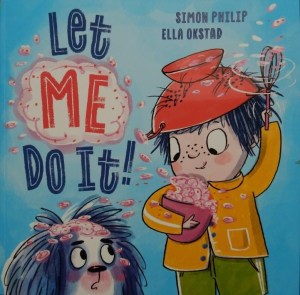
Let ME Do It! Simon Philip and Ella Okstad Oxford Children’s Books
Teddy, so he tells us is NOT a baby any longer; he’s ‘actually very grown up’. The trouble is that everyone still insists on fussing over him,; they want to wipe his nose, make his breakfast, fasten his jacket and tie his shoe laces. Frustrated, our narrator decides to take matters in his own hands letting his family know in no uncertain terms that HE will be the one to do all those tasks. And so he does. Indeed he becomes super confident, so much so that when as he makes his own breakfast and Mum announces a trip to get his hair cut, Teddy decides to give himself some tonsorial treatment with interesting results …
If only he’d left the cutting craft there, as well as quite a few other ideas that he has, washing the family’s whites for instance. OOPS!
Simon Philip’s hilarious first person narrative in combination with Ella Okstad’s equally hilarious, dramatic scenes of Teddy’s ambitious actions will appeal to both young children and the adults who share the story
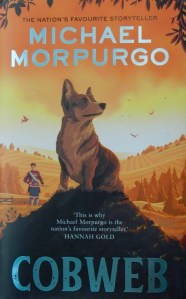
Cobweb Michael Morpurgo, illustrated by Michael Foreman Harper Collins Children’s Books
This wonderful story narrated by Cobweb, a Welsh Corgi, was inspired by real life tales of drovers whose job it was to take farmers’ livestock to market to be sold in cities, staying there until all the livestock were sold. One such route was from west Wales to London and Welsh corgis like Cobweb were frequently used.
He was born on a farm and much loved by Bethan, who lived alone with Tad, her father; after her mother and elder brother were both drowned when they went out in their boat to collect the lobster pots against Tad’s advice. We hear how Cobweb became a drover dog when Tad’s second wife gave the dog to her cousin Drover Morgan. The little dog is well cared for and comes to realise that he must remain with the drover and his own much older collie, Goodlad. The latter becomes a good friend and protector, teaching Cobweb the required skills to be a drover’s dog.
Their first trip to London is long and arduous but Drover Morgan is made welcome wherever they stop and ensures both dog’s are fed. Cobweb is kept going by thoughts of Bethan and the drover’s promise that he can return to her once his droving work is done. Then comes news that Napoleon has been taken prisoner and peace is on its way. After delivering all the animals to market in London and resting for a few nights, Cobweb learns the dogs must make their way home sans Drover Morgan.
During the return journey people are celebrating the British victory at the Battle of Waterloo and the two dogs encounter returning soldiers, in particular brothers Robbie and Jonno, the latter having lost his sight in the fighting. They talk of a very brave young French drummer boy they’d brought to England who then disappeared. Later the dogs come upon the very same drummer boy
who accompanies them on the long trek, eventually finding a home with Bethan.
A truly moving portrayal of the powerful bonds that can be formed between animals and humans, and of courage, the ghastliness of war and resulting loss of human life. Michael’s Morpurgo’s words and Michael Foreman’s illustrations together take readers back to an aspect of history that is relatively unexplored in children’s fiction. This would make a great read aloud to KS2 classes.
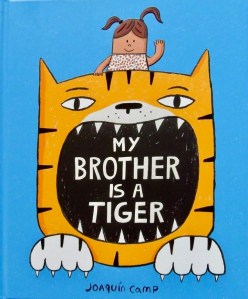
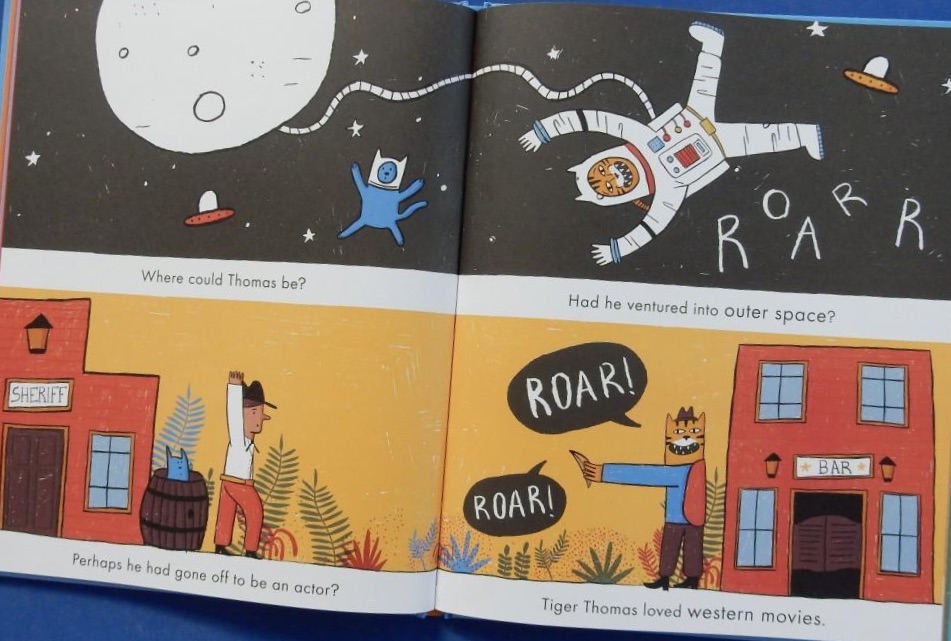
One afternoon young Teresa is playing downstairs while her parents enjoy a relaxing drink and snack together. Suddenly she hears a weird noise coming from upstairs so she decides to go up and try to discover the cause. Shock horror! Her little brother Thomas has turned into a fierce-looking tiger.
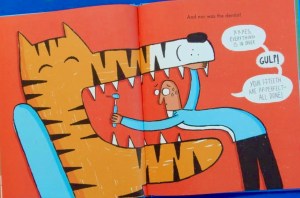
When it comes to school activities, this new persona has its pros and cons and it takes Teresa a while to get used to having a fierce feline for a brother but all in all she copes pretty well. Not so though the neighbours and others that find themselves way too close to Thomas for comfort.
Then one day Tiger Thomas is nowhere to be found: Teresa hunts high and low but without success. Where can he be? She entertains all manner of possibilities …
Clearly distressed, big sister waits and …
When he does appear there’s a surprise in store, but more than one person can play at that game. The surprise twist in this tale will have young listeners chuckling with delight as will some of the scenes of Teresa’s imaginings.
The Fairy Tale Fan Club Richard Ayoade, illustrated by David Roberts Walker Books
This is essentially a satirical collection of letters supposedly written to or from well-known fairy tale characters, each with an introduction by the supposed narrator—C.C. Cecily, the Senior Secretary of the Fairy Tale Fan Club. Said secretary also wrote a rather long introduction to the whole book where he explains how he came to compile and edit the work. Some readers may well want to miss out this and head straight to letter number one, hand-written by eight year old Ira to Little Red Riding Hood. Preceding this is a brief introduction from C.C using the first of a plethora of puns in the book, this one concerning the child being ‘literally wolfed down’ . This child is bemused by a couple of things in the story: how could Little Red have mistaken a wolf for her grandmother and how could she possibly be swallowed by a wolf and survive the experience. She goes on to enquire about the health of the recipient and ends with a PS asking ‘How “little” are you?’ Back comes an explanatory response covering the salient points.
Later there’s another correspondence – a fan letter of sorts – relating to this story but written by Sebastian (almost seven) to the wolf. The wolf then answers at considerable length.
For those who enjoy toilet humour, there’s a hilarious exchange involving a certain Prince Farty Pants (calling himself a duke in the first instance) and Prince Charming; and the latter proves less than helpful in his concluding sentence.
Another laugh-out-loud letter is penned by Humpty Dumpty in reply to that he received from Tyler (just eight). The egg talks about being anthropomorphised unfairly.
For the thoroughly modern reader there’s Zora’s message to Cinderella sans a single apostrophe and complaining about being unable to borrow her siblings’ iPads. This confuses the recipient who assumes an iPad is a cloth or similar used for cleaning.
In addition to the text there are a number of textured, sometimes finely detailed sketches as well as vignettes preceding each epistolary exchange; a perfect complement provided by David Roberts. Altogether a very clever, tongue-in-cheek compilation that will appeal to book lovers especially those like me with a penchant for traditional tales.
Hank Goes Honk Maudie Powell-Tuck and Duncan Beedie Little Tiger
Hank is a goose, an obnoxious one so we’re told. He honks continuously, interrupting everybody at every opportunity. Not only that but he annoys others by pinching the cherries from their cupcakes; he pecks the books visitors are reading in the library, he creates a rumpus in the cinema and bursts balloons of unsuspecting passers by. However such mean behaviour is not without its consequences and Hank finds himself being avoided by all the other animals.
This loneliness causes him to reconsider his thoughtlessness and he spends some time reading a book entitled How To Be An Impeccable Goose. Thereafter he sallies forth a reformed character, determined to be considerate to his fellow creatures. All goes well for a while but then along comes Bunny with a large new balloon and Hank just can’t resist the temptation …
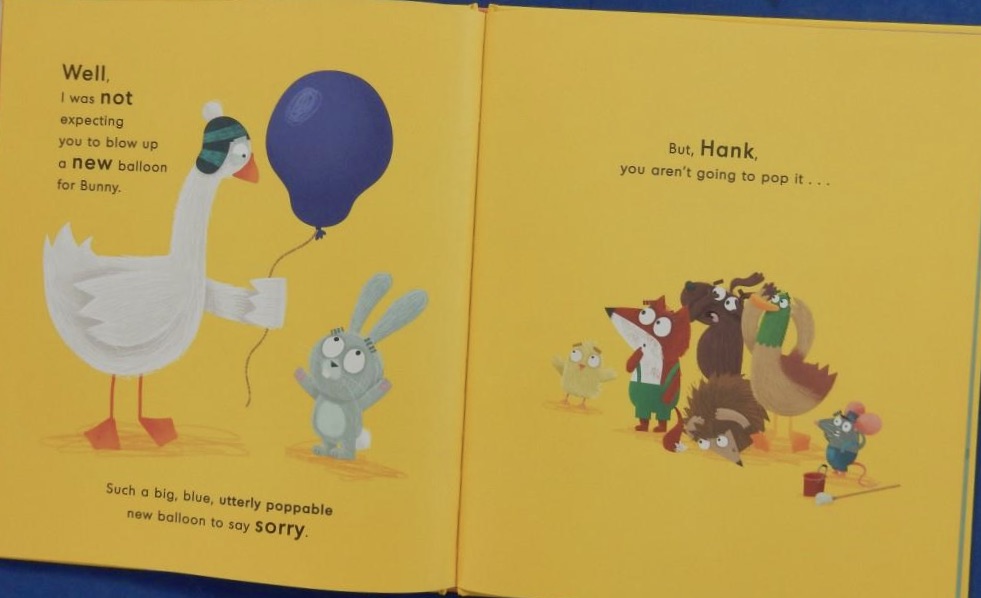
His new friends though are a forgiving lot and, appreciative of the way Hank tried to be good, give him another chance. They wait with bated breath as the goose gives Bunny a new balloon: will he finally be able to restrain himself? I wonder.
A honkingly fun story with an important message and lots of possibilities for audience participation. Young children will revel in following Duncan Beedie’s droll portrayal of Hank and his efforts to change his reprehensible ways.
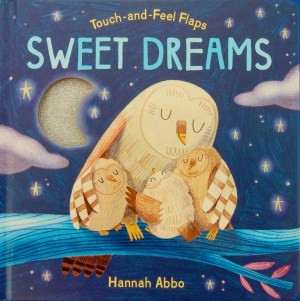
Very young children are invited to join mother owl as she hunts for food, soaring across the starlit sky one night. She flies over tall grass that shelters a mother rabbit and her little ones, passes a log pausing briefly to peep at Fox and its cub, discovers a mother mouse and her babies snuggled together under some leaves and finally flies back to the tree where she tucks her three waiting owlets safely beneath her wing. With its alluring die-cut cover, five differently textured, touchy feely flaps to explore, a gentle rhyming text and scenes of the natural world at night from various viewpoints by Hanna Abbo this is a lovely board book to share with the youngest humans at bedtime especially.
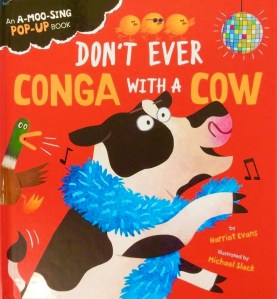
Don’t Ever Conga With A Cow Harriet Evans and Michael Slack Little Tiger
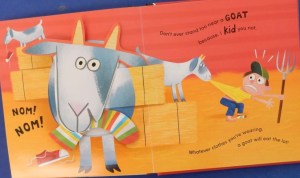
This is an addition to team Evans and Slack’s Don’t Ever series, this one being set down on the farm. Young children are warned against disturbing a slumbering rooster; tricking a woolly sheep, wrongly blaming a large pig for the mucky deposits it hasn’t left; getting your rear end too close to a hungry goat
and finally never ever attempt the titular conga with a cow; it’s sure to move to a different tune. Farm animal silliness with creatures that are guaranteed to make little ones giggle and relish joining in with the RING! RINGs, YEE-HAWS, OINKs and NOM NOMs as you turn the pages making each animal in turn move. Cause alarm and you’re in for a shock.
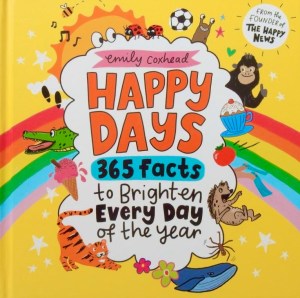
Happy Days: 365 Facts to Brighten Every Day of the Year Emily Coxhead Walker Books
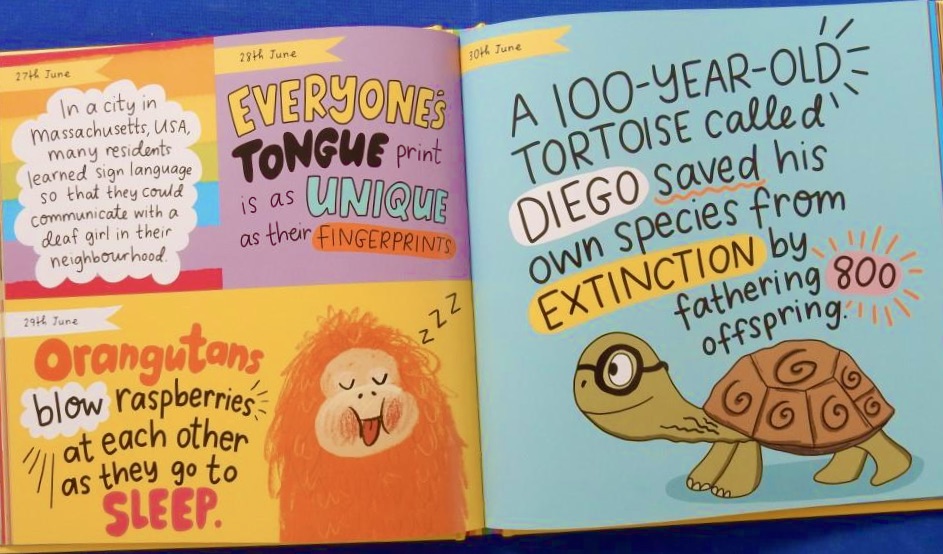
A few years ago, Emily Coxhead had a mission: to sprinkle a tiny bit of happiness all over the planet. To that end she launched a quarterly newspaper, The Happy News. Now comes this book aimed primarily at young children. Starting on 1st January, there are 366 fun facts, each one vibrantly illustrated by Rachel Suzanne. Some feature animals, others plants, and there are also facts relating to humans in various parts of the world.
You can either follow the pattern of the book, discovering a new fact each day, or perhaps start by looking at birthday dates of friends and relations. No matter how you read it, you’re certain to discover new facts. Did you know for instance that a group of pugs is called a grumble or that a 100-year old tortoise, Diego by name, saved his species from extinction by fathering 800 offspring. Wow!
I wonder how big a newly hatched tortoise is: a newborn koala, so we read, is the size of a 2 pence coin.
Prepare to be astonished, puzzled and amused as you turn the pages of this chunky book. I was puzzled to discover that elephants can hear better with one foot off the ground and surprised to read playing music to plants helps them grow faster and that lemons float but limes sink. I guess that’s to do with density. A fun, gently educative read that goes on giving.
Chronicles Of A Lizard Nobody Patrick Ness, illustrated by Tim Miller Walker Books
“ I’m making you both Hall Monitors,” Principal Wombat said, though she quickly added, “This isn’t because you’re monitor lizards.” So begins this laugh-out-loud school story with a difference , seemingly the first of a series, aimed at primary readers, from Carnegie medal winning Patrick Ness. It’s not long before Zeke, one of the chosen two and rather large, demonstrates how incompetent he is at the role. He has an unpleasant encounter with the school bully Pelicarnassus (son of an international supervillain), punches him in the beak and loses his position as hall monitor.
Another problem for Zeke soon raises its head at school; it’s that due to an ancient family curse the entire country of France appeared on Zeke’s knee after the death of his father. Now his class is to study France and teacher Mr MacPherson has the lizard sitting on the edge of the teacher’s desk and is using the shape on Zeke’s knee as a visual aid. Add to that the fact that since his father’s death, Zeke’s mother has been suffering from depression and the young lizard has an awful lot to cope with. On the positive side, however, Zeke has some loyal, brave friends who are often on hand to offer wise words and to assist in his efforts to save their school.
Ness uses an anthropomorphic cast to present the sort of issues human children might face at school every day – bullying, intimidation, violence, fat-shaming and insensitivity to disabilities. His combination of splendid silliness, tenderness and poignancy works effectively, so much so that readers will find themselves laughing frequently. Making the whole thing even funnier are Tim Miller’s zany ink drawings. Underestimating a monitor lizard is not to be advised.
Nibbles: The Very Hungry Book Monster Emma Yarlett Little Tiger Press
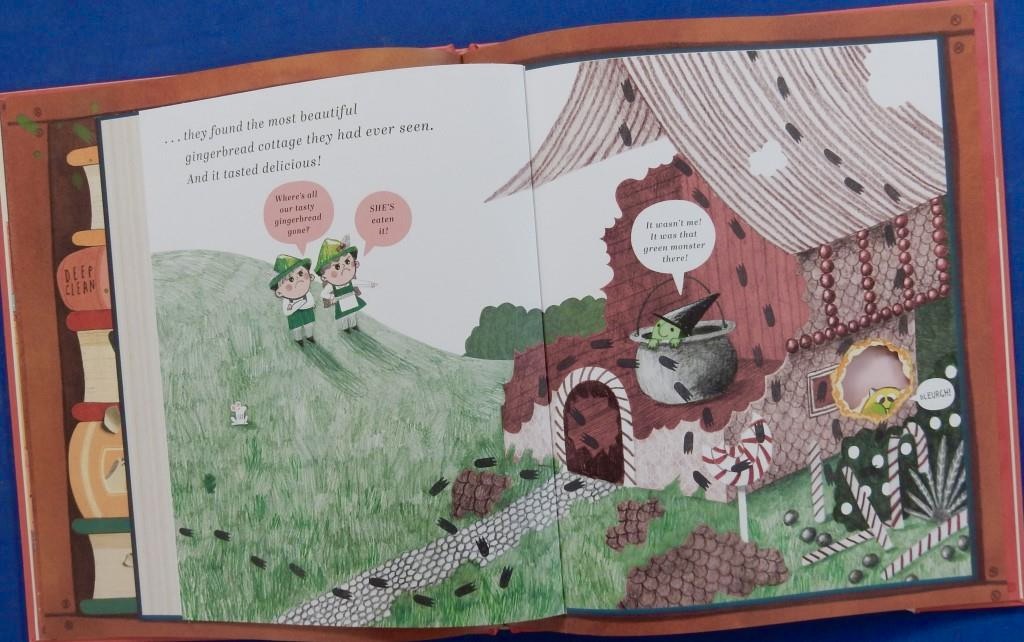
Beware! The creature that gives the ‘I Love Books’ expression a whole new meaning is back. Nibbles the book monster is on the loose again and he’s on the look out for some tasty books to sate his appetite. His first port of call in town is the library. Surely he’ll find something delicious there in that recipe book Maybe not if that birthday cake recipe is anything to go by. With that one far too slimy, perhaps something sweet might suit his palate; but no. The witch’s gingerbread house is far too sweet, so much so that the gingerbread sampling has made him throw up.
Next stop is the farm for some fresh produce but the aroma emanating from Old Macdonald’s farm is truly foul and has him getting away as quickly as his teeth will allow. What a truly awful day. Will Nibbles ever find a book that is just right for snacking on? Maybe it’s a case of east, west, home is definitely best; in which case what will he finally snack on?
Little children, be they established Nibbles enthusiasts or are meeting him for the first time, will delight in following him by peeping through the strategically placed die-cut chomping holes and lifting flaps. They’ll also enjoy encountering some of their favourite characters from traditional tales and rhymes as they follow the book- devourer through this latest all consuming escapade. I love the way Emma has scrambled her name to provide authors for the various books in the story.
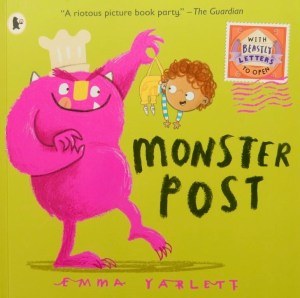
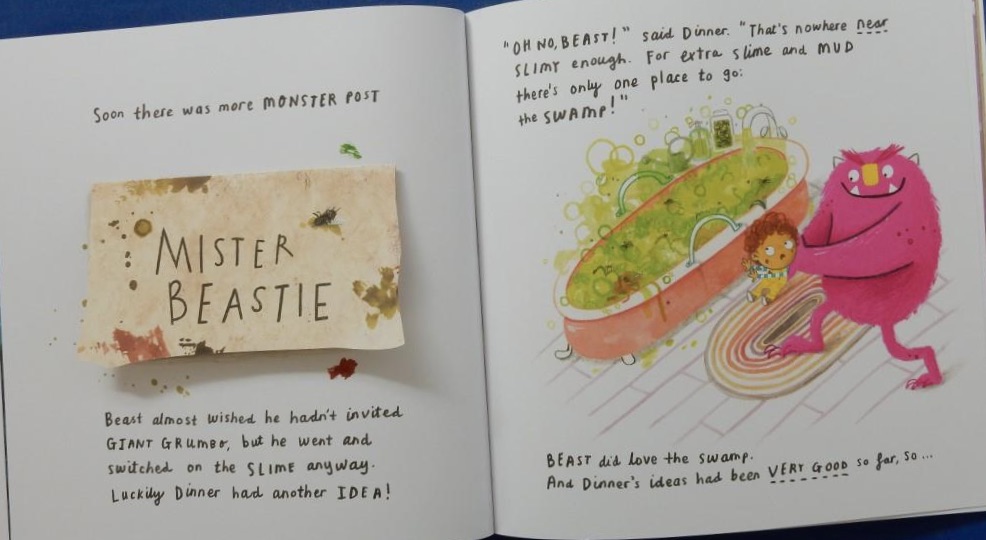
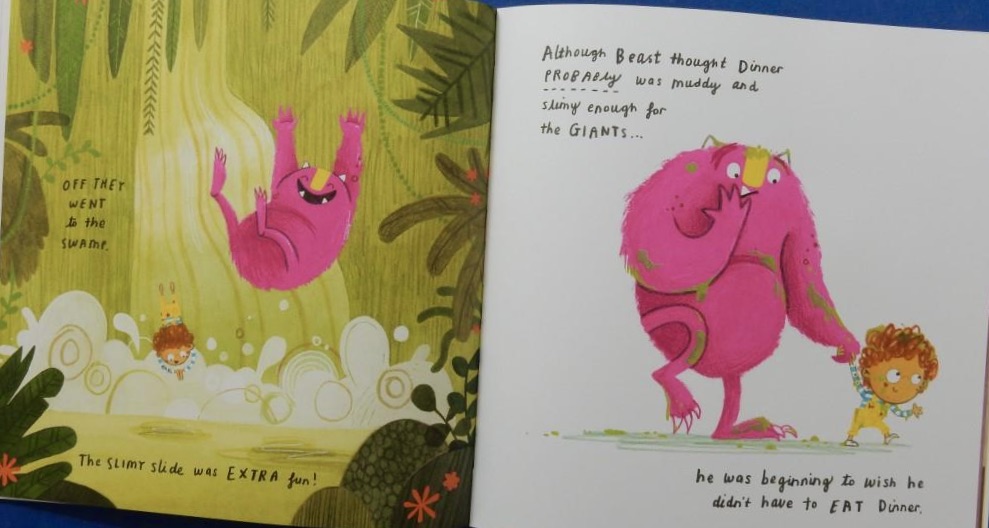
Beast has found himself what he deems will be a vary tasty dinner, so much so that he decides to invite all his friends to partake of a feast. Into a cooking pot goes a very alarmed looking Dinner and off go invitations to Beast’s pals. It’s not long before he receives his first reply; it’s from Sir Gutguzzler who is happy to accept although recommends that Dinner gets a bit more flesh on her body. Out of the pot comes Dinner and is about to be fed something utterly gross when our quick-thinking child aka Dinner makes a suggestion that is sure to make her way more plump.
After some initial reluctance, Beast follows her suggestion and the result is exceedingly yummy. Three further acceptances arrive, each one with a request intended to add additional deliciousness to the feast
and for each, Dinner comes up with a clever idea. Each suggestion results in Beast and Dinner having a thoroughly enjoyable day together, so much so that Beast starts having second thoughts about eating Dinner.
Then one more acceptance arrives. Beast and Dinner have what is for Beast assuredly the best ever day. Come the evening before the feast, with Dinner having been made super tasty, Beast is feeling far from happy about the prospect of consuming her. She in turn has a change of heart about Beast.
Now Beast has a dilemma. He starts thinking really hard. Is there a way he can make his guests satisfied when they arrive for that much anticipated Dinner?
With communications from Beast’s guests containing disgusting recipes, yucky offerings and preposterous stipulations to open, young children will relish this hilarious, interactive book and demand further helpings after an initial sampling.
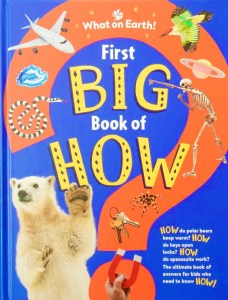
First Big Book of How Sally Symes & Saranne Taylor, illustrated by Kate Slater What on Earth Books
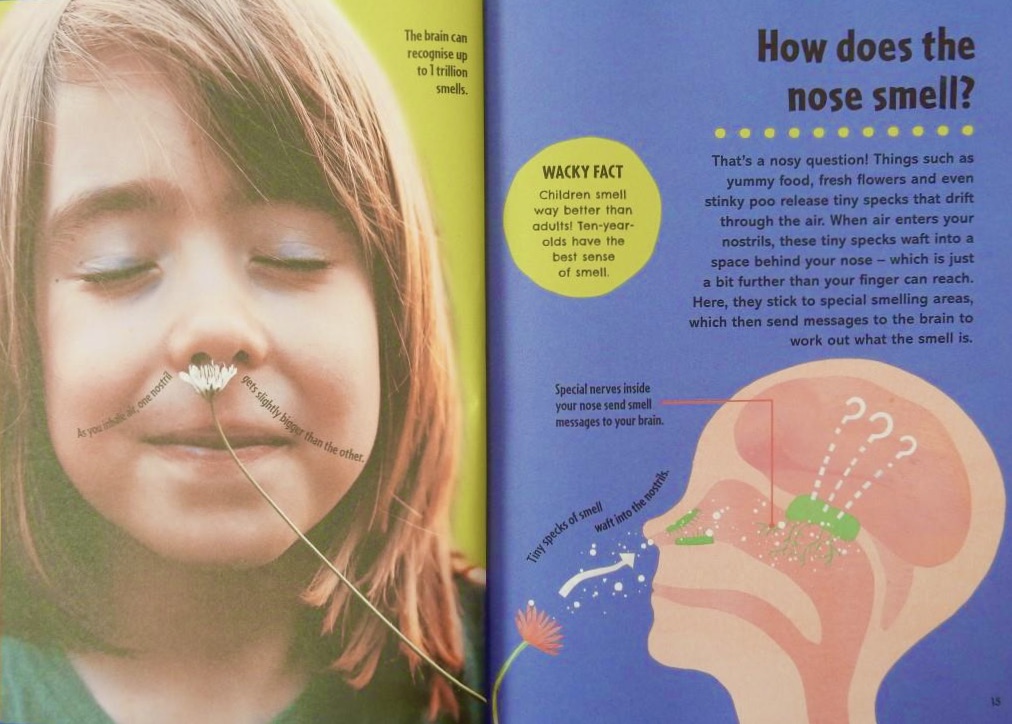
After ‘Why’ questions I think those beginning ‘How’ are probably the most often asked by young children. Author Sally Sykes, together with Saranne Taylor have divided the wealth of How questions in this bumper book into six sections, the first being The Body. The fifteen questions posed are engagingly and succinctly answered the first being ‘How does hair grow?’ A double page spread is allocated to each question, much of the space being taken by a striking illustration or photograph into which has been placed a ‘wacky fact’ and a relevant small labelled, close-up diagram. This section also addresses how each of the senses works – did you know that children smell better than adults, with ten year olds having the best sense of smell?
Then come respiration, circulation and the heart, bone growth, digestion, the growth of an unborn baby, the relationship between exercise and good health, catching a cold and more.
The other sections are in turn Machines & Buildings, Wild Animals, Bugs & Creepy Crawlies, Earth and finally, Space. In addition each part has a ‘Wow! What’s that? spread that zooms right in with a photograph as well as two ‘Tell me how … Now!’ spread, the latter briefly answering additional questions.
One to add to family bookshelves and Foundation Stage/ KS1 class collections.
What The Crow Saw Below Robert Tregoning and Greg Stobbs Oxford Children’s Books
As the story starts we meet a curious young crow who is doing as she’s told, looking down and squawking a warning at anything and everything she sees beneath her on the forest floor. while the others are asleep though, our young crow looks around to see what’s going on. Seemingly there’s nothing sinister at all: could her elders be mistaken?
Then, tired of looking for supposed dangers below she finds the courage to look up and see what she can discover. The older crows are horrified but this doesn’t stop the youngest corvid not only looking but moving upwards. Bravely she takes to the air and then accepts the invitation from a different kind of bird to join them.
Deciding that she can then return to the other crows and encourage them to ‘throw caw, caution to the wind’, she finally leads them all upwards and life begins anew, with a positive, hopeful attitude (and of course, a modicum of caution.)
A terrific rhyming telling with descriptive language that excites and includes alliteration and other clever word play by Robert Tregoning and Greg Stobbs’ illustrations that wonderfully complement the words, this is a joy to share with young listeners. I love a book like this one that encourages children to think for themselves and to focus on the positive things in life. Definitely one to enjoy and talk about both at home and in the primary classroom.
The Goodnight Garage Tori Kosara and Meg Hunt Flying Eye Books
Night is falling on Motor Isle, the time when most of its residents are thinking about bedtime. Not so those working for the Good Night Garage, for them it’s wake up and all aboard your various vehicles: there’s lots that needs to be done to make sure the community keeps running smoothly. There’s a lorry painting new lines on the otherwise empty road, Bin Lorry goes around clearing up all the rubbish from bins and other places where waste is stored – that one has a special packer blade.
Fire Engine and Ambulance have their sirens blaring as their crews respond to emergency calls. Street Sweeper with its large broom and brushes collects unwanted litter and other debris from the streets then washes them clean with a water spray.
Lots of deliveries are made during the night too and for this task Sturdy Lorry is required to drop off goods at different shops. Last but definitely not least, comes Night Bus stopping to pick up passengers along its route and taking them home or to work.
Young vehicle enthusiasts will love seeing the seven featured in Meg Hunt’s illustrations, each with its animal crew and come to appreciate the vital roles played by their human counterparts who often receive little recognition for their labours. They will enjoy too the opportunity to join in with the onomatopoeic honks, beeps, nee-news etc.as an adult shares the book at bedtime or in an education setting.
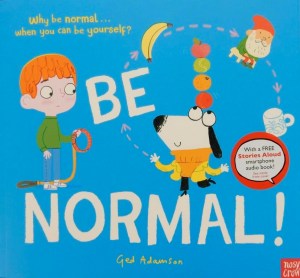
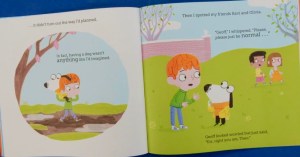
Theo, the story’s narrator, is hugely excited at the prospect of the arrival of a dog of his own and has prepared well. However one thing he hasn’t prepared for is a dog like Geoff Thorndike; he’s a dog like no other. Geoff arrives clad in trousers and jacket and pulling a wheelie case, turns down the offer of water and makes smoothies – delicious ones at that. Come bedtime he turns his nose up at the special doggy bed and usurps Theo’s bed instead. Time passes and it’s evident to Theo that Geoff is anything but keen on the normal doggy things though he does accept a walk in the park
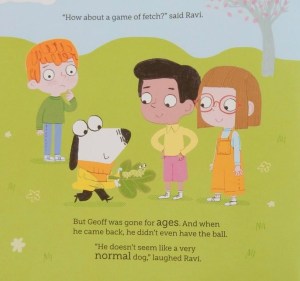
His response to ‘sit’ is well let’s say, something of a surprise. Then Theo’s pal Ravi suggests a game of fetch; this Geoff participates in – kind of –
and after the squirrel incident Theo has had enough. Embarrassed, he tells his friends that his pooch just doesn’t do many normal doggy things but he’s kind and funny and that’s perfectly fine with him. ‘I’m lucky to have you,” he tells Geoff. Having now come to appreciate his dog,Theo accompanied by his friends go home and have smoothies – you can guess who makes those and then Geoff offers to perform his one silly trick …
It’s great to have a story for young children wherein being different is valued. It’s a vital life lesson and Ged Adamson’s fun book conveys this message brilliantly.
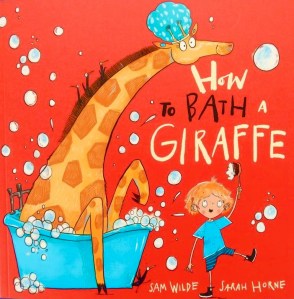
How To Bath A Giraffe Sam Wilde and Sarah Horne Oxford Children’s Books
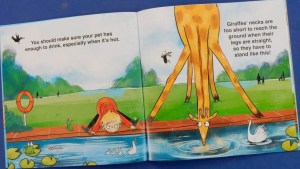
The latest in team Wilde and Horne’s How To series features another pet of the peculiar kind – a giraffe. This one appears in response to the poster displayed in the neighbourhood and astounds the boy narrator’s family with its stature. Clearly there are likely to be issues when caring for such a creature – drinking might be one;
but the most challenging of all is giving the giraffe a bath. The whole story is pretty ridiculous but it’s lots of fun, gently informative and it’s also inclusive (the child narrator has a hearing aid).
Sarah Horne’s illustrations are a hoot and Sam Wilde’s narrative includes lots of interesting facts about giraffes as well as a ‘Top giraffe facts’ final spread. Astonishingly, giraffes and humans have the same number of neck bones (seven).
These are both additions to popular series for very young children:
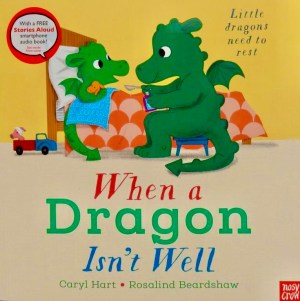
When a Dragon Isn’t Well Carol Hart and Rosalind Beardshaw Nosy Crow
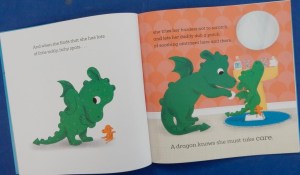
When Little Dragon is poorly and aching all over, she doesn’t stamp and stomp or cry so loudly she wakes the baby. No of course not. Rather she gently calls Daddy dragon who manages to get her off to sleep. Come the morning though, she’s covered all over with itchy spots and instead of scratching frantically, she allows Daddy dragon to apply some soothing ointment.
She accepts being told she cannot go and join her friends who call inviting her to play. She also accepts that she needs to stay indoors and do some more restful activities like drawing and sharing a book with Mummy dragon. Indeed Little Dragon complies with whatever her parents want her to do, – eating lunch, snoozing and enjoying some imaginative play of the gentle kind. Of course, once she’s recovered from her spotty sickness it’s a different matter and Little Dragon resumes her lively activities with gusto: what about her tiny sibling though? … A delightful addition to team Hart and Beardshaw’s When a Dragon series that young humans will relate to and enjoy whether or not they have had lots of itchy spots that make them feel poorly like Little Dragon.
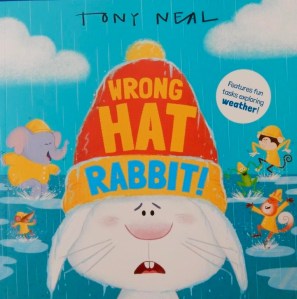
Wrong Hat Rabbit! Tony Neal Oxford Children’s Books
Rabbit wants to spend a day playing at the park with his friends so he dresses in what he hopes is the right gear. However, the weather proves to be very changeable and so no matter how many changes he makes to his attire, he seems to be wearing the wrong outfit. After in turn, being too hot, getting a soaking
and feeling too chilly, his pals decide to step in and help until all appears to be well; but then they start having a snowball fight … An entertaining, simple introduction to some of the vocabulary associated with weather for very young children. The final spread offers activities for a child and adult to do together. Altogether an enjoyable way to support learning at home or perhaps in an early years setting.
The O.D.D. Squad: Attack of Aunty Enchanty Stuart Heritage and Vincent Batignole Puffin Books
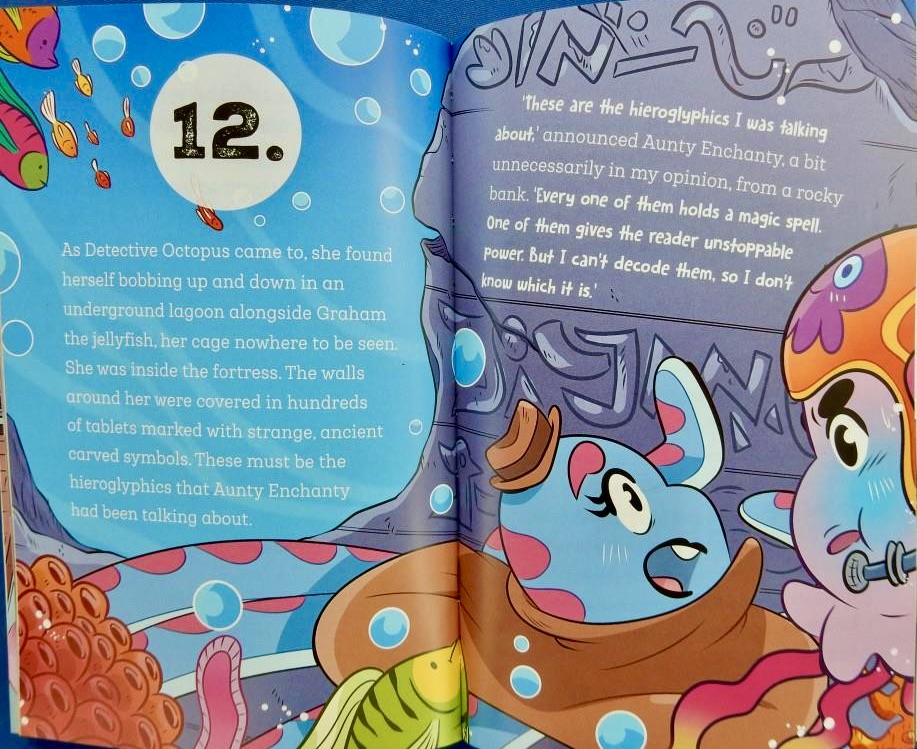
Like the first title in the series, this sequel is fast, funny – often ridiculous and highly illustrated.. In case you’ve not read Rise of Invisidog, the setting is Justice City and the O.D.D squad comprises a team of more than a tad inept crime-fighters – superhero duckling Quack Attack, Detective Octopus and Invisidog (the team’s newest member). A weird threesome indeed and when it comes to apprehending criminals, they do a pretty decent job, as they did at the start of this book when they succeeded in getting The Incredible Slowman safely in handcuffs.
However on returning to headquarters they discover that the place had been broken into and a note left by one Aunty Enchanty claiming to have kidnapped their pal Graham the jellyfish. Now this particular villain, unlike the Incredible Slowman, far from being a bungling idiot; is reputedly an all-powerful sorceress who is intent on carrying out an evil plan to destroy Justice City. The next thing the team know, one of their number – Detective Octopus – is missing; she’s currently in the clutches of Aunty Enchanty who has designs on the captive’s brain. Unbeknown to the captor however, octopuses actually have nine brains. In order to translate the hieroglyphics which would give her unlimited powers the one needed is that which the octopus least wants her to have. The situation gets progressively worse with Detective Octopus having to join the missing jellyfish in an underwater lagoon
closely guarded by the arch evil one, and Quack Attack now having an alter ego, Quacksquatch, a giant were-duck. How on earth or underwater, will this sorry saga end? Can the three detectives get back together and even bring Aunty Enchanty to justice?
Another zany, metafictive romp wherein chapters end on cliffhangers, frequently with a comment from author, Stuart. Coffee anyone?
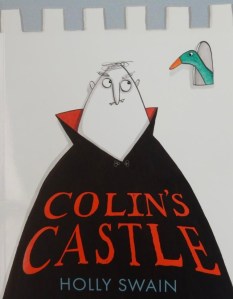
Colin is a vampire, an extremely happy one as it’s the day he moves into his new abode – his very own castle with space aplenty and fabulous views. There’s a snag though, a duck shaped one. Said duck is determined to maintain her squatter’s rights. No matter what Colin does, be it indoors or out in the grounds, the duck pops up, even doing so when Colin is in the bathroom having a dump.
So furious is the vampire that he chases the duck out of the castle and then locks and bolts the castle doors. Hurrah! Peace and quiet at last he thinks, but no; the dastardly bird has somehow managed to find a way in again.
Colin devises a clever ruse
and eventually, pretty exhausted from the day’s events and desperately in need of peace and quiet, retires to bed. But his dreams are disturbed by a loud, “Quack”. It can’t possibly be, can it? … Well, yes and no, for there’s a hilarious final twist that will have young children and adult sharers in fits of giggles
Fearsome fun and full of witty visual details: I especially love the Newton’s cradle and the ultra high factor sunblock.
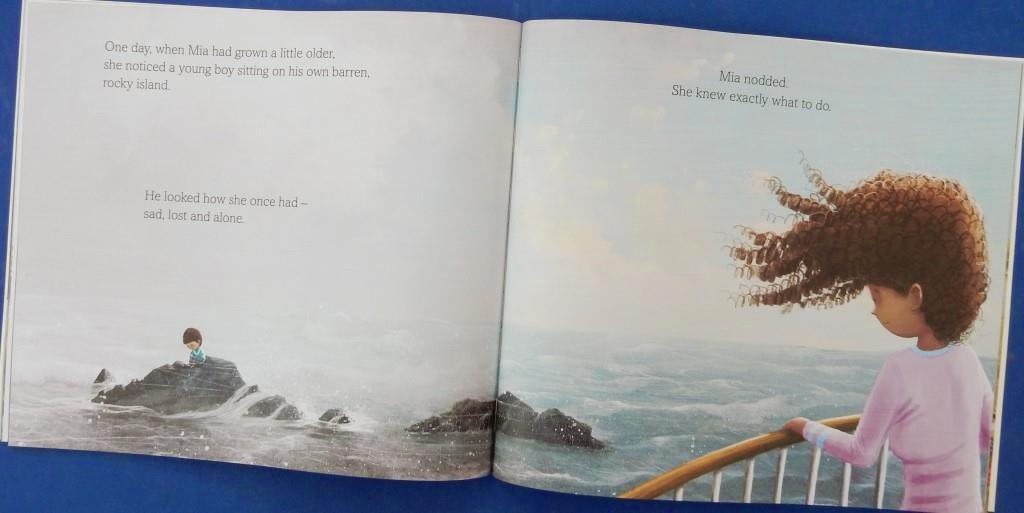
With parents so busy they seldom have time to play with her, Mia feels alone, so much so that it feels as though she lives far out to sea on a small island empty save for her.
One day an unexpected parcel arrives; it contains a book and it’s for Mia. Because she’s never had a book of her own before, this one feels extremely important and that’s before she’s even looked inside the covers. As she begins to read, Mia notices that something amazing is happening: with every word, Mia’s island becomes less empty. Gradually it fills with plants and creatures, and the air is perfumed with what to Mia feels like hope. As she continues reading a bridge starts to appear, growing gradually stronger all the while.
She leaves the island behind and a world of connections opens up with friendships and amazing possibilities in abundance.
Tom’s use of the bridges metaphor is SO well done for the target age of readers: for instance ‘Soon it was solid arches of dependable stone, easily spanning the distance between her and the small island she had now left behind.’ It’s wonderful to see how a slightly older Mia sees a lonely boy and immediately knows what to do.
Leaving her very first book on his doorstep, she passes on the love of reading to him, knowing that before long, his world too is going to be ‘full of bridges, connections, life and laughter’.
Promulgating the power of story and reading, this is a truly beautiful book both verbally and visually. A must have for primary classroom shelves and home collections to share, to give, to inspire and to cherish.
Billy has cerebral palsy and is a wheelchair user. His time at primary school was reasonably okay but now he’s in secondary school, his fellow pupils are much more unkind, including his erstwhile friend Rio and buddies. I felt my blood boiling as I read some of the things he was called. However on line, Billy is able to escape from the bullying and inhumane name calling and feels part of a community.
Then a new girl, Mia, also a wheelchair user, joins the class and everyone is excited to discover that her uncle is a famous soccer player. They’re even more excited when she announces that said uncle – Danny Cash – and some fellow soccer stars are coming to visit the class. Billy, a soccer lover, can’t wait to meet them but he almost misses the opportunity. However an enormous effort on his part means he arrives in class just in time; but it turns out that Billy’s hero isn’t quite what he’d hoped; indeed his behaviour is similar to that of his prejudiced classmates.
Nevertheless during the visit, Billy pulls off something amazing and surprises everyone but infuriates many of his classmates. Things get worse for a while but eventually, with the help and support of online friends, he makes a terrific stand while at a soccer match. This gives lots of people, (including Danny Cash,) cause to rethink their attitudes to Billy and to disabilities. By this time though Billy has come to realise that a sense of self-worth comes from within.
Matt Stephens’ hard hitting and empowering story needs to be read widely by those of eleven onwards, including adults; it will one hopes make them examine their own attitudes towards, and treatment of , anyone who has a disability. As a class reader, it could provoke extremely valuable discussions.
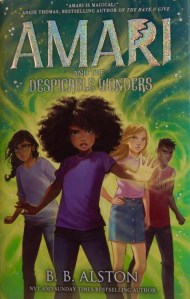
Amari and the Despicable Wonders B.B. Alston Farshore
In the previous story, Amari and the Great Game, Amari had to concede defeat in a contest with Dylan Van Helsing and was left without her magical powers. Now with the League of Magicians and the rival organisation, the Bureau of Supernatural Affairs heading for a decisive showdown, the powerless Amari faces her greatest ever challenge.
As the war intensifies, Quinton, Amari’s elder brother and superstar agent now back on the scene and others from the Bureau are intent on keeping her out of harms way, leaving him to undertake missions. Meanwhile her erstwhile friend and former partner, now her nemesis, Dylan Van Helsing has become head of the League and seems able to outsmart her no matter what she tries. However, Amari is one determined girl and even with the odds against her, she and her loyal group of friends set out to locate their only hope of preventing Dylan from unleashing a new destructive power that would render him invincible. What they need to find is the only source of anti-majik, ancient inventions called Wonders.
The tale twists and turns this way and that to its denouement, which is both poignant and uplifting. And for Amari, it affirms her place in the community she loves. For me as a reader, one of her thoughts near the end particularly resonated: ‘And it makes me hopeful that people might start giving others a chance before judging who they are.’
If you’ve not met Amari et al before, then start with Amari and the Night Brothers and move on to Amari and the Great Game before reading this one.
I have a guest reviewer today: my relation Emmanuelle, an 11 year old, avid reader. Here’s what she had to say:
Star of the Show Jacqueline Wilson, illustrated by Rachael Dean Puffin Books
Jaqueline Wilson’s latest book is an amazing tale of family and hardship. Tess, from whose viewpoint the story is told, and her family live in Victorian England. Sadly their Ma has just died and their Pa has walked out on the children. The five siblings, Maggie, Connor, Tess, Tommy and baby Ada do their best to support one another, the older brother and sister doing all they can to earn some money. Tess though dreams of being a dancer. but she has to attend The Ragged School where she looks after little Ada. One day she learns of a pantomime that is to be performed at The Grand Theatre and she determines to audition for a role dancing in Cinderella … Can she possibly fulfil her wish?
I really loved reading this story, especially the way in which you are introduced to the characters and gradually learn more about them all as the narrative unfolds. It’s great to see how, from such a bad situation at the start, things get progressively better for every one of them. One thing I found surprising was that readers only truly understand the title in the second part of the book.
A wonderful story and one I would definitely recommend to anyone who enjoys stories set in bygone days or wants to pursue a dream.
Being Autistic (and what that actually means) Niamh Garvey, illustrated by Rebecca Burgess Jessica Kingsley Publishers
Here’s a book that explains exactly what the title says and does so in such a way that both KS2 child readers and beyond, as well as adults, be they parents, carers, teachers or support staff, can understand clearly. The author herself was diagnosed as being autistic as an adult as was the illustrator and together they have created a warm, gently humorous, very visual book that is affirmative and supportive. The choice to make it visual is particularly ap,t for a great many autistic people are visual thinkers. It’s divided into four parts, the first of which is short and makes plain the terms autism and neurodiversity. Part two, the longest section explores various autistic traits.
I’ll never forget when one of my support staff shouted crossly at a foundation stage child on her very first day who was showing her distress by stimming. Cleary she’d not experienced this before and we’d not been told that the child might react to a new situation in such a way (she stimmed – repeatedly flapping her hands, turning round and round and humming). If only she’d had the opportunity to read this book the upsetting situation might never have occurred.
The third part describes other challenges autistic people might face and the fourth, What’s Next? talks about growing up and some of the possibilities life might offer.
With its emphasis on inclusivity and positivity this is a vital read for children whether or not they have an autism diagnosis, as well as adults everywhere. The latter really do need to be aware of the challenges an autistic person may face and thus be in the best position possible to be supportive.
Ebb and Flo and the New Boat Ebb and Flo: A Blowy Day Kate Canning and Thomas Voigt Graffeg
In the first story, despite it being early in the morning Bird cannot wait to tell Ebb about what she’s found so she sets off beeping enthusiastically to tell Ebb about the discovery even though Ebb dislikes being disturbed at such an hour. Bird’s excitement is on account of the new boat bedecked with greenery that has arrived at the jetty.. So, Bird sallies forth alone and when she hasn’t returned some while later Ebb starts feeling concerned.
The reason for her absence is that she’s made a new friend on board the new boat. Ebb discovers this with help from Flo who approaches the owner of the new boat asking for Bird. The conversation is confusing as the lady speaks German; however Flo, Ebb and Mum go aboard and in the cabin sure enough there is Bird and also a little canary named Zoot, so the boat owner tells the visitors.
Almost inevitably Ebb feels a tad jealous of Zoot, especially as Bird plays with this new friend all day. Ebb considers Zoot to be akin to Mum’s yellow feather duster. Even Flo’s reassurance at bedtime that it’s possible to have more than one friend doesn’t reassure the pooch. However, the following morning the visiting boat has gone and with it Bird’s new friend. Now it’s her turn to feel upset. Can Ebb and Flo find a way to help Bird return to her usual happy self?
In A Blowy Day, the strong wind causes Mum to feel concern for Granny so she, accompanied by Ebb, Flo and Bird, row across to pay her a visit. Granny is taking advantage of the strong wind and is busy hanging out her washing when they arrive. Her mention of a kite prompts Flo to ask about making a new one there and then so she and Granny set to work. Before long they’re ready to go out and test the kite but it gets caught up with the line of washing and Bird flies to the rescue. Then a sudden extra strong gust sees Granny’s clothes flying way up and out to sea. Time for operation rescue …
Both books, based on Jane Simmons’ original characters are part of an animated TV series: with their simple stories, they work well too as read alouds to share with young children (Both titles have notes for adults that include activities and discussion possibilities at the back.)
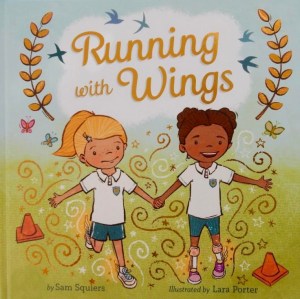
Running with Wings Sam Squiers and Lara Porter New Frontier Publishing
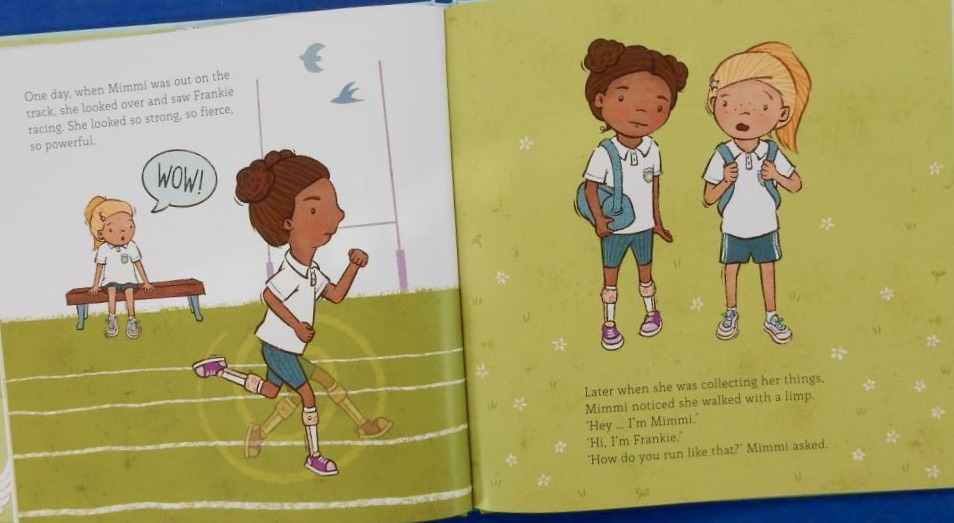
Frankie absolutely loves running; so too does Mimmi. They both seem to live, eat and dream racing and both dream of running in the most spectacular race there is – The BIG One. First though they have to compete in the school carnival on which day every class races the super sprint, 100 metres. However whenever Mimi goes to participate in a race she gets an attack of nerves.
One day while training on the track she sees Frankie running and later notices that she walks with a limp. Introducing herself, Mimmi asks how she manages to run so well.
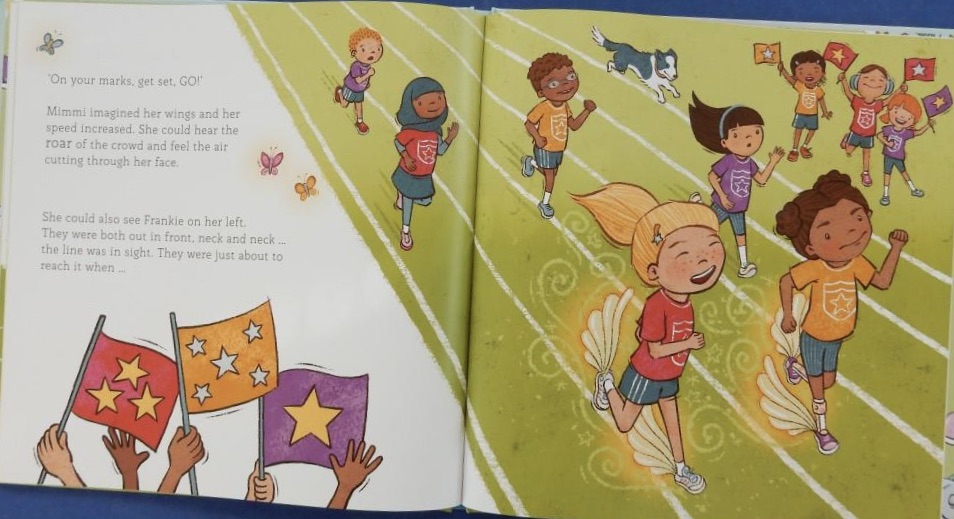
Frankie quietly shares her secret with Mimmi, “I imagine I have wings on my trainers.” Mimmi expresses a wish for wings too and so Frankie explains what she does just before she runs. As you might expect Mimmi tries imagining wings on her own heels and it certainly speeds her up. Henceforward the two girls become almost inseparable friends training and running together at every opportunity.
Come the day of the school carnival Mimmi’s butterflies return and she needs Frankie’s reassurance to get herself to the starting line. Who crosses that finishing line first though?
After the race Mimmi learns from her buddy that there’s more than one way of winning and she cannot help but agree with Frankie.
This is an empowering tale of dreaming big and holding fast to your dreams, self-belief, resilience and over-coming challenges. With the 2024 Paralympics about to start, this is a good book to share with young children. In the author’s words, ‘With their wings they can run, / With their wings they can soar, / It’s not about the race, / But so much more.’ This is brought out beautifully in Lara Porter’s illustrations.
In January 1971 an astronaut took a pouch of seeds with him on the Apollo 14 moon mission. On returning to planet Earth he planted the seeds to see whether any would germinate and thrive. Sally Anne Garland’s story tells of one of those seeds – a winged one.
Below the earth’s surface the little seed determined that it would grow so tall it would be able to reach the moon once more. Gradually a small shoot broke the soil’s surface and in the far distance was able to see the moon shining. The seedling decided to sleep during the daytime and waken only at night when the moon was visible. Weeks and months passed and the months became years until that tiny seed was a mature tree with its roots keeping it firm in the ground. After the tree flowered, winged seeds blew on the wind, a wind that caused a dozing bear to ask, “Why are you still awake, Tree?” Bear doesn’t hear the response though, it’s already slumbering once more.
Each night other animals use the tree for shelter and still the tree yearns for the moon. Then one night Squirrel asks the tree if it’s sad and tree responds thus, “I’m sad that I can’t reach the moon, where I once saw the most bright and beautiful thing I’ve ever seen.” Squirrel then invites the tree to stay awake during the day and together they would see something beautiful.
The following morning bees and birds greet the new day, the tree’s leaves look green against a blue sky
and henceforward the tree slept at night and stayed awake during the day to appreciate and love its earthly home.
The author/ illustrator engenders a sense of awe and wonder in her mixed media scenes of both night and day, be they of the maple tree stretching moonwards, the images of mammals and birds it sheltered, the splendour of a rosy dawn landscape, or our unforgettable blue planet viewed from space.
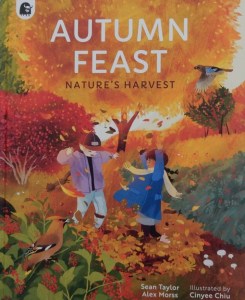
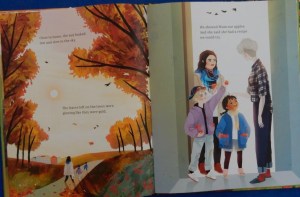
Autumn Feast Sean Taylor & Alex Morss, illustrated by Cinyee Chiu Happy Yak
This autumnal offering completes the seasonal series by the same team that created Winter Sleep, Busy Spring and Wild Summer. Both Sean and Alex are great communicators when it comes to writing for children and again this one is perfectly pitched for its intended audience.
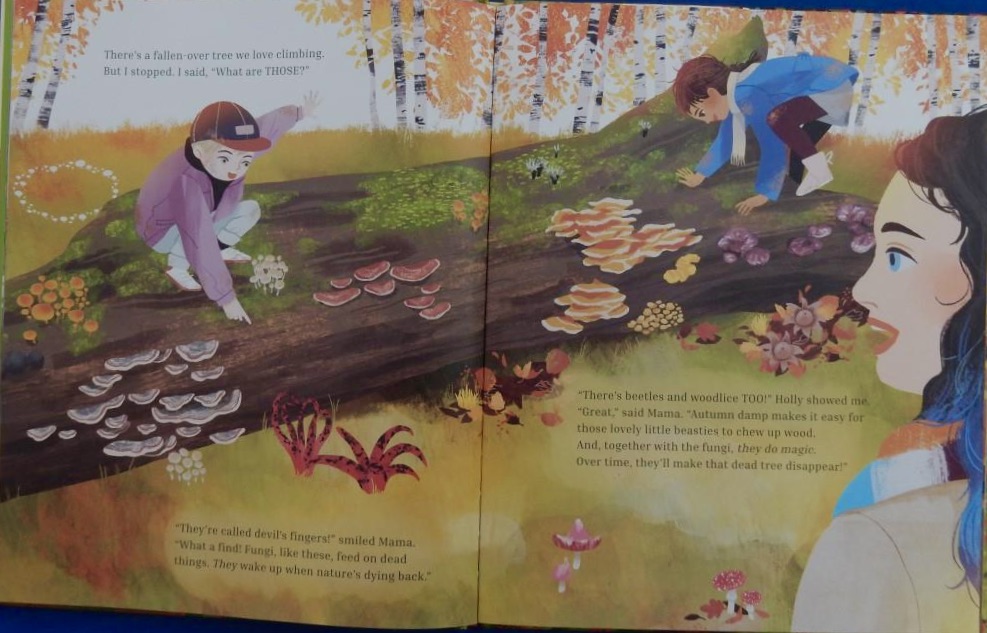
The narrative is set on a bright, chilly autumn morning and Mama suggests the children accompany her on a walk in the nearby park. Somewhat reluctantly in the first instance they wrap up and off they go into the windy street where leaves are blowing every which way. Cheered by the opportunity to romp in the fallen ones Holly and her narrator sibling are ready to embrace the wealth of sights and sounds that surround them. All the while Mama – a nature brainbox – as the young narrator calls her, gently gives the youngsters information about the various plants and animals they come upon: it was a wood mouse that had nibbled at the hazelnuts and has left tooth marks she’s able to identify and some unusual devil’s fingers fungi they see beside a fallen tree.
Having observed minibeasts down low and birds high above, they stop for a while to collect fallen apples before returning home. There excitedly they show Mum the apples
and the four of them chat, bake and consume delicious apple flapjacks together.
All this and more is shown in Cinyee Chiu’s vibrantly coloured detailed scenes.
Following the narrative, the text changes to a more conventional non-fiction style, posing and answering ‘What is Autumn?’ on one spread, after which are a spread on plants, another on animals, one entitled ‘Rotters’ and there’s a final page giving some ways children can help wildlife during the autumn months.
Don’t Disturb the Pirate! Rhiannon Findlay and Sîan Roberts Puffin Books
Young children will have fun joining the young protagonist in a search for his lively puppy, Patch, that has run away. There’s a need to tread carefully however and keep a watch out so as not to disturb the pirate captain and his crew. Scallywag Island offers plenty of hiding places for both pirates and the missing pup and who knows, you could stumble upon a treasure chest, a magical tree, a mermaid or even a helpful map. After looking high and low
what should our young pup hunter spy through his binoculars? Assuredly it’s something unexpected.
With its touches of magic, clues to follow, unexpected ending and fun, throwaway lines on the final page, young children will enjoy the adventure delivered through a jaunty rhyming text and Sîan Roberts’ exciting, brightly coloured scenes of the search. Make sure to peruse the map at the front of the book before you share the story. and allow time for young children to enjoy the playful details in the illustrations as you read.
These are three Puffin Books graphic novels – thanks to the publisher for sending them for review.
Hilo: The Boy Who Crashed To Earth Judd Winick
Meet Daniel Jackson Lim, known as D.J. His siblings are all high achievers but D.J. thinks he’s no good at anything other than being friends with Gina; but then Gina moved away. So he’s left without anything that makes him special until suddenly one day Hilo crash lands near to where he lives almost destroying his clubhouse. Hilo is clad only in silver underpants of the outstanding kind and has no idea from whence he came or why. He has a tendency to eat anything and everything and somehow manages to get himself enrolled at D.J.’s school. As they’re going into class, who should be there but Gina, Daniel’s best friend, recently returned from New York City; so now the two become a threesome.
It quickly transpires that Hilo isn’t the only unexpected arrival from out of the sky though: there’s the monstrous Rant – a robotic ant that Hilo attacks with his laser-shooting hands before it can consume his friends. This monstrous creature however also gives D.J. an opportunity to discover that he too has powers, powers that he can make use of to assist Hilo. Indeed this self-discovery is an important element of the action-packed drama. Who or what though is this Razorwark that haunts Hilo’s dreams and why is he intent on destruction?
With some terrific one liners from Hilo, this is a gripping visual delight that ends on a cliff hanger leaving readers all agog for the next adventure.
Max Meow: Donuts and Danger John Gallagher
In case readers missed his first adventure, Max Meow opens this sequel with an introductory recap. Now Max’s human friend Mindy, has gained powers and created a superhero persona of her own. The trouble is Science Kitty.is such a perfectionist, she is scared to try being a hero in public. However, there’s explosive trouble at the firework factory, robberies start occurring that quickly become a veritable crime wave with problems really erupting at the Kittyopolis Food Fest. Furthermore it appears that an evil, bushy-tailed being aided and abetted by others, has designs on the world’s donut supply so it’s patently obvious that the entire city is in a seriously dangerous predicament. Surely now is the time for Mindy to set aside her concerns about being perfect and apply her many skills however imperfect she might consider them, to helping Cat Crusader save the day, not to mention the donuts.
My head was spinning after reading the book; there’s a possibility that the brain scrambler belonging to one of the villains has been pointed in my direction. Young fans of Max however will likely not be so affected and lap up this mix of madness, mayhem and mimicking with its themes of friendship, fear, bravery, loyalty and jealousy.
For older readers is
Blood City Rollers V.P. Anderson and Tatiana Hill
Meet Mina Murray, a young figure skater with a pushy Mum intent on her getting a place in the Olympics. But then she takes a tumble, breaks her arm and things change dramatically. Mina is talent-spotted and kidnapped by two vampires who want to try her out as a member of their Blood City Rollers team a paranormal roller derby team. She accepts the drink they offer to heal her arm and then it’s time to put on the gear and start learning new ways of skating. The more she practises, the more Mina feels that as a team member is where she really belongs. Ending on a cliff-hanger, this first of a series. Its mix of comedy, paranormal horror and a diverse cast of characters will appeal to readers around the age of Mina.
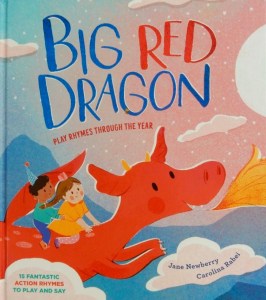
Big Red Dragon: Play Rhymes Through the Year Jane Newberry and Carolina Rabei Otter-Barry Books
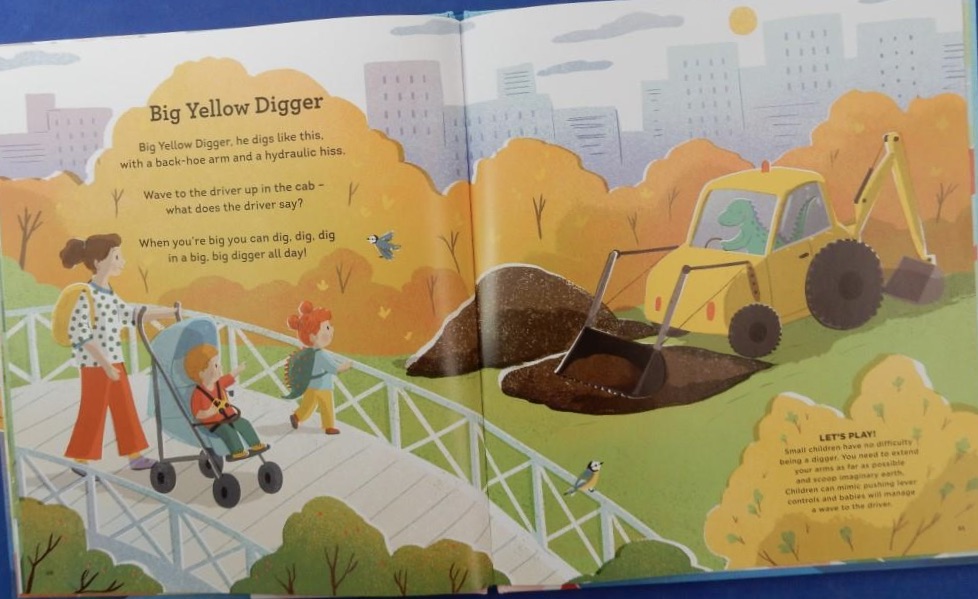
From dinosaurs to diggers and rattle snakes to robins, this lively collection of fifteen playful action rhymes will soon have young children, be they at home or in an early years setting, eagerly participating in both actions and words.
The festival related rhymes are arranged through the year starting with the titular Big Red Dragon for Chinese New Year, then the Easter Bunny, Halloween Fun and Happy Diwali and Naughty Reindeer. Each rhyme has a ‘Let’s Play’ suggestion set into the illustration giving ideas for ways little ones can join in, although some rhymes themselves will suggest movements and sounds, for instance toddlers might like to emulate the dragon’s paws and wings ‘clap clapping’, and ‘flap flapping’ with possible shouts of “Boing!’ as accompaniment.
Carolina Rabei’s playful illustrations are an ideal match for Jane Newberry’s rhymes;
her visual images are vibrantly coloured, textured, perfectly in tune with the words and sure to appeal to young children.
Definitely worth adding to foundation stage collections: I envisage it being used in lots of story time sessions when it will unobtrusively help develop children’s verbal and visual learning.
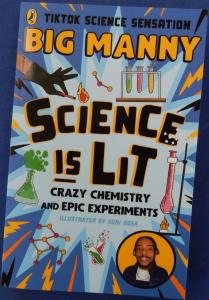
Science Is Lit: Crazy Chemistry and Epic Experiments Big Manny, illustrated by Subi Bosa Puffin Books
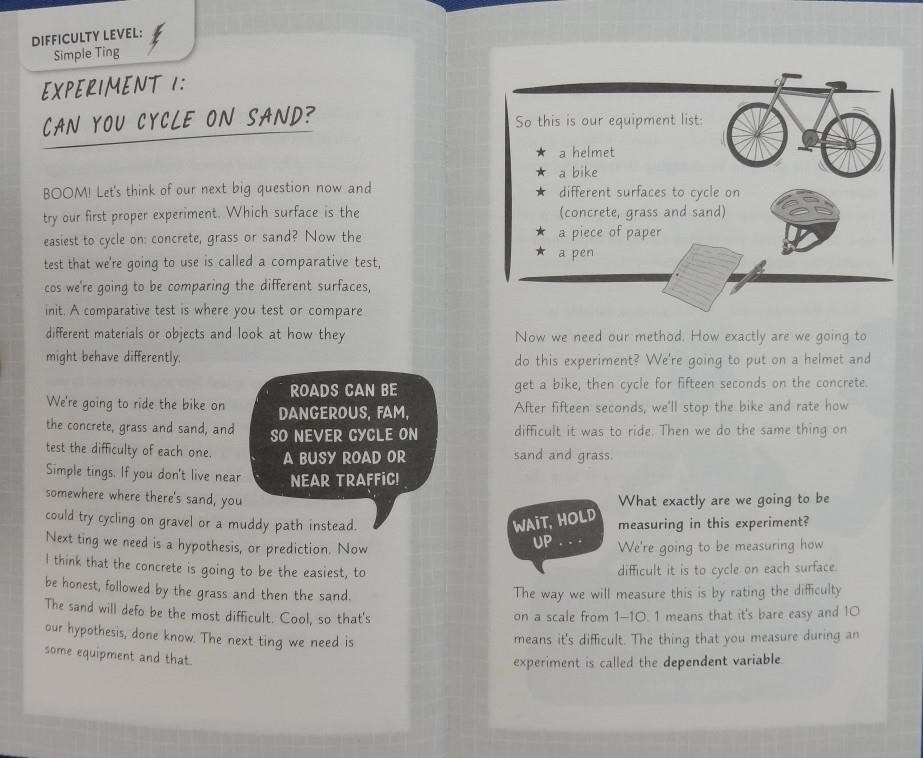
TikTok sensation, Emanuel Wallace, aka Big Manny, is on a mission: he wants to make chemistry as accessible and fun as possible for children. In this book comprising eight chapters, he presents twenty experiments with differing degrees of challenge from ‘Simple’ to what he calls “Big Science’. First though is an introduction in which there are definitions of what chemistry is as well as brief paragraphs defining elements, atoms and molecules. These are followed by a zanily illustrated look at key elements oxygen, hydrogen, carbon, sodium and chlorine. with portraits by Subi Bosa.
The first chapter starts by introducing readers to the way to approach and carry out an experiment with safety rules and the scientific principles of conducting any experimemnt. Then comes experiment one itself – a comparative test to determine which of three surfaces – sand, grass or concrete – is easiest to cycle on.
The hypothesis (you always need one of these) is that concrete will be easiest, then grass and the hardest will be sand. Now off you go on the bike testing each surface. After this comes the write up: method, results, conclusion and an evaluation.
I won’t go into detail about the other experiments other than to add that I never knew there was a way of turning milk into plastic before reading how to do so in chapter 7. The book concludes with some fun questions, a quiz and a final glossary.
Had I been taught by Big Manny when I was studying O-level and A-level chemistry I certainly would not have been bored like I was back in the day.
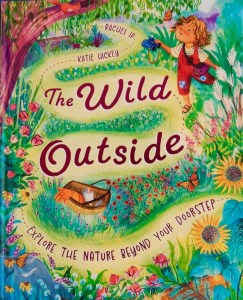
The Wild Outside Rachel Ip and Katie Hickey Hodder Children’s Books
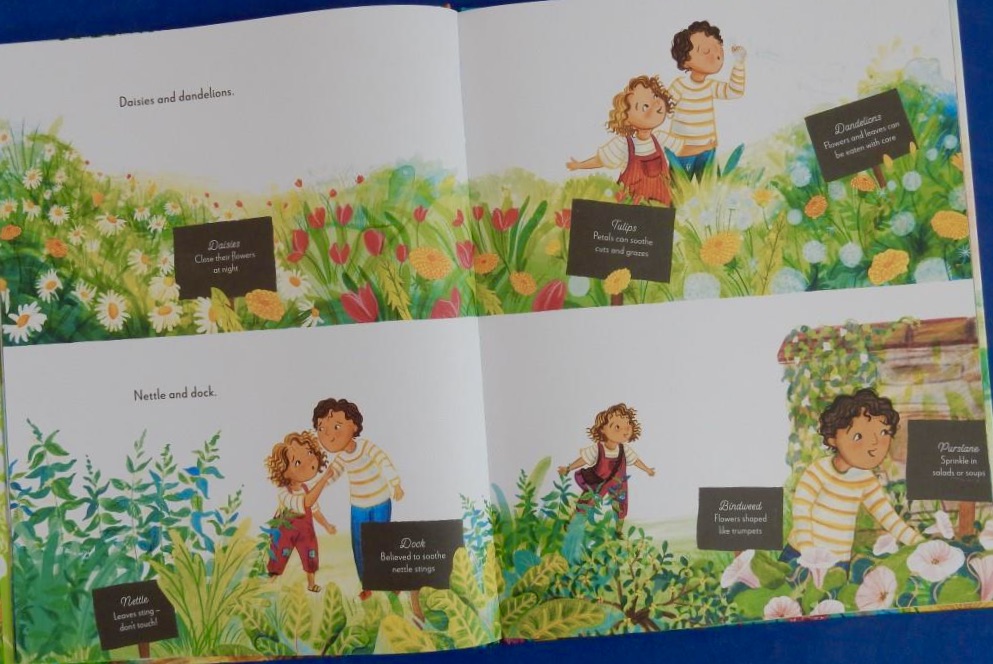
There’s nothing little Tulip likes better than to be outside exploring. She observes carefully the flora and fauna using all her senses and never stops asking questions to increase her knowledge. Then she comes upon a trail of muddy footprints on the path and a sign saying Nature Trail. Written in chalk in various places are labels naming lots of the plants, some she’s already familiar with, but lots that are new to her.
Who can possibly have made this trail, she wonders as she catches sight of somebody’s back retreating. Having filled her pockets with flowers and catkins, Tulip and her elder sibling return home and on the doorstep is a parcel with Tulip’s name on and inside is an illustrated botanical guide and a note encouraging her to keep on exploring.
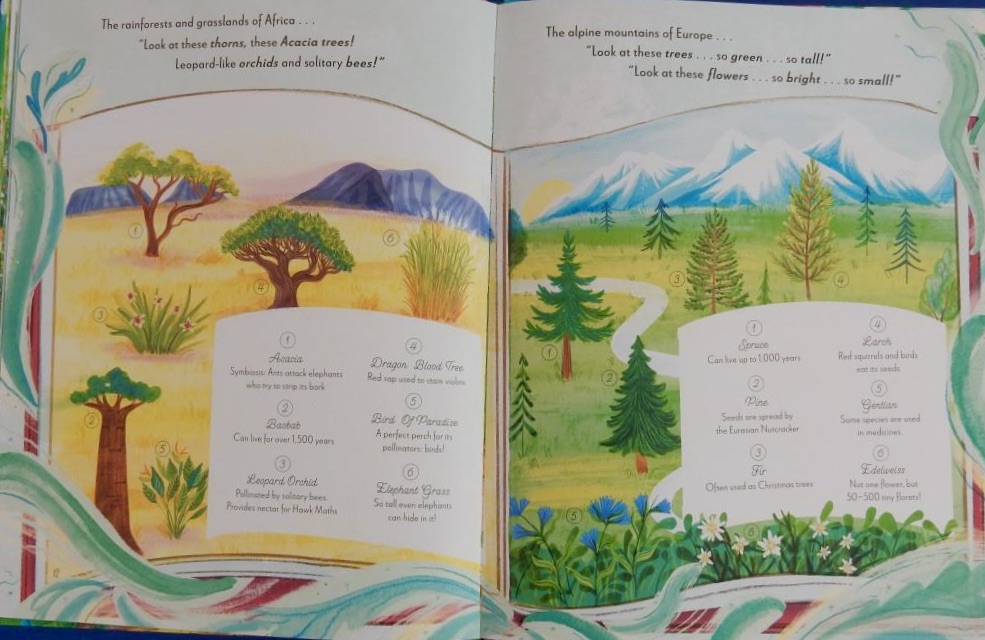
On opening the book, Tulip is excited to find lots of plants and trees she recognises and is inspired to do some labelled drawings. This keeps her engaged until bedtime when she falls asleep wondering where the following day’s explorations will take her. However, come the morning it’s raining hard and so she further explores her book instead, visiting Asian mangroves and forests, the deserts and plains of Australia, African rainforests and grasslands, mountainous regions of Europe,
the North American tundra region, various South American habitats and the cold Antarctic deserts. A clever device this for introducing to readers habitats the world over.
The following day the sun returns but rain has washed away the chalk markings of the trail. However someone has created a new one: who could that be? Tulip chalks a list of plants from the trail, leaving question marks for some she can’t name. On her return walk she discovers somebody else has written the names of those plants and left a trail of footprints. Who could it be? Tulip is delighted to discover the identity of her fellow nature lover and she makes a very special floral thank you using the contents of her pockets and bag.
A smashing way of encouraging young children to emulate Tulip and become natural history enthusiasts. The vibrant illustrations show the abundance of flora Tulip encounters as she explores and the labels are accompanied by brief captions with additional information about each plant. A wonderful combination of story and non-fiction.
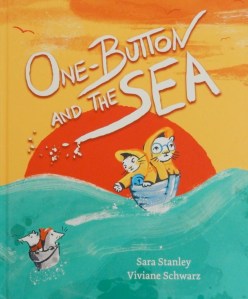
One-Button and the Sea Sara Stanley and Viviane Schwarz Scallywag Press
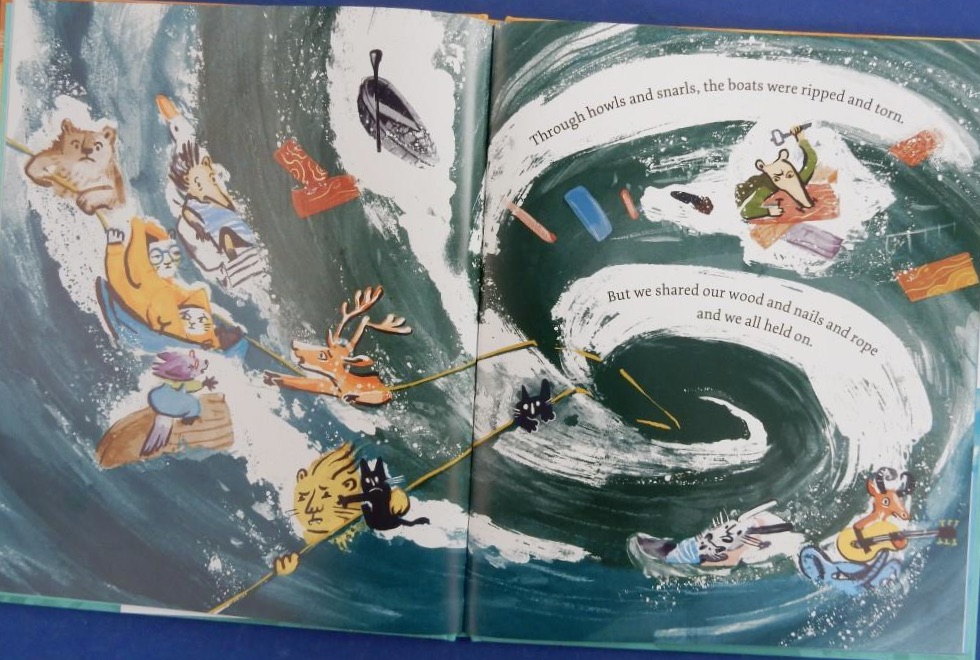
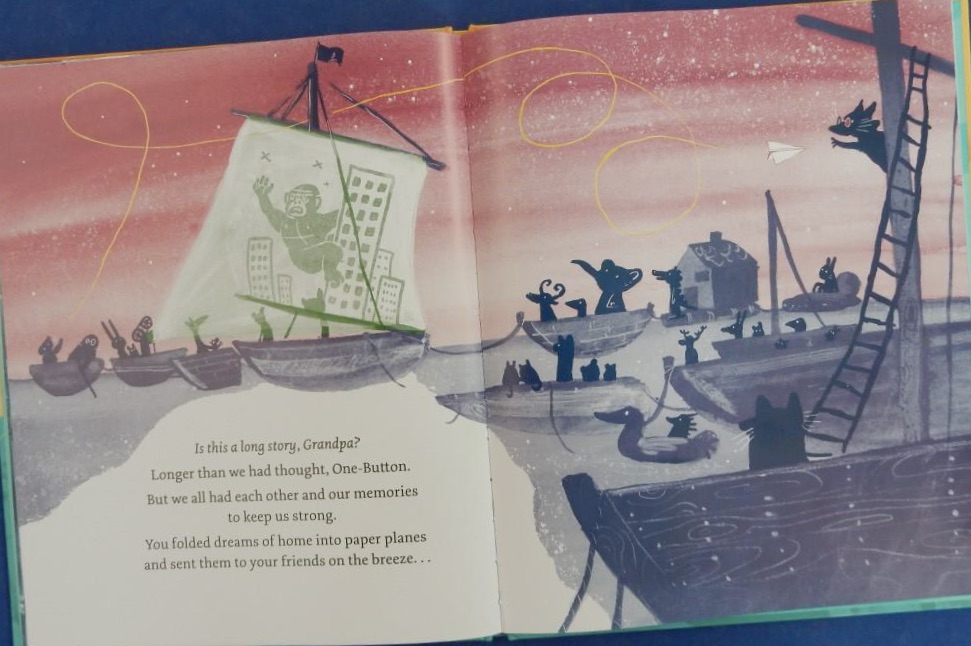
‘Grandpa, tell me the story again of when we went to sea. That’s a BIG story, One-Button. How does it begin? It begins with the uprooting . . .’ And thus, as One-Button sits with Grandpa we share in the story of what happens to a community that suddenly had to uproot and head out to sea in all manner of boats, some of which had several aboard, but Grandpa’s little boat had just the two of them. Leaving their everyday lives far behind, they sang to keep their spirits up as they encounter both calm and stormy waters. The fierce weather badly damaged some boats but this was a community and so everyone did what they could to help those affected, ensuring the safety of all.
There were happy times and sad times for everyone.
After ages on the sea, waiting, waiting, during which they found various creative ways to pass the time,
one day everything changed again. It was safe to return to their homeland, back where they truly belonged. It was time to carry on with their previous way of living, ready to start generating new stories but never forgetting their challenging experience at sea.
Yes, in her quirkily powerful scenes Viviane Schwarz has illustrated Sara’s telling with an animal community but the book would be ideal to share and then discuss, perhaps using a community of enquiry approach when children will likely link it to displaced people in various parts of the world. It’s hopeful and ultimately uplifting and definitely one to add to Foundations Stage and KS2 class collections.
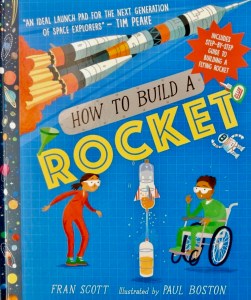
How To Build a Rocket Fran Scott, illustrated by Paul Boston Walker Books
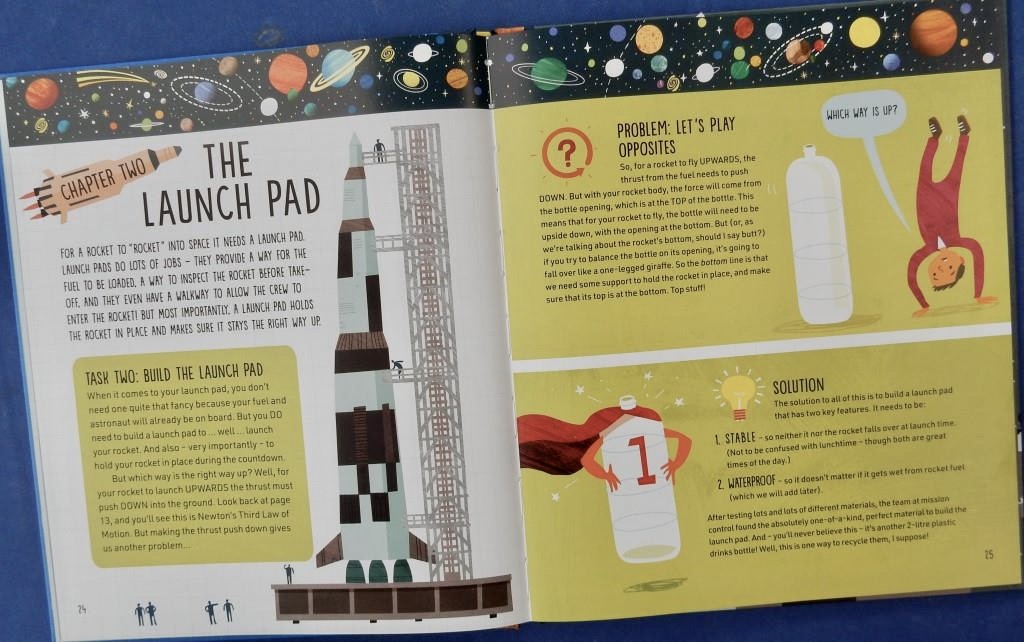
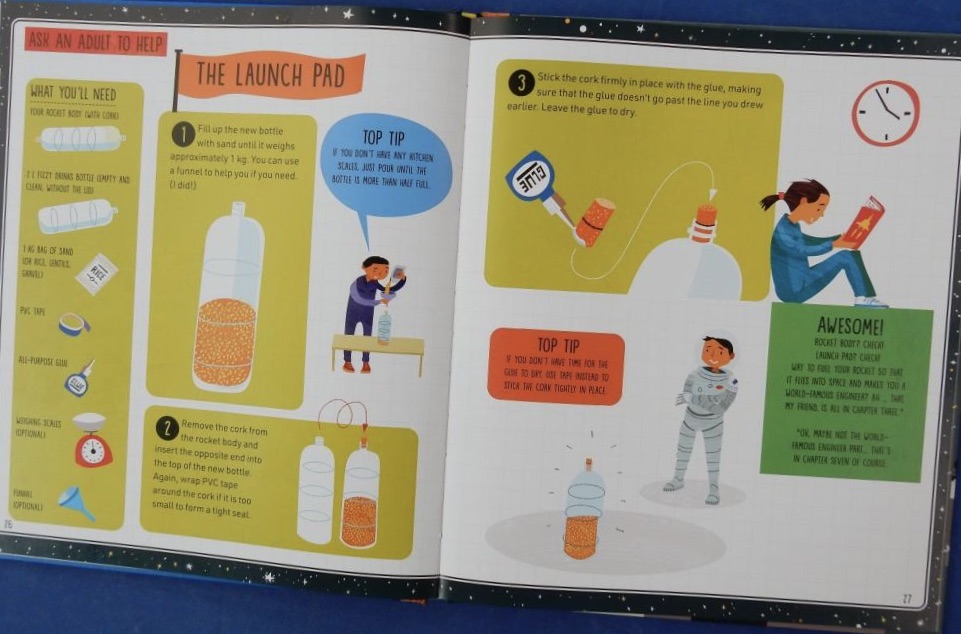
Following How to Build a Racing Car comes another step-by-step guide, to building a rocket, this time. However, this book is much more than a series of instructions; there’s a wealth of information about space-related topics such as an introduction to Isaac Newton and his laws of motion. This is followed by spreads wherein readers meet the various people who work on a rocket and at its launch base. These people then have a related chapter, the first being The Rocket Body wherein both the science behind a real rocket and the making of the model’s body are clearly presented in prose and graphics. Included too is an ’ask an adult’ directive.
Chapter two entitled The Launch Pad is similarly structured and includes some helpful tips.
The next stage is choosing The Fuel (that needed for the model is a mixture of bicarbonate of soda and vinegar). Once the fuel is prepared, it’s time to don your gear, including eye protection, grab an adult head outside to a clear space and prepare for Countdown to launch. Hopefully this is a success but as an integral part of any engineering process, it’s now the Testing and Tweaking should be done. Maybe the addition of fins would make for a better launch; or could an alteration to the weight of your machine improve its flight? Then of course, Personalisation will ensure your rocket is unique. Some designs are offered but why not try creating your own. After all this get ready for the final Blast Off1
What a terrific way to spend time during the summer break and what an amazing amount children who embark on this project will learn.
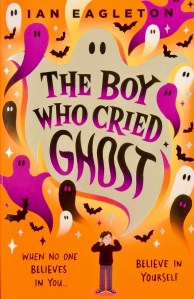
This story of Richard Barnes is a very personal one for author Ian Eagleton: Richard has OCD, with which Ian was diagnosed in his late teens.
Richard and his mother move into what was Grandma’s house just before the beginning of Year 6 and the likelihood that this is permanent, taking him away from his friends, troubles the boy greatly. Everything about his new room troubles him too: he lies awake on his first night thinking about starting at a new school and listening out for the strange sounds that seem to be coming from the old wardrobe in the corner. He resolves to keep it locked to prevent anything hiding inside from escaping. He checks it many more times before leaving for school, which makes him late but Richard believes it’s the only way to keep him and his mother safe.
One day his mum’s friend, Tony, who has been doing some painting in their house, collects Richard from school, accompanies him home and reveals that the boy’s mum has already told him about there being something in the wardrobe. Moreover, he’s also found its key and insists on unlocking the door. Richard is horrified at his thoughtless attempt to show the boy that his anxieties are unjustified: he fears that the ghost has now been released into the room with the result that he experiences a massive panic attack. However when he tries explaining, both Tony and then his mother tell him that his anxieties about the released ghost are down to his over-active mind.
Scared and very angry he decides to enlist the support of his new school friends. They are willing and together settle on calling it ‘The Whisperer’. Meanwhile Mum reveals something about his Grandma and Richard wonders, could she be the Whisperer?
Richard’s friends come to a sleepover with the aim of banishing the spirit once and for all. They reveal lots about themselves during the night but they don’t see the ghost. Then things go disastrously wrong, Mei is hurt and Richard ends up falling out with them, albeit temporarily. Now he feels totally isolated and desperately in need of help. Can Richard finally admit he needs to find somebody to talk to about what is going on and the debilitating voices in his head? Only then might he be able to live comfortably with himself.
Written from the heart, with themes of acceptance, confronting fear, family, friendship and mental health, this powerful story needs to be read widely by older KS2 and KS3 readers as well as adults, many of whom have little or no understanding of OCD. It made me feel I should have been far more empathetic towards a teacher I once worked with who has OCD and frequently turned up late for school. There’s humour and laughter in this book too and in the author’s notes at the end of the book, he pays tribute to his dad who loved jokes, using humour to help him and others deal with their worries.
You’re a Poet Sean Taylor, illustrated by Sam Usher Walker Books
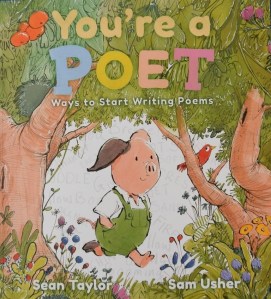
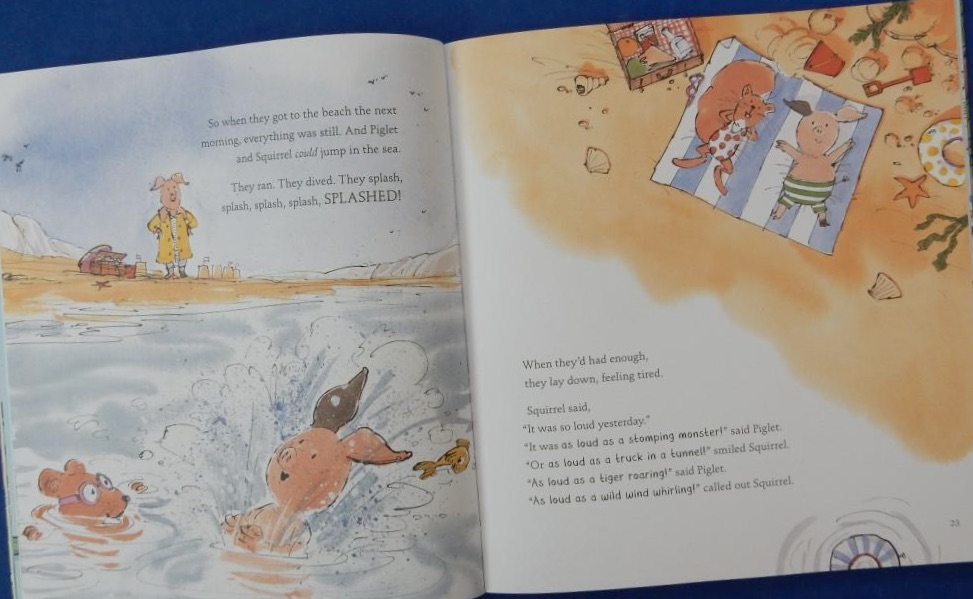
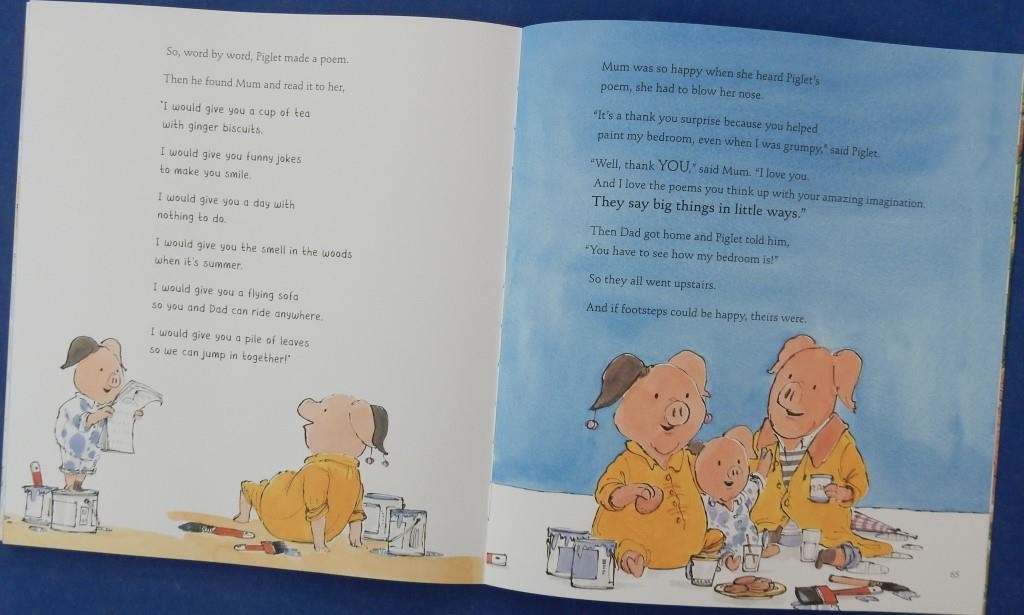
In a clever amalgam of story and non-fiction, author Sean Taylor has created a guide full of poetry-writing tips. There are five short stories starring Piglet, his family and friends, each of which shows children a different way to write a poem.
The first, Piglet … You’re a Poet starts with mum and Piglet in happy mood out walking along a puddly track towards a hill. Piglet, stops, picks up a large stone and drops it into a puddle causing a word-splash. ‘Sunshiny, earthy, wet, fresh, splashing puddle, ‘ says Piglet. Piglet has just created a poem, his mum tells him. This special happening reoccurs as they continue their walk, which culminates in the dizzy delights expressed as the two of them roly-poly down the hill and Mum’s confirmation that her son is a poet. Integral to Sean’s narrative is a demonstration of how to make a Puddle Poem and there are two spreads after the tale with a helpful lesson and ‘writing secrets’ aimed at children.
Of the remaining four stories, the second As Loud As Thunder Booming, introduces figurative language in the form of similes during a seaside family holiday on which Piglet’s pal Squirrel accompanies them.
The Breeze Is My Friend sees Piglet and Squirrel getting a soaking but not before the former has invented a descriptive poem about the seemingly playful breeze. The next tale has Piglet and Squirrel sharing a swing, the to-ing and fro-ing of which gives rise to Piglet’s ‘If I Was a Tree’ poem. Finally, on a day of rain showers Piglet invents an ‘I Would Give You’ poem especially for his Mum while the two paint his bedroom walls together; it’s his special way of saying thank-you to her and she in turn compliments Piglet on his ‘amazing imagination’.
With its compelling narrative, writing possibilities and Sam Usher’s playful and dramatic watercolour illustrations that instantly endear the story characters to readers/llisteners, the message ‘poetry writing is fun’ comes across loud and clear. An inspiring, must have book for foundation stage and KS1 classes.
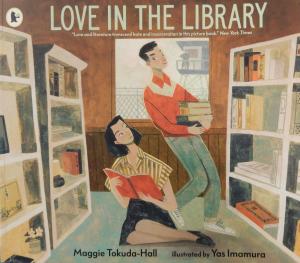
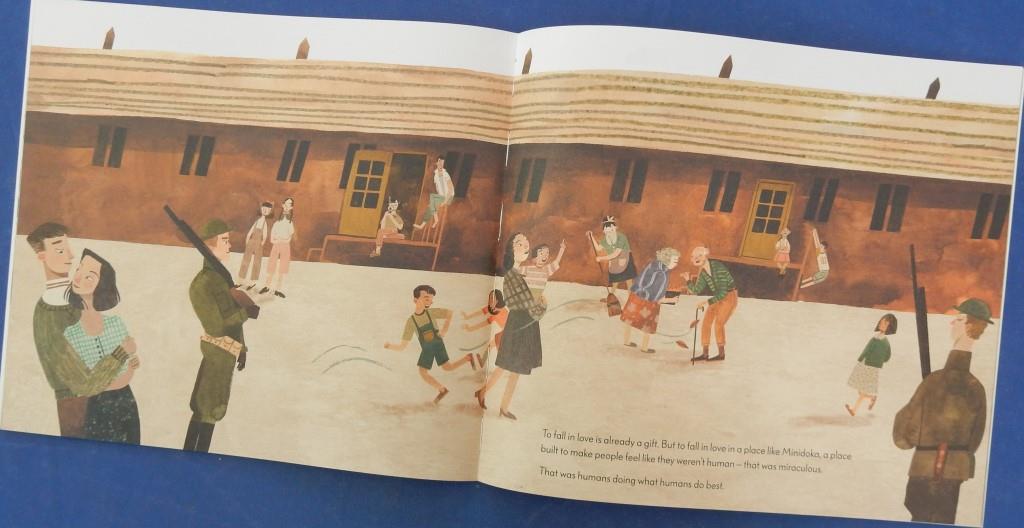
Love in the Library Maggie Tokuda-Hall and Yas Imamura Walker Books
It’s possible to find love, even under the worst situations and so it was for Tama and George in this story based on the experiences of the author’s grandparents who were put in Minidoka incarceration camp during the second world war just for being Japanese Americans. (An author’s note explains the reasons for this terrible unjust treatment at the end of the book.)
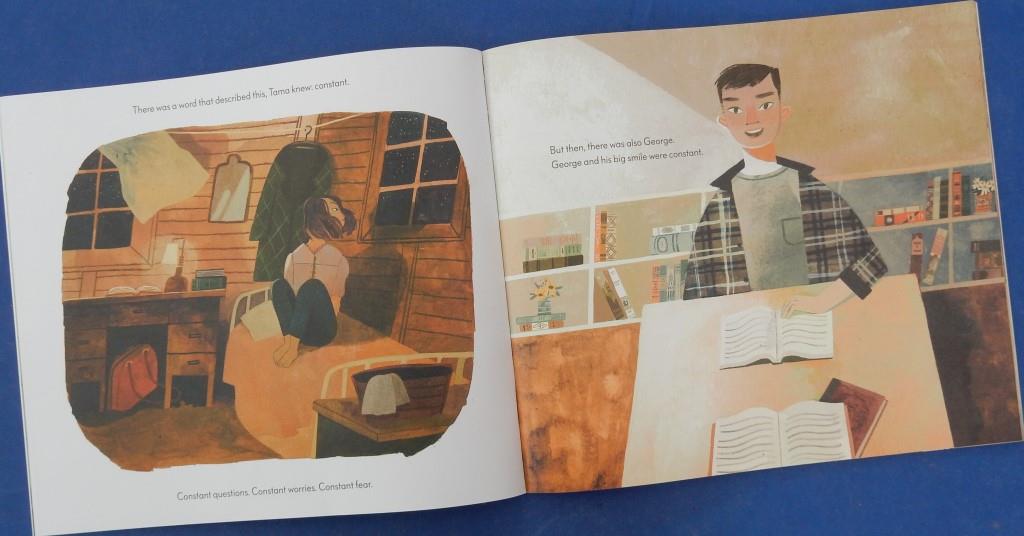
This particular love blooms in a desert library in Minidoka incarceration camp where young Tama works. Every day George visits the library; he too is a lover of books, or so it seems as he always takes away a pile of them and always has a smile on his face. ‘Constant’ Tama calls George and his smile
as helped by books, she tries not to spend all her time thinking of the life before incarceration. Instead she thinks of the gift of the books she is surrounded by.
Gradually, struggling to describe her overwhelming feelings, she opens up to George. He offers her a word – human – and it helps her feel less alone; he also uses the same word to explain why he vistis the library daily and takes so many books. Hope and love blossom – a miracle for sure. Tama and George marry and their first child is born in Minidoka – another light in their lives.
Maggie Tokuda-Hall’s telling is beautifully crafted and together with exquisitely illustrated scenes by Yas Imamura in muted tones showing the harsh realities of the camp, highlight the injustice while at the same time celebrate the treasure of hope and love humans can find against all the odds.
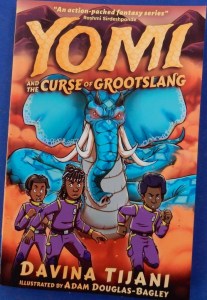
Yomi and the Curse of Grootslang Davina Tijani, illustrated by Adam Douglas-Bagley Little Tiger
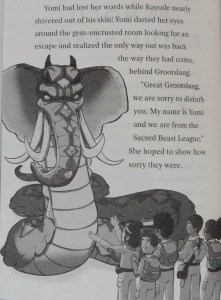
In this third fantasy adventure in Davina Tijani’s Nkara Chronicles series with Adam Douglas-Bagley’s dramatic illustrations, Yomi and her younger brother, Kayode, accompany their Uncle Lou ( a researcher for the Sacred Beast League) to South Africa. Shortly after they arrive the siblings meet the Vilha Treasure Hunters, a group of children who have heard about their bravery when they rescued a Senegalese dragon king and saved a city. The Treasure Hunters believe the qualities the siblings exhibited are exactly what will be required if they agree to join them in their quest to find the Tusk Diamond and bring it back to the rightful owners as well as hopefully, to break a curse issued by the elephantine serpent, Grootslang in whose cave the jewel is hidden. Yomi and Kay agree and so begins their adventure.
On finding the cave the adventurers try bargaining with Grootslang using the pyronite Kayode had brought in exchange for their freedom and the diamond.
When this fails can they come up with something else to persuade her and ultimately help bring peace and harmony to Vilha?
The author weaves mythology, culture and details of South African landscapes into her fast-paced story which also demonstrates the importance of camaraderie and working together, leaving it neatly set up for the next adventure in the series, set in the Congo. Bring it on. There’s mythology too in
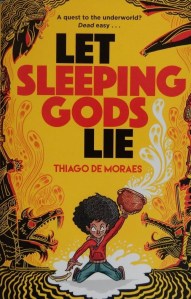
Let Sleeping Gods Lie Thiago De Moraes David Fickling Books
Following her adventure with trickster gods in Old Gods New Tricks, Trixie dos Santos is settling back into her usual way of life, this includes school. She manages to tolerate the boredom of lessons but hates the taunting from some of the pupils, so on some days she spends her time elsewhere, wandering in the woods for instance. It’s on one of these occasions that she loses track of time and reaching home late, is greeted with the news that her grandmother has died and they have to go to Norway for the funeral.
Shortly after arriving there’s some talk of Grandma’s magical cauldron but it isn’t where it’s supposed to be. Trixie notices some strange marks on the kitchen floor. She decides to take a look outside and with Bragi the dog, she sallies forth into the freezing cold. In a clearing in the wood she encounters Baba Yaga.
It turns out that the witch knew Trixie’s grandmother and knows about her magic cauldron. Thus begins Trixie’s next mission: to travel to the Land of the Dead and search for the cauldron.
While in the underworld, having met her dead grandma, Trixie comes upon Hel (goddess of death) and her father Loki, the latter she already knows. Can she trust the trickster when he offers to help. her? Not only he but all the other tricksters that offer assistance as her quest continues taking her through many underworlds. There’s really no choice if Trixie is to prevent the evil army from taking over the world.
A breath-taking tale with plenty of humour, that introduces mythology from various cultures. It will have readers on the edge of their seats as they root for Trixie at every twist and turn. The author’s black and white illustrations are superb – striking, often intricate and very powerful. I can’t wait for Trixie’s next foray into the world of mythology; her emergence from this quest has left her mentally stronger.
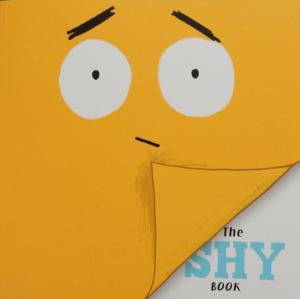
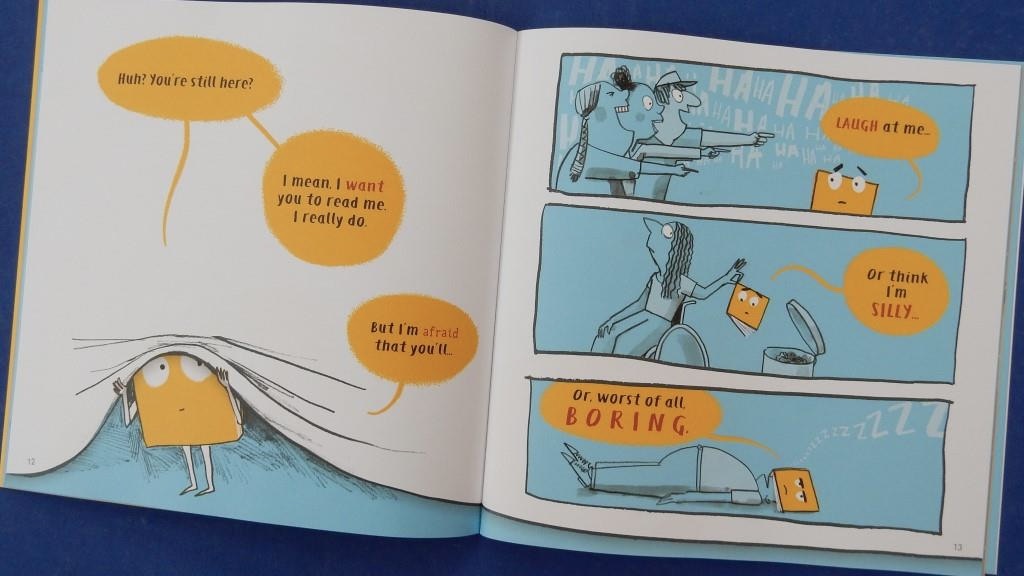
The Shy Book Howard Pearlstein and James Munro Graffeg
This interactive picture book is a novel way of introducing young children, particularly those about to start nursery or school, to a way of coping with their fears about meeting new people and coping with new situations. Its narrator is the titular book and it really does want to be read despite its extreme nervousness. It’s worried, sometimes to the point of dizziness, in case a reader finds it laughable, silly or much worse, boring …
‘go ahead … pick a different book’ it suggests. But what if instead a reader keeps turning the pages? Could they come upon the narrator’s suggestion and gently discover a non-threatening way to feel brave, despite feeling shy as the book does, especially at the outset?
Howard Pearlstein’s clever idea is simply presented, and brought to life by James Munro’s droll illustrations. Empowering and amusing.
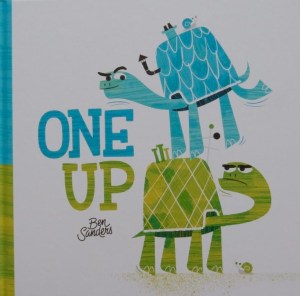
One Up Ben Sanders Little Tiger
Blue and Green are tortoises and they’re best friends. But which is the bestest? That is a cause for competitiveness as each tortoise adds to his shell, making it bigger and bigger, until things get more than a bit out of hand, not to mention out of shell. Both Blue and green are way, way up in the sky
whereas their places of residence remain on the ground and the who is best issue is still unresolved. For a reason unknown to both characters, Blue and Green start craving gelato. But they might have to wait a long while before that desire is satisfied. What in sky’s name can they do? And will they remain best friends?
With inventive, increasingly detailed illustrations of the competitive craziness resorted to by Green and Blue, plus the fun final twist, this is an amusing read aloud that shows the inventiveness of the characters (and the book’s author/artist). With an abundance of visual humour, both children and adult sharers will find themselves laughing as things get progressively precarious.
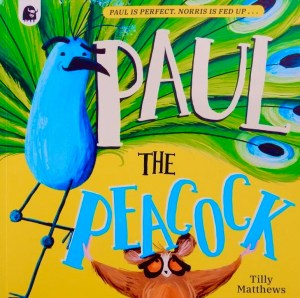
It’s clear from the outset that Paul considers himself an entitled peacock. He has the biggest nest, the most loyal friend and his pride and joy – the most beautiful feathers in the forest. His trusty pal Noris the loris ensures that Paul receives plenty of pampering every single day until one evening a fierce storm blows up. Norris is sent out for more branches to strengthen Paul’s nest but the loris has had enough of his feathery friend’s arrogance and bossiness.
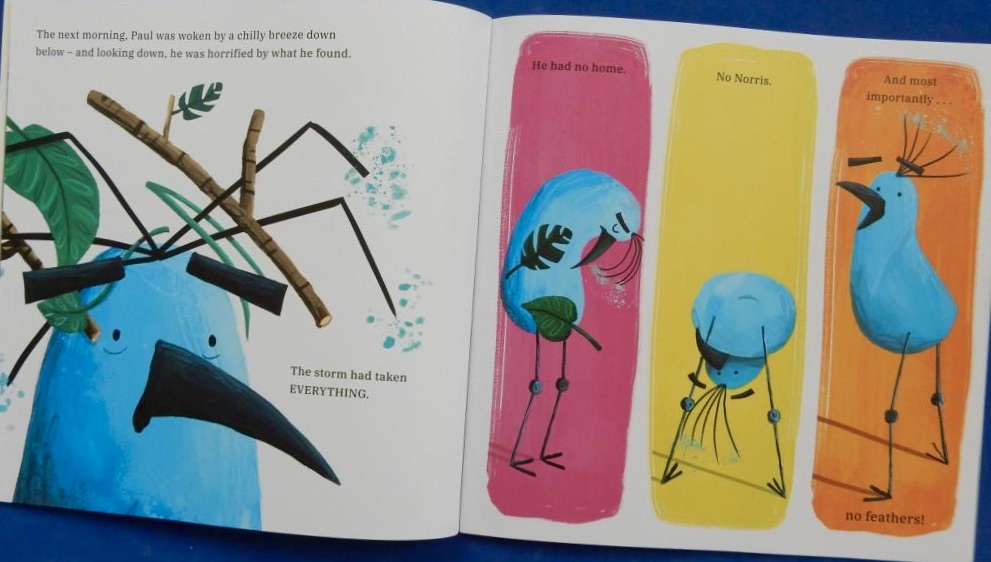
The following morning Paul wakes to discover disaster has struck: he no longer has a home, Norris and worst of all, his feathers have gone – every single one.
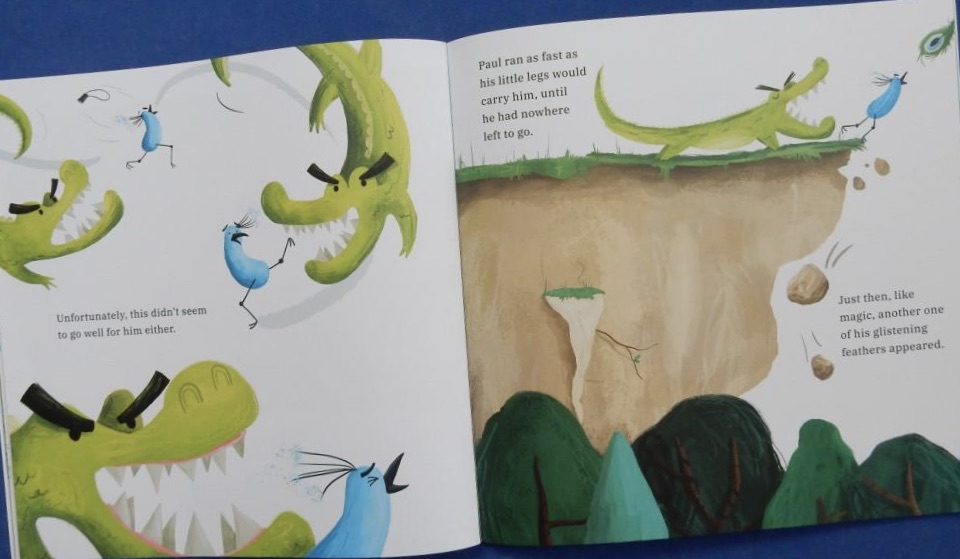
For the first time ever, the peacock heads out on his own to search for those missing feathers; Paul is nothing without his plumage so he’s determined to retrieve every single one. Now politeness is not a quality Paul possesses so he goes about demanding the animals he comes upon with one of those feathers to return it immediately; either that or he attempts to snatch it back.
Hmm, you’ve a lot to learn Paul and you’re going to have to do it the hard way, and eventually he does. Could those same creatures that he’s treated so badly enable Paul to discover that there’s something even more important in life than himself and his appearance?
Tilly Matthews’ fun fable demonstrates the importance of considering the feelings of others as well as being able to show humility and value one’s friends. The illustrations are full of drama and details that will amuse both young listeners and adult sharers of the book. Lots to think about and discuss here.
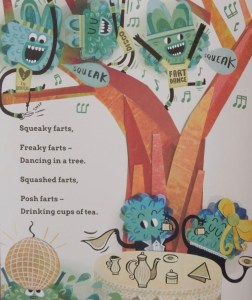
Have an air freshener close at hand when you share this malodorous book with youngsters for you’ll be paying a visit to an exceedingly pongy place.
At this unique zoo (make sure you read all the signs at the entrance) you will encounter more than twenty fart varieties so wearing a nose peg or a face mask might be a good idea. Read too the signs relating to the beastie(s) in each enclosure. Thanks to Leigh Hodgkinson’s narrative and madcap visual portrayals you will quickly discover they come in all shapes and sizes including those sneaky, cheeky …
shlumpy and grumpy, squeaky and freaky, even posh farts (though how that’s possible I truly wonder) and several others.
Finally, however comes an empty enclosure: seemingly a fart has done a runner but where could it possibly be? Chaos rapidly ensues. With the zoo gate wide open the escapee might be anywhere, but it’s not actually left the venue. A couple of eagle-eyed security staff eventually apprehend the whiffer (Evade Fartum), put it back on its recliner and lock the gate but how long will it remain there is anyone’s guess – check out the final scene.
Replete with silly speech bubbles, this is fetid fun for little ones and any adult with a sufficiently strong constitution to read aloud Leigh’s rhyming rendition. (Wearing my science studies hat, the final User’s Guide to Farts is not strictly correct as a classification. For instance ‘Escaping farts should be Fartum evado and ghostly farts should be Fartum umbrabilis and so on … ie only the genus name is capitalised, not the species.)
Another subject with great appeal for young children is:
Not Another Unicorn Book Laura Baker and Chris Jevons Scholastic
The unicorn narrator of this book is anything but pleased at the possibility of being in a unicorn book, vowing she would ‘never, ever ‘ do so but fate takes its course …
There’s nothing for it but to escape its covers as soon as possible. Try as she might with her chomping, poo-dodging and running, her search for adventure doesn’t match up to her expectations. Maybe being in a unicorn book is not actually so bad after all. Assuredly it has its compensations.
Undoubtedly countless little human unicorn lovers will fall for the protagonist in this rainbow coloured setting with its sparkly starry sprinkles that even hover over the poo piles and delicious-looking confections shown in Chris Jevon’s dramatic scenes
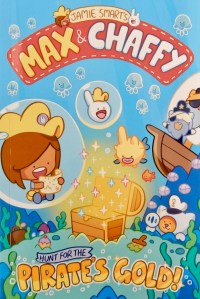
Max & Chaffy: Hunt for the Pirate’s Gold! Jamie Smart David Fickling Books
From the creator of Bunny vs Monkey and Looshkin books, the Max & Chaffy books (this is the fourth), are a less demanding read. Set on Animal Island they feature Max and her pal cum sidekick Chaffy who, having now become official members of the chaffy finding club, are very enthusiastic about sallying forth on their next chaffy hunt. (For the uninitiated Chaffies are small spherical beings with one and a half ears and like to eat lettuce, most of them anyway.)
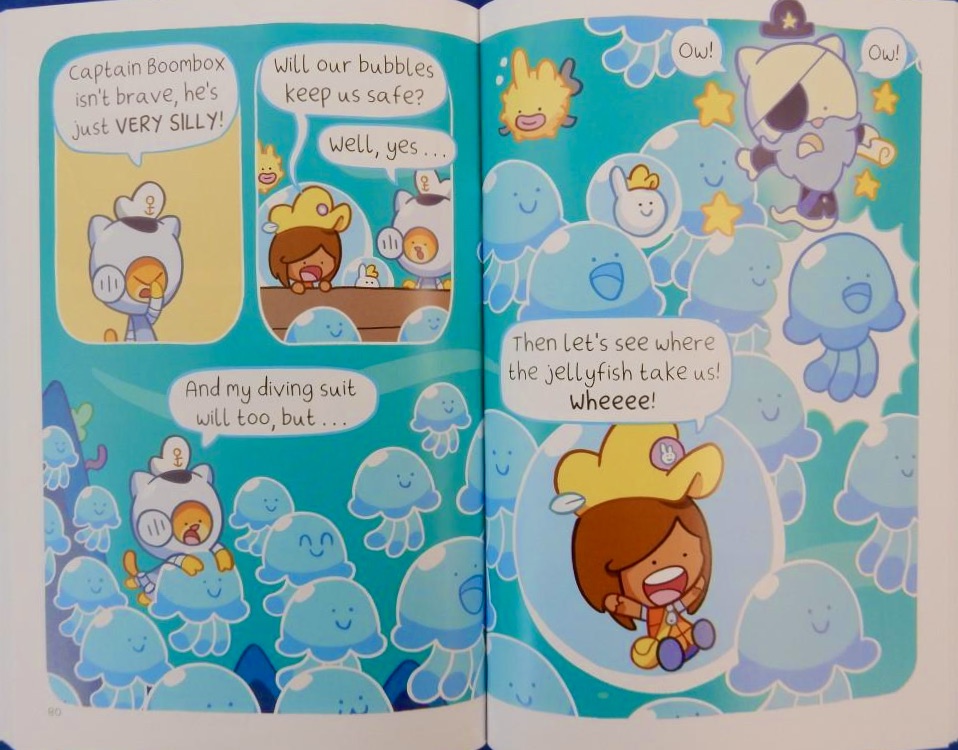
As they’re wandering on the beach the friends come across Foghorn. He offers to take them in his boat to a secret part of the Island, reachable only by sea. Once there, the threesome rapidly becomes a foursome when Chaffy finds a bobbly creature that the rather curmudgeonly Foghorn insists is not actually a chaffy. Max suggests it’s a Puffa Chaffy and soon encased in special underwater bubbles,
Puffa Chaffy, Max and Chaffy embark on an underwater foray involving a map in a bottle, the possibility of treasure and a pirate captain related to Foghorn. It’s an adventure that Foghorn cannot resist joining once he discovers a personal connection. He even lets his kindheartedness come to the surface whenever Puffa Chaffy feels scared and all ends happily with the finding of not one but two new chaffies.
With its vibrant colour palette and a text almost exclusively in speech bubbles, this is a delight – engaging and full of charm. Included too are some puzzle extras..
Rather more complex is
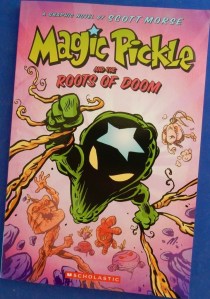
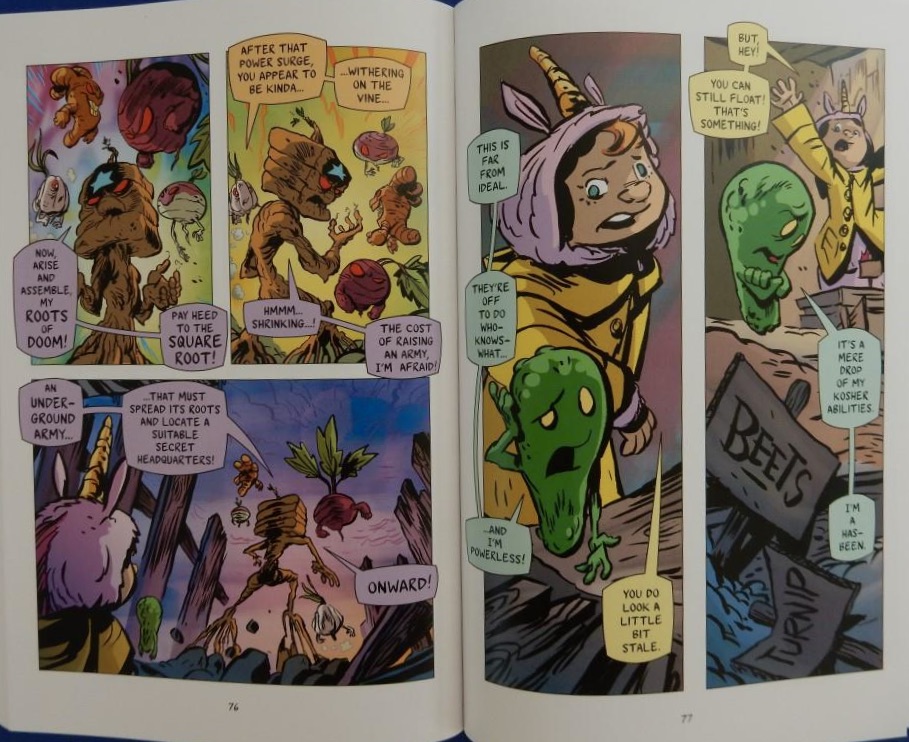
Magic Pickle and the Roots of Doom Scott Morse Scholastic
Herein you will find the titular Magic Pickle that flies around sporting a large star on its head, and his young human sidekick, Jo Jo. She wears a purple onesie with a unicorn horn.
When Magic Pickle is approached by Herb Cloverson, a decidedly malodorous character that is far from happy with life as a garlic clove, Pickle is rather dismissive. Then the clove is itself approached by the evil tuber, Square Root, who says he’s looking for a friend. So Herb Cloverson becomes Square Root’s sidekick and the two set about removing the star from Magic Pickle and thus taking away his power. With the goal achieved and the star on Square Root’s head, he sets about amassing an underground army.
Meanwhile the powerless Pickle is thoroughly downcast and it’s left to Jo-Jo to encourage him to fight back. By now Herb Cloverson has realised that he’s being used and hence is still looking for a friend. So too is Magic Pickle, so can they put things right between them? And will justice finally prevail? Perhaps, with some input from the Information Leek who offers assistance to Jo-Jo, together with the power of teamwork
Replete with veggie-related puns, it’s funny, clever, crazily compelling and diverting in a daft way.
The Dictionary Story Sam Winston and Oliver Jeffers Walker Books
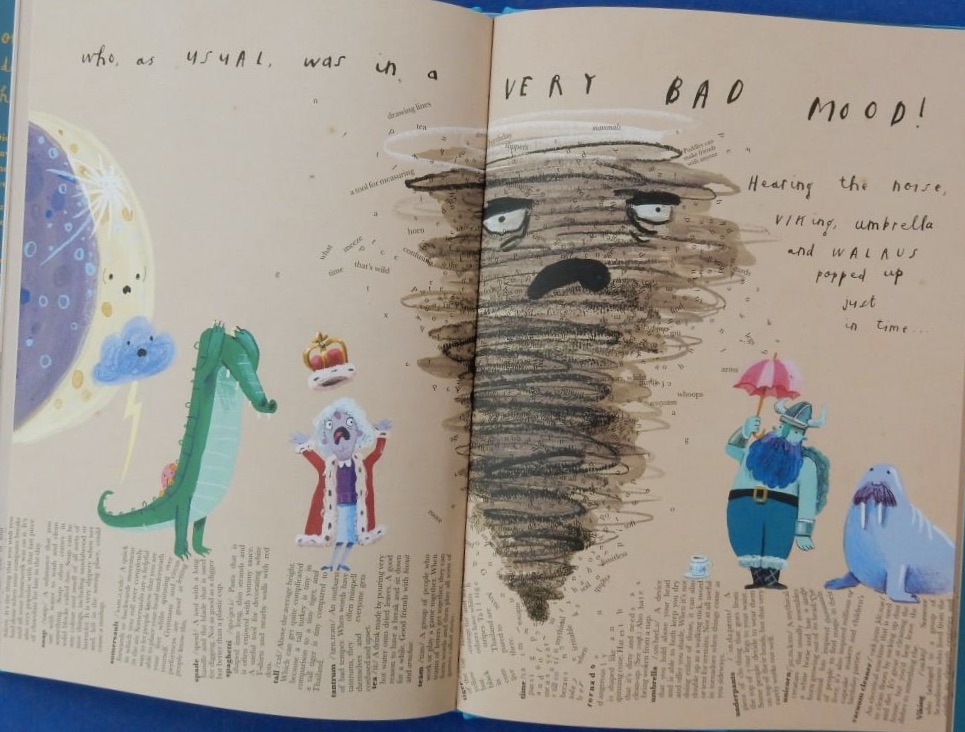
A little dictionary’s realisation that she’s merely a list of definitions whereas the other books lined up beside her on the shelf contain stories, makes her decide that things must change: she resolves to ‘bring her words to life’. Thereupon an alligator of the hungry kind makes an appearance by opening the definitions enclosing him and proceeds to the D pages from where a delicious smell emanates in the form of a doughnut (donut is used here). The tasty confection sees him coming and rather than being consumed rolls off, accidentally right into Ghost – make that through him – and wakes the apparition. Donut continues on its way hotly pursued by Alligator, to the moon. As said moon starts interrogating the two, Ghost appears scaring the moonlight out of them all and prompting Alligator and Donut to rush off until midway through the dictionary the former catches up, only to collide with the Queen who ends up flat on her derriere.
Where will this all end, you might be wondering. Let’s just say total chaos ensues mainly due to the appearance of a tornado, spilled ink, a Viking, an umbrella and more.
In order to restore some semblance of order to the situation and the dismayed dictionary, she calls upon the help of her friend Alphabet whose song solves everything leaving all the words back in their proper places at last. PHEW!
Make sure you read all the tiny print on the dictionary pages ; those definitions are frequently hilarious and very clever, seemingly serving as a stage upon which the alphabetic characters perform. The definition of marmalade for instance is ‘A sort of jam made from citrus fruit, usually oranges. Marmalade is perhaps the main reason that the universe came into existence.’ Vacuum cleaner is defined thus, “An electrical machine that is used to clean floors by sucking up dust and dirt. It’s great at cleaning the house, but you’d best leave the dishes to something else.’
Sam Winston’s comic pacing of the tale – a meta celebration of words – is superb. Superb too are Oliver Jeffers’s naive style illustrations showing the shenanigans of the characters. Totally immersive and brilliantly created right from the real dictionary shown at the front of the book. The more you read it the more delights you will discover, it’s a veritable wordy wonder.
These are both Little Tiger board books: thanks to the publishers for sending them for review.
Cows Are Pink! Becky Davies and Gareth Lucas
Down on the farm, the animals have all got their colours muddled up. Small children will enjoy predicting what is behind each cut out section before the page is turned to reveal in turn which animal is pink, yellow and red. What about cats though? They’re a bit more problematic and they certainly aren’t green, one of the colours visible through a cat diecut. So what is orange, black and green? The final spread shows eight different farm animals and each is appropriately coloured, to the satisfaction no doubt of the little mouse character. With bright, textured illustrations by Gareth Lucas this is a playful book for the very youngest.
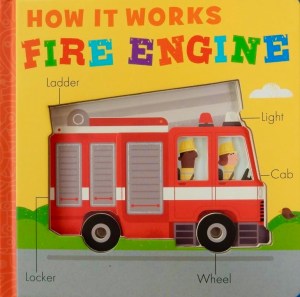
How It Works: Fire Engine Molly Littleboy and David Semple
Curious learners, especially those with an interest in vehicles will enjoy this addition to the How It Works series. Nee-naw! Nee-naw! goes this emergency vehicle but first come explanations for little ones about where fire engines are kept; what firefighters do at the fire station when not out on call,, as well as what their uniform comprises. When the crew receives an alarm call it’s a case of off as fast as they can go, sirens and flashing lights warning other vehicles to give way as they approach. Once the scene is reached it’s masks on and out with the hoses.Sometimes though fire engine crews have to perform acts of rescue for such things as cats stranded high in trees, or they might pay a visit to a nursery or primary school to teach the children the importance of fire safety. Perhaps some of them will be so enthused they go on to join the fire service themselves.
With cutaways, ‘did you know?’ questions, labels and a simple narrative there’s plenty to engage small children.
Wildlife in the Balance Dr Sharon Wismer and Terri Po Flying Eye
In this latest Flying Eye natural history offering author Dr Sharon Wismer introduces readers to the concept of keystone species and their impact upon various ecosystems.
There are introductory spreads explaining ecosystems, food chains and webs, and outlining the work of Professor Robert Paine whose experiments along the Washington State coastline in the 1960s demonstrated how the removal of a top predator from rock pools resulted in the collapse of the biodiversity of the ecosystem. He identified the ochre sea star as top predator and keystone species responsible for the biodiversity of the rock pools.
We learn that apex predators are not the only keystone species: herbivores, plants, prey, insects and habitat modifiers can also be keystone species maintaining the ecosystem in which they live.
Readers are then introduced to a dozen keystone species across the globe’s five major biomes: aquatic, desert,
grassland, forest, and finally, tundra. These include salmon, the saguaro cactus, European rabbits of the Iberian peninsular, green-backed fire crown hummingbirds and krill. Terri Po’s illustrations of the landscapes, flora and fauna are at once stylish, arresting and informative and expand and make accessible, the considerable scientific information conveyed by Sharon Wismer in her text, which concludes with a spread on how humans can help these vital keystone species. Backmatter comprises a glossary and index. Altogether a fascinating book for KS2 readers and beyond..
For readers with a particular interest in the underwater worlds or for reference in a cross-curricular ocean topic is:
Factology: Oceans Button Books
This highly visual book presents a wealth of facts about the ocean and its flora and fauna. In addition there is information on various topics such as the history of exploration and how people navigated their ships, subaquatic exploration of the ocean depths in the hope of finding treasure among the sunken wrecks.
Readers visit coral reefs and submarine volcanoes, see some of the wonderful deep-sea fishes and other creatures – giant squids, anglerfish, blowfish and the spooky-looking barrel eye fish and the fang tooth fish that has the largest teeth of any ocean species, find out how tides work, why the sea is salty and discover how tides and currents work. There’s a gallery of deep-sea deities and a spread introducing marine monsters such as the Kraken and a look at some of the horrendous outcomes of marine pollution
All this and much more, so imagine yourself into a submersible and take the plunge..
The Secret of Golden Island Natasha Farrant Faber Children’s Books
Yakov has had to leave his war ravaged home country and now is staying with relations. He struggles to fit in at school and cope with being away from his loved ones. Skylar’s struggles are with how she feels after her grandfather’s stroke (he’s always been her rock) and a bullying incident at school for which she is suspended.
Skylar: ‘I’m not crying.’ Yakov: ‘I know.’ These are the very first words the two children exchange and somehow this brief interaction is the beginning of a friendship, one they both desperately need. Both of them too have a strong desire to change things for the better and not just for themselves but for those they love. It’s this that brings them even closer to one another as they enter a competition, the prize for which is the ownership of the nearby Golden Island. How though can two children compete successfully against adults with schemes and plans of their own?
Certainly, the call of the island is very strong but the quest they embark upon must be kept secret from family members and they only have one another to rely upon for their safety. As the adventure progresses Skylar and Yakov’s friendship deepens, they reveal more about themselves allowing things they’ve kept deep inside to be exposed.
Trying to solve the clues they’ve been given, the pair come up against some competitors who will go to any length to achieve what they want. Can they overcome all the obstacles that arise during their quest, including a desperate race against time with way more at stake than the competition?
Totally gripping, compassionate and exquisitely told, this book swept me away and as I reached the final paragraphs I felt tears welling up, such is its power.
A wonderful read for older KS2 readers and beyond.
Right from the cover illustration, young children will love being in the know as to the whereabouts of Bear’s glasses but the ursine character decides that he’s left them at Giraffe’s house so off he trots. Now sans specs, as he tells us, he ‘can’t see a thing’ but nevertheless he comments on various objects he passes en route to his friend’s, misidentifying them in turn as a deer, a crocodile, an elephant, a flamingo, each of which astonishes him.
He even fails to recognise Giraffe who is taking it easy on his lounger, calling him instead a snake. Bear apologies and explains his plight; Giraffe then ‘returns’ the glasses to their owner, which allows Bear to uphold his original notion.
Bear goes on to tell his pal of the unusual sights he’s seen en route and eager to see them for himself, Giraffe accompanies the now bespectacled Bear as he makes his way back the same way he came. Of course, neither spots the flamingo nor the elephant,
the crocodile or the deer though a confused Bear blames his glasses. These he then removes and goes on to point out to Giraffe, three lions nearby.
A terrific, tongue-in-cheek comical delight that puts forward the possibility that seeing with one’s imagination is preferable to viewing reality. Little ones will relish Timmers’ tale of discovering – albeit accidentally – new ways of seeing the world and loudly correcting him with regard to the misidentifies flora and fauna.
The Little Worried Caterpillar Christine Pym Scholastic
Little Green is on the brink of change. However she’s not aware of this when she wakes early one morning ready to play with her caterpillar pals, but she can’t find them anywhere on the ground. Then a call tells her that they have morphed into butterflies and are way up above her. “You’ll be next, there’s no doubt!” they tell her. However rather than sprouting wings, she sprouts fear, a fear of change that brings with it worries about the unknown. Her friends reassure Little Green that change is what they were born to do and it’s exciting but this makes her feel even worse.
Along comes bee with what is meant to be some helpful advice; she gets momentary relief but that’s all.
Other creatures also offer suggestions but nothing works until Rabbit appears on the scene. Rabbit listens and what her new friend tells Little Green enables her to feel ready to embrace and prepare for that transformational change
and become … Butterfly Green.
Some young children take change in their stride, others needs considerable support from empathetic friends and understanding adults. A book such as this one is particularly valuable for sharing with the second kind. Christine Pym’s illustrations capture so well Little Green’s fearfulness and eventual delight.
Dig Dig Dinosaur Professor Anjali Goswami and Maggie Li Nosy Crow
Three intrepid little explorers with their kit at the ready are on an expedition in the hope of finding something, something ‘REALLY big’. Dig! Dig! Dig! they go till one person discovers some remains of a sharp clawed dinosaur. These claws make the finder conclude that they belonged to a Velociraptor.
A second child’s Dig! Dig! Dig! digging unearths three large horns: young readers can perhaps guess from which dinosaur these came..
Still intent on finding something even bigger, they continue hunting till the third explorer tells of a dinosaur with a very long tail. and a tiny head supported by an extra long neck.
Little ones can have fun guessing what this might be before the big reveal fold out … They will also enjoy the peep hole pages showing the skeletal remains the young explorers find during the dig.
Worry Boots Lisa Thompson and Aysha Awwad Scholastic
It’s Connie’s first day at school and after putting on her shiny new boots she, her mother and younger sibling set off for the bus stop. Before long Connie stops and calls out to her mum, “There’s something in my boot!” Having wriggled her foot around, her tummy feeling like a dinosaur’s bumpy bottom, she then, declares that it’s a dinosaur and consequently she can’t go to school because everyone will stare at her.
Mum reassures her that this won’t happen and they continue on their way, Connie now not feeling the lumpy bump.
Having boarded the bus, Connie feels the thing in her boot again only now it seems hard and spiky. It must be a unicorn’s horn she decides, informing her mum of the situation and again saying she cannot go to school. Now her tummy feels hard and spiky. Mum tells her all will be well but as they approach the school gate Connie feels another visitation – sharp and pointy this time. There’s no way she’s going into school with a shark in her boot. She’ll frighten everyone out of their wits.
With a sharp pointy feeling in her tummy Connie then sees her teacher welcoming the children as they arrive in the classroom and she has a big smile on her face. Maybe it’s not a shark then, but still that boot and Connie’s tum don’t feel quite right. Before she says goodbye, quick thinking Mum suggests they remove whatever is in her daughter’s boot; she upends it and out falls … What do you think?
Feeling so much better Connie then goes to join the other children in the classroom. With so many new friends perhaps her day won’t be nearly as bad as she had been anticipating.
Acknowledging young children’s first day anxieties, this reassuring story is perfect for sharing with little ones. With her powerful imagination, Connie is a delight and Aysha Awwad’s portrayal captures her feelings beautifully.
The Great Crisp Robbery Pamela Butchart, illustrated by Thomas Flintham Nosy Crow
The latest story narrated by Izzy unfolds on a night train from Aberdeen to London. None of the young travellers has been on a sleeper train before and the realisation that it means bunk beds adds to the excitement. A BIG ADVENTURE indeed: Gary Petrie even has his silky dressing gown and judging from the enormity of her suitcase it would appear that Maisie thinks she’s going to be away for ages. Why though has Miss Yu and not Miss Jones been designated ‘teacher in charge’ when the children have only known her for a few days? Surprising to Izzy is that Jodi suddenly appears on the train having escaped early from the wedding she’s been at and she’s still wearing a floaty pink bridesmaid dress.
As the journey is about to get under way Izzy looks out the window and gasps in horror: on the platform stands a hooded figure watching them: surely it has to be a train robber. Those familiar with Pamela Butchart’s child characters know that it doesn’t take much for imaginations to run wild and their misunderstandings to become suspicions that lead to them being way off beam as they become certainties. Here we have a group of hysterical youngsters on account of Gary’s sixteen missing packets of crisps, albeit Tesco Finest varieties, not to mention all the spending money.
How on earth – make that on railway lines – is this all going to end? Actually it doesn’t exactly do so for puffing and panting and puzzling over what Miss Yu will say in her ‘quick chat’ readers leave the train about an hour from its destination.
Primary readers will devour this faster than Gary’s crisps and the sandwiches from the refreshments trolley and then want more. With its multitude of twists and turns, this adult reviewer was left decidedly dizzy especially at the impending BIG TROUBLE facing Izzy and her pals.
The Majorly Awkward BFF Dramas of Lottie Brooks Katie Kirby Puffin Books
Presented in diary form as usual, with plenty of Lottie’s amusing doodles, this one relates the events from New Year’s Day to the day after Valentine’s day.
January 1st sees Lottie in high spirits about her new boyfriend, Daniel, but as readers might expect, Amber is jealous and makes plenty of mean remarks about the relationship. She even starts giving out application forms at school for the role of Amber’s boyfriend, and then holds auditions.
With regard to Lottie however, she has an abundance of hugely embarrassing moments due to eyebrow alterations and style icon attempts with over-size earmuffs, just to name a couple. Then comes brother Toby’s announcement of his new year’s resolution: to get a dog and for once in her life, Lottie is in agreement with him, even going so far as to aid and abet his plan for mum persuasion. Eventually there comes a new member of the household: enter five-month old golden cockapoo, named Snookers, though that soon gets changed to Pot Noodle, thanks to a remark by Mum. Said pooch is adorable but there’s a major snag, he’s full of mischief, destructive and definitely, despite what Dad was led to believe, NOT toilet trained. How on earth is Lottie meant to cope with a new boyfriend and a new dog that insists on leaving deposits of poo all over the carpet and in other extremely annoying places.
Assuredly she has a whole lot less time to spend on other people – her gang especially, one of whom, Jess, shares the news that she might be gay.
My goodness all that and more in just a few weeks. It’s easy to see why the Lottie Brooks books have become so popular with’tweenage’ girls. I have no doubt fans of the series will eagerly devour this and readers new to Lottie will be equally enthusiastic after reading this one.
A Mystery At The Incredible Hotel Kate Davies and Isabelle Follath Frances Lincoln Children’s Books
We’re back at the Incredible Hotel for a second story which begins one autumn afternoon when manager Mr Starch announces that the World Baking Contest is to be held in the hotel and the head judge will be Chef Tartine, owner of the Stupendous Restaurant. Moreover Chef Stefan has been chosen to represent the city of Delaunay in the event. Stefan works and works until he’s invented a new secret recipe but come the morning of the contest, shock horror! His recipe has disappeared.
Fortunately ace detective, aka Matilda, the hotel’s bellhop, Stephan’s best friend is at the ready to solve the case. But who can the thief possibly be? It turns out that a chef’s hat has also gone missing as well as a cushion.
As Matilda continues trying to find a thief, the police are busy interrogating various suspects. She follows footprints but suddenly is apprehended and accused by Mr Starch of being the thief herself. Just in time however, the determined Matilda discovers the whereabouts of the recipe and the other missing articles. All is forgiven by a very shame-faced manager
and she’s given a new role; but by now there are only ten minutes of the competition left. Surely Stefan can’t bake his cake in time for the judging – or can he …
Another truly tasty treat from team Davis and Follath. Children will delight in joining Matilda as she follows clues to the surprise revelation of the culprit, as well as savouring the delicious details in Isabelle Follath’s mixed media scenes of the unfolding events. Watch out for the antics of the cat and mouse as you peruse the pages.