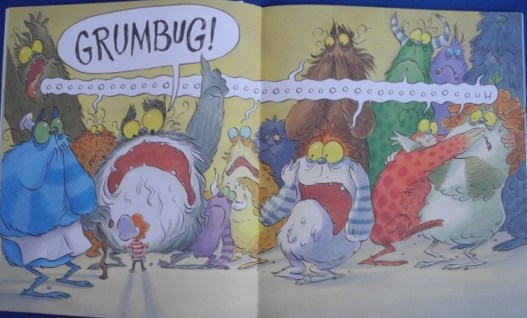
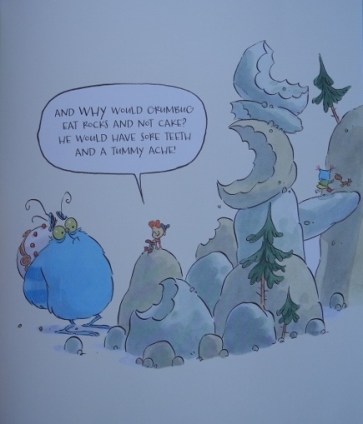
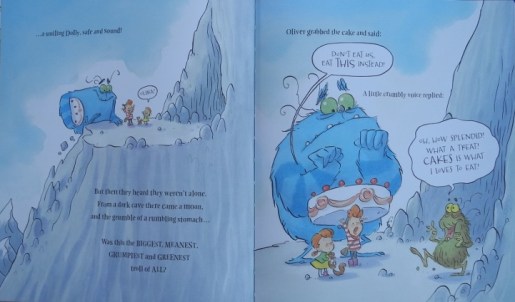
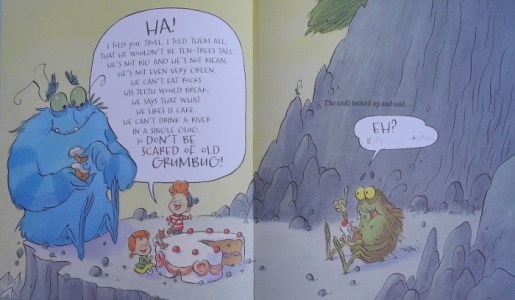
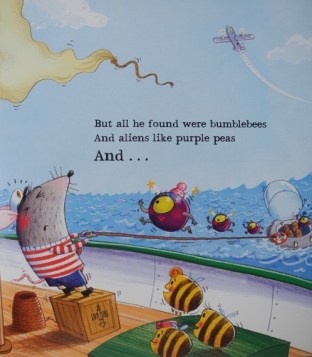
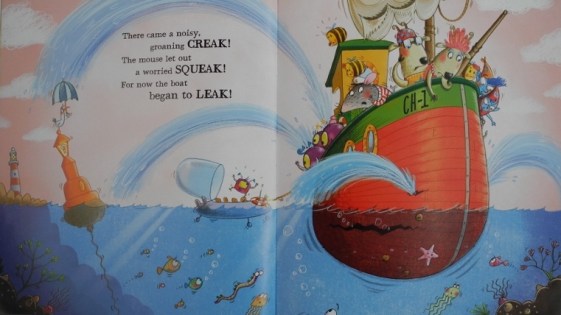
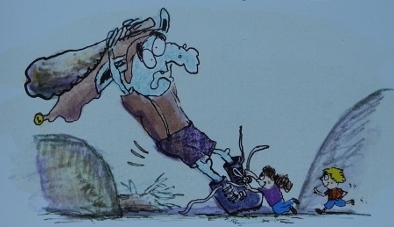
Dolci was a little bit alarmed at the giant’s child-eating threats
The Giant of Jum
Elli Woollard and Benji Davies
Macmillan Children’s Books
Inspired by the traditional tale told to him by his brother, about a boy called Jack, the Giant of Jum – a bad-tempered chap – sets out in search of some children for a tasty teatime snack. The children he discovers though, far from fearing the giant, enlist his help in reaching their ball.

He obliges promising to be back to fulfill his own purposes, then goes on his way again. Before long another group of children beg for his assistance

and once again our giant obliges and promises to return. His search is now for Jack … and sure enough – soon enough, there at his feet is a very small boy pleading for a ride. I’m sure you can guess the name of this little fellow and he’s thoroughly beguiled by the giant.
But … “Fee!” he said, and “Fi!” he said and “Little Jack snack, is that right?” and a whole lot worse. (This bit really had some children on the very edge of their seats.)

But he hadn’t bargained for the children’s rapid intervention, and their bargaining powers …
It’s a happy ending for all – kindness begets kindness – and the giant discovers that some things actually taste better than children.

Enormous fun; and what potential for inspiring creative work from young children. Elli Woollard’s rhyming text bounces along jauntily and is brilliant fun to read aloud: Benji Davies has created a wonderful character in the giant: I love that funky head attire and those peep-toed boots are just superb. With all manner of interesting perspectives (and some darker scenes)
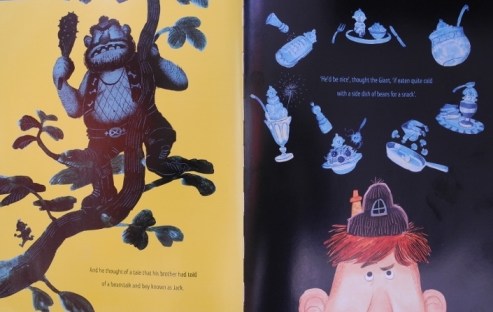
every page is packed with small details to relish and chuckle over. The illustrative style seems something of a new development for Benji Davies; this new partnership with Elli Woollard is one to be celebrated if their debut book is anything to go by. Maybe that Giant of Jum could even make a return …

Jack and the Beanstalk
illustrated by Ed Bryan
Nosy Crow
This is I think, the fourth in the series of fairy tales created from Bryan’s award- winning Nosy Crow apps. It’s a lively rendition of a favourite story that includes a mouse, a frog
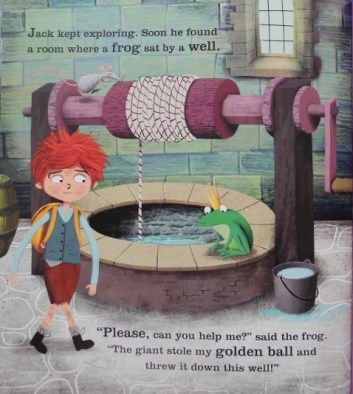
and a baby dragon in the cast of characters. The latter enlists Jack’s help to release him from a dungeon cell and in return he tells Jack the whereabouts of the giant’s golden harp. This harp however, is a trickster and once Jack has it in his clutches, calls out, “Master Giant, wakey wakey! This boy Jack is trying to take me!” Nevertheless Jack does manage to escape from the castle hotly pursued by the giant, grab his trusty axe and bring the beanstalk crashing down. We never learn the fate of the giant but at least he never troubles Jack and his mother ever again.
The setting has something of a modern feel: Jack’s mum, despite her poverty, wears a stylish dress albeit with jazzy patches, and long boots;

and Jack carries a rucksack. The story itself reads aloud well and as the goose on the back cover says, ‘is all about being kind and helpful’. May be not ‘all ’ but no one would argue with that as a worthwhile message.

Rumpelstiltskin
Mara Alperin and Loretta Schauer
Little Tiger Press
This is a lively rendition of a favourite fairy tale with some fairly lavish verbal, and hence visual, embellishments such as the miller’s pre gold-spinning boast about his daughter: “Tulips start to bloom when my daughter sings,” and “When Isabel catches raindrops, they turn into butterflies.” for instance. Young Isabel is duly thrust into the highest tower by the king once he’s heard of her ability to spin straw into gold and ordered to do just that. There follows her encounter with the little man who offers help, makes a bargain and in her desperation, Isobel has promised him his “pick of treasure” once she’s rich. Having spun as promised (‘coins and crowns, and trinkets and trophies’), he vanishes leaving Isabel to reap the rewards from the king. (His visits are cut to one here) and the king introduces her to his kind son, Prince Herbert. Before long wedding bells ring forth and, in due course, the couple is blessed with a baby boy.

The little man is completely forgotten until one stormy night that is. Then POOF! There he is cackling and demanding his dues. Nothing short of the baby will do unless Isabel can guess his name within three nights.
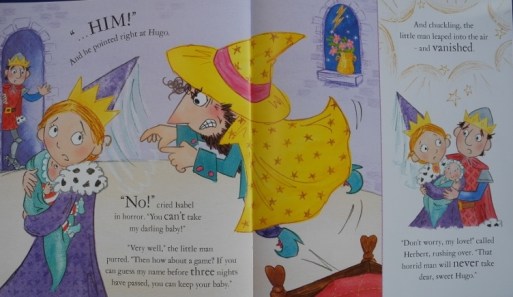
However, it’s not Isabel who takes the initiative – not sure I approve of that – but her husband, Herbert. He tracks down the little man, discovers his name and informs his wife who then ‘guesses correctly’ on her final chance and with a howl and a growl, a stomp and a stamp, Rumpelstiltskin vanishes through the floor, never to be seen again in the kingdom, leaving baby Hugo to grow up safe and sound with his loving parents.
With smatterings of word play and bright, jolly, richly patterned illustrations, this version has a modern feel to it. It’s certainly one young audiences will be attracted to visually and they will enjoy the tension of the guessing game and its outcome in particular.
For me nothing can beat an oral telling I once heard Sara Corrin perform (based on the text in her Stories for Seven Year Olds collection) but this one is an enjoyable read aloud if that’s what you want.
Not a traditional tale but a classic one that seems to be ever popular is:

The Patua Pinocchio
Carlo Collodi and Swarna Chitrakar
Tara Books
The artist, Swarna Chitrakar, a West Bengali scroll painter has given the tale a wholly new visual interpretation, totally unlike the westernized, often Disneyfied one where Pinocchio, the mischievous Italian marionette wears a yellow hat and a kind of romper suit. Here, in keeping with clothing styles from her own tradition, Pinocchio is clad in a dhoti/ loincloth, is adorned with jewellery (anklets and armlets and a neck adornment),

and has a rich brown skin and beatific smile reminding one – and this is the author’s conception too – of the Hindu deity, Krishna whom she refers to in her afterword as ‘a lovable yet godly trickster figure … who looks composed and serene at all times.’
Geppetto in contrast has a mustard-coloured skin and wears a dhoti.
Visually striking, with its stylized Patua folk art images, this book will particularly appeal to those fascinated by traditional art forms, and anyone interested in exploring the universality of stories.
Use your local bookshop 











































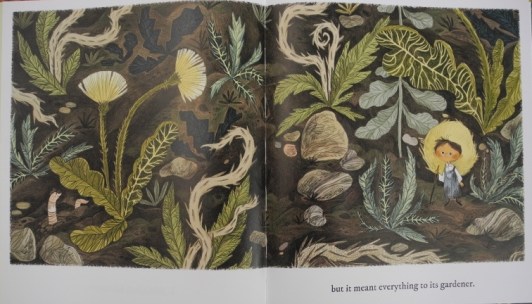
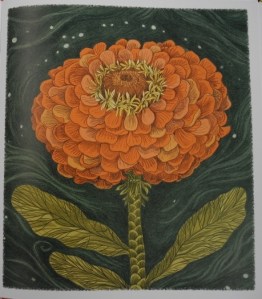

















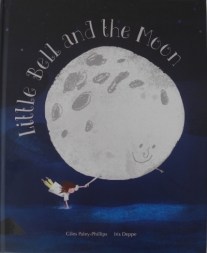
 each loves the other and all is well. One night Bell asks her friend to show her that magical-sounding world and together they fly far across mountains, seas and forests.
  Each night thereafter, they journey and at dawn Bell is safely back home. For sixty years they explore the galaxy until Bell begins to fade, growing more and more frail
 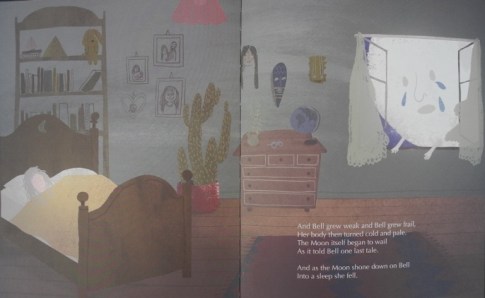 till it is time for one final farewell tale from a mournful moon before Bell’s soul takes flight on its last journey. A journey that takes it far, far out into space wherein it comes to a special resting place – a ball of light among the stars. ‘ The darkness soon began to clear,/Then the moon did reappear./Upon the light its eyes did dwell,/Within it, it saw Little Bell. /And as the Moon shone back at Bell/They both felt all was well.’ A deeply affecting and tender story of life’s journey, ageing and death. The latter can be a tricky topic for young children. Here though, with poetic text and powerful atmospheric scenes, author and artist have created a safe place from which to explore the inherent themes. Definitely one for the spirituality bookshelf at home or school: a book that resonates long after its reading.
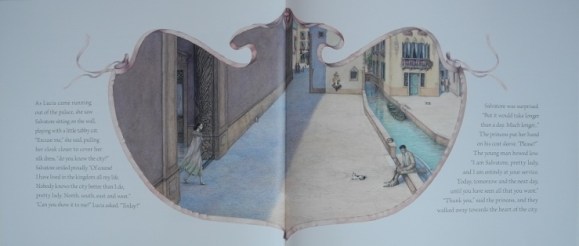 and at the princess’s request, the two explore the city together. At the palace however, her parents are inundated with suitors, each one showing something wonderful. No matter how amazing the items proffered by the endless stream of prospective bridegrooms,
  nothing seems quite right to the by now, completely overwhelmed, king and queen who then decide to call off the search. First though they must locate their daughter to tell her of their decision and it is only when they locate her and find themselves face to face with a young man claiming to have found what they are seeking,
 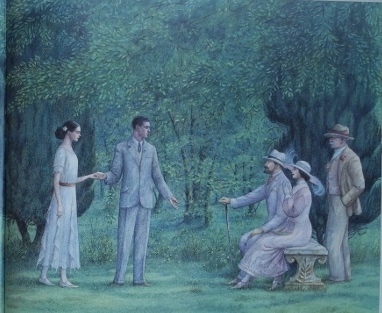 that things feel right. For what he tells them is absolutely so. It’s then that the eyes of the king and queen are finally opened and all ends, in true fairytale fashion, with a happily married couple adored by all in their kingdom. Angela Barrett’s exquisitely detailed, mannered illustrations grace the pages of Vivian French’s enchanting and admirably crafted telling of this wondrous fairy tale, seemingly given an Italian setting here. For romantics and lovers of fairy tales especially, no matter what their age.