
How To Spacewalk
Kathryn D. Sullivan and Michael J. Rosen
Walker Books (in collaboration with MIT Kids Press)
In 1984, Kathryn Sullivan became the first woman to walk in space: in this book, illustrated with photographs and Rosen’s ink and pastel images, she shares her story.
As a child in the 1950s, Kathryn developed an interest in science early on but like other girls, she wasn’t encouraged to follow her interest. However, with determination and perseverance she studied geology and became an oceanographer, eventually applying to join NASA’s astronaut programme for which she was accepted, as well as receiving an offer to explore the ocean depths in a submarine. She chose the first option.
From then on the author addresses readers as though they are participants in her training as an astronaut. What is it like to do a spacewalk? How do you use cutting-edge equipment? What does it feel like to wear and carry out experiments in a hugely heavy space suit? – space armour as it’s called here.
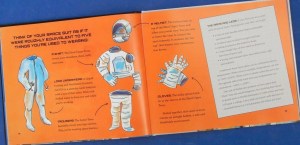
What about experiencing weightlessness?. Will I suddenly feel scared?

A large amount of fascinating factual information is presented, but alongside this we share an empowering account of a woman fulfilling her dreams; it’s one that will surely encourage child readers to live the ‘life you invent’ – to reach for the stars, whatever that means for them.

Wind: Discovering Air In Motion
Olga Fadeeva
Eerdmans Books for Young Readers
Translated from the original Russian by Lena Traer, this book poses and explores eighteen wind- related questions, devoting a double page spread to each question, with illustrations by the author.
The responses to the first – Where does wind come from? are somewhat playful; for instance ‘Maybe there are giants… / who blow air with all their might?’ and ‘Or maybe the wind comes from the wings of a large bird?’.
However from there on the tone changes and What is wind? is answered with a scientific explanation ‘Wind is the horizontal movement of air over the surface of the Earth’ … The author then interweaves information on meteorology, biology, ecology, history, even venturing into outer space, so there’s plenty to keep readers interested.
Each double spread is distinctively designed and the richly textured illustrations are strikingly executed using acrylics, collage and digital media.

Included in several scenes are a little girl, sometimes accompanied by her grandfather and one assumes the questions are coming from the child.
Created with the help of a meteorologist, this exploration of my least favourite element is engaging and absorbing: I would recommend adding the book to primary school collections.
 Red Reading Hub - Jillrbennett's Reviews of Children's Books