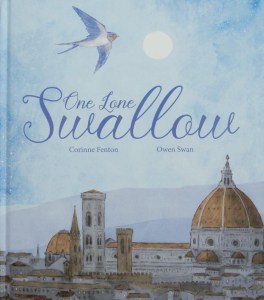
One Lone Swallow

One Lone Swallow
Corinne Fenton and Owen Swan
New Frontier Publishing

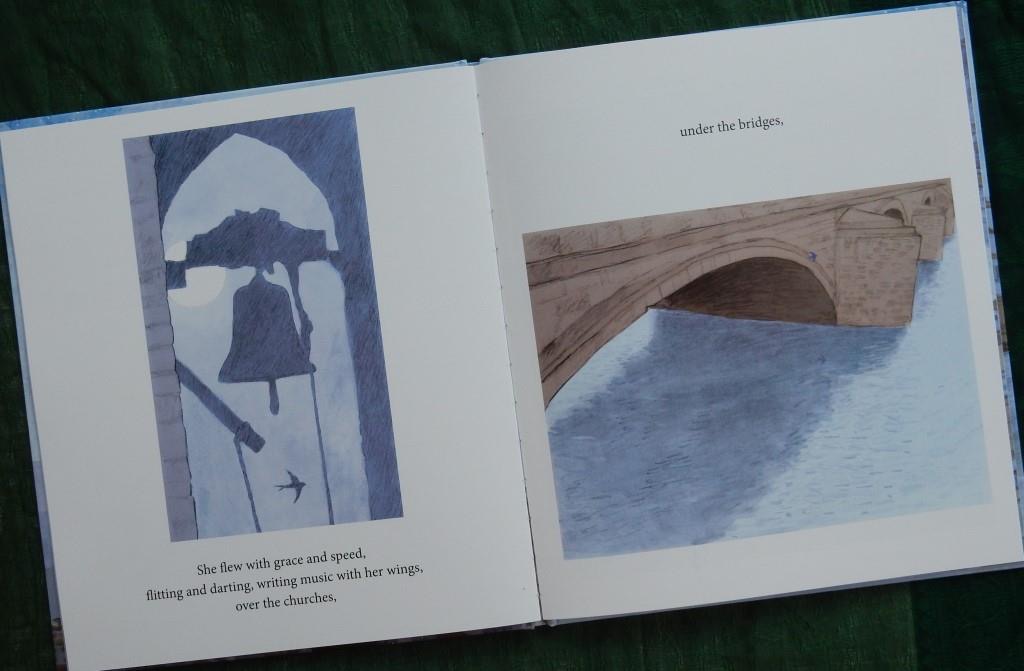
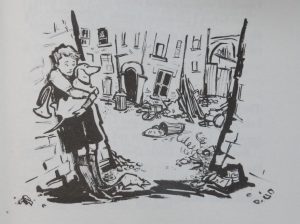
This unusual tale is set at the start of the 19th century in Florence. From its opening illustration of a swallow taking flight from her nest high above the city, readers are swept up in the story.

Leaving her nestlings, the swallow flies through the moonlit sky over the rooftops and chimneys searching, searching for her mate. We follow her over the ancient walls and towers, over the chimneys and roofs, under the bridges,

through the arches and above the piazzas, pausing briefly to rest, all the while searching yet knowing that back at the nest her young are calling out their need for food.

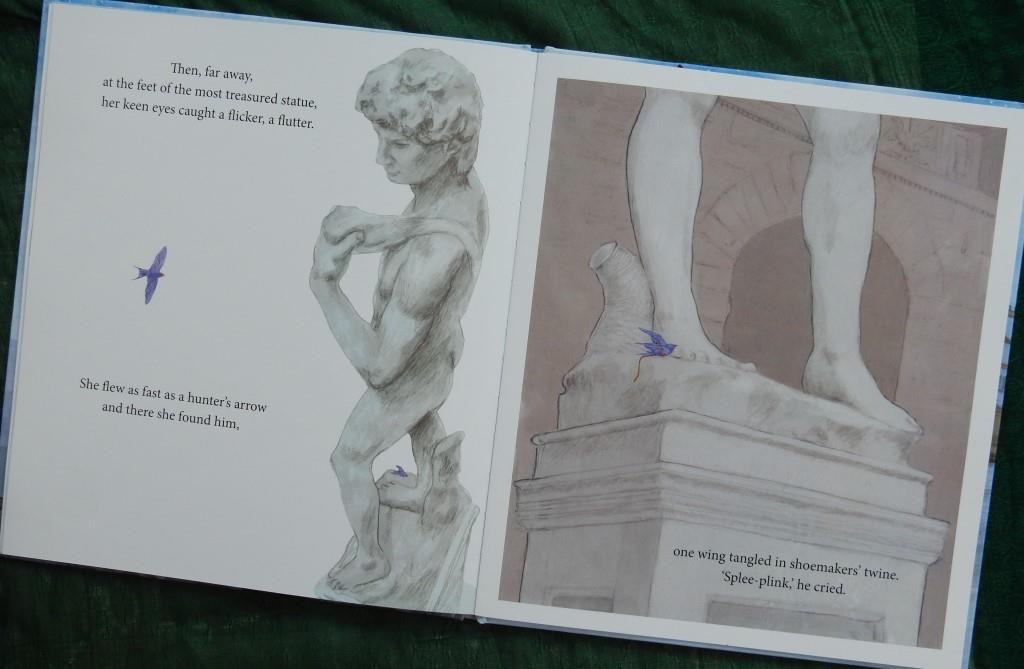
Then resuming her search, her eyes detect a slight movement. At the feet of Michelangelo’s statue of David, one wing entangled in ‘shoemakers’ twine’ is her mate.

She takes the end of the twine in her beak and gently begins the task of unravelling the twisted threads. Hidden out of sight lurks a huge rat just waiting to pounce but just in time, with one more pull the last twist of thread comes loose.

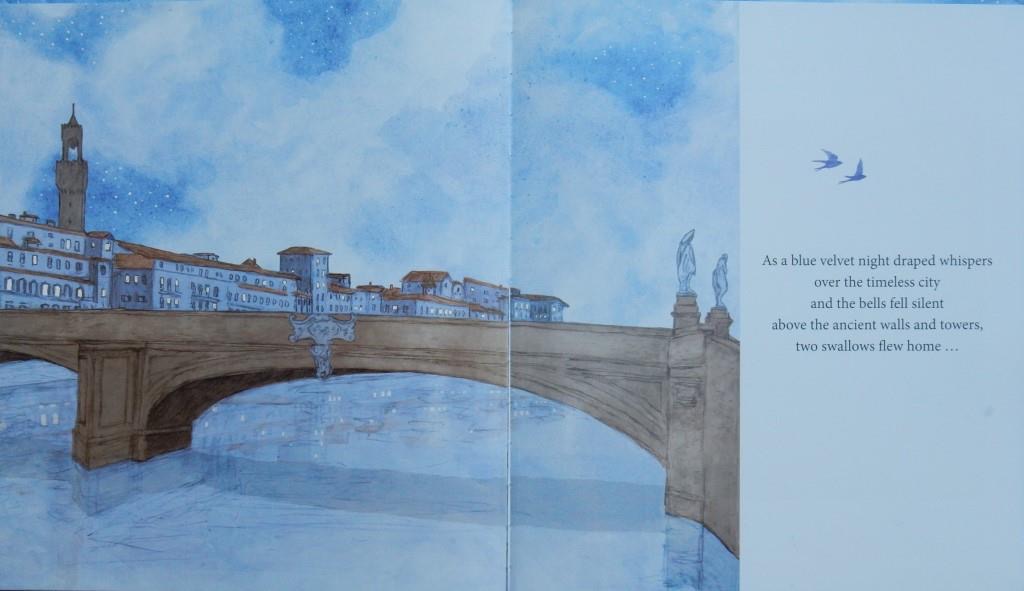
Finally not one, but two swallows start their flight back home to their nest.

This is a beautifully told, stunningly illustrated tale of commitment and fidelity. Corinne’s poetic text in combination with Owen Swan’s breath-taking scenes of the twilight Florence of yesteryear make for an extraordinary cultural and aesthetic experience.

Introducing Rollercoasters

These three books are the first of a series from Oxford University Press called Rollercoasters developed in association with Barrington Stoke. With their highly engaging themes intended to build reading confidence and foster a love of reading, they all use the Barrington Stoke ‘dyslexia friendly font’ and are aimed at readers from around eleven. Each includes an author spotlight, some background information relevant to the story and more.

I Am the Minotaur
Anthony McGowan

Carnegie prize winning Anthony McGowan’s perceptive story focuses on fourteen year old Matthew, referred to as Stinky Mog, who is the narrator.

Matthew does his level best to care for his mum who is battling depression, while trying equally hard to fit in at school without being noticed especially by those types likely to make him the target of their bullying. Not an easy task when he frequently turns up looking decidedly dishevelled in his ragged uniform.

Enter Ari, a beautiful girl who totally captivates Matthew – ‘I longed and yearned for Ari’ he tells readers describing his feelings for her as ‘warm and golden’.

Shortly after her birthday, her brand new bike is stolen and Matthew decides on a plan to get it back from the thieves and make Ari happy as a consequence.. He heads off to the public library to start an internet search.
Next day off he goes to a rendezvous: can he pull off his bike rescue? If so, can it change the course of his life?

With themes of bullying, parental depression and poverty, this short novel packs a powerful punch. It’s great to see that for the narrator, the school library with its kindly librarian is a place he feels safe.

Edgar & Adolf
Phil Earle and Michael Wagg

Whether or not you are a soccer fan (and I’m anything but) this story based on real characters – at the heart of which is friendship – will surely move you. It certainly did me.

The book begins in 1983 in a village in Scotland with seventeen year old Adi.
Adi has come from Hamburg, Germany, with something he has inherited and is on a special mission: to find a man named Edgar Kail and return to him what is rightfully his – a special football badge that the now frail old man hasn’t set eyes on for over forty years. If he succeeds Adi will have fulfilled his grandfather’s final wish to reunite the erstwhile England footballer with his prized possession.

And succeed he does but that is only the start of the tale for it’s one that spans some sixty years as Adi and Edgar share memories, press cuttings, letters and more relating to Edgar and the lad’s grandfather Adolf Jäger.

According to the authors’ notes at the back of the book, Edgar Kail and Adolf Jäger having played for their clubs before WW2 – Dulwich Hamlet and Altona 93 – remain folk heroes celebrated by fans (including Phil and Michael) to this day. Amazing.

Rat
Patrice Lawrence

If you’ve read the author’s YA book Orangeboy, then you’ll know how utterly compelling her writing is.
As the story opens, Al is living in a flat with his mum who is attempting to stay on the straight and narrow after spending time in prison. Partly as a result of having moved several times already, Al has only. two friends, his pet rats Vulture and Venom, and he has to keep them secret from the council.

Things are tough as Al’s mum out of prison on licence, has very little money and no job. Consequently it’s not long before she shoplifts from the local supermarket and after an incident that involves Mr Brayer who lives in a flat below, is back in prison.

Al’s certain that it’s Mr Brayer’s fault and decides to get his revenge whatever anybody else says.

The entire cast of characters and the connectedness between them is interesting especially Al’s Gran and his nineteen year old sister Plum, a college student and carer, who is called on to stay with him when his mum goes back to prison. We also discover something of Mt Brayer’s back story which comes as a surprise to Al and I suspect to readers.

Gripping and thought-provoking, this should certainly appeal to older, under confident readers.
The Castle the King Built

The Castle the King Built
Rebecca Colby and Tom Froese
Nosy Crow

Using the rhythmic pattern and structure of the nursery rhyme This is the House that Jack Built, Rebecca Crosby cleverly mixes fact and fiction to create a story of the building of a medieval castle.

We meet those involved in its creation – stonemasons, carpenters

and smiths, as well as, once it’s built, the people who contribute to the castle’s functioning – grooms, knights, merchants, bakers, servants, minstrels and of course, ruler of the land -the king himself.

The final spread presents the entire cast of characters each of them explaining their part (this includes a few women residents not mentioned in the main text)

Rebecca’s skilful use of rhyme and rhythm ensures that the book reads aloud well and Tom Froese uses an appropriate retro style for his striking illustrations helping to create the long ago atmosphere of those days of yore when knights would joust and singing minstrels pipe and strum.

A thoroughly well-presented, enticing and gently educative book for classroom sharing and individual reading, published in collaboration with the National Trust. I specially like the final acknowledgement that everyone included played their part in the life of the making of the castle.

Out of Nowhere

Out of Nowhere
Chris Naylor-Ballesteros
Nosy Crow

Following his superb The Suitcase picture book, Chris Naylor-Ballesteros has created another compelling tale, this time on the theme of enduring friendship.

The story begins as the friendship is in its first stage with the arrival ’out of nowhere’ of caterpillar into the world of a beetle (the narrator). The two become friends eating together, and watching the moon come up.

One morning the beetle awakes to find no sign of caterpillar and unaware of the presence or significance of something close by…

Beetle waits, scouring the landscape until eventually he spies through his binoculars something that could be his friend. Heavily weighed down by a basket and trying to feel strong, he treks off through the forest to search,

until he discovers that it’s not her after all – he’s made a huge mistake. Now what? Feeling tired and dejected our seeker decides to rest and revive himself before attempting that long return journey. While so doing, ‘out of nowhere, someone suddenly arrived’

After closer inspection, glimmerings of recognition give way, to absolute joy and a celebratory sharing of food …

Chris’s portrayal of a friendship that changes and grows, (as cherished friendships do) is uplifting and profound. His uncluttered illustrations rendered in a minimal colour palette are highly effective and simply stunning, showing young readers/listeners the way to be a true friend.

Saving Hanno

Saving Hanno
Miriam Halahmy, illustrated by Karin Littlewood
Otter-Barry Books

Rudi is a nine-year old Jewish boy who, as the story starts at the end of 1938, lives with his parents and older sister, Lotte in Frankfurt, Germany under Hitler’s rule.

When things get increasingly bad for Jewish people, Rudi’s parents take the decision to send the children to England on the Kindertransport, telling them that they will follow later on. Meanwhile Rudi and Lotte will live with an English family where they’ll be safe from the Nazis. Rudi is devastated as he won’t be able to take his beloved dachshund, Hanno with him. Amazingly though, Rudi’s family find a non-Jewish man who volunteers to take Hanno to England when he goes and then after a period of quarantine, Rudi hopes he can be reunited with his pet.
Once in England Rudi and Lotte are placed in different homes not far from one another: Rudi’s carers are kind and considerate;

not so those with whom Lotte is sent who force her to act as a maid.
After some time things in England get worse and Britain declares war on Germany. As a consequence, the children are to be evacuated to rural parts but then comes news that pets are to be put down before rationing starts. Now again, Rudi is faced with finding a way to keep Hanno safe before he relocates yet again …

With empathetic illustrations by Karin Littlewood, this is a holocaust story with a difference, and told from Rudi’s viewpoint, it’s one that primary school age readers will certainly relate to. The author confirms in her after story note providing additional background information, that it’s based on fact. Many primary schools include WW2 as part of their history curriculum and while there are many stories about that terrible time, I would definitely advocate adding this one to the books to be shared.

I Talk Like A River

I Talk Like A River
Jordan Scott and Sydney Smith
Walker Books

The transformational power of just a few words can sometimes be truly amazing and so it is in Jordan Scott’s autobiographical story. He’s a poet and this is reflected in his lyrical prose wherein he reflects on his childhood stutter and how a conversation with his father after a particularly bad day at school made all the difference.

That day gets off to the usual kind of reflective start but it’s in the classroom where things really take their toll.


When his dad collects him after school, the two take a walk beside the river. It’s quiet surrounded by nature, and having watched his son finally let the pent up emotions of the day flow from his eyes, “They don’t see a pine tree sticking out from my lips instead of a tongue.”

dad sits beside the boy and together they watch the water. “See how that water moves? / That’s how you speak.” he says.

The boy sees ‘bubbling, / whirling, / churning, / and crashing’ and then, keeping his dad’s words in his head he wades into the sunlit water. (shown behind a glorious gatefold) …

Next morning at school the narrator is able to recall these words and ‘to think of the calm river beyond the rapids / where the water is smooth and glistening. … Even the river stutters. / Like I do.’’
No, there’s no instant cure, but this experience does enable the narrator to find a way to tell the class about his favourite place. One cannot help but feel tearful at reading his final few sentences.

I can think of no better artist than Sydney Smith to illustrate Scott’s often painful language. Smith’s wonderfully atmospheric paintings are simply exquisite capturing not only the gut-wrenching pain the boy feels but also the power and energy of the river and of nature itself.


Following the story is a moving ‘How I Speak’ note by the author. Herein he gives additional details of his own childhood experience – his road to self-acceptance and finding a context in which to place his own stutter: ’he (dad) gave image and language to talk about something so private and terrifying.’

This reviewer was absolutely swept away by this awesome collaboration.

Which Food Will You Choose?

Which Food Will You Choose?
Claire Potter and Ailie Busby
Bloomsbury Education (Featherstone)

When Mum opens up the fridge one Monday and sees nothing but beige food items she decides to take the two small narrators straight off to the supermarket to find something more enticing, telling them they’re going to play a game. “But we can’t play games in the supermarket” comes their immediate response.
On arrival she invites her little ones to choose three foods but they have to be red.

Off they go selecting pepperoni, watermelon and a tin of tomato soup. ‘Which three of these RED foods would YOU choose?’ asks the author.

Back home they use the pepperoni as topping for the pizzas they make, chomp into slices of the watermelon (planting the seeds afterwards) and put the soup in a flask to drink when they visit the park .
The narrative then asks, ‘What would YOU do with the three red foods you chose?

A similar thing happens on Tuesday, Wednesday, Thursday and Friday with the children being asked select in turn three yellow, green, orange

and then purple foods.

Come Saturday Mum is caught beige-handed,

so on Sunday the children take things into their own hands …

This is a fun, non-judgemental approach to ‘picky eating’ that should definitely encourage youngsters to try some new foods and Claire Potter, the author includes two sets of notes to help adult sharers to ‘get the most out of ‘ the book.

To add to the enjoyment of the text, she uses some playful alliterative descriptions such as “Gorgeous, glorious, groovy green “ and ‘gazillions of green foods’ and ‘Zingy, zesty, zippy orange !’ … ‘oodles of orange foods’. and adults might like to extend the word play by asking youngsters to make up their own alliterative phrases for others of the foods labelled in Ailie Busby’s enticing spreads. The brother and sister certainly appear to be making the most out of their choices – its good to see wonky carrots and using the celery leaves to feed the rabbit – no food taste there.

There’s a wealth of potential between the covers of this little book, not only for – parents/carers but for foundation stage teachers too.

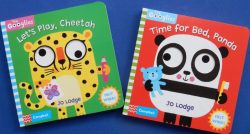
Let’s Play, Cheetah / Time for Bed, Panda

Let’s Play, Cheetah
Time for Bed, Panda

Jo Lodge
Campbell Books

Let me introduce The Googlies, Jo Lodge’s new first words series featuring adorable animals going about their daily lives.
Just right for using with babies and toddlers, each one has five bright alluring scenes that feature an animal character in a simple story, and each character has movable googly eyes and a slider – great for developing fine motor skills.
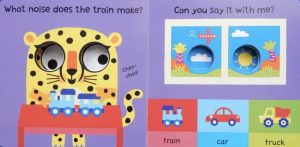
In Let’s Play, Cheetah, little ones can learn the names of Cheetah’s toys, join in with his choo-choo-ing train,

get physical when he experiments with some musical instruments, creates a picture and finally issues an invitation to play peek-a-boo.

Through Time for Bed, Panda, vocabulary associated with a bedtime routine is introduced. While an adult reads aloud tinies can join in with splishing and splashing, sipping and slurping, scrub-a-dubbing, wow-wee-ing (great to see a bedtime story) with ted …

and zzz-snoring, as well as pointing to items both in the main picture on the verso and the small strips on the recto as Panda gets ready for some shut-eye. (courtesy of a slider).

I’d suggest adding this one to the bedtime routine of human babies.

With their repeat refrains, “Can you say it with me?’, both books are great fun to share either at home or one-to-one in a nursery setting. Look out too for other titles coming soon in the series.

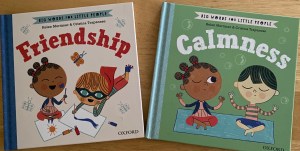
Friendship / Calmness

Friendship
Calmness

Helen Mortimer and Cristina Trapanese
Oxford University Press Children’s Books

These are two additions to the Big Words for Little People series: the first explores what being a good friend really means and the second presents various elements that are associated with feeling calm.
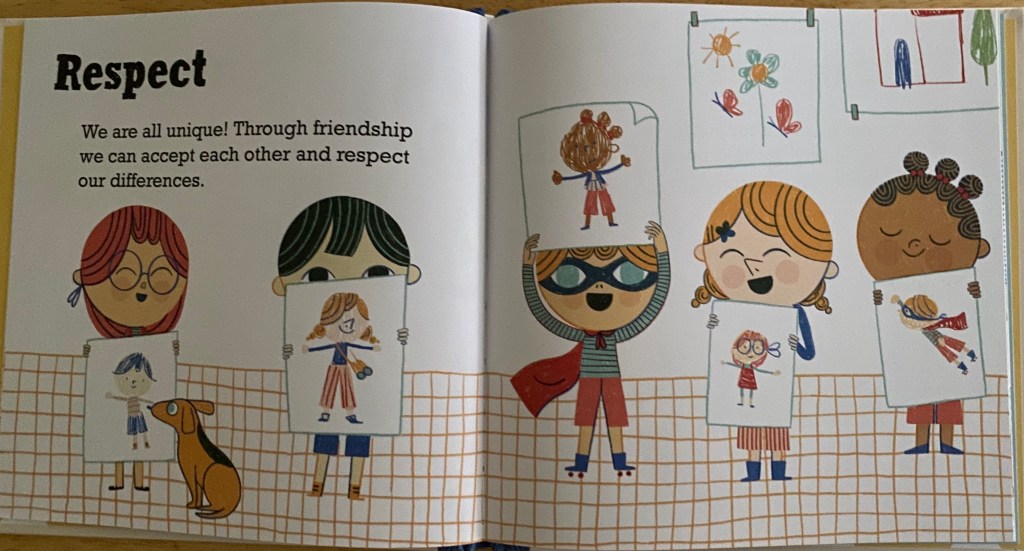
Each of the first eleven spreads takes a key word (or two) exploring it through an engaging scene and an explanatory sentence or two.

For instance part and parcel of Friendship is Respect and that entails accepting and showing respect towards differences.

Share offers examples of what you might share with friends – memories, ideas, treats and especially, time.
The penultimate spread is an affirmation of Friendship itself and then comes a spread aimed at adult sharers giving ten ideas of how to get the most from the book and a final glossary.

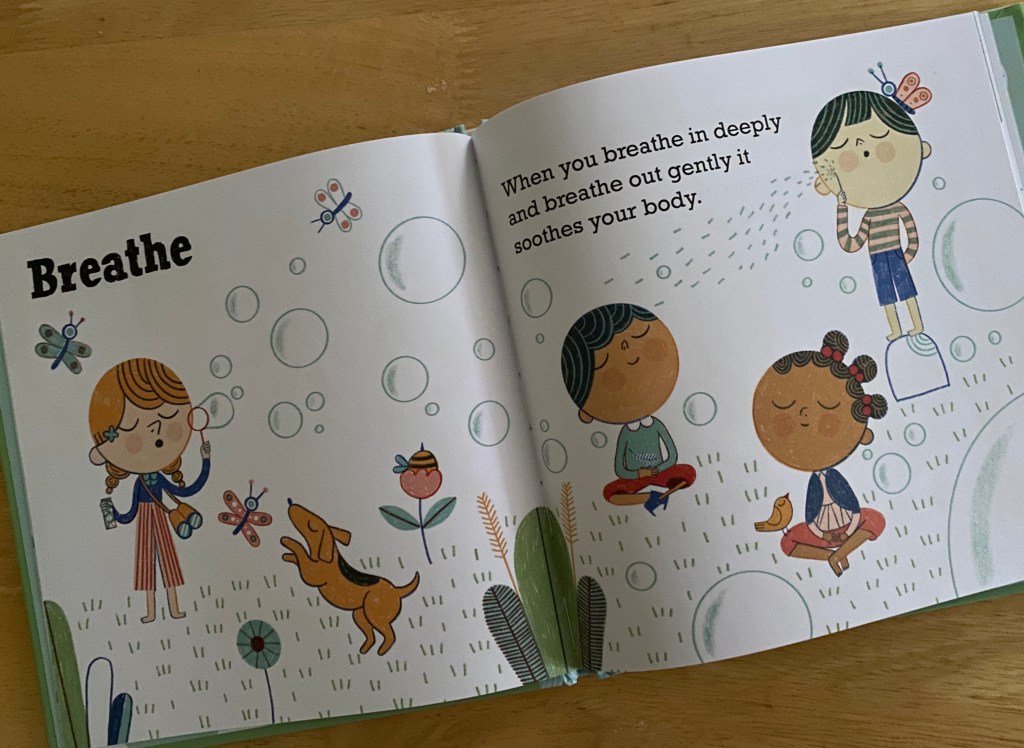
Calmness has spreads on quiet, feeling safe, breathing,

what to do about worries, focus, time – ‘Something as simple as walking gives you time to watch and listen while you move.’ I think that’s something we’ve all appreciated during the past year.

Other ideas suggested to induce that sometimes elusive sense of calm are to Pause, Imagine, ways to ‘get past your angry feelings’, Balance and to take a Softly, softly approach.
Calmness also ends within ideas and a glossary.

Both these engaging little books are well worth adding to an early years collection, as well as for sharing with little ones at home. Cristina Trapanese uses a different theme to illustrate each one. Friendship shows children engaged in a variety of art and craft activities while Calmness has an appropriate outdoor setting reflecting the important role the natural world plays in inducing calm. Both contain a wealth of language learning potential.

Lottie Loves Nature: Bee-ware!

Lottie Loves Nature: Bee-ware!
Jane Clarke, illustrated by James Brown
Five Quills

In this second adventure young nature enthusiast and would-be wildlife presenter Lottie Boffin is engaged in a minibeast survey for her favourite TV show when she encounters Noah Parfitt who lives next door. Noah’s dad is anything but a lover of small wriggly, squishy creatures on account of the mini golf course he’s developed in his garden. So when Lottie and Noah burst in on his recreational activity in their search for minibeasts that might need rescuing, he’s far from pleased. Even less so when he’s flapped and buzzed by a bumblebee looking for a flower, of which there’s a distinct lack in the Parfitt garden.

Then to make matters much worse, Lottie’s insect attracting activities result in bees swarming in a tree in her garden that overhangs Mr Parfitt’s and he’s so furious he calls the pest exterminator.

Lottie’s mum calls a beekeeper who arrives almost simultaneously.

Now all Lottie has to do is to persuade Mr Parfitt to send the pest exterminator away and allow the bees to be collected and moved to a safe new hive.

Interspersed with Jane Clarke’s lively, humorous story are pages about insects, especially bees, from Lottie’s nature notebook

and some things readers can do (as well as notes of Noah’s whose interest lies elsewhere and who sees things through a different lens). In addition to the main narrative, this is a great way to get readers interested in the natural world and the delights it has to offer through first hand experiences.

With equally lively, humorous illustrations by James Brown this is a smashing book to foster curiosity about wildlife and the environment, either at home or school. Like their previous Lottie story, there’s plenty of parrot poop courtesy of macaw Nacho and Lottie’s energetic dog Einstein to add to the fun.

Made for Each Other

Made for Each Other
Joanna McInerney, illustrated by Georgina Taylor
Big Picture Press

Joanna McInerney explores the symbiotic relationships – evolved interactions – that exist between different organisms living close together often for their mutual benefit. Using examples between animal and plant, and between two kinds of animal, she takes readers to various forest locations, beneath the waves, onto the plains and to tropical jungles and rainforests presenting different kinds of symbiotic relationships.

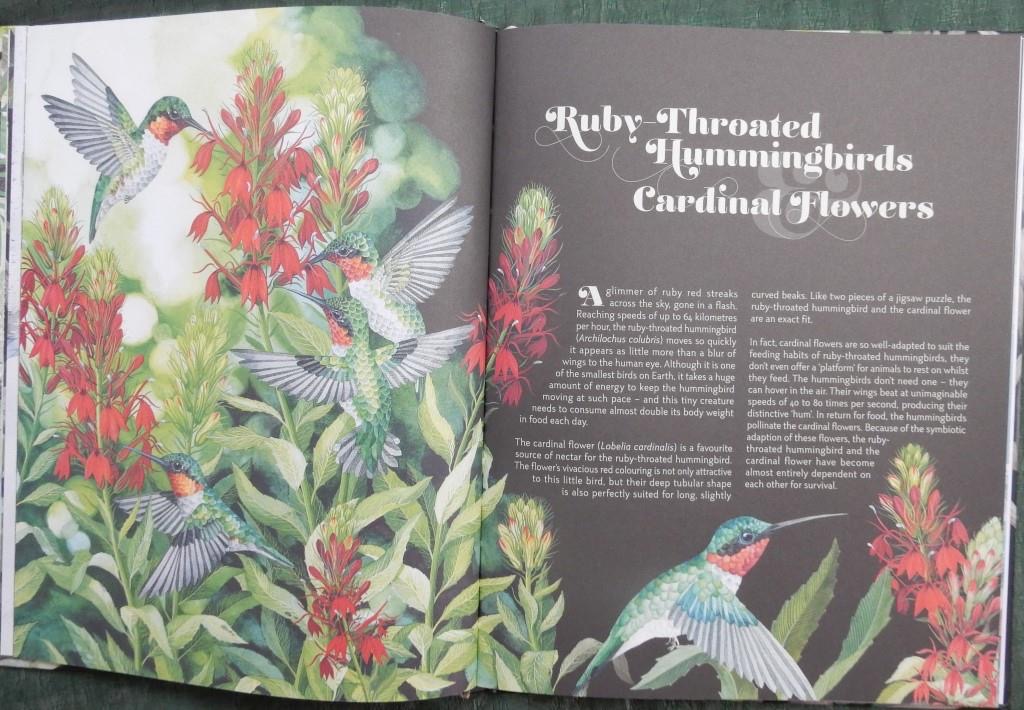
One instance of mutualistic symbiosis is that between the tiny Ruby-throated Hummingbirds and cardinal flowers. These red flowers are one of the birds’ favourite sources of nectar, while their tubular shape is well-suited to accommodate the birds’ beaks. A hummingbird hovers in the air, wings beating and as well as feeding on their nectar, the birds collect pollen from the cardinal flowers, transferring it to another on the next feeding stop. Over time these two species have become almost entirely dependent on one another for survival.


Another example of non-insect pollination is that of the balsa tree flowers carried out by the white-headed capuchin monkeys living in the Ecuadorian rainforest treetops. The process of evolution has ensured that as much pollen dust as possible is transferred when the monkeys feed from flower to flower.

Moving under water, we learn that remora fish have a specially adapted dorsal fin that functions as a sucker by which the fish attach themselves to sharks and thus conserve energy while at the same time feeding on the leftovers of their carrier sharks. In return the hosts receive what the author terms ‘a type of exclusive spa treatment’ with the remoras nibbling at dead skin and shark parasites.

On the Serengeti plains of Eastern Africa can be found one of the most well-known symbiotic relationships: that between the little oxpecker birds and giraffes. The former tend to spend much of their time close to their hosts and use their curved beaks to remove giraffe parasites. Using their two backward-facing toes to cling even to moving giraffes they also keep a watch for predatory animals. The oxpeckers make use of giraffe hair that which they pluck from their hosts to line their nests.

Each of these examples, as well as the other seventeen, are strikingly illustrated by Georgina Taylor. Every one of her artful watercolour compositions of her subjects are reminiscent of Audobon, the 19th century ornithologist and painter.

Slug in Love / How Big Is Love?

Slug in Love
Rachel Bright and Nadia Shireen
Simon & Schuster

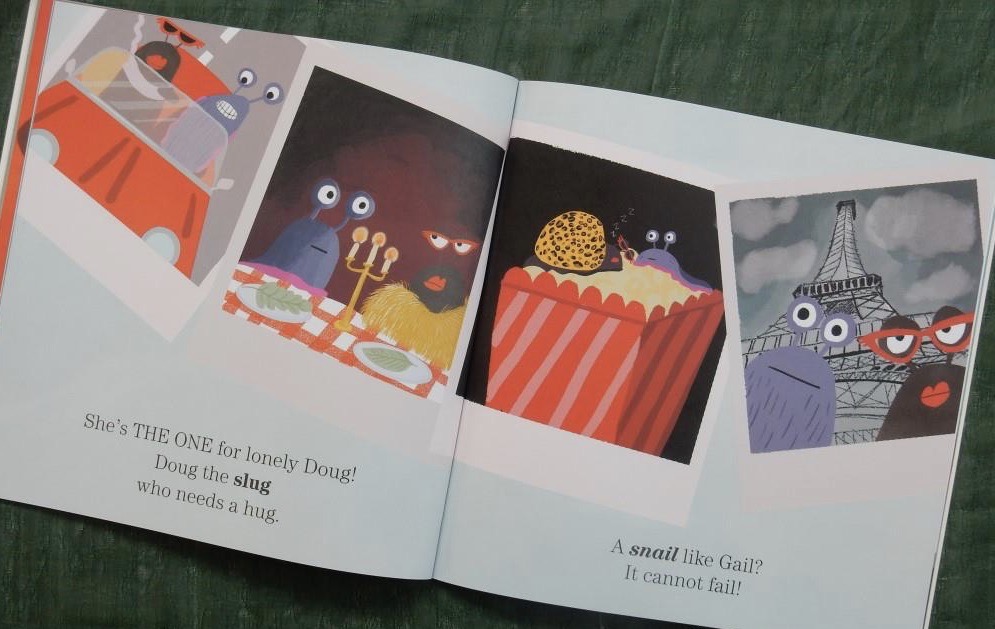
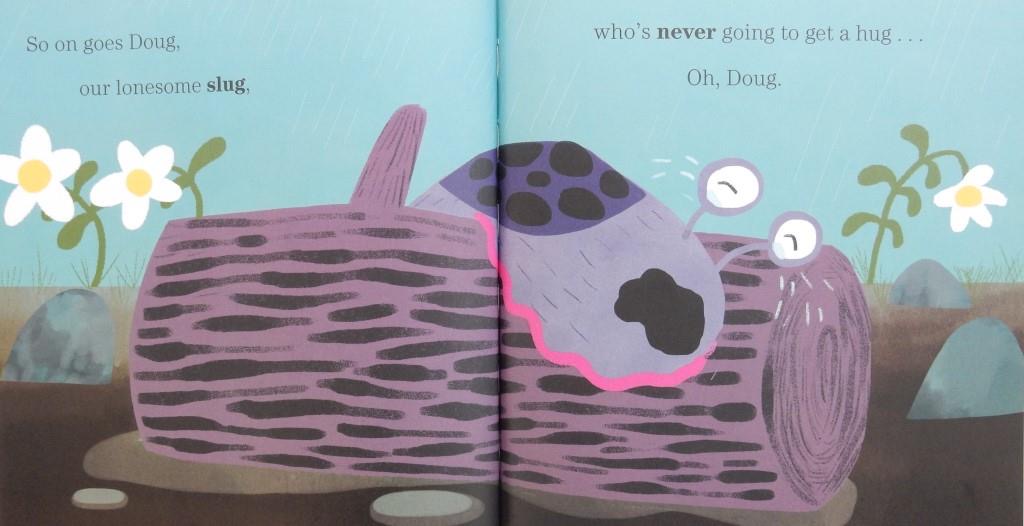
Meet Doug, a slug that’s feeling rather lonesome; he would really love a hug. (Wouldn’t we all?) But just imagine hugging a slug – not a very pleasurable prospect me thinks. So agree the various minibeasts he encounters. There’s earthworm, spider, ant, caterpillar each of which beats a hasty retreat; but not before uttering some thoroughly disheartening words.

Oh dear! Is poor Doug to remain forever sans hug? Hold on, what about Gail the stylish snail? She exhibits all the characteristics eschewed by the four previous creatures – now surely she must be THE one …

Once again though, our slug is given the thumbs – or rather antennae – down.

Feeling ever more dejected, Doug pauses to contemplate his lack of an embrace

and unexpectedly something comes flying along. Could she be his hugger at last? With its wealth of wordplay, Rachel’s punchy rhyming narrative, combined with Nadia’s delicious depictions of Doug, the naysayers and more, make for a book that’s a gigglesome delight. In addition, it’s great for developing sound/symbol awareness and, you’ll absolutely love the final twist.

How Big Is Love?
Emma Dodd
Templar Books

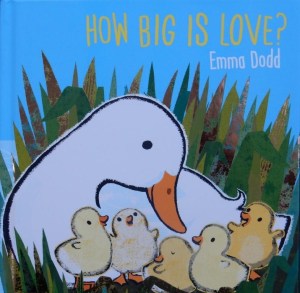
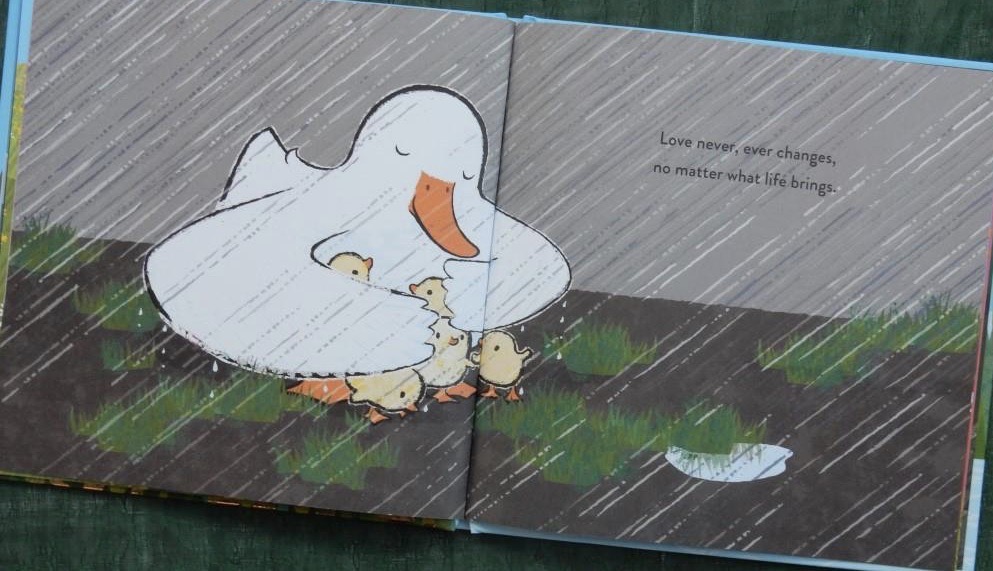
In Emma Dodd’s gorgeous story, a mother duck shows her five little ducklings just how boundless is her love for them. Such love as hers illuminates the entire world, is heart filling, unchanging in the face of life’s unsettling moments,

it’s uplifting and supportive, all day every day even in the darkest of difficult times. But these thoughts haven’t come to the mother of their

own accord, it’s through her day-to-day interactions with her little ones that these feelings have emerged so that she can express them through both her words and dealings.

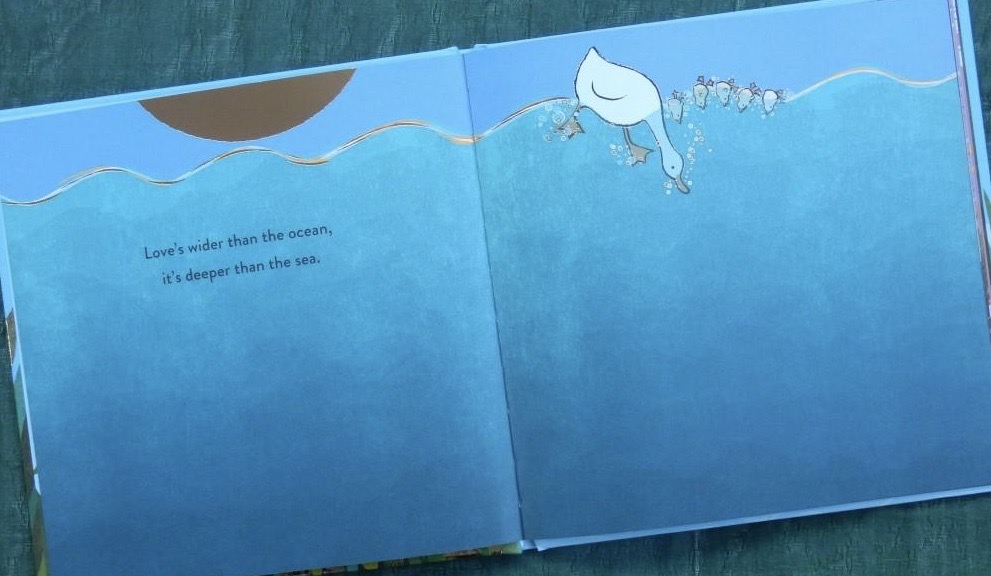
Heartfelt sentiments, beautifully expressed and tenderly illustrated with gorgeous scenes of the natural world, (alternating ones embellished with gold) Emma’s new book is ideal for sharing with the very youngest,

Dragon Detective: That a Wrap! / Vega Jane and the Secrets of Sorcery

Dragon Detective: That’s a Wrap!
Gareth P. Jones
Little Tiger

In case you’re not familiar with the titular detective, he’s Dirk Dilly, a mountain dragon who doubles as a crime-buster, all the while endeavouring to keep the existence of dragons secret from humans – not an easy task.

This story set mainly in the USA is the 4th and final adventure in the Dragon Detective series.
Holly Bigsby, her stepmum, her dad, and Holly’s close friend Archie are unexpectedly flown out to LA in a private luxury jet at the behest of billionaire Brant Buchanan for whom Mrs Bigsby works.
Also in LA, making an autobiographical film is Petal Moses (Holly’s ex-room-mate from her boarding school days.)

On her very first day in the city, Holly meets the movie director, who while filming in the desert has captured something on camera that looks suspiciously like dragons. But before anyone has a chance to look closely at the film, it disappears. Holly is convinced it’s a case for Dirk. She rings him urging him come to LA and participate in an investigation – an investigation that involves Californian Desert Dragons. But can they solve the case and find the film before dragonkind’s reality is revealed to the world at large?

An enjoyable romp of a crime-solver, especially for those primary school readers who like fast moving stories that involve the interface of humans and dragons.

Vega Jane and the Secrets of Sorcery
David Baldacci
Macmillan Children’s Books

This was David Baldacci’s first foray into young adult fiction previously published as The Finisher, now re-edited and reissued.

It follows the quest of fourteen-year-old Vega Jane, who when the story starts works as a Finisher at Stacks, creating goods she knows she’ll never afford while living a life of hardship with her younger brother in Wormwood city. The place is surrounded by the Quag wherein lurk dangerous beasties and beyond which, it’s said, nothing exists, consequently nobody ever leaves.

Vega though is different from other Wugs; she’s curious, something that’s strongly discouraged. Then, having witnessed her mentor escaping into the unknown, she discovers a map that seems to suggest a strange world lies beyond the walls of Wormwood.

Thus begins an exciting adventure that follows Vega’s quest for freedom as she moves through time confronting not just all she’d believed was true and those intent on hiding the truth, but also, her own limitations.

Magical artefacts, mysteries, bizarre creatures, thrills aplenty, and Vega’s somewhat unusual manner of narration that blends her thoughts, Wugmort vocabulary (a translation is given at the outset) and formal speech, as well as memorable characters, are all part of Baldacci’s mix in his blend of sci-fi, myth and fantasy elements. Moreover, there’s a cliff-hanger finale that opens the way for further adventures of this strong female hero.

My Bum is So Noisy!

My Bum is So Noisy!
Dawn McMillan and Ross Kinnaird
Scholastic

Assuredly we all need laughs at the moment and be you an adult sharer or a child, you will certainly find plenty in this, the third of Dawn McMillan and Ross Kinnaird’s New Bum series.

Here, the young boy narrator and his raucous rear have an unexpected cacophonous adventure. Not though before the lad has shared with us some of the trials of having such a turbulent tail that emits a veritable and varying trail of emanations, often at the most inconvenient moments. There are for instance hoots and toots, hums and strums, clangs and bangs,

not only when the house is empty. Visitors too are subjected to sounds aplenty – it’s enough to drive them crazy;

well perhaps not all of them. The younger relations (whose rears are a trifle restricted in their sound-producing capacity) are a tad envious and happily our narrator’s parents appear to support their son.
However the real excitement begins when the boy’s unique talent is discovered and put to creative use by a company who are quick to recognise its potential.

Dawn’s crazy rhyming narrative tumbles forth and rumbles along with laugh-out loud examples of whiffy wonders that Ross Kinnaird renders even more hilarious in his zany illustrations. May I suggest having a room spray to hand when you share this one – just in case …

Play and Learn with Board Books

The Touch Book
written by Nicola Edwards
Little Tiger

Here’s a book that invites young children to “Get Hands-on! and explore texture and who could resist those paint-covered fingers of the little girl on the opening page?

In all, ten different textures are presented: fluffy, crinkly, smooth, bumpy, sticky, spongy, furry, rough, scratchy and soft, and each double spread offers three possible synonyms for the one presented. For instance, crinkly alternatives are wrinkly, ridged and ragged.

However it’s not only the sense of touch that’s being developed: ‘run your finger along something crinkly, what kind of noise does it make?’ asks the narrator; while the ‘sticky’ spread talks of sticky things being either tasty or ‘icky’ which might lead into a tasting session. Your fingertips really do stick to the tiny hexagons beneath the dripping honey so ‘tacky’ might be a good alternative though you’d definitely need to taste some honey to decide if syrupy is appropriate.

I like that little ones are invited to describe the textured patch beneath the digger – would they use ‘scratchy’ or perhaps gritty, grainy or raspy?

Full of potential learning opportunities, this sturdy book can be used either in a family or in an early years setting, perhaps as part of a larger sensory theme.

Although not sensory, to add to the overall fun, I’d suggest following up a sharing of the next book with some hands-on experiences

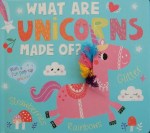
What Are Unicorns Made Of?
illustrated by Louise Anglicas
Little Tiger

A rhyming text guides the adult reader aloud, presenting possible answers to the titular question while Louise Anglicas’s candy-coloured illustrations showing unicorns cavorting across the countryside, through Sweetville, over the rainbow, among the trees and dancing to music offer plenty to explore.

The first consideration of unicorn-ness concerns what’s within: could they be filled with jellybeans, or perhaps ‘yummy pink popcorn?
What about their manes: marshmallow or possibly strawberry ice-cream – maybe but then neither would last long with hungry toddlers in the vicinity! Imagine unicorn rainbow tails all a-sparkle in the sun or horns alive with beautifully patterned butterflies, glittery musical hooves: the only way to discover if any of these might be part and parcel of a unicorn is to close your eyes and wish to see one – ta-da …

Animal World: I Can learn My First Colours
Lauren Crisp, illustrated by Thomas Elliott
Caterpillar Books (Little Tiger)

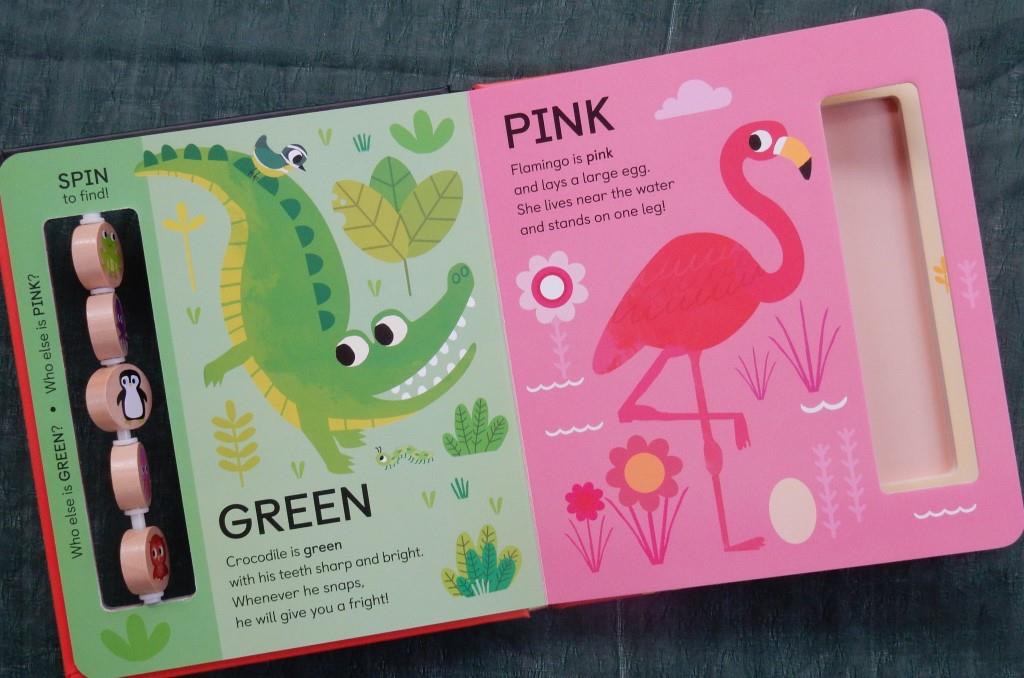
Four-line verses and images of beady-eyed animals are used to help reinforce, or perhaps introduce, the basic colours to toddlers: thus ‘Crocodile is green / with his teeth sharp and bright. / Whenever he snaps, / he will give you a fright!’ whereas ‘Giraffe is yellow / as tall as can be. / She nibbles on leaves / from high in the tree!’ In addition to the main text, along the edge of each verso asks for instance, “Who else is GREEN?’ Who else is PINK?’

The vertical rod inserted into the cover has 5 flattish cylinders, on each side of which is a small picture of an animal, so that little fingers can spin them around to discover another creature with a colour that matches the one in the main illustration.

The final spread shows a dozen butterflies each corresponding to one of the colours already featured and invites little ones to respond to two questions: “What is your favourite colour? And “What colours can you see high up in the sky?’

There’s a wealth of potential fun learning between the covers of this one.

All Aboard the Numbers Train / All Aboard the Shapes Train

All Aboard the Numbers Train
All Aboard the Shapes Train

Sean Sims
Oxford University Press Children’s Books

Based on topics popular with little ones, these two All Aboard titles of a new thematic series are intended to support the early learning goals.
The Numbers Train is in fact a spacecraft that moves through the sky taking six small children and their canine companion on an exploration of the cosmos.

There’s so much to see including rockets, planets, evidence that others have been there too, aliens – of the friendly fun-loving variety fortunately –

and that only takes us as far as number five.

By the time we reach ten the passengers have left their train and are stretching their legs beneath the stars. Back inside again there’s a wealth of number symbols (1-10) on the various levers, dials and other instruments to spot and then it’s time for the countdown before the train leaves for home.

On the return journey there’s an opportunity to count in tens as they whizz past the 100 guiding stars and the penultimate spread maps the entire trip asking ‘Can you remember the numbers we saw on the way?’

No space attire needed on the second ride; the Shapes Train, with its variously 2D shaped windows takes its passengers (and readers) on a journey to the world of playtime, searching for shapes, and the patterns they can create.

We start with circles: ‘There are circles everywhere! The bubbles, balls and bugs are circles.’ says the text. Yes, that is how they’re represented in Sean Sim’s alluring, brightly coloured scene of the train’s first stop but this could be confusing for young learners as foundation stage teachers (certainly this one) would say that bubbles and balls are spheres (3D shapes) not circles (2D shapes).

Other shapes included are squares, triangles,

rectangles, diamonds, as well as semi-circles, ovals, pentagons, hexagons, stars and spirals.

This promises to be a bright, jolly series with lots of learning potential but use the Shapes Train judiciously.

There’s No Such Thing As … Unicorns

There’s No Such Thing As … Unicorns
Lucy Rowland and Katy Halford
Scholastic

Whether or not you know youngsters who are besotted with unicorns (and that’s an awful lot even in my experience), or are acquainted with young search-and- find fans, then this story will likely appeal.

Its narrator is a little girl – a unicorn obsessive if her bedroom is anything to go by and when her big brother tells her that these magical creatures just don’t exist. she decides to try and prove him wrong.

Next morning having packed her bag with the necessary accoutrements, she sets out on a unicorn search. It’s a search that takes her to a variety of places – a farm, the zoo, a lake …

the woods, each of which yield negative results. Now what about the meadow? That looks more promising, but no unicorns appear to frolic among the ponies. Nor are they evident at the seaside, even in the dark depths of that cave …

Equally, the school classroom and the park in the gathering dark furnish for our seeker, not a single unicorn sighting and so disillusioned, she takes refuge to let her tears flow.

Suddenly who should appear but her brother who’s been hunting, not for unicorns but for his little sister. A comforting cuddle ensues and then, under the twinkling stars, the two make a wish …

With its repeat titular refrain,, Lucy’s rhyming telling as always, is a delight to read aloud, and if you share it with more than one or two little ones at a time, make sure you leave plenty of time for listeners to peruse each of Katy’s busy scenes. They simply burst with enchanting details and rainbow hues; and of course there’s that elusive one-horned creature lurking somewhere at each location.

Pizazz vs the New Kid

Pizazz vs the New Kid
Sophy Henn
Simon & Schuster Children’s Books

You might think that being a superhero is incredible but that definitely isn’t always the case if you happen to be this story’s narrator, the almost 9½ year old Pizazz, a member of an entire family of superheroes, especially when your own particular superpower is highly embarrassing as we discovered in the first book.

Pretty annoying you’ll probably agree, but enter another young superhero going by the enviable name of Jett to make matters worse. Moreover her cape is short so consequently not a continual trip hazard, and, she’s to be in Pizazz’s class at school.

Pizazz decides she’ll offer to be Jett’s buddy and make her feel welcome but that plan is immediately thwarted when Jett chooses, of all people, Serena. Life just isn’t fair.

It gets even less so when after a humiliating trip incident caused by a long cape and one of The Popular’s backpacks, Serena decides that what’s needed is a competition – a SUPER-OFF – between Pizazz and Jett. No prizes for guessing who’s to be in charge of that, and she decides there’ll be not just one but three SUPER-OFFs. No pressure then.

Pizazz’s friend Ivy is reassuring but come break time and round one, it seems to Pizazz that she has only a very few supporters whereas almost the entire school is rooting for Jett. However, with two competitions completed the score stands at one win each. Before the third, Pizazz’s dad announces that he’s invited Jett and her family over for dinner. Awkward? You could say!

What about that third contest, you might be thinking. To discover what happens you’ll need your own superpower – or better still, get hold of a copy of this wacky story and discover how it all ends.

Even if youngsters have missed the first story, this works on its own. The ingredients are similar: Sophy’s offbeat illustrations, some comic-book sequences, lots of idiosyncratic typography, irresistible chapter-openers and distinctive characters – human and animal, not forgetting an abundance of eye rolls.

Stars with Flaming Tails

Stars with Flaming Tails
Valerie Bloom, illustrated by Ken Wilson-Max
Otter-Barry Books

How exciting to have a book of new poems from Valerie Bloom after quite a long while; but Stars With Flaming Tails with more than sixty offerings was definitely worth the wait.

Arranged under five headings – Family and Friends, Fun with Forms, Our World, Animals and Unbelievable?, this is a veritable treasure trove of delight encompassing such diverse topics as pancakes and piranhas, the elements, grandparents, siblings, parents,

the ordinary and the extraordinary (though nothing is the former when Valerie works her magic on it).

You’ll laugh, feel saddened, ponder upon, puzzle over, empathise, wonder, and with all your senses aroused, discover many things anew. It’s amazing how totally different moods can be evoked by just four lines; take for instance EclipseA huge space giant saw the sun, / he thought it was a currant bun, / so he took an enormous bite / and turned the daytime into night.

and Dawn – ‘Sunlight pries open / the hands of the mimosa / which all night had been clasped / in prayer.’

On the shortest day of the year, that has also been extremely wet and cheerless, one of the poems that really made me smile ends thus: ‘But all’s well, we’re rich and happy (so I had to beg his pardon), / and he’s charging folk a pound to see the dead giant in the garden.’ Can you guess who the ‘he’ is in this one – hint it’s a character from a traditional tale.

No matter how you’re feeling though, you’ll discover something to suit your mood, or to lift you out of it perhaps. Ken Wilson-Max’s black and white illustrations serve the poems well providing an additional reason to smile wherever you open the book.

Love

Love
Corrinne Averiss and Kirsti Beautyman
Words & Pictures

Young Tess is part of a loving family – love surrounds her like the ‘light inside one of Daddy’s little houses.’

However, when the time comes for her to start school, the worries creep in. School is big and scary – nothing like that warm scarf that she feels wrapping around her when she goes out with her parents. Will the love still find her?

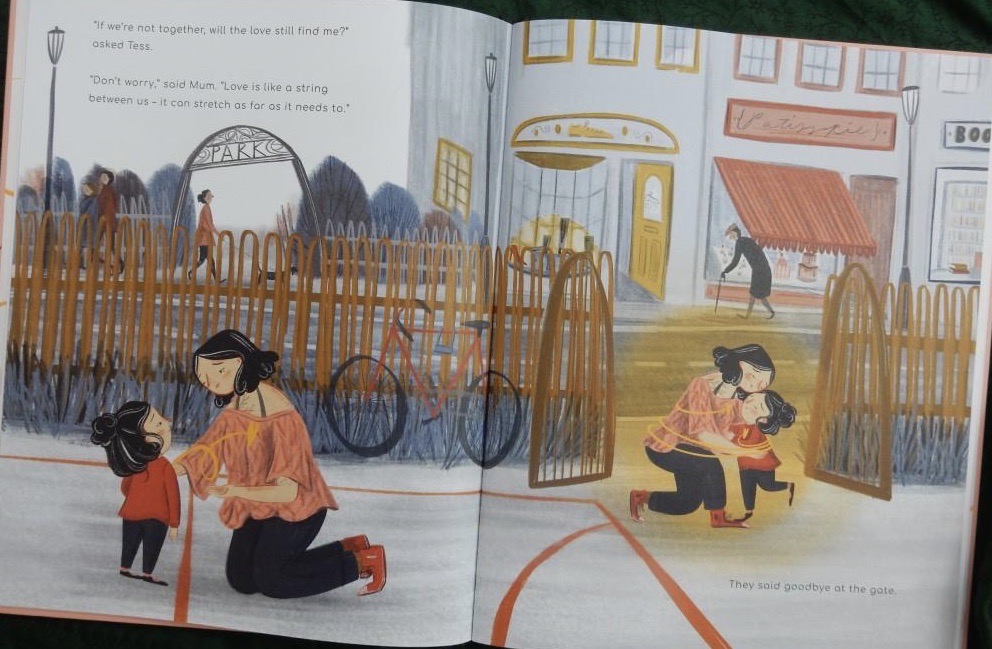
Her mother tries reassuring her saying as they part by the gate, that love will still find her even when they’re apart “like a string between us – it can stretch as far as it needs to.”

Tess though isn’t sure. Her understanding teacher offers some comfort – ‘Tess noticed a little thread between them. That felt nice.’

Little by little she continues discovering new strings of connectedness, friendship and love throughout the day.

Come hometime though, the anxiety returns when her mother is late to collect her.: that string doesn’t appear to be connecting Tess to anything or anyone. Finally, however, there with an explanation and a string-fixing hand, stands Mummy and all is well once more.

Enormously reassuring for young children who experience separation anxiety, Corrinne cleverly uses the string trope to make tangible the bond between loved ones in her story. But she makes it all the more impactful – love connects us no matter the distance between us – with her own ‘candle house’, ‘warm scarf and other metaphors. Employing a limited colour palette to great effect, Kirsti Beautyman’s sequence of textured illustrations are full of feeling, be that love, tenderness, worry, or empathy.

Weird Wild & Wonderful

Weird Wild & Wonderful
James Carter, illustrated by Neal Layton
Otter-Barry Books

James Carter’s selection of his own works might be divided into the three sections of its title, but for me, every one of the fifty herein is, in its own way, wonderful.

The first part – ‘Weird’ – contains those poems that their author calls daft or cheeky, or perhaps both. My favourite is Spot the Fairytales (aka Ten Tiny Senryū) or 17 syllable present tense haiku. Here are some examples: Enter if you dare – / three breakfasts; one broken chair. / Off to bed? / Beware … // A cute bird calling / an urgent word of warning – / ‘THE SKY IS FALLING!!’ // … She’s poshed up in bling – / grooving with the future king. / Slipper fits. KERCHING!

Among the daft is a clever shape poem (one of several ) called Lullaby for a Woolly Mammoth that you can sing to the tune of Twinkle, twinkle …

Among the entirely new poems and included in the ‘Wild’ section is The Elephant’s ODE to the DUNG BEETLE. That one really made me laugh and I love Neal Layton’s illustration of same.

Not all the poems are light-hearted though. Anything but is another shape poem Who Cares? … a stark warning against the thoughtless and selfish ways people are harming our precious wildlife.

In the final ‘Wonderful’ part are some of James’ science poems and quiet poems. One of the latter that spoke to me immediately is another new, and timely one – It’s … Kindness. On this particular day I’m also drawn to That’s Poetry, Where Do You Get Your Ideas From? and, School Library!. Here are its first and last verses: Where are doorways made of words? / That open into other worlds? / Welcoming all boys and girls. // SCHOOL LIBRARY // … Tempted? Go on, have a look. / You never know, you might get hooked. / Your whole life changed by just one book … // SCHOOL LIBRARY! Who knows? It just might be this smashing book of poems – there’s something for all tastes therein: it most definitely hooked this reviewer. The book fairy in another of Neal’s terrific illustrations awaits to lure you in.

Love Makes a Family / I Want to Be … a Doctor

Little Tiger have published several board books to start the year: here are two examples:

Love Makes a Family
Sophie Beer

Diverse families demonstrate the meaning of love – family love – through a variety of day-to-day interactions. Starting with an early awakening by two exuberant little ones of their still rather sleepy parents, or it might be baking and sharing a very special birthday celebration cake. Sometimes, something as simple as knowing where that lost toy might be found is an act of love;

but it’s also enjoying playing in the rain, helping a toddler; showing your appreciation of your children’s performance put on specially for you; comforting, bath time fun;

sharing just one more book or that bedtime kiss.
All these things constitute part of something we all need – especially after the past year – and that is LOVE. Joyfully illustrated in bold bright scenes rich in pattern, Sophie Beer’s celebration of simple loving acts shows the very youngest children, what makes a family a family.

I Want to Be … a Doctor
illustrated by Richard Merritt

The small girl narrator peeping through the die hole in the cover explains why her ambition is to become a doctor. Most importantly she wants to help ‘poorly people get better’, but she’s also excited (as we’re shown in Richard Merritt’s illustrations that show our narrator playing with her teddy), about the prospect of wearing a white lab coat and having lots of doctorly accoutrements.

Then there’s the possibility of an ambulance ride, siren blaring and lights flashing while at other times there’ll be patients visiting her surgery (‘office’) when she might need to use some of the instruments from her doctor’s bag.

She shows readers both the stethoscope and an x-ray machine at work, as well as issuing a prescription based on her observations: all in all, lots of reasons that inspire a young child to aspire to become a member of the medical profession but it’s not everybody’s ambition of course, and the final page with its mirror asks about that very thing.

Stick Boy

Stick Boy
Paul Coomey
Little Tiger

Being different is never easy, ditto starting at a new school; but when Stick Boy moved to a new town, he’d hoped that with yet another fresh start, he’d left old problems behind. Seemingly not, for on the opening pages of Paul Coomey’s story we discover the titular character being pursued on only his second day, by the second biggest bully in the entire school, Sam Devine.

Things are not looking good especially when he then meets Gretchen, another bully. The two of them taunt Stick Boy, get hold of the contents of his pockets and proceed to hurl them over a high wall, recording their nastiness to upload onto ‘Vidwire’.

Along comes Ekam and the two boys introduce themselves to one another. and Stick then demonstrates his locker-opening skill before the bell rings summoning everyone to assembly. There the headteacher announces that the opening of the new Baron Ben’s Bargain Bins Magnificent Mega Mall on Saturday will be celebrated with a concert.

Stick’s first lesson is science with Mr Jansari

where Stick meets another friendly face, Milo and discovers that everyone is excited about the prospect of a pupil from the school being chosen to sing at the Friday Factor. Things are looking up for Stick, but not for long as in double ICT, Miss Bird has it in for the newcomer from the outset.
Stick survives the day and then back home learns that his dad has bought a brand new TV from Baron Ben’s Bargain Bins that comes with a free HomeBot – uh-oh!.
Right away the thing starts behaving weirdly.

The following day Stick is late for school and overhears Miss Bird speaking on her mobile and acting scared. Later the two bully girls forced him into unlocking Mr Jansari’s classroom door

and the act is recorded on Gretchen’s mobile.
From then on things just keep on getting worse and Miss Bird definitely appears to be up to something. Could there be s a connection between those Homebots with their increasingly strange behaviour

and the Mega Mall opening?

This fast-paced mystery story about coping with bullies while being two dimensional in a three dimensional, world fizzes with excitement, and the kind of humour – both visual and verbal – that should go down well with older primary readers.
Mermaids Rock: The Midnight Realm / The Kitten Next Door

Two new titles kindly sent for review by Little Tiger’s Stripes imprint, both from authors popular with young solo readers:

Mermaids Rock: The Midnight Realm
Linda Chapman, illustrated by Mirelle Ortega
Little Tiger
The Midnight Realm referred to in the title in this, the fourth of the Mermaids Rock series, is that region of the ocean around 1,000 metres below sea level that is in constant darkness as no sunlight ever penetrates to that depth. A place where, on account of its extreme pressure and freezing temperatures, humans have only recently developed the technology that makes it possible for them to explore. Not so merpeople however and in particular those merchildren, resident around Mermaids Rock – Marina, Kai, Naya, Coralie and Luna. As the book opens these friends are busy working on the design of a poster for their latest project, corals reefs. And as those who’ve read previous books might expect, Glenda is showing off while being full of negativity towards their efforts.

Excitement rises when their teacher announces a three-day field trip that involves camping on a deserted atoll in the South Pacific.

When Marina says that her father has been researching the disappearance of strawberry squid down in the Midnight Zone, the area that the friends want to know more about for their project, it’s a case of Save the Sea Creatures Club to the rescue once again. And that’s despite being warned how dangerous a place this totally dark region is. A plan is formed: can they solve the mystery of the flashing light that Naya has noticed, (the light that then appears in the tunnel) and discover what is happening to the strawberry squid? Perhaps, but a fair bit of problem solving and creativity will be needed if they embark on such a mission.

And even more when they discover a glowing cave wherein lurks a tentacled monster – a monster that entraps Luna. Now Naya’s creative skill is required if she’s to succeed in rescuing her friend.

With black and white illustrations by Mirelle Ortega to enjoy, this story has exciting moments aplenty, strong friendship, and kindness even towards Glenda despite her misdeeds, this will be lapped up by established fans and other young readers with an interest in marine life and environmental issues.

The Kitten Next Door
Holly Webb, illustrated by Sophy Williams

In this latest story in Holly Webb’s Animal Stories we meet young cat lover Sophia. She longs for a cat of her own but her parents say she must wait until her little sister is a bit older. Then, just after Christmas Sophia spies a tiny, hungry-looking calico kitten Willow appears in the next-door neighbours’ garden and falls under its charm straightaway. She tries to spend some time with the kitten every day but as the holidays come to an end, the people next door move away, taking Willow with them, so Sophia assumes.

But shortly after Sophia notices the kitten again. Has she run away from her new home? Sophia is determined to find out. And so she does, but she finds out a whole lot more too and that’s one of the essential qualities of Holly Webb’s animal stories. Here we are reminded of just how scary fireworks can be to small creatures such as Willow, as well as how showing loving care and kindness towards animals can be hugely rewarding, sometimes in unexpected ways.

With its pencil sketches by Sophy Williams wherein she captivates even this cat phobic reviewer, this book is just right for new solo readers, especially animal lovers like young Sophia.

I Love You With All My Heart / The Curious Case of the Missing Mammoth

I Love You With All My Heart
Jane Chapman
Little Tiger

When Little Bear’s exuberant music making very close to where his mother is tending her sunflower plant results in a catastrophe, the little creature is worried that his mother will be angry with her offspring – and even worse that she’ll stop loving her.

Admirably, Little Bear owns up right away and happily, Mummy is equally quick in her response. She scoops the cub up in her arms and reassuringly says “I’ll ALWAYS love you,” and proceeds to soothe her by asking that she place her paw on her heart to “feel my love beating on and on for ever”. She goes on to tell Little Bear that a similar “Ba ba boom” beats within her little one’s heart.

Next day at preschool, the little cub draws on that knowledge when she’s upset about losing a race, and then later back in the garden when her new kite is whisked away by an unexpected gust of wind. Seemingly, no matter what upsets life throws at Little Bear, she can draw strength from that never-ending motherly love.

There’s a lovely final twist when Mother Bear’s cake baking is interrupted by her cub’s enthusiastic, mud-splashing announcement about her kite rescue …

Would that all little humans had a mother as understanding and unconditionally loving as Little Bear who is brought to life along with Mother Bear in Jane Chapman’s splendidly expressive illustrations that show just how full of love they are, and how comforting the feel of a heartbeat can be to someone needing a bit of TLC. Yes, this book is brimming over with love but it never becomes sentimental.

The Curious Case of the Missing Mammoth
Ellie Hattie and Karl James Mountford
Little Tiger

Now out in paperback is this wonderful magical adventure that unfolds inside The Curious Museum wherein Oscar, clad in his night attire, and mammoth Timothy search for Timothy’s baby brother, Teddy, intent on finding him before the clock strikes one. The hardback version was reviewed on the blog but if you’ve missed the book, it’s definitely worth seeking out the paperback to share with youngsters. There’s SO much to explore in the illustrations and there’s a wealth of information and more to discover behind the flaps.

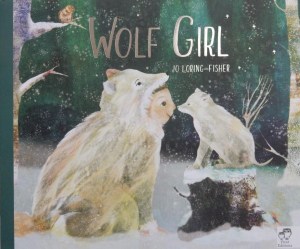
Wolf Girl

Wolf Girl
Jo Loring-Fisher
Frances Lincoln Children’s Books

Sophy tries her best to fit in at school, even wearing her wolf suit, that helps her to feel fierce and perhaps a bit brave, but no matter what she does, her shyness takes hold, she just cannot find her voice and the other children laugh at her.

Safe at home once more, she lets her tears flow and then something amazing happens. Sophy is transported to a magical snowy woodland world and there she finds herself face to face with a wolf and her pup. The pup and girl romp together in the snow becoming friends
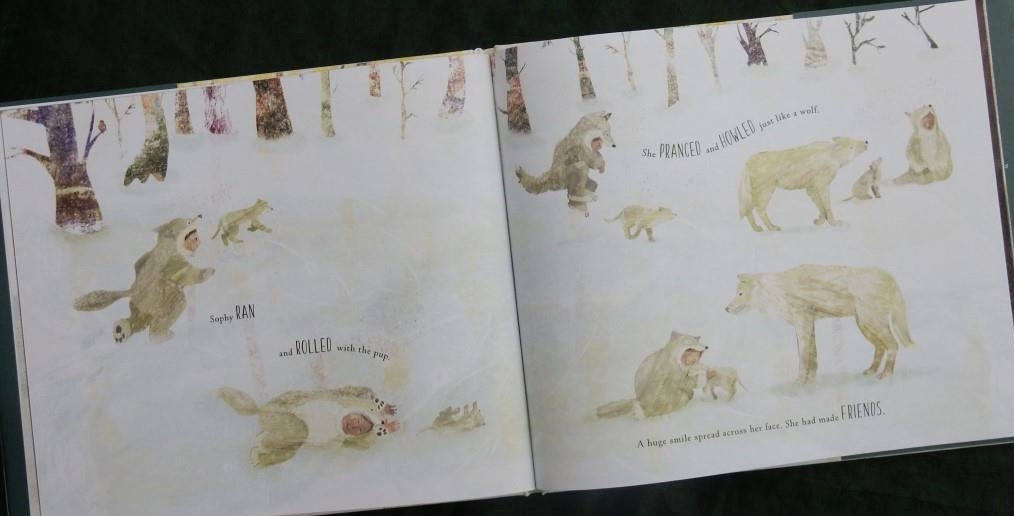
but as the snow falls faster the three seek shelter in a cave.

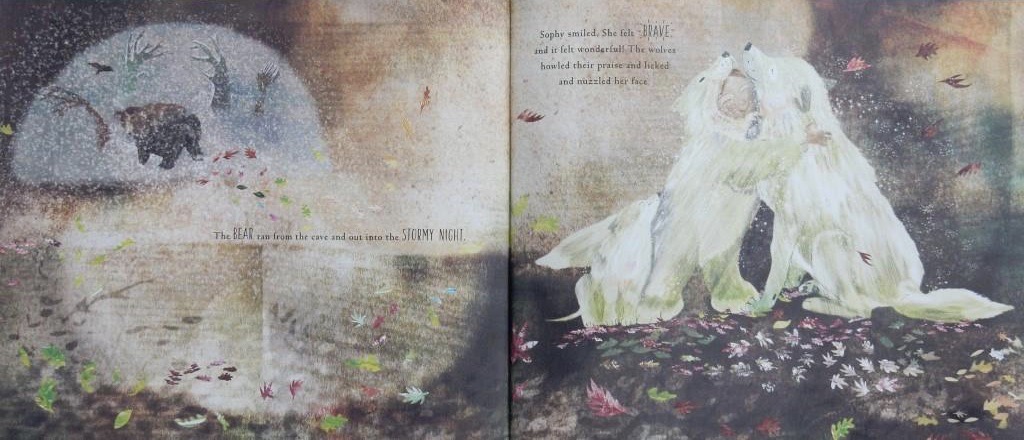
Once inside, the roaring Sophy suddenly hears is both without and within, and there before her is a huge bear. She’s terrified but somehow finds her inner wolf and sends the bear packing.

However, on reflection, she has a change of heart and realises that there’s another way to show her bravery, one that’s more important than any other …

Through both words and pictures, Jo has created a totally credible child in urban-residing Sophy; (indeed I’ve taught many Sophys in my time in the classroom) though she leaves her sensitive, lyrical illustrations to do much of the talking, speaking powerfully of the importance of drawing on your inner strength, finding your voice and friendship.

Definitely a book to share and discuss – with individuals, in the classroom or foundation stage settings especially.