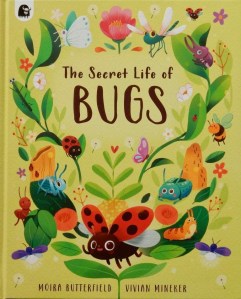
The Secret Life of Bugs

In the latest of The Secret Life series Luna the ladybird takes readers on a journey into the world of insects that includes traditional tales as well as information. She begins by presenting her own life story starting when she was one of a cluster of tiny eggs on the underside of a leaf through her metamorphosis until she became a bright red ladybird with seven black spots. I was surprised to learn that there are over 5,000 different kinds of ladybirds in the world. On the next spread, using herself as exemplar, Lily presents the body parts that are similar in all insects as well as talking about some of the differences such as mouthparts. Did you know ladybirds and many other insects smell by means of special organs on their feet?

After this is a traditional tale (one of the five included in this book) How the Butterflies Got their Colour, based on a legend told by native American People living in the Arizona desert.

Insect homes, night fliers, nesting habits are the topics of the next three spreads.

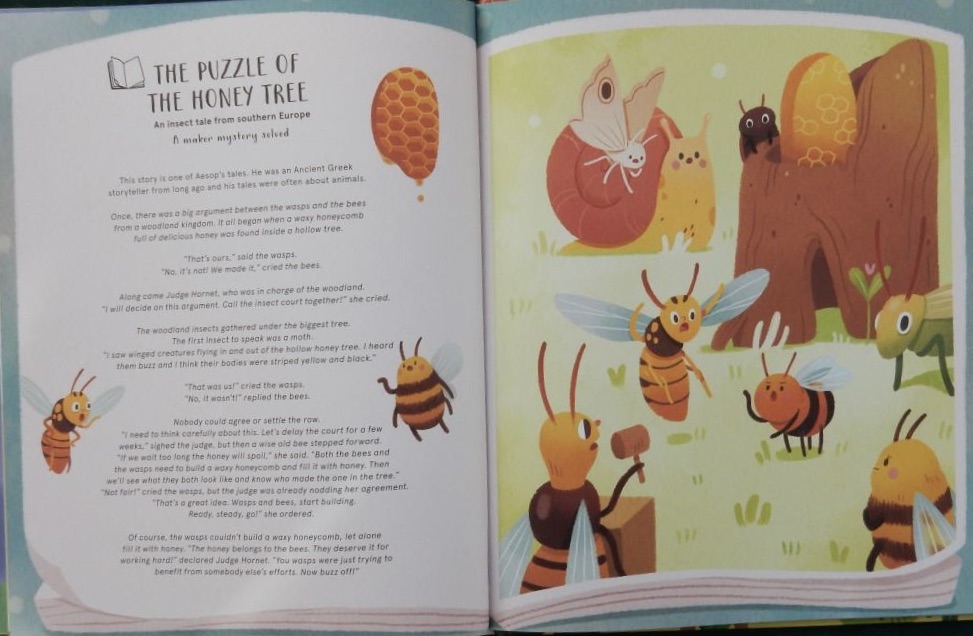
I laughed as I read The Puzzle of the Honey Tree, a traditional tale from southern Europe wherein the bees and the wasps in a woodland kingdom argue over the ownership of a honeycomb containing yummy honey. The idea of the rival factions having to go before an arbitrator really amused me.
Other spreads offer facts on swimming bugs, noisy ones, very large and very small bugs, how bugs see,
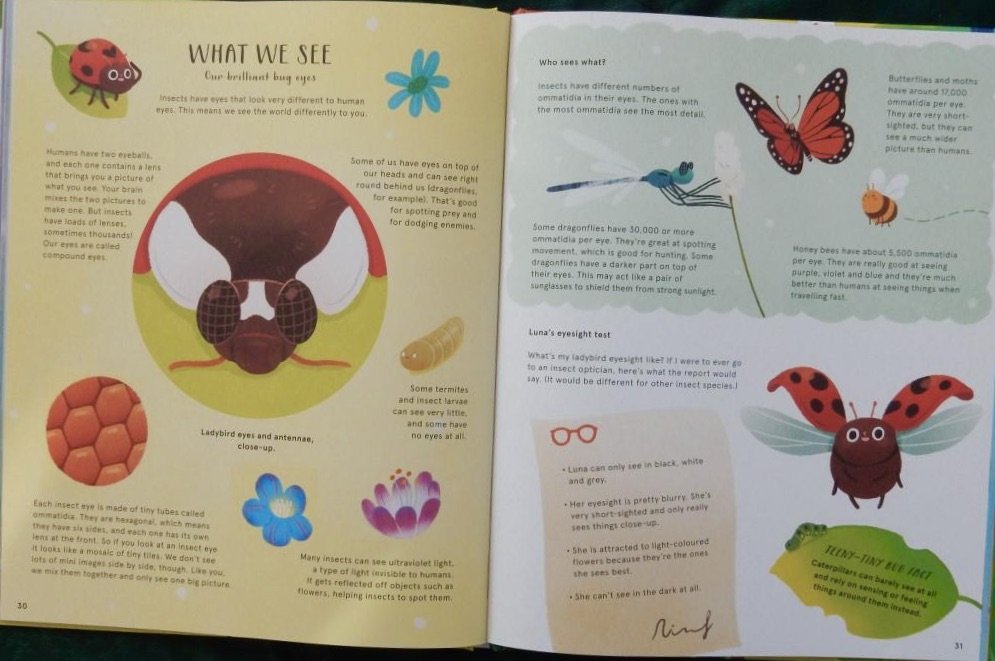
some insect ‘superpowers’ and more, concluding with pages encouraging young readers to get involved in helping insects survive so they can continue their vital work on our planet. There are also bug stories from Ancient Greece, Brazil and South America.

In my experience most young children are fascinated by insects; this book will surely further fuel their interest in and understanding of, these important creatures.
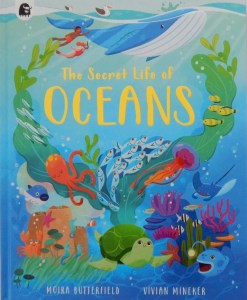
The Secret Life of Oceans

The Secret Life of Oceans
Moira Butterfield and Vivian Lineker
Happy Yak

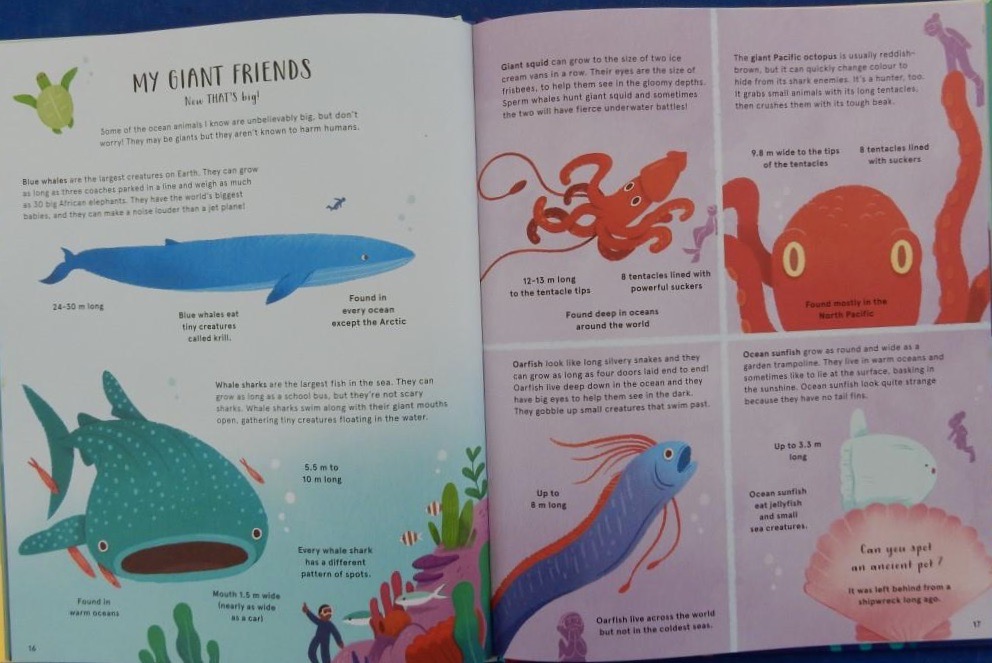
In this book, which is a mix of science and traditional stories from various parts of the world, we’re in the company of Tia the green turtle, famous for her swimming prowess and beautiful shell. Having introduced herself and told the story of how she was born, Tia takes readers on an exploration of some of the secrets of marine flora and fauna starting with those relating to sea turtles like herself and other turtles that live in the world’s various oceans (there’s a map showing these).

Diving down through the zones of the ocean all the way to the abyss, we encounter marine inhabitants large and small from giant squids and blue whales

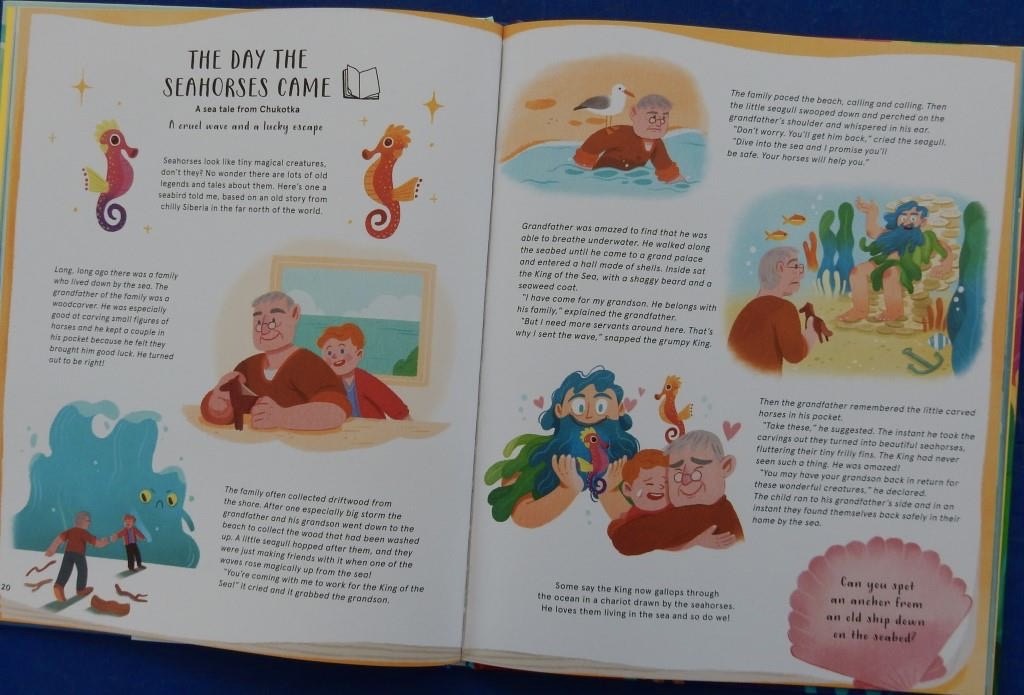
to microscopic zooplankton and phytoplankton and sea-horses, to mention just a few.

Other topics are included such as ways of communicating – did you know that bottlenose dolphins each have their own unique whistle sound or that blue whales make low rumbling sounds that can travel as far as 3200 km through the water? There’s a look at the ocean’s gardens, the chilly, slippery stormy spots formed of ice and snow, an encounter with fearsome creatures with ferocious-looking teeth. And, we find out something about ocean currents, some special coastal features, what it’s like living and working by, and with, the sea.

Many of the spreads have a ‘can you spot’ feature to encourage younger readers to use their powers of observation. The two final spreads are devoted to the endangerment of turtles and what we humans can do to help them. There are also five traditional stories from various parts of the world.

With bright, bold illustrations infused with humour, and a thoughtfully presented, engaging text, this is enjoyable learning for primary children.

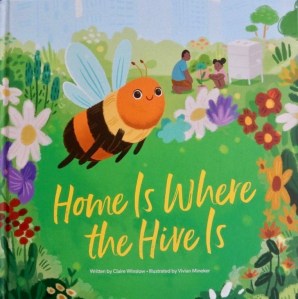
Home Is Where the Hive Is

Home Is Where the Hive Is
Claire Winslow and Vivian Mineker
Sunbird Books

This story told from the viewpoint of Beatrice or ‘Flower-Finding Scout Bee #7394’ is one I’d strongly recommend sharing with KS1 children.

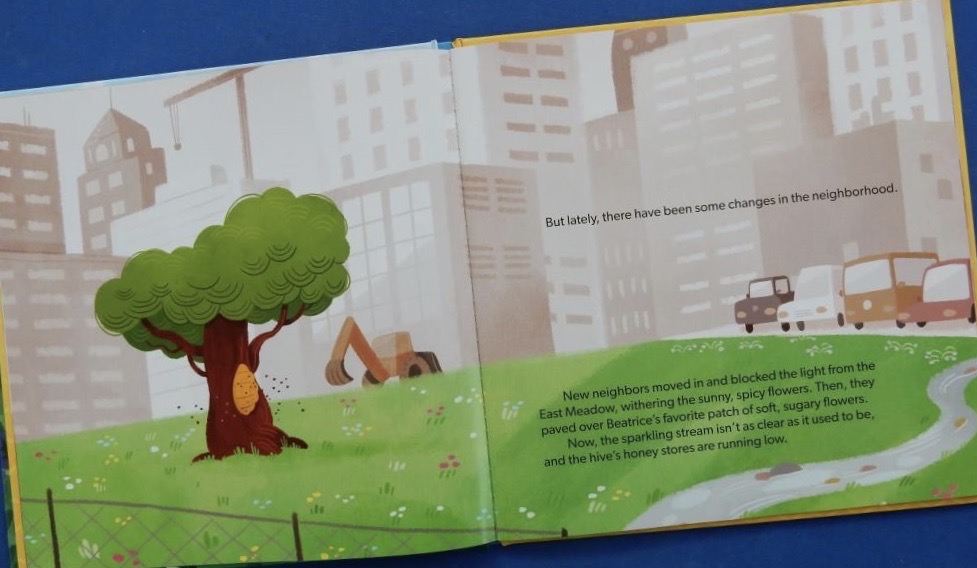
Beatrice lives with her 50,000 sisters in Big Tree Hive a place that with its wealth of tasty flowers close by and plenty of room for storing honey, has been a home for bees for ages and ages. Now however the neighbourhood is undergoing changes: the flower patch has been paved over, the stream is being polluted and tall buildings obstruct the light from the area of the hive.

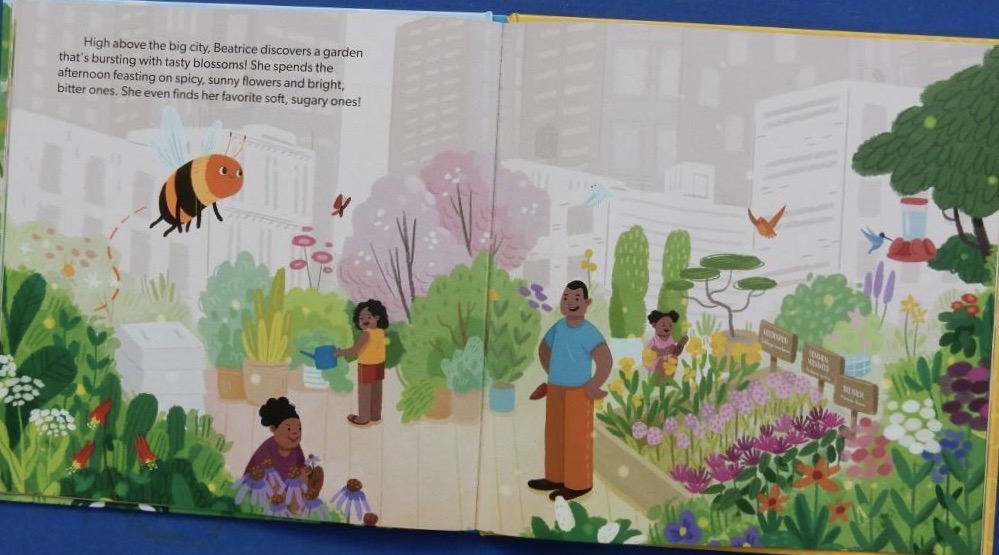
When the queen bee announces that it’s time for all the hive residents to find a new home, Beatrice is determined to find a place that is the equal of Big Tree Hive and off she flies. There’s plenty of danger and she feels scared, but Beatrice isn’t one to give up easily so she keeps on searching. Will her adventure be a success; will she have sad or good news to impart when she flies back to her old home; and what will be the reaction of her sister bees?

With its themes of urban development and the loss of green spaces, Claire Winslow writes from the heart about a topic she clearly finds important to share with youngsters. In support of bees and other pollinating creatures, after the story she provides information and suggestions to help readers, their families and teachers make a difference.

With Vivian Mineker’s vibrant illustrations, this is definitely a book for KS1 class collections and for family shelves.

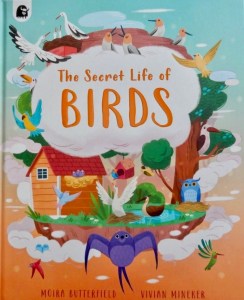
The Secret Life of Birds

The Secret Life of Birds
Moira Butterfield and Vivian Mineker
Happy Yak

Following The Secret Life of Trees and The Secret Life of Bees, the same author and illustrator bring us a book on the world of birds. Readers are in the hands or rather wings, of Speedy the swift, that acts as guide and narrator on this varied glimpse into the world of our feathered friends.

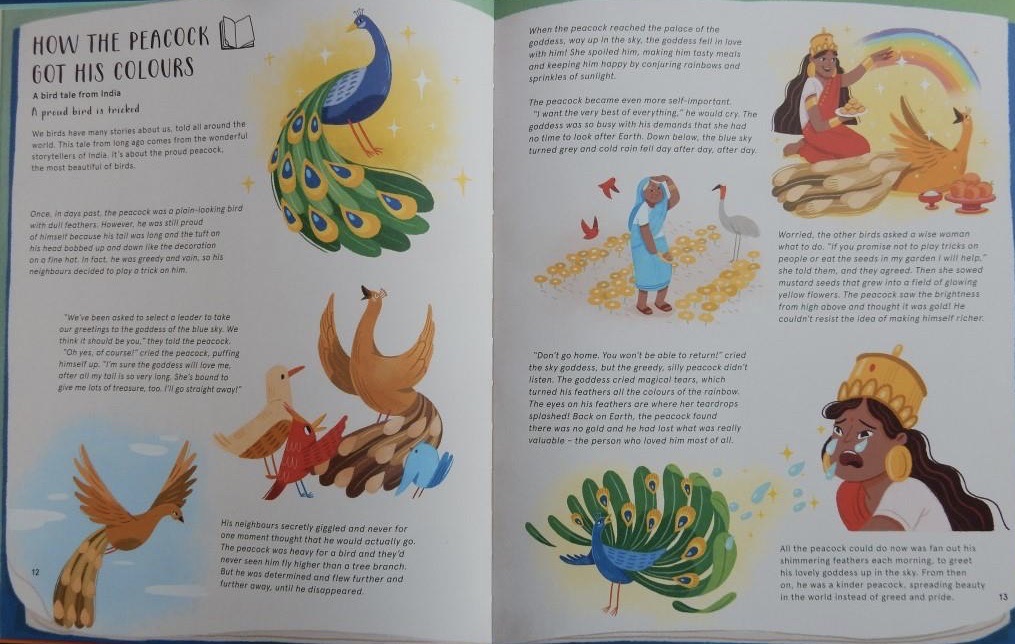
Did you know – well so Speedy says – swift chicks do press-ups on their wingtips to make themselves stronger. This is just one of the cool facts Moira includes herein, along with some stories and Vivian Mineker’s splendid illustrations that really help bring both information and folk tales to life. One of the latter comes from India and is called How the Peacock got his Colours. We read how one peacock, full of self-importance despite his plain, dull feathers was tricked into paying a visit to the sky goddess and in so doing acquired not only his stunning tail plumage, but also some kindness and humility.

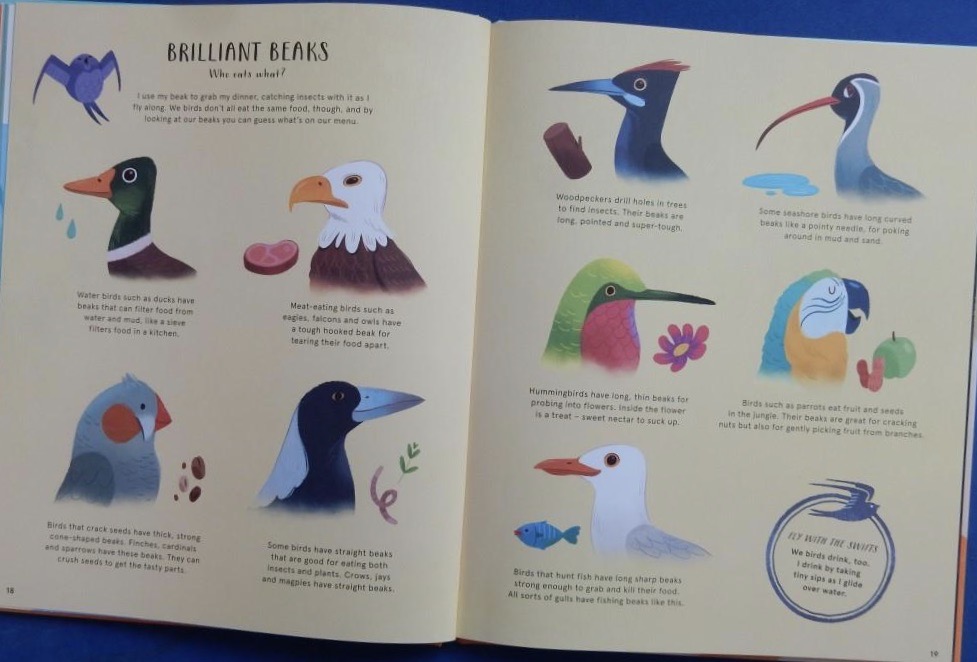
There’s information relating to avian anatomy, growth and development, feathers and their functions, survival, a close up on beaks;

we meet some nocturnal hunters, find out about bird calls and bird song, visit a variety of nests – swifts return to the same one each year repairing it if necessary, look at the stages in the development of a chick from egg to fledgling, there’s a spread on journeys on the wing, are introduced to some record breakers and discover sadly, that all over the world there are endangered birds and finally are some tips on how to help the birds that live close to our homes.

There’s something for everybody here; it’s a good introduction to the topic and a book to add to family shelves and primary classroom collections.

Britannica’s 5 Minute Really True Stories for Family Time

Britannica’s 5 Minute Really True Stories for Family Time
Britannica Books

Authored by Alli Brydon, Catherine D. Hughes and Jackie McCann and illustrated by four artists – Anneli Bray, Vivian Mineker, Sophia Moore and Syklar White – are thirty true stories about things families do together. More than two thirds relate to humans whereas the final seven feature animal families, both sections starting with a look at homes in different parts of the world including for the former, Australia and Bangladesh.

Breakfast is the topic for the second story and I was fascinated to discover the varieties and ways families eat their porridge, whereas the thought of consuming some of the items such as those in a Japanese breakfast first thing in the morning (or at any time) turned my vegan stomach right over.

Whether the reader’s particular interest is in things scientific, or related to technology, sociology – festivals or weddings perhaps, history or art of some form there’s something to discover herein. I particularly like that ‘Storytime’ includes the fact that stories can be told in different ways including through paintings, drawings, dance or music.

Each topic is allocated three double spreads and some incorporate more than one interest area.
The question(s) embedded in each story and occasional practical possibilities provide an interactive element to the book.

For this reviewer using the term ‘true stories’ for this kind of narrative non-fiction is something of a misnomer. There’s a wealth of fascinating information in this attractively illustrated book,

but it’s one I see being used in a primary classroom as part of a topic (there are many possibilities), rather more than a family read together as suggested by the title.

The Secret Life of Bees

The Secret Life of Bees
Moira Butterfield and Vivian Mineker
Words & Pictures

In this large format book you can learn all about the life of the domesticated honey bee and much more. The bee’s life cycle, anatomy,

life in a hive including the tasks undertaken by workers – cleaning, care of the bee nursery, making honey and wax, guard duty and finally, foraging for nectar and pollen outside; plus facts and figures about other species at home and abroad, honey thieves,

pollination, what bee keepers do and how to create a bee-friendly environment are all explained by our narrator worker guide, Buzzwing the honeybee.

There are also five bee tales from various parts of the world including Greece, India and Australia.

Vivian Mincer’s enticingly colourful, gently humorous child-friendly illustrations with Buzzwing’s invitation to spot various creatures hiding within many of the scenes, are likely to be pored over at length by young readers. Author, Moira Butterfield even invites budding poets to write their own bee poetry as did the character in the Indian tale she retells. Indeed, there are activities relating to each of the tales included.

The health of our natural ecosystems is intrinsically linked to the health of our bees (and other pollinators) but their numbers are in decline. Let’s hope this fascinating book will enthuse youngsters to do whatever they can to halt this potential catastrophe.

Altogether a super introduction to the world of bees.

Who’s Driving? / What a Ship Sees

Who’s Driving?
Leo Timmers
Gecko Press

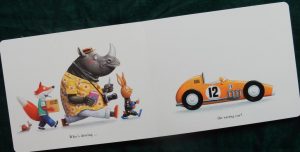
Toddlers and pre-schoolers will absolutely love playing this matching /prediction game wherein Leo Timmers invites them to guess ‘Who’s driving …’ – in the first instance the fire-engine – from the animal character line up on the verso each clutching a key and hastening towards the vehicle shown on the recto. Turn the page ‘wheeooh wheeooh wheeooh’ and the answer is revealed along with the vehicle’s destination. (Sharp-eyed youngsters will likely have spotted some of the clues as to the driver on the first spread.)

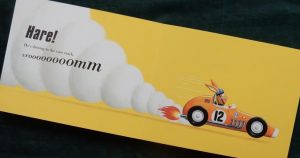
A different four animals appear as possible drivers for each of the new vehicles depicted – the limousine, the racing car,

the tractor, the convertible, the jeep and finally, the aeroplane.

There’s an element of the Hare and the Tortoise fable here too, though probably only appreciated by adults. Little ones will love the explosive onomatopoeic, sound-making opportunities that seemingly make the vehicles whizz right off the pages; and the unlikely drivers depicted in Timmers’ acrylic illustrations. Both visual skills and observation skills will certainly have been stretched too after sharing this.

What a wealth of learning potential there is in this fun little book: it’s a must for nursery/preschool settings and enormous fun for home too.

What A Ship Sees
Laura Knowles and Vivian Mineker
Welbeck Publishing

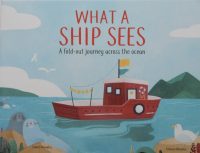
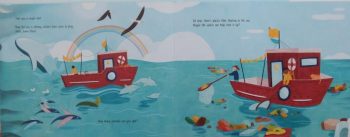
In this cleverly designed concertina book, we follow the journey of a little red ship as it sets out from the jetty on a voyage across the sea. This is no smooth journey though as a storm blows up shortly after the boat has passed a desert island, but all is well and the sailors pause for a while to help remove some of the floating plastic litter before continuing to move north to chilly waters and finally reaching home shores once more.

During the unfolding trip guided by Laura Knowles chatty style narrative, youngsters can enjoy spotting in Vivian Mineker’s illustrations, various sea craft – fishing vessels, a tanker and an enormous cruise ship, as well as dancing dolphins, a shoal of flying fish,

and the changing weather.

There’s a wealth of talk and story-telling potential in the 2.5 metre long unfolding drama, on the reverse side of which is a cutaway of the little red boat, as well as individual elements of the journey along with further information about each one be that ocean fauna, nautical communication,

safety, or ships and boats.

The Secret Life of Trees

The Secret Life of Trees
Moira Butterfield and Vivian Mineker
Words & Pictures

Oakheart the Brave, oldest tree in the forest wherein it stands, acts as narrator of this revealing look at what happens beneath the bark and ‘neath the branches, below the roots even, of trees –arguably THE most important life form on our planet. Some of what we read contains truth in the form of fiction, some is fact.

To begin this fascinating book, Oakheart tells of how a marauding mouse seizes the acorn containing the very seed from which emerges the little shoot that is to become our enormous narrator.

He goes on to regale readers with arboreal tales including a version of an Indian one, The Banyan Tree, as well as The Sky-High Tree from Hungary

and some season-related stories: from Scotland comes The Fairy Tree, from Norway, The Summer Storm and with its autumnal setting we have The Tree of Life from Persia, while the final tree tale Magic in the Forest comes from Britain and is a legend about the wizard , Merlin.

There’s plenty of science too, relating to photosynthesis;

facts and figures about the oak’s growth; information about its animal inhabitants – small and very small; how trees communicate; seasonal change is discussed and much more, concluding with the all-important How to be Tree-Happy that explains briefly how to care for our precious trees and how you might grow one yourself.

Moira’s mix of information and story works wonderfully so the book should have a wide appeal; every spread offers an exciting visual experience too. I love the different viewpoints and clever ways of presenting information such as that of Secrets Inside Us.

Thank you Oakheart for your special gift.