Talking History

Talking History
Joan Haig and Joan Lennon, illustrated by André Ducci
Templar Publishing

Words have the power to move us whether addressed directly to a live audience in a formal setting – political, judicial or in a demonstration, broadcast through the media (TV, radio or social media) or, in printed form such as in newspapers or pamphlets.

The authors and illustrator introduce readers to sixteen speakers from all over the world – eight women and eight men – who over the past 150 years have made historic speeches, each of which has in some way helped to shape the societies we live in today.

Arranged chronologically the orators featured have spoken out on such fundamental issues as civil rights, war, women’s rights, (Emmeline Pankhurst and Funmilayo Ransome-Kuti) gay rights (Harvey Milk) and climate change. The contents of their speeches along with facts about the events that led up to each one, as well as what happened thereafter, are presented in infographic style in this inspiring book.
It’s good to see two not one double spread allocated to each (apart from the two ‘youth voices on the environment’, Severn Cullis-Suzuki and Greta Thunberg, who share four pages.)

Most of those included will be familiar to readers and I was thrilled to see my all time hero, Nelson Mandela with his 1964 ‘statement from the dock’, 

as well as Barack Obama’s 2015 ‘remarks by the president at the 50th anniversary of the Selma to Montgomery marches’ both featured.

A new name to me is Pearl Gibbs who spoke out for justice for the aboriginal peoples of Australia and was involved in 1939 in the very first major Aboriginal civil rights demonstration. 

This is more than just a history book, it’s essential reading for children who will one hopes feel empowered to speak out for the causes in which they believe.

Bloom

Bloom
Anne Booth and Robyn Wilson-Owen
Tiny Owl

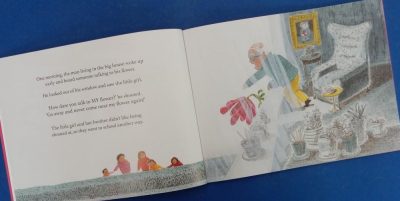
Beneath the window of a large house grows a beautiful flower and every morning as they walk to school with their mum, a brother and sister stop briefly by the flower. The little girl would go up close to savour its beauty with her eyes and nose and address it thus, “Good morning, beautiful flower … I think you’re wonderful. Thank you for being here for us. I love you.” She’d then proceed happily into school.

This went on until one morning having woken earlier than usual the man living in the big house saw what was happening and shouted threateningly at the girl and her brother.

Consequently they decided to change their route to school.

Next morning although the sun came out, the flower didn’t. The poor gardener is blamed for improper watering and the man does the job instead – but still the flower stays closed.

Perhaps it’s shade the flower needs the angry man thinks but again it fails to make a difference. No matter what he does or says the flower remains firmly shut and increasingly droopy.

Totally exasperated and full of complaints, the man calls his gardener again. Despite not knowing what the matter is, the gardener is observant and tells the man exactly what the little girl had done every day.

Finally after consideration, the man goes to the school gate, waits for the girl and her brother and tells them tearfully what has happened.

The little girl offers him some advice and the man rushes home. Instead of self-centred, self-interested orders, can kind, heartfelt words succeed in making his flower bloom again?

With echoes of Oscar Wilde’s The Selfish Giant, Anne Booth’s ultimately uplifting fable demonstrates the power of words and the importance of considering carefully how what you say will impact upon others: positivity is key.

Robyn Wilson Owen’s finely textured, mixed media illustrations show the contrast between the children’s nurturing home environment and that of the man’s lonely existence as well as documenting the changes in the flower through the story.

How to be a Lion

How to be a Lion
Ed Vere
Puffin Books

‘This book is for those who daydream, and those who think for themselves’.
I love that. It’s written in Ed Vere’s inspiring ‘letter’ that accompanied my review copy; it’s also printed on the final page of his eloquent story: I hope it applies to myself, make that, to everyone. I wish everybody could read the entire letter, but instead I urge you to get yourself a copy of the book and share it widely.

It starts philosophically: ‘The world is full of ideas. /Big ones,/ small ones. / Good ones,/ bad ones. / Some think this … / others think that.’ before bringing us back to earth and in particular, lion territory on the African plains where the norm is to be FIERCE! But is that the only way to be?
Enter Leonard: thoughtful, prone to daydreams, something of a poet and above all, gentle.

Enter shortly after, a duck, Marianne by name. Being Leonard, it isn’t a case of ‘Crunch, crunch, CHOMP!’ Instead our lion, polite introductions over, requests her assistance and as luck would have it, Marianne is able to assist in freeing Leonard’s stuck muse and before long a firm friendship has been forged; one that involves stargazing, philosophical musings and above all, contentment and happiness.

Into their peaceable existence comes a pack of ferocious lions demanding to know why the duck has not met its demise.
True to himself, Leonard explains about their friendship and resists their loud growly admonishments.

Their instructions about becoming fierce make him pause and question however, but Marianne suggests a trip to their thinking hill to mull things over. Lo and behold, serious hums and serious quacks together are turned into an idea, and then, poetry that is finally ready to be presented to those fierce lions.

What Leonard says to them is heartfelt, provocative – “Why don’t you be you … And I will be I.” – and one hopes, a game changer.

Ed Vere’s timely fable is profound and intensely moving in the gentle way it offers words as tools of bridge building and change, as well as showing a different male role model. Don’t be pressurised into conforming, be yourself is what shines through both his words and oh, so eloquent, humorous illustrations.

A perfect read aloud with oodles of food for thought, and talk.

What Makes me a ME? / Words and Your Heart

What Makes me a ME?
Ben Faulks and David Tazzyman
Bloomsbury Children’s Books

Here’s a diverting book about identity: “What makes me a ME?” Who am I and where do I fit into this world? – these are questions that everyone ponders.
For the boy narrator it’s a mind-stretching poser as he acknowledges that at different times he’s like a whole range of things: sometimes he’s slow like a snail but he’s not slimy and his eyes don’t stand out on stalks.

He doesn’t have a tail so he can’t be exactly like his puppy Monty, despite being full of energy.
Is he perhaps like a sports car; he’s certainly lightning fast, but that’s thanks to his legs rather than wheels.

No matter what he likens himself to, essentially he’s just himself – special and unique.
Faulks’ funny rhyming stanzas documenting the five year old narrator’s search for an answer to his philosophical question provide Tazzyman plenty of space to conjure up some wonderfully comical scenes, and the boy himself with snub nose, specs and bobble hat is cheekily enchanting.

Words and Your Heart
Kate Jane Neal
Simon & Schuster Children’s Books

Words are powerful things: they can make your heart soar; they can make your heart sink; they can make your heart sing; they can make your heart hurt.
Words can be a force for good; or they can be a force for causing pain.
All this and more is demonstrated through characters Pip and Cat in author/illustrator Kate Jane Neal’s debut picture book.
‘This book is about your heart.
The little bit inside of you that makes you, you!’

So begins this unassuming book that goes on to say ‘the words that enter your ears can affect your heart.’
Her simple, but compelling message is a wonderful demonstration of how we can all contribute to making the world a better place by being mindful of the words we use to, and about, other people.

Executed with minimal colour, the illustrations, together with the empathetic and compassionate text that is orchestrated by means of changes of font, put forward a message too important to ignore.

A book to share and talk about at home, in playgroups and nursery settings, and in schools.

I’ve signed the charter