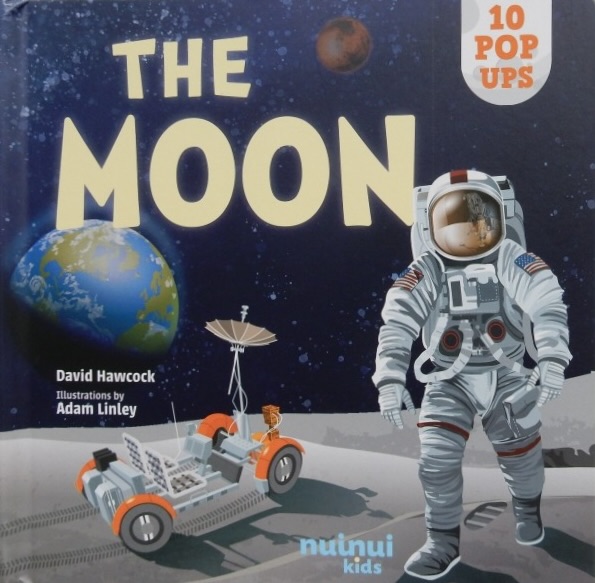
The Moon

The first manned Moon landing was over fifty years back when NASA’s Apollo 11 mission took Neil Armstrong and Buzz Aldrin to the Moon, with Neil Armstrong being the very first human to walk on the Moon’s surface and adults will perhaps recall his “That’s one small step for (a)man, one giant leap for mankind” speech.” Now NASA’s Artemis Ⅱ Moon Mission has brought the moon very much into focus again and this timely pop-up offers an accessible, fun and informative way to educate young children about our nearest celestial body and Earth’s only natural satellite.

The aforementioned Apollo 11 landing is the subject of one of this book’s ten spreads – Walking on the Moon from which we learn that a dozen NASA astronauts from Apollo missions between 1969 and 1972 have walked on the Moon. (This spread is also the cover illustration, sans the flag jointly planted on the surface by Armstrong and Aldrin.)
Before that though is a spread entitled Man on the Moon whereon we have a pop-out of the Apollo 11 Lunar Module – Eagle.

I’ve rather jumped ahead of the book’s sequence, which begins with a look at the Solar System and youngsters will learn that there are in fact many moons therein. Next, following an introductory paragraph, The Moon spread explains that the Moon goes around the Earth and is one aspect of the movement (planet motion) helping to create night, day and the seasons. We also see diagram of the layers inside the Moon.

I won’t mention details of the other six spreads: (below is the illustration for one of them)
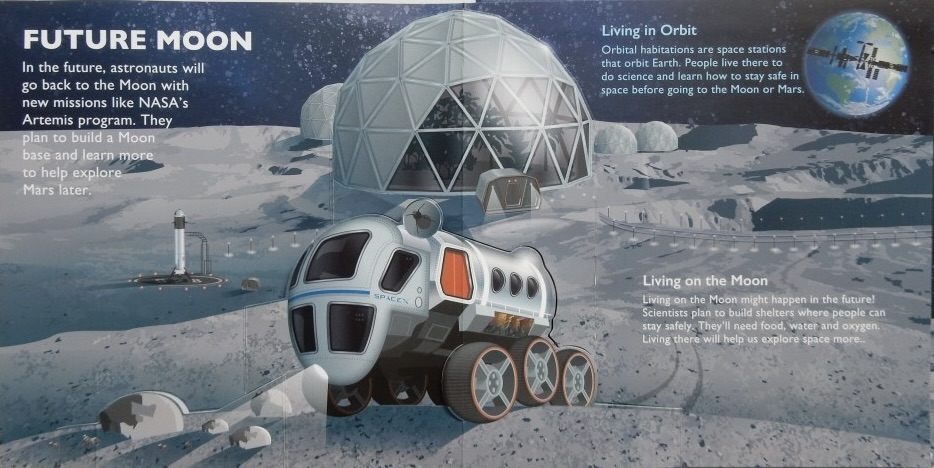
rather, I suggest that you get hold of a copy of this fascinating book and share it with young children – in small groups or individually. It’s sturdily built so should stand up to handling in a Foundation stage/KS1 classroom.

The Moon

The Moon
Hannah Pang and Thomas Hegbrook
Stripes Publishing

It was the non-scientific chapters of this superbly illustrated volume that attracted me most, rather than those on the space race, lunar exploration and moon missions.

Earth’s moon has inspired countless people – artists, poets, mathematicians, astronomers and a great many others have aspired to investigate it scientifically and some have even managed to pay it a visit. It’s truly a source of awe and wonder to us all, no matter what our predilections.

There is an enormous amount of fascinating information in this book published to coincide with the anniversary of the moon landing, as well as myths and legends, poetry, folklore and Thomas Hegbrook’s wonderful, wonderful full-page illustrations of such things as  the celebration of the Chinese New Year.

On this spread we learn that the festival was long ago a celebration of a successful harvest of wheat and rice, when food was offered to the moon; this has been celebrated since the Shang dynasty around 1600-1046BCE.
Other aspects of the celestial calendar are covered in this chapter including paragraphs relating to some religions that follow a lunar calendar including Buddhism, although I saw no mention of Hinduism.

The Moon features in many myths, some being concerned with the Man in the Moon; we learn of such from the Haida people who live on the Pacific coast of Canada; from Germany, including residents of Rantum a small village on the German island of Sylt. It’s said there, that the Earth’s tides are controlled by the Man in the Moon, a giant responsible for pouring water onto Earth creating high tides, and resting as the waters die down.
There are also many Moon Rabbit myths from as far afield as Japan, Korea and Africa.
I especially liked The Fox and the Wolf fable and the way it’s set within a beautiful moonlit scene.

Other parts I found fascinating were The Moon and our Bodies, sleep being one aspect affected by its cycle, as well as the chapter on how a full moon is thought to make people do strange things, even perhaps having an effect on such diverse things as the stock exchange and emergency service call outs.

Numerous artists have included the moon in their paintings. In traditional Chinese art it’s most often shown as a tiny object in the distance; whereas Japanese paintings frequently show a large, partially hidden moon.

Architects too have been inspired to use the moon in their building designs.

There is SO much to learn from this book but it’s impossible to cover everything in a review such as this. Instead I suggest you treat yourself to a copy of Hannah Pang and Thomas Hegbrook’s magnificent moon-filled compilation.