I Am A Tiger / The Happy Lion

I Am A Tiger
Karl Newson and Ross Collins
Macmillan Children’s Books

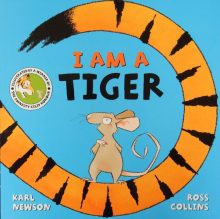
Ignorance? Bravado? Or playfulness? What is driving Karl’s Mouse protagonist to insist that he’s a tiger. Fox, racoon, snake and parrot in turn, challenge the small creature to prove himself but his lack of size, stripes and tree climbing skills do nothing to convince the others of his claim and that growl is – let’s say somewhat feeble.

Suddenly along comes another animal proclaiming …

The ‘not-tiger’ then goes on to try and persuade the stripy character that HE is in fact a mouse with some deft moves.

These he follows with some further ridiculousness

before departing in search of lunch.

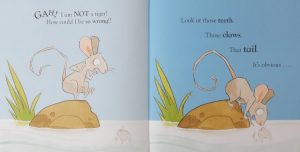
This sees our little grey friend heading towards a watery place wherein he spies his reflection and there he learns the error of his claims …

With it’s wonderful surprise finale, this is a grrralectable piece of comic theatre picture book style delivered through Karl’s droll mouse narrative and Ross Collins’ brilliantly expressive scenes.

Hilarious, and I look forward to the next of the promised Karl/Ross creations; they’ve certainly set the bar pretty high with this one. Young listeners will absolutely love it and it’s a gift for those who enjoy throwing themselves into story sharing.

The Happy Lion
Louise Fatio and Roger Duvoisin
Scallywag Press

This is a new edition of a classic story originally published in the 1950s and is set in a French town.

In that town is a zoo, the home of the Happy Lion. He leads a contented life there with daily visits from friends young and not so young, as well as being entertained by the town’s band on Sundays during the summer.

One day, the keeper forgets to close the door and the lion decides to go out and visit all those kind people who were his regular visitors.

Their reactions however are not at all what the Happy Lion expects; he’s barely acknowledged by the animals and the humans are terrified.

Bemused he stops, meditates, concludes, “this must be the way people behave when they are not in the zoo” and continues on his way hoping to find a friend.

He does so, after some drama involving a fire engine, firefighters and their very long hose; and all ends happily with the Happy Lion and his young friend walking back to the zoo together …

With alternate black and white, and three-colour, textured spreads, Duvoisin’s illustrations – wonderful, sketchy, smudgy scenes – still hold their magical charm – for this reviewer certainly – providing the perfect complement to Fatio’s tale.

Umbrella

Umbrella
Elena Arevalo Melville
Scallywag Press

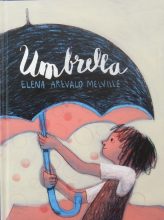
Imagine a world where everyone is kind and forgiving, and where anything is possible. How wonderful would that be. That is the world Elena Arevalo Melville creates in this uplifting story that begins one morning with Clara without anybody to play with in the park.

But then she comes upon an umbrella, albeit somewhat worn, but Clara picks it up and places it gently on a bench close by. To her surprise the umbrella thanks her and goes on to say, “Look inside me. Anything is possible!”

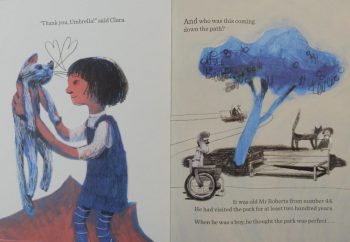
And so it is, for when she opens it up she finds herself face to face with a splendid playmate. Now for Clara at least, the park is quite simply perfect as it had been to near neighbour, old Mr Roberts when he was a boy.

But from his wheel chair he can only look up towards those tasty-looking apples in the tree and think, ‘if only’. Not for long though for Clara is there telling him ‘anything is possible’, with the umbrella urging him, “Look inside me.”

Before long, not only has Mr Roberts got an umbrella full of the yummy fruit, but he’s asking his helper to pick enough for everyone.

And so it goes on until the park is alive with magic and music courtesy of the butterfly band. Everyone joins the dance

except one rather unsavoury character watching from the side with his eyes firmly on that umbrella; a foxy gentleman with only one thing in mind – a very selfish thing.

Can that umbrella work its own special magic yet again and perhaps enable a state of perfection to pervade the entire park?

Debut author/illustrator Elena Arevalo Melville’s use of a minimal colour palette until the penultimate spread serves to make that illustration all the more perfect too. Her somewhat surreal tale of empathy, kindness and community is one to share and discuss at every opportunity.

Then I’d suggest asking listeners to make their own wishes. Perhaps they could write them down and drop them into a partially open umbrella safely secured in a strategic spot.

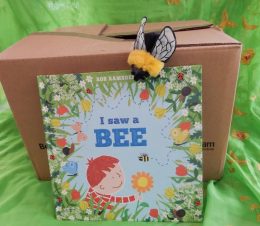
I Saw a Bee

I Saw a Bee
Rob Ramsden
Scallywag Press

Having introduced himself, the small boy narrator of this largely visual story tells what happens when he opens a big box and discovers a bee.

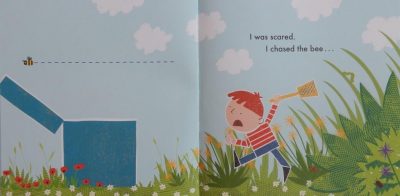
Unsurprisingly, once the lid is lifted the bee buzzes out straight at the lad, scaring him so much that he gives chase.

The bee reciprocates, buzzing after its pursuer who leaps into the box to hide. Inevitably the insect flies off leaving other minibeasts to enter the arena.

Then however, the boy, presumably tired of being stuck inside the box,

emerges and searches for the bee; but the buzzy insect remains elusive, so much so that it’s missed by the lad.

Suddenly ‘Buzz Buzzz’ – could it be? Following the buzzing sound results in a great deal of celebratory buzzing around

and an outpouring of reciprocal love between the human character and the stripy insect he’s befriended.

Beautifully simple – it’s perfect for beginning readers, as well as young listeners, Rob Ramsden’s debut picture book (the first of a promised series that aims to encourage appreciation of the natural world in little ones), has a vital message, all the more so when we read of the decline in insect numbers in our countryside.

Told with a catchy natural rhythm, Rob’s text is highly repeatable; and in conjunction with his wonderfully patterned, screen printed illustrations of the child in the natural world, makes for a book to read, read and read again; and one which should playfully launch the ‘bees are vital’ message that will stay with the very young through their lives.

A delicious first picture book: I look forward to more.

Me and My Sister

Me and My Sister
Rose Robbins
Scallyway Press

Readers are not told that the sister referred to in this book’s title is differently abled or has an autism spectrum condition, in this account of the life shared by the narrator and his sibling: it’s left for us to infer through Rose Robbins’ verbal and visual narrative.

Therein we witness the highs and lows of having a much loved but differently abled younger sister who communicates through sounds and actions rather than words, actions that might be challenging or unsettling although not to understanding older family members.

The siblings attend different schools where the activities are different, although they both do a lot of learning.

There are plenty of fun times, as well as some embarrassing ones especially where strangers are concerned; and it’s frustrating to get chastised for things that aren’t your fault when it seems as though others are getting away with things.

Big bro. reassures us that no matter what, despite their obvious differences he’s an understanding and very loving brother

who is loved back by his little sister.

Told and illustrated with great sensitivity and gentle humour, in no small part because debut author/illustrator Rose Robbins teaches young people who have autism and also has a brother with autism, this is a book that should help foster empathy and understanding to share and talk about in school and at home.
Almost every class I’ve taught has included one or more children with autism and I know that their behaviour can sometimes be challenging; but more importantly, what they need is a loving, stable, structure within which to learn. That is what’s shown in Rose’s story.

(I’m writing this review having spent time today having coffee at Ruskin Mill organic café near where I live. Ruskin Mill is an educational establishment for learners with complex needs; it’s evident from observing those who work with the 16-25 year old students that sensitivity, humour, respect and understanding are part and parcel of their philosophy and approach to everything that happens there.)

The Wall in the Middle of the Book

The Wall in the Middle of the Book
Jon Agee
Scallywag Press

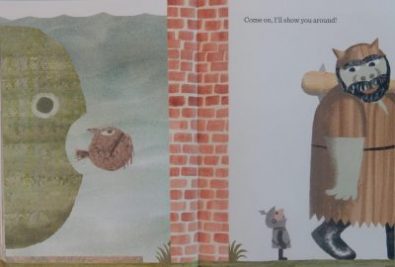
‘Something there is that doesn’t love a wall’. So begins Robert Frost’s famous poem Mending Wall, and so it is too, with Jon Agee who has cleverly constructed a fable with a high brick wall running along the book’s gutter, with the action unfolding on either side.

The story opens with, on the verso, a small knight carrying a ladder approaching the wall while on the recto stand menacingly, a rhino and a tiger. ‘It’s a good thing. The wall protects this side of the book from the other side of the book’ the knight tells us as he stoops to pick up the displaced brick to mend said wall. On the other side, the crew of angry animals has increased.

Up the ladder goes our knight oblivious to what is happening behind him and asserting, ‘This side of the book is safe. The other side is not.’

By this time, the bond with the author is firmly established and readers and listeners will be revelling in the superb interplay between words and pictures, asking themselves, are our narrator’s words altogether well- founded?

Next we learn of the most dangerous thing on the other side of the wall, an ogre.

This ogre however is not quite what the little knight is expecting. Indeed other things too are not at all as he’d anticipated.

Brilliantly expressive – look how the faces and body language of all the animal characters speak without uttering a single word while much of the feelings of knight and ogre are conveyed wordlessly, serving to emphasise the verbal/visual antagonism.

Agee’s pacing too is superb, but best of all is his inherent theme that preconceptions about people from elsewhere are often wrong. In our troubled times of erecting boundaries, walls in particular, rather than building bridges, this timely book will strike a chord with many readers and is a fantastic starting point for opening up discussion.

Hat Tricks

Hat Tricks
Satoshi Kitamura
Scallywag Press

This isn’t the first book Satoshi Kitamura has created about an amazing hat; around ten years back there was Millie’s Marvellous Hat about an imaginative little girl and an invisible hat.

Now we have Hattie and she too has a hat – a magician’s hat; so take your seats everyone, the show is about to begin. And what’s a magician’s favourite way to start a spot of prestidigitation? With a wave of the wand and the magic word ‘Abracadabra’; in this case followed by ‘katakurico’ and the question ‘What’s in the hat?’

In the first instance it’s a cat; but there’s more to come. Hattie repeats the words and out leaps a squirrel.

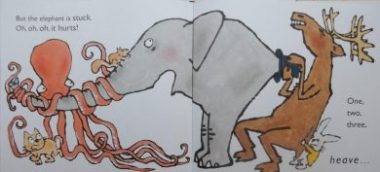
And so it goes on with Hattie producing ever more unlikely and larger animals, none of which appears happy to see its fellow creatures.

Then one of the creatures being conjured gets stuck, unable to extricate itself entirely from the hat. It becomes the centre of a rather painful tug of war

until eventually … out it comes.

Surely there can be nothing left in that hat, now, can there? Well, the grand finale is yet to come … ta-dah!

I’m sure little ones will respond by calling for an immediate ‘encore’ after you’ve shared this book with them. My listeners certainly did.

This is a splendid piece of theatre. Satoshi’s animals are presented with panache: the gamut of eloquent expressions is sheer genius.