Gilly the Giraffe Self-Esteem Activity Book

Gilly the Giraffe Self-Esteem Activity Book
Dr Karen Treisman, illustrated by Sarah Peacock
Jessica Kingsley Publishers

This large format paperback is both a therapeutic story and a creative activity book for primary aged children, developed by specialist clinical psychologist, Dr Karen Treisman.

It begins with a story about Gilly the Giraffe to be shared with children. Gilly has much in her world to be happy about but she struggles with self-confidence on account of her height, her long black tongue and her colourful mosaic patches; and worse, some of the other animals make unkind remarks about these aspects of her appearance.

However, thanks to kindly Loren the lioness pointing out that being different makes Gilly exciting, beautiful and cool;
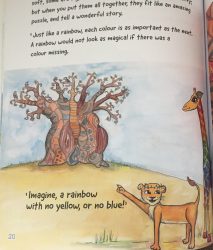
it’s all a matter of how you look at something. “We’re all precious and deserve to be appreciated.” So says Loren and thereafter not only Gilly but her classmates start to become more appreciative about one another.

A great confidence-boosting tale after which might come discussions on some of the story’s key themes.

Thereafter the book offers a wealth of creative ideas through which these themes can be further explored. These are divided into two parts, the first being ‘fun activities and crafts with Gilly’ and comprises such things as mindful colouring, a word search, a quiz, questions to consider, a ‘make your own Gilly the Giraffe, a wonderful positivity wordlist, a positivity acronym using a person’s name(s) and more.

Part 2 contains over 25 further suggestions (that can be used in school or at home) for boosting self-esteem, confidence, positive thinking and self-belief,
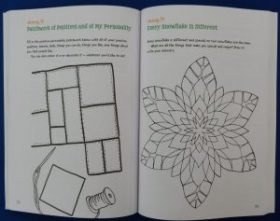
each of which is clearly explained and where appropriate, space is provided in the book for writing, drawing or whatever is apt by way of a response.

With its integrated approach, this book is ideal for using in PSHE sessions and concludes with an excellent explanatory guide for adults; much of what is said herein, especially in the ‘practical strategies, tips and ways of being for building self-esteem’ should be read and acted upon by all who have dealings with children in whatever context.

Wearing my teacher/consultant hat, I whole-heartedly recommend this book.

Yoga for Children and Young People with Autism

Yoga for Children and Young People with Autism
Michael Chissick, illustrated by Sarah Peacock
Jessica Kingsley Publishers

Highly experienced yoga teacher, Michael Chissick has created another absolutely smashing book, for those who teach yoga to youngsters, specifically those with autism, although much of what is included here would work well with neurotypical children too.

At the outset Michael states his case explaining that perfection is not on the agenda, so an adult-style class approach is inappropriate as is chanting.

A plan is vital; intuitive teaching won’t work with children on the autism spectrum: I know from experience they need a structure and that is what the book provides, whether the teaching is done in a mainstream school that includes children with autism or a special school where everyone being taught is on the autism spectrum. If the latter is the case, Chissick suggests three groups(his are named after trees) which can be fluid but are based on the degree of challenge both students and the teacher of the class face.

He then goes on to offer four different lesson plans – one being suitable for all students (universal) and three others – and each of the latter is progressive.

Much of the remainder of the book contains the differentiated tried and tested games, thirteen in all, some of which require additional resources that are flagged up at the outset. There are also sequences such as the Sun Salutation and some sequence games, followed by the postures themselves including ‘good sitting’

(illustrated by Sarah Peacock whose work will be familiar to those who know Michael’s other books such as Ladybird’s Remarkable Relaxation and Sitting on a Chicken .)

And of course, there are ideas for the vital ‘calming stage’ and final relaxation.

There’s a chapter on teaching yoga to children who have ASD in a mainstream classroom, followed by some case studies and extremely useful visual resources.

A wealth of experience has gone into this book: it’s a veritable treasure trove for anyone who teaches yoga to children, whatever the setting, but especially children with ASD.

Seahorse’s Magical Sun Sequences

DSCN6249 (800x600)

Seahorse’s Magical Sun Sequences
Michael Chissick and Sarah Peacock
Singing Dragon (JKP)
Using a variety of sea creature characters, yoga teacher Michael Chissick weaves a narrative through which the ‘Sun Salutation’ sequence is introduced, thus making it highly accessible to all primary aged children.
The Sun Salutation is a sequence of linked postures that should help children to feel confident and positive about themselves. To this end he offers four sequences, three of which have been specially modified to suit the particular needs of wheelchair users; those with autism or sensory problems; those who for one reason or anther – cerebral palsy or a temporary problem that makes it hard for them to stand up and the first, for children whose bodies are not yet sufficiently supple for the full sequence (here called the Challenging Sun Sequence).
Chissick has carefully selected sea animals to represent the various challenges children may be faced with: Toddler and Junior the Starfish Brothers, have very stiff backs so Seahorse teaches them the first “Sun Sequence” breaking it down into a cyclical sequence and reassuringly telling the brothers to go only as far as they can with the bending and stretching. This one involves some twisting the author calls “curly whirly 1’ and ‘curly whirly 2’.
Eel is a wheelchair user …

DSCN6251 (800x600)

and Starfish has a specially adapted sequence for her, which helps to make her feel included.

DSCN6250 (800x600)

Then comes Crab; he likes things to be done in a strict order but doesn’t like being with others. Seahorse knows just how to help him and allows Crab to do a version of the sequence sitting in a chair; and soon Crab too feels much happier.
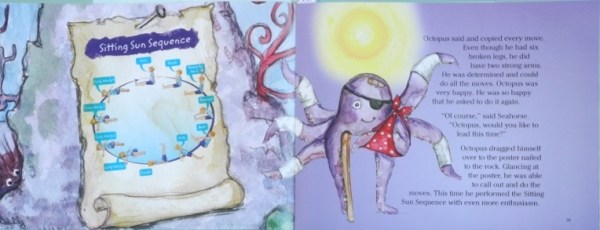
Octopus, a highly competitive creature, has been badly injured (six broken legs) in a pole vaulting competition so Seahorse teaches him a Sitting Sun Salutation

DSCN6252 (800x600)

that allows even a creature in such a bad physical state to do a sequence of postures: a liberating experience for the injured character.
Finally, after several months, Seahorse encounters the Starfish Brothers again and decides they are ready for another challenge and proceeds to teach them the ‘Challenging Sun Sequence”,

DSCN6254 (800x600)

the one most adult yogis are likely to be familiar with.
Throughout the story, Seahorse is gently encouraging, explaining the benefits of what he’s teaching and in true yoga teacher fashion, never making any of the learners feel inadequate: “Do you bestYou’ll soon get the hand of it,” he tells each one in turn.
There is a straightforward ‘Guidance for teachers, Professionals and Parents’ introduction to the book. This explains Surya Namaskar simply and clearly, as well as explaining how the book can be used and the final pages give more details about the various sequences and offers a case study. And, from my viewpoint as an experienced teacher of yoga and early years teacher it’s good to see this message stated loudly and clearly: ‘children’s yoga is not about perfection in the posture’. Amen to that!
From personal experience I know that using stories when teaching yoga to young children is very effective and this beautifully illustrated book is likely to be welcomed by all of us who work to bring yoga and children together no matter what the setting.
Buy from JKP
Use your local bookshop        localbookshops_NameImage-2

Relax with Ladybird

DSCN1564

Ladybird’s Remarkable Relaxation
Michael Chissick and Sarah Peacock
Singing Dragon
In similar vein to Frog’s Breathtaking Speech is yoga teacher, Michael Chissick’s second picture book with artist Sarah Peacock. Here we have a story featuring a helpful character Ladybird, who comes to the aid of Dog, Frog, Flamingo and Dragon all of whom have their own particular anxieties. Dog has trouble writing stories, Frog has too much to do at home and cannot see where to start, Flamingo is being bullied at school and Dragon is feeling very sad because his Granddad has recently died. Rather than taking on their problems for them, Ladybird provides them with a special technique that enables them to relax. In a relaxed state, each animal is able to step back from his or her problem, see the bigger picture and find a plan to deal with it.
In short this is a problem solving story which incorporates a child friendly form of yoga nidra that can be used with primary school children. Even those as young as four or five can work with this version so long as they have already had some previous experience of yoga and relaxation techniques
As both a long standing primary school teacher and an experienced teacher of yoga to young children I can wholeheartedly recommend this book. The author has extensive experience of teaching yoga to children, in particular those with autism spectrum disorders and so he provides concise, easy to follow guidance for teachers and other adults wanting to use his techniques; he explains the basics of yoga nidra, (a very important skill for both children and adults) talks about how to use the book in schools as part of PSHE, in children’s yoga classes or at home and most important, there is a three-phase outline of how to teach Ladybird Relaxation including a script.
Sarah Peacock’s paintings of the characters are great fun and beautifully portray the emotions of the four

DSCN1565

as they change from woeful at the outset to relaxed and smiling at the end of the story.
Buy from Amazon
If this interests you, then go to the section Pages for Parents and Carers. for a review of Frog’s Breathtaking Speech.
Buy from Amazon

Find and buy from your local bookshop: http://www.booksellers.org.uk/bookshopsearch