The Shade Tree / Rapunzel

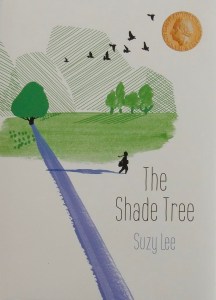
This is a re-telling of an old Korean folk tale wherein we see how a young traveller tricks a rich but heartless man into selling him the shade from the tree that grows on the latter’s land. The rich man considers he’s made some very easy cash but hasn’t considered the effects of the lengthening shadow of his house as the day progresses.Whatever the shade touches is thus owned by the traveller, and he can share it with whomever he wishes. Furthermore when the shade covers the rich man’s house, the traveller can enter that house, which he does,

eventually causing the wealthy one to move out. Once the house is vacant the traveller settles down and enjoys life as the new resident.

Much of the power of this thought-provoking telling lies in its simplicity, simple too is Suzy Lee’s art; it’s almost abstract in style and uses a limited colour palette to effect. With its dramatic gatefold, this is altogether an unusual book that feels at once both old-fashioned and contemporary. It would probably appeal most to older readers especially those with an interest in folk stories.

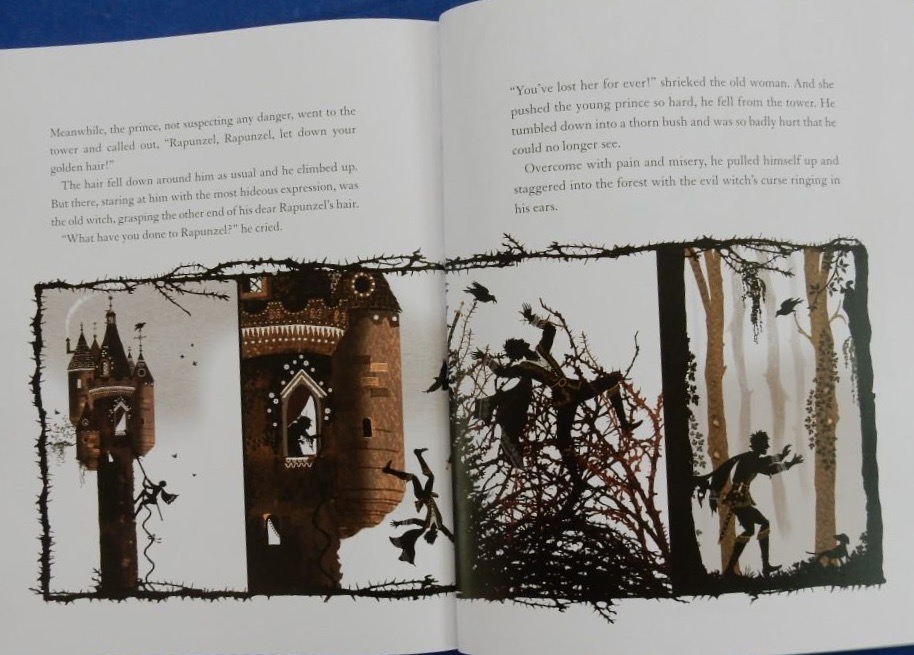
Sarah Gibb has taken the original classic fairytale and turned it into a visual feast.with a mix of gorgeous silhouettes and delicate, detailed colour illustrations, without losing any of the essential elements of the plot in her simplified telling. We still have the drama: the witch discovering the young husband helping himself to the salad leaves from her garden to cure his ailing wife and his promising to give her the baby when born in return. And romance: the baby Rapunzel becoming a beautiful girl incarcerated in a tower, who is visited by a prince and the two eventually marrying.

Rapunzel’s tower is illustrated in true fairytale style, with turrets and weathervanes, vines and roses
and the contrasting silhouette style prince staggering through the forest having been seriously hurt as a result of his fall from the tower.
Recently reissued with a new cover, I suggest that if you are looking for a highly pictorial version of the fairytale, look no further than Sarah Gibb’s offering.

Step Inside Homes Through History / Darwin’s Voyage of Discovery

Step Inside Homes Through History
Goldie Hawk and Sarah Gibb
Nosy Crow

Most readers of this book will recognise many of the features of the contemporary house illustrated herein, and those who are as old as this reviewer will recognise some of the rather garish décor shown in the sixties home. How many though, unless they are members of the National Trust or have a special interest in the topic, will know what living in a Late Middle Ages manor house or a Tudor mansion was like?

Three double spreads each, explore seven periods in time from the mid 13th century through to the present day.
Intricately detailed laser-cut pages show us not only the particular residence outside

and in, but also the fashions, family life and furniture of the period.

You can have fun tracing the evolution of the bathroom from the medieval gardrobes – ‘a bench over a big hole which went outside the house’

to the Georgian chamber pot beneath the bed, the new Victorian indoor flushing toilet through to the present day en-suite bathrooms that many of us have. Also fun is the ‘spot the artefact’ feature where readers are asked to find a named item of furniture or small object in each house.

Full of interesting snippets of information, this well-illustrated book is worth buying for a classroom collection, or if you intend visiting a stately home or historic house, whether or not it belongs to the National Trust, Nosy Crow’s collaborators for this title.

Darwin’s Voyage of Discovery
Jake Williams
Pavilion Books

Following his Really Remarkable Reptiles, illustrator/designer Jake Williams has created another fascinating, stylishly illustrated book, this time about the naturalist and geologist Charles Darwin famous for his epic voyages of adventure on HMS Beagle and his theory of evolution ‘On the Origin of Species’.

The amazing creatures both large and small that Darwin saw during his explorations (some of which we see larger than life illustrated herein) furnished a wealth of detailed notes and drawings, observation data and fossil specimens; and readers can follow in the footsteps of the famous biologist as he travels the world for five years as the Beagle ship’s biologist sailing from England to the Cape Verde islands, from Brazil to the Galapagos and from Tahiti to Australia and finally, back home.

There’s a wealth of information about such things as the ‘cracker’ butterflies of Brazil;

how Darwin unearthed the skull of a giant ground sloth in Argentina and the steamer ducks he observed in the Falklands,

as well as maps showing the Beagle’s progress.

Recommended for all those with enquiring minds, this is a beautifully produced book that highlights the importance that careful observation makes in the furtherance of scientific discovery.

Princes, a Princess and a Dragon

DSCN5526 (800x600)

The Red Prince
Charlie Roscoe and Tom Clohosy Cole
Templar Publishing
Set in a make believe kingdom named Avala, this wonderfully illustrated neo fairy tale is the story of how the young prince is kidnapped by strangers who invade the shores of the realm one night. Having seized the city, the invaders capture the prince hiding him away in a dark fortress dungeon.
Near to despair, he eventually manages to escape one dark night and off he dashes through the falling snow

DSCN5527 (800x600)

until he comes upon a young girl who tells him he must get to the city. You will find help in unlikely places, she reassures him. Her words prove true …

DSCN5529 (800x600)

for having crossed the island and managed to sneak through the city gates an amazing sight meets the red prince’s (and the reader’s) eyes …

DSCN5530 (800x600)

With all Avala sporting red prince garments, the strangers realize they are now faced with a near impossible task, so they return to their boats and sail away.
In his powerful illustrations Tom Clohosy Cole makes dramatic use of dark and light

DSCN5528 (800x600)

creating amazing atmospheric scenes employing all manner of angles and perspectives.

DSCN5543 (800x600)

The Princess Who Had No Fortune
Ursula Jones and Sarah Gibb
Orchard Books
A princess (albeit one with a best pal talking cat) too poor and with too much work to do to go to the prince’s ball surely has its roots in Cinderella. However, in this neo fairy tale the work to be done is down to her father’s latest exploit: she has to prepare for a special party to celebrate the inaugural flight of the king’s latest flying machine. Cupcakes not court balls are her preoccupation, and so is getting the garden into shape for the event.
However, the young man who gets the gardening job is about as good at doing his task (he tries to cut the lawn with a penknife) as she is at baking cakes – terrible!

DSCN5544 (800x600)

When the two sit down together for a coffee break, the gardener makes some suggestions.

DSCN5546 (800x600)

The princess turns down his first idea of a “prince in shining armour” but what about “making a wish to your fairy godmother,” Now there’s a thought, even if you’re not sure you have one …
Ursula Jones witty tale is perfectly complemented by Sarah Gibb’s lush illustrations:

DSCN5545 (800x600)

her colorful collage and paint style scenes resemble a theatrical production and the alternate silhouette spreads, which put me in mind of those by Jan Pieńkowski, are stunningly beautiful.

DSCN5424 (800x600)

The Extremely Greedy Dragon
Jessica Barrah and Chris Saunders
QED Publishing
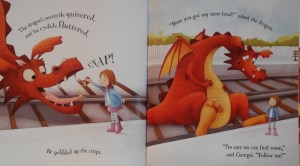
When a sleepy and very large dragon decides to take a snooze on the railway line at Little Chiddling the residents have a problem, or most of them do. Young Georgie Johnson however is eager for the reward money offered to anyone able to move the creature and so decides to try her luck.
The crisps she offers the huge beast hit the mark …

DSCN5425 (800x600)

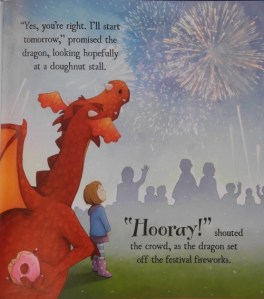
and before long Georgie and the dragon are off in search of more tasty tidbits to satisfy what proves a very large appetite. Those they encounter however are happy to share their food in return for a little help from the dragon in drying out the picnic spot, lighting the barbeque fire, warning up the wedding venue and finally, once Georgie has persuaded the mayor, drying out the damp fireworks to make the festival go with a sparkle and a bang.

DSCN5426 (800x600)

With its inbuilt messages about not judging by appearances and eating healthily, there’s plenty of food for thought and discussion herein.

Use your local bookshop      localbookshops_NameImage-2

Exciting event in Piccadilly, London till 29th October : The Children’s Book Illustration Art Exhibition

C090B987-9FD4-47C9-A6E5-CEEE0DD83F4E[6]


Traditional Art, Traditional Tales

DSCN1325

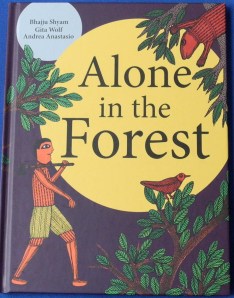
Alone in the Forest
Bhajju Shyam, Gita Wolf and Andrea Anastasio
Tara Books
Gond tribal art has a distinctive style characterised by two dimensional patterned forms intricately detailed with dots, dashes and lines. According to The All India Artisans and Craftworkers website artists use colours extracted from natural materials: colored soil, charcoal, plant sap, rice paste, cow dung and leaves. Colours are used to convey emotions and character. Red is said to depict fear and green is associated with nature. Originally the paintings were done on the mud walls of houses.
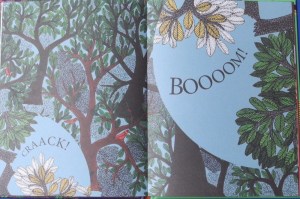
Here, one Gond artist, Bhajju Shyam has used his talent to provide a powerful and striking visual interpretation of a story about a boy, Musa who ventures off alone into the forest to find firewood when his mother is sick. Wandering and humming to himself, he hears a loud noise and lets his imagination run riot.

DSCN1324

As he hides in the hollow of a tree, Musa visualizes first one and then a whole herd of wild boars close by. After what feels like a very long time, Musa emerges from his hiding place to find that the source of the noise that gave rise to his escalating fear was in fact a friendly cow. The same animal leads him safely back to the village – albeit without any firewood but with a story to tell.
An unusual story that draws readers into what for Western audiences is largely, a completely unfamiliar world. It offers an opportunity to look at, discuss and perhaps try experimenting with this particular style of aboriginal art.
A beautifully designed book; recommended for primary school libraries and for anyone interested in art.
Buy from Amazon

DSCN1326

Breaking the Spell
Lari Don illustrated by Cate James
Frances Lincoln Children’s Books
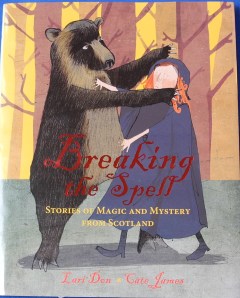
Lari Don is an accomplished storyteller so each of the ten stories in this collection is a pleasure to read aloud. She has included some traditional tales that are specific to Scotland and others such as Whuppity Stoorie, which are Scottish tales that have variants the world over. You can find witches, giants, monsters, royalty, warriors and more herein.
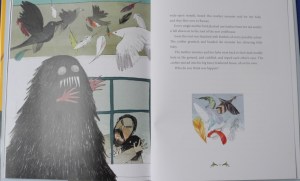
It’s impossible to pick a favourite; each one weaves its own enchantment. I particularly liked The Monster of Raasay wherein we are shown that true monsters are not always the ones billed as such.

DSCN1327

Then of course, the teacher part of me found The Three Questions great fun. It was so good to see that horrible bully of a teacher get his just deserts and to learn why ‘nowadays all teachers are clever and kind and very good at riddles, and none of them ever shout. Do they?’
All the stories are quite short especially The Ring of Brodgar (though if you felt adventurous, its duration could be extended by some giant dancing, or rather stomping, thumping, jumping and yelling).
If you are familiar with the Lollipop and Grandpa picture books series you will recognize Cate James’ illustrative style. She layers ink drawing and textures digitally to create whimsical, witty illustrations and here they range from small vignettes to whole page pictures.
This would certainly make a very worthwhile addition to any family or primary school collection.
Buy from Amazon

DSCN1334

Beauty and the Beast
Ursula Jones and Sarah Gibb
Orchard Books pbk.
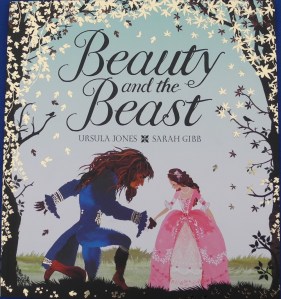
Ursula Jones infuses her spirited retelling of the classic fairy tale with gentle humour: ‘The two older sisters were horrified by the countryside. It was full of plants! And not a clothes shop in sight!’ …
’boom! – in a split second the pretty clothes turned into silly knickers and the sisters had to cover themselves up in Beauty’s sheets.’ Here we seem to have up to the minute language in what looks like a regency setting.
Sarah Gibb’s delicately patterned illustrations are gorgeous. Her fine silhouettes remind me not a little of some of Jan Pienkowski’s work which in turn was influenced by Lotte Reiniger.
Altogether an interesting edition, well worth exploring. One to invest in.
Buy from Amazon