Amazon River

Amazon River
Sangma Francis and Rômolo D’Hipólito
Flying Eye Books

The author of Everest now invites readers to join her on an exploration of a river that starts as a tiny trickle high up in the Andean Mountains of South America, flows across seven countries and 6,400 km. and has more than 1,100 tributaries.
I was previously unaware that the Amazon comprises three different kinds of water: the fast flowing clearwater, the slowly churning blackwater that moves almost imperceptibly across forested land (the dark colour is the result of leaves that fall and rot at the bottom), and the milky whitewater that looks rather like flowing caramel, the colour coming from a mix of sand, silt, minerals, floating sediment and broken down bits of rock.

Having described the geological features, Sangma Frances moves on to talk about the fact that in the Amazon basin there are three different kinds of river, one aerial, the surface river that is visible, and four km. down and recently discovered by scientists, the Hamza.

There’s a wealth of information about the flora (including 16,000 tree species)

and fauna – great and small – 3000 fish species, 1,300 species of birds, 2.5 million species of insects, assuredly the world’s most incredible ecosystem.
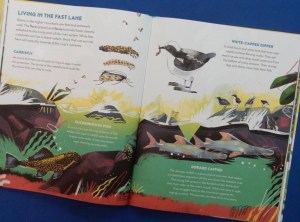
After this comes a legend about a tribal warrior said to have been turned into a huge fish called the pirarucu.

Did you know that the Amazon has been home to human life for 12,000 years, since the last ice age? Or that there are more than 400 indigenous societies in the Amazon, each of which has its own culture, language and traditions and folklore. The story of Naia, queen of the lilies is retold here.

Having described next human life along the river, the author ends by discussing some of the terrible threats faced by the Amazon,

how activists are doing their utmost to protect the precious space and a final plea to all readers to do their bit to help.

The amazing illustrations of Rômolo D’Hipólito really help readers to feel immersed in the wonders of this mighty waterway.

Altogether a smashing cross-curricular resource for schools as well as for individuals interested in learning more about an incredible ecosystem.
The Secret Lives of Unicorns

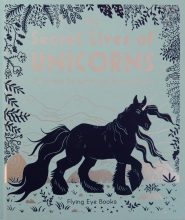
The Secret Lives of Unicorns
Dr Temisa Seraphini and Sophie Robin
Flying Eye Books

Most people consider those much loved unicorns, that are all the rage just now, are imaginary; Dr Temisa Seraphini, author of this book and ‘leading expert’ so she says, on unicornology, would like to persuade readers to think otherwise.

She divides her fanciful presentation into three parts: the first being “What is a Unicorn?; the second provides examples of unicorns from various parts of the world and the third looks at the relationship between humans and unicorns. Her over-arching aim in all this is to encourage those magical creatures of yore back into our technological world of today.

In her introduction to the first part we read that unicorns are herbivorous but unlike their horse cousins, have magical properties; the author places them in the order Artiodactyla that includes, giraffes and goats among other even-toed ungulate creatures, assigning them to a separate family: Unicornus.

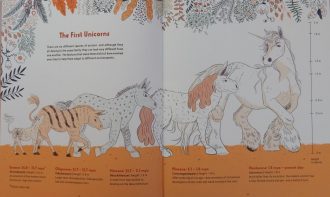
Then on the first spread we’re shown the six different species of the legendary creatures on a evolutionary timeline.

This is followed by a page detailing which parts of the unicorn’s anatomy have magical properties: Did you know that unicorn tears can apparently heal the sick and that the drinking of unicorn blood provides unimaginable strength. Hmmm!

The Horn is the next topic and there are supposedly three varieties – ridged, smooth and pearlescent; the latter so loved by some recent picture book creators; and if you believe it, in 1858 someone unearthed a skull that had once borne a unicorn’s horn. Uh-huh!

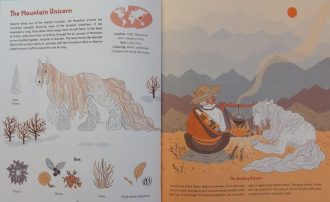
The second section takes us to six different habitats (with accompanying atlas), from the regions around Mount Everest

to the sandy African dunes and the moorlands of northern Europe. We learn  how different adaptations to climate have occurred over time  There’s an introduction to the winged variety and flight.

The final part talks of legendary unicorns; those who found their way into the annals of history or became subjects of artistic representation, as well as introducing some other unicornologists, giving guidance on tracking and communicating with the creatures.

Tongue in cheek though all this may be, it’s fun and rather enchanting. So too are Sophie Robin’s detailed illustrations that will definitely make readers smile as they peruse the pages and get lost in the spellbinding silliness.