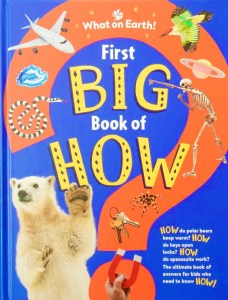
First Big Book of How

After ‘Why’ questions I think those beginning ‘How’ are probably the most often asked by young children. Author Sally Sykes, together with Saranne Taylor have divided the wealth of How questions in this bumper book into six sections, the first being The Body. The fifteen questions posed are engagingly and succinctly answered the first being ‘How does hair grow?’ A double page spread is allocated to each question, much of the space being taken by a striking illustration or photograph into which has been placed a ‘wacky fact’ and a relevant small labelled, close-up diagram. This section also addresses how each of the senses works – did you know that children smell better than adults, with ten year olds having the best sense of smell?
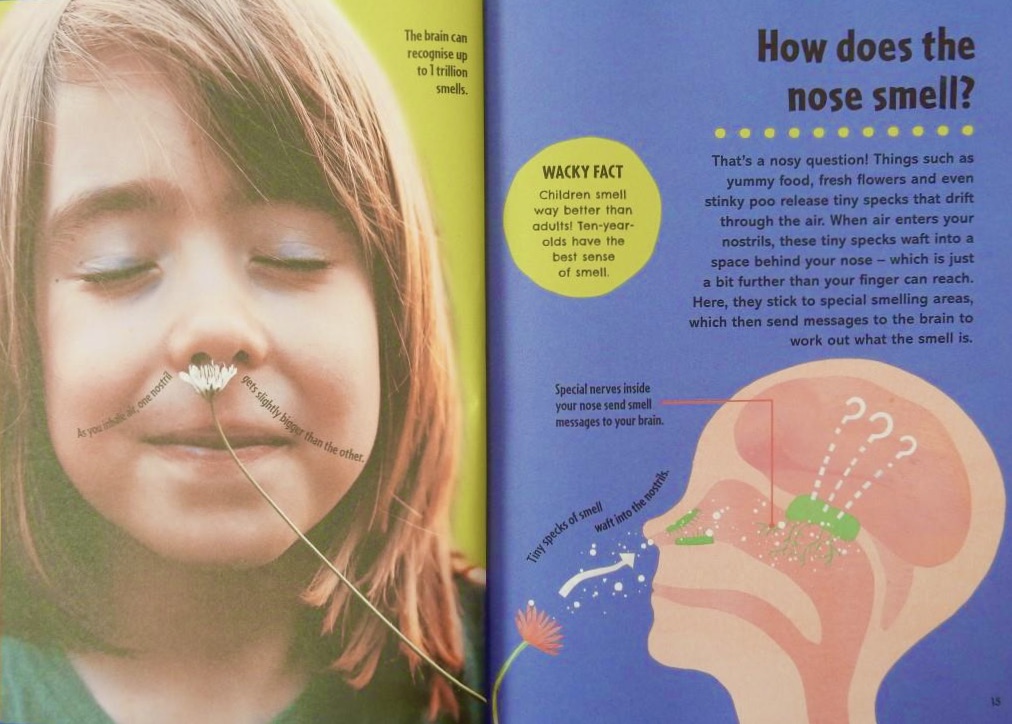
Then come respiration, circulation and the heart, bone growth, digestion, the growth of an unborn baby, the relationship between exercise and good health, catching a cold and more.

The other sections are in turn Machines & Buildings, Wild Animals, Bugs & Creepy Crawlies, Earth and finally, Space. In addition each part has a ‘Wow! What’s that? spread that zooms right in with a photograph as well as two ‘Tell me how … Now!’ spread, the latter briefly answering additional questions.

One to add to family bookshelves and Foundation Stage/ KS1 class collections.

Albert and his Friends / Spooky Little Halloween / That’s How Much I Love You

Albert the Tortoise has already established himself as a popular character among children from around three and their adult sharers. Now he wants to introduce himself and his minibeast friends to the very youngest children. In this little book, with its simple text and close-up images, they will meet in turn, Butterfly with its gorgeous wings, then a pair of woodlice, wiggly worm pops its head up through the soil, Buzzy Bee alights on a flower just in time to say hello, Snail slithers up with its shiny shell, Ladybird gives a wave with one of its front legs, Spider proudly shows a newly spun web 

and the ants demonstrate their teamwork. On the final spread, Albert’s multitude of friends return the compliment, telling the tortoise what a good friend he is to all of them.
Just right for the under threes.

Not really very spooky as the eight characters that almost leap from the pages of this vibrant ‘Finger Wiggle’ book are all smiling in a friendly manner. First comes a little witch riding her broom, arms outstretched; she’s followed by a little wolf singing to the moon, a spider wiggling its eight hairy feet, a little ghost, a rotund pumpkin, an upside down bat, a black cat and finally a little monster proudly showing his first tooth – albeit a very sharp one. On each spread that introduces Nick Sharratt’s endearing characters, Sally Symes’ simple rhyming text provides a ‘wiggle wiggle’ and a fun, sometimes onomatopoeic phrase to join in with.

One cannot help but bring to mind Sam McBratney’s Guess How Much I Love You when reading this first person rhyming tale wherein an adult racoon tells its cub just how much it is loved. The rhyme reads well aloud presenting in turn pairings such as a sock and a shoe, the sun and the moon, a bowl and a spoon; but it’s Tiphanie Beeke’s richly hued illustrations painted on textured paper showing the two racoons that steal the show, especially the final one wherein paw in paw, adult and cub walk in a woodland setting at sundown.
A gentle bedtime wind-down book to share with toddlers.

Britannica’s Baby Encyclopedia / Night-Night Animals

Britannica’s Baby Encyclopedia
Sally Symes, illustrated by Hanako Clulow
Britannica Books

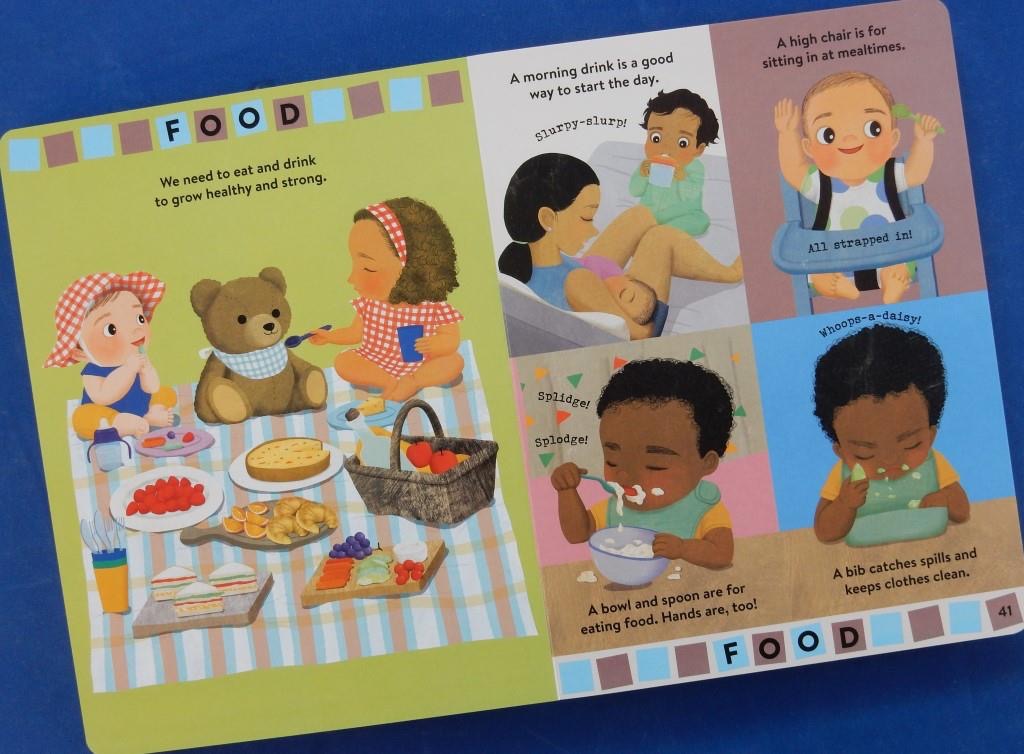
With just over seventy pages in all, this board book first encyclopaedia is divided into sections: our world, animals, plants, body, food, machines, art & music, shapes and numbers, every one of which is beautifully illustrated in bold colours. Each section begins and ends with a full page picture and the accompanying suitably simple text is thoughtfully worded to read like an opening and finale. 

For example Our World starts thus: ‘Our world is a place called Earth. In the morning, the sun comes up and the day begins.’ and concludes, ‘At the end of the day, the moon and stars light up the night sky.’ So, it would work well if an adult and child shared the book, one section per sitting. Little ones will love joining in with all the ‘sound’ words: this section has ‘Plip-plop!’ ‘Flitter! Flutter!’, ‘Gurgle! Burble!, ‘Crash! Smash!’ and several farm animal noises. 

Just the right amount of information is included in each section to engage small children, while also enhancing their vocabulary and knowledge.(A consultant Dr Amanda Gummer was used to this end.) It’s good to see that care has been taken to include a diverse range of humans in every topic presented.
A book to add to family collections if there is a very young child.

Night-Night Animals
Patricia Hegarty and Thomas Elliott
Little Tiger

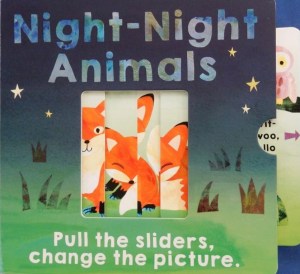
This ‘pull the sliders, change the picture’ title takes little ones to various natural locations where it’s time for the fauna to go to sleep. First visit is the forest wherein there are rabbits, deer, a fox, a mouse and a nesting bird. Which one is nocturnal and needs waking with the help of the slider?
The savannah animals all seem to have shut their eyes already except for one; he needs help to get to sleep. The deep sea has lots of sleepy creatures large and small but one with eight limbs needs the reader’s help. After helping whichever of the rainforest animals is wide awake, it’s the turn of little humans including one very bouncy person who has to stop all those boings.

A fun, interactive bedtime book for the very youngest children who will enjoy assisting the animals before nodding off themselves.

Britannica First Big Book of Why

Britannica First Big Book of Why
Sally Symes and Stephanie Warren, illustrated by Kate Slater
Britannica Books (What on Earth Publishing)

Children are forever asking ‘why’ questions and adults quite often scratch their heads to give appropriate answers; now comes this jumbo book that should help both questioners and responders. It contains a lot of information and seemingly being aimed at slightly younger children than usual, with a single question per spread, is far less overwhelming than is often the case.

Organised into eight sections: minibeasts, pets, wild animals, the body, food, how stuff works, earth and finally, space, each part has fourteen questions of the kind youngsters might well ask. In addition to the question, every spread has a paragraph of text in response, accompanied by either a ‘wacky fact’ or a ‘who knows?’ bubble, one or two large illustrations – some are photographs, others are bold bright art work by Kate Slater.

And, each section concludes with a “Wow! What’s that?’ spread containing half a dozen coloured images for children to match with their names from the six listed.

Back mattter comprises a comprehensive glossary and index, source notes in case readers want to know more about a topic, as well as a ‘meet the Why team’ page and the answers to the matching game.

So, if you know a child who might ask such questions as ‘Why do flies like poo?; ‘why do frogs croak?’; ‘why does music make me want to dance?;

‘why do cakes puff up in the oven?’;

‘why don’t skyscrapers fall over?; or perhaps ‘Why does Saturn have rings?’ then you definitely need to keep a copy of this book to hand, be that at home or in your KS1 classroom. It will also go down well with slightly older, visual learners.

5 Minute Really True Stories for Bedtime

5 Minute Really True Stories for Bedtime
Sally Symes, Jackie McCann, Jen Arena, Rachel Valentine & various illustrators
Britannica Books

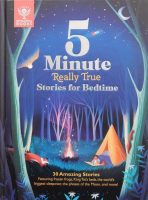
This is an unusual take on bedtime reading: an assortment of thirty narrative non-fiction stories each one with a bedtime connection.
From a hospital visit to see what happens in an accident and emergency department, the maternity ward and other parts where people are busy at work, to hibernation (the winter sleep of ladybirds, a queen bee and North American painted turtles are described).

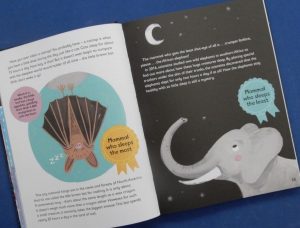
We’re introduced to Sleeping Champions – including a group of Brownies who got into the Guinness World Records book, a little brown bat that sleeps for almost 20 hours a day and elephants that only grab two hours of shut-eye;

and Gherman Titov, the first person to sleep (and puke) in space – fascinating!

Or you might choose to do a spot of Stargazing like the Italian scientist Galileo who made his own telescope to look at the night sky and who by discovering that Earth revolves around the Sun, also changed our understanding of Earth’s place in the universe.

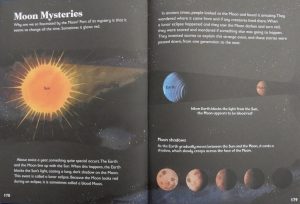
Then there are star stories and Moon Mysteries to enjoy

and lots more.

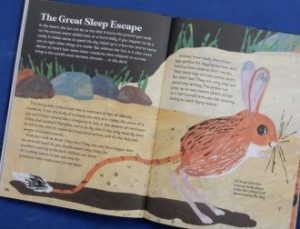
The writing style of the various authors is chatty and engaging, and reads aloud well, while the illustrations are alluring – well maybe not that of the goliath bird-eating tarantula, which is downright alarming and in stark contrast to that of the jerboa – with its huge ears that looks like a creature I’d be happy to meet.

It’s said that just before sleep is a good time to internalise new learning so why not try sharing a non-fiction story from this intriguing book.

Board Book Delights

Both Walker Books and Nosy Crow publish smashing board books – here are some of the latest:

Little Baby’s Busy Day
Little Baby’s Playtime

Nick Sharratt and Sally Symes
Walker Books

These ‘Finger Wiggle Books’ are full of adorable babies doing everyday things, the action being supplied by inserting a finger through the two die-cut holes that go from cover to cover in each book.

Busy Day portrays wake up time, breakfast, looking smart ready to go out, shopping, having a wee, inviting a tummy tickle, a sudsy bathtime and finally, arms extended for a bedtime cuddle. Nick Sharratt supplies the bright jolly visuals in his unmistakeable bubbly style and Sally Symes has created the brief rhyming ‘One little baby … Wiggle wiggle … ‘ narrative.

Little Baby’s Playtime opens with travelling in a sling, then moves to a playground swing, a wizz down a ‘slippery slide’, a tricycle ride, a dig in a sandpit, a game of peek-a-boo, excitement at the sight of a butterfly and finishes with a farewell wave.

Terrific for sharing; and with their patterned text and inviting scenes, these two spell out loud and clear to tinies that all important ‘books are fun’ message.

If You’re Happy and You Know It!
illustrated by Yu-hsuan Huang
Nosy Crow

This addition to the ever -popular ‘Sing along with me!’ series is another established nursery favourite. Here the main characters are bears with other creatures playing the bit parts. We first see the bears cooking together, after which they go out shopping together before returning home. Then small bear then goes out to meet some friends.

As they sing along, little ones can use their fingers to make the small bear clap, stamp, nod and on the final spread, reveal his friends and everyone can join in with the “we are” finale.

There’s a bar code to scan which will provide a version of the song to sing along to. With its cute illustrations, this will become a favourite in the series, I suspect.

Dragon Dos and Don’ts

DSCN7269 (800x600)

Dare to Care: Pet Dragon
M.P.Robertson and Sally Symes
Frances Lincoln Children’s Books
Ever thought of keeping a dragon? It’s probably not top of your list of things to do. Nevertheless Robertson and Symes have compiled a spoofingly delicious manual on how to do just that. There are several considerations including how to dispose of the dung it will produce in profusion –

DSCN7270 (800x600)
before taking that dragon decision tying you together for life. Anatomy (you might want to skip the warty bit, ditto the ‘teeth’ bit, if you are at all squeamish), choice of breed and choice of egg come next – we’re advised that it’s best to begin with an egg and select one that your particular lifestyle most easily accommodates. And hatching can be extremely time consuming …

DSCN7271 (800x600)

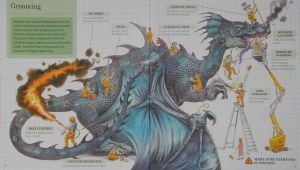
Of course, once the thing finally does emerge you’ll need to know about handling, feeding and grooming. Each of these is given its own spread and I suggest reading them with great care: brussels sprouts are a definite no-no and curry’s inadvisable too. And, oh my goodness you’ll need a veritable troupe of tradespeople when it comes to grooming …

DSCN7272 (800x600)

It’s best to know about dealing with ailments in the unlikely event that your dragon falls sick, so that’s taken care of next, followed by exercise.
Now you may well have selected a dragon as companion for the aeronautical opportunities such a creature offers, so a term or two at flight school is a MUST and then, with license under your belt …

DSCN7273 (800x600)

This tongue-in-cheek treat is guaranteed to give you a good giggle, or rather, a whole lot of giggles. And, it’s the perfect picture book for those who claim to enjoy information texts rather than stories.

DSCN7265 (800x600)

Marmaduke the Very Popular Dragon
Rachel Valentine and Ed Eaves
Bloomsbury Children’s Books
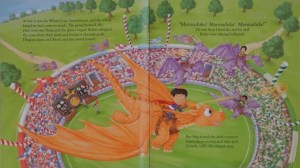
In this, his second story, Marmaduke has become something of a celebrity, so much so that best friend, Meg, sees little of him. Never mind, thinks Meg, there’s the Whizz Cone Tournament coming up, the perfect thing for the best friends to do together. But then Marmaduke becomes even more elusive; surely he couldn’t have found another partner for the tournament could he? That certainly doesn’t look like Meg riding him to victory here …

DSCN7266 (800x600)

Then, come trophy presentation time, Marmaduke isn’t feeling as overjoyed as he ought to and what’s more, he can hear sobbing sounds in the distance. Off he goes to find Meg, offer his heartfelt apologies and make a promise that henceforward, he’ll never exclude her again. That’s the kind of promise best friends always try to keep …

DSCN7268 (800x600)

Fans of Marmaduke and Meg will welcome their return; and applaud Marmaduke for seeing the error of his ways and acting accordingly. Adult mediators of the story have a good starting point for a ‘what makes a good friend?’ discussion.

Use your local bookshop     localbookshops_NameImage-2

WNDB_Button