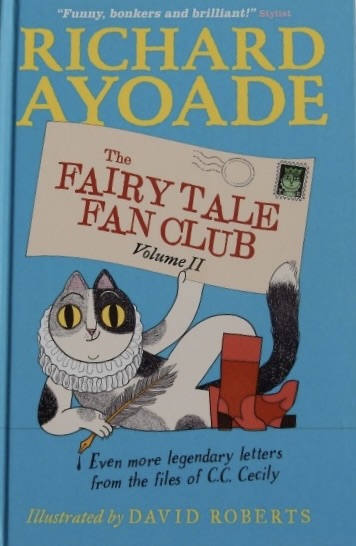
The Fairy Tale Fan Club Volume 11

This second collection of letters to and from fairytale characters is straight from the files of C.C. Cecily senior secretary of the Fairy Tale Fan Club. It contains correspondences between in turn Robin Hood, Puss in Boots, Beauty and the Beast, Goldilocks, The Ugly Duckling, Thumbelina, Tom Thumb, The Pied Piper, The Hedgehog and the Hare, Bluebeard, Aladdin, Three Little Pigs and various inquisitive children who ask the characters questions, each being introduced by as you might expect by C.C.C.

The first letter is penned by Satyajit (10 3/4) who is contemplating stealing his brother’s savings from the tin beneath his bed. Is this ethical or not? What does Robin Hood recommend he should do?

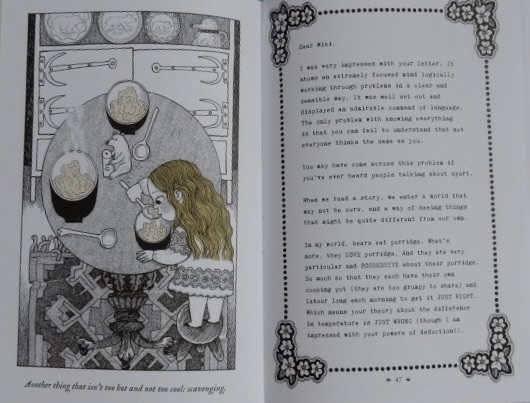
Miki’s letter is full of why questions to Goldilocks and she’s pretty savvy for a slightly over twelve year old and what she writes impresses the recipient considerably. Her return letter praises Miki’s language but tells the girl that despite her powers of deduction her theory about differences in temperature of the porridge is wrong. It even results in a life lesson for Goldilocks who changes her ways concerning where her porridge comes from. Goldilocks’ PS to her missive brought a smile to my face.
The tale dubbed as being ‘of contrasting running styles’ is somewhat similar to that of the Tortoise and the Hare but the latter is replaced by a challenging Hedgehog – a bit of a cheat that enlists his wife’s help in the race. Nine year old Speedy Steve’s letter though, is to the Hare and it’s anything but complimentary. What comes back starts by putting the boy firmly in his place; after which she talks of her present circumstances regarding staying fit.

I had to laugh at the correspondence between Ingmar (just over 8) and the little pig builder who built her house of straw. Ingmar considers this pig an innovator even though her house didn’t stand the test of the wolf’s huffing and puffing. Not overly downhearted about losing her house, Pig Number 1 talks of the adaptability of straw and tells the child that her next plan is to make either a sailboat or a submarine of straw. Let’s hope Miss Pig is a good swimmer if she carries out this project.

The penultimate question is from six year old Griff wanting to know Mr Cecily’s favourite character and why that is so. The final letters all come from Anon. but to discover their contents you’ll need your own copy of this delightfully droll book with David Roberts’ suitably amusing illustrations. I’m not sure whether its creators enjoyed making this more or those like myself who are fractured fairy tale fans. Assuredly there should be a copy in every KS2 class collection and on the home bookshelves of anyone who enjoys witty writing.

The Fairy Tale Fan Club

This is essentially a satirical collection of letters supposedly written to or from well-known fairy tale characters, each with an introduction by the supposed narrator—C.C. Cecily, the Senior Secretary of the Fairy Tale Fan Club. Said secretary also wrote a rather long introduction to the whole book where he explains how he came to compile and edit the work. Some readers may well want to miss out this and head straight to letter number one, hand-written by eight year old Ira to Little Red Riding Hood. Preceding this is a brief introduction from C.C using the first of a plethora of puns in the book, this one concerning the child being ‘literally wolfed down’ . This child is bemused by a couple of things in the story: how could Little Red have mistaken a wolf for her grandmother and how could she possibly be swallowed by a wolf and survive the experience. She goes on to enquire about the health of the recipient and ends with a PS asking ‘How “little” are you?’ Back comes an explanatory response covering the salient points.

Later there’s another correspondence – a fan letter of sorts – relating to this story but written by Sebastian (almost seven) to the wolf. The wolf then answers at considerable length.

For those who enjoy toilet humour, there’s a hilarious exchange involving a certain Prince Farty Pants (calling himself a duke in the first instance) and Prince Charming; and the latter proves less than helpful in his concluding sentence.

Another laugh-out-loud letter is penned by Humpty Dumpty in reply to that he received from Tyler (just eight). The egg talks about being anthropomorphised unfairly.

For the thoroughly modern reader there’s Zora’s message to Cinderella sans a single apostrophe and complaining about being unable to borrow her siblings’ iPads. This confuses the recipient who assumes an iPad is a cloth or similar used for cleaning.

In addition to the text there are a number of textured, sometimes finely detailed sketches as well as vignettes preceding each epistolary exchange; a perfect complement provided by David Roberts.
Altogether a very clever, tongue-in-cheek compilation that will appeal to book lovers especially those like me with a penchant for traditional tales.

The Book That No One Wanted To Read

The Book That No One Wanted To Read
Richard Ayoade, illustrated by Tor Treeman
Walker Books

This is one of the most crazy books I’ve ever read: it’s the first actor, writer and director, Richard Ayoade has written for younger readers. It’s also fiendishly funny, clever and thought-provoking.

Let’s consider how it feels to be a book – the best way is to allow a book to be both main character and the narrator telling things from its own viewpoint – sounds as though we’re getting a bit autobiographical here. Still that way allows us readers to imagine such things as the importance of making one’s cover alluring – failure to do so could all too easily result in being hurled across the room, abandoned under a whiffy pant pile or, horror of horrors, left on a shelf to be nothing more than a mere dust collector. And unless the tome under consideration happens to be a yogi there’s the possibility of having to perform some pretty sophisticated folds,

have your spine broken or, should you be totally unwanted then – gasp! – be sent off to a warehouse and there ‘pulped’ to near oblivion.

Hang on though, this book that we’re reading is in the process of charting its own destiny and that means finding its way into the hands of readers like us who will take great delight in discovering it in a bookshop – preferably on a display table with that irresistible unicorn cover or similar.

Tor Freeman captures with panache, Richard Ayoade’s wry humour in her wonderfully quirky illustrations that accompany the narration. Contrary to its title, this is a book you most definitely WILL want to read.