There Was An Old Lady / What Can Cats Do? and Who’s the Biggest? / How Many Kisses?

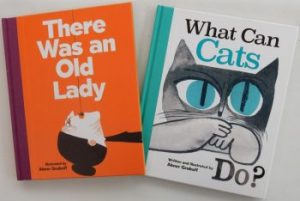
There Was An Old Lady
What Can Cats Do?

illustrated by Abner Graboff
Bodleian Children’s Books
Abner Graboff was an American artist and children’s book illustrator, popular especially in the USA in the 1950s, 60s and 70s who died in 1986 and whose work has since almost disappeared from the radar.
Now Bodleian Children’s Books brings some of this work to a new audience and decidedly quirky it is.
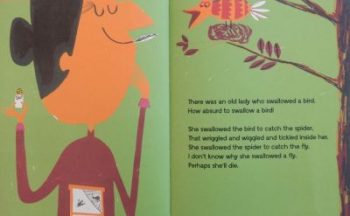
His arresting scenes of the animal guzzling old lady show a wicked sense of humour. The sight of her with a mouthful of bird, delicately holding a salt-cellar between thumb and forefinger and with a window through which we can see the contents of her stomach, is deliciously droll …
So too is this chasing scene …
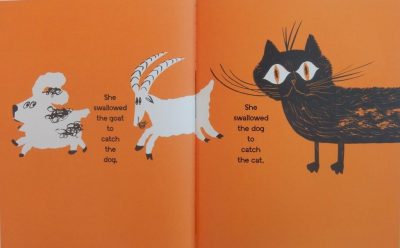
Adults as much as children will enjoy this picture book version of the nonsense song and because of its cumulative nature, it’s a good one for learner readers.
What Can Cats Do? was inspired by Abner’s own cat called Tarzan and apparently his three sons collaborated with their father on the book, carefully observing the creature and reporting what they’d noticed to their dad.
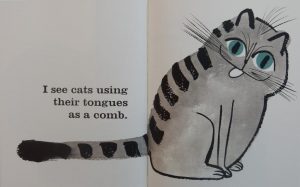
The outcome is a hilarious, first person narrative look at some of the things cats can do that children can’t – using their tongues as combs, for instance,
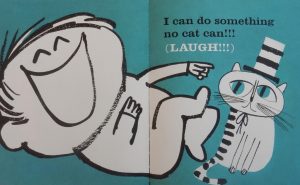
as well as a few things cats are unable to do such as shave or laugh.
Great fun for beginning readers and of interest to children’s book collectors and students of illustration.
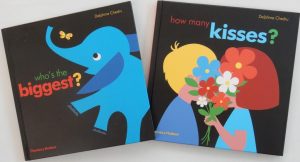
Who’s the Biggest?
How Many Kisses?

Delphine Chedru
Thames & Hudson
In the first title, award winning graphic designer Delphine Chedru takes a playful look at relative size in response to the title question.
The respondents claiming the size title in ways as different as a whisper to a boom, and a gurgle to a sigh, are as disparate as an elephant, a tree, a bear, a hammer, a mountain, a fishbowl, a leaf …
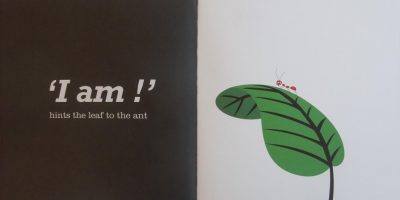
and the faceless human, ‘me’.
How Many Kisses? invites listeners to blow the appropriate number of kisses to who or whatever is indicated in the instruction facing the animal, human or other named objects.
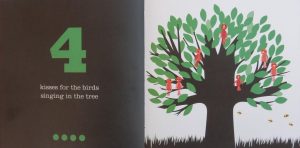
The book follows the expected number sequence from 1 to 10 (with accompanying dots) and then takes seemingly random jumps to 17, 64, 823 and then to ‘millions’. I suspect it would take an exceedingly long time to give the ‘millions of kisses for all the children playing around the world’ on the final spread and the numbers beyond 10 may well be beyond the capability of young children but they’ll most probably enjoy the possibilities offered by such large numbers.
Both books are illustrated with bold bright images using dense flat blocks of contrasting colour and throughout each the text is white lettering on the black background giving an uncluttered, arresting overall appearance to every spread.

I Want To Go First!

I Want To Go First!
Richard Byrne
Oxford University Press

I’ve never quite understood the obsession with being first in a line but it’s something that seems to take hold of children almost from the minute they start school – that’s if they’re made to line up anyway – a teachers’ obsession, often fuelled by parents, and one I dislike intensely.
The whole ‘going first’ thing can make for a fun story though and Richard Byrne exploits its potential for creating humour in his latest interactive picture book.
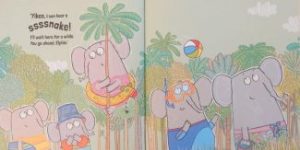
We join five funkily attired elephants, Elizabeth, Eleanor, Elton, Elgar and Elphie as they’re about to embark on ‘the long march to the watering hole at the back of the book’.
Elphie, the smallest of their number, is always the one that brings up the rear.
On this occasion however, he’s had enough of being last and asks to go in the front of the line. As usual though the response comes, ‘ … the littlest always goes last’.
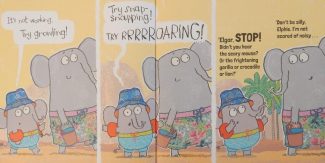
Elphie isn’t prepared to walk at the back and instead he enlists the help of readers to help him with his plan of action. Help that involves first, shouting …

followed by hissing,

wobbling the book, squeaking and other noise making; all of which serve to get him to second place in the line right behind Elgar, just as they reach their destination where it looks as though we’re about to be rumbled …

Oops! The water hole is already occupied. Now what? Perhaps that squeak-squeak noise might come in useful after all … Could it even make the other elephants rethink their first in line criterion.
Enthusiastic orchestration and demands of ‘again’ were my listeners’ responses to this sizeist tale with its playful attempt to alter the status quo.

Very Little Rapunzel / Big Little Hippo

Very Little Rapunzel
Teresa Heapy and Sue Heap
Picture Corgi
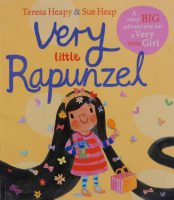
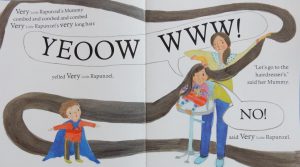
Meet Very Little Rapunzel, star of the fourth of the Very Little fairy tale series. She is, so her mum insists in need of a haircut but refuses to visit the hairdresser’s. New hairstyles are tried but none can curb the abundance of her unruly tresses and in a paddy, the little miss hurls her Big Box of Hair Things out of the tower right down to where a Very Little Prince happens to be standing.
Rapunzel lowers her hair at his request and up climbs the prince to play with her. Before you can say itch, both Prince and Rapunzel are scratching furiously and are discovered to have nits.
Treatment ensues with lots and lots … of combing …

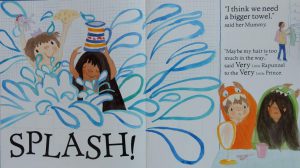
complaining, washing and sploshing …

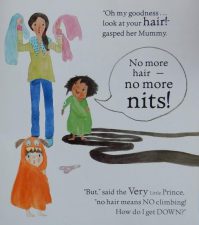
until a certain Very Little miss wilful has a change of heart. She grabs the scissors and …

which leaves her playmate rather stranded, but not for too long. Thanks to some imaginative hair styling, an escape route and more is fashioned by the teasy weezy trio culminating in fun and games for all.
With that disarming smile and spirit of independence, Very Little Rapunzel is set to charm her way into the affections of a whole host of very little listeners.

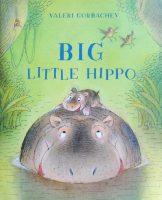
Big Little Hippo
Valeri Gorbachev
Sterling
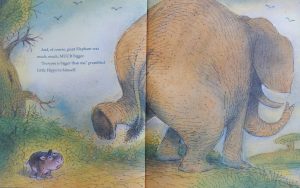
The smallest of his family and much smaller than big old Crocodile, very tall Giraffe and giant Elephant,

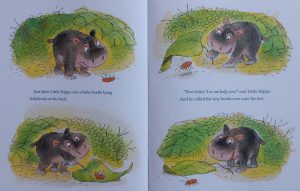
Little Hippo is far from happy with his lack of stature. His mother’s assurances that he’ll eventually be big like his parents offer no comfort as he wanders among huge trees and tall grasses feeling like the smallest creature in the entire world. Until that is he comes upon a tiny beetle struggling to turn itself the right way up. Little Hippo rescues the creature …

and the words of thanks from its family, “Thank you, Big Hippo!” truly make his day and more importantly change the way he sees himself. “I’m big now!” he announces as he rushes, full of new-found confidence, to tell his mother, passing on the way, all those animals whose largeness had previously made him feel so insignificant.
Proud of his deed of kindness, she renames him “Big Little Hippo”, which is just perfect.
Perspective and scale are effectively and playfully used in Gorbachev’s ink and watercolour scenes of Little Hippo and the other jungle animals in this sweet tale of finding where you fit in the world.

I’ve signed the charter  

Alternative Viewpoints

rrhub 028 (480x640)

You Are (Not) Small
Anna Kang and Chris Weyant
Hodder Children’s Books
Size is relative, something that is explored in a very amusing manner courtesy of some fuzzy, ursine-looking creatures herein. When one orange and large encounters one much smaller and purple, he tells him so in no uncertain manner; the purple one however insists he is not small, rather, orange is big. A shouting match ensues with each side growing in number and yelling across the gutter at the other. Both sides are suddenly brought up short by an almighty

rrhub 030 (640x480)

followed by the descent of a number of parachute-borne pink creatures to further complicate matters, or rather, to enable the opposing sides to start seeing things from a different perspective. After all that, it’s time for some nosh chaps … However, it seems the new arrivals may have issues of their own.

rrhub 031 (480x640)

Minimal words per page in large type, allow the comical, cartoon-style illustrations to do much of the talking.
And talking there surely will be after a sharing of this with any group of children from around five. Not only is there the matter of size, this could be the starting point for discussions about racism, sexism and more.

aardvark 001 (800x600)

It’s an Orange Aardvark!
Michael Hall
Words and Pictures (Frances Lincoln Childen’s Books)
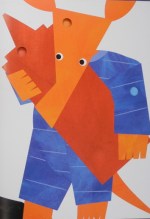
Five little ants (sporting hard hats of various colours) residing in an old tree stump are disturbed by a sound outside. What can it be? One – (yellow-hatted) ant decides to make a hole “Like a window!” to see what’s going on. The red-hatted alarmist ant suggests the possibility that a sneaky, grey aardvark might be out there waiting for its next meal – ants! But through the window they see orange. Not an aardvark then… “Aardvarks turn orange when they are hungry for ants” says guess which ant. More drilling by yellow hat… THUNK! blue seeps in through the next hole… “An orange aardvark wearing blue pyjamas!” alarmist ant again. And so it continues : with each new hole comes a new colour … red,

aardvark 002 (800x600)

green, yellow … and an even more outrageous elaboration on the ant-eating aardvark notion. Savvy listeners will work out what the ants will eventually see before yellow-hat makes his announcement and the ants emerge to …

aardvark 003 (800x600)

Well four of their number anyway.
Crazy cumulativeness, amusing ant talk – “Goodness!” “Gracious!” “Yikes!”, die-cuts (a-la Carle) delight audiences as do the brightly coloured collage-style images and the anticipation as each new idea is added to the imagined creature outside the tree stump. And, so cleverly written – every single word is measured for maximum impact.

Find and buy from your local bookshop:

http://www.booksellers.org.uk/bookshopsearch