Together

Together
Jane Chapman
Little Tiger

Deep within the forest, hidden among the shady leaves, a tiny face peers through the foliage. It belongs to a baby gorilla that feels totally alone in the world, a world that feels strange and a little threatening.

But then along with the downpour of refreshing rain and the smell of something to eat that wafts on the breeze, comes something different, something huge and very …

So thinks the little one. But it’s not so for despite appearances, the creature reaches out with unexpected tenderness, extending a soft paw of companionship and friendship in a hitherto scary world.

Now no matter what each day brings forth, be it beauty and magic,

or shadow and sadness, there’s always the joy and comfort of togetherness.

Jane Chapman’s illustrations are incredible, both in their lifelike portrayal of the two gorillas and in the sensitive way they convey the sense of connectedness between them.

That sense of connectedness is what all of us crave probably more than anything else in these pandemic times. This beautiful, heart-warming story is a wonderful portrayal of how reaching out – may be not physically but in what ever ways are possible – can make all the difference.

On the Night of the Shooting Star

On the Night of the Shooting Star
Amy Hest and Jenni Desmond
Walker Books

Bunny and Dog are neighbours living on opposite sides of the fence in homes that match their owners. Bunny’s house is blue and is furnished in suitable bunny style (look for the bed’s rabbit-eared headboard and the chair’s fluffy white tail):

Dog has a red house with red furnishings. (I love the rug border and fireplace tiles.) Both have lake views and signs indicating they want to be left alone as they go about their solo activities.
However first thing every morning Bunny looks through the fence at Dog and Dog looks through the fence at Bunny: neither says so much as hello. They also take the odd peek at one another during the course of the day and at bedtime each checks the light in the window of the house opposite.
Time passes and one moonlit night, unable to sleep, both animals are drawn outside to watch the stars and each decides the other is in need of a friend.
The sudden appearance of a shooting star provides a shared experience:

could this be the catalyst for their friendship to develop at last?

Everyone needs a friend: sometimes we need the courage to reach out and be that friend. This timely message is at the heart of Amy Hest and Jenni Desmond’s softly spoken, captivatingly illustrated book.

Leaf

Leaf
Sandra Dieckmann
Flying Eye Books
Sandra Dieckmann’s love of the natural world shines right out at you from the arresting cover of her debut picture book.
It opens with a ‘strange white creature’ on an ice floe drifting shoreward upon dark and brooding waters, watched by a large black crow. Once ashore, the polar bear makes its home in a deserted hillside cave: an outsider watched and distrusted by the forest animals. It forages for leaves, watchful, wary; and the residents bestow upon it the name Leaf on account of its strange behaviour, but equally because they want rid of him. They all talk about Leaf but none dares talk to him.

And so it goes on until one day leaf- clad, the bear charges through the forest astonishing all that see, and launches himself, from the hillside and plunges into the lake below.
While the soaking creature hides once more in his cave, the other animals meet to discuss what to do. Conflicting opinions emerge, (only the crows speak for him) with the result that they do nothing.
Leaf meanwhile renews his determination to take flight, this time from a cliff …

and once he’s safely back on shore, the crows – intelligent beings that they are – finally allow him to speak. And speak he does – to them all – about melting ice and his desire to return to his family.
As conveyors of mood and movement, Sandra Dieckmann’s illustrations are impressive.

Executed in black, white, greys, blues and teals with occasional stand out splashes of red, orange, rust, yellow and the greens of the patterned leaves and flowering plants, the landscape portrayed is at once beautiful and at times, hostile.
It’s said in folklore that crows are harbingers of change: I’d like to think that those in Leaf’s story might act as symbols of a positive change in the way outsiders are viewed by too many of us. With themes that include global warming, outsiders, prejudice, loneliness and reaching out to others, this poignantly beautiful book is both topical and timely.

I’ve signed the charter  

Grandad’s Secret Giant

Grandad’s Secret Giant
David Litchfield
Frances Lincoln Children’s Books
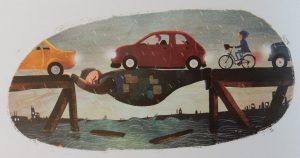
Imagine having a giant in your town, one with “hands the size of tables, legs as long as drainpipes, and feet as big as rowing boats.” There is such a one residing where young Billy lives, or so his Grandad tells him: Billy however doesn’t believe it. Especially when Grandad claims he can fix anything such as mend the broken town clock; push the boat stranded in a storm to safety on the shore; and even help cars cross a bridge that’s partly fallen down.

Moreover, the reason Billy can’t see this wonderful being is, so Grandad says, that the giant keeps himself secret “because people are scared of things that are different”.
The trouble is that if nobody can reach to the top of the wall upon which the townsfolk are painting a mural, it will remain unfinished. So, Billy has a dilemma: should he get up at dawn, go to the mural, hope to see the giant and enlist his help, or continue in his disbelief and leave the wall as it is? The former wins out but only so the lad can prove Grandad wrong about the whole giant business. Off Billy goes accompanied by his dog, Murphy.
Who should be waiting right beside the mural but the …

real … HUMUNGOUS and … TERRIFYING!
Billy beats a hasty retreat but then, having put a considerable distance between himself and the giant, pauses for thought. Could Grandpa be right about people being scared of difference? Back he goes to tell Grandad about his experience. Was it a mistake to run away, he wonders?
Perhaps; but perhaps too, there is a way for Billy, with Grandad’s help, to show the giant he’s sorry. A plan is conceived and executed; then comes the waiting …

Will the giant accept the apologetic offering? Will he rescue Murphy for a second time, and … ?
I got home from a few days in London to find this book waiting for me. After the tragedy that had just happened there, its messages concerning reaching out, embracing difference and friendship resonated all the more.
Heart-wrenchingly beautiful and ultimately, uplifting, this stunning book for me, out- plays even The Bear and the Piano.

I’e signed the charter