
Terrible Horses
Raymond Antrobus and Ken Wilson-Max
Walker Books
Narrated by the younger of two siblings, a small boy talks of how he feels about his sister, the ways they react to one another and to sharing their things. From the boy’s viewpoint, big sister is a cool character but she causes the pair to fight one another physically, rather than verbally. To release the tension within himself, the boy goes to his room and writes stories featuring terrible horses, with himself as a lonely pony.
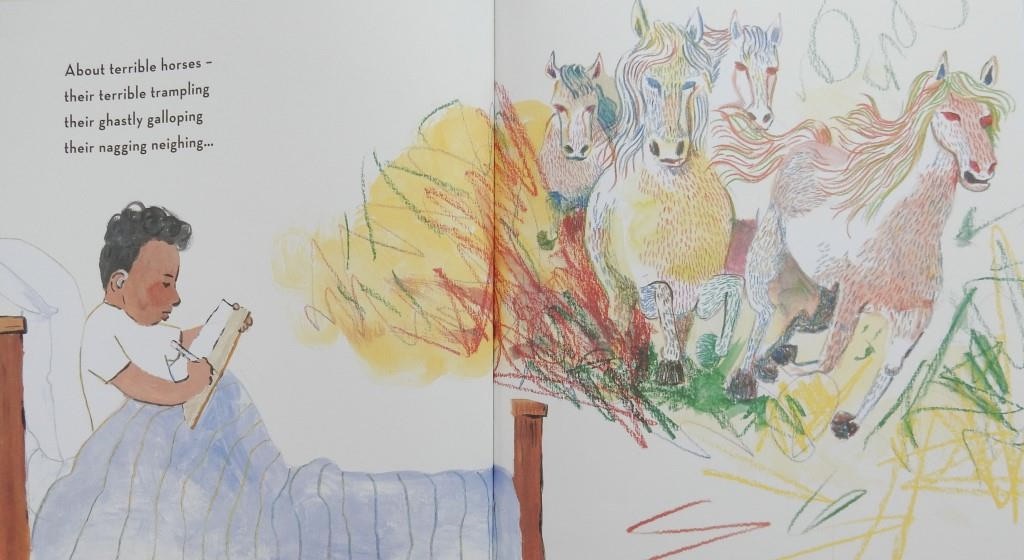
Then there’s another fight on account of the narrator taking things belonging to his sister without asking her permission, which triggers further actions that fuel the aggression. Once again the boy retreats into his bedroom, fashions a horse story that includes showing himself as the pony neither able to speak or sleep. Surprisingly though sleep he does and when he wakes the terrible horses book is missing. Who do you think has it now and what will be the outcome?
Raymond Antrobus has penned a seemingly simple tale of sibling rivalry, but it’s one that conveys feelings relating to discord and empathy, both of which Ken Wilson-Max captures so adeptly in his illustrations of humans and of horses.
Another feelings centred picture book is
When I Feel Brave
Britta Teckentrup
Prestel
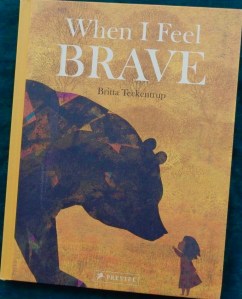
Having presented a girl’s feelings about being angry in When I See Red, Britta Teckentrup examines equally thoughtfully, a girl’s fear and what it means to be brave. By means of the author/artist’s rhyming narrative and evocative collage style illustrations, readers follow a child wandering through a forest who is startled by a huge bear that is initially terrifying, but as she continues her journey, becomes first companion

and by the time they emerge into the light, friend. ‘I can finally see … / that courage and fear / are both part of me’ the child concludes. An important insight indeed and a book that offers child readers and listeners a way of understanding one of their own basic emotions and how bravery allows them to take charge of this emotion.
Try using this first person story as a starting point for a circle time discussion.



 Red Reading Hub - Jillrbennett's Reviews of Children's Books