On the Move: Poems About Migration

On the Move: Poems About Migration
Michael Rosen, illustrated by Quentin Blake
Walker Books

This is a subject very close to the poet’s heart as is evident right from the start when he explores his roots. We read of the experiences of Michael Rosen’s Family and Friends in the first of the book’s four thematic sections. We read too of when he was just a boy and he writes about growing up in London after the end of WW11, and his Polish-Jewish heritage.

The poems in the second and shortest section, The War, are equally poignant comprising parental reminiscences of World War II and incidents during family travels in various parts of postwar Europe

Enormously potent is The Migrants in Me. In this third part, Michael considers missing family members. So says his father: “I had two French uncles. / They were in France / at the beginning of the war. / They weren’t there at the end.”
In the next poem ‘Finding Out,’ Rosen purposefully searches out information about these uncles—Oscar and Martin, learning of old photos of them in a long-hidden box labelled Family Photos.
Then come heart-wrenching poems directly addressing Oscar and Rachel, his wife; these imagine their feelings during escape, discovery by Nazis, and being sent to Auschwitz.

In On the Move Again we read of the poet’s thoughts about migration today, in particular the plight of refugees who flee their homelands in the face of war, famine or other adversity, to start life afresh. It ends with the compelling ‘Today’ – ‘What you did yesterday / can help you choose what to do now. / What you did yesterday and what you do now / can help you plan what to do tomorrow. / But you can only do something now.’

At once commemorative, historical, political and celebratory, Michael’s poems herein have a straightforward power that is echoed in Quentin Blake’s black and white illustrations that have a haunting quality of their own.

The book opens with an explanation of the difference between refugees and migrants and concludes with suggestions of organisations that support refugees.

Old Mother Hubbard’s Dog Takes Up Sport / Old Mother Hubbard’s Dog Learns to Play

Old Mother Hubbard’s Dog Takes Up Sport
Old Mother Hubbard’s Dog Learns to Play

John Yeoman and Quentin Blake
Walker Books

The laugh-out-loud antics of Old Mother Hubbard’s Dog take the form of a variety of playful activities in these two paperbacks.

In the first, Old Mother Hubbard is unhappy at the sight of her canine companion merely lazing around all day and suggests he get up out of his chair, set aside his book and do something more active. And so he does. First it’s tennis (over her full washing line), followed by a spot of pole vaulting, then soccer – with very muddy results.
Having had a bath beside the fire the daft creature heads outside again and further athletic mayhem ensues including putting the shot using live projectiles.
Eventually, unable to stand any more, Old Mother Hubbard orders Dog inside and suggests a much more sober activity.

The second episode begins with Dog in his favourite chair reading once more. Old Mother Hubbard expresses a wish that he “learn how to play.” Before you can turn around she hears a raucous rendition on a flute, closely followed by various other musical instruments. 

Greatly regretting her ill-chosen words, Old Mother Hubbard is at a temporary loss to know what to do, but is ready to try anything including some drupe diversion tactics …

Brilliant nonsense both in John Yeoman’s rhyming narrative and Quentin Blake’s exuberant portrayal of the canine capers; adults and children will love this craziness. Don’t miss the back endpapers.

The Accidental Prime Minister Returns / Roald Dahl Rotsome & Repulsant Words

Books that make us laugh are much needed at the moment: here are two such, sent for review by Oxford University Press

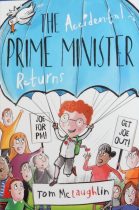
The Accidental Prime Minister Returns
Tom McLaughlin

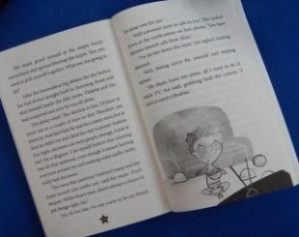
Do I detect a touch of irony in this title? Perhaps the return of Joe who found fame by accidentally becoming Prime Minister while trying to save his local park, knew just when he’d be needed again. Now, I defy you to get through even one chapter of this new story without splitting your sides with sniggering snuffling laughs and ginormous guffaws, let alone wait till chapter four.

Who better than Joe (aka your Primeministerness) to bring back a bit of cheer? So here he is – the perfect counter to all the current doom and gloom – at the ready to remind the populace of life’s good things, and how they can all do their bit to make our great country (or rather, tiny island) and the world, a better place in which to live.

With his entourage, that’s best pal, Ajay dubbed ‘an all round absolute dude, and Alice, democracy’s most mega enthusiast (also a total dude), not to mention Mr Rottweiler (a useful ally?) who else could possibly get our vote. (He’s even got the right colour hair – almost!)

With its healthy herbal juice, spare false eyelashes and an absolute wealth of shenanigans, book seven, laying bare the ups and downs of political life, could not have come at a more apt time. Bring on the ‘coal addition’ – right now!

Delicious daftness of a different kind in:

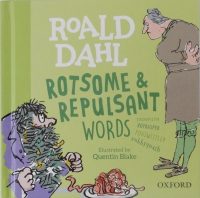
Roald Dahl Rotsome & Repulsant Words
illustrated by Quentin Blake

Roald Dahl was a prolific inventor of rude words. He used some incredibly adroit putdowns and curses, insults and expletive forms.

Now, thanks to editor and lexicographer Dr Susan Rennie, they’ve all been brought together into this collection of naughty-sounding words that will absolutely delight any child (and probably adult) who gets their hands on a copy of Rotsome & Repulsant Words. (my spell check is NOT happy!)

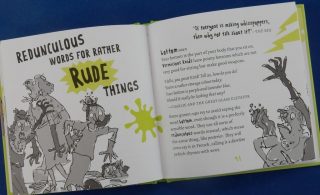
So, if you want to try creating your very own ‘gigantuous’ curse word, there’s a spread to show you how. Or perhaps you’d rather become ‘as Grumpy as a Grandma’ then you can find out how so to do.

I have to say I rather enjoyed the ‘How to be rude in other languages (so grown-ups won’t notice).’ It doesn’t always hold true however: I can recall several occasions when teaching reception and nursery age children, hearing extremely insulting words (meaning much worse things than the examples in this book) coming from the role play area, spoken by children not knowing that their teacher could understand their Hindi, Urdu, Panjabi etc.

Naturally children will relish the collecting of ‘bottom’ words and even more so, those relating to sounds that emanate from same.

There are some smashing onomatopoeic examples here including the Spanish ‘popotraques’ and the Scots ‘rummlypumps’.

Think of the fun you might have in a group discussing ‘swatchwallop’ (the most disgusting thing you can eat. An opportunity for some more creative word inventions methinks. Think too of the wealth of language lessons you could enliven using this with your class.

Whether or not you’re a Dahl fan, I’m pretty sure you’ll relish this little linguistic goldmine, especially with those Quentin Blake illustrations.

The Weed

The Weed
Quentin Blake
Tate Publishing

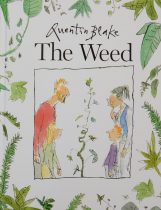
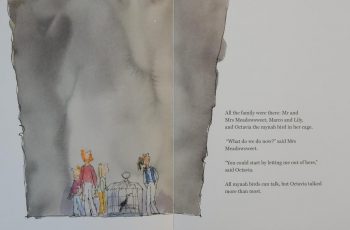
When the Meadowsweet family find themselves at the bottom of a huge crack that’s formed in the earth they decide to set free their mynah bird Octavia.

This proves to be a wise move for it’s not long before she’s back with a seed.

This seed becomes their means of escape from a very tricky situation as little by little then ever more rapidly it grows towards the earth’s surface eventually bursting through.

Up, up, up climb the Meadowsweets through the increasingly lush foliage working up an appetite in so doing. “I hope there’s something left to eat when we get up there. I’m starving,” comments Mr Meadowsweet.

Happily though, they don’t have to wait that long, for the profligate plant puts forth fruits aplenty, as well as foliage, as Mrs Meadowsweet discovers tucking in enthusiastically; but in her eagerness she slips and falls.

Fortuitously, a large comfy leaf cushions her fall and the tendrils of the remarkable plant reunite her with the rest of her family.

The journey of people and plant to the surface is finally accomplished and at the surface the luxuriant and verdant world of a garden of Eden surrounds them after their Jack and the Beanstalk style climb.

We probably all feel like we’re at the bottom of a deep hole just now and we are all looking forward to those green shoots of recovery. So, this fable could be read as a message of hope during these difficult times. Remarkable as its creator Quentin Blake is though, he is not an oracle and one suspects he was merely creating a fun and fantastical story for us all to enjoy.

The Extraordinary Gardener / The Five of Us / Incredible You

Celebrating the paperback editions of 3 Tate Publishing titles:somehow they all speak a similar message to us in this current crisis:

The Extraordinary Gardener
Sam Boughton

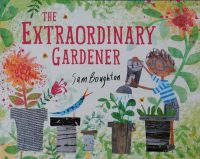
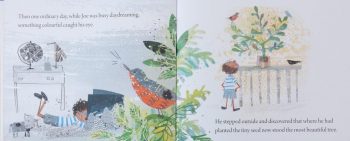
Wildly imaginative, Joe lives in an ordinary apartment in an ordinary city but in his inner world, plants flourish growing taller than skyscrapers and wondrous animals abound.
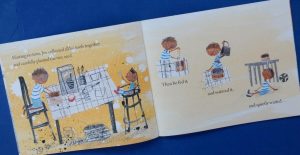
Then thanks to reading one night in bed, a seed of an idea is planted in his mind; it’s colourful, aromatic and joyful sounding. The following morning he sets about transforming that idea into reality, starting with an apple seed and some basic tools.

His idea seems to take ages and ages, almost forever; so much so that Joe forgets his seed and returns to imagining colour into his grey existence. But then one daydreaming day Joe spies something outside, colourful and REAL!

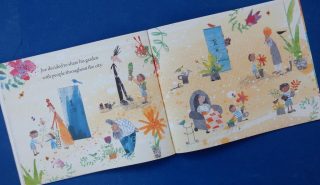
Tender care and new seedlings turn that single tree into a stunningly beautiful garden; a garden admired by his neighbours and that ignites his imagination once again.

More seed gathering ensues and gradually the entire neighbourhood is totally transformed into a riot of colour. Just the kind of awesome moment we all need in our lives just now, and the message too about reaching out to neighbours and strangers.

The more you look at this book, the more you see – the detail is awesome; and Sam Broughton’s way of using greyness and gradually bringing more and more colour into her scenes is wonderful, culminating in a glorious fold-out.

Time to get yourself some seeds, go into your garden (or failing that grab some containers), and begin growing something amazing …

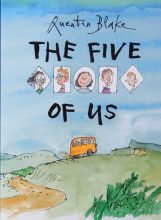
The Five of Us
Quentin Blake

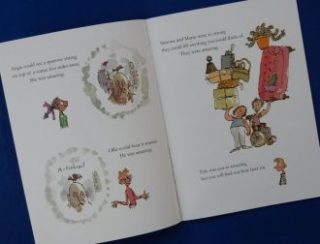
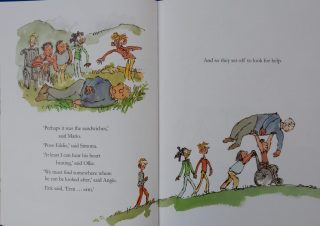
This is an enormously powerful story about how five friends, set out for a picnic into the countryside, in a big yellow bus driven by Big Eddie. Now what we’re told about the five is that each of them has a special, amazing ability: Angie can see things miles away; Ollie’s hearing is supersensitive; Simona and Mario are extraordinarily strong and as for Eric – he’s not yet aware of his superpower, but of that  … more later.

During the picnic Eddie starts feeling “ a bit peculiar’ and suddenly the children have an emergency on their hands. Now more than ever they need to work together

but which of them is going to end up saving the day – or will it be a wonderful collective problem-solving effort.

Quentin Blake’s genius shines forth in every way in this book; his characters are wonderfully portrayed and he leaves plenty of space for readers to bring their own interpretations to the story, though one thing is absolutely clear: do whatever you can – a crisis situation can bring out the most awesome talents in every single one of us.
Written 6 years ago, this is just as timely now – or perhaps even more so.

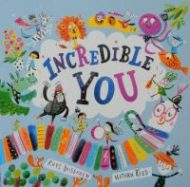
Incredible You
Rhys Brisenden and Nathan Reed

We all have a bad day from time to time and perhaps like the boy protagonist in this book, on especially bad ones, we might wish to be someone or something else.

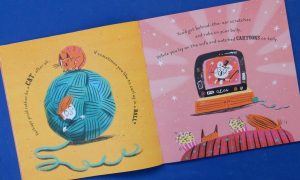
This boy however, having run through the gamut of ordinary

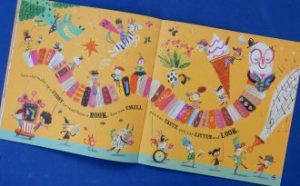
and less ordinary animals and the possibilities offered by so being, comes back round to the senses that he himself possesses and the wonderful wealth of possibilities these can generate.

In short everyone is uniquely AMAZING!

Amazing too is the combination of Rhys Brisenden’s rhyming text and Nathan Reed’s colourful scenes of upbeat characters, animal and human, demonstrating the multitude of ways of being yourself.

Hours of visual stimulus and an abundance of potential talk herein.

Flights of Fancy

Flights of Fancy
Quentin Blake, Anne Fine, Michael Morpurgo, Jacqueline Wilson, Michael Rosen, Julia Donaldson, Anthony Browne, Malorie Blackman, Chris Riddell, Lauren Child
Walker Books

Now in paperback, here’s a truly special gem of an anthology subtitled ‘Let your imagination soar with top tips from ten Children’s Laureates’. It brings together the ten awesome authors and illustrators who have held the title (given in celebration of their outstanding achievements) and first awarded to Quentin Blake in 1999.

To open, Michael Morpurgo explains how the original idea of the role (each person holds it for two years), was first thought up by himself and Ted Hughes, the then Poet Laureate.

You might be especially interested in poetry, rhyme and wordplay, if so head first to the sections from Michael Rosen and Julia Donaldson. Michael in Poetry Belongs to Everyone talks about playing around with a word to create a poem. Julia Donaldson’s Plays to Read and to Write discusses one of her own plays that she based on the Aesop’s fable, The Hare and the Tortoise, offering a fun, lively 6-parter

If you’d rather be playful in the visual sense then Anthony Browne’s The Shape Game could be your starting point: having talked about how to play it, he showcases some examples from 3 other famous illustrators to whom he gave the same shape to play as the one of his own shown in the book. The potential with this one is endless. Probably that is the case with most of the chapters however.

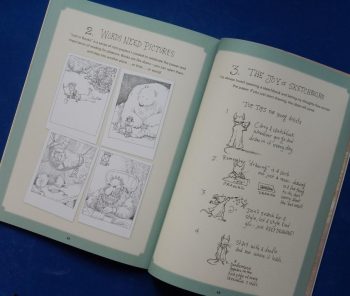
In The Only Way to Travel, Quentin Blake writes with reference to  Dahl’s stories, about how when illustrating someone else’s texts it’s important to ‘put yourself inside their story’ and capture the atmosphere before diving in and drawing those fabulous illustrations of his.

More about how other fabulous illustrators approach their drawing and what provides their inspiration comes from Chris Riddell –

make sure you check out his brilliant cartoons of all ten Children’s Laureates in the final section – and Lauren Child.

How fantastic and moving is Michael Morpurgo’s Find Your Own Voice that tells children how to do so in ‘I Believe in Unicorns’.
I thoroughly enjoyed too, Malorie Blackman’s Taking a Word for a Walk using SEA as her example,

before she moves on to discussing from whose viewpoint a story is being told when one writes.

If you want to inspire children to let their imaginations soar, then you really, really must have a copy of this cracker of a book in your home or classroom; not only will it do just that, but it will also ignite or add fuel to a passion for reading, writing and illustrating. (BookTrust, which manages the Children’s Laureate gets 50p from every sale.)

Mimi and the Mountain Dragon / On Angel Wings

Mimi and the Mountain Dragon
Michael Morpurgo and Helen Stephens
Egmont

I’d not until now come across this story, despite it originally being published five years ago and subsequently made into a musical play. It’s said to be inspired by the author’s visit to a village in Switzerland some years earlier and tells of a fearsome dragon that lives in her castle lair high in the mountains, and a little girl, Mimi who lives in the village below.

One snowy Christmas morning Mimi discovers a baby dragon in the woodshed.

As the entire village population, her father among them, had been chanting ‘Death to the Mountain Dragon!’ the previous day, she knows she must keep him a secret and get him back to his mother as soon as possible.

Waiting until everyone else is safely inside the church for the Christmas service, she bravely sets out alone up the mountain.
Once at the castle, Mimi almost decides to flee when she finds herself face to face with the terrifying Mountain Dragon; but before she can move, the baby launches himself towards his mother and the two are reunited.

With mother and baby dragon now back together, Mimi is no longer scared but she knows she must get back down to the village. She also knows that the disaster that happens thereafter has nothing to do with the Mountain Dragon as the villagers suppose.

All ends happily thanks in fact, to the dragon …

With the folk style feel to Michael Morpurgo’s Christmassy telling and Helen’s equally folksy illustrations, this is a timeless book that can be enjoyed and revisited year after year.

On Angel Wings
Michael Morpurgo and Quentin Blake
Egmont

Created by dream team erstwhile Children’s Laureates Michael Morpurgo and Quentin Blake, this is a beautiful reworking of the nativity story for older readers/listeners.

Imbued throughout with warmth and humour, Michael Morpurgo’s telling captivates from its opening lines, ‘The truth is that once we weren’t children anymore, we never did believe Grandpa’s story, not really—as much as we might have wanted to…. We still loved listening to it, though. Christmas nights would never have been the same without it.’ This sets the scene for Grandpa, then a young shepherd boy, to tell his tale of what happened on the night Christ was born.

A family of shepherds is visited by the angel Gabriel: “Oh dear … I can see you are going to need some convincing,“ he says in response to their questions but convince them he does (with the aid of a host of angels).

Off they set towards Bethlehem leaving the far from happy youngest among them to mind the sheep, despairing of the unfairness of his situation.

But then Gabriel appears before the boy

saying “So I’ve had this idea, to make it a little fairer. I could fly you there and back, lickety-split, and no one would ever know you’d been gone.” (I love that use of colloquial language.) And so he does with the result that the lad is the first visitor to the stable.

He leaves the infant his very own shepherd’s crook before Gabriel wings him back to the flock of sheep, though that isn’t quite the end …

Quentin Blake’s distinctive ink and watercolour illustrations deepen both the wit and poignancy of Morpurgo’s telling making this a book to cherish.

A Scattering of Magic: The Magic Misfits: The Second Story / The Littlest Witch / Lavinia and the Magic Ring

The Magic Misfits: The Second Story
Neil Patrick Harris with Lissy Marlin and Kyle Hilton
Egmont

I hadn’t read the first The Magic Misfits book so in case you’re in the same situation, it tells how young street musician Carter having been taken in after the disappearance of his parents, by his Sly ‘uncle’ Mike, escapes and ends up becoming friends with other variously talented children who together form The Magic Misfits.

This second story continues right on from the first only the focus now turns to Leila Vernon who lives with her two fathers above Vernon’s Magic Shop.

One day out of the blue, a stranger from Dante’s past appears in the shop. The woman, Sandra Santos, aka Madame Esmerelda, was so she says, a friend of Carter’s father.
What though is she doing in Mineral Wells? Whatever it is, it might be that she knows why Leila was placed in an orphanage and by whom. Could it be that Sandra holds the key to these questions?

Scattered throughout this intriguing pacey tale are riddles and puzzles as well as some magic tricks to try and a liberal sprinkling of black and white illustrations by Lissy Marlin.

Carter, Leila and her friends are well worth getting to know, especially for readers who like their stories sprinkled with magic.

The Littlest Witch
Bianca Pitzorno, illustrated by Mark Beech
Catnip

The author of this crazy book is considered to be one of Italy’s best childrens’ writers. It’s a tale of a young man, Alfonso Terribile and what happens when his Great Uncle Sempronio dies.

Alfonso is left a fortune but there is a condition: he has to marry a witch and do so within a year and a month or else his fortune will go elsewhere.

There’s a zany cast of characters including the Zep’s seventh daughter, the infant Sibylla who seems to be behaving in a rather strange fashion. Could she perhaps be the one? Maybe, but there are a lot of other possible contenders too, not least being the spirited Wanda …
Greed quickly consumes Alfonso but will he manage to fulfil his uncle’s criteria? That would be telling; let’s just say that he receives his just deserts.

Mark Beech’s line drawings scattered throughout the book add to the delightful quirkiness.

Lavinia and the Magic Ring
Bianca Pitzorno, illustrated by Quentin Blake
Catnip

Imagine what might happen if you were a little girl and received a ring with a very special power. That is what happens one chilly Christmas Eve, to seven-year-old Lavinia, a modern-day match girl residing in Milan.

Lying in the cold just before midnight dreaming of good things to eat, she’s suddenly awoken by a beautiful lady dressed unsuitably for the cold, asking for a light and professing to be a fairy. Lavinia is nonplussed but agrees and by way of thanks, the witch slips a ring onto her finger, a magic ring that turns things into poo – yes poo!

The girl’s reaction is to try and pull the thing off right away, but the ring is stuck fast.

Now it’s up to Lavinia to use her weird powers judiciously.

There are a lot of decidedly stinky situations in this story so definitely don’t give it to a squeamish child; the rest however will doubtless revel in the ponginess of Lavinia’s mess-making escapades hilariously illustrated by none other than the inimitable Quentin Blake.

Roald Dahl’s 123 & Roald Dahl’s Opposites

Roald Dahl’s 123
Roald Dahl’s Opposites

illustrated by Quentin Blake
Puffin Books

‘Board books with bite’ announces the accompanying press release.

Said bite comes courtesy of The Enormous Crocodile that features large and very toothily in both books.

Toddlers can have some enjoyable counting practice along with the little ‘chiddlers’ – 10 in all, who co-star in the 123 along with the wicked-looking croc. that, having spied some tasty looking fare while lurking in the undergrowth, then disguises himself as a roundabout ride, a palm tree, a seesaw and a picnic bench.

And all the while he’s biding his time, waiting to sate his lunchtime appetite: oh my goodness those gaping jaws, those vicious-looking teeth.

Will the 10 chiddlers cease their play and beat a hasty retreat before they become 1 Enormous Crocodile’s next meal?

Fifteen opposites are demonstrated, thanks to the creatures big and not so big that feature in the second book, along with of course, a certain Crocodile.

On alternate spreads, this book has foliage of different kinds, behind which are hidden a ‘little’ mouse, the ‘upside down’ crocodile, the same crocodile now snapping through a ‘low’ tree trunk, as well as a ’light’ frog leaping.

But what will the wily Crocodile snap ‘closed’ his enormous jaws upon? That question is answered on the final page.

The countless parents who were brought up on the originals will relish the opportunity to share these new incarnations with their offspring. Clearly the intended toddler audience of the board books will not be familiar with Roald Dahl’s characters and Quentin Blake’s iconic images of same, but they will still delight in language such as the BFG ‘childdlers’ and the storyline of both the counting book and the opposites.

The Young Performing Horse

DSCN7536

The Young Performing Horse
Quentin Blake & John Yeoman
Andersen Press
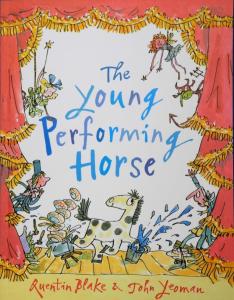
First published almost forty years ago, the Young Performing Horse – should he now be called the Middle Aged Performing Horse? – is back to delight a new generation.
Poor farm children, brother and sister Bertie and Vicky buy a horse at an auction – the only one remaining – and he’s a rarity, a Young Performing Horse, so the auctioneer claims. Certainly he’s unusual with his ‘big eyes, long eyelashes, baggy skin, thick legs and shiny black hooves.’ and the twins fall in love with him straightaway. The adult Priddys had intended that the creature should carry their children to school instead of them having to trudge the long distance every day but he’s not big enough. He does however, accompany the twins to said school, trotting alongside them and even participating in lessons.

%0A

When the family face hard times, the twins persuade their parents not to sell the horse, but to let them take him with them to London where they’ll seek their fortune.
Eventually they reach the big city …

%0A

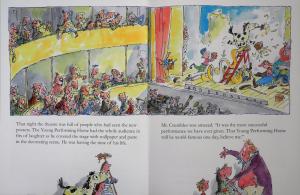
and find the location of Mr Crumbles’ theatre (an address given them by their teacher who happens to be Mr Crumbles’ friend.) and happily for them, there they spot a large sign saying “YOUNG ACTORS REQUIRED’. Having seen what their horse can do, Mr Crumble allows him to perform alongside the twins and the show is a great success …

DSCN7539

So much so that the company is summoned to Buckingham Palace to give a Royal Command Performance in front of her majesty.

DSCN7540

Suitably impressed, the Queen expresses a wish that all her subjects might have the opportunity to see a Young Performing Horse at Christmas. This gives Bertie a brilliant idea: could this be the origins of the pantomime horse? Whether or not it is, the Christmas shows all over the country make a fortune for Mr Crumble and his company and all ends happily for everyone concerned.
The partnership between John Yeoman with his wonderfully imaginative text and Quentin Blake with his sparklingly witty illustrations, results in a magical tale with a Dickensian feel to it. It’s a magic that will still hold audiences in its thrall even after all this time.
Was this cracking book ever made into a Christmas TV entertainment for children? If not, it should be …

Use your local bookshop  localbookshops_NameImage-2

WNDB_Button

Tell Me a Picture/Following My Paint Brush

DSCN3987 (800x600)

Tell Me a Picture
Quentin Blake
Frances Lincoln Children’s Books
Subtitled Adventures in looking at art, this excellent book introduces its readers to twenty six paintings that were Quentin Blake’s choice for an exhibition that was held at the National Gallery in 2001. Representing a wide range of artists, alphabetically arranged we start with

DSCN3986 (800x600)

Avercamp’s A Winter Scene with Skaters near a Castle and conclude with Austrian picture book illustrator, Lisbeth Zwerger’s scene from Dwarf Nose, one of her collaborations with Wilhelm Hauff.
The former is packed full with detail and narrative possibility. However there is no wordy preamble about the painting as such, merely the artist’s name on a display board sign held by one of Blake’s characteristically offbeat characters alongside whom are other Blake characters who are discussing the painting by way of a prelude. The latter might send readers off in all manner of directions depending on what they are bringing to the painting.


DSCN3984 (800x600)

Actually that is part of the appeal of the whole enterprise: every time one turns the page or opens the book afresh, there is the possibility of new stories emerging. It truly is about opening up: opening up to the countless possibilities offered by way of interpretation and inspiration and of course, creativity and the imagination. I’m not dismissing of course, the notion that the book could also act as a starting point for inquiry of a more academic nature but that I’d say comes later.
And, how wonderfully those half dozen or so picture book artists of today (and I’m including Gabrielle Vincent here) stand up against the painters from as far back as the fifteenth century.
How I wish I’d been able to visit the National Gallery exhibition but I must content myself with this wonderful volume and the opportunities it offers me to share its contents with, and I hope inspire, children of all ages although, hopefully not to try emulating the antics of those shown in the lead-in to Polish illustrator Józef Wilkon’s Bats in the Belfry

DSCN3985 (800x600)

which is not a book I’m familiar with although I love some of his other picture books.

DSCN4207 (600x800)

Following My Paintbrush
Duari Devi and Gita Wolf
Tara Books
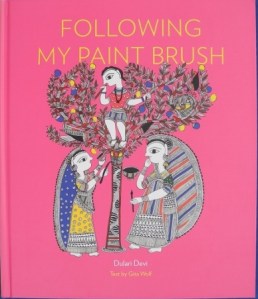
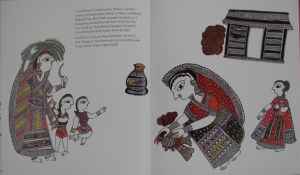
This is an inspiring, first person narrative account of how one woman, a domestic worker, follows her dreams and learns to become a painter.
Dulari Devi, from a poor village family, was unable to go to school. Instead she had to work with her mother caring for her brothers and sisters, selling in the market fish her father had caught, and working in other people’s homes as a domestic; sometimes she wished for more.
One day she stops to watch a group of children by the village pond and in her own words, “As I stood and looked at the children playing, the scene turned into a picture in my mind. It came alive, bright and lively, telling stories …

DSCN4215 (800x600)

Shortly after, she accompanies her mother to work at the home of an artist and is inspired by her paintings. Back home she begins creating her own things of beauty.

DSCN4216 (800x600)

Returning the next day, Dulari asks if she can join the painting class her employer is teaching and thus begins her journey of learning and discovery. Hard work, yes, but painting soon becomes part of her life and still is to this day. For now, as she says, “I am not just ‘a cleaner woman’, I am an artist.” And one who, having met a book publisher can finally say, “I have made a book.”- this one.
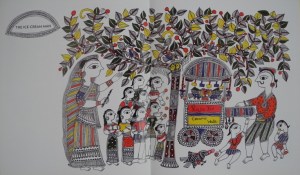
The distinctive artistic style Dulari uses is called Mithila and is a folk art characterised by bold images, richly patterned with lines, zigzags, circles and often, vividly coloured.
Here is one of the glorious paintings from the book…
DSCN4217 (800x600)

Truly an uplifting account of an individual discovering and developing her innate creativity, and a powerful, stunning creation to share with children everywhere whether you want to explore with them a distinctive artistic style from another culture, or inspire them to develop their creativity and follow their dreams. I’d suggest both.

Use your local bookshop localbookshops_NameImage-2